Problem 23 · 2017 Math Kangaroo
Stretch
Geometry & Measurement
Algebra & Patterns
pythagorean-tripledifference-of-squares
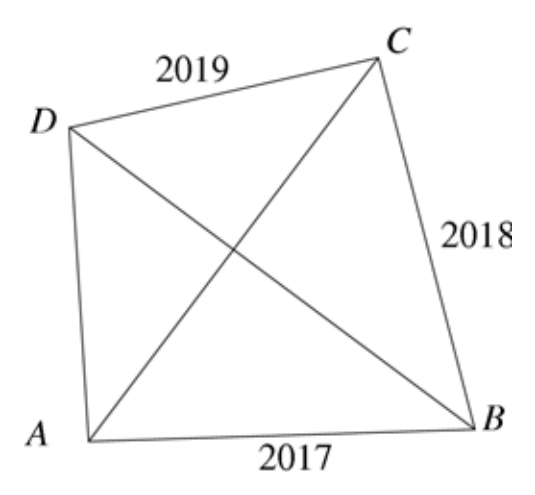
In a convex quadrilateral ABCD the diagonals are perpendicular to each other. The length of the edges are AB = 2017, BC = 2018 and CD = 2019 (diagram not to scale). How long is side AD?
Show answer
Answer: D — \(\sqrt{2018^2 + 2}\)
Show hints
Hint 1 of 2
When the diagonals of a quadrilateral are perpendicular, opposite sides obey a neat relation.
Still stuck? Show hint 2 →
Hint 2 of 2
For perpendicular diagonals, \(AB^2 + CD^2 = BC^2 + AD^2\).
Show solution
Approach: apply the perpendicular-diagonals side relation
- With perpendicular diagonals, \(AB^2 + CD^2 = BC^2 + AD^2\).
- So \(AD^2 = 2017^2 + 2019^2 - 2018^2\). Writing \(2017 = x-1\), \(2019 = x+1\), \(2018 = x\) gives \((x-1)^2 + (x+1)^2 - x^2 = x^2 + 2\).
- Thus \(AD = \sqrt{2018^2 + 2}\), choice D.
Mark:
· log in to save