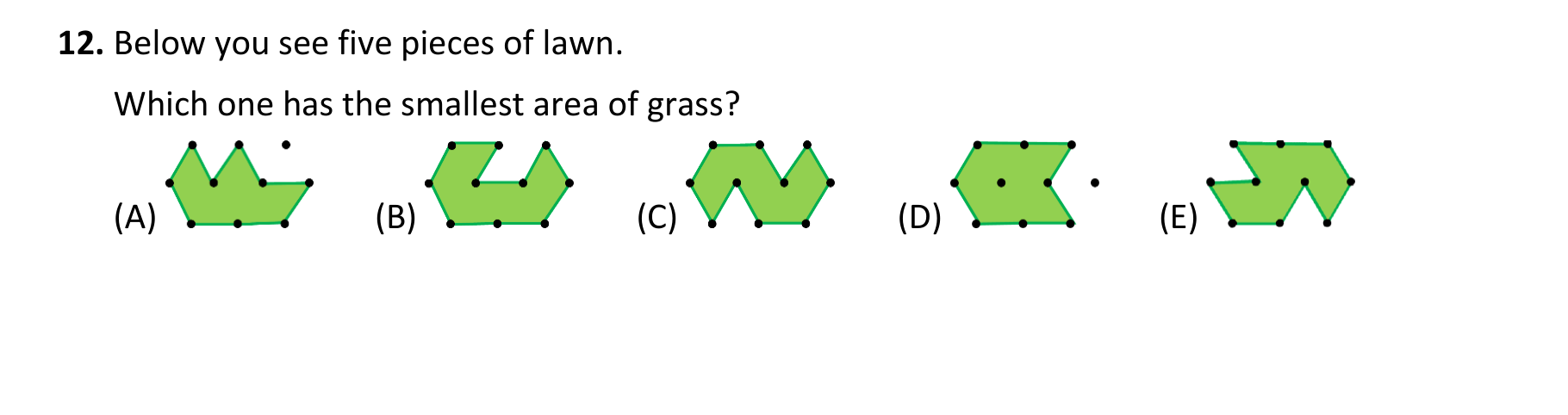
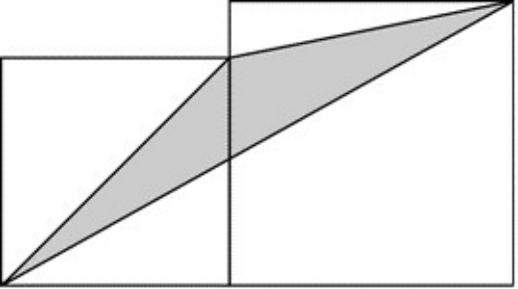
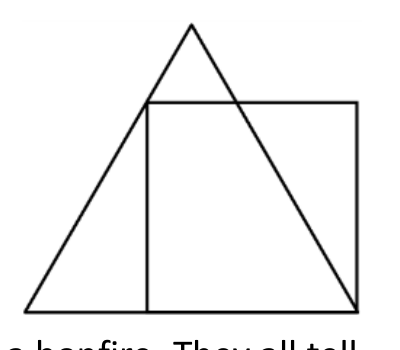
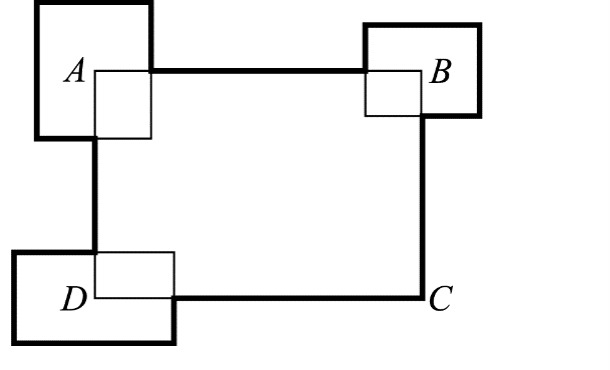
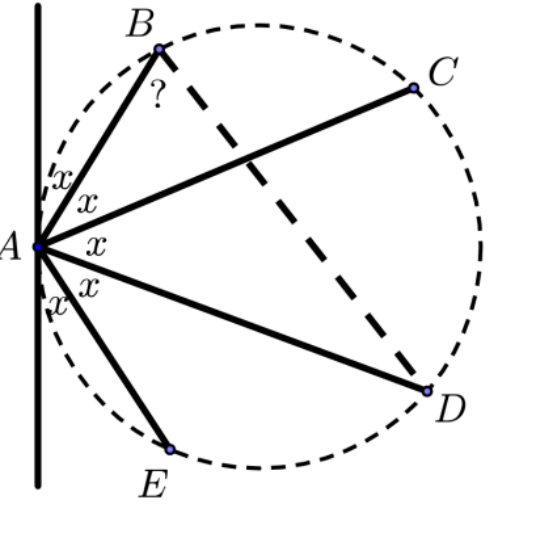
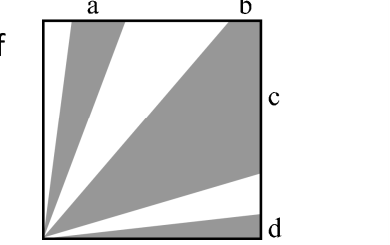
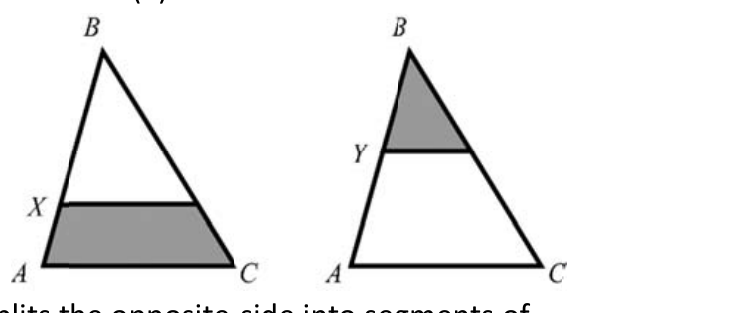
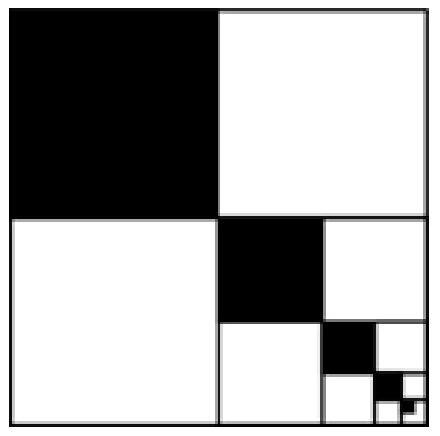
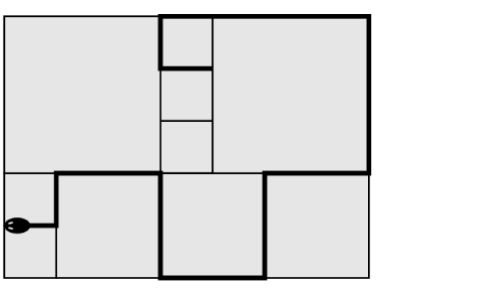
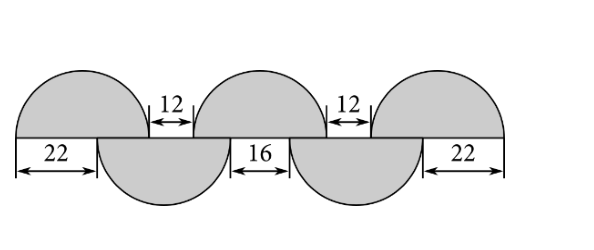
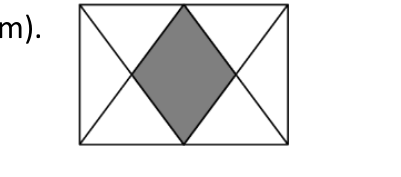
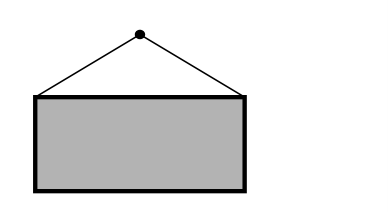
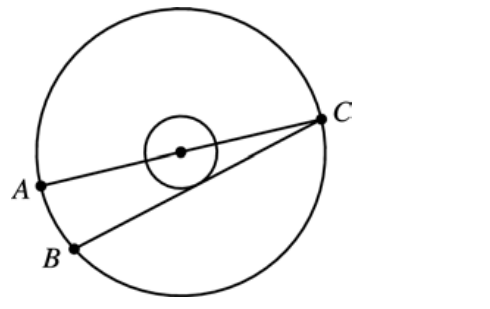
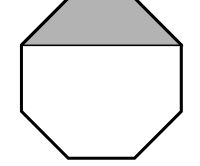
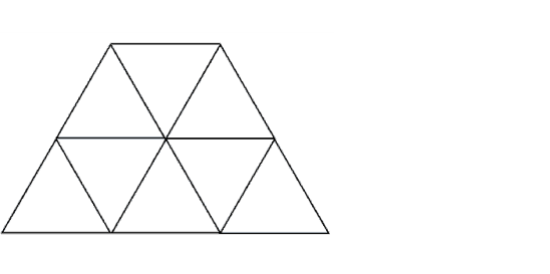
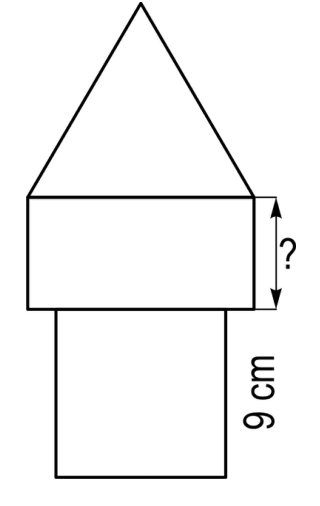
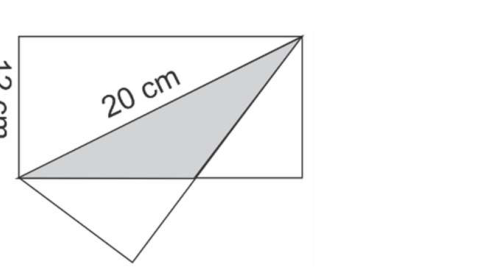
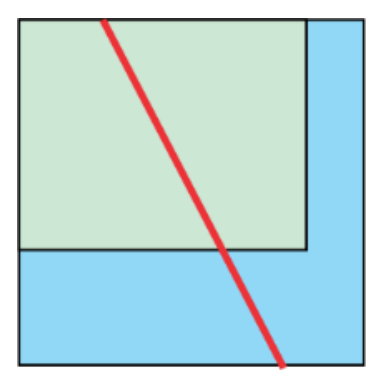
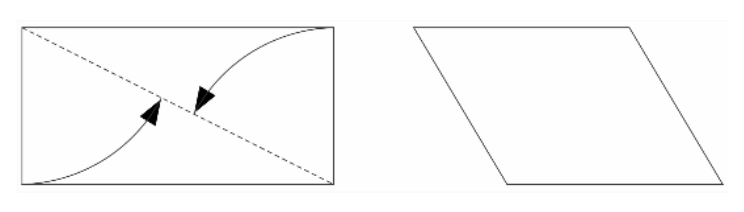
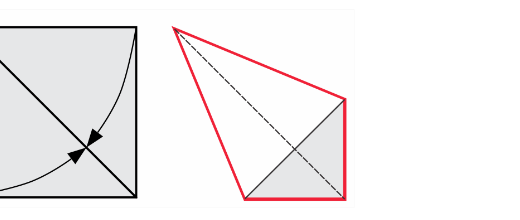
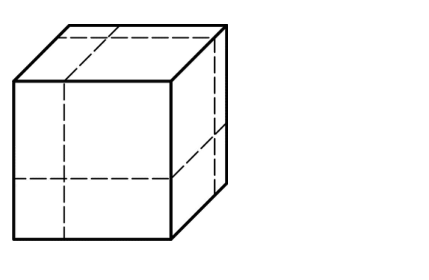
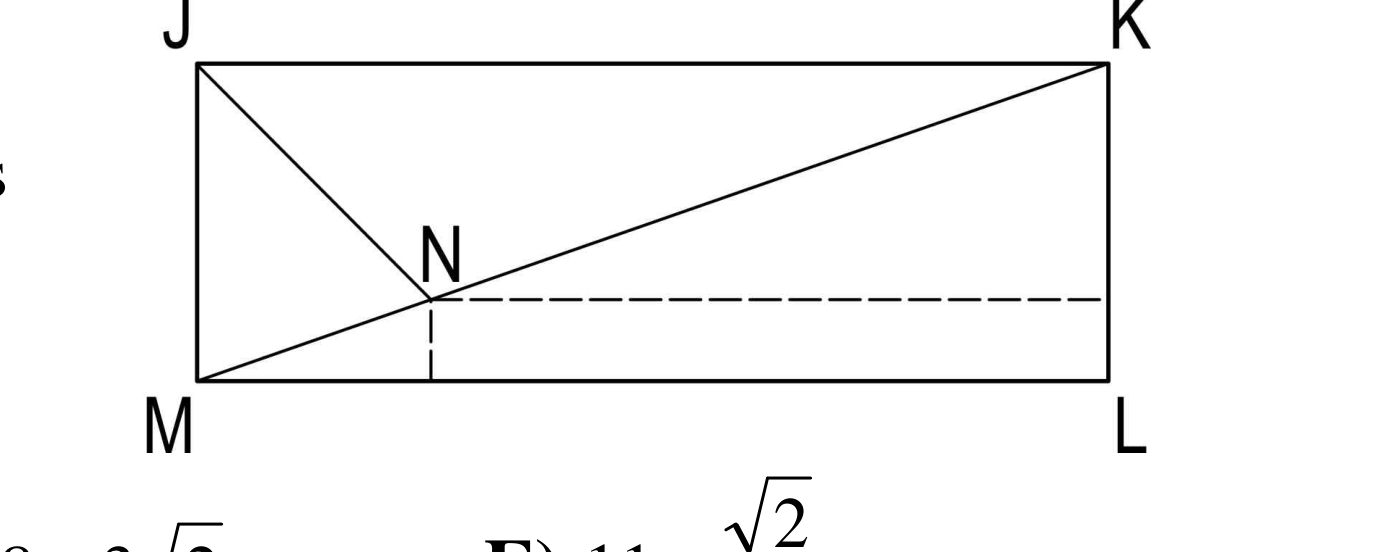
The base of a triangle is extended by 50% and its height is reduced by one third. What is the ratio of the area of the new triangle to the area of the original triangle?
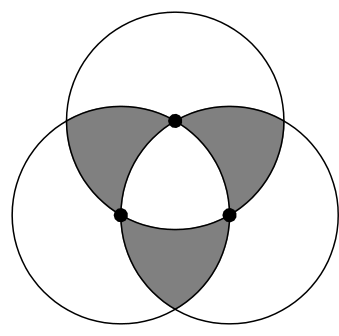
Show answer
Answer: B — 1:1
Show hints
Hint 1 of 2
A triangle's area is proportional to base times height.
Still stuck? Show hint 2 →
Hint 2 of 2
Multiply the two change factors together and see what happens to the product.
Show solution
Approach: multiply the two scale factors
Extending the base by 50% makes it \(\tfrac{3}{2}\) of the old base; reducing the height by one third makes it \(\tfrac{2}{3}\) of the old height.
Area scales by \(\tfrac{3}{2}\times\tfrac{2}{3}=1\), so the area is unchanged.
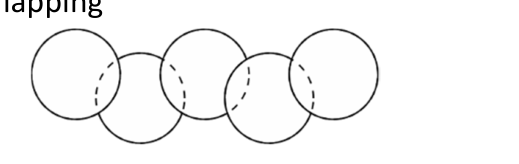
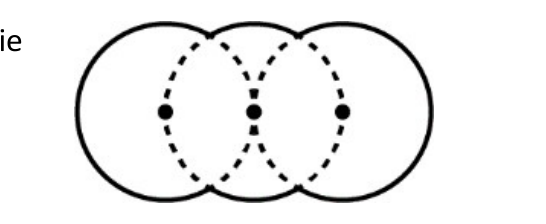
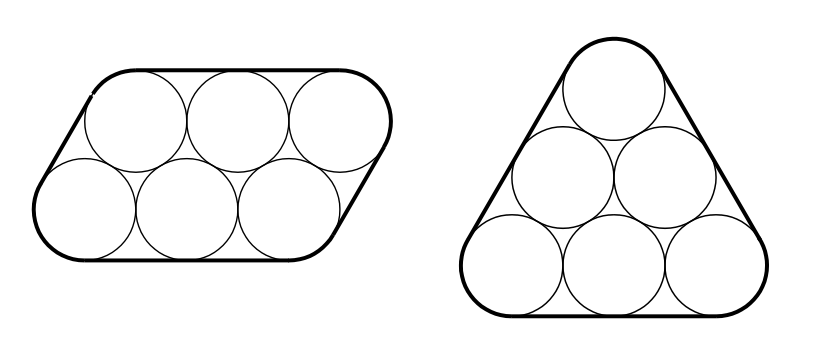
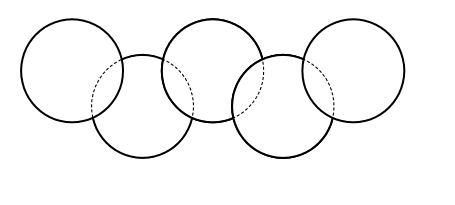
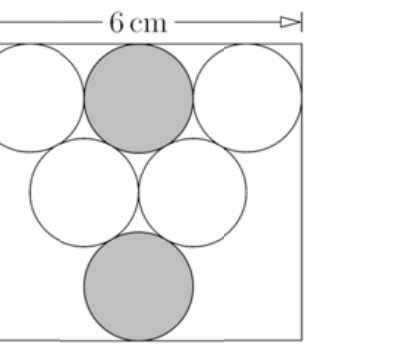
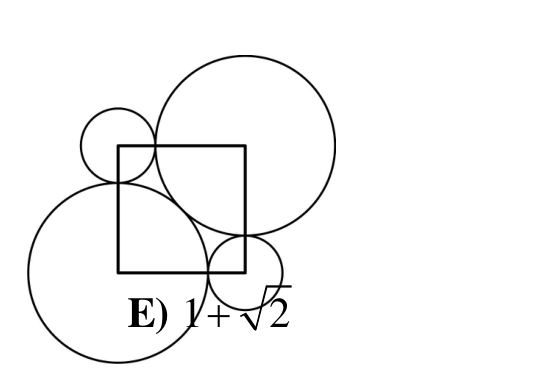
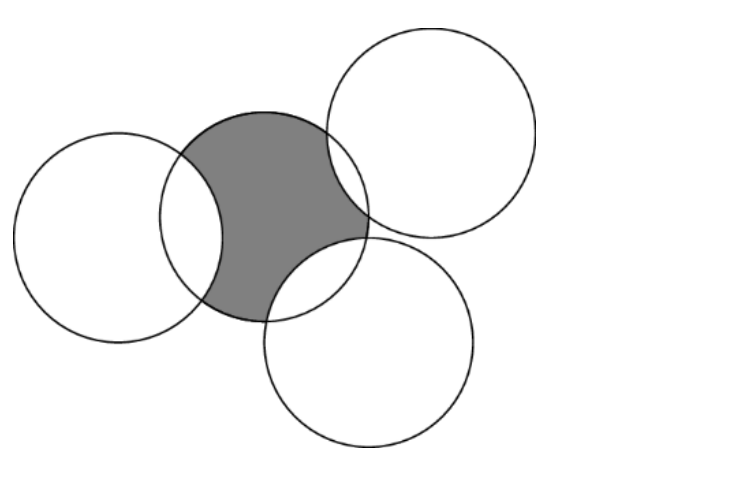
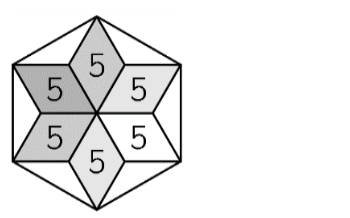
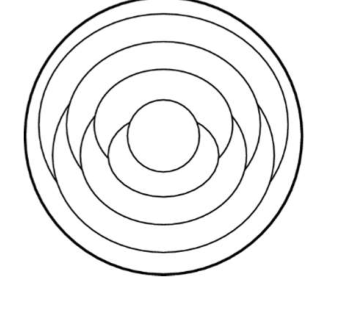
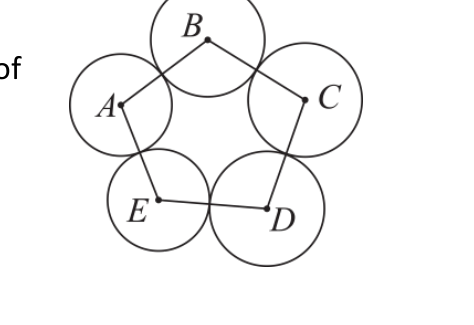
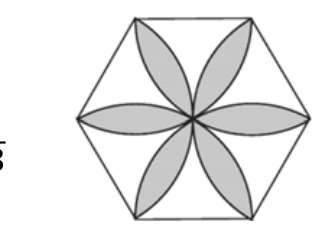
Five circles, each with an area of 8 cm², overlap to form the figure shown. Each overlapping region has an area of 1 cm². What is the total area of the figure, in cm²?
Show answer
Answer: B — 36
Show hints
Hint 1 of 2
Add the five circle areas, then fix the double counting where they overlap.
Still stuck? Show hint 2 →
Hint 2 of 2
Each of the four overlaps was counted twice, so subtract it once.
Show solution
Approach: inclusion–exclusion on overlapping areas
Five circles give 5 × 8 = 40 cm² if simply added.
The four overlap regions (1 cm² each) were each counted twice, so subtract 4 cm².
Total figure area = \(40 - 4 = 36\) cm², which is (B).
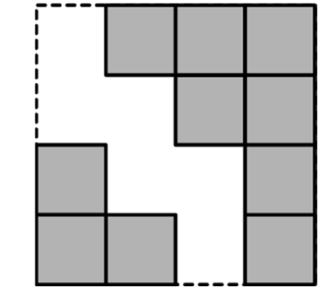
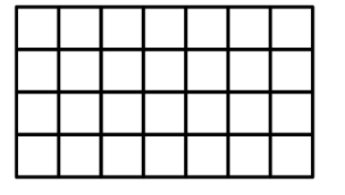
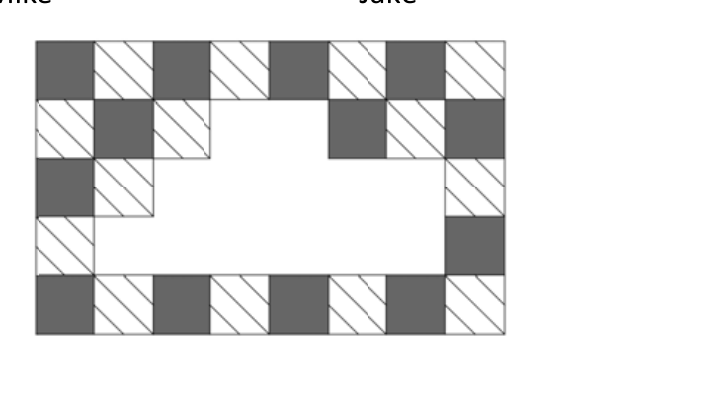
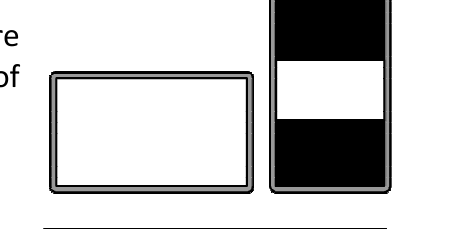
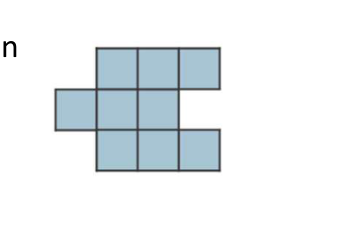
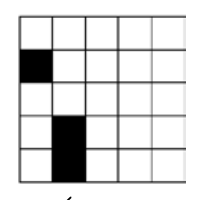
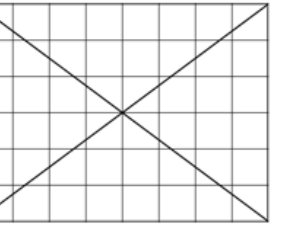
The rectangle on the right has 4 rows and 7 columns, so it is made of 28 white squares. Ira paints 2 whole rows and 1 whole column. How many squares are still white?
Show answer
Answer: C — 12
Show hints
Hint 1 of 3
Instead of counting the painted squares, count the ones that stay white.
Still stuck? Show hint 2 →
Hint 2 of 3
A square stays white only if its row was not painted AND its column was not painted.
Still stuck? Show hint 3 →
Hint 3 of 3
How many rows are left unpainted, and how many columns?
Show solution
Approach: count the white squares directly using the leftover rows and columns
A square stays white only when both its row and its column are unpainted.
Ira paints 2 of the 4 rows, so 2 rows stay white; she paints 1 of the 7 columns, so 6 columns stay white.
The white squares fill those 2 leftover rows across those 6 leftover columns: 2 × 6 = 12.
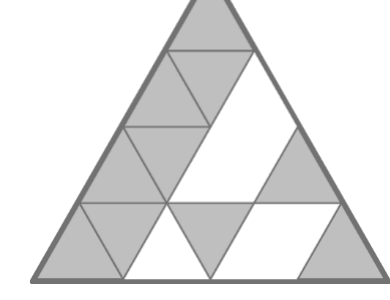
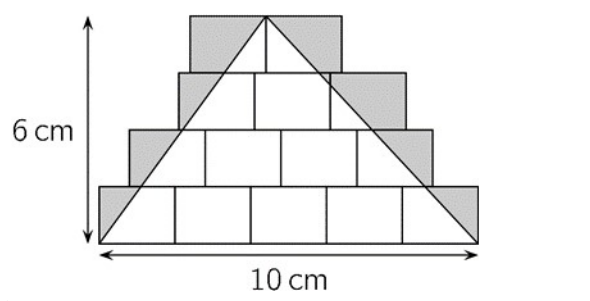
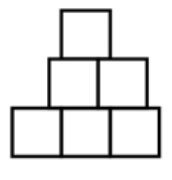
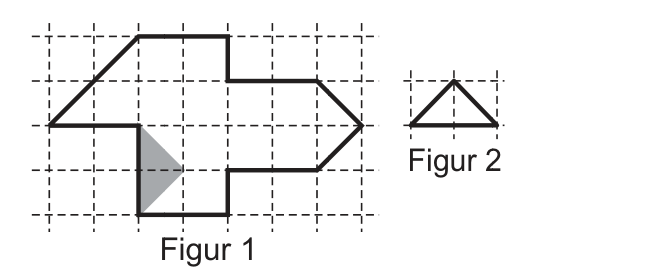
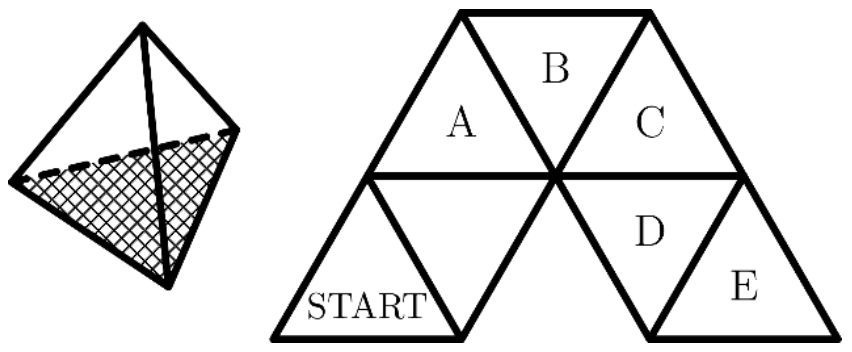
Bruno builds a big triangle out of small triangles that are all the same size. Some are already placed (shown grey). How many more small triangles does he need so that the big triangle is completely filled?
Show answer
Answer: B — 6
Show hints
Hint 1 of 3
The grey little triangles are already glued in; the white spaces are the holes still to fill.
Still stuck? Show hint 2 →
Hint 2 of 3
We only need to count the white triangles, because each hole needs exactly one more small triangle.
Still stuck? Show hint 3 →
Hint 3 of 3
Carefully point to and count every white triangle, one by one.
Show solution
Approach: count the white holes
The grey triangles are already placed, so we just need to fill the white holes.
Touch and count each white triangle one at a time.
There are 6 white triangles, so Bruno needs 6 more.
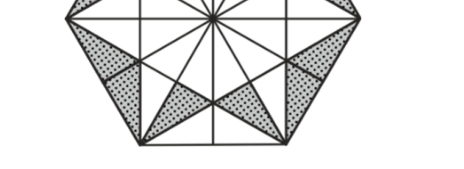
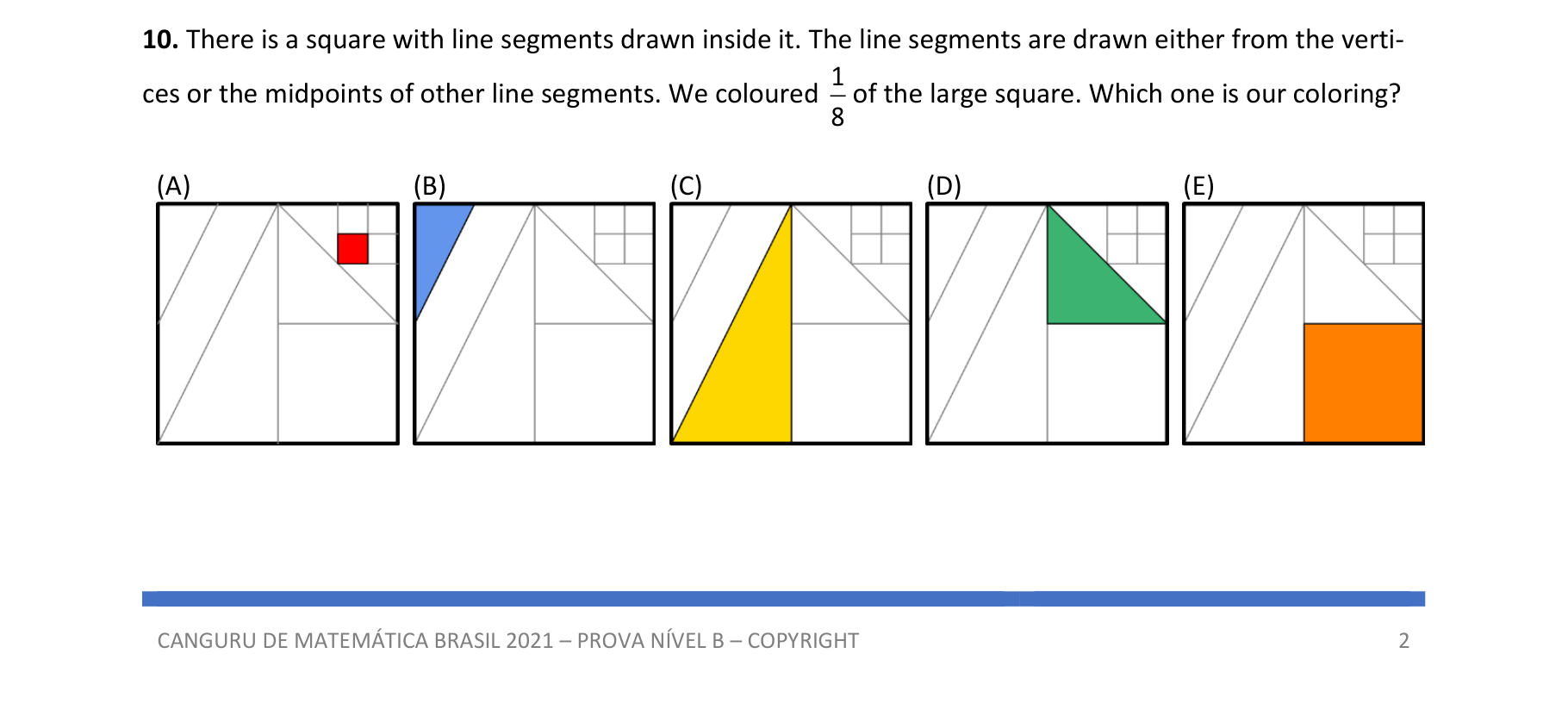
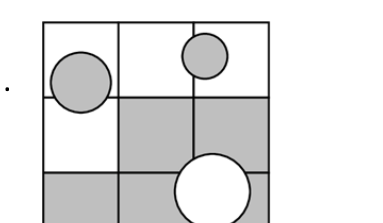
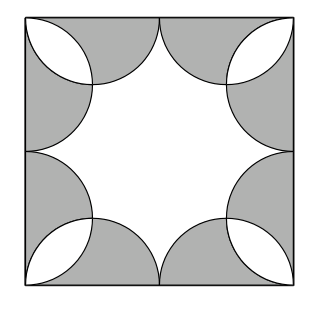
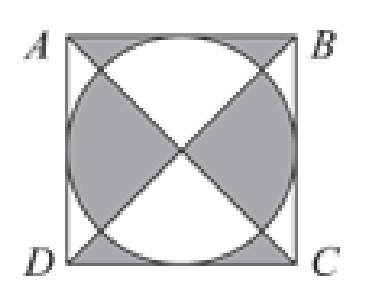
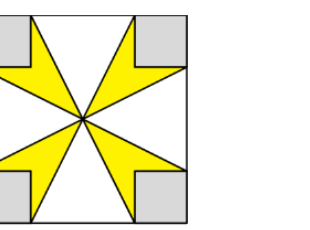
There is a square with line segments drawn inside it. The line segments are drawn either from the vertices or the midpoints of other line segments. We coloured \(\frac{1}{8}\) of the large square. Which one is our coloring?
Show answer
Answer: D
Show hints
Hint 1 of 2
Compare each shaded region's area to the whole square; you want exactly one eighth.
Still stuck? Show hint 2 →
Hint 2 of 2
Use the vertex/midpoint lines to size each shaded piece as a fraction of the big square.
Show solution
Approach: measure each shaded area as a fraction of the square
The internal lines join vertices and midpoints, so each shaded piece is a simple fraction of the large square.
Sizing them, only the region in choice D is exactly 1/8 of the square.
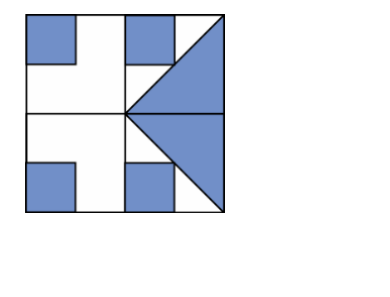
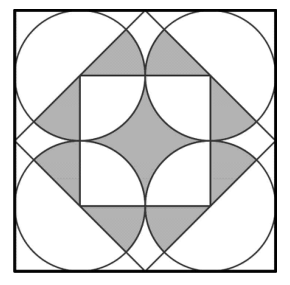
One square was divided into four equal squares, containing equal colored squares and equal colored triangles, as shown in the picture. What fraction of the original square does the colored part represent?
Show answer
Answer: B — 12
Show hints
Hint 1 of 2
The big square is four equal small squares; work out the colored part of each small square.
Still stuck? Show hint 2 →
Hint 2 of 2
Add up the colored squares and triangles and compare with the area of the whole figure.
Show solution
Approach: add the colored pieces and compare to the whole
Each small square is one quarter of the whole, and the colored squares and triangles together fill exactly half of the big square.
Counting the shaded unit squares and the shaded half-squares (triangles) gives a colored area equal to two of the four small squares.
That is 2 out of 4, i.e. 1/2 of the original square — choice B.
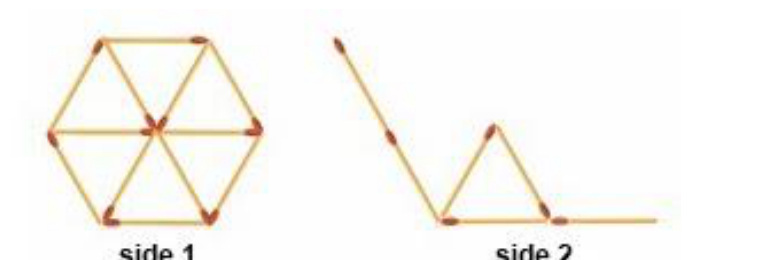
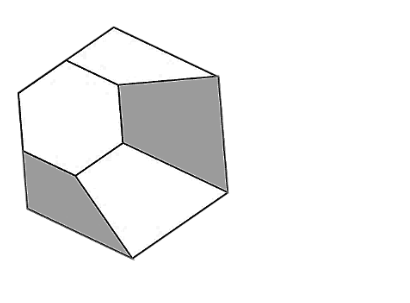
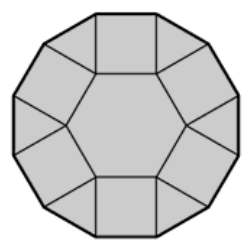
The figure of side 1 is formed by six equal triangles, made with 12 matchsticks. How many matchsticks are needed to complete the figure of side 2, shown partially started?
Show answer
Answer: D — 36
Show hints
Hint 1 of 2
Side 1 (a hexagon of six triangles) uses 12 sticks; side 2 is the next size up of the same pattern.
Still stuck? Show hint 2 →
Hint 2 of 2
Count the matchsticks in the full side-2 figure — the stick count grows faster than the side.
Show solution
Approach: scale the matchstick count to the next size
Side 1 is six small triangles forming a hexagon and needs 12 sticks.
Side 2 is the same hexagonal pattern built one size larger, and a full count of its segments comes to 36 sticks.
So 36 matchsticks are needed to complete the side-2 figure — choice D.
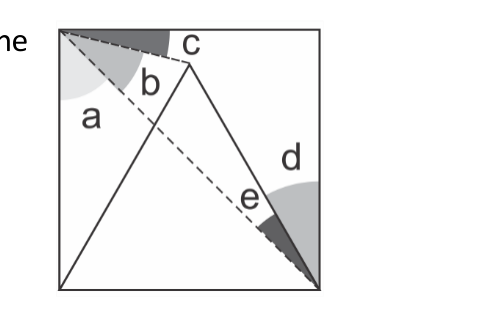
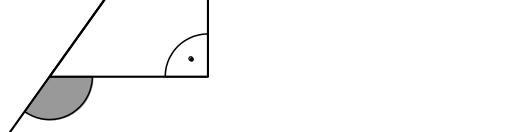
In the figure, formed by a square and an equilateral triangle, the letters indicate the measures of the angles. Which of the following equalities is true?
Show answer
Answer: E — e + d = a
Show hints
Hint 1 of 2
The triangle is equilateral (all 60°) and the square has all 90° corners; mark what each labelled angle is built from.
Still stuck? Show hint 2 →
Hint 2 of 2
Track the angles along the slanted lines and look for the relation that always balances.
Show solution
Approach: chase angles using the 60° and 90° pieces
The shape combines a square (90° corners) and an equilateral triangle (60° corners), so every labelled angle is a combination of these.
Following the diagonal that splits the figure, the angles e and d on one side add up to the angle a on the other.
A triangle ABC has side lengths 6 cm, 10 cm and 11 cm. An equilateral triangle XYZ has the same perimeter as triangle ABC. What is the side length of triangle XYZ?
Show answer
Answer: B — 9 cm
Show hints
Hint 1 of 2
Equal perimeters means the two triangles have the same total side length.
Still stuck? Show hint 2 →
Hint 2 of 2
Find the perimeter of ABC, then split it into three equal sides.
Show solution
Approach: match perimeters, then divide by 3
Perimeter of ABC = 6 + 10 + 11 = 27 cm.
The equilateral triangle has the same perimeter, so each side = 27 : 3 = 9 cm.
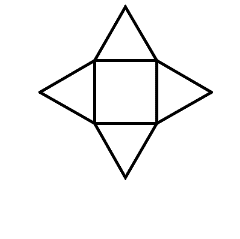
A star is made of a square and four triangles. All the sides of the triangles are equally long. The perimeter of the square is 36 cm. What is the perimeter of the star?
Show answer
Answer: E — 72 cm
Show hints
Hint 1 of 2
First get the side of the square from its perimeter.
Still stuck? Show hint 2 →
Hint 2 of 2
The star's outline is made only of the slanted triangle sides - the square's edges are hidden inside - so count how many of those equal sides form the border.
Show solution
Approach: find the equal side length, then count the edges on the star's outline
The square has perimeter 36 cm, so each side is 9 cm.
All the triangle sides equal that side, namely 9 cm.
The star's boundary is the two outer sides of each of the four triangles: 4 x 2 = 8 sides.
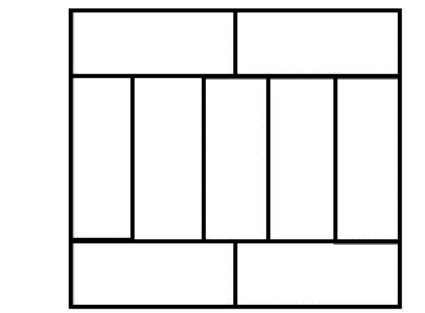
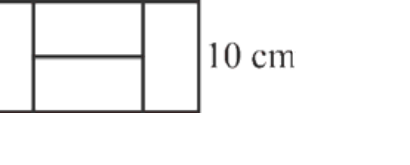
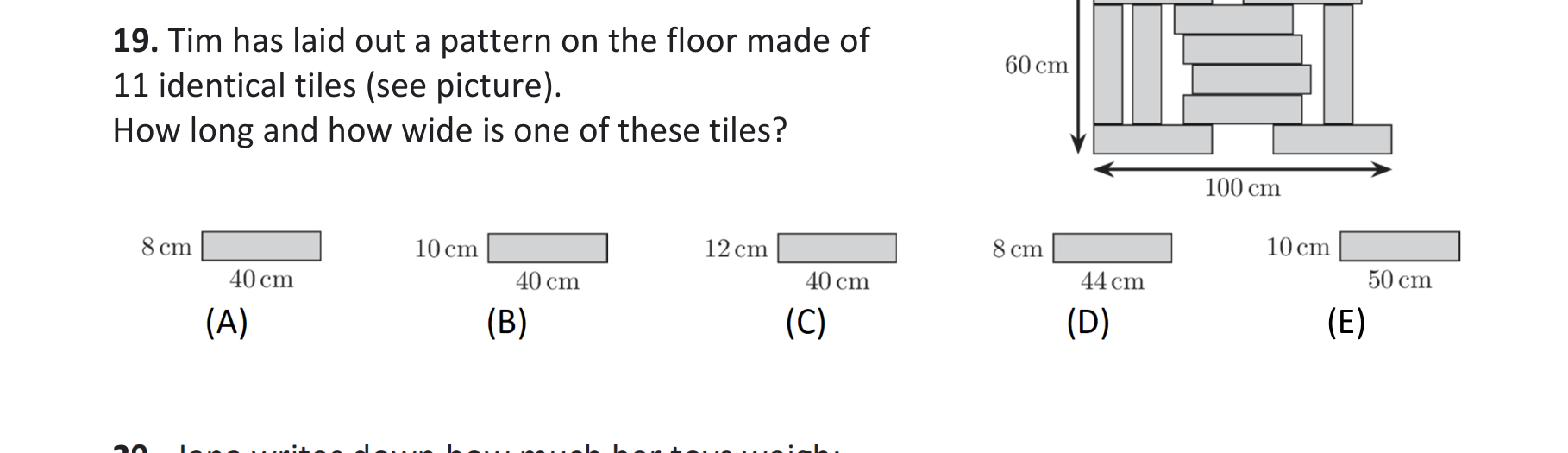
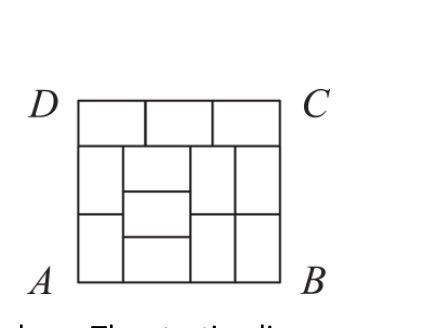
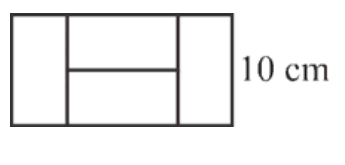
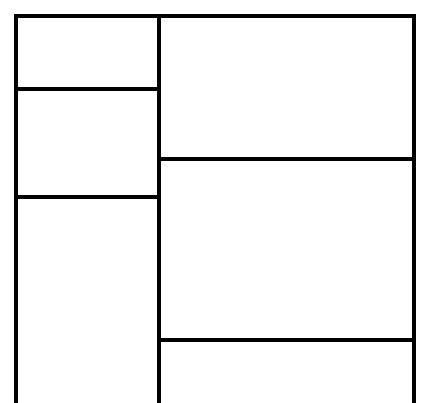
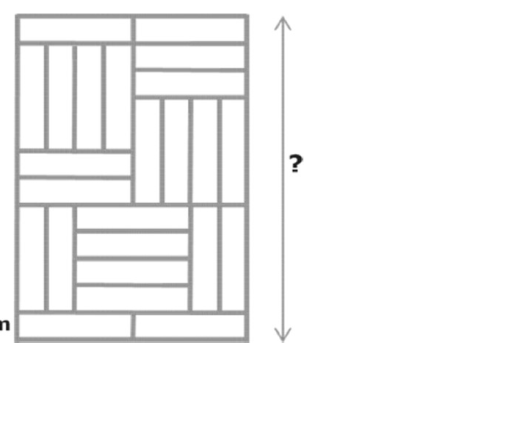
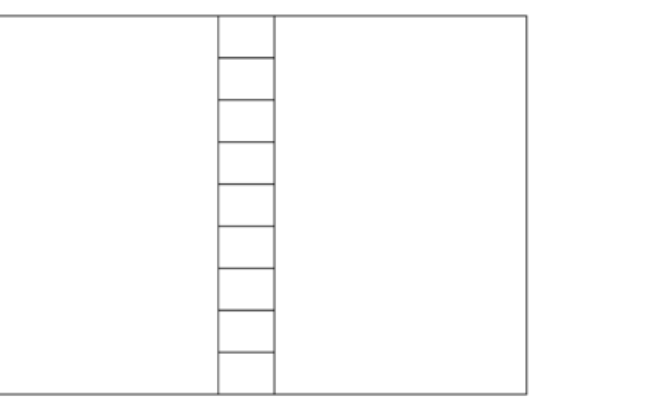
A large rectangle is made up of 9 equally big rectangles. The longer side of each small rectangle is 10 cm long. What is the perimeter of the large rectangle?
Show answer
Answer: C — 76 cm
Show hints
Hint 1 of 2
Let the small rectangle be 10 (long) by w (short), and write the big rectangle's sides using the layout.
Still stuck? Show hint 2 →
Hint 2 of 2
The middle band of standing rectangles fixes the width; the top and bottom rows fix the short side w.
Show solution
Approach: set up the dimensions from the 2+5+2 layout
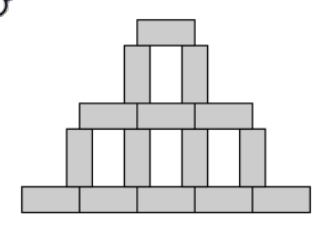
Five standing rectangles side by side make the width: 5 short sides. Two lying rectangles also span that width, so 2 · 10 = 5w, giving w = 4 cm.
The big rectangle is 5w = 20 cm wide and (4 + 10 + 4) = 18 cm tall.
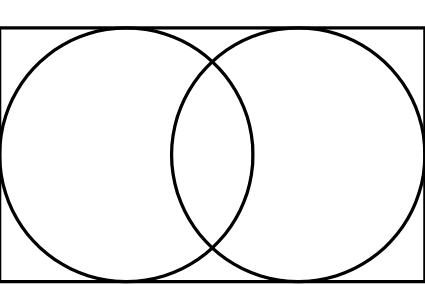
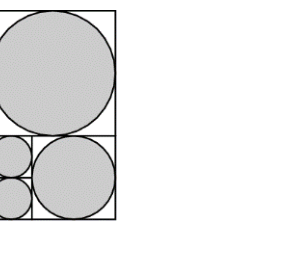
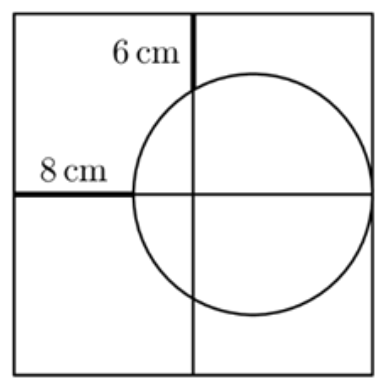
Two circles are inscribed in an 11 cm long and 7 cm wide rectangle so that they each touch three sides of the rectangle. How big is the distance between the centres of the two circles?
Show answer
Answer: D — 4 cm
Show hints
Hint 1 of 2
Each circle touches three sides, so its size is fixed by the short side of the rectangle.
Still stuck? Show hint 2 →
Hint 2 of 2
Find each centre's distance from the left and right ends; subtract.
Show solution
Approach: locate the two centres and subtract
Touching three sides means each circle has diameter 7 cm (the width), so radius 3.5 cm.
The left centre sits 3.5 cm from the left edge; the right centre sits 3.5 cm from the right edge of the 11 cm length.
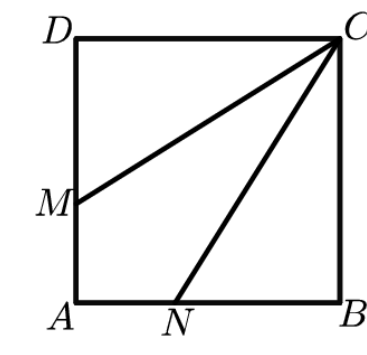
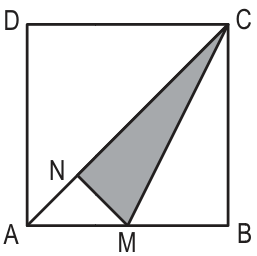
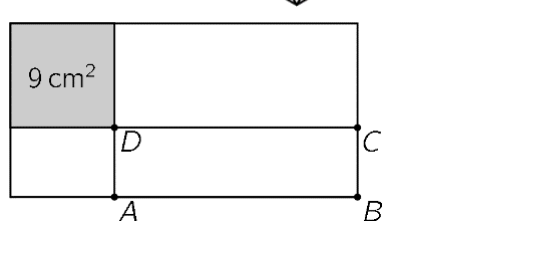
The square ABCD has side length 3 cm. The points M and N, which lie on the sides AD and AB respectively, are joined to the corner C. That way the square is split into three parts of equal area. How long is the line segment DM?
Show answer
Answer: D — 2 cm
Show hints
Hint 1 of 2
Each of the three pieces has area equal to one third of the square.
Still stuck? Show hint 2 →
Hint 2 of 2
Triangle DMC has base DM and height DC = 3; set its area equal to a third of the square.
Show solution
Approach: use the equal-area condition on triangle DMC
The square has area 9 cm², so each part has area 3 cm².
Triangle DMC has area ½ · DM · DC = ½ · DM · 3 = 3, so DM = 2 cm.
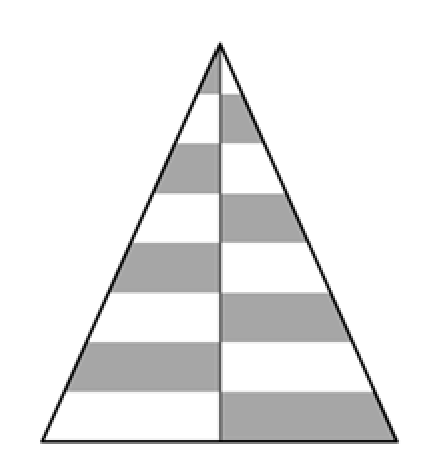
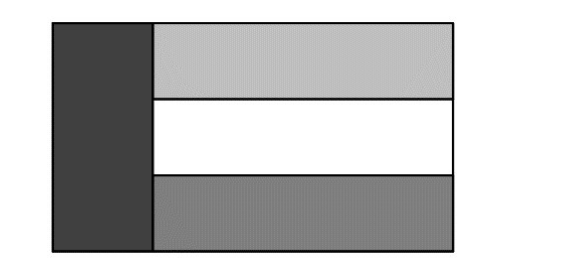
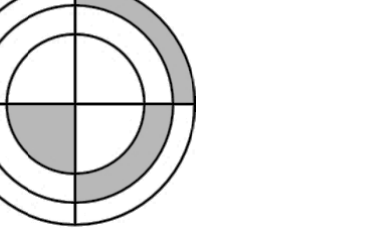
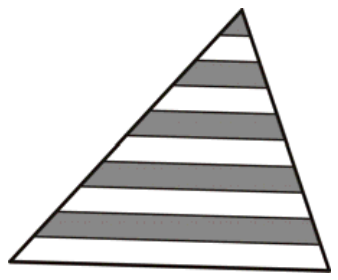
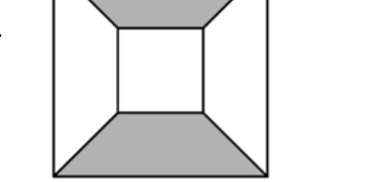
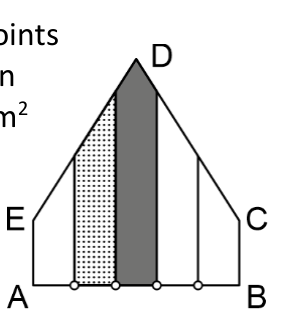
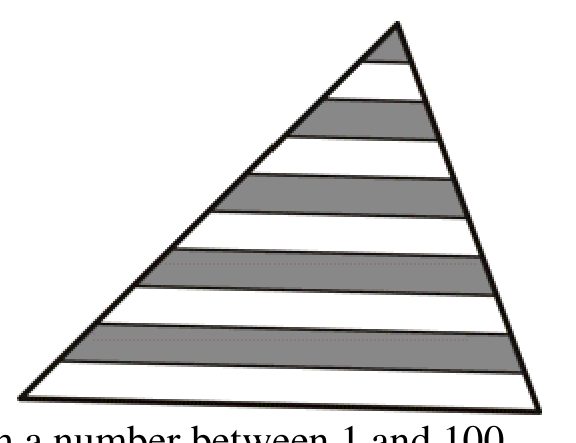
The diagram shows an isosceles triangle, where the height is marked and its area is split up into equally wide white and grey stripes. Which fraction of the area of the triangle is white?
Show answer
Answer: A — 12
Show hints
Hint 1 of 2
The height line splits the triangle into a left and right half — compare a grey stripe with the white stripe right next to it.
Still stuck? Show hint 2 →
Hint 2 of 2
By the symmetry of the picture, each grey region can be paired with an equal white region.
Show solution
Approach: pair equal regions by symmetry
The triangle is cut into equal-width horizontal stripes, and the marked height splits it down the middle.
On one side the stripes are white where the other side is grey, so each grey patch is matched by an equal-area white patch.
The white and grey areas are therefore equal, so the white part is 1/2 of the triangle.
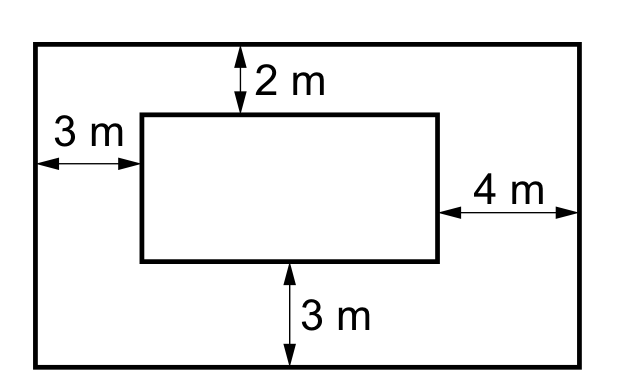
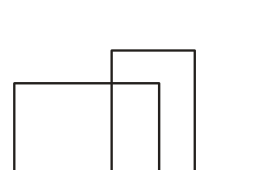
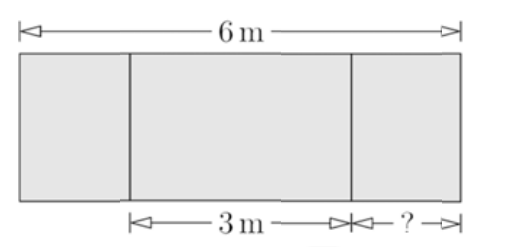
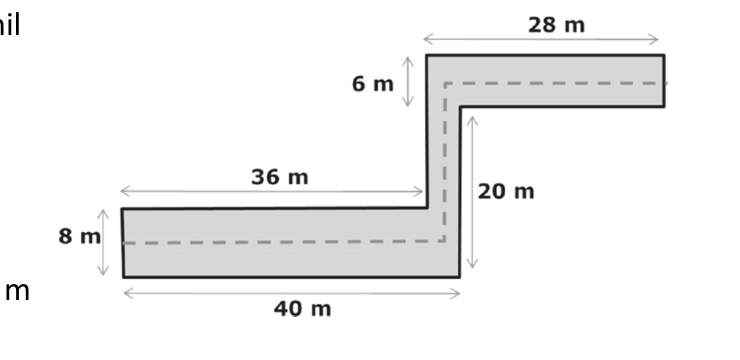
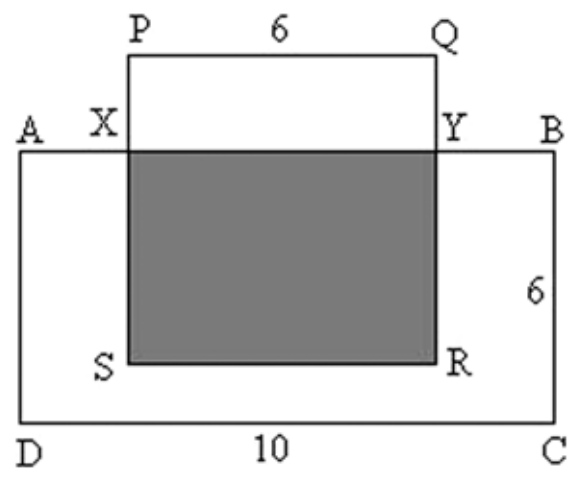
The diagram shows two rectangles whose sides are parallel to each other. By how much is the perimeter of the bigger rectangle greater than the perimeter of the smaller rectangle?
Show answer
Answer: E — 24 m
Show hints
Hint 1 of 2
Perimeter depends only on width plus height, doubled — where the smaller rectangle sits doesn't matter.
Still stuck? Show hint 2 →
Hint 2 of 2
Find each rectangle's width and height from the labelled pieces.
Show solution
Approach: compare total width+height of each rectangle
Perimeter = 2 × (width + height), so only how much wider and taller the big rectangle is matters, not where the small one sits.
The labelled gaps show the big rectangle is wider by 2 m + 4 m = 6 m and taller by 3 m + 3 m = 6 m, a total extra of 12 m in width-plus-height.
The perimeter difference is twice that: 2 × 12 = 24 m.
Petra crafts a piece of jewellery out of two black and two white hearts. The hearts have areas of 1 cm², 4 cm², 9 cm² and 16 cm² respectively. She places the hearts on top of each other as shown in the diagram and glues them together. How big is the total area of the visible black parts?
Show answer
Answer: B — 10 cm²
Show hints
Hint 1 of 2
The hearts are stacked biggest to smallest, with black and white alternating.
Still stuck? Show hint 2 →
Hint 2 of 2
Visible black = big black minus the white on top, plus the next black, and so on.
Show solution
Approach: alternating sum of areas
Stacking areas 16, 9, 4, 1 with alternating colours, the visible black equals 16 − 9 + 4 − 1.
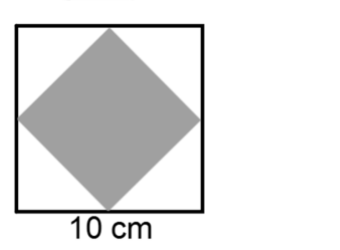
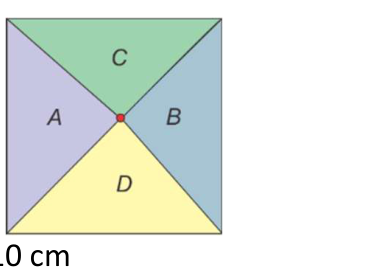
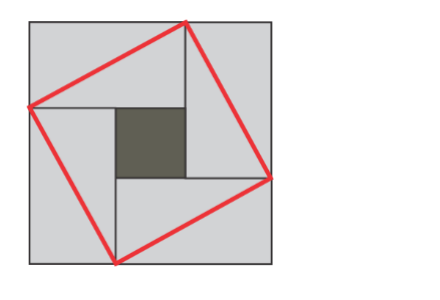
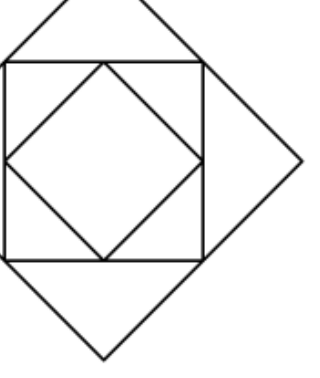
Kathi draws a square with side length 10 cm. Then she joins the midpoints of each side to form a smaller square. What is the area of the smaller square?
Show answer
Answer: E — 50 cm²
Show hints
Hint 1 of 3
Connecting the midpoints leaves a tilted square inside, with a small triangle at each corner.
Still stuck? Show hint 2 →
Hint 2 of 3
Picture sliding the four corner triangles inward; they exactly fill the tilted square.
Still stuck? Show hint 3 →
Hint 3 of 3
So the inner square is half of the big square.
Show solution
Approach: the midpoint square is half the original
Joining the midpoints cuts off four equal right triangles, one at each corner of the big square.
Those four triangles are the same size as the four triangles that make up the tilted inner square, so the inner square is exactly half of the big square.
The big square has area \(10 \times 10 = 100\), so the inner square is half of that, \(50\text{ cm}^2\), choice (E).
A rectangle is made of 4 equally sized small rectangles. The shorter side of the big rectangle is 10 cm long. How long is the longer side of the big rectangle?
Show answer
Answer: B — 20 cm
Show hints
Hint 1 of 2
Look at how the four equal small rectangles are arranged along the short and long sides.
Still stuck? Show hint 2 →
Hint 2 of 2
Two small rectangles stack to make the 10 cm short side; that fixes one small rectangle, then build the long side.
Show solution
Approach: use the arrangement of the four equal pieces
The short side of the big rectangle is split into two equal small rectangles, so each small rectangle is 10 by 5.
The long side is made of two small-rectangle long edges placed end to end.
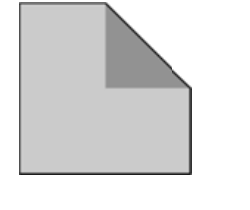
One corner of a square piece of paper is folded into the middle of the square. That way an irregular pentagon is created. The numerical values of the areas of the pentagon and the square are consecutive whole numbers. What is the area of the square?
Show answer
Answer: C — 8
Show hints
Hint 1 of 2
Folding one corner to the centre removes a triangle, so the pentagon area is the square area minus that triangle.
Still stuck? Show hint 2 →
Hint 2 of 2
Write the square area as A; the removed triangle is A/8, so the pentagon is 7A/8, and the two areas are consecutive whole numbers.
Show solution
Approach: express the removed triangle as a fraction of the square
Folding a corner into the centre covers a triangle equal to one eighth of the square.
So the pentagon has area A - A/8 = 7A/8, where A is the square area.
Square and pentagon are consecutive whole numbers, so their difference A/8 = 1, giving A = 8.
A pentagon is called convex if all its internal angles are less than 180°. The number of right angles in a convex pentagon is n. Which of the following lists is a complete listing of all possible values of n?
Show answer
Answer: C — 0, 1, 2, 3
Show hints
Hint 1 of 2
The five interior angles of a pentagon add to 540°, and each must stay below 180°.
Still stuck? Show hint 2 →
Hint 2 of 2
How many 90° angles can you use while the remaining angles each stay under 180°?
Show solution
Approach: use the angle-sum bound
A convex pentagon's angles sum to 540°, each < 180°.
0, 1, 2, or 3 right angles all leave the rest achievable (e.g. 3 right angles leave 270° over two angles, each < 180°).
4 right angles would force the 5th to be 540 − 360 = 180°, not allowed.
The side lengths of a triangle are 6, 10 and 11. An equilateral triangle has the same perimeter as this triangle. How long is one side of the equilateral triangle?
Show answer
Answer: D — 9
Show hints
Hint 1 of 2
First find the perimeter of the given triangle.
Still stuck? Show hint 2 →
Hint 2 of 2
An equilateral triangle with the same perimeter has each side equal to that perimeter divided by 3.
Show solution
Approach: match perimeters then divide by 3
The triangle's perimeter is 6 + 10 + 11 = 27.
An equilateral triangle with the same perimeter also has perimeter 27.
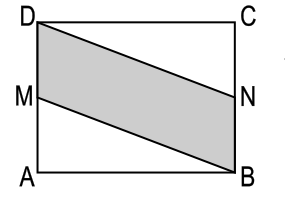
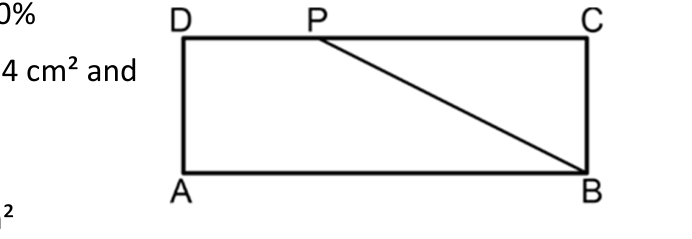
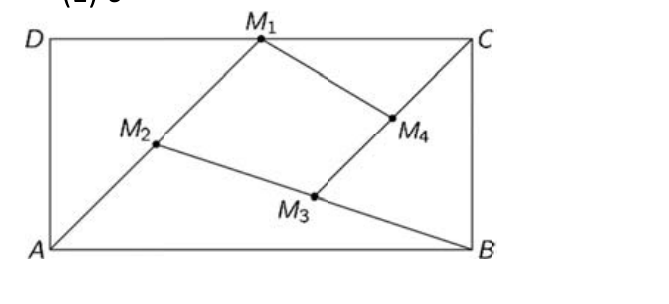
The area of rectangle ABCD in the diagram is 10. M and N are the midpoints of the sides AD and BC respectively. What is the area of the quadrilateral MBND?
Show answer
Answer: B — 5
Show hints
Hint 1 of 2
M and N are midpoints, so segment MN splits the rectangle into two equal halves.
Still stuck? Show hint 2 →
Hint 2 of 2
Compare the quadrilateral MBND with the half of the rectangle that contains it.
Show solution
Approach: use the midpoint line to halve the area
Because M and N are the midpoints of the two opposite sides, the segment MN cuts the rectangle into two equal pieces, each of area 5.
The quadrilateral MBND is built symmetrically about MN, and a quick shear/area argument shows it covers exactly half of the whole rectangle.
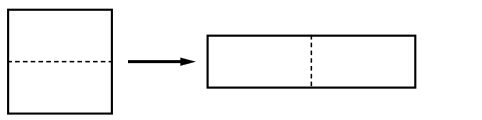
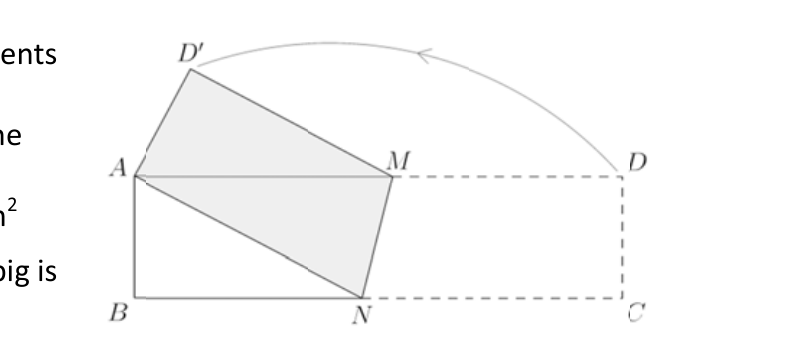
A square with perimeter 48 cm is cut into two equal pieces with one straight cut. The pieces are put together to make a rectangle, as shown in the picture. What is the perimeter of that rectangle?
Show answer
Answer: D — 60 cm
Show hints
Hint 1 of 2
Find the side of the square first from its perimeter.
Still stuck? Show hint 2 →
Hint 2 of 2
Cutting the square in half and laying the pieces side by side makes a rectangle that is twice as long and half as tall.
Show solution
Approach: find the square's side, then the new rectangle's sides
The square has perimeter 48 cm, so each side is 48 ÷ 4 = 12 cm.
The picture shows it cut into two 12 cm by 6 cm halves laid end to end, giving a 24 cm by 6 cm rectangle.
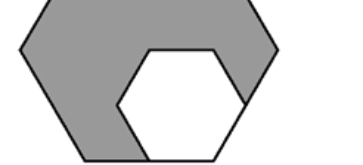
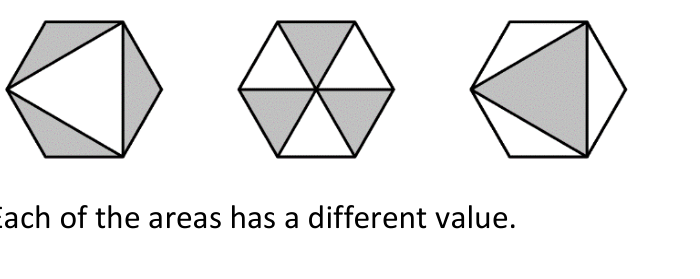
The side lengths of the large regular hexagon are twice those of the small regular hexagon. What is the area of the large hexagon if the small hexagon has an area of 4 cm²?
Show answer
Answer: A — 16 cm²
Show hints
Hint 1 of 2
Doubling every length does not double the area.
Still stuck? Show hint 2 →
Hint 2 of 2
Area scales by the square of the scale factor.
Show solution
Approach: area scales as the square of the side ratio
The large hexagon has sides twice as long, so its area is 2² = 4 times the small one.
Tom draws a square on the coordinate plane. One diagonal sits on the x-axis, with endpoints \((-1,0)\) and \((5,0)\). Which of the following points is also a corner of the square?
Show answer
Answer: B — \((2,3)\)
Show hints
Hint 1 of 2
The two diagonals of a square cross at its centre and have equal length.
Still stuck? Show hint 2 →
Hint 2 of 2
Find the centre, then go the same distance perpendicular to the given diagonal.
Show solution
Approach: use the equal, perpendicular diagonals of a square
The given diagonal runs from (−1,0) to (5,0); its centre is (2,0) and its half-length is 3.
The other diagonal is vertical through (2,0) with the same half-length, giving corners (2,3) and (2,−3).
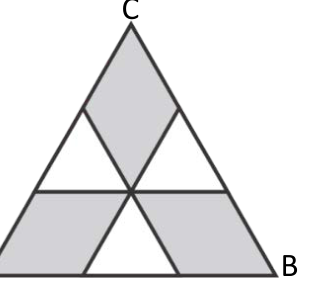
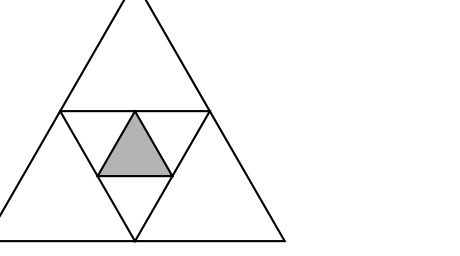
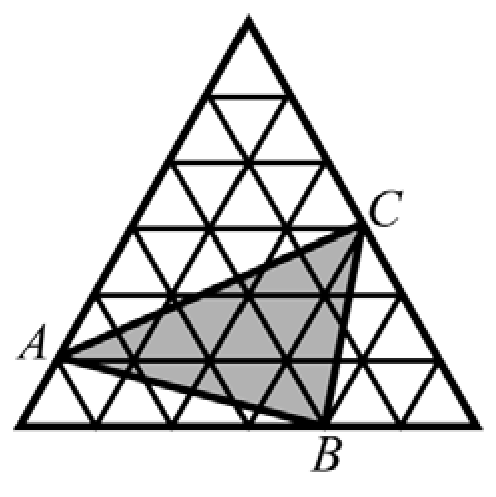
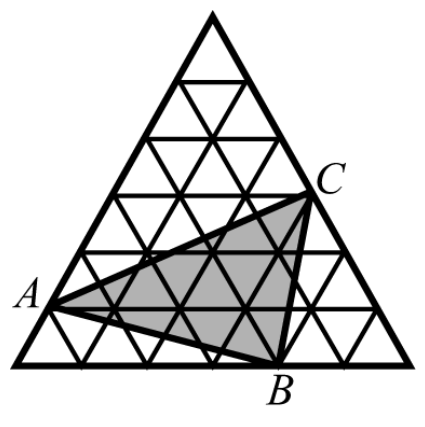
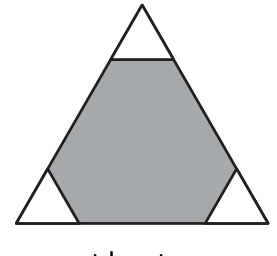
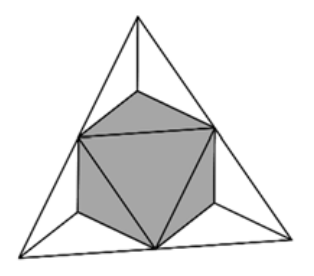
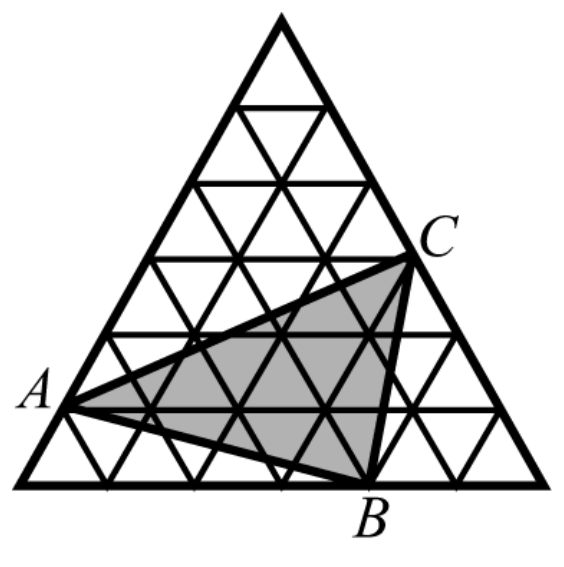
Triangle ABC is equilateral and has area 9. The dividing lines are parallel to the sides and split each side into three equal lengths. What is the area of the grey shaded part of the triangle?
Show answer
Answer: D — 6
Show hints
Hint 1 of 2
The dividing lines split the equilateral triangle into nine little congruent triangles.
Still stuck? Show hint 2 →
Hint 2 of 2
Each little triangle has the same area, so just count how many of the nine are shaded.
Show solution
Approach: count congruent unit triangles
Parallel lines cutting each side into three equal parts split the big triangle into 9 small congruent triangles.
Since the whole area is 9, each small triangle has area 1.
Counting the grey small triangles gives 6 of them.
Maria has six equally big square pieces of plain paper. On each piece of paper she draws one of the figures shown below. How many of these figures have the same perimeter as the plain piece of paper itself?
Show answer
Answer: C — 4
Show hints
Hint 1 of 2
A shaded shape has the same perimeter as the whole square only if every cut is balanced by an equal bit of border added.
Still stuck? Show hint 2 →
Hint 2 of 2
Cutting a notch out of an edge keeps the perimeter the same; count the figures that do not add extra sticking-out edges.
Show solution
Approach: compare each figure's boundary length to the plain square
The plain square has perimeter equal to four side-lengths.
A shape keeps that same perimeter when its drawn lines only re-trace existing border length without adding extra exposed edges.
Checking the six figures, exactly 4 of them match the square's perimeter.
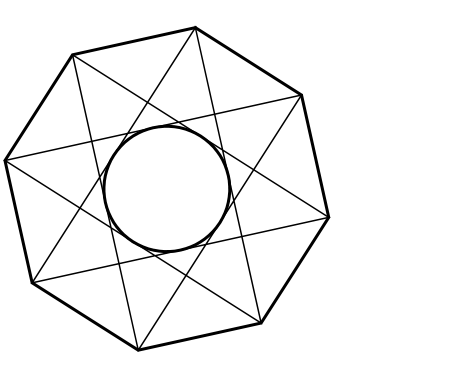
The regular octagon shown has sides of length 10. A circle touches all of the octagon's long diagonals (the inscribed star). What is the radius of this circle?
Show answer
Answer: C — 5
Show hints
Hint 1 of 2
The inscribed star is made of the long diagonals; the circle just touches each of them.
Still stuck? Show hint 2 →
Hint 2 of 2
The radius is the distance from the octagon's centre to those diagonals — find it from the side length.
Show solution
Approach: distance from centre to the long diagonals
Set up the regular octagon with side 10; its diagonals form the inscribed star that the circle touches.
By symmetry every such diagonal sits the same distance from the centre, and that distance is the circle's radius.
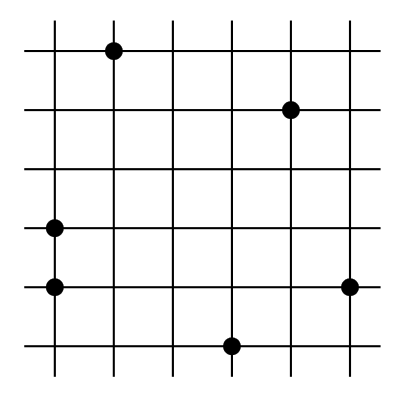
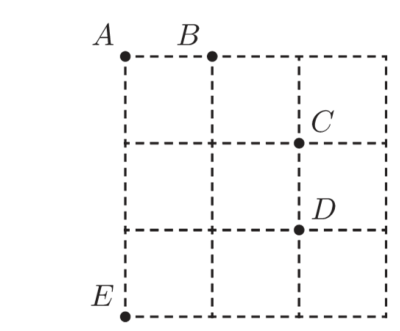
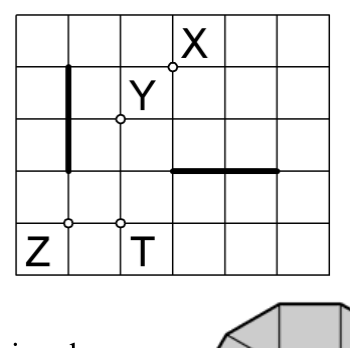
On a square grid made up of unit squares, six points are marked as shown. Three of them form a triangle with the least area. How big is this smallest area?
Show answer
Answer: A — \(\frac{1}{2}\)
Show hints
Hint 1 of 2
The smallest possible triangle area on a unit grid is very small — look for three points that are nearly in a line.
Still stuck? Show hint 2 →
Hint 2 of 2
A triangle with base 1 and height 1 already has area 1/2; check whether any triple beats that, or whether 1/2 is the minimum here.
Show solution
Approach: find the three marked points giving the least area
On a unit grid, the smallest triangle from lattice points has area 1/2 (base 1, height 1).
Among the six marked points, a triple forms exactly such a minimal triangle.
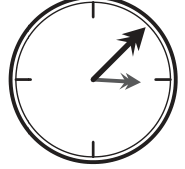
A wristwatch was laid on a table in such a way that the minute hand pointed northeast. How many minutes must pass before the minute hand is pointing northwest for the first time?
Show answer
Answer: A — 45
Show hints
Hint 1 of 2
The minute hand turns clockwise; mark NE and NW on a compass.
Still stuck? Show hint 2 →
Hint 2 of 2
Going clockwise from NE all the way round to NW is three quarters of a turn.
Show solution
Approach: turn the compass directions into a fraction of a full hour
Northeast and northwest are 90° apart, but the minute hand turns clockwise, so it must swing the long way: NE → SE → SW → NW.
That is 270°, which is three quarters of a full 360° turn.
A full turn of the minute hand takes 60 minutes, so three quarters takes 45 minutes.
A wristwatch lies on the table with its face upwards. The minute hand points towards north-east. How many minutes have to pass for the minute hand to point towards north-west for the first time?
Show answer
Answer: A — 45
Show hints
Hint 1 of 2
A minute hand sweeps the whole clock face in 60 minutes.
Still stuck? Show hint 2 →
Hint 2 of 2
Going clockwise, how much of a full turn takes you from north-east round to north-west?
Show solution
Approach: fraction of a full turn
The minute hand turns clockwise, a full circle (360°) in 60 minutes.
From north-east, turning clockwise, it reaches south, then west, then north-west: that is 270° of the turn.
270° is three-quarters of 360°, so it takes three-quarters of 60 minutes = 45 minutes.
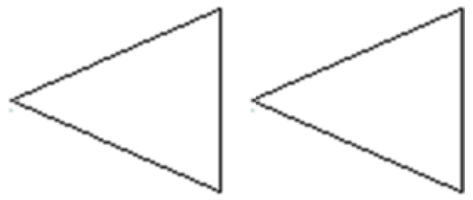
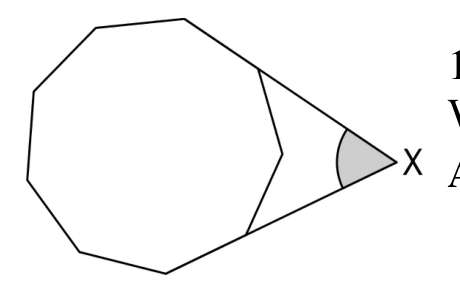
One vertex of the triangle on the left is connected to one vertex of the triangle on the right using a straight line so that no connecting line segment dissects either of the two triangles into two parts. In how many ways is this possible?
Show answer
Answer: D — 4
Show hints
Hint 1 of 2
Try joining each corner of the left triangle to each corner of the right triangle.
Still stuck? Show hint 2 →
Hint 2 of 2
Keep only the joins whose straight segment stays outside both triangles.
Show solution
Approach: test each vertex pairing
There are 3 × 3 = 9 ways to pick one corner from each triangle and join them with a straight segment.
A join is allowed only when the segment does not pass through the inside of either triangle.
Checking the pairings, exactly 4 of the connecting segments avoid both triangles' interiors.
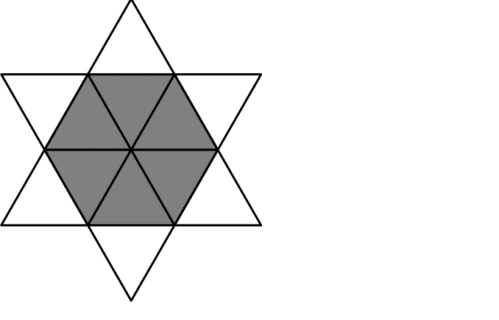
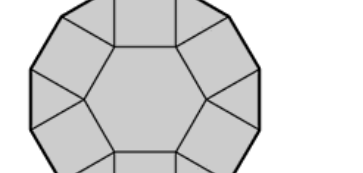
The star shown is made by fitting together 12 congruent equilateral triangles. The perimeter of the star is 36 cm. What is the perimeter of the grey hexagon?
Show answer
Answer: C — 18 cm
Show hints
Hint 1 of 2
The star's outline and the hexagon's outline are both built from those equal triangle edges.
Still stuck? Show hint 2 →
Hint 2 of 2
Count how many equal edges form each outline.
Show solution
Approach: compare edge counts of equal-length segments
The star's outline is made of 12 equal triangle edges, so each edge is 36/12 = 3 cm.
The grey hexagon's perimeter is 6 of those same edges.
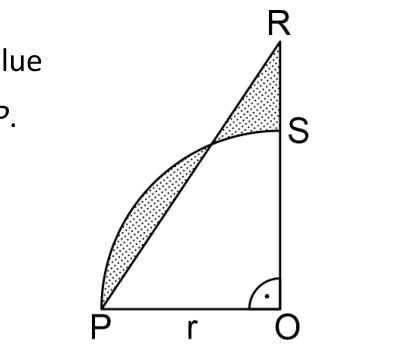
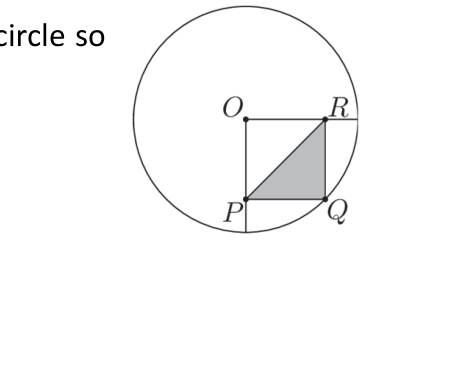
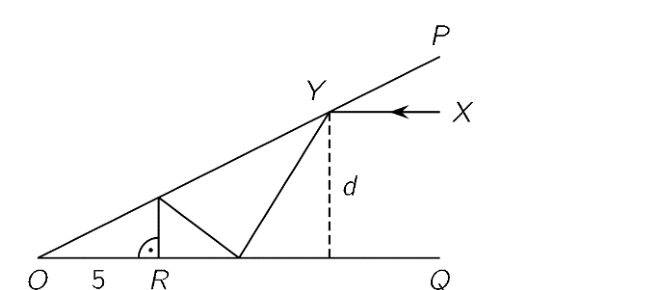
In the diagram we see a quarter circle SP with centre O and radius r, as well as a triangle ORP. The two grey regions have the same area. How long is the segment OR?
Show answer
Answer: A — \(\dfrac{\pi r}{2}\)
Show hints
Hint 1 of 2
Equal grey areas means a shared region can be added to both without changing the equality.
Still stuck? Show hint 2 →
Hint 2 of 2
Adding the common piece turns "two greys equal" into "triangle ORP = quarter circle".
Show solution
Approach: add the shared region to both grey pieces
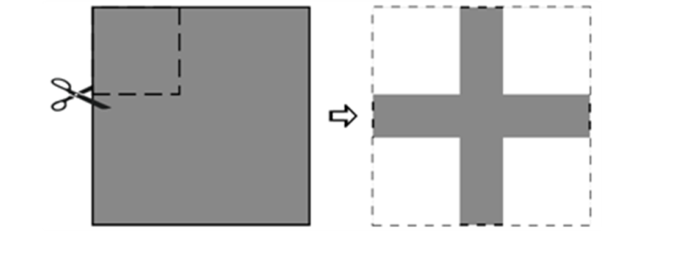
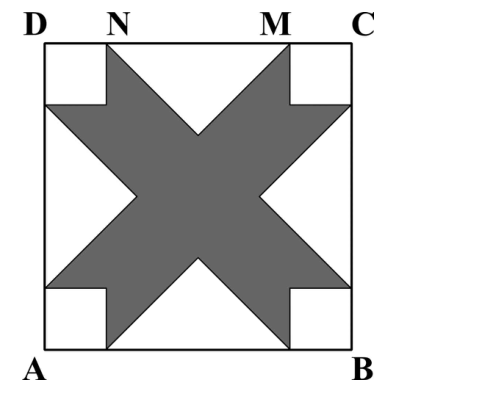
Jana cuts four small squares of the same size from the corners of a square piece of paper (see picture). The total cut-away area is 16 cm², and the area of the remaining figure (the cross) is 9 cm². What is the perimeter of the cross?
Show answer
Answer: C — 20 cm
Show hints
Hint 1 of 2
The whole square’s area is the cut-away plus the cross.
Still stuck? Show hint 2 →
Hint 2 of 2
Cutting a square out of a corner doesn’t change the perimeter — the removed edges are replaced by equal new edges.
Show solution
Approach: reassemble area, then track perimeter
Original square area = 16 (cut away) + 9 (cross) = 25, so its side is 5.
Each of the four corner squares has area 16 ÷ 4 = 4, so side 2.
Removing a 2×2 square from a corner replaces two outer edges with two equal inner edges, so the perimeter stays the same.
The cross perimeter equals the square’s perimeter: 4 × 5 = 20 cm.
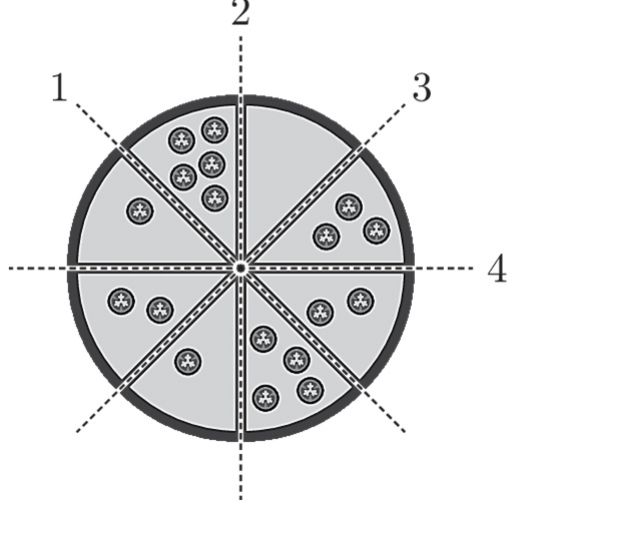
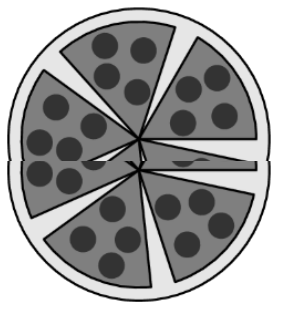
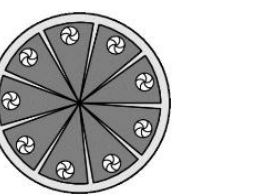
Tom wants to cut the pizza into two halves so that each half has the same number of tomatoes. There are two ways to do this. Along which lines can he cut?
Show answer
Answer: D — 2 or 4
Show hints
Hint 1 of 2
A cut through the centre splits the tomatoes into two halves - you need each half to hold the same number.
Still stuck? Show hint 2 →
Hint 2 of 2
Test the labelled lines: a fair cut has equal tomatoes on both sides.
Show solution
Approach: find centre lines that split the tomatoes evenly
Each valid cut is a straight line through the middle of the pizza.
Count tomatoes on each side of the labelled lines.
Lines 2 and 4 each leave the same number of tomatoes on both halves.
When Grandma started knitting wool socks, she had a ball of wool with a diameter of 30 cm. After she has finished knitting 70 socks, the remaining ball of wool has a diameter of 15 cm. How many more socks can Grandma knit?
Show answer
Answer: E — 10
Show hints
Hint 1 of 2
Wool used is proportional to volume, which scales with the cube of the diameter.
Still stuck? Show hint 2 →
Hint 2 of 2
Volumes go as 30³ : 15³ = 8 : 1, so the leftover is the same size as what 10 socks need.
Show solution
Approach: volume scales as diameter cubed
Volumes are proportional to 30³ = 27000 and 15³ = 3375, ratio 8:1.
70 socks used 27000 − 3375 = 23625 units, i.e. 337.5 per sock.
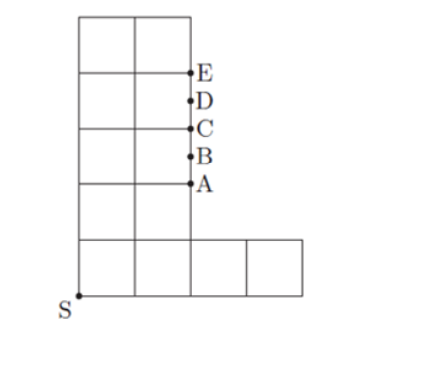
The diagram shown on the right consists of squares of equal size. Point B is in the middle of A and C, and point D is in the middle of C and E. Maria wants to divide the figure into two parts with equal areas using a straight line. Which of the points A, B, C, D or E must she connect to S to obtain this result?
Show answer
Answer: E — E
Show hints
Hint 1 of 2
First count the squares: the cut from S has to leave exactly half of them on each side.
Still stuck? Show hint 2 →
Hint 2 of 2
As you slide the far end of the cut from A up to E, more area moves to one side — stop at the point that makes the two halves equal.
Show solution
Approach: make each side hold half the squares
Count the unit squares in the whole figure and take half: the straight cut from S must leave that same area on each side.
Connecting S to a low point like A leaves too little on one side, and as the endpoint climbs from A toward E more area swings across the line.
The endpoint that finally balances the two sides into equal areas is E, so Maria connects S to E, giving the answer (E).
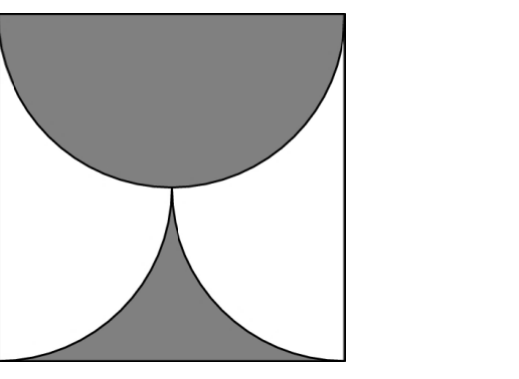
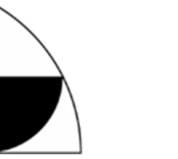
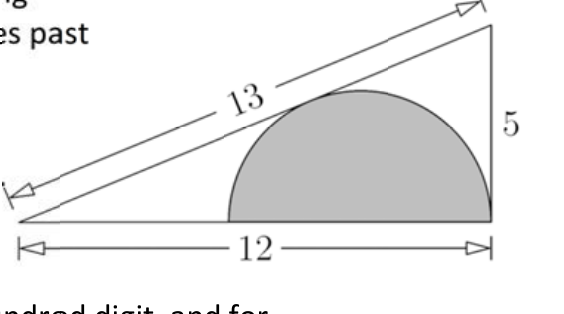
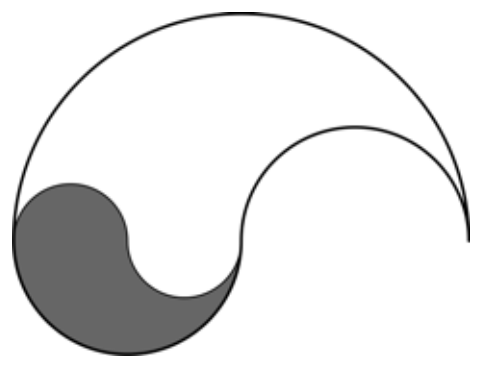
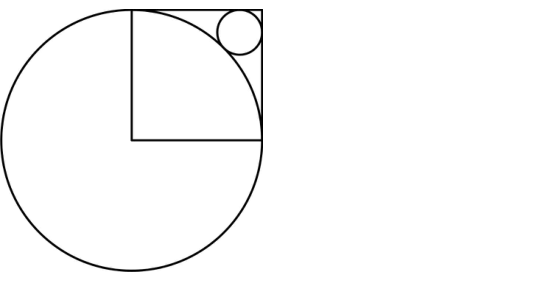
The area of the black semicircle shown is 12 cm². What is the area of the large quarter circle?
Show answer
Answer: D — 30 cm²
Show hints
Hint 1 of 3
Let the quarter circle have radius \(R\) and the small semicircle radius \(r\); read their relationship off the figure.
Still stuck? Show hint 2 →
Hint 2 of 3
The semicircle's diameter spans from the corner to the centre of the quarter circle's straight side, which forces \(R^2 = 5r^2\).
Still stuck? Show hint 3 →
Hint 3 of 3
Then just take the ratio of the two area formulas—the \(\pi\) cancels.
Show solution
Approach: write both areas with their radii and take the ratio
Quarter circle: \(\tfrac14\pi R^2\); black semicircle: \(\tfrac12\pi r^2\).
The figure fixes the semicircle so that \(R^2 = 5r^2\), hence the quarter circle is \(\dfrac{\tfrac14 R^2}{\tfrac12 r^2} = \dfrac{R^2}{2r^2} = \dfrac{5}{2}\) times the semicircle.
So the quarter circle \(= \tfrac52 \times 12 = \textbf{30 cm}^2\), choice (D).
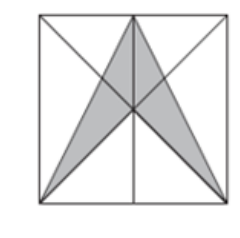
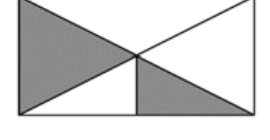
The square shown on the right has sides of 10 cm. The square is divided into two equal-sized rectangles by the vertical centre line. What is the area of the grey section?
Show answer
Answer: B — 25 cm²
Show hints
Hint 1 of 2
The whole square is 10 × 10 = 100 cm², so try to see the grey as a simple fraction of that whole.
Still stuck? Show hint 2 →
Hint 2 of 2
The centre lines split the grey ‘bow-tie’ into a left half and a right half; find the area of one half and double it.
Show solution
Approach: the grey is two equal triangles meeting at the centre
The grey shape is a bow-tie: two triangles that meet at the centre of the square, one on the left and one on the right.
The left triangle has corners at the top-middle of the square, the centre of the square, and the bottom-left corner; counting on a 10×10 grid its area is 12.5 cm², and the right triangle is its mirror image, also 12.5 cm².
Adding the two halves gives 12.5 + 12.5 = 25 cm², which is exactly one quarter of the 100 cm² square, so the answer is (B) 25 cm².
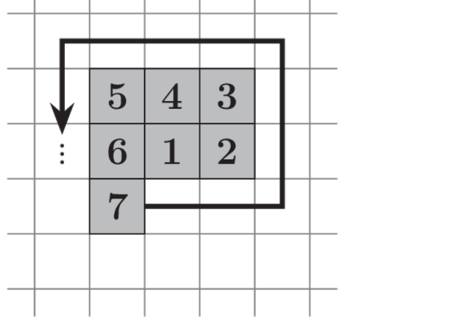
Daniel numbers some squares on a piece of squared paper. He starts with a random square and numbers the squares 1, 2, 3, 4, 5, …, 2025 anti-clockwise (see illustration). At the end he considers the figure that results from all 2025 numbered squares. Each square has a side length of 0.5 cm. What is the perimeter of the figure?
Show answer
Answer: D — 90 cm
Show hints
Hint 1 of 2
The numbered squares form a growing spiral; you only need its outline, not every cell.
Still stuck? Show hint 2 →
Hint 2 of 2
Find the bounding rectangle the spiral fills and account for the small notch where it ends.
Show solution
Approach: bound the spiral and read off the perimeter
Numbering 1..2025 in an outward spiral fills an almost-square block of cells.
2025 = 45², so the spiral exactly fills a 45×45 square of cells.
Side = 45×0.5 = 22.5 cm; perimeter = 4×22.5 = 90 cm.
The two small rectangles in the diagram are congruent and each has an area of 4 cm². What is the area of rectangle ABCD in cm²?
Show answer
Answer: D — 12
Show hints
Hint 1 of 3
The diagonal \(AC\) of the big rectangle passes through the meeting corner of the two small rectangles.
Still stuck? Show hint 2 →
Hint 2 of 3
The diagonal cuts ABCD into two equal halves; compare how many small-rectangle areas fit against that diagonal.
Still stuck? Show hint 3 →
Hint 3 of 3
Each small rectangle has its diagonal corner on \(AC\), so each is split into two equal triangles by the diagonal — use that to count areas.
Show solution
Approach: use the main diagonal to balance the areas
Draw diagonal \(AC\); it runs through the common corner of the two congruent rectangles and splits ABCD into two equal triangles of area \(\tfrac12[ABCD]\) each.
Below the diagonal the dotted rectangle and the leftover triangle make up one half; matching the congruent rectangles against the diagonal shows the big rectangle is built from three small-rectangle areas.
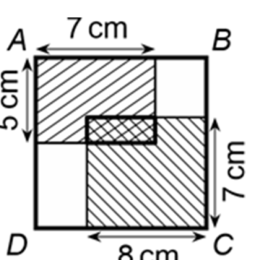
The square ABCD contains two shaded rectangles (see diagram). The dimensions are as shown and the area of the overlapping region is 18 cm². What is the perimeter of the square ABCD?
Show answer
Answer: C — 36 cm
Show hints
Hint 1 of 2
Let the square's side be \(s\); the top-left rectangle is \(7\times5\) and the bottom rectangle is \(8\times7\).
Still stuck? Show hint 2 →
Hint 2 of 2
Find the overlap's width and height in terms of \(s\) by seeing how far the two rectangles reach into each other, then set that product equal to 18.
Show solution
Approach: overlap area gives an equation for the side
The top-left rectangle reaches 7 cm in from the left and 5 cm down from the top; the bottom rectangle reaches 8 cm in from the right and 7 cm up from the bottom.
Their overlap is therefore \((7+8-s)\) wide by \((5+7-s)\) tall, i.e. \((15-s)(12-s)\), and this equals 18.
Solving \((15-s)(12-s)=18\) gives \(s=9\) (the other root is too big to fit), so the perimeter is \(4\times 9=\) 36 cm, answer C.
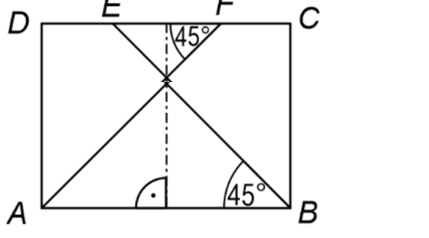
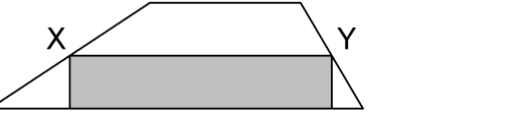
In rectangle ABCD, the points E and F lie on side DC (see diagram) so that ∠EBA = ∠DFA = 45° and AB + EF = 20 cm. How long is side BC?
Show answer
Answer: D — 10 cm
Show hints
Hint 1 of 2
A 45° line rises exactly as much as it runs, so each slanted line shifts sideways by the rectangle's height as it climbs from the bottom to the top.
Still stuck? Show hint 2 →
Hint 2 of 2
Write where E and F land on the top edge in terms of the width AB and the height BC, then plug into AB + EF = 20.
Show solution
Approach: use the 45° lines to locate E and F on the top side
The 45° line from B reaches the top after moving in by the height \(BC\), and likewise the 45° line from A; so each of E and F sits a distance \(BC\) horizontally inside an end of the top edge.
Measuring along the top edge then gives \(EF=2\,BC-AB\), so \(AB+EF=2\,BC\); the two slants effectively double the height.
So \(2\,BC=20\), giving \(BC=\) 10 cm, which is (D).
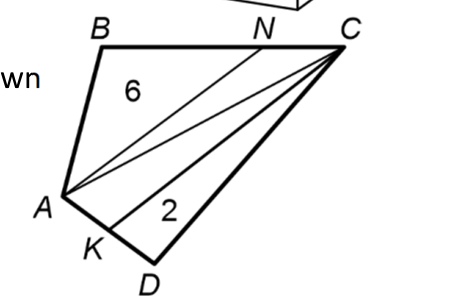
In quadrilateral ABCD, the points N and K are marked on sides BC and AD so that BN = 2·NC and AK = KD. The areas of triangles ABN and CKD are shown in the figure. What is the area of quadrilateral ABCD?
Show answer
Answer: A — 13
Show hints
Hint 1 of 2
A point that splits a side in a ratio splits a triangle's area in the same ratio (same height).
Still stuck? Show hint 2 →
Hint 2 of 2
Stretch triangle ABN up to ABC using BN:NC, and double CKD up to ACD using the midpoint K.
Show solution
Approach: scale each known triangle to a piece of the quadrilateral
BN = 2·NC means BN:BC = 2:3, so triangle ABC has area 6·(3/2) = 9.
K is the midpoint of AD, so triangle ACD = 2·(area CKD) = 2·2 = 4.
Splitting ABCD by diagonal AC: area = \(9 + 4 = 13\), which is (A).
Christian cuts four small grey squares out of one big square. The white shape remains (see picture). This shape has half the area of the big square. The side lengths of the small grey squares are given in the drawing. What is the perimeter of the white shape?
Show answer
Answer: B — 40
Show hints
Hint 1 of 2
First use the 'half the area' fact: the four grey squares together equal half the big square, which pins down the big square's side.
Still stuck? Show hint 2 →
Hint 2 of 2
Cutting a square notch out of a corner does not change the perimeter, because the two removed edges are replaced by two equal new edges.
Show solution
Approach: find the side from areas, then note corner notches keep the perimeter
The grey squares have areas 1, 4, 9 and 36, summing to 50, and this is half the big square, so the big square has area 100 and side 10.
Removing a square from a corner trades two outer edges for two new inner edges of equal length, so the perimeter is unchanged.
Hence the white shape has the same perimeter as the big square: 4 × 10 = 40.
A rectangle is split into three pieces of equal area, as shown. One piece is an equilateral triangle with sides of length 4 cm; the other two are trapezoids. How long is the shorter of the two parallel sides of a trapezoid?
Show answer
Answer: B — \(\sqrt{3}\)
Show hints
Hint 1 of 2
In the picture a full side of the triangle (length 4) lies along the short side of the rectangle, so that side fixes the rectangle's height.
Still stuck? Show hint 2 →
Hint 2 of 2
Each of the three pieces has the same area, and a trapezoid's area is its average width times its height.
Show solution
Approach: use equal areas; the trapezoid's two parallel sides average to a known value
The triangle's vertical side is 4, so the rectangle is 4 tall, and the triangle's area is \(\frac{\sqrt3}{4}\cdot4^2=4\sqrt3\).
All three pieces are equal, so the rectangle's area is \(12\sqrt3\) and its width is \(\frac{12\sqrt3}{4}=3\sqrt3\).
A trapezoid has height 2 (half the rectangle) and longer parallel side \(3\sqrt3\); its area \(4\sqrt3=\tfrac12(3\sqrt3+x)\cdot 2\) gives the shorter side \(x=\sqrt3\).
So the shorter parallel side is \(\sqrt3\), answer B.
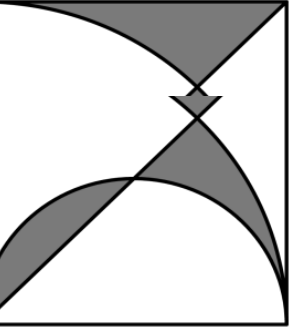
In a square with side length 6, a diagonal, a semicircle and a quarter circle are drawn as shown. What is the area of the grey region?
Show answer
Answer: A — 9
Show hints
Hint 1 of 3
Don't compute each curved piece separately — look for curved areas that exactly cancel.
Still stuck? Show hint 2 →
Hint 2 of 3
The diagonal pairs the semicircle and quarter-circle so their \(\pi\) contributions cancel, leaving a whole-number area.
Still stuck? Show hint 3 →
Hint 3 of 3
Express the grey region as a triangle plus/minus curved pieces and watch the \(\pi\)-terms vanish.
Show solution
Approach: pair the curved pieces so the \(\pi\)-terms cancel
The square has area \(6^2=36\) and the diagonal splits it into two right triangles of area \(18\).
The grey region is a triangular part with one curved bite added and an equal curved bite removed: the semicircle and quarter-circle pieces contribute opposite \(\pi\)-areas.
Those circular contributions cancel exactly, so the grey area is a clean whole number.
Evaluating, the grey region has area 9 (answer A).
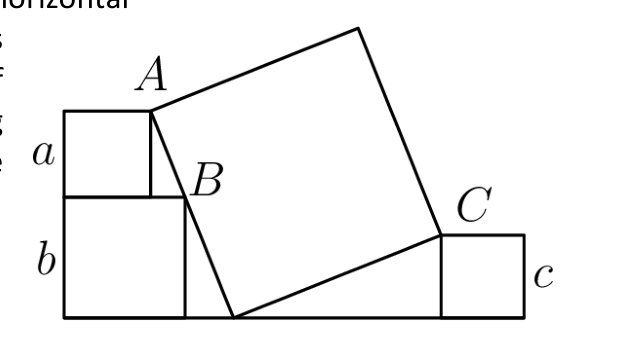
The diagram shows four squares with the entire configuration resting on a horizontal straight line. The smaller squares have side lengths a, b and c. The vertices A and C of two small squares coincide with diagonally opposite vertices of the big square. The vertex B of the third small square lies on a side of the big square. Which of the following expressions is equal to the side length of the big square?
Show answer
Answer: C — \(\sqrt{(a+b)^2+c^2}\)
Show hints
Hint 1 of 3
The tilted square's side is the hypotenuse of a right triangle whose legs you can read off from the small squares.
Still stuck? Show hint 2 →
Hint 2 of 3
Drop a horizontal and a vertical from one corner of the big square to the next; the legs are built from a, b and c.
Still stuck? Show hint 3 →
Hint 3 of 3
Find the horizontal run and the vertical rise of one side of the big square, then apply the Pythagorean theorem.
Show solution
Approach: the tilted side is a right-triangle hypotenuse
A and C of two small squares sit at diagonally opposite corners of the big square, with B on a side, so the big square is tilted.
Take one side of the big square and form the right triangle with horizontal and vertical legs: the horizontal leg adds the two small-square widths to give \(a+b\), and the vertical leg is \(c\).
By the Pythagorean theorem the side length is \(\sqrt{(a+b)^2+c^2}\).
So the answer is \(\sqrt{(a+b)^2+c^2}\) (answer C).
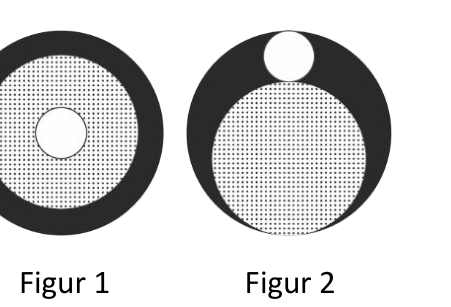
Sanjay has three differently coloured circles. First he stacks them on top of one another, as in Figure 1. Then he moves them so that they touch one another pairwise, as in Figure 2. In Figure 1 the visible black area is seven times the area of the white circle. What is the ratio of the visible black area in Figure 1 to that in Figure 2?
Show answer
Answer: D — 7 : 6
Show hints
Hint 1 of 2
Give the white circle area 1; then the Figure 1 black region is 7, so you immediately know the black circle's area.
Still stuck? Show hint 2 →
Hint 2 of 2
In Figure 2 the circles only touch (no overlap), so figure out how much of the black is newly hidden compared with Figure 1.
Show solution
Approach: scale every area to the white circle, then compare the two pictures
Let the white circle have area 1; since the visible black in Figure 1 is 7 times that, the visible black in Figure 1 is 7 units.
The total black circle has area 8 units (the 7 that show plus the 1 unit the smaller circle covers when stacked).
Re-measuring the black that stays visible once the circles are slid apart to touch pairwise in Figure 2 gives 6 units, so the ratio of visible black in Figure 1 to Figure 2 is \(7:6\), answer D.
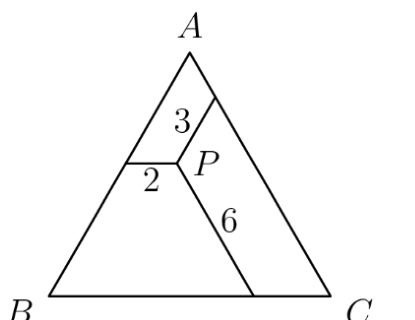
A point P is chosen inside an equilateral triangle ABC. Through P, segments of lengths 2 m, 3 m and 6 m are drawn parallel to the three sides, as shown. What is the perimeter of the triangle?
Show answer
Answer: C — 33 m
Show hints
Hint 1 of 2
The three lines through P cut the big triangle into three small equilateral triangles plus parallelograms.
Still stuck? Show hint 2 →
Hint 2 of 2
Lining up the three small equilateral triangles along one side shows their sides just add up to that whole side.
Show solution
Approach: the three side-parallel segments tile one side of the triangle
Each segment parallel to a side is the side of a small equilateral triangle that sits in a corner of the big triangle.
The three small triangles slide along one side of the big triangle and together cover it exactly, so the side length is \(2+3+6=11\) m.
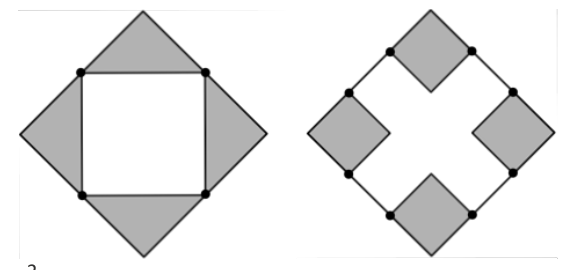
The two large squares have the same area. Parts of them are coloured grey (see picture). In the left square, the dots divide the sides into two equal pieces. In the right square, the dots divide the sides into three equal pieces. The four grey parts in the left square have a combined area of 9 cm². What is the area of the four grey parts in the right square?
Show answer
Answer: B — 8 cm²
Show hints
Hint 1 of 2
Use the left square first: the midpoint construction tells you what fraction of the square the grey corners cover, which fixes the area of the whole square.
Still stuck? Show hint 2 →
Hint 2 of 2
Then express the right square's grey pieces as a fraction of that same total area.
Show solution
Approach: find the common square area from the left figure, then take the right figure's fraction
In the left square the midpoints make the inner tilted square exactly half the big square, so the four grey corner triangles are the other half: 9 cm² is half, giving a square of 18 cm².
In the right square the dots cut each side into thirds, and the four grey pieces there make up 4/9 of the square.
So the grey area on the right is 4/9 × 18 = 8 cm².
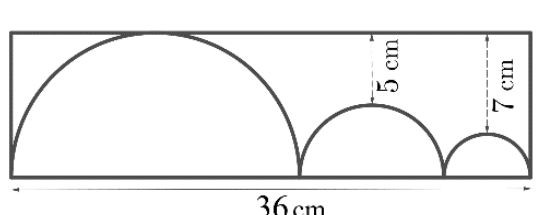
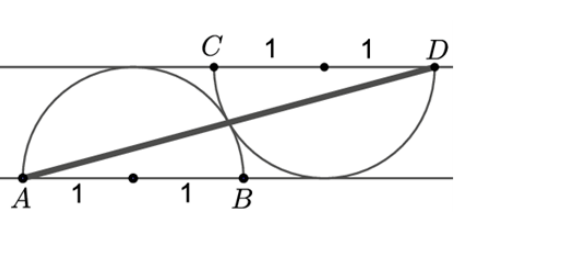
The diagram shows three semicircles inside a rectangle. The middle semicircle touches the other two, which each touch a short side of the rectangle. The biggest semicircle also touches the upper long side of the rectangle. The shortest distances from that side of the rectangle to the two other semicircles are 5 cm and 7 cm, respectively (see diagram). How big is the perimeter of the rectangle, in cm?
Show answer
Answer: B — 92
Show hints
Hint 1 of 3
All three semicircles have their flat sides on the bottom long side; the big one reaches the top, so the rectangle's height equals the big radius.
Still stuck? Show hint 2 →
Hint 2 of 3
The top of a small semicircle is its radius above the bottom, so the gap from the top side down to it is (height) − (its radius).
Still stuck? Show hint 3 →
Hint 3 of 3
Turn the 5 cm and 7 cm gaps into the two small radii, then read the width as the three diameters laid side by side.
Show solution
Approach: convert the top gaps into radii, then add diameters for the width
The big semicircle touches the top long side, so the height of the rectangle equals its radius R = 10 cm.
A small semicircle rises only its own radius above the bottom, so height − radius equals the listed gap: 10 − r = 5 gives r = 5 cm, and 10 − r = 7 gives r = 3 cm.
The three semicircles sit side by side along the bottom, so the width is the sum of their diameters: 2(5) + 2(10) + 2(3) = 36 cm.
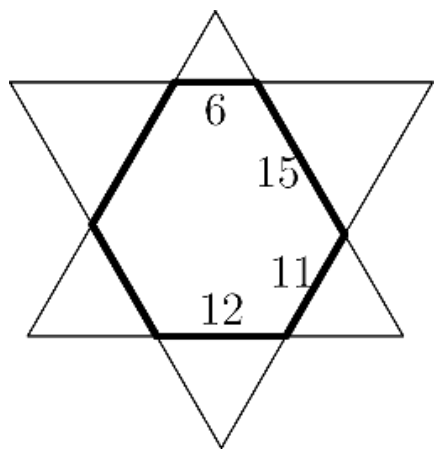
Two equilateral triangles of different sizes are placed on top of each other so that a hexagon is formed on the inside whose opposite sides are parallel. Four of the side lengths of the hexagon are stated in the diagram. How big is the perimeter of the hexagon?
Show answer
Answer: D — 70
Show hints
Hint 1 of 2
Two equilateral triangles overlapping make a hexagon whose every interior angle is 120°.
Still stuck? Show hint 2 →
Hint 2 of 2
In an equiangular hexagon the differences of opposite sides are all equal.
Show solution
Approach: use the equiangular-hexagon side relation
Because the hexagon is formed by two equilateral triangles, all six angles are 120°.
For an equiangular hexagon with sides in order, opposite-side differences are all equal; the known sides 6, 15, 11, 12 then give the missing sides 9 and 17.
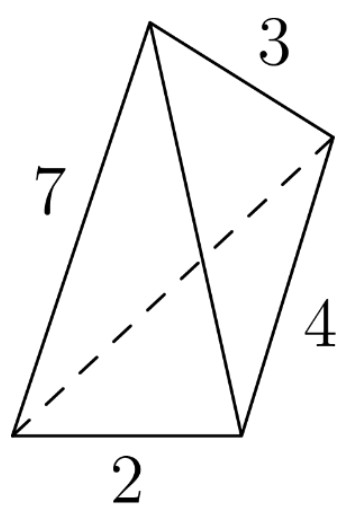
In a three-sided pyramid all side lengths are integers. Four of the side lengths can be seen in the diagram. What is the sum of the two remaining side lengths?
Show answer
Answer: C — 11
Show hints
Hint 1 of 3
Each of the four triangular faces must obey the triangle inequality with whole-number sides.
Still stuck? Show hint 2 →
Hint 2 of 3
The two unknown edges each sit in two faces; intersect the allowed ranges from those faces.
Still stuck? Show hint 3 →
Hint 3 of 3
The two visible edges of a face squeeze the third edge into a narrow whole-number window.
Show solution
Approach: intersect the triangle-inequality ranges for each missing edge
The shown edges are 7 and 2 on one face and 3 and 4 on another; the two missing edges close up the remaining faces.
The missing edge in the 7-2 region must satisfy \(5 < e < 9\), and the same edge in the 3-4 region must satisfy \(1 < e < 7\), forcing it to be 6.
The other missing edge must satisfy \(4 < e < 10\) and \(2 < e < 6\), forcing it to be 5, so the two missing edges sum to \(6 + 5 = \mathbf{11}\).
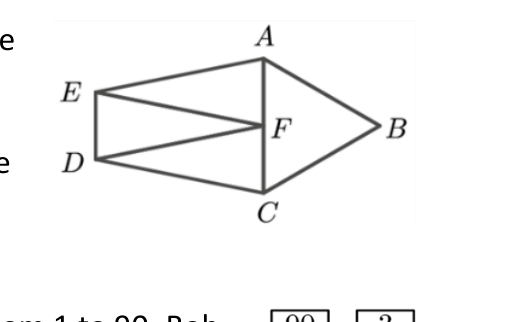
The pentagon ABCDE is split into four triangles that all have the same perimeter (see diagram). Triangle ABC is equilateral and the triangles AEF, DFE and CDF are congruent isosceles triangles. How big is the ratio of the perimeter of the pentagon ABCDE to the perimeter of the triangle ABC?
Show answer
Answer: D — \(\frac{5}{3}\)
Show hints
Hint 1 of 2
All four triangles share the same perimeter; let the equilateral side be the unit.
Still stuck? Show hint 2 →
Hint 2 of 2
Express the outer sides CD, DE, EA of the pentagon using the equal-perimeter condition.
Show solution
Approach: compare the pentagon's outer sides to the equilateral side using equal perimeters
Let the equilateral triangle ABC have side \(s\); its perimeter is \(3s\), and \(AB=BC=s\) are two of the pentagon's sides.
The pentagon's other three sides are CD, DE, EA, which are the outer edges of the three congruent isosceles triangles; the rest of each of those triangles is made of interior segments shared with a neighbour.
Because the three isosceles triangles are congruent and each also has perimeter \(3s\), the equal-perimeter bookkeeping forces the three outer sides CD, DE, EA to add up to \(3s\) (each equal to \(s\)).
Then the pentagon's perimeter is \(AB+BC+CD+DE+EA = s+s+s+s+s = 5s\), so the ratio to the triangle's \(3s\) is \(\frac{5s}{3s}=\frac{5}{3}\) (choice D).
A square with side length 30 cm is split into 9 squares. The big square contains three circles with radii 5 cm (bottom right), 4 cm (top left) as well as 3 cm (top right) as seen in the diagram. How many cm\(^2\) are shaded in grey?
Show answer
Answer: B — \(500\)
Show hints
Hint 1 of 2
The 30 cm square splits into nine 10 cm squares; work out which of those are shaded grey.
Still stuck? Show hint 2 →
Hint 2 of 2
Add up the grey square areas and account for the circle pieces that fall in them.
Show solution
Approach: pair each circular piece with an equal opposite piece so the \(\pi\) terms cancel
The 30 cm square (area 900) is cut into nine 10×10 cells, each of area 100.
The shading takes some whole cells and then swaps circle pieces in and out: for each circle, the grey part removed from one cell is matched by an equal circular part added in an adjacent cell.
Because every circle contributes the same amount of grey as it removes, all the \(\pi\) terms cancel and the grey area is a whole number of square cells.
Adding up the net grey cells gives 500 cm² (choice B); the \(\pi\)-containing options are traps for anyone who forgets the pieces cancel.
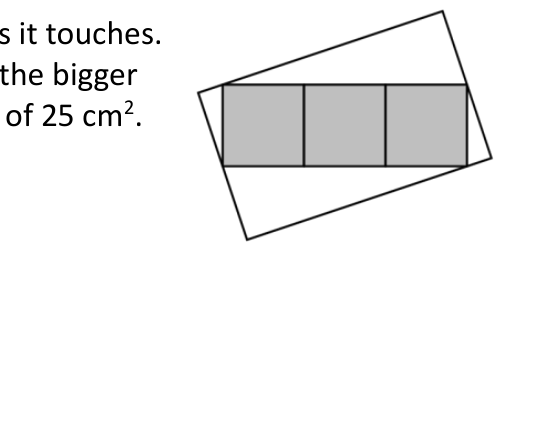
The diagram shows a grey rectangle that lies within a bigger rectangle, touching its sides. Two corner points of the grey rectangle are the midpoints of the shorter sides of the bigger rectangle. The grey rectangle is made up of three squares that each have an area of 25 cm². How big is the area of the bigger rectangle, in cm²?
Show answer
Answer: D — 150
Show hints
Hint 1 of 2
Each small square has area 25, so its side is 5 and the grey rectangle is 15 by 5, area 75.
Still stuck? Show hint 2 →
Hint 2 of 2
A rectangle whose two opposite corners are midpoints of the big rectangle's sides covers exactly half of it.
Show solution
Approach: grey is an inscribed rectangle covering half the big rectangle's area
Each square has side √25 = 5, so the grey rectangle is 15 by 5 with area 75 cm².
Two opposite grey corners are midpoints of the big rectangle's short sides, and the other two lie on its long sides.
Such an inscribed rectangle always encloses exactly half of the outer rectangle, so the big area is 2 × 75 = 150 cm².
A regular hexagon is split into four quadrilaterals and a smaller regular hexagon. The ratio area of the dark sectionsarea of the small hexagon = 43. How big is the ratio area of the small hexagonarea of the big hexagon?
Show answer
Answer: A — 311
Show hints
Hint 1 of 2
Call the small hexagon's area S; then the dark sections total (4/3)S.
Still stuck? Show hint 2 →
Hint 2 of 2
The big hexagon = small hexagon + four quadrilaterals; express the quadrilaterals using the dark/light split.
Show solution
Approach: write all areas in terms of the small hexagon's area
Let the small hexagon have area S. By symmetry the four quadrilaterals are equal; two of them are dark, two light.
Dark = 2 quadrilaterals = (4/3)S, so one quadrilateral = (2/3)S and all four total (8/3)S.
Big hexagon = small hexagon + four quadrilaterals = S + (8/3)S = (11/3)S.
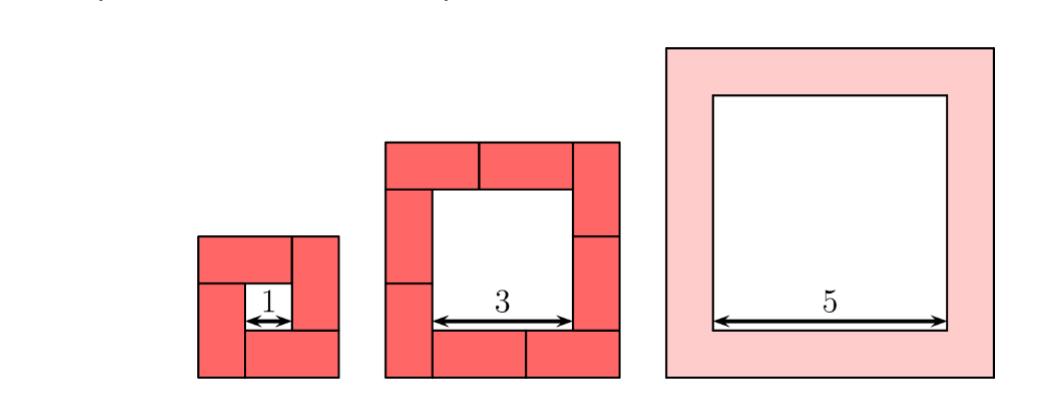
Katrin forms a path around each square. For that she uses stones that are 2 long and 1 wide (see picture). How many such stones does she need for a path around the square with side length 5?
Show answer
Answer: C — 12
Show hints
Hint 1 of 2
Count the stones in the small ring (side 1) and the next ring (side 3) shown in the picture.
Still stuck? Show hint 2 →
Hint 2 of 2
See how many stones get added each time the side gets bigger, then keep that pattern going up to side 5.
Show solution
Approach: continue the picture's stone-count pattern
In the picture, the side-1 ring uses 4 stones and the side-3 ring uses 8 stones.
So growing the side by 2 adds 4 more stones each time (4, then 8, then 12).
The side-5 ring needs 12 stones, so the answer is 12.
For older kidsA 1-stone-thick ring around a square of side \(n\) uses \(2n+2\) of the 2-by-1 stones; for \(n=5\) that is \(2\times5+2=12\).
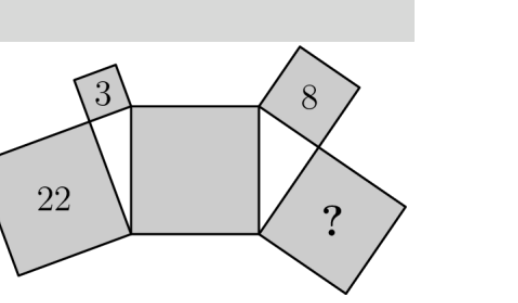
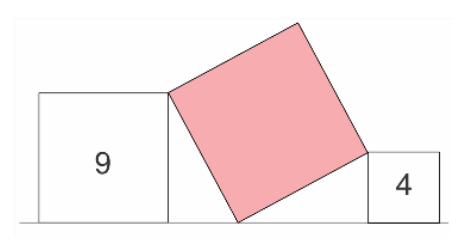
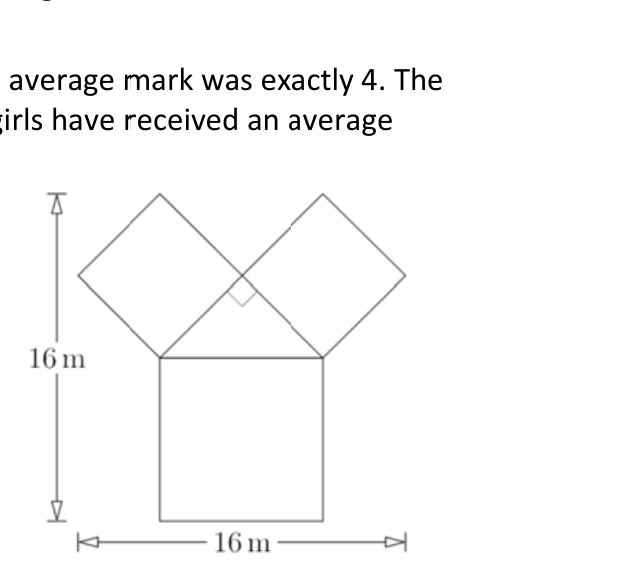
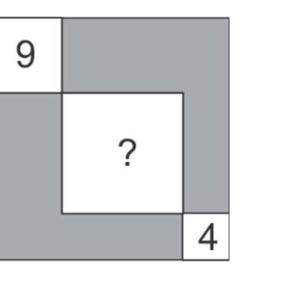
Five squares and two right-angled triangles are placed as shown in the diagram. The numbers 3, 8 and 22 in the squares state the size of the area in m². How big is the area (in m²) of the square with the question mark?
Show answer
Answer: D — 17
Show hints
Hint 1 of 2
Each right triangle ties three squares together through the Pythagorean relation on its sides.
Still stuck? Show hint 2 →
Hint 2 of 2
Chain the area relations across the two triangles to reach the '?' square.
Show solution
Approach: use that each right triangle makes leg-squares add to the hypotenuse-square
For a right triangle, the square on the hypotenuse has area equal to the sum of the squares on the two legs.
The two triangles share a side, so the chain of squares gives \(? + 8 = 22 + 3\): the unknown plus 8 equals the other two squares combined.
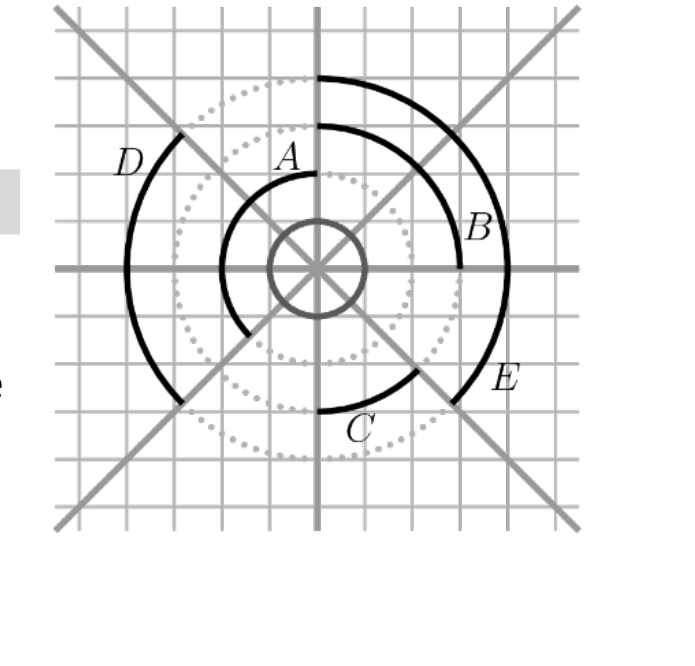
Four straight lines that intersect in one single point form eight equal angles (see diagram). Which one of the black arcs has the same length as the circumference of the little (grey) circle?
Show answer
Answer: D — D
Show hints
Hint 1 of 2
Each of the eight equal angles is 45°; an arc's length is radius times its angle.
Still stuck? Show hint 2 →
Hint 2 of 2
Match an arc whose (radius × angle) equals the small circle's circumference 2πr.
Show solution
Approach: match arc length to circumference (deferred to key)
The four lines split the plane into eight 45° sectors.
Comparing each black arc's radius and angle to the small circle's circumference picks out one arc.
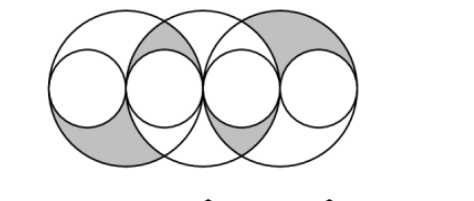
The diagram shows three big circles of equal size and four small circles. Each small circle touches two big circles and has radius 1. How big is the shaded area?
Show answer
Answer: B — \(2\pi\)
Show hints
Hint 1 of 2
The small circles have radius 1; relate the big-circle radius to the small ones.
Still stuck? Show hint 2 →
Hint 2 of 2
The shaded crescent-like pieces rearrange to a neat multiple of pi.
Show solution
Approach: express the shaded region using the small radius 1
Each small circle has radius 1 and sits where two big circles meet.
Adding and subtracting the overlapping circular regions, the shaded crescents combine to a clean area.
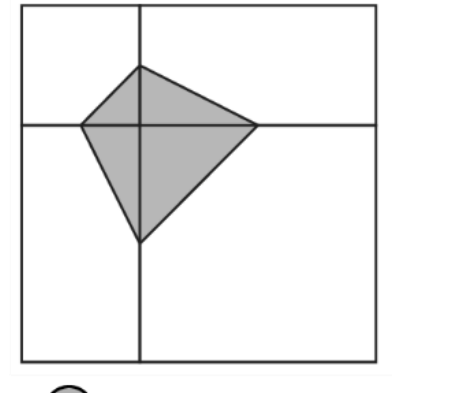
The square pictured is split into two squares and two rectangles. The vertices of the shaded quadrilateral with area 3 are the midpoints of the sides of the smaller squares. What is the area of the non-shaded part of the big square?
Show answer
Answer: D — 21
Show hints
Hint 1 of 2
The shaded kite's corners are the side-midpoints of the two small squares around the centre.
Still stuck? Show hint 2 →
Hint 2 of 2
Compute the kite's area as a fraction of the whole square — it doesn't depend on how the square is split.
Show solution
Approach: kite is one-eighth of the big square
Place the big square as side a+b with the smaller squares of sides a and b meeting at the centre cross.
The kite's four vertices are the relevant side-midpoints; its area works out to exactly 1/8 of the big square (independent of a and b).
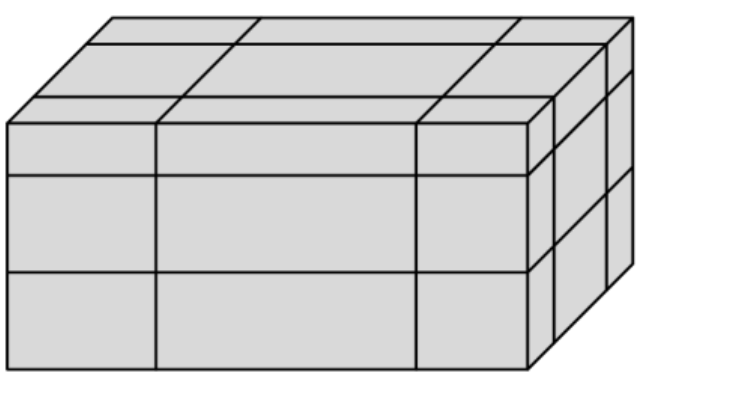
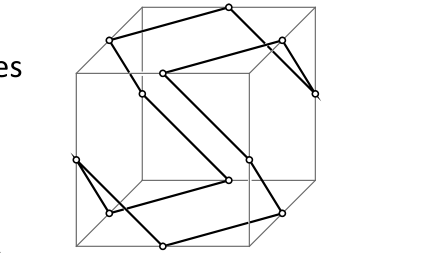
A cuboid with surface area X is cut up along six planes parallel to the sides (see diagram). What is the total surface area of all 27 thus created solids?
Show answer
Answer: C — \(3X\)
Show hints
Hint 1 of 2
Every cut parallel to a face creates two new faces equal to that cross-section.
Still stuck? Show hint 2 →
Hint 2 of 2
Two cuts in each of the three directions; total new area relates simply to X.
Show solution
Approach: count area added by the cuts
Let the three face-pair areas be S1, S2, S3, so X = 2(S1+S2+S3).
Two cuts perpendicular to each direction add 4S1 + 4S2 + 4S3 = 2X of new surface.
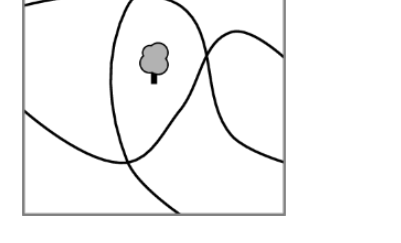
There are three paths running through our park in the city (see diagram). A tree is situated in the centre of the park. What is the minimum number of trees that have to be planted additionally so that there are the same number of trees on either side of each path?
Show answer
Answer: C — 3
Show hints
Hint 1 of 2
Each path must split the trees evenly, so it needs an equal count on both sides.
Still stuck? Show hint 2 →
Hint 2 of 2
Add trees so that every one of the three paths is balanced at once.
Show solution
Approach: balance the tree count across all three dividing paths
Each path divides the park into two parts that must hold equally many trees.
Place extra trees so that all three balance conditions hold at once, including the existing central tree.
The minimum number of additional trees needed is 3.
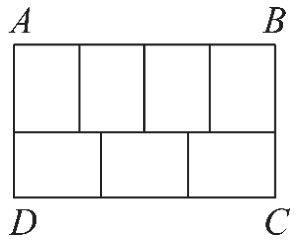
The large rectangle ABCD is made up of 7 congruent smaller rectangles (see diagram). What is the ratio AB⁄BC?
Show answer
Answer: D — 12⁄7
Show hints
Hint 1 of 2
The 7 small rectangles are all congruent; let one be \(a\) (long) by \(b\) (short) and read off how many fit across each row of the figure.
Still stuck? Show hint 2 →
Hint 2 of 2
Both rows span the same width AB, so equate the two row widths to get a relation between \(a\) and \(b\).
Show solution
Approach: equate the widths of the two rows of small rectangles
Let each small rectangle have long side \(a\) and short side \(b\). One row places 3 rectangles standing up (width \(3b\)) beside others, and the other row lays 4 rectangles flat, but both rows span the full width \(AB\).
Matching the row widths gives the relation \(4b = 3a\) (so \(a = \tfrac{4}{3}b\)), and the figure makes \(AB = 4b\) while \(BC = a + b\).
Then \(\tfrac{AB}{BC} = \tfrac{4b}{a+b} = \tfrac{4b}{\frac{4}{3}b + b} = \tfrac{4}{7/3} = \tfrac{12}{7}\), so the answer is D.
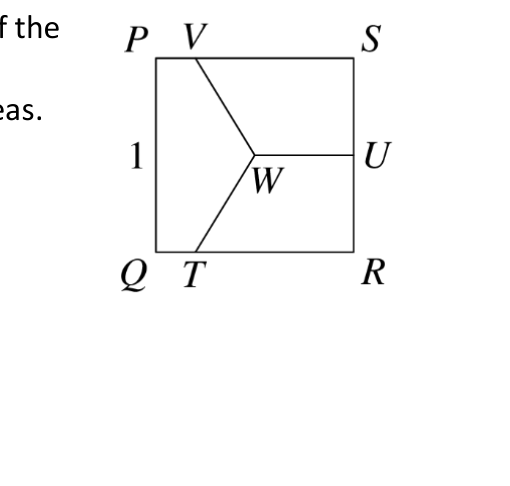
The diagram shows a square PQRS with side length 1. The point U is the midpoint of the side RS and the point W is the midpoint of the square. The three line segments TW, UW and VW split the square into three equally big areas. How long is the line segment SV?
Show answer
Answer: E — \(\tfrac{5}{6}\)
Show hints
Hint 1 of 2
Put coordinates on the unit square with W at the centre and U, V as the relevant points.
Still stuck? Show hint 2 →
Hint 2 of 2
Each of the three regions must have area 1/3; use that to locate V on the top side.
Show solution
Approach: coordinates with equal-area condition to find V, then length SV
Place P, Q, R, S as a unit square with W at the centre and U the midpoint of RS.
Requiring the three regions cut by TW, UW, VW to each have area 1/3 fixes where V sits along the top side.
From V's position the segment SV comes out to 5/6.
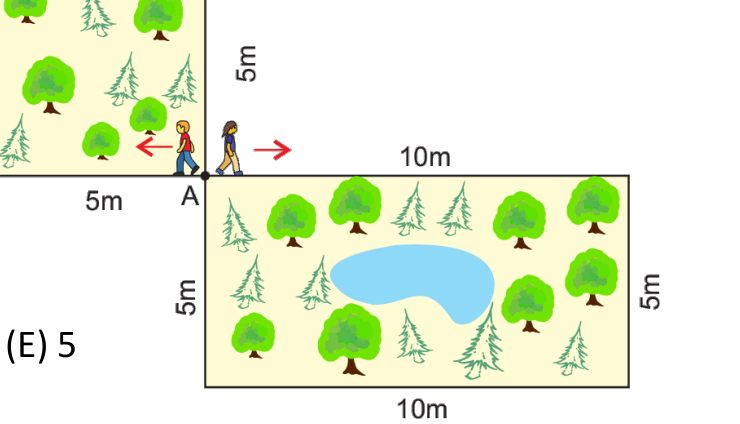
Ahmed and Sara start at point A and walk in the directions shown, at the same speed. Ahmed walks around the square garden and Sara walks around the rectangular garden. How many rounds must Ahmed walk to meet Sara at point A again for the first time?
Show answer
Answer: C — 3
Show hints
Hint 1 of 3
Work out how far one lap is for each child by adding up the sides of their garden.
Still stuck? Show hint 2 →
Hint 2 of 3
Each child is back at A after 1 lap, 2 laps, 3 laps… so skip-count the total distance for each.
Still stuck? Show hint 3 →
Hint 3 of 3
Look for the first distance that shows up in both lists — that is when they meet at A.
Show solution
Approach: skip-count each child's distances until they match
Ahmed's square garden is 5 + 5 + 5 + 5 = 20 m around; Sara's rectangle is 10 + 5 + 10 + 5 = 30 m around.
Ahmed is back at A after 20, 40, 60… metres; Sara is back at A after 30, 60, 90… metres.
The first distance in both lists is 60 m, so that is when they meet at A again.
Ahmed has gone 60 ÷ 20 = 3 laps, so he walks 3 rounds (choice C).
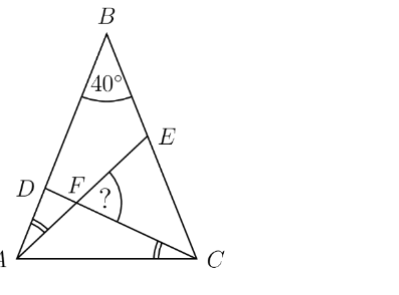
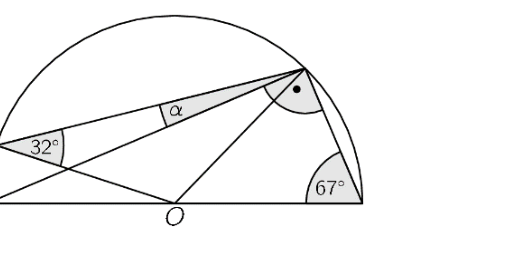
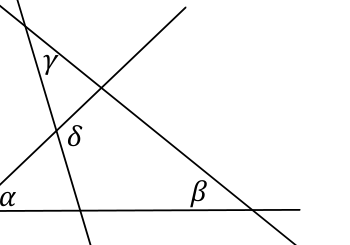
The figure shows a semicircle with center O. Two of the angles are given. What is the size, in degrees, of the angle α?
Show answer
Answer: A — 9°
Show hints
Hint 1 of 2
Every segment drawn from the centre O out to the arc is a radius, so each triangle with O at a vertex is isosceles with two equal base angles.
Still stuck? Show hint 2 →
Hint 2 of 2
Use the exterior-angle rule: in an isosceles radius-triangle the apex's exterior angle equals twice a base angle, so the angles grow by doubling as you step along the chain from \(32°\) toward the \(67°\) corner.
The chords from the diameter's left end and from O to the top point P all share endpoints with radii, so the figure is a chain of isosceles triangles built on equal radii.
Starting from the \(32°\) base angle, each successive isosceles triangle's exterior angle is twice the previous base angle, so the marked directions advance \(32°,\,64°,\,\dots\) around toward P.
The \(67°\) angle at the right-hand end fixes where the last radius points, and \(α\) is the small leftover between that direction and chord \(PR\): the doubling chain and the \(67°\) constraint leave exactly \(9°\).
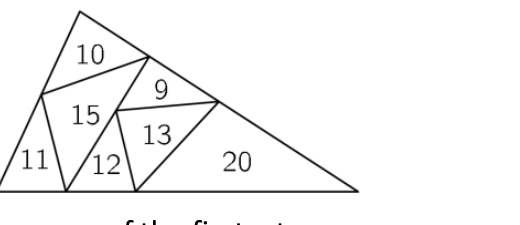
A large triangle is divided into smaller triangles as shown. The number inside each small triangle indicates its perimeter. What is the perimeter of the large triangle?
Show answer
Answer: C — 34
Show hints
Hint 1 of 2
Add up all the small perimeters; every inner edge gets counted twice.
Still stuck? Show hint 2 →
Hint 2 of 2
Subtract twice the total length of the shared interior edges to leave only the outer boundary.
Show solution
Approach: relate the sum of small perimeters to the outer boundary
Adding every small triangle's perimeter counts each interior (shared) edge twice and each outer edge once: the labels total 10+9+15+13+11+12+20 = 90.
So the large triangle's perimeter = 90 − 2×(total length of the interior edges).
The interior edges in the figure add up to 28, leaving an outer perimeter of 90 − 56 = 34.
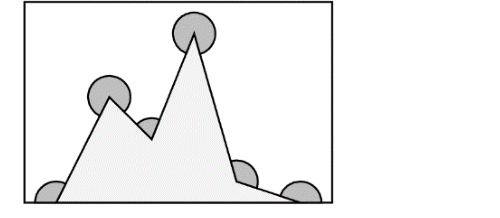
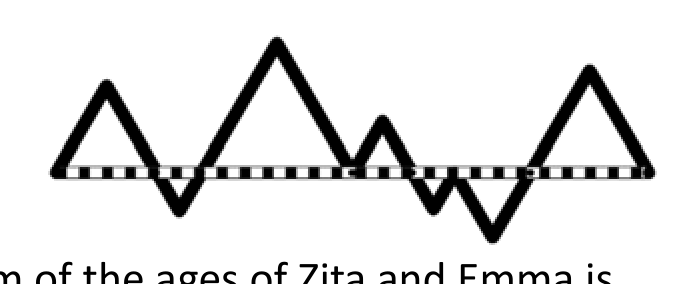
What is the sum of the six marked angles in the picture?
Show answer
Answer: C — 1080°
Show hints
Hint 1 of 2
Don't try to measure any single angle — look for whole triangles in the mountain outline, since each triangle contributes a fixed \(180°\).
Still stuck? Show hint 2 →
Hint 2 of 2
The six marked corners are exactly the corners of a few triangles in the figure; add up those triangles' angle sums.
Show solution
Approach: bundle the marked corners into whole-triangle angle sums
Each marked angle sits at a corner of the zig-zag mountain outline, and those corners are the vertices of the triangles the outline cuts the picture into.
Instead of finding any one angle, group the six marked corners so that together they form six triangle-corner triples, each triple summing to \(180°\) (the straight pieces of the outline cancel out).
Six such triangle angle sums give \(6\times 180° = 1080°\).
So the six marked angles total \(1080°\), choice (C).
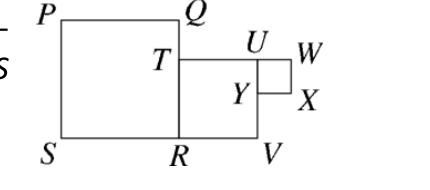
The diagram shows three squares, PQRS, TUVR and UWXY. They are placed together, edge to edge. Points P, T and X lie on the same straight line. The area of PQRS is 36 and the area of TUVR is 16. What is the area of triangle PXV?
Show answer
Answer: C — \(16\)
Show hints
Hint 1 of 2
Set coordinates with the shared baseline on the x-axis and read off the corner points.
Still stuck? Show hint 2 →
Hint 2 of 2
Use the collinearity of P, T, X to find the small square's size, then apply the shoelace area.
Show solution
Approach: coordinatise and use the shoelace formula
Place S=(0,0): then P=(0,6), R=(6,0), V=(10,0), T=(6,4), U=(10,4) from the side-6 and side-4 squares.
P, T, X collinear (line y = 6 − x/3) forces the third square's side 2, giving X=(12,2).
Shoelace on P(0,6), X(12,2), V(10,0): area = ½|0−72+40| = 16.
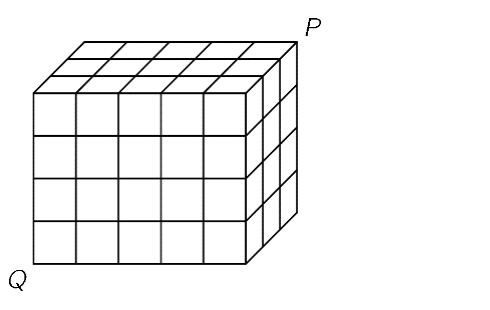
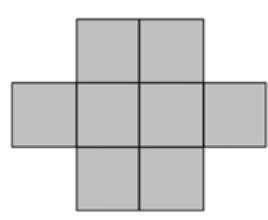
A 3×4×5 cuboid consists of 60 identical small cubes. A termite eats its way along the diagonal from P to Q. This diagonal does not intersect the edges of any small cube inside the cuboid. How many of the small cubes does it pass through on its journey?
Show answer
Answer: C — 10
Show hints
Hint 1 of 2
The diagonal of an a×b×c grid crosses a + b + c interior 'sheets', but crossings at shared edges count once.
Still stuck? Show hint 2 →
Hint 2 of 2
Use a + b + c minus the pairwise gcds plus the triple gcd.
Show solution
Approach: count unit cubes a space-diagonal passes through
For a 3×4×5 box the count is a+b+c − gcd(a,b) − gcd(b,c) − gcd(a,c) + gcd(a,b,c).
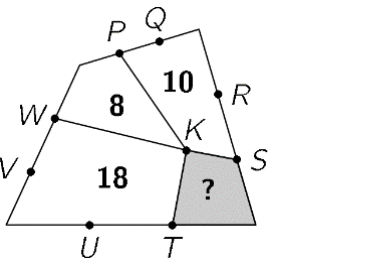
The diagram shows a quadrilateral divided into 4 smaller quadrilaterals with a common vertex K. The other labelled points divide the sides of the large quadrilateral into three equal parts. The numbers indicate the areas of the corresponding small quadrilaterals. What is the area of the shaded quadrilateral?
Show answer
Answer: C — 6
Show hints
Hint 1 of 2
Because the side-points trisect the big quadrilateral's sides, triangles sharing the vertex K have areas in fixed ratios.
Still stuck? Show hint 2 →
Hint 2 of 2
Set up the proportional relations among the four corner quadrilaterals and solve for the shaded one.
Show solution
Approach: use the equal-trisection area ratios
The labelled points trisect each side of the big quadrilateral, so triangles that share the vertex K and sit on equal side-thirds have equal areas.
Splitting each of the four small quadrilaterals through K into two triangles and matching the equal-base pairs ties the three known areas 8, 10 and 18 to the shaded one.
Solving those balance relations gives the shaded quadrilateral an area of 6.
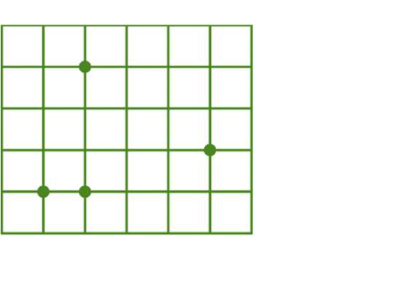
Four points were marked on a grid of 1 cm side squares. Of the possible triangular regions that can be obtained with vertices at three of these points, one has the largest area. What is this area, in cm²?
Show answer
Answer: D — 5.5
Show hints
Hint 1 of 2
List the four marked lattice points, then think which three are spread out most.
Still stuck? Show hint 2 →
Hint 2 of 2
Use the shoelace formula (or base×height) on the most spread-out triple.
Show solution
Approach: compute triangle areas on the lattice and take the largest
The points are at (2,4), (5,2), (1,1) and (2,1) on the cm grid.
The triangle (2,4), (5,2), (1,1) has area ½|2(2−1)+5(1−4)+1(4−2)| = ½·11 = 5.5.
The other triples give smaller areas (4.5, 1.5, 0.5).
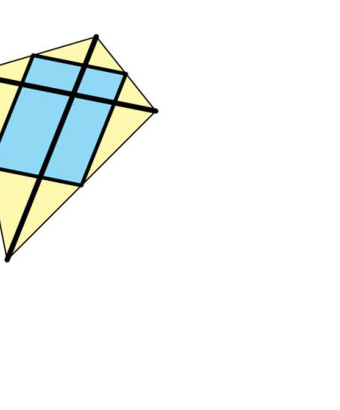
Martinho made a two-colour kite with six pieces of a thin strip of bamboo. Two pieces were used for the diagonals, which are perpendicular. The other four pieces were used to connect the midpoints of the sides of the kite, as shown in the picture. What is the ratio between the blue and yellow parts of the kite?
Show answer
Answer: E — 1
Show hints
Hint 1 of 2
Joining the midpoints of any quadrilateral’s sides makes a parallelogram inside it.
Still stuck? Show hint 2 →
Hint 2 of 2
That midpoint parallelogram always has exactly half the area of the original shape.
Show solution
Approach: use the Varignon midpoint-parallelogram half-area fact
The blue region is the parallelogram formed by the midpoints of the kite’s sides.
For any quadrilateral, this midpoint parallelogram has half the total area.
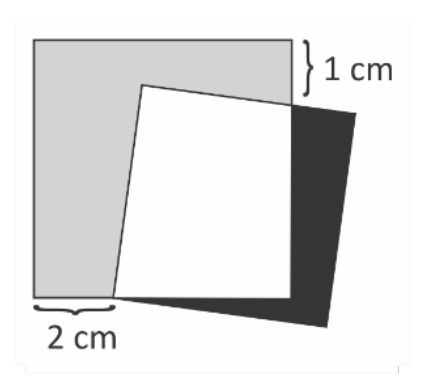
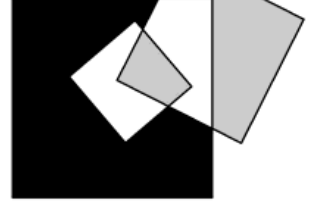
A gray square of area 36 cm² and a black square of area 25 cm² are overlaid as shown. What is the perimeter of the overlapping region — the white quadrilateral, which has one vertex on a side of the gray square?
Show answer
Answer: B — 11 cm
Show hints
Hint 1 of 2
The overlapping white region's sides come from the edges of the two squares.
Still stuck? Show hint 2 →
Hint 2 of 2
The slanted pieces pair up to recover full side lengths.
Show solution
Approach: reassemble the overlap's sides into full square sides
The white quadrilateral is bounded partly by the gray square's edge and partly by the black square's edge.
Because a vertex of one square lies on a side of the other, the slanted boundary pieces add up to one full side of each square.
So the perimeter equals side(gray) + side(black) = 6 + 5 = 11 cm.
Two isosceles triangles that are not similar have at least one side of 20 cm and have equal perimeters. If one of them has a side of 8 cm, which of the following measures can be the measure of one side of the other triangle?
Show answer
Answer: D — 14 cm
Show hints
Hint 1 of 2
Build the two isosceles triangles so their perimeters match, with a 20 in one and an 8 in the other.
Still stuck? Show hint 2 →
Hint 2 of 2
Check that a candidate side length lets you form a genuine (non-degenerate, non-similar) triangle.
Show solution
Approach: construct matching-perimeter isosceles triangles and test a side
Take (8, 20, 20): isosceles, perimeter 48, with sides 8 and 20.
The other triangle (14, 14, 20) is isosceles, perimeter 48, and not similar to the first.
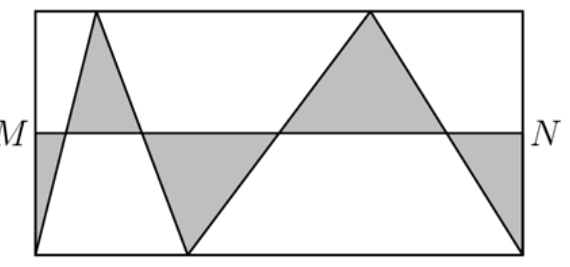
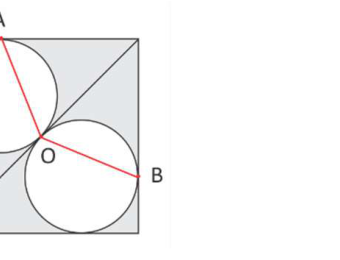
Two circles are tangent to each other and also to two sides of a square. What is the measure of the angle AÔB, determined by three of these points of tangency, as shown in the figure?
Show answer
Answer: E — 135°
Show hints
Hint 1 of 2
The two equal circles and their three tangent points sit symmetrically about a diagonal of the square.
Still stuck? Show hint 2 →
Hint 2 of 2
Drop the radii to the tangent points (each radius meets its tangent line at a right angle) and chase the angles.
Show solution
Approach: use radii-perpendicular-to-tangents plus the diagonal symmetry
The two circles are equal and lined up along the square’s diagonal, with O the point where they touch each other.
A radius meets each tangent line at 90°, so the angle from O to each outer tangency point is built from a right angle plus the 45° of the diagonal.
Adding the two symmetric halves gives the angle AÔB = 135°, choice E.
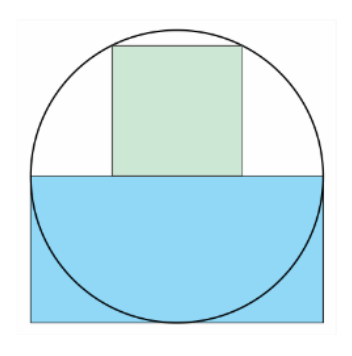
A circle is tangent to one side of a rectangle and passes through two of its vertices, as shown. A square of area 20 cm² has one side lying on a side of the rectangle and two vertices on the circle. What is the area of the rectangle?
Show answer
Answer: C — 50 cm²
Show hints
Hint 1 of 2
By symmetry put the circle's centre on the rectangle's top edge, on the vertical line of symmetry.
Still stuck? Show hint 2 →
Hint 2 of 2
The square's two upper corners sit a half-side left/right and a full side up from that centre — write that distance as the radius.
Show solution
Approach: put the circle's centre on the rectangle's top edge and use the square's corners to find the radius
By symmetry the circle's centre lies on the rectangle's top edge; since the circle is tangent to the bottom edge and passes through the top vertices, the radius equals the rectangle's height and also its half-width.
The square (side \(\sqrt{20}\)) stands on the top edge, so its upper corners are \(\tfrac{\sqrt{20}}{2}\) sideways and \(\sqrt{20}\) up from the centre: \(R^2 = \tfrac{20}{4} + 20 = 25\), so \(R = 5\).
Thus the rectangle is \(10 \times 5\), with area \(50\) cm², option C.
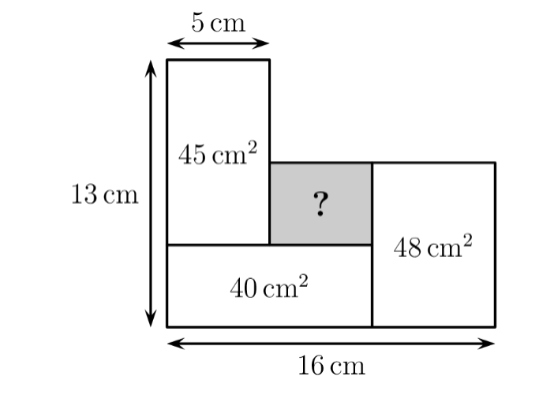
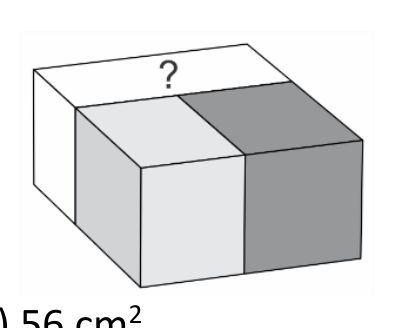
Two rectangular blocks and a cube are joined to form a larger rectangular block of volume 280 cm³. The cube, shown in dark gray, has volume 125 cm³, and the smaller rectangular block has volume 75 cm³. What is the area of the face marked with the question mark?
Show answer
Answer: A — 16 cm²
Show hints
Hint 1 of 2
The cube has side 5, so one dimension of everything is 5.
Still stuck? Show hint 2 →
Hint 2 of 2
Slice the big block into a 5-thick slab and split its face into the three pieces.
Show solution
Approach: decompose the 5x7x8 block
The total volume 280 = 5×7×8, and the cube (125) is 5×5×5.
Removing the cube's 5×5 corner from the 7×8 face leaves an L of area 31, split as 15 (the 75-block, 5×5×3) and 16 (the 80-block, 5×4×4).
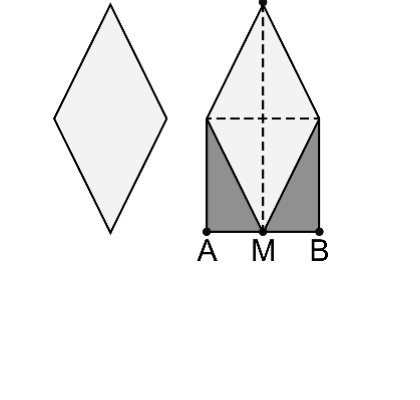
The window shown is a square of area 1 m² and is made up of four triangles whose areas, indicated in the figure, satisfy the ratios \(3A = 4B\) and \(2C = 3D\). A fly is placed exactly at the point where these four triangles touch each other. The fly flies straight to the nearest side of the window. How far does it fly?
Show answer
Answer: A — 40 cm
Show hints
Hint 1 of 2
Each triangle has a full side of the 1 m square as its base; its area fixes the height to that side.
Still stuck? Show hint 2 →
Hint 2 of 2
Opposite heights add to 1 m; use the ratios to find all four heights, then take the smallest.
Show solution
Approach: turn the area ratios into heights and pick the shortest
Each triangle’s area equals ½·(100 cm)·(height to its side), and opposite heights sum to 100 cm.
From 3A = 4B the left/right heights are 400/7 and 300/7 cm.
From 2C = 3D the top/bottom heights are 60 and 40 cm.
The closest side is the bottom, 40 cm away, so the fly flies 40 cm.
The vertices of a square ABCD are labelled anti-clockwise. A and C are the vertices of an equilateral triangle AEC, whose vertices are also labelled anti-clockwise. How big is the angle CBE?
Show answer
Answer: C — 135°
Show hints
Hint 1 of 2
Place the square on coordinates and find the equilateral triangle's apex E on the correct (anticlockwise) side.
Still stuck? Show hint 2 →
Hint 2 of 2
Measure angle CBE from the coordinates.
Show solution
Approach: coordinates and angle measurement
Take A(0,0), B(1,0), C(1,1), D(0,1). The anticlockwise triangle AEC puts E outside the square beyond AC.
Triangle BCE is isosceles, and the apex angle at B works out to 135°.
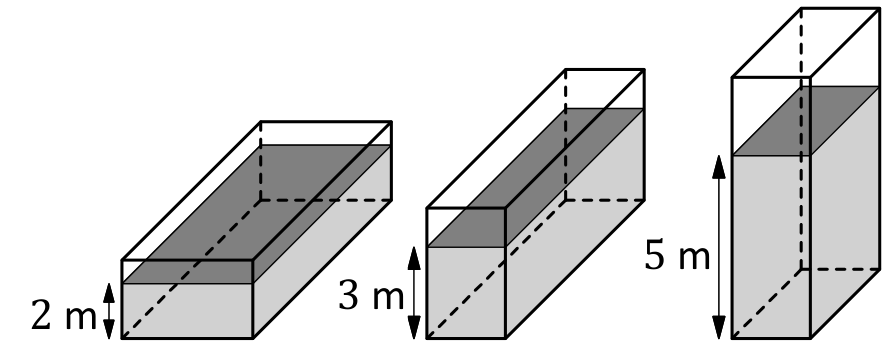
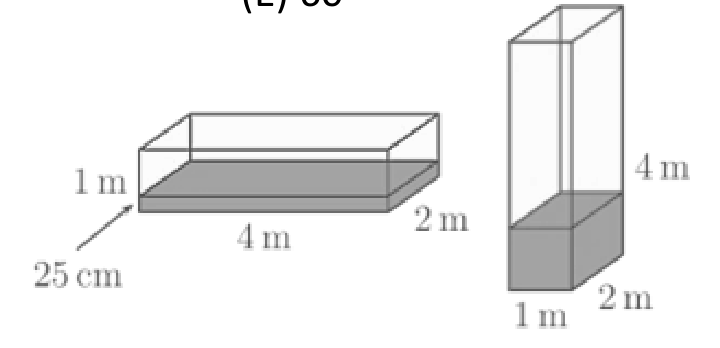
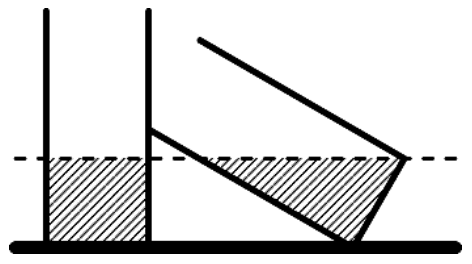
A cuboid-shaped container that is not completely filled holds 120 m³ of water. Depending on which face the container stands on, the depth of the water is 2 m, 3 m or 5 m (drawings not to scale). What is the volume of the container?
Show answer
Answer: E — 240 m³
Show hints
Hint 1 of 2
The same 120 m³ gives depth 2, 3 or 5 on three different bottom faces, so each face area is 120 divided by that depth.
Still stuck? Show hint 2 →
Hint 2 of 2
From the three face areas 60, 40 and 24, the cuboid's volume is the square root of their product.
Show solution
Approach: the water volume is the same in every orientation
The 120 m³ of water sits with depth 2, 3 or 5 m on three different faces.
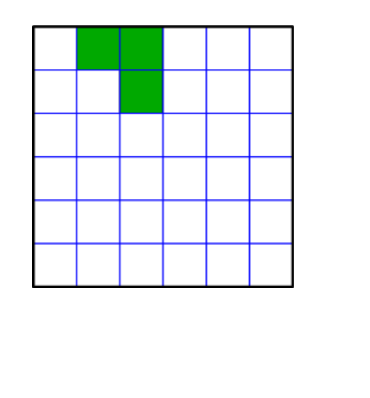
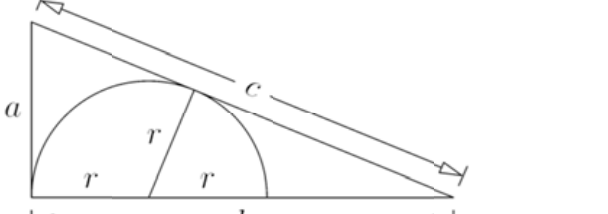
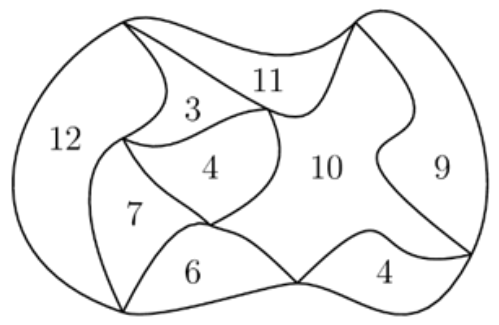
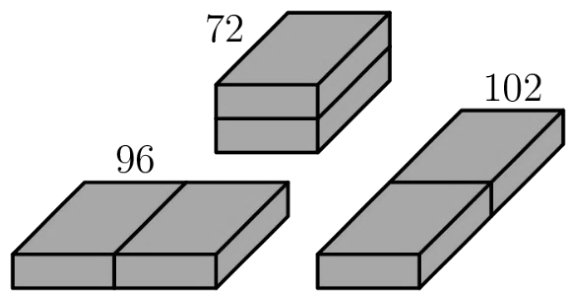
Each bottom face area = 120 ÷ depth, giving 60, 40 and 24 m² — the three face areas of the cuboid.
If the edges are x, y, z then the faces are xy, xz, yz, so \((xyz)^2 = 60\cdot 40\cdot 24 = 57600\) and the volume is \(xyz = 240\).
The flag of Kanguria is a rectangle whose side lengths are in the ratio 3 : 5. The flag is split into four rectangles of equal area, as shown. In which ratio are the side lengths of the white rectangle?
Show answer
Answer: E — 4 : 15
Show hints
Hint 1 of 2
The flag splits into four equal-area rectangles: one tall left strip plus three stacked bars on the right.
Still stuck? Show hint 2 →
Hint 2 of 2
Use the 3:5 side ratio to size the white bar, then take its own width-to-height ratio.
Show solution
Approach: size the pieces from equal areas
Take the flag 5 wide by 3 tall; each of the four equal pieces has area 15/4.
The left strip is 5/4 × 3; the three right bars are each 15/4 wide by 1 tall.
The white bar is 1 by 15/4, side ratio 1 : 15/4 = 4 : 15.
The system shown consists of three pulleys connected to each other by two ropes. The end P of one rope is pulled down by 24 cm. By how many centimetres does point Q move upwards?
Show answer
Answer: D — 6
Show hints
Hint 1 of 2
With movable pulleys the total rope length is conserved; the 24 cm pulled at P is shared among the rope segments that support each pulley.
Still stuck? Show hint 2 →
Hint 2 of 2
Follow each rope over its pulleys and see how the displacement is divided down to point Q.
Show solution
Approach: conserve rope length across the pulley system
Pulling P down by 24 cm feeds slack into the connected ropes.
Each movable pulley halves the displacement passed on, and the two ropes combine the reductions before reaching Q.
Following the displacement through the system, Q rises by 6 cm.
Anna uses 32 small grey squares to frame a 7 cm by 7 cm big picture. How many small grey squares does she have to use to frame a 10 cm by 10 cm big picture?
Show answer
Answer: C — 44
Show hints
Hint 1 of 2
The grey squares make a ring one square thick all the way around the picture.
Still stuck? Show hint 2 →
Hint 2 of 2
Picture the four sides of the ring, and be careful not to count the four corner squares twice.
Show solution
Approach: count the four sides of the grey ring
Around the 7×7 picture, each side of the grey ring is 9 squares long (the 7 picture squares plus one corner at each end), and 4 sides of 9 with the 4 corners counted once give 32 — matching the picture.
Around the 10×10 picture, each side of the ring is 12 squares long.
Four sides of 12 is 48, but the 4 corners were each counted twice, so take 4 away: 48 − 4 = 44.
Mia draws some congruent rectangles and one triangle. She then shades grey the parts of the rectangles that lie outside the triangle (see diagram). How big is the resulting grey area?
Show answer
Answer: B — 12 cm²
Show hints
Hint 1 of 2
Compare the grey parts sticking out with the empty parts of the triangle the rectangles miss.
Still stuck? Show hint 2 →
Hint 2 of 2
By symmetry those two kinds of regions have equal total area.
Show solution
Approach: pair grey overflow with the triangle's uncovered gaps
The triangle has area ½ × 10 × 6 = 30 cm².
By the left-right symmetry of the staircase, each grey piece outside the triangle matches an equal empty piece of the triangle not covered by a rectangle.
Working through the matching, the grey total comes out to 12 cm².
The diagram consists of three circles of equal radius R. The centres of those circles lie on a common straight line, where the middle circle passes through the centres of the other two circles (see diagram). How big is the perimeter of the figure?
Show answer
Answer: A — \(\dfrac{10\pi R}{3}\)
Show hints
Hint 1 of 3
Adjacent centres are a distance R apart, so neighbouring circles meet at 60° points.
Still stuck? Show hint 2 →
Hint 2 of 3
Add up the arc of each circle that lies on the outside of the figure.
Still stuck? Show hint 3 →
Hint 3 of 3
Two equal circles with centres R apart overlap in a 120° lens; work out each circle's exposed arc.
Show solution
Approach: add the exposed arcs of the three circles
Neighbouring circles (centres R apart) cross at points 60° above and below the centre line.
Adding the outside arcs of all three circles totals 600° of arc, i.e. 5/3 of a full circle.
From above, the corridor of a school looks like in the diagram. A cat walks along the dotted line drawn in the middle of the room. How many meters does the cat walk?
Show answer
Answer: E — 83 m
Show hints
Hint 1 of 2
The cat follows the dashed centre line, so use the middle of each corridor section, not the outer walls.
Still stuck? Show hint 2 →
Hint 2 of 2
Break the path into the three straight middle-line pieces and add their lengths.
Show solution
Approach: add the centre-line segments
The corridor has three arms; the cat's dashed path runs along the middle of each.
Bottom arm: the vertical part is 40 − 36 = 4 m wide, so its middle sits 2 m in from the right wall; the centre line runs 36 + 2 = 38 m across.
Vertical arm: it is 20 m up to the start of the top arm, which is 6 m tall, so the centre line climbs to the middle of the top arm; together this part of the path is 19 m.
Top arm: from the middle of the vertical arm out to the far end is 26 m.
Eight congruent semicircles are drawn inside a square with side length 4. How big is the area of the white part?
Show answer
Answer: B — 8
Show hints
Hint 1 of 2
Find the radius of the semicircles from how they sit along the sides.
Still stuck? Show hint 2 →
Hint 2 of 2
Pair up the grey and white pieces so the curved parts cancel.
Show solution
Approach: match curved pieces so the area is exactly half the square
Two semicircles fit along each side of length 4, so each has diameter 2 and radius 1.
By symmetry the eight semicircles split the square into equal grey and white regions: each curved bite removed from the grey is matched by an equal curved bite added to the white.
So the white area is exactly half of the square: \(\tfrac12\times 16 = \) 8.
The vertices of a triangle have the coordinates \(A(p \mid q)\), \(B(r \mid s)\) and \(C(t \mid u)\), as shown. The midpoints of the sides of the triangle are the points \(M(-2 \mid 1)\), \(N(2 \mid -1)\) and \(P(3 \mid 2)\). Determine the value of the expression \(p + q + r + s + t + u\).
Show answer
Answer: D — \(5\)
Show hints
Hint 1 of 2
The sum of the triangle's vertices relates simply to the sum of the side midpoints.
Still stuck? Show hint 2 →
Hint 2 of 2
Each midpoint is the average of two vertices.
Show solution
Approach: sum the midpoints to get the sum of the vertices
Adding the three midpoints: (A+B)/2 + (B+C)/2 + (C+A)/2 = A+B+C.
So the sum of all vertex coordinates equals the sum of all midpoint coordinates.
The big rectangle is made up of several squares of different sizes. Each of the three smallest squares has area 1. What is the area of the big rectangle?
Show answer
Answer: C — 77
Show hints
Hint 1 of 3
Each tiny square has area 1, so its side is just 1 little step — use that step as your ruler for everything else.
Still stuck? Show hint 2 →
Hint 2 of 3
The three tiny squares sit in a row, so the square resting on top of them is 3 steps wide, and you can keep measuring the bigger squares the same way.
Still stuck? Show hint 3 →
Hint 3 of 3
Once you know how many steps wide and how many steps tall the whole rectangle is, multiply those two numbers.
Show solution
Approach: use the side of a tiny square as a measuring step, find each bigger square's side, then multiply the rectangle's width by its height
Each smallest square has area 1, so its side is 1 step long; the three of them in a row make the bottom-left part 3 steps wide.
The square sitting on top of those three is 3 steps on each side, and together with the row of tiny squares the left part is 3 + 1 = 4 steps tall; the square next to it is 4 steps on each side, so the bottom strip is 3 + 4 = 7 steps wide.
The big square on top is as wide as the whole strip, 7 steps, so the rectangle is 7 steps wide and 4 + 7 = 11 steps tall, giving an area of 7 × 11 = 77, answer C.
In a regular 2018-sided polygon the vertices are numbered 1 to 2018 in order. Two diagonals are drawn: one joins vertices 18 and 1018, the other joins vertices 1018 and 2000. How many vertices do the three resulting polygons have?
Show answer
Answer: A — 38, 983, 1001
Show hints
Hint 1 of 2
The two diagonals share vertex 1018, cutting the polygon into three pieces.
Still stuck? Show hint 2 →
Hint 2 of 2
Count the vertices on each piece inclusively (shared endpoints belong to both adjoining pieces).
Show solution
Approach: count the vertices on each arc inclusively
Diagonal 18–1018 bounds the arc 18, 19, …, 1018: that is \(1018-18+1 = 1001\) vertices.
Diagonal 1018–2000 bounds the arc 1018, …, 2000: that is \(2000-1018+1 = 983\) vertices.
The third piece runs 2000, …, 2018, 1, …, 18 together with vertex 1018: \(19 + 18 + 1 = 38\) vertices.
So the three polygons have 38, 983, 1001 vertices.
A belt can be closed in 5 different holes (see picture). How many cm longer is the belt if it is closed in the first hole instead of in the fifth (last) hole?
Show answer
Answer: B — 8 cm
Show hints
Hint 1 of 2
The holes are spaced 2 cm apart; using the first hole leaves more belt than using the fifth.
Still stuck? Show hint 2 →
Hint 2 of 2
The extra length is the distance from the first hole to the fifth.
Show solution
Approach: measure the gap between the first and last hole
The five holes are 2 cm apart, so the first and fifth holes are 4 × 2 = 8 cm apart.
Closing in the first hole instead of the fifth leaves that extra 8 cm of belt.
Lisa’s aviation club designs a flag with a flying “dove” on a 4×6 grid. The area of the “dove” is 192 cm². The perimeter of the “dove” is made up of straight lines and circular arcs. What measurements does the flag have?
Show answer
Answer: D — 24 cm x 16 cm
Show hints
Hint 1 of 2
By the design's symmetry the dove covers exactly half of the whole grid.
Still stuck? Show hint 2 →
Hint 2 of 2
Find the total grid area, then the area of one of the 4×6 cells to get the cell side.
Show solution
Approach: dove = half the grid, then size one cell
The dove's curved and straight pieces fit so it fills exactly half the grid, so the grid area is 2 · 192 = 384 cm².
The grid has 4 · 6 = 24 equal cells, so each cell is 384 : 24 = 16 cm², i.e. 4 cm by 4 cm.
The flag therefore measures 6 · 4 by 4 · 4 = 24 cm × 16 cm.
The points N, M and L lie on the sides of an equilateral triangle ABC so that NM ⊥ BC, ML ⊥ AB and LN ⊥ AC. The area of triangle ABC is 36 cm². What is the area of triangle LMN?
Show answer
Answer: B — 12 cm²
Show hints
Hint 1 of 2
The three right-angle conditions place L, M, N symmetrically on the three sides.
Still stuck? Show hint 2 →
Hint 2 of 2
Inner triangle LMN turns out to be a fixed fraction of triangle ABC.
Show solution
Approach: exploit the symmetric perpendicular-foot construction
The conditions NM ⊥ BC, ML ⊥ AB and LN ⊥ AC place L, M, N symmetrically, so triangle LMN is equilateral and centred in ABC.
For this construction the inner triangle has exactly one third of the area of ABC.
In the isosceles triangle ABC (with base AC) the points K and L are added on the sides AB and BC respectively so that AK = KL = LB and KB = AC. How big is the angle ∠ABC?
Show answer
Answer: C — 36°
Show hints
Hint 1 of 2
Mark the equal segments and chase the base angles of the isosceles triangles that appear.
Still stuck? Show hint 2 →
Hint 2 of 2
Set the angle at A found two different ways equal to each other and solve for angle ABC.
Show solution
Approach: angle-chase the equal segments
Let ∠ABC = β. From AK = KL = LB the angle at A inside that chain is β/2, so ∠LAC = (90° − β/2) − β/2 = 90° − β.
Since KB = AC and B, L, C are in line, LC = AC, making triangle ALC isosceles with ∠LAC = 45° + β/4.
ABCD is a trapezium with parallel sides AB and CD. Let AB = 50 and CD = 20. Point E lies on side AB in such a way that the straight line DE divides the trapezium into two shapes of equal area. How long is the straight line AE?
Show answer
Answer: C — 35
Show hints
Hint 1 of 2
The line DE makes triangle ADE on one side; its area is half base times height.
Still stuck? Show hint 2 →
Hint 2 of 2
Set that triangle equal to half the whole trapezium's area.
Show solution
Approach: express the half-area as a triangle and solve for the base AE
The trapezium has area (50 + 20)/2 × h = 35h, so each half is 17.5h.
Triangle ADE has base AE on AB and the same height h, area = ½ · AE · h.
Setting ½ · AE · h = 17.5h gives AE = 35, choice C.
Three circles with centres A, B, C touch each other in pairs from the outside (see diagram). Their radii are 3, 2 and 1. How big is the area of the triangle ABC?
Show answer
Answer: A — 6
Show hints
Hint 1 of 2
When two circles touch externally, the distance between their centres is the sum of the radii.
Still stuck? Show hint 2 →
Hint 2 of 2
Work out the three side lengths of triangle ABC; they may form a familiar right triangle.
Show solution
Approach: get the side lengths from touching circles, recognise a 3-4-5 triangle
Touching externally, AB = 3 + 2 = 5, BC = 2 + 1 = 3, CA = 1 + 3 = 4.
Sides 3, 4, 5 form a right triangle (3^2 + 4^2 = 5^2).
In an equilateral triangle with area 1, we draw the six perpendicular lines from the midpoints of each side to the other two sides as seen in the diagram. How big is the area of the grey hexagon that has been created this way?
Show answer
Answer: D — 12
Show hints
Hint 1 of 2
The figure is highly symmetric — the hexagon sits at the centre.
Still stuck? Show hint 2 →
Hint 2 of 2
Compare the grey region with the whole triangle using that symmetry.
Show solution
Approach: use the threefold symmetry to pair the grey hexagon against the cut-off corner regions
The construction has the triangle's full threefold rotational symmetry, so the central hexagon and the regions cut off around it all repeat in three identical copies.
Tracking those repeating pieces (or checking with coordinates) shows the cut-off regions outside the hexagon add up to exactly the same area as the hexagon itself.
So the hexagon is exactly half of the triangle; with the triangle's area equal to 1 that is 1/2, choice D.
Two cylinders A and B have the same volume. The radius of the base of B is 10% bigger than that of A. By how much is the height of A greater than that of B?
Show answer
Answer: E — 21%
Show hints
Hint 1 of 2
Equal volumes means (radius squared) x height is the same for both cylinders.
Still stuck? Show hint 2 →
Hint 2 of 2
If B's radius is 1.1 times A's, compare the heights through the square of that factor.
Show solution
Approach: use equal volume to relate the heights through the radius ratio
Volume = pi r^2 h is equal, so r_A^2 h_A = r_B^2 h_B with r_B = 1.1 r_A.
In a convex quadrilateral ABCD the diagonals are perpendicular to each other. The lengths of the edges are AB = 2017, BC = 2018 and CD = 2019 (diagram not to scale). How long is side AD?
Show answer
Answer: D — \(\sqrt{2018^2 + 2}\)
Show hints
Hint 1 of 2
With perpendicular diagonals, the four sides satisfy a neat relation between opposite pairs.
Still stuck? Show hint 2 →
Hint 2 of 2
Use AB^2 + CD^2 = BC^2 + AD^2 to solve for AD.
Show solution
Approach: apply the perpendicular-diagonal identity for the sides
For perpendicular diagonals, AB^2 + CD^2 = BC^2 + AD^2.
So AD^2 = 2017^2 + 2019^2 - 2018^2.
Since 2017^2 + 2019^2 = 2*2018^2 + 2, this gives AD^2 = 2018^2 + 2, so AD = sqrt(2018^2 + 2).
If you measure the angles of a triangle, you obtain three different natural numbers. What is the smallest possible sum of the biggest and the smallest angle of the triangle?
Show answer
Answer: C — 91°
Show hints
Hint 1 of 2
Biggest + smallest = 180° − middle, so making that small means making the middle angle large.
Still stuck? Show hint 2 →
Hint 2 of 2
Push the middle angle as high as possible while keeping all three angles different whole numbers.
Show solution
Approach: maximise the middle angle
The three angles add to 180°, so biggest + smallest = 180 − middle.
To minimise that, maximise the middle angle: take 1°, 89°, 90° (all different, sum 180).
The diagram shows Maria’s square tablecloth to scale. All small light squares are equally big, and their diagonals are parallel to the sides of the tablecloth. Which part of the whole tablecloth is black?
Show answer
Answer: D — 32%
Show hints
Hint 1 of 2
The light squares are tilted 45°; split the border into a grid of small equal triangles.
Still stuck? Show hint 2 →
Hint 2 of 2
Count black triangles against the total to get the black fraction.
Show solution
Approach: tile into equal triangles and count
Because each light square's diagonals line up with the cloth's sides, the whole cloth divides into many congruent small triangles.
Counting the black triangles against the total gives the black share.
A 3×3 field is made up of 9 unit squares. In two of these squares, circles are inscribed as shown in the diagram. How big is the shortest distance between these circles?
Show answer
Answer: A — 2√2 − 1
Show hints
Hint 1 of 2
The two circles sit in opposite corner squares; find the distance between their centres first.
Still stuck? Show hint 2 →
Hint 2 of 2
Subtract one radius from each circle from the centre-to-centre distance.
Show solution
Approach: distance of centres minus radii
Each circle has radius 1/2 and its centre at the middle of a corner unit square.
The centres are 2 right and 2 up apart, a distance of 2√2.
Removing the two radii gives the gap 2√2 − 1, so 2√2 − 1.
What percentage of the area of the triangle is coloured in grey in the adjacent diagram?
Show answer
Answer: C — 88%
Show hints
Hint 1 of 3
Each side of the big triangle is split into 1 + 3 + 1 = 5 equal parts.
Still stuck? Show hint 2 →
Hint 2 of 3
Each small white corner triangle has the same angles as the big one, so it is a scaled copy.
Still stuck? Show hint 3 →
Hint 3 of 3
A shape scaled by a length factor of 1/5 has area (1/5)² of the original.
Show solution
Approach: the white corners are scale-1/5 copies
Every side of the big triangle reads 1 + 3 + 1 = 5, so each side has length 5 in these units.
Each white corner triangle shares the big triangle's angles and has its two cut-off sides equal to 1, so it is the big triangle shrunk by a factor of 1/5.
Its area is therefore (1/5)² = 1/25 = 4% of the whole, and the three corners remove 3×4% = 12%.
In rectangle ABCD the side BC is exactly half as long as the diagonal AC. Let X be the point on CD for which |AX| = |XC| holds true. How big is the angle ∠CAX?
Show answer
Answer: E — another angle
Show hints
Hint 1 of 2
Since BC is half the diagonal AC, find the angles the diagonal makes first.
Still stuck? Show hint 2 →
Hint 2 of 2
Then use the isosceles condition AX = XC; the resulting angle is not one of the first four options.
Show solution
Approach: angle chase, then check against the listed values
BC = AC/2 makes the diagonal split the corner so that angle BAC = 30 degrees and angle ACD = 30 degrees.
With X on CD and AX = XC, triangle AXC is isosceles, giving angle CAX = 30 degrees.
That value is not 12.5, 15, 27.5 or 42.5 degrees, so the answer is another angle (E).
Jack wants to keep six tubes each of diameter 2 cm together using a rubber band. He chooses between the two possible variations shown. How are the lengths of the rubber bands related to each other?
Show answer
Answer: E — Both bands are equally long.
Show hints
Hint 1 of 2
Each band is straight segments plus curved arcs that wrap the outer tubes.
Still stuck? Show hint 2 →
Hint 2 of 2
The arcs always join to one full circle; compare only the straight parts.
Show solution
Approach: straight parts plus one circle
In both arrangements the curved pieces add up to exactly one full circle (2π).
The straight pieces trace the outline of the centres; both layouts give the same total straight length of 12.
The square shown in the diagram has a perimeter of 4. The perimeter of the equilateral triangle is
Show answer
Answer: B — \(3 + \sqrt{3}\)
Show hints
Hint 1 of 2
The square has side 1; work out how far the triangle's side must reach past the square.
Still stuck? Show hint 2 →
Hint 2 of 2
The triangle's base extends beyond the square's foot by a segment set by the \(60^\circ\) slope, which has length \(\tfrac{1}{\sqrt3}\).
Show solution
Approach: read the triangle's side from the unit square
The square has perimeter 4, so its side is 1.
Where a slanted \(60^\circ\) side rises a height of 1 (the square's height), it runs sideways by \(\tfrac{1}{\sqrt3}\), the extra base length beyond the square.
This makes the triangle's side \(1 + \tfrac{1}{\sqrt3}\), so its perimeter is \(3\left(1 + \tfrac{1}{\sqrt3}\right) = 3 + \sqrt3\).
The perimeter of rectangle ABCD is 30 cm. Three more rectangles are added so that their centres are at the corners A, B and D and their sides are parallel to the rectangle (see diagram). The sum of the perimeters of these three rectangles is 20 cm. What is the length of the border of the whole shape (the thick black line)?
Show answer
Answer: C — 40 cm
Show hints
Hint 1 of 3
Look at one corner rectangle: its centre is on the corner, so exactly half of it sits outside the big rectangle and half sits inside.
Still stuck? Show hint 2 →
Hint 2 of 3
Trace the thick line around that corner and compare it to the plain corner it replaced.
Still stuck? Show hint 3 →
Hint 3 of 3
Each corner rectangle adds only half of its own perimeter to the outline.
Show solution
Approach: see how much each corner rectangle adds to the outline
Because each small rectangle is centred on a corner, the big rectangle's two edges cut it into four equal quarters, so half of the small rectangle pokes outside.
Tracing the thick line, the bits that poke out add length while the bits tucked inside hide the same length, so each corner rectangle adds exactly half of its own perimeter to the outline.
The three corner rectangles have perimeters adding to 20 cm, so together they add \(\tfrac{1}{2}\times 20 = 10\) cm.
The outline is the big rectangle's perimeter plus this, \(30 + 10 = 40\) cm, choice (C).
Bettina chooses five points A, B, C, D and E on a circle and draws the tangent to the circle at point A. She realizes that the five angles marked x are all equally big. (Note that the diagram is not drawn to scale!) How big is the angle ∠ABD?
Show answer
Answer: C — 72°
Show hints
Hint 1 of 3
The tangent at A and the chords AB, AC, AD, AE split the straight tangent line into the five equal angles x.
Still stuck? Show hint 2 →
Hint 2 of 3
A tangent-chord angle equals half its intercepted arc, so each angle x cuts off an equal arc.
Still stuck? Show hint 3 →
Hint 3 of 3
Add up the equal arc pieces that the inscribed angle ABD intercepts.
In a square of area 36 there are grey parts as shown in the diagram. The sum of the areas of all the grey parts is 27. How long are the distances a, b, c and d together?
Show answer
Answer: D — 9
Show hints
Hint 1 of 2
Every grey triangle shares the same corner of the square and has its base (one of a, b, c, d) on an edge.
Still stuck? Show hint 2 →
Hint 2 of 2
From that corner each base is the full side away, so every triangle has height 6; the grey total is 3(a + b + c + d).
Show solution
Approach: grey area in terms of the four base segments
The square has side 6 (area 36). Every grey triangle has its apex at the same corner, with base a, b, c or d lying on an edge a full side (6) away.
So the total grey area is (1/2)(6)(a + b + c + d) = 3(a + b + c + d) = 27.
The diagram shows a pentagon with the length of each side marked. Five circles are drawn with centres A, B, C, D and E. On each side of the pentagon, the two circles centred at the ends of that side touch each other. Which point is the centre of the biggest circle?
Show answer
Answer: A — A
Show hints
Hint 1 of 3
Touching circles mean neighbouring radii add to the side between their centres.
The x-axis and the graphs of \(f(x) = 2 - x^2\) and \(g(x) = x^2 - 1\) split the coordinate plane into
Show answer
Answer: D — 10 regions
Show hints
Hint 1 of 2
First locate where the two parabolas meet each other and where each meets the x-axis.
Still stuck? Show hint 2 →
Hint 2 of 2
Each new curve added to the plane can cut existing regions into more pieces.
Show solution
Approach: count regions made by the three curves
The three curves meet in six distinct points: the down-parabola y = 2−x² hits the x-axis at \(x=\pm\sqrt2\), the up-parabola y = x²−1 hits it at \(x=\pm1\), and the two parabolas meet at \(x=\pm\sqrt{3/2}\).
Sketching all three through those crossings and counting every separate piece of the plane (the bounded slivers between the curves plus the unbounded outer regions) gives 10 regions (D).
A rectangle is formed from 4 equally sized smaller rectangles. The shorter side is 10 cm long. How long is the longer side?
Show answer
Answer: C — 20 cm
Show hints
Hint 1 of 2
Two of the small rectangles stand upright and span the full 10 cm height; the other two lie flat, stacked in the middle.
Still stuck? Show hint 2 →
Hint 2 of 2
An upright rectangle's long side is 10 cm; a stacked rectangle's short side is half of 10. Use that to find both side lengths of a small rectangle.
Show solution
Approach: find the small rectangle's sides, then add up the long side of the big one
Each small rectangle is the same. The two upright ones have long side equal to the full height, 10 cm; the two stacked in the middle split that height, so each has short side 10 ÷ 2 = 5 cm.
So a small rectangle is 5 cm by 10 cm.
Along the long side of the big rectangle: upright (5) + stacked length (10) + upright (5) = 20 cm.
The diagram shows three concentric circles and two perpendicular, common diameters of the three circles. The three grey sections are of equal area, the small circle has radius 1. What is the product of the radii of the three circles?
Show answer
Answer: A — √6
Show hints
Hint 1 of 2
Write each shaded region's area in terms of the three radii and set them equal.
Still stuck? Show hint 2 →
Hint 2 of 2
Work outward from the small circle of radius 1.
Show solution
Approach: set the three equal-area conditions and solve for the radii
The three grey pieces (a quarter of the inner disk, and quarter-annulus bands of the middle and outer rings) have equal areas.
Equal areas force the radii to satisfy r₁² = r₂²−r₁² = r₃²−r₂²; with r₁ = 1 this gives r₂² = 2 and r₃² = 3.
Luca wants to cut the shape in figure 1 into equally sized small triangles (like those in figure 2). One of these triangles is already drawn on figure 1. How many of these triangles will he get?
Show answer
Answer: D — 15
Show hints
Hint 1 of 2
Notice that one little triangle is exactly half of a small grid square.
Still stuck? Show hint 2 →
Hint 2 of 2
If you know how much room the big shape covers in grid squares, two triangles fit in each square.
Show solution
Approach: fit the half-square triangles into the shape
Each little triangle is half of a small grid square, so two of them fill one square.
The big shape covers seven-and-a-half squares of room, and two triangles fit in every square.
Doubling seven-and-a-half gives 15 little triangles.
In this square there are 9 dots. The distance between the points is always the same. You can draw a square by joining 4 points. How many different sizes can such squares have?
Show answer
Answer: D — 3
Show hints
Hint 1 of 2
Squares can sit straight on the dots, but they can also be tilted like a diamond.
Still stuck? Show hint 2 →
Hint 2 of 2
Hunt for a tiny straight square, a big straight square, and one slanted square.
Show solution
Approach: find every square size, straight ones and the tilted one
On the 3-by-3 dots you can make a tiny straight square (1 step on each side) and a big straight square (2 steps on each side).
You can also make a slanted square shaped like a diamond, joining the four middle dots of the edges.
A square with area 30 is split into two by its diagonal and then split into triangles as shown in the diagram. Some of the areas of the triangles are given in the diagram. Which of the line segments a, b, c, d, e of the diagonal is the longest?
Show answer
Answer: D — d
Show hints
Hint 1 of 2
Triangles on the diagonal share the same height, so a segment's length is proportional to its triangle's area.
Still stuck? Show hint 2 →
Hint 2 of 2
Read each segment a, b, c, d, e from the area sitting on it and pick the biggest.
Show solution
Approach: segment length is proportional to the triangle's area
The triangles standing on the diagonal share one height, so each base segment is proportional to that triangle's area.
The square area 30 is split into the marked pieces (5, 9, 4, 2 and the rest), letting each segment be read off its area.
Comparing all five, segment d carries the largest area and so is the longest.
Lines parallel to the base AC of triangle ABC are drawn through X and Y. In each case, the areas of the grey parts are equal in size. The ratio BX : XA = 4 : 1 is known. What is the ratio BY : YA?
Show answer
Answer: D — 3 : 2
Show hints
Hint 1 of 2
A line parallel to the base cuts off a small similar triangle whose area scales as the square of the height ratio.
Still stuck? Show hint 2 →
Hint 2 of 2
Set the two grey areas equal: (BY/BA)² matches 1 − (BX/BA)², with BX/BA = 4/5.
Show solution
Approach: use area scales as the square of the side ratio
BX : XA = 4 : 1 means BX/BA = 4/5, so the trapezoid below X is 1 − (4/5)² = 9/25 of the triangle.
On the right, the grey triangle above Y is (BY/BA)² of the triangle.
Setting (BY/BA)² = 9/25 gives BY/BA = 3/5, so BY : YA = 3 : 2.
In a right-angled triangle the angle bisector of an acute angle splits the opposite side into segments of length 1 and 2 respectively. How long is this angle bisector?
Show answer
Answer: C — \(\sqrt{4}\)
Show hints
Hint 1 of 3
By the angle-bisector theorem, the two segments (1 and 2) are in the ratio of the two sides meeting at that acute vertex.
Still stuck? Show hint 2 →
Hint 2 of 3
Put the right angle at the origin and the foot of the bisector on a leg, then read off the bisector's length as a distance.
Still stuck? Show hint 3 →
Hint 3 of 3
The ratio of sides is 2 : 1, which fixes the triangle; the bisector then comes out a clean length.
Show solution
Approach: use the angle-bisector ratio, then place coordinates
The bisector of the acute angle at B meets the opposite leg AC (length 1 + 2 = 3) at D, with AD : DC = BA : BC.
Put the right angle at C = (0,0), A = (3,0), B = (0,√3); then BA = 2√3 and BC = √3, a 2 : 1 ratio, so D is at distance 1 from C: D = (1,0).
The bisector is BD = distance from (0,√3) to (1,0) = √(1 + 3) = 2.
In the trapezium PQRS the sides PQ and SR are parallel. Also \(\angle RSP = 120^\circ\) and \(RS = SP = \tfrac{1}{3}PQ\). What is the size of angle \(\angle PQR\)?
Show answer
Answer: D — 30°
Show hints
Hint 1 of 2
Drop the equal sides RS = SP = (1/3)PQ into the trapezium and use that PQ is parallel to SR.
Still stuck? Show hint 2 →
Hint 2 of 2
The isosceles pieces and the 120 degree angle let you chase angles down to angle PQR.
Show solution
Approach: angle-chase using the equal sides and parallels
RS = SP makes triangle RSP isosceles, and angle RSP = 120 gives base angles of 30 degrees.
Since RS = SP = PQ/3, the equal lengths split the figure into congruent isosceles triangles with 30 degree base angles.
Chasing these angles across to the corner Q gives angle PQR = 30 degrees.
The ant Tanti starts an adventure at a vertex of a cube with side length 1. She wants to walk along each edge of the cube at least once and return to the starting point at the end. What is the minimum possible length of her walk?
Show answer
Answer: D — 16
Show hints
Hint 1 of 2
The ant must traverse all 12 edges and return; every cube vertex has 3 edges (an odd number).
Still stuck? Show hint 2 →
Hint 2 of 2
To close the walk, some edges must be repeated — pair up the 8 odd vertices to add as few repeats as possible.
Show solution
Approach: route-inspection on the cube graph
A cube has 12 edges; each of its 8 vertices has degree 3 (odd).
A closed walk covering every edge needs all even degrees, so the 8 odd vertices must be fixed by repeating edges.
Pairing them needs 4 extra unit edges, so minimum walk = 12 + 4 = 16.
Five circles, each with an area of \(1\text{ cm}^2\), overlap to form the figure in the diagram. The regions where two circles overlap each have an area of 18\(\text{ cm}^2\). What is the area completely covered by the figure in the diagram?
Show answer
Answer: B — 92\(\text{ cm}^2\)
Show hints
Hint 1 of 2
If you just add the five circle areas, the overlap regions get counted twice.
Still stuck? Show hint 2 →
Hint 2 of 2
Use inclusion–exclusion: total area = sum of circles − sum of the doubly-covered overlaps.
Show solution
Approach: inclusion–exclusion on overlapping areas
Adding the five circles gives 5 × 1 = 5 cm², but every overlap region is then counted twice.
There are four overlaps, each of area 1/8 cm², so subtract 4 × 1/8 = 1/2 cm².
Five congruent rectangles are positioned inside a square of side length 24, as shown in the diagram. What is the area of one of these rectangles?
Show answer
Answer: E — \(32\text{ cm}^2\)
Show hints
Hint 1 of 2
Call the rectangle's long side L and short side W, then read off the side of the square along two directions.
Still stuck? Show hint 2 →
Hint 2 of 2
The staircase forces a relation between L and W; solve it together with the side length 24.
Show solution
Approach: set up length equations from the staircase
Let the rectangle be L by W. Reading across one direction of the staircase and down the other gives equations that link L and W to the square's side 24.
Solving them yields a long side that is twice the short side, with L = 8 and W = 4.
In triangle ABC (see sketch) AD is the angle bisector of the angle at A, and BH is the height from side AC. The obtuse angle between BH and AD is four times the size of angle \(\angle DAB\). How big is the angle \(\angle CAB\)?
Show answer
Answer: C — \(60°\)
Show hints
Hint 1 of 2
Let angle DAB = α, so angle CAB = 2α; the height BH is perpendicular to AC.
Still stuck? Show hint 2 →
Hint 2 of 2
Find the angle between AD and the perpendicular BH in terms of α, then set its obtuse value equal to 4α.
Show solution
Approach: express the angle between the bisector and the height
Let ∠DAB = α, so ∠CAB = 2α and AD makes angle α with AC.
BH is perpendicular to AC, so the acute angle between AD and BH is 90° − α, and the obtuse one is 90° + α.
The sides of a rectangle are 6 cm and 11 cm long. You select one of the long sides. Then the angle bisectors of the angles at the two ends of this side are drawn. They split the opposite long side into three pieces. How long are these pieces?
Show answer
Answer: E — 5 cm, 1 cm, 5 cm
Show hints
Hint 1 of 2
An angle bisector of a 90° corner makes a 45° line, which drops at 45° to the opposite side.
Still stuck? Show hint 2 →
Hint 2 of 2
A 45° line travels the same distance sideways as the rectangle's short side, 6 cm.
Show solution
Approach: use the 45° bisectors to locate the two split points
Each corner of the chosen long side is 90°, so its bisector is a 45° line crossing the 6 cm gap to the opposite side.
A 45° line moves 6 cm sideways while crossing, so the left bisector meets the opposite side 6 cm from the left end, and the right bisector meets it 6 cm from the right end (5 cm from the left).
The two marks at 5 cm and 6 cm split the 11 cm side into pieces of 5 cm, 1 cm and 5 cm.
The straight line \(g\) runs through the vertex A of the rectangle ABCD shown. The perpendicular distance from C to \(g\) is 2 and from D to \(g\) is 6. AD is twice as long as AB. Determine the length of AD.
Show answer
Answer: A — 10
Show hints
Hint 1 of 2
Set the line g through A as a direction and measure perpendicular distances of C and D from it.
Still stuck? Show hint 2 →
Hint 2 of 2
With AD = 2·AB the two distance equations combine into a tidy Pythagorean relation.
Show solution
Approach: coordinates with perpendicular-distance formulas
Place A at the origin; write g by its unit normal. The distances of C and D from g are 2 and 6.
Using AD = 2·AB, the distance conditions reduce to AD² = 6² + 8² = 100.
In the diagram on the right the following can be seen: a straight line that is the common tangent of two touching circles of radius 1, and a square with one edge on the straight line and the other two vertices one on each of the two circles. How big is the side length of the square?
Show answer
Answer: A — \(\dfrac{2}{5}\)
Show hints
Hint 1 of 2
By symmetry the square is centred on the touching point; put it on coordinates.
Still stuck? Show hint 2 →
Hint 2 of 2
Its top corners sit on the circles — plug a corner into a circle's equation.
Show solution
Approach: coordinates and one circle equation
Centres at (±1,1), the tangent line is y = 0; by symmetry the square's base is centred at the origin.
A top corner (s/2, s) lies on the right circle: (s/2 − 1)² + (s − 1)² = 1.
This gives 5s² − 12s + 4 = 0, whose sensible (small) root is s = 2/5.
PT is tangent to a circle with centre O, and PB is the bisector of the angle TPA (see diagram). How big is the angle TBP?
Show answer
Answer: B — 45°
Show hints
Hint 1 of 2
Use the tangent–chord angle and the fact that PB bisects angle TPA.
Still stuck? Show hint 2 →
Hint 2 of 2
Chase the angles to show angle TBP does not depend on where P sits.
Show solution
Approach: tangent–chord angle plus the bisector make the P-dependence cancel
Let \(\angle TPA = 2\alpha\), so the bisector gives \(\angle TPB = \alpha\). By the tangent–chord angle, the angle between tangent \(PT\) and chord \(TB\) equals the inscribed angle \(TB\) subtends, namely \(\angle TPB + \angle PBT = \alpha + \angle TBP\) seen from the alternate segment.
Writing the angle sum of triangle \(PTB\) and substituting the tangent–chord relation, every term involving \(\alpha\) (hence the position of \(P\)) cancels.
What remains forces \(\angle TBP = \) 45°, the same for every position of \(P\).
In triangle ABC, AB = 6 cm, AC = 8 cm and BC = 10 cm. M is the midpoint of side BC. AMDE is a square, and MD meets AC at point F. What is the area of the quadrilateral AFDE in cm²?
Show answer
Answer: B — 1258
Show hints
Hint 1 of 2
The 6–8–10 triangle is right-angled at A, which makes coordinates easy.
Still stuck? Show hint 2 →
Hint 2 of 2
Place A at the origin, build the square on AM, and find where MD meets AC.
Show solution
Approach: coordinates: right angle at A, square on AM, intersection F
Since 6² + 8² = 10², angle A is right; set A = (0,0), B = (6,0), C = (0,8), so M = (3,4).
Square AMDE has side AM = 5; building it and intersecting line MD with AC gives F = (0, 6.25).
Triangle RZT is generated by rotating the equilateral triangle AZC about point Z. Angle \(\beta = \angle CZR = 70^\circ\). Determine angle \(\alpha = \angle CAR\).
Show answer
Answer: D — \(35^\circ\)
Show hints
Hint 1 of 2
A rotation about Z keeps lengths, so ZC = ZR and triangle CZR is isosceles.
Still stuck? Show hint 2 →
Hint 2 of 2
Find the base angle of that isosceles triangle, then relate it to angle CAR.
Show solution
Approach: use the rotation to build an isosceles triangle
Rotating equilateral triangle AZC about Z sends C to R, so ZC = ZR.
Triangle CZR is isosceles with apex angle β = 70°, so its base angles are (180° − 70°) / 2 = 55°.
Combining the 60° angle of the equilateral triangle at A with this geometry gives α = 35°.
The figure shown is made up of six unit squares; its perimeter is 14 cm. Squares are added to this figure in the same zigzag way (alternating bottom-right and top-right) until it is made up of 2013 unit squares. How big is the perimeter of the newly created figure?
Show answer
Answer: B — 4028
Show hints
Hint 1 of 2
Find a simple rule linking the number of squares to the perimeter using the given case (6 squares, 14 cm).
Still stuck? Show hint 2 →
Hint 2 of 2
Each square added to the zigzag adds the same fixed amount to the perimeter.
Show solution
Approach: find the linear perimeter rule, then plug in 2013
For the staircase of unit squares, the perimeter follows P = 2n + 2 (check: n = 6 gives 2 · 6 + 2 = 14).
A and B are opposite vertices of a regular six-sided shape, and the points C and D are the midpoints of two opposite sides. The area of the regular six-sided shape is 60. Determine the product of the lengths of the segments AB and CD.
Show answer
Answer: D — 80
Show hints
Hint 1 of 2
Write AB (the long diagonal) and CD (the gap between opposite sides) in terms of the hexagon's side.
Still stuck? Show hint 2 →
Hint 2 of 2
Both the area and the product AB·CD are multiples of side²; take their ratio.
Show solution
Approach: express AB, CD, and area via the side length
For side s: the long diagonal AB = 2s, and the distance between opposite sides CD = s√3.
So AB · CD = 2√3 · s², while the area is (3√3 / 2) s² = 60.
We consider rectangles that have one side of length 5.0 cm. Among them, some can be cut into a square and a rectangle, one of which has an area of 4.0 cm². How many such rectangles are there?
Show answer
Answer: D — 4
Show hints
Hint 1 of 2
Call the unknown side w; cutting off a square leaves a smaller rectangle.
Still stuck? Show hint 2 →
Hint 2 of 2
Set the square's area or the leftover's area equal to 4 and solve.
Show solution
Approach: case out which piece has area 4
A 5×w rectangle cut into a square plus a rectangle: solve w²=4, (5−w)w=4, or 5(w−5)=4.
These give w = 2, 1, 4, and 5.8 — four valid rectangles.
Tarzan wanted to draw a rhombus made up of two equilateral triangles, but he drew the line segments inaccurately. When Jane checked the four marked angles, she saw that they are not all equal (see diagram). Which of the five line segments in this diagram is the longest?
Show answer
Answer: A — AD
Show hints
Hint 1 of 2
In any triangle, the longest side lies opposite the largest angle.
Still stuck? Show hint 2 →
Hint 2 of 2
Compare the marked angles across both triangles to see which single segment is the longest of all five.
Show solution
Approach: use longest-side-opposite-largest-angle across the figure
The figure is two near-equilateral triangles whose marked angles are slightly unequal.
In each triangle the longest side is opposite its biggest angle; comparing the labelled angles across the whole figure singles out one segment as longest overall.
If I join the midpoints of the sides of the large triangle in the picture, a small triangle is formed. If I join the midpoints of the sides of this small triangle, a tiny triangle is formed. How many of these tiny triangles can fit into the largest triangle at the same time?
Show answer
Answer: D — 16
Show hints
Hint 1 of 3
When you join the midpoints of a triangle, it splits into 4 equal little triangles just like it.
Still stuck? Show hint 2 →
Hint 2 of 3
So the big triangle holds 4 small triangles, and each small triangle holds 4 tiny ones.
Still stuck? Show hint 3 →
Hint 3 of 3
Count the tiny ones: 4 small triangles, each made of 4 tiny ones.
Show solution
Approach: each midpoint-join splits a triangle into 4 copies, so do it twice
Joining the midpoints cuts the big triangle into 4 equal small triangles.
Doing it again cuts each of those small triangles into 4 tiny ones.
That is 4 groups of 4 tiny triangles, so 4 × 4 = 16 fit in the big triangle, which is answer D.
The sides of rectangle ABCD are parallel to the coordinate axes. The rectangle lies below the x-axis and to the right of the y-axis, as shown. The coordinates of A, B, C, D are all whole numbers. For each point we work out (y-coordinate) ÷ (x-coordinate). Which point gives the smallest value?
Show answer
Answer: A — A
Show hints
Hint 1 of 2
All x-coordinates are positive and all y-coordinates are negative, so y/x is always negative.
Still stuck? Show hint 2 →
Hint 2 of 2
To make a negative value smallest, you want the most-negative y over the smallest x.
Show solution
Approach: compare y/x at the four corners
Each point has x > 0 and y < 0, so every y/x is negative.
The smallest (most negative) value comes from the largest |y| with the smallest x.
Corner A is the lowest-left point: smallest x together with the most negative y.
One of the two sides of a rectangle has length 6 cm. In the rectangle circles are drawn next to each other in such a way that their centres form an equilateral triangle. What is the shortest distance between the two grey circles (in cm)?
Show answer
Answer: C — \(2\sqrt{3} - 2\)
Show hints
Hint 1 of 2
Three equal circles span the 6 cm side, so each has diameter 2 and radius 1.
Still stuck? Show hint 2 →
Hint 2 of 2
Equal touching circles have centres 2 apart; stack the equilateral rows to find the two grey centres.
Show solution
Approach: locate the grey centres, then subtract the two radii
Three touching circles fill the 6 cm width, so each diameter is 2 and each radius is 1.
Centres of touching circles are 2 apart and form equilateral triangles, so going down two rows the centres drop by 2 × √3 = 2√3 vertically.
The two grey circles' centres are 2√3 apart; subtract the two radii (1 + 1 = 2) to get the gap.
In the diagram we see a rose bed. White roses are growing in the squares that are equally big, red ones are in the big square and yellow ones in the right-angled triangle. The bed has width and height 16 m. How big is the area of the bed?
Show answer
Answer: C — 144 m²
Show hints
Hint 1 of 2
The triangle is an isosceles right triangle (its two leg-squares are equal), with the big red square sitting on its hypotenuse.
Still stuck? Show hint 2 →
Hint 2 of 2
Let the red square have side \(d\); then express the whole figure's width and height in terms of \(d\) and use that both equal 16.
Show solution
Approach: express everything through the hypotenuse-square side d
Let the red square (on the hypotenuse) have side \(d\). The right angle sits at the top apex, so the two equal legs have length \(\frac{d}{\sqrt{2}}\), and each white square has side \(\frac{d}{\sqrt{2}}\).
The two white squares fan out left and right, making the figure \(2d\) wide; stacked on the red square they reach height \(2d\). So \(2d = 16\), giving \(d = 8\).
Add the pieces: red square \(d^2 = 64\), two white squares \(2\cdot\frac{d^2}{2} = 64\), and the yellow triangle \(\frac{1}{2}\left(\frac{d}{\sqrt2}\right)^2 = \frac{d^2}{4} = 16\).
Total \(= 64 + 64 + 16 = 144\;\text{m}^2\), choice C.
A square ABCD has side-length 2. E is the midpoint of AB and F the midpoint of AD. G is a point on the line CF with 3CG = 2GF. How big is the area of the triangle BEG?
Show answer
Answer: B — \(\tfrac{4}{5}\)
Show hints
Hint 1 of 2
Drop coordinates on the square so \(E\), \(F\) and \(C\) are easy points.
Still stuck? Show hint 2 →
Hint 2 of 2
Find \(G\) by splitting \(CF\) in the ratio \(CG:GF = 2:3\); then base \(BE\) lies on the x-axis so the area only needs \(G\)'s height.
Show solution
Approach: coordinates with base BE on the x-axis
Let \(A=(0,0)\), \(B=(2,0)\), \(C=(2,2)\), \(D=(0,2)\); then \(E=(1,0)\) and \(F=(0,1)\).
\(G\) divides \(CF\) with \(CG:GF = 2:3\), so \(G = C + \tfrac{2}{5}(F-C) = \left(\tfrac{6}{5}, \tfrac{8}{5}\right)\).
Base \(BE\) lies on the x-axis with length 1, and \(G\)'s height above it is \(\tfrac{8}{5}\), so the area is \(\tfrac12 \cdot 1 \cdot \tfrac{8}{5} = \tfrac{4}{5}\).
So the area of triangle \(BEG\) is \(\tfrac{4}{5}\), choice B.
The clock shown has a rectangular clock face, the hands however move as usual in a constant circular pattern. How big is the distance x of the digits 1 and 2 (in cm), if the distance between the numbers 8 and 10 is given as 12 cm?
Show answer
Answer: C — \(4\sqrt{3}\)
Show hints
Hint 1 of 2
The numbers sit where rays \(30^\circ\) apart from the centre meet the rectangle; 8 and 10 are the two left corners, so their \(12\) cm gap is the rectangle's height.
Still stuck? Show hint 2 →
Hint 2 of 2
Put the centre at the origin and find where the rays toward 1 and 2 hit the frame.
Show solution
Approach: intersect the 30°-spaced clock rays with the rectangle
Numbers 8 and 10 are the bottom-left and top-left corners, so the left edge (the height) is \(12\) cm; place the centre at the origin with half-height \(6\).
The ray to 2 (\(60^\circ\) from straight up) hits the top-right corner \((W, 6)\): from direction \(\left(\tfrac{\sqrt3}{2}, \tfrac12\right)\), reaching \(y=6\) needs \(t=12\), so \(W = 6\sqrt3\) and corner 2 is at \((6\sqrt3, 6)\).
The ray to 1 (\(30^\circ\) from up) hits the top edge at \(x = 2\sqrt3\), so number 1 is at \((2\sqrt3, 6)\).
The gap is \(6\sqrt3 - 2\sqrt3 = 4\sqrt3\) cm, choice C.
Both the figures on the right were made out of the same 5 pieces. The rectangle has dimensions 5 cm × 10 cm. The other pieces are quarter circles with 2 different sized radii. What is the difference between the perimeters of the two figures?
Show answer
Answer: E — 20 cm
Show hints
Hint 1 of 2
Both shapes use the very same five pieces, so the curved (arc) parts of their outlines are identical.
Still stuck? Show hint 2 →
Hint 2 of 2
Only the straight rectangle edges show up differently, so compare just those.
Show solution
Approach: cancel the identical arcs, compare straight edges
Both figures are built from the very same five pieces, so the curved quarter-circle arcs contribute the same total length to each outline and simply cancel when we take the difference.
The only thing that can differ is how much of the rectangle's straight edges shows on the outside; in one figure a pair of the rectangle's 10 cm sides lies on the boundary while in the other they are tucked inside.
That swap of two 10 cm straight edges gives a perimeter difference of 2 x 10 = 20 cm (choice E).
A rectangular piece of paper is 60 mm long and 36 mm wide. After making a straight cut you have a square and a leftover piece. You do the same with the leftover piece, and so on, until the leftover piece itself is a square. What is the side length of the last square?
Show answer
Answer: E — 12 mm
Show hints
Hint 1 of 2
Each cut slices off the biggest square that fits, leaving a smaller rectangle.
Still stuck? Show hint 2 →
Hint 2 of 2
Repeat the cutting on 60 by 36 and watch the leftover shrink to a square.
Show solution
Approach: repeatedly cut off the largest square
From 60 by 36, cut a 36 by 36 square, leaving 24 by 36.
From 24 by 36, cut a 24 by 24 square, leaving 24 by 12.
From 24 by 12, two 12 by 12 squares finish it, so the last square has side 12.
Let a > b. If the ellipse shown rotates about the x-axis an ellipsoid Ex with volume Vol(Ex) is obtained. If it rotates about the y-axis an ellipsoid Ey with volume Vol(Ey) is obtained. Which of the following statements is true?
Show answer
Answer: C — Ex ≠ Ey and Vol(Ex) > Vol(Ey)
Show hints
Hint 1 of 2
Read the figure: the ellipse is tall, with the larger semi-axis \(a\) along the \(y\)-axis and the smaller \(b\) along the \(x\)-axis.
Still stuck? Show hint 2 →
Hint 2 of 2
When you spin a shape about an axis, the volume grows with the square of the radius (the semi-axis perpendicular to the spin axis).
Show solution
Approach: compare the two solids of revolution
From the figure the ellipse has semi-axis \(a\) up the \(y\)-axis and \(b\) along the \(x\)-axis, with \(a > b\).
Spinning about the \(x\)-axis sweeps radius \(a\), giving a solid with semi-axes \((b,a,a)\) and volume \(\tfrac{4}{3}\pi a^2 b\); spinning about the \(y\)-axis sweeps radius \(b\), giving semi-axes \((b,b,a)\) and volume \(\tfrac{4}{3}\pi a b^2\). The two solids clearly differ.
Since \(a > b\), \(\tfrac{4}{3}\pi a^2 b > \tfrac{4}{3}\pi a b^2\), so \(\mathrm{Vol}(E_x) > \mathrm{Vol}(E_y)\).
Thus \(E_x \ne E_y\) and \(\mathrm{Vol}(E_x) > \mathrm{Vol}(E_y)\), choice C.
In a square ABCD, M is the midpoint of AB. MN is perpendicular to AC. Determine the ratio of the area of the grey triangle to the area of the square ABCD.
Show answer
Answer: D — 3 : 16
Show hints
Hint 1 of 2
Put the square on coordinates with side 2 and find N as the foot of the perpendicular from M to AC.
Still stuck? Show hint 2 →
Hint 2 of 2
Compute the grey triangle's area, then compare it to the square's area.
Show solution
Approach: coordinates and area
Take A(0,0), B(2,0), C(2,2), D(0,2); M(1,0) is the midpoint of AB and AC is the line y = x.
The foot of the perpendicular from M to AC is N(0.5, 0.5); the grey triangle has vertices M, N, C with area 3/4.
The square's area is 4, so the ratio is (3/4) : 4 = 3 : 16.
Three lines dissect a big triangle into four triangles and three quadrilaterals. The sum of the perimeters of the three quadrilaterals is 25 cm. The sum of the perimeters of the four triangles is 20 cm. The perimeter of the big triangle is 19 cm. How big is the sum of the lengths of the three dissecting lines?
Show answer
Answer: C — 13 cm
Show hints
Hint 1 of 2
Add up the perimeters of all seven pieces and see what gets counted twice.
Still stuck? Show hint 2 →
Hint 2 of 2
Each interior cut-line is shared by two pieces, so it is counted twice in that total.
Show solution
Approach: double-counting the cut lines
Summing all seven small perimeters gives 20 + 25 = 45.
In that sum the big triangle's boundary (19) is counted once and every interior cut-line is counted twice.
So 45 = 19 + 2 × (total cut length), giving total cut length = (45 − 19)/2 = 13 cm.
A rectangle is split into three smaller rectangles. One of them measures 7 by 11 and another measures 4 by 8. Determine the measurements of the third rectangle so that its area is as large as possible.
Show answer
Answer: D — 7 by 8
Show hints
Hint 1 of 2
Imagine one rectangle filling a full side, with the remaining strip split into two.
Still stuck? Show hint 2 →
Hint 2 of 2
Match shared side lengths: a strip 8 wide split into a 4-tall piece leaves a 7-tall piece.
Show solution
Approach: fit shared edges to size the third piece
Place 7×11 along the full height 11; the leftover column is 8 wide.
Splitting that column gives the 4×8 piece and a remaining 7×8 piece.
Nina made a wall around a square area, using 36 identical cubes. A section of the wall is shown in the picture. How many cubes will she now need to completely fill the square area?
Show answer
Answer: C — 64
Show hints
Hint 1 of 2
The 36 cubes form just the border of a square, one cube thick.
Still stuck? Show hint 2 →
Hint 2 of 2
Find the side of that square, then how many cubes fill the whole inside.
Show solution
Approach: the wall is the border; find the side, then fill the inside
The 36 cubes are just the outer ring of a square, one cube thick.
A square that has 10 cubes along each side uses 10 + 10 + 8 + 8 = 36 cubes around the edge (the corners are counted once), so each side is 10 cubes long.
The whole 10-by-10 area holds 10 × 10 = 100 cubes, and 36 are already the wall, so she still needs 100 − 36 = 64.
Shortcut with a formulaThe border of an \(n \times n\) square uses \(4n - 4\) cubes; \(4n - 4 = 36\) gives \(n = 10\), so the fill is \(100 - 36 = 64\).
I have two cubes with side lengths a dm and a + 1 dm. The big cube is full of water and the little one is empty. I pour as much water as possible from the big one into the little one, and now 217 ℓ remain in the big cube. How many litres of water are now in the little one?
Show answer
Answer: B — 512 ℓ
Show hints
Hint 1 of 2
The leftover water equals the big cube's volume minus the small cube's volume.
Still stuck? Show hint 2 →
Hint 2 of 2
Set that difference equal to 217 (in litres = dm³) and solve for the side a.
Show solution
Approach: solve the cube-volume difference for a
1 dm³ = 1 litre, so the leftover is (a+1)³ − a³ = 217.
Expanding: 3a² + 3a + 1 = 217, so a² + a − 72 = 0, giving a = 8.
The small cube is now full, holding a³ = 8³ = 512 litres.
A marble of radius 15 is rolled into a cone-shaped hole. It fits in perfectly. From the side the cone looks like an equilateral triangle. How deep is the hole?
Show answer
Answer: C — 45
Show hints
Hint 1 of 2
From the side the cone is an equilateral triangle and the marble is its inscribed circle.
Still stuck? Show hint 2 →
Hint 2 of 2
For an equilateral triangle the inradius is one third of the height.
Show solution
Approach: use the equilateral triangle's inradius
Side-on, the marble is the circle inscribed in an equilateral triangle, with radius 15.
In an equilateral triangle the inradius equals one third of the height.
A car's rear window wiper is built so that the rod r and the wiper blade w are equally long and are joined at an angle α. The wiper turns about the centre of rotation O and wipes the area shown on the right. Find the angle β between the right edge of the cleaned area and the tangent to the curved upper edge.
Show answer
Answer: B — \(\pi-\frac{\alpha}{2}\)
Show hints
Hint 1 of 2
The blade tip traces a circle about O, and a tangent to that circle is perpendicular to the radius.
Still stuck? Show hint 2 →
Hint 2 of 2
Triangle O–joint–tip is isosceles (rod = blade), so its base angle is (π−α)/2.
Show solution
Approach: use the isosceles rod-blade triangle plus the tangent-radius right angle
Rod and blade are equal, so the triangle from O to the joint to the tip is isosceles with apex angle α; its base angle is (π−α)/2.
The tangent to the swept arc is perpendicular to the radius to the tip.
Adding the right angle to the base angle: β = π/2 + (π−α)/2 = π − α/2.
A square piece of paper is cut into six rectangular pieces as shown. The sum of the perimeters of the six pieces is 120 cm. How big is the area of the square?
Show answer
Answer: D — 144 cm²
Show hints
Hint 1 of 2
The six perimeters together include the outside edges plus the internal cut lines counted twice.
Still stuck? Show hint 2 →
Hint 2 of 2
Express that total in terms of the side length s, set it to 120, and solve.
Show solution
Approach: relate the total of the six perimeters to the square's side
When the square (side s) is cut into the six rectangles shown, the cut segments add length.
Adding up all six perimeters counts the square's outer edge plus twice every internal cut.
For this cut pattern that total equals 120 cm exactly when s = 12, so the area is 12² = 144 cm².
There are three horizontal lines and three parallel sloped lines. Both circles shown touch four of the lines. X, Y and Z are the areas of the grey regions, and D is the area of the parallelogram PQRS. At least how many of the areas X, Y, Z and D must you know in order to determine the area of the parallelogram T?
Show answer
Answer: A — 1
Show hints
Hint 1 of 2
The equally spaced parallel lines split PQRS into pieces with fixed area ratios.
Still stuck? Show hint 2 →
Hint 2 of 2
Because those ratios are fixed, one known area pins down all the rest, including T.
Show solution
Approach: exploit the fixed area ratios from equally spaced lines
The three-by-three set of parallel lines cuts the parallelogram into regions whose areas stay in fixed proportion.
Knowing any single one of X, Y, Z or D therefore determines every region, T included.
You are given the three corner points of a triangle and want to add a fourth point to make the four corners of a parallelogram. In how many places can the fourth point be placed?
Show answer
Answer: C — 3
Show hints
Hint 1 of 2
Draw the triangle, then try sliding the new point off each of the three corners in turn.
Still stuck? Show hint 2 →
Hint 2 of 2
Each corner of the triangle can be the one that sits opposite the new point — count those choices.
Show solution
Approach: let each triangle corner be the one opposite the new point
Draw the triangle with corners A, B, C; the fourth point joins them into a parallelogram.
Pick which corner is opposite the new point: if it is A you get one parallelogram, if B another, if C a third.
That gives three different spots for the fourth point, so the answer is 3.
Louise draws a line DE of length 2 cm. How many ways are there for her to add a point F so that a right-angled triangle DEF with area 1 cm² can be formed?
Show answer
Answer: C — 6
Show hints
Hint 1 of 2
Area 1 with base 2 forces the distance from F to line DE to be 1.
Still stuck? Show hint 2 →
Hint 2 of 2
Consider separately where the right angle is: at D, at E, or at F.
Show solution
Approach: place the right angle at D, at E, or at F
With base DE = 2 and area 1, the height must be 1.
Right angle at D: F is 1 cm from D perpendicular to DE — 2 positions (each side); same at E gives 2 more.
Right angle at F: F lies on the circle with diameter DE, and height 1 is reached at exactly 2 points.
The sides AB, BC, CD, DE, EF and FA of a hexagon all touch the same circle. The sides AB, BC, CD, DE and EF, in this order, measure 4, 5, 6, 7 and 8. How long is side FA?
Show answer
Answer: D — 6
Show hints
Hint 1 of 2
For a polygon whose sides all touch one circle, the two tangent lengths from each vertex are equal.
Still stuck? Show hint 2 →
Hint 2 of 2
That makes the alternating sums of side lengths equal.
Show solution
Approach: equal alternating sums in a tangential polygon
In a tangential hexagon, AB + CD + EF = BC + DE + FA.
In the triangle WXY, point Z lies on XY and point T lies on WZ, as shown. Connecting T with X creates a figure with nine interior angles. Of those 9 angles, what is the smallest possible number that could all be different sizes from one another?
Show answer
Answer: B — 3
Show hints
Hint 1 of 3
The drawing makes three small triangles, and each one's angles must add to 180°.
Still stuck? Show hint 2 →
Hint 2 of 3
Ask how FEW distinct sizes the nine angles could take while still obeying every triangle's angle sum and the straight-line angles at T and Z.
Still stuck? Show hint 3 →
Hint 3 of 3
Try to force as many angles equal as possible and see what minimum number of different sizes survives.
Show solution
Approach: minimise the number of distinct angle sizes under the triangle-sum constraints
Segment TX cuts the figure into three triangles, and the marked angles also satisfy straight-angle relations along line WZ at T and along XY at Z.
If we try to make all nine angles equal, the 180° sums clash, so they cannot all match; with care we can still force them down to just a few values.
Choosing the shape cleverly collapses the nine angles into exactly three distinct sizes, and no arrangement does better.
So the smallest possible number of different sizes is 3, choice (B).
Lines drawn parallel to the base of the triangle pictured separate the other two sides into 10 equally large parts. What percentage of the triangle is grey?
Show answer
Answer: C — 45 %
Show hints
Hint 1 of 2
The 10 horizontal strips have areas in the ratio 1, 3, 5, 7, ... from the top.
Still stuck? Show hint 2 →
Hint 2 of 2
Add the shaded strips' numbers and compare to the total of 100.
Show solution
Approach: strip areas follow odd numbers
Cutting the height into 10 equal parts makes strip areas proportional to 1,3,5,...,19 (total 100).
The grey strips are the 1st, 3rd, 5th, 7th and 9th: 1+5+9+13+17 = 45.
In the figure, \(\alpha = 7^\circ\). All the lines OA1, A1A2, A2A3, … are equally long. What is the maximum number of lines that can be drawn in this way if no two lines are allowed to intersect each other?
Show answer
Answer: D — 13
Show hints
Hint 1 of 2
Each equal-length step turns the direction by the apex angle of 7 degrees.
Still stuck? Show hint 2 →
Hint 2 of 2
Lines can keep being added while the built-up angle stays below 90 degrees.
Show solution
Approach: accumulate 7 degrees until it reaches 90
Because the segments are equal, each new one increases the running angle by 7 degrees.
Drawing can continue while the total stays under 90: 12x7 = 84 works, 13x7 = 91 does not.
In the triangle shown, one interior angle measures 68°. The three angle bisectors of the triangle are drawn. What is the size of the angle marked with a question mark?
Show answer
Answer: B — 124°
Show hints
Hint 1 of 2
The three bisectors meet at the incenter; the marked angle is one of the angles there.
Still stuck? Show hint 2 →
Hint 2 of 2
The incenter angle facing a vertex equals 90° plus half that vertex's angle.
Show solution
Approach: use the incenter angle formula
The bisectors meet at the incenter, and the marked angle faces the 68° vertex.
The two bisectors meeting there come from the other vertices B and C; that angle is 90° + (A/2).
With A = 68°, the marked angle = 90° + 34° = 124°.
An equilateral triangle with side length 3 and a circle with radius 1 have the same centre. What is the perimeter of the figure created when the two are put together?
Show answer
Answer: A — \(6+\pi\)
Show hints
Hint 1 of 2
Decide where the circle pokes out past the triangle and where the corners poke out past the circle.
Still stuck? Show hint 2 →
Hint 2 of 2
The outline is the three straight side-pieces plus the bulging circular arcs; add their lengths.
Show solution
Approach: trace the union’s boundary, mixing straight pieces and arcs
The circle (radius 1) reaches past each side’s midpoint, replacing a chunk of each side with an outward arc, while the sharp corners stay.
Adding the leftover straight pieces and the three equal arcs, the lengths combine to 6 + π.
The centres of the four circles shown are at the corners of the square. The two big circles touch each other and also touch the two little circles. By what factor must you multiply the radius of the little circles to obtain the radius of the big circles?
Show answer
Answer: E — \(1+\sqrt{2}\)
Show hints
Hint 1 of 2
The two big circles touch along the square's diagonal; the big and small circles touch along a side.
Still stuck? Show hint 2 →
Hint 2 of 2
Write both touching conditions in terms of the side length, then take the ratio R/r.
Show solution
Approach: relate radii through the diagonal and the side
Let the square have side s, big radius R, small radius r.
Two big circles at opposite corners touch across the diagonal: 2R = s√2, so R = s/√2.
A big and a small circle touch along a side: R + r = s, so r = s − s/√2.
ABCD is a square with side length 10 cm. The distance from N to M is 6 cm. Every part that is not shaded grey is either a square or an isosceles triangle. What is the grey shaded area?
Show answer
Answer: C — 48 cm²
Show hints
Hint 1 of 2
The corner cut-offs and the centred segment NM = 6 fix the small white pieces.
Still stuck? Show hint 2 →
Hint 2 of 2
Find the total white area (corner squares plus isosceles triangles) and subtract from 100.
Show solution
Approach: whole minus white pieces
The square ABCD has area 10 × 10 = 100.
The unshaded parts are small squares at the corners and isosceles triangles, fixed by NM = 6 and the side 10.
Consider a circle with centre O and radius 10 cm. A square OPQR is drawn inside the circle so that Q lies on the circle (see diagram). What is the area of the grey triangle PQR?
Show answer
Answer: B — 25 cm²
Show hints
Hint 1 of 2
The corner of the square at the centre and the opposite corner on the circle are the ends of a diagonal.
Still stuck? Show hint 2 →
Hint 2 of 2
The diagonal equals the radius; the triangle is half the square.
Show solution
Approach: diagonal = radius, triangle is half the square
O is a corner of square OPQR and Q is the opposite corner on the circle, so the diagonal OQ = radius = 10.
A square with diagonal d has area d²/2 = 100/2 = 50.
Robert wants to choose four points in such a way that the distances between any two of them are different. Which one of the points A, B, C, D or E must he remove?
Show answer
Answer: D — D
Show hints
Hint 1 of 3
Read each point's grid coordinates, then look for repeated distances rather than computing all ten exactly.
Still stuck? Show hint 2 →
Hint 2 of 3
Several pairs share the length \(\sqrt5\); find the one point common to the offending pairs.
Still stuck? Show hint 3 →
Hint 3 of 3
Remove that point and check the remaining six distances are all different.
Show solution
Approach: find the repeated length and the point it shares
With \(A(0,3), B(1,3), C(2,2), D(2,1), E(0,0)\), the pairs \(AC, BD, DE\) all have length \(\sqrt5\), so a duplicate length is the obstacle.
Point \(D\) appears in two of those equal pairs (\(BD\) and \(DE\)); the four remaining points \(A,B,C,E\) give distances \(1,\sqrt2,\sqrt5,2\sqrt2,3,\sqrt{10}\), all distinct.
Alexander folds a square sheet of paper along its diagonal to form a triangle. He then folds the paper again so that one of the two shorter sides of the triangle lies on the longer side of the triangle to form the smaller triangle AXC (see diagrams). What is the size of the angle ∠CXA?
Show answer
Answer: B — 112.5°
Show hints
Hint 1 of 2
After the first fold you have a right isosceles triangle, with angles 90°, 45°, 45°.
Still stuck? Show hint 2 →
Hint 2 of 2
The second fold lays a 45° leg onto the hypotenuse, so the crease bisects the angle it folds — work out the resulting angle at X.
Show solution
Approach: track angles through the two folds
Folding the square along its diagonal gives a right isosceles triangle: a 90° corner and two 45° corners.
The second fold lays a short side (leg) onto the long side (hypotenuse), so the crease through X bisects the 45° corner at A into two 22.5° pieces.
At X the crease meets the right angle, giving \(\angle CXA = 90^\circ + 22.5^\circ = 112.5^\circ\), answer B.
Anna is looking at a picture on her smart phone. The format is 16:9 and fills the entire screen. If she turns the smart phone, the picture becomes smaller. What proportion of the screen is needed for the smaller picture?
Show answer
Answer: E — \(\frac{81}{256}\)
Show hints
Hint 1 of 2
Turning the phone rotates the picture to a 9:16 shape, which must still fit inside the same 16:9 screen.
Still stuck? Show hint 2 →
Hint 2 of 2
The limiting dimension is the screen's short side (height 9); scale the rotated picture so its tall side just fits, then compare areas.
Show solution
Approach: fit the rotated frame and compare areas
Take the screen as \(16\times 9\). Rotated, the picture has shape \(9:16\); to fit, its long side must equal the screen's height \(9\), so it scales to \(9\times k\) by \(16\times k\) with \(16k=9\), giving \(k=\tfrac{9}{16}\).
Picture area \(=9k\times 16k=144k^2=144\cdot\tfrac{81}{256}\); screen area \(=144\).
The proportion is \(\tfrac{144\cdot 81/256}{144}=\tfrac{81}{256}\), answer E.
A kangaroo cuts a pizza into 6 pieces of equal size. After it has eaten one piece, it rearranges the remaining pieces so that the gaps between the pieces are all equally big. What is the angle in each gap?
Show answer
Answer: E — 12°
Show hints
Hint 1 of 2
The five remaining pieces still cover the same total angle they did before one was removed.
Still stuck? Show hint 2 →
Hint 2 of 2
Find the total angle of the 5 pieces, subtract from 360°, then split the leftover into 5 equal gaps.
Show solution
Approach: share the missing angle among the gaps
Six equal pieces means each spans 360° ÷ 6 = 60°.
Five pieces remain, covering 5 × 60° = 300°.
The empty angle is 360° − 300° = 60°, split into 5 equal gaps.
The diagram shows a square containing four touching circles of equal size. What is the ratio of the area of the black part to the area of the grey part?
Show answer
Answer: B — 1 : 3
Show hints
Hint 1 of 2
Pick an easy size: let each circle have radius 1, so the square has side 4.
Still stuck? Show hint 2 →
Hint 2 of 2
Cut the square into nine equal small squares; the black centre and the grey corners are made of those small squares minus the circle pieces inside them.
Show solution
Approach: split the leftover area into a centre square and the corners
Let each circle have radius 1; then the square has side 4 and area 16, and the four circles cover \(4\pi\).
Look at the central \(2\times 2\) square (area 4): it contains exactly four quarter-circles, so the black centre is \(4-\pi\).
The grey region is everything else outside the circles, which equals \(16-4\pi-(4-\pi)=12-3\pi=3(4-\pi)\), exactly three times the black centre.
A square has vertices A, B, C, D as shown, and a regular hexagon is drawn on the side OC, where O is the centre of the square. How big is the angle α?
Show answer
Answer: A — 105°
Show hints
Hint 1 of 2
O is the centre, so OC is half a diagonal of the square; that makes triangle OCD a nice special triangle.
Still stuck? Show hint 2 →
Hint 2 of 2
A regular hexagon has interior angles of 120 degrees, so the hexagon edge leaving O is tilted a fixed amount from OC.
Show solution
Approach: find the tilt of the hexagon edge, then subtract from the straight side
Since O is the square's centre, OC and OD are both half-diagonals and CD is a side, so triangle OCD is right-angled and isosceles with the angle at C equal to 45 degrees and OC making 45 degrees with the horizontal top side AD.
At O the hexagon's interior angle is 120 degrees, so the hexagon edge leaving O is turned 120 degrees from OC, which lands it pointing 75 degrees above the horizontal.
The angle \(\alpha\) between that rising hexagon edge and the horizontal side AD is \(180^\circ-75^\circ=105^\circ\), answer A.
The picture is 45 cm wide and 30 cm high and is made up of identical rectangles. What is the area of one such rectangle?
Show answer
Answer: E — 36 cm²
Show hints
Hint 1 of 3
Every rectangle is the same, so its long side and short side appear over and over; line them up along the 45 cm width and the 30 cm height.
Still stuck? Show hint 2 →
Hint 2 of 3
Read off how many long sides and short sides fit across the width, and how many fit down the height, to get the two side lengths.
Still stuck? Show hint 3 →
Hint 3 of 3
Once you know the long side and the short side, multiply them for the area.
Show solution
Approach: read the repeated long and short sides off the picture, then multiply
Because all the rectangles are identical, only two lengths exist in the whole picture: a long side and a short side.
Matching how those sides line up along the 45 cm width and the 30 cm height shows the long side is 9 cm and the short side is 4 cm.
One rectangle is therefore 9 cm by 4 cm, with area 9 × 4 = 36.
So one rectangle has area 36 cm².
Check itFive long sides of 9 cm reach across the 45 cm width \((5 \times 9 = 45)\), and a long side plus a short side stack to make sense of the heights, leaving the short side as 4 cm; the area is \(9 \times 4 = 36\).
The diagram shows a rhombus. Its area is increased by adding two right-angled triangles (see diagram), where \(\angle NMA = \angle BMN = 90^\circ\). By what percentage does this increase the area?
Show answer
Answer: E — 50%
Show hints
Hint 1 of 2
Split the rhombus by a diagonal into two equal triangles and compare an added triangle to one of them.
Still stuck? Show hint 2 →
Hint 2 of 2
With the given right angles, each added triangle has the same base and height as half the rhombus.
Show solution
Approach: compare each added triangle's area to half the rhombus
The horizontal diagonal splits the rhombus into two congruent triangles, so each half is half the rhombus.
The right angles at N make the two added triangles together fit exactly onto the lower half-triangle of the rhombus, so they add up to half the rhombus.
Adding half the rhombus increases the area by 50%.
There are black and dashed paths in a park. Both paths divide the area of the park exactly in half. Which of the following statements about the areas of the sections A, B and C (shown in the diagram) is definitely correct?
Show answer
Answer: B — B = A + C
Show hints
Hint 1 of 2
Both paths cut the park into two equal halves, so the area on one side of a path equals the area on the other side.
Still stuck? Show hint 2 →
Hint 2 of 2
Compare the two halves: the regions where the paths disagree are exactly A, B and C, and that balance forces a relation between them.
Show solution
Approach: balance the two equal halves where the paths disagree
The solid path puts area \(\tfrac{1}{2}\) of the park on each side; the dashed path does the same.
Since both 'upper' halves have the same area, the places where one path lies inside and the other outside must cancel out.
The two paths cross, carving those in-between slivers into A (top), B (middle) and C (bottom), with A and C on one side of the balance and B on the other.
Cancelling gives \(A + C = B\), so the correct statement is B = A + C (answer B).
Carina has baked a cake and cut it into 10 equal pieces. She ate one piece and spread the remaining pieces out evenly (see diagram). How big is the angle between two neighbouring pieces?
Show answer
Answer: B — 4°
Show hints
Hint 1 of 2
Each of the 10 original pieces still has its own pointed tip angle.
Still stuck? Show hint 2 →
Hint 2 of 2
Nine pieces spread evenly leave gaps; the gaps share what one missing piece's worth of angle would have been.
Show solution
Approach: share the missing piece's angle among the 9 gaps
Ten equal pieces had tip angles of 360° ÷ 10 = 36° each.
After eating one, the 9 remaining pieces use 9 × 36° = 324° of tips.
The leftover 360° − 324° = 36° is split evenly into 9 gaps between neighbours.
A kitchen floor uses two kinds of tiles: long rectangles and small squares. The picture shows part of the floor. Each rectangular tile is 23 cm long and 11 cm wide. How long is one side of a small square tile?
Show answer
Answer: D — 6 cm
Show hints
Hint 1 of 2
Look at one straight line in the weave where a rectangle's length lines up with its width plus some squares.
Still stuck? Show hint 2 →
Hint 2 of 2
Set up: 23 = 11 + (two square sides) and solve for one side.
Show solution
Approach: match lengths along the basket-weave edges
In the weave, a rectangle's long side (23) equals its short side (11) plus two small-square sides.
So 23 = 11 + 2 × (square side).
Then 2 × (square side) = 12, giving a square side of 6.
A cylindrical tin is 15 cm high. The circumference of the base circle is 30 cm. An ant walks from point A at the base to point B at the top. Its path is partly vertically upwards and partly along horizontal circular arcs. Its path is drawn in bold on the diagram (with a solid line on the front and a dashed line at the back). How long is the total distance covered by the ant?
Show answer
Answer: E — 75 cm
Show hints
Hint 1 of 2
The bold path is made only of straight vertical pieces and horizontal arc pieces.
Still stuck? Show hint 2 →
Hint 2 of 2
Add up all the vertical climbs (they total the height) and all the horizontal arcs (each is part of the 30 cm circumference) separately.
Show solution
Approach: separate the path into vertical rises and horizontal arc lengths
Every vertical piece of the path together climbs the full height of 15 cm.
The horizontal arcs each cover part of the 30 cm circumference; following the drawn path they sum to 60 cm.
A small square with side length 4 cm is drawn within a big square with side length 10 cm; their sides are parallel to each other (see diagram). What percentage of the figure is shaded?
Show answer
Answer: D — 42 %
Show hints
Hint 1 of 2
The shaded parts are the top and bottom trapezoids between the two squares.
Still stuck? Show hint 2 →
Hint 2 of 2
Each trapezoid has parallel sides 10 and 4; find its height from the leftover border.
Show solution
Approach: area of two trapezoids as a fraction of the big square
The big square has area 10·10 = 100 cm².
The shaded top and bottom pieces are trapezoids with parallel sides 10 and 4 and height (10−4)/2 = 3.
Each trapezoid area = (10+4)/2 · 3 = 21 cm², so two of them give 42 cm².
The big rectangle shown is divided into 30 equally big squares. The perimeter of the area shaded in grey is 240 cm. How big is the area of the big rectangle?
Show answer
Answer: D — 1920 cm\(^2\)
Show hints
Hint 1 of 2
The grey region's boundary is made of edges of the small squares; count how many such edges it has.
Still stuck? Show hint 2 →
Hint 2 of 2
Find the side of one small square first, then the whole rectangle's area is 30 of those squares.
Show solution
Approach: find the unit side from the shaded perimeter, then total area
The grey region's outline runs along edges of the small squares; tracing it counts 30 such edges.
So 30·s = 240 cm, meaning each small square has side s = 8 cm.
The big rectangle is 30 small squares, each of area 8·8 = 64 cm².
A square with area 84 is split into four squares. The upper left square is coloured in black. The lower right square is again split into four squares and so on. The process is repeated infinitely many times. How big is the area coloured in black?
Show answer
Answer: B — 28
Show hints
Hint 1 of 2
Each step blackens one quarter of the square that is still being divided.
Still stuck? Show hint 2 →
Hint 2 of 2
The black areas form a geometric series with ratio 1/4.
Show solution
Approach: sum the geometric series of black quarters
At each stage the black piece is 1/4 of the current square, and the next stage works on another 1/4.
Black fraction = 1/4 + (1/4)(1/4) + ... = (1/4)/(1−1/4) = 1/3 of the whole.
A terrace is covered with square tiles of different sizes. The smallest tile has a perimeter of 80 cm. A snake lies along the edges of the tiles (see picture). How long is the snake?
Show answer
Answer: C — 420 cm
Show hints
Hint 1 of 3
A square's perimeter is four equal sides, so first turn the 80 cm into the length of one small-tile side.
Still stuck? Show hint 2 →
Hint 2 of 3
Use that small side as your ruler and walk along the snake, counting how many small sides fit into each straight stretch.
Still stuck? Show hint 3 →
Hint 3 of 3
Add up all the little side-lengths the snake covers, then multiply by the length of one side.
Show solution
Approach: find the small-tile side, then count how many of those lengths the snake covers
The smallest tile is a square with perimeter 80 cm, so each of its sides is 80 / 4 = 20 cm.
Reading the snake's path along the tile edges, it stretches across 21 of these small side-lengths.
Two rays starting at S form a right angle. More rays starting at S are drawn inside the right angle so that each of the angles 10°, 20°, 30°, 40°, 50°, 60°, 70° and 80° is enclosed by two of the rays. What is the minimum number of rays that have to be drawn inside?
Show answer
Answer: B — 3
Show hints
Hint 1 of 2
The two arms of the right angle are already drawn; you only add rays inside.
Still stuck? Show hint 2 →
Hint 2 of 2
Pick a few interior rays so that every listed angle is the gap between two of all the drawn rays.
Show solution
Approach: choose interior rays so each required angle is spanned
The arms at 0° and 90° already exist; the angle between any two rays is the difference of their directions.
Drawing interior rays at 10°, 40° and 70° gives ray directions 0, 10, 40, 70, 90.
Their pairwise differences are 10, 20, 30, 40, 50, 60, 70 and 80 — every required angle appears.
Two interior rays give only a few differences and cannot reach all eight, so the minimum is 3 (B).
The points A, B, C and D are marked on a straight line in this order as shown in the diagram. We know that A is 12 cm from C and that B is 18 cm from D. How far apart from each other are the midpoints of the line segments AB and CD?
Show answer
Answer: E — 15 cm
Show hints
Hint 1 of 2
Write the midpoints of AB and CD using the positions of the four points.
Still stuck? Show hint 2 →
Hint 2 of 2
The gap equals the average of AC and BD.
Show solution
Approach: midpoint distance = average of AC and BD
A box-shaped water tank measures 4 m × 2 m × 1 m, and the water in it is 25 cm deep. The tank is then turned onto its side (see the picture on the right). How high is the water in the tank now?
Show answer
Answer: D — 1 m
Show hints
Hint 1 of 2
The amount of water does not change — only the shape of the space it fills.
Still stuck? Show hint 2 →
Hint 2 of 2
Find the water's volume, then divide by the area of the new bottom face to get the new height.
Show solution
Approach: the volume stays the same, so divide by the new base
The water's volume is 4 × 2 × 0.25 = 2 m³ (using 25 cm = 0.25 m).
After tipping, the tank rests on a 1 m × 2 m face, so the new bottom has area 2 m².
Six rectangles are arranged as shown. The top left-hand rectangle has height 6 cm. The numbers within the rectangles indicate their areas in cm². What is the height of the bottom right-hand rectangle?
Show answer
Answer: B — 5 cm
Show hints
Hint 1 of 2
The top-left rectangle has height 6 and area 18, so its width is 3 — then chain that through neighbours that share a side.
Still stuck? Show hint 2 →
Hint 2 of 2
Each shared edge passes a known length along; follow the chain until you reach the bottom-right rectangle's width, then divide its area by that width.
Show solution
Approach: propagate shared side lengths through the areas
Top-left has height 6 and area 18, so its width is 18÷6 = 3.
Bottom-left shares that width 3 and has area 12, so its height is 12÷3 = 4; the bottom-middle rectangle shares this height 4 and has area 16, so its width is 16÷4 = 4.
Top-middle shares width 4 and area 32, so its height is 32÷4 = 8; top-right shares that height 8 and area 48, so its width is 48÷8 = 6.
The bottom-right rectangle shares this width 6 and has area 30, so its height is 30÷6 = 5 cm, choice (B).
A large square is divided into smaller squares, as shown. A shaded circle is inscribed inside each of the smaller squares. What proportion of the area of the large square is shaded?
Show answer
Answer: E — \(\tfrac{\pi}{4}\)
Show hints
Hint 1 of 2
A circle inscribed in a square always fills the same fraction of that square.
Still stuck? Show hint 2 →
Hint 2 of 2
Find that fraction once; it does not depend on the square's size.
Show solution
Approach: use the fixed circle-to-square area ratio
A circle inscribed in a square of side s has area π(s/2)² = πs²/4.
That is π/4 of the square's area s², the same fraction for every square.
Since the circles fill squares that tile the big square, the shaded part is π/4 of the whole.
A rectangular sheet of paper has length x and width y where \(x > y\). The rectangle may be folded to form the curved surface of a circular cylinder in two different ways. What is the ratio of the volume of the longer cylinder to the volume of the shorter cylinder?
Show answer
Answer: B — \(y : x\)
Show hints
Hint 1 of 2
Rolling the sheet either way fixes which side becomes the circular edge and which becomes the height.
Still stuck? Show hint 2 →
Hint 2 of 2
Volume of a cylinder is (circumference)² / (4π) times height; compare the two volumes.
Show solution
Approach: compute both volumes and take the ratio
Roll so circumference = x, height = y: volume = x²y/(4π). Roll so circumference = y, height = x: volume = y²x/(4π).
Since x > y, the taller (longer) cylinder is the second one, height x, volume y²x/(4π).
Six congruent rhombuses, each of area 5 cm², form a star. The tips of the star are joined to draw a regular hexagon, as shown. What is the area of the hexagon?
Show answer
Answer: C — 45 cm²
Show hints
Hint 1 of 2
Each rhombus splits into two small equilateral triangles, so one such triangle has area 2.5.
Still stuck? Show hint 2 →
Hint 2 of 2
The hexagon is the six-rhombus star plus six more of those same triangles in the gaps.
Show solution
Approach: count equal small triangles
The six rhombuses give the star an area of 6×5 = 30.
Each rhombus is two equal equilateral triangles, so each small triangle has area 2.5.
Filling the hexagon adds six more identical triangles: 6×2.5 = 15.
A rectangle with perimeter 30 cm is divided into four parts by a vertical line and a horizontal line. One of the parts is a square of area 9 cm², as shown in the figure. What is the perimeter of rectangle ABCD?
Show answer
Answer: C — 18 cm
Show hints
Hint 1 of 2
The square has area 9, so its side is 3; the big rectangle's half-perimeter is 15.
Still stuck? Show hint 2 →
Hint 2 of 2
Rectangle ABCD is the big rectangle with the square's width and height removed from two sides.
Show solution
Approach: relate ABCD's sides to the whole rectangle
The big rectangle has perimeter 30, so its length + width = 15.
The cut-out square has side 3 (area 9), trimming 3 from one side and 3 from the other.
Rose the cat walks along the wall. She starts at point B and follows the direction of the arrows shown in the picture. The cat walks a total of 20 metres. Where does she end up?
Show answer
Answer: D — D
Show hints
Hint 1 of 3
Follow the arrows and add up the side lengths as the cat walks.
Still stuck? Show hint 2 →
Hint 2 of 3
Notice that one full loop brings her all the way back to where she started.
Still stuck? Show hint 3 →
Hint 3 of 3
After one full loop she still has a little walking left, so keep going from B.
Show solution
Approach: walk the path and keep a running total
Following the arrows from B, the sides are 4, 1, 5, 2 and 3 metres, which add to 15 m for one full loop back to B.
After 15 m she is at B again, with 20 − 15 = 5 m left to walk.
B to C is 4 m and C to D is 1 m, using the last 5 m exactly.
The area of the large square is 16 cm² and the area of each small (corner) square is 1 cm². What is the total area of the central flower, in cm²?
Show answer
Answer: C — 4
Show hints
Hint 1 of 2
The big square is 4×4 since its area is 16, and it is split into a 4×4 grid of unit squares.
Still stuck? Show hint 2 →
Hint 2 of 2
Find the flower's area by combining its petal pieces using the symmetry of the figure.
Show solution
Approach: decompose the unit-grid square
Area 16 means the big square is 4 by 4, so the unit corner squares have side 1 and the centre is the middle of the grid.
The flower has 8 yellow petals; the 4 'straight' petals each reach from the centre to a side, and the 4 'diagonal' petals reach toward the corner unit squares.
By symmetry the 8 petals together tile half of the inner 2×2 region around the centre plus matching slivers, and the pieces total 4 cm².
3 rectangles of the same height are positioned as shown. The numbers within the rectangles indicate their areas in cm². If AB = 6 cm, how long is the distance CD?
Show answer
Answer: C — 8 cm
Show hints
Hint 1 of 2
The rectangles share one height, so each width equals its area divided by that common height.
Still stuck? Show hint 2 →
Hint 2 of 2
AB covers the first two widths; find the height from AB, then add the last two widths for CD.
Show solution
Approach: find the shared height, then add widths
AB spans the 12 and 18 rectangles, so (12+18)/height = 6, giving height = 5 cm.
Then the widths are 12/5, 18/5, 22/5 = 2.4, 3.6, 4.4 cm.
CD spans the 18 and 22 rectangles: 3.6 + 4.4 = 8 cm.
Five identical right-angled triangles can be arranged so that their larger acute angles touch to form the star shown in the diagram. It is also possible to form a different star by arranging more of these triangles so that their smaller acute angles touch. How many triangles are needed to form the second star?
Show answer
Answer: D — 20
Show hints
Hint 1 of 2
Five large acute angles meeting at a point fill 360°, so each large acute angle is 72°.
Still stuck? Show hint 2 →
Hint 2 of 2
The small acute angle is 90° minus the large one; see how many fill a full turn.
Show solution
Approach: use the angles meeting at the star's centre
For the first star, 5 equal larger acute angles surround the centre: 360° ÷ 5 = 72°.
The triangle is right-angled, so the smaller acute angle is 90° − 72° = 18°.
For the second star, smaller angles meet at the centre: 360° ÷ 18° = 20 triangles.
Five squares are positioned as shown. The small square indicated has area 1. What is the value of h?
Show answer
Answer: C — 4 m
Show hints
Hint 1 of 2
The marked small square has area 1, so its side is 1; use it as the unit of length.
Still stuck? Show hint 2 →
Hint 2 of 2
Work along the staircase of squares to express h in those units.
Show solution
Approach: measure with the unit square
The marked small square has area 1, so its side is 1; use that as the unit of length along the figure.
Each larger square's side is set by stacking on the one beside it, so the side lengths grow by fixed steps measured in those units.
The arrow h reaches across the top from the small square's structure to the far edge of the big right-hand square, and summing those side-steps gives h = 4 m.
A rectangular strip of paper of dimensions 4 cm × 13 cm is folded as shown in the diagram. 2 rectangles are formed with areas P and Q where P = 2Q. What is the value of x?
Show answer
Answer: C — 6 cm
Show hints
Hint 1 of 2
The 45° fold makes the overlap a right-isosceles triangle, linking the two rectangle sizes.
Still stuck? Show hint 2 →
Hint 2 of 2
Use P = 2Q together with the strip's fixed width and length to pin down x.
Show solution
Approach: relate the two rectangle areas through the fold
The strip has width 4, so both rectangles are 4 wide: P = 4x and Q = 4y, where x and y are their lengths.
The 45° fold turns the strip square across its width, so the diagonal overlap uses a 4-by-4 square, and the three lengths fit the strip: x + 4 + y = 13.
P = 2Q gives x = 2y; with x + y = 9 this makes y = 3 and x = 6.
An ant used to walk 6 m in a straight line each day to go from point A to point B. One day Johnny placed an upright cylinder 1 m tall across the path. Now the ant walks along the same straight line, going up and over the cylinder and back down, as shown. How far must she walk now to get from A to B?
Show answer
Answer: A — 8 m
Show hints
Hint 1 of 2
The top of the cylinder is flat, so walking across it covers the same horizontal distance as before.
Still stuck? Show hint 2 →
Hint 2 of 2
Only the climbing up and back down is extra.
Show solution
Approach: account only for the extra vertical climb
Going over the top adds the climb up (1 m) and the climb down (1 m).
Crossing the flat top replaces the same horizontal stretch she used to walk on the ground, so that part is unchanged.
Cynthia paints each region of the figure a single colour: red, blue or yellow. Regions that touch each other must be painted different colours. In how many different ways can she colour the figure?
Show answer
Answer: E — 6
Show hints
Hint 1 of 2
The picture is a chain of nested regions; neighbours sharing a border must differ in colour.
Still stuck? Show hint 2 →
Hint 2 of 2
Work along the chain: each new region just needs to avoid the colour of the one it touches, so multiply the choices.
Show solution
Approach: count colourings region by region with the touching rule
The figure splits into regions; touching regions must get different colours from {red, blue, yellow}.
Colour the regions one at a time: the first is free, and each following region only has to differ from the single region it borders.
Multiplying the available choices at each step gives 6 valid colourings.
Gaspar has these seven different pieces, each made of equal little squares. He uses all the pieces to build rectangles with different shapes (and so different perimeters). How many different perimeters can he get?
Show answer
Answer: B — 3
Show hints
Hint 1 of 2
All the pieces together cover a fixed number of small squares — that's the area of every rectangle he makes.
Still stuck? Show hint 2 →
Hint 2 of 2
List the rectangle shapes with that area and count their different perimeters.
Show solution
Approach: fix the total area, then count distinct rectangle shapes
The pieces have 1, 2, 3, 4, 5, 6 and 7 squares, so together they always cover 1+2+3+4+5+6+7 = 28 squares.
A rectangle of 28 squares can be 1×28, 2×14 or 4×7, which give 3 different perimeters.
There are several figures that can be formed by nine squares of 1 cm side placed side by side (an example is shown), and one of them has the biggest perimeter. What is this perimeter?
Show answer
Answer: E — 20 cm
Show hints
Hint 1 of 2
Every time two squares share an edge, the total perimeter drops by 2.
Still stuck? Show hint 2 →
Hint 2 of 2
To make the perimeter biggest, join the nine squares with as few shared edges as possible.
Show solution
Approach: minimise shared edges to maximise perimeter
Nine separate squares have 9 × 4 = 36 unit edges.
Connecting them needs at least 8 shared edges, each removing 2.
Largest perimeter = 36 − 2×8 = 20 cm (e.g. a straight strip).
Denis ties his dog with an 11-metre rope, one metre away from a corner of a fence about 7 metres by 5 metres, as shown. Denis places 5 bones near the fence, as in the picture. How many bones can the dog reach?
Show answer
Answer: E — 5
Show hints
Hint 1 of 3
The dog is tied just outside the fence, so the rope has to hug the fence and bend around each corner to reach a bone.
Still stuck? Show hint 2 →
Hint 2 of 3
Walk the rope along the fence step by step, counting the metres (the tick marks) and bending it at every corner.
Still stuck? Show hint 3 →
Hint 3 of 3
Check how far 11 metres of rope can reach once it turns the corners.
Show solution
Approach: follow the rope along the fence, counting metres and bending at corners
The dog is tied 1 metre from the top-right corner, so the rope wraps along the top edge, down a side, and around the bottom, bending at each corner.
Counting the tick marks (each 1 metre), the farthest bone along this path is still within the 11 metres of rope once it bends around the corners.
So the rope is long enough to reach every bone, and the dog can grab all 5 of them, choice E.
Luana builds a fence using pieces of wood 2 metres long and half a metre wide, all the same shape. The picture shows the finished fence. How long is the fence, in metres?
Show answer
Answer: B — 6.5
Show hints
Hint 1 of 2
Each board is 2 m long, but where boards overlap, length is shared, not doubled.
Still stuck? Show hint 2 →
Hint 2 of 2
Add the board lengths along the fence, subtracting the overlaps.
Show solution
Approach: add board lengths along the fence, accounting for overlaps
The fence is made of 2 m boards whose ends overlap as shown in the picture.
Adding the lengths along the run, with the shared overlaps counted once, the total length is 6.5 m.
The garden of Sonia's house is shaped like a 12-meter square and is divided into three lawns of equal area. The central lawn is shaped like a parallelogram whose shorter diagonal is parallel to two sides of the square, as shown in the picture. What is the length of this diagonal, in meters?
Show answer
Answer: C — 8.0
Show hints
Hint 1 of 2
The square's area is 12 × 12 = 144, split into three equal lawns of 48 each.
Still stuck? Show hint 2 →
Hint 2 of 2
The central parallelogram has its short diagonal horizontal; its area is half that diagonal times the full height 12.
Show solution
Approach: use the equal-thirds area
Total area 12 × 12 = 144, so each lawn has area 144 ÷ 3 = 48.
The central parallelogram spans the full 12 m height, and its area equals (diagonal × 12) ÷ 2.
A square is formed by four identical rectangles and a central square, as in the figure. The area of the large square is 81 cm², and the square formed by the diagonals of these rectangles has area 64 cm². What is the area of the central square?
Show answer
Answer: D — 47 cm²
Show hints
Hint 1 of 2
Call the rectangle sides a and b; one big side is a + b = 9, and the diagonal is √(a²+b²) = 8.
Still stuck? Show hint 2 →
Hint 2 of 2
The central square has side a − b, so its area is a² + b² − 2ab.
Show solution
Approach: combine the sum and the diagonal
The outer square has side 9 (area 81), so a + b = 9 and (a+b)² = 81.
The diagonals' square has side 8, so a² + b² = 64.
From 81 = 64 + 2ab we get 2ab = 17, and the central square area is (a−b)² = a²+b² − 2ab = 64 − 17 = 47.
The flag of Kangoraland is a rectangle split into three equal rectangles, as shown. What is the ratio of the side lengths of the white rectangle?
Show answer
Answer: A — 1 : 2
Show hints
Hint 1 of 2
The three rectangles are congruent — the tall dark one is just one of them stood on end.
Still stuck? Show hint 2 →
Hint 2 of 2
Give the small rectangle sides 1 and 2 and check that one upright plus two stacked sideways tile the flag.
Show solution
Approach: the three congruent rectangles are one upright beside two stacked sideways
Let each of the three equal rectangles have short side 1 and long side r.
The dark rectangle stands upright (width 1, height r); the grey and white rectangles lie sideways (width r, height 1) and are stacked, so together they are r wide and 2 tall.
For the flag to be a rectangle, the upright height must equal the stacked height: r = 2.
So each rectangle is 1 by 2, and the white rectangle's sides are in ratio (A) 1 : 2.
The giants Tim and Tom build a sandcastle and decorate it with a flag. They push half the flagpole into the highest point of the sandcastle. The highest point of the flagpole is now 16 m above the floor, and the lowest is 6 m (see diagram). How high is the sandcastle?
Show answer
Answer: A — 11 m
Show hints
Hint 1 of 2
Find the whole length of the flagpole from its top and bottom heights.
Still stuck? Show hint 2 →
Hint 2 of 2
Half the pole is buried, so the sand reaches halfway up the pole; that halfway height is the castle.
Show solution
Approach: find pole length, then take the midpoint where the sand reaches
The pole's top is 16 m up and its bottom is 6 m up, so the pole is 16 − 6 = 10 m long.
Half the pole (5 m) is buried in the castle, starting from its bottom at 6 m.
So the sand reaches up to 6 + 5 = 11 m, which is the top of the castle.
The following is known about triangle PSQ: angle QPS = 20°. The triangle PSQ has been split into two smaller triangles by the line QR, as shown. It is known that PQ = PR = QS. How big is the angle RQS?
Show answer
Answer: B — 60°
Show hints
Hint 1 of 2
PQ = PR makes one isosceles triangle; use its base angles.
Still stuck? Show hint 2 →
Hint 2 of 2
Then chase angles into triangle QRS where QS = PR.
Show solution
Approach: isosceles angle chase
In triangle PQR, PQ = PR and the apex angle at P is 20°, so the base angles are each (180−20)/2 = 80°.
Angle QRS is the supplement of 80° along line PS, namely 100°.
With QS = PR the remaining triangle forces angle RQS = 60°.
In a triangle one side has length 5 and another side has length 2. The length of the third side is an odd whole number. What is the length of the third side?
Show answer
Answer: C — 5
Show hints
Hint 1 of 2
The third side must be longer than the difference of the other two and shorter than their sum.
Still stuck? Show hint 2 →
Hint 2 of 2
It has to be more than 5 − 2 = 3 and less than 5 + 2 = 7.
Show solution
Approach: triangle inequality
The third side must be greater than 5 − 2 = 3 and less than 5 + 2 = 7.
Four identical rhombuses (diamonds) and two squares are fitted together to form a regular octagon, as shown. How big are the obtuse interior angles of the rhombuses?
Show answer
Answer: A — \(135^\circ\)
Show hints
Hint 1 of 2
The four rhombuses and two squares tile a regular octagon, whose interior angle is known.
Still stuck? Show hint 2 →
Hint 2 of 2
Relate the rhombus obtuse angle to the octagon's corner angle.
Show solution
Approach: use the octagon's interior angle
A regular octagon has interior angles of 135°.
Each octagon vertex coincides with the obtuse corner of a rhombus, so that obtuse angle equals the octagon's interior angle.
Hence the obtuse interior angle of each rhombus is 135°.
Valentin draws a zig-zag line inside a rectangle as shown in the diagram. For that he uses the angles 10°, 14°, 33° and 26°. How big is the angle \(\varphi\)?
Show answer
Answer: A — 11°
Show hints
Hint 1 of 2
The zig-zag bounces between the two parallel long sides of the rectangle.
Still stuck? Show hint 2 →
Hint 2 of 2
Going along the path, the slope angles add and subtract; combine the four given angles to get φ.
Show solution
Approach: add and subtract the alternating zig-zag angles
For a zig-zag between two parallel lines, the marked angles alternate in sign as the path turns.
The diagram shows a rectangle and a straight line x, which is parallel to one of the sides of the rectangle. There are two points A and B on x inside the rectangle. The sum of the areas of the two triangles shaded in grey is 10 cm². How big is the area of the rectangle?
Show answer
Answer: B — 20 cm²
Show hints
Hint 1 of 2
Each grey triangle has the full width of the rectangle as its base and its apex on line x.
Still stuck? Show hint 2 →
Hint 2 of 2
Together the two triangles' heights add up to the height of the rectangle.
Show solution
Approach: add the two triangle areas using a common base
Both triangles share the rectangle's width as base; one reaches up to the top side, the other down to the bottom side.
Their heights sum to the rectangle's height, so together they cover ½ of the rectangle.
Since that half is 10 cm², the rectangle is 20 cm².
Angelika crafts a piece of jewellery out of two grey and two white stars. The stars have areas of 1 cm², 4 cm², 9 cm² and 16 cm² respectively. She places the stars on top of each other as shown in the diagram and glues them together. How big is the total area of the visible grey parts?
Show answer
Answer: B — 10 cm²
Show hints
Hint 1 of 2
The stars are stacked biggest at the back, smallest in front.
Still stuck? Show hint 2 →
Hint 2 of 2
A grey star only shows the ring left after the next (smaller) star covers its middle.
Show solution
Approach: subtract each covering star from the grey star beneath it
Stacked back to front the areas are 16, 9, 4, 1; colours alternate grey, white, grey, white.
The grey 16-star shows everything except where the white 9-star sits: 16 − 9 = 7.
The grey 4-star shows everything except the white 1-star on top: 4 − 1 = 3.
A rectangle is twice as long as it is wide. What fraction of the rectangle is shaded grey?
Show answer
Answer: B — \(\tfrac38\)
Show hints
Hint 1 of 2
Slice the rectangle along its diagonals and midline and compare the shaded triangles to the whole.
Still stuck? Show hint 2 →
Hint 2 of 2
Add up the grey pieces as a fraction of the full rectangle.
Show solution
Approach: split the rectangle into two equal squares and add the grey pieces
The rectangle is twice as long as wide, so it splits down the middle into two equal squares.
In the left square the grey is one triangle that is exactly half the square.
In the right square the grey triangle is half of a half, so a quarter of that square.
Grey is \(\tfrac12 + \tfrac14 = \tfrac34\) of one square, out of the two squares, so the shaded fraction is \(\tfrac34 \div 2 = \tfrac38\) — option (B).
Raphael has three squares. The first has side 2 cm. The second has side 4 cm, and one of its corners sits at the centre of the first square. The third has side 6 cm, and one of its corners sits at the centre of the second square. What is the total area of the figure shown?
Show answer
Answer: A — 51 cm²
Show hints
Hint 1 of 2
Add the three square areas, then subtract the parts that overlap where a corner sits at a centre.
Still stuck? Show hint 2 →
Hint 2 of 2
Each overlap is a quarter of the smaller square in that pair.
Show solution
Approach: add areas and subtract the overlaps
The squares have areas 2² = 4, 4² = 16 and 6² = 36, totalling 56.
Each larger square has a corner at the previous square's centre, overlapping a quarter of the smaller square: 4÷4 = 1 and 16÷4 = 4.
Two 1 cm long segments are marked on opposite sides of a square with side length 8 cm. The end points of the segments are connected with each other as shown in the diagram. How big is the area of the grey part?
Show answer
Answer: B — 4 cm²
Show hints
Hint 1 of 2
The two connecting lines cross, forming a bow-tie of two grey triangles.
Still stuck? Show hint 2 →
Hint 2 of 2
Each grey triangle has a 1 cm base; their heights together span the square.
Show solution
Approach: two triangles whose heights sum to the side
The grey region is two triangles, each with base 1 cm (the marked segments).
Their apexes meet where the lines cross, and the two heights together span the 8 cm side of the square.
Five points are given in a Cartesian coordinate system: P(−1, 3), Q(0, −4), R(−2, −1), S(1, 1), T(3, −2). Four of these five points are vertices of a square. Which point does not belong there?
Show answer
Answer: A — P
Show hints
Hint 1 of 2
A square has four equal sides meeting at right angles.
Still stuck? Show hint 2 →
Hint 2 of 2
Test which four of the five points have all sides equal and perpendicular.
Show solution
Approach: check the square
Q(0,−4), R(−2,−1), S(1,1), T(3,−2) give four equal sides (each of squared length 13) with right angles.
The diagram shows a circle with centre O as well as a tangent that touches the circle at point P. The arc AP has length 20 and the arc BP has length 16. What is the size of the angle ∠AXP?
Show answer
Answer: E — 10°
Show hints
Hint 1 of 3
Notice A, O, B are collinear, so AB is a diameter and the arc from A through P to B is a semicircle.
Still stuck? Show hint 2 →
Hint 2 of 3
The line through X is tangent at P and a secant cutting A and B, so its angle equals half the difference of the two intercepted arcs.
Still stuck? Show hint 3 →
Hint 3 of 3
Turn the arc lengths into degrees first, using that the two arcs add to 180.
Show solution
Approach: convert arc lengths to degrees, then use the tangent-secant angle
Since A, O, B lie on one line, AB is a diameter, so arc AP + arc PB is a semicircle: \(20 + 16 = 36\) units of length equal \(180^\circ\), i.e. 1 unit is \(5^\circ\).
Thus arc AP \(= 100^\circ\) and arc PB \(= 80^\circ\).
The tangent at P and the secant through B and A meet at X, so \(\angle AXP = \tfrac12(\text{arc }AP - \text{arc }PB) = \tfrac12(100^\circ - 80^\circ) = 10^\circ\).
Inside the square ABCD there are four identical rectangles (see diagram). The perimeter of each rectangle is 16 cm. What is the perimeter of the square?
Show answer
Answer: E — 32 cm
Show hints
Hint 1 of 2
Let a rectangle have long side a and short side b; the square's side equals a + b.
Still stuck? Show hint 2 →
Hint 2 of 2
Each rectangle's perimeter 2(a+b) = 16 gives a + b directly.
Show solution
Approach: relate the square side to a rectangle half-perimeter
From the arrangement, the square's side equals one long side plus one short side, a + b.
Each rectangle has perimeter 2(a + b) = 16 cm, so a + b = 8 cm, which is the square's side.
A quadrilateral is called convex if all its internal angles are less than 180°. The number of right angles in a convex quadrilateral is n. Which of the following lists is a complete listing of all possible values of n?
Show answer
Answer: B — 0, 1, 2, 4
Show hints
Hint 1 of 2
Could a convex quadrilateral have exactly three right angles?
Still stuck? Show hint 2 →
Hint 2 of 2
The four interior angles must add to 360°.
Show solution
Approach: use that the four angles sum to 360°
0, 1 and 2 right angles are all possible (e.g. a general quadrilateral, a kite, a right trapezoid).
If three angles were 90°, the fourth would also be 360−270 = 90°, giving four — so exactly three is impossible.
Four right angles is a rectangle, which works, so the complete list is 0, 1, 2, 4 (B).
The diameters of three semi-circles form the sides of a right-angled triangle. Their areas are X cm², Y cm² and Z cm² as pictured. Which of the following expressions is definitely correct?
Show answer
Answer: C — X + Y = Z
Show hints
Hint 1 of 2
A semicircle's area depends on the square of its diameter.
Still stuck? Show hint 2 →
Hint 2 of 2
The diameters are the triangle's sides, which satisfy the Pythagorean relation.
Show solution
Approach: semicircle areas track the squares of the sides
Each semicircle area is πd²/8, proportional to the square of its diameter (a side of the right triangle).
For a right triangle, leg² + leg² = hypotenuse², so the two smaller semicircle areas add to the largest.
The diagram consists of three squares each of side length 1. The midpoint of the topmost square is exactly above the common side of the two other squares. What is the area of the section coloured grey?
Show answer
Answer: C — 1
Show hints
Hint 1 of 2
Use the side-1 squares as units and locate the grey triangle's base and height.
Still stuck? Show hint 2 →
Hint 2 of 2
The midpoint of the top square sits above the shared side; use that to get the triangle's dimensions, then area = base times height over 2.
Show solution
Approach: compute the grey triangle's area on the unit grid
Two unit squares sit side by side, with the third unit square centred above their common side.
The grey region is the triangle cut off by the diagonal across the stacked squares.
A cuboid shaped container has a square base with side length 10 cm. It is filled up to a height h with water. Now a metal cube with side length 2 cm is put inside. It sinks to the bottom of the container. The water now reaches to the top corner of the metal cube. Determine h!
Show answer
Answer: A — 1.92 cm
Show hints
Hint 1 of 2
The cube sinks fully; the water surface ends level with the cube's top, i.e. at height 2 cm.
Still stuck? Show hint 2 →
Hint 2 of 2
Volume of water is fixed: it equals the 10×10×2 block minus the 2×2×2 cube.
Show solution
Approach: conserve the water volume
The water rises to the cube's top, so the final level is 2 cm.
Up to height 2, the container holds 10 × 10 × 2 = 200 cm³, but the cube occupies 2³ = 8 cm³.
Water volume = 200 − 8 = 192 cm³, and originally that filled 10 × 10 × h = 100h.
The square ABCD has area 80. The points E, F, G and H are on the sides of the square and AE = BF = CG = DH. How big is the area of the grey part, if AE = 3 × EB?
Show answer
Answer: B — 25
Show hints
Hint 1 of 3
AE = 3·EB places E (and likewise F, G, H) three-quarters of the way along each side.
Still stuck? Show hint 2 →
Hint 2 of 3
Put the square on coordinates with side s where s² = 80, then read the grey region's corners.
Still stuck? Show hint 3 →
Hint 3 of 3
Use the shoelace area on the grey polygon's vertices — the side length squared (80) cancels into a clean number.
Show solution
Approach: place coordinates, then find the grey area by proportion
Let the square have side s with s² = 80; since AE = 3·EB, each of E, F, G, H sits 3/4 of the way along its side (so AE = 3s/4, EB = s/4).
By the equal spacing the figure is symmetric under a quarter-turn, so the grey region is a fixed fraction of the whole square.
Working out that fraction with coordinates gives 5/16 of the square, and 5/16 × 80 = 25.
George builds the sculpture shown from seven cubes, each of edge length 1. How many more of these cubes must he add to the sculpture to build a large cube of edge length 3?
Show answer
Answer: E — 20
Show hints
Hint 1 of 2
How many unit cubes does a 3×3×3 cube contain?
Still stuck? Show hint 2 →
Hint 2 of 2
Subtract the seven cubes he already has from the full count.
Show solution
Approach: count and subtract
A cube of edge 3 is made of 3 × 3 × 3 = 27 unit cubes.
The curved surfaces of two identical cylinders are cut open along the vertical dotted line, as shown, and then stuck together to create the curved surface of one big cylinder. What can be said about the volume of the resulting cylinder compared to the volume of one of the small cylinders?
Show answer
Answer: D — It is 4 times as big.
Show hints
Hint 1 of 2
The two lateral surfaces are joined side by side, so what doubles — the height or the circumference?
Still stuck? Show hint 2 →
Hint 2 of 2
Same height, double circumference means double the radius. How does radius affect volume?
Show solution
Approach: track how radius scales the volume
Joining two equal lateral surfaces edge to edge keeps the height the same but doubles the circumference, so the new radius is twice the old: R = 2r.
Volume ∝ radius², so the big cylinder's volume is (2)² = 4 times one small cylinder's.
Paul hangs rectangular pictures on a wall. For each picture he hammers a nail into the wall 2·5 m above the floor and ties a 2 m long string to the two upper corners of the picture (see diagram). Which picture size (width in cm × height in cm) has its lower edge nearest to the floor?
Show answer
Answer: C — 120 × 90
Show hints
Hint 1 of 2
The 2 m string and the picture's width form an isosceles triangle hanging from the nail.
Still stuck? Show hint 2 →
Hint 2 of 2
Find how far the top edge drops below the nail, then subtract the picture's height.
Show solution
Approach: drop of the top edge below the nail, then subtract height
Each half of the 2 m string is 1 m and spans half the width w/2 horizontally.
The top edge sits √(1 − (w/2)²) below the nail (in metres), and the nail is 2.5 m up.
Lower edge height = 2.5 − √(1 − (w/2)²) − height; testing the options, 120 × 90 gives the smallest (0.8 m).
The ratio of the radii of two concentric circles is 1 : 3. The line AC is a diameter of the bigger circle. A chord BC of the big circle touches the small circle (see diagram). The line AB has length 12. How big is the radius of the big circle?
Show answer
Answer: B — 18
Show hints
Hint 1 of 2
Because AC is a diameter, the angle at B is a right angle.
Still stuck? Show hint 2 →
Hint 2 of 2
The centre is the midpoint of AC; how far is a midpoint of the hypotenuse from one leg?
Show solution
Approach: use the right angle at B and a midline distance
AC is a diameter, so by Thales the angle at B is 90°; thus AB ⊥ BC.
Chord BC is tangent to the small circle, so the centre O lies a distance r = R/3 from line BC.
O is the midpoint of AC, and its distance to line BC is half of AB (a midline), i.e. 12/2 = 6.
The points A, B, C, D, E, F lie on a straight line in this order. These distances are known: AF = 35, AC = 12, BD = 11, CE = 12, and DF = 16. How long is BE?
Show answer
Answer: D — 16
Show hints
Hint 1 of 2
Put A at 0 and F at 35, then place the other points using the given distances.
Still stuck? Show hint 2 →
Hint 2 of 2
Once every point has a position on the line, BE is just the difference of E's and B's positions.
Show solution
Approach: give each point a coordinate on the line, then subtract
Set A = 0, so F = 35. Then C = 12 (from AC = 12).
DF = 16 puts D at 35 − 16 = 19, and BD = 11 puts B at 19 − 11 = 8.
Maria drew the figures below on square sheets of paper (each shape is shaded on its own square sheet). How many of these figures have the same perimeter as the square sheet of paper itself?
Show answer
Answer: C — 4
Show hints
Hint 1 of 3
The plain square sheet has a border equal to its 4 sides.
Still stuck? Show hint 2 →
Hint 2 of 3
Trace each shape's edge and watch what a notch does: a step in must be matched by a step back out.
Still stuck? Show hint 3 →
Hint 3 of 3
A bump or dent that goes in and comes straight back keeps the border length the same.
Show solution
Approach: compare each outline's perimeter to the square
Trace the border of each figure and compare it to the square's 4-side border.
Most of the cut shapes have notches where every step inward is balanced by an equal step outward, so their border stays the same as the square's; one shape gains extra edge.
Counting the matching ones gives 4 figures, which is choice C.
Anne plays “sink the ship” with a friend on a 5×5 grid. She has already drawn in a 1×1 ship and a 2×2 ship (see picture). She must also draw a rectangular 3×1 ship. Ships may be neither directly nor diagonally adjacent to one another. How many possible positions are there for the 3×1 ship?
Show answer
Answer: E — 8
Show hints
Hint 1 of 3
Shade every cell that touches an existing ship, even at a corner, as off-limits.
Still stuck? Show hint 2 →
Hint 2 of 3
On the cells that remain, count the straight runs of three (across and down) where the new ship fits.
Still stuck? Show hint 3 →
Hint 3 of 3
Each free column tall enough holds several vertical placements, so check the open columns carefully.
Show solution
Approach: block the buffer cells, then count straight runs of three free cells
Each existing ship needs a one-cell gap on every side (including diagonals), so shade those buffer cells as forbidden.
After shading, the two right-hand columns stay completely open from top to bottom, plus the top two rows have a free stretch of three cells.
Each open length-5 column holds 3 vertical placements (rows 1-3, 2-4, 3-5), giving 3 + 3 = 6 vertical positions.
The two open top rows each hold one horizontal 3-in-a-row, adding 2 more, for 6 + 2 = 8.
In the diagram, α = 55°, β = 40° and γ = 35°. How big is δ?
Show answer
Answer: E — 130°
Show hints
Hint 1 of 3
An exterior angle of a triangle equals the sum of the two interior angles it is not next to.
Still stuck? Show hint 2 →
Hint 2 of 3
Apply that idea twice, stepping up through the two stacked triangles toward δ.
Still stuck? Show hint 3 →
Hint 3 of 3
Watch how each step folds one more of the given angles into the running total.
Show solution
Approach: exterior-angle theorem, applied twice up the figure
On the bottom line, the lower triangle has base angles α and β, so the angle at its top vertex (the exterior angle on the far side) collects α + β = 55° + 40° = 95°.
That 95° angle and the angle γ = 35° are the two remote interior angles of the small triangle that has δ as its exterior angle.
By the exterior-angle theorem, δ = 95° + 35° = 130°.
In the 8×6 grid pictured, there are 24 squares that are not cut by either of the two diagonals. Now we draw the two diagonals on a 10×6 grid. How many squares of this grid will not be cut by either diagonal?
Show answer
Answer: E — 32
Show hints
Hint 1 of 2
A diagonal of an m×n grid passes through m + n − gcd(m,n) unit squares.
Still stuck? Show hint 2 →
Hint 2 of 2
Subtract the squares both diagonals touch from the total to get the uncut ones.
Show solution
Approach: count squares a diagonal crosses
One diagonal of a 10×6 grid crosses 10 + 6 − gcd(10,6) = 14 squares.
Both diagonals meet at the centre lattice point and share no cut square, so together they cut 14 + 14 = 28.
The grid has 60 squares, so 60 − 28 = 32 are uncut.
A rectangular piece of paper ABCD with the measurements 4 cm × 16 cm is folded along the line MN so that point C coincides with point A as shown. How big is the area of the quadrilateral ANMD′?
Show answer
Answer: C — 32 cm²
Show hints
Hint 1 of 2
The fold sends C onto A, so the crease MN reflects one part of the paper exactly onto the other.
Still stuck? Show hint 2 →
Hint 2 of 2
The quadrilateral ANMD' is the mirror image of region MNCD, so it has the same area.
Show solution
Approach: folding preserves area; find the reflected region
Folding along MN reflects corner C onto A, mapping region MNCD onto quadrilateral ANMD'.
Placing B=(0,0), C=(16,0), the equal-distance conditions give N=(7.5,0) on BC and M=(8.5,4) on AD.
Region MNCD is a trapezoid with parallel sides 7.5 and 8.5 and height 4, area (7.5+8.5)/2·4 = 32.
ABC is a right-angled triangle with shorter sides 6 cm and 8 cm. K, L, M are the midpoints of the sides of triangle ABC. What is the perimeter of triangle KLM?
Show answer
Answer: B — 12 cm
Show hints
Hint 1 of 2
First find the third side of the 6–8 right triangle.
Still stuck? Show hint 2 →
Hint 2 of 2
The triangle joining the midpoints has sides exactly half of the original.
Show solution
Approach: medial triangle has half the perimeter
The right triangle has legs 6 and 8, so its hypotenuse is 10 and its perimeter is 24.
Joining the midpoints of the sides makes the medial triangle, whose sides are half as long.
So its perimeter is half of 24, which is 12 cm (B).
Ms. Green plants peas (“Erbsen”) and strawberries (“Erdbeeren”) only in her garden. This year she has changed her pea-bed into a square-shaped bed by increasing one side by 3 m. By doing this her strawberry-bed became 15 m² smaller. What area did the pea-bed have before? (In the picture, “alte Beete” means the old beds and “neue Beete” the new beds.)
Show answer
Answer: C — 10 m²
Show hints
Hint 1 of 2
Increasing one side by 3 m turned the rectangular pea-bed into a square.
Still stuck? Show hint 2 →
Hint 2 of 2
The 15 m² taken from the strawberries is the strip that was added — use it to find the square's side.
Show solution
Approach: set up the added strip
Let the square pea-bed have side s; before, the pea-bed was (s−3) by s, since one side grew by 3.
The added strip has area 3 × s and equals the 15 m² lost by the strawberries, so 3s = 15, giving s = 5.
The original pea-bed area was (s−3) × s = 2 × 5 = 10 m².
Three equally sized equilateral triangles are cut from the vertices of a large equilateral triangle of side length 6 cm. The three little triangles together have the same perimeter as the remaining grey hexagon. What is the side-length of one side of one small triangle?
Show answer
Answer: D — 1.5 cm
Show hints
Hint 1 of 2
Let the small triangle's side be x and write both perimeters in terms of x.
Still stuck? Show hint 2 →
Hint 2 of 2
The hexagon's six sides are the three cut edges and the three leftover pieces of the big sides.
Show solution
Approach: match the two perimeters
With small side x, the three little triangles have total perimeter 3 × 3x = 9x.
The hexagon's sides are three edges of length x plus three leftover pieces of length 6 − 2x, total 3x + 3(6−2x) = 18 − 3x.
Setting 9x = 18 − 3x gives 12x = 18, so x = 1.5 cm.
In the picture we can see three squares. The corners of the middle square are on the midpoints of the sides of the larger square, and the corners of the smaller square are on the midpoints of the sides of the middle square. The area of the small square is 6 cm². What is the area of the big square?
Show answer
Answer: A — 24 cm²
Show hints
Hint 1 of 2
A square drawn on the midpoints of another square has a fixed fraction of its area.
Still stuck? Show hint 2 →
Hint 2 of 2
Each step outward doubles the area, so apply that twice from the small square.
Show solution
Approach: each inner square has half the area of the next one out
Connecting the midpoints of a square makes a new square with half the area.
A regular hexagon of side-length 1, six squares and six equilateral triangles fit together as shown on the right. What is the perimeter of this tessellation?
Show answer
Answer: E — 12
Show hints
Hint 1 of 2
The whole tessellation has a 12-sided outline; every outer edge has length 1.
Still stuck? Show hint 2 →
Hint 2 of 2
Just count the outer edges — one per square and triangle around the rim.
Show solution
Approach: count unit edges on the outer boundary
Around the rim the squares and triangles each contribute outer edges of length 1.
The boundary is a regular 12-gon of unit edges, so the perimeter is 12.
Given are a regular hexagon with side-length 1, six squares and six equilateral triangles arranged as shown. What is the perimeter of this tessellation?
Show answer
Answer: C — 12
Show hints
Hint 1 of 2
The squares and triangles all have side length 1, so every outer edge has length 1.
Still stuck? Show hint 2 →
Hint 2 of 2
Just count how many unit edges form the outer boundary of the whole tiling.
Show solution
Approach: count unit edges on the outer boundary
All pieces share the hexagon's side length 1, so each exposed edge is 1 unit long.
The outer boundary of the star-shaped tiling is a twelve-sided outline.
The hollow spaces of two empty containers are cubic and have a base area of 1 dm² and 4 dm² respectively. The big container is to be filled with water, using the small one as a scoop. How many full scoops are necessary to fill the big cube?
Show answer
Answer: D — 8
Show hints
Hint 1 of 2
Both hollows are cubes, so a base area also fixes the height.
Still stuck? Show hint 2 →
Hint 2 of 2
Compare the two volumes, not the base areas.
Show solution
Approach: turn base areas into side lengths, then volumes
A cube with base 1 dm² has side 1 dm, so volume 1 dm³.
A cube with base 4 dm² has side 2 dm, so volume 2³ = 8 dm³.
Filling 8 dm³ one scoop (1 dm³) at a time needs 8 scoops.
Martina draws the six corner points of a regular hexagon (see picture) and then connects some of them to obtain a geometric figure. Which of the following figures cannot be made?
Show answer
Answer: C — square
Show hints
Hint 1 of 2
Mark the six vertices of a regular hexagon and try to form each named shape.
Still stuck? Show hint 2 →
Hint 2 of 2
A square needs four points with equal sides and right angles — check whether any four hexagon vertices give that.
Show solution
Approach: try to realise each shape on hexagon vertices
A trapezium, a right-angled triangle, a kite and an obtuse triangle can all be formed from hexagon vertices.
But no four of the six regular-hexagon vertices form a square.
In the figure the square has side length 2. The semicircles pass through the midpoint of the square and have their centres on the corners of the square. The grey circles have their centres on the sides of the square and touch the semicircles. How big is the total area of the grey parts?
Show answer
Answer: A — \(4\cdot(3-2\sqrt{2})\cdot\pi\)
Show hints
Hint 1 of 2
Find the radius of a semicircle: its centre is a corner and it passes through the square's centre.
Still stuck? Show hint 2 →
Hint 2 of 2
A grey circle sits on a side and just touches a semicircle; relate their radii along that line.
Show solution
Approach: find both radii, then add four grey-circle areas
A semicircle is centred at a corner and reaches the square's centre, a distance √2, so its radius is √2.
A grey circle is centred at a side's midpoint, distance 1 from the nearest corner; touching the semicircle gives 1 + r = √2, so r = √2 − 1.
A circle of radius 4 cm is divided, as shown, by four semicircles of radius 2 cm into four congruent parts. What is the perimeter of one of these parts?
Show answer
Answer: C — \(6\pi\)
Show hints
Hint 1 of 2
The boundary of one piece is made of arcs - part of the big circle plus the small semicircle arcs.
Still stuck? Show hint 2 →
Hint 2 of 2
Add up the arc lengths; the arc of a half-circle of radius 2 has length pi times 2.
Show solution
Approach: add the arc lengths of one piece
The outer edge of one piece is a quarter of the big circle: (1/4) x 2pi x 4 = 2pi.
Its inner edge is two semicircle arcs of radius 2, each pi x 2 = 2pi.
A triangle is folded along the dashed line as shown. The area of the triangle is 1.5 times the area of the resulting figure. We know that the total area of the grey parts is 1. Determine the area of the starting triangle.
Show answer
Answer: B — 3
Show hints
Hint 1 of 2
Folding doubles a part onto the figure; the grey is the overlap that got covered twice.
Still stuck? Show hint 2 →
Hint 2 of 2
Write the folded area as the triangle minus the overlap, then use the 1.5 ratio.
Show solution
Approach: relate triangle, folded figure and overlap
Folded figure area = triangle area T minus the overlap (the grey region).
T = 1.5 x (folded) means folded = (2/3)T, so overlap = T - (2/3)T = (1/3)T.
In his garden Tony made a pathway using 10 paving stones. Each paver was 4 dm wide and 6 dm long. He then drew a black line connecting the middle points of each paving stone. How long is the black line?
Show answer
Answer: C — 46 dm
Show hints
Hint 1 of 3
The black line is a chain of straight pieces, each joining the middle of one stone to the middle of the next stone.
Still stuck? Show hint 2 →
Hint 2 of 3
Look at one zig and one zag in the picture: as you cross from a stone to the next, you slide 4 dm sideways and 3 dm up or down (half of the 6 dm length).
Still stuck? Show hint 3 →
Hint 3 of 3
Count how many of those slanted pieces there are between 10 stones.
Show solution
Approach: see one slanted piece, then count the pieces along the zig-zag
The line goes from the middle of each stone to the middle of the next one, so with 10 stones there are 9 slanted pieces.
Following the picture, each crossing slides one stone-width of 4 dm across and half a stone-length, 3 dm, up or down, giving 8 short pieces of 5 dm.
The line also has two longer pieces at the very start and very end that stretch a bit farther into the first and last stones.
Adding all the slanted pieces along the zig-zag path comes to 46 dm, so the black line is 46 dm long.
The circles \(k_1\) (with centre \(M_1\) and radius 13) and \(k_2\) (with centre \(M_2\) and radius 15) intersect each other in the points P and Q. The length of \(PQ\) is 24. What possible value could the distance \(M_1M_2\) be?
Show answer
Answer: D — 14
Show hints
Hint 1 of 2
Drop a perpendicular from each centre to the common chord PQ; it bisects PQ.
Still stuck? Show hint 2 →
Hint 2 of 2
Each centre’s distance to the chord is a leg of a right triangle with the radius.
Show solution
Approach: right triangles from each centre to the chord
Half the chord is 12, so the distance from M₁ to PQ is √(13² − 12²) = 5, and from M₂ it is √(15² − 12²) = 9.
If the centres lie on opposite sides of PQ, M₁M₂ = 5 + 9 = 14.
Each side of a triangle ABC is extended to the points P, Q, R, S, T and U, so that \(PA=AB=BS\), \(TC=CA=AQ\) and \(UC=CB=BR\). The area of ABC is 1. How big is the area of the hexagon PQRSTU?
Show answer
Answer: D — 13
Show hints
Hint 1 of 2
Each extension creates triangles that share a base and height with ABC, so compare areas piece by piece.
Still stuck? Show hint 2 →
Hint 2 of 2
Count how many copies of [ABC] (= 1) tile the whole hexagon.
Show solution
Approach: split the hexagon into triangles equal in area to ABC
Extending each side to double-length builds outer triangles each with area related to [ABC] = 1.
Summing the central triangle and the six outer pieces tiles the hexagon with 13 unit-area triangles.
Peter shared a bar of chocolate. First he broke off a row with five pieces for his brother. Then he broke off a column with 7 pieces for his sister. How many pieces were there in the entire bar of chocolate?
Show answer
Answer: D — 40
Show hints
Hint 1 of 2
A 'row of five' tells you how many columns the bar has; a 'column of seven' tells you how many rows.
Still stuck? Show hint 2 →
Hint 2 of 2
Be careful: the column he breaks off is from what is LEFT after the first row is gone.
Show solution
Approach: recover the grid dimensions, then multiply
A row holds 5 pieces, so the bar is 5 columns wide.
After removing that row, a full column still has 7 pieces, so the bar has 7 + 1 = 8 rows.
The area of the triangle shown equals 80 m². Each circle has a radius of 2 m and its centre is at one of the vertices of the triangle. What is the area of the grey shaded region (in m²)?
Show answer
Answer: B — 80 − 2π
Show hints
Hint 1 of 2
The grey region is the triangle with three circular wedges removed at the corners.
Still stuck? Show hint 2 →
Hint 2 of 2
The three corner angles of any triangle add to 180° — a half turn.
Show solution
Approach: subtract the three corner sectors from the triangle
At each vertex a circular sector of radius 2 is cut out of the triangle.
The three sector angles are the triangle's interior angles, which total 180° = half a full circle.
Together they form half a circle of radius 2: area = ½·π·2² = 2π.
The quadrilateral on the right has side lengths AB = 11, BC = 7, CD = 9 and DA = 3. The angles at A and C are right angles. What is the area of the quadrilateral?
Show answer
Answer: C — 48
Show hints
Hint 1 of 2
The two right angles let you split the shape with diagonal BD into two right triangles.
Still stuck? Show hint 2 →
Hint 2 of 2
Add the areas of right triangle ABD (legs 11 and 3) and right triangle CBD (legs 7 and 9).
Show solution
Approach: split into two right triangles
Draw diagonal BD. Angle A is a right angle, so triangle ABD has legs AB = 11 and AD = 3.
Its area is ½ × 11 × 3 = 16.5.
Angle C is a right angle, so triangle CBD has legs BC = 7 and CD = 9, area ½ × 7 × 9 = 31.5.
Nick measured all 6 angles in two triangles. One of the triangles was acute-angled and the other obtuse-angled. He noted four of the angles to be 120°, 80°, 55° and 10°. What is the size of the smallest angle in the acute-angled triangle?
Show answer
Answer: A — 45°
Show hints
Hint 1 of 2
The 120 degree angle must belong to the obtuse triangle; the acute triangle's angles are all below 90.
Still stuck? Show hint 2 →
Hint 2 of 2
Split the four given angles so one triangle is obtuse and the other has three angles under 90 summing to 180.
Show solution
Approach: sort the angles into the two triangles
The obtuse triangle holds 120, leaving 60 for its other two angles, e.g. 10 and 50.
The acute triangle then uses 80 and 55, needing a third angle of 180 - 80 - 55 = 45 (all under 90 - valid).
The smallest angle in the acute triangle is 45 degrees.
The “tower” in the diagram is made up of a square, a rectangle and an equilateral triangle. Each of these three shapes has the same perimeter. The side length of the square is 9 cm. How long is the marked side of the rectangle?
Show answer
Answer: C — 6 cm
Show hints
Hint 1 of 2
All three shapes share one perimeter — find it from the square first.
Still stuck? Show hint 2 →
Hint 2 of 2
The triangle's side fixes the rectangle's long side; use the shared perimeter to get the other side.
Show solution
Approach: equal perimeters
The square has side 9, so its perimeter is 4 × 9 = 36; every shape has perimeter 36.
The equilateral triangle has side 36 ÷ 3 = 12, which is the rectangle's longer side.
The rectangle's perimeter 2(12 + h) = 36 gives h = 6.
So the indicated side of the rectangle is 6 cm — answer C.
Don't measure the curves one by one - look for symmetry that pairs grey bulges with white bites.
Still stuck? Show hint 2 →
Hint 2 of 2
The circular bulges and bites cancel, leaving a clean fraction of the square.
Show solution
Approach: use symmetry to cancel curved pieces
The figure is built from circles, a tilted square and a central square with full four-fold symmetry.
By symmetry every curved piece sticking out of the grey is matched by an equal curved bite taken from it, so the grey equals a plain straight-edged region.
Four circular discs with radii \(r_1\), \(r_2\), \(r_3\) and \(r_4\) have their centres at the points \((0\,|\,0)\), \((1\,|\,0)\), \((3\,|\,0)\) and \((6\,|\,0)\). The discs may touch each other but may not overlap. What is the largest possible value of \(r_1 + r_2 + r_3 + r_4\)?
Show answer
Answer: B — 4
Show hints
Hint 1 of 2
Touching discs give one equation each: the sum of two radii equals the gap between their centres.
Still stuck? Show hint 2 →
Hint 2 of 2
Neighbouring constraints r₁+r₂ ≤ 1 and r₃+r₄ ≤ 3 already cap the total at 4.
Show solution
Approach: bound the sum using nearest-neighbour gaps
Discs at 0 and 1 give r₁ + r₂ ≤ 1; discs at 3 and 6 give r₃ + r₄ ≤ 3.
Adding: r₁+r₂+r₃+r₄ ≤ 4, and r₁ = 1, r₄ = 3 (others 0) achieves it.
On the map shown on the right, we see a city in which there are four schools. Regions A, B, C and D each consist of the points for which the relevant school is closest. The coordinates of the school in region D are \((9\,|\,1)\). What are the coordinates of the school in region A?
Show answer
Answer: C — \((1\,|\,5)\)
Show hints
Hint 1 of 3
Each border line is the perpendicular bisector of the segment joining two schools, so a school is the mirror image of its neighbour across their shared border.
Still stuck? Show hint 2 →
Hint 2 of 3
Start from the known D-school at \((9\,|\,1)\) and reflect across the C–D and then A–C borders.
Still stuck? Show hint 3 →
Hint 3 of 3
Check your candidate: it must be equidistant from the borders of region A and farther from every other school.
Show solution
Approach: reflect a known school across the perpendicular-bisector borders
The three regions meet at the point \((4\,|\,4)\); the A–C border runs along the line through \((4\,|\,4)\) up to \((0\,|\,8)\) and the A–B border down to \((0\,|\,2)\).
School A must be the reflection of the neighbouring schools across those bisectors, placing it left of and below the corner, at integer coordinates inside region A.
Testing the options, only \((1\,|\,5)\) is equidistant from both A-borders and closest among all four schools to every point of region A, so A is at \((1\,|\,5)\), choice (C).
In the diagram we see a regular hexagon ABCDEF. The point P lies on BC in such a way that the area of the triangle PEF is 64 and the area of the triangle PDE is 42. What is the area of the triangle APF?
Show answer
Answer: B — 54
Show hints
Hint 1 of 2
For a point on the hexagon's boundary, the triangle to the far parallel side has a fixed area.
Still stuck? Show hint 2 →
Hint 2 of 2
Triangle PEF (base EF, height = width between opposite sides) equals one-third of the hexagon's area; use the constant-sum property for the other group.
Show solution
Approach: opposite-side area is one-third of the hexagon
PEF uses base EF and the full width to the opposite side, so [PEF] = (1/3)·[hexagon] = 64, giving [hexagon] = 192.
P lies on BC, so [PBC] = 0 and [PDE] + [PFA] = ½[hexagon] = 96.
In the diagram we see two touching circles and the diameter through their common point. The outer circle has a chord parallel to this diameter with length 16, which touches the inner circle. What is the area of the grey region?
Show answer
Answer: C — \(64\pi\)
Show hints
Hint 1 of 3
The grey region is the big disk minus the small disk, so its area is \(\pi(R^2-r^2)\) — you never need \(R\) and \(r\) separately.
Still stuck? Show hint 2 →
Hint 2 of 3
Drop the perpendicular from the centre to the chord: the half-chord, the inner radius, and the outer radius form a right triangle.
Still stuck? Show hint 3 →
Hint 3 of 3
Tangency makes the centre-to-chord distance equal to \(r\), so \(r^2+8^2=R^2\).
Show solution
Approach: annulus area via the chord
The chord of length 16 (half-length 8) is tangent to the inner circle, so the perpendicular distance from the common centre to the chord equals the inner radius \(r\).
By the right triangle (radius, half-chord, distance): \(R^2=r^2+8^2\), hence \(R^2-r^2=64\).
Grey area \(=\pi R^2-\pi r^2=\pi(R^2-r^2)=\) \(64\pi\), answer C.
In the picture we see a regular octagon with a side length of 1 cm. Eight circular arcs with a radius of 1 cm and with centres at the corners were drawn as shown. What is the perimeter of the dark area?
Show answer
Answer: B — \(\dfrac{2\pi}{3}\) cm
Show hints
Hint 1 of 3
By the pinwheel symmetry the dark central region is bounded by eight congruent arcs, all of radius 1.
Still stuck? Show hint 2 →
Hint 2 of 3
An arc length on a radius-1 circle equals its central angle in radians, so you only need the angle of one arc.
Still stuck? Show hint 3 →
Hint 3 of 3
Compare the octagon's interior angle (\(135^\circ\)) with the angles the radii to neighbouring arc-endpoints cut off.
Show solution
Approach: find one arc's central angle, then multiply by eight
The figure's rotational symmetry makes the dark region's boundary eight congruent radius-1 arcs centred at the eight corners.
Working out the angle subtended at a corner from the octagon's \(135^\circ\) interior angle gives \(15^\circ = \dfrac{\pi}{12}\) per arc.
Total perimeter \(= 8 \cdot 1 \cdot \dfrac{\pi}{12} = \dfrac{2\pi}{3}\) cm, choice (B).
A three-sided pyramid has edges with side lengths 5, 6, 7, 8, 9 and 10. The points M, N, P, Q, R and S are the midpoints of the edges, as shown in the diagram. What is the total length of the closed polyline MNPQRSM?
Show answer
Answer: C — 21
Show hints
Hint 1 of 3
Each step of the polyline joins the midpoints of two edges that meet at a vertex — that is a midsegment of a triangular face.
Still stuck? Show hint 2 →
Hint 2 of 3
A midsegment is parallel to and exactly half of the third edge of that face.
Still stuck? Show hint 3 →
Hint 3 of 3
So each of the six steps is half of one edge; add the six halves the closed path uses.
Show solution
Approach: every step is a midsegment, so half an edge
M, N, P, Q, R, S are the six edge midpoints, and each consecutive pair lies on two edges sharing a vertex.
The segment between two such midpoints is a triangle midsegment, equal to half of the third edge of that face, so each step is half of one edge.
Reading the faces the path crosses, the six steps are the halves of edges \(10, 5, 6, 7, 8, 6\), giving \(\tfrac{1}{2}(10+5+6+7+8+6)=\tfrac{1}{2}\cdot 42=\) 21 (answer C).
A quadrilateral ABCD has two right angles, at the vertices B and C. It is known that AB = 4, BC = 8 and CD = 2. What is the smallest possible value of AX + DX, if X is a point on the segment BC?
Show answer
Answer: D — 10
Show hints
Hint 1 of 2
Reflect one of the right-angle vertices across line BC so the path AX + DX becomes straight.
Still stuck? Show hint 2 →
Hint 2 of 2
After reflecting A across BC, the shortest AX + DX is the straight distance to D — a right-triangle hypotenuse.
Show solution
Approach: reflect to straighten a shortest path
With right angles at B and C, AB = 4 and CD = 2 stand perpendicular to BC = 8.
Reflect A across line BC to get A'; then AX + DX = A'X + DX, smallest when A', X, D are collinear.
Jill has some black and some white unit cubes. She uses 27 of them to build a 3×3×3 cube, and she wants exactly one third of the surface to be black. If A is the smallest possible number of black cubes she can use and B the largest, what is the value of \(B - A\)?
Show answer
Answer: D — 7
Show hints
Hint 1 of 2
The 3x3x3 cube has 54 unit faces on its surface; one third is 18 black faces.
Still stuck? Show hint 2 →
Hint 2 of 2
Corner cubes show 3 faces, edges 2, face-centres 1, and the single hidden centre cube shows 0; use that for the maximum.
Show solution
Approach: count black faces by cube position to find A and B
One third of the 54 surface faces is 18 black faces.
Fewest black cubes: use 6 corner cubes (3 faces each) = 18 black faces, so A = 6.
Most black cubes: cover 18 faces with cubes showing as few faces as possible, then add the fully hidden centre cube as a free black cube; this gives B = 13, so B - A = 7.
Twenty points are spaced equally around a circle. How many of the segments joining two of these points are longer than the radius of the circle but shorter than its diameter?
Show answer
Answer: C — 120
Show hints
Hint 1 of 2
A chord between points k steps apart has length 2R*sin(k*pi/20).
Still stuck? Show hint 2 →
Hint 2 of 2
Find which step counts k make this longer than R but shorter than the diameter 2R.
Show solution
Approach: convert the length condition to a range of step counts
The chord length 2R*sin(k*pi/20) exceeds R when k >= 4, and is below the diameter for every k except the 10-step diameter.
So k can be 4,5,6,7,8,9 (six values), each giving 20 chords by symmetry.
Consider the pentagon \(ABCDE\) with \(\angle BAE = \angle CBA = 90^\circ\), \(\overline{AE} = \overline{BC}\) and \(\overline{ED} = \overline{DC}\). Four points are marked along \(AB\), dividing it into five pieces of equal length, and vertical lines are drawn through these points as shown in the diagram. The dark part in the middle has an area of 13 cm² and the lightly shaded part to its left has an area of 10 cm². What is the area of the entire pentagon, in cm²?
Show answer
Answer: A — 45
Show hints
Hint 1 of 3
The pentagon is a vertical-sided base with a triangular roof peaking at D, and it is symmetric about the line through D, so the five strips pair up: 1st = 5th and 2nd = 4th.
Still stuck? Show hint 2 →
Hint 2 of 3
Each strip's area equals its (equal) width times its average height, and along a straight roof edge the average height climbs by the same fixed amount from one strip to the next.
Still stuck? Show hint 3 →
Hint 3 of 3
Use the two given strips to pin down that climb and the lowest strip, then add all five.
Show solution
Approach: use the straight roof edges to find the side strip, then sum the five symmetric strips
Along the left roof edge the strips' average heights rise by a constant step, so the 1st and 2nd strips differ by the same amount the slope adds per strip; the middle (3rd) strip straddles the peak.
Matching the given 2nd strip = 10 and middle strip = 13 fixes the geometry, which makes the 1st (and by symmetry 5th) strip equal to 6.
A pentagon is cut into smaller parts as shown in the diagram. The numbers in the triangles state the area of the according triangle. How big is the area P of the grey quadrilateral?
Show answer
Answer: C — 16
Show hints
Hint 1 of 2
Triangles that share the same height have areas in the ratio of their bases.
Still stuck? Show hint 2 →
Hint 2 of 2
Use those base ratios to chase the unknown areas around the figure until the grey piece is forced.
Show solution
Approach: propagate area ratios through shared-height triangles
The labelled triangle areas fix the ratios in which the diagonals cut each other, via equal-height comparisons.
Carrying those ratios through the figure determines every sub-area, and hence the grey quadrilateral.
A circle with midpoint \((75\,|\,30)\) and radius 10 is cut from a rectangle with vertices \((0\,|\,0)\), \((100\,|\,0)\), \((100\,|\,50)\) and \((0\,|\,50)\). What is the gradient of the straight line that goes through the point \((75\,|\,30)\) and divides the remaining part of the rectangle into two parts with equal area?
Show answer
Answer: A — \(\frac{1}{5}\)
Show hints
Hint 1 of 2
A line through the centre of a circle always halves that circle's area.
Still stuck? Show hint 2 →
Hint 2 of 2
So the line only needs to bisect the rectangle — which means passing through the rectangle's centre too.
Show solution
Approach: a center line bisects both shapes
Any line through the hole's centre (75,30) splits the circular hole into two equal halves.
To split the rest equally, the line must also bisect the rectangle, i.e. pass through its centre (50,25).
The line through (75,30) and (50,25) has slope (30−25)/(75−50) = 5/25 = 1/5.
A game marker in the shape of a regular tetrahedron has one marked face. That face is placed on the triangle marked START. The marker is then moved within the diagram always to the next adjacent triangle by rolling it around an edge. On which triangle is the marker when it is on the marked side again for the first time?
Show answer
Answer: E — E
Show hints
Hint 1 of 2
Roll the tetrahedron one edge at a time and track which face is touching the table.
Still stuck? Show hint 2 →
Hint 2 of 2
Follow the marked face until that same face lands face-down again, and read where the marker sits on the net.
Show solution
Approach: simulate the tetrahedron rolling across the net
Place the marked face on START and roll the marker from triangle to triangle over shared edges.
Tracking the orientation, the marked face first returns to the table after the marker has travelled around the net.
The big square shown is split into four small squares. The circle touches the right side of the square in its midpoint. How big is the side length of the big square? (Hint: the diagram is not drawn to scale.)
Show answer
Answer: A — 18 cm
Show hints
Hint 1 of 3
Tangency at the midpoint of the right side puts the circle's centre on the horizontal midline, a radius in from that side.
Still stuck? Show hint 2 →
Hint 2 of 3
Read the 8 cm and 6 cm marks as the gaps from the square's edges to where the circle crosses the two midlines.
Still stuck? Show hint 3 →
Hint 3 of 3
Set side \(s\) and radius \(r\); the two marks give two equations to solve together.
Show solution
Approach: place coordinates and turn the two marks into equations in side and radius
Put the origin at the square's centre; tangency at the right side's midpoint puts the circle's centre at \((\tfrac{s}{2}-r,\,0)\) with radius \(r\).
The 8 cm mark is the stretch of the horizontal midline from the left edge to the circle, so \(s - 2r = 8\); the 6 cm mark is the drop on the vertical midline from the top edge to the circle, so \(\tfrac{s}{2} - \sqrt{r^2-(\tfrac{s}{2}-r)^2} = 6\).
Solving the pair gives \(r = 5\) and \(s = \mathbf{18}\) cm.
Consider the two touching semicircles with radius 1 and their diameters AB and CD respectively that are parallel to each other. The extensions of the two diameters are also tangents to the respective other semicircle (see diagram). How big is the square of the length AD?
Show answer
Answer: B — \(8 + 4\sqrt{3}\)
Show hints
Hint 1 of 2
Set coordinates: A and B on the lower line, C and D on the upper line, each diameter of length 2.
Still stuck? Show hint 2 →
Hint 2 of 2
Use that each diameter's extension is tangent to the other semicircle to fix the offset, then apply the distance formula for AD.
Show solution
Approach: coordinates and the tangency condition
Each line is tangent to the other semicircle, so the distance between the two parallel lines equals the radius: the vertical gap is 1.
The semicircles touch, so the distance between their centres is 1 + 1 = 2; with a vertical gap of 1, the horizontal offset of the centres is √(2² − 1²) = √3.
Put A = (−1, 0) and the far end D = (√3 + 1, 1); then AD² = (√3 + 2)² + 1² = 3 + 4√3 + 4 + 1.
Two identical cylindrical glasses contain the same amount of water. The left glass is upright, while the right one rests against the other one at a slant. The water level in both glasses is at the same height. The water level in the leaning glass touches its bottom in exactly one point (see diagram). The bases of both glasses have an area of \(3\pi\) cm². How much water is in each glass?
Show answer
Answer: A — \(9\pi\) cm³
Show hints
Hint 1 of 2
The leaning glass holds a wedge of water whose surface passes through the single bottom contact point.
Still stuck? Show hint 2 →
Hint 2 of 2
Compare that wedge to the upright cylinder of the same equal water height.
Show solution
Approach: equate the wedge volume to the upright cylinder volume
The base area is 3π, so the radius squared is 3. The water heights are equal in both glasses.
The wedge in the tilted glass, with its surface through the lone bottom point, has the same volume as a cylinder of that height on the 3π base.
The diagram shows the map of a big park. The park is split into several sections and the number in each section states its perimeter in km. How big is the perimeter of the entire park in km?
Show answer
Answer: C — 26
Show hints
Hint 1 of 2
The sum of all the section perimeters counts every internal wall twice and the outer boundary once.
Still stuck? Show hint 2 →
Hint 2 of 2
Outer perimeter = (sum of all section perimeters) − 2×(total internal wall length).
Show solution
Approach: the shared interior walls get counted twice
Add up the perimeter labels of all the sections.
In that total, every wall on the park's outer edge is counted once, but every wall shared between two sections is counted twice (once by each section).
So the park's true perimeter equals the sum of all section perimeters minus twice the total length of the interior dividing walls.
Carrying out that subtraction with the figure's lengths leaves 26 km (choice C).
Two identical bricks can be placed side by side in three different ways, as shown. The surface areas of the three resulting cuboids are 72, 96 and 102 cm². What is the surface area, in cm², of one brick?
Show answer
Answer: D — 54
Show hints
Hint 1 of 2
Let one brick be \(a \times b \times c\); a brick's own surface area is \(2(ab+bc+ca)\).
Still stuck? Show hint 2 →
Hint 2 of 2
Add the three cuboids' surface areas and watch how each product \(ab, bc, ca\) appears the same number of times.
Show solution
Approach: add the three surface areas to isolate one brick
Let the brick be \(a \times b \times c\); doubling it along each of the three directions gives the three cuboids, with surface areas \(2(2ab+bc+2ca)\), \(2(2ab+2bc+ca)\) and \(2(ab+2bc+2ca)\).
Adding all three, every product appears the same way and the total is \(10(ab+bc+ca) = 72+96+102 = 270\), so \(ab+bc+ca = 27\).
One brick's surface is \(2(ab+bc+ca) = 2 \times 27 = 54\) cm squared, so the answer is D.
One square is drawn inside each of the two congruent isosceles right-angled triangles. The area of square P is 45 units. How many units is the area of square R?
Show answer
Answer: B — 40
Show hints
Hint 1 of 2
The two inscribed squares sit differently: one leg-aligned, one tilted on the hypotenuse.
Still stuck? Show hint 2 →
Hint 2 of 2
There is a fixed ratio between the two square areas for the same right isosceles triangle.
Show solution
Approach: use the known ratio of the two inscribed-square areas
For an isosceles right triangle, the leg-aligned square and the hypotenuse-tilted square have a fixed area ratio of 9 : 8.
Square P (leg-aligned) has area 45, so the tilted square R has area 45 * 8/9.
A rectangle is split into 11 smaller rectangles as shown. All 11 small rectangles are similar to the initial rectangle. The smallest rectangles are aligned like the original rectangle (see diagram). The lower sides of the smallest rectangles have length 1. How big is the perimeter of the big rectangle?
Show answer
Answer: D — 30
Show hints
Hint 1 of 2
All 11 pieces are similar to the whole, so their side ratio is the same as the big rectangle's.
Still stuck? Show hint 2 →
Hint 2 of 2
Use the smallest rectangles' base of 1 to pin down the common ratio, then the big dimensions.
Show solution
Approach: every piece keeps the same shape, so one similarity ratio chains all the sides together
All 11 pieces (and the big rectangle) are the same shape, so they share one length-to-width ratio \(r\); call the smallest rectangle \(1\times r\) since its lower side is 1.
Reading across the diagram, the next-size rectangles and then the big one are obtained by scaling by \(r\) each time, so widths run \(1, r, r^2,\dots\) and they must add up consistently along each side.
Matching the rows and columns of the tiling forces \(r=\tfrac32\), giving big-rectangle sides \(9\) and \(6\).
Two rectangles are inscribed into a triangle as shown in the diagram. The dimensions of the rectangles are \(1\times 5\) and \(2\times 3\) respectively. How big is the height of the triangle in A?
Show answer
Answer: B — \(\tfrac{7}{2}\)
Show hints
Hint 1 of 3
A corner of each rectangle sits on a slanted side, so the little triangle above each rectangle is similar to the whole triangle.
Still stuck? Show hint 2 →
Hint 2 of 3
Width-of-rectangle to base behaves like remaining-height to total height — write that proportion for both rectangles.
Still stuck? Show hint 3 →
Hint 3 of 3
Two such proportions in the unknown base and height let you eliminate the base and solve for the height.
Show solution
Approach: each inscribed rectangle cuts off a triangle similar to the whole, giving two proportions
Let the triangle have base \(b\) and height \(H\) (the height at \(A\)); a rectangle of height \(h\) and width \(w\) inscribed against the base satisfies \(\dfrac{w}{b}=\dfrac{H-h}{H}\) by similar triangles.
The two rectangles give \(\dfrac{5}{b}=\dfrac{H-1}{H}\) and \(\dfrac{3}{b}=\dfrac{H-2}{H}\) (using the 1\(\times\)5 and 2\(\times\)3 pieces).
Dividing the two equations removes \(b\): \(\dfrac{5}{3}=\dfrac{H-1}{H-2}\), so \(5(H-2)=3(H-1)\) and \(2H=7\).
The diagonals of the squares ABCD and EFGB are 7 cm and 10 cm long respectively (see diagram). The point P is the point of intersection of the two diagonals of the square ABCD. How big is the area of the triangle FPD (in cm²)?
Show answer
Answer: E — 17.5
Show hints
Hint 1 of 2
Place the squares on coordinates using their diagonals 7 and 10 sharing vertex B.
Still stuck? Show hint 2 →
Hint 2 of 2
P is the centre of square ABCD; find F, P, D coordinates and take the triangle area.
Show solution
Approach: coordinate geometry from the shared vertex and diagonals
Set coordinates so the squares ABCD (diagonal 7) and EFGB (diagonal 10) share the vertex B.
Locate F, P (centre of ABCD) and D from the side lengths derived from the diagonals.
Consider the five circles with midpoints A, B, C, D and E respectively, which touch each other as displayed in the diagram. The line segments, drawn in, connect the midpoints of adjacent circles. The distances between the midpoints are AB = 16, BC = 14, CD = 17, DE = 13 and AE = 14. Which of the points is the midpoint of the circle with the biggest radius?
Show answer
Answer: A — A
Show hints
Hint 1 of 2
Each connecting segment length equals the sum of the two touching circles' radii.
Still stuck? Show hint 2 →
Hint 2 of 2
Set up r_A+r_B = 16 and the rest, then solve for the radii around the ring.
Show solution
Approach: turn each touching pair into a radius-sum equation and solve
Touching circles meet where their radii add, so \(r_A+r_B=16\), \(r_B+r_C=14\), \(r_C+r_D=17\), \(r_D+r_E=13\), \(r_E+r_A=14\).
Subtracting pairs gives \(r_A-r_C=2\) and \(r_C-r_E=4\); putting these into \(r_E+r_A=14\) yields \(r_C=8\).
Then \(r_A=10, r_B=6, r_D=9, r_E=4\), so the largest radius is at point A.
A hemispheric hole is carved into each face of a wooden cube with sides of length 2. All holes are equally sized, and their midpoints are in the centre of the faces of the cube. The holes are as big as possible so that each hemisphere touches each adjacent hemisphere in exactly one point. How big is the diameter of the holes?
Show answer
Answer: C — \(\sqrt{2}\)
Show hints
Hint 1 of 2
Adjacent hemispheres touch along an edge of the cube, where their rims meet.
Still stuck? Show hint 2 →
Hint 2 of 2
Find the distance between the centres of two adjacent faces and set 2r equal to it.
Show solution
Approach: set the diameter equal to the distance between adjacent face centres
For a cube of side 2, the centres of two adjacent faces are sqrt(1^2 + 1^2) = sqrt(2) apart.
Hemispheres on those faces just touch when their radii meet along that line: r + r = sqrt(2).
Two circles intersect a rectangle AFMG as shown in the diagram. The line segments along the long side of the rectangle that are outside the circles have length AB = 8, CD = 26, EF = 22, GH = 12 and JK = 24. How long is the length x of the line segment LM?
Show answer
Answer: C — 16
Show hints
Hint 1 of 2
Each circle is symmetric, so the midpoint of the gap it leaves on the top side sits directly above the midpoint of the gap it leaves on the bottom side.
Still stuck? Show hint 2 →
Hint 2 of 2
Those two alignments, together with the top and bottom sides being equal in length, are enough to solve for x without ever finding a radius.
Show solution
Approach: use that each circle's top and bottom gaps share a centre line, plus equal long sides
Read the top side as AB + arc-gap + CD + middle-gap + EF = 8 + … + 26 + … + 22, and the bottom as GH + … + JK + … + x = 12 + … + 24 + … + x.
Because each circle is symmetric, the midpoint of its top chord lies exactly above the midpoint of its bottom chord; the two alignment conditions force (top chord − bottom chord) of circle 1 to be 8 and the corresponding middle-gap difference to be −12.
Setting the top side equal to the bottom side gives x = 20 + 8 − 12 = 16.
An ant climbs from C to A along the path CA and descends from A to B on the stairs, as shown in the diagram. What is the ratio of the lengths of the ascending and descending paths?
Show answer
Answer: E — √33
Show hints
Hint 1 of 2
The staircase length from A to B is just the total horizontal run plus the total vertical drop of A to B.
Still stuck? Show hint 2 →
Hint 2 of 2
With the 75° and 60° angles, angle B = 45°; compare CA to (horizontal+vertical) of AB using the law of sines.
Show solution
Approach: staircase length = horizontal + vertical; compare with CA
The descending stairs from A to B have total length equal to the horizontal distance plus the vertical distance between A and B.
Since the angles at A and C are 75° and 60°, angle B = 45°, so AB rises at 45° and its horizontal+vertical = AB·√2.
By the law of sines CA = AB·sin45°/sin60° = AB·√2/√3.
A triangle ABC is divided into four parts by two straight lines, as shown. The areas of the smaller triangles are 1, 3 and 3. What is the area of the original triangle?
Show answer
Answer: A — 12
Show hints
Hint 1 of 2
Triangles sharing the same height have areas in the ratio of their bases.
Still stuck? Show hint 2 →
Hint 2 of 2
Use the two equal-3 areas to find a base ratio, then chase the areas up to the whole triangle.
Show solution
Approach: use base ratios from shared-height triangles
The cevians cut ABC into triangles of areas 1, 3, 3 and one quadrilateral.
Comparing triangles on a common base/height, the segment ratios force the quadrilateral's area to be 5.
Two plane mirrors OP and OQ are inclined at an acute angle (diagram is not to scale). A ray of light XY parallel to OQ strikes mirror OP at Y. The ray is reflected and hits mirror OQ, is reflected again and hits mirror OP and is reflected for a third time and strikes mirror OQ at right angles at R as shown. If \(OR = 5\) cm, what is the distance d of the ray XY from the mirror OQ?
Show answer
Answer: C — 5 cm
Show hints
Hint 1 of 2
Unfold the bounces by reflecting the wedge so the light path becomes a straight line.
Still stuck? Show hint 2 →
Hint 2 of 2
The incoming ray is parallel to OQ, and the final hit at R is perpendicular to OQ — relate d to OR.
Show solution
Approach: unfold the reflections into a straight path
Reflecting the mirrors turns the three-bounce path into a single straight ray; lengths are preserved.
The ray starts parallel to OQ at height d and ends meeting OQ perpendicularly at R with OR = 5.
Maria pours 4 litres of water into vase I, 3 litres into vase II and 4 litres into vase III, as shown. Seen from the front, the three vases look the same size. Which of the following pictures can show the three vases seen from above?
Show answer
Answer: A
Show hints
Hint 1 of 2
Same water heights from the front but different amounts means the vases have different base areas.
Still stuck? Show hint 2 →
Hint 2 of 2
Vase II holds less (3 L vs 4 L) at the same height, so II has the smaller top - match the top-view sizes.
Show solution
Approach: use volume = base area x height to rank the tops
From the front the vases look the same size, so the shown heights reflect base area, not real width.
Vases I and III hold 4 L and II holds 3 L; with the heights shown, the top-view areas differ accordingly.
The top view giving I and III equal larger tops and II a smaller top is option A.
Inside the gray square there are three white squares; the number in each shows its area. The white squares have sides parallel to the sides of the gray square. If the area of the gray square is 81, what is the area of the gray region not covered by the white squares?
Show answer
Answer: C — 52
Show hints
Hint 1 of 2
The gray square has area 81, so its side is 9; find the side of each white square from its area.
Still stuck? Show hint 2 →
Hint 2 of 2
The middle white square spans what is left across the side after the corner squares, so its side is 9 − 3 − 2.
Show solution
Approach: find each square's side, then subtract the white areas
The gray square has area 81, so its side is 9. The corner white squares have areas 9 and 4, so their sides are 3 and 2.
The middle white square stretches across the row between them, so its side is 9 − 3 − 2 = 4, giving area 16.
Geometry & MeasurementLogic & Word Problemsperimeterspatial-reasoning
In each of the four corners of a swimming pool, 10 m wide by 25 m long, there is a child. The swim instructor is sitting almost in the middle of one of the long edges of the pool. When he calls the children, they all choose the longest path along the edges to reach him. What was the sum of the distances covered by the four children?
Show answer
Answer: E — 210 m
Show hints
Hint 1 of 2
The pool's perimeter is 2×(10+25) = 70 m; the instructor sits near the middle of a long edge.
Still stuck? Show hint 2 →
Hint 2 of 2
Each child walks the longer way round, which is 70 minus the short way; add the four long routes.
Show solution
Approach: use the perimeter and take the long way each time
Perimeter = 2 × (10 + 25) = 70 m, with the instructor about 12.5 m from each end of a long edge.
The two near corners take the long route 70 − 12.5 = 57.5 m each; the two far corners take 70 − 22.5 = 47.5 m each.
A little kangaroo draws a line through the point P of the grid and then shades three triangles black, as shown. The areas of these triangles are proportional to which numbers?
Show answer
Answer: A — 1 : 4 : 9
Show hints
Hint 1 of 2
The three black triangles are similar to each other.
Still stuck? Show hint 2 →
Hint 2 of 2
Their linear sizes grow as 1, 2, 3 along the line.
Show solution
Approach: similar triangles with linear scale 1:2:3
Each black triangle is cut off by the same line in a grid cell, so they are all similar.
Their corresponding sides grow in the ratio 1 : 2 : 3 as you move along the line.
Areas scale as the square of the sides, giving 1 : 4 : 9.
A rectangular sheet with one side of 12 cm is folded along its 20 cm diagonal. What is the overlapping area of the folded parts, shown in gray in the picture?
Show answer
Answer: E — 75 cm²
Show hints
Hint 1 of 2
First find the rectangle’s other side from the 12 and the 20 diagonal.
Still stuck? Show hint 2 →
Hint 2 of 2
The overlap is an isosceles triangle; set its base on the crease and find its height.
Show solution
Approach: find the missing side, then the area of the symmetric overlap triangle
The other side is √(20² − 12²) = 16 cm (a 12-16-20 triangle).
Folding along the diagonal makes an isosceles overlap triangle.
Sofia has 52 isosceles right triangles, each of area 1 cm². She wants to make a square using some of these triangles. What is the area of the largest square she can make?
Show answer
Answer: D — 50 cm²
Show hints
Hint 1 of 2
Each triangle has area 1, so a square built from k of them has area k.
Still stuck? Show hint 2 →
Hint 2 of 2
Right isosceles triangles assemble into squares whose area is twice a perfect square (2, 8, 18, 32, 50, ...).
Show solution
Approach: find the largest valid square area within the supply
Each triangle has area 1, so a square of these has an integer area equal to the number used.
These isosceles right triangles tile squares of area 2×1², 2×2², 2×3², ... = 2, 8, 18, 32, 50.
The largest such area not exceeding 52 triangles is 50.
A rectangular garden was 50 m long and 40 m wide. An artificial lake was built next to it so that the whole arrangement forms a 60 m square. Then a fence was stretched in a straight line, splitting both the garden and the lake into two parts of equal area, as shown. How long is this fence?
Show answer
Answer: B — \(30\sqrt{5}\) m
Show hints
Hint 1 of 2
A line that halves both the garden and the lake must pass through both their centres.
Still stuck? Show hint 2 →
Hint 2 of 2
Find the two centres, then measure the segment across the 60×60 square.
Show solution
Approach: the bisecting line joins the two region centroids
A single straight cut that halves both regions must pass through the centroid of the garden (50×40) and the centroid of the L-shaped lake.
Placing the 60×60 square with corner at the origin, those centroids are at (25, 20) and (36.25, 42.5), so the line has slope 2.
Crossing the square, that line runs from (15, 0) to (45, 60), a length of \(\sqrt{30^2 + 60^2} = 30\sqrt{5}\) m, option B.
Vilma took a sheet of paper measuring 10 cm × 20 cm and made two folds, bringing the two shorter sides onto a diagonal of the sheet. She obtains a parallelogram, as shown. What is the area of this quadrilateral, in cm²?
Show answer
Answer: D — \(50(5 - \sqrt{5})\)
Show hints
Hint 1 of 2
Each fold turns a short side onto the diagonal along an angle-bisector crease.
Still stuck? Show hint 2 →
Hint 2 of 2
Find where each crease meets a long edge, then subtract the two folded triangles.
Show solution
Approach: locate the bisector creases and subtract the folded triangles
Folding a short side onto the diagonal creases along the bisector of the corner angle.
That crease meets a long edge a distance \(5(\sqrt{5}-1)\) from the corner, so each folded triangle has area \(\tfrac12 \cdot 10 \cdot 5(\sqrt{5}-1) = 25(\sqrt{5}-1)\).
Parallelogram area \(= 200 - 2 \cdot 25(\sqrt{5}-1) = 250 - 50\sqrt{5} = 50(5-\sqrt{5})\) cm², option D.
Zilda took a square sheet of paper with side 1 and made two folds, bringing two consecutive sides of the sheet onto a diagonal of it, as shown in the picture, obtaining a quadrilateral (the highlighted outline). What is the area of this quadrilateral?
Show answer
Answer: B — 2 − √2
Show hints
Hint 1 of 2
Set the square as a unit square and the diagonal from one corner; each fold brings a side onto that diagonal.
Still stuck? Show hint 2 →
Hint 2 of 2
Each crease bisects a 45° angle, hitting a side at distance tan 22.5° from a corner; find the kite's area.
Show solution
Approach: locate the creases and use the shoelace area
With a unit square and diagonal from one corner, each fold creases along the bisector of a 45° angle.
The two creases meet the far sides at distance tan 22.5° = √2 − 1 from the opposite corners.
The remaining quadrilateral is a kite whose area computes to 2 − √2.
The submerged part of an iceberg shaped like a cube makes up 96.4% of the iceberg's volume, and the part above the water has the same three edges meeting at a corner. What percentage of the total surface area of the iceberg is in contact with the air?
Show answer
Answer: A — 9%
Show hints
Hint 1 of 2
Only 3.6% of the cube pokes above water, as a small corner with three equal edges.
Still stuck? Show hint 2 →
Hint 2 of 2
A corner tetrahedron's volume is (edge)³/6 — find that edge.
Show solution
Approach: corner tetrahedron above water
The above-water part is a corner cut off by the waterline, a tetrahedron with three equal edges x along the cube's edges; its volume x³/6 = 0.036a³.
So x³ = 0.216a³, giving x = 0.6a.
Exposed area = three right triangles 3·(x²/2) = 0.54a²; over the cube's 6a² that is 9%.
A large rectangular plot is divided into two lots that are separated from each other by an ABCD fence, as shown in the picture. The AB, BC and CD parts of this fence are parallel to the sides of the rectangle and have lengths of 30 m, 24 m and 10 m, respectively. The owners of these lands have agreed to knock down the fence and make a new straight AE fence, without changing the area of each of the lands. How far from point D should the end E of the fence be?
Show answer
Answer: C — 12 m
Show hints
Hint 1 of 2
The straight fence must keep each lot’s area, so the area swept on each side cancels.
Still stuck? Show hint 2 →
Hint 2 of 2
Compare the area to one side of the staircase fence with the area under the straight line.
Show solution
Approach: balance areas to locate E on the top edge
With A at the bottom, the staircase keeps a left area of 24·10 = 240 beyond the step.
A straight fence A–E to a point E on the top edge gives a left area of 20·(horizontal offset of E).
Equating, E sits 12 m horizontally from A, i.e. 12 m left of D.
Two vertices of a square lie on a semi-circle, as shown, while the other two lie on its diameter. The radius of the circle is 1 cm. How big is the area of the square?
Show answer
Answer: A — 45 cm2
Show hints
Hint 1 of 2
Put the centre of the diameter at the origin; the square sits symmetrically on it.
Still stuck? Show hint 2 →
Hint 2 of 2
If the side is s, the top corners (±s/2, s) lie on the radius-1 circle.
Show solution
Approach: put a corner on the circle and solve
By symmetry the base runs from (−s/2, 0) to (s/2, 0) with top corners (±s/2, s).
These lie on the circle: (s/2)² + s² = 1, so (5/4)s² = 1.
A path \(DEFB\) with \(DE \perp EF\) and \(EF \perp FB\) lies inside the square \(ABCD\), as shown. We know that \(DE = 5\), \(EF = 1\) and \(FB = 2\). What is the side length of the square?
Show answer
Answer: E — another value
Show hints
Hint 1 of 2
Since \(DE \perp EF\) and \(EF \perp FB\), the legs \(DE\) and \(FB\) are parallel; put \(D\) and \(B\) at opposite corners and use coordinates.
Still stuck? Show hint 2 →
Hint 2 of 2
Add the path vectors \(D\to E\to F\to B\) and force the result to land on the opposite corner \((s,s)\).
Show solution
Approach: add the path vectors and land on the opposite corner
Put \(D = (0,0)\) and \(B = (s,s)\). Let \(DE\) point along \((\cos\theta, \sin\theta)\); then \(EF\) along \((-\sin\theta, \cos\theta)\) and \(FB\) along \((\cos\theta, \sin\theta)\) again.
Three circles of radius 2 are drawn so that each time, one of the intersection points of two circles is the centre of the third circle. What is the area of the grey region?
Show answer
Answer: D — \(2\pi\)
Show hints
Hint 1 of 2
Each centre lies on the other two circles, so the three centres form an equilateral triangle of side \(r = 2\) and every pairwise overlap is the same lens shape.
Still stuck? Show hint 2 →
Hint 2 of 2
Set the full circle area \(4\pi\) against how many times each overlapping lens is being counted in the shaded picture.
Show solution
Approach: exploit the threefold symmetry: the answer is a clean multiple of the lens overlaps
Because each centre sits on the other two circles, the three centres form an equilateral triangle of side equal to the radius \(r = 2\), so the whole figure has perfect threefold symmetry.
Each circle has area \(\pi r^2 = 4\pi\), and the three identical pairwise overlap lenses meet symmetrically at the common region in the middle.
The shaded region is exactly two of these equal lens-overlaps' worth of area, which the symmetry forces to be the clean value \(2\pi\).
The figure shown consists of one square part and eight rectangular parts. Each part is 8 cm wide. Peter rearranges all the parts to form one long rectangle that is 8 cm wide. How long is this rectangle?
Show answer
Answer: D — 200 cm
Show hints
Hint 1 of 2
Every piece is 8 cm wide, so when laid end to end the new rectangle stays 8 cm wide; only total area matters.
Still stuck? Show hint 2 →
Hint 2 of 2
Find the total area of the original figure, then divide by 8 to get the length.
Show solution
Approach: conserve area: length = total area / width
All nine parts have width 8 cm, so reassembling them into one 8 cm-wide rectangle keeps the same total area.
The original figure is a square whose area equals the sum of all the parts.
Dividing that total area by the 8 cm width gives a length of 200 cm.
ABCDEF is a regular hexagon, as shown. G is the midpoint of AB. H and I are the intersections of the line segments GD and GE respectively with the line segment FC. How big is the ratio of the areas of triangle GIF and trapezium IHDE?
Show answer
Answer: A — \(\tfrac{1}{2}\)
Show hints
Hint 1 of 2
Set coordinates for the regular hexagon and find H, I as intersections on FC.
Still stuck? Show hint 2 →
Hint 2 of 2
Compare the two areas directly.
Show solution
Approach: coordinate geometry on the regular hexagon
Place the hexagon with F and C on a horizontal diagonal and G at the midpoint of the top side AB.
Lines GD and GE cross FC at H and I, symmetric about the centre.
Computing areas, triangle GIF is exactly half of trapezium IHDE.
Two chords AB and AC are drawn in a circle with diameter AD. \(\angle BAC = 60^\circ\), \(AB = 24\) cm, point E lies on AC with \(EC = 3\) cm, and BE is perpendicular to AC. How long is the chord BD?
Show answer
Answer: D — \(2\sqrt{3}\) cm
Show hints
Hint 1 of 2
Drop into right triangle ABE to get the two legs \(AE\) and \(BE\) from the \(60^\circ\) angle.
Still stuck? Show hint 2 →
Hint 2 of 2
AD is a diameter, so \(\angle ABD = 90^\circ\); also the inscribed angle \(\angle ADB\) equals \(\angle ACB\) because both stand on arc \(AB\).
Show solution
Approach: find angle ACB from the right triangle, then use the right angle at B in triangle ABD
In right triangle BEC (right angle at E): \(BE = 24\sin 60^\circ = 12\sqrt3\) and \(EC = 3\), so \(\tan(\angle ACB) = \dfrac{BE}{EC} = \dfrac{12\sqrt3}{3} = 4\sqrt3\).
Because AD is a diameter, \(\angle ABD = 90^\circ\); and \(\angle ADB = \angle ACB\) since both inscribed angles stand on the same arc \(AB\).
In right triangle ABD then \(BD = \dfrac{AB}{\tan(\angle ADB)} = \dfrac{24}{4\sqrt3} = \dfrac{6}{\sqrt3} = 2\sqrt3\).
The diagram shows a regular hexagon with side length 1. The grey flower is outlined by circular arcs of radius 1 whose centres lie at the vertices of the hexagon. How big is the area of the grey flower?
Show answer
Answer: E — \(2\pi - 3\sqrt{3}\)
Show hints
Hint 1 of 2
Each petal is built from two circular arcs of radius 1; relate it to a 60-degree sector of a unit circle.
Still stuck? Show hint 2 →
Hint 2 of 2
Subtract the straight triangular pieces from the arc sectors to isolate the petal area, then multiply by the number of petals.
Show solution
Approach: decompose the flower into arc-sectors minus triangles
Each petal is the overlap of two unit circles centred at adjacent vertices; that lens is two \(60^\circ\) sectors minus the equilateral triangle counted twice, i.e. \(2\cdot\frac{\pi}{6} - 2\cdot\frac{\sqrt{3}}{4} = \frac{\pi}{3} - \frac{\sqrt{3}}{2}\).
The flower is made of six such petals, so its area is \(6\left(\frac{\pi}{3} - \frac{\sqrt{3}}{2}\right)\).
That simplifies to \(2\pi - 3\sqrt{3}\), which is answer E.
In a convex quadrilateral ABCD the diagonals are perpendicular to each other. The length of the edges are AB = 2017, BC = 2018 and CD = 2019 (diagram not to scale). How long is side AD?
Show answer
Answer: D — \(\sqrt{2018^2 + 2}\)
Show hints
Hint 1 of 2
When the diagonals of a quadrilateral are perpendicular, opposite sides obey a neat relation.
Still stuck? Show hint 2 →
Hint 2 of 2
For perpendicular diagonals, \(AB^2 + CD^2 = BC^2 + AD^2\).
Show solution
Approach: apply the perpendicular-diagonals side relation
With perpendicular diagonals, \(AB^2 + CD^2 = BC^2 + AD^2\).
We look at a regular tetrahedron with volume 1. Its four vertices are cut off by planes that go through the midpoints of the respective edges (see diagram). How big is the volume of the remaining solid?
Show answer
Answer: D — 12
Show hints
Hint 1 of 2
Each cut through edge midpoints slices off a small tetrahedron similar to the whole, at half scale.
Still stuck? Show hint 2 →
Hint 2 of 2
A half-scale tetrahedron has 1/8 the volume; account for all four corners.
Show solution
Approach: subtract four half-scale corner tetrahedra
Cutting through the midpoints removes a corner tetrahedron with edges half as long, so each has volume (1/2)^3 = 1/8.
The four corner pieces do not overlap, removing 4 x 1/8 = 1/2 of the volume.
The sum of the three side lengths of a right-angled triangle equals 18. The sum of the squares of these three side lengths equals 128. How big is the area of the triangle?
Show answer
Answer: E — 9
Show hints
Hint 1 of 2
For a right triangle the sum of the two leg-squares equals the hypotenuse-square, so the squared-sum simplifies.
Still stuck? Show hint 2 →
Hint 2 of 2
Use the perimeter and the squared identity to find the legs' product, which gives the area.
Show solution
Approach: use the Pythagorean relation to find the legs' product
With legs a, b and hypotenuse c: a^2 + b^2 = c^2, so a^2 + b^2 + c^2 = 2c^2 = 128, giving c = 8.
Then a + b = 18 - 8 = 10, and (a + b)^2 = a^2 + b^2 + 2ab = 64 + 2ab = 100, so ab = 18.
Lisa places some points on a circle and then connects them in sequence to make a polygon. She adds up the interior angles of the polygon. By mistake she misses out one angle and obtains the sum 2017. How big is the angle that she has overlooked?
Show answer
Answer: E — 143°
Show hints
Hint 1 of 2
The true angle sum of a polygon is a multiple of 180°.
Still stuck? Show hint 2 →
Hint 2 of 2
The missed angle is the gap up to the next multiple of 180 above 2017.
Show solution
Approach: round up to the nearest valid polygon angle sum
The interior angles of an n-gon sum to (n−2)·180°, a multiple of 180.
The smallest multiple of 180 above 2017 is 2160 = 12·180.
The overlooked angle is 2160 − 2017 = 143°, choice E.
Logic & Word ProblemsGeometry & Measurementsymmetrycasework
30 dancers are standing in a circle facing the centre. The dance instructor shouts “Left” and many of them turn 90° to the left. Unfortunately, some are confused and turn right, so that some dancers are now directly facing each other. All of the ones that are facing each other are shaking their head. It turns out that 10 dancers shake their head. Then the dance instructor says “Turn around” and all of them turn 180° to look in the opposite direction. Again, all of the ones that are directly facing each other shake their head. How many dancers are shaking their head second time round?
Show answer
Answer: A — 10
Show hints
Hint 1 of 2
Two dancers facing each other still form a special pair after both turn 180°.
Still stuck? Show hint 2 →
Hint 2 of 2
Turning everyone around swaps who faces whom, but the count is preserved by symmetry.
Show solution
Approach: track neighbouring pairs facing each other versus back-to-back before and after the turn-around
After turning, each dancer looks clockwise or anticlockwise; a neighbouring pair faces each other when both look toward the gap between them, and is back-to-back when both look away from it.
Going once around the circle, every switch from clockwise-runs to anticlockwise-runs is matched by a switch back, so the number of facing gaps always equals the number of back-to-back gaps.
The first round has 10 head-shakers, i.e. 5 facing gaps, hence also 5 back-to-back gaps; turning everyone 180° reverses all directions, so those 5 back-to-back gaps become the new facing gaps.
That gives 5 facing pairs again, so 10 dancers shake their heads the second time, choice A.
The points A and B lie on a circle with centre M. The point P lies on the straight line through A and M. PB touches the circle in B. The lengths of the segments PA and MB are whole numbers, and PB = PA + 6. How many possible values for MB are there?
Show answer
Answer: D — 6
Show hints
Hint 1 of 2
PB is tangent, so its square equals the product of the whole secant and its external part (power of the point P).
Still stuck? Show hint 2 →
Hint 2 of 2
Turn the relation into MB = 6 + 18/PA and require whole numbers.
Show solution
Approach: use the tangent-secant power of a point, then count integer solutions
Power of the point P: \(PB^2 = PA \cdot (PA + 2\,MB)\), since the secant through A and M has external part PA and crosses the circle again a diameter (2·MB) further on.
With PB = PA + 6: \((PA+6)^2 = PA^2 + 2\,PA\cdot MB\) gives \(12\,PA + 36 = 2\,PA\cdot MB\), so \(MB = 6 + \dfrac{18}{PA}\).
MB is a whole number when PA divides 18: PA ∈ {1, 2, 3, 6, 9, 18}, giving 6 distinct values of MB, choice D.
The parallelogram ABCD has area 1. The two diagonals intersect each other at point M. Another point P lies on the side DC. E is the point of intersection of the segments AP and BD, and F is the point of intersection of the segments BP and AC. What is the area of the quadrilateral EMFP, if the sum of the areas of the triangles AED and BFC is 13?
Show answer
Answer: D — 112
Show hints
Hint 1 of 2
Use that the parallelogram has area 1 and that its diagonals and the segments cut it into known fractions.
Still stuck? Show hint 2 →
Hint 2 of 2
Express EMFP as the parallelogram minus the surrounding triangles, using the given AED + BFC = 1/3.
Show solution
Approach: area chase with the given triangle sum
Take all areas relative to the whole parallelogram (=1); the segments AP, BP and the diagonals cut it into triangles of fixed fractions.
Removing the triangles around EMFP and using area(AED) + area(BFC) = 1/3 pins down the quadrilateral.
A creeping plant twists exactly 5 times around a post with circumference 15 cm (as shown in the diagram) and thus reaches a height of 1 m. While the plant grows the height of the plant also grows with constant speed. How long is the creeping plant?
Show answer
Answer: C — 1.25 m
Show hints
Hint 1 of 2
Unroll one full twist into a flat right triangle.
Still stuck? Show hint 2 →
Hint 2 of 2
Its base is the post's circumference and its height is the rise per twist.
Show solution
Approach: unroll the spiral
Each of the 5 twists rises 100/5 = 20 cm while going 15 cm around.
A quadrilateral has an inner circle (i.e. all four sides of the quadrilateral are tangents to the circle). The ratio of the perimeter of the quadrilateral to the circumference of the circle is 4:3. The ratio of the area of the quadrilateral to that of the circle is therefore
Show answer
Answer: E — 4:3
Show hints
Hint 1 of 2
A tangential polygon's area is the inradius times its semiperimeter.
Still stuck? Show hint 2 →
Hint 2 of 2
Combine that with the given perimeter-to-circumference ratio.
Show solution
Approach: area = r * semiperimeter for a tangential quadrilateral
For a quadrilateral with an inscribed circle of radius r, area = r * (perimeter/2).
Given perimeter:circumference = 4:3, perimeter = (4/3)(2*pi*r) = 8*pi*r/3.
Area = r * (4*pi*r/3) = 4*pi*r^2/3; circle area = pi*r^2; ratio = 4:3 (E).
In the right-angled triangle ABC (with the right angle at A) the angle bisectors of the acute angles intersect at point P. The distance of P to the hypotenuse is \(\sqrt{8}\). What is the distance of P to A?
Show answer
Answer: E — 4
Show hints
Hint 1 of 3
Two angle bisectors meeting is the incentre, so its distance to every side is the same inradius.
Still stuck? Show hint 2 →
Hint 2 of 3
At the right angle A, the incentre sits on the bisector of a \(90^\circ\) angle, a \(45^\circ\) line from each leg.
Still stuck? Show hint 3 →
Hint 3 of 3
Relate AP to the inradius using that \(45^\circ\) geometry.
Show solution
Approach: incentre geometry at the right angle
The two acute-angle bisectors meet at the incentre P, so its distance to the hypotenuse is the inradius \(r = \sqrt{8}\).
P is also distance \(r\) from each leg, so from the right-angle vertex A it lies along the \(45^\circ\) bisector at distance \(r\sqrt{2}\).
\(AP = \sqrt{8}\cdot\sqrt{2} = \sqrt{16} = 4\), answer E.
In a solid cube P is a point on the inside. We cut the cube into 6 (sloping) pyramids. Each pyramid has one face of the cube as its base and point P as its top. The volumes of five of these pyramids are 2, 5, 10, 11 and 14. What is the volume of the sixth pyramid?
Show answer
Answer: C — 6
Show hints
Hint 1 of 2
Pair up pyramids on opposite faces of the cube.
Still stuck? Show hint 2 →
Hint 2 of 2
Two opposite pyramids have heights adding to the cube's edge, so each opposite pair has the same total volume.
The curve in the diagram is defined by the equation (x2 + y2 − 2x)2 = 2(x2 + y2). Which of the lines a, b, c, d is the y-axis?
Show answer
Answer: A — a
Show hints
Hint 1 of 2
Rewrite the curve in polar form to see its single axis of symmetry.
Still stuck? Show hint 2 →
Hint 2 of 2
The y-axis must be perpendicular to that axis of symmetry, then match it to the drawn lines.
Show solution
Approach: find the curve's symmetry axis and locate the perpendicular line
Substituting \(x^2+y^2=r^2\) and \(x=r\cos\theta\), the equation becomes \(r = 2\cos\theta \pm \sqrt2\); since it depends only on \(\cos\theta\), the limaçon is symmetric about its own x-axis, with the small inner loop opening toward the positive-x side.
The y-axis passes through the curve's origin (its self-crossing node) and is perpendicular to that symmetry axis.
Matching the perpendicular-through-the-node line to the drawing identifies it as a (A).
In the rectangle ABCD pictured, M1 is the midpoint of DC, M2 the midpoint of AM1, M3 the midpoint of BM2 and M4 the midpoint of CM3. Determine the ratio of the area of the quadrilateral M1M2M3M4 to the area of the rectangle ABCD.
Show answer
Answer: C — 732
Show hints
Hint 1 of 2
Put the rectangle on coordinates with side lengths 1 and build the midpoints step by step.
Still stuck? Show hint 2 →
Hint 2 of 2
Use the shoelace formula on the four midpoint coordinates.
Show solution
Approach: coordinates plus the shoelace area formula
Take A(0,0), B(1,0), C(1,1), D(0,1); then M₁(½,1), M₂(¼,½), M₃(⅝,¼), M₄(13/16,⅝).
The shoelace formula on M₁M₂M₃M₄ gives area 7/32.
Since the rectangle has area 1, the ratio is 7/32 (C).
The quadrilateral ABCD has right angles only at corners A and D. The numbers in the diagram give the areas of the triangles in which they are located. What is the area of ABCD?
Show answer
Answer: B — 45
Show hints
Hint 1 of 2
Right angles at A and D make AB and DC both perpendicular to AD, so AB is parallel to DC — ABCD is a trapezoid.
Still stuck? Show hint 2 →
Hint 2 of 2
In a trapezoid the two diagonals cut it into four triangles; the two 'side' triangles (on the legs) always have equal area, and the top and bottom triangles are similar.
Show solution
Approach: use the trapezoid-diagonal area relations
Since the angles at A and D are right angles, AB and DC are both perpendicular to AD, so AB is parallel to DC and ABCD is a trapezoid with diagonals AC and DB.
The two triangles on the legs are equal in area, so the triangle on the right (T) equals the given left triangle: T = 10.
The top triangle (5) and bottom triangle (S) are similar, and a diagonal trapezoid gives \(10^2 = 5 \times S\), so S = 20.
Two regular polygons with side length 1 lie on opposite sides of the common edge AB. One of them is the 15-sided polygon \(ABC_1D_1E_1\ldots\) and the other is the \(n\)-sided polygon \(ABC_2D_2E_2\ldots\). For which value of \(n\) is the distance from \(C_1\) to \(C_2\) exactly 1?
Show answer
Answer: A — 10
Show hints
Hint 1 of 2
Place the shared edge AB and find the second vertices C₁ and C₂ of each polygon.
Still stuck? Show hint 2 →
Hint 2 of 2
Their separation depends on the polygons' interior angles; test which n makes C₁C₂ = 1.
Show solution
Approach: locate the two C-vertices and set their distance to 1
Put A=(0,0), B=(1,0). For each regular polygon the next vertex C is found from its interior angle (a unit step from B).
The 15-gon fixes C₁; the n-gon (on the other side) fixes C₂.
Trying values, n = 10 makes the distance C₁C₂ exactly 1.
In the diagram a closed polygon can be seen whose vertices are the midpoints of the edges of the die. The interior angles are, as usual, the angles that two sides of the polygon make at a common vertex. How big is the sum of all interior angles of the polygon?
Show answer
Answer: B — \(1080°\)
Show hints
Hint 1 of 2
First count the vertices: the closed path visits the midpoints of six of the cube's edges.
Still stuck? Show hint 2 →
Hint 2 of 2
The polygon is skew (it does not lie in one plane), so its angle sum is not the flat-hexagon 720°; find each interior angle from the directions of the two edges meeting there.
Show solution
Approach: count the vertices, then add the interior angles of the skew hexagon
The closed path joins the midpoints of six cube edges, so it is a hexagon (six vertices, six sides).
Each side connects two edge-midpoints, and at every vertex the two sides meet at an interior angle of 180° — the path goes 'straight through' each midpoint as seen along its turn — giving six equal angles.
We are looking at rectangles where one side has length 5.0 cm. Among them are some that can be cut into a square and a rectangle, one of which has an area of 4.0 cm². How many such rectangles are there?
Show answer
Answer: D — 4
Show hints
Hint 1 of 2
Cutting a 5-by-L rectangle once gives a square (side = the shorter dimension) plus a leftover rectangle.
Still stuck? Show hint 2 →
Hint 2 of 2
Set either the square's area or the leftover's area to 4 and solve in each case.
Show solution
Approach: case-split on which piece has area 4
If the side of length 5 is the short one: square is 5 × 5, and leftover 5 × (L − 5) = 4 gives L = 5.8.
If the side of length 5 is the long one: square L × L gives L² = 4 so L = 2; or leftover L · (5 − L) = 4 gives L = 1 and L = 4.
Two sides of a quadrilateral have lengths 1 and 4. One of the diagonals has length 2 and splits the quadrilateral into two isosceles triangles. What is the perimeter of the quadrilateral?
Show answer
Answer: D — 11
Show hints
Hint 1 of 2
The diagonal of length 2 makes each of the two triangles isosceles.
Still stuck? Show hint 2 →
Hint 2 of 2
Pair the given sides 1 and 4 with the diagonal so each triangle's two equal sides work out.
Show solution
Approach: force each triangle to be isosceles using the diagonal
The diagonal of length 2 splits the quadrilateral into two isosceles triangles.
On the triangle holding the side 1, the only valid isosceles choice is sides 1, 2, 2; on the triangle holding the side 4 it is 4, 4, 2 (sides 2, 2, 4 would be degenerate).
So the four sides are 1, 2, 4, 4, giving perimeter 1 + 2 + 4 + 4 = 11 (D).
The shape pictured is made out of two squares with side lengths 4 cm and 5 cm respectively, a triangle with area 8 cm² and the grey parallelogram. What is the area of the parallelogram?
Show answer
Answer: B — 16 cm²
Show hints
Hint 1 of 2
The triangle's two sides are the sides of the squares (4 and 5); use its area to find the angle.
Still stuck? Show hint 2 →
Hint 2 of 2
The parallelogram has the same two side lengths but the supplementary angle.
Show solution
Approach: relate triangle and parallelogram through the shared angle's sine
The triangle has sides 4 and 5 (shared with the squares); its area ½·4·5·sinθ = 8 gives sinθ = 0.8.
The grey parallelogram has the same two sides 4 and 5 but the supplementary angle, whose sine is also 0.8.
Three corners of a die (not all on one face) have the coordinates P(3, 4, 1), Q(5, 2, 9) and R(1, 6, 5). What are the coordinates of the midpoint of the die?
Show answer
Answer: A — A(4, 3, 5)
Show hints
Hint 1 of 2
Compute the squared distances between \(P\), \(Q\), \(R\) and compare them.
Still stuck? Show hint 2 →
Hint 2 of 2
If two of the points turn out to be opposite corners (a space diagonal), the centre of the die is just their midpoint.
Show solution
Approach: identify the space diagonal, then take its midpoint
The squared distances are \(PR^2 = 24\), \(QR^2 = 48\), \(PQ^2 = 72\), in the ratio \(1 : 2 : 3\).
For a cube with edge\(^2 = 24\) these are an edge, a face diagonal and a space diagonal, so \(P\) and \(Q\) are opposite corners.
The centre is the midpoint of \(PQ\): \(\left(\tfrac{3+5}{2}, \tfrac{4+2}{2}, \tfrac{1+9}{2}\right) = (4,3,5)\), choice A.
Simon has a glass cube with side length 1 dm. He sticks several equally big black squares on it, as shown, so that all faces look the same. How many cm² were covered over?
Show answer
Answer: C — 225
Show hints
Hint 1 of 2
The cube has edge 10 cm, so its total surface area is 6 × 10².
Still stuck? Show hint 2 →
Hint 2 of 2
Find what fraction of each identical face the black squares cover, then take that share of the surface.
Show solution
Approach: take the covered fraction of the total surface
A 1 dm cube has edge 10 cm, so its surface area is 6 × 10² = 600 cm².
The pattern is identical on every face, so the same fraction of each 100 cm² face is black.
That fraction works out to ⅜ of each face, and ⅜ of 600 = 225 cm².
Given is a regular tetrahedron ABCD whose face ABC lies on the plane \(\varepsilon\). The edge BC lies on the straight line s. Another tetrahedron BCDE shares one face with ABCD. Where does the straight line DE intersect the plane \(\varepsilon\)?
Show answer
Answer: C — Outside of ABC, not on the same side of s as A.
Show hints
Hint 1 of 3
Since ABCD is regular, A is itself an apex over face BCD, so E (the other regular tetrahedron's apex on BCD) is just A reflected across the plane BCD.
Still stuck? Show hint 2 →
Hint 2 of 3
Set simple coordinates with BC on the x-axis and A on the positive-y side, then find where line DE crosses z = 0.
Still stuck? Show hint 3 →
Hint 3 of 3
Check the y-sign of that crossing point to decide which side of s it lands on.
Show solution
Approach: reflect A across plane BCD to get E, then intersect line DE with the base plane
All edges of ABCD are equal, so A is an apex of face BCD; the second regular tetrahedron's apex E is therefore the mirror image of A in the plane BCD.
Placing B and C on line s with A on the positive-y side and D the apex above triangle ABC, reflecting A across plane BCD puts E below, with a negative y-coordinate.
Extending DE down to the base plane ε gives a point with negative y — outside triangle ABC and on the far side of s from A.
So DE meets ε outside ABC, not on A's side of s, choice (C).
On the inside of a square with side length 7 cm another square is drawn with side length 3 cm. Then a third square with side length 5 cm is drawn so that it cuts the first two as shown in the picture. How big is the difference between the black area and the grey area?
Show answer
Answer: D — 15 cm²
Show hints
Hint 1 of 2
Set up the black area and the grey area and subtract; the overlap of the third square cancels.
Still stuck? Show hint 2 →
Hint 2 of 2
Work with the square areas 49, 9 and 25 and see how the shared region drops out.
Show solution
Approach: track which parts of each square count as black and as grey
The 7 cm square is black, the 3 cm square inside it is grey, and the 5 cm square overlays both.
Comparing the black region with the grey region, the overlapping pieces cancel out.
What remains is a difference of 15 cm² between the black and grey areas.
In a convex quadrilateral ABCD with AB = AC, the following holds true: ∠BAD = 80°, ∠ABC = 75°, ∠ADC = 65°. How big is ∠BDC? (Note: in a convex quadrilateral all internal angles are less than 180°.)
Show answer
Answer: B — 15°
Show hints
Hint 1 of 2
Use AB = AC to get the base angles of triangle ABC, then the quadrilateral angle sum.
Still stuck? Show hint 2 →
Hint 2 of 2
Show AB = AD, find ∠ADB, and subtract it from ∠ADC.
Show solution
Approach: chase angles using AB = AC and the quadrilateral angle sum
AB = AC gives triangle ABC base angles 75°, so ∠BAC = 30° and ∠CAD = 50°.
The quadrilateral angles sum to 360°, forcing ∠BCD = 140°, hence ∠ACD = 65°, and triangle ACD gives AC = AD.
Then AB = AD too, so triangle ABD has base angles 50°, and ∠BDC = ∠ADC − ∠ADB = 65° − 50° = 15°.
The two circles shown intersect each other at X and Y. Here XY is the diameter of the small circle. The centre S of the large circle (with radius r) lies on the small circle. How big is the area of the grey region?
Show answer
Answer: C — \(\dfrac{1}{2}r^2\)
Show hints
Hint 1 of 2
Since S lies on the small circle and XY is its diameter, angle XSY is a right angle.
Still stuck? Show hint 2 →
Hint 2 of 2
The grey lune's area equals the area of the right triangle XSY.
Show solution
Approach: use the lune = triangle identity
XY is the small circle's diameter and S lies on that circle, so angle XSY = 90°.
X and Y are on the large circle, so SX = SY = r, making XSY a right isosceles triangle of area ½r².
By the classic lune result, the grey crescent has the same area as triangle XSY.
The figure on the left consists of two rectangles. Two side lengths are marked: 11 and 13. The figure is cut into three parts along the two lines drawn inside. These can be put together to make the triangle shown on the right. How long is the side marked x?
Show answer
Answer: B — 37
Show hints
Hint 1 of 2
Cutting and rearranging does not change total area — set rectangle area equal to triangle area.
Still stuck? Show hint 2 →
Hint 2 of 2
Use the marks 11 and 13 to find the area, then solve for the side x.
Show solution
Approach: the two rectangles' area equals the triangle's area
The three cut pieces from the two rectangles reassemble into the triangle, so the total area is preserved.
Using the marked lengths 11 and 13 to compute that area and matching it to the triangle gives the missing side.
Lines drawn parallel to the base of the triangle pictured separate the two other sides into 10 equal-sized parts. What percentage of the triangle is grey?
Show answer
Answer: B — 45 %
Show hints
Hint 1 of 2
Strips cut parallel to the base have areas like 1, 3, 5, 7, ... from the top.
Still stuck? Show hint 2 →
Hint 2 of 2
Add up only the grey strips and compare with the total of 100.
Show solution
Approach: strip areas are consecutive odd numbers
From the apex the strips have areas 1, 3, 5, ..., 19, totalling 100 parts.
The grey strips are the odd-positioned ones: 1 + 5 + 9 + 13 + 17 = 45 parts.
In the figure, \(\alpha = 7^\circ\). All the lines OA1, A1A2, A2A3, … are equally long. What is the maximum number of lines that can be drawn in this way if no two lines are allowed to intersect each other?
Show answer
Answer: D — 13
Show hints
Hint 1 of 2
Each equal segment makes an isosceles triangle, and the slope angle grows by 7° each step.
Still stuck? Show hint 2 →
Hint 2 of 2
The zigzag can continue only while that angle stays below 90°.
Show solution
Approach: track the growing angle
With α = 7° and all segments equal, each new isosceles step increases the slope angle by 7°.
The construction stays valid while the accumulated angle is under 90°: 7°×12 = 84° still works, but 7°×13 = 91° does not.
Counting the segments that can still be drawn gives 13 lines.
On the two legs of a right-angled triangle (with lengths a and b respectively) points P and Q respectively are chosen. Let K and H be the feet of the perpendiculars from P and Q respectively, to the hypotenuse of the triangle. How big is the smallest possible value of KP + PQ + QH?
Show answer
Answer: C — \(\frac{2ab}{\sqrt{a^2+b^2}}\)
Show hints
Hint 1 of 3
K and H sit on the hypotenuse; KP and QH are perpendicular to it, so the path KP–PQ–QH is a 'wall-bounce' route.
Still stuck? Show hint 2 →
Hint 2 of 3
Reflect to straighten a bouncing path: the shortest such path equals the straight-line distance between the reflected endpoints.
Still stuck? Show hint 3 →
Hint 3 of 3
The hypotenuse length is \(c=\sqrt{a^2+b^2}\) and the altitude to it is \(h=\tfrac{ab}{c}\) — the answer is built from h.
Show solution
Approach: straighten the bounce path by reflection
Put the right angle at the origin with legs along the axes; the hypotenuse has length \(c=\sqrt{a^2+b^2}\) and the triangle's altitude to it is \(h=\frac{ab}{c}\).
KP and QH are both perpendicular to the hypotenuse, so KP–PQ–QH is a path that leaves the hypotenuse, crosses, and returns — like light bouncing off two parallel walls a distance h apart.
Reflecting the figure to straighten that bounce, the shortest total length is exactly twice the gap between the walls, i.e. \(2h\).
Therefore the minimum is \(2h=\dfrac{2ab}{\sqrt{a^2+b^2}}\) — choice C.
A cube is cut in three directions as shown, to produce eight cuboids (each cut is parallel to one of the faces of the cube). What is the ratio of the total surface area of the eight cuboids to the surface area of the original cube?
Show answer
Answer: D — 2 : 1
Show hints
Hint 1 of 2
Each straight cut makes two new faces, each equal to the cross-section it slices.
Still stuck? Show hint 2 →
Hint 2 of 2
Add the new face area from the three cuts to the original surface and compare.
Show solution
Approach: count the new surface from each cut
Let the cube's surface be 6 (in face units). Each middle cut adds two faces of area 1, i.e. +2 per cut.
Three cuts add 6, giving total 6 + 6 = 12.
The ratio of new total to original is 12 : 6 = 2 : 1.
Kangoo has 2009 unit cubes that he puts together to make one big cuboid. He also has 2009 square stickers measuring 1 × 1 with which he tries to cover the surface area of the cuboid. He manages to do this and even has some spare stickers. How many are left over?
Show answer
Answer: B — 763
Show hints
Hint 1 of 2
The cuboid uses all 2009 unit cubes, so its dimensions multiply to 2009 = 7·7·41.
Still stuck? Show hint 2 →
Hint 2 of 2
Only one shape has surface area small enough to cover with 2009 stickers — find it.
Show solution
Approach: pick the factorization whose surface area fits 2009 stickers
2009 = 7·7·41, so the cuboid dimensions are a factorization of 2009.
The compact shape 7×7×41 has surface area 2(49 + 287 + 287) = 1246.
Every other factorization needs more than 2009 stickers, so 7×7×41 is the one he can finish.
In a rectangle JKLM the angle bisector at J intersects the diagonal KM at N. The distance of N to LM is 1 and the distance of N to KL is 8. How long is LM?
Show answer
Answer: A — \(8+2\sqrt{2}\)
Show hints
Hint 1 of 2
The bisector from J makes equal angles, so drop the two given distances as the legs of similar right triangles.
Still stuck? Show hint 2 →
Hint 2 of 2
Combine the distance-to-LM = 1 and distance-to-KL = 8 conditions with where N sits on diagonal KM.
Show solution
Approach: place coordinates and use the bisector’s 45° line
Put M at the origin; the bisector from J runs at 45°, so N’s drop to the base and its horizontal match along that line.
The conditions (height of N = 1, distance to side KL = 8) give (h − 1)² = 8 for the rectangle’s height.
In the quadrilateral PQRS, PQ = 2006, QR = 2008, RS = 2007 and SP = 2009. At which corners must the interior angle definitely be smaller than 180°?
Show answer
Answer: D — P, R, S
Show hints
Hint 1 of 2
A simple quadrilateral has at most one reflex (>180) angle - find which vertex could be it.
Still stuck? Show hint 2 →
Hint 2 of 2
A vertex folds inward only if its two sides together are shorter than the other two together.
Show solution
Approach: find the only vertex that could be reflex
A vertex can be reflex only if the two sides meeting there sum to less than the other two sides.
At Q: 2006+2008 = 4014 < 2009+2007 = 4016, so only Q might be reflex; at P, R, S the two sides are not shorter than the rest, so those angles are under 180.
The corners definitely below 180 degrees are P, R and S.
In triangle ABC the interior angle B equals 20° and C equals 40°. The length of the angle bisector through A is 2. What is the difference of the side lengths BC and AB?
Show answer
Answer: C — 2
Show hints
Hint 1 of 2
With B=20 and C=40, angle A is 120, so its bisector makes two 60 degree halves.
Still stuck? Show hint 2 →
Hint 2 of 2
Set the sides by the sine rule with bisector length 2; the difference BC - AB is strikingly clean.
Show solution
Approach: use the angle-bisector length
Angle A = 180 - 20 - 40 = 120, bisected into two 60 degree parts; by the sine rule the sides are proportional to sin20, sin40, sin120.
Scaling so the bisector from A has length 2 and computing the sides, BC - AB works out to exactly 2.