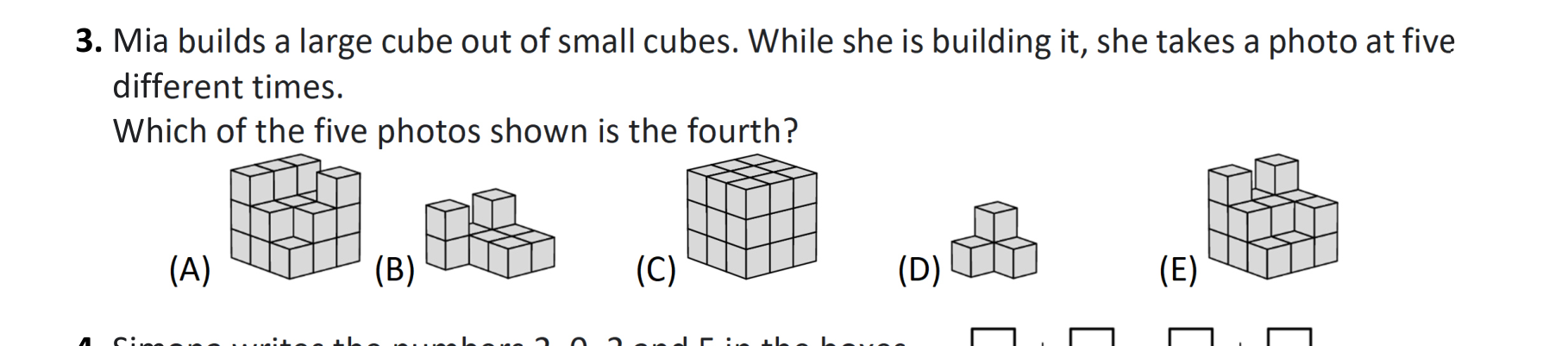
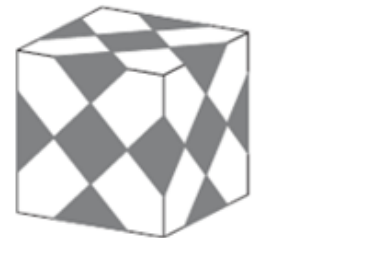
Which of the pieces shown completes the pattern? (The five choices A–E are pictured below the question.)
Show answer
Answer: C
Show hints
Hint 1 of 2
The big design is one repeating pattern; the white window is just a square-shaped hole punched out of it.
Still stuck? Show hint 2 →
Hint 2 of 2
Look at the lines touching all four edges of the hole and ask which piece lets every one of them continue without a break.
Show solution
Approach: match the missing tile to the lines around the hole
The hole sits inside a repeating pattern of overlapping squares and diamonds, so the right piece is the one that keeps every line going straight across the gap.
Trace the lines that arrive at the top, bottom, left and right edges of the white square; the correct piece must connect to all of them at once.
Only choice C lines up on all four sides so the pattern stays seamless with no broken lines, so the answer is (C).
Anna builds a wall out of black and grey bricks that shows 2025. What can Bella read on the back of the wall? (The five choices A–E are pictured below the question.)
Show answer
Answer: E
Show hints
Hint 1 of 2
Looking at the back of a wall is like seeing it in a mirror.
Still stuck? Show hint 2 →
Hint 2 of 2
Reflect the whole ‘2025’ left-to-right; each digit flips and the order of digits reverses.
Show solution
Approach: horizontal mirror reflection
Seeing the back of the wall is exactly like holding the front up to a mirror, so the whole picture flips left–right.
Two things happen at once: the order of the digits reverses (so 2025 reads 5202), and each digit itself is mirrored.
The choice that shows this left–right flip of the bricks is the back view, which is (E).
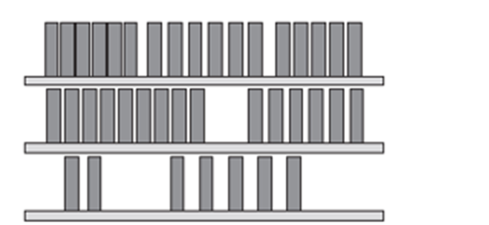
A bookshelf with three rows has 17 books in the top row, 15 books in the middle row and 7 books in the bottom row. Monika would like to have the same number of books in each row, but she wants to rearrange as few books as possible. How many books does she have to move from the middle row to the bottom row?
Show answer
Answer: B — 2
Show hints
Hint 1 of 2
First find how many books each row should hold.
Still stuck? Show hint 2 →
Hint 2 of 2
Books should only be moved into rows that are short; figure out the bottom row’s shortfall.
Show solution
Approach: even out the rows with fewest moves
Total books: 17 + 15 + 7 = 39, so each row should have 39 ÷ 3 = 13.
The bottom row is short by 13 − 7 = 6 books; the top row has 4 spare and the middle has 2 spare.
To move as few as possible, send the top’s 4 spare and the middle’s 2 spare straight to the bottom.
So only 2 books go from the middle row to the bottom row.
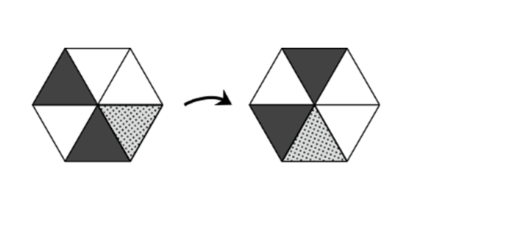
Thea rotates a painted hexagon clockwise one space at a time. The first rotation can be seen in the picture. Which hexagon does Thea see after the eighth rotation? (The five choices A–E are pictured below the question.)
Show answer
Answer: A
Show hints
Hint 1 of 2
The hexagon has 6 sectors, so rotating 6 times brings it back to the start.
Still stuck? Show hint 2 →
Hint 2 of 2
Eight rotations is the same as just 8 − 6 = 2 rotations.
Show solution
Approach: rotation repeats every 6 steps
A hexagon has 6 sectors, so after 6 one-step turns it looks exactly like the start — the pattern repeats every 6 rotations.
So the 8th rotation looks the same as the 8 − 6 = 2nd rotation; we only need to turn the starting hexagon two steps clockwise.
Turning the Start picture two sectors clockwise matches choice (A), so that is what Thea sees after the eighth rotation.
The picture on the right shows the menu of a burger restaurant. The rain has washed away some of the numbers. The burgers are ordered by price. Which of the following prices was on the board?
Show answer
Answer: B — 5.50
Show hints
Hint 1 of 2
The prices go up from top (3.70) to bottom (6.80); use the visible last two digits.
Still stuck? Show hint 2 →
Hint 2 of 2
Find whole-euro values that keep the list strictly increasing and fit the shown cents.
Show solution
Approach: fit increasing prices to the visible digits
Prices rise from 3.70 to 6.80, and the visible cents are .30, .60, .50, .10 going down.
Because .50 is less than .60, ‘cheesy’ must jump to a higher whole euro, and similarly for ‘double’.
The only increasing fit is 4.30, 4.60, 5.50, 6.10.
Among the choices, 5.50 (the cheesy price) is the one that appears.
Six children were running a race. Ariadne finished third. Bill finished sixth, just behind Ernest. Fatima finished between Ariadne and Ernest. Diana overtook Charles just before the finish line. Who won the race?
Show answer
Answer: C — Diana
Show hints
Hint 1 of 2
Pin down the fixed finishing places first (Ariadne is 3rd).
Still stuck? Show hint 2 →
Hint 2 of 2
Use ‘just behind’ and ‘between’ to place Ernest and Fatima, then the last two spots go to Diana and Charles.
Show solution
Approach: fill in the finishing order from the clues
Ariadne is 3rd. Bill is 6th just behind Ernest, so Ernest is 5th.
Fatima finishes between Ariadne (3rd) and Ernest (5th), so Fatima is 4th.
Only places 1 and 2 are left for Diana and Charles, and Diana overtook Charles at the end.
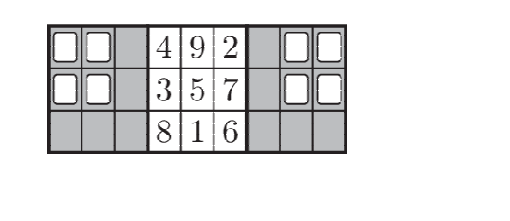
There are numbers on the middle part of a 3-part unfolded card. The left and right parts of the card have holes. Mike folds the right part along the dotted line onto the middle part. He can now see the numbers 2, 3, 5 and 6 through the holes. Then he folds the left part along the dotted line onto the other two parts. What is the sum of the numbers that he can still see through the holes?
Show answer
Answer: A — 8
Show hints
Hint 1 of 2
After folding the right flap, you already see 2, 3, 5 and 6 through its holes.
Still stuck? Show hint 2 →
Hint 2 of 2
Folding the left flap on top covers some of those holes; only the numbers under a left-flap hole stay visible.
Show solution
Approach: trace which holes still line up after both folds
After the right flap is folded over, its holes already let Mike see 2, 3, 5 and 6 on the middle panel.
When the left flap folds on top, its holes only line up over some of those numbers: two of them stay showing through a hole and the other two get covered by solid paper.
The two numbers still visible through a hole are 3 and 5, so the sum is 3 + 5 = 8, giving the answer (A) 8.
Three turtles are competing in a 10 km race. Each of them moves at a constant speed. When the first turtle finishes the competition, the second has completed 14 of the distance and the third has completed 15 of the distance. How far is the third turtle from the finish line when the second turtle finishes the race?
Show answer
Answer: B — 2 km
Show hints
Hint 1 of 2
The turtles move at steady speeds, so the distance each has covered tells you their speed ratio.
Still stuck? Show hint 2 →
Hint 2 of 2
When the 2nd turtle finishes, its distance has grown by the same factor as the 3rd turtle’s.
Show solution
Approach: scale the third turtle’s distance by the same factor
When the 1st finishes 10 km, the 2nd has done 1/4 of 10 = 2.5 km and the 3rd has done 1/5 of 10 = 2 km.
For the 2nd turtle to reach 10 km, time must be multiplied by 10 ÷ 2.5 = 4.
In that same time the 3rd turtle goes 2 × 4 = 8 km.
So the 3rd turtle is 10 − 8 = 2 km from the finish.
Vera has built a tower of cubes. She wants to replace the two cubes with question marks with cubes with numbers. Vera wants the number on each cube to be at least 2 higher than the number on the cube below it. How many ways can she replace the two cubes?
Show answer
Answer: D — 6
Show hints
Hint 1 of 2
The two missing cubes sit above 6 and below 14, each at least 2 more than the one below.
Still stuck? Show hint 2 →
Hint 2 of 2
List the lower missing number first, then count valid choices for the upper one.
Show solution
Approach: count valid number pairs by casework
Reading up, the tower is 1, 4, 6, then two unknowns, then 14, each cube at least 2 more than the one below.
The lower unknown must be at least 8 (it is at least 2 more than 6).
The upper unknown is at least 2 more than it and at most 12 (since 14 is at least 2 more).
In the picture you can see five different wheels of fortune. Each wheel of fortune is divided into equal-sized parts, but the number of parts is different. Anna spins all of the wheels of fortune. If a wheel of fortune stops at the arrow with a dark sector, she wins. Which of the wheels of fortune gives Anna the best chance of winning?
Show answer
Answer: A — 1
Show hints
Hint 1 of 2
On a fair wheel, the chance of winning is just the share of the wheel that is dark: dark sectors out of total sectors.
Still stuck? Show hint 2 →
Hint 2 of 2
Write each wheel’s chance as a fraction and see which fraction is biggest — a bigger dark share on a wheel with fewer pieces wins.
Show solution
Approach: compare the fraction of dark sectors
Each wheel is split into equal parts, so the chance of stopping on dark is simply the fraction of the wheel that is dark.
Wheel 1 has 2 dark sectors out of 8, which is 14 of the wheel; the others all turn out to be smaller dark shares (each less than a quarter, since they spread their dark sectors over more pieces).
14 is the largest dark share, so wheel 1 gives Anna the best chance, and the answer is (A) 1.
Which of the five shapes cannot be placed on the large square so that it only lies on white squares? (The five shapes A–E and the patterned large square are pictured with the question.)
Show answer
Answer: D
Show hints
Hint 1 of 2
Look at where the white squares actually sit on the big board, then try to slide each shape around so all of its squares land on white.
Still stuck? Show hint 2 →
Hint 2 of 2
Four of the shapes can be tucked onto a run of white squares; hunt for the one shape whose squares are forced to grab a black square no matter where you put it.
Show solution
Approach: try to fit each shape onto only white squares
A shape works only if you can lay it down so every one of its squares sits on a white square of the board.
Slide each shape A–E around the board: four of them can be placed on a stretch of white squares with no black square underneath.
Shape D is the only one that always lands on at least one black square wherever it goes, so it cannot sit only on white squares — the answer is (D).
Five swimmers from a school are training for a relay race. The five participants swim the same distance, one after the other, without stopping. The coach stops the intermediate time after each swimmer. The first swimmer takes 2 minutes and 8 seconds. The stopwatches show the total time after the first, second, third, fourth and fifth swimmer (see picture). Which swimmer swam the distance the fastest?
Show answer
Answer: D — the fourth
Show hints
Hint 1 of 2
Each stopwatch shows the total time after that many swimmers, so subtract to get each leg.
Still stuck? Show hint 2 →
Hint 2 of 2
All swam the same distance, so the fastest is the one with the shortest individual leg.
Show solution
Approach: difference of consecutive total times
The watches show running totals: 2:08, 4:07, 6:10, 8:05, 10:03.
Subtract each total from the one before to get each swimmer’s own time: 128 s, 119 s, 123 s, 115 s, 118 s.
Same distance means fastest = shortest time, and 115 s is the smallest.
Jana cuts four small squares of the same size from the corners of a square piece of paper (see picture). The total cut-away area is 16 cm², and the area of the remaining figure (the cross) is 9 cm². What is the perimeter of the cross?
Show answer
Answer: C — 20 cm
Show hints
Hint 1 of 2
The whole square’s area is the cut-away plus the cross.
Still stuck? Show hint 2 →
Hint 2 of 2
Cutting a square out of a corner doesn’t change the perimeter — the removed edges are replaced by equal new edges.
Show solution
Approach: reassemble area, then track perimeter
Original square area = 16 (cut away) + 9 (cross) = 25, so its side is 5.
Each of the four corner squares has area 16 ÷ 4 = 4, so side 2.
Removing a 2×2 square from a corner replaces two outer edges with two equal inner edges, so the perimeter stays the same.
The cross perimeter equals the square’s perimeter: 4 × 5 = 20 cm.
Each card has two 3-digit numbers on it. Some of the digits are hidden (shown as ?). On one of the cards, the sum of the digits of the two numbers is the same. Which one?
Show answer
Answer: C — 982 and 1??
Show hints
Hint 1 of 2
For each card, find the digit sum of the fully shown number.
Still stuck? Show hint 2 →
Hint 2 of 2
Check whether the hidden number could ever reach that same digit sum.
Show solution
Approach: compare achievable digit sums
982 has digit sum 9 + 8 + 2 = 19.
Its partner 1?? can reach a digit sum as high as 1 + 9 + 9 = 19 (the number 199).
For every other card, the visible number’s digit sum is out of reach of its hidden partner.
So the card with equal digit sums is ‘982 and 1??’.
The diagram shown on the right consists of squares of equal size. Point B is in the middle of A and C, and point D is in the middle of C and E. Maria wants to divide the figure into two parts with equal areas using a straight line. Which of the points A, B, C, D or E must she connect to S to obtain this result?
Show answer
Answer: E — E
Show hints
Hint 1 of 2
First count the squares: the cut from S has to leave exactly half of them on each side.
Still stuck? Show hint 2 →
Hint 2 of 2
As you slide the far end of the cut from A up to E, more area moves to one side — stop at the point that makes the two halves equal.
Show solution
Approach: make each side hold half the squares
Count the unit squares in the whole figure and take half: the straight cut from S must leave that same area on each side.
Connecting S to a low point like A leaves too little on one side, and as the endpoint climbs from A toward E more area swings across the line.
The endpoint that finally balances the two sides into equal areas is E, so Maria connects S to E, giving the answer (E).
Hassan writes either the number 0 or the number 1 in each field of the table. The sum in each row, each column and each diagonal should be exactly 3. Hassan has entered 0 in one field and then fills out the table completely. What is the sum of the numbers in the fields with question marks?
Show answer
Answer: B — 2
Show hints
Hint 1 of 2
Each row and each column has 4 cells but must total 3 using only 0s and 1s — so what does that force about how many 0s are in each row and column?
Still stuck? Show hint 2 →
Hint 2 of 2
There is exactly one 0 in every row and exactly one 0 in every column; place the rest of the 0s so the two diagonals also each have a single 0.
Show solution
Approach: each row and column hides exactly one 0
A row of four 0s-and-1s that adds to 3 must be three 1s and a single 0, so every row has exactly one 0 — and by the same reasoning every column has exactly one 0, and each diagonal must also hold just one 0.
Starting from the given 0, the ‘one 0 per row, one per column, one per diagonal’ rule pins down where all four 0s go, so the whole grid is forced.
Looking at the four question-mark cells, two of them turn out to be 1 and two turn out to be 0, so their sum is 1 + 1 + 0 + 0 = 2, giving the answer (B) 2.
A witch has 10 apples, 9 bananas and 6 pears. One day she enchants all of her fruits into different types of fruit. For example, she turns each apple into either a banana or a pear. After that she has 15 apples, 7 bananas and 3 pears. How many apples did she turn into bananas?
Show answer
Answer: E — 7
Show hints
Hint 1 of 2
Every original fruit changes type, so all 10 apples leave and new apples arrive from other fruits.
Still stuck? Show hint 2 →
Hint 2 of 2
Set up the in/out counts for each fruit type and solve.
Show solution
Approach: track each fruit type in and out
All 9 bananas and all 6 pears must become apples or each other; the 15 final apples come only from old bananas and pears.
Since 9 + 6 = 15, every banana and every pear turned into an apple.
Then the 10 apples must supply all 7 final bananas and 3 final pears: 7 + 3 = 10.
The square shown on the right has sides of 10 cm. The square is divided into two equal-sized rectangles by the vertical centre line. What is the area of the grey section?
Show answer
Answer: B — 25 cm²
Show hints
Hint 1 of 2
The whole square is 10 × 10 = 100 cm², so try to see the grey as a simple fraction of that whole.
Still stuck? Show hint 2 →
Hint 2 of 2
The centre lines split the grey ‘bow-tie’ into a left half and a right half; find the area of one half and double it.
Show solution
Approach: the grey is two equal triangles meeting at the centre
The grey shape is a bow-tie: two triangles that meet at the centre of the square, one on the left and one on the right.
The left triangle has corners at the top-middle of the square, the centre of the square, and the bottom-left corner; counting on a 10×10 grid its area is 12.5 cm², and the right triangle is its mirror image, also 12.5 cm².
Adding the two halves gives 12.5 + 12.5 = 25 cm², which is exactly one quarter of the 100 cm² square, so the answer is (B) 25 cm².
Joanna divides the figure into five equal-sized, same-shaped parts, each of which consists of three squares. Which of the letters is in the part with the star?
Show answer
Answer: E — E
Show hints
Hint 1 of 2
All five pieces are the same shape made of three squares, so figure out that shape first from a corner that can only be filled one way.
Still stuck? Show hint 2 →
Hint 2 of 2
Once you know the piece shape, build outward and watch which three squares end up grouped with the star.
Show solution
Approach: find the repeating 3-square piece, then read off the star’s group
Since every piece is the same three-square shape, start at a corner of the figure where only one shape can fit; that fixes what the repeating piece looks like.
Lay that same piece again and again to tile the whole figure with no gaps or overlaps — there is only one way it all fits together.
The piece that ends up covering the starred square also covers the square labelled E, so the answer is (E).