30 problems — one per position, pulled from random authored years. Hints and solutions are locked until you submit. Retake as often as you want — every attempt is saved to your test history (if you're logged in).
Pick a paper and hit Start to take it as a timed test — or browse past papers untimed to read the original questions, figures and answers at your own pace.
← BackTip: real Math Kangaroo is about 75 minutes — set a timer if you want the full pressure.
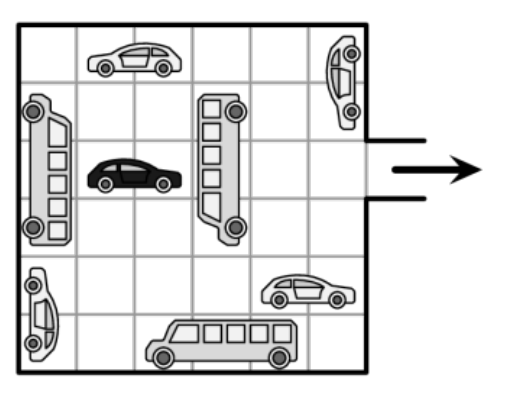
All vehicles in the garage can only drive forwards or backwards. The black car wants to leave the garage (see diagram). What is the minimum number of grey vehicles that need to move at least a little bit so that this is possible?
Show answer
Answer: C — 4
Show hints
Hint 1 of 3
Find the exit first, then the straight lane the black car must drive along to reach it.
Still stuck? Show hint 2 →
Hint 2 of 3
Only the grey vehicles actually sitting in that lane (or blocking a vehicle that does) need to move.
Still stuck? Show hint 3 →
Hint 3 of 3
Count just those blockers - vehicles parked out of the way can stay put.
Show solution
Approach: clear the black car's exit lane, moving only the blockers
The black car must drive straight to the opening on the right.
Identify every grey vehicle sitting in or across that path.
Exactly 4 of them must shift at least a little to free the route.
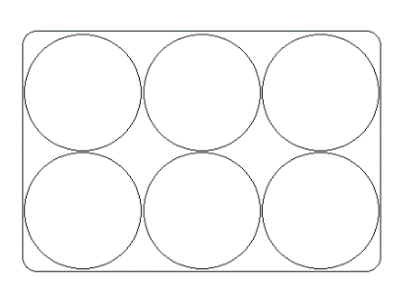
A hen lays white and brown eggs. Lisa takes six of them and puts them in a box as shown. The brown eggs are not allowed to touch each other. What is the largest number of brown eggs Lisa can put in the box?
Show answer
Answer: C — 3
Show hints
Hint 1 of 2
Two round eggs touch only when their cups are right next to each other (side by side or one above the other).
Still stuck? Show hint 2 →
Hint 2 of 2
Try putting brown eggs in cups that skip a space, like a checkerboard pattern.
Show solution
Approach: spread the brown eggs out so none are next to each other
The box has 6 cups in 2 rows of 3. Eggs touch only when their cups are side by side or one directly above the other.
Put brown eggs in the two top corners and the middle cup of the bottom row — none of these three cups touch.
A fourth brown egg would have to sit next to one of them, so the most Lisa can place is 3.
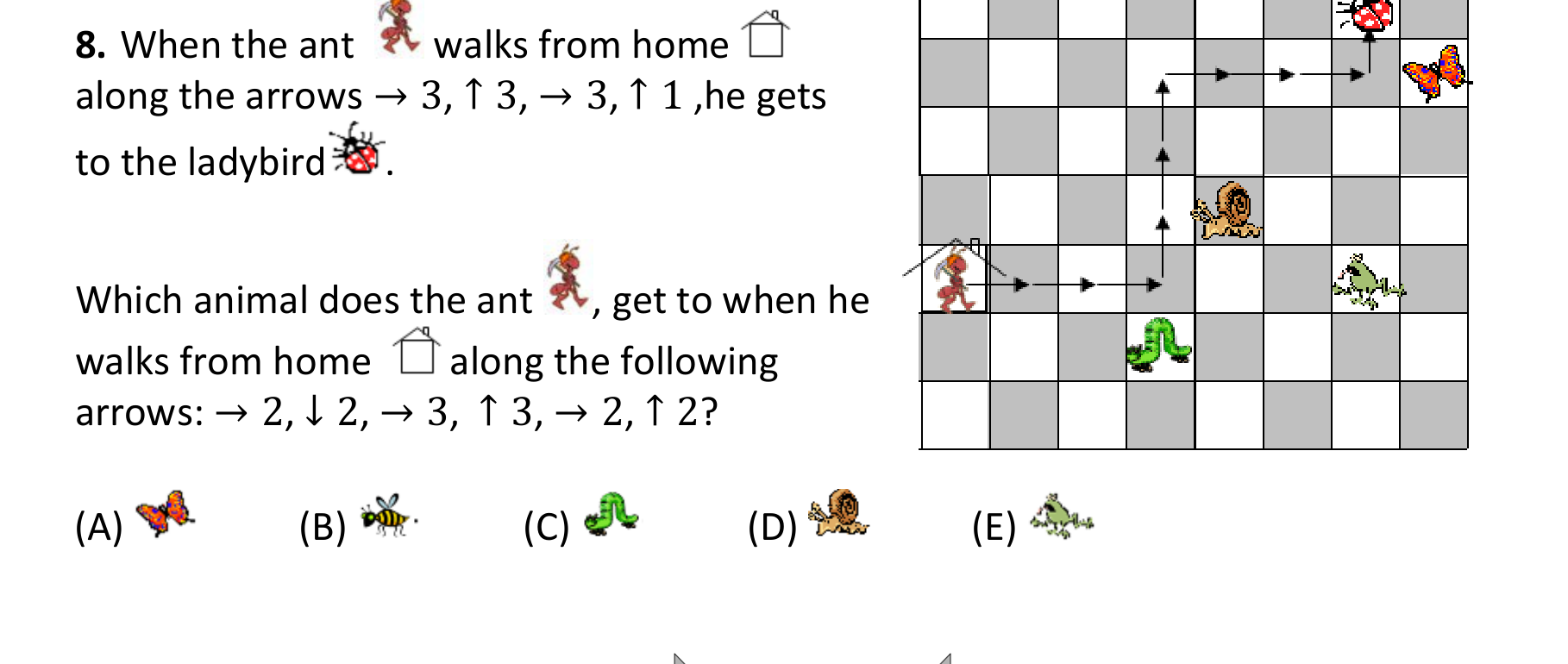
When the ant walks from home along the arrows right 3, up 3, right 3, up 1, he gets to the ladybird. Which animal does the ant get to when he walks from home along these arrows: right 2, down 2, right 3, up 3, right 2, up 2?
Show answer
Answer: A
Show hints
Hint 1 of 3
An arrow with a number tells you how many squares to step that way, like a board game move.
Still stuck? Show hint 2 →
Hint 2 of 3
Start your finger on the home square and make each move one square at a time, counting as you go.
Still stuck? Show hint 3 →
Hint 3 of 3
When all the moves are done, look at the square your finger has landed on.
Show solution
Approach: hop square by square through every arrow, then read the animal on the landing square
Put your finger on the home square; each arrow says which way to go and how many squares to hop.
Hop right 2, then down 2, then right 3, then up 3, then right 2, then up 2, counting each square.
Your finger lands on the square in the top-right where the butterfly is sitting.
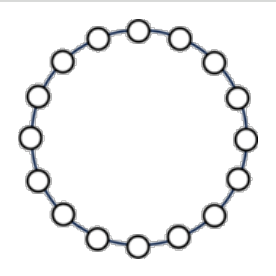
Pia writes a number in each of the 16 little circles (see picture). Numbers in neighbouring circles differ by 1. She writes the number 5 in one circle and the number 13 in another. How many different numbers does Pia write in the 16 circles?
Show answer
Answer: A — 9
Show hints
Hint 1 of 2
Stepping from circle to circle changes the number by exactly 1, so going all the way around the ring you must take as many +1 steps as -1 steps.
Still stuck? Show hint 2 →
Hint 2 of 2
To get from 5 up to 13 and back, the numbers have to pass through every value between 5 and 13.
Show solution
Approach: count the values forced by going up to 13 and back to 5
Neighbouring circles differ by 1, so as you walk around the ring the value rises or falls by 1 at each step.
Somewhere a 5 and a 13 appear, and to climb from 5 to 13 the numbers must hit every whole number 5, 6, 7, …, 13.
That is 9 different values, and with only 16 circles you can arrange them without needing any number outside 5–13.
Logic & Word ProblemsArithmetic & Operationssum-constraintcasework
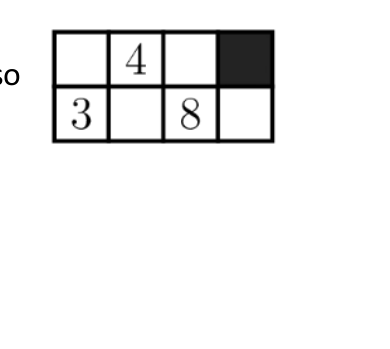
Evita wants to write the numbers from 1 to 8, with one number in each field. The sum of the numbers in each row should be equal. The sum of the numbers in each of the four columns should also be the same. She has already written in the numbers 3, 4 and 8 (see diagram). Which number does she have to write in the dark field?
Show answer
Answer: E — 7
Show hints
Hint 1 of 2
The numbers 1..8 add to 36; use that to find each row sum and each column sum.
Still stuck? Show hint 2 →
Hint 2 of 2
Fit the remaining numbers around the given 3, 4 and 8 so every row and every column hits its target.
Show solution
Approach: use the fixed total to pin row/column sums, then place numbers
1 + 2 + ... + 8 = 36; with two equal rows each row sums to 18, and with four equal columns each column sums to 9.
Place the remaining numbers so each column totals 9 and each row totals 18, respecting the given 3, 4 and 8.
A rectangular chocolate bar is made of equal squares. Neil breaks off two complete strips of squares and eats the 12 squares he obtains. Later, Jack breaks off one complete strip of squares from the same bar and eats the 9 squares he obtains. How many squares of chocolate are left in the bar?
Show answer
Answer: D — 45
Show hints
Hint 1 of 2
Neil's two equal strips total 12, so a strip in that direction holds 6 — that fixes one side of the bar.
Still stuck? Show hint 2 →
Hint 2 of 2
Jack's strip runs the other way; remember Neil already removed two rows before Jack broke his strip.
Show solution
Approach: recover the bar's dimensions from the strip sizes
Neil's two equal strips give 12 squares, so each strip holds 6: one side of the bar is 6.
Jack's strip runs the other way and holds 9, but Neil had already removed 2 squares from that direction, so the full bar was 6 by (9+2) = 11, i.e. 66 squares.
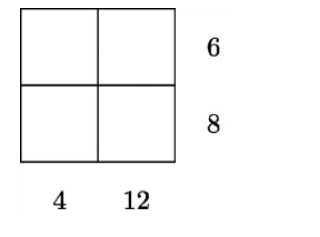
Four different positive whole numbers are written into the grid and then covered up. The product of the two numbers in each row, and in each column, is written next to or below the grid (see diagram). What is the sum of the four covered numbers?
Show answer
Answer: C — 13
Show hints
Hint 1 of 2
Label the four cells and write the four product equations for the rows and columns.
Still stuck? Show hint 2 →
Hint 2 of 2
All four numbers are different; use the column products 4 and 12 with the row products 6 and 8 to pin them down.
Show solution
Approach: solve the product equations for four distinct integers
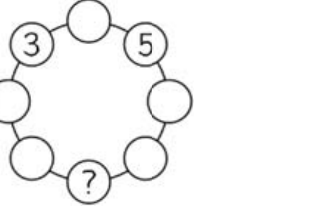
Ella wants to write a number into each circle in the diagram on the right, in such a way that each number is equal to the sum of its two direct neighbours. Which number does Ella need to write into the circle marked with “?”?
Show answer
Answer: E — This question has no solution.
Show hints
Hint 1 of 2
‘Each number equals the sum of its two neighbours’ rearranges to ‘next = this − previous’, which repeats with period 6.
Still stuck? Show hint 2 →
Hint 2 of 2
Follow that pattern around the 8-circle ring and see whether the two given numbers, 3 and 5, can both fit.
Show solution
Approach: chase the neighbour-sum rule around the ring
Writing each circle as the sum of its neighbours rearranges to ‘next neighbour = this − previous’, a rule that repeats every 6 steps.
On a ring of 8 circles this period-6 repetition forces two of the circles (here the ones holding 3 and 5) to carry equal values.
Since 3 ≠ 5, no consistent filling exists, so the answer is ‘no solution’ (E).
Gerhard has the same number of white, grey and black counters. He has thrown some of these round pieces together onto a pile. All the pieces he used can be seen in the picture. He has, however, got 5 counters left that will not stay on the pile. How many black counters did he have to begin with?
Show answer
Answer: B — 6
Show hints
Hint 1 of 3
He began with the same number of white, grey and black, so think of them in equal groups.
Still stuck? Show hint 2 →
Hint 2 of 3
Count the counters on the pile, colour by colour, from the picture.
Still stuck? Show hint 3 →
Hint 3 of 3
The 5 left over are the extras that did not fit, so add them back to find each starting group.
Show solution
Approach: count the pile by colour, then add back the leftovers to make equal groups
Count how many white, grey and black counters are actually on the pile in the picture.
He started with the same number of each colour, and 5 counters were left over that did not stay on.
Sharing everything back into three equal colour groups, each group had 6 counters.
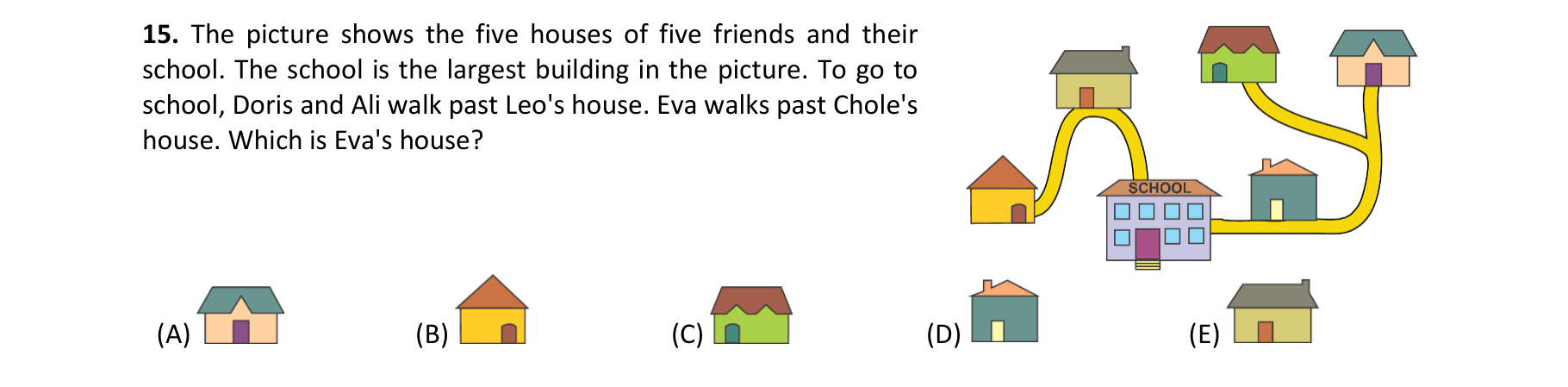
The picture shows the five houses of five friends and their school. The school is the largest building in the picture. To go to school, Doris and Ali walk past Leo's house. Eva walks past Chloe's house. Which is Eva's house?
Show answer
Answer: B
Show hints
Hint 1 of 3
Find the school first, then trace the road each child walks to get there.
Still stuck? Show hint 2 →
Hint 2 of 3
The clues about Leo's house help you figure out who lives where.
Still stuck? Show hint 3 →
Hint 3 of 3
Eva's road is the one that goes right past Chloe's house.
Show solution
Approach: trace the roads to school
Find the big school, then look at which houses you walk past on the way from each house.
The clue that Doris and Ali pass Leo's house tells you where Leo lives.
Eva's road is the one passing Chloe's house, and tracing it back, Eva's house is option B.
Today is Sunday. Francis starts reading a 290-page book today. On Sundays he reads 25 pages, and on every other day he reads 4 pages, with no exception. How many days does it take him to read the whole book?
Show answer
Answer: E — 41
Show hints
Hint 1 of 2
Group the week: one Sunday plus six ordinary days makes a fixed weekly total.
Still stuck? Show hint 2 →
Hint 2 of 2
Each full week reads 25 + 6×4 = 49 pages; see how many weeks fit into 290.
Show solution
Approach: weekly chunks then finish
A week reads 25 (Sunday) + 6 × 4 = 49 pages.
After 5 weeks (35 days) he has read 5 × 49 = 245 pages, leaving 45.
Day 36 is a Sunday (25 pages), reaching 270 with 20 left; then 5 days of 4 pages finish it.
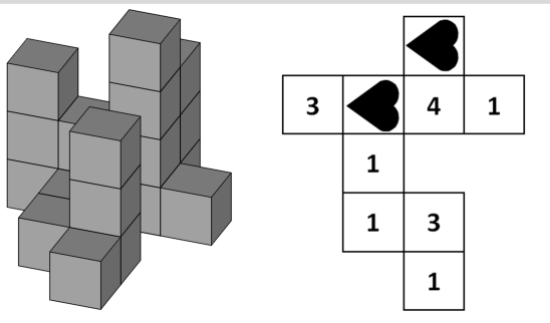
Max builds this construction using some small equally big cubes. If he looks at his construction from above, the plan on the right tells the number of cubes in every tower. How big is the sum of the numbers covered by the two hearts?
Show answer
Answer: C — 5
Show hints
Hint 1 of 2
The plan number in each square is the height of the tower standing there.
Still stuck? Show hint 2 →
Hint 2 of 2
Read the two hidden tower heights off the 3-D picture, then add them.
Show solution
Approach: read the two covered tower heights from the construction and add
Each square of the plan shows how many cubes are stacked there.
The two hearts cover two of these tower heights.
Reading those two towers from the picture and adding gives the total.
The arithmetic mean of five numbers is 24. The mean of the three smallest numbers is 19 and that of the three biggest is 28. What is the median of the five numbers?
Show answer
Answer: B — 21
Show hints
Hint 1 of 2
Write the three totals: all five, the three smallest, the three largest.
Still stuck? Show hint 2 →
Hint 2 of 2
The median is counted in both the bottom-three and top-three sums.
Show solution
Approach: overlap counts the median twice
Sum of all five = 120; smallest three sum to 57; largest three sum to 84.
57 + 84 counts every number once except the median, which is counted twice: 57 + 84 = 120 + median.
The brothers Gerhard and Günther pass on information about the members of their chess club. Gerhard says: “All members of our club are male, with five exceptions.” Günther says: “In every group of six members there are at least four female members.” How many members does the chess club have?
Show answer
Answer: B — 7
Show hints
Hint 1 of 2
'Five exceptions' means exactly five female members.
Still stuck? Show hint 2 →
Hint 2 of 2
If every group of six must hold at least four females, no group of six can contain three males — so there are at most two males.
Show solution
Approach: bound the males, then make the group-of-six condition meaningful
There are exactly 5 female members. Any six members must include ≥4 females, so at most 2 males.
For the 'every group of six' statement to be about more than the whole club, there must be more than six members.
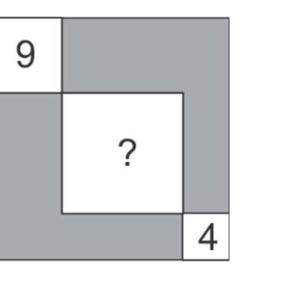
Inside the gray square there are three white squares; the number in each shows its area. The white squares have sides parallel to the sides of the gray square. If the area of the gray square is 81, what is the area of the gray region not covered by the white squares?
Show answer
Answer: C — 52
Show hints
Hint 1 of 2
The gray square has area 81, so its side is 9; find the side of each white square from its area.
Still stuck? Show hint 2 →
Hint 2 of 2
The middle white square spans what is left across the side after the corner squares, so its side is 9 − 3 − 2.
Show solution
Approach: find each square's side, then subtract the white areas
The gray square has area 81, so its side is 9. The corner white squares have areas 9 and 4, so their sides are 3 and 2.
The middle white square stretches across the row between them, so its side is 9 − 3 − 2 = 4, giving area 16.
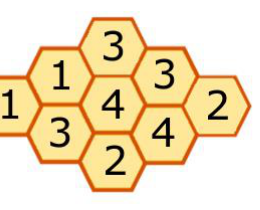
The picture on the right shows a honeycomb with 9 cells. Some cells contain honey. The number written in a cell tells how many of its neighbouring cells contain honey. How many cells are filled with honey?
Show answer
Answer: C — 6
Show hints
Hint 1 of 3
Each written number counts how many of that cell's touching neighbours hold honey — like a honey version of Minesweeper.
Still stuck? Show hint 2 →
Hint 2 of 3
Start at a cell with few neighbours: if a clue equals its number of neighbours, every one of them must be honey.
Still stuck? Show hint 3 →
Hint 3 of 3
Use each filled-in clue to force its neighbours, one cell at a time, until the whole comb is settled.
Show solution
Approach: use each clue to decide its neighbours, starting where a clue forces everything
Begin at an edge cell whose clue equals its number of touching neighbours — then all of those neighbours must hold honey.
Once those are fixed, neighbouring clues tell you which of their remaining cells are honey and which are empty.
Keep applying the clues, cell by cell, so that every number ends up matching the honey around it.
When the whole comb is consistent, six of the cells contain honey: 6 (C).
The sequence of functions \(f_{1}(x),\,f_{2}(x),\,\ldots\) satisfies \(f_{1}(x)=x\) and \(f_{n+1}(x)=\dfrac{1}{1-f_{n}(x)}\). Determine the value of \(f_{2011}(2011)\).
Show answer
Answer: A — 2011
Show hints
Hint 1 of 2
Compute f₂, f₃, f₄ and watch for a repeat.
Still stuck? Show hint 2 →
Hint 2 of 2
The map cycles with period 3, so reduce 2011 modulo 3.
Show solution
Approach: detect the period-3 cycle
f₁(x)=x, f₂=1/(1−x), f₃=(x−1)/x, and f₄=x again — period 3.
A circle with midpoint \((75\,|\,30)\) and radius 10 is cut from a rectangle with vertices \((0\,|\,0)\), \((100\,|\,0)\), \((100\,|\,50)\) and \((0\,|\,50)\). What is the gradient of the straight line that goes through the point \((75\,|\,30)\) and divides the remaining part of the rectangle into two parts with equal area?
Show answer
Answer: A — \(\frac{1}{5}\)
Show hints
Hint 1 of 2
A line through the centre of a circle always halves that circle's area.
Still stuck? Show hint 2 →
Hint 2 of 2
So the line only needs to bisect the rectangle — which means passing through the rectangle's centre too.
Show solution
Approach: a center line bisects both shapes
Any line through the hole's centre (75,30) splits the circular hole into two equal halves.
To split the rest equally, the line must also bisect the rectangle, i.e. pass through its centre (50,25).
The line through (75,30) and (50,25) has slope (30−25)/(75−50) = 5/25 = 1/5.
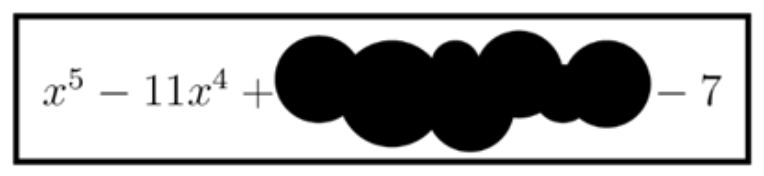
A part of a polynomial of degree five is illegible due to an ink stain (see diagram). It is known that all zeros of the polynomial are integers. What is the highest power of \(x - 1\) that divides this polynomial?
Show answer
Answer: D — \((x-1)^4\)
Show hints
Hint 1 of 2
Vieta's formulas link the visible coefficients to the sum and product of the roots.
Still stuck? Show hint 2 →
Hint 2 of 2
All roots are integers, the product is 7 and the sum is 11 — that pins them down.
Show solution
Approach: recover the integer roots with Vieta's formulas
For x5 − 11x4 + ... − 7, the integer roots have product 7 and sum 11.
The only integer multiset is 7, 1, 1, 1, 1 (product 7, sum 11).
So (x−1) appears four times, and the highest power dividing it is (x−1)4.
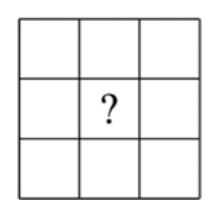
Nine whole numbers were written into the cells of a 3 × 3 table. The sum of these nine numbers is 500. We know that the numbers in two adjacent cells (sharing a common side) differ by exactly 1. Which number is in the middle cell?
Show answer
Answer: D — 56
Show hints
Hint 1 of 2
Adjacent cells differ by 1, so the grid splits into two parity classes like a checkerboard around the centre.
Still stuck? Show hint 2 →
Hint 2 of 2
Express all nine entries in terms of the centre value and set the total equal to 500.
Show solution
Approach: write all cells relative to the centre, then use the sum
Colour the grid like a checkerboard; neighbours differ by 1, so the centre and four corners share one parity while the four edge cells share the other.
A valid tight filling is centre \(m\), each edge cell \(m-1\), and each corner \(m\) (every adjacent pair then differs by exactly 1).
The total is \(m + 4(m-1) + 4m = 9m - 4\); setting \(9m - 4 = 500\) gives \(9m = 504\).
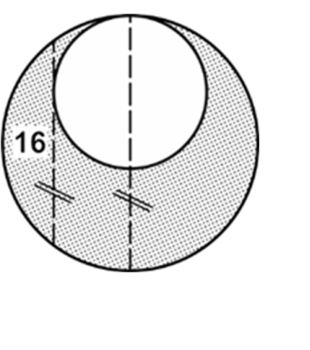
In the diagram we see two touching circles and the diameter through their common point. The outer circle has a chord parallel to this diameter with length 16, which touches the inner circle. What is the area of the grey region?
Show answer
Answer: C — \(64\pi\)
Show hints
Hint 1 of 3
The grey region is the big disk minus the small disk, so its area is \(\pi(R^2-r^2)\) — you never need \(R\) and \(r\) separately.
Still stuck? Show hint 2 →
Hint 2 of 3
Drop the perpendicular from the centre to the chord: the half-chord, the inner radius, and the outer radius form a right triangle.
Still stuck? Show hint 3 →
Hint 3 of 3
Tangency makes the centre-to-chord distance equal to \(r\), so \(r^2+8^2=R^2\).
Show solution
Approach: annulus area via the chord
The chord of length 16 (half-length 8) is tangent to the inner circle, so the perpendicular distance from the common centre to the chord equals the inner radius \(r\).
By the right triangle (radius, half-chord, distance): \(R^2=r^2+8^2\), hence \(R^2-r^2=64\).
Grey area \(=\pi R^2-\pi r^2=\pi(R^2-r^2)=\) \(64\pi\), answer C.
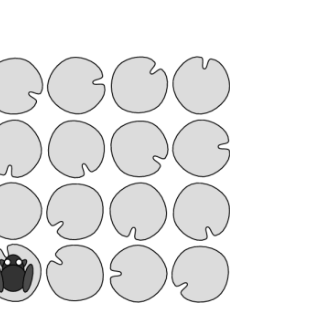
On a pond, 16 lily pads are arranged in a \(4\times 4\) grid as shown in the diagram. A frog sits on a lily pad in one of the corners of the grid (see picture). The frog jumps from one lily pad to another horizontally or vertically, always jumping over at least one lily pad, and never lands on the same lily pad twice. What is the maximum number of lily pads, including the one he starts on, on which he can land?
Show answer
Answer: A — 16
Show hints
Hint 1 of 2
Each jump skips at least one pad, so from a column or row the frog lands two or more cells away.
Still stuck? Show hint 2 →
Hint 2 of 2
Try to build a route that visits every pad without repeating; can all 16 be reached?
Show solution
Approach: construct a route touching every pad
From a corner the frog can hop horizontally or vertically, always clearing at least one pad in between.
Designing the path carefully, it is possible to thread through every row and column so that no pad is repeated.
Such a route reaches all of them, so the maximum number of pads is the full 16.
Each positive whole number is coloured in according to the following three rules: (i) Each number is either red or green. (ii) The sum of two different red numbers is a red number. (iii) The sum of two different green numbers is a green number. How many ways are there to do this?
Show answer
Answer: D — 6
Show hints
Hint 1 of 2
The two rules force strong closure: sums of like-coloured numbers keep their colour.
Still stuck? Show hint 2 →
Hint 2 of 2
Colour 1, 2, 3, ... and chase the forced consequences to count how many consistent colourings of all positive integers exist.
Show solution
Approach: count the colourings closed under the two sum-rules
Reds are closed under adding two distinct reds, and greens under adding two distinct greens.
Fixing the colours of the smallest numbers forces almost everything else, leaving only a few consistent patterns.
Carefully enumerating them gives exactly 6 valid colourings.