About this topic
About one in every four contest problems is geometry. That is more than any other single topic. So if you get good at this lesson, you move your score more than anywhere else.
Here is the surprising part: the formulas are not the hard bit. Area of a rectangle, area of a triangle — you already know those. What separates the kids who crush geometry from the kids who freeze is two habits.
Habit one: draw your own picture. Even when the problem prints a diagram, redraw it on scratch paper and write on it. Mark every length you know. Mark every angle you find. The picture becomes a running record of your progress — and the next step usually jumps out the moment you write down the last one.
Habit two: look for symmetry before you compute. If a figure has a fold line, a center, or a repeating pattern, find one piece and mirror it. You can skip three quarters of the work.
This lesson teaches the twelve most useful geometry ideas, each as one chapter. The first three handle flat shapes (areas, cutting them up, the frame trick). Then comes a short chapter on square roots — the one piece of arithmetic Pythagoras keeps demanding — so you are ready when right triangles arrive next. After that: symmetry, 3D, angles, circles, coordinates, folding, and finally scaling. Every chapter ends with a real contest problem you can try yourself.
Area and perimeter — the basics that never stop being useful
Picture two gardens. One is 20 feet by 45 feet. The other is 25 feet by 40 feet. Same shape family, different proportions. Which one needs more fence? Which one grows more vegetables? Those are two completely different questions — and mixing them up is the single most common slip in contest geometry.
Perimeter is the fence: walk all the way around the edge and add up the steps. Area is the dirt inside: how much surface you cover, counted in little squares. Fence is a length. Dirt is squares. Keep them in separate boxes in your head.
(That garden is real: 20×45 = 900 vs 25×40 = 1000 — the second is bigger by 100 sq ft on the same fence. Shape matters.)
FORMULAS TO MEMORIZE COLD
- Rectangle: A = L · W. P = 2(L + W). Example: a 5×3 rectangle has area 15 and perimeter 16.
- Square: A = s². P = 4s. Example: side 7 → area 49, perimeter 28.
- Triangle: A = ½ · base · height. The height is perpendicular to the base, not slanted.
- Circle: A = π r². Circumference = 2π r = π d.
- Parallelogram: A = base · height (height ⊥ base).
- Trapezoid: A = ½ · (sum of the two parallel sides) · height.
The one trap that catches everyone. The height in the triangle, parallelogram, and trapezoid formulas is the perpendicular distance — straight up from the base, like a plumb line. It is almost never the slanted side. Grabbing the slanted side instead is the most common geometry mistake there is.
Go deeper: count on a grid instead of using a formula
Count along the grid — don’t reach for a formula
Some figures sit on a grid of unit squares. The lengths and areas are sitting right there in the squares. You don’t need a formula — you need to count carefully.
Say a thick zig-zag line traces the edges of grid squares, and each square has area 4. First turn area into length: a square of area 4 has side √4 = 2. Now count how many square-edges the line follows — say 9 of them. Length = 9 × 2 = 18. The whole problem is “find one edge, then count edges.”
For the perimeter of a shape glued from unit squares, there’s a faster count than walking the whole outline. Start from the squares apart: 6 squares have 6 × 4 = 24 unit edges. Every place two squares touch, they hide 2 unit edges (one from each). Count the touching pairs and subtract: 6 touches → perimeter = 24 − 2 × 6 = 12.
Go deeper: substitution — name an unknown piece, read each length as a sum
Substitution — use one length to pin down another
Some figures are built from several copies of the same rectangle, tucked together. You’re given the outside size and asked for one piece. There aren’t enough numbers to plug in directly. So you make some up — carefully.
Call one small rectangle w wide and h tall. Now read the picture: each outside length is built from a few w’s and h’s laid end to end. That gives you equations. Solve them, substitute back.
Here’s the cleanest version (it’s a real Kangaroo problem, kangaroo-2015-kadett-02). A big rectangle is built from 4 equal small rectangles. The short side of the big one is 10. Two small rectangles stand upright, spanning the full height — so a small rectangle’s long side is 10. The other two lie flat and stack to fill that same 10, so each small rectangle’s short side is 10 ÷ 2 = 5. The long side of the big rectangle = flat-length(10) + flat-length(10) = 20.
You never measured the long side directly. You named the small rectangle’s sides, found them from the one number you were given, then added them back up.
A close cousin is the sum-constraint: a total is split into named pieces. A board of length 6 has a 3-long middle; the two equal ends share what’s left, so each end = (6 − 3) ÷ 2 = 1.5. Total = sum of parts — write that equation and the unknown drops out.
Your instinct is to wait for more numbers. Resist it. Name the unknown piece, read each given length as a sum of named pieces, then substitute.
Go deeper: the trapezoid midsegment = average of the two bases
The midsegment of a trapezoid — just average the two bases
A trapezoid has a short top and a long bottom. Slice it horizontally exactly halfway up, joining the midpoints of the two slanted sides. That cut — the midsegment — has a length you can read off without measuring: it’s the plain average of the top and bottom.
Top 4, bottom 10 → midsegment = (4 + 10) ÷ 2 = 7. It always lands right in the middle of the two, which is where your eye expects it.
Framing inspired by Competition Math for Middle School (AoPS).
Go deeper: the quadrilateral family — who contains whom (and the diagonal trick)
The quadrilateral family — who contains whom
Square, rectangle, rhombus, parallelogram, trapezoid — they sound like five separate shapes. They aren’t. They nest inside each other like measuring cups, and seeing the nesting tells you instantly which properties carry over.
Read it from the inside out: a square is the overlap — it’s a rectangle AND a rhombus at once. A rectangle (four right angles) and a rhombus (four equal sides) are both parallelograms (two pairs of parallel sides). And every parallelogram is a quadrilateral. In symbols:
square ⊂ rectangle & rhombus ⊂ parallelogram ⊂ quadrilateral
Why this matters on a contest: a property true of every parallelogram is automatically true of rectangles, rhombuses, and squares (they live inside). But a special rhombus fact — like “the diagonals cross at right angles” — need not hold for a general parallelogram. The nesting tells you exactly how far a property travels.
Same trick, one shape wider — the kite. A kite’s two diagonals also cross at a right angle, so its area is the same half-product: area = ½ · d₁ · d₂ (diagonals 6 and 8 → area = ½ · 6 · 8 = 24). The rhombus is just the special kite whose four sides are all equal.
Framing inspired by AoPS Prealgebra.
amc8-2019-04). What is its area, in square units?Go deeper: staircases of squares & triangular numbers (two worked examples)
A handy trick: a staircase of squares hides a triangular number
Some figures are built by stacking rows of unit squares into a staircase: 1 square on top, 2 in the next row, 3 below that, and so on. Counting them one by one is slow and error-prone. But the rows are just 1 + 2 + 3 + … + n — a triangular number — and that sum has a one-line shortcut:
\(1 + 2 + 3 + \cdots + n = \dfrac{n(n+1)}{2}\)
So a 7-layer staircase uses \(\tfrac{7\times 8}{2} = 28\) squares — no counting. And here’s the bonus: the jagged outline of that right-triangular staircase has the same perimeter as its bounding rectangle (the chapter-1 step-shape trick again), because every little inward step trades a horizontal piece for an equal vertical one.
Another worked example
A staircase is built from unit squares: row 1 has 1 square, row 2 has 2, …, down to row 5 with 5 squares, each square 1 cm on a side. (a) How many squares are used? (b) What is the perimeter of the whole staircase?
(a) Count by the triangular-number shortcut. Squares = \(1+2+3+4+5 = \tfrac{5\times 6}{2} = \mathbf{15}\).
(b) Slide the steps to the bounding rectangle. The staircase fits exactly inside a 5 cm by 5 cm square. Each inward step on the slanted side moves a 1 cm horizontal piece in and a 1 cm vertical piece up — equal trades, so the perimeter is unchanged from the full square: \(2\times(5+5) = \mathbf{20}\) cm.
Notice the two answers don’t track each other: 15 squares of area but only 20 cm of edge. Area and perimeter live in separate boxes, exactly as the chapter opened.
Inspired by a Terry Chew Math Olympiad workbook.
Same fence, most square → most dirt
Here is the deepest version of “fence and dirt are different.” Fix the fence — say 40 m of it — and ask which rectangle holds the most dirt. The fence pins down only the half-perimeter: width + height = 40 ÷ 2 = 20. So 6×14, 8×12, and 10×10 all use the very same 40 m fence — but their areas are 84, 96, and 100. The closer the rectangle gets to a square, the more dirt it traps. The square is the champion.
Optimization framing inspired by Posamentier, Problem-Solving Strategies.
For composite figures made of right angles (L-shapes, T-shapes, step shapes), the perimeter equals the perimeter of the bounding rectangle. Each inward step trades a piece of horizontal for an equal piece of inward horizontal, and similarly for vertical — net change zero.
Every quadrilateral has a one-line area formula
The rhombus is the trap. Its sides won't give you the area — its two diagonals (which cross at right angles) will: area = ½·d₁·d₂.
Two square gardens. The first has perimeter 20; the second has perimeter 24. “The second has more fence, so it grows more vegetables — and it beats the first by exactly the same margin in area, since both grew together.”
Why it breaks: area and perimeter don’t march in step — perimeter grows like the side, but area grows like the side squared. Equal fence margins do not mean equal area margins.
The fix: get the sides from the fence first, then square. Side \(= 20/4 = 5\) gives area \(25\); side \(= 24/4 = 6\) gives area \(36\). The fence gap is \(4\), but the area gap is \(11\) — not the same number. Fence is a length; dirt is squares. Always convert to the side before you compare areas.
The letter T is formed by placing two 2 × 4 inch rectangles next to each other, as shown. What is the perimeter of the T, in inches?
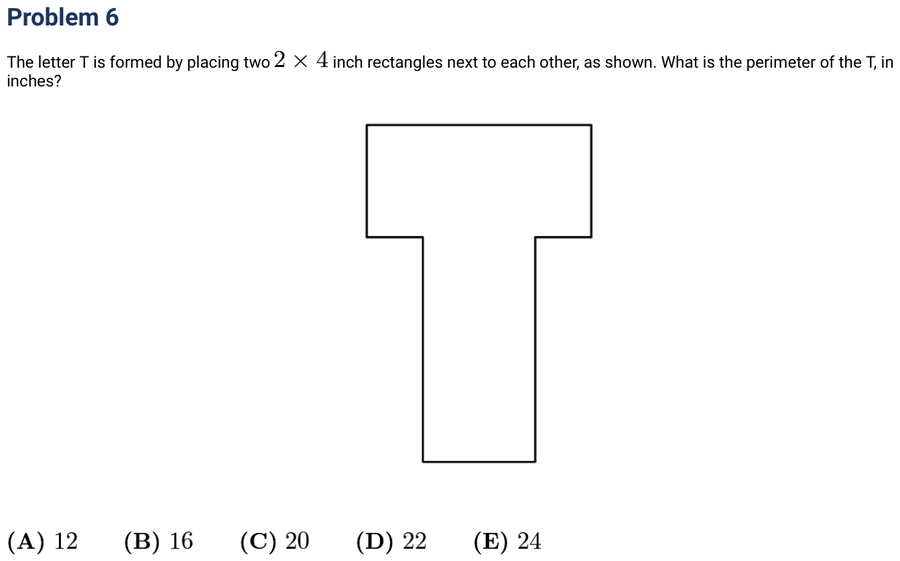
The letter T is built from two 2×4 inch rectangles, one standing as the stem and one lying across as the bar. Find the perimeter of the T.
Start with the two rectangles apart. Each has perimeter 2(2 + 4) = 12, so together that’s 24.
Now glue them. Where the stem touches the bar, a 2-inch seam gets pressed together. That seam is now inside the T — it disappears from the outline of both rectangles. So you lose 2 inches from each piece: subtract 2 twice.
Perimeter = 24 − 2 − 2 = 20 inches (choice C).
The trap is computing one rectangle’s perimeter (12) and stopping, or forgetting the seam hides on both sides. Whenever two shapes are glued, perimeter = (sum of the pieces) − 2 × (length of the shared seam). The seam counts twice because it leaves both outlines at once.
For axis-aligned step shapes (L, T, etc.), perimeter = bounding rectangle perimeter. Area is the bounding rectangle minus the notch. Always check first: are you computing area or perimeter?
2026 · #3 Haruki has a piece of wire that is 24 centimeters long. He wants to bend it to form each of the following shapes, one at a time.A...
Haruki has a piece of wire that is 24 centimeters long. He wants to bend it to form each of the following shapes, one at a time.
- A regular hexagon with side length 5 cm.
- A square of area 36 cm2.
- A right triangle whose legs are 6 and 8 cm long.
Which of the shapes can Haruki make?
Show answer
Show hints
Still stuck? Show hint 2 →
Show solution
- A fixed loop of wire can only bend into a shape whose perimeter is exactly 24 cm. So the whole problem becomes: find each perimeter and check it against 24.
- Hexagon: 6 sides × 5 = 30 cm. Too long — no. (Notice you don't even need the others to rule this one out.)
- Square of area 36: the side is √36 = 6, so perimeter 4 × 6 = 24 cm. ✓
- Right triangle, legs 6 and 8: spot the 6-8-10 Pythagorean triple — the hypotenuse is 10, so perimeter 6 + 8 + 10 = 24 cm. ✓
- Only the square and the triangle fit, so the answer is Square and triangle only.
- You'll see it again: 3-4-5 and its scalings (6-8-10, 9-12-15…) are the most common right triangles on contests — recognizing one saves you the square-root work.
2015 · #1 How many square yards of carpet are required to cover a rectangular floor that is 12 feet long and 9 feet wide? (There are 3 feet in a yard.)
How many square yards of carpet are required to cover a rectangular floor that is 12 feet long and 9 feet wide? (There are 3 feet in a yard.)
Show answer
Show hints
Still stuck? Show hint 2 →
Show solution
- Convert the lengths, not the area: 12 ft = 4 yd and 9 ft = 3 yd.
- Area = 4 yd × 3 yd = 12 square yards.
- Why this transfers: area and volume scale by the square (or cube) of a length conversion. 1 yd = 3 ft, so 1 sq yd = 32 = 9 sq ft — which is exactly why 108 sq ft ÷ 9 = 12 sq yd also works, and matches our answer. Converting lengths first dodges that factor entirely.
2012 · #4 A blackboard has a total unfolded length of 6 m. The middle section is 3 m long. How long is the section labelled with a question mark?
A blackboard has a total unfolded length of 6 m. The middle section is 3 m long. How long is the section labelled with a question mark?
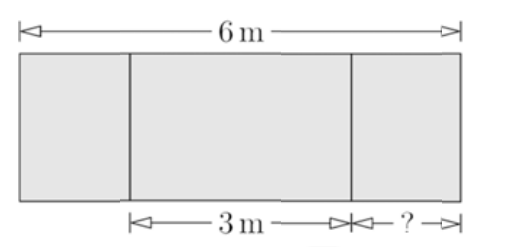
Show answer
Show hints
Still stuck? Show hint 2 →
Show solution
- The total length is 6 m; the middle section is 3 m.
- The two end sections together make 6 - 3 = 3 m.
- The picture shows the two ends are equal, so each is 3 / 2 = 1.5 m.
2015 · #5 Each square in the shape has an area of 4 cm². How long is the thick line?
Each square in the shape has an area of 4 cm². How long is the thick line?
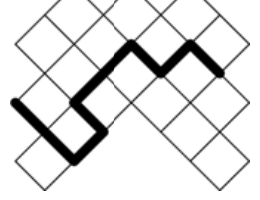
Show answer
Show hints
Still stuck? Show hint 2 →
Show solution
- Each small square has area 4 cm², so its side is √4 = 2 cm.
- The thick line follows 9 of these square edges along the grid.
- Its length is 9 × 2 = 18 cm.
2018 · #8 A large rectangle is made up of 9 equally big rectangles. The longer side of each small rectangle is 10 cm long. What is the perimeter...
A large rectangle is made up of 9 equally big rectangles. The longer side of each small rectangle is 10 cm long. What is the perimeter of the large rectangle?
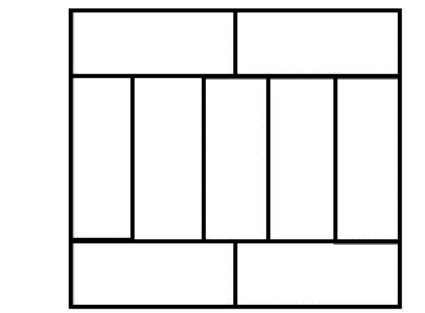
Show answer
Show hints
Still stuck? Show hint 2 →
Show solution
- Five standing rectangles side by side make the width: 5 short sides. Two lying rectangles also span that width, so 2 · 10 = 5w, giving w = 4 cm.
- The big rectangle is 5w = 20 cm wide and (4 + 10 + 4) = 18 cm tall.
- Its perimeter is 2 · (20 + 18) = 76 cm.
Area decomposition — cut into pieces you can measure
Here’s a shape with a chunk bitten out of one corner — an L. There’s no “area of an L” formula. So what do you do? You cut. And the satisfying part: there is almost always more than one good place to cut, and every cut gives the same answer. Watch two different kids attack the same L and land on 36.
So the skill isn’t a formula — it’s deciding where to cut. Here’s how to choose fast.
HOW TO CHOOSE WHERE TO CUT
- Grid lines if the figure is on a grid — cuts make whole rectangles.
- Perpendiculars from a vertex to a side — cuts make right triangles.
- Diagonals — cut a parallelogram or trapezoid into two equal triangles.
- Big-minus-notch when the leftover is small and obvious.
Go deeper: where the area formulas come from (one cut turns each into a rectangle)
Where the formulas come from — one cut turns it into a rectangle
The area formulas for a parallelogram and a triangle aren’t magic. Each one is a rectangle in disguise. Cut once, slide, and look.
Parallelogram → rectangle. A parallelogram looks like a rectangle that got shoved sideways. Slice the slanted triangle off one end and slide it to the other end — it fits perfectly, and you’re holding a plain rectangle. Same base, same height, same area. So A = base × height — and the height is the straight-up distance, never the slanted side.
Triangle = half a rectangle. Take any triangle. Make a second identical copy, flip it upside down, and snug it against the first. The two together form a parallelogram (a rectangle, if the triangle is right) on the same base and height. So one triangle is exactly half of it: A = ½ × base × height. The “½” isn’t a rule to memorize — it’s the second copy you didn’t draw.
Pictured-intuition adapted from Competition Math for Middle School (AoPS).
Go deeper: a triangle inside a rectangle — decompose with coordinates
A triangle inside a rectangle — cut differently
A pentagon with vertices (0,0), (4,0), (5,3), (2,5), (0,3). Cut into a rectangle and two triangles:
- Bottom rectangle: width 4, height 3 → area 12.
- Bottom-right triangle: base 1, height 3 → ½ · 1 · 3 = 1.5.
- Top triangle: base 5, height 2 → ½ · 5 · 2 = 5.
Total: 12 + 1.5 + 5 = 18.5 square units.
Go deeper: rearrangement — slide matching pieces, don’t measure slants
Rearrangement — slide a piece, don’t measure it
Sometimes a shape has slanted or bumpy edges that look painful to measure. Before you reach for the Pythagorean theorem, ask: did the slants just move area around?
Look at a shape where the bottom edge slopes down on the left and the top edge slopes up by the exact same amount. The slant on top took a triangle of area off one corner; the slant on the bottom handed back an identical triangle somewhere else. Net change: zero. Slide the pieces back and you’re left with a plain rectangle. If that rectangle is 2 by 3, the area is 2 × 3 = 6 — no slants to measure at all.
This is the same idea behind the L-shape perimeter trick in chapter 1 — pieces that cancel. Here it’s area, not perimeter.
The strong version shows up with curves too. If a star is built by bending the four arcs of a circle inward, no area was created or destroyed — the star and the leftover “bites” are the same arcs as the circle. Find a square the pieces tile exactly, and the area comes from subtraction, not from arc formulas.
Your instinct is to measure every slanted edge. Resist it. Look for matching pieces that cancel, slide them into a plain shape, and read the area off that.
For polygons with mostly right angles, slice along the right angles to make rectangles. For polygons with one or two slanted sides, drop perpendiculars to make right triangles.
If the figure is on a grid and the cutting feels messy, switch to Shoelace or Pick’s (chapter 10).
In the figure, the outer equilateral triangle has area 16, the inner equilateral triangle has area 1, and the three trapezoids are congruent. What is the area of one of the trapezoids?
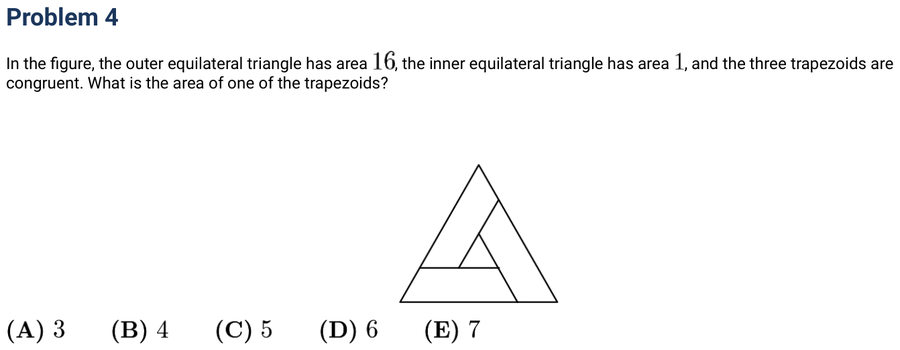
A big equilateral triangle of area 16 has a small equilateral triangle of area 1 sitting in its center. The three pieces left over are congruent trapezoids. Find the area of one trapezoid.
Your instinct is to find side lengths and use the trapezoid formula. Resist it — you don’t need any lengths. The trapezoids are exactly what’s left when you punch the little triangle out of the big one. That’s the frame trick (chapter 3) in disguise.
Three trapezoids together: 16 − 1 = 15.
They’re congruent — identical — so each one is 15 ÷ 3 = 5 (choice C).
The word “congruent” is doing all the work. It means the leftover splits into equal pieces, so you divide. Notice the answer choices run 3 to 7 — 15 split three ways can only be 5, so even a quick sanity check pins it.
Cut, compute, add. For 'irregular' polygons inscribed in a rectangle, sometimes 'big minus notch' is faster than adding up pieces.
2018 · #4 (figure problem)
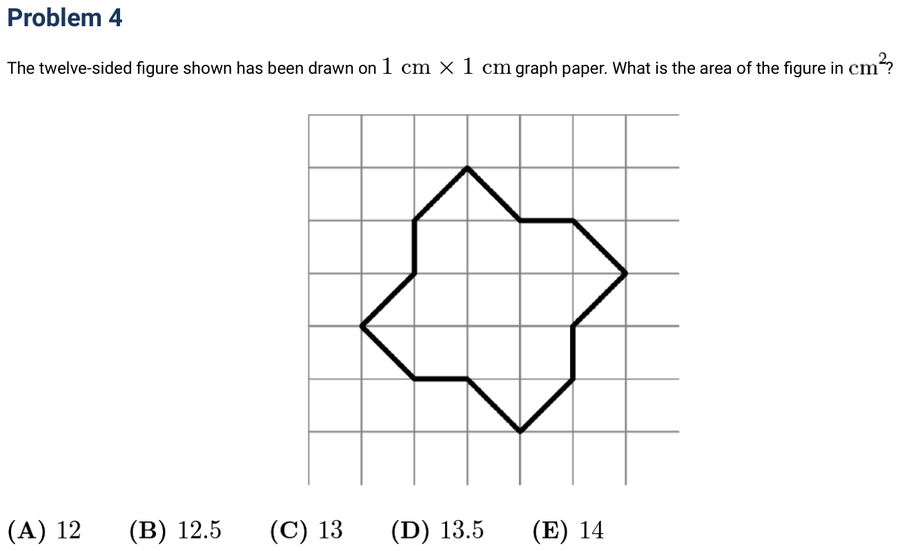
Show answer
Show hints
Still stuck? Show hint 2 →
Show solution
- Spot the structure: a calm 3 × 3 square in the center, with one identical triangular point poking out of each of its four sides.
- Square area: 3 × 3 = 9. Each point is a triangle with base 2 and height 1, so area (1/2)(2)(1) = 1; four of them give 4.
- Total: 9 + 4 = 13 cm2. Sanity check: the figure is clearly bigger than the 9 square but doesn't fill its 5×5 bounding box, so 13 feels right.
- You'll see it again: spotting a symmetric core plus repeated identical flaps turns a 12-sided monster into "one square + 4 copies of one triangle."
- Here's a power tool for any polygon whose corners sit on grid points: area = (interior dots) + (boundary dots)/2 − 1.
- Count the grid dots strictly inside the figure (the interior count) and the dots lying on its outline, plug into the formula, and you get 13 — no slicing into triangles needed. Worth knowing for any "shape drawn on graph paper" question.
2024 · #3 Four squares of side lengths 4, 7, 9, and 10 units are arranged in increasing size order so that their left edges and bottom edges...
Four squares of side lengths 4, 7, 9, and 10 units are arranged in increasing size order so that their left edges and bottom edges align. The squares alternate in the color pattern white-gray-white-gray, respectively, as shown in the figure. What is the area of the visible gray region, in square units?
Show answer
Show hints
Still stuck? Show hint 2 →
Show solution
- The insight: you never see a whole gray square — a smaller white square always sits on top, leaving only an L-shaped frame. So gray visible = (gray square's area) − (the square covering it).
- Gray 10 under white 9: 102 − 92. Instead of 100 − 81, use a2 − b2 = (a+b)(a−b) = 19×1 = 19 — no big subtraction.
- Gray 7 under white 4: 72 − 42 = (7+4)(7−4) = 11×3 = 33.
- Add the two frames: 19 + 33 = 52. You'll see it again: any time two squares (or any two areas) sit one inside the other, the leftover is their difference — and difference-of-squares makes consecutive sizes like 10 and 9 collapse to just their sum.
- The visible gray is the 10-square minus the 9-square plus the 7-square minus the 4-square: 100 − 81 + 49 − 16.
- = 52.
2017 · #8 Petra crafts a piece of jewellery out of two black and two white hearts. The hearts have areas of 1 cm², 4 cm², 9 cm² and 16 cm²...
Petra crafts a piece of jewellery out of two black and two white hearts. The hearts have areas of 1 cm², 4 cm², 9 cm² and 16 cm² respectively. She places the hearts on top of each other as shown in the diagram and glues them together. How big is the total area of the visible black parts?

Show answer
Show hints
Still stuck? Show hint 2 →
Show solution
- Stacking areas 16, 9, 4, 1 with alternating colours, the visible black equals 16 − 9 + 4 − 1.
- That is 16 − 9 + 4 − 1 = 10 cm².
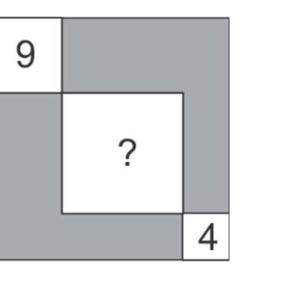
2020 · #21 Inside the gray square there are three white squares; the number in each shows its area. The white squares have sides parallel to the...
Inside the gray square there are three white squares; the number in each shows its area. The white squares have sides parallel to the sides of the gray square. If the area of the gray square is 81, what is the area of the gray region not covered by the white squares?
Show answer
Show hints
Still stuck? Show hint 2 →
Show solution
- The gray square has area 81, so its side is 9. The corner white squares have areas 9 and 4, so their sides are 3 and 2.
- The middle white square stretches across the row between them, so its side is 9 − 3 − 2 = 4, giving area 16.
- Gray left over = 81 − 9 − 4 − 16 = 52.
The frame trick — big region minus the hole
You want the area of a picture mat — the cardboard border around a photo. You could measure all four strips and add them. Or you could do this: outer rectangle minus the photo. One subtraction. Done.
That is the frame trick, and it is the most common single move in contest geometry. Whenever the region you want is defined by what got removed — a hole, a cut, a leftover — don’t trace its messy boundary. Measure the big thing and the missing thing, and subtract.
FRAME TRICK
Shaded area = (large region containing it) − (unshaded pieces inside).
Three flavors:
- A square with a circle removed: area = square − circle.
- A photo inside a frame: frame area = big rectangle − inner photo.
- The leftover after cutting: original area − cut piece.
You never measure the shaded boundary directly. You measure the big rectangle and the hole, then subtract.
When pieces overlap, subtract the double-count
The frame trick has a twin for overlapping shapes. If you slap two regions together and they overlap, just adding their areas counts the overlap twice. Fix it by subtracting the overlap once:
union = A + B − overlap
Grown-ups call this inclusion–exclusion. You call it “pay back the part you counted twice.” It works for any number of pieces: add everything, then subtract each overlap once.
For 'inside the frame' regions, area = big − small. For overlapping regions, area = A + B − overlap. Always decide first which kind you're looking at — that one decision picks your formula.
Five circles, each with an area of 8 cm², overlap to form the figure shown. Each overlapping region has an area of 1 cm². What is the total area of the figure, in cm²?
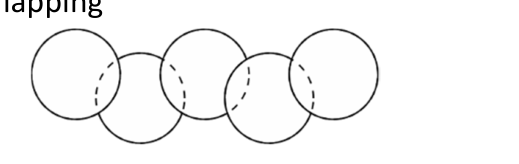
Five circles, each of area 8 cm², overlap in a chain to form one blob. Every overlap region has area 1 cm², and there are four of them. What is the total area of the blob?
Your instinct is to add the five circles: 5 × 8 = 40 cm². But stop — wherever two circles overlap, you just counted that little lens twice, once for each circle.
There are four overlaps, 1 cm² each. Each got double-counted, so pay back 4 × 1 = 4 cm².
Total = 40 − 4 = 36 cm² (choice B).
The trap is answering 40 — the plain sum — and never fixing the overlaps. The phrase “overlap” is the flashing sign: add the pieces, then subtract each shared region exactly once.
For 'inside the frame' regions: area = big − small. For overlapping regions: area = A + B − overlap.
2012 · #6 A rectangular photograph is placed in a frame that forms a border two inches wide on all sides of the photograph. The photograph...
A rectangular photograph is placed in a frame that forms a border two inches wide on all sides of the photograph. The photograph measures 8 inches high and 10 inches wide. What is the area of the border, in square inches?
Show answer
Show hints
Still stuck? Show hint 2 →
Show solution
- The border is everything in the outer rectangle except the photo, so its area = outer area − photo area. That sidesteps adding up four separate strips.
- The 2-inch border hits both sides, so each dimension gains 2 + 2 = 4: the outer rectangle is 12 × 14 = 168.
- Subtract the photo: 8 × 10 = 80, so border = 168 − 80 = 88 sq in.
- Watch the doubling — a border/margin of width w always adds 2w to each side length, the classic slip in frame and walkway problems.
2018 · #4 (figure problem)
Show answer
Show hints
Still stuck? Show hint 2 →
Show solution
- Spot the structure: a calm 3 × 3 square in the center, with one identical triangular point poking out of each of its four sides.
- Square area: 3 × 3 = 9. Each point is a triangle with base 2 and height 1, so area (1/2)(2)(1) = 1; four of them give 4.
- Total: 9 + 4 = 13 cm2. Sanity check: the figure is clearly bigger than the 9 square but doesn't fill its 5×5 bounding box, so 13 feels right.
- You'll see it again: spotting a symmetric core plus repeated identical flaps turns a 12-sided monster into "one square + 4 copies of one triangle."
- Here's a power tool for any polygon whose corners sit on grid points: area = (interior dots) + (boundary dots)/2 − 1.
- Count the grid dots strictly inside the figure (the interior count) and the dots lying on its outline, plug into the formula, and you get 13 — no slicing into triangles needed. Worth knowing for any "shape drawn on graph paper" question.
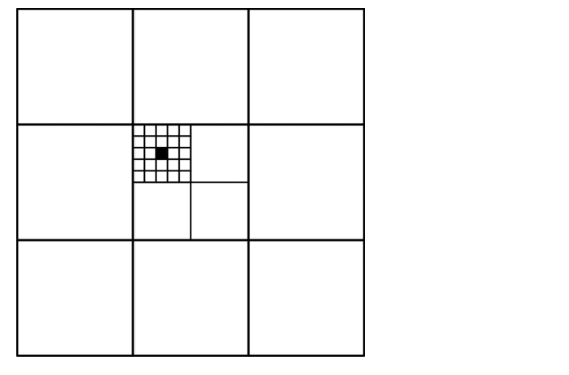
2009 · #5 In the picture the large square has an area of 1. What is the area of the small black square?
In the picture the large square has an area of 1. What is the area of the small black square?
Show answer
Show hints
Still stuck? Show hint 2 →
Show solution
- The black square sits inside nested subdivisions of the unit square.
- Following the repeated shrinking down to the black cell, its side is 1/30 of the whole.
- Its area is therefore (1/30)^2 = 1/900 of the large square.
2006 · #21 An aquarium has a rectangular base that measures 100 cm by 40 cm and has a height of 50 cm. The aquarium is filled with water to a depth...
An aquarium has a rectangular base that measures 100 cm by 40 cm and has a height of 50 cm. The aquarium is filled with water to a depth of 37 cm. A rock with volume 1000 cm3 is then placed in the aquarium and completely submerged. By how many centimeters does the water level rise?
Show answer
Show hints
Still stuck? Show hint 2 →
Show solution
- Submerging the rock displaces exactly 1000 cm³ of water, which spreads across the full base as a thin layer of rise.
- That layer is a box: base 100 × 40 = 4000 cm², volume 1000 cm³. Its height (the rise) = 1000 ÷ 4000 = 0.25 cm.
- Why the 37 cm and 50 cm don't matter: the rise depends only on how much volume you add and how wide the tank is — not on the current depth (as long as the rock stays submerged and the water doesn't overflow). Sanity check: 0.25 cm of rise × 4000 cm² = 1000 cm³, exactly the rock. Spotting the decoy numbers is half the battle.
Area basics — formulas, decomposition, frame
Three problems on areas, perimeters, and the frame trick.
2006 · #6 The letter T is formed by placing two 2 × 4 inch rectangles next to each other, as shown. What is the perimeter of the T, in inches?
The letter T is formed by placing two 2 × 4 inch rectangles next to each other, as shown. What is the perimeter of the T, in inches?
Show answer
Show hints
Still stuck? Show hint 2 →
Show solution
- Each 2 × 4 rectangle has perimeter 2(2 + 4) = 12, so separately they total 24.
- Where the stem meets the bar, a 2-inch segment of each rectangle is pressed against the other. That seam is now interior, so it leaves the outline of both — subtract 2 twice.
- 24 − 2 − 2 = 20.
- Worth keeping: whenever pieces are glued together, perimeter of the whole = sum of the parts' perimeters − 2 × (length of each shared seam). The seam vanishes from both sides, which is why it's counted twice.
- Trace the T's edge and add the segments: the bar's top is 4; coming down the right side and around the stem and back up the left mixes 2-inch and other pieces.
- Summing all the boundary segments of the T gives 20 — a good way to double-check the subtraction method, since you never touch the interior seam at all.
2008 · #4 In the figure, the outer equilateral triangle has area 16, the inner equilateral triangle has area 1, and the three trapezoids are...
In the figure, the outer equilateral triangle has area 16, the inner equilateral triangle has area 1, and the three trapezoids are congruent. What is the area of one of the trapezoids?
Show answer
Show hints
Still stuck? Show hint 2 →
Show solution
- The big triangle is the small triangle plus the three trapezoids, so the trapezoids together cover 16 − 1 = 15. No measuring needed — the area you can't see is simply "total minus the hole."
- They're congruent (identical), so each is 15 ÷ 3 = 5.
- Sanity check: the choices run 3–7, and 15 split three ways must be 5 — only one choice fits.
- Area 16 vs area 1 means the big triangle is 4× the small one in side length (since area scales as the square, √16 = 4).
- The whole figure is 16 small-triangle-areas worth; the center hole is 1, leaving 15 for the three trapezoids, so each is 5.
2025 · #9 Five circles, each with an area of 8 cm², overlap to form the figure shown. Each overlapping region has an area of 1 cm². What is the...
Five circles, each with an area of 8 cm², overlap to form the figure shown. Each overlapping region has an area of 1 cm². What is the total area of the figure, in cm²?
Show answer
Show hints
Still stuck? Show hint 2 →
Show solution
- Five circles give 5 × 8 = 40 cm² if simply added.
- The four overlap regions (1 cm² each) were each counted twice, so subtract 4 cm².
- Total figure area = \(40 - 4 = 36\) cm², which is (B).
Square roots — what the radical sign means and how to tame it
Before we tackle right triangles next chapter, we need one tool from arithmetic — because you meet the square root sign the moment you touch Pythagoras: legs 2 and 3 give a hypotenuse of \(\sqrt{13}\). But what is that? Most kids treat \(\sqrt{\ }\) as a scary button on a calculator. It isn’t. It’s just the question “what number, times itself, gives this?” run backwards.
Squaring takes 5 to 25. The square root walks back: 25 to 5. That’s the whole idea — it undoes squaring.
So \(\sqrt{25}=5\), \(\sqrt{49}=7\), \(\sqrt{144}=12\). A number like 25 or 144 that comes out whole is a perfect square. The little hook symbol \(\sqrt{\ }\) has a name — the radical.
PERFECT SQUARES TO KNOW ON SIGHT
1, 4, 9, 16, 25, 36, 49, 64, 81, 100, 121, 144, 169, 196, 225, 256, …
(that’s \(1^2\) through \(16^2\) — the more of these you know cold, the faster every root problem goes.)
Go deeper: simplify a root — pull out the biggest perfect-square factor
Simplifying a root — pull out the perfect-square factor
What about \(\sqrt{50}\)? It’s not whole — 50 isn’t a perfect square. But hiding inside 50 is a perfect square: \(50 = 25 \times 2\). And a root splits across a product:
\(\sqrt{a \times b} = \sqrt{a}\,\times\,\sqrt{b}\)
So \(\sqrt{50} = \sqrt{25 \times 2} = \sqrt{25}\times\sqrt{2} = 5\sqrt{2}\). The 25 walks out as a 5; the 2 has no perfect-square factor left, so it stays under the radical. That’s simplified form: a whole number times a root with nothing square left inside.
Hunt for the biggest perfect-square factor and you finish in one step. Miss it and you still get there in two: \(\sqrt{72} = \sqrt{4 \times 18} = 2\sqrt{18} = 2\sqrt{9 \times 2} = 2 \cdot 3\sqrt{2} = 6\sqrt{2}\). Same answer, just more steps.
Framing inspired by AoPS Prealgebra.
Go deeper: multiplying vs adding roots (two different rules)
Multiplying and adding roots — two different rules
Multiplying is friendly. Roots multiply straight across: \(\sqrt{2}\times\sqrt{8} = \sqrt{16} = 4\). Whatever’s inside combines under one radical.
Adding is fussy. You can only add roots that are already the same root — like terms. \(2\sqrt{3} + 5\sqrt{3} = 7\sqrt{3}\) (count the \(\sqrt{3}\)s), exactly like \(2\) apples \(+\) \(5\) apples. But \(\sqrt{2} + \sqrt{3}\) just stays \(\sqrt{2} + \sqrt{3}\) — different roots, can’t combine.
The payoff: simplify first, and unlike-looking roots often turn out alike. \(\sqrt{50} - \sqrt{18} = 5\sqrt{2} - 3\sqrt{2} = 2\sqrt{2}\). They were both \(\sqrt{2}\) in disguise.
Go deeper: estimating a root — trap it between two integers
Estimating a root — trap it between two integers
A hypotenuse comes out \(\sqrt{40}\) and the answer choices are plain numbers. About how big is it? You don’t need a calculator — you need the two perfect squares it sits between.
The rule that makes this work: bigger inside means bigger root. Since \(36 < 40 < 49\), taking roots keeps the order: \(\sqrt{36} < \sqrt{40} < \sqrt{49}\), so \(6 < \sqrt{40} < 7\). And 40 is much closer to 36 than to 49, so \(\sqrt{40}\) is a touch above 6 — about 6.3.
Square roots show up all over Pythagoras — but most contest right triangles are secretly triples, so the root comes out whole (\(\sqrt{25}=5\), \(\sqrt{169}=13\)) and you skip the radical entirely. When it doesn’t come out whole, you have three tools: simplify (\(\sqrt{50}=5\sqrt{2}\)), estimate (trap it between perfect squares), or leave it exact — on a contest the answer choices usually keep the radical, so \(5\sqrt{2}\) is the final answer, not a number to round.
This is why \(\sqrt{2}\) haunts geometry: the diagonal of a unit square is \(\sqrt{2}\), the diagonal of a side-\(s\) square is \(s\sqrt{2}\) — a simplified radical you leave exactly as is.
A right triangle has legs 6 and 8. “The hypotenuse is \(\sqrt{6^2+8^2}\), and a square root spreads across a sum, so that’s \(\sqrt{6^2}+\sqrt{8^2}=6+8=14\).”
Why it breaks: \(\sqrt{\ }\) splits across a product, never across a sum: \(\sqrt{a+b}\) is not \(\sqrt{a}+\sqrt{b}\). Test it small: \(\sqrt{9+16}=\sqrt{25}=5\), but \(\sqrt{9}+\sqrt{16}=3+4=7\). Not equal.
The fix: add inside first, then root: \(\sqrt{36+64}=\sqrt{100}=10\). (And 6-8-10 is just the 3-4-5 triple doubled — you could have read off 10 with no root at all.)
A square and a circle have the same area. What is the ratio of the side length of the square to the radius of the circle?
A square and a circle have the same area. What is the ratio of the square’s side \(s\) to the circle’s radius \(r\)? This is a square-root problem in disguise — watch where the radical comes from.
Same area means \(s^2 = \pi r^2\). You want the plain length ratio \(s/r\), so divide both sides by \(r^2\):
\(\left(\dfrac{s}{r}\right)^2 = \pi.\)
Now the chapter’s whole point: the equation is in squared units, but the question wants a plain length. So you undo the square — take the square root of both sides:
\(\dfrac{s}{r} = \sqrt{\pi}\) (choice B).
\(\pi\) has no perfect-square factor to pull out, so \(\sqrt{\pi}\) is already simplified — that radical is the answer, not something to round.
The trap is leaving the answer as \(\pi\) and skipping the square root — the same “forgot to undo the square” slip that turns \((s/r)^2=\pi\) into a wrong \(s/r=\pi\). Quick sense-check: \(\pi>1\) so \(\sqrt{\pi}>1\), meaning the side beats the radius — right, since a circle is more than one radius across. When a length-squared equals something, the length itself carries a root.
\(\sqrt{\ }\) undoes squaring. Simplify by pulling out the largest perfect-square factor (\(\sqrt{50}=5\sqrt{2}\)). Multiply across (\(\sqrt{a}\sqrt{b}=\sqrt{ab}\)); add only like roots. Estimate by trapping between perfect squares. NEVER split a root across a sum: \(\sqrt{a+b}\ne\sqrt{a}+\sqrt{b}\).
2003 · #21 (figure problem)
Show answer
Show hints
Still stuck? Show hint 2 →
Show solution
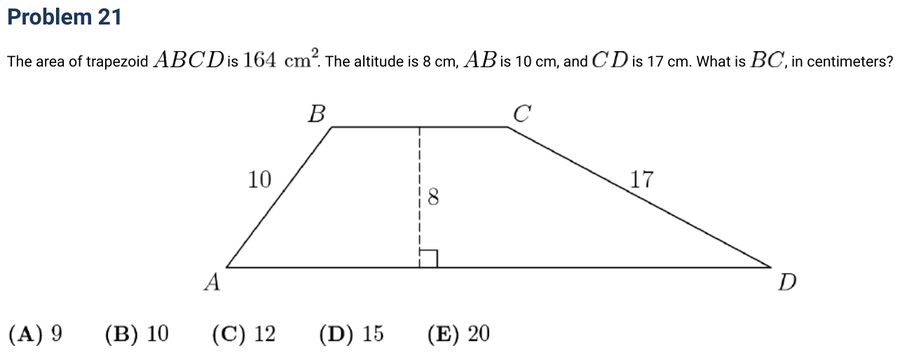
- Drop perpendiculars from B and C straight down to the long side AD; both have length 8 (the altitude). Each slanted leg is now the hypotenuse of a right triangle. AB = 10 with a vertical leg of 8 is a 6-8-10 triangle, so its base is 6. CD = 17 with a vertical leg of 8 is an 8-15-17 triangle, so its base is 15.
- The bottom AD is the top BC plus those two overhangs: AD = BC + 6 + 15 = BC + 21.
- The area gives the second relation. Trapezoid area = ½(sum of parallel sides)(height): ½(BC + AD)(8) = 164, so BC + AD = 41.
- Substitute: BC + (BC + 21) = 41 → 2·BC = 20 → BC = 10.
- You'll see this again: recognizing 6-8-10 and 8-15-17 turns "find the missing horizontal piece" into instant recall — no Pythagorean square-rooting. The trapezoid then becomes one length equation plus one area equation.
- The two overhangs (6 and 15) total 21, so AD is exactly 21 longer than BC. Their average — the trapezoid's "midline" — is BC + 10.5.
- Area = midline × height = (BC + 10.5) × 8 = 164, so BC + 10.5 = 20.5.
- Therefore BC = 10.
2019 · #4 (figure problem)
Show answer
Show hints
Still stuck? Show hint 2 →
Show solution
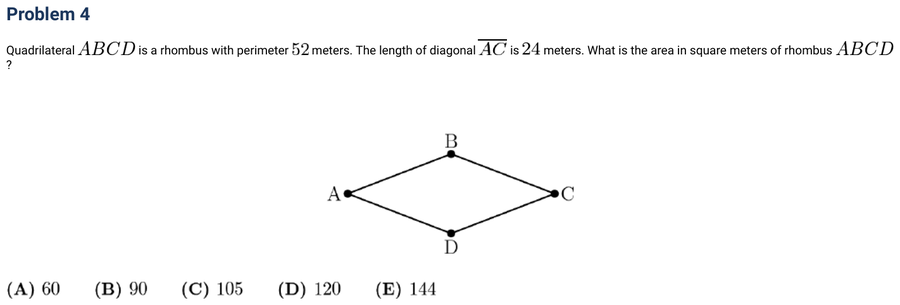
- Perimeter gives side = 52 ÷ 4 = 13; half of diagonal AC = 24 ÷ 2 = 12.
- The diagonals cut each other at right angles, so the center splits the rhombus into four identical right triangles with hypotenuse 13 (the side) and one leg 12 (half of AC). That's the 5-12-13 triple — no Pythagorean computation needed — so the other half-diagonal is 5 and the full diagonal BD = 10.
- Area of a rhombus = d1 × d22 = 24 × 102 = 120 sq m.
- You'll see it again as: whenever a problem hands you a rhombus (or a kite), reach first for "diagonals perpendicular" — it converts the figure into right triangles, and recognizing a Pythagorean triple (3-4-5, 5-12-13, 8-15-17) skips the square roots.
- Each of the four right triangles has legs 12 and 5, so area 12 × 52 = 30.
- Four of them: 4 × 30 = 120 sq m — same answer, confirming the diagonal-product formula.
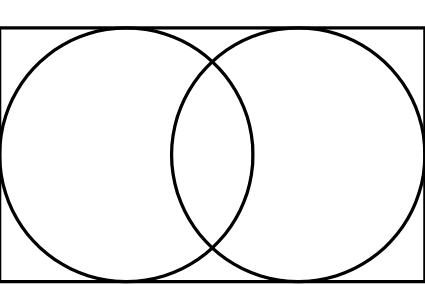
2018 · #9 Two circles are inscribed in an 11 cm long and 7 cm wide rectangle so that they each touch three sides of the rectangle. How big is the...
Two circles are inscribed in an 11 cm long and 7 cm wide rectangle so that they each touch three sides of the rectangle. How big is the distance between the centres of the two circles?
Show answer
Show hints
Still stuck? Show hint 2 →
Show solution
- Touching three sides means each circle has diameter 7 cm (the width), so radius 3.5 cm.
- The left centre sits 3.5 cm from the left edge; the right centre sits 3.5 cm from the right edge of the 11 cm length.
- Distance between centres = 11 − 3.5 − 3.5 = 4 cm.
Right triangles — Pythagorean theorem and the famous triples
Three numbers worth more than any formula in this lesson: 3, 4, 5. Build a triangle with sides 3, 4, 5 and the corner between the 3 and the 4 comes out exactly square. Carpenters have used this for thousands of years to make right angles with nothing but a knotted rope. On a contest, the moment you spot a 3, a 4, and a 5 (or a 5 and a 12, or an 8 and a 15), you can write the missing side with zero arithmetic.
These magic trios are Pythagorean triples: right triangles whose three sides are all whole numbers. They obey the most famous equation in geometry.
PYTHAGOREAN THEOREM
a² + b² = c²
(legs a, b; hypotenuse c = the longest side, across from the right angle)
You can always compute the third side with this. But the triples let you skip the computing. Memorize these three:
The three most common Pythagorean triples: 3-4-5, 5-12-13, 8-15-17.
Other triples worth knowing:
- 7-24-25, 9-40-41, and (rarely) 20-21-29.
- Any multiple of a triple is also a triple: 6-8-10, 9-12-15, 30-40-50, 10-24-26, …
Go deeper: see WHY a²+b²=c² — the four-triangle puzzle (a real proof)
See WHY it’s true — the four-triangle puzzle
Most kids are told a² + b² = c² and asked to believe it. You don’t have to. Here is a picture that proves it, with no algebra — only cutting and counting.
Take four copies of the same right triangle (legs a and b, hypotenuse c). Pack them, pinwheel-style, into the corners of a big square whose side is a + b. The four slanted hypotenuses fence off a tilted square in the middle, and that square’s side is exactly c — so its area is c².
Here is the trick. The big square has a fixed area. The four triangles never change. So whatever is left over after you place the triangles must always be the same amount of leftover — no matter how you arrange them.
Arrange them the pinwheel way (left): leftover = the tilted square = c². Now slide the same four triangles to hug two corners instead (right): the leftover splits into two upright squares — one of side a (area a²) and one of side b (area b²). Same big square, same four triangles, so the leftovers match:
c² = a² + b².
No formula handed down — you watched the same blank space get re-counted two ways. That is a proof.
Pictured-intuition adapted from Competition Math for Middle School (AoPS).
Go deeper: the two special right triangles (45-45-90 and 30-60-90)
The two special right triangles — where the √2 and √3 come from
Triples give whole-number triangles. But two right triangles show up constantly with non-whole sides — and you don’t memorize them, you build them from shapes you already know.
The 45-45-90 is half a square. Slice any square along its diagonal. You get two identical right triangles with equal legs and two 45° angles. If each leg is 1, Pythagoras gives the diagonal: 1² + 1² = 2, so the hypotenuse is √2. That’s the whole rule — hypotenuse = leg · √2, ratio 1 : 1 : √2. (This is exactly why a square of side s has diagonal s√2.)
The 30-60-90 is half an equilateral triangle. Take an equilateral triangle with side 2 and drop a straight-down line from the top. It splits into two matching right triangles. The base was 2, now halved to 1 (the short leg). The hypotenuse is still a full side, 2. Pythagoras fills in the tall leg: it’s √(2² − 1²) = √3. So ratio 1 : √3 : 2 — short leg, long leg, hypotenuse.
Framing inspired by AoPS Prealgebra.
Go deeper: the 13-14-15 triangle — the one non-right triangle worth memorising
The 13-14-15 triangle — the one non-right triangle worth memorizing
It’s not a right triangle, but its sides are all whole numbers and so is its area:
Drop the altitude to the side of length 14. It splits into a 5-12-13 right triangle and a 9-12-15 right triangle (a 3-4-5 tripled). Both share the altitude 12, and the bases add to 5 + 9 = 14 ✓.
Triples often hide inside other figures — an altitude or a square slices a bigger shape into 3-4-5 or 5-12-13 fragments. Whenever you drop a perpendicular and split a base in half, scan the two right triangles for known triples before you reach for √.
A triangle has sides 6 and 8 with a 7 cm side between them. “Two sides are 6 and 8, and 6-8-10 is a triple, so the third side must be 10.”
Why it breaks: \(a^2+b^2=c^2\) is a fact about right triangles only. This triangle has no right angle marked — the third side is already given as 7. Pythagoras (and every triple) applies only when there’s a 90° corner between the two legs.
The fix: before using \(a^2+b^2=c^2\) or any triple, confirm the angle between the two sides is a right angle (a little square in the figure, or “perpendicular” in the text). No right angle → no Pythagoras. If you need the area of a non-right triangle, drop an altitude to make right triangles first.
And it runs backwards (the converse). The arrow points both ways: if a triangle’s three sides happen to satisfy \(a^2+b^2=c^2\), then it must have a right angle — opposite the longest side. So 5, 12, 13 (since \(25+144=169\)) is automatically a right triangle, while 4, 5, 6 (since \(16+25=41\neq 36\)) is not. That makes Pythagoras a right-angle detector, not just a side-finder.
The base of isosceles ▵ABC is 24 and its area is 60. What is the length of one of the congruent sides?
An isosceles triangle has base 24 and area 60. Find the length of one of the two equal sides.
Step 1 — back out the height. Area = ½ · base · height, so 60 = ½ · 24 · h. That gives 60 = 12h, so h = 5.
Step 2 — use the symmetry. The height of an isosceles triangle drops straight down the middle and cuts the base in half: 24 ÷ 2 = 12. So each equal side is the hypotenuse of a right triangle with legs 5 and 12.
Step 3 — recognize the triple. Legs 5 and 12 → that’s the 5-12-13 triple. The equal side = 13 (choice C).
You never computed √(25 + 144). The instant you saw legs 5 and 12, the hypotenuse was 13 by reflex. Triples are pattern-matching, not arithmetic — that’s the whole point of memorizing them.
Memorize 3-4-5, 5-12-13, 8-15-17, 7-24-25, and their multiples. For 45-45-90 and 30-60-90 triangles, know the side ratios (1:1:√2 and 1:√3:2).
2019 · #4 (figure problem)
Show answer
Show hints
Still stuck? Show hint 2 →
Show solution
- Perimeter gives side = 52 ÷ 4 = 13; half of diagonal AC = 24 ÷ 2 = 12.
- The diagonals cut each other at right angles, so the center splits the rhombus into four identical right triangles with hypotenuse 13 (the side) and one leg 12 (half of AC). That's the 5-12-13 triple — no Pythagorean computation needed — so the other half-diagonal is 5 and the full diagonal BD = 10.
- Area of a rhombus = d1 × d22 = 24 × 102 = 120 sq m.
- You'll see it again as: whenever a problem hands you a rhombus (or a kite), reach first for "diagonals perpendicular" — it converts the figure into right triangles, and recognizing a Pythagorean triple (3-4-5, 5-12-13, 8-15-17) skips the square roots.
- Each of the four right triangles has legs 12 and 5, so area 12 × 52 = 30.
- Four of them: 4 × 30 = 120 sq m — same answer, confirming the diagonal-product formula.
2026 · #3 Haruki has a piece of wire that is 24 centimeters long. He wants to bend it to form each of the following shapes, one at a time.A...
Haruki has a piece of wire that is 24 centimeters long. He wants to bend it to form each of the following shapes, one at a time.
- A regular hexagon with side length 5 cm.
- A square of area 36 cm2.
- A right triangle whose legs are 6 and 8 cm long.
Which of the shapes can Haruki make?
Show answer
Show hints
Still stuck? Show hint 2 →
Show solution
- A fixed loop of wire can only bend into a shape whose perimeter is exactly 24 cm. So the whole problem becomes: find each perimeter and check it against 24.
- Hexagon: 6 sides × 5 = 30 cm. Too long — no. (Notice you don't even need the others to rule this one out.)
- Square of area 36: the side is √36 = 6, so perimeter 4 × 6 = 24 cm. ✓
- Right triangle, legs 6 and 8: spot the 6-8-10 Pythagorean triple — the hypotenuse is 10, so perimeter 6 + 8 + 10 = 24 cm. ✓
- Only the square and the triangle fit, so the answer is Square and triangle only.
- You'll see it again: 3-4-5 and its scalings (6-8-10, 9-12-15…) are the most common right triangles on contests — recognizing one saves you the square-root work.
2003 · #21 (figure problem)
Show answer
Show hints
Still stuck? Show hint 2 →
Show solution
- Drop perpendiculars from B and C straight down to the long side AD; both have length 8 (the altitude). Each slanted leg is now the hypotenuse of a right triangle. AB = 10 with a vertical leg of 8 is a 6-8-10 triangle, so its base is 6. CD = 17 with a vertical leg of 8 is an 8-15-17 triangle, so its base is 15.
- The bottom AD is the top BC plus those two overhangs: AD = BC + 6 + 15 = BC + 21.
- The area gives the second relation. Trapezoid area = ½(sum of parallel sides)(height): ½(BC + AD)(8) = 164, so BC + AD = 41.
- Substitute: BC + (BC + 21) = 41 → 2·BC = 20 → BC = 10.
- You'll see this again: recognizing 6-8-10 and 8-15-17 turns "find the missing horizontal piece" into instant recall — no Pythagorean square-rooting. The trapezoid then becomes one length equation plus one area equation.
- The two overhangs (6 and 15) total 21, so AD is exactly 21 longer than BC. Their average — the trapezoid's "midline" — is BC + 10.5.
- Area = midline × height = (BC + 10.5) × 8 = 164, so BC + 10.5 = 20.5.
- Therefore BC = 10.
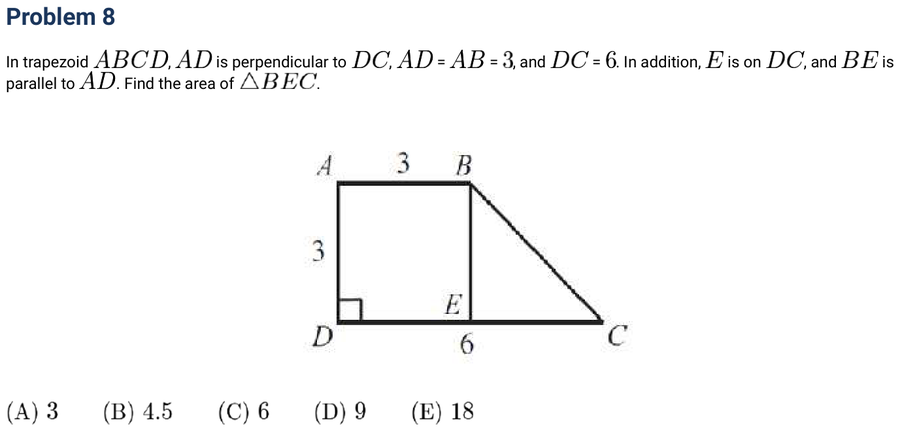
2007 · #8 In trapezoid ABCD, AD is perpendicular to DC, AD = AB = 3, and DC = 6. In addition, E is on DC, and BE is parallel to AD. Find the area of ▵BEC.
In trapezoid ABCD, AD is perpendicular to DC, AD = AB = 3, and DC = 6. In addition, E is on DC, and BE is parallel to AD. Find the area of ▵BEC.
Show answer
Show hints
Still stuck? Show hint 2 →
Show solution
- Since BE ∥ AD and AD ⊥ DC, segment BE is also ⊥ DC. With AB ∥ DC too, ABED is a rectangle — in fact a square, because AD = AB = 3. So BE = 3 and DE = 3.
- That leaves EC = DC − DE = 6 − 3 = 3, and ▵BEC is right-angled at E with legs 3 and 3.
- Area = (1/2)(3)(3) = 4.5.
- Worth keeping: when one side is parallel to a perpendicular height, that height is just the rectangle's width — no Pythagoras needed.
Symmetry — measure one piece, then multiply
Fold a square in half. The two halves land exactly on top of each other. That fold line is a line of symmetry, and it’s a cheat code: anything you learn about one half, you get the other half for free. Contest figures are loaded with symmetry, and the kids who hunt for it first do a quarter of the work.
Here’s a fast pattern to lock in. Count the fold lines of these shapes — the number always matches the number of equal sides:
- Equilateral triangle → 3 axes. Square → 4 axes (two through midpoints, two diagonals).
- Rectangle → 2 axes (through midpoints — not the diagonals). Regular hexagon → 6 axes.
- Circle → infinitely many — any line through the center.
There’s a second kind: rotational symmetry, where a figure looks the same after you spin it. A square looks identical after a quarter turn; a hexagon after a sixth of a turn.
Go deeper: the spinning-wedge trick (a right angle at a square’s centre)
The spinning-wedge trick
Here’s a figure contests love. Take a square. Pin the corner of a right angle (two perpendicular rays) at the center of the square, and spin that right angle to any angle. What fraction of the square does the wedge cover?
It looks like it should depend on the angle. It doesn’t. The wedge always covers exactly one quarter.
Why: spin the right angle until its two rays point straight along the diagonals (or straight to two opposite sides) — now the covered region is plainly one of the four matching corners, a quarter. Rotate away from that and whatever sliver you lose on one side, symmetry hands back on the other. The four quarter-turns of the right angle about the center are identical, so each covers the same area, and together they fill the whole square. One quarter each.
When a right angle turns about the center of a square, the slice it cuts stays constant — rotate it to the easy position and read off the fraction.
(Rotating-square overlap adapted from Problem Solving via the AMC, Australian Maths Trust.)
Go deeper: reflect a bent path straight — then it’s one hypotenuse
Reflect a bent path straight — then it’s just one hypotenuse
Symmetry isn’t only for shaded fractions. It also straightens crooked paths. Whenever a route bends at a wall, a river, or a mirror — touch the line, then carry on — you can fold the second leg across the line. The bend opens flat into a single straight segment, and a straight segment is just the hypotenuse of a right triangle you can measure with Pythagoras.
Here’s the picture. A walker starts at A, must touch a straight river, then reach B on the same side. Reflect B across the river to its mirror image B′. Any path A → (river) → B has the exact same length as the matching path A → (river) → B′, because the second leg and its reflection are mirror copies — same length. So the bent trip equals a trip from A to B′, and the shortest one is the dead-straight line A–B′.
Now read off the right triangle for the straight line A–B′. A sits 3 above the river; B′ sits 5 below it, so the vertical leg is 3 + 5 = 8. A and B are 6 apart along the river, so the horizontal leg is 6. The straight distance is √(6² + 8²) = √100 = 10 — a 6-8-10 triangle, no slanted measuring at all.
Strategy framing inspired by Posamentier, The Art of Problem Solving (teacher resource).
For 'what fraction of the figure is shaded' problems, look for the smallest symmetric piece (a wedge, a quadrant, an eighth) and check what fraction of that piece is shaded. By symmetry, the same fraction applies to the whole figure.
Points A, B, C and D are midpoints of the sides of the larger square. If the larger square has area 60, what is the area of the smaller square?
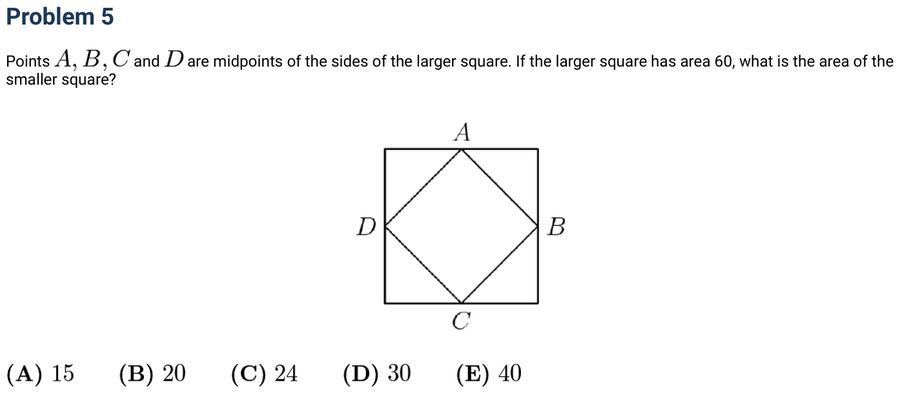
A, B, C, D are the midpoints of the four sides of a big square. Joining them makes a smaller, tilted square inside. The big square has area 60. Find the area of the inner square.
Your instinct is to find side lengths and the √2 diagonals. Resist it — use symmetry instead.
The four slanted joining-lines slice off four right triangles, one at each corner of the big square. Now fold each corner triangle inward along its slanted edge. They fit exactly into the tilted inner square — no gaps, no overlap.
So the inner square is made of four triangles, and the four corners that got folded in are the same four triangles. Inside and outside are equal halves. The inner square is exactly half the big one.
Inner area = 60 ÷ 2 = 30 (choice D).
The folding shows the answer without a single length. Lock in the fact: the midpoint square of any square has half the area. (It’s true for any quadrilateral, too — that’s the Varignon idea.) Spot the configuration and the answer is instant.
Always check for symmetry before computing. The shaded fraction is often clean even when the boundary looks ugly.
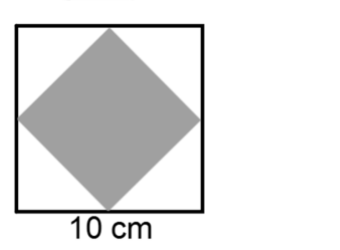
2016 · #5 Kathi draws a square with side length 10 cm. Then she joins the midpoints of each side to form a smaller square. What is the area of the...
Kathi draws a square with side length 10 cm. Then she joins the midpoints of each side to form a smaller square. What is the area of the smaller square?
Show answer
Show hints
Still stuck? Show hint 2 →
Still stuck? Show hint 3 →
Show solution
- Joining the midpoints cuts off four equal right triangles, one at each corner of the big square.
- Those four triangles are the same size as the four triangles that make up the tilted inner square, so the inner square is exactly half of the big square.
- The big square has area \(10 \times 10 = 100\), so the inner square is half of that, \(50\text{ cm}^2\), choice (E).
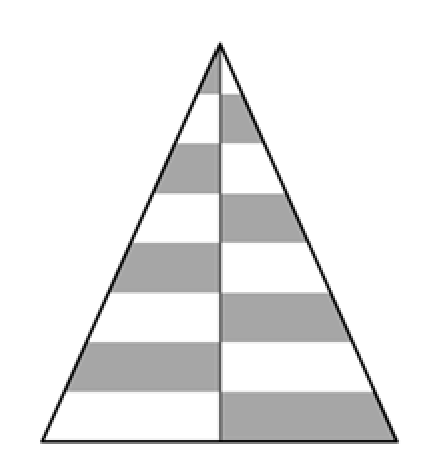
2017 · #1 The diagram shows an isosceles triangle, where the height is marked and its area is split up into equally wide white and grey stripes....
The diagram shows an isosceles triangle, where the height is marked and its area is split up into equally wide white and grey stripes. Which fraction of the area of the triangle is white?
Show answer
Show hints
Still stuck? Show hint 2 →
Show solution
- The triangle is cut into equal-width horizontal stripes, and the marked height splits it down the middle.
- On one side the stripes are white where the other side is grey, so each grey patch is matched by an equal-area white patch.
- The white and grey areas are therefore equal, so the white part is 1/2 of the triangle.
2010 · #6 Which of the following figures has the greatest number of lines of symmetry?
Which of the following figures has the greatest number of lines of symmetry?
Show answer
Show hints
Still stuck? Show hint 2 →
Show solution
- Fold-test the square first since it looks most regular: it matches across both diagonals and both midpoint lines — 4 lines.
- The others fall short: equilateral triangle 3, non-square rhombus 2 (only its diagonals), non-square rectangle 2 (only its midpoint lines), isosceles trapezoid just 1.
- Most lines: square.
- Worth keeping: a regular n-sided shape has exactly n lines of symmetry (triangle 3, square 4, pentagon 5…). Knowing that, you can often spot the winner without drawing a single fold.
2011 · #7 Each of the following four large congruent squares is subdivided into combinations of congruent triangles or rectangles and is partially...
Each of the following four large congruent squares is subdivided into combinations of congruent triangles or rectangles and is partially bolded. What percent of the total area is partially bolded?
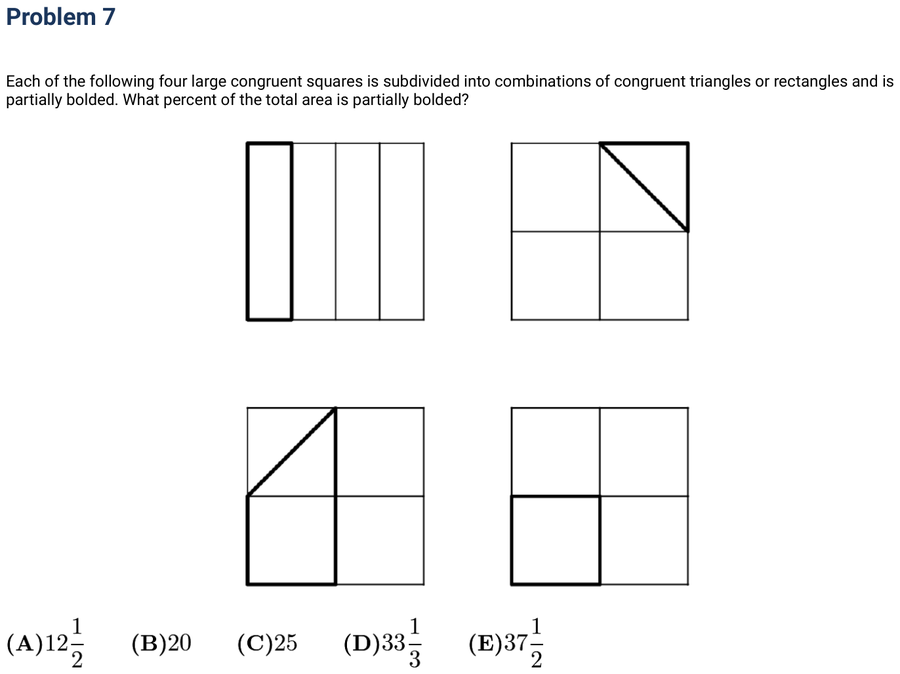
Show answer
Show hints
Still stuck? Show hint 2 →
Show solution
- Read the shaded part of each square: one of four columns = 1/4; a triangle that's half of one quarter = 1/8; a full quarter plus that triangle = 3/8; one full quarter = 1/4.
- These four fractions add to 1/4 + 1/8 + 3/8 + 1/4 = 2/8 + 1/8 + 3/8 + 2/8 = 8/8 = 1 — together they fill exactly one whole square.
- One whole square out of four equal squares is 1/4 = 25%.
- Intuition: the four shaded pieces, rearranged, would tile one complete square — that "they add to a whole" is what makes 25% pop out cleanly.
Surface area, volume, and nets
Hold a die in your hand. It has 6 faces, 12 edges, and 8 corners — and that’s true for every box, no matter the size. Lock those three numbers in; contests ask for them constantly (a real AMC problem just adds them up: 6 + 12 + 8 = 26).
3D problems split into two questions. How much skin? is surface area — add up the faces. How much stuffing? is volume — how much fills the inside.
3D FORMULAS
- Cube of side s: Surface area = 6s². Volume = s³.
- Box (a × b × c): SA = 2(ab + bc + ca). Volume = abc.
- Cylinder (radius r, height h): SA = 2πr² + 2πrh. Volume = πr²h.
- Sphere (radius r): SA = 4πr². Volume = (4/3)πr³.
- Cone (radius r, height h, slant ℓ): Volume = (1/3)πr²h. SA = πr² + πrℓ.
A net is a 3D shape unfolded flat — the pattern of faces you’d cut from paper and fold up. A cube has 11 different nets; the most common is a plus-sign cross of 6 squares. The key skill: given a net, tell which faces end up opposite each other after folding.
Fold F up as the front. T folds to the top, B to the bottom (T ↔ B). L folds left, R folds right (L ↔ R). K wraps around to the back (F ↔ K). On any cube net, opposite faces are the ones never sharing an edge — and a face one step away on a straight strip ends up opposite the face two steps along.
Go deeper: surface area = unfold the box into its net and add the flat pieces
Surface area = unfold the box and add the flat pieces
Surface area sounds three-dimensional and scary. It isn’t. Unfold the box flat into its net and the whole thing becomes a flat-area problem you already know. Add up the rectangles. Done.
Take a box that is 4 long, 3 wide, 2 tall. Cut along the edges and lay it open. You get six rectangles in three matching pairs:
Add them: two tops/bottoms (12 + 12), two fronts/backs (8 + 8), two sides (6 + 6) = 52. That is exactly what the formula 2(ab + bc + ca) = 2(12 + 6 + 8) = 52 packs into one line — but the net shows you why: three pairs of matching rectangles, each pair counted twice because every face has a twin on the far side.
Pictured-intuition adapted from Competition Math for Middle School (AoPS).
Go deeper: faces, vertices, edges — rebuild Euler’s formula from a cube
Faces, vertices, edges — recover the formula from a cube
Every solid with flat faces obeys one tidy rule connecting its faces (F), corners or vertices (V), and edges (E): F + V − E = 2. It’s called Euler’s formula, and it holds for a pyramid, a prism, a soccer ball — anything.
Here’s the part worth stealing from the pros: don’t memorize which letters go where. Remember a formula exists, then rebuild it from the cube you already know cold — 6 faces, 8 vertices, 12 edges. Test: 6 + 8 − 12 = 2. ✓ Now you have it, and you can’t mix up the signs, because the cube checks itself.
This recovery habit beats raw memory all over 3-D geometry. Forget the cylinder’s surface area? Unroll it: two circles (2πr²) plus a rectangle as tall as the cylinder and as wide as the circle rolls (2πr · h). The picture rebuilds the formula every time.
Framing inspired by Competition Math for Middle School (AoPS).
Go deeper: the space diagonal of a box (Pythagoras, done twice)
The longest stick that fits in a box
What is the longest straight rod you can slide into a box? It runs corner to opposite corner through the inside — the space diagonal. You don’t need a new formula; you use Pythagoras twice.
Take a box that is 3 by 4 by 12.
- Step 1 — the floor diagonal. First find the diagonal across the bottom face (3 by 4): \(\sqrt{3^2+4^2}=\sqrt{25}=5\). (A 3-4-5 triple — no square root needed.)
- Step 2 — climb to the top corner. That floor diagonal (5) and the height (12) are the two legs of a new right triangle standing up inside the box, with the space diagonal as its hypotenuse: \(\sqrt{5^2+12^2}=\sqrt{169}=\mathbf{13}\). (A 5-12-13 triple!)
Packed into one line, that’s the all-in-one rule: space diagonal \(=\sqrt{a^2+b^2+c^2}\). Check: \(\sqrt{3^2+4^2+12^2}=\sqrt{9+16+144}=\sqrt{169}=13\). ✓ A plain cube of side \(s\) is the easy case \(a=b=c=s\), so its space diagonal is \(\sqrt{3s^2}=s\sqrt{3}\).
Two-step diagonal framing inspired by Competition Math for Middle School (AoPS).
For a box you can’t see all of, you can sometimes find the surface area without knowing the three dimensions separately. Watch: the surface area of a box is 2(ab + bc + ca). If a problem hands you that combination ab + bc + ca through some clever total, you’re done — you never need a, b, c on their own. Look for the combination, not the individual lengths.
Two identical bricks can be placed side by side in three different ways, as shown. The surface areas of the three resulting cuboids are 72, 96 and 102 cm². What is the surface area, in cm², of one brick?
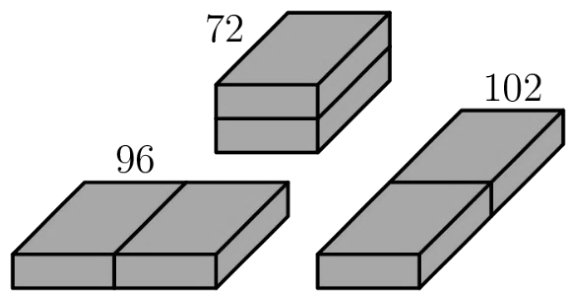
Two identical bricks are pushed together side by side in three different ways. The three resulting cuboids have surface areas 72, 96, and 102 cm². Find the surface area of one brick.
Call the brick a × b × c. One brick’s surface is 2(ab + bc + ca) — so all you actually need is the combination ab + bc + ca, not a, b, c by themselves.
The clever move: add up all three given cuboid areas. Each of the three stacking directions doubles the brick along one dimension, and when you add the three surface-area expressions, every product ab, bc, ca shows up the same number of times. The sum works out to exactly 10(ab + bc + ca).
So 10(ab + bc + ca) = 72 + 96 + 102 = 270, giving ab + bc + ca = 27.
One brick’s surface = 2 × 27 = 54 cm² (choice D).
The trap is trying to solve for a, b, c one at a time — messy, and you don’t need them. Adding all three equations makes the individual lengths vanish and leaves only the combination the answer wants. Add first, solve for the combination, double it.
Surface area = sum of face areas. For composite solids, count exposed faces by direction (top/front/back/left/right). A box has 6 faces, 12 edges, 8 corners — always.
2003 · #1 Jamie counted the number of edges of a cube, Jimmy counted the corners, and Judy counted the faces. They then added the three numbers....
Jamie counted the number of edges of a cube, Jimmy counted the corners, and Judy counted the faces. They then added the three numbers. What was the resulting sum?
Show answer
Show hints
Still stuck? Show hint 2 →
Show solution
- Count each kind separately so nothing gets mixed up. Corners (the points): 8. Edges (the lines): 12. Faces (the flat sides): 6.
- 8 + 12 + 6 = 26.
- Worth keeping: for any cube or box these never change — 8 corners, 12 edges, 6 faces. (They even fit Euler's rule: corners − edges + faces = 8 − 12 + 6 = 2 for any solid like this.)
1997 · #21 (figure problem)
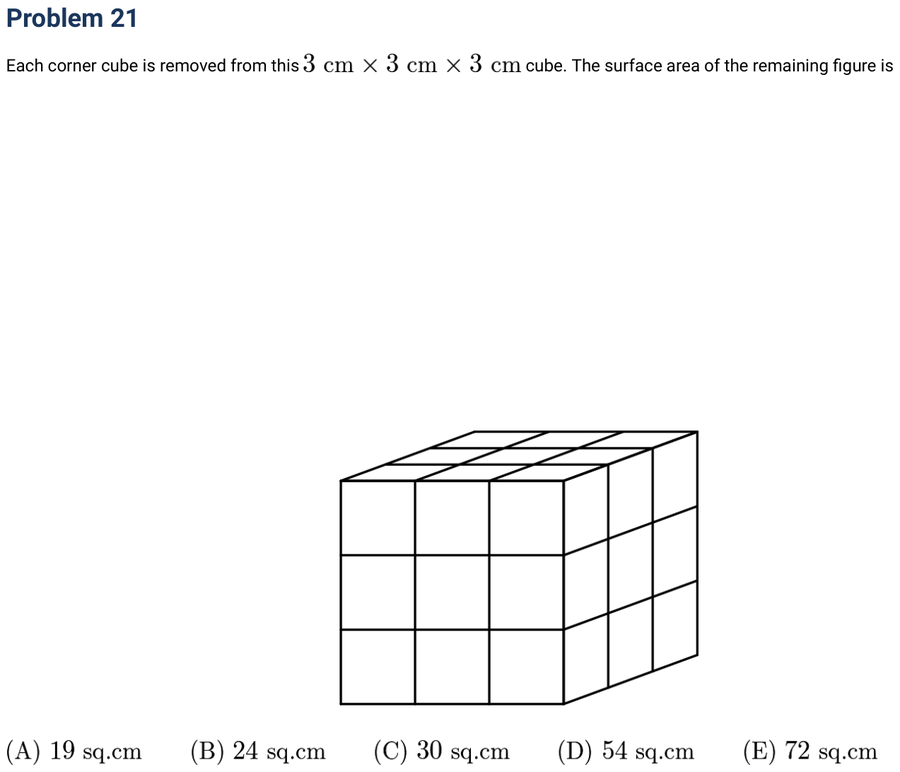
Show answer
Show hints
Still stuck? Show hint 2 →
Show solution
- A corner cube touches 3 of the big cube's outer faces. Removing it deletes those 3 unit squares but uncovers 3 new unit squares (the inside walls of the notch) — a perfect trade, so surface area is unchanged.
- All 8 corners are separated by a middle cube, so the cuts don't interfere; the area still equals the original cube's: 6 × 3² = 6 × 9 = 54 sq cm.
- Why this transfers: the elegant move is recognizing 'lose 3, gain 3 = no change' before crunching numbers. Hunting for an invariant turns a scary 3-D figure into a one-line answer.
2006 · #21 An aquarium has a rectangular base that measures 100 cm by 40 cm and has a height of 50 cm. The aquarium is filled with water to a depth...
An aquarium has a rectangular base that measures 100 cm by 40 cm and has a height of 50 cm. The aquarium is filled with water to a depth of 37 cm. A rock with volume 1000 cm3 is then placed in the aquarium and completely submerged. By how many centimeters does the water level rise?
Show answer
Show hints
Still stuck? Show hint 2 →
Show solution
- Submerging the rock displaces exactly 1000 cm³ of water, which spreads across the full base as a thin layer of rise.
- That layer is a box: base 100 × 40 = 4000 cm², volume 1000 cm³. Its height (the rise) = 1000 ÷ 4000 = 0.25 cm.
- Why the 37 cm and 50 cm don't matter: the rise depends only on how much volume you add and how wide the tank is — not on the current depth (as long as the rock stays submerged and the water doesn't overflow). Sanity check: 0.25 cm of rise × 4000 cm² = 1000 cm³, exactly the rock. Spotting the decoy numbers is half the battle.
1986 · #21 (figure problem)
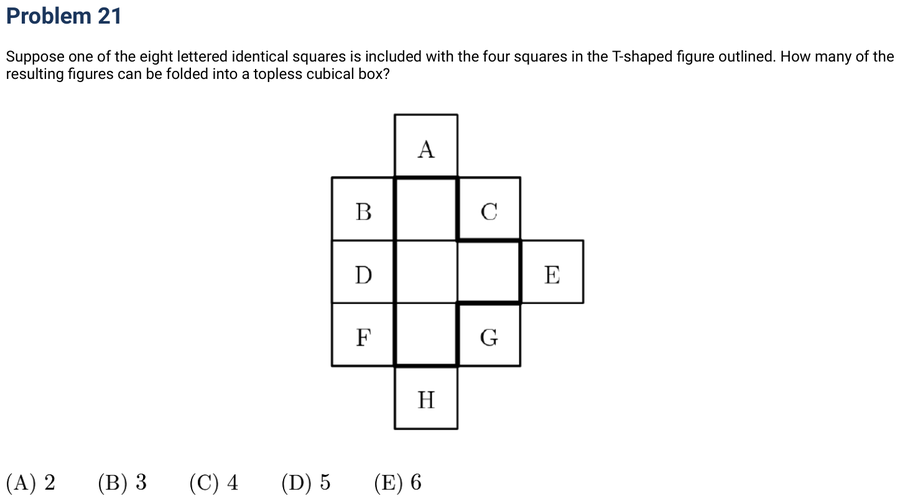
Show answer
Show hints
Still stuck? Show hint 2 →
Still stuck? Show hint 3 →
Show solution
- A topless cube needs 5 squares (4 sides + a bottom), and the T supplies 4, so every choice has the correct number — the only way to fail is an *overlap* when folded.
- Fold the T's four squares up into an open box, leaving one wall missing. Each lettered square either folds neatly into the one empty face or collides with a face that's already filled.
- Going through the eight positions, only two of them fold onto an already-used face; the other 6 complete a topless cubical box.
- Why count squares first: knowing a topless cube is exactly 5 faces tells you instantly that 'how many squares' is never the obstacle — the whole puzzle is purely about overlaps, so you only have to test for collisions.
Triangles and 3D
Three problems on Pythagorean triples, symmetry, and surface area.
2007 · #14 The base of isosceles ▵ABC is 24 and its area is 60. What is the length of one of the congruent sides?
The base of isosceles ▵ABC is 24 and its area is 60. What is the length of one of the congruent sides?
Show answer
Show hints
Still stuck? Show hint 2 →
Show solution
- Back the height out of the area: 60 = (1/2)(24)(h) ⇒ h = 5.
- That altitude bisects the base, so each right triangle has legs 5 (height) and 12 (half of 24).
- Hypotenuse = the congruent side = √(52 + 122) = √169 = 13.
- Recognize it: 5-12-13 is one of the famous Pythagorean triples — spotting 5 and 12 lets you write 13 instantly, no square root needed.
2006 · #5 Points A, B, C and D are midpoints of the sides of the larger square. If the larger square has area 60, what is the area of the smaller square?
Points A, B, C and D are midpoints of the sides of the larger square. If the larger square has area 60, what is the area of the smaller square?
Show answer
Show hints
Still stuck? Show hint 2 →
Show solution
- The four slanted lines slice off four right triangles at the corners. Fold each one inward along its slanted edge.
- The four triangles exactly tile the inner diamond — so the inner square is made of half the big square's area, the other half being the (folded-out) triangles.
- Inner area = 60 ÷ 2 = 30.
- You'll see it again: the midpoint square of ANY square (or even any quadrilateral — the "Varignon" idea) has half the area. Remember the fact and these become instant.
- Let the big square have side s, so s2 = 60. Each midpoint sits halfway along a side.
- The inner square's side is the hypotenuse of a right triangle with legs s/2 and s/2, so (inner side)2 = (s/2)2 + (s/2)2 = s2/2.
- Inner area = (inner side)2 = s2/2 = 60/2 = 30 — the algebra confirms the half-area fact.
2022 · #20 Two identical bricks can be placed side by side in three different ways, as shown. The surface areas of the three resulting cuboids are...
Two identical bricks can be placed side by side in three different ways, as shown. The surface areas of the three resulting cuboids are 72, 96 and 102 cm². What is the surface area, in cm², of one brick?
Show answer
Show hints
Still stuck? Show hint 2 →
Show solution
- Let the brick be \(a \times b \times c\); doubling it along each of the three directions gives the three cuboids, with surface areas \(2(2ab+bc+2ca)\), \(2(2ab+2bc+ca)\) and \(2(ab+2bc+2ca)\).
- Adding all three, every product appears the same way and the total is \(10(ab+bc+ca) = 72+96+102 = 270\), so \(ab+bc+ca = 27\).
- One brick's surface is \(2(ab+bc+ca) = 2 \times 27 = 54\) cm squared, so the answer is D.
Angle chasing
Angle chasing is a game, and once you see it that way it gets fun. You start with one or two angles the problem hands you. You apply a rule — angles on a line, angles in a triangle — to find a new angle. You write it on the figure. Then that new angle unlocks the next one. Most angle problems fall in three or four moves, like dominoes.
You can’t play without the rulebook, so here it is. Know these cold.
ANGLE RULES TO KNOW COLD
- Straight line: angles along a straight line sum to 180°.
- Around a point: angles sum to 360°.
- Triangle: interior angles sum to 180°.
- Polygon (n sides): interior angles sum to (n−2) · 180°. Pentagon 540°, hexagon 720°.
- Regular polygon: each interior angle = (n−2)·180° / n. Equilateral triangle 60°, square 90°, pentagon 108°, hexagon 120°.
- Exterior angle of a triangle: equals the sum of the two non-adjacent interior angles.
- Parallel lines + transversal: alternate interior angles equal; corresponding angles equal.
- Isosceles triangle: the two angles opposite the equal sides are equal.
- Vertical angles (the X of two crossing lines) are equal.
- Inscribed angle in a circle = half the central angle on the same arc.
The exterior-angle rule earns its keep more than any other. Extend one side of a triangle past a vertex; the angle that sticks out equals the sum of the two far interior angles (the ones it doesn’t touch). It lets you skip a whole step.
Go deeper: why a polygon’s angles add to (n−2)·180° — fan it into triangles
Why a polygon’s angles add to (n−2)·180° — just fan it into triangles
You know a triangle’s angles sum to 180°. Every other polygon’s angle sum is built straight from that one fact — no new rule to trust.
Stand at one corner of the polygon and draw a line to every other corner you can reach. The polygon fans out into triangles. Count them: a pentagon (5 sides) splits into 3 triangles; a hexagon (6 sides) into 4. Every triangle’s angles pile up at the polygon’s corners and nowhere else — so the polygon’s total angle is just (number of triangles) × 180°.
The pattern: an n-sided polygon always fans into n − 2 triangles (you skip the two corners next to you). So the angle sum is (n − 2) · 180°. For a regular polygon, share that total equally among the n corners.
Pictured-intuition adapted from Competition Math for Middle School (AoPS).
Go deeper: the hidden gem — a polygon’s OUTSIDE angles always add to 360°
The hidden gem: a polygon’s OUTSIDE angles always add to 360°
Here is the fact almost no one remembers, and it’s the easiest one of all. Walk all the way around the edge of any convex polygon, like a tiny car driving the outline. At each corner you turn by the exterior angle — the bit of turn the corner forces. By the time you’re back where you started, facing the way you began, you have made exactly one full turn. One full turn is 360°. So no matter how many sides — triangle, hexagon, 100-gon — the exterior angles always sum to 360°.
That single fact makes regular polygons trivial. A regular polygon splits its 360° of turning evenly among n corners, so each exterior angle = 360° ÷ n — and the interior angle is 180° − that. A regular hexagon: each exterior = 360 ÷ 6 = 60°, so each interior = 180 − 60 = 120°. No (n−2)·180 needed.
Framing inspired by AoPS Prealgebra.
Go deeper: parallel lines + a transversal — the Z, F, and C angle pairs
Parallel lines + a transversal — the Z, F, and C angle pairs
Draw two parallel lines, then a third line slicing across both (a transversal). You get eight angles — but only two different sizes, and they alternate. Slide one crossing up the transversal until it lands on the other: every angle drops right onto a matching one. That’s why the pattern repeats.
Three quick shapes catch all the pairs you need. Trace the letter and the two angles it hugs are related:
THE THREE LETTER PAIRS
- Z (alternate interior): the two angles inside the Z are equal.
- F (corresponding): the two angles in matching corners are equal.
- C (co-interior / same-side): the two angles tucked inside the C add to 180°.
So mark one angle and every other angle in the figure is either that same number or its supplement (180° minus it). The deeper power: this runs both ways — if a pair of corresponding angles turns out equal, the two lines must be parallel. That’s how a problem proves lines are parallel without a ruler.
Framing inspired by AoPS Prealgebra.
Go deeper: casework — when the figure isn’t pinned down
Casework — when the picture isn’t pinned down
Some angle problems don’t hand you a fixed figure. “An isosceles triangle has an angle of 70°” — but which angle? The 70° could be the odd one out, or one of the matching pair. Each guess is a different triangle.
Don’t pick one and hope. List every case, solve each, then collect the answers.
Two angles of an isosceles triangle are 70° and x°. The equal pair could be any of three things:
- Case 1: x matches the 70° → x = 70.
- Case 2: the two 70° angles are the pair → x = 180 − 70 − 70 = 40.
- Case 3: two x° angles are the pair → 2x + 70 = 180 → x = 55.
All three are real triangles, so all three count. Sum: 70 + 40 + 55 = 165.
The trap is stopping at the first case you draw. The phrase “sum of all possible values” is a flashing sign that more than one case survives. When the figure isn’t forced, split into cases, check each is valid, then combine.
Go deeper: the triangle inequality — a side can’t be too long
The triangle inequality — a side can’t be too long
Take two sticks, 3 and 4 long, hinged at one end. Swing them open. The gap between the far ends can be almost anything — but only up to a point. Stretch the hinge flat and the gap maxes out at 3 + 4 = 7. Snap it shut and the gap shrinks to 4 − 3 = 1. So the third side of any triangle is always squeezed between those two numbers: bigger than the difference, smaller than the sum.
TRIANGLE INEQUALITY
For sides a, b, c: each side is less than the sum of the other two, and more than their difference. The short test: the two shortest sides must beat the longest one.
This one looks too obvious to bother with — and that is exactly why it catches good students. A problem hands you “a triangle with sides 2, 3, and 8” and you start computing, never noticing 2 + 3 = 5 can’t reach 8. There is no such triangle.
Where it earns its keep: counting the possible whole-number lengths of a missing side. Say two sides are 5 and 9. The third side x must satisfy 9 − 5 < x < 9 + 5, so 4 < x < 14. The whole numbers from 5 to 13 work — that’s 9 of them.
Framing inspired by Competition Math for Middle School (AoPS).
For regular polygons, the angle table is the single most useful thing to memorize — contests reuse the same shapes constantly:
In ▵ABC, D is a point on side AC such that BD = DC and ∠BCD measures 70°. What is the degree measure of ∠ADB?
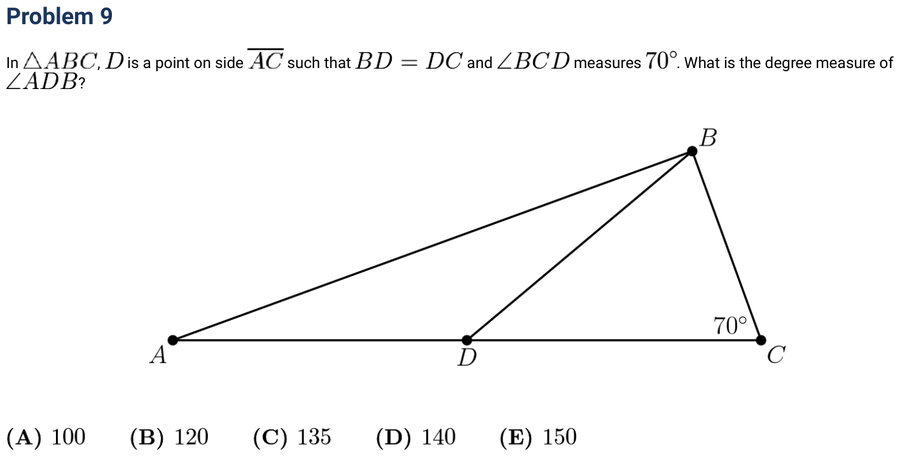
In triangle ABC, point D sits on side AC with BD = DC, and angle BCD = 70°. Find angle ADB.
Step 1 — use the equal sides. BD = DC means triangle BDC is isosceles. Equal sides face equal angles, so the two base angles match: angle DBC = angle DCB = 70°.
Step 2 — spot the exterior angle. Angle ADB sits on the straight line AC, just outside triangle BDC at vertex D. That makes it the exterior angle of triangle BDC — so it equals the sum of the two far interior angles.
angle ADB = 70° + 70° = 140° (choice D).
The exterior-angle rule let you skip finding the apex angle of the triangle entirely. Anytime an angle hangs just off a straight side of a triangle, reach for “exterior = sum of the two remote interiors” before you start adding up the inside.
Start with labeled angles. Apply one rule (triangle sum, exterior angle, parallel lines). Propagate. Most angle problems collapse in 3–4 steps.
2009 · #8 In the diagram QSR is a straight line. ∠QPS = 12° and PQ = PS = RS. How big is ∠QPR?
In the diagram QSR is a straight line. ∠QPS = 12° and PQ = PS = RS. How big is ∠QPR?
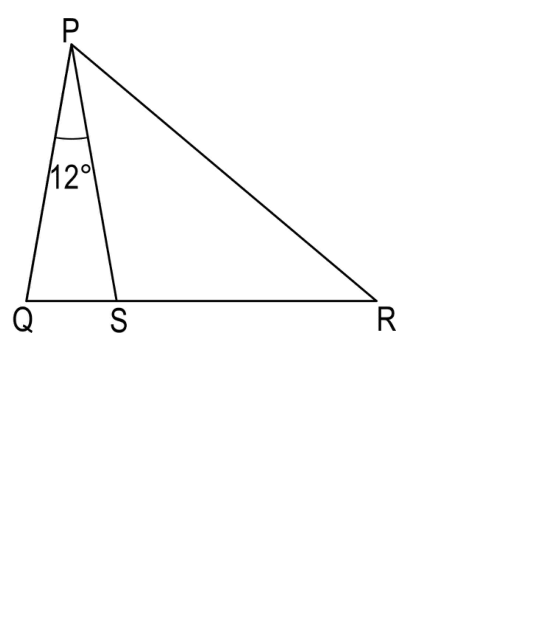
Show answer
Show hints
Still stuck? Show hint 2 →
Show solution
- In triangle PQS, PQ=PS with apex angle QPS=12, so each base angle is (180-12)/2 = 84; in particular angle PSQ = 84.
- Since QSR is straight, angle PSR = 180 - 84 = 96. In triangle PSR, PS=RS, so angle SPR = (180-96)/2 = 42.
- Then angle QPR = 12 + 42 = 54 degrees.
1999 · #21 (figure problem)
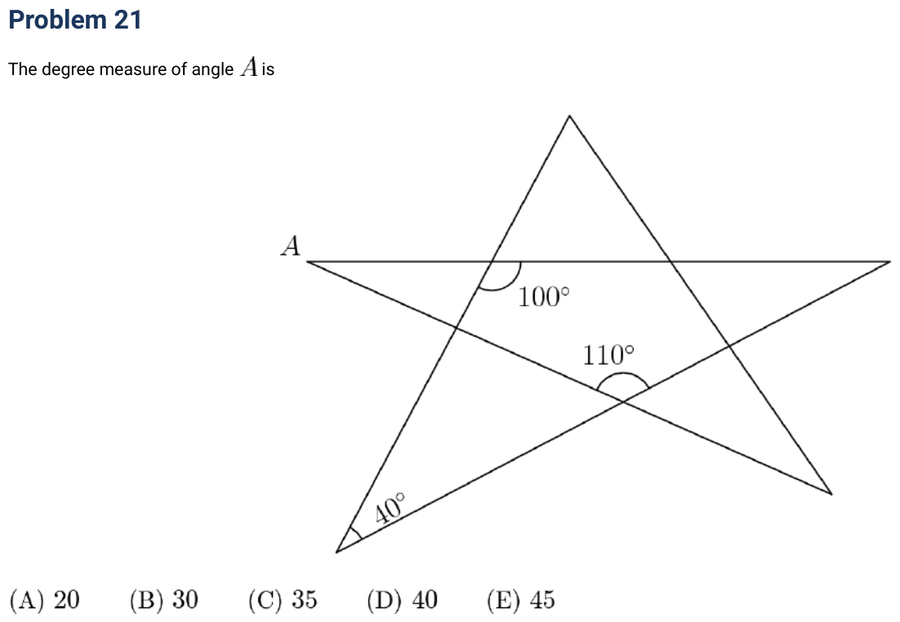
Show answer
Show hints
Still stuck? Show hint 2 →
Show solution
- First turn the marks into triangle angles. The 100° has supplement 80° on the line through A; the 110° has supplement 70°.
- Look at the triangle with the 40° tip and the 70° angle: its third angle is 180° − 40° − 70° = 70°. The vertical angle at that same crossing (on A's triangle) is also 70°.
- Now A's triangle has the 80° and that 70°: ∠A = 180° − 80° − 70° = 30°.
- Tools you'll reuse on every star/chase: at a crossing, the supplement (sums to 180° along a line) and the vertical angle (equal across the X) let you teleport a known angle into a neighboring triangle — then the 180° triangle sum finishes it.
- A famous fact: the five point-angles of a 5-pointed star always add to 180°. Two of the tips here can be read from the figure's marked angles.
- Using the supplements, the tip angles work out so that the remaining tip A fills the gap to 180°, giving ∠A = 30°.
- Knowing the 'star tips = 180°' result lets you skip most of the chase once you can identify the other tip angles — a handy shortcut to verify the answer.
1995 · #13 (figure problem)
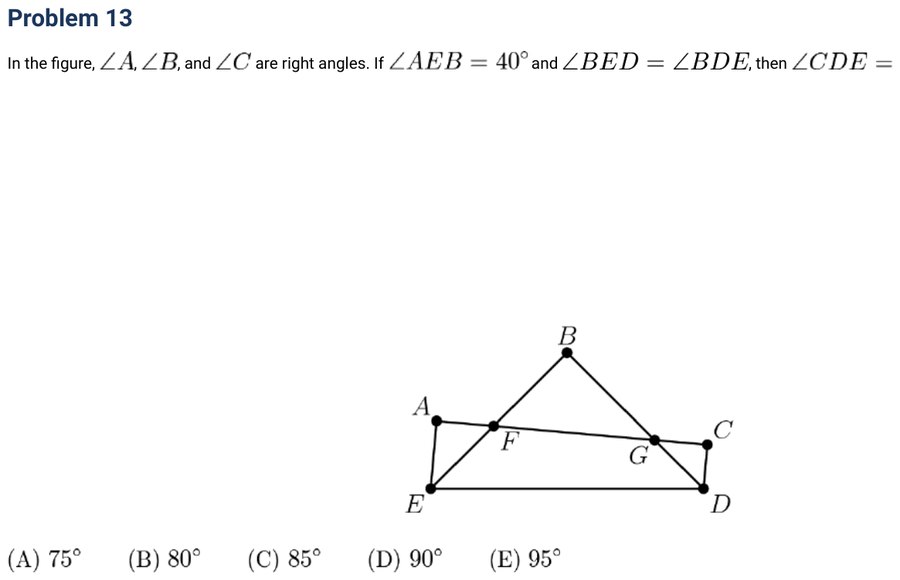
Show answer
Show hints
Still stuck? Show hint 2 →
Show solution
- Anchor: the only number given is ∠AEB = 40°. The plan is to relay it across the figure toward ∠CDE, spending one right angle at a time.
- At E, EA is perpendicular to the base ED, so ∠AED = 90°. That leaves ∠BED = 90° − 40° = 50°. The clue ∠BED = ∠BDE then hands that 50° across the isosceles triangle to ∠BDE = 50°.
- Continuing the relay through the right angles at B and C (each 90° corner converts one angle into its complement), the chase delivers ∠CDE = 95°.
- The habit that transfers: in any 'find the far angle' figure, name the one known angle and march it through the givens — perpendiculars give complements, equal sides give equal angles, triangles give 'the three add to 180°.' Each given is one conversion step.
2003 · #20 What is the measure of the acute angle formed by the hands of the clock at 4:20 PM?
What is the measure of the acute angle formed by the hands of the clock at 4:20 PM?
Show answer
Show hints
Still stuck? Show hint 2 →
Show solution
- Minute hand first: 20 minutes is 20/60 = 1/3 of the way around, which lands it exactly on the 4 (since the 4 marks 20 minutes). So both hands are near the 4 — convenient.
- Hour hand next, and here's the catch: by 4:20 it has slid 1/3 of the way from 4 toward 5. Each number-to-number gap is 360° ÷ 12 = 30°, so the hour hand sits 30° ÷ 3 = 10° past the 4.
- The minute hand is right on the 4, the hour hand 10° beyond it, so they're 10° apart.
- Worth keeping: the hour hand moves 30° per hour = 0.5° per minute; the minute hand moves 6° per minute. Knowing both speeds lets you place either hand at any time — and remembering the hour hand keeps drifting is what saves you from the 0° trap.
Circles — circumference, area, arcs, and sectors
Every circle hides the same secret number. Roll any circle along the floor for one full turn, then measure how far it traveled: that distance is always almost exactly 3.14 times the width across. Big wheel, tiny coin — same ratio, every time. That number is π, and it’s the only thing standing between you and circle problems.
CIRCLE FORMULAS
- Circumference (the roll):
C = 2π r = π d. - Area:
A = π r². - Arc length (central angle θ):
= 2π r · (θ/360)— just the fraction of the full roll. - Sector area (a pie slice):
= π r² · (θ/360)— the fraction of the full disk.
Two circle facts that unlock a LOT of problems
FACT 1 — DIAMETER MAKES A RIGHT ANGLE
If a triangle is inscribed in a circle and one of its sides is a diameter, the angle across from that diameter is always 90°. (And the reverse: a right angle inside a circle always points at a diameter.)
FACT 2 — TANGENT ⊥ RADIUS
If a line just touches a circle at one point (a tangent), the radius to that touch-point is perpendicular to the line. Wherever a problem says “tangent at P,” drop the radius to P and mark a right angle — it usually starts a Pythagorean triangle.
FACT 3 — A RADIUS THROUGH A CHORD’S MIDDLE HITS IT AT 90°
Draw a chord (any segment with both ends on the circle). The radius (or diameter) that passes through the midpoint of that chord is perpendicular to it — and the reverse holds too: a radius drawn perpendicular to a chord bisects it. So a radius to the middle of a chord and a half-chord make a right triangle, ready for Pythagoras. (This is exactly the move behind the ring trick below.)
Go deeper: where π comes from — and why area = πr² (sliced-pizza proof)
Where π comes from — and why area = πr²
First, what is π? Wrap a string once around any circle, then lay it flat against the width across. The string is always about 3.14 widths long. That number — the roll-distance divided by the diameter — is π, and it’s the same for a coin and a stadium. So C = π d isn’t a rule to memorize; it’s the definition of π rearranged.
Now the area. A = π r² looks like it fell from the sky. It didn’t. Slice the disk into thin pizza wedges and re-lace them.
The wedges, laid point-up then point-down in a row, settle into a near-rectangle. Its height is the radius r (the length of each wedge). Its base is half the rim — the top arcs and bottom arcs split the full roll 2πr in two, so the base is πr. Thinner wedges make a cleaner rectangle, and the area is just base × height:
A = (πr)(r) = π r².
That’s the formula — not memorized, but rebuilt from a sliced-up pizza.
Pictured-intuition adapted from Competition Math for Middle School (AoPS).
On a contest you can usually leave π in your answer — the choices will too. The arc and sector formulas aren’t new facts; they’re just “take this fraction of the whole circle.” A quarter circle is ¼ of everything; a 90° pie slice is ¼ of the area.
Circles packed into squares show up constantly — know these two by heart:
- Circle inscribed in a square of side s: the diameter equals s, so radius =
s/2. - Square inscribed in a circle of radius r: the diagonal equals 2r, so side =
r√2.
Go deeper: the ring (annulus) trick — area from one chord, plus a worked example
A handy trick: a ring’s area comes from one chord, not two radii
Two circles share a center, making a flat ring (an annulus) between them. To get the ring’s area you’d think you need both radii. You don’t — one cleverly placed chord is enough.
Draw a chord of the outer circle that just grazes (is tangent to) the inner circle. The radius to that touch-point is perpendicular to the chord (chapter-9 tangent fact), splitting the chord in half. With outer radius \(R\), inner radius \(r\), and half-chord \(h\), Pythagoras gives \(r^2 + h^2 = R^2\), so \(R^2 - r^2 = h^2\). The ring area is
\(\pi R^2 - \pi r^2 = \pi(R^2 - r^2) = \pi h^2\)
— it depends only on the half-chord. If that tangent chord is 12 long, then \(h = 6\) and the ring area is \(\pi\cdot 6^2 = 36\pi\), no matter how fat or thin the ring actually is.
Another worked example
A circular running track is the ring between two concentric circles. The longest straight chord that stays on the track — tangent to the inner edge — measures 16 m. Find the area of the track (the ring), in terms of \(\pi\).
That longest chord is tangent to the inner circle, so the half-chord is \(h = 16 \div 2 = 8\) m. By the ring trick, the radius to the tangent point makes a right angle, giving \(R^2 - r^2 = h^2 = 8^2 = 64\).
Ring area \(= \pi(R^2 - r^2) = \pi \cdot 64 = \mathbf{64\pi}\) m\(^2\).
We never found \(R\) or \(r\) on their own — only their squared difference, which the chord handed us directly.
Inspired by a Terry Chew Math Olympiad workbook.
Semicircles on the legs — Pythagoras as areas
Draw a semicircle outward on each side of a right triangle, using each side as the flat diameter. A semicircle on a side of length \(s\) has area \(\tfrac12\pi(\tfrac{s}{2})^2 = \tfrac{\pi}{8}s^2\) — it grows with the square of the side. So the three semicircle areas are \(\tfrac{\pi}{8}a^2,\ \tfrac{\pi}{8}b^2,\ \tfrac{\pi}{8}c^2\), and Pythagoras (\(a^2+b^2=c^2\)) instantly gives:
(semicircle on leg a) + (semicircle on leg b) = (semicircle on the hypotenuse).
Go deeper: the crescent (lune) — a curvy region with a whole-number area
The crescent (lune)
Now flip the hypotenuse semicircle over the triangle (so it covers the triangle), and keep the two leg semicircles bulging outward. The two outer slivers left over — the lunes (crescents) — have a startling total area: they exactly equal the triangle.
Why. The hypotenuse semicircle equals the two leg semicircles (just shown). From the picture: (two leg semicircles) = (two lunes) + (the two circular slices the triangle and hyp-semicircle share); and (hyp semicircle) = (triangle) + (those same two shared slices). The two left sides are equal, so cancel the shared slices — the curvy lunes collapse to the plain triangle.
Inspired by Terry Chew (crescent problems) and Competition Math for Middle School (AoPS, semicircles on a right triangle).
When a shaded region mixes a circle and a polygon, compute each separately and subtract — the frame trick again. The two most common moves: 'quarter-disk minus a triangle' and 'half-disk minus a rectangle.'
A circle fits exactly inside a square of side 10, touching all four sides. “The circle spans the square, so its radius is 10. Area \(=\pi r^2 = 100\pi\).”
Why it breaks: the distance straight across the circle is the diameter, not the radius. The 10 that spans the square is the diameter; the radius is half of it.
The fix: radius \(= 10/2 = 5\), so area \(= \pi (5)^2 = 25\pi\) — a quarter of the bogus answer. Every circle formula uses \(r\): \(C = 2\pi r\), \(A = \pi r^2\). The moment a problem hands you a width-across or a “fits inside,” that’s the diameter — halve it before plugging in.
A square and a circle have the same area. What is the ratio of the side length of the square to the radius of the circle?
A square and a circle have the same area. What is the ratio of the square’s side to the circle’s radius?
Write what “same area” means. Square side s, circle radius r:
s² = π r².
You want the ratio s/r, so divide both sides by r² to get the s and r together:
(s/r)² = π.
Now undo the square — take the square root of both sides:
s/r = √π (choice B).
The trap is leaving the answer as π and skipping the square root. The area equation is in squared units; the question asks for a plain length ratio, so a square root is forced. Quick check: π > 1 so √π > 1, meaning the side beats the radius — right, since a circle is wider than one radius across.
Memorize C = 2πr, A = πr². For arcs and sectors: multiply by θ/360 to get the fraction of the full circle.
2006 · #7 Circle X has a radius of π. Circle Y has a circumference of 8π. Circle Z has an area of 9π. List the circles in order from smallest to...
Circle X has a radius of π. Circle Y has a circumference of 8π. Circle Z has an area of 9π. List the circles in order from smallest to largest radius.
Show answer
Show hints
Still stuck? Show hint 2 →
Show solution
- Y: C = 2πr = 8π, so r = 4. Z: πr2 = 9π, so r2 = 9 and r = 3. X: r = π ≈ 3.14 (given directly).
- Now they're comparable: 3 < 3.14 < 4, so smallest to largest is Z, X, Y.
- The key fact for the close call: π lands between 3 and 4 (it's about 3.14), so circle X squeezes in between Z and Y. Anytime quantities are given in different forms, reduce them to one common measure first.
2018 · #9 Two circles are inscribed in an 11 cm long and 7 cm wide rectangle so that they each touch three sides of the rectangle. How big is the...
Two circles are inscribed in an 11 cm long and 7 cm wide rectangle so that they each touch three sides of the rectangle. How big is the distance between the centres of the two circles?
Show answer
Show hints
Still stuck? Show hint 2 →
Show solution
- Touching three sides means each circle has diameter 7 cm (the width), so radius 3.5 cm.
- The left centre sits 3.5 cm from the left edge; the right centre sits 3.5 cm from the right edge of the 11 cm length.
- Distance between centres = 11 − 3.5 − 3.5 = 4 cm.
2002 · #1 A circle and two distinct lines are drawn on a sheet of paper. What is the largest possible number of points of intersection of these figures?
A circle and two distinct lines are drawn on a sheet of paper. What is the largest possible number of points of intersection of these figures?
Show answer
Show hints
Still stuck? Show hint 2 →
Show solution
- Here's the key move: a crossing always happens between *two* figures, so total it pair by pair instead of staring at the tangle. The pairs are line1-circle, line2-circle, and line1-line2.
- A straight line meets a circle in at most 2 points, so the two line-circle pairs give up to 2 + 2 = 4.
- Two lines meet in at most 1 point, adding 1 more. Total: 4 + 1 = 5.
- *You'll see this again:* the most intersections among any set of figures is just the sum of each pair's maximum — count pairs, never the whole picture at once.
Coordinates and the Shoelace formula
Give a triangle three corner coordinates and there’s a way to get its area without drawing anything, without finding a base or a height — just plug the numbers into one formula and turn a crank. It’s called Shoelace, because of the criss-cross pattern you multiply in, like lacing a shoe.
SHOELACE FORMULA
For vertices (x₁,y₁), …, (xₙ,yₙ) in order around the polygon:
Area = ½ · |Σ (xₙ · yₙ₊₁ − xₙ₊₁ · yₙ)|
(After the last vertex, wrap back to the first.)
Try it on a triangle with corners A=(0,0), B=(4,0), C=(0,3):
- List the coordinates in order, repeating the first at the bottom.
- Multiply down-right (x₁·y₂, x₂·y₃, x₃·y₁) and add: 0·0 + 4·3 + 0·0 = 12.
- Multiply down-left (y₁·x₂, y₂·x₃, y₃·x₁) and add: 0·4 + 0·0 + 3·0 = 0.
- Subtract, take the absolute value, halve: |12 − 0| / 2 = 6.
(Matches ½ · base · height = ½ · 4 · 3 = 6 ✓.) Shoelace works for ANY polygon, even concave ones.
One shortcut before you even Shoelace: if the triangle has a horizontal or vertical side, use that side as the base. Its length and the height are both just coordinate differences — you may not need the formula at all.
Pick’s Theorem — the magical dot-counting formula
Here’s a totally different way to find a polygon’s area when its corners sit on grid dots (lattice points). No coordinates, no multiplying. You just count two kinds of dots.
PICK’S THEOREM
Area = I + B/2 − 1
- I = dots strictly inside the polygon.
- B = dots on the boundary (corners and along the edges).
Count the dots below, then plug in.
● boundary dots (B = 8) · ● interior dots (I = 5)
Plug in: Area = 5 + 8/2 − 1 = 5 + 4 − 1 = 8. No coordinates, no Shoelace — just dot-counting.
Which to use? Easy coordinates (especially off-grid) → Shoelace. A clean grid where you can SEE the dots → Pick’s. Both always agree.
For older kids: counting boundary dots on slanted edges
A diagonal edge can pass through extra lattice dots between its corners. The count from (x₁,y₁) to (x₂,y₂) — not counting the starting endpoint — is gcd(|x₂−x₁|, |y₂−y₁|). Example: from (0,0) to (6,4), gcd(6,4) = 2, so two new dots. Tally every edge this way to get B.
For polygons given by coordinates, Shoelace beats decomposition. For polygons drawn on a clean grid, Pick’s is usually fastest. The deciding question: can you easily SEE and count the dots?
What is the area of the triangle formed by the lines y = 5, y = 1 + x, and y = 1 − x?
Find the area of the triangle made by the three lines y = 5, y = 1 + x, and y = 1 − x.
Step 1 — find the corners. Two corners sit on the flat top y = 5. Set y = 5 in each slanted line: 5 = 1 + x gives (4, 5); 5 = 1 − x gives (−4, 5). The two slanted lines meet where 1 + x = 1 − x, so x = 0: the apex is (0, 1).
Step 2 — pick the easy base. The top side is horizontal, so use it. From (−4, 5) to (4, 5) is length 8. The height is the vertical drop from y = 5 down to the apex at y = 1, which is 5 − 1 = 4.
Step 3. Area = ½ · 8 · 4 = 16 (choice E).
Because the triangle had a horizontal side, the base and height were just coordinate subtractions — no distance formula, no Shoelace needed. Always scan for a horizontal or vertical side first; it’s the lightest path.
For coordinate-given polygons, Shoelace beats decomposition. List vertices in order, sum x·y_next − y·x_next, divide by 2.
2025 · #5 (figure problem)
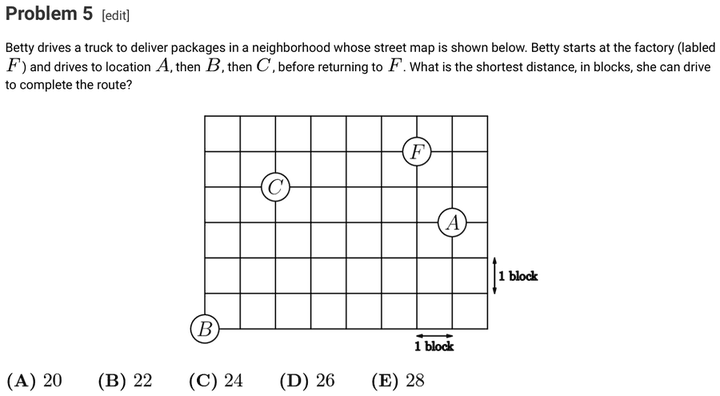
Show answer
Show hints
Still stuck? Show hint 2 →
Show solution
- Key idea: on a street grid you can't cut diagonally, so the distance for any leg is just (horizontal blocks) + (vertical blocks) — and as long as you never backtrack, the exact path doesn't matter, only where you start and end. (This is the taxicab / Manhattan distance.)
- Read the four legs off the map: F→A = 1 + 2 = 3, A→B = 7 + 3 = 10, B→C = 2 + 4 = 6, C→F = 4 + 1 = 5.
- Total: 3 + 10 + 6 + 5 = 24 blocks.
- Why this transfers: on any grid where you only move along streets, the shortest distance between two points is fixed — just add the sideways and up-down gaps. The wiggly path you choose is irrelevant.
- Notice C lies on a shortest path from B back to F, so visiting C costs nothing extra. The problem reduces to F → A → B → F.
- F→A = 3, A→B = 10, B→F (through C) = 6 + 5 = 11. Total: 3 + 10 + 11 = 24 blocks.
2003 · #20 What is the measure of the acute angle formed by the hands of the clock at 4:20 PM?
What is the measure of the acute angle formed by the hands of the clock at 4:20 PM?
Show answer
Show hints
Still stuck? Show hint 2 →
Show solution
- Minute hand first: 20 minutes is 20/60 = 1/3 of the way around, which lands it exactly on the 4 (since the 4 marks 20 minutes). So both hands are near the 4 — convenient.
- Hour hand next, and here's the catch: by 4:20 it has slid 1/3 of the way from 4 toward 5. Each number-to-number gap is 360° ÷ 12 = 30°, so the hour hand sits 30° ÷ 3 = 10° past the 4.
- The minute hand is right on the 4, the hour hand 10° beyond it, so they're 10° apart.
- Worth keeping: the hour hand moves 30° per hour = 0.5° per minute; the minute hand moves 6° per minute. Knowing both speeds lets you place either hand at any time — and remembering the hour hand keeps drifting is what saves you from the 0° trap.
2012 · #3 A wristwatch lies on the table with its face upwards. The minute hand points towards north-east. How many minutes have to pass for the...
A wristwatch lies on the table with its face upwards. The minute hand points towards north-east. How many minutes have to pass for the minute hand to point towards north-west for the first time?
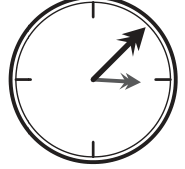
Show answer
Show hints
Still stuck? Show hint 2 →
Show solution
- The minute hand turns clockwise, a full circle (360°) in 60 minutes.
- From north-east, turning clockwise, it reaches south, then west, then north-west: that is 270° of the turn.
- 270° is three-quarters of 360°, so it takes three-quarters of 60 minutes = 45 minutes.
Folding, cutting, and transformations
Take a square sheet of paper. Fold it in half, then in half again so it’s a quarter the size. Now snip the folded corner with scissors and open it up. One little snip became four matching holes — arranged with perfect symmetry. That surprise is the whole topic: a fold is a mirror, and whatever you do on one side happens to every layer it stacks.
FOLD = MIRROR
- The fold line is an axis of symmetry. Each side reflects the other.
- A point
daway from the fold maps to a pointdaway on the far side. - One cut through folded paper opens into symmetric cuts — one per layer.
Reflections on a grid
A reflection is the same mirror idea on coordinates: one number flips, the other holds still. Reflect across a vertical mirror (like the y-axis) and the x flips while y stays put. Reflect across a horizontal mirror (the x-axis) and y flips while x stays.
Watch one point. Reflect (3, 2) across the y-axis: the 3 walks to the other side and becomes −3, the 2 doesn’t move — you land on (−3, 2). Reflect the same point across the x-axis instead and it’s the 2 that flips: (3, −2). Do every corner of a shape this way and the whole figure comes out mirror-reversed — left and right swap, the way letters read backwards in a mirror.
Rolling problems — two turns at once
When a shape rolls around the outside of another, its total spin comes from two sources, and forgetting one is the classic mistake:
- Rolling along edges = (distance traveled) ÷ (rolling shape’s perimeter) × 360°.
- Pivoting at corners = at each corner it tips over the exterior angle. Around a hexagon (exterior 60°), six corners add 6 · 60° = 360°.
Add both parts for the total rotation.
For any folded-paper problem: pick a concrete size, draw the fold, see what the cut hits. Then unfold mentally — each cut in the folded sheet becomes a symmetric cut in the open sheet, one copy per layer it passed through.
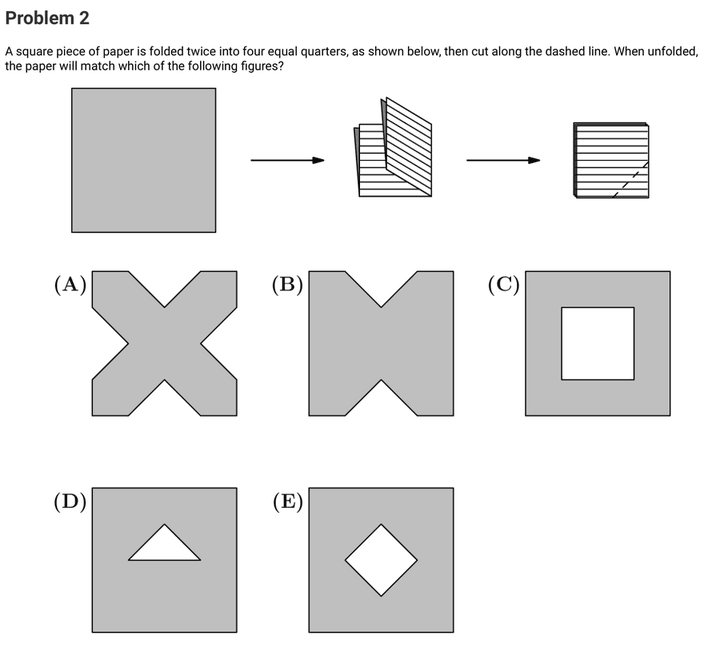
A square is folded in half, then in half again (now it’s a quarter), and a triangular notch is cut from the folded corner. What does the paper look like unfolded?
Forget tracing every layer. Ask the one question: where is the folded corner on the original sheet?
Folding a square twice into quarters stacks all four original corners onto a single point — and that point is the center of the sheet. So the notch is cut through four layers at once, snipping four identical triangles that all meet at the center.
Unfold, and those four notches join into one diamond-shaped hole in the middle. That’s figure (E).
One question answered the whole problem: the folded corner lands at the center, so the cut becomes a symmetric shape centered on the sheet. (Contrast: a cut on an open edge stays at the edge.) Locate the all-folds-meet corner first and the rest is automatic.
For folding / cutting: pick a concrete size. For rolling: total rotation = rolling component (distance ÷ rolling-shape perimeter × 360°) + corner pivots (sum of exterior angles at corners touched).
2022 · #4 (figure problem)
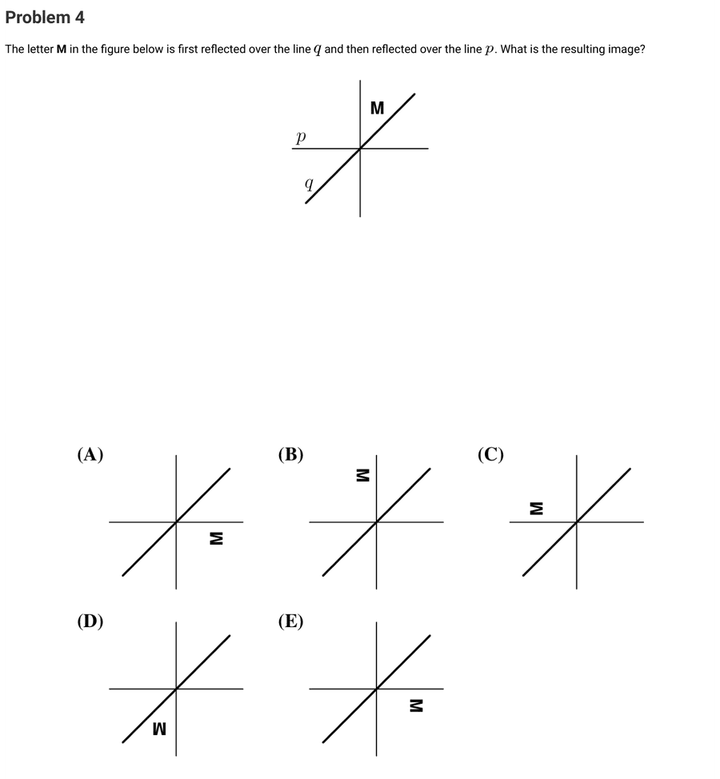
Show answer
Show hints
Still stuck? Show hint 2 →
Show solution
- Insight: doing two flips in a row feels fiddly, but the combined effect is one clean motion. Reflecting across two lines that cross at a point is exactly a rotation about that point.
- The rotation angle is twice the angle between the lines, in the direction from the first line (q) toward the second (p). So instead of tracking each flip, just spin the M about the crossing point.
- Carrying M through both flips lands it in the position shown in figure (E).
- You'll see this again: two reflections always collapse into a single motion — a rotation if the mirror lines cross, or a translation if they're parallel. Spotting that turns a two-step transformation into one.
- Reflect M over line q: the M flips across that line, landing in its mirror image position.
- Reflect that result over line p: a second flip across the other line.
- The final position matches choice (E).
2024 · #3 (figure problem)

Show answer
Show hints
Still stuck? Show hint 2 →
Show solution
- Viewing the blocks from behind reverses their left-right order while keeping every height unchanged.
- Mirror the given front arrangement horizontally.
- The mirrored picture matches choice B.
- So from behind the blocks look like B.
2005 · #3 What is the minimum number of small squares that must be colored black so that a line of symmetry lies on the diagonal BD of square ABCD?
What is the minimum number of small squares that must be colored black so that a line of symmetry lies on the diagonal BD of square ABCD?
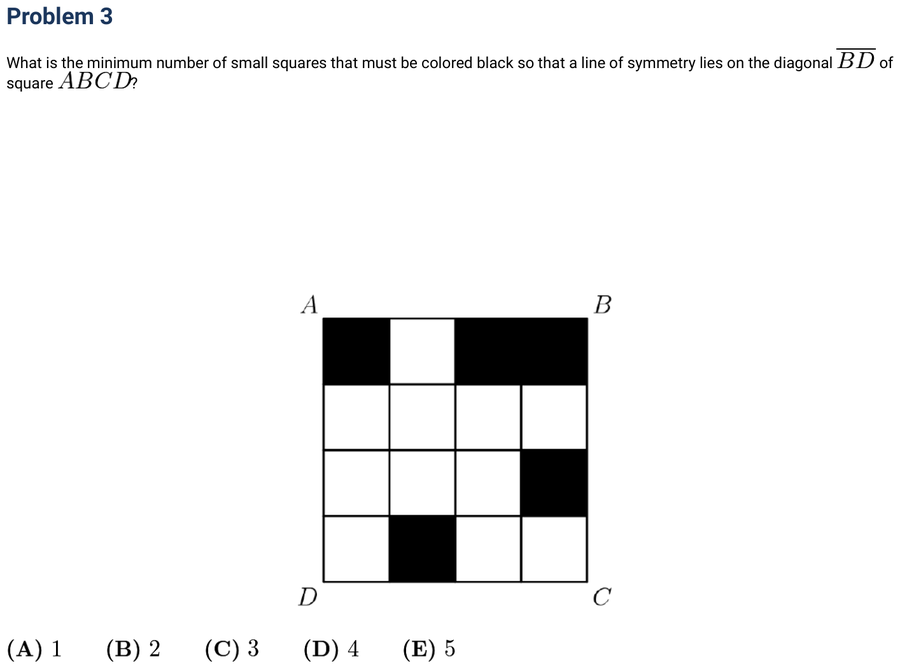
Show answer
Show hints
Still stuck? Show hint 2 →
Show solution
- Picture folding the square along diagonal BD. For the picture to match itself, every black square must fold onto another black square.
- Black squares already on the diagonal are fine — they map to themselves. The work is only with the black squares off the diagonal.
- There are 4 such off-diagonal black squares, and each one's mirror image across BD is still white. Coloring those 4 mirrors makes the picture symmetric ⇒ 4 squares.
- Why this transfers: for any reflection-symmetry counting problem, ignore whatever lies on the mirror line itself and just pair up the rest — the answer is the number of unmatched partners.
2011 · #3 A square piece of paper is cut in a straight line into two pieces. Which of the following shapes can not be created?
A square piece of paper is cut in a straight line into two pieces. Which of the following shapes can not be created?
Show answer
Show hints
Still stuck? Show hint 2 →
Show solution
- A single straight cut splits the square into two pieces, each bounded by part of the square plus the one cut line.
- A rectangle, a right-angled triangle, a pentagon, and an equilateral triangle can all appear as one of the two pieces for a suitable cut.
- But a smaller square cannot: a square needs four right angles, and one straight cut cannot create a second full square-shaped piece.
- So the impossible shape is a square.
Similar figures — when shapes scale
Blow up a photo to twice the width and you’d guess it uses twice the ink. It uses four times. Double every length and area doesn’t double — it quadruples. This single surprise is behind a whole family of contest problems, and most kids get it wrong the first time.
Two shapes are similar if they’re the same shape at different sizes — one is an enlarge-or-shrink copy of the other. Every matching angle is equal, every matching pair of sides shares the same ratio. Call that ratio the scale factor k.
SCALE FACTOR k
- Lengths scale by k (sides, perimeter, diagonals).
- Areas scale by k².
- Volumes scale by k³.
Feel it with two squares. Side 3 and side 6, so k = 2:
- Perimeters: 12 and 24 — ratio 2 (that’s k).
- Areas: 9 and 36 — ratio 4 (that’s k²).
Sides double → area quadruples. Always 2² = 4, never 2.
Go deeper: see k, k², k³ in the tiles (why area scales by k²)
See k, k², k³ in the tiles
Why does area scale by k² and volume by k³? Don’t take it on faith — count the little boxes. Take a 1×1 square. Double every length (k = 2) and the new square isn’t one big square — it’s a 2-by-2 grid of 4 copies of the original. Triple it (k = 3) and you get a 3-by-3 grid of 9. The grid is k tiles wide and k tiles tall, so it holds k × k = k² tiles. That’s the “four times the ink” surprise, made of countable squares.
Now go 3-D. Double a cube’s edge and it fills with a 2×2×2 stack of 8 little cubes — k × k × k = k³. Same counting, one dimension up. That is the whole story:
- Lengths ×
k— one row of tiles. - Area ×
k²— a square grid of tiles. - Volume ×
k³— a cube stack of boxes.
Pictured-intuition adapted from Competition Math for Middle School (AoPS).
kangaroo-2013-kadett-01). What is the grey area?Go deeper: when are two triangles similar? (AA, SAS, SSS)
When are two triangles similar?
You don’t check all six things (3 angles + 3 ratios). Any ONE of these is enough:
SIMILARITY CRITERIA
- AA (Angle-Angle): two equal angle pairs — the third is automatic.
- SAS: two side pairs in the same ratio, with equal angle between them.
- SSS: all three side pairs in the same ratio.
AA is the workhorse. Two triangles sharing an angle, or formed by parallel lines cut by a transversal, are similar — set up the side-ratio equation and solve. And the classic: a line parallel to one side of a triangle cuts off a smaller, similar triangle.
Go deeper: same height → area ratio = base ratio (skip the height)
Same height → area ratio = base ratio (no height needed)
This one isn’t about similar shapes — it’s about triangles that share a height but sit on different bases. It saves you from ever finding the height.
Take a triangle. Put a point on the bottom that splits it into a piece of length 2 and a piece of length 5. Draw a line from that point up to the top corner. Now you have two skinny triangles side by side.
The slow way. Pick a height — say 6. Left triangle: ½ · 2 · 6 = 6. Right: ½ · 5 · 6 = 15. Ratio = 6 : 15 = 2 : 5. Notice the 6 showed up in both and cancelled.
The fast way. Both triangles reach the same top corner, so they share a height. Same height means area is just ½ · base · (same height) — so the areas land in the exact ratio of the bases. 2 : 5. Done.
One famous case: a median (corner to the midpoint of the far side) splits the base into two equal halves, so it splits the triangle into two equal-area pieces every time.
Two triangles with the same height have areas in the ratio of their bases — skip the height entirely.
(Same-altitude area ratio adapted from Problem Solving via the AMC, Australian Maths Trust.)
Go deeper: a line parallel to a side — the “shadow” proportion in full
Parallel cut → matching ratios all the way up
We said a line parallel to one side of a triangle slices off a smaller similar triangle. Here is the proportion it hands you, written out. If DE is drawn parallel to BC (with D on AB and E on AC), then by AA the small triangle ADE is similar to the big one ABC, so every matching pair is in the same ratio:
\(\dfrac{AD}{AB}=\dfrac{AE}{AC}=\dfrac{DE}{BC}\)
The everyday version of this is the shadow trick: the sun’s rays are parallel, so a stick and its shadow form a triangle similar to a tall pole and its shadow. Heights and shadows share one ratio.
Full parallel-line proportion from Competition Math for Middle School (AoPS); shadow setup also in Terry Chew.
Go deeper: the angle-bisector theorem (it splits the far side in the side-ratio)
An angle bisector cuts the opposite side in the ratio of the two sides
Draw the line from a triangle’s corner that splits its angle into two equal halves (the angle bisector) and follow it to the opposite side. It doesn’t land at the midpoint — it lands so that the two pieces are in the same ratio as the two sides meeting at that corner:
\(\dfrac{BD}{DC}=\dfrac{AB}{AC}\)
Angle-bisector theorem from Competition Math for Middle School (AoPS).
Go deeper (stretch): find a whole triangle from its sub-triangle areas
Reading areas off shared heights
Here is the same-height idea pushed to a harder, prettier problem. A point P sits inside triangle ABC. Cevians AP, BP, CP cut the triangle into pieces. Suppose the cevian from A splits side BC at D, and you are told two of the little areas. Because triangles \(ABD\) and \(ACD\) share the height from A, their areas are in the ratio \(BD:DC\) — and so are any two triangles on those same two bases. That single observation chains through the whole figure.
A clean case to chew on. In triangle ABC, D is on BC with \(BD:DC = 2:3\). The cevian AD is drawn. If triangle ABD has area 14, what is the area of triangle ABC?
Solve it. ABD and ACD share the height from A, so their areas are in the ratio \(BD:DC = 2:3\). Thus \([ACD] = \tfrac{3}{2}\times 14 = 21\), and the whole triangle is \([ABC] = 14 + 21 = \mathbf{35}\). No height, no lengths — just the base ratio.
Sub-triangle area-chasing inspired by a Terry Chew Math Olympiad workbook (a triangle split into four sub-triangles by cevians).
When areas of similar figures appear, the area ratio is the square of the side ratio. Given areas, asked for sides → take the square root. Two similar triangles of areas 25 and 100 have side ratio √(25/100) = 1/2.
For 3D, volumes scale by k³: two similar cones of volumes 8 and 27 have side ratio ∛(8/27) = 2/3.
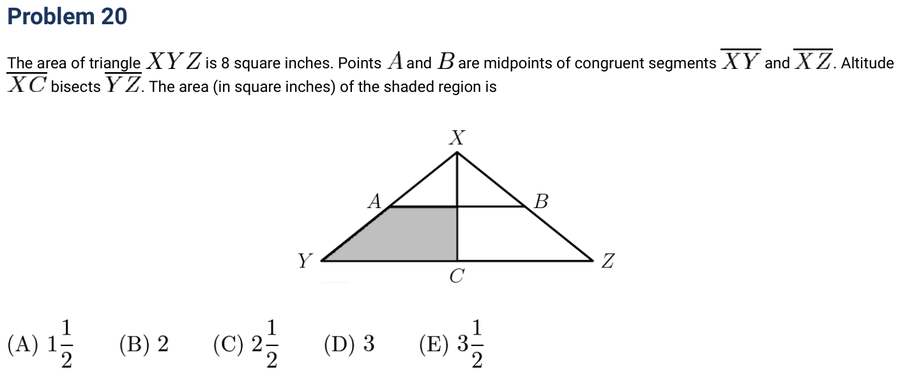
Triangle XYZ has area 8. C is the midpoint of YZ. The shaded region is triangle XYC with a small midpoint-triangle removed from the top. Find the shaded area — using fractions, never lengths.
Step 1 — halve with the median. XC runs to the midpoint of YZ, so it’s a median: it cuts XYZ into two equal halves. Triangle XYC = 8 ÷ 2 = 4.
Step 2 — scale down the little triangle. The small top triangle is built on midpoints, so every side is half of XYC’s — scale factor k = ½. Its area is k² = ¼ of XYC: 4 × ¼ = 1.
Step 3 — subtract. Shaded = 4 − 1 = 3 square inches (choice D).
Two scaling moves, zero side lengths: a median halves the area, and halving the sides quarters the area (k²). Both are pattern-matches. The trap is grabbing for actual lengths — you only ever need the fractions.
Lengths scale by k. Areas scale by k². Volumes scale by k³. For triangle similarity, AA is usually enough — look for shared angles or parallel-line angle pairs.
2008 · #4 In the figure, the outer equilateral triangle has area 16, the inner equilateral triangle has area 1, and the three trapezoids are...
In the figure, the outer equilateral triangle has area 16, the inner equilateral triangle has area 1, and the three trapezoids are congruent. What is the area of one of the trapezoids?
Show answer
Show hints
Still stuck? Show hint 2 →
Show solution
- The big triangle is the small triangle plus the three trapezoids, so the trapezoids together cover 16 − 1 = 15. No measuring needed — the area you can't see is simply "total minus the hole."
- They're congruent (identical), so each is 15 ÷ 3 = 5.
- Sanity check: the choices run 3–7, and 15 split three ways must be 5 — only one choice fits.
- Area 16 vs area 1 means the big triangle is 4× the small one in side length (since area scales as the square, √16 = 4).
- The whole figure is 16 small-triangle-areas worth; the center hole is 1, leaving 15 for the three trapezoids, so each is 5.
2013 · #1 Triangle ABC is equilateral and has area 9. The dividing lines are parallel to the sides and split each side into three equal lengths....
Triangle ABC is equilateral and has area 9. The dividing lines are parallel to the sides and split each side into three equal lengths. What is the area of the grey shaded part of the triangle?
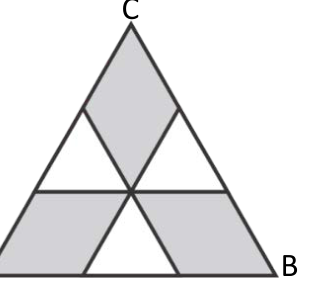
Show answer
Show hints
Still stuck? Show hint 2 →
Show solution
- Parallel lines cutting each side into three equal parts split the big triangle into 9 small congruent triangles.
- Since the whole area is 9, each small triangle has area 1.
- Counting the grey small triangles gives 6 of them.
- So the shaded area is 6.
2014 · #4 The area of rectangle ABCD in the diagram is 10. M and N are the midpoints of the sides AD and BC respectively. What is the area of the...
The area of rectangle ABCD in the diagram is 10. M and N are the midpoints of the sides AD and BC respectively. What is the area of the quadrilateral MBND?
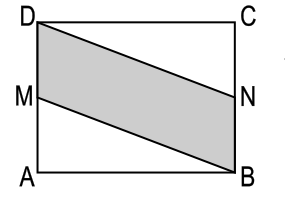
Show answer
Show hints
Still stuck? Show hint 2 →
Show solution
- Because M and N are the midpoints of the two opposite sides, the segment MN cuts the rectangle into two equal pieces, each of area 5.
- The quadrilateral MBND is built symmetrically about MN, and a quick shear/area argument shows it covers exactly half of the whole rectangle.
- Half of 10 is 5.
2007 · #8 In trapezoid ABCD, AD is perpendicular to DC, AD = AB = 3, and DC = 6. In addition, E is on DC, and BE is parallel to AD. Find the area of ▵BEC.
In trapezoid ABCD, AD is perpendicular to DC, AD = AB = 3, and DC = 6. In addition, E is on DC, and BE is parallel to AD. Find the area of ▵BEC.
Show answer
Show hints
Still stuck? Show hint 2 →
Show solution
- Since BE ∥ AD and AD ⊥ DC, segment BE is also ⊥ DC. With AB ∥ DC too, ABED is a rectangle — in fact a square, because AD = AB = 3. So BE = 3 and DE = 3.
- That leaves EC = DC − DE = 6 − 3 = 3, and ▵BEC is right-angled at E with legs 3 and 3.
- Area = (1/2)(3)(3) = 4.5.
- Worth keeping: when one side is parallel to a perpendicular height, that height is just the rectangle's width — no Pythagoras needed.
Circles, roots, and scaling
Three problems on circle formulas, hidden right triangles, and reading lengths off a figure.
2006 · #7 Circle X has a radius of π. Circle Y has a circumference of 8π. Circle Z has an area of 9π. List the circles in order from smallest to...
Circle X has a radius of π. Circle Y has a circumference of 8π. Circle Z has an area of 9π. List the circles in order from smallest to largest radius.
Show answer
Show hints
Still stuck? Show hint 2 →
Show solution
- Y: C = 2πr = 8π, so r = 4. Z: πr2 = 9π, so r2 = 9 and r = 3. X: r = π ≈ 3.14 (given directly).
- Now they're comparable: 3 < 3.14 < 4, so smallest to largest is Z, X, Y.
- The key fact for the close call: π lands between 3 and 4 (it's about 3.14), so circle X squeezes in between Z and Y. Anytime quantities are given in different forms, reduce them to one common measure first.
2003 · #21 (figure problem)
Show answer
Show hints
Still stuck? Show hint 2 →
Show solution
- Drop perpendiculars from B and C straight down to the long side AD; both have length 8 (the altitude). Each slanted leg is now the hypotenuse of a right triangle. AB = 10 with a vertical leg of 8 is a 6-8-10 triangle, so its base is 6. CD = 17 with a vertical leg of 8 is an 8-15-17 triangle, so its base is 15.
- The bottom AD is the top BC plus those two overhangs: AD = BC + 6 + 15 = BC + 21.
- The area gives the second relation. Trapezoid area = ½(sum of parallel sides)(height): ½(BC + AD)(8) = 164, so BC + AD = 41.
- Substitute: BC + (BC + 21) = 41 → 2·BC = 20 → BC = 10.
- You'll see this again: recognizing 6-8-10 and 8-15-17 turns "find the missing horizontal piece" into instant recall — no Pythagorean square-rooting. The trapezoid then becomes one length equation plus one area equation.
- The two overhangs (6 and 15) total 21, so AD is exactly 21 longer than BC. Their average — the trapezoid's "midline" — is BC + 10.5.
- Area = midline × height = (BC + 10.5) × 8 = 164, so BC + 10.5 = 20.5.
- Therefore BC = 10.
2018 · #9 Two circles are inscribed in an 11 cm long and 7 cm wide rectangle so that they each touch three sides of the rectangle. How big is the...
Two circles are inscribed in an 11 cm long and 7 cm wide rectangle so that they each touch three sides of the rectangle. How big is the distance between the centres of the two circles?
Show answer
Show hints
Still stuck? Show hint 2 →
Show solution
- Touching three sides means each circle has diameter 7 cm (the width), so radius 3.5 cm.
- The left centre sits 3.5 cm from the left edge; the right centre sits 3.5 cm from the right edge of the 11 cm length.
- Distance between centres = 11 − 3.5 − 3.5 = 4 cm.
Power of a point — when two chords cross
Two chords of a circle cross at a point inside it, cutting each into two pieces. There is a beautiful little law hiding here: multiply the two pieces of one chord, multiply the two pieces of the other, and you get the same number. It looks like magic, but it falls straight out of similar triangles — and it cracks open a whole band of harder circle problems.
INTERSECTING CHORDS
When two chords meet inside a circle and split each other into pieces \(a, b\) and \(c, d\): \(a\cdot b = c\cdot d\).
Why it’s true — it’s just AA
Label the crossing point \(X\). Two chords \(AB\) and \(CD\) cross there, making two triangles, \(AXC\) and \(DXB\). They are similar (Chapter 12’s AA):
- The two angles at \(X\) are vertical angles — equal.
- Angles \(\angle A\) and \(\angle D\) sit on the same arc \(BC\), so they’re equal (that’s the inscribed-angle idea from the next chapter).
Two equal angle pairs → the triangles are similar, so corresponding sides are in proportion:
\(\dfrac{AX}{DX} = \dfrac{CX}{BX}\)
Cross-multiply and you get \(AX\cdot BX = CX\cdot DX\) — exactly \(a\cdot b = c\cdot d\). It isn’t a new rule to memorize; it’s last chapter’s AA wearing a circle.
Derivation route follows Competition Math for Middle School (AoPS).
Worked example
A chord \(BD\) passes through the midpoint \(X\) of another chord \(AC\). The two pieces of \(BD\) are \(BX = 2\) and \(DX = 6\). How long is chord \(AC\)?
Because \(X\) is the midpoint of \(AC\), its two pieces are equal — call each one \(x\). The intersecting-chord law says the products match:
\(x\cdot x = BX\cdot DX = 2\cdot 6 = 12\)
So \(x^2 = 12\) and \(x=\sqrt{12}=2\sqrt{3}\). The whole chord is two of those pieces: \(AC = 2x = \mathbf{4\sqrt{3}}\).
Notice we never found where the centre was or how big the circle is — the products were all we needed.
Climb higher: the outside cousin (secants)
When the two lines cross outside the circle (two secants from one external point), the same similar-triangle argument gives \(a(a+b) = c(c+d)\) — each whole secant times its outer piece. Same idea, vertex moved outside. (Together these are the “power of a point” theorem.)
See two chords crossing inside a circle? Immediately write (piece × piece) = (piece × piece). Three of the four pieces are usually given; the equal-products law hands you the fourth in one step — no radius, no centre, no Pythagoras needed.
Crossing chords → \(a\cdot b = c\cdot d\). If a chord is bisected by another, its two equal halves \(x\) satisfy \(x^2 = (\text{the other chord’s two pieces multiplied})\).
Inscribed angles — half the arc
Back in the circles chapter you met one striking fact: an angle that opens onto a diameter is always 90°. That is the tip of a much bigger iceberg. Pin two points \(A\) and \(B\) on a circle, then pick any third point \(P\) on the far arc and look at the angle \(\angle APB\). Slide \(P\) anywhere along that arc and the angle never changes — and it is always exactly half the central angle that opens the same arc.
INSCRIBED-ANGLE THEOREM
An inscribed angle (vertex on the circle) equals half its arc — equivalently, half the central angle that subtends the same arc. Every inscribed angle resting on the same arc is therefore equal.
The 90° fact is just the half-of-180 case
When \(AB\) is a diameter, the arc it cuts off is a full half-circle — a 180° arc, opened by a straight 180° central angle. Half of 180° is 90°. So “an angle in a semicircle is a right angle” isn’t a separate rule at all; it’s this one theorem with the arc set to 180°.
Worked example
Points \(A\), \(B\), \(P\) lie on a circle with centre \(O\). The central angle \(\angle AOB = 100^\circ\). What is the inscribed angle \(\angle APB\) (with \(P\) on the major arc)?
The inscribed angle is half the central angle that opens the same arc: \(\angle APB = \tfrac12 \cdot 100^\circ = \mathbf{50^\circ}\). Move \(P\) to any other spot on that major arc and you’d still read 50°.
Theorem and diameter-case proof from Competition Math for Middle School (AoPS).
Why it’s half (the diameter case, in one line)
Run a line from \(P\) through the centre \(O\) to the far side. In the triangle made by two radii and a chord, two sides are radii, so it is isosceles and its two base angles are equal — call each \(a\). The central angle is the triangle’s exterior angle, so it equals \(a+a = 2a\) (Chapter 8’s remote-angles rule). Hence the inscribed angle \(a\) is half the central angle \(2a\). The general case stacks two of these back to back.
Spot an angle whose corner sits on the circle? It is half the arc it faces. Two such angles facing the same arc are equal — that is what makes the crossing-chord triangles in the last chapter similar. And the famous 90°-in-a-semicircle is just the arc = 180° case.
Inscribed angle = \(\tfrac12\)(arc) = \(\tfrac12\)(central angle on the same arc). Diameter → arc 180° → angle 90°.
Altitude to the hypotenuse — the geometric mean
Drop a straight line from the right-angle corner of a right triangle, perpendicular onto the hypotenuse. That single line — the altitude to the hypotenuse — quietly does something wonderful: it splits the big right triangle into two smaller right triangles, each similar to the original (and to each other). Three nested copies of the same shape, hiding in one picture.
Because the three triangles are similar, their sides line up in proportions — and one of those proportions is a gem. The altitude \(h\) is the geometric mean of the two hypotenuse pieces \(p\) and \(q\):
ALTITUDE-ON-HYPOTENUSE
The altitude splits the hypotenuse into pieces \(p\) and \(q\). Then:
- \(h^2 = p\cdot q\) — the altitude squared is the product of the two pieces.
- (each leg)\(^2\) = (whole hypotenuse) × (the piece next to it).
Why \(h^2 = pq\)? In the two small triangles, \(h\) is the long leg of one and the short leg of the other, so matching the proportion gives \(\dfrac{p}{h} = \dfrac{h}{q}\) — cross-multiply to get \(h^2 = pq\). From any two of the five lengths in the figure you can rebuild the rest with this rule and Pythagoras.
Configuration from Competition Math for Middle School (AoPS), Similarity.
Worked example
The altitude to the hypotenuse of a right triangle splits that hypotenuse into pieces of length 6 and 10. Find the area of the triangle.
Get the altitude. By the geometric-mean rule, \(h^2 = p\cdot q = 6\cdot 10 = 60\), so \(h = \sqrt{60} = 2\sqrt{15}\).
Now the area. The whole hypotenuse is \(6 + 10 = 16\), and \(h\) is the height onto it, so area \(= \tfrac12 \cdot 16 \cdot 2\sqrt{15} = \mathbf{16\sqrt{15}}\).
We never needed the two legs themselves — the altitude rule jumped straight to the height.
Climb higher: the angle-bisector cousin
A different cevian, the angle bisector from a vertex, splits the opposite side in the ratio of the two neighbouring sides: \(\dfrac{AB}{AC} = \dfrac{BD}{CD}\) (the angle-bisector theorem). Like the altitude rule, it’s a one-line consequence of similar triangles — handy when a bisector chops a side into an unknown ratio.
See an altitude dropped onto a hypotenuse? Three similar triangles appear at once. Reach first for \(h^2 = pq\) (altitude squared = product of the two hypotenuse pieces); from any two of the five lengths, Pythagoras finishes the rest.
Altitude on hypotenuse: \(h^2 = pq\); (leg)\(^2\) = (whole hypotenuse)(adjacent piece). It mixes similarity and Pythagoras in one move.
Stretch test
Five harder geometry problems combining multiple techniques.
2002 · #20 (figure problem)
Show answer
Show hints
Still stuck? Show hint 2 →
Show solution
- Think in fractions, not measurements. Altitude XC bisects YZ, so triangle XYC is exactly half of XYZ: area 8 ÷ 2 = 4.
- Inside that half, the unshaded top triangle is built on midpoints, so it's a half-scale copy — and half the side lengths gives (½)² = ¼ the area, i.e. ¼ × 4 = 1.
- Shaded = 4 − 1 = 3 square inches.
- *The reusable idea:* you can find an area as a *fraction* of a known one without any side lengths — halving by a median, and the length²-to-area rule (half the sides → quarter the area) — then add and subtract the fractions.
2020 · #21 In each of the four corners of a swimming pool, 10 m wide by 25 m long, there is a child. The swim instructor is sitting almost in the...
In each of the four corners of a swimming pool, 10 m wide by 25 m long, there is a child. The swim instructor is sitting almost in the middle of one of the long edges of the pool. When he calls the children, they all choose the longest path along the edges to reach him. What was the sum of the distances covered by the four children?
Show answer
Show hints
Still stuck? Show hint 2 →
Show solution
- Perimeter = 2 × (10 + 25) = 70 m, with the instructor about 12.5 m from each end of a long edge.
- The two near corners take the long route 70 − 12.5 = 57.5 m each; the two far corners take 70 − 22.5 = 47.5 m each.
- Sum = 57.5 + 57.5 + 47.5 + 47.5 = 210 m.
- The total is 210 m, choice E.
2020 · #21 Inside the gray square there are three white squares; the number in each shows its area. The white squares have sides parallel to the...
Inside the gray square there are three white squares; the number in each shows its area. The white squares have sides parallel to the sides of the gray square. If the area of the gray square is 81, what is the area of the gray region not covered by the white squares?
Show answer
Show hints
Still stuck? Show hint 2 →
Show solution
- The gray square has area 81, so its side is 9. The corner white squares have areas 9 and 4, so their sides are 3 and 2.
- The middle white square stretches across the row between them, so its side is 9 − 3 − 2 = 4, giving area 16.
- Gray left over = 81 − 9 − 4 − 16 = 52.
1990 · #18 (figure problem)
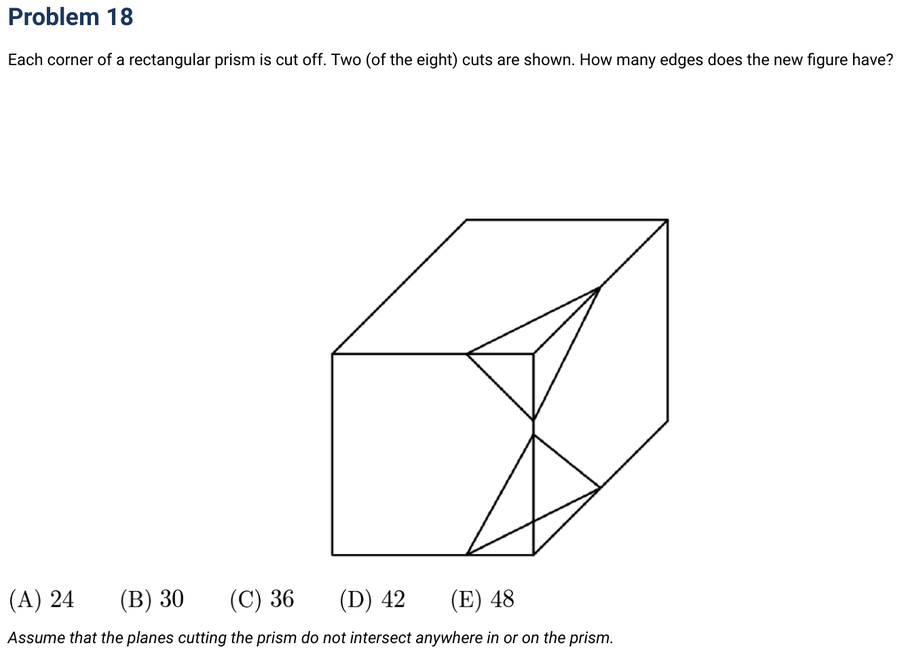
Show answer
Show hints
Still stuck? Show hint 2 →
Show solution
- A box (rectangular prism) starts with 12 edges and 8 corners. Cutting a corner just *shortens* the three edges meeting there — it doesn't remove any, so all 12 original edges survive.
- Each cut exposes a new little triangular face, and a triangle has 3 sides — so every corner adds 3 brand-new edges. Eight corners (the cuts don't touch each other) add 8 × 3 = 24 new edges.
- Total edges = 12 survivors + 24 new = 36.
- *Why this transfers:* for 'slice the corners' (truncation) problems, count by category — old edges that survive plus (new edges per cut) × (number of cuts). The same bookkeeping handles faces and vertices too.
2019 · #21 What is the area of the triangle formed by the lines y = 5, y = 1 + x, and y = 1 − x?
What is the area of the triangle formed by the lines y = 5, y = 1 + x, and y = 1 − x?
Show answer
Show hints
Still stuck? Show hint 2 →
Show solution
- Find the corners. On y = 5: 5 = 1 + x gives (4, 5), and 5 = 1 − x gives (−4, 5). The two slanted lines meet where 1 + x = 1 − x, i.e. x = 0, the apex (0, 1).
- Take the flat top as base: from (−4, 5) to (4, 5) is length 8 (and it's centered on the y-axis, confirming the triangle is isosceles). Height is the vertical distance 5 − 1 = 4.
- Area = ½ × 8 × 4 = 16.
- Why this transfers: when a triangle has a horizontal or vertical side, use that side as the base — its length and the perpendicular height are both just coordinate differences, sidestepping the distance formula entirely.
Stretch practice — beyond AMC 8
22 bonus problems on Geometry & Measurement. These are typed-answer (no multiple choice) and tilt harder — closer to early AMC 10. Try the ones that look fun.
Stretch · #1 A cube has six faces (flat surfaces). Now cut a cube in half. How many faces does half a cube have? Try to think of all the different...
Show answer
Show hints
Still stuck? Show hint 2 →
Still stuck? Show hint 3 →
Show solution
- This problem is meant to be open-ended; its value is in the discussion, not in one magic number.
- Straight cut down the middle: you get a smaller rectangular box, which has 6 flat faces — so this answer is 6 (one is the new face the knife made).
- Slanted (corner-to-corner) cut: the piece is a wedge or triangular prism, and you count 5 faces. (Some people blurt out 3 before noticing the original faces are still partly there.)
- Staircase cut: if the cut is a jagged staircase that still splits the cube into two equal-volume pieces, every step adds faces, so the count can be as big as you like.
- The real lesson: 'half a cube' is ambiguous. Once you notice that, many answers become reasonable, and you start asking better questions: must the pieces match exactly? must the cut be flat?
Stretch · #5 Two circles share the same center. The gap between them (big radius minus small radius) is \(10\). How much bigger is the big circle's...
Show answer
Show hints
Still stuck? Show hint 2 →
Still stuck? Show hint 3 →
Show solution
- Extreme case: shrink the inner circle to a point. Then the gap \(10\) becomes simply the radius of the surviving circle. Its circumference is \(2\pi(10) = 20\pi\), and the point has circumference \(0\), so the difference is \(20\pi\).
- Why this always works: the difference of circumferences is \(2\pi R - 2\pi r = 2\pi(R - r) = 2\pi(10) = 20\pi\), which depends only on the gap \(R-r\), not on the individual sizes.
Stretch · #5 Take regular hexagons cut from paper. (a) On one hexagon, fold two OPPOSITE corners in to the center. (b) On another, fold every OTHER...
Show answer
Show hints
Still stuck? Show hint 2 →
Still stuck? Show hint 3 →
Show solution
- Cut the regular hexagon into 6 equal triangles that all meet at the center \(O\). Each triangle is \(\tfrac16\) of the hexagon, and folding a corner to the center folds exactly one of these triangles flat.
- (a) Two opposite corners: two triangles fold over, so \(\tfrac26 = \tfrac13\) is covered and \(\tfrac23\) is left showing. The outline becomes a rectangle.
- (b) Three alternate corners: three triangles fold over — half — so \(\tfrac12\) is left showing, and the outline is an equilateral triangle.
- (c) All six corners: every corner flap folds in; the region still showing is \(\tfrac13\) of the original, and the outline is a smaller hexagon.
- Just by counting how many of the 6 triangles fold, you get the area instantly: (a) \(\tfrac23\), (b) \(\tfrac12\), (c) \(\tfrac13\).
Stretch · #6 A rope is wrapped tightly around the Earth's equator. Now you add just \(1\) extra meter of rope and spread the slack evenly so the rope...
Show answer
Show hints
Still stuck? Show hint 2 →
Still stuck? Show hint 3 →
Show solution
- The rope circle and the Earth circle share a center, so the rope's height above the ground is the difference in their radii.
- When a circumference grows by \(1\) meter, the radius grows by \(\Delta r = \frac{\Delta C}{2\pi} = \frac{1}{2\pi} \approx 0.159\) m \(\approx 16\) cm.
- This gap does not depend on the Earth's size at all (the same \(1\) meter of slack on a basketball would lift the rope by the same \(16\) cm).
- A gap of about \(16\) centimeters all the way around is easily enough room for a mouse, so yes — a mouse can fit.
Stretch · #8 Five points are placed inside an equilateral triangle with sides of length 1. Show that at least 2 of the points are less than...
Show answer
Show hints
Still stuck? Show hint 2 →
Still stuck? Show hint 3 →
Show solution
- Connect the midpoints of the three sides of the big triangle. This splits it into 4 smaller equilateral triangles, each with side length \(\tfrac12\). These 4 small triangles are our boxes.
- Drop the 5 points into the 4 small triangles. Since \(5 > 4\), some small triangle holds at least 2 points.
- Inside any triangle, the farthest apart two points can be is the length of its longest side; here that is \(\tfrac12\).
- So the two points in the same small triangle are less than \(\tfrac12\) apart.
Stretch · #9 On the round Earth, from how many starting points can you walk exactly \(1\) mile south, then \(1\) mile east, then \(1\) mile north and...
Show answer
Show hints
Still stuck? Show hint 2 →
Still stuck? Show hint 3 →
Show solution
- North Pole: start there, walk \(1\) mile south, then \(1\) mile east along a latitude circle, then \(1\) mile north — back at the pole. It works.
- Near the South Pole: find the circle that is exactly \(1\) mile all the way around. Stand anywhere \(1\) mile NORTH of it. Walking south lands you on the little circle, walking \(1\) mile east loops you all the way around back to the same point, and walking north returns you to start. Every point on that bigger circle works — infinitely many.
- More possibilities: the little circle could instead be \(\frac{1}{2}\) mile around (the east walk loops it twice), or \(\frac{1}{3}\) mile around (three times), and so on for any whole number of loops.
- Full answer: the North Pole, plus — for every whole number \(n = 1, 2, 3, \dots\) — every point \(1\) mile north of the southern circle whose distance around is \(\frac{1}{n}\) mile. That is infinitely many starting points.
Stretch · #10 A bug sits at corner \(B\) of a closed box and wants to crawl along the outside surface to the opposite corner \(H\). It must stay on...
Show answer
Show hints
Still stuck? Show hint 2 →
Still stuck? Show hint 3 →
Show solution
- Crawling around a 3-D corner is confusing, so change the representation: unfold the box so the faces the bug walks across become one flat sheet.
- On a flat sheet, the shortest path between two points is a straight line. So draw the straight segment from \(B\) to \(H\) in the unfolded picture — that is the shortest possible crawl. When you fold the box back up, that straight line wraps over the faces and shows the bug's actual route.
- There is more than one way to unfold the box (you could open it across different pairs of faces). Each unfolding gives a straight segment of a different length, so try the unfoldings and choose the one with the shortest segment \(\overline{BH}\).
Stretch · #10 Using whole-number inch marks, what is the SHORTEST wire that can be bent into a RIGHT triangle? And what is the shortest wire that can...
Show answer
Show hints
Still stuck? Show hint 2 →
Still stuck? Show hint 3 →
Show solution
- A whole-number right triangle is a Pythagorean triple \(a^2+b^2=c^2\). The smallest is 3-4-5, perimeter \(3+4+5 = 12\), and no shorter whole-number triangle is right. So the shortest right-triangle wire is 12 inches.
- For obtuse we want a real triangle whose longest side satisfies \(a^2 + b^2 < c^2\). Check perimeters in order: at perimeter 6 or less the only triangles (1-1-1, 1-2-2, 2-2-2) are equilateral or acute (1-2-2: \(1+4=5 > 4\), acute).
- Perimeter 7: try 2-2-3. Since \(2^2 + 2^2 = 8 < 9 = 3^2\), the angle across from the side of 3 is obtuse.
- So the shortest obtuse-triangle wire is 7 inches (2-2-3). Answer: right = 12 inches, obtuse = 7 inches.
Stretch · #11 Start with one triangle (stage 0). Connect the midpoints of its sides to cut it into 4 small triangles, keep the 3 corner ones, and...
Show answer
Show hints
Still stuck? Show hint 2 →
Still stuck? Show hint 3 →
Show solution
- Each shaded triangle becomes 3 shaded triangles next stage, so the count triples: \(1, 3, 9, 27, 81, \dots\), giving triangles at stage \(n = 3^n\).
- Each stage you punch one new hole in every triangle that was there the stage before, so new holes at stage \(k\) equal \(3^{k-1}\). Holes pile up: holes at stage \(n = 1 + 3 + 9 + \cdots + 3^{n-1}\).
- At stage 5: triangles \(= 3^5 = 243\); holes \(= 1 + 3 + 9 + 27 + 81 = 121\).
- So stage 5 has 243 triangles and 121 holes. (In general the hole count equals \(\tfrac{3^n - 1}{2}\).)
Stretch · #12 Mark 6 points anywhere on a stick that is 1 meter long. Show that 2 of the points are less than \(\tfrac15\) of a meter (20 cm) apart.
Show answer
Show hints
Still stuck? Show hint 2 →
Still stuck? Show hint 3 →
Show solution
- Cut the 1-meter stick into 5 equal pieces. Each piece is \(\tfrac15\) meter (20 cm) long. These 5 pieces are our boxes.
- Place the 6 points and see which piece each lands in. Since \(6 > 5\), some piece holds at least 2 points.
- Two points inside one piece of length \(\tfrac15\) meter can't be more than \(\tfrac15\) meter apart.
- So two of the points are less than \(\tfrac15\) meter (20 cm) apart.
Stretch · #12 In the same Sierpinski pattern, give the stage-0 triangle an area of 1 and a perimeter of 1. Each stage replaces every triangle with 3...
Show answer
Show hints
Still stuck? Show hint 2 →
Still stuck? Show hint 3 →
Show solution
- Halving the side length makes each triangle's area \(\left(\tfrac12\right)^2 = \tfrac14\) as big, and there are 3 copies, so total area multiplies by \(3 \times \tfrac14 = \tfrac34\) every stage: \(\text{Area}(n) = \left(\tfrac34\right)^n\).
- Halving the side length makes each perimeter \(\tfrac12\) as big, and there are 3 copies, so total perimeter multiplies by \(3 \times \tfrac12 = \tfrac32\) every stage: \(\text{Perimeter}(n) = \left(\tfrac32\right)^n\).
- At stage 5: area \(= \left(\tfrac34\right)^5 = \tfrac{243}{1024} \approx 0.24\); perimeter \(= \left(\tfrac32\right)^5 = \tfrac{243}{32} \approx 7.59\).
- So the stage-5 area is \(\tfrac{243}{1024}\). Forever: area shrinks toward 0 while perimeter grows without limit — almost no area but an endlessly long edge.
Stretch · #14 Ten checkers are set up in a triangle pointing UP, with rows of \(1, 2, 3,\) and \(4\). What is the fewest checkers you must move so the...
Show answer
Show hints
Still stuck? Show hint 2 →
Still stuck? Show hint 3 →
Show solution
- Ask the complement question: how many checkers can stay put? A checker can stay if its spot is part of BOTH the up-triangle and the down-triangle.
- When you overlay the upward triangle and its upside-down version, \(7\) of the \(10\) checkers land on shared spots and don't have to move. Only \(3\) checkers are out of place — the single checker at the top point and the two checkers at the bottom corners.
- So the fewest moves is \(3\).
Stretch · #1 Square \(ABCD\) has side length \(1\). From two opposite corners, draw two quarter circles of radius \(1\). They overlap in a...
Show answer
Show hints
Still stuck? Show hint 2 →
Still stuck? Show hint 3 →
Show solution
- Each quarter circle has area \(\frac{1}{4}\pi(1)^2 = \frac{\pi}{4}\). Together their areas add to \(\frac{\pi}{4}+\frac{\pi}{4} = \frac{\pi}{2}\).
- When you lay both pieces on the square, they cover the whole square, but the leaf in the middle is covered TWICE (it belongs to both quarter circles). So the total \(\frac{\pi}{2}\) counts the square once plus the lens one extra time: \(\frac{\pi}{2} = (\text{square}) + (\text{lens}) = 1 + (\text{lens})\).
- Therefore the lens area is \(\frac{\pi}{2} - 1 \approx 0.57\).
Stretch · #1 Two flagpoles stand on flat ground, 8 meters apart. The left pole is 6 m tall and the right pole is 4 m tall. A rope 10 m long is tied...
Show answer
Show hints
Still stuck? Show hint 2 →
Still stuck? Show hint 3 →
Show solution
- Let \(h\) be the weight's height. The rope makes equal angles with the vertical, which is the signature of a mirror reflection, so reflect the right pole and its rope half straight down across the horizontal line through the weight \(W\).
- After reflecting, the right rope segment lines up with the left one and the whole 10 m rope becomes a single straight line — the hypotenuse of a right triangle.
- The horizontal leg is the 8 m between the poles. The vertical leg: the left top is \((6 - h)\) above \(W\) and the reflected right top is \((4 - h)\) below \(W\), so the legs differ by \((6 - h) + (4 - h) = 10 - 2h\).
- Pythagoras: \(10^2 = 8^2 + (10 - 2h)^2\), so \((10 - 2h)^2 = 36\), giving \(10 - 2h = 6\), so \(h = 2\). Check: \(6^2 + 8^2 = 100 = 10^2\). The weight hangs 2 meters above the ground.
Stretch · #3 Three circles all touch a straight line, and each circle touches the other two. Two of the circles are the same size, and the third...
Show answer
Show hints
Still stuck? Show hint 2 →
Still stuck? Show hint 3 →
Show solution
- Lay the line flat; each circle's center is directly above its touch point, at a height equal to its radius. Put the small circle (radius 3) in the middle at height 3, and the two matching circles (radius r) on either side at height r.
- The two big circles touch each other with the small circle exactly between them, so the horizontal distance from a big center to the small center is r.
- A big circle touches the small circle externally, so the distance between those centers is \(r+3\); that is the hypotenuse of a right triangle with horizontal leg \(r\) and vertical leg \(r-3\).
- Pythagoras: \(r^2+(r-3)^2=(r+3)^2\Rightarrow r^2+r^2-6r+9=r^2+6r+9\Rightarrow r^2-6r=6r\Rightarrow r^2=12r\Rightarrow r=12\).
- Check: legs 12 and 9 give hypotenuse \(\sqrt{12^2+9^2}=\sqrt{225}=15=12+3\). So \(r=12\). (The problem says all circles are on the same side of the line; that assumption is what makes the answer unique.)
Stretch · #4 Two circles share the same center. A chord \(AB\) of the big circle just touches (is tangent to) the small circle. If \(AB = 8\), find...
Show answer
Show hints
Still stuck? Show hint 2 →
Still stuck? Show hint 3 →
Show solution
- Because the problem gives no circle sizes but wants one answer, the answer cannot depend on the radii. So we are free to pick a convenient extreme case.
- Extreme case: shrink the inner circle to a single point at the center. The chord \(AB\) still must touch it, so \(AB\) now goes straight through the center, meaning \(AB\) is a diameter of the big circle. Since \(AB=8\), the big radius is \(4\).
- With the inner circle gone, the ring becomes the entire big circle: area \(= \pi r^2 = \pi (4)^2 = 16\pi\).
- Check with the Pythagorean theorem: the radius to the touch point is perpendicular to \(AB\) and cuts it in half, giving half-chord \(4\), so \(R^2 - r^2 = 4^2 = 16\), and the ring area \(\pi R^2 - \pi r^2 = 16\pi\) — the same answer.
Stretch · #7 Draw a five-pointed star (a pentagram). Add up the five sharp point angles at the tips. What is the total? (It comes out the same for...
Show answer
Show hints
Still stuck? Show hint 2 →
Still stuck? Show hint 3 →
Show solution
- Since every five-pointed star gives the same total, reason about a nice symmetric one. A clean method uses turning.
- Imagine an ant walking around the outline of the star and back to where it started, facing the same way. At each of the \(5\) sharp tips it makes a turn. For a star (unlike a normal pentagon) the ant spins around TWICE before getting home, so the turns add up to \(2 \times 360^\circ = 720^\circ\).
- At each tip, the turn is \(180^\circ\) minus the tip angle (the sharper the point, the bigger the turn). Adding over all \(5\) tips: \(\sum(180^\circ - \text{tip}) = 720^\circ\).
- That is \(5 \times 180^\circ - (\text{sum of tip angles}) = 720^\circ\), so \(900^\circ - (\text{sum of tip angles}) = 720^\circ\), giving sum of tip angles \(= 180^\circ\) for any five-pointed star.
Stretch · #7 Nine points are placed anywhere inside a square whose sides are 1 unit long. Show that some 3 of these points form a triangle with area...
Show answer
Show hints
Still stuck? Show hint 2 →
Still stuck? Show hint 3 →
Show solution
- By the given fact, 3 points inside a region of area \(\tfrac14\) make a triangle of area less than \(\tfrac12 \times \tfrac14 = \tfrac18\). So we just need 3 of the 9 points in one region of area \(\tfrac14\).
- Cut the unit square into 4 equal small squares (slice it in half across and half down). Each small square has area \(\tfrac14\); these 4 squares are our boxes.
- Drop the 9 points into the 4 squares. Since \(9 = 4\times 2 + 1\), some square holds at least 3 points.
- Those 3 points form a triangle of area less than \(\tfrac18\).
Stretch · #8 A regular hexagon (6 equal sides) has side length \(4\). The apothem — the distance from the center straight out to the middle of a side...
Show answer
Show hints
Still stuck? Show hint 2 →
Still stuck? Show hint 3 →
Show solution
- Draw segments from the center to all \(6\) corners. This cuts the hexagon into \(6\) identical triangles, each with base \(= 4\) (one side) and height \(= 3.46\) (the apothem hits the side at a right angle).
- Area of one triangle \(= \frac{1}{2} \times 4 \times 3.46 = 6.92\). All \(6\) triangles give \(6 \times 6.92 = 41.52\) square units.
- Look at the structure: \(6 \times \left(\frac{1}{2} \times \text{side} \times \text{apothem}\right) = \frac{1}{2} \times (6 \times \text{side}) \times \text{apothem}\). But \(6 \times \text{side}\) is the whole perimeter, so Area \(= \frac{1}{2} \times (\text{perimeter}) \times (\text{apothem})\) for any regular polygon.
- Here \(\frac{1}{2} \times 24 \times 3.46 \approx 41.5\) square units. (Extreme case: a circle has apothem \(= r\), giving \(\frac{1}{2}(2\pi r)(r) = \pi r^2\).)
Stretch · #9 Mark 9 equally spaced dots, 0 through 8, around a circle. Dot 0 is where the wire's ends meet; pick 2 of the other 8 dots for the bends....
Show answer
Show hints
Still stuck? Show hint 2 →
Still stuck? Show hint 3 →
Show solution
- A wire triangle uses dot 0 plus 2 chosen dots, so there are \(\binom{8}{2} = \tfrac{8 \times 7}{2} = 28\) ways to choose.
- For a real triangle each side must be shorter than the sum of the other two. Since the three sides always add to 9, that condition is simply: each side is less than \(\tfrac92 = 4.5\).
- Each side IS one arc of the 9-unit circle, so 'each side < 4.5' means 'each arc is less than half the circle.' When all three arcs are under half, the triangle drawn on the circle wraps around the center; if one arc reaches half or more, that side is too long and the wire can't close.
- Exactly 10 of the 28 dot-pairs keep every arc under 4.5 — the same 10 wire triangles found before. The other \(28 - 10 = 18\) have an arc of 5 or more and fail. So the answer is 10.
Stretch · #15 Seven points are placed inside a circle of radius 1. Show that 2 of the points are less than distance 1 apart.
Show answer
Show hints
Still stuck? Show hint 2 →
Still stuck? Show hint 3 →
Show solution
- Draw 6 radii from the center, splitting the disk into 6 equal wedges, each with a \(60^\circ\) angle. These 6 wedges are the boxes.
- Drop the 7 points into the 6 wedges (the center may be counted in any one). Since \(7 > 6\), some wedge holds at least 2 points.
- In one wedge, the two straight sides are radii of length 1 meeting at \(60^\circ\); the greatest distance between two points there is exactly 1 (the radii tips form an equilateral triangle of side 1).
- So two points sharing a wedge are less than distance 1 apart.
Stretch · #16 Thirteen points are placed in a rectangle with side lengths 3 and 2. Show that some 3 of them form a triangle with area at most...
Show answer
Show hints
Still stuck? Show hint 2 →
Still stuck? Show hint 3 →
Show solution
- Cut the \(3 \times 2\) rectangle into 6 unit squares (3 across, 2 down), each of area 1. These 6 squares are the boxes.
- Drop the 13 points into the 6 squares. Since \(13 = 6\times2 + 1\), one square must hold at least 3 points.
- By the given fact, 3 points inside a region of area 1 form a triangle of area less than \(\tfrac12 \times 1 = \tfrac12\).
- So some 3 of the points form a triangle of area at most \(\tfrac12\).
Geometry quick-reference
FORMULAS TO KNOW COLD
- Rectangle: A = lw, P = 2(l + w).
- Square: A = s², P = 4s, diagonal = s√2.
- Triangle: A = ½ b h. Pythagorean: a² + b² = c².
- Equilateral triangle (side s): A = (√3/4) s². Height = (√3/2) s.
- Parallelogram: A = b h (h ⊥ base).
- Trapezoid: A = ½ (b₁ + b₂) h. Midsegment = average of the two parallel sides = ½(b₁ + b₂).
- Regular hexagon (side s): A = (3√3/2) s² (= 6 equilateral triangles of side s).
- Circle: A = π r², C = 2π r. Sector: π r² · θ/360. Arc: 2π r · θ/360.
- Cube: SA = 6 s², V = s³. Space diagonal = s√3.
- Box (a × b × c): SA = 2(ab + bc + ca), V = abc. Space diagonal = √(a² + b² + c²).
- Cylinder: V = π r² h, SA = 2π r² + 2π r h.
- Cone (radius r, height h): V = ⅓ π r² h.
- Sphere: V = (4/3) π r³, SA = 4π r².
- Distance between two points: √((x₂−x₁)² + (y₂−y₁)²).
- Equation of a circle: (x−a)² + (y−b)² = r² (center (a,b), radius r).
- Pick's Theorem (lattice polygons): A = I + B/2 − 1.
- Shoelace (coordinates): A = ½ |Σ(xₙyₙ₊₁ − xₙ₊₁yₙ)|.
- 13-14-15 triangle: area = 84 (splits into 5-12-13 + 9-12-15).
- Pythagorean triples: 3-4-5, 5-12-13, 8-15-17, 7-24-25, 9-40-41, 20-21-29.
- Special right triangles: 45-45-90 sides 1:1:√2. 30-60-90 sides 1:√3:2.
- Simplifying roots: pull out the largest perfect square — √50 = 5√2, √12 = 2√3, √75 = 5√3, √18 = 3√2. Multiply across: √a · √b = √(ab). Add only like roots.
- Polygon interior angle sum: (n−2) · 180°.
- Regular polygon angles: interior = (n−2)·180/n; exterior = 360/n. Pentagon 108, hexagon 120, octagon 135, 9-gon 140, 10-gon 144.
- Exterior angles sum to 360° for ANY convex polygon (one full lap of turning).
- Exterior angle of a triangle = sum of the two remote (non-adjacent) interior angles.
- Parallel lines + transversal: Z (alternate interior) equal; F (corresponding) equal; C (co-interior / same-side) sum to 180°.
- Triangle inequality: each side < sum of the other two (the two shorter sides must beat the longest).
- Same height → area ratio = base ratio. A median (corner to midpoint of opposite side) splits a triangle into two equal areas.
- Inscribed right triangle: a side equal to the diameter forces a 90° opposite angle.
- Tangent ⊥ radius: a tangent meets the radius at the touch-point at 90°.
QUADRILATERAL AREAS
- square
s²· rectangle / parallelogramb·h - rhombus
½·d₁·d₂(the diagonals — not the sides!) - trapezoid
½(b₁+b₂)·h(average the parallel sides, times height) - Hierarchy: square ⊂ rectangle & rhombus ⊂ parallelogram ⊂ quadrilateral. A rhombus or square has perpendicular diagonals — solve through the diagonals, not the sides.
- Confusing slanted side with height in parallelogram / triangle area formulas. Height is always perpendicular.
- Forgetting symmetry. Look for fold axes or rotational symmetry before computing.
- Misreading the figure. Always redraw it on your own paper and write your finds on it.
- Area vs perimeter mix-up. Fence is a length; dirt is squares. Keep them apart.
- Off-by-one on grid counts. A 5×5 grid of squares has 6 horizontal lines and 6 vertical lines.
- Forgetting overlap in two-region area sums. Use A + B − (A ∩ B).
- Doubling the area ratio instead of squaring it. Twice the size = four times the area (k²), not twice.
- Splitting a root across a sum. √(a + b) is NEVER √a + √b, and √(a² + b²) is NEVER a + b. Add inside the radical first, then take the root.
- Radius vs diameter. The distance straight across a circle is the diameter; every formula uses the radius r = d/2. A “fits inside” or “width across” gives the diameter — halve it.
- Using Pythagoras without a right angle. a² + b² = c² (and the triples) hold only when the angle between the two legs is 90°.
- Midpoint square is HALF, not a quarter. Joining the midpoints of a square’s sides gives an inner square with half the area (the four corner triangles fold in to fill it).
- Stopping at the first case. “An isosceles triangle has a 70° angle” can mean three different triangles — “sum of all possible values” means more than one case survives. List every case, check each is valid, then combine.
- Forgetting a triangle can’t exist. Before computing, check the triangle inequality — sides 2, 3, 8 form no triangle (2 + 3 < 8).
- Counting only one source of rotation when a shape rolls. Total spin = rolling along edges (distance ÷ perimeter × 360°) PLUS pivoting at each corner (the exterior angles).
Drill these:
- Right triangle with legs 5 and 12: hypotenuse = 13.
- Square inscribed in a circle of radius r: side = r√2, area = 2 r².
- Hexagon with side 1: 6 equilateral triangles of side 1; area = 6 · (√3/4) = (3√3)/2 ≈ 2.6.
- Cube of side 4: SA = 96, V = 64.
- Cylinder r = 3, h = 5: V = π · 9 · 5 = 45π.
- Interior angle of a regular octagon: (8−2)·180/8 = 135°.
Want to climb higher? — four advanced geometry facts (#22–#25 territory)
- British Flag Theorem. For any point P inside a rectangle ABCD: PA² + PC² = PB² + PD². Squared distances to opposite corners stay equal — wherever P sits.
- Euler’s polyhedron formula. For any flat-faced solid: V − E + F = 2. Cube: 8 − 12 + 6 = 2 ✓. Tetrahedron: 4 − 6 + 4 = 2 ✓.
- Inradius of a right triangle (legs a, b, hypotenuse c): r = (a + b − c) / 2. The circle in a 3-4-5 triangle has radius (3 + 4 − 5)/2 = 1.
- Heron’s formula (area from sides only): with s = (a+b+c)/2, area = √(s(s−a)(s−b)(s−c)). Avoid unless you must — a height or a decomposition is usually cleaner.