About this topic
Look around the room right now.
A window is a square. A door is a tall rectangle. A slice of pizza is a triangle. A clock is a circle.
Shapes are everywhere. In this lesson you will name them, count their sides, fold them to find matching halves, walk all the way around them, and count the little squares inside.
One trick runs through the whole lesson: go slow and point with your finger. Touch each side, each corner, each square, and say a number out loud.
Sides and corners
Look at these shapes. Count the straight edges on each one.
A side is one straight edge. A corner is the pointy spot where two sides meet.
Now count both for each shape and look for the pattern:
- Triangle: 3 sides, 3 corners.
- Square: 4 sides, 4 corners.
- Hexagon: 6 sides, 6 corners.
Did you see it? The two numbers are always the same!
The number of sides always equals the number of corners.
So count one, and you already know the other. Here are a square's corners marked with red dots. Count the dots.
Square corners
Look at a corner of this page. The two edges meet in a neat L shape. That kind of corner is called a square corner.
A square corner is not too open and not too pointy. It sits in the corner of a book exactly. Every corner of a square and a rectangle is a square corner. That is why they sit flat and tidy.
To test a corner: slide the corner of a real book or card up to it. If it fits snug, it is a square corner.
Peek: how many square corners?
Touch each side with your finger and say a number out loud: one, two, three. The last number you say is how many sides there are. And that is how many corners there are too.
Do not count a side twice. Pick a starting corner and walk one way around, so you stop right where you began.
Bruno builds a big triangle out of small triangles that are all the same size. Some are already placed (shown grey). How many more small triangles does he need so that the big triangle is completely filled?
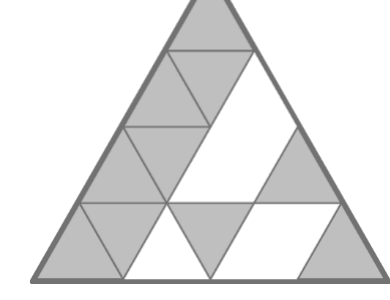
Bruno is filling a big triangle with little triangles. The grey ones are already in. The white spots are the holes still to fill.
You do not need the grey ones at all. Each hole needs one new triangle. So count the white holes.
Point at each white triangle and count out loud: 1, 2, 3, 4, 5, 6.
Bruno needs 6 more little triangles.
The grey ones are done. I only count what is still empty. Touch each white hole once so I do not skip one or count it twice.
Sides = corners, every time. Count one, and you know the other.
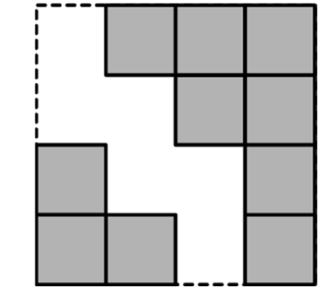
2025 · #4 Felix forms a square out of 16 small, grey tiles. He then removes some of the small tiles — see picture. How many small tiles did he remove?
Felix forms a square out of 16 small, grey tiles. He then removes some of the small tiles — see picture. How many small tiles did he remove?
Show answer
Show hints
Still stuck? Show hint 2 →
Still stuck? Show hint 3 →
Show solution
- The full square has 4 × 4 = 16 small tiles.
- Count the grey tiles still in place: there are 10 of them.
- Removed tiles = 16 − 10 = 6.
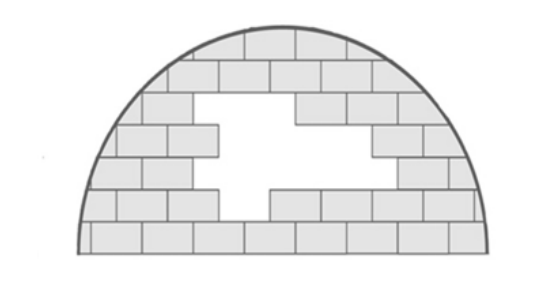
2017 · #3 How many blocks are missing in this igloo?
How many blocks are missing in this igloo?
Show answer
Show hints
Still stuck? Show hint 2 →
Show solution
- Look at the white hole in the brick dome.
- Count the missing bricks in each row that the hole passes through.
- Adding the gaps row by row gives 10 empty brick spaces.
- So 10 blocks are missing.
Folding to match
Take a butterfly. Fold it right down the middle. The two wings land on top of each other. They match!
Some shapes have a special line like that. Fold along it and the two halves cover each other exactly. That line is called the line of symmetry. Think of it as the fold line.
Fold this triangle down the dotted line. The left half drops right onto the right half.
Now look for fold lines on a square. A square is special. It has 4 different fold lines!
Two go straight across (up-down and side-to-side). Two go corner to corner. Each one makes the halves match.
If the two halves match when you fold, that line is a line of symmetry.
Peek: which letters fold?
Pretend the shape is paper. Ask: could I fold it so one half lands right on top of the other? If yes, that fold is a line of symmetry.
Not every line is a fold line. Test it in your head first: do the two halves really land on top of each other? A slanted line through a rectangle does not match. Only the straight middle lines do.
Tom wants to cut the pizza into two halves so that each half has the same number of tomatoes. There are two ways to do this. Along which lines can he cut?
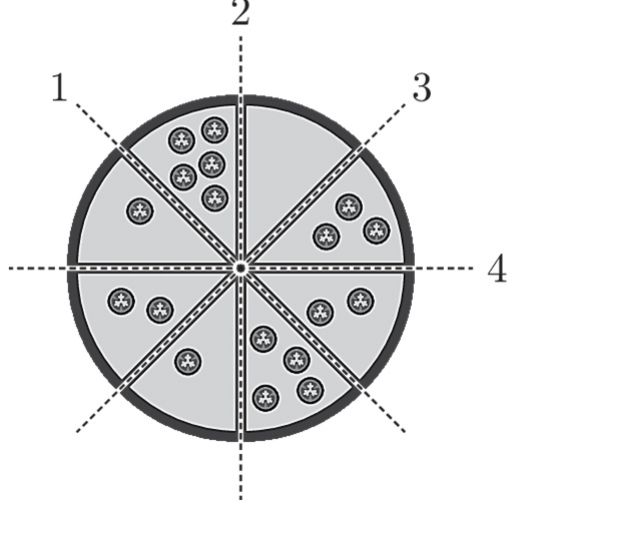
Tom wants to cut the pizza into two halves with the same number of tomatoes on each side.
This works the same way as folding. A good cut splits the pizza so each side has an equal share of tomatoes.
Look at the lines one at a time. For each one, count the tomatoes on the left, then count the tomatoes on the right.
Line 2: the two sides have the same number. It works. Line 4: same on both sides too. It works.
Lines 1 and 3 leave more tomatoes on one side. They do not work. So the two good cuts are 2 and 4.
I do not need a fancy middle line. I only need the same tomato count on each side. So I count one side, count the other, and compare.
Fold it. If the halves match, it is a line of symmetry.
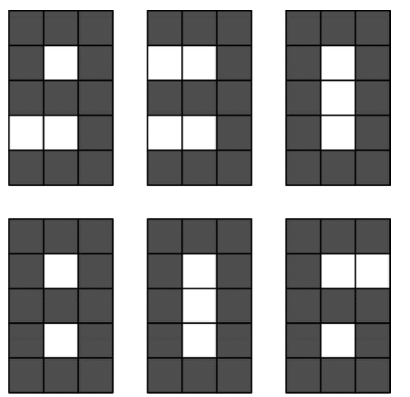
2009 · #4 In the picture you see the number 930. How many small squares must be changed so that the number becomes 806?
In the picture you see the number 930. How many small squares must be changed so that the number becomes 806?
Show answer
Show hints
Still stuck? Show hint 2 →
Still stuck? Show hint 3 →
Show solution
- Look at each digit on its own: 9 becomes 8, then 3 becomes 0, then 0 becomes 6.
- For the first digit, just one little square switches to turn the 9 into an 8.
- For the middle digit, two little squares switch to turn the 3 into a 0; for the last digit, three little squares switch to turn the 0 into a 6.
- Counting the switches: 1 + 2 + 3 = 6, so 6 small squares must be changed.
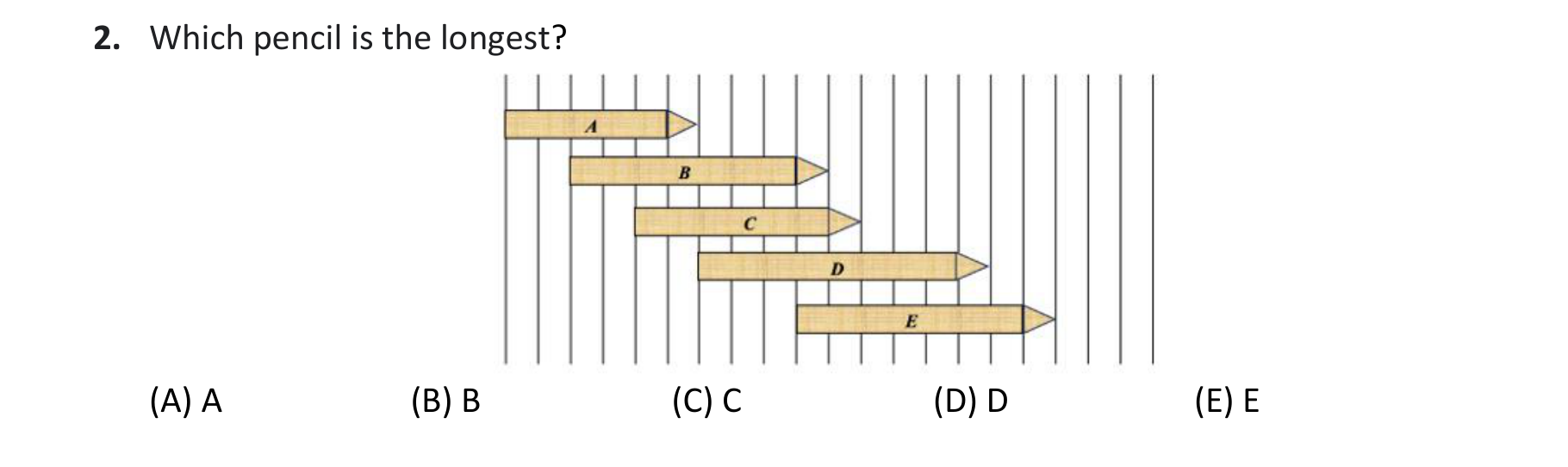
2024 · #2 Five pencils labelled A, B, C, D and E lie on a grid of lines. Which pencil is the longest?
Five pencils labelled A, B, C, D and E lie on a grid of lines. Which pencil is the longest?
Show answer
Show hints
Still stuck? Show hint 2 →
Still stuck? Show hint 3 →
Show solution
- The background lines are all the same distance apart, so we can count spaces to compare lengths.
- Count the spaces each pencil covers from its back end to its tip; pencil D reaches across more spaces than any other.
- So pencil D is the longest.
Quick check: shapes and folding
Two warm-ups. Count carefully, then find the matching halves.
2024 · #2 Five pencils labelled A, B, C, D and E lie on a grid of lines. Which pencil is the longest?
Five pencils labelled A, B, C, D and E lie on a grid of lines. Which pencil is the longest?
Show answer
Show hints
Still stuck? Show hint 2 →
Still stuck? Show hint 3 →
Show solution
- The background lines are all the same distance apart, so we can count spaces to compare lengths.
- Count the spaces each pencil covers from its back end to its tip; pencil D reaches across more spaces than any other.
- So pencil D is the longest.
2009 · #4 In the picture you see the number 930. How many small squares must be changed so that the number becomes 806?
In the picture you see the number 930. How many small squares must be changed so that the number becomes 806?
Show answer
Show hints
Still stuck? Show hint 2 →
Still stuck? Show hint 3 →
Show solution
- Look at each digit on its own: 9 becomes 8, then 3 becomes 0, then 0 becomes 6.
- For the first digit, just one little square switches to turn the 9 into an 8.
- For the middle digit, two little squares switch to turn the 3 into a 0; for the last digit, three little squares switch to turn the 0 into a 6.
- Counting the switches: 1 + 2 + 3 = 6, so 6 small squares must be changed.
Taller, shorter, and how much more
Two friends stand back to back to see who is taller. They line up their feet on the floor first. Then they look at the tops of their heads.
Shapes work the same way. To compare two shapes, line them up at the bottom. Then look at the tops.
Both blocks sit on the same line. The tall one pokes up higher. The bit poking up above the short one is how much taller it is.
To find that gap, do not add the two heights. Count up from the short top to the tall top. That count is the difference.
Fitting inside is the same idea. A small shape fits in a big one when it is both shorter and thinner. A coin fits in a cup. A little square fits in a big square.
Line the shapes up at the same bottom. Then count the steps from the short top up to the tall top. That gap is the difference.
Difference does not mean add. If you hear how much taller or how much more, you count the gap between the tops. You take the small away from the big.
The picture shows 2 mushrooms. What is the difference between their heights?
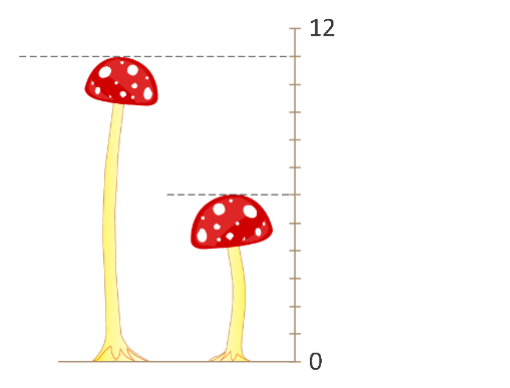
The picture shows two mushrooms. You want the difference between their heights.
Both mushrooms grow up from the ground, so they share the same bottom line. Good.
Read the tall mushroom on the scale: it reaches 11. Read the short one: it reaches 6.
Now count up from 6 to the tall top: 7, 8, 9, 10, 11. That is 5 steps. So the mushrooms differ by 5.
If I added 11 and 6 I would get 17, which is one of the wrong answers on purpose! Difference means the gap, so I count up from the small to the big.
Difference = how far apart the two tops are. Count the gap, do not add.
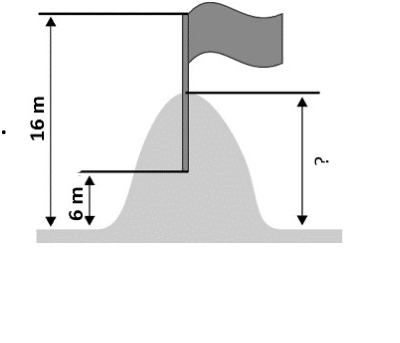
2019 · #11 The giants Tim and Tom build a sandcastle and decorate it with a flag. They push half the flagpole into the highest point of the...
The giants Tim and Tom build a sandcastle and decorate it with a flag. They push half the flagpole into the highest point of the sandcastle. The highest point of the flagpole is now 16 m above the floor, and the lowest is 6 m (see diagram). How high is the sandcastle?
Show answer
Show hints
Still stuck? Show hint 2 →
Show solution
- The pole's top is 16 m up and its bottom is 6 m up, so the pole is 16 − 6 = 10 m long.
- Half the pole (5 m) is buried in the castle, starting from its bottom at 6 m.
- So the sand reaches up to 6 + 5 = 11 m, which is the top of the castle.
- The answer is A.
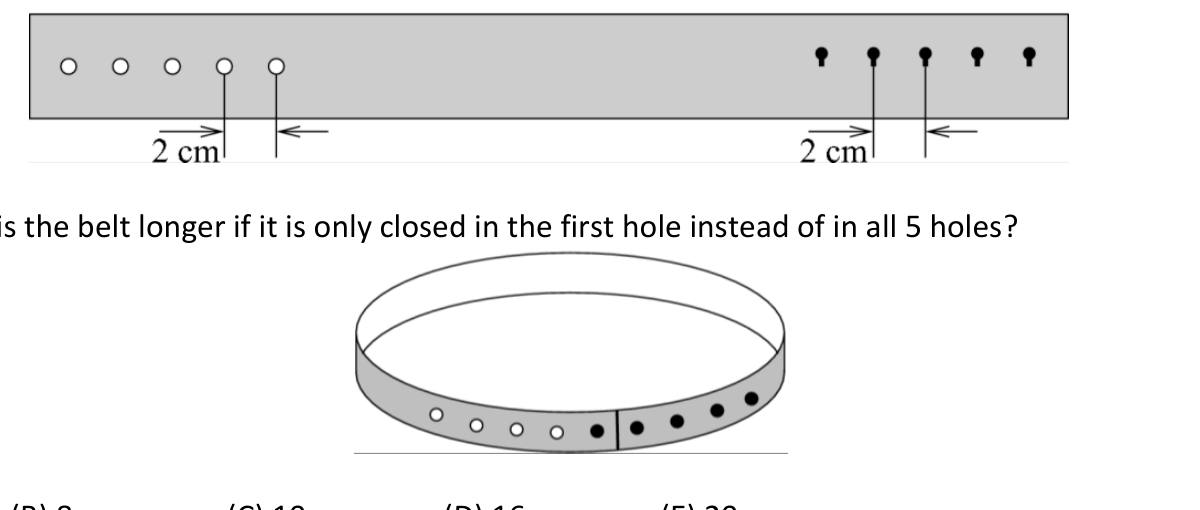
2018 · #21 A belt can be closed in 5 different holes (see picture). How many cm longer is the belt if it is closed in the first hole instead of in...
A belt can be closed in 5 different holes (see picture). How many cm longer is the belt if it is closed in the first hole instead of in the fifth (last) hole?
Show answer
Show hints
Still stuck? Show hint 2 →
Show solution
- The five holes are 2 cm apart, so the first and fifth holes are 4 × 2 = 8 cm apart.
- Closing in the first hole instead of the fifth leaves that extra 8 cm of belt.
- So the belt is 8 cm longer.
The walk around (perimeter)
A tiny ant walks all the way around a shape. It starts at one corner, follows every side, and comes back to where it began.
How far did the ant walk? That total is called the perimeter. It means the distance all the way around.
To find it, add up the length of every side.
Walk around this rectangle from the red dot. Add the sides: 6 + 4 + 6 + 4.
That is 6 + 4 = 10, and 10 + 10 = 20. The walk around is 20.
A square is easy. All four sides are the same. So add that one side four times. A square with side 5 has a walk of 5 + 5 + 5 + 5 = 20.
Perimeter is the steps all the way around. Add every side.
Peek (for big kids)
Start at one corner. Walk around and add each side as you pass it. Stop when you get back to the start.
Do not forget a side. Mark your starting corner with your finger so you know exactly when you have gone all the way around.
The length of a rectangle is 8 cm. The width is half as long. How long are the sides of a square that has the same perimeter as the rectangle?
The rectangle is 8 cm long. The width is half as long, so the width is 4 cm.
First walk around the rectangle. Add all four sides: 8 + 4 + 8 + 4 = 24.
Now we want a square with that same walk of 24. A square has 4 equal sides. So share 24 into 4 equal parts.
24 shared into 4 equal parts is 6. So each side of the square is 6 cm.
Same perimeter means same total walk. The rectangle walk is 24. A square has 4 equal sides, so each side is 24 shared by 4, which is 6.
Perimeter = add up every side. For a square, that is one side four times.
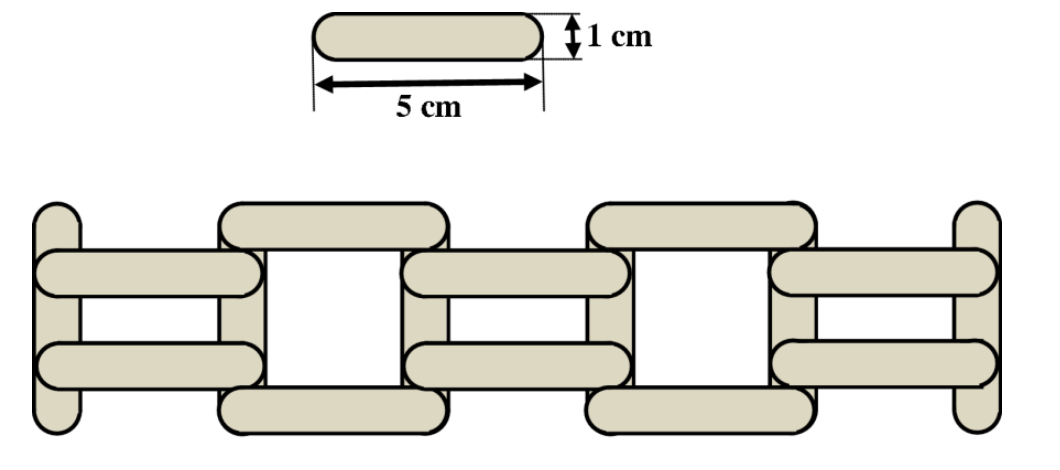
2018 · #14 Susi makes this pattern using ice-lolly sticks. Each stick is 5 cm long and 1 cm wide. How long is Susi's pattern?
Susi makes this pattern using ice-lolly sticks. Each stick is 5 cm long and 1 cm wide. How long is Susi's pattern?
Show answer
Show hints
Still stuck? Show hint 2 →
Still stuck? Show hint 3 →
Show solution
- Measure the pattern left to right: five 5 cm sticks reach across its length, which alone would be 5 × 5 = 25 cm.
- But the sticks cross and overlap at 4 places, and each overlap is 1 cm wide (a stick's width), so 4 cm is counted twice.
- Take those 4 cm away once: 25 − 4 = 21 cm.
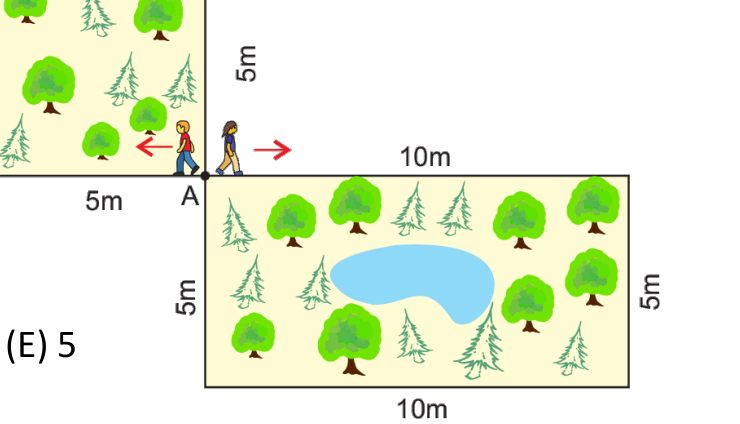
2022 · #21 Ahmed and Sara start at point A and walk in the directions shown, at the same speed. Ahmed walks around the square garden and Sara walks...
Ahmed and Sara start at point A and walk in the directions shown, at the same speed. Ahmed walks around the square garden and Sara walks around the rectangular garden. How many rounds must Ahmed walk to meet Sara at point A again for the first time?
Show answer
Show hints
Still stuck? Show hint 2 →
Still stuck? Show hint 3 →
Show solution
- Ahmed's square garden is 5 + 5 + 5 + 5 = 20 m around; Sara's rectangle is 10 + 5 + 10 + 5 = 30 m around.
- Ahmed is back at A after 20, 40, 60… metres; Sara is back at A after 30, 60, 90… metres.
- The first distance in both lists is 60 m, so that is when they meet at A again.
- Ahmed has gone 60 ÷ 20 = 3 laps, so he walks 3 rounds (choice C).
2019 · #18 Anna uses 32 small grey squares to frame a 7 cm by 7 cm big picture. How many small grey squares does she have to use to frame a 10 cm...
Anna uses 32 small grey squares to frame a 7 cm by 7 cm big picture. How many small grey squares does she have to use to frame a 10 cm by 10 cm big picture?
Show answer
Show hints
Still stuck? Show hint 2 →
Show solution
- Around the 7×7 picture, each side of the grey ring is 9 squares long (the 7 picture squares plus one corner at each end), and 4 sides of 9 with the 4 corners counted once give 32 — matching the picture.
- Around the 10×10 picture, each side of the ring is 12 squares long.
- Four sides of 12 is 48, but the 4 corners were each counted twice, so take 4 away: 48 − 4 = 44.
- So she needs 44 (C) grey squares.
Quick check: compare and walk around
Find a difference, then walk all the way around a shape.
2018 · #21 A belt can be closed in 5 different holes (see picture). How many cm longer is the belt if it is closed in the first hole instead of in...
A belt can be closed in 5 different holes (see picture). How many cm longer is the belt if it is closed in the first hole instead of in the fifth (last) hole?
Show answer
Show hints
Still stuck? Show hint 2 →
Show solution
- The five holes are 2 cm apart, so the first and fifth holes are 4 × 2 = 8 cm apart.
- Closing in the first hole instead of the fifth leaves that extra 8 cm of belt.
- So the belt is 8 cm longer.
2018 · #14 Susi makes this pattern using ice-lolly sticks. Each stick is 5 cm long and 1 cm wide. How long is Susi's pattern?
Susi makes this pattern using ice-lolly sticks. Each stick is 5 cm long and 1 cm wide. How long is Susi's pattern?
Show answer
Show hints
Still stuck? Show hint 2 →
Still stuck? Show hint 3 →
Show solution
- Measure the pattern left to right: five 5 cm sticks reach across its length, which alone would be 5 × 5 = 25 cm.
- But the sticks cross and overlap at 4 places, and each overlap is 1 cm wide (a stick's width), so 4 cm is counted twice.
- Take those 4 cm away once: 25 − 4 = 21 cm.
Counting little squares
A big rectangle can be built from little squares, like a chocolate bar or a window with panes.
You could count the little squares one by one. But that is slow and you might lose your place. Look at the rows instead.
This bar has 3 rows. Each row holds 4 little squares.
Skip-count, one jump for each row: 4, then 8, then 12. So there are 12 little squares.
Count one row, then skip-count once for each row. The last number is the total.
Peek (for big kids)
Cut an odd shape into easy pieces
Some shapes are not a neat rectangle. They bend, like a letter L or a set of stairs.
An odd shape is hard to count all at once. So do not try. Cut it into easy pieces first.
Draw a line that splits the shape into neat rectangles. Count each piece. Then add the pieces up.
This L is cut into two easy pieces. A tall part and a flat part.
Say the tall part holds 6 little squares and the flat part holds 8. Add them: 6 + 8 = 14 little squares in all.
Cut the odd shape into easy pieces. Count each piece. Add them up.
Count how many are in one row. Then skip-count, one jump for each row. The last number is the total.
Do not count the same square twice. Go row by row, neat and tidy. And when a row crosses a column, that shared corner square belongs to both, so count it only once.
The rectangle on the right has 4 rows and 7 columns, so it is made of 28 white squares. Ira paints 2 whole rows and 1 whole column. How many squares are still white?
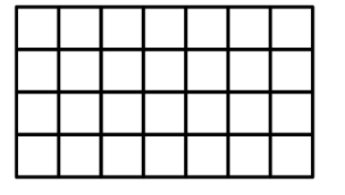
The rectangle has 4 rows and 7 columns, so 28 little white squares to start. The problem hands us that number.
Here is the light way: a square stays white only if its row was not painted and its column was not painted.
Ira paints 2 of the 4 rows, so 2 rows stay white. She paints 1 of the 7 columns, so 6 columns stay white.
The white squares fill those 2 leftover rows across those 6 leftover columns. Skip-count: 6, then 12. That is 12 white squares.
Counting the painted squares is messy, because the row and the column overlap. Counting the leftover white rows and columns avoids the overlap completely. 2 rows of 6 is 12.
Rows of equal size: count one row, then skip-count by that number for each row.
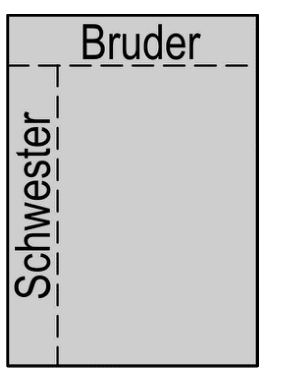
2009 · #10 Peter shared a bar of chocolate. First he broke off a row with five pieces for his brother. Then he broke off a column with 7 pieces for...
Peter shared a bar of chocolate. First he broke off a row with five pieces for his brother. Then he broke off a column with 7 pieces for his sister. How many pieces were there in the entire bar of chocolate?
Show answer
Show hints
Still stuck? Show hint 2 →
Show solution
- A row holds 5 pieces, so the bar is 5 columns wide.
- After removing that row, a full column still has 7 pieces, so the bar has 7 + 1 = 8 rows.
- The whole bar is 8 rows × 5 columns = 40 pieces.
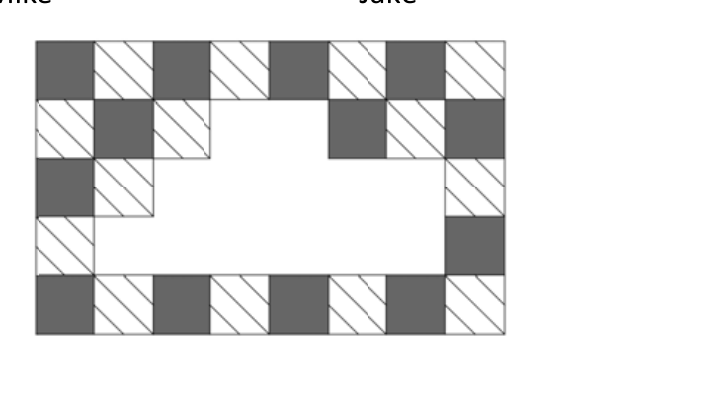
2012 · #7 A wall was tiled alternately with grey and striped tiles. Some tiles have fallen from the wall. How many grey tiles have fallen off?
A wall was tiled alternately with grey and striped tiles. Some tiles have fallen from the wall. How many grey tiles have fallen off?
Show answer
Show hints
Still stuck? Show hint 2 →
Show solution
- The tiles alternate grey/striped like a chessboard, so a square's colour is fixed by its position.
- There are 13 empty squares in the hole.
- Working through the checkerboard, 7 of the gaps sit on grey positions and 6 on striped positions.
- So 7 grey tiles fell off.
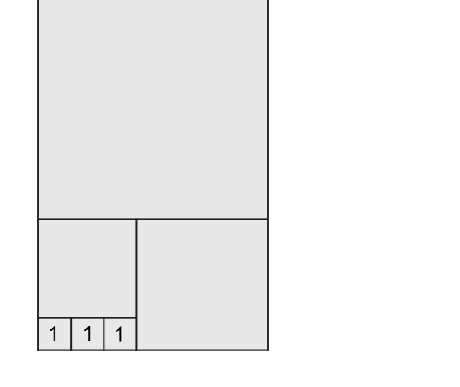
2018 · #17 The big rectangle is made up of several squares of different sizes. Each of the three smallest squares has area 1. What is the area of...
The big rectangle is made up of several squares of different sizes. Each of the three smallest squares has area 1. What is the area of the big rectangle?
Show answer
Show hints
Still stuck? Show hint 2 →
Still stuck? Show hint 3 →
Show solution
- Each smallest square has area 1, so its side is 1 step long; the three of them in a row make the bottom-left part 3 steps wide.
- The square sitting on top of those three is 3 steps on each side, and together with the row of tiny squares the left part is 3 + 1 = 4 steps tall; the square next to it is 4 steps on each side, so the bottom strip is 3 + 4 = 7 steps wide.
- The big square on top is as wide as the whole strip, 7 steps, so the rectangle is 7 steps wide and 4 + 7 = 11 steps tall, giving an area of 7 × 11 = 77, answer C.
Hidden shapes
Here is a fun one. How many squares can you see in this picture?
Most kids say 4. But look again!
There are 4 small squares. And the big outside square counts too. That is 5 squares, not 4.
The big one is made of the 4 little ones stuck together. It is easy to miss because it is hiding in plain sight.
So count in two passes:
- First pass: count the smallest shapes, one at a time.
- Second pass: hunt for bigger shapes made of smaller ones joined together.
Then add the two counts.
Big shapes hide inside little ones. Count the small ones, then hunt for the big ones, then add.
Count in two passes. First the smallest shapes. Then the bigger shapes built from joining small ones. Add the two counts together.
The trap is stopping after the small ones. Always ask: can I glue a few small ones into a bigger shape of the same kind? If yes, that is one more to count.
How many triangles can be seen in the picture on the right? (Be careful! A triangle can also be made by joining several smaller triangles together.)
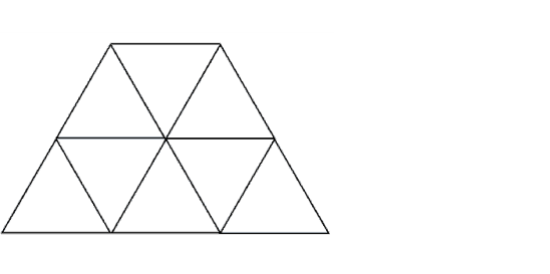
The question asks how many triangles you can see. The clue warns that a triangle can also be made by joining smaller ones. So we count in two passes.
First pass: point at each smallest triangle, one at a time. There are 6 of them. Count: 1, 2, 3, 4, 5, 6.
Second pass: now hunt for bigger triangles made of 2 or 3 small ones joined together. There are 4 of those. Keep counting: 7, 8, 9, 10.
Add the two passes: 6 small and 4 big. 6 + 4 = 10 triangles.
If I stop after the 6 little ones I get the trap answer. The clue is shouting at me to look for the big ones too. So I do a careful second pass before I answer.
Hidden shapes: count small, then count big, then add. Never stop after the little ones.
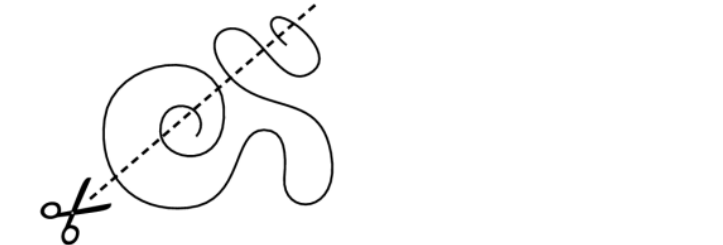
2017 · #2 Into how many pieces will the string be cut?
Into how many pieces will the string be cut?
Show answer
Show hints
Still stuck? Show hint 2 →
Show solution
- The string is one long curve, and the dashed line is one straight cut across it.
- Walk along the dashed line and count the dots where it crosses the string: there are 8 crossings.
- Each crossing makes one extra piece, so 8 crossings give 8 + 1 = 9 pieces.
- So the string is cut into 9 pieces.
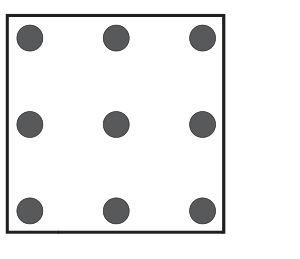
2015 · #22 In this square there are 9 dots. The distance between the points is always the same. You can draw a square by joining 4 points. How many...
In this square there are 9 dots. The distance between the points is always the same. You can draw a square by joining 4 points. How many different sizes can such squares have?
Show answer
Show hints
Still stuck? Show hint 2 →
Show solution
- On the 3-by-3 dots you can make a tiny straight square (1 step on each side) and a big straight square (2 steps on each side).
- You can also make a slanted square shaped like a diamond, joining the four middle dots of the edges.
- That is three squares of three different sizes.
- The answer is 3.
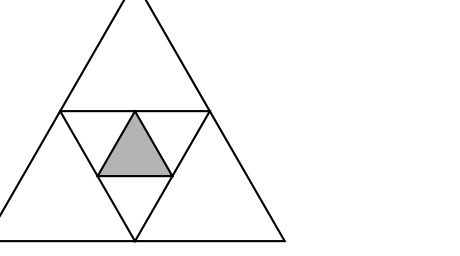
2013 · #20 If I join the midpoints of the sides of the large triangle in the picture, a small triangle is formed. If I join the midpoints of the...
If I join the midpoints of the sides of the large triangle in the picture, a small triangle is formed. If I join the midpoints of the sides of this small triangle, a tiny triangle is formed. How many of these tiny triangles can fit into the largest triangle at the same time?
Show answer
Show hints
Still stuck? Show hint 2 →
Still stuck? Show hint 3 →
Show solution
- Joining the midpoints cuts the big triangle into 4 equal small triangles.
- Doing it again cuts each of those small triangles into 4 tiny ones.
- That is 4 groups of 4 tiny triangles, so 4 × 4 = 16 fit in the big triangle, which is answer D.
Solid shapes
So far every shape was flat, like a drawing on paper. But real things are solid. You can hold them and turn them around.
Here are four solid shapes you already know:
- A cube is like a dice or a sugar lump. Every flat side is a square.
- A ball (sphere) is round all over, like a marble or an orange.
- A can (cylinder) has two flat circle ends and a round middle, like a soup tin.
- A cone is round at the bottom and points at the top, like an ice-cream cone or a party hat.
A flat side on a solid shape is called a face. To count faces, do the same as always: go slow and point.
A cube is the friendliest. It has 6 flat faces. Count them like this: front, back, top, bottom, left, right. Each one is a square.
A face is a flat side. Point and count the faces, one at a time, just like sides on a flat shape.
Peek: which solids roll?
A solid shape is one you can hold. A face is one of its flat sides. Count faces the same way you count sides on a flat shape: point at each one and say a number out loud.
Do not forget the faces hiding at the back. A cube shows 3 faces from the front, but 3 more hide behind. Turn it around in your head and count all 6.
Flat sides on a solid are called faces. A cube has 6 faces, all squares. Point and count, front to back.
Shapes & Sides: final test
Six problems, easy to medium. Go slow. Point with your finger and count.
2017 · #3 How many blocks are missing in this igloo?
How many blocks are missing in this igloo?
Show answer
Show hints
Still stuck? Show hint 2 →
Show solution
- Look at the white hole in the brick dome.
- Count the missing bricks in each row that the hole passes through.
- Adding the gaps row by row gives 10 empty brick spaces.
- So 10 blocks are missing.
2021 · #2 The picture shows 2 mushrooms. What is the difference between their heights?
The picture shows 2 mushrooms. What is the difference between their heights?
Show answer
Show hints
Still stuck? Show hint 2 →
Still stuck? Show hint 3 →
Show solution
- The taller mushroom is 11 tall and the shorter mushroom is 6 tall.
- To see how much taller, take away: 11 − 6 = 5.
- So their heights differ by 5.
2024 · #3 The rectangle on the right has 4 rows and 7 columns, so it is made of 28 white squares. Ira paints 2 whole rows and 1 whole column. How...
The rectangle on the right has 4 rows and 7 columns, so it is made of 28 white squares. Ira paints 2 whole rows and 1 whole column. How many squares are still white?
Show answer
Show hints
Still stuck? Show hint 2 →
Still stuck? Show hint 3 →
Show solution
- A square stays white only when both its row and its column are unpainted.
- Ira paints 2 of the 4 rows, so 2 rows stay white; she paints 1 of the 7 columns, so 6 columns stay white.
- The white squares fill those 2 leftover rows across those 6 leftover columns: 2 × 6 = 12.
- So 12 (C) squares are still white.
2009 · #13 The length of a rectangle is 8 cm. The width is half as long. How long are the sides of a square that has the same perimeter as the rectangle?
The length of a rectangle is 8 cm. The width is half as long. How long are the sides of a square that has the same perimeter as the rectangle?
Show answer
Show hints
Still stuck? Show hint 2 →
Show solution
- The rectangle is 8 cm long and half as wide, so 4 cm wide.
- Its perimeter is 2 × (8 + 4) = 24 cm.
- A square with perimeter 24 cm has side 24 ÷ 4 = 6 cm.
- So the square's side is 6 cm.
2009 · #10 Peter shared a bar of chocolate. First he broke off a row with five pieces for his brother. Then he broke off a column with 7 pieces for...
Peter shared a bar of chocolate. First he broke off a row with five pieces for his brother. Then he broke off a column with 7 pieces for his sister. How many pieces were there in the entire bar of chocolate?
Show answer
Show hints
Still stuck? Show hint 2 →
Show solution
- A row holds 5 pieces, so the bar is 5 columns wide.
- After removing that row, a full column still has 7 pieces, so the bar has 7 + 1 = 8 rows.
- The whole bar is 8 rows × 5 columns = 40 pieces.
2022 · #21 Ahmed and Sara start at point A and walk in the directions shown, at the same speed. Ahmed walks around the square garden and Sara walks...
Ahmed and Sara start at point A and walk in the directions shown, at the same speed. Ahmed walks around the square garden and Sara walks around the rectangular garden. How many rounds must Ahmed walk to meet Sara at point A again for the first time?
Show answer
Show hints
Still stuck? Show hint 2 →
Still stuck? Show hint 3 →
Show solution
- Ahmed's square garden is 5 + 5 + 5 + 5 = 20 m around; Sara's rectangle is 10 + 5 + 10 + 5 = 30 m around.
- Ahmed is back at A after 20, 40, 60… metres; Sara is back at A after 30, 60, 90… metres.
- The first distance in both lists is 60 m, so that is when they meet at A again.
- Ahmed has gone 60 ÷ 20 = 3 laps, so he walks 3 rounds (choice C).
Quick reference
- Sides = corners. Always the same number.
- Fold line: the two halves match when you fold.
- Difference: count the gap between the tops. Do not add.
- Perimeter: the walk all the way around. Add every side.
- Little squares: count one row, then skip-count for each row.
- Hidden shapes: count small, then count big, then add.