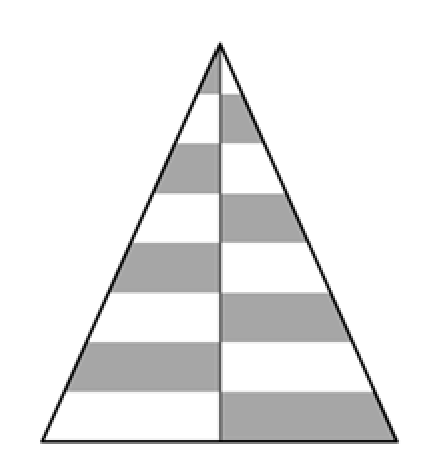
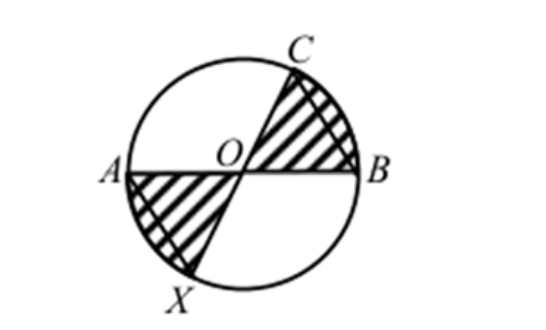
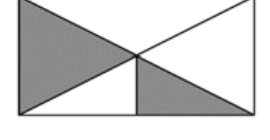
The diagram shows an isosceles triangle, where the height is marked and its area is split up into equally wide white and grey stripes. Which fraction of the area of the triangle is white?
Show answer
Answer: A — 12
Show hints
Hint 1 of 2
The height line splits the triangle into a left and right half — compare a grey stripe with the white stripe right next to it.
Still stuck? Show hint 2 →
Hint 2 of 2
By the symmetry of the picture, each grey region can be paired with an equal white region.
Show solution
Approach: pair equal regions by symmetry
The triangle is cut into equal-width horizontal stripes, and the marked height splits it down the middle.
On one side the stripes are white where the other side is grey, so each grey patch is matched by an equal-area white patch.
The white and grey areas are therefore equal, so the white part is 1/2 of the triangle.
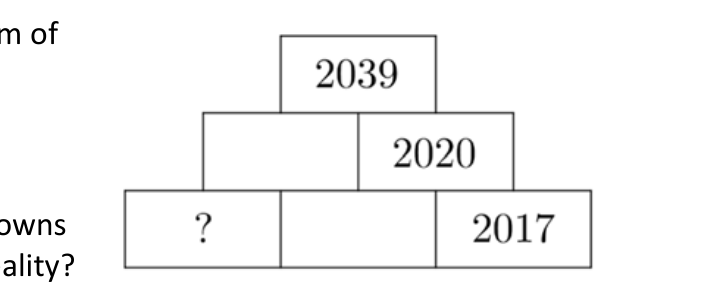
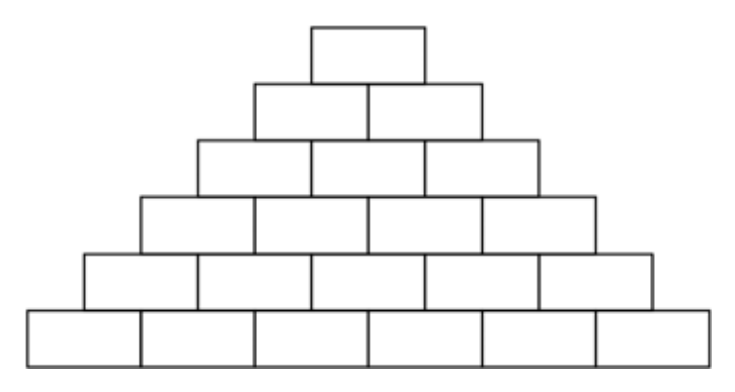
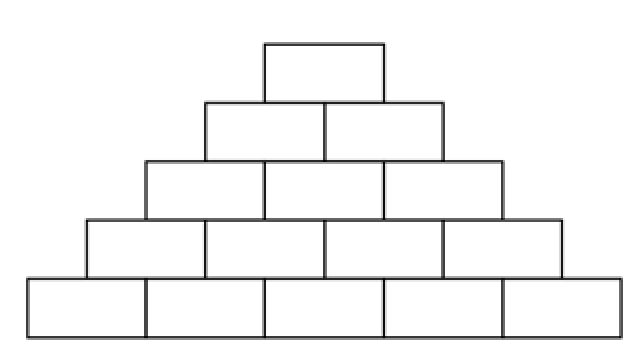
On the number wall shown, the number on each tile is equal to the sum of the numbers on the two tiles directly below it. Which number is on the tile marked with “?”
Show answer
Answer: B — 16
Show hints
Hint 1 of 2
The top tile equals the sum of everything fed up from the bottom; write each tile from the bottom two unknowns.
Still stuck? Show hint 2 →
Hint 2 of 2
Use the known tiles 2020 and 2017 to pin down the bottom values first, then read off the marked tile.
Show solution
Approach: set up the wall from the bottom two unknown tiles and use the known tiles
Call the two leftmost bottom tiles a (the marked one) and b; the bottom row is a, b, 2017.
The middle-right tile is b + 2017 = 2020, so b = 3.
The top tile is a + 2b + 2017 = 2039, so a + 2b = 22, giving a = 22 - 6 = 16.
Peter writes the word KANGAROO on a see-through piece of glass, as seen on the right. What can he see when he first flips over the glass onto its back along the right-hand side edge and then turns it about 180° while it is lying on the table?
Show answer
Answer: E
Show hints
Hint 1 of 2
Flipping the glass over its right edge mirrors the writing left–right.
Still stuck? Show hint 2 →
Hint 2 of 2
Track what happens to both the order of the letters and whether each letter looks reversed.
Show solution
Approach: apply the flip then the half-turn to the see-through word
Flipping the glass over its right-hand edge reverses the writing left–right, like a mirror image.
Turning it 180° flat on the table then rotates that mirrored word a half turn.
Carrying out both moves on KANGAROO gives the image shown in choice E.
Many model railways use the H0-scale 1:87. For his railway, Benjamin owns a 2 cm high model of his brother in H0-scale. How tall is his brother in reality?
Show answer
Answer: A — 1.74 m
Show hints
Hint 1 of 2
The scale 1:87 means every real centimetre is shrunk 87 times in the model.
Still stuck? Show hint 2 →
Hint 2 of 2
Multiply the model height by 87 to undo the shrinking, then convert to metres.
Show solution
Approach: scale up by the ratio
The model is 2 cm tall and the scale is 1:87, so the real height is 2 x 87 = 174 cm.
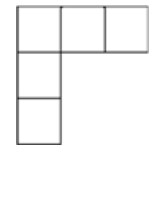
Anna has four identical building blocks that each look like the one shown (a straight strip of three squares). Which of the shapes in the options can she not form with them?
Show answer
Answer: E
Show hints
Hint 1 of 2
Each block covers three squares in a straight line; four of them cover twelve squares.
Still stuck? Show hint 2 →
Hint 2 of 2
A shape can be built only if it can be cut into straight 1×3 pieces — try tiling each one.
Show solution
Approach: tile each shape with straight triominoes
The block is a straight strip of three squares, so four blocks cover 12 squares total.
Each pictured shape has 12 squares, so the test is whether it splits into four straight 1×3 strips.
Four of the shapes can be cut into such strips; the remaining one cannot be tiled this way.
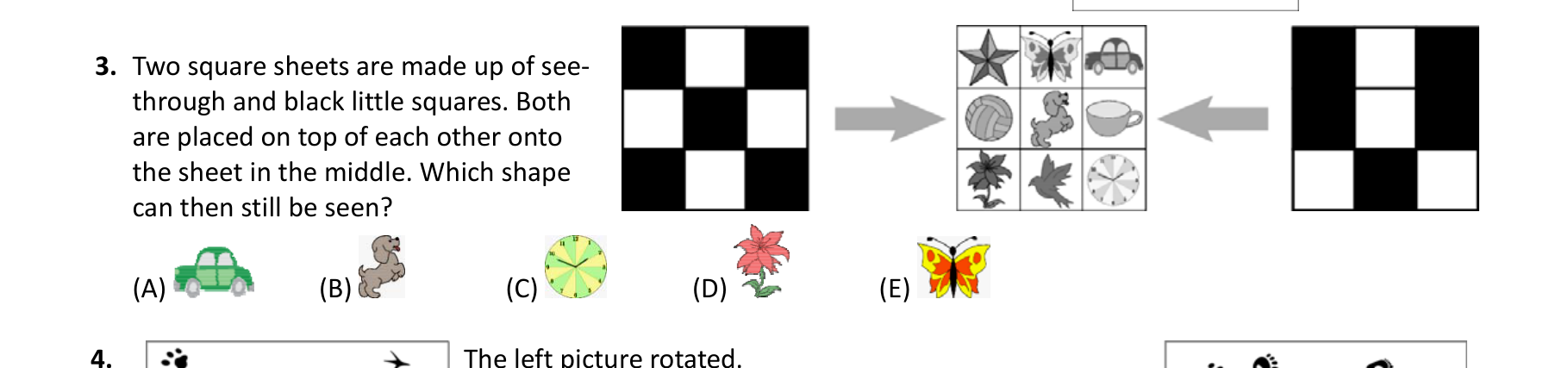
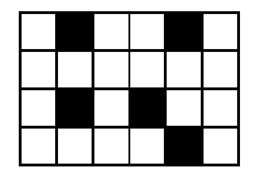
Two square sheets are made up of see-through and black little squares. Both are placed on top of each other onto the sheet in the middle. Which shape can then still be seen?
Show answer
Answer: E
Show hints
Hint 1 of 2
A picture is visible only where BOTH sheets are see-through over that cell.
Still stuck? Show hint 2 →
Hint 2 of 2
Find the one cell that is clear (white) on the left sheet AND clear on the right sheet.
Show solution
Approach: a shape shows only through a cell that is transparent on both sheets
Lay the two patterns on top of each other, cell by cell, over the middle sheet.
A cell stays see-through only when BOTH sheets are clear there; if either sheet has a black square, that cell is blocked.
Colour in every cell that is black on either sheet, and the cells still see-through show the picture.
Angelika crafts a piece of jewellery out of two grey and two white stars. The stars have areas of 1 cm², 4 cm², 9 cm² and 16 cm² respectively. She places the stars on top of each other as shown in the diagram and glues them together. How big is the total area of the visible grey parts?
Show answer
Answer: B — 10 cm²
Show hints
Hint 1 of 2
The stars are stacked biggest at the back, smallest in front.
Still stuck? Show hint 2 →
Hint 2 of 2
A grey star only shows the ring left after the next (smaller) star covers its middle.
Show solution
Approach: subtract each covering star from the grey star beneath it
Stacked back to front the areas are 16, 9, 4, 1; colours alternate grey, white, grey, white.
The grey 16-star shows everything except where the white 9-star sits: 16 − 9 = 7.
The grey 4-star shows everything except the white 1-star on top: 4 − 1 = 3.
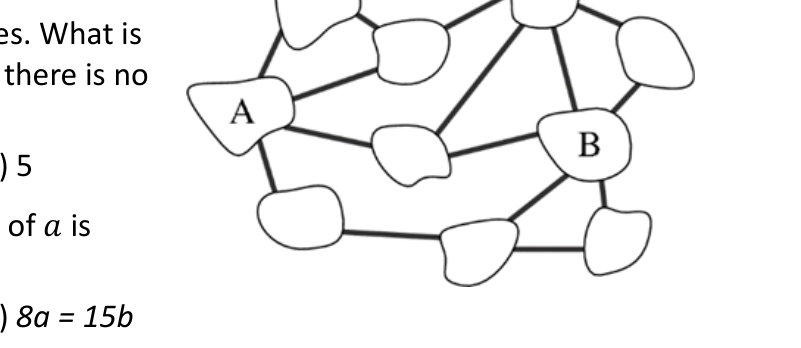
In the diagram we see 10 islands that are connected by 15 bridges. What is the minimum number of bridges that need to be closed off so that there is no longer any connection from A to B?
Show answer
Answer: C — 3
Show hints
Hint 1 of 2
You want the fewest bridges whose removal leaves no path at all from A to B.
Still stuck? Show hint 2 →
Hint 2 of 2
Look for a bottleneck: the smallest set of bridges that every A-to-B route must use.
Show solution
Approach: find a minimum cut (smallest bottleneck of bridges) separating A from B
Every route from A to B has to cross a narrow set of bridges.
Trace the routes and find the smallest group of bridges that all of them share.
Removing that bottleneck of 3 bridges disconnects A from B, and no smaller set works.
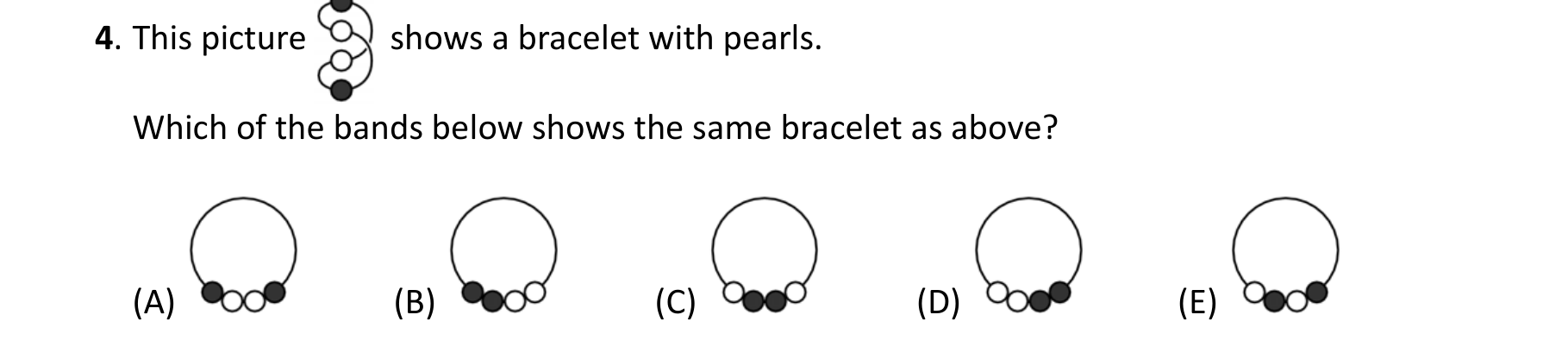
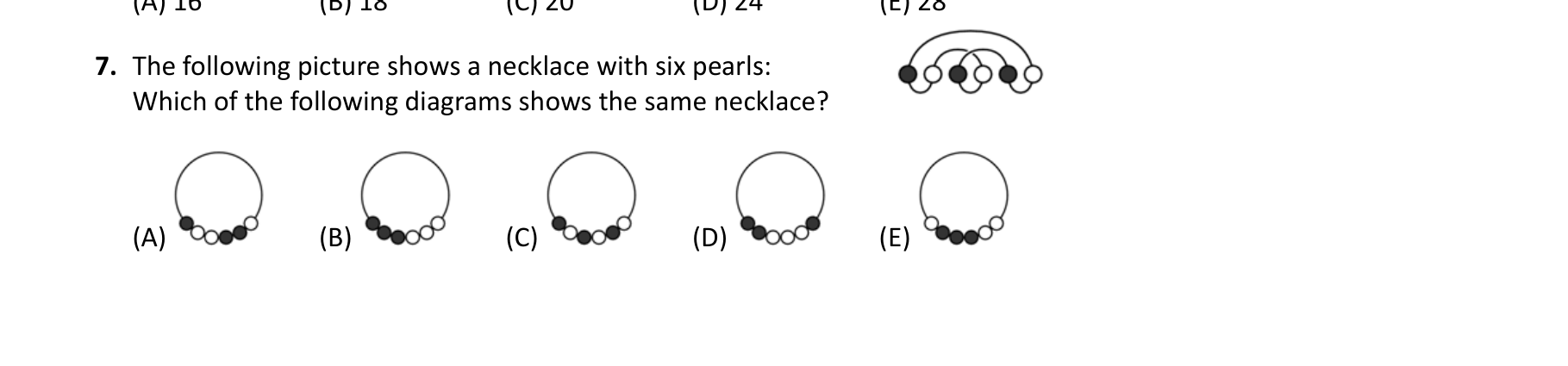
This picture shows a bracelet with pearls. Which of the bands below shows the same bracelet as above? (The five bands are shown as choices A, B, C, D, E.)
Show answer
Answer: E
Show hints
Hint 1 of 2
The bracelet is a ring, so it does not matter which pearl you start counting from.
Still stuck? Show hint 2 →
Hint 2 of 2
Say the colours out loud going around the ring, then find the band that matches when it is wrapped into the same ring.
Show solution
Approach: read the pearls around the ring
The bracelet is a closed ring of pearls. Say their colours out loud going around it.
When you cut a ring open into a straight band, you can start at any pearl, so the band can begin in a different place but the order of colours stays the same.
Check each band: does it have the same colours in the same going-around order?
Maria has 24 Euros. Each of her 3 sisters has 12 Euros. How much does she have to give to each sister so that all four of them have the same amount of Euros?
Show answer
Answer: C — 3
Show hints
Hint 1 of 2
First find what amount everyone should end up with.
Still stuck? Show hint 2 →
Hint 2 of 2
Maria's gift is split equally among the three sisters.
Show solution
Approach: equalise the total, then see how much each sister needs
Total money = 24 + 3 × 12 = 60 Euros, so each of the four should have 60 ÷ 4 = 15.
Maria must drop from 24 to 15, giving away 9 Euros in all.
Shared equally among 3 sisters, that is 9 ÷ 3 = 3 each, choice C.
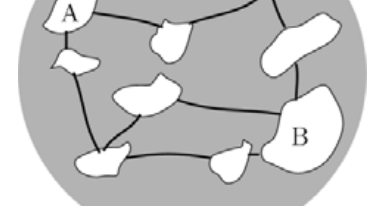
Ten islands are joined by 12 bridges (see the map). Every bridge is open. What is the least number of bridges that must be closed so that it is impossible to travel from island A to island B?
Show answer
Answer: B — 2
Show hints
Hint 1 of 2
You want to cut the fewest bridges so no path of open bridges remains from A to B.
Still stuck? Show hint 2 →
Hint 2 of 2
Look for a bottleneck: the smallest set of bridges whose removal disconnects A from B.
Show solution
Approach: find the minimum cut between A and B
Closing bridges blocks A from B only when every route between them is broken.
Search the map for the narrowest bottleneck — the fewest bridges lying on all A–B routes.
Removing those two bridges cuts every path between A and B, and one bridge is never enough.
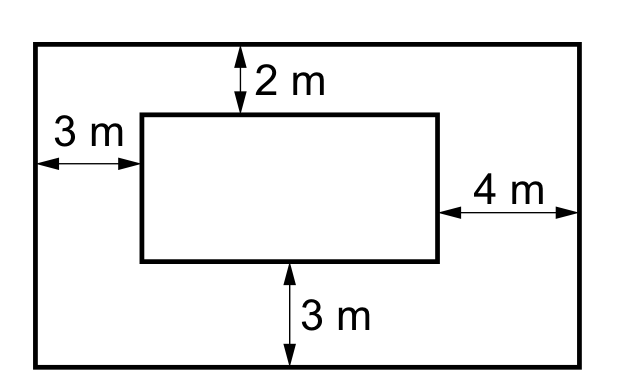
The diagram shows two rectangles whose sides are parallel to each other. By how much is the perimeter of the bigger rectangle greater than the perimeter of the smaller rectangle?
Show answer
Answer: E — 24 m
Show hints
Hint 1 of 2
Perimeter depends only on width plus height, doubled — where the smaller rectangle sits doesn't matter.
Still stuck? Show hint 2 →
Hint 2 of 2
Find each rectangle's width and height from the labelled pieces.
Show solution
Approach: compare total width+height of each rectangle
Perimeter = 2 × (width + height), so only how much wider and taller the big rectangle is matters, not where the small one sits.
The labelled gaps show the big rectangle is wider by 2 m + 4 m = 6 m and taller by 3 m + 3 m = 6 m, a total extra of 12 m in width-plus-height.
The perimeter difference is twice that: 2 × 12 = 24 m.
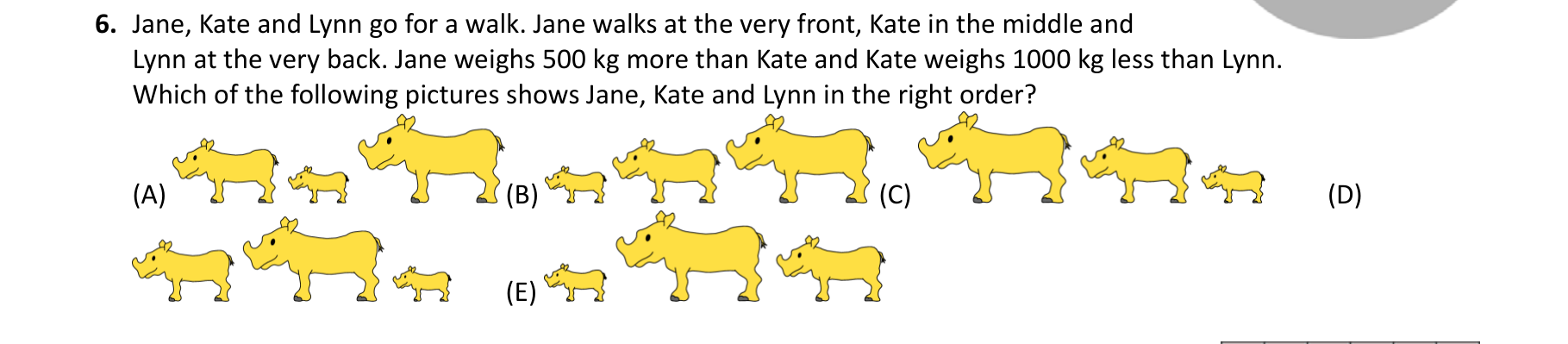
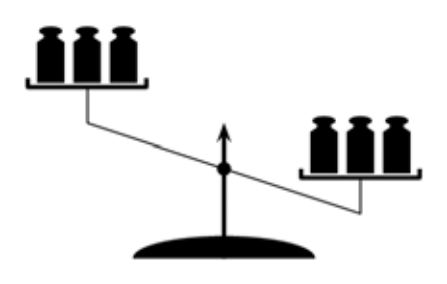
Jane, Kate and Lynn go for a walk. Jane walks at the very front, Kate in the middle and Lynn at the very back. Jane weighs 500 kg more than Kate, and Kate weighs 1000 kg less than Lynn. Which of the pictures shows Jane, Kate and Lynn in the right order?
Show answer
Answer: A
Show hints
Hint 1 of 2
Turn the weight clues into an order: who is heaviest and who is lightest?
Still stuck? Show hint 2 →
Hint 2 of 2
Jane is heavier than Kate, and Lynn is heavier still, so rank all three, then match the picture's front-to-back sizes.
Show solution
Approach: order the three by weight, then match to the row
Jane = Kate + 500 and Lynn = Kate + 1000, so Lynn is heaviest, Jane is in the middle, Kate is lightest.
Walking order is Jane (front), Kate (middle), Lynn (back).
So the picture must show, front to back, a medium animal, then the smallest, then the largest.
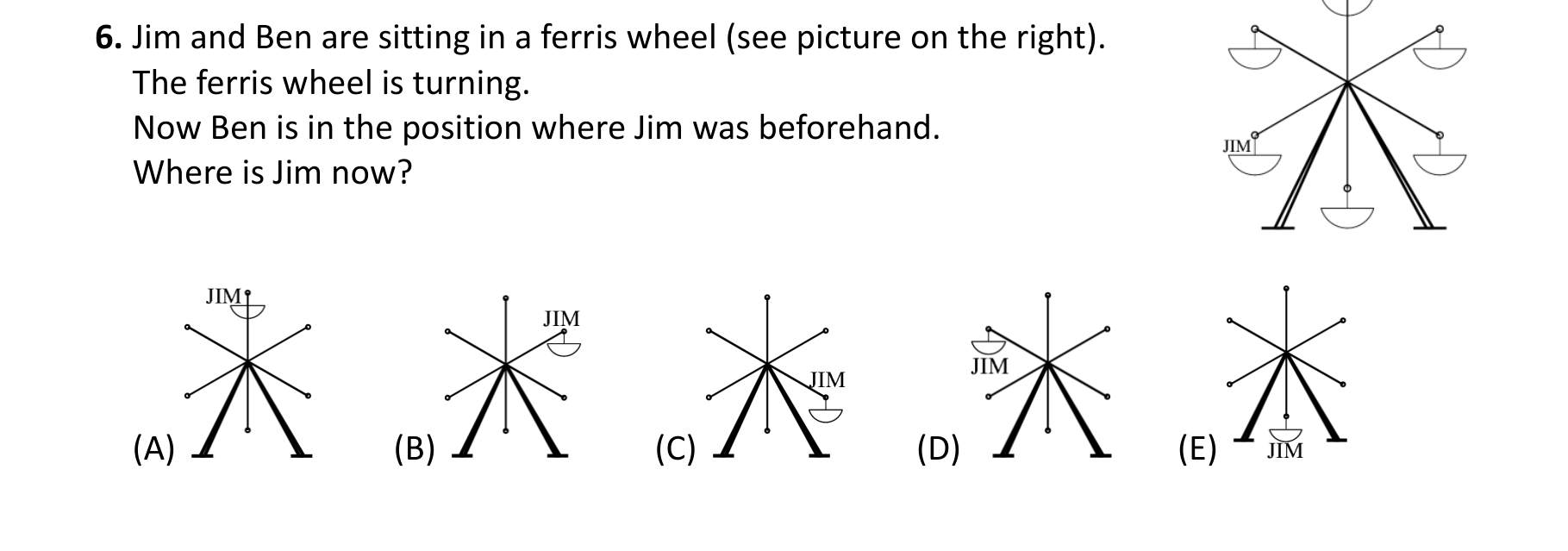
Jim and Ben are sitting in a ferris wheel (see picture on the right). The ferris wheel is turning. Now Ben is in the position where Jim was beforehand. Where is Jim now? (The five positions are shown as choices A, B, C, D, E.)
Show answer
Answer: C
Show hints
Hint 1 of 2
The whole wheel turns together, so every seat slides the same number of spots around.
Still stuck? Show hint 2 →
Hint 2 of 2
See how far Ben moved to reach Jim's old seat, then slide Jim that same amount in that same direction.
Show solution
Approach: rotate every seat by the same step
Ben moved into the seat Jim used to occupy, so the wheel rotated by exactly one seat-gap.
Jim's seat rotates by that same gap in the same direction.
Logic & Word ProblemsArithmetic & Operationsoff-by-one
Some girls are standing in a circle. The teacher makes them do a headcount. Bianca says one, her neighbour says two and so on. If they count in a clockwise direction, Antonia says six. If they count in an anticlockwise direction, Antonia says nine. How many girls are forming the circle?
Show answer
Answer: C — 13
Show hints
Hint 1 of 2
Count the gap from Bianca to Antonia each way around the circle.
Still stuck? Show hint 2 →
Hint 2 of 2
Going clockwise and anticlockwise covers the whole circle once.
Show solution
Approach: add the two arc-gaps to get the total around the circle
Clockwise, Antonia is number 6, so she is 5 girls along from Bianca.
Anticlockwise she is number 9, so she is 8 girls along the other way.
The two arcs together go right round the circle: 5 + 8 = 13 girls, choice C.
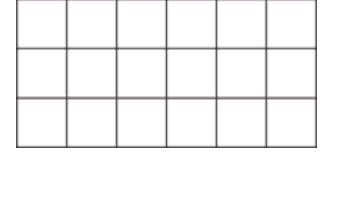
Max colours the squares of the grid so that one third of all the squares are blue and one half are yellow. He colours the rest red. How many squares does he colour red?
Show answer
Answer: C — 3
Show hints
Hint 1 of 2
First count the squares in the grid, then find a third of them and a half of them.
Still stuck? Show hint 2 →
Hint 2 of 2
Red = total minus the blue third minus the yellow half.
Show solution
Approach: take fractions of the total square count
The grid is 3 by 6, so there are 18 squares.
One third are blue: 18÷3 = 6 squares; one half are yellow: 18÷2 = 9 squares.
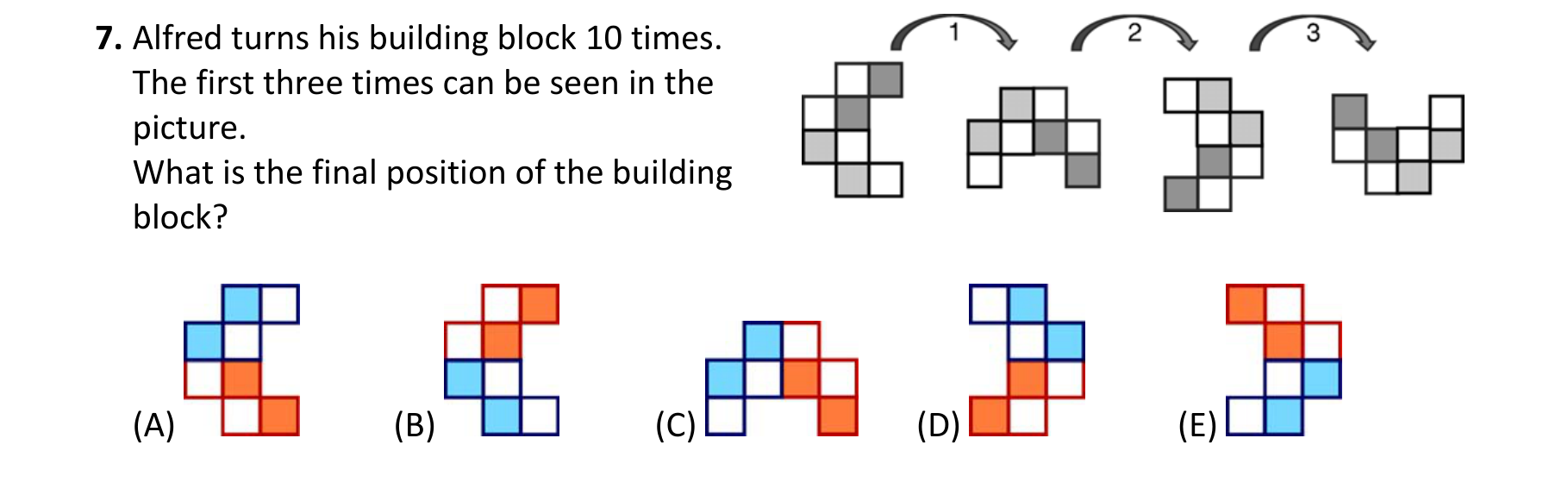
Alfred turns his building block 10 times. The first three times can be seen in the picture. What is the final position of the building block? (The five positions are shown as choices A, B, C, D, E.)
Show answer
Answer: D
Show hints
Hint 1 of 2
Look at the first three pictures and notice that every turn is the same little turn.
Still stuck? Show hint 2 →
Hint 2 of 2
The block goes back to looking the same after a few turns, so find that repeat and see where turn 10 lands.
Show solution
Approach: follow the repeating turn up to turn 10
Each turn is the same. After it keeps turning, the block comes back to the very first picture every 4 turns.
Count by fours: turn 4 and turn 8 both look like the start.
Two more turns after turn 8 (turn 9, then turn 10) match the second and third pictures.
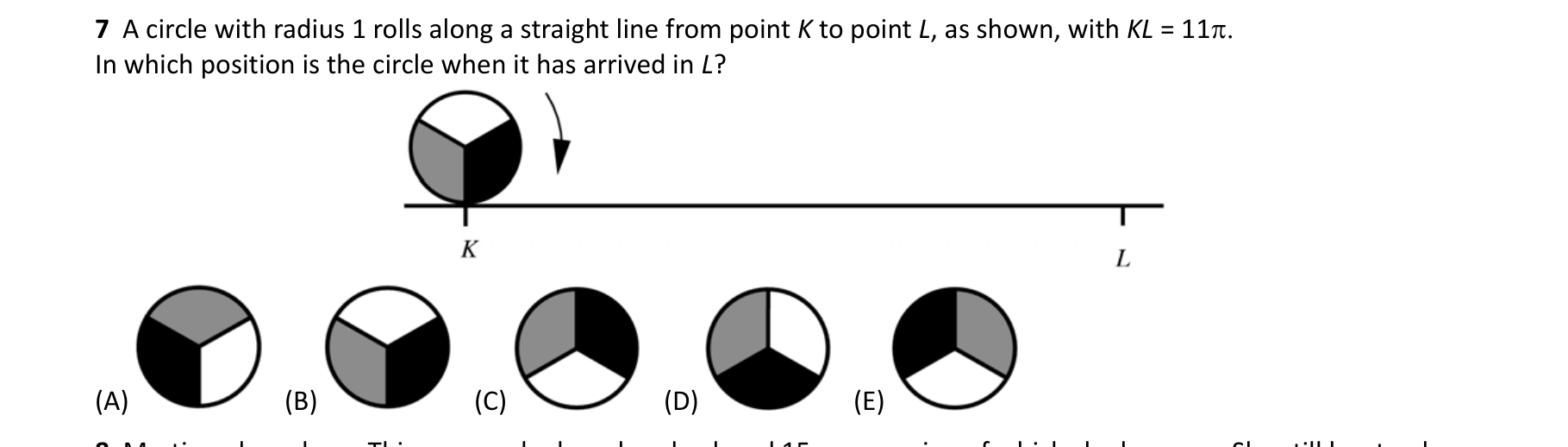
A circle with radius 1 rolls along a straight line from point K to point L, as shown, with \(KL = 11\pi\). In which position is the circle when it has arrived in L?
Show answer
Answer: E
Show hints
Hint 1 of 2
How many full turns does the circle make over a length of 11π?
Still stuck? Show hint 2 →
Hint 2 of 2
Its circumference is 2π, so see how much of an extra turn is left over.
Show solution
Approach: count revolutions, then read off the leftover part-turn
A radius-1 circle has circumference 2π, so over 11π it makes 11π ÷ 2π = 5.5 turns.
The half turn left over flips the shaded pattern to the opposite side compared with the start.
Reading off the resulting orientation gives choice E.
A \(4 \times 1 \times 1\) cuboid is made up of 2 white and 2 grey cubes as shown. Which of the following cuboids can be built entirely out of such \(4 \times 1 \times 1\) cuboids?
Show answer
Answer: A
Show hints
Hint 1 of 2
Each building block is a 4x1x1 bar with a fixed white-white-grey-grey colour pattern.
Still stuck? Show hint 2 →
Hint 2 of 2
A target box can be built only if its grey and white cubes split into such fixed bars; check the colour layout, not just the shape.
Show solution
Approach: check which target colouring can be partitioned into the fixed WWGG bars
Every available bar is 4 cubes long with colours white, white, grey, grey in that order.
Try to cover each candidate box with these bars so that every bar's colour pattern matches.
Only box A has a colour layout that can be cut entirely into such WWGG bars.
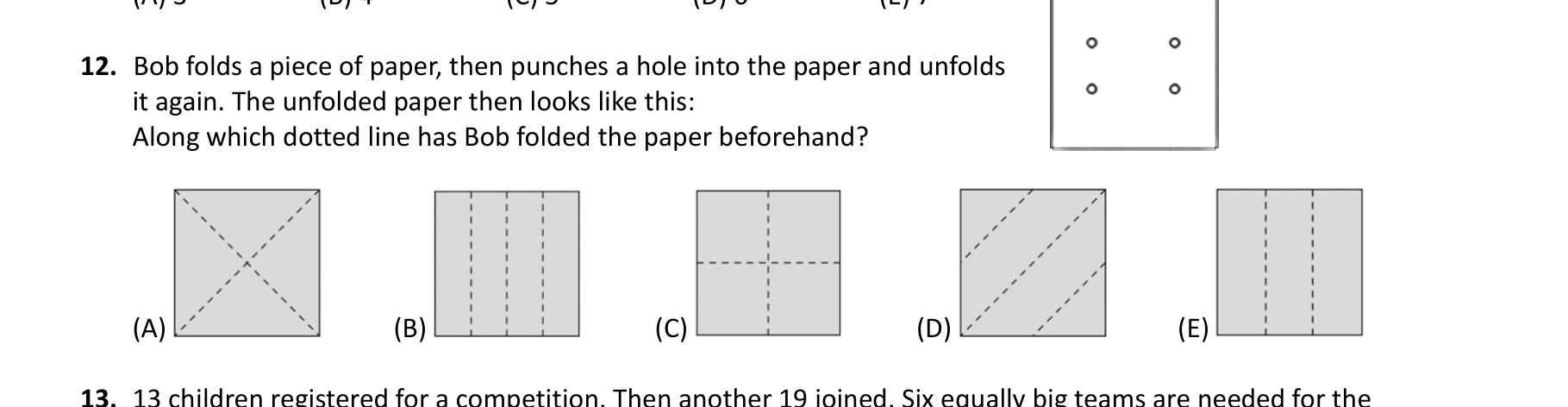
Bob folds a piece of paper, then punches a hole in it and unfolds it again. The unfolded paper then looks like the picture. Along which dotted line did Bob fold the paper?
Show answer
Answer: D
Show hints
Hint 1 of 2
Unfolding mirrors the punched holes across each fold line, so the holes are symmetric about that line.
Still stuck? Show hint 2 →
Hint 2 of 2
Find the line that the four-hole pattern is symmetric across — that was the fold.
Show solution
Approach: match the hole pattern's symmetry to the fold line
A punch through folded paper leaves holes that are mirror images across the fold crease.
Look at the four holes in the unfolded sheet and find the line they are symmetric about.
The holes balance across the diagonal shown in (D).
In which picture are there half as many circles as triangles and twice as many squares as triangles? (The five pictures are shown as choices A, B, C, D, E.)
Show answer
Answer: E
Show hints
Hint 1 of 2
For each picture, count the circles, the triangles, and the squares.
Still stuck? Show hint 2 →
Hint 2 of 2
You want the triangles to be in the middle: half as many circles, and double as many squares.
Show solution
Approach: count the shapes in each picture
Count the three kinds of shape in each picture.
We need a picture where the circles are the small group, the triangles are double the circles, and the squares are double the triangles.
For example 1 circle, 2 triangles, 4 squares fits: circles are half the triangles and squares are twice the triangles.
Martina plays chess. This season she has already played 15 games, nine of which she has won. She still has to play 5 more games. How high is her win rate at the end of the season if she wins all remaining games?
Show answer
Answer: C — 70 %
Show hints
Hint 1 of 2
First find the final number of wins and the total games played.
Still stuck? Show hint 2 →
Hint 2 of 2
Win rate is wins divided by total games, as a percent.
Show solution
Approach: add the wins and games, then convert to a percent
If she wins all 5 remaining games she has 9 + 5 = 14 wins.
Petra crafts a piece of jewellery out of two black and two white hearts. The hearts have areas of 1 cm², 4 cm², 9 cm² and 16 cm² respectively. She places the hearts on top of each other as shown in the diagram and glues them together. How big is the total area of the visible black parts?
Show answer
Answer: B — 10 cm²
Show hints
Hint 1 of 2
The hearts are stacked biggest to smallest, with black and white alternating.
Still stuck? Show hint 2 →
Hint 2 of 2
Visible black = big black minus the white on top, plus the next black, and so on.
Show solution
Approach: alternating sum of areas
Stacking areas 16, 9, 4, 1 with alternating colours, the visible black equals 16 − 9 + 4 − 1.
Which quadrant contains no points of the graph of the linear function \(f(x) = -3.5x + 7\)? (Quadrants are numbered I, II, III, IV anticlockwise, starting from the upper right.)
Show answer
Answer: C — III
Show hints
Hint 1 of 2
A line with negative slope and positive y-intercept rises to the upper left and falls to the lower right.
Still stuck? Show hint 2 →
Hint 2 of 2
Sketch where the line goes: which of the four quadrants does it simply never enter?
Show solution
Approach: trace the line by slope and intercept across the quadrants
f(x) = -3.5x + 7 has y-intercept (0,7) and x-intercept (2,0).
For x < 2 the line is above the x-axis (quadrants II then I); for x > 2 it drops below (quadrant IV).
It never reaches the lower-left region, so it has no points in quadrant III.
A rectangle is twice as long as it is wide. What fraction of the rectangle is shaded grey?
Show answer
Answer: B — \(\tfrac38\)
Show hints
Hint 1 of 2
Slice the rectangle along its diagonals and midline and compare the shaded triangles to the whole.
Still stuck? Show hint 2 →
Hint 2 of 2
Add up the grey pieces as a fraction of the full rectangle.
Show solution
Approach: split the rectangle into two equal squares and add the grey pieces
The rectangle is twice as long as wide, so it splits down the middle into two equal squares.
In the left square the grey is one triangle that is exactly half the square.
In the right square the grey triangle is half of a half, so a quarter of that square.
Grey is \(\tfrac12 + \tfrac14 = \tfrac34\) of one square, out of the two squares, so the shaded fraction is \(\tfrac34 \div 2 = \tfrac38\) — option (B).
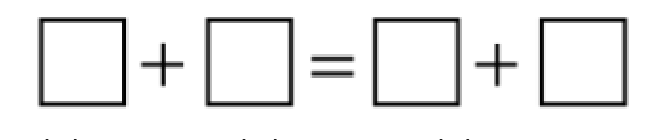
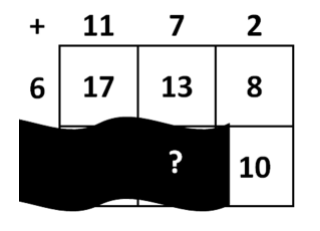
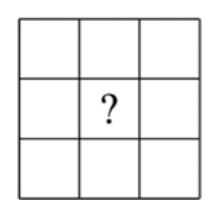
Every box shows the result of the addition of the numbers on the very left and on the very top (for example: 6 + 2 = 8). Which number is written behind the question mark?
Show answer
Answer: E — 15
Show hints
Hint 1 of 2
Every box is its left number added to its top number; find a box where you already know both to fill in a missing edge number.
Still stuck? Show hint 2 →
Hint 2 of 2
The box showing 10 sits under the top number 2, so its left number must make 10.
Show solution
Approach: use a known box to find the missing left number, then add
Each box is the number at the left of its row plus the number at the top of its column.
The box showing 10 is under the top number 2, so its left number is 8 (because 8 + 2 = 10).
The question-mark box is in that same row, under the top number 7.
Leo and Max are standing in a queue that is made up of 11 people in total. There are 7 people in front of Leo, and Max stands directly behind him in the queue. How many people are behind Max?
Show answer
Answer: B — 2
Show hints
Hint 1 of 2
First work out Leo's place in line from the 7 people ahead of him.
Still stuck? Show hint 2 →
Hint 2 of 2
Max is right behind Leo; the rest of the 11 are behind Max.
Show solution
Approach: locate each person, then count the tail
7 people are in front of Leo, so Leo is 8th.
Max stands directly behind Leo, so Max is 9th.
There are 11 people total, leaving 11 - 9 = 2 behind Max.
At a wedding one eighth of the guests is underage. Three sevenths of the adult guests are men. How big is the fraction of adult women amongst all guests?
Show answer
Answer: A — 12
Show hints
Hint 1 of 2
What fraction of all guests are adults?
Still stuck? Show hint 2 →
Hint 2 of 2
Find the men as a fraction of all guests, then take what is left of the adults.
Show solution
Approach: take fractions of fractions, all relative to the whole party
Underage guests are 1/8 of everyone, so adults are 7/8 of all guests.
Men are 3/7 of the adults: 3/7 × 7/8 = 3/8 of all guests.
Adult women = adults − men = 7/8 − 3/8 = 4/8 = 1/2, choice A.
Yvonne has 20 €, and each of her four sisters has 10 €. How much does Yvonne have to give to each of her sisters so that all of them have the same amount of money?
Show answer
Answer: A — 2
Show hints
Hint 1 of 2
First find how much each person should have once the money is shared equally.
Still stuck? Show hint 2 →
Hint 2 of 2
Then see how much Yvonne must hand to each sister to reach that level.
Show solution
Approach: equalise the total
Total money = 20 + 4×10 = 60 €, shared among 5 people = 12 € each.
Yvonne must drop from 20 to 12, giving away 8 € over 4 sisters.
In each of the five boxes (A) to (E) there are red and blue balls. Benedict wants to take exactly one ball, without looking, out of one of these boxes, and hopes to get a blue ball. In which box is the probability of that happening greatest?
Show answer
Answer: B — 6 blue, 4 red
Show hints
Hint 1 of 2
For each box the chance of a blue ball is blues divided by total balls.
Only four players scored goals in a handball game, and each scored a different number of goals. Michael scored the fewest. If the other three players scored 20 goals in total, what is the greatest number of goals Michael could have scored?
Show answer
Answer: C — 4
Show hints
Hint 1 of 2
Michael scored the fewest, and all four totals differ; the other three add to 20.
Still stuck? Show hint 2 →
Hint 2 of 2
To make Michael's count as big as possible, keep the other three just barely above him and distinct.
Show solution
Approach: push the other three players as close to Michael as possible
Michael scored the fewest, so the other three each scored more than him, and all four totals are different.
To let Michael score a lot, the other three should be just barely bigger: the three smallest different scores above Michael are Michael+1, Michael+2 and Michael+3.
If Michael scored 4, the others would be at least 5, 6, 7 = 18, which fits inside 20 (for example 5, 6, 9 add to 20).
If Michael scored 5, the others would be at least 6, 7, 8 = 21, which is already more than 20 — too big.
So Michael could score at most 4 (C).
Same idea with algebraIf Michael scores \(m\), the smallest the other three can total is \((m+1)+(m+2)+(m+3)=3m+6\). We need \(3m+6\le 20\), so \(m\le 4\).
Counting & ProbabilityLogic & Word Problemscareful-counting
A whimsical teacher has a box with 203 red, 117 white and 28 blue buttons. He asks his students to each take one button out of the box without looking. What is the minimum number of students who have to take a button so that definitely at least three of the buttons picked have the same colour?
Show answer
Answer: C — 7
Show hints
Hint 1 of 2
Think about the worst possible luck before three match.
Still stuck? Show hint 2 →
Hint 2 of 2
There are only three colours, so how many can you draw with at most two of each?
Show solution
Approach: pigeonhole: build the worst case, then add one
In the worst case each colour comes up at most twice: 2 + 2 + 2 = 6 buttons with no colour reaching three.
The very next button (the 7th) must repeat some colour for a third time.
So 7 students guarantee three of one colour, choice C.
Some girls are standing in a circle. The teacher makes them do a headcount: Bianca says one, her neighbour says two, and so on. If they count in a clockwise direction, Antonia says five. If they count in an anticlockwise direction, Antonia says eight. How many girls are forming the circle?
Show answer
Answer: C — 11
Show hints
Hint 1 of 2
Count the gaps between Bianca and Antonia going each way around the circle.
Still stuck? Show hint 2 →
Hint 2 of 2
The two arcs together make one full loop.
Show solution
Approach: add the two arc lengths
Clockwise, Antonia is the 5th, so 4 girls separate them that way.
Anticlockwise she is the 8th, so 7 girls separate them the other way.
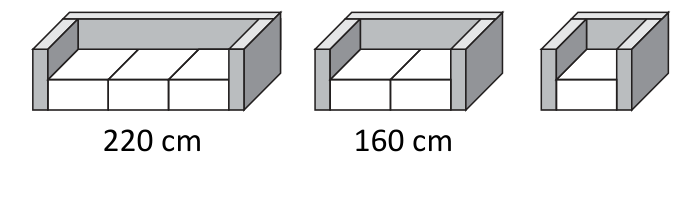
A furniture shop sells 3-seater, 2-seater and 1-seater sofas. Each sofa has an equally wide armrest on the left and on the right, and every seat is equally wide (see picture). With its armrests the 3-seater sofa is 220 cm wide and the 2-seater sofa is 160 cm wide. How wide is the 1-seater sofa?
Show answer
Answer: D — 100 cm
Show hints
Hint 1 of 2
Both sofas have two armrests; the only difference between the 3-seater and 2-seater is one seat.
Still stuck? Show hint 2 →
Hint 2 of 2
Find one seat's width from the 220 vs 160 difference, then build the 1-seater.
Show solution
Approach: subtract to isolate a seat, then a pair of armrests
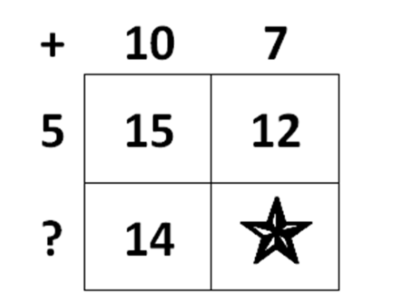
Every box shows the result of the addition of the numbers on the very left and on the very top (for example: \(5 + 7 = 12\)). Which number is written behind the star?
Show answer
Answer: B — 11
Show hints
Hint 1 of 2
Each cell equals its row number plus its column number; use the filled cells to find the hidden row number.
Still stuck? Show hint 2 →
Hint 2 of 2
Once you know the missing row label, add it to the star's column heading.
Show solution
Approach: recover the hidden labels, then add
Each box is row-label + column-label. The cell '14' sits in the star's row under column 10, so the hidden row label is 14 - 10 = 4.
The star is in that same row (label 4) under column 7.
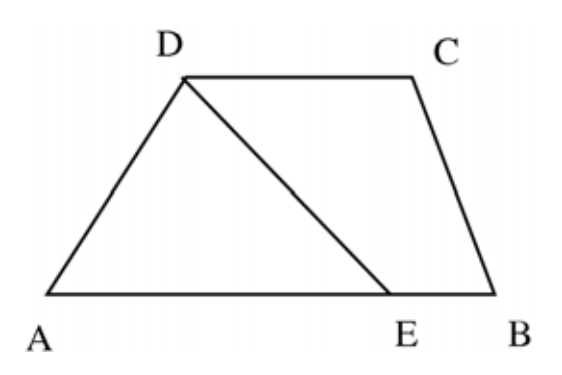
ABCD is a trapezium with parallel sides AB and CD. Let AB = 50 and CD = 20. Point E lies on side AB in such a way that the straight line DE divides the trapezium into two shapes of equal area. How long is the straight line AE?
Show answer
Answer: C — 35
Show hints
Hint 1 of 2
The line DE makes triangle ADE on one side; its area is half base times height.
Still stuck? Show hint 2 →
Hint 2 of 2
Set that triangle equal to half the whole trapezium's area.
Show solution
Approach: express the half-area as a triangle and solve for the base AE
The trapezium has area (50 + 20)/2 × h = 35h, so each half is 17.5h.
Triangle ADE has base AE on AB and the same height h, area = ½ · AE · h.
Setting ½ · AE · h = 17.5h gives AE = 35, choice C.
Ant Annie starts at the left end of the stick and crawls 23 of the length of the stick. Ladybird Bob starts at the right end of the stick and crawls 34 of the length of the stick. Which fraction of the length of the stick are they then apart from each other?
Show answer
Answer: D — 512
Show hints
Hint 1 of 2
Put both bugs' positions on the same scale, measured from the left end.
Still stuck? Show hint 2 →
Hint 2 of 2
Subtract the two positions to get the gap.
Show solution
Approach: locate both on [0,1] and subtract
Annie is at 2/3 from the left. Bob, 3/4 from the right, is at 1 − 3/4 = 1/4 from the left.
They have passed each other; the gap is 2/3 − 1/4 = 8/12 − 3/12 = 5/12.
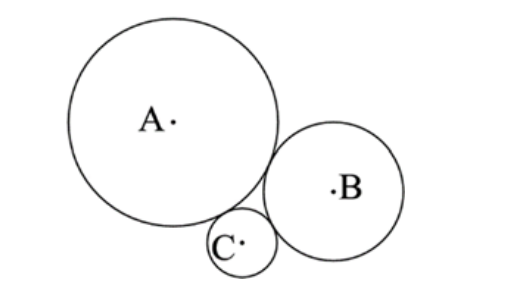
Three circles with centres A, B, C touch each other in pairs from the outside (see diagram). Their radii are 3, 2 and 1. How big is the area of the triangle ABC?
Show answer
Answer: A — 6
Show hints
Hint 1 of 2
When two circles touch externally, the distance between their centres is the sum of the radii.
Still stuck? Show hint 2 →
Hint 2 of 2
Work out the three side lengths of triangle ABC; they may form a familiar right triangle.
Show solution
Approach: get the side lengths from touching circles, recognise a 3-4-5 triangle
Touching externally, AB = 3 + 2 = 5, BC = 2 + 1 = 3, CA = 1 + 3 = 4.
Sides 3, 4, 5 form a right triangle (3^2 + 4^2 = 5^2).
Tom writes the numbers from 1 to 20 one after another and gets the 31-digit number 1234567891011121314151617181920. He then deletes 24 of the digits so that the number that is left is as large as possible. Which number does he get?
Show answer
Answer: C — 9781920
Show hints
Hint 1 of 2
Keeping 7 digits in their original left-to-right order, you want the largest possible number.
Still stuck? Show hint 2 →
Hint 2 of 2
Greedily grab the biggest digit you can while leaving enough digits to fill the remaining places.
Show solution
Approach: greedy choice of the largest leftmost digits
The string 1234567891011121314151617181920 has 31 digits; deleting 24 leaves 7.
To maximise, pick the largest digit early while keeping enough digits after it to complete 7.
The best run grabs the 9 (from the '...891...'), then 7 and 8 (from '17'/'18'), then 1920.
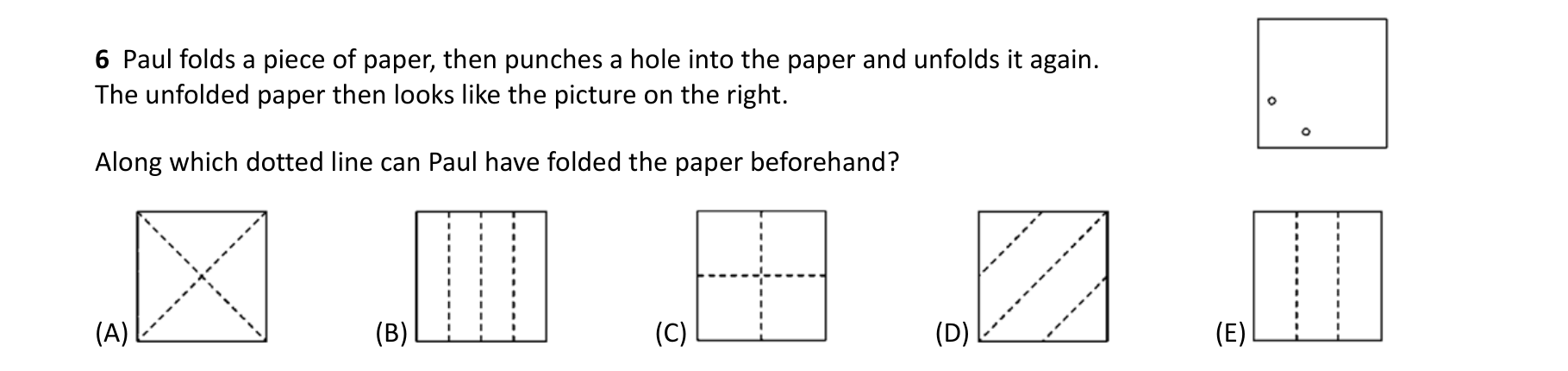
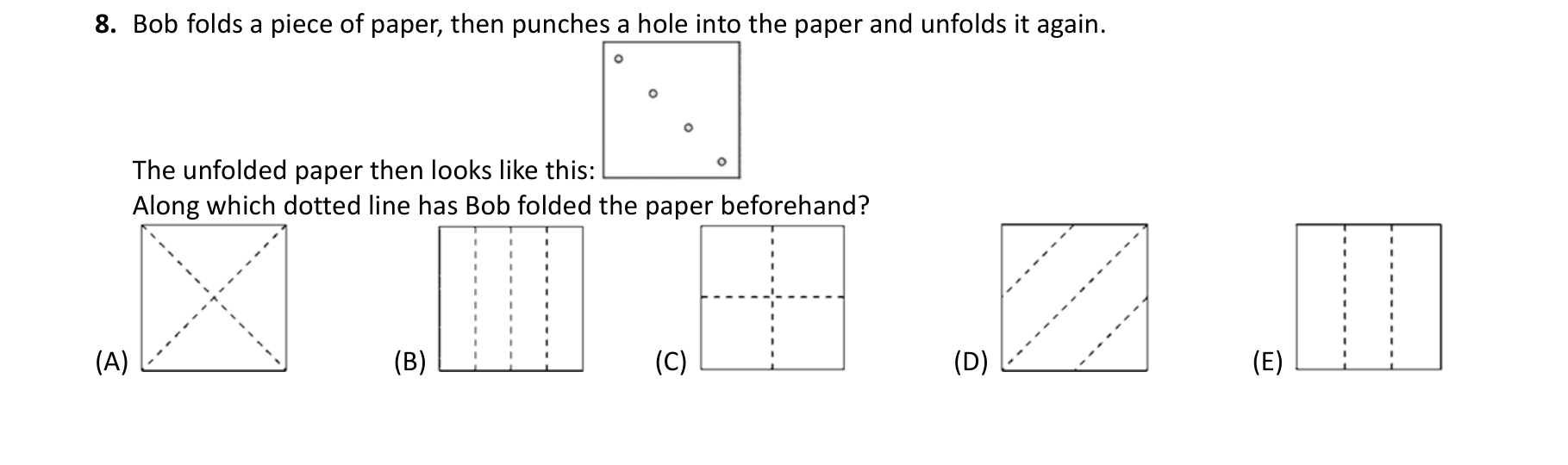
Bob folds a piece of paper, then punches a hole into the paper and unfolds it again. The unfolded paper then looks like this. Along which dotted line has Bob folded the paper beforehand?
Show answer
Answer: C
Show hints
Hint 1 of 2
Count the holes: four holes from one punch means the paper was in four layers.
Still stuck? Show hint 2 →
Hint 2 of 2
Four layers come from folding twice, along both centre lines.
Show solution
Approach: four holes need four layers, i.e. folds along both centre lines
One punched hole makes one hole per layer of paper.
Four holes mean the paper had four layers when punched.
Four layers come from folding along both the horizontal and the vertical centre line.
That double fold is shown by the cross in choice C.
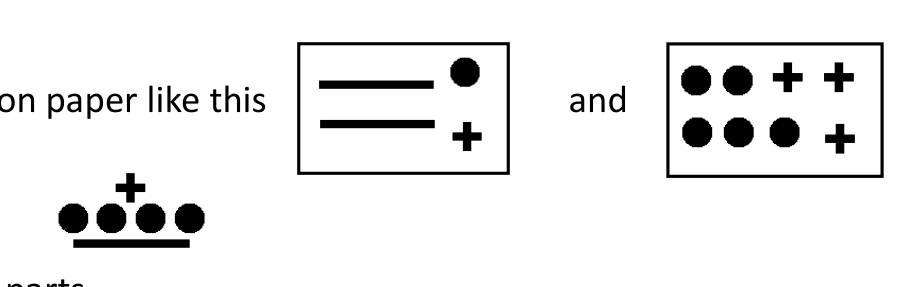
Lisa has several sheets of construction paper, of two kinds (shown). She wants to make 7 identical crowns, and for that she cuts out the necessary parts. What is the minimum number of sheets of construction paper that she has to cut up?
Show answer
Answer: B — 9
Show hints
Hint 1 of 2
First count exactly what one crown is made of: how many dots, crosses, and bars.
Still stuck? Show hint 2 →
Hint 2 of 2
Only the first kind of sheet has bars, and you need one bar per crown; start by getting enough bars, then top up the dots.
Show solution
Approach: cover the scarce part first (bars), then make up the dots
Each crown needs 4 dots, 1 cross, and 1 bar, so 7 crowns need 28 dots, 7 crosses, and 7 bars.
Only the first kind of sheet has bars (2 bars, plus 1 dot and 1 cross each); to get 7 bars she needs 4 of these sheets, giving 8 bars, 4 dots, and 4 crosses.
She still needs 28 - 4 = 24 more dots; the second kind of sheet has 5 dots (and 3 crosses) each, so 5 of them give 25 dots — enough, and plenty of crosses.
One sixth of all spectators in a children’s theatre are adults, and the rest are children. Two fifths of the children are girls. Which fraction of all spectators are boys?
Show answer
Answer: A — 12
Show hints
Hint 1 of 2
Children are the part that isn't adults; boys are the part of children that aren't girls.
Still stuck? Show hint 2 →
Hint 2 of 2
Multiply the two fractions.
Show solution
Approach: chain the fractions
Children are 5/6 of all spectators.
Boys are 3/5 of the children (since 2/5 are girls).
A number is written on each face of a special die. The two numbers on any pair of opposite faces always add up to the same total. Five of the six numbers are 5, 6, 9, 11 and 14. What is the number on the sixth face?
Show answer
Answer: E — 15
Show hints
Hint 1 of 2
Opposite faces share the same total, so the six numbers split into three pairs with equal sums.
Still stuck? Show hint 2 →
Hint 2 of 2
The biggest and smallest known numbers hint at the common pair-sum; find the missing partner.
Show solution
Approach: find the common pair-sum from two known numbers, then complete the last pair
Opposite faces always add to the same total, so the six numbers split into three pairs that all share one sum.
Among the five known numbers, 6 + 14 = 20 and 9 + 11 = 20, so that shared sum must be 20.
The number 5 is left over, so its partner is the sixth face: 20 − 5 = 15.
13 children registered for a competition. Then another 19 joined. Six equally big teams are needed for the competition. How many more children are needed, so that six equally big teams can be formed?
Show answer
Answer: D — 4
Show hints
Hint 1 of 2
First add the two groups of children together.
Still stuck? Show hint 2 →
Hint 2 of 2
Six equal teams means the total must split into 6 equal piles, so count up by sixes past your total.
Show solution
Approach: count up by sixes to the first number past the total
Altogether there are 13 + 19 = 32 children.
Six equal teams need a total that shares evenly into 6 piles, so count by sixes: 6, 12, 18, 24, 30, 36.
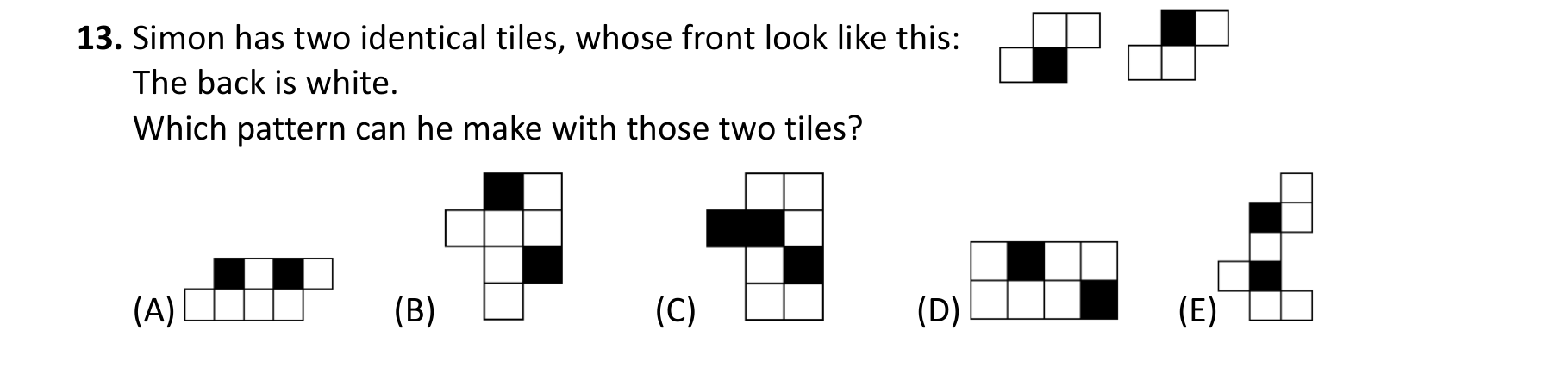
Simon has two identical tiles, whose front looks like this. The back is white. Which pattern can he make with those two tiles? (The five patterns are shown as choices A, B, C, D, E.)
Show answer
Answer: A
Show hints
Hint 1 of 2
Each tile can be turned around or even flipped over, since the back is plain white.
Still stuck? Show hint 2 →
Hint 2 of 2
Try to split each pattern into two pieces that both look just like Simon's tile.
Show solution
Approach: tile the figure with two copies of the piece
The two tiles are identical L-shaped pieces (a dark square in one corner); they may be turned or flipped.
Test each option by trying to cut it into two such tiles with the dark squares in the right spots.
Only option A can be built from the two given tiles.
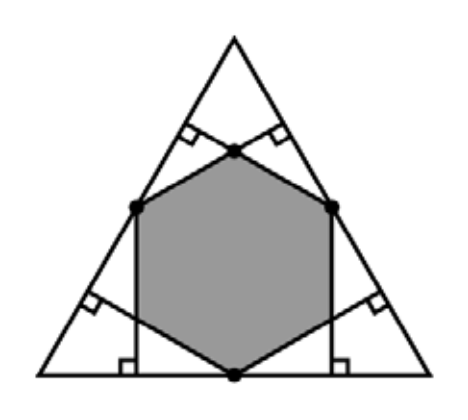
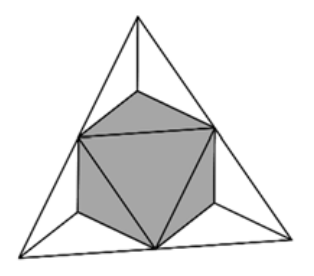
In an equilateral triangle with area 1, we draw the six perpendicular lines from the midpoints of each side to the other two sides as seen in the diagram. How big is the area of the grey hexagon that has been created this way?
Show answer
Answer: D — 12
Show hints
Hint 1 of 2
The figure is highly symmetric — the hexagon sits at the centre.
Still stuck? Show hint 2 →
Hint 2 of 2
Compare the grey region with the whole triangle using that symmetry.
Show solution
Approach: use the threefold symmetry to pair the grey hexagon against the cut-off corner regions
The construction has the triangle's full threefold rotational symmetry, so the central hexagon and the regions cut off around it all repeat in three identical copies.
Tracking those repeating pieces (or checking with coordinates) shows the cut-off regions outside the hexagon add up to exactly the same area as the hexagon itself.
So the hexagon is exactly half of the triangle; with the triangle's area equal to 1 that is 1/2, choice D.
Two cylinders A and B have the same volume. The radius of the base of B is 10% bigger than that of A. By how much is the height of A greater than that of B?
Show answer
Answer: E — 21%
Show hints
Hint 1 of 2
Equal volumes means (radius squared) x height is the same for both cylinders.
Still stuck? Show hint 2 →
Hint 2 of 2
If B's radius is 1.1 times A's, compare the heights through the square of that factor.
Show solution
Approach: use equal volume to relate the heights through the radius ratio
Volume = pi r^2 h is equal, so r_A^2 h_A = r_B^2 h_B with r_B = 1.1 r_A.
Paul goes on a 5-day hike, starting on Monday and finishing on Friday. Each day he walks 2 km more than the day before, and in total he walks 70 km. How far does he walk on Thursday?
Show answer
Answer: E — 16 km
Show hints
Hint 1 of 2
The five daily distances rise by 2 km each day, so they are evenly spaced around the middle day.
Still stuck? Show hint 2 →
Hint 2 of 2
The middle (Wednesday) distance is the average; find it, then step up to Thursday.
Show solution
Approach: use the average of an arithmetic sequence
Five days increasing by 2 km average to the middle day, Wednesday: 70 ÷ 5 = 14 km.
Each later day is 2 km more, so Thursday = 14 + 2 = 16 km.
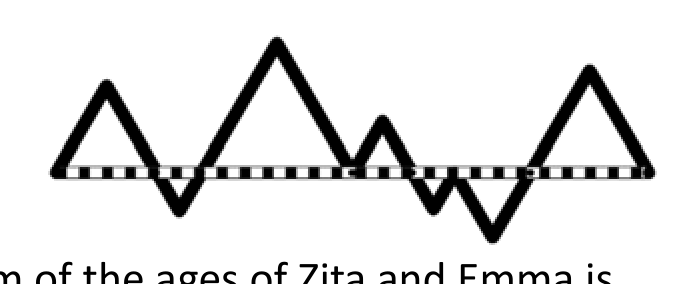
Four cousins are 3, 8, 12 and 14 years old. Emma is younger than Rita. The sum of the ages of Zita and Emma is divisible by 5, as is the sum of the ages of Zita and Rita. How old is Ina (the 4th cousin)?
Show answer
Answer: A — 14
Show hints
Hint 1 of 2
Zita+Emma and Zita+Rita are both multiples of 5, so Emma and Rita leave the same remainder mod 5.
Still stuck? Show hint 2 →
Hint 2 of 2
Find which two of 3, 8, 12, 14 agree mod 5, then place Zita and read off Ina.
Show solution
Approach: match remainders mod 5
Remainders mod 5: 3→3, 8→3, 12→2, 14→4. Emma and Rita must match, so {Emma,Rita}={3,8}; with Emma<Rita, Emma=3, Rita=8.
Zita+3 divisible by 5 means Zita≡2 (mod 5), so Zita=12.
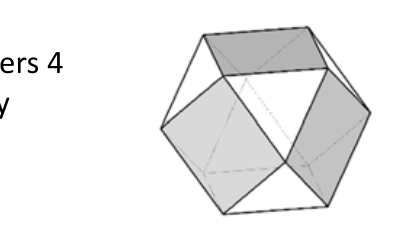
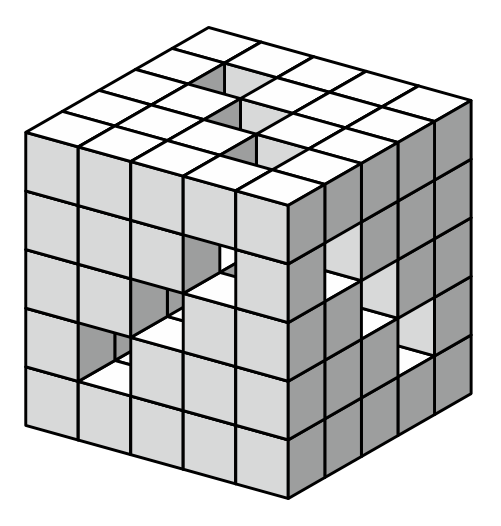
Each face of the polyhedron shown is either a triangle or a square. Each square borders 4 triangles, and each triangle borders 3 squares. The polyhedron has 6 squares. How many triangles does it have?
Show answer
Answer: D — 8
Show hints
Hint 1 of 2
Count the square-touches-triangle contacts in two different ways.
Still stuck? Show hint 2 →
Hint 2 of 2
Each square contributes 4 such contacts; each triangle uses up 3 of them.
Show solution
Approach: double-count the square-triangle adjacencies
There are 6 squares, each bordering 4 triangles, giving 6 x 4 = 24 square-triangle borders.
Each triangle borders 3 squares, so it accounts for 3 of those borders.
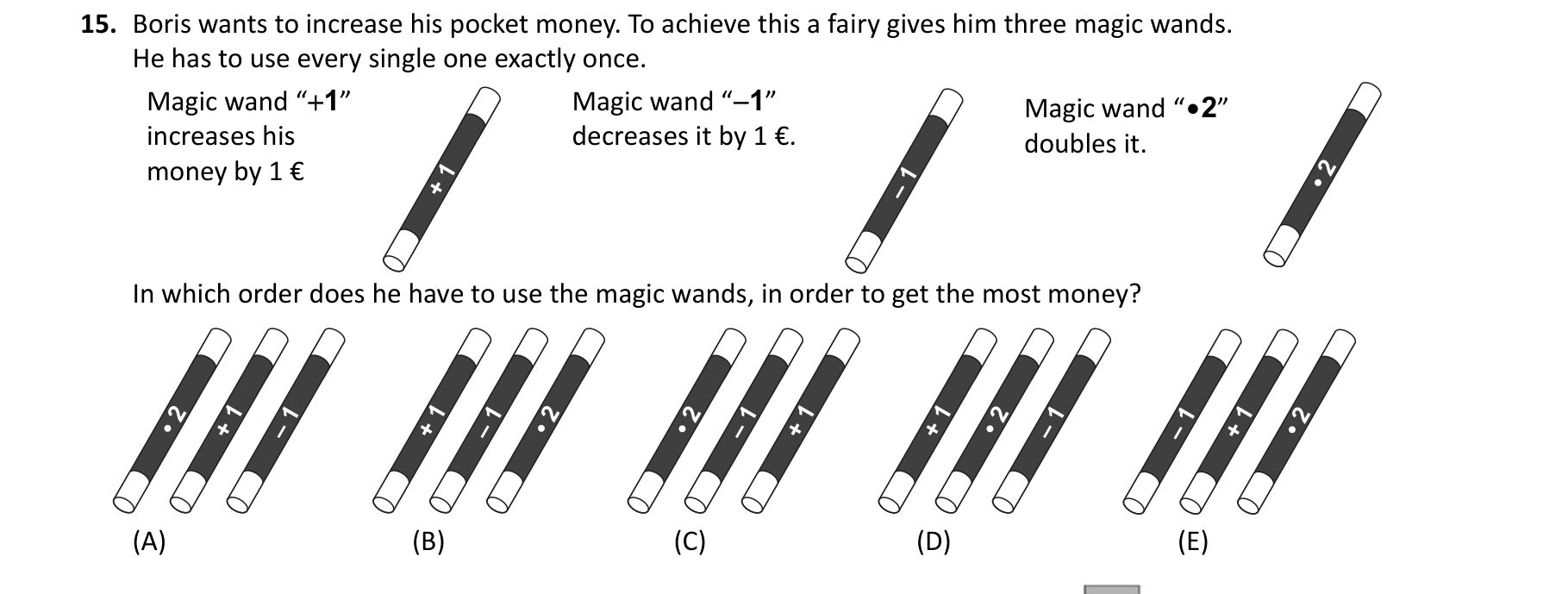
Boris wants to increase his pocket money. A fairy gives him three magic wands, and he must use every one exactly once: the “+1” wand increases his money by 1 €, the “−1” wand decreases it by 1 €, and the “×2” wand doubles it. In which order should he use the wands to end up with the most money?
Show answer
Answer: D
Show hints
Hint 1 of 2
Doubling multiplies everything that came before, so a +1 done before doubling is worth more than after.
Still stuck? Show hint 2 →
Hint 2 of 2
Add before you double and subtract after you double to end up highest.
Show solution
Approach: order operations so the gain is doubled and the loss is not
The +1 wand is most valuable applied before the ×2 wand, so its euro gets doubled.
The −1 wand should come after the ×2 wand, so only one euro is lost, not two.
Best order: +1, then ×2, then −1, giving (x+1)×2 − 1 = 2x + 1.
David has a stove with two hobs on which he wants to prepare five different dishes. The dishes need 40 min, 15 min, 35 min, 10 min and 45 min until they are fully cooked. He wants to spend as little time in the kitchen as possible but is only allowed to take dishes off the hob when they are fully cooked. How long does he need for the preparation?
Show answer
Answer: C — 75 min
Show hints
Hint 1 of 2
With two hobs, split the five cooking times into two groups; the time needed is the larger group's total.
Still stuck? Show hint 2 →
Hint 2 of 2
Balance the two groups as evenly as you can to make that larger total small.
Show solution
Approach: partition the times into two groups and minimise the larger total
The five times add to 40+15+35+10+45 = 145 minutes across two hobs.
He is free until everything is cooked, so the time needed is the larger group's total.
The most balanced split is 40+35 = 75 against 45+15+10 = 70.
The larger total, and so the time needed, is 75 min.
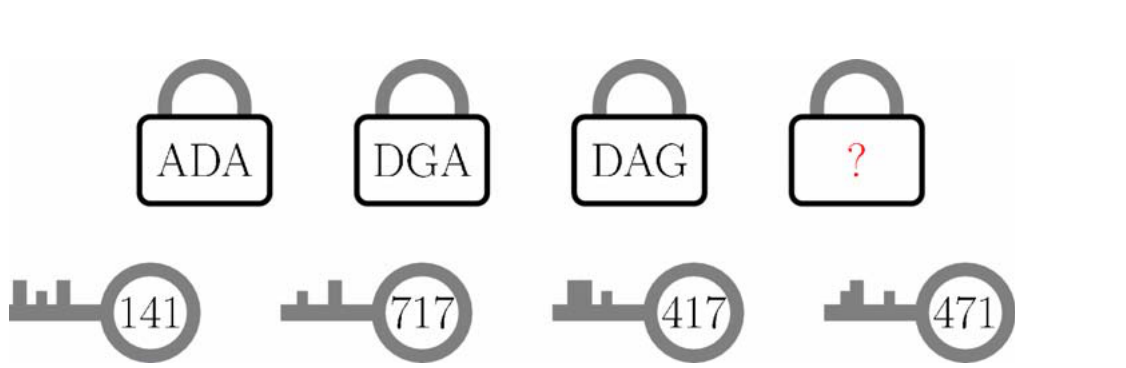
Each one of the four keys locks exactly one padlock. Every letter on a padlock stands for exactly one digit, and the same letters mean the same digits. Which letters must be written on the fourth padlock?
Show answer
Answer: D — GAG
Show hints
Hint 1 of 2
Match each key's number to the padlock it opens, lining up the digits with the letters in the same spots.
Still stuck? Show hint 2 →
Hint 2 of 2
Once you know which digit each letter is, the leftover key tells you the fourth padlock.
Show solution
Approach: decode letters to digits, then read the leftover key
The lock ADA has its first and last letters the same; the only key like that is 141, so A=1 and D=4.
Now DAG starts 4, 1, so its key is 417, giving G=7; then DGA is 4, 7, 1, which is the key 471.
Those three keys are used, so the fourth padlock is opened by the leftover key 717.
Reading 717 back as letters gives 7=G, 1=A, 7=G, so the fourth padlock is GAG (option D).
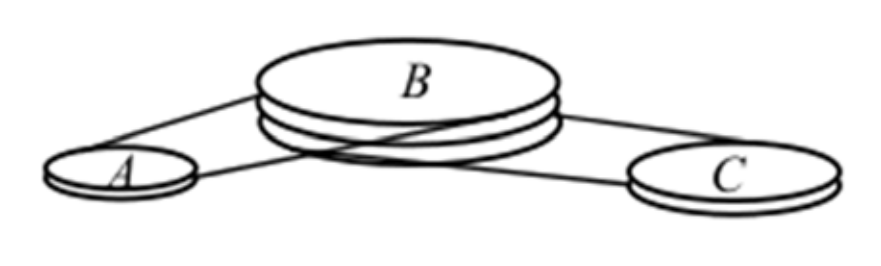
A belt system is made up of wheels A, B and C, which rotate without sliding. B rotates 4 times around, while A turns 5 times around, and B rotates 6 times around, while C turns 7 times around. The circumference of C is 30 cm. How big is the circumference of A?
Show answer
Answer: B — 28 cm
Show hints
Hint 1 of 2
Wheels joined by a belt move the same length of belt, so turns × circumference is equal.
Still stuck? Show hint 2 →
Hint 2 of 2
Chain the A–B relation to the B–C relation.
Show solution
Approach: equal belt length means revolutions are inversely proportional to circumference
Wheels joined by a belt cover the same belt length, so each wheel's turns × circumference is the same on the link.
For B and C: 6 × (circumference of B) = 7 × 30, so the circumference of B is 35 cm.
For A and B: 5 × (circumference of A) = 4 × 35, so the circumference of A is 28 cm, choice B.
More than 800 people take part in the kangaroo–run. Among the participants, 35% are female. There are 252 more male than female participants. How many people in total are taking part in the run?
Show answer
Answer: E — 840
Show hints
Hint 1 of 2
The male-minus-female gap is a fixed percent of the total.
Still stuck? Show hint 2 →
Hint 2 of 2
Set that percent equal to 252 and solve for the total.
Show solution
Approach: percent gap equals the headcount difference
Female = 35%, male = 65%, so male − female = 30% of the total.
The four faces of a regular tetrahedron are labelled with the four digits 2, 0, 1 and 7 (one digit on each face). For a game, four such tetrahedrons are used as fair dice. All four dice are thrown simultaneously. Three of the four faces of each die can then be seen from above. What is the probability that we can form the number 2017 using exactly one of the three visible digits of each die?
Show answer
Answer: B — 6364
Show hints
Hint 1 of 2
On each die the three visible faces are simply all faces except the one hidden underneath.
Still stuck? Show hint 2 →
Hint 2 of 2
It is easier to count the chance you CANNOT form 2017, then subtract from 1.
Show solution
Approach: complementary counting over which digit each die hides
Each die hides exactly one of its four digits; the other three are visible. There are 4^4 = 256 equally likely hidden-digit combinations.
You can match the four needed digits (2,0,1,7) to the four dice unless some required digit is hidden on every die.
That fails only when all four dice hide the same one digit: 4 ways out of 256.
So the probability of success is 1 - 4/256 = 63/64.
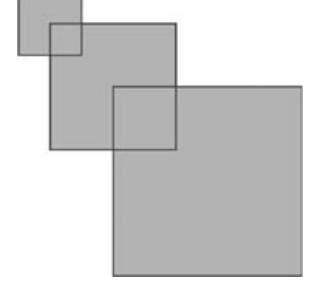
Raphael has three squares. The first has side 2 cm. The second has side 4 cm, and one of its corners sits at the centre of the first square. The third has side 6 cm, and one of its corners sits at the centre of the second square. What is the total area of the figure shown?
Show answer
Answer: A — 51 cm²
Show hints
Hint 1 of 2
Add the three square areas, then subtract the parts that overlap where a corner sits at a centre.
Still stuck? Show hint 2 →
Hint 2 of 2
Each overlap is a quarter of the smaller square in that pair.
Show solution
Approach: add areas and subtract the overlaps
The squares have areas 2² = 4, 4² = 16 and 6² = 36, totalling 56.
Each larger square has a corner at the previous square's centre, overlapping a quarter of the smaller square: 4÷4 = 1 and 16÷4 = 4.
Counting & ProbabilityLogic & Word Problemscareful-counting
Tycho plans his running training. Each week he wants to go for a run on the same weekdays. He never wants to go for a run on two consecutive days. But he wants to go for a run three days a week. How many different weekly plans meet those conditions?
Show answer
Answer: B — 7
Show hints
Hint 1 of 2
A weekly plan repeats, so the seven days form a loop — Sunday touches Monday.
Still stuck? Show hint 2 →
Hint 2 of 2
Count choices of 3 days on a circle of 7 with no two adjacent.
Show solution
Approach: count non-adjacent triples around a cycle of 7 days
Because the plan repeats every week, the days form a circle of 7 where no two chosen days may be next to each other.
The number of ways to pick 3 non-adjacent positions on a circle of 7 is 7.
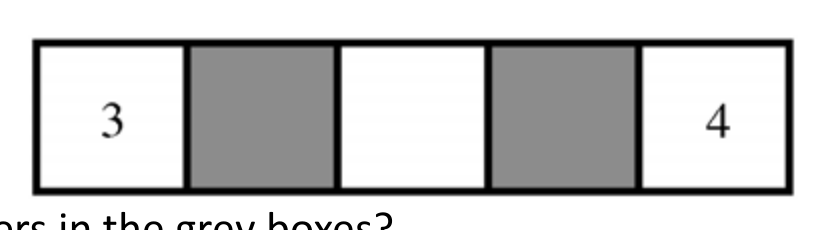
Ria wants to write a number into each box. She has already written two numbers. The sum of all five numbers should be 35, the sum of the first three numbers should be 22, and the sum of the last three numbers should be 25. What is the product Ria gets if she multiplies the two numbers in the grey boxes?
Show answer
Answer: A — 63
Show hints
Hint 1 of 2
The full sum minus the first three minus the last three double-counts only the middle box.
Still stuck? Show hint 2 →
Hint 2 of 2
Use the running sums to pin down each grey box.
Show solution
Approach: solve the box values from overlapping sums
first3 + last3 = 22 + 25 = 47 = total (35) + middle, so the middle box = 12.
First three: 3 + grey1 + 12 = 22, so grey1 = 7. Last three: 12 + grey2 + 4 = 25, so grey2 = 9.
The polynomial \(5x^3 + ax^2 + bx + 24\) has whole-number coefficients a and b. Which of the following numbers is definitely not a solution to the equation \(5x^3 + ax^2 + bx + 24 = 0\)?
Show answer
Answer: D — 5
Show hints
Hint 1 of 2
Any integer root of a polynomial with integer coefficients must divide the constant term.
Still stuck? Show hint 2 →
Hint 2 of 2
The constant term is 24; which listed candidate is not a divisor of 24?
Show solution
Approach: rational (integer) root test on the constant term
An integer solution r of 5x^3 + ax^2 + bx + 24 = 0 must divide the constant term 24.
Among 1, -1, 3, 5, 6, all divide 24 except 5.
So 5 can never be a solution, whatever a and b are.
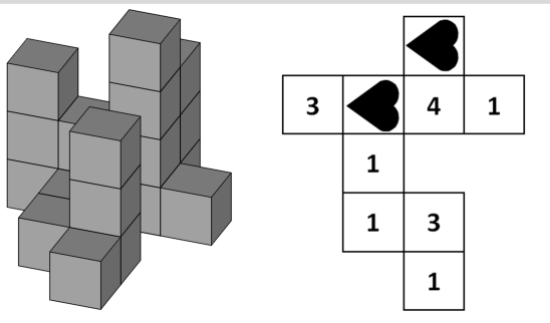
Max builds this construction using some small equally big cubes. If he looks at his construction from above, the plan on the right tells the number of cubes in every tower. How big is the sum of the numbers covered by the two hearts?
Show answer
Answer: C — 5
Show hints
Hint 1 of 2
The plan number in each square is the height of the tower standing there.
Still stuck? Show hint 2 →
Hint 2 of 2
Read the two hidden tower heights off the 3-D picture, then add them.
Show solution
Approach: read the two covered tower heights from the construction and add
Each square of the plan shows how many cubes are stacked there.
The two hearts cover two of these tower heights.
Reading those two towers from the picture and adding gives the total.
Algebra & PatternsLogic & Word Problemssubstitution
Four brothers have different heights. Tobias is as many centimeters smaller than Viktor, as he is taller than Peter. Oskar on the other hand is equally many centimeters smaller than Peter. Tobias is 184 cm tall, and on average the four brothers are 178 cm tall. How tall is Oskar?
Show answer
Answer: A — 160 cm
Show hints
Hint 1 of 2
Write everyone's height as Tobias plus or minus a single difference d.
Still stuck? Show hint 2 →
Hint 2 of 2
Use the average to pin down d.
Show solution
Approach: express all four heights in terms of one difference, then use the average
Let d be the common difference. Viktor = 184 + d, Peter = 184 − d, and Oskar = Peter − d = 184 − 2d.
The average is 178, so the sum is 712: (184+d) + 184 + (184−d) + (184−2d) = 736 − 2d = 712.
Thus 2d = 24, d = 12, and Oskar = 184 − 24 = 160 cm, choice A.
Simon wants to cut a piece of wire into 9 equally long pieces and makes marks where he needs to make his cuts. Barbara wants to cut the same piece of wire into 8 equally long pieces and makes marks where she needs to make her cuts. Carl cuts the piece of wire at every mark. How many pieces does Carl get?
Show answer
Answer: B — 16
Show hints
Hint 1 of 2
Count the cut marks each person makes, then check whether any marks land on the same spot.
Still stuck? Show hint 2 →
Hint 2 of 2
Marks at ninths and eighths of the wire never coincide in the interior.
Show solution
Approach: count distinct marks, add one for pieces
Nine equal pieces need 8 interior marks; eight equal pieces need 7 interior marks.
Since 8 and 9 share no common factor, no ninth-mark equals an eighth-mark, giving 8 + 7 = 15 distinct marks.
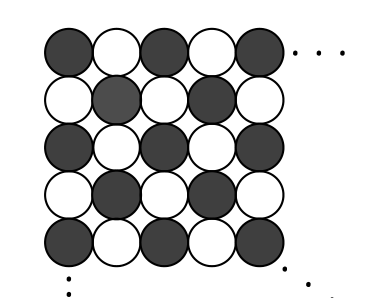
Julia has 2017 round discs available: 1009 black ones and 1008 white ones. Using them, she wants to lay the biggest square pattern possible (as shown) and starts by using a black disc in the upper-left corner. She then lays the discs so that the colours alternate in each row and column. How many discs are left over when she has laid the biggest possible square?
Show answer
Answer: E — 40 white and 41 black
Show hints
Hint 1 of 2
A checkerboard square with a black corner has roughly half discs of each colour; find the biggest size that fits the supply.
Still stuck? Show hint 2 →
Hint 2 of 2
Try square sizes n x n and find the largest where black <= 1009 and white <= 1008, then count what is left.
Show solution
Approach: find the largest fitting checkerboard, then subtract
For an n x n board starting black, with n even there are n^2/2 of each colour.
n = 44 needs 968 black and 968 white, which fits; n = 46 needs 1058 each, too many.
Leftover: 1009 - 968 = 41 black and 1008 - 968 = 40 white.
The numbers 1, 2, 3, 4 and 5 are to be written into the five cells of this diagram by the following rules: if one number is below another it must be greater, and if one number is to the right of another it must be greater. How many ways are there to place the numbers?
Show answer
Answer: D — 6
Show hints
Hint 1 of 2
Numbers must increase going right and increase going down, which forces 1 into the top-left and 5 into the bottom-right.
Still stuck? Show hint 2 →
Hint 2 of 2
Count the valid fillings of the remaining cells respecting both rules.
Show solution
Approach: place the forced smallest and largest, then list the few valid fillings
Every cell must be bigger than the one to its left and the one above it, so the very top-left cell is the smallest, 1, and the very bottom-right cell is the largest, 5.
Now fill the remaining cells with 2, 3 and 4, always keeping each one larger than its left and upper neighbours.
Going through the possibilities carefully, exactly 6 different fillings obey both rules.
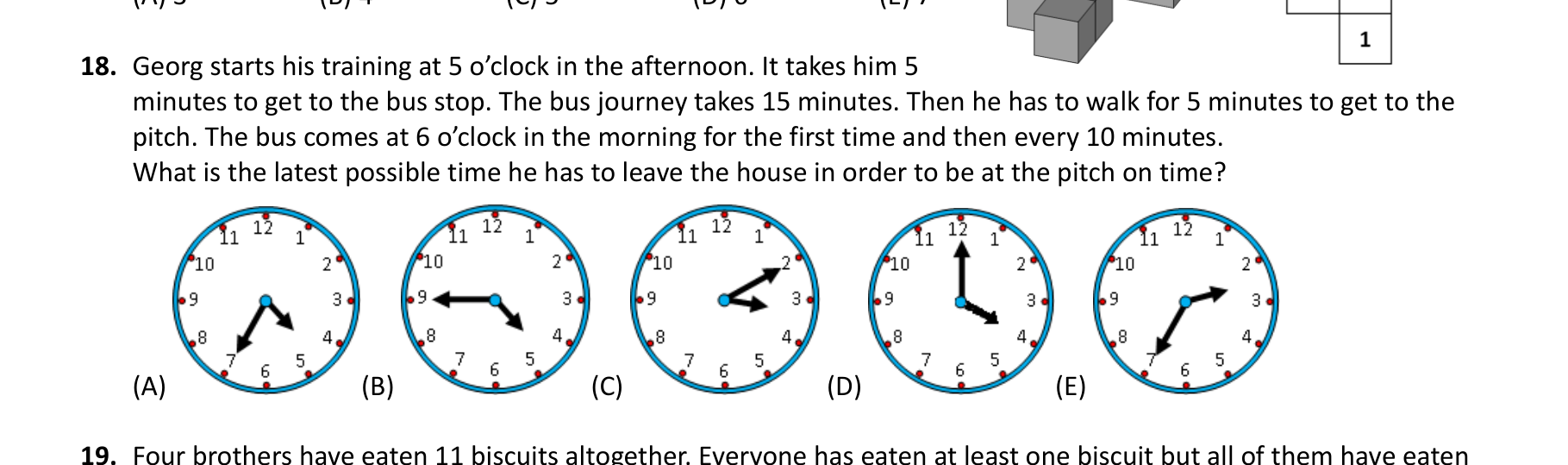
Georg starts his training at 5 o'clock in the afternoon. It takes him 5 minutes to get to the bus stop. The bus journey takes 15 minutes. Then he has to walk for 5 minutes to get to the pitch. The bus comes for the first time and then every 10 minutes. What is the latest possible time he has to leave the house in order to be at the pitch on time?
Show answer
Answer: A
Show hints
Hint 1 of 2
Work backwards from 5 o'clock, peeling off the walk, the bus ride and the first walk.
Still stuck? Show hint 2 →
Hint 2 of 2
He must catch a bus, which only leaves every 10 minutes, so round to a bus time.
Show solution
Approach: work backward from 5:00 through each leg of the trip
He must be at the pitch by 5:00; the last walk takes 5 min, so he leaves the bus by 4:55.
The bus ride is 15 min, so he must board by 4:40 (a valid every-10-minutes time).
The walk to the bus stop takes 5 min, so he must leave home by 4:35.
Logic & Word ProblemsAlgebra & Patternssum-constraintsubstitution
During our holidays it rained on 7 days. If it rained before noon, then there was no rain in the afternoon. If it rained in the afternoon, there was no rain before noon. There were 5 days without rain before noon and six days without rain in the afternoon. How many days long was our holiday?
Show answer
Answer: C — 9
Show hints
Hint 1 of 2
Each rainy day rains either only the morning or only the afternoon, never both.
Still stuck? Show hint 2 →
Hint 2 of 2
Count days with no morning rain and no afternoon rain in terms of the total.
Show solution
Approach: set up the dry-half counts against the total number of days
Each of the 7 rainy days has rain in exactly one half, so morning-rain + afternoon-rain days = 7.
If the holiday is N days: dry mornings = N − (morning-rain) = 5 and dry afternoons = N − (afternoon-rain) = 6.
Adding: 2N − 7 = 11, so 2N = 18 and N = 9, choice C.
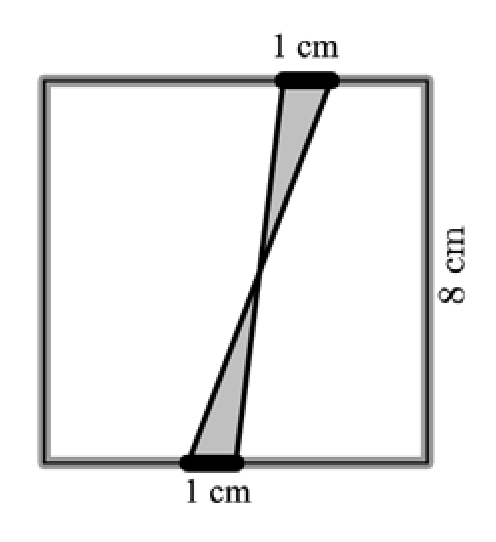
Two 1 cm long segments are marked on opposite sides of a square with side length 8 cm. The end points of the segments are connected with each other as shown in the diagram. How big is the area of the grey part?
Show answer
Answer: B — 4 cm²
Show hints
Hint 1 of 2
The two connecting lines cross, forming a bow-tie of two grey triangles.
Still stuck? Show hint 2 →
Hint 2 of 2
Each grey triangle has a 1 cm base; their heights together span the square.
Show solution
Approach: two triangles whose heights sum to the side
The grey region is two triangles, each with base 1 cm (the marked segments).
Their apexes meet where the lines cross, and the two heights together span the 8 cm side of the square.
Two consecutive positive whole numbers are written on a board. The sum of the digits of each number is divisible by 7. What is the minimum number of digits the smaller of the two numbers has to have?
Show answer
Answer: C — 5
Show hints
Hint 1 of 2
Normally adding 1 raises the digit sum by 1, so both sums can be multiples of 7 only when carrying happens.
Still stuck? Show hint 2 →
Hint 2 of 2
Trailing 9s cause big drops in the digit sum; figure out how many 9s are needed for both sums to stay divisible by 7.
Show solution
Approach: use trailing nines to control how the digit sum changes
If the smaller number ends in k nines, adding 1 turns them to zeros and bumps the next digit, so the digit sum changes by 1 - 9k.
For both digit sums divisible by 7 we need 9k = 1 (mod 7), i.e. 2k = 1 (mod 7), giving k = 4 as the smallest.
Four trailing nines plus at least one leading digit (e.g. 69999) is needed, which has 5 digits.
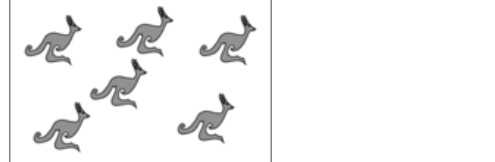
Eight kangaroos stand in a row, facing the directions shown in the picture. Whenever two kangaroos that are next to each other are facing each other, they swap places by hopping past one another. This continues until no more hops are possible. How many times did a swap take place?
Show answer
Answer: D — 13
Show hints
Hint 1 of 2
A swap happens only where a right-facing kangaroo is directly in front of a left-facing one (they face each other).
Still stuck? Show hint 2 →
Hint 2 of 2
Each such facing pair eventually passes through every opposing kangaroo — count the total crossings.
Show solution
Approach: count the head-on pairs that must pass each other
Two neighbours swap only when a right-facing kangaroo is immediately in front of a left-facing one, so they meet head-on.
Over the whole process, each right-facing kangaroo ends up passing every left-facing kangaroo that started to its right — exactly one swap per such pair.
Reading the picture, the facing pattern gives 13 such right-then-left pairs.
Four brothers have eaten 11 biscuits altogether. Everyone has eaten at least one biscuit but all of them have eaten a different amount of biscuits. Three of the brothers ate 9 biscuits altogether, where one of them got exactly 3 biscuits. How many biscuits did the boy who had the most biscuits eat?
Show answer
Answer: C — 5
Show hints
Hint 1 of 2
First find how many the fourth brother ate, then split the other 9 among three different amounts.
Still stuck? Show hint 2 →
Hint 2 of 2
All four numbers are different and at least 1; one of the trio is exactly 3.
Show solution
Approach: find the outsider's count, then fill the trio with distinct values
Three brothers ate 9, so the fourth ate 11 - 9 = 2.
The trio (summing to 9) includes a 3, so the other two add to 6.
They must be different from each other and from 2 and 3, so they are 1 and 5.
Algebra & PatternsLogic & Word Problemssubstitution
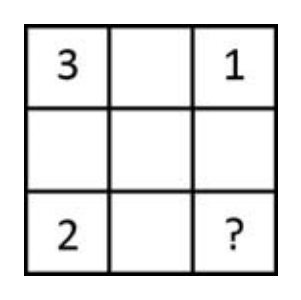
Jenny wants to write numbers into the cells of a 3×3-table so that the sum of the numbers in each of the four 2×2-squares are equally big. As it is shown in the diagram, she has already inserted three numbers. What number does she have to write into the cell in the fourth corner?
Show answer
Answer: D — 0
Show hints
Hint 1 of 2
Two 2×2 squares side by side share a whole column, so comparing them cancels those shared cells.
Still stuck? Show hint 2 →
Hint 2 of 2
Compare the two top squares and the two bottom squares, then subtract.
Show solution
Approach: compare side-by-side 2x2 squares so the shared column cancels
Call the unknown corner x (bottom-right); the known corners are 3 (top-left), 1 (top-right), 2 (bottom-left). Write the middle-left cell as d and the middle-right cell as f.
The two top squares are equal, and they share the middle column, so the leftover columns match: 3 + d = 1 + f.
The two bottom squares are equal the same way: 2 + d = x + f.
Subtract the second from the first: 3 − 2 = 1 − x, so 1 = 1 − x and x = 0, uniquely, choice D.
Tycho plans his running training. Each week he wants to go for a run on the same weekdays. He never wants to go for a run on two consecutive days, but he wants to go for a run two days a week. How many different weekly plans meet those conditions?
Show answer
Answer: B — 14
Show hints
Hint 1 of 2
The seven weekdays form a cycle; pick 2 run-days with no two next to each other.
Still stuck? Show hint 2 →
Hint 2 of 2
Count all pairs of 7 days, then remove the adjacent ones.
Show solution
Approach: choose 2 non-adjacent days on a 7-cycle
Choosing 2 of 7 days gives C(7,2) = 21 pairs.
Of these, 7 pairs are consecutive days, which are not allowed.
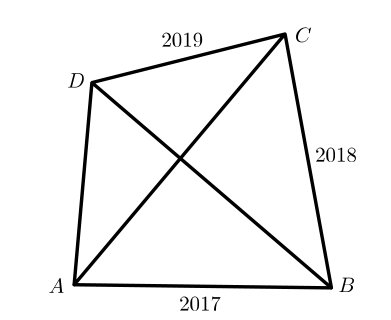
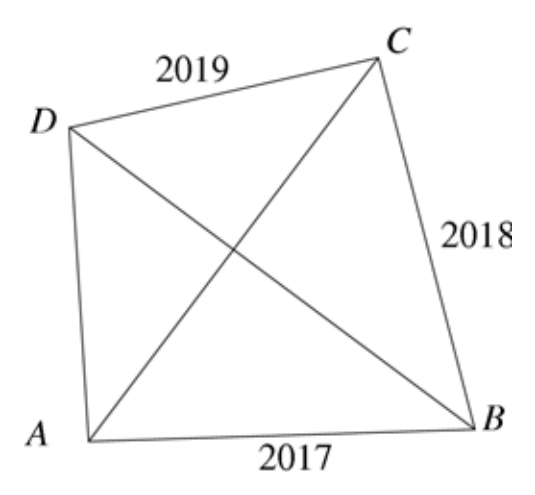
In a convex quadrilateral ABCD the diagonals are perpendicular to each other. The lengths of the edges are AB = 2017, BC = 2018 and CD = 2019 (diagram not to scale). How long is side AD?
Show answer
Answer: D — \(\sqrt{2018^2 + 2}\)
Show hints
Hint 1 of 2
With perpendicular diagonals, the four sides satisfy a neat relation between opposite pairs.
Still stuck? Show hint 2 →
Hint 2 of 2
Use AB^2 + CD^2 = BC^2 + AD^2 to solve for AD.
Show solution
Approach: apply the perpendicular-diagonal identity for the sides
For perpendicular diagonals, AB^2 + CD^2 = BC^2 + AD^2.
So AD^2 = 2017^2 + 2019^2 - 2018^2.
Since 2017^2 + 2019^2 = 2*2018^2 + 2, this gives AD^2 = 2018^2 + 2, so AD = sqrt(2018^2 + 2).
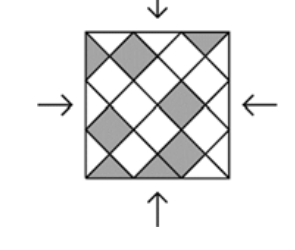
A square floor is tiled with triangular and square tiles in grey and white. What is the smallest number of grey tiles that must be swapped with white tiles so that the floor looks the same from each of the four marked viewing directions?
Show answer
Answer: C — one triangle, one square
Show hints
Hint 1 of 2
Looking the same from all four directions means the pattern must be unchanged by a quarter-turn rotation.
Still stuck? Show hint 2 →
Hint 2 of 2
Find the fewest grey tiles to recolour so every quarter-turn maps grey onto grey.
Show solution
Approach: enforce 4-fold rotational symmetry with fewest swaps
For the floor to look identical from all four sides, the grey pattern must repeat under a 90° rotation.
Compare each tile to where it lands under the rotations and fix the mismatches.
The smallest fix recolours one triangular tile and one square tile.
A number is written into every square of a 4 × 4 table. Mary is looking for the 2 × 2 table where the sum of the four numbers is greatest. How big is this sum?
1
2
1
3
4
1
1
2
1
7
3
2
2
1
3
1
Show answer
Answer: D — 14
Show hints
Hint 1 of 2
Slide a 2 x 2 window over the table and add its four numbers each time.
Still stuck? Show hint 2 →
Hint 2 of 2
The biggest entry, 7, should sit inside the best window.
Show solution
Approach: check the 2 x 2 block containing the largest numbers
Try 2 x 2 blocks, focusing on the area around the 7.
The block with 7, 3 (its right neighbour) and the 1, 3 below them gives 7+3+1+3.
That total is 14, larger than any other 2 x 2 block.
Number TheoryAlgebra & Patternssum-constraintcasework
Seven positive whole numbers a, b, c, d, e, f, g are written down next to each other in this order. The sum of all seven numbers is 2017. Every two adjacent numbers always differ by 1. Which number can be equal to 286?
Show answer
Answer: A — only a or g
Show hints
Hint 1 of 2
Neighbours differ by 1, so the seven numbers alternate even, odd, even, … — and the odd total 2017 fixes which positions are even.
Still stuck? Show hint 2 →
Hint 2 of 2
286 is below the average of about 288, so ask which position can dip the lowest.
Show solution
Approach: parity rules out three spots, then check which can reach the smallest value
Neighbours differ by 1, so the numbers alternate in parity. For the total 2017 to be odd, the four outer-pattern places a, c, e, g must be even and b, d, f odd.
286 is even, so it can only sit at one of a, c, e, g — that already rules out choices about b, d, f.
The average is 2017 ÷ 7 ≈ 288, and since steps are only ±1, the smallest a number can be is 286, reached only by going straight down from an end. An inner even place (c or e) has values on both sides pulling it up, so it cannot get below 288.
Hence 286 can occur only at an endpoint: only a or g, choice A.
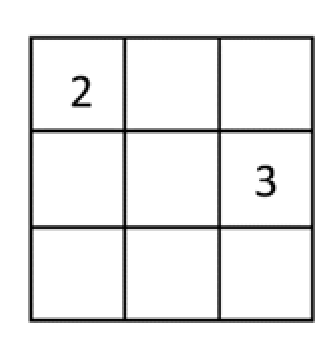
Emily wants to insert nine numbers into the 3 × 3 table so that the sum of the numbers in any two adjacent cells (cells with a common side) is always the same. She has already written two numbers into the table. How big is the sum of all nine numbers?
Show answer
Answer: D — 22
Show hints
Hint 1 of 2
Equal adjacent sums force a checkerboard: cells in the same colour class all hold the same value.
Still stuck? Show hint 2 →
Hint 2 of 2
The two given numbers belong to the two different colour classes.
Show solution
Approach: checkerboard pattern from equal adjacent sums
If every pair of side-sharing cells has the same sum, the grid alternates two values like a checkerboard: 5 cells of one value, 4 of the other.
The 2 sits in the 5-cell class and the 3 in the 4-cell class.
Lilli tries to be a well-behaved kangaroo, but she is having just too much fun not to lie every now and then. So every third statement of hers is a lie and the rest are true; sometimes she starts with a lie and sometimes with one or two true statements. Lilli thinks of a two-digit number and says to her friend: 1: “One digit of the number is a 2.” 2: “The number is greater than 50.” 3: “It is an even number.” 4: “The number is less than 30.” 5: “The number is divisible by 3.” 6: “One digit of the number is a 7.” What is the sum of the digits of the number Lilli is thinking of?
Show answer
Answer: D — 15
Show hints
Hint 1 of 2
Exactly one statement in each block of three is a lie, so the lies sit at positions {1,4}, {2,5}, or {3,6}.
Still stuck? Show hint 2 →
Hint 2 of 2
Test each lie-pattern: only one makes all the 'true' statements consistent for a real two-digit number.
Show solution
Approach: casework on which statements are the lies, then find the number
The two lies are at positions {1,4}, {2,5}, or {3,6}. The first two cases give contradictions (e.g. '>50' and '<30' both true).
With lies at {1,4}: the number is even, greater than 50, divisible by 3, contains a 7, contains no 2, and is at least 30.
That number is 78 (even, >50, 7+8=15 divisible by 3, has a 7, no 2).
A bag contains only red and green marbles. If you take out any 5 marbles, at least one is red. If you take out any 6 marbles, at least one is green. What is the greatest possible number of marbles in the bag?
Show answer
Answer: C — 9
Show hints
Hint 1 of 2
'Any 5 include a red' limits how many greens there can be; 'any 6 include a green' limits the reds.
Still stuck? Show hint 2 →
Hint 2 of 2
Turn each rule into a cap: greens ≤ 4 and reds ≤ 5, then add.
Show solution
Approach: convert each guarantee into a maximum count
If any 5 marbles always contain a red, there can be at most 4 greens (else 5 greens could be drawn).
If any 6 marbles always contain a green, there can be at most 5 reds (else 6 reds could be drawn).
So at most 4 green + 5 red = 9 marbles, and 4 green with 5 red satisfies both rules.
Five boys share 10 bags of marbles between themselves. Everyone gets exactly two bags (see picture). Alex gets 5 marbles, Bob 7, Charles 9 and Dennis 15. Eric gets the two bags that are left over. How many marbles does he get?
Show answer
Answer: E — 19
Show hints
Hint 1 of 2
The ten bags hold 1, 2, 3, ... up to 10 marbles; add them all first.
Still stuck? Show hint 2 →
Hint 2 of 2
Subtract the four known boys' totals from the grand total to get Eric's two bags.
Show solution
Approach: total all bags, then subtract the known amounts
The ten bags hold 1 through 10 marbles, a total of 55.
Alex, Bob, Charlie and Dennis took 5 + 7 + 9 + 15 = 36 marbles.
In the primate enclosure in a zoo there are four gorillas. They are all younger than 18 years old. No two have the same age, and all their ages are whole numbers. The product of their ages is 882. How big is the sum of their ages?
Show answer
Answer: D — 31
Show hints
Hint 1 of 2
Factor 882 and split it into four different whole numbers, all under 18.
Still stuck? Show hint 2 →
Hint 2 of 2
Use the prime factorisation 882 = 2 · 3² · 7².
Show solution
Approach: factor 882 into four distinct factors below 18
882 = 2 · 3² · 7².
The only way to write it as four distinct factors each under 18 is 1 · 7 · 9 · 14 = 882.
If you measure the angles of a triangle, you obtain three different natural numbers. What is the smallest possible sum of the biggest and the smallest angle of the triangle?
Show answer
Answer: C — 91°
Show hints
Hint 1 of 2
Biggest + smallest = 180° − middle, so making that small means making the middle angle large.
Still stuck? Show hint 2 →
Hint 2 of 2
Push the middle angle as high as possible while keeping all three angles different whole numbers.
Show solution
Approach: maximise the middle angle
The three angles add to 180°, so biggest + smallest = 180 − middle.
To minimise that, maximise the middle angle: take 1°, 89°, 90° (all different, sum 180).
How many positive whole numbers have the property that, if you delete the last digit, you obtain a new number that is exactly equal to 114 of the original number?
Show answer
Answer: C — 2
Show hints
Hint 1 of 2
Deleting the last digit of N leaves the number formed by the other digits; call that part a and the last digit d.
Still stuck? Show hint 2 →
Hint 2 of 2
Write N = 10a + d and set a = N/14, then see which digits d are possible.
Show solution
Approach: set up the place-value equation and solve for valid digits
Let the number be 10a + d, where a is what remains after deleting the last digit d.
The condition a = (10a + d)/14 gives 14a = 10a + d, so 4a = d.
Since d is a single digit, a = 1 (d = 4, number 14) or a = 2 (d = 8, number 28).
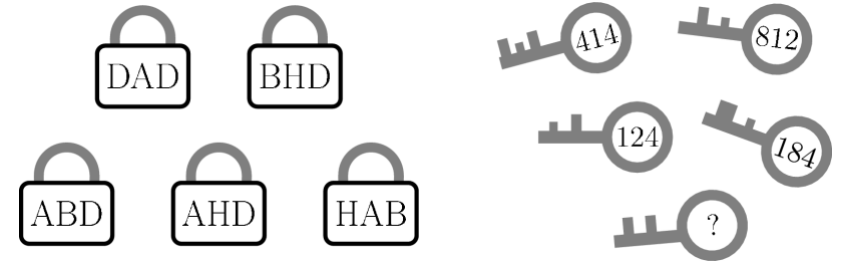
Each of the 5 keys opens exactly one padlock. On a padlock, each letter stands for one digit, and equal letters mean equal digits. Which digits are on the key marked with the question mark?
Show answer
Answer: C — 284
Show hints
Hint 1 of 2
Each padlock's letter pattern (which letters repeat and where) must match a key's digit pattern.
Still stuck? Show hint 2 →
Hint 2 of 2
Match the all-different padlock to the all-different key, then read off shared letters to decode the rest.
Show solution
Approach: match letter patterns to digit patterns and solve for each letter
The unknown key 284 (all different digits) fits BHD (all different letters): B=2, H=8, D=4.
DAD = 4_4 matches 414, giving A=1; then ABD = 1,2,4 matches 124 and AHD = 1,8,4 matches 184.
HAB = 8,1,2 matches 812, so every padlock is accounted for consistently.
A small zoo has a giraffe, an elephant, a lion and a turtle. Susi wants to visit exactly two of the animals today but does not want to start with the lion. How many different possibilities does she have, to visit the two animals one after the other?
Show answer
Answer: D — 9
Show hints
Hint 1 of 2
Count ordered visits of two different animals, then remove the forbidden starts.
Still stuck? Show hint 2 →
Hint 2 of 2
There are 4 x 3 ordered pairs; throw out the ones beginning with the lion.
Show solution
Approach: count ordered pairs, then subtract those starting with the lion
Choosing two animals in order gives 4 x 3 = 12 possibilities.
Of these, the ones starting with the lion number 1 x 3 = 3.
The numbers −3, −2, −1, 0, 1, 2 are written on the six faces of a die. The die is rolled twice. The numbers that were rolled are multiplied. How big is the probability that this product is negative?
Show answer
Answer: E — 13
Show hints
Hint 1 of 2
A product is negative only when one factor is positive and the other is negative.
Still stuck? Show hint 2 →
Hint 2 of 2
Count the positive faces and the negative faces; zero never helps.
Show solution
Approach: count favourable ordered rolls over all 36 outcomes
The faces are −3, −2, −1, 0, 1, 2: three negatives and two positives (0 gives product 0).
Negative product needs one of each sign; ordered, that is 3·2 + 2·3 = 12 of the 36 equally likely pairs.
There are 10 kangaroos in a row, as seen in the picture. Two kangaroos that are standing next to each other and can see each other are allowed to change places by hopping past each other. This is carried out until no more jumps are allowed. How often do two kangaroos swap places?
Show answer
Answer: C — 18
Show hints
Hint 1 of 2
A swap happens for each pair of kangaroos that start facing each other but in the wrong order.
Still stuck? Show hint 2 →
Hint 2 of 2
Count the facing pairs that must pass each other — that is the number of swaps.
Show solution
Approach: count the pairs that must cross
A swap happens exactly once for each pair where a right-facing kangaroo starts somewhere to the left of a left-facing kangaroo, since those two must pass each other.
So count, for every right-facing kangaroo, how many left-facing kangaroos stand to its right, and add these up.
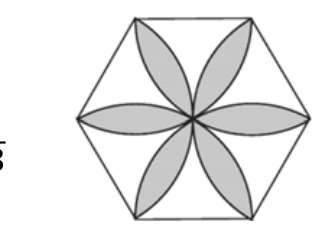
The diagram shows a regular hexagon with side length 1. The grey flower is outlined by circular arcs of radius 1 whose centres lie at the vertices of the hexagon. How big is the area of the grey flower?
Show answer
Answer: E — \(2\pi - 3\sqrt{3}\)
Show hints
Hint 1 of 2
Each petal is built from two circular arcs of radius 1; relate it to a 60-degree sector of a unit circle.
Still stuck? Show hint 2 →
Hint 2 of 2
Subtract the straight triangular pieces from the arc sectors to isolate the petal area, then multiply by the number of petals.
Show solution
Approach: decompose the flower into arc-sectors minus triangles
Each petal is the overlap of two unit circles centred at adjacent vertices; that lens is two \(60^\circ\) sectors minus the equilateral triangle counted twice, i.e. \(2\cdot\frac{\pi}{6} - 2\cdot\frac{\sqrt{3}}{4} = \frac{\pi}{3} - \frac{\sqrt{3}}{2}\).
The flower is made of six such petals, so its area is \(6\left(\frac{\pi}{3} - \frac{\sqrt{3}}{2}\right)\).
That simplifies to \(2\pi - 3\sqrt{3}\), which is answer E.
Petra likes even numbers, Ina likes numbers divisible by 3, and Celina likes numbers divisible by 5. A basket holds 8 balls, each marked with a number. Each girl went to the basket alone, in turn, and took every remaining ball that matched her taste. Petra took 32 and 52; Ina took 24, 33 and 45; Celina took 20, 25 and 35. In what order did they go to the basket?
Show answer
Answer: D — Ina, Celina, Petra
Show hints
Hint 1 of 2
Some balls fit two girls' tastes; whoever ended up with such a ball must have visited the basket first.
Still stuck? Show hint 2 →
Hint 2 of 2
Use a shared ball each time to order two girls, then chain the comparisons.
Show solution
Approach: use shared-preference balls to order the visits
45 is a multiple of both 3 and 5; Ina took it, so Ina came before Celina.
20 is both even and a multiple of 5; Celina took it, so Celina came before Petra.
Kate has four flowers, which have 6, 7, 8 and 11 petals respectively. She now tears off one petal from each of three different flowers. She repeats this until it is no longer possible to tear off one petal from each of three different flowers. What is the minimum number of petals left over?
Show answer
Answer: B — 2
Show hints
Hint 1 of 2
Every single round takes away exactly 3 petals (one from each of three flowers).
Still stuck? Show hint 2 →
Hint 2 of 2
Since 3 petals leave each round, the petals removed always count up by threes; think about what is left from 32.
Show solution
Approach: petals leave 3 at a time, so the leftover is what 32 has past a count-by-three
There are 6 + 7 + 8 + 11 = 32 petals to start.
Each round takes one petal from three different flowers, so exactly 3 petals leave every round.
Counting by threes (3, 6, 9, ..., 30), the most she can remove is 30, which still keeps three flowers alive long enough to do every round.
In a convex quadrilateral ABCD the diagonals are perpendicular to each other. The length of the edges are AB = 2017, BC = 2018 and CD = 2019 (diagram not to scale). How long is side AD?
Show answer
Answer: D — \(\sqrt{2018^2 + 2}\)
Show hints
Hint 1 of 2
When the diagonals of a quadrilateral are perpendicular, opposite sides obey a neat relation.
Still stuck? Show hint 2 →
Hint 2 of 2
For perpendicular diagonals, \(AB^2 + CD^2 = BC^2 + AD^2\).
Show solution
Approach: apply the perpendicular-diagonals side relation
With perpendicular diagonals, \(AB^2 + CD^2 = BC^2 + AD^2\).
Diana adds either 2 or 5 to every whole number from 1 to 9. She wants to achieve as few different sums as possible. What is the minimum number of different values she obtains?
Show answer
Answer: B — 6
Show hints
Hint 1 of 2
Each number 1–9 becomes either n+2 or n+5; you choose to make sums coincide.
Still stuck? Show hint 2 →
Hint 2 of 2
The reachable sums run from 3 to 14 — choose so as few distinct values appear as possible.
Show solution
Approach: overlap the +2 and +5 results
Adding 2 gives values 3..11; adding 5 gives 6..14; since n+5 = (n+3)+2, results three apart can be merged.
Choosing cleverly, the distinct sums collapse to just 6, 7, 8, 9, 10, 11.
The first kangaroo is repeatedly mirrored (reflected) across the dotted lines. Two reflections have already been carried out. In which position is the kangaroo in the grey triangle?
Show answer
Answer: E
Show hints
Hint 1 of 2
Each step flips the kangaroo across the next dotted edge; reflecting twice restores orientation but moves it.
Still stuck? Show hint 2 →
Hint 2 of 2
Track the kangaroo through the reflections into the grey triangle and read off its pose.
Show solution
Approach: apply successive reflections across the triangle edges
Reflecting across each shared dotted edge flips the kangaroo's orientation in alternating triangles.
Carry the flips along the strip until reaching the grey triangle.
The resulting pose matches option (E).
So the kangaroo in the grey triangle looks like (E).
Leonie has hidden a Smiley behind some of the grey boxes. The numbers state how many Smileys there are in the neighbouring boxes. Two boxes are neighbouring if they have one side or one corner in common. How many Smileys has Leonie hidden?
Show answer
Answer: B — 5
Show hints
Hint 1 of 2
A number in a white box counts the Smileys in its grey neighbour boxes (boxes touching it by a side or a corner).
Still stuck? Show hint 2 →
Hint 2 of 2
Begin with a number whose grey neighbours are few: it may force every one of them to hold a Smiley.
Show solution
Approach: use each clue box to decide which grey boxes hold Smileys
Each white number tells how many of its touching grey boxes hide a Smiley.
A clue near an edge has only a few grey neighbours, so a large number there fills them all; a small number elsewhere then forces nearby boxes to stay empty.
Working clue by clue, every grey box is decided as either holding a Smiley or empty.
Counting the boxes forced to hold a Smiley gives 5 in total.
A popular two-digit number is made up of the digits a and b. If the number pair is written down three times one after the other, a six-digit number is obtained. This new number is always divisible by
Show answer
Answer: C — 7
Show hints
Hint 1 of 2
Writing the two-digit number three times equals it times some fixed number.
Still stuck? Show hint 2 →
Hint 2 of 2
Factor that fixed multiplier 10101.
Show solution
Approach: factor the repetition multiplier
Writing the two-digit number ab three times gives ababab = ab × 10101.
Factor 10101 = 3 · 7 · 13 · 37, so 7 always divides the result.
Every three minutes a bus leaves the airport to drive to the city centre. A car leaves the airport at the same time as a bus and travels the same route to the city centre. Every bus takes 60 minutes for the journey from the airport to the city centre; the car takes only 35 minutes. How many buses does the car overtake on its way to the city centre? (The bus that starts at the same time as the car does not count.)
Show answer
Answer: A — 8
Show hints
Hint 1 of 2
Send the car and a bus from the airport together and find when the car draws level with each earlier bus.
Still stuck? Show hint 2 →
Hint 2 of 2
A bus counts only if the car catches it before either reaches the city.
Show solution
Approach: catch-up time for each earlier bus
Let the car leave at time 0; a bus that left 3k minutes earlier is caught when the car has run for 4.2k minutes.
This catch must happen before the bus arrives: 4.2k + 3k ≤ 60 gives k ≤ 8.
So the car overtakes buses for k = 1..8, that is 8 buses.
We look at a regular tetrahedron with volume 1. Its four vertices are cut off by planes that go through the midpoints of the respective edges (see diagram). How big is the volume of the remaining solid?
Show answer
Answer: D — 12
Show hints
Hint 1 of 2
Each cut through edge midpoints slices off a small tetrahedron similar to the whole, at half scale.
Still stuck? Show hint 2 →
Hint 2 of 2
A half-scale tetrahedron has 1/8 the volume; account for all four corners.
Show solution
Approach: subtract four half-scale corner tetrahedra
Cutting through the midpoints removes a corner tetrahedron with edges half as long, so each has volume (1/2)^3 = 1/8.
The four corner pieces do not overlap, removing 4 x 1/8 = 1/2 of the volume.
My friend Heinz wants to use a special password that is made up of seven digits. Each digit used in the password appears as many times in the password as is the value of the digit. Additionally, equal digits are always next to each other. Therefore he can for example use 4444333 or 1666666 as passwords. How many possible passwords can he choose from?
Show answer
Answer: E — 13
Show hints
Hint 1 of 2
Each chosen digit takes up as many of the 7 slots as its value, so the values must add to 7.
Still stuck? Show hint 2 →
Hint 2 of 2
Equal digits stay together as one block, so count orderings of the blocks.
Show solution
Approach: partition 7 into distinct digit-values, then order the blocks
Since a digit d fills d slots and equal digits are adjacent, choose distinct digit-values that sum to 7: {7}, {1,6}, {2,5}, {3,4}, {1,2,4}.
Each choice of k blocks can be arranged in k! orders: 1 + 2 + 2 + 2 + 6 = 13.
The diagram shows Maria’s square tablecloth to scale. All small light squares are equally big, and their diagonals are parallel to the sides of the tablecloth. Which part of the whole tablecloth is black?
Show answer
Answer: D — 32%
Show hints
Hint 1 of 2
The light squares are tilted 45°; split the border into a grid of small equal triangles.
Still stuck? Show hint 2 →
Hint 2 of 2
Count black triangles against the total to get the black fraction.
Show solution
Approach: tile into equal triangles and count
Because each light square's diagonals line up with the cloth's sides, the whole cloth divides into many congruent small triangles.
Counting the black triangles against the total gives the black share.
The sum of the three side lengths of a right-angled triangle equals 18. The sum of the squares of these three side lengths equals 128. How big is the area of the triangle?
Show answer
Answer: E — 9
Show hints
Hint 1 of 2
For a right triangle the sum of the two leg-squares equals the hypotenuse-square, so the squared-sum simplifies.
Still stuck? Show hint 2 →
Hint 2 of 2
Use the perimeter and the squared identity to find the legs' product, which gives the area.
Show solution
Approach: use the Pythagorean relation to find the legs' product
With legs a, b and hypotenuse c: a^2 + b^2 = c^2, so a^2 + b^2 + c^2 = 2c^2 = 128, giving c = 8.
Then a + b = 18 - 8 = 10, and (a + b)^2 = a^2 + b^2 + 2ab = 64 + 2ab = 100, so ab = 18.
Logic & Word ProblemsNumber Theorycaseworkcareful-counting
Paul wants to write a positive whole number onto every tile in the number wall shown, so that every number is equal to the sum of the two numbers on the tiles that are directly below. What is the maximum number of odd numbers he can write on the tiles?
Show answer
Answer: B — 14
Show hints
Hint 1 of 2
Work in parity (odd/even): a tile is odd exactly when the two below it differ in parity.
Still stuck? Show hint 2 →
Hint 2 of 2
Search the bottom row patterns of the six-row wall to maximise odd tiles.
Show solution
Approach: reduce to parity and optimise the bottom row of the wall
Only odd/even matters: a tile is odd exactly when the two tiles below it have different parities, so the whole wall is fixed once the bottom row's pattern of odds and evens is chosen.
For the six-row (21-tile) wall, testing the bottom-row patterns, the best choice (such as even, odd, odd, even, odd, odd) makes 14 of the 21 tiles odd.
So the maximum number of odd tiles is 14, choice B.
The number sequence 2, 3, 6, 8, 8, … is created by the following rule: the first two digits are 2 and 3. After that, every subsequent digit is the units digit of the product of the two previous digits. Which digit is the 2017th digit of the sequence?
Show answer
Answer: A — 2
Show hints
Hint 1 of 2
Each new term is the units digit of the product of the previous two, so the sequence soon repeats.
Still stuck? Show hint 2 →
Hint 2 of 2
Find the repeating block, then locate position 2017 within it.
Show solution
Approach: detect the cycle, then index into it
The sequence is 2, 3, 6, 8, 8, 4, 2, 8, 6, 8, 8, 4, ... ; from the 6th term it cycles with period 6: (4, 2, 8, 6, 8, 8).
Position 2017 is 2011 steps past the 6th term, and 2011 mod 6 = 1, picking the 2nd entry of the cycle.
Anna has five boxes, as well as five black balls and five white balls. She is allowed to decide how she shares out the balls between the boxes, as long as she puts at least one ball into each box. Beate randomly chooses one box and takes one ball without looking. Beate wins if she draws a white ball; otherwise Anna wins. How should Anna distribute the balls to get the highest probability of winning?
Show answer
Answer: D — Anna puts all of the white balls into one box and then puts one black ball into each box.
Show hints
Hint 1 of 2
Anna wins when Beate draws black, so Anna wants to minimise the chance of a white draw.
Still stuck? Show hint 2 →
Hint 2 of 2
Beate picks a box uniformly first; compute the white-draw probability for each option and pick the smallest.
Show solution
Approach: compute Beate's white-draw probability for each distribution
Beate first picks one of the 5 boxes with equal chance \(\frac{1}{5}\), then a ball from it; Anna wants the white-draw probability as small as possible.
Option D buries all 5 white balls in one box that also gets a black ball (6 balls, \(\frac{5}{6}\) white) while the other four boxes hold only black, giving white chance \(\frac{1}{5}\cdot\frac{5}{6} = \frac{1}{6}\).
Every other option leaves more boxes containing white balls, so its white chance exceeds \(\frac{1}{6}\) (e.g. option C gives \(\frac{1}{5}\)).
The smallest white chance, hence Anna's best play, is option D.
Lisa places some points on a circle and then connects them in sequence to make a polygon. She adds up the interior angles of the polygon. By mistake she misses out one angle and obtains the sum 2017. How big is the angle that she has overlooked?
Show answer
Answer: E — 143°
Show hints
Hint 1 of 2
The true angle sum of a polygon is a multiple of 180°.
Still stuck? Show hint 2 →
Hint 2 of 2
The missed angle is the gap up to the next multiple of 180 above 2017.
Show solution
Approach: round up to the nearest valid polygon angle sum
The interior angles of an n-gon sum to (n−2)·180°, a multiple of 180.
The smallest multiple of 180 above 2017 is 2160 = 12·180.
The overlooked angle is 2160 − 2017 = 143°, choice E.
Mike has 125 small, equally big cubes. He glues some of them together in such a way that one big cube with exactly nine tunnels is created (see diagram). The tunnels go all the way straight through the cube. How many of the 125 cubes is he not using?
Show answer
Answer: D — 39
Show hints
Hint 1 of 2
Count how many unit cubes are removed to make the nine straight tunnels.
Still stuck? Show hint 2 →
Hint 2 of 2
Tunnels share cubes where they cross inside the big cube — don't double-count.
Show solution
Approach: count removed cubes via inclusion-exclusion
Each tunnel removes a straight line of 5 cubes; nine tunnels would remove 45, but the tunnels intersect inside the cube.
Subtracting the cubes shared at the crossings leaves 39 cubes actually removed.
Nine whole numbers were written into the cells of a 3 × 3 table. The sum of these nine numbers is 500. We know that the numbers in two adjacent cells (sharing a common side) differ by exactly 1. Which number is in the middle cell?
Show answer
Answer: D — 56
Show hints
Hint 1 of 2
Adjacent cells differ by 1, so the grid splits into two parity classes like a checkerboard around the centre.
Still stuck? Show hint 2 →
Hint 2 of 2
Express all nine entries in terms of the centre value and set the total equal to 500.
Show solution
Approach: write all cells relative to the centre, then use the sum
Colour the grid like a checkerboard; neighbours differ by 1, so the centre and four corners share one parity while the four edge cells share the other.
A valid tight filling is centre \(m\), each edge cell \(m-1\), and each corner \(m\) (every adjacent pair then differs by exactly 1).
The total is \(m + 4(m-1) + 4m = 9m - 4\); setting \(9m - 4 = 500\) gives \(9m = 504\).
Logic & Word ProblemsGeometry & Measurementsymmetrycasework
30 dancers are standing in a circle facing the centre. The dance instructor shouts “Left” and many of them turn 90° to the left. Unfortunately, some are confused and turn right, so that some dancers are now directly facing each other. All of the ones that are facing each other are shaking their head. It turns out that 10 dancers shake their head. Then the dance instructor says “Turn around” and all of them turn 180° to look in the opposite direction. Again, all of the ones that are directly facing each other shake their head. How many dancers are shaking their head second time round?
Show answer
Answer: A — 10
Show hints
Hint 1 of 2
Two dancers facing each other still form a special pair after both turn 180°.
Still stuck? Show hint 2 →
Hint 2 of 2
Turning everyone around swaps who faces whom, but the count is preserved by symmetry.
Show solution
Approach: track neighbouring pairs facing each other versus back-to-back before and after the turn-around
After turning, each dancer looks clockwise or anticlockwise; a neighbouring pair faces each other when both look toward the gap between them, and is back-to-back when both look away from it.
Going once around the circle, every switch from clockwise-runs to anticlockwise-runs is matched by a switch back, so the number of facing gaps always equals the number of back-to-back gaps.
The first round has 10 head-shakers, i.e. 5 facing gaps, hence also 5 back-to-back gaps; turning everyone 180° reverses all directions, so those 5 back-to-back gaps become the new facing gaps.
That gives 5 facing pairs again, so 10 dancers shake their heads the second time, choice A.
Two runners are training at the same time on a 720 m long, round running track. They run with constant speed in opposite directions. The first runner needs four minutes for one lap, the second five minutes. How many metres does the second runner run between two consecutive meetings of the two runners?
Show answer
Answer: E — 320
Show hints
Hint 1 of 2
Running opposite ways, the two runners' speeds add when finding how fast the gap to the next meeting closes.
Still stuck? Show hint 2 →
Hint 2 of 2
Find the time between meetings, then multiply by the slower runner's speed.
Show solution
Approach: closing speed gives the meeting interval
Counting & ProbabilityLogic & Word Problemscaseworkcareful-counting
Three weights are randomly placed on each tray of a beam balance. The balance dips to the right hand side as shown on the picture. The masses of the weights are 101, 102, 103, 104, 105 and 106 grams. For how many percent of the possible distributions is the 106-grams-weight on the right (heavier) side?
Show answer
Answer: B — 80 %
Show hints
Hint 1 of 2
List the splits of the six weights into two trays of three with the right side heavier.
Still stuck? Show hint 2 →
Hint 2 of 2
Among those, count how often the heaviest weight (106) is on the right.
Show solution
Approach: enumerate the heavier-right splits and check where 106 sits
Of the C(6,3)=20 ways to fill the right tray, exactly half (10) make the right side heavier.
Counting those, the 106-gram weight is on the right in 8 of the 10 cases.
Sarah wants to write a positive whole number onto every tile in the number wall shown, so that every number is equal to the sum of the two numbers on the tiles that are directly below it. What is the maximum number of odd numbers Sarah can write on the tiles?
Show answer
Answer: D — 10
Show hints
Hint 1 of 2
A tile is the sum of the two below it, so it is odd only when exactly one of those two is odd.
Still stuck? Show hint 2 →
Hint 2 of 2
Arrange the bottom row's parities to keep as many tiles odd as possible.
Show solution
Approach: track parities up the wall
With 15 tiles (rows of 5, 4, 3, 2, 1), each upper tile is odd exactly when the two below it differ in parity.
Searching parity patterns for the bottom row, the most odd tiles achievable across the whole wall is 10.
The points A and B lie on a circle with centre M. The point P lies on the straight line through A and M. PB touches the circle in B. The lengths of the segments PA and MB are whole numbers, and PB = PA + 6. How many possible values for MB are there?
Show answer
Answer: D — 6
Show hints
Hint 1 of 2
PB is tangent, so its square equals the product of the whole secant and its external part (power of the point P).
Still stuck? Show hint 2 →
Hint 2 of 2
Turn the relation into MB = 6 + 18/PA and require whole numbers.
Show solution
Approach: use the tangent-secant power of a point, then count integer solutions
Power of the point P: \(PB^2 = PA \cdot (PA + 2\,MB)\), since the secant through A and M has external part PA and crosses the circle again a diameter (2·MB) further on.
With PB = PA + 6: \((PA+6)^2 = PA^2 + 2\,PA\cdot MB\) gives \(12\,PA + 36 = 2\,PA\cdot MB\), so \(MB = 6 + \dfrac{18}{PA}\).
MB is a whole number when PA divides 18: PA ∈ {1, 2, 3, 6, 9, 18}, giving 6 distinct values of MB, choice D.
The parallelogram ABCD has area 1. The two diagonals intersect each other at point M. Another point P lies on the side DC. E is the point of intersection of the segments AP and BD, and F is the point of intersection of the segments BP and AC. What is the area of the quadrilateral EMFP, if the sum of the areas of the triangles AED and BFC is 13?
Show answer
Answer: D — 112
Show hints
Hint 1 of 2
Use that the parallelogram has area 1 and that its diagonals and the segments cut it into known fractions.
Still stuck? Show hint 2 →
Hint 2 of 2
Express EMFP as the parallelogram minus the surrounding triangles, using the given AED + BFC = 1/3.
Show solution
Approach: area chase with the given triangle sum
Take all areas relative to the whole parallelogram (=1); the segments AP, BP and the diagonals cut it into triangles of fixed fractions.
Removing the triangles around EMFP and using area(AED) + area(BFC) = 1/3 pins down the quadrilateral.
2017 people live on an island. Each person is either a liar (who always lies) or a nobleman (who always tells the truth). Over a thousand of them attend a banquet where they all sit together around one big round table. Everyone says, “Of my two neighbours, one is a liar and one is a nobleman.” What is the maximum number of noblemen on the island?
Show answer
Answer: A — 1683
Show hints
Hint 1 of 2
The banquet statement constrains only the people seated at the round table; the others on the island are free.
Still stuck? Show hint 2 →
Hint 2 of 2
Work out the densest valid liar/nobleman pattern around the table, then add the unseated islanders.
Show solution
Approach: maximise noblemen given the round-table constraint plus free islanders
A seated nobleman truly has one liar neighbour, so two noblemen can sit together but never three in a row; a seated liar lies, so its two neighbours match (both noblemen or both liars).
The densest legal seating repeats the block nobleman-nobleman-liar, making at most \(\frac{2}{3}\) of the seated people noblemen, so a table of \(n\) (a multiple of 3) seats up to \(\frac{2n}{3}\) noblemen.
Everyone not at the banquet can be a nobleman, so the island total is \((2017-n) + \frac{2n}{3} = 2017 - \frac{n}{3}\), maximised by the smallest legal \(n\) over a thousand, namely \(n = 1002\).
That gives \(2017 - 334 = 1683\) noblemen, answer A.