Problem 12 · 2016 Math Kangaroo
Hard
Number Theory
factorization
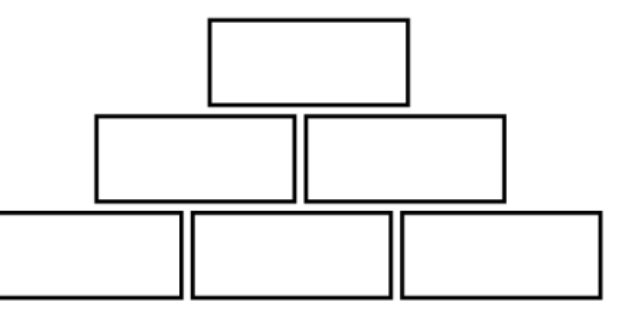
In this number pyramid each number in a higher cell is equal to the product of the two numbers in the cells immediately underneath it. Which of the following numbers cannot appear in the topmost cell, if the cells on the bottom row hold only natural numbers greater than 1?
Show answer
Answer: D — 105
Show hints
Hint 1 of 2
Write the top cell as a product of the three bottom entries.
Still stuck? Show hint 2 →
Hint 2 of 2
The top equals a*b^2*c, so it must contain a perfect-square factor bigger than 1.
Show solution
Approach: express the apex as a*b^2*c
- With bottom cells a, b, c, the middle cells are ab and bc, and the top is ab*bc = a*b^2*c.
- So the top number must be divisible by some square b^2 with b greater than 1.
- Among the options, 105 = 3*5*7 is square-free, so it cannot appear: answer 105 (D).
Mark:
· log in to save