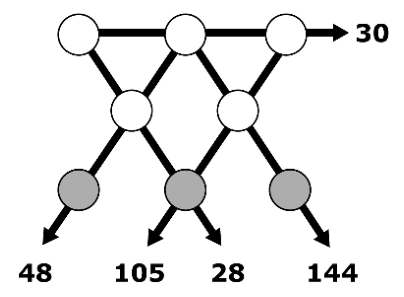
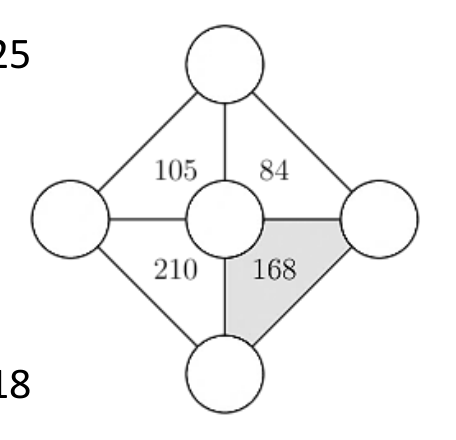
Sarah has a bag of 18 balls numbered from 1 to 18. What is the smallest number of balls Sarah must remove from the bag to be sure that she has removed at least three prime numbers?
Show answer
Answer: D — 14
Show hints
Hint 1 of 2
Ask how many balls are NOT prime — those could all come out before any prime.
Still stuck? Show hint 2 →
Hint 2 of 2
After removing every non-prime, the next few must be primes; worst case removes all non-primes first.
Show solution
Approach: worst-case (pigeonhole) counting
Primes from 1–18: 2,3,5,7,11,13,17 — seven of them; the other 11 numbers are non-prime.
Worst case she draws all 11 non-primes first, then needs 3 more to guarantee three primes.
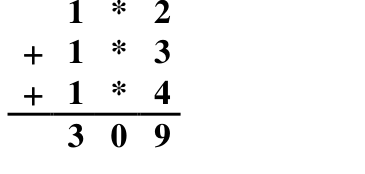
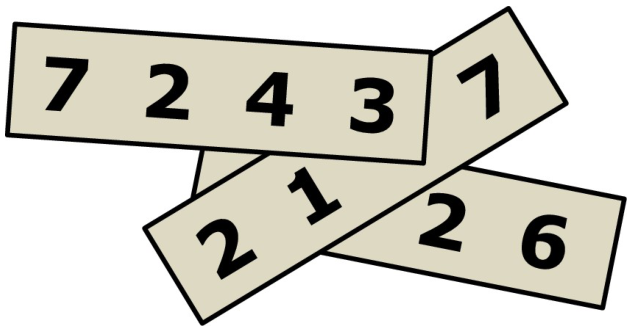
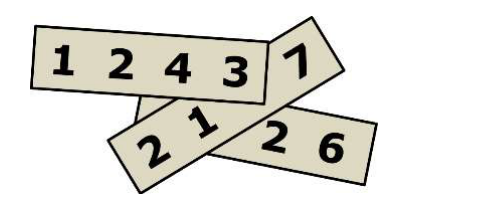
213, 214 and 215 are three numbers in a row, each one more than the one before. Mohammad writes three numbers like that, but with four digits each. His sister erases some digits from each number, leaving:
???7, ?898, 48??
Which digits (from left to right) are missing?
Show answer
Answer: D — 4 8 9, 4, 9 9
Show hints
Hint 1 of 2
The three numbers are consecutive, and the middle one looks like _898.
Still stuck? Show hint 2 →
Hint 2 of 2
Pick the four-digit number ending 898, then write the one before and the one after it.
Show solution
Approach: identify three consecutive numbers from the visible digits
The middle number is 4898 (form _898, and it sits between numbers ending 7 and starting 48).
We call a positive integer ntwoprime if it has exactly three different positive factors, namely 1, 2 and the number n itself. How many twoprime numbers are there?
Show answer
Answer: B — 1
Show hints
Hint 1 of 2
A number with exactly three divisors must be the square of a prime.
Still stuck? Show hint 2 →
Hint 2 of 2
Here the three divisors have to be exactly 1, 2 and n — so 2 must be the prime.
Show solution
Approach: a number with exactly three factors is a prime squared
Exactly three positive factors means n = p2 for a prime p, with factors 1, p, p2.
The factors must be 1, 2 and n, so p = 2 and n = 4 (factors 1, 2, 4).
Beate arranges five cards — 4, 8, 31, 59 and 107 — side by side to make the smallest possible nine-digit number. Which card ends up furthest to the right?
Show answer
Answer: B — 8
Show hints
Hint 1 of 2
To make the joined number smallest, the cards with the smallest leading digit should sit furthest to the left.
Still stuck? Show hint 2 →
Hint 2 of 2
Order the five cards by the digit they start with, and see which card ends up last on the right.
Show solution
Approach: order the cards by their leading digit
The five cards start with the digits 1 (107), 3 (31), 4 (4), 5 (59) and 8 (8).
For the smallest number these leading digits must read in increasing order from left to right, so the cards go 107, 31, 4, 59, 8, giving 107314598.
The card furthest to the right is 8, so the answer is B.
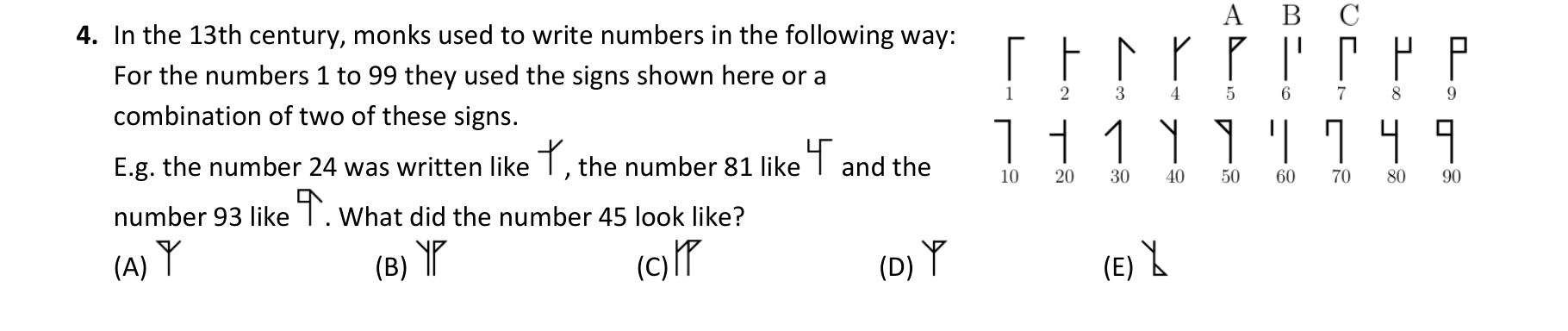
In the 13th century, monks wrote numbers in a special way: for the numbers 1 to 99 they used the signs shown here, or a combination of two of these signs. For example, the number 24 was written one way, 81 another, and 93 another. What did the number 45 look like?
Show answer
Answer: D
Show hints
Hint 1 of 2
Split 45 into a tens part and a units part: 40 and 5.
Still stuck? Show hint 2 →
Hint 2 of 2
Combine the sign for 40 with the sign for 5, just as 24 combined the signs for 20 and 4.
Show solution
Approach: combine the tens-sign and units-sign for 45
The system writes a two-digit number by combining one tens sign and one units sign.
For 45 take the sign for 40 and the sign for 5.
Putting them together gives the figure shown in D.
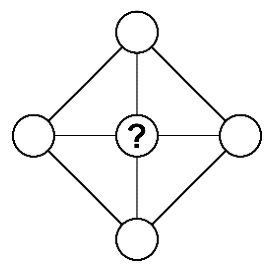
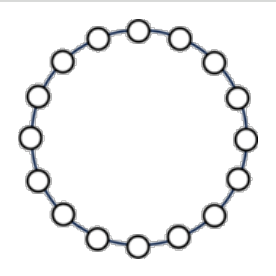
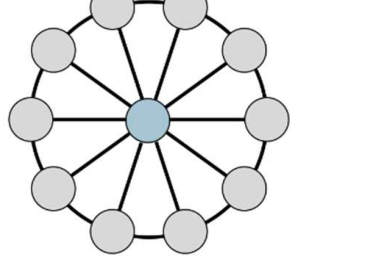
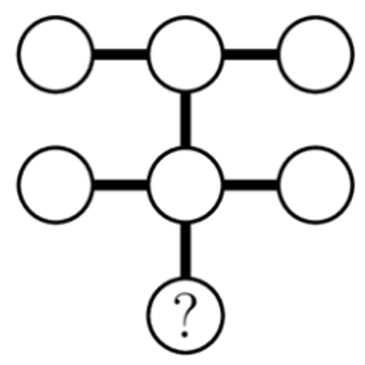
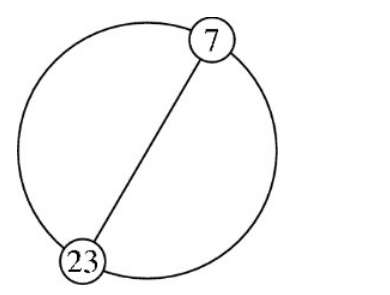
The numbers 3, 4, 5, 6 and 7 are written in the five circles of the shape shown. The product of the numbers in the four outer circles is 360. Which number is in the inner circle?
Show answer
Answer: E — 7
Show hints
Hint 1 of 2
The five numbers are fixed: 3, 4, 5, 6, 7. Find their total product first.
Still stuck? Show hint 2 →
Hint 2 of 2
Divide the product of all five by the product of the four outer ones to isolate the inner number.
Show solution
Approach: divide the full product by the outer product
The product of all five numbers 3,4,5,6,7 is 2520.
The four outer numbers multiply to 360.
The inner number is 2520 / 360 = 7, so the answer is E.
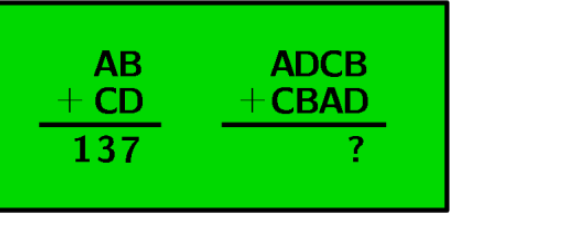
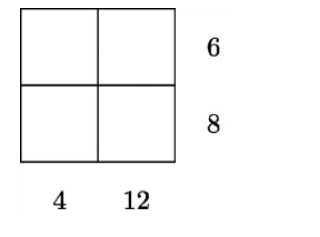
A student correctly added the two two-digit numbers on the left of the board (AB + CD) and got the answer 137. What answer will he get if he adds the two four-digit numbers on the right of the board (ADCB + CBAD)?
Show answer
Answer: B — 13 837
Show hints
Hint 1 of 2
Write the right-hand sum ADCB + CBAD in terms of the totals A+C and B+D.
Still stuck? Show hint 2 →
Hint 2 of 2
The left-hand fact AB + CD = 137 already pins down 10(A+C) + (B+D).
Show solution
Approach: express the big sum using A+C and B+D
From AB + CD = 137 we get 10(A+C) + (B+D) = 137, so A+C = 13 and B+D = 7.
Grandma has just baked 23 cupcakes and wants to give the same number of them to each of her six grandchildren, eating what is left over. At least how many cupcakes will she have left to eat?
Show answer
Answer: E — 5
Show hints
Hint 1 of 2
Give each of the 6 children the same number of cupcakes, as many as you can.
Still stuck? Show hint 2 →
Hint 2 of 2
Whatever does not fit into an equal share is what Grandma eats.
Show solution
Approach: share equally, then see what is left over
Give each child 3 cupcakes: that uses 6 × 3 = 18 cupcakes.
Giving each a 4th would need 24, but there are only 23, so 3 each is the most that shares evenly.
That leaves 23 − 18 = 5 cupcakes for Grandma to eat.
Thor has seven stones and a hammer. With his hammer he hits a stone and it breaks into five small stones. He does that a few times. Which of these numbers could be the number of stones he ends up with?
Show answer
Answer: D — 23
Show hints
Hint 1 of 2
Each hammer blow replaces one stone with five, so the count changes by a fixed amount.
Still stuck? Show hint 2 →
Hint 2 of 2
Track the total as a starting value plus a multiple of that step.
Show solution
Approach: find the invariant: each hit adds a constant number of stones
Breaking one stone into five removes 1 and adds 5, a net gain of +4 stones per hit.
Starting at 7, after k hits the total is 7+4k: 11, 15, 19, 23, ...
Among the options only 23 has the form 7+4k (k=4).
If you add up the digits of the year 2016 (2 + 0 + 1 + 6), the result is 9. What is the next year after 2016 for which the sum of the digits is 9 again?
Show answer
Answer: B — 2025
Show hints
Hint 1 of 2
The next year must be after 2016 and have digits adding to 9.
Still stuck? Show hint 2 →
Hint 2 of 2
Try years just after 2016 and add their digits.
Show solution
Approach: check years after 2016 for digit sum 9
Add the digits of each year right after 2016: 2017 gives 10, 2018 gives 11, and they keep climbing, so none of 2017–2024 lands back on 9.
Alex has one rope 1 m long and another 2 m long. He cuts up both ropes so that all the pieces are of equal length. Which of the following numbers of pieces can he not obtain this way?
Show answer
Answer: B — 8
Show hints
Hint 1 of 2
Every piece must fit a whole number of times into the 1 m rope and into the 2 m rope.
Still stuck? Show hint 2 →
Hint 2 of 2
If each piece is 1/n of a metre, the short rope gives n pieces and the long rope gives 2n, so the total is always a multiple of 3.
Show solution
Approach: the total number of pieces is always a multiple of 3
Equal pieces must divide both ropes exactly, so each piece is 1/n of a metre for some whole number n.
Then the 1 m rope makes n pieces and the 2 m rope makes 2n pieces, for 3n pieces in all — always a multiple of 3.
Among the options 6, 9, 12 and 15 are multiples of 3, but 8 is not, so 8 pieces cannot be obtained.
Marie wants to put the digit 3 somewhere into the number 2014. Where must she put the 3 so that the new number (with all 5 digits) is as small as possible?
Show answer
Answer: D — between 1 and 4
Show hints
Hint 1 of 3
A number is smaller when its first (left-most) digits are smaller.
Still stuck? Show hint 2 →
Hint 2 of 3
Putting the big digit 3 near the front pushes the number up, so push the 3 as far right as you can.
Still stuck? Show hint 3 →
Hint 3 of 3
Write out each new number and read them like words to see which comes first.
Show solution
Approach: keep the small left-hand digits and push the 3 to the right
Try the 3 in each gap: 32014, 23014, 20314, 20134, 20143.
Reading them like a race, the one that stays smallest the longest at the front is 20134.
The circumference of the large wheel of a bicycle measures 4·2 m, and that of the small wheel 0·9 m. To begin with, the valves on both wheels are at the lowest point; then the bicycle moves off. After a few metres both valves are again at the lowest point at the same time. After how many metres does this happen for the first time?
Show answer
Answer: C — 12·6 m
Show hints
Hint 1 of 2
Both valves return to the bottom after a whole number of turns of each wheel.
Still stuck? Show hint 2 →
Hint 2 of 2
Find the least common multiple of the two circumferences.
Show solution
Approach: least common multiple of the wheel circumferences
The distance must be a whole-number multiple of both 4.2 m and 0.9 m.
Work in tenths of a metre: lcm(42, 9) = 126, so 12.6 m.
Five children are talking about the number 325. Andreas: “It is a three-digit number.” Boris: “All the digits are different.” Sara: “The digit sum is 10.” Gerda: “The units digit is 5.” Daniela: “All the digits are odd.” Who has made a mistake?
Show answer
Answer: E — Daniela
Show hints
Hint 1 of 2
Check each child's statement against the actual number 325.
Still stuck? Show hint 2 →
Hint 2 of 2
One statement is simply false — look at whether every digit is really odd.
Show solution
Approach: test each claim about 325
325 is a three-digit number (Andreas correct), its digits 3, 2, 5 are all different (Boris correct).
3+2+5 = 10 (Sara correct) and the units digit is 5 (Gerda correct).
But 2 is even, so 'all the digits are odd' is wrong — that is Daniela.
The year 2013 is made up of four consecutive digits 0, 1, 2, 3 (in some order). How many years before 2013 was the most recent year also made up of four consecutive digits?
Show answer
Answer: C — 581
Show hints
Hint 1 of 2
You need the most recent earlier year whose four digits are four consecutive integers in some order.
Still stuck? Show hint 2 →
Hint 2 of 2
Try the digit sets {1,2,3,4} and {0,1,2,3} and find the largest valid year below 2013.
Show solution
Approach: search digit-consecutive years just below 2013
A year of four consecutive digits uses a set like {0,1,2,3}, {1,2,3,4}, etc.
Below 2013, the largest such year comes from {1,2,3,4}: arranging them as 1432.
The positive whole numbers are being coloured in order, in red, blue and green, i.e. 1 red, 2 blue, 3 green, 4 red, 5 blue, 6 green, and so on. Which colour could the sum of a red number and a blue number be?
Show answer
Answer: C — green only
Show hints
Hint 1 of 2
Red, blue, green repeat every three numbers — look at remainders when dividing by 3.
Still stuck? Show hint 2 →
Hint 2 of 2
Add a 'red' remainder to a 'blue' remainder and see which colour the total lands on.
Show solution
Approach: track the colour by remainder mod 3
Red numbers leave remainder 1, blue leave remainder 2, green leave remainder 0 when divided by 3.
A red plus a blue gives remainder 1+2 = 3, i.e. remainder 0.
Remainder 0 is exactly the green colour, so the sum is always green only.
In Crazytown the houses on the right-hand side of the street all have odd numbers. The Crazytowners don't use any numbers with the digit 3 in them. The first house on the right-hand side has the number 1. Which number does the fifteenth house on the right-hand side have?
Show answer
Answer: E — 47
Show hints
Hint 1 of 2
List the odd house numbers in order, but skip any that contain the digit 3.
Still stuck? Show hint 2 →
Hint 2 of 2
Count carefully until you reach the 15th allowed number.
Show solution
Approach: list allowed odd numbers and count to the 15th
Odd numbers with no digit 3, in order: 1, 5, 7, 9, 11, 15, 17, 19, 21, 25, 27, 29, 41, 45, 47.
(We skip 3, 13, 23, and 31–39 because they contain a 3.)
What is the smallest number of digits that must be removed from the number 12323314 so that the number left over reads the same forwards and backwards?
Show answer
Answer: C — 3
Show hints
Hint 1 of 2
A palindrome reads the same forwards and backwards; keep the longest such block you can.
Still stuck? Show hint 2 →
Hint 2 of 2
Removing digits is fastest when you keep the longest in-order palindrome and delete the rest.
Show solution
Approach: keep longest palindrome, delete the rest
The number is 1 2 3 2 3 3 1 4.
The longest run of digits that stays in order and reads the same both ways has length 5 (for example 1 2 3 2 1).
Mari, Ville and Ossi are going to a coffee shop. Each of them has 3 glasses of juice, 2 cups of ice cream and 5 biscuits. What value could the total bill come up to in the end?
Show answer
Answer: C — €37.20
Show hints
Hint 1 of 2
Each of the three orders the same things, so the bill is three identical orders added up.
Still stuck? Show hint 2 →
Hint 2 of 2
That makes the total a multiple of 3—check which price is divisible by 3.
Show solution
Approach: the total is three equal orders, hence a multiple of 3
Three people each buy 3 + 2 + 5 items, so the bill is 3 × (one person's order).
Therefore the total must be divisible by 3.
Of the choices only €37.20 (3720 cents) is divisible by 3, so the bill is €37.20.
Each card has two 3-digit numbers on it. Some of the digits are hidden (shown as ?). On one of the cards, the sum of the digits of the two numbers is the same. Which one?
Show answer
Answer: C — 982 and 1??
Show hints
Hint 1 of 2
For each card, find the digit sum of the fully shown number.
Still stuck? Show hint 2 →
Hint 2 of 2
Check whether the hidden number could ever reach that same digit sum.
Show solution
Approach: compare achievable digit sums
982 has digit sum 9 + 8 + 2 = 19.
Its partner 1?? can reach a digit sum as high as 1 + 9 + 9 = 19 (the number 199).
For every other card, the visible number’s digit sum is out of reach of its hidden partner.
So the card with equal digit sums is ‘982 and 1??’.
In the six-digit number PAPAYA, different letters stand for different digits and equal letters stand for equal digits. It is also given that Y = P + P = A + A + A. What is the value of P × A × P × A × Y × A?
Show answer
Answer: A — 432
Show hints
Hint 1 of 2
The clues say Y = 2P and Y = 3A — so 2P = 3A with single digits.
Still stuck? Show hint 2 →
Hint 2 of 2
Find digits where twice P equals three times A, then read off Y.
Show solution
Approach: solve the digit equations, then multiply
Y = P + P = 2P and Y = A + A + A = 3A, so 2P = 3A.
The simplest distinct digits are A = 2, P = 3, giving Y = 6.
Then \(P\times A\times P\times A\times Y\times A = 3\cdot2\cdot3\cdot2\cdot6\cdot2 = 432\), which is (A).
The rooms in a hotel are numbered in ascending order (No. 1, 2, 3, …), with no number left out. Beaver Benji counts the digits of all the room numbers and finds the digit ‘2’ fourteen times and the digit ‘5’ three times. What is the biggest possible room number in this hotel?
Show answer
Answer: C — 34
Show hints
Hint 1 of 2
Count how often each digit shows up as you list the room numbers 1, 2, 3, … and watch the running totals for the digit 2 and the digit 5.
Still stuck? Show hint 2 →
Hint 2 of 2
Three 5s are used up exactly at room 25 (from 5, 15, 25), so the hotel can't reach 35; check that fourteen 2s also work out by then.
Show solution
Approach: track the running count of the digits 2 and 5
List room numbers in order and tally the digit 5: it appears in 5, 15, 25, … so the third 5 occurs at room 25 and a fourth would appear at 35.
Since only three 5s are used, the hotel cannot include 35, so the largest possible number is below 35.
Now tally the digit 2 up to 34: units-place 2s in 2, 12, 22, 32 give 4, and tens-place 2s in 20–29 give 10, totalling exactly 14.
Both counts match at room 34, so that is the biggest possible room number.
A palindrome is a number that reads the same forwards and backwards, for example 121 or 444. What is the sum of the digits of the largest three-digit palindrome that is also a multiple of 6?
Show answer
Answer: E — 24
Show hints
Hint 1 of 2
A palindrome aba is a multiple of 6 when it is even and its digit sum is divisible by 3.
Still stuck? Show hint 2 →
Hint 2 of 2
Even means the outer digit a is even; push a as high as possible, then the middle digit.
Show solution
Approach: build the largest even palindrome with digit sum divisible by 3
For aba to be even, a must be even, so the largest choice is a = 8.
Then 8b8 needs digit sum 16 + b divisible by 3; the largest such b is 8, giving 888.
888 is even and divisible by 3, so it is a multiple of 6, with digit sum 24.
The daughter of Mary’s daughter was born today. In two years’ time the product of Mary’s age, her daughter’s age and her granddaughter’s age will be exactly 2024, and each of the three ages will be an even number. How old is Mary today?
Show answer
Answer: B — 44
Show hints
Hint 1 of 2
The granddaughter is 0 today, so in two years she is 2; that 2 is a factor of 2024.
Still stuck? Show hint 2 →
Hint 2 of 2
Factor 2024/2 into two even numbers that are sensible ages for a mother and her daughter.
Show solution
Approach: factor 2024 with the granddaughter's age fixed
In two years the ages are M+2, D+2 and 2, with product 2024, so (M+2)(D+2) = 1012.
All three ages are even, so M+2 and D+2 are both even; 1012 = 46 x 22 fits.
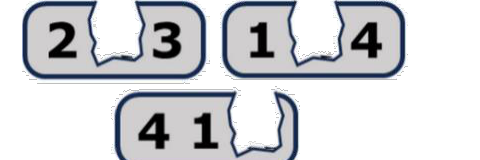
Mia has 3 cards, each showing a three-digit number. When she adds the three numbers she gets 782. Sadly a worm has eaten one digit on each card, so they now read 2 ? 3, 1 ? 4 and 4 1 ?. What do you get when you add the three digits the worm ate?
Show answer
Answer: D — 11
Show hints
Hint 1 of 3
First add up only the digits you can still see, putting a 0 in each eaten spot.
Still stuck? Show hint 2 →
Hint 2 of 3
Compare that total with 782 to see how much the eaten digits must add back.
Still stuck? Show hint 3 →
Hint 3 of 3
Remember: an eaten digit in a tens place is worth that many tens, and an eaten digit in a ones place is worth that many ones.
Show solution
Approach: add the visible digits first, then see how much the eaten digits must add back
Treat each eaten spot as 0: the cards read 203, 104 and 410, which add to 717.
But the real total is 782, so the eaten digits must add back 782 − 717 = 65.
Two of the eaten digits sit in tens places, so together they are worth 60 (meaning those two digits add to 6); the third sits in a ones place worth 5 (so that digit is 5).
The three eaten digits therefore add to 6 + 5 = 11 (D).
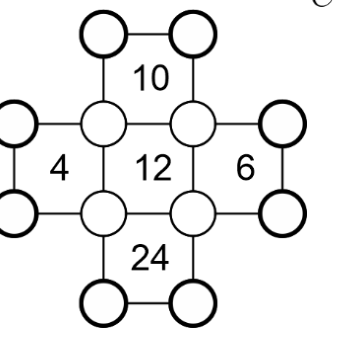
A number is written in each of the twelve circles shown. The number in each square is the product of the four numbers at the corners of that square. What is the product of the numbers in the eight bold circles?
Show answer
Answer: B — 40
Show hints
Hint 1 of 2
Multiply the four outer squares' numbers together and watch which circles get used and how many times.
Still stuck? Show hint 2 →
Hint 2 of 2
The centre square's number is the product of the four inner circles, and each inner circle sits in exactly two outer squares.
Show solution
Approach: multiply the four outer squares and divide out the inner circles
Multiplying the four outer (arm) squares \(10\times4\times6\times24=5760\) uses each of the eight bold outer circles once and each of the four inner circles twice.
The four inner circles multiply to the centre square's value 12, so their squared contribution is \(12^2=144\).
Therefore the product of the eight bold circles is \(5760\div144=40\), answer B.
A teacher writes the 7 digits 1 1 2 2 2 2 3 on the board. He asks a student to insert some multiplication signs (×) in such a way that the product of the resulting numbers (possibly with multiple digits) has the value 2024. How many multiplication signs must be inserted?
Show answer
Answer: D — 4
Show hints
Hint 1 of 2
Factor 2024 first to see which building-block numbers the digits must form.
Still stuck? Show hint 2 →
Hint 2 of 2
2024 = 11 × 23 × 8, so the digits must group into 11, 23 and the factor 8 from three 2s.
Show solution
Approach: factor the target and group the digits
2024 = 2³ × 11 × 23.
Keeping the digits 1 1 2 2 2 2 3 in order, form 11, then three single 2s, then 23.
So 11 × 2 × 2 × 2 × 23 = 2024 uses five numbers, needing 4 multiplication signs.
We call a positive integer powerfree if none of its digits can be written as a power of an integer with an exponent bigger than 1. For example, the number 53 is powerfree, but the number 54 is not powerfree since \(4 = 2^2\). Which one of the following numbers is the difference between the biggest and the smallest two-digit powerfree numbers?
Show answer
Answer: B — 55
Show hints
Hint 1 of 2
A digit is “bad” if it is a perfect power: 0, 1, 4, 8, 9.
Still stuck? Show hint 2 →
Hint 2 of 2
Find the largest and smallest two-digit numbers whose digits are all allowed, then subtract.
Show solution
Approach: restrict to allowed digits
Digits that are powers (exponent>1) are 0=0², 1=1², 4=2², 8=2³, 9=3².
Allowed digits are 2, 3, 5, 6, 7.
The biggest two-digit powerfree number is 77 and the smallest is 22.
For each positive integer n the number \(n!\) is defined as the product of all numbers from 1 to n. For example, \(4! = 4 \cdot 3 \cdot 2 \cdot 1 = 24\). For a certain N the formula \(N! = 6! \cdot 7!\) holds. How big is the sum of the digits of N?
Show answer
Answer: A — 1
Show hints
Hint 1 of 2
Try to write 6!·7! as a single factorial.
Still stuck? Show hint 2 →
Hint 2 of 2
Notice 7! = 7·6!, and look for a factorial equal to 6!·7!.
Show solution
Approach: recognise 6!·7! as 10!
Since 7! = 7·6!, the product 6!·7! equals 3 628 800.
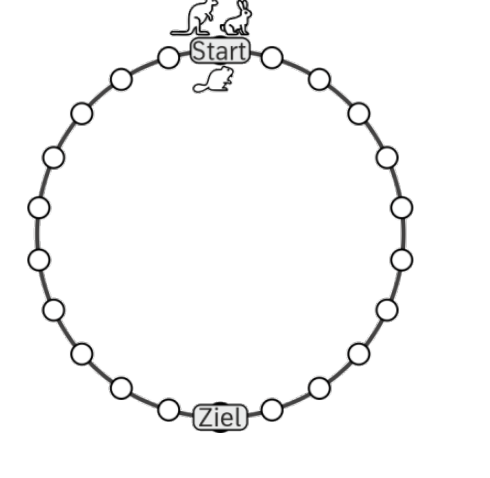
A rabbit, a beaver and a kangaroo have a race. They all start at the same time from “Start” and hop in the same direction around the loop. With each jump the beaver moves forward 1 position, the rabbit moves forward 2 positions, and the kangaroo moves forward 3 positions. Whoever needs the fewest jumps to land exactly on the position marked “Ziel” wins. Who wins the race?
Show answer
Answer: E — Kangaroo and beaver
Show hints
Hint 1 of 2
Ziel sits exactly opposite Start, so its distance from Start is half the number of positions around the loop.
Still stuck? Show hint 2 →
Hint 2 of 2
Check whether each animal's jump size can ever add up exactly to that distance, and compare how many jumps it takes.
Show solution
Approach: compare each step size against the half-way distance to Ziel
Ziel is directly opposite Start, so reaching it means covering exactly half the loop, an odd number of positions.
The rabbit moves 2 at a time, so its total is always even and it can never land exactly on the odd-distance Ziel.
The beaver (step 1) and the kangaroo (step 3) both reach Ziel, and they need the same number of jumps to first land there.
Tied for the fewest jumps are the kangaroo and the beaver, answer E.
Number TheoryArithmetic & Operationsdigit-sumcasework
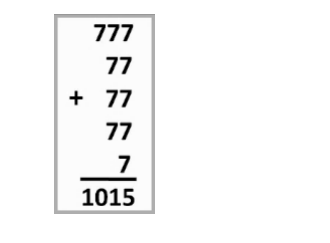
Bart wrote the number 1015 as a sum of numbers that are made up of only the digit 7. In total he used the digit 7 ten times (see diagram). Now he wants to write the number 2023 as a sum of numbers made up of only the digit 7, using the digit 7 nineteen times in total. How many times does he have to use the number 77?
Show answer
Answer: E — 6
Show hints
Hint 1 of 2
Numbers made only of 7s are 7, 77, 777, ... each contributing several 7s to the digit-count.
Still stuck? Show hint 2 →
Hint 2 of 2
Match the value 2023 and the total of 19 sevens together; that pins how many 77s appear.
Show solution
Approach: balance the value 2023 and the count of 19 sevens
Let there be a parts equal to 7, b equal to 77 and c equal to 777 (777 × 3 > 2023, so no bigger parts).
Value: 7a + 77b + 777c = 2023, i.e. a + 11b + 111c = 289 (dividing by 7). Digit count: a + 2b + 3c = 19.
Subtracting gives 9b + 108c = 270, so b + 12c = 30; the only choice keeping a ≥ 0 is c = 2, b = 6 (then a = 1).
Check: 7 + 6×77 + 2×777 = 7 + 462 + 1554 = 2023, using 1 + 12 + 6 = 19 sevens. So 77 is used 6 times, option E.
We check the water meter and see that all digits on the display are different. What is the minimum amount of water that has to be used before this happens again?
Show answer
Answer: D — 0.137 m³
Show hints
Hint 1 of 2
The meter shows 91.876; you want the next reading whose five digits are all different.
Still stuck? Show hint 2 →
Hint 2 of 2
Step up the reading until no digit repeats, then subtract.
Show solution
Approach: find next all-distinct reading
Current reading 91.876 (digits 9,1,8,7,6 all different).
Stepping up, the next reading with five different digits is 92.013.
The year 2022 has three equal digits. This is the third time that Tortoise Eva has experienced a year where the same digit appears three times. What is the minimum age that Tortoise Eva can be this year?
Show answer
Answer: C — 23
Show hints
Hint 1 of 2
List recent years whose four digits include the same digit three times.
Still stuck? Show hint 2 →
Hint 2 of 2
She has lived through three such years; to make her as young as possible, pick the latest possible earlier two.
Show solution
Approach: find the three latest triple-digit years up to 2022
2022 has three 2s. The two latest earlier such years are 2000 (three 0s) and 1999 (three 9s).
If 2022 is her third, she was alive in 1999, so she was born by 1999.
How many three-digit natural numbers have the property that when their digits are written in reverse order, the result is a three-digit number which is 99 more than the original number?
Show answer
Answer: D — 80
Show hints
Hint 1 of 2
Write the number and its reversal using place value and subtract.
Still stuck? Show hint 2 →
Hint 2 of 2
The difference depends only on the first and last digits; set it equal to 99.
Show solution
Approach: use place value to relate a number and its reversal
For a 3-digit number 100a+10b+c, the reversal is 100c+10b+a, and their difference is 99(c − a).
Setting 99(c − a) = 99 gives c = a + 1.
With a from 1 to 8 (so c stays a digit) and b any of 0–9, that is 8 × 10 = 80 numbers.
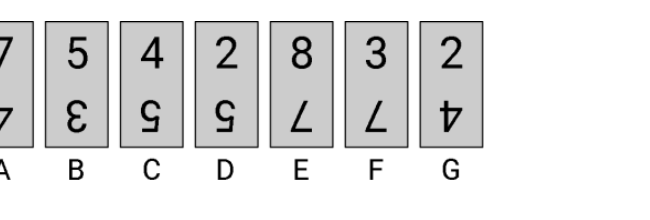
7 cards are arranged as shown. Each card has 2 numbers on it, with 1 of them written upside down. The teacher wants to rearrange the cards so that the sum of the numbers in the top row is the same as the sum of the numbers in the bottom row. She can do this by turning one of the cards upside down. Which card must she turn?
Show answer
Answer: E — G
Show hints
Hint 1 of 2
Add up the top row and add up the bottom row, then see how far apart the two totals are.
Still stuck? Show hint 2 →
Hint 2 of 2
Turning one card swaps its top and bottom numbers, so look for the card whose swap moves exactly half the gap from one row to the other.
Show solution
Approach: compare the two row totals and flip the one card that evens them out
The top numbers add to 7+5+4+2+8+3+2 = 31 and the bottom numbers add to 4+3+5+5+7+7+4 = 35, a gap of 4 (the bottom is 4 bigger).
All 14 numbers add to 66, so to make the rows equal each must be 66 / 2 = 33; the top needs to gain 2 and the bottom to lose 2.
Flipping a card moves its top number down and its bottom number up, so we need a card whose bottom is 2 more than its top — that is card G (top 2, bottom 4).
A box has fewer than 50 cookies in it. The cookies can be divided evenly between 2, 3, or 4 children. However, they cannot be divided evenly between 7 children, because 6 more cookies would be needed. How many cookies are there in the box?
Show answer
Answer: D — 36
Show hints
Hint 1 of 2
Sharing evenly between 2, 3 and 4 children means the number is in the 2, 3 and 4 times tables — so it is in the 12 times table.
Still stuck? Show hint 2 →
Hint 2 of 2
List the multiples of 12 under 50, then check which one becomes a multiple of 7 after you add the 6 missing cookies.
Show solution
Approach: list multiples of 12 under 50, then test the sharing-by-7 clue
To share evenly between 2, 3 and 4 children the number must be in all three times tables, which means the 12 times table: 12, 24, 36, 48.
Needing 6 more cookies to share between 7 means that number plus 6 lands in the 7 times table.
Check each: 12+6=18, 24+6=30, 36+6=42, 48+6=54 — only 42 is in the 7 times table (6 x 7), so the number is 36.
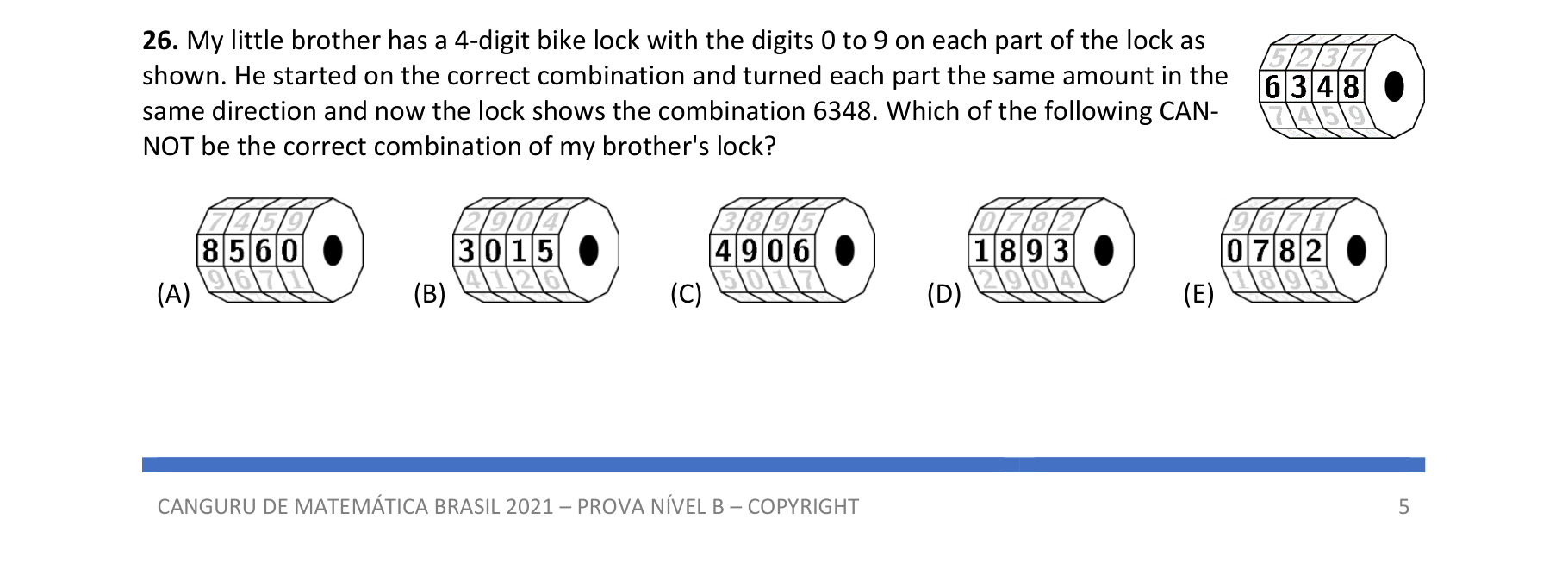
My little brother has a 4-digit bike lock with the digits 0 to 9 on each part of the lock as shown. He started on the correct combination and turned each part the same amount in the same direction and now the lock shows the combination 6348. Which of the following CANNOT be the correct combination of my brother's lock?
Show answer
Answer: C
Show hints
Hint 1 of 2
Turning every wheel by the same amount in the same direction shifts each digit by the same value (mod 10).
Still stuck? Show hint 2 →
Hint 2 of 2
Subtract 6348 digit-by-digit (mod 10); a real start must give the same shift on all four digits.
Show solution
Approach: check for a constant per-digit shift mod 10
Since each wheel turned the same amount, the true combination differs from 6348 by the same shift in every digit (mod 10).
For 8560 the shifts are 2,2,2,2 and for the others they are equal too — except 4906, whose shifts 8,6,2,8 are not all the same.
So 4906 cannot be the correct combination: choice C.
Number TheoryLogic & Word Problemsdivisibilitycasework
2021 coloured kangaroos are arranged in a row and are numbered from 1 to 2021. Each kangaroo is coloured either red, grey or blue. Amongst any three consecutive kangaroos, there are always kangaroos of all three colours. Bruce guesses the colours of five kangaroos. These are his guesses: Kangaroo 2 is grey; Kangaroo 20 is blue; Kangaroo 202 is red; Kangaroo 1002 is blue; Kangaroo 2021 is grey. Only one of his guesses is wrong. What is the number of the kangaroo whose colour he guessed incorrectly?
Show answer
Answer: B — 20
Show hints
Hint 1 of 2
'Any three in a row use all three colours' forces the colouring to repeat with period 3.
Still stuck? Show hint 2 →
Hint 2 of 2
So a kangaroo's colour depends only on its position modulo 3; compare the guesses at equal residues.
Show solution
Approach: use the period-3 structure
With every three consecutive kangaroos all different, the colour pattern repeats every 3 positions.
Positions 2, 20 and 2021 are all 2 (mod 3), so they must share one colour.
Guesses say k2 = grey, k20 = blue, k2021 = grey; the lone disagreement (k20) must be the wrong one.
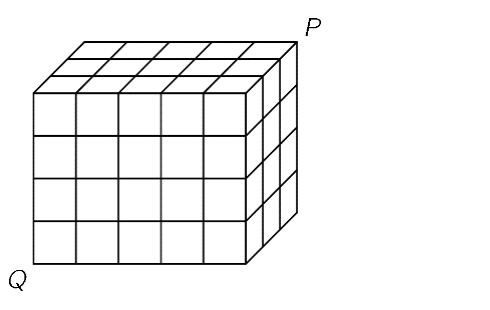
A 3×4×5 cuboid consists of 60 identical small cubes. A termite eats its way along the diagonal from P to Q. This diagonal does not intersect the edges of any small cube inside the cuboid. How many of the small cubes does it pass through on its journey?
Show answer
Answer: C — 10
Show hints
Hint 1 of 2
The diagonal of an a×b×c grid crosses a + b + c interior 'sheets', but crossings at shared edges count once.
Still stuck? Show hint 2 →
Hint 2 of 2
Use a + b + c minus the pairwise gcds plus the triple gcd.
Show solution
Approach: count unit cubes a space-diagonal passes through
For a 3×4×5 box the count is a+b+c − gcd(a,b) − gcd(b,c) − gcd(a,c) + gcd(a,b,c).
In a group of 10 elves and trolls, each was given a token with a different number from 1 to 10 written on it. They were each asked what number was on their token, and all answered with a number from 1 to 10. The sum of the answers was 36. Each troll told a lie and each elf told the truth. What is the smallest number of trolls there could be in the group?
Show answer
Answer: B — 3
Show hints
Hint 1 of 2
If everyone told the truth the answers would total 1 + 2 + … + 10 = 55; the actual total is only 36.
Still stuck? Show hint 2 →
Hint 2 of 2
Each troll replaces its own token number with a smaller answer; how much total drop can just a few trolls create?
Show solution
Approach: cover the shortfall with the fewest liars
Honest answers would total 1 + 2 + … + 10 = 55, but the answers added to 36, so the trolls' lies pulled the total down by 19.
Each troll's biggest possible drop is from token 10 down to answer 1, a drop of 9; one troll can drop at most 9 and two trolls at most 9 + 8 = 17, both short of 19.
Three trolls can manage it — for example tokens 10, 9, 8 answering 1, 1, 1 drops the total by 9 + 8 + 7 = 24, and other choices hit exactly 19 — so the smallest number of trolls is 3.
Mary numbered the faces of three cards with the numbers 1 to 6. Using the three cards she can make three-digit numbers, for example 135 or 234, but some numbers cannot be made, such as 126. Which of the following numbers CANNOT be made?
Show answer
Answer: D — 245
Show hints
Hint 1 of 2
Each card shows two numbers (opposite faces), and you read one number from each of the three cards.
Still stuck? Show hint 2 →
Hint 2 of 2
Find the secret pairing of {1..6} into three cards; a number is impossible if two of its digits live on the same card.
Show solution
Approach: recover the card pairings, then test each number
Three cards carry digits 1..6, two per card; a three-digit number takes one digit from each card.
Examples 135 and 234 are possible while 126 is not, which pins down which digits share a card.
Checking the options, 245 needs two digits on the same card, so it cannot be made.
Marta observed that the number 2020 has the following property: the number formed by the two digits on the left is equal to the number formed by the two digits on the right. How many four-digit numbers, including 2020, have this same property?
Show answer
Answer: D — 90
Show hints
Hint 1 of 2
The property says the front two digits equal the back two digits.
Still stuck? Show hint 2 →
Hint 2 of 2
Such a number is just a two-digit block repeated; count the allowed blocks.
Show solution
Approach: count the repeated two-digit blocks
A number with this property looks like the block XY repeated, e.g. 2020 = 20|20.
The block must be a two-digit number from 10 to 99 (it can’t start with 0).
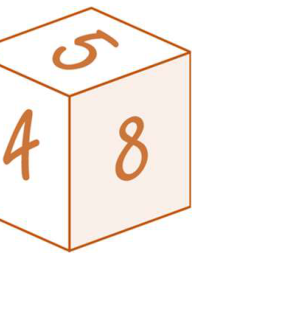
Six different numbers, chosen from the whole numbers 1 to 9, are written on the faces of a cube, one number per face. The sum of the two numbers on each pair of opposite faces is always the same. Which of these numbers could be written on the face opposite the number 8?
Show answer
Answer: A — 3
Show hints
Hint 1 of 2
Opposite faces share one common sum; three of the digits 1-9 are left off.
Still stuck? Show hint 2 →
Hint 2 of 2
Whatever sits opposite 8 must give that same pair-sum as the other two pairs.
Show solution
Approach: find a consistent equal pair-sum
The picture shows 4, 5 and 8 on three faces that touch, so none of them is opposite another; their partners are the three hidden faces.
All three pairs share one common sum. If that sum is 11, then 8 pairs with 3, 5 pairs with 6, and 4 pairs with 7 — the six numbers 3, 4, 5, 6, 7, 8 are all different and all between 1 and 9.
Any larger common sum forces a partner above 9, so the only choice that works is 8 opposite 3.
A positive integer \(n\) is called good if its biggest factor (apart from \(n\) itself) is equal to \(n - 6\). How many good positive integers are there?
Show answer
Answer: C — 3
Show hints
Hint 1 of 2
The biggest factor of \(n\) other than \(n\) is \(n\) divided by its smallest prime factor \(p\).
Still stuck? Show hint 2 →
Hint 2 of 2
Set \(n/p = n - 6\) and solve \(n = 6p/(p-1)\), then see which primes \(p\) make \(n\) a whole number.
Show solution
Approach: the largest proper factor is \(n\) over its smallest prime factor
The largest proper factor of \(n\) is \(n/p\), where \(p\) is the smallest prime factor of \(n\).
Require \(n/p = n - 6\), i.e. \(n(p-1) = 6p\), so \(n = \dfrac{6p}{p-1}\).
\(p = 2\) gives \(n = 12\), \(p = 3\) gives \(n = 9\), \(p = 7\) gives \(n = 7\) (and these each check out); no other prime makes \(n\) whole.
So there are exactly 3 good integers — answer (C).
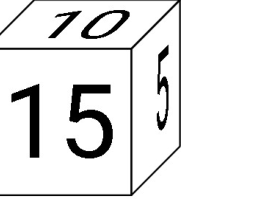
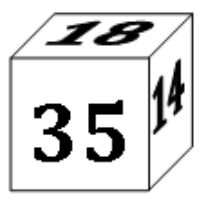
A natural number greater than 0 is written on each side of the die shown (the three visible faces show 10, 15 and 5). All products of opposite numbers are equal. What is the smallest possible sum of all 6 numbers?
Show answer
Answer: C — 41
Show hints
Hint 1 of 3
Every pair of opposite faces multiplies to the same number; call it k.
Still stuck? Show hint 2 →
Hint 2 of 3
Then each hidden face is k divided by the face across from it, so k must divide 10, 15 and 5 evenly.
Still stuck? Show hint 3 →
Hint 3 of 3
Pick the smallest such k to make the hidden faces as small as possible, then add all six.
Show solution
Approach: choose smallest common product k
The three shown faces 10, 15, 5 each have an opposite face, and all three opposite products equal some k.
Each opposite is k÷10, k÷15, k÷5, so k must be a multiple of 10, 15 and 5 — smallest is k = 30.
Then the opposites are 3, 2, 6, and the six faces sum to 10+15+5+3+2+6 = 41 (C).
The pages of a book are numbered with 1, 2, 3, 4, 5 and so on. The digit 5 appears exactly 16 times. What is the maximum number of pages the book can have?
Show answer
Answer: B — 64
Show hints
Hint 1 of 2
Count where the digit 5 shows up as you list page numbers 1, 2, 3, ...
Still stuck? Show hint 2 →
Hint 2 of 2
The block 50-59 alone contributes ten 5s (the tens digit); add those to the single 5s like 5, 15, 25, ...
Show solution
Approach: count occurrences of the digit 5
Up to 49 the 5s appear at 5, 15, 25, 35, 45: five of them.
The block 50-59 has a 5 in every tens digit: ten more, plus the extra units-5 in 55, reaching the 16th by page 59.
Pages 60-64 add no new 5s, but page 65 would add a 17th.
So the most pages with exactly sixteen 5s is 64 (B).
Benjamin writes a number into the first circle. He then carries out the calculations shown along the arrows and each time writes the result in the next circle. How many of the six numbers are divisible by 3?
Show answer
Answer: B — 2
Show hints
Hint 1 of 3
The starting number is unknown, so try a few different starting numbers and watch which results land on multiples of 3.
Still stuck? Show hint 2 →
Hint 2 of 3
Among any three numbers in a row, exactly one is a multiple of 3.
Still stuck? Show hint 3 →
Hint 3 of 3
Check whether the count of multiples of 3 stays the same no matter where you start.
Show solution
Approach: try a couple of starting numbers and spot the steady pattern
Pick an easy start and follow the arrows; then pick a different start and do it again, each time circling the results that are multiples of 3.
Both times you find exactly two multiples of 3: one comes from the first three numbers (one of any three numbers in a row is always a multiple of 3), and one comes from the step that multiplies by 3.
The last two results are always 2 more, and double of that, so they are never multiples of 3, leaving exactly 2 divisible by 3 (B).
Why it is always exactly 2 (algebra)If the start is n, the six numbers are n, n+1, n+2, 3(n+2), 3(n+2)+2, and 6(n+2)+4. Exactly one of n, n+1, n+2 is divisible by 3, 3(n+2) always is, and the last two leave remainders 2 and 1, so the count is always 2.
If one of the digits of a two-digit number is deleted, the result in both cases is a factor of the original number. How many two-digit numbers have this property?
Show answer
Answer: C — 14
Show hints
Hint 1 of 3
Deleting a digit leaves a single digit; the original must be divisible by each remaining digit.
Still stuck? Show hint 2 →
Hint 2 of 3
Require the number to be divisible by both its tens digit and its units digit.
Still stuck? Show hint 3 →
Hint 3 of 3
Every multiple of 11 works, plus a few others — count them all.
Show solution
Approach: test divisibility by each single digit
For a number with tens t and units u, both u and t must divide it (u ≠ 0).
Through 10–99 the ones that pass are 11, 12, 15, 22, 24, 33, 36, 44, 48, 55, 66, 77, 88, 99.
60 apples and 60 pears in total are shared out among several boxes. There should be the same number of apples in each box, but no two boxes should contain the same number of pears. Each box contains both fruits. What is the maximum number of boxes that can be filled in this way?
Show answer
Answer: D — 10
Show hints
Hint 1 of 3
Equal apples per box means the number of boxes divides 60.
Still stuck? Show hint 2 →
Hint 2 of 3
Distinct positive pear counts summing to 60 need at least 1+2+…+k; combine both limits.
Still stuck? Show hint 3 →
Hint 3 of 3
Find the largest k with 60 divisible by k and 1+2+…+k ≤ 60.
Show solution
Approach: combine the apple and pear constraints
With k boxes, k must divide 60 (equal apples) and 1+2+…+k ≤ 60 (distinct pear counts).
1+…+10 = 55 ≤ 60 and 10 divides 60, so k = 10 works.
k = 12 fails (1+…+12 = 78 > 60), so the maximum is 10 boxes.
Maria wants to share 42 apples, 60 peaches and 90 cherries fairly. She puts them into baskets that each hold the same number of apples, the same number of peaches and the same number of cherries, and gives one basket to each friend. At most, how many baskets can she fill?
Show answer
Answer: B — 6
Show hints
Hint 1 of 2
The number of baskets must divide each of 42, 60 and 90 exactly.
Still stuck? Show hint 2 →
Hint 2 of 2
Find the greatest common divisor of 42, 60 and 90.
Show solution
Approach: greatest common divisor
Each fruit count must split evenly among the baskets, so the number of baskets divides 42, 60 and 90.
105 numbers are written in a row: 1, 2, 2, 3, 3, 3, 4, 4, 4, 4, 5, 5, 5, 5, 5, … where each number n is written exactly n times. How many of those numbers are divisible by 3?
Show answer
Answer: D — 30
Show hints
Hint 1 of 2
1 + 2 + 3 + … + 14 = 105, so the row runs from 1 up to 14.
Still stuck? Show hint 2 →
Hint 2 of 2
Only the multiples of 3 (namely 3, 6, 9, 12) count, and each appears as many times as its value.
Show solution
Approach: sum the counts of the multiples of 3 up to 14
Since 1 + 2 + … + 14 = 105, the numbers used run from 1 to 14.
The multiples of 3 in that range are 3, 6, 9 and 12, each written that many times.
How many three-digit numbers have the property that the two-digit number obtained by deleting the middle digit is exactly one ninth of the original number?
Show answer
Answer: D — 4
Show hints
Hint 1 of 2
Write the number as \(100a+10b+c\); deleting the middle digit gives \(10a+c\).
Still stuck? Show hint 2 →
Hint 2 of 2
The condition \(100a+10b+c = 9(10a+c)\) simplifies to a relation between the digits.
Show solution
Approach: set up the place-value equation and count solutions
Let the number be \(100a+10b+c\); deleting the middle digit gives \(10a+c\).
The condition \(100a+10b+c = 9(10a+c)\) becomes \(10a+10b = 8c\), i.e. \(5(a+b)=4c\).
So \(c\) is a multiple of 5, and \(c\neq 0\) forces \(c=5\), giving \(a+b=4\).
Instead of digits, Hannes uses the letters A, B, C, and D in a calculation. Different letters stand for different digits, and the addition ABC + CBA = DDDD is correct (each group of letters is a number written with those digits in order). Which digit does the letter B stand for?
Show answer
Answer: A — 0
Show hints
Hint 1 of 2
Add ABC and CBA column by column and notice the symmetry of the outer digits.
Still stuck? Show hint 2 →
Hint 2 of 2
The sum 101(A + C) + 20B must equal a four-digit repdigit DDDD; only D = 1 fits, which pins B.
Show solution
Approach: add by place value and match to a repdigit
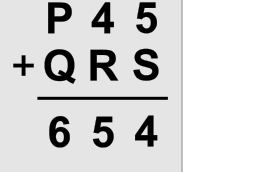
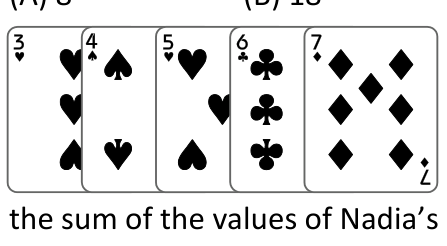
Three of the cards shown will be dealt to Nadia, the rest to Riny. Nadia multiplies the three values of her cards and Riny multiplies the two values of his cards. It turns out that the sum of those two products is a prime number. Determine the sum of the values of Nadia's cards.
Show answer
Answer: B — 13
Show hints
Hint 1 of 2
For the sum of the two products to be an odd prime, one product must be even and the other odd.
Still stuck? Show hint 2 →
Hint 2 of 2
Riny's two-card product is odd only if both his cards are odd — try the odd pairs from 3,5,7.
Show solution
Approach: use parity, then test the few odd pairs for Riny
The card values are 3,4,5,6,7. A prime above 2 is odd, so one product is even, one odd.
Riny's two-card product is odd only when both his cards are odd; the odd values are 3,5,7.
Trying Riny = {5,7}: product 35, Nadia = {3,4,6}, product 72, and 72+35 = 107, which is prime.
The polynomial \(5x^3 + ax^2 + bx + 24\) has whole-number coefficients a and b. Which of the following numbers is definitely not a solution to the equation \(5x^3 + ax^2 + bx + 24 = 0\)?
Show answer
Answer: D — 5
Show hints
Hint 1 of 2
Any integer root of a polynomial with integer coefficients must divide the constant term.
Still stuck? Show hint 2 →
Hint 2 of 2
The constant term is 24; which listed candidate is not a divisor of 24?
Show solution
Approach: rational (integer) root test on the constant term
An integer solution r of 5x^3 + ax^2 + bx + 24 = 0 must divide the constant term 24.
Among 1, -1, 3, 5, 6, all divide 24 except 5.
So 5 can never be a solution, whatever a and b are.
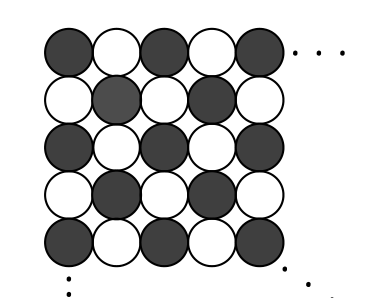
Julia has 2017 round discs available: 1009 black ones and 1008 white ones. Using them, she wants to lay the biggest square pattern possible (as shown) and starts by using a black disc in the upper-left corner. She then lays the discs so that the colours alternate in each row and column. How many discs are left over when she has laid the biggest possible square?
Show answer
Answer: E — 40 white and 41 black
Show hints
Hint 1 of 2
A checkerboard square with a black corner has roughly half discs of each colour; find the biggest size that fits the supply.
Still stuck? Show hint 2 →
Hint 2 of 2
Try square sizes n x n and find the largest where black <= 1009 and white <= 1008, then count what is left.
Show solution
Approach: find the largest fitting checkerboard, then subtract
For an n x n board starting black, with n even there are n^2/2 of each colour.
n = 44 needs 968 black and 968 white, which fits; n = 46 needs 1058 each, too many.
Leftover: 1009 - 968 = 41 black and 1008 - 968 = 40 white.
Two consecutive positive whole numbers are written on a board. The sum of the digits of each number is divisible by 7. What is the minimum number of digits the smaller of the two numbers has to have?
Show answer
Answer: C — 5
Show hints
Hint 1 of 2
Normally adding 1 raises the digit sum by 1, so both sums can be multiples of 7 only when carrying happens.
Still stuck? Show hint 2 →
Hint 2 of 2
Trailing 9s cause big drops in the digit sum; figure out how many 9s are needed for both sums to stay divisible by 7.
Show solution
Approach: use trailing nines to control how the digit sum changes
If the smaller number ends in k nines, adding 1 turns them to zeros and bumps the next digit, so the digit sum changes by 1 - 9k.
For both digit sums divisible by 7 we need 9k = 1 (mod 7), i.e. 2k = 1 (mod 7), giving k = 4 as the smallest.
Four trailing nines plus at least one leading digit (e.g. 69999) is needed, which has 5 digits.
Number TheoryAlgebra & Patternssum-constraintcasework
Seven positive whole numbers a, b, c, d, e, f, g are written down next to each other in this order. The sum of all seven numbers is 2017. Every two adjacent numbers always differ by 1. Which number can be equal to 286?
Show answer
Answer: A — only a or g
Show hints
Hint 1 of 2
Neighbours differ by 1, so the seven numbers alternate even, odd, even, … — and the odd total 2017 fixes which positions are even.
Still stuck? Show hint 2 →
Hint 2 of 2
286 is below the average of about 288, so ask which position can dip the lowest.
Show solution
Approach: parity rules out three spots, then check which can reach the smallest value
Neighbours differ by 1, so the numbers alternate in parity. For the total 2017 to be odd, the four outer-pattern places a, c, e, g must be even and b, d, f odd.
286 is even, so it can only sit at one of a, c, e, g — that already rules out choices about b, d, f.
The average is 2017 ÷ 7 ≈ 288, and since steps are only ±1, the smallest a number can be is 286, reached only by going straight down from an end. An inner even place (c or e) has values on both sides pulling it up, so it cannot get below 288.
Hence 286 can occur only at an endpoint: only a or g, choice A.
Diana adds either 2 or 5 to every whole number from 1 to 9. She wants to achieve as few different sums as possible. What is the minimum number of different values she obtains?
Show answer
Answer: B — 6
Show hints
Hint 1 of 2
Each number 1–9 becomes either n+2 or n+5; you choose to make sums coincide.
Still stuck? Show hint 2 →
Hint 2 of 2
The reachable sums run from 3 to 14 — choose so as few distinct values appear as possible.
Show solution
Approach: overlap the +2 and +5 results
Adding 2 gives values 3..11; adding 5 gives 6..14; since n+5 = (n+3)+2, results three apart can be merged.
Choosing cleverly, the distinct sums collapse to just 6, 7, 8, 9, 10, 11.
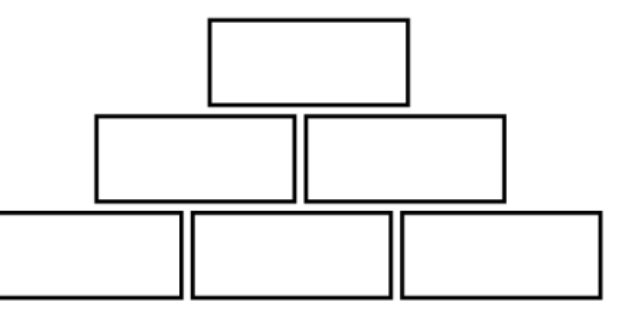
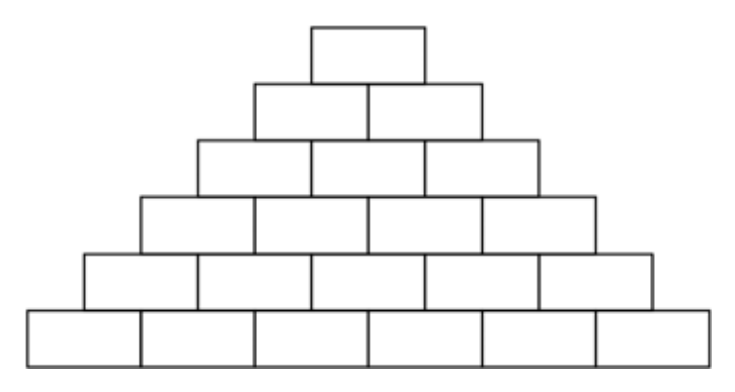
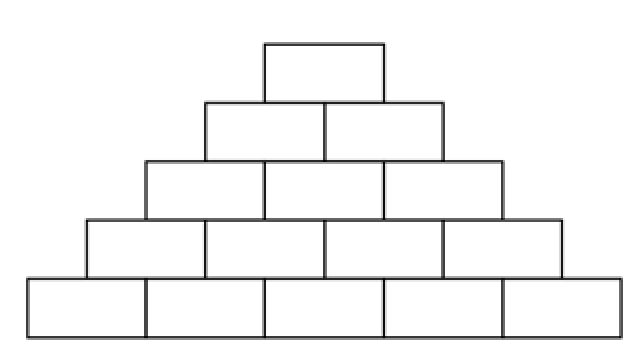
In this number pyramid each number in a higher cell is equal to the product of the two numbers in the cells immediately underneath it. Which of the following numbers cannot appear in the topmost cell, if the cells on the bottom row hold only natural numbers greater than 1?
Show answer
Answer: D — 105
Show hints
Hint 1 of 2
Write the top cell as a product of the three bottom entries.
Still stuck? Show hint 2 →
Hint 2 of 2
The top equals a*b^2*c, so it must contain a perfect-square factor bigger than 1.
Show solution
Approach: express the apex as a*b^2*c
With bottom cells a, b, c, the middle cells are ab and bc, and the top is ab*bc = a*b^2*c.
So the top number must be divisible by some square b^2 with b greater than 1.
Among the options, 105 = 3*5*7 is square-free, so it cannot appear: answer 105 (D).
Diana cuts a rectangle of area 2016 into 56 identical squares. The side lengths of the rectangle and the squares are all whole numbers. For how many different rectangles can she do this? (Two rectangles are said to be different if they are not congruent.)
Show answer
Answer: B — 4
Show hints
Hint 1 of 2
Each square has the same area, so find that area first.
Still stuck? Show hint 2 →
Hint 2 of 2
2016/56 = 36, so squares are 6x6; count the rectangle shapes from the factor pairs of 56.
Show solution
Approach: fix the square size, count factor pairs
Each square has area 2016/56 = 36, so side 6 (a whole number, good).
The 56 squares form an m-by-n grid with m*n = 56.
Non-congruent factor pairs: (1,56),(2,28),(4,14),(7,8), so 4 rectangles.
Eight cards with the numbers 1, 2, 4, 8, 16, 32, 64, 128 are each in an unmarked envelope. Eva randomly chooses some of these eight envelopes. Ali takes the remaining ones. Both add their numbers together. They find out that Eva’s sum is 31 bigger than Ali’s sum. How many envelopes has Eva chosen?
Show answer
Answer: D — 5
Show hints
Hint 1 of 2
The eight cards are the powers of two from 1 to 128; their total is 255.
Still stuck? Show hint 2 →
Hint 2 of 2
If Eva's sum beats Ali's by 31 out of 255, find Eva's exact total, then read off its binary digits.
Show solution
Approach: binary split
The cards total 1+2+…+128 = 255.
Eva − Ali = 31 and Eva + Ali = 255, so Eva = (255+31)/2 = 143.
Three three-digit numbers are built using the digits 1 to 9 so that each of the nine digits is used exactly once. Which of the following numbers cannot be the sum of the three numbers?
Show answer
Answer: A — 1500
Show hints
Hint 1 of 2
The sum of all nine digits is fixed.
Still stuck? Show hint 2 →
Hint 2 of 2
1+2+...+9 = 45, so the total of the three numbers must be a multiple of 9.
Show solution
Approach: digit-sum divisibility by 9
The nine digits 1..9 sum to 45, a multiple of 9, so the total of the three numbers is divisible by 9.
Among the options only 1500 is not a multiple of 9 (1+5 = 6), so it cannot be the sum (A).
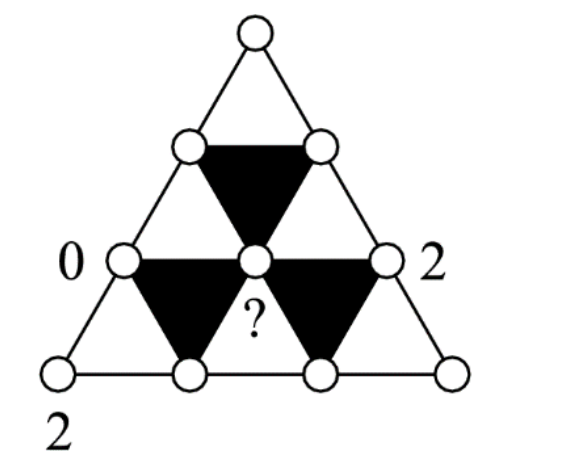
Each of the ten points in the diagram is labelled with one of the numbers 0, 1 or 2. It is known that the sum of the numbers in the corner points of each white triangle is divisible by 3, while the sum of the numbers in the corner points of each black triangle is not divisible by 3. Three of the points are already labelled as shown in the diagram. With which numbers can the inner point be labelled?
Show answer
Answer: A — only 0
Show hints
Hint 1 of 3
Read every condition modulo 3: a white triangle's three corners sum to 0, a black triangle's do not.
Still stuck? Show hint 2 →
Hint 2 of 3
Two triangles that share an edge differ only in their third corner, so compare the apex labels of triangles sitting on the same base.
Still stuck? Show hint 3 →
Hint 3 of 3
Chase the conditions outward from the given 0 and 2 to pin the inner point's residue.
Show solution
Approach: residues mod 3 on the triangular grid
Work mod 3: each white (upward) triangle's corners sum to 0, each black (downward) triangle's corners do not.
An upward and the downward triangle resting on the same edge share two corners, so their third corners must have different residues; this forces neighbouring apex labels apart.
Starting from the labelled corners 0 and 2 and propagating these forced differences leaves the inner point only one possible residue.
That residue is 0, so the inner point can be only 0 (A).
The symbols ◯, □ and ◇ stand for three different digits. If the digits of the number ◯□◯ are added, you get the two-digit number □◇. If the digits of the two-digit number □◇ are added, you get the single-digit number □. Which digit does ◯ stand for?
Show answer
Answer: E — 9
Show hints
Hint 1 of 3
Start from the last clue: adding the two digits of □◇ gives □ again.
Still stuck? Show hint 2 →
Hint 2 of 3
If □ + ◇ = □, the diamond ◇ must be 0.
Still stuck? Show hint 3 →
Hint 3 of 3
Now use that the digits of ◯□◯ add to the two-digit number □0.
Show solution
Approach: chase the digit clues from the smallest one up
The last clue says □ + ◇ = □, and the only way adding ◇ leaves □ unchanged is ◇ = 0, so the two-digit number □◇ ends in 0.
The first clue says the digits of ◯□◯ add to that number, so ◯ + □ + ◯ = (a multiple of 10), i.e. 2◯ + □ is 10, 20, ...
Trying □0 = 20 gives 2◯ + 2 = 20, so ◯ = 9, and the digits are all different (9, 2, 0).
Check: 929 has digit sum \(9+2+9 = 20\), and \(2+0 = 2\) — it works, so ◯ = 9, choice (E).
Leo has built a stick made up of 27 building blocks (see picture). He splits the stick into two pieces so that one part is twice as long as the other. He keeps repeating this: each time he takes one of the two pieces and splits it so that one piece is twice as long as the other. Which of the following pieces can never result in this way? (The choices are pieces of length 2, 4, 6, 8 and 10 blocks.)
Show answer
Answer: E — 10
Show hints
Hint 1 of 2
Splitting a piece into a 2:1 ratio only works when its length divides into three equal parts.
Still stuck? Show hint 2 →
Hint 2 of 2
List every length you can reach starting from 27 and see which option never appears.
Show solution
Approach: track which lengths a 2:1 split can produce
27 splits into 18 and 9; 18 splits into 12 and 6; 9 splits into 6 and 3; 12 splits into 8 and 4; 6 splits into 4 and 2.
The reachable lengths are 2, 3, 4, 6, 8, 9, 12, 18, 27.
A 10-block piece never appears, so 10 can never result.
Two three-digit numbers are made up of six different digits. The first digit of the second number is twice as big as the last digit of the first number. (Note: 0 is also a digit, but cannot be the first digit of a number.) What is the smallest possible sum of the two numbers?
Show answer
Answer: C — 537
Show hints
Hint 1 of 3
The hundreds digits matter most, so make those two as small as you can.
Still stuck? Show hint 2 →
Hint 2 of 3
The second number's first digit is twice the first number's last digit, so test small even leading digits like 2 or 4.
Still stuck? Show hint 3 →
Hint 3 of 3
Once the hundreds and that linked pair are fixed, fill the leftover spots with the smallest unused digits.
Show solution
Approach: make the hundreds digits smallest, respecting the doubling rule
The two hundreds digits drive the sum, so we want them tiny; the smallest nonzero hundreds digit is 1 for the first number.
The second number's hundreds digit must be double the first number's units digit, and the smallest workable pair is units 2 with hundreds 4, so the numbers look like 1?2 and 4?? .
Fill the remaining slots with the smallest unused digits 0, 3, 5: that gives 102 and 435, all six digits different.
Their sum \(102 + 435 = 537\) is the smallest possible, choice (C).
Little Red Riding Hood is taking waffles to three grandmothers. Her basket starts completely full. Just before she reaches each grandmother’s house, the wolf eats half of the waffles in the basket. When she leaves the third grandmother, the basket is empty. Each grandmother gets the same number of waffles. The original number of waffles can definitely be divided by which of the following numbers?
Show answer
Answer: D — 7
Show hints
Hint 1 of 2
Work backward: before each grandmother the basket held twice what it held after.
Still stuck? Show hint 2 →
Hint 2 of 2
Each grandmother gets the same amount; reconstruct the start as a multiple, then see what must divide it.
Show solution
Approach: work backward through the halvings
The wolf halves the basket before each of the 3 grandmothers, and each grandmother takes the same amount g.
Working backward through the three halvings and equal gifts, the original amount comes out as a multiple of 7.
So the original number of waffles is always divisible by 7.
Natural numbers, no two the same, are written on a board. The product of the two smallest is 16, and the product of the two largest is 225. What is the sum of all the numbers on the board?
Show answer
Answer: C — 44
Show hints
Hint 1 of 3
The two smallest numbers multiply to 16; the two largest to 225. Factor each.
Still stuck? Show hint 2 →
Hint 2 of 3
Pick distinct factor pairs that can be the smallest two and largest two, with no room for numbers in between.
Still stuck? Show hint 3 →
Hint 3 of 3
Then add all the numbers.
Show solution
Approach: identify the extreme pairs by factoring
The two smallest distinct naturals with product 16 are 2 and 8; the two largest distinct with product 225 are 9 and 25.
Since 8 and 9 are consecutive, no other number can fit between the small and large pairs, so the board holds exactly 2, 8, 9, 25.
Each day Maria writes down the date and then adds together the individual digits. For instance, today on the 23rd March she writes 23. 03. and calculates 2 + 3 + 0 + 3 = 8. What is the largest total she can make in this way in the course of a year?
Show answer
Answer: E — 20
Show hints
Hint 1 of 2
Maximise the day part and the month part of the digit sum separately.
Still stuck? Show hint 2 →
Hint 2 of 2
The month with the biggest digit sum is September (0 + 9), and you want the day with the biggest digit sum that still exists in that month.
Show solution
Approach: maximise the day-digits and month-digits separately
For the month, 09 gives the largest digit sum 0 + 9 = 9 (months 10, 11, 12 give only 1, 2, 3).
For the day, 29 gives 2 + 9 = 11, the biggest possible (31 gives only 4), and the 29th exists in September.
So the largest total is 29.09 → 2 + 9 + 0 + 9 = 20.
Lucy and her mother were both born in January. Today, on 23rd March 2015, Lucy adds together her year of birth, that of her mother, her age, and that of her mother. Which answer does she get?
Show answer
Answer: C — 4030
Show hints
Hint 1 of 2
Both birthdays are in January, so by 23 March each has already had her birthday this year.
Still stuck? Show hint 2 →
Hint 2 of 2
For anyone, year of birth + current age equals the current year once the birthday has passed.
Show solution
Approach: year of birth plus current age equals the present year
Since both were born in January, by 23 March 2015 each has already turned a year older this year.
So Lucy's birth year + Lucy's age = 2015, and likewise her mother's birth year + her mother's age = 2015.
There are 2015 marbles in a pipe. They are numbered 1 to 2015. Marbles whose digits add up to the same number have the same colour, and marbles whose digits have a different sum have a different colour. How many different colours do the marbles in the pipe have?
Show answer
Answer: C — 28
Show hints
Hint 1 of 2
The colour of a marble depends only on its digit sum.
Still stuck? Show hint 2 →
Hint 2 of 2
Find the smallest and largest digit sum occurring among 1 to 2015 — then count the values in between.
Show solution
Approach: count the distinct digit sums from 1 to 2015
Colours correspond exactly to the different digit sums that appear.
The smallest digit sum is 1 (e.g. 1, 1000) and the largest is 28 (from 1999).
Every value from 1 to 28 is achievable, so there are 28 colours (C).
On a straight line there are five points. Alex measures all the distances between every possible pair of points. He obtains in ascending order 2, 5, 6, 8, 9, k, 15, 17, 20 and 22. What is the value of k?
Show answer
Answer: E — 14
Show hints
Hint 1 of 2
Five points give 10 pairwise distances; the largest is the whole span and the smallest are the outer gaps.
Still stuck? Show hint 2 →
Hint 2 of 2
Fix the endpoints at 0 and 22, fit the inner points to match the distances, then read off the missing one.
Show solution
Approach: reconstruct the point positions from the distances
Put the endpoints at 0 and 22, so the span 22 is the largest distance.
The two smallest gaps, 2 and 5, sit at the ends, which places points at 2 and 17; matching the rest forces the last point to 8, giving coordinates 0, 2, 8, 17, 22.
Their ten pairwise distances are 2, 5, 6, 8, 9, 14, 15, 17, 20, 22; the one missing from the given list is 14, so k = 14.
Maria divides 2015 by 1. Then she divides 2015 by 2, and then in order by 3, 4 and so on up to and including 1000. For each division she writes down the remainder. What is the biggest remainder she has noted down?
Show answer
Answer: C — 671
Show hints
Hint 1 of 2
The remainder is always less than the divisor, so big remainders need a divisor a bit above a half (or third) of 2015.
Still stuck? Show hint 2 →
Hint 2 of 2
With the divisor capped at 1000, try n just above 2015/3 so the quotient is 2 and the remainder 2015 - 2n is large.
Show solution
Approach: maximise the remainder under the divisor cap of 1000
The remainder of 2015 divided by n is at most n - 1, and n only runs up to 1000.
For n between 672 and 1007 the quotient is 2, so the remainder is 2015 - 2n, which is largest when n is smallest in that range.
At n = 672 the remainder is 2015 - 1344 = 671, and nothing under the cap beats it.
Each positive whole number is coloured in according to the following three rules: (i) Each number is either red or green. (ii) The sum of two different red numbers is a red number. (iii) The sum of two different green numbers is a green number. How many ways are there to do this?
Show answer
Answer: D — 6
Show hints
Hint 1 of 2
The two rules force strong closure: sums of like-coloured numbers keep their colour.
Still stuck? Show hint 2 →
Hint 2 of 2
Colour 1, 2, 3, ... and chase the forced consequences to count how many consistent colourings of all positive integers exist.
Show solution
Approach: count the colourings closed under the two sum-rules
Reds are closed under adding two distinct reds, and greens under adding two distinct greens.
Fixing the colours of the smallest numbers forces almost everything else, leaving only a few consistent patterns.
Carefully enumerating them gives exactly 6 valid colourings.
A grandmother, her daughter and her granddaughter find that the sum of their ages is 100. Each age is a power of two (that is, several twos multiplied together). How old is the granddaughter?
Show answer
Answer: C — 4
Show hints
Hint 1 of 2
Each age is a power of two: 1, 2, 4, 8, 16, 32, 64, ...
Still stuck? Show hint 2 →
Hint 2 of 2
Find three powers of two that add to 100; the smallest one is the granddaughter.
Show solution
Approach: write 100 as a sum of three powers of two
The grandmother must be the oldest power of two under 100, so try 64; that leaves 36 for the other two ages.
Two powers of two adding to 36 can only be 32 + 4, so the ages are 64, 32 and 4.
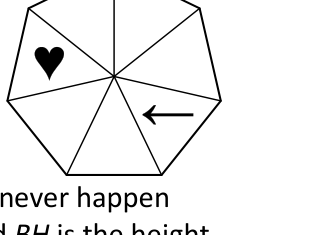
In the figure, the heart and the arrow are arranged as pictured. At the same moment the heart and the arrow begin to move. The arrow moves around the figure 3 spaces clockwise and the heart 4 spaces anticlockwise, and then they stop. This process repeats over and over again. After how many repetitions does the arrow find itself for the first time in the same triangle as the heart?
Show answer
Answer: E — That will never happen
Show hints
Hint 1 of 2
After r repetitions the arrow has moved 3r spaces one way and the heart 4r spaces the other way, around 7 triangles.
Still stuck? Show hint 2 →
Hint 2 of 2
Look at the gap between them modulo 7: each repetition changes it by a fixed amount that never makes it zero.
Show solution
Approach: track the gap between them around the ring of 7 triangles
The figure is a ring of 7 triangles. In one repetition the arrow moves 3 spaces one way and the heart 4 spaces the other way.
So in each repetition the arrow gains \(3+4 = 7\) spaces on the heart, which is a whole lap around the 7 triangles.
Gaining exactly 7 spaces each time returns them to the same relative positions, so the gap between them never changes.
Since they do not start in the same triangle, they can never meet.
Lea plays with her marbles, placing them in small groups on the table. In groups of three, two marbles are left over. In groups of five, again two are left over. How many more marbles does Lea need so that she can place them in groups of three and in groups of five with none left over?
Show answer
Answer: E — 13
Show hints
Hint 1 of 2
Leaving 2 over for both groups of three and groups of five means leaving 2 over for groups of fifteen.
Still stuck? Show hint 2 →
Hint 2 of 2
She wants a multiple of 15; find the next multiple of 15 above her current count and see how many more marbles that needs.
Show solution
Approach: use that 2 left over mod 3 and mod 5 means 2 left over mod 15
Leaving 2 over in groups of three and in groups of five means leaving 2 over in groups of fifteen.
So her smallest possible count is 2; to split evenly into both 3s and 5s she needs a multiple of 15.
The next multiple of 15 after 2 is 15, which is 15 − 2 = 13 more marbles.
Among 10 different positive whole numbers, exactly 5 are divisible by 5 and exactly 7 are divisible by 7. Let M be the biggest of these numbers. What is the smallest possible value of M?
Show answer
Answer: E — another value
Show hints
Hint 1 of 2
Multiples of 5 and multiples of 7 must fit inside just 10 numbers — they have to overlap.
Still stuck? Show hint 2 →
Hint 2 of 2
Overlap means multiples of 35; how few of those can you get away with, and how small can they be?
Show solution
Approach: count the forced overlap, then keep everything small
Five multiples of 5 plus seven multiples of 7 is 12 'slots' but only 10 numbers, so at least 2 must be multiples of 35.
The two smallest multiples of 35 are 35 and 70, so the largest number M is at least 70.
Choosing 5,10,15,35,70 (the 5's) and 7,14,21,28,35,42,70 worth of 7's gives a valid set of 10 with M = 70.
70 is none of 105, 77, 75, 63, so the answer is (E) another value.
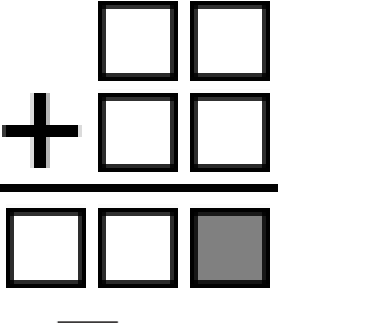
In each box exactly one of the digits 0, 1, 2, 3, 4, 5 and 6 is to be written. Each digit is used only once. The picture on the right shows two 2-digit numbers being added to give a 3-digit number. Which digit has to be written in the grey box so that the sum is correct?
Show answer
Answer: D — 5
Show hints
Hint 1 of 3
The answer has 3 digits, so the two 2-digit numbers must add up to at least 100.
Still stuck? Show hint 2 →
Hint 2 of 3
You only have the digits 0 to 6 once each, so the hundreds digit of the answer can only be 1.
Still stuck? Show hint 3 →
Hint 3 of 3
Once you know the answer starts with 1, fit the remaining digits and read the grey (ones) box.
Show solution
Approach: find the only valid sum, then read the grey (units) box
Two 2-digit numbers add to a 3-digit number using 0..6 once each.
The only working sum is 105 (e.g. 42 + 63), using digits 0,1,2,3,4,5,6.
The grey box is the units digit of the result, which is 5.
Mia writes three single-digit numbers on the board. Ali adds them and gets 15. Then he deletes one of the three numbers and replaces it with 3. Resi multiplies the three numbers and gets 36. Which numbers could Ali have deleted?
Show answer
Answer: B — either 7 or 8
Show hints
Hint 1 of 2
After swapping one number for 3, the product is 36, so the two untouched numbers multiply to 12.
Still stuck? Show hint 2 →
Hint 2 of 2
List the single-digit pairs that multiply to 12, then use the sum 15 to find the deleted number in each case.
Show solution
Approach: the two kept numbers multiply to 12; use the sum to recover the deleted one
After replacing one number with 3, Resi's product 36 = 3 × (the two numbers Ali kept), so the kept pair multiplies to 12.
Single-digit pairs with product 12 are 3 × 4 and 2 × 6.
Since all three originals add to 15: if the kept pair is 3 and 4 (sum 7), the deleted number is 15 − 7 = 8; if the kept pair is 2 and 6 (sum 8), the deleted number is 15 − 8 = 7.
Tom has written down a few different positive whole numbers, all smaller than 101. The product of the numbers is not divisible by 18. At most how many numbers could he have written down?
Show answer
Answer: C — 68
Show hints
Hint 1 of 2
18 = 2 × 3², so the product fails only if it lacks a 2 or lacks two 3s.
Still stuck? Show hint 2 →
Hint 2 of 2
Keep as many numbers as possible while keeping the power of 3 below 2.
Show solution
Approach: control the factors of 3 to dodge 18
Keep all 67 numbers from 1–100 that are not multiples of 3.
Add one multiple of 3 that is not a multiple of 9 (one factor of 3 only); the product then isn't divisible by 9, hence not by 18.
The number 35 has a special property: it can be divided exactly by its units digit, because \(35 \div 5 = 7\). The number 38 does not have this property. How many numbers bigger than 21 but smaller than 30 have this property?
Show answer
Answer: B — 3
Show hints
Hint 1 of 3
Bigger than 21 and smaller than 30 means the numbers 22, 23, 24, 25, 26, 27, 28, 29.
Still stuck? Show hint 2 →
Hint 2 of 3
For each one, can you split it into equal groups of its last digit with none left over?
Still stuck? Show hint 3 →
Hint 3 of 3
Count how many of the eight numbers pass that test.
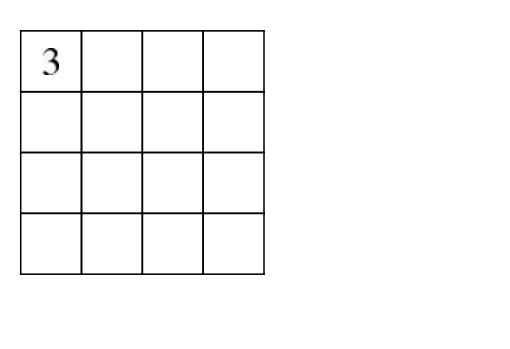
Numbers are written in the 4 × 4 grid so that any two numbers in squares sharing an edge differ by 1. The number 3 is already given, and the number 9 is used somewhere in the grid. How many different numbers are used once the grid is completely filled in?
Show answer
Answer: D — 7
Show hints
Hint 1 of 3
Touching squares differ by exactly 1, so as you step across the grid the number only goes up or down by 1 each time.
Still stuck? Show hint 2 →
Hint 2 of 3
To get from a 3 to a 9 you must pass through every value in between.
Still stuck? Show hint 3 →
Hint 3 of 3
List the numbers you are forced to step through from 3 up to 9 and count them.
Show solution
Approach: track the range of values forced by the rules
Moving from one square to a touching square changes the number by just 1, so to climb from 3 up to 9 you must step through 4, 5, 6, 7 and 8 along the way.
That forces all of 3, 4, 5, 6, 7, 8, 9 to appear in the grid.
So 7 different numbers are used, which is choice D.
Given a six-digit number whose digit sum is even and whose digit product is odd. Which of the following statements is true for this number?
Show answer
Answer: E — None of the statements (A)–(D) are correct.
Show hints
Hint 1 of 2
A product of digits is odd only when every single digit is odd.
Still stuck? Show hint 2 →
Hint 2 of 2
With all six digits odd, check each statement — and remember there are only five odd digits to choose from.
Show solution
Approach: deduce all digits are odd, then test each claim
An odd digit product forces all six digits to be odd (any even digit would make the product even).
Six odd digits sum to an even number, matching the condition — so such numbers exist (e.g. 111111).
Now: (A) zero even digits, false; (C) six odd digits is an even count, false; (D) only five distinct odd digits exist, so six different is impossible, false.
Number TheoryAlgebra & Patternsplace-valuedigit-sum
Robert chose a five-digit positive number. He removed one of its digits, leaving a four-digit number. The sum of this four-digit number and the original five-digit number is 52713. What is the digit sum of the original five-digit number?
Show answer
Answer: C — 23
Show hints
Hint 1 of 2
The five-digit number plus the four-digit number is 52713; estimate the five-digit number's size.
Still stuck? Show hint 2 →
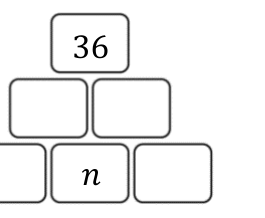
Hint 2 of 2
Removing a digit relates the two numbers through place value — set up and solve.
Show solution
Approach: place-value relation between N and the trimmed number
Let N be the five-digit number and M the four-digit number; N + M = 52713.
Since M is N with one digit removed, N is a little under 52713, around 47921.
Solving gives N = 47921 (and M = 4792), whose digits sum to 4+7+9+2+1 = 23.
Let \(f : \mathbb{N} \to \mathbb{N}\) be defined by \(f(n) = \frac{n}{2}\) for even n and \(f(n) = \frac{n-1}{2}\) for odd n. For a positive integer k, let \(f^{k}(n)\) mean applying f a total of k times. How many solutions does the equation \(f^{2013}(n) = 1\) have?
Show answer
Answer: D — \(2^{2013}\)
Show hints
Hint 1 of 2
For both even and odd n, the map is just the integer halving floor(n/2).
Still stuck? Show hint 2 →
Hint 2 of 2
Applying it k times gives floor(n / 2^k).
Show solution
Approach: iterate the halving map
f(n) = floor(n/2) for every n, so f^2013(n) = floor(n / 2^2013).
A sequence of numbers begins 1, −1, −1, 1, −1. Each new number is the product of the two numbers before it (for example, the sixth number is the product of the fourth and fifth). What is the sum of the first 2013 numbers?
Show answer
Answer: B — −671
Show hints
Hint 1 of 2
Compute a few more terms; the sequence soon repeats.
Still stuck? Show hint 2 →
Hint 2 of 2
Find the repeating block and its sum, then count how many blocks fit in 2013 terms.
Show solution
Approach: find the period and sum blocks
The terms run 1, −1, −1, 1, −1, −1, 1, −1, −1, … — the block (1, −1, −1) repeats.
Each of the 4 vertices and 6 edges of a tetrahedron is labelled with one of the numbers 1, 2, 3, 4, 5, 6, 7, 8, 9, 11 (the number 10 is left out), each used exactly once. The number on each edge is the sum of the numbers on the two vertices it connects. The edge AB has the number 9. With which number is the edge CD labelled?
Show answer
Answer: B — 5
Show hints
Hint 1 of 2
Add up all ten labels, and note each vertex value is counted in three edges.
Still stuck? Show hint 2 →
Hint 2 of 2
Find the vertex-sum first; opposite edges (like AB and CD) split that sum.
Show solution
Approach: total counts each vertex three times
The ten labels 1..9 and 11 sum to 56.
Edges sum to 3×(vertex sum) since each vertex sits on 3 edges, so vertex sum + 3×(vertex sum) = 4×(vertex sum) = 56, giving vertex sum 14.
Edges AB and CD together use all four vertices, so (A+B) + (C+D) = 14.
A rectangular piece of paper is 108 mm long and 84 mm wide. After making a straight cut you have a square and a leftover piece. You do the same with the leftover piece and so on until the leftover piece itself is a square. What is the side length of the last square?
Show answer
Answer: E — 12 mm
Show hints
Hint 1 of 2
Each cut peels off the biggest square it can; track the leftover rectangle's sizes.
Still stuck? Show hint 2 →
Hint 2 of 2
This is the subtract-the-smaller-side process, and it ends at the greatest common divisor.
Gregory made two 3-digit numbers from the digits 1, 2, 3, 4, 5, 6. Each digit was used only once. Afterwards he added the two numbers together. What is the largest answer he could have got?
Show answer
Answer: D — 1173
Show hints
Hint 1 of 2
To make a sum large, put the biggest digits where they count the most.
Still stuck? Show hint 2 →
Hint 2 of 2
Give the two hundreds places the largest digits, then the tens, then the units.
Show solution
Approach: place the largest digits in the highest places
Use 6 and 5 in the hundreds places, 4 and 3 in the tens, 2 and 1 in the units.
The two numbers add to (600 + 500) + (40 + 30) + (2 + 1).
In a game with fractions I am allowed to carry out two operations, namely either increase the numerator by 8 or increase the denominator by 7 without simplifying during the game. Starting with the fraction 78 after n such operations I again obtain a fraction with equal value. What is the smallest value of n?
Show answer
Answer: D — 113
Show hints
Hint 1 of 2
Say you add 8 to the numerator \(p\) times and 7 to the denominator \(q\) times.
Still stuck? Show hint 2 →
Hint 2 of 2
Set the new fraction equal to \(\tfrac{7}{8}\) and clear fractions; you'll get a clean ratio between \(p\) and \(q\).
Show solution
Approach: set the new fraction equal and solve for the move counts
After \(p\) numerator-moves and \(q\) denominator-moves the fraction is \(\frac{7+8p}{8+7q}\).
Setting it equal to \(\tfrac{7}{8}\) gives \(8(7+8p) = 7(8+7q)\), which simplifies to \(64p = 49q\).
Since \(\gcd(64,49)=1\), the smallest whole solution is \(p = 49\), \(q = 64\), so \(n = p+q = 113\), choice D.
Wanted are all three-digit numbers from 100 to 999 that have the following property: If you remove the first digit a square number remains and if you remove the last digit again a square number remains (e.g. 164 → (1)64 → 16(4)). How big is the sum of all numbers with this special property?
Show answer
Answer: D — 1993
Show hints
Hint 1 of 2
Both 'drop the first digit' and 'drop the last digit' must leave two-digit squares.
Still stuck? Show hint 2 →
Hint 2 of 2
The middle digit is shared — it is the units digit of one square and the tens digit of another.
Show solution
Approach: match shared middle digit
The two-digit squares are 16, 25, 36, 49, 64, 81. The number a b c needs both 10a+b and 10b+c to be in this list.
The shared digit b must be a units digit of one square and a tens digit of another, which works for b = 1, 4, 6, giving the numbers 816, 649, 164, 364.
There are 30 chapters in a book. Each chapter has a different length, i.e. 1, 2, 3, …, 30 pages. Each chapter starts on a new page. The first chapter starts on page 1. At most how many chapters start on a page with an odd page number?
Show answer
Answer: E — 23
Show hints
Hint 1 of 2
A chapter keeps the next start's parity the same when its length is even, and flips it when odd.
Still stuck? Show hint 2 →
Hint 2 of 2
There are 15 even and 15 odd lengths — spend the even ones while you are on odd pages.
Show solution
Approach: track start-page parity
Chapter 1 starts on page 1 (odd). An even-length chapter keeps the next start odd; an odd-length chapter flips the parity.
Use all 15 even lengths first: starts of chapters 1 through 16 are all odd (16 odd starts). The remaining 14 odd-length chapters then alternate parity, adding 7 more odd starts.
What is the smallest possible positive whole-number value of the expression \(\dfrac{K\cdot A\cdot N\cdot G\cdot A\cdot R\cdot O\cdot O}{G\cdot A\cdot M\cdot E}\) if different letters stand for different digits, none equal to 0, and equal letters stand for equal digits?
Show answer
Answer: B — 2
Show hints
Hint 1 of 2
Cancel the letters common to top and bottom, leaving K·A·N·R·O·O over M·E.
Still stuck? Show hint 2 →
Hint 2 of 2
Make the denominator's two digits divide the numerator while keeping the quotient as small as possible.
Show solution
Approach: cancel, then choose digits to minimise the integer quotient
After cancelling one A and one G, the value is (K·A·N·R·O²)/(M·E) with eight distinct nonzero digits.
Choosing O = 1 and letting M·E absorb the rest, e.g. K,A,N,R = 2,3,4,6 and M,E = 8,9, gives 2·3·4·6/(8·9) = 2.
No assignment gives a positive value below 2, so the minimum is 2.
Each star in the expression 1 ∗ 2 ∗ 3 ∗ 4 ∗ 5 ∗ 6 ∗ 7 ∗ 8 ∗ 9 ∗ 10 is either replaced by a “+” or a “×”. Let N be the biggest number possible that can be obtained this way. What is the smallest prime factor of N?
Show answer
Answer: E — Another number
Show hints
Hint 1 of 3
Multiplying by 1 is wasteful — adding the 1 instead makes the result bigger.
Still stuck? Show hint 2 →
Hint 2 of 3
So N = 1 + (2×3×…×10); the product is even, so the +1 makes N odd.
Still stuck? Show hint 3 →
Hint 3 of 3
An odd N can't have factor 2; check whether 3, 5 or 7 divide it before settling on the answer.
Show solution
Approach: maximise, then factor the result
Each factor from 3 to 10 should be multiplied, but for the 1 note that 1+P > 1×P, so the 1 is added.
The teacher said, “In our school library there are roughly 2010 books.” The pupils then guessed exactly how many there are. Artur guessed 2010, Beate guessed 1998 and Carlos guessed 2015. Their guesses are off by 12, 7 and 5, but not in that order. How many books are in the library?
Show answer
Answer: A — 2003
Show hints
Hint 1 of 2
The real number differs from the three guesses by 12, 7 and 5 in some order.
Still stuck? Show hint 2 →
Hint 2 of 2
Try a value near 2010 and check that its distances to 2010, 1998 and 2015 are exactly 12, 7 and 5.
Show solution
Approach: find the value whose distances to the guesses are 12, 7, 5
Berti’s friends each add together the day and the month of their birthday. They all get the answer 35, but no two of them have the same birthday. What is the largest number of friends Berti can have?
Show answer
Answer: B — 8
Show hints
Hint 1 of 2
You need months and days with month + day = 35, and each birthday must be a real date.
Still stuck? Show hint 2 →
Hint 2 of 2
Start from December and step down through the months, checking the day fits that month.
Show solution
Approach: count valid (month, day) pairs summing to 35
List month + day = 35 with a valid day: Dec 23, Nov 24, Oct 25, Sep 26, Aug 27, Jul 28, Jun 29, May 30.
April would need day 31, which doesn't exist, and earlier months need impossible days.
That gives 8 different birthdays, so at most 8 friends.
On each of 18 cards either a 4 or a 5 is written. The sum of the numbers on all the cards is divisible by 17. On how many cards is the number 4 written?
Show answer
Answer: B — 5
Show hints
Hint 1 of 2
Write the total in terms of how many cards show 4.
Still stuck? Show hint 2 →
Hint 2 of 2
Then make that total a multiple of 17.
Show solution
Approach: set up the sum and use divisibility
If x cards show 4, the rest (18−x) show 5, so the sum is 4x + 5(18−x) = 90 − x.
For 90 − x to be a multiple of 17 with 0 ≤ x ≤ 18, we need x = 5.
Along each side of a pentagon a positive integer is written. Numbers on adjacent sides never have a common factor bigger than 1, while numbers on non-adjacent sides always have a common factor bigger than 1. There are several possibilities for this situation, but one of the following numbers can never be on a side of the pentagon. Which one?
Show answer
Answer: C — 19
Show hints
Hint 1 of 2
Each side must share a factor with its two non-adjacent sides but none with its neighbours.
Still stuck? Show hint 2 →
Hint 2 of 2
A prime number on a side forces both its partner sides to be its multiples - and those partners are neighbours of each other.
Show solution
Approach: why a prime side is impossible
A side's two non-adjacent partners must share its factor; but in a pentagon those two partners are next to each other.
If the side were a prime, both partners would be multiples of that prime and so share it - yet as neighbours they must be coprime.
The only prime offered is 19, so 19 can never be used.
In the equation E×I×G×H×TF×O×U×R = T×W×O each letter represents a certain digit (the same letter represents the same digit each time). How many different values can the expression T·H·R·E·E have?
Show answer
Answer: A — 1
Show hints
Hint 1 of 2
Ten different letters stand for the ten different digits - so one of them must be 0.
Still stuck? Show hint 2 →
Hint 2 of 2
Ask what the product T x H x R x E x E becomes once a 0 is in play.
Show solution
Approach: spot the forced zero
The ten distinct letters use every digit 0-9, so exactly one letter is 0.
A 0 sits among T, H, R, E in any valid arrangement, making the product T x H x R x E x E equal to 0.
So the expression can take only 1 value (it is always 0).
Friday writes several different positive whole numbers, all less than 11, next to each other in the sand. Robinson Crusoe looks at the sequence and notices with amusement that adjacent numbers are always divisible by each other. What is the maximum amount of numbers he could possibly have written in the sand?
Show answer
Answer: D — 9
Show hints
Hint 1 of 2
Among 1–10, each neighbour pair must have one number dividing the other.
Still stuck? Show hint 2 →
Hint 2 of 2
Treat numbers as dots and 'divides' as links, then find the longest chain of distinct numbers.
Show solution
Approach: build the longest chain of distinct numbers where each neighbour pair divides
Among 1–10, the only number that 7 divides or that divides 7 is 1 (since 14 is too big), so 7 can sit next to 1 only — meaning 7 must be an end of the row, touching 1.
If all ten numbers were used, 7 would need that single end spot, but then the rest of 1–10 still cannot all be chained, so 10 numbers is impossible.
Drop 7 and a valid row of 9 exists: 9, 3, 6, 2, 4, 8, 1, 5, 10, where every neighbour pair has one dividing the other.
Among 10 different given positive integers, exactly five are divisible by 5 and exactly seven are divisible by 7. Let M be the largest of these numbers. What is the smallest possible value of M?
Show answer
Answer: E — a different value
Show hints
Hint 1 of 2
At least how many numbers must be divisible by both 5 and 7?
Still stuck? Show hint 2 →
Hint 2 of 2
Inclusion–exclusion forces ≥2 multiples of 35; the second-smallest is 70, so M is at least 70.
Show solution
Approach: inclusion–exclusion, then minimise the maximum
5 + 7 − (multiples of 35) ≤ 10, so at least 2 numbers are multiples of 35.
The two smallest multiples of 35 are 35 and 70, so 70 must appear and is the largest.
M = 70, which is not among A–D, so the answer is a different value.
The four-digit number 80?? is missing its last two digits. We know that this number is divisible by 8 and 9. What is the product of the last two digits?
Show answer
Answer: D — 24
Show hints
Hint 1 of 2
Divisible by both 8 and 9 means divisible by 72.
Still stuck? Show hint 2 →
Hint 2 of 2
Find the multiple of 72 between 8000 and 8099, then multiply its last two digits.
Show solution
Approach: use divisibility by 72
A number divisible by 8 and 9 is divisible by 72.
The multiple of 72 of the form 80__ is 8064 (= 72×112).
There are some cards on a table with various different positive integers written on them. All of these are smaller than 20 and their product is 2025. What is the maximum number of cards on the table?
Show answer
Answer: D — 5
Show hints
Hint 1 of 2
Factor 2025 and split it into as many factors below 20 as possible.
Still stuck? Show hint 2 →
Hint 2 of 2
2025 = 3^4 × 5^2; including the card '1' adds one more card for free.
Show solution
Approach: maximize the number of small factors
2025 = 3⁴ × 5²; each card value is below 20.
Break it up as 1 × 3 × 5 × 9 × 15 = 2025, all distinct and under 20.
Pia writes a number in each of the 16 little circles (see picture). Numbers in neighbouring circles differ by 1. She writes the number 5 in one circle and the number 13 in another. How many different numbers does Pia write in the 16 circles?
Show answer
Answer: A — 9
Show hints
Hint 1 of 2
Stepping from circle to circle changes the number by exactly 1, so going all the way around the ring you must take as many +1 steps as -1 steps.
Still stuck? Show hint 2 →
Hint 2 of 2
To get from 5 up to 13 and back, the numbers have to pass through every value between 5 and 13.
Show solution
Approach: count the values forced by going up to 13 and back to 5
Neighbouring circles differ by 1, so as you walk around the ring the value rises or falls by 1 at each step.
Somewhere a 5 and a 13 appear, and to climb from 5 to 13 the numbers must hit every whole number 5, 6, 7, …, 13.
That is 9 different values, and with only 16 circles you can arrange them without needing any number outside 5–13.
50 children are sitting in a circle. They throw a ball. Each child that gets the ball throws it to the child sitting six places to their left. Frida gets the ball 100 times during the game. How many children never get the ball during this time?
Show answer
Answer: D — 25
Show hints
Hint 1 of 2
The ball lands on positions that are multiples of 6 around a circle of 50.
Still stuck? Show hint 2 →
Hint 2 of 2
How many distinct seats it visits depends on the greatest common divisor of 6 and 50.
Show solution
Approach: count the orbit length using gcd
Starting from one child, the ball moves 6 seats each throw around 50 seats.
The seats it reaches are spaced by gcd(6, 50) = 2, so it visits 50 ÷ 2 = 25 children.
The other 50 − 25 = 25 children never get the ball.
Noah starts with the number 1 and multiplies it with either 6 or 10. He then multiplies the result again by either 6 or 10. He repeats this process several times. Which of the following numbers can he not obtain in this way?
Show answer
Answer: B — \(2^{90}\cdot 3^{30}\cdot 5^{80}\)
Show hints
Hint 1 of 2
Each multiplication by 6 or 10 always adds one factor of 2, plus either a 3 or a 5.
Still stuck? Show hint 2 →
Hint 2 of 2
So in the final number the power of 2 must equal the powers of 3 and 5 added together — check which option breaks this.
Show solution
Approach: count factors of 2 against 3 and 5
6 = 2·3 and 10 = 2·5, so each step adds exactly one 2 and either one 3 or one 5.
After several steps the power of 2 equals (power of 3) + (power of 5).
Ardal fences a rectangular plot of land using 40 m of fence. Every side length of the rectangle is a prime number. What is the largest possible area of the plot?
Show answer
Answer: B — 91 m²
Show hints
Hint 1 of 2
The two side lengths add to half the perimeter; both must be prime.
Still stuck? Show hint 2 →
Hint 2 of 2
For a fixed sum, the product (area) is largest when the two numbers are closest together.
Show solution
Approach: find the prime pair summing to 20 with largest product
Perimeter 40 means the two sides add to 20, and both are prime.
Prime pairs adding to 20: (3,17), (7,13); their products are 51 and 91.
Four different positive whole numbers are written into the grid and then covered up. The product of the two numbers in each row, and in each column, is written next to or below the grid (see diagram). What is the sum of the four covered numbers?
Show answer
Answer: C — 13
Show hints
Hint 1 of 2
Label the four cells and write the four product equations for the rows and columns.
Still stuck? Show hint 2 →
Hint 2 of 2
All four numbers are different; use the column products 4 and 12 with the row products 6 and 8 to pin them down.
Show solution
Approach: solve the product equations for four distinct integers
Franziska writes down three consecutive two-digit numbers, in increasing order. Instead of the digits she uses symbols and writes □◊, ♡△, ♡□. What does Franziska’s next number look like?
Show answer
Answer: C — ♡♡
Show hints
Hint 1 of 2
The last two numbers share the same first symbol, so they have the same tens digit, while the first number's tens symbol is different.
Still stuck? Show hint 2 →
Hint 2 of 2
That means the jump from the first to the second number crosses into a new ten, so the numbers are like 19, 20, 21.
Show solution
Approach: decode each symbol by matching to three consecutive numbers
The 2nd and 3rd numbers start with the same heart symbol, so they share a tens digit, but the 1st number starts with a different symbol, so the first step crosses a ten.
Three consecutive numbers doing that look like 19, 20, 21: so the symbols decode to square=1, diamond=9, heart=2, triangle=0 (19=square diamond, 20=heart triangle, 21=heart square).
Her next number is 22, which uses heart for both digits.
Number TheoryLogic & Word Problemsplace-valuenumber-systems
Dorli writes down three consecutive natural numbers in increasing order. She replaces the digits with symbols and gets: □♦♦, ♡△△, ♡△□. What would be the next bigger number in this notation?
Show answer
Answer: E — ♡△♡
Show hints
Hint 1 of 3
Each symbol is one fixed digit, and the three codes are consecutive numbers, so the jump from the first to the second is just adding 1.
Still stuck? Show hint 2 →
Hint 2 of 3
Notice the hundreds symbol changes between the first and second number — that signals a roll-over like 199 → 200.
Still stuck? Show hint 3 →
Hint 3 of 3
Once you know what each symbol stands for, write the third number, add 1 more, and re-encode it.
Show solution
Approach: decode the symbols using the roll-over, then add one more
From the second to the third number only the last digit changes (♡△△ → ♡△□), so adding 1 turns △ into □, meaning □ = △ + 1 with no carry.
From the first to the second number the hundreds digit changes (□♦♦ → ♡△△), which only happens on a roll-over like 199 → 200: so ♦ = 9, △ = 0, □ = 1 and ♡ = 2.
The three numbers are 199, 200, 201, and the next bigger one is 202.
Re-encoding 202 with 2 = ♡ and 0 = △ gives ♡△♡, option E.
The digits 0 to 9 can be formed using matchsticks (see diagram). How many different positive whole numbers can be formed this way with exactly 6 matchsticks?
Show answer
Answer: C — 6
Show hints
Hint 1 of 2
First note how many matchsticks each digit 0..9 needs.
Still stuck? Show hint 2 →
Hint 2 of 2
List all numbers (one or more digits) whose matchstick counts add to exactly 6, ignoring leading zeros.
Show solution
Approach: count matchsticks per digit, then list totals equal to 6
Four posts are placed along a 120 m long running track at the distances shown. How many more posts must be added so that the track is divided into sections that are all the same length?
Show answer
Answer: C — 17
Show hints
Hint 1 of 2
The existing posts sit at distances 24 m, 54 m and 120 m from the start; the equal sections must line up with all of them.
Still stuck? Show hint 2 →
Hint 2 of 2
Find the largest length that divides all those distances, then count how many posts that many sections need.
Show solution
Approach: use the greatest common divisor of the existing post positions
Measured from the start, the four posts are at 0, 24, 54 and 120 metres.
Equal sections must reach each existing post, so the section length must divide 24, 54 and 120; the largest such length is their greatest common divisor, 6 m.
That makes 120 / 6 = 20 sections, which need 21 posts in all.
Since 4 posts are already there, 21 − 4 = 17 more are needed, answer C.
Logic & Word ProblemsNumber Theorywork-backwardsum-constraint
Max and two of his friends are standing in a line. The number of people in the line is a multiple of 3. He notices that there are the same number of people in front of him as there are behind him. Both of his friends are behind him: one is in position 19, the other in position 28 of the line. In which position of the line is Max?
Show answer
Answer: D — 17
Show hints
Hint 1 of 2
Equal numbers in front and behind means Max is exactly in the middle, so the line length is odd.
Still stuck? Show hint 2 →
Hint 2 of 2
The length is a multiple of 3 and at least 28; the smallest odd multiple of 3 that is ≥ 28 fixes everything.
Show solution
Approach: use the middle position and the multiple-of-3, length-≥28 conditions
Equal people in front and behind put Max in the middle, so the total number is odd.
The total is a multiple of 3 and must be at least 28 (a friend stands at position 28), so the smallest such odd value is 33.
Max's middle position in a line of 33 is position (33+1)/2 = 17.
Karo has a box of matches with 30 matches. Using some of the matches she forms the number 2022. She has already formed the first two digits (see picture). How many matches will be left in the box when she has finished the number?
Show answer
Answer: B — 9
Show hints
Hint 1 of 2
Work out how many matches each digit needs, then add up what is still missing.
Still stuck? Show hint 2 →
Hint 2 of 2
She has already built '20'; only '22' remains, and each '2' costs 5 matches.
Show solution
Approach: count matches used, subtract from 30
A '2' is built from 5 matches and a '0' from 6 matches.
Forming '20' already used 5 + 6 = 11 matches.
The remaining digits '22' need 5 + 5 = 10 matches.
Kengu hops along the number line. He starts at 0, always makes two big jumps followed by three small jumps (see diagram), and keeps repeating this pattern. On which of these numbers will he land?
Show answer
Answer: C — 84
Show hints
Hint 1 of 2
One full cycle is two big jumps then three small jumps; find how far one cycle moves him and which spots he lands on.
Still stuck? Show hint 2 →
Hint 2 of 2
List the landing positions within one cycle, then see which cycle the answer lands in by working modulo the cycle length.
Show solution
Approach: find the repeating pattern of landing spots
From the diagram one cycle is two big jumps of 3 then three small jumps of 1, so each full cycle moves him forward 6 + 3 = 9.
Starting a cycle at a multiple of 9, he lands on +3, +6, +7, +8, +9 within it, so every landing spot is a multiple of 9 plus 3, 6, 7, 8 or 9.
Since 84 = 81 + 3 = (9 x 9) + 3, it is a landing spot, while 82, 83, 85, 86 are not, so the answer is C.
Bodil lays these seven cards — 4, 69, 113, 9, 51, 5, 67 — next to each other, so that the smallest possible 12-digit number that can be made from these cards is formed. What are the last three digits of this number?
Show answer
Answer: A — 699
Show hints
Hint 1 of 3
A number is smallest when its very first digit is as small as possible, then the next, and so on.
Still stuck? Show hint 2 →
Hint 2 of 3
When two cards could go either way, try both joins and keep the smaller one (for example 51 then 5 makes 515, which beats 551).
Still stuck? Show hint 3 →
Hint 3 of 3
Once you have the whole order, the last card you place gives the final three digits.
Show solution
Approach: build the number digit by digit, smallest first
Want the smallest start, so a card beginning with 1 leads: the card 113 goes first.
Next pick the card that keeps the number smallest at each step, comparing tricky pairs by trying both joins (51 before 5 since 515 < 551).
The order 113, 4, 51, 5, 67, 69, 9 builds 113451567699.
Its last three digits are 699, so the answer is A.
In the multiplication grid displayed, each white cell should show the product of the numbers in the grey cells that are in the same row and column respectively. One number is already entered. The integer x is bigger than the positive integer y. What is the value of y?
Show answer
Answer: A — 6
Show hints
Hint 1 of 2
The bottom-right white cell equals (y+1) times (x+1).
Still stuck? Show hint 2 →
Hint 2 of 2
Factor 77 and use that x and y are positive integers with x > y.
Show solution
Approach: factor the product in the corner cell
The 77 cell is the product of its grey row label (y+1) and column label (x+1): (y+1)(x+1) = 77.
77 = 7 * 11, and since x > y we take x+1 = 11, y+1 = 7.
Gerhard writes down the sum of the squares of two numbers, but some ink has run out so we cannot read every digit (see diagram). What is the last digit of the first number?
Show answer
Answer: C — 5
Show hints
Hint 1 of 2
You only need the LAST digit of the answer, so only the units digits of the two numbers matter.
Still stuck? Show hint 2 →
Hint 2 of 2
Squares can only end in 0, 1, 4, 5, 6 or 9; use the readable last digit of the total and of the second number.
Show solution
Approach: track only the units digit
Only units digits matter: the visible total ends in 9, and the second number ends in 2, so its square ends in 4.
Then the first number's square must end in 9 - 4 = 5, and a square ends in 5 only when its base ends in 5.
So the last digit of the first number is 5, the answer is C.
The number 5021972970 is written on a sheet of paper. Julian cuts the sheet twice, so he gets 3 numbers. What is the smallest sum he can get by adding these 3 numbers?
Show answer
Answer: B — 3444
Show hints
Hint 1 of 2
Two cuts give three numbers; their sum is smallest when fewer digits sit in high place-value spots.
Still stuck? Show hint 2 →
Hint 2 of 2
Avoid leaving any single long piece with a large leading digit — spread the digits so the place values stay low.
Show solution
Approach: place the cuts to minimise total place value
The string is 5021972970; two cuts split it into three numbers.
Cutting as 502 | 1972 | 970 keeps the high place values small.
Their sum is 502 + 1972 + 970 = 3444, the smallest achievable.
In the addition shown, different letters represent different digits and equal letters represent equal digits. The resulting sum is a four-digit number, with B different from zero. What is the sum of the digits of this number?
Show answer
Answer: B — BB
Show hints
Hint 1 of 2
Write A + AB + ABA as an expression in the digit values of A and B.
Still stuck? Show hint 2 →
Hint 2 of 2
Match it to the four-digit result BEBA and pin down each letter.
Show solution
Approach: convert the cryptarithm to place value and solve for the digits
A + AB + ABA = 112A + 11B, and BEBA = 1010B + 100E + A.
Setting them equal forces A = 9, B = 1, E = 0, so the sum is 1019.
Five boxes contain 2, 3, 4, 7 and 15 balls. Peter wants to move balls between boxes so that every box ends up holding twice or half as many balls as one of the other boxes. At least how many balls must he move?
Show answer
Answer: A — 1
Show hints
Hint 1 of 2
Try to reach a doubling chain; notice the total 2+3+4+7+15 = 31 stays fixed.
Still stuck? Show hint 2 →
Hint 2 of 2
Compare {2,3,4,7,15} with a valid arrangement and count the fewest balls you must shift.
Show solution
Approach: find the nearest valid doubling arrangement
The boxes hold 2, 3, 4, 7, 15 - total 31 balls, which stays fixed.
A working layout (each box double or half of another) is {2, 4, 4, 7, 14}: 2=4/2, 4=2x2, 14=2x7.
Getting there from {2,3,4,7,15} just moves one ball (from the box of 15 to the box of 3).
In the addition on the right, different letters stand for different digits. Assuming the sum is correct, what is the greatest possible value of \(C + A + N\)?
Show answer
Answer: D — 21
Show hints
Hint 1 of 2
Read the columns of CAN + GUR = UUU with their carries; the result is a three-digit repdigit UUU.
Still stuck? Show hint 2 →
Hint 2 of 2
To make C + A + N large, push the units and the carried digits, allowing a leading zero in the second number.
Show solution
Approach: analyse CAN + GUR = UUU column by column, then maximise C + A + N
Looking at the tens column, A plus the units carry must reach a multiple of 10, which forces A = 9 with a carry of 1.
Trying the largest digits for C and N that still close the columns gives 498 + 057 = 555 (here G = 0 is allowed).
That makes C + A + N = 4 + 9 + 8 = 21, option D, and no arrangement beats it among the choices.
Number TheoryLogic & Word Problemssum-constraintcasework
The circles in the figure are to be numbered from 0 to 10, each with a different number. The five sums of the three numbers along each diameter must all be odd. If one of these sums is as small as possible, what is the largest possible value of one of the remaining sums?
Show answer
Answer: E — 21
Show hints
Hint 1 of 2
The centre circle is shared by all five diameters; for every diameter-sum to be odd, think about the parity the centre forces.
Still stuck? Show hint 2 →
Hint 2 of 2
Make one sum smallest by surrounding it with tiny numbers, which pushes the leftover large numbers onto another diameter to maximise it.
Show solution
Approach: use parity of the shared centre, then push extremes apart
Numbers 0..10 are placed; each diameter sums two ends plus the shared centre, and all five sums are odd.
The shared centre fixes a parity pattern for the diameter ends.
Putting the smallest numbers on one diameter leaves the large numbers for another; maximising that one gives a sum of 21.
Three four-digit numbers are written on three separate pieces of paper, as shown. The sum of the three numbers is 11126. Three of the digits in the picture are hidden (covered by the overlapping papers). Which are the three hidden digits?
Show answer
Answer: B — 1, 5 and 7
Show hints
Hint 1 of 2
The three four-digit numbers add to 11126; line them up by place value and use the visible digits.
Still stuck? Show hint 2 →
Hint 2 of 2
Work column by column from the units, tracking carries, to pin down the three covered digits.
Show solution
Approach: add the three numbers by columns using the total 11126
Stack the three four-digit numbers as a column addition equal to 11126.
Going column by column from the units and carrying as needed, the visible digits force each hidden position in turn.
Completing the reconstruction gives the three hidden digits as 1, 5 and 7.
Julia reads a book whose pages are all numbered. The digit 0 appears five times and the digit 8 appears six times. What is the page number of the last page?
Show answer
Answer: B — 58
Show hints
Hint 1 of 2
Count how many 0s and 8s appear as you number pages 1, 2, 3, and so on.
Still stuck? Show hint 2 →
Hint 2 of 2
Stop at the page where the 0-count and 8-count first match the clue.
Show solution
Approach: tally the digits up to each candidate
Counting digits from page 1: the digit 0 first reaches five copies and the digit 8 first reaches six copies at the same point.
Tallying shows that happens exactly at page 58 (zeros in 10,20,30,40,50; eights in 8,18,28,38,48,58).
On each of three separate pieces of paper there is a three-digit number. The papers overlap so that one digit on each of two of them is hidden (see picture). The sum of the three numbers is 826. What is the sum of the two hidden digits?
Show answer
Answer: C — 9
Show hints
Hint 1 of 3
Line the three numbers up by ones, tens and hundreds, just like in column addition.
Still stuck? Show hint 2 →
Hint 2 of 3
Add only the digits you can actually see in each column, and call the two covered ones blanks.
Still stuck? Show hint 3 →
Hint 3 of 3
Compare your visible total with 826 to see what the two blanks together must make up.
Show solution
Approach: reconstruct from the column sums
Stack the three numbers in columns and add only the digits you can see, leaving the two hidden ones as blanks.
The visible digits already account for most of 826; the gap left over is what the two covered digits must supply together.
Working through the ones, tens and hundreds columns, the two hidden digits must add up to 9 (C).
Three five-digit numbers are written onto three separate pieces of paper, as shown. Three of the digits in the picture are hidden. The sum of the three numbers is 57263. Which are the hidden digits?
Show answer
Answer: B — 1, 2 and 9
Show hints
Hint 1 of 2
The three five-digit numbers add to 57263; match digits column by column.
Still stuck? Show hint 2 →
Hint 2 of 2
Work through the addition with carries to pin down each hidden digit.
Show solution
Approach: column addition with the known total
Line up the three five-digit numbers so their sum is 57263.
Filling the columns with the right carries forces the three covered digits.
Three four-digit numbers are written on three separate strips of paper, as shown. The sum of the three numbers is 10126. Three of the digits in the picture are hidden. Which are the hidden digits?
Show answer
Answer: A — 5, 6 and 7
Show hints
Hint 1 of 3
You don't need to find each number — just the total of the three hidden digits.
Still stuck? Show hint 2 →
Hint 2 of 3
The digit sum of a number leaves the same remainder on division by 9 as the number itself, so the digits of all three numbers together must match 10126 in that test.
Still stuck? Show hint 3 →
Hint 3 of 3
Add the nine visible digits, see what the three hidden ones must add to, then pick the option with that sum.
Show solution
Approach: use the divisible-by-9 (digit-sum) check instead of reconstructing the numbers
A number and its digit sum leave the same remainder when divided by 9, so the sum of all twelve digits leaves the same remainder as 10126 does.
10126 has digit sum 1+0+1+2+6 = 10, which leaves remainder 1; the nine visible digits add to 1+2+4+3+7+2+1+2+6 = 28, which also leaves remainder 1.
So the three hidden digits must add to a multiple of 9; among the choices only 5+6+7 = 18 works.
Alice subtracts one two-digit number from another two-digit number. Afterwards she paints over two of the digits in the calculation, so it now reads ?3 − 2? = 25 (each ? hides a digit). What is the sum of the two painted-over digits?
Show answer
Answer: D — 13
Show hints
Hint 1 of 2
Write the two numbers with their hidden digits as unknowns and line up the subtraction.
Still stuck? Show hint 2 →
Hint 2 of 2
Turn the painted-over subtraction into a place-value equation; only one pair of digits makes it work.
Show solution
Approach: rebuild the subtraction one place value at a time
The calculation is ?3 − 2? = 25, so the answer 25 sits just above 20.
For the difference to be 25, the first number must be in the 50s: try 53.
Then 53 − 2? = 25 forces 2? = 28, so the hidden digits are 5 and 8.
Martina multiplies two two-digit numbers and then paints over some of the digits, leaving \(?\,3 \times 2\,? = 3\,?\,2\). How big is the sum of the three digits that Martina has painted over?
Show answer
Answer: B — 6
Show hints
Hint 1 of 2
The units digit of the product comes only from the units digits of the two factors.
Still stuck? Show hint 2 →
Hint 2 of 2
Find the hidden units digit first, then the product is forced, revealing the other hidden digits.
Show solution
Approach: pin down digits using the units digit and size
The numbers are (10a+3) and (20+b), product 3?2. For the product to end in 2, 3b must end in 2, so b = 4 and the second number is 24.
Then (10a+3) · 24 lies between 300 and 392; a = 1 gives 13 · 24 = 312, which fits 3?2.
The painted digits are 1, 4 and 1, whose sum is 6.
Alice writes down three prime numbers that are all less than 100. She only uses the digits 1, 2, 3, 4 and 5, and she uses each digit exactly once. Which of the following prime numbers did she definitely write down?
Show answer
Answer: D — 41
Show hints
Hint 1 of 2
Five digits split as a 1-digit prime and two 2-digit primes; even digits can't end a prime.
Still stuck? Show hint 2 →
Hint 2 of 2
Place 2 and 4 as tens-digits, then find the forced prime common to every valid arrangement.
Show solution
Approach: place the even digits and find what is forced
Using digits 1,2,3,4,5 once, the even digits 2 and 4 can only be tens-digits (a prime can't end in an even digit).
Working through the options gives sets like {5, 23, 41} and {2, 41, 53}.
The prime that appears in every valid set is 41, so she definitely wrote it.
Tom writes the numbers from 1 to 20 one after another and gets the 31-digit number 1234567891011121314151617181920. He then deletes 24 of the digits so that the number that is left is as large as possible. Which number does he get?
Show answer
Answer: C — 9781920
Show hints
Hint 1 of 2
Keeping 7 digits in their original left-to-right order, you want the largest possible number.
Still stuck? Show hint 2 →
Hint 2 of 2
Greedily grab the biggest digit you can while leaving enough digits to fill the remaining places.
Show solution
Approach: greedy choice of the largest leftmost digits
The string 1234567891011121314151617181920 has 31 digits; deleting 24 leaves 7.
To maximise, pick the largest digit early while keeping enough digits after it to complete 7.
The best run grabs the 9 (from the '...891...'), then 7 and 8 (from '17'/'18'), then 1920.
13 children registered for a competition. Then another 19 joined. Six equally big teams are needed for the competition. How many more children are needed, so that six equally big teams can be formed?
Show answer
Answer: D — 4
Show hints
Hint 1 of 2
First add the two groups of children together.
Still stuck? Show hint 2 →
Hint 2 of 2
Six equal teams means the total must split into 6 equal piles, so count up by sixes past your total.
Show solution
Approach: count up by sixes to the first number past the total
Altogether there are 13 + 19 = 32 children.
Six equal teams need a total that shares evenly into 6 piles, so count by sixes: 6, 12, 18, 24, 30, 36.
Four cousins are 3, 8, 12 and 14 years old. Emma is younger than Rita. The sum of the ages of Zita and Emma is divisible by 5, as is the sum of the ages of Zita and Rita. How old is Ina (the 4th cousin)?
Show answer
Answer: A — 14
Show hints
Hint 1 of 2
Zita+Emma and Zita+Rita are both multiples of 5, so Emma and Rita leave the same remainder mod 5.
Still stuck? Show hint 2 →
Hint 2 of 2
Find which two of 3, 8, 12, 14 agree mod 5, then place Zita and read off Ina.
Show solution
Approach: match remainders mod 5
Remainders mod 5: 3→3, 8→3, 12→2, 14→4. Emma and Rita must match, so {Emma,Rita}={3,8}; with Emma<Rita, Emma=3, Rita=8.
Zita+3 divisible by 5 means Zita≡2 (mod 5), so Zita=12.
Simon wants to cut a piece of wire into 9 equally long pieces and makes marks where he needs to make his cuts. Barbara wants to cut the same piece of wire into 8 equally long pieces and makes marks where she needs to make her cuts. Carl cuts the piece of wire at every mark. How many pieces does Carl get?
Show answer
Answer: B — 16
Show hints
Hint 1 of 2
Count the cut marks each person makes, then check whether any marks land on the same spot.
Still stuck? Show hint 2 →
Hint 2 of 2
Marks at ninths and eighths of the wire never coincide in the interior.
Show solution
Approach: count distinct marks, add one for pieces
Nine equal pieces need 8 interior marks; eight equal pieces need 7 interior marks.
Since 8 and 9 share no common factor, no ninth-mark equals an eighth-mark, giving 8 + 7 = 15 distinct marks.
Hansi writes the number 2581953764 on a strip of paper. Twice he cuts through the strip between two digits, getting three numbers which he adds. What is the smallest sum he can obtain in this way?
Show answer
Answer: B — 2975
Show hints
Hint 1 of 3
A long piece is worth a lot (thousands or more), so very long pieces make the sum big.
Still stuck? Show hint 2 →
Hint 2 of 3
The ten digits split into three pieces whose lengths add to 10, so keep every piece short — at most four digits.
Still stuck? Show hint 3 →
Hint 3 of 3
Among the short splits, choose the one whose biggest piece has the smallest leading digits.
Show solution
Approach: keep the pieces short, then shrink the leading digits
Two cuts make three pieces, and a piece with 5 or more digits already passes every answer, so each piece should have at most 4 digits.
That means the lengths are 3, 4, 3 in some order; the 4-digit piece dominates the sum, so we want it to start with the smallest digits.
Cutting as \(258 + 1953 + 764\) makes the 4-digit piece start with 1, and the total is \(258 + 1953 + 764 = 2975\).
No split beats this, so the smallest sum is 2975, choice (B).
Each ? in the equation \(2\,?\,0\,?\,1\,?\,5\,?\,2\,?\,0\,?\,1\,?\,5\,?\,2\,?\,0\,?\,1\,?\,5 = 0\) should be replaced by either “+” or “−” so that the equation is correct. What is the smallest number of ? that can be replaced by “+”?
Show answer
Answer: B — 2
Show hints
Hint 1 of 2
With every sign a minus, the signed total is some negative value; switching a sign to plus before a number raises the total by twice that number.
Still stuck? Show hint 2 →
Hint 2 of 2
You need the total to reach 0, so use the fewest plus signs whose doubled values close the gap (favour the big numbers).
Show solution
Approach: balance the signed sum to zero
The numbers used are 2, 0, 1, 5 repeated three times; the 0s do not matter.
Switching a sign from − to + before a number raises the total by twice that number, so the plus signs must supply exactly the gap up to 0.
Using the large numbers first, two plus signs can close the gap while one plus sign cannot.
If the whole number age of a father is multiplied by the whole number age of his son, one obtains 2015. Both are born in the 20th century. How big is the age gap between father and son?
Show answer
Answer: D — 34
Show hints
Hint 1 of 2
Factor 2015 into a product of two whole numbers, both ages of people born in the 1900s.
Still stuck? Show hint 2 →
Hint 2 of 2
2015 = 5 × 13 × 31; find the factor pair that gives believable father/son ages.
Show solution
Approach: match a factor pair to plausible ages
2015 = 5 × 13 × 31.
The factor pair fitting a father and son both born in the 20th century is 65 × 31.
A bush has 10 twigs. Each twig has exactly 5 leaves, or exactly 2 leaves and a flower. Which of the following numbers could be the total number of leaves on the bush?
Show answer
Answer: E — None of the numbers from (A) to (D).
Show hints
Hint 1 of 2
Each of the 10 twigs adds either 5 leaves or 2 leaves.
Still stuck? Show hint 2 →
Hint 2 of 2
Write the total as \(5a + 2b\) with \(a + b = 10\) and check which listed number is reachable.
Show solution
Approach: reachable totals from 5s and 2s on 10 twigs
Each twig gives 5 leaves or 2 leaves, so with 10 twigs the total is \(5a + 2b\) where \(a + b = 10\).
Then the total is \(2 \cdot 10 + 3a = 20 + 3a\), so it is 20 more than a multiple of 3.
The reachable totals run 20, 23, 26, …, 50; none of 45, 39, 37, 31 fits this pattern.
Which value of the variable n is a counterexample to the statement “If n is a prime number, then exactly one of the two numbers n − 2 and n + 2 is a prime number.”?
Show answer
Answer: E — 37
Show hints
Hint 1 of 2
You want a prime n for which the rule fails: both n−2 and n+2 prime, or neither.
Still stuck? Show hint 2 →
Hint 2 of 2
Check each option: 37 is prime but 35 and 39 are both composite, so neither n−2 nor n+2 is prime.
Show solution
Approach: find the prime that breaks the claim
The statement fails if, for a prime n, the count of primes among n−2, n+2 is 0 or 2.
For 37 (prime): 35 = 5·7 and 39 = 3·13 are both composite → neither is prime.
In the year 2014 all digits are different and the last digit is bigger than the sum of the other three digits. How many years ago was this last the case?
Show answer
Answer: C — 305
Show hints
Hint 1 of 2
Read 2014's two conditions, then walk backwards year by year.
Still stuck? Show hint 2 →
Hint 2 of 2
You need all four digits different AND the last digit larger than the sum of the first three.
Show solution
Approach: step backward to the previous year meeting both rules
2014 works: digits 2,0,1,4 are all different and 4 > 2+0+1.
Going back, you must find a year with four different digits whose last digit beats the sum of the other three — hard once the leading digits grow.
The most recent earlier such year is 1709 (digits all different, 9 > 1+7+0 = 8).
A grandmother, her daughter and her granddaughter each have their birthday in February. Together they are 100 years old, and each person’s age is a power of 2. In which year was the granddaughter born?
Show answer
Answer: C — 2010
Show hints
Hint 1 of 2
Three ages, each a power of 2, add to 100.
Still stuck? Show hint 2 →
Hint 2 of 2
Try the largest powers of 2 first and see what is left.
Show solution
Approach: find three powers of 2 summing to 100
Powers of 2 available: 1, 2, 4, 8, 16, 32, 64.
64 + 32 + 4 = 100, so the ages are 64, 32 and 4 (grandmother, mother, granddaughter).
If you add the numbers on opposite faces of this special die, you get the same total three times. The numbers on the hidden faces are prime numbers. Which number is on the face opposite to 14?
Show answer
Answer: E — 23
Show hints
Hint 1 of 2
Opposite faces all add to the same total; the three hidden faces are primes.
Still stuck? Show hint 2 →
Hint 2 of 2
Use the three visible numbers 18, 35, 14 and make each opposite a prime with one common sum.
Show solution
Approach: find the common opposite-sum that makes all hidden faces prime
Let every opposite pair add to S. Then the hidden faces are S−18, S−35 and S−14.
S = 37 works: hidden faces 19, 2 and 23 are all prime.
The number n is the biggest natural number for which \(4n\) is three digits long, and m is the smallest natural number for which \(4m\) is three digits long. What value does \(4n - 4m\) have?
Show answer
Answer: C — 896
Show hints
Hint 1 of 2
A three-digit multiple of 4 ranges from 100 to 999; find the largest and smallest n that land in that range.
The number 36 has a special property: 36 can be divided by its units digit with no remainder (36 is divisible by 6). The number 38 does not have this property. How many numbers between 20 and 30 have the same property as 36?
Show answer
Answer: C — 4
Show hints
Hint 1 of 3
Check each number from 21 up to 29 one at a time.
Still stuck? Show hint 2 →
Hint 2 of 3
For each one, share it into groups the size of its last digit and see if there is any leftover.
Still stuck? Show hint 3 →
Hint 3 of 3
Count only the numbers that split evenly with nothing left over.
Show solution
Approach: check divisibility by the units digit
Go through 21 to 29 and divide each by its last digit: \(21\div1\), \(22\div2\), \(24\div4\) and \(25\div5\) all come out even with no leftover.
The rest (23, 26, 27, 28, 29) each leave a leftover.
So 4 numbers have the property, which is choice C.
Number TheoryCounting & Probabilitycareful-countingplace-value
All four-digit positive numbers that use the same digits as 2013 were written on a blackboard in ascending order. Find the largest possible difference between two numbers that are next to each other on the blackboard.
Show answer
Answer: A — 702
Show hints
Hint 1 of 2
List the four-digit numbers using the digits 2, 0, 1, 3 each once (no leading 0), in order.
Still stuck? Show hint 2 →
Hint 2 of 2
The biggest jump happens where the leading digit changes.
Show solution
Approach: order the arrangements, find the largest jump
Using digits 2,0,1,3 (no leading zero) gives numbers starting with 1, 2, or 3.
The largest number starting with 2 is 2310; the smallest starting with 3 is 3012.
Their difference 3012 − 2310 = 702 is the largest gap between consecutive numbers.
In the 8×6 grid pictured, there are 24 squares that are not cut by either of the two diagonals. Now we draw the two diagonals on a 10×6 grid. How many squares of this grid will not be cut by either diagonal?
Show answer
Answer: E — 32
Show hints
Hint 1 of 2
A diagonal of an m×n grid passes through m + n − gcd(m,n) unit squares.
Still stuck? Show hint 2 →
Hint 2 of 2
Subtract the squares both diagonals touch from the total to get the uncut ones.
Show solution
Approach: count squares a diagonal crosses
One diagonal of a 10×6 grid crosses 10 + 6 − gcd(10,6) = 14 squares.
Both diagonals meet at the centre lattice point and share no cut square, so together they cut 14 + 14 = 28.
The grid has 60 squares, so 60 − 28 = 32 are uncut.
The age of Quintus is a two-digit power of five and the age of Sekundus is a two-digit power of two. If one adds the digits of their ages the total obtained is an odd number. How big is the product of the digits of their ages?
Show answer
Answer: A — 240
Show hints
Hint 1 of 2
A two-digit power of 5 is forced; list the two-digit powers of 2.
Still stuck? Show hint 2 →
Hint 2 of 2
Use the 'sum of all digits is odd' clue to pick the right power of 2, then multiply the four digits.
Show solution
Approach: pin the ages from the power and parity clues
The only two-digit power of 5 is \(25\) (digits 2 and 5, summing to 7).
Two-digit powers of 2 are \(16, 32, 64\), with digit sums \(7, 5, 10\).
Adding each to 7 gives \(14, 12, 17\) — only \(64\) makes the total odd (\(17\)).
So the four digits are \(2,5,6,4\) and their product is \(2\cdot5\cdot6\cdot4 = 240\), choice A.
From the digits 1, 2, 3, 4, 5, 6, 7, 8 we form two four-digit numbers so that every digit is used exactly once and the sum of the two numbers is as small as possible. What is the value of this sum?
Show answer
Answer: C — 3825
Show hints
Hint 1 of 2
The two thousands-digits matter most for the size of the sum.
Still stuck? Show hint 2 →
Hint 2 of 2
Put the smallest available digits in the highest place values of both numbers.
Show solution
Approach: smallest digits in the biggest places
To make the sum small, give the two thousands places the smallest digits (1 and 2), the hundreds places 3 and 4, the tens 5 and 6, the units 7 and 8.
The natural numbers are to be painted: 1 is red, 2 is blue, 3 is green, 4 is red, 5 is blue, 6 is green, and so on. Which colour(s) can the sum of a red number and a blue number have?
Show answer
Answer: A — green only
Show hints
Hint 1 of 2
The colours repeat every three numbers: red, blue, green, red, blue, green...
Still stuck? Show hint 2 →
Hint 2 of 2
Think about the remainders when red and blue numbers are divided by 3, then add them.
Show solution
Approach: use remainders mod 3
Red numbers are 1, 4, 7, ... (remainder 1 when divided by 3); blue are 2, 5, 8, ... (remainder 2).
A red plus a blue number has remainder 1 + 2 = 3, that is remainder 0 (a multiple of 3).
Multiples of 3 (3, 6, 9, ...) are exactly the green numbers, so the sum is always green only.
The lazy tomcat Garfield observes some mice stealing cheese. Each mouse carries away at least one piece of cheese but less than ten pieces. Each mouse steals a different amount of cheese pieces. No mouse steals exactly twice as many pieces as another mouse. What is the maximum number of mice Garfield can have observed?
Show answer
Answer: C — 6
Show hints
Hint 1 of 2
The amounts are different whole numbers from 1 to 9, and no amount may be exactly double another.
Still stuck? Show hint 2 →
Hint 2 of 2
Group the numbers into doubling chains and pick the most from each chain.
Show solution
Approach: avoid doubling pairs
Allowed amounts are distinct numbers 1–9 with no pair a and 2a.
The doubling chain 1–2–4–8 lets you keep at most 2 numbers; the chain 3–6 lets you keep 1; and 5, 7, 9 are free (3 numbers).
The date 01-03-05 (1st March 2005) has three consecutive odd numbers. This is the first day in the 21st Century with this property. How many days with this property are there in total in the 21st Century?
Show answer
Answer: A — 5
Show hints
Hint 1 of 2
The date reads day-month-year as three numbers that are consecutive odd numbers.
Still stuck? Show hint 2 →
Hint 2 of 2
List consecutive-odd triples and check that the day and month stay valid.
Show solution
Approach: list consecutive odd triples that form a valid date
We need day, month, year to be three consecutive odd numbers, with day ≤ 31 and month ≤ 12.
The triples that work: (1,3,5), (3,5,7), (5,7,9), (7,9,11), (9,11,13).
From all whole numbers between 100 and 1000 whose digits sum to 8, the smallest and the largest number are chosen. How big is the sum of those two numbers?
Show answer
Answer: B — 907
Show hints
Hint 1 of 2
To make the smallest number, keep the hundreds digit tiny; to make the largest, make it big.
Still stuck? Show hint 2 →
Hint 2 of 2
Find 107 and 800, then add them.
Show solution
Approach: find the smallest and largest 3-digit numbers with digit sum 8
Smallest such number puts weight at the end: 107 (1+0+7=8).
Johannes has only 5 Cent coins and 10 Cent coins in his pocket. Altogether he has 13 coins. Which of the following amounts cannot be the total of his coins?
Show answer
Answer: B — 60 c
Show hints
Hint 1 of 2
With 13 coins, swapping a 5 c coin for a 10 c coin changes the total by a fixed step.
Still stuck? Show hint 2 →
Hint 2 of 2
Find the smallest and largest possible totals, and the step between reachable totals.
Show solution
Approach: range and step of the total
All 5 c gives 65 c; all 10 c gives 130 c; each 5→10 swap adds 5 c, so totals are 65, 70, 75, …, 130.
80, 70, 115 and 125 are all multiples of 5 in that range, but 60 c is below 65 c, so it cannot be the total, answer B.
All the four-digit numbers with the same digits as 2011 (i.e. 0, 1, 1, 2) are written in a row in ascending order. What is the difference between the two numbers that are next to 2011 in this list?
Show answer
Answer: B — 891
Show hints
Hint 1 of 2
List all four-digit numbers using the digits 0, 1, 1, 2 in increasing order.
Still stuck? Show hint 2 →
Hint 2 of 2
Find 2011 in the list and look at its immediate neighbours.
Show solution
Approach: order the arrangements and subtract the neighbours
Using digits 0,1,1,2 (no leading zero), the ordered list is 1012, 1021, 1102, 1120, 1201, 1210, 2011, 2101, 2110.
The numbers just before and after 2011 are 1210 and 2101.
Grandma has baked a cake for her grandchildren. She does not know whether 3, 5, or all 6 grandchildren will come today. Into how many pieces does she have to cut the cake so that, no matter how many come, all the grandchildren present get the same amount of cake?
Show answer
Answer: E — 30
Show hints
Hint 1 of 2
The number of pieces must split evenly among 3, 5 or 6 children.
Still stuck? Show hint 2 →
Hint 2 of 2
So you need the smallest number divisible by all of 3, 5 and 6 — their least common multiple.
Show solution
Approach: least common multiple
The pieces must divide evenly by 3, by 5 and by 6.
LCM(3,5,6) = 30, so she cuts the cake into 30 pieces.
A long number is built by writing the number 2009 in a row 2009 times. What is the sum of all the odd digits in this number that are immediately to the left of an even digit?
Show answer
Answer: D — 18072
Show hints
Hint 1 of 2
Inside the repeated block 2009, which digit sits just before an even digit?
Still stuck? Show hint 2 →
Hint 2 of 2
Each copy of 2009 contributes the same fixed amount; count how many junctions there are.
Show solution
Approach: find the repeating pattern, then multiply
The string is 2009 2009 2009 … (2009 copies).
Within one block 2-0-0-9, the only odd digit followed by an even one is the 9 before the next block's 2.
That happens at each junction between consecutive blocks: 2008 junctions, each adding 9.
A four-digit number ABCD is multiplied by its units digit D. The result is a different four-digit number DXYA, whose units and thousands digits are swapped compared to the original number (that is, ABCD × D = DXYA). Different letters can stand for the same digits. How many four-digit numbers ABCD have this property?
Show answer
Answer: E — 11
Show hints
Hint 1 of 3
The product is still a 4-digit number whose thousands digit is the original units digit \(D\) and whose units digit is the original thousands digit \(A\).
Still stuck? Show hint 2 →
Hint 2 of 3
First nail down \(A\) and \(D\) from the size and the last-digit rules, then see how free the middle digits are.
Still stuck? Show hint 3 →
Hint 3 of 3
Since multiplying by \(D\) only just stays 4-digit, \(A\) must be very small; the units digit of \(A\times D\) must equal \(A\).
Show solution
Approach: pin the end digits, then count the free middle
The result \(DXYA\) starts with \(D\) and ends with \(A\); for \(ABCD\times D\) to stay 4-digit while its leading digit jumps to \(D\), the only fit is \(A=1\) and \(D=9\) (then \(1BC9\times9\) lands in the 9000s and ends in \(\dots1\), since \(9\times9=81\)).
With \(A=1,\,D=9\) the number is \(\overline{1BC9}\); checking shows every such number works because \(\overline{1BC9}\times9\) automatically becomes \(\overline{9XY1}\).
So \(B\) and \(C\) are free over \(1009,1019,\dots,1109\) — that is 11 numbers, answer E.
The six-digit number ABCDEF consists of the digits 1, 2, 3, 4, 5 and 6, with each digit occurring exactly once. The number AB consisting of the first two digits is a multiple of 2. The number ABC is a multiple of 3. The number ABCD is a multiple of 4. The number ABCDE is a multiple of 5, and the entire number ABCDEF is a multiple of 6. What values can the digit F take?
Show answer
Answer: B — only 4
Show hints
Hint 1 of 3
Apply the rules in order: \(AB\) even, \(ABC\) a multiple of 3, \(ABCD\) of 4, \(ABCDE\) of 5, \(ABCDEF\) of 6.
Still stuck? Show hint 2 →
Hint 2 of 3
Divisible-by-5 with digits 1–6 forces \(E=5\); divisible-by-2 and divisible-by-6 force \(B\), \(D\), \(F\) to be the three even digits.
Still stuck? Show hint 3 →
Hint 3 of 3
So \(\{B,D,F\}=\{2,4,6\}\) and \(\{A,C\}=\{1,3\}\); pin them down with the multiple-of-3 and multiple-of-4 rules.
Show solution
Approach: apply the divisibility conditions step by step
Since \(ABCDE\) is a multiple of 5, \(E=5\); \(B\) (and \(F\)) are even and \(D\) is even (for the 4-rule), so the even digits 2, 4, 6 fill \(B,D,F\) and the odd digits 1, 3 fill \(A,C\).
\(ABC\) divisible by 3 needs \(A+B+C\) divisible by 3; with \(A+C=1+3=4\), \(B\) must be 2, leaving \(\{D,F\}=\{4,6\}\). The 4-rule on \(\overline{CD}\) (with \(C\in\{1,3\}\)) forces \(D=6\).
That leaves \(F=4\), and indeed 123654 and 321654 satisfy every rule, so \(F\) can only be 4, answer B.
Daniel wants to cut a rope into 12 equal pieces and marks the places where he has to cut. Mohammed wants to cut the same rope into 16 equal pieces and marks his cuts as well. Maya finally cuts the rope at all the marked spots. How many pieces does Maya get?
Show answer
Answer: A — 24
Show hints
Hint 1 of 2
Count the marks each boy makes (11 for twelve pieces, 15 for sixteen pieces), but watch for marks that land on the same spot.
Still stuck? Show hint 2 →
Hint 2 of 2
Shared marks happen where the fractions agree; subtract those once, and remember the number of pieces is one more than the number of cuts.
Show solution
Approach: inclusion-exclusion on the cut marks, then add one
Daniel makes 11 marks (at 1/12, 2/12, …, 11/12) and Mohammed makes 15 marks (at 1/16, …, 15/16).
Marks coincide where the positions match, which happens at 1/4, 1/2 and 3/4 — that is 3 shared marks.
Cristina has 12 cards numbered 1 to 12. She places eight of them in a circle so that the sum of any two adjacent numbers is a multiple of 3. Which numbers does Cristina not use?
Show answer
Answer: E — 3, 6, 9, 12
Show hints
Hint 1 of 2
Sort 1-12 by remainder when divided by 3: three groups of four.
Still stuck? Show hint 2 →
Hint 2 of 2
Two adjacent numbers sum to a multiple of 3 only if both are multiples of 3, or one is a 'remainder 1' and the other a 'remainder 2'.
Show solution
Approach: classify by residue mod 3 and build the circle
Mod 3 the numbers split into {3,6,9,12}, {1,4,7,10}, {2,5,8,11}.
Adjacent sums divisible by 3 force the circle to alternate the remainder-1 and remainder-2 groups, using all eight of those numbers.
That leaves the multiples of 3 unused, so Christina does not use 3, 6, 9, 12.
The sum of the digits of N is three times the sum of the digits of \(N+1\). What is the smallest possible sum of the digits of N?
Show answer
Answer: C — 12
Show hints
Hint 1 of 2
Adding 1 only changes the digit sum a lot when N ends in some nines (each trailing 9 turns into a 0).
Still stuck? Show hint 2 →
Hint 2 of 2
If N ends in exactly k nines, write the digit sum of N+1 in terms of the digit sum of N and solve.
Show solution
Approach: use trailing nines to relate the two digit sums, then minimise
If N ends in exactly \(k\) nines, then \(N+1\) turns those \(k\) nines into zeros and raises the next digit by 1, so \(S(N+1)=S(N)-9k+1\).
The condition \(S(N)=3\,S(N+1)\) becomes \(S(N)=3(S(N)-9k+1)\), which simplifies to \(2S(N)=27k-3\); the smallest valid case is \(k=1\), giving \(S(N)=12\).
This is achievable, e.g. \(N=39\) has digit sum 12 and \(N+1=40\) has digit sum 4, with \(12=3\times4\); so the smallest digit sum of N is 12, answer C.
Dagobert wants to complete the diagram so that each box in the middle and top rows equals the product of the two boxes directly underneath it. Each box must contain a positive whole number, and he wants the top box to contain 36. How many different values can the number n have?
Show answer
Answer: D — 4
Show hints
Hint 1 of 2
Write the top box as a product of the three bottom boxes, with n appearing twice.
Still stuck? Show hint 2 →
Hint 2 of 2
The top equals the bottom product with an n-squared factor, so n-squared must divide 36.
Show solution
Approach: express the top as a product and require n-squared divides 36
With bottom boxes x, n, y, the middle row is xn and ny, and the top is xn · ny = x·y·n² = 36.
So n² must divide 36: n can be 1, 2, 3 or 6.
Each choice leaves a valid positive product for x·y, so n has 4 possible values.
A farmer sells chicken eggs and duck eggs. In different baskets he has 4, 6, 12, 13, 22 and 29 eggs, with each basket holding eggs of only one kind. Christoph buys all the eggs in one basket. The farmer then realises that he now has twice as many chicken eggs as duck eggs. How many eggs did Christoph buy?
Show answer
Answer: E — 29
Show hints
Hint 1 of 2
After Christoph takes one basket, the rest must split as chicken = twice duck, so the remaining total is a multiple of 3.
Still stuck? Show hint 2 →
Hint 2 of 2
Find which single basket, when removed, leaves a multiple of 3.
Show solution
Approach: use divisibility by 3 on the remaining total
All baskets total 4+6+12+13+22+29 = 86.
Remaining = chicken + duck = 2·duck + duck = 3·duck, so it must be a multiple of 3.
86 leaves remainder 2 mod 3, so the removed basket must be ≡ 2 mod 3; only 29 qualifies.
Seven pairwise different single-digit numbers are distributed among the circles shown so that the product of the three numbers that are connected by a straight line is the same in all three cases. Which number is written in the circle with the question mark?
Show answer
Answer: A — 2
Show hints
Hint 1 of 2
The centre number is in all three products, so the two outer numbers on each line have equal products.
Still stuck? Show hint 2 →
Hint 2 of 2
Find three disjoint pairs of distinct digits with the same product, and see which centre value makes it work.
Show solution
Approach: equal products force matching pairs
All seven digits must be different and non-zero (a zero would force every product to be 0).
Trying the common product 72 = 8·9·1 = 6·4·3, the two horizontal lines can use {8,9,1} and {6,4,3}.
The vertical line shares the two centres (9 and 4 in one valid layout), so its third number is 72 ÷ (9·4) = 2.
Checking all arrangements, the question-mark circle always holds 2.
The product of six consecutive numbers is a 12-digit number of the form abb cdd cdd abb, where the digits a, b, c and d are also consecutive numbers in any order. What is the value of the digit d?
Show answer
Answer: C — 3
Show hints
Hint 1 of 2
The product of six consecutive numbers is a 12-digit number, which narrows the starting value a lot.
Still stuck? Show hint 2 →
Hint 2 of 2
Search near that range and match the repeating abb cdd cdd abb digit pattern.
Show solution
Approach: bound the starting value, then match the digit pattern
A 12-digit product of six consecutive integers forces the run to start in the mid-70s.
Testing those, 74·75·76·77·78·79 = 200 133 133 200, of the form abb cdd cdd abb with a=2, b=0, c=1, d=3.
Once I met six sisters whose ages were six consecutive integers. I asked each one of them: How old is the oldest of your sisters? Which of the following numbers cannot be the sum of the six answers?
Show answer
Answer: D — 205
Show hints
Hint 1 of 2
Each sister names her oldest sister: five of them name the same person, but the oldest names someone different.
Still stuck? Show hint 2 →
Hint 2 of 2
Write the total of the six answers as one expression in the youngest age, then check it against each option.
Show solution
Approach: build the sum of the six answers, then test the fixed remainder
Call the ages \(n, n+1, \dots, n+5\); the oldest is \(n+5\), and her own oldest sister is \(n+4\).
Five sisters answer \(n+5\) and the oldest answers \(n+4\), so the six answers add to \(5(n+5)+(n+4)=6n+29\).
So any valid sum minus 29 must be a multiple of 6; checking the options, only \(205-29=176\) is not, so 205 cannot occur.
The numbers 1 to 8 are written in the circles shown, one per circle. Along each of the five straight arrows the three numbers in the circles are multiplied, and the product is written at the arrow’s tip. What is the sum of the numbers in the three circles in the bottom row?
Show answer
Answer: D — 17
Show hints
Hint 1 of 2
Each product label factors into three of the numbers 1-8; the arrow-tip products constrain which numbers sit where.
Still stuck? Show hint 2 →
Hint 2 of 2
Factor 30, 48, 105, 28, 144 into the digits 1-8 and find the three bottom-row circles in the consistent assignment.
Show solution
Approach: factor the arrow products to place numbers
The numbers 1 to 8 fill the circles (total 36), and each arrow's label is the product of its three circles.
Factoring a label like \(105 = 3 \times 5 \times 7\) forces those three numbers onto that arrow, and the other labels pin down the rest by elimination.
The resulting placement puts numbers summing to 17 in the three bottom-row circles, so the answer is D.
Kai puts the numbers 3, 4, 5, 6 and 7 into the five circles of the diagram. For each triangle, the product of the three numbers at its vertices must equal the number written inside that triangle. What is the sum of the numbers at the vertices of the triangle marked 168?
Show answer
Answer: D — 17
Show hints
Hint 1 of 2
Factor each label as a product of three of the numbers 3,4,5,6,7 to see which three meet in that triangle.
Still stuck? Show hint 2 →
Hint 2 of 2
The number sitting in every triangle is the shared centre; the 168 triangle uses the other two plus the centre.
Show solution
Approach: factor each product to identify the three vertices
The numbers 1, 2, 7, 9, 10, 15 and 19 are written down on a blackboard. Two players alternately delete one number each until only one number remains on the blackboard. The sum of the numbers deleted by one of the players is twice the sum of the numbers deleted by the other player. What is the number that remains?
Show answer
Answer: B — 9
Show hints
Hint 1 of 2
The whole list sums to 63; if one player's deletions are twice the other's, what must the remaining number satisfy?
Still stuck? Show hint 2 →
Hint 2 of 2
Check which candidate value can actually be split into the required two groups of three.
Show solution
Approach: use the total and a divisibility test, then verify a split
Total is 1+2+7+9+10+15+19 = 63. If deletions are k and 2k, then 63 − r = 3k, so r is a multiple of 3.
The multiples of 3 in the list are 9 and 15; only r = 9 allows a valid split: {1,2,15}=18 and {7,10,19}=36 = 2·18.
Jonas and Elias went to the beach for their vacation, where they had ice cream every day. Each ice cream they had, had two or three balls. On the last day of vacation, Jonas and Elias had had 23 and 19 ice cream balls in total, respectively. At least how many days were they on vacation?
Show answer
Answer: C — 8
Show hints
Hint 1 of 3
To use up the fewest days, give the bigger eater (Jonas, 23 balls) the most balls each day.
Still stuck? Show hint 2 →
Hint 2 of 3
Even eating 3 balls every single day, count how many days it takes to reach 23.
Still stuck? Show hint 3 →
Hint 3 of 3
The same number of days has to work for both boys, so check that 19 also fits in that many days.
Show solution
Approach: give the most balls per day to use the fewest days, then check both totals fit
To finish in as few days as possible, eat the biggest ice cream (3 balls) every day.
Counting by 3 toward Jonas's 23: seven days give only 21 balls, which is not enough, so they need at least 8 days.
Eight days really works for both: Jonas eats 3 balls on 7 days and 2 balls on 1 day (21 + 2 = 23), and Elias eats 3 balls on 3 days and 2 balls on 5 days (9 + 10 = 19).
So they were on vacation at least 8 days, choice C.
Sofia has 52 isosceles right triangles, each of area 1 cm². She wants to make a square using some of these triangles. What is the area of the largest square she can make?
Show answer
Answer: D — 50 cm²
Show hints
Hint 1 of 2
Each triangle has area 1, so a square built from k of them has area k.
Still stuck? Show hint 2 →
Hint 2 of 2
Right isosceles triangles assemble into squares whose area is twice a perfect square (2, 8, 18, 32, 50, ...).
Show solution
Approach: find the largest valid square area within the supply
Each triangle has area 1, so a square of these has an integer area equal to the number used.
These isosceles right triangles tile squares of area 2×1², 2×2², 2×3², ... = 2, 8, 18, 32, 50.
The largest such area not exceeding 52 triangles is 50.
Number Theorydivisibilityfactorizationperfect-square
Let N be the smallest positive number such that half of N is divisible by 2, one-third of N is divisible by 3, one-quarter of N is divisible by 4, one-fifth of N is divisible by 5, one-sixth of N is divisible by 6, one-eighth of N is divisible by 8, and one-ninth of N is divisible by 9. The square root of N is a number of how many digits?
Show answer
Answer: A — 3
Show hints
Hint 1 of 2
'Half of N divisible by 2' means N is a multiple of 4; turn each clue into a divisibility of N.
Still stuck? Show hint 2 →
Hint 2 of 2
Take the least common multiple of all those requirements, then count the digits of its square root.
Show solution
Approach: translate the clues, then take the LCM
The clues say N is a multiple of 4, 9, 16, 25, 36, 64 and 81.
A positive integer N is divisible by every integer from 2 to 11 except for two of them. Among the pairs \((6,7)\), \((7,8)\), \((8,9)\), \((9,10)\) and \((10,11)\), how many could be that pair of exceptions?
Show answer
Answer: B — 2
Show hints
Hint 1 of 2
If N misses two numbers, the LCM of the remaining nine must fail to divide each missing one.
Still stuck? Show hint 2 →
Hint 2 of 2
Test each candidate pair by building the LCM of the others.
Show solution
Approach: check each pair against the LCM of the kept numbers
For a pair to be the exception, N can be the LCM of the other nine numbers and must NOT be divisible by either removed number.
Testing each pair, only (7,8) and (8,9) work; the others leave an LCM still divisible by one of the removed numbers.
Julia wrote four positive integers, one at each vertex of a triangular-based pyramid. She calculated the sum of the numbers written on the vertices of one face and the products of the numbers written on the vertices of the other two faces, obtaining 15, 20 and 30, respectively. What is the highest possible value of the product of the four numbers?
Show answer
Answer: E — 120
Show hints
Hint 1 of 2
Each face uses three of the four vertices; two faces share an edge (two vertices).
Still stuck? Show hint 2 →
Hint 2 of 2
Pick vertex values matching the two products that share a pair, then check the sum-15 face.
Show solution
Approach: match shared-edge factor triples and maximise the product
The faces with products 20 and 30 share two vertices; try the shared pair {1,5}.
Then the third vertices are 4 (for 20) and 6 (for 30), giving values 1, 5, 4, 6.
The remaining face 5+4+6 = 15 matches the required sum.
Jonas was driving his car and saw the following information on the car display: speed 90 km/h, distance travelled 116.0 km, and time 21h00min. Jonas kept driving at the same speed, and that same night he noticed that the four-digit sequence showing the distance travelled was the same four-digit sequence showing the time. At what time did this happen?
Show answer
Answer: D — 22h10min
Show hints
Hint 1 of 2
At 90 km/h he gains 90 km each hour (1.5 km per minute); update both the distance and the clock together.
Still stuck? Show hint 2 →
Hint 2 of 2
Find the moment when the four digits of the distance match the four digits of the time.
Show solution
Approach: advance distance and time together
At 90 km/h the distance climbs by 1.5 km per minute from 116.0 km at 21h00.
After 70 minutes (at 22h10) the distance is 116 + 90·(70/60) = 221.0 km.
The distance digits 2–2–1–0 match the time 22h10 exactly.
Maria writes each positive divisor of 2020 on its own card and puts all the cards in a box. She then closes her eyes and draws the cards out one at a time. How many cards must she draw to be sure that among them are two numbers a and b with a not a divisor of b and b not a divisor of a?
Show answer
Answer: B — 6
Show hints
Hint 1 of 2
List the 12 divisors of 2020 and think of chains where each divides the next.
Still stuck? Show hint 2 →
Hint 2 of 2
A set with no 'incomparable' pair is just one such chain — how long can it be?
Show solution
Approach: longest divisibility chain plus one
2020 = 2²·5·101 has 12 divisors.
A set with no incomparable pair is a chain under divisibility; the longest chain (for example 1, 2, 4, 404, 2020) has 5 elements.
To be sure of an incomparable pair she must draw 5 + 1 = 6 cards.
Number TheoryAlgebra & Patternsfactorizationsubstitution
Sonia writes three consecutive whole numbers, one on each side of a triangle. Then, on each vertex of the triangle, she writes the sum of the numbers written on the two sides that meet at that vertex, and she multiplies these three vertex numbers, obtaining the product 504. What is the product of the three numbers written on the sides of the triangle?
Show answer
Answer: B — 60
Show hints
Hint 1 of 2
Call the three consecutive numbers n, n+1, n+2; each vertex product is a sum of two of them.
Still stuck? Show hint 2 →
Hint 2 of 2
The vertex sums are 2n+1, 2n+2, 2n+3; set their product to 504 and find n.
Show solution
Approach: set up the vertex products
With sides n, n+1, n+2, the three vertices hold (2n+1), (2n+2), (2n+3), and their product is 504.
Testing, 7 × 8 × 9 = 504, so 2n+1 = 7, giving n = 3 and sides 3, 4, 5.
The product of the side numbers is 3 × 4 × 5 = 60.
There are n different prime numbers \(p_1, p_2, \ldots, p_n\) written from left to right on the bottom row of the table shown. The product of two neighbouring numbers in a row is written in the box above them. The number \(K = p_1^{\alpha_1} \cdot p_2^{\alpha_2} \cdots p_n^{\alpha_n}\) is written in the single box at the top. In such a table, where \(\alpha_2 = 9\), how many of the numbers are divisible by \(p_4\)?
Show answer
Answer: D — 28
Show hints
Hint 1 of 2
The exponent of each prime at the top follows Pascal's triangle; the second exponent being 9 fixes how many primes there are.
Still stuck? Show hint 2 →
Hint 2 of 2
A cell is divisible by the fourth prime exactly when its block of bottom primes includes position 4.
Show solution
Approach: Pascal's triangle for n, then count blocks containing position 4
The exponent of the second prime at the apex is C(n−1, 1) = n−1 = 9, so there are n = 10 primes.
Each cell is the product of a contiguous block of bottom primes, and it is divisible by the fourth prime iff its block contains position 4.
n buttons are placed evenly around a circle. The buttons are labelled clockwise in order with the numbers 1 to n. The button numbered 7 is exactly opposite the button numbered 23. How big is n?
Show answer
Answer: B — 32
Show hints
Hint 1 of 2
Two buttons are exactly opposite when they are half the circle apart.
Still stuck? Show hint 2 →
Hint 2 of 2
The gap between button 7 and button 23 is therefore n/2.
Show solution
Approach: opposite means a half-circle apart
If buttons 7 and 23 are exactly opposite, they are n/2 positions apart.
Let \(a\) be the sum of all positive factors of 1024 and \(b\) be the product of all positive factors of 1024. (Note that 1 and 1024 are also factors of 1024.) Then which statement holds?
Show answer
Answer: B — \((a+1)^{5} = b\)
Show hints
Hint 1 of 2
\(1024 = 2^{10}\) has eleven factors: \(2^{0}\) through \(2^{10}\).
Still stuck? Show hint 2 →
Hint 2 of 2
Their product is 2 raised to \(0 + 1 + \cdots + 10\); compare it with a power of the sum \(a\).
Show solution
Approach: use that \(1024 = 2^{10}\) has 11 factors
The factors of \(1024 = 2^{10}\) are \(2^{0}, \ldots, 2^{10}\), so their product is \(b = 2^{0+1+\cdots+10} = 2^{55}\).
The sum of all factors is \(a = 1 + 2 + \cdots + 1024 = 2^{11} - 1 = 2047\), so \(a + 1 = 2^{11}\).
The numbers a, b and c are three-digit numbers, and in each number the first digit is equal to the last one. Furthermore \(b = 2a + 1\) and \(c = 2b + 1\). How many possible values are there for the number a?
Show answer
Answer: C — 2
Show hints
Hint 1 of 2
“First digit equals last” means each of a, b, c is a 3-digit number of the form x?x.
Still stuck? Show hint 2 →
Hint 2 of 2
Use b = 2a + 1 and c = 2b + 1 and test which starting a keep all three in that form.
Show solution
Approach: chase the doubling chain through 3-digit ‘x?x’ numbers
a, b, c each read x?x (first digit = last). With b = 2a + 1 and c = 2b + 1, only a few a work.
a = 181 gives b = 363, c = 727; a = 191 gives b = 383, c = 767 — both valid.
What is the minimum number of elements of the set \(\{10, 20, 30, 40, 50, 60, 70, 80, 90\}\) that have to be removed so that the product of the remaining elements is a square number?
Show answer
Answer: B — 2
Show hints
Hint 1 of 3
A product is a square exactly when every prime appears an even number of times.
Still stuck? Show hint 2 →
Hint 2 of 3
Only one element, 70, carries the prime 7, so 70 must go — then check what its removal does to the other primes.
Still stuck? Show hint 3 →
Hint 3 of 3
Removing 70 throws the counts of 2 and 5 off, so a second element is needed to fix them.
Show solution
Approach: make every prime exponent even
In the full product \(2^{16}\cdot 3^{4}\cdot 5^{10}\cdot 7^{1}\) the only odd exponent is the lone 7, which comes solely from 70.
So 70 must be removed; but 70 = \(2\cdot 5\cdot 7\), and dropping it turns the exponents of 2 and 5 odd.
Removing one more element that supplies an odd 2 and an odd 5 (for example 40 = \(2^{3}\cdot 5\)) makes everything even, so the minimum is 2.
Three different digits A, B, and C are chosen. Then the biggest possible six-digit number is built in which the digit A appears 3 times, the digit B 2 times, and the digit C 1 time. Which arrangement is definitely not possible for this number?
Show answer
Answer: D — AAABCB
Show hints
Hint 1 of 2
The biggest number puts its six digits in order from largest on the left to smallest on the right, so reading left to right the digits never go back up.
Still stuck? Show hint 2 →
Hint 2 of 2
Watch the two copies of B: if any other letter sits between them, that letter would have to be no bigger than B and no smaller than B at the same time, forcing it to equal B - which is not allowed.
Show solution
Approach: the biggest number lists its digits from largest to smallest, so equal digits must be together
To make the number as big as possible you write its six digits from largest to smallest, so going left to right the digits never increase.
Then the two B's must sit side by side: any letter caught between them would have to be no bigger than B (to its left) yet no smaller than B (to its right), so it would equal B - impossible, since the digits are all different.
In AAABCB the C sits between the two B's, which can never happen.
Every other option keeps the two B's together, so the impossible one is AAABCB.
Some whole numbers are written on a board, among them the number 2018. The sum of all of them is 2018, and the product of all of them is also 2018. Which of the following could be how many numbers are on the board?
Show answer
Answer: B — 2017
Show hints
Hint 1 of 2
The product is already 2018 from that one number, so every other number must be \(\pm 1\).
Still stuck? Show hint 2 →
Hint 2 of 2
The sum is already 2018, so the extra \(+1\)'s and \(-1\)'s must cancel; that forces an exact count.
Show solution
Approach: every other number is +1 or -1, then match the sum and product constraints
The list already contains 2018, whose value equals both the required sum and the required product, so every other number must be a \(+1\) or a \(-1\) (these don't change a product and are the only integers that can).
For the product to stay \(+2018\), the number of \(-1\)'s must be even; for the sum to stay 2018, the \(+1\)'s and \(-1\)'s must cancel, so there are equally many of each, say \(k\) of each.
Then the board holds \(1 + k + k = 2k+1\) numbers, which is always odd, so among the options only 2017 is possible (take \(k = 1008\)).
Nick wants to split the numbers 2, 3, 4, 5, 6, 7, 8, 9, 10 into some groups so that the sum of the numbers in each group is the same. What is the biggest number of groups he can make this way?
Show answer
Answer: B — 3
Show hints
Hint 1 of 2
Add 2 through 10 first; each group's sum must divide that total evenly.
Still stuck? Show hint 2 →
Hint 2 of 2
The number 10 must sit in some group, so every group sum is at least 10 - that caps how many groups you can have.
Show solution
Approach: use the total and the largest element to bound the groups
The numbers 2 + 3 + ... + 10 add to 54.
Equal groups means each group's sum divides 54, and since 10 sits in one group every group sum is at least 10.
The only divisor of 54 that is at least 10 and gives more than two groups is 18, which makes 54 / 18 = 3 groups (e.g. {10,8}, {9,7,2}, {6,5,4,3}).
Ed builds a big cube from several identical small white dice and colours some of the big cube's faces red. His sister Nicole drops it and it breaks back into the small dice. 45 of them have no red face. How many faces of the big cube did Ed colour red?
Show answer
Answer: C — 4
Show hints
Hint 1 of 2
A small die stays all-white only if it touches none of the coloured big-cube faces.
Still stuck? Show hint 2 →
Hint 2 of 2
Find a cube size where exactly 45 small dice can avoid the coloured faces.
Show solution
Approach: count the small dice that avoid every coloured face
Take the big cube as \(5\times5\times5\) (125 small dice) and colour the 4 side faces, leaving the top and bottom uncoloured.
The dice touching no red face are the inner \(3\times3\) of each of the 5 layers: \(3\times 3\times 5 = 45\), exactly as stated.
Archimedes has calculated \(15!\) and the result is on the board, but two of the digits—the second and the tenth—cannot be read: \(1\,?\,0\,7\,6\,7\,4\,3\,6\,?\,0\,0\,0\). What are the two missing digits? (Remark: \(15! = 15 \cdot 14 \cdot 13 \cdots 2 \cdot 1\).)
Show answer
Answer: E — 3 and 8
Show hints
Hint 1 of 2
15! is divisible by 9 and by 11, which constrain the hidden digits through digit tests.
Still stuck? Show hint 2 →
Hint 2 of 2
Use the rule for 9 (digit sum) and the alternating rule for 11.
Show solution
Approach: apply divisibility tests for 9 and 11 to recover the hidden digits
Write 15! as 1 a 0 7 6 7 4 3 6 b 0 0 0 with hidden 2nd digit a and 10th digit b.
Divisibility by 9: the digit sum 34+a+b must be a multiple of 9, forcing a+b = 11.
Divisibility by 11: the alternating digit sum forces b−a = 5.
Solving gives a = 3, b = 8 — the missing digits are 3 and 8.
In the primate enclosure in a zoo there are four gorillas. They are all younger than 18 years old. No two have the same age, and all their ages are whole numbers. The product of their ages is 882. How big is the sum of their ages?
Show answer
Answer: D — 31
Show hints
Hint 1 of 2
Factor 882 and split it into four different whole numbers, all under 18.
Still stuck? Show hint 2 →
Hint 2 of 2
Use the prime factorisation 882 = 2 · 3² · 7².
Show solution
Approach: factor 882 into four distinct factors below 18
882 = 2 · 3² · 7².
The only way to write it as four distinct factors each under 18 is 1 · 7 · 9 · 14 = 882.
How many positive whole numbers have the property that, if you delete the last digit, you obtain a new number that is exactly equal to 114 of the original number?
Show answer
Answer: C — 2
Show hints
Hint 1 of 2
Deleting the last digit of N leaves the number formed by the other digits; call that part a and the last digit d.
Still stuck? Show hint 2 →
Hint 2 of 2
Write N = 10a + d and set a = N/14, then see which digits d are possible.
Show solution
Approach: set up the place-value equation and solve for valid digits
Let the number be 10a + d, where a is what remains after deleting the last digit d.
The condition a = (10a + d)/14 gives 14a = 10a + d, so 4a = d.
Since d is a single digit, a = 1 (d = 4, number 14) or a = 2 (d = 8, number 28).
The numbers −3, −2, −1, 0, 1, 2 are written on the six faces of a die. The die is rolled twice. The numbers that were rolled are multiplied. How big is the probability that this product is negative?
Show answer
Answer: E — 13
Show hints
Hint 1 of 2
A product is negative only when one factor is positive and the other is negative.
Still stuck? Show hint 2 →
Hint 2 of 2
Count the positive faces and the negative faces; zero never helps.
Show solution
Approach: count favourable ordered rolls over all 36 outcomes
The faces are −3, −2, −1, 0, 1, 2: three negatives and two positives (0 gives product 0).
Negative product needs one of each sign; ordered, that is 3·2 + 2·3 = 12 of the 36 equally likely pairs.
A popular two-digit number is made up of the digits a and b. If the number pair is written down three times one after the other, a six-digit number is obtained. This new number is always divisible by
Show answer
Answer: C — 7
Show hints
Hint 1 of 2
Writing the two-digit number three times equals it times some fixed number.
Still stuck? Show hint 2 →
Hint 2 of 2
Factor that fixed multiplier 10101.
Show solution
Approach: factor the repetition multiplier
Writing the two-digit number ab three times gives ababab = ab × 10101.
Factor 10101 = 3 · 7 · 13 · 37, so 7 always divides the result.
My friend Heinz wants to use a special password that is made up of seven digits. Each digit used in the password appears as many times in the password as is the value of the digit. Additionally, equal digits are always next to each other. Therefore he can for example use 4444333 or 1666666 as passwords. How many possible passwords can he choose from?
Show answer
Answer: E — 13
Show hints
Hint 1 of 2
Each chosen digit takes up as many of the 7 slots as its value, so the values must add to 7.
Still stuck? Show hint 2 →
Hint 2 of 2
Equal digits stay together as one block, so count orderings of the blocks.
Show solution
Approach: partition 7 into distinct digit-values, then order the blocks
Since a digit d fills d slots and equal digits are adjacent, choose distinct digit-values that sum to 7: {7}, {1,6}, {2,5}, {3,4}, {1,2,4}.
Each choice of k blocks can be arranged in k! orders: 1 + 2 + 2 + 2 + 6 = 13.
Logic & Word ProblemsNumber Theorycaseworkcareful-counting
Paul wants to write a positive whole number onto every tile in the number wall shown, so that every number is equal to the sum of the two numbers on the tiles that are directly below. What is the maximum number of odd numbers he can write on the tiles?
Show answer
Answer: B — 14
Show hints
Hint 1 of 2
Work in parity (odd/even): a tile is odd exactly when the two below it differ in parity.
Still stuck? Show hint 2 →
Hint 2 of 2
Search the bottom row patterns of the six-row wall to maximise odd tiles.
Show solution
Approach: reduce to parity and optimise the bottom row of the wall
Only odd/even matters: a tile is odd exactly when the two tiles below it have different parities, so the whole wall is fixed once the bottom row's pattern of odds and evens is chosen.
For the six-row (21-tile) wall, testing the bottom-row patterns, the best choice (such as even, odd, odd, even, odd, odd) makes 14 of the 21 tiles odd.
So the maximum number of odd tiles is 14, choice B.
Lisa places some points on a circle and then connects them in sequence to make a polygon. She adds up the interior angles of the polygon. By mistake she misses out one angle and obtains the sum 2017. How big is the angle that she has overlooked?
Show answer
Answer: E — 143°
Show hints
Hint 1 of 2
The true angle sum of a polygon is a multiple of 180°.
Still stuck? Show hint 2 →
Hint 2 of 2
The missed angle is the gap up to the next multiple of 180 above 2017.
Show solution
Approach: round up to the nearest valid polygon angle sum
The interior angles of an n-gon sum to (n−2)·180°, a multiple of 180.
The smallest multiple of 180 above 2017 is 2160 = 12·180.
The overlooked angle is 2160 − 2017 = 143°, choice E.
Sarah wants to write a positive whole number onto every tile in the number wall shown, so that every number is equal to the sum of the two numbers on the tiles that are directly below it. What is the maximum number of odd numbers Sarah can write on the tiles?
Show answer
Answer: D — 10
Show hints
Hint 1 of 2
A tile is the sum of the two below it, so it is odd only when exactly one of those two is odd.
Still stuck? Show hint 2 →
Hint 2 of 2
Arrange the bottom row's parities to keep as many tiles odd as possible.
Show solution
Approach: track parities up the wall
With 15 tiles (rows of 5, 4, 3, 2, 1), each upper tile is odd exactly when the two below it differ in parity.
Searching parity patterns for the bottom row, the most odd tiles achievable across the whole wall is 10.
The points A and B lie on a circle with centre M. The point P lies on the straight line through A and M. PB touches the circle in B. The lengths of the segments PA and MB are whole numbers, and PB = PA + 6. How many possible values for MB are there?
Show answer
Answer: D — 6
Show hints
Hint 1 of 2
PB is tangent, so its square equals the product of the whole secant and its external part (power of the point P).
Still stuck? Show hint 2 →
Hint 2 of 2
Turn the relation into MB = 6 + 18/PA and require whole numbers.
Show solution
Approach: use the tangent-secant power of a point, then count integer solutions
Power of the point P: \(PB^2 = PA \cdot (PA + 2\,MB)\), since the secant through A and M has external part PA and crosses the circle again a diameter (2·MB) further on.
With PB = PA + 6: \((PA+6)^2 = PA^2 + 2\,PA\cdot MB\) gives \(12\,PA + 36 = 2\,PA\cdot MB\), so \(MB = 6 + \dfrac{18}{PA}\).
MB is a whole number when PA divides 18: PA ∈ {1, 2, 3, 6, 9, 18}, giving 6 distinct values of MB, choice D.
In the Kangaroo Republic, every month has 40 days, which are numbered through from 1 to 40. Every day with a number that is divisible by 6 is a public holiday, and likewise every day with a prime number. How often per month does it occur that there is exactly one working day between two public holidays?
Show answer
Answer: A — 1
Show hints
Hint 1 of 2
Mark every day that is a multiple of 6 or a prime as a holiday.
Still stuck? Show hint 2 →
Hint 2 of 2
Look for a holiday, then a single working day, then another holiday.
Show solution
Approach: list and scan
Holidays are the primes and the multiples of 6 up to 40.
Scanning for the pattern holiday–working–holiday, only day 4 sits alone between holidays 3 and 5.
Jakob writes down four consecutive positive whole numbers. He calculates all possible sums of three of those numbers and realises that none of those sums is a prime number. What is the smallest number that Jakob could have written down?
Show answer
Answer: C — 7
Show hints
Hint 1 of 2
Adding three of four consecutive numbers leaves out one; write the four sums.
Still stuck? Show hint 2 →
Hint 2 of 2
Two of the sums are automatically multiples of 3; make the other two composite too.
Show solution
Approach: search the smallest start
For a start n the four sums are 3n+3, 3n+4, 3n+5, 3n+6; the first and last are multiples of 3.
Need 3n+4 and 3n+5 composite as well; the first n that works is n = 7 (25 and 26).
Anna chooses a positive whole number n and writes down the sum of all positive whole numbers from 1 to n. A prime number p divides this sum but none of the summands. Which of the following numbers is a possible value of n + p?
Show answer
Answer: A — 217
Show hints
Hint 1 of 3
The sum \(1+2+\cdots+n\) equals \(\tfrac{n(n+1)}{2}\).
Still stuck? Show hint 2 →
Hint 2 of 3
A prime that divides the sum but none of the summands \(1,\dots,n\) must be larger than \(n\).
Still stuck? Show hint 3 →
Hint 3 of 3
The only way such a prime appears in \(\tfrac{n(n+1)}{2}\) is as \(n+1\) itself.
Show solution
Approach: the special prime must equal n+1
The sum is \(\tfrac{n(n+1)}{2}\); if prime \(p\) divides it but no summand \(1,\dots,n\), then \(p > n\).
A prime bigger than \(n\) can only come from the factor \(n+1\), so \(p = n+1\) and \(n+p = 2n+1\) is odd.
Test the odd options: \(217 = 2(108)+1\) needs \(n=108\), \(p=109\), and 109 is prime, while the others give composite \(n+1\).
For \(n=108\), \(p=109\) divides \(\tfrac{108\cdot109}{2}\) but no summand, so 217 works (A).
A date can be written in the form DD.MM.YYYY; e.g. today’s date is 17.03.2016. We call a date “surprising” if all 8 digits used in this notation are different. In which month does the next surprising date occur?
Show answer
Answer: B — June
Show hints
Hint 1 of 3
All eight digits must differ, so the year YYYY itself must already use four distinct digits.
Still stuck? Show hint 2 →
Hint 2 of 3
A day's first digit is 0-3 and a month's first digit is 0 or 1, which sharply limits which years can work.
Still stuck? Show hint 3 →
Hint 3 of 3
Step forward from 2016 to the first year whose digits leave a legal day and month with no repeats.
Show solution
Approach: find the first year that leaves room for a valid day and month
Any year from 2017 onward that starts 20.. reuses the 0 (months and small days also need a 0 or repeat), so no surprising date appears in the 2000s.
Checking the 2100s, 2200s and early 2300s, the leading digits keep colliding with the only small digits a valid month (01-12) and day (01-31) can use, so none works.
The first year that frees up enough distinct small digits is 2345, and its earliest surprising date is 17.06.2345 (digits 1,7,0,6,2,3,4,5 all different).
The positive whole number N has exactly six different (positive) factors, including 1 and N. The product of five of these factors is 648. Which of these numbers is the sixth factor of N?
Show answer
Answer: C — 9
Show hints
Hint 1 of 3
Divisors pair up to multiply to N, so the product of all of them is a power of N.
Still stuck? Show hint 2 →
Hint 2 of 3
With six divisors, all six multiply to \(N^3\).
Still stuck? Show hint 3 →
Hint 3 of 3
Then the sixth factor is \(N^3\) divided by the given product 648.
Show solution
Approach: product of all divisors = N^(d/2)
For \(N\) with 6 divisors, the product of all six is \(N^3\) (divisors pair up to give \(N\)).
So the sixth factor is \(N^3 / 648\), meaning \(648\) must equal \(N^3\) divided by one divisor.
Trying \(N = 18\): its factors \(1,2,3,6,9,18\) multiply to \(5832 = 18^3\), and \(5832 / 648 = 9\).
A train has 12 carriages. In each carriage there is the same number of compartments. Mike is sitting in the 18th compartment behind the engine, this is in the 3rd carriage. Joanna is sitting in the 50th compartment behind the engine, this is in the 7th carriage. How many compartments are in one carriage?
Show answer
Answer: B — 8
Show hints
Hint 1 of 3
Every carriage holds the same number of compartments, so try the answer choices one at a time.
Still stuck? Show hint 2 →
Hint 2 of 3
If each carriage has 8 compartments, carriages 1 and 2 use compartments 1–16, so carriage 3 holds 17–24.
Still stuck? Show hint 3 →
Hint 3 of 3
Check that the same guess also lands compartment 50 inside carriage 7.
Show solution
Approach: test the answer choices: find how many compartments fit before each carriage
Try 8 compartments per carriage. Then carriages 1 and 2 fill compartments 1 through 16, so carriage 3 holds compartments 17 through 24 — and Mike's seat 18 lands there. ✓
With 8 each, carriages 1–6 fill compartments 1 through 48, so carriage 7 holds 49 through 56 — and Joanna's seat 50 lands there. ✓
Both facts work only with 8, so there are 8 compartments in one carriage.
How many different triangles ABC whose side lengths are whole numbers are there, if ∠ABC = 90° and AB = 20? (Hint: two triangles are called different if they are not congruent.)
Show answer
Answer: D — 4
Show hints
Hint 1 of 2
With the right angle at B, AB and BC are the legs; you need integer BC and hypotenuse AC.
Still stuck? Show hint 2 →
Hint 2 of 2
Use AC² − BC² = 400 and factor it as a difference of squares.
Show solution
Approach: solve AC² − BC² = 20² by factoring
The right angle is at B, so 20² + BC² = AC², i.e. (AC−BC)(AC+BC) = 400.
Both factors must be even; the pairs (2,200),(4,100),(8,50),(10,40) give positive integer legs (the pair (20,20) gives a zero leg).
Independently from each other, Bill and Bob substitute the letters in the word KANGAROO with numbers, so that the resulting numbers are multiples of 11. They both substitute different letters with different digits and same letters with the same digits (K ≠ 0). Bill obtains the biggest possible number and Bob the smallest possible. In both cases one letter is substituted with the same digit. Which digit is that?
Show answer
Answer: D — 5
Show hints
Hint 1 of 2
For divisibility by 11 use the alternating digit sum; in KANGAROO the repeated A and O sit in opposite positions and cancel.
Still stuck? Show hint 2 →
Hint 2 of 2
Build the largest number greedily from the front and the smallest greedily from the front, then see which letter lands on the same digit both times.
Show solution
Approach: alternating-digit-sum test for divisibility by 11, then optimise
Labelling the positions of K A N G A R O O, the alternating sum reduces to \(K+N-G-R\) (the two A's and two O's cancel), so divisibility by 11 means \(K+N-G-R\equiv 0 \pmod{11}\).
Pushing the largest digits to the front gives Bill's maximum 98758066 (K=9, A=8, N=7, G=5, R=0, O=6), and pushing the smallest gives Bob's minimum 10250933 (K=1, A=0, N=2, G=5, R=9, O=3).
Comparing the two, the letter G takes the digit 5 in both, so the shared digit is 5 (D).
Thomas wants to write down pairwise different positive whole numbers, none of which is bigger than 100. Their product should not be divisible by 54. At most how many numbers can he write down?
Show answer
Answer: D — 69
Show hints
Hint 1 of 2
54 = 2 · 3³. The product fails to be divisible by 54 if it is short on 2's OR short on 3's.
Still stuck? Show hint 2 →
Hint 2 of 2
Keeping the total power of 3 below three is the cheaper restriction — how many numbers does that allow?
Show solution
Approach: avoid 3³ in the product to keep the most numbers
Since 54 = 2·3³, the product avoids 54 if its total power of 3 stays under 3.
All 67 numbers from 1 to 100 that are NOT multiples of 3 contribute no 3's at all.
We may still add two multiples of 3 (each contributing one 3), keeping the total power of 3 at 2.
The chain of equations \(k=(2014+m)^{ rac{1}{n}}=1024^{ rac{1}{n}}+1\) should hold for the positive whole numbers \(k\), \(m\), \(n\). How many different values can \(m\) take?
Show answer
Answer: C — 2
Show hints
Hint 1 of 2
From the right-hand side, 1024^{1/n} must be a whole number, so 1024 is a perfect n-th power.
Still stuck? Show hint 2 →
Hint 2 of 2
1024 = 2^{10}; which n make (k−1)^n = 2^{10} work, and then is m positive?
Show solution
Approach: force 1024 to be a perfect power, then check m > 0
The equation needs (k−1)^n = 1024 = 2^{10}, so n must divide 10: n ∈ {1,2,5,10}.
Then k = 2^{10/n} + 1 and m = k^n − 2014.
n=1 and n=2 give negative m; n=5 gives m = 1111 and n=10 gives m = 57035 (both positive).
Several different positive whole numbers are written on a blackboard. Exactly two of these numbers are divisible by 2, and exactly 13 of these numbers are divisible by 13. The biggest number on the board is M. What is the smallest value that M can have?
Show answer
Answer: C — 273
Show hints
Hint 1 of 2
You need 13 multiples of 13, but only 2 of all the numbers may be even.
Still stuck? Show hint 2 →
Hint 2 of 2
Use odd multiples of 13 as much as possible; how many odd multiples of 13 do you need, and how big is the last one?
Show solution
Approach: use odd multiples of 13 to respect the 'only 2 even' limit
Thirteen of the numbers are multiples of 13, but at most 2 numbers overall may be even.
An even multiple of 13 is also divisible by 2, so among the thirteen multiples at most 2 can be even, meaning at least 11 must be odd multiples of 13.
The odd multiples of 13 are 13·1, 13·3, 13·5, …; the 11th of these is 13 × 21 = 273.
The number 2013 is made up of the four consecutive digits 0, 1, 2, 3. How many years before the year 2013 was the date last made up of four consecutive digits?
Show answer
Answer: C — 581
Show hints
Hint 1 of 2
Search backward from 2013 for a year whose four digits are four consecutive values in some order.
Still stuck? Show hint 2 →
Hint 2 of 2
Try the digit-set {1,2,3,4} arranged to make the largest year below 2013.
Show solution
Approach: search backward for four-consecutive-digit years
Just below 2013, the most recent year using four consecutive digits is 1432 (digits 1, 2, 3, 4).
Let Q be the number of square numbers among the natural numbers from 1 to \(2013^{6}\), and K the number of cube numbers among the natural numbers from 1 to \(2013^{6}\). Which of the following holds true?
Show answer
Answer: A — \(Q = 2013\times K\)
Show hints
Hint 1 of 2
The count of perfect squares up to a number is the square root of that number (rounded down); the count of cubes is the cube root.
Still stuck? Show hint 2 →
Hint 2 of 2
Take the square root and cube root of 2013⁶ exactly.
Using the numbers 1, 2, 3, …, 22, eleven fractions \(\frac{a}{b}\) are formed where each number is used exactly once. What is the maximum number of these fractions that can have whole-number values?
Show answer
Answer: B — 10
Show hints
Hint 1 of 2
A fraction is a whole number when the numerator is a multiple of the denominator; pair the numbers 1–22 to make as many such pairs as possible.
Still stuck? Show hint 2 →
Hint 2 of 2
Big primes like 13, 17, 19 are hard to use as denominators — one pair is forced to be non-integer.
Show solution
Approach: pair numbers so one divides the other, maximising integer pairs
A fraction \(\frac{a}{b}\) is a whole number when \(b\) divides \(a\), so pair each number with one it divides into.
The large primes 13, 17 and 19 have no other multiple in 1–22, so each can only sit on top of 1 to give an integer — but there is just one number 1, so at least two of them are forced into a non-integer fraction.
Matching the rest greedily (e.g. \(\frac{22}{11}, \frac{20}{10}, \frac{18}{9}, \dots\)) lets 10 fractions come out whole while one stays non-integer.
A positive integer N is smaller than the sum of its three biggest proper factors (N itself is not a proper factor of N). Which of the following statements is true?
Show answer
Answer: B — All such numbers N are divisible by 6.
Show hints
Hint 1 of 2
The biggest proper factors of N are N/2, N/3, N/4, ... — write the sum of the top three this way.
Still stuck? Show hint 2 →
Hint 2 of 2
For that sum to exceed N, the small divisors 2 and 3 must both divide N.
Show solution
Approach: express the largest proper factors as N over its smallest divisors
The three biggest proper factors are N divided by its three smallest divisors (other than 1).
Their sum can exceed N only when both 2 and 3 divide N (for example N/2 + N/3 + N/4 = 13N/12 > N).
Gerhard chooses two numbers a and b from the set {1, 2, 3, …, 26}. The product ab of these two numbers is equal to the sum of the remaining 24 numbers from this set. How big is |a − b|?
Show answer
Answer: E — 6
Show hints
Hint 1 of 2
Write 'product equals sum of the other 24' using the total \(1+2+\cdots+26 = 351\).
Still stuck? Show hint 2 →
Hint 2 of 2
Rearrange \(ab + a + b = 351\) into a product of two shifted factors (Simon's trick).
Show solution
Approach: turn the condition into a factoring of 352
The remaining 24 numbers total \(351 - a - b\), so the condition is \(ab = 351 - a - b\).
Add 1 to both sides: \(ab + a + b + 1 = 352\), i.e. \((a+1)(b+1) = 352\).
The only factor pair of \(352 = 16\cdot22\) with both numbers \(\le 27\) gives \(\{a,b\} = \{15,21\}\), so \(|a-b| = 6\), choice E.
10 children are at a judo club. Their teacher has 80 sweets. If he gives each girl the same amount of sweets, there are three sweets left over. How many boys are at the club?
Show answer
Answer: C — 3
Show hints
Hint 1 of 2
Take away the 3 leftover sweets; the rest split evenly among the girls.
Still stuck? Show hint 2 →
Hint 2 of 2
The number of girls must divide that leftover-free amount exactly, and be fewer than 10.
Show solution
Approach: share the leftover-free sweets evenly among the girls
After 3 are left over, 80 − 3 = 77 sweets are shared equally among the girls.
77 splits evenly only into 7 groups of 11 (or 11 groups of 7), and only 7 girls fits a club of 10, so there are 7 girls.
A drum contains a number of balls, each marked with a different positive whole number. On 30 of the balls the numbers are divisible by 6, on 20 balls the numbers are divisible by 7, and on 10 balls the numbers are divisible by 42. What is the minimum number of balls in the drum?
Show answer
Answer: B — 40
Show hints
Hint 1 of 2
Balls labelled with a multiple of 42 are counted in both the 'divisible by 6' and 'divisible by 7' groups.
Still stuck? Show hint 2 →
Hint 2 of 2
Use inclusion–exclusion on the 6- and 7-divisible counts.
Show solution
Approach: inclusion–exclusion on overlapping divisibility groups
Multiples of 42 are exactly the numbers divisible by both 6 and 7, and there are 10 of them.
Numbers are to be built using only the digits 1, 2, 3, 4 and 5 in such a way that each digit is only used once in each number. How many of these numbers will have the following property: the first digit is divisible by 1, the first 2 digits make a number divisible by 2, the first 3 digits make a number divisible by 3, the first 4 digits make a number divisible by 4, and all 5 digits make a number divisible by 5?
Show answer
Answer: A — It's not possible
Show hints
Hint 1 of 2
Each prefix has a divisibility rule: the 5th digit forces a 5 at the end, the even positions force even digits.
Still stuck? Show hint 2 →
Hint 2 of 2
Check whether the first-four-digits-divisible-by-4 rule can still be met.
Show solution
Approach: apply the prefix rules and hit a contradiction
The 5-digit number must end in 5 (divisible by 5 with no 0 available), and digits 2 and 4 must be even, so they are 2 and 4.
Divisibility of the first three digits by 3 forces digit 2 = 2, hence digit 4 = 4 and digits 1,3 are 1 and 3.
Then the first four digits end in '14' or '34', and neither is divisible by 4 — a contradiction.
For a positive whole number \(n \ge 2\), let \(\langle n\rangle\) denote the largest prime number less than or equal to n. How many positive whole numbers k satisfy the condition \(\langle k+1\rangle + \langle k+2\rangle = \langle 2k+3\rangle\)?
Show answer
Answer: B — 1
Show hints
Hint 1 of 2
Both sides are at most 2k+3, and the left side hits that maximum only when k+1 and k+2 are both prime.
Still stuck? Show hint 2 →
Hint 2 of 2
Test small k directly; the equality is very restrictive.
Show solution
Approach: bound both sides, then test small k
The left side is at most (k+1)+(k+2) = 2k+3, and the right side ⟨2k+3⟩ is at most 2k+3.
Equality forces a tight prime arrangement; checking k = 1 gives 2 + 3 = 5 = ⟨5⟩, which works.
For k = 2, 3, 4, ... the largest primes drop below the needed totals, so none work.
Seven years ago Eva’s age was a multiple of 8. In eight years it will be a multiple of 7. Eight years ago Raffi’s age was a multiple of 7. In seven years it will be a multiple of 8. Which of the following statements can be true?
Show answer
Answer: A — Raffi is two years older than Eva.
Show hints
Hint 1 of 2
Write each clue as 'age plus or minus something is a multiple of 7 or 8' and combine them.
Still stuck? Show hint 2 →
Hint 2 of 2
Compare the possible ages of Eva and Raffi to read off their age difference.
Show solution
Approach: find the smallest age each set of clues allows, then compare
Eva needs \(E-7\) a multiple of 8 and \(E+8\) a multiple of 7; the smallest realistic age that fits both is \(E=55\) (since \(48\) and \(63\) work).
Raffi needs \(R-8\) a multiple of 7 and \(R+7\) a multiple of 8; the smallest realistic age that fits both is \(R=57\) (since \(49\) and \(64\) work).
With \(E=55\) and \(R=57\), Raffi is exactly 2 years older than Eva, so statement A can be true.
Which is the smallest possible positive whole-number value of the expression K × A × N × G × A × R × O × OG × A × M × E if different letters stand for different digits not equal to 0, and the same letters stand for the same digits?
Show answer
Answer: B — 2
Show hints
Hint 1 of 2
First simplify by cancelling the letters that appear in both top and bottom.
Still stuck? Show hint 2 →
Hint 2 of 2
Then assign distinct digits so the remaining fraction is a small whole number.
Show solution
Approach: cancel repeated letters, then make the leftover product smallest
The expression is K·A·N·G·A·R·O·O divided by G·A·M·E; the G and one A cancel.
What is left is K·A·N·R·O·O / (M·E) with distinct nonzero digits.
Choosing digits so the bottom nearly matches the top makes the smallest whole-number value 2.
Let a, b and c be positive whole numbers for which \(a^{2}=2b^{3}=3c^{5}\). What is the smallest possible number of divisors of \(abc\), counting 1 and \(abc\) themselves?
Show answer
Answer: D — 77
Show hints
Hint 1 of 2
Write the common value as 2x3y and impose the square, cube and fifth-power conditions on the exponents.
Still stuck? Show hint 2 →
Hint 2 of 2
Each exponent must satisfy three modular conditions at once.
Show solution
Approach: force the exponents to meet all three power conditions
Let a² = 2b³ = 3c⁵ = 2x3y; then x,y even, x≡1 and y≡0 (mod 3), x≡0 and y≡1 (mod 5).
Smallest solution: x = 10, y = 6, giving abc = 2103⁶.
Twenty different positive whole numbers are written into a 4×5 table. Any two numbers in cells that share a common side always have a common factor greater than 1. Determine the smallest possible value of n, where n is the largest number in the table.
Show answer
Answer: C — 26
Show hints
Hint 1 of 2
Neighbouring numbers must share a prime, so colour the grid like a checkerboard of two prime 'families'.
Still stuck? Show hint 2 →
Hint 2 of 2
Build the table from the smallest usable multiples of small primes to keep the maximum down.
Show solution
Approach: assign small-prime multiples to keep the largest entry minimal
Adjacent cells need a common factor, so arrange numbers from the smallest multiples of 2, 3, 5, … that still keep all 20 distinct.
Optimising the layout to minimise the biggest value gives a maximum of 26.
In the multiplication of a three-digit number by a one-digit number, PPQ × Q = RQ5Q, the letters P, Q and R stand for different digits. What is P + Q + R?
Show answer
Answer: D — 17
Show hints
Hint 1 of 2
Look at the last digit: \(Q \times Q\) must end in \(Q\) again, which narrows \(Q\) down to very few digits.
Still stuck? Show hint 2 →
Hint 2 of 2
Once you know \(Q\), try the few three-digit numbers \(PPQ\) until the product matches the pattern \(RQ5Q\).
Show solution
Approach: use the last digit, then test
The last digit of \(PPQ \times Q\) is the last digit of \(Q \times Q\), and it must equal \(Q\); the only digit that works in a 4-digit product is \(Q = 6\) (since \(6 \times 6 = 36\) ends in 6).
Testing \(PP6 \times 6\), the value \(776 \times 6 = 4656\) fits \(RQ5Q = 4\,6\,5\,6\), giving \(P = 7,\ Q = 6,\ R = 4\).
So \(P + Q + R = 7 + 6 + 4 = 17\) — the answer is D.
\(\sqrt{0.\underbrace{44\ldots4}_{100\text{ times}}}\) is written as a decimal. What is the 100th digit after the decimal point?
Show answer
Answer: E — 6
Show hints
Hint 1 of 2
A long run of 4s after the point is very close to a familiar fraction.
Still stuck? Show hint 2 →
Hint 2 of 2
Take the square root of that fraction and read off the repeating digit.
Show solution
Approach: compare with the nearby fraction 4/9
The full repeating decimal \(0.\overline{4}=\tfrac{4}{9}\), and \(\sqrt{\tfrac{4}{9}}=\tfrac{2}{3}=0.\overline{6}\).
Our number (one hundred 4s) is a hair below \(\tfrac49\), so its root is a hair below \(0.6666\ldots\); the difference only shows up far past the 100th place.
So through the 100th digit the value reads \(0.6666\ldots\), making the 100th digit 6 — choice E.
A secret agent wants to crack a six-digit code. He knows that the sum of the digits in the even positions is equal to the sum of the digits in the odd positions. Which of the following numbers is the code? (Each ? stands for an unknown digit.)
Show answer
Answer: D — 12?9?8
Show hints
Hint 1 of 3
For each number, circle the digits in the 1st, 3rd and 5th spots, and box the digits in the 2nd, 4th and 6th spots.
Still stuck? Show hint 2 →
Hint 2 of 3
The known digits in one group might already be too big for the other group to ever catch up, even using a 9 in each blank.
Still stuck? Show hint 3 →
Hint 3 of 3
Look for the one number whose two groups CAN be made equal.
Show solution
Approach: compare the known digits in the two groups and see which one can balance
Add up the known digits in the odd spots (1st, 3rd, 5th) and in the even spots (2nd, 4th, 6th), and remember a blank can be at most 9.
In A, B, C and E one group's known digits are already so far ahead that even filling the other group's blanks with 9 cannot make them equal.
In D the number is 12?9?8: the even spots give 2 + 9 + 8 = 19, and the odd spots are 1 + ? + ?, which reaches 19 when both blanks are 9 (1 + 9 + 9 = 19).
Only option D can have its two groups equal, so the code is option D.
All factors of a number N (with the exception of 1 and N itself) are written down one after another. It turns out that the biggest of these factors is 45 times as big as the smallest. For how many numbers N is this true?
Show answer
Answer: C — 2
Show hints
Hint 1 of 2
The smallest proper factor is the least prime p; the largest proper factor is N/p.
Still stuck? Show hint 2 →
Hint 2 of 2
Set N/p = 45p, so N = 45p², and require p to really be the smallest prime factor.
Show solution
Approach: express N through its smallest and largest proper factors
The smallest proper factor is the least prime p of N and the largest is N/p.
'Largest = 45 × smallest' means N/p = 45p, so N = 45p².
Since 45 = 3²·5, p must be 2 or 3 for p to stay the smallest prime: N = 180 or N = 405.
Both work (factors of 180 run 2…90, of 405 run 3…135), so there are 2 such numbers.
All factors of a number N (with the exception of 1 and N itself) are written down one after the other. It turns out that the biggest factor is 45 times as big as the smallest factor. For how many numbers N is that true?
Show answer
Answer: C — 2
Show hints
Hint 1 of 2
The smallest factor above 1 is the least prime p; the largest below N is N/p.
Still stuck? Show hint 2 →
Hint 2 of 2
Set N/p = 45p, so N = 45 p^2, and check p is really the smallest prime of N.
Show solution
Approach: translate the factor condition into N = 45 p^2
The condition (largest proper factor) = 45 x (smallest proper factor) gives N/p = 45p, so N = 45 p^2.
Because 45 = 3^2 x 5, N always has factor 3, so the smallest prime p can only be 2 or 3: p=2 gives N=180, p=3 gives N=405, both valid.
A square is cut into 2009 smaller squares. The side length of each smaller square is a whole number. What is the minimum possible side length of the original square?
Show answer
Answer: B — 45
Show hints
Hint 1 of 2
A side-n square split into unit squares gives n^2 pieces; merging blocks lowers the count.
Still stuck? Show hint 2 →
Hint 2 of 2
You need n^2 at least 2009 and must hit exactly 2009 by merging.
Show solution
Approach: bound n then adjust the piece count
Side 44 allows at most 44^2 = 1936 < 2009 pieces, so 44 is too small.
Side 45 starts at 2025 unit squares; replacing a 3x3 block by one square removes 8 pieces, and doing it twice removes 16 to reach exactly 2009.
The numbers 1, 2, 3, …, 99 are divided up into n groups. The following rules apply:
• Each number is in exactly one group. • There are at least two numbers in each group. • If two numbers are in the same group, then their sum is not divisible by 3.
Determine the smallest n which fulfils these rules.
Show answer
Answer: C — 33
Show hints
Hint 1 of 2
Sort the numbers 1–99 by their remainder when divided by 3—there are 33 of each remainder.
Still stuck? Show hint 2 →
Hint 2 of 2
Two numbers add to a multiple of 3 only in certain remainder pairs; that limits what can share a group.
Show solution
Approach: work with remainders mod 3
There are 33 numbers each of remainder 0, 1 and 2. Two remainder-0 numbers, or a remainder-1 with a remainder-2, sum to a multiple of 3.
So a group holds at most one remainder-0 number and never mixes remainder-1 with remainder-2.
Each of the 33 remainder-0 numbers needs its own group (paired with allowed others), forcing at least 33 groups, which is achievable.
Friday writes different positive whole numbers that are all less than 11 next to each other in the sand. Robinson Crusoe looks at the sequence and notices with amusement that adjacent numbers are always divisible by each other. What is the maximum amount of numbers he could possibly have written in the sand?
Show answer
Answer: D — 9
Show hints
Hint 1 of 2
Join two numbers when one divides the other; you want the longest chain of distinct numbers 1-10.
Still stuck? Show hint 2 →
Hint 2 of 2
Small numbers like 1 and 2 connect to many others - use them as bridges.
Show solution
Approach: find the longest divisibility chain in 1-10
Make a chain where each neighbouring pair has one dividing the other, e.g. 4, 8, 1, 5, 10, 2, 6, 3, 9.
That uses 9 distinct numbers below 11; all 10 is impossible because 7 cannot neighbour any of them.
A single-digit prime number is called “strange.” A prime number with more than one digit is called “strange” if the numbers obtained by deleting its first digit and by deleting its last digit are both strange prime numbers again. How many strange prime numbers are there?
Show answer
Answer: D — 9
Show hints
Hint 1 of 2
Start from the single-digit 'strange' primes 2, 3, 5, 7 and build longer ones digit by digit.
Still stuck? Show hint 2 →
Hint 2 of 2
A longer prime is strange only if dropping its first digit AND dropping its last digit each give a strange prime.
Show solution
Approach: build strange primes upward by length
The single-digit strange primes are 2, 3, 5, 7.
A two-digit prime is strange if removing either end digit leaves a strange prime: 23, 37, 53, 73 qualify.
A three-digit prime needs both trimmed numbers strange: only 373 works (37 and 73 are strange).
No four-digit prime qualifies, so the count is 4 + 4 + 1 = 9.
A sequence of whole numbers is defined by \(a_0=1\), \(a_1=2\) and \(a_{n+2}=a_n+(a_{n+1})^2\) for \(n\ge 0\). When \(a_{2009}\) is divided by 7, the remainder is
Show answer
Answer: B — 1
Show hints
Hint 1 of 2
Remainders on division by 7 repeat, so compute the sequence mod 7 until it cycles.
Still stuck? Show hint 2 →
Hint 2 of 2
Find the cycle length, then locate 2009 within the cycle.
Show solution
Approach: find the period of the sequence modulo 7