Problem 25 · 2012 AMC 8
Hard
Geometry & Measurement
inscribed-squarearea-of-corner-triangles
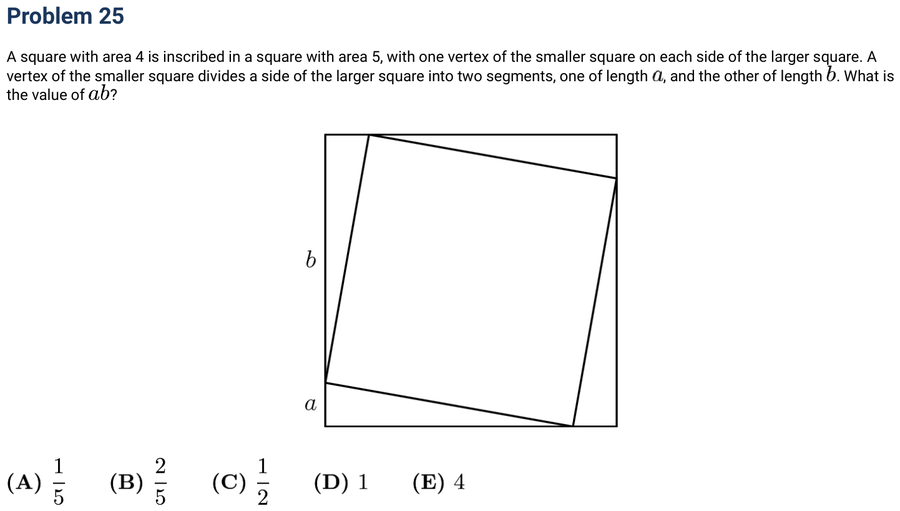
A square with area 4 is inscribed in a square with area 5, with one vertex of the smaller square on each side of the larger square. A vertex of the smaller square divides a side of the larger square into two segments, one of length a, and the other of length b. What is the value of ab?
Show answer
Answer: C — 1/2.
Show hints
Hint 1 of 2
Don't hunt for a and b separately — the question only wants their product. The tilted small square cuts the big square into itself plus 4 corner triangles, and each triangle's area is exactly (1/2)ab. So chase the total triangle area.
Still stuck? Show hint 2 →
Hint 2 of 2
The 4 corner triangles are congruent (the picture is symmetric), and together they're just the part of the big square not covered by the small one: 5 − 4 = 1. That's the whole problem — no need for side lengths.
Show solution
Approach: leftover area equals the four corner triangles → ab
- The small square sits inside the big one, leaving 4 right triangles in the corners. Their total area is the difference of squares: 5 − 4 = 1.
- Those 4 triangles are congruent by the symmetry of the figure, so each has area 1/4.
- Each corner triangle has legs a and b, so its area is (1/2)ab. Set (1/2)ab = 1/4, giving ab = 1/2.
- Why it's quick: the target is a product, and (1/2)ab is exactly a triangle's area — so an area equation hands you ab directly, no need to solve for a or b alone.
Another way — two Pythagorean relations:
- The small square's side is √4 = 2, and it's the hypotenuse of a corner right triangle with legs a, b: so a² + b² = 4.
- The big square's side is √5, and that side is split into a + b: so (a + b)² = 5, i.e. a² + 2ab + b² = 5.
- Subtract the first from the second: 2ab = 5 − 4 = 1, so ab = 1/2. (The (a+b)² − (a²+b²) = 2ab identity is the engine here.)
Mark:
· log in to save