Problem 24 · 2012 AMC 8
Hard
Geometry & Measurement
rearrangementbounding-square
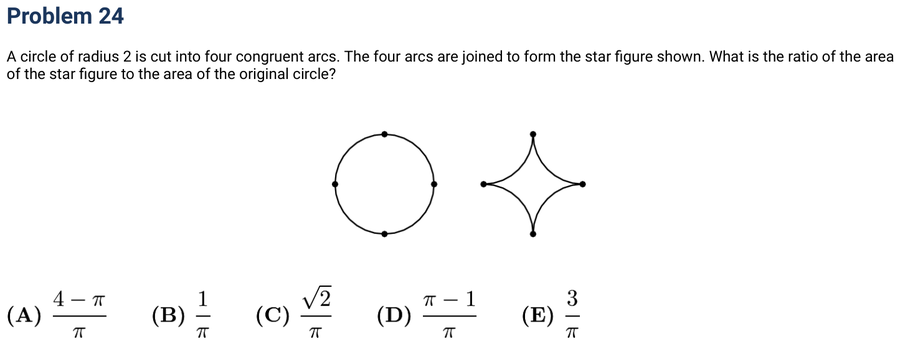
A circle of radius 2 is cut into four congruent arcs. The four arcs are joined to form the star figure shown. What is the ratio of the area of the star figure to the area of the original circle?
Show answer
Answer: A — (4 − π)/π.
Show hints
Hint 1 of 2
Nothing was added or removed — the star is the same four arcs as the circle, just flipped to curve inward instead of outward. So the star and circle are made of identical pieces; the trick is to find a clean container.
Still stuck? Show hint 2 →
Hint 2 of 2
Drop the star inside a square that its 4 points just touch. The 4 leftover corner "bites" are exactly the 4 arc-pieces — flipped back out, they rebuild the circle. So square = star + circle. This is a rearrangement / conservation-of-pieces argument.
Show solution
Approach: same arcs rearranged: bounding square = star + circle
- The four arcs that bulged outward to make the circle are now curved inward to make the star — same pieces, no area gained or lost. We just need a shape we can measure.
- Inscribe the star in a square whose sides its four points touch. Each star point reaches one radius (2) past center on each side, so the square is 4 × 4 = 16.
- Look at the 4 corner regions outside the star but inside the square: each is one of the original arc bites. Flipped outward they reassemble the whole circle, so those 4 regions total the circle's area π(2)² = 4π.
- Thus star = square − those corners = 16 − 4π, and the ratio star : circle = (16 − 4π) / 4π = (4 − π)/π.
- The transferable move: when a figure is built by rearranging pieces of another, look for a simple shape (here a square) that the pieces tile exactly — then areas come from subtraction, not integration or arcs.
Mark:
· log in to save