25 problems — one per position, pulled from random authored years. Hints and solutions are locked until you submit. Retake as often as you want — every attempt is saved to your test history (if you're logged in).
Pick a paper and hit Start to take it as a timed test — or browse past papers untimed to read the original questions, figures and answers at your own pace.
← BackTip: real AMC 8 is 40 minutes — set a timer if you want the full pressure.
Problem 1 · 2020 AMC 8
Easy
Ratios, Rates & Proportionsratioproportion
Luka is making lemonade to sell at a school fundraiser. His recipe requires 4 times as much water as sugar and twice as much sugar as lemon juice. He uses 3 cups of lemon juice. How many cups of water does he need?
Show answer
Answer: E — 24 cups.
Show hints
Hint 1 of 2
Lemon juice is the “smallest” ingredient and everything is measured against it. So instead of two separate steps, ask: how many times bigger is water than lemon juice?
Still stuck? Show hint 2 →
Hint 2 of 2
When one thing scales another which scales a third, the scale factors multiply. Water is 4× sugar and sugar is 2× lemon, so water is 4 × 2 = 8 times the lemon juice.
Show solution
Approach: multiply the scale factors into one jump
Chained scalings multiply: water is 4× sugar and sugar is 2× lemon, so water is 4 × 2 = 8 times the lemon juice — one jump instead of two.
With 3 cups of lemon juice, water = 8 × 3 = 24 cups.
You'll see this again as: any “A is k times B, B is m times C” chain collapses to “A is k·m times C.” Gear ratios and unit conversions work the same way.
Another way — one step at a time: lemon → sugar → water (MAA):
Counting & ProbabilityLogic & Word Problemsconsidering-extreme-casesaccounting-for-all-possibilitieslogical-reasoning
A drawer has 7 blue socks and 7 red socks, all jumbled together. You reach in (in the dark) and pull out socks. (1) How many socks must you grab to be CERTAIN of getting a matching pair of some color? (2) Now a harder, different question: how many must you grab to be CERTAIN of getting two BLUE socks specifically? (Imagine the worst possible luck.)
Show answer
Answer: Any matching pair: 3 socks. Two blue socks specifically: 9 socks
Show hints
Hint 1 of 4
'A matching pair of some color' means two blues OR two reds. There are only two colors. Think about the worst case: what is the most socks you could grab and still NOT have a pair?
Still stuck? Show hint 2 →
Hint 2 of 4
If you grabbed 2 socks of different colors (one blue, one red), you have no pair yet. But the very next sock must match one of them!
Still stuck? Show hint 3 →
Hint 3 of 4
For part (2), 'two blue' is much pickier. Worst luck: you keep pulling out red socks. How many reds are in the drawer? You might pull every one of them before a blue shows up.
Show solution
Approach: Considering the worst case — pigeonhole vs. a specific color
Part 1, a matching pair of any color: with only two colors, after you grab 2 socks the unluckiest result is one blue and one red — no pair yet. But the 3rd sock has to be blue or red, so it MUST match one of the two you already hold. So 3 socks guarantee a matching pair. (You can also list the patterns of 3 socks: BBB, BBR, BRR, RRR — every one contains a pair.)
Part 2, two BLUE socks specifically: this is a pickier demand. Imagine pulling out reds again and again with terrible luck. There are 7 red socks, so you could pull all 7 reds before any blue appears. After those 7 reds you still need 2 blue socks, so in the worst case you need \(7+2=9\) socks.
The lesson: read the question carefully! 'A matching pair of any color' (3 socks) and 'two of a specific color' (9 socks) have completely different answers.
A big fraction-over-a-fraction is just a division: (top) ÷ (bottom). Notice the two pieces on top already share the same denominator, so adding them is a freebie.
Still stuck? Show hint 2 →
Hint 2 of 2
Dividing by a fraction means flipping it and multiplying. Watch for the same fraction showing up twice.
Show solution
Approach: the bar means divide; flipping turns it into a square
The top adds easily because the bottoms match: 3/8 + 7/8 = 10/8 = 5/4.
The big bar means divide by 4/5, and dividing by a fraction means flip-and-multiply: (5/4) ÷ (4/5) = (5/4) × (5/4).
That's the same fraction times itself: (5/4)² = 25/16.
Why this transfers: a fraction stacked over a fraction is always a division in disguise — rewrite it as ÷, then flip the bottom. And a sanity check: 5/4 is a bit over 1, so its square should be a bit over 1; 25/16 ≈ 1.56 fits.
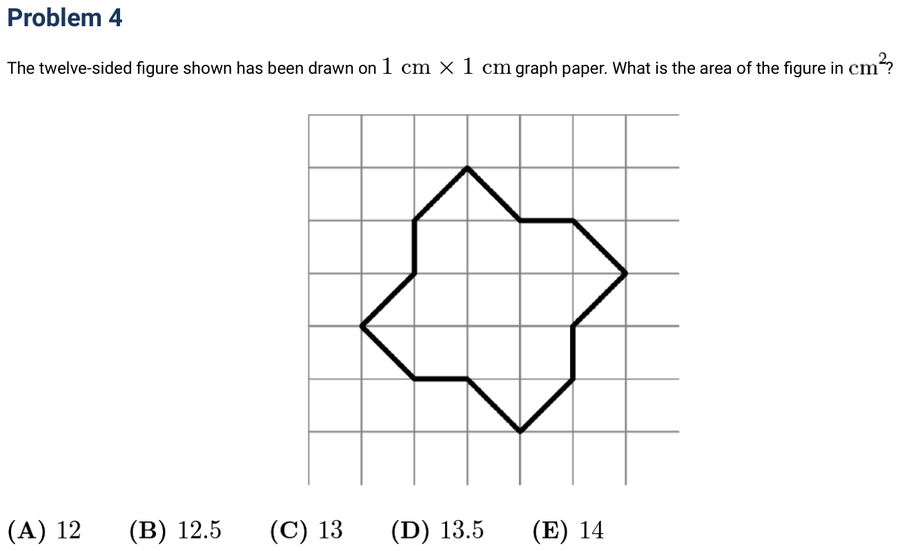
Don't try to measure the whole jagged outline at once. Look for the "calm" piece in the middle — there's a plain square hiding in there, and the rest is just four matching points sticking out.
Still stuck? Show hint 2 →
Hint 2 of 2
The technique for any weird grid shape: cut it into pieces you already know (squares and right triangles), find each area, and add. The symmetry here means you only compute one triangle and multiply by four.
Show solution
Approach: split into a square + 4 triangles
Spot the structure: a calm 3 × 3 square in the center, with one identical triangular point poking out of each of its four sides.
Square area: 3 × 3 = 9. Each point is a triangle with base 2 and height 1, so area (1/2)(2)(1) = 1; four of them give 4.
Total: 9 + 4 = 13 cm2. Sanity check: the figure is clearly bigger than the 9 square but doesn't fill its 5×5 bounding box, so 13 feels right.
You'll see it again: spotting a symmetric core plus repeated identical flaps turns a 12-sided monster into "one square + 4 copies of one triangle."
Another way — Pick's Theorem (lattice points):
Here's a power tool for any polygon whose corners sit on grid points: area = (interior dots) + (boundary dots)/2 − 1.
Count the grid dots strictly inside the figure (the interior count) and the dots lying on its outline, plug into the formula, and you get 13 — no slicing into triangles needed. Worth knowing for any "shape drawn on graph paper" question.
Barney Schwinn notices that the odometer on his bicycle reads 1441, a palindrome, because it reads the same forward and backward. After riding 4 more hours that day and 6 the next, he notices that the odometer shows another palindrome, 1661. What was his average speed in miles per hour?
Show answer
Answer: E — 22 mph.
Show hints
Hint 1 of 2
"Palindrome" is just flavor — all you need is the two odometer readings and the total hours.
Still stuck? Show hint 2 →
Hint 2 of 2
Average speed always means total distance ÷ total time, no matter how the trip was split up.
Show solution
Approach: total distance ÷ total time
Distance is just how far the odometer moved: 1661 − 1441 = 220 miles. Don't be distracted by the palindrome story.
Total time is 4 + 6 = 10 hours, so average speed = 220 ÷ 10 = 22 mph.
Why this transfers: average speed is never the average of two speeds — it's always all the miles over all the hours.
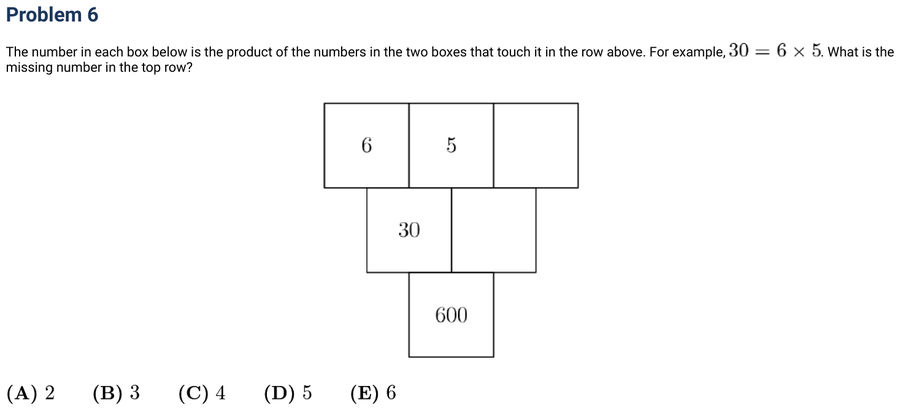
The number in each box below is the product of the numbers in the two boxes that touch it in the row above. For example, 30 = 6 × 5. What is the missing number in the top row?
Show answer
Answer: C — 4.
Show hints
Hint 1 of 2
You can't fill the top box directly — but you can work backwards. The bottom 600 came from multiplying, so a missing factor is found by dividing. Which box can you unlock with 600 ÷ 30?
Still stuck? Show hint 2 →
Hint 2 of 2
In a product pyramid, multiply to go down and divide to go back up. Solve the box you have the most info about first, then chain to the unknown.
Circle X has a radius of π. Circle Y has a circumference of 8π. Circle Z has an area of 9π. List the circles in order from smallest to largest radius.
Show answer
Answer: B — Z, X, Y.
Show hints
Hint 1 of 2
The circles are described in three different languages — radius, circumference, area. Translate all three into the SAME thing (radius) before you can compare them.
Still stuck? Show hint 2 →
Hint 2 of 2
Peel the radius out of each formula: C = 2πr and A = πr2. The lone π factors cancel, leaving clean whole-number radii.
Show solution
Approach: convert all three descriptions to radius
Y: C = 2πr = 8π, so r = 4. Z: πr2 = 9π, so r2 = 9 and r = 3. X: r = π ≈ 3.14 (given directly).
Now they're comparable: 3 < 3.14 < 4, so smallest to largest is Z, X, Y.
The key fact for the close call: π lands between 3 and 4 (it's about 3.14), so circle X squeezes in between Z and Y. Anytime quantities are given in different forms, reduce them to one common measure first.
Fuel flows steadily into a tank at \(2{,}000\) liters per hour. The day is split into six \(4\)-hour periods. During those periods the tank uses \(6{,}000\), \(13{,}500\), \(7{,}300\), \(10{,}000\), \(8{,}000\), and \(3{,}200\) liters, in that order. Each day repeats the same pattern. What is the capacity (in liters) of the smallest tank that can always keep at least \(200\) liters of fuel inside?
Show answer
Answer: 7,000 liters
Show hints
Hint 1 of 4
First, how much fuel flows IN during one 4-hour period? It's \(4\times2000=8000\) liters every period.
Still stuck? Show hint 2 →
Hint 2 of 4
For each period, the net change is (inflow \(8000\)) minus (that period's usage). Make a table and keep a running total, starting from some unknown amount \(x\) at the beginning of the day.
Still stuck? Show hint 3 →
Hint 3 of 4
After all six periods, find the lowest running total and the highest running total. The lowest must stay at or above 200; that tells you the smallest starting amount \(x\).
Show solution
Approach: Running-total table, then bound by the lowest and highest levels
Each 4-hour period brings in \(4\times2000=8000\) liters. Let \(x\) be the amount at the start of the day; the net change in a period is \(8000\) minus the usage.
Track the running total:
Period
Usage
Net (8000−usage)
Tank after
1
6000
+2000
x+2000
2
13500
−5500
x−3500
3
7300
+700
x−2800
4
10000
−2000
x−4800
5
8000
0
x−4800
6
3200
+4800
x
The lowest the tank ever gets is \(x-4800\). To keep at least 200 liters: \(x-4800\ge200\Rightarrow x\ge5000\).
Using the smallest allowed start \(x=5000\), the highest the tank ever gets is \(x+2000=7000\). The tank must hold that peak, so the smallest workable capacity is \(7000\) liters.
Art, Roger, Paul, and Trisha bake cookies that are all the same thickness, in the shapes shown below (dimensions in inches). Each friend uses the same amount of dough, and Art's batch makes exactly 12 cookies.
Art's cookies sell for 60 cents each. To bring in the same total from one batch, how much should one of Roger's cookies cost, in cents?
Show answer
Answer: C — 40 cents.
Show hints
Hint 1 of 2
Both bakers earn the same total from the same dough, so every square inch of cookie is worth the same money — a small cookie should cost proportionally less.
Still stuck? Show hint 2 →
Hint 2 of 2
Price per cookie scales with cookie area: take Roger's area ÷ Art's area, then apply that fraction to 60¢.
Show solution
Approach: price per cookie scales with cookie area
Same dough and same total revenue means the price is really being charged per square inch of cookie. So a cookie's price is proportional to its area — you can scale straight from area to price.
Roger's cookie is 8 in², Art's is 12 in²: Roger's is 8/12 = 2/3 the size.
So Roger charges 2/3 of Art's price: 60 × 2/3 = 40 cents.
You'll see this again: spotting the hidden constant rate (here, cents per in²) turns a multi-step count into one proportion.
Another way — count the cookies:
Art: 12 cookies at 60¢ = 720¢ per batch, using 12 × 12 = 144 in² of dough.
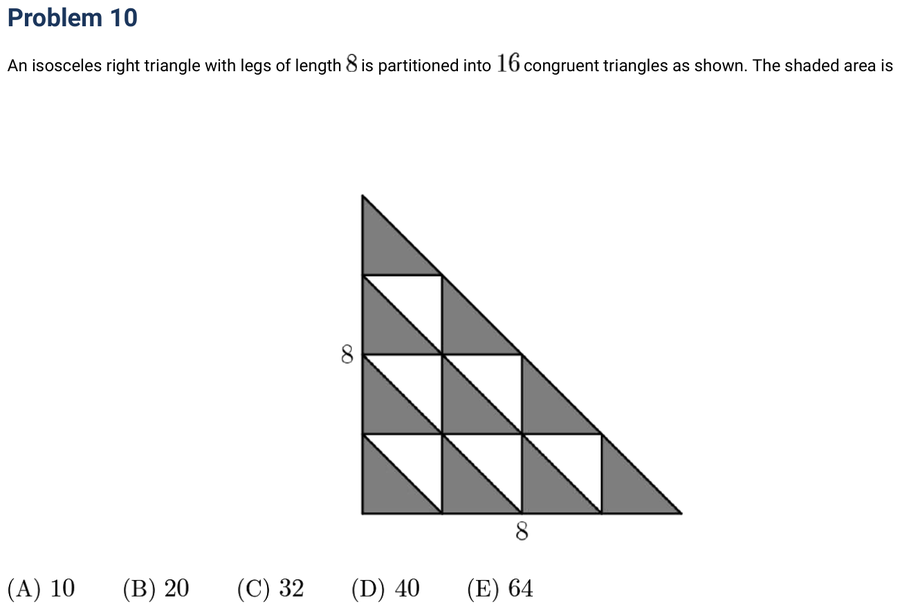
The pieces are all congruent — identical. So instead of measuring the odd-shaped shaded region directly, what one easy number unlocks the whole figure?
Still stuck? Show hint 2 →
Hint 2 of 3
When a shape is cut into equal pieces, find ONE piece's area (total ÷ number of pieces), then shaded area is just "piece area × pieces shaded." Counting beats measuring.
Still stuck? Show hint 3 →
Hint 3 of 3
Get the big triangle's area from its legs first; the small pieces each get an equal share of it.
Show solution
Approach: one equal piece's area × the number shaded
The whole triangle is a right triangle with legs 8, so its area is ½ · 8 · 8 = 32. It's split into 16 congruent pieces, so each piece has area 32 ÷ 16 = 2.
Counting the shaded little triangles in the picture gives 10 of them.
Shaded area = 10 × 2 = 20.
Why this transfers: "equal pieces" is your friend — once every piece is the same size, area becomes pure counting. You never have to compute the strange shaded outline itself, only how many unit-pieces it contains.
Sanity check: 10 of 16 pieces are shaded, a bit over half, and 20 is a bit over half of 32. Consistent.
Henry the donkey has a very long piece of pasta. He takes a number of bites of pasta, each time eating 3 inches of pasta from the middle of one piece. In the end, he has 10 pieces of pasta whose total length is 17 inches. How long, in inches, was the piece of pasta he started with?
Show answer
Answer: D — 44 inches.
Show hints
Hint 1 of 2
Each bite takes one piece and leaves two behind — so every bite raises the piece-count by exactly 1. Work backward from 10 pieces to the number of bites.
Still stuck? Show hint 2 →
Hint 2 of 2
Going from 1 piece to 10 takes 9 bites. Each bite removes 3 inches, and the original = what's left + what was eaten.
Show solution
Approach: every bite adds one piece, so pieces − 1 = number of bites
Insight: don't think about lengths yet — count the bites. A bite from the middle splits one piece into two, so each bite raises the piece count by exactly 1. Starting at 1 piece and ending at 10 means 10 − 1 = 9 bites.
Original = what remains + what was eaten = 17 + 27 = 44 inches.
You'll see this again: this is the “fenceposts vs. gaps” idea — cutting a piece into N parts always takes N − 1 cuts. Count the separations, not the parts.
If each of the three operation signs +, −, × is used exactly once in one of the blanks in the expression 5 __ 4 __ 6 __ 3, then the value of the result could equal
Show answer
Answer: E — 19.
Show hints
Hint 1 of 2
To reach the largest answer (19), you want multiplication to act on a big chunk — and × beats + and − no matter where it sits, so it runs first. Where should × go to grab the most?
Still stuck? Show hint 2 →
Hint 2 of 2
Put × on the biggest pair, 6 and 3, so multiplication fires first and gives 18. Then the + and − only nudge that 18 a little.
Show solution
Approach: place × to maximize, then let order of operations work
Multiplication always goes first, so think of × as picking which pair gets multiplied. To land near 19, let × hit 6 and 3: 6 × 3 = 18, a big head start.
Now slot the remaining + and − around it: 5 − 4 + 6 × 3 = 5 − 4 + 18 = 19, with each sign used exactly once.
Why this transfers: when signs are yours to place and you want the result big, give the × the largest factors and let it run first — order of operations does the heavy lifting. Want the result small instead? Multiply the smallest pair. Same lever, opposite direction.
A three-digit integer contains one of each of the digits 1, 3, and 5. What is the probability that the integer is divisible by 5?
Show answer
Answer: B — 1/3.
Show hints
Hint 1 of 2
Divisibility by 5 depends ONLY on the last digit — here that means the units digit must be the 5. The other two digits don't matter, so ignore them.
Still stuck? Show hint 2 →
Hint 2 of 2
By symmetry, each of 1, 3, 5 is equally likely to be the units digit. So you don't even need to count all the arrangements.
Show solution
Approach: only the units digit matters — use symmetry
A number is a multiple of 5 exactly when its last digit is 0 or 5. Our digits are 1, 3, 5, so we need the 5 sitting in the units place.
The three digits are placed at random, and there's nothing special about any one slot — so the 5 lands in the units place with probability 1/3 (just as 1 or 3 each would).
Why this transfers: a divisibility rule that reads only the last digit lets you collapse a whole-number question to one position — then symmetry handles the probability without listing every arrangement.
Another way — count arrangements directly:
All orderings: 3! = 6. Those ending in 5: fix 5 last, arrange the rest: 2! = 2.
Austin and Temple are 50 miles apart along Interstate 35. Bonnie drove from Austin to her daughter's house in Temple, averaging 60 miles per hour. Leaving the car with her daughter, Bonnie rode a bus back to Austin along the same route and averaged 40 miles per hour on the return trip. What was the average speed for the round trip, in miles per hour?
Show answer
Answer: B — 48 mph.
Show hints
Hint 1 of 2
The trap answer is 50 (just averaging 60 and 40). But she spends MORE time at the slow 40 mph, so the average leans below 50. Average speed is always total distance ÷ total time — never the average of the speeds.
Still stuck? Show hint 2 →
Hint 2 of 2
Since the distance each way is the same, the actual 50 miles cancels out — the answer depends only on the two speeds 60 and 40.
Show solution
Approach: total distance ÷ total time
Time there: 50/60 = 5/6 hr. Time back: 50/40 = 5/4 hr. Total time = 5/6 + 5/4 = 10/12 + 15/12 = 25/12 hr.
Sanity check: 48 is below the plain average of 50 — correct, because the slow leg eats more time.
You'll see it again: equal-distance round trips give the harmonic mean of the speeds, 2×60×40/(60+40) = 4800/100 = 48 — always below the ordinary average, and the actual distance never matters.
Another way — pick a convenient distance:
The distance cancels, so use the LCM of 60 and 40: pretend each leg is 120 miles.
Out: 120/60 = 2 hr. Back: 120/40 = 3 hr. Total 240 miles in 5 hr = 48 mph.
Sale prices at the Ajax Outlet Store are 50% below original prices. On Saturdays an additional discount of 20% off the sale price is given. What is the Saturday price of a coat whose original price is $180?
Show answer
Answer: B — $72.
Show hints
Hint 1 of 2
The two discounts don't add up to 70% off. The 20% comes off the *already-reduced* sale price, not the original — so the discounts stack one after the other. What fraction of the price *survives* each cut?
Still stuck? Show hint 2 →
Hint 2 of 2
Track what you keep, not what you lose: after "50% off" you keep 0.5 of the price; after a further "20% off" you keep 0.8 of that. Multiply the keep-factors.
Show solution
Approach: chain the 'fraction kept' factors
Each discount is taken on the current price, so they multiply rather than add. After 50% off you keep half: $180 × 0.5 = $90 (the sale price).
On Saturday, 20% off means you keep 80% of *that*: $90 × 0.8 = $72.
Watch the trap: 50% + 20% is *not* 70% off (that would give $54). Successive discounts stack multiplicatively — keeping 0.5 then 0.8 means keeping 0.5 × 0.8 = 0.4, i.e. 40% of $180.
Why this transfers: any chain of percent changes is handled by multiplying 'fraction remaining' factors — far safer than adding or subtracting the percents.
Another way — combine the factors first:
Keep-factor overall = 0.5 × 0.8 = 0.4, so Saturday price = $180 × 0.4 = $72 in one step.
Counting & ProbabilityLogic & Word Problemsseeking-complementsasking-key-questions
A tournament has \(36\) players. One loss knocks you out. How many games must be played to crown a single champion? Then: how would the answer change if it took TWO losses to be knocked out?
Show answer
Answer: 35 games (single elimination); 70 or 71 games if two losses are needed
Show hints
Hint 1 of 3
Don't count games from the winner's side — that's hard. Ask the complement question: how many LOSERS are there, and how does a loss relate to a game?
Still stuck? Show hint 2 →
Hint 2 of 3
Each game produces exactly one loser. So the number of games equals the total number of losses handed out.
Still stuck? Show hint 3 →
Hint 3 of 3
Everyone except the one champion gets eliminated. For one-loss: \(35\) players must be eliminated, so \(35\) losses, so \(35\) games. For two-loss: each eliminated player needs \(2\) losses.
Show solution
Approach: Seeking complements — count losses, not wins
Ask the complement question: count losses, not wins. Every game makes exactly one loser, so the number of games equals the number of losses.
One loss to eliminate: out of \(36\) players, exactly \(1\) becomes champion and the other \(35\) are each eliminated by \(1\) loss. That is \(35\) losses, so \(35\) games.
Two losses to eliminate: each of the \(35\) eliminated players must collect \(2\) losses, giving \(35 \times 2 = 70\) losses. The champion might also pick up a loss along the way (one is allowed), so the total is \(70\) games if the champion never lost, or \(71\) if the champion lost exactly once before winning.
98 factors is a signal: this is meant to collapse, not be multiplied out. Each fraction is k(k+2) over (k+1)2 — numbers one apart, top and bottom — which begs to be split so neighbors cancel.
Still stuck? Show hint 2 →
Hint 2 of 2
Each factor k(k+2)(k+1)(k+1) breaks into kk+1 × k+2k+1; collect all the first pieces in one chain and all the second pieces in another.
Show solution
Approach: split each factor into two telescoping chains
Every factor is k(k+2)(k+1)(k+1) = kk+1 × k+2k+1, for k = 1 to 98.
Chain 1 (the kk+1 pieces): 12 × 23 × … × 9899. Each top cancels the next bottom, leaving 199.
Chain 2 (the k+2k+1 pieces): 32 × 43 × … × 10099, which cancels down to 1002 = 50.
Multiply the two leftovers: 199 × 50 = 5099.
Why this transfers: a long product or sum that looks hopeless is usually telescoping — each piece cancels part of its neighbor. Factor every term into simple pieces, line them up, and almost everything collapses, leaving just the two ends.
Many calculators have a reciprocal key 1/x that replaces the current number displayed with its reciprocal. For example, if the display is 00004 and the 1/x key is pressed, then the display becomes 000.25. If 00032 is currently displayed, what is the fewest positive number of times you must depress the 1/x key so the display again reads 00032?
Show answer
Answer: B — 2.
Show hints
Hint 1 of 3
Don't assume it takes many presses — just do it once and see what's on the screen, then ask whether one more press undoes it.
Still stuck? Show hint 2 →
Hint 2 of 3
Flipping a fraction upside down, then flipping again, lands you exactly where you started: the reciprocal of the reciprocal is the original number.
Still stuck? Show hint 3 →
Hint 3 of 3
32 = 32⁄1; one press flips it to 1⁄32; the next press flips it back.
Show solution
Approach: the reciprocal undoes itself
Press once: 32 (which is 32⁄1) flips to 1⁄32. Press again: 1⁄32 flips back to 32. So the display returns after exactly 2 presses.
Why this works: taking a reciprocal twice cancels itself — like flipping a card over and over, every even number of presses returns the original. An operation that is its own undo is called self-inverse, and it always cycles with period 2 (unless the number is 1, which never changes).
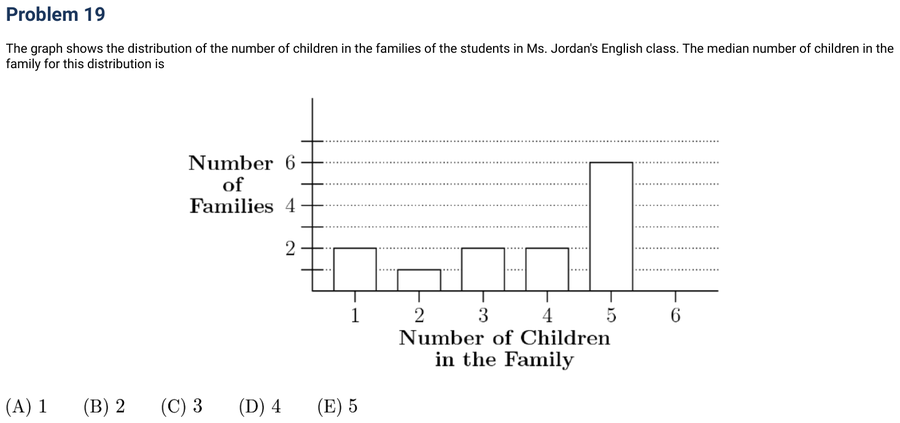
Median is the MIDDLE value, not the tallest bar. Read carefully: the bar HEIGHT is how many families, and the number you're averaging over is the children-per-family on the bottom axis. First find how many families there are in all.
Still stuck? Show hint 2 →
Hint 2 of 2
Once you know the total count, the median sits at the middle position. You don't need to write every value — just walk along the bars counting until you reach that middle spot.
Show solution
Approach: total the families, then walk the bars to the middle position
Read the bars as counts of families: 2 families have 1 child, 1 has 2, 2 have 3, 2 have 4, 6 have 5 — that's 2 + 1 + 2 + 2 + 6 = 13 families.
With 13 values in order, the median is the 7th one (six below it, six above). Walk the bars: positions 1–2 are '1 child,' position 3 is '2,' positions 4–5 are '3,' positions 6–7 are '4.' The 7th lands in the '4 children' group.
So the median is 4.
The trap this catches: the '5 children' bar is tallest, so it's tempting to answer 5 — but tallest is the MODE, not the median. Median = middle position. Sanity check: the 7th value is 4, comfortably below the popular 5's that pile up at the top end.
The value of the expression (304)⁵ ⁄ ((29.7)(399)⁴) is closest to
Show answer
Answer: D — 3.
Show hints
Hint 1 of 3
Never compute a fifth power here — the word 'closest' plus those round-ish numbers (304, 399, 29.7) is begging you to round to 300, 400, 30 first.
Still stuck? Show hint 2 →
Hint 2 of 3
After rounding, you have 300⁵ on top and 400⁴ on the bottom. Don't expand them — pair up four of the 300s with the four 400s to make (300⁄400)⁴ = (3⁄4)⁴, and you're left with one spare 300 over the 30.
Still stuck? Show hint 3 →
Hint 3 of 3
(3⁄4)⁴ is a bit under ⅓, and the leftover 300⁄30 = 10, so the product is roughly 10 × (a third).
Show solution
Approach: round, then pair the powers into (3⁄4)⁴
'Closest' means estimate, so round to friendly numbers: 304 → 300, 399 → 400, 29.7 → 30. The expression becomes 300⁵ ⁄ (30 · 400⁴).
Don't expand the powers — regroup instead. Match four 300s against the four 400s: (300⁄400)⁴ = (3⁄4)⁴. The fifth 300 pairs with the 30 to give 300⁄30 = 10.
So it's (3⁄4)⁴ · 10 = (81⁄256) · 10 ≈ 0.316 · 10 ≈ 3.16, closest to 3.
Sanity check the size: 81⁄256 is just under ⅓, and ⅓ of 10 is about 3.3 — so the answer is a small single-digit number, instantly ruling out the .003, .03, .3, and 30 options. The art is grouping powers before multiplying, not crunching huge numbers.
Harold tosses a nickel four times. The probability that he gets at least as many heads as tails is
Show answer
Answer: E — 11/16.
Show hints
Hint 1 of 2
A coin has no preference for heads over tails, so "heads ≥ tails" must be exactly as likely as "tails ≥ heads." Those two cases together cover *everything* — but they double-count something.
Still stuck? Show hint 2 →
Hint 2 of 2
The only outcome that fits both is a 2–2 tie. So the two equal halves overlap precisely on the tie: 2·(what you want) = 1 + P(tie). Find the tie, and you're done.
Show solution
Approach: use heads–tails symmetry
Heads and tails are interchangeable, so P(heads ≥ tails) = P(tails ≥ heads). Together these events cover all outcomes, overlapping only on the 2–2 tie.
By inclusion-exclusion, P(H≥T) + P(T≥H) = 1 + P(tie), i.e. 2·P(H≥T) = 1 + P(tie). The tie has C(4,2) = 6 of the 16 equally likely outcomes, so P(tie) = 6/16 = 3/8.
Then P(heads ≥ tails) = (1 + 3/8) ÷ 2 = 11/16.
*Why this transfers:* when two symmetric events together fill the whole sample space, you don't count both — you write 2·P = 1 + P(overlap) and only the small overlap needs counting.
Another way — just count the winning outcomes:
"At least as many heads as tails" over 4 flips means 2, 3, or 4 heads.
Ways: C(4,2) + C(4,3) + C(4,4) = 6 + 4 + 1 = 11, out of 2⁴ = 16 outcomes.
Several students are seated at a large circular table. They pass around a bag of 100 pieces of candy. Each person takes one piece and passes the bag to the next person. If Chris takes the first and the last piece of candy, then the number of students at the table could be
Show answer
Answer: B — 11.
Show hints
Hint 1 of 2
The bag comes back to Chris once every full lap around the table. So Chris gets pieces 1, then 1+(one lap), then 1+(two laps), … The real question is: how far apart are his pieces?
Still stuck? Show hint 2 →
Hint 2 of 2
Chris grabs the 1st piece and the 100th piece — that's a gap of 99 pieces, which must be a whole number of laps. So the number of students has to divide evenly into 99. Test the choices for who splits 99 with nothing left over.
Show solution
Approach: the gap between Chris's first and last piece must be a whole number of laps
With n students, the bag returns to Chris every n pieces (one lap). So Chris takes pieces 1, 1+n, 1+2n, … — each of his pieces is one full lap after the last.
He gets the 1st *and* the 100th piece. The distance from piece 1 to piece 100 is 100 − 1 = 99 pieces, and that must be an exact whole number of laps. So n must divide 99 with nothing left over.
Check the choices: 10, 19, 20, 25 all leave a remainder, but 99 ÷ 11 = 9 exactly. So there could be 11 students (Chris gets every 11th piece: 1, 12, 23, …, 89, 100).
*Why this transfers:* 'same person at the start and at position k' around a circle means the number of people must divide the gap (here k−1) evenly — it's really a 'which numbers go in evenly' (divisor) question in disguise.
The manager of a company planned to give a $50 bonus to each employee from the company fund, but the fund was $5 short of what was needed. Instead the manager gave each employee a $45 bonus and kept the remaining $95 in the fund. How much money was in the company fund before any bonuses were paid?
Show answer
Answer: E — 995 dollars.
Show hints
Hint 1 of 2
The fund never changed — only the plans for it did. Write the SAME fund two different ways: once for the $50 plan (which fell $5 short) and once for the $45 plan (which left $95 over). Two expressions for one quantity means you can set them equal.
Still stuck? Show hint 2 →
Hint 2 of 2
With n employees: the $50 plan needs 50n but the fund is $5 less, so fund = 50n − 5. The $45 plan uses 45n and leaves $95, so fund = 45n + 95. Equate them to find n.
Show solution
Approach: write the same fund two ways and equate
Let n be the number of employees. The fund equals 50n − 5 (it was $5 short of giving everyone $50) and also 45n + 95 (after $45 each, $95 stayed in). Same fund, so 50n − 5 = 45n + 95.
That gives 5n = 100, so n = 20, and the fund is 45·20 + 95 = $995.
Why this transfers: when one quantity is described two ways, set the two descriptions equal — the unknown pops out. No need to find the fund first to get n.
Another way — follow the $5-per-person savings:
Cutting each bonus from $50 to $45 frees up $5 per employee. That freed-up money is exactly what turns a $5 shortfall into a $95 surplus — a total swing of 5 + 95 = $100.
So 5 × (employees) = 100, meaning 20 employees, and the fund = 45·20 + 95 = $995.
Logic & Word Problemslogical-reasoningaccount-for-all-possibilities
Four glasses sit at the corners of a square table, each right-side-up or upside-down. You are blindfolded. On each turn you may feel any two glasses and flip none, one, or both. After each turn the table is spun randomly, so you lose track of corners. A bell rings the instant all four glasses face the same way. What is the fewest number of turns that GUARANTEES you can make the bell ring?
Show answer
Answer: 5 turns
Show hints
Hint 1 of 4
You can't control which corners you grab compared to last time (the spin scrambles them), but you CAN choose two ADJACENT (side-by-side) glasses or two DIAGONAL (across) glasses. Mix the two kinds.
Still stuck? Show hint 2 →
Hint 2 of 4
Turn 1: grab a diagonal pair and turn both right-side-up. Turn 2: grab an adjacent pair and turn both right-side-up. If no bell yet, exactly one glass is upside-down.
Still stuck? Show hint 3 →
Hint 3 of 4
Turn 3: grab a diagonal pair and flip BOTH. If no bell, the two down glasses are now adjacent (side by side).
Show solution
Approach: Mix diagonal and adjacent grabs to force all four to match
Mix DIAGONAL and ADJACENT grabs so that no matter how the table spins, the glasses are forced toward all-the-same.
Turn 1 (diagonal): set both right-side-up. Turn 2 (adjacent): set both right-side-up. If no bell, exactly one glass is down.
Turn 3 (diagonal): flip both. If no bell, the two down glasses are now adjacent. Turn 4 (adjacent): flip both. If no bell, the two down glasses are now diagonal.
Turn 5 (diagonal): flip both — now all four match and the bell rings. Every branch finishes by turn \(5\), and no faster plan is guaranteed, so the answer is \(5\) turns.
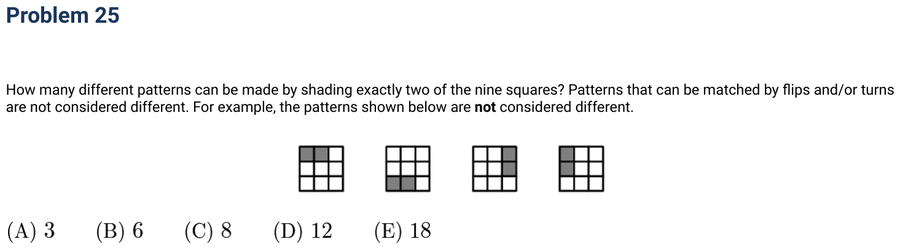
Counting all C(9,2)=36 pairs and crossing out flips/turns is a mess. First simplify the board: by symmetry the nine cells are really only THREE kinds — the 1 center, the 4 edge-middles, and the 4 corners. Any two cells of the same kind look the same after turning the grid.
Still stuck? Show hint 2 →
Hint 2 of 2
So a pattern is decided by which *kinds* of cell you pick AND how they sit relative to each other (touching? across? diagonal?). List the kind-combinations carefully — that's symmetry classification.
Show solution
Approach: classify by cell-type and relative position (count up to the square's symmetry)
The nine cells split into 3 symmetry types: center (1), edges (4 middle-of-side), corners (4). Turning or flipping the grid shuffles cells *within* a type, so what matters is which types you shade and how they're positioned.
Go through the type-pairs. Center + edge: 1 way. Center + corner: 1 way. Two edges: they're either next to each other (adjacent) or across (opposite) — 2 ways. Two corners: adjacent (same side) or diagonal — 2 ways. Corner + edge: the edge either touches that corner or is on the far side — 2 ways.
Total distinct patterns: 1 + 1 + 2 + 2 + 2 = 8. (Two center cells is impossible — there's only one center.)
*Why this transfers:* when shapes are 'the same under flips/turns,' don't count raw placements — group the spots into symmetry types first, then count combinations of types and their relative positions. That's the heart of symmetry counting.