Haruki has a piece of wire that is 24 centimeters long. He wants to bend it to form each of the following shapes, one at a time.
A regular hexagon with side length 5 cm.
A square of area 36 cm2.
A right triangle whose legs are 6 and 8 cm long.
Which of the shapes can Haruki make?
Show answer
Answer: D — Square and triangle only.
Show hints
Hint 1 of 2
The wire is one fixed length and can't stretch. So what single number must every makeable shape's outline equal?
Still stuck? Show hint 2 →
Hint 2 of 2
A shape works only if its perimeter equals 24 cm. Find each perimeter — and for the triangle, watch for a familiar right-triangle (the 6-8-10) so you don't have to compute a square root.
Show solution
Approach: the wire never stretches — only perimeter = 24 works
A fixed loop of wire can only bend into a shape whose perimeter is exactly 24 cm. So the whole problem becomes: find each perimeter and check it against 24.
Hexagon: 6 sides × 5 = 30 cm. Too long — no. (Notice you don't even need the others to rule this one out.)
Square of area 36: the side is √36 = 6, so perimeter 4 × 6 = 24 cm. ✓
Right triangle, legs 6 and 8: spot the 6-8-10 Pythagorean triple — the hypotenuse is 10, so perimeter 6 + 8 + 10 = 24 cm. ✓
Only the square and the triangle fit, so the answer is Square and triangle only.
You'll see it again: 3-4-5 and its scalings (6-8-10, 9-12-15…) are the most common right triangles on contests — recognizing one saves you the square-root work.
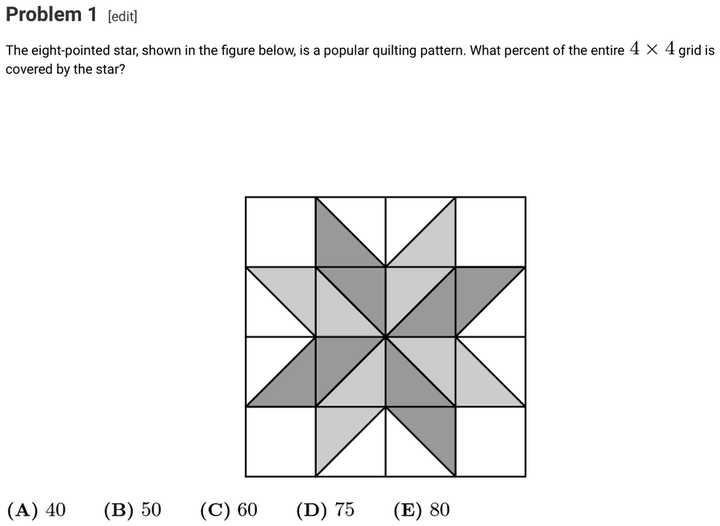
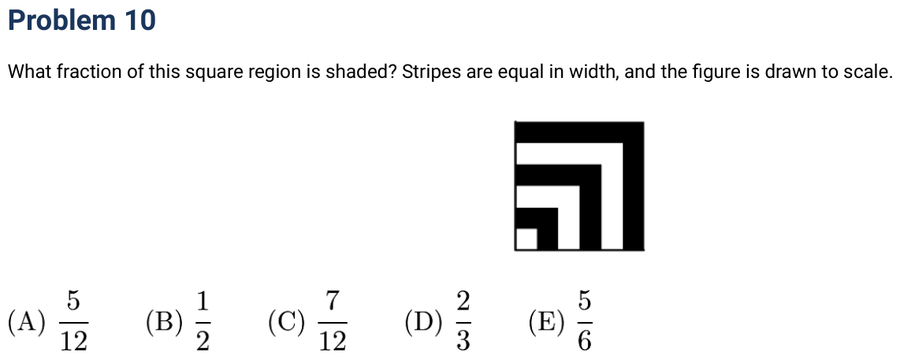
You probably don't need to measure anything. Could the shaded and unshaded parts be hiding the same total area?
Still stuck? Show hint 2 →
Hint 2 of 2
Look for symmetry that swaps shaded with white: pair every shaded triangle with a matching white triangle the same size. If they pair up perfectly, the answer is forced.
Show solution
Approach: pair each shaded triangle with a white twin (symmetry)
Don't measure anything — look for a partner. Each shaded triangle of the star has a congruent white triangle right beside it; shaded and white tile the grid in matched pairs.
Matched pairs means shaded = white exactly, so the star covers half the 4 × 4 grid: 8 of 16 squares = 50%.
Why this transfers: whenever a figure has a symmetry that swaps shaded with unshaded (a flip or a quarter-turn), the shaded fraction is forced to 1/2 — you never have to compute the area.
Another way — shrink to one quarter (MAA):
The four-fold symmetry means the shaded fraction of the whole equals the shaded fraction of just the top-left 2 × 2 quarter.
In that quarter, sliding one little triangle over makes it obvious the shaded part is exactly half — so the whole is 50% too.
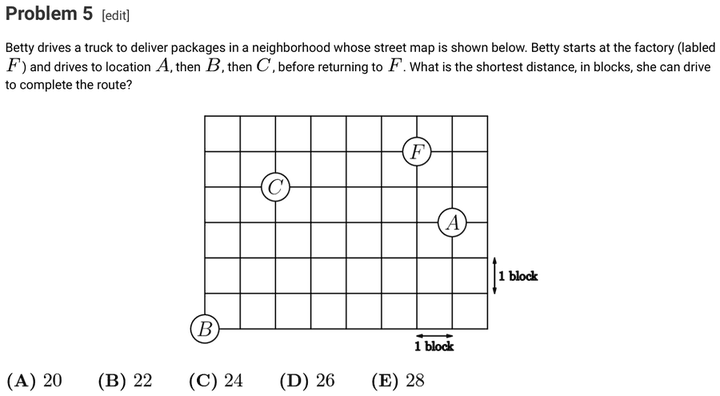
You can't cut diagonally across blocks. So however Betty zigzags within one leg, the distance is the same — what two things does it depend on?
Still stuck? Show hint 2 →
Hint 2 of 2
Each leg's length is just its sideways blocks plus its up-and-down blocks (taxicab distance). Read those off the map for F→A, A→B, B→C, C→F and add.
Show solution
Approach: taxicab / Manhattan distance per leg
Key idea: on a street grid you can't cut diagonally, so the distance for any leg is just (horizontal blocks) + (vertical blocks) — and as long as you never backtrack, the exact path doesn't matter, only where you start and end. (This is the taxicab / Manhattan distance.)
Read the four legs off the map: F→A = 1 + 2 = 3, A→B = 7 + 3 = 10, B→C = 2 + 4 = 6, C→F = 4 + 1 = 5.
Total: 3 + 10 + 6 + 5 = 24 blocks.
Why this transfers: on any grid where you only move along streets, the shortest distance between two points is fixed — just add the sideways and up-down gaps. The wiggly path you choose is irrelevant.
Another way — C is already on the way back (MAA):
Notice C lies on a shortest path from B back to F, so visiting C costs nothing extra. The problem reduces to F → A → B → F.
Four squares of side lengths 4, 7, 9, and 10 units are arranged in increasing size order so that their left edges and bottom edges align. The squares alternate in the color pattern white-gray-white-gray, respectively, as shown in the figure. What is the area of the visible gray region, in square units?
Sides 4, 7, 9, 10 share a bottom-left corner; smaller squares lie on top.
Show answer
Answer: E — 52 square units.
Show hints
Hint 1 of 2
You never see a whole gray square — a smaller one always sits on its bottom-left corner. So what shape is the gray you actually see, and how would you find its area?
Still stuck? Show hint 2 →
Hint 2 of 2
Technique: each visible gray piece = (its square) − (the square on top). And a2 − b2 = (a+b)(a−b) makes 102−92 = 19 instantly — no squaring.
Show solution
Approach: frame = outer square minus the one on top (difference of squares)
The insight: you never see a whole gray square — a smaller white square always sits on top, leaving only an L-shaped frame. So gray visible = (gray square's area) − (the square covering it).
Gray 10 under white 9: 102 − 92. Instead of 100 − 81, use a2 − b2 = (a+b)(a−b) = 19×1 = 19 — no big subtraction.
Gray 7 under white 4: 72 − 42 = (7+4)(7−4) = 11×3 = 33.
Add the two frames: 19 + 33 = 52. You'll see it again: any time two squares (or any two areas) sit one inside the other, the leftover is their difference — and difference-of-squares makes consecutive sizes like 10 and 9 collapse to just their sum.
Another way — alternating add and subtract (MAA):
The visible gray is the 10-square minus the 9-square plus the 7-square minus the 4-square: 100 − 81 + 49 − 16.
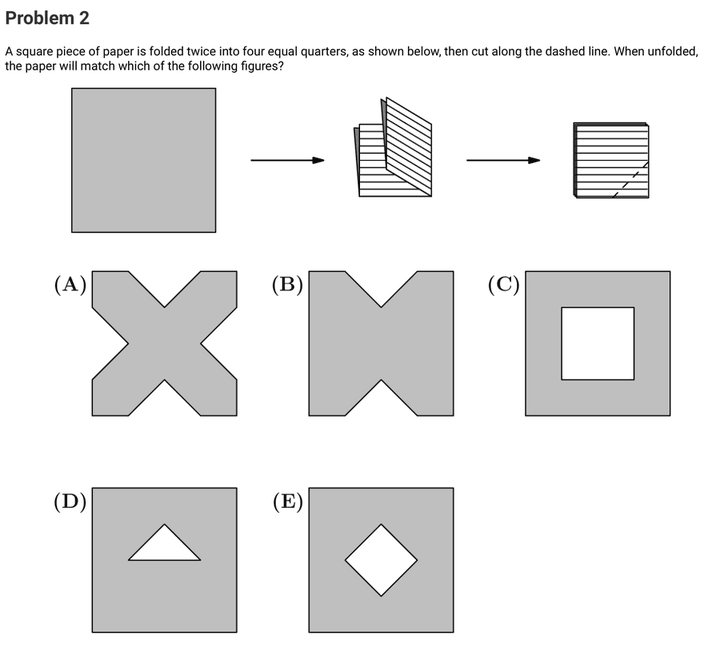
Find the one corner where all the folds meet — that's the spot the cut affects most. Where does it land on the full sheet?
Still stuck? Show hint 2 →
Hint 2 of 2
Folding twice into quarters stacks four layers at one corner, and that corner is the center of the original sheet. So one cut becomes four identical snips arranged symmetrically around the middle.
Show solution
Approach: track where one cut lands once the layers are stacked
The key question for any folding-and-cutting puzzle: where is the corner that all the folds meet at? Folding twice into quarters stacks all four corners onto one spot — and that spot is the center of the original sheet.
So a single cut near that folded corner is really happening through four layers at once — meaning four identical snips appear around the center when you unfold.
A straight diagonal cut takes a triangle off that stacked corner; unfolded, the four triangles join into one diamond-shaped hole in the middle — figure (E). This transfers: whatever you cut at the all-folds-meet corner becomes a symmetric shape centered on the sheet; cuts at an open edge stay at the edge.
Another way — fold real paper (or imagine one layer):
If you can, fold a square twice and cut — the fastest check. If not, just unfold one step at a time: the cut on the folded square mirrors across the first crease, then the result mirrors across the second crease.
Two mirrorings of a corner-triangle produce a four-fold symmetric hole sitting dead-center — matching (E).
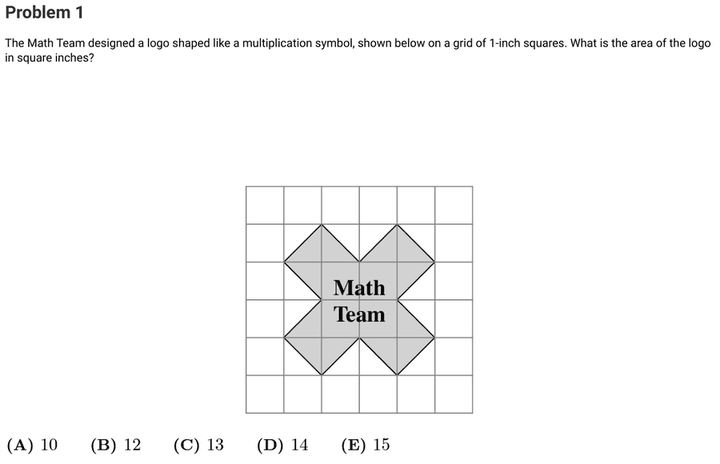
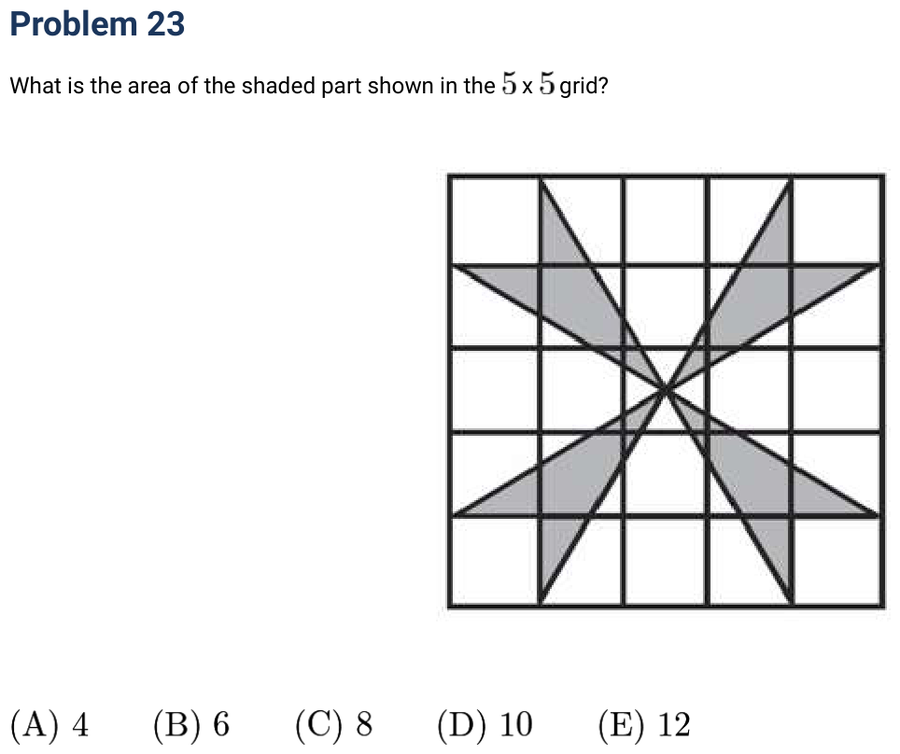
The shape is slanted, but the grid behind it isn't — don't measure tilted lengths, let the grid count the area for you.
Still stuck? Show hint 2 →
Hint 2 of 2
Slice the gray region along the grid lines: every piece becomes a whole unit square (area 1) or a half-square triangle (area ½). Count each kind and add.
Show solution
Approach: let the grid count the area for you (whole squares + half-squares)
Insight: a slanted shape on a grid is hard to eyeball, but it's easy to count. Slice the gray region along the grid lines and every piece becomes either a whole unit square or a triangular half-square — areas you know instantly (1 and ½).
There are 4 whole gray squares in the middle; the surrounding gray triangles are twelve half-squares, adding 12 × ½ = 6 more.
Total area: 4 + 6 = 10 square inches.
You'll see this again: whenever a tilted figure sits on a grid, don't reach for slant-length formulas — chop it into unit squares and half-squares and just add.
Another way — spot five identical tilted unit-squares (MAA):
The logo is made of five small tilted squares whose sides go diagonally across one grid cell, so each side is √(12 + 12) = √2.
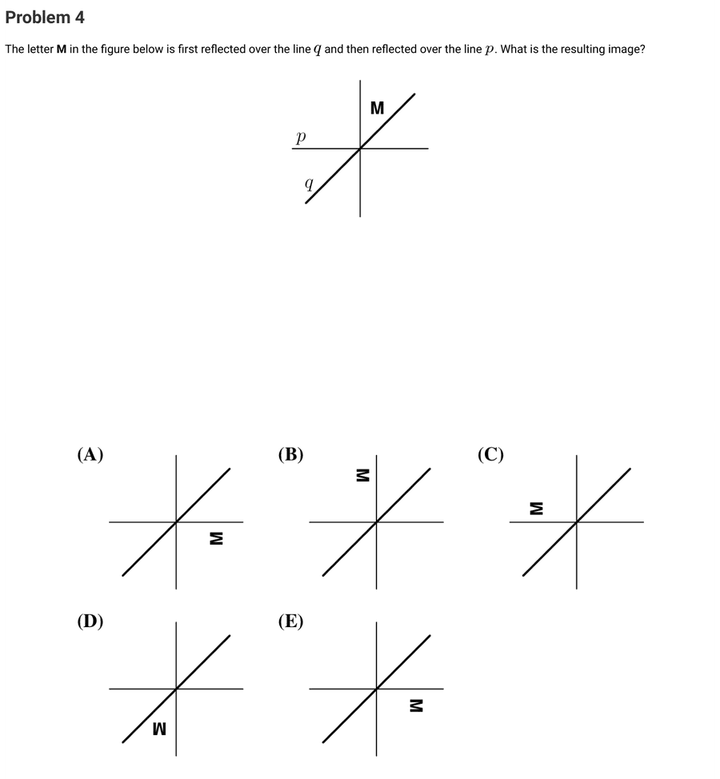
Don't trace the M through each flip separately — ask what single, simpler motion the two flips add up to.
Still stuck? Show hint 2 →
Hint 2 of 2
Two reflections across lines that cross equal one rotation about the crossing point (by twice the angle between the lines). Spin the M instead of flipping it twice.
Show solution
Approach: two reflections across crossing lines = one rotation
Insight: doing two flips in a row feels fiddly, but the combined effect is one clean motion. Reflecting across two lines that cross at a point is exactly a rotation about that point.
The rotation angle is twice the angle between the lines, in the direction from the first line (q) toward the second (p). So instead of tracking each flip, just spin the M about the crossing point.
Carrying M through both flips lands it in the position shown in figure (E).
You'll see this again: two reflections always collapse into a single motion — a rotation if the mirror lines cross, or a translation if they're parallel. Spotting that turns a two-step transformation into one.
Another way — just do the two reflections in order (MAA):
Reflect M over line q: the M flips across that line, landing in its mirror image position.
Reflect that result over line p: a second flip across the other line.
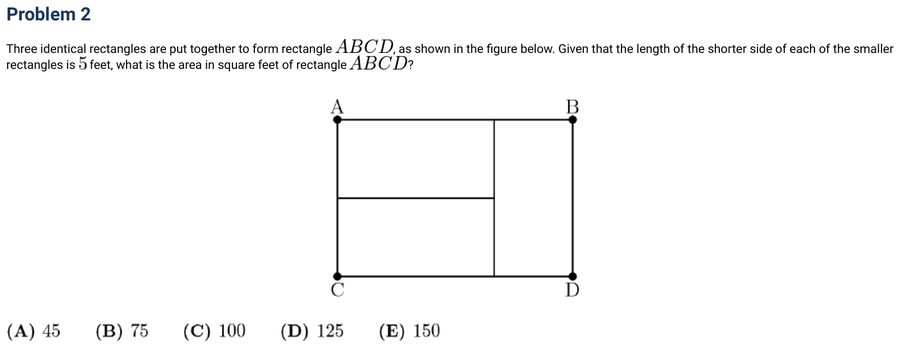
You're only told the short side is 5 — the long side is hidden. Look for a place in the picture where short sides line up against a long side; that shared edge tells you the long side for free.
Still stuck? Show hint 2 →
Hint 2 of 2
Two short sides stacked equal one long side standing beside them: long = 2 × short. That's the key equation; everything else is one multiplication.
Show solution
Approach: let the shared seam set the unknown long side
Each small rectangle has short side 5. In the picture two rectangles lie stacked on the left while one stands upright on the right — their edges share the same height. Two stacked shorts equal one standing long, so the long side = 2 × 5 = 10.
Now the big rectangle ABCD has height 10 and width 10 + 5 = 15, so area = 15 × 10 = 150 square feet.
Why this transfers: in "identical pieces tiled together" figures, a single missing length is almost always pinned by a seam where one orientation lines up flush against another — hunt for that matched edge before reaching for algebra.
Another way — count small rectangles:
Each small rectangle is 5 by 10, area 50. Three identical pieces tile ABCD with no gaps, so the total is 3 × 50 = 150 square feet — a quick check that matches the 15 × 10 answer.
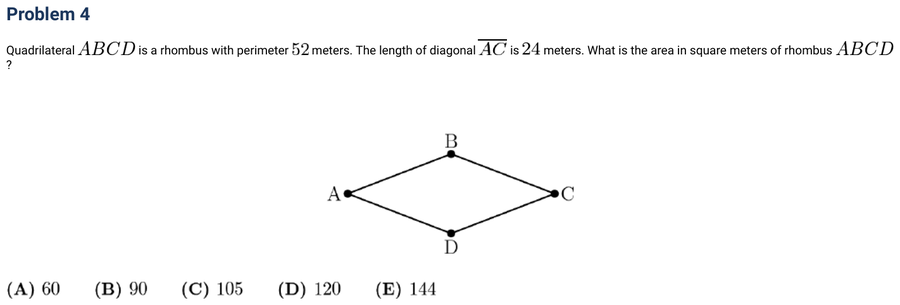
A rhombus only gives you a perimeter and one diagonal — so the hidden tool must be the special fact about a rhombus's diagonals: they meet at right angles and bisect each other. That instantly hands you a right triangle.
Still stuck? Show hint 2 →
Hint 2 of 2
The side (52÷4 = 13) is the hypotenuse and half of AC (24÷2 = 12) is a leg. Recognize 12-13-? — it's the 5-12-13 triple, so the missing leg is 5.
Show solution
Approach: perpendicular bisecting diagonals make a 5-12-13 right triangle
Perimeter gives side = 52 ÷ 4 = 13; half of diagonal AC = 24 ÷ 2 = 12.
The diagonals cut each other at right angles, so the center splits the rhombus into four identical right triangles with hypotenuse 13 (the side) and one leg 12 (half of AC). That's the 5-12-13 triple — no Pythagorean computation needed — so the other half-diagonal is 5 and the full diagonal BD = 10.
Area of a rhombus = d1 × d22 = 24 × 102 = 120 sq m.
You'll see it again as: whenever a problem hands you a rhombus (or a kite), reach first for "diagonals perpendicular" — it converts the figure into right triangles, and recognizing a Pythagorean triple (3-4-5, 5-12-13, 8-15-17) skips the square roots.
Another way — four little triangles:
Each of the four right triangles has legs 12 and 5, so area 12 × 52 = 30.
Four of them: 4 × 30 = 120 sq m — same answer, confirming the diagonal-product formula.
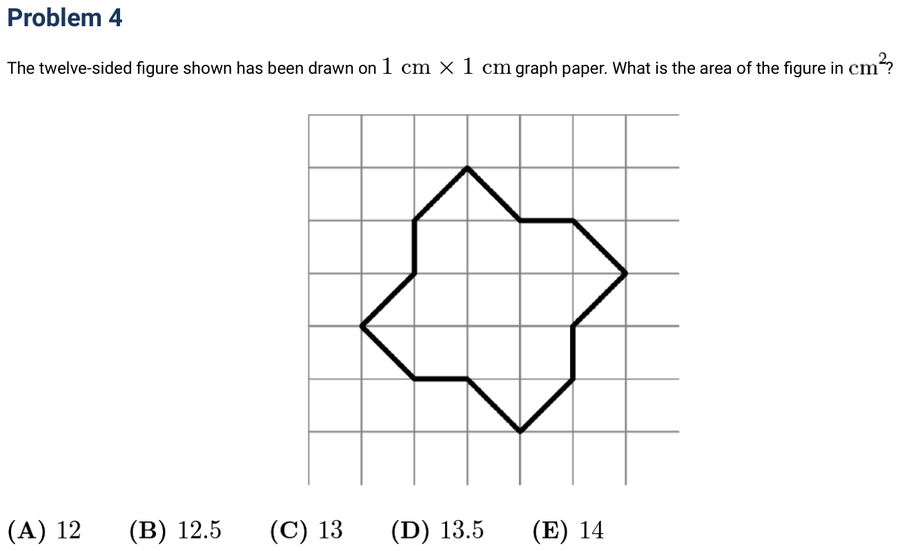
Don't try to measure the whole jagged outline at once. Look for the "calm" piece in the middle — there's a plain square hiding in there, and the rest is just four matching points sticking out.
Still stuck? Show hint 2 →
Hint 2 of 2
The technique for any weird grid shape: cut it into pieces you already know (squares and right triangles), find each area, and add. The symmetry here means you only compute one triangle and multiply by four.
Show solution
Approach: split into a square + 4 triangles
Spot the structure: a calm 3 × 3 square in the center, with one identical triangular point poking out of each of its four sides.
Square area: 3 × 3 = 9. Each point is a triangle with base 2 and height 1, so area (1/2)(2)(1) = 1; four of them give 4.
Total: 9 + 4 = 13 cm2. Sanity check: the figure is clearly bigger than the 9 square but doesn't fill its 5×5 bounding box, so 13 feels right.
You'll see it again: spotting a symmetric core plus repeated identical flaps turns a 12-sided monster into "one square + 4 copies of one triangle."
Another way — Pick's Theorem (lattice points):
Here's a power tool for any polygon whose corners sit on grid points: area = (interior dots) + (boundary dots)/2 − 1.
Count the grid dots strictly inside the figure (the interior count) and the dots lying on its outline, plug into the formula, and you get 13 — no slicing into triangles needed. Worth knowing for any "shape drawn on graph paper" question.
In rectangle ABCD, AB = 6 and AD = 8. Point M is the midpoint of AD. What is the area of ▵AMC?
Show answer
Answer: A — Area 12.
Show hints
Hint 1 of 2
A triangle's area doesn't care WHICH side you call the base — so pick the base that makes the height free. Is there a side of this triangle that lies right along an edge of the rectangle?
Still stuck? Show hint 2 →
Hint 2 of 2
Use AM (part of side AD) as the base. Then the height is the perpendicular distance from C across to that side — which is just the width AB, no extra work.
Show solution
Approach: choose the base along a rectangle edge so the height is free
M is the midpoint of AD, so the base AM = AD/2 = 8/2 = 4.
Because AM lies along side AD, the height to it is the full width across the rectangle: the perpendicular distance from C to line AD equals AB = 6.
Area = (1/2)(base)(height) = (1/2)(4)(6) = 12.
Why this transfers: when a triangle shares a side with a rectangle, choose that shared side as the base — the height collapses to a known rectangle dimension and you skip the Pythagorean theorem entirely.
Another way — coordinates (the shoelace / base-height made explicit):
Place A = (0, 0), D = (8, 0), so M = (4, 0), and C = (8, 6).
Triangle AMC has a horizontal base AM from x = 0 to x = 4 (length 4) on the line y = 0; vertex C sits at height 6.
How many square yards of carpet are required to cover a rectangular floor that is 12 feet long and 9 feet wide? (There are 3 feet in a yard.)
Show answer
Answer: A — 12 square yards.
Show hints
Hint 1 of 2
The trap is to find the area in square feet (12 × 9 = 108) and then divide by 3. But a square yard isn't 3 square feet — it's a 3-by-3 block, which is 9 square feet. Convert the lengths first, then there's nothing to undo.
Still stuck? Show hint 2 →
Hint 2 of 2
Convert each side to yards before multiplying. (General rule: change units on lengths first, then compute area or volume — never convert the answer.)
Show solution
Approach: convert the side lengths to yards first, then multiply
Convert the lengths, not the area: 12 ft = 4 yd and 9 ft = 3 yd.
Area = 4 yd × 3 yd = 12 square yards.
Why this transfers: area and volume scale by the square (or cube) of a length conversion. 1 yd = 3 ft, so 1 sq yd = 32 = 9 sq ft — which is exactly why 108 sq ft ÷ 9 = 12 sq yd also works, and matches our answer. Converting lengths first dodges that factor entirely.
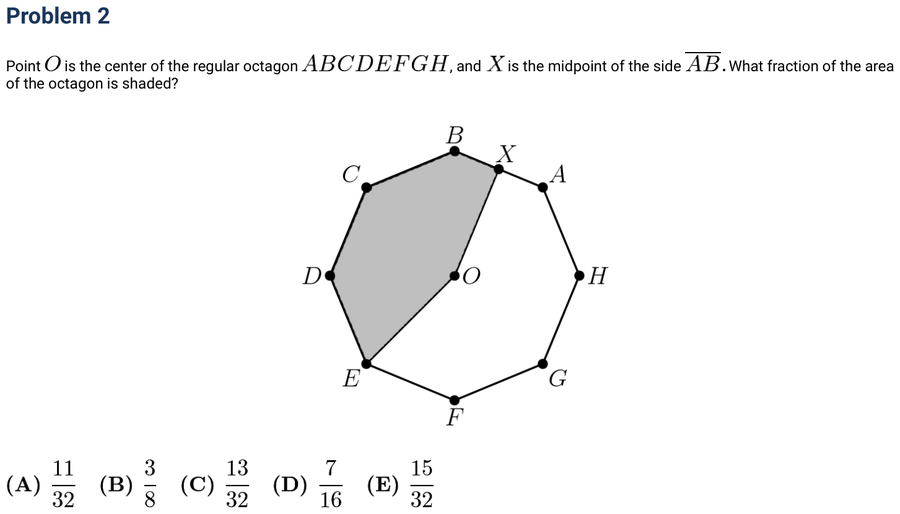
Don't try to measure the shaded shape directly. The center O is begging you to slice: draw a spoke from O to each vertex and the octagon falls into 8 identical wedges.
Still stuck? Show hint 2 →
Hint 2 of 2
Once everything is in equal pieces, the area question becomes a counting question — how many of the 8 wedges (and which half-wedges) are shaded? (A center point in a regular polygon almost always means 'cut into equal slices.')
Show solution
Approach: cut the octagon into 8 equal wedges from the center, then count
Draw a spoke from O to every vertex. A regular octagon splits into 8 congruent triangular wedges, so each wedge is exactly 1/8 of the area — now area is just bookkeeping.
The shaded region is three whole wedges (OBC, OCD, ODE) plus ▵OXB. Since X is the midpoint of AB, OX cuts wedge OAB into two equal halves, so ▵OXB is half a wedge.
Shaded = 3½ wedges out of 8 = (7/2)/8 = 7/16.
Why this transfers: a midpoint that splits a triangle off the same base line splits its area in half too (same height, half the base). That's how the half-wedge appears without any computation.
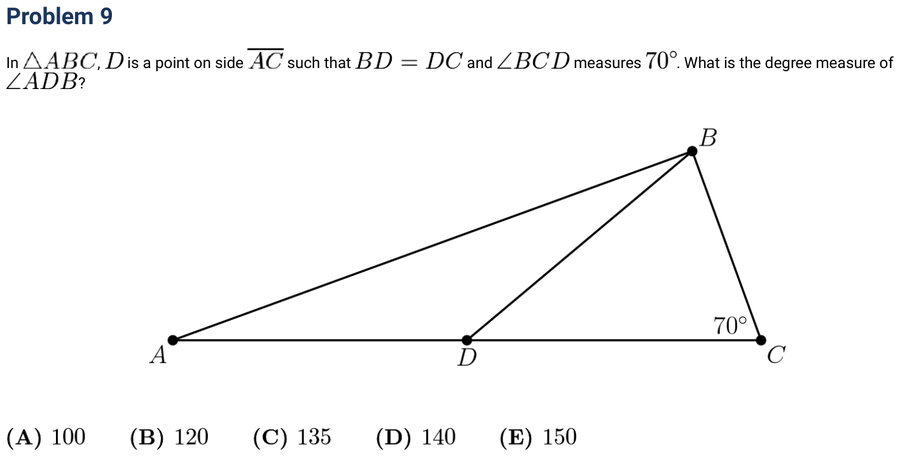
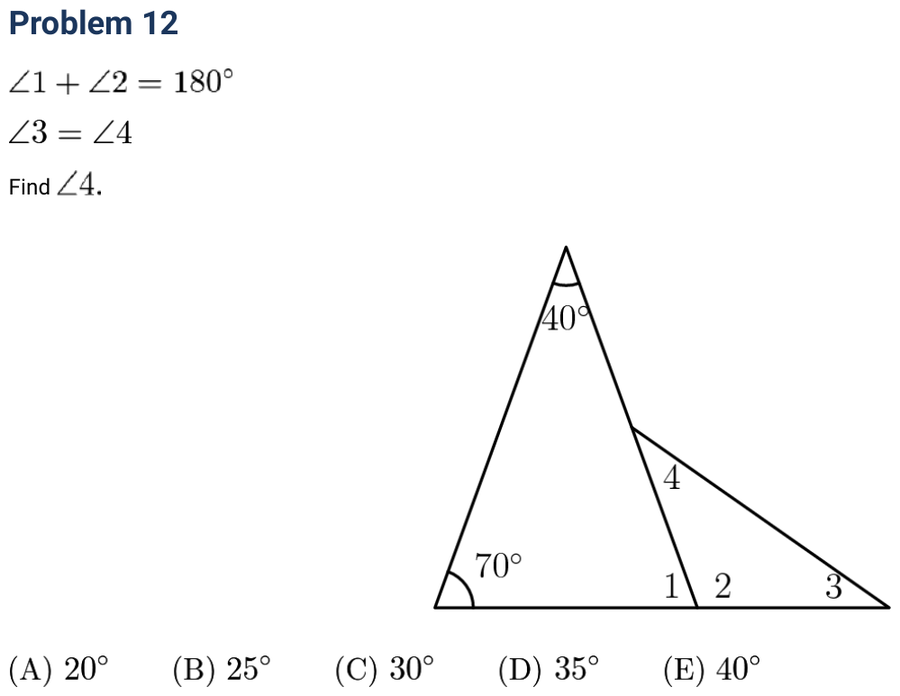
In ▵ABC, D is a point on side AC such that BD = DC and ∠BCD measures 70°. What is the degree measure of ∠ADB?
Show answer
Answer: D — 140 degrees.
Show hints
Hint 1 of 2
BD = DC makes ▵BDC isosceles, so the 70° at C is mirrored at B — you instantly get a second 70° for free.
Still stuck? Show hint 2 →
Hint 2 of 2
∠ADB sits on the straight line AC next to ▵BDC, so it's the exterior angle — equal to the sum of the two far (remote) interior angles.
Show solution
Approach: exterior angle of an isosceles triangle
BD = DC ⇒ ▵BDC is isosceles, so its base angles match: ∠DBC = ∠DCB = 70°. (Equal sides face equal angles.)
∠ADB is the exterior angle of ▵BDC at D. The exterior angle equals the sum of the two remote interior angles: 70° + 70° = 140°.
Why this transfers: the exterior-angle rule (exterior = sum of the two non-adjacent interiors) lets you skip finding the apex angle entirely — it's a shortcut worth spotting whenever an angle hangs off a straight side.
Another way — linear pair after computing the apex angle:
Base angles 70° each give apex ∠BDC = 180° − 140° = 40°. Then ∠ADB = 180° − 40° = 140°.
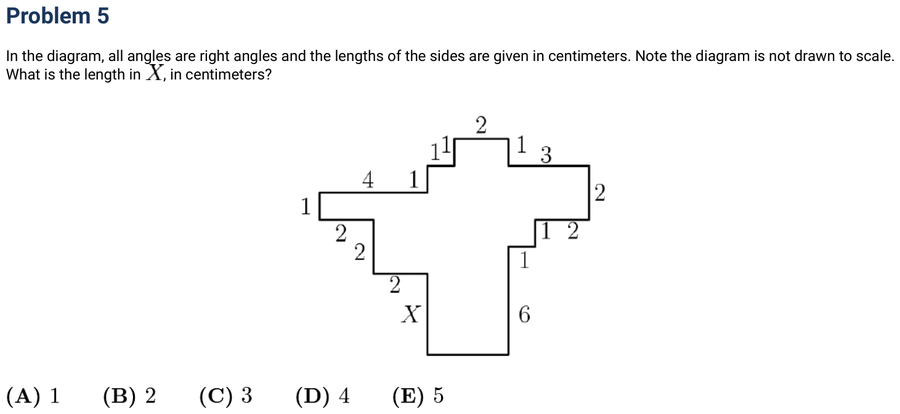
In the diagram, all angles are right angles and the lengths of the sides are given in centimeters. Note the diagram is not drawn to scale. What is X, in centimeters?
Show answer
Answer: E — X = 5.
Show hints
Hint 1 of 2
Don't try to find every coordinate. In any all-right-angle figure, the vertical segments going up must total the same as the segments going down — otherwise the outline wouldn't close back to where it started.
Still stuck? Show hint 2 →
Hint 2 of 2
This is the closed-loop balance for staircase figures: sum of upward steps = sum of downward steps (and likewise left = right). Add up the verticals on each path and set them equal.
Show solution
Approach: vertical segments up = vertical segments down (closed loop)
Walk the outline: every bit you climb up has to be undone coming down, since the figure closes. So total "up" height = total "down" height.
The verticals on one side add to 1 + 2 + 1 + 6 = 10.
The verticals on the other side add to 1 + 1 + 1 + 2 + X = 5 + X.
Set them equal: 5 + X = 10 ⇒ X = 5.
You'll reuse this on every "find the missing length in a right-angled figure": the up-segments and down-segments balance, and so do left and right — no need to chase individual corners.
A rectangular photograph is placed in a frame that forms a border two inches wide on all sides of the photograph. The photograph measures 8 inches high and 10 inches wide. What is the area of the border, in square inches?
Show answer
Answer: E — 88 square inches.
Show hints
Hint 1 of 2
The border is an awkward picture-frame shape. Don't measure it directly — it's a big rectangle (frame + photo) with the photo punched out of the middle.
Still stuck? Show hint 2 →
Hint 2 of 2
This is complementary area: outer area − inner area. The only trap is the width — a 2-inch border adds 2 on the left and 2 on the right, so each dimension grows by 4, not 2.
Show solution
Approach: outer rectangle minus the photo (complementary area)
The border is everything in the outer rectangle except the photo, so its area = outer area − photo area. That sidesteps adding up four separate strips.
The 2-inch border hits both sides, so each dimension gains 2 + 2 = 4: the outer rectangle is 12 × 14 = 168.
Subtract the photo: 8 × 10 = 80, so border = 168 − 80 = 88 sq in.
Watch the doubling — a border/margin of width w always adds 2w to each side length, the classic slip in frame and walkway problems.
Karl's rectangular vegetable garden is 20 feet by 45 feet, and Makenna's is 25 feet by 40 feet. Which of the following statements are true?
Show answer
Answer: E — Makenna's garden is larger by 100 square feet.
Show hints
Hint 1 of 2
Don't compare the shapes — compare their areas. Area of a rectangle is length × width, so find both and subtract.
Still stuck? Show hint 2 →
Hint 2 of 2
Notice both gardens have the same half-perimeter (20+45 = 25+40 = 65). For a fixed perimeter, the rectangle whose sides are closer together holds more area — that hints Makenna (25 by 40) wins before you even multiply.
Show solution
Approach: multiply each area, then subtract
Karl: 20 × 45 = 900 sq ft.
Makenna: 25 × 40 = 1000 sq ft.
Difference: 1000 − 900 = 100 ⇒ Makenna's is larger by 100 sq ft.
Worth keeping: with the same perimeter, the "rounder" (squarer) rectangle always has more area — 25 by 40 is closer to a square than 20 by 45, so it had to be the bigger one.
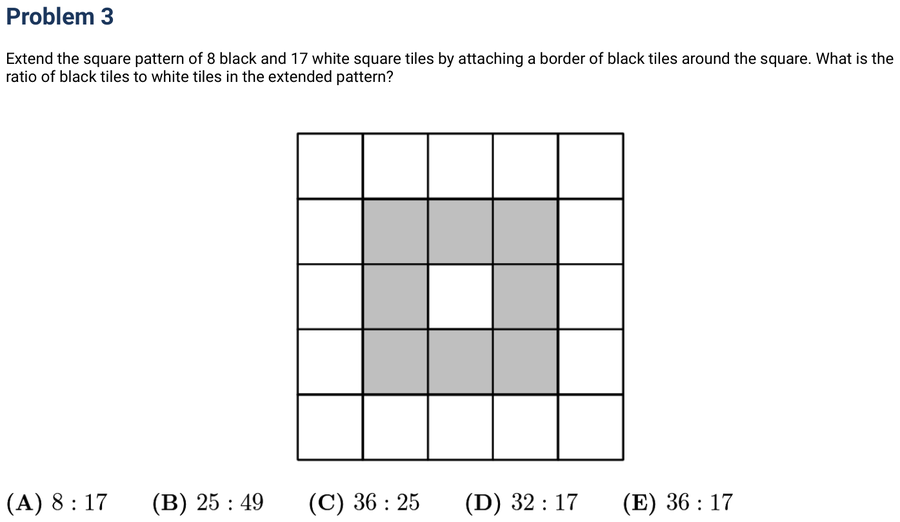
Extend the square pattern of 8 black and 17 white square tiles by attaching a border of black tiles around the square. What is the ratio of black tiles to white tiles in the extended pattern?
Show answer
Answer: D — 32 : 17.
Show hints
Hint 1 of 2
The border only adds black tiles — the 17 white tiles never change. So the only thing to find is how many black tiles the new ring adds.
Still stuck? Show hint 2 →
Hint 2 of 2
Find the new total by squaring: a square of 25 tiles is 5 × 5, and wrapping one ring around it makes it 7 × 7. New tiles = big square − old square.
Show solution
Approach: the white count is frozen; only count the new black ring
The original 25 tiles form a 5 × 5 square. Adding one ring all around makes it 7 × 7 = 49 tiles (each side grows by 2: one tile at each end).
The 49 − 25 = 24 new tiles are all black, so black becomes 8 + 24 = 32; white stays 17.
Ratio: 32 : 17.
Worth keeping: wrapping one ring around an n × n square turns it into (n+2) × (n+2), adding (n+2)2 − n2 = 4n + 4 tiles — here 4·5 + 4 = 24.
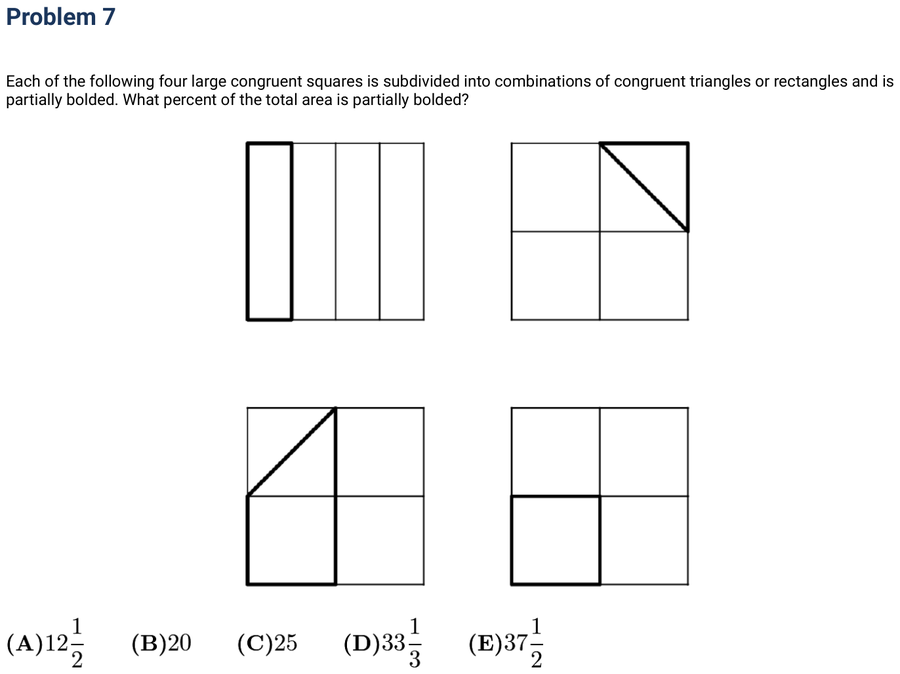
Each of the following four large congruent squares is subdivided into combinations of congruent triangles or rectangles and is partially bolded. What percent of the total area is partially bolded?
Show answer
Answer: C — 25%.
Show hints
Hint 1 of 2
You don't need real measurements — just read each square as a fraction of itself: one of four equal columns is 1/4, a triangle filling half of a quarter is 1/8, and so on.
Still stuck? Show hint 2 →
Hint 2 of 2
Since all four squares are the same size, the answer is the average of the four shaded fractions: add them up and divide by 4.
Show solution
Approach: read each square as a fraction, then average the four
Read the shaded part of each square: one of four columns = 1/4; a triangle that's half of one quarter = 1/8; a full quarter plus that triangle = 3/8; one full quarter = 1/4.
These four fractions add to 1/4 + 1/8 + 3/8 + 1/4 = 2/8 + 1/8 + 3/8 + 2/8 = 8/8 = 1 — together they fill exactly one whole square.
One whole square out of four equal squares is 1/4 = 25%.
Intuition: the four shaded pieces, rearranged, would tile one complete square — that "they add to a whole" is what makes 25% pop out cleanly.
Which of the following figures has the greatest number of lines of symmetry?
Show answer
Answer: E — Square (4 lines).
Show hints
Hint 1 of 2
A line of symmetry is a fold line: fold the shape along it and the two halves land exactly on each other. Picture the fold for each figure instead of trying to remember a rule.
Still stuck? Show hint 2 →
Hint 2 of 2
The more ‘sameness’ a shape has (equal sides, equal angles), the more fold lines work. So check the most regular shape — the square — first.
Show solution
Approach: count fold lines, most-regular first
Fold-test the square first since it looks most regular: it matches across both diagonals and both midpoint lines — 4 lines.
The others fall short: equilateral triangle 3, non-square rhombus 2 (only its diagonals), non-square rectangle 2 (only its midpoint lines), isosceles trapezoid just 1.
Most lines: square.
Worth keeping: a regular n-sided shape has exactly n lines of symmetry (triangle 3, square 4, pentagon 5…). Knowing that, you can often spot the winner without drawing a single fold.
A square and a circle have the same area. What is the ratio of the side length of the square to the radius of the circle?
Show answer
Answer: B — √π.
Show hints
Hint 1 of 2
You want the ratio s/r, and the only fact is ‘same area.’ Write both areas, set them equal, and notice s/r appears once you divide — squared.
Still stuck? Show hint 2 →
Hint 2 of 2
To get a length ratio from an area condition, expect a square root: areas compare like (length ratio)2, so undo it by taking √.
Show solution
Approach: equate areas, then take a root
Equal areas: s2 = πr2. Divide both sides by r2 to isolate the ratio: (s/r)2 = π.
Take the square root: s/r = √π.
Sanity check: π > 1, so √π > 1 — the square's side should beat the circle's radius, which feels right since a circle of radius r is wider than r across. Answers like π or π2 skip the square root that the area-to-length step demands.
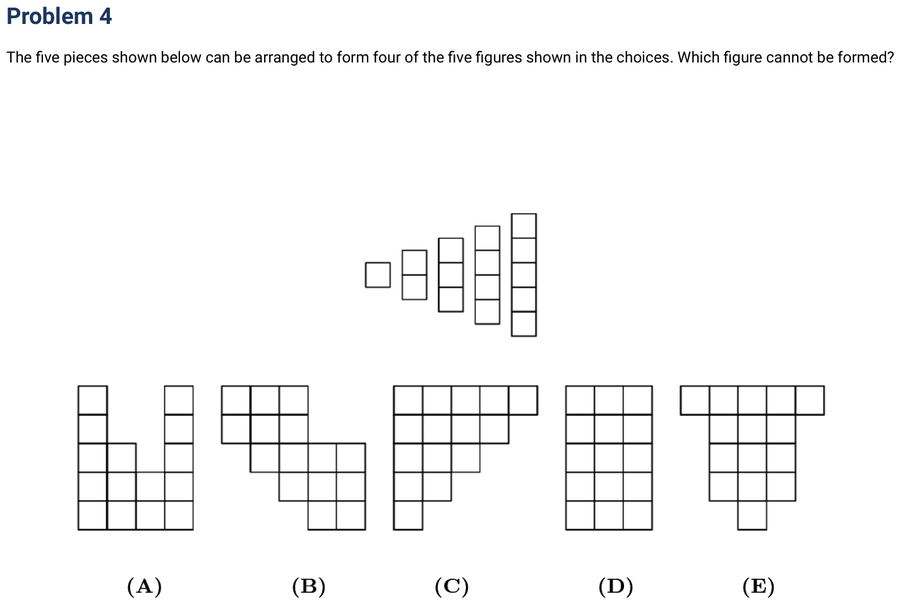
The five pieces shown below can be arranged to form four of the five figures shown in the choices. Which figure cannot be formed?
Show answer
Answer: B — B.
Show hints
Hint 1 of 2
Don't try to actually build all five figures — that's a maze. Instead hunt for the ONE piece that's hardest to place: the long 1×5 strip. It can't bend.
Still stuck? Show hint 2 →
Hint 2 of 2
Find a feature of the stubborn piece, then test the target shapes against it. A shape that can't host that feature is the impossible one.
Show solution
Approach: rule out by the most constrained piece
The 1×5 strip is rigid: in any arrangement it occupies 5 squares in a perfectly straight line, horizontal or vertical.
So the answer shape MUST contain a straight 5-in-a-row somewhere. Scan the choices for that run — figure B has no straight 5-block run in either direction, so the strip has nowhere to go.
Why this transfers: with fitting/packing puzzles, attack the most restrictive piece first. One necessary feature it forces (here, "a straight length-5 slot must exist") often eliminates the answer instantly — far faster than constructing everything.
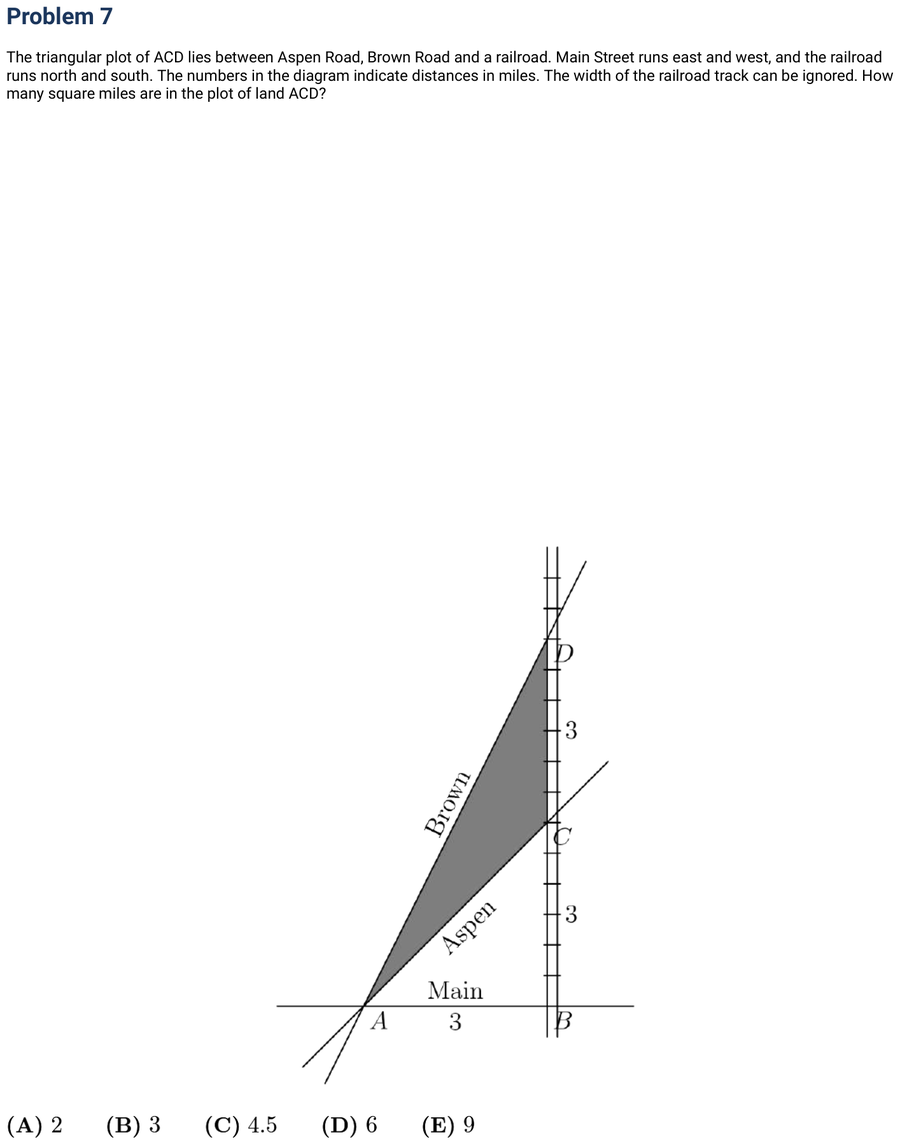
The triangular plot of ACD lies between Aspen Road, Brown Road and a railroad. Main Street runs east and west, and the railroad runs north and south. The numbers in the diagram indicate distances in miles. The width of the railroad track can be ignored. How many square miles are in the plot of land ACD?
Show answer
Answer: C — 4.5 square miles.
Show hints
Hint 1 of 2
The triangle looks slanted, but you get to CHOOSE which side is the base. Pick the side CD sitting on the (vertical) railroad — then the height is just the straight horizontal distance over to A.
Still stuck? Show hint 2 →
Hint 2 of 2
Base and height must be perpendicular. The railroad runs north–south and Main Street runs east–west, so they're already at right angles — that's why those two segments are the easy base/height pair.
Show solution
Approach: choose a convenient base, read its perpendicular height
Use CD as the base: C and D both lie on the railroad, with CD = 3.
The height is the perpendicular distance from A across to that railroad line. Since Main Street (east–west) meets the railroad (north–south) at a right angle, that distance is just AB = 3.
Area = ½ × base × height = ½ × 3 × 3 = 4.5.
Why this transfers: on a tilted triangle, find a side that lies along a grid line or axis — its perpendicular height is then a simple horizontal or vertical gap, sparing you any slope or distance-formula work.
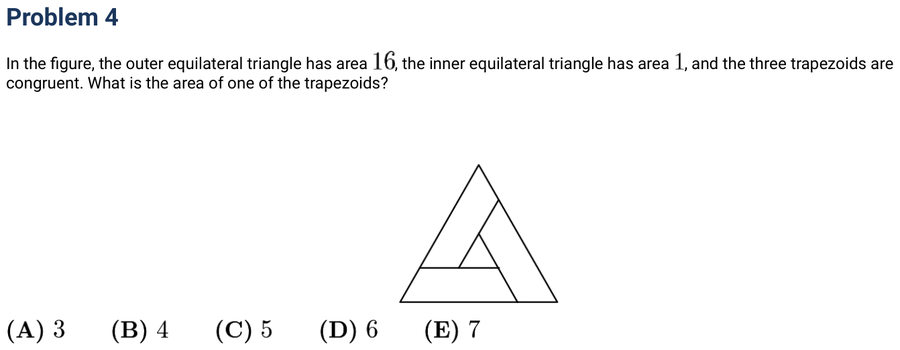
In the figure, the outer equilateral triangle has area 16, the inner equilateral triangle has area 1, and the three trapezoids are congruent. What is the area of one of the trapezoids?
Show answer
Answer: C — 5.
Show hints
Hint 1 of 2
The three trapezoids are exactly what's left when you cut the little triangle out of the big one — you don't need any side lengths.
Still stuck? Show hint 2 →
Hint 2 of 2
"Congruent" is the key word: equal pieces means just divide the leftover evenly.
Show solution
Approach: subtract the hole, split the rest evenly
The big triangle is the small triangle plus the three trapezoids, so the trapezoids together cover 16 − 1 = 15. No measuring needed — the area you can't see is simply "total minus the hole."
They're congruent (identical), so each is 15 ÷ 3 = 5.
Sanity check: the choices run 3–7, and 15 split three ways must be 5 — only one choice fits.
Another way — scale-factor intuition:
Area 16 vs area 1 means the big triangle is 4× the small one in side length (since area scales as the square, √16 = 4).
The whole figure is 16 small-triangle-areas worth; the center hole is 1, leaving 15 for the three trapezoids, so each is 5.
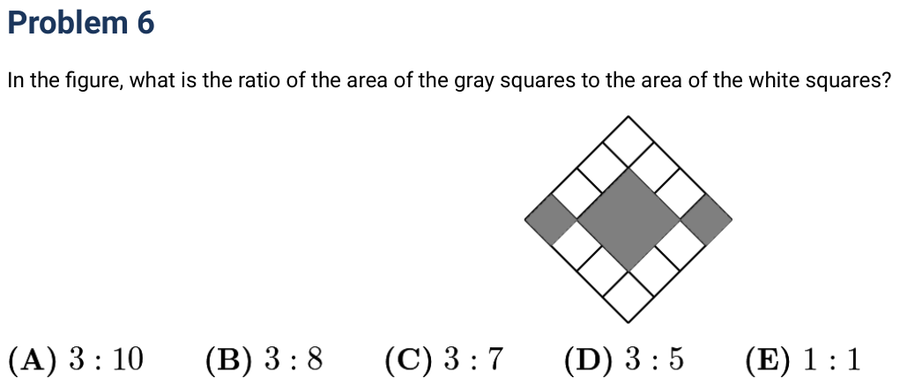
In the figure, what is the ratio of the area of the gray squares to the area of the white squares?
Show answer
Answer: D — 3 : 5.
Show hints
Hint 1 of 2
Every little square is the same size, so "area" just means "how many squares" — you can count instead of measure.
Still stuck? Show hint 2 →
Hint 2 of 2
The question asks gray-to-white, not gray-to-total — watch which two amounts you're comparing.
Show solution
Approach: count squares, then compare the right two groups
All 16 squares are congruent, so area becomes a counting problem. Gray: the central 2×2 block (4) plus 2 gray corners = 6. White: the other 16 − 6 = 10.
The ratio asked is gray : white = 6 : 10 = 3 : 5. (If you wrongly used gray : total = 6 : 16 = 3 : 8 you'd pick the trap answer B.)
Why this transfers: a ratio compares two specific quantities — always reread which is named before simplifying.
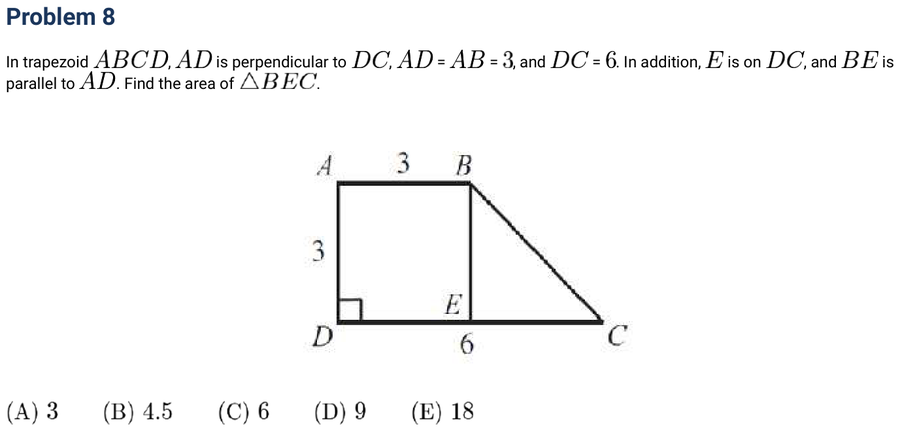
In trapezoid ABCD, AD is perpendicular to DC, AD = AB = 3, and DC = 6. In addition, E is on DC, and BE is parallel to AD. Find the area of ▵BEC.
Show answer
Answer: B — 4.5.
Show hints
Hint 1 of 2
Drop BE straight down and the shape splits into a square ABED and the triangle. The square hands you both legs of the triangle for free.
Still stuck? Show hint 2 →
Hint 2 of 2
Slice an awkward shape into a familiar one: a parallel-and-perpendicular setup usually hides a rectangle (here a square) you can read lengths off of.
Show solution
Approach: carve off the square to expose a right triangle
Since BE ∥ AD and AD ⊥ DC, segment BE is also ⊥ DC. With AB ∥ DC too, ABED is a rectangle — in fact a square, because AD = AB = 3. So BE = 3 and DE = 3.
That leaves EC = DC − DE = 6 − 3 = 3, and ▵BEC is right-angled at E with legs 3 and 3.
Area = (1/2)(3)(3) = 4.5.
Worth keeping: when one side is parallel to a perpendicular height, that height is just the rectangle's width — no Pythagoras needed.
The base of isosceles ▵ABC is 24 and its area is 60. What is the length of one of the congruent sides?
Show answer
Answer: C — 13.
Show hints
Hint 1 of 2
In an isosceles triangle, the altitude to the base lands dead center, splitting it into two mirror-image right triangles. The area hands you that altitude's length.
Still stuck? Show hint 2 →
Hint 2 of 2
Drop the altitude from the apex: it halves the base and creates a right triangle, turning a side-length question into Pythagoras.
Show solution
Approach: altitude splits it into a right triangle
Back the height out of the area: 60 = (1/2)(24)(h) ⇒ h = 5.
That altitude bisects the base, so each right triangle has legs 5 (height) and 12 (half of 24).
Hypotenuse = the congruent side = √(52 + 122) = √169 = 13.
Recognize it: 5-12-13 is one of the famous Pythagorean triples — spotting 5 and 12 lets you write 13 instantly, no square root needed.
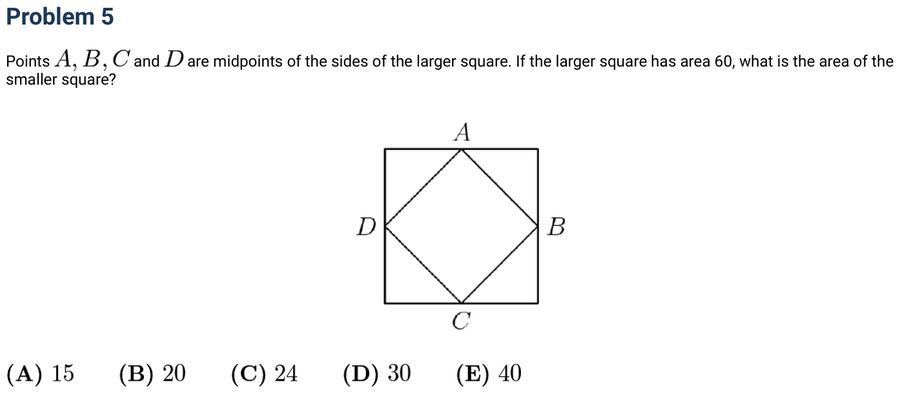
Points A, B, C and D are midpoints of the sides of the larger square. If the larger square has area 60, what is the area of the smaller square?
Show answer
Answer: D — 30.
Show hints
Hint 1 of 2
The midpoint lines cut off four corner triangles. Picture folding each triangle inward along the slanted line — where do the four corners land?
Still stuck? Show hint 2 →
Hint 2 of 2
Connecting the midpoints of any square always makes a tilted square with exactly HALF the area. Knowing this fact lets you skip all the computation.
Show solution
Approach: the four corner triangles fold in to fill the inner square
The four slanted lines slice off four right triangles at the corners. Fold each one inward along its slanted edge.
The four triangles exactly tile the inner diamond — so the inner square is made of half the big square's area, the other half being the (folded-out) triangles.
Inner area = 60 ÷ 2 = 30.
You'll see it again: the midpoint square of ANY square (or even any quadrilateral — the "Varignon" idea) has half the area. Remember the fact and these become instant.
Another way — side length from the half-diagonal:
Let the big square have side s, so s2 = 60. Each midpoint sits halfway along a side.
The inner square's side is the hypotenuse of a right triangle with legs s/2 and s/2, so (inner side)2 = (s/2)2 + (s/2)2 = s2/2.
Inner area = (inner side)2 = s2/2 = 60/2 = 30 — the algebra confirms the half-area fact.
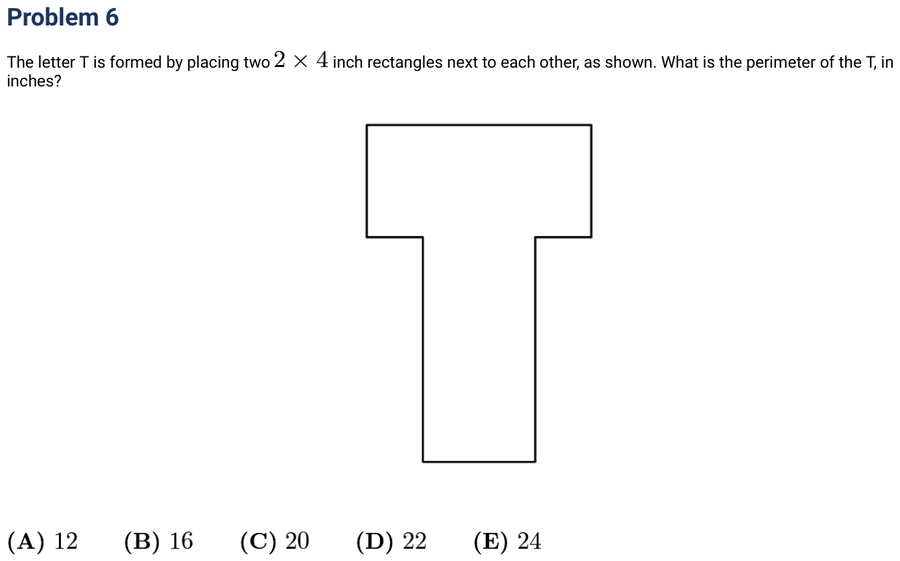
The letter T is formed by placing two 2 × 4 inch rectangles next to each other, as shown. What is the perimeter of the T, in inches?
Show answer
Answer: C — 20.
Show hints
Hint 1 of 2
When two shapes touch, the edges along the touch line end up INSIDE — they're no longer part of the outline. So find where the two rectangles press together.
Still stuck? Show hint 2 →
Hint 2 of 2
Total outline = (sum of both perimeters) − (every edge that became internal). The shared seam disappears from BOTH rectangles, so subtract it twice.
Show solution
Approach: add the two perimeters, remove the hidden seam
Each 2 × 4 rectangle has perimeter 2(2 + 4) = 12, so separately they total 24.
Where the stem meets the bar, a 2-inch segment of each rectangle is pressed against the other. That seam is now interior, so it leaves the outline of both — subtract 2 twice.
24 − 2 − 2 = 20.
Worth keeping: whenever pieces are glued together, perimeter of the whole = sum of the parts' perimeters − 2 × (length of each shared seam). The seam vanishes from both sides, which is why it's counted twice.
Another way — walk the outline directly:
Trace the T's edge and add the segments: the bar's top is 4; coming down the right side and around the stem and back up the left mixes 2-inch and other pieces.
Summing all the boundary segments of the T gives 20 — a good way to double-check the subtraction method, since you never touch the interior seam at all.
Circle X has a radius of π. Circle Y has a circumference of 8π. Circle Z has an area of 9π. List the circles in order from smallest to largest radius.
Show answer
Answer: B — Z, X, Y.
Show hints
Hint 1 of 2
The circles are described in three different languages — radius, circumference, area. Translate all three into the SAME thing (radius) before you can compare them.
Still stuck? Show hint 2 →
Hint 2 of 2
Peel the radius out of each formula: C = 2πr and A = πr2. The lone π factors cancel, leaving clean whole-number radii.
Show solution
Approach: convert all three descriptions to radius
Y: C = 2πr = 8π, so r = 4. Z: πr2 = 9π, so r2 = 9 and r = 3. X: r = π ≈ 3.14 (given directly).
Now they're comparable: 3 < 3.14 < 4, so smallest to largest is Z, X, Y.
The key fact for the close call: π lands between 3 and 4 (it's about 3.14), so circle X squeezes in between Z and Y. Anytime quantities are given in different forms, reduce them to one common measure first.
An aquarium has a rectangular base that measures 100 cm by 40 cm and has a height of 50 cm. The aquarium is filled with water to a depth of 37 cm. A rock with volume 1000 cm3 is then placed in the aquarium and completely submerged. By how many centimeters does the water level rise?
Show answer
Answer: A — 0.25 cm.
Show hints
Hint 1 of 2
The submerged rock pushes water up. That extra water forms a thin flat slab sitting on top, with the rock's volume but the tank's base. Picture that slab.
Still stuck? Show hint 2 →
Hint 2 of 2
A slab's volume = base area × height. You know the slab's volume (= rock volume) and the base, so the rise is volume ÷ base area. The starting depth and tank height are decoys.
Show solution
Approach: the rise is a thin slab with the rock's volume
Submerging the rock displaces exactly 1000 cm³ of water, which spreads across the full base as a thin layer of rise.
That layer is a box: base 100 × 40 = 4000 cm², volume 1000 cm³. Its height (the rise) = 1000 ÷ 4000 = 0.25 cm.
Why the 37 cm and 50 cm don't matter: the rise depends only on how much volume you add and how wide the tank is — not on the current depth (as long as the rock stays submerged and the water doesn't overflow). Sanity check: 0.25 cm of rise × 4000 cm² = 1000 cm³, exactly the rock. Spotting the decoy numbers is half the battle.
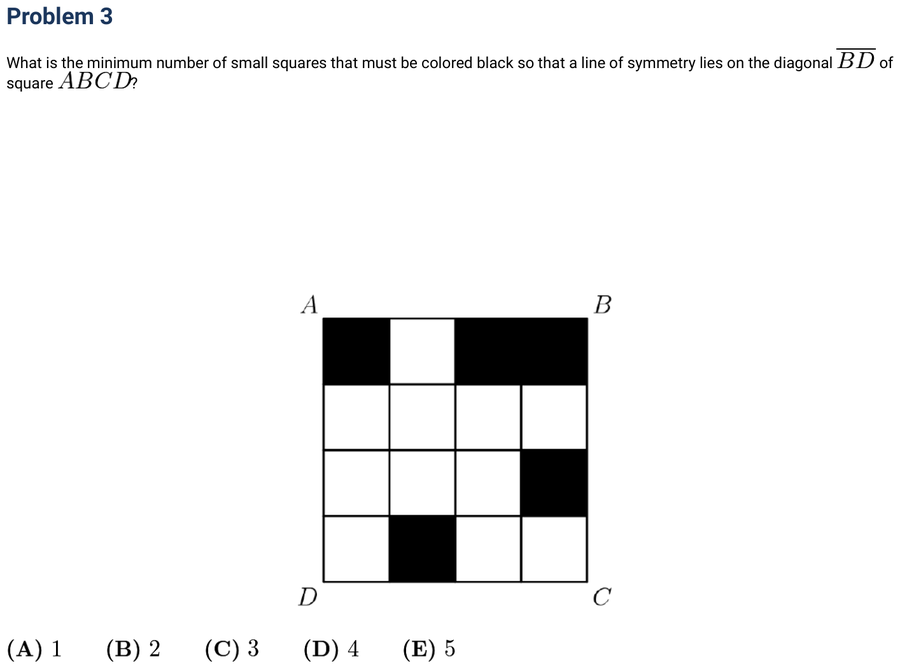
What is the minimum number of small squares that must be colored black so that a line of symmetry lies on the diagonal BD of square ABCD?
Show answer
Answer: D — 4.
Show hints
Hint 1 of 2
A fold along BD must land black on black. So look only at the black squares off the diagonal — each one needs a twin on the other side.
Still stuck? Show hint 2 →
Hint 2 of 2
Symmetry means 'reflect and match.' Go black square by black square, find its mirror across BD, and check whether that mirror is already black.
Show solution
Approach: every off-diagonal black square needs its mirror twin
Picture folding the square along diagonal BD. For the picture to match itself, every black square must fold onto another black square.
Black squares already on the diagonal are fine — they map to themselves. The work is only with the black squares off the diagonal.
There are 4 such off-diagonal black squares, and each one's mirror image across BD is still white. Coloring those 4 mirrors makes the picture symmetric ⇒ 4 squares.
Why this transfers: for any reflection-symmetry counting problem, ignore whatever lies on the mirror line itself and just pair up the rest — the answer is the number of unmatched partners.
A square and a triangle have equal perimeters. The lengths of the three sides of the triangle are 6.1 cm, 8.2 cm and 9.7 cm. What is the area of the square in square centimeters?
Show answer
Answer: C — 36.
Show hints
Hint 1 of 2
'Equal perimeters' is the bridge: the triangle hands you a total length, and a square splits that same length into 4 equal sides.
Still stuck? Show hint 2 →
Hint 2 of 2
The decimals are a distraction. Add the three sides first — they're chosen to land on a clean whole number.
Show solution
Approach: share the perimeter, then build the square
Triangle's perimeter: 6.1 + 8.2 + 9.7 = 24 cm. (The ugly decimals add to a tidy 24 — a hint you're on track.)
The square has this same perimeter, so one side is 24 ÷ 4 = 6 cm.
Area = side² = 6² = 36 sq cm.
Sanity check: don't grab a side length and square it without dividing — 24² or 6·4 are the traps. Perimeter → side → area is the chain.
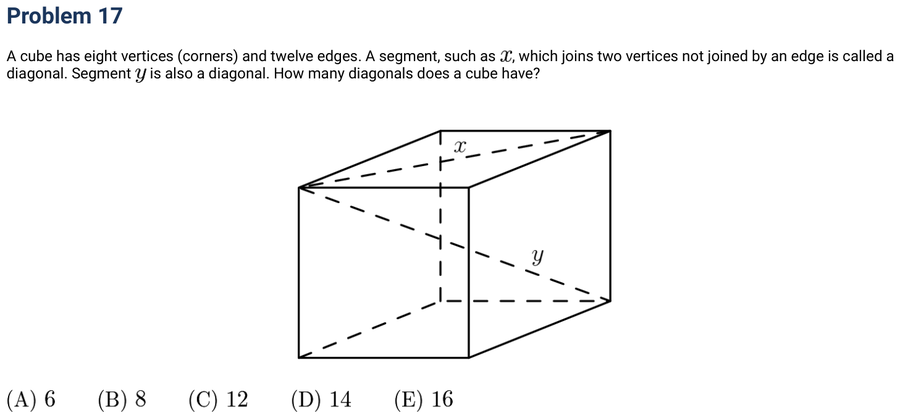
Jamie counted the number of edges of a cube, Jimmy counted the corners, and Judy counted the faces. They then added the three numbers. What was the resulting sum?
Show answer
Answer: E — 26.
Show hints
Hint 1 of 2
Picture a die or a box in your hand and count the three kinds of parts separately: pointy corners, line edges, flat faces.
Still stuck? Show hint 2 →
Hint 2 of 2
A cube's part-counts are worth memorizing: 8 corners, 12 edges, 6 faces.
Show solution
Approach: count the three kinds of cube parts and add
Count each kind separately so nothing gets mixed up. Corners (the points): 8. Edges (the lines): 12. Faces (the flat sides): 6.
8 + 12 + 6 = 26.
Worth keeping: for any cube or box these never change — 8 corners, 12 edges, 6 faces. (They even fit Euler's rule: corners − edges + faces = 8 − 12 + 6 = 2 for any solid like this.)
A circle and two distinct lines are drawn on a sheet of paper. What is the largest possible number of points of intersection of these figures?
Show answer
Answer: D — 5.
Show hints
Hint 1 of 2
Don't try to draw the whole messy picture — every crossing belongs to exactly one *pair* of figures, so count the pairs.
Still stuck? Show hint 2 →
Hint 2 of 2
Ask the maximum for each shape-pair: line-with-circle, and line-with-line. Add the maxes — that's the most you can ever reach.
Show solution
Approach: max crossings = sum over every pair of figures
Here's the key move: a crossing always happens between *two* figures, so total it pair by pair instead of staring at the tangle. The pairs are line1-circle, line2-circle, and line1-line2.
A straight line meets a circle in at most 2 points, so the two line-circle pairs give up to 2 + 2 = 4.
Two lines meet in at most 1 point, adding 1 more. Total: 4 + 1 = 5.
*You'll see this again:* the most intersections among any set of figures is just the sum of each pair's maximum — count pairs, never the whole picture at once.
What is the degree measure of the smaller angle formed by the hands of a clock at 10 o'clock?
Show answer
Answer: C — 60°.
Show hints
Hint 1 of 2
A clock face is just a circle cut into 12 equal slices. Forget degrees for a moment — how many slices sit between the 10 and the 12?
Still stuck? Show hint 2 →
Hint 2 of 2
Each hour-slice is the same size: 360° ÷ 12 = 30°. Count the slices, then multiply.
Show solution
Approach: the clock is 12 equal 30° slices — count slices
At exactly 10 o'clock the hour hand is on the 10 and the minute hand is on the 12. There are two number-gaps between them (10→11→12).
Each gap is one-twelfth of the full turn: 360° ÷ 12 = 30°. Two gaps give 2 × 30° = 60°.
You'll see it again: any "angle between clock hands on the hour" is just (number of gaps) × 30°. Knowing the 30°-per-hour grid makes every on-the-hour clock angle instant.
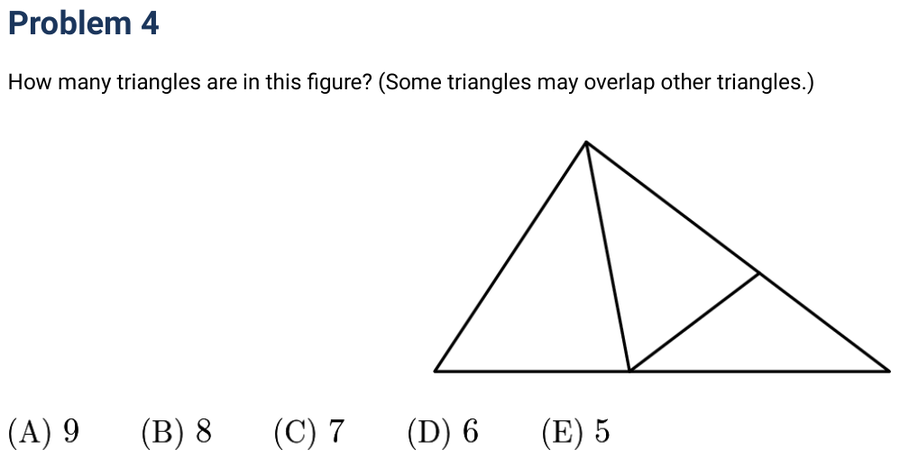
Counting by eye gives a guess; counting by SIZE gives the answer. Sort triangles into 'single smallest pieces' first, then ones made of two pieces, then the whole outline.
Still stuck? Show hint 2 →
Hint 2 of 2
Work small-to-big in layers so you never miss or double-count: how many 1-piece triangles? how many 2-piece? then the full outline.
Show solution
Approach: count in size layers (smallest pieces, then combinations)
Smallest pieces: the inner line cut the figure into 3 little triangles.
Made of 2 pieces: the two right-hand little triangles share a side and join into 1 bigger triangle.
Made of all the pieces: the whole outline is itself 1 triangle.
Total: 3 + 1 + 1 = 5.
Why this transfers: for any 'how many triangles' puzzle, count by size layer (1 piece, 2 pieces, 3 pieces, …) instead of randomly. The layered list is your guarantee against missing or repeating one.
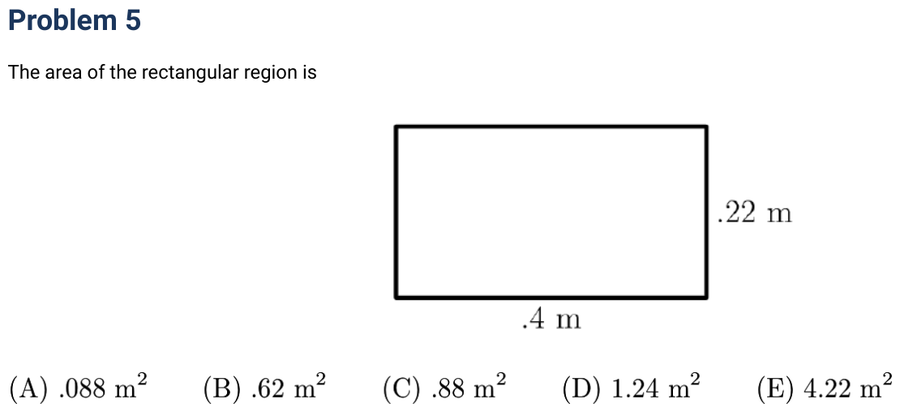
Area is length × width — but both sides are less than 1, so before computing, ask: should the area be bigger or smaller than either side?
Show solution
Approach: multiply the sides, then place the decimal by estimating
Area = 0.4 × 0.22. Multiply the digits: 4 × 22 = 88. Now place the point: 0.4 has one decimal place, 0.22 has two, so the product has three — 0.088 m².
Sanity-check: multiplying two numbers below 1 always shrinks them, so the area must be smaller than 0.22. That instantly kills .62, .88 (a dropped decimal place), 1.24 (the perimeter, 2 × .4 + 2 × .22), and 4.22. Only 0.088 is smaller than both sides.
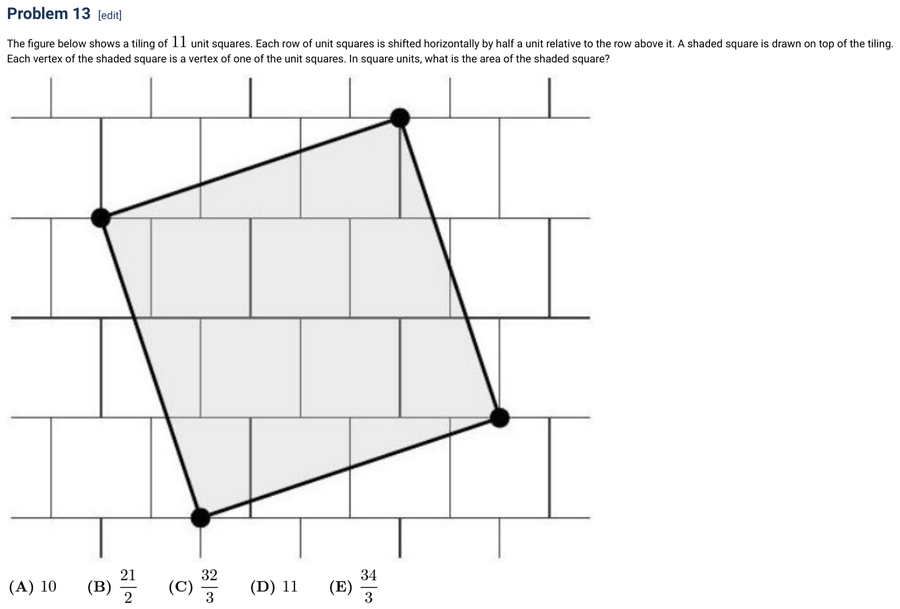
Don't try to measure the slanted side directly. The area of any square is just (side length)² — so you only need side², never the side itself.
Still stuck? Show hint 2 →
Hint 2 of 2
Treat one tilted side as a journey across the grid: so many units right and so many up. By the Pythagorean theorem, side² = (across)² + (up)², and that is the area — no square roots needed.
Show solution
Approach: area = side², and side² = (horizontal step)² + (vertical step)²
Pick one side of the shaded square and trace it from corner to corner across the tiling: it moves 1 unit across and 3 units up (the half-unit row shifts let the vertices land on lattice points).
That side is the hypotenuse of a right triangle with legs 1 and 3, so side² = 1² + 3² = 10. But the area of the square is side², so the area is 10 — you never even compute the side.
Why this transfers: for any tilted square on a grid, the area is just (horizontal step)² + (vertical step)² of one side. This is the ‘tilted-square shortcut’ — it skips both the square root and the messier ‘big square minus 4 corner triangles’ method.
Another way — bounding box minus four corner triangles:
Enclose the tilted square in the smallest upright square. With side-steps of 1 and 3, that box is 4 × 4 = 16.
The four right-triangle corners each have legs 1 and 3, area ½·1·3 = 1.5, so four of them remove 4 × 1.5 = 6.
Tilted-square area = 16 − 6 = 10, matching the shortcut.
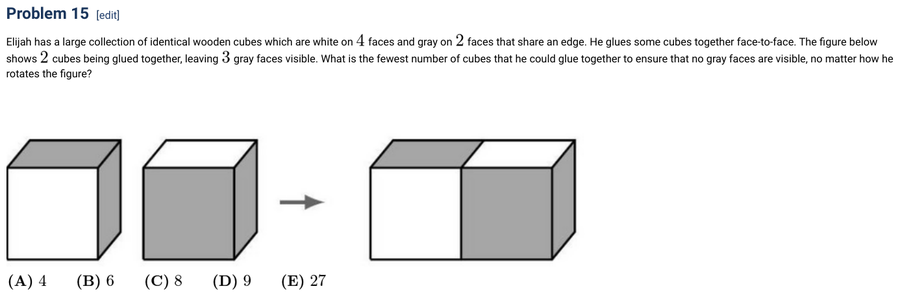
Focus on what one cube needs. Its two gray faces meet at an edge (they're adjacent, not opposite). To bury both, the cube must be glued on two faces that also meet at an edge.
Still stuck? Show hint 2 →
Hint 2 of 2
So a straight line of cubes can't work — the inside cubes are only glued on opposite faces. Every cube needs two glued faces sharing a corner. What's the smallest cluster where every cube gets that?
Show solution
Approach: each cube must be glued on two faces that share an edge
Zoom in on a single cube. Its two gray faces are adjacent (they share an edge), so to hide both, the cube has to touch neighbors on two faces that share an edge — an ‘L’ of contact, not a straight-through pair.
That rules out a straight row: an end cube is glued on only one face, and a middle cube is glued on two opposite faces — either way a gray face is left showing. You need the cubes to turn a corner.
Arrange four cubes in a 2 × 2 square. Every cube then touches two neighbors on faces that meet at an edge, so its gray pair can point into that corner and stay hidden. Three or fewer cubes can't give all of them an L of contacts.
The fewest is 4.
Why this transfers: ‘hide adjacent faces’ problems hinge on which faces get covered, not just how many — opposite-face contact (a straight line) and edge-sharing contact (a corner) are very different, and the gray-face geometry tells you which you need.
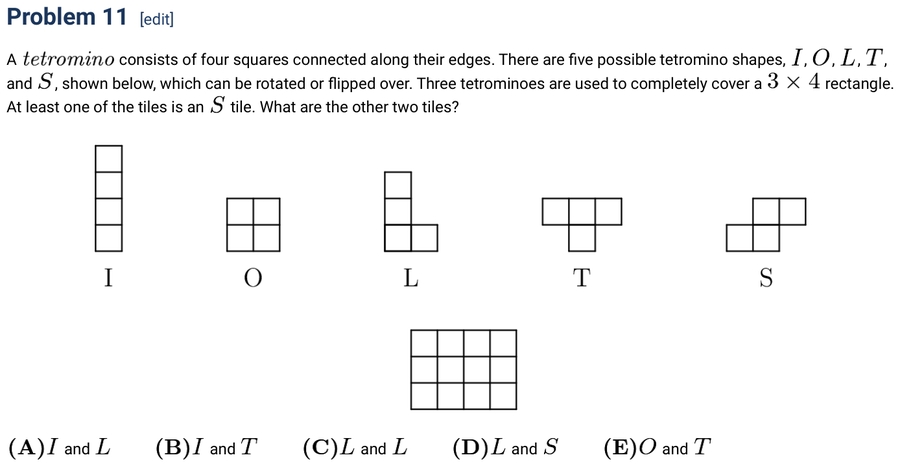
You're told one tile is an S, the trickiest, kinkiest shape. Lock it down first — commit to placing it, then see what hole is left for the other two.
Still stuck? Show hint 2 →
Hint 2 of 2
Slide the S along an edge so it leaves a tidy hole. The remaining 8 squares fall into an L-shape — what two tetrominoes fill that?
Show solution
Approach: place the most constrained piece first, then read off the leftover
The 3 × 4 rectangle is 12 squares = three tetrominoes. Start with the given S piece, because it's the most awkward — pinning the hardest constraint first leaves you the least to juggle.
Tuck the S against an edge so it doesn't fracture the rest. The 8 squares left over form one connected L-shaped region.
That region splits neatly down the middle into two L tetrominoes — so the other two tiles are L and L.
Why this transfers: in any tiling or fitting puzzle, place the piece with the fewest legal positions first. It collapses the casework, instead of building up a mess of options you later have to undo.
Another way — eliminate by what can't reach a corner:
Once the S sits in place, look at the leftover region's corners: each is a square that only an L (or I) can reach into without poking outside.
An O or T can't fill those notched corners, and a single I plus the S won't close the gap — so the pair must be two L's, choice L and L.
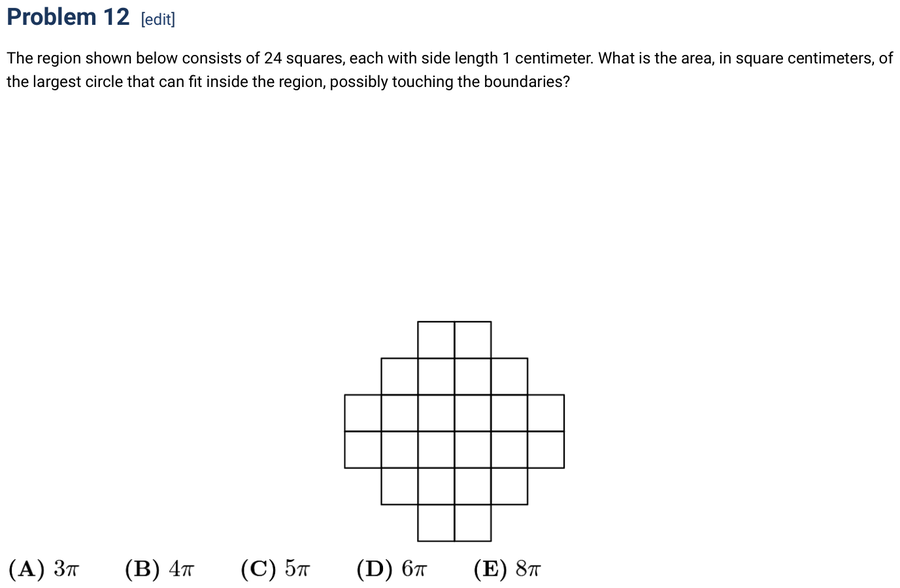
A circle's reach is capped by the closest bit of boundary. On this lumpy plus-shape, that closest bit isn't a flat edge — it's an inward corner where two arms meet.
Still stuck? Show hint 2 →
Hint 2 of 2
Center the circle in the middle (by symmetry). Find one nearest inward corner: it's 1 unit across and 2 units up from the center. The Pythagorean theorem gives the radius — then square it for the area.
Show solution
Approach: radius = distance to the closest point of the boundary
Center the circle at the region's center (forced by symmetry). The biggest it can grow is limited by the nearest boundary point — and on this cross-shape those are the inward corners where the arms notch in, not the outer flat edges.
One such corner sits 1 unit across and 2 units up from the center, so the radius is the hypotenuse: √(12 + 22) = √5.
Area = π × (√5)2 = 5π.
Why this transfers: the largest inscribed circle is always pinned by the closest point of the boundary — so on a non-convex shape, hunt the inward corners first. And notice you never needed √5 itself: squaring it for the area gives a clean 5.
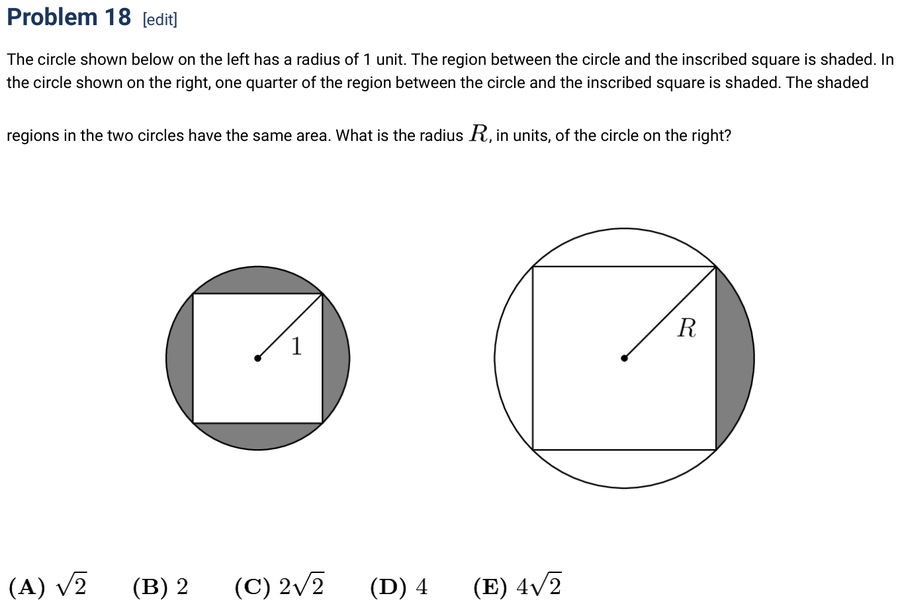
Don't compute either crescent-region's actual area. The two pictures are the same shape scaled up — so ask how area responds when you scale a figure.
Still stuck? Show hint 2 →
Hint 2 of 2
First translate the words into one number: "one quarter of the right region = the whole left region" means the right region is 4× the left. Since area scales as (length)2, the length scale-up is √4.
Show solution
Approach: similar figures: area scales as the square of the length
Both pictures are the identical shape (a square inscribed in a circle), just enlarged — so every area on the right is R2 times the matching area on the left, because radius 1 scales up to R.
The condition says a quarter of the right's between-region equals the left's whole between-region, so the right's whole region is 4 times the left's: R2 = 4.
R = √4 = 2.
Why this transfers: for similar figures, areas scale as length2 (and volumes as length3). Whenever shapes are merely scaled copies, you can skip the messy individual areas and just take a square root of the area ratio to get the length ratio.
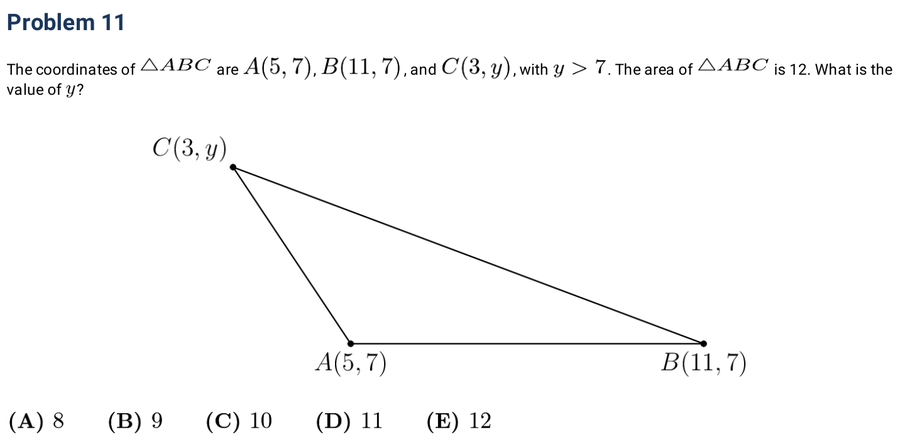
You get to CHOOSE which side is the base. A and B share the same height (y = 7), so AB is horizontal — pick that one and the height becomes trivial.
Still stuck? Show hint 2 →
Hint 2 of 2
Technique: with a horizontal base, the height is just the vertical gap. Base AB = 6 (from x = 5 to 11); height from C is y − 7.
Show solution
Approach: use the horizontal side as the base
A and B both sit at y = 7, so AB is a flat horizontal segment — the easiest possible base. Its length is just the x-gap: 11 − 5 = 6.
Because the base is horizontal, the height is simply how far C rises above the line y = 7, namely y − 7 — no distance formula needed. Area = 12 · 6 · (y − 7) = 12.
So 12 · 6 = 3 times the height equals 12 → height = 4 → y = 7 + 4 = 11. This transfers: on the coordinate plane, always make the base horizontal or vertical — then base and height are just coordinate differences.
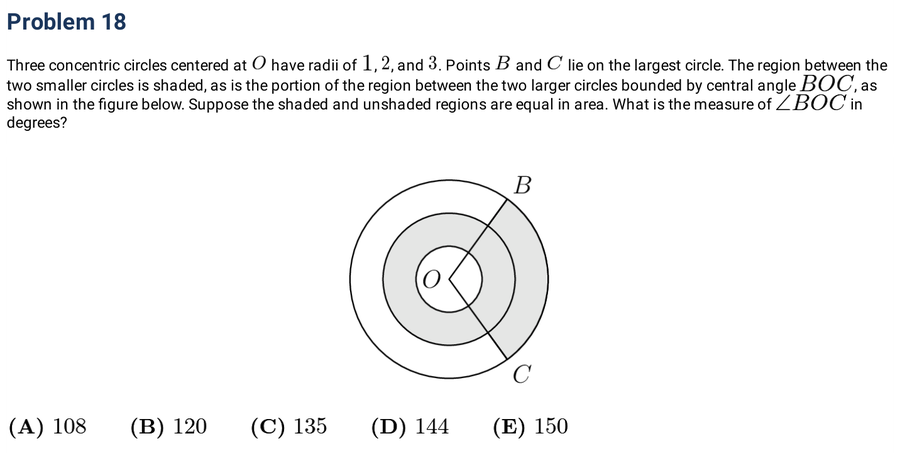
"Shaded = unshaded" is the gift: each must be exactly HALF the whole disk. So you don't compare two messy regions — you just set shaded = half the total.
Still stuck? Show hint 2 →
Hint 2 of 2
Break the disk into three rings (inner disk, ring 1–2, ring 2–3) and find each area from πr2. The only part the angle controls is the θ-sector of the outer ring.
Show solution
Approach: shaded equals half the disk; only the outer sector depends on the angle
The phrase "shaded = unshaded" means each is exactly half the disk — so skip comparing regions and just set shaded = half the total. Total disk area = π·32 = 9π, so shaded must be 4.5π.
Now tally the shaded parts in rings. The fully-shaded inner annulus (radii 1 to 2) has area π(22 − 12) = 3π, no angle involved. The outer annulus (radii 2 to 3) has area π(32 − 22) = 5π, but only the θ-slice of it is shaded: θ360(5π).
Set shaded = half: 3π + θ360(5π) = 4.5π. The 3π already covers most of the half, leaving the sector to supply just 1.5π: θ360(5π) = 1.5π → θ360 = 0.3 → θ = 108°.
This transfers: when a problem says two regions are equal, immediately rewrite it as "each = half the whole" — one equation instead of two, and the constant parts often vanish into the half.
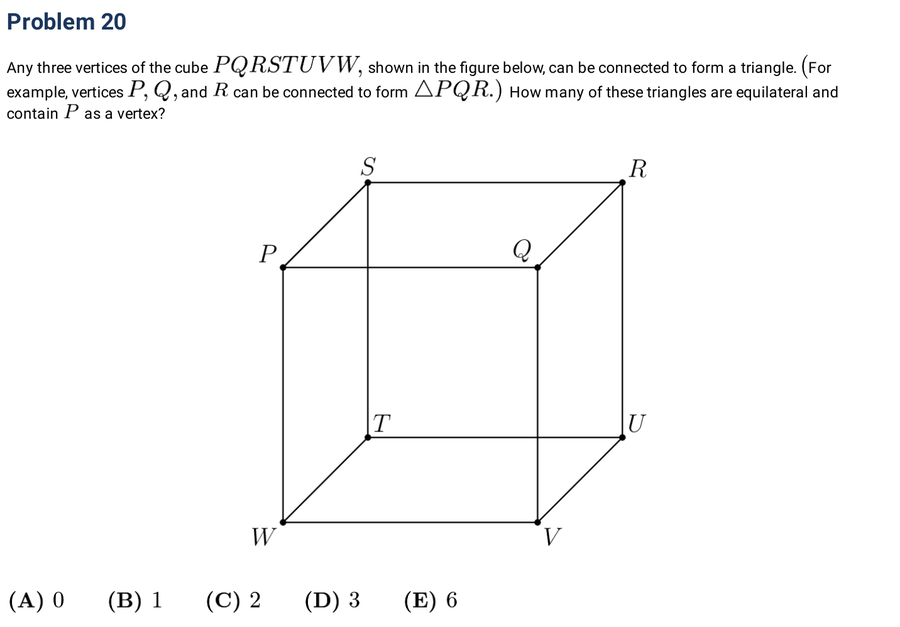
A cube only offers three distances between vertices: edge (1), face diagonal (√2), space diagonal (√3). For all three sides to match, which single distance can do it?
Still stuck? Show hint 2 →
Hint 2 of 2
Only face diagonals (√2) work. So find P's face-diagonal neighbors, then count how many TRIANGLES they form — that's a "choose 2" once you know how many neighbors there are.
Show solution
Approach: use face-diagonal length as the only valid side
List the only three possible vertex-to-vertex distances in a cube: edge = 1, face diagonal = √2, space diagonal = √3. An equilateral triangle needs all three sides equal, and edges or space diagonals can't close up into a triangle — only face diagonals (√2) can.
From P, the vertices a face-diagonal away are the three that sit across each of P's three faces: R, T, V (one per face).
Now check pairs: any two of {R, T, V} are themselves a face-diagonal apart, so each pair plus P is an equilateral triangle. With 3 such neighbors, the number of triangles is "choose 2 of 3" = 3: {P,R,T}, {P,R,V}, {P,T,V}.
3 triangles. This transfers: in 3-D distance problems, first list the few possible lengths, decide which can build the shape, then it becomes a small counting ("choose 2") problem.
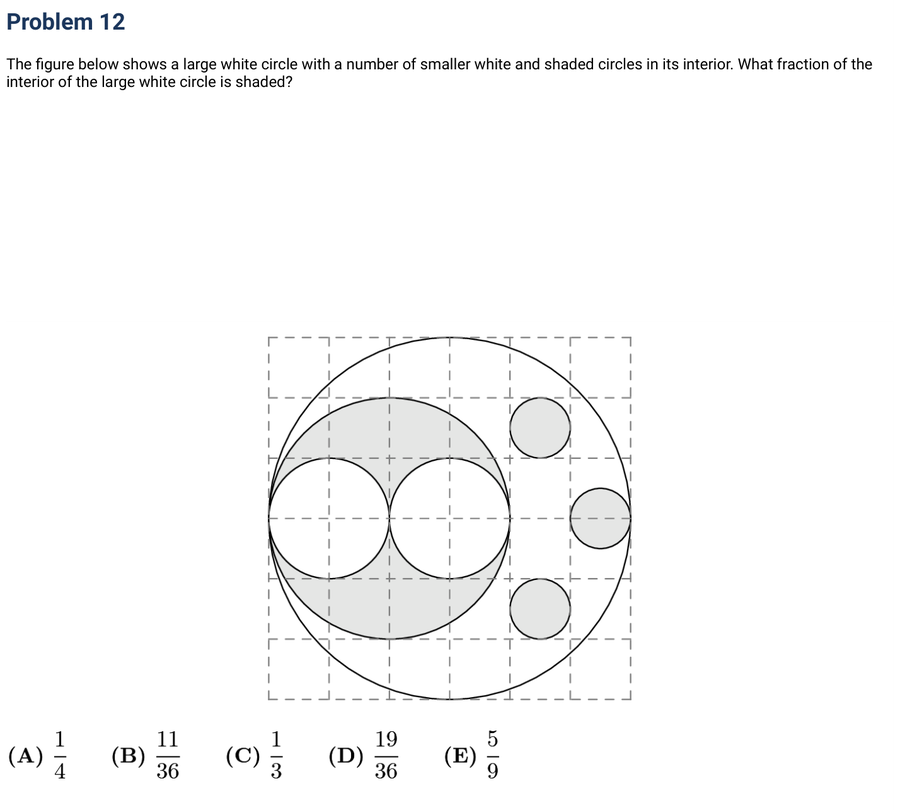
First use the faint grid to read off every radius (3, 2, 1, and 12). Then notice the big shaded disk has two white circles biting into it — so its shaded area is disk minus those bites.
Still stuck? Show hint 2 →
Hint 2 of 2
Because every area carries a factor of π, you can drop the π and just compare radius-squared values: outer = 9, big disk = 4, each inner white = 1, each tiny shaded = 14. The π cancels in the final fraction.
Show solution
Approach: sum shaded, subtract carved-out whites
Read the radii off the grid: outer circle 3, big shaded disk 2, the two white circles inside it 1 each, the three tiny shaded circles 12 each. Since we want a fraction, the π will cancel — so really just work with radius-squared.
Big shaded disk has area 4π, but two white circles (1π each) eat into it: net shaded there = 4π − 2π = 2π.
Three tiny shaded circles add 3 × π4 = 3π4.
Total shaded = 2π + 3π4 = 11π4, over the outer 9π: 11π/49π = 1136. Worth keeping: in any ‘what fraction is shaded’ circle problem the π always cancels — compare radius² values and skip π entirely.
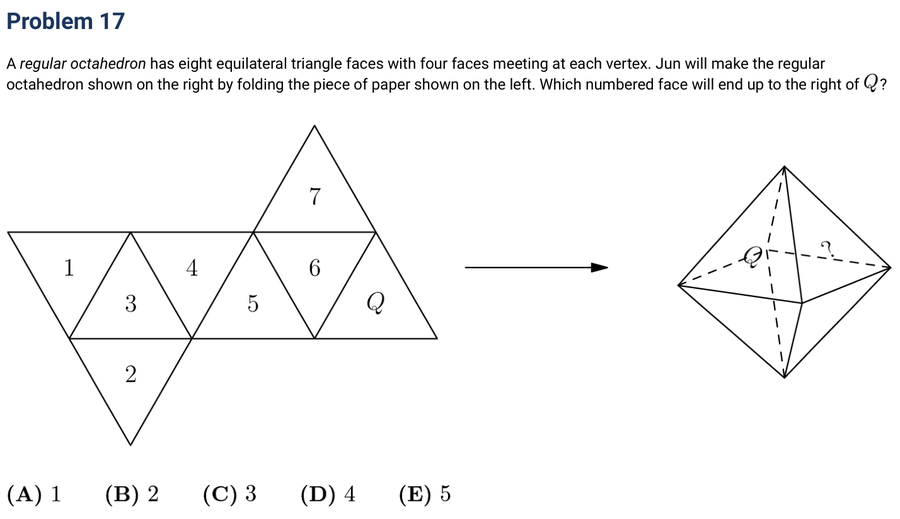
Don't try to fold the whole net in your head. Use the structure: an octahedron is two pyramids glued base-to-base, so its 8 faces split into a top 4 and a bottom 4, and exactly 4 faces meet at each tip.
Still stuck? Show hint 2 →
Hint 2 of 2
Hunt for 4 faces that all share one corner in the net — those become one pyramid (one hemisphere). Faces 2, 3, 4, 5 do that, so the other four {Q, 6, 7, 1} are Q's hemisphere; the answer must be among them.
Show solution
Approach: split the eight faces into two hemispheres of four
Instead of mentally folding, use the octahedron's structure: it's two square pyramids base-to-base, so the 8 faces split into a top set of 4 and a bottom set of 4, and exactly 4 faces ring each apex.
In the net, faces 2, 3, 4, 5 all meet at a single vertex — that vertex becomes one apex, making {2, 3, 4, 5} one hemisphere. Q can't be in that group, so by elimination Q's hemisphere is {Q, 6, 7, 1}.
Within that ring of four around the top apex, the fold seats face 1 immediately to the right of Q. This transfers: for any solid-from-net puzzle, first sort faces into the groups that share a vertex — it slashes the possibilities before you fold anything.
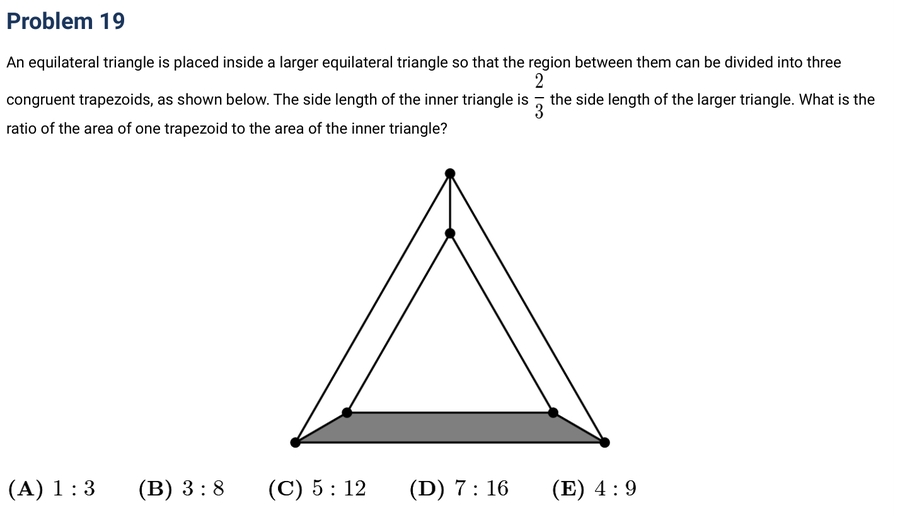
You never need the actual area formula. Lengths scale by 2:3, so areas scale by the square: (2/3)2 = 4/9. That one fact does all the work.
Still stuck? Show hint 2 →
Hint 2 of 2
Pick friendly numbers: let the inner triangle be 4 and the outer be 9 (ratio 4:9). The three trapezoids together fill the gap 9 − 4, then split it evenly into three.
Show solution
Approach: areas scale as side-length squared
Don't reach for ½·base·height — the key is that for similar figures, doubling lengths quadruples area: area scales as the square of the length ratio. Side ratio 2:3 → area ratio 4:9.
So set inner area = 4 and outer area = 9 (any pair in 4:9 works). The ring of three congruent trapezoids fills the leftover 9 − 4 = 5, so each trapezoid is 53.
One trapezoid : inner triangle = 5/34 = 512, i.e. 5 : 12. Worth keeping: whenever you see a ratio of lengths, square it for the ratio of areas (and cube it for volumes) — then you can assign convenient numbers and skip the geometry.
Another way — solve for the trapezoid area (MAA):
Let the inner triangle have area A. The outer triangle is (3/2)2 = 9/4 as large, so its area is 94A.
Inner triangle plus three trapezoids fills the outer triangle: A + 3X = 94A, so 3X = 54A and X = 512A.
The midpoints of the four sides of a rectangle are (−3, 0), (2, 0), (5, 4), and (0, 4). What is the area of the rectangle?
Show answer
Answer: C — 40.
Show hints
Hint 1 of 2
You're handed the midpoints, not the corners — so reach for the fact about midpoints. Joining the midpoints of any quadrilateral's sides makes a parallelogram, and it always has exactly half the area of the original.
Still stuck? Show hint 2 →
Hint 2 of 2
Plot the four midpoints and find that inner parallelogram's area (base × height), then double it to recover the rectangle.
Show solution
Approach: Varignon — the midpoint parallelogram has half the parent's area
Insight: don't hunt for the rectangle's corners. Connecting the midpoints of any quadrilateral gives a parallelogram (Varignon's theorem) whose area is always half the original — intuitively, each corner triangle you slice off to go from quadrilateral to inner parallelogram removes a quarter of the area, and the four removed quarters total half.
Plot the midpoints: the base from (−3,0) to (2,0) has length 5, and the height (y from 0 to 4) is 4, so the inner parallelogram has area 5 × 4 = 20.
Double it: rectangle area = 2 × 20 = 40.
Another way — the segments joining opposite midpoints ARE the rectangle's sides:
A segment connecting the midpoints of two opposite sides of a rectangle runs straight across and has the same length as the pair of sides it's parallel to — so the two such segments give the rectangle's width and height directly.
Opposite midpoints: (−3,0)–(5,4) gives a segment of length √(82 + 42) = √80; (2,0)–(0,4) gives √(22 + 42) = √20.
These are perpendicular (a rectangle's adjacent sides), so area = √80 × √20 = √1600 = 40.
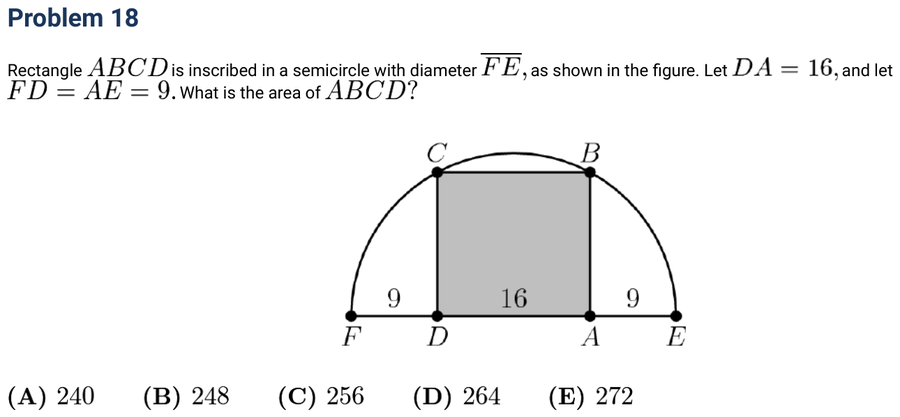
The height DC is hidden — but any corner on the arc sits exactly one radius from the center. So draw the line from the center O to a top corner C: that segment is a known length (the radius).
Still stuck? Show hint 2 →
Hint 2 of 2
FE = 9 + 16 + 9 = 34, so the radius is 17. By symmetry the center O sits at the midpoint of DA, so OD = 8. Now OC = 17 is the hypotenuse of right triangle ODC — Pythagoras gives the height DC.
Show solution
Approach: draw a radius to a corner on the arc
The whole diameter is FE = 9 + 16 + 9 = 34, so the radius is 17 and the center O is the midpoint of FE.
By symmetry O is also the midpoint of the rectangle's base DA, so OD = 16 ÷ 2 = 8. The key move: C lies on the arc, so OC = radius = 17.
Right triangle ODC has legs OD = 8 and DC (the rectangle's height) with hypotenuse OC = 17: DC2 = 172 − 82 = 289 − 64 = 225, so DC = 15 (the 8–15–17 triple).
Area = DA · DC = 16 · 15 = 240.
Why this transfers: whenever a point sits on a circle, the radius to it is a free known length — drawing it turns a vague distance into the hypotenuse of a right triangle. Recognizing 8–15–17 (a Pythagorean triple) then skips the square-root arithmetic.
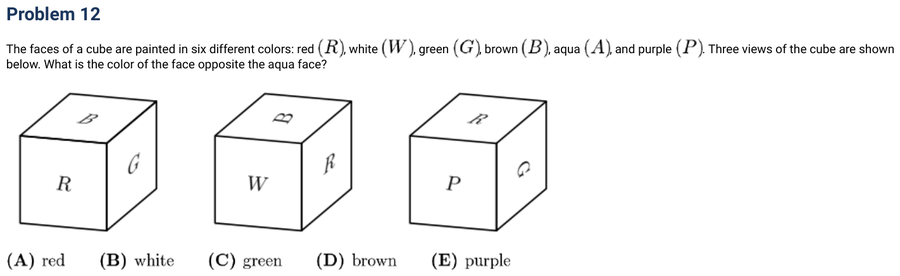
Key fact about a cube: two faces are opposite exactly when they can never show up together in one view (you'd have to see through the cube). So the opposite of aqua is whichever color shares no view with it.
Still stuck? Show hint 2 →
Hint 2 of 2
Easier to chase the other way: list every color that does appear alongside red. Red touches four colors — the one it's missing must be its opposite.
Show solution
Approach: opposite faces never appear in the same view
Two faces sharing a view are adjacent; opposite faces can never both be seen at once. Track what red is adjacent to across the three pictures.
Red appears with brown and green in one view, with brown and white in another, and with purple and green in the third — so red sits next to brown, green, white, and purple.
Red is adjacent to four of the five other colors; the one it never meets is aqua. So aqua and red are opposite, and the face opposite aqua is red.
Why this transfers: for any "net or views of a cube" puzzle, find a face and rule out its four neighbors — the single color it never shares a view with is forced to be its opposite.
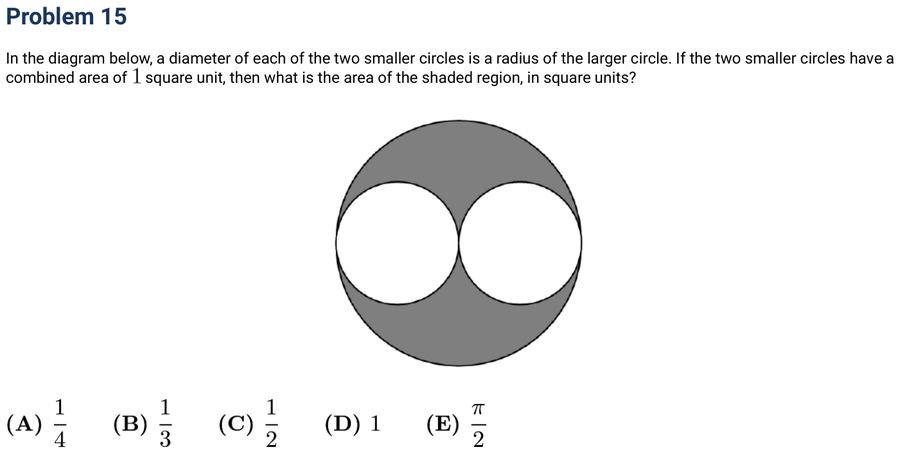
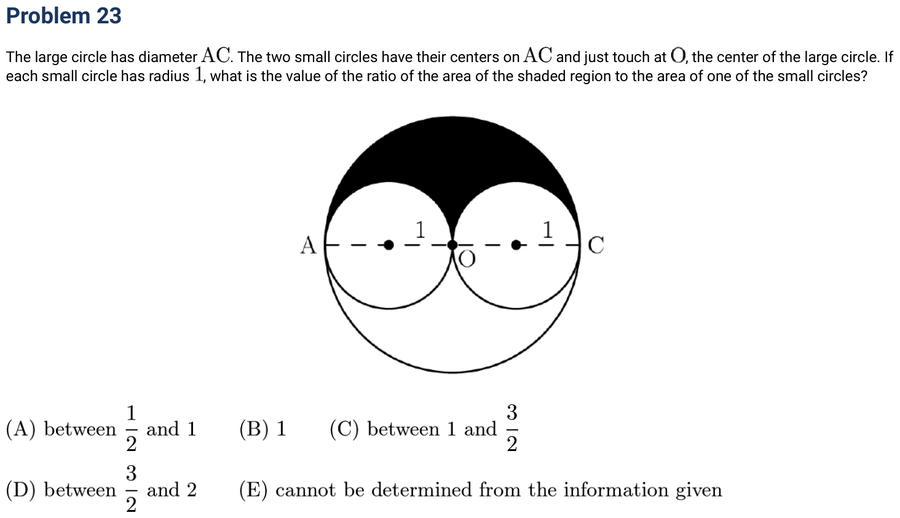
"Diameter of small = radius of big" secretly says the small circle's radius is half the big one's. And halving a radius doesn't halve the area — notice it does something stronger.
Still stuck? Show hint 2 →
Hint 2 of 2
The technique: area scales as the square of the radius. Half the radius means one-quarter the area. Once you have that, you never need π or the actual radius — just compare.
Show solution
Approach: areas scale as radius squared
Each small radius is half the big radius, so each small area is (1/2)2 = 1/4 of the big circle's area. Two smalls together are 2×(1/4) = 1/2 of the big.
We're told the two smalls total 1 square unit, and that's half the big, so the big circle is 2 square units.
Shaded = big − the two white smalls = 2 − 1 = 1.
You'll see it again: the "half the radius ⇒ quarter the area" jump (and its cousin "triple radius ⇒ nine times area") lets you compare circles without ever touching π.
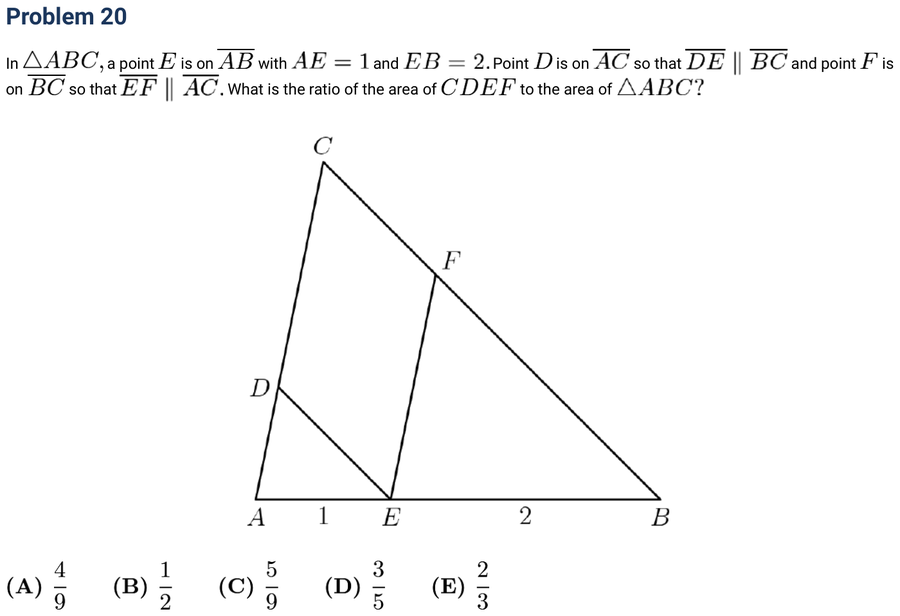
A line parallel to a side of a triangle slices off a smaller triangle that's a scaled copy of the whole. Each parallel cut here (DE and EF) does exactly that, lopping off a similar triangle at a corner. The quadrilateral is just what's left.
Still stuck? Show hint 2 →
Hint 2 of 2
The technique: similar-triangle area scales as the square of the side ratio. AE : AB = 1 : 3, so ▵ADE is 1/9 of the whole; EB : AB = 2 : 3, so ▵EFB is 4/9. Subtract both from 1.
Show solution
Approach: carve away two similar triangles
Set the whole ▵ABC = 1. Because DE ∥ BC, ▵ADE is a shrunken copy of ▵ABC with ratio AE/AB = 1/3 — so its area is (1/3)2 = 1/9.
Because EF ∥ AC, ▵EFB is a copy with ratio EB/AB = 2/3, area (2/3)2 = 4/9.
Those two triangles sit at corners A and B and don't overlap, so the leftover quadrilateral CDEF = 1 − 1/9 − 4/9 = 4/9.
You'll see it again: "line parallel to a side" instantly gives a similar triangle, and area ratio = (side ratio)2 — the squaring is the part people forget.
Another way — recognize CDEF as a parallelogram:
Since DE ∥ CB (i.e. ∥ CF) and EF ∥ AC (i.e. ∥ DC), quadrilateral DCFE has both pairs of opposite sides parallel — it's a parallelogram.
Its area can be read as base × height directly, or just confirmed by the subtraction above; either way the ratio to ▵ABC is 4/9. Spotting the parallelogram also explains why the two carved triangles exactly fill the rest.
A square-shaped floor is covered with congruent square tiles. If the total number of tiles that lie on the two diagonals is 37, how many tiles cover the floor?
Show answer
Answer: C — 361 tiles.
Show hints
Hint 1 of 2
37 is odd. Two diagonals of an n×n square would be 2n tiles — an even number — unless they cross and share one tile. The odd count is telling you they overlap at the center.
Still stuck? Show hint 2 →
Hint 2 of 2
So diagonal tiles = 2n − 1 (subtract the one shared center tile). Solve for n, then the floor is n².
Show solution
Approach: the odd count reveals a shared center tile
Each diagonal of an n×n floor has n tiles. For two diagonals to share a single center tile, n must be odd — and then they cover 2n − 1 tiles, not 2n. The fact that 37 is odd confirms this overlap is happening.
Set 2n − 1 = 37, so n = 19.
Total tiles: 192 = 361.
Sanity check: 361 is a perfect square (only choices 324, 361, 1296, 1369 are squares), and 19 is odd, matching the single-overlap picture. You'll see 2n−1 again for any pair of crossing diagonals / overlapping lines.
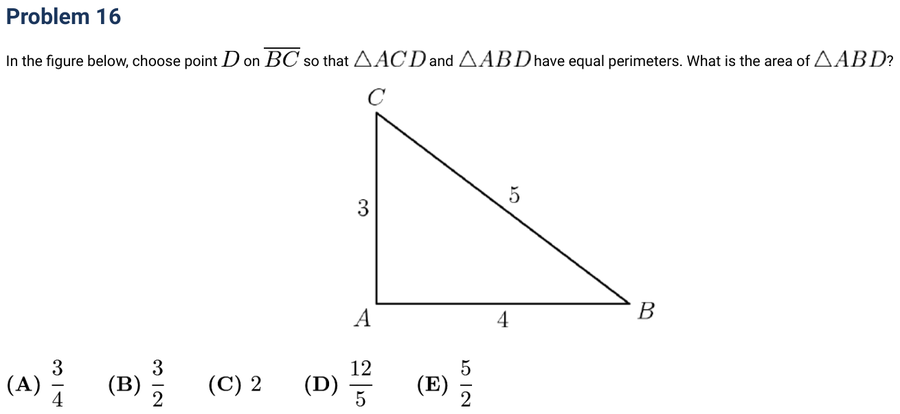
Both perimeters secretly contain the shared side AD, so it cancels. "Equal perimeters" really just says AC + CD = AB + BD — a balance on the two pieces of BC.
Still stuck? Show hint 2 →
Hint 2 of 2
Once you find where D sits, don't redo an area from scratch: ▵ABD and ▵ABC share the same height from A, so their areas are in the simple ratio of their bases on line BC.
Show solution
Approach: cancel the shared side, then use base ratio
▵ABC is a 3-4-5 right triangle (right angle at A, AC = 3, AB = 4, BC = 5). Let BD = x, so CD = 5 − x.
Equal perimeters share side AD, which cancels: AC + CD = AB + BD ⇒ 3 + (5 − x) = 4 + x ⇒ x = 2. So BD = 2. Spotting that AD cancels is what makes this one line instead of two messy perimeter sums.
▵ABD and ▵ABC share the altitude from A down to line BC, so their areas scale as their bases: area(▵ABD)/area(▵ABC) = BD/BC = 2/5.
You'll reuse the base-ratio idea constantly: two triangles with a common apex and bases on the same line have areas in the ratio of those bases — no need to find the height.
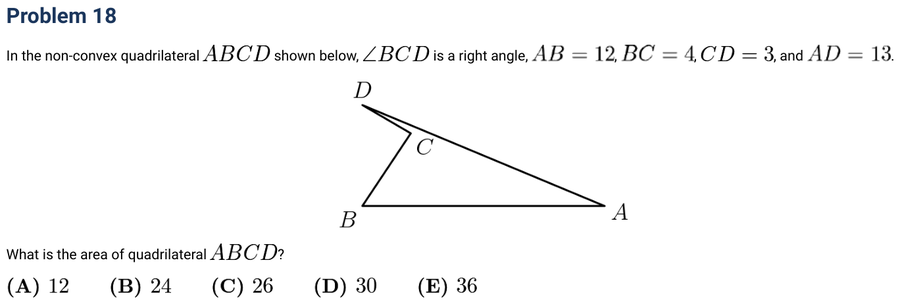
Draw the diagonal BD. The right angle at C makes ▵BCD a 3-4-5, handing you BD = 5 — and that 5 is the bridge to the rest of the figure.
Still stuck? Show hint 2 →
Hint 2 of 2
Watch the side lengths line up: with BD = 5, ▵ABD has sides 5, 12, 13 — a Pythagorean triple, so it's secretly a right triangle too. And since the quadrilateral is non-convex (C caves inward), its area is the big triangle − the notch: ▵ABD − ▵BCD.
Show solution
Approach: split on diagonal BD into two right triangles
Add diagonal BD. ▵BCD has the right angle at C with legs BC = 4 and CD = 3, so BD = √(16+9) = 5. That hypotenuse is the key — it unlocks the second triangle.
Now ▵ABD has sides BD = 5, AB = 12, AD = 13 — a 5-12-13 triple, so it's right-angled at B. (Recognizing the triple saves you a square-root computation.)
Because C dents inward, the quadrilateral is the large ▵ABD with the small ▵BCD removed: area = (1/2)(12)(5) − (1/2)(4)(3) = 30 − 6 = 24.
Why this transfers: for any odd quadrilateral, slice it on a diagonal into triangles; here the right angle hands you that diagonal for free, and spotting 3-4-5 / 5-12-13 lets you skip the Pythagorean arithmetic.
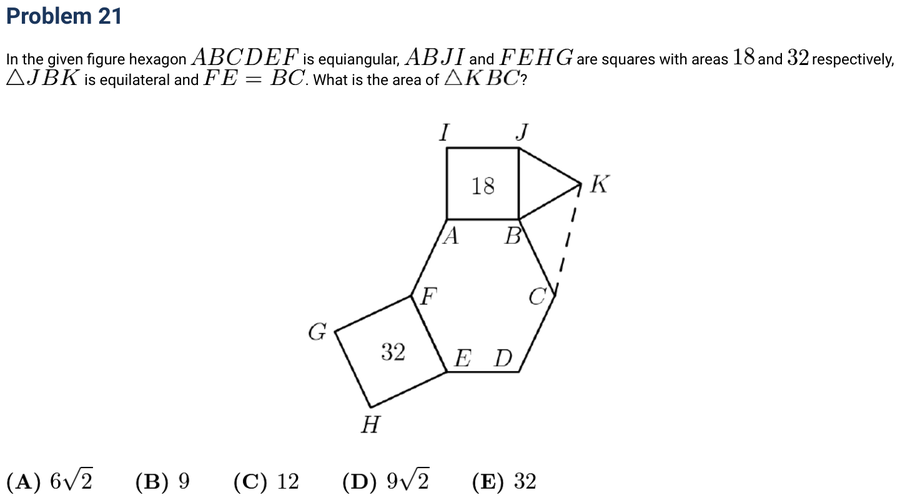
In the given figure hexagon ABCDEF is equiangular, ABJI and FEHG are squares with areas 18 and 32 respectively, ▵JBK is equilateral and FE = BC. What is the area of ▵KBC?
Show answer
Answer: C — Area 12.
Show hints
Hint 1 of 2
To get a triangle's area you need two sides and the angle between them — and B is exactly where everything meets. The squares hand you the two sides for free: a square's side is √(its area).
Still stuck? Show hint 2 →
Hint 2 of 2
For the missing angle, notice four angles fan out around point B (the square's corner, the equilateral triangle's corner, ∠KBC, and the hexagon's interior corner) and they must close up to 360°. An equiangular hexagon has every interior angle 120°, so the only unknown in that sum is ∠KBC.
Show solution
Approach: two sides from the squares + included angle from the 360° around B
Sides from the squares: BK = JB = √18 = 3√2 (square side, copied by the equilateral ▵JBK), and BC = FE = √32 = 4√2.
Angles fanning around B must total 360°: ∠ABJ (square) + ∠JBK (equilateral) + ∠KBC + ∠CBA (hexagon's 120° interior angle) = 90 + 60 + ∠KBC + 120 = 360, so ∠KBC = 90°.
With a right angle at B, the two sides are the legs: area = ½(3√2)(4√2) = ½(12·2) = 12.
Why this transfers: a vertex where several shapes meet lets you find a stubborn angle by 'going all the way around = 360°'; and the side of a square is always the square root of its area.
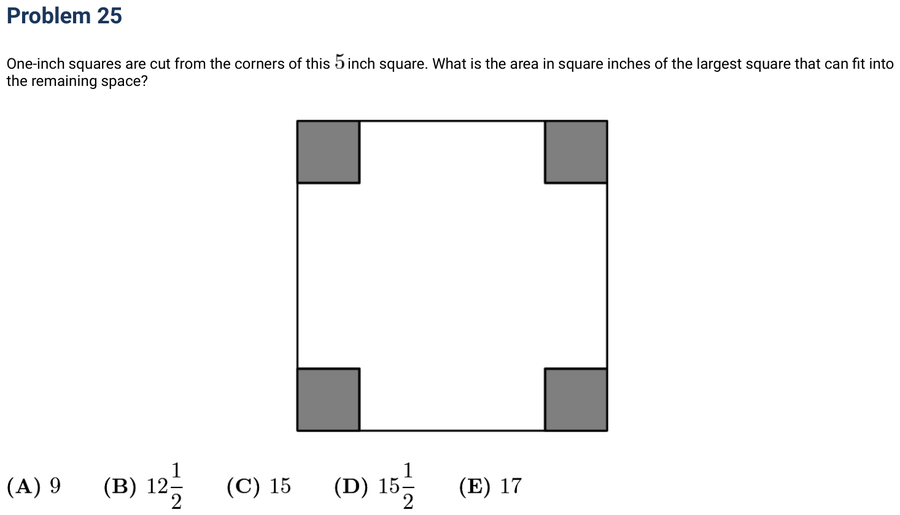
One-inch squares are cut from the corners of this 5 inch square. What is the area in square inches of the largest square that can be fit into the remaining space?
Show answer
Answer: C — Area 15.
Show hints
Hint 1 of 2
A straight (axis-aligned) square gets boxed in by the notches — it can't beat side 3 (area 9, the trap answer A). The cuts only block the corners, so a tilted square can slip its edges past them and grow larger.
Still stuck? Show hint 2 →
Hint 2 of 2
Make it as big as possible by letting each edge just graze a notch — run each side right through the inner corner of a cut square. Then don't chase the slanted side length; slice the tilted square into pieces you can measure: a central 3×3 block plus four right-triangle flaps.
Show solution
Approach: tilt so each edge grazes the notches, then decompose into a 3×3 plus 4 triangles
Put the 5×5 on coordinates from (0,0) to (5,5); the cut unit squares sit in the four corners (the bottom-left one is [0,1]×[0,1], etc.). A straight inscribed square jams at side 3, so tilt instead.
The largest tilted square runs each edge through the inner corners of the notches — along the bottom that's the points (1,1) and (4,1) — with its four vertices landing on the four sides of the big square (slightly off the midpoints).
Slice it into the central axis-aligned 3×3 square [1,4]×[1,4] (area 9) plus four congruent right-triangle flaps, one hanging off each side of that 3×3.
Each flap has a base of length 3 along a side of the 3×3 (e.g. from (1,1) to (4,1)) and an apex 1 unit out on the big square's edge — legs 3 and 1, area ½(3)(1) = 3/2.
Total = 9 + 4·(3/2) = 9 + 6 = 15.
Why this transfers: when a shape is blocked only at the corners, tilting escapes the obstacles; and a tilted figure is easiest to measure by cutting it into a straight square plus triangles rather than squaring a messy slanted length.
Another way — big square minus the four outside corner triangles:
The tilted square's four vertices sit on the four sides of the 5×5, so what's left between it and the big square is four congruent right triangles, one at each corner of the 5×5.
Along each side the two legs of a corner triangle add to 5, and they work out so each triangle's area is 5/2.
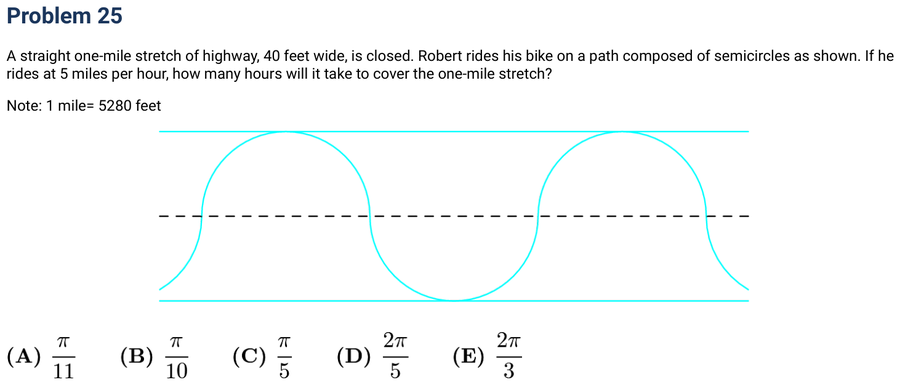
A straight one-mile stretch of highway, 40 feet wide, is closed. Robert rides his bike on a path composed of semicircles as shown. If he rides at 5 miles per hour, how many hours will it take to cover the one-mile stretch? Note: 1 mile = 5280 feet.
Show answer
Answer: B — π/10 hours.
Show hints
Hint 1 of 3
Don't compute how many semicircles there are — you don't need to. Each semicircle just replaces a straight diameter d with its half-circumference (π/2)d, so the curvy path is the straight path stretched by the same factor π/2, whatever the diameter.
Still stuck? Show hint 2 →
Hint 2 of 3
That means the 40-foot width and the 5280-feet conversion are red herrings — the answer is (π/2 × 1 mile) ÷ speed.
Still stuck? Show hint 3 →
Hint 3 of 3
Time = distance ÷ speed; you already know the straight mile would take 1/5 hour.
Show solution
Approach: the path is the straight distance scaled by π/2
For a semicircle of diameter d, the curved length is half the circumference = (1/2)πd = (π/2)d — exactly π/2 times the straight diameter it sits on.
Laid end to end, every diameter adds up to the full 1 mile, so the whole bike path = (π/2) × 1 mile = π/2 miles. (The 40-ft width and the foot conversion never enter — only the π/2 ratio matters.)
Time = distance ÷ speed = (π/2) ÷ 5 = π/10 hours.
Sanity check: the straight mile takes 1/5 hr; the path is π/2 ≈ 1.57 times longer, and (1/5)(π/2) = π/10 — consistent.
Why this transfers: when a shape is built from pieces that each scale a base length by the same fixed ratio, the whole thing scales by that ratio — so you can replace the wiggly path with π/2 of the straight one and ignore the count of pieces entirely.
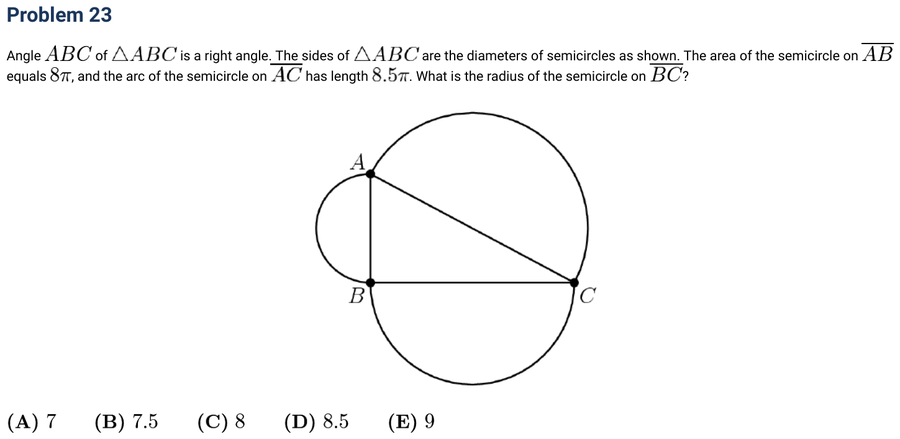
Angle ABC of ▵ABC is a right angle. The sides of ▵ABC are the diameters of semicircles as shown. The area of the semicircle on AB equals 8π, and the arc of the semicircle on AC has length 8.5π. What is the radius of the semicircle on BC?
Show answer
Answer: B — Radius 7.5.
Show hints
Hint 1 of 2
The semicircles are just disguises for the triangle's three sides. Each clue (an area, an arc length) is really telling you a side length — translate them back to AB and AC first, and a familiar right triangle appears.
Still stuck? Show hint 2 →
Hint 2 of 2
Pin down which radius-formula each clue uses: semicircle area = ½πr2, semicircle arc = πr. Recover the radii, double them for the diameters (= sides), then it's just the Pythagorean theorem.
Show solution
Approach: decode each semicircle into a side, then use Pythagoras
Side AB: its semicircle has area ½πr2 = 8π, so r2 = 16, r = 4, and AB = 2·4 = 8.
Side AC: its semicircle arc is πr = 8.5π, so r = 8.5 and AC = 2·8.5 = 17.
Right angle at B makes AC the hypotenuse: BC = √(172 − 82) = √225 = 15. (Spotting the 8-15-17 triple skips the square root entirely.)
The question wants the semicircle's radius on BC, so halve: 15 ÷ 2 = 7.5.
Watch the trap: after all that work it's tempting to answer 15 (the side) — but the figure's circles ride on the sides, and the question asks for a radius, so the final halving matters.
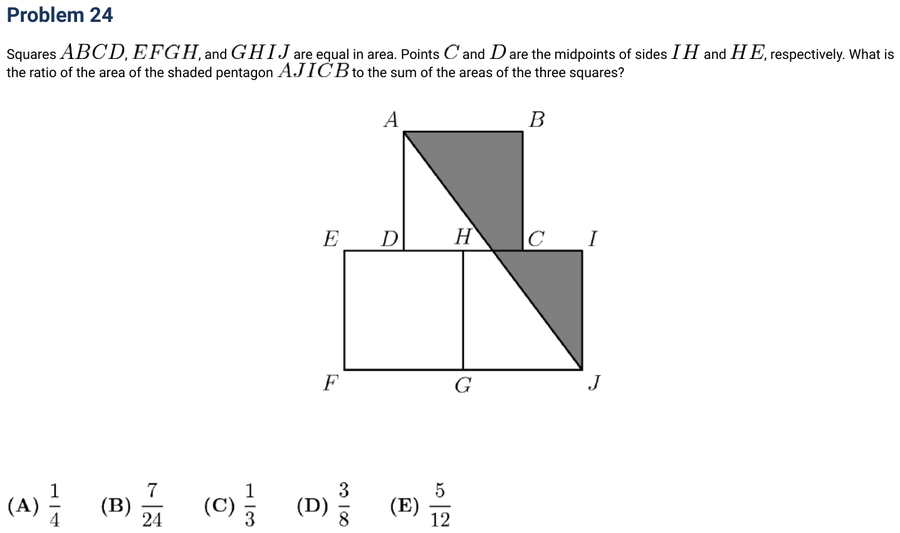
Squares ABCD, EFGH, and GHIJ are equal in area. Points C and D are the midpoints of sides IH and HE, respectively. What is the ratio of the area of the shaded pentagon AJICB to the sum of the areas of the three squares?
Show answer
Answer: C — 1/3.
Show hints
Hint 1 of 2
No actual size is given, so the answer can't depend on it — set each square's side to 1. Then the denominator is fixed at 3, and only the pentagon's area is left to find.
Still stuck? Show hint 2 →
Hint 2 of 2
The jagged pentagon is awkward, but its complement (the unshaded region ADEFJ, cut off by the straight diagonal from A to J) is a clean rectangle-plus-triangle. Subtracting the easy piece beats chasing the hard one. Coordinates with F = (0,0) make every corner exact.
Show solution
Approach: subtract the easy unshaded complement
Set each side to 1 (the ratio doesn't care about size), so the three squares total area 3 — that's the denominator handled. Now we only need the shaded area.
Rather than fight the jagged pentagon, find the unshaded leftover ADEFJ — the diagonal A–J splits it off cleanly. Put F = (0,0); its corners are A = (0.5, 2), D = (0.5, 1), E = (0, 1), F = (0, 0), J = (2, 0).
That region is a 0.5×1 rectangle (EDKF-style strip, area ½) plus right triangle AKJ with legs 1.5 and 2 (area ½·1.5·2 = 1.5), totaling 2.
Shaded = 3 − 2 = 1, so the ratio is 1 ÷ 3 = 1/3.
Why this transfers: when a shaded shape is jagged but its complement is made of rectangles and triangles, subtract the complement — the "hard region = whole − easy region" move.
Another way — coordinates + shoelace on the pentagon directly:
With F = (0, 0): A = (0.5, 2), J = (2, 0), I = (2, 1), C = (1.5, 1), B = (1.5, 2).
Shoelace on AJICB: ½ |(0.5·0 + 2·1 + 2·1 + 1.5·2 + 1.5·2) − (2·2 + 0·2 + 1·1.5 + 1·1.5 + 2·0.5)| = ½ |10 − 8| = 1.
Ratio = 1 ÷ 3 = 1/3. (Shoelace works on any polygon once you have the vertices in order.)
A ball with diameter 4 inches starts at point A to roll along the track shown. The track is comprised of 3 semicircular arcs whose radii are R1 = 100 inches, R2 = 60 inches, and R3 = 80 inches, respectively. The ball always remains in contact with the track and does not slip. What is the distance the center of the ball travels over the course from A to B?
Show answer
Answer: A — 238π.
Show hints
Hint 1 of 2
The ball touches the track but its center always sits one ball-radius (2 in) away. So the center traces its own set of semicircles, each concentric with the track's — the only question is whether the center is on the near or far side of each arc.
Still stuck? Show hint 2 →
Hint 2 of 2
On an arc that curves away from the center of the ball's path (ball rolls along the outside), the center's radius is R − 2; where the track curves the other way (ball rides the inside of the bend), it's R + 2. Match each arc to the picture, then a semicircle's length is just πR.
Show solution
Approach: shift each arc's radius by the ball's radius, then add the half-circumferences
The ball's diameter is 4, so its radius is 2 — the center always floats 2 inches off the track.
Read each bend from the figure: arc 1 and arc 3 are humps the ball rolls over the outside of, so the center's radius shrinks by 2 (100 → 98, 80 → 78); arc 2 is the dip where the ball hugs the inside, so it grows by 2 (60 → 62).
Each leg is a semicircle of length π·(center radius), so total = π(98 + 62 + 78) = 238π.
Why the ±2 matters: ignoring the offset gives π(100+60+80) = 240π (choice B, the trap). The shifts nearly cancel but not quite — two shrinks and one grow leave a net −2π.
You'll see this again: a rolling object's center traces a curve parallel to the track, offset by its radius — the same idea behind a coin rolling around a coin.
An equilateral triangle and a regular hexagon have equal perimeters. If the triangle's area is 4, what is the area of the hexagon?
Show answer
Answer: C — Area 6.
Show hints
Hint 1 of 2
A regular hexagon is secretly 6 little equilateral triangles meeting at its center — so the whole problem is about comparing those small triangles to the big one. First find the hexagon's side from the equal-perimeter clue.
Still stuck? Show hint 2 →
Hint 2 of 2
Equal perimeters: the triangle's 3 sides equal the hexagon's 6 sides, so each hexagon side is half the triangle's side. Key fact: when you halve a length, area shrinks by the square — to 1/4, not 1/2.
Show solution
Approach: hexagon = six equilateral triangles; area scales as (length)²
Equal perimeters means 3 × (triangle side) = 6 × (hexagon side), so the hexagon's side is half the triangle's side.
Cut the hexagon into its 6 natural equilateral triangles (from center to the corners) — each has that half-length side.
Halving the side scales area by (1/2)² = 1/4 (area always scales as the square of length), so each mini-triangle has area 4 × 1/4 = 1.
Six of them: hexagon area = 6 × 1 = 6.
The big takeaway: area scales like the square of the length ratio — double the side, 4× the area; half the side, 1/4 the area. This single fact handles most "similar figures" comparisons without any formula for the area itself.
A circle of radius 2 is cut into four congruent arcs. The four arcs are joined to form the star figure shown. What is the ratio of the area of the star figure to the area of the original circle?
Show answer
Answer: A — (4 − π)/π.
Show hints
Hint 1 of 2
Nothing was added or removed — the star is the same four arcs as the circle, just flipped to curve inward instead of outward. So the star and circle are made of identical pieces; the trick is to find a clean container.
Still stuck? Show hint 2 →
Hint 2 of 2
Drop the star inside a square that its 4 points just touch. The 4 leftover corner "bites" are exactly the 4 arc-pieces — flipped back out, they rebuild the circle. So square = star + circle. This is a rearrangement / conservation-of-pieces argument.
Show solution
Approach: same arcs rearranged: bounding square = star + circle
The four arcs that bulged outward to make the circle are now curved inward to make the star — same pieces, no area gained or lost. We just need a shape we can measure.
Inscribe the star in a square whose sides its four points touch. Each star point reaches one radius (2) past center on each side, so the square is 4 × 4 = 16.
Look at the 4 corner regions outside the star but inside the square: each is one of the original arc bites. Flipped outward they reassemble the whole circle, so those 4 regions total the circle's area π(2)² = 4π.
Thus star = square − those corners = 16 − 4π, and the ratio star : circle = (16 − 4π) / 4π = (4 − π)/π.
The transferable move: when a figure is built by rearranging pieces of another, look for a simple shape (here a square) that the pieces tile exactly — then areas come from subtraction, not integration or arcs.
A square with area 4 is inscribed in a square with area 5, with one vertex of the smaller square on each side of the larger square. A vertex of the smaller square divides a side of the larger square into two segments, one of length a, and the other of length b. What is the value of ab?
Show answer
Answer: C — 1/2.
Show hints
Hint 1 of 2
Don't hunt for a and b separately — the question only wants their product. The tilted small square cuts the big square into itself plus 4 corner triangles, and each triangle's area is exactly (1/2)ab. So chase the total triangle area.
Still stuck? Show hint 2 →
Hint 2 of 2
The 4 corner triangles are congruent (the picture is symmetric), and together they're just the part of the big square not covered by the small one: 5 − 4 = 1. That's the whole problem — no need for side lengths.
Show solution
Approach: leftover area equals the four corner triangles → ab
The small square sits inside the big one, leaving 4 right triangles in the corners. Their total area is the difference of squares: 5 − 4 = 1.
Those 4 triangles are congruent by the symmetry of the figure, so each has area 1/4.
Each corner triangle has legs a and b, so its area is (1/2)ab. Set (1/2)ab = 1/4, giving ab = 1/2.
Why it's quick: the target is a product, and (1/2)ab is exactly a triangle's area — so an area equation hands you ab directly, no need to solve for a or b alone.
Another way — two Pythagorean relations:
The small square's side is √4 = 2, and it's the hypotenuse of a corner right triangle with legs a, b: so a² + b² = 4.
The big square's side is √5, and that side is split into a + b: so (a + b)² = 5, i.e. a² + 2ab + b² = 5.
Subtract the first from the second: 2ab = 5 − 4 = 1, so ab = 1/2. (The (a+b)² − (a²+b²) = 2ab identity is the engine here.)
A circle with radius 1 is inscribed in a square and circumscribed about another square as shown. Which fraction is closest to the ratio of the circle's shaded area to the area between the two squares?
Show answer
Answer: A — Closest to 1/2.
Show hints
Hint 1 of 2
The two key fits: the circle sits inside the outer square, so the outer square's side equals the diameter; the inner square sits inside the circle with its corners on it, so the inner square's diagonal equals the diameter. Both are pinned to the diameter = 2.
Still stuck? Show hint 2 →
Hint 2 of 2
From a square's diagonal you get its area fast: area = (diagonal)2÷2. So the inner square's area is 22÷2 = 2 — no need for the √2 side length at all.
Show solution
Approach: tie every length to the diameter, then form the ratio
Diameter = 2. Outer square (circle inscribed in it): side 2, area 4. Inner square (inscribed in the circle): diagonal 2, so area = 22÷2 = 2.
Shaded part = inside the circle but outside the inner square = π(1)2 − 2 = π − 2.
Area between the squares = outer − inner = 4 − 2 = 2.
Ratio = (π − 2)÷2 ≈ (3.14 − 2)÷2 ≈ 0.57, closest to 1/2.
Sanity check: π − 2 ≈ 1.14 is just over half of 2, so the ratio is just over 1/2 — 1/2 is clearly the nearest choice (the next option, 1, would need the shaded area to equal the full gap of 2).
The diagram shows an octagon consisting of 10 unit squares. The portion below PQ is a unit square and a triangle with base 5. If PQ bisects the area of the octagon, what is the ratio XQQY?
Show answer
Answer: D — 2/3.
Show hints
Hint 1 of 3
‘Bisects the area’ is a number in disguise: half of 10 is 5. So the whole region below the line must total exactly 5 — that's your one equation.
Still stuck? Show hint 2 →
Hint 2 of 3
Turn the geometric condition into an area equation, then back out the unknown height. Here the bottom region is (unit square) + (triangle of base 5), and its total is pinned to 5.
Still stuck? Show hint 3 →
Hint 3 of 3
Once you know the triangle's height, the point Q's location on the 2-unit-tall right edge is forced — then XQ and QY are just the two pieces it splits.
Show solution
Approach: convert ‘bisects area’ into an equation, then locate Q
The octagon is 10 unit squares, so each half is 5. The part below PQ is a unit square plus a triangle of base 5, and together they must equal 5 — so the triangle alone has area 4.
Area = (1/2) · base · height, so (1/2) · 5 · height = 4 gives height = 1.6. That height is how high Q sits above the base.
The right edge XY is 2 units tall (with Y one unit up). Q sits at height 1.6, so QY = 1.6 − 1 = 0.6 and XQ = 2 − 1.6 = 0.4.
Ratio XQ/QY = 0.4 / 0.6 = 2/3.
Why this transfers: a ‘line that splits the area in a given way’ is really an algebra problem — write the area on one side, set it to the target, solve for the unknown length. The geometry just supplies the formula.
Semicircles POQ and ROS pass through the center O. What is the ratio of the combined areas of the two semicircles to the area of circle O?
Show answer
Answer: B — 1/2.
Show hints
Hint 1 of 3
The two semicircles are identical, so together they're the same area as one full small circle — stop counting them separately.
Still stuck? Show hint 2 →
Hint 2 of 3
Use coordinates to nail the radii: the small radius is half of PQ = 1, and the big radius is the distance OQ = √(12+12) = √2 by the distance formula.
Still stuck? Show hint 3 →
Hint 3 of 3
Since you're forming a ratio, every π will cancel — only the squared radii matter.
Show solution
Approach: combine the semicircles, then ratio the squared radii
Both semicircles have diameter PQ = RS = 2, so radius 1. Two of them glue into one full circle of radius 1, area π.
The big circle's radius is the distance from center O(0,0) to Q(1,1): √(12+12) = √2, so its area is π(√2)2 = 2π.
Ratio = π / 2π = 1/2 — the π cancels, as expected for a pure area ratio.
Why this transfers: two matching semicircles always recombine into a whole circle, and area ratios reduce to (radius ratio)2. Here that's (1 vs √2)2, i.e. 1 : 2 — no π, no decimals.
How many non-congruent triangles have vertices at three of the eight points in the array shown below?
Show answer
Answer: D — 8.
Show hints
Hint 1 of 2
The 8 points form 2 rows of 4. Any triangle must use BOTH rows — three points on one line make no triangle — so it's always two points on one row and one point on the other.
Still stuck? Show hint 2 →
Hint 2 of 2
"Non-congruent" means count SHAPES, not positions: a triangle and its mirror image are the same shape. So organize by the horizontal gap between the two same-row points (1, 2, or 3) and how far the lone point sits from them, then drop mirror duplicates.
Show solution
Approach: classify by the pair's width and the lone point's offset, count shapes up to mirror
Every triangle = two points on one row + one on the other (the rows are 1 unit apart). What fixes the SHAPE is two numbers: the gap g between the same-row pair, and the lone point's horizontal offset from them. Slide-and-flip copies are congruent, so count each distinct (g, offset) once.
Gap g = 1 (adjacent pair, like columns 1–2): the lone point can sit directly under one end (offset 0), or 1, or 2 columns out to the side. The two sides are mirror images, so the distinct shapes come from offsets 0, 2, 3 measured from the pair — 3 shapes.
Gap g = 2 (pair like columns 1–3): lone point under an end, under the middle, or one column beyond — 3 shapes.
Gap g = 3 (pair at the far ends, columns 1–4): the lone point is at one of the two inner columns; those two choices are mirror images of each other, and being under an endpoint repeats a thinner shape — 2 shapes.
Total distinct shapes: 3 + 3 + 2 = 8.
Why this transfers: for "how many non-congruent figures," never list raw positions — pick the few measurements that pin down a shape (here a base length and an offset) and count those, folding mirror images together.
A one-cubic-foot cube is cut into four pieces by three cuts parallel to the top face of the cube. The first cut is 12 foot from the top face. The second cut is 13 foot below the first cut, and the third cut is 117 foot below the second cut. From the top to the bottom the pieces are labeled A, B, C, and D. The pieces are then glued together end to end as shown in the second diagram. What is the total surface area of this solid in square feet?
Show answer
Answer: E — 11 square feet.
Show hints
Hint 1 of 2
Those ugly cut fractions (1/2, 1/3, 1/17) are bait — the slabs together still came from one cube, so their heights always add to 1. Look from all 6 directions instead of tracking each slab's thickness.
Still stuck? Show hint 2 →
Hint 2 of 2
Add up the SILHOUETTE area seen from each face. Top and bottom each show four 1×1 squares; front and back each show a staircase whose four heights total 1 (a full unit); the two ends each show only the tallest step.
Show solution
Approach: project onto all 6 faces — heights conspire to 1
Each piece keeps its 1×1 footprint. Top & bottom views: you see all four 1×1 squares — 4 sq ft from the top, 4 from the bottom.
Front & back views: the staircase silhouette is four width-1 strips whose heights are the four slab thicknesses — and those came from slicing one unit cube, so they sum to exactly 1. Area = 1 each ⇒ 2 sq ft.
Two end views: the slabs descend like a staircase, so from an end you see only the tallest piece A's cross-section, 1 × ½ = ½ — 1 sq ft for both ends.
Total surface area = 4 + 4 + 2 + 1 = 11.
Why this transfers: for a blocky solid, total surface area = sum of the six flat-on silhouette areas (no part of an axis-aligned surface ever hides behind another). And when pieces come from one whole, their dimensions secretly add back to that whole — so deliberately messy fractions often cancel.
In square ABCE, AF = 2FE and CD = 2DE. What is the ratio of the area of ▵BFD to the area of square ABCE?
Show answer
Answer: C — 5/18.
Show hints
Hint 1 of 2
△BFD has no horizontal or vertical side, so it's awkward to measure head-on — but the three pieces left over (one at each used corner) are right triangles with easy legs.
Still stuck? Show hint 2 →
Hint 2 of 2
Subtract instead of build: △BFD = whole square − the three right triangles cut off in the corners. Pick side length 1 to make every leg a simple fraction.
Show solution
Approach: subtract three corner right triangles from the square
Take side 1, so AF = 2/3, FE = 1/3, CD = 2/3, DE = 1/3. The three corner triangles cut off around △BFD are △ABF (legs 1, 2/3, area 1/3), △BCD (legs 1, 2/3, area 1/3), and △FED (legs 1/3, 1/3, area 1/18).
Why this transfers: a slanted triangle inside a rectangle is almost always easier as "rectangle minus the right triangles in the corners" — each corner triangle has axis-aligned legs you can read straight off the figure.
Another way — shoelace:
Place E at the origin, side s. B = (s, s), F = (0, s/3), D = (s/3, 0).
Area △BFD = ½ |s(s/3 − 0) + 0(0 − s) + (s/3)(s − s/3)| = ½(s²/3 + 2s²/9) = 5s²/18, so the ratio is 5/18.
Margie's winning art design is shown. The smallest circle has radius 2 inches, with each successive circle's radius increasing by 2 inches. Approximately what percent of the design is black?
Show answer
Answer: A — About 42%.
Show hints
Hint 1 of 2
A ring (annulus) is just the big disk with the smaller disk punched out, so its area is πR² − πr² — never measure the ring directly.
Still stuck? Show hint 2 →
Hint 2 of 2
You want a ratio, so the π will cancel — work with the radius-squares and only deal with whole numbers.
Show solution
Approach: rings as differences of disks, then take the ratio (π cancels)
The radii are 2, 4, 6, 8, 10, 12. Each black region is a ring = outer disk − inner disk, so use π(R² − r²): the center black disk is π·2² = 4π, the ring from 4 to 6 is π(36 − 16) = 20π, and the ring from 8 to 10 is π(100 − 64) = 36π.
Ratio: 60π / 144π = 60/144 = 5/12 ≈ 41.7%, closest to 42%. The π cancels, so you're just comparing radius-squares.
Why this transfers: any "ring" or "washer" area is one disk minus another, and in a fraction-of-the-whole question every π divides out — track only the squared radii.
A lemming sits at a corner of a square with side length 10 meters. The lemming runs 6.2 meters along a diagonal toward the opposite corner. It stops, makes a 90° right turn and runs 2 more meters. A scientist measures the shortest distance between the lemming and each side of the square. What is the average of these four distances in meters?
Show answer
Answer: C — 5.
Show hints
Hint 1 of 2
Resist plotting the exact spot — the 6.2 and the 2 are bait. For any point inside the square, its distance to the left wall plus its distance to the right wall is the full width, 10. Same up-and-down.
Still stuck? Show hint 2 →
Hint 2 of 2
Hunt for the invariant: when a problem buries you in specific lengths but asks for a sum or average, check whether that quantity stays fixed no matter where the point lands.
Show solution
Approach: an inside point's opposite-wall distances always sum to the side
First confirm the lemming is still inside: it travels 6.2 then 2, well within a 10×10 square. So it's an interior point — the exact spot won't matter.
Left-wall distance + right-wall distance spans the whole width = 10. Top + bottom likewise = 10. All four distances sum to 20.
Average = 20 ÷ 4 = 5.
The payoff: the messy 6.2 and 2 never entered the math — the four distances always total 2×(side), so the average is always side÷2. Spotting that invariant beats any coordinate grind.
What is the area of the shaded pinwheel shown in the 5 × 5 grid?
Show answer
Answer: B — 6.
Show hints
Hint 1 of 2
The shaded pinwheel has slanted, awkward edges — but the unshaded leftovers are tidy squares and triangles. Measure what's easy and subtract from the whole 5×5.
Still stuck? Show hint 2 →
Hint 2 of 2
Complementary area: when the region you want is jagged, find the area of its simple complement and subtract from the total.
Show solution
Approach: whole grid minus the easy unshaded pieces
Total grid area = 52 = 25.
The unshaded part is 4 corner unit squares (4 · 1 = 4) plus 4 congruent triangles, each with base 3 and height 5/2.
Those triangles total 4 · (1/2)(3)(5/2) = 15. Unshaded = 4 + 15 = 19.
Shaded pinwheel = 25 − 19 = 6.
Reusable move: never wrestle a slanted shape directly — subtracting the clean complement from a bounding rectangle is almost always faster and less error-prone.
A square with side length 2 and a circle share the same center. The total area of the regions that are inside the circle and outside the square is equal to the total area of the regions that are outside the circle and inside the square. What is the radius of the circle?
Show answer
Answer: A — 2/√π.
Show hints
Hint 1 of 2
The overlap region (inside both) belongs to neither of the two 'sticking-out' areas. Both shapes share that exact same overlap — so when you set the two leftover bits equal, the overlap simply cancels.
Still stuck? Show hint 2 →
Hint 2 of 2
Don't try to find the messy crescent and corner pieces. Add the shared overlap back to both sides: the condition collapses to 'circle area = square area.'
Show solution
Approach: the shared overlap cancels ⇒ equal total areas
Call the overlap (inside both shapes) I. Then inside-circle-but-outside-square = πr² − I, and outside-circle-but-inside-square = 4 − I (the square's area is 2² = 4).
Setting them equal: πr² − I = 4 − I. The unknown overlap I cancels, leaving πr² = 4.
So r² = 4/π and r = 2/√π = 2/√π.
The big idea: 'sticking-out area on one side = sticking-out area on the other' is just a disguised way of saying the two whole shapes have equal area — because both share the same overlap, it never needs to be computed. Spotting that you can add the common piece back to both sides is the whole problem.
What is the area enclosed by the geoboard quadrilateral below?
Show answer
Answer: C — 22½.
Show hints
Hint 1 of 2
The shape is a slanted 'arrow' on dots — awkward to slice into clean triangles. When every corner sits on a grid point, you have a special tool that turns area into counting dots instead of measuring.
Still stuck? Show hint 2 →
Hint 2 of 2
That tool is Pick's Theorem: A = I + B/2 − 1, where I = dots strictly inside the shape and B = dots on the boundary. It works for any lattice polygon, no matter how jagged — that's its power.
Show solution
Approach: Pick's theorem (count the dots)
Because all four corners are lattice points, skip slicing — just count dots. Boundary dots: the 4 corners plus 1 grid point an edge passes through, so B = 5. Interior dots: I = 21.
Why this transfers: Pick's Theorem reduces any geoboard-area problem to two careful counts — inside dots and edge dots — and the half-integer answer (the ½) is itself a hint that an even number of boundary dots wasn't in play.
Another way — box minus surrounding triangles (decomposition):
Enclose the dart in the smallest grid rectangle that contains all four vertices.
Subtract the right triangles (and any rectangles) trapped between the dart's slanted edges and the box's sides — each such triangle has area ½ · base · height with whole-number legs.
What remains is the dart's area, 22½ — a good independent check on the dot-counting, which is easy to slip on.
In the figure, ABCD is a rectangle and EFGH is a parallelogram. Using the measurements given in the figure, what is the length d of the segment that is perpendicular to HE and FG?
Show answer
Answer: C — 7.6.
Show hints
Hint 1 of 3
There's no direct way to measure that slanted height d. But d is the parallelogram's height on base HE, so if you knew the parallelogram's area, you'd get d = area ÷ base. So the real task is: find the parallelogram's area.
Still stuck? Show hint 2 →
Hint 2 of 3
The strategy is area two ways: get the parallelogram's area the easy way (whole rectangle minus the four corner right-triangles), then set it equal to base × height to solve for the height you actually want.
Still stuck? Show hint 3 →
Hint 3 of 3
The base HE is the hypotenuse of a 3-4 right triangle in the corner, so HE = 5 — a clean Pythagorean leg-up before you divide.
Show solution
Approach: area two ways → height = area / base
Find the parallelogram's area by subtraction. The rectangle is 10 wide (4 + 6) by 8 tall (3 + 5), area 80. The four corner triangles cut off are right triangles: top-left legs 4×3 (area 6), top-right 6×5 (area 15), bottom-right 4×3 (area 6), bottom-left 6×5 (area 15) — total 6 + 15 + 6 + 15 = 42.
So parallelogram EFGH has area 80 − 42 = 38.
Now use area = base × height with base HE = √(3² + 4²) = 5: 38 = 5d, so d = 38 ÷ 5 = 7.6.
Why this transfers: when a length is awkward to measure directly, compute the same area by an easy route, then back the length out of area = base × height. Sanity check: the height should be shorter than the rectangle's 8, and 7.6 < 8.
Two 4 × 4 squares intersect at right angles, bisecting their intersecting sides, as shown. The circle's diameter is the segment between the two points of intersection. What is the area of the shaded region created by removing the circle from the squares?
Show answer
Answer: D — 28 − 2π.
Show hints
Hint 1 of 3
The shaded area is 'both squares, minus the circle'. The trap is double-counting the overlap, so first nail the combined area of the two squares using inclusion–exclusion: square + square − the piece they share.
Still stuck? Show hint 2 →
Hint 2 of 3
The shared piece is the small square where they cross. 'Bisecting their intersecting sides' means each square is cut at the midpoints of those sides, so the overlap is a 2×2 square (area 4).
Still stuck? Show hint 3 →
Hint 3 of 3
For the circle, the diameter is the segment joining the two crossing points — that's the diagonal of the 2×2 overlap square. Diagonal = 2√2, so radius = √2.
Show solution
Approach: inclusion–exclusion, then subtract the circle
Combined area of the two squares (avoid double-counting the middle): 16 + 16 − (overlap). The overlap is a 2×2 square because the squares meet at the midpoints of the crossed sides, so overlap = 4. Combined region = 16 + 16 − 4 = 28.
Circle: its diameter is the diagonal of that 2×2 overlap square = 2√2, so radius = √2 and area = π(√2)² = 2π.
Shaded = combined region − circle = 28 − 2π.
Why these two ideas pair up so often: inclusion–exclusion (add the parts, subtract the shared piece once) handles the overlapping squares, and the √2 comes from a square's diagonal — both are workhorses you'll reuse constantly. Estimate check: 2π ≈ 6.3, so the shaded area is about 28 − 6.3 ≈ 21.7, comfortably less than the 28 of squares alone.
"Painted faces" just means "exposed faces", so reword the question: which cubes have exactly four sides touching the outside air?
Still stuck? Show hint 2 →
Hint 2 of 2
Don't paint every cube — instead find the misfits. Sort the 14 cubes by exposure: the perched-on-top ones are too open, the buried bottom corners too hidden, and what's left must be the fours.
Show solution
Approach: count exposed faces per cube, then subtract the misfits
Paint reaches a cube's face only if that face is exposed, and the bottom counts as exposed too. So "exactly four painted faces" means "exactly four exposed sides." Rather than tally all 14, find the cubes that are too exposed or too hidden and subtract.
The 4 cubes perched on top of the base are open on all 4 sides plus the top — that's 5 painted faces, too many.
The 4 corner cubes of the bottom layer touch neighbors on two sides, leaving only 3 faces (two sides + bottom) exposed — too few.
Everything else has exactly four exposed sides. So 14 − 4 (tops) − 4 (bottom corners) = 6 cubes.
You'll see this again: for "how many cubes have exactly k painted faces," count by a cube's position (corner / edge / face-center / hidden) instead of inspecting cubes one at a time — position fixes the exposure.
For a MINIMUM, make each cube do double duty — one cube can show up in both the front view and the side view at once.
Still stuck? Show hint 2 →
Hint 2 of 2
Build the L-shaped front view with 3 cubes first, then add only what the side view still demands.
Show solution
Approach: reuse cubes across both views; add only what's missing
Minimizing means letting cubes count toward both pictures. Start with the front view, an L of 3 squares — that needs at least 3 cubes, sitting in one flat plane.
Now check the side view: it's also an L with depth, meaning something must sit behind the front row. Those 3 cubes alone give a side view only 1 cube deep, which is wrong. Adding one cube behind the corner fixes the side view — and that 4th cube touches the others, so the "every cube shares a face" rule holds.
No fewer than 4 can cover both an L front and an L side, so the minimum is 4 cubes.
You'll see this again: in "fewest cubes for these views" problems, the answer is driven by where the two views disagree — build the bigger view, then patch only the parts the other view still forces.
For his birthday, Bert gets a box that holds 125 jellybeans when filled to capacity. A few weeks later, Carrie gets a larger box full of jellybeans. Her box is twice as high, twice as wide, and twice as long as Bert's. Approximately how many jellybeans did Carrie get?
Show answer
Answer: E — About 1000.
Show hints
Hint 1 of 2
"Twice as big" tricks the eye — picture how many of Bert's small boxes actually pack inside Carrie's. Imagine a 2-by-2-by-2 stack of them.
Still stuck? Show hint 2 →
Hint 2 of 2
That stack is 2 across, 2 deep, 2 tall: the volume (and the jellybeans) multiplies by 2 × 2 × 2, not by 2.
Show solution
Approach: scaling all three dimensions cubes the factor
Visualize Carrie's box as a 2×2×2 stack of Bert's boxes — 8 of them fit inside. Doubling all three dimensions multiplies volume by 2 × 2 × 2 = 8.
So Carrie gets about 8 × 125 = 1000 jellybeans.
*Why this transfers:* when every length scales by k, area scales by k² and volume by k³. "Double" never means double for area or volume — and a quick gut-check, 250 (×2), would be the classic wrong trap.
Slanted edges scare people off — but every tilted piece here is just *half of a grid square*. So you never measure a slant, you only count squares and half-squares.
Still stuck? Show hint 2 →
Hint 2 of 2
Tally inside each shape: a full grid square is worth 1, a corner-to-corner triangle is worth ½. Add them up per polygon and compare the totals.
Show solution
Approach: count whole squares and half-squares
On a grid you don't need any area formulas: chop each polygon into pieces you can count — whole unit squares (area 1) and half-square triangles (area ½) — then add.
Doing that for all five gives areas 5, 5, 5, 4.5, and 5.5. The biggest is polygon E at 5.5.
*The transferable move:* break a messy shape into easy standard pieces and sum them. Counting squares-and-half-squares turns any grid polygon into simple addition.
Another way — box-and-subtract:
Trap each polygon in the smallest grid rectangle that surrounds it, then subtract the right-triangle corners poking outside the polygon.
Rectangle area minus the cut-off corners gives the same totals — handy when a shape has few inside squares but many slanted edges.
Each outer triangle is right *isosceles*, so its two legs equal the 3-4-5 side it's built on. That makes its area a clean ½·(side)² — area depends only on which side it sits on.
Still stuck? Show hint 2 →
Hint 2 of 2
So X, Y, Z scale like 3², 4², 5². You already know a famous fact linking those three squares.
Show solution
Approach: each isosceles right triangle's area is half the square on its side
A right isosceles triangle with legs s has area ½·s². Since each one sits on a 3-4-5 side, X = ½·3² = 4.5, Y = ½·4² = 8, Z = ½·5² = 12.5.
Now the Pythagorean fact 3² + 4² = 5² is hiding here: halve every term and you get 4.5 + 8 = 12.5, i.e. X + Y = Z, choice E.
*The big idea worth keeping:* build *any* matching shape on the three sides of a right triangle — triangles here, but squares, semicircles, anything similar — and the two smaller areas always sum to the largest. It's the Pythagorean theorem dressed in areas, because every such area is (some fixed constant)·(side)².
A square piece of paper, 4 inches on a side, is folded in half vertically. Both layers are then cut in half parallel to the fold. Three new rectangles are formed, a large one and two small ones. What is the ratio of the perimeter of one of the small rectangles to the perimeter of the large rectangle?
Show answer
Answer: E — 5/6.
Show hints
Hint 1 of 2
Don't picture it abstractly — sketch the paper at each step and just track length × width. The fold turns 4×4 into a 4×2 stack.
Still stuck? Show hint 2 →
Hint 2 of 2
The cut goes through both folded layers parallel to the fold; unfolding gives one large rectangle and two small ones. Find their dimensions, then compare perimeters.
Show solution
Approach: find each rectangle's dimensions, then compare perimeters
Fold the 4×4 square in half vertically → a 4-tall by 2-wide stack (two layers). Cut that stack in half parallel to the fold: the half nearest the fold stays joined when unfolded (a 4×2 piece), while the outer half is two loose layers (two 4×1 pieces).
So one large 4×2 rectangle and two small 4×1 rectangles. Their perimeters: small = 2(4 + 1) = 10, large = 2(4 + 2) = 12.
Ratio = 10 : 12 = 5/6. The reusable habit: in fold-and-cut problems, forget the picture's drama and just bookkeep each piece's length and width.
∠ACT = ∠ATC means triangle CAT is isosceles — those two equal base angles plus the 36° apex must total 180°. That single equation unlocks both base angles at once.
Still stuck? Show hint 2 →
Hint 2 of 2
Once you know ∠ATC, the bisector cuts it in half to give ∠RTC. Then triangle CRT is just another 'three angles sum to 180°' — and notice you already know two of them (∠TCR is the same as ∠ACT).
Show solution
Approach: isosceles to get base angles, then a second triangle's angle sum
Triangle CAT is isosceles (∠ACT = ∠ATC), so 36 + 2·(base angle) = 180, giving each base angle = (180 − 36)/2 = 72°. So ∠ATC = ∠ACT = 72°.
The bisector TR halves ∠ATC, so ∠RTC = 72 ÷ 2 = 36°.
In triangle CRT the angles are ∠TCR = 72° (it's the same corner as ∠ACT), ∠RTC = 36°, and ∠CRT. So ∠CRT = 180 − 72 − 36 = 72°.
The reusable move: an angle chase is just a relay — pin down one angle with isosceles/bisector facts, then carry it into the next triangle's 180° sum. Reuse angles you've already found instead of recomputing them.
'Midpoint' is the key word: building the next triangle on a midpoint makes its side exactly half. So the sides go 4, 2, 1 — each triangle half the last.
Still stuck? Show hint 2 →
Hint 2 of 2
Perimeter means the OUTSIDE boundary only. Don't add all three full triangles — where one triangle sits on another, that shared edge is interior and gets skipped. Just walk the outline once.
Show solution
Approach: walk the outer boundary, skipping shared edges
Each new triangle is built on a midpoint, so its side is half the previous: 4, then 2, then 1.
Trace the outline A→B→C→D→E→F→G→A and record only edges on the outside. You get 4, 4 (big triangle's two outer sides), 2, 2 (middle), 1, 1, 1 (small), summing to 15.
Sanity check / the principle: if you'd naively added all three perimeters (12 + 6 + 3 = 21, choice E — the trap!), you'd double-count the edges where triangles meet. Perimeter is always the outer boundary, so interior shared segments never count.
In order for Mateen to walk a kilometer (1000 m) in his rectangular backyard, he must walk the length 25 times or walk its perimeter 10 times. What is the area of Mateen's backyard in square meters?
Show answer
Answer: C — 400 square meters.
Show hints
Hint 1 of 2
Each '___ times = 1000 m' is secretly a division: if one length is walked 25 times to reach 1000 m, one length is 1000 ÷ 25. Translate both clues into a single number each.
Still stuck? Show hint 2 →
Hint 2 of 2
Length and perimeter alone don't give area — you need the width. Back it out of perimeter = 2(length + width).
Show solution
Approach: turn each 'walk it N times' clue into one measurement
Length: walked 25 times to cover 1000 m, so one length = 1000 ÷ 25 = 40 m. Perimeter: walked 10 times for 1000 m, so the perimeter = 1000 ÷ 10 = 100 m.
Perimeter = 2(length + width): 100 = 2(40 + W), so 40 + W = 50 and W = 10 m.
Area = length × width = 40 × 10 = 400 m².
The lesson: 'do X to cover a total' clues are just multiplication facts in disguise — divide the total by the count to recover one piece. Then the area needs both dimensions, so use perimeter to fish out the missing one.
Answer: E — Same area, but quadrilateral I has the smaller perimeter.
Show hints
Hint 1 of 2
The answer choices split into 'compare area' and 'compare perimeter,' so settle area FIRST — and don't eyeball it. On a geoboard you can find area exactly (slice into triangles, or use base × height).
Still stuck? Show hint 2 →
Hint 2 of 2
Equal area does NOT force equal perimeter — a shape can enclose the same space with more boundary. Once areas tie, compare the sides one by one: the shapes share a pair of equal slants, so look only at the *other* sides.
Show solution
Approach: lock down area exactly, then compare the differing sides
Area first. Region I is a parallelogram of base 1 and height 1, so area = 1. Region II splits into two triangles, each base 1 and height 1, area ½ + ½ = 1. The areas are *equal* — so it's down to perimeter.
Both shapes have a matching pair of slant sides (each spanning 1 across and 1 up, length √2). Their remaining sides differ: region I's other two sides are plain unit segments (length 1 each), while region II's remaining side is a long diagonal clearly stretching more than 1.
So region II carries more boundary — its perimeter is larger, which means region I's perimeter is the *smaller* one: choice E.
The big idea: area and perimeter are independent — same area can hide very different perimeters (a key reason 'compare the figures' problems list both). Pin down the one that's easy to compute exactly, then reason about the other.
Before reaching for π, notice every arc has the SAME radius 5. The two quarter-circles scooped OUT of the bottom and the semicircle bulging UP on top are built from identical-radius pieces — so the curves might just cancel.
Still stuck? Show hint 2 →
Hint 2 of 2
Two quarter-circles of radius 5 add up to one semicircle of radius 5. That's exactly the area added by the top bump. So removed area = added area, and the region equals a plain rectangle — the π's vanish.
Show solution
Approach: the curves cancel — equal area cut out equals area added
All arcs have radius 5. Frame the figure with the rectangle whose width is the straight chord BD = 2·5 = 10 (B and D sit one radius either side of center) and whose height is 5.
The bottom of the region dips inward along two quarter-circles (arcs AB and AD); together those two quarters make exactly one semicircle of radius 5 of *missing* area. The top of the region bulges out along semicircle BCD — exactly one semicircle of radius 5 of *extra* area.
Missing = extra, so they cancel perfectly: the region has the same area as the 10 × 5 rectangle = 50.
You'll see it again: when curved bites and curved bulges share the same radius, slide the bulge into the bite — equal curves cancel and you're left with straight-sided area. If you ever see π in your answer here, you forgot to cancel (the trap choices 25π, 10+5π are there for exactly that).
From the front you look along the depth direction, so a tall stack hides any shorter stack behind it. Each column's front height is just its TALLEST stack — the back-to-front numbers collapse to their maximum.
Still stuck? Show hint 2 →
Hint 2 of 2
Read the map column by column (front and back number in each), keep the bigger one, and you've built the front silhouette.
Show solution
Approach: a front view is the max-height projection of each column
Looking from the front, depth disappears — within a column, the taller stack blocks the view of the shorter one, so the column's height is the maximum of its two numbers.
Column by column: max(2,1) = 2, max(2,3) = 3, max(4,1) = 4. So the silhouette rises 2, 3, 4 left to right, matching figure B.
The principle to keep: any single-direction view of a 3-D pile is a projection — collapse the hidden direction by taking the maximum height in each visible column. (Side view would instead take the max across each row.)
Don't measure the tilted square directly — relate it to easy pieces of the BIG square. The lines from the top corners meet at the center, carving the square into four matching triangles.
Still stuck? Show hint 2 →
Hint 2 of 2
Focus on the bottom quarter-triangle. What fraction of THAT triangle does the shaded square fill? Then 'fraction of a quarter' gives the fraction of the whole.
Show solution
Approach: compare the shaded square to one quarter of the big square
Lines run from the two top corners down to the center of the square, splitting it into four equal triangles (top, bottom, left, right) — each is one quarter of the whole.
The shaded tilted square sits inside the bottom quarter-triangle and covers exactly half of it (the extra vertical line marks the split).
So the shaded area = ½ of ¼ = 1/8 of the large square.
Why this transfers: for a tilted shape inside a square 'drawn to scale,' chop the big square into equal slices you trust, then express the target as a fraction of one slice — far safer than guessing lengths off a diagonal.
Another way — coordinates (pin the corners):
Put the big square on a grid with corners (0,0), (4,0), (4,4), (0,4) — area 16. The shaded square's corners land at the center (2,2), the base midpoint (2,0), and the two points (1,1) and (3,1) where the corner-lines cross.
That tilted square has diagonals of length 2 (from (2,0) to (2,2)) and 2 (from (1,1) to (3,1)); a square's area is ½·(diagonal)·(diagonal) = ½·2·2 = 2.
Ratio = 2/16 = 1/8, confirming the slice argument.
First settle how MANY holes appear: the paper was folded twice, so the punch went through 2 × 2 = 4 layers. The answer must show exactly 4 holes — that alone rules choices out.
Still stuck? Show hint 2 →
Hint 2 of 2
Unfold in reverse order, and each time you open a fold the holes copy across the crease line like a mirror. Undo the last fold first.
Show solution
Approach: count layers for the number of holes, then mirror across each crease
Two folds stack the paper into 2 × 2 = 4 layers, so the single punch pierces 4 spots — look only at choices with exactly four holes.
Unfold in reverse. Undo the last fold (left-to-right): the hole in the upper area mirrors across the vertical crease, making a left/right pair. Then undo the first fold (bottom-to-top): both holes mirror across the horizontal crease, making the bottom copies.
The result is four holes placed symmetrically — matching choice B.
Why this transfers: every fold-and-punch is two questions in one. Count holes = 2^(number of folds), and locate them by reflecting across each crease as you unfold in the opposite order you folded. Folding is just mirroring.
Let PQRS be a square piece of paper. P is folded onto R, and then Q is folded onto S. The area of the resulting figure is 9 square inches. Find the perimeter of square PQRS.
Show answer
Answer: D — 24 inches.
Show hints
Hint 1 of 2
Don't picture the exact shape after folding — track only the AREA. Each fold lays the paper onto itself, so the visible area halves every time.
Still stuck? Show hint 2 →
Hint 2 of 2
Two folds means the final area is the whole square's area cut in half twice — that's one quarter. Set that quarter equal to 9 and work back to the side.
Show solution
Approach: each fold halves the area; two folds leave a quarter
Folding a flat sheet onto itself doubles its thickness and halves its visible area. Fold P onto R: area halves. Fold Q onto S: it halves again. So the final figure is ¼ of the square.
That quarter is 9 in²: ¼·s² = 9, so the full square has area s² = 36, and its side is s = 6.
Perimeter = 4 × side = 4 × 6 = 24 inches.
Why this transfers: when a problem folds paper but only asks about area, skip the geometry of the resulting shape — just multiply the original area by ½ for each fold. Then a quick √ takes area back to side length.
A 4 × 4 × 4 cubical box contains 64 identical small cubes that exactly fill the box. How many of these small cubes touch a side or the bottom of the box?
Show answer
Answer: B — 52 cubes.
Show hints
Hint 1 of 2
Counting the cubes that touch a wall directly is a corner/edge nightmare (you'll double-count). Flip it: count the cubes that touch NOTHING — no wall, no floor — and subtract from 64.
Still stuck? Show hint 2 →
Hint 2 of 2
Read which surfaces matter: 4 side walls and the bottom, but NOT the top (the box is open up there). A 'safe' cube must dodge all four walls and the floor — but it's free to touch the top.
Show solution
Approach: complementary counting — subtract the cubes that touch nothing
Find the cubes touching no side and not the bottom. To miss all four walls, a cube must sit in the inner 2 × 2 of the 4 × 4 footprint (strip one cube off each of the four edges). To miss the bottom, it must be above the floor layer — but it CAN touch the top, since only sides and bottom count. That's the top 3 layers: 2 × 2 × 3 = 12 untouched cubes.
Everything else touches a side or the bottom: 64 − 12 = 52.
Why this transfers: 'touches at least one of several surfaces' is far easier counted backwards — count the few that touch NONE, then subtract. The untouched region is a clean little box (here 2×2×3), so it's quick to size up.
Trisection means clean thirds, so set the big side to 3 — then each tilted inner side is the slanted edge of a right triangle that goes 2 along and 1 up.
Still stuck? Show hint 2 →
Hint 2 of 2
For a tilted square, find its side via the Pythagorean theorem on the corner triangle; for an area RATIO you only ever need side², so the √ never has to be evaluated.
Show solution
Approach: Pythagoras gives side², which is the area
Let the big square's side be 3 (trisection points fall at 1 and 2). Each side of the inner square is the hypotenuse of a right triangle with legs 2 and 1.
By the Pythagorean theorem the inner side² = 2² + 1² = 5. (No need to take the square root!)
Area ratio = inner side² / big side² = 5 / 3² = 5/9.
Key shortcut: a square's area IS its side², so for area problems stop at side² = 5 — chasing √5 just invites it to be squared right back.
Another way — subtract the four corner triangles:
The inner square is the big 3×3 square with four right triangles snipped off the corners, each with legs 2 and 1.
Each corner triangle has area ½ · 2 · 1 = 1, so four of them total 4. Inner area = 9 − 4 = 5.
Ratio = 5/9 = 5/9 — same answer with no Pythagoras at all, just area bookkeeping.
Diagonals come in two flavors: ones lying flat ON a face, and ones boring through the INSIDE of the cube. Count the two types separately so you don't miss the inside ones (like segment y).
Still stuck? Show hint 2 →
Hint 2 of 2
Sort by type to avoid double-counting or omissions: face diagonals (2 per face) plus interior space diagonals (one from each vertex to its far corner).
Show solution
Approach: split into face diagonals and space diagonals
Face diagonals: each of the 6 faces is a square with 2 diagonals, so 6 × 2 = 12 (segment x is one of these).
Space diagonals: each vertex has exactly one opposite vertex through the interior, and 8 vertices pair up into 8 ÷ 2 = 4 such diagonals (segment y is one).
Total = 12 + 4 = 16.
Another way — all vertex pairs minus the edges:
Connect every pair of the 8 vertices: that's C(8,2) = (8 × 7)/2 = 28 segments in all.
Of those, 12 are edges (not diagonals). A diagonal is any vertex-pair that isn't an edge: 28 − 12 = 16.
Lesson: 'count everything, subtract what doesn't qualify' is often faster than itemizing each kind.
First nail down the target: Q = (2,2) makes OPQR a 2×2 square, so its area is 4 — that's the area the triangle has to match. Now you need the right base and height for triangle PQT.
Still stuck? Show hint 2 →
Hint 2 of 2
Pick PQ as the base: it's the vertical side from (2,0) to (2,2), length 2, sitting on the line x = 2. For any T on the x-axis, the height is just how far T is sideways from that line. Set ½ · base · height = 4 and solve for the sideways distance.
Show solution
Approach: match the triangle's area to the square's, picking a convenient base
Q = (2,2) means the square OPQR is 2 × 2, area 4 — so we need triangle PQT to have area 4 as well.
Choose the vertical side PQ as the base (length 2, lying on the line x = 2). The height is the horizontal distance from T to that line. Area = ½ · 2 · (distance) = distance, so the distance must equal 4.
T sits on the x-axis 4 units from the line x = 2. The figure puts T to the left of the origin, so T is at x = 2 − 4 = −2, giving T = (−2, 0).
Why this transfers: in coordinate area problems, choose the base that lies along a vertical or horizontal line — then the height is just a coordinate difference, no slanted measuring needed.
Look how nearly straight A, B, C are — B sits just a hair off the line from A to C, so this triangle is a razor-thin sliver. That's a hint the area will be tiny, not one of the bigger answer choices.
Still stuck? Show hint 2 →
Hint 2 of 2
Put A at the origin and read B and C off the grid as coordinates. Then a lattice-coordinate area formula (or counting boxes) pins down the sliver exactly.
Show solution
Approach: coordinates and the area formula
Set A = (0,0) and read off B = (3,2), C = (4,3) from the grid.
Shoelace formula: area = ½ |0(2 − 3) + 3(3 − 0) + 4(0 − 2)| = ½ |9 − 8| = 1/2.
Sanity-check: the line from A through C has slope 3/4, and B = (3,2) would be on it only if 2 = 3·(3/4) = 2.25 — it's just 1/4 unit below, so the triangle is a thin sliver, exactly matching the tiny area 1/2 (and ruling out the larger choices).
Another way — Pick's theorem:
The triangle has the 3 corners as its only boundary lattice points (no grid point lies on a side) and no interior lattice points: B = (3,2) just misses the line AC.
The measure of angle ABC is 50°. AD bisects angle BAC, and DC bisects angle BCA. The measure of angle ADC is
Show answer
Answer: C — 115°.
Show hints
Hint 1 of 2
You don't need the two base angles separately — only their SUM. The three angles of triangle ABC add to 180°, so the two base angles ∠A + ∠C must total 180° − 50°. Keep them lumped together.
Still stuck? Show hint 2 →
Hint 2 of 2
Inside the little triangle ADC, the two angles at A and C are each HALVED by the bisectors, so they add to half of (∠A + ∠C). Then the triangle-sum 180° finishes ∠ADC.
Show solution
Approach: work with the SUM of the base angles, then halve
In triangle ABC the base angles satisfy ∠BAC + ∠BCA = 180° − 50° = 130°. We never need them individually — just their sum.
The bisectors split each in half, so in triangle ADC the angles at A and C add to ½ · 130° = 65°. Then ∠ADC = 180° − 65° = 115°.
Why this transfers: the angle between two internal bisectors is always 90° + ½(third angle) — here 90° + ½·50° = 115°. And the key habit: when only a SUM of angles is needed, halving the sum beats finding each angle.
Don't reach for circle formulas — area of a rectangle only needs its width and height, and the circles are just there to MEASURE those lengths. The radius is your ruler.
Still stuck? Show hint 2 →
Hint 2 of 2
'Circle Q passes through P and R' is the secret length clue: P and R sit on circle Q, so PQ and QR each equal Q's radius. Tangency to the top and bottom edges gives the height.
Show solution
Approach: use the radius as a ruler to measure the rectangle's sides
Diameter 4 means radius 2. The circles are tangent to the top and bottom edges, so the rectangle's height is exactly one diameter: 4.
For the width, use the clue 'Q passes through P and R': that puts P and R on circle Q, so PQ = QR = 2 (a radius), giving PR = 4. The left and right circles are tangent to the side edges, adding one radius (2) beyond P and beyond R.
The reusable idea: when a figure is built from tangent circles, every key length is a whole number of radii. Count radii along each edge instead of computing anything.
The four L-shapes plus the center square fill the whole big square. So instead of measuring the center directly, find what FRACTION of the square the four L's eat up — the center is whatever fraction is left.
Still stuck? Show hint 2 →
Hint 2 of 2
Work in area first; only turn area into side length at the very end with a square root.
Show solution
Approach: leftover area (whole − the four L's), then square-root to a side
Don't try to read the center square's side off the picture. Use the whole: the four L-regions and the center together make the full square (fraction 1). Each L is 316, so four of them cover 4 × 316 = 1216 = 34.
That leaves the center square as 1 − 34 = 14 of the area.
The big square is 100 × 100 = 10000 sq in, so the center is 14 × 10000 = 2500 sq in. Its side is √2500 = 50 inches.
Why this transfers: for 'what's left in the middle' figures, fractions of area beat measuring lengths — and a center square that's exactly 14 the area has side exactly 12 the big side (since √(1/4) = 1/2). Sure enough, 50 is half of 100.
A plastic snap-together cube has a protruding snap on one side and receptacle holes on the other five sides. What is the smallest number of these cubes that can be snapped together so that only receptacle holes are showing?
Show answer
Answer: B — 4.
Show hints
Hint 1 of 2
The real requirement: every snap must DISAPPEAR — it has to plug into some other cube's hole. So count the snaps that need hiding, and ask how to hide them all.
Still stuck? Show hint 2 →
Hint 2 of 2
Picture each snap as an arrow that must point into a neighbor. Try to make the arrows form a closed loop so each cube's snap feeds the next cube.
Show solution
Approach: every snap must be absorbed — chain them into a closed loop
Reframe the goal: 'only holes showing' means every snap is buried inside another cube's hole. With n cubes there are n snaps, and each needs its own neighbor's hole to vanish into.
Why not fewer? Each cube's snap must hide in some OTHER cube, so the snaps form a chain 'cube → cube → …' with no loose end — meaning the chain must close into a loop. With cubes you can only turn a 90° corner per step, so the smallest loop that actually returns to its start is a square ring of 4 (a straight line or an L always leaves an end snap exposed).
Four cubes in a square, each snap pointing into the neighbor ahead, hide all four snaps; only holes face outward. So the answer is 4.
Why this transfers: 'each thing must point into another, with none left over' is a closed-loop (cycle) idea — the minimum is the smallest loop that has no loose end. You meet it again in handshake, gift-exchange, and arrow-chasing puzzles.
A parallelogram has ONE area, but you can compute it from EITHER base with its matching height: AB × DE or BC × DF. Set those two equal and the unknown DF pops out — no new area needed.
Still stuck? Show hint 2 →
Hint 2 of 2
To use the second base you need BC. Opposite sides are equal, so BC = AD, and AD is the hypotenuse of the right triangle formed by the altitude DE. Pythagoras gives it.
Show solution
Approach: area-two-ways: same area from two different base–height pairs
Big idea: the parallelogram's area is a single number, so (base AB)(height DE) = (base BC)(height DF). Find the area once, find BC, then solve for DF.
Area from AB: opposite sides are equal so AB = DC = 12, and DE = 6, giving area = 12 × 6 = 72.
Find BC: it equals AD. The altitude DE splits off right triangle ADE with AE = AB − EB = 12 − 4 = 8 and DE = 6, so AD = √(8² + 6²) = √100 = 10. Thus BC = 10. (The 6-8-10 is just a doubled 3-4-5 triple.)
Now the two-ways equation: 10 × DF = 72, so DF = 7.2.
Why this transfers: 'compute one area two different ways and equate' is a workhorse for finding an awkward height or length — it turns an unknown into a simple equation. Sanity check: BC (10) is shorter than AB (12), so its matching height DF must be TALLER than DE... but 7.2 < 6 is false — recheck: a longer base pairs with a shorter height, and BC=10 < AB=12, so DF should be larger than DE=6. Indeed 7.2 > 6. Consistent.
The angle you want, ∠BDC, lives in triangle BDC, where you already know ∠C = 30°. So the whole job is just finding ONE more angle of that triangle: ∠DBC.
Still stuck? Show hint 2 →
Hint 2 of 2
Look at line E–D–B: it's straight, so the angle that line makes with the baseline at B is shared by both triangles. Chase the angle at B over from the left triangle to the right one.
Show solution
Approach: angle sum, then a supplement
Left triangle ABE: angles are 60° at A, 40° at E, so the third angle ∠ABE = 180° − 60° − 40° = 80°.
A, B, C sit on one straight line, so ∠DBC and ∠ABE are supplements along that line: ∠DBC = 180° − 80° = 100°. (Ray BD is ray BE since E, D, B are collinear.)
Sanity check: 50° is a small, sharp angle — and ∠BDC does look acute in the picture, so the answer passes the eyeball test.
Another way — exterior-angle shortcut:
∠DBC is the exterior angle of triangle ABE at B (the base AB extended to C). An exterior angle equals the sum of the two FAR-AWAY interior angles, so ∠DBC = ∠A + ∠E = 60° + 40° = 100° in one step — no need to first find the 80°.
Then triangle BDC gives ∠BDC = 180° − 100° − 30° = 50°. The exterior-angle rule (an outside angle = the two opposite inside angles) is a huge time-saver in angle chases.
Resist computing three messy areas. Since the cuts all hit the midpoints, the shaded bits in each square are made of the same little half-of-a-quarter triangles — slide them around in your head.
Still stuck? Show hint 2 →
Hint 2 of 2
Find what fraction of ONE square is shaded, then check the other two land on the same fraction. (Picture square II: it's clearly one quarter shaded — that's your target to match.)
Show solution
Approach: cut and rearrange to compare
Square II is the easy anchor: one of the four equal quarters is shaded, so it's exactly 1/4 of the square.
Square I: the two shaded triangles each sit in a quarter of the grid and fill half of it (the midpoint cut halves them), so together they cover 1/4. Square III: the shaded diamond pieces likewise reassemble — slide the corner triangles inward — to cover 1/4.
All three are all equal (each is 1/4 of the square).
Big idea: when every cut goes through a midpoint, shapes are built from identical building-block triangles. Rearranging those blocks (instead of computing each odd shape) is the fast, error-proof way to compare areas — you'll reuse this 'cut-and-slide' trick constantly in geometry.
A semicircle drawn on a side of length 4 has that side as its diameter, so its radius is 2 — and the farthest it pokes out from the side is exactly that radius, 2.
Still stuck? Show hint 2 →
Hint 2 of 2
The outer square is tangent to the bulges, meaning it just kisses the top of each semicircle. So measuring straight across, the outer side = inner side + a bulge on each end. Then square it for area.
Show solution
Approach: grow the inner square by the semicircle radii
Diameter = the side = 4, so each semicircle's radius is 2. Its outermost point sticks out 2 past the inner square's edge.
Cross the figure left-to-right: outer edge, bulge (2), inner square (4), bulge (2), outer edge. So square ABCD has side 4 + 2 + 2 = 8.
Area = 8² = 64.
Sanity check that beats the trap answers: the outer square is clearly bigger than the inner one's area (16) but not absurdly so — 64 = four inner squares, which looks right in the picture. The takeaway: when a shape 'just touches' a circle (tangency), the gap it leaves equals the radius — convert tangency into a length you can add.
Counting the scattered white background squares directly would be a nightmare. Flip it: white = (whole sign) − (black letters). The black HELP is far easier to count.
Still stuck? Show hint 2 →
Hint 2 of 2
The strokes are exactly 1 unit wide, so each letter is just a count of unit squares. Tally H, E, L, P one letter at a time — and don't double-count squares where strokes meet.
Show solution
Approach: complementary counting — total minus the letters
The white area is hard to count directly (it's the leftover background), so subtract instead. The whole sign is 5 × 15 = 75 unit squares.
Now count the black letters (1-unit strokes), letter by letter, being careful at the junctions: the four block letters H, E, L, P cover 39 squares all together.
White = 75 − 39 = 36.
Why this transfers: when the shape you want is the messy 'everything else,' count the tidy part and subtract from the whole. This 'complementary counting' turns an ugly region into one clean subtraction — you'll reuse it constantly in area and counting problems.
Each corner cut takes 5 off both ends of a side, so the base shrinks by 10 in each direction: 20−10 and 30−10. The 5-wide flaps that fold up become the box's height of 5.
Still stuck? Show hint 2 →
Hint 2 of 2
An open box has a bottom and 4 walls but NO lid. Add those five faces; don't include a top.
Show solution
Approach: unfold the box into bottom + four walls (no top)
Cutting a 5×5 square from each corner removes 5 from both ends of every side, so the base is (20−5−5) × (30−5−5) = 10 × 20 = 200. The flaps that fold upward are 5 tall, so the box height is 5.
Four walls: two are 10×5 and two are 20×5, totaling 2(50) + 2(100) = 300. The interior is the bottom plus those four walls (no lid): 200 + 300 = 500.
Trap to dodge: 'open box' means skip the top — count 5 faces, not 6. And remember the corner cuts subtract from both ends, so the base loses 2×5 in each direction, not just 5. Choice E (1000) is what you'd get from the full original 20×30 sheet's worth of double-counting.
The quadrilateral ABDF is a slanted, awkward shape — but it's just the full rectangle with two corner triangles snipped off. Find the easy whole, then subtract the easy corners.
Still stuck? Show hint 2 →
Hint 2 of 2
Both snipped corners are right triangles (the rectangle's own corners C and E). Each has one leg that's a full side and one leg that's a midpoint half-side — so area = ½·base·height.
Show solution
Approach: rectangle minus two corner right triangles
Don't chase ABDF directly. Start from rectangle ACDE: area 32 × 20 = 640. ABDF is what's left after cutting the two triangles at corners C and D-side.
△BCD sits at corner C: legs BC = 16 (half of the 32 top, since B is a midpoint) and CD = 20, so its area is ½·16·20 = 160. △FED sits at corner E: legs FE = 10 (half of the 20 side, F a midpoint) and ED = 32, area ½·10·32 = 160.
ABDF = 640 − 160 − 160 = 320.
Why this transfers: a tilted polygon inside a rectangle is almost always easiest as (rectangle) − (corner triangles). The midpoints just make each triangle's legs exactly a full side and a half side — clean numbers, no slanted lengths needed.
The pieces are all congruent — identical. So instead of measuring the odd-shaped shaded region directly, what one easy number unlocks the whole figure?
Still stuck? Show hint 2 →
Hint 2 of 3
When a shape is cut into equal pieces, find ONE piece's area (total ÷ number of pieces), then shaded area is just "piece area × pieces shaded." Counting beats measuring.
Still stuck? Show hint 3 →
Hint 3 of 3
Get the big triangle's area from its legs first; the small pieces each get an equal share of it.
Show solution
Approach: one equal piece's area × the number shaded
The whole triangle is a right triangle with legs 8, so its area is ½ · 8 · 8 = 32. It's split into 16 congruent pieces, so each piece has area 32 ÷ 16 = 2.
Counting the shaded little triangles in the picture gives 10 of them.
Shaded area = 10 × 2 = 20.
Why this transfers: "equal pieces" is your friend — once every piece is the same size, area becomes pure counting. You never have to compute the strange shaded outline itself, only how many unit-pieces it contains.
Sanity check: 10 of 16 pieces are shaded, a bit over half, and 20 is a bit over half of 32. Consistent.
"Twice the volume" doesn't have to mean changing the radius. The volume formula has TWO knobs (radius and height) — which one could you turn to exactly double the volume most simply?
Still stuck? Show hint 2 →
Hint 2 of 3
Volume = π · radius2 · height. Height affects volume in a plain way (double height → double volume), but radius is SQUARED, so changing it has an outsized effect.
Still stuck? Show hint 3 →
Hint 3 of 3
Compute the target (twice the original), then test each choice — but watch the radius-squared: a doubled radius quadruples that part, not doubles it.
Show solution
Approach: since height scales volume directly, just double the height
Original: radius 10, height 5, so volume = π · 102 · 5 = 500π. We want twice that, 1000π.
Height multiplies volume one-for-one, so keeping radius 10 and doubling the height to 10 gives π · 102 · 10 = 1000π — exactly double. That's cylinder B.
Why the others fail: doubling the RADIUS to 20 (choices A, D) multiplies volume by 22 = 4, far past double; choice C (radius 5, height 10) actually shrinks it. The radius-squared is the trap.
Why this transfers: in any V = (something) · height formula, height is the ‘easy’ dimension — to double volume, just double the height. Squared dimensions like radius change the result much faster, so reach for the linear knob when you want a clean factor.
The sides of a triangle have lengths 6.5, 10, and s, where s is a whole number. What is the smallest possible value of s?
Show answer
Answer: B — 4.
Show hints
Hint 1 of 3
Picture the two fixed sides (6.5 and 10) hinged together. If the third side is too short, the two free ends can't reach each other to close the triangle. What's the shortest the third side can be and still connect them?
Still stuck? Show hint 2 →
Hint 2 of 3
The triangle inequality: any side must be longer than the difference of the other two (and shorter than their sum). The "smallest" question is governed by the difference.
Still stuck? Show hint 3 →
Hint 3 of 3
10 − 6.5 = 3.5 is the floor — s must be strictly more than 3.5, and it's a whole number.
Show solution
Approach: the short side must beat the gap between the other two
Imagine the sides 6.5 and 10 pinned at one end. To swing their far ends together and close a triangle, the third side must bridge at least the difference 10 − 6.5 = 3.5. If s were 3.5 or less, the triangle flattens and won't form.
So s must be greater than 3.5. The smallest whole number bigger than 3.5 is 4.
Why this transfers: for three lengths to make a real (non-flat) triangle, each side must be less than the sum AND more than the difference of the other two. When a problem asks for the smallest side, it's the difference rule that bites; for the largest, it's the sum rule.
Trap: 3 fails (3 + 6.5 = 9.5 < 10, can't reach), confirming 4 is the first that works.
A cube has exactly 6 faces, and a folding pattern has 6 squares — so a good net must send each square to a DIFFERENT face, with none left bare. Picture folding the flaps up one at a time.
Still stuck? Show hint 2 →
Hint 2 of 3
Quick test for a cube net: pick any one square as the ‘bottom,’ fold the rest up, and check that nothing doubles up. The bad net makes two squares collide on the same face.
Still stuck? Show hint 3 →
Hint 3 of 3
A handy shortcut: a row of more than 4 squares in a straight strip can't work — a cube band is only 4 squares around, so a 5th in line wraps back and overlaps.
Show solution
Approach: fold each net in your head and look for two squares landing on the same face
Six squares must become six different faces. Imagine choosing one square as the base and folding the others upright.
Four of the patterns fold cleanly — every square reaches its own face and the cube closes up.
Pattern D doesn't: as you fold, two of its squares swing onto the SAME face, which leaves a different face uncovered. With a gap and a doubled-up face, it can't seal into a cube.
Why this transfers: the test for any cube net is ‘does every square map to a distinct face?’ Watch for a straight strip longer than 4 (it wraps around and overlaps) or two squares that fold into the same spot — either one disqualifies the net.
Don't compute the whole surface area before and after — just track what CHANGES at the corner. Removing the little cube takes away some surface squares but opens up a notch with new walls. Compare those two amounts.
Still stuck? Show hint 2 →
Hint 2 of 3
The cut-out cube sat at a corner, so exactly 3 of its faces were on the outside (now gone). The notch it leaves behind exposes 3 fresh inside faces. Are those numbers the same?
Still stuck? Show hint 3 →
Hint 3 of 3
Picture biting one cube out of a corner: 3 squares disappear from the outside, 3 brand-new squares appear inside. The trade is even.
Show solution
Approach: compare only the squares removed vs. the squares newly exposed
Total surface area barely matters — only the corner changes, so just weigh what's lost against what's gained there.
The unit cube was at a corner, so 3 of its faces were part of the outer surface; removing it erases those 3 unit squares.
But the empty notch now shows 3 new inside faces (the walls of the bite), adding 3 unit squares back.
3 removed, 3 revealed — they cancel exactly, so the surface area is the same.
Why this transfers: for any "before vs. after" question, don't recompute the whole thing — track only the difference. And a corner notch always trades 3 outer faces for 3 inner faces (an edge notch trades 2 for 4, growing the area), so the geometry of where you cut decides the outcome.
Trying to measure each shaded chunk separately is slow. Instead, look at the long diagonal running corner to corner — what does it do to the whole square?
Still stuck? Show hint 2 →
Hint 2 of 2
Use symmetry, not arithmetic: the diagonal splits the square into two equal triangles, and the figure is built so the shading on one side of the diagonal exactly mirrors the unshaded part on the other.
Show solution
Approach: let the diagonal do the work (symmetry over computing pieces)
Don't compute the little triangles and rectangle one by one. Notice the main diagonal cuts the square into two congruent triangles — each is exactly half the square.
Along that diagonal the picture is balanced: every shaded piece on one side is matched by a same-size unshaded piece on the other. Slide the shaded pieces together and they fill exactly one of the two half-triangles.
So the shaded part is one half of the square: 1/2.
*Why this transfers:* when a figure has a line of symmetry (a diagonal, a center line), look for shaded/unshaded pieces that pair up across it — the fraction is often a clean 1/2 with no measuring at all.
First turn the area into a length. Four equal squares share the 100 cm², so one square is 25 cm² — and 25 is a perfect square, which hands you the side instantly.
Still stuck? Show hint 2 →
Hint 2 of 2
For the perimeter, don't measure with a ruler — count how many square-sides lie on the *outside* of the S-shape. Inner edges where two squares touch are hidden and don't count.
Show solution
Approach: area → side, then count only the outer square-edges
The four squares are identical and total 100 cm², so each is 25 cm². Since 5×5 = 25, each square has side 5 cm.
Now trace the boundary of the S-shaped figure and count the side-lengths on the outside: there are 10 of them (the edges where two squares meet are interior and don't show).
Perimeter = 10 × 5 = 50 cm.
*Worth keeping:* for shapes built from equal squares, find the side from one square's area, then perimeter = (count of exposed square-edges) × side — you only ever count the *outside* edges.
A straight concrete sidewalk is to be 3 feet wide, 60 feet long, and 3 inches thick. How many cubic yards of concrete must a contractor order for the sidewalk if concrete must be ordered in a whole number of cubic yards?
Show answer
Answer: A — 2.
Show hints
Hint 1 of 2
The mixed units (feet and inches) are the first trap — get everything into the *same* unit before multiplying. 3 inches is what fraction of a foot?
Still stuck? Show hint 2 →
Hint 2 of 2
Two more traps after the volume: 1 cubic yard is 3×3×3 = 27 cubic feet (not 3), and 'must order a whole number' means round UP, never down — you can't buy 1.67 yards of concrete.
Show solution
Approach: match units, find volume, convert with 27, round up
Convert the odd one out: 3 inches = 3/12 = 1/4 foot. Now all three measurements are in feet: 3 ft wide, 60 ft long, 1/4 ft thick.
Volume = 3 × 60 × 1/4 = 45 cubic feet.
A cubic yard is a 3 ft cube, so it holds 3×3×3 = 27 cubic feet (the easy mistake is to divide by 3). 45 ÷ 27 ≈ 1.67 cubic yards.
You must order a *whole* number, and 1 yard isn't enough — so round up to 2 cubic yards.
*Worth keeping:* converting cubic units cubes the factor (1 yd = 3 ft, so 1 yd³ = 27 ft³), and 'order a whole number' problems always round up to cover the need.
A mirror on a vertical line only swaps left and right — top stays top, bottom stays bottom. So track each feature's left/right side and leave its height alone.
Still stuck? Show hint 2 →
Hint 2 of 3
Two anchors pin down the mirror image: where the little corner square lands, and which way the slanted arms lean. Check both before choosing.
Still stuck? Show hint 3 →
Hint 3 of 3
The corner square sits at the TOP of the original, so it must stay at the top — that instantly throws out any choice with the square at the bottom, narrowing the field fast.
Show solution
Approach: swap left↔right, keep top/bottom, then match two anchors
Reflection across the vertical dashed line is a left-right flip only: every feature keeps its height but trades sides. So the corner square stays at the top and moves to the opposite side, and the slanted arms reverse their lean.
Use the corner square as the first filter — it's at the top in the original, so any choice with it at the bottom is out. Then check the arm lean against the mirror. Only B matches both anchors: square at the same top level on the flipped side, with the arms leaning the mirrored way.
Why this transfers: to test a mirror image, don't eyeball the whole picture — pick one or two distinctive features (a corner mark, a lean direction) and verify each obeys the flip. Symmetry problems crack quickly once you reduce them to a couple of checkable anchors.
BEDC has two horizontal sides (BC on top, ED on the bottom) and the vertical BE joining them at right angles. What standard shape is that?
Still stuck? Show hint 2 →
Hint 2 of 3
It's a right trapezoid: BC and ED are the two parallel sides and BE is the height that's perpendicular to both. Use ½ × (sum of parallel sides) × height.
Still stuck? Show hint 3 →
Hint 3 of 3
You're missing BC, but the figure is a parallelogram — so BC equals the opposite side AD = 10. BE = 8 is the height.
Show solution
Approach: right-trapezoid area directly
Spot the shape: BEDC has BC parallel to ED (both horizontal) with BE perpendicular to both, so it's a right trapezoid. Its height is the perpendicular side BE = 8.
Find the missing parallel side: in parallelogram ABCD, BC equals its opposite side AD = 10. So the parallel sides are BC = 10 and ED = 6.
Area = ½(10 + 6)(8) = ½ × 16 × 8 = 64.
Another way — whole parallelogram minus the corner triangle:
The full parallelogram has base AD = 10 and height BE = 8, so its area is 10 × 8 = 80.
The unshaded part is right triangle ABE. Since AD = 10 and ED = 6, the leg AE = 10 − 6 = 4, and the other leg is BE = 8, so its area is ½ × 4 × 8 = 16.
Shaded BEDC = 80 − 16 = 64. Two routes, same answer — a reassuring check.
Don't fold the whole cube in your head — just find which faces end up OPPOSITE each other, because opposite faces can never touch at a corner.
Still stuck? Show hint 2 →
Hint 2 of 3
Every corner is where three faces meet, and those three are exactly one from each opposite pair. So to make a corner sum biggest, grab the larger number from each pair.
Still stuck? Show hint 3 →
Hint 3 of 3
In a straight row of the net, faces two apart are opposite. The row 6, 2, 4, 5 gives 6↔4 and 2↔5; the up-down arm gives 1↔3.
Show solution
Approach: find the three opposite pairs, take the larger of each
First pair off opposite faces. In the horizontal strip 6 – 2 – 4 – 5, faces two apart fold to opposite sides: 6↔4 and 2↔5. The vertical arm 1 – 2 – 3 gives 1↔3. So the three opposite pairs are {6, 4}, {2, 5}, {1, 3}.
A corner is made of three faces, one drawn from each opposite pair (two opposite faces can't share a corner). To maximize, take the bigger of each pair: 6, 5, and 3.
Largest corner sum = 6 + 5 + 3 = 14. And such a corner really exists, since picking one face from each pair always meets at a single vertex.
Why this transfers: cube-net problems become easy once you stop folding and instead identify the three opposite pairs — faces two apart in a row, or the ends of a T/L bend, are opposite.
If rose bushes are spaced about 1 foot apart, approximately how many bushes are needed to surround a circular patio whose radius is 12 feet?
Show answer
Answer: D — 75.
Show hints
Hint 1 of 2
The bushes go *around* the patio, not all over it. So you need the distance around the circle, not how much space it covers.
Still stuck? Show hint 2 →
Hint 2 of 2
Distance around a circle is its circumference, 2πr. With one bush per foot, the number of bushes ≈ that distance in feet.
Show solution
Approach: bushes line the edge, so use circumference = 2πr
'Surround' means lining the boundary, so the right measurement is the circumference: 2π · 12 = 24π ≈ 75.4 feet.
At one bush per foot, about 75 bushes are needed.
Trap to avoid: choice 450 comes from using area, πr² ≈ 452. But the bushes form a ring around the edge, not a filled-in field — boundary problems use circumference (perimeter), not area.
Why this transfers: whenever something runs *along the edge* — fencing, lights on a track, bushes around a patio — reach for the perimeter/circumference. 'Covering the inside' is the only time you use area.
The shape is two rectangles crossing like a plus sign. If you just add their two areas, you've counted the little square where they cross *twice* — so what must you do about it?
Still stuck? Show hint 2 →
Hint 2 of 2
Add both rectangles, then subtract the overlap once. The overlap is the 3-wide, 2-tall patch in the middle.
Show solution
Approach: add both rectangles, subtract the double-counted overlap
The horizontal bar is 10 × 2 = 20 and the vertical bar is 3 × 8 = 24. Adding gives 44, but the crossing region — a 3 × 2 = 6 patch — sat inside *both* bars, so it got counted twice.
Remove that one extra copy: 20 + 24 − 6 = 38.
Why this transfers: whenever two regions overlap, area(A) + area(B) counts the shared part twice, so the true total is area(A) + area(B) − overlap. This 'add, then subtract the double-count' rule is the heart of inclusion–exclusion.
Another way — cut into non-overlapping pieces:
Keep the whole horizontal bar (10 × 2 = 20) and add only the parts of the vertical bar that stick out above and below it. Those two stubs are each 3 wide; together they're 3 × (8 − 2) = 3 × 6 = 18.
Read the shaded block's two dimensions off the grid. You can compare it to the whole as a fraction without ever computing a big area.
Still stuck? Show hint 2 →
Hint 2 of 2
The shaded block spans 3 of the 18 units across and 6 of the 12 units up. What fraction of the width is that, and what fraction of the height?
Show solution
Approach: multiply the width-fraction by the height-fraction
The black block is 3 units wide and 6 units tall. As a share of the whole rectangle that's 3⁄18 = 1⁄6 of the width and 6⁄12 = 1⁄2 of the height.
A sub-rectangle's share of area is (its width-share) × (its height-share): 1⁄6 × 1⁄2 = 1⁄12.
Why this transfers: shrinking each direction independently multiplies the areas — handling the two ratios separately keeps the numbers tiny and dodges 12 × 18 = 216 entirely.
Only two lengths are labeled (8 and 6), yet the shape has six sides — so don't try to find each missing side. Instead ask: if you pushed the notched-in corner back out to make a full rectangle, would the total edge length change?
Still stuck? Show hint 2 →
Hint 2 of 3
Every horizontal piece on the staircase, added up, must still span the full width 8; every vertical piece must still span the full height 6. So the perimeter equals that of the surrounding 8-by-6 rectangle.
Still stuck? Show hint 3 →
Hint 3 of 3
Bounding rectangle: 8 wide, 6 tall — that alone fixes the perimeter even though individual side lengths are unknown.
Show solution
Approach: slide the step out — perimeter unchanged
Look at all the horizontal edges: going across, they must total the full width, 8. Same for the vertical edges: top to bottom they total the full height, 6. Sliding the inward 'step' out to the corner just rearranges those pieces without adding or removing any length.
So the perimeter is exactly that of the 8-by-6 bounding rectangle: 2(8 + 6) = 28.
This is why the answer isn't 'cannot be determined' even though the step's individual sizes are hidden — for any such rectilinear staircase shape, the perimeter depends only on the overall width and height.
Sanity check: the area would change if you moved the step, but the perimeter doesn't — a nice reminder that area and perimeter are independent.
On a cube, opposite faces never share an edge. X touches V (above it) and Z (below it), so neither V nor Z can be the answer — knock those out first.
Still stuck? Show hint 2 →
Hint 2 of 3
Handy shortcut for nets: in any straight strip of THREE squares in a line, the two end squares fold to opposite faces. The vertical strip V–X–Z makes V and Z opposite — so X must pair with one of the remaining squares (U, W, or Y).
Still stuck? Show hint 3 →
Hint 3 of 3
Pick a front face and fold the rest into place. The only face left over after seating X's neighbors is the one directly across from X.
Show solution
Approach: fold around a chosen front face
Make V the front face. Its neighbors fold in: U → left, W → right, X → bottom, and Z (below X) wraps around to the back. The square Y sits above W, and since W became the right face, Y folds up to the top.
So X is the bottom and Y is the top — top is opposite bottom, so the face opposite X is Y.
Why this transfers: two quick rules crack most net problems — squares that share an edge are adjacent (never opposite), and the two ends of a straight line of three squares are always opposite. Apply those before folding anything in your head.
A square and a triangle have equal perimeters. The lengths of the three sides of the triangle are 6.2 cm, 8.3 cm, and 9.5 cm. The area of the square is
Show answer
Answer: B — 36 cm².
Show hints
Hint 1 of 2
The phrase 'equal perimeters' is the only bridge between the triangle and the square. Find the triangle's perimeter first — that number is also the square's perimeter, even though you can't see the square.
Still stuck? Show hint 2 →
Hint 2 of 2
A square's four sides are all equal, so its side is (perimeter ÷ 4). Once you have the side, the area is side². Watch the order: perimeter → side → area, not perimeter → area directly.
Show solution
Approach: perimeter → side → area
Add the triangle's three sides: 6.2 + 8.3 + 9.5 = 24 cm (the decimals were chosen to total a whole number). Equal perimeters means the square also has perimeter 24.
A square splits its perimeter into 4 equal sides: side = 24 ⁄ 4 = 6 cm. Then area = 6² = 36 cm².
Spot the trap: the answer is 6² = 36, not 6×… or 24 itself. Choices like 64 and 144 are squares of 8 and 12 — they're there to catch a wrong side length, so double-check you divided the perimeter by 4.
If the length and width of a rectangle are each increased by 10%, then the perimeter of the rectangle is increased by
Show answer
Answer: B — 10%.
Show hints
Hint 1 of 2
Don't reach for length and width numbers — none are given, which is a clue the answer doesn't depend on them. If every side gets 10% longer, what happens to the total of the sides?
Still stuck? Show hint 2 →
Hint 2 of 2
Perimeter is just the sum of lengths. Stretch every length by the same factor and the sum stretches by that same factor — so a 10% increase on each side is a 10% increase on the whole perimeter. (Area is different: it would grow by 1.10 × 1.10.)
Multiplying by 1.10 is a 10% increase — the length/width values cancel out, which is why none were needed.
Spot the trap: 21% (choice D) is the AREA increase (1.10 × 1.10 = 1.21). Length-type quantities like perimeter scale by the factor itself; area-type quantities scale by the factor squared. Knowing which is which beats plugging in numbers.
Another way — try a concrete rectangle:
Take a 10 × 20 rectangle: perimeter = 60. Grow sides to 11 × 22: new perimeter = 66.
66 ÷ 60 = 1.10, a 10% increase — and the same ratio comes out for any starting rectangle.
The reachable border is a frame around the field — an awkward shape. Don't measure it directly; what's the easy shape you'd subtract to leave only the frame?
Still stuck? Show hint 2 →
Hint 2 of 2
Find the unreachable inner rectangle instead (everything more than 1 m from every edge): a 1 m strip on each side shrinks each dimension by 2. Then border = whole − inner.
Show solution
Approach: complementary counting — subtract the easy inner rectangle
The reachable strip is a frame, which is fiddly to measure head-on. Flip it: the unreachable part is the rectangle more than 1 m from every edge — a clean rectangle.
A 1 m margin on each side trims 1 + 1 = 2 from each dimension: the inner rectangle is (10 − 2) × (8 − 2) = 8 × 6 = 48, out of the full 10 × 8 = 80.
So the reachable frame is 80 − 48 = 32, giving the fraction 32/80 = 2/5.
Why this transfers: a border/frame is almost always easiest as (whole rectangle) − (inner rectangle) — and remember a uniform margin shrinks each side by twice the margin, not once.
The spiral isn't one weird curve — it's five separate quarter-circles, one per square. In a square of side s, the inscribed quarter-circle has radius s. What is a quarter of that circle's circumference?
Still stuck? Show hint 2 →
Hint 2 of 2
Each arc is ¼ × 2πs = πs/2 — the arc length is just proportional to the side. So factor out π/2 and add the five sides.
Show solution
Approach: each square gives a quarter-circle; arc length scales with the side
Break the spiral into its five pieces: in each square of side s, the inscribed quarter-circle has radius s, so its arc is one-fourth of the full circumference: ¼ × 2πs = πs/2.
Every arc is just (π/2) times its side, so factor that out and total the sides 1, 1, 2, 3, 5: total = (π/2)(1 + 1 + 2 + 3 + 5) = (π/2)(12) = 6π.
Why this transfers: when a curve is built from circular arcs, handle each arc as (its fraction of a turn) × (2π × its radius), then add — you never need to draw the whole curve, just account for each arc's radius and how much of a full turn it sweeps.
Why this transfers: the chain area → length → volume is one you'll reuse constantly — a square's side is √(area), and a cube's volume is that side cubed. Don't be thrown by the answer being a surd; (√3)3 = 3√3, not a whole number.
Don't try to find the funny outline directly. If you just add both rectangles' areas, what region gets counted twice?
Still stuck? Show hint 2 →
Hint 2 of 2
Area covered = (one rectangle) + (other rectangle) − (the overlap). So you only need the overlap's area. It's a square — and the pivot at the midpoint of DC fixes its side at 2.5.
Show solution
Approach: inclusion–exclusion (add both, subtract the double-count)
The shape covered is awkward, but its area isn't: add both rectangles and subtract the part you counted twice. Each rectangle is 5 × 3 = 15.
The overlap: the rotation pivots at the midpoint of DC, so along DC the shared strip is half of 5 = 2.5, and a quarter-turn makes the overlap a 2.5 × 2.5 square — area 2.52 = 6.25.
Covered area = 15 + 15 − 6.25 = 23.75.
Why this transfers: whenever two regions overlap, |A or B| = |A| + |B| − |A and B| — the overlap must be subtracted once because adding counts it twice. This inclusion–exclusion idea saves you from ever computing a messy combined outline.
Don't try to measure anything. Use the plain oval P as your ruler, then ask of each other path: does it cut a corner (shorter) or detour across a diagonal (longer)?
Still stuck? Show hint 2 →
Hint 2 of 2
Principle: a straight chord across a curve is shorter than the arc; a diagonal across a rectangle is longer than the two sides it skips (hypotenuse > leg). Count cuts vs. diagonals for each path.
Show solution
Approach: compare each path to the plain oval boundary, no measuring
The whole problem is comparisons, not lengths — so compare every path to the plain oval P. R replaces the two rounded ends with straight chords; a straight chord is shorter than the arc it spans, so R < P. R is the shortest, which already narrows you to choices D and E.
S trades part of the boundary for one diagonal slash across the oval. That diagonal is the hypotenuse of a right triangle, and a hypotenuse is always longer than either leg it replaces — so S > P.
Q does the same trade but with two crossing diagonals, longer still: Q > S.
Order shortest→longest: R, P, S, Q — choice D. This transfers: in any "order the lengths" figure problem, look for arcs-vs-chords and diagonals-vs-sides rather than computing — the inequalities decide it.
The 2×2 and 1×4 tiles BOTH cover exactly 4 squares. So before placing anything, what does that force about how many cells the tiny 1×1 tiles must mop up?
Still stuck? Show hint 2 →
Hint 2 of 2
Technique — a counting (mod 4) filter: the big tiles fill a multiple of 4, and 21 = 4×5 + 1, so the 1×1 count is 1, 5, 9, … You'd love 1, but check whether it can actually be tiled before believing it.
Show solution
Approach: count mod 4 to bound it, then a coloring argument rules out 1
Start with arithmetic, not pictures. Both big tiles cover 4 squares, so they always fill a multiple of 4. Since 21 = 4×5 + 1, the leftover for 1×1 tiles is 21 − (multiple of 4), which is 1, 5, 9, … The dream answer is 1.
Can just one 1×1 work? Color the 3×7 board in 4 repeating diagonal colors (or check by hand): the 2×2 and 1×4 tiles can't tile a 3×7 board with a single cell removed, no matter where that cell is — it never fits. So 1 is impossible.
Next allowed value is 5, and it's achievable: lay four big tiles (a mix of 2×2 and 1×4) covering 16 cells, then drop 1×1's into the 5 holes. Minimum = 5. This transfers: a covering count gives a quick lower-bound filter, but you still must exhibit one real arrangement — "allowed by counting" isn't the same as "buildable."
The rectangle is tiny and way off to the right (x only runs 15 to 16). So instead of graphing the whole lines, just ask: when a line reaches that far right, is its height between 3 and 5? You only need to test x = 15 and x = 16.
Still stuck? Show hint 2 →
Hint 2 of 2
Read each line's slope off its two points to get its equation. Line AB rises 1 for every 3 right: y = x/3. Line CD drops 1 for every 2 right: y = 10 − x/2. Plug in x = 15 and 16.
Show solution
Approach: evaluate the two lines at the rectangle's x-range
Notice the rectangle is a thin sliver far to the right: x runs only 15 to 16, y only 3 to 5. So you don't graph the whole lines — you just check whether either line is at the right height when it gets out to x = 15 or 16.
Line AB: slope = 1/3 (from A(0,0) to B(3,1)), so y = x/3. At x = 15: y = 5 — exactly the corner (15, 5) ✓. At x = 16: y ≈ 5.33, just above the box.
Line CD: slope = −1/2, so y = 10 − x/2. At x = 15: y = 2.5; at x = 16: y = 2 — both below the box.
Only (15, 5) lands on the rectangle — 1 point. Why this is faster: when a region is far from the lines, test the region's edges rather than tracing the lines all the way out.
Two iced faces can only meet along an edge, so hunt along the cake's edges, not the flat faces. But beware: the bottom has no icing, which breaks the usual up-down symmetry — treat top edges and bottom edges differently.
Still stuck? Show hint 2 →
Hint 2 of 2
Sort the edges into kinds: 4 top edges (top + a side), 4 vertical corner edges (side + side), and 4 bottom edges (a side + the un-iced bottom = only 1 iced face, so they don't count). Subtract the top corners, which have 3 iced sides.
Show solution
Approach: classify cubes by exposed faces; respect the missing bottom icing
A cube has two iced sides only where two iced faces meet — an edge. Top corners touch three iced faces (top + two sides), and the bottom face has no icing, so the bottom edges only ever touch one iced face. That leaves two qualifying edge types.
Top edges (top + one side): each of the 4 has 4 cubes; the 2 ends are top corners (3 iced) → 2 good per edge → 4 × 2 = 8.
Vertical corner edges (side + side): each of the 4 has 4 cubes; the top one is a top corner already counted, and the bottom 3 each touch 2 sides (bottom un-iced doesn't add a face) → 4 × 3 = 12.
Total: 8 + 12 = 20 pieces.
Why this transfers: “painted cube” problems are all about classifying small cubes by how many faces are exposed (corner = 3, edge = 2, face = 1). The trick here is that removing one face's icing destroys the top–bottom symmetry, so you can't just double the top — always recheck which faces actually count.
"Line PQ is a line of symmetry" sounds open-ended, but a square has only four symmetry lines, period. So the real question is just: how many grid points sit on those four lines (other than P)?
Still stuck? Show hint 2 →
Hint 2 of 2
The four axes all pass through center P. Count points per line, multiply by 4 — then watch the double-count: P is shared by all four lines and isn't allowed as Q.
Show solution
Approach: Q must land on one of the square's 4 symmetry lines
A square has exactly 4 axes of symmetry, and every one passes through its center P: the two diagonals and the two midline (perpendicular-bisector) lines. For PQ to be an axis, Q must lie on one of these 4 lines.
Each axis runs across the 9×9 grid through 9 points (including P). Across 4 lines that's 4 × 9 = 36, but P is on all four and Q can't equal P, so subtract those 4 copies of P: 36 − 4 = 32 valid points for Q.
Probability = 32 / 80 = 2/5.
Watch the overlap: the only reason this isn't simply 4×9 is that the lines share the center point — whenever you count points spread over several lines through a common point, subtract the shared point's repeats.
Alex and Felicia each have cats as pets. Alex buys cat food in cylindrical cans that are 6 cm in diameter and 12 cm high. Felicia buys cat food in cylindrical cans that are 12 cm in diameter and 6 cm high. What is the ratio of the volume of one of Alex's cans to the volume of one of Felicia's cans?
Show answer
Answer: B — 1:2.
Show hints
Hint 1 of 2
Don't plug into πr2h and crunch — a ratio only cares about how each dimension changes. Notice the diameter doubles and the height halves between the two cans.
Still stuck? Show hint 2 →
Hint 2 of 2
Radius appears squared, so doubling it multiplies volume by 4; halving the height multiplies by ½. The π cancels in any ratio — just combine the scale factors.
Show solution
Approach: scale factors, not actual volumes
From Alex's can to Felicia's: the radius doubles and the height halves. In πr2h, radius is squared, so doubling it gives ×4; halving the height gives ×½.
Felicia's volume = Alex's × 4 × ½ = Alex's × 2. So Alex : Felicia = 1 : 2.
The trap: a length that's doubled changes area by 4 and volume by 8 — squared and cubed dimensions amplify. Track exponents when scaling, and let π cancel itself out in any ratio.
Tyler is tiling the floor of his 12 foot by 16 foot living room. He plans to place one-foot by one-foot square tiles to form a border along the edges of the room and to fill in the rest of the floor with two-foot by two-foot square tiles. How many tiles will he use?
Show answer
Answer: B — 87 tiles.
Show hints
Hint 1 of 2
Two different tile sizes means two different regions: a one-foot-wide picture frame around the edge, and the rectangle left inside it. Handle them separately, and watch the corners — that's where over-counting hides.
Still stuck? Show hint 2 →
Hint 2 of 2
The technique: for a one-wide border, "walk the perimeter" but subtract the 4 corner squares you'd otherwise count twice; then the interior is just the room minus 1 foot off every side.
Show solution
Approach: border + interior
Border (1×1 tiles): the four sides total 12 + 16 + 12 + 16 = 56, but each of the 4 corner squares sits on two sides and got counted twice, so subtract 4: 56 − 4 = 52 border tiles.
Interior: peeling off the 1-foot border shrinks the room by 1 foot on each side, leaving 10 ft × 14 ft = 140 sq ft. Each 2×2 tile covers 4 sq ft, so 140 ÷ 4 = 35 tiles.
Total: 52 + 35 = 87.
You'll see it again: the corner double-count (subtract 4) shows up in every "border around a rectangle" problem — sidewalks, picture frames, fence posts.
Another way — count border tiles by the inner rectangle:
Another clean way to size the border: total room area minus the interior area, all in unit squares. The room is 12×16 = 192 sq ft and the interior is 10×14 = 140 sq ft, so the border is 192 − 140 = 52 sq ft = 52 unit tiles — no corner bookkeeping at all.
Then add the 35 big tiles for the interior: 52 + 35 = 87.
If the degree measures of the angles of a triangle are in the ratio 3 : 3 : 4, what is the degree measure of the largest angle of the triangle?
Show answer
Answer: D — 72°.
Show hints
Hint 1 of 2
A ratio doesn't give angles directly — it gives shares. Picture the 180° of a triangle cut into 3 + 3 + 4 = 10 equal pieces; the question is how big one piece is.
Still stuck? Show hint 2 →
Hint 2 of 2
The 'parts' trick: add the ratio numbers to get the total parts, divide the known whole by that to size one part, then scale up to the part you want.
Show solution
Approach: parts of a whole
The angles of any triangle add to 180°. The ratio splits that 180° into 3 + 3 + 4 = 10 equal parts, so one part = 180 ÷ 10 = 18°. This sizing step is the key — everything else is multiplication.
The largest angle holds 4 parts: 4 × 18 = 72°.
Sanity check: 54 + 54 + 72 = 180. You'll reuse this 'sum-of-parts' idea for any "divide a total in ratio a:b:c" problem — money, lengths, mixtures, all the same move.
In ▵ABC, AB = BC = 29, and AC = 42. What is the area of ▵ABC?
Show answer
Answer: B — Area 420.
Show hints
Hint 1 of 2
Area needs a height, and there isn't one yet — so make one. The altitude from the apex B has a bonus property in an isosceles triangle: it lands dead center on the base, slicing the triangle into two identical right triangles.
Still stuck? Show hint 2 →
Hint 2 of 2
That gives a right triangle with hypotenuse 29 and one leg 42÷2 = 21; the height is the other leg by the Pythagorean theorem. (Spotting 21 and 29 should ring a bell — it's the 20-21-29 right triangle.)
Show solution
Approach: drop the altitude to the base; isosceles means it bisects the base
Drop the altitude from B to base AC. Because AB = BC, this altitude hits the midpoint M, so AM = 42/2 = 21 — this symmetry is the whole point, it hands you a right triangle for free.
In right ▵ABM: height BM = √(292 − 212) = √(841 − 441) = √400 = 20. (Recognizing the 20-21-29 triple skips the arithmetic entirely.)
Area = ½ · base · height = ½ · 42 · 20 = 420.
Why this transfers: an altitude to the unequal side of an isosceles triangle always bisects that side, converting any isosceles triangle into two congruent right triangles — your go-to move for its area or height.
Another way — Heron's formula (no altitude needed):
Sides 29, 29, 42 give semiperimeter s = (29 + 29 + 42)/2 = 50.
What is the smallest whole number larger than the perimeter of any triangle with a side of length 5 and a side of length 19?
Show answer
Answer: D — 48.
Show hints
Hint 1 of 2
What makes the perimeter big is the third side, and it can't grow without limit: the triangle inequality says it must stay shorter than the other two sides combined. Cap the third side and you cap the perimeter.
Still stuck? Show hint 2 →
Hint 2 of 2
The cap is a strict 'less than' — the perimeter gets as close to it as you like but never touches it. So the smallest whole number larger than every possible perimeter is exactly that boundary value (the supremum it can't reach).
Show solution
Approach: the triangle inequality caps the perimeter; find that ceiling
The third side s must satisfy s < 5 + 19 = 24 (it also needs s > 14, but the upper bound is what limits the perimeter).
Perimeter P = 5 + 19 + s < 5 + 19 + 24 = 48, and this is strict — P can creep up toward 48 (e.g. s = 23.9 gives P = 47.9) but never reach it.
Since every perimeter is below 48 yet can exceed any number under 48, the smallest whole number larger than all of them is 48.
Why this transfers: 'smallest integer greater than a quantity that approaches but never hits a bound' lands you exactly on the bound itself — the strict inequality is doing the real work.
How many pairs of parallel edges, such as AB and GH, or EH and FG, does a cube have?
Show answer
Answer: C — 18 pairs.
Show hints
Hint 1 of 2
Every edge of a cube points along one of just three directions (left-right, front-back, up-down). Two edges are parallel exactly when they share a direction — so sort the 12 edges into three groups of 4 and only compare within a group.
Still stuck? Show hint 2 →
Hint 2 of 2
A 'pair' means choosing 2 of the 4 same-direction edges, with order not mattering — that's C(4,2) = 6 per group. Three groups gives the answer. (Choosing an unordered pair is the C(n,2) move; it's also why the count-each-twice method must divide by 2.)
Show solution
Approach: group edges by direction
Sort the 12 edges by direction: 3 directions, 4 parallel edges each. Parallel pairs can only form within a direction-group, so the three groups don't interact.
Within one group, a pair is any 2 of the 4 edges (order doesn't matter): C(4, 2) = 6.
Total: 3 × 6 = 18.
Why this transfers: 'how many unordered pairs share property X' → bucket the objects by X, then sum C(size, 2) over the buckets — no double counting to clean up.
Another way — double-count:
Each of the 12 edges has 3 edges parallel to it.
Total ordered pairs: 12 × 3 = 36; each unordered pair counted twice, so 36/2 = 18.
A triangle with vertices as A = (1, 3), B = (5, 1), and C = (4, 4) is plotted on a 6 × 5 grid. What fraction of the grid is covered by the triangle?
Show answer
Answer: A — 1/6.
Show hints
Hint 1 of 2
The 'fraction of the grid' is just (triangle area) ÷ (grid area), and the grid is an easy 6 × 5 = 30. So the whole problem reduces to finding one triangle's area from its coordinates.
Still stuck? Show hint 2 →
Hint 2 of 2
A tilted triangle on a grid has no obvious base or height — that's exactly when the shoelace formula shines: it gets the area straight from the three coordinate pairs, no measuring.
Show solution
Approach: shoelace formula for area from coordinates
Area = ½ |xA(yB − yC) + xB(yC − yA) + xC(yA − yB)| = ½ |1(1 − 4) + 5(4 − 3) + 4(3 − 1)| = ½ |−3 + 5 + 8| = 5.
Fraction = 5 / 30 = 1/6.
Why this transfers: shoelace turns any polygon's vertices into its area mechanically — the antidote to slanted shapes with no clean base.
Another way — bounding box minus corner triangles:
Box the triangle in the rectangle from (1,1) to (5,4): area 4 × 3 = 12.
Carve off the three right triangles in the box corners: bottom-left (legs 2 and 4) = 4, top-left (legs 1 and 3) = 1.5, top-right (legs 1 and 3) = 1.5.
Triangle = 12 − (4 + 1.5 + 1.5) = 12 − 7 = 5, so the fraction is 5/30 = 1/6. Good check on the shoelace value.
Rectangle ABCD and right triangle DCE have the same area. They are joined to form a trapezoid, as shown. What is DE?
Show answer
Answer: B — DE = 13.
Show hints
Hint 1 of 2
"Same area" is the bridge: compute the rectangle's area, then that number is the triangle's area too. The shared side DC = 5 is one leg, so the area equation hands you the other leg CE.
Still stuck? Show hint 2 →
Hint 2 of 2
With both legs known, DE is the hypotenuse — watch for a familiar Pythagorean triple before reaching for the calculator.
Show solution
Approach: transfer the area across, then Pythagoras
Rectangle area = 5 × 6 = 30. The triangle has the same area, so ▵DCE = 30.
▵DCE is right-angled at C with legs DC = 5 and CE: (1/2)(5)(CE) = 30 ⇒ CE = 12.
DE = √(52 + 122) = √169 = 13. (Recognize the 5-12-13 triple and skip the square root.)
Why this transfers: "equal areas" (or equal perimeters, equal anything) is a free equation — set the two expressions equal and an unknown pops out. And memorizing 3-4-5, 5-12-13, 8-15-17 turns many right-triangle problems into instant recall.
The circumference of the circle with center O is divided into 12 equal arcs, marked the letters A through L as seen below. What is the number of degrees in the sum of the angles x and y?
Show answer
Answer: C — 90 degrees.
Show hints
Hint 1 of 2
The 12 equal arcs turn the picture into a clock: each arc is 360°÷12 = 30°. Counting arcs gives you every central angle for free.
Still stuck? Show hint 2 →
Hint 2 of 2
Each marked triangle has two radii as sides, so it's isosceles — once you know the apex (central) angle, the two base angles are each (180° − apex)/2.
Show solution
Approach: central angles from arc-counting, then isosceles base angles
x sits in ▵OAE. Arc A→E spans 4 arcs, so the central angle ∠AOE = 4 × 30° = 120°. Two radii make it isosceles, so x = (180° − 120°)/2 = 30°.
y sits in ▵OIG. Arc G→I spans 2 arcs, so ∠GOI = 60° and y = (180° − 60°)/2 = 60°.
x + y = 30° + 60° = 90°.
Another way — add the central angles first, then halve:
Both x and y are base angles of isosceles triangles, so each equals (180° − its central angle)/2.
Adding: x + y = [(180° − 120°) + (180° − 60°)]/2 = (60° + 120°)/2 = 180°/2 = 90°.
Spotting that the two leftover arc-angles (120° and 60°) total 180° collapses the work to one division.
A cube with 3-inch edges is to be constructed from 27 smaller cubes with 1-inch edges. Twenty-one of the cubes are colored red and 6 are colored white. If the 3-inch cube is constructed to have the smallest possible white surface area showing, what fraction of the surface area is white?
Show answer
Answer: A — 5/54.
Show hints
Hint 1 of 2
Not all 27 positions are equal: a unit cube shows 3 faces at a corner, 2 on an edge, 1 in the middle of a face, and 0 in the dead center. To hide white, fill the lowest-exposure slots first.
Still stuck? Show hint 2 →
Hint 2 of 2
There's exactly one 0-face slot (center) and six 1-face slots (face-centers) — just enough for the 6 white cubes. Then divide the visible white by the total surface 6 × 9 = 54.
Show solution
Approach: greedily put white cubes in the least-exposed positions
Rank positions by faces showing: center (0), 6 face-centers (1 each), 12 edges (2 each), 8 corners (3 each). White should claim the cheapest slots.
Put 1 white cube in the dead center (0 faces show) and the other 5 in face-centers (1 face each) ⇒ only 5 white faces are visible — the smallest possible.
Total surface area = 6 faces × 32 = 54 unit squares.
White fraction = 5/54.
Why this transfers: minimizing or maximizing exposure on a cube always comes down to sorting positions by how many faces show — corners are expensive, the center is free — then filling greedily.
Rectangle ABCD has sides CD = 3 and DA = 5. A circle of radius 1 is centered at A, a circle of radius 2 is centered at B, and a circle of radius 3 is centered at C. Which of the following is closest to the area of the region inside the rectangle but outside all three circles?
Show answer
Answer: B — 4.0.
Show hints
Hint 1 of 3
Each circle is centered at a corner of the rectangle — and a corner is a 90° right angle. What fraction of a full circle does a 90° wedge capture? That fraction of each circle is the only part inside the rectangle.
Still stuck? Show hint 2 →
Hint 2 of 3
So you don't subtract three whole circles — you subtract a quarter of each: area = rectangle − (¼)(sum of the three circle areas).
Still stuck? Show hint 3 →
Hint 3 of 3
The radii (1, 2, 3) all fit without the quarters overlapping, so just add πr2/4 for each.
Show solution
Approach: a corner captures exactly one quarter of each circle
Each circle sits at a corner, where the two rectangle sides meet at 90°. A 90° angle is ¼ of the full 360°, so exactly one quarter of each circle pokes into the rectangle.
Region outside all circles = rectangle − quarters = (3 × 5) − 7π/2 = 15 − 7π/2.
7π/2 ≈ 7(3.14)/2 ≈ 11.0, so the answer ≈ 15 − 11.0 = 4.0.
Spot it next time: a circle centered at a polygon's corner always contributes a wedge equal to (corner angle ÷ 360°) of the circle — quarter at a square corner, third at an equilateral-triangle corner, and the three corner-angles of any triangle even sum to a half-circle.
Another way — estimate with π ≈ 22/7:
Quarters total 7π/2. Using π ≈ 22/7: (7/2)(22/7) = 11 exactly.
Rectangle 15 − 11 = 4.0 — the 22/7 estimate lands the multiple-choice answer with no decimals.
Isabella uses one-foot cubical blocks to build a rectangular fort that is 12 feet long, 10 feet wide, and 5 feet high. The floor and the four walls are all one foot thick. How many blocks does the fort contain?
Show answer
Answer: B — 280 blocks.
Show hints
Hint 1 of 2
Counting the floor and four walls block-by-block is a nightmare of overlaps. Instead, imagine the fort as a solid box, then carve out the empty room inside — subtraction beats addition here.
Still stuck? Show hint 2 →
Hint 2 of 2
"Solid total minus the hollow" is the go-to for any shell or frame. The only care needed is how much the hollow shrinks: a 1-ft wall on each side removes 2 from a dimension; a floor with no ceiling removes only 1 from the height.
Show solution
Approach: solid outer box minus the hollow interior
Pretend the fort is solid: 12 × 10 × 5 = 600 cubes.
Now find the empty room. Walls on both sides shave 2 off length (12 → 10) and 2 off width (10 → 8); the floor shaves 1 off height but there's no ceiling (5 → 4). Hollow = 10 × 8 × 4 = 320.
Blocks actually used = 600 − 320 = 280.
Watch the trap: the open top is the whole subtlety — height loses only 1 (floor), not 2. Treating it like a closed box would give the wrong hollow.
A 1 × 2 rectangle is inscribed in a semicircle with the longer side on the diameter. What is the area of the semicircle?
Show answer
Answer: C — π.
Show hints
Hint 1 of 2
By symmetry, the center of the semicircle sits at the middle of the diameter — right below the rectangle's center. A radius drawn to an upper corner is the hypotenuse of a little right triangle. What are its two legs?
Still stuck? Show hint 2 →
Hint 2 of 2
Don't chase the radius directly — build a right triangle from the center to a point on the circle and use the Pythagorean theorem. Also note area only needs r2, so you never have to simplify √2.
Show solution
Approach: right triangle from the center to a top corner
Put the center at the midpoint of the diameter. The rectangle (long side 2 on the diameter, height 1) reaches a top corner that is 1 across and 1 up from the center.
That corner lies on the circle, so the radius is its distance: r2 = 12 + 12 = 2. (No need to take the square root.)
Semicircle area = ½πr2 = ½π(2) = π.
Worth keeping: area formulas use r2, so stop the moment you know r2 — squaring back a messy radius is wasted work.
A square with an integer side length is cut into 10 squares, all of which have integer side length and at least 8 of which have area 1. What is the smallest possible value of the length of the side of the original square?
Show answer
Answer: B — Side 4.
Show hints
Hint 1 of 2
"Smallest possible" problems are squeezed from two directions. First squeeze from below: 10 pieces, each with integer side, so each has area at least 1 — what does that force about the big square's area?
Still stuck? Show hint 2 →
Hint 2 of 2
A lower bound only says "no smaller than". To prove the bound is actually reached, you must build an example at that size — here, an explicit way to cut a 4×4 into the right 10 squares.
Show solution
Approach: trap the answer: area lower bound, then a real construction
Lower bound (rule out smaller): each of the 10 squares has integer side ≥ 1, so area ≥ 1, making the total area ≥ 10. A side-3 square has area only 9 < 10, so side ≥ 4.
Upper bound (show 4 works): a bound is only believable if you can build it. Take the 4×4 square; fill the top 4×2 strip with two 2×2 squares, and the bottom 4×2 strip with 8 unit squares. That's 2 + 8 = 10 squares, exactly 8 of area 1. ✓
Since side 3 is impossible and side 4 is achievable, the smallest is 4.
The reusable habit: for any "smallest/largest that works" problem, prove a bound and exhibit an example hitting it — one half alone never settles the question.
Marla has a large white cube that has an edge of 10 feet. She also has enough green paint to cover 300 square feet. Marla uses all the paint to create a white square centered on each face, surrounded by a green border. What is the area of one of the white squares, in square feet?
Show answer
Answer: D — 50 square feet.
Show hints
Hint 1 of 2
You never need the size or shape of the green border — just areas. Every bit of the cube's surface is either green paint or white square, so white = total surface − green.
Still stuck? Show hint 2 →
Hint 2 of 2
This is whole minus the part you know. Find the cube's total surface, subtract the 300 of green, then split the remaining white equally among the 6 identical faces. (The √2 answer choices are bait for finding a side length you don't need.)
Show solution
Approach: total surface area, subtract green, divide by 6
A cube has 6 faces, each 10 × 10, so total surface = 6 × 100 = 600 sq ft.
Green covers 300 of it, so the white squares together cover 600 − 300 = 300 sq ft.
The 6 faces are identical, so each white square is 300 / 6 = 50 sq ft.
Note: the question asks for the white area, so stop here — no need to take a square root to find the side. Watching what's actually asked saves the √2 traps.
Two congruent squares, ABCD and PQRS, have side length 15. They overlap to form the 15 by 25 rectangle AQRD shown. What percent of the area of rectangle AQRD is shaded?
Show answer
Answer: C — 20%.
Show hints
Hint 1 of 2
The shaded piece is where the two squares overlap. You don't need its dimensions — just notice that adding both squares' areas covers the overlap twice, while the rectangle covers everything exactly once.
Still stuck? Show hint 2 →
Hint 2 of 2
Overlap = (area of both squares added) − (area of the rectangle they fill). This is inclusion-exclusion: the "extra" from double-counting is exactly the shared region.
Show solution
Approach: inclusion-exclusion — the overlap is the double-counted area
Each square is 15 × 15 = 225, so the two together account for 225 + 225 = 450 of area — but the overlap got counted in both, i.e. twice.
The rectangle they actually fill is 25 × 15 = 375 (each point counted once). The difference is the part that was double-counted: overlap = 450 − 375 = 75.
Shaded fraction of the rectangle: 75 / 375 = 1/5 = 20%.
Worth keeping: for any two overlapping regions, (sum of the two areas) − (area of their union) = area of the overlap — no need to measure the overlap directly.
Another way — find the overlap's dimensions directly:
The union is 25 wide; the two 15-wide squares stick out 25 − 15 = 10 on each side, so they share a strip of width 15 − 10 = 5.
Let A be the area of the triangle with sides of length 25, 25, and 30. Let B be the area of the triangle with sides of length 25, 25, and 40. What is the relationship between A and B?
Show answer
Answer: C — A = B.
Show hints
Hint 1 of 2
Both triangles are isosceles with the same equal sides (25). Drop the altitude to the odd side — it splits each into two right triangles whose hypotenuse is 25.
Still stuck? Show hint 2 →
Hint 2 of 2
Watch what the Pythagorean theorem produces: both right triangles are the 15-20-25 triangle (a 3-4-5 scaled by 5). They're the same triangle — the 15 and 20 just swap between ‘half-base’ and ‘height.’
Show solution
Approach: drop altitudes — both triangles are built from the identical 15-20-25 right triangle
Base 30 (half-base 15, slant 25): height = √(252 − 152) = 20, so A = (1/2)(30)(20) = 300.
Base 40 (half-base 20, slant 25): height = √(252 − 202) = 15, so B = (1/2)(40)(15) = 300.
A = B.
The deep reason: each triangle is two copies of the same 15-20-25 right triangle. In one, the ‘15’ leg is the half-base and ‘20’ is the height; in the other they trade places. Since area only uses the product of base-half and height, swapping them changes nothing — so the areas had to match.
Quadrilateral ABCD is a trapezoid, AD = 15, AB = 50, BC = 20, and the altitude is 12. What is the area of the trapezoid?
Show answer
Answer: D — 750.
Show hints
Hint 1 of 2
Trapezoid area needs both parallel sides. You have the short one (50), the height (12), and the two slanted legs — so the only missing piece is how far each leg sticks out sideways. Drop a vertical from each top corner to split off two right triangles.
Still stuck? Show hint 2 →
Hint 2 of 2
Each leg is now the hypotenuse of a height-12 right triangle. Recognize the 3-4-5 family: 12-15 forces leg 9 (a 9-12-15 = 3-4-5×3), and 12-20 forces leg 16 (a 12-16-20 = 3-4-5×4) — no square roots needed.
Show solution
Approach: drop altitudes to extend the short base into the long one
Drop verticals from the two top corners. They cut off a right triangle at each end, both of height 12. Left triangle: legs 12 and ?, hypotenuse 15 ⇒ ? = 9 (a 9-12-15 triangle). Right triangle: hypotenuse 20 ⇒ the other leg is 16 (a 12-16-20 triangle).
The long base spans those two overhangs plus the rectangle in the middle: 9 + 50 + 16 = 75.
Worth keeping: spotting 3-4-5 multiples (9-12-15, 12-16-20) lets you skip the Pythagorean square-root every time a known hypotenuse pairs with a leg of 12.
Six pepperoni circles will exactly fit across the diameter of a 12-inch pizza when placed. If a total of 24 circles of pepperoni are placed on this pizza without overlap, what fraction of the pizza is covered by pepperoni?
Show answer
Answer: B — 2/3.
Show hints
Hint 1 of 2
Six pepperonis span the diameter, so each is 1/6 as wide as the pizza. But area doesn't shrink by 1/6 — it shrinks by 1/6 squared. That squaring is the whole trick.
Still stuck? Show hint 2 →
Hint 2 of 2
For any two similar shapes, the ratio of areas is the square of the ratio of lengths. π never has to appear — it cancels.
Show solution
Approach: areas scale with the square of length
Each pepperoni is 1/6 the width of the pizza, so its area is (1/6)2 = 1/36 of the pizza — squaring the length ratio. No need to compute any actual area.
24 pepperonis cover 24 · (1/36) = 24/36 = 2/3 of the pizza.
Why this transfers: ‘length ratio k ⇒ area ratio k2’ (and volume ratio k3) lets you skip π and radii entirely in scaling problems. Spot the length ratio, square it, done.
Another way — plug in real numbers:
Pizza diameter 12 ⇒ pepperoni diameter 2, radius 1, area π. Pizza radius 6, area 36π.
24 pepperonis: 24π / 36π = 24/36 = 2/3; the π cancels, matching the shortcut above.
A decorative window is made up of a rectangle with semicircles on either end. The ratio of AD to AB is 3 : 2, and AB is 30 inches. What is the ratio of the area of the rectangle to the combined areas of the semicircles?
Show answer
Answer: C — 6 : π.
Show hints
Hint 1 of 2
The two semicircles share the same diameter (the short side, 30). Slide them together and they make exactly one full circle — so stop treating them as two shapes.
Still stuck? Show hint 2 →
Hint 2 of 2
Two equal semicircles always glue into one whole circle. Replacing ‘two halves’ with ‘one circle’ is the move that makes the area easy.
Show solution
Approach: glue the two semicircles into one circle
Both semicircles sit on a side of length AB = 30, so glued together they form one circle of diameter 30 — radius 15, area π · 152 = 225π.
The rectangle is AD × AB = (3/2 · 30) × 30 = 45 × 30 = 1350.
Ratio rectangle : circle = 1350 : 225π. Divide both by 225: 6 : π.
Why this transfers: matched semicircles (or quarter-circles at four corners) recombine into whole circles — spotting that turns a scary ‘sum of curved pieces’ into a single πr2. The 30:π trap comes from forgetting to square the radius.
The two circles pictured have the same center C. Chord AD is tangent to the inner circle at B, AC is 10, and chord AD has length 16. What is the area between the two circles?
Show answer
Answer: C — 64π.
Show hints
Hint 1 of 3
You're never told the inner radius — and you don't need it. The ring's area is π(AC2 − CB2), and that difference of squares is exactly what a right triangle hands you.
Still stuck? Show hint 2 →
Hint 2 of 3
Tangent line ⇒ the radius to the touch point is perpendicular to it. That right angle at B sets up Pythagoras: AC2 − CB2 = AB2.
Still stuck? Show hint 3 →
Hint 3 of 3
The perpendicular from the center to a chord also bisects it, so B is the midpoint of AD and AB = 8.
Show solution
Approach: the missing inner radius cancels via Pythagoras
AD is tangent to the inner circle at B, so radius CB ⊥ AD. A perpendicular from the center bisects the chord, so AB = AD/2 = 8.
The ring (annulus) area is πAC2 − πCB2 = π(AC2 − CB2). In right triangle ABC, that bracket isAB2 by Pythagoras.
So the area = π · 82 = 64π — the unknown inner radius never had to be found.
Why this transfers: when an answer depends only on a difference of squared radii, look for a right triangle whose legs are those radii. The annulus area becomes π · (half-chord)2 — a recurring ‘ring + tangent chord’ shortcut.
Construct a square on one side of an equilateral triangle. On one non-adjacent side of the square, construct a regular pentagon, as shown. On a non-adjacent side of the pentagon, construct a hexagon. Continue to construct regular polygons in the same way, until you construct an octagon. How many sides does the resulting polygon have?
Show answer
Answer: B — 23 sides.
Show hints
Hint 1 of 2
The shared edges between two glued polygons sit INSIDE the chain — they vanish from the outline. So don't add up all the sides; subtract the buried ones.
Still stuck? Show hint 2 →
Hint 2 of 2
Count the glue-joints. Each interior polygon is glued on two sides (to its neighbor before and after), so it hides 2 sides; the two end polygons are glued on only one side, hiding just 1.
Show solution
Approach: total sides minus the buried (shared) edges
The shapes are 3, 4, 5, 6, 7, 8 (triangle through octagon). All sides together: 3+4+5+6+7+8 = 33.
Now subtract every edge that gets glued shut. There are 5 glue-joints between consecutive shapes, and each joint hides one edge from BOTH shapes it joins — so 2 sides vanish per joint: 5 × 2 = 10 buried sides.
Outline = 33 − 10 = 23.
Why this transfers: when figures share borders, the outline counts only edges touched by the outside. "Add everything, then subtract each shared edge once per shape it belongs to" is the same trick behind perimeter-of-glued-shapes problems.
Another way — per-polygon contribution:
End shapes give all-but-1 side: (3−1) + (8−1) = 2 + 7 = 9.
Two angles of an isosceles triangle measure 70° and x°. What is the sum of the three possible values of x?
Show answer
Answer: D — 165.
Show hints
Hint 1 of 2
"Isosceles" only promises SOME two angles are equal — it doesn't say which. That ambiguity is exactly why there are three answers, so don't lock in one picture.
Still stuck? Show hint 2 →
Hint 2 of 2
Make the equal pair the variable: either 70° matches x°, or the 70° is the repeated angle, or x° is the repeated angle. Use angle-sum 180° in each case.
Show solution
Approach: case-split on which angles are the equal pair
Case 1 — 70° and x° are the equal pair: then x = 70. (Third angle 40°, valid.)
Case 2 — two 70° angles: the third angle is x = 180 − 70 − 70 = 40.
Case 3 — two x° angles, with 70° the odd one: 2x + 70 = 180 ⇒ x = 55.
All three are valid triangles, so sum them: 70 + 40 + 55 = 165.
Why this transfers: when a shape is "isosceles" but the equal sides/angles aren't specified, systematically try each candidate for the matched pair — and check each case gives a real triangle (positive angles summing to 180°) before counting it.
A shape is created by joining seven unit cubes, as shown. What is the ratio of the volume in cubic units to the surface area in square units?
Show answer
Answer: D — 7 : 30.
Show hints
Hint 1 of 2
See the shape as one center cube with a cube glued to each of its 6 faces — the center is buried with nothing showing.
Still stuck? Show hint 2 →
Hint 2 of 2
Don't count all 42 faces and then subtract; count what's actually exposed: each outer cube hides exactly the one face that touches the center.
Show solution
Approach: count only the exposed faces
Volume is easy: 7 unit cubes = 7. For surface area, notice each of the 6 outer cubes touches the center on one face, so it shows 6 − 1 = 5 faces; the center cube shows nothing.
Exposed faces: 6 × 5 = 30, and the center adds 0. So volume : surface = 7 : 30.
Why this transfers: for glued-cube surface area, every shared face hides 2 unit squares (one on each cube) — counting exposed faces directly is faster than total-minus-hidden.
Another way — total faces minus hidden:
7 cubes have 7 × 6 = 42 faces. There are 6 glued joints, each hiding 2 faces, so 12 faces vanish.
Two circles that share the same center have radii 10 meters and 20 meters. An aardvark runs along the path shown, starting at A and ending at K. How many meters does the aardvark run?
Show answer
Answer: E — 20π + 40.
Show hints
Hint 1 of 2
A curvy path looks scary, but it's only two kinds of pieces — circular arcs and straight segments. Sort every piece into one bin or the other and the π's stay separate from the plain numbers.
Still stuck? Show hint 2 →
Hint 2 of 2
For an arc, ask "what fraction of the full circle is it?" then take that fraction of the circumference 2πr; each curved corner here is a quarter-turn.
Show solution
Approach: split the path into arcs (the π part) and straight segments (the plain part)
Arcs first: the path curves a quarter-way around the big circle (radius 20) — that's ¼ · 2π · 20 = 10π — and a quarter-way around the small circle (radius 10) twice, each ¼ · 2π · 10 = 5π. Arc total: 10π + 5π + 5π = 20π.
Now the straight pieces: two radial hops crossing the ring (each 20 − 10 = 10) plus one straight run across the small circle's diameter (2 · 10 = 20). Straight total: 10 + 10 + 20 = 40.
Add the bins: 20π + 40. Keeping π-terms apart from whole numbers means there's nothing to combine — just stack them.
Why this transfers: any "length of a curvy track" problem yields to the same split — arcs become (fraction)×2πr, straights are ordinary distances, and the answer is a tidy (multiple of π) + (whole number).
Jerry cuts a wedge from a 6-cm cylinder of bologna as shown by the dashed curve. Which answer choice is closest to the volume of his wedge in cubic centimeters?
Show answer
Answer: C — About 151.
Show hints
Hint 1 of 2
The dashed cut is a tilted plane that passes through the center axis — a slice through the middle splits any cylinder into two equal halves.
Still stuck? Show hint 2 →
Hint 2 of 2
So skip the wedge shape entirely: find the whole cylinder's volume and halve it.
Show solution
Approach: the cut through the center halves the cylinder
The slicing plane goes through the cylinder's central axis, so the wedge is exactly half — no need to model the slanted face. Diameter 8 means radius 4, and the length is 6, so the full cylinder is π · 4² · 6 = 96π.
Half of that is 48π. Estimate: 48π ≈ 48 · 3.14 ≈ 151.
Sanity check: the answer choices are spread out (48, 75, 151, 192, 603), so even a rough π ≈ 3 gives 144 — clearly closest to 151, not its neighbors.
Why this transfers: any cut passing through a solid's center of symmetry divides it into equal halves — spotting symmetry beats integrating the odd shape.
A unit hexagram is composed of a regular hexagon of side length 1 and its 6 equilateral triangular extensions, as shown in the diagram. What is the ratio of the area of the extensions to the area of the original hexagon?
Show answer
Answer: A — 1 : 1.
Show hints
Hint 1 of 2
Don't compute any area — count triangles. Draw the three long diagonals of the hexagon and it falls into 6 little triangles that are identical to the 6 spikes glued on the outside.
Still stuck? Show hint 2 →
Hint 2 of 2
Match shapes instead of measuring: if you can show two regions are made of congruent pieces, their areas are equal — no formula required.
Show solution
Approach: cut the hexagon into copies of the spikes
Connect the hexagon's center to its 6 corners. A regular hexagon splits into 6 equilateral triangles, each with side 1.
Each outer spike is also an equilateral triangle of side 1, built on one edge of the hexagon — so it's congruent to one of the inner triangles.
6 inner triangles vs. 6 identical outer triangles: the areas are equal, so the ratio is 1 : 1.
Reusable idea: a regular hexagon is exactly 6 equilateral triangles of its side length — a fact that turns most hexagon-area problems into simple counting.
A cube with 3-inch edges is made using 27 cubes with 1-inch edges. Nineteen of the smaller cubes are white and eight are black. If the eight black cubes are placed at the corners of the larger cube, what fraction of the surface area of the larger cube is white?
Show answer
Answer: D — 5/9.
Show hints
Hint 1 of 2
Don't think about all 6 faces and 8 cubes at once. By symmetry every face looks identical, so the whole-cube fraction equals the fraction on a SINGLE face.
Still stuck? Show hint 2 →
Hint 2 of 2
On one 3×3 face, ask: which of the 9 little squares are black? A corner cube of the big cube touches each face it's on at exactly that face's corner square.
Show solution
Approach: symmetry — just analyze one face
Every face is identical, so the surface fraction for the whole cube equals the fraction on one face. Look at a single 3 × 3 face: 9 unit squares.
The black cubes sit at the big cube's 8 corners. On any one face, the four corner unit squares are exactly those corner cubes — so 4 squares are black, leaving 9 − 4 = 5 white.
White fraction = 5/9.
Why one face is enough: the cube's symmetry makes every face the same, so a count on one face IS the answer — no need to total all 54 surface squares. Spotting symmetry to shrink the work is the whole game here.
Trap to dodge: the choice 19/27 counts white CUBES out of all cubes, but the question asks about surface AREA — the buried center cube and hidden faces don't show, so don't mix the two up.
Another way — total surface area, counting black squares directly:
The big cube has 6 faces × 9 = 54 unit squares of surface. Each of the 8 corner (black) cubes shows on 3 faces, contributing 3 black squares, for 8 × 3 = 24 black squares.
White squares = 54 − 24 = 30, so white fraction = 30/54 = 5/9 — matches the one-face shortcut.
Triangle ABC is an isosceles triangle with AB = BC. Point D is the midpoint of both BC and AE, and CE is 11 units long. Triangle ABD is congruent to triangle ECD. What is the length of BD?
Show answer
Answer: D — 5.5.
Show hints
Hint 1 of 2
You want BD, but the only length given is CE = 11. Build a chain of equal lengths that connects them — that's what the congruence and the isosceles condition are for.
Still stuck? Show hint 2 →
Hint 2 of 2
Congruent triangles have equal matching sides: read ▵ABD ≅ ▵ECD in order, so AB matches EC. Match the letters position by position to find which sides are equal.
Show solution
Approach: chain equal segments from the known length to BD
Match the congruence letter-for-letter: ▵ABD ≅ ▵ECD pairs AB with EC, so AB = EC = 11.
The triangle is isosceles with AB = BC, so BC = 11 too.
D is the midpoint of BC, so BD = ½ × 11 = 5.5.
The skill to keep: never read a congruence as a blob — line the letters up in order so corresponding parts (A↔E, B↔C, D↔D) tell you exactly which sides are equal. From there it's just hopping along equal segments to the one you want.
Bill walks 12 mile south, then 34 mile east, and finally 12 mile south. How many miles is he, in a direct line, from his starting point?
Show answer
Answer: B — 1¼.
Show hints
Hint 1 of 2
A wiggly path, but only the net displacement matters. Add up all the south moves into one south distance; the east move stands alone.
Still stuck? Show hint 2 →
Hint 2 of 2
Net south and net east are perpendicular — the straight-line distance home is the hypotenuse of that right triangle (Pythagoras).
Show solution
Approach: collapse the path to net legs, then Pythagoras
The two south stretches (½ + ½) combine to 1 mile south; the single east stretch is ¾ mile. The direction the moves came in doesn't matter — only the totals.
Start and finish are corners of a right triangle with legs 1 and ¾. Distance = √(1² + (¾)²) = √(1 + 9/16) = √(25/16) = 5/4 = 1¼.
Spot the 3-4-5: legs ¾ and 1 are 3 and 4 scaled by ¼, so the hypotenuse is 5 scaled by ¼ = &frac54;. Recognizing the triple skips the square-root work entirely.
In quadrilateral ABCD, sides AB and BC both have length 10, sides CD and DA both have length 17, and the measure of angle ADC is 60°. What is the length of diagonal AC?
Show answer
Answer: D — 17.
Show hints
Hint 1 of 2
The 10-10 sides are a distraction. The diagonal AC lives inside triangle ADC, which has two equal sides (17, 17) and the 60° angle between them. That's all you need.
Still stuck? Show hint 2 →
Hint 2 of 2
Watch what happens to an isosceles triangle when the apex angle is exactly 60° — check what the other two angles must be.
Show solution
Approach: isosceles + a 60° angle forces equilateral
Look only at triangle ADC: DA = DC = 17, so its base angles are equal. They share the leftover 180 − 60 = 120°, giving 60° each.
All three angles are 60° — the triangle is equilateral, so every side equals 17. Thus AC = 17.
Worth keeping: isosceles + one 60° angle = equilateral, every time. Spotting it beats hauling out the Law of Cosines. (Choice D, 17, is no coincidence — AC matches the equal sides.)
Another way — Law of Cosines (the unenlightened route):
AC² = 17² + 17² − 2·17·17·cos 60°. Since cos 60° = ½, the last term is 17², leaving AC² = 17².
So AC = 17 — the same result, the long way. The cos 60° = ½ collapse is exactly why the triangle came out equilateral.
The area of polygon ABCDEF is 52 with AB = 8, BC = 9 and FA = 5. What is DE + EF?
Show answer
Answer: C — 9.
Show hints
Hint 1 of 2
This L-shape is a full rectangle with a smaller rectangle bitten out of the corner. Fill the bite back in — the big rectangle is easy, and the bite carries the unknowns DE and EF.
Still stuck? Show hint 2 →
Hint 2 of 2
The missing bite's area = (big rectangle) − (given area). One side of the bite is forced by the two side lengths you already know — that hands you the other side.
Show solution
Approach: complete the L to a rectangle, subtract the bite
Extend the short edges to close off the corner. The full bounding rectangle is 8 × 9 = 72. The L has area 52, so the bitten-out rectangle has area 72 − 52 = 20.
The bite's vertical side is the gap between the two sides BC = 9 and FA = 5, namely ED = 9 − 5 = 4.
So its horizontal side is EF = 20 ÷ 4 = 5, and DE + EF = 4 + 5 = 9.
Why this transfers: any rectilinear (right-angle-only) polygon is a rectangle plus or minus smaller rectangles — 'complete to the bounding box and subtract' turns a scary shape into easy arithmetic.
Another way — edges close around, not just area:
In a closed rectilinear path, the horizontal edges going right must equal those going left: AB = FE + DC, and the vertical edges balance the same way.
Combined with area 52, the same numbers fall out: ED = 4, EF = 5, giving 9. Useful when you're handed perimeters instead of an area.
The only mystery side is the long bottom, AD. Drop a vertical from each top corner (B and C) to the base — that carves the trapezoid into a rectangle in the middle and a right triangle on each end.
Still stuck? Show hint 2 →
Hint 2 of 2
Each slanted leg becomes the hypotenuse of a right triangle whose other leg is the height 24. Look for friendly Pythagorean triples instead of grinding square roots.
Show solution
Approach: slice into a rectangle plus two right triangles
Drop verticals from B and C down to base AD, with feet E and F. Both have height 24, and the middle piece EF equals the top BC = 50.
Left triangle: hypotenuse 30, one leg 24 ⇒ the other leg is 18 (it's a 3-4-5 triple scaled by 6: 18-24-30). So AE = 18.
Right triangle: hypotenuse 25, leg 24 ⇒ other leg 7 (the 7-24-25 triple). So FD = 7.
Why this transfers: any trapezoid splits into a rectangle plus two right triangles by dropping the two heights — and recognizing 18-24-30 and 7-24-25 as scaled triples turns the Pythagorean step into instant recall.
Isosceles right triangle ABC encloses a semicircle of area 2π. The circle has its center O on hypotenuse AB and is tangent to sides AC and BC. What is the area of triangle ABC?
Show answer
Answer: B — 8.
Show hints
Hint 1 of 2
A semicircle is half a circle — so double its area to recover a full circle, and that gives you the radius. The radius is the secret length connecting the circle to the triangle.
Still stuck? Show hint 2 →
Hint 2 of 2
The center O sits at the midpoint of the hypotenuse, and the distance from O to each tangent leg is the radius. Use the symmetry of the 45-45-90 to turn that radius into the leg length.
Show solution
Approach: semicircle → radius → leg via tangency
The semicircle's area is 2π, so a full circle would be 4π = πr², giving r = 2.
O is the midpoint of hypotenuse AB, and the perpendicular distance from O to each leg is the radius 2. In the 45-45-90, the foot of that perpendicular hits each leg at its midpoint, so the full leg is 2·2 = 4.
Area = ½·leg·leg = ½·4·4 = 8.
The reusable move: a tangent radius meets the side at a right angle, and a center on the hypotenuse of a 45-45-90 sits dead center — together these pin the leg to exactly twice the radius.
Another way — radius via the half-leg:
Let each leg be s. The center O is the hypotenuse midpoint, so its horizontal and vertical distances to the right-angle vertex C are each s/2 — and those distances are the tangent radii.
So r = s/2. With r = 2 we get s = 4 and area ½·4² = 8.
Tess runs counterclockwise around rectangular block JKLM. She lives at corner J. Which graph could represent her straight-line distance from home?
Show answer
Answer: D — Graph D.
Show hints
Hint 1 of 2
Don't compute — tell the story of the distance and match its shape. Tess leaves home (J), gets steadily farther, is farthest when she's diagonally across at L, then comes home. Where does the graph start, where does it peak, where does it end?
Still stuck? Show hint 2 →
Hint 2 of 2
The skill is reading a graph by its qualitative features: check three things — start value, number of peaks, end value — and eliminate. Here: starts at 0, exactly one peak (at L), ends back at 0.
Show solution
Approach: match the shape, eliminate the rest
Trace the trip J→K→L→M→J. Distance from home starts at 0, grows as she heads to K, keeps growing to the diagonally-opposite corner L (the farthest point), then shrinks back through M to 0 at J. So the graph must start at 0, rise to a single maximum, and fall back to 0.
Eliminate with those checkpoints: (A) only rises and never returns — out. (B) starts high and decreases — out. (C) has two peaks — out. (E) rises to a plateau and stays — out.
Only D shows the one-hump 'leave and return' shape.
The transferable habit: for 'which graph' problems, narrate the situation and pin down start, peaks/valleys, and end — those three features alone usually kill four of the five choices. Bonus insight: the curve is gently bowed, not made of straight segments, because straight-line distance grows like a hypotenuse — quickly at first, then leveling near the peak.
Each square is built on a side of the triangle, so the side of a square IS a side of the triangle — square-root each area.
Still stuck? Show hint 2 →
Hint 2 of 2
5, 12, 13 is a famous Pythagorean triple, so the triangle has a right angle and the two shorter sides are its legs.
Show solution
Approach: areas give the side lengths; recognize the right triangle
A square's side length is the square root of its area, and each square shares a side with the triangle. So the triangle's sides are √169 = 13, √144 = 12, and √25 = 5.
Check 5² + 12² = 25 + 144 = 169 = 13²: the sides fit the Pythagorean rule, so the angle between the two short sides is a right angle. That makes 5 and 12 the perpendicular legs — the base and height.
Area of a right triangle = ½ × leg × leg = ½ × 5 × 12 = 30.
Worth keeping: 5-12-13 and 3-4-5 (and its scalings) are the triples to memorize — spotting one instantly tells you a triangle is right-angled, no slow Pythagorean computation needed.
Art, Roger, Paul, and Trisha bake cookies that are all the same thickness, in the shapes shown below (dimensions in inches). Each friend uses the same amount of dough, and Art's batch makes exactly 12 cookies.
Who makes the fewest cookies from one batch of dough?
Show answer
Answer: A — Art.
Show hints
Hint 1 of 2
Flip the question: the SAME pile of dough splits into fewer cookies exactly when each cookie is bigger — so you're really hunting for the largest single shape.
Still stuck? Show hint 2 →
Hint 2 of 2
Just compare the four areas; the biggest area means the fewest cookies.
Show solution
Approach: same dough, so biggest cookie means fewest cookies
Everyone starts with the same amount of dough, so cookies = dough ÷ (one cookie's size). Bigger cookie, fewer of them. So you only need to find the largest shape — no need to know how much dough there is.
Areas (square inches): Art is a trapezoid, ½(3 + 5)(3) = 12; Roger's rectangle 2 × 4 = 8; Paul's parallelogram 3 × 2 = 6; Trisha's triangle ½(3)(4) = 6.
Art's 12 in² cookie is the biggest, so Art makes the fewest.
Worth keeping: a trapezoid's area is ½(top + bottom) × height — the average of the two parallel sides times the distance between them.
To promote her school's annual Kite Olympics, Genevieve makes a small kite and a large kite for a bulletin board display. The kites look like the one in the diagram. For her small kite Genevieve draws the kite on a one-inch grid (shown below). For the large kite she triples both the height and width of the entire grid.
What is the number of square inches in the area of the small kite?
Show answer
Answer: A — 21 square inches.
Show hints
Hint 1 of 2
The kite's diagonals cross at a right angle (one across, one up-and-down on the grid) — that perpendicular crossing is what unlocks an easy area.
Still stuck? Show hint 2 →
Hint 2 of 2
When a quadrilateral has perpendicular diagonals, its area is ½ × (one diagonal) × (other diagonal). Read both lengths off the grid.
Show solution
Approach: area of a kite = half the product of the diagonals
Count along the grid: the horizontal diagonal is 6 inches and the vertical diagonal is 7 inches, and they meet at a right angle.
For perpendicular diagonals, Area = ½ × d₁ × d₂ = ½ × 6 × 7 = 21 square inches.
Why it works: the two diagonals slice the kite into four right triangles, and gathering their areas always gives ½·d₁·d₂. The same formula handles any rhombus or square (just diagonals) — keep it in your toolkit.
Another way — two triangles sharing the horizontal diagonal:
The horizontal diagonal (length 6) splits the kite into a top triangle and a bottom triangle.
Their heights are the two pieces of the vertical diagonal, totaling 7, so area = ½ × 6 × 7 = 21 square inches.
To promote her school's annual Kite Olympics, Genevieve makes a small kite and a large kite for a bulletin board display. The kites look like the one in the diagram. For her small kite Genevieve draws the kite on a one-inch grid (shown below). For the large kite she triples both the height and width of the entire grid.
Genevieve puts bracing on her large kite in the form of a cross connecting opposite corners of the kite. How many inches of bracing material does she need?
Show answer
Answer: E — 39 inches.
Show hints
Hint 1 of 2
"A cross connecting opposite corners" is just the kite's two diagonals — you already know their grid lengths from before.
Still stuck? Show hint 2 →
Hint 2 of 2
Tripling the grid is a scale factor of 3. Lengths scale by 3 (not 9 — that's areas), so each diagonal triples.
Show solution
Approach: the cross is the two diagonals, scaled up ×3
The bracing follows the two diagonals. On the small grid they're 6 and 7 units.
Tripling every length multiplies each diagonal by 3: 6 → 18 and 7 → 21 inches.
Total bracing = 18 + 21 = 39 inches. Key idea: under a scale factor k, lengths multiply by k while areas multiply by k² — so triple the grid means ×3 for bracing but ×9 for any area.
Another way — scale the small total at the end:
On the small kite the two diagonals total 6 + 7 = 13 units.
Tripling all lengths multiplies that total by 3: 13 × 3 = 39 inches.
To promote her school's annual Kite Olympics, Genevieve makes a small kite and a large kite for a bulletin board display. The kites look like the one in the diagram. For her small kite Genevieve draws the kite on a one-inch grid (shown below). For the large kite she triples both the height and width of the entire grid.
The large kite is covered with gold foil. The foil is cut from a rectangular piece that just covers the entire grid. How many square inches of waste material are cut off from the four corners?
Show answer
Answer: D — 189 square inches.
Show hints
Hint 1 of 2
The kite's diagonals are exactly the rectangle's width and height — so kite area is ½ × width × height, which is half the rectangle. No need to measure the four corners separately.
Still stuck? Show hint 2 →
Hint 2 of 2
Waste = rectangle − kite, but since the kite IS half the rectangle, the waste is just the other half.
Show solution
Approach: waste = rectangle − kite, and the kite is half the rectangle
The large rectangle covers the whole grid: 18 × 21 = 378 square inches.
Here's the shortcut: the kite's diagonals span the full 18 and 21, so its area is ½ × 18 × 21 — exactly half the rectangle. The cut-off corners are therefore the other half: 378 ÷ 2 = 189 square inches.
Spotting that a shape is a clean fraction of its bounding box saves the messier work of computing four corner triangles one by one — look for that whenever a figure sits snugly inside a rectangle.
Another way — subtract the kite explicitly:
Kite area = ½ × 18 × 21 = 189 square inches.
Waste = rectangle − kite = 378 − 189 = 189 square inches — confirming the two halves match.
Points A, B, C, and D have these coordinates: A(3, 2), B(3, −2), C(−3, −2), and D(−3, 0). What is the area of quadrilateral ABCD?
Show answer
Answer: C — 18.
Show hints
Hint 1 of 2
Always plot the points first — the picture tells you the shape. Notice A,B share x = 3 and C,D share x = −3, so two sides are vertical (parallel).
Still stuck? Show hint 2 →
Hint 2 of 2
Two parallel sides means trapezoid: use ½(b₁ + b₂)·h, treating the vertical sides as the bases and the horizontal distance between them as the height.
Show solution
Approach: trapezoid with two vertical sides
Plotting reveals the parallel pair: AB is vertical (x = 3) and DC is vertical (x = −3). So ABCD is a trapezoid lying on its side.
Base lengths: AB from y = 2 down to y = −2 has length 4; DC from y = 0 down to y = −2 has length 2. The "height" is the horizontal gap between the two verticals: 3 − (−3) = 6.
Area = ½(b₁ + b₂)·h = ½(4 + 2)·6 = 18. The trapezoid formula works whichever way the parallel sides point — just measure the perpendicular distance between them.
Another way — Shoelace formula (works for any polygon):
List the vertices in order A(3,2), B(3,−2), C(−3,−2), D(−3,0) and apply Shoelace: ½|Σ(xᵢyᵢ₊₁ − xᵢ₊₁yᵢ)|.
Sum of x·(next y): 3·(−2)+3·(−2)+(−3)·0+(−3)·2 = −6−6+0−6 = −18; sum of y·(next x): 2·3+(−2)·(−3)+(−2)·(−3)+0·3 = 6+6+6+0 = 18.
Area = ½|−18 − 18| = ½·36 = 18. Shoelace is your fallback when a coordinate shape isn't a tidy trapezoid.
An L-shape is awkward to measure directly — but it's just a big square with bites taken out. Find the big square's side, then subtract the white bites.
Still stuck? Show hint 2 →
Hint 2 of 2
The big square's side isn't labeled directly: read it off the top edge as 1 + 4 = 5. Then it's whole-minus-holes.
Show solution
Approach: fill in the big square, then subtract the white holes
The outer square's side isn't given alone, but the top edge reads 1 + 4 = 5, so the square is 5 × 5 = 25.
The white (non-shaded) pieces are the top 1×1 square, the bottom-right 1×1 square, and the big 4×4 square: 1 + 1 + 16 = 18.
Shaded L = 25 − 18 = 7.
You'll see it again: for any L, staircase, or 'frame' region, don't chop it into thin strips — complete it to a full rectangle and subtract the missing rectangles. Far fewer chances to slip.
A rectangular garden 50 feet long and 10 feet wide is enclosed by a fence. To make the garden larger, while using the same fence, its shape is changed to a square. By how many square feet does this enlarge the garden?
Show answer
Answer: D — 400 square feet.
Show hints
Hint 1 of 2
The fence never changes length, so the perimeter is the thing that stays fixed — the area is free to grow. Find that fixed perimeter first.
Still stuck? Show hint 2 →
Hint 2 of 2
The shape that holds the most area for a given perimeter is the most "square" one. Compute the square's side from the fence, then its area.
Show solution
Approach: perimeter is fixed; the rounder shape holds more area
The fence length is locked: 2(50 + 10) = 120 ft. Reshaping can't change that, so the square has side 120 ÷ 4 = 30 ft and area 30² = 900 sq ft.
The old long-thin rectangle held 50 × 10 = 500 sq ft, so the gain is 900 − 500 = 400 square feet.
The principle: for a fixed perimeter, the more equal the sides, the more area — a square always beats a stretched-out rectangle. That's why squaring up a 50×10 sliver buys so much extra room.
On a cube, two faces are opposite exactly when they are NOT neighbors — they never share an edge or a fold-corner in the net. Pick the white square and rule out everything it touches as it folds.
Still stuck? Show hint 2 →
Hint 2 of 2
Faces that are edge-adjacent in the net, OR sit in an L (one step over, one step up), end up next to each other. The one square that can't reach white either way is its opposite.
Show solution
Approach: opposite = the face white can never sit beside
Anchor the yellow square as the bottom and fold the rest up around it. White (directly below yellow) folds to become one side wall.
Now eliminate white's neighbors: white shares the fold with yellow, and yellow's straight-strip partner is orange — those wrap around white's column. Red and green attach along the other edges. The only face left, sitting across the cube from white, is blue.
The rule to keep: on any cube net, opposite faces are the pair that are neither edge-adjacent nor one-corner-apart. A quick test: in a straight run of three squares the two ends are opposite — here yellow's straight neighbors pin down what's beside white, leaving blue as the lone face across from it.
The slant sides AB and CD are equal, so the trapezoid is symmetric — drop a vertical from B and from C and the bottom splits into the middle (equal to the top, 8) plus two equal overhangs. The two overhangs share the leftover 16 − 8.
Still stuck? Show hint 2 →
Hint 2 of 2
Each slant side is now the hypotenuse of a right triangle with legs = height and overhang. Watch for a friendly Pythagorean triple.
Show solution
Approach: use symmetry to find the overhang, then a 3-4-5 triangle
Because AB = CD, the figure is symmetric: dropping verticals from B and C carves a rectangle of width 8 in the middle, leaving 16 − 8 = 8 split evenly into two overhangs of 4 each.
Each slant side is the hypotenuse of a right triangle with legs 3 (height) and 4 (overhang): √(3² + 4²) = 5 — a 3-4-5 triangle, no messy square root.
Perimeter = 16 + 8 + 5 + 5 = 34. Two transferable habits: exploit symmetry to find the overhang for free, and recognize 3-4-5 (and 5-12-13) so you spot the hypotenuse on sight.
A slanted edge looks scary but it only TRADES area: whatever triangle it cuts off one side, it adds an equal triangle on the other. So nothing is really lost.
Still stuck? Show hint 2 →
Hint 2 of 2
Mentally straighten the slanted cuts into a tidy rectangle, then just count its width times height.
Show solution
Approach: slide the slanted pieces to make a clean rectangle
Each slanted edge cuts a little triangle off one place and pastes an identical triangle somewhere else — the area doesn't change, it just relocates. Picture sliding those triangles straight, and the wiggly shape becomes a flat 2 × 3 rectangle.
Its area is 2 × 3 = 6 square units.
Why this transfers: a diagonal cut between two dots one step apart always splits its unit square exactly in half, so cut-off and pasted-on pieces match. Reshaping an awkward region into a rectangle (or pair of rectangles) is the go-to move for dot-grid areas.
Another way — box-and-subtract (boxing method):
Box the whole figure in the smallest grid rectangle that contains it, then subtract the empty corner triangles the slanted edges leave outside the shape.
Each slanted edge carves off a half-unit triangle and adds one back, so the subtractions and additions cancel and you land back on 6 square units. Boxing-and-subtracting is the reliable fallback whenever a grid shape has slanted sides.
The area of the smallest square that will contain a circle of radius 4 is
Show answer
Answer: D — 64.
Show hints
Hint 1 of 2
'Smallest square' means the circle just barely fits — it kisses all four sides at once. When that happens, what part of the circle exactly spans the square?
Still stuck? Show hint 2 →
Hint 2 of 2
A circle touching opposite sides of its tightest square sets the side = the circle's diameter (not its radius).
Show solution
Approach: the snug circle's diameter sets the side
The smallest containing square has the circle tangent to all four sides, so the circle's full width — its diameter — equals the side. With radius 4, that's 2 × 4 = 8.
Area = side² = 8² = 64.
Trap: it's tempting to use the radius (4) as the side and get 16 — but the radius only reaches halfway across. Always picture the diameter spanning the gap.
You'll see it again: 'tightest box around a circle' → side = diameter; 'tightest circle around a square' → diameter = the square's diagonal.
The stripes are equal width, so impose a grid where one stripe = one cell wide. The figure spans 6 widths, so overlay a 6 × 6 grid and the messy picture becomes pure counting.
Still stuck? Show hint 2 →
Hint 2 of 2
Turning a 'to scale' shaded-region picture into a unit grid converts area into countable squares — the standard move for these.
Show solution
Approach: overlay a unit grid and count cells
Equal stripe widths let you tile the square with a 6 × 6 grid (36 unit cells), so each black L-shaped stripe is a whole number of cells.
Counting the three black L's from inside out gives 3, 7, and 11 cells — total 3 + 7 + 11 = 21 shaded.
Shaded fraction = 21/36 = 7/12.
Nice pattern: the black L's grow 3, 7, 11 — jumping by 4 each time, since each larger L wraps an extra cell along two arms. Spotting the +4 rhythm guards against a miscount.
You'll see it again: 'drawn to scale, equal widths' is a hint to grid it; counting cells beats fighting with areas.
∠4 lives in the right triangle, but you can't touch it yet. Start where ALL the numbers are — the left triangle — and let each angle hand you the next one, like dominoes.
Still stuck? Show hint 2 →
Hint 2 of 2
Angle-chasing toolkit: angles in a triangle sum to 180°, and two angles on a straight line are supplementary (sum to 180°). Chain them.
Show solution
Approach: chase angles step by step into the target triangle
Left triangle has 40° (apex) and 70° (base), so the third angle ∠1 = 180° − 40° − 70° = 70°.
∠1 and ∠2 sit on the straight base line, so ∠2 = 180° − 70° = 110°.
Now the right triangle's three angles are ∠2, ∠3, ∠4: ∠3 + ∠4 = 180° − 110° = 70°. Since ∠3 = ∠4 (given), each is 70° ÷ 2 = 35°.
Why this transfers: angle problems are dominoes — you can't reach the far angle directly, so start from the fully-determined triangle and propagate one relation at a time.
Geometry & MeasurementLogic & Word Problemsaccount-for-all-possibilitiesconsider-extreme-cases
A cube has six faces (flat surfaces). Now cut a cube in half. How many faces does half a cube have? Try to think of all the different ways the cube might be cut in half.
Show answer
Answer: No single answer: 6 for a flat straight cut, 5 for a slanted cut, more for a staircase cut — the point is to define what 'half' means
Show hints
Hint 1 of 4
There is no single 'right' answer here! The number of faces depends on HOW you slice. Start by picturing the simplest cut you can imagine.
Still stuck? Show hint 2 →
Hint 2 of 4
Try a straight cut straight down through the middle, like slicing a block of cheese. You get a smaller box. Count its flat surfaces carefully — don't forget the brand-new face the knife made.
Still stuck? Show hint 3 →
Hint 3 of 4
Now try a slanted cut, going corner to corner. Count again. Did you get a different number? What does that tell you?
Show solution
Approach: Open-ended exploration: the answer depends on the cut
This problem is meant to be open-ended; its value is in the discussion, not in one magic number.
Straight cut down the middle: you get a smaller rectangular box, which has 6 flat faces — so this answer is 6 (one is the new face the knife made).
Slanted (corner-to-corner) cut: the piece is a wedge or triangular prism, and you count 5 faces. (Some people blurt out 3 before noticing the original faces are still partly there.)
Staircase cut: if the cut is a jagged staircase that still splits the cube into two equal-volume pieces, every step adds faces, so the count can be as big as you like.
The real lesson: 'half a cube' is ambiguous. Once you notice that, many answers become reasonable, and you start asking better questions: must the pieces match exactly? must the cut be flat?
Look at a six-pointed star (a Star of David) built from a triangular grid. Hidden inside are triangles of three different sizes — some point up and some point down. How many triangles are there in all? (This is a classic 'don't miss any!' counting puzzle.)
Show answer
Answer: 20 triangles
Show hints
Hint 1 of 4
First decide how many different SIZES of triangle you can find. There are three.
Still stuck? Show hint 2 →
Hint 2 of 4
For each size, count the up-pointing ones and the down-pointing ones separately. A great trick: cut a cardboard triangle of each size and slide it around so you don't miss any.
Still stuck? Show hint 3 →
Hint 3 of 4
The star looks the same flipped top-to-bottom, so for each size the number pointing up equals the number pointing down.
Show solution
Approach: Sort by size and direction, then add
Two skills are needed: seeing that there are three sizes, and counting carefully so none get missed.
Because the star looks the same flipped upside down, for each size the 'up' count equals the 'down' count.
Tally the three sizes:
Size
Up
Down
Total
Small
6
6
12
Medium
3
3
6
Large
1
1
2
Add the totals: 12 + 6 + 2 = 20.
So there are 20 triangles in all (12 small, 6 medium, 2 large). The big idea: when a puzzle says 'count them all,' get organized instead of randomly pointing and hoping.
Logic & Word ProblemsGeometry & Measurementsymmetrylogical-reasoningconsidering-extreme-cases
A hunter leaves camp, walks 10 miles due north in a straight line, and stops for lunch. After lunch he again walks 10 miles due north in a straight line — and discovers he is back at camp! On a round Earth, where is the hunter's camp? ('North' always means 'toward the North Pole,' and his straight line follows the curve of the Earth like a taut string on a globe.)
Show answer
Answer: The South Pole
Show hints
Hint 1 of 3
On a globe, 'north' is not one fixed compass direction forever. It always means 'toward the North Pole.' Is there a special place where 'north' behaves strangely?
Still stuck? Show hint 2 →
Hint 2 of 3
Think about the South Pole. From the South Pole, which direction is north?
Still stuck? Show hint 3 →
Hint 3 of 3
From the South Pole, EVERY direction is north. So if the camp is at the South Pole, walking 'north' takes you out, and walking 'north' again along the same taut-string path on the far side brings you right back.
Show solution
Approach: Use the special symmetry of the pole
'North' means toward the North Pole. On a flat map that feels like one fixed direction, but on a round Earth it changes with where you stand. The trick is to find the one special spot where this matters.
Stand exactly at the South Pole. The North Pole is straight up and over the globe in every direction, so from the South Pole every direction you face is 'north.'
Put the camp at the South Pole. Walking 10 miles 'north' carries the hunter out along a great circle; walking 'north' again continues along that same circle, which loops back toward the pole on the far side and returns him to the South Pole.
Because all directions from the South Pole are identical (all 'north'), a 'north then north' walk can close on itself. No ordinary spot has that symmetry, so the camp is at the South Pole.
There are 26 teams in the annual football draft. Each team's office has a direct phone line to every other team's office. How many phone lines are there in all?
Show answer
Answer: 325 telephone lines
Show hints
Hint 1 of 4
Drawing 26 offices at once is a mess. Start small. How many lines connect 1 office? 2 offices? 3? 4? Draw dots and connect every pair, then count the lines.
Still stuck? Show hint 2 →
Hint 2 of 4
Tabulate the line counts for 1, 2, 3, 4, 5 offices: you get 0, 1, 3, 6, 10. Now look at the JUMPS between them.
Still stuck? Show hint 3 →
Hint 3 of 4
The jumps are 1, 2, 3, 4, ... Each new office must connect to every office already there. So the \(n\)-th office adds \(n-1\) new lines, and the total is \(0 + 1 + 2 + \dots + (n-1)\).
Show solution
Approach: Reduce and expand — the handshake count \(\dfrac{n(n-1)}{2}\)
Reduce the number of offices and count the connecting lines:
Offices
Lines
1
0
2
1
3
3
4
6
5
10
The jumps between line-counts are 1, 2, 3, 4, ... — every new office joins to every office already present, so the \(n\)-th office adds \(n-1\) lines, giving a total of \(0+1+2+\dots+(n-1) = \dfrac{n(n-1)}{2}\).
Another view: each of the \(n\) offices needs a line to the other \(n-1\) offices, which is \(n(n-1)\) line-ends, but each line is counted twice, so divide by 2.
How many squares of all sizes are there on an \(8 \times 8\) checkerboard?
Show answer
Answer: 204 squares
Show hints
Hint 1 of 4
Careful — the answer is NOT just 64! Those are only the small 1×1 squares. There are also 2×2 squares, 3×3 squares, all the way up to the whole 8×8 board. Start with a tiny board to get the idea.
Still stuck? Show hint 2 →
Hint 2 of 4
Count all the squares on a 1×1 board, then a 2×2 board, then a 3×3. For example, a 2×2 board has four 1×1 squares plus one 2×2 square = 5 total. You should get totals 1, 5, 14, ...
Still stuck? Show hint 3 →
Hint 3 of 4
On the 8×8 board, count each size separately. A \(k\)-by-\(k\) square can slide into \((9-k)\) positions across and \((9-k)\) down, so there are \((9-k)^2\) of them. That gives \(8^2 + 7^2 + \dots + 1^2\).
Show solution
Approach: Reduce and expand — sum the per-size counts \((9-k)^2\)
There are squares of every size from 1×1 up to 8×8, not just the 64 unit squares.
How many \(k\)-by-\(k\) squares fit? Its left edge can start in any of \((9-k)\) columns and its top edge in any of \((9-k)\) rows, so there are \((9-k)^2\) of size \(k\):
Size \(k\)
Count \((9-k)^2\)
1
64
2
49
3
36
4
25
5
16
6
9
7
4
8
1
Add them all up: \(64 + 49 + 36 + 25 + 16 + 9 + 4 + 1 = 204\). This is \(1^2 + 2^2 + \dots + 8^2\); the formula \(\dfrac{n(n+1)(2n+1)}{6}\) for \(n = 8\) gives \(\dfrac{8 \times 9 \times 17}{6} = 204\) too.
Two circles share the same center. The gap between them (big radius minus small radius) is \(10\). How much bigger is the big circle's circumference than the small circle's?
Show answer
Answer: \(20\pi\)
Show hints
Hint 1 of 3
The actual radii are never given, so the answer must depend only on the gap of \(10\). That is a hint to try an extreme case.
Still stuck? Show hint 2 →
Hint 2 of 3
Shrink the small circle to a single point. Then the gap, \(10\), IS the radius of the one circle that is left.
Still stuck? Show hint 3 →
Hint 3 of 3
A point has circumference \(0\). So the difference is just the circumference of a circle of radius \(10\). Compute \(2\pi \times 10\).
Show solution
Approach: Considering an extreme case — shrink the inner circle to a point
Extreme case: shrink the inner circle to a point. Then the gap \(10\) becomes simply the radius of the surviving circle. Its circumference is \(2\pi(10) = 20\pi\), and the point has circumference \(0\), so the difference is \(20\pi\).
Why this always works: the difference of circumferences is \(2\pi R - 2\pi r = 2\pi(R - r) = 2\pi(10) = 20\pi\), which depends only on the gap \(R-r\), not on the individual sizes.
Take regular hexagons cut from paper. (a) On one hexagon, fold two OPPOSITE corners in to the center. (b) On another, fold every OTHER corner (3 of them) in to the center. (c) On a third, fold ALL six corners in to the center. For each one, what fraction of the hexagon's area is left showing on top? (For part (b), what fraction is left showing?)
Show answer
Answer: (a) 2/3 left (rectangle); (b) 1/2 left (triangle); (c) 1/3 left (hexagon)
Show hints
Hint 1 of 4
Split the hexagon into 6 equal triangles, all meeting at the center point. This is the key picture!
Still stuck? Show hint 2 →
Hint 2 of 4
Folding one corner to the center exactly covers one of those 6 triangles. So folding k corners covers k of the 6 triangles.
Still stuck? Show hint 3 →
Hint 3 of 4
(a) Fold 2 corners: 2 of 6 triangles get covered. (b) Fold 3 corners. (c) Fold 6 corners.
Show solution
Approach: Cut the hexagon into 6 equal triangles and count what folds over
Cut the regular hexagon into 6 equal triangles that all meet at the center \(O\). Each triangle is \(\tfrac16\) of the hexagon, and folding a corner to the center folds exactly one of these triangles flat.
(a) Two opposite corners: two triangles fold over, so \(\tfrac26 = \tfrac13\) is covered and \(\tfrac23\) is left showing. The outline becomes a rectangle.
(b) Three alternate corners: three triangles fold over — half — so \(\tfrac12\) is left showing, and the outline is an equilateral triangle.
(c) All six corners: every corner flap folds in; the region still showing is \(\tfrac13\) of the original, and the outline is a smaller hexagon.
Just by counting how many of the 6 triangles fold, you get the area instantly: (a) \(\tfrac23\), (b) \(\tfrac12\), (c) \(\tfrac13\).
A rope is wrapped tightly around the Earth's equator. Now you add just \(1\) extra meter of rope and spread the slack evenly so the rope floats at the same height all the way around. Could a mouse fit underneath it?
Show answer
Answer: Yes — the rope rises about \(\frac{1}{2\pi}\approx 0.159\) m \(\approx 16\) cm everywhere
Show hints
Hint 1 of 3
The rope and the Earth's surface are two circles with the same center. When a circle's circumference grows by some amount, how much does its radius grow?
Still stuck? Show hint 2 →
Hint 2 of 3
If the circumference grows by \(1\) meter, the radius grows by \(\frac{1}{2\pi}\) meters. (From \(C = 2\pi r\), a change in \(C\) of \(1\) means a change in \(r\) of \(\frac{1}{2\pi}\).) Surprisingly, this gap is the same no matter how big the planet is!
Still stuck? Show hint 3 →
Hint 3 of 3
Work out \(\frac{1}{2\pi}\) in meters, then convert to centimeters and decide if a mouse fits.
Show solution
Approach: Considering an extreme case — the gap is independent of the planet's size
The rope circle and the Earth circle share a center, so the rope's height above the ground is the difference in their radii.
When a circumference grows by \(1\) meter, the radius grows by \(\Delta r = \frac{\Delta C}{2\pi} = \frac{1}{2\pi} \approx 0.159\) m \(\approx 16\) cm.
This gap does not depend on the Earth's size at all (the same \(1\) meter of slack on a basketball would lift the rope by the same \(16\) cm).
A gap of about \(16\) centimeters all the way around is easily enough room for a mouse, so yes — a mouse can fit.
A 9-inch piece of wire is bent at two of the inch marks so its two ends meet, forming a triangle. The two bends must land exactly on inch marks. How many different choices of bending points are possible?
Show answer
Answer: 10 choices
Show hints
Hint 1 of 4
The three sides are whole numbers that add to 9. Which whole-number triples can actually form a triangle? (Triangle rule: the two shorter sides together must be LONGER than the longest side.)
Still stuck? Show hint 2 →
Hint 2 of 4
List the valid shapes: 3-3-3, 1-4-4, and 2-3-4. But careful — the question asks for bending-POINT choices, not just shapes.
Still stuck? Show hint 3 →
Hint 3 of 4
Organize by the first (smaller) bend. If you bend first at 1, then 2, then 3, then 4, how many valid second bends does each allow?
Show solution
Approach: Organize the bending-point pairs by the smaller bend
Whole-number sides adding to 9 that obey the triangle rule are only three shapes: 3-3-3 (equilateral), 1-4-4 (isosceles), and 2-3-4 (scalene). Many people stop and answer '3' — but the question asks for bending-point choices.
Lay the wire out as marks 1 through 8; picking two bends fixes where each side falls. List by the smaller bend: bend at 1 and 5 (1 way); bend at 2 and {5 or 6} (2 ways); bend at 3 and {5,6,7} (3 ways); bend at 4 and {5,6,7,8} (4 ways).
Total: \(1 + 2 + 3 + 4 = 10\) choices.
So there are 10 choices of bending points. (Notice 10 is the 4th triangular number.)
Five points are placed inside an equilateral triangle with sides of length 1. Show that at least 2 of the points are less than \(\tfrac12\) apart.
Show answer
Answer: two points less than 1/2 apart
Show hints
Hint 1 of 4
Cut the big triangle into smaller equal triangles, like cutting the square into smaller squares.
Still stuck? Show hint 2 →
Hint 2 of 4
Connect the midpoints of the three sides. This makes 4 smaller equilateral triangles. What is the side length of each?
Still stuck? Show hint 3 →
Hint 3 of 4
Each small triangle has side \(\tfrac12\) — those are your 4 boxes. You have 5 points.
Show solution
Approach: Pigeonhole — 5 points into 4 side-1/2 triangles
Connect the midpoints of the three sides of the big triangle. This splits it into 4 smaller equilateral triangles, each with side length \(\tfrac12\). These 4 small triangles are our boxes.
Drop the 5 points into the 4 small triangles. Since \(5 > 4\), some small triangle holds at least 2 points.
Inside any triangle, the farthest apart two points can be is the length of its longest side; here that is \(\tfrac12\).
So the two points in the same small triangle are less than \(\tfrac12\) apart.
Geometry & MeasurementLogic & Word Problemsconsidering-extreme-casesaccount-for-all-possibilities
On the round Earth, from how many starting points can you walk exactly \(1\) mile south, then \(1\) mile east, then \(1\) mile north and end up right where you started? Describe ALL such points.
Show answer
Answer: Infinitely many: the North Pole plus infinitely many circles near the South Pole
Show hints
Hint 1 of 4
Look at the extreme spots on Earth: the poles. Try starting at the North Pole and check what happens.
Still stuck? Show hint 2 →
Hint 2 of 4
There is more than one answer! Think about the South Pole area. The 'east' walk goes around a circle of latitude. When would walking \(1\) mile east bring you back to where you started that leg?
Still stuck? Show hint 3 →
Hint 3 of 4
If your \(1\) mile south lands you on a tiny circle whose distance all the way around is exactly \(1\) mile, then walking \(1\) mile east loops you all the way around, back to the same spot. Then \(1\) mile north returns you to start.
Show solution
Approach: Considering extreme cases (the poles) and accounting for all possibilities
North Pole: start there, walk \(1\) mile south, then \(1\) mile east along a latitude circle, then \(1\) mile north — back at the pole. It works.
Near the South Pole: find the circle that is exactly \(1\) mile all the way around. Stand anywhere \(1\) mile NORTH of it. Walking south lands you on the little circle, walking \(1\) mile east loops you all the way around back to the same point, and walking north returns you to start. Every point on that bigger circle works — infinitely many.
More possibilities: the little circle could instead be \(\frac{1}{2}\) mile around (the east walk loops it twice), or \(\frac{1}{3}\) mile around (three times), and so on for any whole number of loops.
Full answer: the North Pole, plus — for every whole number \(n = 1, 2, 3, \dots\) — every point \(1\) mile north of the southern circle whose distance around is \(\frac{1}{n}\) mile. That is infinitely many starting points.
A bug sits at corner \(B\) of a closed box and wants to crawl along the outside surface to the opposite corner \(H\). It must stay on the faces (it cannot fly or tunnel through). What is the shortest route along the faces?
Show answer
Answer: Unfold the box flat; the shortest route is the straight segment \(\overline{BH}\) in the unfolding (the unfolding that makes it shortest)
Show hints
Hint 1 of 3
A path that bends around a corner of the box is hard to measure. Change the picture: unfold the box flat, like opening a cereal box, so the two faces the bug crosses lie in one flat plane.
Still stuck? Show hint 2 →
Hint 2 of 3
On a flat surface, the shortest path between two points is a straight line. So once the box is unfolded, just draw the straight segment from \(B\) to \(H\).
Still stuck? Show hint 3 →
Hint 3 of 3
Fold the box back up: that straight line becomes the bug's route over the faces. Since the box can be unfolded in more than one way, check the different unfoldings and pick the one giving the shortest straight line.
Show solution
Approach: Visual representation — unfold the box flat
Crawling around a 3-D corner is confusing, so change the representation: unfold the box so the faces the bug walks across become one flat sheet.
On a flat sheet, the shortest path between two points is a straight line. So draw the straight segment from \(B\) to \(H\) in the unfolded picture — that is the shortest possible crawl. When you fold the box back up, that straight line wraps over the faces and shows the bug's actual route.
There is more than one way to unfold the box (you could open it across different pairs of faces). Each unfolding gives a straight segment of a different length, so try the unfoldings and choose the one with the shortest segment \(\overline{BH}\).
Logic & Word ProblemsGeometry & Measurementproof-by-contradictionparity
Is it possible to draw a single straight line that crosses every one of the \(999\) sides of a \(999\)-sided polygon? Explain why or why not.
Show answer
Answer: No — it is impossible (a parity argument, since 999 is odd)
Show hints
Hint 1 of 4
Suppose it IS possible, and look for something that goes wrong (this is proof by contradiction). A straight line splits the plane into two sides — call them 'left' and 'right'.
Still stuck? Show hint 2 →
Hint 2 of 4
Walk around the polygon vertex by vertex. Every time you cross the line, you switch from one side to the other. So crossing a side means the two endpoints of that side are on opposite sides of the line.
Still stuck? Show hint 3 →
Hint 3 of 4
If the line crosses ALL 999 sides, then every pair of neighboring vertices is on opposite sides — the vertices must perfectly alternate left, right, left, right... all the way around.
Show solution
Approach: Proof by contradiction using parity
Suppose, for contradiction, that one straight line crosses all 999 sides. The line cuts the plane into two halves.
Walk around the polygon from vertex to vertex. Crossing a side means stepping over the line, switching half-planes, so a crossed side has its two endpoints on opposite sides.
If every one of the 999 sides is crossed, the vertices must alternate left, right, left, right around the whole loop and return to the start.
Returning to the start after alternating only works with an even number of vertices. Since \(999\) is odd, perfect alternation around the loop is impossible — a contradiction. So no such line exists.
Using whole-number inch marks, what is the SHORTEST wire that can be bent into a RIGHT triangle? And what is the shortest wire that can be bent into an OBTUSE (one angle bigger than \(90^\circ\)) triangle?
Show answer
Answer: 12 inches (right, 3-4-5) and 7 inches (obtuse, 2-2-3)
Show hints
Hint 1 of 4
A whole-number right triangle must be a Pythagorean triple (sides where \(a^2 + b^2 = c^2\)). What is the smallest famous one?
Still stuck? Show hint 2 →
Hint 2 of 4
The smallest Pythagorean triple is 3-4-5. Add the sides to get the wire length.
Still stuck? Show hint 3 →
Hint 3 of 4
For obtuse, you need a real triangle (\(a + b > c\)) where the longest side is 'too long': \(a^2 + b^2 < c^2\). Try short triples and test.
Show solution
Approach: Smallest Pythagorean triple, then test short triples for obtuse
A whole-number right triangle is a Pythagorean triple \(a^2+b^2=c^2\). The smallest is 3-4-5, perimeter \(3+4+5 = 12\), and no shorter whole-number triangle is right. So the shortest right-triangle wire is 12 inches.
For obtuse we want a real triangle whose longest side satisfies \(a^2 + b^2 < c^2\). Check perimeters in order: at perimeter 6 or less the only triangles (1-1-1, 1-2-2, 2-2-2) are equilateral or acute (1-2-2: \(1+4=5 > 4\), acute).
Perimeter 7: try 2-2-3. Since \(2^2 + 2^2 = 8 < 9 = 3^2\), the angle across from the side of 3 is obtuse.
So the shortest obtuse-triangle wire is 7 inches (2-2-3). Answer: right = 12 inches, obtuse = 7 inches.
Number TheoryGeometry & Measurementvisual-representationpattern-recognition
Look at these sums: \(1 = 1\), \(1+3 = 4\), \(1+3+5 = 9\), \(1+3+5+7 = 16\). Adding up the first \(n\) odd numbers always gives a perfect square. What is the sum of the first \(10\) odd numbers?
Show answer
Answer: 100
Show hints
Hint 1 of 4
First just look at the answers: \(1, 4, 9, 16, 25, \dots\) What kind of numbers are these?
Still stuck? Show hint 2 →
Hint 2 of 4
Draw each sum as dots arranged in a square. Start with \(1\) dot. How do you grow the square to the next size?
Still stuck? Show hint 3 →
Hint 3 of 4
To turn a \(k \times k\) square into a \((k+1) \times (k+1)\) square, you add an L-shaped border: \(k\) dots down the new right side, \(k\) dots along the new bottom, and \(1\) dot in the corner.
Show solution
Approach: Picture proof — each odd number is an L-shaped square border
The answers \(1, 4, 9, 16, 25, \dots\) are the perfect squares \(1^2, 2^2, 3^2, 4^2, \dots\)
Build the sum as a square of dots. To grow a \(k \times k\) square into the next square, add an L-shaped border: a column of \(k\) dots, a row of \(k\) dots, and \(1\) corner dot.
That border has \(k + k + 1 = 2k + 1\) dots — exactly the next odd number. So \(1 + 3 + 5 + \dots + (2n-1) = n^2\).
Adding the first \(10\) odd numbers therefore gives \(10^2 = 100\).
Start with one triangle (stage 0). Connect the midpoints of its sides to cut it into 4 small triangles, keep the 3 corner ones, and throw away the middle (that leaves a triangular HOLE). Do the same to every triangle you kept, again and again. At stage 5, how many shaded triangles are there, and how many holes?
Show answer
Answer: 243 triangles and 121 holes at stage 5
Show hints
Hint 1 of 4
Build a table for the first few stages. Each shaded triangle turns into how many shaded triangles next stage? And how many NEW holes appear?
Still stuck? Show hint 2 →
Hint 2 of 4
Triangles go 1, 3, 9, 27, 81, ... Each stage MULTIPLIES by 3. Write stage \(n\) as a power of 3.
Still stuck? Show hint 3 →
Hint 3 of 4
Holes: each stage you punch one new hole in every triangle that existed the stage before. New holes at stage \(n\) = number of triangles at stage \(n-1\) = \(3^{n-1}\). Add up all the holes made so far.
Show solution
Approach: Find the multiply-by-3 pattern and sum the new holes
Each shaded triangle becomes 3 shaded triangles next stage, so the count triples: \(1, 3, 9, 27, 81, \dots\), giving triangles at stage \(n = 3^n\).
Each stage you punch one new hole in every triangle that was there the stage before, so new holes at stage \(k\) equal \(3^{k-1}\). Holes pile up: holes at stage \(n = 1 + 3 + 9 + \cdots + 3^{n-1}\).
In the same Sierpinski pattern, give the stage-0 triangle an area of 1 and a perimeter of 1. Each stage replaces every triangle with 3 half-size copies. What is the total shaded area at stage 5, as a fraction?
Show answer
Answer: 243/1024 (about 0.24); perimeter is (3/2)^5 = 243/32
Show hints
Hint 1 of 4
Each kept triangle is half as wide and half as tall as its parent. What does cutting the side length in half do to ONE triangle's area? to its perimeter?
Still stuck? Show hint 2 →
Hint 2 of 4
Area: half the side length makes \(\tfrac14\) the area. There are 3 kept triangles, so total area multiplies by \(3 \times \tfrac14 = \tfrac34\) each stage.
Still stuck? Show hint 3 →
Hint 3 of 4
Perimeter: half the side length makes half the perimeter. With 3 triangles, total perimeter multiplies by \(3 \times \tfrac12 = \tfrac32\) each stage.
Show solution
Approach: Track how area and perimeter scale each stage
Halving the side length makes each triangle's area \(\left(\tfrac12\right)^2 = \tfrac14\) as big, and there are 3 copies, so total area multiplies by \(3 \times \tfrac14 = \tfrac34\) every stage: \(\text{Area}(n) = \left(\tfrac34\right)^n\).
Halving the side length makes each perimeter \(\tfrac12\) as big, and there are 3 copies, so total perimeter multiplies by \(3 \times \tfrac12 = \tfrac32\) every stage: \(\text{Perimeter}(n) = \left(\tfrac32\right)^n\).
At stage 5: area \(= \left(\tfrac34\right)^5 = \tfrac{243}{1024} \approx 0.24\); perimeter \(= \left(\tfrac32\right)^5 = \tfrac{243}{32} \approx 7.59\).
So the stage-5 area is \(\tfrac{243}{1024}\). Forever: area shrinks toward 0 while perimeter grows without limit — almost no area but an endlessly long edge.
Geometry & MeasurementCounting & ProbabilityLogic & Word Problemsasking-key-questionsseeking-complementssymmetry
Ten checkers are set up in a triangle pointing UP, with rows of \(1, 2, 3,\) and \(4\). What is the fewest checkers you must move so the triangle points DOWN instead?
Show answer
Answer: 3 checkers
Show hints
Hint 1 of 3
Instead of asking which checkers to move, ask the opposite (complement) question: which checkers can STAY where they are because they're already in the right spot for the downward triangle too?
Still stuck? Show hint 2 →
Hint 2 of 3
Lay the downward triangle on top of the upward one (same overall outline, flipped). Many checkers overlap — those don't need to move.
Still stuck? Show hint 3 →
Hint 3 of 3
Count how many checkers sit in the overlap and can stay. The answer is \(10\) minus that number.
Show solution
Approach: Seeking complements — count the checkers that can stay
Ask the complement question: how many checkers can stay put? A checker can stay if its spot is part of BOTH the up-triangle and the down-triangle.
When you overlay the upward triangle and its upside-down version, \(7\) of the \(10\) checkers land on shared spots and don't have to move. Only \(3\) checkers are out of place — the single checker at the top point and the two checkers at the bottom corners.
Perimeter and side of a square are locked together: side = perimeter ÷ 4. So a perimeter instantly tells you a side — work in sides, not perimeters.
Still stuck? Show hint 2 →
Hint 2 of 2
Look at how the squares stack in the picture: the big square's left edge is exactly as tall as the two smaller squares stacked. So its side is the SUM of the two small sides.
Show solution
Approach: convert perimeters to sides, read the side relationship from the picture
First turn each perimeter into a side (a square's side is perimeter ÷ 4, since all four sides match): square I has side 12 ÷ 4 = 3, square II has side 24 ÷ 4 = 6.
Now read the figure: the big square III runs alongside squares I and II stacked together, so its side equals 3 + 6 = 9.
Perimeter of III = 4 × 9 = 36.
Why this transfers: for squares, perimeter, side, and area are all instantly convertible (÷4, then square). The real work is always reading how the sides line up in the picture.
Three shapes evenly spaced means each one sits 120° from the next — so a 120° turn doesn't scramble them, it just slides each shape into the spot the next one held.
Still stuck? Show hint 2 →
Hint 2 of 2
You only need to track ONE shape to kill four of the five choices: follow where the triangle (currently at the top) ends up, then check the others line up.
Show solution
Approach: rotate each shape one position clockwise
The three positions are top, lower-right, lower-left. Turning clockwise (the direction a clock's hands move) sends top → lower-right → lower-left → back to top.
Apply it to each shape: triangle (top) → lower-right; diamond (lower-right) → lower-left; circle (lower-left) → top. So the result has circle on top, diamond at lower-left, triangle at lower-right — choice B.
Shortcut worth keeping: with evenly spaced objects, a rotation is just a 'shift everyone over by one seat.' Pin down a single object and the rest follow — you don't have to redraw the whole picture.
The perimeter of one square is 3 times the perimeter of another square. The area of the larger square is how many times the area of the smaller square?
Show answer
Answer: E — 9.
Show hints
Hint 1 of 2
Perimeter is just 4 sides added up, so it grows in lockstep with the side. If the perimeter tripled, the side tripled too — the '4' and the units cancel out of the ratio.
Still stuck? Show hint 2 →
Hint 2 of 2
Here's the trap the answer choices set: area does NOT triple. Length is one-dimensional, area is two-dimensional, so the area ratio is the side ratio MULTIPLIED BY ITSELF.
Show solution
Approach: area scales as the square of the side ratio
Perimeter = 4 × side, so a 3× perimeter means a 3× side. The big square's side is 3 times the small one's.
Area = side × side. Triple a side and you triple it in BOTH directions, so area becomes 3 × 3 = 9 times as big.
Picture it: lay the small square inside the big one and you fit a 3-by-3 grid of them — 9 copies. That's the whole reason answer '3' is a trap. The rule (scale length by k → area by k², volume by k³) shows up everywhere from maps to model rockets.
The shaded part is "what's left" after the hole is punched out. So which two areas do you compare, and which way around?
Still stuck? Show hint 2 →
Hint 2 of 3
Whenever a shape is carved out of a bigger shape, the leftover region = big area − carved-out area. This subtraction idea works for any hole.
Still stuck? Show hint 3 →
Hint 3 of 3
Watch the circle's measurement: diameter is 1, so the radius (which goes in the area formula) is only 1/2 — a tiny circle.
Show solution
Approach: shaded = rectangle − the circular hole
The shaded region is the rectangle with a circle removed, so shaded = rectangle area − circle area. Rectangle = 2 × 3 = 6.
The hole has diameter 1, so radius 1/2. Its area is π(1/2)2 = π/4 ≈ 0.8 — less than one square unit.
Shaded ≈ 6 − 0.8 = 5.2, and the closest whole number is 5.
Sanity check: the circle is small (it would fit inside a 1×1 square), so it can shave off only about ¾ of a unit — the leftover should be just under 6, and 5 is the only nearby choice.
Which of the “checkerboards” illustrated below CANNOT be covered exactly and completely by a whole number of non-overlapping dominoes?
(A)
(B)
(C)
(D)
(E)
Show answer
Answer: B — 3 × 5.
Show hints
Hint 1 of 3
You don't need to attempt any actual covering. One domino always hides exactly 2 squares — so the squares always vanish two at a time. What must be true about the TOTAL number of squares for them all to disappear in pairs?
Still stuck? Show hint 2 →
Hint 2 of 3
Dominoes cover squares in twos, so a fillable board must have an EVEN count of squares. The answer is the lone board whose square-count is odd — and square-count is just rows × columns.
Still stuck? Show hint 3 →
Hint 3 of 3
Multiply rows × columns for each board and hunt for the odd one — odd × odd is the only way to get an odd total.
Show solution
Approach: a board fillable by dominoes must have an even number of squares
Each domino covers exactly 2 squares, so however you lay them, squares get used up two at a time. That means a board can be filled only if its total number of squares is even — no clever arrangement can save an odd-square board.
Count the squares (rows × columns): 3×4 = 12, 3×5 = 15, 4×4 = 16, 4×5 = 20, 6×3 = 18. Only 15 is odd.
An odd number of squares can never split into pairs, so 3 × 5 is the board that cannot be covered.
Why this transfers: any tile that covers a fixed number of cells forces the total to be a multiple of that number — a divisibility check often settles "can it be tiled?" instantly, before you ever try to fit a single piece.
Going deeper (the harder version): an even count is necessary but not always enough. Color the board like a checkerboard — each domino must cover one dark and one light square, so a board with unequal dark/light counts is impossible even when its total is even. Here, though, the simple even/odd count already names the answer.
A parallelogram's area is base × height — and "height" means the straight-up gap between the two parallel sides, NOT the length of the slanted side. The top and bottom sides here are both horizontal; pick one as the base.
Still stuck? Show hint 2 →
Hint 2 of 3
The top side B–C is horizontal: read off its length straight from the coordinates. Then the height is just how far apart the top row and the bottom row sit vertically.
Still stuck? Show hint 3 →
Hint 3 of 3
Slanting a parallelogram side-to-side doesn't change its area — only the base and the perpendicular height matter. Don't let the tilt tempt you into using the diagonal.
Show solution
Approach: area = base × perpendicular height (the slant doesn't count)
Use the horizontal top side as the base. B = (0, 2) and C = (4, 2) sit at the same height, so the base length is just 4 − 0 = 4.
The height is the vertical distance between the parallel top and bottom sides: the top is at y = 2 and the bottom (through D = (3,0)) is at y = 0, a gap of 2.
Area = base × height = 4 × 2 = 8.
Why this transfers: a parallelogram is a "sheared" rectangle — push the top sideways and the area stays the same, because area depends only on base and the perpendicular height. The slanted edge length is a decoy; never multiply by it.
What is the number of degrees in the smaller angle between the hour hand and the minute hand on a clock that reads seven o'clock?
Show answer
Answer: D — 150°.
Show hints
Hint 1 of 3
A full clock face is one full turn — 360° — divided into 12 equal hour gaps. What's one gap worth?
Still stuck? Show hint 2 →
Hint 2 of 3
Convert 'hour marks apart' into degrees by giving every hour gap a fixed value, then just count gaps.
Still stuck? Show hint 3 →
Hint 3 of 3
At 7:00 the minute hand points at 12 and the hour hand at 7. Count the hour gaps the SHORT way around between them.
Show solution
Approach: one hour gap = 30°, then count gaps
The 12 hour marks split the full 360° circle into 12 equal gaps, so each gap is 360 ÷ 12 = 30°.
At 7:00 the minute hand sits at 12 and the hour hand at 7. The short way between them spans 5 hour gaps (12→11→10→9→8→7), giving 5 × 30° = 150°.
Why this transfers: turning a clock into '30° per hour gap' converts every clock-angle question into simple counting; the long way around would be 12 − 5 = 7 gaps = 210°, and the two always add to 360°.
A protractor doesn't measure an angle directly — it gives each ray a number, and the angle *between* two rays is the difference of their two numbers. So first find the number on every ray you care about.
Still stuck? Show hint 2 →
Hint 2 of 2
C has no label, but ∠CBD = 90° pins it down: C's reading must be 90° less than D's. Once you know C and A's readings, ∠ABC is just C − A.
Show solution
Approach: an angle = difference of the two protractor readings
Read each ray off the scale: A is at 20° and D is at 160°. The angle between any two rays is the gap between their readings — that's why ∠CBD = (C's reading) − (D's reading) would be negative, so we use the 90° gap the other way: C sits 90° below D, at 160° − 90° = 70°.
Why this transfers: think of a protractor as a number line bent into a half-circle. Any angle is a subtraction of two positions, just like distance on a ruler is a subtraction of two marks.
Isosceles just means two sides are equal. On a grid you don't need the actual lengths — for each slanted side, the box it spans gives a 'right + up' pair (a, b). Two sides match exactly when their (a, b) boxes match (in either order).
Still stuck? Show hint 2 →
Hint 2 of 2
Skip the square roots: compare a² + b² for each side instead of the length itself. If two sides give the same a² + b², they're equal — and the triangle is isosceles.
Show solution
Approach: compare squared side lengths from the grid
For each triangle, read every side as a 'right a, up b' move on the grid, and compute a² + b² (this is the side's length squared — no square roots needed). A triangle is isosceles the moment two of its three sides give the same value.
Checking all five this way, four of them have a matching pair of sides; only one comes out with three different values (scalene). So 4 are isosceles.
Why this transfers: lengths on a grid almost always come out as ugly square roots. Comparing a² + b² keeps everything as whole numbers, so you can decide 'equal or not' by eye without ever taking a root.
Counting the shaded ones directly is messy. Instead ask the reverse: which small cubes manage to stay completely unshaded?
Still stuck? Show hint 2 →
Hint 2 of 3
Every one of the 27 small cubes is one of just four types by position: 8 corners, 12 edges, 6 face-centers, 1 hidden inside. Sort by type instead of counting square by square.
Still stuck? Show hint 3 →
Hint 3 of 3
The checkerboard leaves only each face's center square white. The single cube directly behind that center square is the only one on that face that can dodge all shading.
Show solution
Approach: count by sub-cube class (and count the easy ones)
Sort the 27 small cubes by position: 8 sit at corners (3 faces showing), 12 sit on edges (2 faces showing), 6 sit at the center of a face (1 face showing), and 1 is buried inside (0 faces).
It's far easier to count the cubes with NO shading. The pattern leaves only the center square of each face white, so the only candidates to escape are the 6 face-center cubes plus the 1 internal cube = 7 unshaded.
Everything else is shaded: 27 − 7 = 20.
Why this transfers: "count the complement" — when the thing you want is scattered and the leftover is tidy, count the leftover and subtract from the whole.
Another way — add the shaded classes directly:
All 8 corner cubes and all 12 edge cubes show at least one shaded square (they touch a non-center square of some face).
A picture 3 feet across is hung in the center of a wall that is 19 feet wide. How many feet from the end of the wall is the nearest edge of the picture?
Show answer
Answer: B — 8.
Show hints
Hint 1 of 2
"Centered" is the whole secret: the wall left over after the picture is shared equally by the gap on the left and the gap on the right. So how much wall is left over, and how does it split?
Still stuck? Show hint 2 →
Hint 2 of 2
Find the leftover wall, then halve it — the two margins must be equal.
Show solution
Approach: leftover wall, split in half
Because the picture is centered, the wall that isn't covered is split into two equal gaps, one on each side. So first find that leftover: 19 − 3 = 16 feet of empty wall.
Split it evenly: 16 ÷ 2 = 8 feet from each end to the nearest edge of the picture.
Sanity check: 8 + 3 (picture) + 8 = 19 ✓. Watch the trap — 9 1⁄2 is half of the *whole* wall (the center line), not the distance to the picture's edge.
The shape has one corner pushed IN (the bite near E and F). Instead of chopping it into pieces, imagine filling that bite to make a full rectangle — then take the bite back out. What is the full rectangle?
Still stuck? Show hint 2 →
Hint 2 of 2
This is the bounding-box trick: enclose any rectilinear shape in the smallest rectangle that contains it, then subtract the rectangular pieces that aren't part of the shape. One subtraction beats slicing into several rectangles.
Show solution
Approach: bounding rectangle minus the notch
Fill the bite to complete the full rectangle: it is 6 wide (the top AB) by 9 tall (the right side BC), so its area is 6 × 9 = 54.
The bite that was removed is itself a small rectangle. Its width is 6 − 4 = 2 (top width minus bottom width DC) and its height is 9 − 5 = 4 (right side minus left side AF), so its area is 2 × 4 = 8.
Polygon = full rectangle − bite = 54 − 8 = 46.
Why this transfers: any L-shape, T-shape, or staircase is just a rectangle with rectangular bites taken out — find the missing side lengths by subtracting the parts you know, then subtract areas.
Another way — split into two rectangles:
Cut horizontally at the level of F/E. Top piece: 6 wide × 5 tall = 30. Bottom piece: 4 wide × (9 − 5) = 4 × 4 = 16.
30 + 16 = 46 — same answer, built up instead of cut down.
Split the band into two kinds of pieces: the straight stretches (lying along flat tangent lines between coins) and the curved stretches (hugging a coin). Handle the two kinds separately.
Still stuck? Show hint 2 →
Hint 2 of 2
Key fact: going once around any convex bunch, the band turns through exactly 360°, so all its curved pieces together make one full circle. The straight pieces are each tangent, so they're as long as the gaps between the outer coin centers — i.e. the perimeter of the polygon joining those centers.
Show solution
Approach: curves sum to one whole circle; straights trace the outer-center polygon
Diameter 4 means radius 2. Break the band into straight tangent segments and curved arcs that wrap the outer coins.
The arcs: as the band loops all the way around, its direction turns through a full 360°, and each arc bends along a radius-2 coin. All the arcs together sweep one complete turn, so they add up to exactly one full circle: 2π × 2 = 4π.
The straights: each tangent segment runs parallel to the line joining two neighboring outer coin centers and has the same length. So the straight pieces total the perimeter of the trapezoid through the four outer centers. With touching radius-2 coins, the bottom span is 8 and the other three center-to-center sides are each 4: 8 + 4 + 4 + 4 = 20.
Band length = 4π + 20 → 4π + 20 centimeters.
Why this transfers: for a belt/band tight around any bunch of equal circles, the answer is always (one full circle from the radius) + (perimeter of the polygon through the outer centers). The curved parts re-assemble into a single circle because the total turning is one full 360°.
Two 60° base angles are begging for an equilateral triangle. Slice one off: draw a line through A parallel to the slanted side CD — what shape gets cut out, and what's left?
Still stuck? Show hint 2 →
Hint 2 of 2
That cut makes an equilateral triangle ABE (so AB = BE = AE) plus a parallelogram ADCE (so AD = EC). Relabel the equal lengths x and y, and the whole perimeter collapses to 3x + 2y = 30 — now it's just counting integer solutions.
The two 60° angles are the cue. Draw a segment through A parallel to CD, meeting BC at E. Because ∠B = 60° and AB = DC, triangle ABE has all 60° angles — it's equilateral, so AB = BE = AE = x.
What remains, ADCE, is a parallelogram (AE ∥ DC and AD ∥ EC), so the two parallel sides match: AD = EC = y.
Now the perimeter rewrites entirely in x and y: AB + BC + CD + DA = x + (x + y) + x + y = 3x + 2y = 30. The geometry is gone — it's a counting problem.
Need positive integers: y = (30 − 3x)/2 must be positive (so x < 10) and an integer (so 30 − 3x even, i.e. x even). That leaves x ∈ {2, 4, 6, 8} — 4 trapezoids.
Why this transfers: a parallel auxiliary line through a vertex peels a trapezoid into a triangle + parallelogram, and a 60° angle makes that triangle equilateral. The payoff is converting a shape question into a tidy linear equation to count.
Forget the spiral entirely. The tape is the SAME material whether coiled or unrolled, so its cross-section area is conserved. Unrolled, that area is just length × thickness.
Still stuck? Show hint 2 →
Hint 2 of 2
Technique (conserve the cross-section area): the coiled tape fills the ring between the inner and outer circles. Ring area = length × thickness. Ring = π(R2 − r2), with R = 2, r = 1 (radii, half the diameters).
Show solution
Approach: the ring's area equals length × thickness
The slick idea: coiling doesn't change how much tape there is, so the cross-section area is the same coiled or flat. Flat, the tape is a thin strip of length L and thickness 0.015 in — area = 0.015L.
Coiled, that same cross-section is the ring between outer radius 2 (diameter 4) and inner radius 1 (diameter 2): area = π(22 − 12) = 3π.
Set them equal: 0.015L = 3π → L = 3π0.015 = 200π ≈ 628 in, rounding to 600. This transfers: for anything rolled, folded, or melted, the AREA (or volume) is conserved — equate "before" and "after" instead of tracing the shape.
Another way — layers × average circumference (MAA estimate):
The roll's wall is 1 inch thick (radius 2 minus radius 1), and each wrap is 0.015 in, so there are about 1 ÷ 0.015 ≈ 67 layers.
A layer's circumference runs from 2π (inner) to 4π (outer), averaging 3π. Total length ≈ 67 × 3π ≈ 200π ≈ 628 → 600. Same answer, by averaging the loops instead of conserving area.
The dip between the peaks is exactly where the two mountains OVERLAP. So if you treat each mountain as a full triangle and add them, you've counted that dip twice — the setup for inclusion–exclusion.
Still stuck? Show hint 2 →
Hint 2 of 2
Handy fact: a 45-45-90 mountain triangle of peak height H has base 2H, so its area is 12(2H)(H) = H2. The dip is a third such triangle of height h.
Show solution
Approach: inclusion–exclusion on three 45-45-90 triangles
First, a clean area shortcut: each mountain is a right-isoceles triangle (90° peak, 45° base angles), so its base is 2×(its height) and its area is 12(2H)(H) = H2. Heights 8 and 12 give areas 64 and 144.
If you just add 64 + 144, you double-count the V-dip where the two mountains overlap — and that dip is itself a 45-45-90 triangle of height h, area h2. So the true artwork area is 64 + 144 − h2.
Set that to the given 183: 208 − h2 = 183 → h2 = 25 → h = 5. This transfers: when two regions overlap, area(A) + area(B) − area(overlap) = total — inclusion–exclusion turns a tricky shape into three simple ones.
Each cut makes a smaller triangle similar to ABC. The one fact you need: a sub-triangle of height k has area (k/h)2 of ABC — areas scale as the square of height.
Still stuck? Show hint 2 →
Hint 2 of 2
Write both shaded pieces as fractions of ABC and set them equal. Left shaded = whole − top triangle (height 11). Right shaded = the top triangle of height h − 5. The total area T cancels, leaving a clean equation in h.
Show solution
Approach: areas scale as height squared; equate shaded regions
Both cuts create triangles similar to ABC, so the only tool needed is: area shrinks as the square of height. Crucially, the shaded areas being equal means their fractions of ABC are equal — so the actual area T never matters and cancels out.
Left figure: the unshaded top triangle has height 11, so it's (11/h)2 of ABC; the shaded trapezoid is the rest, 1 − (11/h)2.
Right figure: the shaded piece is the top triangle of height h − 5, which is ((h−5)/h)2 of ABC.
Set equal: 1 − 121/h2 = (h−5)2/h2. Multiply by h2: h2 − 121 = h2 − 10h + 25 — the h2 drops out, giving 10h = 146.
h = 14.6. Worth keeping: ‘cut parallel to the base’ always makes a similar triangle whose area is (height ratio)2 — convert to fractions of the whole and the unknown total cancels itself away.
Don't get lost in the flat net — it folds into a triangular prism, whose volume is just (triangle base area) × (prism length). So you only need two things: the right-triangle's two legs and how long the prism is.
Still stuck? Show hint 2 →
Hint 2 of 2
Edges that fold to meet must be equal: AH = EF = 8 makes the rectangular faces 8 wide (the prism length). The triangle's legs are the prism length (8) and GJ = GH − HJ = 14 − 8 = 6.
Show solution
Approach: recognize the solid (triangular prism), then volume = base × length
Insight: a net is a fold-up plan for a solid you already know — here a triangular prism. So skip the clutter and chase only two ingredients: the triangular base and the prism's length. Volume = (base area) × length.
Edges that come together in the fold are equal. The rectangular faces are all 8 across (AB = BC = HJ = GF = 8, and BJ = AH = 8), so the prism length is 8.
The triangular base is right triangle BJG. One leg is HJ = 8; the other is GJ = GH − HJ = 14 − 8 = 6. Base area = (6 × 8)/2 = 24.
Volume = 24 × 8 = 192.
You'll see this again: for any net problem, first name the 3-D shape it folds into, then track only the few lengths its volume formula needs — using “edges that meet are equal” to recover the ones not labeled.
No real measurements are given, only ratios — so set the big square's side to 1 and work in fractions. The single most useful move: 64% is a perfect square, 64% = (4/5)2, so areas turn into lengths cleanly.
Still stuck? Show hint 2 →
Hint 2 of 2
Gray covers (4/5)2 of the area split among 242 tiles, so each tile's side is (4/5)/24 = 1/30. Then the side of the big square = 24 tiles + 25 borders, which solves for d.
Show solution
Approach: normalize the big square to side 1; turn the % into a length
Only ratios matter, so let the large square have side 1. The gray fraction 64% = (4/5)2, and it's shared by 576 = 242 equal tiles, so each tile has area (4/5)2 / 242 = (1/30)2.
Take the square root to get the tile's side: s = 1/30.
Lay out one side: 24 tile widths and 25 border widths (a border on each side of every tile) fill the unit length: 24·(1/30) + 25d = 1 ⇒ 25d = 1 − 4/5 = 1/5 ⇒ d = 1/125.
d/s = (1/125) ÷ (1/30) = 30/125 = 6/25.
Why this transfers: when a problem gives only proportions, fix the overall size to 1 so everything becomes a fraction. And a percentage that's a perfect square (64% → 4/5) is a strong hint to bridge from area to length by taking a square root.
What is the area of the triangle formed by the lines y = 5, y = 1 + x, and y = 1 − x?
Show answer
Answer: E — 16.
Show hints
Hint 1 of 2
Before computing, notice the two slanted lines are mirror images: slopes +1 and −1, both crossing at the same apex. That symmetry makes the horizontal line y = 5 a perfect flat base.
Still stuck? Show hint 2 →
Hint 2 of 2
Pick the horizontal side as the base — its length is just the gap between two x-values at y = 5, and the height is the straight vertical drop to the apex. No slant distances needed.
Show solution
Approach: use the horizontal line as base; exploit the ±1 symmetry
Find the corners. On y = 5: 5 = 1 + x gives (4, 5), and 5 = 1 − x gives (−4, 5). The two slanted lines meet where 1 + x = 1 − x, i.e. x = 0, the apex (0, 1).
Take the flat top as base: from (−4, 5) to (4, 5) is length 8 (and it's centered on the y-axis, confirming the triangle is isosceles). Height is the vertical distance 5 − 1 = 4.
Area = ½ × 8 × 4 = 16.
Why this transfers: when a triangle has a horizontal or vertical side, use that side as the base — its length and the perpendicular height are both just coordinate differences, sidestepping the distance formula entirely.
Every quantity here is a ratio (1:2, midpoint, an area of 360), and area ratios don't care about the exact shape. So either chase the ratios directly with the "same height → areas split like the bases" rule, or drop in convenient coordinates and let the numbers do the work.
Still stuck? Show hint 2 →
Hint 2 of 2
If you go coordinate: place the triangle with easy numbers honoring AD:DC = 1:2, find E as a midpoint and F as the intersection of lines AE and BC, then compare area(EBF) to area(ABC).
Show solution
Approach: convenient coordinates, then compare to the whole
Ratios are shape-independent, so pick easy coordinates honoring AD:DC = 1:2: A = (0, 0), B = (0, 1), C = (3, 0). Then D = (1, 0) and E = midpoint of BD = (0.5, 0.5).
Line AE has slope 1, so y = x; line BC runs (0,1) to (3,0), so y = 1 − x/3. Setting equal: x = 1 − x/3 ⇒ x = 3/4, giving F = (3/4, 3/4).
Shoelace on E(0.5, 0.5), B(0, 1), F(0.75, 0.75) gives area 1/8; area ABC = 3/2. So ▵EBF is (1/8) ÷ (3/2) = 1/12 of the whole.
Therefore ▵EBF = (1/12) × 360 = 30.
Why this transfers: when a problem gives only ratios and one total area, the answer is a fixed fraction of that total — computing on any convenient triangle gives the same fraction, so choose coordinates that make the arithmetic trivial.
Another way — pure area-ratio chain (no coordinates):
Since AD:DC = 1:2, triangles ABD and CBD share the height from B and split as their bases: [ABD] = (1/3)(360) = 120.
E is the midpoint of BD, so the median AE halves ▵ABD: [ABE] = 60.
F lies on line BC, so ▵BEF and ▵ABF share base BF; their areas are in the ratio of the heights of E and A above line BC. Because E is the midpoint of BD and D is 2/3 of the way along CA, E's height above BC is 1/3 of A's, giving [BEF] : [ABF] = 1 : 3.
The crossing point F looks awkward, but AB (the full top side) is parallel to EC (half the bottom side). Parallel lines being crossed means the two triangles meeting at F are similar — and that similarity, with its 2 : 1 size ratio, locks down exactly where F sits on the diagonal.
Still stuck? Show hint 2 →
Hint 2 of 2
The technique: find the key ratio from an X-shaped pair of similar triangles, then chase areas as fractions of the square. Don't solve for the side length until the very end — carry s symbolically and let the 45 finish it.
Show solution
Approach: use the AF:FC ratio from similar triangles
Let the square's side be s. Then AB = s and EC = s/2 (E is the midpoint of DC).
Lines BE and AC cross at F, forming ▵AFB and ▵CFE as a bow-tie. Since AB ∥ EC, these triangles are similar with ratio AB : EC = 2 : 1, so AF : FC = 2 : 1 — F is 2/3 of the way from A down to C.
That fixes F's height: being 2/3 of the way down the diagonal, F is 1/3 of the side above the base DC. So ▵CEF has base EC = s/2 and height s/3, giving area (1/2)(s/2)(s/3) = s2/12.
AFED is the lower-left triangle ▵ACD minus ▵CEF: s2/2 − s2/12 = 5s2/12. Set equal to the given 45: 5s2/12 = 45.
s2 = 108 — and s2is the square's area, so no separate final step.
Another way — coordinates (let the side be 1, scale at the end):
Place D = (0, 0), C = (1, 0), B = (1, 1), A = (0, 1) for a unit square, with E = (1/2, 0). Line AC goes from (0,1) to (1,0): y = 1 − x. Line BE goes from (1,1) to (1/2,0): solving, the two meet at F = (2/3, 1/3).
Quadrilateral AFED has vertices A(0,1), F(2/3,1/3), E(1/2,0), D(0,0). The shoelace formula gives area 5/12 of the unit square.
So AFED is 5/12 of the whole square. Since 5/12 of the area = 45, the area is 45 × 12/5 = 108 — the same ratio, reached with pure coordinates instead of similar triangles.
Don't fight the slanted quadrilateral head-on. Each of its four sides runs from a corner of the cube to a midpoint of an edge the same distance away — so all four sides are equal length. That single observation tells you the cross-section is a rhombus.
Still stuck? Show hint 2 →
Hint 2 of 2
The technique: for a rhombus, area = (1/2) × (one diagonal) × (other diagonal). Here the diagonals are familiar cube distances — a face diagonal and the space diagonal — so Pythagoras hands you both, and the side s cancels out at the end.
Show solution
Approach: compute rhombus area via diagonals
Each side of EJCI joins a cube corner to a midpoint of an edge; by symmetry all four are equal, so EJCI is a rhombus. Its two diagonals are IJ and CE.
Diagonal IJ connects the midpoints of two parallel edges, so it equals a face diagonal: IJ = s√2 (Pythagoras on a face). Diagonal CE joins opposite corners of the cube: the space diagonal CE = s√3.
Rhombus area = (1/2)(s√2)(s√3) = s2√6 / 2.
R = (cross-section) / (face) = (s2√6 / 2) ÷ s2 = √6 / 2 — the s2 cancels, so the answer doesn't depend on the cube's size.
R2 = 6/4 = 3/2. (The question asks for R2 precisely to dodge the messy square roots — squaring at the end is cleaner.)
You'll see it again: recognizing a rhombus (or kite) lets you swap the hard base×height for the easy half-product-of-diagonals; the diagonals of a cube cross-section are almost always a face diagonal (√2) or space diagonal (√3).
Side BC isn't just a leg — it's a tangent to the semicircle, and so is the hypotenuse. The two-tangents-from-a-point rule means the lengths from B match: BD = BC = 5, which slices the hypotenuse into 5 + 8.
Still stuck? Show hint 2 →
Hint 2 of 2
Drop the radius to the tangent point D — it's perpendicular to AB. That little right triangle ▵ADO is similar to the big ▵ACB (shared angle A), so r/AD = BC/AC.
Show solution
Approach: equal tangents + similar triangles
First the hypotenuse: AB = √(122 + 52) = 13. Let O be the center (on leg AC) and D the point where the curve touches AB.
Both leg BC and hypotenuse AB are tangent lines from B, so they have equal tangent length: BD = BC = 5. Hence AD = 13 − 5 = 8. This equal-tangents step is the unlock — it turns the picture into known lengths.
The radius OD is perpendicular to the tangent AB, so ▵ADO (right angle at D) is similar to ▵ACB (right angle at C), sharing angle A. Matching legs: rAD = BCAC ⇒ r8 = 512.
r = 40/12 = 10/3.
Why this transfers: 'a radius drawn to a tangent point is perpendicular' plus 'tangents from one external point are equal' are the two workhorse facts for almost every inscribed-circle problem.
Another way — coordinates and distance to a line:
Put C = (0,0), A = (12,0), B = (0,5). The diameter sits on AC with its right end at C, so the center is O = (r, 0) and the radius is r.
Line AB is 5x + 12y − 60 = 0. The semicircle is tangent to AB, so the distance from O to that line equals r: (60 − 5r)/13 = r.
Then 60 − 5r = 13r ⇒ 18r = 60 ⇒ r = 10/3 — same answer with no similar-triangle setup, just the point-to-line distance formula.
The curvy region is awkward, but the two arcs are bites taken out of a clean shape. The trick with weird areas: find the simple figure they were carved from, then subtract the bites.
Still stuck? Show hint 2 →
Hint 2 of 2
Extend US and UT past S and T by the radius 2. The 60° at U and the equal sides make the completed figure an equilateral triangle of side 4 — and each arc is a 60° (one-sixth) sector of radius 2 scooped out of it.
Show solution
Approach: complete to a clean equilateral triangle, subtract the scooped sectors
The region looks hard, so rebuild the simple shape behind it: extend US and UT past S and T by 2 each (the arc radius). With the 60° apex at U and two equal sides of 2 + 2 = 4, the angles force a 60-60-60 equilateral triangle of side 4. That reframing — carved shape = full triangle − bites — is the whole idea.
Equilateral triangle area (side s): s2√34 = 42√34 = 4√3.
The two bites are each a 60° sector (one-sixth of a circle, radius 2): sector area = πr2/6 = 4π/6 = 2π/3, so two of them total 4π/3.
Region = 4√3 − 4π/3 (choice B).
Sanity check: 4√3 ≈ 6.93 and 4π/3 ≈ 4.19, leaving ≈ 2.7 — a small positive area, right for this slim region. Why this transfers: for any region bounded by arcs, look for the straight-sided figure it was cut from and subtract (or add) the circular pieces.
The figure is left-right symmetric, so the two wings have equal area — find ONE wing and double. The wing isn't a clean triangle, but it's a big triangle with a small triangle bitten out where the two slant lines cross.
Still stuck? Show hint 2 →
Hint 2 of 3
The crossing point H comes from similar triangles: ▵BCH and ▵EFH share the vertical angle at H and have parallel bases BC = 1 (top) and EF = 3 (bottom), so they're similar in ratio 1 : 3. Their heights split the rectangle's height 4 in that same 1 : 3 ratio.
Still stuck? Show hint 3 →
Hint 3 of 3
Once H's height is known, one wing = (a triangle with base on the top edge) minus (the little triangle above H).
Show solution
Approach: use the symmetry, find the crossing height by similar triangles, compute one wing and double
Let H be where the two inner slants CF and BE cross. ▵BCH ~ ▵EFH (vertical angle at H; parallel bases BC = 1 and EF = 3), so their heights are in ratio 1 : 3 and together span the height 4 — giving ▵BCH a height of 1.
Area ▵BCH = (1/2)(BC)(height) = (1/2)(1)(1) = 1/2.
▵BCE has base BC = 1 along the top and reaches the full height 4 down to E, so its area = (1/2)(1)(4) = 2.
One wing = ▵BCE − the bitten-out ▵BCH = 2 − 1/2 = 3/2. By symmetry the two wings total 2 × 3/2 = 3.
Why this transfers: when two cevians/slants cross, the crossing point's position comes free from a similar-triangle ratio of the two parallel bases — no coordinates needed.
Another way — coordinates + shoelace (trust-the-arithmetic check):
Put E = (0, 0), F = (3, 0), D = (0, 4), A = (3, 4); then C = (1, 4) and B = (2, 4). Inner slants: line BE is y = 2x, line CF is y = −2x + 6, crossing at H = (1.5, 3).
Left wing is ▵ with vertices C(1, 4), E(0, 0), H(1.5, 3). Shoelace area = (1/2)|1(0 − 3) + 0(3 − 4) + 1.5(4 − 0)| = (1/2)|−3 + 6| = 3/2.
Two congruent circles centered at points A and B each pass through the other circle's center. The line containing both A and B is extended to intersect the circles at points C and D. The circles intersect at two points, one of which is E. What is the degree measure of ∠CED?
Show answer
Answer: C — 120°.
Show hints
Hint 1 of 3
Mark every segment that is a radius. Each circle passes through the other's center, so AB, AE, and BE are ALL radii of equal length — that makes ▵AEB equilateral, handing you a free 60° at E.
Still stuck? Show hint 2 →
Hint 2 of 3
C and D are the far ends of the line through both centers, so CA and BD are full DIAMETERS. The key fact: an angle inscribed in a semicircle (standing on a diameter) is a right angle — so ∠CEA = 90° and ∠BED = 90°.
Still stuck? Show hint 3 →
Hint 3 of 3
Now ∠CED isn't just one of those angles — the two right angles OVERLAP in the middle (∠AEB), so combine them carefully rather than adding blindly.
Show solution
Approach: equilateral triangle for the middle angle + Thales' right angles on the diameters
AE = EB = AB (all radii of the two congruent circles, each through the other's center), so ▵AEB is equilateral and ∠AEB = 60°.
CA is a diameter of A's circle, so by Thales' theorem (angle in a semicircle) ∠CEA = 90°; likewise BD is a diameter of B's circle, so ∠BED = 90°.
Going from ray EC to ray ED, the two 90° angles share the overlap ∠AEB, so ∠CED = ∠CEA + ∠BED − ∠AEB = 90 + 90 − 60 = 120°.
Why this transfers: two facts unlock most circle-angle problems — equal radii build equilateral/isosceles triangles, and any angle subtending a DIAMETER is exactly 90° (Thales). Spot the diameter, get a right angle for free.
The big idea: a radius drawn to the point where the semicircle touches a slant side is PERPENDICULAR to that side (radius ⊥ tangent). So the radius is just the perpendicular distance from the semicircle's center to the slant — and that perpendicular is an altitude of a triangle hiding inside the figure.
Still stuck? Show hint 2 →
Hint 2 of 3
Isolate the triangle made by the center O (midpoint of the base), a base corner, and the apex. Its area can be written TWO ways — using the base×height you know, and using the slant side with the unknown radius as its height. Setting them equal frees the radius.
Still stuck? Show hint 3 →
Hint 3 of 3
You'll need the slant length: half the base is 8 and the height is 15, so the slant is the hypotenuse of an 8-15-17 right triangle — a clean 17, no square roots.
Show solution
Approach: area of a sub-triangle computed two ways (radius = its altitude to the slant)
Let O be the midpoint of the base (the semicircle's center). The semicircle is tangent to the slant side, and a radius to a tangent point is perpendicular to it — so the radius equals the perpendicular distance from O to that slant, i.e. the altitude of ▵BOC dropped onto side BC.
Compute ▵BOC's area the easy way: base OB = 8 (half the base) and height 15 (the full triangle height), so area = (1/2)(8)(15) = 60.
Find the slant BC: with legs 8 and 15 it's an 8-15-17 right triangle, so BC = 17. Now write the SAME area using BC as base and the radius as height: 60 = (1/2)(17)(radius).
Solve: radius = 120/17 = 120/17.
Why this transfers: "area two ways" turns any perpendicular-distance-to-a-side into algebra — compute a triangle's area with the convenient base, then re-express it with the side you care about, and the unknown height drops out. (Tangent ⊥ radius is the standard hook for inscribed-circle problems.)
Another way — perpendicular distance via coordinates:
Put the base's midpoint at (0, 0), apex at (0, 15), right base corner at (8, 0). The right slant has equation 15x + 8y = 120.
The radius is the distance from (0, 0) to that line: 120 / √(152 + 82) = 120/17.
What is the measure of the acute angle formed by the hands of the clock at 4:20 PM?
Show answer
Answer: D — 10°.
Show hints
Hint 1 of 2
The trap is assuming the hour hand sits right on the 4 — it has crept toward 5. Pin down each hand's exact spot before measuring the gap.
Still stuck? Show hint 2 →
Hint 2 of 2
At :20 the minute hand lands exactly on the 4, so the whole gap is just how far the hour hand has drifted past the 4.
Show solution
Approach: pin each hand's exact position, then take the gap
Minute hand first: 20 minutes is 20/60 = 1/3 of the way around, which lands it exactly on the 4 (since the 4 marks 20 minutes). So both hands are near the 4 — convenient.
Hour hand next, and here's the catch: by 4:20 it has slid 1/3 of the way from 4 toward 5. Each number-to-number gap is 360° ÷ 12 = 30°, so the hour hand sits 30° ÷ 3 = 10° past the 4.
The minute hand is right on the 4, the hour hand 10° beyond it, so they're 10° apart.
Worth keeping: the hour hand moves 30° per hour = 0.5° per minute; the minute hand moves 6° per minute. Knowing both speeds lets you place either hand at any time — and remembering the hour hand keeps drifting is what saves you from the 0° trap.
The slanted legs hide right triangles — drop a vertical from each top corner to the bottom side and the 8-cm altitude becomes a shared leg.
Still stuck? Show hint 2 →
Hint 2 of 2
A leg of 10 with height 8 is a 6-8-10 triangle; a leg of 17 with height 8 is an 8-15-17 triangle. Those triples hand you the horizontal overhangs for free.
Show solution
Approach: drop the legs into right triangles, then let the area equation finish it
Drop perpendiculars from B and C straight down to the long side AD; both have length 8 (the altitude). Each slanted leg is now the hypotenuse of a right triangle. AB = 10 with a vertical leg of 8 is a 6-8-10 triangle, so its base is 6. CD = 17 with a vertical leg of 8 is an 8-15-17 triangle, so its base is 15.
The bottom AD is the top BC plus those two overhangs: AD = BC + 6 + 15 = BC + 21.
The area gives the second relation. Trapezoid area = ½(sum of parallel sides)(height): ½(BC + AD)(8) = 164, so BC + AD = 41.
Substitute: BC + (BC + 21) = 41 → 2·BC = 20 → BC = 10.
You'll see this again: recognizing 6-8-10 and 8-15-17 turns "find the missing horizontal piece" into instant recall — no Pythagorean square-rooting. The trapezoid then becomes one length equation plus one area equation.
Another way — average-of-parallel-sides shortcut:
The two overhangs (6 and 15) total 21, so AD is exactly 21 longer than BC. Their average — the trapezoid's "midline" — is BC + 10.5.
Area = midline × height = (BC + 10.5) × 8 = 164, so BC + 10.5 = 20.5.
Before computing, notice A's one circle and B's four circles cover the SAME total area in the same square — so A and B must tie, and the real contest is C.
Still stuck? Show hint 2 →
Hint 2 of 2
In C the square is inscribed in the circle, so the square's diagonal equals the circle's diameter — that's how you get the square's size.
Show solution
Approach: compare the three shaded areas (each is "whole minus a circle/square")
A: a 2×2 square (area 4) minus its inscribed circle (radius 1, area π) = 4 − π ≈ 0.86.
B: the same 2×2 square minus four circles of radius ½. Each has area π/4, so four total π — the same circle area as in A. Shaded = 4 − π ≈ 0.86, tied with A. (Shrinking one circle into four smaller ones that fill the same span doesn't change the leftover.)
C: a circle minus an inscribed square. The square's diagonal equals the diameter, 2, and a square's area is ½(diagonal)² = ½(2)² = 2. The circle has radius 1, area π. Shaded = π − 2 ≈ 1.14.
0.86, 0.86, 1.14 — C wins, so the answer is C only.
Worth keeping: a square's area straight from its diagonal d is ½d² (no need to find the side first). And spotting that A and B share the same circle area kills two of three computations before you start.
Don't read the graph as the ship's position — it's the ship's distance from X. Track only how that one distance rises and falls on each leg.
Still stuck? Show hint 2 →
Hint 2 of 2
On a circle centered at X every point is the same distance away (a flat line); on a straight line the distance to an off-line point falls to a minimum, then rises.
Show solution
Approach: read the graph as distance-from-X, leg by leg
Leg 1, A to B along the semicircle centered at X: every point of a circle is exactly one radius from the center, so the distance to X never changes — a flat horizontal segment.
Leg 2, B to C in a straight line: the ship's distance to the off-line point X drops as it approaches the closest point on the line (the foot of the perpendicular from X), reaches a minimum there, then climbs again — a smooth dip down and back up.
A flat stretch followed by a dip matches graph B.
Worth keeping: "distance vs. time" graphs reward checking each segment's shape separately — constant on an arc around the center, and a single minimum (never a corner) as you pass nearest a fixed point on a straight path.
The whole problem is area = ½ × base × height — the base is BC and the height is A's distance from line BC. Find those two lengths.
Still stuck? Show hint 2 →
Hint 2 of 3
"Fold across BC and A lands on O" is the key: folding is a mirror reflection over line BC, so A and O are equally far from BC on opposite sides. That hands you the height.
Still stuck? Show hint 3 →
Hint 3 of 3
Set the side of the big square (from area 25) and use the unit squares to locate BC.
Show solution
Approach: turn the fold into a reflection to get the height
Square WXYZ has area 25, so its side is √25 = 5 and its center O lies 5/2 = 2.5 cm in from side WZ.
The base BC sits 2 cm outside WZ (the two stacked 1-cm squares), and it spans the gap between them, so BC = 5 − 2 = 3 cm. The distance from BC across to O is 2 + 2.5 = 9/2 cm.
Here's the unlock: folding the triangle over line BC sends A exactly onto O, and a fold is a mirror reflection across that line. A mirror keeps distances, so A starts as far from BC as O ends up — both 9/2 cm. That 9/2 is the triangle's height (A is the apex, BC the base).
Area = ½ × base × height = ½ × 3 × 9/2 = 27/4 cm².
You'll see this again: a fold = a reflection across the fold line, and reflections preserve distance. So "folds onto point P" instantly tells you the original point is the mirror image of P — same perpendicular distance, opposite side.
Don't chase exact lengths — work in *fractions of the whole 8*. The altitude XC bisects YZ, so it cuts the triangle into two equal halves; focus on the left half only.
Still stuck? Show hint 2 →
Hint 2 of 2
The little corner triangle cut off near X is a *half-scale* copy of that half (its sides are midpoint-halved). Half the lengths means a quarter of the area — so the shaded trapezoid is the half minus that quarter-of-a-half.
Show solution
Approach: halve the triangle, then remove the midpoint triangle
Think in fractions, not measurements. Altitude XC bisects YZ, so triangle XYC is exactly half of XYZ: area 8 ÷ 2 = 4.
Inside that half, the unshaded top triangle is built on midpoints, so it's a half-scale copy — and half the side lengths gives (½)² = ¼ the area, i.e. ¼ × 4 = 1.
Shaded = 4 − 1 = 3 square inches.
*The reusable idea:* you can find an area as a *fraction* of a known one without any side lengths — halving by a median, and the length²-to-area rule (half the sides → quarter the area) — then add and subtract the fractions.
Start from the easy over-count: 6 loose cubes show 6 × 6 = 36 little faces. Gluing them together can only *hide* faces, never add any.
Still stuck? Show hint 2 →
Hint 2 of 2
Look at the *glue joints*, not the cubes. Every place two cubes are pressed together buries exactly 2 faces (one off each cube). Count the joints, double it, subtract.
Show solution
Approach: total faces minus the hidden (touching) faces
Six separate unit cubes would show 6 × 6 = 36 unit faces.
Now subtract for contact. Each spot where two cubes touch hides 2 faces. Tracing the figure, the cubes are joined at 5 places, so 5 × 2 = 10 faces are buried.
*The reusable idea:* for any blob of glued cubes, surface area = 6·(number of cubes) − 2·(number of touching pairs). Counting joints is faster and less error-prone than checking each cube's hidden sides one at a time.
Another way — tally per cube:
Go cube by cube and count buried faces: three cubes hide 1 face each, two hide 2, one hides 3 → 3 + 4 + 3 = 10 hidden.
You'd never count the whole floor — and you don't have to. A pattern that repeats has a single *tile of repetition*; find the smallest block that, stamped over and over, rebuilds the floor.
Still stuck? Show hint 2 →
Hint 2 of 2
The whole floor's dark fraction equals the dark fraction inside that *one* block. Inside it, count dark area as whole squares plus triangles (two half-square triangles glue into one square).
Show solution
Approach: find the repeating block, then the dark fraction inside it
Since the design tiles the plane, the dark fraction of the *whole* floor is the same as the dark fraction of one repeating block. The block here is 3 × 3 = 9 unit squares.
Dark area in that block: 3 full squares, plus two corner triangles that together make a 4th square — 4 dark out of 9.
Fraction dark = 4/9.
*Why this transfers:* for any repeating pattern, shrink the question to its fundamental tile. One block's ratio *is* the whole floor's ratio — and edge bits that look like halves often pair up into whole units.
Points R, S, and T are vertices of an equilateral triangle, and points X, Y, and Z are midpoints of its sides. How many noncongruent triangles can be drawn using any three of these six points as vertices?
Show answer
Answer: D — 4.
Show hints
Hint 1 of 2
"Noncongruent" is the whole trap — you're counting distinct SHAPES, not positions. The figure's threefold symmetry means many triangles are rotated/reflected copies.
Still stuck? Show hint 2 →
Hint 2 of 2
Sort triangles by their ingredients: how many corners (R,S,T) versus midpoints (X,Y,Z) each one uses. Triangles with the same recipe come out congruent.
Show solution
Approach: count shapes up to congruence using symmetry
Picking any 3 of the 6 points gives C(6,3) = 20 triangles — that's why 20 is offered as a tempting wrong answer. But the equilateral symmetry rotates and reflects most of them onto each other, so we count shape types, not all 20.
Classify by makeup. 3 corners: only RST (big equilateral). 3 midpoints: only XYZ (small equilateral). 2 corners + 1 midpoint: e.g. R-T-Z, a 30-60-90 right triangle. 1 corner + 2 midpoints: e.g. R-Y-Z, an obtuse isosceles. (Three collinear points like R-X-T form no triangle.)
That's exactly 4 distinct shapes. The reusable trick: when a figure is highly symmetric, group your choices by their structural "recipe" — copies under rotation/reflection collapse together.
Don't recompute the whole new solid — just ask what surface *changed*. Gluing covers a 1×1 patch of the big top, but the small cube's own top reappears directly above it. So the upward-facing area is exactly the same as before.
Still stuck? Show hint 2 →
Hint 2 of 2
Net new surface = the parts you can newly see minus the parts now hidden. Here the tops trade evenly, leaving only the small cube's 4 side walls as genuinely new area.
Show solution
Approach: count only the faces that actually change
Original surface area: 6 · 2² = 24.
Gluing on the unit cube hides a 1×1 patch of the big top, but the unit cube's top (also 1×1) now sits right above it — so total upward-facing area is unchanged. The glued-down bottom face contributes nothing. The only new surface is the 4 side walls of the small cube: +4.
Increase = 4 / 24 = ⅙ ≈ 16.7%, closest to 17%.
The principle: for 'how much did surface area change,' never re-add everything — track only what got covered vs. newly exposed. A bump glued flat on top trades its footprint for its own top (a wash) and adds only its sides.
The figure looks like a tangle of lines, but the only thing you're TOLD is ∠AFG = ∠AGF — that quietly says triangle AFG is isosceles, and you know its apex ∠A = 20°. Start there; it hands you the angle at F for free.
Still stuck? Show hint 2 →
Hint 2 of 2
Once you have the angle at F, notice that same angle is the *exterior* angle of triangle BFD at F. The exterior-angle theorem says it equals the two far-off angles added together — and those happen to be exactly ∠B and ∠D, the thing you want.
Show solution
Approach: isosceles triangle to get the angle at F, then exterior-angle theorem
∠AFG = ∠AGF makes triangle AFG isosceles. With apex ∠A = 20°, each base angle is (180° − 20°) / 2 = 80°, so ∠AFG = 80°.
That 80° angle at F is the exterior angle of triangle BFD. The exterior-angle theorem: an exterior angle equals the sum of the two remote interior angles — here those remote angles are exactly ∠B and ∠D.
So ∠B + ∠D = 80°, no need to find B and D separately.
The power move: the exterior-angle theorem lets you grab a SUM of two angles in one shot — perfect when a problem asks for ∠B + ∠D rather than either one alone. Always read whether you're asked for a single angle or a sum; a sum often means 'don't solve them individually.'
Another way — supplement, then angle sum (as MAA presents it):
From the isosceles triangle, ∠AFG = 80°, so the angle inside triangle BFD at F is its supplement, 180° − 80° = 100°.
The angles of triangle BFD sum to 180°, so ∠B + ∠D = 180° − 100° = 80°.
The area of rectangle ABCD is 72. If point A and the midpoints of sides BC and CD are joined to form a triangle, the area of that triangle is
Show answer
Answer: B — 27.
Show hints
Hint 1 of 2
The slanted triangle is hard to measure head-on, but the three corners it leaves behind are clean right triangles. Cut those away from the whole rectangle instead — and you never need the actual dimensions.
Still stuck? Show hint 2 →
Hint 2 of 2
Each corner triangle is ½ · (its two legs), and each leg is either a full side or a half-side of the rectangle — so each corner is a simple fraction (¼ or ⅛) of the rectangle. Add the fractions, subtract from 1.
Show solution
Approach: subtract the corner triangles as fractions of the whole
The target triangle is what's left after slicing off the three right triangles in the corners. Work in fractions of the whole rectangle so the unknown dimensions cancel:
Corner B: legs = full top + half of the right side ⇒ ½ · 1 · ½ = ¼ of the rectangle. Corner D: full left side + half the bottom ⇒ another ¼. Corner C: half-right + half-bottom ⇒ ½ · ½ · ½ = ⅛.
Corners take ¼ + ¼ + ⅛ = ⅝, so the triangle is the remaining ⅜. Area = ⅜ · 72 = 27.
You'll see it again: for a triangle drawn inside a rectangle using corners and midpoints, don't hunt for a base and height — subtract the corner right triangles as fractions of the whole. The area ratio is fixed no matter the rectangle's actual shape.
Another way — drop in coordinates:
Pick easy dimensions with area 72, say width 12 and height 6: A(0,6), B(12,6), C(12,0), D(0,0). Midpoint of BC is M(12,3); midpoint of CD is N(6,0).
The 100° and 110° marks sit at crossing points, so each has a partner angle: its supplement (straight line) and its vertical angle (the X across the crossing). Convert the marked angles into the angles that actually live inside the small triangles.
Still stuck? Show hint 2 →
Hint 2 of 2
The cleanest tool here is the exterior-angle theorem: in any triangle, an exterior angle equals the sum of the two non-adjacent interior angles. Chase from the known tips toward A.
Show solution
Approach: exterior-angle theorem to chase toward A
First turn the marks into triangle angles. The 100° has supplement 80° on the line through A; the 110° has supplement 70°.
Look at the triangle with the 40° tip and the 70° angle: its third angle is 180° − 40° − 70° = 70°. The vertical angle at that same crossing (on A's triangle) is also 70°.
Now A's triangle has the 80° and that 70°: ∠A = 180° − 80° − 70° = 30°.
Tools you'll reuse on every star/chase: at a crossing, the supplement (sums to 180° along a line) and the vertical angle (equal across the X) let you teleport a known angle into a neighboring triangle — then the 180° triangle sum finishes it.
Another way — the five star tips sum to 180°:
A famous fact: the five point-angles of a 5-pointed star always add to 180°. Two of the tips here can be read from the figure's marked angles.
Using the supplements, the tip angles work out so that the remaining tip A fills the gap to 180°, giving ∠A = 30°.
Knowing the 'star tips = 180°' result lets you skip most of the chase once you can identify the other tip angles — a handy shortcut to verify the answer.
You want a length, but you're given an area — so use area to FIND the length first. Triangle BMC is right-angled at B with one leg the full side BC = 3; its area being one-third of the square pins down the other leg BM.
Still stuck? Show hint 2 →
Hint 2 of 2
Once you know both legs of the right triangle BMC, segment CM is just its hypotenuse — Pythagoras.
Show solution
Approach: let the equal-area condition solve for the missing leg, then Pythagoras
The square's area is 3² = 9, split into three equal parts of 3 each. Triangle BMC is right-angled at corner B, with legs BC = 3 (top side) and BM along the left side. Its area = ½ · 3 · BM = 3, so BM = 2.
Now CM is the hypotenuse of right triangle BMC: CM = √(BM² + BC²) = √(2² + 3²) = √(4 + 9) = √13.
Why this transfers: when a problem hands you an area but asks a length, run the area formula backward to recover the unknown side — then geometry (here Pythagoras) finishes it. The √13 answer also tells you it's between √9 = 3 and √16 = 4, a quick sanity check on the choices.
Each step takes midpoints, so every new triangle is a half-scale copy of the last one — and halving the sides quarters the area. The shaded triangles therefore shrink by a factor of ¼ each time: it's a geometric series.
Still stuck? Show hint 2 →
Hint 2 of 2
When the ratio is less than 1 and you're adding 100 terms, the tail is microscopic — treat it as the full infinite sum: first term ÷ (1 − ratio).
Show solution
Approach: self-similar figure → geometric series with ratio ¼
The whole right triangle ACG has legs 6, area ½·6·6 = 18. The midpoint construction makes each stage a half-size copy of the previous, and half the side length means one-quarter the area — so the shaded pieces run 9/2, 9/8, 9/32, …, each ¼ of the one before.
Sum the geometric series: first term ÷ (1 − ratio) = (9/2) ÷ (1 − ¼) = (9/2) ÷ (¾) = 6. Doing it 100 times instead of forever changes this by far less than the gap between answer choices.
So the total shaded area is nearest 6. The big idea: self-similar (midpoint/fractal) figures generate geometric series, and once the ratio < 1, a long-but-finite count is safely the infinite sum a/(1−r).
Another way — trap it between an under- and over-estimate:
If you don't trust the infinite-sum leap, bound it. The first three shaded triangles already total 9/2 + 9/8 + 9/32 ≈ 5.9, an underestimate.
All the remaining tiny triangles fit inside one small triangle of area 9/32 ≈ 0.28, so the true total is below 5.9 + 0.3 ≈ 6.2.
The answer is squeezed between 5.9 and 6.2, so it's nearest 6 — a rigorous check that doesn't assume the series is exactly infinite.
Before computing anything, ask what a single corner-cut actually DOES to the surface. A corner cube shows 3 faces to the outside; pull it out and you expose 3 fresh faces from the notch. Notice anything?
Still stuck? Show hint 2 →
Hint 2 of 2
Look for an invariant: if every move removes exactly as much surface as it adds, the total can't change — so you only need the original.
Show solution
Approach: spot the surface-area invariant
A corner cube touches 3 of the big cube's outer faces. Removing it deletes those 3 unit squares but uncovers 3 new unit squares (the inside walls of the notch) — a perfect trade, so surface area is unchanged.
All 8 corners are separated by a middle cube, so the cuts don't interfere; the area still equals the original cube's: 6 × 3² = 6 × 9 = 54 sq cm.
Why this transfers: the elegant move is recognizing 'lose 3, gain 3 = no change' before crunching numbers. Hunting for an invariant turns a scary 3-D figure into a one-line answer.
A two-inch cube (2 × 2 × 2) of silver weighs 3 pounds and is worth $200. How much is a three-inch cube of silver worth?
Show answer
Answer: E — $675.
Show hints
Hint 1 of 2
Silver is worth its weight, and weight comes from how much METAL is there — that's volume, not side length. Going from a 2-inch to a 3-inch cube isn't 1.5× the value.
Still stuck? Show hint 2 →
Hint 2 of 2
Value tracks volume. When a 3-D solid scales, volume grows with the CUBE of the side ratio, so reason in unit cubes.
Show solution
Approach: value is proportional to volume
Slice the 2-inch cube into unit cubes: 2³ = 8 of them, sharing $200, so each unit cube is worth $200 ÷ 8 = $25.
A 3-inch cube is 3³ = 27 unit cubes, worth 27 × $25 = $675.
Trap: the side only grows from 2 to 3 (×1.5), but value grows ×(3/2)³ = ×3.375, giving 200 × 3.375 = $675. The weight (3 lb) is a decoy — you never needed it.
You'll see it again: scale a length by k and area scales by k², volume (and anything proportional to it, like mass or value) by k³.
Pick a friendly diameter so the 2:3 split is whole: AE = 10 gives AC = 4, CE = 6, big radius 5. Then build the wavy upper region out of clean half-disks rather than fighting the S-curve directly.
Still stuck? Show hint 2 →
Hint 2 of 2
Decompose a curvy region into known semicircles: start with the big upper half-disk, then subtract the bump that dips below the dividing line and add the bump that rises above it.
Show solution
Approach: big half-disk, minus the dipping bump, plus the rising bump
Let AE = 10, so AC = 4 (radius 2) and CE = 6 (radius 3); the big circle has radius 5. Half-areas: big = ½·π·5² = 12.5π, small ABC = ½·π·2² = 2π, small CDE = ½·π·3² = 4.5π.
The S-shaped boundary carves the upper region as: big upper half-disk − semicircle ABC (it pushes down, removing area) + semicircle CDE (it bulges up, adding area) = 12.5π − 2π + 4.5π = 15π.
The whole circle is 25π, so the lower region is 25π − 15π = 10π. Ratio = 15π : 10π = 3 : 2.
Sanity check: the upper region is the bigger one, matching the shaded (mostly-top) figure. Notice: the π's cancel in the ratio — area-ratio problems rarely need the actual value of π.
Square \(ABCD\) has side length \(1\). From two opposite corners, draw two quarter circles of radius \(1\). They overlap in a leaf-shaped (lens) region in the middle. Find the area of that shaded lens.
Show answer
Answer: \(\frac{\pi}{2}-1\) (about 0.57)
Show hints
Hint 1 of 4
Each quarter circle covers part of the square. What is the area of one quarter circle of radius \(1\)? (A full circle of radius \(1\) has area \(\pi\), so a quarter is \(\pi/4\).)
Still stuck? Show hint 2 →
Hint 2 of 4
Here is the key trick. Add the two quarter-circle areas together. Every point of the square gets covered, but the middle lens is the only part that sits inside BOTH quarter circles, so it gets counted twice.
Still stuck? Show hint 3 →
Hint 3 of 4
If you add the two quarter circles and then subtract the whole square once, the parts counted once cancel out and you are left with exactly the extra (doubly-counted) lens.
Show solution
Approach: Seeking complements — add the two quarter circles, then subtract the square once
Each quarter circle has area \(\frac{1}{4}\pi(1)^2 = \frac{\pi}{4}\). Together their areas add to \(\frac{\pi}{4}+\frac{\pi}{4} = \frac{\pi}{2}\).
When you lay both pieces on the square, they cover the whole square, but the leaf in the middle is covered TWICE (it belongs to both quarter circles). So the total \(\frac{\pi}{2}\) counts the square once plus the lens one extra time: \(\frac{\pi}{2} = (\text{square}) + (\text{lens}) = 1 + (\text{lens})\).
Therefore the lens area is \(\frac{\pi}{2} - 1 \approx 0.57\).
Two flagpoles stand on flat ground, 8 meters apart. The left pole is 6 m tall and the right pole is 4 m tall. A rope 10 m long is tied to the top of each pole. A ring slides freely on the rope and a weight hangs from it, so the two parts of the rope make equal angles with the vertical (a perfectly balanced clothesline). How high above the ground does the weight hang (in meters)?
Show answer
Answer: 2 meters
Show hints
Hint 1 of 4
Draw the picture: two poles, the rope, the weight. The rope makes equal angles with the vertical on both sides. Keep that word 'equal' in mind.
Still stuck? Show hint 2 →
Hint 2 of 4
Equal angles is exactly what a mirror does. Reflect the right pole (and its half of the rope) straight down across the horizontal line through the weight. The whole rope becomes one straight line of length 10 — the hypotenuse of a right triangle.
Still stuck? Show hint 3 →
Hint 3 of 4
The horizontal leg is the distance between the poles, 8 m. The vertical leg is how far the two tops are apart once one is flipped down: \((6 - h) + (4 - h)\), where \(h\) is the weight's height.
Show solution
Approach: Reflect to straighten the rope, then Pythagorean theorem
Let \(h\) be the weight's height. The rope makes equal angles with the vertical, which is the signature of a mirror reflection, so reflect the right pole and its rope half straight down across the horizontal line through the weight \(W\).
After reflecting, the right rope segment lines up with the left one and the whole 10 m rope becomes a single straight line — the hypotenuse of a right triangle.
The horizontal leg is the 8 m between the poles. The vertical leg: the left top is \((6 - h)\) above \(W\) and the reflected right top is \((4 - h)\) below \(W\), so the legs differ by \((6 - h) + (4 - h) = 10 - 2h\).
Pythagoras: \(10^2 = 8^2 + (10 - 2h)^2\), so \((10 - 2h)^2 = 36\), giving \(10 - 2h = 6\), so \(h = 2\). Check: \(6^2 + 8^2 = 100 = 10^2\). The weight hangs 2 meters above the ground.
Three circles all touch a straight line, and each circle touches the other two. Two of the circles are the same size, and the third (smaller) circle has a radius of 3. All three circles sit on the same side of the line. What is the radius of the two matching circles?
Show answer
Answer: r = 12
Show hints
Hint 1 of 4
Everything depends on a clear picture. Draw the line flat (horizontal). A circle that touches the line sits with its center straight above the touching point, at a height equal to its radius.
Still stuck? Show hint 2 →
Hint 2 of 4
By symmetry, the little circle (radius 3) sits down low between the two big circles (call their radius r). Connect the center of a big circle to the center of the small circle. When two circles touch on the outside, the distance between their centers equals the SUM of the radii: here that is r + 3.
Still stuck? Show hint 3 →
Hint 3 of 4
Make a right triangle. From the big circle's center, the up-and-down leg is the difference in heights, r - 3. The slanted line connecting the two centers (the hypotenuse) is r + 3. You just need the flat (horizontal) leg.
Show solution
Approach: Place centers at height = radius, then use the Pythagorean theorem on the center triangle
Lay the line flat; each circle's center is directly above its touch point, at a height equal to its radius. Put the small circle (radius 3) in the middle at height 3, and the two matching circles (radius r) on either side at height r.
The two big circles touch each other with the small circle exactly between them, so the horizontal distance from a big center to the small center is r.
A big circle touches the small circle externally, so the distance between those centers is \(r+3\); that is the hypotenuse of a right triangle with horizontal leg \(r\) and vertical leg \(r-3\).
Check: legs 12 and 9 give hypotenuse \(\sqrt{12^2+9^2}=\sqrt{225}=15=12+3\). So \(r=12\). (The problem says all circles are on the same side of the line; that assumption is what makes the answer unique.)
On graph paper, mark any 5 points that sit exactly on grid corners (their \(x\) and \(y\) coordinates are whole numbers). Show that 2 of your points have a midpoint that also sits exactly on a grid corner. Reminder: the midpoint of \((x_1,y_1)\) and \((x_2,y_2)\) is \(\left(\dfrac{x_1+x_2}{2},\dfrac{y_1+y_2}{2}\right)\); it lands on a grid corner exactly when \(x_1+x_2\) is even AND \(y_1+y_2\) is even.
Show answer
Answer: 2 points share a parity type
Show hints
Hint 1 of 4
When is the average of two whole numbers a whole number? Only when the two numbers are both even or both odd (same 'parity').
Still stuck? Show hint 2 →
Hint 2 of 4
So for each point, all that matters is whether its \(x\) is even or odd, and whether its \(y\) is even or odd. List the possible (even/odd, even/odd) types.
Still stuck? Show hint 3 →
Hint 3 of 4
There are exactly 4 types: (even,even), (even,odd), (odd,even), (odd,odd). Make these your 4 boxes.
The midpoint is a grid corner exactly when \(x_1+x_2\) and \(y_1+y_2\) are both even, which happens only when each pair of coordinates has the same parity. So all that matters is the even/odd status of each point's two coordinates.
Each point falls into one of 4 parity types (our boxes): (even,even), (even,odd), (odd,even), (odd,odd).
Drop your 5 points into these 4 boxes. Since \(5 > 4\), some box holds 2 points.
Those two points match in both coordinates' parity, so \(x_1+x_2\) and \(y_1+y_2\) are both even — the midpoint lands right on a grid corner.
Two circles share the same center. A chord \(AB\) of the big circle just touches (is tangent to) the small circle. If \(AB = 8\), find the area of the ring (the shaded region between the two circles).
Show answer
Answer: \(16\pi\)
Show hints
Hint 1 of 3
Notice that the problem never tells you the sizes of the circles, yet it expects one answer. That is a big clue: the answer must NOT depend on the sizes. So try an extreme case.
Still stuck? Show hint 2 →
Hint 2 of 3
Shrink the small circle down until it is just a tiny dot at the center. The chord still has to touch it, so now the chord passes right through the center — which makes \(AB\) a diameter of the big circle.
Still stuck? Show hint 3 →
Hint 3 of 3
If \(AB=8\) is a diameter, the big radius is \(4\). With the small circle gone, the ring is now the whole big circle. Find its area.
Show solution
Approach: Considering an extreme case — shrink the inner circle to a point
Because the problem gives no circle sizes but wants one answer, the answer cannot depend on the radii. So we are free to pick a convenient extreme case.
Extreme case: shrink the inner circle to a single point at the center. The chord \(AB\) still must touch it, so \(AB\) now goes straight through the center, meaning \(AB\) is a diameter of the big circle. Since \(AB=8\), the big radius is \(4\).
With the inner circle gone, the ring becomes the entire big circle: area \(= \pi r^2 = \pi (4)^2 = 16\pi\).
Check with the Pythagorean theorem: the radius to the touch point is perpendicular to \(AB\) and cuts it in half, giving half-chord \(4\), so \(R^2 - r^2 = 4^2 = 16\), and the ring area \(\pi R^2 - \pi r^2 = 16\pi\) — the same answer.
Now do the same idea in 3-D space. Mark any 9 points whose coordinates \((x,y,z)\) are all whole numbers. Show that 2 of them have a midpoint with all whole-number coordinates.
Show answer
Answer: 2 points share a parity pattern
Show hints
Hint 1 of 4
Use the same trick as the flat (2-D) version, but now there are three coordinates, each even or odd.
Still stuck? Show hint 2 →
Hint 2 of 4
Count the even/odd patterns for a triple \((x,y,z)\): each of the 3 spots is even or odd, so multiply \(2\times2\times2\).
Still stuck? Show hint 3 →
Hint 3 of 4
That's 8 patterns — your 8 boxes. You have 9 points.
As in the flat version, the only thing that matters about a point is whether each coordinate is even or odd. With three coordinates each even or odd, the number of patterns is \(2\times2\times2 = 8\).
Make these 8 patterns your boxes and drop the 9 points in. Since \(9 > 8\), two points land in the same box.
They match in even/odd for \(x\), for \(y\), and for \(z\), so \(x_1+x_2\), \(y_1+y_2\), and \(z_1+z_2\) are all even.
Dividing each by 2 gives whole numbers, so the midpoint has all whole-number coordinates.
Draw a five-pointed star (a pentagram). Add up the five sharp point angles at the tips. What is the total? (It comes out the same for every five-pointed star.)
Show answer
Answer: \(180^\circ\)
Show hints
Hint 1 of 4
The total is the same for every star, so you may pick a convenient star. But you can also find it with a fact you already know: the angles in a triangle add to \(180^\circ\), and an exterior angle of a triangle equals the sum of the two far interior angles.
Still stuck? Show hint 2 →
Hint 2 of 4
Each tip of the star is the top angle of a little triangle whose base is one side of the inner pentagon. Build up the five tip angles using triangle facts.
Still stuck? Show hint 3 →
Hint 3 of 4
Quick way: walk all the way around the star, turning at each of the \(5\) points. Going once around a star, you actually spin around twice, so the turning adds to \(2 \times 360^\circ = 720^\circ\). Each tip angle is \(180^\circ\) minus its turn.
Show solution
Approach: Considering a convenient case — total turning around the star
Since every five-pointed star gives the same total, reason about a nice symmetric one. A clean method uses turning.
Imagine an ant walking around the outline of the star and back to where it started, facing the same way. At each of the \(5\) sharp tips it makes a turn. For a star (unlike a normal pentagon) the ant spins around TWICE before getting home, so the turns add up to \(2 \times 360^\circ = 720^\circ\).
At each tip, the turn is \(180^\circ\) minus the tip angle (the sharper the point, the bigger the turn). Adding over all \(5\) tips: \(\sum(180^\circ - \text{tip}) = 720^\circ\).
That is \(5 \times 180^\circ - (\text{sum of tip angles}) = 720^\circ\), so \(900^\circ - (\text{sum of tip angles}) = 720^\circ\), giving sum of tip angles \(= 180^\circ\) for any five-pointed star.
Nine points are placed anywhere inside a square whose sides are 1 unit long. Show that some 3 of these points form a triangle with area less than \(\tfrac18\). You may use this fact: any triangle that fits inside a rectangle has area less than half the rectangle's area.
Show answer
Answer: a triangle of area less than 1/8
Show hints
Hint 1 of 4
The fact about triangles turns this into a 'get 3 points into a small region' problem. If 3 points sit in a region of area \(\tfrac14\), their triangle has area less than half of \(\tfrac14\).
Still stuck? Show hint 2 →
Hint 2 of 4
Cut the unit square into 4 equal small squares. What is the area of each?
Still stuck? Show hint 3 →
Hint 3 of 4
Each small square has area \(\tfrac14\) — and there are 4 of them (your boxes). You have 9 points.
Show solution
Approach: Pigeonhole — 9 points into 4 quarter-squares, then the triangle-area fact
By the given fact, 3 points inside a region of area \(\tfrac14\) make a triangle of area less than \(\tfrac12 \times \tfrac14 = \tfrac18\). So we just need 3 of the 9 points in one region of area \(\tfrac14\).
Cut the unit square into 4 equal small squares (slice it in half across and half down). Each small square has area \(\tfrac14\); these 4 squares are our boxes.
Drop the 9 points into the 4 squares. Since \(9 = 4\times 2 + 1\), some square holds at least 3 points.
Those 3 points form a triangle of area less than \(\tfrac18\).
A regular hexagon (6 equal sides) has side length \(4\). The apothem — the distance from the center straight out to the middle of a side — is about \(3.46\). Find the area by cutting the hexagon into triangles. (Round to the nearest tenth.)
Show answer
Answer: About 41.5 square units
Show hints
Hint 1 of 4
Draw lines from the center of the hexagon to each corner. How many triangles do you get, and are they all the same?
Still stuck? Show hint 2 →
Hint 2 of 4
Each triangle has a base equal to one side of the hexagon (\(4\)) and a height equal to the apothem (\(3.46\)). What is the area of ONE triangle?
Still stuck? Show hint 3 →
Hint 3 of 4
Add up all \(6\) triangles. Then notice: \(6\) bases together equal the whole perimeter.
Show solution
Approach: Cut into triangles; area = half perimeter times apothem
Draw segments from the center to all \(6\) corners. This cuts the hexagon into \(6\) identical triangles, each with base \(= 4\) (one side) and height \(= 3.46\) (the apothem hits the side at a right angle).
Area of one triangle \(= \frac{1}{2} \times 4 \times 3.46 = 6.92\). All \(6\) triangles give \(6 \times 6.92 = 41.52\) square units.
Look at the structure: \(6 \times \left(\frac{1}{2} \times \text{side} \times \text{apothem}\right) = \frac{1}{2} \times (6 \times \text{side}) \times \text{apothem}\). But \(6 \times \text{side}\) is the whole perimeter, so Area \(= \frac{1}{2} \times (\text{perimeter}) \times (\text{apothem})\) for any regular polygon.
Here \(\frac{1}{2} \times 24 \times 3.46 \approx 41.5\) square units. (Extreme case: a circle has apothem \(= r\), giving \(\frac{1}{2}(2\pi r)(r) = \pi r^2\).)
Logic & Word ProblemsGeometry & Measurementconsidering-extreme-caseslogical-reasoningvisual-representation
It is raining straight down, steadily, with no wind. You need to get from point \(C\) to point \(P\). To stay as dry as possible, should you run, walk slowly, or does it not matter?
Show answer
Answer: Run — the front catches the same rain at any speed, but the top of your head catches less the faster you go
Show hints
Hint 1 of 4
Split your wetness into two parts: rain landing on the TOP of your head, and rain hitting your FRONT as you move forward. Think about each part separately.
Still stuck? Show hint 2 →
Hint 2 of 4
Top of your head: the longer you are out in the rain, the more drops land on top. So going faster (less time outside) means less rain on top.
Still stuck? Show hint 3 →
Hint 3 of 4
Your front: as you move forward you 'sweep up' all the drops in your path. Whether you go fast or slow, you still pass through the same stretch of air from \(C\) to \(P\), so your front meets the same number of drops either way.
Show solution
Approach: Considering extreme cases — split the wetness into top and front
Break the problem into two pieces and think about extremes.
Top of the head: imagine walking infinitely slowly — you stand in the rain forever and your head gets soaked. Imagine running infinitely fast — you are barely outside, so almost nothing lands on top. So faster means less rain on top.
Front of the body: as you travel from \(C\) to \(P\), you run into all the raindrops in the space you pass through. That space is the same no matter how fast you cross it, so your front collects the same amount of rain at any speed.
Putting them together: the front is a tie, and the top favors speed. So running gets you to \(P\) driest overall.
Mark 9 equally spaced dots, 0 through 8, around a circle. Dot 0 is where the wire's ends meet; pick 2 of the other 8 dots for the bends. The three arcs between your chosen dots are the three side lengths (they add to 9). There are \(\binom{8}{2} = 28\) ways to pick 2 dots. Of those 28, how many give a real triangle — one where NO arc is half the circle or more?
Show answer
Answer: 10 of the 28 dot-pairs (matching the 10 wire triangles)
Show hints
Hint 1 of 4
Each side of the wire triangle is one arc on the circle. The whole circle is 9 units. What does 'half the circle' equal in units?
Still stuck? Show hint 2 →
Hint 2 of 4
The triangle rule says each side must be SHORTER than the other two added together. Since all three add to 9, that means each side must be less than \(\tfrac92 = 4.5\).
Still stuck? Show hint 3 →
Hint 3 of 4
So 'each side < 4.5' is the same as 'each arc is less than half the circle.' Count how many of the 28 dot-pairs make all three arcs smaller than 4.5.
Show solution
Approach: Translate the triangle rule into 'every arc less than half the circle'
A wire triangle uses dot 0 plus 2 chosen dots, so there are \(\binom{8}{2} = \tfrac{8 \times 7}{2} = 28\) ways to choose.
For a real triangle each side must be shorter than the sum of the other two. Since the three sides always add to 9, that condition is simply: each side is less than \(\tfrac92 = 4.5\).
Each side IS one arc of the 9-unit circle, so 'each side < 4.5' means 'each arc is less than half the circle.' When all three arcs are under half, the triangle drawn on the circle wraps around the center; if one arc reaches half or more, that side is too long and the wire can't close.
Exactly 10 of the 28 dot-pairs keep every arc under 4.5 — the same 10 wire triangles found before. The other \(28 - 10 = 18\) have an arc of 5 or more and fail. So the answer is 10.
Logic & Word ProblemsGeometry & Measurementproof-by-contradictionpigeonhole
Six round disks lie in the plane. No disk contains the center of any other disk. Prove that the six disks cannot all share a single common point.
Show answer
Answer: Proven impossible: a shared point forces two centers within 60°, so one disk would contain another's center
Show hints
Hint 1 of 4
Argue by contradiction: pretend all six disks DO share a common point \(P\). Draw a segment from \(P\) out to each of the six centers.
Still stuck? Show hint 2 →
Hint 2 of 4
The six segments spread out around \(P\), and the angles around a point add up to \(360^\circ\). With six angles sharing \(360^\circ\), at least one angle is \(60^\circ\) or smaller (pigeonhole: they can't all be bigger than \(60\)).
Still stuck? Show hint 3 →
Hint 3 of 4
Take the two centers making that small angle. Call their distances from \(P\) \(a\) and \(b\), with \(a\) the smaller. In that skinny triangle, the side across from the small (\(\le 60^\circ\)) angle is not the longest side.
Show solution
Approach: Proof by contradiction with pigeonhole on the angles around a point
Suppose, for contradiction, that all six disks share a common point \(P\). Draw the six segments from \(P\) to the centers \(O_1,\dots,O_6\).
The angles around \(P\) total \(360^\circ\). If all six were bigger than \(60^\circ\) they'd exceed \(360^\circ\), so by pigeonhole at least one angle is \(\le 60^\circ\). Call its two centers \(O_a\) and \(O_b\), at distances \(a\le b\) from \(P\).
In triangle \(PO_aO_b\) the angle at \(P\) is \(\le 60^\circ\), so it isn't the largest angle, and the side opposite it, \(O_aO_b\), isn't the longest side; hence \(O_aO_b\le b\).
Since \(P\) is inside disk \(b\), \(b\) is at most that disk's radius, so \(O_aO_b\le b\le(\text{radius of disk }b)\). That puts center \(O_a\) inside disk \(b\) — one disk contains another's center, contradicting the rule. So the six disks cannot all share a common point.
Number TheoryGeometry & Measurementlogical-reasoningpattern-recognition
A lattice point has both coordinates whole numbers, like \((4, 3)\). A straight line through the origin passes through the lattice point \((6, 4)\). What is the lattice point on this line that is CLOSEST to the origin (other than the origin itself)?
Show answer
Answer: (3, 2)
Show hints
Hint 1 of 4
Find the slope of the line through \((0,0)\) and \((6, 4)\): rise over run is \(\tfrac{4}{6}\). Reduce it.
Still stuck? Show hint 2 →
Hint 2 of 4
\(\tfrac{4}{6} = \tfrac{2}{3}\) (go right 3, up 2). Once a line through the origin hits one lattice point, it hits all whole-number multiples of it.
Still stuck? Show hint 3 →
Hint 3 of 4
From \((0,0)\) step right 3, up 2 to land on a lattice point. What is the first one you reach?
Show solution
Approach: Reduce the slope to lowest terms
The line through \((0,0)\) and \((6,4)\) has slope \(\tfrac{4}{6} = \tfrac{2}{3}\): go right 3, up 2.
A line through the origin passes through every whole-number multiple of a lattice point on it: \((3,2), (6,4), (9,6), (12,8), \dots\)
The closest one to the origin is the smallest step, \((3, 2)\), where the slope \(\tfrac{2}{3}\) is already in lowest terms.
Number TheoryGeometry & Measurementpattern-recognitionlogical-reasoning
Mark a point on a circle. Spin it by a fixed angle to get the next dot, spin again, and so on. If you spin by \(40^\circ\) each time, how many dots are there before you land back exactly on the starting point?
Show answer
Answer: 9 dots
Show hints
Hint 1 of 4
You are back at the start when the total amount you've spun adds up to a whole number of full circles.
Still stuck? Show hint 2 →
Hint 2 of 4
A full circle is \(360^\circ\). Keep adding \(40^\circ\): 40, 80, 120, ...
Still stuck? Show hint 3 →
Hint 3 of 4
When do you first reach a multiple of 360?
Show solution
Approach: Find when the total spin first completes whole circles
You return to the start exactly when your total spin is a whole number of complete circles (\(360^\circ, 720^\circ, \dots\)).
Spinning \(40^\circ\) each time, after \(n\) spins the total is \(40n\) degrees. The first time this is a multiple of 360 is when \(40n = 360\), so \(n = 9\).
So there are 9 dots before returning. (For comparison, spinning \(90^\circ\) would give 4 dots, a square.)
In how many ways can a triangle be named using 3 different letters of the 26-letter alphabet? (The same triangle can be read starting at any of its 3 corners and in either direction, so different readings of the same triangle should NOT be counted as different.)
Show answer
Answer: 2600 triangles
Show hints
Hint 1 of 4
First count ORDERED lists of 3 different letters (an AND process: 26 then 25 then 24). Then fix the over-count.
Still stuck? Show hint 2 →
Hint 2 of 4
The triangle named ABC is the same triangle as BCA, CAB (different starting corners) and also as the reverse readings ACB, CBA, BAC.
Still stuck? Show hint 3 →
Hint 3 of 4
Each triangle gets counted 6 times: 3 starting corners times 2 directions. So divide the ordered count by 6.
Show solution
Approach: Count ordered lists, then divide out the repeats
A triangle's name lists its 3 corners, but the SAME triangle can start at any of the 3 corners and go either of 2 directions. So first count ordered lists, then divide out these repeats.
Ordered lists of 3 different letters: \(26 \times 25 \times 24 = 15600\).
Each triangle is named \(3 \times 2 = 6\) different ways, so divide: \(\dfrac{15600}{6} = 2600\).
(This is the same as 'just choose which 3 letters', since once you pick 3 corners there is only one triangle.)
Seven points are placed inside a circle of radius 1. Show that 2 of the points are less than distance 1 apart.
Show answer
Answer: two points less than distance 1 apart
Show hints
Hint 1 of 4
Use the center to slice the disk into equal wedges (sectors) where any two points are close.
Still stuck? Show hint 2 →
Hint 2 of 4
Draw 6 radii to cut the disk into 6 equal wedges. What is the angle at the center of each wedge?
Still stuck? Show hint 3 →
Hint 3 of 4
Each wedge has a \(60^\circ\) angle. The two longest sides of a wedge are radii of length 1, and they meet at \(60^\circ\) — so the wedge is never wider than 1.
Show solution
Approach: Pigeonhole — 7 points into 6 sixty-degree wedges
Draw 6 radii from the center, splitting the disk into 6 equal wedges, each with a \(60^\circ\) angle. These 6 wedges are the boxes.
Drop the 7 points into the 6 wedges (the center may be counted in any one). Since \(7 > 6\), some wedge holds at least 2 points.
In one wedge, the two straight sides are radii of length 1 meeting at \(60^\circ\); the greatest distance between two points there is exactly 1 (the radii tips form an equilateral triangle of side 1).
So two points sharing a wedge are less than distance 1 apart.
Thirteen points are placed in a rectangle with side lengths 3 and 2. Show that some 3 of them form a triangle with area at most \(\tfrac12\). You may use this fact: any triangle that fits inside a rectangle has area less than half the rectangle's area.
Show answer
Answer: a triangle of area at most 1/2
Show hints
Hint 1 of 4
Same trick as the unit-square problem: get 3 points into a small region of area 1, and the triangle is smaller than half of 1.
Still stuck? Show hint 2 →
Hint 2 of 4
The big rectangle is 3 wide and 2 tall, so its area is 6. Cut it into unit squares. How many do you get?
Still stuck? Show hint 3 →
Hint 3 of 4
You get 6 unit squares (3 across, 2 down), each of area 1 — your 6 boxes. You have 13 points.
Show solution
Approach: Pigeonhole — 13 points into 6 unit squares, then the triangle-area fact
Cut the \(3 \times 2\) rectangle into 6 unit squares (3 across, 2 down), each of area 1. These 6 squares are the boxes.
Drop the 13 points into the 6 squares. Since \(13 = 6\times2 + 1\), one square must hold at least 3 points.
By the given fact, 3 points inside a region of area 1 form a triangle of area less than \(\tfrac12 \times 1 = \tfrac12\).
So some 3 of the points form a triangle of area at most \(\tfrac12\).
Number TheoryGeometry & Measurementpattern-recognitionlogical-reasoning
Pick two whole numbers with \(0 < m < n\). Build \(p = n^2 - m^2\), \(q = 2mn\), \(r = m^2 + n^2\); these always satisfy \(p^2 + q^2 = r^2\). Using \(m = 1, n = 2\), find the value of \(p\) (the smaller leg).
Show answer
Answer: p = 3 (the triple is 3, 4, 5)
Show hints
Hint 1 of 4
First test the machine: with \(m = 1, n = 2\), compute \(p = n^2 - m^2\).
Still stuck? Show hint 2 →
Hint 2 of 4
\(p = 2^2 - 1^2\). Then \(q = 2 \times 1 \times 2\) and \(r = 1^2 + 2^2\). Do you recognize the triple?
Still stuck? Show hint 3 →
Hint 3 of 4
To see why it always works, compute \(p^2 + q^2 = (n^2 - m^2)^2 + (2mn)^2\) and simplify.
Show solution
Approach: Test the generator, then prove the identity by expanding
With \(m = 1, n = 2\): \(p = 2^2 - 1^2 = 3\), \(q = 2 \times 1 \times 2 = 4\), \(r = 1^2 + 2^2 = 5\) — the famous \(3, 4, 5\) triple, and \(3^2 + 4^2 = 25 = 5^2\).
Prove it always works: \((n^2 - m^2)^2 = n^4 - 2m^2 n^2 + m^4\) and \((2mn)^2 = 4m^2 n^2\).
Adding, the middle terms combine: \(n^4 + 2m^2 n^2 + m^4 = (n^2 + m^2)^2 = r^2\), so \(p^2 + q^2 = r^2\) for every \(m < n\). (\(m=2, n=3\) gives \(5, 12, 13\).)
So for \(m = 1, n = 2\) the smaller leg is \(p = 3\).
A point is chosen at random from within a circular region. What is the probability that the point is closer to the center of the region than it is to the boundary of the region?
Show answer
Answer: A — 1/4.
Show hints
Hint 1 of 2
A point isn't 'in a region' — it just has two distances: how far from the center, and how far from the edge. If a point is r from the center of a radius-R circle, how far is it from the boundary? (Walk straight out to the rim.)
Still stuck? Show hint 2 →
Hint 2 of 2
Distance to the boundary is R − r. 'Closer to center' means r < R − r, which simplifies to r < R/2. So the winning points form a smaller circle of HALF the radius — now compare areas, not lengths.
Show solution
Approach: translate 'closer' into a smaller circle, then compare areas
A point r from the center is R − r from the boundary (just continue straight out to the rim). 'Closer to the center' means r < R − r, i.e. r < R/2. So the favorable points fill the inner circle of radius R/2.
Probability is the area ratio. Halving the radius quarters the area: (R/2)² ⁄ R² = 1/4.
Watch the trap: halving the radius does NOT halve the area — area grows with radius SQUARED, so half the radius is a quarter of the area. That r² scaling is the heart of nearly every geometric-probability and similar-figures problem.
This is an angle CHASE: don't look for one formula — start from the angle you know (40°) and convert it step by step into the angle you want, using each right angle and the equal-angle clue as you pass through it.
Still stuck? Show hint 2 →
Hint 2 of 2
First conversion: side EA stands perpendicular to the base ED, so the 40° at E lives inside a 90° corner. That instantly gives you a second angle at E to carry forward. The equal-angles clue (∠BED = ∠BDE) then bounces an angle across the isosceles triangle to the far side.
Show solution
Approach: angle chase from the known 40° through the right angles
Anchor: the only number given is ∠AEB = 40°. The plan is to relay it across the figure toward ∠CDE, spending one right angle at a time.
At E, EA is perpendicular to the base ED, so ∠AED = 90°. That leaves ∠BED = 90° − 40° = 50°. The clue ∠BED = ∠BDE then hands that 50° across the isosceles triangle to ∠BDE = 50°.
Continuing the relay through the right angles at B and C (each 90° corner converts one angle into its complement), the chase delivers ∠CDE = 95°.
The habit that transfers: in any 'find the far angle' figure, name the one known angle and march it through the givens — perpendiculars give complements, equal sides give equal angles, triangles give 'the three add to 180°.' Each given is one conversion step.
A checkerboard consists of one-inch squares. A square card, 1.5 inches on a side, is placed on the board so that it covers part or all of the area of each of n squares. The maximum possible value of n is
Show answer
Answer: E — 12 or more.
Show hints
Hint 1 of 2
The word 'maximum' is the signal: don't settle for the obvious lined-up placement. The squares you touch are exactly the squares the card's edges cross into — so you want the card to straddle as many grid lines as possible.
Still stuck? Show hint 2 →
Hint 2 of 2
Tilt the card off the grid. Rotating it makes its corners poke past grid lines they'd otherwise stay short of, and its long diagonal (about 2.1 in) now spans more rows and columns than the 1.5-in sides did.
Show solution
Approach: tilt to cross the most grid lines
Count what the card overlaps. Lined up square-with-the-grid, a 1.5-inch card fits inside a 2×2-to-3×3 footprint — at most 9 squares (a 3×3 block when it straddles lines both ways).
Now tilt it. A rotated card sticks its sharp corners across extra grid lines, and its diagonal (≈2.12 in) reaches farther than 1.5 in did — so the card can overlap pieces of more than 9 squares. A good tilt covers parts of 12 or more squares.
Why this transfers: 'cover the most squares' really means 'cross the most grid lines,' because each crossing slices the card into another square. Aligning with the grid wastes that — tilting maximizes crossings. Whenever a 'maximum overlap' problem lets you rotate, suspect the answer comes from tilting off the axes.
Don't recount the whole perimeter for every placement — ask instead: when I snap on ONE tile, how does the boundary CHANGE? What's the most it can grow by?
Still stuck? Show hint 2 →
Hint 2 of 3
A tile has 4 edges. Sharing one edge with the figure hides that edge AND covers an edge of the figure, so each tile that touches at exactly one edge nets +2 to the perimeter; touching more edges adds even less. Track the change, not the total.
Still stuck? Show hint 3 →
Hint 3 of 3
To make the perimeter as large as possible, let each new tile touch the figure along just a single edge, and keep the two new tiles from touching each other.
Show solution
Approach: track each tile's change to the perimeter; maximize by touching minimally
Start from perimeter 14. Snap on one tile: it brings 4 edges, but the edge it shares is now internal (hidden) and it covers one edge of the old figure too. Net change = +3 − 1 = +2 — and that's the MOST a single tile can add (sharing more edges adds even less). The change is always even.
Two tiles, each touching at just one edge and not touching each other, add +2 each: 14 + 2 + 2 = 18. That's the largest reachable perimeter, and it's actually achievable.
Why this transfers: for tiling/perimeter problems, reason about the CHANGE one piece makes, not the full recount. Sharing an edge always removes 2 from the boundary (one from each tile), so more sharing means a smaller perimeter — minimal contact maximizes perimeter.
Why the bigger choices are impossible: 19 is odd (each tile changes perimeter by an even amount, so 14 stays even), and 20 would need each tile to add +3, more than a tile can ever contribute.
The little shaded star sits inside the square but outside all four circles. So which big shape, minus which circular bites, leaves exactly that sliver?
Still stuck? Show hint 2 →
Hint 2 of 3
Each circle is centered at a CORNER of the square, where the angle is 90° — one quarter of a full turn. So each circle pokes in only a quarter. Four corner-quarters together make one whole circle.
Still stuck? Show hint 3 →
Hint 3 of 3
First nail the square's side: neighboring circles just touch, so the distance between adjacent centers is two radii.
Show solution
Approach: shaded = square − four corner quarter-circles (which total one whole circle)
The four centers form a square. Adjacent circles touch, so the side equals two radii: 2 × 3 = 6, and the square's area is 62 = 36.
At each corner the square's 90° angle captures exactly one quarter of that circle. Four quarters make one full circle of radius 3: area π · 32 = 9π ≈ 28.3.
Shaded = square − the four corner-quarters = 36 − 28.3 ≈ 7.7.
Why this transfers: a circle centered at a polygon corner always contributes a wedge equal to (corner angle ÷ 360°) of the circle — a quarter at a square corner. So four square-corner quarters conveniently reassemble into exactly one whole circle, sparing you from adding wedges separately.
Sanity check: the circles fill most of the square, so only a thin star is left — an answer under 8 (not 17 or 27) is the believable one.
You don't have to track all 16 squares — only one position can end up on top, so just chase the TOP of the stack. Each fold says "X half over Y half," and the half that folds OVER lands on top. Keep asking: after this fold, which original square is now on top?
Still stuck? Show hint 2 →
Hint 2 of 3
Work fold by fold. After folds 1 and 2 (both horizontal), the paper is one row tall and you know which row is now on top. After folds 3 and 4 (both vertical), it's a single square — and only one column survives on top.
Still stuck? Show hint 3 →
Hint 3 of 3
Each fold halves the paper and flips the moving half over. Don't redraw the whole grid; track which row, then which column, finishes on top.
Show solution
Approach: chase only the top of the stack through each fold
Number the rows 1–4 (top to bottom) and columns 1–4 (left to right). Only the final top square matters, so follow what rises to the top.
Fold 1, top half OVER bottom: rows 1–2 swing down on top of rows 3–4, so the upper rows are now the top layers. Fold 2, bottom half OVER top: the lower of the two remaining row-bands swings up on top — this brings the row originally numbered 5, 6, 7, 8 to the very top.
Fold 3, right half OVER left: the right columns land on top of the left. Fold 4, left half OVER right: the leftmost band swings over on top, which brings the original left column to the top.
Combining "top row after folds = the 5,6,7,8 row" with the column that finishes on top lands you on the square numbered 9. (Tracing the whole stack confirms the top-to-bottom order begins 9, 5, 1, 13, …)
Why this transfers: in any folding puzzle, the phrase "A over B" tells you A ends up on TOP — so you never need to model all the layers, just follow the single cell that keeps winning the "on top" race.
A cube of edge 3 cm is cut into N smaller cubes, not all the same size. If the edge of each smaller cube is a whole number of centimeters, then N =
Show answer
Answer: E — 20.
Show hints
Hint 1 of 3
What sizes of smaller cube can even exist here? Edges must be whole centimeters and SMALLER than 3, so only edge 1 or edge 2 are allowed. The phrase "not all the same size" means you can't just use twenty-seven 1-cubes — you must include at least one 2-cube.
Still stuck? Show hint 2 →
Hint 2 of 3
A 2×2×2 cube needs 2 cm of room in every direction, and the big cube is only 3 cm wide — so how many 2-cubes can you possibly fit side by side? Place that many, then fill every remaining gap with 1-cubes.
Still stuck? Show hint 3 →
Hint 3 of 3
Total volume is 3³ = 27. Subtract the volume of the 2-cube(s) you placed; whatever's left is made of unit cubes (volume 1 each). Then add up the piece COUNT.
Show solution
Approach: only 1- and 2-cubes are allowed; place the few big ones, count the rest
The big cube has volume 3 × 3 × 3 = 27. Smaller whole-cm cubes can only have edge 1 or 2 (edge 3 would be the whole cube). And "not all the same size" forces at least one 2-cube into the mix.
How many 2-cubes fit? Each needs 2 cm along every edge, but the box is only 3 cm wide, so two of them can't sit side by side in any direction — only ONE 2-cube fits.
That 2-cube uses 8 of the 27 cubic cm, leaving 27 − 8 = 19 cubic cm, all filled by unit cubes — that's 19 of them.
Total pieces: 1 + 19 = 20, and they're not all the same size. ✓
Why this transfers: in dissection problems, first list which piece sizes are even possible, then use the container's dimensions to cap how many of the big pieces fit — the leftover volume forces the count of small pieces. Counting volume and counting pieces are different questions; here we needed the piece count.
Don't track the growing number of tiny triangles — track the FRACTION of black area. Each change removes the middle fourth of every black triangle. So after one change, what fraction of the previously-black area is still black?
Still stuck? Show hint 2 →
Hint 2 of 3
Removing 1/4 leaves 3/4 — and this happens to every black triangle, big or small, so the total black area gets multiplied by 3/4 at each step. Five changes means multiplying by 3/4 five times.
Still stuck? Show hint 3 →
Hint 3 of 3
You want (3/4) raised to the 5th power: cube the top and bottom separately — 3⁵ over 4⁵.
Show solution
Approach: each change multiplies the black area by 3/4 — compound it 5 times
Each change whitens the middle fourth of every black triangle, leaving 3/4 of each one black. Because this applies uniformly to all black pieces, the total black fraction is just multiplied by 3/4 every change — no need to count the swarm of little triangles.
After 5 changes the black fraction is (3/4) × (3/4) × (3/4) × (3/4) × (3/4) = (3/4)⁵.
Compute by powering top and bottom separately: 3⁵ = 243 and 4⁵ = 1024, so (3/4)⁵ = 243/1024.
Why this transfers: a process that scales a quantity by the same factor each step is geometric — after n steps the quantity is (start) × (factor)ⁿ. Recognizing the constant ratio lets you skip all the intermediate stages and jump straight to the answer.
Sanity check: 243/1024 is a bit under 1/4, and five rounds of shaving off a quarter should leave well under half the original black — plausible. ✓
Don't try to draw the whole chopped shape and count edges off the picture. Instead account for edges in two separate groups: the ones that were already there, and the brand-new ones each cut creates.
Still stuck? Show hint 2 →
Hint 2 of 2
Track what a single slice does, then multiply by how many slices. Each corner cut slices off a little corner triangle — how many fresh edges does that one triangle add, and how many original edges get destroyed?
Show solution
Approach: count edges as 'survivors' + 'new ones per cut'
A box (rectangular prism) starts with 12 edges and 8 corners. Cutting a corner just *shortens* the three edges meeting there — it doesn't remove any, so all 12 original edges survive.
Each cut exposes a new little triangular face, and a triangle has 3 sides — so every corner adds 3 brand-new edges. Eight corners (the cuts don't touch each other) add 8 × 3 = 24 new edges.
Total edges = 12 survivors + 24 new = 36.
*Why this transfers:* for 'slice the corners' (truncation) problems, count by category — old edges that survive plus (new edges per cut) × (number of cuts). The same bookkeeping handles faces and vertices too.
Painted area = number of EXPOSED unit faces (each 1 m²). A face is unpainted only if it touches the ground or is pressed against a neighboring cube.
Still stuck? Show hint 2 →
Hint 2 of 3
Counting one cube at a time invites double-counting. Instead sweep the whole sculpture by viewing direction — top, then each side — and tally the faces you can actually see from each.
Still stuck? Show hint 3 →
Hint 3 of 3
The bottom faces sit on the ground (never painted), so the work is: all top-visible faces plus the exposed faces on the front, back, and two sides.
Show solution
Approach: tally exposed faces by viewing direction
Only faces touching nothing get paint — faces on the ground or glued to a neighbor are skipped. So organize the count by direction instead of cube-by-cube, which avoids missing or repeating faces.
Looking straight down, 10 cube-tops are uncovered → 10. The front shows 6 exposed faces and the back another 6. The two side walls together expose 11 more.
Total painted = 10 + 6 + 6 + 11 = 33 m².
Why this transfers: for any blocky solid, painted surface = total faces (cubes × 6) minus the hidden ones (on the ground or shared between touching cubes). Counting by direction is just an organized way to do exactly that without losing track.
No numbers are given, so invent a friendly side length — pick 4 — so the folded and cut pieces all have whole-number sides.
Still stuck? Show hint 2 →
Hint 2 of 3
The big question is why ONE piece is large and TWO are small. Think about the layers: at the folded crease the paper is connected, but on the open edge the two layers are separate sheets.
Still stuck? Show hint 3 →
Hint 3 of 3
Fold makes a 2-wide, 4-tall double stack; cutting it in half puts the cut 1 unit from the fold. Whatever includes the fold opens into one piece; whatever is on the open side is really two loose layers.
Show solution
Approach: assign side 4, then track folded layers
Let the square be 4 × 4. Folding in half makes a double-thick stack 2 wide and 4 tall. Cutting this stack in half parallel to the fold puts the cut 1 unit from the fold, splitting it into a fold-side strip and an open-side strip, each 1 × 4 in the folded view.
Now unfold. The fold-side strip straddles the crease, so its two layers are joined — it opens into one 2 × 4 large rectangle. The open-side strip's two layers were never connected, so they fall apart into two separate 1 × 4 small rectangles. That's why there are three pieces: one big, two small.
Perimeters: small = 2(1 + 4) = 10, large = 2(2 + 4) = 12. Ratio small : large = 10 : 12 = 5⁄6.
Why this transfers: in fold-and-cut puzzles, a cut across the fold keeps a piece joined while a cut on the open side doubles into two. Picking a concrete size turns an abstract ratio into countable rectangles.
Don't track the whole journey at once — just figure out how much the square turns at a *single* corner of the hexagon, then count how many corners it rounds from position 1 to position 4.
Still stuck? Show hint 2 →
Hint 2 of 2
At each corner the square pivots on the shared vertex. The turn there is whatever angle is left after the square's own 90° corner and the hexagon's 120° corner are taken out of the full 360° around that point.
Show solution
Approach: rotation per pivot, summed over the corners rounded
At a corner, the square pivots about the shared vertex until its next edge lies flat on the next hexagon side. Around that vertex the full 360° is split among the square's corner (90°), the hexagon's interior corner (120°), and the turn the square sweeps. So each pivot turns the square 360° − 90° − 120° = 150° clockwise.
Going from the top (position 1) to the bottom (position 4) rounds 3 corners, for a total of 3 × 150° = 450°. A 450° turn is the same as 450° − 360° = 90° clockwise.
The solid triangle starts pointing straight up. Turn it 90° clockwise and it points to the right — matching choice A.
Why this transfers: for any shape rolling around the outside of a polygon, the turn at each corner is 360° minus the rolling shape's own corner minus the polygon's corner. Add up the corners you round, then reduce by full 360° turns to read the final orientation.
B is the only labeled point ON the circle, and D is the center — so the segment DB is a radius. Notice DB is also the diagonal of the rectangle. What's its length?
Still stuck? Show hint 2 →
Hint 2 of 3
The shaded sliver is the quarter-circle in that corner with the rectangle punched out of it. Find the quarter-circle's area and subtract the rectangle.
Still stuck? Show hint 3 →
Hint 3 of 3
The question only asks 'between which two whole numbers,' so you can approximate π ≈ 3.14 at the end rather than carrying it exactly.
Show solution
Approach: quarter-disk minus the rectangle inside it
D is the center and B is on the circle, so the radius is DB — the rectangle's diagonal. By the Pythagorean theorem DB² = AD² + CD² = 4² + 3² = 25, so the radius is 5.
The shaded region is the quarter-disk at corner D with rectangle ABCD removed: (1⁄4)(π · 5²) − (4 × 3) = 25π⁄4 − 12.
Estimate: 25π⁄4 ≈ 25 × 3.14 ÷ 4 ≈ 19.6, so the area ≈ 19.6 − 12 ≈ 7.6 — between 7 and 8.
Why this transfers: when an unknown length is the radius to a point on a circle, hunt for a right triangle whose hypotenuse reaches that point. Here the rectangle hands you a clean 3-4-5.
A box with no top is just 4 walls plus a floor — exactly 5 squares. The T already gives 4, so adding any one lettered square gives the right *count*; the real question is whether they fold without overlapping.
Still stuck? Show hint 2 →
Hint 2 of 3
Don't fold all eight in your head at once. Mentally fold the 4 squares of the T into an open box first, then for each lettered square just ask: does it land on an empty wall, or does it crash into a face that's already there?
Still stuck? Show hint 3 →
Hint 3 of 3
A choice fails only when, after folding, it would cover a spot another square already occupies (two faces on the same side).
Show solution
Approach: fold the T into an open box, then test each added square
A topless cube needs 5 squares (4 sides + a bottom), and the T supplies 4, so every choice has the correct number — the only way to fail is an *overlap* when folded.
Fold the T's four squares up into an open box, leaving one wall missing. Each lettered square either folds neatly into the one empty face or collides with a face that's already filled.
Going through the eight positions, only two of them fold onto an already-used face; the other 6 complete a topless cubical box.
Why count squares first: knowing a topless cube is exactly 5 faces tells you instantly that 'how many squares' is never the obstacle — the whole puzzle is purely about overlaps, so you only have to test for collisions.
First nail down the sizes. Two small circles of radius 1 sit side by side along the diameter AC, so AC = 4, making the big circle's radius 2 — the big radius is double the small one.
Still stuck? Show hint 2 →
Hint 2 of 3
The shaded blob is the *top half* of the big circle with the *top halves* of the two small circles scooped out. Write shaded = (half the big disk) − (two half small disks) and let the π's do the work.
Still stuck? Show hint 3 →
Hint 3 of 3
Don't fear π — it will cancel when you form the final ratio, so the answer is a clean number.
Show solution
Approach: shaded = half big disk − two half small disks
Sizes first: the two radius-1 circles span AC, so AC = 4 and the big radius is 2. Doubling the radius is the key — area grows with the *square* of the radius.
The shaded region is the upper half of the big circle minus the upper halves of the two small circles: ½(π · 2²) − 2 · [½(π · 1²)] = 2π − π = π.
The question asks for the ratio of this to *one* small circle (area π · 1² = π): π ⁄ π = 1. The π cancels, leaving a tidy whole number.
Neat takeaway: even though the big circle has 4× the area of a small one, slicing everything in half and subtracting leaves the shaded piece exactly equal to a whole small circle — a reminder that 'radius doubles ⇒ area quadruples' drives these comparisons.