Problem 25 · 2015 AMC 8
Hard
Geometry & Measurement
tilted-squaredecomposition
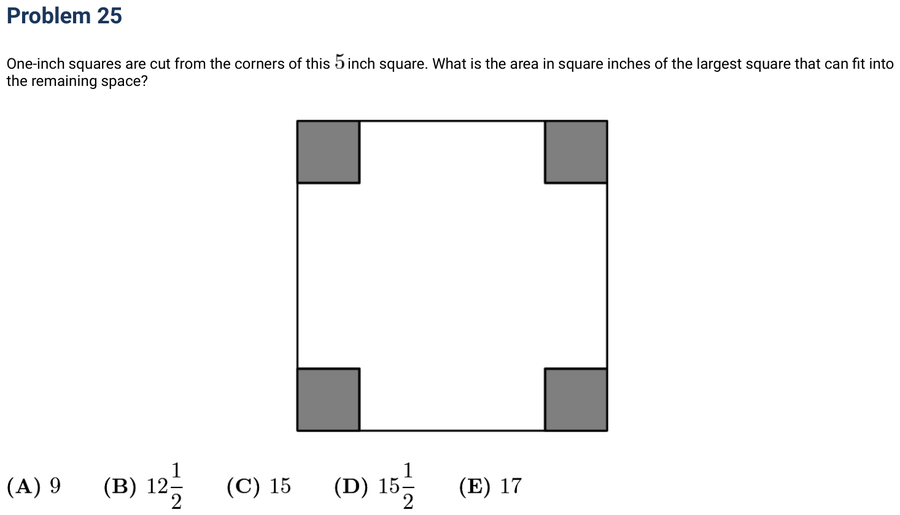
One-inch squares are cut from the corners of this 5 inch square. What is the area in square inches of the largest square that can be fit into the remaining space?
Show answer
Answer: C — Area 15.
Show hints
Hint 1 of 2
A straight (axis-aligned) square gets boxed in by the notches — it can't beat side 3 (area 9, the trap answer A). The cuts only block the corners, so a tilted square can slip its edges past them and grow larger.
Still stuck? Show hint 2 →
Hint 2 of 2
Make it as big as possible by letting each edge just graze a notch — run each side right through the inner corner of a cut square. Then don't chase the slanted side length; slice the tilted square into pieces you can measure: a central 3×3 block plus four right-triangle flaps.
Show solution
Approach: tilt so each edge grazes the notches, then decompose into a 3×3 plus 4 triangles
- Put the 5×5 on coordinates from (0,0) to (5,5); the cut unit squares sit in the four corners (the bottom-left one is [0,1]×[0,1], etc.). A straight inscribed square jams at side 3, so tilt instead.
- The largest tilted square runs each edge through the inner corners of the notches — along the bottom that's the points (1,1) and (4,1) — with its four vertices landing on the four sides of the big square (slightly off the midpoints).
- Slice it into the central axis-aligned 3×3 square [1,4]×[1,4] (area 9) plus four congruent right-triangle flaps, one hanging off each side of that 3×3.
- Each flap has a base of length 3 along a side of the 3×3 (e.g. from (1,1) to (4,1)) and an apex 1 unit out on the big square's edge — legs 3 and 1, area ½(3)(1) = 3/2.
- Total = 9 + 4·(3/2) = 9 + 6 = 15.
- Why this transfers: when a shape is blocked only at the corners, tilting escapes the obstacles; and a tilted figure is easiest to measure by cutting it into a straight square plus triangles rather than squaring a messy slanted length.
Another way — big square minus the four outside corner triangles:
- The tilted square's four vertices sit on the four sides of the 5×5, so what's left between it and the big square is four congruent right triangles, one at each corner of the 5×5.
- Along each side the two legs of a corner triangle add to 5, and they work out so each triangle's area is 5/2.
- Tilted square = 25 − 4·(5/2) = 25 − 10 = 15 — matching the decomposition above.
Mark:
· log in to save