How many square yards of carpet are required to cover a rectangular floor that is 12 feet long and 9 feet wide? (There are 3 feet in a yard.)
Show answer
Answer: A — 12 square yards.
Show hints
Hint 1 of 2
The trap is to find the area in square feet (12 × 9 = 108) and then divide by 3. But a square yard isn't 3 square feet — it's a 3-by-3 block, which is 9 square feet. Convert the lengths first, then there's nothing to undo.
Still stuck? Show hint 2 →
Hint 2 of 2
Convert each side to yards before multiplying. (General rule: change units on lengths first, then compute area or volume — never convert the answer.)
Show solution
Approach: convert the side lengths to yards first, then multiply
Convert the lengths, not the area: 12 ft = 4 yd and 9 ft = 3 yd.
Area = 4 yd × 3 yd = 12 square yards.
Why this transfers: area and volume scale by the square (or cube) of a length conversion. 1 yd = 3 ft, so 1 sq yd = 32 = 9 sq ft — which is exactly why 108 sq ft ÷ 9 = 12 sq yd also works, and matches our answer. Converting lengths first dodges that factor entirely.
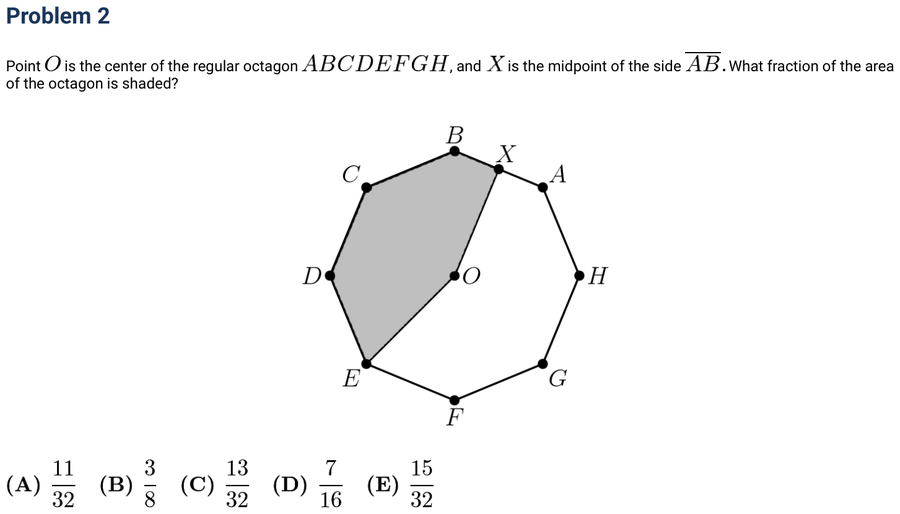
Don't try to measure the shaded shape directly. The center O is begging you to slice: draw a spoke from O to each vertex and the octagon falls into 8 identical wedges.
Still stuck? Show hint 2 →
Hint 2 of 2
Once everything is in equal pieces, the area question becomes a counting question — how many of the 8 wedges (and which half-wedges) are shaded? (A center point in a regular polygon almost always means 'cut into equal slices.')
Show solution
Approach: cut the octagon into 8 equal wedges from the center, then count
Draw a spoke from O to every vertex. A regular octagon splits into 8 congruent triangular wedges, so each wedge is exactly 1/8 of the area — now area is just bookkeeping.
The shaded region is three whole wedges (OBC, OCD, ODE) plus ▵OXB. Since X is the midpoint of AB, OX cuts wedge OAB into two equal halves, so ▵OXB is half a wedge.
Shaded = 3½ wedges out of 8 = (7/2)/8 = 7/16.
Why this transfers: a midpoint that splits a triangle off the same base line splits its area in half too (same height, half the base). That's how the half-wedge appears without any computation.
Jack and Jill are going swimming at a pool that is one mile from their house. They leave home simultaneously. Jill rides her bicycle to the pool at a constant speed of 10 miles per hour. Jack walks to the pool at a constant speed of 4 miles per hour. How many minutes before Jack does Jill arrive?
Show answer
Answer: D — 9 minutes.
Show hints
Hint 1 of 2
The distance is the same for both (1 mile), so don't compute any distance — the only thing that differs is how long each takes. Find both times, then subtract.
Still stuck? Show hint 2 →
Hint 2 of 2
Reading 'miles per hour' as 'miles per 60 minutes' turns time into a one-step division: minutes for one mile = 60 ÷ speed.
Show solution
Approach: same distance — just compare the two travel times
Both travel 1 mile, so all that matters is each person's time. At v mph one mile takes 60/v minutes (since 1 hour = 60 min).
Jill: 60/10 = 6 min. Jack: 60/4 = 15 min.
Jill arrives 15 − 6 = 9 minutes earlier.
Sanity check: Jack is slower, so he takes longer — the slower person's time should be the bigger number, and 15 > 6. ✓
The Centerville Middle School chess team consists of two boys and three girls. A photographer wants to take a picture of the team to appear in the local newspaper. She decides to have them sit in a row with a boy at each end and the three girls in the middle. How many such arrangements are possible?
Show answer
Answer: E — 12 arrangements.
Show hints
Hint 1 of 2
The seating breaks into two separate jobs that don't interfere: arrange the boys at the two ends, and arrange the girls in the three middle seats. Solve each job alone.
Still stuck? Show hint 2 →
Hint 2 of 2
When choices are independent, total = (ways for job 1) × (ways for job 2). Arranging k people in k seats has k! ways. (This is the multiplication / rule-of-product principle.)
Show solution
Approach: split into two independent jobs and multiply
The ends are boys-only and the middle is girls-only, so the two choices never collide — handle them separately.
Boys in the 2 end seats: 2! = 2 ways. Girls in the 3 middle seats: 3! = 6 ways.
By the rule of product, total = 2 × 6 = 12.
Why this transfers: any time a setup divides into independent stages, multiply the counts. The only trap is making sure the stages really don't affect each other — here they can't, since boys and girls occupy disjoint seats.
Billy's basketball team scored the following points over the course of the first 11 games of the season: 42, 47, 53, 53, 58, 58, 58, 61, 64, 65, 73. If his team scores 40 in the 12th game, which of the following statistics will show an increase?
Show answer
Answer: A — Range increases.
Show hints
Hint 1 of 2
The one new fact is that 40 sits below the old minimum of 42 — it's a new rock-bottom score. Adding a low value can't pull any average or middle up; ask which statistic actually grows when the bottom drops.
Still stuck? Show hint 2 →
Hint 2 of 2
Sort the five statistics by what they depend on: median/mean/mode react to where the bulk of the data sits, mid-range = (max+min)/2 averages the two ends, but range = max − min is the only one that widens when the minimum falls. Reason about each, don't recompute all of them.
Show solution
Approach: reason about which statistic a new low value can push up
40 is below the old low of 42, so it's the new minimum; the maximum (73) is unchanged.
Range = max − min: was 73 − 42 = 31, now 73 − 40 = 33 → increases. A wider gap is exactly what a new low creates.
Quick rule-out for the rest: mean drops (a below-average score lowers the average), median can only stay or fall (adding a small value never lifts the middle), mode stays 58, and mid-range = (max+min)/2 falls because min fell while max held.
Only the range increases. Why this transfers: before crunching numbers, sort statistics by what each one 'feels' — spread (range, mid-range) vs. center (mean, median, mode) — and a single new value usually moves only the ones it touches.
In ▵ABC, AB = BC = 29, and AC = 42. What is the area of ▵ABC?
Show answer
Answer: B — Area 420.
Show hints
Hint 1 of 2
Area needs a height, and there isn't one yet — so make one. The altitude from the apex B has a bonus property in an isosceles triangle: it lands dead center on the base, slicing the triangle into two identical right triangles.
Still stuck? Show hint 2 →
Hint 2 of 2
That gives a right triangle with hypotenuse 29 and one leg 42÷2 = 21; the height is the other leg by the Pythagorean theorem. (Spotting 21 and 29 should ring a bell — it's the 20-21-29 right triangle.)
Show solution
Approach: drop the altitude to the base; isosceles means it bisects the base
Drop the altitude from B to base AC. Because AB = BC, this altitude hits the midpoint M, so AM = 42/2 = 21 — this symmetry is the whole point, it hands you a right triangle for free.
In right ▵ABM: height BM = √(292 − 212) = √(841 − 441) = √400 = 20. (Recognizing the 20-21-29 triple skips the arithmetic entirely.)
Area = ½ · base · height = ½ · 42 · 20 = 420.
Why this transfers: an altitude to the unequal side of an isosceles triangle always bisects that side, converting any isosceles triangle into two congruent right triangles — your go-to move for its area or height.
Another way — Heron's formula (no altitude needed):
Sides 29, 29, 42 give semiperimeter s = (29 + 29 + 42)/2 = 50.
Each of two boxes contains three chips numbered 1, 2, 3. A chip is drawn randomly from each box and the numbers on the two chips are multiplied. What is the probability that their product is even?
Show answer
Answer: E — 5/9.
Show hints
Hint 1 of 2
'Even product' happens in lots of ways (either chip even is enough), but 'odd product' happens in just one tidy way: both chips must be odd. Chase the easy case.
Still stuck? Show hint 2 →
Hint 2 of 2
Compute the easy event and subtract from 1: this is complementary counting. Each box has 2 odd values out of 3, and the boxes are independent, so multiply.
Show solution
Approach: complementary counting — find P(odd) and subtract
A product is odd only when both factors are odd, while it's even in many scenarios — so the odd case is the simpler one to count.
Each box has odds {1, 3} out of {1, 2, 3}, a 2/3 chance, and the draws are independent: P(both odd) = (2/3)(2/3) = 4/9.
P(even product) = 1 − 4/9 = 5/9.
Why this transfers: 'at least one __' or 'is even/divisible' events are usually faster through the complement — count the one clean way it fails, then subtract from 1.
Another way — direct count over all 9 outcomes:
The two draws give 3 × 3 = 9 equally likely pairs.
List products: row by row they are 1,2,3 / 2,4,6 / 3,6,9. The even ones are 2,2,4,6,6 — that's 5 outcomes.
What is the smallest whole number larger than the perimeter of any triangle with a side of length 5 and a side of length 19?
Show answer
Answer: D — 48.
Show hints
Hint 1 of 2
What makes the perimeter big is the third side, and it can't grow without limit: the triangle inequality says it must stay shorter than the other two sides combined. Cap the third side and you cap the perimeter.
Still stuck? Show hint 2 →
Hint 2 of 2
The cap is a strict 'less than' — the perimeter gets as close to it as you like but never touches it. So the smallest whole number larger than every possible perimeter is exactly that boundary value (the supremum it can't reach).
Show solution
Approach: the triangle inequality caps the perimeter; find that ceiling
The third side s must satisfy s < 5 + 19 = 24 (it also needs s > 14, but the upper bound is what limits the perimeter).
Perimeter P = 5 + 19 + s < 5 + 19 + 24 = 48, and this is strict — P can creep up toward 48 (e.g. s = 23.9 gives P = 47.9) but never reach it.
Since every perimeter is below 48 yet can exceed any number under 48, the smallest whole number larger than all of them is 48.
Why this transfers: 'smallest integer greater than a quantity that approaches but never hits a bound' lands you exactly on the bound itself — the strict inequality is doing the real work.
On her first day of work, Janabel sold one widget. On day two, she sold three widgets. On day three, she sold five widgets, and on each succeeding day, she sold two more widgets than she had sold on the previous day. How many widgets in total had Janabel sold after working 20 days?
Show answer
Answer: D — 400 widgets.
Show hints
Hint 1 of 2
Write out the daily sales: 1, 3, 5, 7, … — those are exactly the odd numbers, in order. Over 20 days you're adding the first 20 odd numbers.
Still stuck? Show hint 2 →
Hint 2 of 2
There's a gem worth memorizing: the sum of the first n odd numbers is always n2 (1 = 12, 1+3 = 22, 1+3+5 = 32, …). So no long addition is needed.
Show solution
Approach: recognize the odd numbers; their running total is a perfect square
Day k sales = 2k − 1, so over 20 days the total is 1 + 3 + 5 + … + 39 — the first 20 odd numbers.
Key fact: 1 + 3 + 5 + … + (2n−1) = n2. (Picture building an n×n square one L-shaped layer at a time: each new layer adds the next odd number of unit squares.)
Total = 202 = 400.
Another way — pair the ends (Gauss pairing):
Pair first-with-last: (1 + 39), (3 + 37), (5 + 35), … Each pair sums to 40.
The 20 terms make 10 such pairs, so the total is 10 × 40 = 400.
This is the all-purpose arithmetic-series trick: sum = (number of terms) × (first + last)/2 = 20 · (1 + 39)/2 = 400.
How many integers between 1000 and 9999 have four distinct digits?
Show answer
Answer: B — 4536 integers.
Show hints
Hint 1 of 2
Build the 4-digit number one place at a time, left to right. 'Distinct' means every place must dodge the digits already used — so the menu of choices shrinks by one each step.
Still stuck? Show hint 2 →
Hint 2 of 2
Handle the trickiest restriction first: the leading digit can't be 0 (else it isn't a 4-digit number). Then multiply the choices for the four places.
Show solution
Approach: fill the places left to right; multiply the shrinking choice counts
Thousands place: 9 choices (1–9; 0 is banned as a leading digit).
Hundreds place: now 0 is allowed again, but the thousands digit is used up — that's 10 − 1 = 9 choices (the count stays 9, just for a different reason).
Tens: 8 left. Ones: 7 left.
Total = 9 × 9 × 8 × 7 = 4536.
Why this transfers: tackle the most-restricted slot first, then count the rest as 'whatever's left.' Watch the subtle coincidence here — the hundreds place is 9 because a banned-zero rule and a used-up-digit rule happen to remove one option each.
In the small country of Mathland, all automobile license plates have four symbols. The first must be a vowel (A, E, I, O, or U), the second and third must be two different letters among the 21 non-vowels, and the fourth must be a digit (0 through 9). If the symbols are chosen at random subject to these conditions, what is the probability that the plate will read "AMC8"?
Show answer
Answer: B — 1/21,000.
Show hints
Hint 1 of 2
'AMC8' is one single plate. If every allowed plate is equally likely, you don't need to do anything with AMC8 itself — just count how many plates exist in all, and the probability is 1 over that.
Still stuck? Show hint 2 →
Hint 2 of 2
Multiply the choices slot by slot, but watch slot 3: it must differ from slot 2, so it has 21 − 1 = 20 options, not 21. (One slot's count depending on an earlier slot is common in plate/seating counts.)
Show solution
Approach: count all equally likely plates; the target is just one of them
Count total plates by the rule of product, going slot by slot: 5 vowels, 21 non-vowels, then 20 (the second letter must differ from the third), then 10 digits.
'AMC8' is exactly one of those, so its probability is 1/21,000.
Why this transfers: the chance of one specific equally-likely outcome is simply 1 ÷ (number of outcomes) — the work is all in the careful count, especially the dependent slot.
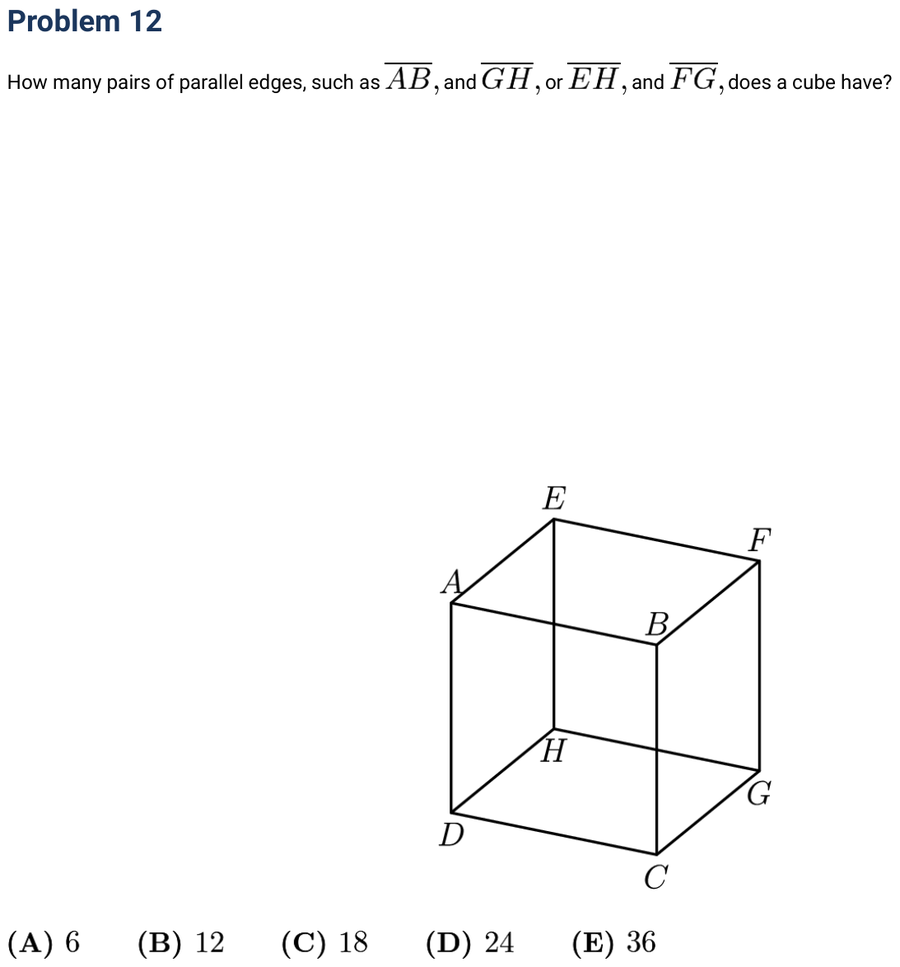
How many pairs of parallel edges, such as AB and GH, or EH and FG, does a cube have?
Show answer
Answer: C — 18 pairs.
Show hints
Hint 1 of 2
Every edge of a cube points along one of just three directions (left-right, front-back, up-down). Two edges are parallel exactly when they share a direction — so sort the 12 edges into three groups of 4 and only compare within a group.
Still stuck? Show hint 2 →
Hint 2 of 2
A 'pair' means choosing 2 of the 4 same-direction edges, with order not mattering — that's C(4,2) = 6 per group. Three groups gives the answer. (Choosing an unordered pair is the C(n,2) move; it's also why the count-each-twice method must divide by 2.)
Show solution
Approach: group edges by direction
Sort the 12 edges by direction: 3 directions, 4 parallel edges each. Parallel pairs can only form within a direction-group, so the three groups don't interact.
Within one group, a pair is any 2 of the 4 edges (order doesn't matter): C(4, 2) = 6.
Total: 3 × 6 = 18.
Why this transfers: 'how many unordered pairs share property X' → bucket the objects by X, then sum C(size, 2) over the buckets — no double counting to clean up.
Another way — double-count:
Each of the 12 edges has 3 edges parallel to it.
Total ordered pairs: 12 × 3 = 36; each unordered pair counted twice, so 36/2 = 18.
How many subsets of two elements can be removed from the set {1, 2, 3, 4, 5, 6, 7, 8, 9, 10, 11} so that the mean (average) of the remaining numbers is 6?
Show answer
Answer: D — 5 pairs.
Show hints
Hint 1 of 2
'Mean of the leftovers is 6' sounds vague, but a mean is just a total in disguise: with a known count, fixing the mean fixes the sum. So this secretly tells you the exact total the removed pair must carry away.
Still stuck? Show hint 2 →
Hint 2 of 2
Compute the starting total and the required ending total; their difference is the sum the two removed numbers must hit. Then it's pure pair-counting.
Show solution
Approach: convert the mean into a fixed sum (sum = mean × count)
Whole-set sum: 1 + 2 + … + 11 = 66. Removing 2 leaves 9 numbers, and mean 6 forces their sum to be 9 × 6 = 54.
So the two removed numbers must sum to 66 − 54 = 12 — that single number is the whole puzzle now.
Count pairs from {1, …, 11} adding to 12: {1,11}, {2,10}, {3,9}, {4,8}, {5,7} — pairing inward from the ends until they'd cross at 6. That's 5 pairs.
Why this transfers: whenever a problem fixes an average, immediately rewrite it as a sum — sums add and subtract cleanly, averages don't.
Which of the following integers cannot be written as the sum of four consecutive odd integers?
Show answer
Answer: D — 100.
Show hints
Hint 1 of 2
Don't test each answer by hunting for four odds — first ask what every such sum has in common. Add a general block of four consecutive odd integers and a hidden divisibility rule pops out.
Still stuck? Show hint 2 →
Hint 2 of 2
Writing them as n, n+2, n+4, n+6, the sum is 4n + 12 = 4(n + 3). Since n is odd, n+3 is even, so there's a second factor of 2 — the sum is always a multiple of 8. Now just find the choice that isn't.
Show solution
Approach: find the hidden invariant: the sum is always a multiple of 8
Let the four be n, n+2, n+4, n+6. Sum = 4n + 12 = 4(n + 3).
n is odd, so n + 3 is even — that even factor donates another 2, making the sum divisible by 4 × 2 = 8. So every valid sum is a multiple of 8.
Scan the choices for the odd one out: 16, 40, 72, 200 are all multiples of 8, but 100 = 8·12 + 4 is not.
Only 100 can't be made.
Why this transfers: on 'which one can't be written as …' problems, derive the form's invariant (here, divisibility) and let it disqualify the choices — far faster than constructing examples.
At Euler Middle School, 198 students voted on two issues in a school referendum with the following results: 149 voted in favor of the first issue and 119 voted in favor of the second issue. If there were exactly 29 students who voted against both issues, how many students voted in favor of both issues?
Show answer
Answer: D — 99 students.
Show hints
Hint 1 of 2
The '29 against both' is the door in: everyone else — 198 − 29 — said yes to at least one issue. That single number is what unlocks the rest.
Still stuck? Show hint 2 →
Hint 2 of 2
When you add the two 'yes' counts (149 + 119), the people who said yes to both got counted twice. Inclusion-exclusion fixes the overlap: |A ∪ B| = |A| + |B| − |A ∩ B|.
Show solution
Approach: inclusion-exclusion, after finding the 'at least one' group
Against both = 29, so everyone else voted yes to at least one issue: 198 − 29 = 169 = |A ∪ B|.
Adding 149 + 119 counts the 'both' voters twice, so 149 + 119 − |both| = 169.
|both| = 149 + 119 − 169 = 99.
Why this transfers: the moment you add two overlapping groups, you've double-counted their intersection — subtract it once. A quick Venn sketch (two circles in a box of 198) makes the bookkeeping foolproof.
In a middle-school mentoring program, a number of the sixth graders are paired with a ninth-grade student as a buddy. No ninth grader is assigned more than one sixth-grade buddy. If 13 of all the ninth graders are paired with 25 of all the sixth graders, what fraction of the total number of sixth and ninth graders have a buddy?
Show answer
Answer: B — 4/11.
Show hints
Hint 1 of 2
Buddies come in pairs, so the count of paired ninth-graders equals the count of paired sixth-graders — one body on each side of every handshake. That hidden equality links the two unknown group sizes.
Still stuck? Show hint 2 →
Hint 2 of 2
There are no actual totals given, so invent friendly ones: with no specified size, pick numbers that make both fractions land on whole people, then just count heads.
Show solution
Approach: pick concrete sizes so the fractions are whole numbers
Pairs are one-to-one, so paired ninth-graders = paired sixth-graders. Pick small numbers that make both fractions whole: ninth = 6, sixth = 5.
Then paired ninth = (1/3)(6) = 2 and paired sixth = (2/5)(5) = 2. ✓
Total students = 6 + 5 = 11. Buddied students = 2 + 2 = 4. Fraction = 4/11.
Why this transfers: when a problem gives only ratios and no totals, the answer can't depend on the actual size — so plug in the smallest sizes that make every fraction whole and read off the result.
Another way — algebra:
Let n = ninth-graders, s = sixth-graders. (1/3)n = (2/5)s ⇒ 5n = 6s.
Buddied / total = ((1/3)n + (2/5)s) / (n + s) = (2 · (1/3)n) / (n + s) (since the two numerators are equal).
Jeremy's father drives him to school in rush hour traffic in 20 minutes. One day there is no traffic, so his father can drive him 18 miles per hour faster and gets him to school in 12 minutes. How far in miles is it to school?
Show answer
Answer: D — 9 miles.
Show hints
Hint 1 of 2
The two trips cover the same distance — that's the anchor. Write that one distance two ways (each as speed × time) and set them equal; the matching distances kill the unknown distance and leave you solving for the speed.
Still stuck? Show hint 2 →
Hint 2 of 2
Turn the minutes into hours so speed × time gives miles: 20 min = 1/3 h, 12 min = 1/5 h. Then solve s · (1/3) = (s + 18) · (1/5).
Show solution
Approach: the distance is the same both days — equate the two expressions
Let the rush-hour speed be s mph. Same distance both days: s · (1/3) = (s + 18) · (1/5).
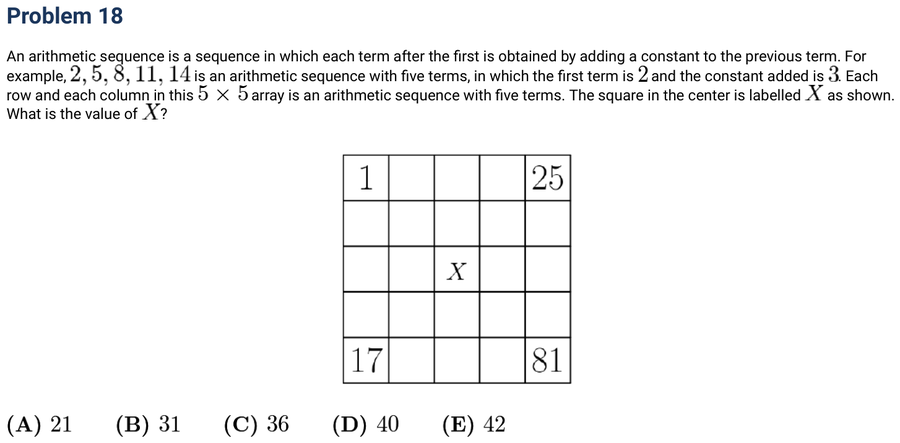
An arithmetic sequence is a sequence in which each term after the first is obtained by adding a constant to the previous term. For example, 2, 5, 8, 11, 14 is an arithmetic sequence with five terms, in which the first term is 2 and the constant added is 3. Each row and each column in this 5 × 5 array is an arithmetic sequence with five terms. The square in the center is labelled X. What is the value of X?
Show answer
Answer: B — X = 31.
Show hints
Hint 1 of 2
You don't need to fill in the whole grid. In any arithmetic sequence the middle term is just the average of the two ends — the constant step makes it sit exactly halfway. So a center value is reachable straight from outer values.
Still stuck? Show hint 2 →
Hint 2 of 2
Use that fact like stepping stones: the corners give you the middles of the top and bottom rows, and those two give you X. (Only the four corners ever matter.)
Show solution
Approach: middle term = average of the two endpoints, applied twice
Middle term = average of endpoints: top row middle = (1 + 25)/2 = 13, bottom row middle = (17 + 81)/2 = 49.
X is the middle of the center column, whose ends are those two: X = (13 + 49)/2 = 31.
Why this transfers: 'middle = average of the ends' (because the step cancels symmetrically) collapses these grid problems — you never need the interior entries.
Another way — X is the average of the four corners:
Averaging the top corners then the bottom corners then those two results is the same as averaging all four corners at once.
X = (1 + 25 + 17 + 81)/4 = 124/4 = 31 — one clean computation, no intermediate values.
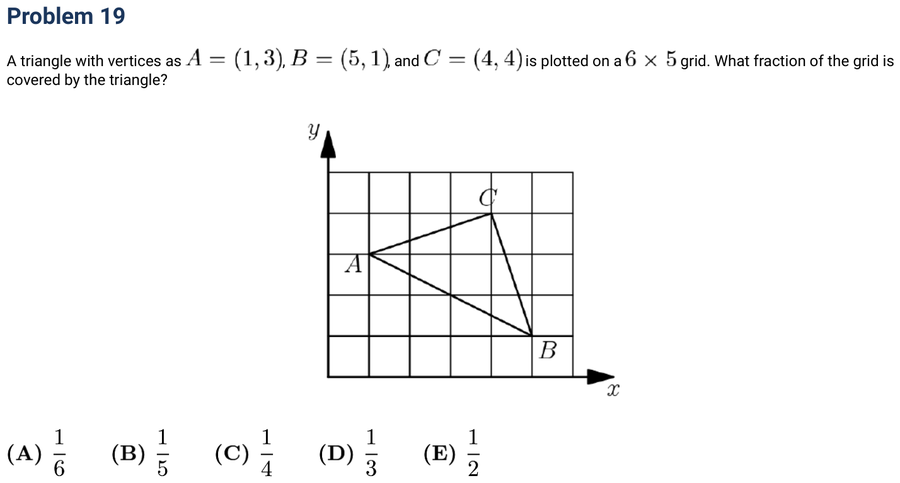
A triangle with vertices as A = (1, 3), B = (5, 1), and C = (4, 4) is plotted on a 6 × 5 grid. What fraction of the grid is covered by the triangle?
Show answer
Answer: A — 1/6.
Show hints
Hint 1 of 2
The 'fraction of the grid' is just (triangle area) ÷ (grid area), and the grid is an easy 6 × 5 = 30. So the whole problem reduces to finding one triangle's area from its coordinates.
Still stuck? Show hint 2 →
Hint 2 of 2
A tilted triangle on a grid has no obvious base or height — that's exactly when the shoelace formula shines: it gets the area straight from the three coordinate pairs, no measuring.
Show solution
Approach: shoelace formula for area from coordinates
Area = ½ |xA(yB − yC) + xB(yC − yA) + xC(yA − yB)| = ½ |1(1 − 4) + 5(4 − 3) + 4(3 − 1)| = ½ |−3 + 5 + 8| = 5.
Fraction = 5 / 30 = 1/6.
Why this transfers: shoelace turns any polygon's vertices into its area mechanically — the antidote to slanted shapes with no clean base.
Another way — bounding box minus corner triangles:
Box the triangle in the rectangle from (1,1) to (5,4): area 4 × 3 = 12.
Carve off the three right triangles in the box corners: bottom-left (legs 2 and 4) = 4, top-left (legs 1 and 3) = 1.5, top-right (legs 1 and 3) = 1.5.
Triangle = 12 − (4 + 1.5 + 1.5) = 12 − 7 = 5, so the fraction is 5/30 = 1/6. Good check on the shoelace value.
Ralph went to the store and bought 12 pairs of socks for a total of $24. Some of the socks he bought cost $1 a pair, some of the socks he bought cost $3 a pair, and some of the socks he bought cost $4 a pair. If he bought at least one pair of each type, how many pairs of $1 socks did Ralph buy?
Show answer
Answer: D — 7 pairs.
Show hints
Hint 1 of 2
Three unknowns but only two equations — that feels underdetermined, but the counts must be whole positive numbers, and that's enough. Notice a appears with the same coefficient (1) in both the count equation and the cost equation: subtract them and a vanishes.
Still stuck? Show hint 2 →
Hint 2 of 2
Subtracting leaves 2b + 3c = 12 with b, c ≥ 1. Since 2b is even and 12 is even, 3c must be even, so c is even — parity nails it down.
Show solution
Approach: eliminate a by subtracting, then use parity
Counts: a + b + c = 12. Cost: a + 3b + 4c = 24. Both have a single a, so subtract to erase it: 2b + 3c = 12.
Parity: 2b and 12 are even, forcing 3c — hence c — to be even. With at least one of each type, 0 < c < 4, so c = 2.
Back-substitute: 2b = 6 ⇒ b = 3, then a = 12 − 3 − 2 = 7.
Why this transfers: when a variable shares the same coefficient across two equations, subtract to delete it; then parity/divisibility usually finishes off the few whole-number possibilities.
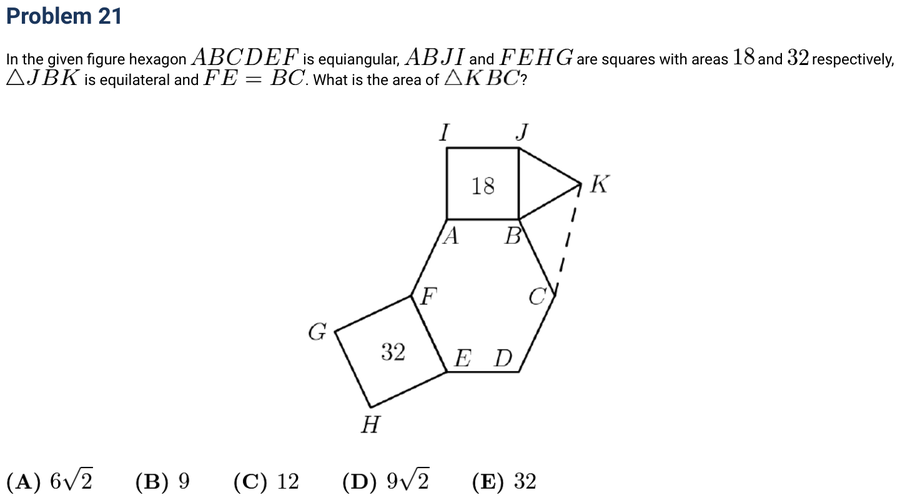
In the given figure hexagon ABCDEF is equiangular, ABJI and FEHG are squares with areas 18 and 32 respectively, ▵JBK is equilateral and FE = BC. What is the area of ▵KBC?
Show answer
Answer: C — Area 12.
Show hints
Hint 1 of 2
To get a triangle's area you need two sides and the angle between them — and B is exactly where everything meets. The squares hand you the two sides for free: a square's side is √(its area).
Still stuck? Show hint 2 →
Hint 2 of 2
For the missing angle, notice four angles fan out around point B (the square's corner, the equilateral triangle's corner, ∠KBC, and the hexagon's interior corner) and they must close up to 360°. An equiangular hexagon has every interior angle 120°, so the only unknown in that sum is ∠KBC.
Show solution
Approach: two sides from the squares + included angle from the 360° around B
Sides from the squares: BK = JB = √18 = 3√2 (square side, copied by the equilateral ▵JBK), and BC = FE = √32 = 4√2.
Angles fanning around B must total 360°: ∠ABJ (square) + ∠JBK (equilateral) + ∠KBC + ∠CBA (hexagon's 120° interior angle) = 90 + 60 + ∠KBC + 120 = 360, so ∠KBC = 90°.
With a right angle at B, the two sides are the legs: area = ½(3√2)(4√2) = ½(12·2) = 12.
Why this transfers: a vertex where several shapes meet lets you find a stubborn angle by 'going all the way around = 360°'; and the side of a square is always the square root of its area.
On June 1, a group of students is standing in rows, with 15 students in each row. On June 2, the same group is standing with all of the students in one long row. On June 3, the same group is standing with just one student in each row. On June 4, the same group is standing with 6 students in each row. This process continues through June 12 with a different number of students per row each day. However, on June 13, they cannot find a new way of organizing the students. What is the smallest possible number of students in the group?
Show answer
Answer: C — 60 students.
Show hints
Hint 1 of 2
Strip away the story: 'students per row' that divides the group evenly is just a divisor of n. Each of the 12 days uses a different one, and running out on day 13 means there are no more — so n has exactly 12 divisors.
Still stuck? Show hint 2 →
Hint 2 of 2
Two clues fix n's prime factors: it's a multiple of 15 and of 6, hence of lcm(6,15) = 30 = 2·3·5. Now use the divisor-count formula — (exponent+1) multiplied across the primes — to grow 30 into something with exactly 12 divisors, as cheaply as possible.
Show solution
Approach: translate the rows into a divisor-counting problem
A valid 'students per row' must divide n evenly, so each day is a distinct divisor. Twelve days then 'no new way' means n has exactly 12 divisors.
n is a multiple of 15 and 6, so of lcm(6,15) = 30 = 2·3·5. Its divisor count is (1+1)(1+1)(1+1) = 8 — we need 4 more.
The divisor count multiplies (exponent+1) over the primes; to push 8 up to 12 = 3·2·2, raise one exponent from 1 to 2. Doing it to the smallest prime is cheapest: 22·3·5 = 60 gives (3)(2)(2) = 12. (Bumping 3 or 5 instead gives 90 or 150 — bigger.)
Smallest n = 60.
Why this transfers: 'number of ways to arrange in equal rows' = number of divisors, and you control it through the prime exponents via the (e+1) product — to minimize the number, add the new factor to the smallest prime.
Tom has twelve slips of paper which he wants to put into five cups labeled A, B, C, D, E. He wants the sum of the numbers on the slips in each cup to be an integer. Furthermore, he wants the five integers to be consecutive and increasing from A to E. The numbers on the papers are 2, 2, 2, 2.5, 2.5, 3, 3, 3, 3, 3.5, 4, and 4.5. If a slip with 2 goes into cup E and a slip with 3 goes into cup B, then the slip with 3.5 must go into what cup?
Show answer
Answer: D — Cup D.
Show hints
Hint 1 of 3
Before worrying about the 3.5, lock down the five cup totals. The slips add to 35, and the totals are five consecutive integers — five consecutive integers summing to 35 have middle (=average) 35/5 = 7, so they're forced.
Still stuck? Show hint 2 →
Hint 2 of 3
Once the totals are A=5, B=6, C=7, D=8, E=9, use the two given placements to remove slips, then test the 3.5 in each cup: it works only if its leftover partners can hit the cup's remaining total.
Still stuck? Show hint 3 →
Hint 3 of 3
Cup B has a 3 and needs 6, so its partner is another 3; cup E has a 2 and needs 7 more. Now ask, for each cup, 'total minus 3.5 — can the remaining slips make that?'
Show solution
Approach: pin down cup totals, then place 3.5 by elimination
Sum of slips: 2+2+2+2.5+2.5+3+3+3+3+3.5+4+4.5 = 35. Five consecutive integers summing to 35 must be 5, 6, 7, 8, 9, so A=5, B=6, C=7, D=8, E=9.
B has a 3 and needs 6 total ⇒ the other slip in B is another 3.
After B = {3, 3} and the 2 in E, the slips still to place are {2, 2, 2.5, 2.5, 3, 3, 3.5, 4, 4.5}. Try the 3.5 in each remaining cup and see what its partner(s) would have to total.
A (need 5): 5 − 3.5 = 1.5 — no slip equals 1.5 and no combo of leftovers sums to 1.5. ✗
C (need 7): 7 − 3.5 = 3.5 from leftovers — no such combo without using the only 3.5. ✗
E (already has 2, need 7 more): 7 − 3.5 = 3.5 — same issue. ✗
D (need 8): 8 − 3.5 = 4.5 — pair with the 4.5 slip. ✓ The remaining slips then fill the others: A = {2.5, 2.5} = 5, C = {3, 4} = 7, and E takes {2, 2, 3} on top of its 2 for 9.
So 3.5 goes in cup D.
Why this transfers: when totals are 'consecutive integers' (or otherwise constrained), find them first from the grand sum — that collapses an open-ended placement puzzle into a small, finite check.
A baseball league consists of two four-team divisions. Each team plays every other team in its division N games. Each team plays every team in the other division M games with N > 2M and M > 4. Each team plays a 76 game schedule. How many games does a team play within its own division?
Show answer
Answer: B — 48 games.
Show hints
Hint 1 of 2
Count a team's opponents first: in a 4-team division it has 3 rivals (N games each), and the other division has 4 teams (M games each). That's the one equation: 3N + 4M = 76.
Still stuck? Show hint 2 →
Hint 2 of 2
One equation, two unknowns — the inequalities and whole-number-ness do the rest. Two squeezes work together: 'mod 3' pins M to one residue class, while N > 2M plus M > 4 traps M in a tiny range.
Show solution
Approach: build one Diophantine equation, then squeeze M with mod + bounds
Opponents: 3 division rivals at N games and 4 cross-division teams at M games ⇒ 3N + 4M = 76.
Mod 3: 3N vanishes, so 4M ≡ 76 ≡ 1, i.e. M ≡ 1 (mod 3) — M ∈ {7, 10, 13, …}.
Bound it: N > 2M gives 76 = 3N + 4M > 10M, so M < 7.6; combined with M > 4, only M = 7 survives (and it fits the mod-3 class).
Then N = (76 − 4·7)/3 = 48/3 = 16, so games within the division = 3N = 48.
Why this transfers: one equation with two whole-number unknowns isn't stuck — mod arithmetic narrows to a residue class and inequalities crop it to a single value.
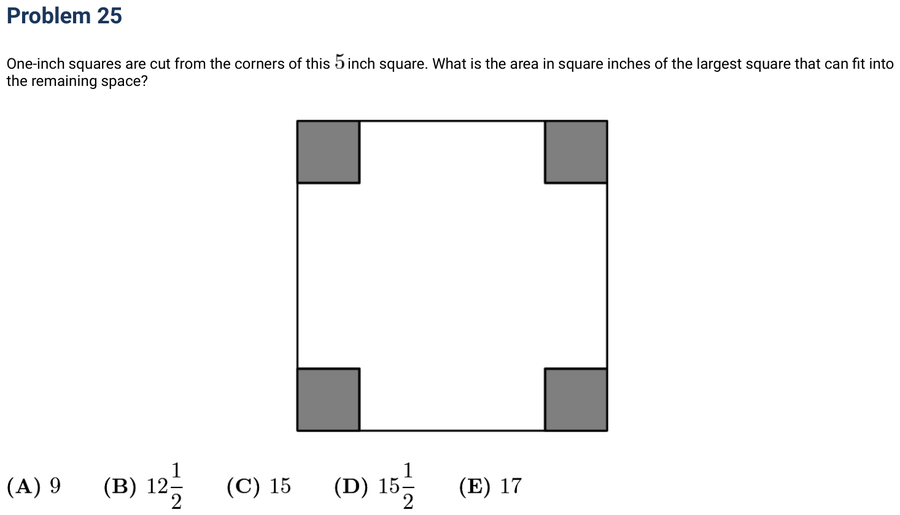
One-inch squares are cut from the corners of this 5 inch square. What is the area in square inches of the largest square that can be fit into the remaining space?
Show answer
Answer: C — Area 15.
Show hints
Hint 1 of 2
A straight (axis-aligned) square gets boxed in by the notches — it can't beat side 3 (area 9, the trap answer A). The cuts only block the corners, so a tilted square can slip its edges past them and grow larger.
Still stuck? Show hint 2 →
Hint 2 of 2
Make it as big as possible by letting each edge just graze a notch — run each side right through the inner corner of a cut square. Then don't chase the slanted side length; slice the tilted square into pieces you can measure: a central 3×3 block plus four right-triangle flaps.
Show solution
Approach: tilt so each edge grazes the notches, then decompose into a 3×3 plus 4 triangles
Put the 5×5 on coordinates from (0,0) to (5,5); the cut unit squares sit in the four corners (the bottom-left one is [0,1]×[0,1], etc.). A straight inscribed square jams at side 3, so tilt instead.
The largest tilted square runs each edge through the inner corners of the notches — along the bottom that's the points (1,1) and (4,1) — with its four vertices landing on the four sides of the big square (slightly off the midpoints).
Slice it into the central axis-aligned 3×3 square [1,4]×[1,4] (area 9) plus four congruent right-triangle flaps, one hanging off each side of that 3×3.
Each flap has a base of length 3 along a side of the 3×3 (e.g. from (1,1) to (4,1)) and an apex 1 unit out on the big square's edge — legs 3 and 1, area ½(3)(1) = 3/2.
Total = 9 + 4·(3/2) = 9 + 6 = 15.
Why this transfers: when a shape is blocked only at the corners, tilting escapes the obstacles; and a tilted figure is easiest to measure by cutting it into a straight square plus triangles rather than squaring a messy slanted length.
Another way — big square minus the four outside corner triangles:
The tilted square's four vertices sit on the four sides of the 5×5, so what's left between it and the big square is four congruent right triangles, one at each corner of the 5×5.
Along each side the two legs of a corner triangle add to 5, and they work out so each triangle's area is 5/2.