Problem 25 · 2014 AMC 8
Hard
Geometry & Measurement
semicircle-lengthscaling-by-pi-over-2
A straight one-mile stretch of highway, 40 feet wide, is closed. Robert rides his bike on a path composed of semicircles as shown. If he rides at 5 miles per hour, how many hours will it take to cover the one-mile stretch? Note: 1 mile = 5280 feet.
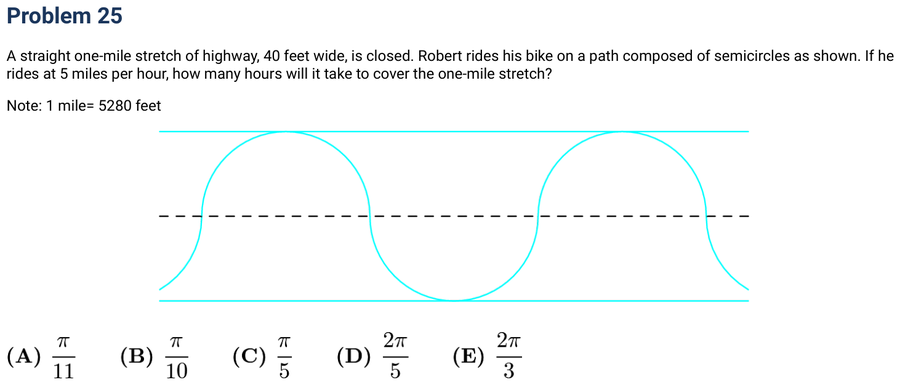
Show answer
Answer: B — π/10 hours.
Show hints
Hint 1 of 3
Don't compute how many semicircles there are — you don't need to. Each semicircle just replaces a straight diameter d with its half-circumference (π/2)d, so the curvy path is the straight path stretched by the same factor π/2, whatever the diameter.
Still stuck? Show hint 2 →
Hint 2 of 3
That means the 40-foot width and the 5280-feet conversion are red herrings — the answer is (π/2 × 1 mile) ÷ speed.
Still stuck? Show hint 3 →
Hint 3 of 3
Time = distance ÷ speed; you already know the straight mile would take 1/5 hour.
Show solution
Approach: the path is the straight distance scaled by π/2
- For a semicircle of diameter d, the curved length is half the circumference = (1/2)πd = (π/2)d — exactly π/2 times the straight diameter it sits on.
- Laid end to end, every diameter adds up to the full 1 mile, so the whole bike path = (π/2) × 1 mile = π/2 miles. (The 40-ft width and the foot conversion never enter — only the π/2 ratio matters.)
- Time = distance ÷ speed = (π/2) ÷ 5 = π/10 hours.
- Sanity check: the straight mile takes 1/5 hr; the path is π/2 ≈ 1.57 times longer, and (1/5)(π/2) = π/10 — consistent.
- Why this transfers: when a shape is built from pieces that each scale a base length by the same fixed ratio, the whole thing scales by that ratio — so you can replace the wiggly path with π/2 of the straight one and ignore the count of pieces entirely.
Mark:
· log in to save