Harry and Terry are each told to calculate 8 − (2 + 5). Harry gets the correct answer. Terry ignores the parentheses and calculates 8 − 2 + 5. If Harry's answer is H and Terry's answer is T, what is the difference H − T?
Show answer
Answer: A — −10.
Show hints
Hint 1 of 2
A minus sign in front of a parenthesis flips the sign of everything inside. Dropping the parentheses doesn't just add the 5 differently — it changes 8 − 2 − 5 into 8 − 2 + 5.
Still stuck? Show hint 2 →
Hint 2 of 2
Compute both values; the gap between them is exactly twice the number that got its sign flipped (the 5).
Show solution
Approach: subtracting a group flips every sign inside it
Harry (correct): H = 8 − (2 + 5) = 8 − 7 = 1. Subtracting the whole group means subtracting both the 2 and the 5.
Terry (drops the parentheses): T = 8 − 2 + 5 = 6 + 5 = 11. Now the 5 is added instead of subtracted.
H − T = 1 − 11 = −10.
Why this transfers: only the 5 changed roles — it went from −5 to +5, a swing of 10. That's why the answers differ by exactly 10. Whenever you remove parentheses after a minus sign, every term inside must flip.
Paul owes Paula 35 cents and has a pocket full of 5-cent coins, 10-cent coins, and 25-cent coins that he can use to pay her. What is the difference between the largest and the smallest number of coins he can use to pay her?
Show answer
Answer: E — 5 coins difference.
Show hints
Hint 1 of 2
"Most coins" and "fewest coins" are opposite greedy goals for the same total: to pile up the most, use the smallest coin every time; to use the fewest, grab the biggest coin that still fits.
Still stuck? Show hint 2 →
Hint 2 of 2
Find each count separately, then subtract.
Show solution
Approach: two opposite greedy choices
Most coins ⇒ use only the smallest coin (5 cents): 35 ÷ 5 = 7 coins.
Fewest coins ⇒ grab the largest coins first: 25 + 10 = 35 uses just 2 coins.
Difference: 7 − 2 = 5.
You'll see this again: "maximize the count" and "minimize the count" almost always mean "use the smallest pieces" vs. "use the largest pieces" — a greedy idea that works for making change, stamps, and weights.
Isabella had a week to read a book for a school assignment. She read an average of 36 pages per day for the first three days and an average of 44 pages per day for the next three days. She then finished the book by reading 10 pages on the last day. How many pages were in the book?
Show answer
Answer: B — 250 pages.
Show hints
Hint 1 of 2
An average is a stand-in for the real total: "36 pages a day for 3 days" carries the same total as 36 + 36 + 36. So average × days rebuilds each block's pages.
Still stuck? Show hint 2 →
Hint 2 of 2
Add the three blocks: first 3 days, next 3 days, and the final single day.
Show solution
Approach: average × count rebuilds each block's total
First three days: 36 × 3 = 108 pages (the average undoes back into a total).
Next three days: 44 × 3 = 132 pages.
Total: 108 + 132 + 10 = 250.
Key idea you'll reuse: total = average × count. Knowing any two of {total, average, count} gives the third — the same lever solves "find the missing test score" problems.
Six rectangles each with a common base width of 2 have lengths of 1, 4, 9, 16, 25, and 36. What is the sum of the areas of the six rectangles?
Show answer
Answer: D — 182.
Show hints
Hint 1 of 2
Every rectangle shares the same width 2, so instead of computing six areas and adding, factor the 2 out: total = 2 × (sum of all the lengths). One multiply at the end.
Still stuck? Show hint 2 →
Hint 2 of 2
Bonus: the lengths 1, 4, 9, 16, 25, 36 are the first six perfect squares.
Show solution
Approach: factor out the common width (distributive property)
All widths equal 2, so total area = 2×1 + 2×4 + … + 2×36 = 2 × (1 + 4 + 9 + 16 + 25 + 36).
The lengths are the first six squares; their sum is 91.
Total area: 2 × 91 = 182.
Why this transfers: a common factor in every term can always be pulled outside the sum — that's the distributive property doing the heavy lifting, turning six multiplications into one.
Eleven members of the Middle School Math Club each paid the same integer amount for a guest speaker to talk about problem solving at their math club meeting. In all, they paid their guest speaker $1A2. What is the missing digit A of this 3-digit number?
Show answer
Answer: D — A = 3.
Show hints
Hint 1 of 2
"11 people each paid the same whole amount" is the whole clue: the total is 11 × something, so 1A2 must be a multiple of 11.
Still stuck? Show hint 2 →
Hint 2 of 2
Test divisibility by 11 with the alternating digit sum: add every other digit, subtract the rest, and check for a multiple of 11.
Show solution
Approach: translate the word clue into a divisibility-by-11 test
Equal split among 11 people ⇒ total is a multiple of 11, so 1A2 must be divisible by 11.
Alternating sum (test for 11): 1 − A + 2 = 3 − A must be a multiple of 11.
A is one digit (0–9), so the only way 3 − A hits a multiple of 11 is 3 − A = 0, giving A = 3.
Check: 132 = 11 × 12. ✓
You'll reuse this: "n equal shares" always means "total divisible by n" — the fastest way to turn a money/sharing sentence into a number-theory condition.
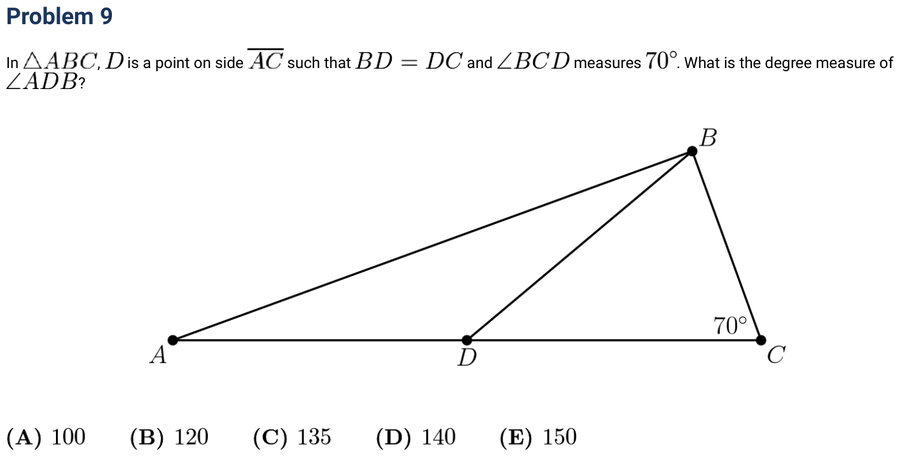
In ▵ABC, D is a point on side AC such that BD = DC and ∠BCD measures 70°. What is the degree measure of ∠ADB?
Show answer
Answer: D — 140 degrees.
Show hints
Hint 1 of 2
BD = DC makes ▵BDC isosceles, so the 70° at C is mirrored at B — you instantly get a second 70° for free.
Still stuck? Show hint 2 →
Hint 2 of 2
∠ADB sits on the straight line AC next to ▵BDC, so it's the exterior angle — equal to the sum of the two far (remote) interior angles.
Show solution
Approach: exterior angle of an isosceles triangle
BD = DC ⇒ ▵BDC is isosceles, so its base angles match: ∠DBC = ∠DCB = 70°. (Equal sides face equal angles.)
∠ADB is the exterior angle of ▵BDC at D. The exterior angle equals the sum of the two remote interior angles: 70° + 70° = 140°.
Why this transfers: the exterior-angle rule (exterior = sum of the two non-adjacent interiors) lets you skip finding the apex angle entirely — it's a shortcut worth spotting whenever an angle hangs off a straight side.
Another way — linear pair after computing the apex angle:
Base angles 70° each give apex ∠BDC = 180° − 140° = 40°. Then ∠ADB = 180° − 40° = 140°.
The first AMC 8 was given in 1985 and it has been given annually since that time. Samantha turned 12 years old the year that she took the seventh AMC 8. In what year was Samantha born?
Show answer
Answer: A — 1979.
Show hints
Hint 1 of 2
Watch the off-by-one: the 1st contest was 1985, so the 7th is only 6 years later (not 7). Add the gap, not the count.
Still stuck? Show hint 2 →
Hint 2 of 2
Once you have the year she took it, subtract her age to land on her birth year.
Show solution
Approach: fencepost-careful year arithmetic
The 7th AMC 8 is 6 gaps after the 1st: 1985 + 6 = 1991. (1st→7th is 6 steps, not 7 — the classic fencepost.)
She turned 12 that year, so she was born 1991 − 12 = 1979.
Reusable caution: the n-th item in a yearly sequence starting at year Y falls in Y + (n − 1). Counting endpoints instead of gaps is the most common slip in these problems.
Jack wants to bike from his house to Jill's house, which is located three blocks east and two blocks north of Jack's house. After biking each block, Jack can continue either east or north, but he needs to avoid a dangerous intersection one block east and one block north of his house. In how many ways can he reach Jill's house by biking a total of five blocks?
Show answer
Answer: A — 4 ways.
Show hints
Hint 1 of 2
Forbidding a point is hard to count head-on, so flip it: count all paths, then throw away the bad ones. (Count what you don't want — complementary counting.)
Still stuck? Show hint 2 →
Hint 2 of 2
A path through (1,1) splits into two independent legs: ways to reach (1,1) times ways to continue from (1,1) to the goal. Multiply them.
Show solution
Approach: total − paths through (1,1)
Total E/N paths to (3,2): choose which 2 of the 5 steps are North, C(5, 2) = 10.
Paths that hit the bad corner (1,1): (ways to reach (1,1)) × (ways from (1,1) to (3,2)) = C(2,1) × C(3,1) = 2 × 3 = 6. Multiplying works because the two legs are independent.
Allowed = total − bad = 10 − 6 = 4.
Why this transfers: "must avoid X" almost always means "all paths minus paths through X," and any path through a checkpoint factors into (reach it) × (leave it).
Another way — case split on first two moves:
To avoid (1,1) Jack's first two moves must be either EE or NN.
After EE he is at (2, 0) and needs 1 E + 2 N in some order: C(3,1) = 3 paths. After NN he is at (0, 2) and needs 3 E + 0 N: 1 path.
A magazine printed photos of three celebrities along with three photos of the celebrities as babies. The baby pictures did not identify the celebrities. Readers were asked to match each celebrity with the correct baby pictures. What is the probability that a reader guessing at random will match all three correctly?
Show answer
Answer: B — 1/6.
Show hints
Hint 1 of 2
There's exactly one correct matching, so the probability is just 1 ÷ (number of possible matchings). The whole problem is counting the orderings.
Still stuck? Show hint 2 →
Hint 2 of 2
Three baby photos can be lined up against the three celebrities in 3! ways.
Show solution
Approach: one favorable outcome over all equally likely orderings
Order the 3 baby photos against the celebrities: 3! = 6 equally likely ways.
Exactly 1 of those 6 is the all-correct matching, so probability = 1/6 = 1/6.
Reusable idea: when every arrangement is equally likely and only one wins, P(win) = 1/(total arrangements). The hard part is always the count, never the division.
Another way — match one celebrity at a time:
First celebrity: 1 of 3 baby photos is right ⇒ chance 1/3.
Given that, the second celebrity: 1 of the 2 remaining is right ⇒ chance 1/2 (and the third is then forced).
If n and m are integers and n2 + m2 is even, which of the following is impossible?
Show answer
Answer: D — n + m cannot be odd.
Show hints
Hint 1 of 2
Squaring never changes even/odd: an even number stays even when squared, an odd stays odd. So n2+m2 behaves exactly like n+m for parity — the exponents are a red herring.
Still stuck? Show hint 2 →
Hint 2 of 2
An even sum forces n and m to share parity. Now check which listed statement that rules out.
Show solution
Approach: a square keeps the parity of its base
Squaring preserves parity, so n2+m2 even means n+m is even too ⇒ n and m have the same parity (both even or both odd).
Same parity always sums to an even number, so n + m can never be odd — that's the impossible choice.
Sanity check on the others: both even (2,2) works; both odd (1,1) works; an even sum is exactly what's forced. Only "sum is odd" is impossible.
Takeaway: for parity questions you can erase squares, products, and other parity-preserving steps and just track even/odd directly.
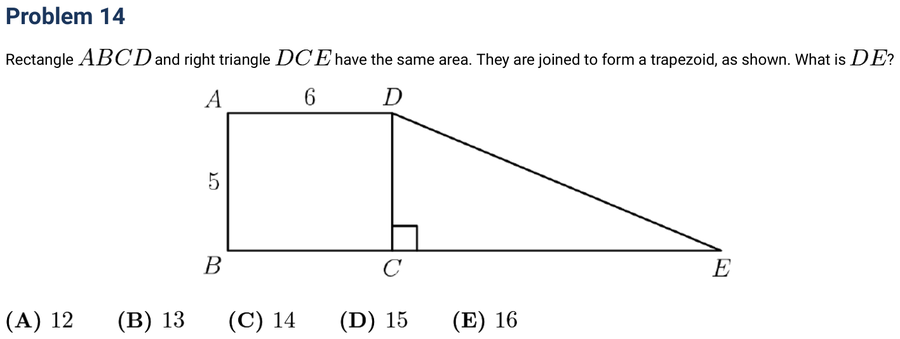
Rectangle ABCD and right triangle DCE have the same area. They are joined to form a trapezoid, as shown. What is DE?
Show answer
Answer: B — DE = 13.
Show hints
Hint 1 of 2
"Same area" is the bridge: compute the rectangle's area, then that number is the triangle's area too. The shared side DC = 5 is one leg, so the area equation hands you the other leg CE.
Still stuck? Show hint 2 →
Hint 2 of 2
With both legs known, DE is the hypotenuse — watch for a familiar Pythagorean triple before reaching for the calculator.
Show solution
Approach: transfer the area across, then Pythagoras
Rectangle area = 5 × 6 = 30. The triangle has the same area, so ▵DCE = 30.
▵DCE is right-angled at C with legs DC = 5 and CE: (1/2)(5)(CE) = 30 ⇒ CE = 12.
DE = √(52 + 122) = √169 = 13. (Recognize the 5-12-13 triple and skip the square root.)
Why this transfers: "equal areas" (or equal perimeters, equal anything) is a free equation — set the two expressions equal and an unknown pops out. And memorizing 3-4-5, 5-12-13, 8-15-17 turns many right-triangle problems into instant recall.
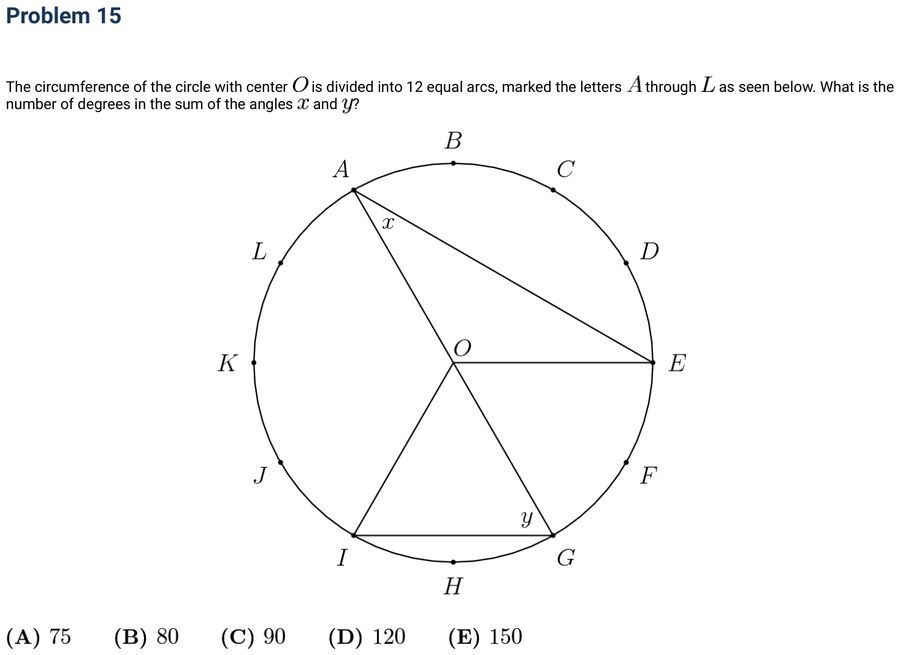
The circumference of the circle with center O is divided into 12 equal arcs, marked the letters A through L as seen below. What is the number of degrees in the sum of the angles x and y?
Show answer
Answer: C — 90 degrees.
Show hints
Hint 1 of 2
The 12 equal arcs turn the picture into a clock: each arc is 360°÷12 = 30°. Counting arcs gives you every central angle for free.
Still stuck? Show hint 2 →
Hint 2 of 2
Each marked triangle has two radii as sides, so it's isosceles — once you know the apex (central) angle, the two base angles are each (180° − apex)/2.
Show solution
Approach: central angles from arc-counting, then isosceles base angles
x sits in ▵OAE. Arc A→E spans 4 arcs, so the central angle ∠AOE = 4 × 30° = 120°. Two radii make it isosceles, so x = (180° − 120°)/2 = 30°.
y sits in ▵OIG. Arc G→I spans 2 arcs, so ∠GOI = 60° and y = (180° − 60°)/2 = 60°.
x + y = 30° + 60° = 90°.
Another way — add the central angles first, then halve:
Both x and y are base angles of isosceles triangles, so each equals (180° − its central angle)/2.
Adding: x + y = [(180° − 120°) + (180° − 60°)]/2 = (60° + 120°)/2 = 180°/2 = 90°.
Spotting that the two leftover arc-angles (120° and 60°) total 180° collapses the work to one division.
The "Middle School Eight" basketball conference has 8 teams. Every season, each team plays every other conference team twice (home and away), and each team also plays 4 games against non-conference opponents. What is the total number of games in a season involving the "Middle School Eight" teams?
Show answer
Answer: B — 88 games.
Show hints
Hint 1 of 2
The trap is double-counting: a conference game is shared by two MSE teams, but a non-conference game touches only one. Count the two kinds with different rules.
Still stuck? Show hint 2 →
Hint 2 of 2
Conference games are pairs of teams (each pair twice); non-conference games belong to a single team, so just add 8 × 4 with no halving.
Show solution
Approach: count conference pairs × 2, plus non-conference (no double-count)
Conference: number of team-pairs is C(8, 2) = 28, and each pair plays twice (home and away) ⇒ 28 × 2 = 56 games.
Non-conference: each of the 8 teams plays 4, and the opponent is outside MSE, so every such game is counted once — 8 × 4 = 32 games.
Total: 56 + 32 = 88.
Why this transfers: when both participants are inside your group, you divide by 2 (or use C(n,2)) to avoid double-counting; when only one participant is inside, you don't. Always ask "is this game shared?"
Another way — count by home games (each conference game has exactly one host):
Every conference game is hosted by exactly one team, and each team hosts the other 7 once: 8 × 7 = 56 conference games — no double-counting since "host" is unique.
George walks 1 mile to school. He leaves home at the same time each day, walks at a steady speed of 3 miles per hour, and arrives just as school begins. Today he was distracted by the pleasant weather and walked the first 12 mile at a speed of only 2 miles per hour. At how many miles per hour must George run the last 12 mile in order to arrive just as school begins today?
Show answer
Answer: B — 6 mph.
Show hints
Hint 1 of 2
Time is the fixed budget here, not speed. He must arrive at the usual moment, so his total travel time is locked at the normal value — figure that out first.
Still stuck? Show hint 2 →
Hint 2 of 2
Subtract the time the slow first half ate up; whatever's left is all he has to cover the last half-mile. Speed = distance ÷ that leftover time.
Show solution
Approach: time is the fixed budget — subtract what's spent
Normal trip: 1 mile at 3 mph takes 1/3 hr. That's the total time budget he must hit today.
Slow first half: (1/2 mile) ÷ (2 mph) = 1/4 hr used up.
Time left for the second half-mile: 1/3 − 1/4 = 4/12 − 3/12 = 1/12 hr.
Required speed = (1/2 mile) ÷ (1/12 hr) = 6 mph.
Why this transfers: in "arrive on time" problems, hold time constant and treat it as a budget. Don't average the speeds — dawdling on the first half costs disproportionately more time, which is why he must nearly triple his pace, not just speed up a little.
Four children were born at City Hospital yesterday. Assume each child is equally likely to be a boy or a girl. Which of the following outcomes is most likely?
Show answer
Answer: D — 3 of one gender and 1 of the other is most likely.
Show hints
Hint 1 of 2
Outcomes feel unequal because they're not single sequences — the fair coins are the 16 ordered strings BBBB…GGGG. Count how many strings each description sweeps up.
Still stuck? Show hint 2 →
Hint 2 of 2
Watch the hidden lump: "3 of one gender and 1 of the other" secretly covers BOTH 3 boys-1 girl AND 3 girls-1 boy, so it gathers twice as many strings as you'd guess.
Show solution
Approach: count favorable sequences out of 16
All 16 birth orders are equally likely; count how many each option covers. All 4 boys: 1 string. All 4 girls: 1 string.
2-and-2: choose which 2 of the 4 are girls, C(4, 2) = 6 strings.
Largest count is 3 of one gender, 1 of the other with 8 strings (and 1 + 1 + 6 + 8 = 16 — check, all cases accounted for).
Why this transfers: "most likely" means "covers the most equally-likely outcomes," and an option phrased as "k of one, the rest of the other" quietly bundles two binomial counts. The counts 1, 4, 6, 4, 1 are row 4 of Pascal's triangle.
A cube with 3-inch edges is to be constructed from 27 smaller cubes with 1-inch edges. Twenty-one of the cubes are colored red and 6 are colored white. If the 3-inch cube is constructed to have the smallest possible white surface area showing, what fraction of the surface area is white?
Show answer
Answer: A — 5/54.
Show hints
Hint 1 of 2
Not all 27 positions are equal: a unit cube shows 3 faces at a corner, 2 on an edge, 1 in the middle of a face, and 0 in the dead center. To hide white, fill the lowest-exposure slots first.
Still stuck? Show hint 2 →
Hint 2 of 2
There's exactly one 0-face slot (center) and six 1-face slots (face-centers) — just enough for the 6 white cubes. Then divide the visible white by the total surface 6 × 9 = 54.
Show solution
Approach: greedily put white cubes in the least-exposed positions
Rank positions by faces showing: center (0), 6 face-centers (1 each), 12 edges (2 each), 8 corners (3 each). White should claim the cheapest slots.
Put 1 white cube in the dead center (0 faces show) and the other 5 in face-centers (1 face each) ⇒ only 5 white faces are visible — the smallest possible.
Total surface area = 6 faces × 32 = 54 unit squares.
White fraction = 5/54.
Why this transfers: minimizing or maximizing exposure on a cube always comes down to sorting positions by how many faces show — corners are expensive, the center is free — then filling greedily.
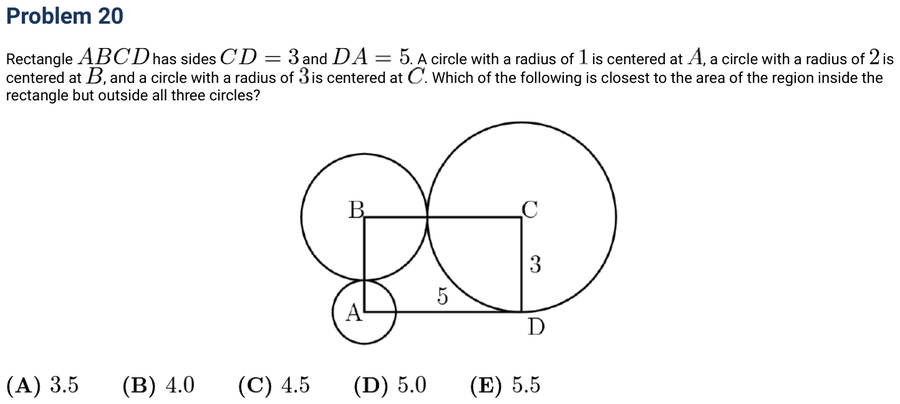
Rectangle ABCD has sides CD = 3 and DA = 5. A circle of radius 1 is centered at A, a circle of radius 2 is centered at B, and a circle of radius 3 is centered at C. Which of the following is closest to the area of the region inside the rectangle but outside all three circles?
Show answer
Answer: B — 4.0.
Show hints
Hint 1 of 3
Each circle is centered at a corner of the rectangle — and a corner is a 90° right angle. What fraction of a full circle does a 90° wedge capture? That fraction of each circle is the only part inside the rectangle.
Still stuck? Show hint 2 →
Hint 2 of 3
So you don't subtract three whole circles — you subtract a quarter of each: area = rectangle − (¼)(sum of the three circle areas).
Still stuck? Show hint 3 →
Hint 3 of 3
The radii (1, 2, 3) all fit without the quarters overlapping, so just add πr2/4 for each.
Show solution
Approach: a corner captures exactly one quarter of each circle
Each circle sits at a corner, where the two rectangle sides meet at 90°. A 90° angle is ¼ of the full 360°, so exactly one quarter of each circle pokes into the rectangle.
Region outside all circles = rectangle − quarters = (3 × 5) − 7π/2 = 15 − 7π/2.
7π/2 ≈ 7(3.14)/2 ≈ 11.0, so the answer ≈ 15 − 11.0 = 4.0.
Spot it next time: a circle centered at a polygon's corner always contributes a wedge equal to (corner angle ÷ 360°) of the circle — quarter at a square corner, third at an equilateral-triangle corner, and the three corner-angles of any triangle even sum to a half-circle.
Another way — estimate with π ≈ 22/7:
Quarters total 7π/2. Using π ≈ 22/7: (7/2)(22/7) = 11 exactly.
Rectangle 15 − 11 = 4.0 — the 22/7 estimate lands the multiple-choice answer with no decimals.
The 7-digit numbers 74A52B1 and 326AB4C are each multiples of 3. Which of the following could be the value of C?
Show answer
Answer: A — C = 1.
Show hints
Hint 1 of 2
You can't find A and B individually — and you don't need to. Both numbers share the same A + B, so write each divisibility-by-3 condition and subtract them to cancel A + B entirely.
Still stuck? Show hint 2 →
Hint 2 of 2
What's left is a single condition on C mod 3. Only one answer choice fits.
Show solution
Approach: subtract the two digit-sum conditions so the shared A+B cancels
Divisibility by 3 = digit sum divisible by 3. First number: 7+4+5+2+1 = 19, so 19 + A + B ≡ 0 ⇒ A + B ≡ 2 (mod 3).
Second number: 3+2+6+4 = 15, so 15 + A + B + C ≡ 0 ⇒ A + B + C ≡ 0 (mod 3).
Subtract the first from the second: the A + B cancels, leaving C ≡ −2 ≡ 1 (mod 3).
Among the choices {1, 2, 3, 5, 8}, only C = 1 is ≡ 1 (mod 3).
Why this transfers: when an unknown blocks two equations the same way, subtract to eliminate it — the same move that solves systems of equations works on mod conditions too.
A 2-digit number is such that the product of the digits plus the sum of the digits is equal to the number. What is the units digit of the number?
Show answer
Answer: E — Units digit 9.
Show hints
Hint 1 of 2
The notice is that "digits" means place value: a 2-digit number is 10×(tens) + (units). Write the condition that way and watch how much cancels.
Still stuck? Show hint 2 →
Hint 2 of 2
The units digit b appears on both sides and vanishes; so does most of the rest, leaving a tiny equation that pins down one digit.
Show solution
Approach: place value, then cancel
Write the number as 10a + b (tens digit a, units digit b). The condition "product + sum = number" becomes ab + a + b = 10a + b.
The b on each side cancels, leaving ab = 9a.
Since a ≠ 0 (it's the leading digit), divide by a: b = 9. The units digit is forced — the tens digit can be anything.
Check: 1·9 + 1 + 9 = 19 ✓ (and 29, 39, … all work too).
Why this transfers: turning "the digits" into 10a + b converts a word puzzle into algebra, and the magic here is that the answer doesn't depend on a at all — a sign the question only ever cared about the units digit.
Three members of the Euclid Middle School girls' softball team had the following conversation. Ashley: I just realized that our uniform numbers are all 2-digit primes. Bethany: And the sum of your two uniform numbers is the date of my birthday earlier this month. Caitlin: That's funny. The sum of your two uniform numbers is the date of my birthday later this month. Ashley: And the sum of your two uniform numbers is today's date. What number does Caitlin wear?
Show answer
Answer: A — 11.
Show hints
Hint 1 of 3
The dates do double duty as ordering clues: every pairwise sum is a calendar date (1–31), and the words "earlier" / "later" / "today" rank those three sums smallest < middle < largest.
Still stuck? Show hint 2 →
Hint 2 of 3
Sums ≤ 31 squeeze the three primes down to a tiny list — find a triple of two-digit primes whose three pairwise sums all fit and are distinct.
Still stuck? Show hint 3 →
Hint 3 of 3
Each girl names the sum of the OTHER two. So the girl with the largest sum-of-others must herself be the smallest number — the big two are added without her.
Show solution
Approach: shrink the prime list, then use date order to rank the sums
Each pairwise sum is a date ≤ 31. Two-digit primes are 11, 13, 17, 19, 23, 29, but any pair using 23 or 29 overshoots 31, so the three numbers come from {11, 13, 17, 19}.
Pick a triple with three distinct sums: {11, 13, 17} gives 11+13 = 24, 11+17 = 28, 13+17 = 30 — all distinct and ≤ 31. ✓
Order the clues: Bethany's date (earlier) is the smallest sum 24, today is the middle 28, Caitlin's date (later) is the largest 30. Each girl quotes the sum of the OTHER two.
Caitlin's date = 30 = sum of the other two = Ashley + Bethany, so Ashley and Bethany are the two larger numbers {13, 17}, leaving Caitlin = 11.
Cross-check: Bethany's date 24 = Ashley + Caitlin = Ashley + 11 ⇒ Ashley = 13, so Bethany = 17, and today = Ashley + Bethany... wait, today = Bethany + Caitlin = 17 + 11 = 28. ✓ All three statements hold.
Caitlin wears 11.
Why this transfers: when each clue references "the others," the person tied to the biggest total is the one left out of it — so largest sum-of-others ↔ smallest own value. Spotting that inverse ordering cracks many "sum of the other two" puzzles.
One day the Beverage Barn sold 252 cans of soda to 100 customers, and every customer bought at least one can of soda. What is the maximum possible median number of cans of soda bought per customer on that day?
Show answer
Answer: C — 3.5.
Show hints
Hint 1 of 3
The median of 100 sorted values only looks at the 50th and 51st. Everything below the 50th is dead weight you control — so spend as few cans as possible there to free up cans for the middle.
Still stuck? Show hint 2 →
Hint 2 of 3
"At least one each" means the floor is 1, so set the bottom 49 customers to 1 can. That's the cheapest legal way to clear them out of the way.
Still stuck? Show hint 3 →
Hint 3 of 3
Now push the 50th and 51st as high as the leftover cans allow, remembering every customer above the 50th must be ≥ the 50th's value.
Show solution
Approach: minimize the first 49, push the median pair as high as possible
The median of 100 sorted counts is the average of the 50th and 51st. To maximize it, minimize everyone below: set customers 1–49 to the legal minimum of 1 can each (uses 49 cans, leaves 252 − 49 = 203 for the top 51).
Let the 50th count be a and the 51st be b with a ≤ b. To spend the fewest cans above the median, make customers 51–100 all equal to b. Then the last 51 use a + 50b ≤ 203.
Push b up. b = 4: need a + 200 ≤ 203 ⇒ a ≤ 3, so take a = 3 (and 3 ≤ 4 ✓). Median = (3 + 4)/2 = 3.5.
b = 5 would need a + 250 ≤ 203 — impossible, so 3.5 is the ceiling.
Why this transfers: to maximize a median, starve the bottom half down to the minimum so the saved resource can lift the two middle values — the same "rob the cheap end to fund the position you care about" trick appears all over optimization problems.
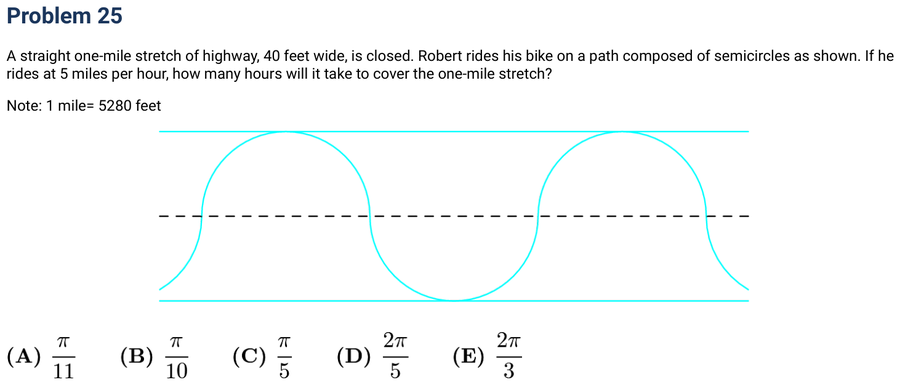
A straight one-mile stretch of highway, 40 feet wide, is closed. Robert rides his bike on a path composed of semicircles as shown. If he rides at 5 miles per hour, how many hours will it take to cover the one-mile stretch? Note: 1 mile = 5280 feet.
Show answer
Answer: B — π/10 hours.
Show hints
Hint 1 of 3
Don't compute how many semicircles there are — you don't need to. Each semicircle just replaces a straight diameter d with its half-circumference (π/2)d, so the curvy path is the straight path stretched by the same factor π/2, whatever the diameter.
Still stuck? Show hint 2 →
Hint 2 of 3
That means the 40-foot width and the 5280-feet conversion are red herrings — the answer is (π/2 × 1 mile) ÷ speed.
Still stuck? Show hint 3 →
Hint 3 of 3
Time = distance ÷ speed; you already know the straight mile would take 1/5 hour.
Show solution
Approach: the path is the straight distance scaled by π/2
For a semicircle of diameter d, the curved length is half the circumference = (1/2)πd = (π/2)d — exactly π/2 times the straight diameter it sits on.
Laid end to end, every diameter adds up to the full 1 mile, so the whole bike path = (π/2) × 1 mile = π/2 miles. (The 40-ft width and the foot conversion never enter — only the π/2 ratio matters.)
Time = distance ÷ speed = (π/2) ÷ 5 = π/10 hours.
Sanity check: the straight mile takes 1/5 hr; the path is π/2 ≈ 1.57 times longer, and (1/5)(π/2) = π/10 — consistent.
Why this transfers: when a shape is built from pieces that each scale a base length by the same fixed ratio, the whole thing scales by that ratio — so you can replace the wiggly path with π/2 of the straight one and ignore the count of pieces entirely.