Problem 25 · 2004 AMC 8
Hard
Geometry & Measurement
union-and-subtraction
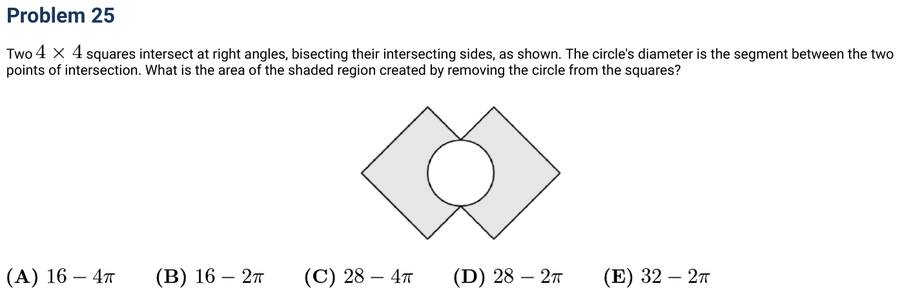
Two 4 × 4 squares intersect at right angles, bisecting their intersecting sides, as shown. The circle's diameter is the segment between the two points of intersection. What is the area of the shaded region created by removing the circle from the squares?
Show answer
Answer: D — 28 − 2π.
Show hints
Hint 1 of 3
The shaded area is 'both squares, minus the circle'. The trap is double-counting the overlap, so first nail the combined area of the two squares using inclusion–exclusion: square + square − the piece they share.
Still stuck? Show hint 2 →
Hint 2 of 3
The shared piece is the small square where they cross. 'Bisecting their intersecting sides' means each square is cut at the midpoints of those sides, so the overlap is a 2×2 square (area 4).
Still stuck? Show hint 3 →
Hint 3 of 3
For the circle, the diameter is the segment joining the two crossing points — that's the diagonal of the 2×2 overlap square. Diagonal = 2√2, so radius = √2.
Show solution
Approach: inclusion–exclusion, then subtract the circle
- Combined area of the two squares (avoid double-counting the middle): 16 + 16 − (overlap). The overlap is a 2×2 square because the squares meet at the midpoints of the crossed sides, so overlap = 4. Combined region = 16 + 16 − 4 = 28.
- Circle: its diameter is the diagonal of that 2×2 overlap square = 2√2, so radius = √2 and area = π(√2)² = 2π.
- Shaded = combined region − circle = 28 − 2π.
- Why these two ideas pair up so often: inclusion–exclusion (add the parts, subtract the shared piece once) handles the overlapping squares, and the √2 comes from a square's diagonal — both are workhorses you'll reuse constantly. Estimate check: 2π ≈ 6.3, so the shaded area is about 28 − 6.3 ≈ 21.7, comfortably less than the 28 of squares alone.
Mark:
· log in to save