Problem 24 · 2004 AMC 8
Hard
Geometry & Measurement
parallelogram-area-as-base-times-height
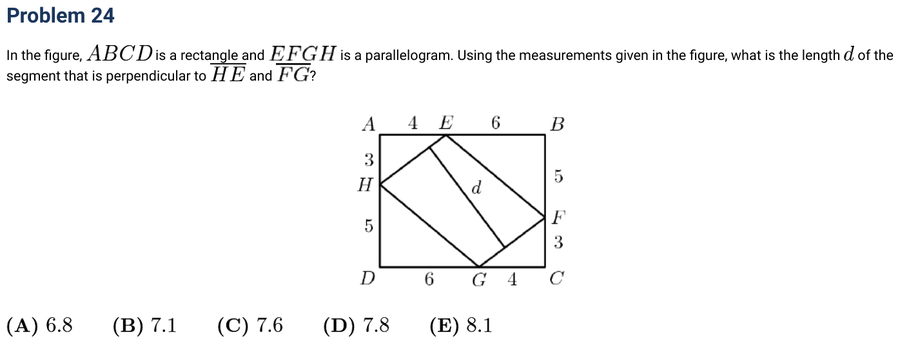
In the figure, ABCD is a rectangle and EFGH is a parallelogram. Using the measurements given in the figure, what is the length d of the segment that is perpendicular to HE and FG?
Show answer
Answer: C — 7.6.
Show hints
Hint 1 of 3
There's no direct way to measure that slanted height d. But d is the parallelogram's height on base HE, so if you knew the parallelogram's area, you'd get d = area ÷ base. So the real task is: find the parallelogram's area.
Still stuck? Show hint 2 →
Hint 2 of 3
The strategy is area two ways: get the parallelogram's area the easy way (whole rectangle minus the four corner right-triangles), then set it equal to base × height to solve for the height you actually want.
Still stuck? Show hint 3 →
Hint 3 of 3
The base HE is the hypotenuse of a 3-4 right triangle in the corner, so HE = 5 — a clean Pythagorean leg-up before you divide.
Show solution
Approach: area two ways → height = area / base
- Find the parallelogram's area by subtraction. The rectangle is 10 wide (4 + 6) by 8 tall (3 + 5), area 80. The four corner triangles cut off are right triangles: top-left legs 4×3 (area 6), top-right 6×5 (area 15), bottom-right 4×3 (area 6), bottom-left 6×5 (area 15) — total 6 + 15 + 6 + 15 = 42.
- So parallelogram EFGH has area 80 − 42 = 38.
- Now use area = base × height with base HE = √(3² + 4²) = 5: 38 = 5d, so d = 38 ÷ 5 = 7.6.
- Why this transfers: when a length is awkward to measure directly, compute the same area by an easy route, then back the length out of area = base × height. Sanity check: the height should be shorter than the rectangle's 8, and 7.6 < 8.
Mark:
· log in to save