Problem 22 · 2003 AMC 8
Stretch
Geometry & Measurement
areaarea-decomposition
Show answer
Answer: C — C only.
Show hints
Hint 1 of 2
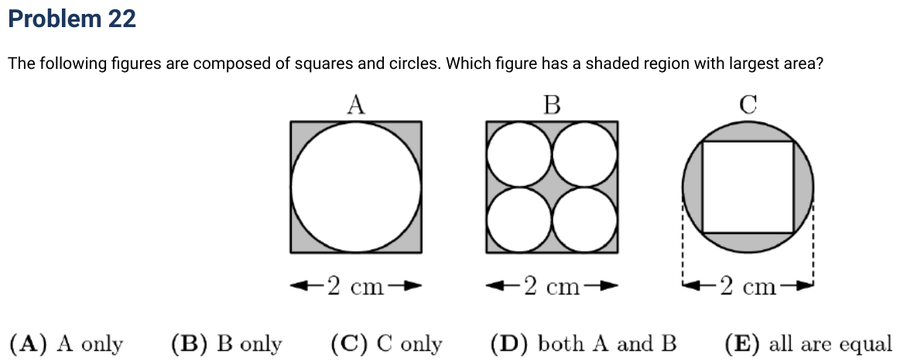
Before computing, notice A's one circle and B's four circles cover the SAME total area in the same square — so A and B must tie, and the real contest is C.
Still stuck? Show hint 2 →
Hint 2 of 2
In C the square is inscribed in the circle, so the square's diagonal equals the circle's diameter — that's how you get the square's size.
Show solution
Approach: compare the three shaded areas (each is "whole minus a circle/square")
- A: a 2×2 square (area 4) minus its inscribed circle (radius 1, area π) = 4 − π ≈ 0.86.
- B: the same 2×2 square minus four circles of radius ½. Each has area π/4, so four total π — the same circle area as in A. Shaded = 4 − π ≈ 0.86, tied with A. (Shrinking one circle into four smaller ones that fill the same span doesn't change the leftover.)
- C: a circle minus an inscribed square. The square's diagonal equals the diameter, 2, and a square's area is ½(diagonal)² = ½(2)² = 2. The circle has radius 1, area π. Shaded = π − 2 ≈ 1.14.
- 0.86, 0.86, 1.14 — C wins, so the answer is C only.
- Worth keeping: a square's area straight from its diagonal d is ½d² (no need to find the side first). And spotting that A and B share the same circle area kills two of three computations before you start.
Mark:
· log in to save