Problem 21 · 2003 AMC 8
Stretch
Geometry & Measurement
pythagorean-triplearea-decomposition
Show answer
Answer: B — BC = 10 cm.
Show hints
Hint 1 of 2
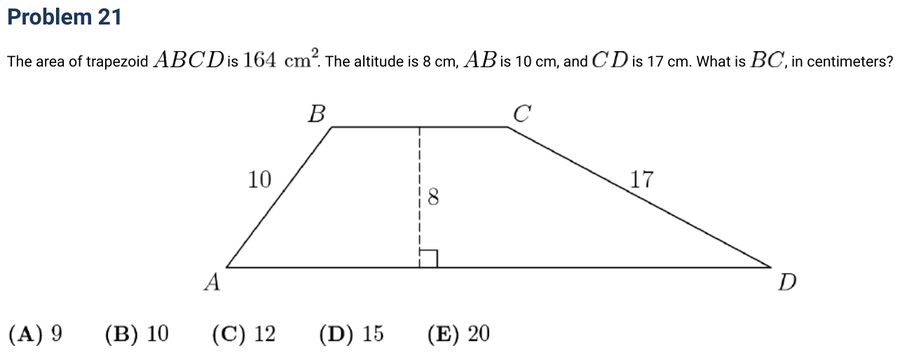
The slanted legs hide right triangles — drop a vertical from each top corner to the bottom side and the 8-cm altitude becomes a shared leg.
Still stuck? Show hint 2 →
Hint 2 of 2
A leg of 10 with height 8 is a 6-8-10 triangle; a leg of 17 with height 8 is an 8-15-17 triangle. Those triples hand you the horizontal overhangs for free.
Show solution
Approach: drop the legs into right triangles, then let the area equation finish it
- Drop perpendiculars from B and C straight down to the long side AD; both have length 8 (the altitude). Each slanted leg is now the hypotenuse of a right triangle. AB = 10 with a vertical leg of 8 is a 6-8-10 triangle, so its base is 6. CD = 17 with a vertical leg of 8 is an 8-15-17 triangle, so its base is 15.
- The bottom AD is the top BC plus those two overhangs: AD = BC + 6 + 15 = BC + 21.
- The area gives the second relation. Trapezoid area = ½(sum of parallel sides)(height): ½(BC + AD)(8) = 164, so BC + AD = 41.
- Substitute: BC + (BC + 21) = 41 → 2·BC = 20 → BC = 10.
- You'll see this again: recognizing 6-8-10 and 8-15-17 turns "find the missing horizontal piece" into instant recall — no Pythagorean square-rooting. The trapezoid then becomes one length equation plus one area equation.
Another way — average-of-parallel-sides shortcut:
- The two overhangs (6 and 15) total 21, so AD is exactly 21 longer than BC. Their average — the trapezoid's "midline" — is BC + 10.5.
- Area = midline × height = (BC + 10.5) × 8 = 164, so BC + 10.5 = 20.5.
- Therefore BC = 10.
Mark:
· log in to save