Problem 22 · 2017 AMC 8
Hard
Geometry & Measurement
pythagorean-triplearea
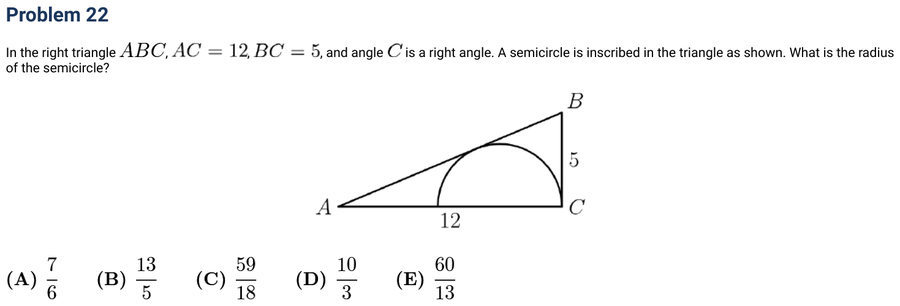
Show answer
Answer: D — r = 10/3.
Show hints
Hint 1 of 2
Side BC isn't just a leg — it's a tangent to the semicircle, and so is the hypotenuse. The two-tangents-from-a-point rule means the lengths from B match: BD = BC = 5, which slices the hypotenuse into 5 + 8.
Still stuck? Show hint 2 →
Hint 2 of 2
Drop the radius to the tangent point D — it's perpendicular to AB. That little right triangle ▵ADO is similar to the big ▵ACB (shared angle A), so r/AD = BC/AC.
Show solution
Approach: equal tangents + similar triangles
- First the hypotenuse: AB = √(122 + 52) = 13. Let O be the center (on leg AC) and D the point where the curve touches AB.
- Both leg BC and hypotenuse AB are tangent lines from B, so they have equal tangent length: BD = BC = 5. Hence AD = 13 − 5 = 8. This equal-tangents step is the unlock — it turns the picture into known lengths.
- The radius OD is perpendicular to the tangent AB, so ▵ADO (right angle at D) is similar to ▵ACB (right angle at C), sharing angle A. Matching legs: rAD = BCAC ⇒ r8 = 512.
- r = 40/12 = 10/3.
- Why this transfers: 'a radius drawn to a tangent point is perpendicular' plus 'tangents from one external point are equal' are the two workhorse facts for almost every inscribed-circle problem.
Another way — coordinates and distance to a line:
- Put C = (0,0), A = (12,0), B = (0,5). The diameter sits on AC with its right end at C, so the center is O = (r, 0) and the radius is r.
- Line AB is 5x + 12y − 60 = 0. The semicircle is tangent to AB, so the distance from O to that line equals r: (60 − 5r)/13 = r.
- Then 60 − 5r = 13r ⇒ 18r = 60 ⇒ r = 10/3 — same answer with no similar-triangle setup, just the point-to-line distance formula.
Mark:
· log in to save