Problem 22 · 2024 AMC 8
Hard
Geometry & Measurement
areaarea-decomposition
Show answer
Answer: B — About 600 inches.
Show hints
Hint 1 of 2
Forget the spiral entirely. The tape is the SAME material whether coiled or unrolled, so its cross-section area is conserved. Unrolled, that area is just length × thickness.
Still stuck? Show hint 2 →
Hint 2 of 2
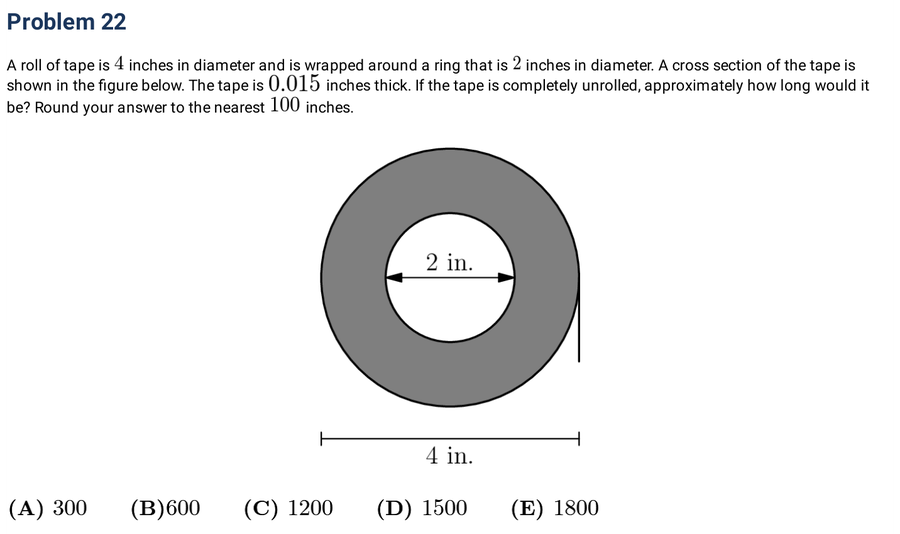
Technique (conserve the cross-section area): the coiled tape fills the ring between the inner and outer circles. Ring area = length × thickness. Ring = π(R2 − r2), with R = 2, r = 1 (radii, half the diameters).
Show solution
Approach: the ring's area equals length × thickness
- The slick idea: coiling doesn't change how much tape there is, so the cross-section area is the same coiled or flat. Flat, the tape is a thin strip of length L and thickness 0.015 in — area = 0.015L.
- Coiled, that same cross-section is the ring between outer radius 2 (diameter 4) and inner radius 1 (diameter 2): area = π(22 − 12) = 3π.
- Set them equal: 0.015L = 3π → L = 3π0.015 = 200π ≈ 628 in, rounding to 600. This transfers: for anything rolled, folded, or melted, the AREA (or volume) is conserved — equate "before" and "after" instead of tracing the shape.
Another way — layers × average circumference (MAA estimate):
- The roll's wall is 1 inch thick (radius 2 minus radius 1), and each wrap is 0.015 in, so there are about 1 ÷ 0.015 ≈ 67 layers.
- A layer's circumference runs from 2π (inner) to 4π (outer), averaging 3π. Total length ≈ 67 × 3π ≈ 200π ≈ 628 → 600. Same answer, by averaging the loops instead of conserving area.
Mark:
· log in to save