The question wants only the LAST digit. So why compute all six? What's the smallest piece of each number you actually need?
Still stuck? Show hint 2 →
Hint 2 of 2
Technique: for any "ones digit of…" question, work only in the ones column. Here every number ends in 2 — that's all that matters.
Show solution
Approach: only the ones digit matters
The question asks for ONE digit, so do ONE digit of arithmetic. Every number ends in 2, and there are five being subtracted, so their ones digits remove 5 × 2 = 10 — an amount ending in 0.
Taking away something ending in 0 never disturbs a ones digit: 222,222 keeps its 2. This transfers: for any "last digit of…" question, throw away every higher place and work only in the ones column.
Sanity check: the true value is 222,222 − 24,690 = 197,532 — ones digit 2, as predicted.
Another way — keep the intermediate positive (MAA):
Look only at the last two digits so the running total never goes negative: 22 − 2 − 2 − 2 − 2 − 2.
What is the value of this expression in decimal form?
4411 + 11044 + 441100
Show answer
Answer: C — 6.54.
Show hints
Hint 1 of 2
Before finding a common denominator, glance at each fraction alone — do any of them just collapse to a clean number?
Still stuck? Show hint 2 →
Hint 2 of 2
Each one simplifies on its own (every part hides a factor of 11). Turn each into a decimal, then add.
Show solution
Approach: simplify each fraction, then add
Don't reach for a common denominator — each fraction simplifies to a clean decimal on its own, so just turn them one at a time. 4411 = 4.
11044 = 52 = 2.5 (cancel 22).
441100 = 4100 = 0.04 (cancel 11).
Add: 4 + 2.5 + 0.04 = 6.54. Sanity check: answers near 6.5 should sit just above 6.5 once the tiny 0.04 is added — rules out 6.4 and 6.9.
Another way — pull out the shared 11 first (MAA):
Every numerator and denominator carries a factor of 11. Spotting that turns 44, 110, 1100 into 4×11, 10×11, 100×11 — the 11's cancel before you divide.
You're left with 41 + 104 + 4100 = 4 + 2.5 + 0.04 = 6.54.
Four squares of side lengths 4, 7, 9, and 10 units are arranged in increasing size order so that their left edges and bottom edges align. The squares alternate in the color pattern white-gray-white-gray, respectively, as shown in the figure. What is the area of the visible gray region, in square units?
Sides 4, 7, 9, 10 share a bottom-left corner; smaller squares lie on top.
Show answer
Answer: E — 52 square units.
Show hints
Hint 1 of 2
You never see a whole gray square — a smaller one always sits on its bottom-left corner. So what shape is the gray you actually see, and how would you find its area?
Still stuck? Show hint 2 →
Hint 2 of 2
Technique: each visible gray piece = (its square) − (the square on top). And a2 − b2 = (a+b)(a−b) makes 102−92 = 19 instantly — no squaring.
Show solution
Approach: frame = outer square minus the one on top (difference of squares)
The insight: you never see a whole gray square — a smaller white square always sits on top, leaving only an L-shaped frame. So gray visible = (gray square's area) − (the square covering it).
Gray 10 under white 9: 102 − 92. Instead of 100 − 81, use a2 − b2 = (a+b)(a−b) = 19×1 = 19 — no big subtraction.
Gray 7 under white 4: 72 − 42 = (7+4)(7−4) = 11×3 = 33.
Add the two frames: 19 + 33 = 52. You'll see it again: any time two squares (or any two areas) sit one inside the other, the leftover is their difference — and difference-of-squares makes consecutive sizes like 10 and 9 collapse to just their sum.
Another way — alternating add and subtract (MAA):
The visible gray is the 10-square minus the 9-square plus the 7-square minus the 4-square: 100 − 81 + 49 − 16.
When Yunji added all the integers from 1 to 9, she mistakenly left out a number. Her incorrect sum turned out to be a square number. What number did Yunji leave out?
Show answer
Answer: E — She left out 9.
Show hints
Hint 1 of 2
Don't test all nine cases. Find the FULL total 1+2+…+9 first — the answer is that total minus one small number, so it lands just below it. Which perfect square is nearby?
Still stuck? Show hint 2 →
Hint 2 of 2
Technique: full sum is 45 (pair 1+9, 2+8, …). Removing x gives 45 − x, somewhere in 36–44. Which value lands exactly on a perfect square?
Show solution
Approach: the full sum minus the missing number is a perfect square
The insight: start from the FULL total and only then take one number away. 1 + 2 + … + 9 = 45 (it pairs up: 1+9, 2+8, 3+7, 4+6, and a lonely 5 — four 10s plus 5).
Dropping a number from 1 to 9 leaves a sum between 45−9 = 36 and 45−1 = 44. So we just need a perfect square in the window 36–44.
Only 36 = 62 lives there (the next square, 49, is too big). So the sum became 36.
Removed amount = 45 − 36 = 9. Why this transfers: when something is "almost" a known total, compute the whole thing first, then the small correction — far easier than testing every number.
Aaliyah rolls two standard 6-sided dice. She notices that the product of the two numbers rolled is a multiple of 6. Which of the following integers cannot be the sum of the two numbers?
Show answer
Answer: B — The sum cannot be 6.
Show hints
Hint 1 of 2
What does "multiple of 6" really demand of the two dice? Break 6 into its prime pieces — the product needs both of them.
Still stuck? Show hint 2 →
Hint 2 of 2
Technique: 6 = 2 × 3, so the pair needs a factor of 2 (an even die) AND a factor of 3 (a 3 or 6). Test each answer's possible pairs against that single rule.
Show solution
Approach: test which sum has no multiple-of-6 pair
The insight: "multiple of 6" means "has a factor 2 AND a factor 3." So the pair must contain at least one even number AND at least one 3 or 6. That's the only condition — no need to multiply anything out.
Now test each sum. Sum 6 can only be (1,5), (2,4), or (3,3). Check: (1,5) has no even-and-3, (2,4) has no 3 or 6, (3,3) has a 3 but no even number. None qualify — so a sum of 6 is impossible.
Every other choice does have a qualifying pair: 5 = (2,3), 7 = (1,6), 8 = (2,6), 9 = (3,6). Answer: 6. This transfers: to test divisibility by a composite like 6, 12, or 15, split it into prime factors and check each one separately.
Another way — list every valid pair (MAA):
Pairs whose product is a multiple of 6 (need a multiple of 3 and an even number): (1,6), (2,3), (2,6), (3,6), (4,6), (5,6), (6,6).
Their sums: 7, 5, 8, 9, 10, 11, 12. Among A–E, only 6 is missing.
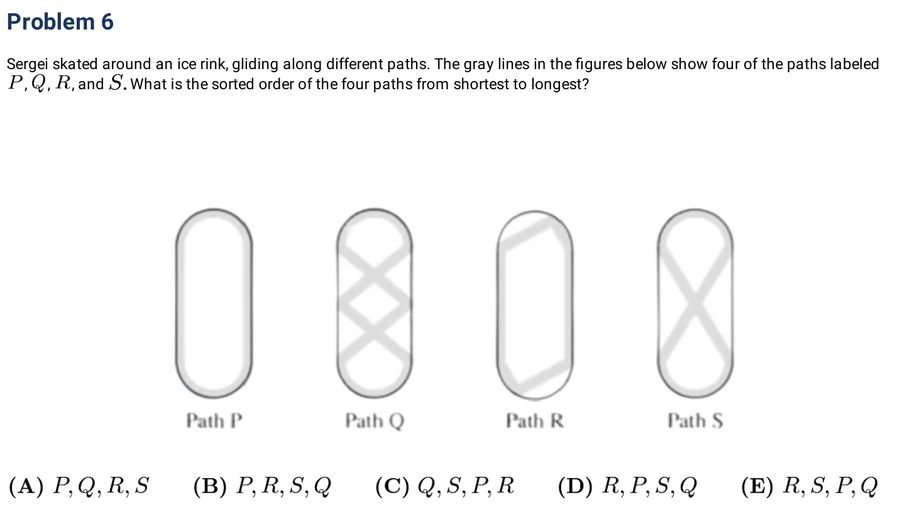
Don't try to measure anything. Use the plain oval P as your ruler, then ask of each other path: does it cut a corner (shorter) or detour across a diagonal (longer)?
Still stuck? Show hint 2 →
Hint 2 of 2
Principle: a straight chord across a curve is shorter than the arc; a diagonal across a rectangle is longer than the two sides it skips (hypotenuse > leg). Count cuts vs. diagonals for each path.
Show solution
Approach: compare each path to the plain oval boundary, no measuring
The whole problem is comparisons, not lengths — so compare every path to the plain oval P. R replaces the two rounded ends with straight chords; a straight chord is shorter than the arc it spans, so R < P. R is the shortest, which already narrows you to choices D and E.
S trades part of the boundary for one diagonal slash across the oval. That diagonal is the hypotenuse of a right triangle, and a hypotenuse is always longer than either leg it replaces — so S > P.
Q does the same trade but with two crossing diagonals, longer still: Q > S.
Order shortest→longest: R, P, S, Q — choice D. This transfers: in any "order the lengths" figure problem, look for arcs-vs-chords and diagonals-vs-sides rather than computing — the inequalities decide it.
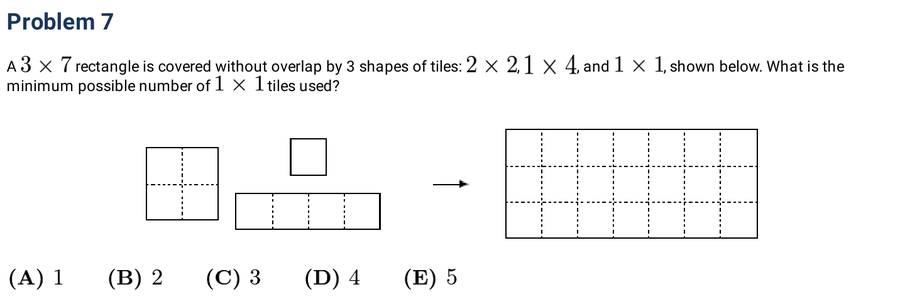
The 2×2 and 1×4 tiles BOTH cover exactly 4 squares. So before placing anything, what does that force about how many cells the tiny 1×1 tiles must mop up?
Still stuck? Show hint 2 →
Hint 2 of 2
Technique — a counting (mod 4) filter: the big tiles fill a multiple of 4, and 21 = 4×5 + 1, so the 1×1 count is 1, 5, 9, … You'd love 1, but check whether it can actually be tiled before believing it.
Show solution
Approach: count mod 4 to bound it, then a coloring argument rules out 1
Start with arithmetic, not pictures. Both big tiles cover 4 squares, so they always fill a multiple of 4. Since 21 = 4×5 + 1, the leftover for 1×1 tiles is 21 − (multiple of 4), which is 1, 5, 9, … The dream answer is 1.
Can just one 1×1 work? Color the 3×7 board in 4 repeating diagonal colors (or check by hand): the 2×2 and 1×4 tiles can't tile a 3×7 board with a single cell removed, no matter where that cell is — it never fits. So 1 is impossible.
Next allowed value is 5, and it's achievable: lay four big tiles (a mix of 2×2 and 1×4) covering 16 cells, then drop 1×1's into the 5 holes. Minimum = 5. This transfers: a covering count gives a quick lower-bound filter, but you still must exhibit one real arrangement — "allowed by counting" isn't the same as "buildable."
On Monday Taye has $2. Every day, he either gains $3 or doubles the amount of money he had on the previous day. How many different dollar amounts could Taye have on Thursday, 3 days later?
Show answer
Answer: D — 6 different amounts.
Show hints
Hint 1 of 2
Each day has 2 choices over 3 days, so 2×2×2 = 8 paths — but the question asks for AMOUNTS, not paths. Why might those two counts differ?
Still stuck? Show hint 2 →
Hint 2 of 2
Technique: track the SET of reachable amounts day by day, not the branching paths. When two paths land on the same dollar amount, the set automatically merges them — so you can't over-count.
Show solution
Approach: track the set of reachable amounts, letting duplicates merge
The trap is counting 2×2×2 = 8 paths; the question wants distinct amounts, and some paths collide. So carry a SET forward each day instead of a list of paths. Start $2. Tuesday: 2+3 = 5 or 2×2 = 4 → {4, 5}.
Wednesday, apply both moves to each: 4+3 = 7, 4×2 = 8, 5+3 = 8, 5×2 = 10. The two 8's merge → {7, 8, 10}.
Thursday from {7, 8, 10}: 7→{10,14}, 8→{11,16}, 10→{13,20}, all distinct → {10, 11, 13, 14, 16, 20}.
6 distinct amounts. This transfers: whenever "how many outcomes" can repeat, count states (the set), not branches — the set throws away duplicates for you. It's the seed of breadth-first thinking.
All of the marbles in Maria's collection are red, green, or blue. Maria has half as many red marbles as green marbles and twice as many blue marbles as green marbles. Which of the following could be the total number of marbles in Maria's collection?
Show answer
Answer: E — 28 marbles.
Show hints
Hint 1 of 2
The three colors lock together in fixed ratios, so the total can't be just any number. Name the smallest pile with a variable and the others follow — what does their sum have to be a multiple of?
Still stuck? Show hint 2 →
Hint 2 of 2
Technique: pick the color that makes the others whole. Red is smallest, so let r = red, green = 2r, blue = 4r. Total 7r must be a multiple of 7.
Show solution
Approach: fix the ratios into one variable, find the hidden multiple
Choose the variable to dodge fractions. "Half as many red as green" makes green double the red, so let r = red (the smallest). Then green = 2r, and blue = twice green = 4r.
Total = r + 2r + 4r = 7r — whatever r is, the total is a multiple of 7.
Only 28 = 7 × 4 among the choices is a multiple of 7. This transfers: when quantities are tied by ratios, the total is always a fixed multiple, so the answer must be divisible by the sum of the ratio parts (here 1 + 2 + 4 = 7) — you can often skip straight to that divisibility test.
In January 1980 the Mauna Loa Observatory recorded carbon dioxide CO2 levels of 338 ppm (parts per million). Over the years the average CO2 reading has increased by about 1.515 ppm each year. What is the expected CO2 level in ppm in January 2030? Round your answer to the nearest integer.
Show answer
Answer: B — 414 ppm.
Show hints
Hint 1 of 2
"Same amount every year" is the signal for one move: total rise = rate × number of years. Don't add year by year.
Still stuck? Show hint 2 →
Hint 2 of 2
Technique — linear growth: increase = (yearly rate) × (years elapsed), then add to the starting level. Count the years from 1980 to 2030 first.
Show solution
Approach: rate × time, then add to start
A constant yearly increase means the rise is just rate × time — no need to step through 50 separate years. Years elapsed: 2030 − 1980 = 50.
Total increase: 50 × 1.515 = 75.75 ≈ 76 ppm.
New level: 338 + 76 = 414. Sanity check: ~1.5 ppm/yr over 50 years is roughly 75, landing just above 338+75 = 413 — only 414 is in range, so estimation alone nails the choice.
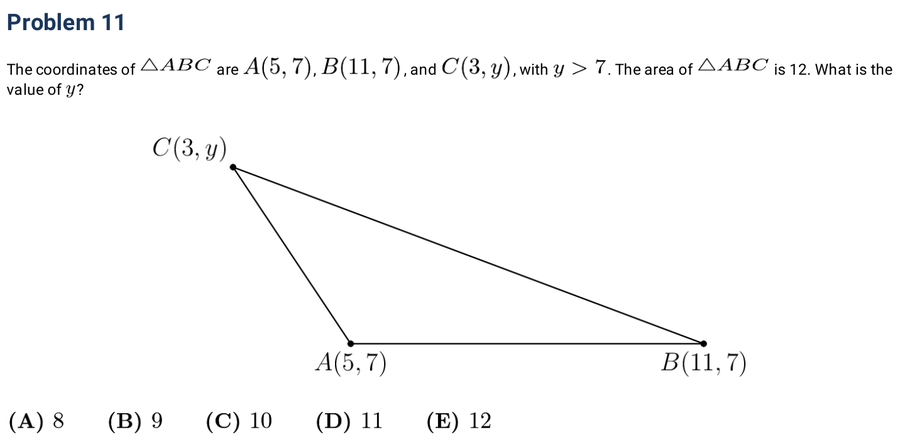
You get to CHOOSE which side is the base. A and B share the same height (y = 7), so AB is horizontal — pick that one and the height becomes trivial.
Still stuck? Show hint 2 →
Hint 2 of 2
Technique: with a horizontal base, the height is just the vertical gap. Base AB = 6 (from x = 5 to 11); height from C is y − 7.
Show solution
Approach: use the horizontal side as the base
A and B both sit at y = 7, so AB is a flat horizontal segment — the easiest possible base. Its length is just the x-gap: 11 − 5 = 6.
Because the base is horizontal, the height is simply how far C rises above the line y = 7, namely y − 7 — no distance formula needed. Area = 12 · 6 · (y − 7) = 12.
So 12 · 6 = 3 times the height equals 12 → height = 4 → y = 7 + 4 = 11. This transfers: on the coordinate plane, always make the base horizontal or vertical — then base and height are just coordinate differences.
Rohan keeps a total of 90 guppies in 4 fish tanks.
There is 1 more guppy in the 2nd tank than in the 1st tank.
There are 2 more guppies in the 3rd tank than in the 2nd tank.
There are 3 more guppies in the 4th tank than in the 3rd tank.
How many guppies are in the 4th tank?
Show answer
Answer: E — 26 guppies.
Show hints
Hint 1 of 2
The clues chain off each other, so anchor everything to ONE tank. From tank 1, each later tank is tank 1 plus a running total: +1, then +1+2 = +3, then +1+2+3 = +6.
Still stuck? Show hint 2 →
Hint 2 of 2
Technique: write all four as tank 1 + (0, 1, 3, 6). Their sum is 4·(tank 1) + 10 = 90 — one equation for one unknown.
Show solution
Approach: express every tank in terms of tank 1
The differences chain, so pin everything to tank 1 = x. Then tank 2 = x + 1, tank 3 = (x+1) + 2 = x + 3, tank 4 = (x+3) + 3 = x + 6.
Adding: 4x + (1 + 3 + 6) = 4x + 10 = 90, so x = 20.
The question wants tank 4, not tank 1 — so finish the job: tank 4 = 20 + 6 = 26. Watch out: solving for x = 20 and stopping is the classic trap; always re-read what's being asked.
Another way — level the tanks against the total:
If all four tanks matched tank 1, the total would be 4·(tank 1). The real total is 10 more (the built-in extras 0+1+3+6), so 4·(tank 1) = 90 − 10 = 80 → tank 1 = 20.
Buzz Bunny is hopping up and down a set of stairs, one step at a time. In how many ways can Buzz start on the ground, make a sequence of 6 hops, and end up back on the ground? (For example, one sequence of hops is up-up-down-down-up-down.)
Show answer
Answer: B — 5 sequences.
Show hints
Hint 1 of 2
Ending back on the ground after 6 hops forces exactly 3 ups and 3 downs. The real constraint: at no moment can downs outnumber ups, or Buzz drops below the ground.
Still stuck? Show hint 2 →
Hint 2 of 2
This is the "balanced parentheses" rule — read U as ( and D as ). List the legal arrangements; always start with U, end with D.
Show solution
Approach: count valid never-go-below sequences (a Catalan count)
Back to the ground in 6 hops means equal ups and downs: 3 U and 3 D. The twist is the ground floor — reading left to right, the count of D's may never exceed the count of U's (else Buzz steps below the ground). So every valid string starts U and ends D.
List them with that rule, keeping ups ahead: UUUDDD, UUDUDD, UUDDUD, UDUUDD, UDUDUD — 5 in all.
This transfers: "up/down steps that never go below start" is exactly the balanced-parentheses problem, and its counts are the Catalan numbers 1, 2, 5, 14, … For 3 ups and 3 downs the count is the 3rd Catalan number, 5 — matching our list, and a fast check for the longer versions of this problem.
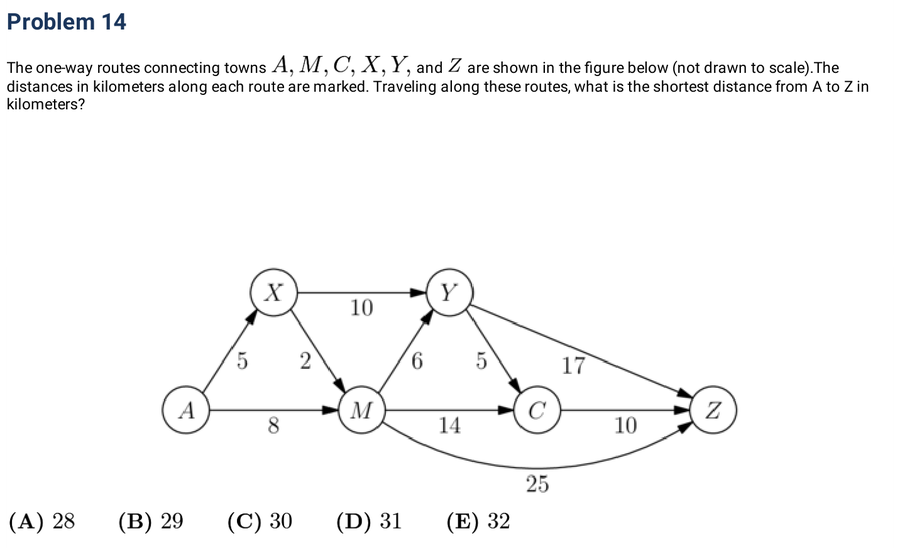
Don't try to trace whole routes — too many. Instead label each town with its OWN shortest distance from A, in the order the towns can be reached.
Still stuck? Show hint 2 →
Hint 2 of 2
Technique (shortest-path relaxation): a town's best distance = the smallest "(best distance to a town that feeds it) + (that edge)". Solve them in flow order A, X, M, Y, C, Z.
Show solution
Approach: shortest-path table, town by town
Rather than list every full route, find the shortest distance to each town from A, building up in the order towns become reachable. Each town's value = the cheapest "(arrived-distance to a feeder) + (its edge to here)." Start: A→X = 5 (only way in).
A→M = min(8 direct, 5 + 2 via X) = 7. Going through X beats the direct road.
A→Y = min(5 + 10 via X, 7 + 6 via M) = 13.
A→C = min(7 + 14 via M, 13 + 5 via Y) = 18.
A→Z = min(7 + 25 via M, 13 + 17 via Y, 18 + 10 via C) = 28 (via C). This transfers: this is Dijkstra's idea — once a town has its final shortest label, every later town can lean on it, so you never re-explore whole paths.
Let the letters F, L, Y, B, U, G represent distinct digits. Suppose FLYFLY is the greatest number that satisfies the equation
8 · FLYFLY = BUGBUG.
What is the value of FLY + BUG?
Show answer
Answer: C — 1107.
Show hints
Hint 1 of 2
A number that repeats a 3-digit block, like ABCABC, isn't random — it's the block times something. What number, when multiplied by 123, gives 123123?
Still stuck? Show hint 2 →
Hint 2 of 2
Key fact: ABCABC = 1001 × ABC. So FLYFLY = 1001·FLY and BUGBUG = 1001·BUG, and the whole equation collapses to 8 · FLY = BUG.
Show solution
Approach: strip the repeat, then maximize digit-by-digit
The repeated block is the doorway: ABCABC = ABC×1000 + ABC = 1001·ABC. So FLYFLY = 1001·FLY, BUGBUG = 1001·BUG, and dividing both sides by 1001 leaves the tiny equation 8 · FLY = BUG.
BUG is still only 3 digits, so 8 · FLY < 1000 → FLY ≤ 124. That forces F = 1, and the tens digit L ≤ 2 (if L = 3, 8·13Y already exceeds 1040).
We want the GREATEST FLY, so push digits up. L = 2 (1 is taken by F). Now test the units Y from high down, needing all six digits F,L,Y,B,U,G distinct: Y = 4 gives 8·124 = 992 (repeated 9, fails); Y = 3 gives 8·123 = 984, digits {1,2,3,9,8,4} all different ✓.
FLY + BUG = 123 + 984 = 1107. You'll see it again: 1001 = 7×11×13 is the workhorse behind every ABCABC pattern — spotting the repeated block lets you divide a 6-digit monster down to 3 digits.
Minh enters the numbers 1 through 81 into the cells of a 9 × 9 grid in some order. She calculates the product of the numbers in each row and column. What is the least number of rows and columns that could have a product divisible by 3?
Show answer
Answer: D — 11 rows and columns.
Show hints
Hint 1 of 2
One multiple of 3 anywhere in a row makes that whole row's product divisible by 3 — same for its column. So a single bad number "poisons" a full row AND a full column. How do you poison as few lines as possible?
Still stuck? Show hint 2 →
Hint 2 of 2
Technique: count the multiples of 3 (there are 27 in 1–81) and pack them into an r×c block. That block fits r·c of them while poisoning r + c lines — minimize r + c with r·c ≥ 27.
Show solution
Approach: pack multiples of 3 into the tightest possible block
A row or column's product is divisible by 3 the instant it holds even one multiple of 3. So each multiple-of-3 placement poisons one row and one column — the goal is to confine all of them to the fewest lines. There are 27 multiples of 3 in 1–81 (81÷3).
Squeeze them into an r×c rectangle: it covers r·c cells and poisons exactly r + c lines. We need r·c ≥ 27 while making r + c small. A 5×5 block holds 25 — two short.
Tuck the last 2 multiples into a 6th column (rows 1–2). Now rows poisoned: 5; columns poisoned: 6; total 5 + 6 = 11. (A 6×5 would also reach 30 cells and 11 lines — same minimum.)
This transfers: for a fixed area r·c, the perimeter-like sum r + c is smallest when the rectangle is near-square — the same reason a square fences the most area for a given fence.
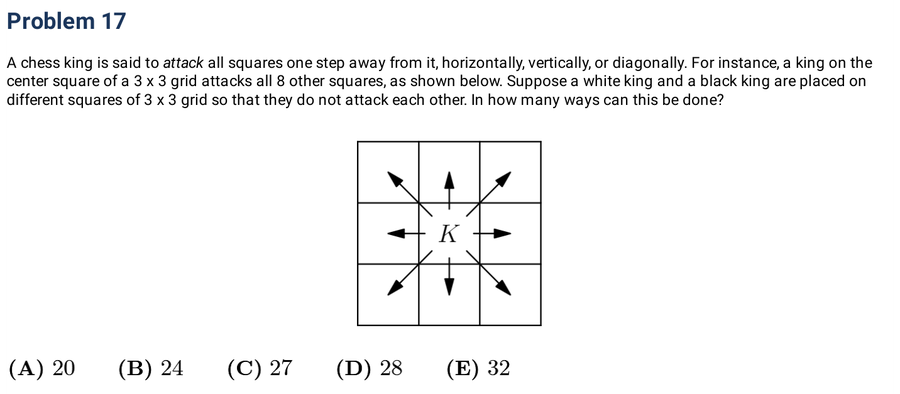
First, kill the impossible square: the CENTER attacks all 8 others, so a king there always attacks — neither king can sit there. That leaves only the 8 border squares.
Still stuck? Show hint 2 →
Hint 2 of 2
Technique — casework by the first king's spot, because corners and edge-middles see different numbers of squares: a corner attacks 3 (5 safe for the other), an edge-middle attacks 5 (3 safe).
Show solution
Approach: casework on the first king's position
Rule out the center first: it attacks all 8 surrounding squares, so a king there can never avoid attacking — both kings live on the 8 border squares. The kings are different colors, so order matters; place white first, then count safe spots for black.
White on a corner (4 corners): a corner attacks only 3 squares, leaving 8 − 3 = 5 safe for black. 4 × 5 = 20.
White on an edge-middle (4 of them): it attacks 5 squares, leaving 3 safe. 4 × 3 = 12.
Total: 20 + 12 = 32. Why split into cases: the count of attacked squares depends on the piece's position, so group positions by that count — the same move pays off whenever a board has corner/edge/center symmetry.
Another way — all pairs minus attacking pairs:
Place white anywhere (9), then black on any other square (8): 9 × 8 = 72 ordered placements ignoring attacks.
Subtract attacking placements. Count adjacencies on the 3×3: there are 12 edge-adjacencies and 8 diagonal-adjacencies, 20 unordered attacking pairs, so 40 ordered ones.
"Shaded = unshaded" is the gift: each must be exactly HALF the whole disk. So you don't compare two messy regions — you just set shaded = half the total.
Still stuck? Show hint 2 →
Hint 2 of 2
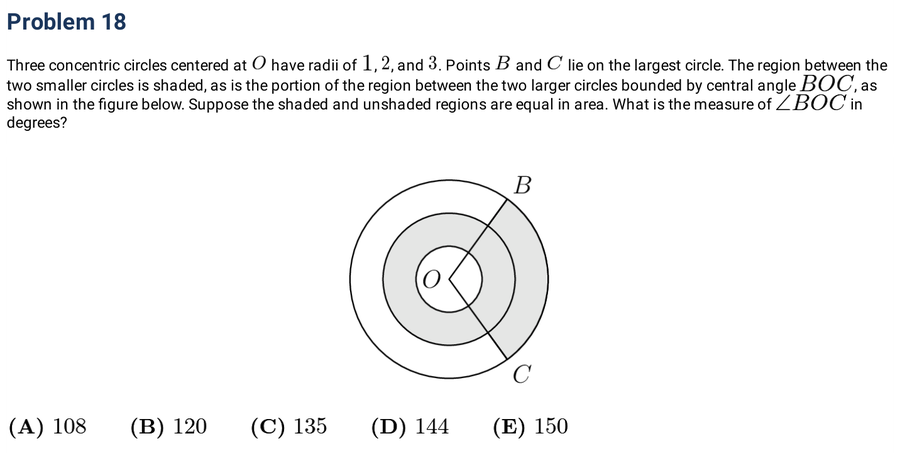
Break the disk into three rings (inner disk, ring 1–2, ring 2–3) and find each area from πr2. The only part the angle controls is the θ-sector of the outer ring.
Show solution
Approach: shaded equals half the disk; only the outer sector depends on the angle
The phrase "shaded = unshaded" means each is exactly half the disk — so skip comparing regions and just set shaded = half the total. Total disk area = π·32 = 9π, so shaded must be 4.5π.
Now tally the shaded parts in rings. The fully-shaded inner annulus (radii 1 to 2) has area π(22 − 12) = 3π, no angle involved. The outer annulus (radii 2 to 3) has area π(32 − 22) = 5π, but only the θ-slice of it is shaded: θ360(5π).
Set shaded = half: 3π + θ360(5π) = 4.5π. The 3π already covers most of the half, leaving the sector to supply just 1.5π: θ360(5π) = 1.5π → θ360 = 0.3 → θ = 108°.
This transfers: when a problem says two regions are equal, immediately rewrite it as "each = half the whole" — one equation instead of two, and the constant parts often vanish into the half.
Jordan owns 15 pairs of sneakers. Three fifths of the pairs are red and the rest are white. Two thirds of the pairs are high-top and the rest are low-top. The red high-top sneakers make up a fraction of the collection. What is the least possible value of this fraction?
Show answer
Answer: C — 4/15.
Show hints
Hint 1 of 2
There are a FIXED 10 high-tops. To make as few of them red as possible, give as many high-tops as you can to the white pairs instead — crowd red out.
Still stuck? Show hint 2 →
Hint 2 of 2
Technique (minimize an overlap by pushing to the extreme): 9 red, 6 white; 10 high-top, 5 low-top. Whites can absorb at most 6 high-tops, so red is forced to take whatever high-tops are left.
Show solution
Approach: push white pairs into high-top to crowd out red
First nail the four counts. Red = 35×15 = 9, white = 6; high-top = 23×15 = 10, low-top = 5. The total of 10 high-tops is fixed; we only choose WHO gets them.
To minimize red high-tops, hand high-tops to white first. There are only 6 white pairs, so at most 6 high-tops can be white — do exactly that.
That leaves 10 − 6 = 4 high-top spots with nowhere to go but red. So the smallest red-high-top fraction is 415. This transfers: to minimize the overlap of two groups, shove the limited "other" group as full as it goes — the forced leftover is your minimum (it's the same logic as the Pigeonhole/inclusion bound).
A cube only offers three distances between vertices: edge (1), face diagonal (√2), space diagonal (√3). For all three sides to match, which single distance can do it?
Still stuck? Show hint 2 →
Hint 2 of 2
Only face diagonals (√2) work. So find P's face-diagonal neighbors, then count how many TRIANGLES they form — that's a "choose 2" once you know how many neighbors there are.
Show solution
Approach: use face-diagonal length as the only valid side
List the only three possible vertex-to-vertex distances in a cube: edge = 1, face diagonal = √2, space diagonal = √3. An equilateral triangle needs all three sides equal, and edges or space diagonals can't close up into a triangle — only face diagonals (√2) can.
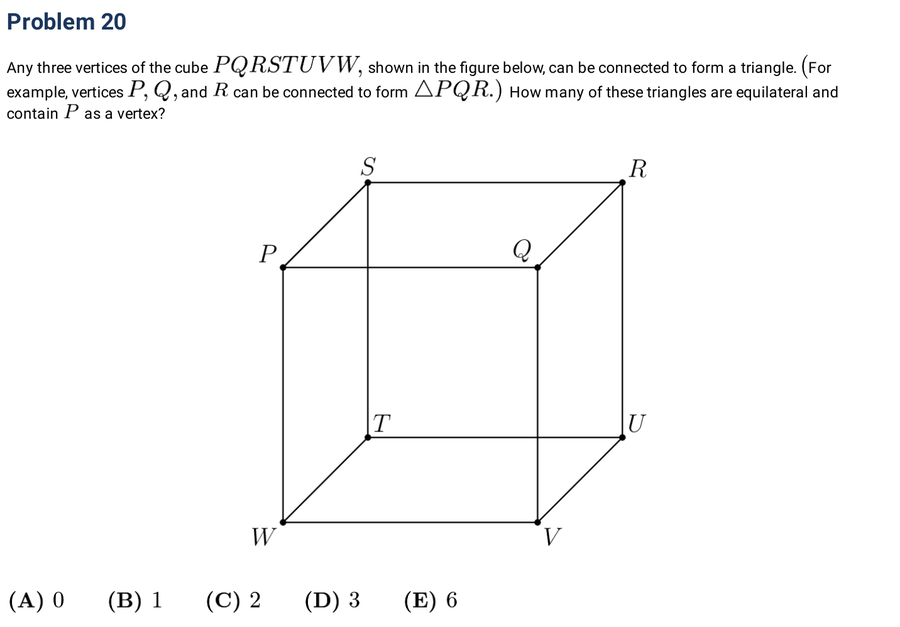
From P, the vertices a face-diagonal away are the three that sit across each of P's three faces: R, T, V (one per face).
Now check pairs: any two of {R, T, V} are themselves a face-diagonal apart, so each pair plus P is an equilateral triangle. With 3 such neighbors, the number of triangles is "choose 2 of 3" = 3: {P,R,T}, {P,R,V}, {P,T,V}.
3 triangles. This transfers: in 3-D distance problems, first list the few possible lengths, decide which can build the shape, then it becomes a small counting ("choose 2") problem.
A group of frogs (called an army) is living in a tree. A frog turns green when in the shade and turns yellow when in the sun. Initially, the ratio of green to yellow frogs was 3 : 1. Then 3 green frogs moved to the sunny side and 5 yellow frogs moved to the shady side. Now the ratio is 4 : 1. What is the difference between the number of green frogs and yellow frogs now?
Show answer
Answer: E — 24 frogs.
Show hints
Hint 1 of 2
A 3 : 1 ratio means green = 3 × yellow, so the whole army rides on one number. Call yellow y and write everything in terms of it.
Still stuck? Show hint 2 →
Hint 2 of 2
Technique: track the net change per color (frogs move both ways), then set the new ratio equal to 4. After the moves green = 3y + 2, yellow = y − 2 — so (3y+2)/(y−2) = 4.
Show solution
Approach: let y = initial yellow, then use both ratios
The 3 : 1 ratio pins green to yellow, so use one variable: let y = initial yellow, then initial green = 3y.
Net the movements per color. Green: 5 yellow-turned-green arrive, 3 leave for the sun → 3y + 5 − 3 = 3y + 2. Yellow: 3 sun-turned-yellow arrive, 5 leave for shade → y + 3 − 5 = y − 2.
New ratio 4 : 1 means green is 4 times yellow: 3y + 2 = 4(y − 2) = 4y − 8 → y = 10. So now green = 32, yellow = 8.
The question asks the DIFFERENCE now: 32 − 8 = 24. Watch the ask: it wants the current gap, not the original counts — easy to stop a step early.
Another way — the total army never changes:
Every move just recolors a frog (sun↔shade), so the total is fixed. Initially green:yellow = 3:1, so the total is a multiple of 3+1 = 4; finally it's 4:1, a multiple of 4+1 = 5. The total is a multiple of both, so a multiple of 20.
Now the difference. Finally green:yellow = 4:1, so the gap is 4−1 = 3 parts out of 5, i.e. 35 of the total. With the total = 40 (the value consistent with the 3 net-out yellow and 4:1 split), the difference is 35×40 = 24.
Forget the spiral entirely. The tape is the SAME material whether coiled or unrolled, so its cross-section area is conserved. Unrolled, that area is just length × thickness.
Still stuck? Show hint 2 →
Hint 2 of 2
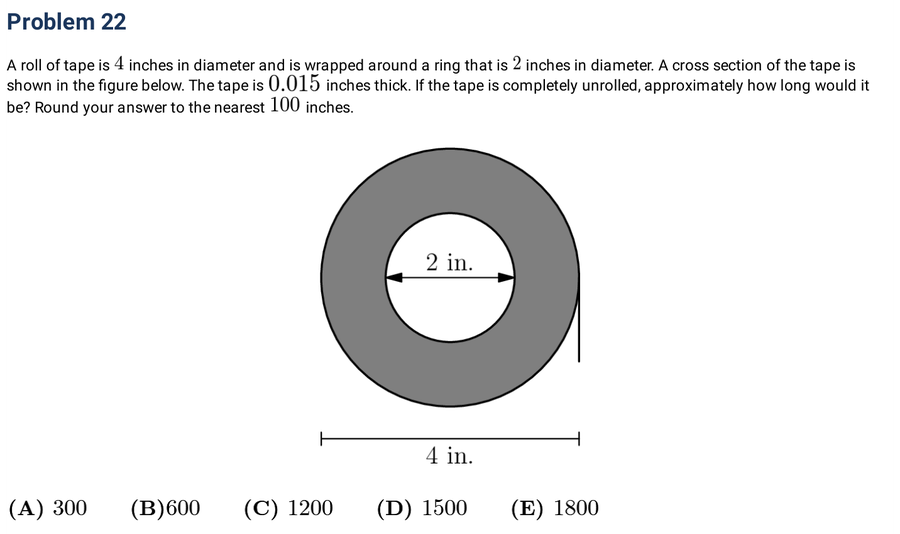
Technique (conserve the cross-section area): the coiled tape fills the ring between the inner and outer circles. Ring area = length × thickness. Ring = π(R2 − r2), with R = 2, r = 1 (radii, half the diameters).
Show solution
Approach: the ring's area equals length × thickness
The slick idea: coiling doesn't change how much tape there is, so the cross-section area is the same coiled or flat. Flat, the tape is a thin strip of length L and thickness 0.015 in — area = 0.015L.
Coiled, that same cross-section is the ring between outer radius 2 (diameter 4) and inner radius 1 (diameter 2): area = π(22 − 12) = 3π.
Set them equal: 0.015L = 3π → L = 3π0.015 = 200π ≈ 628 in, rounding to 600. This transfers: for anything rolled, folded, or melted, the AREA (or volume) is conserved — equate "before" and "after" instead of tracing the shape.
Another way — layers × average circumference (MAA estimate):
The roll's wall is 1 inch thick (radius 2 minus radius 1), and each wrap is 0.015 in, so there are about 1 ÷ 0.015 ≈ 67 layers.
A layer's circumference runs from 2π (inner) to 4π (outer), averaging 3π. Total length ≈ 67 × 3π ≈ 200π ≈ 628 → 600. Same answer, by averaging the loops instead of conserving area.
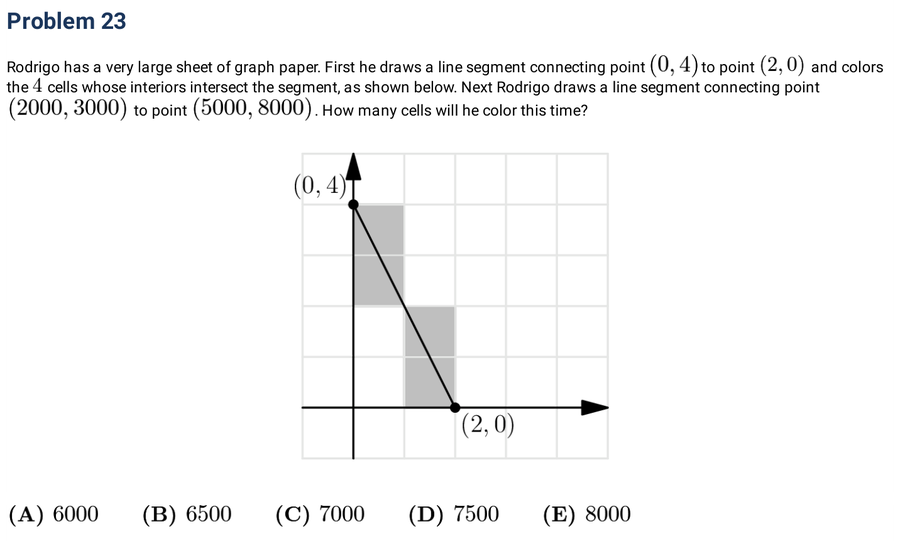
Think about WHEN the segment moves into a new cell: every time it crosses a vertical or horizontal gridline. So count crossings — but watch the special moment when it crosses both at once (through a grid corner) and gets two for the price of one.
Still stuck? Show hint 2 →
Hint 2 of 2
Technique (lattice cell-crossing formula): cells = (horizontal offset) + (vertical offset) − gcd(those offsets). The gcd counts the corner-crossings you'd otherwise double-count. Apply it to offsets 3000 and 5000.
Show solution
Approach: use the lattice-line cell-count formula
A line segment whose horizontal offset is a and vertical offset is b crosses a + b − gcd(a, b) grid cells. (You'd cross a + b cells if the line never hit a grid corner; each lattice-point crossing collapses two cell-entries into one, saving 1 per shared factor.)
From (2000, 3000) to (5000, 8000): horizontal offset 3000, vertical offset 5000.
The slope from (2000, 3000) to (5000, 8000) is 5/3. The segment is equivalent to 1000 copies of a primitive (0,0)→(3,5) piece, since gcd(3000, 5000) = 1000.
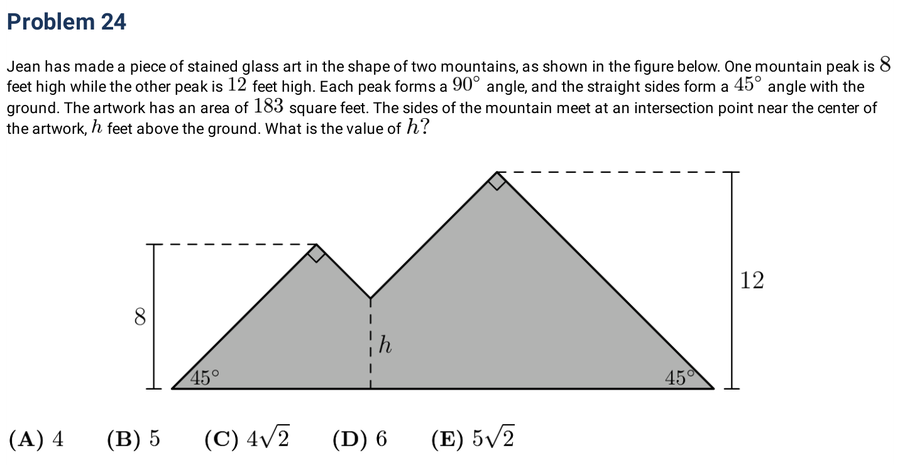
The dip between the peaks is exactly where the two mountains OVERLAP. So if you treat each mountain as a full triangle and add them, you've counted that dip twice — the setup for inclusion–exclusion.
Still stuck? Show hint 2 →
Hint 2 of 2
Handy fact: a 45-45-90 mountain triangle of peak height H has base 2H, so its area is 12(2H)(H) = H2. The dip is a third such triangle of height h.
Show solution
Approach: inclusion–exclusion on three 45-45-90 triangles
First, a clean area shortcut: each mountain is a right-isoceles triangle (90° peak, 45° base angles), so its base is 2×(its height) and its area is 12(2H)(H) = H2. Heights 8 and 12 give areas 64 and 144.
If you just add 64 + 144, you double-count the V-dip where the two mountains overlap — and that dip is itself a 45-45-90 triangle of height h, area h2. So the true artwork area is 64 + 144 − h2.
Set that to the given 183: 208 − h2 = 183 → h2 = 25 → h = 5. This transfers: when two regions overlap, area(A) + area(B) − area(overlap) = total — inclusion–exclusion turns a tricky shape into three simple ones.
A small airplane has 4 rows of seats with 3 seats in each row. Eight passengers have boarded the plane and are distributed randomly among the seats. A married couple is next to board. What is the probability there will be 2 adjacent seats in the same row for the couple?
Show answer
Answer: C — 20/33.
Show hints
Hint 1 of 2
Counting WHERE the couple can sit is messy — there are many ways to leave an open pair. Flip it: count the seatings where the couple CAN'T sit together (no open adjacent pair), which is far more rigid, then subtract.
Still stuck? Show hint 2 →
Hint 2 of 2
The 8 passengers can sit in C(12,8) = 495 ways. Per row L-M-R, an adjacent open pair is blocked exactly when M is taken OR both L and R are taken. Case-split on k = how many of the 4 middle seats are occupied.
Show solution
Approach: complementary counting on middle-seat occupancies
Counting the "couple fits" seatings directly is a tangle, so count the COMPLEMENT — seatings with no open adjacent pair anywhere — and subtract from the total. Total ways to seat 8 passengers in 12 seats (order ignored): C(12, 8) = 495.
For NO adjacent pair to be open in a row L–M–R: either M is occupied, or both L and R are occupied. Casework on k = number of rows with M occupied:
k = 0: all four M's empty ⇒ all 8 edge seats filled. 1 way.
k = 1: 4 choices of row, then 2 choices for the extra passenger in that row's edges. 8 ways.
k = 2: C(4,2) = 6 row-choices × C(4,2) = 6 placements of remaining 2 passengers in the 4 unfilled edges. 36 ways.
k = 3: C(4,3) = 4 row-choices × C(6,3) = 20 placements of remaining 3 passengers. 80 ways.
k = 4: all middles filled (4 passengers); C(8,4) = 70 placements of the remaining 4 on edges. 70 ways.
Total "no open pair": 1 + 8 + 36 + 80 + 70 = 195. So the favorable count = 495 − 195 = 300.
Probability = 300495 = 2033. This transfers: when "at least one good spot exists" has many overlapping ways to happen, count the cleaner complement ("no good spot") instead — here the no-pair condition reduced to a tidy per-row rule and a single case-split.