Every option uses the same four digits 2, 0, 1, 7 — the only difference is whether a + or a × sits between them. Adding keeps the digits; multiplying by 0 or 1 throws value away.
Still stuck? Show hint 2 →
Hint 2 of 2
Order of operations (PEMDAS): all multiplications happen before any addition. The biggest result comes from the option that multiplies least — here, the all-plus option.
Show solution
Approach: compare without full computation
The insight: all-addition (A) keeps every digit working for you; any × either zeroes out a term (anything × 0) or wastes one (anything × 1). So (A) should win — no arithmetic needed to see it leads.
Largest is (A) = 10. You'll see this again: when options differ only by an operation, ask which operation grows the value rather than computing all five.
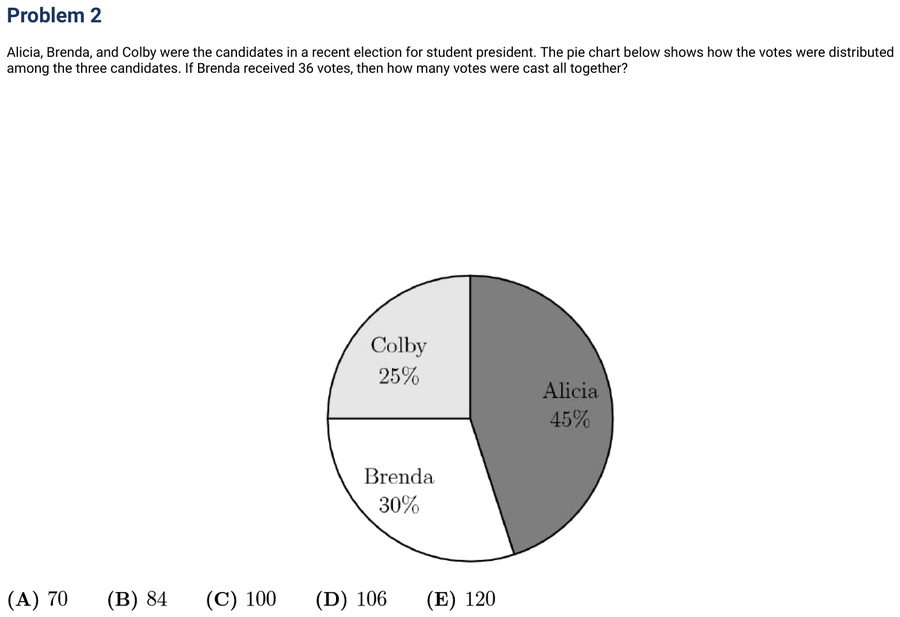
The pie chart tells you Brenda's slice is 30%. So 36 votes is 30% of everything — the question is really "36 is 30% of what?"
Still stuck? Show hint 2 →
Hint 2 of 2
Use a unit-percent anchor: find what 10% is, then the whole is just ten of those. It sidesteps division by an awkward decimal.
Show solution
Approach: anchor on 10%, then scale up
From the chart, Brenda's 36 votes = 30% of the total. The clean move: 30% = 36, so 10% = 36 ÷ 3 = 12.
The whole is 100% = ten of those tenths: 10 × 12 = 120 votes.
Why this transfers: turning a percent into its 1%- or 10%-unit first lets you scale to any target percent with simple multiplication — no decimal division.
Another way — direct division:
30% of the total is 36, so total = 36 ÷ 0.30 = 36 ÷ (3/10) = 36 × 10/3 = 120.
What is the value of the expression √(16 · √(8 · √4)) ?
Show answer
Answer: C — 8.
Show hints
Hint 1 of 2
Nested radicals only untangle from the inside out — you can't simplify the outer √ until you know what's under it. Start at the deepest √4.
Still stuck? Show hint 2 →
Hint 2 of 2
Watch for a chain reaction: each square root turns into a whole number, which then makes the next product a perfect square too. That's the design of these problems.
Show solution
Approach: peel from the inside out
Start at the deepest layer: √4 = 2. This is the whole game — it makes the next product land on a perfect square.
Middle layer: √(8 · 2) = √16 = 4. Again a perfect square pops out.
Outer layer: √(16 · 4) = √64 = 8.
Why it works: contest nested radicals are built so every layer collapses to an integer. If yours doesn't, recheck the layer below.
Another way — exponents instead of roots:
Write each √ as a power of 1/2: the expression is (16 · (8 · 4^(1/2))^(1/2))^(1/2).
Innermost 4^(1/2) = 2, then 8·2 = 16 and 16^(1/2) = 4, then 16·4 = 64 and 64^(1/2) = 8 — same collapse, viewed as halving exponents.
When 0.000315 is multiplied by 7,928,564 the product is closest to which of the following?
Show answer
Answer: D — 2400.
Show hints
Hint 1 of 2
The answer choices jump by powers of 10 (210, 2100, 24000…), so you don't need a precise product — you only need the right size. Round each number to one digit.
Still stuck? Show hint 2 →
Hint 2 of 2
Separate the problem into two easy parts: multiply the leading digits (3 × 8), and separately track the powers of 10. That's the heart of scientific-notation estimation.
Show solution
Approach: estimate via scientific notation
Round to one significant figure: 0.000315 ≈ 3 × 10⁻⁴, and 7,928,564 ≈ 8 × 10⁶. The choices are spread by factors of 10, so this rounding is safe.
Multiply the fronts and add the exponents: (3 × 8) × 10−4 + 6 = 24 × 102 = 2400.
Why this transfers: whenever answer choices differ by orders of magnitude, estimate — nail the leading digit and the exponent, and ignore the rest.
Don't multiply the giant top out! The bottom is just an addition, which collapses to a small number — once you know it, look for that number hiding as factors inside the top.
Still stuck? Show hint 2 →
Hint 2 of 2
Technique: never expand a product when you can cancel. Factor the denominator and hunt for those same factors among the terms upstairs.
Show solution
Approach: collapse the sum, then cancel matching factors
First the easy part — the denominator is a sum, not a product: 1 + 2 + … + 8 = 36. (Pair 1+8, 2+7, 3+6, 4+5 = four 9's, or use 8·9/2.) And 36 = 6 · 6.
Now cancel instead of multiply: the top already has a 6, and 2 · 3 builds a second 6 — both 6's wipe out the denominator.
What survives on top: 1 · 4 · 5 · 7 · 8 = 4·5·7·8 = 1120.
Why this transfers: a fraction of products is an invitation to cancel, never to brute-force; reduce before you ever multiply.
Another way — cancel using 36 = 4 · 9:
Write 36 = 4 · 9. The top contains a 4 (cancel it) and a 9 living inside 3 · 6 = 18 = 9 · 2 (cancel the 9, leaving a 2 behind).
After canceling the 4, the 3, and replacing the 6 with 2: top = 1 · 2 · 2 · 5 · 7 · 8 = 1120 — same answer, different factors canceled.
If the degree measures of the angles of a triangle are in the ratio 3 : 3 : 4, what is the degree measure of the largest angle of the triangle?
Show answer
Answer: D — 72°.
Show hints
Hint 1 of 2
A ratio doesn't give angles directly — it gives shares. Picture the 180° of a triangle cut into 3 + 3 + 4 = 10 equal pieces; the question is how big one piece is.
Still stuck? Show hint 2 →
Hint 2 of 2
The 'parts' trick: add the ratio numbers to get the total parts, divide the known whole by that to size one part, then scale up to the part you want.
Show solution
Approach: parts of a whole
The angles of any triangle add to 180°. The ratio splits that 180° into 3 + 3 + 4 = 10 equal parts, so one part = 180 ÷ 10 = 18°. This sizing step is the key — everything else is multiplication.
The largest angle holds 4 parts: 4 × 18 = 72°.
Sanity check: 54 + 54 + 72 = 180. You'll reuse this 'sum-of-parts' idea for any "divide a total in ratio a:b:c" problem — money, lengths, mixtures, all the same move.
Let Z be a 6-digit positive integer, such as 247247, whose first three digits are the same as its last three digits taken in the same order. Which of the following numbers must also be a factor of Z?
Show answer
Answer: A — 11.
Show hints
Hint 1 of 2
The block of 3 digits repeats. Ask what number you multiply abc by to shove it 3 places left and then add it back — that single multiplier carries every factor that must divide Z.
Still stuck? Show hint 2 →
Hint 2 of 2
Repeating a digit block is always multiplication by a repunit-like constant: abcabc = abc × 1001. Factor that constant to read off the guaranteed divisors.
Show solution
Approach: factor the repeat multiplier
Repeating abc means: abc shifted up 3 digits (×1000) plus abc itself, so Z = abc × 1000 + abc = abc · 1001. That 1001 is the whole problem — it divides Z no matter what abc is.
Factor it: 1001 = 7 · 11 · 13. So 7, 11, and 13 are all guaranteed factors — from the choices, 11 works.
Worth memorizing: 1001 = 7·11·13, and likewise 11 = 11, 101 prime, 1111 = 11·101. Repeated-block numbers are a classic AMC divisibility setup — the answer is always inside the repeat constant.
Another way — test the example:
The problem hands you 247247. Check the choices: 247247 ÷ 11 = 22477 exactly, so 11 divides this case. Since 11 must work for the given example, it's the safe pick — and the abc·1001 argument confirms it holds for every such number.
Malcolm wants to visit Isabella after school today and knows the street where she lives but doesn't know her house number. She tells him, "My house number has two digits, and exactly three of the following four statements about it are true."
It is prime.
It is even.
It is divisible by 7.
One of its digits is 9.
This information allows Malcolm to determine Isabella's house number. What is its units digit?
Show answer
Answer: D — 8.
Show hints
Hint 1 of 2
"Exactly three true" means exactly one is false. Instead of testing numbers, hunt for two statements that fight each other — they can't both be true, so one of them must be the lone false one.
Still stuck? Show hint 2 →
Hint 2 of 2
A 2-digit number can't be both even and prime (the only even prime is 2). So statement (1) "prime" and (2) "even" clash; the false one must be (1), forcing (2), (3), (4) true.
Show solution
Approach: spot the clashing pair, then build the number
Exactly one statement is false. The pair (1) prime and (2) even can never both hold for a 2-digit number (2 is the only even prime). So the false statement is (1) — that's the deduction that cracks it — and (2), (3), (4) are all true.
True facts: even AND divisible by 7 means divisible by 14. Two-digit multiples of 14: 14, 28, 42, 56, 70, 84, 98. Only 98 also has a 9 as a digit.
Its units digit is 8.
Why this transfers: in "exactly k of these are true" puzzles, look for a forced contradiction first — pinning the false statement collapses the search far faster than checking candidates one by one.
All of Marcy's marbles are blue, red, green, or yellow. One third of her marbles are blue, one fourth of them are red, and six of them are green. What is the smallest number of yellow marbles that Marcy could have?
Show answer
Answer: D — 4 yellow marbles.
Show hints
Hint 1 of 2
You can't have a third of a marble. Since 1/3 and 1/4 of the total are both whole counts, the total is locked to multiples of 12 — you only ever test 12, 24, 36, …
Still stuck? Show hint 2 →
Hint 2 of 2
Try the smallest legal total first. If blue + red + green already exceeds it, that total is impossible and you bump up to the next multiple of 12.
Show solution
Approach: total must be a multiple of lcm(3, 4) = 12
Blue is 1/3 and red is 1/4 of the total, and counts are whole numbers, so the total must be divisible by both 3 and 4 — i.e. a multiple of 12. That restriction is the whole problem.
Try 12: blue = 4, red = 3, plus 6 green = 13 marbles — already more than 12. Impossible, so jump up.
Try 24: blue = 8, red = 6, green = 6, leaving yellow = 24 − 8 − 6 − 6 = 4. This works and is the smallest valid total.
Why smallest total = smallest yellow here: once green (6) is fixed, a larger total only adds more blue+red+yellow, so the first total that fits gives the fewest yellow.
A box contains five cards, numbered 1, 2, 3, 4, and 5. Three cards are selected randomly without replacement from the box. What is the probability that 4 is the largest value selected?
Show answer
Answer: C — 3/10.
Show hints
Hint 1 of 2
"4 is the largest" is a quiet double condition: 4 must be in the draw, and 5 must be out. The other two cards are then forced to come from {1, 2, 3}.
Still stuck? Show hint 2 →
Hint 2 of 2
Translate 'largest is X' into 'include X, exclude everything bigger.' Then just count how to fill the remaining slots from what's left below X.
Show solution
Approach: include the max, fill the rest from below it
Decode the condition: for 4 to be the biggest card drawn, you must take the 4 and avoid the 5. So the other two cards are chosen from {1, 2, 3}. That reframing is the insight.
All draws: C(5, 3) = 10. Probability = 3/10 = 3/10.
Why this transfers: 'the max equals X' problems always split into 'X is in, everything above X is out' — the rest is a small count among the cards below X.
Another way — list the favorable subsets:
With only 5 cards, just write the 3-card sets whose max is 4: {1,2,4}, {1,3,4}, {2,3,4} — exactly 3 of them.
Out of C(5,3) = 10 equally likely draws, that's 3/10.
A square-shaped floor is covered with congruent square tiles. If the total number of tiles that lie on the two diagonals is 37, how many tiles cover the floor?
Show answer
Answer: C — 361 tiles.
Show hints
Hint 1 of 2
37 is odd. Two diagonals of an n×n square would be 2n tiles — an even number — unless they cross and share one tile. The odd count is telling you they overlap at the center.
Still stuck? Show hint 2 →
Hint 2 of 2
So diagonal tiles = 2n − 1 (subtract the one shared center tile). Solve for n, then the floor is n².
Show solution
Approach: the odd count reveals a shared center tile
Each diagonal of an n×n floor has n tiles. For two diagonals to share a single center tile, n must be odd — and then they cover 2n − 1 tiles, not 2n. The fact that 37 is odd confirms this overlap is happening.
Set 2n − 1 = 37, so n = 19.
Total tiles: 192 = 361.
Sanity check: 361 is a perfect square (only choices 324, 361, 1296, 1369 are squares), and 19 is odd, matching the single-overlap picture. You'll see 2n−1 again for any pair of crossing diagonals / overlapping lines.
The smallest positive integer greater than 1 that leaves a remainder of 1 when divided by 4, 5, and 6 lies between which of the following pairs of numbers?
Show answer
Answer: D — Between 60 and 79.
Show hints
Hint 1 of 2
'Remainder 1' means the number is just one past a clean multiple. So subtract that 1: n − 1 leaves no remainder under 4, 5, or 6 — it's a common multiple of all three.
Still stuck? Show hint 2 →
Hint 2 of 2
Smallest common multiple = lcm. Find lcm(4, 5, 6), then add the 1 back. Careful: lcm(4,6) = 12, not 24.
Show solution
Approach: shift by the remainder, then take the lcm
If n leaves remainder 1 under each of 4, 5, 6, then n − 1 is exactly divisible by all three — a common multiple. Peeling off the remainder turns three conditions into one lcm.
lcm(4, 5, 6) = 60 (note 4 and 6 share a factor of 2, so it's 60, not 120). The smallest such n > 1 is 60 + 1 = 61.
61 lies between 60 and 79.
Why this transfers: 'same remainder r for several divisors' always means n = lcm(…)·k + r; subtract r first to expose the lcm.
Peter, Emma, and Kyler played chess with each other. Peter won 4 games and lost 2 games. Emma won 3 games and lost 3 games. If Kyler lost 3 games, how many games did he win?
Show answer
Answer: B — 1 win.
Show hints
Hint 1 of 2
You're not told how many games were played — and you don't need to be. Every single game produces exactly one winner and one loser, so across everyone, total wins must equal total losses.
Still stuck? Show hint 2 →
Hint 2 of 2
Counting principle: when each event creates one of each kind, the two totals are forced equal. Add up the losses, set wins to match, solve for the unknown.
Show solution
Approach: total wins = total losses
Each game makes one winner and one loser, so summed over all three players, wins = losses. This balance lets you skip working out who played whom.
Total losses: 2 + 3 + 3 = 8. So total wins must also be 8: 4 + 3 + Kyler = 8.
Kyler's wins = 8 − 7 = 1.
Why this transfers: any tournament/handshake/edge-counting setup where each event contributes equally to two tallies lets you equate the tallies instead of reconstructing the schedule.
Chloe and Zoe are both students in Ms. Demeanor's math class. Last night they each solved half of the problems in their homework assignment alone and then solved the other half together. Chloe had correct answers to only 80% of the problems she solved alone, but overall 88% of her answers were correct. Zoe had correct answers to 90% of the problems she solved alone. What was Zoe's overall percentage of correct answers?
Show answer
Answer: C — 93%.
Show hints
Hint 1 of 2
The hidden link is the 'together' half — the girls worked it side by side, so they got the same questions right there. Chloe's data secretly tells you that shared score, which is the missing piece for Zoe.
Still stuck? Show hint 2 →
Hint 2 of 2
Pick a friendly total of 100 problems (50 alone + 50 together). Percentages with no given count are free to scale, so choose the number that makes the arithmetic clean.
Show solution
Approach: pick 100 problems, then mine Chloe's data for the shared half
Let there be 100 problems: 50 alone + 50 together. (No count was given, so we're free to choose the convenient one — the percentages won't change.)
Chloe alone: 80% of 50 = 40 correct. Chloe overall: 88 of 100. So her together-score = 88 − 40 = 48 of 50. And that 48 is shared — it's also Zoe's together-score.
Zoe alone: 90% of 50 = 45 correct. Zoe total = 45 + 48 = 93 of 100 = 93%.
Why this transfers: when two people share part of a task, that shared part is one number you can solve for from either person and then reuse for the other.
In the arrangement of letters and numerals below, by how many different paths can one spell AMC8? Beginning at the A in the middle, a path allows only moves from one letter to an adjacent (above, below, left, or right, but not diagonal) letter. One example of such a path is traced in the picture.
8C88CMC8CMAM8CMC8C8
Show answer
Answer: D — 24 paths.
Show hints
Hint 1 of 2
The grid is fully symmetric, so don't trace 24 separate paths. Just ask: from a letter, how many choices for the next letter? Each step's choices are the same no matter which path you're on.
Still stuck? Show hint 2 →
Hint 2 of 2
That's the multiplication principle: when each stage offers an independent number of choices, multiply them. Count the fan-out A→M, then M→C, then C→8.
Show solution
Approach: multiplication principle on the fan-out
From the center A: 4 adjacent M's (up, down, left, right) — 4 choices.
From any M: 3 adjacent C's (the fourth neighbor is the A you came from, which doesn't extend the spelling) — 3 choices.
From any C: 2 adjacent 8's — 2 choices.
Because every stage's choice count is independent of earlier picks, multiply: 4 × 3 × 2 = 24.
Why this transfers: spell-a-word and lattice-path counts almost always collapse to multiplying the branch count at each step — far faster than drawing every route.
Both perimeters secretly contain the shared side AD, so it cancels. "Equal perimeters" really just says AC + CD = AB + BD — a balance on the two pieces of BC.
Still stuck? Show hint 2 →
Hint 2 of 2
Once you find where D sits, don't redo an area from scratch: ▵ABD and ▵ABC share the same height from A, so their areas are in the simple ratio of their bases on line BC.
Show solution
Approach: cancel the shared side, then use base ratio
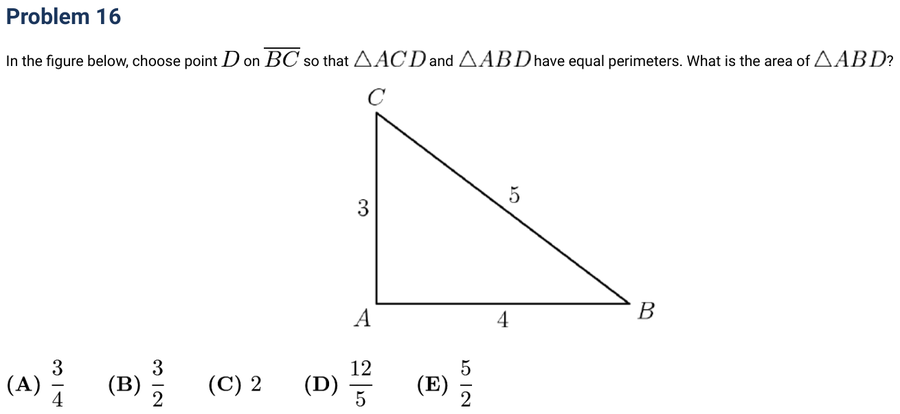
▵ABC is a 3-4-5 right triangle (right angle at A, AC = 3, AB = 4, BC = 5). Let BD = x, so CD = 5 − x.
Equal perimeters share side AD, which cancels: AC + CD = AB + BD ⇒ 3 + (5 − x) = 4 + x ⇒ x = 2. So BD = 2. Spotting that AD cancels is what makes this one line instead of two messy perimeter sums.
▵ABD and ▵ABC share the altitude from A down to line BC, so their areas scale as their bases: area(▵ABD)/area(▵ABC) = BD/BC = 2/5.
You'll reuse the base-ratio idea constantly: two triangles with a common apex and bases on the same line have areas in the ratio of those bases — no need to find the height.
Starting with some gold coins and some empty treasure chests, I tried to put 9 gold coins in each treasure chest, but that left 2 treasure chests empty. So instead I put 6 gold coins in each treasure chest, but then I had 3 gold coins left over. How many gold coins did I have?
Show answer
Answer: C — 45 coins.
Show hints
Hint 1 of 2
The coin pile never changes — only how it's distributed. Write the same number of coins two ways, one for each filling, and set those expressions equal.
Still stuck? Show hint 2 →
Hint 2 of 2
"2 chests empty" means only n − 2 chests get the 9 coins. Equate g = 9(n − 2) with g = 6n + 3 and solve.
Show solution
Approach: count the same coins two ways
Let n = chests and g = coins. Filling 9 each but leaving 2 chests empty uses only n − 2 chests: g = 9(n − 2). Filling 6 each with 3 left over: g = 6n + 3.
Same g, so 9(n − 2) = 6n + 3 ⇒ 9n − 18 = 6n + 3 ⇒ 3n = 21 ⇒ n = 7.
g = 6(7) + 3 = 45.
Why this transfers: any "distribute the same total two different ways" puzzle becomes one equation by writing the unchanging total twice and matching them.
Another way — track the difference per chest:
Going from 6-per-chest to 9-per-chest adds 3 coins to each of the 7 chests... but instead reason forward: the two schemes differ. Switching from 9s to 6s frees 3 coins from every filled chest, plus the 2 chests that were empty now also get 6 each.
Quick check the answer: with 7 chests, 9×(7−2) = 45 and 6×7 + 3 = 45 — both give 45, confirming the count is consistent.
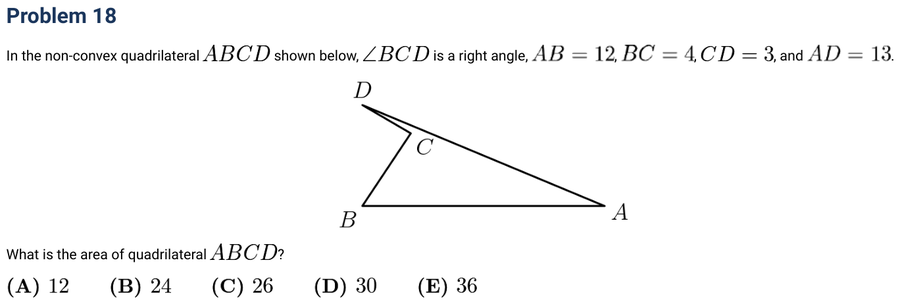
Draw the diagonal BD. The right angle at C makes ▵BCD a 3-4-5, handing you BD = 5 — and that 5 is the bridge to the rest of the figure.
Still stuck? Show hint 2 →
Hint 2 of 2
Watch the side lengths line up: with BD = 5, ▵ABD has sides 5, 12, 13 — a Pythagorean triple, so it's secretly a right triangle too. And since the quadrilateral is non-convex (C caves inward), its area is the big triangle − the notch: ▵ABD − ▵BCD.
Show solution
Approach: split on diagonal BD into two right triangles
Add diagonal BD. ▵BCD has the right angle at C with legs BC = 4 and CD = 3, so BD = √(16+9) = 5. That hypotenuse is the key — it unlocks the second triangle.
Now ▵ABD has sides BD = 5, AB = 12, AD = 13 — a 5-12-13 triple, so it's right-angled at B. (Recognizing the triple saves you a square-root computation.)
Because C dents inward, the quadrilateral is the large ▵ABD with the small ▵BCD removed: area = (1/2)(12)(5) − (1/2)(4)(3) = 30 − 6 = 24.
Why this transfers: for any odd quadrilateral, slice it on a diagonal into triangles; here the right angle hands you that diagonal for free, and spotting 3-4-5 / 5-12-13 lets you skip the Pythagorean arithmetic.
For any positive integer M, the notation M! denotes the product of the integers 1 through M. What is the largest integer n for which 5n is a factor of the sum
98! + 99! + 100! ?
Show answer
Answer: D — 26.
Show hints
Hint 1 of 2
Don't fear the factorials — the smallest, 98!, is a factor of all three (99! = 99·98!, 100! = 100·99·98!). Pull it out and the leftover bracket collapses to something startlingly round.
Still stuck? Show hint 2 →
Hint 2 of 2
Factors of 5 add up from two independent sources: the round leftover, plus the 5's buried inside 98!. For 98!, use Legendre's count: ⌊98/5⌋ + ⌊98/25⌋ (multiples of 5, then the extra 5 in multiples of 25).
Show solution
Approach: factor out 98!, then count 5's from each piece
Factor out the common 98!: 98! + 99! + 100! = 98!(1 + 99 + 100·99) = 98!(100 + 9900) = 98! · 10,000. That clean 10,000 is the payoff for factoring — it's loaded with 5's.
Source 1, the leftover: 10,000 = 104 = 24·54, giving 4 factors of 5.
Source 2, inside 98!: count multiples of 5 (⌊98/5⌋ = 19) plus the second 5 each multiple of 25 contributes (⌊98/25⌋ = 3): that's 19 + 3 = 22 factors of 5.
Add the two sources: 4 + 22 = 26. So the largest such n is 26.
Why this transfers: sums of factorials always factor out the smallest one; and the prime-5 count in any k! is ⌊k/5⌋ + ⌊k/25⌋ + ⌊k/125⌋ + … (Legendre's formula) — the engine behind every "trailing zeros" / "power of a prime in a factorial" question.
An integer between 1000 and 9999, inclusive, is chosen at random. What is the probability that it is an odd integer whose digits are all distinct?
Show answer
Answer: B — 56/225.
Show hints
Hint 1 of 2
Two restrictions fight over the same digits: 'odd' lives at the units, 'no leading zero' lives at the thousands. Fill the most constrained positions first so the constraints don't trip over each other.
Still stuck? Show hint 2 →
Hint 2 of 2
Place the units digit first (odd: 5 choices), then the thousands (no 0, and distinct from units), then the looser hundreds and tens. Filling tightest-first keeps each later count clean.
Show solution
Approach: fill the most-constrained positions first
Total 4-digit integers from 1000 to 9999: 9000. These are equally likely, so probability = (favorable)/9000.
Place the trickiest digit first — the units must be odd: {1,3,5,7,9}, 5 choices. Doing units before thousands is the key, because the leading-zero rule then has clean counts.
Thousands: can't be 0 and can't repeat the units digit → 10 − 2 = 8 choices.
Hundreds: any digit except the 2 already used → 8 choices. Tens: any except the 3 used → 7 choices.
Favorable = 5 × 8 × 8 × 7 = 2240, so probability = 2240/9000 = 56/225.
Why this transfers: in 'distinct digits with a position rule' counts, always assign the most-restricted slot first — tackling 0/leading and parity constraints early prevents double-counting headaches.
Suppose a, b, and c are nonzero real numbers, and a + b + c = 0. What are the possible value(s) for
a|a| + b|b| + c|c| + abc|abc| ?
Show answer
Answer: A — 0.
Show hints
Hint 1 of 2
Each x/|x| is just a sign: +1 if positive, −1 if negative. So the whole expression is (sign of a) + (sign of b) + (sign of c) + (sign of abc).
Still stuck? Show hint 2 →
Hint 2 of 2
The constraint a+b+c=0 forbids all-same-sign, so the count of negatives is exactly 1 or 2. Notice the last term's sign is determined by the first three: an odd number of negatives makes abc negative.
Show solution
Approach: read everything as signs (+1/−1)
Each x/|x| equals +1 (if x>0) or −1 (if x<0). So we're adding four signs — three for a, b, c, and one for their product abc.
Since the three sum to 0 and none is zero, they aren't all the same sign: exactly one or exactly two of a, b, c are negative.
Two positive, one negative: the three signs are +1, +1, −1 (sum +1); one negative factor makes abc negative, sign −1. Total: +1 − 1 = 0.
Two negative, one positive: signs −1, −1, +1 (sum −1); two negatives make abc positive, sign +1. Total: −1 + 1 = 0.
Both cases give 0. The deeper reason: the abc sign always cancels the sum of the first three, because the product's sign tracks the parity of how many are negative.
Another way — pick a concrete example to kill wrong choices:
The value can't depend on which specific numbers you pick, so test one: a=1, b=1, c=−2 (sum 0). Then signs give 1 + 1 + (−1) + (−1) = 0.
A single value of 0 already eliminates every choice except (A); the casework above confirms 0 is the only value, so the answer is 0.
Test-taking tip: when a problem asks 'what are the possible values' and the answer must be constant, computing one clean example often pins it instantly.
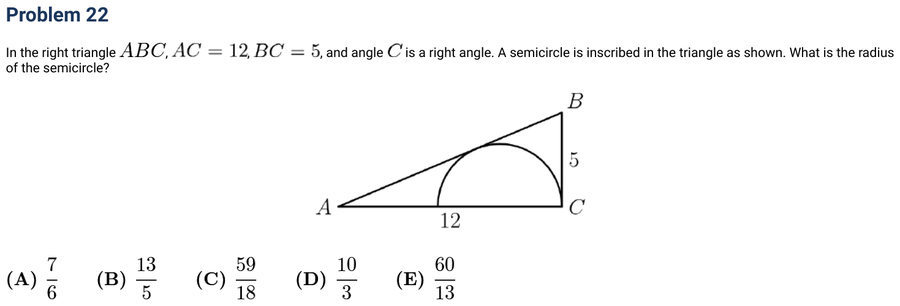
Side BC isn't just a leg — it's a tangent to the semicircle, and so is the hypotenuse. The two-tangents-from-a-point rule means the lengths from B match: BD = BC = 5, which slices the hypotenuse into 5 + 8.
Still stuck? Show hint 2 →
Hint 2 of 2
Drop the radius to the tangent point D — it's perpendicular to AB. That little right triangle ▵ADO is similar to the big ▵ACB (shared angle A), so r/AD = BC/AC.
Show solution
Approach: equal tangents + similar triangles
First the hypotenuse: AB = √(122 + 52) = 13. Let O be the center (on leg AC) and D the point where the curve touches AB.
Both leg BC and hypotenuse AB are tangent lines from B, so they have equal tangent length: BD = BC = 5. Hence AD = 13 − 5 = 8. This equal-tangents step is the unlock — it turns the picture into known lengths.
The radius OD is perpendicular to the tangent AB, so ▵ADO (right angle at D) is similar to ▵ACB (right angle at C), sharing angle A. Matching legs: rAD = BCAC ⇒ r8 = 512.
r = 40/12 = 10/3.
Why this transfers: 'a radius drawn to a tangent point is perpendicular' plus 'tangents from one external point are equal' are the two workhorse facts for almost every inscribed-circle problem.
Another way — coordinates and distance to a line:
Put C = (0,0), A = (12,0), B = (0,5). The diameter sits on AC with its right end at C, so the center is O = (r, 0) and the radius is r.
Line AB is 5x + 12y − 60 = 0. The semicircle is tangent to AB, so the distance from O to that line equals r: (60 − 5r)/13 = r.
Then 60 − 5r = 13r ⇒ 18r = 60 ⇒ r = 10/3 — same answer with no similar-triangle setup, just the point-to-line distance formula.
Each day for four days, Linda traveled for one hour at a speed that resulted in her traveling one mile in an integer number of minutes. Each day after the first, her speed decreased so that the number of minutes to travel one mile increased by 5 minutes over the preceding day. Each of the four days, her distance traveled was also an integer number of miles. What was the total number of miles for the four trips?
Show answer
Answer: C — 25 miles.
Show hints
Hint 1 of 2
She rides 60 minutes each day. For the miles to come out whole, the minutes-per-mile must divide evenly into 60 — so each day's pace is a divisor of 60. That single fact is the whole problem.
Still stuck? Show hint 2 →
Hint 2 of 2
Now it's a treasure hunt: among the divisors of 60, find four that increase by exactly 5 each step. Listing them shows there's only one such run.
Show solution
Approach: minutes-per-mile must divide 60
Each day she rides 60 minutes, and miles = 60 ÷ (minutes per mile). For that to be a whole number, the minutes-per-mile must be a divisor of 60. Translating 'integer miles' into 'divides 60' is the key move.
Divisors of 60: 1, 2, 3, 4, 5, 6, 10, 12, 15, 20, 30, 60. The only four that form an arithmetic run with common difference 5 are 5, 10, 15, 20.
Why this transfers: 'whole number of X per fixed total' is almost always a disguised divisibility condition — convert it to 'must divide the total' and the search space shrinks to a short divisor list.
Mrs. Sanders has three grandchildren, who call her regularly. One calls her every three days, one calls her every four days, and one calls her every five days. All three called her on December 31, 2016. On how many days during the next year did she not receive a phone call from any of her grandchildren?
Show answer
Answer: D — 146 days.
Show hints
Hint 1 of 2
Don't track 365 days — the call pattern is periodic. After lcm(3,4,5) = 60 days all three are back in sync, so figure out one 60-day block and the rest is copy-paste.
Still stuck? Show hint 2 →
Hint 2 of 2
Count no-call days = 60 − (call days), and find call days by inclusion–exclusion: add the every-3, every-4, every-5 counts, subtract the overlaps (every-12, every-15, every-20), add back the triple (every-60).
Show solution
Approach: find one 60-day cycle by inclusion–exclusion, then tile
The three grandchildren realign every lcm(3, 4, 5) = 60 days, so the whole year is just copies of one 60-day block. Solving one block solves everything.
Call days in 60 by inclusion–exclusion: 20 (÷3) + 15 (÷4) + 12 (÷5) − 5 (÷12) − 4 (÷15) − 3 (÷20) + 1 (÷60) = 36. So no-call days = 60 − 36 = 24 per block.
The year is 365 = 6×60 + 5 days. The six full blocks give 6 × 24 = 144 no-call days.
Handle the 5 leftover days (days 361–365, which restart the cycle as days 1–5): day 1 no, day 2 no, day 3 call, day 4 call, day 5 call — 2 more no-call days.
Total: 144 + 2 = 146.
Why this transfers: periodic-event problems collapse to one lcm-length cycle; inclusion–exclusion handles the overlaps, and the only care needed is the partial cycle at the end.
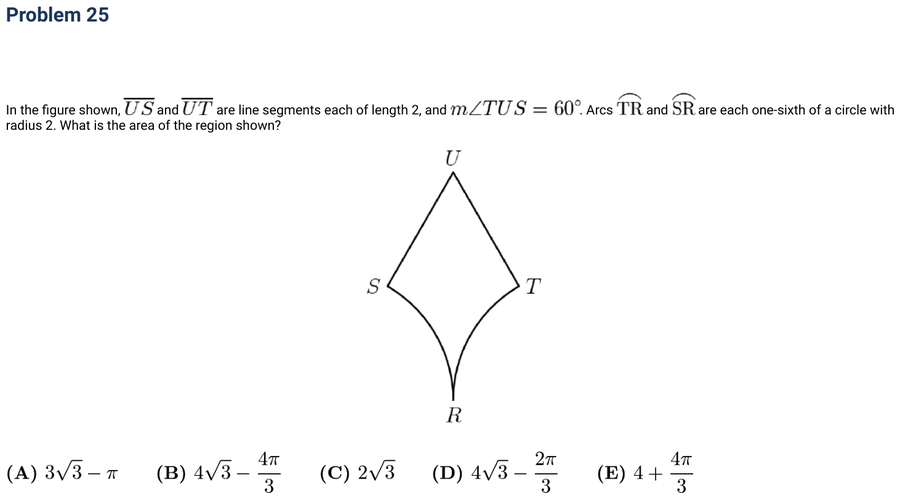
The curvy region is awkward, but the two arcs are bites taken out of a clean shape. The trick with weird areas: find the simple figure they were carved from, then subtract the bites.
Still stuck? Show hint 2 →
Hint 2 of 2
Extend US and UT past S and T by the radius 2. The 60° at U and the equal sides make the completed figure an equilateral triangle of side 4 — and each arc is a 60° (one-sixth) sector of radius 2 scooped out of it.
Show solution
Approach: complete to a clean equilateral triangle, subtract the scooped sectors
The region looks hard, so rebuild the simple shape behind it: extend US and UT past S and T by 2 each (the arc radius). With the 60° apex at U and two equal sides of 2 + 2 = 4, the angles force a 60-60-60 equilateral triangle of side 4. That reframing — carved shape = full triangle − bites — is the whole idea.
Equilateral triangle area (side s): s2√34 = 42√34 = 4√3.
The two bites are each a 60° sector (one-sixth of a circle, radius 2): sector area = πr2/6 = 4π/6 = 2π/3, so two of them total 4π/3.
Region = 4√3 − 4π/3 (choice B).
Sanity check: 4√3 ≈ 6.93 and 4π/3 ≈ 4.19, leaving ≈ 2.7 — a small positive area, right for this slim region. Why this transfers: for any region bounded by arcs, look for the straight-sided figure it was cut from and subtract (or add) the circular pieces.