Problem 25 · 1991 AJHSME
Stretch
Geometry & Measurement
geometric-fraction
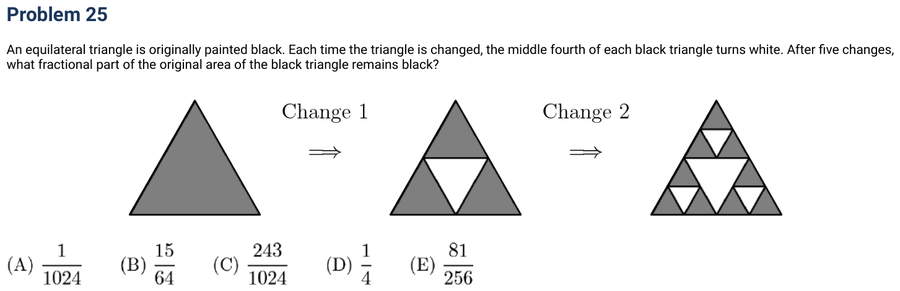
Show answer
Answer: C — 243/1024.
Show hints
Hint 1 of 3
Don't track the growing number of tiny triangles — track the FRACTION of black area. Each change removes the middle fourth of every black triangle. So after one change, what fraction of the previously-black area is still black?
Still stuck? Show hint 2 →
Hint 2 of 3
Removing 1/4 leaves 3/4 — and this happens to every black triangle, big or small, so the total black area gets multiplied by 3/4 at each step. Five changes means multiplying by 3/4 five times.
Still stuck? Show hint 3 →
Hint 3 of 3
You want (3/4) raised to the 5th power: cube the top and bottom separately — 3⁵ over 4⁵.
Show solution
Approach: each change multiplies the black area by 3/4 — compound it 5 times
- Each change whitens the middle fourth of every black triangle, leaving 3/4 of each one black. Because this applies uniformly to all black pieces, the total black fraction is just multiplied by 3/4 every change — no need to count the swarm of little triangles.
- After 5 changes the black fraction is (3/4) × (3/4) × (3/4) × (3/4) × (3/4) = (3/4)⁵.
- Compute by powering top and bottom separately: 3⁵ = 243 and 4⁵ = 1024, so (3/4)⁵ = 243/1024.
- Why this transfers: a process that scales a quantity by the same factor each step is geometric — after n steps the quantity is (start) × (factor)ⁿ. Recognizing the constant ratio lets you skip all the intermediate stages and jump straight to the answer.
- Sanity check: 243/1024 is a bit under 1/4, and five rounds of shaving off a quarter should leave well under half the original black — plausible. ✓
Mark:
· log in to save