Subtracting from a row of 0's forces borrowing all the way across — twelve times. Is there a nearby number you'd MUCH rather subtract from?
Still stuck? Show hint 2 →
Hint 2 of 3
The number just below, 999,999,999,999, is all 9's: every column subtracts with no borrowing. Solve that easy problem first, then fix up the difference of 1.
Still stuck? Show hint 3 →
Hint 3 of 3
Notice four of the five choices begin with 2's; only the last digit decides between them, so most of the work is just nailing down that ones place.
Show solution
Approach: swap the all-0's number for the all-9's number, then add back the 1
Subtracting from 1,000,000,000,000 means borrowing across every column — slow and error-prone. Instead use the number one less, 999,999,999,999: now every digit is 9, so each column gives 9 − 7 = 2 with no borrowing. That clean subtraction is 222,222,222,222.
We replaced the top number by one that was 1 smaller, so the true difference is 1 bigger: 222,222,222,222 + 1 = 222,222,222,223.
Why this transfers: when subtracting from a power of ten (a 1 followed by 0's), shift to the all-9's number right below it to dodge every borrow, then adjust by 1 at the end. The same trick turns 1000 − 638 into 999 − 638 = 361, then +1 = 362.
Sanity check: 222,222,222,223 + 777,777,777,777 should rebuild the top number — the 2's-and-7's add to 9's and the final 3 + 7 carries up to make 1,000,000,000,000. ✓
Two hundred thousand times two hundred thousand equals
Show answer
Answer: E — forty billion.
Show hints
Hint 1 of 3
Split each big number into a small front number and its trailing zeros. Two hundred thousand = 2 followed by how many zeros?
Still stuck? Show hint 2 →
Hint 2 of 3
Handle the fronts and the zeros separately: multiply the 2 × 2, then just pile ALL the zeros together.
Still stuck? Show hint 3 →
Hint 3 of 3
Five zeros from each factor means ten zeros stack up. What does 4 with ten zeros after it spell out?
Show solution
Approach: separate the front digits from the trailing zeros, then recombine
Write each number as a front digit times its zeros: 200,000 = 2 with five 0's = 2 × 10⁵. Multiplying, the fronts give 2 × 2 = 4 and the zeros simply add up: 5 + 5 = 10 zeros.
So the product is 4 followed by ten zeros = 40,000,000,000 = forty billion.
Why this transfers: when multiplying round numbers, never line them up to multiply digit-by-digit — peel off the trailing zeros, multiply the small leftovers, and re-attach the combined zero count. (300 × 4000 = 12 with 5 zeros = 1,200,000.)
Sanity check on the name: a billion has 9 zeros; 40 billion is 4 followed by 10 zeros, which is exactly what we got. ✓
If 991 + 993 + 995 + 997 + 999 = 5000 − N, then N =
Show answer
Answer: E — 25.
Show hints
Hint 1 of 3
Five numbers each just shy of 1000 would total exactly 5000 — and the right side is written as 5000 − N. So N isn't the sum; it's how much the sum FALLS SHORT of 5000. How far below 1000 is each term?
Still stuck? Show hint 2 →
Hint 2 of 3
Don't add the five big numbers. Add only the small gaps (how far each is under 1000); those gaps are exactly N.
Still stuck? Show hint 3 →
Hint 3 of 3
The gaps are 9, 7, 5, 3, 1 — consecutive odd numbers. There's a quick way to total those without adding one at a time.
Show solution
Approach: compare each term to 1000 — add the tiny shortfalls instead of the big numbers
The five terms are each near 1000, so pretend they're all 1000: that's 5000. But each is a little less — by 9, 7, 5, 3, 1. The total shortfall is exactly what gets subtracted from 5000.
Add the gaps: 9 + 7 + 5 + 3 + 1 = 25. So the sum is 5000 − 25, matching 5000 − N, which gives N = 25.
Speed note: 9 + 7 + 5 + 3 + 1 is the first five odd numbers, and the sum of the first k odd numbers is always k² — here 5² = 25, no adding needed.
Why this transfers: when numbers cluster near a round value, measure each from that value and add the small differences — far lighter than adding the bulky numbers and far safer than miscounting digits.
Which of the “checkerboards” illustrated below CANNOT be covered exactly and completely by a whole number of non-overlapping dominoes?
(A)
(B)
(C)
(D)
(E)
Show answer
Answer: B — 3 × 5.
Show hints
Hint 1 of 3
You don't need to attempt any actual covering. One domino always hides exactly 2 squares — so the squares always vanish two at a time. What must be true about the TOTAL number of squares for them all to disappear in pairs?
Still stuck? Show hint 2 →
Hint 2 of 3
Dominoes cover squares in twos, so a fillable board must have an EVEN count of squares. The answer is the lone board whose square-count is odd — and square-count is just rows × columns.
Still stuck? Show hint 3 →
Hint 3 of 3
Multiply rows × columns for each board and hunt for the odd one — odd × odd is the only way to get an odd total.
Show solution
Approach: a board fillable by dominoes must have an even number of squares
Each domino covers exactly 2 squares, so however you lay them, squares get used up two at a time. That means a board can be filled only if its total number of squares is even — no clever arrangement can save an odd-square board.
Count the squares (rows × columns): 3×4 = 12, 3×5 = 15, 4×4 = 16, 4×5 = 20, 6×3 = 18. Only 15 is odd.
An odd number of squares can never split into pairs, so 3 × 5 is the board that cannot be covered.
Why this transfers: any tile that covers a fixed number of cells forces the total to be a multiple of that number — a divisibility check often settles "can it be tiled?" instantly, before you ever try to fit a single piece.
Going deeper (the harder version): an even count is necessary but not always enough. Color the board like a checkerboard — each domino must cover one dark and one light square, so a board with unequal dark/light counts is impossible even when its total is even. Here, though, the simple even/odd count already names the answer.
Which number in the array below is both the largest in its column and the smallest in its row? (Columns go up and down, rows go right and left.)
10643211714108834591341512182593
Show answer
Answer: C — 7.
Show hints
Hint 1 of 3
Two conditions must hold at once, but they aren't equally cheap to check. One of them — being the SMALLEST in its row — only needs you to glance along a single row of five numbers. Which condition would you screen with first to throw out the most candidates fast?
Still stuck? Show hint 2 →
Hint 2 of 3
This is a search with two filters. Pick the filter that's quick to apply, run it to make a short list, then test only the survivors against the slower filter. Here: find each row's smallest, then check just those few against their column.
Still stuck? Show hint 3 →
Hint 3 of 3
There are 5 rows, so only 5 numbers can possibly be "smallest in its row." Find those 5, then check each one against its column for "largest in its column."
Show solution
Approach: screen with the cheap filter first, then test the survivors
Two conditions must both hold, so use the faster one to shrink the search. Scan each row for its smallest entry — that gives just 5 candidates instead of all 25.
Row by row the smallest entries are: 2 (top row), 7 (second row: 11, 7, 14, 10, 8), 3, 1, and 2.
Now test each candidate against its column. The 7 sits in the second column (6, 7, 3, 4, 2), where it is the largest. The others fail the column test.
So the number that is both smallest in its row and largest in its column is 7.
Why this transfers: when something must satisfy two conditions, don't check both for every item — apply the condition that's quickest to evaluate first, then test only what survives. This "cheap filter first" idea saves work in counting and search problems everywhere.
Worth knowing: a value that is the min of its row and the max of its column is called a saddle point — and there can be at most one such value in any grid.
The value of (487,000)(12,027,300) + (9,621,001)(487,000)(19,367)(.05) is closest to
Show answer
Answer: D — About 10,000,000,000.
Show hints
Hint 1 of 3
The question says "closest to," and the choices jump by factors of TEN — so don't multiply anything exactly. The size (number of digits) is all that matters. But first, do the two products on top share something you can factor out?
Still stuck? Show hint 2 →
Hint 2 of 3
Both terms on top are (something) × 487,000. Factor out 487,000 so the messy top becomes 487,000 × (one sum). Then round every number to a single digit times a power of ten and just count zeros.
Still stuck? Show hint 3 →
Hint 3 of 3
Round: 487,000 ≈ 5 × 10⁵, the bracket sum ≈ 2 × 10⁷, and on the bottom 19,367 × 0.05 ≈ 10³. Track only the powers of ten.
Show solution
Approach: factor out the shared term, then size everything with powers of ten
Spot the shared factor on top: both products are (…) × 487,000, so the numerator = 487,000 × (12,027,300 + 9,621,001). Factoring first means one rounding instead of two.
Now estimate magnitudes only. 487,000 ≈ 5 × 10⁵; the bracket ≈ 21,648,301 ≈ 2 × 10⁷. Their product ≈ 10 × 10¹² = 10¹³.
Bottom: 19,367 ≈ 2 × 10⁴, and × 0.05 gives ≈ 10³.
So the value ≈ 10¹³ ÷ 10³ = 10¹⁰ = about 10,000,000,000.
Why this transfers: when answers differ by powers of ten and the question says "closest to," estimating is the intended shortcut — round each factor to one significant digit, then just add and subtract exponents. Exact multiplication here would be a waste of time and a chance to slip.
What is the largest quotient that can be formed using two numbers chosen from the set {−24, −3, −2, 1, 2, 8}?
Show answer
Answer: D — 12.
Show hints
Hint 1 of 3
To make a quotient as LARGE as possible you want it positive and big. A division is positive when both numbers share a sign — and the set's two extreme-magnitude numbers (−24 and... ) happen to both be negative. What pairing makes the result both positive and huge?
Still stuck? Show hint 2 →
Hint 2 of 3
Big quotient = big top ÷ small bottom. For a positive answer the two numbers must match signs; the negatives let you do that AND use the biggest magnitude, −24.
Still stuck? Show hint 3 →
Hint 3 of 3
Try −24 divided by a small-magnitude negative. Which negative in the set has the smallest size?
Show solution
Approach: make it positive (matching signs) with the biggest numerator over the smallest denominator
A quotient grows when the top is large and the bottom is small, and it's positive only when the two numbers share a sign. The biggest-magnitude number is −24 (negative), so pair it with another negative to keep the result positive.
The smallest-magnitude negative is −2. Then −24 ÷ −2 = +12 — large top, small bottom, and the two negatives cancel to give a positive.
So the largest quotient is 12.
Trap to dodge: −24 ÷ −3 = 8 is smaller, and 8 ÷ 1 = 8 also loses — the winning move uses BOTH the biggest magnitude on top and a sign match. Reaching for the literal largest number (8) on top is the bait that gives only 8 ÷ ... at best.
Why this transfers: with signed numbers, "largest result" problems split into two decisions — fix the sign first (match signs to go positive), then maximize magnitude (biggest ÷ smallest).
How many whole numbers from 1 through 46 are divisible by either 3 or 5 or both?
Show answer
Answer: B — 21.
Show hints
Hint 1 of 3
The word "or both" is the warning. If you just add (multiples of 3) + (multiples of 5), the numbers that are multiples of BOTH get counted twice. Which numbers are those?
Still stuck? Show hint 2 →
Hint 2 of 3
Count multiples of 3 and multiples of 5 separately, then subtract the ones counted twice — the multiples of 3 AND 5, i.e. multiples of 15. (Add, add, subtract the overlap.)
Still stuck? Show hint 3 →
Hint 3 of 3
How many multiples of 3 up to 46? Of 5? Of 15? Each count is just 46 divided by that number, rounded down.
Show solution
Approach: inclusion-exclusion — add the two groups, then subtract the double-counted overlap
Counting multiples of 3 and of 5 separately double-counts any number that's a multiple of both. A number divisible by both 3 and 5 is exactly a multiple of 15, so those are the ones to remove once.
Multiples of 3 up to 46: ⌊46 ÷ 3⌋ = 15. Of 5: ⌊46 ÷ 5⌋ = 9. Of 15: ⌊46 ÷ 15⌋ = 3.
Add the two groups and subtract the overlap once: 15 + 9 − 3 = 21.
Why this transfers: "how many do A or B" is always |A| + |B| − |both|. The subtraction fixes the overcount — and "multiple of a and b" means multiple of their least common multiple (here LCM(3,5) = 15, since 3 and 5 share no factors).
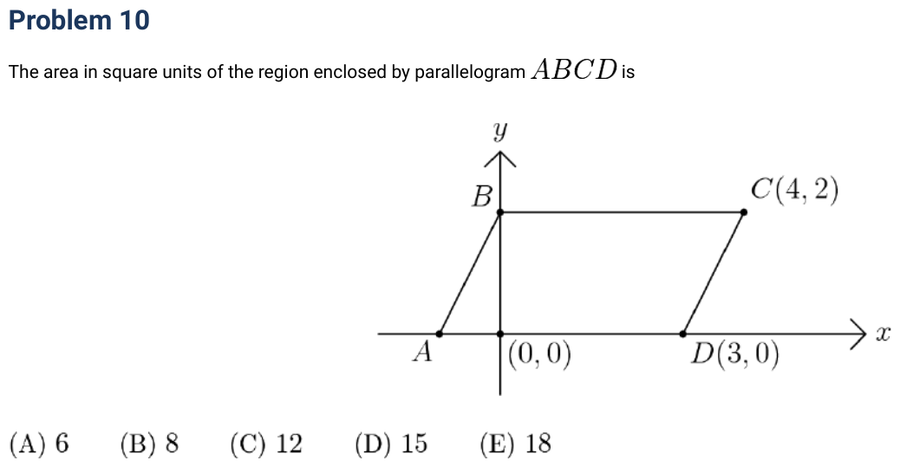
A parallelogram's area is base × height — and "height" means the straight-up gap between the two parallel sides, NOT the length of the slanted side. The top and bottom sides here are both horizontal; pick one as the base.
Still stuck? Show hint 2 →
Hint 2 of 3
The top side B–C is horizontal: read off its length straight from the coordinates. Then the height is just how far apart the top row and the bottom row sit vertically.
Still stuck? Show hint 3 →
Hint 3 of 3
Slanting a parallelogram side-to-side doesn't change its area — only the base and the perpendicular height matter. Don't let the tilt tempt you into using the diagonal.
Show solution
Approach: area = base × perpendicular height (the slant doesn't count)
Use the horizontal top side as the base. B = (0, 2) and C = (4, 2) sit at the same height, so the base length is just 4 − 0 = 4.
The height is the vertical distance between the parallel top and bottom sides: the top is at y = 2 and the bottom (through D = (3,0)) is at y = 0, a gap of 2.
Area = base × height = 4 × 2 = 8.
Why this transfers: a parallelogram is a "sheared" rectangle — push the top sideways and the area stays the same, because area depends only on base and the perpendicular height. The slanted edge length is a decoy; never multiply by it.
There are several sets of three different numbers whose sum is 15 which can be chosen from {1, 2, 3, 4, 5, 6, 7, 8, 9}. How many of these sets contain a 5?
Show answer
Answer: B — 4.
Show hints
Hint 1 of 3
The 5 is forced into the set, so it's already "spent." That fixes how much the other TWO numbers must add up to. Once you know that target, the question shrinks to counting pairs.
Still stuck? Show hint 2 →
Hint 2 of 3
Lock in the 5: the remaining two must total 15 − 5 = 10, be different from each other, and not be another 5. Count those pairs.
Still stuck? Show hint 3 →
Hint 3 of 3
List pairs from the small end (1 + 9, 2 + 8, …) and stop when you'd start repeating — once the two halves cross, you're just re-listing pairs you already have.
Show solution
Approach: fix the forced element, then count pairs for what's left
Since 5 must be in the set, treat it as already chosen. The other two numbers then have to make up 15 − 5 = 10, using different values from 1–9 (and not a second 5).
Walk up from the bottom: 1 + 9, 2 + 8, 3 + 7, 4 + 6. The next would be 5 + 5 (repeats 5, not allowed) and after that pairs just repeat in reverse. So there are 4 sets.
Why this transfers: when one item is required, "use it up" first and reduce to a smaller problem on what remains — here a three-number sum collapses into an easy two-number pairing.
Avoid double-counting: {5, 1, 9} and {5, 9, 1} are the same set, so list each pair only once by always taking the smaller number first.
Each side is "(sum of three numbers) ÷ something." The left side divides by 3 and equals the AVERAGE of 2, 3, 4. What's that average — and what does it force the right side to equal?
Still stuck? Show hint 2 →
Hint 2 of 3
Three consecutive numbers average to their middle one, so the left side is just 3. The right side must also equal 3, which pins down what N has to be.
Still stuck? Show hint 3 →
Hint 3 of 3
You can sidestep the big sum: notice the right side looks just like the left — three consecutive numbers over a divisor. For its value to be the middle number, the divisor must match the middle number.
Show solution
Approach: read both sides as averages of consecutive numbers
Left side: 2, 3, 4 are consecutive, so their average is the middle value, 3. (No need to add and divide.)
So the equation becomes (1990 + 1991 + 1992) ÷ N = 3. The three numbers on top are also consecutive with middle 1991, so their sum is 3 × 1991 (three times the middle).
Now 3 × 1991 ÷ N = 3, which forces N = 1991.
Why this transfers: any run of consecutive numbers (or any evenly-spaced run) sums to (count) × (middle term), and averages to the middle term. Spotting that turns "add three four-digit numbers" into a one-line observation.
How many zeros are at the end of the product 25 × 25 × 25 × 25 × 25 × 25 × 25 × 8 × 8 × 8?
Show answer
Answer: C — 9.
Show hints
Hint 1 of 3
A trailing zero means the number is divisible by 10, and 10 = 2 × 5. So every trailing zero needs ONE 2 paired with ONE 5. Don't multiply this monster out — break each factor into 2's and 5's and count.
Still stuck? Show hint 2 →
Hint 2 of 3
Each zero eats one 2 and one 5, so the number of zeros is however many COMPLETE 2-and-5 pairs you can form. Count all the 2's and all the 5's; the smaller pile is your answer.
Still stuck? Show hint 3 →
Hint 3 of 3
Rewrite the pieces as powers: 25 = 5², so 25⁷ = 5¹⁴; and 8 = 2³, so 8³ = 2⁹. Now just compare the two exponents.
Show solution
Approach: every trailing zero is one factor of 2 paired with one factor of 5
A trailing zero comes from a factor of 10 = 2 × 5, so each zero uses up exactly one 2 and one 5. The number of zeros is the number of complete (2, 5) pairs you can build — which is the smaller of (total 2's) and (total 5's).
Break the product into prime pieces: 25 = 5², so seven 25's give 5¹⁴ (fourteen 5's); 8 = 2³, so three 8's give 2⁹ (nine 2's).
Fourteen 5's but only nine 2's, so you can form just nine pairs. Trailing zeros = 9.
Why this transfers: trailing zeros are always limited by the scarcer of factor-2 vs factor-5. In counting zeros of a factorial like 100!, 2's are plentiful, so you just count the 5's — the same min-of-the-two-piles idea.
Several students are competing in a series of three races. A student earns 5 points for winning a race, 3 points for finishing second, and 1 point for finishing third. There are no ties. What is the smallest number of points a student must earn in the three races to be guaranteed of earning more points than any other student?
Show answer
Answer: D — 13.
Show hints
Hint 1 of 3
"Guaranteed" is the key word — you must beat the rival's BEST possible day, not their average. So picture the strongest single opponent and ask: what score do I need so even they can't tie me? Also: every place (5, 3, 1) is odd, so what's true of every three-race total?
Still stuck? Show hint 2 →
Hint 2 of 3
Three odd numbers always sum to an odd number, so all totals are odd: …, 9, 11, 13, … Test the candidates: for each possible score of yours, work out the best a rival could grab from the places you didn't take, and find the smallest score that leaves every rival strictly behind.
Still stuck? Show hint 3 →
Hint 3 of 3
If you score 11 (say 5+3+3), a rival can also reach 11, so 11 isn't safe. Bump to the next odd total and check whether any rival can still match it.
Show solution
Approach: beat the rival's best-case score, not their typical one
"Guaranteed to win" means your total must exceed what the strongest possible rival could score, so think worst-case for you. First, a quick filter: 5, 3, 1 are all odd, and odd + odd + odd is always odd — so every three-race total is odd. Only 9, 11, 13, 15 are reachable; check from the bottom.
Suppose you score 11. One way is 5 + 3 + 3 — but then a rival could take the two 1st places you didn't (5 + 5) plus a 1, reaching 11 and tying you. So 11 can be tied; not safe.
Now score 13 — say 5 + 5 + 3 (win two races, 2nd in the third). The best any single rival can still collect is 2nd in your two wins and 1st in the remaining race: 3 + 3 + 5 = 11. That's strictly less than 13, every time.
So the smallest guaranteed-winning total is 13.
Why this transfers: "guarantee" problems are worst-case problems — you optimize against an adversary playing their best, not against an average. Pair that with a parity filter (totals here must be odd) to skip half the candidates instantly.
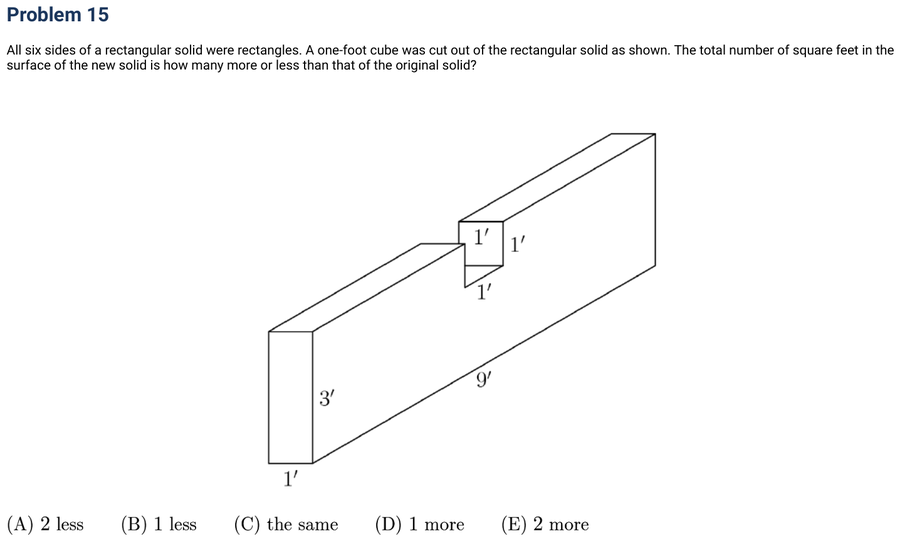
Don't compute the whole surface area before and after — just track what CHANGES at the corner. Removing the little cube takes away some surface squares but opens up a notch with new walls. Compare those two amounts.
Still stuck? Show hint 2 →
Hint 2 of 3
The cut-out cube sat at a corner, so exactly 3 of its faces were on the outside (now gone). The notch it leaves behind exposes 3 fresh inside faces. Are those numbers the same?
Still stuck? Show hint 3 →
Hint 3 of 3
Picture biting one cube out of a corner: 3 squares disappear from the outside, 3 brand-new squares appear inside. The trade is even.
Show solution
Approach: compare only the squares removed vs. the squares newly exposed
Total surface area barely matters — only the corner changes, so just weigh what's lost against what's gained there.
The unit cube was at a corner, so 3 of its faces were part of the outer surface; removing it erases those 3 unit squares.
But the empty notch now shows 3 new inside faces (the walls of the bite), adding 3 unit squares back.
3 removed, 3 revealed — they cancel exactly, so the surface area is the same.
Why this transfers: for any "before vs. after" question, don't recompute the whole thing — track only the difference. And a corner notch always trades 3 outer faces for 3 inner faces (an edge notch trades 2 for 4, growing the area), so the geometry of where you cut decides the outcome.
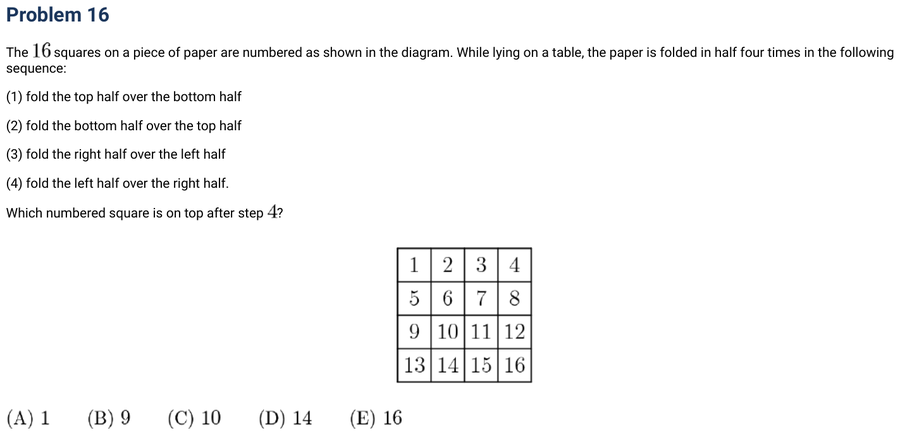
You don't have to track all 16 squares — only one position can end up on top, so just chase the TOP of the stack. Each fold says "X half over Y half," and the half that folds OVER lands on top. Keep asking: after this fold, which original square is now on top?
Still stuck? Show hint 2 →
Hint 2 of 3
Work fold by fold. After folds 1 and 2 (both horizontal), the paper is one row tall and you know which row is now on top. After folds 3 and 4 (both vertical), it's a single square — and only one column survives on top.
Still stuck? Show hint 3 →
Hint 3 of 3
Each fold halves the paper and flips the moving half over. Don't redraw the whole grid; track which row, then which column, finishes on top.
Show solution
Approach: chase only the top of the stack through each fold
Number the rows 1–4 (top to bottom) and columns 1–4 (left to right). Only the final top square matters, so follow what rises to the top.
Fold 1, top half OVER bottom: rows 1–2 swing down on top of rows 3–4, so the upper rows are now the top layers. Fold 2, bottom half OVER top: the lower of the two remaining row-bands swings up on top — this brings the row originally numbered 5, 6, 7, 8 to the very top.
Fold 3, right half OVER left: the right columns land on top of the left. Fold 4, left half OVER right: the leftmost band swings over on top, which brings the original left column to the top.
Combining "top row after folds = the 5,6,7,8 row" with the column that finishes on top lands you on the square numbered 9. (Tracing the whole stack confirms the top-to-bottom order begins 9, 5, 1, 13, …)
Why this transfers: in any folding puzzle, the phrase "A over B" tells you A ends up on TOP — so you never need to model all the layers, just follow the single cell that keeps winning the "on top" race.
An auditorium with 20 rows of seats has 10 seats in the first row. Each successive row has one more seat than the previous row. If students taking an exam are permitted to sit in any row, but not next to another student in that row, then the maximum number of students that can be seated for an exam is
Show answer
Answer: C — 200.
Show hints
Hint 1 of 3
First solve ONE row: in a row of n seats with no two students adjacent, the most you can fit is "fill every other seat" starting at an end. For a row of 10 that's 5; for a row of 11 that's 6. What's the rule for n?
Still stuck? Show hint 2 →
Hint 2 of 3
Per row the max is ⌈n/2⌉ (round n÷2 UP — an odd row gets the extra seat). Now you must add that over rows of 10, 11, …, 29 seats. Adding twenty numbers is slow; look for a pairing shortcut.
Still stuck? Show hint 3 →
Hint 3 of 3
Write the twenty per-row maxima in order: 5, 6, 6, 7, …, 14, 14, 15. Pair the smallest with the largest, second-smallest with second-largest. What does each pair add to?
Show solution
Approach: solve one row, then pair the row-totals from the ends
One row first: with no two students side by side, fill every other seat starting at an end. A row of n seats holds ⌈n/2⌉ students (round up, so an odd row earns the extra seat).
The rows have 10, 11, …, 29 seats, giving maxima 5, 6, 6, 7, 7, 8, …, 14, 14, 15.
Pair from the ends: 5 + 15, 6 + 14, 6 + 14, … — each pair sums to 20. There are 20 rows = 10 pairs, so the total is 10 × 20 = 200.
Why this transfers: "no two adjacent" always means "take every other one," capping a line of n at ⌈n/2⌉ — the same bound shows up in seating, tiling, and graph problems. And summing a tidy list is fastest by pairing ends (the Gauss trick).
Another way — average × count (Gauss):
The twenty row-maxima run 5, 6, 6, …, 14, 14, 15 — they're balanced around a middle value of 10, so their average is 10.
Total = average × count = 10 × 20 = 200, no listing required.
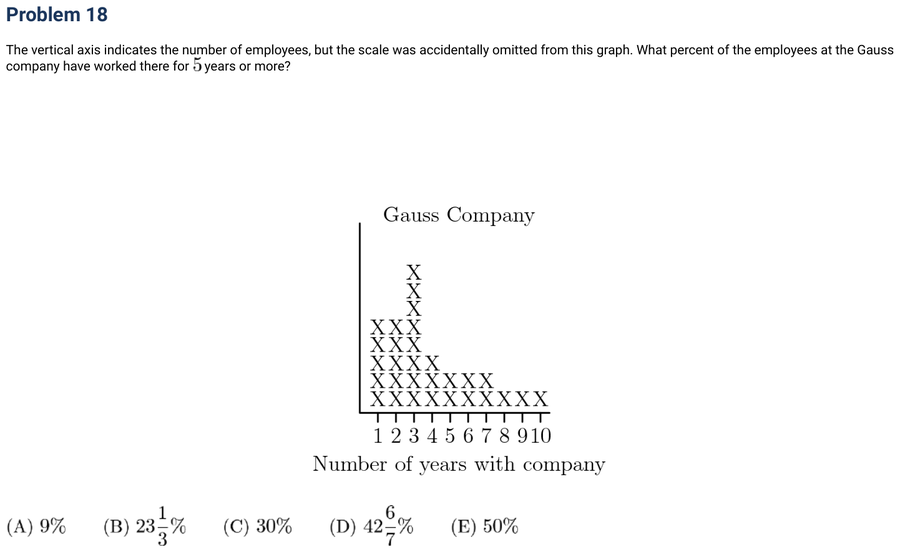
"The scale was left off" sounds like missing information, but it isn't — every X stands for the SAME number of employees, whatever that number is. So a percent (a ratio) doesn't need the scale at all. What two counts of X's do you actually need?
Still stuck? Show hint 2 →
Hint 2 of 3
Percent for 5+ years = (X's in the 5,6,7,8,9,10 columns) ÷ (X's in ALL columns), times 100. The unknown "employees per X" cancels top and bottom — just count symbols.
Still stuck? Show hint 3 →
Hint 3 of 3
Tally each column's height. The total comes to a round number, which makes the fraction easy to turn into a percent.
Show solution
Approach: the missing scale cancels — count X's and take the ratio
The percent of employees with 5+ years is (employees with 5+ years) ÷ (all employees). Each X is the same number of employees, say k; that k multiplies both top and bottom and cancels, so the scale being missing doesn't matter — just count X's.
Years 5 and up are columns 5–10: 2 + 2 + 2 + 1 + 1 + 1 = 9 X's.
Fraction = 9 ÷ 30 = 3/10 = 30%.
Why this transfers: a ratio or percent never needs the absolute scale — any common unit cancels. Whenever a problem hides the "how many per symbol," check whether you only need a fraction; if so, counting symbols is enough.
The average (arithmetic mean) of 10 different positive whole numbers is 10. The largest possible value of any of these numbers is
Show answer
Answer: C — 55.
Show hints
Hint 1 of 3
Average 10 over 10 numbers means a FIXED total — the ten numbers always add to 100, a fixed pie. To give one number the biggest possible slice, what should the other nine slices be?
Still stuck? Show hint 2 →
Hint 2 of 3
The total is locked at 100. One number is huge only if the other nine are as TINY as possible — and they must be different positive whole numbers. What are the nine smallest such numbers?
Still stuck? Show hint 3 →
Hint 3 of 3
The nine smallest different positive whole numbers are 1, 2, 3, …, 9. Take their sum away from 100.
Show solution
Approach: fix the total, then starve the other nine numbers
Average 10 across 10 numbers means the total is fixed: 10 × 10 = 100. With a fixed total, one number is biggest exactly when the rest are smallest.
The nine others must be different positive whole numbers, so the smallest they can be is 1, 2, 3, …, 9. That sum is (9 × 10) ÷ 2 = 45.
The largest number takes whatever's left: 100 − 45 = 55.
Why this transfers: a fixed average is a fixed total — a budget. To maximize one part of a fixed budget, push every other part to its allowed minimum (and use the "different" rule to make them 1, 2, 3, …). The same "minimize the rest" move solves countless extremal problems.
Trap to dodge: 91 (= 100 − 9, leaving 1's) ignores "different"; the values must be distinct, forcing 1 through 9, not nine copies of 1.
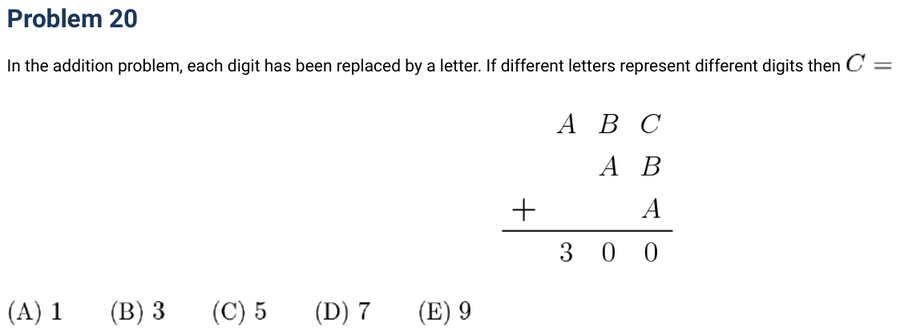
The letter A appears in the hundreds place (in ABC), the tens place (in AB), and the ones place (in A). So A pulls a LOT of weight in the total of 300. Roughly how big can A be before three copies of it overshoot 300?
Still stuck? Show hint 2 →
Hint 2 of 3
Write what each letter is worth: ABC = 100A + 10B + C, AB = 10A + B, A = A. Add them: 111A + 11B + C = 300. Now the hundreds force A almost immediately.
Still stuck? Show hint 3 →
Hint 3 of 3
111A alone must be near 300 without passing it: A = 3 gives 333 (too big), A = 1 gives only 111 (can't reach 300 with the small leftovers). So A is pinned. Then solve 11B + C = whatever's left.
Show solution
Approach: expand by place value; the hundreds digit pins everything down
Translate the stacked sum into place value: ABC + AB + A = (100A + 10B + C) + (10A + B) + A = 111A + 11B + C = 300.
Look at A first: it's multiplied by 111. A = 3 gives 333 (over 300); A = 1 gives 111, and even with B = C = 9 you'd reach only 111 + 99 + 9 = 219 (short of 300). So A = 2 is forced.
That leaves 11B + C = 300 − 222 = 78. The biggest B can be is 7 (since 11 × 8 = 88 > 78), and 11 × 7 = 77 leaves C = 1.
Check: 271 + 27 + 2 = 300, and A, B, C = 2, 7, 1 are all different. So C = 1.
Why this transfers: in a cryptarithm, attack the leftmost (highest place-value) digit first — it carries the most weight and usually only one digit fits, which then unlocks the rest.
Another way — add column by column with carries:
Units column: A + B + C must end in 0 (the total's ones digit). Tens column: A + B plus any carry must also end in 0. Hundreds column: A plus the carry from the tens must equal 3.
If the tens carry 1 into the hundreds, then A + 1 = 3, so A = 2. Filling that back through the columns gives B = 7 and C = 1, and 271 + 27 + 2 = 300 checks out — so C = 1.
For every 3° rise in temperature, the volume of a certain gas expands by 4 cubic centimeters. If the volume of the gas is 24 cubic centimeters when the temperature is 32°, what was the volume in cubic centimeters when the temperature was 20°?
Show answer
Answer: A — 8.
Show hints
Hint 1 of 3
The rule comes in chunks of 3° at a time, so think in STEPS, not in single degrees. Going from 32° back to 20° is how big a temperature change — and how many whole 3° steps does that make?
Still stuck? Show hint 2 →
Hint 2 of 3
Lower temperature means a SMALLER volume (the gas was colder before), so you'll subtract. A 12° drop = four 3° steps, and each step is worth 4 cm³.
Still stuck? Show hint 3 →
Hint 3 of 3
Find the change first (four steps × 4 cm³), then apply it to the known 24 cm³ in the right direction.
Show solution
Approach: count whole 3° steps, then subtract (colder = less)
The rule changes volume only per 3° step, so measure the temperature change in steps. From 32° down to 20° is a 12° drop = 12 ÷ 3 = four steps.
Each step is 4 cm³, so four steps = 16 cm³. Since we're going to a colder 20°, the gas was smaller then — subtract: 24 − 16 = 8 cm³.
Trap to dodge: the easy slip is adding (getting 40) — always check direction: lower temperature shrinks the gas, so the earlier, cooler volume must be the smaller one.
Why this transfers: for any "so much change per fixed step" rule, count the steps first, multiply by the per-step amount, then add or subtract based on which way you're traveling.
A product is even the moment EITHER number is even — one even factor is enough. The only way to FAIL (get an odd product) is for both spins to be odd. Counting that single bad case is easier than counting all the good ones.
Still stuck? Show hint 2 →
Hint 2 of 3
Use the complement: P(even) = 1 − P(both odd). Find each spinner's chance of landing odd, then multiply (the spins are independent).
Still stuck? Show hint 3 →
Hint 3 of 3
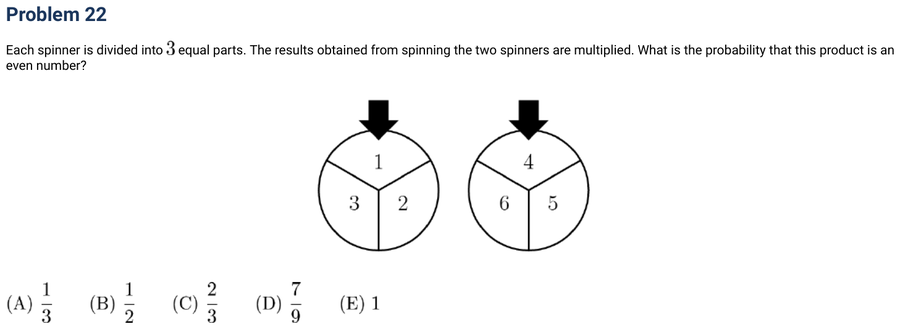
Spinner one has numbers 1, 2, 3 (two odd); spinner two has 4, 5, 6 (one odd). Multiply those odd-chances to get 'both odd,' then subtract from 1.
Show solution
Approach: complementary counting — 1 minus the chance of the only bad case
A product is even unless both factors are odd (any single even number drags the product even). So instead of listing every even outcome, find the one way it goes wrong — both odd — and subtract from 1.
Spinner 1 shows 1, 2, 3: odd in 2 of 3 cases, so P(odd) = 2/3. Spinner 2 shows 4, 5, 6: odd only on the 5, so P(odd) = 1/3.
The spins are independent, so P(both odd) = 2/3 × 1/3 = 2/9.
P(even product) = 1 − 2/9 = 7/9.
Why this transfers: when a result needs "at least one" of something (here, at least one even factor), it's usually far faster to compute the single opposite case ("none of them") and subtract from 1 — complementary counting.
Another way — count the 9 equally likely outcomes:
There are 3 × 3 = 9 equally likely (spin1, spin2) pairs. The product is odd only when both are odd: (1,5) and (3,5) — just 2 pairs.
So 9 − 2 = 7 pairs give an even product, and the probability is 7/9.
The Pythagoras High School band has 100 female and 80 male members. The orchestra has 80 female and 100 male members. There are 60 females who are in both band and orchestra. Altogether there are 230 students who are in either band or orchestra or both. The number of males in the band who are NOT in the orchestra is
Show answer
Answer: A — 10.
Show hints
Hint 1 of 3
This looks tangled because males and females are mixed together. Untangle it: the 230 total splits cleanly into distinct females + distinct males. The females are fully solvable on their own (you know the band females, orchestra females, AND the overlap), so peel them off first.
Still stuck? Show hint 2 →
Hint 2 of 3
Find distinct females with overlap subtracted (band F + orchestra F − both F). Subtract from 230 to get distinct males. Then run the SAME overlap formula on the males to find how many are in both — and finally remove those from the band males.
Still stuck? Show hint 3 →
Hint 3 of 3
Once you know males-in-both, the answer is just band males minus that overlap (the ones left are in band only).
Show solution
Approach: handle females first, then inclusion-exclusion on the males
Separate by gender. Distinct females (counting the 60 overlap only once): 100 + 80 − 60 = 120.
The 230 total is females + males, so distinct males = 230 − 120 = 110.
Now inclusion-exclusion on the males to find the overlap: (band males) + (orchestra males) − (distinct males) = 80 + 100 − 110 = 70 males are in both.
Males in band but NOT orchestra = all band males minus those also in orchestra = 80 − 70 = 10.
Why this transfers: when a population mixes two categories, split it into independent sub-populations you can fully solve, then apply "in A or B = A + B − both" to each. The overlap formula run backwards (solving for "both" from the union) is the key move here.
A cube of edge 3 cm is cut into N smaller cubes, not all the same size. If the edge of each smaller cube is a whole number of centimeters, then N =
Show answer
Answer: E — 20.
Show hints
Hint 1 of 3
What sizes of smaller cube can even exist here? Edges must be whole centimeters and SMALLER than 3, so only edge 1 or edge 2 are allowed. The phrase "not all the same size" means you can't just use twenty-seven 1-cubes — you must include at least one 2-cube.
Still stuck? Show hint 2 →
Hint 2 of 3
A 2×2×2 cube needs 2 cm of room in every direction, and the big cube is only 3 cm wide — so how many 2-cubes can you possibly fit side by side? Place that many, then fill every remaining gap with 1-cubes.
Still stuck? Show hint 3 →
Hint 3 of 3
Total volume is 3³ = 27. Subtract the volume of the 2-cube(s) you placed; whatever's left is made of unit cubes (volume 1 each). Then add up the piece COUNT.
Show solution
Approach: only 1- and 2-cubes are allowed; place the few big ones, count the rest
The big cube has volume 3 × 3 × 3 = 27. Smaller whole-cm cubes can only have edge 1 or 2 (edge 3 would be the whole cube). And "not all the same size" forces at least one 2-cube into the mix.
How many 2-cubes fit? Each needs 2 cm along every edge, but the box is only 3 cm wide, so two of them can't sit side by side in any direction — only ONE 2-cube fits.
That 2-cube uses 8 of the 27 cubic cm, leaving 27 − 8 = 19 cubic cm, all filled by unit cubes — that's 19 of them.
Total pieces: 1 + 19 = 20, and they're not all the same size. ✓
Why this transfers: in dissection problems, first list which piece sizes are even possible, then use the container's dimensions to cap how many of the big pieces fit — the leftover volume forces the count of small pieces. Counting volume and counting pieces are different questions; here we needed the piece count.
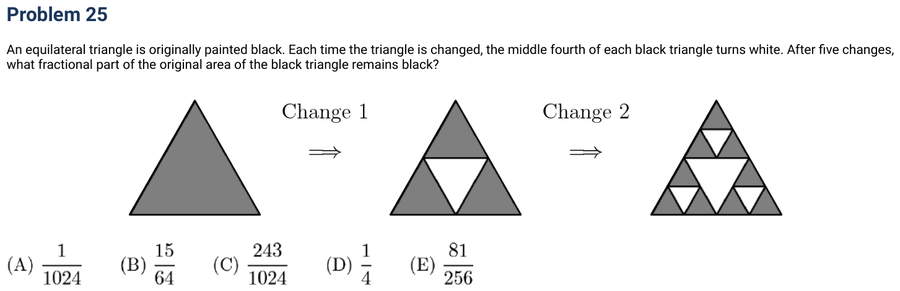
Don't track the growing number of tiny triangles — track the FRACTION of black area. Each change removes the middle fourth of every black triangle. So after one change, what fraction of the previously-black area is still black?
Still stuck? Show hint 2 →
Hint 2 of 3
Removing 1/4 leaves 3/4 — and this happens to every black triangle, big or small, so the total black area gets multiplied by 3/4 at each step. Five changes means multiplying by 3/4 five times.
Still stuck? Show hint 3 →
Hint 3 of 3
You want (3/4) raised to the 5th power: cube the top and bottom separately — 3⁵ over 4⁵.
Show solution
Approach: each change multiplies the black area by 3/4 — compound it 5 times
Each change whitens the middle fourth of every black triangle, leaving 3/4 of each one black. Because this applies uniformly to all black pieces, the total black fraction is just multiplied by 3/4 every change — no need to count the swarm of little triangles.
After 5 changes the black fraction is (3/4) × (3/4) × (3/4) × (3/4) × (3/4) = (3/4)⁵.
Compute by powering top and bottom separately: 3⁵ = 243 and 4⁵ = 1024, so (3/4)⁵ = 243/1024.
Why this transfers: a process that scales a quantity by the same factor each step is geometric — after n steps the quantity is (start) × (factor)ⁿ. Recognizing the constant ratio lets you skip all the intermediate stages and jump straight to the answer.
Sanity check: 243/1024 is a bit under 1/4, and five rounds of shaving off a quarter should leave well under half the original black — plausible. ✓