Problem 17 · 1988 AJHSME
Hard
Geometry & Measurement
inclusion-exclusion-area
Show answer
Answer: B — 38.
Show hints
Hint 1 of 2
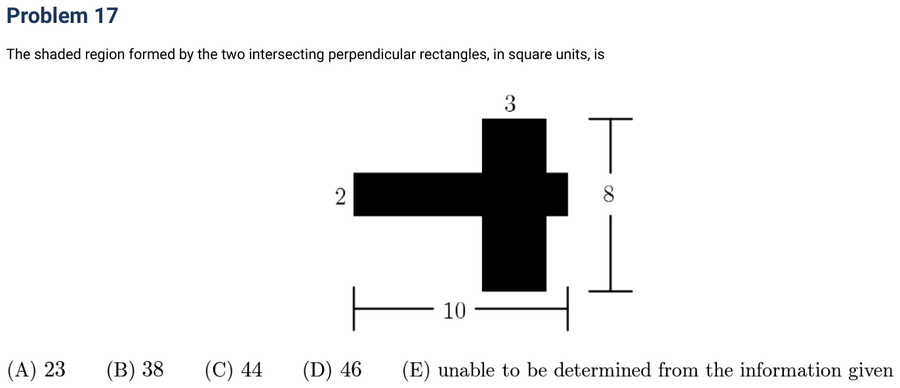
The shape is two rectangles crossing like a plus sign. If you just add their two areas, you've counted the little square where they cross *twice* — so what must you do about it?
Still stuck? Show hint 2 →
Hint 2 of 2
Add both rectangles, then subtract the overlap once. The overlap is the 3-wide, 2-tall patch in the middle.
Show solution
Approach: add both rectangles, subtract the double-counted overlap
- The horizontal bar is 10 × 2 = 20 and the vertical bar is 3 × 8 = 24. Adding gives 44, but the crossing region — a 3 × 2 = 6 patch — sat inside *both* bars, so it got counted twice.
- Remove that one extra copy: 20 + 24 − 6 = 38.
- Why this transfers: whenever two regions overlap, area(A) + area(B) counts the shared part twice, so the true total is area(A) + area(B) − overlap. This 'add, then subtract the double-count' rule is the heart of inclusion–exclusion.
Another way — cut into non-overlapping pieces:
- Keep the whole horizontal bar (10 × 2 = 20) and add only the parts of the vertical bar that stick out above and below it. Those two stubs are each 3 wide; together they're 3 × (8 − 2) = 3 × 6 = 18.
- 20 + 18 = 38, with no double-counting to undo.
Mark:
· log in to save