Problem 17 · 2010 AMC 8
Hard
Geometry & Measurement
area-bisectorsimilar-triangles
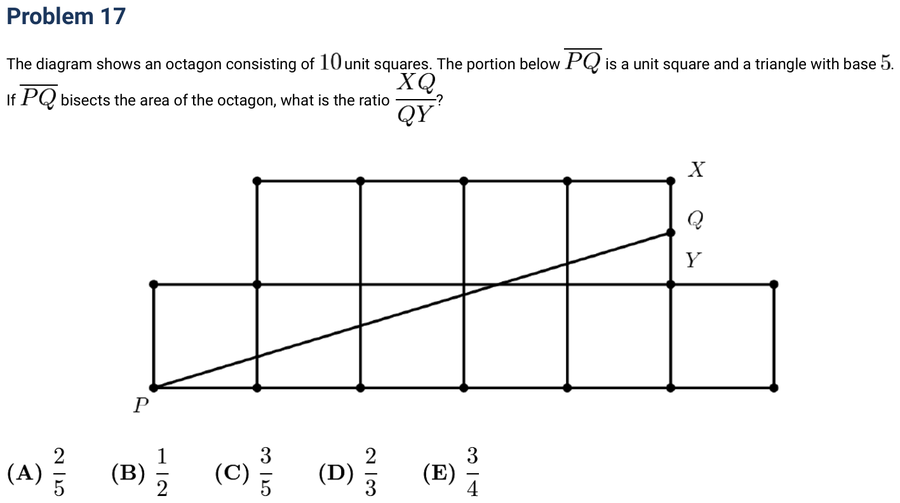
The diagram shows an octagon consisting of 10 unit squares. The portion below PQ is a unit square and a triangle with base 5. If PQ bisects the area of the octagon, what is the ratio XQQY?
Show answer
Answer: D — 2/3.
Show hints
Hint 1 of 3
‘Bisects the area’ is a number in disguise: half of 10 is 5. So the whole region below the line must total exactly 5 — that's your one equation.
Still stuck? Show hint 2 →
Hint 2 of 3
Turn the geometric condition into an area equation, then back out the unknown height. Here the bottom region is (unit square) + (triangle of base 5), and its total is pinned to 5.
Still stuck? Show hint 3 →
Hint 3 of 3
Once you know the triangle's height, the point Q's location on the 2-unit-tall right edge is forced — then XQ and QY are just the two pieces it splits.
Show solution
Approach: convert ‘bisects area’ into an equation, then locate Q
- The octagon is 10 unit squares, so each half is 5. The part below PQ is a unit square plus a triangle of base 5, and together they must equal 5 — so the triangle alone has area 4.
- Area = (1/2) · base · height, so (1/2) · 5 · height = 4 gives height = 1.6. That height is how high Q sits above the base.
- The right edge XY is 2 units tall (with Y one unit up). Q sits at height 1.6, so QY = 1.6 − 1 = 0.6 and XQ = 2 − 1.6 = 0.4.
- Ratio XQ/QY = 0.4 / 0.6 = 2/3.
- Why this transfers: a ‘line that splits the area in a given way’ is really an algebra problem — write the area on one side, set it to the target, solve for the unknown length. The geometry just supplies the formula.
Mark:
· log in to save