Problem 17 · 1996 AJHSME
Hard
Geometry & Measurement
coordinate-area
Show answer
Answer: C — (−2, 0).
Show hints
Hint 1 of 2
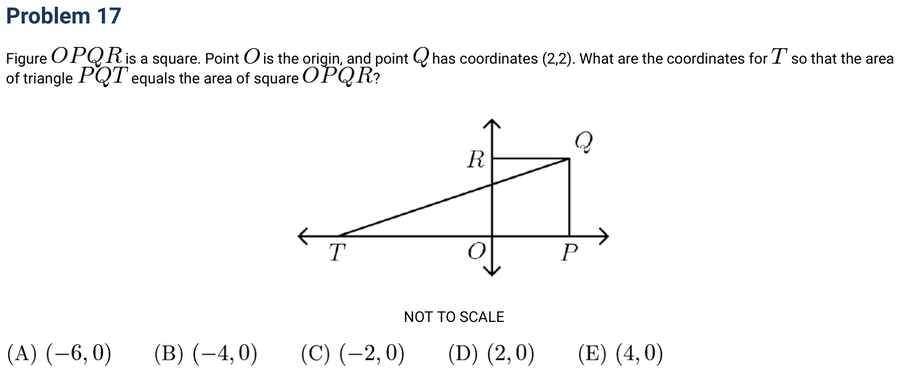
First nail down the target: Q = (2,2) makes OPQR a 2×2 square, so its area is 4 — that's the area the triangle has to match. Now you need the right base and height for triangle PQT.
Still stuck? Show hint 2 →
Hint 2 of 2
Pick PQ as the base: it's the vertical side from (2,0) to (2,2), length 2, sitting on the line x = 2. For any T on the x-axis, the height is just how far T is sideways from that line. Set ½ · base · height = 4 and solve for the sideways distance.
Show solution
Approach: match the triangle's area to the square's, picking a convenient base
- Q = (2,2) means the square OPQR is 2 × 2, area 4 — so we need triangle PQT to have area 4 as well.
- Choose the vertical side PQ as the base (length 2, lying on the line x = 2). The height is the horizontal distance from T to that line. Area = ½ · 2 · (distance) = distance, so the distance must equal 4.
- T sits on the x-axis 4 units from the line x = 2. The figure puts T to the left of the origin, so T is at x = 2 − 4 = −2, giving T = (−2, 0).
- Why this transfers: in coordinate area problems, choose the base that lies along a vertical or horizontal line — then the height is just a coordinate difference, no slanted measuring needed.
Mark:
· log in to save