At Euclid Middle School the mathematics teachers are Miss Germain, Mr. Newton, and Mrs. Young. There are 11 students in Mrs. Germain's class, 8 students in Mr. Newton's class, and 9 students in Mrs. Young's class taking the AMC 8 this year. How many mathematics students at Euclid Middle School are taking the contest?
Show answer
Answer: C — 28.
Show hints
Hint 1 of 2
Each class is a separate group of students, and no student is in two of these classes — so the total is just the three counts joined together.
Still stuck? Show hint 2 →
Hint 2 of 2
When groups don't overlap, the whole equals the sum of the parts. Add them.
Show solution
Approach: add disjoint groups
The three classes don't share students, so the total is just 11 + 8 + 9 = 28.
Why this transfers: ‘how many altogether’ is a plain sum only when the groups can't overlap. The moment groups could share members (students in two clubs, say), you'd need to subtract the overlap — that's the inclusion-exclusion idea you'll meet later.
If a@b = a × ba + b for a, b positive integers, then what is 5@10?
Show answer
Answer: D — 10/3.
Show hints
Hint 1 of 2
The ‘@’ is just a made-up recipe: it tells you exactly what to do with the two numbers. Read it as ‘product on top, sum on the bottom.’
Still stuck? Show hint 2 →
Hint 2 of 2
With any new symbol, copy the rule and drop your numbers into the matching slots — a and b are placeholders waiting to be filled.
Show solution
Approach: substitute into the definition
Plug a = 5, b = 10 into product-over-sum: 5@10 = (5 · 10)/(5 + 10) = 50/15.
Simplify by dividing top and bottom by 5: 50/15 = 10/3.
Why this transfers: a strange symbol like @, ★, or ◇ is never magic — it's a one-line instruction. Substitute carefully and the ‘hard’ problem becomes ordinary arithmetic.
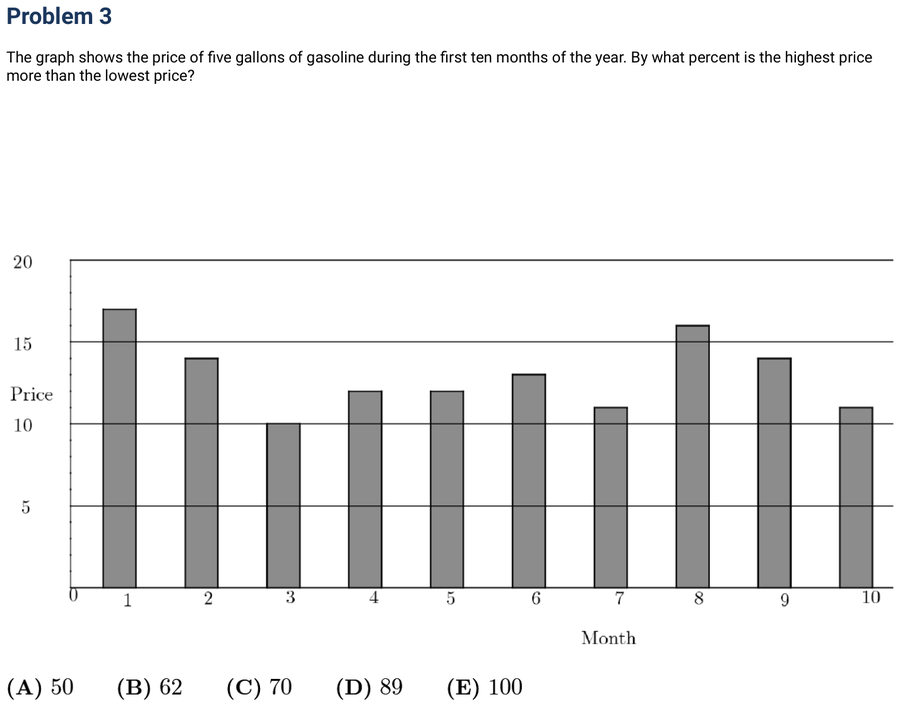
The graph shows the price of five gallons of gasoline during the first ten months of the year. By what percent is the highest price more than the lowest price?
Show answer
Answer: C — 70%.
Show hints
Hint 1 of 2
‘More than’ is the key phrase: you're comparing the gap to the starting amount, not to the bigger amount. The low price is the baseline (the 100%).
Still stuck? Show hint 2 →
Hint 2 of 2
Percent change always divides by where you started: (new − old) / old. The word after ‘than’ tells you the baseline.
Show solution
Approach: compare the gap to the baseline (the low)
Read the tallest and shortest bars: highest = 17, lowest = 10. The gap is 17 − 10 = 7.
‘How much more than the low’ means measure that gap against the low: 7 / 10 = 0.7 = 70%.
Watch out: a common trap is dividing by 17 (the high). Dividing by the wrong number is exactly why the wrong answers are on the list — always anchor to the amount named after ‘than.’
What is the sum of the mean, median, and mode of the numbers 2, 3, 0, 3, 1, 4, 0, 3?
Show answer
Answer: C — 7.5.
Show hints
Hint 1 of 2
Sorting the list once does double duty: it lines up the middle for the median and stacks the repeats so the mode jumps out. Do that single step before anything else.
Still stuck? Show hint 2 →
Hint 2 of 2
Mean / median / mode each answer a different question — the fair share, the middle, the most popular. Sort first, then read two of them straight off the list.
Show solution
Approach: sort once, then read off median and mode
Sort: 0, 0, 1, 2, 3, 3, 3, 4. Now everything is easy to see.
Mode (most repeated) = 3, sitting in an obvious cluster. Median (middle): with 8 numbers, average the 4th and 5th: (2 + 3)/2 = 2.5.
Mean (fair share): sum = 16, so 16/8 = 2.
Total: 3 + 2.5 + 2 = 7.5.
Why this transfers: the three M's are easy to mix up. Naming what each one does — popular, middle, fair-share — keeps you from grabbing the wrong one under time pressure.
Alice needs to replace a light bulb located 10 centimeters below the ceiling in her kitchen. The ceiling is 2.4 meters above the floor. Alice is 1.5 meters tall and can reach 46 centimeters above the top of her head. Standing on a stool, she can just reach the light bulb. What is the height of the stool, in centimeters?
Show answer
Answer: B — 34 cm.
Show hints
Hint 1 of 2
Everything stacks up to the same total height. From the floor: stool + Alice + her reach must equal the height of the bulb. The stool is the only missing piece.
Still stuck? Show hint 2 →
Hint 2 of 2
First make every measurement use the same unit — mixing meters and centimeters is the classic trap here. Turn the meters into centimeters before you add anything.
Show solution
Approach: stack the heights, convert units first
Convert to centimeters so nothing is mismatched: ceiling 240, Alice 150. The bulb hangs 10 below the ceiling, so it's at 240 − 10 = 230 cm.
Standing on the stool, Alice reaches stool + 150 + 46 = stool + 196. That just touches the bulb at 230.
Stool = 230 − 196 = 34 cm.
Why this transfers: in any ‘how tall / how far’ word problem, your very first move is to put all lengths in one unit. The numbers 2.4 m and 150 cm look ready to subtract — they aren't.
Which of the following figures has the greatest number of lines of symmetry?
Show answer
Answer: E — Square (4 lines).
Show hints
Hint 1 of 2
A line of symmetry is a fold line: fold the shape along it and the two halves land exactly on each other. Picture the fold for each figure instead of trying to remember a rule.
Still stuck? Show hint 2 →
Hint 2 of 2
The more ‘sameness’ a shape has (equal sides, equal angles), the more fold lines work. So check the most regular shape — the square — first.
Show solution
Approach: count fold lines, most-regular first
Fold-test the square first since it looks most regular: it matches across both diagonals and both midpoint lines — 4 lines.
The others fall short: equilateral triangle 3, non-square rhombus 2 (only its diagonals), non-square rectangle 2 (only its midpoint lines), isosceles trapezoid just 1.
Most lines: square.
Worth keeping: a regular n-sided shape has exactly n lines of symmetry (triangle 3, square 4, pentagon 5…). Knowing that, you can often spot the winner without drawing a single fold.
Using only pennies, nickels, dimes, and quarters, what is the smallest number of coins Freddie would need so he could pay any amount of money less than a dollar?
Show answer
Answer: B — 10 coins.
Show hints
Hint 1 of 2
You only need enough coins to fill the gaps each bigger coin can't reach by itself.
Still stuck? Show hint 2 →
Hint 2 of 2
Pennies cover the 1¢–4¢ gaps below a nickel; nickels cover the gap below a dime; dimes-and-nickels cover the gap below a quarter — carry just enough of each to bridge to the next coin.
Show solution
Approach: carry just enough small coins to bridge to the next-bigger coin
To make any 1¢–4¢ ending you need 4 pennies. To reach 5¢–9¢ you need a nickel. To reach 10¢–24¢ you need a dime and a second nickel (a dime alone can't make 15¢).
Now the four pennies, two nickels, and one dime can make every amount up to 24¢. Three quarters then stack on top to push that all the way to 99¢.
Total: 4 + 2 + 1 + 3 = 10 coins.
Why this transfers: ‘cover every amount up to N’ problems are built bottom-up — carry the smallest coins/units needed to bridge each gap, then the next size stacks on top. The dime trap (it can't make 15¢ alone, so you still need a spare nickel) is the kind of gap you must check at every level.
As Emily is riding her bicycle on a long straight road, she spots Emerson skating in the same direction 1/2 mile in front of her. After she passes him, she can see him in her rear mirror until he is 1/2 mile behind her. Emily rides at a constant rate of 12 miles per hour, and Emerson skates at a constant rate of 8 miles per hour. For how many minutes can Emily see Emerson?
Show answer
Answer: D — 15 minutes.
Show hints
Hint 1 of 2
Don't track two moving people — track the gap between them. It starts at 1/2 mile (Emerson ahead) and ends at 1/2 mile (Emerson behind), a swing of 1 full mile.
Still stuck? Show hint 2 →
Hint 2 of 2
When two things move the same direction, sit in one rider's seat: from Emily's view Emerson drifts backward at the difference of the speeds, 12 − 8 = 4 mph. That's relative speed.
Show solution
Approach: watch the gap, using relative speed
From Emily's seat, Emerson slides backward at 12 − 8 = 4 mph — only the difference matters since they head the same way.
The gap she can ‘see across’ runs from 1/2 mile ahead to 1/2 mile behind, so 1 mile of relative drift.
Why this transfers: same direction → subtract speeds; opposite directions → add them. Reframing two movers as one gap turns chase/overtake problems into a single distance ÷ rate step.
Another way — track real positions and solve:
Let t be hours since Emily is alongside Emerson. Emily has gone 12t, Emerson 8t, so Emily leads by 4t miles.
Visibility starts at 4t = −1/2 (he's ahead) and ends at 4t = +1/2 (he's behind), a span of Δ(4t) = 1, i.e. t increases by 1/4 hour.
1/4 hour = 15 minutes — same answer, confirming the gap view.
Ryan got 80% of the problems correct on a 25-problem test, 90% on a 40-problem test, and 70% on a 10-problem test. What percent of all the problems did Ryan answer correctly?
Show answer
Answer: D — 84%.
Show hints
Hint 1 of 2
You can't just average 80, 90, 70 — the tests are different sizes, and the big test should pull harder. Go back to raw counts: how many problems did he actually get right out of how many total?
Still stuck? Show hint 2 →
Hint 2 of 2
An overall percent is a weighted average: total correct over total problems. Each test's weight is its number of problems.
Show solution
Approach: weighted average via raw counts
Ignore the percents for a moment and count right answers: 0.8 · 25 + 0.9 · 40 + 0.7 · 10 = 20 + 36 + 7 = 63 correct.
Out of 25 + 40 + 10 = 75 problems: 63 / 75 = 84%.
Sanity check: 84 lands between the lowest (70) and highest (90) scores and leans toward 90 — right, because the 40-problem test is the heaviest. A plain average of 80, 90, 70 gives 80, the wrong answer (A is the trap), proof that size matters.
Six pepperoni circles will exactly fit across the diameter of a 12-inch pizza when placed. If a total of 24 circles of pepperoni are placed on this pizza without overlap, what fraction of the pizza is covered by pepperoni?
Show answer
Answer: B — 2/3.
Show hints
Hint 1 of 2
Six pepperonis span the diameter, so each is 1/6 as wide as the pizza. But area doesn't shrink by 1/6 — it shrinks by 1/6 squared. That squaring is the whole trick.
Still stuck? Show hint 2 →
Hint 2 of 2
For any two similar shapes, the ratio of areas is the square of the ratio of lengths. π never has to appear — it cancels.
Show solution
Approach: areas scale with the square of length
Each pepperoni is 1/6 the width of the pizza, so its area is (1/6)2 = 1/36 of the pizza — squaring the length ratio. No need to compute any actual area.
24 pepperonis cover 24 · (1/36) = 24/36 = 2/3 of the pizza.
Why this transfers: ‘length ratio k ⇒ area ratio k2’ (and volume ratio k3) lets you skip π and radii entirely in scaling problems. Spot the length ratio, square it, done.
Another way — plug in real numbers:
Pizza diameter 12 ⇒ pepperoni diameter 2, radius 1, area π. Pizza radius 6, area 36π.
24 pepperonis: 24π / 36π = 24/36 = 2/3; the π cancels, matching the shortcut above.
The top of one tree is 16 feet higher than the top of another tree. The heights of the two trees are in the ratio 3 : 4. In feet, how tall is the taller tree?
Show answer
Answer: B — 64 feet.
Show hints
Hint 1 of 2
Think of the trees as made of equal ‘parts’: one is 3 parts tall, the other 4. The 16-foot difference is just the one extra part. So one part = 16 ft.
Still stuck? Show hint 2 →
Hint 2 of 2
In a ratio, the difference between the numbers is also measured in those same parts. Find the value of one part, then scale up.
Show solution
Approach: find the value of one ratio part
The heights are 3 parts and 4 parts. The gap between them is 4 − 3 = 1 part, and that gap is the given 16 ft — so 1 part = 16 ft.
The taller tree is 4 parts: 4 · 16 = 64 ft.
Why this transfers: ‘ratio + a difference (or sum)’ almost always cracks open by pricing one part. Match the given number to how many parts it represents, then multiply.
Of the 500 balls in a large bag, 80% are red and the rest are blue. How many of the red balls must be removed from the bag so that 75% of the remaining balls are red?
Show answer
Answer: D — 100 red balls.
Show hints
Hint 1 of 2
Only red balls leave the bag, so the number of blue balls never moves. Track that fixed quantity instead of chasing the changing reds.
Still stuck? Show hint 2 →
Hint 2 of 2
When one quantity stays constant through a change, anchor on it. ‘75% red’ means ‘25% blue,’ and you already know exactly how many blue there are.
Show solution
Approach: anchor on the unchanging blue count
Start: 80% of 500 = 400 red, leaving 100 blue. Removing reds can't touch those 100 blue.
At the end red is 75%, so blue is the other 25%. Those 25% are still exactly 100 balls, so the new total = 100 / 0.25 = 400 balls.
We dropped from 500 to 400, all reds: 100 red balls removed.
Why this transfers: in any ‘remove/add until the percentage changes’ problem, find the quantity that doesn't change and let it carry the new total. Chasing the moving part directly is the slow road.
The lengths of the sides of a triangle in inches are three consecutive integers. The length of the shortest side is 30% of the perimeter. What is the length of the longest side?
Show answer
Answer: E — 11 inches.
Show hints
Hint 1 of 2
Consecutive integers are evenly spaced, so the middle side is exactly the average — meaning the perimeter is 3 times the middle side. That single fact replaces a lot of algebra.
Still stuck? Show hint 2 →
Hint 2 of 2
When three numbers are evenly spaced, their sum is 3 × the middle one. Now ‘shortest = 30% of perimeter’ becomes a clean comparison.
Show solution
Approach: use the evenly-spaced middle term
Sides are m−1, m, m+1 around a middle value m. Their sum (the perimeter) is exactly 3m.
The shortest side is 30% of the perimeter: m−1 = 0.30 · 3m = 0.9m. So 0.1m = 1, giving m = 10.
Longest = m+1 = 11.
Why this transfers: for any evenly-spaced list, swapping in ‘sum = (count) × middle’ collapses messy sums to one variable. It's the same idea behind averaging a run of consecutive numbers.
Another way — test the answer choices:
Longest options are 7…11; try the longest = 11, so sides are 9, 10, 11 with perimeter 30.
Is the shortest 30% of 30? 0.30 · 30 = 9 = shortest. It fits, so the longest side is 11 — a fast check when you'd rather verify than solve.
2010 ends in 0, so it's begging to be split as 201 × 10. That instantly hands you the primes 2 and 5 — now just crack 201.
Still stuck? Show hint 2 →
Hint 2 of 2
To prime-factor, peel off the easy small primes first (2, 3, 5) using divisibility shortcuts, then factor whatever's left.
Show solution
Approach: peel off small primes using divisibility tests
The trailing 0 gives 2010 = 201 × 10 = 2 · 5 · 201. For 201, its digits sum to 3, so 3 divides it: 201 = 3 · 67.
67 has no small factor (not even, not a multiple of 3 or 5, and 7·7 > 67 once you've ruled out 7) — so it's prime.
Primes are 2, 3, 5, 67; sum = 77.
Why this transfers: divisibility tests (even → 2, digit-sum → 3, ends in 0/5 → 5) let you factor by inspection. And you only test primes up to the square root before declaring what's left prime.
A jar contains five different colors of gumdrops: 30% are blue, 20% are brown, 15% red, 10% yellow, and the other 30 gumdrops are green. If half of the blue gumdrops are replaced with brown gumdrops, how many gumdrops will be brown?
Show answer
Answer: C — 42.
Show hints
Hint 1 of 2
The 30 green gumdrops are your only real count — everything else is a percent. So first turn green into a percent (whatever's left after the others), and it unlocks the total.
Still stuck? Show hint 2 →
Hint 2 of 2
‘A known count equals a known percent’ lets you find the whole: total = count ÷ (its percent). Once you have the total, every color becomes a real number.
Show solution
Approach: convert the one known count into the total
The listed colors use 30+20+15+10 = 75%, so green is the remaining 25%. That 25% is the 30 green gumdrops, so the total = 30 / 0.25 = 120.
Now percents become counts: blue = 30% · 120 = 36, brown = 20% · 120 = 24.
Half the blue (18) turn brown: 24 + 18 = 42.
Why this transfers: whenever a problem gives mostly percents and a single raw count, that count is your bridge — divide it by its percent to get the total, then read off the rest.
A square and a circle have the same area. What is the ratio of the side length of the square to the radius of the circle?
Show answer
Answer: B — √π.
Show hints
Hint 1 of 2
You want the ratio s/r, and the only fact is ‘same area.’ Write both areas, set them equal, and notice s/r appears once you divide — squared.
Still stuck? Show hint 2 →
Hint 2 of 2
To get a length ratio from an area condition, expect a square root: areas compare like (length ratio)2, so undo it by taking √.
Show solution
Approach: equate areas, then take a root
Equal areas: s2 = πr2. Divide both sides by r2 to isolate the ratio: (s/r)2 = π.
Take the square root: s/r = √π.
Sanity check: π > 1, so √π > 1 — the square's side should beat the circle's radius, which feels right since a circle of radius r is wider than r across. Answers like π or π2 skip the square root that the area-to-length step demands.
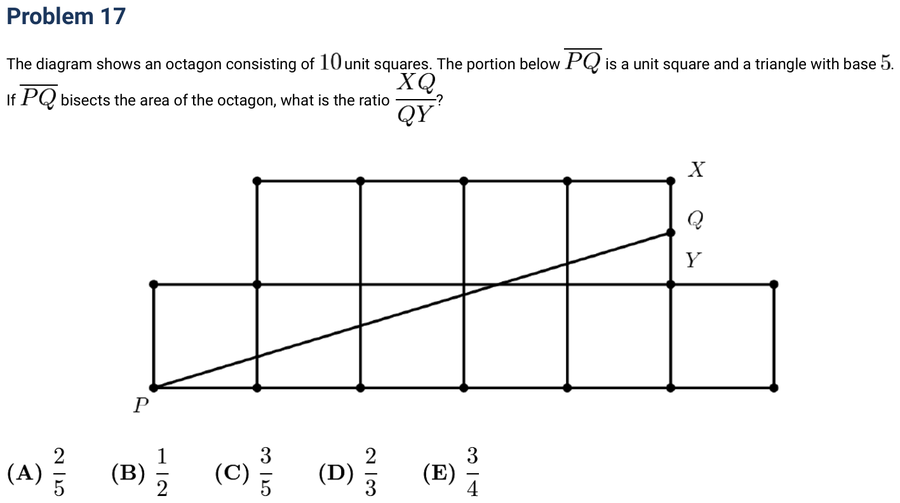
The diagram shows an octagon consisting of 10 unit squares. The portion below PQ is a unit square and a triangle with base 5. If PQ bisects the area of the octagon, what is the ratio XQQY?
Show answer
Answer: D — 2/3.
Show hints
Hint 1 of 3
‘Bisects the area’ is a number in disguise: half of 10 is 5. So the whole region below the line must total exactly 5 — that's your one equation.
Still stuck? Show hint 2 →
Hint 2 of 3
Turn the geometric condition into an area equation, then back out the unknown height. Here the bottom region is (unit square) + (triangle of base 5), and its total is pinned to 5.
Still stuck? Show hint 3 →
Hint 3 of 3
Once you know the triangle's height, the point Q's location on the 2-unit-tall right edge is forced — then XQ and QY are just the two pieces it splits.
Show solution
Approach: convert ‘bisects area’ into an equation, then locate Q
The octagon is 10 unit squares, so each half is 5. The part below PQ is a unit square plus a triangle of base 5, and together they must equal 5 — so the triangle alone has area 4.
Area = (1/2) · base · height, so (1/2) · 5 · height = 4 gives height = 1.6. That height is how high Q sits above the base.
The right edge XY is 2 units tall (with Y one unit up). Q sits at height 1.6, so QY = 1.6 − 1 = 0.6 and XQ = 2 − 1.6 = 0.4.
Ratio XQ/QY = 0.4 / 0.6 = 2/3.
Why this transfers: a ‘line that splits the area in a given way’ is really an algebra problem — write the area on one side, set it to the target, solve for the unknown length. The geometry just supplies the formula.
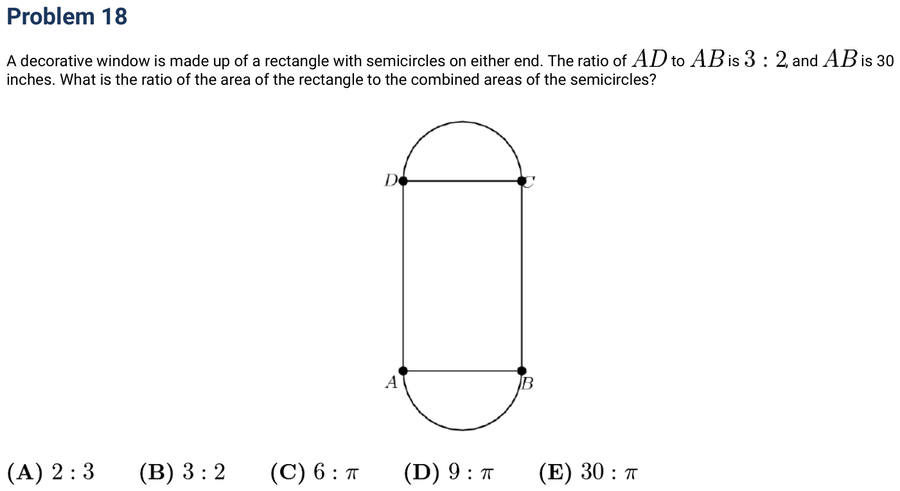
A decorative window is made up of a rectangle with semicircles on either end. The ratio of AD to AB is 3 : 2, and AB is 30 inches. What is the ratio of the area of the rectangle to the combined areas of the semicircles?
Show answer
Answer: C — 6 : π.
Show hints
Hint 1 of 2
The two semicircles share the same diameter (the short side, 30). Slide them together and they make exactly one full circle — so stop treating them as two shapes.
Still stuck? Show hint 2 →
Hint 2 of 2
Two equal semicircles always glue into one whole circle. Replacing ‘two halves’ with ‘one circle’ is the move that makes the area easy.
Show solution
Approach: glue the two semicircles into one circle
Both semicircles sit on a side of length AB = 30, so glued together they form one circle of diameter 30 — radius 15, area π · 152 = 225π.
The rectangle is AD × AB = (3/2 · 30) × 30 = 45 × 30 = 1350.
Ratio rectangle : circle = 1350 : 225π. Divide both by 225: 6 : π.
Why this transfers: matched semicircles (or quarter-circles at four corners) recombine into whole circles — spotting that turns a scary ‘sum of curved pieces’ into a single πr2. The 30:π trap comes from forgetting to square the radius.
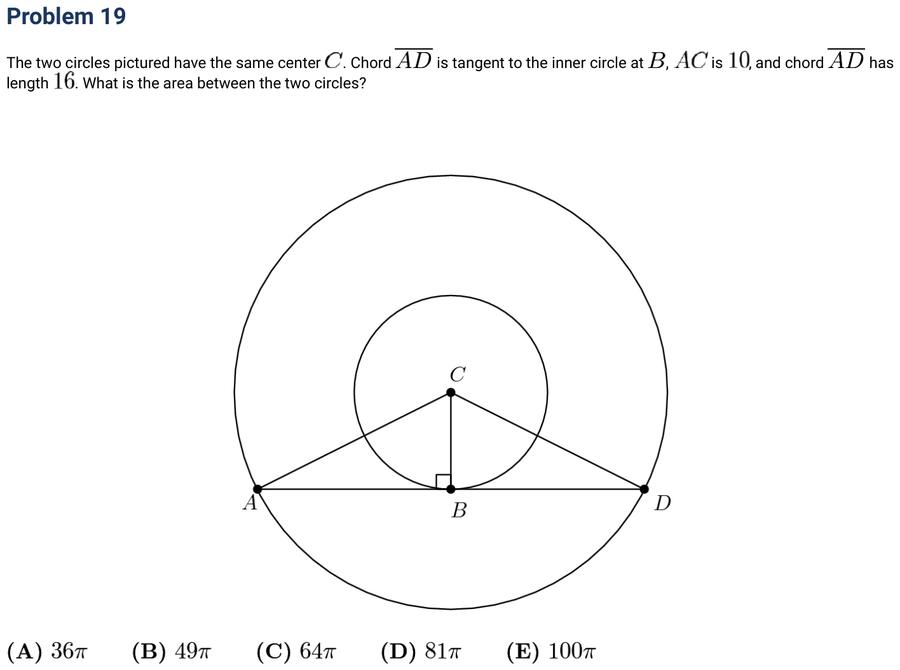
The two circles pictured have the same center C. Chord AD is tangent to the inner circle at B, AC is 10, and chord AD has length 16. What is the area between the two circles?
Show answer
Answer: C — 64π.
Show hints
Hint 1 of 3
You're never told the inner radius — and you don't need it. The ring's area is π(AC2 − CB2), and that difference of squares is exactly what a right triangle hands you.
Still stuck? Show hint 2 →
Hint 2 of 3
Tangent line ⇒ the radius to the touch point is perpendicular to it. That right angle at B sets up Pythagoras: AC2 − CB2 = AB2.
Still stuck? Show hint 3 →
Hint 3 of 3
The perpendicular from the center to a chord also bisects it, so B is the midpoint of AD and AB = 8.
Show solution
Approach: the missing inner radius cancels via Pythagoras
AD is tangent to the inner circle at B, so radius CB ⊥ AD. A perpendicular from the center bisects the chord, so AB = AD/2 = 8.
The ring (annulus) area is πAC2 − πCB2 = π(AC2 − CB2). In right triangle ABC, that bracket isAB2 by Pythagoras.
So the area = π · 82 = 64π — the unknown inner radius never had to be found.
Why this transfers: when an answer depends only on a difference of squared radii, look for a right triangle whose legs are those radii. The annulus area becomes π · (half-chord)2 — a recurring ‘ring + tangent chord’ shortcut.
In a room, 2/5 of the people are wearing gloves, and 3/4 of the people are wearing hats. What is the minimum number of people in the room wearing both a hat and a glove?
Show answer
Answer: A — 3.
Show hints
Hint 1 of 3
‘2/5 of the people’ has to be a whole number, and so does ‘3/4 of the people.’ That forces the head count to be a multiple of both 5 and 4 — pick the smallest such number.
Still stuck? Show hint 2 →
Hint 2 of 3
To minimize overlap, push the two groups as far apart as you can. But gloves (8) + hats (15) = 23 people-slots in a room of only 20 — the 3 extra slots must double up. That forced overlap is the minimum.
Still stuck? Show hint 3 →
Hint 3 of 3
This is inclusion-exclusion read as a floor: min(both) = gloves + hats − total, whenever that's positive.
Show solution
Approach: smallest legal room, then the forced overlap
Both 2/5 and 3/4 of the people must be whole numbers, so the total is a multiple of 5 and 4 → a multiple of 20. The smallest room is 20 people (smaller total gives fractional people).
Then gloves = 2/5 · 20 = 8 and hats = 3/4 · 20 = 15.
Those are 8 + 15 = 23 ‘wearings’ spread over 20 people. Even spreading them out as much as possible, 23 − 20 = 3 of them are forced to land on someone already counted. So at least 3 wear both.
Why this transfers: ‘A + B exceeds the whole’ guarantees an overlap of at least (A + B − whole) — a pigeonhole-flavored floor that shows up whenever two big groups share a small population.
Hui is an avid reader. She bought a copy of the best seller Math is Beautiful. On the first day, Hui read 1/5 of the pages plus 12 more, and on the second day she read 1/4 of the remaining pages plus 15 pages. On the third day she read 1/3 of the remaining pages plus 18 pages. She then realized that there were only 62 pages left to read, which she read the next day. How many pages are in this book?
Show answer
Answer: C — 240 pages.
Show hints
Hint 1 of 3
The only number you actually know for sure is the 62 pages left at the very end. So run the story in reverse — start from 62 and undo each day.
Still stuck? Show hint 2 →
Hint 2 of 3
Undoing a day: if she read 1/3 of the pile plus 18, then 2/3 of the pile minus 18 is what's left. First add the 18 back, then the leftover is 2/3 of the pile — so multiply by 3/2 to recover the start of that day.
Still stuck? Show hint 3 →
Hint 3 of 3
Repeat the same undo for day 2, then day 1, each time recovering the pile at the start of that day.
Show solution
Approach: work backwards, undoing one day at a time
Start from the end: 62 pages remain after day 3. She'd read 1/3 of that day's pile plus 18, leaving 2/3 of it minus 18. So (2/3)·pile − 18 = 62 ⇒ (2/3)·pile = 80 ⇒ pile = 120 at the start of day 3.
Undo day 2 the same way: (3/4)·pile − 15 = 120 ⇒ (3/4)·pile = 135 ⇒ pile = 180 at the start of day 2.
Undo day 1: (4/5)·pile − 12 = 180 ⇒ (4/5)·pile = 192 ⇒ pile = 240 — the whole book.
Why this transfers: when a process ‘take a fraction, then a fixed amount’ repeats and you only know the final state, working backward is far cleaner than one giant forward equation — you invert each step in turn (add the constant back, then scale up).
Another way — forward algebra in one variable:
Let the book be N pages. After day 1, remaining = N − (N/5 + 12) = (4/5)N − 12.
After day 2 (read 1/4 of that plus 15), remaining = (3/4)[(4/5)N − 12] − 15 = (3/5)N − 24.
After day 3 (read 1/3 of that plus 18), remaining = (2/3)[(3/5)N − 24] − 18 = (2/5)N − 34.
Set that to 62: (2/5)N = 96 ⇒ N = 240 — matching the backward method.
The hundreds digit of a three-digit number is 2 more than the units digit. The digits of the three-digit number are reversed, and the result is subtracted from the original three-digit number. What is the units digit of the result?
Show answer
Answer: E — 8.
Show hints
Hint 1 of 3
When you reverse a 3-digit number, the tens digit doesn't move — only the hundreds and units swap. So in the subtraction, the tens completely cancel and won't affect the answer.
Still stuck? Show hint 2 →
Hint 2 of 3
Reversing always gives a difference of 99 × (hundreds digit − units digit). Here that gap is fixed at 2, so the difference is a single fixed number — no variables survive.
Still stuck? Show hint 3 →
Hint 3 of 3
So you don't need the actual digits: just compute 99 × 2 and read off its units digit.
Show solution
Approach: the tens digit cancels; difference is forced
Write the number as 100·(hundreds) + 10·(tens) + (units). Reversing swaps hundreds and units, so when you subtract, the 10·(tens) terms cancel exactly.
What's left is 99·(hundreds − units). The hundreds digit is 2 more than the units, so hundreds − units = 2, every time.
Difference = 99 × 2 = 198, whose units digit is 8.
Why this transfers: ‘a number minus its reversal’ is always a multiple of 99 (for 3 digits), and only the gap between the outer digits matters. Spotting that the middle digit cancels means you can answer without ever choosing specific digits.
Another way — try a concrete example:
Pick any number fitting the rule, say hundreds 2 more than units: 301. Reverse to 103.
301 − 103 = 198 ⇒ units digit 8. Trying 412 − 214 = 198 too — the units digit is locked at 8 no matter what you choose, which is the whole point.
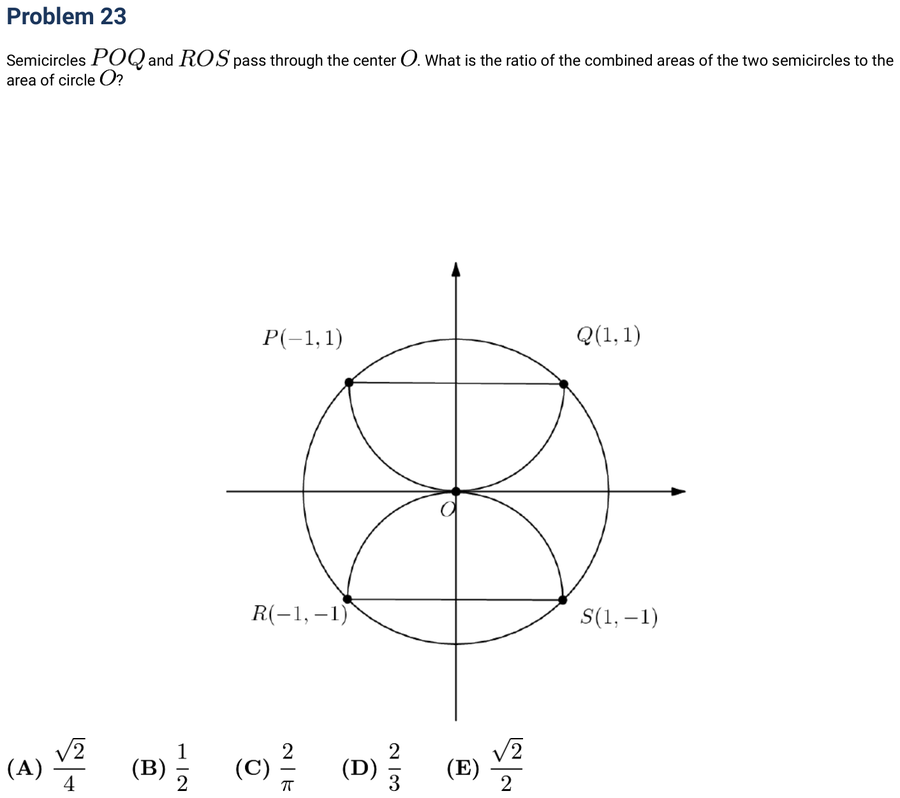
Semicircles POQ and ROS pass through the center O. What is the ratio of the combined areas of the two semicircles to the area of circle O?
Show answer
Answer: B — 1/2.
Show hints
Hint 1 of 3
The two semicircles are identical, so together they're the same area as one full small circle — stop counting them separately.
Still stuck? Show hint 2 →
Hint 2 of 3
Use coordinates to nail the radii: the small radius is half of PQ = 1, and the big radius is the distance OQ = √(12+12) = √2 by the distance formula.
Still stuck? Show hint 3 →
Hint 3 of 3
Since you're forming a ratio, every π will cancel — only the squared radii matter.
Show solution
Approach: combine the semicircles, then ratio the squared radii
Both semicircles have diameter PQ = RS = 2, so radius 1. Two of them glue into one full circle of radius 1, area π.
The big circle's radius is the distance from center O(0,0) to Q(1,1): √(12+12) = √2, so its area is π(√2)2 = 2π.
Ratio = π / 2π = 1/2 — the π cancels, as expected for a pure area ratio.
Why this transfers: two matching semicircles always recombine into a whole circle, and area ratios reduce to (radius ratio)2. Here that's (1 vs √2)2, i.e. 1 : 2 — no π, no decimals.
What is the correct ordering of the three numbers, 108, 512, and 224?
Show answer
Answer: A — 2^24 < 10^8 < 5^12.
Show hints
Hint 1 of 2
You can't compare powers with different bases and different exponents. So make one of them match — the exponents 8, 12, 24 all share the factor 4, so force every exponent down to 4.
Still stuck? Show hint 2 →
Hint 2 of 2
amn = (am)n: rewrite each as something-to-the-4th. Once the exponents agree, just compare the bases.
Show solution
Approach: rewrite all three with a common exponent of 4
The exponents 8, 12, 24 are all multiples of 4, so pull each into a 4th power: 108 = (102)4 = 1004, 512 = (53)4 = 1254, 224 = (26)4 = 644.
Now the exponent is identical (4), so larger base means larger number: 64 < 100 < 125.
Therefore 224 < 108 < 512.
Why this transfers: to compare exponentials, match either the bases or the exponents — whichever the numbers make easy. A shared exponent factor (here 4) is the giveaway to convert and just eyeball the bases.
Another way — factor out a common eighth power, compare pairwise:
224 vs 108: write 224 = 28·48 and 108 = 28·58. The shared 28 cancels and 4 < 5, so 224 < 108.
108 vs 512: write 108 = 44·58 and 512 = 54·58. The shared 58 cancels and 44=256 < 625=54, so 108 < 512.
Everyday at school, Jo climbs a flight of 6 stairs. Jo can take the stairs 1, 2, or 3 at a time. For example, Jo could climb 3, then 1, then 2. In how many ways can Jo climb the stairs?
Show answer
Answer: E — 24 ways.
Show hints
Hint 1 of 3
Don't try to list all the ways for 6 stairs — that's a mess. Instead ask: what was Jo's last step? It was a 1, 2, or 3, landing on stair 6 from stair 5, 4, or 3. So the count for 6 is built from the counts for 5, 4, and 3.
Still stuck? Show hint 2 →
Hint 2 of 3
That ‘classify by the final move’ idea gives a recurrence: ways(n) = ways(n−1) + ways(n−2) + ways(n−3). Build the small cases up to 6.
Still stuck? Show hint 3 →
Hint 3 of 3
Anchor the start: ways(1)=1, ways(2)=2 (1+1 or 2), ways(3)=4 (1+1+1, 1+2, 2+1, 3).
Show solution
Approach: build up by classifying the last step (recurrence)
The last step onto stair n was a 1, 2, or 3, coming from stair n−1, n−2, or n−3. Those cases don't overlap and cover everything, so ways(n) = ways(n−1) + ways(n−2) + ways(n−3).
Why this transfers: ‘in how many ways’ counting problems with a repeated choice (step sizes, tiles, coin sequences) crack open by conditioning on the last move — turning one hard count into a sum of smaller solved counts. (With only 1- and 2-steps it's the Fibonacci numbers.)
Another way — count which inner stairs she lands on, then forbid big jumps:
Think of stairs 1–5 as optional landing spots (she must finish on 6). Each of the 5 inner stairs is either stepped on or skipped, giving 25 = 32 raw sequences of step-sizes.
But some of those imply a jump of 4, 5, or 6 stairs, which isn't allowed. Counting the sequences that contain such an over-long gap gives exactly 8 bad ones.
Valid ways = 32 − 8 = 24 — a complementary-counting route that confirms the recurrence.