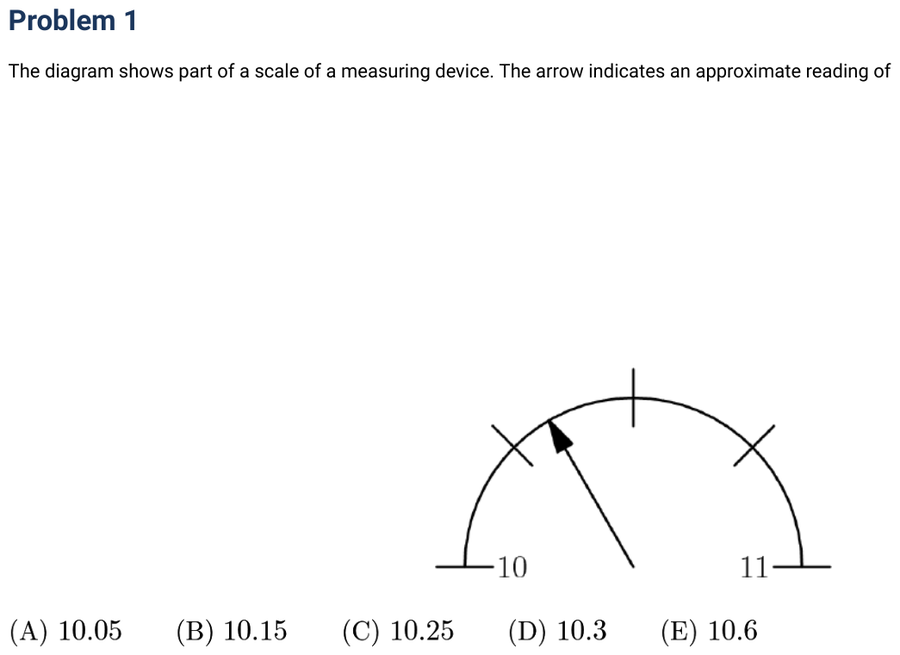
The arrow falls between the 10 and 11 marks — so the reading is 10-point-something. Where in the gap does the tip land?
Still stuck? Show hint 2 →
Hint 2 of 2
Reading a scale means judging what fraction of one gap you're into. The tip looks about a quarter of the way from 10 to 11.
Show solution
Approach: read the fraction of one gap
The arrow tip sits between 10 and 11, about one-fourth of the way along that gap. The whole answer is 10 plus that fraction.
One gap = 1 unit, so a quarter of it = 0.25, giving 10 + 0.25 = 10.25.
Why this transfers: every analog scale — rulers, thermometers, dials — is read the same way. Lock onto the two marks the pointer is between, then estimate the fraction of that single gap; never guess against the whole scale at once.
Don't multiply left to right. Those decimals are familiar fractions in disguise — 0.25 = 1⁄4 and 0.125 = 1⁄8. Which factor would 'undo' each one?
Still stuck? Show hint 2 →
Hint 2 of 2
Multiplication can be reordered freely, so hunt for pairs that make a whole number: 8 cancels the eighth, 2 fits the quarter.
Show solution
Approach: reorder to make canceling pairs
0.125 = 1⁄8 and 0.25 = 1⁄4, so pair each big number with the fraction it cancels: (8 × 0.125) × (2 × 0.25) = 1 × 0.5.
Product = 1⁄2.
Why this transfers: because order and grouping don't change a product, scan a long multiplication for factors that pair into 1, 10, or 100 first. Pairing beats grinding through ugly decimals one at a time.
Before reaching for a common denominator, look at each fraction on its own. What does 2⁄20 reduce to? And 3⁄30?
Still stuck? Show hint 2 →
Hint 2 of 2
In every fraction here the bottom is exactly ten times the top — so each one is secretly the same value.
Show solution
Approach: simplify each term first, then add
Each fraction has a bottom that's 10× its top, so each one equals 1⁄10: 2⁄20 = 1⁄10 and 3⁄30 = 1⁄10.
The sum is just 1⁄10 + 1⁄10 + 1⁄10 = 3⁄10 = 0.3.
Why this transfers: always simplify each fraction before adding. Reducing first can collapse a scary-looking sum into identical pieces, dodging the messy common-denominator step entirely.
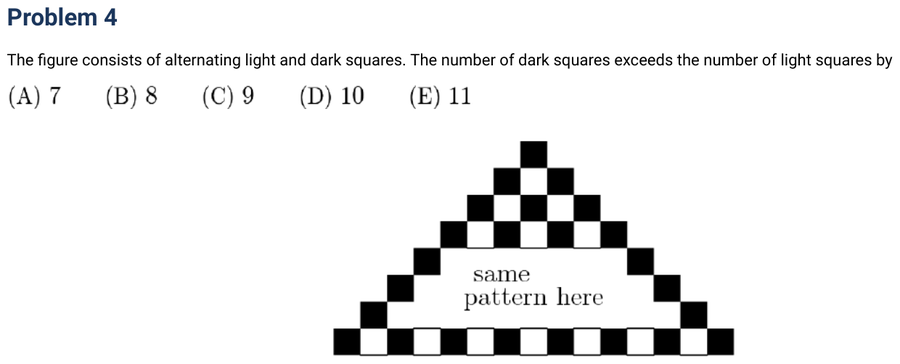
You only want the *difference* dark − light, not either total. So don't count everything — look at one row at a time and ask how far ahead dark is in that row.
Still stuck? Show hint 2 →
Hint 2 of 2
Each row alternates dark, light, dark, … and both ends are dark. An alternating strip that starts and ends the same color always has exactly one extra of that color.
Show solution
Approach: tally dark − light row by row
Look at a single row: it goes dark, light, dark, … and begins *and* ends with dark. Whenever an alternating strip starts and ends with the same color, that color wins by exactly one — so every row has 1 more dark than light, no matter its length.
The triangle has 11 rows, each contributing a surplus of 1, so dark beats light by 11.
Why this transfers: when a question asks only for a difference, track the difference directly instead of computing two big totals and subtracting. The per-row +1 makes the grand total fall out instantly.
Another way — pair them off:
In each row, pair every light square with the dark square just to its left. Every light gets a partner, but the dark square on the far right has no light partner left over.
That's one unpaired dark per row × 11 rows = 11 extra dark squares.
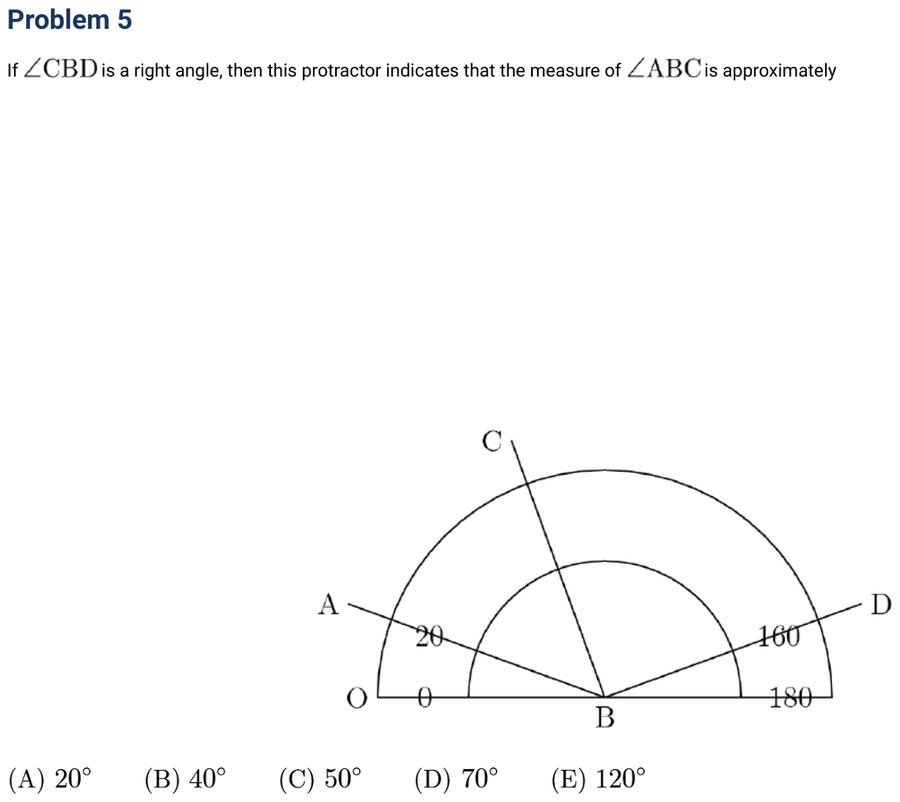
A protractor doesn't measure an angle directly — it gives each ray a number, and the angle *between* two rays is the difference of their two numbers. So first find the number on every ray you care about.
Still stuck? Show hint 2 →
Hint 2 of 2
C has no label, but ∠CBD = 90° pins it down: C's reading must be 90° less than D's. Once you know C and A's readings, ∠ABC is just C − A.
Show solution
Approach: an angle = difference of the two protractor readings
Read each ray off the scale: A is at 20° and D is at 160°. The angle between any two rays is the gap between their readings — that's why ∠CBD = (C's reading) − (D's reading) would be negative, so we use the 90° gap the other way: C sits 90° below D, at 160° − 90° = 70°.
Why this transfers: think of a protractor as a number line bent into a half-circle. Any angle is a subtraction of two positions, just like distance on a ruler is a subtraction of two marks.
Don't compute the tiny decimals. Notice that .2 is exactly 10 times .02 — so a .2 over a .02 is just a clean 10. How many of those can you pair up?
Still stuck? Show hint 2 →
Hint 2 of 2
Split one factor of .2 off the top so the rest pairs as (.2 ⁄ .02)² — each pair becomes 10.
Show solution
Approach: pair matching factors so .2 ⁄ .02 = 10
There are three .2's on top and two .02's on the bottom. Peel one .2 aside, then pair the other two .2's with the two .02's: (.2)³ ⁄ (.02)² = .2 × (.2 ⁄ .02) × (.2 ⁄ .02) = .2 × 10 × 10.
= .2 × 100 = 20.
Why this transfers: when a fraction is built from the same digits at different decimal scales, don't grind out the decimals — pair top and bottom into clean powers of 10. Counting the factors of 10 is far safer than tracking tiny zeros.
The answer choices jump by 100s, so you don't need precision — you need a fast, roughly-right estimate. Glance at that sum in parentheses first: 5.17 + 4.829 is almost exactly what nice round number?
Still stuck? Show hint 2 →
Hint 2 of 2
Round every factor to something friendly: 2.46 ≈ 2.5, 8.163 ≈ 8, and the sum ≈ 10.
Show solution
Approach: round each factor to an easy number
Spot the gift: 5.17 + 4.829 ≈ 10. Round the rest too — 2.46 ≈ 2.5 and 8.163 ≈ 8 — so the product ≈ 2.5 × 8 × 10.
2.5 × 8 = 20, then × 10 = 200.
Why this transfers: when answer choices are far apart, estimating beats exact arithmetic. Round each factor to a value you can multiply in your head, and pick numbers (like 2.5 and 8) whose product is clean.
Betty used a calculator to find the product 0.075 × 2.56. She forgot to enter the decimal points. The calculator showed 19200. If Betty had entered the decimal points correctly, the answer would have been
Show answer
Answer: B — .192.
Show hints
Hint 1 of 2
The calculator multiplied the same whole-number digits Betty wanted — the decimal point's only job is to fix where the point lands. So the digits 192 are already correct; you just have to place the point.
Still stuck? Show hint 2 →
Hint 2 of 2
The number of decimal places in a product equals the *total* number of decimal places in the two factors. Count them up, then shift the point in 19200 that many places left.
Show solution
Approach: the product's decimal places = sum of the factors' decimal places
0.075 has 3 digits after its point and 2.56 has 2, so the answer must have 3 + 2 = 5 decimal places. Slide the decimal in 19200 five places to the left.
19200 → 0.19200 = 0.192.
Sanity check: 0.075 is a bit under one-tenth and 2.56 is about 2½, so the product should be around 0.2 — and 0.192 fits, while 1.92 or 0.0192 don't.
Why this transfers: never re-multiply to fix a decimal point. Multiply the digits once, then count the combined decimal places — that count alone tells you where the point goes.
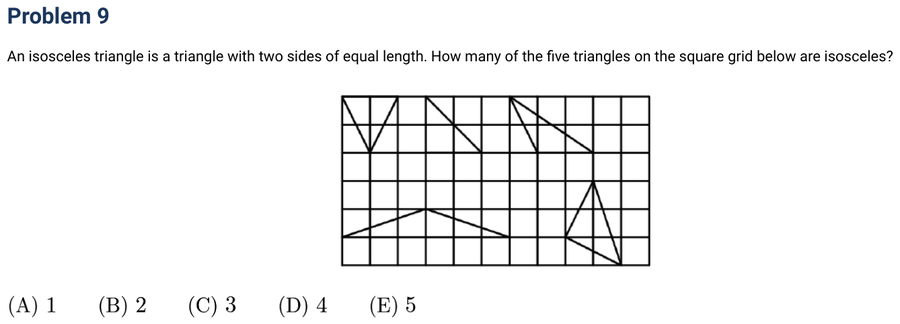
Isosceles just means two sides are equal. On a grid you don't need the actual lengths — for each slanted side, the box it spans gives a 'right + up' pair (a, b). Two sides match exactly when their (a, b) boxes match (in either order).
Still stuck? Show hint 2 →
Hint 2 of 2
Skip the square roots: compare a² + b² for each side instead of the length itself. If two sides give the same a² + b², they're equal — and the triangle is isosceles.
Show solution
Approach: compare squared side lengths from the grid
For each triangle, read every side as a 'right a, up b' move on the grid, and compute a² + b² (this is the side's length squared — no square roots needed). A triangle is isosceles the moment two of its three sides give the same value.
Checking all five this way, four of them have a matching pair of sides; only one comes out with three different values (scalene). So 4 are isosceles.
Why this transfers: lengths on a grid almost always come out as ugly square roots. Comparing a² + b² keeps everything as whole numbers, so you can decide 'equal or not' by eye without ever taking a root.
Chris's birthday is on a Thursday this year. What day of the week will it be 60 days after her birthday?
Show answer
Answer: A — Monday.
Show hints
Hint 1 of 2
A whole week brings you right back to the same weekday — Thursday to Thursday. So most of those 60 days do nothing to the answer. What's the only part that matters?
Still stuck? Show hint 2 →
Hint 2 of 2
Pull as many full weeks (groups of 7) out of 60 as you can; only the leftover days actually move the weekday forward.
Show solution
Approach: throw away whole weeks, count only the leftover days
Every 7 days lands on the same weekday, so the full weeks inside 60 days change nothing. 60 = 56 + 4 = eight full weeks plus 4 leftover days, and only those 4 matter.
Step 4 days past Thursday: Friday, Saturday, Sunday, Monday.
Why this transfers: any 'what comes after a big jump in a repeating cycle' question works this way — strip out whole cycles (weeks, here) and walk only the remainder. The same trick finds the day of the year, the hour on a clock, or a repeating decimal digit.
You don't need the exact value — just find the two perfect squares that 164 sits between. Which squares do you know that bracket it?
Still stuck? Show hint 2 →
Hint 2 of 2
Run up the squares you know: …, 12² = 144, 13² = 169. 164 lands between those two, so its root lands between 12 and 13.
Show solution
Approach: trap 164 between consecutive perfect squares
Find the perfect squares just below and just above 164: 12² = 144 and 13² = 169. Since 144 < 164 < 169, taking square roots keeps the order: 12 < √164 < 13.
So √164 lies between 12 and 13.
Trap to avoid: choice 42 tempts anyone who thinks a square root makes a number bigger — it doesn't. √164 is far smaller than 164.
Why this transfers: to locate any square root, sandwich the number between two perfect squares you've memorized. Square roots preserve order, so the root lands between those two whole numbers.
Suppose the estimated 20 billion dollar cost to send a person to the planet Mars is shared equally by the 250 million people in the U.S. Then each person's share is
Show answer
Answer: C — 80 dollars.
Show hints
Hint 1 of 2
Don't write out all those zeros. Measure both amounts in the same unit — 'millions' — so the giant word on each side cancels. How many millions is 20 billion?
Still stuck? Show hint 2 →
Hint 2 of 2
A billion is 1000 millions, so 20 billion = 20,000 million. Now both top and bottom are 'so-many million,' and the 'million' cancels.
Show solution
Approach: rewrite both numbers in the same unit, then cancel it
Put both amounts in millions: 20 billion = 20,000 million, and the population is 250 million. Now the shared word 'million' cancels top and bottom: 20,000 million ⁄ 250 million = 20,000 ⁄ 250.
20,000 ⁄ 250 = 80 dollars.
Why this transfers: when a quotient mixes huge words like billion and million, convert both to the same scale so that scale cancels. You're left dividing small, friendly numbers instead of juggling rows of zeros.
If rose bushes are spaced about 1 foot apart, approximately how many bushes are needed to surround a circular patio whose radius is 12 feet?
Show answer
Answer: D — 75.
Show hints
Hint 1 of 2
The bushes go *around* the patio, not all over it. So you need the distance around the circle, not how much space it covers.
Still stuck? Show hint 2 →
Hint 2 of 2
Distance around a circle is its circumference, 2πr. With one bush per foot, the number of bushes ≈ that distance in feet.
Show solution
Approach: bushes line the edge, so use circumference = 2πr
'Surround' means lining the boundary, so the right measurement is the circumference: 2π · 12 = 24π ≈ 75.4 feet.
At one bush per foot, about 75 bushes are needed.
Trap to avoid: choice 450 comes from using area, πr² ≈ 452. But the bushes form a ring around the edge, not a filled-in field — boundary problems use circumference (perimeter), not area.
Why this transfers: whenever something runs *along the edge* — fencing, lights on a track, bushes around a patio — reach for the perimeter/circumference. 'Covering the inside' is the only time you use area.
◇ and △ are whole numbers and ◇ × △ = 36. The largest possible value of ◇ + △ is
Show answer
Answer: E — 37.
Show hints
Hint 1 of 2
With the product locked at 36, you only get to choose which factor pair to use. To make the sum as *big* as possible, do you want the two numbers close together or far apart?
Still stuck? Show hint 2 →
Hint 2 of 2
For a fixed product, the sum grows as the factors spread apart and shrinks as they bunch up. So go straight for the most lopsided pair.
Show solution
Approach: for a fixed product, spread the factors apart
The factor pairs of 36 are (1,36), (2,18), (3,12), (4,9), (6,6), with sums 37, 20, 15, 13, 12. The most spread-out pair, 1 and 36, gives the biggest sum.
1 + 36 = 37.
Why this transfers: when a product is fixed, balanced factors (like 6 × 6) give the *smallest* sum and the most lopsided factors (1 × 36) give the *largest*. Knowing which end you want lets you jump to the answer without testing every pair.
'Reciprocal of (a sum)' means you must finish the sum first, getting one single fraction, before you flip anything. So: what is 1⁄2 + 1⁄3 as one fraction?
Still stuck? Show hint 2 →
Hint 2 of 2
Add over a common denominator of 6, then flip the result top-for-bottom.
Show solution
Approach: add into one fraction, then flip
First combine: 1⁄2 + 1⁄3 = 3⁄6 + 2⁄6 = 5⁄6. Reciprocal flips a single fraction over, so the answer is 6⁄5.
Trap to avoid: you cannot flip each piece separately. Flipping gives 2 + 3 = 5 (choice E), which is wrong — the reciprocal of a sum is not the sum of the reciprocals.
Why this transfers: 'reciprocal of (…)' is one operation on the *whole* finished value. Always collapse what's inside the parentheses to a single number first, then take the reciprocal once.
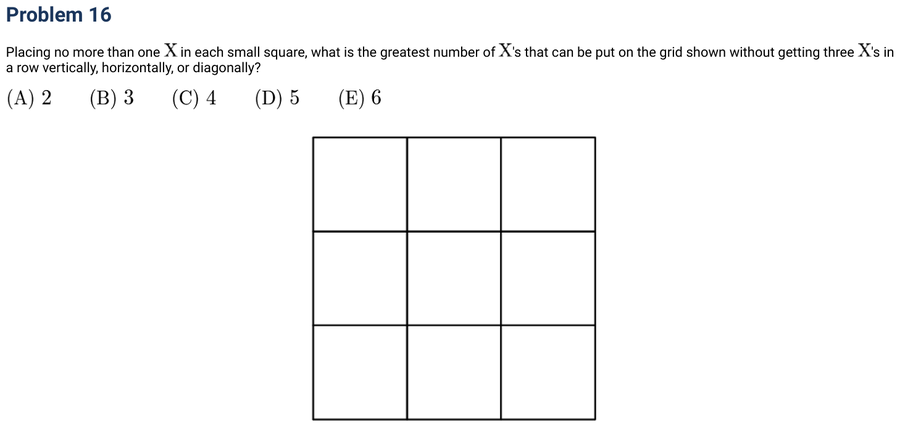
Flip the question around: instead of asking how many X's to *place*, ask how few squares you must leave *empty* so that no full line of three survives. Maximizing X's is the same as minimizing empties.
Still stuck? Show hint 2 →
Hint 2 of 2
List the 8 lines you must break (3 rows, 3 columns, 2 diagonals). Each empty square can break only the lines it sits on — and one square can lie on at most 4 of them. So how few empties could possibly cover all 8?
Show solution
Approach: minimize the empty squares needed to break every line
Most X's = fewest empties. Every one of the 8 lines (3 rows, 3 columns, 2 diagonals) needs at least one empty square to break it. The center square lies on 4 lines (its row, its column, both diagonals) — the maximum any square can hit. So 2 empties reach at most 4 + 3 = 7 lines, which can't cover all 8. Hence at least 3 squares must stay empty.
Three empties is actually achievable: leave the center and two opposite corners blank. The center breaks the middle row, middle column, and both diagonals; the two opposite corners break the four remaining edge lines. That breaks all 8 lines, so 9 − 3 = 6 X's can go down.
Why this transfers: 'maximize the things you keep' is often easiest as 'minimize the things you remove,' and a 'block every line' goal becomes a covering count — how many removals does it take to touch every constraint?
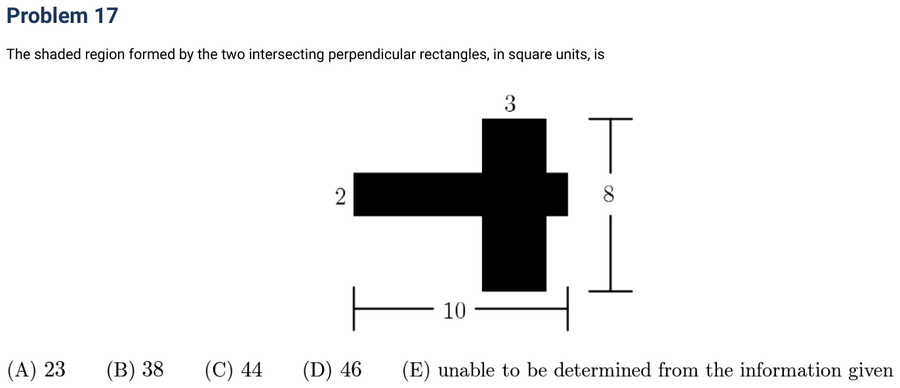
The shape is two rectangles crossing like a plus sign. If you just add their two areas, you've counted the little square where they cross *twice* — so what must you do about it?
Still stuck? Show hint 2 →
Hint 2 of 2
Add both rectangles, then subtract the overlap once. The overlap is the 3-wide, 2-tall patch in the middle.
Show solution
Approach: add both rectangles, subtract the double-counted overlap
The horizontal bar is 10 × 2 = 20 and the vertical bar is 3 × 8 = 24. Adding gives 44, but the crossing region — a 3 × 2 = 6 patch — sat inside *both* bars, so it got counted twice.
Remove that one extra copy: 20 + 24 − 6 = 38.
Why this transfers: whenever two regions overlap, area(A) + area(B) counts the shared part twice, so the true total is area(A) + area(B) − overlap. This 'add, then subtract the double-count' rule is the heart of inclusion–exclusion.
Another way — cut into non-overlapping pieces:
Keep the whole horizontal bar (10 × 2 = 20) and add only the parts of the vertical bar that stick out above and below it. Those two stubs are each 3 wide; together they're 3 × (8 − 2) = 3 × 6 = 18.
The average weight of 6 boys is 150 pounds and the average weight of 4 girls is 120 pounds. The average weight of the 10 children is
Show answer
Answer: C — 138 pounds.
Show hints
Hint 1 of 2
You can't just average 150 and 120 — there are more boys than girls, so the boys pull the combined average closer to their side. The only safe move is to go back to the raw totals.
Still stuck? Show hint 2 →
Hint 2 of 2
An average is always (total of everything) ÷ (how many things). Find the total weight of all 10 kids, then divide by 10.
Show solution
Approach: rebuild from total weight ÷ total count
Recover the totals each average came from: boys weigh 6 × 150 = 900, girls weigh 4 × 120 = 480. All 10 children together weigh 900 + 480 = 1380.
Average = 1380 ⁄ 10 = 138 pounds.
Trap to avoid: (150 + 120) ⁄ 2 = 135 (choice A) treats the groups as equal in size. Because the 6 boys outnumber the 4 girls, the real average sits *above* the midpoint 135 — and 138 leans toward the heavier, larger group, exactly as it should.
Why this transfers: to combine two averages, never average the averages. Undo each average into a sum, add the sums, and divide by the combined count — the group sizes do the weighting for you automatically.
What is the 100th number in the arithmetic sequence: 1, 5, 9, 13, 17, 21, 25, …?
Show answer
Answer: A — 397.
Show hints
Hint 1 of 2
Each term is 4 more than the one before. The catch: getting from the *1st* term to the *100th* term takes how many steps of 4 — 100, or one fewer?
Still stuck? Show hint 2 →
Hint 2 of 2
It's 99 steps, not 100, because the first term needs no step to reach itself. So the 100th term = 1 + 99 × 4.
Show solution
Approach: start value + (number of steps) × step size
The list climbs by 4 each time. To reach the 100th term from the 1st you take 99 steps (the 2nd is 1 step out, the 3rd is 2 steps out, … the 100th is 99 steps out). So the 100th term = 1 + 99 × 4 = 1 + 396 = 397.
Trap to avoid: choice 401 comes from using 100 steps instead of 99. The number of *gaps* between terms is always one less than the number of terms — the same reason a fence with 100 posts has only 99 gaps.
Why this transfers: any evenly-spaced list works as start + (n − 1) × step. The (n − 1) is the fence-post idea: count the gaps you cross, not the terms you land on.
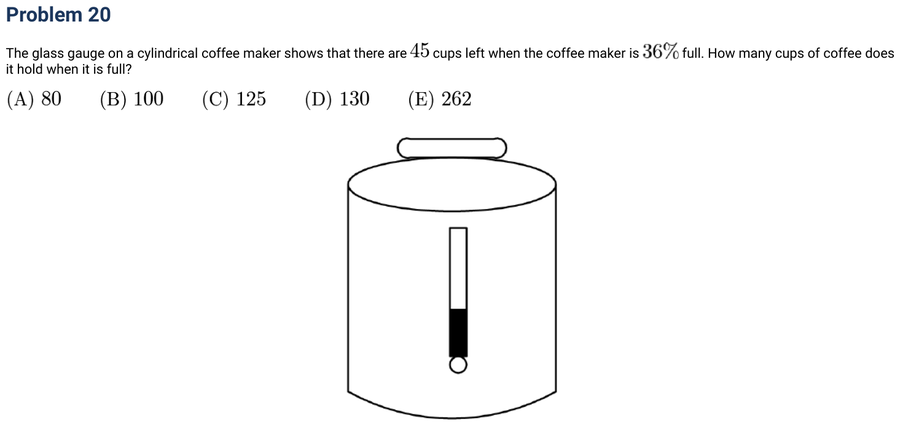
You're told the *part* (45 cups) and the *percent* it represents (36%); you want the *whole*. Since 45 is only 36% of the maker, the full capacity must be larger than 45 — which choices does that already rule out?
Still stuck? Show hint 2 →
Hint 2 of 2
If 36% of the full amount is 45, then full × 0.36 = 45. Undo the multiply: divide 45 by 0.36.
Show solution
Approach: the part ÷ its percent gives the whole
45 cups is 36% of the full pot, so Full × 0.36 = 45, giving Full = 45 ⁄ 0.36 = 4500 ⁄ 36 = 125 cups.
Intuition check: if 36% is 45 cups, then each 1% is 45 ⁄ 36 = 1.25 cups, so the full 100% is 1.25 × 100 = 125 cups. Same answer, and it's comfortably bigger than 45 as expected.
Why this transfers: 'this part is P% of the whole' always rearranges to whole = part ÷ (P as a decimal). Finding the 'per 1%' amount first and scaling to 100 is a handy mental shortcut for the same idea.
A fifth number, n, is added to the set {3, 6, 9, 10} to make the mean of the set of five numbers equal to its median. The number of possible values of n is
Show answer
Answer: C — 3.
Show hints
Hint 1 of 2
The mean is easy — it's always (3 + 6 + 9 + 10 + n) ⁄ 5. The median is the tricky one: it's whichever number ends up in the middle once you sort, and that *depends on where n lands*. What are the possible middle numbers?
Still stuck? Show hint 2 →
Hint 2 of 2
Split into cases by where n falls: small (median stays 6), in the middle (median is n itself), or large (median stays 9). Set mean = median in each case — and then check the n you get actually belongs in that case.
Show solution
Approach: case on where n lands in the sorted list
The mean is always (28 + n) ⁄ 5. The median is the 3rd value after sorting {3, 6, 9, 10, n}, which depends on n:
• If n is small (n ≤ 6): the order is n, 3, 6, 9, 10 → median 6. Set (28 + n)⁄5 = 6 → n = 2, and 2 ≤ 6 ✓.
• If n is in the middle (6 ≤ n ≤ 9): median is n. Set (28 + n)⁄5 = n → 28 + n = 5n → n = 7, and 6 ≤ 7 ≤ 9 ✓.
• If n is large (n ≥ 9): median 9. Set (28 + n)⁄5 = 9 → n = 17, and 17 ≥ 9 ✓.
All three candidates land inside their own case, so n = 2, 7, 17 all work — 3 values.
Why this transfers: the median has no single formula — its value changes as the unknown crosses the other numbers. Whenever an unknown can sit in different positions of a sorted list, break into cases, solve each, and *verify the answer falls in the case you assumed* (a candidate that escapes its range is rejected).
Tom's Hat Shoppe increased all original prices by 25%. Now the shoppe is having a sale where all prices are 20% off these increased prices. Which statement best describes the sale price of an item?
Show answer
Answer: E — The sale price is the same as the original price.
Show hints
Hint 1 of 2
The 20% off isn't taken off the original price — it's taken off the *already-raised* price, so the two percents can't simply cancel. Turn each change into a 'multiply by' factor instead.
Still stuck? Show hint 2 →
Hint 2 of 2
Up 25% means ×1.25; then 20% off means ×0.80. Multiply those two factors together — what do you get?
Show solution
Approach: turn each percent change into a multiplier and multiply
Raising by 25% multiplies the price by 1.25; taking 20% off multiplies by 0.80. Doing both means 1.25 × 0.80 = 1.00 — so the final price equals the original. The sale price is the same as the original price.
Concrete check: start at $100 → up 25% → $125 → 20% off $125 is $25 off → $100. Right back where we started.
Trap to avoid: +25% then −20% does NOT make +5%. The 20% is a slice of the larger $125, not of the original $100, so the bigger 'off' exactly undoes the increase. Percent changes combine by multiplying their factors, never by adding the percents.
Maria buys computer disks at a price of 4 for $5 and sells them at a price of 3 for $5. How many computer disks must she sell in order to make a profit of $100?
Show answer
Answer: D — 240.
Show hints
Hint 1 of 2
Profit comes from the gap between what each disk costs her and what each disk earns her. Find that gap for *one* disk, then see how many disks pile up to $100.
Still stuck? Show hint 2 →
Hint 2 of 2
Cost per disk = $5⁄4; sale price per disk = $5⁄3. Profit per disk is the difference, $5⁄3 − $5⁄4.
Show solution
Approach: profit per disk, then scale to $100
Each disk costs 5⁄4 dollar and sells for 5⁄3 dollar, so the profit per disk is 5⁄3 − 5⁄4 = 20⁄12 − 15⁄12 = 5⁄12 dollar.
To pile up $100 of profit: 100 ÷ (5⁄12) = 100 × 12⁄5 = 240 disks.
Why this transfers: profit is always (money in) − (money out) per unit; once you know the profit on one item, any target total is just division by that per-item profit.
Another way — work in whole-disk batches (no fractions):
Pick a batch size that divides evenly both ways — 12 disks (since 12 is a multiple of 3 and 4). Buying 12 costs 3 groups of $5 = $15; selling 12 brings 4 groups of $5 = $20. So every 12 disks make $20 − $15 = $5 profit.
$100 ÷ $5 = 20 batches, and 20 × 12 = 240 disks — all whole numbers, no fractions needed.
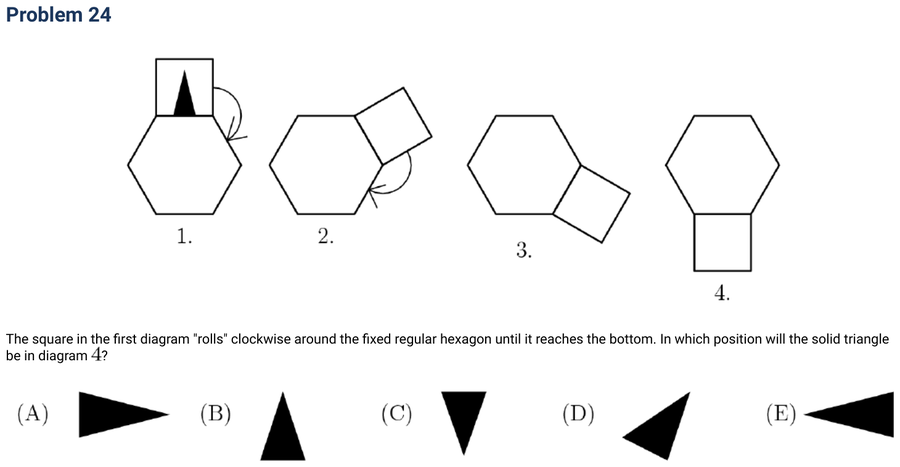
Don't track the whole journey at once — just figure out how much the square turns at a *single* corner of the hexagon, then count how many corners it rounds from position 1 to position 4.
Still stuck? Show hint 2 →
Hint 2 of 2
At each corner the square pivots on the shared vertex. The turn there is whatever angle is left after the square's own 90° corner and the hexagon's 120° corner are taken out of the full 360° around that point.
Show solution
Approach: rotation per pivot, summed over the corners rounded
At a corner, the square pivots about the shared vertex until its next edge lies flat on the next hexagon side. Around that vertex the full 360° is split among the square's corner (90°), the hexagon's interior corner (120°), and the turn the square sweeps. So each pivot turns the square 360° − 90° − 120° = 150° clockwise.
Going from the top (position 1) to the bottom (position 4) rounds 3 corners, for a total of 3 × 150° = 450°. A 450° turn is the same as 450° − 360° = 90° clockwise.
The solid triangle starts pointing straight up. Turn it 90° clockwise and it points to the right — matching choice A.
Why this transfers: for any shape rolling around the outside of a polygon, the turn at each corner is 360° minus the rolling shape's own corner minus the polygon's corner. Add up the corners you round, then reduce by full 360° turns to read the final orientation.
A palindrome is a whole number that reads the same forwards and backwards. If one neglects the colon, certain times displayed on a digital watch are palindromes. Three examples are: 1:01, 4:44, and 12:21. How many times during a 12-hour period will be palindromes?
Show answer
Answer: A — 57.
Show hints
Hint 1 of 2
A digital time has a different number of digits at 1:05 (three digits, 105) than at 11:11 (four digits). Reading-the-same forwards and backwards works differently for each, so handle the 1-digit hours and the 2-digit hours separately.
Still stuck? Show hint 2 →
Hint 2 of 2
For a 3-digit time h:mm, reading backwards forces the last digit of mm to equal h, and the middle digit (the tens of the minutes) is free — but only 0–5, since minutes top out at 59.
Show solution
Approach: split by how many digits the hour has
One-digit hours, h:mm with h = 1–9 (the string is h, then two minute digits). To read the same backwards, the minutes' ones digit must equal h, and the minutes' tens digit is the free middle — it can be 0,1,2,3,4,5 (minutes go up to 59). That's 6 valid minutes for each of the 9 hours: 9 × 6 = 54 times.
Two-digit hours, hh:mm = 10, 11, 12 (the string is four digits). Reverse must match digit-for-digit, which only works for 10:01, 11:11, and 12:21 — 3 times.
Total = 54 + 3 = 57.
Why this transfers: counting under a 'reads the same both ways' rule means free digits in front *force* matching digits in back. Count only the digits you may choose freely (here, the hour and the minutes' tens), and respect each slot's real limits (minutes' tens ≤ 5).