Problem 16 · 1988 AJHSME
Hard
Counting & Probability
block-each-line
Show answer
Answer: E — 6.
Show hints
Hint 1 of 2
Flip the question around: instead of asking how many X's to *place*, ask how few squares you must leave *empty* so that no full line of three survives. Maximizing X's is the same as minimizing empties.
Still stuck? Show hint 2 →
Hint 2 of 2
List the 8 lines you must break (3 rows, 3 columns, 2 diagonals). Each empty square can break only the lines it sits on — and one square can lie on at most 4 of them. So how few empties could possibly cover all 8?
Show solution
Approach: minimize the empty squares needed to break every line
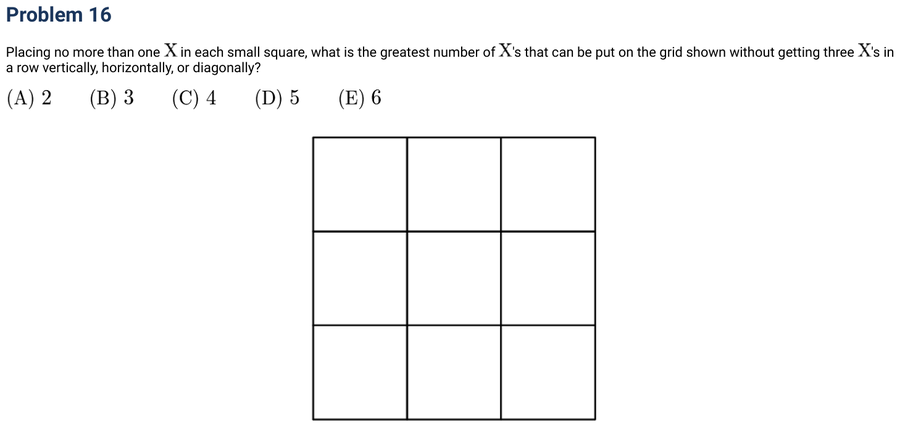
- Most X's = fewest empties. Every one of the 8 lines (3 rows, 3 columns, 2 diagonals) needs at least one empty square to break it. The center square lies on 4 lines (its row, its column, both diagonals) — the maximum any square can hit. So 2 empties reach at most 4 + 3 = 7 lines, which can't cover all 8. Hence at least 3 squares must stay empty.
- Three empties is actually achievable: leave the center and two opposite corners blank. The center breaks the middle row, middle column, and both diagonals; the two opposite corners break the four remaining edge lines. That breaks all 8 lines, so 9 − 3 = 6 X's can go down.
- Why this transfers: 'maximize the things you keep' is often easiest as 'minimize the things you remove,' and a 'block every line' goal becomes a covering count — how many removals does it take to touch every constraint?
Mark:
· log in to save