The Centerville Middle School chess team consists of two boys and three girls. A photographer wants to take a picture of the team to appear in the local newspaper. She decides to have them sit in a row with a boy at each end and the three girls in the middle. How many such arrangements are possible?
Show answer
Answer: E — 12 arrangements.
Show hints
Hint 1 of 2
The seating breaks into two separate jobs that don't interfere: arrange the boys at the two ends, and arrange the girls in the three middle seats. Solve each job alone.
Still stuck? Show hint 2 →
Hint 2 of 2
When choices are independent, total = (ways for job 1) × (ways for job 2). Arranging k people in k seats has k! ways. (This is the multiplication / rule-of-product principle.)
Show solution
Approach: split into two independent jobs and multiply
The ends are boys-only and the middle is girls-only, so the two choices never collide — handle them separately.
Boys in the 2 end seats: 2! = 2 ways. Girls in the 3 middle seats: 3! = 6 ways.
By the rule of product, total = 2 × 6 = 12.
Why this transfers: any time a setup divides into independent stages, multiply the counts. The only trap is making sure the stages really don't affect each other — here they can't, since boys and girls occupy disjoint seats.
A magazine printed photos of three celebrities along with three photos of the celebrities as babies. The baby pictures did not identify the celebrities. Readers were asked to match each celebrity with the correct baby pictures. What is the probability that a reader guessing at random will match all three correctly?
Show answer
Answer: B — 1/6.
Show hints
Hint 1 of 2
There's exactly one correct matching, so the probability is just 1 ÷ (number of possible matchings). The whole problem is counting the orderings.
Still stuck? Show hint 2 →
Hint 2 of 2
Three baby photos can be lined up against the three celebrities in 3! ways.
Show solution
Approach: one favorable outcome over all equally likely orderings
Order the 3 baby photos against the celebrities: 3! = 6 equally likely ways.
Exactly 1 of those 6 is the all-correct matching, so probability = 1/6 = 1/6.
Reusable idea: when every arrangement is equally likely and only one wins, P(win) = 1/(total arrangements). The hard part is always the count, never the division.
Another way — match one celebrity at a time:
First celebrity: 1 of 3 baby photos is right ⇒ chance 1/3.
Given that, the second celebrity: 1 of the 2 remaining is right ⇒ chance 1/2 (and the third is then forced).
A fair coin is tossed 3 times. What is the probability of at least two consecutive heads?
Show answer
Answer: C — 3/8.
Show hints
Hint 1 of 2
Only 8 outcomes exist for 3 flips — small enough to just list them all and circle the winners. "Consecutive" means the two heads must be neighbors (positions 1-2 or 2-3), not scattered.
Still stuck? Show hint 2 →
Hint 2 of 2
When the sample space is tiny (23 = 8), full enumeration beats any clever formula. Probability = (favorable outcomes) ÷ (total outcomes).
Show solution
Approach: enumerate all 8 equally-likely outcomes
All 8 outcomes: HHH, HHT, HTH, HTT, THH, THT, TTH, TTT. Each is equally likely, so we just count favorables.
"At least two consecutive heads" needs HH side by side: HHH, HHT, THH — that's 3. (HTH fails: its heads aren't neighbors.)
Probability = 3 ÷ 8 = 3/8.
Watch the trap: HTH has two heads but they're not consecutive, so it doesn't count — reading "consecutive" carefully is the whole problem.
Another way — complement — subtract the 'no HH' outcomes:
Sometimes it's easier to count the unwanted outcomes. Strings of 3 flips with no two heads adjacent: TTT, TTH, THT, HTT, HTH — 5 of them.
So favorable = 8 − 5 = 3, giving probability 3/8 = 3/8. (When 'at least' makes direct counting fiddly, count the opposite.)
Abe holds 1 green and 1 red jelly bean in his hand. Bob holds 1 green, 1 yellow, and 2 red jelly beans in his hand. Each randomly picks a jelly bean to show the other. What is the probability that the colors match?
Show answer
Answer: C — 3/8.
Show hints
Hint 1 of 2
A "match" can only happen on a color both people own. Yellow is Bob-only, so it can never match — the only matchable colors are green and red. Handle those two cases separately.
Still stuck? Show hint 2 →
Hint 2 of 2
Two independent picks: within a case multiply (AND), across the separate cases add (OR). First filter to colors both hands share.
Show solution
Approach: split into the only two matchable colors
Only green and red exist in both hands (Bob's yellow can never match), so a match is "both green" OR "both red."
Both green = P(Abe green) × P(Bob green) = (1/2)(1/4) = 1/8 — multiply because both must happen.
Both red = P(Abe red) × P(Bob red) = (1/2)(2/4) = 1/4.
In a town of 351 adults, every adult owns a car, motorcycle, or both. If 331 adults own cars and 45 adults own motorcycles, how many of the car owners do not own a motorcycle?
Show answer
Answer: D — 306.
Show hints
Hint 1 of 2
Flip the question: instead of "car owners without a motorcycle," ask "who has no motorcycle at all?" Since everyone owns at least one vehicle, anyone without a motorcycle must own a car — so those two groups are the same people.
Still stuck? Show hint 2 →
Hint 2 of 2
The 331 car-owners is a decoy here — complementary counting (total minus the unwanted group) sidesteps it entirely.
Show solution
Approach: complementary counting — car-only = everyone who lacks a motorcycle
Every adult owns at least one vehicle, so an adult without a motorcycle owns a car and nothing else — exactly the "car but no motorcycle" group we want.
Count the non-motorcycle owners: 351 − 45 = 306.
Why this transfers: when every item is in "A or B or both," the "A only" group is just everyone minus the B group — counting the complement beats wrestling with the overlap.
Another way — inclusion-exclusion as a check:
Both = cars + motorcycles − total = 331 + 45 − 351 = 25 own both.
Car owners without a motorcycle = 331 − 25 = 306, matching above.
Bag A has three chips labeled 1, 3, and 5. Bag B has three chips labeled 2, 4, and 6. If one chip is drawn from each bag, how many different values are possible for the sum of the two numbers on the chips?
Show answer
Answer: B — 5 different values.
Show hints
Hint 1 of 2
Bag A is all odd, Bag B is all even, so every sum is odd + even = odd. That instantly rules out even totals — you only need to count which odd numbers are reachable.
Still stuck? Show hint 2 →
Hint 2 of 2
Find the smallest and largest possible sum; every odd number in between turns out to be reachable, so just count the odds in that range.
Show solution
Approach: all sums are odd — count the odds from smallest to largest
Smallest sum: 1 + 2 = 3. Largest: 5 + 6 = 11. Every sum is odd, so the only candidates are 3, 5, 7, 9, 11.
Each of those is achievable (e.g. 5 = 1+4 or 3+2, 7 = 1+6 = 3+4 = 5+2, etc.), so all 5 occur.
That's 5 distinct values.
Worth keeping: spotting that odd + even is always odd cuts the candidate list in half before you compute anything — check the parity of a sum first.
Angie, Bridget, Carlos, and Diego are seated at random around a square table, one person to a side. What is the probability that Angie and Carlos are seated opposite each other?
Show answer
Answer: B — 1/3.
Show hints
Hint 1 of 2
Don't track all four people — only the relationship between Angie and Carlos matters. Plant Angie in a seat and ask: where does Carlos land?
Still stuck? Show hint 2 →
Hint 2 of 2
Once Angie is fixed, Carlos is equally likely in each of the 3 remaining seats. The question becomes "how many of those 3 are opposite her?"
Show solution
Approach: fix one person as a reference, then place the other
Pin Angie in any one seat — this throws away the seating's overall symmetry so we only watch Carlos.
Carlos is equally likely to take any of the 3 leftover seats, and exactly one of them is directly across from Angie.
So the probability is 1 out of 3 = 1/3.
Why this transfers: in seating/circular problems, fixing one object as an anchor turns a messy 4! = 24 count into a simple "where does the one I care about go?"
Another way — count all arrangements:
Total ways to seat 4 people = 4! = 24.
Favorable: choose Angie's seat (4 ways), Carlos takes the opposite seat (1 way), the other two fill the rest (2! = 2). That's 4 × 1 × 2 = 8.
On a checkerboard composed of 64 unit squares, what is the probability that a randomly chosen unit square does not touch the outer edge of the board?
Show answer
Answer: D — 9/16.
Show hints
Hint 1 of 2
"Doesn't touch the outer edge" means: peel off the whole one-square-thick border ring. What's left in the middle is the safe region.
Still stuck? Show hint 2 →
Hint 2 of 2
Peeling one ring removes a row/column from EACH of the four sides — so an 8-wide board becomes 8 − 2 = 6 wide inside.
Show solution
Approach: subtract the border ring, then take the ratio
Drop the outer ring: the inside is a 6×6 block (8 minus 1 row off the top and 1 off the bottom, same for the sides). That's 6 × 6 = 36 interior squares.
Probability = interior ÷ total = 36 / 64 = 9/16.
Why this transfers: "not on the edge" problems shrink an n×n grid to (n−2)×(n−2) — the −2 is one layer off opposite sides. Same idea for borders on rugs, frames, or seating around a table.
Another way — count the edge squares instead:
Border of an 8×8: 4×8 − 4 corners counted twice = 32 − 4 = 28 edge squares.
Interior = 64 − 28 = 36, so 36/64 = 9/16. (Subtracting the ring directly is faster.)
A three-digit integer contains one of each of the digits 1, 3, and 5. What is the probability that the integer is divisible by 5?
Show answer
Answer: B — 1/3.
Show hints
Hint 1 of 2
Divisibility by 5 depends ONLY on the last digit — here that means the units digit must be the 5. The other two digits don't matter, so ignore them.
Still stuck? Show hint 2 →
Hint 2 of 2
By symmetry, each of 1, 3, 5 is equally likely to be the units digit. So you don't even need to count all the arrangements.
Show solution
Approach: only the units digit matters — use symmetry
A number is a multiple of 5 exactly when its last digit is 0 or 5. Our digits are 1, 3, 5, so we need the 5 sitting in the units place.
The three digits are placed at random, and there's nothing special about any one slot — so the 5 lands in the units place with probability 1/3 (just as 1 or 3 each would).
Why this transfers: a divisibility rule that reads only the last digit lets you collapse a whole-number question to one position — then symmetry handles the probability without listing every arrangement.
Another way — count arrangements directly:
All orderings: 3! = 6. Those ending in 5: fix 5 last, arrange the rest: 2! = 2.
Each of the 39 students in the eighth grade at Lincoln Middle School has one dog or one cat or both a dog and a cat. Twenty students have a dog and 26 students have a cat. How many students have both a dog and a cat?
Show answer
Answer: A — 7.
Show hints
Hint 1 of 2
Add 20 dog-owners + 26 cat-owners and you get 46 — but only 39 kids exist, so somebody got counted twice.
Still stuck? Show hint 2 →
Hint 2 of 2
Anyone counted twice owns both pets. The overcount itself is the answer.
Show solution
Approach: the overcount is the overlap
Counting dog-owners (20) and cat-owners (26) separately gives 20 + 26 = 46 "pet slots," but there are only 39 kids. The extra 46 − 39 = 7 came from kids who got tallied in both groups.
Those double-counted kids are exactly the ones with both a dog and a cat: 7.
Why this transfers: this is inclusion–exclusion — |A| + |B| counts the overlap twice, so |both| = |A| + |B| − |either|. You'll reuse it for any "how many in both groups" question.
A singles tournament had six players. Each player played every other player only once, with no ties. If Helen won 4 games, Ines won 3 games, Janet won 2 games, Kendra won 2 games and Lara won 2 games, how many games did Monica (the sixth player) win?
Show answer
Answer: C — 2 games.
Show hints
Hint 1 of 2
Don't try to reconstruct who beat whom — you can't and you don't need to. Instead notice that every single game produces exactly ONE win, so total wins is a fixed, knowable number.
Still stuck? Show hint 2 →
Hint 2 of 2
Count the total number of games (each pair plays once), which equals total wins. Monica's wins are just that total minus everyone else's.
Show solution
Approach: every game makes exactly one win
With 6 players each meeting every other once, the number of games is "choose 2 of 6" = (6 × 5)/2 = 15. Since there are no ties, that's exactly 15 wins handed out.
The five named players account for 4 + 3 + 2 + 2 + 2 = 13 wins.
Monica gets the rest: 15 − 13 = 2.
You'll reuse this: in any round-robin with no ties, (total wins) = (total games) = "choose 2" of the players. The wins are conserved, so a single missing count is always "total minus the known." No game-by-game detective work needed.
How many different four-digit numbers can be formed by rearranging the four digits in 2004?
Show answer
Answer: B — 6.
Show hints
Hint 1 of 2
There are really only two 'interesting' digits here — the 2 and the 4. The two zeros are interchangeable, and a number can't start with 0. What position can each non-zero digit take?
Still stuck? Show hint 2 →
Hint 2 of 2
Whenever a digit repeats, ordinary 4! over-counts; and a 'no leading zero' rule trims more. Naming both traps — identical-item over-count and the leading-zero restriction — is the whole skill.
Show solution
Approach: place the non-zero digits first
The slick view: a valid number is fixed once you decide where the 2 and 4 sit, because the leftover slots must be the two zeros. The thousands place must be 2 or 4 (no leading 0) — 2 choices — and the other non-zero digit then has 3 open slots — 3 choices. That's 2 × 3 = 6.
Why this beats brute force: you never list anything; the two zeros take care of themselves once the 'real' digits are placed.
You'll meet this again any time a number has repeated digits and a 'first digit can't be 0' rule — place the restricted/distinct items first, let the duplicates fall into the gaps.
Another way — count all, then subtract leading zeros:
All arrangements of {2, 0, 0, 4}: 4!/2! = 12 (divide by 2! because the two 0s are identical).
Bad ones put a 0 in front: the remaining three slots hold {2, 0, 4}, giving 3! = 6 arrangements.
Ms. Hamilton's eighth-grade class wants to participate in the annual three-person-team basketball tournament. Lance, Sally, Joy, and Fred are chosen for the team. In how many ways can the three starters be chosen?
Show answer
Answer: B — 4.
Show hints
Hint 1 of 2
Choosing who plays is hard to picture, but flip it: picking 3 starters out of 4 is the same as picking the one person who sits out. How many ways to choose the one bench-warmer?
Still stuck? Show hint 2 →
Hint 2 of 2
This is complementary counting: count the small leftover group instead of the big chosen group. Choosing 3-of-4 and choosing 1-of-4 are the same count — that's the symmetry C(n, k) = C(n, n−k).
Show solution
Approach: count the one left out (complement)
Each starting trio leaves exactly one person on the bench, so 'how many trios?' = 'how many ways to pick the one who sits?' There are 4 people, so 4 ways.
Why this transfers: whenever you're choosing almost all of a group, count the tiny excluded part instead — far less work. Choosing 18 of 20, for instance, is just choosing the 2 to drop.
Find the number of two-digit positive integers whose digits total 7.
Show answer
Answer: B — 7.
Show hints
Hint 1 of 2
You don't need to track two digits at once. Once you pick the tens digit, the units digit is forced (it has to finish the sum to 7). So the only real question is: how many legal tens digits are there?
Still stuck? Show hint 2 →
Hint 2 of 2
The principle is one free choice fixes the rest: count only the variable you're actually free to choose. Here a two-digit number can't start with 0, so the tens digit runs 1 to 7 — that's the entire count.
Show solution
Approach: count only the free digit
Pick the tens digit a; the units digit is then forced to 7 − a. So the count equals the number of valid a.
a can be 1, 2, 3, 4, 5, 6, or 7 — it can't be 0 (no leading zero) and can't exceed 7 (then the units digit would go negative). That's 7 values: 16, 25, 34, 43, 52, 61, 70.
You'll reuse this whenever one choice locks in the others — count the driver, not the whole pair.
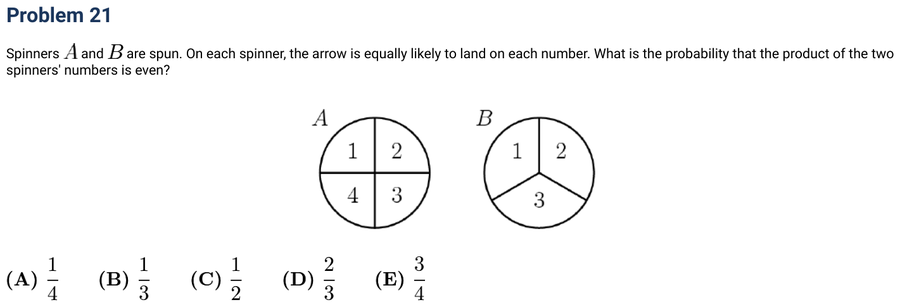
Spinners A and B are spun. On each spinner, the arrow is equally likely to land on each number. What is the probability that the product of the two spinners' numbers is even?
Show answer
Answer: D — 2/3.
Show hints
Hint 1 of 2
'Even product' can happen lots of ways (this even, that even, both even) — messy to count. But the opposite is razor-simple: a product is odd only when both spinners are odd. Count that one easy case and subtract.
Still stuck? Show hint 2 →
Hint 2 of 2
The technique is complementary counting: P(even) = 1 − P(odd), and a product is odd exactly when every factor is odd. Whenever 'at least one even' shows up, flip to 'all odd'.
Show solution
Approach: complement (1 minus all-odd)
Spinner A shows 1, 2, 4, 3 — odds are {1, 3}, so P(A odd) = 2/4 = 1/2. Spinner B shows 1, 2, 3 — odds are {1, 3}, so P(B odd) = 2/3.
Product is odd only if both are odd: P(odd) = (1/2)(2/3) = 1/3.
Therefore P(even) = 1 − 1/3 = 2/3.
Why the complement wins: the direct count needs three even-cases, but 'both odd' is a single product — one multiplication instead of several additions. Odd × odd = odd is the only way to dodge an even factor.
Another way — count favorable outcomes directly:
There are 4 × 3 = 12 equally likely (A, B) outcomes.
Odd products come only from A ∈ {1,3} and B ∈ {1,3}: that's 2 × 2 = 4 odd outcomes, so 12 − 4 = 8 even outcomes.
How many different combinations of $5 bills and $2 bills can be used to make a total of $17? Order does not matter.
Show answer
Answer: A — 2.
Show hints
Hint 1 of 2
$17 is *odd*, but stacking $2 bills can only ever build an even amount. Where does the odd part have to come from?
Still stuck? Show hint 2 →
Hint 2 of 2
That's a **parity** lock: the $5 bills must supply the oddness, so their count must be odd. Now you only have to try odd numbers of fives.
Show solution
Approach: use parity to pin down the number of $5 bills
Start by noticing the odd/even clash: any pile of $2 bills totals an even number, yet the target $17 is odd. The only odd ingredient is the $5 bill, so the number of fives must be odd.
Odd counts of fives that fit under $17: one ($5, leaving $12 = six twos) or three ($15, leaving $2 = one two). Five fives would already be $25 — too much.
That's exactly 2 combinations.
*Why this transfers:* whenever a total's parity doesn't match one of your building blocks, the *other* block's count is forced odd or even — parity slashes the cases before you start listing.
Four students sit in a row and chat with the people next to them. They then rearrange themselves so that no one is seated next to anyone they sat next to before. How many such rearrangements are possible?
Show answer
Answer: A — 2.
Show hints
Hint 1 of 2
Label the original seats 1, 2, 3, 4. The forbidden new-neighbor pairs are exactly the old neighbors: 1-2, 2-3, 3-4. Instead of listing what's banned, flip it — which pairs are allowed to sit together?
Still stuck? Show hint 2 →
Hint 2 of 2
List the allowed pairs (1-3, 1-4, 2-4) and you'll see they chain together in essentially one way. A valid row is just a path that uses every student through allowed links.
Show solution
Approach: build the ‘allowed-neighbor’ chain instead of testing all 24 orders
The banned new-neighbor pairs are the old ones: 1-2, 2-3, 3-4. Flip to the allowed pairs — everything else: 1-3, 1-4, and 2-4. A legal new row is a path that strings all four students together using only allowed links.
Trace the allowed links: 2 connects only to 4, and 3 connects only to 1, so 2 and 3 must be the ends. The only way to join them is 2–4–1–3.
That chain read either direction gives 2–4–1–3 and 3–1–4–2, so there are 2 rearrangements.
Why this transfers: ‘who may sit/stand next to whom’ problems become much easier as a graph — draw the allowed connections and count paths through all the vertices, rather than testing every permutation against a list of bans.
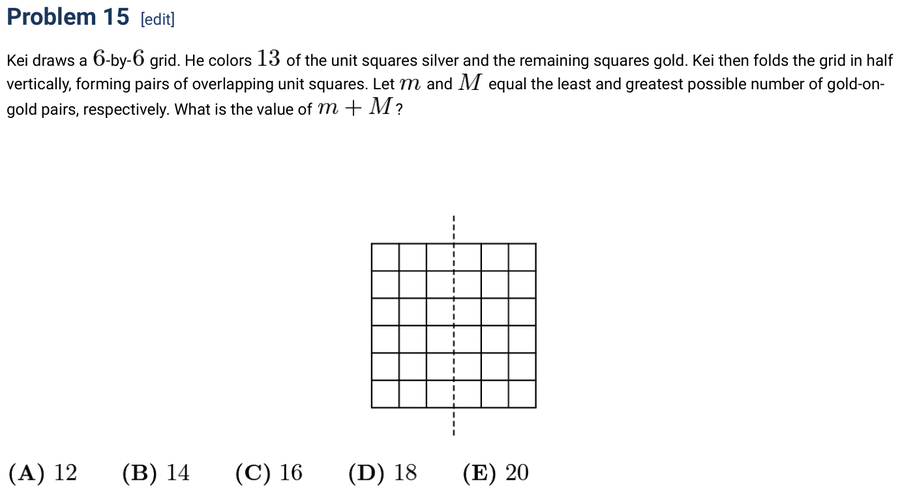
The fold turns 36 squares into 18 overlapping pairs. First, how many gold squares are there — and how does that compare to 18?
Still stuck? Show hint 2 →
Hint 2 of 2
There are more golds (23) than pairs (18), so some doubling-up is unavoidable. To make it rare, spread golds one-per-pair first; to make it common, glue golds together two-at-a-time.
Show solution
Approach: for an extreme, push the arrangement all the way to one side
Count gold: 36 − 13 = 23 golds, and the fold makes 18 pairs. Since 23 > 18, gold-on-gold pairs can't be avoided entirely — that tension is the whole problem.
Fewest (m): spread golds so each of the 18 pairs gets one first; that uses 18, and the remaining 23 − 18 = 5 are forced to land on already-gold squares. So m = 5.
Most (M): instead pile golds two-to-a-pair. 23 = 2 × 11 + 1, so you fill 11 pairs fully with 1 gold left over. So M = 11.
m + M = 5 + 11 = 16.
Why this transfers: to find a min or max of a count, don't search randomly — deliberately arrange things to the extreme (spread out for the minimum, clump together for the maximum). The leftover after even distribution is exactly the pigeonhole surplus, 23 − 18 = 5.
Buzz Bunny is hopping up and down a set of stairs, one step at a time. In how many ways can Buzz start on the ground, make a sequence of 6 hops, and end up back on the ground? (For example, one sequence of hops is up-up-down-down-up-down.)
Show answer
Answer: B — 5 sequences.
Show hints
Hint 1 of 2
Ending back on the ground after 6 hops forces exactly 3 ups and 3 downs. The real constraint: at no moment can downs outnumber ups, or Buzz drops below the ground.
Still stuck? Show hint 2 →
Hint 2 of 2
This is the "balanced parentheses" rule — read U as ( and D as ). List the legal arrangements; always start with U, end with D.
Show solution
Approach: count valid never-go-below sequences (a Catalan count)
Back to the ground in 6 hops means equal ups and downs: 3 U and 3 D. The twist is the ground floor — reading left to right, the count of D's may never exceed the count of U's (else Buzz steps below the ground). So every valid string starts U and ends D.
List them with that rule, keeping ups ahead: UUUDDD, UUDUDD, UUDDUD, UDUUDD, UDUDUD — 5 in all.
This transfers: "up/down steps that never go below start" is exactly the balanced-parentheses problem, and its counts are the Catalan numbers 1, 2, 5, 14, … For 3 ups and 3 downs the count is the 3rd Catalan number, 5 — matching our list, and a fast check for the longer versions of this problem.
Minh enters the numbers 1 through 81 into the cells of a 9 × 9 grid in some order. She calculates the product of the numbers in each row and column. What is the least number of rows and columns that could have a product divisible by 3?
Show answer
Answer: D — 11 rows and columns.
Show hints
Hint 1 of 2
One multiple of 3 anywhere in a row makes that whole row's product divisible by 3 — same for its column. So a single bad number "poisons" a full row AND a full column. How do you poison as few lines as possible?
Still stuck? Show hint 2 →
Hint 2 of 2
Technique: count the multiples of 3 (there are 27 in 1–81) and pack them into an r×c block. That block fits r·c of them while poisoning r + c lines — minimize r + c with r·c ≥ 27.
Show solution
Approach: pack multiples of 3 into the tightest possible block
A row or column's product is divisible by 3 the instant it holds even one multiple of 3. So each multiple-of-3 placement poisons one row and one column — the goal is to confine all of them to the fewest lines. There are 27 multiples of 3 in 1–81 (81÷3).
Squeeze them into an r×c rectangle: it covers r·c cells and poisons exactly r + c lines. We need r·c ≥ 27 while making r + c small. A 5×5 block holds 25 — two short.
Tuck the last 2 multiples into a 6th column (rows 1–2). Now rows poisoned: 5; columns poisoned: 6; total 5 + 6 = 11. (A 6×5 would also reach 30 cells and 11 lines — same minimum.)
This transfers: for a fixed area r·c, the perimeter-like sum r + c is smallest when the rectangle is near-square — the same reason a square fences the most area for a given fence.
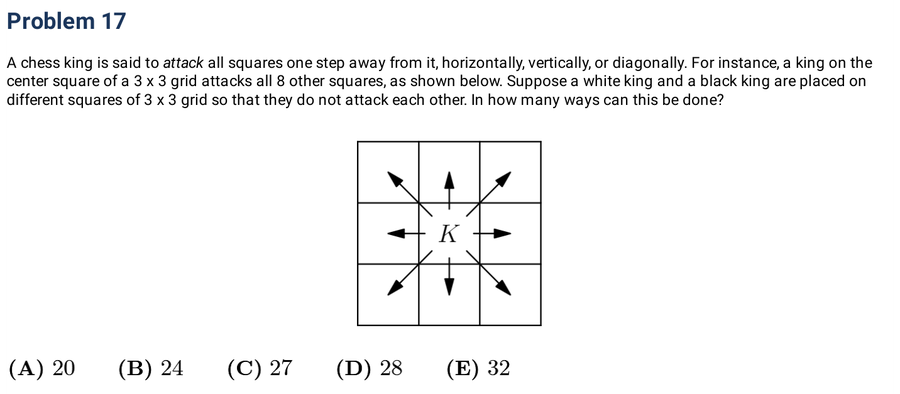
First, kill the impossible square: the CENTER attacks all 8 others, so a king there always attacks — neither king can sit there. That leaves only the 8 border squares.
Still stuck? Show hint 2 →
Hint 2 of 2
Technique — casework by the first king's spot, because corners and edge-middles see different numbers of squares: a corner attacks 3 (5 safe for the other), an edge-middle attacks 5 (3 safe).
Show solution
Approach: casework on the first king's position
Rule out the center first: it attacks all 8 surrounding squares, so a king there can never avoid attacking — both kings live on the 8 border squares. The kings are different colors, so order matters; place white first, then count safe spots for black.
White on a corner (4 corners): a corner attacks only 3 squares, leaving 8 − 3 = 5 safe for black. 4 × 5 = 20.
White on an edge-middle (4 of them): it attacks 5 squares, leaving 3 safe. 4 × 3 = 12.
Total: 20 + 12 = 32. Why split into cases: the count of attacked squares depends on the piece's position, so group positions by that count — the same move pays off whenever a board has corner/edge/center symmetry.
Another way — all pairs minus attacking pairs:
Place white anywhere (9), then black on any other square (8): 9 × 8 = 72 ordered placements ignoring attacks.
Subtract attacking placements. Count adjacencies on the 3×3: there are 12 edge-adjacencies and 8 diagonal-adjacencies, 20 unordered attacking pairs, so 40 ordered ones.
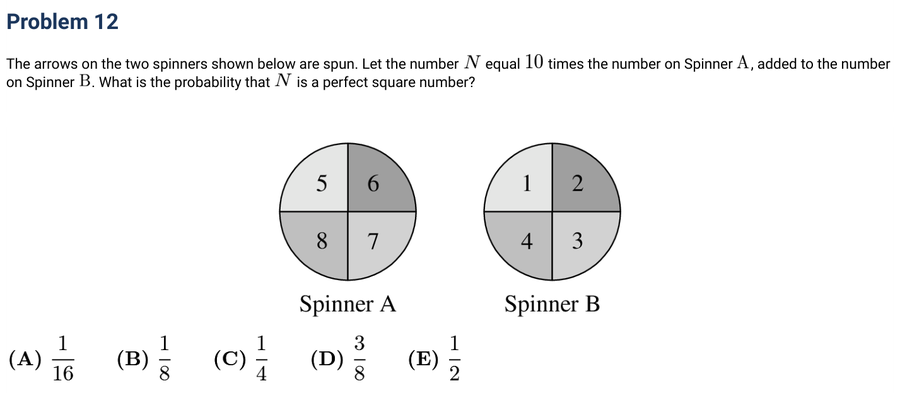
“10 times A plus B” is just sticking A in the tens place and B in the ones place — so N is a 2-digit number. Don't list spinner combos; list the perfect squares that could appear, since there are very few.
Still stuck? Show hint 2 →
Hint 2 of 2
Spinner A ∈ {5, 6, 7, 8} puts N in the 50s–80s, and B ∈ {1, 2, 3, 4} fixes the ones digit. Which perfect squares live in that window?
Show solution
Approach: count the rare outcomes (perfect squares), not the common ones
Insight: N = 10A + B just glues the two spinner numbers into a 2-digit number (A tens, B ones). Rather than checking all 16 spins, hunt the scarce target: perfect squares are rare, so list them.
With A ∈ {5,6,7,8} and B ∈ {1,2,3,4}, N runs 51 to 84. The only perfect squares there are 64 = 82 and 81 = 92. Check each is reachable: 64 needs A=6, B=4 ✓; 81 needs A=8, B=1 ✓.
So 2 of the 4 × 4 = 16 equally likely outcomes win: probability = 216 = 18.
You'll see this again: when favorable outcomes are rare, count them directly instead of sifting the whole sample space — far fewer cases to check.
In how many ways can the letters in BEEKEEPER be rearranged so that two or more E's do not appear together?
Show answer
Answer: D — 24 ways.
Show hints
Hint 1 of 2
BEEKEEPER is 5 E's and just 4 other letters in 9 slots. With so many E's crammed into 9 spots and none allowed to touch, the E placement is almost forced — figure out where they have to go.
Still stuck? Show hint 2 →
Hint 2 of 2
To keep 5 E's all apart in a row of 9, picture them with a non-E in each gap between them: E _ E _ E _ E _ E. That uses all 9 slots one way only. Then the 4 leftover letters fill the gaps.
Show solution
Approach: place the crowded letter first — it's forced — then permute the rest
Insight: the 5 E's are the constraint, so place them first. To keep all 5 apart you need a non-E between every pair: E _ E _ E _ E _ E. That's 5 E's plus 4 separators = 9 slots — it fits with zero room to spare, so the E's must sit in positions 1, 3, 5, 7, 9.
That leaves positions 2, 4, 6, 8 for B, K, P, R in any order: 4! = 24 arrangements.
You'll see this again: in “keep these apart” problems, set down the troublesome items first as a frame (gaps between them), then slot the others into the gaps. When the items barely fit, their pattern is forced.
The eighth grade class at Lincoln Middle School has 93 students. Each student takes a math class or a foreign language class or both. There are 70 eighth graders taking a math class, and there are 54 eighth graders taking a foreign language class. How many eighth graders take only a math class and not a foreign language class?
Show answer
Answer: D — 39 students.
Show hints
Hint 1 of 2
Add the two class sizes: 70 + 54 = 124, but there are only 93 students. The extra 124 − 93 = 31 isn't a mistake — it's the kids counted twice because they're in both classes.
Still stuck? Show hint 2 →
Hint 2 of 2
Once you know how many take both, "math only" is just the math total minus the both-takers (subtract off the shared slice of the Venn diagram).
Show solution
Approach: the overcount equals the overlap
Every student is in at least one class, so the two lists together should cover all 93 people — yet 70 + 54 = 124. The 124 − 93 = 31 surplus is exactly the students counted in both lists, so Both = 31.
"Math only" peels off the shared part: 70 − 31 = 39.
Why this transfers: whenever two groups together exceed the whole, the excess is the overlap — that's inclusion-exclusion (|M| + |F| − |both| = total), and a two-circle Venn diagram makes the "only" regions obvious.
On a beach 50 people are wearing sunglasses and 35 people are wearing caps. Some people are wearing both sunglasses and caps. If one of the people wearing a cap is selected at random, the probability that this person is also wearing sunglasses is 25. If instead, someone wearing sunglasses is selected at random, what is the probability that this person is also wearing a cap?
Show answer
Answer: B — 7/25.
Show hints
Hint 1 of 2
Both probabilities are about the same group — the people wearing both. So nail down that one number first; it's the bridge between the two questions.
Still stuck? Show hint 2 →
Hint 2 of 2
"2/5 of cap-wearers also wear sunglasses" means both = (2/5) of 35. Once you have a head-count for both, each probability is just both ÷ (the group you're conditioning on).
Show solution
Approach: find the both-count, then re-divide
The given probability is a fraction of the 35 cap-wearers: people wearing both = (2/5) × 35 = 14.
The reversed question keeps the same 14 in both, now as a fraction of the 50 sunglasses-wearers: P(cap | sunglasses) = 14 / 50 = 7/25.
Why this transfers: a conditional probability is always (overlap) ÷ (the condition group). Convert one conditional into the raw overlap count, and you can flip it onto any other group — the overlap doesn't change, only the denominator does.
The faces of each of two fair dice are numbered 1, 2, 3, 5, 7, and 8. When the two dice are tossed, what is the probability that their sum will be an even number?
Show answer
Answer: C — 5/9.
Show hints
Hint 1 of 2
Don't list all 36 pairs — a sum is even only when the two numbers match in parity (odd+odd or even+even). So all that matters is how many faces are odd vs even.
Still stuck? Show hint 2 →
Hint 2 of 2
These dice are unusual: faces 1, 3, 5, 7 are odd (4 of them) and only 2, 8 are even (2 of them). Find P(both odd) and P(both even), then add.
Show solution
Approach: even sum means matching parity
A sum is even exactly when both dice are odd or both are even — the actual values don't matter, only odd/even. On this die: odd faces {1, 3, 5, 7} = 4 of 6; even faces {2, 8} = 2 of 6, so P(odd) = 2/3 and P(even) = 1/3.
Both odd: (2/3)(2/3) = 4/9. Both even: (1/3)(1/3) = 1/9. These can't both happen, so add: 4/9 + 1/9 = 5/9.
Why this transfers: for parity-of-a-sum questions, throw away the numbers and keep only odd/even — the problem shrinks to a coin-flip count. (Sanity check: a normal 3-odd-3-even die gives exactly 1/2; tilting to 4 odds nudges "both-odd" up, so 5/9 just over 1/2 fits.)
Abby, Bridget, and four of their classmates will be seated in two rows of three for a group picture. If the seating positions are assigned randomly, what is the probability that Abby and Bridget are adjacent to each other in the same row or the same column?
Show answer
Answer: C — 7/15.
Show hints
Hint 1 of 2
The other four classmates are a distraction. The only thing that matters is which two of the six seats Abby and Bridget land in — so think about seat-pairs, not full seatings.
Still stuck? Show hint 2 →
Hint 2 of 2
The technique: when an event depends only on the relative position of two items, make the sample space the set of unordered seat-pairs: probability = (adjacent pairs) ÷ (all pairs). Then you just count adjacencies on the grid.
Show solution
Approach: count adjacent seat-pairs out of all seat-pairs
All the randomness boils down to which two of the six seats hold Abby and Bridget: C(6,2) = 15 equally likely unordered pairs.
Now count the adjacent pairs directly on the 2×3 grid: within a row the 3 seats give 2 side-by-side pairs, × 2 rows = 4 horizontal; each of the 3 columns has one top-bottom pair = 3 vertical. Total 4 + 3 = 7.
Probability = 7/15 — that's 7/15.
You'll see it again: reducing "random arrangement" to "random pair of positions for the two people I care about" sidesteps all the irrelevant orderings of everyone else.
Another way — fix Abby, place Bridget:
Seat Abby first; by symmetry split into where she lands. If Abby takes a middle seat (probability 2/6 = 1/3), it has 3 neighbors among the 5 remaining seats, so Bridget is adjacent with probability 3/5.
If Abby takes a corner/edge seat (probability 4/6 = 2/3), it has only 2 neighbors, so adjacency probability is 2/5.
Combine: (1/3)(3/5) + (2/3)(2/5) = 3/15 + 4/15 = 7/15 — same answer, built from Abby's viewpoint.
Professor Chang has nine different language books lined up on a bookshelf: two Arabic, three German, and four Spanish. How many ways are there to arrange the nine books on the shelf keeping the Arabic books together and keeping the Spanish books together?
Show answer
Answer: C — 5760 ways.
Show hints
Hint 1 of 2
"Must stay together" is a gift: tape each must-stick group into a single fat book. Now you're arranging far fewer objects — but the German books aren't taped, so they each stay separate.
Still stuck? Show hint 2 →
Hint 2 of 2
The technique is the block / glue method: arrange the blocks-and-loose-items as one layer, then multiply by the internal arrangements inside each block (the books in a block can still shuffle among themselves).
Show solution
Approach: block-then-internal
Glue the 2 Arabic books into one block and the 4 Spanish books into another. The shelf now holds 5 movable objects: [Arabic block], [Spanish block], and the 3 separate German books — arranged in 5! = 120 ways.
Don't forget the books can rearrange inside their blocks: the Arabic block has 2! = 2 internal orders, the Spanish block has 4! = 24.
Total: 120 × 2 × 24 = 5760.
You'll see it again: every "these items must be adjacent" problem is glue-the-group-into-one, arrange, then × the internal orderings — and items that aren't required to be together simply stay as their own objects.
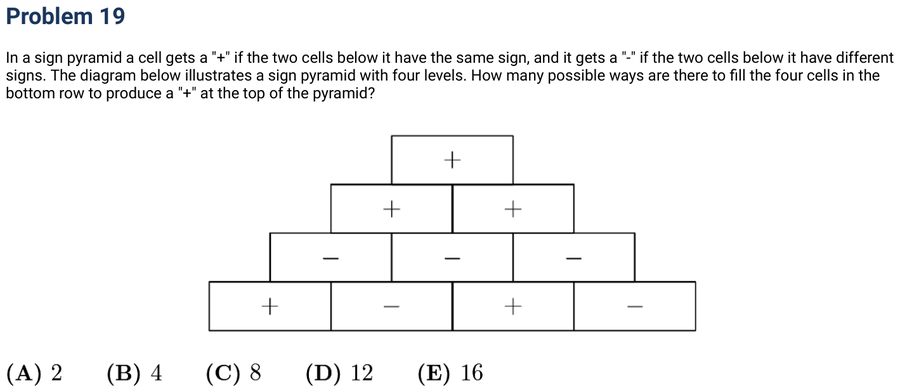
Instead of testing all 16 bottom rows, notice the pyramid is reversible: if you know a cell and the cell to its bottom-left, the bottom-right cell is forced. So a whole row plus one free corner choice determines the row beneath it.
Still stuck? Show hint 2 →
Hint 2 of 2
The technique is counting free choices: building downward, each new row is pinned down by the row above plus exactly one free sign at the left. Three rows get built below the fixed top, so the count is 2 × 2 × 2.
Show solution
Approach: count the free choices building downward
Key reversibility: given a cell's sign and its bottom-left neighbor, the rule forces the bottom-right neighbor (if the top is +, the two bottoms match; if −, they differ). So a known row plus one free leftmost choice determines the entire row below it.
Start from the fixed + at the apex and build down. Row 2 (2 cells): pick its left cell freely (2 ways), the right is forced — 2 choices. Row 3 is then determined by row 2 plus one free left cell — another 2. Row 4 (the bottom) similarly — another 2.
Total = 2 × 2 × 2 = 8.
You'll see it again: when a structure is "reversible with one free knob per level," the answer is 2 to the power of the number of free knobs — far faster than brute-forcing all configurations.
Another way — XOR / parity of the bottom row:
Encode + as 0 and − as 1; then "+ when the two below match" is exactly addition mod 2 (XOR): each cell is the XOR of the two beneath it.
Stacking three layers, the top equals bottom1 ⊕ bottom2 ⊕ bottom3 ⊕ bottom4, because the weights are the row-3 binomial coefficients 1, 3, 3, 1 — all odd, so all four corners count.
Top = + means an even number of −'s in the bottom row. Of the 16 bottom rows, exactly half have even parity: 8.
In the arrangement of letters and numerals below, by how many different paths can one spell AMC8? Beginning at the A in the middle, a path allows only moves from one letter to an adjacent (above, below, left, or right, but not diagonal) letter. One example of such a path is traced in the picture.
8C88CMC8CMAM8CMC8C8
Show answer
Answer: D — 24 paths.
Show hints
Hint 1 of 2
The grid is fully symmetric, so don't trace 24 separate paths. Just ask: from a letter, how many choices for the next letter? Each step's choices are the same no matter which path you're on.
Still stuck? Show hint 2 →
Hint 2 of 2
That's the multiplication principle: when each stage offers an independent number of choices, multiply them. Count the fan-out A→M, then M→C, then C→8.
Show solution
Approach: multiplication principle on the fan-out
From the center A: 4 adjacent M's (up, down, left, right) — 4 choices.
From any M: 3 adjacent C's (the fourth neighbor is the A you came from, which doesn't extend the spelling) — 3 choices.
From any C: 2 adjacent 8's — 2 choices.
Because every stage's choice count is independent of earlier picks, multiply: 4 × 3 × 2 = 24.
Why this transfers: spell-a-word and lattice-path counts almost always collapse to multiplying the branch count at each step — far faster than drawing every route.
An integer between 1000 and 9999, inclusive, is chosen at random. What is the probability that it is an odd integer whose digits are all distinct?
Show answer
Answer: B — 56/225.
Show hints
Hint 1 of 2
Two restrictions fight over the same digits: 'odd' lives at the units, 'no leading zero' lives at the thousands. Fill the most constrained positions first so the constraints don't trip over each other.
Still stuck? Show hint 2 →
Hint 2 of 2
Place the units digit first (odd: 5 choices), then the thousands (no 0, and distinct from units), then the looser hundreds and tens. Filling tightest-first keeps each later count clean.
Show solution
Approach: fill the most-constrained positions first
Total 4-digit integers from 1000 to 9999: 9000. These are equally likely, so probability = (favorable)/9000.
Place the trickiest digit first — the units must be odd: {1,3,5,7,9}, 5 choices. Doing units before thousands is the key, because the leading-zero rule then has clean counts.
Thousands: can't be 0 and can't repeat the units digit → 10 − 2 = 8 choices.
Hundreds: any digit except the 2 already used → 8 choices. Tens: any except the 3 used → 7 choices.
Favorable = 5 × 8 × 8 × 7 = 2240, so probability = 2240/9000 = 56/225.
Why this transfers: in 'distinct digits with a position rule' counts, always assign the most-restricted slot first — tackling 0/leading and parity constraints early prevents double-counting headaches.
Two different numbers are randomly selected from the set {−2, −1, 0, 3, 4, 5} and multiplied together. What is the probability that the product is 0?
Show answer
Answer: D — 1/3.
Show hints
Hint 1 of 2
A product is 0 ONLY when one of its factors is 0. The minus signs and the size of the numbers are pure distraction — the only chip that matters is the 0. So really the question is: how often does 0 get picked?
Still stuck? Show hint 2 →
Hint 2 of 2
Count the pairs that include 0 versus all pairs. There are 6 numbers; pairing 0 with each of the other 5 gives the favorable pairs.
Show solution
Approach: a product is zero only when 0 is one of the two picks
The product is 0 exactly when 0 is one of the two chosen numbers — the negatives and the spread of values don't matter at all.
Total ways to choose 2 of the 6 numbers: C(6, 2) = 15. Pairs that contain 0: pair 0 with each of the other 5 numbers → 5 pairs.
Probability = 5 / 15 = 1/3.
Why this transfers: a "product equals 0" question always reduces to "is the special factor 0 chosen?" — ignore everything else and just count how often 0 appears.
Another way — probability the FIRST pick already settles it:
Think of drawing one number, then a second. The chance 0 is NOT picked first is 5/6; given that, the chance 0 is not picked second is 4/5.
So neither is 0 with probability (5/6)(4/5) = 4/6 = 2/3. The product is 0 the rest of the time: 1 − 2/3 = 1/3.
An ATM password at Fred's Bank is composed of four digits from 0 to 9, with repeated digits allowable. If no password may begin with the sequence 9, 1, 1, then how many passwords are possible?
Show answer
Answer: D — 9990 passwords.
Show hints
Hint 1 of 2
"How many are ALLOWED" is awkward to count head-on. But the FORBIDDEN ones are super easy to count — so count everything, then subtract the bad ones. (Total − bad = good.)
Still stuck? Show hint 2 →
Hint 2 of 2
A forbidden password has its first three digits locked as 9, 1, 1; only the fourth digit is free. So there are very few bad ones — count those, not the good ones.
Show solution
Approach: complementary counting (total minus forbidden)
Count everything first: 4 digits, each 0–9, gives 104 = 10,000 possible passwords.
Count the forbidden ones: they must read 9, 1, 1, _ — first three digits fixed, last digit any of 10. That's only 10 bad passwords.
Good = total − bad = 10,000 − 10 = 9990.
Why this transfers: when a rule says "everything EXCEPT a small forbidden set," counting the small forbidden set and subtracting is almost always faster than counting the survivors directly.
Tom has twelve slips of paper which he wants to put into five cups labeled A, B, C, D, E. He wants the sum of the numbers on the slips in each cup to be an integer. Furthermore, he wants the five integers to be consecutive and increasing from A to E. The numbers on the papers are 2, 2, 2, 2.5, 2.5, 3, 3, 3, 3, 3.5, 4, and 4.5. If a slip with 2 goes into cup E and a slip with 3 goes into cup B, then the slip with 3.5 must go into what cup?
Show answer
Answer: D — Cup D.
Show hints
Hint 1 of 3
Before worrying about the 3.5, lock down the five cup totals. The slips add to 35, and the totals are five consecutive integers — five consecutive integers summing to 35 have middle (=average) 35/5 = 7, so they're forced.
Still stuck? Show hint 2 →
Hint 2 of 3
Once the totals are A=5, B=6, C=7, D=8, E=9, use the two given placements to remove slips, then test the 3.5 in each cup: it works only if its leftover partners can hit the cup's remaining total.
Still stuck? Show hint 3 →
Hint 3 of 3
Cup B has a 3 and needs 6, so its partner is another 3; cup E has a 2 and needs 7 more. Now ask, for each cup, 'total minus 3.5 — can the remaining slips make that?'
Show solution
Approach: pin down cup totals, then place 3.5 by elimination
Sum of slips: 2+2+2+2.5+2.5+3+3+3+3+3.5+4+4.5 = 35. Five consecutive integers summing to 35 must be 5, 6, 7, 8, 9, so A=5, B=6, C=7, D=8, E=9.
B has a 3 and needs 6 total ⇒ the other slip in B is another 3.
After B = {3, 3} and the 2 in E, the slips still to place are {2, 2, 2.5, 2.5, 3, 3, 3.5, 4, 4.5}. Try the 3.5 in each remaining cup and see what its partner(s) would have to total.
A (need 5): 5 − 3.5 = 1.5 — no slip equals 1.5 and no combo of leftovers sums to 1.5. ✗
C (need 7): 7 − 3.5 = 3.5 from leftovers — no such combo without using the only 3.5. ✗
E (already has 2, need 7 more): 7 − 3.5 = 3.5 — same issue. ✗
D (need 8): 8 − 3.5 = 4.5 — pair with the 4.5 slip. ✓ The remaining slips then fill the others: A = {2.5, 2.5} = 5, C = {3, 4} = 7, and E takes {2, 2, 3} on top of its 2 for 9.
So 3.5 goes in cup D.
Why this transfers: when totals are 'consecutive integers' (or otherwise constrained), find them first from the grand sum — that collapses an open-ended placement puzzle into a small, finite check.
Samantha lives 2 blocks west and 1 block south of the southwest corner of City Park. Her school is 2 blocks east and 2 blocks north of the northeast corner of City Park. On school days she bikes on streets to the southwest corner of City Park, then takes a diagonal path through the park to the northeast corner, and then bikes on streets to school. If her route is as short as possible, how many different routes can she take?
Show answer
Answer: E — 18 routes.
Show hints
Hint 1 of 2
The forced diagonal through the park splits the trip into three separate legs that don't interfere with each other. Count each leg's shortest routes on its own, then combine — how do independent choices multiply?
Still stuck? Show hint 2 →
Hint 2 of 2
A shortest grid route is just an arrangement of fixed moves (so many easts, so many norths). Number of routes = C(total steps, steps in one direction). And independent stages multiply.
Show solution
Approach: count each leg, then multiply (independent stages)
Leg 1, home → SW corner: 2 easts and 1 north in some order. Choosing where the single north goes among 3 steps gives C(3, 1) = 3 routes.
Leg 2, the diagonal through the park: a single forced path = 1 way (this is what cleanly separates the two grids).
Leg 3, NE corner → school: 2 easts and 2 norths, C(4, 2) = 6 routes.
The legs are independent, so multiply: 3 × 1 × 6 = 18.
You'll see this again: shortest-path counts on a grid are always "choose which steps are north," and independent stages of a journey multiply — the multiplication principle.
Let R be a set of nine distinct integers. Six of the elements are 2, 3, 4, 6, 9, and 14. What is the number of possible values of the median of R?
Show answer
Answer: D — 7 possible values.
Show hints
Hint 1 of 2
With 9 distinct integers, the median is just the 5th smallest — the one with exactly 4 below it and 4 above. You get to add 3 free integers, so you can shove the "window" left or right. Ask: which values can't be reached no matter how you place those 3?
Still stuck? Show hint 2 →
Hint 2 of 2
Find the boundaries by counting what's already forced. A candidate median needs 4 below and 4 above; if too many of the six known values are already stuck on one side, you can't balance it. The technique is to find the largest and smallest reachable median, then count the integers between.
Show solution
Approach: find the median's reachable range, then count integers in it
Median = 5th smallest of the 9. To make a value m the median, the final set must have 4 elements below m and 4 above. You control only 3 new integers, so check whether the six knowns (2, 3, 4, 6, 9, 14) can be balanced around m.
Too small fails: if m < 3, then 3, 4, 6, 9, 14 — five knowns — already sit above m, more than the 4 allowed. So m ≥ 3.
Too big fails: if m > 9, then 2, 3, 4, 6, 9 — five knowns — already sit below, again too many. So m ≤ 9.
Every integer from 3 to 9 does work: place enough of your 3 spare integers below or above to even the count to 4 and 4. That's the integers 3, 4, 5, 6, 7, 8, 9 — 9 − 3 + 1 = 7 possible medians.
The reusable idea: when you control some of the data, find the extreme positions the answer can reach (the boundaries) and count between them — don't test every value blindly.
How many 4-digit positive integers have four different digits, where the leading digit is not zero, the integer is a multiple of 5, and 5 is the largest digit?
Show answer
Answer: D — 84.
Show hints
Hint 1 of 2
Decode the constraints into a digit pool first: ‘5 is the largest digit’ means no digit exceeds 5 (pool is {0,1,2,3,4,5}) and 5 must actually appear. ‘Multiple of 5’ pins the units digit to 0 or 5.
Still stuck? Show hint 2 →
Hint 2 of 2
The two units choices (0 vs 5) behave very differently for the leading-zero rule, so split into those two cases — that's the natural fault line.
Show solution
Approach: casework on the units digit, after fixing the digit pool
Case units = 0: the 5 must live in one of the three front slots, plus two more distinct digits from {1,2,3,4}. Pick those two: C(4,2) = 6 ways; arrange the three front digits (5 and the two picks): 3! = 6 ways. That's 6×6 = 36, and a leading 0 is impossible here since 0 is parked at the end.
Case units = 5: the front three are distinct digits from {0,1,2,3,4}. All arrangements: 5·4·3 = 60; subtract the bad ones with 0 in front (0 _ _ with the other two from the remaining 4: 4·3 = 12). That's 60 − 12 = 48.
Total: 36 + 48 = 84.
Worth keeping: with several restrictions, translate each into ‘which digits are allowed’ and ‘which must appear’ before counting — then case-split on the rule (divisibility) that controls a single position.
In a room, 2/5 of the people are wearing gloves, and 3/4 of the people are wearing hats. What is the minimum number of people in the room wearing both a hat and a glove?
Show answer
Answer: A — 3.
Show hints
Hint 1 of 3
‘2/5 of the people’ has to be a whole number, and so does ‘3/4 of the people.’ That forces the head count to be a multiple of both 5 and 4 — pick the smallest such number.
Still stuck? Show hint 2 →
Hint 2 of 3
To minimize overlap, push the two groups as far apart as you can. But gloves (8) + hats (15) = 23 people-slots in a room of only 20 — the 3 extra slots must double up. That forced overlap is the minimum.
Still stuck? Show hint 3 →
Hint 3 of 3
This is inclusion-exclusion read as a floor: min(both) = gloves + hats − total, whenever that's positive.
Show solution
Approach: smallest legal room, then the forced overlap
Both 2/5 and 3/4 of the people must be whole numbers, so the total is a multiple of 5 and 4 → a multiple of 20. The smallest room is 20 people (smaller total gives fractional people).
Then gloves = 2/5 · 20 = 8 and hats = 3/4 · 20 = 15.
Those are 8 + 15 = 23 ‘wearings’ spread over 20 people. Even spreading them out as much as possible, 23 − 20 = 3 of them are forced to land on someone already counted. So at least 3 wear both.
Why this transfers: ‘A + B exceeds the whole’ guarantees an overlap of at least (A + B − whole) — a pigeonhole-flavored floor that shows up whenever two big groups share a small population.
Everyday at school, Jo climbs a flight of 6 stairs. Jo can take the stairs 1, 2, or 3 at a time. For example, Jo could climb 3, then 1, then 2. In how many ways can Jo climb the stairs?
Show answer
Answer: E — 24 ways.
Show hints
Hint 1 of 3
Don't try to list all the ways for 6 stairs — that's a mess. Instead ask: what was Jo's last step? It was a 1, 2, or 3, landing on stair 6 from stair 5, 4, or 3. So the count for 6 is built from the counts for 5, 4, and 3.
Still stuck? Show hint 2 →
Hint 2 of 3
That ‘classify by the final move’ idea gives a recurrence: ways(n) = ways(n−1) + ways(n−2) + ways(n−3). Build the small cases up to 6.
Still stuck? Show hint 3 →
Hint 3 of 3
Anchor the start: ways(1)=1, ways(2)=2 (1+1 or 2), ways(3)=4 (1+1+1, 1+2, 2+1, 3).
Show solution
Approach: build up by classifying the last step (recurrence)
The last step onto stair n was a 1, 2, or 3, coming from stair n−1, n−2, or n−3. Those cases don't overlap and cover everything, so ways(n) = ways(n−1) + ways(n−2) + ways(n−3).
Why this transfers: ‘in how many ways’ counting problems with a repeated choice (step sizes, tiles, coin sequences) crack open by conditioning on the last move — turning one hard count into a sum of smaller solved counts. (With only 1- and 2-steps it's the Fibonacci numbers.)
Another way — count which inner stairs she lands on, then forbid big jumps:
Think of stairs 1–5 as optional landing spots (she must finish on 6). Each of the 5 inner stairs is either stepped on or skipped, giving 25 = 32 raw sequences of step-sizes.
But some of those imply a jump of 4, 5, or 6 stairs, which isn't allowed. Counting the sequences that contain such an over-long gap gives exactly 8 bad ones.
Valid ways = 32 − 8 = 24 — a complementary-counting route that confirms the recurrence.
Ten tiles numbered 1 through 10 are turned face down. One tile is turned up at random, and a die is rolled. What is the probability that the product of the numbers on the tile and the die will be a square?
Show answer
Answer: C — 11/60.
Show hints
Hint 1 of 2
The die only shows 1–6, so loop over its six values — fewer cases than looping over the ten tiles.
Still stuck? Show hint 2 →
Hint 2 of 2
For each die value d, ask which tiles make d·t a perfect square: the tile must supply exactly the prime factors d is missing to make every exponent even.
Show solution
Approach: case on the die value (only six cases)
Total outcomes: 10 tiles × 6 die faces = 60. Now scan the die. d = 1 is already a square, so any square tile works: t = 1, 4, 9 ⇒ 3.
d = 2 needs the tile to contribute another factor of 2 (and otherwise be square): t = 2, 8 ⇒ 2. d = 3 needs another 3: only t = 3 ⇒ 1.
d = 4 is itself a square, so again the square tiles: t = 1, 4, 9 ⇒ 3. d = 5: only t = 5 ⇒ 1. d = 6: only t = 6 ⇒ 1.
Successes: 3 + 2 + 1 + 3 + 1 + 1 = 11, so the probability is 11/60.
Why this transfers: a number is a perfect square exactly when every prime appears an even number of times — so "make this product square" means the other factor must fill in the odd-power primes.
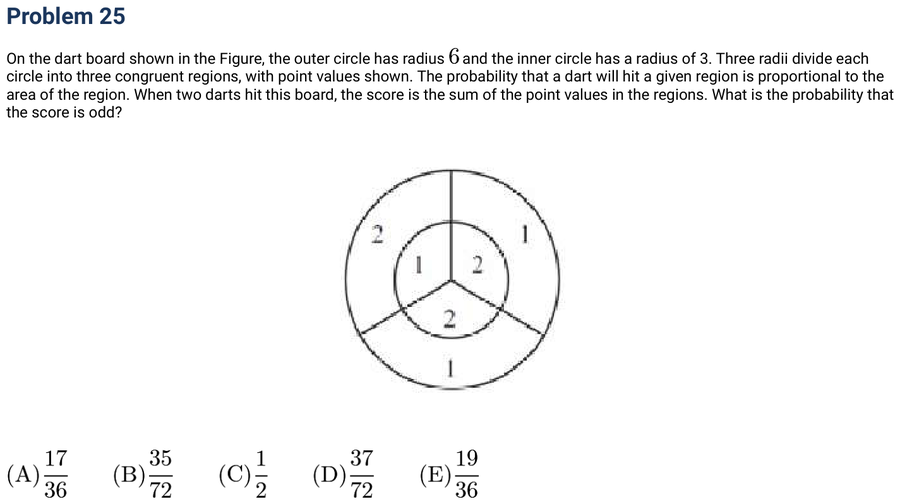
On the dart board shown in the figure, the outer circle has radius 6 and the inner circle has a radius of 3. Three radii divide each circle into three congruent regions, with point values shown. The probability that a dart will hit a given region is proportional to the area of the region. When two darts hit this board, the score is the sum of the point values of the regions hit. What is the probability that the score is odd?
Show answer
Answer: B — 35/72.
Show hints
Hint 1 of 2
Sum of two scores is odd only when one is even and one is odd — here that means exactly one dart lands on a 1 and the other on a 2. So you never need each region separately, just P(hit a 1) and P(hit a 2).
Still stuck? Show hint 2 →
Hint 2 of 2
Collapse the regions into two outcomes: lump all '1' regions into P(1) and all '2' regions into P(2); 'odd total' then becomes the simple two-color event.
Show solution
Approach: reduce to P(1) and P(2), then 2·P(1)·P(2)
Areas drive the chances. Inner circle = 9π in 3 equal sectors ⇒ each inner region = 3π, probability 3π/36π = 1/12. Outer ring = 36π − 9π = 27π in 3 sectors ⇒ each outer region = 9π, probability 1/4.
From the board: inner regions are 1, 2, 2; outer regions are 1, 1, 2.
P(hit a 2) = 2 · 1/12 (inner) + 1/4 (outer) = 2/12 + 3/12 = 5/12. (Check: 7/12 + 5/12 = 1, since every region is a 1 or a 2.)
Odd total = one 1 and one 2, in either order: 2 · (7/12)(5/12) = 35/72.
Why the factor of 2: '1 then 2' and '2 then 1' are distinct equally-likely orders, so the mixed event gets counted twice — the same 2·p·q that shows up in coin-flip 'exactly one heads' problems.
Ali, Bonnie, Carlo, and Dianna are going to drive together to a nearby theme park. The car they are using has four seats: one driver's seat, one front passenger seat, and two back passenger seats. Bonnie and Carlo are the only ones who know how to drive the car. How many possible seating arrangements are there?
Show answer
Answer: D — 12 arrangements.
Show hints
Hint 1 of 2
Handle the seat with a rule attached FIRST — the driver's seat — before the free-for-all of the other seats.
Still stuck? Show hint 2 →
Hint 2 of 2
Once the driver is locked in, the remaining three people just fill three seats with no restrictions.
Show solution
Approach: fill the restricted seat first (the constrained-choice rule)
The driver's seat is the only one with a rule: just Bonnie or Carlo can sit there, so 2 choices. Settling the restriction first keeps it from tangling the rest.
With the driver seated, the other 3 people drop into the 3 remaining seats freely: 3! = 3 × 2 × 1 = 6 ways.
Multiply the independent stages: 2 × 6 = 12 arrangements.
Worth keeping: in counting problems, fill the most restricted slot first — if you save it for last, the count for the "free" slots changes depending on earlier picks and the multiplication breaks down.
How many whole numbers between 99 and 999 contain exactly one 0?
Show answer
Answer: D — 162.
Show hints
Hint 1 of 2
"Between 99 and 999" just means three-digit numbers — and a 3-digit number can't *start* with 0. So the lone 0 is barred from the hundreds place before you count anything.
Still stuck? Show hint 2 →
Hint 2 of 2
Place the special digit first: the one 0 must be in the tens or units spot (2 choices), and then make sure the *other* two digits are nonzero so you don't accidentally get a second 0.
Show solution
Approach: place the lone 0, then fill the rest with nonzero digits
Deal with the *restricted* digit first — that's the habit. The hundreds digit can't be 0, so the single 0 lives in the tens or units place: 2 spots for it.
The remaining two digits must each be 1–9 (zero would either repeat the 0 or land where it can't): 9 × 9 ways.
Total: 2 × 9 × 9 = 162.
*Why this transfers:* in digit-counting, place the most-constrained slot first (here, where the 0 may go) and keep the "exactly one" rule honest by forbidding the special digit everywhere else — that's what blocks both the leading-zero and the double-counting traps.
Tyler has entered a buffet line in which he chooses one kind of meat, two different vegetables, and one dessert. If the order of food items is not important, how many different meals might he choose?
Each food slot is chosen independently, so multiply the choices — but the vegetables need care because you pick TWO and order doesn't matter.
Still stuck? Show hint 2 →
Hint 2 of 2
Picking 2 of 4 vegetables where order is irrelevant is a combination, C(4,2) = 6 — not 4 × 3, which would double-count corn-then-beans vs beans-then-corn.
Show solution
Approach: multiply the independent choices
Handle the tricky slot first. "Two different vegetables, order doesn't matter": there are 4 × 3 = 12 ordered ways, but each pair (like beans+corn) got counted twice, so divide by 2 → 6 pairs. That's exactly C(4,2) = 6.
The other slots are single picks: meat 3 ways, dessert 4 ways, all independent.
Multiply independent choices: 3 × 6 × 4 = 72 meals. The reusable move: when a selection ignores order, count it as ordered then divide by the number of rearrangements (here, 2).
Two dice are thrown. What is the probability that the product of the two numbers is a multiple of 5?
Show answer
Answer: D — 11/36.
Show hints
Hint 1 of 2
A product carries a factor of 5 only if one of the dice supplies it — and the only multiple of 5 on a die is 5 itself. So the event is really "at least one die shows a 5."
Still stuck? Show hint 2 →
Hint 2 of 2
"At least one" is the cue to flip to the complement: count the chance that NEITHER die is a 5, which is one clean multiplication.
Show solution
Approach: complementary counting
Where can the factor of 5 come from? Only the face 5 (since 10, 15, … aren't on a die). So a multiple-of-5 product means at least one die is a 5.
Counting "at least one" directly is messy, so count the opposite: P(neither is 5) = (5/6)(5/6) = 25/36. Then P(at least one 5) = 1 − 25/36 = 11/36.
Whenever you see "at least one," reach for the complement — "none" is usually a single product instead of a pile of overlapping cases.
Another way — count the favorable cells directly:
Of 36 equally likely (die1, die2) outcomes, a 5 appears in row 5 (6 cells) or column 5 (6 cells).
Bicycle license plates in Flatville each contain three letters. The first is chosen from the set {C, H, L, P, R}, the second from {A, I, O}, and the third from {D, M, N, T}. When Flatville needed more license plates, they added two new letters. The new letters may both be added to one set, or one letter may be added to one set and one to another. What is the largest possible number of additional license plates that can be made by adding two letters?
Show answer
Answer: D — 40 more plates.
Show hints
Hint 1 of 2
Each plate is one choice from each set, so the count is the PRODUCT of the three set sizes: 5 × 3 × 4 = 60. Adding a letter bumps one factor up by 1.
Still stuck? Show hint 2 →
Hint 2 of 2
Adding to a set multiplies the whole product by that factor's growth — going 3→4 multiplies by 4/3, going 5→6 only by 6/5. So push your new letters into the smallest sets to get the biggest multiplier.
Show solution
Approach: count = product of set sizes; feed the smallest factors
Plates = (size 1)×(size 2)×(size 3) = 5 × 3 × 4 = 60. Two new letters add 2 total across the three factors.
A letter helps most where the factor is smallest, because it multiplies by the larger ratio. The size-3 set is smallest: putting both there gives 5 × 5 × 4 = 100; splitting one into the 3-set and one into the 4-set gives 5 × 4 × 5 = 100 as well.
Either way that's 100 plates, an extra 100 − 60 = 40. The principle: to grow a product of fixed total "+1 bumps," feed your increments to the smallest factors — they give the steepest percentage jump.
Another way — just test every placement (brute force, when in doubt):
Six ways to place the two letters; compute each product. Both into set 1: 7×3×4 = 84. Both into set 2: 5×5×4 = 100. Both into set 3: 5×3×6 = 90.
Tamika selects two different numbers at random from the set {8, 9, 10} and adds them. Carlos takes two different numbers at random from the set {3, 5, 6} and multiplies them. What is the probability that Tamika's result is greater than Carlos' result?
Show answer
Answer: A — 4/9.
Show hints
Hint 1 of 2
The two people act independently, so the real sample space is small: every one of Tamika's 3 possible results paired with every one of Carlos's 3 — only 9 equally likely matchups. List each person's possible outcomes first.
Still stuck? Show hint 2 →
Hint 2 of 2
Organize by Carlos's value: against his low number Tamika always wins, against his high number she always loses — only his middle value needs a closer look.
Show solution
Approach: list each person's outcomes, count winning matchups out of 9
Pinning down outcomes: Tamika picks two of {8,9,10} and adds → sums 17, 18, 19. Carlos picks two of {3,5,6} and multiplies → products 15, 18, 30. Each value is equally likely, and the two choices are independent, so there are 3 × 3 = 9 equally likely matchups.
Count Tamika's wins by Carlos's value: vs Carlos = 15, all 3 of her sums (17,18,19) win → 3; vs Carlos = 18, only 19 wins → 1; vs Carlos = 30, none win → 0.
That's 3 + 1 + 0 = 4 wins out of 9, so the probability is 4/9.
Why this transfers: for two independent random choices, the outcomes multiply (3 × 3 = 9 equally likely pairs), and a tidy table or 'sort by one person's value' keeps you from miscounting. Sanity check: 4 of 9 is just under half, which feels right since Carlos's products spread higher than Tamika's sums.
How many subsets containing three different numbers can be selected from the set {89, 95, 99, 132, 166, 173} so that the sum of the three numbers is even?
Show answer
Answer: D — 12.
Show hints
Hint 1 of 2
The actual values don't matter — replace every number by just 'odd' or 'even.' The set is really four odds and two evens. Whether a sum is even depends only on how many odd numbers you grabbed.
Still stuck? Show hint 2 →
Hint 2 of 2
Adding odds is what flips even/odd: a sum is even only when you use an EVEN number of odd terms. Picking 3 numbers, that means 2 odds + 1 even (using 0 odds would need 3 evens, but there are only 2). Now just count the ways.
Show solution
Approach: reduce to parity, then count
Tag each number: odds are 89, 95, 99, 173 (four of them), evens are 132, 166 (two). A total is even only when an even count of the picks are odd. With 3 picks the only workable split is 2 odds + 1 even — the alternative '0 odds' would need 3 evens, but only 2 exist.
Count those choices: pick 2 of the 4 odds in C(4,2) = 6 ways, and 1 of the 2 evens in C(2,1) = 2 ways. Total 6 · 2 = 12 subsets.
Why this transfers: for even/odd-sum counting, throw away the numbers and keep only odd/even labels. Even sum = even number of odd parts — a rule that turns a scary value problem into simple counting.
Diana and Apollo each roll a standard die, obtaining a number at random from 1 to 6. What is the probability that Diana's number is larger than Apollo's number?
Show answer
Answer: B — 5/12.
Show hints
Hint 1 of 2
The two players are interchangeable, so 'Diana's number is bigger' and 'Apollo's number is bigger' must be EXACTLY as likely as each other. Use that fairness instead of listing cases.
Still stuck? Show hint 2 →
Hint 2 of 2
Every outcome is one of three things: Diana bigger, Apollo bigger, or a tie. Knock out the ties first, then the symmetry splits what remains evenly in two.
Show solution
Approach: symmetry — peel off the ties, split the rest in half
Key insight: the dice are identical and the two rolls are interchangeable, so 'Diana > Apollo' and 'Apollo > Diana' are equally likely. The only outcome that breaks the symmetry is a tie — so handle ties separately.
Total outcomes: 6 × 6 = 36. Ties (1-1, 2-2, …, 6-6) are 6 of them, leaving 36 − 6 = 30 where someone is strictly bigger.
By the symmetry, half of those 30 favor Diana: 15 outcomes. Probability = 1536 = 5/12.
Why this transfers: whenever two players or choices are interchangeable, the 'one beats the other' cases are equal — so P(A wins) = (1 − P(tie)) ÷ 2. Find the ties, and the rest is free. Trap: ½ forgets the ties; 5/12 is just under ½, which makes sense.
Another way — direct count:
Count outcomes where Diana > Apollo by Apollo's roll: if Apollo rolls 1, Diana wins with 2–6 (5 ways); rolls 2 → 4 ways; … rolls 5 → 1 way; rolls 6 → 0 ways.
Total favorable = 5 + 4 + 3 + 2 + 1 + 0 = 15, out of 36, giving 5/12 — matching the symmetry answer.
How many four-digit whole numbers are there such that the leftmost digit is odd, the second digit is even, and all four digits are different?
Show answer
Answer: B — 1400.
Show hints
Hint 1 of 2
Build the number one digit-slot at a time and count the choices for each slot; the answer is the product. Fill the MOST restricted slots first (the odd and even ones) so the 'all different' rule is easy to track.
Still stuck? Show hint 2 →
Hint 2 of 2
Odd digits and even digits never overlap, so choosing the first (odd) and second (even) can never collide. Then each later digit just avoids the ones already placed.
Show solution
Approach: multiplication principle, filling the constrained slots first
Handle the picky positions first. First digit must be odd → {1,3,5,7,9}, 5 choices. Second must be even → {0,2,4,6,8}, 5 choices. These can't clash, since no number is both odd and even — that's why we do them first.
Now the 'all different' rule kicks in for the rest. Third digit: any of 10 digits except the 2 already used → 8 choices. Fourth: except the 3 used → 7 choices.
The technique: for 'how many arrangements' problems, count choices slot by slot and multiply — and always fill the tightest-constrained slots first so the leftover counts stay clean. Sanity check: ignoring repeats it'd be 5 × 5 × 10 × 10 = 2500, and removing the clashes drops it to 1400 — smaller, as it should be.
For how many three-digit whole numbers does the sum of the digits equal 25?
Show answer
Answer: C — 6.
Show hints
Hint 1 of 2
Counting up to 25 from scratch is messy — flip it. The biggest a digit sum can be is 9+9+9 = 27, so 25 means you only have to take away 2 from a row of nines.
Still stuck? Show hint 2 →
Hint 2 of 2
Now the question is tiny: how can you remove a total of 2 from three 9s? Find those few digit-patterns, then count how many ways each one can be arranged.
Show solution
Approach: count from the maximum 27
Start at 9,9,9 (sum 27) and remove 2. Either take 2 off one digit → 9, 9, 7; or take 1 off two digits → 9, 8, 8. Those are the only digit-bags that sum to 25 (all digits stay valid, and the lead digit is never 0).
Count arrangements of each: {9, 9, 7} places the lone 7 in 3 spots → (997), (979), (799). {9, 8, 8} places the lone 9 in 3 spots → (988), (898), (889). That's 3 + 3 = 6 numbers.
Why 'subtract from the max' wins: when a target is near the ceiling, counting the small shortfall is far easier than building up. The arrangement step — 'how many spots for the odd-one-out' — is the same idea you'll use for permutations with repeats.
A gumball machine contains 9 red, 7 white, and 8 blue gumballs. The least number of gumballs a person must buy to be sure of getting four gumballs of the same color is
Show answer
Answer: C — 10.
Show hints
Hint 1 of 2
'To be SURE' means it has to work even on your unluckiest day. So picture the meanest possible streak — how long can the machine keep you from ever getting four of one color?
Still stuck? Show hint 2 →
Hint 2 of 2
The worst it can do is hand you three of every color. Count those, then take one more — that next gumball has nowhere to hide.
Show solution
Approach: worst case, then one more
Build the unluckiest run: 3 red, 3 white, 3 blue = 9 gumballs, and STILL no color has four. This is the most you can hold without a four-of-a-kind.
The very next (10th) gumball is red, white, or blue — whichever it is, that color jumps to four. So 10 guarantees it.
Notice the colors had 9, 7, 8 in stock — plenty to spare, so those numbers were a distraction; all that mattered was '3 colors.' This is the pigeonhole idea: to FORCE k of some category among c categories, survive the worst case of (k−1) in each, then add 1 → c(k−1)+1. Here 3(3)+1 = 10.
The digit-sum of 998 is 9 + 9 + 8 = 26. How many 3-digit whole numbers, whose digit-sum is 26, are even?
Show answer
Answer: A — 1.
Show hints
Hint 1 of 3
The biggest a 3-digit digit-sum can be is 9 + 9 + 9 = 27. A sum of 26 is only 1 short of that ceiling — so how far from all-9s can the digits stray?
Still stuck? Show hint 2 →
Hint 2 of 3
When a digit-sum is pinned near its maximum, the digits are forced to be almost as large as possible — that drastically limits the possibilities, so you can just list them.
Still stuck? Show hint 3 →
Hint 3 of 3
For a number to be even, only the LAST digit matters — it has to be even.
Show solution
Approach: the near-maximum sum forces the digits; then check the last one
The largest possible digit-sum is 9 + 9 + 9 = 27. To get 26 we must drop exactly 1 from that, so one digit becomes 8 and the rest stay 9: the digits are 9, 9, 8.
Arranged as a 3-digit number, that gives only 998, 989, 899.
Even numbers must end in an even digit. Of the three, only 998 ends in 8 (even), so the count is 1.
Why this transfers: when a sum sits right against its maximum, treat it as "how much must I subtract from the all-max case?" A tiny deficit means only a handful of arrangements — cheap enough to list and check by hand.
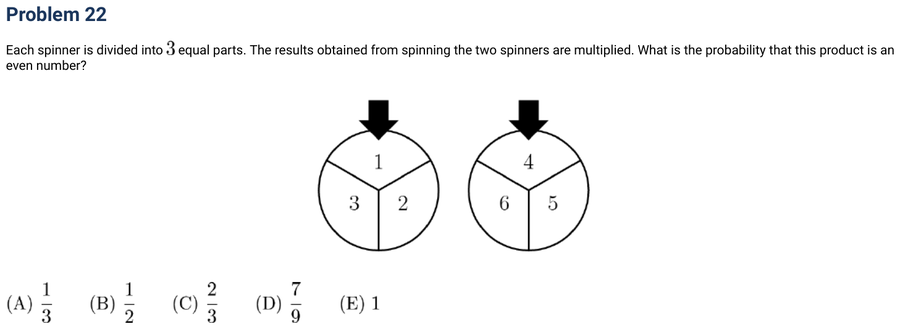
A product is even the moment EITHER number is even — one even factor is enough. The only way to FAIL (get an odd product) is for both spins to be odd. Counting that single bad case is easier than counting all the good ones.
Still stuck? Show hint 2 →
Hint 2 of 3
Use the complement: P(even) = 1 − P(both odd). Find each spinner's chance of landing odd, then multiply (the spins are independent).
Still stuck? Show hint 3 →
Hint 3 of 3
Spinner one has numbers 1, 2, 3 (two odd); spinner two has 4, 5, 6 (one odd). Multiply those odd-chances to get 'both odd,' then subtract from 1.
Show solution
Approach: complementary counting — 1 minus the chance of the only bad case
A product is even unless both factors are odd (any single even number drags the product even). So instead of listing every even outcome, find the one way it goes wrong — both odd — and subtract from 1.
Spinner 1 shows 1, 2, 3: odd in 2 of 3 cases, so P(odd) = 2/3. Spinner 2 shows 4, 5, 6: odd only on the 5, so P(odd) = 1/3.
The spins are independent, so P(both odd) = 2/3 × 1/3 = 2/9.
P(even product) = 1 − 2/9 = 7/9.
Why this transfers: when a result needs "at least one" of something (here, at least one even factor), it's usually far faster to compute the single opposite case ("none of them") and subtract from 1 — complementary counting.
Another way — count the 9 equally likely outcomes:
There are 3 × 3 = 9 equally likely (spin1, spin2) pairs. The product is odd only when both are odd: (1,5) and (3,5) — just 2 pairs.
So 9 − 2 = 7 pairs give an even product, and the probability is 7/9.
There are twenty-four 4-digit numbers that use each of the four digits 2, 4, 5, and 7 exactly once. Listed in numerical order from smallest to largest, the number in the 17th position in the list is
Show answer
Answer: B — 5724.
Show hints
Hint 1 of 2
Listing all 24 numbers in order is slow and error-prone. Instead think in *blocks*: once you fix the first digit, the other three digits can be arranged 6 ways (3×2×1). So the smallest 6 numbers all start with 2, the next 6 start with 4, and so on.
Still stuck? Show hint 2 →
Hint 2 of 2
Walk the blocks of 6 to land on the right leading digit, then list only inside that small block. This is counting-by-blocks (place-value with permutations).
Show solution
Approach: count in blocks of 6, then order only inside the right block
Fixing the first digit leaves 3 digits to arrange = 3×2×1 = 6 numbers per block, in increasing leading digit (2, 4, 5, 7). So: positions 1–6 start with 2, 7–12 start with 4, 13–18 start with 5, 19–24 start with 7.
The 17th falls in the '5' block (13–18), and it's the 17−12 = 5th number in that block.
List just the 5-block in order (remaining digits 2,4,7): 5247, 5274, 5427, 5472, 5724, 5742. The 5th is 5724.
*Why this transfers:* to find the k-th item in an ordered list of arrangements, never write them all — divide into blocks (here 6 per leading digit), jump to the right block, and only sort the few inside it.
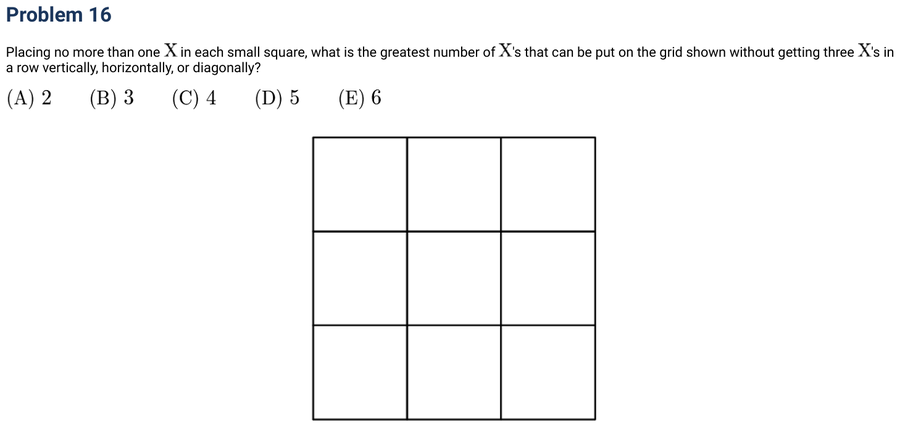
Flip the question around: instead of asking how many X's to *place*, ask how few squares you must leave *empty* so that no full line of three survives. Maximizing X's is the same as minimizing empties.
Still stuck? Show hint 2 →
Hint 2 of 2
List the 8 lines you must break (3 rows, 3 columns, 2 diagonals). Each empty square can break only the lines it sits on — and one square can lie on at most 4 of them. So how few empties could possibly cover all 8?
Show solution
Approach: minimize the empty squares needed to break every line
Most X's = fewest empties. Every one of the 8 lines (3 rows, 3 columns, 2 diagonals) needs at least one empty square to break it. The center square lies on 4 lines (its row, its column, both diagonals) — the maximum any square can hit. So 2 empties reach at most 4 + 3 = 7 lines, which can't cover all 8. Hence at least 3 squares must stay empty.
Three empties is actually achievable: leave the center and two opposite corners blank. The center breaks the middle row, middle column, and both diagonals; the two opposite corners break the four remaining edge lines. That breaks all 8 lines, so 9 − 3 = 6 X's can go down.
Why this transfers: 'maximize the things you keep' is often easiest as 'minimize the things you remove,' and a 'block every line' goal becomes a covering count — how many removals does it take to touch every constraint?
'Fewest posts' is a hint about which side to hide against the wall — the wall side needs no fence and no posts of its own, so put the *longest* side there to fence the least length.
Still stuck? Show hint 2 →
Hint 2 of 3
Now you have one straight path of fence (unrolled, it's just a line). The classic trap: a 132 m line with posts every 12 m has 132⁄12 = 11 gaps but 12 posts — one more post than gaps, because both ends get a post.
Still stuck? Show hint 3 →
Hint 3 of 3
Check the corners: at 36 m and 96 m the fence bends, but both are multiples of 12, so a post already lands there — no bonus posts needed.
To use the *fewest* posts, fence the *least* length, so press the longest side (60 m) against the wall — that side needs no fence. The remaining three sides total 36 + 60 + 36 = 132 m of fence.
Think of that 132 m as one straight run (the corners don't change its length). Posts sit every 12 m, so there are 132⁄12 = 11 gaps — but the number of posts is one more than the gaps because both endpoints get a post: 11 + 1 = 12.
Double-check the bends at 36 m and 96 m: both are multiples of 12, so posts already land exactly on the corners — nothing extra to add.
Why 'posts = gaps + 1': this is the fencepost principle — the off-by-one that bites people who just divide and forget the two endpoints. Cutting a line into n equal pieces always needs n + 1 marks.
How many whole numbers between 100 and 400 contain the digit 2?
Show answer
Answer: C — 138.
Show hints
Hint 1 of 2
Counting numbers that contain a 2 directly is messy — a 2 might be in the hundreds, tens, or units place, and numbers like 220 or 282 would get counted twice. When 'at least one' is hard, count the OPPOSITE.
Still stuck? Show hint 2 →
Hint 2 of 2
Count how many numbers have NO 2 at all, then subtract from the total. 'Total − (none) = (at least one)' sidesteps all the double-counting. The numbers run 100 to 399, so there are 300 of them.
Show solution
Approach: complement count
There are 300 whole numbers from 100 to 399. Instead of counting those that contain a 2, count those that contain NO 2 (much cleaner — no overlaps).
No-2 count: the hundreds digit can be 1 or 3 (2 ways, since 2 is banned and a 3-digit number can't start with 0), and each of the tens and units can be any digit except 2 (9 ways each): 2 × 9 × 9 = 162.
Contains a 2 = total − none = 300 − 162 = 138.
Why this transfers: whenever you want 'at least one' of something, counting the cases with NONE and subtracting is almost always easier — it turns an overlapping mess into one clean multiplication.
How many students earned a score of at least 80% and less than 90%?
Show answer
Answer: D — 37 students.
Show hints
Hint 1 of 2
These groups aren't separate piles — "at least 80%" already contains everyone who scored at least 90%. They're nested, like measuring cups inside each other.
Still stuck? Show hint 2 →
Hint 2 of 2
So to get just the 80–90% band, take the big group and subtract the part of it you don't want. Which two of the four counts do you need? (The 85% and 95% lines are decoys.)
Show solution
Approach: subtract the inner group from the outer (don't add the bands)
The four counts are nested, not separate: the 13 who scored ≥ 90% sit inside the 50 who scored ≥ 80%. So you subtract, you don't add.
Students in [80%, 90%) = (those ≥ 80%) − (those ≥ 90%) = 50 − 13 = 37. The 85% and 95% counts are just there to distract.
Why this transfers: with "at least" cutoffs, the count for a band is the difference of two cumulative counts — spot the nesting and subtract instead of trying to build each band from scratch.
On Monday Taye has $2. Every day, he either gains $3 or doubles the amount of money he had on the previous day. How many different dollar amounts could Taye have on Thursday, 3 days later?
Show answer
Answer: D — 6 different amounts.
Show hints
Hint 1 of 2
Each day has 2 choices over 3 days, so 2×2×2 = 8 paths — but the question asks for AMOUNTS, not paths. Why might those two counts differ?
Still stuck? Show hint 2 →
Hint 2 of 2
Technique: track the SET of reachable amounts day by day, not the branching paths. When two paths land on the same dollar amount, the set automatically merges them — so you can't over-count.
Show solution
Approach: track the set of reachable amounts, letting duplicates merge
The trap is counting 2×2×2 = 8 paths; the question wants distinct amounts, and some paths collide. So carry a SET forward each day instead of a list of paths. Start $2. Tuesday: 2+3 = 5 or 2×2 = 4 → {4, 5}.
Wednesday, apply both moves to each: 4+3 = 7, 4×2 = 8, 5+3 = 8, 5×2 = 10. The two 8's merge → {7, 8, 10}.
Thursday from {7, 8, 10}: 7→{10,14}, 8→{11,16}, 10→{13,20}, all distinct → {10, 11, 13, 14, 16, 20}.
6 distinct amounts. This transfers: whenever "how many outcomes" can repeat, count states (the set), not branches — the set throws away duplicates for you. It's the seed of breadth-first thinking.
How many integers between 2020 and 2400 have four distinct digits arranged in increasing order? (For example, 2347 is one integer.)
Show answer
Answer: C — 15 integers.
Show hints
Hint 1 of 2
“Increasing order” is a gift: once you pick which digits to use, there's only one way to arrange them. So you're choosing a set of digits, never ordering them.
Still stuck? Show hint 2 →
Hint 2 of 2
The first two digits are forced (2, then 3, to stay between 2020 and 2400 while increasing). So just count how many ways to pick the last two digits from {4, 5, 6, 7, 8, 9}.
Show solution
Approach: increasing ⇒ choosing a set, not arranging
Increasing means strictly ascending, so once the four digits are chosen, the order is automatic. The thousands digit is 2 (number is 2020–2400), and the next digit must beat 2 yet keep the number ≤ 2400, so it's 3.
That leaves the last two digits: any 2 distinct values from {4, 5, 6, 7, 8, 9}. Each pair makes exactly one valid number (smaller digit first), so just count the pairs: C(6, 2) = 15.
Why this transfers: whenever an arrangement is forced to be increasing (or decreasing), counting collapses from permutations to combinations — you pick the values and the order takes care of itself. That's the difference between C(6,2) = 15 and the larger 6×5 = 30 of ordered pairs.
Another way — list the pairs to see C(6,2):
Last two digits from {4,5,6,7,8,9}: pick the smaller, then a larger partner. 4 with {5,6,7,8,9}=5; 5 with {6,7,8,9}=4; 6→3; 7→2; 8→1.
5 + 4 + 3 + 2 + 1 = 15 — the triangular-number shape that always shows up when you count unordered pairs.
Zara has a collection of 4 marbles: an Aggie, a Bumblebee, a Steelie, and a Tiger. She wants to display them in a row on a shelf, but does not want to put the Steelie and the Tiger next to one another. In how many ways can she do this?
Show answer
Answer: C — 12 ways.
Show hints
Hint 1 of 2
“Not next to each other” is awkward to count head-on. Flip it: count everything, then subtract the arrangements where they are next to each other.
Still stuck? Show hint 2 →
Hint 2 of 2
To count the bad ones, glue Steelie and Tiger into a single block (they're forced together): 3 items arrange 3! = 6 ways, and the block flips 2 ways → 12 bad. Subtract from 4! = 24.
Show solution
Approach: complementary counting with the glue trick
All arrangements of 4 distinct marbles: 4! = 24.
Bad ones (Steelie–Tiger touching): glue them into one block, leaving 3 items → 3! = 6 orders; the block itself is ST or TS → ×2 = 12 bad.
Good = 24 − 12 = 12.
You'll see this again as: for a “must be adjacent” condition, glue them into one unit; for “must not be adjacent,” count the total and subtract the glued case. Two tools that pair up on almost every seating problem.
Another way — gap method (place the others first):
Place the Aggie and Bumblebee first: 2! = 2 orders. They create 3 gaps: _ A _ B _.
Drop Steelie and Tiger into two different gaps so they can't touch: choose 2 of the 3 gaps and order them, 3 × 2 = 6 ways.
2 × 6 = 12. The gap method builds only the good arrangements directly — no subtracting.
A box contains five cards, numbered 1, 2, 3, 4, and 5. Three cards are selected randomly without replacement from the box. What is the probability that 4 is the largest value selected?
Show answer
Answer: C — 3/10.
Show hints
Hint 1 of 2
"4 is the largest" is a quiet double condition: 4 must be in the draw, and 5 must be out. The other two cards are then forced to come from {1, 2, 3}.
Still stuck? Show hint 2 →
Hint 2 of 2
Translate 'largest is X' into 'include X, exclude everything bigger.' Then just count how to fill the remaining slots from what's left below X.
Show solution
Approach: include the max, fill the rest from below it
Decode the condition: for 4 to be the biggest card drawn, you must take the 4 and avoid the 5. So the other two cards are chosen from {1, 2, 3}. That reframing is the insight.
All draws: C(5, 3) = 10. Probability = 3/10 = 3/10.
Why this transfers: 'the max equals X' problems always split into 'X is in, everything above X is out' — the rest is a small count among the cards below X.
Another way — list the favorable subsets:
With only 5 cards, just write the 3-card sets whose max is 4: {1,2,4}, {1,3,4}, {2,3,4} — exactly 3 of them.
Out of C(5,3) = 10 equally likely draws, that's 3/10.
Each of two boxes contains three chips numbered 1, 2, 3. A chip is drawn randomly from each box and the numbers on the two chips are multiplied. What is the probability that their product is even?
Show answer
Answer: E — 5/9.
Show hints
Hint 1 of 2
'Even product' happens in lots of ways (either chip even is enough), but 'odd product' happens in just one tidy way: both chips must be odd. Chase the easy case.
Still stuck? Show hint 2 →
Hint 2 of 2
Compute the easy event and subtract from 1: this is complementary counting. Each box has 2 odd values out of 3, and the boxes are independent, so multiply.
Show solution
Approach: complementary counting — find P(odd) and subtract
A product is odd only when both factors are odd, while it's even in many scenarios — so the odd case is the simpler one to count.
Each box has odds {1, 3} out of {1, 2, 3}, a 2/3 chance, and the draws are independent: P(both odd) = (2/3)(2/3) = 4/9.
P(even product) = 1 − 4/9 = 5/9.
Why this transfers: 'at least one __' or 'is even/divisible' events are usually faster through the complement — count the one clean way it fails, then subtract from 1.
Another way — direct count over all 9 outcomes:
The two draws give 3 × 3 = 9 equally likely pairs.
List products: row by row they are 1,2,3 / 2,4,6 / 3,6,9. The even ones are 2,2,4,6,6 — that's 5 outcomes.
How many integers between 1000 and 9999 have four distinct digits?
Show answer
Answer: B — 4536 integers.
Show hints
Hint 1 of 2
Build the 4-digit number one place at a time, left to right. 'Distinct' means every place must dodge the digits already used — so the menu of choices shrinks by one each step.
Still stuck? Show hint 2 →
Hint 2 of 2
Handle the trickiest restriction first: the leading digit can't be 0 (else it isn't a 4-digit number). Then multiply the choices for the four places.
Show solution
Approach: fill the places left to right; multiply the shrinking choice counts
Thousands place: 9 choices (1–9; 0 is banned as a leading digit).
Hundreds place: now 0 is allowed again, but the thousands digit is used up — that's 10 − 1 = 9 choices (the count stays 9, just for a different reason).
Tens: 8 left. Ones: 7 left.
Total = 9 × 9 × 8 × 7 = 4536.
Why this transfers: tackle the most-restricted slot first, then count the rest as 'whatever's left.' Watch the subtle coincidence here — the hundreds place is 9 because a banned-zero rule and a used-up-digit rule happen to remove one option each.
In the small country of Mathland, all automobile license plates have four symbols. The first must be a vowel (A, E, I, O, or U), the second and third must be two different letters among the 21 non-vowels, and the fourth must be a digit (0 through 9). If the symbols are chosen at random subject to these conditions, what is the probability that the plate will read "AMC8"?
Show answer
Answer: B — 1/21,000.
Show hints
Hint 1 of 2
'AMC8' is one single plate. If every allowed plate is equally likely, you don't need to do anything with AMC8 itself — just count how many plates exist in all, and the probability is 1 over that.
Still stuck? Show hint 2 →
Hint 2 of 2
Multiply the choices slot by slot, but watch slot 3: it must differ from slot 2, so it has 21 − 1 = 20 options, not 21. (One slot's count depending on an earlier slot is common in plate/seating counts.)
Show solution
Approach: count all equally likely plates; the target is just one of them
Count total plates by the rule of product, going slot by slot: 5 vowels, 21 non-vowels, then 20 (the second letter must differ from the third), then 10 digits.
'AMC8' is exactly one of those, so its probability is 1/21,000.
Why this transfers: the chance of one specific equally-likely outcome is simply 1 ÷ (number of outcomes) — the work is all in the careful count, especially the dependent slot.
How many subsets of two elements can be removed from the set {1, 2, 3, 4, 5, 6, 7, 8, 9, 10, 11} so that the mean (average) of the remaining numbers is 6?
Show answer
Answer: D — 5 pairs.
Show hints
Hint 1 of 2
'Mean of the leftovers is 6' sounds vague, but a mean is just a total in disguise: with a known count, fixing the mean fixes the sum. So this secretly tells you the exact total the removed pair must carry away.
Still stuck? Show hint 2 →
Hint 2 of 2
Compute the starting total and the required ending total; their difference is the sum the two removed numbers must hit. Then it's pure pair-counting.
Show solution
Approach: convert the mean into a fixed sum (sum = mean × count)
Whole-set sum: 1 + 2 + … + 11 = 66. Removing 2 leaves 9 numbers, and mean 6 forces their sum to be 9 × 6 = 54.
So the two removed numbers must sum to 66 − 54 = 12 — that single number is the whole puzzle now.
Count pairs from {1, …, 11} adding to 12: {1,11}, {2,10}, {3,9}, {4,8}, {5,7} — pairing inward from the ends until they'd cross at 6. That's 5 pairs.
Why this transfers: whenever a problem fixes an average, immediately rewrite it as a sum — sums add and subtract cleanly, averages don't.
At Euler Middle School, 198 students voted on two issues in a school referendum with the following results: 149 voted in favor of the first issue and 119 voted in favor of the second issue. If there were exactly 29 students who voted against both issues, how many students voted in favor of both issues?
Show answer
Answer: D — 99 students.
Show hints
Hint 1 of 2
The '29 against both' is the door in: everyone else — 198 − 29 — said yes to at least one issue. That single number is what unlocks the rest.
Still stuck? Show hint 2 →
Hint 2 of 2
When you add the two 'yes' counts (149 + 119), the people who said yes to both got counted twice. Inclusion-exclusion fixes the overlap: |A ∪ B| = |A| + |B| − |A ∩ B|.
Show solution
Approach: inclusion-exclusion, after finding the 'at least one' group
Against both = 29, so everyone else voted yes to at least one issue: 198 − 29 = 169 = |A ∪ B|.
Adding 149 + 119 counts the 'both' voters twice, so 149 + 119 − |both| = 169.
|both| = 149 + 119 − 169 = 99.
Why this transfers: the moment you add two overlapping groups, you've double-counted their intersection — subtract it once. A quick Venn sketch (two circles in a box of 198) makes the bookkeeping foolproof.
Jack wants to bike from his house to Jill's house, which is located three blocks east and two blocks north of Jack's house. After biking each block, Jack can continue either east or north, but he needs to avoid a dangerous intersection one block east and one block north of his house. In how many ways can he reach Jill's house by biking a total of five blocks?
Show answer
Answer: A — 4 ways.
Show hints
Hint 1 of 2
Forbidding a point is hard to count head-on, so flip it: count all paths, then throw away the bad ones. (Count what you don't want — complementary counting.)
Still stuck? Show hint 2 →
Hint 2 of 2
A path through (1,1) splits into two independent legs: ways to reach (1,1) times ways to continue from (1,1) to the goal. Multiply them.
Show solution
Approach: total − paths through (1,1)
Total E/N paths to (3,2): choose which 2 of the 5 steps are North, C(5, 2) = 10.
Paths that hit the bad corner (1,1): (ways to reach (1,1)) × (ways from (1,1) to (3,2)) = C(2,1) × C(3,1) = 2 × 3 = 6. Multiplying works because the two legs are independent.
Allowed = total − bad = 10 − 6 = 4.
Why this transfers: "must avoid X" almost always means "all paths minus paths through X," and any path through a checkpoint factors into (reach it) × (leave it).
Another way — case split on first two moves:
To avoid (1,1) Jack's first two moves must be either EE or NN.
After EE he is at (2, 0) and needs 1 E + 2 N in some order: C(3,1) = 3 paths. After NN he is at (0, 2) and needs 3 E + 0 N: 1 path.
The "Middle School Eight" basketball conference has 8 teams. Every season, each team plays every other conference team twice (home and away), and each team also plays 4 games against non-conference opponents. What is the total number of games in a season involving the "Middle School Eight" teams?
Show answer
Answer: B — 88 games.
Show hints
Hint 1 of 2
The trap is double-counting: a conference game is shared by two MSE teams, but a non-conference game touches only one. Count the two kinds with different rules.
Still stuck? Show hint 2 →
Hint 2 of 2
Conference games are pairs of teams (each pair twice); non-conference games belong to a single team, so just add 8 × 4 with no halving.
Show solution
Approach: count conference pairs × 2, plus non-conference (no double-count)
Conference: number of team-pairs is C(8, 2) = 28, and each pair plays twice (home and away) ⇒ 28 × 2 = 56 games.
Non-conference: each of the 8 teams plays 4, and the opponent is outside MSE, so every such game is counted once — 8 × 4 = 32 games.
Total: 56 + 32 = 88.
Why this transfers: when both participants are inside your group, you divide by 2 (or use C(n,2)) to avoid double-counting; when only one participant is inside, you don't. Always ask "is this game shared?"
Another way — count by home games (each conference game has exactly one host):
Every conference game is hosted by exactly one team, and each team hosts the other 7 once: 8 × 7 = 56 conference games — no double-counting since "host" is unique.
Four children were born at City Hospital yesterday. Assume each child is equally likely to be a boy or a girl. Which of the following outcomes is most likely?
Show answer
Answer: D — 3 of one gender and 1 of the other is most likely.
Show hints
Hint 1 of 2
Outcomes feel unequal because they're not single sequences — the fair coins are the 16 ordered strings BBBB…GGGG. Count how many strings each description sweeps up.
Still stuck? Show hint 2 →
Hint 2 of 2
Watch the hidden lump: "3 of one gender and 1 of the other" secretly covers BOTH 3 boys-1 girl AND 3 girls-1 boy, so it gathers twice as many strings as you'd guess.
Show solution
Approach: count favorable sequences out of 16
All 16 birth orders are equally likely; count how many each option covers. All 4 boys: 1 string. All 4 girls: 1 string.
2-and-2: choose which 2 of the 4 are girls, C(4, 2) = 6 strings.
Largest count is 3 of one gender, 1 of the other with 8 strings (and 1 + 1 + 6 + 8 = 16 — check, all cases accounted for).
Why this transfers: "most likely" means "covers the most equally-likely outcomes," and an option phrased as "k of one, the rest of the other" quietly bundles two binomial counts. The counts 1, 4, 6, 4, 1 are row 4 of Pascal's triangle.
Toothpicks are used to make a grid that is 60 toothpicks long and 32 toothpicks wide. How many toothpicks are used altogether?
Show answer
Answer: E — 3932 toothpicks.
Show hints
Hint 1 of 2
Each toothpick lies either horizontally or vertically, so sort them into those two piles and count each pile separately — never try to count the whole grid at once.
Still stuck? Show hint 2 →
Hint 2 of 2
The classic fence-post catch: a row of cells 60 long needs 61 vertical lines (one extra at the far end), and the lines stack 33 high (one more than 32). Always "cells + 1" for the dividing lines.
Show solution
Approach: split into horizontal and vertical toothpicks
Horizontal toothpicks form rows of length 60. The grid is 32 cells tall, so there are 32 + 1 = 33 such rows: 33 × 60 = 1980.
Vertical toothpicks form columns of length 32. The grid is 60 cells wide, so there are 60 + 1 = 61 such columns: 61 × 32 = 1952.
Add the two piles: 1980 + 1952 = 3932.
Watch the trap: using 60 and 32 (instead of 61 and 33) drops the boundary lines and gives 1920 or 1952 — both are decoy choices. The "+1 fence-post" is the whole problem.
How many 4-digit numbers greater than 1000 are there that use the four digits of 2012?
Show answer
Answer: D — 9.
Show hints
Hint 1 of 2
Two of the four digits are identical (two 2's), and the 0 can't lead. The cleanest plan: handle the picky positions first — decide where the 0 goes, then where the 1 goes, and the two 2's fill the rest with no further choice.
Still stuck? Show hint 2 →
Hint 2 of 2
This is place the constrained items first. Because the two 2's are interchangeable, once 0 and 1 are placed there's exactly one way to finish — so just multiply the number of choices.
Show solution
Approach: place the 0 (restricted) and the 1, the 2's fall in automatically
The digits are {0, 1, 2, 2}. The 0 is the troublemaker — it can't be the leading digit, so it has only 3 legal spots (not 4).
After the 0 is down, the 1 takes any of the 3 remaining spots.
The last two spots must both be 2's — identical, so there's nothing left to decide. Total = 3 × 3 = 9 numbers.
The reusable idea: when something is restricted (a digit that can't lead, a person who must sit at the end), place it first — you count the easy cases and never over- or under-count.
Another way — all arrangements, then remove the bad ones:
Arrange 4 digits where two are identical: 4! / 2! = 12 total orderings.
Toss out the ones that start with 0: fix 0 in front and arrange {1, 2, 2}, giving 3! / 2! = 3 bad cases.
Good numbers = 12 − 3 = 9. (The 2! divides out the swap of the two identical 2's.)
In the BIG N, a middle school football conference, each team plays every other team exactly once. If a total of 21 conference games were played during the 2012 season, how many teams were members of the BIG N conference?
Show answer
Answer: B — 7 teams.
Show hints
Hint 1 of 2
Each team plays every other one, so a team plays N − 1 games. Multiply by the N teams — but careful, that counts each game from both sides, so you've double-counted.
Still stuck? Show hint 2 →
Hint 2 of 2
This is the handshake count: games (or handshakes) = N(N − 1)/2. The ÷2 fixes the double-count. Set it equal to 21 and find N.
Show solution
Approach: handshake count, then solve for N
Each of the N teams faces the other N − 1 teams. Counting N × (N − 1) tallies every game twice (once for each team in it), so the real total is N(N − 1)/2.
Set that to 21: N(N − 1)/2 = 21, so N(N − 1) = 42.
Find two consecutive numbers multiplying to 42 — that's 7 × 6, so N = 7. (Faster than a formula: just scan products of neighbors.)
Same pattern everywhere: handshakes in a room, diagonals plus sides of a polygon, pairs from a group — all are N(N − 1)/2 because every pair is counted from both ends.
A fair 6-sided die is rolled twice. What is the probability that the first number that comes up is greater than or equal to the second number?
Show answer
Answer: D — 7/12.
Show hints
Hint 1 of 2
≥ means ‘greater OR equal,’ so handle the tie separately. The 6 tie outcomes are easy; then use symmetry for the rest.
Still stuck? Show hint 2 →
Hint 2 of 2
‘First > second’ and ‘first < second’ are mirror images — relabel the two dice and one becomes the other — so they have equal probability and split the non-tie outcomes evenly.
Show solution
Approach: use the symmetry between ‘greater’ and ‘less,’ handle ties separately
Ties: 36 equally likely (first, second) pairs, and 6 of them are doubles, so P(equal) = 6/36 = 1/6.
The remaining 30 non-tie outcomes split evenly between ‘first > second’ and ‘first < second’ (swapping the dice turns one into the other), so each is 15/36 = 5/12.
We want ≥, which is ‘greater’ plus ‘equal’: 5/12 + 1/6 = 5/12 + 2/12 = 7/12.
Worth keeping: when two events are mirror images, they share a probability — so you only compute the ‘extra’ (the ties) and split the rest.
Another way — count favorable cells in the 6×6 grid:
For first = 1 there's 1 winning second (just 1); for first = 2 there are 2; … up to first = 6 giving 6.
Total favorable = 1+2+3+4+5+6 = 21, out of 36, so 21/36 = 7/12.
Eyeballing always under- or over-counts. Give every little region its own letter, then count by building rectangles out of those pieces — that way each one is found exactly once.
Still stuck? Show hint 2 →
Hint 2 of 2
Sweep by size: first the single-piece rectangles, then two-piece ones, then larger blocks. A group of pieces counts only if its outline is a true rectangle (four right-angle corners, no notches).
Show solution
Approach: label the pieces, then sweep size-by-size so nothing is missed or double-counted
Cut the figure into its smallest regions and letter them. Now every rectangle in the picture is some block of these pieces, and you can list them in order of how many pieces they use.
Single pieces that are themselves rectangles, then pairs that combine into a rectangle, then larger blocks — checking each candidate has a clean rectangular outline (no jagged edge).
This organized sweep turns up exactly 11 rectangles in all.
Worth keeping: ‘how many rectangles’ problems are won by a fixed order of counting (by size, by position), never by hunting at random — an order is what guarantees you hit each one once.
The two spinners shown are spun once and each lands on one of the numbered sectors. What is the probability that the sum of the numbers in the two sectors is prime?
Show answer
Answer: D — 7/9.
Show hints
Hint 1 of 2
First spinner is all ODD (1, 3, 5); second is all EVEN (2, 4, 6). Odd + even is always odd — so every one of the 9 sums is odd, and you never have to worry about "even, so not prime."
Still stuck? Show hint 2 →
Hint 2 of 2
Among odd sums the only non-primes are 9, 15, 21, … (odd multiples of 3). The sums here run 3 to 11, so the only danger is a 9. Count BAD outcomes — it's quicker than counting good ones.
Show solution
Approach: use parity, then count the few non-primes (complement)
There are 3 × 3 = 9 equally likely outcomes. Since odd + even = odd, every sum is odd, so the only way to miss "prime" is to land on an odd non-prime in range (3–11) — that's just 9.
Which pairs sum to 9? Only 3+6 and 5+4 — 2 outcomes.
So 2 fail and 7 succeed: probability = 7/9 = 7/9.
Why this transfers: spotting that all sums share a parity slashes the work, and counting the FEW bad cases (complement) beats listing all the good ones.
Another way — list all nine sums:
Sums: 3, 5, 7, 5, 7, 9, 7, 9, 11. The two 9s are the only composites.
How many 3-digit positive integers have digits whose product equals 24?
Show answer
Answer: D — 21.
Show hints
Hint 1 of 2
Split the job in two: FIRST find which sets of three digits multiply to 24 (order ignored), THEN count how many numbers each set makes by reordering. Don't try to do both at once.
Still stuck? Show hint 2 →
Hint 2 of 2
Each digit must be 1–9 (no 0, or the product is 0). To list the sets cleanly, factor 24 = 2³ × 3 and hand the factors out three ways. Watch for repeats — a set with a doubled digit has fewer arrangements.
Show solution
Approach: list digit-sets, then count orderings (correct for repeats)
Digit-sets (each 1–9) with product 24: {1,3,8}, {1,4,6}, {2,3,4}, {2,2,6}. That's it — any other split needs a digit above 9.
Count orderings of each. Three different digits give 3! = 6 numbers each: that's 6 + 6 + 6 = 18 from the first three sets.
{2,2,6} has a repeated 2, so swapping the two 2's gives nothing new: only 3!/2! = 3 numbers.
Total: 18 + 3 = 21.
Why this transfers: "count the numbers with property X" usually splits into "find the unordered ingredient sets, then count arrangements." And always divide out duplicate items — forgetting the repeat is the #1 overcount error.
The diagram represents a 7-foot-by-7-foot floor that is tiled with 1-square-foot light tiles and dark tiles. Notice that the corners have dark tiles. If a 15-foot-by-15-foot floor is to be tiled in the same manner, how many dark tiles will be needed?
Show answer
Answer: C — 64 dark tiles.
Show hints
Hint 1 of 2
With corners dark, the dark tiles land exactly on the ODD rows and ODD columns — they form their own little grid sitting inside the big one. So the count is (odd rows) × (odd columns), not anything you have to draw out.
Still stuck? Show hint 2 →
Hint 2 of 2
Don't count dark tiles on the figure one by one and guess — find the RULE on the small 7×7, then apply the same rule to 15×15.
Show solution
Approach: dark tiles form an odd×odd subgrid — count and rescale
Dark tiles occupy odd row + odd column positions. In a 7-wide floor the odd numbers are 1, 3, 5, 7 — that's 4 of them, so 4 × 4 = 16 dark tiles (matches the diagram).
In a 15-wide floor the odd numbers are 1, 3, 5, 7, 9, 11, 13, 15 — 8 of them each way.
Dark tiles = 8 × 8 = 64.
Why this transfers: a repeating tile pattern is really a smaller grid — nail down its spacing on the example, then scale by counting how many lattice points fit. (Quick rule: an n-wide row, n odd, has (n+1)/2 odd positions.)
How many whole numbers between 1 and 1000 do not contain the digit 1?
Show answer
Answer: D — 728.
Show hints
Hint 1 of 2
Counting by independent digit-choices is the move: each digit slot can be filled freely, and 'no digit 1' just means each slot avoids one value. Multiply the choices per slot.
Still stuck? Show hint 2 →
Hint 2 of 2
Be careful at the boundaries: the FIRST digit of a number can't be 0 (or it's shorter), and remember 1000 itself contains a 1. Splitting by number of digits keeps the leading-zero rule straight.
Show solution
Approach: multiply allowed choices per digit, split by length
Forbidden digit is 1. A non-leading slot may be any of {0,2,3,4,5,6,7,8,9} = 9 choices; a leading slot also bans 0, leaving {2,…,9} = 8 choices.
1-digit: 8. 2-digit: 8 × 9 = 72. 3-digit: 8 × 9 × 9 = 648. (1000 has a 1, so it's out.)
Total: 8 + 72 + 648 = 728.
Why this transfers: 'how many numbers avoid digit d' is a per-slot multiplication — just mind the leading-zero rule and the top endpoint.
Another way — pad to 3 digits and subtract:
Write every number 1–999 as a 3-digit string 001…999, allowing leading zeros. With no '1' anywhere, each of the 3 slots has 9 allowed digits: 9³ = 729 strings (this counts 000).
Drop 000 (it's not in our range) and note 1000 has a 1: 729 − 1 = 728. Padding turns three cases into one clean power.
Three A's, three B's, and three C's are placed in the nine spaces so that each row and column contain one of each letter. If A is placed in the upper left corner, how many arrangements are possible?
Show answer
Answer: C — 4 arrangements.
Show hints
Hint 1 of 2
"One of each per row and column" means once you commit a couple of cells, the rest are forced — so just count the genuinely free choices.
Still stuck? Show hint 2 →
Hint 2 of 2
Use the multiplication principle: multiply the number of choices at each free decision point.
Show solution
Approach: count only the free choices, let the rest cascade
A sits top-left. The rest of row 1 is B, C in some order — 2 ways. Now look at the cell below A (start of row 2): it can't be A, so it's B or C — 2 ways.
After those two picks, every remaining cell is forced (each row and column still needs its missing letter). So the count is just 2 × 2 = 4.
Why this transfers: in tight grid/arrangement puzzles, find the few cells you freely choose and multiply — the constraints fill in the rest for free, so you never enumerate all the boards.
Another way — list them:
Fixing row 1 as A B C, the two valid completions are (B C A / C A B) and (C A B / B C A). Fixing row 1 as A C B gives two more.
Eight points are spaced around at intervals of one unit around a 2 × 2 square, as shown. Two of the 8 points are chosen at random. What is the probability that the two points are one unit apart?
Show answer
Answer: B — 2/7.
Show hints
Hint 1 of 2
The 8 points sit evenly around the square's edge, so every point looks the same — whichever you pick first, it has the same number of 1-unit neighbors.
Still stuck? Show hint 2 →
Hint 2 of 2
Once you fix the first point, the question collapses to: of the other 7 points, how many are exactly 1 unit away?
Show solution
Approach: use symmetry — fix the first point, count favorable seconds
By symmetry every point is interchangeable, so just pick any first point. Walking around the perimeter, exactly its two immediate neighbors are 1 unit away.
That leaves 2 good choices out of the remaining 7 points, so the probability is 2/7.
Why this transfers: when all starting choices are symmetric, condition on one of them — the messy "choose 2" count becomes a simple "favorable out of the rest."
Another way — count pairs directly:
Total pairs of points: C(8,2) = 28. Adjacent (1-unit) pairs: the 8 points form a loop, so there are 8 neighboring pairs.
Sets A and B, shown in the Venn diagram, have the same number of elements. Their union has 2007 elements and their intersection has 1001 elements. Find the number of elements in A.
Show answer
Answer: C — 1504.
Show hints
Hint 1 of 2
If you add the two circles, the overlap gets counted twice — so |A| + |B| overshoots the union by exactly the intersection. That's the whole equation.
Still stuck? Show hint 2 →
Hint 2 of 2
Inclusion-exclusion: |A ∪ B| = |A| + |B| − |A ∩ B|, because the shared part is double-counted once.
Show solution
Approach: inclusion-exclusion with equal sets
Since |A| = |B|, write both as x. The two circles together cover the union plus one extra copy of the overlap: x + x − 1001 = 2007.
So 2x = 2007 + 1001 = 3008, giving x = 1504.
Sanity check: each set must be at least as big as the intersection (1001) and at most the union (2007); 1504 sits comfortably between, as it should.
Another way — count the three regions of the diagram:
The middle (both) holds 1001. The union has 2007, so the two outer-only slivers together hold 2007 − 1001 = 1006.
Equal sets means the slivers split evenly: 503 each. Then |A| = its sliver + the middle = 503 + 1001 = 1504.
Two cards are dealt from a deck of four red cards labeled A, B, C, D and four green cards labeled A, B, C, D. A winning pair is two of the same color or two of the same letter. What is the probability of drawing a winning pair?
Show answer
Answer: D — 4/7.
Show hints
Hint 1 of 2
Don't worry about which card comes first — whatever it is, the picture from the second card's point of view is identical. So freeze the first card and just ask: which of the 7 leftover cards pairs with it?
Still stuck? Show hint 2 →
Hint 2 of 2
Fix one outcome to kill the symmetry: by symmetry the first card's identity doesn't matter, so condition on it and count favorable second cards out of the rest.
Show solution
Approach: fix the first card, count winning seconds
Hold the first card fixed; 7 cards remain. Count which of them make a winning pair with it.
Same color (different letters): the 3 other cards of that color — all winners.
Same letter (different color): exactly 1 card — also a winner.
So 3 + 1 = 4 of the 7 remaining cards win: probability 4/7.
Why no double-count: a same-color card has a different letter and vice versa, so the two winning sets never overlap — you can just add them.
Another way — count via the losing pairs instead:
A pair loses only when it's different color AND different letter. Fix the first card: of the 7 left, 3 share its color and 1 shares its letter, so 7 − 4 = 3 are total mismatches (losers).
A bag contains four pieces of paper, each labeled with one of the digits 1, 2, 3, or 4, with no repeats. Three of these pieces are drawn, one at a time without replacement, to construct a three-digit number. What is the probability that the three-digit number is a multiple of 3?
Show answer
Answer: C — 1/2.
Show hints
Hint 1 of 2
Divisibility by 3 cares about the digit-sum, and a sum doesn't notice the order — so forget the three-digit arrangements entirely and just ask which trio of digits got drawn.
Still stuck? Show hint 2 →
Hint 2 of 2
Divisible by 3 ⇔ digit-sum divisible by 3. Since order can't change a sum, this is really a 'which 3 did I pick' question, not a 'which number' question.
Show solution
Approach: drawing 3 of 4 = leaving 1 out
Order is irrelevant for divisibility by 3, so picking 3 of the 4 digits is the same as choosing which single digit to leave behind.
All four digits sum to 1+2+3+4 = 10. Leaving out d makes the drawn sum 10 − d, which is a multiple of 3 exactly when d = 1 (sum 9) or d = 4 (sum 6).
So 2 of the 4 equally likely 'leftover' digits work: probability = 2/4 = 1/2.
Slick reframing: 'choose 3 from 4' is always 'discard 1 from 4' — turning a messy selection into one easy choice is a counting habit worth keeping.
Another way — list the four subsets directly:
The size-3 subsets of {1,2,3,4} are {1,2,3}, {1,2,4}, {1,3,4}, {2,3,4} with sums 6, 7, 8, 9.
Multiples of 3: sums 6 and 9 — 2 of the 4 subsets. Probability 2/4 = 1/2.
Jeff rotates spinners P, Q and R and adds the resulting numbers. What is the probability that his sum is an odd number?
Show answer
Answer: B — 1/3.
Show hints
Hint 1 of 2
Odd-or-even doesn't depend on the actual values, only on each number's parity. So glance at each spinner: are its numbers all even, all odd, or mixed?
Still stuck? Show hint 2 →
Hint 2 of 2
Adding an even number never changes parity; adding an odd number flips it. Track only the flips — a spinner that's entirely even or entirely odd has a fixed, predictable effect, so the whole answer collapses onto the one mixed spinner.
Show solution
Approach: track parity, not values — collapse to the one mixed spinner
Read the spinners' parities: Q is all even (2, 4, 6, 8), R is all odd (1, 3, 5, 7, 9, 11), and only P is mixed (1, 2, 3).
Q always adds an even (no effect on parity); R always adds an odd (one guaranteed flip). So before P, the running sum is odd for sure.
Then P decides everything: the total stays odd only if P is even. P is even just on the "2" slice — 1 of its 3 equal regions.
Probability = 1/3.
The transferable move: in any sum-parity question, the certain (all-even or all-odd) parts give a fixed baseline; the probability lives entirely in the parts that can be either. Find the one undecided piece and ignore the rest.
The Little Twelve Basketball League has two divisions, with six teams in each division. Each team plays each of the other teams in its own division twice and every team in the other division once. How many games are scheduled?
Show answer
Answer: B — 96.
Show hints
Hint 1 of 2
Two kinds of games behave differently — same-division (played twice) and cross-division (played once). Count each kind on its own, then add.
Still stuck? Show hint 2 →
Hint 2 of 2
Count matchups, not games-per-team, to dodge double counting: a same-division pair is C(6,2), and each plays 2 games.
Show solution
Approach: split into same-division and cross-division matchups
Same-division: each division has C(6,2) = 15 pairs, each pair plays twice ⇒ 15·2 = 30 games per division. Two divisions: 60.
Cross-division: every team in one division plays every team in the other once — 6·6 = 36 games (no pair is counted twice here, since the two teams are in different divisions).
Total: 60 + 36 = 96.
The key safeguard: a 'game' is one unordered pair, so count pairs once, not each team's schedule — that's how you avoid the doubling trap (192, choice E, is exactly that error).
Another way — one team's games, then halve:
Pick any team: it plays its 5 division-mates twice (10 games) and all 6 cross-division teams once (6 games) — 16 games.
All 12 teams: 12·16 = 192, but every game was counted by both its teams, so divide by 2: 192 ÷ 2 = 96.
How many different isosceles triangles have integer side lengths and perimeter 23?
Show answer
Answer: C — 6 triangles.
Show hints
Hint 1 of 2
An isosceles triangle is pinned down by just one number — the leg length y — because the base is then forced to be 23 − 2y. So you're really counting valid leg lengths, not triples.
Still stuck? Show hint 2 →
Hint 2 of 2
Two fences bound y: the base must be positive (so y isn't too big) and the triangle inequality 2·leg > base must hold (so y isn't too small). Count the integers between.
Show solution
Approach: one variable (the leg), bounded both ways
Let the two legs be y and the base x, so 2y + x = 23. The base is whatever's left: x = 23 − 2y — one number controls everything.
Lower fence (triangle inequality): the two legs must beat the base, 2y > x = 23 − 2y, giving y > 5.75, so y ≥ 6.
Upper fence (base positive): x = 23 − 2y ≥ 1 gives y ≤ 11.
So y = 6, 7, 8, 9, 10, 11 — 6 triangles.
Why this transfers: reduce a 'count the shapes' problem to one free variable, then squeeze it between two inequalities and count integers. Here, conveniently, the odd perimeter 23 makes the base 23 − 2y always odd, so it can never tie a leg — no equilateral or degenerate cases to worry about.
How many distinct triangles can be drawn using three of the dots below as vertices?
Show answer
Answer: C — 18.
Show hints
Hint 1 of 2
Count generously first: every choice of 3 dots gives a triangle — unless the 3 happen to lie on one straight line. So count all triples, then throw out the flat ones.
Still stuck? Show hint 2 →
Hint 2 of 2
The only way 3 of these 6 dots line up is if all three sit in the same row. How many all-in-one-row triples are there?
Show solution
Approach: count all triples, subtract the collinear ones
Choosing 3 dots from 6 in any way: C(6,3) = 20 triples.
Three dots fail to make a triangle only when they're collinear. Here the dots form two rows of 3, so the lone collinear triples are the full top row and the full bottom row — just 2 of them.
Triangles: 20 − 2 = 18.
Why this 'count all, subtract bad' works: it's far easier to count every selection and remove the few degenerate ones than to count valid triangles directly. The trap answer 20 (choice D) is forgetting that collinear triples aren't triangles.
Thirteen black and six white hexagonal tiles were used to create the figure below. If a new figure is created by attaching a border of white tiles with the same size and shape as the others, what will be the difference between the total number of white tiles and the total number of black tiles in the new figure?
Show answer
Answer: C — 11.
Show hints
Hint 1 of 2
Don't recount the picture — look for the ring pattern. A center hex is surrounded by a ring of 6, then a ring of 12, and so on. Spot the rule for how big the next ring is, and you've solved it.
Still stuck? Show hint 2 →
Hint 2 of 2
The pattern is ring n holds 6n hexagons (6, 12, 18, …). The new border is the next ring out, so you only need its size — the inner tiles don't change.
Show solution
Approach: hexagonal ring counts
The figure is rings around a center hex: ring 1 has 6, ring 2 has 12 — the rule is 6n. The new white border is ring 3, so it adds 6 × 3 = 18 tiles.
Black stays put at 13. White becomes the old 6 plus the new 18 = 24.
Difference: 24 − 13 = 11.
Sanity check via the change: nothing black was added, and 18 new white tiles arrived, so the white-minus-black gap should jump by 18 from its old value. Old gap was 6 − 13 = −7; +18 gives −7 + 18 = 11. The two routes agree.
This 6n ring idea reappears in hex-grid and honeycomb problems — concentric rings grow by a fixed step.
Three friends have a total of 6 identical pencils, and each one has at least one pencil. In how many ways can this happen?
Show answer
Answer: D — 10 ways.
Show hints
Hint 1 of 2
Picture the 6 pencils in a row. To split them among 3 friends, you just need to drop 2 'dividers' into the gaps between pencils — the dividers cut the row into three piles. Counting splits becomes counting where the dividers go.
Still stuck? Show hint 2 →
Hint 2 of 2
This is stars and bars. With the 'each person ≥ 1' rule, there are 5 gaps between the 6 pencils, and you choose 2 of them for dividers: C(5, 2). (No gap gets two dividers, so nobody is left empty.)
Show solution
Approach: stars and bars (dividers in the gaps)
Line up the 6 pencils. The 'at least one each' rule means each divider must land in a different gap between pencils — there are 5 such gaps, and we place 2 dividers.
Choose 2 of the 5 gaps: C(5, 2) = 10. So there are 10 ways.
The general tool: distributing n identical items into k groups with at least one each is C(n − 1, k − 1) — here C(6 − 1, 3 − 1) = C(5, 2) = 10.
Another way — give one away first, then distribute freely:
Hand each friend 1 pencil up front (satisfying the rule); 3 pencils remain to share with no restriction.
When a fair six-sided die is tossed on a table top, the bottom face cannot be seen. What is the probability that the product of the numbers on the five faces that can be seen is divisible by 6?
Show answer
Answer: E — 1 (it always happens).
Show hints
Hint 1 of 2
Don't multiply anything — 6 = 2 × 3, so you only need a 2 and a 3 to BOTH be among the faces you can see.
Still stuck? Show hint 2 →
Hint 2 of 2
Only one face hides at a time. Ask the worst case: even if the hidden face is the 6, is a 2 and a 3 still showing?
Show solution
Approach: prove the event is certain (probability 1)
A product is divisible by 6 the moment it contains a factor of 2 and a factor of 3 (since 6 = 2 × 3). So we just need both a 2 and a 3 visible — no multiplying required.
Test the worst case: only one face hides. If the hidden face is the 6, the 2 and 3 are still both up, so the product has 2 × 3. If the hidden face is anything else, then the 6 itself is showing, which already supplies the factor of 6.
There is no roll that fails, so the event always happens — probability 1.
You'll see this again: when every outcome works, the probability is exactly 1 (a certain event). Checking the single worst case is enough to prove "always."
A board game spinner is divided into three regions labeled A, B, and C. The probability the arrow stops on region A is 13 and on region B is 12. What is the probability the arrow stops on region C?
Show answer
Answer: B — 1/6.
Show hints
Hint 1 of 2
The arrow has to land *somewhere*, and A, B, C are the only options — so their three chances can't add up to anything but a whole 1.
Still stuck? Show hint 2 →
Hint 2 of 2
That makes C the leftover: don't solve for it, just subtract A and B from 1.
Show solution
Approach: probabilities of all regions sum to 1
The three regions cover every outcome with no overlap, so P(A) + P(B) + P(C) = 1. The unknown is just the leftover: P(C) = 1 − 13 − 12.
Use a common denominator of 6: 66 − 26 − 36 = 16.
*The principle:* when outcomes split a situation completely (nothing left out, nothing double-counted), their probabilities sum to 1 — so the last unknown piece is always "1 minus the rest."
If you just add 500 + 450 + 350, every plant in an overlap gets counted in two beds — so the sum is too big. By how much?
Still stuck? Show hint 2 →
Hint 2 of 2
A plant shared by two beds is counted twice but should count once, so it's an extra +1. Subtract each overlap once to undo the double-count.
Show solution
Approach: inclusion–exclusion: add all, subtract the double-counted overlaps once
Add the beds: 500 + 450 + 350 = 1300. But a plant in two beds was tallied in both, so each overlap plant is counted one time too many.
There are 50 + 100 = 150 such doubly-counted plants (and none in all three). Remove the extra copy: 1300 − 150 = 1150 plants.
This is inclusion–exclusion, and you'll meet it everywhere: |A ∪ B ∪ C| = (sum of parts) − (pairwise overlaps) + (triple overlap). Here the triple overlap is 0, so you only subtract the pairs.
A complete cycle of a traffic light takes 60 seconds. During each cycle the light is green for 25 seconds, yellow for 5 seconds, and red for 30 seconds. At a randomly chosen time, what is the probability that the light will NOT be green?
Show answer
Answer: E — 7/12.
Show hints
Hint 1 of 2
Probability over time = (favorable seconds) ÷ (total seconds). The favorable event is "not green" — so which seconds count?
Still stuck? Show hint 2 →
Hint 2 of 2
"Not green" is the opposite of green. You can add up yellow + red, or just take the whole cycle minus the green time — the complement trick.
Show solution
Approach: favorable time over total — or 1 minus the green probability
A random instant is equally likely anywhere in the 60-second cycle, so probability = (matching seconds) ÷ 60.
Complement shortcut: green is 25/60, so not-green is 1 − 25/60 = 35/60 = 7/12 — same answer. Whenever the "not" event has fewer pieces to add, subtract from 1 instead.
You flip a fair coin and get 5 heads in a row. (1) What is the probability that the very next flip is also heads? (2) Separately, before you start flipping at all, what is the probability of getting 6 heads in a row? To warm up, list all the outcomes of just 2 flips and find the probability of getting 2 heads in a row.
Show answer
Answer: Next flip: \(\frac{1}{2}\). A streak of 6 heads from the start: \(\frac{1}{64}\)
Show hints
Hint 1 of 4
These are two different questions! One asks about a single next flip; the other asks about a whole streak from the start. Don't let them blur together.
Still stuck? Show hint 2 →
Hint 2 of 4
A coin has no memory. It doesn't know it just landed on 5 heads. So for the single next flip, the past flips change nothing.
Still stuck? Show hint 3 →
Hint 3 of 4
For a streak, list the equally likely outcomes. Two flips give HH, HT, TH, TT — four equally likely cases, so 'two heads' happens 1 time out of 4.
Show solution
Approach: Accounting for all possibilities — independence vs. counting a whole streak
The single next flip: coin flips are independent, so nothing that already happened can change a future flip. The coin has no memory of those 5 heads. So the chance the next flip is heads is just \(\frac{1}{2}\), the same as always.
A streak from the start: warm up with 2 flips. The four equally likely outcomes are \(HH, HT, TH, TT\). Only 1 of these 4 is two-heads, so the probability is \(\frac{1}{4}=\frac{1}{2}\times\frac{1}{2}\).
Each extra flip multiplies by another \(\frac{1}{2}\). For 6 heads in a row, \(\left(\frac{1}{2}\right)^6=\frac{1}{64}\).
So both are true at once: a long streak really is unlikely as a whole, but that does NOT make the single next flip anything other than \(\frac{1}{2}\).
Laura is training her pet white rabbit, Ghost, to climb a flight of 10 steps. Ghost can hop up 1 step or 2 steps at a time. He never hops down, only up. How many different ways can Ghost hop up the whole flight of 10 steps?
Show answer
Answer: 89 ways
Show hints
Hint 1 of 4
The number 10 is big and a little scary. Start tiny! How many ways can Ghost climb a staircase with just 1 step? With just 2 steps? Write out every possible hopping pattern for the small cases.
Still stuck? Show hint 2 →
Hint 2 of 4
Make a table. For 1, 2, 3, 4, 5 steps, list every sequence of 1-hops and 2-hops and count them. You should get 1, 2, 3, 5, 8. Careful: 1, 2, 3 looks like ordinary counting, but keep going — the next number is 5, not 4!
Still stuck? Show hint 3 →
Hint 3 of 4
Think about Ghost's very last hop. To land on step \(n\), he either came from step \(n-1\) (a 1-hop) or from step \(n-2\) (a 2-hop). So the number of ways to reach step \(n\) is the ways to reach step \(n-1\) PLUS the ways to reach step \(n-2\).
Show solution
Approach: Reduce and expand — shrink to tiny staircases, find the Fibonacci pattern, grow it back
Ghost's final hop onto step \(n\) came from step \(n-1\) (a 1-hop) or step \(n-2\) (a 2-hop), so ways(\(n\)) = ways(\(n-1\)) + ways(\(n-2\)).
Tiny cases by listing: a 1-step staircase has 1 way; a 2-step staircase has 2 ways ('1-1' or '2').
Now add the two previous each time to build the table:
Steps
Ways
1
1
2
2
3
3
4
5
5
8
6
13
7
21
8
34
9
55
10
89
These are the Fibonacci numbers. Reading the table at 10 steps gives the answer: Ghost can climb the flight in \(89\) different ways.
You pick 5 cards from a big pile of cards that are each either red or blue. Show that no matter which 5 you grab, you are guaranteed to have at least 3 cards of the same color. (How many of one color are you guaranteed?)
Show answer
Answer: at least 3 of one color
Show hints
Hint 1 of 3
There are only two colors. Imagine two boxes: a red box and a blue box. Drop each card into the box for its color.
Still stuck? Show hint 2 →
Hint 2 of 3
You have 5 cards going into only 2 boxes. Could both boxes have 2 or fewer cards?
Still stuck? Show hint 3 →
Hint 3 of 3
If each box had at most 2 cards, you'd have at most \(2+2 = 4\) cards. But you have 5! So some box must have 3 or more.
Show solution
Approach: Pigeonhole — 5 cards into 2 color-boxes
Make two boxes (the 'holes'): one for red cards, one for blue cards. Each of your 5 cards goes into the box matching its color.
Could you avoid having 3 of one color? That would mean each box holds at most 2 cards. But \(2+2 = 4\), and you have 5 cards.
So at least one box must hold 3 or more cards — giving 3 cards of the same color. You are guaranteed at least \(3\) of one color.
A man has 3 shirts and 4 ties. In how many ways can he choose a shirt and a tie?
Show answer
Answer: 12 outfits
Show hints
Hint 1 of 3
He makes the outfit in two steps: first pick a shirt, then pick a tie. The little word 'and' between the two steps is a big clue.
Still stuck? Show hint 2 →
Hint 2 of 3
When you do one thing AND then another, you multiply the number of choices at each step.
Still stuck? Show hint 3 →
Hint 3 of 3
Multiply (number of shirts) times (number of ties).
Show solution
Approach: AND process — multiply the choices at each step
Picking an outfit happens in two steps: choose a shirt AND then choose a tie. When you do one thing and then another, multiply.
There are 3 shirts and 4 ties, so the number of outfits is \(3 \times 4 = 12\).
You can see it with a tree: draw one branch for each shirt, and let each shirt branch split into 4 ties. Counting the 12 branch-ends gives the 12 outfits.
Logic & Word ProblemsCounting & Probabilityconsider-extreme-casesaccount-for-all-possibilitiespattern-recognition
In a fairy tale, a hero must collect golden hairs from a devil's head. The devil's grandmother is blind, so she pulls hairs out at random. The devil has \(5\) hairs in all, and \(3\) of them are golden. How many hairs must the blind grandmother pull to be sure she has at least one golden hair? Then think bigger: the devil has \(x\) hairs, \(y\) of which are golden. How many hairs must be pulled to be sure of getting at least \(z\) golden hairs? (Here \(z \le y \le x\), and all are whole numbers.)
Show answer
Answer: 3 hairs in the small case; (x−y)+z hairs in general
Show hints
Hint 1 of 4
The word 'sure' is the key. You can't count on getting lucky. Ask yourself: what is the unluckiest possible order in which the hairs could come out?
Still stuck? Show hint 2 →
Hint 2 of 4
Pretend the grandmother has the worst luck in the world: she keeps grabbing only the non-golden hairs first. With \(5\) hairs and \(3\) golden, how many hairs are NOT golden?
Still stuck? Show hint 3 →
Hint 3 of 4
Once every non-golden hair is gone, the very next pull MUST be golden. There are \(5-3=2\) non-golden hairs, so after pulling those \(2\), the next pull (the 3rd) is guaranteed golden.
Show solution
Approach: Worst-case (pigeonhole-style) reasoning
'Sure' means it must work even with the worst luck: every non-golden hair comes out first. There are \(5-3=2\) non-golden hairs.
So in the worst case the first 2 pulls are both non-golden; then only golden hairs are left, so the 3rd pull must be golden. She must pull \(2+1=3\) hairs.
General case: there are \(x-y\) non-golden hairs. In the worst case she pulls all \(x-y\) of them first and gets no gold; after that every remaining hair is golden.
To collect \(z\) golden hairs she pulls \((x-y)+z\) hairs. Check with \(x=5, y=3, z=1\): \((5-3)+1=3\), which matches. (This is the same idea behind pigeonhole problems.)
Counting & ProbabilityLogic & Word Problemsconsidering-extreme-casesaccounting-for-all-possibilitieslogical-reasoning
A drawer has 7 blue socks and 7 red socks, all jumbled together. You reach in (in the dark) and pull out socks. (1) How many socks must you grab to be CERTAIN of getting a matching pair of some color? (2) Now a harder, different question: how many must you grab to be CERTAIN of getting two BLUE socks specifically? (Imagine the worst possible luck.)
Show answer
Answer: Any matching pair: 3 socks. Two blue socks specifically: 9 socks
Show hints
Hint 1 of 4
'A matching pair of some color' means two blues OR two reds. There are only two colors. Think about the worst case: what is the most socks you could grab and still NOT have a pair?
Still stuck? Show hint 2 →
Hint 2 of 4
If you grabbed 2 socks of different colors (one blue, one red), you have no pair yet. But the very next sock must match one of them!
Still stuck? Show hint 3 →
Hint 3 of 4
For part (2), 'two blue' is much pickier. Worst luck: you keep pulling out red socks. How many reds are in the drawer? You might pull every one of them before a blue shows up.
Show solution
Approach: Considering the worst case — pigeonhole vs. a specific color
Part 1, a matching pair of any color: with only two colors, after you grab 2 socks the unluckiest result is one blue and one red — no pair yet. But the 3rd sock has to be blue or red, so it MUST match one of the two you already hold. So 3 socks guarantee a matching pair. (You can also list the patterns of 3 socks: BBB, BBR, BRR, RRR — every one contains a pair.)
Part 2, two BLUE socks specifically: this is a pickier demand. Imagine pulling out reds again and again with terrible luck. There are 7 red socks, so you could pull all 7 reds before any blue appears. After those 7 reds you still need 2 blue socks, so in the worst case you need \(7+2=9\) socks.
The lesson: read the question carefully! 'A matching pair of any color' (3 socks) and 'two of a specific color' (9 socks) have completely different answers.
At the end of the 7th inning of last night's baseball game, the score was tied 8–8. How many different scores were possible at the end of the 6th inning (the inning before)?
Show answer
Answer: 81 possible scores
Show hints
Hint 1 of 4
The tie 8–8 is a big number. Shrink it! How many scores could come before a 0–0 tie? A 1–1 tie? A 2–2 tie? Work out the tiny cases first.
Still stuck? Show hint 2 →
Hint 2 of 4
Before an \(n\)–\(n\) tie, each team's score could be anything from 0 up to \(n\). Make a little grid of (Team A score, Team B score) and count the boxes. For \(n = 0, 1, 2, 3\) you should get 1, 4, 9, 16.
Still stuck? Show hint 3 →
Hint 3 of 4
Those counts 1, 4, 9, 16 are the perfect squares! Each team has \(n+1\) possible scores (0, 1, ..., \(n\)), and the teams are independent, so multiply: \((n+1)\times(n+1)\).
Show solution
Approach: Reduce and expand — small ties reveal the perfect-square count
Reduce the tie to tiny cases. Tie 0–0: only 0–0 came before → 1 possibility.
Tie 1–1: each team had 0 or 1, a 2-by-2 grid → 4 possibilities. Tie 2–2: a 3-by-3 grid → 9. Tie 3–3: a 4-by-4 grid → 16.
The counts 1, 4, 9, 16 are the perfect squares. For a tie \(n\)–\(n\), Team A has \(n+1\) choices (0 to \(n\)) and so does Team B, and they are independent, so the count is \((n+1)^2\).
For the 8–8 tie, \(n = 8\), so the count is \((8+1)^2 = 9^2 = 81\) possible scores.
Counting & ProbabilityLogic & Word Problemspigeonholelogical-reasoning
At a party there are 6 people, and everyone knows at least one other person there. Show that at least 2 people know the exact same number of the others. (Knowing is mutual: if A knows B, then B knows A.)
Show answer
Answer: at least 2 people match
Show hints
Hint 1 of 4
Each person knows somewhere between 1 person (the smallest, since everyone knows at least one) and 5 people (everyone else).
Still stuck? Show hint 2 →
Hint 2 of 4
So each person's 'number of friends here' is one of the values 1, 2, 3, 4, or 5. How many choices is that?
Still stuck? Show hint 3 →
Hint 3 of 4
That's only 5 possible 'friend-count' labels, but there are 6 people. Make the 5 labels your boxes and drop each person into the box for their count.
Show solution
Approach: Pigeonhole — 6 people, only 5 possible friend-counts
Each of the 6 people knows at least 1 other and at most 5 others, so each person's number of acquaintances is one of \(1, 2, 3, 4, 5\).
That's only 5 possible values. Make those 5 values into 5 boxes ('knows 1', 'knows 2', ..., 'knows 5').
Put each of the 6 people into the box for how many people they know. With 6 people and only 5 boxes, some box holds at least 2 people.
Those 2 people know the same number of others, so at least \(2\) people must match.
Look at a six-pointed star (a Star of David) built from a triangular grid. Hidden inside are triangles of three different sizes — some point up and some point down. How many triangles are there in all? (This is a classic 'don't miss any!' counting puzzle.)
Show answer
Answer: 20 triangles
Show hints
Hint 1 of 4
First decide how many different SIZES of triangle you can find. There are three.
Still stuck? Show hint 2 →
Hint 2 of 4
For each size, count the up-pointing ones and the down-pointing ones separately. A great trick: cut a cardboard triangle of each size and slide it around so you don't miss any.
Still stuck? Show hint 3 →
Hint 3 of 4
The star looks the same flipped top-to-bottom, so for each size the number pointing up equals the number pointing down.
Show solution
Approach: Sort by size and direction, then add
Two skills are needed: seeing that there are three sizes, and counting carefully so none get missed.
Because the star looks the same flipped upside down, for each size the 'up' count equals the 'down' count.
Tally the three sizes:
Size
Up
Down
Total
Small
6
6
12
Medium
3
3
6
Large
1
1
2
Add the totals: 12 + 6 + 2 = 20.
So there are 20 triangles in all (12 small, 6 medium, 2 large). The big idea: when a puzzle says 'count them all,' get organized instead of randomly pointing and hoping.
A pizza shop lets you start with plain cheese and then add any of these 6 toppings: peppers, onions, sausage, mushrooms, broccoli, anchovies. You may add none, some, or all of them. If you order a different pizza every day, how many days until you have tried every possible pizza?
Show answer
Answer: 64 days
Show hints
Hint 1 of 4
There is no word 'and' in the problem, but an AND process is hiding. Go through the toppings one at a time.
Still stuck? Show hint 2 →
Hint 2 of 4
For each single topping you make one decision: yes (add it) or no (skip it). That is 2 choices per topping.
Still stuck? Show hint 3 →
Hint 3 of 4
You decide about topping 1 AND topping 2 AND ... AND topping 6 — six yes/no decisions in a row. Multiply the choices.
Show solution
Approach: AND process — a yes/no choice for each topping
Walk through the toppings one at a time and ask: do I add this one? Each answer is Yes or No — that is 2 choices — and you do it for all 6 toppings.
Since you decide topping 1 AND topping 2 AND ... AND topping 6, you multiply: \(2 \times 2 \times 2 \times 2 \times 2 \times 2 = 2^6 = 64\).
The 'No to all six' outcome is just the plain cheese slice, so it is correctly included. There are 64 different pizzas, so it takes 64 days.
Logic & Word ProblemsCounting & ProbabilityNumber Theoryaccount-for-all-possibilitiesreduce-and-expandcounting-principle
How many \(2\)-digit whole numbers are there? Then generalize: how many \(n\)-digit whole numbers are there, where \(n\) is a whole number bigger than \(1\)? (Hint to start small: first try counting using only the digits \(0\) and \(1\), then using \(0,1,2,3\).)
Show answer
Answer: 90 two-digit numbers; in general 9 × 10^(n−1)
Show hints
Hint 1 of 4
There are two nice ways to do this. You can count a range of numbers, or you can count digit by digit using the multiplication (counting) principle.
Still stuck? Show hint 2 →
Hint 2 of 4
Range way: the smallest \(2\)-digit number is \(10\) and the biggest is \(99\). How many whole numbers are there from \(10\) to \(99\), counting both ends?
Still stuck? Show hint 3 →
Hint 3 of 4
Counting way: the first digit can't be \(0\) (or it wouldn't be a \(2\)-digit number), so how many choices does it have? The second digit can be anything \(0\) through \(9\). Multiply the two counts.
Show solution
Approach: Count a range, or use the multiplication counting principle
Way 1 (count a range): the whole numbers from \(a\) to \(b\) number \(b-a+1\). The 2-digit numbers go from 10 to 99, so there are \(99-10+1=90\).
Way 2 (counting principle): the first digit can be \(1,\dots,9\) (9 choices, no leading 0) and the second digit can be \(0,\dots,9\) (10 choices), giving \(9\times10=90\).
Generalizing to \(n\) digits: 9 choices for the leading digit and 10 for each of the other \(n-1\) digits, so \(9\times10^{\,n-1}\).
Check: \(n=2\) gives \(9\times10=90\); \(n=3\) gives \(9\times100=900\), matching the three-digit numbers from 100 to 999.
There are 26 teams in the annual football draft. Each team's office has a direct phone line to every other team's office. How many phone lines are there in all?
Show answer
Answer: 325 telephone lines
Show hints
Hint 1 of 4
Drawing 26 offices at once is a mess. Start small. How many lines connect 1 office? 2 offices? 3? 4? Draw dots and connect every pair, then count the lines.
Still stuck? Show hint 2 →
Hint 2 of 4
Tabulate the line counts for 1, 2, 3, 4, 5 offices: you get 0, 1, 3, 6, 10. Now look at the JUMPS between them.
Still stuck? Show hint 3 →
Hint 3 of 4
The jumps are 1, 2, 3, 4, ... Each new office must connect to every office already there. So the \(n\)-th office adds \(n-1\) new lines, and the total is \(0 + 1 + 2 + \dots + (n-1)\).
Show solution
Approach: Reduce and expand — the handshake count \(\dfrac{n(n-1)}{2}\)
Reduce the number of offices and count the connecting lines:
Offices
Lines
1
0
2
1
3
3
4
6
5
10
The jumps between line-counts are 1, 2, 3, 4, ... — every new office joins to every office already present, so the \(n\)-th office adds \(n-1\) lines, giving a total of \(0+1+2+\dots+(n-1) = \dfrac{n(n-1)}{2}\).
Another view: each of the \(n\) offices needs a line to the other \(n-1\) offices, which is \(n(n-1)\) line-ends, but each line is counted twice, so divide by 2.
Picture a flower with 6 triangular petals around a center. Each petal can be either OPEN or CLOSED, all on its own. How many different open/closed patterns are possible in all?
Show answer
Answer: 64 patterns
Show hints
Hint 1 of 4
Start small. If there were just 1 petal, how many patterns? If there were 2 petals?
Still stuck? Show hint 2 →
Hint 2 of 4
Each petal has exactly 2 choices (open or closed), and the petals don't affect each other.
Still stuck? Show hint 3 →
Hint 3 of 4
Multiply the choices: 2 for petal 1, times 2 for petal 2, and so on for all 6 petals.
Show solution
Approach: Multiplication (counting) principle
Go petal by petal. Petal 1 can be open or closed: 2 choices. For each of those, petal 2 has 2 choices, so 2 petals give \(2 \times 2 = 4\) patterns.
Three petals give \(2 \times 2 \times 2 = 8\), and so on — each new petal doubles the count.
For all 6 petals: \(2 \times 2 \times 2 \times 2 \times 2 \times 2 = 2^6 = 64\).
So there are 64 different open/closed patterns. (Fun aside: many of these look the SAME if you rotate or flip the flower; counting only the truly different shapes gives 13, but that uses symmetry ideas beyond this problem.)
Ms. Smith wants to tip her doorman. Her purse holds exactly four different things: a quarter, a half dollar, a silver dollar, and a five-dollar bill. She will give him some of these as a tip. How many different tips are possible (she does give at least one item)?
Show answer
Answer: 15 tips
Show hints
Hint 1 of 4
Treat each piece of money like a pizza topping: decide give it or keep it.
Still stuck? Show hint 2 →
Hint 2 of 4
There are 4 different items, each a yes/no choice. Multiplying the yes/no choices gives all the possible groups.
Still stuck? Show hint 3 →
Hint 3 of 4
\(2 \times 2 \times 2 \times 2\) counts every group, including the 'give nothing' group. But she definitely tips, so that one group is not allowed.
Show solution
Approach: AND process, then subtract the empty case
Each of the 4 different items gets a give-it-or-not decision. That is a 4-step AND process: \(2 \times 2 \times 2 \times 2 = 2^4 = 16\).
Those 16 groups include the 'give nothing' group. Since she definitely gives a tip, throw that one out: \(16 - 1 = 15\).
Because all four items are different values, no two different groups are worth the same, so we are not over-counting. There are 15 possible tips.
Logic & Word ProblemsCounting & ProbabilityArithmetic & Operationsaccount-for-all-possibilitiesorganizing-datareduce-and-expandpattern-recognition
A strip of \(15\) unit squares is cut into 'pieces.' Each piece is a run of \(1, 2, 3, 4,\) or \(5\) squares, and we use at most \(5\) pieces. List all the ways to write \(15\) as a sum of pieces under these rules (order of the pieces doesn't matter). Then connect to Gauss: one of the \(5\)-piece answers is \(5 + 4 + 3 + 2 + 1\), the numbers \(1\) through \(5\). Use this to find a quick formula for \(1 + 2 + 3 + \cdots + n\).
Show answer
Answer: 1 way with 3 pieces, 5 with 4 pieces, 12 with 5 pieces; and 1+2+…+n = n(n+1)/2
Show hints
Hint 1 of 4
Each piece is at most \(5\) squares and they must add to \(15\). What is the smallest number of pieces you could possibly use?
Still stuck? Show hint 2 →
Hint 2 of 4
Since \(5 + 5 + 5 = 15\), you can't do it in fewer than \(3\) pieces. So organize your search into \(3\)-piece, \(4\)-piece, and \(5\)-piece cases.
Still stuck? Show hint 3 →
Hint 3 of 4
In each case you're writing \(15\) as a sum of that many numbers, each between \(1\) and \(5\). Always list the biggest part first so you don't miss any or repeat any.
Show solution
Approach: Organized casework on number of pieces, then Gauss pairing
The total is 15, each piece is 1 to 5 squares, at most 5 pieces. Since the biggest piece is 5 and \(5\times3=15\), you need at least 3 pieces.
Gauss: in \(1+2+3+4+5\), pair \(1+5=6\), \(2+4=6\), middle 3; each pair adds to \(n+1\). For \(1+2+\cdots+n\), pairing the ends always gives \(n+1\), so \(1+2+\cdots+n=\dfrac{n(n+1)}{2}\). Check: \(1+2+3+4+5=\dfrac{5\times6}{2}=15\), and \(1+2+\cdots+100=\dfrac{100\times101}{2}=5050\).
How many squares of all sizes are there on an \(8 \times 8\) checkerboard?
Show answer
Answer: 204 squares
Show hints
Hint 1 of 4
Careful — the answer is NOT just 64! Those are only the small 1×1 squares. There are also 2×2 squares, 3×3 squares, all the way up to the whole 8×8 board. Start with a tiny board to get the idea.
Still stuck? Show hint 2 →
Hint 2 of 4
Count all the squares on a 1×1 board, then a 2×2 board, then a 3×3. For example, a 2×2 board has four 1×1 squares plus one 2×2 square = 5 total. You should get totals 1, 5, 14, ...
Still stuck? Show hint 3 →
Hint 3 of 4
On the 8×8 board, count each size separately. A \(k\)-by-\(k\) square can slide into \((9-k)\) positions across and \((9-k)\) down, so there are \((9-k)^2\) of them. That gives \(8^2 + 7^2 + \dots + 1^2\).
Show solution
Approach: Reduce and expand — sum the per-size counts \((9-k)^2\)
There are squares of every size from 1×1 up to 8×8, not just the 64 unit squares.
How many \(k\)-by-\(k\) squares fit? Its left edge can start in any of \((9-k)\) columns and its top edge in any of \((9-k)\) rows, so there are \((9-k)^2\) of size \(k\):
Size \(k\)
Count \((9-k)^2\)
1
64
2
49
3
36
4
25
5
16
6
9
7
4
8
1
Add them all up: \(64 + 49 + 36 + 25 + 16 + 9 + 4 + 1 = 204\). This is \(1^2 + 2^2 + \dots + 8^2\); the formula \(\dfrac{n(n+1)(2n+1)}{6}\) for \(n = 8\) gives \(\dfrac{8 \times 9 \times 17}{6} = 204\) too.
A flower has 6 petals. Each petal opens with probability \(\tfrac12\) (like a fair coin: heads = open, tails = closed), and the petals are independent. What is the probability that EXACTLY 2 of the 6 petals open?
Show answer
Answer: 15/64 (about 0.23)
Show hints
Hint 1 of 4
There are \(2^6 = 64\) equally likely open/closed patterns (each petal a fair coin). So you can find the probability by counting.
Still stuck? Show hint 2 →
Hint 2 of 4
You need patterns with exactly 2 petals open out of 6. That's the same as asking: in how many ways can you CHOOSE which 2 of the 6 petals are the open ones?
Still stuck? Show hint 3 →
Hint 3 of 4
Count the choices of 2 petals from 6: \(\tfrac{6 \times 5}{2} = 15\) ways.
Show solution
Approach: Count favorable patterns over all equally likely patterns
Because each petal is like a fair coin, all \(2^6 = 64\) open/closed patterns are equally likely, so \(P(\text{exactly 2 open}) = \dfrac{\text{patterns with exactly 2 open}}{64}\).
Patterns with exactly 2 open means choosing which 2 of the 6 petals are open. The number of ways to pick 2 of 6 is \(\tfrac{6 \times 5}{2} = 15\) (6 choices for the first, 5 for the second, divide by 2 since order doesn't matter).
So there are 15 good patterns out of 64: \(P(\text{exactly 2 open}) = \dfrac{15}{64} \approx 0.23\).
A traveler wants to tip a porter using coins from her pocket: 4 pennies, 1 nickel, 1 dime, and 6 quarters. She gives at least one coin. How many different tips are possible? (Pennies look alike, and quarters look alike, so only how many of each you give matters.)
Show answer
Answer: 139 tips
Show hints
Hint 1 of 4
Now some coins come in identical copies. Saying 'this exact penny or that exact penny' would double-count, because the pennies look the same.
Still stuck? Show hint 2 →
Hint 2 of 4
Instead, for each kind of coin, just decide HOW MANY to give.
Still stuck? Show hint 3 →
Hint 3 of 4
Pennies: you can give 0, 1, 2, 3, or 4 (that's 5 choices). Nickel: 2 choices. Dime: 2 choices. Quarters: 0 through 6 (that's 7 choices). It's an AND process, so multiply.
Show solution
Approach: AND process by quantity, then subtract the empty case
Because the pennies are identical and the quarters are identical, count by HOW MANY of each kind we give, not which exact coin. That makes it an AND process over the four kinds.
Pennies: 0, 1, 2, 3, or 4 gives 5 choices. Nickel: give it or not gives 2 choices. Dime: 2 choices. Quarters: 0 through 6 gives 7 choices.
Multiply: \(5 \times 2 \times 2 \times 7 = 140\).
This count includes giving nothing. Since she gives at least one coin, subtract that one case: \(140 - 1 = 139\).
A license plate starts with three digits, like \(N_1 N_2 N_3\), where each digit is chosen at random from 0 through 9 (so 007 and 000 are allowed). (1) What is the probability that the three digits are all different? (2) What is the probability that they are NOT all different (some repeat)?
Show answer
Answer: All different: 0.72. Not all different: 0.28
Show hints
Hint 1 of 4
First count ALL possible three-digit strings. Each of the 3 positions can be any of 10 digits, so use the multiplication principle.
Still stuck? Show hint 2 →
Hint 2 of 4
Now count the strings where all three digits are different. The first digit can be anything; each later digit must avoid the digits already used.
Approach: Multiplication principle plus complementary counting
Total strings: each of the 3 positions has 10 choices, so by the multiplication principle there are \(10\times 10\times 10=1000\) possible strings (000 through 999).
All three different: the first digit can be any of 10, the second must differ from the first (9 left), the third must differ from both (8 left): \(10\times 9\times 8=720\). So \(P(\text{all different})=\frac{720}{1000}=0.72\).
Not all different is the opposite event, so \(P(\text{not all different})=1-0.72=0.28\).
Check: exactly-two-equal gives \(3\times(10\times 9)=270\) and all-three-equal gives \(10\), total \(280\), which is \(0.28\). It matches!
Ms. Streett will tip a coat-check helper using coins in her purse: 2 dimes, 2 quarters, and 1 nickel. She will definitely give at least one coin. In how many different ways can she choose which coins to give?
Show answer
Answer: 17 ways
Show hints
Hint 1 of 3
Count by how many of each kind you give, since the two dimes match and the two quarters match.
Still stuck? Show hint 2 →
Hint 2 of 3
Dimes: 0, 1, or 2 (3 choices). Quarters: 0, 1, or 2 (3 choices). Nickel: 0 or 1 (2 choices). Multiply.
Still stuck? Show hint 3 →
Hint 3 of 3
After multiplying, remember she gives at least one coin, so remove the 'give nothing' case.
Show solution
Approach: AND process by quantity, then subtract the empty case
Count by how many of each kind she gives (an AND process).
Dimes: 0, 1, or 2 gives 3 ways. Quarters: 0, 1, or 2 gives 3 ways. Nickel: 0 or 1 gives 2 ways.
Multiply: \(3 \times 3 \times 2 = 18\).
She definitely tips, so drop the 'give nothing' case: \(18 - 1 = 17\) ways.
A plate has the form \(N_1 N_2 N_3 - L_1 L_2 L_3\): three digits (0-9) then three letters (A-Z). The total number of possible plates is \(10^3\times 26^3 = 17{,}576{,}000\). How many plates have all three digits different AND all three letters different? What is the probability of getting one?
Show answer
Answer: 11,232,000 plates; probability about 0.0639 (about 1 in 16)
Show hints
Hint 1 of 3
Handle the digit part and the letter part separately, then multiply, because the digits and letters are chosen independently.
Still stuck? Show hint 2 →
Hint 2 of 3
All-different digits: \(10\times 9\times 8\). All-different letters: \(26\times 25\times 24\) (each new letter avoids the ones already used).
Still stuck? Show hint 3 →
Hint 3 of 3
Multiply those two counts for the number of favorable plates, then divide by \(17{,}576{,}000\) for the probability.
Show solution
Approach: Multiplication principle — count digits and letters separately
The digits and letters are picked independently, so count each part and multiply.
Three different digits: \(10\times 9\times 8=720\). Three different letters: \(26\times 25\times 24=15{,}600\).
Counting & ProbabilityLogic & Word Problemscount-the-complementconsider-extreme-cases
A tennis tournament has 61 players. In any round with an odd number of players, one player gets a 'bye' (they skip that round and advance without playing). Every match is played until someone wins; the loser is knocked out. How many matches are played in all before one champion is left undefeated?
Show answer
Answer: 60 matches
Show hints
Hint 1 of 4
First make sure you understand a 'bye': it just means a player moves on to the next round without playing, because there was an odd number of players.
Still stuck? Show hint 2 →
Hint 2 of 4
You COULD draw the whole bracket round by round and add up the matches. That works, but it's a lot of bookkeeping.
Still stuck? Show hint 3 →
Hint 3 of 4
Try a smarter idea: instead of counting winners, count LOSERS. Every match knocks out exactly one player.
Show solution
Approach: Count losers, not winners
Bracket way (the long way): Round 1 has 61 players (one bye), 30 matches, 31 left; Round 2: 15 matches, 16 left; Round 3: 8 matches, 8 left; Round 4: 4 matches; Round 5: 2 matches; Round 6: 1 match. Total \(30+15+8+4+2+1=60\).
The clever way: the champion is the only player who never loses, and everyone loses exactly once, by being knocked out in one match.
A bye is not a match and knocks no one out. Each match knocks out exactly one player, and we must knock out everyone except the champion.
So the number of matches is \(61-1=60\). Counting losers skips all the messy bye bookkeeping.
A 9-inch piece of wire is bent at two of the inch marks so its two ends meet, forming a triangle. The two bends must land exactly on inch marks. How many different choices of bending points are possible?
Show answer
Answer: 10 choices
Show hints
Hint 1 of 4
The three sides are whole numbers that add to 9. Which whole-number triples can actually form a triangle? (Triangle rule: the two shorter sides together must be LONGER than the longest side.)
Still stuck? Show hint 2 →
Hint 2 of 4
List the valid shapes: 3-3-3, 1-4-4, and 2-3-4. But careful — the question asks for bending-POINT choices, not just shapes.
Still stuck? Show hint 3 →
Hint 3 of 4
Organize by the first (smaller) bend. If you bend first at 1, then 2, then 3, then 4, how many valid second bends does each allow?
Show solution
Approach: Organize the bending-point pairs by the smaller bend
Whole-number sides adding to 9 that obey the triangle rule are only three shapes: 3-3-3 (equilateral), 1-4-4 (isosceles), and 2-3-4 (scalene). Many people stop and answer '3' — but the question asks for bending-point choices.
Lay the wire out as marks 1 through 8; picking two bends fixes where each side falls. List by the smaller bend: bend at 1 and 5 (1 way); bend at 2 and {5 or 6} (2 ways); bend at 3 and {5,6,7} (3 ways); bend at 4 and {5,6,7,8} (4 ways).
Total: \(1 + 2 + 3 + 4 = 10\) choices.
So there are 10 choices of bending points. (Notice 10 is the 4th triangular number.)
Logic & Word ProblemsCounting & ProbabilityArithmetic & Operationsorganizing-datalogical-reasoning
Six patients A, B, C, D, E, F wait at a dentist. Their treatment times are A = 15 min, B = 30 min, C = 10 min, D = 10 min, E = 20 min, F = 5 min. The dentist wants the total waiting time of all patients added together to be as small as possible. What is that smallest possible total waiting time (in minutes)?
Show answer
Answer: 145 minutes (treat shortest first: F, C, D, A, E, B)
Show hints
Hint 1 of 4
The first patient seen waits 0 minutes. The second waits through the first one's treatment. Everyone waits through everyone seen before them.
Still stuck? Show hint 2 →
Hint 2 of 4
Whoever goes FIRST makes all 5 others wait through their treatment. So a long treatment early on is very costly.
Still stuck? Show hint 3 →
Hint 3 of 4
To keep the total small, put the shortest treatments first and the longest last.
Show solution
Approach: Shortest-job-first scheduling
The first patient's time is waited through by all 5 others, the second's by 4, then 3, 2, 1, 0. To make the total small, the biggest counts should multiply the smallest times — so treat the shortest patient first.
The times in order are 5, 10, 10, 15, 20, 30, which is F, C, D, A, E, B.
Using the same plate form \(N_1 N_2 N_3 - L_1 L_2 L_3\) (total \(17{,}576{,}000\) plates), how many plates have three EQUAL digits and three EQUAL letters (like 777-MMM)? What is the probability of getting one?
Show answer
Answer: 260 plates; probability about 0.0000148 (about 1 in 67,600)
Show hints
Hint 1 of 3
If all three digits must be equal, only the first digit is a real choice — the other two are forced to copy it.
Still stuck? Show hint 2 →
Hint 2 of 3
Three equal digits: \(10\times 1\times 1\). Three equal letters: \(26\times 1\times 1\). Multiply for the plate count.
Still stuck? Show hint 3 →
Hint 3 of 3
Divide by \(17{,}576{,}000\) to get the probability.
Show solution
Approach: Multiplication principle — forced positions count as 1 choice
If all three digits are equal, the first digit can be any of 10, and the other two are forced to match it: \(10\times 1\times 1=10\) ways. Same idea for letters: \(26\times 1\times 1=26\) ways.
Digits and letters are independent, so \(10\times 26=260\) plates have three equal digits and three equal letters.
Probability: \(\frac{260}{17{,}576{,}000}\approx 0.0000148\), about 1 in 67,600.
Now use a 10-inch wire instead of 9, again bent at two inch marks to make a triangle. Will there be MORE choices, FEWER, or the SAME number as the 9-inch wire? Find the exact number of bending-point choices.
Show answer
Answer: 6 choices (fewer than the 9-inch wire's 10)
Show hints
Hint 1 of 4
Don't just guess 'longer means more!' Test it. List the whole-number side triples that add to 10 and obey the triangle rule.
Still stuck? Show hint 2 →
Hint 2 of 4
No side can be 5 or more (since 5 is half of 10, and a side that big can't be beaten by the other two). So all sides are 4 or less and add to 10.
Still stuck? Show hint 3 →
Hint 3 of 4
The only valid shapes are 2-4-4 and 3-3-4. Now count the actual bending-point pairs for each.
Show solution
Approach: List valid triangles, then count bending-point pairs
For sides adding to 10 with the triangle rule, every side must be less than 5 (a side of 5 or more couldn't be beaten by the rest). The only whole-number triangles are 2-4-4 and 3-3-4, both isosceles — no scalene triangle fits.
Count the bending-point pairs: 2-4-4 comes from {2,6}, {4,6}, {4,8}; and 3-3-4 comes from {3,6}, {3,7}, {4,7}.
That's \(3 + 3 = 6\) choices, all isosceles — fewer than the 10 choices for the 9-inch wire.
So the answer is 6: a longer wire does not always mean more triangles. Always check, don't assume!
Logic & Word ProblemsArithmetic & OperationsCounting & Probabilitylogical-reasoningconsidering-extreme-cases
You win a lottery! There are three piles of bills: a 100-dollar pile, a 50-dollar pile, and a 10-dollar pile. You may take 10 bills from one pile, 5 bills from another, and 1 bill from the third (you choose which pile gets which count). Matching the counts to win the most money, how many dollars do you win?
Show answer
Answer: 1260 dollars
Show hints
Hint 1 of 4
This is like the dentist problem flipped: now you want the total to be as BIG as possible.
Still stuck? Show hint 2 →
Hint 2 of 4
Each pile's bill value gets multiplied by one of the counts 10, 5, or 1. Which count do you want on the most valuable bill?
Still stuck? Show hint 3 →
Hint 3 of 4
Put the biggest count on the biggest bill: take 10 bills of 100 dollars, 5 bills of 50 dollars, 1 bill of 10 dollars.
Show solution
Approach: Pair the largest multiplier with the largest value
Your winnings are (some count) times each pile's value, added up. To make that largest, give the largest count to the largest bill.
Take 10 bills from the 100-dollar pile, 5 from the 50-dollar pile, and 1 from the 10-dollar pile.
A 'symmetrical' plate has the form \(N_1 N_2 N_1 - L_1 L_2 L_1\): the first and third digits match, the first and third letters match, and the middle entry is different from the outer ones (like 363-WXW). Out of \(17{,}576{,}000\) total plates, how many are symmetrical? What is the probability of getting one?
Show answer
Answer: 58,500 plates; probability about 0.00333 (about 1 in 300)
Show hints
Hint 1 of 3
Symmetry forces the third digit to copy the first and the third letter to copy the first. Those positions are not free choices.
Still stuck? Show hint 2 →
Hint 2 of 3
Pick the first digit (10 ways), then the middle digit different from it (9 ways); the third digit is forced (1 way). Do the same for letters with 26 and 25.
Still stuck? Show hint 3 →
Hint 3 of 3
Multiply the digit count by the letter count, then divide by \(17{,}576{,}000\).
Show solution
Approach: Multiplication principle with forced positions
Build the symmetrical digit part \(N_1 N_2 N_1\): choose \(N_1\) in 10 ways, choose \(N_2\) different from it in 9 ways, and \(N_3\) is forced to equal \(N_1\) (1 way): \(10\times 9\times 1=90\).
Same for the letters \(L_1 L_2 L_1\): \(26\times 25\times 1=650\).
So the number of symmetrical plates is \(90\times 650=58{,}500\), and the probability is \(\frac{58{,}500}{17{,}576{,}000}\approx 0.00333\), about 1 in 300.
Five points are placed inside an equilateral triangle with sides of length 1. Show that at least 2 of the points are less than \(\tfrac12\) apart.
Show answer
Answer: two points less than 1/2 apart
Show hints
Hint 1 of 4
Cut the big triangle into smaller equal triangles, like cutting the square into smaller squares.
Still stuck? Show hint 2 →
Hint 2 of 4
Connect the midpoints of the three sides. This makes 4 smaller equilateral triangles. What is the side length of each?
Still stuck? Show hint 3 →
Hint 3 of 4
Each small triangle has side \(\tfrac12\) — those are your 4 boxes. You have 5 points.
Show solution
Approach: Pigeonhole — 5 points into 4 side-1/2 triangles
Connect the midpoints of the three sides of the big triangle. This splits it into 4 smaller equilateral triangles, each with side length \(\tfrac12\). These 4 small triangles are our boxes.
Drop the 5 points into the 4 small triangles. Since \(5 > 4\), some small triangle holds at least 2 points.
Inside any triangle, the farthest apart two points can be is the length of its longest side; here that is \(\tfrac12\).
So the two points in the same small triangle are less than \(\tfrac12\) apart.
A fruit bowl has 3 apples, 2 oranges, and 4 bananas. Judy will take at least one piece of fruit. How many different fruit combinations can she take? (Pieces of the same fruit look alike, so only how many of each she takes matters.)
Show answer
Answer: 59 combinations
Show hints
Hint 1 of 4
Since pieces of the same fruit are identical, for each fruit only the quantity matters — like the porter's coins.
Still stuck? Show hint 2 →
Hint 2 of 4
For each fruit she may take 0 up to all of them. Count the quantity choices for each fruit.
Peggy will buy one or more new fish for her tank from 6 identical coral fish, 7 identical angel fish, and 3 identical blue fish. In how many ways can she make her selection?
Show answer
Answer: 223 ways
Show hints
Hint 1 of 3
The fish of each kind look alike, so only the number of each kind taken matters.
Still stuck? Show hint 2 →
Hint 2 of 3
For each kind she may take 0 up to all available. Count the choices for each of the three kinds.
Still stuck? Show hint 3 →
Hint 3 of 3
Coral: 0-6 (7 ways), angel: 0-7 (8 ways), blue: 0-3 (4 ways). Multiply, then remove the empty selection since she buys one or more.
Show solution
Approach: AND process by quantity, then subtract the empty case
Count by quantity of each identical kind (AND process).
Counting & ProbabilityLogic & Word Problemsasking-key-questionspigeonholeconsidering-extreme-cases
A drawer has \(7\) pairs of blue socks and \(7\) pairs of red socks, all jumbled together. Reaching in the dark, how many socks must you grab at once to be SURE you have a matching pair (two of the same color)?
Show answer
Answer: 3 socks
Show hints
Hint 1 of 3
The numbers \(7\) and \(7\) are a distraction. Ask the key question: assuming the worst possible luck, how many socks could you pull out and STILL not have a matching pair?
Still stuck? Show hint 2 →
Hint 2 of 3
There are only two colors. The most you could grab without a match is one blue and one red — just \(2\) socks.
Still stuck? Show hint 3 →
Hint 3 of 3
Now think about the very next sock. What color can it possibly be?
Show solution
Approach: Asking the key question — the pigeonhole worst case
Ask the key question: with the worst luck, how many socks can you draw and still have no match?
There are only two colors. The unluckiest grab gives you one blue and one red — \(2\) socks, no match yet.
But the third sock you pull MUST be blue or red, and either way it matches one you already hold. So \(3\) socks are always enough (and \(2\) is not). The numbers \(7\) and \(7\) never matter — only that there are \(2\) colors.
Write any 6 whole numbers into the 6 cells of a 2-row, 3-column grid. Show that you can pick a rectangle (2 of the 3 columns) whose 4 corner numbers add up to an even number.
Show answer
Answer: such a rectangle always exists
Show hints
Hint 1 of 4
Whether a sum is even or odd only depends on even/odd, not the actual numbers. Replace each number by E (even) or O (odd).
Still stuck? Show hint 2 →
Hint 2 of 4
Look at each column as a top/bottom pair. A column's SUM is either even or odd. Label each column 'even-sum' or 'odd-sum'.
Still stuck? Show hint 3 →
Hint 3 of 4
Now you have 3 columns sorted into just 2 labels ('even-sum' or 'odd-sum'). What does pigeonhole say?
Show solution
Approach: Pigeonhole on column-sum parity — 3 columns, 2 labels
Only even/odd matters for whether a sum is even, so replace each number by E or O.
Look at each of the 3 columns as a top/bottom pair and ask whether its two numbers add to an even or odd total. Label each column 'even-sum' or 'odd-sum' — just 2 labels (boxes) for 3 columns.
Since \(3 > 2\), two columns share a label. If both are 'even-sum', the four corners total even + even = even; if both are 'odd-sum', they total odd + odd = even.
Either way, that pair of columns forms a rectangle whose 4 corner numbers add up to an even number.
A carrier has 3 letters and 5 mailboxes. In how many ways can the letters be placed if (a) each letter must go in a different mailbox; (b) any number of letters may share a mailbox?
Show answer
Answer: (a) 60; (b) 125
Show hints
Hint 1 of 4
Place the letters one at a time — placing each letter is a step in an AND process.
Still stuck? Show hint 2 →
Hint 2 of 4
In part (b), each letter independently has all 5 mailboxes to choose from. In part (a), a box already used by an earlier letter is no longer available.
Still stuck? Show hint 3 →
Hint 3 of 4
(b): \(5 \times 5 \times 5\) (three letters, 5 choices each). (a): 5 for the first letter, then 4, then 3, as boxes get used up.
Show solution
Approach: AND process, placing letters one at a time
Place the 3 letters one after another — a 3-step AND process.
(a) Different mailboxes: the first letter has 5 choices, the second has 4 (one box is taken), the third has 3, so \(5 \times 4 \times 3 = 60\).
(b) No restriction: each letter independently may go in any of the 5 boxes, so \(5 \times 5 \times 5 = 125\).
An apartment building has \(20\) mailboxes. How many letters must the mailman deliver to be CERTAIN that at least one box ends up with \(3\) or more letters?
Show answer
Answer: 41 letters
Show hints
Hint 1 of 3
Ask the key question: what is the most letters you could deliver while keeping every box at \(2\) or fewer (so no box has reached \(3\) yet)?
Still stuck? Show hint 2 →
Hint 2 of 3
The worst case puts exactly \(2\) letters in every single box. With \(20\) boxes, how many letters is that in total?
Still stuck? Show hint 3 →
Hint 3 of 3
One more letter after that must push some box up to \(3\).
Show solution
Approach: Asking the key question — the pigeonhole worst case
Ask the key question: how many letters can be delivered without any box reaching \(3\)?
In the worst case, every one of the \(20\) boxes gets exactly \(2\) letters: \(20 \times 2 = 40\) letters, and still no box has \(3\).
But the very next letter, the \(41\)st, has to go into a box that already holds \(2\), making it \(3\). So \(41\) letters guarantee that some box has at least \(3\).
Now there are 6 letters and 4 mailboxes. In how many ways can the letters be placed if (a) each letter must go in a different mailbox; (b) any number of letters may share a mailbox?
Show answer
Answer: (a) 0 (impossible); (b) 4096
Show hints
Hint 1 of 3
Use the same place-one-letter-at-a-time idea, but now there are more letters than boxes.
Still stuck? Show hint 2 →
Hint 2 of 3
Part (a) wants all 6 letters in different mailboxes — but there are only 4 boxes. Is that even possible?
Still stuck? Show hint 3 →
Hint 3 of 3
If 6 letters must each be in a separate box but there are only 4 boxes, two letters are forced to share. So (a) has 0 ways. For (b), each of the 6 letters has 4 choices.
Show solution
Approach: Pigeonhole for (a); AND process for (b)
(a) Different mailboxes: you would need at least 6 boxes to put 6 letters in different boxes, but there are only 4. By the pigeonhole idea (more letters than boxes forces a box to hold two), it is impossible — 0 ways.
(b) No restriction: place the 6 letters one at a time, each with 4 choices, so \(4^6 = 4096\).
A drawer holds \(6\) red, \(7\) green, \(4\) blue, and \(9\) yellow ribbons, all the same shape so you can't tell them apart by feel. In the dark, how many ribbons must you pull out to be sure you have at least one of EVERY color?
Show answer
Answer: 23 ribbons
Show hints
Hint 1 of 3
Ask the key question: with the worst luck, how many ribbons could you pull and still be missing one color (have only \(3\) of the \(4\) colors)?
Still stuck? Show hint 2 →
Hint 2 of 3
To stay missing a color as long as possible, imagine grabbing every ribbon of the three biggest colors first, and none of the smallest.
Still stuck? Show hint 3 →
Hint 3 of 3
The smallest color is blue (\(4\)). Add up the other three counts: \(6 + 7 + 9\). After all those, you still have no blue. What does the next ribbon have to be?
Show solution
Approach: Asking the key question — the worst-case grab
Ask the key question: what is the most ribbons you can hold while still missing a color?
The unluckiest run grabs every ribbon of the three most common colors and skips the rarest (blue): \(6\) (red) \(+\ 7\) (green) \(+\ 9\) (yellow) \(= 22\) ribbons, and you still have zero blue.
The \(23\)rd ribbon has no choice but to be blue, completing all four colors. So you must take \(23\) ribbons to be certain. (You might get lucky much sooner, but 'certain' means even in the worst case.)
A bin holds a mix of 3 kinds of apples. A customer wants 3 apples of the same kind. What is the smallest number of apples they must grab to be guaranteed 3 of the same kind (and show that one fewer might not be enough)?
Show answer
Answer: 7 apples
Show hints
Hint 1 of 4
Think about the worst luck. How many apples could you grab while still avoiding 3 of any one kind?
Still stuck? Show hint 2 →
Hint 2 of 4
With 3 kinds, the worst case is 2 of each kind. How many apples is that?
Still stuck? Show hint 3 →
Hint 3 of 4
That worst case is \(2 \times 3 = 6\) apples with no kind reaching 3 — so 6 can fail.
Show solution
Approach: Pigeonhole / worst case — 3 kinds as boxes
Use the 3 kinds as 3 boxes. To dodge getting 3 of a kind, each box can hold at most 2 apples.
The most apples grabbed that way is \(2 \times 3 = 6\) (exactly 2 of each kind) — so 6 apples might not give 3 of a kind.
Grab a 7th apple: now 7 apples in 3 boxes, and \(7 = 2\times 3 + 1\), so some box must hold at least 3.
That's 3 of the same kind, guaranteed, so \(7\) is the smallest number that always works.
Geometry & MeasurementCounting & ProbabilityLogic & Word Problemsasking-key-questionsseeking-complementssymmetry
Ten checkers are set up in a triangle pointing UP, with rows of \(1, 2, 3,\) and \(4\). What is the fewest checkers you must move so the triangle points DOWN instead?
Show answer
Answer: 3 checkers
Show hints
Hint 1 of 3
Instead of asking which checkers to move, ask the opposite (complement) question: which checkers can STAY where they are because they're already in the right spot for the downward triangle too?
Still stuck? Show hint 2 →
Hint 2 of 3
Lay the downward triangle on top of the upward one (same overall outline, flipped). Many checkers overlap — those don't need to move.
Still stuck? Show hint 3 →
Hint 3 of 3
Count how many checkers sit in the overlap and can stay. The answer is \(10\) minus that number.
Show solution
Approach: Seeking complements — count the checkers that can stay
Ask the complement question: how many checkers can stay put? A checker can stay if its spot is part of BOTH the up-triangle and the down-triangle.
When you overlay the upward triangle and its upside-down version, \(7\) of the \(10\) checkers land on shared spots and don't have to move. Only \(3\) checkers are out of place — the single checker at the top point and the two checkers at the bottom corners.
A class has 50 students. The oldest is 18 and the youngest is 15. Show that at least 2 students were born in the same month of the same year.
Show answer
Answer: at least 2 students share a birth month and year
Show hints
Hint 1 of 4
Ages from 15 to 18 cover how many different birth YEARS?
Still stuck? Show hint 2 →
Hint 2 of 4
Each year has 12 months. Multiply the number of years by 12 to count the possible (year, month) combinations.
Still stuck? Show hint 3 →
Hint 3 of 4
Ages 15–18 span 4 birth years, so there are \(4 \times 12 = 48\) possible (year, month) boxes.
Show solution
Approach: Pigeonhole — 50 students into 48 month-and-year boxes
Students aged 15 to 18 were born in one of 4 different years.
Each year has 12 months, so the number of possible (birth year, birth month) combinations is \(4 \times 12 = 48\). Make these 48 combinations the boxes.
Put each of the 50 students into the box for their birth month and year. Since \(50 > 48\), some box holds at least 2 students.
Those 2 students were born in the same month of the same year.
Number TheoryCounting & ProbabilityArithmetic & Operationssymmetryorganizing-datalogical-reasoning
Find the digit-sum of every number from 1 to 999, then add all those digit-sums together. (The digit-sum of 254 is \(2 + 5 + 4 = 11\).) What is the grand total?
Show answer
Answer: 13,500
Show hints
Hint 1 of 4
Don't add number by number. Count how many times each digit 1, 2, ..., 9 appears in total across 1 to 999. (Zeros add nothing.)
Still stuck? Show hint 2 →
Hint 2 of 4
By symmetry, every nonzero digit appears the exact same number of times. So just count how often, say, the digit 3 shows up.
Still stuck? Show hint 3 →
Hint 3 of 4
Count the digit 3 in the ones place, the tens place, and the hundreds place separately. In each place it appears 100 times.
Show solution
Approach: Count digit appearances by symmetry
Adding digit-sums is the same as counting how often each digit appears, weighted by its value. Zeros add nothing, so only digits 1 through 9 matter, and by symmetry each appears equally often.
Count the digit 3 across 1 to 999 (think 000 to 999, three places): ones place 100 times, tens place 100 times, hundreds place 100 times — so 300 times total.
Every nonzero digit likewise appears 300 times, so total \(= 300 (1 + 2 + \cdots + 9) = 300 \times 45 = 13{,}500\).
Mrs. Stux has 3 dimes, 2 quarters, and 4 nickels in her purse. She will give a tip of one or more coins. How many different tips can she give? (Count by how many of each kind she uses.)
Show answer
Answer: 59 tips
Show hints
Hint 1 of 3
Coins of the same kind look alike, so count by how many of each kind you give.
Still stuck? Show hint 2 →
Hint 2 of 3
Dimes: 0-3, quarters: 0-2, nickels: 0-4. Find the number of choices for each, then multiply.
Still stuck? Show hint 3 →
Hint 3 of 3
Dimes 4 ways, quarters 3 ways, nickels 5 ways. After multiplying, subtract the 'no tip' case since she gives one or more.
Show solution
Approach: AND process by quantity, then subtract the empty case
Count by how many of each kind she gives (AND process).
Counting & ProbabilityLogic & Word Problemsseeking-complementsasking-key-questions
A tournament has \(36\) players. One loss knocks you out. How many games must be played to crown a single champion? Then: how would the answer change if it took TWO losses to be knocked out?
Show answer
Answer: 35 games (single elimination); 70 or 71 games if two losses are needed
Show hints
Hint 1 of 3
Don't count games from the winner's side — that's hard. Ask the complement question: how many LOSERS are there, and how does a loss relate to a game?
Still stuck? Show hint 2 →
Hint 2 of 3
Each game produces exactly one loser. So the number of games equals the total number of losses handed out.
Still stuck? Show hint 3 →
Hint 3 of 3
Everyone except the one champion gets eliminated. For one-loss: \(35\) players must be eliminated, so \(35\) losses, so \(35\) games. For two-loss: each eliminated player needs \(2\) losses.
Show solution
Approach: Seeking complements — count losses, not wins
Ask the complement question: count losses, not wins. Every game makes exactly one loser, so the number of games equals the number of losses.
One loss to eliminate: out of \(36\) players, exactly \(1\) becomes champion and the other \(35\) are each eliminated by \(1\) loss. That is \(35\) losses, so \(35\) games.
Two losses to eliminate: each of the \(35\) eliminated players must collect \(2\) losses, giving \(35 \times 2 = 70\) losses. The champion might also pick up a loss along the way (one is allowed), so the total is \(70\) games if the champion never lost, or \(71\) if the champion lost exactly once before winning.
Counting & ProbabilityLogic & Word Problemspigeonholelogical-reasoning
In a town of 10 people, everyone has at least 1 friend (friendship is mutual). Show that at least 2 people have the same number of friends.
Show answer
Answer: at least 2 people have the same friend-count
Show hints
Hint 1 of 4
This is the party problem again. The people are the objects; their friend-count is the label.
Still stuck? Show hint 2 →
Hint 2 of 4
Each person has at least 1 friend and at most 9 friends (everyone else). List the possible friend-counts.
Still stuck? Show hint 3 →
Hint 3 of 4
The counts are \(1, 2, \dots, 9\) — that's 9 possible values (boxes) for 10 people.
Show solution
Approach: Pigeonhole — 10 people, only 9 possible friend-counts
Each of the 10 people has at least 1 friend and at most 9 friends (everyone else in town), so each person's friend-count is one of \(1, 2, 3, \dots, 9\) — 9 possible values.
Make these 9 values the boxes and put each person into the box equal to their number of friends.
With 10 people but only 9 boxes, some box holds at least 2 people.
How many whole numbers less than 1000 can be made if every digit must come from the set {3, 5, 6, 7, 9}? (Digits may repeat.)
Show answer
Answer: 155 numbers
Show hints
Hint 1 of 3
A number below 1000 has 1, 2, or 3 digits. These are separate cases — an OR (add) process.
Still stuck? Show hint 2 →
Hint 2 of 3
Within each case, choosing the digits is an AND (multiply) process. Repeats are allowed, so each digit slot has all 5 choices.
Still stuck? Show hint 3 →
Hint 3 of 3
1-digit: 5 numbers. 2-digit: \(5 \times 5\). 3-digit: \(5 \times 5 \times 5\). Add the three cases.
Show solution
Approach: OR over lengths, AND within each length
A number under 1000 has 1, 2, or 3 digits — three separate cases (OR, so add). In each case every digit slot is freely chosen from the 5 allowed digits (AND, so multiply), and repeats are allowed.
One digit: 5. Two digits: \(5 \times 5 = 25\). Three digits: \(5 \times 5 \times 5 = 125\).
Number TheoryCounting & Probabilitypigeonholeorganizing-data
Pick any 7 numbers from \(1, 2, 3, \dots, 12\). Show that two of them differ by exactly 6.
Show answer
Answer: two of them differ by 6
Show hints
Hint 1 of 4
You want two numbers that differ by 6. Could you sort the numbers 1 to 12 into groups so that 'same group' automatically means 'differ by 6'?
Still stuck? Show hint 2 →
Hint 2 of 4
Pair the numbers so each pair differs by 6: \(\{1,7\}, \{2,8\}, \{3,9\}, \{4,10\}, \{5,11\}, \{6,12\}\). How many pairs is that, and do they use up all 12 numbers?
Still stuck? Show hint 3 →
Hint 3 of 4
There are 6 pairs covering all 12 numbers — your 6 boxes. You're picking 7 numbers.
Show solution
Approach: Pigeonhole — pair the numbers into 6 difference-6 boxes
Split \(1, 2, \dots, 12\) into pairs that differ by 6: \(\{1,7\}, \{2,8\}, \{3,9\}, \{4,10\}, \{5,11\}, \{6,12\}\).
That's 6 pairs, and together they use every number from 1 to 12. Make these 6 pairs the boxes.
Pick your 7 numbers and drop them into the boxes. Since \(7 > 6\), two of them land in the same pair.
The two numbers in a pair differ by exactly \(6\).
A state makes regular plates two ways. Old plates: 2 letters then a 2-digit number from 10 to 99. New plates: 2 letters then a 3-digit number from 100 to 999. How many regular plates are possible in all?
Show answer
Answer: 669,240 plates
Show hints
Hint 1 of 4
There are two separate plate formats (old and new). Adding the two counts is an OR process.
Still stuck? Show hint 2 →
Hint 2 of 4
Each format is built by an AND process. A 2-digit number 10-99 has 90 values; a 3-digit number 100-999 has 900 values.
Still stuck? Show hint 3 →
Hint 3 of 4
Old: \(26 \times 26 \times 90\) (two letters, then the 2-digit number). New: \(26 \times 26 \times 900\). Add the two.
Show solution
Approach: OR of two AND processes
Two separate formats means an OR process (add), and each format is an AND process (multiply).
Old plates: 2 letters then a number 10-99 (that's 90 values): \(26 \times 26 \times 90 = 676 \times 90 = 60840\).
New plates: 2 letters then a number 100-999 (that's 900 values): \(26 \times 26 \times 900 = 676 \times 900 = 608400\).
Logic & Word ProblemsCounting & Probabilitypigeonholecounterexamplelogical-reasoning
Someone claims: 'If there are more leaves than trees, then at least 2 trees must have the same number of leaves.' Is this true? Explain.
Show answer
Answer: No — it is not always true
Show hints
Hint 1 of 4
Try the obvious pigeonhole setup, then test it on a tiny example to see if it really works.
Still stuck? Show hint 2 →
Hint 2 of 4
If trees are the boxes and leaves are the objects, pigeonhole says some tree has lots of leaves — but does it say two trees MATCH?
Still stuck? Show hint 3 →
Hint 3 of 4
Could one tree have 0 leaves? In the 'friends' problems, the trick worked because everyone had at LEAST 1. Here there's no such rule.
Show solution
Approach: Counterexample — pigeonhole forces a big count, not a tie
The claim is NOT true in general. More leaves than trees only forces some tree to have several leaves; it does not force two trees to have the EXACT SAME count.
Counterexample: 2 trees and 3 leaves (more leaves than trees). Give one tree 0 leaves and the other 3 leaves — more leaves than trees, yet the two counts differ.
Why did the 'friends' problems work but this doesn't? There, everyone had at least 1 friend, squeezing the counts into the \(N-1\) values \(1, \dots, N-1\) — one fewer box than people. Here 0 leaves is allowed, so the counts aren't squeezed and the trick fails.
How many whole numbers less than 1000 can be made if every digit must come from a set of 8 different nonzero digits? (Digits may repeat.)
Show answer
Answer: 584 numbers
Show hints
Hint 1 of 3
Same idea as the {3,5,6,7,9} problem, but now there are 8 allowed digits and none of them is 0.
Still stuck? Show hint 2 →
Hint 2 of 3
Cases by length (1, 2, or 3 digits) are an OR process; each case is an AND process with 8 choices per slot.
Still stuck? Show hint 3 →
Hint 3 of 3
Add \(8 + 8^2 + 8^3\).
Show solution
Approach: OR over lengths, AND within each length
Numbers under 1000 have 1, 2, or 3 digits (separate cases, OR), and each digit slot is freely chosen from the 8 nonzero digits (AND, repeats allowed; no leading-zero worry since 0 isn't allowed).
Each column is a stack of 3 squares, each red or blue. The number of ways to color a stack of 3 with 2 colors is \(2 \times 2 \times 2 = 2^3 = 8\). Make these 8 patterns the boxes.
The grid has 9 columns. Sort each column into the box for its pattern.
Since \(9 > 8\), two columns share a pattern.
That means two columns are colored exactly the same.
Find the number of plates for each rule: (a) 2 letters followed by a 2-digit number (10-99); (b) 2 letters then a 2-digit number, OR a 2-digit number then 2 letters; (c) 3 characters, each of which can be any letter or any digit.
Show answer
Answer: (a) 60840; (b) 121680; (c) 46656
Show hints
Hint 1 of 3
A 2-digit number means 10-99, which is 90 values. A letter has 26 choices, a digit 10 choices, and a 'letter or digit' slot has 36 choices.
Still stuck? Show hint 2 →
Hint 2 of 3
(a) is one AND process. (b) is two formats that don't overlap (OR of two ANDs). (c) lets each of 3 slots be any of 36 symbols.
Still stuck? Show hint 3 →
Hint 3 of 3
(a): \(26 \times 26 \times 90\). (b): add the two arrangements (each equal to part (a)). (c): \(36 \times 36 \times 36\).
Show solution
Approach: AND, OR-of-ANDs, and the 36-symbol slot
A '2-digit number' means 10-99, which is 90 values. A letter slot has 26 choices, a digit slot 10, and a 'letter or digit' slot \(26 + 10 = 36\).
(a) 2 letters then a 2-digit number (AND): \(26 \times 26 \times 90 = 60840\).
(b) That format OR the reverse (two non-overlapping formats; each equals part (a)): \(60840 + 60840 = 121680\).
(c) 3 characters, each a letter or digit (AND): \(36 \times 36 \times 36 = 46656\).
A state allows plates that are 2 letters followed by 2 digits, OR 2 digits followed by 2 letters. Each digit slot may be 0-9. How many plates are possible?
Show answer
Answer: 135,200 plates
Show hints
Hint 1 of 3
Two arrangements that don't overlap: letters-first and digits-first. That's an OR process (add).
Still stuck? Show hint 2 →
Hint 2 of 3
Each arrangement is an AND process. A digit slot here allows 0-9, so 10 choices each.
Still stuck? Show hint 3 →
Hint 3 of 3
Each format is \(26 \times 26 \times 10 \times 10\). Add the two.
Show solution
Approach: OR of two AND processes
Two non-overlapping formats (OR, add), each an AND process. A digit slot ranges 0-9 (10 choices).
A radio station's call sign has 3 letters. The first letter must be W or K, and the other two letters can be anything (A-Z). How many different call signs are possible?
Show answer
Answer: 1352 call signs
Show hints
Hint 1 of 3
The first letter is W or K — that's 2 choices.
Still stuck? Show hint 2 →
Hint 2 of 3
Once the first letter is set, the next two letters are free, with 26 choices each. That's an AND process.
Still stuck? Show hint 3 →
Hint 3 of 3
Multiply \(2 \times 26 \times 26\).
Show solution
Approach: AND process with a restricted first slot
The first letter is W or K (2 choices). The remaining two letters are unrestricted (26 each).
It's all one AND process: \(2 \times 26 \times 26 = 2 \times 676 = 1352\).
An urn has 3 red marbles and 1 blue marble. Two marbles are drawn at random. Find the probability that both are red if (a) the first marble is put back before the second draw; (b) the first marble is NOT put back.
Show answer
Answer: (a) 9/16; (b) 1/2
Show hints
Hint 1 of 4
Both draws happen, so this is an AND process. The key question: does the first draw change what's left for the second?
Still stuck? Show hint 2 →
Hint 2 of 4
With the marble put back, the second draw is just like the first (3 red out of 4). Multiply the two single-draw chances.
Still stuck? Show hint 3 →
Hint 3 of 4
Without putting it back, after pulling a red there are only 2 reds left out of 3 marbles. Multiply the changed chances.
Show solution
Approach: AND process for probabilities (with and without replacement)
(a) With replacement (independent draws): each draw is red with probability \(\frac{3}{4}\), so \(\frac{3}{4} \times \frac{3}{4} = \frac{9}{16}\).
(b) Without replacement: the first is red with probability \(\frac{3}{4}\); after removing one red, 2 reds remain among 3 marbles, so the second is red with probability \(\frac{2}{3}\).
A nickel and a dime are tossed at the same time. Find the probability that (a) both show heads; (b) both show tails; (c) one shows heads and the other shows tails.
Show answer
Answer: (a) 1/4; (b) 1/4; (c) 1/2
Show hints
Hint 1 of 3
The two coins are independent, so 'and' results multiply (each coin is heads with probability \(1/2\)).
Still stuck? Show hint 2 →
Hint 2 of 3
(a) and (b) are single 'and' outcomes, each \((1/2)(1/2)\). (c) can happen two ways: nickel H and dime T, OR nickel T and dime H.
Still stuck? Show hint 3 →
Hint 3 of 3
(c): add the two ways, each \((1/2)(1/2)\).
Show solution
Approach: AND for each coin, OR across the two ways for part (c)
Each coin is heads or tails with probability \(\frac{1}{2}\), and the coins are independent, so multiply for 'and'.
(a) Both heads: \(\frac{1}{2} \times \frac{1}{2} = \frac{1}{4}\). (b) Both tails: \(\frac{1}{2} \times \frac{1}{2} = \frac{1}{4}\).
(c) One head, one tail — two separate ways (OR, add): (nickel H, dime T) or (nickel T, dime H), so \(\frac{1}{4} + \frac{1}{4} = \frac{1}{2}\).
Helen tosses a coin 6 times. Find the probability that she gets heads on the first 3 tosses and tails on the last 3 tosses (in that exact order: H H H T T T).
Show answer
Answer: 1/64
Show hints
Hint 1 of 3
This asks for one exact sequence H H H T T T, not 'three of each in any order'. Each toss is independent.
Still stuck? Show hint 2 →
Hint 2 of 3
Multiply the chance of the required result on every one of the 6 tosses.
Still stuck? Show hint 3 →
Hint 3 of 3
Each toss has probability \(1/2\), so it's \((1/2)\) multiplied 6 times.
Show solution
Approach: AND process for one specific sequence
An exact order H H H T T T is required. Each toss is independent with probability \(\frac{1}{2}\), so multiply (AND process).
So \(\left(\frac{1}{2}\right)^6 = \frac{1}{64}\). Because we want one specific order, there is no 'choosing' step — just the single product.
The numbers 7, 8, 11, 12, and 15 are written on 5 slips of paper and mixed in a hat. Two slips are picked (without replacement). Find the probability that the sum of the two numbers is odd.
Show answer
Answer: 3/5
Show hints
Hint 1 of 4
A sum is odd exactly when one number is odd and the other is even. Sort the five numbers into odds and evens.
Still stuck? Show hint 2 →
Hint 2 of 4
Count how many are odd and how many are even. An odd sum needs exactly one of each.
Still stuck? Show hint 3 →
Hint 3 of 4
Favorable pairs = (number of odds) x (number of evens). Total pairs = number of ways to pick 2 of 5.
Show solution
Approach: Count favorable pairs over total pairs
A sum is odd only when one number is odd and the other is even. Among {7, 8, 11, 12, 15}, the odds are 7, 11, 15 (three) and the evens are 8, 12 (two).
Favorable pairs (one odd, one even): \(3 \times 2 = 6\). Total ways to pick 2 of 5 slips: 10.
So \(P(\text{odd sum}) = \frac{6}{10} = \frac{3}{5}\).
A box has 7 marbles: 3 red and 4 blue. Two are drawn one after another. Find the probability both are red if (a) the first is put back before the second draw; (b) the first is not put back.
Show answer
Answer: (a) 9/49; (b) 1/7
Show hints
Hint 1 of 3
Two draws form an AND process. Ask whether the first draw changes the box for the second.
Still stuck? Show hint 2 →
Hint 2 of 3
With replacement the chance stays \(3/7\) each draw; without replacement, after one red is gone there are 2 reds left out of 6.
Approach: AND process (with and without replacement)
(a) With replacement (independent): each draw is red with probability \(\frac{3}{7}\), so \(\frac{3}{7} \times \frac{3}{7} = \frac{9}{49}\).
(b) Without replacement (dependent): after one red is removed, 2 reds remain among 6 marbles, so \(\frac{3}{7} \times \frac{2}{6} = \frac{3}{7} \times \frac{1}{3} = \frac{1}{7}\).
Roz bought 12 cups of yogurt, but 4 of them are spoiled. She grabs 3 cups at random, one after another. Find the probability that all 3 she grabs are spoiled.
Show answer
Answer: 1/55
Show hints
Hint 1 of 3
Grabbing cups one after another (without putting any back) is an AND process with changing counts.
Still stuck? Show hint 2 →
Hint 2 of 3
Track how many spoiled cups and how many total cups are left at each grab.
Still stuck? Show hint 3 →
Hint 3 of 3
Multiply \((4/12) \times (3/11) \times (2/10)\).
Show solution
Approach: AND process without replacement
Grab three cups in a row (none put back); the spoiled count and the total both drop each time.
Counting & ProbabilityLogic & Word Problemsand-process-multiplylogical-reasoning
Blake thinks his chance of getting into college A is 0.75 and into college B is 0.5. He multiplies to claim the chance of getting into BOTH is 0.375. Explain why his reasoning might not be right.
Show answer
Answer: Multiplying assumes independence, which is doubtful here
Show hints
Hint 1 of 3
Multiplying \(P(A) \times P(B)\) for 'A and B' only works under one special condition.
Still stuck? Show hint 2 →
Hint 2 of 3
What has to be true about the two events for multiplying to be valid?
Still stuck? Show hint 3 →
Hint 3 of 3
Think about whether getting into one college is really unrelated to getting into the other (his grades, scores, and essays affect both).
Multiplying two probabilities to get 'both happen' only works when the two events are INDEPENDENT — one happening has no effect on the chance of the other.
Blake's arithmetic (\(0.75 \times 0.5 = 0.375\)) is fine, but the multiplication itself is only allowed if the two acceptances are independent.
In real life they probably are NOT: the same grades, test scores, and essays affect both colleges. A strong applicant tends to get into both, a weaker one tends to be rejected by both.
So the events are linked, and the true chance of 'both' is likely higher than 0.375. His reasoning isn't justified unless the events are independent, which is doubtful here.
A family has 4 children, each equally likely to be a girl or a boy. Find the probability that (a) exactly 3 are girls; (b) none are girls; (c) at least 2 are girls.
Show answer
Answer: (a) 1/4; (b) 1/16; (c) 11/16
Show hints
Hint 1 of 3
There are \(2^4 = 16\) equally likely boy/girl sequences for the 4 children.
Still stuck? Show hint 2 →
Hint 2 of 3
For each part, count how many of the 16 sequences fit, then divide by 16.
Still stuck? Show hint 3 →
Hint 3 of 3
(a) choose which 3 of 4 are girls: 4 ways. (b) all boys: 1 way. (c) 'at least 2 girls' means 2, 3, or 4 girls: count \(6 + 4 + 1\).
Show solution
Approach: Favorable sequences over 16 equally likely sequences
There are \(2^4 = 16\) equally likely sequences for the 4 children.
(a) Exactly 3 girls: 4 ways to pick which 3 are girls, so \(\frac{4}{16} = \frac{1}{4}\).
(b) No girls (all boys): just 1 sequence, so \(\frac{1}{16}\).
(c) At least 2 girls means 2, 3, or 4 girls: counts \(6 + 4 + 1 = 11\), so \(\frac{11}{16}\).
There are several sets of three different numbers whose sum is 15 which can be chosen from {1, 2, 3, 4, 5, 6, 7, 8, 9}. How many of these sets contain a 5?
Show answer
Answer: B — 4.
Show hints
Hint 1 of 3
The 5 is forced into the set, so it's already "spent." That fixes how much the other TWO numbers must add up to. Once you know that target, the question shrinks to counting pairs.
Still stuck? Show hint 2 →
Hint 2 of 3
Lock in the 5: the remaining two must total 15 − 5 = 10, be different from each other, and not be another 5. Count those pairs.
Still stuck? Show hint 3 →
Hint 3 of 3
List pairs from the small end (1 + 9, 2 + 8, …) and stop when you'd start repeating — once the two halves cross, you're just re-listing pairs you already have.
Show solution
Approach: fix the forced element, then count pairs for what's left
Since 5 must be in the set, treat it as already chosen. The other two numbers then have to make up 15 − 5 = 10, using different values from 1–9 (and not a second 5).
Walk up from the bottom: 1 + 9, 2 + 8, 3 + 7, 4 + 6. The next would be 5 + 5 (repeats 5, not allowed) and after that pairs just repeat in reverse. So there are 4 sets.
Why this transfers: when one item is required, "use it up" first and reduce to a smaller problem on what remains — here a three-number sum collapses into an easy two-number pairing.
Avoid double-counting: {5, 1, 9} and {5, 9, 1} are the same set, so list each pair only once by always taking the smaller number first.
You only want the *difference* dark − light, not either total. So don't count everything — look at one row at a time and ask how far ahead dark is in that row.
Still stuck? Show hint 2 →
Hint 2 of 2
Each row alternates dark, light, dark, … and both ends are dark. An alternating strip that starts and ends the same color always has exactly one extra of that color.
Show solution
Approach: tally dark − light row by row
Look at a single row: it goes dark, light, dark, … and begins *and* ends with dark. Whenever an alternating strip starts and ends with the same color, that color wins by exactly one — so every row has 1 more dark than light, no matter its length.
The triangle has 11 rows, each contributing a surplus of 1, so dark beats light by 11.
Why this transfers: when a question asks only for a difference, track the difference directly instead of computing two big totals and subtracting. The per-row +1 makes the grand total fall out instantly.
Another way — pair them off:
In each row, pair every light square with the dark square just to its left. Every light gets a partner, but the dark square on the far right has no light partner left over.
That's one unpaired dark per row × 11 rows = 11 extra dark squares.
Tracing every full route by hand invites missed ones and double-counts. Notice something cleaner: the number of ways to reach a point is just the total of the ways to reach the points whose arrows feed into it.
Still stuck? Show hint 2 →
Hint 2 of 3
So label each point with a count, working outward from M (which counts as 1 way — you're already there), adding up the incoming arrows' counts as you go.
Still stuck? Show hint 3 →
Hint 3 of 3
Follow the arrows in order so every point you add up is already finished. Any point an arrow leaves *to* gets that count poured into it.
Show solution
Approach: label each point with its number of routes (build up from M)
The key idea: the number of routes into a point equals the sum of the routes into the points that arrow toward it. So you never trace a whole path — you just accumulate. Start: M = 1 (there's one way to 'be at the start').
Top region: B is fed only by M, so B = 1. A is fed by M and by B, so A = 1 + 1 = 2.
Bottom: D is fed only by A, so D = 2. C is fed by A, B, and D, so C = 2 + 1 + 2 = 5.
Finally N is fed by B and C: N = 1 + 5 = 6 routes.
Why this transfers: this 'add up the incoming counts' trick is exactly how you count lattice paths (and how Pascal's triangle is built) — it turns an explosion of routes into a handful of additions.
The land of Catania uses gold coins (1 mm thick) and silver coins (3 mm thick). In how many ways can Taylor make a stack exactly 8 mm tall using any arrangement of gold and silver coins, where order matters?
Show answer
Answer: D — 13.
Show hints
Hint 1 of 2
Listing every 8 mm stack by hand is error-prone. Instead build the answer from smaller stacks: focus on just the top coin — it's either gold (1 mm) or silver (3 mm). What height of stack sits underneath in each case?
Still stuck? Show hint 2 →
Hint 2 of 2
If f(n) counts stacks of height n, a gold top leaves f(n−1) below it and a silver top leaves f(n−3). So f(n) = f(n−1) + f(n−3). Build up from small heights.
Show solution
Approach: recursion by the top coin: f(n) = f(n−1) + f(n−3)
Sort stacks of height n by what the top coin is. If it's gold (1 mm), the rest is any stack of height n−1; if it's silver (3 mm), the rest is any stack of height n−3. Those cases don't overlap and cover everything, so f(n) = f(n−1) + f(n−3).
Seed the small cases: f(0) = 1 (the empty stack), f(1) = 1, f(2) = 1 (only gold fits). Then climb: f(3)=2, f(4)=3, f(5)=4, f(6)=6, f(7)=9, f(8)=13.
So there are 13 stacks.
Why this transfers: ‘order matters’ counting with a few fixed step sizes is almost always a recursion — condition on the last piece, and the count for n becomes a sum of counts for smaller totals (this is the same engine behind staircase / tiling problems).
Ten points is too many to track one by one — but notice every point is one of just two types. An outer tip touches only 2 inner points (degree 2); an inner point touches 2 outer tips and 2 inner points (degree 4). So collapse the whole web into ‘outer vs. inner’.
Still stuck? Show hint 2 →
Hint 2 of 2
Now it's a 2-state chain. From outer you always step inner; from inner you step outer with probability 2/4 = ½. Track just ‘chance of being outer’ move by move.
Show solution
Approach: collapse 10 points to two states (outer/inner) and track the probability
The 10 points come in only two kinds, so lump them: an outer tip has both edges going inward (so outer → inner for sure), while an inner point has 4 edges, 2 to outer tips and 2 to inner points (so inner → outer with probability 2/4 = ½). By symmetry it doesn't matter which tip we start at.
Start outer. Move 1: forced inward, so the spider is surely inner.
Move 2: from inner it goes outer with probability ½, inner with probability ½.
Move 3: to finish on an outer tip, the only route is to have stayed inner on move 2 (½), then step outward on move 3 (½). (Being outer after move 2 forces it back inner on move 3 — a dead end.) So the chance is ½ × ½ = 1/4.
Why this transfers: when a random walk lives on a symmetric graph, group the vertices into a few ‘types’ that behave alike — the problem shrinks from many points to a tiny state machine you can track by hand.
Don't think ‘hexagon’ — think about what's missing. An equiangular hexagon inscribed this way is exactly the equilateral triangle with a small equilateral triangle snipped off each corner. So describe a hexagon by its three corner-cut sizes a, b, c instead of its six sides.
Still stuck? Show hint 2 →
Hint 2 of 2
Each side of the big triangle is split into cut + middle + cut, and the middle piece must be a real side (length ≥ 1). With triangle side 6, that says a + b ≤ 5 for every pair. Then count the triples — remembering rotations/reflections are the same, so order doesn't matter.
Show solution
Approach: describe each hexagon by its three corner cuts, then count valid triples
Reframe the shape: an equiangular hexagon with all six vertices on the triangle is the triangle with a small equilateral triangle cut off each corner. So a hexagon is fully pinned down by the three integer cut sizesa, b, c at the corners — far fewer numbers than six sides.
Find the triangle's side: the example's bottom edge reads 1 + 3 + 2 = 6, so the triangle has side 6. Each edge is cut + middle + cut, e.g. a + (middle) + b = 6, and the middle must be an actual hexagon side, so 6 − a − b ≥ 1, i.e. a + b ≤ 5 for every pair of cuts.
Since rotations and reflections are the same, count unordered triples {a, b, c} of positive integers with all pairwise sums ≤ 5: {1,1,1}, {1,1,2}, {1,1,3}, {1,1,4}, {1,2,2}, {1,2,3}, {2,2,2}, {2,2,3}. That's 8.
Why this transfers: a shape defined by lots of side conditions often has far fewer real degrees of freedom — here three corner cuts — and ‘up to rotation/reflection’ means count unordered/symmetric configurations, not every labeled one.
Summing the right-area of all 252 paths one at a time is hopeless. The escape: mirror each path left↔right. The full set of paths is its own mirror image, so the total of all left areas equals the total of all right areas — the answer you want.
Still stuck? Show hint 2 →
Hint 2 of 2
Add the two totals: for a single path, (left area) + (right area) is just the whole diamond, a constant. So 2×(answer) = (that constant) × (number of paths). The path count is the ways to interleave 5 NE and 5 NW moves.
Show solution
Approach: double it via the left↔right mirror, so each path contributes a constant
Let X be the sum of right-side areas. Flipping every path left↔right sends the set of all paths to itself, so the sum of all left-side areas is also X. Add them: 2X = sum over all paths of (left + right).
But for any single path, left area + right area is the entire 5×5 diamond = 25 — a constant, independent of the path. The hard per-path detail vanishes.
Number of paths = interleavings of 5 NE moves and 5 NW moves = 10!5! · 5! = 252.
So 2X = 25 × 252 = 6300, giving X = 3150.
Why this transfers: to sum a quantity you can't compute term-by-term, add it to its mirror image — if the pair sums to a constant, you've turned an impossible sum into (constant) × (count) ÷ 2. This pairing/symmetry trick is the same idea behind summing 1+2+…+n by pairing ends.
A small airplane has 4 rows of seats with 3 seats in each row. Eight passengers have boarded the plane and are distributed randomly among the seats. A married couple is next to board. What is the probability there will be 2 adjacent seats in the same row for the couple?
Show answer
Answer: C — 20/33.
Show hints
Hint 1 of 2
Counting WHERE the couple can sit is messy — there are many ways to leave an open pair. Flip it: count the seatings where the couple CAN'T sit together (no open adjacent pair), which is far more rigid, then subtract.
Still stuck? Show hint 2 →
Hint 2 of 2
The 8 passengers can sit in C(12,8) = 495 ways. Per row L-M-R, an adjacent open pair is blocked exactly when M is taken OR both L and R are taken. Case-split on k = how many of the 4 middle seats are occupied.
Show solution
Approach: complementary counting on middle-seat occupancies
Counting the "couple fits" seatings directly is a tangle, so count the COMPLEMENT — seatings with no open adjacent pair anywhere — and subtract from the total. Total ways to seat 8 passengers in 12 seats (order ignored): C(12, 8) = 495.
For NO adjacent pair to be open in a row L–M–R: either M is occupied, or both L and R are occupied. Casework on k = number of rows with M occupied:
k = 0: all four M's empty ⇒ all 8 edge seats filled. 1 way.
k = 1: 4 choices of row, then 2 choices for the extra passenger in that row's edges. 8 ways.
k = 2: C(4,2) = 6 row-choices × C(4,2) = 6 placements of remaining 2 passengers in the 4 unfilled edges. 36 ways.
k = 3: C(4,3) = 4 row-choices × C(6,3) = 20 placements of remaining 3 passengers. 80 ways.
k = 4: all middles filled (4 passengers); C(8,4) = 70 placements of the remaining 4 on edges. 70 ways.
Total "no open pair": 1 + 8 + 36 + 80 + 70 = 195. So the favorable count = 495 − 195 = 300.
Probability = 300495 = 2033. This transfers: when "at least one good spot exists" has many overlapping ways to happen, count the cleaner complement ("no good spot") instead — here the no-pair condition reduced to a tidy per-row rule and a single case-split.
Alina writes the numbers 1, 2, …, 9 on separate cards, one number per card. She wishes to divide the cards into 3 groups of 3 cards so that the sum of the numbers in each group will be the same. In how many ways can this be done?
Show answer
Answer: C — 2 ways.
Show hints
Hint 1 of 2
Find the target sum first — that single number tells you a lot. In particular, where can the three largest cards possibly sit?
Still stuck? Show hint 2 →
Hint 2 of 2
Each group sums to 15, so 7, 8, 9 can't share a group (7+8 already overshoots room) — they're spread one per group. Same for 1, 2, 3. Now the only freedom left is where 5 lands; case-split on that.
Show solution
Approach: fix the totals, then place the extreme numbers
The total 1+2+…+9 = 45 splits into three equal groups, so each must sum to 15. That target instantly pins the big and small cards.
7, 8, 9 must each land in a different group (any two of them already total 15 or more, leaving no room for a positive third). By the same squeeze, 1, 2, 3 spread out one per group too.
So the only real choice is 5's partner-pair, which must sum to 10: {3,5,7}, {2,5,8}, or {1,5,9}. Test each by finishing the other two groups.
{2,5,8} dies: it would leave 1, 3, 7, 9 to form two groups of 15, but 9 needs a 6 (gone) and 7 needs an 8 (gone) — impossible. The other two succeed: {1,5,9}/{3,4,8}/{2,6,7} and {3,5,7}/{1,6,8}/{2,4,9}.
So there are 2 ways. This transfers: in equal-sum partition problems, first compute the target, then corner the extreme values — the largest elements have the fewest legal homes, so placing them first kills most of the casework.
A diamond is built from four tiles meeting at one point — and any 2×2 diamond must use the center cell. So the center tile is already ‘there’; the question is whether its three neighbors line up.
Still stuck? Show hint 2 →
Hint 2 of 2
Once the center tile shows a gray corner, the three tiles touching that corner each need one specific orientation out of 4 to complete the diamond. Three independent 1-in-4 events — multiply.
Show solution
Approach: three neighbor tiles must each orient correctly
Picture how a diamond forms: four gray triangles meet at a single point, and that point is always a corner of the center cell. So the center tile is automatically part of any diamond — whatever gray corner it happens to show is the corner the diamond grows from.
To complete that diamond, the three tiles touching that gray corner must each be turned the right way. Each tile has 4 equally likely orientations, exactly 1 of which works, so each contributes probability 14 — independently.
Multiply: 14 × 14 × 14 = 164. Why this is faster: instead of counting all 49 tilings, condition on the piece that's always involved (the center) and only the constraints that matter survive.
Another way — count favorable tilings (MAA):
Total tilings: each of the 9 cells takes 1 of 4 tiles, so 49 in all.
Favorable: a diamond's center can sit at any of the 4 corners of the middle cell (4 choices). Once chosen, the 4 tiles forming it are forced, but the other 5 cells are free: 45. So favorable = 4 × 45 = 46.
Key observation: a ▵ line and a ○ line can't cross — the crossing cell would have to be both shapes. So the two lines can't be perpendicular: either both run across (rows) or both run down (columns). That splits the whole problem into two mirror-image halves.
Still stuck? Show hint 2 →
Hint 2 of 2
By that left-right/up-down symmetry, count only the “both vertical” configurations and double. Then case on how many full columns are monochromatic: all 3, or exactly 2.
Show solution
Approach: perpendicular lines are impossible ⇒ count one orientation and double, then casework
Insight: where would a ▵-row and a ○-column meet? That cell can't be both shapes, so a horizontal line and a vertical line can't coexist. Hence both lines are horizontal OR both vertical — two symmetric worlds. Count the vertical world and multiply by 2.
Vertical: case 3 lines — each of the 3 columns is monochromatic. 2³ = 8 colorings, minus the 2 all-same colorings (only one shape gets a line) → 6.
Vertical: case 2 lines — one ▵ column, one ○ column, one mixed. 3 ways to pick the ▵ column × 2 remaining for ○ × 6 mixed configurations for the leftover column (2³ minus the two all-same = 6) = 36.
Vertical total: 6 + 36 = 42. By symmetry, horizontal also = 42. Total: 42 + 42 = 84.
You'll see this again: an impossibility (the lines can't be perpendicular) is what splits the count into clean, non-overlapping cases — and a symmetry then lets you count one case and double. Always check that the cases can't overlap (a config with both a vertical and horizontal monochrome line would be double-counted — here that's exactly what the impossibility rules out).
A cricket randomly hops between 4 leaves, on each turn hopping to one of the other 3 leaves with equal probability. After 4 hops, what is the probability that the cricket has returned to the leaf where it started?
Show answer
Answer: E — 7/27.
Show hints
Hint 1 of 2
Don't track which of the four leaves — the three non-start leaves all behave identically. Collapse the whole thing to one number: pn = the chance of being on the start leaf after n hops.
Still stuck? Show hint 2 →
Hint 2 of 2
Build a one-step rule. If you're on start, you must leave (so you got there only from a non-start leaf); from any non-start leaf, exactly 1 of the 3 hops returns to start. So pn+1 = (1 − pn) · 13.
Show solution
Approach: collapse 4 states to 1 by symmetry, then step a recursion
Insight: the three leaves that aren't the start are interchangeable, so you never need to know which one the cricket is on — only whether it's home. Track a single number pn = P(on starting leaf after n hops).
One-step rule: to be on start next hop, the cricket must currently be off-start (probability 1 − pn) and then pick the one returning hop out of 3. So pn+1 = (1 − pn) · 13.
You'll see this again: when many states behave the same, merge them into one tracked quantity (here “home vs. away”) — a multi-state random walk becomes a single tidy recursion.
Another way — just count the paths (all are equally likely):
Each hop is 1 of 3 equally likely choices, so the 4 hops give 34 = 81 equally likely paths. Count how many end back at the start.
Such a return path must use the start as a “stepping point” an even number of times in the middle. Counting the closed length-4 walks gives 21 of them.
Probability = 2181 = 727 — matching the recursion, a good cross-check.
Don't trace individual zig-zag paths. Instead label each reachable square with how many paths reach it. Since you arrive at a square only from the two squares diagonally below, that count is the sum of those two — the marker can't be in two places, so paths just add.
Still stuck? Show hint 2 →
Hint 2 of 2
This is Pascal's triangle. Write 1 on P, then fill each square above as the sum of its two lower neighbors — but whenever a square is missing (the board edge cuts it off), treat it as 0. Read the number that lands on Q.
Show solution
Approach: label squares with path-counts (Pascal's triangle), respecting the edge
Each step moves up one row to a diagonally-adjacent square, so the number of paths to a square is the sum of the paths to the two squares just below it. Start by writing 1 on P.
Build upward row by row. Near the right edge of the board one of the two lower neighbors is missing, so it contributes 0 — this is what bends the answer away from a clean power of 2.
The counts grow 1; 1, 1; 1, 2, 1; 1, 3, 3; 4, 6, 4; … and feeding them up through the 7 rows, the value landing on Q is 28.
Why this transfers: any ‘count the lattice paths’ problem yields to this add-the-two-below labeling — it's Pascal's triangle in disguise. The edge of the board simply zeroes out the off-board neighbor, which is why the count is 28 instead of the unrestricted 27.
Five different awards are to be given to three students. Each student will receive at least one award. In how many different ways can the awards be distributed?
Show answer
Answer: B — 150 ways.
Show hints
Hint 1 of 2
‘Each student gets at least one’ is the awkward part. Counting without that rule is easy — each of the 5 distinct awards independently goes to one of 3 students. So count freely, then remove the bad cases where someone is shut out.
Still stuck? Show hint 2 →
Hint 2 of 2
Total = 35. To remove the bad cases, use inclusion–exclusion: subtract the ‘a chosen student gets nothing’ cases (3 × 25), but you double-removed the ‘two students get nothing’ cases, so add those back (3 × 15).
Show solution
Approach: inclusion–exclusion on ‘someone is empty-handed’
Awards are distinct and students are distinct, so without the ‘at least one’ rule each award has 3 independent choices: 35 = 243 total.
Subtract the assignments where one named student gets nothing (the other two share all 5): C(3,1) × 25 = 3 × 32 = 96.
Those subtractions double-counted the assignments where two named students get nothing (one student hogs everything), so add them back: C(3,2) × 15 = 3.
243 − 96 + 3 = 150.
Why this transfers: ‘onto’ / ‘everyone gets something’ distributions are the home turf of inclusion–exclusion: count everything, subtract single exclusions, add back double exclusions. The alternating −, + pattern fixes the over-removal automatically.
Another way — split by the shape of the distribution:
With 5 awards into 3 nonempty piles, the pile sizes are either 3-1-1 or 2-2-1 — the only ways to break 5 into three positive parts.
Shape 3-1-1: pick who gets 3 (3 ways), choose their 3 awards C(5,3)=10, then the last 2 awards go one each to the other two students (2 ways): 3 × 10 × 2 = 60.
Shape 2-2-1: pick who gets the single award (3 ways) and which award C(5,1)=5, then split the remaining 4 into two pairs for the two named students C(4,2)=6: 3 × 5 × 6 = 90.
60 + 90 = 150 — same answer, built directly with no subtracting.
Alice has 24 apples. In how many ways can she share them with Becky and Chris so that each of the three people has at least two apples?
Show answer
Answer: C — 190 ways.
Show hints
Hint 1 of 2
The "at least 2 each" rule is the only obstacle — so satisfy it up front. Hand everyone their 2 apples first; whatever's left can be split with no rules at all.
Still stuck? Show hint 2 →
Hint 2 of 2
Now it's "split N identical apples among 3 people, zero allowed." That's stars and bars: lay out the apples in a row and choose where 2 dividers go.
Show solution
Approach: give the minimum first, then unrestricted stars and bars
Pre-give 2 apples to each person (6 used), so the floor is automatically met. That leaves 18 apples to hand out among the three with no lower limit — the hard constraint is gone.
Picture the 18 apples in a row; placing 2 dividers among them splits them into the three shares (a person can get 0). Choosing 2 divider slots out of 18 + 2 = 20 positions gives C(20, 2) = 190.
Why this transfers: a "each gets at least k" condition is removed by pre-allotting k to everyone, converting it to the standard zero-allowed stars-and-bars count C(n + r − 1, r − 1).
"At least one" is the classic flag to flip the question: counting triangles that touch a side splits into messy cases, but triangles with no octagon-side are one clean family — their three vertices are all spread apart. Find that, then subtract from 1.
Still stuck? Show hint 2 →
Hint 2 of 2
The technique pairs complementary counting with gaps / stars-and-bars: a no-side triangle means every gap between chosen vertices is ≥ 1. Counting solutions to gap1+gap2+gap3 = 5 with all gaps ≥ 1 is a stars-and-bars count.
Show solution
Approach: complementary counting with gap variables
Flip to the easier event: triangles with NO side on the octagon. Fix one vertex A; the three chosen vertices split the remaining 5 vertices into three gaps x, y, z (skipped vertices between consecutive chosen ones), with x + y + z = 5.
Total triangles through A: choose the other 2 vertices from the remaining 7, C(7, 2) = 21.
"No octagon-side" means no two chosen vertices are adjacent, i.e. every gap ≥ 1. Stars-and-bars for x, y, z ≥ 1 summing to 5 gives C(4, 2) = 6.
P(no side) = 6/21 = 2/7, so P(at least one side) = 1 − 2/7 = 5/7.
You'll see it again: "at least one" almost always wants complementary counting, and "keep chosen things non-adjacent around a ring" is a gap/stars-and-bars setup.
Another way — count the favorable triangles directly:
Total triangles from 8 vertices: C(8, 3) = 56. Now count those using at least one octagon side directly.
Exactly-one-side triangles: pick one of the 8 sides as an edge (8 ways), then a third vertex not adjacent to that side (to avoid a second side): 4 choices each, giving 8 × 4 = 32.
Exactly-two-side triangles: these use two adjacent sides sharing a vertex — one per vertex, so 8 of them.
Favorable = 32 + 8 = 40, and 40/56 = 5/7 — matching the complement, a good cross-check.
A top hat contains 3 red chips and 2 green chips. Chips are drawn randomly, one at a time without replacement, until all 3 of the reds are drawn or until both green chips are drawn. What is the probability that the 3 reds are drawn?
Show answer
Answer: B — 2/5.
Show hints
Hint 1 of 3
The real reframe: pretend you keep drawing until ALL 5 chips are out, ignoring the stop. Whoever's color finishes "first" (gets its full set out earliest) is decided entirely by the VERY LAST chip — because the last chip is the one color that didn't finish first.
Still stuck? Show hint 2 →
Hint 2 of 3
So "the 3 reds come out before both greens" is the same event as "the last chip in the full random order is green." Now you just need the chance a random one of the 5 positions — the last — is green.
Still stuck? Show hint 3 →
Hint 3 of 3
Each of the 5 chips is equally likely to be the last one drawn, so the probability the last is green is simply (number of greens) / (total chips).
Show solution
Approach: reframe as 'which color is last in a full shuffle'
Imagine shuffling all 5 chips and revealing them one by one (ignore the early stop — it doesn't change the order). The reds are all out before the greens are all out exactly when the LAST chip revealed is green.
Why: if the last chip is green, then both greens were NOT out before that point, so the reds must have completed first; if the last chip is red, the greens finished first.
Every chip is equally likely to occupy the last position, so P(last is green) = 2 greens / 5 chips = 2/5.
Why this transfers: "which group finishes drawing first" usually hinges only on the single LAST element of a full random order — a powerful shortcut that dodges casework entirely.
Another way — direct: reds win means the 5th-position chip is green:
List which chip sits in the final (5th) position of a random arrangement: it's R, R, R, G, or G — 5 equally likely outcomes, 2 of them green.
The reds-first event is exactly those 2 green-last outcomes, giving 2/5 = 2/5. (You can also enumerate all arrangements and count, landing on the same 2/5.)
Harold tosses a nickel four times. The probability that he gets at least as many heads as tails is
Show answer
Answer: E — 11/16.
Show hints
Hint 1 of 2
A coin has no preference for heads over tails, so "heads ≥ tails" must be exactly as likely as "tails ≥ heads." Those two cases together cover *everything* — but they double-count something.
Still stuck? Show hint 2 →
Hint 2 of 2
The only outcome that fits both is a 2–2 tie. So the two equal halves overlap precisely on the tie: 2·(what you want) = 1 + P(tie). Find the tie, and you're done.
Show solution
Approach: use heads–tails symmetry
Heads and tails are interchangeable, so P(heads ≥ tails) = P(tails ≥ heads). Together these events cover all outcomes, overlapping only on the 2–2 tie.
By inclusion-exclusion, P(H≥T) + P(T≥H) = 1 + P(tie), i.e. 2·P(H≥T) = 1 + P(tie). The tie has C(4,2) = 6 of the 16 equally likely outcomes, so P(tie) = 6/16 = 3/8.
Then P(heads ≥ tails) = (1 + 3/8) ÷ 2 = 11/16.
*Why this transfers:* when two symmetric events together fill the whole sample space, you don't count both — you write 2·P = 1 + P(overlap) and only the small overlap needs counting.
Another way — just count the winning outcomes:
"At least as many heads as tails" over 4 flips means 2, 3, or 4 heads.
Ways: C(4,2) + C(4,3) + C(4,4) = 6 + 4 + 1 = 11, out of 2⁴ = 16 outcomes.
On a twenty-question test, each correct answer is worth 5 points, each unanswered question is worth 1 point, and each incorrect answer is worth 0 points. Which of the following scores is NOT possible?
Show answer
Answer: E — 97.
Show hints
Hint 1 of 2
Scores bunch up near the top in a jagged way — so test the high choices first by asking "what's the most you can score without getting everything right?"
Still stuck? Show hint 2 →
Hint 2 of 2
Turning one correct (5 pts) into one unanswered (1 pt) drops your score by 4, which creates a gap just below the perfect 100.
Show solution
Approach: find the gap just below the maximum
The ceiling is all 20 correct: 20 × 5 = 100. To score less you must give up a correct answer, and the gentlest downgrade is correct (5) → unanswered (1), a loss of 4. So the very next attainable score is 100 − 4 = 96 (= 19 right + 1 unanswered).
That leaves 97, 98, 99 stranded with no way to reach them. Among the choices, 97 is the impossible one.
Quick check that the rest work: 95 = 19 right (the last as wrong); 90 = 18 right; 91 = 18 right + 1 unanswered; 92 = 18 right + 2 unanswered. The lesson: scoring systems with unequal point values leave "holes," and the biggest holes sit right under the maximum.
Keiko tosses one penny and Ephraim tosses two pennies. The probability that Ephraim gets the same number of heads that Keiko gets is
Show answer
Answer: B — 3/8.
Show hints
Hint 1 of 2
Keiko has only one coin, so she can only get 0 or 1 head — that means there are just TWO ways to 'match,' and you only ever have to consider those two head-counts.
Still stuck? Show hint 2 →
Hint 2 of 2
Independent people ⇒ multiply their probabilities within each matching case, then ADD across the cases. So total = P(both 0) + P(both 1).
Show solution
Approach: split into the only two matchable head-counts
Keiko's single coin: 1 head or 0 heads, each probability ½. Ephraim's two coins: 0 heads (TT) with probability ¼, 1 head (HT or TH) with probability ½, 2 heads (HH) with probability ¼. His '2 heads' can never match Keiko, so ignore it.
Match at 1 head: ½ · ½ = ¼. Match at 0 heads: ½ · ¼ = ⅛.
These cases are exclusive, so add: ¼ + ⅛ = ⅜.
The principle: 'same outcome for two players' = sum over each shared value of P(A gets it)·P(B gets it). Limiting to the value the *smaller* experiment can produce keeps the casework tiny.
Another way — count equally-likely outcomes directly:
Keiko has 2 equally likely results (H, T); Ephraim has 4 (HH, HT, TH, TT). Together that's 2 × 4 = 8 equally likely combined outcomes.
Matching ones: Keiko H pairs with Ephraim's 1-head results HT, TH (2 ways); Keiko T pairs with Ephraim's TT (1 way). That's 3 favorable out of 8.
A pair of 8-sided dice have sides numbered 1 through 8, each equally likely. What is the probability that the product of the two numbers facing up exceeds 36?
Show answer
Answer: A — 5/32.
Show hints
Hint 1 of 2
A product over 36 is rare — both dice have to be large. So don't list all 64 outcomes; only the top rolls matter. Sweep the first die from high down and ask 'how big must the other be?'
Still stuck? Show hint 2 →
Hint 2 of 2
When few outcomes qualify, count the SUCCESSES directly by organized cases instead of computing every possibility.
Show solution
Approach: case on the first die, find the threshold for the second
For each value of the first die, find the smallest second value that pushes the product past 36: a 1–4 can't reach it; a 5 needs 8 (1 way); a 6 needs 7 or 8 (2); a 7 needs 6, 7, 8 (3); an 8 needs 5, 6, 7, 8 (4).
Counts 1 + 2 + 3 + 4 = 10 ordered pairs out of 8 × 8 = 64 total.
Probability = 10/64 = 5/32.
Nice pattern: the winning counts run 1, 2, 3, 4 as the first die climbs 5→8 — a neat staircase that signals you've been systematic, not just guessing.
Imagine a tiny 'year' with only 5 days, and a group of 3 people who each have a birthday on a random one of those 5 days. What is the probability that at least two of them share a birthday? (This is the same idea as the famous '30 students, 365 days' birthday problem, just with small numbers you can actually compute.)
Show answer
Answer: \(P(\text{shared})=1-0.48=0.52\)
Show hints
Hint 1 of 4
Finding 'at least two share' directly is messy (there are several ways it could happen). Ask the EASIER opposite question first: what is the probability that all 3 birthdays are different?
Still stuck? Show hint 2 →
Hint 2 of 4
Line the people up. Person 1 can be born on any day. Person 2 must avoid person 1's day. Person 3 must avoid both used days.
Still stuck? Show hint 3 →
Hint 3 of 4
All different: \(\frac{5}{5}\times\frac{4}{5}\times\frac{3}{5}\). (Each new person has fewer 'free' days.)
Show solution
Approach: Complementary counting — find P(all different) and subtract from 1
Computing 'at least two share' head-on is messy, so ask the easier opposite question: what is the chance all 3 birthdays are different? Then subtract from 1.
Line the people up. Person 1: any of the 5 days works, \(\frac{5}{5}\). Person 2: must avoid person 1's day, so 4 of 5 are safe, \(\frac{4}{5}\). Person 3: must avoid both used days, so 3 of 5 are safe, \(\frac{3}{5}\).
Since 'all different' and 'at least one shared' are opposite events that together are certain, \(P(\text{at least two share})=1-0.48=0.52\). Even with only 3 people a shared birthday is slightly more likely than not — the same reason the real 30-people, 365-day problem comes out to about 70%.
On graph paper, mark any 5 points that sit exactly on grid corners (their \(x\) and \(y\) coordinates are whole numbers). Show that 2 of your points have a midpoint that also sits exactly on a grid corner. Reminder: the midpoint of \((x_1,y_1)\) and \((x_2,y_2)\) is \(\left(\dfrac{x_1+x_2}{2},\dfrac{y_1+y_2}{2}\right)\); it lands on a grid corner exactly when \(x_1+x_2\) is even AND \(y_1+y_2\) is even.
Show answer
Answer: 2 points share a parity type
Show hints
Hint 1 of 4
When is the average of two whole numbers a whole number? Only when the two numbers are both even or both odd (same 'parity').
Still stuck? Show hint 2 →
Hint 2 of 4
So for each point, all that matters is whether its \(x\) is even or odd, and whether its \(y\) is even or odd. List the possible (even/odd, even/odd) types.
Still stuck? Show hint 3 →
Hint 3 of 4
There are exactly 4 types: (even,even), (even,odd), (odd,even), (odd,odd). Make these your 4 boxes.
The midpoint is a grid corner exactly when \(x_1+x_2\) and \(y_1+y_2\) are both even, which happens only when each pair of coordinates has the same parity. So all that matters is the even/odd status of each point's two coordinates.
Each point falls into one of 4 parity types (our boxes): (even,even), (even,odd), (odd,even), (odd,odd).
Drop your 5 points into these 4 boxes. Since \(5 > 4\), some box holds 2 points.
Those two points match in both coordinates' parity, so \(x_1+x_2\) and \(y_1+y_2\) are both even — the midpoint lands right on a grid corner.
You have 3 cards. Card A is red on both sides. Card B is blue on both sides. Card C is red on one side, blue on the other. You shuffle them in a bag, pull one out, and lay it down. The side facing up is RED. What is the probability that the hidden side (the bottom) is also red?
Show answer
Answer: \(\frac{2}{3}\)
Show hints
Hint 1 of 4
The tempting wrong answer is \(\frac{1}{2}\) ('it's either the red-red card or the red-blue card, 50-50'). But that ignores something. Count SIDES, not cards.
Still stuck? Show hint 2 →
Hint 2 of 4
Make a list of every individual face that could be the red one facing up. The red-red card has TWO red faces; the red-blue card has only ONE. So red faces aren't all on the same kind of card.
Still stuck? Show hint 3 →
Hint 3 of 4
List the equally likely red faces that could be up, and write what's underneath each: (A-side1 / A-side2 red), (A-side2 / A-side1 red), (C-red / C-blue).
Show solution
Approach: Accounting for all possibilities — count faces, not cards
The trap answer is \(\frac{1}{2}\): 'the card is either A (red-red) or C (red-blue), so 50-50.' That's wrong because it counts cards, but the right thing to count is faces.
There are three red faces in the whole set: Card A side 1 (other side red), Card A side 2 (other side red), and Card C red side (other side blue).
Seeing red means one of these three equally likely red faces is up. In 2 of those 3 cases (both faces of card A), the hidden side is also red; in only 1 case (card C) is it blue.
So \(P(\text{other side is red})=\frac{2}{3}\). The key move: condition on what you actually saw (a red face) and count faces, not cards.
Now do the same idea in 3-D space. Mark any 9 points whose coordinates \((x,y,z)\) are all whole numbers. Show that 2 of them have a midpoint with all whole-number coordinates.
Show answer
Answer: 2 points share a parity pattern
Show hints
Hint 1 of 4
Use the same trick as the flat (2-D) version, but now there are three coordinates, each even or odd.
Still stuck? Show hint 2 →
Hint 2 of 4
Count the even/odd patterns for a triple \((x,y,z)\): each of the 3 spots is even or odd, so multiply \(2\times2\times2\).
Still stuck? Show hint 3 →
Hint 3 of 4
That's 8 patterns — your 8 boxes. You have 9 points.
As in the flat version, the only thing that matters about a point is whether each coordinate is even or odd. With three coordinates each even or odd, the number of patterns is \(2\times2\times2 = 8\).
Make these 8 patterns your boxes and drop the 9 points in. Since \(9 > 8\), two points land in the same box.
They match in even/odd for \(x\), for \(y\), and for \(z\), so \(x_1+x_2\), \(y_1+y_2\), and \(z_1+z_2\) are all even.
Dividing each by 2 gives whole numbers, so the midpoint has all whole-number coordinates.
Logic & Word ProblemsCounting & Probabilityaccount-for-all-possibilitiesorganizing-datareduce-and-expandchoosing-vs-arranging
A captured hero must design a new flag with three vertical stripes, each stripe a different color. He can only use colors that already appear on these five real three-stripe flags, which together use \(6\) different colors: Belgium (black, yellow, red); France (blue, white, red); Ireland (green, white, yellow); Italy (green, white, red); Romania (blue, yellow, red). How many different three-stripe flags can be made from these \(6\) colors? How many of those are brand new (not one of the five that already exist)?
Show answer
Answer: 120 possible flags in all; 115 of them are new
Show hints
Hint 1 of 4
There are really two questions hiding here: WHICH three colors to use, and in WHAT order to put them left to right. Solve them one at a time.
Still stuck? Show hint 2 →
Hint 2 of 4
First count how many ways to choose \(3\) different colors out of \(6\) when order doesn't matter yet. List them carefully so you don't miss any.
Still stuck? Show hint 3 →
Hint 3 of 4
There are \(20\) ways to choose the three colors. Now take one set of three colors and count the left-to-right orders: ABC, ACB, BAC, BCA, CAB, CBA. How many is that?
Show solution
Approach: Separate choosing the colors from arranging them, then subtract existing flags
Step 1 — choose the three colors: pick 3 of the 6 with order not mattering yet; there are exactly 20 sets (\(\binom{6}{3}=\dfrac{6\times5\times4}{3\times2\times1}=20\)).
Step 2 — order each set: three chosen colors A, B, C arrange left-to-right as ABC, ACB, BAC, BCA, CAB, CBA — exactly 6 (\(3!=6\)). Since stripes are ordered, each order is a different flag.
Step 3 — total flags: \(20\times6=120\). (Directly: 6 choices for the first stripe, 5 for the second, 4 for the third, \(6\times5\times4=120\).)
Step 4 — new flags: remove the 5 that already exist: \(120-5=115\) brand-new flags.
Number TheoryCounting & Probabilityreduce-and-expandpattern-recognitionorganizing-datadivisor-counting
A hallway has 100 lockers, all closed, and 100 students. Student 1 walks by and opens every locker. Student 2 toggles every 2nd locker (2, 4, 6, ...), closing each one. Student 3 toggles every 3rd locker (3, 6, 9, ...) — opening it if closed, closing it if open. In general, Student \(k\) toggles every \(k\)-th locker. After all 100 students have gone by, how many lockers are still open?
Show answer
Answer: 10 lockers (the perfect squares)
Show hints
Hint 1 of 4
One hundred lockers is too many to track in your head. Reduce! Just do the first 10 or 12 lockers by hand. Mark each locker O (open) or C (closed) after each student passes. Which ones end up open?
Still stuck? Show hint 2 →
Hint 2 of 4
Focus on one locker, say locker 12. Which students touch it? Only the ones whose number divides 12 evenly: students 1, 2, 3, 4, 6, 12. So a locker gets toggled once for each of its divisors (factors).
Still stuck? Show hint 3 →
Hint 3 of 4
A locker starts closed. Each toggle flips it. So it ends OPEN only if it was toggled an ODD number of times — that is, only if its locker number has an ODD number of divisors.
Show solution
Approach: Reduce and expand — a locker ends open iff it has an odd number of divisors (perfect squares)
Reduce the problem — trace just the first 12 lockers by hand, marking open (O) or closed (C). The lockers left open are 1, 4, 9: the perfect squares.
Who touches a locker? Student \(k\) toggles locker \(n\) exactly when \(k\) divides \(n\). So locker \(n\) is toggled once for each of its divisors. Locker 12 has divisors 1, 2, 3, 4, 6, 12 — six toggles.
Every locker starts closed and each toggle flips it, so a locker ends OPEN only if it is flipped an ODD number of times — its number must have an ODD number of divisors.
Divisors normally come in pairs \((d, n/d)\), giving an even count. The count is odd only when one divisor pairs with itself, \(d \times d = n\) — exactly when \(n\) is a perfect square (e.g. 16 has divisors 1, 2, 4, 8, 16, an odd 5, because \(4 \times 4 = 16\)).
The open lockers are the perfect squares up to 100: \(1, 4, 9, 16, 25, 36, 49, 64, 81, 100\) — that is \(1^2\) through \(10^2\), a total of \(10\) open lockers. (In the original 1000-locker version the answer is the perfect squares up to \(31^2 = 961\), so 31 open lockers.)
Number TheoryCounting & Probabilitypigeonholeorganizing-data
Pick any 27 different odd numbers, each less than 100. Show that two of them must add up to 102.
Show answer
Answer: two of them sum to 102
Show hints
Hint 1 of 4
First, how many odd numbers are below 100? They are \(1, 3, 5, \dots, 99\).
Still stuck? Show hint 2 →
Hint 2 of 4
Pair them up so each pair adds to 102: \(\{3,99\}, \{5,97\}, \dots, \{49,53\}\). Which numbers are left over with no partner?
Still stuck? Show hint 3 →
Hint 3 of 4
The leftovers are 1 (its partner 101 is too big) and 51 (its partner would be 51 again). Put those two alone in their own boxes. Count all the boxes.
Show solution
Approach: Pigeonhole — group odds below 100 into pairs summing to 102
The odd numbers below 100 are \(1, 3, 5, \dots, 99\) — that's 50 numbers.
Group them into boxes whose two numbers add to 102: \(\{3,99\}, \{5,97\}, \{7,95\}, \dots, \{49,53\}\). That's 24 pairs.
Two numbers have no partner: 1 (since \(102-1=101\) isn't under 100) and 51 (since \(102-51=51\) is itself). Give each its own box. Total boxes: \(24 + 2 = 26\).
Choose your 27 numbers and drop them in. Since \(27 > 26\), some box gets 2 numbers. A singleton box holds only 1, so the doubled box must be one of the 24 pairs — and that pair sums to \(102\).
Logic & Word ProblemsCounting & ProbabilityNumber Theoryaccount-for-all-possibilitiesorganizing-datapattern-recognitionvisual-representation
A knight starts on the bottom-left square of a standard \(8 \times 8\) chessboard. Each knight move always goes upward, climbing either \(1\) row or \(2\) rows (never going down). Call a move that climbs \(2\) rows 'long' and a move that climbs \(1\) row 'short.' (We don't care about left-or-right, only the rows.) (a) How many rows must the knight climb to reach the top row? (b) List every combination of long and short moves that does it. (c) Stretch: for each combination, how many different orders are there to make those moves? Add them up.
The board has \(8\) rows. If the knight starts on row \(1\) (the bottom) and must reach row \(8\) (the top), how many rows does it gain in total?
Still stuck? Show hint 2 →
Hint 2 of 4
Let \(a\) = number of long moves (2 rows each) and \(b\) = number of short moves (1 row each). The climb adds up to \(7\) rows. Write an equation connecting \(a\) and \(b\).
Still stuck? Show hint 3 →
Hint 3 of 4
From \(2a + b = 7\): since \(2a\) is even and \(7\) is odd, \(b\) must be odd. List the pairs \((a,b)\) where \(a\) and \(b\) are \(0\) or more.
Show solution
Approach: Set up 2a+b=7, list whole-number solutions, then count arrangements
(a) Going from row 1 to row 8 is a gain of \(8-1=7\) rows.
(b) Let \(a\) be long moves (2 rows) and \(b\) short moves (1 row), so \(2a+b=7\). Since \(2a\) is even and 7 is odd, \(b\) is odd. The solutions are \((a,b)=(3,1),(2,3),(1,5),(0,7)\) — 4 combinations.
(c) Count arrangements for each: \((3,1)\) has 4 moves, the single short in any of 4 spots → 4; \((2,3)\) has 5 moves, choose 2 long → \(\dfrac{5\times4}{2\times1}=10\); \((1,5)\) has 6 moves, single long in any of 6 spots → 6; \((0,7)\) → 1.
Adding: \(4+10+6+1=21\) different upward move-patterns.
Number TheoryCounting & Probabilitypigeonholeorganizing-data
Pick any 51 numbers from \(1, 2, 3, \dots, 100\). Show that two of them must have the property that one is a multiple of the other.
Show answer
Answer: one of the two is a multiple of the other
Show hints
Hint 1 of 4
When is one number a multiple of another? Doubling is a clue: \(6\) is a multiple of \(3\), and \(12\) is a multiple of both. Try grouping numbers linked by repeated doubling.
Still stuck? Show hint 2 →
Hint 2 of 4
Every whole number is an odd number times a power of 2 (its 'odd part'). Group the numbers 1 to 100 by their odd part — for example, odd part 3 gives \(\{3, 6, 12, 24, 48, 96\}\). How many different odd parts are possible?
Still stuck? Show hint 3 →
Hint 3 of 4
The odd parts are \(1, 3, 5, \dots, 99\) — exactly 50 of them. So there are 50 groups (boxes). You're picking 51 numbers.
Show solution
Approach: Pigeonhole on 'odd part' — 51 numbers, 50 odd parts
Any whole number can be written as (an odd number) \(\times\) (a power of 2); call the odd factor its 'odd part'. For instance \(40 = 5\times 2^3\).
Group the numbers 1 to 100 by odd part, e.g. \(\{1,2,4,8,16,32,64\}\), \(\{3,6,12,24,48,96\}\), \(\{5,10,20,40,80\}, \dots\). The possible odd parts are \(1,3,5,\dots,99\), which is 50, so there are 50 boxes.
Drop your 51 chosen numbers into the 50 boxes. Since \(51 > 50\), two of them, say \(a < b\), share a box.
In one box every number is a power of 2 times the same odd part, so \(b\) equals \(a\) times some power of 2 — making \(b\) a multiple of \(a\).
A club has 4 married couples (8 people total). A 3-person committee is chosen, but a husband and wife may NOT both be on it. How many committees are possible?
Show answer
Answer: 32 committees
Show hints
Hint 1 of 4
Since no two members can be a married pair, the 3 members must come from 3 DIFFERENT couples.
Still stuck? Show hint 2 →
Hint 2 of 4
Step 1: choose which 3 of the 4 couples will be represented. Step 2: from each chosen couple, pick the one person who serves (2 ways each).
Still stuck? Show hint 3 →
Hint 3 of 4
Choosing 3 couples out of 4 can be done in 4 ways (you leave out 1 couple). Then \(2 \times 2 \times 2\) for the one person from each. Multiply.
Show solution
Approach: Build in steps — choose the couples, then a person from each
No two members can be spouses, so the 3 members come from 3 different couples. Build the committee in steps.
Step 1: pick the 3 couples to be represented. With 4 couples, choosing 3 is the same as choosing the 1 couple to leave out, so there are 4 ways.
Step 2: from each of the 3 chosen couples, pick which spouse serves — 2 ways each.
Multiply: \(4 \times (2 \times 2 \times 2) = 4 \times 8 = 32\). There are 32 possible committees.
Nine points are placed anywhere inside a square whose sides are 1 unit long. Show that some 3 of these points form a triangle with area less than \(\tfrac18\). You may use this fact: any triangle that fits inside a rectangle has area less than half the rectangle's area.
Show answer
Answer: a triangle of area less than 1/8
Show hints
Hint 1 of 4
The fact about triangles turns this into a 'get 3 points into a small region' problem. If 3 points sit in a region of area \(\tfrac14\), their triangle has area less than half of \(\tfrac14\).
Still stuck? Show hint 2 →
Hint 2 of 4
Cut the unit square into 4 equal small squares. What is the area of each?
Still stuck? Show hint 3 →
Hint 3 of 4
Each small square has area \(\tfrac14\) — and there are 4 of them (your boxes). You have 9 points.
Show solution
Approach: Pigeonhole — 9 points into 4 quarter-squares, then the triangle-area fact
By the given fact, 3 points inside a region of area \(\tfrac14\) make a triangle of area less than \(\tfrac12 \times \tfrac14 = \tfrac18\). So we just need 3 of the 9 points in one region of area \(\tfrac14\).
Cut the unit square into 4 equal small squares (slice it in half across and half down). Each small square has area \(\tfrac14\); these 4 squares are our boxes.
Drop the 9 points into the 4 squares. Since \(9 = 4\times 2 + 1\), some square holds at least 3 points.
Those 3 points form a triangle of area less than \(\tfrac18\).
A key blank has 4 positions where metal can be left alone or cut. At each position you may leave it alone OR cut it at one of 3 different depths. How many different keys can be made if at least one position must be cut?
Show answer
Answer: 255 keys
Show hints
Hint 1 of 4
Handle each position as its own step in an AND process.
Still stuck? Show hint 2 →
Hint 2 of 4
At one position you can: leave it alone, or cut at depth 1, or depth 2, or depth 3. How many outcomes is that for one position?
Still stuck? Show hint 3 →
Hint 3 of 4
Each position has 1 (leave alone) + 3 (depths) = 4 outcomes. There are 4 positions, so multiply 4 four times.
Show solution
Approach: AND process per position, then subtract the all-blank key
Each of the 4 positions is a step. At a position you can leave the metal alone or cut at one of 3 depths, so \(1 + 3 = 4\) outcomes per position.
Multiply over the 4 positions: \(4 \times 4 \times 4 \times 4 = 4^4 = 256\).
This counts the key with no cuts at all. Since at least one position must be cut, remove that single key: \(256 - 1 = 255\).
Number TheoryCounting & ProbabilityAlgebra & Patternspattern-recognitionintelligent-guessing-and-testingorganizing-data
Bending a wire of whole-number length \(n\) at two marks to make a triangle gives some number of bending-point choices. The counts for lengths 3 through 15 are: 1, 0, 3, 1, 6, 3, 10, 6, 15, 10, 21, 15, 28. The row looks scrambled. What sequence of numbers is hidden inside it? (Hint: look at odd lengths and even lengths separately.)
The numbers jump around because TWO patterns are tangled together. Separate them: write down only the odd-length answers, then only the even-length answers.
Still stuck? Show hint 2 →
Hint 2 of 4
Odd lengths 3,5,7,9,11,13,15 give 1,3,6,10,15,21,28. Even lengths 4,6,8,10,12,14 give 0,1,3,6,10,15. Do you recognize 1,3,6,10,15,...?
Still stuck? Show hint 3 →
Hint 3 of 4
These are the TRIANGULAR NUMBERS: 1, 3, 6, 10, 15, 21, 28, ... formed by 1, 1+2, 1+2+3, 1+2+3+4, and so on. The \(k\)-th one is \(1+2+\cdots+k\).
Show solution
Approach: Split odd and even lengths to reveal triangular numbers
Separate the row by parity. Odd lengths 3, 5, 7, 9, 11, 13, 15 give 1, 3, 6, 10, 15, 21, 28. Even lengths 4, 6, 8, 10, 12, 14 give 0, 1, 3, 6, 10, 15.
Both lists are the triangular numbers \(T_k = 1 + 2 + \cdots + k\): \(T_1=1, T_2=3, T_3=6, T_4=10, T_5=15, T_6=21, T_7=28\).
Why? Counting by the first bend gives a staircase \(1 + 2 + 3 + \cdots\), exactly the X-staircase from the 9-inch wire. Odd lengths start one row higher than even lengths (an even wire wastes its exact-middle mark), so the even list is shifted down.
So the hidden pattern is the triangular numbers \(1, 3, 6, 10, 15, 21, 28, \dots\), interleaved — and an even-length wire gives the same count as the odd-length wire 3 inches shorter (14 gives 15, same as 11; 10 gives 6, same as 7).
Logic & Word ProblemsCounting & ProbabilityArithmetic & Operationslogical-reasoningorganizing-datapattern-recognition
A senator must meet five groups, one at a time; while a group is being seen, everyone in later groups waits. Group 1 has 4 members and meets 20 min; group 2 has 8 members, 10 min; group 3 has 5 members, 30 min; group 4 has 10 members, 15 min; group 5 has 6 members, 25 min. In what order should he call the groups to make the total waiting time of all people as small as possible?
This is like the dentist problem, but each 'patient' is a whole group of people who all wait together.
Still stuck? Show hint 2 →
Hint 2 of 4
A group that takes a long time but has few people isn't so bad. What matters is the time PER PERSON in the group.
Still stuck? Show hint 3 →
Hint 3 of 4
Compute time divided by members for each group.
Show solution
Approach: Schedule by smallest time-per-member first
A group of \(g\) people meeting for \(t\) minutes acts like \(g\) people who each weigh \(t/g\) minutes. So compare time per member, then go smallest-first.
So the best order is G2, G4, G5, G1, G3. (Swapping any neighbor pair shows the earlier group should have the smaller time-per-person, which forces this whole order.)
When you multiply out \((x+y)^4\), you get \(x^4 + 4x^3y + 6x^2y^2 + 4xy^3 + y^4\). The numbers out front are \(1, 4, 6, 4, 1\), and they add up to \(16\). Without multiplying anything out, find the sum of the front numbers for \((x+y)^8\).
Show answer
Answer: \(2^8 = 256\)
Show hints
Hint 1 of 3
Here is the trick: the 'sum of the front numbers' is just what you get if you plug in \(x=1\) and \(y=1\), because then every \(x\) and \(y\) turns into \(1\) and each term becomes only its number.
Still stuck? Show hint 2 →
Hint 2 of 3
Check it on the small example: \((1+1)^4 = 2^4 = 16\), which matches \(1+4+6+4+1\). Cool!
Still stuck? Show hint 3 →
Hint 3 of 3
So for \((x+y)^8\), just compute \((1+1)^8 = 2^8\).
Show solution
Approach: Reduce and expand — set the variables to 1
To add up the front numbers (coefficients), set \(x=1\) and \(y=1\). Then every term becomes just its front number, so the whole expression equals the sum of those numbers.
Check on the warm-up: \((1+1)^4 = 2^4 = 16\), and indeed \(1+4+6+4+1 = 16\).
Do the same for the eighth power: \((1+1)^8 = 2^8 = 256\). So the front numbers of \((x+y)^8\) add up to \(256\) — no multiplying out required.
A small lottery puts 10 balls numbered 1 to 10 in a bag, then draws 3 of them one at a time. To win, the 3 numbers drawn must match the 3 numbers you bet on (order doesn't matter). What is the probability you win? (Then think: is a big real lottery, like 'pick 6 numbers out of 50,' a good way to spend your money?)
Show answer
Answer: \(\frac{1}{120}\) (the small lottery); a real 'pick 6 of 50' lottery is about 1 in 16 million
Show hints
Hint 1 of 4
Draw the balls one at a time. What is the chance the first ball drawn is one of your 3 numbers, out of the 10 in the bag?
Still stuck? Show hint 2 →
Hint 2 of 4
1st ball: \(\frac{3}{10}\) chance it's one of yours. Then 9 balls remain and 2 of your numbers are left, so the 2nd ball: \(\frac{2}{9}\). Keep going.
Still stuck? Show hint 3 →
Hint 3 of 4
Multiply the three fractions: \(\frac{3}{10}\times\frac{2}{9}\times\frac{1}{8}\).
Show solution
Approach: Multiplication principle — multiply the shrinking match-fractions
Draw the 3 balls one at a time, and each one must be one of your numbers that hasn't been matched yet.
1st ball is one of your 3 numbers, out of 10 balls: \(\frac{3}{10}\). 2nd ball is one of your remaining 2 numbers, out of the 9 left: \(\frac{2}{9}\). 3rd ball is your last number, out of the 8 left: \(\frac{1}{8}\).
Multiply: \(\frac{3}{10}\times\frac{2}{9}\times\frac{1}{8}=\frac{6}{720}=\frac{1}{120}\). So even in this tiny lottery your chance is only 1 in 120.
A real 'pick 6 of 50' lottery uses the same idea: \(\frac{6}{50}\times\frac{5}{49}\times\frac{4}{48}\times\frac{3}{47}\times\frac{2}{46}\times\frac{1}{45}\approx\frac{1}{15{,}900{,}000}\), about 1 in 16 million. The lesson: the lottery is a very poor investment.
Counting & ProbabilityLogic & Word Problemspigeonholelogical-reasoningsymmetry
A round table has 5 chairs, and a name card is taped to the table in front of each chair. Five friends sit down without looking, and it turns out nobody is in front of their own card. Show that you can spin the table to a new position where at least 2 friends end up in front of their own cards.
Show answer
Answer: some spin makes at least 2 friends correct
Show hints
Hint 1 of 4
Spinning the table one chair at a time moves every card forward one seat. There are 4 'new' spin positions (after 1, 2, 3, or 4 clicks); the starting position has nobody correct.
Still stuck? Show hint 2 →
Hint 2 of 4
Pick one friend. As the table makes its 4 clicks, that friend's own card passes by their seat exactly once. So exactly one spin position is 'correct' for that friend.
Still stuck? Show hint 3 →
Hint 3 of 4
Every friend has exactly one correct spin position among the 4. Make the 4 spin positions your boxes, and assign each friend to their correct one.
Spin the table one click at a time. There are 4 'new' positions (1, 2, 3, or 4 clicks); the no-spin start has nobody correct, by assumption.
Focus on one friend. As the cards parade past that friend's seat over the 4 clicks, the friend's own card lines up with the seat exactly once (not at the start, so during one of the 4 clicks). So each friend has exactly one correct spin position.
Make the 4 spin positions our boxes and put each of the 5 friends into the box for their one correct spin. Since \(5 > 4\), two friends land in the same box.
At that single spin position, both of those friends sit in front of their own cards — so some spin makes at least \(2\) friends correct.
Mark 9 equally spaced dots, 0 through 8, around a circle. Dot 0 is where the wire's ends meet; pick 2 of the other 8 dots for the bends. The three arcs between your chosen dots are the three side lengths (they add to 9). There are \(\binom{8}{2} = 28\) ways to pick 2 dots. Of those 28, how many give a real triangle — one where NO arc is half the circle or more?
Show answer
Answer: 10 of the 28 dot-pairs (matching the 10 wire triangles)
Show hints
Hint 1 of 4
Each side of the wire triangle is one arc on the circle. The whole circle is 9 units. What does 'half the circle' equal in units?
Still stuck? Show hint 2 →
Hint 2 of 4
The triangle rule says each side must be SHORTER than the other two added together. Since all three add to 9, that means each side must be less than \(\tfrac92 = 4.5\).
Still stuck? Show hint 3 →
Hint 3 of 4
So 'each side < 4.5' is the same as 'each arc is less than half the circle.' Count how many of the 28 dot-pairs make all three arcs smaller than 4.5.
Show solution
Approach: Translate the triangle rule into 'every arc less than half the circle'
A wire triangle uses dot 0 plus 2 chosen dots, so there are \(\binom{8}{2} = \tfrac{8 \times 7}{2} = 28\) ways to choose.
For a real triangle each side must be shorter than the sum of the other two. Since the three sides always add to 9, that condition is simply: each side is less than \(\tfrac92 = 4.5\).
Each side IS one arc of the 9-unit circle, so 'each side < 4.5' means 'each arc is less than half the circle.' When all three arcs are under half, the triangle drawn on the circle wraps around the center; if one arc reaches half or more, that side is too long and the wire can't close.
Exactly 10 of the 28 dot-pairs keep every arc under 4.5 — the same 10 wire triangles found before. The other \(28 - 10 = 18\) have an arc of 5 or more and fail. So the answer is 10.
You have a tower of \(n\) discs stacked biggest-on-bottom on one of three rods. Move the whole tower to another rod, moving only one disc at a time and never putting a bigger disc on a smaller one. What is the fewest moves needed, as a formula in \(n\)?
Show answer
Answer: 2^n - 1 moves
Show hints
Hint 1 of 4
Play it by hand. With 1 disc it takes 1 move. With 2 discs, 3 moves. With 3 discs, 7 moves. Write these down.
Still stuck? Show hint 2 →
Hint 2 of 4
Clever idea: to move a tower of \(n\), first move the top \(n-1\) discs to the spare rod, then the big bottom disc, then the \(n-1\) discs back on top.
Still stuck? Show hint 3 →
Hint 3 of 4
So \(H(n) = 2 \times H(n-1) + 1\). Build the list: 1, 3, 7, 15, 31, ... How does each compare to a power of 2?
Show solution
Approach: Recursion, then read off the closed form
To move an \(n\)-disc tower: move the top \(n-1\) to the spare rod (\(H(n-1)\) moves), move the biggest disc (1 move), move the \(n-1\) back on top (\(H(n-1)\) moves). So \(H(n) = 2H(n-1) + 1\), which is best possible since the bottom disc can't move until everything above it is parked elsewhere.
The values \(1, 3, 7, 15, 31, \dots\) are each one less than a power of 2, so \(H(n) = 2^n - 1\).
Check: \(2H(n) + 1 = 2(2^n - 1) + 1 = 2^{n+1} - 1 = H(n+1)\), so the formula \(H(n) = 2^n - 1\) holds forever.
Two evenly matched teams play a best-of-seven series (first to win \(4\) games wins). Each game is a coin flip. The chance the series lasts exactly \(7\) games is \(\frac{5}{16}\); the chance it lasts exactly \(6\) games is also \(\frac{5}{16}\). What is the probability the series lasts exactly \(7\) games? Give your answer as a fraction.
Show answer
Answer: 5/16
Show hints
Hint 1 of 4
Imagine the teams stubbornly play all \(7\) games even after the series is decided. There are \(2^7 = 128\) equally likely win/loss patterns.
Still stuck? Show hint 2 →
Hint 2 of 4
For the series to last exactly \(7\) games, the teams must be tied \(3\)-\(3\) after \(6\) games, then someone wins game \(7\). Count the ways to be tied \(3\)-\(3\).
Still stuck? Show hint 3 →
Hint 3 of 4
To be tied \(3\)-\(3\) after \(6\) games, pick which \(3\) of the \(6\) games team A won: that is \(\binom{6}{3} = 20\) ways. Game \(7\) can go either way, so \(20 \times 2 = 40\) full \(7\)-game outcomes out of \(128\).
Show solution
Approach: Count equally likely full-length patterns (visual representation of all cases)
Imagine the teams play all \(7\) games no matter what; there are \(2^7 = 128\) equally likely win/loss patterns, and each probability is (count)\(/128\).
The series reaches \(7\) games only if it is tied \(3\)-\(3\) after \(6\) games. The number of ways for team A to win exactly \(3\) of the first \(6\) is \(\binom{6}{3} = 20\), and game \(7\) can go either way, giving \(20 \times 2 = 40\) patterns.
So \(P(7) = \frac{40}{128} = \frac{5}{16}\). (For the others: \(P(4) = \frac{2}{16}\), \(P(5) = \frac{4}{16}\), \(P(6) = \frac{5}{16}\), summing to \(1\).)
A \(6\)-game and a \(7\)-game series are equally likely (\(\frac{5}{16}\) each): once the score is \(3\)-\(2\) after \(5\) games, game \(6\) either ends it or forces a game \(7\), each with probability \(\frac{1}{2}\).
Counting & ProbabilityLogic & Word Problemspigeonholecasework
Color every square of a \(3 \times 9\) grid either black or white, any way you like. Show that you can always find a rectangle (using 2 of the rows and 2 of the columns) whose 4 corner squares are all the same color.
Show answer
Answer: a same-color-corner rectangle always exists
Show hints
Hint 1 of 4
A rectangle's 4 corners live in 2 columns and 2 rows. Try looking at the grid one column at a time — what can you always say about a single column of 3 squares in 2 colors?
Still stuck? Show hint 2 →
Hint 2 of 4
How many 'features' are possible? Choose 2 of the 3 rows (there are 3 ways: rows 1&2, 1&3, 2&3) and a color (2 ways). That's \(3 \times 2 = 6\) features — your boxes.
Still stuck? Show hint 3 →
Hint 3 of 4
You have 9 columns, each giving a feature, but only 6 feature-boxes.
Show solution
Approach: Pigeonhole on (row-pair, color) features — 9 columns, 6 features
Look at any single column: 3 squares in 2 colors, so by pigeonhole at least 2 of its squares share a color. For each column record a 'feature': which two rows match, and what color they share.
How many features are possible? 3 ways to pick the matched row-pair (1&2, 1&3, or 2&3) times 2 color choices, so \(3 \times 2 = 6\) features. Make these 6 features the boxes.
The grid has 9 columns, each giving one feature, but only 6 boxes. Since \(9 > 6\), two columns share a feature.
That means the same two rows have the same color in both columns — those 4 squares are the corners of a rectangle, all one color.
Logic & Word ProblemsCounting & Probabilityvisual-representationlogical-reasoning
A building project has stages \(P_1, \dots, P_6\) (\(P_1\) start, \(P_6\) finish). An arrow '\(P_2 \to P_5 = 9\)' means \(P_2\) must finish before \(P_5\) and that step takes 9 days. The steps (in days): \(P_1\to P_2 = 4\), \(P_2\to P_3 = 6\), \(P_2\to P_5 = 9\), \(P_2\to P_4 = 8\), \(P_3\to P_5 = 7\), \(P_5\to P_6 = 3\), \(P_4\to P_6 = 6\). What is the shortest total time to finish the whole project (in days)?
Show answer
Answer: 20 days
Show hints
Hint 1 of 4
Draw the stages as dots and each step as an arrow with its days. Steps that don't depend on each other can happen at the same time.
Still stuck? Show hint 2 →
Hint 2 of 4
Surprise: the project isn't done until EVERY chain of steps is done. So the finish time is set by the LONGEST chain from start to finish.
Still stuck? Show hint 3 →
Hint 3 of 4
List every path of arrows from \(P_1\) to \(P_6\) and add up the days along each one.
Show solution
Approach: Longest path (critical path) in the activity network
Steps on different branches run at the same time, so the project finishes only when the longest must-do-in-order chain is complete.
List the paths from \(P_1\) to \(P_6\): \(P_1\to P_2\to P_3\to P_5\to P_6 = 4+6+7+3 = 20\); \(P_1\to P_2\to P_5\to P_6 = 4+9+3 = 16\); \(P_1\to P_2\to P_4\to P_6 = 4+8+6 = 18\).
The longest is 20 days, along \(P_1\to P_2\to P_3\to P_5\to P_6\), which is the bottleneck (critical path).
So the whole project needs 20 days; the other branches finish within that time.
Flip a fair coin \(4\) times. The chances of getting exactly \(0, 1, 2, 3, 4\) heads come from the counts \(1, 4, 6, 4, 1\) out of \(16\). What is the most likely number of heads?
Show answer
Answer: 2 heads (probability 6/16 = 3/8)
Show hints
Hint 1 of 4
Every sequence of H's and T's in \(4\) flips is equally likely. How many sequences are there in total? (\(2 \times 2 \times 2 \times 2\).)
Still stuck? Show hint 2 →
Hint 2 of 4
The chance of exactly \(k\) heads is (number of sequences with \(k\) heads) divided by the total. So you need to count sequences for each \(k\).
Still stuck? Show hint 3 →
Hint 3 of 4
Use the numbers from Pascal's triangle row for \(4\): \(1, 4, 6, 4, 1\). (There are \(6\) ways to place \(2\) heads among \(4\) flips, and so on.)
Show solution
Approach: Count sequences with Pascal's triangle; the distribution peaks in the middle
Each set of \(4\) flips is one of \(2^4 = 16\) equally likely sequences, so \(P(k \text{ heads}) = \frac{\text{sequences with } k \text{ heads}}{16}\).
The counts come from Pascal's triangle (row 4): \(1, 4, 6, 4, 1\), giving probabilities \(\frac{1}{16}, \frac{4}{16}, \frac{6}{16}, \frac{4}{16}, \frac{1}{16}\).
Check the total: \(1 + 4 + 6 + 4 + 1 = 16\), so the probabilities add to \(\frac{16}{16} = 1\).
The largest count is \(6\), at \(k = 2\). So the most likely outcome is exactly \(2\) heads, with probability \(\frac{6}{16} = \frac{3}{8}\).
There are 3 different math books and 2 different art books, all different. Roslyn will choose some of them. How many selections can she make if (a) she takes at least one book; (b) she must include at least one math book?
Show answer
Answer: (a) 31; (b) 28
Show hints
Hint 1 of 4
All 5 books are different, so a selection is just a subset: each book is in or out. Start from \(2^5\).
Still stuck? Show hint 2 →
Hint 2 of 4
For 'at least one book', remove only the empty selection.
Still stuck? Show hint 3 →
Hint 3 of 4
For 'at least one math book', it is easiest to handle the math books and the art books separately. Math books: how many ways to pick 'at least one' of the 3? Art books: free to pick any.
Show solution
Approach: Subsets; subtract the empty case, and split into groups for part (b)
All 5 books are different, so a selection is a subset; each book is in or out, giving \(2^5 = 32\) subsets in all.
(a) At least one book: remove the empty selection, so \(2^5 - 1 = 31\).
(b) At least one math book: split into the 3 math books and the 2 art books. Math must include at least one, so \(2^3 - 1 = 7\). Art is free, so \(2^2 = 4\).
In how many ways can a triangle be named using 3 different letters of the 26-letter alphabet? (The same triangle can be read starting at any of its 3 corners and in either direction, so different readings of the same triangle should NOT be counted as different.)
Show answer
Answer: 2600 triangles
Show hints
Hint 1 of 4
First count ORDERED lists of 3 different letters (an AND process: 26 then 25 then 24). Then fix the over-count.
Still stuck? Show hint 2 →
Hint 2 of 4
The triangle named ABC is the same triangle as BCA, CAB (different starting corners) and also as the reverse readings ACB, CBA, BAC.
Still stuck? Show hint 3 →
Hint 3 of 4
Each triangle gets counted 6 times: 3 starting corners times 2 directions. So divide the ordered count by 6.
Show solution
Approach: Count ordered lists, then divide out the repeats
A triangle's name lists its 3 corners, but the SAME triangle can start at any of the 3 corners and go either of 2 directions. So first count ordered lists, then divide out these repeats.
Ordered lists of 3 different letters: \(26 \times 25 \times 24 = 15600\).
Each triangle is named \(3 \times 2 = 6\) different ways, so divide: \(\dfrac{15600}{6} = 2600\).
(This is the same as 'just choose which 3 letters', since once you pick 3 corners there is only one triangle.)
Seven points are placed inside a circle of radius 1. Show that 2 of the points are less than distance 1 apart.
Show answer
Answer: two points less than distance 1 apart
Show hints
Hint 1 of 4
Use the center to slice the disk into equal wedges (sectors) where any two points are close.
Still stuck? Show hint 2 →
Hint 2 of 4
Draw 6 radii to cut the disk into 6 equal wedges. What is the angle at the center of each wedge?
Still stuck? Show hint 3 →
Hint 3 of 4
Each wedge has a \(60^\circ\) angle. The two longest sides of a wedge are radii of length 1, and they meet at \(60^\circ\) — so the wedge is never wider than 1.
Show solution
Approach: Pigeonhole — 7 points into 6 sixty-degree wedges
Draw 6 radii from the center, splitting the disk into 6 equal wedges, each with a \(60^\circ\) angle. These 6 wedges are the boxes.
Drop the 7 points into the 6 wedges (the center may be counted in any one). Since \(7 > 6\), some wedge holds at least 2 points.
In one wedge, the two straight sides are radii of length 1 meeting at \(60^\circ\); the greatest distance between two points there is exactly 1 (the radii tips form an equilateral triangle of side 1).
So two points sharing a wedge are less than distance 1 apart.
Thirteen points are placed in a rectangle with side lengths 3 and 2. Show that some 3 of them form a triangle with area at most \(\tfrac12\). You may use this fact: any triangle that fits inside a rectangle has area less than half the rectangle's area.
Show answer
Answer: a triangle of area at most 1/2
Show hints
Hint 1 of 4
Same trick as the unit-square problem: get 3 points into a small region of area 1, and the triangle is smaller than half of 1.
Still stuck? Show hint 2 →
Hint 2 of 4
The big rectangle is 3 wide and 2 tall, so its area is 6. Cut it into unit squares. How many do you get?
Still stuck? Show hint 3 →
Hint 3 of 4
You get 6 unit squares (3 across, 2 down), each of area 1 — your 6 boxes. You have 13 points.
Show solution
Approach: Pigeonhole — 13 points into 6 unit squares, then the triangle-area fact
Cut the \(3 \times 2\) rectangle into 6 unit squares (3 across, 2 down), each of area 1. These 6 squares are the boxes.
Drop the 13 points into the 6 squares. Since \(13 = 6\times2 + 1\), one square must hold at least 3 points.
By the given fact, 3 points inside a region of area 1 form a triangle of area less than \(\tfrac12 \times 1 = \tfrac12\).
So some 3 of the points form a triangle of area at most \(\tfrac12\).
Number TheoryCounting & Probabilitypigeonholeorganizing-data
Pick any 7 numbers from \(1, 2, 3, \dots, 12\). Show that among them, one number is a multiple of another.
Show answer
Answer: one of two numbers is a multiple of the other
Show hints
Hint 1 of 4
Use the same 'odd part' idea as the 1-to-100 problem: every number is an odd number times a power of 2.
Still stuck? Show hint 2 →
Hint 2 of 4
Group the numbers 1 to 12 by their odd part. For example odd part 3 gives \(\{3, 6, 12\}\). The odd parts available are \(1, 3, 5, 7, 9, 11\).
Still stuck? Show hint 3 →
Hint 3 of 4
There are 6 odd numbers in 1–12, so 6 groups (boxes). You're picking 7 numbers.
Show solution
Approach: Pigeonhole on 'odd part' — 7 numbers, 6 odd parts
Every number is (an odd number) \(\times\) (a power of 2). Group the numbers 1 to 12 by their odd part: \(\{1,2,4,8\}, \{3,6,12\}, \{5,10\}, \{7\}, \{9\}, \{11\}\).
The odd parts are \(1,3,5,7,9,11\) — that's 6 groups, so 6 boxes.
Pick your 7 numbers and drop them into the boxes. Since \(7 > 6\), two numbers \(a < b\) share an odd part.
In one box every number is the same odd part times a power of 2, so \(b\) is \(a\) times a power of 2 — making \(b\) a multiple of \(a\).
Counting & ProbabilityLogic & Word Problemsand-process-multiplylogical-reasoning
A state uses plates of 3 letters followed by 3 digits, and every possible plate is already used. To make more plates cheaply, it will add ONE more character slot. Should the new slot be a letter or a digit to create the most new plates? Explain.
Show answer
Answer: Add a letter (26 choices)
Show hints
Hint 1 of 3
Adding one slot multiplies the number of plates by however many choices that slot has. So you want the slot with the most choices.
Still stuck? Show hint 2 →
Hint 2 of 3
A letter slot has 26 choices; a digit slot has only 10. Which multiplies your plates more?
Still stuck? Show hint 3 →
Hint 3 of 3
Compare multiplying by 26 versus multiplying by 10.
Show solution
Approach: Adding a slot multiplies by the slot's choice count
Adding one extra slot multiplies the number of plates by the number of symbols that slot allows. So to make the MOST new plates, choose the slot with the most options.
A letter offers 26 choices; a digit offers only 10. Since 26 is bigger than 10, adding a LETTER slot makes far more plates.
The old pool was \(26^3 \times 10^3 = 17{,}576{,}000\) plates. A letter multiplies by 26, giving \(456{,}976{,}000\); a digit would only multiply by 10, giving \(175{,}760{,}000\). So add a letter.
How many different selections of at least one book can Erica make from 4 different books? (a) Solve it with an AND process. (b) Solve it with an OR process. Which way was easier?
Show answer
Answer: 15 selections (AND is easier)
Show hints
Hint 1 of 4
AND view: each of the 4 different books is independently in or out.
Still stuck? Show hint 2 →
Hint 2 of 4
OR view: split by how many books she takes — exactly 1, exactly 2, exactly 3, or exactly 4 — and add the counts.
Still stuck? Show hint 3 →
Hint 3 of 4
AND gives \(2^4\) minus the empty set. OR gives (ways to pick 1) + (pick 2) + (pick 3) + (pick 4). Both should match.
Show solution
Approach: Two ways to count the same total
(a) AND process: each of the 4 different books is in or out — a 4-step AND process giving \(2^4 = 16\) subsets. 'At least one' removes the empty set: \(2^4 - 1 = 15\).
(b) OR process: split by how many books she takes and add: \(4 + 6 + 4 + 1 = 15\) (pick 1, pick 2, pick 3, pick 4).
Both give 15. The AND process is much easier — one quick power of 2 minus 1, instead of adding four separate counts.
A tattoo shop offers 6 different designs. No one gets the same design twice. (a) Bob may get any number of them, even none. How many different sets of tattoos could Bob have? (b) Suppose Bob definitely got the eagle design. Now how many different sets are possible?
Show answer
Answer: (a) 64; (b) 32
Show hints
Hint 1 of 4
Since no design repeats, a set of tattoos is just a subset of the 6 designs — each design is in or out.
Still stuck? Show hint 2 →
Hint 2 of 4
(a) Any number, even none, means count ALL subsets: \(2^6\).
Still stuck? Show hint 3 →
Hint 3 of 4
(b) If the eagle is definitely in, it is no longer a choice. Only the other 5 designs are still in-or-out.
Show solution
Approach: Subsets; fix an element for part (b)
Since no design is repeated, a set of tattoos is a subset of the 6 designs.
(a) Any number, even none: each design is in or out (AND process), so \(2^6 = 64\).
(b) The eagle is definitely in, so that design is fixed and only the other 5 are still free choices: \(2^5 = 32\).
Maile pulls one card at random from a standard 52-card deck. (a) What is the probability it is a seven or an ace? (b) What is the probability it is a seven or a red card?
Show answer
Answer: (a) 2/13; (b) 7/13
Show hints
Hint 1 of 3
First ask: can the two things happen at the same time on one card?
Still stuck? Show hint 2 →
Hint 2 of 3
A card can't be both a seven and an ace, so just add those chances. But a card CAN be both a seven and red (like the seven of hearts).
Still stuck? Show hint 3 →
Hint 3 of 3
(a) Add \(4/52 + 4/52\). (b) Add the sevens and the reds, then subtract the red sevens you counted twice.
Show solution
Approach: OR process — add, subtracting any overlap
(a) Seven or ace: no card is both, so the chances simply add. There are 4 sevens and 4 aces: \(\frac{4}{52} + \frac{4}{52} = \frac{8}{52} = \frac{2}{13}\).
(b) Seven or red: there are 4 sevens and 26 red cards, but the seven of hearts and seven of diamonds got counted in BOTH groups. Subtract those 2 once: \(\frac{4}{52} + \frac{26}{52} - \frac{2}{52} = \frac{28}{52} = \frac{7}{13}\).
When two events can't overlap, just add; when they can overlap, subtract the part counted twice.
A die is rolled 5 times. Rolling a number less than 3 (a 1 or a 2) counts as a 'success'. What is the probability of getting exactly 3 successes?
Show answer
Answer: 40/243
Show hints
Hint 1 of 4
First find the chance of a success on ONE roll: 'less than 3' means a 1 or a 2.
Still stuck? Show hint 2 →
Hint 2 of 4
Any one specific pattern with 3 successes and 2 failures (like S S S F F) has the same probability: multiply 3 success-chances and 2 failure-chances (AND process).
Still stuck? Show hint 3 →
Hint 3 of 4
Now count how many such patterns exist — that's choosing which 3 of the 5 rolls are the successes. There are 10 of them.
Show solution
Approach: Binomial probability — count the patterns, multiply by the per-pattern chance
A success ('less than 3', a 1 or 2) has probability \(p = \frac{2}{6} = \frac{1}{3}\), and a failure has \(q = \frac{2}{3}\). Any single pattern with 3 successes and 2 failures has probability \(p^3 q^2\) (independent rolls, multiply).
How many such patterns? That's the number of ways to pick which 3 of the 5 rolls are successes, which is 10. These patterns don't overlap, so add (OR) — i.e. multiply the count by the per-pattern chance.
A die is rolled 5 times; rolling less than 3 (a 1 or 2) is a 'success'. What is the probability of getting exactly 3 OR exactly 4 successes?
Show answer
Answer: 50/243
Show hints
Hint 1 of 3
'Exactly 3' and 'exactly 4' can't both happen, so it's an OR process — add their probabilities.
Still stuck? Show hint 2 →
Hint 2 of 3
You already found \(P(\text{exactly 3}) = 40/243\). Now find \(P(\text{exactly 4})\) the same way.
Still stuck? Show hint 3 →
Hint 3 of 3
Exactly 4: there are 5 patterns (which roll is the single failure), each with probability \(p^4 q\). So \(P(\text{exactly 4}) = 5 \times (1/3)^4 (2/3)\). Add it to \(40/243\).
Show solution
Approach: Binomial probability with an OR (add) over the cases
'Exactly 3' and 'exactly 4' successes can't both happen, so add (OR process), with \(p = \frac{1}{3}\) and \(q = \frac{2}{3}\).
From the previous problem, \(P(\text{exactly }3) = \frac{40}{243}\).
For exactly 4 successes there are 5 patterns (choose which single roll is the one failure), each worth \(p^4 q\): \(5 \times \left(\frac{1}{3}\right)^4 \times \frac{2}{3} = 5 \times \frac{1}{81} \times \frac{2}{3} = \frac{10}{243}\).
Add the two cases: \(\frac{40}{243} + \frac{10}{243} = \frac{50}{243}\).
Deanna guesses on a 4-question multiple-choice quiz. Each question has 4 choices, so each guess is correct with probability \(\tfrac{1}{4}\). You need at least 3 correct to pass. What is the probability she passes by guessing?
Show answer
Answer: 13/256 (about 0.05)
Show hints
Hint 1 of 4
Each question is a success (correct guess) with probability \(1/4\), or a failure with probability \(3/4\). Questions are independent.
Still stuck? Show hint 2 →
Hint 2 of 4
'At least 3 correct' out of 4 means exactly 3 OR exactly 4 — two separate cases to add (OR process).
Still stuck? Show hint 3 →
Hint 3 of 4
Exactly 4: only 1 pattern, \((1/4)^4\). Exactly 3: there are 4 patterns (which one is wrong), each \((1/4)^3 (3/4)\).
Show solution
Approach: Binomial probability — add the 'exactly 3' and 'exactly 4' cases
Each guess is correct with probability \(p = \frac{1}{4}\) and wrong with \(q = \frac{3}{4}\). Passing needs at least 3 of 4 correct, so add 'exactly 3' and 'exactly 4' (OR). Use the common denominator \(4^4 = 256\).
Two equally good teams play a best-of-three series (first to win 2 games wins the series). Each game is a coin-flip (each team wins with probability \(\tfrac{1}{2}\)). Find the probability that Team A wins the series.
Show answer
Answer: 1/2
Show hints
Hint 1 of 4
Each game is independent with probability \(1/2\) for Team A. Team A wins the series the moment it reaches 2 wins.
Still stuck? Show hint 2 →
Hint 2 of 4
The series lasts 2 or 3 games. A clean way to list outcomes: write the game-by-game winners until someone reaches 2 wins.
Still stuck? Show hint 3 →
Hint 3 of 4
List all the ways the series can go and add the chances — or notice the two teams are equally good, so by symmetry each is equally likely to win the whole thing.
Show solution
Approach: Case-listing, with a symmetry shortcut
Each game is independent, Team A winning with probability \(\frac{1}{2}\).
Method 1 (list the ways A wins, A must win the last game): A wins in 2 games (A A) is \(\frac{1}{2} \times \frac{1}{2} = \frac{1}{4}\). A wins in 3 games: 2 patterns (A B A and B A A), each \(\left(\frac{1}{2}\right)^3 = \frac{1}{8}\), totaling \(\frac{1}{4}\).
Add: \(\frac{1}{4} + \frac{1}{4} = \frac{1}{2}\).
Method 2 (symmetry): the two teams are equally good, so A and B are equally likely to win the series, giving A's chance as exactly \(\frac{1}{2}\) — matching Method 1.
A card is drawn from a full deck and put back; this is done 3 times. Find the probability of getting at least one ace in the 3 draws. (An ace has probability \(\tfrac{4}{52} = \tfrac{1}{13}\) each draw.)
Show answer
Answer: 469/2197 (about 0.21)
Show hints
Hint 1 of 4
Because the card is put back, the draws are independent with the same ace-chance \(1/13\) (and no-ace chance \(12/13\)).
Still stuck? Show hint 2 →
Hint 2 of 4
'At least one ace' is awkward to count directly (1, 2, or 3 aces). It is far easier to count the OPPOSITE: no aces at all.
Still stuck? Show hint 3 →
Hint 3 of 4
\(P(\text{no aces in 3 draws}) = (12/13)^3\). Then \(P(\text{at least one}) = 1\) minus that.
Show solution
Approach: Complementary counting — 1 minus 'no aces'
Putting the card back makes the draws independent. Each draw is NOT an ace with probability \(\frac{12}{13}\).
Directly counting 'at least one ace' means handling 1, 2, or 3 aces — messy. The slick move is to find the chance of NO aces and subtract from 1.
A family has 5 children, each equally likely to be a boy or a girl. Find the probability that (a) at least 4 are boys; (b) at least 4 are girls.
Show answer
Answer: (a) 3/16; (b) 3/16
Show hints
Hint 1 of 3
There are \(2^5 = 32\) equally likely sequences. 'At least 4 boys' means exactly 4 OR exactly 5 boys.
Still stuck? Show hint 2 →
Hint 2 of 3
Count the sequences: exactly 5 boys (1 way) and exactly 4 boys (5 ways — which one child is the girl). Add, then divide by 32.
Still stuck? Show hint 3 →
Hint 3 of 3
For (b), boys and girls are equally likely, so by symmetry the 'at least 4 girls' answer is the same as 'at least 4 boys'.
Show solution
Approach: Binomial count, with a symmetry argument for part (b)
There are \(2^5 = 32\) equally likely sequences.
(a) At least 4 boys = exactly 4 OR exactly 5 boys. Exactly 5 boys: 1 sequence. Exactly 4 boys: 5 sequences (which single child is the girl). Total favorable: \(5 + 1 = 6\), so \(\frac{6}{32} = \frac{3}{16}\).
(b) At least 4 girls: since boys and girls are equally likely, swapping the labels shows this has the SAME probability as part (a), so \(\frac{6}{32} = \frac{3}{16}\).
Don't list every number-pair and add them — the only thing that decides if a SUM is even is the parity (odd/even) of the two spins. Even + even or odd + odd → even; a mismatch → odd. So shrink each wheel down to just 'P(even)' and 'P(odd).'
Still stuck? Show hint 2 →
Hint 2 of 2
Get those chances from the AREAS, not the count of numbers. On wheel 1 the '3' fills a big half while 1 and 2 each fill a quarter; wheel 2 is split into three equal thirds.
Show solution
Approach: combine the even/odd chances of each wheel
Wheel 1 by area: the even number 2 owns 1/4, so P(even) = 1/4 and P(odd) = 3/4 (the 3 takes half, the 1 a quarter). Wheel 2 by thirds: evens 6 and 4 give P(even) = 2/3, odd 5 gives P(odd) = 1/3.
Even sum = both even OR both odd. Multiply within each case, then add: (1/4)(2/3) + (3/4)(1/3) = 2/12 + 3/12 = 5/12.
Key simplification: for an even/odd-sum question you can throw away the actual numbers and track only parity — that collapses two messy wheels into a 2-outcome problem. Quick check: P(odd sum) = 1 − 5/12 = 7/12, and the two should sum to 1 ✓.
A 2 by 2 square is divided into four 1 by 1 squares. Each small square is painted green or red. In how many ways can this be done so that no green square shares its top or right side with a red square? (There may be from zero to four green squares.)
Show answer
Answer: B — 6.
Show hints
Hint 1 of 2
Translate the wordy rule into a chain reaction: 'no green touches a red on its top or right' means the instant a square is green, its top neighbor and right neighbor are FORCED green too.
Still stuck? Show hint 2 →
Hint 2 of 2
So greenness flows up and to the right. The bottom-left square is the hardest to make green (it forces the most), and the top-right is the easiest. Think about which squares MUST come along for the ride.
Show solution
Approach: green region must be closed upward and rightward
Rephrase the constraint: green ⇒ the square above and the square to the right are green. Greenness 'climbs' toward the top-right corner.
So the top-right square is free (nothing above or right of it), and the bottom-left is most demanding (greening it forces all four green). List the legal green sets by how far the green spreads: {none}, {TR}, {TR, TL}, {TR, BR}, {TR, TL, BR}, {all four}.
That's 6 colorings. (16 total colorings exist, but the rule throws out the 10 that put a green below or left of a red.)
The transferable trick: when a rule says 'if A then B must follow,' you're really counting which START sets are self-consistent — build them in order of size (smallest spread to largest) so you can't double-count or skip one. This 'closed staircase' shape is the same idea as Pascal-style monotone regions.
Pat Peano has plenty of 0's, 1's, 3's, 4's, 5's, 6's, 7's, 8's and 9's, but he has only twenty-two 2's. How far can he number the pages of his scrapbook with these digits?
Show answer
Answer: D — 119.
Show hints
Hint 1 of 2
Every other digit is unlimited — only the 2's can run out. So ignore all other digits and just count how many 2's the page numbers eat as you climb.
Still stuck? Show hint 2 →
Hint 2 of 2
Count 2's in chunks. How many 2's appear writing pages 1–99? (Count the units-place 2's and the tens-place 2's separately.) Then continue past 99 page-by-page until the 22nd two is spent.
Show solution
Approach: count only the 2's, by place value
The 2's are the bottleneck, so tally them. In pages 1–99, a 2 lands in the units place ten times (2, 12, 22, …, 92) and in the tens place ten times (20–29): 20 twos used, leaving just 2 of them.
Past 99, the next pages needing a 2 are 102 and 112 — one 2 each. That spends the last two 2's by page 112. Pages 113–119 contain no 2, so they're free, but page 120 would demand a tens-place 2 (a 23rd) that Pat doesn't have.
So he can number all the way to 119.
Why this transfers: when one resource is scarce and the rest are free, track only the scarce one and walk forward until it's exhausted — the answer is the last page before the one that would overspend, not the page that breaks the budget.
If two dice are tossed, the probability that the product of the numbers showing on the tops of the dice is greater than 10 is
Show answer
Answer: B — 17/36.
Show hints
Hint 1 of 3
Two dice give 6 × 6 = 36 equally likely outcomes (treat the dice as different colors so order counts). The whole job is counting how many of those 36 have a product over 10.
Still stuck? Show hint 2 →
Hint 2 of 3
Organize the count so you don't miss any: fix the FIRST die's value, then ask which second-die values push the product past 10. March through 1, 2, 3, 4, 5, 6 one row at a time.
Still stuck? Show hint 3 →
Hint 3 of 3
Low first values barely qualify (a 1 never works, a 2 needs a 6), so the winners pile up at the high end — count carefully there.
Show solution
Approach: fix the first die, count qualifying partners, then divide by 36
There are 36 equally likely ordered outcomes. Go die-by-die and count partners giving product > 10: first die 1 → none; 2 → only 6 (gives 12), 1 way; 3 → 4, 5, 6, that's 3; 4 → 3, 4, 5, 6, that's 4; 5 → 3, 4, 5, 6, that's 4; 6 → 2, 3, 4, 5, 6, that's 5.
Total winners: 1 + 3 + 4 + 4 + 5 = 17. So the probability is 17/36.
Why count this way: sweeping through one die's values in order is a checklist that guarantees no outcome is double-counted or skipped — the safest method for ‘how many of the 36’ dice questions.
Watch the boundary: ‘greater than 10’ excludes a product of exactly 10 (like 2×5 or 5×2), so those don't count — a classic trap.
Several students are competing in a series of three races. A student earns 5 points for winning a race, 3 points for finishing second, and 1 point for finishing third. There are no ties. What is the smallest number of points a student must earn in the three races to be guaranteed of earning more points than any other student?
Show answer
Answer: D — 13.
Show hints
Hint 1 of 3
"Guaranteed" is the key word — you must beat the rival's BEST possible day, not their average. So picture the strongest single opponent and ask: what score do I need so even they can't tie me? Also: every place (5, 3, 1) is odd, so what's true of every three-race total?
Still stuck? Show hint 2 →
Hint 2 of 3
Three odd numbers always sum to an odd number, so all totals are odd: …, 9, 11, 13, … Test the candidates: for each possible score of yours, work out the best a rival could grab from the places you didn't take, and find the smallest score that leaves every rival strictly behind.
Still stuck? Show hint 3 →
Hint 3 of 3
If you score 11 (say 5+3+3), a rival can also reach 11, so 11 isn't safe. Bump to the next odd total and check whether any rival can still match it.
Show solution
Approach: beat the rival's best-case score, not their typical one
"Guaranteed to win" means your total must exceed what the strongest possible rival could score, so think worst-case for you. First, a quick filter: 5, 3, 1 are all odd, and odd + odd + odd is always odd — so every three-race total is odd. Only 9, 11, 13, 15 are reachable; check from the bottom.
Suppose you score 11. One way is 5 + 3 + 3 — but then a rival could take the two 1st places you didn't (5 + 5) plus a 1, reaching 11 and tying you. So 11 can be tied; not safe.
Now score 13 — say 5 + 5 + 3 (win two races, 2nd in the third). The best any single rival can still collect is 2nd in your two wins and 1st in the remaining race: 3 + 3 + 5 = 11. That's strictly less than 13, every time.
So the smallest guaranteed-winning total is 13.
Why this transfers: "guarantee" problems are worst-case problems — you optimize against an adversary playing their best, not against an average. Pair that with a parity filter (totals here must be odd) to skip half the candidates instantly.
An auditorium with 20 rows of seats has 10 seats in the first row. Each successive row has one more seat than the previous row. If students taking an exam are permitted to sit in any row, but not next to another student in that row, then the maximum number of students that can be seated for an exam is
Show answer
Answer: C — 200.
Show hints
Hint 1 of 3
First solve ONE row: in a row of n seats with no two students adjacent, the most you can fit is "fill every other seat" starting at an end. For a row of 10 that's 5; for a row of 11 that's 6. What's the rule for n?
Still stuck? Show hint 2 →
Hint 2 of 3
Per row the max is ⌈n/2⌉ (round n÷2 UP — an odd row gets the extra seat). Now you must add that over rows of 10, 11, …, 29 seats. Adding twenty numbers is slow; look for a pairing shortcut.
Still stuck? Show hint 3 →
Hint 3 of 3
Write the twenty per-row maxima in order: 5, 6, 6, 7, …, 14, 14, 15. Pair the smallest with the largest, second-smallest with second-largest. What does each pair add to?
Show solution
Approach: solve one row, then pair the row-totals from the ends
One row first: with no two students side by side, fill every other seat starting at an end. A row of n seats holds ⌈n/2⌉ students (round up, so an odd row earns the extra seat).
The rows have 10, 11, …, 29 seats, giving maxima 5, 6, 6, 7, 7, 8, …, 14, 14, 15.
Pair from the ends: 5 + 15, 6 + 14, 6 + 14, … — each pair sums to 20. There are 20 rows = 10 pairs, so the total is 10 × 20 = 200.
Why this transfers: "no two adjacent" always means "take every other one," capping a line of n at ⌈n/2⌉ — the same bound shows up in seating, tiling, and graph problems. And summing a tidy list is fastest by pairing ends (the Gauss trick).
Another way — average × count (Gauss):
The twenty row-maxima run 5, 6, 6, …, 14, 14, 15 — they're balanced around a middle value of 10, so their average is 10.
Total = average × count = 10 × 20 = 200, no listing required.
The Pythagoras High School band has 100 female and 80 male members. The orchestra has 80 female and 100 male members. There are 60 females who are in both band and orchestra. Altogether there are 230 students who are in either band or orchestra or both. The number of males in the band who are NOT in the orchestra is
Show answer
Answer: A — 10.
Show hints
Hint 1 of 3
This looks tangled because males and females are mixed together. Untangle it: the 230 total splits cleanly into distinct females + distinct males. The females are fully solvable on their own (you know the band females, orchestra females, AND the overlap), so peel them off first.
Still stuck? Show hint 2 →
Hint 2 of 3
Find distinct females with overlap subtracted (band F + orchestra F − both F). Subtract from 230 to get distinct males. Then run the SAME overlap formula on the males to find how many are in both — and finally remove those from the band males.
Still stuck? Show hint 3 →
Hint 3 of 3
Once you know males-in-both, the answer is just band males minus that overlap (the ones left are in band only).
Show solution
Approach: handle females first, then inclusion-exclusion on the males
Separate by gender. Distinct females (counting the 60 overlap only once): 100 + 80 − 60 = 120.
The 230 total is females + males, so distinct males = 230 − 120 = 110.
Now inclusion-exclusion on the males to find the overlap: (band males) + (orchestra males) − (distinct males) = 80 + 100 − 110 = 70 males are in both.
Males in band but NOT orchestra = all band males minus those also in orchestra = 80 − 70 = 10.
Why this transfers: when a population mixes two categories, split it into independent sub-populations you can fully solve, then apply "in A or B = A + B − both" to each. The overlap formula run backwards (solving for "both" from the union) is the key move here.
Counting all C(9,2)=36 pairs and crossing out flips/turns is a mess. First simplify the board: by symmetry the nine cells are really only THREE kinds — the 1 center, the 4 edge-middles, and the 4 corners. Any two cells of the same kind look the same after turning the grid.
Still stuck? Show hint 2 →
Hint 2 of 2
So a pattern is decided by which *kinds* of cell you pick AND how they sit relative to each other (touching? across? diagonal?). List the kind-combinations carefully — that's symmetry classification.
Show solution
Approach: classify by cell-type and relative position (count up to the square's symmetry)
The nine cells split into 3 symmetry types: center (1), edges (4 middle-of-side), corners (4). Turning or flipping the grid shuffles cells *within* a type, so what matters is which types you shade and how they're positioned.
Go through the type-pairs. Center + edge: 1 way. Center + corner: 1 way. Two edges: they're either next to each other (adjacent) or across (opposite) — 2 ways. Two corners: adjacent (same side) or diagonal — 2 ways. Corner + edge: the edge either touches that corner or is on the far side — 2 ways.
Total distinct patterns: 1 + 1 + 2 + 2 + 2 = 8. (Two center cells is impossible — there's only one center.)
*Why this transfers:* when shapes are 'the same under flips/turns,' don't count raw placements — group the spots into symmetry types first, then count combinations of types and their relative positions. That's the heart of symmetry counting.
The exact numbers don't matter for an even sum — only whether each is even or odd. A sum is even exactly when the two numbers MATCH in parity: both even, or both odd.
Still stuck? Show hint 2 →
Hint 2 of 3
Strip each wheel down to its even/odd chances, then combine: P(match) = P(both even) + P(both odd).
Still stuck? Show hint 3 →
Hint 3 of 3
Wheel 1's four equal sectors {5, 3, 8, 4} are half even, half odd. Wheel 2's three equal sectors {6, 9, 7} are one even, two odd.
Show solution
Approach: reduce each wheel to even/odd, then match parities
An even sum needs the two numbers to share parity (even + even or odd + odd), so the actual values are irrelevant — only even-vs-odd counts. Reduce each wheel: Wheel 1 {5, 3, 8, 4} has 2 evens and 2 odds → P(even) = ½, P(odd) = ½. Wheel 2 {6, 9, 7} has 1 even and 2 odds → P(even) = ⅓, P(odd) = ⅔.
Since the wheels are independent, multiply within each case and add the two winning cases: P(both even) + P(both odd) = (½·⅓) + (½·⅔) = 1⁄6 + 2⁄6 = 1⁄2.
Why this transfers: for sum-parity questions, throw away the numbers and keep only even/odd labels — it shrinks a messy spinner into a tiny 'do the parities match?' calculation.
Another way — count all 12 equally-likely outcomes:
There are 4 × 3 = 12 equally likely (wheel1, wheel2) pairs. The sum is even when parities match.
A palindrome is a whole number that reads the same forwards and backwards. If one neglects the colon, certain times displayed on a digital watch are palindromes. Three examples are: 1:01, 4:44, and 12:21. How many times during a 12-hour period will be palindromes?
Show answer
Answer: A — 57.
Show hints
Hint 1 of 2
A digital time has a different number of digits at 1:05 (three digits, 105) than at 11:11 (four digits). Reading-the-same forwards and backwards works differently for each, so handle the 1-digit hours and the 2-digit hours separately.
Still stuck? Show hint 2 →
Hint 2 of 2
For a 3-digit time h:mm, reading backwards forces the last digit of mm to equal h, and the middle digit (the tens of the minutes) is free — but only 0–5, since minutes top out at 59.
Show solution
Approach: split by how many digits the hour has
One-digit hours, h:mm with h = 1–9 (the string is h, then two minute digits). To read the same backwards, the minutes' ones digit must equal h, and the minutes' tens digit is the free middle — it can be 0,1,2,3,4,5 (minutes go up to 59). That's 6 valid minutes for each of the 9 hours: 9 × 6 = 54 times.
Two-digit hours, hh:mm = 10, 11, 12 (the string is four digits). Reverse must match digit-for-digit, which only works for 10:01, 11:11, and 12:21 — 3 times.
Total = 54 + 3 = 57.
Why this transfers: counting under a 'reads the same both ways' rule means free digits in front *force* matching digits in back. Count only the digits you may choose freely (here, the hour and the minutes' tens), and respect each slot's real limits (minutes' tens ≤ 5).
Ten balls numbered 1 to 10 are in a jar. Jack reaches into the jar and randomly removes one of the balls. Then Jill reaches into the jar and randomly removes a different ball. The probability that the sum of the two numbers on the balls removed is even is
Show answer
Answer: A — 4⁄9.
Show hints
Hint 1 of 2
A sum is even only when the two numbers match in parity (odd+odd or even+even). What's the count of each kind among 1–10?
Still stuck? Show hint 2 →
Hint 2 of 2
There are 5 odd and 5 even balls. After Jack takes one, only 9 balls remain — so Jill's draw is out of 9, not 10.
Show solution
Approach: match Jack's parity (fix the first draw)
The sum is even exactly when both balls share parity. Whatever Jack pulls, his ball has 4 same-parity partners left (e.g. if he takes an odd, 4 odds remain) out of the 9 balls Jill can choose from.
So the probability Jill matches is 4⁄9 — and that's the whole answer: 4⁄9.
Why this transfers: when only the relationship between two draws matters, fix the first draw as 'done' and ask the chance the second one cooperates. No need to enumerate Jack's case at all.
The 600 students at King Middle School are divided into three groups of equal size for lunch. Each group has lunch at a different time. A computer randomly assigns each student to one of three lunch groups. The probability that three friends, Al, Bob, and Carol, will be assigned to the same lunch group is approximately
Show answer
Answer: B — 1⁄9.
Show hints
Hint 1 of 3
Don't worry about *which* of the three groups they all end up in — just let Al go wherever he goes and treat his group as 'the target.' Now the only question is whether the other two follow him there.
Still stuck? Show hint 2 →
Hint 2 of 3
Each remaining friend independently lands in Al's group with chance about 1⁄3. The word 'same group' means *both* of them must match Al, so combine the two chances.
Still stuck? Show hint 3 →
Hint 3 of 3
Independent 'and' events multiply their probabilities.
Show solution
Approach: anchor on Al, then require the others to match
Anchor the problem on Al: wherever he lands becomes 'the target group,' which costs no probability — he's somewhere for sure. This sidesteps having to sum over all three groups.
Now Bob must land in Al's group (chance ≈ 1⁄3, since the three groups are equal size and the 600 students make it essentially even) and Carol must too (another ≈ 1⁄3), independently.
'Bob matches AND Carol matches' multiplies: 1⁄3 × 1⁄3 = 1⁄9.
Why anchoring helps: fixing one object as the reference removes a layer of casework — you no longer care which group, only that the rest agree with it. (The '600 students, equal groups' detail is what makes each chance a clean 1⁄3.)
Another way — count equally likely group-triples:
List the group each friend gets as a triple; there are 3 × 3 × 3 = 27 equally likely assignments. 'All same' happens in 3 of them (all-group-1, all-group-2, all-group-3), so the probability is 3⁄27 = 1⁄9.
Assume every 7-digit whole number is a possible telephone number except those that begin with 0 or 1. What fraction of telephone numbers begin with 9 and end with 0?
Show answer
Answer: B — 1⁄80.
Show hints
Hint 1 of 2
A 'what fraction' question is (favorable count) ⁄ (total count). Build both counts digit-by-digit, position by position. The first digit is special (it can't be 0 or 1), and the favorable case also pins the first and last digits.
Still stuck? Show hint 2 →
Hint 2 of 2
Here's the shortcut: the five middle digits are totally free in BOTH counts, so they contribute the same factor on top and bottom — they cancel. Only the constrained positions (first and last digit) actually decide the fraction.
Show solution
Approach: count and take the ratio
Total valid numbers: first digit has 8 choices (2 through 9, since 0 and 1 are banned), the other six digits have 10 each → 8 · 10⁶.
Favorable (start 9, end 0): first digit forced to 9 (1 way), last digit forced to 0 (1 way), five middle digits free (10⁵).
Ratio = 10⁵ ⁄ (8 · 10⁶) = 1⁄80.
Why this transfers: in a fraction of counts, any position with the same freedom on top and bottom cancels — so you can think of just the constrained spots: 1-in-8 for the first digit being 9, times 1-in-10 for the last being 0, gives 1⁄80 directly.