Problem 7 · 1987 AJHSME
Medium
Geometry & Measurement
count-by-sub-cube-class
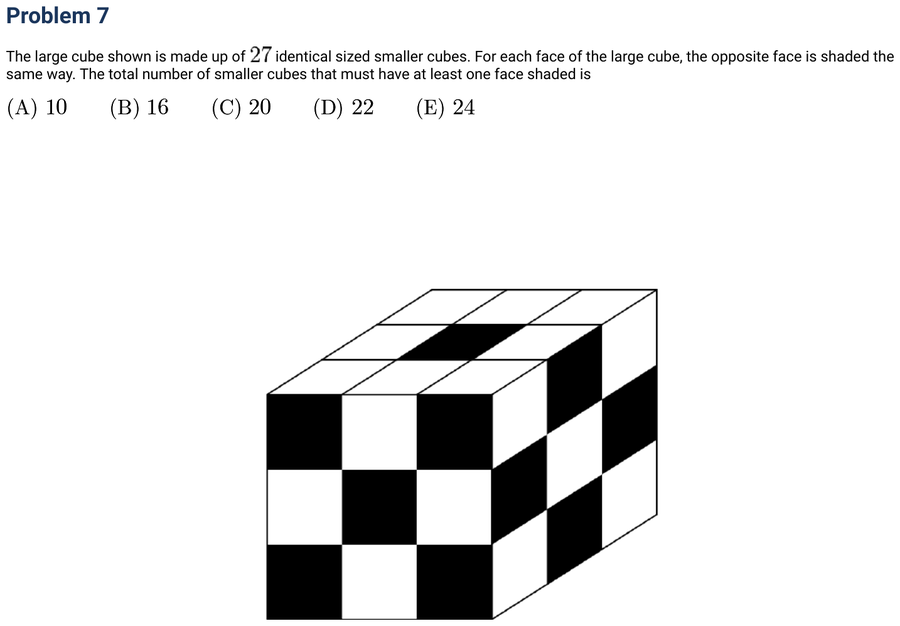
Show answer
Answer: C — 20.
Show hints
Hint 1 of 3
Counting the shaded ones directly is messy. Instead ask the reverse: which small cubes manage to stay completely unshaded?
Still stuck? Show hint 2 →
Hint 2 of 3
Every one of the 27 small cubes is one of just four types by position: 8 corners, 12 edges, 6 face-centers, 1 hidden inside. Sort by type instead of counting square by square.
Still stuck? Show hint 3 →
Hint 3 of 3
The checkerboard leaves only each face's center square white. The single cube directly behind that center square is the only one on that face that can dodge all shading.
Show solution
Approach: count by sub-cube class (and count the easy ones)
- Sort the 27 small cubes by position: 8 sit at corners (3 faces showing), 12 sit on edges (2 faces showing), 6 sit at the center of a face (1 face showing), and 1 is buried inside (0 faces).
- It's far easier to count the cubes with NO shading. The pattern leaves only the center square of each face white, so the only candidates to escape are the 6 face-center cubes plus the 1 internal cube = 7 unshaded.
- Everything else is shaded: 27 − 7 = 20.
- Why this transfers: "count the complement" — when the thing you want is scattered and the leftover is tidy, count the leftover and subtract from the whole.
Another way — add the shaded classes directly:
- All 8 corner cubes and all 12 edge cubes show at least one shaded square (they touch a non-center square of some face).
- 8 + 12 = 20, confirming the complement count.
Mark:
· log in to save