Problem 8 · 1987 AJHSME
Medium
Number Theory
bound-the-sum
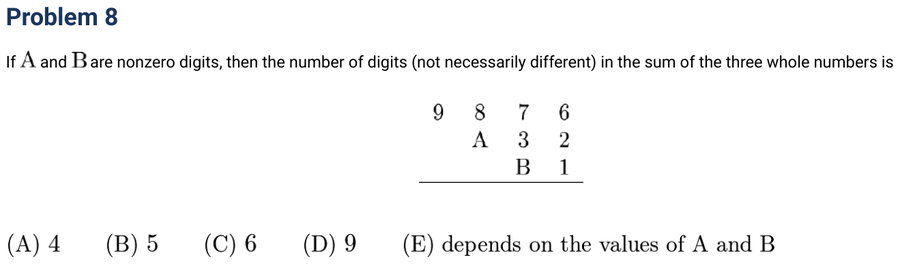
Show answer
Answer: B — 5.
Show hints
Hint 1 of 2
Answer (E) tempts you to think the digit count wobbles with A and B. Don't guess — pin down the smallest and largest the sum could ever be.
Still stuck? Show hint 2 →
Hint 2 of 2
Push A and B to their extremes: both as small as allowed (1) for the minimum, both 9 for the maximum. If both ends have the same digit count, every value in between does too.
Show solution
Approach: bracket the sum between its extremes
- A and B are digits, and 'nonzero' means each is at least 1. Smallest sum: 9876 + 132 + 11 = 10019. Largest sum: 9876 + 932 + 91 = 10899.
- Both endpoints land between 10000 and 99999, so the sum has 5 digits no matter what A and B are — that's why the answer isn't (E).
- Why this transfers: to test whether an answer 'depends' on a free choice, squeeze the choice to its extremes. If the extremes agree, nothing in between can disagree.
Mark:
· log in to save