The question wants only the LAST digit. So why compute all six? What's the smallest piece of each number you actually need?
Still stuck? Show hint 2 →
Hint 2 of 2
Technique: for any "ones digit of…" question, work only in the ones column. Here every number ends in 2 — that's all that matters.
Show solution
Approach: only the ones digit matters
The question asks for ONE digit, so do ONE digit of arithmetic. Every number ends in 2, and there are five being subtracted, so their ones digits remove 5 × 2 = 10 — an amount ending in 0.
Taking away something ending in 0 never disturbs a ones digit: 222,222 keeps its 2. This transfers: for any "last digit of…" question, throw away every higher place and work only in the ones column.
Sanity check: the true value is 222,222 − 24,690 = 197,532 — ones digit 2, as predicted.
Another way — keep the intermediate positive (MAA):
Look only at the last two digits so the running total never goes negative: 22 − 2 − 2 − 2 − 2 − 2.
When Yunji added all the integers from 1 to 9, she mistakenly left out a number. Her incorrect sum turned out to be a square number. What number did Yunji leave out?
Show answer
Answer: E — She left out 9.
Show hints
Hint 1 of 2
Don't test all nine cases. Find the FULL total 1+2+…+9 first — the answer is that total minus one small number, so it lands just below it. Which perfect square is nearby?
Still stuck? Show hint 2 →
Hint 2 of 2
Technique: full sum is 45 (pair 1+9, 2+8, …). Removing x gives 45 − x, somewhere in 36–44. Which value lands exactly on a perfect square?
Show solution
Approach: the full sum minus the missing number is a perfect square
The insight: start from the FULL total and only then take one number away. 1 + 2 + … + 9 = 45 (it pairs up: 1+9, 2+8, 3+7, 4+6, and a lonely 5 — four 10s plus 5).
Dropping a number from 1 to 9 leaves a sum between 45−9 = 36 and 45−1 = 44. So we just need a perfect square in the window 36–44.
Only 36 = 62 lives there (the next square, 49, is too big). So the sum became 36.
Removed amount = 45 − 36 = 9. Why this transfers: when something is "almost" a known total, compute the whole thing first, then the small correction — far easier than testing every number.
Aaliyah rolls two standard 6-sided dice. She notices that the product of the two numbers rolled is a multiple of 6. Which of the following integers cannot be the sum of the two numbers?
Show answer
Answer: B — The sum cannot be 6.
Show hints
Hint 1 of 2
What does "multiple of 6" really demand of the two dice? Break 6 into its prime pieces — the product needs both of them.
Still stuck? Show hint 2 →
Hint 2 of 2
Technique: 6 = 2 × 3, so the pair needs a factor of 2 (an even die) AND a factor of 3 (a 3 or 6). Test each answer's possible pairs against that single rule.
Show solution
Approach: test which sum has no multiple-of-6 pair
The insight: "multiple of 6" means "has a factor 2 AND a factor 3." So the pair must contain at least one even number AND at least one 3 or 6. That's the only condition — no need to multiply anything out.
Now test each sum. Sum 6 can only be (1,5), (2,4), or (3,3). Check: (1,5) has no even-and-3, (2,4) has no 3 or 6, (3,3) has a 3 but no even number. None qualify — so a sum of 6 is impossible.
Every other choice does have a qualifying pair: 5 = (2,3), 7 = (1,6), 8 = (2,6), 9 = (3,6). Answer: 6. This transfers: to test divisibility by a composite like 6, 12, or 15, split it into prime factors and check each one separately.
Another way — list every valid pair (MAA):
Pairs whose product is a multiple of 6 (need a multiple of 3 and an even number): (1,6), (2,3), (2,6), (3,6), (4,6), (5,6), (6,6).
Their sums: 7, 5, 8, 9, 10, 11, 12. Among A–E, only 6 is missing.
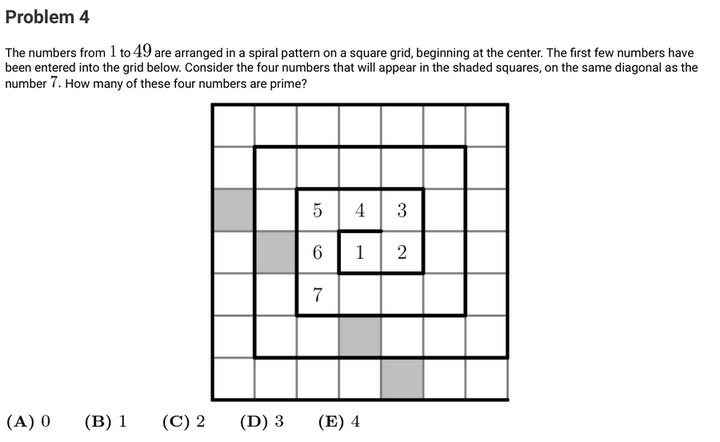
The spiral is just scenery — the real question is simply which four numbers land on those squares. Find them, then the problem becomes ‘how many are prime?’
Still stuck? Show hint 2 →
Hint 2 of 2
To find the numbers without drawing the whole grid, use the perfect squares as landmarks: 9, 25, 49 sit at corners of their layers. Then test each shaded number for primeness (a quick digit-sum check catches multiples of 3).
Show solution
Approach: fill in the diagonal, then test each for primeness
The clever move is to ignore the picture's prettiness and just ask: which four numbers land on those squares? Once you know them, the spiral has done its job and the question is pure prime-testing.
Continuing the spiral outward, the diagonal through 7 carries the four shaded numbers 19, 23, 39, 47.
Now test each for primeness. 39 jumps out: its digits add to 12 (a multiple of 3), so 39 = 3 × 13 is composite. The other three — 19, 23, 47 — are prime.
So 3 of the four shaded numbers are prime. Worth keeping: the digit-sum test (digits add to a multiple of 3 ⇒ divisible by 3) is the fastest way to spot a non-prime here.
Another way — use perfect squares as landmarks (MAA):
Without filling the whole grid: on an n×n spiral the number n2 sits in the upper-left (n even) or lower-right (n odd) corner. So 9 is at lower-right of the 3×3 block, 25 at lower-right of 5×5, 49 at lower-right of 7×7; 16 at upper-left of 4×4, 36 at upper-left of 6×6.
Walking outward from those anchors locates the four shaded squares as 19, 23, 39, 47 — with 39 = 3 × 13 the only composite.
When three positive integers a, b, and c are multiplied together, their product is 100. Suppose a < b < c. In how many ways can the numbers be chosen?
Show answer
Answer: E — 4 ways.
Show hints
Hint 1 of 2
Because a < b < c, the smallest factor can't be big — if all three were that size the product would blow past 100. So fix a first; it has very few options.
Still stuck? Show hint 2 →
Hint 2 of 2
a must be a small factor of 100 (it's the least of three, so a³ < 100 ⇒ a ≤ 4). For each such a, split the leftover product into b < c.
Show solution
Approach: fix the smallest factor and list outward
Insight: since a < b < c, the smallest factor a is the natural thing to pin down — it's tiny (if all three were as big as a, the product a³ would already exceed 100). So a can only be a small factor of 100.
a = 1: then bc = 100 with b < c — (1,2,50), (1,4,25), (1,5,20).
a = 2: then bc = 50 with 2 < b < c — only (2,5,10).
Bigger a leaves no room (e.g. a = 4 would need bc = 25 with 4 < b < c, impossible). That gives 4 valid triples.
Why fix the smallest: in any “a < b < c, fixed product” problem, the smallest is squeezed into a short list, so looping over it is the fast, miss-nothing path.
Another way — bound the smallest factor first (MAA):
Since a < b < c and abc = 100, we get a3 < 100, so a ≤ 4. And a must be a factor of 100, so a ∈ {1, 2, 4}.
For each: a = 1 gives (1,2,50), (1,4,25), (1,5,20); a = 2 gives (2,5,10); a = 4 gives nothing (would need bc = 25 with 4 < b < c).
The cheapest clue to use is the ÷10 one: a leftover of 3 when you divide by 10 simply means N ends in the digit 3. That single fact shrinks the whole list to {13, 23, 33, …, 93}.
Still stuck? Show hint 2 →
Hint 2 of 3
Now apply the ÷9 clue. Handy shortcut: a number's leftover when divided by 9 equals the leftover of its DIGIT SUM — so just look for the candidate whose digits add to something 1-more-than-a-multiple-of-9.
Still stuck? Show hint 3 →
Hint 3 of 3
Find N first; only THEN divide it by 11. Don't try to juggle all three divisors at once — pin down the number, then answer the actual question.
Show solution
Approach: let the easy clue filter the list, then test with the digit-sum trick
"Leftover 3 when divided by 10" means the units digit is 3, so N ∈ {13, 23, 33, 43, 53, 63, 73, 83, 93}.
Digit-sum test for division by 9 (a number and its digit sum leave the same leftover): 13→4, 23→5, …, 73→10 which leaves 1. Only 73 leaves a leftover of 1. So N = 73.
Now answer the real question: 73 = 11 × 6 + 7, so the leftover when divided by 11 is 7.
Why this transfers: when several remainder conditions overlap, start with the one that fixes the most (divide-by-10 fixes a whole digit), then sieve the short list — far faster than algebra.
Eleven members of the Middle School Math Club each paid the same integer amount for a guest speaker to talk about problem solving at their math club meeting. In all, they paid their guest speaker $1A2. What is the missing digit A of this 3-digit number?
Show answer
Answer: D — A = 3.
Show hints
Hint 1 of 2
"11 people each paid the same whole amount" is the whole clue: the total is 11 × something, so 1A2 must be a multiple of 11.
Still stuck? Show hint 2 →
Hint 2 of 2
Test divisibility by 11 with the alternating digit sum: add every other digit, subtract the rest, and check for a multiple of 11.
Show solution
Approach: translate the word clue into a divisibility-by-11 test
Equal split among 11 people ⇒ total is a multiple of 11, so 1A2 must be divisible by 11.
Alternating sum (test for 11): 1 − A + 2 = 3 − A must be a multiple of 11.
A is one digit (0–9), so the only way 3 − A hits a multiple of 11 is 3 − A = 0, giving A = 3.
Check: 132 = 11 × 12. ✓
You'll reuse this: "n equal shares" always means "total divisible by n" — the fastest way to turn a money/sharing sentence into a number-theory condition.
Danica wants to arrange her model cars in rows with exactly 6 cars in each row. She now has 23 model cars. What is the smallest number of additional cars she must buy in order to be able to arrange all her cars this way?
Show answer
Answer: A — 1 more car.
Show hints
Hint 1 of 2
"Exactly 6 per row" is a disguised way of saying "the total must be a multiple of 6." So really: what's the next multiple of 6 once you pass 23?
Still stuck? Show hint 2 →
Hint 2 of 2
When a word problem demands a whole number of equal groups, translate it to "the total is a multiple of (group size)" and round up to the nearest one.
Show solution
Approach: round up to the next multiple of 6
Rows of exactly 6 means the total must be a multiple of 6 — that's the hidden condition. So 23 itself won't work.
Count up from 23 to the next multiple of 6: 24 = 6 × 4. She needs 24 − 23 = 1 more car.
You'll see this again: any "arrange in equal rows / groups" problem is secretly asking for a multiple, so the answer is always (next multiple) − (what you have).
2010 ends in 0, so it's begging to be split as 201 × 10. That instantly hands you the primes 2 and 5 — now just crack 201.
Still stuck? Show hint 2 →
Hint 2 of 2
To prime-factor, peel off the easy small primes first (2, 3, 5) using divisibility shortcuts, then factor whatever's left.
Show solution
Approach: peel off small primes using divisibility tests
The trailing 0 gives 2010 = 201 × 10 = 2 · 5 · 201. For 201, its digits sum to 3, so 3 divides it: 201 = 3 · 67.
67 has no small factor (not even, not a multiple of 3 or 5, and 7·7 > 67 once you've ruled out 7) — so it's prime.
Primes are 2, 3, 5, 67; sum = 77.
Why this transfers: divisibility tests (even → 2, digit-sum → 3, ends in 0/5 → 5) let you factor by inspection. And you only test primes up to the square root before declaring what's left prime.
What is the sum of the two smallest prime factors of 250?
Show answer
Answer: C — 7.
Show hints
Hint 1 of 2
250 ends in 0, so it's even and a multiple of 5 — you already know its two smallest primes without dividing anything.
Still stuck? Show hint 2 →
Hint 2 of 2
The smallest prime factors hide in the last digit: even ⇒ 2 lives there; ending in 0 or 5 ⇒ 5 lives there.
Show solution
Approach: spot the primes from the last digit
250 ends in 0, which means it's divisible by both 2 and by 5 — the two smallest primes any number can have. So the two smallest are 2 and 5 with no work.
Sum: 2 + 5 = 7.
Why you can stop: 2 and 5 are the smallest two primes that exist, so once a number has both, nothing smaller can sneak in. (Fully, 250 = 2 · 53, but you never needed that.)
For any positive integer n, define [n] to be the sum of the positive factors of n. For example, [6] = 1 + 2 + 3 + 6 = 12. Find [[11]].
Show answer
Answer: D — 28.
Show hints
Hint 1 of 2
Nested brackets mean work inside-out: settle [11] completely before touching the outer bracket. The clue is that 11 is prime — its only factors are 1 and itself.
Still stuck? Show hint 2 →
Hint 2 of 2
Factors come in pairs: list divisors as pairs that multiply to n (1&12, 2&6, 3&4) so you never miss one.
Show solution
Approach: evaluate the inner bracket first, then the outer
Inner first: 11 is prime, so its only factors are 1 and 11 ⇒ [11] = 1 + 11 = 12.
Now [12]. Pair up the divisors so none escape: 1·12, 2·6, 3·4 — that's {1, 2, 3, 4, 6, 12}.
Add them: 1 + 2 + 3 + 4 + 6 + 12 = 28.
Habit worth forming: finding divisors in multiply-to-n pairs guarantees a complete list — the same trick that makes counting factors fast.
Suppose m and n are positive odd integers. Which of the following must also be an odd integer?
Show answer
Answer: E — 3mn.
Show hints
Hint 1 of 2
Don't plug in numbers and test — track only whether each piece is odd or even. The one rule that does all the work: odd + odd = even, and odd − odd = even.
Still stuck? Show hint 2 →
Hint 2 of 2
A product is odd only when every factor is odd; the moment a sum of two odds appears, it turns even. Scan for which choice avoids any 'odd + odd.'
Show solution
Approach: track parity, not values
Replace each variable with its parity. Note 3 is odd, and odd×odd stays odd, so 3n, 3m, 3mn are all odd.
(E) odd·odd·odd = odd — the only one with no addition of two odds to spoil it.
The big idea: adding or subtracting two odds always makes an even; multiplying odds keeps them odd. Choices A–D each smuggle in an odd±odd, so only the pure product survives.
Every multiple of 13 is 13·k. Instead of hunting the multiples, hunt the multipliers k that keep 13k in the 100–999 range — they form a tidy run of consecutive whole numbers.
Still stuck? Show hint 2 →
Hint 2 of 2
Find the first k with 13k ≥ 100 and the last with 13k ≤ 999. Then count the integers between, inclusive.
Show solution
Approach: count the multipliers, not the multiples
Write each multiple as 13k. Smallest 3-digit one: 100 ÷ 13 ≈ 7.7, so k = 8 gives 13·8 = 104. Largest: 999 ÷ 13 ≈ 76.8, so k = 76 gives 13·76 = 988.
So k runs through 8, 9, …, 76 — a block of consecutive integers. Count them: 76 − 8 + 1 = 69.
The two things people botch: remember the +1 (counting endpoints, not gaps — that's why it's 69, not 68), and translate the problem into counting k's rather than the multiples themselves. This 'count the index' trick works for any 'how many multiples in a range' question.
Which of the following numbers has the smallest prime factor?
Show answer
Answer: C — 58 (its smallest prime factor is 2).
Show hints
Hint 1 of 2
Don't factor all five numbers — ask what the smallest possible prime factor even is, then look for it.
Still stuck? Show hint 2 →
Hint 2 of 2
The smallest prime is 2, and only even numbers own a factor of 2. Scan for the even one.
Show solution
Approach: chase the smallest prime (2) instead of factoring everything
The winner needs the tiniest prime factor, and no prime beats 2. So the real question is: which choice is even? An even number automatically has 2 as its smallest prime factor.
58 is the only even number on the list, so its smallest prime factor is 2 — smaller than any odd number can manage. Answer 58.
You'll see this again: 'smallest/largest prime factor' problems reward looking for the small primes (2, then 3, then 5) first rather than fully factoring every option.
The year 2002 is a palindrome (a number that reads the same from left to right as it does from right to left). What is the product of the digits of the next year after 2002 that is a palindrome?
Show answer
Answer: B — 4.
Show hints
Hint 1 of 2
To stay as close to 2002 as you can, leave the thousands digit at 2 — bumping it would jump you all the way past 3000. So the year looks like 2 ? ? 2.
Still stuck? Show hint 2 →
Hint 2 of 2
A palindrome is locked by its *front half*: the mirror forces the two middle digits to match. Pick the smallest matching pair that still lands you above 2002.
Show solution
Approach: build the next palindrome from the outside in
Key idea: you only get to *choose* the first half of a palindrome — the back half is its mirror. Keep the leading 2 (raising it overshoots wildly), so the year is 2 ? ? 2.
The middle two digits must be equal. "00" gives 2002 (not *after*), so the next-smallest equal pair is "11" → 2112. Its digit product is 2 × 1 × 1 × 2 = 4.
*This transfers:* to find the next palindrome, only nudge the first half upward and mirror it — you never have to scan years one by one.
Carlos Montado was born on Saturday, November 9, 2002. On what day of the week will Carlos be 706 days old?
Show answer
Answer: C — Friday.
Show hints
Hint 1 of 2
Whole weeks change nothing — 7 days later is the same weekday. So toss out the full weeks and only the *leftover* days matter.
Still stuck? Show hint 2 →
Hint 2 of 2
Split 706 cleverly: 706 = 700 + 6, and 700 is a clean stack of weeks (7 × 100). That leaves just 6 days to walk forward.
Show solution
Approach: strip off the whole weeks (multiples of 7)
The weekday repeats every 7 days, so anything that's a multiple of 7 is invisible. Peel 706 into 700 + 6: those 700 days are exactly 100 weeks and land you right back on Saturday.
Now just step 6 days past Saturday: Sun, Mon, Tue, Wed, Thu, Friday.
*The reusable trick:* for any "what day/position after N steps" question with a cycle of length 7, only the *leftover* of N after pulling out whole cycles matters — break N into (multiple of 7) + (small remainder).
How many positive factors of 36 are also multiples of 4?
Show answer
Answer: B — 3.
Show hints
Hint 1 of 2
A number that is both a factor of 36 AND a multiple of 4 must already have the 4 built in. So write it as 4 × (something) — what does that 'something' have to be?
Still stuck? Show hint 2 →
Hint 2 of 2
Pull the 4 out front: the number is 4 × (a factor of 36 ÷ 4 = 9). Counting them becomes just counting the factors of 9 — a much smaller job.
Show solution
Approach: factor out the required 4
A multiple of 4 looks like 4 × k. For it to also divide 36, the leftover k must divide 36 ÷ 4 = 9. So instead of hunting through all of 36's factors, we just need the factors of 9.
9 has factors 1, 3, 9 — three of them. Multiplying each by 4 gives 4, 12, 36, so there are 3 such numbers.
Why this transfers: 'count the multiples of d that also divide N' always becomes 'count the factors of N ÷ d.' Pulling out the forced factor shrinks the problem every time.
A contest began at noon one day and ended 1000 minutes later. At what time did the contest end?
Show answer
Answer: D — 4:40 a.m.
Show hints
Hint 1 of 2
1000 loose minutes is hard to add to a clock. What unit would make adding to "noon" easy?
Still stuck? Show hint 2 →
Hint 2 of 2
Trade the minutes in for hours: how many whole hours fit in 1000 minutes, and how many minutes are left over?
Show solution
Approach: convert minutes to hours-and-minutes, then add
Clocks count in hours, so first turn 1000 minutes into hours. Since 60 minutes make an hour, 1000 ÷ 60 = 16 with 40 left over: that's 16 hours 40 minutes.
Add to noon. 16 hours past noon: noon + 12 h = midnight, then + 4 more h = 4:00 a.m.; the leftover 40 minutes makes 4:40 a.m. the next day.
Why split off the 12 first: jumping straight to midnight handles the a.m./p.m. flip cleanly, so you don't accidentally land on 4:40 p.m.
Consider all positive four-digit integers whose digits are all even. What fraction of these integers are divisible by 4?
Show answer
Answer: D — 3/5.
Show hints
Hint 1 of 2
Don't count the thousands of numbers. Divisibility by 4 cares only about the last two digits — so the first two even digits are free and just cancel out of the fraction.
Still stuck? Show hint 2 →
Hint 2 of 2
Here's the lucky break: the tens digit is even, so 10×(tens) is a multiple of 20, hence already a multiple of 4. That leaves the units digit as the only thing that decides divisibility by 4.
Show solution
Approach: divisibility by 4 collapses onto the units digit alone
Divisibility by 4 depends only on the last two digits, so the thousands and hundreds digits don't matter — whatever fraction works for the last two digits is the answer for the whole pile.
Split the last two digits as 10·(tens) + units. The tens digit is even, so 10·(tens) is a multiple of 20, which is already a multiple of 4. That means the number is divisible by 4 exactly when the units digit alone is — i.e. units ∈ {0, 4, 8}.
Of the 5 allowed even units {0, 2, 4, 6, 8}, three (0, 4, 8) work, and this holds no matter what the other digits are. So the fraction is 3/5 → 3/5.
Why this transfers: a divisibility rule lets you ignore most digits — isolate just the digits the rule depends on, and check whether the ‘free’ part is automatically handled so the count reduces to one digit.
In how many ways can 60 be written as the sum of two or more consecutive odd positive integers, arranged in increasing order?
Show answer
Answer: B — 2.
Show hints
Hint 1 of 2
Before any algebra, use parity: a sum of k odd numbers is even exactly when k is even. Since 60 is even, that already says something about how many terms you can have.
Still stuck? Show hint 2 →
Hint 2 of 2
A run of k consecutive odd numbers starting at a sums to k(a + k − 1) = 60. Test only the evenk that divide 60, keeping those with a positive odd start.
Show solution
Approach: parity narrows k, then the run-sum formula finishes it
First a free filter: adding k odd numbers gives a result with the same parity as k. Our target 60 is even, so the number of terms k must be even — we never even test odd k.
A run of k consecutive odds starting at a is a + (a+2) + … = k(a + k − 1) = 60, so a = 60/k − (k − 1). Check the even k ≥ 2 dividing 60:
k = 2 → a = 29 (29 + 31 = 60); k = 6 → a = 5 (5+7+9+11+13+15 = 60); k = 4, 10, 12… give a ≤ 0 or non-odd. Two runs work.
So there are 2 ways.
Why this transfers: on ‘sum of consecutive’ problems, a parity (or mod) check on the target usually kills most cases for free before you grind the algebra — cheap filters first, formula second.
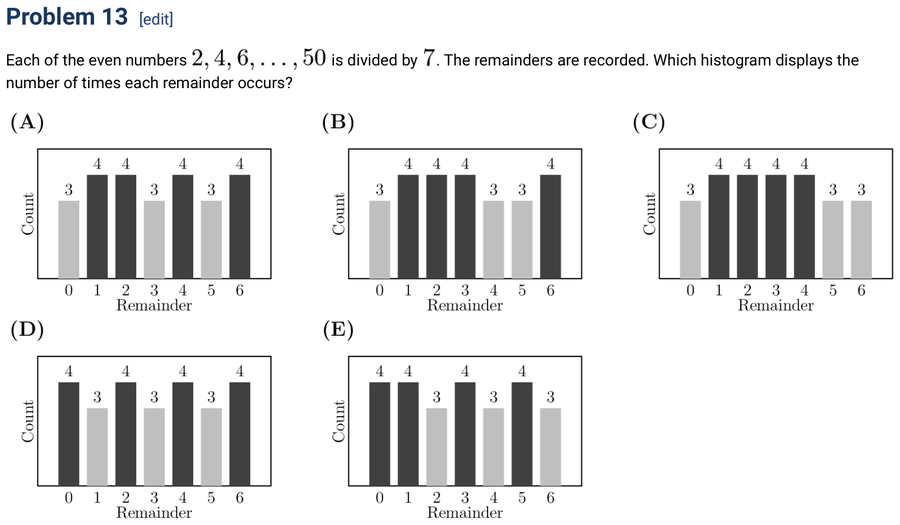
Computing 25 remainders one by one is a trap. Adding 2 each time bumps the remainder by 2 (mod 7) — so the remainders march in a short repeating loop. Find that loop.
Still stuck? Show hint 2 →
Hint 2 of 2
The loop has length 7, and 25 = 3 full loops + 4 leftovers. The full loops hit every remainder equally, so it's only those 4 leftovers — the first remainders in the cycle — that decide which bars stand taller.
Show solution
Approach: find the period-7 cycle; only the leftovers break the tie
Adding 2 each step bumps the remainder by 2 (mod 7), so 2, 4, 6, 8, 10, 12, 14, … give remainders that loop: 2, 4, 6, 1, 3, 5, 0, repeating every 7.
There are 25 even numbers = 3 complete loops (21 numbers, each remainder appearing 3 times — so all bars start tied) plus 4 extras, which are the first four of the cycle: 2, 4, 6, 1.
Those 4 extras push remainders 1, 2, 4, 6 up to 4 each, while 0, 3, 5 stay at 3 each. The histogram with its taller bars exactly on 1, 2, 4, 6 is choice A.
Why this transfers: for "how often does each remainder occur" questions, find the repeating cycle, peel off the whole cycles (which tie everything), and let the short leftover tail break the tie. That beats brute-forcing every value.
Five distinct integers from 1 to 10 are chosen, and five distinct integers from 11 to 20 are chosen. No two numbers differ by exactly 10. What is the sum of the ten chosen numbers?
Show answer
Answer: C — 105.
Show hints
Hint 1 of 2
The question asks for one fixed sum, yet you get to choose the numbers freely. That's a hint the sum is the same for every valid choice — so find what's forced. Each low number you pick rules out exactly one high number.
Still stuck? Show hint 2 →
Hint 2 of 2
Picking 5 lows blocks 5 highs, leaving exactly 5 highs you're forced to take. Those forced highs are 10 more than the 5 lows you didn't pick — so chosen-highs and unchosen-lows pair up.
Show solution
Approach: the high picks are forced; chosen highs pair with the unchosen lows
Insight: the answer can't depend on your choices (the problem gives just one sum), so something must be forced. Each chosen low x blocks the high x+10; choosing 5 lows blocks 5 highs, so the 5 highs you must take are precisely the unblocked ones — the highs that are 10 more than the 5 lows you didn't choose.
So every high pairs with an unchosen low: sum of chosen highs = (sum of unchosen lows) + 5×10. Then (chosen lows) + (chosen highs) = (chosen lows) + (unchosen lows) + 50 = (all of 1–10) + 50.
1 + 2 + … + 10 = 55, so the total is 55 + 50 = 105, the same for any legal choice.
Why this transfers: when a problem lets you choose but asks for a single number, look for the invariant — the quantity that's the same across all valid choices. Here a blocking/pairing argument shows the sum never moves.
Let the letters F, L, Y, B, U, G represent distinct digits. Suppose FLYFLY is the greatest number that satisfies the equation
8 · FLYFLY = BUGBUG.
What is the value of FLY + BUG?
Show answer
Answer: C — 1107.
Show hints
Hint 1 of 2
A number that repeats a 3-digit block, like ABCABC, isn't random — it's the block times something. What number, when multiplied by 123, gives 123123?
Still stuck? Show hint 2 →
Hint 2 of 2
Key fact: ABCABC = 1001 × ABC. So FLYFLY = 1001·FLY and BUGBUG = 1001·BUG, and the whole equation collapses to 8 · FLY = BUG.
Show solution
Approach: strip the repeat, then maximize digit-by-digit
The repeated block is the doorway: ABCABC = ABC×1000 + ABC = 1001·ABC. So FLYFLY = 1001·FLY, BUGBUG = 1001·BUG, and dividing both sides by 1001 leaves the tiny equation 8 · FLY = BUG.
BUG is still only 3 digits, so 8 · FLY < 1000 → FLY ≤ 124. That forces F = 1, and the tens digit L ≤ 2 (if L = 3, 8·13Y already exceeds 1040).
We want the GREATEST FLY, so push digits up. L = 2 (1 is taken by F). Now test the units Y from high down, needing all six digits F,L,Y,B,U,G distinct: Y = 4 gives 8·124 = 992 (repeated 9, fails); Y = 3 gives 8·123 = 984, digits {1,2,3,9,8,4} all different ✓.
FLY + BUG = 123 + 984 = 1107. You'll see it again: 1001 = 7×11×13 is the workhorse behind every ABCABC pattern — spotting the repeated block lets you divide a 6-digit monster down to 3 digits.
Number Theorycomplementary-countingcareful-counting
Nicolas is planning to send a package to his friend Anton, who is a stamp collector. To pay for the postage, Nicolas would like to cover the package with a large number of stamps. Suppose he has a collection of 5-cent, 10-cent, and 25-cent stamps, with exactly 20 of each type. What is the greatest number of stamps Nicolas can use to make exactly $7.10 in postage?
Show answer
Answer: E — 55 stamps.
Show hints
Hint 1 of 2
‘Use the most stamps’ is hard to chase directly. Flip it: he owns a fixed pile worth a fixed total, so using the most stamps means setting aside the fewest. What's the whole pile worth?
Still stuck? Show hint 2 →
Hint 2 of 2
All 60 stamps total $8.00, and he only needs $7.10 — so he must hold back exactly $0.90. Now the easy question: what's the fewest stamps that make $0.90?
Show solution
Approach: minimize stamps removed, not maximize stamps used
Maximizing what you use is the same as minimizing what you leave out — and since the whole pile is fixed, the leftover is fixed in value too. That flip turns a messy ‘maximize’ into a tidy ‘minimize.’
All 60 stamps total 20 × ($0.05 + $0.10 + $0.25) = 20 × $0.40 = $8.00. To pay $7.10 he must hold back $8.00 − $7.10 = $0.90.
Fewest stamps making $0.90: grab the biggest coins first — three 25¢ (75¢), one 10¢, one 5¢ = $0.90 with just 5 stamps.
Stamps used = 60 − 5 = 55. This transfers: ‘use the most/fewest of a fixed supply’ problems are almost always easier solved by counting the complement — what you don't use.
Another way — build up directly (MAA):
To pile on stamps, lean on the small ones and use as few 25¢ as possible. The 5¢ and 10¢ together max out at $1.00 + $2.00 = $3.00, so you need at least $4.10 more from quarters — at least seventeen 25¢ = $4.25.
That leaves $7.10 − $4.25 = $2.85. Since $2.85 isn't a whole number of dimes, use an odd count of nickels: nineteen 5¢ = $0.95 leaves $1.90 = nineteen 10¢.
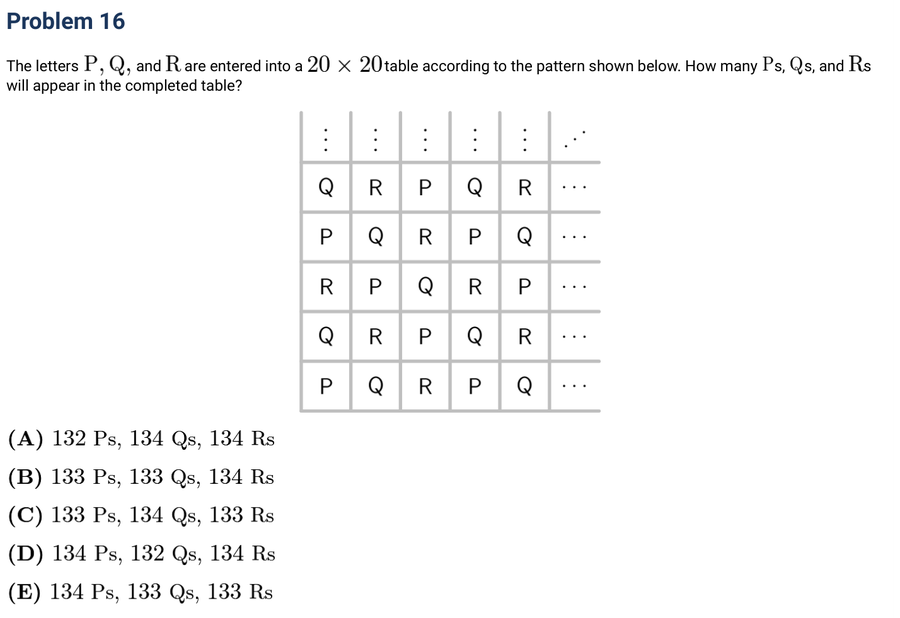
20 isn't a multiple of 3, so the three letters can't come out perfectly equal — 400 = 3 × 133 + 1 means exactly one letter gets one extra. The real work is finding which letter.
Still stuck? Show hint 2 →
Hint 2 of 2
Trick to balance the board: pretend you add a 21st column that's a copy of column 3. Each row of P,Q,R repeating across 21 cells holds exactly 7 of each — perfectly even. Then just subtract back off the column you added.
Show solution
Approach: pad to a clean width, then subtract the extra column
Since 20 isn't divisible by 3, the counts can't be equal: 400 = 3 × 133 + 1, so two letters tie at 133 and one gets 134. The whole question is which letter wins the leftover.
Make the width friendly: imagine appending a 21st column identical to the 3rd column. Now every row spans 21 = 3 × 7 cells, so each row has exactly 7 P, 7 Q, 7 R. Over 20 rows that's 140 of each — perfectly balanced.
Now undo it: the column you added (a copy of column 3, which reads P, R, Q, P, R, … down 20 cells) contains 7 Ps, 6 Qs, 7 Rs. Subtract from 140 each: 140−7 = 133 Ps, 140−6 = 134 Qs, 140−7 = 133 Rs.
So the table has 133 Ps, 134 Qs, 133 Rs. This transfers: when a repeating pattern doesn't fit evenly, pad it to a clean multiple where counting is trivial, then subtract the padding.
Another way — tile with 1×3 triominoes (MAA):
Any 1×3 straight tile laid on the pattern covers exactly one P, one Q, and one R. So wherever the board tiles cleanly, the three letters stay perfectly balanced.
Split the 20×20 board into an 18×18 square, a 2×18 strip, an 18×2 strip (all divisible by 3, so balanced), plus a leftover 2×2 corner.
That corner reads Q R / P Q — one extra Q. So the whole board has one more Q than P or R: 133 Ps, 134 Qs, 133 Rs.
Greta Grasshopper sits on a long line of lily pads in a pond. From any lily pad, Greta can jump 5 pads to the right or 3 pads to the left. What is the fewest number of jumps Greta must make to reach the lily pad located 2023 pads to the right of her starting position?
Show answer
Answer: D — 411 jumps.
Show hints
Hint 1 of 2
Order doesn't matter — jumping right-then-left lands the same place as left-then-right. So all that matters is how many of each.
Still stuck? Show hint 2 →
Hint 2 of 2
She should overshoot 2023 with right jumps (landing on a multiple of 5), then walk back to 2023 in left jumps of 3. Find the first overshoot whose gap is a multiple of 3.
Show solution
Approach: overshoot to a multiple of 5, then step back by 3s
Order doesn't matter, so do all the right jumps first: they land Greta on a multiple of 5 just past 2023. Then left jumps of 3 carry her back to 2023, so the overshoot gap must be a multiple of 3.
Right jumps: 2035 ÷ 5 = 407. Left jumps: 12 ÷ 3 = 4. Total: 407 + 4 = 411 jumps. This transfers: ‘reach a target using two step sizes’ problems collapse once you realize order doesn't matter — only the counts of each step do, so you're really just solving 5R − 3L = 2023 in whole numbers.
Another way — pair each left jump with a right jump (MAA):
Pair every left jump with a right jump: a pair nets 5 − 3 = 2 pads forward, and any leftover right jumps add 5 each. With P pairs and Q spare right jumps, 2P + 5Q = 2023 and the total jumps is 2P + Q.
Spare right jumps move farther per jump, so maximize Q (minimize P). The smallest P making 2023 − 2P a multiple of 5 is P = 4, giving Q = (2023 − 8)/5 = 403.
If n is an even positive integer, the double-factorial notation n!! represents the product of all the even integers from 2 to n. For example: 8!! = 2 × 4 × 6 × 8. What is the units digit of the following sum?
2!! + 4!! + 6!! + … + 2022!!
Show answer
Answer: B — Units digit 2.
Show hints
Hint 1 of 2
“Units digit” means you never need the actual huge values. The moment a product includes 10 as a factor, it ends in 0 — so most of these 1000+ terms are silently zero.
Still stuck? Show hint 2 →
Hint 2 of 2
Every term from 10!! onward has a factor of 10 (ends in 0), contributing nothing. Only 2!!, 4!!, 6!!, 8!! touch the ones digit.
Show solution
Approach: kill the terms ending in 0, keep only the ones digits of the rest
Insight: the sum runs all the way to 2022!!, but “units digit” lets you ignore almost everything. Any n!! with n ≥ 10 multiplies in a 10, so it ends in 0 and adds nothing to the ones place.
Add just those ones digits: 2 + 8 + 8 + 4 = 22, so the final units digit is 2.
You'll see this again: for a units-digit question, work mod 10 the whole way — only ones digits feed into ones digits, and a factor of 10 (or 2 and 5 together) zeroes a term out.
For a positive integer n, the factorial notation n! represents the product of the integers from n to 1. For example: 6! = 6 × 5 × 4 × 3 × 2 × 1. What value of N satisfies the following equation?
5! × 9! = 12 × N!
Show answer
Answer: A — N = 10.
Show hints
Hint 1 of 2
Don't expand 9! into a giant number. The right side has a 9! sitting in it — so leave the 9! alone and shape the left side to match it.
Still stuck? Show hint 2 →
Hint 2 of 2
The key identity is 10! = 10 × 9!. So if you can turn 5! into 12 × 10, the whole left side becomes 12 × 10 × 9! = 12 × 10!.
Show solution
Approach: reassemble a factorial instead of multiplying it out
Factorials “telescope”: n! = n × (n−1)!. So a leftover factor times 9! can rebuild into 10!, 11!, … — keep the 9! intact rather than expanding it.
You'll see this again as: when factorials appear in an equation, never compute the big ones — peel digits off one factorial and absorb them into another using n! = n(n−1)!. The arithmetic stays tiny.
How many factors of 2020 have more than 3 factors? (As an example, 12 has 6 factors, namely 1, 2, 3, 4, 6, and 12.)
Show answer
Answer: B — 7 factors.
Show hints
Hint 1 of 2
“More than 3 factors” is hard to spot one by one. Flip it: which numbers have 3 or fewer factors? There are only three types — and they're easy to recognize.
Still stuck? Show hint 2 →
Hint 2 of 2
A number has ≤3 factors only if it's 1 (one factor), a prime (two), or a prime squared (three). Count those among the divisors of 2020, then subtract from the total.
Show solution
Approach: complementary — subtract the three ‘small’ types
2020 = 22 · 5 · 101, so the total factor count is (2+1)(1+1)(1+1) = 12.
The divisors with ≤3 factors fall into exactly three recognizable types: 1 (one factor); the primes 2, 5, 101 (two each); and the prime square 4 = 22 (three). That's 1 + 3 + 1 = 5.
Remaining: 12 − 5 = 7 divisors with more than 3 factors.
You'll see this again as: the number of divisors a number has is fixed by its prime exponents — exactly 1 factor ⇒ the number is 1; exactly 2 ⇒ prime; exactly 3 ⇒ prime squared. Memorize those three and ‘count the small ones, subtract’ becomes routine.
A number is called flippy if its digits alternate between two distinct digits. For example, 2020 and 37373 are flippy, but 3883 and 123123 are not. How many five-digit flippy numbers are divisible by 15?
Show answer
Answer: B — 4 numbers.
Show hints
Hint 1 of 2
Break the scary ‘divisible by 15’ into two friendly tests: divisible by 5 (look at the last digit) and divisible by 3 (look at the digit sum). Handle them one at a time.
Still stuck? Show hint 2 →
Hint 2 of 2
A 5-digit flippy looks like ababa, so the first and last digit are the same a. Div-by-5 wants the last digit to be 0 or 5 — but it's also the first digit, which can't be 0. That forcesa = 5; then chase div-by-3 on what's left.
Show solution
Approach: split 15 = 3 × 5, and let the ‘same first/last digit’ force a
Divisible by 15 means divisible by both 5 and 3 — two simple digit tests instead of one hard division.
A flippy 5-digit number is ababa, so its first and last digits are both a. Div-by-5 needs the last digit 0 or 5; since it's also the leading digit it can't be 0, so a = 5. The number is 5b5b5.
Div-by-3 looks at the digit sum: 5+b+5+b+5 = 15 + 2b. Since 15 is already a multiple of 3, we just need 2b (hence b) divisible by 3: b ∈ {0, 3, 6, 9}, all different from 5.
That's 4 flippy numbers.
You'll see this again as: to test divisibility by a composite, split it into coprime factors and apply each rule separately (15 → 3 and 5; 12 → 3 and 4; 6 → 2 and 3). And in ‘flippy’-style patterns, the repeated-digit structure often pins a digit before you do any real work.
A palindrome is a number that has the same value when read from left to right or from right to left. (For example, 12321 is a palindrome.) Let N be the least three-digit integer which is not a palindrome but which is the sum of three distinct two-digit palindromes. What is the sum of the digits of N?
Show answer
Answer: A — 2.
Show hints
Hint 1 of 2
List the two-digit palindromes: 11, 22, 33, …, 99. They're all just 11 times something — every one is a multiple of 11. That single fact pins down what N can be.
Still stuck? Show hint 2 →
Hint 2 of 2
If N is a sum of three multiples of 11, then N is a multiple of 11 too. So scan the 3-digit multiples of 11 in order and grab the first that isn't itself a palindrome — then just confirm it's reachable.
Show solution
Approach: every 2-digit palindrome is a multiple of 11
A two-digit palindrome has equal digits (11, 22, …, 99), which means it equals 11 × (that digit) — always a multiple of 11. A sum of three of them is therefore also a multiple of 11, so N must be a multiple of 11.
Walk the 3-digit multiples of 11: 110, 121, 132, … The very first, 110, already isn't a palindrome (110 reversed is 011). So N = 110 is the candidate — just check it's actually buildable.
110 = 11 + 22 + 77 ✓ three distinct two-digit palindromes, so it qualifies.
Digit sum of 110 = 1 + 1 + 0 = 2.
Why this transfers: spotting a hidden divisibility (here, "repeated-digit number = multiple of 11") shrinks an open search into a short ordered list — always ask what number property all the building blocks share.
Isabella has 6 coupons that can be redeemed for free ice cream cones at Pete's Sweet Treats. In order to make the coupons last, she decides that she will redeem one every 10 days until she has used them all. She knows that Pete's is closed on Sundays, but as she circles the 6 dates on her calendar, she realizes that no circled date falls on a Sunday. On what day of the week does Isabella redeem her first coupon?
Show answer
Answer: C — Wednesday.
Show hints
Hint 1 of 2
A 10-day jump is the same as a 3-day jump on the weekly cycle (10 = 7 + 3, and a full week of 7 lands on the same weekday). So each coupon is 3 weekdays after the last.
Still stuck? Show hint 2 →
Hint 2 of 2
Stepping +3 six times lands on six different weekdays — they cover six of the seven, skipping exactly one. That skipped day has to be Sunday, which tells you where to start.
Show solution
Approach: 10 days = +3 weekdays; find the one weekday left untouched
Adding 10 days moves the weekday forward by 10 − 7 = 3 each time (a full week doesn't change the weekday). So from the start day the six redemptions land at +0, +3, +6, +9, +12, +15 weekdays = +0, +3, +6, +2, +5, +1 after reducing by 7s.
Those six offsets are all different and cover every weekday except +4. Since none of the six is a Sunday, Sunday is precisely the missing +4 day.
So the start is 4 weekdays before Sunday: counting back Sat, Fri, Thu, Wed.
Why this transfers: repeated equal steps around a 7-day cycle reduce to stepping by the remainder mod 7; because 3 shares no factor with 7, six steps hit six distinct days — so the single avoided day fixes everything.
Another way — just test the start days:
Try starting Wednesday and step +3 weekdays each time: Wed, Sat, Tue, Fri, Mon, Thu — six dates, none on Sunday. It works.
Any earlier choice (Mon, Tue) lands on a Sunday within the six steps, so the answer is Wednesday.
Laila took five math tests, each worth a maximum of 100 points. Laila's score on each test was an integer between 0 and 100, inclusive. Laila received the same score on the first four tests, and she received a higher score on the last test. Her average score on the five tests was 82. How many values are possible for Laila's score on the last test?
Show answer
Answer: A — 4 values.
Show hints
Hint 1 of 2
The average is 82, but the last test is higher than the other four — so the four equal tests must drag below 82 and the last test makes up the whole shortfall. Picture starting everyone at 82 and then shifting points onto the last test.
Still stuck? Show hint 2 →
Hint 2 of 2
The technique is a modular constraint plus a range: write the total as 4f + l = 410, get bounds on l, then notice the four identical scores force a step-size on l.
Show solution
Approach: modular constraint + range
Average 82 over 5 tests means the five scores total 5×82 = 410. Let f be the repeated first-four score and l the last, so 4f + l = 410 with f < l ≤ 100.
Lower bound on l: if all five were 82 the total is exactly 410, but the last must be strictly higher than the others, so l > 82 and f < 82.
Why l jumps by 4: each point you move off the last test has to be split equally among the four equal tests, but a whole point on each of the four costs 4 points from the last. Concretely, to keep f a whole number, lowering all four from 82 by 1 (to 81) frees 4 points that pile onto the last test — so l climbs 86, 90, 94, 98 in steps of 4.
(Same fact in modular language: 4f is a multiple of 4 and 410 leaves remainder 2 mod 4, so l ≡ 2 mod 4.) In the window 82 < l ≤ 100 that gives l ∈ {86, 90, 94, 98}.
4 values. (Check the top: l = 98 pairs with f = 78 — valid; the next step 102 exceeds 100, so we stop.)
Let N be the greatest five-digit number whose digits have a product of 120. What is the sum of the digits of N?
Show answer
Answer: D — 18.
Show hints
Hint 1 of 2
"Greatest number" is decided left to right: a bigger digit in the ten-thousands place beats anything happening later. So your only goal at each step is to make the current leftmost digit as large as possible.
Still stuck? Show hint 2 →
Hint 2 of 2
The technique is a greedy choice: at each slot, grab the biggest single digit (1–9) that still divides what's left of the product, then pass the remaining product to the next slot.
Show solution
Approach: greedy left-to-right factorization
First digit: the largest digit dividing 120 is 8 (9 doesn't divide 120, since 120/9 isn't whole). Take 8; remaining product 120/8 = 15.
Second digit: largest digit dividing 15 is 5; remaining 3. Third digit: largest dividing 3 is 3; remaining 1. The last two slots must each be 1 (their product has to be 1).
So N = 85311, and the digit sum is 8 + 5 + 3 + 1 + 1 = 18.
Why greedy is safe here: a larger leftmost digit raises the number more than any improvement further right ever could, so locking in the biggest legal digit at each step can't be beaten.
Listing all the divisors by hand would be miserable. The escape: every factor is built by choosing how many of each prime to include — so the real question is about the exponents in the prime factorization, not the divisors themselves.
Still stuck? Show hint 2 →
Hint 2 of 2
The technique — the divisor-counting formula: factor the number as primes to powers, then multiply (each exponent + 1). The "+1" is the option of using that prime zero times.
Show solution
Approach: prime factorize, multiply (exponent + 1) per prime
Strip out 2's: 23,232 halves six times down to 363, so 23,232 = 26 · 363. Then 363 = 3 · 121 = 3 · 112. So 23,232 = 26 · 3 · 112.
Each divisor picks 0–6 copies of 2 (7 choices), 0–1 copies of 3 (2 choices), and 0–2 copies of 11 (3 choices). Multiply the independent choices: 7 · 2 · 3 = 42.
You'll see it again: "how many factors" is always (exponent+1) multiplied across the primes — and the same choice-counting idea gives the sum of factors too.
The smallest positive integer greater than 1 that leaves a remainder of 1 when divided by 4, 5, and 6 lies between which of the following pairs of numbers?
Show answer
Answer: D — Between 60 and 79.
Show hints
Hint 1 of 2
'Remainder 1' means the number is just one past a clean multiple. So subtract that 1: n − 1 leaves no remainder under 4, 5, or 6 — it's a common multiple of all three.
Still stuck? Show hint 2 →
Hint 2 of 2
Smallest common multiple = lcm. Find lcm(4, 5, 6), then add the 1 back. Careful: lcm(4,6) = 12, not 24.
Show solution
Approach: shift by the remainder, then take the lcm
If n leaves remainder 1 under each of 4, 5, 6, then n − 1 is exactly divisible by all three — a common multiple. Peeling off the remainder turns three conditions into one lcm.
lcm(4, 5, 6) = 60 (note 4 and 6 share a factor of 2, so it's 60, not 120). The smallest such n > 1 is 60 + 1 = 61.
61 lies between 60 and 79.
Why this transfers: 'same remainder r for several divisors' always means n = lcm(…)·k + r; subtract r first to expose the lcm.
For any positive integer M, the notation M! denotes the product of the integers 1 through M. What is the largest integer n for which 5n is a factor of the sum
98! + 99! + 100! ?
Show answer
Answer: D — 26.
Show hints
Hint 1 of 2
Don't fear the factorials — the smallest, 98!, is a factor of all three (99! = 99·98!, 100! = 100·99·98!). Pull it out and the leftover bracket collapses to something startlingly round.
Still stuck? Show hint 2 →
Hint 2 of 2
Factors of 5 add up from two independent sources: the round leftover, plus the 5's buried inside 98!. For 98!, use Legendre's count: ⌊98/5⌋ + ⌊98/25⌋ (multiples of 5, then the extra 5 in multiples of 25).
Show solution
Approach: factor out 98!, then count 5's from each piece
Factor out the common 98!: 98! + 99! + 100! = 98!(1 + 99 + 100·99) = 98!(100 + 9900) = 98! · 10,000. That clean 10,000 is the payoff for factoring — it's loaded with 5's.
Source 1, the leftover: 10,000 = 104 = 24·54, giving 4 factors of 5.
Source 2, inside 98!: count multiples of 5 (⌊98/5⌋ = 19) plus the second 5 each multiple of 25 contributes (⌊98/25⌋ = 3): that's 19 + 3 = 22 factors of 5.
Add the two sources: 4 + 22 = 26. So the largest such n is 26.
Why this transfers: sums of factorials always factor out the smallest one; and the prime-5 count in any k! is ⌊k/5⌋ + ⌊k/25⌋ + ⌊k/125⌋ + … (Legendre's formula) — the engine behind every "trailing zeros" / "power of a prime in a factorial" question.
Determine how many two-digit numbers satisfy the following property: when the number is added to the number obtained by reversing its digits, the sum is 132.
Show answer
Answer: B — 7 numbers.
Show hints
Hint 1 of 3
Reversing swaps the tens digit and the ones digit. So when you ADD a number to its reversal, each digit lands once in the tens place and once in the ones place — the two digits end up playing perfectly equal roles. Write both numbers with place value and watch that symmetry.
Still stuck? Show hint 2 →
Hint 2 of 3
That symmetry forces the sum to be 11 × (digit sum). So 132 = 11 × (something) instantly pins the digit sum, and the whole problem becomes "count the digit pairs that add to it."
Still stuck? Show hint 3 →
Hint 3 of 3
Counting trap: the tens digit can't be 0 (it must stay a two-digit number), so a pair like (0, 12) is out — and a digit can't exceed 9 anyway.
Show solution
Approach: place value turns number + reversal into 11 × (digit sum)
Write the number as 10a + b and its reversal as 10b + a. Adding: (10a + b) + (10b + a) = 11a + 11b = 11(a + b).
So 11(a + b) = 132, giving a + b = 12. The reversal trick converted the whole condition into one tidy digit-sum equation.
Count digit pairs with a from 1–9 (leading digit, can't be 0) and b a single digit: (3,9), (4,8), (5,7), (6,6), (7,5), (8,4), (9,3) — that's 7 numbers.
Why this transfers: "number plus its reversal" is ALWAYS a multiple of 11, and "number minus its reversal" is always a multiple of 9 — remembering these two facts collapses a whole family of digit problems.
What is the largest power of 2 that is a divisor of 134 − 114?
Show answer
Answer: C — 32.
Show hints
Hint 1 of 3
Resist computing 134 − 114 (that's 28561 − 14641 — a big number you'd then have to factor). Counting factors of 2 only needs the number in FACTORED form, so factor it BEFORE you multiply anything out.
Still stuck? Show hint 2 →
Hint 2 of 3
It's a difference of two fourth powers, which is a difference of squares: a4 − b4 = (a2 + b2)(a2 − b2). That breaks it into small numbers you can factor by eye.
Still stuck? Show hint 3 →
Hint 3 of 3
Then just tally the 2s: the largest power of 2 dividing a product is found by adding up the factors of 2 in each piece.
Show solution
Approach: factor first (difference of squares), then count factors of 2
134 − 114 = (132 + 112)(132 − 112) = (169 + 121)(169 − 121) = 290 · 48 — two small numbers instead of one huge one.
Count 2s in each: 290 = 2 · 145 contributes one factor of 2; 48 = 24 · 3 contributes four.
Add the exponents: 21+4 = 25 = 32.
Why this transfers: to find the highest power of a prime dividing a product, never multiply it out — factor each piece and ADD the exponents of that prime. Difference-of-squares (and its repeat) is the standard tool for cracking an − bn open.
The least common multiple of a and b is 12, and the least common multiple of b and c is 15. What is the least possible value of the least common multiple of a and c?
Show answer
Answer: A — 20.
Show hints
Hint 1 of 2
b is the hinge between the two conditions, so pin it down first. Since b is a factor of lcm(a,b) = 12 AND of lcm(b,c) = 15, it must divide BOTH 12 and 15 — so b divides gcd(12, 15) = 3.
Still stuck? Show hint 2 →
Hint 2 of 2
To make lcm(a, c) as small as possible, you want a and c to share as much as they can with b and carry no extra junk. Take b = 3, then pick the SMALLEST a and c that still satisfy each lcm condition.
Show solution
Approach: pin down the shared value b, then minimize a and c
b divides both lcms, so b | gcd(12, 15) = 3 — meaning b is 1 or 3. To let b absorb shared factors, try b = 3.
Smallest a with lcm(a, 3) = 12 is a = 4 (since 4 supplies the 2² and 3 supplies the 3). Smallest c with lcm(c, 3) = 15 is c = 5.
lcm(4, 5) = 20 — and 4 and 5 share no factors, so this is as small as it gets: 20.
Watch the trap: the lazy choice b = 1 forces a = 12, c = 15, giving lcm = 60 (answer C). Letting b carry the common 3 is what shrinks the answer to 20.
Why this transfers: a value shared across two lcm/gcd conditions must divide the gcd of the two results — nail that shared value first, then minimize the leftovers.
On June 1, a group of students is standing in rows, with 15 students in each row. On June 2, the same group is standing with all of the students in one long row. On June 3, the same group is standing with just one student in each row. On June 4, the same group is standing with 6 students in each row. This process continues through June 12 with a different number of students per row each day. However, on June 13, they cannot find a new way of organizing the students. What is the smallest possible number of students in the group?
Show answer
Answer: C — 60 students.
Show hints
Hint 1 of 2
Strip away the story: 'students per row' that divides the group evenly is just a divisor of n. Each of the 12 days uses a different one, and running out on day 13 means there are no more — so n has exactly 12 divisors.
Still stuck? Show hint 2 →
Hint 2 of 2
Two clues fix n's prime factors: it's a multiple of 15 and of 6, hence of lcm(6,15) = 30 = 2·3·5. Now use the divisor-count formula — (exponent+1) multiplied across the primes — to grow 30 into something with exactly 12 divisors, as cheaply as possible.
Show solution
Approach: translate the rows into a divisor-counting problem
A valid 'students per row' must divide n evenly, so each day is a distinct divisor. Twelve days then 'no new way' means n has exactly 12 divisors.
n is a multiple of 15 and 6, so of lcm(6,15) = 30 = 2·3·5. Its divisor count is (1+1)(1+1)(1+1) = 8 — we need 4 more.
The divisor count multiplies (exponent+1) over the primes; to push 8 up to 12 = 3·2·2, raise one exponent from 1 to 2. Doing it to the smallest prime is cheapest: 22·3·5 = 60 gives (3)(2)(2) = 12. (Bumping 3 or 5 instead gives 90 or 150 — bigger.)
Smallest n = 60.
Why this transfers: 'number of ways to arrange in equal rows' = number of divisors, and you control it through the prime exponents via the (e+1) product — to minimize the number, add the new factor to the smallest prime.
A baseball league consists of two four-team divisions. Each team plays every other team in its division N games. Each team plays every team in the other division M games with N > 2M and M > 4. Each team plays a 76 game schedule. How many games does a team play within its own division?
Show answer
Answer: B — 48 games.
Show hints
Hint 1 of 2
Count a team's opponents first: in a 4-team division it has 3 rivals (N games each), and the other division has 4 teams (M games each). That's the one equation: 3N + 4M = 76.
Still stuck? Show hint 2 →
Hint 2 of 2
One equation, two unknowns — the inequalities and whole-number-ness do the rest. Two squeezes work together: 'mod 3' pins M to one residue class, while N > 2M plus M > 4 traps M in a tiny range.
Show solution
Approach: build one Diophantine equation, then squeeze M with mod + bounds
Opponents: 3 division rivals at N games and 4 cross-division teams at M games ⇒ 3N + 4M = 76.
Mod 3: 3N vanishes, so 4M ≡ 76 ≡ 1, i.e. M ≡ 1 (mod 3) — M ∈ {7, 10, 13, …}.
Bound it: N > 2M gives 76 = 3N + 4M > 10M, so M < 7.6; combined with M > 4, only M = 7 survives (and it fits the mod-3 class).
Then N = (76 − 4·7)/3 = 48/3 = 16, so games within the division = 3N = 48.
Why this transfers: one equation with two whole-number unknowns isn't stuck — mod arithmetic narrows to a residue class and inequalities crop it to a single value.
The 7-digit numbers 74A52B1 and 326AB4C are each multiples of 3. Which of the following could be the value of C?
Show answer
Answer: A — C = 1.
Show hints
Hint 1 of 2
You can't find A and B individually — and you don't need to. Both numbers share the same A + B, so write each divisibility-by-3 condition and subtract them to cancel A + B entirely.
Still stuck? Show hint 2 →
Hint 2 of 2
What's left is a single condition on C mod 3. Only one answer choice fits.
Show solution
Approach: subtract the two digit-sum conditions so the shared A+B cancels
Divisibility by 3 = digit sum divisible by 3. First number: 7+4+5+2+1 = 19, so 19 + A + B ≡ 0 ⇒ A + B ≡ 2 (mod 3).
Second number: 3+2+6+4 = 15, so 15 + A + B + C ≡ 0 ⇒ A + B + C ≡ 0 (mod 3).
Subtract the first from the second: the A + B cancels, leaving C ≡ −2 ≡ 1 (mod 3).
Among the choices {1, 2, 3, 5, 8}, only C = 1 is ≡ 1 (mod 3).
Why this transfers: when an unknown blocks two equations the same way, subtract to eliminate it — the same move that solves systems of equations works on mod conditions too.
Computing 72011 is hopeless — but the tens digit only depends on the last two digits, and those depend only on the last two digits of the previous power. So track just the last two digits as you multiply by 7.
Still stuck? Show hint 2 →
Hint 2 of 2
List the last-two-digit patterns: 07, 49, 43, 01, then it returns to 07. A repeating cycle of length 4 — now the only question is where 2011 lands in the cycle.
Show solution
Approach: only the last two digits matter, and they cycle with period 4
Multiply keeping just the last two digits: 7, then 49, then 7×49 = 343 → 43, then 7×43 = 301 → 01, then 7×01 = 07 — back to the start. The cycle 07, 49, 43, 01 repeats every 4 powers.
Find 2011's spot: 2011 = 4·502 + 3, a remainder of 3, so 72011 ends like the 3rd entry, 73 = 43.
The tens digit of …43 is 4.
Worth keeping: to get the last k digits of a big power, work ‘mod 10k’ (here mod 100) — last digits always settle into a short repeating cycle, so you only need the exponent's remainder.
Another way — shortcut via 74 ≡ 1 (mod 100):
74 = 2401 ends in 01, i.e. 74 ≡ 1 (mod 100), so any 74 block can be dropped.
The positive integers x and y are the two smallest positive integers for which the product of 360 and x is a square and the product of 360 and y is a cube. What is the sum of x and y?
Show answer
Answer: B — 85.
Show hints
Hint 1 of 2
A perfect square is a number whose prime exponents are ALL even; a perfect cube has all exponents divisible by 3. So prime-factor 360 first and just look at the exponents.
Still stuck? Show hint 2 →
Hint 2 of 2
To minimize the multiplier, top up each exponent to the NEXT even number (for a square) or next multiple of 3 (for a cube) — add only the missing primes, nothing extra.
Show solution
Approach: round each prime's exponent up to the target
360 = 2³ · 3² · 5¹. Read the exponents: 3, 2, 1.
Square (all exponents even): 3 → 4 needs one more 2; 2 is already even; 1 → 2 needs one more 5. So multiply by 2 × 5 = 10. Thus x = 10.
Cube (all exponents multiples of 3): 3 is fine; 2 → 3 needs one more 3; 1 → 3 needs two more 5's. So multiply by 3 × 5² = 75. Thus y = 75.
x + y = 10 + 75 = 85.
Why this transfers: "multiply to make a perfect square/cube" is purely about exponents — round each up to the next even / next multiple of 3, and you're done. The minimum multiplier supplies exactly the missing primes.
In the multiplication problem below, A, B, C, D are different digits. ABA × CD = CDCD. What is A + B?
Show answer
Answer: A — 1.
Show hints
Hint 1 of 2
Look at the answer CDCD: it's the two-digit block CD written twice. Ask what number you multiply a two-digit block by to repeat it — like how 37 × 1001 = 37037.
Still stuck? Show hint 2 →
Hint 2 of 2
Repeating a 2-digit block means multiplying by 101 (since CD·101 = CD00 + CD = CDCD). Compare that to the given ABA × CD and the value of ABA falls right out.
Show solution
Approach: recognize the repeat as multiplying by 101
Writing the block CD twice is exactly CD × 101, because CD × 100 shifts it left two places and adding CD fills the bottom: CDCD.
But the problem says ABA × CD = CDCD = 101 × CD. Cancelling the CD on both sides forces ABA = 101.
Reading off the digits: A = 1, B = 0, so A + B = 1.
Worth keeping: repeating an n-digit block multiplies it by a "1 0…0 1" number — 11 for 1 digit, 101 for 2 digits, 1001 for 3. Recognizing these place-value patterns cracks most cryptarithms without trial and error.
Barry wrote 6 different numbers, one on each side of 3 cards, and laid the cards on a table, as shown. The sums of the two numbers on each of the three cards are equal. The three numbers on the hidden sides are prime numbers. What is the average of the hidden prime numbers? (Visible sides: 44, 59, 38.)
Show answer
Answer: B — 14.
Show hints
Hint 1 of 3
Look at the three visible numbers: 44 and 38 are even, but 59 is odd. Since all three card-sums are EQUAL, that odd one out is the lever — what kind of prime must hide behind it?
Still stuck? Show hint 2 →
Hint 2 of 3
Almost every prime is odd; the only even prime is 2. Use parity: even + (odd prime) is odd, while odd + (odd prime) is even — so the sums can only all match if one special card hides the 2.
Still stuck? Show hint 3 →
Hint 3 of 3
Once parity pins down which card hides 2, you get the common sum, then subtract each visible number to recover the other two hidden primes — and check they're actually prime.
Show solution
Approach: parity of the visible numbers forces where 2 hides
The three sums are equal, so they're all the same parity (all odd or all even). Behind 44 and 38 (even), an odd prime gives an odd sum; behind 59 (odd), an odd prime gives an even sum. Those can't match — so something must break the "odd prime" assumption.
The only escape is the one even prime, 2. To make 59's sum match the others' parity, the 2 must hide behind 59: 59 + 2 = 61 (odd). Then 44 and 38 need odd primes to reach 61 (odd), which is consistent.
Common sum = 61. Behind 44: 61 − 44 = 17 (prime ✓). Behind 38: 61 − 38 = 23 (prime ✓). All six numbers (44, 59, 38, 2, 17, 23) are different, as required.
Average of the hidden primes: (2 + 17 + 23) ÷ 3 = 42 ÷ 3 = 14.
The transferable move: "2 is the only even prime" is a parity wildcard — whenever primes must satisfy an even/odd condition, the 2 is almost always the special case that makes it work. Spot the odd-one-out, and parity tells you where it goes.
Alice and Bob play a game involving a circle whose circumference is divided by 12 equally-spaced points. The points are numbered clockwise, from 1 to 12. Both start on point 12. Alice moves clockwise and Bob, counterclockwise. In a turn of the game, Alice moves 5 points clockwise and Bob moves 9 points counterclockwise. The game ends when they stop on the same point. How many turns will this take?
Show answer
Answer: A — 6 turns.
Show hints
Hint 1 of 2
They walk toward each other around the loop. Each turn they close the gap by 5 + 9 = 14 points. They land together once that closing distance is a whole number of full laps — a multiple of 12.
Still stuck? Show hint 2 →
Hint 2 of 2
So you need the smallest k with 14k a multiple of 12 — that's the least common multiple of 14 and 12, divided by 14.
Show solution
Approach: relative motion — close the gap by a whole lap
Going opposite directions, Alice and Bob eat up 5 + 9 = 14 points of separation each turn. They start together, so they reunite exactly when their combined motion is a whole number of laps of 12.
Need 14k = multiple of 12. The smallest such total is lcm(14, 12) = 84, so k = 84 ÷ 14 = 6 turns.
Why this transfers: two bodies moving in opposite directions around a loop have their speeds add (relative speed), and they meet when the combined travel equals a full circuit — far cleaner than tracking each position separately.
Another way — track positions with modular arithmetic:
After k turns Alice sits at +5k and Bob at −9k (mod 12). They coincide when 5k ≡ −9k, i.e. 14k ≡ 0 (mod 12).
Divide through by 2: 7k ≡ 0 (mod 6). Since 7 and 6 share no factor, k must be a multiple of 6 ⇒ smallest is 6.
Don't be scared by the huge exponents — a number's last digit only depends on the last digit of the base. Both 19 and 99 end in 9, so this is really 'what does 9 to a big power end in?'
Still stuck? Show hint 2 →
Hint 2 of 2
List the last digits of 9¹, 9², 9³…: 9, 1, 9, 1, … — a length-2 cycle. So the only thing that matters is whether the exponent is odd or even.
Show solution
Approach: reduce each base to its last digit, then find the power's cycle
Last digit depends only on the base's last digit, so 19¹⁹ matches 9¹⁹ and 99⁹⁹ matches 9⁹⁹.
Powers of 9 end in 9 (odd exponent) or 1 (even exponent). Both exponents 19 and 99 are odd, so each power ends in 9.
9 + 9 = 18, so the sum ends in 8.
You'll see it again: for the last digit of any power, throw away everything but the base's units digit, then find its short repeating cycle (length 1, 2, or 4) and reduce the exponent against that cycle.
Another way — 9 is one less than 10:
Since 9 = 10 − 1, a power of 9 is just a touch off a multiple of 10: 9^odd ends in the same digit as (−1)^odd = −1, i.e. a 9; 9^even ends like +1.
Both exponents are odd, so both powers end in 9, and 9 + 9 = 18 → units digit 8.
Each of the letters W, X, Y, and Z represents a different integer in the set {1, 2, 3, 4}, but not necessarily in that order. If WX − YZ = 1, then the sum of W and Y is
Show answer
Answer: E — 7.
Show hints
Hint 1 of 2
The difference comes out to exactly 1 — a clean whole number with no leftover fraction. That's a big clue: the easiest way to get a whole number is for each fraction to already BE a whole number.
Still stuck? Show hint 2 →
Hint 2 of 2
From {1, 2, 3, 4}, which fractions are whole numbers? You need a denominator that divides its numerator. Only a 1 or a 2 on the bottom can do that here.
Show solution
Approach: force both fractions to be whole numbers
The result is the whole number 1, so chase the cleanest setup: make each fraction a whole number. From {1,2,3,4}, a fraction is whole only with bottom 1 (any top) or bottom 2 under top 4. To use both 1 and 2 as bottoms once each, the fractions must be 4/2 = 2 and (3 or odd)/1.
Take W/X = 3/1 = 3 and Y/Z = 4/2 = 2: then 3 − 2 = 1. Every letter is a different number from {1,2,3,4}, as required.
So W = 3 and Y = 4, giving W + Y = 7 — which is the largest choice, a nice confirmation we found the intended setup.
Why this transfers: when a messy expression must equal a clean whole number, look for the structure that forces it cleanly (here, integer fractions) instead of testing every arrangement at random.
Let [N] mean the number of whole number divisors of N. For example, [3] = 2 because 3 has two divisors, 1 and 3. Find the value of
[ [11] × [20] ].
Show answer
Answer: A — 6.
Show hints
Hint 1 of 2
This is a function-inside-a-function: resolve the innermost brackets to plain numbers first, then move outward — never try to do it all at once.
Still stuck? Show hint 2 →
Hint 2 of 2
To count a number's divisors, prime-factorize it, then multiply (each exponent + 1). A divisor is built by choosing how many of each prime to include, and there are (exponent + 1) choices per prime.
Show solution
Approach: count divisors via prime factorization, inside-out
Innermost: [11] = 2 since 11 is prime (only divisors 1 and 11). And [20] = [2² · 5] = (2+1)(1+1) = 6.
Why the formula works: for 12 = 2²·3, a divisor picks 0, 1, or 2 twos (3 ways) and 0 or 1 three (2 ways), giving 3 × 2 = 6 divisors — and indeed 1, 2, 3, 4, 6, 12.
Curiosity: the answer also equals [20], since both 12 and 20 are 'p²q' shaped — same exponent pattern means same divisor count.
The remainder when the product 1492 · 1776 · 1812 · 1996 is divided by 5 is
Show answer
Answer: E — 4.
Show hints
Hint 1 of 2
Never multiply those huge four-digit numbers! When you divide by 5, only the LAST digit decides the leftover (because 5 divides evenly into every 10, 100, 1000…). So just watch the units digits.
Still stuck? Show hint 2 →
Hint 2 of 2
The units digit of the whole product comes only from multiplying the units digits together. Find that final units digit, then ask how much is left over after taking out 5s.
Show solution
Approach: only the units digit matters
Dividing by 5 only cares about the last digit, since 5 splits evenly into 10, 100, 1000…. The four factors end in 2, 6, 2, 6, and the product's last digit is the last digit of 2·6·2·6 = 144, which is 4.
A number ending in 4 has leftover 4 after pulling out as many 5s as possible (every number ending in 0 or 5 is a clean multiple of 5, so an ending of 4 sits 4 past the last one).
Why this transfers: for 'remainder when divided by 5 (or 10, or 2),' chop everything down to units digits first. The last digit of a product depends only on the last digits of the factors — a giant computation shrinks to one tiny multiplication.
A lucky year is one in which at least one date, written as month/day/year, has the property that the month times the day equals the last two digits of the year. For example, 1956 is lucky because 7/8/56 has 7 × 8 = 56. Which of the following is NOT a lucky year?
Show answer
Answer: E — 1994.
Show hints
Hint 1 of 2
'Month × day = the two-digit year' is really asking: can you FACTOR that number into month × day, where the month is 1–12 and the day is a real calendar day? So this is a factoring hunt in disguise.
Still stuck? Show hint 2 →
Hint 2 of 2
The dangerous factor pairs are ones where the only factorizations need a month bigger than 12. Check 94 last — it's the one with almost no factors.
Show solution
Approach: treat each year as a factoring question: month (1–12) × day
Reframe 'lucky' as: can the last two digits be written as (a number 1–12) × (a valid day)? That turns the puzzle into checking factor pairs.
90 = 9 × 10 ✓, 91 = 7 × 13 ✓, 92 = 4 × 23 ✓, 93 = 3 × 31 ✓ — each has a month ≤ 12 paired with a real day.
94 is the trap: its only factorizations are 1 × 94 and 2 × 47. The month must be 1–12, so the only candidate is month 2 (February) with day 47 — impossible. No valid pair exists, so 1994 is not lucky.
Why this transfers: when a number has few factors (here 94 = 2 × 47, a product of two primes), it has very few ways to be split — which is exactly why it fails. Always factor first; the sparse-factor number is your prime suspect.
What is the 100th digit to the right of the decimal point in the decimal form of 4/37?
Show answer
Answer: B — 1.
Show hints
Hint 1 of 2
A repeating decimal loops forever in a fixed block, so the digits go in cycles. You don't write out 100 digits — you find the block, then figure out where the 100th digit lands WITHIN the cycle.
Still stuck? Show hint 2 →
Hint 2 of 2
Find the repeating block of 4/37 (it's short). Then use the leftover after dividing 100 by the block length to pick the right digit in the block.
Show solution
Approach: find the repeating block, then locate position 100 inside the cycle
Do the division: 4 ÷ 37 = 0.108108108… The block '108' repeats, length 3. So the digit at any position depends only on where it sits inside that 3-long cycle.
Position 100: how many whole blocks fit, with what leftover? 100 = 3 × 33 + 1, leftover 1. After 33 complete '108' blocks you're at the 1st digit of the next block.
The 1st digit of '108' is 1.
Why this transfers: for any repeating decimal, divide the position by the block length and read the leftover — leftover 1 → 1st digit, leftover 2 → 2nd, and a leftover of 0 means you've landed on the LAST digit of the block. This 'cycle position' trick handles powers, units digits, and calendars too.
The number 6545 can be written as a product of a pair of positive two-digit numbers. What is the sum of this pair of numbers?
Show answer
Answer: A — 162.
Show hints
Hint 1 of 2
You can't see the two-digit factors by staring at 6545 — but its prime factorization reveals every possible way to split it. Break it into primes first; the answer is just a regrouping of those.
Still stuck? Show hint 2 →
Hint 2 of 2
6545 ends in 5, so 5 comes out immediately. Keep pulling small primes, then sort the prime pieces into two groups that each land between 10 and 99.
Show solution
Approach: prime-factor, then regroup the primes into two two-digit numbers
Break 6545 down: it ends in 5 → divide by 5 to get 1309; 1309 = 7 × 187 = 7 × 11 × 17. So 6545 = 5 × 7 × 11 × 17.
Now bundle those four primes into two two-digit numbers. The bundle (5 × 17) × (7 × 11) = 85 × 77 works — both are two-digit. (5×7=35 with 11×17=187 fails, since 187 is three digits.)
Sum = 85 + 77 = 162.
Why this transfers: the prime factorization is the master list of a number's building blocks — every factor pair is just one way of dividing those primes into two teams. Factor first, then the regrouping is quick.
For how many positive integer values of N is the expression 36N + 2 an integer?
Show answer
Answer: A — 7.
Show hints
Hint 1 of 2
A fraction 36/(something) is a whole number exactly when that 'something' divides 36 evenly. So forget N for a second — ask which numbers go into 36.
Still stuck? Show hint 2 →
Hint 2 of 2
Don't list every divisor and stop there: N has to be a positive integer (N ≥ 1), so the bottom N+2 is at least 3. Toss out any divisor smaller than 3.
Show solution
Approach: count valid divisors of 36
36/(N+2) is an integer exactly when N+2 is a divisor of 36. All divisors of 36 (pair them up): 1·36, 2·18, 3·12, 4·9, 6·6 → 1, 2, 3, 4, 6, 9, 12, 18, 36.
But N ≥ 1 forces N+2 ≥ 3, so the divisors 1 and 2 are off-limits (they'd need N = −1 or 0). Keep 3, 4, 6, 9, 12, 18, 36 — that's 7 values.
Two ideas worth keeping: list divisors in PAIRS so you never miss one, and always re-check the hidden constraint (here N ≥ 1) before counting — the smaller divisors are the classic trap that turns the right list into a wrong total.
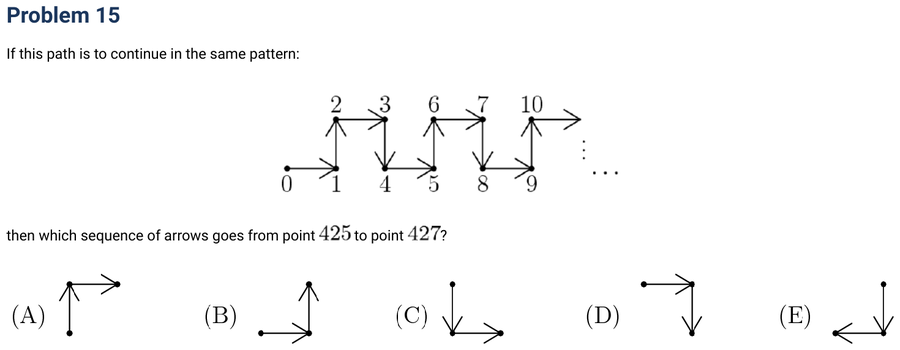
The arrows don't go on forever in new directions — watch the picture and you'll see the same 4-arrow shape (right, up, right, down) repeat over and over. A repeating loop means you only care about where 425 falls inside the loop.
Still stuck? Show hint 2 →
Hint 2 of 2
Sort each starting point by its leftover after dividing by 4: numbers ending the same way in that 4-cycle leave the same way. So point 425 behaves like the 1-leftover points (0, 4, 8 →), and 426 like the 2-leftover points.
Show solution
Approach: use the period-4 repetition
Map the loop using the first numbers: leaving 0 you go RIGHT, leaving 1 UP, leaving 2 RIGHT, leaving 3 DOWN — then it resets (4 acts like 0, going right again). So the arrow out of a point depends only on its leftover when divided by 4.
425 = 4×10⁶ + 1, so it has leftover 1 → the UP arrow takes you to 426. 426 has leftover 2 → the RIGHT arrow takes you to 427.
Up then right is choice A.
Why this works for any huge number: in a pattern that repeats every k steps, dividing by k and keeping the leftover tells you the position in the cycle. You never simulate all 425 steps — you just locate where 425 lands in one loop.
What is the 1992nd letter in the sequence ABCDEDCBAABCDEDCBAABCDEDCBA… ?
Show answer
Answer: C — C.
Show hints
Hint 1 of 3
The pattern just repeats the same chunk over and over. Find where one chunk ends and the next begins — how many letters is one full chunk?
Still stuck? Show hint 2 →
Hint 2 of 3
For a repeating pattern, only the LEFTOVER after removing whole chunks matters: chop off complete blocks, and the position you land on inside the last block is your answer.
Still stuck? Show hint 3 →
Hint 3 of 3
Divide 1992 by the block length and look at the leftover, not the quotient — the leftover tells you how far into a fresh block you are.
Show solution
Approach: strip away whole blocks; the leftover position names the letter
The repeating chunk is ABCDEDCBA, which is 9 letters long. After that it starts over.
Take away as many whole 9-letter blocks as fit in 1992: 9 × 221 = 1989, leaving 1992 − 1989 = 3 letters into the next block.
The 3rd letter of ABCDEDCBA is C.
Why this transfers: every "which item is in spot n" pattern problem works this way — the answer depends only on the leftover after removing complete cycles, never on how many cycles there were. A leftover of 0 would mean the very last letter of a block.
Sanity check: spots 1, 2, 3 are A, B, C; since 1992 is 3 past a clean block boundary, it must match spot 3 = C.
How many whole numbers from 1 through 46 are divisible by either 3 or 5 or both?
Show answer
Answer: B — 21.
Show hints
Hint 1 of 3
The word "or both" is the warning. If you just add (multiples of 3) + (multiples of 5), the numbers that are multiples of BOTH get counted twice. Which numbers are those?
Still stuck? Show hint 2 →
Hint 2 of 3
Count multiples of 3 and multiples of 5 separately, then subtract the ones counted twice — the multiples of 3 AND 5, i.e. multiples of 15. (Add, add, subtract the overlap.)
Still stuck? Show hint 3 →
Hint 3 of 3
How many multiples of 3 up to 46? Of 5? Of 15? Each count is just 46 divided by that number, rounded down.
Show solution
Approach: inclusion-exclusion — add the two groups, then subtract the double-counted overlap
Counting multiples of 3 and of 5 separately double-counts any number that's a multiple of both. A number divisible by both 3 and 5 is exactly a multiple of 15, so those are the ones to remove once.
Multiples of 3 up to 46: ⌊46 ÷ 3⌋ = 15. Of 5: ⌊46 ÷ 5⌋ = 9. Of 15: ⌊46 ÷ 15⌋ = 3.
Add the two groups and subtract the overlap once: 15 + 9 − 3 = 21.
Why this transfers: "how many do A or B" is always |A| + |B| − |both|. The subtraction fixes the overcount — and "multiple of a and b" means multiple of their least common multiple (here LCM(3,5) = 15, since 3 and 5 share no factors).
How many zeros are at the end of the product 25 × 25 × 25 × 25 × 25 × 25 × 25 × 8 × 8 × 8?
Show answer
Answer: C — 9.
Show hints
Hint 1 of 3
A trailing zero means the number is divisible by 10, and 10 = 2 × 5. So every trailing zero needs ONE 2 paired with ONE 5. Don't multiply this monster out — break each factor into 2's and 5's and count.
Still stuck? Show hint 2 →
Hint 2 of 3
Each zero eats one 2 and one 5, so the number of zeros is however many COMPLETE 2-and-5 pairs you can form. Count all the 2's and all the 5's; the smaller pile is your answer.
Still stuck? Show hint 3 →
Hint 3 of 3
Rewrite the pieces as powers: 25 = 5², so 25⁷ = 5¹⁴; and 8 = 2³, so 8³ = 2⁹. Now just compare the two exponents.
Show solution
Approach: every trailing zero is one factor of 2 paired with one factor of 5
A trailing zero comes from a factor of 10 = 2 × 5, so each zero uses up exactly one 2 and one 5. The number of zeros is the number of complete (2, 5) pairs you can build — which is the smaller of (total 2's) and (total 5's).
Break the product into prime pieces: 25 = 5², so seven 25's give 5¹⁴ (fourteen 5's); 8 = 2³, so three 8's give 2⁹ (nine 2's).
Fourteen 5's but only nine 2's, so you can form just nine pairs. Trailing zeros = 9.
Why this transfers: trailing zeros are always limited by the scarcer of factor-2 vs factor-5. In counting zeros of a factorial like 100!, 2's are plentiful, so you just count the 5's — the same min-of-the-two-piles idea.
When placing each of the digits 2, 4, 5, 6, 9 in exactly one of the boxes of this subtraction problem, what is the smallest difference that is possible?
−
Show answer
Answer: C — 149.
Show hints
Hint 1 of 3
To make a difference small, push the top number down and the bottom number up — but not all digit slots matter equally. Which single slot moves the answer the most?
Still stuck? Show hint 2 →
Hint 2 of 3
Place digits where they have the most leverage first: the hundreds place of the top number, then the tens place of the bottom number, then fill in the rest.
Still stuck? Show hint 3 →
Hint 3 of 3
The top must be 3 digits, so its hundreds digit can't be helped much — make it the smallest, 2. Then give the bottom number the biggest tens digit you can, 9.
Show solution
Approach: place the high-leverage digits first
A digit in the hundreds column is worth 100, in the tens column 10 — so the slots that swing the difference most are the top number's hundreds and the bottom number's tens. Lock those down first: top hundreds = smallest = 2; bottom tens = largest = 9.
Now fill the leftover digits {4, 5, 6} to keep the gap tight: top becomes 245 (smallest with leading 2) and bottom becomes 96 (largest with leading 9). Difference: 245 − 96 = 149.
Why this transfers: in build-the-number puzzles, assign digits to the highest place values first — that's where they count for the most. Greedily optimizing the biggest column, then the next, beats blindly trying combinations.
In how many ways can 47 be written as the sum of two primes?
Show answer
Answer: A — 0.
Show hints
Hint 1 of 3
47 is odd. Two numbers add to an odd total only when one is even and one is odd — so think about which of the two primes is the even one.
Still stuck? Show hint 2 →
Hint 2 of 3
Use parity to shrink the search: an odd sum forces one even prime, and there's only a single even prime in existence.
Still stuck? Show hint 3 →
Hint 3 of 3
The only even prime is 2, so the partner is forced to be 47 − 2 = 45. Now just check: is 45 prime?
Show solution
Approach: parity forces one prime to be 2
Two numbers add to an odd total (47) only if one is even and the other odd. Among primes, the lone even one is 2 — every other prime is odd. So if 47 splits into two primes, one of them MUST be 2.
That forces the partner to be 47 − 2 = 45. But 45 = 5 × 9 is not prime, so no valid split exists: 0 ways.
Why this transfers: a parity check often collapses a search instantly. 'Odd = even + odd' plus 'the only even prime is 2' means an odd number is a sum of two primes only if (number − 2) is itself prime — one test, done. Try it on 13: 13 − 2 = 11 is prime, so 13 = 2 + 11 works.
You don't need the exact value — just find the two perfect squares that 164 sits between. Which squares do you know that bracket it?
Still stuck? Show hint 2 →
Hint 2 of 2
Run up the squares you know: …, 12² = 144, 13² = 169. 164 lands between those two, so its root lands between 12 and 13.
Show solution
Approach: trap 164 between consecutive perfect squares
Find the perfect squares just below and just above 164: 12² = 144 and 13² = 169. Since 144 < 164 < 169, taking square roots keeps the order: 12 < √164 < 13.
So √164 lies between 12 and 13.
Trap to avoid: choice 42 tempts anyone who thinks a square root makes a number bigger — it doesn't. √164 is far smaller than 164.
Why this transfers: to locate any square root, sandwich the number between two perfect squares you've memorized. Square roots preserve order, so the root lands between those two whole numbers.
◇ and △ are whole numbers and ◇ × △ = 36. The largest possible value of ◇ + △ is
Show answer
Answer: E — 37.
Show hints
Hint 1 of 2
With the product locked at 36, you only get to choose which factor pair to use. To make the sum as *big* as possible, do you want the two numbers close together or far apart?
Still stuck? Show hint 2 →
Hint 2 of 2
For a fixed product, the sum grows as the factors spread apart and shrinks as they bunch up. So go straight for the most lopsided pair.
Show solution
Approach: for a fixed product, spread the factors apart
The factor pairs of 36 are (1,36), (2,18), (3,12), (4,9), (6,6), with sums 37, 20, 15, 13, 12. The most spread-out pair, 1 and 36, gives the biggest sum.
1 + 36 = 37.
Why this transfers: when a product is fixed, balanced factors (like 6 × 6) give the *smallest* sum and the most lopsided factors (1 × 36) give the *largest*. Knowing which end you want lets you jump to the answer without testing every pair.
"If a whole number n is not prime, then the whole number n − 2 is not prime." A value of n which shows this statement to be false is
Show answer
Answer: A — 9.
Show hints
Hint 1 of 2
To break an 'if ... then ...' rule you need ONE case where the 'if' part is true but the 'then' part fails. What must n and n − 2 each be?
Still stuck? Show hint 2 →
Hint 2 of 2
You need n itself NOT prime (so the 'if' holds) yet n − 2 prime (so the 'then' fails). Scan the choices for a composite n whose n − 2 is prime.
Show solution
Approach: make the hypothesis true but the conclusion false
A counterexample needs the 'if' satisfied and the 'then' broken: n must be non-prime, while n − 2 must BE prime.
n = 9 fits perfectly: 9 = 3 × 3 is not prime, yet 9 − 2 = 7 is prime. The rule predicted 7 would be non-prime, so the rule is false. Answer 9.
Why this transfers: to disprove any 'if P then Q,' you only ever need a single example with P true and Q false — never a general argument. Choices like 13 (prime, so 'if' fails) can't be counterexamples at all.
Let o be an odd whole number and let n be any whole number. Which of the following statements about the whole number (o² + no) is always true?
Show answer
Answer: E — it is odd only if n is even.
Show hints
Hint 1 of 3
Don't grind through cases — both terms share a common factor of o. Pulling it out turns the whole thing into a *product* of two pieces, and a product's odd/even-ness is easy to read off.
Still stuck? Show hint 2 →
Hint 2 of 3
o² + no = o(o + n). A product of whole numbers is odd only when *both* parts are odd. The first part o is already odd, so everything hinges on whether o + n is odd or even.
Still stuck? Show hint 3 →
Hint 3 of 3
o + n is odd ⟺ you added an odd and an even. Since o is odd, that needs n even.
Show solution
Approach: factor out o, then read the parity of the product
Factor the shared o: o² + no = o(o + n). Now it's one odd number (o) times another number (o + n), and a product is odd only when both factors are odd — otherwise an even factor drags the whole thing even.
The first factor o is odd no matter what. So the product is odd exactly when o + n is also odd. Adding to the odd o, you get an odd total only by adding an *even* n (odd + even = odd; odd + odd = even).
Therefore the expression is odd only if n is even — answer E.
Sanity check with numbers: o = 3, n = 2 → 9 + 6 = 15 (odd, n even ✓); o = 3, n = 1 → 9 + 3 = 12 (even, n odd ✓). The 'odd happens only with even n' pattern holds.
Why factoring first helps: turning a sum into a product lets you judge odd/even instantly, since one even factor makes the product even — a tactic worth reaching for whenever a common factor is in sight.
In a certain year, January had exactly four Tuesdays and four Saturdays. On what day did January 1 fall that year?
Show answer
Answer: C — Wednesday.
Show hints
Hint 1 of 3
January has 31 days, and 31 = 4 weeks + 3 leftover days. That means SOME weekdays squeeze in a 5th time. Which ones? The first three days of the month — they're the extras.
Still stuck? Show hint 2 →
Hint 2 of 3
So exactly three weekdays appear 5 times (the day Jan 1 lands on, plus the next two), and the other four appear only 4 times. The problem wants Tuesday AND Saturday to be among the rare (4-time) ones.
Still stuck? Show hint 3 →
Hint 3 of 3
For both Tuesday and Saturday to appear only 4 times, neither can be in the 'first three days' trio. Test each possible starting day and see whose trio of three consecutive weekdays misses both Tue and Sat.
Show solution
Approach: find which start makes Tue and Sat both rare
31 days = 4 full weeks (28 days) + 3 extra days. Every weekday shows up 4 times for the 28, and the 3 extras — Jan 1, 2, 3's weekdays — get a 5th appearance. So three consecutive weekdays appear 5 times; the rest appear 4.
We need Tuesday and Saturday to both be 4-time days, i.e. NOT in that trio of three-in-a-row starting at Jan 1. List the trios: a Monday start gives Mon-Tue-Wed (hits Tue ✗); a Tuesday start hits Tue ✗; a Wednesday start gives Wed-Thu-Fri — misses both Tue and Sat ✓.
So January 1 fell on Wednesday.
Why this transfers: in any month, take the day count mod 7 to find how many 'extra' days there are; those extras (counting from the 1st) are exactly the weekdays that occur one more time than the others.
Sekou writes down the numbers 15, 16, 17, 18, 19. After he erases one of his numbers, the sum of the remaining four numbers is a multiple of 4. Which number did he erase?
Show answer
Answer: C — 17.
Show hints
Hint 1 of 2
You don't need the actual sums — only the leftover after dividing by 4 matters. What's each number's leftover?
Still stuck? Show hint 2 →
Hint 2 of 2
Find the leftover (remainder) of the total when divided by 4. The number you erase must carry away exactly that much leftover.
Show solution
Approach: track only the remainders (leftovers) mod 4
The full sum 15+16+17+18+19 = 85, and 85 = 84 + 1 leaves a leftover of 1 after dividing by 4. To make the remaining four a clean multiple of 4, you must erase exactly the leftover of 1.
Which number carries leftover 1? Checking: 16 leaves 0, 17 leaves 1, 18 leaves 2, 19 leaves 3, 15 leaves 3. Only 17 has leftover 1, so erase 17.
Why this transfers: for any divisibility question, work with remainders, not the big sums — a number's remainder is all that affects divisibility. Sanity check: 85 − 17 = 68 = 4 × 17. ✓
All of the marbles in Maria's collection are red, green, or blue. Maria has half as many red marbles as green marbles and twice as many blue marbles as green marbles. Which of the following could be the total number of marbles in Maria's collection?
Show answer
Answer: E — 28 marbles.
Show hints
Hint 1 of 2
The three colors lock together in fixed ratios, so the total can't be just any number. Name the smallest pile with a variable and the others follow — what does their sum have to be a multiple of?
Still stuck? Show hint 2 →
Hint 2 of 2
Technique: pick the color that makes the others whole. Red is smallest, so let r = red, green = 2r, blue = 4r. Total 7r must be a multiple of 7.
Show solution
Approach: fix the ratios into one variable, find the hidden multiple
Choose the variable to dodge fractions. "Half as many red as green" makes green double the red, so let r = red (the smallest). Then green = 2r, and blue = twice green = 4r.
Total = r + 2r + 4r = 7r — whatever r is, the total is a multiple of 7.
Only 28 = 7 × 4 among the choices is a multiple of 7. This transfers: when quantities are tied by ratios, the total is always a fixed multiple, so the answer must be divisible by the sum of the ratio parts (here 1 + 2 + 4 = 7) — you can often skip straight to that divisibility test.
The 5-digit number 2018U is divisible by 9. What is the remainder when this number is divided by 8?
Show answer
Answer: B — Remainder 3.
Show hints
Hint 1 of 2
The mystery digit isn't really free. The divisible-by-9 rule keys off the digit sum, and a single missing digit can only nudge that sum into one nearby multiple of 9 — so U is pinned down before you do anything else.
Still stuck? Show hint 2 →
Hint 2 of 2
The technique: use a divisibility rule to solve for the unknown digit first, then treat the now-known number as a plain division problem.
Show solution
Approach: use the divisibility-by-9 rule
Add the known digits: 2 + 0 + 1 + 8 = 11. The full sum 11 + U must be a multiple of 9, and since U is a single digit (0–9) the only reachable multiple is 18, forcing U = 7.
Now the number is 20187. Divide by 8: 2523 × 8 = 20184, leaving a remainder of 3.
You'll see it again: "unknown digit makes it divisible by 9 (or 3)" problems always start with the digit-sum rule — it converts an unknown digit into a forced one.
Another way — remainder mod 8 uses only the last three digits:
A divisibility shortcut for 8: a number's remainder when divided by 8 depends only on its last three digits, because 1000 is a multiple of 8.
So instead of dividing 20187, just look at 187: 187 = 23×8 + 3, giving remainder 3 — the same answer with much smaller arithmetic.
Let Z be a 6-digit positive integer, such as 247247, whose first three digits are the same as its last three digits taken in the same order. Which of the following numbers must also be a factor of Z?
Show answer
Answer: A — 11.
Show hints
Hint 1 of 2
The block of 3 digits repeats. Ask what number you multiply abc by to shove it 3 places left and then add it back — that single multiplier carries every factor that must divide Z.
Still stuck? Show hint 2 →
Hint 2 of 2
Repeating a digit block is always multiplication by a repunit-like constant: abcabc = abc × 1001. Factor that constant to read off the guaranteed divisors.
Show solution
Approach: factor the repeat multiplier
Repeating abc means: abc shifted up 3 digits (×1000) plus abc itself, so Z = abc × 1000 + abc = abc · 1001. That 1001 is the whole problem — it divides Z no matter what abc is.
Factor it: 1001 = 7 · 11 · 13. So 7, 11, and 13 are all guaranteed factors — from the choices, 11 works.
Worth memorizing: 1001 = 7·11·13, and likewise 11 = 11, 101 prime, 1111 = 11·101. Repeated-block numbers are a classic AMC divisibility setup — the answer is always inside the repeat constant.
Another way — test the example:
The problem hands you 247247. Check the choices: 247247 ÷ 11 = 22477 exactly, so 11 divides this case. Since 11 must work for the given example, it's the safe pick — and the abc·1001 argument confirms it holds for every such number.
Malcolm wants to visit Isabella after school today and knows the street where she lives but doesn't know her house number. She tells him, "My house number has two digits, and exactly three of the following four statements about it are true."
It is prime.
It is even.
It is divisible by 7.
One of its digits is 9.
This information allows Malcolm to determine Isabella's house number. What is its units digit?
Show answer
Answer: D — 8.
Show hints
Hint 1 of 2
"Exactly three true" means exactly one is false. Instead of testing numbers, hunt for two statements that fight each other — they can't both be true, so one of them must be the lone false one.
Still stuck? Show hint 2 →
Hint 2 of 2
A 2-digit number can't be both even and prime (the only even prime is 2). So statement (1) "prime" and (2) "even" clash; the false one must be (1), forcing (2), (3), (4) true.
Show solution
Approach: spot the clashing pair, then build the number
Exactly one statement is false. The pair (1) prime and (2) even can never both hold for a 2-digit number (2 is the only even prime). So the false statement is (1) — that's the deduction that cracks it — and (2), (3), (4) are all true.
True facts: even AND divisible by 7 means divisible by 14. Two-digit multiples of 14: 14, 28, 42, 56, 70, 84, 98. Only 98 also has a 9 as a digit.
Its units digit is 8.
Why this transfers: in "exactly k of these are true" puzzles, look for a forced contradiction first — pinning the false statement collapses the search far faster than checking candidates one by one.
All of Marcy's marbles are blue, red, green, or yellow. One third of her marbles are blue, one fourth of them are red, and six of them are green. What is the smallest number of yellow marbles that Marcy could have?
Show answer
Answer: D — 4 yellow marbles.
Show hints
Hint 1 of 2
You can't have a third of a marble. Since 1/3 and 1/4 of the total are both whole counts, the total is locked to multiples of 12 — you only ever test 12, 24, 36, …
Still stuck? Show hint 2 →
Hint 2 of 2
Try the smallest legal total first. If blue + red + green already exceeds it, that total is impossible and you bump up to the next multiple of 12.
Show solution
Approach: total must be a multiple of lcm(3, 4) = 12
Blue is 1/3 and red is 1/4 of the total, and counts are whole numbers, so the total must be divisible by both 3 and 4 — i.e. a multiple of 12. That restriction is the whole problem.
Try 12: blue = 4, red = 3, plus 6 green = 13 marbles — already more than 12. Impossible, so jump up.
Try 24: blue = 8, red = 6, green = 6, leaving yellow = 24 − 8 − 6 − 6 = 4. This works and is the smallest valid total.
Why smallest total = smallest yellow here: once green (6) is fixed, a larger total only adds more blue+red+yellow, so the first total that fits gives the fewest yellow.
Which of the following numbers is not a perfect square?
Show answer
Answer: B — 2^2017.
Show hints
Hint 1 of 3
A perfect square is something split into two identical halves. A power like 32018 is a perfect square exactly when you can break it into two equal piles — so what does that say about its exponent?
Still stuck? Show hint 2 →
Hint 2 of 3
Two tests catch every square here: (1) an EVEN exponent on any base means you can halve it, e.g. 32018 = (31009)2; (2) a base that's already a perfect square (like 4 = 22) stays a square no matter the exponent. Hunt for the ONE choice that passes neither.
Still stuck? Show hint 3 →
Hint 3 of 3
Watch the trap: 4 is not prime — rewrite it as 22 before judging its exponent, or you'll mis-count.
Show solution
Approach: rewrite each as a single prime power and check if the exponent is even
Reduce each base to a prime: 12016 = 1 = a square trivially; 32018 and 52020 have EVEN exponents on a prime, so they split into equal halves — squares.
42019 = (22)2019 = 24038, an even exponent — also a square.
22017 is a prime with an ODD exponent (2017): you can't split it into two equal prime-power piles, so it's NOT a perfect square.
Why this transfers: a number is a perfect square exactly when EVERY prime in its factorization has an even exponent — reduce to primes first, then the parity of each exponent settles it.
What is the sum of the distinct prime integer divisors of 2016?
Show answer
Answer: B — 12.
Show hints
Hint 1 of 2
The word that matters is DISTINCT — you only care WHICH primes appear, not how many times. So you don't need the full exponents, just the list of different prime factors.
Still stuck? Show hint 2 →
Hint 2 of 2
Peel small primes off 2016 one at a time: it's even (keep halving), then the digits sum to a multiple of 3, and what's left will reveal the rest. Each new prime you meet goes on your list once.
Show solution
Approach: strip out each prime once; only the distinct ones count
Halve repeatedly: 2016 → 1008 → 504 → 252 → 126 → 63, pulling out 2 (five times). The prime 2 is now on the list.
63 = 9 × 7 = 32 · 7, adding the primes 3 and 7. So 2016 = 25 · 32 · 7.
Distinct primes are 2, 3, 7 (ignore the exponents — "distinct" means count each prime once). Sum = 2 + 3 + 7 = 12.
Watch the trap: answer E = 63 is what you'd get by adding leftover factors, and 49 = 7² baits you into squaring — the question wants the PRIMES themselves, added once each.
Which of the following integers cannot be written as the sum of four consecutive odd integers?
Show answer
Answer: D — 100.
Show hints
Hint 1 of 2
Don't test each answer by hunting for four odds — first ask what every such sum has in common. Add a general block of four consecutive odd integers and a hidden divisibility rule pops out.
Still stuck? Show hint 2 →
Hint 2 of 2
Writing them as n, n+2, n+4, n+6, the sum is 4n + 12 = 4(n + 3). Since n is odd, n+3 is even, so there's a second factor of 2 — the sum is always a multiple of 8. Now just find the choice that isn't.
Show solution
Approach: find the hidden invariant: the sum is always a multiple of 8
Let the four be n, n+2, n+4, n+6. Sum = 4n + 12 = 4(n + 3).
n is odd, so n + 3 is even — that even factor donates another 2, making the sum divisible by 4 × 2 = 8. So every valid sum is a multiple of 8.
Scan the choices for the odd one out: 16, 40, 72, 200 are all multiples of 8, but 100 = 8·12 + 4 is not.
Only 100 can't be made.
Why this transfers: on 'which one can't be written as …' problems, derive the form's invariant (here, divisibility) and let it disqualify the choices — far faster than constructing examples.
If n and m are integers and n2 + m2 is even, which of the following is impossible?
Show answer
Answer: D — n + m cannot be odd.
Show hints
Hint 1 of 2
Squaring never changes even/odd: an even number stays even when squared, an odd stays odd. So n2+m2 behaves exactly like n+m for parity — the exponents are a red herring.
Still stuck? Show hint 2 →
Hint 2 of 2
An even sum forces n and m to share parity. Now check which listed statement that rules out.
Show solution
Approach: a square keeps the parity of its base
Squaring preserves parity, so n2+m2 even means n+m is even too ⇒ n and m have the same parity (both even or both odd).
Same parity always sums to an even number, so n + m can never be odd — that's the impossible choice.
Sanity check on the others: both even (2,2) works; both odd (1,1) works; an even sum is exactly what's forced. Only "sum is odd" is impossible.
Takeaway: for parity questions you can erase squares, products, and other parity-preserving steps and just track even/odd directly.
What is the ratio of the least common multiple of 180 and 594 to the greatest common factor of 180 and 594?
Show answer
Answer: C — 330.
Show hints
Hint 1 of 2
Don't compute the huge LCM and tiny GCD separately and then divide. Once both numbers are in prime-factored form, the ratio reads off prime by prime: for each prime, LCM takes the bigger exponent and GCD the smaller, so the ratio just keeps the difference.
Still stuck? Show hint 2 →
Hint 2 of 2
Prime factorization is the master key for LCM and GCD: GCD = product of min exponents, LCM = product of max exponents. Compare the two prime towers side by side.
Show solution
Approach: prime factor each number, then compare exponents
Factor: 180 = 22 · 32 · 5 and 594 = 2 · 33 · 11.
GCD takes the smaller power of each shared prime: 21 · 32 = 18.
LCM takes the larger power of every prime that appears: 22 · 33 · 5 · 11 = 4 · 27 · 55 = 5940.
Ratio: 5940 ÷ 18 = 330.
Another way — ratio straight from exponent gaps (no big numbers):
LCM/GCD keeps, for each prime, the gap between the two exponents: 2 has exponents 2 and 1 (gap 1), 3 has 2 and 3 (gap 1), and 5, 11 appear in only one number (full power).
So the ratio = 21 · 31 · 5 · 11 = 2 · 3 · 5 · 11 = 330 — no 5940 or 106,920 ever needed.
Another way — product identity LCM · GCD = a · b:
Use LCM(a,b) · GCD(a,b) = a · b, so LCM/GCD = ab/GCD2.
Number Theoryplace-value-differencedivisibility-by-9
When Clara totaled her scores, she inadvertently reversed the units digit and the tens digit of one score. By which of the following might her incorrect sum have differed from the correct one?
Show answer
Answer: A — 45.
Show hints
Hint 1 of 2
Swapping the tens and units digit only moves value between the "tens place" and "ones place." A digit worth 10 in one spot is worth 1 in the other — so each unit you shuffle changes the number by 9. The difference can only be a multiple of 9.
Still stuck? Show hint 2 →
Hint 2 of 2
Reversing two adjacent digits always changes a number by a multiple of 9 (it's a place-value gap of 10 − 1). So scan the choices for the one divisible by 9 — no equation needed.
Show solution
Approach: digit swap forces a multiple-of-9 difference
Write the swapped two digits as 10a + b before and 10b + a after. The difference is (10a + b) − (10b + a) = 9(a − b) — a multiple of 9, no matter what the digits are.
So Clara's error in the sum must be divisible by 9.
Check the choices for divisibility by 9 (digit-sum trick): only 45 has digit sum 9. So the answer is 45 = 9 × 5.
You'll see this again: any "reversed digits" puzzle hinges on this multiple-of-9 fact — it's the same reason the digit-sum test for 9 works.
You'll never compute 132012 — and you don't have to. When you multiply, only the units digit of each factor affects the units digit of the answer, so 132012 ends in the same digit as 32012.
Still stuck? Show hint 2 →
Hint 2 of 2
Now list a few powers of 3 and watch the last digit: 3, 9, 7, 1, then 3 again. It cycles with period 4 — so the answer depends only on where 2012 lands in that cycle of 4.
Show solution
Approach: units digits repeat in a short cycle — find the position
The units digit of a product depends only on the units digits being multiplied, so 132012 ends in the same digit as 32012. The big base is irrelevant.
List the last digits of powers of 3: 31→3, 32→9, 33→7, 34→1, 35→3… They loop every 4 powers: (3, 9, 7, 1).
So divide the exponent by 4 and look at the leftover: 2012 = 4 × 503 with leftover 0, meaning we land exactly on the end of a cycle — the 4th spot, which is 1.
This transfers to every units-digit problem: last digits always cycle (period 1, 2, or 4 for single digits); find the cycle length, then reduce the exponent by that length. A leftover of 0 lands on the last entry, not the first.
Jamar bought some pencils costing more than a penny each at the school bookstore and paid $1.43. Sharona bought some of the same pencils and paid $1.87. How many more pencils did Sharona buy than Jamar?
Show answer
Answer: C — 4 more pencils.
Show hints
Hint 1 of 2
Switch to whole cents (143 and 187) so you're working with integers. A whole number of pencils at a whole-cent price means that price divides each total exactly — so the price is a common factor of 143 and 187.
Still stuck? Show hint 2 →
Hint 2 of 2
This is a shared divisor hunt: the price divides both amounts, so it divides their gcd. Factor each amount and the price has to fall out (the "more than a penny" rules out the trivial 1¢).
Show solution
Approach: the price is a common factor of both totals
Some whole number of pencils times the (whole-cent) price gives 143¢, and likewise 187¢. So the price divides both 143 and 187 — it's a common factor.
Factor them: 143 = 11 × 13 and 187 = 11 × 17. Their only shared factor above 1 is 11, and "more than a penny" forbids 1¢, so each pencil costs 11¢.
The clean finish: Sharona paid 187 − 143 = 44¢ more, which is 44 / 11 = 4 extra pencils — no need to find each kid's count.
The transferable idea: "same whole-number price buys both totals" means the price is a common divisor; factoring or gcd pins it down. Subtracting the totals before dividing skips the individual counts.
The smallest number greater than 2 that leaves a remainder of 2 when divided by 3, 4, 5, or 6 lies between what numbers?
Show answer
Answer: D — Between 61 and 65.
Show hints
Hint 1 of 2
"Leaves 2 left over" every time is the clue: if you remove those 2 leftover, the number divides evenly by 3, 4, 5, and 6. So x − 2 is a common multiple of all four.
Still stuck? Show hint 2 →
Hint 2 of 2
This is the subtract-the-leftover shift: turn "remainder 2" into "exact multiple", then the number you need is the LCM of 3, 4, 5, 6. (Notice 3 and 6 are covered once you handle 4 and... well, 6 needs both 2 and 3.)
Show solution
Approach: shift off the leftover, then use the LCM
Strip away the 2 leftover: x − 2 must divide evenly by 3, 4, 5, and 6 at once — so it's a common multiple of all four.
The smallest common multiple is LCM(3, 4, 5, 6). Build it from prime needs: 4 = 2², 5, and a 3 (which also covers 6) ⇒ LCM = 2² × 3 × 5 = 60.
So the smallest x − 2 above 0 is 60, giving x = 62 — which lands between 61 and 65.
The reusable move: "same remainder r for several divisors" ⇒ subtract r, find the LCM, add r back. Don't list multiples one by one.
What is the smallest positive integer that is neither prime nor square and that has no prime factor less than 50?
Show answer
Answer: A — 3127.
Show hints
Hint 1 of 2
Don't search numbers — decode the three conditions into a recipe for what the number must be built from. Translate each phrase: "not prime", "no prime factor < 50", "not a square."
Still stuck? Show hint 2 →
Hint 2 of 2
"Not prime" + "every prime factor ≥ 50" ⇒ it's a product of at least two primes, all ≥ 50. "Not a square" ⇒ those primes must be different. So: smallest two different primes above 50.
Show solution
Approach: translate each condition, then take the smallest legal build
Read the conditions as a blueprint. "Not prime" means it factors into ≥ 2 primes; "no prime factor below 50" means every one of those primes is ≥ 50; "not a square" means we can't repeat a prime (like p²). So the number = a product of distinct primes ≥ 50.
To make it smallest, use the two smallest primes above 50. Checking 51 = 3×17 (no), 52, 53 is prime; next prime is 59.
Smallest such product: 53 × 59 = 3127.
The skill: turn each word-condition into a structural fact about the prime factorization first — then "smallest" just means "use the smallest allowed ingredients."
Let w, x, y, and z be whole numbers. If 2w · 3x · 5y · 7z = 588, then what does 2w + 3x + 5y + 7z equal?
Show answer
Answer: A — 21.
Show hints
Hint 1 of 2
The bases 2, 3, 5, 7 are all prime, so a number's prime factorization tells you each exponent directly — just factor 588.
Still stuck? Show hint 2 →
Hint 2 of 2
Pull out the small primes one at a time (is it even? divisible by 3? by 7?) to find how many of each it contains.
Show solution
Approach: match prime powers — a prime factorization is unique, so the exponents are forced
Factor 588 by peeling off small primes: 588 = 2 · 294 = 2 · 2 · 147 = 4 · 3 · 49 = 22 · 31 · 72.
Match exponents on each prime: w = 2, x = 1, z = 2. There's no factor of 5, so y = 0 (and 50 = 1 contributes nothing — the easy slip is to forget this term).
2w + 3x + 5y + 7z = 4 + 3 + 0 + 14 = 21.
Why this works: every whole number has exactly one prime factorization, so once both sides are written as products of primes, the exponents must match up one-for-one.
In how many ways can 10001 be written as the sum of two primes?
Show answer
Answer: A — 0 ways.
Show hints
Hint 1 of 2
The target 10001 is odd, and odd = even + odd. Two odd primes always sum to an even number, so to hit an odd total one prime must be even — and the only even prime is 2. That leaves just one candidate pair to check.
Still stuck? Show hint 2 →
Hint 2 of 2
So everything hinges on a single question: is 10001 − 2 = 9999 prime?
Show solution
Approach: parity forces one prime to be 2, leaving one pair to test
10001 is odd. A sum is odd only when one part is even and one is odd, so one of the two primes must be even — the only even prime is 2.
That fixes the other prime as 10001 − 2 = 9999. Check it: its digits 9+9+9+9 = 36 is divisible by 3, so 9999 = 3·3333 is not prime.
The one possible pair fails, so there are 0 ways.
Worth keeping: writing an odd number as prime + prime is only possible if 2 is one of them — parity collapses the whole search to a single primality check.
The Amaco Middle School bookstore sells pencils costing a whole number of cents. Some seventh graders each bought a pencil, paying a total of $1.43. Some of the 30 sixth graders each bought a pencil, and they paid a total of $1.95. How many more sixth graders than seventh graders bought a pencil?
Show answer
Answer: D — 4 more.
Show hints
Hint 1 of 2
The number of buyers in each grade must be a WHOLE number = (total paid) ÷ (one price). So the single pencil price has to divide BOTH totals evenly. Work in cents: 143 and 195.
Still stuck? Show hint 2 →
Hint 2 of 2
A number dividing both 143 and 195 is a common divisor — factor each and look for what they share.
Show solution
Approach: the price is a common divisor of both totals
Switch to cents so everything's whole: $1.43 = 143¢, $1.95 = 195¢. The price p must divide both (buyers = total ÷ p has to come out whole).
Factor: 143 = 11 × 13 and 195 = 3 × 5 × 13. Their only shared factors are 1 and 13.
Rule out p = 1¢: at 1¢ each, 195 sixth graders would have bought — but there are only 30. So p = 13¢.
Why this transfers: "equal items, total cost, unknown unit price" means the price divides every total — reach for common divisors (gcd), then use side conditions (like "at most 30 kids") to pick the right one.
In Theresa's first 8 basketball games, she scored 7, 4, 3, 6, 8, 3, 1 and 5 points. In her ninth game, she scored fewer than 10 points and her points-per-game average for the nine games was an integer. Similarly in her tenth game, she scored fewer than 10 points and her points-per-game average for the 10 games was also an integer. What is the product of the number of points she scored in the ninth and tenth games?
Show answer
Answer: B — 40.
Show hints
Hint 1 of 2
"Average is a whole number" is a divisibility clue in disguise: the running total must be a multiple of the number of games.
Still stuck? Show hint 2 →
Hint 2 of 2
Each new score is under 10, so the total can only land in a tiny window — usually just one multiple fits, pinning the score exactly.
Show solution
Approach: turn "integer average" into "total is a multiple"
First 8 scores sum to 37. Adding game 9 (1–9 points) lands the 9-game total between 38 and 46, and it must be a multiple of 9. Only 45 fits — so game 9 = 45 − 37 = 8.
Adding game 10 (under 10) lands the 10-game total between 46 and 54, and it must be a multiple of 10. Only 50 fits — so game 10 = 50 − 45 = 5.
Product: 8 · 5 = 40.
Why this transfers: "the average is an integer" always means "the sum is divisible by the count" — pair that with a bounded range and the value is usually forced.
For how many positive integer values of n are both n3 and 3n three-digit whole numbers?
Show answer
Answer: A — 12.
Show hints
Hint 1 of 2
For n/3 to even be a whole number, n must be a multiple of 3 — so write n = 3x and both conditions become conditions on x.
Still stuck? Show hint 2 →
Hint 2 of 2
Two range conditions overlap; you only need the tighter (binding) one on each end, then count the integers in the survivor range.
Show solution
Approach: substitute n = 3x, then find the binding range
Since n/3 must be a whole number, let n = 3x. Then n/3 = x and 3n = 9x, so we need both x and 9x to be three-digit: 100 ≤ x ≤ 999 and 100 ≤ 9x ≤ 999.
The big number 9x is the squeeze: 9x ≤ 999 forces x ≤ 111, far tighter than x ≤ 999. The lower end is just x ≥ 100.
So x runs 100, 101, …, 111 — that's 111 − 100 + 1 = 12 values.
Why this transfers: when several inequalities pin a variable, keep only the strictest on each side; and counting integers from a to b inclusive is b − a + 1 (don't forget the +1).
The product of the two 99-digit numbers 303,030,303,…,030,303 and 505,050,505,…,050,505 has thousands digit A and units digit B. What is the sum of A and B?
Show answer
Answer: D — 8.
Show hints
Hint 1 of 2
Those 99-digit monsters are a scare tactic — the last few digits of a product depend only on the last few digits of the factors. Lop off everything but the tails.
Still stuck? Show hint 2 →
Hint 2 of 2
Work mod a power of 10: to get the last 4 digits of a product, multiply the last 4 digits of each number; the front digits can't reach back that far.
Show solution
Approach: keep only the tails of each factor
We need the last 4 digits, so keep just the last 4 of each number: 0303 and 0505. Everything to the left lands far past the thousands place.
Multiply the short versions: 303 · 505 = 153015.
Read off the last four digits, 3015: thousands digit A = 3, units digit B = 5.
A + B = 3 + 5 = 8.
Why this is safe: any digit of the product is built only from digit-pairs at or below its place value, so chopping the high digits leaves the last 4 untouched — the standard 'last digits' shortcut.
How many two-digit numbers have digits whose sum is a perfect square?
Show answer
Answer: C — 17.
Show hints
Hint 1 of 2
Flip the question: instead of testing all 90 two-digit numbers, first ask which digit SUMS are even allowed. The smallest sum is 1 (from 10) and the largest is 18 (from 99), so only the perfect squares 1, 4, 9, 16 can occur.
Still stuck? Show hint 2 →
Hint 2 of 2
Now handle each target sum separately. The tens digit must be 1–9 (no leading zero), but the units digit may be 0–9 — that asymmetry is what makes the counts uneven, so watch the edges.
Show solution
Approach: first pin down the possible digit sums, then count each case
A two-digit number's digit sum runs from 1 (for 10) up to 18 (for 99). The perfect squares in that window are 1, 4, 9, and 16 — only four cases to check.
Sum = 16: 79, 88, 97 ⇒ 3 numbers (only these fit, since each digit caps at 9 — big sums leave very few splits).
Total: 1 + 4 + 9 + 3 = 17.
Why the counts shrink at the top: for sum 16 the digits are nearly maxed out (each at most 9), so few splits fit; for middling sums like 9 there's lots of freedom. Narrowing to the four legal sums first is what keeps this from being a 90-number slog.
A box contains gold coins. If the coins are equally divided among six people, four coins are left over. If the coins are equally divided among five people, three coins are left over. If the box holds the smallest number of coins that meets these two conditions, how many coins are left when equally divided among seven people?
Show answer
Answer: A — 0.
Show hints
Hint 1 of 2
Two leftover conditions at once is hard to handle directly. List the numbers satisfying the rarer condition (leftover 4 from groups of 6), then just scan that short list for the other condition.
Still stuck? Show hint 2 →
Hint 2 of 2
"Leftover 4 when split into 6s" is the same as starting at 4 and stepping by 6. Walk that list and stop at the first number that also leaves 3 when split into 5s — the smallest match is your answer.
Show solution
Approach: list one condition, scan for the other
Numbers leaving 4 when divided by 6: 4, 10, 16, 22, 28, … (start at 4, add 6 each time).
Check each against "leftover 3 when divided by 5": 4→4, 10→0, 16→1, 22→2, 28→3 ✓. The first that works is 28.
Now 28 ÷ 7 = 4 with remainder 0 — it splits evenly among seven people.
Shortcut to notice: "leftover 4 out of 6" means 2 short of a full group, and "leftover 3 out of 5" also means 2 short of a full group. Being exactly 2 short of both 6 and 5 means 2 short of their LCM, 30 — so the number is 30 − 2 = 28 instantly, no listing needed. Spotting a common shortfall turns two conditions into one.
Another way — common shortfall → LCM:
Leftover 4 of 6 is the same as being 2 below a multiple of 6; leftover 3 of 5 is being 2 below a multiple of 5.
So the count is 2 below a common multiple of both: 2 below lcm(6,5) = 30, giving 28. Then 28 splits evenly by 7, remainder 0.
A whole number larger than 2 leaves a remainder of 2 when divided by each of the numbers 3, 4, 5, and 6. The smallest such number lies between which two numbers?
Show answer
Answer: B — Between 60 and 79.
Show hints
Hint 1 of 2
A remainder of 2 every time is suspicious — it means if you set aside that constant 2, the leftover divides evenly by all four numbers. So look at x − 2 instead of x.
Still stuck? Show hint 2 →
Hint 2 of 2
The move is shift away the common remainder: x − 2 must be a common multiple of 3, 4, 5, 6, so the smallest is their LCM. (And note 6 = 2×3 is already covered by 4 and 3, so really LCM(3,4,5).)
Show solution
Approach: subtract the remainder, then LCM
Same remainder 2 for all divisors means x − 2 is divisible by 3, 4, 5, and 6 at once — so x − 2 is a common multiple.
The smallest positive common multiple is LCM(3, 4, 5, 6) = 60 (the 4 supplies 2×2, the 3 and 5 the rest; 6 adds nothing new).
So the smallest x − 2 = 60, giving x = 62, which lies between 60 and 79.
This 'remove the remainder' trick turns any 'leaves remainder r for several divisors' question into a clean LCM problem — a staple of number-theory contests.
The clue 'three-digit power' is doing the heavy lifting — there are only a handful of those, so list them instead of computing. The two answers must agree at the square where they cross.
Still stuck? Show hint 2 →
Hint 2 of 2
Powers of 5 grow fast: only 125 and 625 have three digits. Powers of 2: only 128, 256, 512. The crossing cell must be a digit that appears in BOTH an answer of one list and an answer of the other.
Show solution
Approach: list the few candidates, then match at the shared cell
Three-digit powers of 5 are just 125 and 625 — both have 2 as their *middle* digit. So the down-answer's middle cell (which is the across-answer's *first* cell) is a 2.
Three-digit powers of 2 are 128, 256, 512. The only one starting with 2 is 256, so the across answer is 256.
The outlined square is the last cell of that across answer: its units digit, 6.
The lesson: 'how many such numbers exist' is often tiny — exponential values thin out fast, so enumerate them rather than search blindly, then let the overlap pin down the rest.
The number 64 has the property that it is divisible by its units digit. How many whole numbers between 10 and 50 have this property?
Show answer
Answer: C — 17.
Show hints
Hint 1 of 2
The units digit is what you're dividing BY, so sort the numbers by units digit — each digit becomes its own little test. And some digits are free: ending in 1, 2, or 5 *guarantees* divisibility.
Still stuck? Show hint 2 →
Hint 2 of 2
Why are 1, 2, 5 free? Any number is divisible by 1; any even number (ends in 2) is divisible by 2; any number ending in 5 is divisible by 5. For the remaining digits, you only have a few numbers each to check by hand.
Show solution
Approach: casework on the units digit, banking the 'free' ones first
Free digits: ending in 1, 2, or 5 always divides (rules for 1, 2, 5). In 10–50 each of those digits gives 4 numbers ⇒ 12 winners so far.
Now hand-check the rest. Digit 3: only 33 works (33÷3=11). Digit 4: 24 and 44 work. Digit 6: only 36 works. Digit 8: only 48 works. Digits 0 (can't divide by 0), 7, and 9 give nothing.
Total = 12 + 1 + 2 + 1 + 1 = 17.
Organizing principle: when a property depends on the last digit, splitting into 10 digit-cases turns one big hunt into ten tiny ones — and spotting which cases are automatically true (1, 2, 5) cuts most of the work.
There are many two-digit multiples of 7, but only two of them have a digit sum of 10. The sum of these two multiples of 7 is
Show answer
Answer: A — 119.
Show hints
Hint 1 of 2
You have two conditions — 'multiple of 7' AND 'digits add to 10.' Pick whichever list is SHORTER to write out, then filter it by the other.
Still stuck? Show hint 2 →
Hint 2 of 2
When two conditions must both hold, generate the smaller set first and test it against the second condition.
Show solution
Approach: list the shorter set, filter by the other condition
There are about thirteen two-digit multiples of 7, so walk through 14, 21, 28, … and keep only those whose digits sum to 10: that gives 28 (2+8) and 91 (9+1).
Their sum is 28 + 91 = 119.
Another way — start from the digit-sum list instead:
Two-digit numbers with digit sum 10 are quick to list: 19, 28, 37, 46, 55, 64, 73, 82, 91.
Test each for divisibility by 7 — only 28 = 7×4 and 91 = 7×13 survive, so the sum is 28 + 91 = 119.
Lesson: either list works; choosing the shorter condition to enumerate first saves time.
Logic & Word ProblemsNumber Theorywork-backwardpattern-recognition
Two players take turns removing \(1\), \(2\), \(3\), or \(4\) counters from a pile that starts with \(27\) counters. The player who takes the very last counter wins. Should you go first or second, and what is your winning plan? (Give the number of counters to take on your first move.)
Show answer
Answer: Go first and take 2 (leaving 25)
Show hints
Hint 1 of 4
There are lots of ways to start, but only one way to finish (grab the last few counters). When the END is clearer than the start, work backward from the end.
Still stuck? Show hint 2 →
Hint 2 of 4
Ask: how many counters can I leave for my opponent so that no matter what they take (\(1\), \(2\), \(3\), or \(4\)), I can take the rest and grab the last one?
Still stuck? Show hint 3 →
Hint 3 of 4
If you leave exactly \(5\), you win: whatever they take, you take the rest of those \(5\). Now work back one more step. To be able to leave \(5\) next time, what should you leave now?
Show solution
Approach: Working backward from the finish to find the safe positions
To win you want to take the last counter, so after your final move there are \(0\) left. Work backward from there.
The magic numbers to leave for your opponent are the multiples of \(5\). Leaving \(5\) works: if they take \(k\) (one of \(1, 2, 3, 4\)), you take the remaining \(5 - k\) and grab the last counter.
So every turn you hand them a multiple of \(5\): \(25, 20, 15, 10, 5, 0\). Whatever they remove, you remove enough to land on the next multiple of \(5\).
Since \(27 = 25 + 2\), you go FIRST and take \(2\), leaving \(25\). After that always leave a multiple of \(5\); your last move leaves \(0\), so you took the last counter and win.
Number TheoryFractions, Decimals & Percentsbound-a-variablefind-factor-pairs
Find every pair of different positive whole numbers \(a\) and \(b\) (with \(a>b\)) so that \(\dfrac{1}{a}+\dfrac{1}{b}=\dfrac{1}{9}\).
Show answer
Answer: (a,b)=(90,10) and (36,12)
Show hints
Hint 1 of 4
Think about sizes first. If \(b\) were \(9\) or smaller, then \(\tfrac1b\) would already be \(\tfrac19\) or bigger, leaving nothing for \(\tfrac1a\). So both \(a\) and \(b\) must be bigger than \(9\).
Still stuck? Show hint 2 →
Hint 2 of 4
Clear the fractions. Multiply everything by \(9ab\) to get \(9b+9a=ab\). Rearrange to \(ab-9a-9b=0\).
Still stuck? Show hint 3 →
Hint 3 of 4
Here is the classic trick: add \(81\) to both sides so the left side factors. You get \(ab-9a-9b+81=81\), which is \((a-9)(b-9)=81\).
Show solution
Approach: Add 81 and factor (Simon's Favorite Factoring), then search factor pairs
Both numbers must be bigger than 9: if \(b\le 9\) then \(\tfrac1b\ge\tfrac19\), which already uses up all of \(\tfrac19\), leaving nothing for \(\tfrac1a\). So \(a>b>9\).
Clear fractions by multiplying \(\tfrac1a+\tfrac1b=\tfrac19\) by \(9ab\): \(9b+9a=ab\), so \(ab-9a-9b=0\).
Add \(81\) to both sides so the left factors: \(ab-9a-9b+81=81\), i.e. \((a-9)(b-9)=81\).
List factor pairs of \(81\) with the bigger factor going to \(a\): \(a-9=81, b-9=1\Rightarrow a=90, b=10\); and \(a-9=27, b-9=3\Rightarrow a=36, b=12\). (The split \(9\times9\) gives \(a=b=18\), but we need \(a>b\), so skip it.)
Check: \(\tfrac{1}{90}+\tfrac{1}{10}=\tfrac{1}{90}+\tfrac{9}{90}=\tfrac{10}{90}=\tfrac19\), and \(\tfrac{1}{36}+\tfrac{1}{12}=\tfrac{1}{36}+\tfrac{3}{36}=\tfrac{4}{36}=\tfrac19\). So the pairs are \((a,b)=(90,10)\) and \((36,12)\).
A common mistake is to 'break a square root apart' over a plus sign: \(\sqrt{a+b}=\sqrt{a}+\sqrt{b}\). Test it with \(a = 9, b = 16\): compute \(\sqrt{9}+\sqrt{16}\). (Compare it to the true value \(\sqrt{9+16}\) to see the rule is false.)
Show answer
Answer: 7 (while the true value is 5, so the rule is false)
Show hints
Hint 1 of 4
A 'rule' that is supposed to always work can be destroyed by a single example where it fails. Pick easy perfect squares so you can compute both sides in your head.
Still stuck? Show hint 2 →
Hint 2 of 4
Work out the RIGHT side: \(\sqrt{9}+\sqrt{16}=3+4\).
Still stuck? Show hint 3 →
Hint 3 of 4
Now the LEFT side: \(9+16=25\), and \(\sqrt{25}=5\). Are they equal?
Show solution
Approach: Disprove a false rule with one numerical counterexample
Compute the right side of the supposed rule: \(\sqrt{9}+\sqrt{16}=3+4=7\).
Compute the true left side: \(\sqrt{9+16}=\sqrt{25}=5\).
Since \(7 \neq 5\), the rule \(\sqrt{a+b}=\sqrt{a}+\sqrt{b}\) is FALSE — one counterexample is enough to kill it.
Same idea checks a claim like \(\sqrt{36}=\sqrt{30}+\sqrt{6}\): \(\sqrt{30} > 5\) and \(\sqrt{6} > 2\), so the right side exceeds \(7\), far more than \(\sqrt{36}=6\). A square root never splits over a plus sign.
Logic & Word ProblemsNumber Theorywork-backwardpattern-recognition
Same game as before: take \(1\), \(2\), \(3\), or \(4\) counters from a pile of \(27\). But now the player who takes the LAST counter LOSES. What is your winning plan? (Give the number of counters to take on your first move.)
Show answer
Answer: Go first and take 1 (leaving 26)
Show hints
Hint 1 of 4
Now losing means being forced to take the final counter. So you want to hand your opponent exactly \(1\) counter at the very end — then they must take it and lose.
Still stuck? Show hint 2 →
Hint 2 of 4
Work backward from leaving \(1\). What is the next safe number to leave below that?
Still stuck? Show hint 3 →
Hint 3 of 4
Just like the last game used multiples of \(5\), this game uses numbers that are \(1\) more than a multiple of \(5\): \(1, 6, 11, 16, 21, 26\).
Show solution
Approach: Working backward to force the opponent to take the last counter
You win by forcing your opponent to take the last counter, so on your final turn you want to leave exactly \(1\).
Leaving \(1\) is safe (they must take it and lose). Working backward, the safe numbers to leave are one more than a multiple of \(5\): \(1, 6, 11, 16, 21, 26\).
From any of these, whatever your opponent takes (\(k\)), you take \(5 - k\) to get back to the next safe number.
Since \(27 = 26 + 1\), you go FIRST and take \(1\), leaving \(26\). Then always leave a number that is \(1\) more than a multiple of \(5\); your last move leaves \(1\), your opponent must take it, and they lose.
Logic & Word ProblemsCounting & ProbabilityNumber Theoryaccount-for-all-possibilitiesreduce-and-expandcounting-principle
How many \(2\)-digit whole numbers are there? Then generalize: how many \(n\)-digit whole numbers are there, where \(n\) is a whole number bigger than \(1\)? (Hint to start small: first try counting using only the digits \(0\) and \(1\), then using \(0,1,2,3\).)
Show answer
Answer: 90 two-digit numbers; in general 9 × 10^(n−1)
Show hints
Hint 1 of 4
There are two nice ways to do this. You can count a range of numbers, or you can count digit by digit using the multiplication (counting) principle.
Still stuck? Show hint 2 →
Hint 2 of 4
Range way: the smallest \(2\)-digit number is \(10\) and the biggest is \(99\). How many whole numbers are there from \(10\) to \(99\), counting both ends?
Still stuck? Show hint 3 →
Hint 3 of 4
Counting way: the first digit can't be \(0\) (or it wouldn't be a \(2\)-digit number), so how many choices does it have? The second digit can be anything \(0\) through \(9\). Multiply the two counts.
Show solution
Approach: Count a range, or use the multiplication counting principle
Way 1 (count a range): the whole numbers from \(a\) to \(b\) number \(b-a+1\). The 2-digit numbers go from 10 to 99, so there are \(99-10+1=90\).
Way 2 (counting principle): the first digit can be \(1,\dots,9\) (9 choices, no leading 0) and the second digit can be \(0,\dots,9\) (10 choices), giving \(9\times10=90\).
Generalizing to \(n\) digits: 9 choices for the leading digit and 10 for each of the other \(n-1\) digits, so \(9\times10^{\,n-1}\).
Check: \(n=2\) gives \(9\times10=90\); \(n=3\) gives \(9\times100=900\), matching the three-digit numbers from 100 to 999.
Two friends want to buy a horse, but neither has enough alone. The first says, 'If you gave me half of your money, I'd have exactly enough to buy the horse.' The second says, 'And if you gave me a third of your money, I'd have exactly enough to buy the horse.' Find the smallest whole-number amounts each friend could have, and the price of the horse. (Give the horse's price.)
Show answer
Answer: First has 3, second has 4, horse costs 5
Show hints
Hint 1 of 4
Turn the sentences into equations. Let \(A\) and \(B\) be the friends' money and \(H\) the horse's price. 'I plus half of yours' gives \(A + \tfrac{B}{2} = H\); the second gives \(B + \tfrac{A}{3} = H\).
Still stuck? Show hint 2 →
Hint 2 of 4
Multiply the first equation by 2 and the second by 3 to clear fractions: \(2A + B = 2H\) and \(A + 3B = 3H\).
Still stuck? Show hint 3 →
Hint 3 of 4
Substitute to compare \(A\) and \(B\).
Show solution
Approach: Set up two equations, clear fractions, solve the ratio
Let \(A\) = first friend's money, \(B\) = second's, \(H\) = horse price. Then \(A + \tfrac{1}{2}B = H\) and \(B + \tfrac{1}{3}A = H\).
Clear fractions: \(2A + B = 2H\) and \(A + 3B = 3H\). From the first, \(B = 2H - 2A\).
Substitute: \(A + 3(2H - 2A) = 3H \Rightarrow A + 6H - 6A = 3H \Rightarrow -5A = -3H \Rightarrow A = \tfrac{3}{5}H\), and \(B = 2H - \tfrac{6}{5}H = \tfrac{4}{5}H\). So \(A : B : H = 3 : 4 : 5\).
Smallest whole numbers: \(A = 3, B = 4, H = 5\). Check: \(3 + \tfrac12(4) = 5\) and \(4 + \tfrac13(3) = 5\). The horse costs 5.
Number TheoryArithmetic & Operationsbe-greedywork-in-another-base
In the Unlucky Lottery, every prize is a power of 13 dollars — that is \(1\), \(13\), \(169\), \(2{,}197\) dollars, and so on. The total prize money handed out is exactly \(1{,}000{,}000\) dollars. What is the smallest possible number of prizes?
Show answer
Answer: 16 prizes
Show hints
Hint 1 of 4
To use as few prizes as possible, hand out the biggest prizes you can first. List the powers of 13 that are below a million.
Still stuck? Show hint 2 →
Hint 2 of 4
The powers are \(1\), \(13\), \(169\), \(2{,}197\), \(28{,}561\), and \(371{,}293\) dollars. Start by taking as many \(371{,}293\) prizes as fit, then move down to the next size.
Still stuck? Show hint 3 →
Hint 3 of 4
Keep subtracting and moving to the next-smaller power. Add up how many prizes you used in total.
Show solution
Approach: Greedy largest-first, which is exactly base-13 expansion
To use the fewest prizes, give out the largest prizes first. The powers of 13 up to a million are \(1\), \(13\), \(169\), \(2{,}197\), \(28{,}561\), \(371{,}293\) dollars.
Two \(371{,}293\) prizes use \(742{,}586\), leaving \(257{,}414\). Nine \(28{,}561\) prizes use \(257{,}049\), leaving \(365\). Zero \(2{,}197\) prizes (too big for \(365\)).
Two \(169\) prizes use \(338\), leaving \(27\). Two \(13\) prizes use \(26\), leaving \(1\). One \(1\) prize finishes it.
Total prizes: \(2+9+0+2+2+1=16\).
Shortcut: this is exactly writing \(1{,}000{,}000\) in base thirteen, namely \(290221_{13}\); the digit sum \(2+9+0+2+2+1=16\) is the minimum number of prizes.
A hallway has \(100\) lockers, numbered \(1\) to \(100\), all closed. Student \(1\) opens every locker. Student \(2\) changes (opens if closed, closes if open) every \(2\)nd locker: \(2, 4, 6, \dots\). Student \(3\) changes every \(3\)rd locker: \(3, 6, 9, \dots\). This continues through student \(100\). After all \(100\) students go by, how many lockers are OPEN?
Show answer
Answer: 10 lockers (the perfect squares)
Show hints
Hint 1 of 4
Pick one locker, say number \(12\), and figure out exactly which students touch it. A student numbered \(n\) touches locker \(12\) only if \(n\) divides \(12\).
Still stuck? Show hint 2 →
Hint 2 of 4
So locker \(m\) gets touched once for each divisor of \(m\). A locker ends OPEN if it was touched an ODD number of times. So the question becomes: which numbers have an odd number of divisors?
Still stuck? Show hint 3 →
Hint 3 of 4
Divisors usually come in pairs. For \(12\): \((1, 12), (2, 6), (3, 4)\) — that is \(6\) divisors, an even number, so locker \(12\) ends closed. When does a divisor get paired with ITSELF?
Show solution
Approach: Count divisors; perfect squares have an odd number of divisors
Focus on one locker, number \(m\). Student \(n\) touches it exactly when \(n\) divides \(m\). So locker \(m\) gets touched once for every divisor of \(m\), and it ends OPEN when the number of divisors is ODD.
Divisors come in pairs \((d, m/d)\). For example \(12\) has the pairs \((1,12), (2,6), (3,4)\) — six divisors, an even number, so locker \(12\) ends closed.
The only way to get an ODD count is when one divisor pairs with itself, meaning \(d = m/d\), so \(m = d^2\). For example \(9\) has divisors \(1, 3, 9\): the pair \((3,3)\) is just one number, giving the odd count \(3\).
So the lockers that stay open are exactly the perfect squares \(1, 4, 9, 16, 25, 36, 49, 64, 81, 100\) — ten lockers.
Three children pool their pocket money. You are told only the pair totals: Anya and Ben together have 20 dollars; Ben and Carla together have 30 dollars; Carla and Anya together have 40 dollars. How much does Carla have?
Show answer
Answer: Carla has 25 dollars (Anya 15, Ben 5)
Show hints
Hint 1 of 4
Write the three facts as equations: \(A + B = 20\), \(B + C = 30\), \(C + A = 40\). Each child shows up more than once — a hint there's a slicker move than one variable at a time.
Still stuck? Show hint 2 →
Hint 2 of 4
Try ADDING all three pair-totals. Every child appears in exactly two of the pairs, so \(20 + 30 + 40\) counts everyone's money TWICE.
Still stuck? Show hint 3 →
Hint 3 of 4
\(20 + 30 + 40 = 90 = 2 \times (A + B + C)\), so all three together have \(90 \div 2 = 45\) dollars.
Show solution
Approach: Add all the equations to get the total, then subtract
Let \(A, B, C\) be Anya, Ben, Carla's money: \(A + B = 20\), \(B + C = 30\), \(C + A = 40\).
Add all three: \((A+B) + (B+C) + (C+A) = 90\). Each child appears in two pairs, so the left side is \(2(A+B+C)\), giving \(A + B + C = 45\).
Brent has goldfish that quadruple (become four times as many) every month, and Gretel has goldfish that double every month. If Brent has 4 goldfish at the same time that Gretel has 128 goldfish, in how many months from that time will they have the same number of goldfish?
Show answer
Answer: B — 5 months.
Show hints
Hint 1 of 2
Brent starts at 4, way behind Gretel's 128 — but each month Brent multiplies by 4 while Gretel only doubles. So every month Brent's count gains an extra ×2 on Gretel's. Track how fast that closes the gap.
Still stuck? Show hint 2 →
Hint 2 of 2
Brent starts at 4 = Gretel ÷ 32, and each month Brent's ratio to Gretel doubles (×4 vs ×2). Step both forward — or count how many doublings turn 1/32 into 1.
Show solution
Approach: step both counts forward until they meet
Each month Brent's ×4 outruns Gretel's ×2 by a factor of 2, so the ratio Brent:Gretel doubles every month. He starts at 4 vs 128 (a ratio of 1/32), and 32 is 2⁵ — so it takes 5 doublings to catch up.
Run the counts to confirm. Brent quadruples: 4, 16, 64, 256, 1024, 4096. Gretel doubles: 128, 256, 512, 1024, 2048, 4096. They first match at 4096, after 5 months.
Another way — match powers of 2:
As powers of 2: Brent has 4·4m = 22m+2, Gretel has 128·2m = 2m+7.
Setting the exponents equal, 2m + 2 = m + 7, gives m = 5.
Now use a 10-inch wire instead of 9, again bent at two inch marks to make a triangle. Will there be MORE choices, FEWER, or the SAME number as the 9-inch wire? Find the exact number of bending-point choices.
Show answer
Answer: 6 choices (fewer than the 9-inch wire's 10)
Show hints
Hint 1 of 4
Don't just guess 'longer means more!' Test it. List the whole-number side triples that add to 10 and obey the triangle rule.
Still stuck? Show hint 2 →
Hint 2 of 4
No side can be 5 or more (since 5 is half of 10, and a side that big can't be beaten by the other two). So all sides are 4 or less and add to 10.
Still stuck? Show hint 3 →
Hint 3 of 4
The only valid shapes are 2-4-4 and 3-3-4. Now count the actual bending-point pairs for each.
Show solution
Approach: List valid triangles, then count bending-point pairs
For sides adding to 10 with the triangle rule, every side must be less than 5 (a side of 5 or more couldn't be beaten by the rest). The only whole-number triangles are 2-4-4 and 3-3-4, both isosceles — no scalene triangle fits.
Count the bending-point pairs: 2-4-4 comes from {2,6}, {4,6}, {4,8}; and 3-3-4 comes from {3,6}, {3,7}, {4,7}.
That's \(3 + 3 = 6\) choices, all isosceles — fewer than the 10 choices for the 9-inch wire.
So the answer is 6: a longer wire does not always mean more triangles. Always check, don't assume!
Using whole-number inch marks, what is the SHORTEST wire that can be bent into a RIGHT triangle? And what is the shortest wire that can be bent into an OBTUSE (one angle bigger than \(90^\circ\)) triangle?
Show answer
Answer: 12 inches (right, 3-4-5) and 7 inches (obtuse, 2-2-3)
Show hints
Hint 1 of 4
A whole-number right triangle must be a Pythagorean triple (sides where \(a^2 + b^2 = c^2\)). What is the smallest famous one?
Still stuck? Show hint 2 →
Hint 2 of 4
The smallest Pythagorean triple is 3-4-5. Add the sides to get the wire length.
Still stuck? Show hint 3 →
Hint 3 of 4
For obtuse, you need a real triangle (\(a + b > c\)) where the longest side is 'too long': \(a^2 + b^2 < c^2\). Try short triples and test.
Show solution
Approach: Smallest Pythagorean triple, then test short triples for obtuse
A whole-number right triangle is a Pythagorean triple \(a^2+b^2=c^2\). The smallest is 3-4-5, perimeter \(3+4+5 = 12\), and no shorter whole-number triangle is right. So the shortest right-triangle wire is 12 inches.
For obtuse we want a real triangle whose longest side satisfies \(a^2 + b^2 < c^2\). Check perimeters in order: at perimeter 6 or less the only triangles (1-1-1, 1-2-2, 2-2-2) are equilateral or acute (1-2-2: \(1+4=5 > 4\), acute).
Perimeter 7: try 2-2-3. Since \(2^2 + 2^2 = 8 < 9 = 3^2\), the angle across from the side of 3 is obtuse.
So the shortest obtuse-triangle wire is 7 inches (2-2-3). Answer: right = 12 inches, obtuse = 7 inches.
Number TheoryGeometry & Measurementvisual-representationpattern-recognition
Look at these sums: \(1 = 1\), \(1+3 = 4\), \(1+3+5 = 9\), \(1+3+5+7 = 16\). Adding up the first \(n\) odd numbers always gives a perfect square. What is the sum of the first \(10\) odd numbers?
Show answer
Answer: 100
Show hints
Hint 1 of 4
First just look at the answers: \(1, 4, 9, 16, 25, \dots\) What kind of numbers are these?
Still stuck? Show hint 2 →
Hint 2 of 4
Draw each sum as dots arranged in a square. Start with \(1\) dot. How do you grow the square to the next size?
Still stuck? Show hint 3 →
Hint 3 of 4
To turn a \(k \times k\) square into a \((k+1) \times (k+1)\) square, you add an L-shaped border: \(k\) dots down the new right side, \(k\) dots along the new bottom, and \(1\) dot in the corner.
Show solution
Approach: Picture proof — each odd number is an L-shaped square border
The answers \(1, 4, 9, 16, 25, \dots\) are the perfect squares \(1^2, 2^2, 3^2, 4^2, \dots\)
Build the sum as a square of dots. To grow a \(k \times k\) square into the next square, add an L-shaped border: a column of \(k\) dots, a row of \(k\) dots, and \(1\) corner dot.
That border has \(k + k + 1 = 2k + 1\) dots — exactly the next odd number. So \(1 + 3 + 5 + \dots + (2n-1) = n^2\).
Adding the first \(10\) odd numbers therefore gives \(10^2 = 100\).
Write any 6 whole numbers into the 6 cells of a 2-row, 3-column grid. Show that you can pick a rectangle (2 of the 3 columns) whose 4 corner numbers add up to an even number.
Show answer
Answer: such a rectangle always exists
Show hints
Hint 1 of 4
Whether a sum is even or odd only depends on even/odd, not the actual numbers. Replace each number by E (even) or O (odd).
Still stuck? Show hint 2 →
Hint 2 of 4
Look at each column as a top/bottom pair. A column's SUM is either even or odd. Label each column 'even-sum' or 'odd-sum'.
Still stuck? Show hint 3 →
Hint 3 of 4
Now you have 3 columns sorted into just 2 labels ('even-sum' or 'odd-sum'). What does pigeonhole say?
Show solution
Approach: Pigeonhole on column-sum parity — 3 columns, 2 labels
Only even/odd matters for whether a sum is even, so replace each number by E or O.
Look at each of the 3 columns as a top/bottom pair and ask whether its two numbers add to an even or odd total. Label each column 'even-sum' or 'odd-sum' — just 2 labels (boxes) for 3 columns.
Since \(3 > 2\), two columns share a label. If both are 'even-sum', the four corners total even + even = even; if both are 'odd-sum', they total odd + odd = even.
Either way, that pair of columns forms a rectangle whose 4 corner numbers add up to an even number.
Start with one triangle (stage 0). Connect the midpoints of its sides to cut it into 4 small triangles, keep the 3 corner ones, and throw away the middle (that leaves a triangular HOLE). Do the same to every triangle you kept, again and again. At stage 5, how many shaded triangles are there, and how many holes?
Show answer
Answer: 243 triangles and 121 holes at stage 5
Show hints
Hint 1 of 4
Build a table for the first few stages. Each shaded triangle turns into how many shaded triangles next stage? And how many NEW holes appear?
Still stuck? Show hint 2 →
Hint 2 of 4
Triangles go 1, 3, 9, 27, 81, ... Each stage MULTIPLIES by 3. Write stage \(n\) as a power of 3.
Still stuck? Show hint 3 →
Hint 3 of 4
Holes: each stage you punch one new hole in every triangle that existed the stage before. New holes at stage \(n\) = number of triangles at stage \(n-1\) = \(3^{n-1}\). Add up all the holes made so far.
Show solution
Approach: Find the multiply-by-3 pattern and sum the new holes
Each shaded triangle becomes 3 shaded triangles next stage, so the count triples: \(1, 3, 9, 27, 81, \dots\), giving triangles at stage \(n = 3^n\).
Each stage you punch one new hole in every triangle that was there the stage before, so new holes at stage \(k\) equal \(3^{k-1}\). Holes pile up: holes at stage \(n = 1 + 3 + 9 + \cdots + 3^{n-1}\).
Number TheoryArithmetic & Operationspattern-recognitiontranslate-text-into-mathematics
Start adding \(1 + 2 + 3 + \cdots\), keeping a running total, until the total is a three-digit number with all three digits the same (like 111, 222, ..., 999). How many numbers do you add?
Show answer
Answer: 36 numbers (the total is 666)
Show hints
Hint 1 of 4
The running total after adding up to \(n\) is \(\tfrac{n(n+1)}{2}\). It has to be at most 999, so \(n\) can't be too big.
Still stuck? Show hint 2 →
Hint 2 of 4
A number 'xxx' (all digits equal) is \(x \times 111\), and \(111 = 3 \times 37\).
Still stuck? Show hint 3 →
Hint 3 of 4
So you need \(\tfrac{n(n+1)}{2}\) to be a multiple of 111, meaning \(n(n+1)\) is a multiple of \(2 \times 3 \times 37\). The prime 37 must divide \(n\) or \(n+1\).
Show solution
Approach: Triangular number must be a repdigit multiple of 111
The running total after \(n\) numbers is \(S = \tfrac{n(n+1)}{2} \le 999\). Since \(\tfrac{44 \times 45}{2} = 990\) and \(\tfrac{45 \times 46}{2} = 1035\), we need \(n \le 44\).
A repdigit 'xxx' equals \(x \times 111 = x \times 3 \times 37\), so \(n(n+1) = 2 \times 3 \times 37 \times x\). The prime 37 must divide \(n\) or \(n+1\), and with \(n \le 44\) the only options are \(n = 37\) or \(n = 36\).
\(n = 37\): \(37 \times 38 = 1406\), not divisible by 3 (digit sum 11), so no. \(n = 36\): \(36 \times 37 = 1332 = 222 \times 6\), so the total is \(666\).
Check: \(1 + 2 + \cdots + 36 = \tfrac{36 \times 37}{2} = 666\). So you add 36 numbers.
Find the smallest whole number \(n\) that leaves a remainder of \(1\) when you divide it by each of \(2, 3, 4, 5, 6, 7, 8, 9\).
Show answer
Answer: 2521
Show hints
Hint 1 of 4
If \(n\) leaves remainder \(1\) for all those divisors, what can you say about \(n - 1\)? It must divide evenly by all of them.
Still stuck? Show hint 2 →
Hint 2 of 4
So \(n - 1\) is a common multiple of \(2, 3, 4, 5, 6, 7, 8, 9\). The smallest such number is their least common multiple (LCM).
Still stuck? Show hint 3 →
Hint 3 of 4
Many of these are 'covered' by others. If a number is divisible by \(8\), it's automatically divisible by \(4\) and \(2\). If divisible by \(9\), it's divisible by \(3\). The numbers you really need are \(5, 7, 8, 9\).
Show solution
Approach: Reduce to an LCM by looking at n minus 1
If \(n\) leaves remainder \(1\) when divided by each of \(2\) through \(9\), then \(n - 1\) divides evenly by all of them. So \(n - 1\) is their least common multiple.
Many divisors are redundant: divisibility by \(8\) covers \(4\) and \(2\); by \(9\) covers \(3\); by \(2\) and \(3\) covers \(6\).
The ones that really matter are \(5, 7, 8, 9\): \(\text{LCM} = 5 \times 7 \times 8 \times 9 = 2520\).
Number TheoryCounting & ProbabilityArithmetic & Operationssymmetryorganizing-datalogical-reasoning
Find the digit-sum of every number from 1 to 999, then add all those digit-sums together. (The digit-sum of 254 is \(2 + 5 + 4 = 11\).) What is the grand total?
Show answer
Answer: 13,500
Show hints
Hint 1 of 4
Don't add number by number. Count how many times each digit 1, 2, ..., 9 appears in total across 1 to 999. (Zeros add nothing.)
Still stuck? Show hint 2 →
Hint 2 of 4
By symmetry, every nonzero digit appears the exact same number of times. So just count how often, say, the digit 3 shows up.
Still stuck? Show hint 3 →
Hint 3 of 4
Count the digit 3 in the ones place, the tens place, and the hundreds place separately. In each place it appears 100 times.
Show solution
Approach: Count digit appearances by symmetry
Adding digit-sums is the same as counting how often each digit appears, weighted by its value. Zeros add nothing, so only digits 1 through 9 matter, and by symmetry each appears equally often.
Count the digit 3 across 1 to 999 (think 000 to 999, three places): ones place 100 times, tens place 100 times, hundreds place 100 times — so 300 times total.
Every nonzero digit likewise appears 300 times, so total \(= 300 (1 + 2 + \cdots + 9) = 300 \times 45 = 13{,}500\).
Number TheoryLogic & Word Problemslogical-reasoningpattern-recognition
In a leap year, January has \(31\) days, February \(29\), March \(31\). Using the fact that a week repeats every \(7\) days, January 1 and April 1 fall on the same weekday because the number of days from January 1 to April 1 is a multiple of \(7\). How many days is that?
Show answer
Answer: 91 days (= 7 x 13)
Show hints
Hint 1 of 4
Two dates land on the same weekday when the number of days between them is a multiple of \(7\). So count the days from January 1 to April 1.
Still stuck? Show hint 2 →
Hint 2 of 4
The days from January 1 to April 1 equal the lengths of January, February, and March added together.
Still stuck? Show hint 3 →
Hint 3 of 4
In a leap year, January has \(31\) days, February has \(29\), March has \(31\). Add them up.
Show solution
Approach: Count days, then check divisibility by 7
Two dates fall on the same weekday exactly when the number of days between them divides evenly by \(7\), since the weekday pattern repeats every \(7\) days.
From January 1 to April 1 the days you pass through are all of January, February, and March: \(31 + 29 + 31 = 91\) days.
Divide by \(7\): \(91 = 7 \times 13\), an exact multiple with no remainder. So April 1 lands on the same weekday as January 1.
Bonus: April 1 to July 1 is \(30 + 31 + 30 = 91\) days too, so July 1 also matches — that is why January, April, and July all start on the same weekday in a leap year.
Number TheoryCounting & Probabilitypigeonholeorganizing-data
Pick any 7 numbers from \(1, 2, 3, \dots, 12\). Show that two of them differ by exactly 6.
Show answer
Answer: two of them differ by 6
Show hints
Hint 1 of 4
You want two numbers that differ by 6. Could you sort the numbers 1 to 12 into groups so that 'same group' automatically means 'differ by 6'?
Still stuck? Show hint 2 →
Hint 2 of 4
Pair the numbers so each pair differs by 6: \(\{1,7\}, \{2,8\}, \{3,9\}, \{4,10\}, \{5,11\}, \{6,12\}\). How many pairs is that, and do they use up all 12 numbers?
Still stuck? Show hint 3 →
Hint 3 of 4
There are 6 pairs covering all 12 numbers — your 6 boxes. You're picking 7 numbers.
Show solution
Approach: Pigeonhole — pair the numbers into 6 difference-6 boxes
Split \(1, 2, \dots, 12\) into pairs that differ by 6: \(\{1,7\}, \{2,8\}, \{3,9\}, \{4,10\}, \{5,11\}, \{6,12\}\).
That's 6 pairs, and together they use every number from 1 to 12. Make these 6 pairs the boxes.
Pick your 7 numbers and drop them into the boxes. Since \(7 > 6\), two of them land in the same pair.
The two numbers in a pair differ by exactly \(6\).
Number Theoryspecification-without-loss-of-generalitylogical-reasoning
The sum of any \(5\) numbers in a row (like \(8, 9, 10, 11, 12\)) is always divisible by \(5\), because it equals \(5\) times the middle number. What is the sum \(8 + 9 + 10 + 11 + 12\)?
Show answer
Answer: 50 (= 5 x 10)
Show hints
Hint 1 of 4
For \(5\) numbers in a row, there is a middle number. How does each number compare to the middle one?
Still stuck? Show hint 2 →
Hint 2 of 4
Pair up the numbers around the middle: the one just below and the one just above add to twice the middle. What does the whole sum equal in terms of the middle number?
Still stuck? Show hint 3 →
Hint 3 of 4
If the sum equals \(5\) times the middle number, it's automatically divisible by \(5\). The middle of \(8, 9, 10, 11, 12\) is \(10\).
Show solution
Approach: Pair around the middle term
Take \(5\) consecutive numbers and call the middle one \(m\): they are \(m-2, m-1, m, m+1, m+2\).
Add them: the \(-2\) and \(+2\) cancel, the \(-1\) and \(+1\) cancel, leaving \(5m\) — five times a whole number, so always divisible by \(5\).
For \(8, 9, 10, 11, 12\) the middle is \(m = 10\), so the sum is \(5 \times 10 = 50\).
(Contrast: \(4\) in a row, like \(1 + 2 + 3 + 4 = 10\), has no single middle and \(10\) is not divisible by \(4\).)
Number Theoryintelligent-guessing-and-testinglogical-reasoning
The formula \(n^2 + n + 41\) gives a prime for \(n = 1, 2, 3, \dots, 39\). But it can't give primes forever. Find the SMALLEST positive value of \(n\) that makes \(n^2 + n + 41\) NOT prime.
Show answer
Answer: n = 40 (gives 1681 = 41 squared)
Show hints
Hint 1 of 4
A formula can spit out primes for a long time and still fail eventually. Look for an \(n\) that shares a factor with the \(41\).
Still stuck? Show hint 2 →
Hint 2 of 4
What if you choose \(n\) so that the pieces share the factor \(41\)?
Still stuck? Show hint 3 →
Hint 3 of 4
Try \(n = 41\): then \(n^2 = 41 \times 41\), \(n = 41\), and the last term is \(41\). Factor out the \(41\). But check smaller values too.
Show solution
Approach: Test cases and factor to expose a composite value
Look for an \(n\) where the value factors. Try \(n = 40\): \(40^2 + 40 + 41 = 1600 + 40 + 41 = 1681 = 41 \times 41 = 41^2\) — a perfect square, so not prime.
Check that nothing smaller fails: for \(n = 1\) through \(39\) the formula is known to give primes, so \(40\) is the smallest failure.
Why it must eventually fail: at \(n = 41\), \(41^2 + 41 + 41 = 41(41 + 1 + 1) = 41 \times 43\), clearly composite.
So the smallest \(n\) making it composite is \(40\).
The numbers 7, 8, 11, 12, and 15 are written on 5 slips of paper and mixed in a hat. Two slips are picked (without replacement). Find the probability that the sum of the two numbers is odd.
Show answer
Answer: 3/5
Show hints
Hint 1 of 4
A sum is odd exactly when one number is odd and the other is even. Sort the five numbers into odds and evens.
Still stuck? Show hint 2 →
Hint 2 of 4
Count how many are odd and how many are even. An odd sum needs exactly one of each.
Still stuck? Show hint 3 →
Hint 3 of 4
Favorable pairs = (number of odds) x (number of evens). Total pairs = number of ways to pick 2 of 5.
Show solution
Approach: Count favorable pairs over total pairs
A sum is odd only when one number is odd and the other is even. Among {7, 8, 11, 12, 15}, the odds are 7, 11, 15 (three) and the evens are 8, 12 (two).
Favorable pairs (one odd, one even): \(3 \times 2 = 6\). Total ways to pick 2 of 5 slips: 10.
So \(P(\text{odd sum}) = \frac{6}{10} = \frac{3}{5}\).
The units digit (one's digit) of the product of any six consecutive positive whole numbers is
Show answer
Answer: A — 0.
Show hints
Hint 1 of 2
'Any six consecutive numbers' means the answer must work for EVERY such run — so look for something that's always there, no matter where you start.
Still stuck? Show hint 2 →
Hint 2 of 2
A units digit of 0 just means 'divisible by 10,' and 10 = 2 × 5. So ask: is the product always even, and always a multiple of 5?
Show solution
Approach: the product is a multiple of 10
Six numbers in a row always sweep past a multiple of 5 (you can't go five steps without hitting one) and obviously include even numbers.
So the product carries both a factor of 5 and a factor of 2 — that's a factor of 10. Anything divisible by 10 ends in 0.
Why this transfers: 'ends in 0' = 'has both a 2 and a 5 inside.' You'll use this same 2-and-5 logic to count trailing zeros in factorials and big products. Notice we never multiplied anything — spotting the guaranteed factors beats computing the giant product.
Which of the following numbers has the largest prime factor?
Show answer
Answer: B — 51.
Show hints
Hint 1 of 2
The question isn't 'which number is biggest' — it's 'which has the biggest prime piece.' A small-looking number can hide a large prime. Break each into its prime building blocks.
Still stuck? Show hint 2 →
Hint 2 of 2
Each of these is a product of just two primes. Find the larger prime in each pair, then compare those — that's the only number that matters per choice.
Show solution
Approach: factor each, then race the largest primes
Split each into primes: 39 = 3·13, 51 = 3·17, 77 = 7·11, 91 = 7·13, 121 = 11·11. The biggest prime inside each is 13, 17, 11, 13, 11.
The champion is 17, living inside 51 — even though 51 is far from the largest number on the list.
Why this transfers: 'largest prime factor' is about the deepest prime in the factor tree, not the size of the number. The two ideas come apart — that's exactly the surprise these problems test.
This is adding, not multiplying — and adding three identical things is just multiplying by 3. Rewrite the sum as a single product before touching exponents.
Still stuck? Show hint 2 →
Hint 2 of 2
The key principle: addition of equal powers turns into a count out front (3×3³), and the count 3 is itself 3¹. Then multiplying powers of the same base means adding the exponents.
Show solution
Approach: turn repeated addition into multiplication, then add exponents
Three copies of 3³ added together is 3 × 3³. Don't multiply the powers — when you ADD equal terms, you count them.
Now 3 × 3³ = 3¹ × 3³, and multiplying same-base powers adds exponents: 1 + 3 = 4. So the answer is 3⁴.
Trap to dodge: the tempting wrong moves all show up as choices — 9³ (adding the bases), 3⁹ (multiplying the exponents). Neither is what 'add three of them' means. Slow down on whether you're adding or multiplying.
What is the smallest sum of two 3-digit numbers that can be obtained by placing each of the six digits 4, 5, 6, 7, 8, 9 in one of the six boxes in this addition problem?
+
Show answer
Answer: C — 1047.
Show hints
Hint 1 of 2
A digit in the hundreds place is worth 100 of itself, but only 1 of itself in the units. So which digits do you most want to keep out of the hundreds?
Still stuck? Show hint 2 →
Hint 2 of 2
This is the place-value greedy rule: to make a sum small, feed your smallest digits to the most expensive seats (hundreds), and dump your biggest digits in the cheapest seats (units).
Show solution
Approach: feed small digits to the expensive place values
Don't try arrangements at random — notice that each hundreds digit costs 100× its value, each tens digit 10×, each units digit 1×. So you want the *smallest* digits sitting where the multiplier is biggest.
Smallest two digits (4, 5) go in the hundreds; next two (6, 7) in the tens; largest two (8, 9) in the units. The order *within* a place doesn't matter (4+5 hundreds is the same as 5+4).
*Why this transfers:* whenever you're placing fixed digits to minimize (or maximize) a total, sort by the place's weight — smallest values into the heaviest places to minimize, the reverse to maximize. You'll meet this again in 'arrange the digits' problems.
Which of the following could not be the units digit (one's digit) of the square of a whole number?
Show answer
Answer: E — 8.
Show hints
Hint 1 of 2
When you multiply two numbers, the last digit of the answer depends only on the last digits you multiplied. So a square's last digit only depends on the number's last digit — there are just 10 endings to try (0 through 9).
Still stuck? Show hint 2 →
Hint 2 of 2
This is the units-digit trick: to find how a number *ends*, ignore everything but the ones digits. Square 0,1,2,…,9 and collect which last digits actually appear.
Show solution
Approach: the last digit of a square depends only on the last digit squared
Key idea: the ones digit of n×n is decided entirely by the ones digit of n. So square only 0–9 and watch the endings: 0→0, 1→1, 2→4, 3→9, 4→6, 5→5, 6→6, 7→9, 8→4, 9→1.
The only endings that ever show up are 0, 1, 4, 5, 6, 9. Notice they come in mirror pairs (1&9, 2&8, 3&7, 4&6 give the same ending), which is why so few appear.
8 is not on the list, so no whole number squared can end in 8.
*Worth keeping:* a perfect square can only end in 0, 1, 4, 5, 6, or 9 — if a number ends in 2, 3, 7, or 8 it is instantly not a square.
Chris's birthday is on a Thursday this year. What day of the week will it be 60 days after her birthday?
Show answer
Answer: A — Monday.
Show hints
Hint 1 of 2
A whole week brings you right back to the same weekday — Thursday to Thursday. So most of those 60 days do nothing to the answer. What's the only part that matters?
Still stuck? Show hint 2 →
Hint 2 of 2
Pull as many full weeks (groups of 7) out of 60 as you can; only the leftover days actually move the weekday forward.
Show solution
Approach: throw away whole weeks, count only the leftover days
Every 7 days lands on the same weekday, so the full weeks inside 60 days change nothing. 60 = 56 + 4 = eight full weeks plus 4 leftover days, and only those 4 matter.
Step 4 days past Thursday: Friday, Saturday, Sunday, Monday.
Why this transfers: any 'what comes after a big jump in a repeating cycle' question works this way — strip out whole cycles (weeks, here) and walk only the remainder. The same trick finds the day of the year, the hour on a clock, or a repeating decimal digit.
Answer (E) tempts you to think the digit count wobbles with A and B. Don't guess — pin down the smallest and largest the sum could ever be.
Still stuck? Show hint 2 →
Hint 2 of 2
Push A and B to their extremes: both as small as allowed (1) for the minimum, both 9 for the maximum. If both ends have the same digit count, every value in between does too.
Show solution
Approach: bracket the sum between its extremes
A and B are digits, and 'nonzero' means each is at least 1. Smallest sum: 9876 + 132 + 11 = 10019. Largest sum: 9876 + 932 + 91 = 10899.
Both endpoints land between 10000 and 99999, so the sum has 5 digits no matter what A and B are — that's why the answer isn't (E).
Why this transfers: to test whether an answer 'depends' on a free choice, squeeze the choice to its extremes. If the extremes agree, nothing in between can disagree.
When finding the sum 1⁄2 + 1⁄3 + 1⁄4 + 1⁄5 + 1⁄6 + 1⁄7, the least common denominator used is
Show answer
Answer: C — 420.
Show hints
Hint 1 of 2
The common denominator must be a multiple of every bottom — but it doesn't need to be their product. What's the smallest number all of 2–7 divide into?
Still stuck? Show hint 2 →
Hint 2 of 2
Build the LCM from primes: include each prime to the highest power that shows up among 2, 3, 4, 5, 6, 7. The 6 brings nothing new (it's just 2 × 3, already covered).
Show solution
Approach: take the highest power of each prime
Factor the denominators: 2, 3, 2², 5, 2·3, 7. The distinct prime powers needed are 2² (from the 4), 3, 5, and 7 — note 6 = 2 × 3 is already accounted for.
LCM = 2² × 3 × 5 × 7 = 4 × 3 × 5 × 7 = 420.
Why this transfers: the least common denominator is the LCM, NOT the product. Multiplying all six gives 5040 (the trap answer) — far bigger than needed, because it double-counts shared factors like the 2 in 4 and 6.
You don't need the messy decimal values of √8 and √80 — you only need to know which two *whole* numbers each one is trapped between. Which perfect squares sit just below and just above 8? And around 80?
Still stuck? Show hint 2 →
Hint 2 of 2
Once each square root is pinned between two integers, just list the whole numbers caught in between (carefully decide whether the endpoints count).
Show solution
Approach: trap each root between neighboring perfect squares
√8 lives between √4 = 2 and √9 = 3, so 2 < √8 < 3. √80 lives between √64 = 8 and √81 = 9, so 8 < √80 < 9. You never compute a decimal — the perfect squares fence the roots in.
Now count the whole numbers strictly between 2.something and 8.something: 3, 4, 5, 6, 7, 8 — that's 6.
Why this works generally: to locate any √N, find the perfect squares just below and above N; that brackets the root without a calculator. Trap to watch: √8 ≈ 2.83, so 2 is *not* included, and √80 ≈ 8.94, so 8 *is*.
Don't try every digit 0–9. The very last digit of the answer (the 6 in 6396) is decided only by the last digits being multiplied — so look at the ones column first.
Still stuck? Show hint 2 →
Hint 2 of 3
The ones digit of B2 is 2 and of 7B is B, so the product's ones digit comes from 2 × B. For what B does 2 × B end in 6? That narrows ten guesses down to two.
Still stuck? Show hint 3 →
Hint 3 of 3
With only two candidates left, a single quick multiplication tells you which one is right.
Show solution
Approach: ones-digit filter, then verify the survivor
Attack the ones column first — it's independent of all the carrying. The ones digits being multiplied are 2 (from B2) and B (from 7B), so 2 × B must end in the product's last digit, 6.
2 × B ends in 6 only when B = 3 (gives 6) or B = 8 (gives 16). That's the whole point: a 10-way search collapses to 2.
Check the survivors: 32 × 73 = 2336 (too small), but 82 × 78 = 6396 ✓. So B = 8.
Why this transfers: in any 'find the hidden digit' puzzle, the ones digit of a product depends only on the ones digits of the factors — start there to slash your candidates before doing real arithmetic.
The notation n! is the product of the first n positive integers. Define the superfactorial of n to be the product of the factorials 1! · 2! · 3! · … · n! (so the superfactorial of 3 is 1! · 2! · 3! = 12). How many factors of 7 appear in the prime factorization of the superfactorial of 51?
Show answer
Answer: E — 171.
Show hints
Hint 1 of 2
The superfactorial is a product of factorials, and exponents add across a product. So the total number of 7s is just the sum of the 7-counts of 1!, 2!, …, 51! — turn one big product into a sum.
Still stuck? Show hint 2 →
Hint 2 of 2
Count the 7s in a single k! with Legendre's formula: ⌊k/7⌋ + ⌊k/49⌋ (multiples of 7 give one, multiples of 49 give an extra). Then group the values of k by how many 7s they contribute — the count is constant on each block of 7 consecutive values.
Show solution
Approach: Legendre's 7-count, summed over every factorial in blocks
Across a product, exponents add, so the number of 7s in 1!·2!·…·51! is the sum of v₇(k!) for k = 1 to 51, where Legendre's formula gives v₇(k!) = ⌊k/7⌋ + ⌊k/49⌋.
Track how the count grows as k rises. For k = 1–6 it's 0; then it steps up by 1 each time k passes a new multiple of 7, staying flat in between — so v₇(k!) = 1 for the 7 values 7–13, = 2 for 14–20, …, up to = 6 for 42–48.
That block sums to 7×(1+2+3+4+5+6) = 7×21 = 147. Then at k = 49 the count jumps to 8 (= ⌊49/7⌋ + ⌊49/49⌋ = 7 + 1), and k = 49, 50, 51 each give 8, adding 3×8 = 24.
Total = 147 + 24 = 171.
Why this transfers: to count a prime p in a factorial, use ⌊k/p⌋ + ⌊k/p²⌋ + …; the higher powers (here 49 = 7²) are exactly what create the surprise ‘jump’ that an easy 1+2+3+… guess would miss.
The annoying part is that the gap after the last coat has no coat closing it off, unlike the gaps between coats. Fix that asymmetry: imagine one phantom coat on a 36th hook, and now empty-then-coat repeats perfectly.
Still stuck? Show hint 2 →
Hint 2 of 2
With the phantom, 36 hooks split into d identical blocks of length b (each = some empties + one coat), so bd = 36 with b ≥ 2 and d ≥ 2. Counting the coat-arrangements becomes counting these factorizations.
Show solution
Approach: add a phantom coat to make a clean repeat, then count factor pairs
The setup is fiddly because the trailing gap isn't followed by a coat the way the inner gaps are. Patch it: drop a phantom coat on a 36th hook. Now the whole row is a flawless repeat of (some empty hooks)+(one coat), each block of length b ≥ 2.
If there are d such blocks, bd = 36, and the real coat count is d − 1 (we added one phantom). The constraints are b ≥ 2 (each block has ≥ 1 empty + 1 coat) and d ≥ 2 (≥ 1 real coat plus the phantom).
So just count factorizations 36 = b × d with both factors ≥ 2. Since 36 = 22 × 32 has (2+1)(2+1) = 9 divisors, and we drop the two using a 1 (1×36, 36×1), the answer is 9 − 2 = 7.
Why this transfers: when boundary items spoil a repeating pattern, add (or remove) a phantom to restore the symmetry — the awkward "ends differ from the middle" complication melts into a clean periodic count.
Number Theoryprimesdifference-of-squaresprime-test
How many four-digit numbers have all three of the following properties?
The tens digit and ones digit are both 9.
The number is 1 less than a perfect square.
The number is the product of exactly two prime numbers.
Show answer
Answer: B — Exactly 1.
Show hints
Hint 1 of 2
Translate each clue into a structural fact. Ending in 99 means "add 1" gives a number ending in 00 — and a perfect square ending in 00 forces its square root to be a multiple of 10. That alone cuts the candidates to a handful.
Still stuck? Show hint 2 →
Hint 2 of 2
Now the number is (10k)2 − 1 = (10k − 1)(10k + 1), already factored. "Product of exactly two primes" means both of those factors must themselves be prime — you're hunting twin primes straddling a multiple of 10.
Show solution
Approach: turn the clues into structure: square ends in 00, then seek twin primes
Decode the conditions instead of testing thousands of numbers. "Ends in 99" + 1 = ends in 00, and a square ending in 00 must be (10k)2. So the number is (10k)2 − 1 = (10k − 1)(10k + 1) — a difference of squares, factored for free.
"Product of exactly two primes" now means both 10k − 1 and 10k + 1 are prime. Check: 39×41 (39 = 3×13, no), 49×51 (49 = 72, no), 59×61 (both prime ✓), 69×71 (69 = 3×23, no), 79×81 (81 = 34, no), 89×91 (91 = 7×13, no), 99×101 (99 = 9×11, no).
Only 59 × 61 = 3599 survives, so exactly 1.
Why this transfers: "one less than a perfect square" should instantly trigger the difference-of-squares factoring a2 − 1 = (a−1)(a+1) — turning a vague property into a concrete factorization you can prime-test.
Think about WHEN the segment moves into a new cell: every time it crosses a vertical or horizontal gridline. So count crossings — but watch the special moment when it crosses both at once (through a grid corner) and gets two for the price of one.
Still stuck? Show hint 2 →
Hint 2 of 2
Technique (lattice cell-crossing formula): cells = (horizontal offset) + (vertical offset) − gcd(those offsets). The gcd counts the corner-crossings you'd otherwise double-count. Apply it to offsets 3000 and 5000.
Show solution
Approach: use the lattice-line cell-count formula
A line segment whose horizontal offset is a and vertical offset is b crosses a + b − gcd(a, b) grid cells. (You'd cross a + b cells if the line never hit a grid corner; each lattice-point crossing collapses two cell-entries into one, saving 1 per shared factor.)
From (2000, 3000) to (5000, 8000): horizontal offset 3000, vertical offset 5000.
The slope from (2000, 3000) to (5000, 8000) is 5/3. The segment is equivalent to 1000 copies of a primitive (0,0)→(3,5) piece, since gcd(3000, 5000) = 1000.
In a sequence of positive integers, each term after the second is the product of the previous two terms. The sixth term in the sequence is 4000. What is the first term?
Show answer
Answer: D — 5.
Show hints
Hint 1 of 2
Don't guess numbers — track structure. Call the first two terms a and b; every later term is a product, so it's just a and b raised to some powers. Watch how those powers grow.
Still stuck? Show hint 2 →
Hint 2 of 2
The exponents of a (and of b) each follow a Fibonacci-style add: the 6th term is a3b5. Now break 4000 into primes and match.
Show solution
Approach: track exponents of a and b through the sequence
Let the first two terms be a, b. Each new term multiplies the previous two, which adds their exponents — so the exponents climb like Fibonacci: a, b, ab, ab2, a2b3, a3b5.
So the 6th term is a3b5 = 4000. Factor: 4000 = 4 × 1000 = 22 × (2×5)3 = 25 × 53. Matching the cube to a3 and the fifth power to b5 gives a = 5, b = 2.
First term: 5. Sanity check: the sequence reads 5, 2, 10, 20, 200, 4000 — the 6th term hits 4000. Worth keeping: in any ‘multiply the previous two’ sequence, the exponents of the two starting values follow the Fibonacci numbers.
When a positive integer N is fed into a machine, the output is calculated by the rule: if N is even, output N/2; if N is odd, output 3N + 1. Example: 7 → 22 → 11 → 34 → 17 → 52 → 26. When the same 6-step process is applied to a different starting N, the final output is 1. What is the sum of all such integers N?
Show answer
Answer: E — Sum is 83.
Show hints
Hint 1 of 2
Going forward you'd have to guess starting values and test each one. Flip the arrows: start at the known endpoint 1 and ask ‘what could come right before this?’ six times.
Still stuck? Show hint 2 →
Hint 2 of 2
Reverse each rule. A value k can come from 2k (undo the halving — always works) or from (k−1)/3 (undo the 3n+1 — but only when that's an odd whole number). Build the tree of possibilities 6 levels back from 1.
Show solution
Approach: invert the machine and grow the tree backward from 1
Forward the rule is: even → halve, odd → 3n+1. Run it backward from a value k: a predecessor is 2k (always valid, since doubling lands on an even number that halves back to k), and also (k−1)/3 — but only if that comes out an odd whole number (so the odd rule really applied).
Grow the tree 6 steps back from 1: 1 → {2} → {4} → {8, 1} → {16, 2} → {32, 5, 4} → {64, 10, 8, 1}. (At each value, double it, and divide-minus-one-by-three when that's an odd integer.)
The four level-6 values are the starting numbers; their sum is 64 + 10 + 8 + 1 = 83.
Why this transfers: when a process is easy to run forward but you're told the output, work backward and invert each rule — the branches that fail the ‘is it a valid integer / right parity’ check simply die off, pruning the tree to a small set you can sum.
How many positive three-digit integers have a remainder of 2 when divided by 6, a remainder of 5 when divided by 9, and a remainder of 7 when divided by 11?
Show answer
Answer: E — 5 integers.
Show hints
Hint 1 of 2
Three separate remainder conditions look like a mess — until you notice each remainder is exactly 4 short of its divisor (2 = 6−4, 5 = 9−4, 7 = 11−4). That shared "4 short" is the whole problem.
Still stuck? Show hint 2 →
Hint 2 of 2
The technique: if x is 4 short of a multiple of 6, of 9, and of 11, then x + 4 is a common multiple of all three — so it's a multiple of their lcm. Three conditions collapse into one.
Show solution
Approach: spot the common shift, then use lcm
Rewrite each condition as "4 short": remainder 2 mod 6 means x + 4 is divisible by 6; remainder 5 mod 9 means x + 4 divisible by 9; remainder 7 mod 11 means x + 4 divisible by 11.
So x + 4 is a multiple of lcm(6, 9, 11) = 2 · 32 · 11 = 198.
Three-digit x means 100 ≤ x ≤ 999, so 104 ≤ x + 4 ≤ 1003. The multiples of 198 there are 198, 396, 594, 792, 990 — 5 values.
You'll see it again: when every remainder is the same fixed amount below its divisor, shift the variable by that amount and the simultaneous system becomes a single lcm divisibility — the cleanest route past full Chinese Remainder Theorem casework.
How many perfect cubes lie between 28 + 1 and 218 + 1, inclusive?
Show answer
Answer: E — 58 cubes.
Show hints
Hint 1 of 2
Counting cubes is really counting their cube-roots: a cube n3 is in range exactly when n is. So the whole game is finding the smallest and largest allowed n. Look hard at 218 — that exponent 18 is begging to be split as 6×3.
Still stuck? Show hint 2 →
Hint 2 of 2
The technique: take cube roots of the boundaries to turn a range of cubes into a range of integers, then count integers with "last − first + 1." The "+1" on each bound (the +1's in 28+1 and 218+1) only nudges the endpoints — check whether each endpoint is itself a cube.
Show solution
Approach: bracket the cube-root bounds
Upper end: 218 = (26)3 = 643, which is ≤ 218 + 1, so base 64 counts but base 65 (= 653) blows past the limit. Largest base: 64.
Lower end: 28 + 1 = 257. Bracket it between cubes: 63 = 216 < 257 but 73 = 343 ≥ 257, so the smallest cube in range has base 7.
Count the integer bases from 7 to 64 inclusive: 64 − 7 + 1 = 58.
You'll see it again: "how many cubes (or squares) in a range" collapses to "how many integers between the cube roots" — and recognizing a power like 218 as a perfect cube is the move that makes the top bound exact instead of approximate.
Each day for four days, Linda traveled for one hour at a speed that resulted in her traveling one mile in an integer number of minutes. Each day after the first, her speed decreased so that the number of minutes to travel one mile increased by 5 minutes over the preceding day. Each of the four days, her distance traveled was also an integer number of miles. What was the total number of miles for the four trips?
Show answer
Answer: C — 25 miles.
Show hints
Hint 1 of 2
She rides 60 minutes each day. For the miles to come out whole, the minutes-per-mile must divide evenly into 60 — so each day's pace is a divisor of 60. That single fact is the whole problem.
Still stuck? Show hint 2 →
Hint 2 of 2
Now it's a treasure hunt: among the divisors of 60, find four that increase by exactly 5 each step. Listing them shows there's only one such run.
Show solution
Approach: minutes-per-mile must divide 60
Each day she rides 60 minutes, and miles = 60 ÷ (minutes per mile). For that to be a whole number, the minutes-per-mile must be a divisor of 60. Translating 'integer miles' into 'divides 60' is the key move.
Divisors of 60: 1, 2, 3, 4, 5, 6, 10, 12, 15, 20, 30, 60. The only four that form an arithmetic run with common difference 5 are 5, 10, 15, 20.
Why this transfers: 'whole number of X per fixed total' is almost always a disguised divisibility condition — convert it to 'must divide the total' and the search space shrinks to a short divisor list.
Mrs. Sanders has three grandchildren, who call her regularly. One calls her every three days, one calls her every four days, and one calls her every five days. All three called her on December 31, 2016. On how many days during the next year did she not receive a phone call from any of her grandchildren?
Show answer
Answer: D — 146 days.
Show hints
Hint 1 of 2
Don't track 365 days — the call pattern is periodic. After lcm(3,4,5) = 60 days all three are back in sync, so figure out one 60-day block and the rest is copy-paste.
Still stuck? Show hint 2 →
Hint 2 of 2
Count no-call days = 60 − (call days), and find call days by inclusion–exclusion: add the every-3, every-4, every-5 counts, subtract the overlaps (every-12, every-15, every-20), add back the triple (every-60).
Show solution
Approach: find one 60-day cycle by inclusion–exclusion, then tile
The three grandchildren realign every lcm(3, 4, 5) = 60 days, so the whole year is just copies of one 60-day block. Solving one block solves everything.
Call days in 60 by inclusion–exclusion: 20 (÷3) + 15 (÷4) + 12 (÷5) − 5 (÷12) − 4 (÷15) − 3 (÷20) + 1 (÷60) = 36. So no-call days = 60 − 36 = 24 per block.
The year is 365 = 6×60 + 5 days. The six full blocks give 6 × 24 = 144 no-call days.
Handle the 5 leftover days (days 361–365, which restart the cycle as days 1–5): day 1 no, day 2 no, day 3 call, day 4 call, day 5 call — 2 more no-call days.
Total: 144 + 2 = 146.
Why this transfers: periodic-event problems collapse to one lcm-length cycle; inclusion–exclusion handles the overlaps, and the only care needed is the partial cycle at the end.
The digits 1, 2, 3, 4, and 5 are each used once to write a five-digit number PQRST. The three-digit number PQR is divisible by 4, the three-digit number QRS is divisible by 5, and the three-digit number RST is divisible by 3. What is P?
Show answer
Answer: A — P = 1.
Show hints
Hint 1 of 3
Attack the TIGHTEST rule first. Divisible-by-5 is the strictest: the last digit must be 0 or 5, and the only one of {1,2,3,4,5} available is 5 — so QRS divisible by 5 instantly forces S = 5. One clue, one digit pinned.
Still stuck? Show hint 2 →
Hint 2 of 3
Next-tightest: PQR divisible by 4 means its last two digits QR form a multiple of 4. With 5 used up, QR is a two-digit number from {1, 2, 3, 4} that's a multiple of 4 — only 12, 24, 32 qualify. Just three cases left.
Still stuck? Show hint 3 →
Hint 3 of 3
Finish with the gentlest rule (divisible by 3 = digit sum divisible by 3) to test the survivors. Notice R is shared by all three numbers, so it's heavily constrained — track it.
Show solution
Approach: apply the divisibility rules from most-restrictive to least, then test the few survivors
Divisible-by-5 is strictest: QRS ends in S, which must be 0 or 5, so S = 5.
Divisible-by-4: QR (the last two digits of PQR) must be a multiple of 4 built from {1, 2, 3, 4} — only 12, 24, 32 work. Three cases.
QR = 12: leftovers {3, 4} for P, T; RST = 25T has digit sum 7 + T, and T ∈ {3, 4} gives 10 or 11 — not divisible by 3. Out.
QR = 24: leftovers {1, 3}; RST = 45T has digit sum 9 + T, and T = 3 gives 12, divisible by 3. ✓ That forces P = 1, so PQRST = 12435 and P = 1.
QR = 32: leftovers {1, 4}; RST = 25T sum 7 + T with T ∈ {1, 4} gives 8 or 11 — not divisible by 3. Out. Only one solution survives.
Why this transfers: for digit puzzles with several divisibility rules, always resolve the most restrictive constraint first (it pins digits outright), which shrinks the casework before the looser rules ever come up.
There are 24 four-digit whole numbers that use each of the four digits 2, 4, 5, and 7 exactly once. Only one of these four-digit numbers is a multiple of another one. Which of the following is it?
Show answer
Answer: D — 7425.
Show hints
Hint 1 of 2
Both the number and its factor-partner are built from the same four digits, so both live in the narrow window 2457 to 7542 — that squeezes the possible multiplier down to almost nothing.
Still stuck? Show hint 2 →
Hint 2 of 2
Since even 2457 × 4 ≈ 9828 already escapes the window, the factor can only be 2 or 3. Test small.
Show solution
Approach: the only feasible factor is 3
Both numbers use exactly {2, 4, 5, 7}, so each lies between 2457 and 7542. For one to be a multiple of the other, the ratio must keep the product inside that window — and 2457 × 4 ≈ 9828 already overshoots, so the multiplier is just 2 or 3.
Doubling never lands back in the set, so try ×3: 2475 × 3 = 7425, which uses exactly 2, 4, 5, 7. ✓
So the answer is 7425 (= 3 × 2475). Neat confirmation: every arrangement of 2,4,5,7 has digit sum 2+4+5+7 = 18, a multiple of 9 — so all 24 numbers are multiples of 9, and 7425 = 9 × 825 fits right in.
The reusable idea: when a multiple must reuse a fixed digit set, the size window pins the factor to a tiny range — bounding before searching turns 24 candidates into one quick test.
You'll never compute 1999²⁰⁰⁰ — and you don't have to. The remainder when dividing by 5 depends only on the units digit, and the units digit of a power depends only on the units digit of the base. So really you're asking: what does 9²⁰⁰⁰ end in?
Still stuck? Show hint 2 →
Hint 2 of 2
Units digits of powers always fall into a short repeating cycle. List a few powers of 9 and the pattern jumps out; then use whether the exponent is odd or even.
Show solution
Approach: the units digit cycles — find where the even exponent lands
Dividing by 5 only cares about the last digit (10, 20, 30, … are all multiples of 5), and the last digit of a power only depends on the base's last digit, 9.
Powers of 9 cycle in their units digit: 9, 81, 729, … → 9, 1, 9, 1, … Odd exponent → ends in 9, even exponent → ends in 1. Since 2000 is even, 1999²⁰⁰⁰ ends in 1.
A number ending in 1 is one more than a multiple of 10 (hence of 5), so the remainder is 1. The transferable idea: for last-digit or mod-5/mod-10 questions, ignore the giant number and ride the short repeating cycle of units digits.
Another way — reduce the base mod 5 first:
Modulo 5, 1999 leaves remainder 4 (since 2000 is a multiple of 5), so 1999²⁰⁰⁰ ≡ 4²⁰⁰⁰ (mod 5).
And 4 ≡ −1 (mod 5), so 4²⁰⁰⁰ ≡ (−1)²⁰⁰⁰ = 1 (mod 5).
The remainder is 1. Spotting that the base is −1 away from a multiple of 5 makes an even power collapse to 1 instantly — a clean trick once you've met modular arithmetic.
A board of 8 columns has squares numbered left to right, top to bottom (row one is 1–8, row two is 9–16, and so on). A student shades square 1, then skips one and shades square 3, skips two and shades square 6, skips three and shades square 10, and continues this way until every column has at least one shaded square. What is the number of the shaded square that first achieves this?
Show answer
Answer: E — 120.
Show hints
Hint 1 of 2
Two patterns hide here. First, the shaded square numbers 1, 3, 6, 10, 15, … are the triangular numbers (add 2, then 3, then 4, …). Second, with 8 columns, a square's column is decided by its leftover when divided by 8 — so you're really asking 'when have all 8 leftovers shown up?'
Still stuck? Show hint 2 →
Hint 2 of 2
List the triangular numbers' leftovers mod 8 in order. Seven of the eight leftovers appear fast; the holdout is leftover 0 (a multiple of 8). Find the first triangular number that's a multiple of 8.
Show solution
Approach: triangular numbers, sorted by their leftover mod 8; wait for the missing column
The shaded squares jump 1, 3, 6, 10, 15, 21, … — the triangular numbers. Since the board is 8 wide, a square lands in column (its value's leftover after dividing by 8); column 8 means a leftover of 0, i.e. a multiple of 8.
Track the leftovers as they arrive: 1→col1, 3→col3, 6→col6, 10→col2, 15→col7, 21→col5, 28→col4. After just seven shaded squares, columns 1,2,3,4,5,6,7 are all hit — only column 8 (leftover 0) is still empty.
So we need the first triangular number divisible by 8. Checking on: 36, 45, 55, 66, 78, 91, 105 — none are multiples of 8 — until 120 = 8 × 15. The final column fills at square 120.
Why this transfers: when items wrap across a fixed number of columns, the column is just the value's remainder, and 'until every column is hit' becomes 'until every remainder appears.' Watching the remainders (not the raw numbers) keeps the search short. (Bonus: 120 is the biggest answer choice, so once it's forced, it must be the answer.)
Some positive integers have both properties: (I) the sum of the squares of their digits is 50, and (II) each digit is larger than the one to its left. The product of the digits of the largest such integer is
Show answer
Answer: C — 36.
Show hints
Hint 1 of 2
'Each digit larger than the one before' secretly means the digits are all DIFFERENT — and the smallest possible distinct digits already pile up squares fast. First pin down how many digits can even fit under a square-sum of 50.
Still stuck? Show hint 2 →
Hint 2 of 2
Two moves: (1) bound the count of digits using the minimum square-sum, then (2) to make the NUMBER biggest, work from the largest possible final digit downward.
Show solution
Approach: bound the digit count, then settle the largest digit
Strictly increasing ⇒ distinct digits. Five distinct increasing digits force squares ≥ 1+4+9+16+25 = 55 > 50, so there are at most 4 digits. (A 4-digit answer beats any 3-digit one, so aim for 4.)
Test the last (largest) digit d: d = 7 gives 49, leaving only 1 for three more squares — impossible. d = 6 gives 36, leaving 14 = 1 + 4 + 9 for the smaller digits 1, 2, 3. That works: 1236, with 1 + 4 + 9 + 36 = 50.
Smaller last digits (d = 5 etc.) can't reach a 4-digit set summing to 50, so 1236 is the largest valid integer.
Digit product = 1 × 2 × 3 × 6 = 36.
Why this transfers: 'largest integer with property P' problems split into bounding the length, then greedily fixing digits from the most significant (or here, the constraint-heaviest) end down.
All the even numbers from 2 to 98 inclusive, except those ending in 0, are multiplied together. What is the units digit of the product?
Show answer
Answer: D — 6.
Show hints
Hint 1 of 2
A units digit only depends on the units digits of the factors — the tens never reach the ones place. So 12, 22, 32, … all behave like '2', and the long list shrinks to a repeating pattern of 2, 4, 6, 8.
Still stuck? Show hint 2 →
Hint 2 of 2
For a units digit of a huge product, replace each factor by its units digit, group the repeats, and use the fact that units digits of powers cycle.
Show solution
Approach: reduce to units digits, group, then use power cyclicity
Excluding multiples of 10, each block of ten (2,4,6,8 then 12,14,16,18 …) contributes the units digits 2, 4, 6, 8. Their product ends like 2 × 4 × 6 × 8 = 384, i.e. units digit 4.
From 2 to 98 there are 10 such blocks, so the overall units digit is that of 4¹⁰.
Powers of 4 cycle 4, 6, 4, 6, …: 4² = 16 ends in 6, and any power of 6 ends in 6, so 4¹⁰ = (4²)⁵ ends in 6.
You'll see it again: units digits of nⁿ-style products are tamed by (1) keeping only units digits and (2) exploiting their short repeating cycle — never multiply the giant number out.
In the equation \(Ax^2+Bx+C=0\), the two solutions (roots) turn out to be exactly \(A\) and \(B\). Here \(A\), \(B\), \(C\) are nonzero whole numbers (they may be negative). Find \(A\), \(B\), and \(C\).
Show answer
Answer: A=-2, B=4, C=16
Show hints
Hint 1 of 4
Useful fact: for \(Ax^2+Bx+C=0\), the two roots add up to \(-\tfrac{B}{A}\) and multiply to \(\tfrac{C}{A}\). Here the roots are \(A\) and \(B\) themselves, so \(A+B=-\tfrac{B}{A}\).
Still stuck? Show hint 2 →
Hint 2 of 4
Multiply that by \(A\) to clear the fraction: \(A^2+AB=-B\). Get \(B\) alone: \(B(A+1)=-A^2\), so \(B=\dfrac{-A^2}{A+1}\).
Still stuck? Show hint 3 →
Hint 3 of 4
For \(B\) to be a whole number, \(A+1\) has to divide \(A^2\) evenly. A short division shows the only way is \(A+1=-1\), giving \(A=-2\). Plug in to find \(B\).
Show solution
Approach: Sum of roots equals -B/A, force the leftover to be a whole number
For \(Ax^2+Bx+C=0\) the roots add to \(-\tfrac{B}{A}\). Since the roots are \(A\) and \(B\), \(A+B=-\tfrac{B}{A}\).
Multiply both sides by \(A\): \(A^2+AB=-B\), so \(B(A+1)=-A^2\) and \(B=\dfrac{-A^2}{A+1}\).
Rewrite \(\dfrac{A^2}{A+1}=A-1+\dfrac{1}{A+1}\); the leftover \(\dfrac{1}{A+1}\) is a whole number only when \(A+1=\pm1\). Since \(A\ne0\), we can't use \(A+1=1\), so \(A+1=-1\), giving \(A=-2\).
Then \(B=\dfrac{-(-2)^2}{-2+1}=\dfrac{-4}{-1}=4\).
Use that \(B=4\) is a root of \(-2x^2+4x+C=0\): plug \(x=4\) to get \(-2(16)+4(4)+C=0\Rightarrow-32+16+C=0\Rightarrow C=16\).
Check: \(-2x^2+4x+16=-2(x-4)(x+2)\), whose roots are \(4\) and \(-2\) — exactly \(B\) and \(A\). So \(A=-2,\ B=4,\ C=16\).
Logic & Word ProblemsNumber Theorywork-backwardaccount-for-all-possibilities
Same take-away game (pile of \(27\), take \(1\) to \(4\) each turn). New rule: when all counters are gone, the player who has collected an EVEN number of counters wins. (This is harder — you must keep track of both how many you leave AND whether your own pile is even or odd.) What should your first move be?
Show answer
Answer: Go first and take 2
Show hints
Hint 1 of 4
This time your position depends on two things at once: how many counters you leave, and whether your own collected pile is even or odd. Track both.
Still stuck? Show hint 2 →
Hint 2 of 4
Start at the end. If you already hold an EVEN number and you can leave \(0\) or \(1\), you win. So aim to finish holding an even amount.
Still stuck? Show hint 3 →
Hint 3 of 4
If you hold an ODD number and leave \(5\), check all four replies: they take \(1\), you take \(3\); take \(2\), you take \(3\); take \(3\), you take \(1\); take \(4\), you take \(1\). In every case your pile flips to EVEN and you leave a deadly \(0\) or \(1\).
Show solution
Approach: Working backward while tracking two states (counters left and parity of your pile)
Here you win based on whether YOUR OWN pile is even at the end, so you track two things: the number you leave, and the even/odd state of what you hold.
When you hold an ODD number, leaving \(5\) wins. Check every reply: take \(1\) then you take \(3\); take \(2\) then you take \(3\); take \(3\) then you take \(1\); take \(4\) then you take \(1\). Each time you add enough so your pile becomes EVEN and you leave a fatal \(0\) or \(1\).
When you hold an EVEN number, the safe leaves come in pairs. The base pair is \(0, 1\) (you already won) and the next pair is \(6, 7\). Continuing by working backward gives — even pile: leave \(0, 1, 6, 7, 12, 13, 18, 19, 24, 25\); odd pile: leave \(5, 11, 17, 23\).
From \(27\), the one good first move is to take \(2\): now you hold \(2\) (even) and have left \(25\), which is on the even list. After that, always land on the list matching your current parity.
Number TheoryFractions, Decimals & Percentsflip-and-divideuse-a-prime
A fraction is 'reducible' if its top and bottom share a common factor bigger than \(1\) (so it can be simplified). What is the smallest positive whole number \(n\) that makes \(\dfrac{n-12}{5n+23}\) a reducible fraction (and not equal to \(0\))?
Show answer
Answer: n=95
Show hints
Hint 1 of 4
A fraction reduces exactly when its flip reduces (same common factor on top and bottom). The flip \(\dfrac{5n+23}{n-12}\) is easier to study.
Still stuck? Show hint 2 →
Hint 2 of 4
Do the division: how many times does \(n-12\) go into \(5n+23\)? Five times \((n-12)\) is \(5n-60\), and \(5n+23-(5n-60)=83\). So \(\dfrac{5n+23}{n-12}=5+\dfrac{83}{n-12}\).
Still stuck? Show hint 3 →
Hint 3 of 4
So the only common factor that \(n-12\) can share with the top comes from the number \(83\). Since \(83\) is a prime number, \(n-12\) must be a multiple of \(83\).
Show solution
Approach: Flip the fraction, divide out the remainder, use that 83 is prime
A fraction reduces exactly when its flip reduces, so study \(\dfrac{5n+23}{n-12}\).
Divide: \(5\) copies of \((n-12)\) make \(5n-60\), and the leftover is \((5n+23)-(5n-60)=83\). So \(\dfrac{5n+23}{n-12}=5+\dfrac{83}{n-12}\).
The fraction reduces exactly when \(n-12\) and \(83\) share a common factor bigger than \(1\). But \(83\) is prime, so its only factor bigger than \(1\) is \(83\) itself, meaning \(n-12\) must be a multiple of \(83\).
The smallest positive \(n\) comes from \(n-12=83\), so \(n=95\).
On graph paper, mark any 5 points that sit exactly on grid corners (their \(x\) and \(y\) coordinates are whole numbers). Show that 2 of your points have a midpoint that also sits exactly on a grid corner. Reminder: the midpoint of \((x_1,y_1)\) and \((x_2,y_2)\) is \(\left(\dfrac{x_1+x_2}{2},\dfrac{y_1+y_2}{2}\right)\); it lands on a grid corner exactly when \(x_1+x_2\) is even AND \(y_1+y_2\) is even.
Show answer
Answer: 2 points share a parity type
Show hints
Hint 1 of 4
When is the average of two whole numbers a whole number? Only when the two numbers are both even or both odd (same 'parity').
Still stuck? Show hint 2 →
Hint 2 of 4
So for each point, all that matters is whether its \(x\) is even or odd, and whether its \(y\) is even or odd. List the possible (even/odd, even/odd) types.
Still stuck? Show hint 3 →
Hint 3 of 4
There are exactly 4 types: (even,even), (even,odd), (odd,even), (odd,odd). Make these your 4 boxes.
The midpoint is a grid corner exactly when \(x_1+x_2\) and \(y_1+y_2\) are both even, which happens only when each pair of coordinates has the same parity. So all that matters is the even/odd status of each point's two coordinates.
Each point falls into one of 4 parity types (our boxes): (even,even), (even,odd), (odd,even), (odd,odd).
Drop your 5 points into these 4 boxes. Since \(5 > 4\), some box holds 2 points.
Those two points match in both coordinates' parity, so \(x_1+x_2\) and \(y_1+y_2\) are both even — the midpoint lands right on a grid corner.
Number TheoryLogic & Word Problemssolve-a-simpler-problempattern-recognition
People stand in a circle, numbered \(1, 2, 3, \dots, N\) clockwise. Person \(1\) says 'one' and stays. Person \(2\) says 'two' and steps OUT. Person \(3\) stays, person \(4\) steps out, and so on around and around: every other person leaves. The counting keeps going (it does NOT restart) until one person is left. Who survives when \(N = 100\)?
Show answer
Answer: Person 73
Show hints
Hint 1 of 4
One hundred is too many to act out. Solve smaller versions first! Make a table: for \(N = 1, 2, 3, 4, 5, 6, 7, 8\), who survives?
Still stuck? Show hint 2 →
Hint 2 of 4
Notice the rows where the survivor is person \(1\). They happen at \(N = 1, 2, 4, 8, 16, \dots\) — the powers of \(2\). What pattern do you see between those points?
Still stuck? Show hint 3 →
Hint 3 of 4
Write \(N\) as (a power of \(2\)) plus a leftover: \(N = 2^k + L\), where \(2^k\) is the biggest power of \(2\) that is not bigger than \(N\). The survivor turns out to be a simple formula in \(L\).
Show solution
Approach: Solve a simpler problem, find the pattern, then apply the formula
Build a table of survivors for small \(N\):
N
1
2
3
4
5
6
7
8
survivor
1
1
3
1
3
5
7
1
The survivor is person \(1\) exactly when \(N\) is a power of \(2\) (\(1, 2, 4, 8, 16, \dots\)). Between powers of \(2\), the survivor jumps up by \(2\) each time (\(1, 3, 5, 7, \dots\)) and then resets to \(1\).
So write \(N = 2^k + L\), where \(2^k\) is the biggest power of \(2\) that fits inside \(N\) and \(L\) is the leftover. The survivor's number is \(2L + 1\).
For \(N = 100\): the biggest power of \(2\) that is \(\le 100\) is \(64\), so \(L = 100 - 64 = 36\) and the survivor is \(2(36) + 1 = 73\).
Now do the same idea in 3-D space. Mark any 9 points whose coordinates \((x,y,z)\) are all whole numbers. Show that 2 of them have a midpoint with all whole-number coordinates.
Show answer
Answer: 2 points share a parity pattern
Show hints
Hint 1 of 4
Use the same trick as the flat (2-D) version, but now there are three coordinates, each even or odd.
Still stuck? Show hint 2 →
Hint 2 of 4
Count the even/odd patterns for a triple \((x,y,z)\): each of the 3 spots is even or odd, so multiply \(2\times2\times2\).
Still stuck? Show hint 3 →
Hint 3 of 4
That's 8 patterns — your 8 boxes. You have 9 points.
As in the flat version, the only thing that matters about a point is whether each coordinate is even or odd. With three coordinates each even or odd, the number of patterns is \(2\times2\times2 = 8\).
Make these 8 patterns your boxes and drop the 9 points in. Since \(9 > 8\), two points land in the same box.
They match in even/odd for \(x\), for \(y\), and for \(z\), so \(x_1+x_2\), \(y_1+y_2\), and \(z_1+z_2\) are all even.
Dividing each by 2 gives whole numbers, so the midpoint has all whole-number coordinates.
Insisting the rule \(x^m\cdot x^n=x^{m+n}\) keeps working tells you what new exponents must mean. Multiplying \(x^{1/2}\) by itself gives \(x^{1/2}\cdot x^{1/2}=x^{1}=x\). So \(x^{1/2}\) equals which familiar expression in \(x\)? (Write it using a square root, e.g. sqrt(x).)
Show answer
Answer: the square root of x
Show hints
Hint 1 of 4
Don't try to picture a 'negative bag' or a 'half bag.' Instead demand that 'when you multiply, you add the exponents' still works.
Still stuck? Show hint 2 →
Hint 2 of 4
Multiply \(x^{1/2}\) by itself: the rule gives \(x^{1/2}\cdot x^{1/2}=x^{1/2+1/2}=x^{1}=x\).
Still stuck? Show hint 3 →
Hint 3 of 4
A number that, times itself, gives \(x\) is a square root of \(x\).
Show solution
Approach: Extend a pattern by requiring the exponent rule to keep holding
Throw away the 'bag of x's' picture for new exponents and REQUIRE \(x^m\cdot x^n=x^{m+n}\) to keep holding; the rule then forces the definitions.
Multiply \(x^{1/2}\) by itself: \(x^{1/2}\cdot x^{1/2}=x^{\frac12+\frac12}=x^{1}=x\).
So \(x^{1/2}\) is a number that times itself gives \(x\) — that is exactly the square root: \(x^{1/2}=\sqrt{x}\).
The same trick handles negatives: \(x^{-3}\cdot x^{3}=x^{0}=1\), so \(x^{-3}=\frac{1}{x^3}\). We keep the useful rule and let it define the new cases.
Number TheoryCounting & Probabilityreduce-and-expandpattern-recognitionorganizing-datadivisor-counting
A hallway has 100 lockers, all closed, and 100 students. Student 1 walks by and opens every locker. Student 2 toggles every 2nd locker (2, 4, 6, ...), closing each one. Student 3 toggles every 3rd locker (3, 6, 9, ...) — opening it if closed, closing it if open. In general, Student \(k\) toggles every \(k\)-th locker. After all 100 students have gone by, how many lockers are still open?
Show answer
Answer: 10 lockers (the perfect squares)
Show hints
Hint 1 of 4
One hundred lockers is too many to track in your head. Reduce! Just do the first 10 or 12 lockers by hand. Mark each locker O (open) or C (closed) after each student passes. Which ones end up open?
Still stuck? Show hint 2 →
Hint 2 of 4
Focus on one locker, say locker 12. Which students touch it? Only the ones whose number divides 12 evenly: students 1, 2, 3, 4, 6, 12. So a locker gets toggled once for each of its divisors (factors).
Still stuck? Show hint 3 →
Hint 3 of 4
A locker starts closed. Each toggle flips it. So it ends OPEN only if it was toggled an ODD number of times — that is, only if its locker number has an ODD number of divisors.
Show solution
Approach: Reduce and expand — a locker ends open iff it has an odd number of divisors (perfect squares)
Reduce the problem — trace just the first 12 lockers by hand, marking open (O) or closed (C). The lockers left open are 1, 4, 9: the perfect squares.
Who touches a locker? Student \(k\) toggles locker \(n\) exactly when \(k\) divides \(n\). So locker \(n\) is toggled once for each of its divisors. Locker 12 has divisors 1, 2, 3, 4, 6, 12 — six toggles.
Every locker starts closed and each toggle flips it, so a locker ends OPEN only if it is flipped an ODD number of times — its number must have an ODD number of divisors.
Divisors normally come in pairs \((d, n/d)\), giving an even count. The count is odd only when one divisor pairs with itself, \(d \times d = n\) — exactly when \(n\) is a perfect square (e.g. 16 has divisors 1, 2, 4, 8, 16, an odd 5, because \(4 \times 4 = 16\)).
The open lockers are the perfect squares up to 100: \(1, 4, 9, 16, 25, 36, 49, 64, 81, 100\) — that is \(1^2\) through \(10^2\), a total of \(10\) open lockers. (In the original 1000-locker version the answer is the perfect squares up to \(31^2 = 961\), so 31 open lockers.)
Number TheoryCounting & Probabilitypigeonholeorganizing-data
Pick any 27 different odd numbers, each less than 100. Show that two of them must add up to 102.
Show answer
Answer: two of them sum to 102
Show hints
Hint 1 of 4
First, how many odd numbers are below 100? They are \(1, 3, 5, \dots, 99\).
Still stuck? Show hint 2 →
Hint 2 of 4
Pair them up so each pair adds to 102: \(\{3,99\}, \{5,97\}, \dots, \{49,53\}\). Which numbers are left over with no partner?
Still stuck? Show hint 3 →
Hint 3 of 4
The leftovers are 1 (its partner 101 is too big) and 51 (its partner would be 51 again). Put those two alone in their own boxes. Count all the boxes.
Show solution
Approach: Pigeonhole — group odds below 100 into pairs summing to 102
The odd numbers below 100 are \(1, 3, 5, \dots, 99\) — that's 50 numbers.
Group them into boxes whose two numbers add to 102: \(\{3,99\}, \{5,97\}, \{7,95\}, \dots, \{49,53\}\). That's 24 pairs.
Two numbers have no partner: 1 (since \(102-1=101\) isn't under 100) and 51 (since \(102-51=51\) is itself). Give each its own box. Total boxes: \(24 + 2 = 26\).
Choose your 27 numbers and drop them in. Since \(27 > 26\), some box gets 2 numbers. A singleton box holds only 1, so the doubled box must be one of the 24 pairs — and that pair sums to \(102\).
Logic & Word ProblemsCounting & ProbabilityNumber Theoryaccount-for-all-possibilitiesorganizing-datapattern-recognitionvisual-representation
A knight starts on the bottom-left square of a standard \(8 \times 8\) chessboard. Each knight move always goes upward, climbing either \(1\) row or \(2\) rows (never going down). Call a move that climbs \(2\) rows 'long' and a move that climbs \(1\) row 'short.' (We don't care about left-or-right, only the rows.) (a) How many rows must the knight climb to reach the top row? (b) List every combination of long and short moves that does it. (c) Stretch: for each combination, how many different orders are there to make those moves? Add them up.
The board has \(8\) rows. If the knight starts on row \(1\) (the bottom) and must reach row \(8\) (the top), how many rows does it gain in total?
Still stuck? Show hint 2 →
Hint 2 of 4
Let \(a\) = number of long moves (2 rows each) and \(b\) = number of short moves (1 row each). The climb adds up to \(7\) rows. Write an equation connecting \(a\) and \(b\).
Still stuck? Show hint 3 →
Hint 3 of 4
From \(2a + b = 7\): since \(2a\) is even and \(7\) is odd, \(b\) must be odd. List the pairs \((a,b)\) where \(a\) and \(b\) are \(0\) or more.
Show solution
Approach: Set up 2a+b=7, list whole-number solutions, then count arrangements
(a) Going from row 1 to row 8 is a gain of \(8-1=7\) rows.
(b) Let \(a\) be long moves (2 rows) and \(b\) short moves (1 row), so \(2a+b=7\). Since \(2a\) is even and 7 is odd, \(b\) is odd. The solutions are \((a,b)=(3,1),(2,3),(1,5),(0,7)\) — 4 combinations.
(c) Count arrangements for each: \((3,1)\) has 4 moves, the single short in any of 4 spots → 4; \((2,3)\) has 5 moves, choose 2 long → \(\dfrac{5\times4}{2\times1}=10\); \((1,5)\) has 6 moves, single long in any of 6 spots → 6; \((0,7)\) → 1.
Adding: \(4+10+6+1=21\) different upward move-patterns.
Number Theoryadopt-a-different-point-of-viewpattern-recognition
Every entry below is a way to write the SAME number, but each in a different counting base, and the bases go DOWN by one each step. Find the rule and fill in the missing entry: \[10,\ 11,\ 12,\ 13,\ 14,\ \underline{\ \ },\ 100.\]
Show answer
Answer: 21 (the number 9 written in base 4)
Show hints
Hint 1 of 4
Don't read these as ordinary base-ten numbers. Try the idea that every entry stands for the SAME number, just written in a different base.
Still stuck? Show hint 2 →
Hint 2 of 4
Remember what a numeral means: '12' in base \(b\) means \(1 \times b + 2\). And '100' in base \(b\) means \(b \times b\).
Still stuck? Show hint 3 →
Hint 3 of 4
The last entry is \(100\). If \(100\) in some base equals our secret number, then the number is a perfect square. Try: the secret number is \(9\), and \(100\) is written in base \(3\) (since \(3 \times 3 = 9\)).
Show solution
Approach: Adopt a different point of view — every entry is one fixed number in shrinking bases
Change your point of view: every entry is the SAME number, \(9\), just written in a different base, and the bases count DOWN by one each step (base \(9\), then \(8\), then \(7\), and so on).
Check, going down in base: \(10\) in base \(9\) is \(1 \times 9 + 0 = 9\); \(11\) in base \(8\) is \(8 + 1 = 9\); \(12\) in base \(7\) is \(7 + 2 = 9\); \(13\) in base \(6\) is \(6 + 3 = 9\); \(14\) in base \(5\) is \(5 + 4 = 9\); and \(100\) in base \(3\) is \(3 \times 3 = 9\).
The blank sits where the base is \(4\), so write \(9\) in base \(4\): \(9 = 2 \times 4 + 1\), which is the numeral \(21\).
So the missing entry is \(21\) — the number \(9\) written in base \(4\).
Number TheoryCounting & Probabilitypigeonholeorganizing-data
Pick any 51 numbers from \(1, 2, 3, \dots, 100\). Show that two of them must have the property that one is a multiple of the other.
Show answer
Answer: one of the two is a multiple of the other
Show hints
Hint 1 of 4
When is one number a multiple of another? Doubling is a clue: \(6\) is a multiple of \(3\), and \(12\) is a multiple of both. Try grouping numbers linked by repeated doubling.
Still stuck? Show hint 2 →
Hint 2 of 4
Every whole number is an odd number times a power of 2 (its 'odd part'). Group the numbers 1 to 100 by their odd part — for example, odd part 3 gives \(\{3, 6, 12, 24, 48, 96\}\). How many different odd parts are possible?
Still stuck? Show hint 3 →
Hint 3 of 4
The odd parts are \(1, 3, 5, \dots, 99\) — exactly 50 of them. So there are 50 groups (boxes). You're picking 51 numbers.
Show solution
Approach: Pigeonhole on 'odd part' — 51 numbers, 50 odd parts
Any whole number can be written as (an odd number) \(\times\) (a power of 2); call the odd factor its 'odd part'. For instance \(40 = 5\times 2^3\).
Group the numbers 1 to 100 by odd part, e.g. \(\{1,2,4,8,16,32,64\}\), \(\{3,6,12,24,48,96\}\), \(\{5,10,20,40,80\}, \dots\). The possible odd parts are \(1,3,5,\dots,99\), which is 50, so there are 50 boxes.
Drop your 51 chosen numbers into the 50 boxes. Since \(51 > 50\), two of them, say \(a < b\), share a box.
In one box every number is a power of 2 times the same odd part, so \(b\) equals \(a\) times some power of 2 — making \(b\) a multiple of \(a\).
Three numbers add up to \(13\), multiply to \(-165\), and the sum of their squares is \(155\). What are the three numbers?
Show answer
Answer: The numbers are -3, 5, 11
Show hints
Hint 1 of 4
The product is negative (\(-165\)) and not too big, so at least one number is negative and they are probably small whole numbers. Factor \(165=3\times5\times11\) to get candidate sizes.
Still stuck? Show hint 2 →
Hint 2 of 4
Useful identity: \((a+b+c)^2=a^2+b^2+c^2+2(ab+ac+bc)\). You know the sum (13) and the sum of squares (155), so you can find the 'sum of products' \(ab+ac+bc\).
Still stuck? Show hint 3 →
Hint 3 of 4
Plug in: \(13^2=155+2(ab+ac+bc)\), so \(169=155+2(\ldots)\), giving \(ab+ac+bc=7\).
Show solution
Approach: Squaring identity to get the pairwise-product sum, then factor-based guess-and-check
Because the product \(-165=3\times5\times11\) is small and negative, the three numbers are probably small whole numbers with one negative.
Use the identity \((a+b+c)^2=a^2+b^2+c^2+2(ab+ac+bc)\). With \(a+b+c=13\) and \(a^2+b^2+c^2=155\): \(169=155+2(ab+ac+bc)\Rightarrow ab+ac+bc=7\).
We need three numbers with sum \(13\), pairwise-product sum \(7\), and product \(-165\). The factors of \(165\) are \(3,5,11\). Try \(-3,\,5,\,11\).
Check: sum \(-3+5+11=13\); product \((-3)(5)(11)=-165\); sum of squares \(9+25+121=155\). All three conditions match, so the numbers are \(-3,\ 5,\ 11\).
Number TheoryCounting & ProbabilityAlgebra & Patternspattern-recognitionintelligent-guessing-and-testingorganizing-data
Bending a wire of whole-number length \(n\) at two marks to make a triangle gives some number of bending-point choices. The counts for lengths 3 through 15 are: 1, 0, 3, 1, 6, 3, 10, 6, 15, 10, 21, 15, 28. The row looks scrambled. What sequence of numbers is hidden inside it? (Hint: look at odd lengths and even lengths separately.)
The numbers jump around because TWO patterns are tangled together. Separate them: write down only the odd-length answers, then only the even-length answers.
Still stuck? Show hint 2 →
Hint 2 of 4
Odd lengths 3,5,7,9,11,13,15 give 1,3,6,10,15,21,28. Even lengths 4,6,8,10,12,14 give 0,1,3,6,10,15. Do you recognize 1,3,6,10,15,...?
Still stuck? Show hint 3 →
Hint 3 of 4
These are the TRIANGULAR NUMBERS: 1, 3, 6, 10, 15, 21, 28, ... formed by 1, 1+2, 1+2+3, 1+2+3+4, and so on. The \(k\)-th one is \(1+2+\cdots+k\).
Show solution
Approach: Split odd and even lengths to reveal triangular numbers
Separate the row by parity. Odd lengths 3, 5, 7, 9, 11, 13, 15 give 1, 3, 6, 10, 15, 21, 28. Even lengths 4, 6, 8, 10, 12, 14 give 0, 1, 3, 6, 10, 15.
Both lists are the triangular numbers \(T_k = 1 + 2 + \cdots + k\): \(T_1=1, T_2=3, T_3=6, T_4=10, T_5=15, T_6=21, T_7=28\).
Why? Counting by the first bend gives a staircase \(1 + 2 + 3 + \cdots\), exactly the X-staircase from the 9-inch wire. Odd lengths start one row higher than even lengths (an even wire wastes its exact-middle mark), so the even list is shifted down.
So the hidden pattern is the triangular numbers \(1, 3, 6, 10, 15, 21, 28, \dots\), interleaved — and an even-length wire gives the same count as the odd-length wire 3 inches shorter (14 gives 15, same as 11; 10 gives 6, same as 7).
Number TheoryGeometry & Measurementlogical-reasoningpattern-recognition
A lattice point has both coordinates whole numbers, like \((4, 3)\). A straight line through the origin passes through the lattice point \((6, 4)\). What is the lattice point on this line that is CLOSEST to the origin (other than the origin itself)?
Show answer
Answer: (3, 2)
Show hints
Hint 1 of 4
Find the slope of the line through \((0,0)\) and \((6, 4)\): rise over run is \(\tfrac{4}{6}\). Reduce it.
Still stuck? Show hint 2 →
Hint 2 of 4
\(\tfrac{4}{6} = \tfrac{2}{3}\) (go right 3, up 2). Once a line through the origin hits one lattice point, it hits all whole-number multiples of it.
Still stuck? Show hint 3 →
Hint 3 of 4
From \((0,0)\) step right 3, up 2 to land on a lattice point. What is the first one you reach?
Show solution
Approach: Reduce the slope to lowest terms
The line through \((0,0)\) and \((6,4)\) has slope \(\tfrac{4}{6} = \tfrac{2}{3}\): go right 3, up 2.
A line through the origin passes through every whole-number multiple of a lattice point on it: \((3,2), (6,4), (9,6), (12,8), \dots\)
The closest one to the origin is the smallest step, \((3, 2)\), where the slope \(\tfrac{2}{3}\) is already in lowest terms.
Number TheoryGeometry & Measurementpattern-recognitionlogical-reasoning
Mark a point on a circle. Spin it by a fixed angle to get the next dot, spin again, and so on. If you spin by \(40^\circ\) each time, how many dots are there before you land back exactly on the starting point?
Show answer
Answer: 9 dots
Show hints
Hint 1 of 4
You are back at the start when the total amount you've spun adds up to a whole number of full circles.
Still stuck? Show hint 2 →
Hint 2 of 4
A full circle is \(360^\circ\). Keep adding \(40^\circ\): 40, 80, 120, ...
Still stuck? Show hint 3 →
Hint 3 of 4
When do you first reach a multiple of 360?
Show solution
Approach: Find when the total spin first completes whole circles
You return to the start exactly when your total spin is a whole number of complete circles (\(360^\circ, 720^\circ, \dots\)).
Spinning \(40^\circ\) each time, after \(n\) spins the total is \(40n\) degrees. The first time this is a multiple of 360 is when \(40n = 360\), so \(n = 9\).
So there are 9 dots before returning. (For comparison, spinning \(90^\circ\) would give 4 dots, a square.)
Number Theorylogical-reasoningaccount-for-all-possibilities
Find the smallest whole number \(n\) that leaves remainder \(1\) when divided by \(5\), and remainder \(3\) when divided by \(7\). (Hint: you can find it by smart listing — no fancy formula needed!)
Show answer
Answer: 31
Show hints
Hint 1 of 4
Start with the harder condition. List numbers that leave remainder \(3\) when divided by \(7\): \(3, 10, 17, 24, 31, \dots\)
Still stuck? Show hint 2 →
Hint 2 of 4
Now go down that list and check which ones also leave remainder \(1\) when divided by \(5\) (the ones ending in \(1\) or \(6\)).
Still stuck? Show hint 3 →
Hint 3 of 4
Check each: does \(3\) leave remainder \(1\) mod \(5\)? Does \(10\)? Does \(17\)? Keep going.
Show solution
Approach: Smart listing and checking against the second condition
Write the numbers that leave remainder \(3\) when divided by \(7\): \(3, 10, 17, 24, 31, 38, \dots\)
Check each for 'remainder \(1\) when divided by \(5\)': \(3 \to 3\) (no), \(10 \to 0\) (no), \(17 \to 2\) (no), \(24 \to 4\) (no), \(31 \to 1\) (yes!).
Number TheoryCounting & Probabilitypigeonholeorganizing-data
Pick any 7 numbers from \(1, 2, 3, \dots, 12\). Show that among them, one number is a multiple of another.
Show answer
Answer: one of two numbers is a multiple of the other
Show hints
Hint 1 of 4
Use the same 'odd part' idea as the 1-to-100 problem: every number is an odd number times a power of 2.
Still stuck? Show hint 2 →
Hint 2 of 4
Group the numbers 1 to 12 by their odd part. For example odd part 3 gives \(\{3, 6, 12\}\). The odd parts available are \(1, 3, 5, 7, 9, 11\).
Still stuck? Show hint 3 →
Hint 3 of 4
There are 6 odd numbers in 1–12, so 6 groups (boxes). You're picking 7 numbers.
Show solution
Approach: Pigeonhole on 'odd part' — 7 numbers, 6 odd parts
Every number is (an odd number) \(\times\) (a power of 2). Group the numbers 1 to 12 by their odd part: \(\{1,2,4,8\}, \{3,6,12\}, \{5,10\}, \{7\}, \{9\}, \{11\}\).
The odd parts are \(1,3,5,7,9,11\) — that's 6 groups, so 6 boxes.
Pick your 7 numbers and drop them into the boxes. Since \(7 > 6\), two numbers \(a < b\) share an odd part.
In one box every number is the same odd part times a power of 2, so \(b\) is \(a\) times a power of 2 — making \(b\) a multiple of \(a\).
Number TheoryGeometry & Measurementpattern-recognitionlogical-reasoning
Pick two whole numbers with \(0 < m < n\). Build \(p = n^2 - m^2\), \(q = 2mn\), \(r = m^2 + n^2\); these always satisfy \(p^2 + q^2 = r^2\). Using \(m = 1, n = 2\), find the value of \(p\) (the smaller leg).
Show answer
Answer: p = 3 (the triple is 3, 4, 5)
Show hints
Hint 1 of 4
First test the machine: with \(m = 1, n = 2\), compute \(p = n^2 - m^2\).
Still stuck? Show hint 2 →
Hint 2 of 4
\(p = 2^2 - 1^2\). Then \(q = 2 \times 1 \times 2\) and \(r = 1^2 + 2^2\). Do you recognize the triple?
Still stuck? Show hint 3 →
Hint 3 of 4
To see why it always works, compute \(p^2 + q^2 = (n^2 - m^2)^2 + (2mn)^2\) and simplify.
Show solution
Approach: Test the generator, then prove the identity by expanding
With \(m = 1, n = 2\): \(p = 2^2 - 1^2 = 3\), \(q = 2 \times 1 \times 2 = 4\), \(r = 1^2 + 2^2 = 5\) — the famous \(3, 4, 5\) triple, and \(3^2 + 4^2 = 25 = 5^2\).
Prove it always works: \((n^2 - m^2)^2 = n^4 - 2m^2 n^2 + m^4\) and \((2mn)^2 = 4m^2 n^2\).
Adding, the middle terms combine: \(n^4 + 2m^2 n^2 + m^4 = (n^2 + m^2)^2 = r^2\), so \(p^2 + q^2 = r^2\) for every \(m < n\). (\(m=2, n=3\) gives \(5, 12, 13\).)
So for \(m = 1, n = 2\) the smaller leg is \(p = 3\).
The 'mediant' of two fractions adds the tops and adds the bottoms: \(\frac{a}{b} \oplus \frac{c}{d} = \frac{a+c}{b+d}\). (This is NOT how you add fractions, but the result always lands strictly between them.) What is the mediant of \(\frac{1}{3}\) and \(\frac{1}{2}\)? Give it as a fraction in lowest terms.
Show answer
Answer: 2/5
Show hints
Hint 1 of 4
Compute the mediant of \(\frac{1}{3}\) and \(\frac{1}{2}\) by adding tops and adding bottoms.
Still stuck? Show hint 2 →
Hint 2 of 4
Turn all three fractions into decimals (or a common denominator) and put them in order. Is the mediant in the middle?
Still stuck? Show hint 3 →
Hint 3 of 4
To see why it always works, compare \(\frac{a}{b}\) with \(\frac{a+c}{b+d}\) using cross-multiplication (the bigger fraction has the bigger cross-product).
Show solution
Approach: Compute the mediant, verify it lies between via cross-multiplication
Add tops and bottoms: \(\frac{1 + 1}{3 + 2} = \frac{2}{5}\), already in lowest terms.
Check the order as decimals: \(\frac{1}{3} \approx 0.333\), \(\frac{2}{5} = 0.4\), \(\frac{1}{2} = 0.5\). The mediant sits right between them.
Why it always works: if \(\frac{a}{b} < \frac{c}{d}\) then \(ad < bc\). Comparing \(\frac{a}{b}\) with \(\frac{a+c}{b+d}\) by cross-multiplying gives \(a(b+d) < b(a+c)\), i.e. \(ab + ad < ab + bc\), i.e. \(ad < bc\) — exactly what we know.
The same check shows the mediant is below \(\frac{c}{d}\), so the mediant of \(\frac{1}{3}\) and \(\frac{1}{2}\) is \(\frac{2}{5}\) and always lands strictly between.
Turn the column-addition into one expression by place value: XXX is 111·X, YX is 10·Y + X, and X is X. Add them and the X's collect to 113·X, plus 10·Y.
Still stuck? Show hint 2 →
Hint 2 of 2
Two competing wants: make the sum big, but it must stay 3 digits (the question says so). X drives it hardest (the 113), so push X as high as it can go WITHOUT spilling to 4 digits, then push Y. Last step: read off the answer's digits and translate them back into X/Y/Z letters.
Show solution
Approach: express the sum, then maximize within three digits
Sum = XXX + YX + X = 113·X + 10·Y. X matters most, but 113·9 = 1017 is four digits, so the biggest legal X is 8 → 113·8 = 904.
Now max out Y: Y = 9 adds 90, giving 904 + 90 = 994. (Y can equal a different digit than X.)
Read 994 in letters: with X = 8, Y = 9, Z = 4, the digits 9, 9, 4 are Y, Y, Z. So the form is YYZ.
Why two-step greedy works: when one slot's coefficient (113) dwarfs the other's (10), maximize the heavyweight first, then the rest. The sneaky part is the question wants the FORM (pattern of letters), not the number — so always re-map the digits back to the symbols you were given.
where a string of 94 nines is multiplied by a string of 94 fours.
Show answer
Answer: A — 846.
Show hints
Hint 1 of 2
94 nines is far too big to multiply out — but a number THIS regular always hides a pattern. Shrink the problem: try 9×4, then 99×44, then 999×444, and watch what the digit sum does each time you add one more nine.
Still stuck? Show hint 2 →
Hint 2 of 2
This is the 'solve a tiny version first' technique: nail the rule on 1, 2, 3 nines, confirm it's growing by the same amount each step, then leap straight to 94 without ever doing the giant multiplication.
Show solution
Approach: spot the pattern from small cases, then leap to 94
Do the small versions and total the digits: 9·4 = 36 (digit sum 9), 99·44 = 4356 (sum 18), 999·444 = 443556 (sum 27). Each extra nine adds exactly 9 to the digit sum, so the rule is: digit sum = 9 × (number of nines).
With 94 nines, the digit sum is 9 × 94 = 846.
Why it grows by a steady 9: look at 999·444 = 443556 — it's a run of 4s, then a 3, then a run of 5s, then a 6. Adding one more nine lengthens the 4-run AND the 5-run by one digit each, so the digit sum climbs by 4 + 5 = 9 every time. With 94 nines the product is 93 fours, a 3, 93 fives, a 6, giving 4·93 + 3 + 5·93 + 6 = 9·94 = 846. The reusable move: when a number is too huge to compute, test the smallest cases, check the step between them is constant, then leap to the big case.
Sanity check on the pattern: the all-nines factor is a multiple of 9, so the product is too — and a multiple of 9 always has a digit sum that's a multiple of 9. Our 846 = 9 × 94 passes, while the only non-multiple-of-9 choice (1072) can be ruled out on sight. (Several choices ARE multiples of 9, so this test confirms 846 is legal but doesn't pick it alone — the small-case rule is what pins down the exact value.)
Another way — rewrite the nines as a round number minus 1:
A string of 94 nines equals 10⁹⁴ − 1, so the product is (10⁹⁴ − 1)·(444…4) = (444…4 with 94 zeros tacked on) − (444…4). Subtracting the 94-digit string of 4s from that shifted copy borrows down the line and lands on 93 fours, a 3, 93 fives, a 6 — exactly the shape the small cases predicted.
Its digit sum is 4·93 + 3 + 5·93 + 6 = 372 + 3 + 465 + 6 = 846. Turning 99…9 into 10ⁿ − 1 is the standard trick that explains WHY these repeated-digit products come out so regular.
When 1093 − 93 is expressed as a single whole number, the sum of the digits is
Show answer
Answer: D — 826.
Show hints
Hint 1 of 2
You can't write out 10⁹³ — but you don't have to. Shrink the problem: what does 10⁴ − 93 look like? Then 10⁵ − 93? A pattern will jump out, and big exponents just stretch it.
Still stuck? Show hint 2 →
Hint 2 of 2
Subtracting from 1000…0 forces a chain of borrows that turns the middle into all 9s. Find how many 9s appear (in terms of the exponent), then add the leftover digits.
Show solution
Approach: spot the borrowing pattern from a small case
Test small: 10⁴ − 93 = 10000 − 93 = 9907, and 10⁵ − 93 = 99907. The borrowing eats the zeros into a run of 9s, ending in 07. The pattern: 10ⁿ − 93 is (n − 2) nines followed by '07'.
For n = 93 that's 91 nines, then a 0 and a 7. Digit sum = 91 × 9 + 0 + 7 = 819 + 7 = 826.
Why this transfers: when an exponent is too big to compute, simulate the SAME operation on a tiny exponent, read the digit pattern, then scale it up. Numbers like 10ⁿ minus a small amount always collapse into a predictable string of 9s — borrowing is regular.
The figure below shows a triangular ‘staircase’ array of numbers. The first row has 1 number, the second row has 3, the third row has 5, and so on (the kth row has 2k−1 numbers, in order).
1
2 3 4
5 6 7 8 9
10 11 12 13 14 15 16
…
What number is directly above 142 in this array of numbers?
Show answer
Answer: C — 120.
Show hints
Hint 1 of 2
The right edge of each row is the giveaway: rows end at 1, 4, 9, 16, … — the perfect squares k². So spotting which square 142 sits just under tells you its row instantly.
Still stuck? Show hint 2 →
Hint 2 of 2
Each row is centered and 2 numbers wider than the one above (one extra on each side). So the entry above isn't in the same position — it's shifted one slot toward the left.
Show solution
Approach: locate by row, then account for the centering shift
Rows end at the squares 1, 4, 9, …, k². Since 11² = 121 and 12² = 144, the number 142 lives in row 12 (which runs 122 to 144). Its position in that row is 142 − 122 + 1 = 21st, out of 12's 23 entries.
Row 11 runs 101 to 121 — 21 entries — sitting centered above row 12. Because row 12 has one extra number on the left, row 12's 21st entry lines up under row 11's 20th entry.
Row 11's 20th entry is 101 + (20 − 1) = 120.
Why this transfers: two facts crack any centered number-triangle — the row-ending rule (here, squares) pins the row, and 'each row is 1 wider on each side' gives the alignment shift. Forgetting the shift is the classic slip; 142 is 21st, but directly above is the 20th, not the 21st.
The letter A appears in the hundreds place (in ABC), the tens place (in AB), and the ones place (in A). So A pulls a LOT of weight in the total of 300. Roughly how big can A be before three copies of it overshoot 300?
Still stuck? Show hint 2 →
Hint 2 of 3
Write what each letter is worth: ABC = 100A + 10B + C, AB = 10A + B, A = A. Add them: 111A + 11B + C = 300. Now the hundreds force A almost immediately.
Still stuck? Show hint 3 →
Hint 3 of 3
111A alone must be near 300 without passing it: A = 3 gives 333 (too big), A = 1 gives only 111 (can't reach 300 with the small leftovers). So A is pinned. Then solve 11B + C = whatever's left.
Show solution
Approach: expand by place value; the hundreds digit pins everything down
Translate the stacked sum into place value: ABC + AB + A = (100A + 10B + C) + (10A + B) + A = 111A + 11B + C = 300.
Look at A first: it's multiplied by 111. A = 3 gives 333 (over 300); A = 1 gives 111, and even with B = C = 9 you'd reach only 111 + 99 + 9 = 219 (short of 300). So A = 2 is forced.
That leaves 11B + C = 300 − 222 = 78. The biggest B can be is 7 (since 11 × 8 = 88 > 78), and 11 × 7 = 77 leaves C = 1.
Check: 271 + 27 + 2 = 300, and A, B, C = 2, 7, 1 are all different. So C = 1.
Why this transfers: in a cryptarithm, attack the leftmost (highest place-value) digit first — it carries the most weight and usually only one digit fits, which then unlocks the rest.
Another way — add column by column with carries:
Units column: A + B + C must end in 0 (the total's ones digit). Tens column: A + B plus any carry must also end in 0. Hundreds column: A plus the carry from the tens must equal 3.
If the tens carry 1 into the hundreds, then A + 1 = 3, so A = 2. Filling that back through the columns gives B = 7 and C = 1, and 271 + 27 + 2 = 300 checks out — so C = 1.
Six consecutive numbers, and you can see 11, 14, 15. Since they're consecutive, the whole set is squeezed into a tight window around those three — what six numbers in a row could contain all of 11, 14, and 15?
Still stuck? Show hint 2 →
Hint 2 of 2
The three opposite-pair sums are equal, so each pair sums to the same value — which means each pair is (smallest+largest), (2nd+2nd-largest), (middle two). That tells you the lowest and highest must add to the same total, pinning the set.
Show solution
Approach: consecutive + equal opposite-sums pins the exact six numbers
Six consecutive whole numbers containing 11, 14, and 15 can only be 11, 12, 13, 14, 15, 16 (you must reach up to 15 and you can't start above 11). That alone fixes the set — the 'equal sums' is just the consistency check.
Confirm it's consistent: pair them from the outside in — 11+16, 12+15, 13+14 — each sums to 27, so opposite faces can indeed match. Good.
Now you don't even need the answer choices for arithmetic tricks — total = 11+12+13+14+15+16. Pair from the ends: three pairs of 27 = 81.
*Worth keeping:* a run of consecutive numbers always pairs symmetrically (smallest+largest = 2nd+2nd-to-last = …), so their sum = (number of pairs) × (one pair sum) — far faster than adding one at a time.
Several students are seated at a large circular table. They pass around a bag of 100 pieces of candy. Each person takes one piece and passes the bag to the next person. If Chris takes the first and the last piece of candy, then the number of students at the table could be
Show answer
Answer: B — 11.
Show hints
Hint 1 of 2
The bag comes back to Chris once every full lap around the table. So Chris gets pieces 1, then 1+(one lap), then 1+(two laps), … The real question is: how far apart are his pieces?
Still stuck? Show hint 2 →
Hint 2 of 2
Chris grabs the 1st piece and the 100th piece — that's a gap of 99 pieces, which must be a whole number of laps. So the number of students has to divide evenly into 99. Test the choices for who splits 99 with nothing left over.
Show solution
Approach: the gap between Chris's first and last piece must be a whole number of laps
With n students, the bag returns to Chris every n pieces (one lap). So Chris takes pieces 1, 1+n, 1+2n, … — each of his pieces is one full lap after the last.
He gets the 1st *and* the 100th piece. The distance from piece 1 to piece 100 is 100 − 1 = 99 pieces, and that must be an exact whole number of laps. So n must divide 99 with nothing left over.
Check the choices: 10, 19, 20, 25 all leave a remainder, but 99 ÷ 11 = 9 exactly. So there could be 11 students (Chris gets every 11th piece: 1, 12, 23, …, 89, 100).
*Why this transfers:* 'same person at the start and at position k' around a circle means the number of people must divide the gap (here k−1) evenly — it's really a 'which numbers go in evenly' (divisor) question in disguise.
What is the number of the line on which AJHSME 1989 will appear for the first time?
Show answer
Answer: C — 12.
Show hints
Hint 1 of 3
The letters and the digits cycle on their own clocks: 6 letters need 6 steps to come home, 4 digits need 4 steps. When do BOTH come home at once?
Still stuck? Show hint 2 →
Hint 2 of 3
Two repeating cycles realign for the first time at the least common multiple of their lengths — the smallest number that's a whole count of each.
Still stuck? Show hint 3 →
Hint 3 of 3
List multiples of 6 (6, 12, 18, …) and of 4 (4, 8, 12, …) and catch the first they share.
Show solution
Approach: least common multiple of the two cycle lengths
Each part is back to its start on its own schedule: the 6 letters realign every 6 lines, the 4 digits every 4 lines. The full word AJHSME 1989 reappears only when both happen on the same line.
That first shared moment is the least common multiple: multiples of 6 are 6, 12, 18…; of 4 are 4, 8, 12…; the first match is LCM(6, 4) = 12.
Trap to avoid: it is NOT 6 × 4 = 24. Two cycles can sync up sooner than their product whenever the lengths share a factor (here both share a 2), so always use the LCM, not the plain product. Why this transfers: any 'when do two repeating things coincide' question — gears, blinking lights, planet alignments — is an LCM.
Which of the following sets of whole numbers has the largest average?
Show answer
Answer: D — multiples of 5 between 1 and 101.
Show hints
Hint 1 of 3
You do NOT have to add up dozens of numbers. Each list is evenly spaced, so its values are perfectly balanced around their middle — the average is just the midpoint of the first and last terms.
Still stuck? Show hint 2 →
Hint 2 of 3
So for each set you only need two numbers: its smallest multiple and its largest multiple (up to 100). Average = (first + last) ⁄ 2.
Still stuck? Show hint 3 →
Hint 3 of 3
The winner will tend to be the one whose last term reaches closest to the top, 100.
Show solution
Approach: average of an evenly-spaced list = (first + last) ⁄ 2
Each set is an evenly-spaced (arithmetic) list, and such lists are symmetric about their center — every term below the middle is matched by one equally far above. So the average equals the midpoint of the first and last terms; no long addition needed.
Just grab first and last of each: 2's → (2 + 100)⁄2 = 51; 3's → (3 + 99)⁄2 = 51; 4's → (4 + 100)⁄2 = 52; 5's → (5 + 100)⁄2 = 52.5; 6's → (6 + 96)⁄2 = 51.
The largest is 52.5, from the multiples of 5.
Why 5 wins: its last multiple under 101 is 100 (hitting the ceiling) while its first term, 5, is small — so its first-and-last midpoint sits highest. Whenever you must average an evenly spaced list, reach for the (first + last)⁄2 shortcut.