Each number already lives in a different place: 4 in the tenths, 2 in the hundredths, 6 in the thousandths. What happens when no two of them share a column?
Still stuck? Show hint 2 →
Hint 2 of 2
When addends don't overlap in any place value, the digits just slot in next to each other — no carrying.
Show solution
Approach: drop each digit into its own place
.4 fills the tenths place, .02 the hundredths, .006 the thousandths — three different columns, so nothing overlaps and nothing carries.
Read them off in order: .426.
Sanity-check the traps: .066 comes from misaligning the decimal points, and .012 from ignoring them entirely. Lining up the points is the whole game.
Decimals are just fractions whose denominator is 10, 100, 1000… Can you nudge the 25 into one of those?
Still stuck? Show hint 2 →
Hint 2 of 2
25 × 4 = 100, and a denominator of 100 means you can read the answer straight off as hundredths.
Show solution
Approach: scale the denominator to a power of 10
A denominator of 25 isn't a power of ten, but 25 × 4 = 100 is. Multiply top and bottom by 4: 2⁄25 = 8⁄100.
8⁄100 is just 8 hundredths = 0.08.
Why this transfers: any fraction whose denominator divides a power of 10 (denominators built only from 2s and 5s) becomes an exact decimal this way — 7⁄20 → 35⁄100 = 0.35, 3⁄8 → 375⁄1000 = 0.375.
Another way — long division:
Divide 2 ÷ 25 directly: 25 goes into 20 zero times, into 200 eight times exactly.
Result 0.08 — same answer, but scaling to 100 skips the work.
Don't add ten numbers in a row — notice they're evenly spaced. What does the smallest plus the largest equal, and does that hold for the next pair in?
Still stuck? Show hint 2 →
Hint 2 of 2
In any evenly-spaced list, pairing the ends inward gives equal sums. Count the pairs.
Show solution
Approach: pair from the ends
The ten numbers climb by 2 each time, so pairing ends inward gives a constant total: 81 + 99 = 180, 83 + 97 = 180, and so on. Ten numbers make five pairs, each 180, so the bracket is 5 × 180 = 900.
Then double: 2 × 900 = 1800.
Why this transfers: this is the Gauss trick — any evenly-spaced sum equals (count) × (average of first and last). Here that's 10 × (81+99)/2 = 10 × 90 = 900, the same 900 without listing pairs.
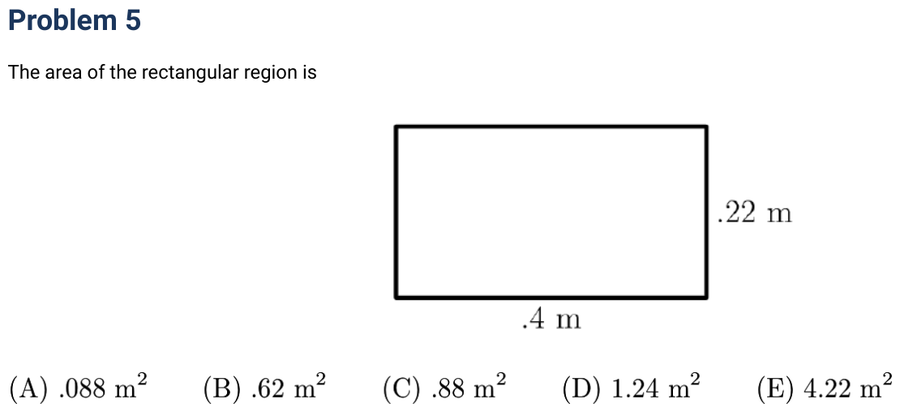
Area is length × width — but both sides are less than 1, so before computing, ask: should the area be bigger or smaller than either side?
Show solution
Approach: multiply the sides, then place the decimal by estimating
Area = 0.4 × 0.22. Multiply the digits: 4 × 22 = 88. Now place the point: 0.4 has one decimal place, 0.22 has two, so the product has three — 0.088 m².
Sanity-check: multiplying two numbers below 1 always shrinks them, so the area must be smaller than 0.22. That instantly kills .62, .88 (a dropped decimal place), 1.24 (the perimeter, 2 × .4 + 2 × .22), and 4.22. Only 0.088 is smaller than both sides.
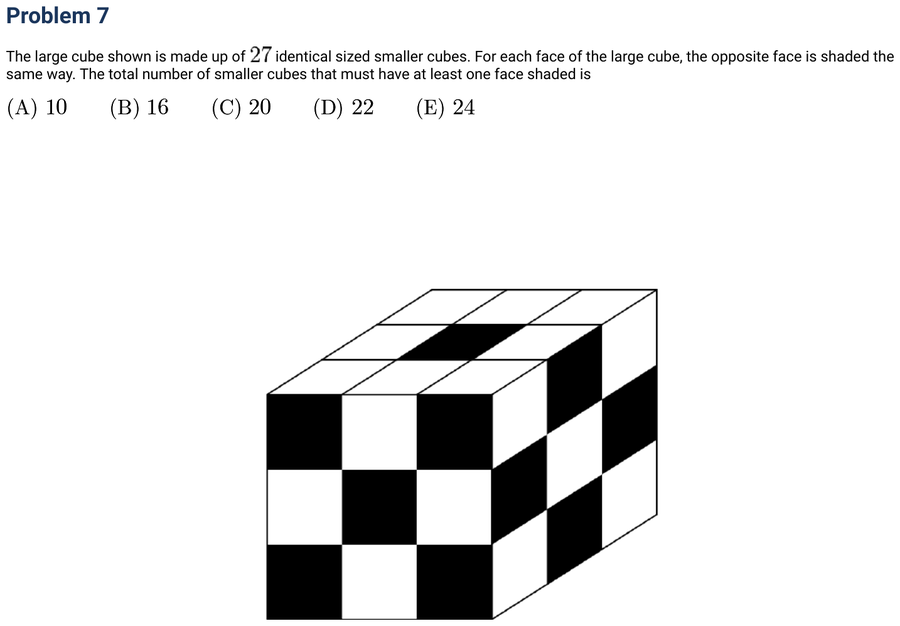
Counting the shaded ones directly is messy. Instead ask the reverse: which small cubes manage to stay completely unshaded?
Still stuck? Show hint 2 →
Hint 2 of 3
Every one of the 27 small cubes is one of just four types by position: 8 corners, 12 edges, 6 face-centers, 1 hidden inside. Sort by type instead of counting square by square.
Still stuck? Show hint 3 →
Hint 3 of 3
The checkerboard leaves only each face's center square white. The single cube directly behind that center square is the only one on that face that can dodge all shading.
Show solution
Approach: count by sub-cube class (and count the easy ones)
Sort the 27 small cubes by position: 8 sit at corners (3 faces showing), 12 sit on edges (2 faces showing), 6 sit at the center of a face (1 face showing), and 1 is buried inside (0 faces).
It's far easier to count the cubes with NO shading. The pattern leaves only the center square of each face white, so the only candidates to escape are the 6 face-center cubes plus the 1 internal cube = 7 unshaded.
Everything else is shaded: 27 − 7 = 20.
Why this transfers: "count the complement" — when the thing you want is scattered and the leftover is tidy, count the leftover and subtract from the whole.
Another way — add the shaded classes directly:
All 8 corner cubes and all 12 edge cubes show at least one shaded square (they touch a non-center square of some face).
Answer (E) tempts you to think the digit count wobbles with A and B. Don't guess — pin down the smallest and largest the sum could ever be.
Still stuck? Show hint 2 →
Hint 2 of 2
Push A and B to their extremes: both as small as allowed (1) for the minimum, both 9 for the maximum. If both ends have the same digit count, every value in between does too.
Show solution
Approach: bracket the sum between its extremes
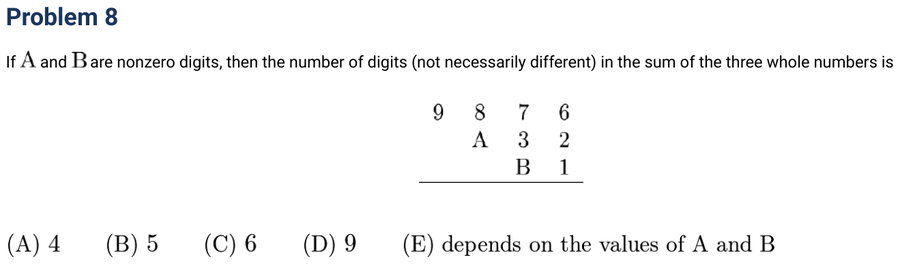
A and B are digits, and 'nonzero' means each is at least 1. Smallest sum: 9876 + 132 + 11 = 10019. Largest sum: 9876 + 932 + 91 = 10899.
Both endpoints land between 10000 and 99999, so the sum has 5 digits no matter what A and B are — that's why the answer isn't (E).
Why this transfers: to test whether an answer 'depends' on a free choice, squeeze the choice to its extremes. If the extremes agree, nothing in between can disagree.
When finding the sum 1⁄2 + 1⁄3 + 1⁄4 + 1⁄5 + 1⁄6 + 1⁄7, the least common denominator used is
Show answer
Answer: C — 420.
Show hints
Hint 1 of 2
The common denominator must be a multiple of every bottom — but it doesn't need to be their product. What's the smallest number all of 2–7 divide into?
Still stuck? Show hint 2 →
Hint 2 of 2
Build the LCM from primes: include each prime to the highest power that shows up among 2, 3, 4, 5, 6, 7. The 6 brings nothing new (it's just 2 × 3, already covered).
Show solution
Approach: take the highest power of each prime
Factor the denominators: 2, 3, 2², 5, 2·3, 7. The distinct prime powers needed are 2² (from the 4), 3, 5, and 7 — note 6 = 2 × 3 is already accounted for.
LCM = 2² × 3 × 5 × 7 = 4 × 3 × 5 × 7 = 420.
Why this transfers: the least common denominator is the LCM, NOT the product. Multiplying all six gives 5040 (the trap answer) — far bigger than needed, because it double-counts shared factors like the 2 in 4 and 6.
Three terms share the same factor 299 — don't multiply them out separately. What do their multipliers add to?
Still stuck? Show hint 2 →
Hint 2 of 2
Distributive property in reverse: 4(299) + 3(299) + 2(299) = (4 + 3 + 2)(299). Collect the count first.
Show solution
Approach: factor out the shared term, then round
The first three terms all carry 299, so pull it out: (4 + 3 + 2)(299) = 9 × 299.
Use 299 = 300 − 1: 9 × 300 − 9 = 2700 − 9 = 2691. Add the last term: 2691 + 298 = 2989.
Why this transfers: spotting a repeated factor and rounding to a friendly nearby number (299 → 300) turns four multiplications into one easy subtraction.
Another way — count the 299s plus the leftover:
There are 4 + 3 + 2 = 9 copies of 299, and 298 = 299 − 1, so the total is 10 × 299 − 1.
You don't need the exact sum — just which half-unit it lands in. Add the whole numbers, then ask only how big the leftover fractions can get.
Still stuck? Show hint 2 →
Hint 2 of 2
The whole parts give 10 exactly. For the three fractions, find a floor and a ceiling: one of them is already 1⁄2, and the other two together are tiny.
Show solution
Approach: split off the whole parts, then bound the fractions
Whole parts: 2 + 3 + 5 = 10 — that's locked in. Now the fractions 1⁄7 + 1⁄2 + 1⁄19 only need bounding, not exact addition.
Floor: it's more than 1⁄2, because one term is already 1⁄2 and the others are positive. Ceiling: it's less than 1, because 1⁄7 + 1⁄19 is well under 1⁄2 (each is smaller than 1⁄4).
So the fractions land between 1⁄2 and 1, putting the total between 10 1⁄2 and 11 — answer B.
Why this transfers: when a question asks 'between which values,' estimate with bounds instead of finding a common denominator. Far less work, no arithmetic slips.
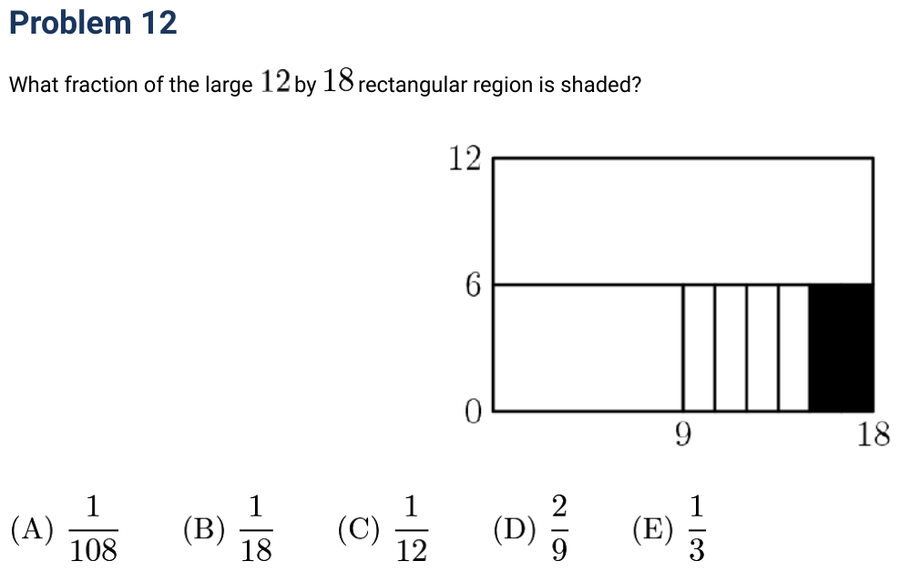
Read the shaded block's two dimensions off the grid. You can compare it to the whole as a fraction without ever computing a big area.
Still stuck? Show hint 2 →
Hint 2 of 2
The shaded block spans 3 of the 18 units across and 6 of the 12 units up. What fraction of the width is that, and what fraction of the height?
Show solution
Approach: multiply the width-fraction by the height-fraction
The black block is 3 units wide and 6 units tall. As a share of the whole rectangle that's 3⁄18 = 1⁄6 of the width and 6⁄12 = 1⁄2 of the height.
A sub-rectangle's share of area is (its width-share) × (its height-share): 1⁄6 × 1⁄2 = 1⁄12.
Why this transfers: shrinking each direction independently multiplies the areas — handling the two ratios separately keeps the numbers tiny and dodges 12 × 18 = 216 entirely.
Which of the following fractions has the largest value?
Show answer
Answer: E — 151⁄301.
Show hints
Hint 1 of 2
Don't hunt for a common denominator across all five. Pick one easy yardstick they're all near and measure each against it.
Still stuck? Show hint 2 →
Hint 2 of 2
Each fraction is close to 1⁄2. To test a⁄b against 1⁄2, just compare 2a to b — double the top and see if it beats the bottom.
Show solution
Approach: compare every fraction to the landmark 1⁄2
Use the test a⁄b > 1⁄2 exactly when 2a > b (double the numerator, compare to the denominator). Double each top: 6 vs 7, 8 vs 9, 34 vs 35, 200 vs 201 — every one falls just short, so each is a hair below 1⁄2.
But 151⁄301 doubles to 302 vs 301: 302 > 301, so it's just over 1⁄2.
Four fractions sit below 1⁄2 and one sits above it, so 151⁄301 is the largest.
Why this transfers: comparing many quantities to a single landmark (here 1⁄2) replaces ten messy pairwise comparisons with five quick checks.
The sale ad read: "Buy three tires at the regular price and get the fourth tire for three dollars." Sam paid 240 dollars for a set of four tires at the sale. What was the regular price of one tire?
Show answer
Answer: D — 79 dollars.
Show hints
Hint 1 of 2
Not all four tires cost the same — one is a flat $3. Peel that special tire off the total before splitting the rest.
Still stuck? Show hint 2 →
Hint 2 of 2
Of the $240, exactly $3 paid for the fourth tire. The remaining money bought three tires at the same regular price.
Show solution
Approach: set the odd-one-out aside first
The fourth tire was a flat $3, so it accounts for $3 of the $240. That leaves 240 − 3 = 237 dollars covering the three full-price tires.
Those three are equal, so the regular price is 237 ⁄ 3 = 79 dollars.
Trap-check: dividing 240 ⁄ 4 = 60 pretends all four tires cost the same — but the $3 tire breaks that. Always remove the unequal piece before averaging the rest.
Joyce made 12 of her first 30 shots in the first three games of this basketball game, so her seasonal shooting average was 40%. In her next game, she took 10 shots and raised her seasonal shooting average to 50%. How many of these 10 shots did she make?
Show answer
Answer: E — 8.
Show hints
Hint 1 of 2
A season average is about totals, not single games. Work out her total makes before and after the new game, and the difference is what you want.
Still stuck? Show hint 2 →
Hint 2 of 2
After the extra game she's taken 30 + 10 = 40 shots at a 50% average. How many total baskets does that mean — and how many had she already made?
Show solution
Approach: work in season totals, then take the difference
An average is (total made) ⁄ (total shots), so work with totals. After the game she's taken 40 shots at 50%, meaning 50% × 40 = 20 total makes.
She'd already made 12, so this game she made 20 − 12 = 8.
Why this transfers: never average the averages or work game-by-game — convert each percentage back to a count of makes over a count of shots, then subtract. Totals are what actually add up.
Abby, Bret, Carl, and Dana are seated in a row of four seats numbered #1 to #4. Joe looks at them and says:
"Bret is next to Carl."
"Abby is between Bret and Carl."
However each one of Joe's statements is false. Bret is actually sitting in seat #3. Who is sitting in seat #2?
Show answer
Answer: D — Dana.
Show hints
Hint 1 of 3
The clues are FALSE — that's the gift. Each false 'X is here' tells you X is NOT there, which is often more powerful than a true clue.
Still stuck? Show hint 2 →
Hint 2 of 3
Start from the fact you're handed: Bret is in #3. 'Bret is next to Carl' is false, so Carl can't be in either seat touching #3.
Still stuck? Show hint 3 →
Hint 3 of 3
Once Carl is forced, the second false clue ('Abby between Bret and Carl') eliminates exactly one seat for Abby — the seat strictly between Carl and Bret.
Show solution
Approach: negate each false clue, then place seats one at a time
Bret sits in #3. Clue 1 ('Bret next to Carl') is false, so Carl is NOT in #2 or #4 — the only seat left for Carl is #1.
With Carl in #1 and Bret in #3, the seat strictly between them is #2. Clue 2 ('Abby between Bret and Carl') is false, so Abby is NOT in #2. The remaining seats for Abby and Dana are #2 and #4, so Abby takes #4 and Dana takes #2.
Seat #2 holds Dana.
Why this transfers: a false 'A is next to B' statement is a constraint in disguise — flip it to 'A is NOT next to B' and use elimination just like a true clue.
Half the people in a room left. One third of those remaining started to dance. There were then 12 people who were not dancing. The original number of people in the room was what?
Show answer
Answer: C — 36.
Show hints
Hint 1 of 2
Follow the 12 non-dancers backward. What single fraction of the ORIGINAL crowd are they?
Still stuck? Show hint 2 →
Hint 2 of 2
Half the people stay, and of those 1⁄3 dance — so 2⁄3 of the stayers don't. Chain the fractions: 1⁄2 of the room, then 2⁄3 of that.
Show solution
Approach: compose the fractions back to the original
Half stay, so the stayers are 1⁄2 of the original. Of the stayers, 1⁄3 dance, leaving 2⁄3 not dancing. Chain them: the non-dancers are 2⁄3 × 1⁄2 = 1⁄3 of the original room.
That third equals 12, so the whole room is N = 3 × 12 = 36.
Why this transfers: 'a fraction of a fraction' multiplies — collapsing the two steps into one fraction of the start lets you solve in a single division instead of tracking three separate counts.
Another way — walk forward and check:
Start with 36: half leave → 18 remain. A third of 18 dance → 6 dancers, so 18 − 6 = 12 not dancing.
A calculator has a squaring key x² which replaces the current number displayed with its square. For example, if the display is 000003 and the x² key is depressed, then the display becomes 000009. If the display reads 000002, how many times must you depress the x² key to produce a displayed number greater than 500?
Show answer
Answer: A — 4.
Show hints
Hint 1 of 2
Squaring isn't adding — each press multiplies the number by itself, so it grows ferociously. Just list the displays and stop the moment one passes 500.
Still stuck? Show hint 2 →
Hint 2 of 2
Track the exponent instead: each squaring DOUBLES the exponent of 2. Starting at 2¹, the powers go 2 → 4 → 8 → 16…
256 is still below 500, so three presses aren't enough; 65536 clears 500, so it takes 4 presses.
Why this transfers: squaring doubles the exponent, so the display is 2^(2ⁿ) after n presses — that's 2¹, 2², 2⁴, 2⁸, 2¹⁶. Doubling exponents means the size explodes, so 'how many presses' is always small. Don't confuse 4 presses with the wrong-units traps 8 or 250.
"If a whole number n is not prime, then the whole number n − 2 is not prime." A value of n which shows this statement to be false is
Show answer
Answer: A — 9.
Show hints
Hint 1 of 2
To break an 'if ... then ...' rule you need ONE case where the 'if' part is true but the 'then' part fails. What must n and n − 2 each be?
Still stuck? Show hint 2 →
Hint 2 of 2
You need n itself NOT prime (so the 'if' holds) yet n − 2 prime (so the 'then' fails). Scan the choices for a composite n whose n − 2 is prime.
Show solution
Approach: make the hypothesis true but the conclusion false
A counterexample needs the 'if' satisfied and the 'then' broken: n must be non-prime, while n − 2 must BE prime.
n = 9 fits perfectly: 9 = 3 × 3 is not prime, yet 9 − 2 = 7 is prime. The rule predicted 7 would be non-prime, so the rule is false. Answer 9.
Why this transfers: to disprove any 'if P then Q,' you only ever need a single example with P true and Q false — never a general argument. Choices like 13 (prime, so 'if' fails) can't be counterexamples at all.
The notation tempts you to add and subtract the bottoms (3* + 6* 'looking like' 9*). But reciprocals behave very differently under + and − than under × and ÷ — translate each line into real fractions before judging.
Still stuck? Show hint 2 →
Hint 2 of 2
Multiplying and dividing reciprocals stays clean: 1⁄a · 1⁄b = 1⁄(ab), and (1⁄a) ÷ (1⁄b) = b⁄a. Adding and subtracting them does NOT just combine the bottoms.
Show solution
Approach: rewrite each statement as ordinary fractions and check
Why this transfers: the trap is assuming a tidy multiplication rule (1⁄(ab)) carries over to addition. It doesn't — products and quotients of reciprocals stay reciprocals, but sums and differences need a common denominator.
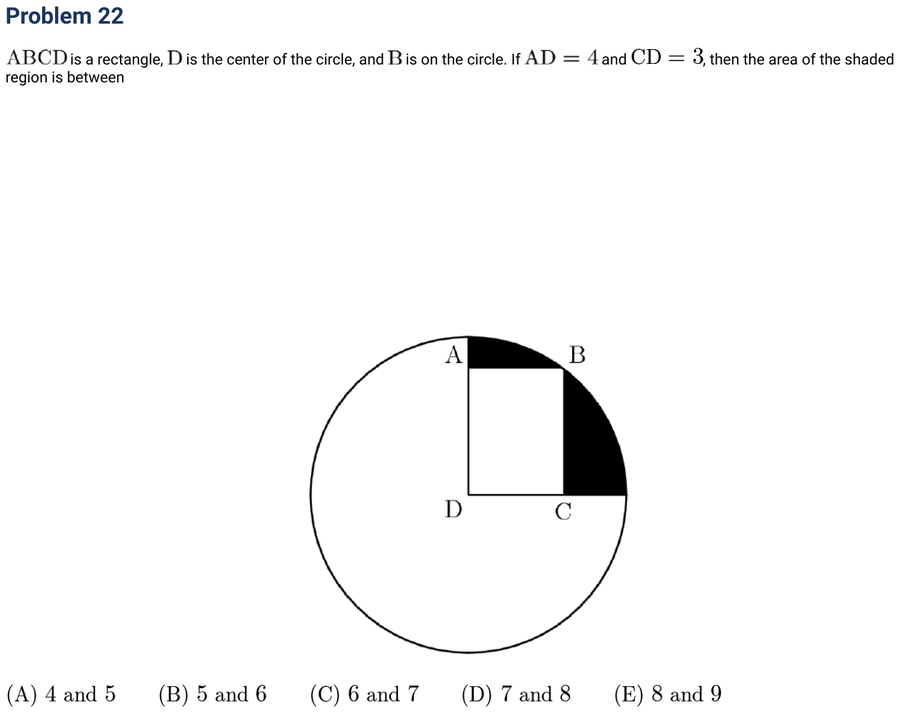
B is the only labeled point ON the circle, and D is the center — so the segment DB is a radius. Notice DB is also the diagonal of the rectangle. What's its length?
Still stuck? Show hint 2 →
Hint 2 of 3
The shaded sliver is the quarter-circle in that corner with the rectangle punched out of it. Find the quarter-circle's area and subtract the rectangle.
Still stuck? Show hint 3 →
Hint 3 of 3
The question only asks 'between which two whole numbers,' so you can approximate π ≈ 3.14 at the end rather than carrying it exactly.
Show solution
Approach: quarter-disk minus the rectangle inside it
D is the center and B is on the circle, so the radius is DB — the rectangle's diagonal. By the Pythagorean theorem DB² = AD² + CD² = 4² + 3² = 25, so the radius is 5.
The shaded region is the quarter-disk at corner D with rectangle ABCD removed: (1⁄4)(π · 5²) − (4 × 3) = 25π⁄4 − 12.
Estimate: 25π⁄4 ≈ 25 × 3.14 ÷ 4 ≈ 19.6, so the area ≈ 19.6 − 12 ≈ 7.6 — between 7 and 8.
Why this transfers: when an unknown length is the radius to a point on a circle, hunt for a right triangle whose hypotenuse reaches that point. Here the rectangle hands you a clean 3-4-5.
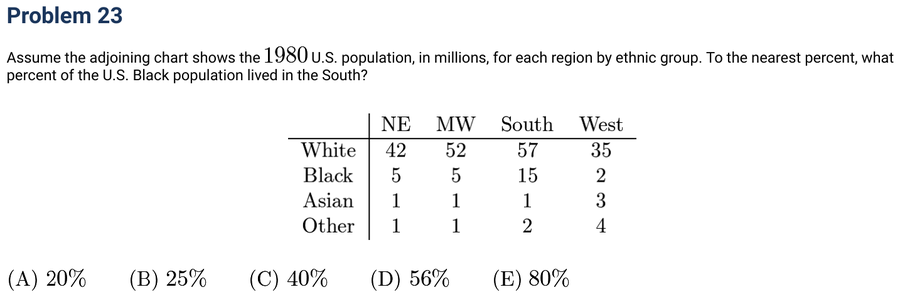
The question is about Black population only — every other row is a distraction. The 'whole' here is the Black ROW total, not the table total.
Still stuck? Show hint 2 →
Hint 2 of 2
Add the four numbers in the Black row to get the denominator, then the South entry over that total is your fraction.
Show solution
Approach: the right 'whole' is the Black row total
'What percent of the Black population' means the base is just the Black row: 5 + 5 + 15 + 2 = 27 million. Ignore the White, Asian, and Other rows entirely.
The South's Black population is 15, so the share is 15 ⁄ 27 ≈ 0.556 → nearest percent 56%.
Why this transfers: in a two-way table, a percent question fixes the 'whole' to one row or one column. Read the phrasing carefully to pick the correct denominator — using the table grand total here would give a wrong, much smaller percent.
A multiple choice examination consists of 20 questions. The scoring is +5 for each correct answer, −2 for each incorrect answer, and 0 for each unanswered question. John's score on the examination is 48. What is the maximum number of questions he could have answered correctly?
Show answer
Answer: D — 12.
Show hints
Hint 1 of 2
Write the score as 5c − 2w = 48 with c correct and w wrong. Before bounding anything, notice what parity 5c must have — that alone restricts c.
Still stuck? Show hint 2 →
Hint 2 of 2
Since 48 and 2w are both even, 5c must be even, which forces c to be even. So only even values of c are possible — test the largest ones downward.
Show solution
Approach: use parity to limit c, then check the largest candidates
Let c = correct, w = wrong, so 5c − 2w = 48. The right side 48 and the 2w are both even, so 5c is even — meaning c itself must be even. Candidates: c = 14, 12, 10, …
Try c = 14: 5(14) − 2w = 48 → 2w = 22 → w = 11, but then c + w = 25 > 20 questions. Too many. Try c = 12: 2w = 60 − 48 = 12 → w = 6, and c + w = 18 ≤ 20. This works.
So the maximum is c = 12.
Why this transfers: a parity check ('5c must be even ⇒ c even') instantly throws out odd choices like 9 and 11, so you only test a couple of values instead of all five.
Ten balls numbered 1 to 10 are in a jar. Jack reaches into the jar and randomly removes one of the balls. Then Jill reaches into the jar and randomly removes a different ball. The probability that the sum of the two numbers on the balls removed is even is
Show answer
Answer: A — 4⁄9.
Show hints
Hint 1 of 2
A sum is even only when the two numbers match in parity (odd+odd or even+even). What's the count of each kind among 1–10?
Still stuck? Show hint 2 →
Hint 2 of 2
There are 5 odd and 5 even balls. After Jack takes one, only 9 balls remain — so Jill's draw is out of 9, not 10.
Show solution
Approach: match Jack's parity (fix the first draw)
The sum is even exactly when both balls share parity. Whatever Jack pulls, his ball has 4 same-parity partners left (e.g. if he takes an odd, 4 odds remain) out of the 9 balls Jill can choose from.
So the probability Jill matches is 4⁄9 — and that's the whole answer: 4⁄9.
Why this transfers: when only the relationship between two draws matters, fix the first draw as 'done' and ask the chance the second one cooperates. No need to enumerate Jack's case at all.