Problem 7 · 2024 AMC 8
Medium
Geometry & Measurement
spatial-reasoningcaseworkdivisibility
Show answer
Answer: E — 5 unit tiles.
Show hints
Hint 1 of 2
The 2×2 and 1×4 tiles BOTH cover exactly 4 squares. So before placing anything, what does that force about how many cells the tiny 1×1 tiles must mop up?
Still stuck? Show hint 2 →
Hint 2 of 2
Technique — a counting (mod 4) filter: the big tiles fill a multiple of 4, and 21 = 4×5 + 1, so the 1×1 count is 1, 5, 9, … You'd love 1, but check whether it can actually be tiled before believing it.
Show solution
Approach: count mod 4 to bound it, then a coloring argument rules out 1
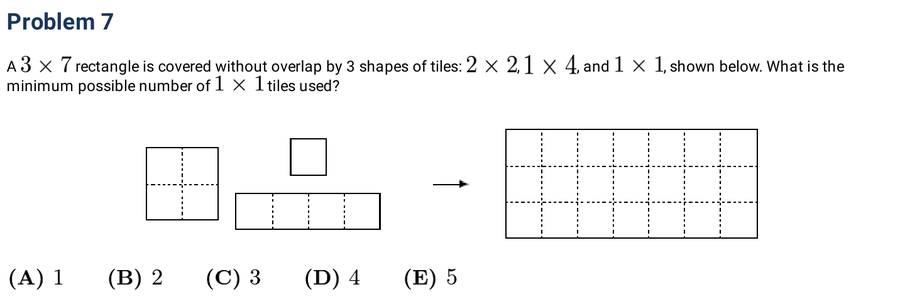
- Start with arithmetic, not pictures. Both big tiles cover 4 squares, so they always fill a multiple of 4. Since 21 = 4×5 + 1, the leftover for 1×1 tiles is 21 − (multiple of 4), which is 1, 5, 9, … The dream answer is 1.
- Can just one 1×1 work? Color the 3×7 board in 4 repeating diagonal colors (or check by hand): the 2×2 and 1×4 tiles can't tile a 3×7 board with a single cell removed, no matter where that cell is — it never fits. So 1 is impossible.
- Next allowed value is 5, and it's achievable: lay four big tiles (a mix of 2×2 and 1×4) covering 16 cells, then drop 1×1's into the 5 holes. Minimum = 5. This transfers: a covering count gives a quick lower-bound filter, but you still must exhibit one real arrangement — "allowed by counting" isn't the same as "buildable."
Mark:
· log in to save