Problem 21 · 2025 Math Kangaroo
Hard
Logic & Word Problems
caseworkcareful-counting
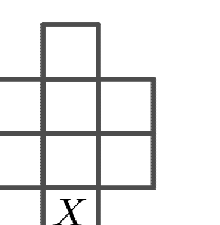
We want to place the numbers 1 through 8 in the eight squares of the figure shown in such a way that consecutive numbers are never in adjacent squares (not even diagonally adjacent). Which numbers can we write in the square marked with an X?
Show answer
Answer: B — 2 or 7
Show hints
Hint 1 of 3
Consecutive numbers may not touch even diagonally, so a number with many forbidden partners needs a roomy cell with few neighbours.
Still stuck? Show hint 2 →
Hint 2 of 3
Count how many cells each number must avoid: the ends 1 and 8 avoid just one each, while the most-crowded cell (touching the most others) needs a number that has very few neighbours to dodge.
Still stuck? Show hint 3 →
Hint 3 of 3
By the figure's symmetry, X and its mirror cell are the two most-connected cells, so list which values can sit in such a tight spot.
Show solution
Approach: match crowded cells to numbers with few forbidden neighbours
- A value \(n\) (with \(1
- Cell X is one of the two most-connected cells in the shape, so the number placed there must have few neighbours to conflict with; testing placements, only by putting a near-end value there can every other number be seated legally.
- Working the arrangement out, the value in X must be 2 or 7 (the two cases are mirror images), answer B.
Mark:
· log in to save