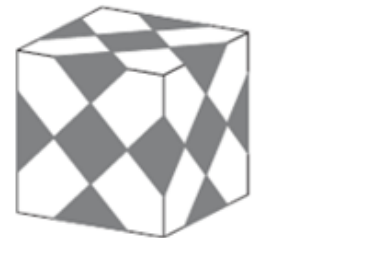
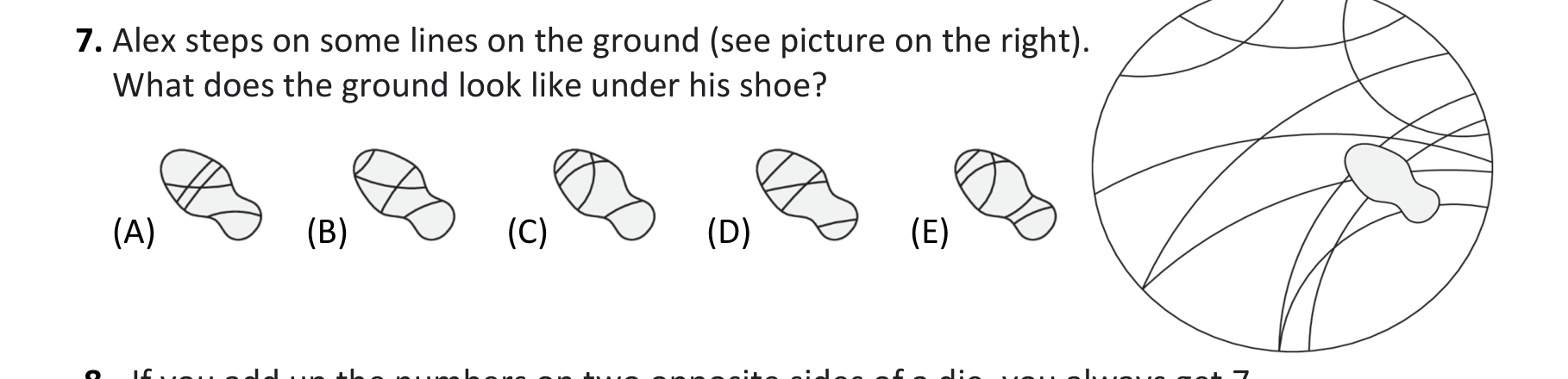
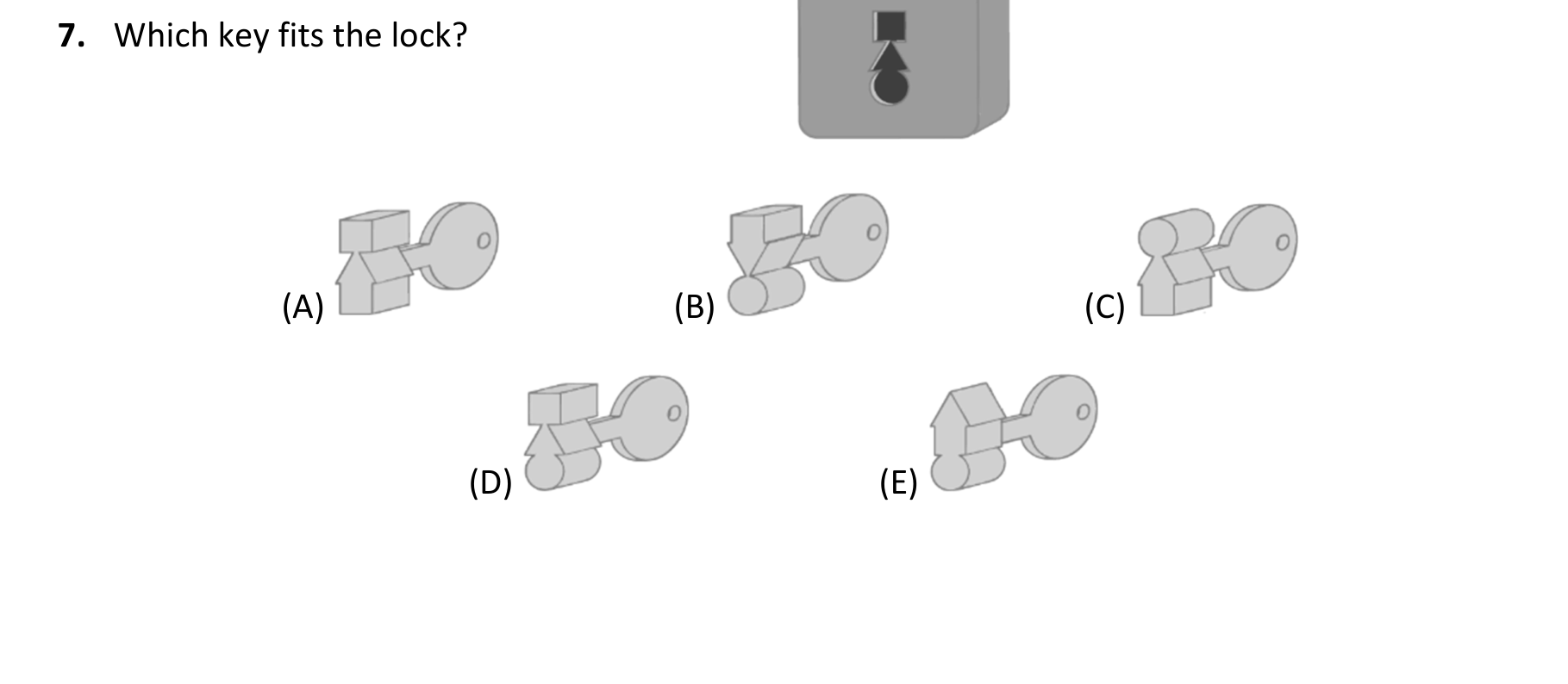
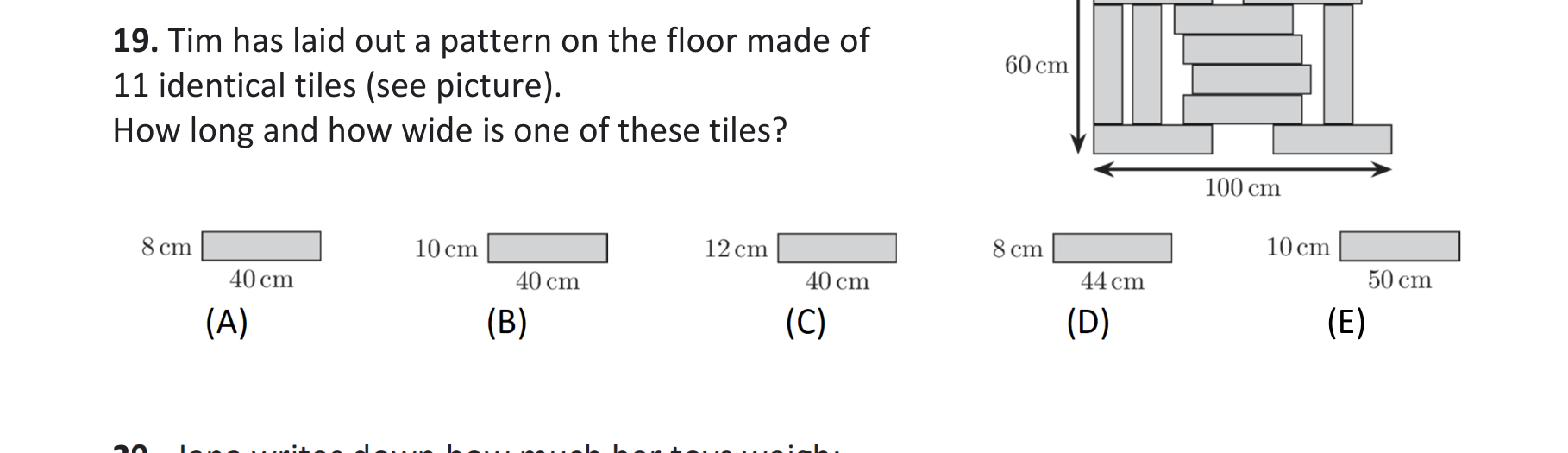
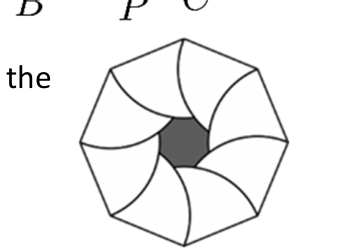
Which of the pieces shown completes the pattern? (The five choices A–E are pictured below the question.)
Show answer
Answer: C
Show hints
Hint 1 of 2
The big design is one repeating pattern; the white window is just a square-shaped hole punched out of it.
Still stuck? Show hint 2 →
Hint 2 of 2
Look at the lines touching all four edges of the hole and ask which piece lets every one of them continue without a break.
Show solution
Approach: match the missing tile to the lines around the hole
The hole sits inside a repeating pattern of overlapping squares and diamonds, so the right piece is the one that keeps every line going straight across the gap.
Trace the lines that arrive at the top, bottom, left and right edges of the white square; the correct piece must connect to all of them at once.
Only choice C lines up on all four sides so the pattern stays seamless with no broken lines, so the answer is (C).
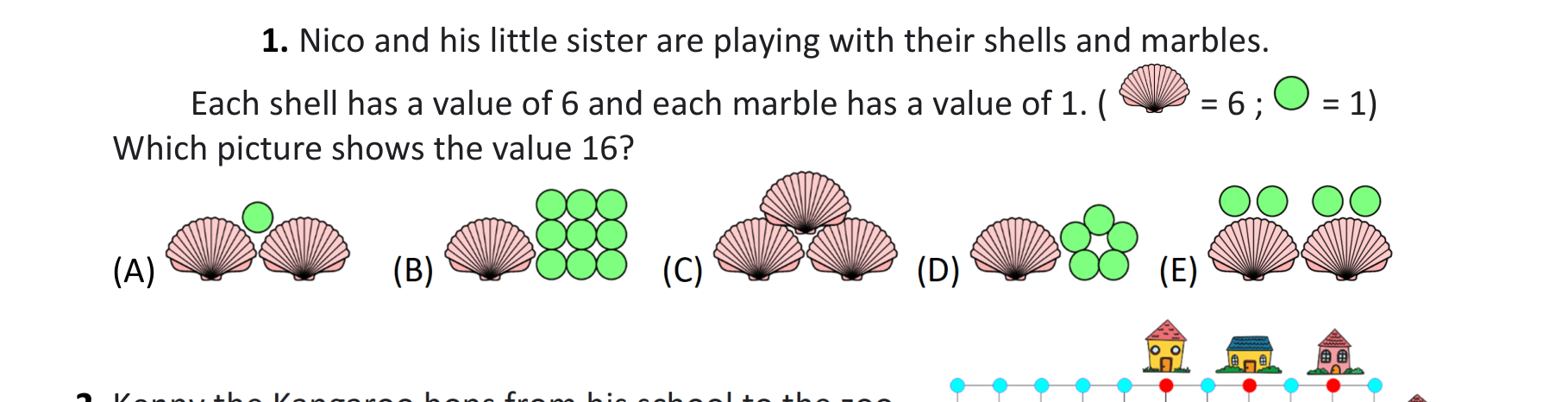
Nico and his little sister play with shells and marbles. Each shell is worth 6 and each marble is worth 1 (shell = 6, marble = 1). Which picture shows the value 16?
Show answer
Answer: E
Show hints
Hint 1 of 2
Each shell counts as 6 and each marble counts as 1 - add up each picture's total.
Still stuck? Show hint 2 →
Hint 2 of 2
You need a total of exactly 16, so look for two shells plus four marbles.
Show solution
Approach: add the shell and marble values in each option
A shell is worth 6 and a marble is worth 1.
Two shells give 12, and you need 4 more to reach 16, so 4 marbles.
The picture with two shells and four marbles totals 12 + 4 = 16.
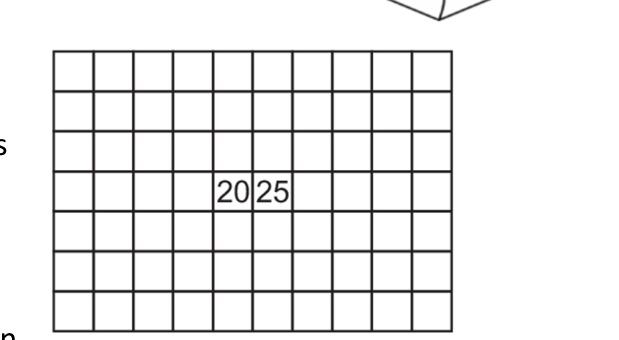
Anna builds a wall out of black and grey bricks that shows 2025. What can Bella read on the back of the wall? (The five choices A–E are pictured below the question.)
Show answer
Answer: E
Show hints
Hint 1 of 2
Looking at the back of a wall is like seeing it in a mirror.
Still stuck? Show hint 2 →
Hint 2 of 2
Reflect the whole ‘2025’ left-to-right; each digit flips and the order of digits reverses.
Show solution
Approach: horizontal mirror reflection
Seeing the back of the wall is exactly like holding the front up to a mirror, so the whole picture flips left–right.
Two things happen at once: the order of the digits reverses (so 2025 reads 5202), and each digit itself is mirrored.
The choice that shows this left–right flip of the bricks is the back view, which is (E).
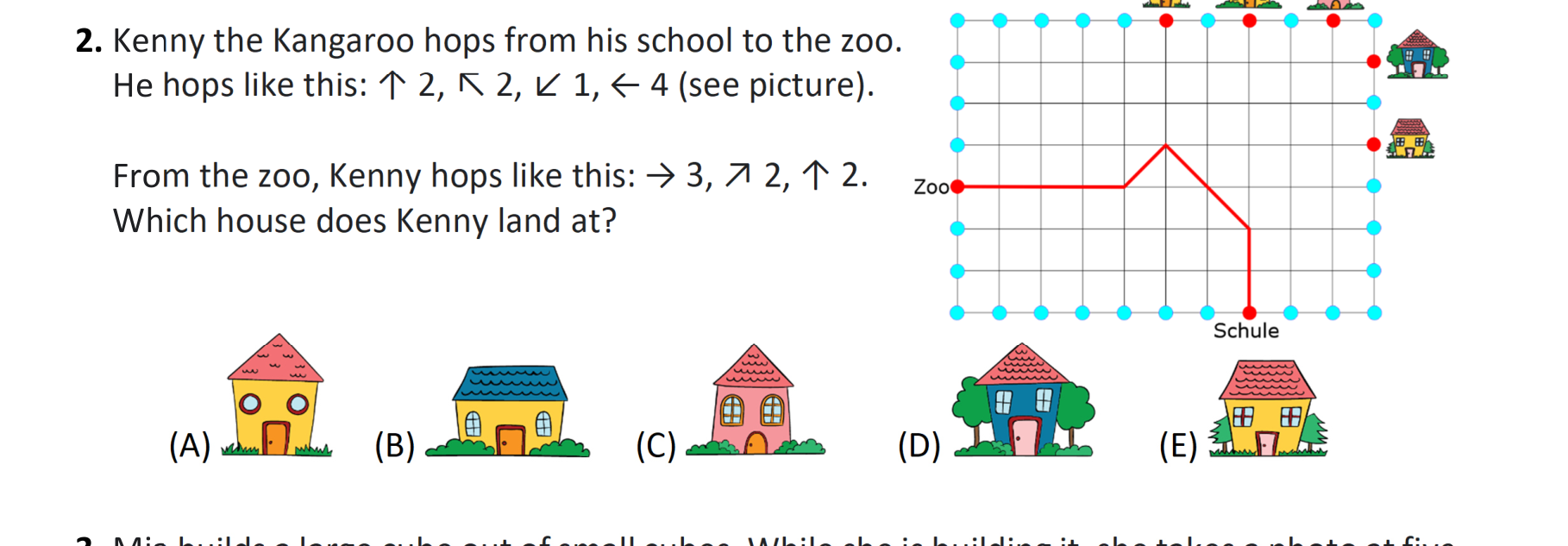
Kenny the Kangaroo hops from his school to the zoo. He hops like this: up 2, up-left 2, down-left 1, left 4 (see picture). From the zoo, Kenny hops like this: right 3, up-right 2, up 2. Which house does Kenny land at?
Show answer
Answer: A
Show hints
Hint 1 of 2
Start at the Zoo dot and follow the new hops one by one on the grid.
Still stuck? Show hint 2 →
Hint 2 of 2
Track the arrows right 3, up-right 2, up 2 step by step until you land on a house.
Show solution
Approach: trace the hops on the grid from the zoo
Begin at the Zoo marker and move right 3 squares.
Then move diagonally up-right 2 squares, then straight up 2 squares.
The base of a triangle is extended by 50% and its height is reduced by one third. What is the ratio of the area of the new triangle to the area of the original triangle?
Show answer
Answer: B — 1:1
Show hints
Hint 1 of 2
A triangle's area is proportional to base times height.
Still stuck? Show hint 2 →
Hint 2 of 2
Multiply the two change factors together and see what happens to the product.
Show solution
Approach: multiply the two scale factors
Extending the base by 50% makes it \(\tfrac{3}{2}\) of the old base; reducing the height by one third makes it \(\tfrac{2}{3}\) of the old height.
Area scales by \(\tfrac{3}{2}\times\tfrac{2}{3}=1\), so the area is unchanged.
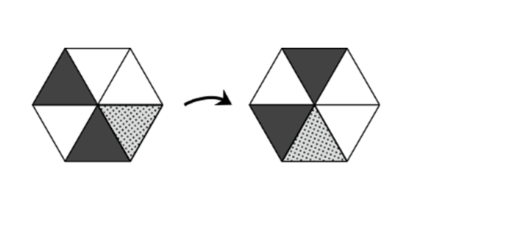
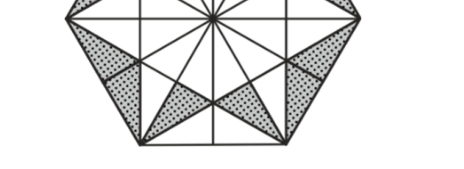
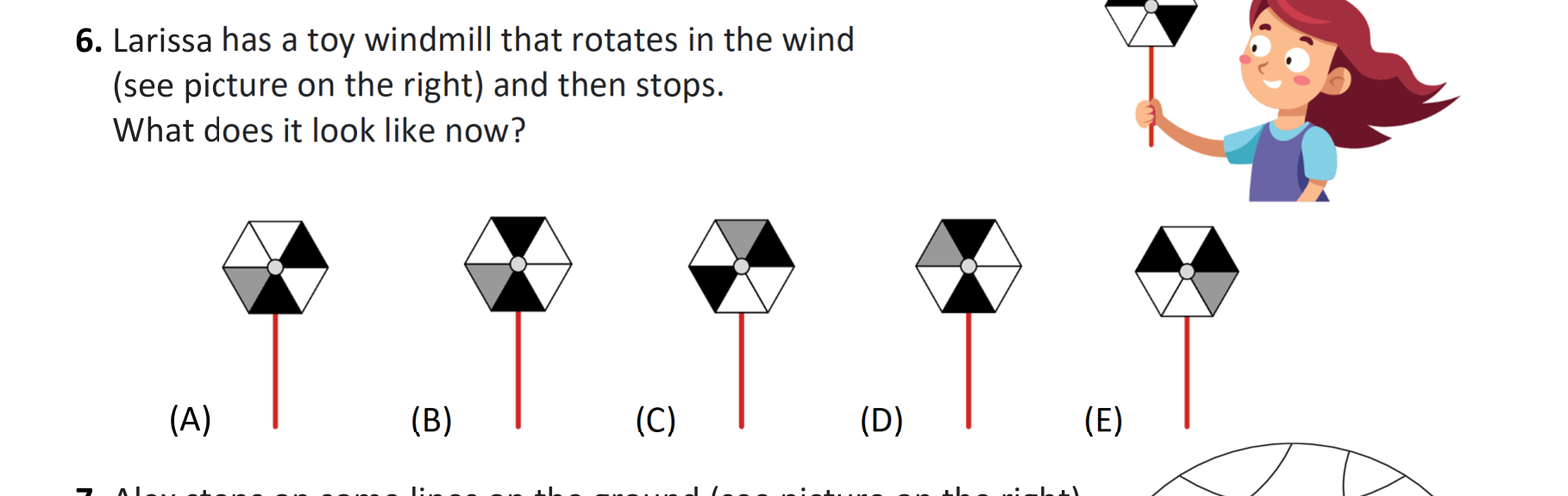
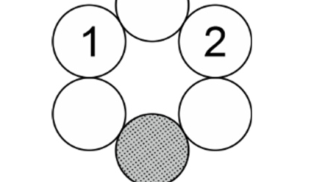
Isabelle plays with a hexagonal sheet of paper. With each move she rotates the hexagon by the same angle in the same direction. The illustration shows the sheet at the start and after the first move. After how many moves does the sheet look the same as it did at the beginning?
Show answer
Answer: A — 6
Show hints
Hint 1 of 2
The single dotted wedge acts as a marker — track where it lands after one move.
Still stuck? Show hint 2 →
Hint 2 of 2
Find the rotation angle of one move, then see how many moves complete a full turn back to the start.
Show solution
Approach: track the marker wedge under repeated equal rotations
The colouring has no rotational symmetry, so the sheet only looks identical after a whole turn brings every wedge home.
Comparing the start and the first move, the unique dotted wedge has shifted by one position — a 60° rotation.
A 60° step needs \(360^\circ \div 60^\circ = 6\) moves to return to the original picture, which is (A).
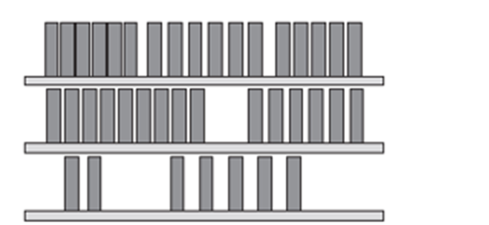
A bookshelf with three rows has 17 books in the top row, 15 books in the middle row and 7 books in the bottom row. Monika would like to have the same number of books in each row, but she wants to rearrange as few books as possible. How many books does she have to move from the middle row to the bottom row?
Show answer
Answer: B — 2
Show hints
Hint 1 of 2
First find how many books each row should hold.
Still stuck? Show hint 2 →
Hint 2 of 2
Books should only be moved into rows that are short; figure out the bottom row’s shortfall.
Show solution
Approach: even out the rows with fewest moves
Total books: 17 + 15 + 7 = 39, so each row should have 39 ÷ 3 = 13.
The bottom row is short by 13 − 7 = 6 books; the top row has 4 spare and the middle has 2 spare.
To move as few as possible, send the top’s 4 spare and the middle’s 2 spare straight to the bottom.
So only 2 books go from the middle row to the bottom row.
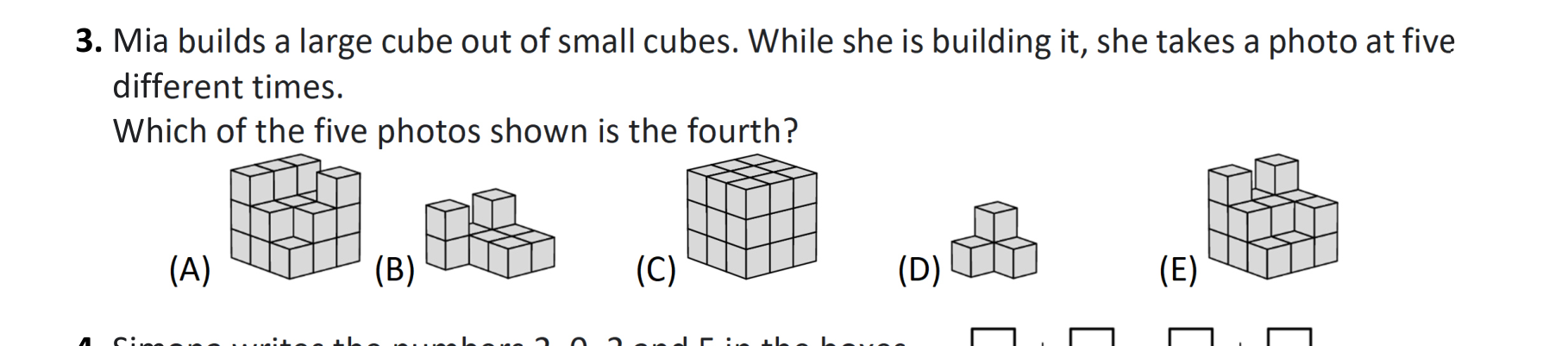
Mia builds a large cube out of small cubes. While she is building it, she takes a photo at five different times. Which of the five photos shown is the fourth?
Show answer
Answer: A
Show hints
Hint 1 of 2
The photos show the cube growing, so put them in order from fewest cubes to a full cube.
Still stuck? Show hint 2 →
Hint 2 of 2
Order the five pictures by how complete the cube is, then count to the fourth one.
Show solution
Approach: order the photos by how built-up the cube is
The cube is assembled over time, so the photos go from least built to fully built.
Arrange the five images by increasing number of small cubes placed.
The fourth picture in that order is the nearly-complete cube shown in option A.
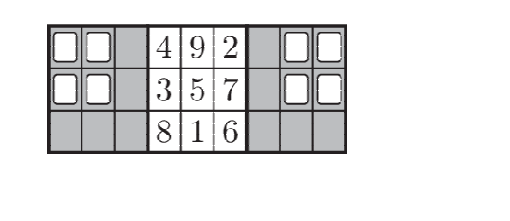
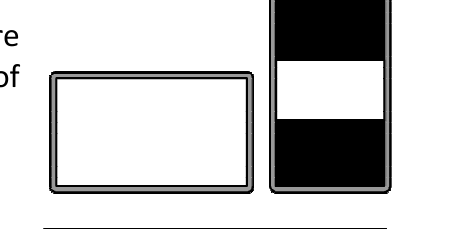
The left and right parts of a three-part brochure each contain four transparent windows. If these two parts are folded onto the middle part, some of the numbers written on the middle part are visible through the windows. What is the sum of the visible numbers when the brochure is folded?
Show answer
Answer: D — 14
Show hints
Hint 1 of 3
Both side panels fold over the middle, stacking on top of each other, so each panel reflects left-right as it closes.
Still stuck? Show hint 2 →
Hint 2 of 3
A middle number shows only if BOTH the left panel and the right panel have a window over that same cell.
Still stuck? Show hint 3 →
Hint 3 of 3
Find the windows each panel lands on after folding, then keep only the cells where the two sets of windows overlap.
Show solution
Approach: intersect the two panels' window positions
Both flaps fold inward and cover the whole 3×3 middle, so a number is visible only where the left flap AND the right flap both have a window (you must see through both layers).
Folding the left flap (it reflects) puts its windows over the middle's two right columns; folding the right flap puts its windows over the middle's two left columns — they overlap only in the centre column.
There the visible numbers are 9 (top) and 5 (middle), so the sum is \(9+5=14\), answer D.
Logic & Word Problemscomplementary-countingsum-constraint
Vasily has 20 balls. Each ball is either yellow, green, blue or black. Of the balls, exactly 17 are not green, exactly 15 are not black, and exactly 12 are not yellow. How many of his balls are blue?
Show answer
Answer: D — 4
Show hints
Hint 1 of 2
Turn each "not" statement into a count of that colour.
Still stuck? Show hint 2 →
Hint 2 of 2
Green = 20 − 17, black = 20 − 15, yellow = 20 − 12; the rest are blue.
Show solution
Approach: complementary counting
Not green = 17 means green = 3; not black = 15 means black = 5; not yellow = 12 means yellow = 8.
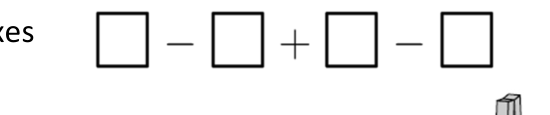
Simona writes the numbers 2, 0, 2 and 5 in the boxes, one number per box (see picture). In what order can she write them so that the calculation gives the biggest result?
Show answer
Answer: E — 5, 2, 0, 2
Show hints
Hint 1 of 2
The third box is the one that gets subtracted, so put the smallest number there.
Still stuck? Show hint 2 →
Hint 2 of 2
Put the 0 in the subtracted (third) box and add everything else.
Show solution
Approach: minimise what is subtracted, maximise what is added
The calculation is first + second minus third + fourth.
To make it biggest, subtract the smallest number, which is 0.
Then the other three (5, 2, 2) are all added: 5 + 2 - 0 + 2 = 9.
The order 5, 2, 0, 2 does this, which is option E.
Thea rotates a painted hexagon clockwise one space at a time. The first rotation can be seen in the picture. Which hexagon does Thea see after the eighth rotation? (The five choices A–E are pictured below the question.)
Show answer
Answer: A
Show hints
Hint 1 of 2
The hexagon has 6 sectors, so rotating 6 times brings it back to the start.
Still stuck? Show hint 2 →
Hint 2 of 2
Eight rotations is the same as just 8 − 6 = 2 rotations.
Show solution
Approach: rotation repeats every 6 steps
A hexagon has 6 sectors, so after 6 one-step turns it looks exactly like the start — the pattern repeats every 6 rotations.
So the 8th rotation looks the same as the 8 − 6 = 2nd rotation; we only need to turn the starting hexagon two steps clockwise.
Turning the Start picture two sectors clockwise matches choice (A), so that is what Thea sees after the eighth rotation.
In Kangaroo Town the unit of distance is the ‘hop’ instead of the kilometre. Kangaroo Klaus needs 12 minutes to cover one hop. How many hops can he cover in 12 hours?
Show answer
Answer: A — 60
Show hints
Hint 1 of 2
First find how many minutes are in 12 hours.
Still stuck? Show hint 2 →
Hint 2 of 2
Each hop costs 12 minutes, so divide the total minutes by 12.
Show solution
Approach: convert to a common time unit then divide
12 hours = 12 × 60 = 720 minutes.
Each hop takes 12 minutes, so he covers \(720 \div 12 = 60\) hops, which is (A).
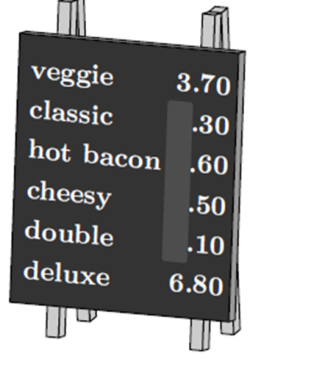
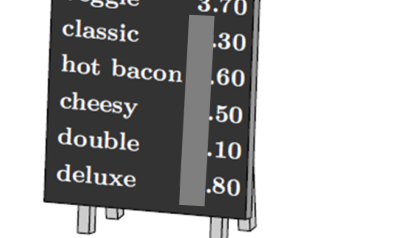
The picture on the right shows the menu of a burger restaurant. The rain has washed away some of the numbers. The burgers are ordered by price. Which of the following prices was on the board?
Show answer
Answer: B — 5.50
Show hints
Hint 1 of 2
The prices go up from top (3.70) to bottom (6.80); use the visible last two digits.
Still stuck? Show hint 2 →
Hint 2 of 2
Find whole-euro values that keep the list strictly increasing and fit the shown cents.
Show solution
Approach: fit increasing prices to the visible digits
Prices rise from 3.70 to 6.80, and the visible cents are .30, .60, .50, .10 going down.
Because .50 is less than .60, ‘cheesy’ must jump to a higher whole euro, and similarly for ‘double’.
The only increasing fit is 4.30, 4.60, 5.50, 6.10.
Among the choices, 5.50 (the cheesy price) is the one that appears.
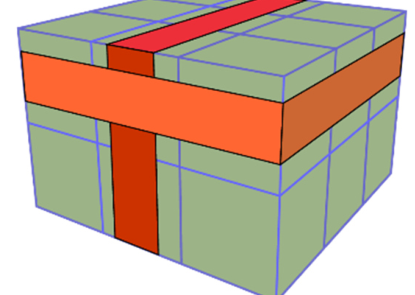
Laura glues together 18 cubes. Then she stretches two rubber bands around them — see picture. How many cubes are not touched by any of the rubber bands?
Show answer
Answer: D — 10
Show hints
Hint 1 of 3
Find the cubes each rubber band touches first, then the leftover cubes are the answer.
Still stuck? Show hint 2 →
Hint 2 of 3
The 18 cubes make a box that is 3 cubes wide, 3 cubes deep and 2 cubes tall.
Still stuck? Show hint 3 →
Hint 3 of 3
Count the cubes a band runs across, then count how many cubes nothing touches at all.
Show solution
Approach: find the touched cubes, then count the ones left over
The 18 cubes are stacked into a box 3 wide, 3 deep and 2 tall.
Follow each rubber band and mark every cube it presses against — the two bands touch 8 cubes in all.
The cubes nothing touches are the 18 minus those 8, which is 10. The answer is D.
Six children were running a race. Ariadne finished third. Bill finished sixth, just behind Ernest. Fatima finished between Ariadne and Ernest. Diana overtook Charles just before the finish line. Who won the race?
Show answer
Answer: C — Diana
Show hints
Hint 1 of 2
Pin down the fixed finishing places first (Ariadne is 3rd).
Still stuck? Show hint 2 →
Hint 2 of 2
Use ‘just behind’ and ‘between’ to place Ernest and Fatima, then the last two spots go to Diana and Charles.
Show solution
Approach: fill in the finishing order from the clues
Ariadne is 3rd. Bill is 6th just behind Ernest, so Ernest is 5th.
Fatima finishes between Ariadne (3rd) and Ernest (5th), so Fatima is 4th.
Only places 1 and 2 are left for Diana and Charles, and Diana overtook Charles at the end.
Sarah has a bag of 18 balls numbered from 1 to 18. What is the smallest number of balls Sarah must remove from the bag to be sure that she has removed at least three prime numbers?
Show answer
Answer: D — 14
Show hints
Hint 1 of 2
Ask how many balls are NOT prime — those could all come out before any prime.
Still stuck? Show hint 2 →
Hint 2 of 2
After removing every non-prime, the next few must be primes; worst case removes all non-primes first.
Show solution
Approach: worst-case (pigeonhole) counting
Primes from 1–18: 2,3,5,7,11,13,17 — seven of them; the other 11 numbers are non-prime.
Worst case she draws all 11 non-primes first, then needs 3 more to guarantee three primes.
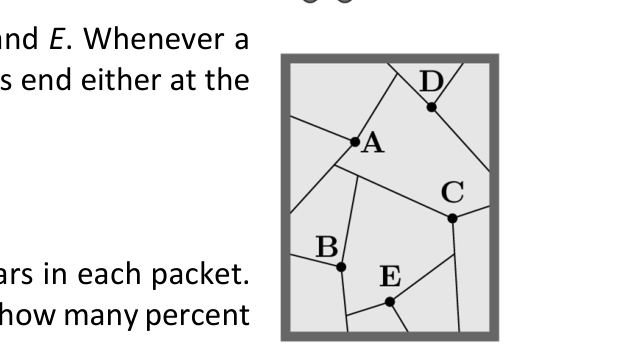
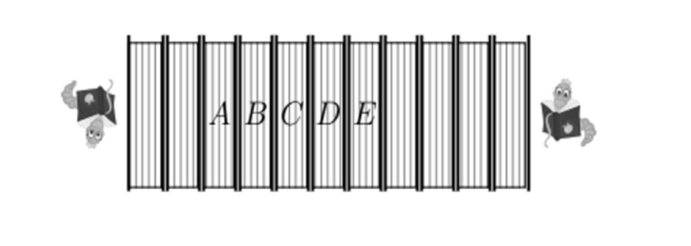
A student throws five stones in turn, hitting a window at points A, B, C, D and E. Whenever a stone hits the window, it creates cracks starting from that point. These cracks end either at the edge of the window or at an existing crack. In which order did he throw the stones?
Show answer
Answer: A — DACBE
Show hints
Hint 1 of 3
A crack can only stop on a crack that already exists, so "X's crack ends on Y's crack" means Y was thrown before X.
Still stuck? Show hint 2 →
Hint 2 of 3
Find the stone whose cracks all run to the window edge—that one must be first.
Still stuck? Show hint 3 →
Hint 3 of 3
Then repeatedly pick the next stone whose cracks only touch the edge or already-placed points.
Show solution
Approach: order the throws by which cracks land on earlier cracks
\(D\)'s cracks reach only the window edge, so \(D\) was thrown first.
Next, \(A\)'s crack ends on \(D\)'s, then \(C\)'s ends on \(A\)'s, then \(B\)'s ends on \(C\)'s, and finally \(E\)'s ends on \(B\)'s.
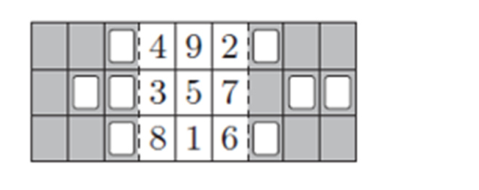
There are numbers on the middle part of a 3-part unfolded card. The left and right parts of the card have holes. Mike folds the right part along the dotted line onto the middle part. He can now see the numbers 2, 3, 5 and 6 through the holes. Then he folds the left part along the dotted line onto the other two parts. What is the sum of the numbers that he can still see through the holes?
Show answer
Answer: A — 8
Show hints
Hint 1 of 2
After folding the right flap, you already see 2, 3, 5 and 6 through its holes.
Still stuck? Show hint 2 →
Hint 2 of 2
Folding the left flap on top covers some of those holes; only the numbers under a left-flap hole stay visible.
Show solution
Approach: trace which holes still line up after both folds
After the right flap is folded over, its holes already let Mike see 2, 3, 5 and 6 on the middle panel.
When the left flap folds on top, its holes only line up over some of those numbers: two of them stay showing through a hole and the other two get covered by solid paper.
The two numbers still visible through a hole are 3 and 5, so the sum is 3 + 5 = 8, giving the answer (A) 8.
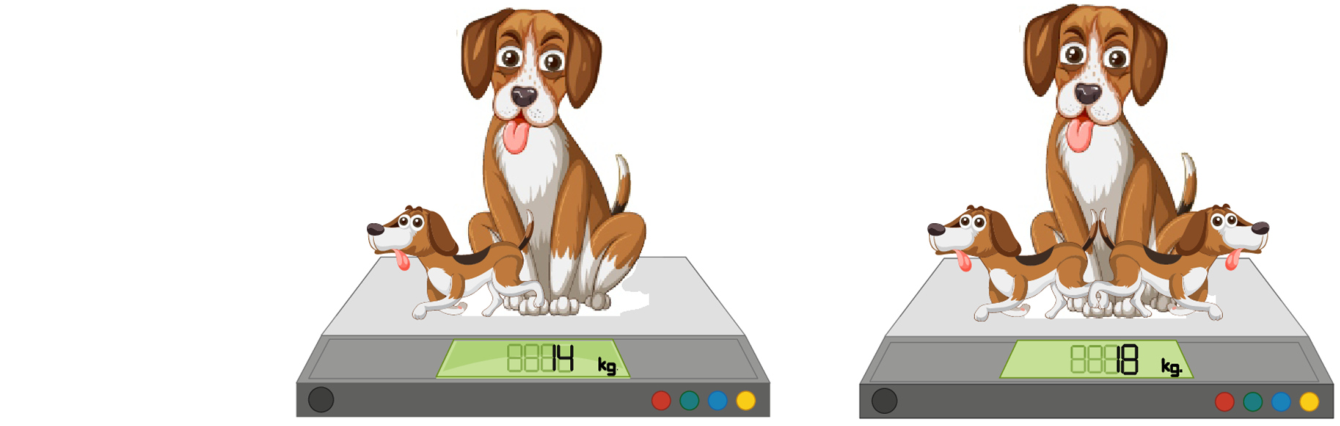
A dog has 2 puppies that both weigh the same. Picture 1 shows that the dog and one puppy together weigh 14 kilograms. Picture 2 shows that the dog and both puppies together weigh 18 kilograms. How many kilograms does the big dog weigh?
Show answer
Answer: B — 10
Show hints
Hint 1 of 3
The two pictures are the same except one has one more puppy.
Still stuck? Show hint 2 →
Hint 2 of 3
The extra weight from picture 1 to picture 2 is just one puppy.
Still stuck? Show hint 3 →
Hint 3 of 3
Once you know how heavy one puppy is, take it away from the 14 kg picture to find the dog.
Show solution
Approach: the extra puppy tells you one puppy's weight, then find the dog
Picture 1 is the dog and one puppy (14 kg). Picture 2 is the dog and both puppies (18 kg).
Going from 14 kg to 18 kg adds one more puppy, so one puppy weighs 4 kg.
Take that puppy away from picture 1: 14 take away 4 leaves 10 kg for the dog. The answer is B.
Luka has dogs, rabbits and cats as pets. Eight of these pets are not dogs, five of these pets are not rabbits and seven of these pets are not cats. How many pets does Luka have?
Show answer
Answer: A — 10
Show hints
Hint 1 of 2
Let the counts of dogs, rabbits, cats be d, r, c and turn each 'not' statement into an equation.
Still stuck? Show hint 2 →
Hint 2 of 2
Add the three equations; each total counts every pet twice.
Show solution
Approach: set up and add the three equations
Not dogs: r+c=8; not rabbits: d+c=5; not cats: d+r=7.
The picture shows the menu of a burger restaurant. The rain has washed away some of the numbers. The burgers are listed by price in increasing order, the cheapest being the “veggie” burger. What is the smallest possible price of the “deluxe” burger?
Show answer
Answer: B — 6.80
Show hints
Hint 1 of 2
Only the cents are readable; the whole-euro parts are hidden, but the prices increase down the list.
Still stuck? Show hint 2 →
Hint 2 of 2
Step down the menu choosing the smallest whole-euro part that keeps each price above the one before it.
Show solution
Approach: build the cheapest increasing price chain
Silvia's favourite chocolate bars are sold in packets. There used to be five bars in each packet. Now there are only four in each packet, but the packets still cost the same. By how many percent has each bar become more expensive?
Show answer
Answer: C — by 25%
Show hints
Hint 1 of 2
Find the cost of one bar before and after the change.
Still stuck? Show hint 2 →
Hint 2 of 2
Old price per bar is P/5, new is P/4; compare them as a ratio.
Three turtles are competing in a 10 km race. Each of them moves at a constant speed. When the first turtle finishes the competition, the second has completed 14 of the distance and the third has completed 15 of the distance. How far is the third turtle from the finish line when the second turtle finishes the race?
Show answer
Answer: B — 2 km
Show hints
Hint 1 of 2
The turtles move at steady speeds, so the distance each has covered tells you their speed ratio.
Still stuck? Show hint 2 →
Hint 2 of 2
When the 2nd turtle finishes, its distance has grown by the same factor as the 3rd turtle’s.
Show solution
Approach: scale the third turtle’s distance by the same factor
When the 1st finishes 10 km, the 2nd has done 1/4 of 10 = 2.5 km and the 3rd has done 1/5 of 10 = 2 km.
For the 2nd turtle to reach 10 km, time must be multiplied by 10 ÷ 2.5 = 4.
In that same time the 3rd turtle goes 2 × 4 = 8 km.
So the 3rd turtle is 10 − 8 = 2 km from the finish.
Jan puts 12 pieces of fruit on a table. Vera takes away 2 pears, 4 apples and half of the oranges. Now there are only oranges on the table. How many oranges are left?
Show answer
Answer: C — 3
Show hints
Hint 1 of 3
The 12 pieces are pears, apples and oranges all together.
Still stuck? Show hint 2 →
Hint 2 of 3
Take the pears and apples out of the 12 to see how many oranges there were.
Still stuck? Show hint 3 →
Hint 3 of 3
Vera kept only half the oranges, so split that number of oranges into two equal piles.
Show solution
Approach: find how many oranges there were, then keep half
The 2 pears and 4 apples make 6 pieces that are not oranges.
Take those 6 away from 12 and you are left with 6 oranges to start.
Vera took half the oranges away, so half of 6 stays: 3 oranges are left. The answer is C.
Katrin and Thomas are both celebrating their birthday today. Thomas notices that \(\frac{1}{19}\) of Katrin's age is the same as \(\frac{1}{17}\) of his. Together they are older than 40 years and younger than 100 years. How old is Katrin?
Show answer
Answer: C — 38
Show hints
Hint 1 of 2
If Katrin/19 equals Thomas/17, both ages are multiples of the same number.
Still stuck? Show hint 2 →
Hint 2 of 2
Write K=19k, T=17k and use 40 < K+T < 100.
Show solution
Approach: common-multiple substitution
From K/19 = T/17, set K = 19k and T = 17k.
Total K+T = 36k must satisfy 40 < 36k < 100, so k = 2.
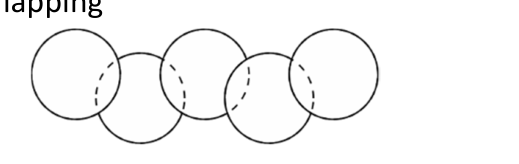
Five circles, each with an area of 8 cm², overlap to form the figure shown. Each overlapping region has an area of 1 cm². What is the total area of the figure, in cm²?
Show answer
Answer: B — 36
Show hints
Hint 1 of 2
Add the five circle areas, then fix the double counting where they overlap.
Still stuck? Show hint 2 →
Hint 2 of 2
Each of the four overlaps was counted twice, so subtract it once.
Show solution
Approach: inclusion–exclusion on overlapping areas
Five circles give 5 × 8 = 40 cm² if simply added.
The four overlap regions (1 cm² each) were each counted twice, so subtract 4 cm².
Total figure area = \(40 - 4 = 36\) cm², which is (B).
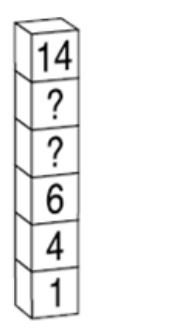
Vera has built a tower of cubes. She wants to replace the two cubes with question marks with cubes with numbers. Vera wants the number on each cube to be at least 2 higher than the number on the cube below it. How many ways can she replace the two cubes?
Show answer
Answer: D — 6
Show hints
Hint 1 of 2
The two missing cubes sit above 6 and below 14, each at least 2 more than the one below.
Still stuck? Show hint 2 →
Hint 2 of 2
List the lower missing number first, then count valid choices for the upper one.
Show solution
Approach: count valid number pairs by casework
Reading up, the tower is 1, 4, 6, then two unknowns, then 14, each cube at least 2 more than the one below.
The lower unknown must be at least 8 (it is at least 2 more than 6).
The upper unknown is at least 2 more than it and at most 12 (since 14 is at least 2 more).
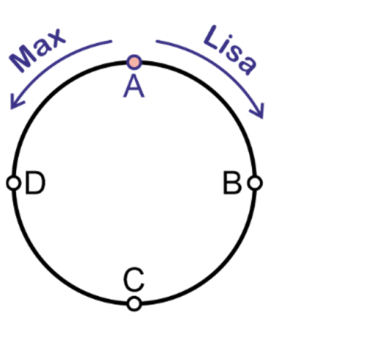
Max draws a large circle in the sand and Lisa adds the letters A, B, C and D. Starting together from point A, Lisa runs clockwise and Max runs anti-clockwise around the circle (see picture). They meet for the first time at B, then at C, then at D, and then again at A. How many times has Max run around the circle by then?
Show answer
Answer: C — 3 times
Show hints
Hint 1 of 2
Each time they meet, together they have covered one more full circle.
Still stuck? Show hint 2 →
Hint 2 of 2
Find what fraction of the circle Max covers before the first meeting, then scale up to the total laps.
Show solution
Approach: use the constant speed ratio across the meetings
Going opposite ways, between meetings the two together cover one whole circle.
They first meet at B after Max has gone three quarters of the way around (A to D to C to B), so Max is 3 times faster.
From the start until they meet again at A, together they cover 4 circles.
Max therefore covers 3 of those 4 circles, so Max ran around 3 times - option C.
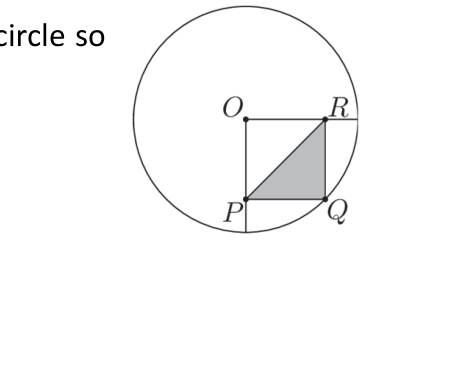
Consider a circle with centre O and radius 10 cm. A square OPQR is drawn inside the circle so that Q lies on the circle (see diagram). What is the area of the grey triangle PQR?
Show answer
Answer: B — 25 cm²
Show hints
Hint 1 of 2
The corner of the square at the centre and the opposite corner on the circle are the ends of a diagonal.
Still stuck? Show hint 2 →
Hint 2 of 2
The diagonal equals the radius; the triangle is half the square.
Show solution
Approach: diagonal = radius, triangle is half the square
O is a corner of square OPQR and Q is the opposite corner on the circle, so the diagonal OQ = radius = 10.
A square with diagonal d has area d²/2 = 100/2 = 50.
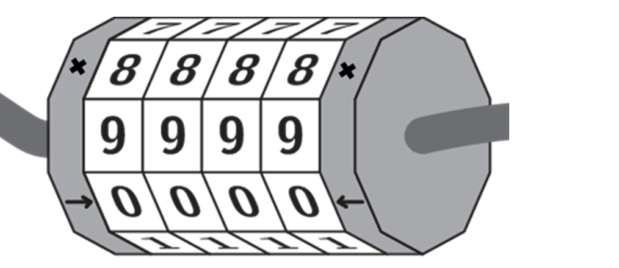
When Paul sets the number 0000 on his bicycle lock, he sees 8888 at the point marked with an x. To open the lock he must turn the rings so that 2815 shows at the x mark. What number is then next to the arrows?
Show answer
Answer: A — 4037
Show hints
Hint 1 of 2
Compare the two visible windows: at the arrows you see 0, two rows up at the x you see 8.
Still stuck? Show hint 2 →
Hint 2 of 2
Each ring is offset by a fixed amount; find the digit at the arrows for each target digit at the x.
Show solution
Approach: use the fixed offset between the x-window and the arrow-window
When the arrows show 0 the x shows 8, so on every ring the arrow digit is 2 more than the x digit (the rows run …,8,9,0,… downward).
Setting 2,8,1,5 at the x makes the arrows read 2+2, 8+2, 1+2, 5+2 (mod 10) = 4, 0, 3, 7.
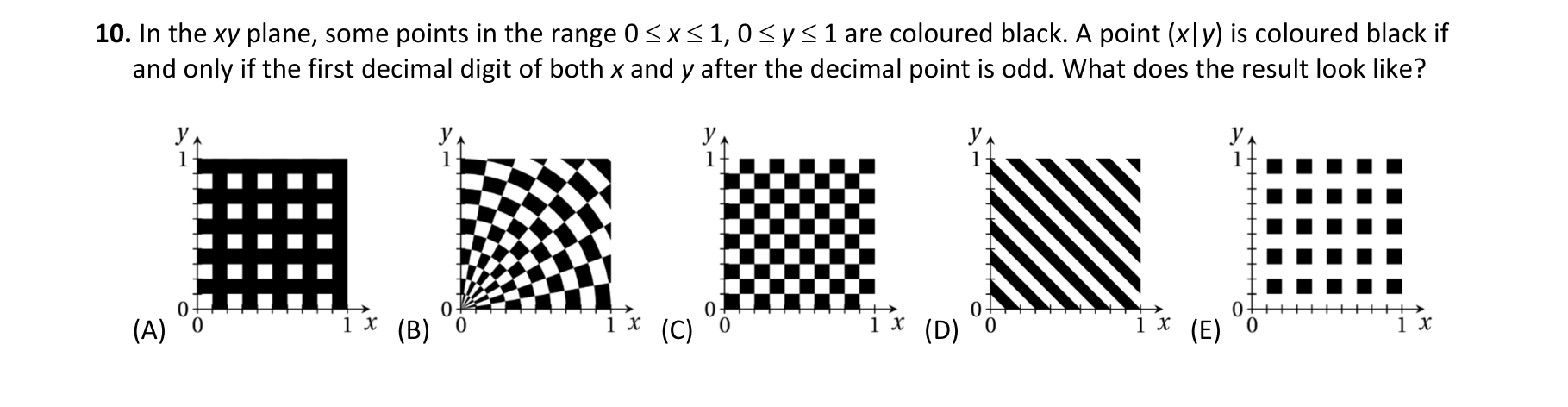
In the \(xy\) plane, some points in the range \(0 \le x \le 1\), \(0 \le y \le 1\) are coloured black. A point \((x\,|\,y)\) is coloured black if and only if the first decimal digit of both \(x\) and \(y\) after the decimal point is odd. What does the result look like?
Show answer
Answer: E
Show hints
Hint 1 of 2
List which first-decimal digits are odd for x, and the same for y.
Still stuck? Show hint 2 →
Hint 2 of 2
Odd first digit means x lies in [0.1,0.2)∪[0.3,0.4)∪…∪[0.9,1.0): five separated strips each way.
Show solution
Approach: intersect two sets of strips
x has an odd first decimal in five disjoint strips; same for y.
Black points form a 5×5 array of separated squares with gaps between them.
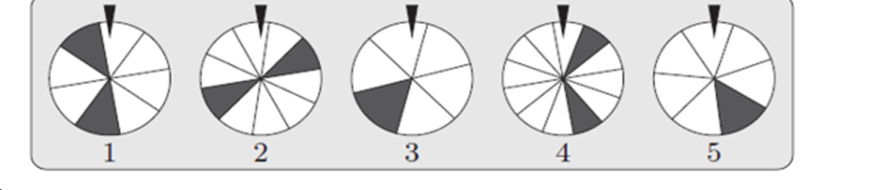
In the picture you can see five different wheels of fortune. Each wheel of fortune is divided into equal-sized parts, but the number of parts is different. Anna spins all of the wheels of fortune. If a wheel of fortune stops at the arrow with a dark sector, she wins. Which of the wheels of fortune gives Anna the best chance of winning?
Show answer
Answer: A — 1
Show hints
Hint 1 of 2
On a fair wheel, the chance of winning is just the share of the wheel that is dark: dark sectors out of total sectors.
Still stuck? Show hint 2 →
Hint 2 of 2
Write each wheel’s chance as a fraction and see which fraction is biggest — a bigger dark share on a wheel with fewer pieces wins.
Show solution
Approach: compare the fraction of dark sectors
Each wheel is split into equal parts, so the chance of stopping on dark is simply the fraction of the wheel that is dark.
Wheel 1 has 2 dark sectors out of 8, which is 14 of the wheel; the others all turn out to be smaller dark shares (each less than a quarter, since they spread their dark sectors over more pieces).
14 is the largest dark share, so wheel 1 gives Anna the best chance, and the answer is (A) 1.
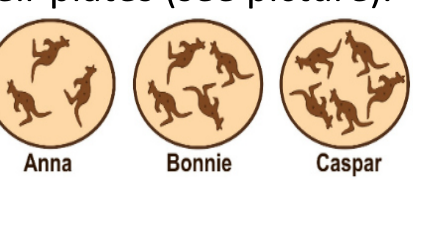
Anna, Bonnie and Caspar have some kangaroo cookies on their plates (see picture). There are 15 more cookies left over. They share these out so that each child ends up with the same number of cookies on their plate. How many cookies are added to Anna's plate?
Show answer
Answer: D — 6
Show hints
Hint 1 of 2
First find how many cookies there are altogether, then share them equally among the three children.
Still stuck? Show hint 2 →
Hint 2 of 2
Subtract the cookies Anna already has from her fair share.
Show solution
Approach: find the equal share, then see how many Anna still needs
The plates already hold 3 (Anna) + 4 (Bonnie) + 5 (Caspar) = 12 cookies.
With the 15 extra there are 12 + 15 = 27 cookies in all.
Shared equally, each child should have 27 ÷ 3 = 9 cookies.
Alex threads white and black beads alternately onto a piece of string. Twice, 5 beads are hidden — see picture. How many white beads are hidden in total?
Show answer
Answer: C — 6
Show hints
Hint 1 of 3
The beads always go white, black, white, black — never two of the same colour together.
Still stuck? Show hint 2 →
Hint 2 of 3
Look at the visible bead right before each hidden part to know what colour comes next.
Still stuck? Show hint 3 →
Hint 3 of 3
Fill in each hidden run of 5 by carrying on the colours, then count just the white ones.
Show solution
Approach: carry on the alternating colour pattern through each hidden run
The beads keep switching: white, black, white, black, and so on.
Each hidden group of 5 carries on that pattern, and in each one 3 of the 5 beads come out white.
There are two hidden groups, so 3 and 3 make 6 white beads in total. The answer is C.
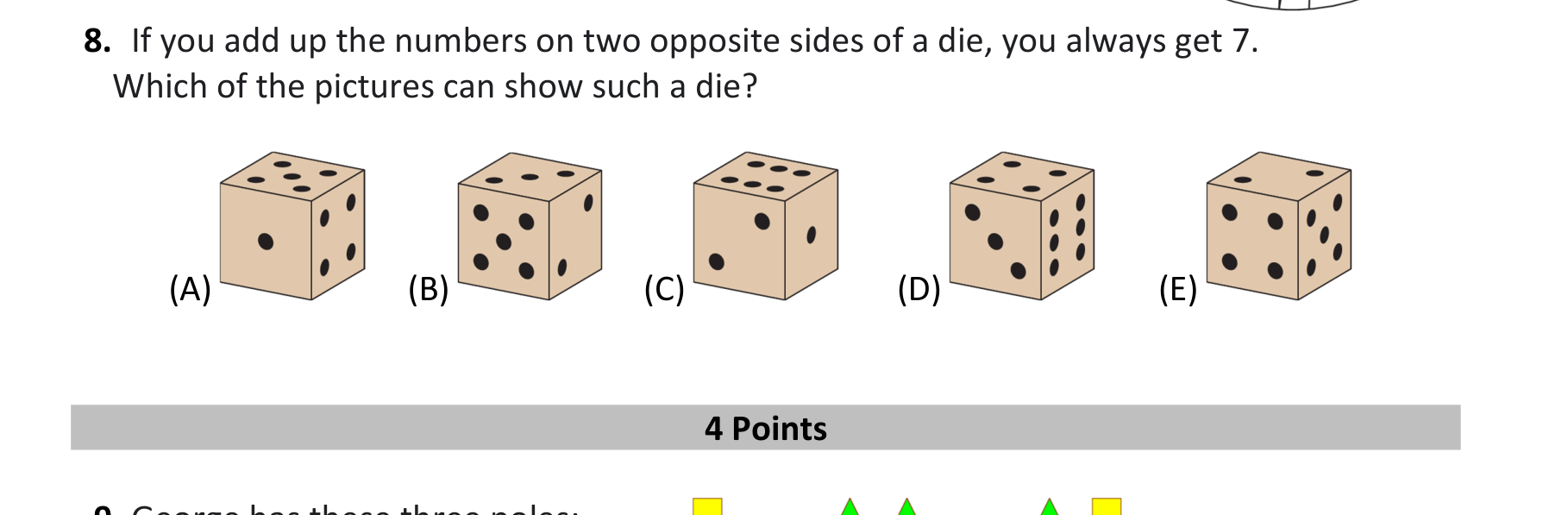
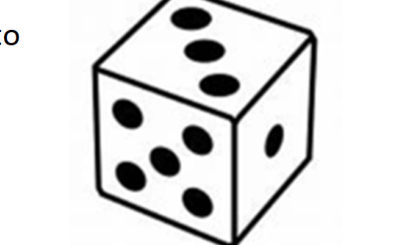
On a standard die, the sum of the number of points on opposite sides is always 7. We want to tilt the die shown several times along its edges so that all six sides are on top once. Which of the given sequences of top numbers is not possible?
Show answer
Answer: B — 3-2-5-1-6-4
Show hints
Hint 1 of 2
Each tilt moves to a face sharing an edge with the current top; opposite faces (summing to 7) can never be consecutive in the list.
Still stuck? Show hint 2 →
Hint 2 of 2
Check each sequence: two faces that are opposite must not appear next to each other.
Show solution
Approach: adjacent tops cannot be opposite faces
Tilting over an edge sends the top to a face that shares that edge, i.e. an adjacent face — never to the opposite face (its 7-partner).
So in a valid sequence no two consecutive top numbers may sum to 7; scan each option for such a forbidden step.
In sequence B, the step 2 then 5 has \(2+5=7\), an impossible move, so B is the one that cannot occur.
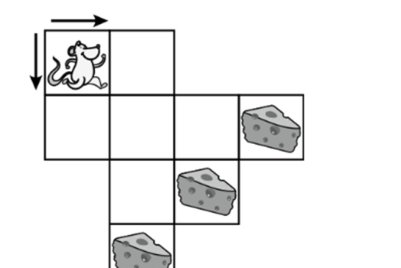
A mouse wants to reach a piece of cheese. From each square it can only move to the square to its right or to the square directly below it. How many different paths lead the mouse to a piece of cheese?
Show answer
Answer: C — 8
Show hints
Hint 1 of 2
Instead of drawing every route, write a number in each square: how many ways the mouse can reach that square.
Still stuck? Show hint 2 →
Hint 2 of 2
A square's number is the sum of the numbers in the square just left of it and the square just above it, since those are the only ways in.
Show solution
Approach: fill in path counts square by square
Write 1 in the start square; every other square gets the total of the square to its left and the square above it (the only squares that can flow into it).
Filling the staircase this way, the counts grow 1, then 2 and 3, and so on down toward the cheese.
The cheese squares collect a total of 8 paths, which is (C).
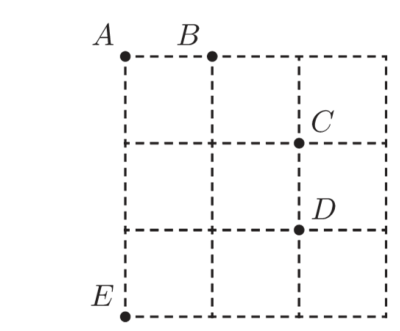
Robert wants to choose four points in such a way that the distances between any two of them are different. Which one of the points A, B, C, D or E must he remove?
Show answer
Answer: D — D
Show hints
Hint 1 of 3
Read each point's grid coordinates, then look for repeated distances rather than computing all ten exactly.
Still stuck? Show hint 2 →
Hint 2 of 3
Several pairs share the length \(\sqrt5\); find the one point common to the offending pairs.
Still stuck? Show hint 3 →
Hint 3 of 3
Remove that point and check the remaining six distances are all different.
Show solution
Approach: find the repeated length and the point it shares
With \(A(0,3), B(1,3), C(2,2), D(2,1), E(0,0)\), the pairs \(AC, BD, DE\) all have length \(\sqrt5\), so a duplicate length is the obstacle.
Point \(D\) appears in two of those equal pairs (\(BD\) and \(DE\)); the four remaining points \(A,B,C,E\) give distances \(1,\sqrt2,\sqrt5,2\sqrt2,3,\sqrt{10}\), all distinct.
Which of the five shapes cannot be placed on the large square so that it only lies on white squares? (The five shapes A–E and the patterned large square are pictured with the question.)
Show answer
Answer: D
Show hints
Hint 1 of 2
Look at where the white squares actually sit on the big board, then try to slide each shape around so all of its squares land on white.
Still stuck? Show hint 2 →
Hint 2 of 2
Four of the shapes can be tucked onto a run of white squares; hunt for the one shape whose squares are forced to grab a black square no matter where you put it.
Show solution
Approach: try to fit each shape onto only white squares
A shape works only if you can lay it down so every one of its squares sits on a white square of the board.
Slide each shape A–E around the board: four of them can be placed on a stretch of white squares with no black square underneath.
Shape D is the only one that always lands on at least one black square wherever it goes, so it cannot sit only on white squares — the answer is (D).
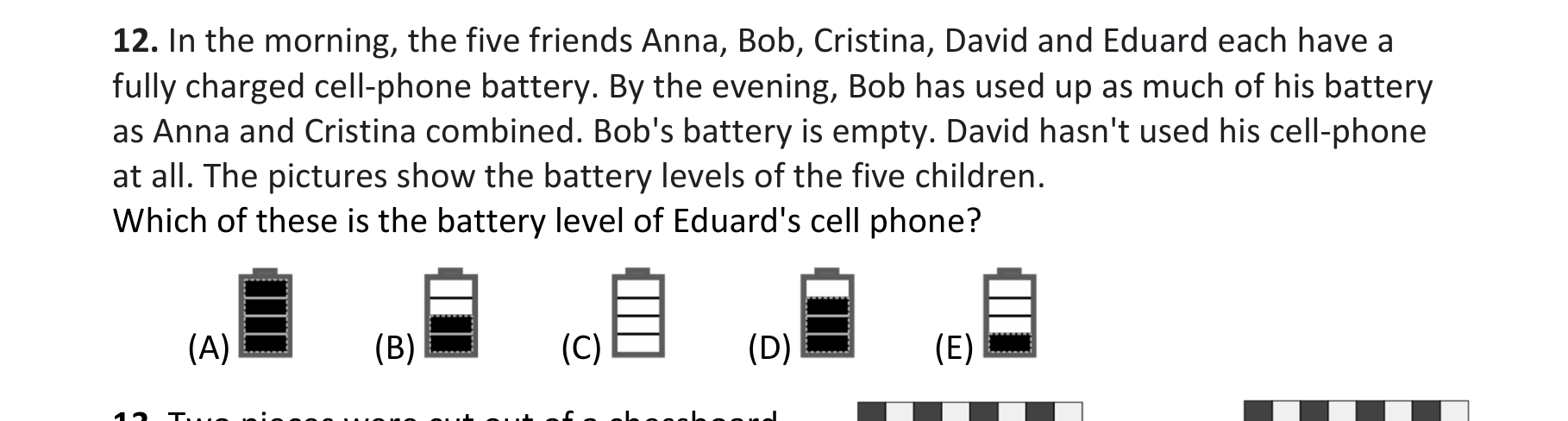
In the morning, the five friends Anna, Bob, Cristina, David and Eduard each have a fully charged phone battery. By evening, Bob has used up as much of his battery as Anna and Cristina together, and Bob's battery is now empty. David has not used his phone at all. The pictures show the battery levels of the five children. Which one is Eduard's battery level?
Show answer
Answer: B
Show hints
Hint 1 of 2
David did not use his phone, so his battery is still full - that pins down 'full'.
Still stuck? Show hint 2 →
Hint 2 of 2
Bob's used-up amount equals Anna's plus Cristina's; match the five pictures to the five children to find the leftover one for Eduard.
Show solution
Approach: assign the five battery pictures by the given clues
David's phone is full (unused) and Bob's is empty (fully used).
Bob's drained amount equals Anna's drain plus Cristina's drain combined.
Match those clues to four of the five pictures; the one left over is Eduard's.
17 squirrels are sitting on 4 trees. There are at least 2 squirrels on each tree. The number of squirrels is different on each tree. What is the largest possible number of squirrels on one tree?
Show answer
Answer: B — 8
Show hints
Hint 1 of 3
To put as many squirrels as possible on one tree, leave as few as possible on the others.
Still stuck? Show hint 2 →
Hint 2 of 3
The other three trees still need at least 2 each, and all four numbers must be different.
Still stuck? Show hint 3 →
Hint 3 of 3
The three smallest different numbers, each at least 2, are 2, 3 and 4.
Show solution
Approach: minimise the other three to maximise one
Each tree needs at least 2 squirrels and all four counts are different.
Make three trees as small as possible: 2, 3 and 4 squirrels.
Those three trees hold 2 + 3 + 4 = 9 squirrels, leaving 17 − 9 = 8 on the last tree. The answer is B.
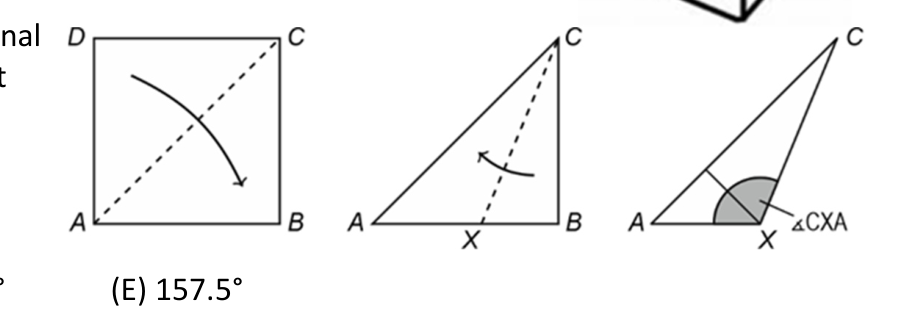
Alexander folds a square sheet of paper along its diagonal to form a triangle. He then folds the paper again so that one of the two shorter sides of the triangle lies on the longer side of the triangle to form the smaller triangle AXC (see diagrams). What is the size of the angle ∠CXA?
Show answer
Answer: B — 112.5°
Show hints
Hint 1 of 2
After the first fold you have a right isosceles triangle, with angles 90°, 45°, 45°.
Still stuck? Show hint 2 →
Hint 2 of 2
The second fold lays a 45° leg onto the hypotenuse, so the crease bisects the angle it folds — work out the resulting angle at X.
Show solution
Approach: track angles through the two folds
Folding the square along its diagonal gives a right isosceles triangle: a 90° corner and two 45° corners.
The second fold lays a short side (leg) onto the long side (hypotenuse), so the crease through X bisects the 45° corner at A into two 22.5° pieces.
At X the crease meets the right angle, giving \(\angle CXA = 90^\circ + 22.5^\circ = 112.5^\circ\), answer B.
In a 60 m hurdles race there are 5 hurdles. The first hurdle is 12 m after the start, and the distance between any two consecutive hurdles is 8 m. How far is the last hurdle from the finish line?
Show answer
Answer: E — 16 m
Show hints
Hint 1 of 2
Find the position of the last (5th) hurdle measured from the start.
Still stuck? Show hint 2 →
Hint 2 of 2
Then subtract that from the 60 m finish line.
Show solution
Approach: locate the last hurdle, then measure to the finish
Hurdle 1 is at 12 m and each later hurdle is 8 m further: 12, 20, 28, 36, 44.
The 5th hurdle is at 12 + 4×8 = 44 m.
Distance to the finish = \(60 - 44 = 16\) m, which is (E).
Among 10 different given positive integers, exactly five are divisible by 5 and exactly seven are divisible by 7. Let M be the largest of these numbers. What is the smallest possible value of M?
Show answer
Answer: E — a different value
Show hints
Hint 1 of 2
At least how many numbers must be divisible by both 5 and 7?
Still stuck? Show hint 2 →
Hint 2 of 2
Inclusion–exclusion forces ≥2 multiples of 35; the second-smallest is 70, so M is at least 70.
Show solution
Approach: inclusion–exclusion, then minimise the maximum
5 + 7 − (multiples of 35) ≤ 10, so at least 2 numbers are multiples of 35.
The two smallest multiples of 35 are 35 and 70, so 70 must appear and is the largest.
M = 70, which is not among A–D, so the answer is a different value.
Five swimmers from a school are training for a relay race. The five participants swim the same distance, one after the other, without stopping. The coach stops the intermediate time after each swimmer. The first swimmer takes 2 minutes and 8 seconds. The stopwatches show the total time after the first, second, third, fourth and fifth swimmer (see picture). Which swimmer swam the distance the fastest?
Show answer
Answer: D — the fourth
Show hints
Hint 1 of 2
Each stopwatch shows the total time after that many swimmers, so subtract to get each leg.
Still stuck? Show hint 2 →
Hint 2 of 2
All swam the same distance, so the fastest is the one with the shortest individual leg.
Show solution
Approach: difference of consecutive total times
The watches show running totals: 2:08, 4:07, 6:10, 8:05, 10:03.
Subtract each total from the one before to get each swimmer’s own time: 128 s, 119 s, 123 s, 115 s, 118 s.
Same distance means fastest = shortest time, and 115 s is the smallest.
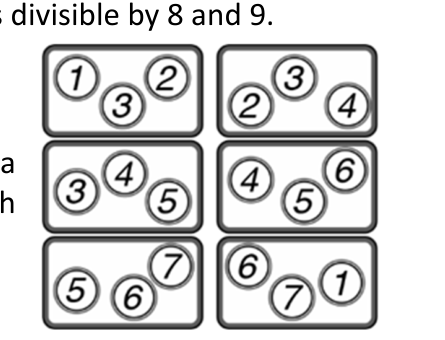
The four-digit number 80?? is missing its last two digits. We know that this number is divisible by 8 and 9. What is the product of the last two digits?
Show answer
Answer: D — 24
Show hints
Hint 1 of 2
Divisible by both 8 and 9 means divisible by 72.
Still stuck? Show hint 2 →
Hint 2 of 2
Find the multiple of 72 between 8000 and 8099, then multiply its last two digits.
Show solution
Approach: use divisibility by 72
A number divisible by 8 and 9 is divisible by 72.
The multiple of 72 of the form 80__ is 8064 (= 72×112).
Emma wants to write a number in each circle (see diagram) so that each number equals the sum of the numbers in the two adjacent circles. She has already written two numbers. Which number will she write in the grey circle?
Show answer
Answer: D — −3
Show hints
Hint 1 of 2
Every circle equals the sum of the two circles touching it, and the 1 and 2 are not next to each other.
Still stuck? Show hint 2 →
Hint 2 of 2
Start with the empty circle between the 1 and the 2 — it must equal \(1+2\) — then keep applying the rule around the ring.
Show solution
Approach: propagate the neighbour-sum rule around the ring
The top circle sits between the 1 and the 2, so it equals \(1+2=3\).
Now use 'each circle = sum of its two neighbours' going around: the right circle is \(2-3=-1\), the left circle is \(1-3=-2\), and the grey bottom circle (between them) is \(-1+(-2)=-3\).
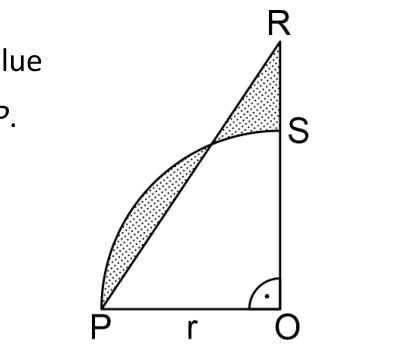
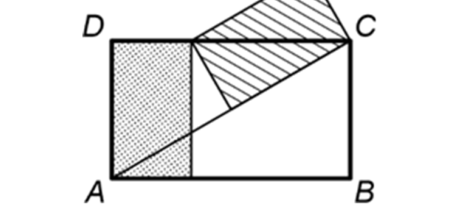
In the diagram we see a quarter circle SP with centre O and radius r, as well as a triangle ORP. The two grey regions have the same area. How long is the segment OR?
Show answer
Answer: A — \(\dfrac{\pi r}{2}\)
Show hints
Hint 1 of 2
Equal grey areas means a shared region can be added to both without changing the equality.
Still stuck? Show hint 2 →
Hint 2 of 2
Adding the common piece turns "two greys equal" into "triangle ORP = quarter circle".
Show solution
Approach: add the shared region to both grey pieces
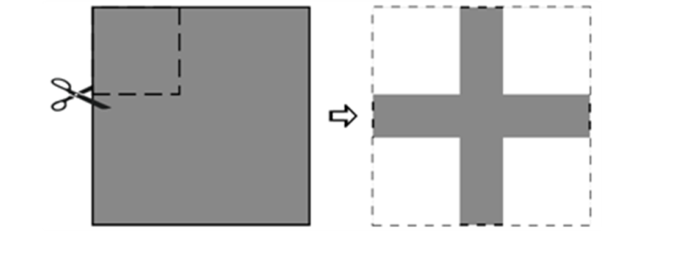
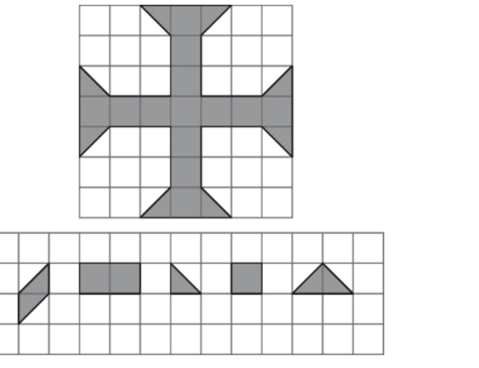
Jana cuts four small squares of the same size from the corners of a square piece of paper (see picture). The total cut-away area is 16 cm², and the area of the remaining figure (the cross) is 9 cm². What is the perimeter of the cross?
Show answer
Answer: C — 20 cm
Show hints
Hint 1 of 2
The whole square’s area is the cut-away plus the cross.
Still stuck? Show hint 2 →
Hint 2 of 2
Cutting a square out of a corner doesn’t change the perimeter — the removed edges are replaced by equal new edges.
Show solution
Approach: reassemble area, then track perimeter
Original square area = 16 (cut away) + 9 (cross) = 25, so its side is 5.
Each of the four corner squares has area 16 ÷ 4 = 4, so side 2.
Removing a 2×2 square from a corner replaces two outer edges with two equal inner edges, so the perimeter stays the same.
The cross perimeter equals the square’s perimeter: 4 × 5 = 20 cm.
Rudi feeds six sheep in the petting zoo. The six sheep get a total of 210 g of food. Each of the five large sheep gets the same amount, and the small sheep gets twice as much as a large sheep. How much food does the small sheep get?
Show answer
Answer: C — 60 g
Show hints
Hint 1 of 2
The small sheep eats as much as two large sheep, so count it as two large sheep.
Still stuck? Show hint 2 →
Hint 2 of 2
Then the 210 g is shared into 7 equal large-sheep portions.
Show solution
Approach: count everything in equal large-sheep portions
The small sheep eats as much as two large sheep, so pretend it is two large sheep.
Now there are 5 + 2 = 7 equal large-sheep portions sharing 210 g.
Each portion is 210 ÷ 7 = 30 g.
The small sheep gets two portions: 30 + 30 = 60 g, option C.
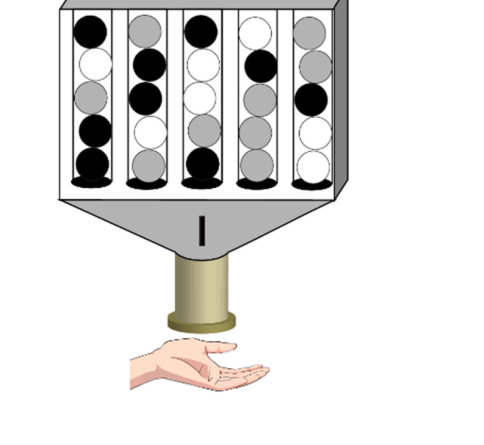
Every time a coin is put into the machine, the bottom ball falls out of one of the five tubes. How many coins does Barbara have to put in to be sure she gets at least one white ball?
Show answer
Answer: D — 11
Show hints
Hint 1 of 3
Imagine Barbara has the unluckiest day — every ball that is not white comes out first.
Still stuck? Show hint 2 →
Hint 2 of 3
Only the bottom ball of a tube can come out, so count the non-white balls that could fall before any white one.
Still stuck? Show hint 3 →
Hint 3 of 3
Add up all those non-white balls, then put in one more coin to be sure of a white ball.
Show solution
Approach: imagine the unluckiest order, then add one more coin
Each coin drops the bottom ball of some tube, so the worst luck is all the non-white balls coming out first.
Counting from the bottom of every tube up to its first white ball, 10 non-white balls could fall before any white one.
After those 10 unlucky balls, the next ball must be white, so she needs 10 + 1 = 11 coins. The answer is D.
An athlete has a collection of 2 gold medals and 5 silver medals. They are numbered in a certain order from 1 to 7. The images show black-and-white pictures of the medals. Each of the six pictures shows exactly one gold medal. What is the sum of the numbers on the two gold medals?
Show answer
Answer: C — 9
Show hints
Hint 1 of 2
Each of the six pictures shows exactly one of the two gold medals, the rest silver.
Still stuck? Show hint 2 →
Hint 2 of 2
A number is gold only if it appears as the single gold in some picture; find which two numbers are always the gold one.
Show solution
Approach: identify the two consistently-gold numbers
Each of the six pictures shows exactly one gold medal among the seven, so the gold medal is the single one that looks different in that picture.
Comparing the pictures, only two of the numbered medals ever play the role of the gold one — those are the two gold medals.
Adding the numbers on that gold pair gives 9, answer C.
Sanja has two bowls of numbered balls. The left bowl holds seven balls numbered 1, 2, 6, 7, 10, 11 and 12, with arithmetic mean 7.0. The right bowl holds five balls numbered 3, 4, 5, 8 and 9, with arithmetic mean 5.8. Sanja wants to increase the arithmetic mean of both bowls. Which ball must she move from the left bowl to the right bowl to do this?
Show answer
Answer: A — 6
Show hints
Hint 1 of 2
Moving a ball must push BOTH averages up — think about what value keeps each average rising.
Still stuck? Show hint 2 →
Hint 2 of 2
The moved ball must be below the left average (so the left mean rises) yet above the right average (so the right mean rises).
Show solution
Approach: bound the ball value from both averages
Left sum is 7×7 = 49, right sum is 5.8×5 = 29.
To raise the left mean the removed ball must be below 7; to raise the right mean it must be above 5.8.
The only left-bowl ball between 5.8 and 7 is 6, which is (A).
Each card has two 3-digit numbers on it. Some of the digits are hidden (shown as ?). On one of the cards, the sum of the digits of the two numbers is the same. Which one?
Show answer
Answer: C — 982 and 1??
Show hints
Hint 1 of 2
For each card, find the digit sum of the fully shown number.
Still stuck? Show hint 2 →
Hint 2 of 2
Check whether the hidden number could ever reach that same digit sum.
Show solution
Approach: compare achievable digit sums
982 has digit sum 9 + 8 + 2 = 19.
Its partner 1?? can reach a digit sum as high as 1 + 9 + 9 = 19 (the number 199).
For every other card, the visible number’s digit sum is out of reach of its hidden partner.
So the card with equal digit sums is ‘982 and 1??’.
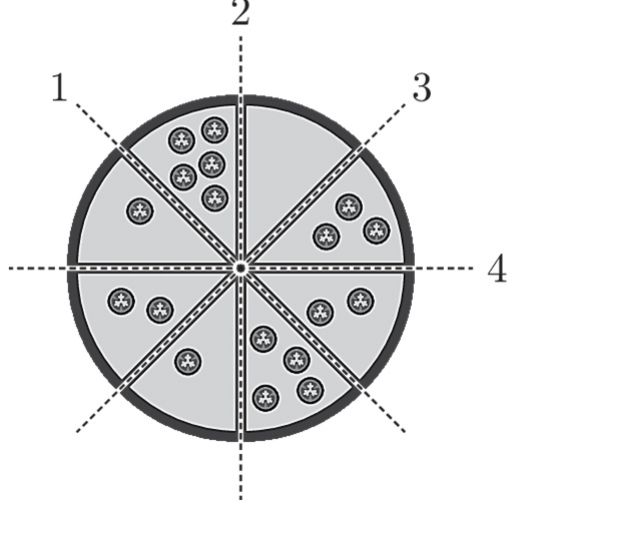
Tom wants to cut the pizza into two halves so that each half has the same number of tomatoes. There are two ways to do this. Along which lines can he cut?
Show answer
Answer: D — 2 or 4
Show hints
Hint 1 of 2
A cut through the centre splits the tomatoes into two halves - you need each half to hold the same number.
Still stuck? Show hint 2 →
Hint 2 of 2
Test the labelled lines: a fair cut has equal tomatoes on both sides.
Show solution
Approach: find centre lines that split the tomatoes evenly
Each valid cut is a straight line through the middle of the pizza.
Count tomatoes on each side of the labelled lines.
Lines 2 and 4 each leave the same number of tomatoes on both halves.
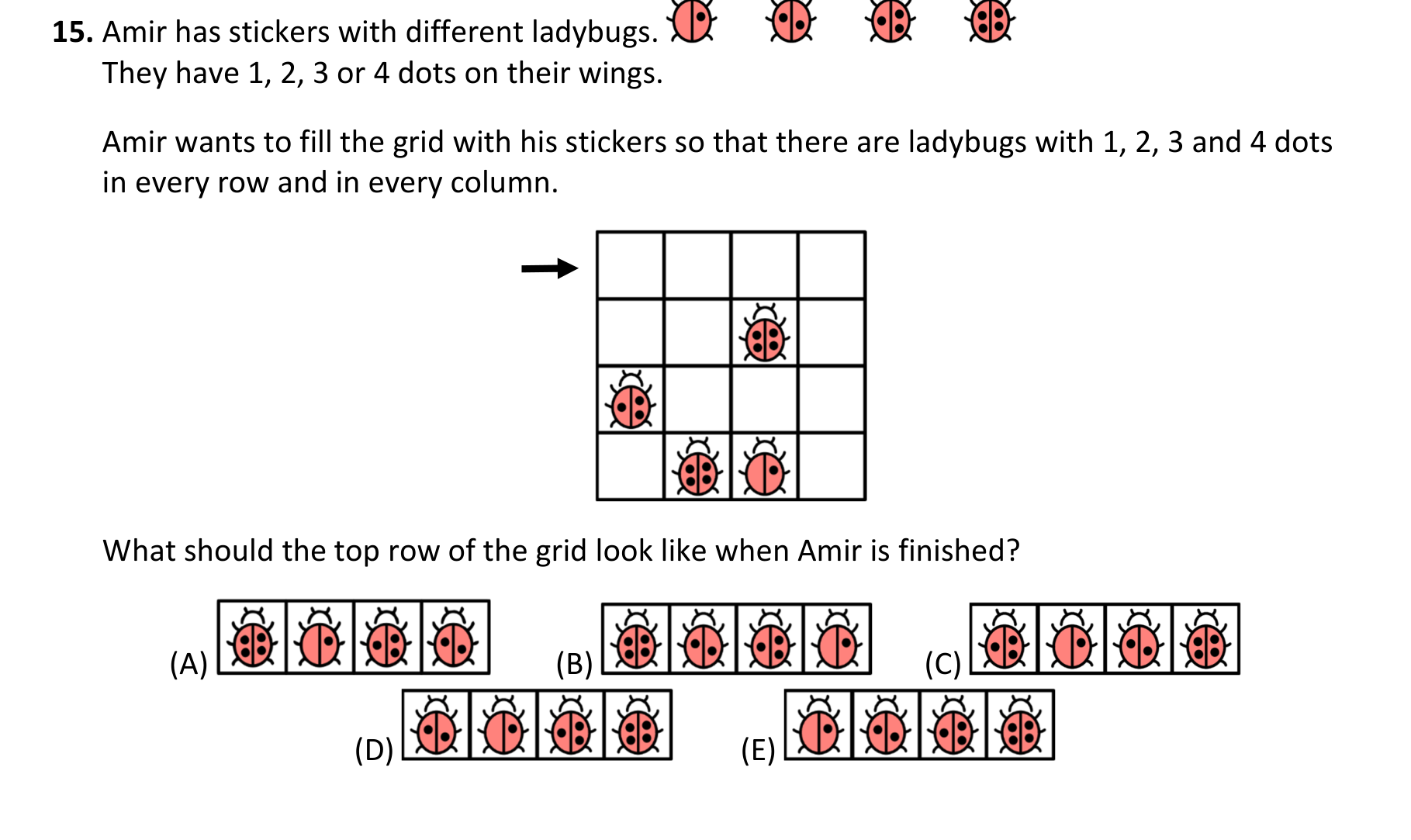
Amir has stickers of ladybugs with 1, 2, 3 or 4 dots on their wings. He fills the grid so that every row and every column has a ladybug with 1, 2, 3 and 4 dots. What should the top row of the grid look like when he is finished?
Show answer
Answer: B
Show hints
Hint 1 of 3
In every row and every column you must use a 1-dot, 2-dot, 3-dot and 4-dot ladybug, each exactly once.
Still stuck? Show hint 2 →
Hint 2 of 3
Look down each column at the ladybugs already placed to see which dot-numbers are still missing.
Still stuck? Show hint 3 →
Hint 3 of 3
A top cell must hold the one dot-number its column does not have yet.
Show solution
Approach: fill the grid so every row and column has 1, 2, 3 and 4 once
Every row and every column must show a 1-dot, 2-dot, 3-dot and 4-dot ladybug, each just once.
Look down each column and find the one dot-number it is still missing — that number must go in the top cell.
Filling each top cell with its column's missing number gives the row shown in option B. The answer is B.
Anna is looking at a picture on her smart phone. The format is 16:9 and fills the entire screen. If she turns the smart phone, the picture becomes smaller. What proportion of the screen is needed for the smaller picture?
Show answer
Answer: E — \(\frac{81}{256}\)
Show hints
Hint 1 of 2
Turning the phone rotates the picture to a 9:16 shape, which must still fit inside the same 16:9 screen.
Still stuck? Show hint 2 →
Hint 2 of 2
The limiting dimension is the screen's short side (height 9); scale the rotated picture so its tall side just fits, then compare areas.
Show solution
Approach: fit the rotated frame and compare areas
Take the screen as \(16\times 9\). Rotated, the picture has shape \(9:16\); to fit, its long side must equal the screen's height \(9\), so it scales to \(9\times k\) by \(16\times k\) with \(16k=9\), giving \(k=\tfrac{9}{16}\).
Picture area \(=9k\times 16k=144k^2=144\cdot\tfrac{81}{256}\); screen area \(=144\).
The proportion is \(\tfrac{144\cdot 81/256}{144}=\tfrac{81}{256}\), answer E.
Theo is on a treadmill and sees two stopwatches. The left one shows the time elapsed since he started his workout; the right one shows the time remaining until the end. At the moment shown the left reads 14:58 and the right reads 21:32. At some point both stopwatches will display the same time. What will they display then?
Show answer
Answer: D — 18:15
Show hints
Hint 1 of 2
One clock counts up and the other counts down at the same speed, so their sum stays constant.
Still stuck? Show hint 2 →
Hint 2 of 2
They show the same time exactly halfway through that constant total.
Show solution
Approach: the two readings always sum to the full workout time
Elapsed + remaining is constant: 14:58 + 21:32 = 36:30 (the whole workout).
They are equal at half of that total: \(36{:}30 \div 2 = 18{:}15\), which is (D).
When Grandma started knitting wool socks, she had a ball of wool with a diameter of 30 cm. After she has finished knitting 70 socks, the remaining ball of wool has a diameter of 15 cm. How many more socks can Grandma knit?
Show answer
Answer: E — 10
Show hints
Hint 1 of 2
Wool used is proportional to volume, which scales with the cube of the diameter.
Still stuck? Show hint 2 →
Hint 2 of 2
Volumes go as 30³ : 15³ = 8 : 1, so the leftover is the same size as what 10 socks need.
Show solution
Approach: volume scales as diameter cubed
Volumes are proportional to 30³ = 27000 and 15³ = 3375, ratio 8:1.
70 socks used 27000 − 3375 = 23625 units, i.e. 337.5 per sock.
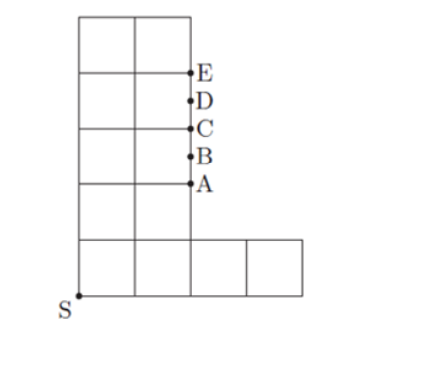
The diagram shown on the right consists of squares of equal size. Point B is in the middle of A and C, and point D is in the middle of C and E. Maria wants to divide the figure into two parts with equal areas using a straight line. Which of the points A, B, C, D or E must she connect to S to obtain this result?
Show answer
Answer: E — E
Show hints
Hint 1 of 2
First count the squares: the cut from S has to leave exactly half of them on each side.
Still stuck? Show hint 2 →
Hint 2 of 2
As you slide the far end of the cut from A up to E, more area moves to one side — stop at the point that makes the two halves equal.
Show solution
Approach: make each side hold half the squares
Count the unit squares in the whole figure and take half: the straight cut from S must leave that same area on each side.
Connecting S to a low point like A leaves too little on one side, and as the endpoint climbs from A toward E more area swings across the line.
The endpoint that finally balances the two sides into equal areas is E, so Maria connects S to E, giving the answer (E).
Paul shoots a ball at two targets (see diagram) a total of 27 times. When he aims for the upper-left target, he hits 50% of the time, and when he aims for the bottom-right target, he hits 80% of the time. In total, 9 of his shots miss their target. How many times does Paul hit the top-left target?
Show answer
Answer: C — 6
Show hints
Hint 1 of 2
27 shots, 9 missed, so 18 hit; let a shots aim upper-left and b aim lower-right.
Still stuck? Show hint 2 →
Hint 2 of 2
Misses are 50% of a plus 20% of b; set that equal to 9.
Show solution
Approach: set up the miss equation
a + b = 27 shots. Misses: 0.5a + 0.2b = 9.
Substitute b = 27−a: 0.5a + 0.2(27−a) = 9 → 0.3a = 3.6 → a = 12.
In a room there are 10 more people who always tell the truth than there are people who always lie. Everyone in the room was asked, “Are you telling the truth?” and all 20 people answered yes. How many liars are in the room?
Show answer
Answer: B — 5
Show hints
Hint 1 of 2
Both truth-tellers and liars answer 'yes' to 'Are you telling the truth?' — so the answers tell you nothing new.
Still stuck? Show hint 2 →
Hint 2 of 2
Just use that truth-tellers outnumber liars by 10 and there are 20 people.
Show solution
Approach: solve the count from the two given totals
A truth-teller says 'yes' truthfully; a liar also says 'yes' (lying), so all 20 say yes regardless.
If liars = L, truth-tellers = L + 10, and (L+10) + L = 20.
So \(2L = 10\), giving \(L = 5\) liars, which is (B).
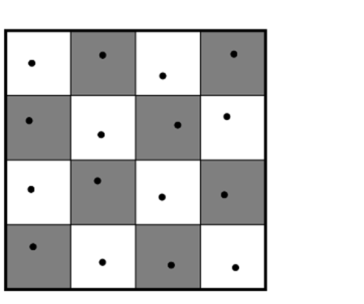
We consider a giant \(4 \times 4\) chessboard. A kangaroo is standing on each of the 16 squares. On each move, each kangaroo jumps to an adjacent square (up, down, left or right, but not diagonally). All kangaroos stay on the chessboard. Several kangaroos can be on one square at the same time. What is the maximum number of unoccupied squares that we can have after 100 moves?
Show answer
Answer: B — 14
Show hints
Hint 1 of 2
Colour the board like a checkerboard; what happens to a kangaroo's colour each jump?
Still stuck? Show hint 2 →
Hint 2 of 2
Every jump flips colour, so after an even number of moves the 8 dark-start and 8 light-start kangaroos stay split—each group can pile onto one square.
Show solution
Approach: checkerboard parity invariant
Each jump changes a kangaroo's square colour, so after 100 (even) moves 8 kangaroos sit on dark squares and 8 on light squares.
Each group can be gathered onto a single square, occupying just 2 squares total.
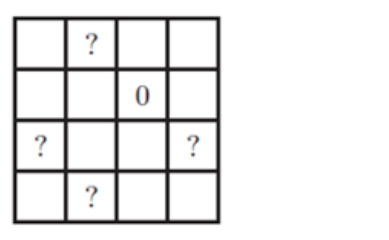
Hassan writes either the number 0 or the number 1 in each field of the table. The sum in each row, each column and each diagonal should be exactly 3. Hassan has entered 0 in one field and then fills out the table completely. What is the sum of the numbers in the fields with question marks?
Show answer
Answer: B — 2
Show hints
Hint 1 of 2
Each row and each column has 4 cells but must total 3 using only 0s and 1s — so what does that force about how many 0s are in each row and column?
Still stuck? Show hint 2 →
Hint 2 of 2
There is exactly one 0 in every row and exactly one 0 in every column; place the rest of the 0s so the two diagonals also each have a single 0.
Show solution
Approach: each row and column hides exactly one 0
A row of four 0s-and-1s that adds to 3 must be three 1s and a single 0, so every row has exactly one 0 — and by the same reasoning every column has exactly one 0, and each diagonal must also hold just one 0.
Starting from the given 0, the ‘one 0 per row, one per column, one per diagonal’ rule pins down where all four 0s go, so the whole grid is forced.
Looking at the four question-mark cells, two of them turn out to be 1 and two turn out to be 0, so their sum is 1 + 1 + 0 + 0 = 2, giving the answer (B) 2.
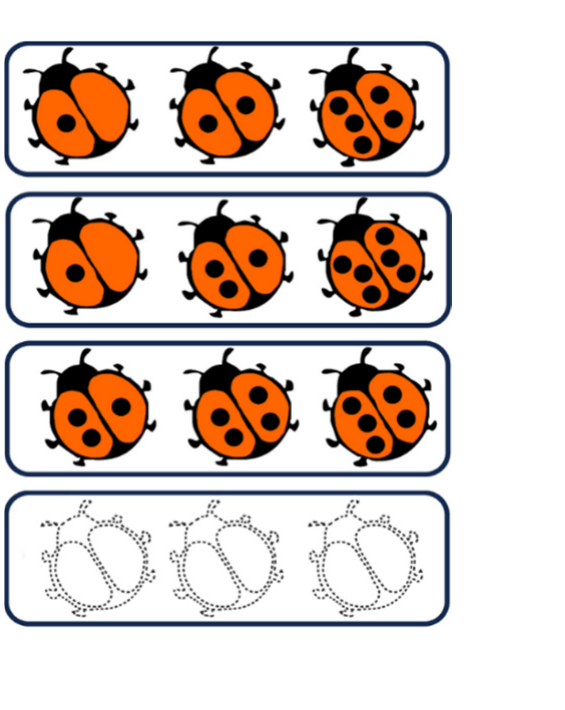
Six ladybirds have 1, 2, 3, 4, 5 and 6 spots. Marta takes four photos, each showing three different ladybirds, and each ladybird appears in the same number of photos. The first three photos are shown. How many spots do the three ladybirds in the fourth photo have in total?
Show answer
Answer: C — 12
Show hints
Hint 1 of 2
There are 4 photos with 3 ladybirds each, that is 12 ladybird-appearances shared equally among 6 ladybirds.
Still stuck? Show hint 2 →
Hint 2 of 2
So every ladybird appears in exactly 2 photos, which tells you the grand total of spots over all four photos.
Show solution
Approach: find the grand total of all four photos, then subtract the three shown
Four photos with three ladybirds each give 12 appearances; split equally among 6 ladybirds, so each appears in exactly 2 photos.
Then all four photos together show every spot-count twice: 2 × (1 + 2 + 3 + 4 + 5 + 6) = 2 × 21 = 42 spots.
The three shown photos hold 30 spots in total.
So the fourth photo has 42 − 30 = 12 spots, option C.
There are some cards on a table with various different positive integers written on them. All of these are smaller than 20 and their product is 2025. What is the maximum number of cards on the table?
Show answer
Answer: D — 5
Show hints
Hint 1 of 2
Factor 2025 and split it into as many factors below 20 as possible.
Still stuck? Show hint 2 →
Hint 2 of 2
2025 = 3^4 × 5^2; including the card '1' adds one more card for free.
Show solution
Approach: maximize the number of small factors
2025 = 3⁴ × 5²; each card value is below 20.
Break it up as 1 × 3 × 5 × 9 × 15 = 2025, all distinct and under 20.
A bee, a mouse, a beetle and a cat want to take a group photo, so they line up next to each other. The cat is not allowed to stand next to the mouse. In how many different ways can the animals line up?
Show answer
Answer: B — 12
Show hints
Hint 1 of 2
Count all line-ups, then remove the bad ones where the cat and mouse are side by side.
Still stuck? Show hint 2 →
Hint 2 of 2
Treat the cat-and-mouse pair as a single block to count the forbidden arrangements.
Show solution
Approach: total minus the cat-next-to-mouse cases
Four animals can line up in 4! = 24 ways.
Glue cat+mouse together: 3 items in 3! = 6 orders, times 2 for the internal order = 12 forbidden line-ups.
Allowed line-ups = \(24 - 12 = 12\), which is (B).
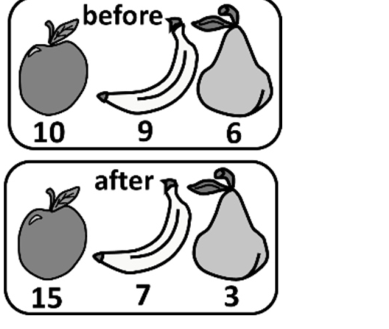
A witch has 10 apples, 9 bananas and 6 pears. One day she enchants all of her fruits into different types of fruit. For example, she turns each apple into either a banana or a pear. After that she has 15 apples, 7 bananas and 3 pears. How many apples did she turn into bananas?
Show answer
Answer: E — 7
Show hints
Hint 1 of 2
Every original fruit changes type, so all 10 apples leave and new apples arrive from other fruits.
Still stuck? Show hint 2 →
Hint 2 of 2
Set up the in/out counts for each fruit type and solve.
Show solution
Approach: track each fruit type in and out
All 9 bananas and all 6 pears must become apples or each other; the 15 final apples come only from old bananas and pears.
Since 9 + 6 = 15, every banana and every pear turned into an apple.
Then the 10 apples must supply all 7 final bananas and 3 final pears: 7 + 3 = 10.
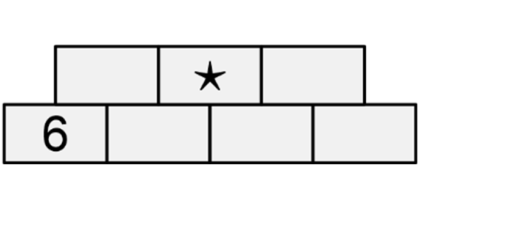
Maria writes the numbers 1, 2, 3, 4, 5, 6 and 7, each exactly once, into the number wall. Each upper box equals the sum of the two boxes just below it. The bottom-left box already holds 6. Which number must she write in the box with the star?
Show answer
Answer: D — 4
Show hints
Hint 1 of 2
The box sitting on top of the 6 is 6 plus its neighbour, and it can be at most 7.
Still stuck? Show hint 2 →
Hint 2 of 2
That forces the neighbour, then keep building upward with 1 to 7 each used once.
Show solution
Approach: use that no box can exceed 7 to fix the numbers, then build upward
Every box is the sum of the two below it, and no number is bigger than 7.
The box above the 6 is 6 + (its right neighbour), so that neighbour must be 1, giving 6 + 1 = 7.
The leftover numbers 2, 3, 5 must fill the rest; placing the bottom row as 6, 1, 3, 2 gives the next row 7, 4, 5 - and that uses 1 to 7 exactly once.
The starred middle-top box is 1 + 3 = 4, option D.
The two bookworms Linki and Rechti eat their way through a row of books. Linki starts from the left and Rechti from the right, both at the same time. Linki eats through a book cover in 3 days and through all the pages of a book in 2 days. Rechti eats through a book cover in 1 day and through all the pages of a book in 2 days. In which book (see illustration) do the two meet?
Show answer
Answer: B — B
Show hints
Hint 1 of 2
Give each worm a 'days to chew through' cost for a cover and for a set of pages, then send them toward each other.
Still stuck? Show hint 2 →
Hint 2 of 2
Add up the days each worm spends, layer by layer, until their totals show them reaching the same book.
Show solution
Approach: accumulate the days each worm needs until they meet
Linki (from the left) needs 3 days per cover and 2 days per book of pages; Rechti (from the right) needs 1 day per cover and 2 days per book of pages.
After 13 days Linki has chewed through book A entirely and reached the pages of book B \((3+2+3+3+2)\); in those same 13 days Rechti has chewed through E, D and C and into book B \((1+2+1+1+2+1+1+2+1+1)\).
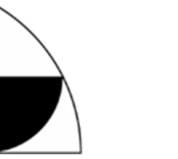
The area of the black semicircle shown is 12 cm². What is the area of the large quarter circle?
Show answer
Answer: D — 30 cm²
Show hints
Hint 1 of 3
Let the quarter circle have radius \(R\) and the small semicircle radius \(r\); read their relationship off the figure.
Still stuck? Show hint 2 →
Hint 2 of 3
The semicircle's diameter spans from the corner to the centre of the quarter circle's straight side, which forces \(R^2 = 5r^2\).
Still stuck? Show hint 3 →
Hint 3 of 3
Then just take the ratio of the two area formulas—the \(\pi\) cancels.
Show solution
Approach: write both areas with their radii and take the ratio
Quarter circle: \(\tfrac14\pi R^2\); black semicircle: \(\tfrac12\pi r^2\).
The figure fixes the semicircle so that \(R^2 = 5r^2\), hence the quarter circle is \(\dfrac{\tfrac14 R^2}{\tfrac12 r^2} = \dfrac{R^2}{2r^2} = \dfrac{5}{2}\) times the semicircle.
So the quarter circle \(= \tfrac52 \times 12 = \textbf{30 cm}^2\), choice (D).
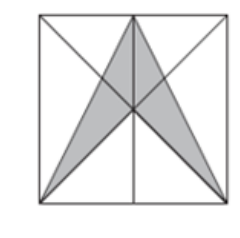
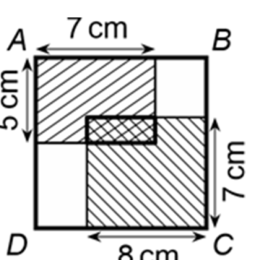
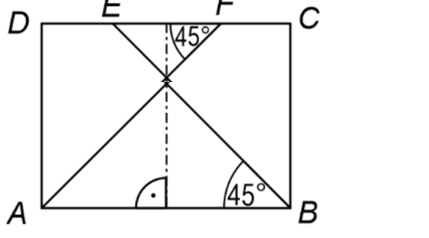
The square shown on the right has sides of 10 cm. The square is divided into two equal-sized rectangles by the vertical centre line. What is the area of the grey section?
Show answer
Answer: B — 25 cm²
Show hints
Hint 1 of 2
The whole square is 10 × 10 = 100 cm², so try to see the grey as a simple fraction of that whole.
Still stuck? Show hint 2 →
Hint 2 of 2
The centre lines split the grey ‘bow-tie’ into a left half and a right half; find the area of one half and double it.
Show solution
Approach: the grey is two equal triangles meeting at the centre
The grey shape is a bow-tie: two triangles that meet at the centre of the square, one on the left and one on the right.
The left triangle has corners at the top-middle of the square, the centre of the square, and the bottom-left corner; counting on a 10×10 grid its area is 12.5 cm², and the right triangle is its mirror image, also 12.5 cm².
Adding the two halves gives 12.5 + 12.5 = 25 cm², which is exactly one quarter of the 100 cm² square, so the answer is (B) 25 cm².
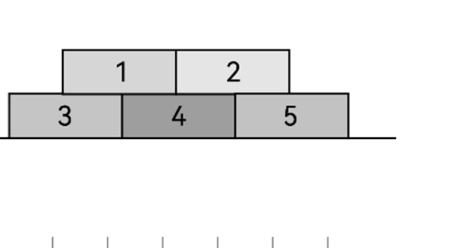
Five bricks form a wall (see figure). Peter can only remove a brick if there is no other brick directly above it. On each turn, he randomly selects one of the removable bricks with equal probability and removes it. What is the probability that the brick numbered 4 is the third to be removed?
Show answer
Answer: D — \(\frac{1}{6}\)
Show hints
Hint 1 of 2
Only the two top bricks start out removable; brick 4 sits beneath both of them, so it is freed only after both 1 and 2 are gone.
Still stuck? Show hint 2 →
Hint 2 of 2
For 4 to be third, the first two removals must be exactly bricks 1 and 2 (in some order), then 4 must be chosen on turn three.
Show solution
Approach: follow the only path that frees brick 4 by turn three
At the start only the two top bricks 1 and 2 are free (each bottom brick is still pinned by a top brick), so turn 1 removes 1 or 2.
Suppose 1 goes first; now free are {2, 3}, and brick 4 still needs 2 removed, so turn 2 must pick 2 (chance \(\tfrac{1}{2}\)), after which {3, 4, 5} are free.
Turn 3 then picks 4 with chance \(\tfrac{1}{3}\); the path probability is \(\tfrac{1}{2}\cdot\tfrac{1}{2}\cdot\tfrac{1}{3}=\tfrac{1}{12}\), and the symmetric order (2 then 1) doubles it to \(\tfrac{1}{6}\), answer D.
Emus, snakes and kangaroos live together on an Australian farm. Emus have two legs and no tail. Kangaroos have four legs and a tail. Snakes have no legs but a tail. Every animal has two eyes. Altogether they have 18 eyes, 7 tails and 24 legs. How many kangaroos live on the farm?
Show answer
Answer: E — 5
Show hints
Hint 1 of 2
Every animal has 2 eyes, so the eye count gives the total number of animals.
Still stuck? Show hint 2 →
Hint 2 of 2
Use tails to split snakes+kangaroos from emus, then legs to isolate the kangaroos.
Show solution
Approach: set up and solve from eyes, tails and legs
18 eyes mean 9 animals; 7 tails are carried by kangaroos and snakes, so 2 emus.
Legs: emus give 2×2 = 4, so kangaroos give 24 − 4 = 20 legs.
Each kangaroo has 4 legs, so there are \(20 \div 4 = 5\) kangaroos, which is (E).
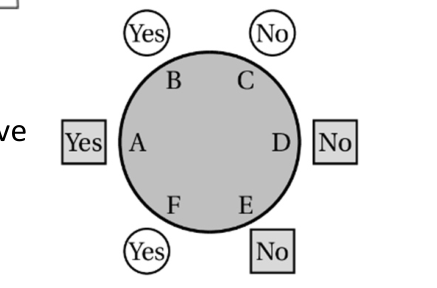
Three square Martians and three round Jupiterians are sitting at a table as shown. One of the six has the key to the spaceship. Everyone from one planet always tells the truth, and everyone from the other planet always lies. When asked “Does any of your neighbours have the key?” all six answer as shown. Who has the key?
Show answer
Answer: B — B
Show hints
Hint 1 of 3
The key-holder's two neighbours truly have a neighbour with the key, while everyone non-adjacent to the key truly does not.
Still stuck? Show hint 2 →
Hint 2 of 3
Whoever holds the key answers about their own neighbours, who do NOT have it—so the holder's truthful answer would be "No."
Still stuck? Show hint 3 →
Hint 3 of 3
Test each candidate and keep the one that yields exactly three truth-tellers and three liars.
Show solution
Approach: assume each candidate holds the key and count consistent types
Around the table the neighbours are \(A\!-\!B\!-\!C\!-\!D\!-\!E\!-\!F\!-\!A\); the answers are A:Yes, B:Yes, C:No, D:No, E:No, F:Yes.
Suppose \(B\) has the key: then \(A\) (neighbour) truly says Yes; \(B\) sees no key neighbour yet says Yes (lie); \(C\) says No but a neighbour has it (lie); \(D,E\) truly say No; \(F\) says Yes but neither neighbour has it (lie).
That is truth-tellers \(A,D,E\) and liars \(B,C,F\)—exactly three each, the only candidate that works—so the key is with B, choice (B).
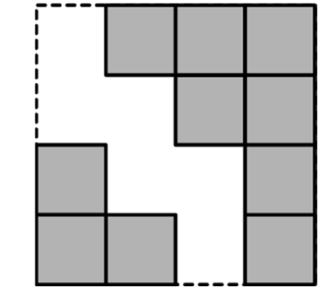
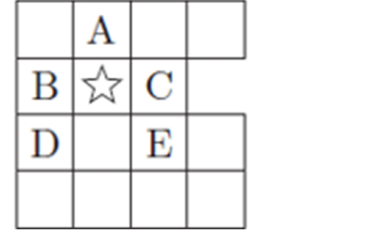
Joanna divides the figure into five equal-sized, same-shaped parts, each of which consists of three squares. Which of the letters is in the part with the star?
Show answer
Answer: E — E
Show hints
Hint 1 of 2
All five pieces are the same shape made of three squares, so figure out that shape first from a corner that can only be filled one way.
Still stuck? Show hint 2 →
Hint 2 of 2
Once you know the piece shape, build outward and watch which three squares end up grouped with the star.
Show solution
Approach: find the repeating 3-square piece, then read off the star’s group
Since every piece is the same three-square shape, start at a corner of the figure where only one shape can fit; that fixes what the repeating piece looks like.
Lay that same piece again and again to tile the whole figure with no gaps or overlaps — there is only one way it all fits together.
The piece that ends up covering the starred square also covers the square labelled E, so the answer is (E).
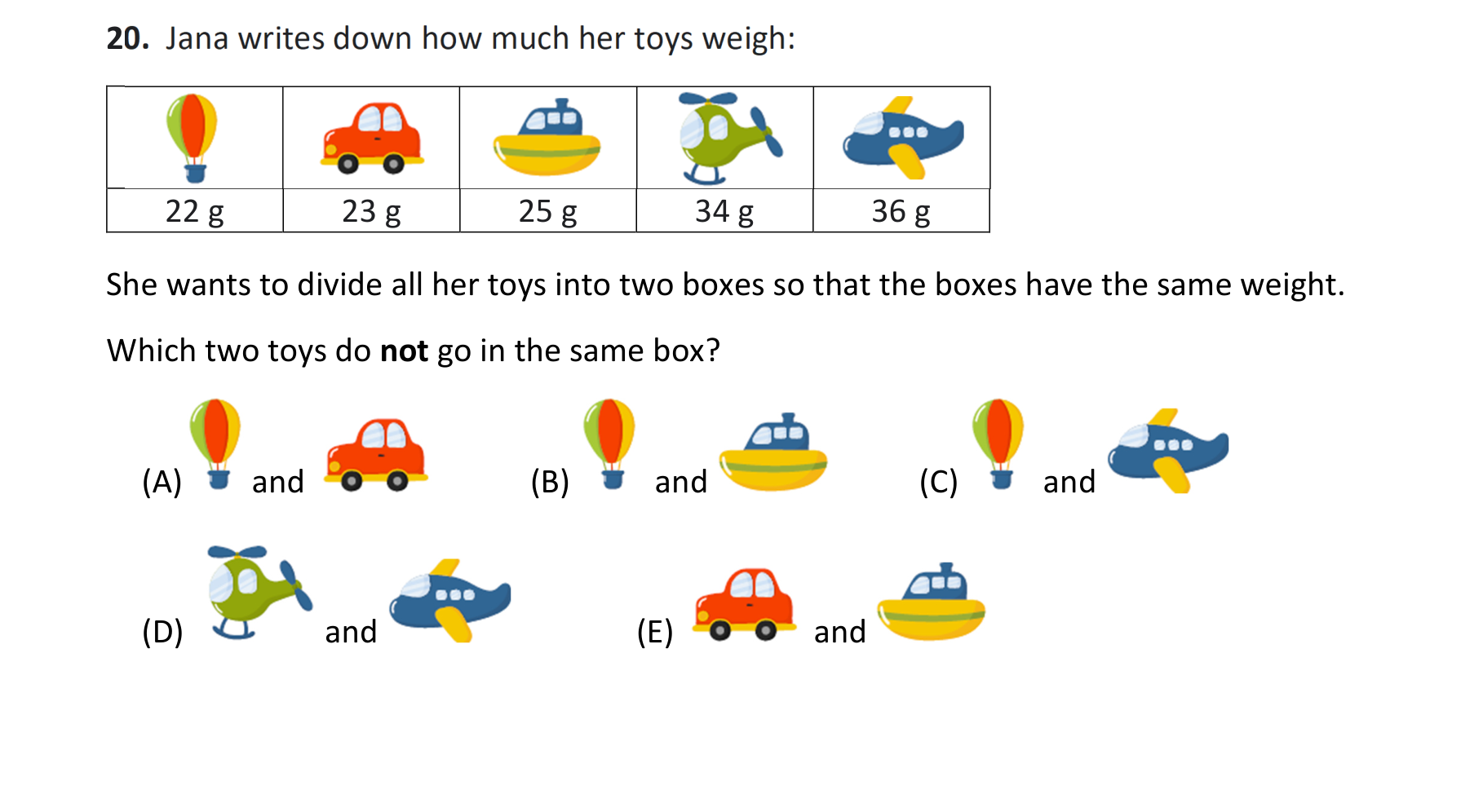
Jana writes down how much her toys weigh: 22 g, 23 g, 25 g, 34 g and 36 g. She wants to share all her toys into two boxes so that both boxes weigh the same. Which two toys do not go in the same box?
Show answer
Answer: C
Show hints
Hint 1 of 2
Add all five weights and split into two equal boxes.
Still stuck? Show hint 2 →
Hint 2 of 2
Find which toys sum to half the total; the two that land in different boxes are your answer.
Show solution
Approach: split the weights into two equal halves
The weights 22, 23, 25, 34, 36 add to 140 g, so each box holds 70 g.
One box is 22 + 23 + 25 = 70 (balloon, car, boat); the other is 34 + 36 = 70 (helicopter, plane).
So the balloon and the plane end up in different boxes.
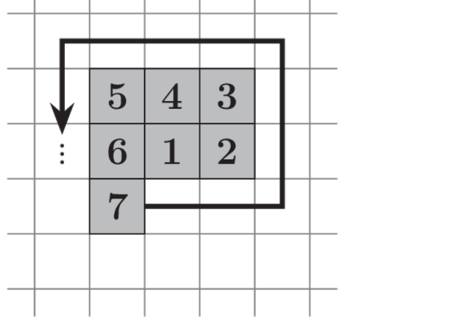
Daniel numbers some squares on a piece of squared paper. He starts with a random square and numbers the squares 1, 2, 3, 4, 5, …, 2025 anti-clockwise (see illustration). At the end he considers the figure that results from all 2025 numbered squares. Each square has a side length of 0.5 cm. What is the perimeter of the figure?
Show answer
Answer: D — 90 cm
Show hints
Hint 1 of 2
The numbered squares form a growing spiral; you only need its outline, not every cell.
Still stuck? Show hint 2 →
Hint 2 of 2
Find the bounding rectangle the spiral fills and account for the small notch where it ends.
Show solution
Approach: bound the spiral and read off the perimeter
Numbering 1..2025 in an outward spiral fills an almost-square block of cells.
2025 = 45², so the spiral exactly fills a 45×45 square of cells.
Side = 45×0.5 = 22.5 cm; perimeter = 4×22.5 = 90 cm.
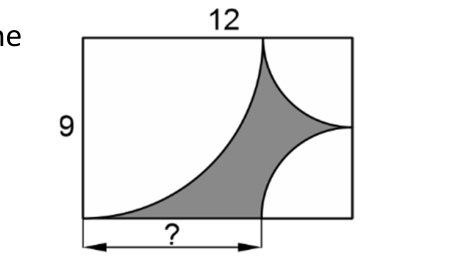
Elke draws quarter circles on a sheet of paper measuring 12 cm × 9 cm, with the centres at the four corners. She shades the resulting region in the middle of the figure (not drawn to scale). How long is the distance marked with the question mark?
Show answer
Answer: B — 6 cm
Show hints
Hint 1 of 2
Each quarter circle reaches exactly its radius along the side it starts from, so name the radii and mark where each arc meets the bottom edge.
Still stuck? Show hint 2 →
Hint 2 of 2
Where two arcs touch, their radii must fit together along that side — use that to pin the radii, then read the marked length off the 12 cm bottom.
Show solution
Approach: use the corner-circle radii along the sides
Each arc reaches its own radius along the edges from its corner; where two arcs meet on the 9 cm right side, those two radii add up to 9.
Those same radii mark off points along the 12 cm bottom edge, and the question-mark length is what is left between the bottom-left corner and the bottom-right arc.
Working the radii through the 12 cm width leaves the marked distance equal to 6 cm, which is (B).
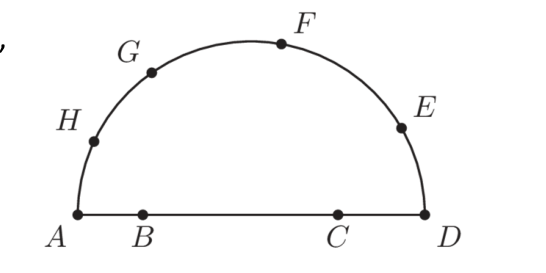
Points B and C lie on the diameter of a semicircle with diameter AD, and points E, F, G and H lie on the arc. How many triangles exist whose vertices are three of these eight points?
Show answer
Answer: D — 52
Show hints
Hint 1 of 2
Count all triples of the 8 points, then subtract the degenerate ones.
Still stuck? Show hint 2 →
Hint 2 of 2
Four points (A, B, C, D) are collinear on the diameter, so triples chosen all from those four are not triangles.
Show solution
Approach: total triples minus collinear triples
Choose any 3 of 8 points: C(8,3) = 56.
The only collinear set is A, B, C, D on the diameter: C(4,3) = 4 bad triples.
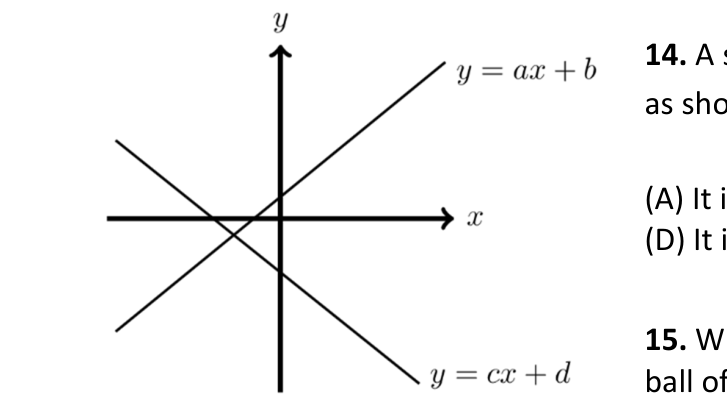
Fabio never tells the truth on Tuesdays, Thursdays and Saturdays, while he always tells the truth on the other days of the week. One day Mateo had the following conversation with Fabio:
Mateo: “What day is today?” Fabio: “Saturday” Mateo: “What day will tomorrow be?” Fabio: “Wednesday”
On which day of the week did the conversation take place?
Show answer
Answer: D — Thursday
Show hints
Hint 1 of 2
On a truth day both of Fabio’s answers are true; on a lying day both are false.
Still stuck? Show hint 2 →
Hint 2 of 2
Test each weekday against his two statements until one fits.
Show solution
Approach: check each day for consistency
Fabio lies on Tue/Thu/Sat and tells the truth otherwise; both his answers share that day’s truth status.
He says ‘today is Saturday’ and ‘tomorrow is Wednesday’.
Only Thursday works: it is a lying day, and both statements are indeed false (it isn’t Saturday, and tomorrow is Friday not Wednesday).
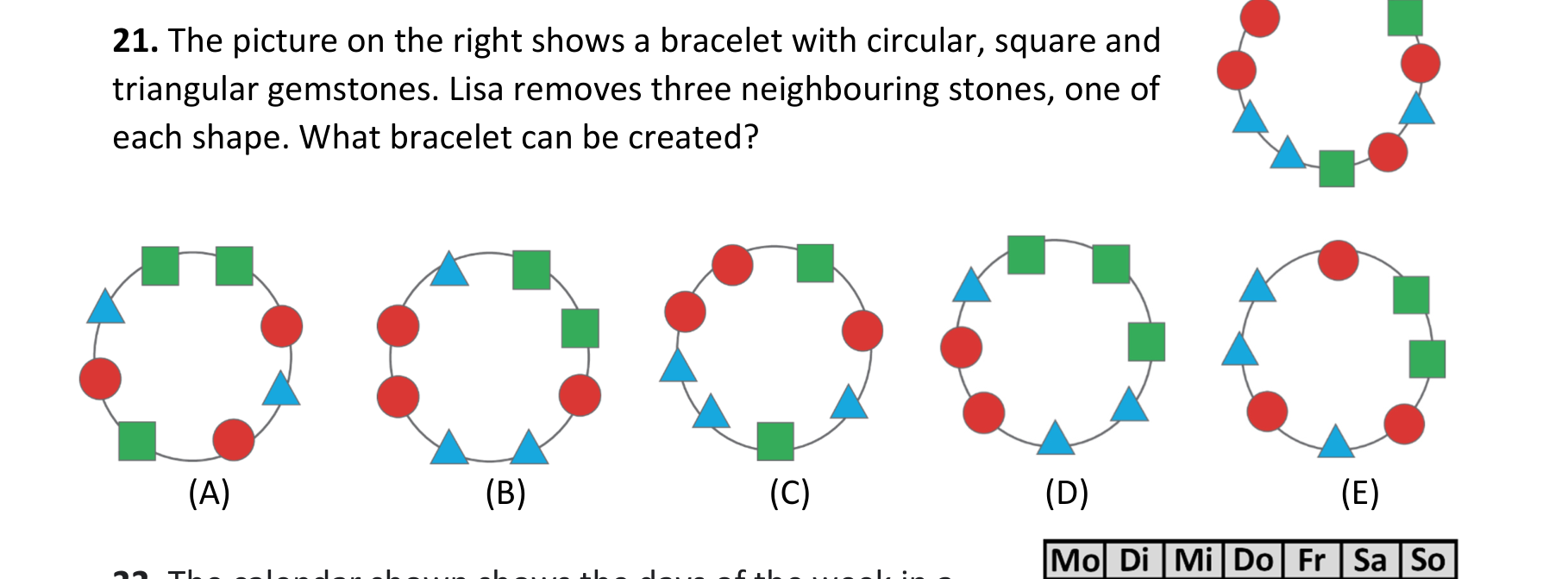
The picture on the right shows a bracelet with round, square and triangular gemstones. Lisa removes three neighbouring stones, one of each shape. Which bracelet can be created?
Show answer
Answer: B
Show hints
Hint 1 of 2
Removing three neighbours (one circle, one square, one triangle) leaves a gap of three in the ring.
Still stuck? Show hint 2 →
Hint 2 of 2
Find a stretch of three adjacent stones with one of each shape, then see what remains.
Show solution
Approach: remove a valid run of three neighbouring stones
Lisa removes three stones in a row, one of each shape.
Locate a circle, square, and triangle sitting next to each other on the bracelet.
Taking them out leaves the arrangement shown in option B.
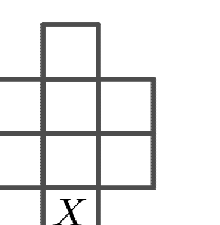
We want to place the numbers 1 through 8 in the eight squares of the figure shown in such a way that consecutive numbers are never in adjacent squares (not even diagonally adjacent). Which numbers can we write in the square marked with an X?
Show answer
Answer: B — 2 or 7
Show hints
Hint 1 of 3
Consecutive numbers may not touch even diagonally, so a number with many forbidden partners needs a roomy cell with few neighbours.
Still stuck? Show hint 2 →
Hint 2 of 3
Count how many cells each number must avoid: the ends 1 and 8 avoid just one each, while the most-crowded cell (touching the most others) needs a number that has very few neighbours to dodge.
Still stuck? Show hint 3 →
Hint 3 of 3
By the figure's symmetry, X and its mirror cell are the two most-connected cells, so list which values can sit in such a tight spot.
Show solution
Approach: match crowded cells to numbers with few forbidden neighbours
A value \(n\) (with \(1
Cell X is one of the two most-connected cells in the shape, so the number placed there must have few neighbours to conflict with; testing placements, only by putting a near-end value there can every other number be seated legally.
Working the arrangement out, the value in X must be 2 or 7 (the two cases are mirror images), answer B.
In the six-digit number PAPAYA, different letters stand for different digits and equal letters stand for equal digits. It is also given that Y = P + P = A + A + A. What is the value of P × A × P × A × Y × A?
Show answer
Answer: A — 432
Show hints
Hint 1 of 2
The clues say Y = 2P and Y = 3A — so 2P = 3A with single digits.
Still stuck? Show hint 2 →
Hint 2 of 2
Find digits where twice P equals three times A, then read off Y.
Show solution
Approach: solve the digit equations, then multiply
Y = P + P = 2P and Y = A + A + A = 3A, so 2P = 3A.
The simplest distinct digits are A = 2, P = 3, giving Y = 6.
Then \(P\times A\times P\times A\times Y\times A = 3\cdot2\cdot3\cdot2\cdot6\cdot2 = 432\), which is (A).
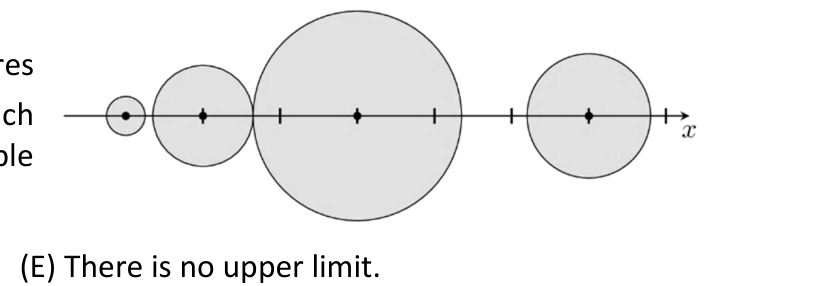
Four circular discs with radii \(r_1\), \(r_2\), \(r_3\) and \(r_4\) have their centres at the points \((0\,|\,0)\), \((1\,|\,0)\), \((3\,|\,0)\) and \((6\,|\,0)\). The discs may touch each other but may not overlap. What is the largest possible value of \(r_1 + r_2 + r_3 + r_4\)?
Show answer
Answer: B — 4
Show hints
Hint 1 of 2
Touching discs give one equation each: the sum of two radii equals the gap between their centres.
Still stuck? Show hint 2 →
Hint 2 of 2
Neighbouring constraints r₁+r₂ ≤ 1 and r₃+r₄ ≤ 3 already cap the total at 4.
Show solution
Approach: bound the sum using nearest-neighbour gaps
Discs at 0 and 1 give r₁ + r₂ ≤ 1; discs at 3 and 6 give r₃ + r₄ ≤ 3.
Adding: r₁+r₂+r₃+r₄ ≤ 4, and r₁ = 1, r₄ = 3 (others 0) achieves it.
Julio wants to make the shape shown in the top picture on the right. He has several of each of the five tiles shown in the bottom picture on the right. The tiles must be placed next to each other without overlapping. What is the smallest number of tiles he must use?
Show answer
Answer: C — 13
Show hints
Hint 1 of 2
To use as few tiles as possible, you want each tile to cover as much of the cross as it can, so reach for the biggest tiles first.
Still stuck? Show hint 2 →
Hint 2 of 2
The straight parts of the cross are easy to cover with the large rectangle and big triangle; the pointy arm-tips are what force you to use the small triangles.
Show solution
Approach: cover the big areas with big tiles, the tips with small ones
Fewer tiles means each tile should cover as much as possible, so fill the wide straight parts of the cross with the largest tiles (the long rectangle and the big triangle).
The four slanted arm-tips are too thin for the big tiles, so each tip has to be finished with the small triangle pieces — these are unavoidable and set the limit on how low the count can go.
Packing the big tiles in the body and the small triangles at the tips, with no overlaps, covers the whole cross in 13 tiles, and no arrangement does it in fewer, so the answer is (C) 13.
The calendar shows the days of a month, with the columns running Monday, Tuesday, …, Sunday, but the dates are missing. The two dark grey boxes are a Thursday and a Wednesday. If you add the two dates in the dark grey boxes, you get 29. What day of the week is the 1st of the month?
Show answer
Answer: D — Thursday
Show hints
Hint 1 of 3
Count the days from the grey Thursday box down to the grey Wednesday box - it is exactly 13 days later.
Still stuck? Show hint 2 →
Hint 2 of 3
So the two grey dates are 13 apart and add up to 29; find two such numbers.
Still stuck? Show hint 3 →
Hint 3 of 3
Once you know the grey Thursday's date, count back by 7s to reach the 1st.
Show solution
Approach: use the 13-day gap and the sum of 29, then walk back to the 1st
Going down two rows and one box to the left, the grey Wednesday lands 13 days after the grey Thursday.
Take away those extra 13 days from the sum 29, and 16 is left for two equal Thursday dates, so each is 16 ÷ 2 = 8 - the grey Thursday is the 8th.
Counting back a week, the 1st of the month is also a Thursday (8, then 1).
The two small rectangles in the diagram are congruent and each has an area of 4 cm². What is the area of rectangle ABCD in cm²?
Show answer
Answer: D — 12
Show hints
Hint 1 of 3
The diagonal \(AC\) of the big rectangle passes through the meeting corner of the two small rectangles.
Still stuck? Show hint 2 →
Hint 2 of 3
The diagonal cuts ABCD into two equal halves; compare how many small-rectangle areas fit against that diagonal.
Still stuck? Show hint 3 →
Hint 3 of 3
Each small rectangle has its diagonal corner on \(AC\), so each is split into two equal triangles by the diagonal — use that to count areas.
Show solution
Approach: use the main diagonal to balance the areas
Draw diagonal \(AC\); it runs through the common corner of the two congruent rectangles and splits ABCD into two equal triangles of area \(\tfrac12[ABCD]\) each.
Below the diagonal the dotted rectangle and the leftover triangle make up one half; matching the congruent rectangles against the diagonal shows the big rectangle is built from three small-rectangle areas.
Manuela takes a total of 17 shots at goal over two soccer training sessions. In the first session she scores with 60% of her shots, and in the second she scores with 75% of her shots. How many goals does she score in the second session?
Show answer
Answer: D — 9
Show hints
Hint 1 of 2
Both hit-counts must be whole numbers: 60% of the first session and 75% of the second.
Still stuck? Show hint 2 →
Hint 2 of 2
Split 17 shots so that 60% of the first part and 75% of the second part are both integers.
Show solution
Approach: force whole-number hits to fix the split
60% needs the first count to be a multiple of 5; 75% needs the second to be a multiple of 4.
With shots adding to 17, the split is 5 and 12 (5 is a multiple of 5, 12 of 4).
Second-session hits = 75% of 12 = 9, which is (D).
On the map shown on the right, we see a city in which there are four schools. Regions A, B, C and D each consist of the points for which the relevant school is closest. The coordinates of the school in region D are \((9\,|\,1)\). What are the coordinates of the school in region A?
Show answer
Answer: C — \((1\,|\,5)\)
Show hints
Hint 1 of 3
Each border line is the perpendicular bisector of the segment joining two schools, so a school is the mirror image of its neighbour across their shared border.
Still stuck? Show hint 2 →
Hint 2 of 3
Start from the known D-school at \((9\,|\,1)\) and reflect across the C–D and then A–C borders.
Still stuck? Show hint 3 →
Hint 3 of 3
Check your candidate: it must be equidistant from the borders of region A and farther from every other school.
Show solution
Approach: reflect a known school across the perpendicular-bisector borders
The three regions meet at the point \((4\,|\,4)\); the A–C border runs along the line through \((4\,|\,4)\) up to \((0\,|\,8)\) and the A–B border down to \((0\,|\,2)\).
School A must be the reflection of the neighbouring schools across those bisectors, placing it left of and below the corner, at integer coordinates inside region A.
Testing the options, only \((1\,|\,5)\) is equidistant from both A-borders and closest among all four schools to every point of region A, so A is at \((1\,|\,5)\), choice (C).
Tina wants to combine the three building blocks shown in the picture to form a cube building. Which one of the following cube buildings could she make? (The three blocks and the five choices A–E are pictured with the question.)
Show answer
Answer: D
Show hints
Hint 1 of 2
First just count: how many little cubes are in the three blocks all together? The answer building must use exactly that many cubes.
Still stuck? Show hint 2 →
Hint 2 of 2
Throw out any choice with the wrong cube count, then check the survivors by mentally snapping the three blocks together.
Show solution
Approach: count cubes first, then fit the blocks
Each of the three building blocks is made of small cubes; counting them gives a fixed total number of cubes that the finished building must contain.
Count the cubes in each answer building and cross out the ones with the wrong total — the right building must have exactly as many cubes as the three blocks combined.
Among the buildings with the correct cube count, only (D) can actually be assembled from those three particular blocks fitting together with no gaps, so the answer is (D).
Nele folds a piece of paper in half and then in half again (see picture). She cuts four pieces out of the folded paper. When she unfolds it, she sees the pattern shown. What did the paper look like before she unfolded it?
Show answer
Answer: A
Show hints
Hint 1 of 2
Fold the unfolded pattern back in half twice and see what single quarter-piece you get.
Still stuck? Show hint 2 →
Hint 2 of 2
The folded paper shows just one quarter of the pattern, with cuts on the folded edges.
Show solution
Approach: fold the pattern back to a quarter
Folding in half twice stacks the paper into four layers, so the cuts repeat four times.
Reverse it: take one quarter of the shown pattern.
That single folded quarter is the X-shape in option A.
Louise places three rectangular pictures as shown in the figure. What is the size of the angle α?
Show answer
Answer: B — 70°
Show hints
Hint 1 of 2
Each picture is a rectangle, so every corner of it is a right angle (90°) — that is the key fact to lean on.
Still stuck? Show hint 2 →
Hint 2 of 2
Use a right-angle corner together with the marked 62° to find a small leftover angle, then combine it with the 42°.
Show solution
Approach: angle-chase using the rectangles' right angles
Because each picture is a rectangle, the corner sitting at the 62° mark is a right angle, so beyond the 62° there is \(90^\circ-62^\circ=28^\circ\) left over.
That 28° lines up next to the 42° gap, so \(\alpha=42^\circ+28^\circ\).
To compare the weights of a red square, a star and a green circle, Mona uses a beam balance (see picture). The lower pan holds the heavier side. Each shape always has the same weight, different shapes have different weights, and every weight is 1, 2, 3, 4 or 5 kg. How many kilograms does the red square weigh?
Show answer
Answer: C — 3 kg
Show hints
Hint 1 of 2
The lower pan is heavier: one square outweighs two stars, and two circles outweigh three squares.
Still stuck? Show hint 2 →
Hint 2 of 2
Try weights 1 to 5 for the square: it must be more than two stars yet light enough that two circles beat three of it.
Show solution
Approach: read both balances, then test the square's weight
Left balance: the square pan is lower, so one square is heavier than two stars.
Right balance: the two-circle pan is lower, so two circles are heavier than three squares.
One square beating two stars means the square is at least 3 (two different weights of 1 and 2 already make 3).
If the square is 4, three squares weigh 12, but two circles can be at most 2×5 = 10 - too light. So the square is 3, with stars 1 and circles 5: 3 > 2 and 10 > 9 both hold, giving 3 kg, option C.
The square ABCD contains two shaded rectangles (see diagram). The dimensions are as shown and the area of the overlapping region is 18 cm². What is the perimeter of the square ABCD?
Show answer
Answer: C — 36 cm
Show hints
Hint 1 of 2
Let the square's side be \(s\); the top-left rectangle is \(7\times5\) and the bottom rectangle is \(8\times7\).
Still stuck? Show hint 2 →
Hint 2 of 2
Find the overlap's width and height in terms of \(s\) by seeing how far the two rectangles reach into each other, then set that product equal to 18.
Show solution
Approach: overlap area gives an equation for the side
The top-left rectangle reaches 7 cm in from the left and 5 cm down from the top; the bottom rectangle reaches 8 cm in from the right and 7 cm up from the bottom.
Their overlap is therefore \((7+8-s)\) wide by \((5+7-s)\) tall, i.e. \((15-s)(12-s)\), and this equals 18.
Solving \((15-s)(12-s)=18\) gives \(s=9\) (the other root is too big to fit), so the perimeter is \(4\times 9=\) 36 cm, answer C.
Anurag lives 1 km from his school and sets off at the same time every day. Walking, he travels at 4 km/h; cycling, he travels at 15 km/h. When he walks, he arrives 5 minutes before school starts. How many minutes before school starts does he arrive if he cycles?
Show answer
Answer: E — 16
Show hints
Hint 1 of 2
Find how long the 1 km walk takes and how long the 1 km ride takes.
Still stuck? Show hint 2 →
Hint 2 of 2
Cycling saves the time difference, so add that saving to the 5 minutes he already had to spare.
Show solution
Approach: compare travel times and the fixed start moment
Walking 1 km at 4 km/h takes 15 minutes; cycling 1 km at 15 km/h takes 4 minutes.
He leaves at the same moment, so cycling gets him there 15 − 4 = 11 minutes earlier than walking.
Walking he is 5 minutes early, so cycling he is \(5 + 11 = 16\) minutes early, which is (E).
Fritz fills out a table with two columns and 51 rows. In the first row, he writes 5 on the left and 3 on the right. In each subsequent row he writes the sum of the two numbers from the row above on the left and the positive difference of these two numbers on the right. Which two numbers does he write in the bottom row?
Show answer
Answer: D — \(5\cdot 2^{25}\) and \(3\cdot 2^{25}\)
Show hints
Hint 1 of 2
Compute a few rows and watch the left and right entries separately.
Still stuck? Show hint 2 →
Hint 2 of 2
Each pair (L, R) becomes (L+R, L−R); the left entry doubles every two rows starting from 5.
Show solution
Approach: track the recurrence two rows at a time
Rows give left entries 5, 8, 10, 16, 20, 32, 40… and right entries 3, 2, 6, 4, 12, 8, 24…
A four-digit number ABCD is multiplied by its units digit D. The result is a different four-digit number DXYA, whose units and thousands digits are swapped compared to the original number (that is, ABCD × D = DXYA). Different letters can stand for the same digits. How many four-digit numbers ABCD have this property?
Show answer
Answer: E — 11
Show hints
Hint 1 of 3
The product is still a 4-digit number whose thousands digit is the original units digit \(D\) and whose units digit is the original thousands digit \(A\).
Still stuck? Show hint 2 →
Hint 2 of 3
First nail down \(A\) and \(D\) from the size and the last-digit rules, then see how free the middle digits are.
Still stuck? Show hint 3 →
Hint 3 of 3
Since multiplying by \(D\) only just stays 4-digit, \(A\) must be very small; the units digit of \(A\times D\) must equal \(A\).
Show solution
Approach: pin the end digits, then count the free middle
The result \(DXYA\) starts with \(D\) and ends with \(A\); for \(ABCD\times D\) to stay 4-digit while its leading digit jumps to \(D\), the only fit is \(A=1\) and \(D=9\) (then \(1BC9\times9\) lands in the 9000s and ends in \(\dots1\), since \(9\times9=81\)).
With \(A=1,\,D=9\) the number is \(\overline{1BC9}\); checking shows every such number works because \(\overline{1BC9}\times9\) automatically becomes \(\overline{9XY1}\).
So \(B\) and \(C\) are free over \(1009,1019,\dots,1109\) — that is 11 numbers, answer E.
In rectangle ABCD, the points E and F lie on side DC (see diagram) so that ∠EBA = ∠DFA = 45° and AB + EF = 20 cm. How long is side BC?
Show answer
Answer: D — 10 cm
Show hints
Hint 1 of 2
A 45° line rises exactly as much as it runs, so each slanted line shifts sideways by the rectangle's height as it climbs from the bottom to the top.
Still stuck? Show hint 2 →
Hint 2 of 2
Write where E and F land on the top edge in terms of the width AB and the height BC, then plug into AB + EF = 20.
Show solution
Approach: use the 45° lines to locate E and F on the top side
The 45° line from B reaches the top after moving in by the height \(BC\), and likewise the 45° line from A; so each of E and F sits a distance \(BC\) horizontally inside an end of the top edge.
Measuring along the top edge then gives \(EF=2\,BC-AB\), so \(AB+EF=2\,BC\); the two slants effectively double the height.
So \(2\,BC=20\), giving \(BC=\) 10 cm, which is (D).
John writes a two-digit number on the board. If he erases the ones digit, the value of the number is reduced by p%. Which of the following numbers is closest to the largest possible value of p?
Show answer
Answer: D — 95
Show hints
Hint 1 of 2
Write the number as 10a + b and the erased value as a; the drop is (9a + b)/(10a + b).
Still stuck? Show hint 2 →
Hint 2 of 2
To make the percentage drop largest, make a small and b large—try a = 1, b = 9.
The six-digit number ABCDEF consists of the digits 1, 2, 3, 4, 5 and 6, with each digit occurring exactly once. The number AB consisting of the first two digits is a multiple of 2. The number ABC is a multiple of 3. The number ABCD is a multiple of 4. The number ABCDE is a multiple of 5, and the entire number ABCDEF is a multiple of 6. What values can the digit F take?
Show answer
Answer: B — only 4
Show hints
Hint 1 of 3
Apply the rules in order: \(AB\) even, \(ABC\) a multiple of 3, \(ABCD\) of 4, \(ABCDE\) of 5, \(ABCDEF\) of 6.
Still stuck? Show hint 2 →
Hint 2 of 3
Divisible-by-5 with digits 1–6 forces \(E=5\); divisible-by-2 and divisible-by-6 force \(B\), \(D\), \(F\) to be the three even digits.
Still stuck? Show hint 3 →
Hint 3 of 3
So \(\{B,D,F\}=\{2,4,6\}\) and \(\{A,C\}=\{1,3\}\); pin them down with the multiple-of-3 and multiple-of-4 rules.
Show solution
Approach: apply the divisibility conditions step by step
Since \(ABCDE\) is a multiple of 5, \(E=5\); \(B\) (and \(F\)) are even and \(D\) is even (for the 4-rule), so the even digits 2, 4, 6 fill \(B,D,F\) and the odd digits 1, 3 fill \(A,C\).
\(ABC\) divisible by 3 needs \(A+B+C\) divisible by 3; with \(A+C=1+3=4\), \(B\) must be 2, leaving \(\{D,F\}=\{4,6\}\). The 4-rule on \(\overline{CD}\) (with \(C\in\{1,3\}\)) forces \(D=6\).
That leaves \(F=4\), and indeed 123654 and 321654 satisfy every rule, so \(F\) can only be 4, answer B.
If the height of a cuboid is reduced by 3 cm, its surface area decreases by 60 cm² and the result is a cube. What is the volume of the original cuboid, in cm³?
Show answer
Answer: D — 200
Show hints
Hint 1 of 2
When you trim 3 cm off the height you remove a band around the side — that lost area is the side perimeter times 3.
Still stuck? Show hint 2 →
Hint 2 of 2
After trimming it's a cube, so the base is a square; find its side from the lost surface area.
Show solution
Approach: relate the surface-area loss to the base perimeter
Cutting the height by 3 cm removes a strip of lateral surface = (base perimeter)×3 = 60, so the base perimeter is 20 and each square side is 5.
The result is a cube of side 5, so the original height was 5 + 3 = 8.
Original volume = \(5\times5\times8 = 200\) cm³, which is (D).
Julia and her little sister Paula start a bike ride together. Julia cycles at a constant speed of 18 km/h and Paula at a constant speed of 12 km/h. They cycle along the same route. After 20 minutes, Julia is tired and turns around. When she meets Paula, she also turns around and they both cycle home at their respective speeds. How many minutes does Paula arrive later than Julia?
Show answer
Answer: C — 8
Show hints
Hint 1 of 2
Find where Julia (turning at 20 min) meets Paula, then send each home at her own speed.
Still stuck? Show hint 2 →
Hint 2 of 2
They meet 4 min after Julia turns; from there compare each rider's time home.
Show solution
Approach: meeting point then separate trips home
In 20 min Julia rides 6 km and turns; Paula has ridden 4 km. Closing 2 km at 30 km/h takes 4 min, meeting at 4.8 km.
Julia home: 24 + 4.8/18·60 = 40 min. Paula home: 24 + 4.8/12·60 = 48 min.
A number is to be written in each circle of the diagram in such a way that the sum of the numbers in three touching circles is always the same. Some of the numbers are already given. What is the sum of all the numbers in the middle row?
Show answer
Answer: C — 13
Show hints
Hint 1 of 3
Every set of three mutually touching circles forms a tiny triangle with the same sum; use both the upward- and downward-pointing triangles.
Still stuck? Show hint 2 →
Hint 2 of 3
Two triangles that share the same pair of circles must have equal third circles, which lets you copy values between rows.
Still stuck? Show hint 3 →
Hint 3 of 3
Propagate from the given 4 (top), 2 (right of middle) and 1 (bottom) until every middle circle is fixed.
Show solution
Approach: use the equal-triple-sum constraints to propagate values
The circles pack in three rows (4, 5, 4); each small triangle of three touching circles has the same sum \(S\), and two triangles sharing a side force their opposite circles to be equal.
Chaining these equalities from the known 4, 2 and 1 fixes \(S=7\) and fills the middle row as \(4,\,2,\,1,\,4,\,2\).
In quadrilateral ABCD, the points N and K are marked on sides BC and AD so that BN = 2·NC and AK = KD. The areas of triangles ABN and CKD are shown in the figure. What is the area of quadrilateral ABCD?
Show answer
Answer: A — 13
Show hints
Hint 1 of 2
A point that splits a side in a ratio splits a triangle's area in the same ratio (same height).
Still stuck? Show hint 2 →
Hint 2 of 2
Stretch triangle ABN up to ABC using BN:NC, and double CKD up to ACD using the midpoint K.
Show solution
Approach: scale each known triangle to a piece of the quadrilateral
BN = 2·NC means BN:BC = 2:3, so triangle ABC has area 6·(3/2) = 9.
K is the midpoint of AD, so triangle ACD = 2·(area CKD) = 2·2 = 4.
Splitting ABCD by diagonal AC: area = \(9 + 4 = 13\), which is (A).
In the diagram we see a regular hexagon ABCDEF. The point P lies on BC in such a way that the area of the triangle PEF is 64 and the area of the triangle PDE is 42. What is the area of the triangle APF?
Show answer
Answer: B — 54
Show hints
Hint 1 of 2
For a point on the hexagon's boundary, the triangle to the far parallel side has a fixed area.
Still stuck? Show hint 2 →
Hint 2 of 2
Triangle PEF (base EF, height = width between opposite sides) equals one-third of the hexagon's area; use the constant-sum property for the other group.
Show solution
Approach: opposite-side area is one-third of the hexagon
PEF uses base EF and the full width to the opposite side, so [PEF] = (1/3)·[hexagon] = 64, giving [hexagon] = 192.
P lies on BC, so [PBC] = 0 and [PDE] + [PFA] = ½[hexagon] = 96.
In the diagram we see two touching circles and the diameter through their common point. The outer circle has a chord parallel to this diameter with length 16, which touches the inner circle. What is the area of the grey region?
Show answer
Answer: C — \(64\pi\)
Show hints
Hint 1 of 3
The grey region is the big disk minus the small disk, so its area is \(\pi(R^2-r^2)\) — you never need \(R\) and \(r\) separately.
Still stuck? Show hint 2 →
Hint 2 of 3
Drop the perpendicular from the centre to the chord: the half-chord, the inner radius, and the outer radius form a right triangle.
Still stuck? Show hint 3 →
Hint 3 of 3
Tangency makes the centre-to-chord distance equal to \(r\), so \(r^2+8^2=R^2\).
Show solution
Approach: annulus area via the chord
The chord of length 16 (half-length 8) is tangent to the inner circle, so the perpendicular distance from the common centre to the chord equals the inner radius \(r\).
By the right triangle (radius, half-chord, distance): \(R^2=r^2+8^2\), hence \(R^2-r^2=64\).
Grey area \(=\pi R^2-\pi r^2=\pi(R^2-r^2)=\) \(64\pi\), answer C.
Martin wants to fill the cells in the diagram so that each cell contains either a cross or a circle, with no row, column or diagonal containing four consecutive identical symbols. What will the grey column contain in the completed diagram?
Show answer
Answer: B — 2 circles and 4 crosses
Show hints
Hint 1 of 2
No row, column or diagonal may hold four of the same symbol in a row — that rule forces almost every empty cell once you start from the ones already filled.
Still stuck? Show hint 2 →
Hint 2 of 2
Work cell by cell from the given symbols; whenever three matching symbols line up, the fourth must be the opposite one.
Show solution
Approach: propagate the no-four-in-a-row constraint
Start from the already-filled cells and apply the rule: whenever a line would otherwise get four equal symbols in a row, the next cell is forced to be the other symbol.
Chasing these forced choices through the grid fills the grey column uniquely.
The grey column ends up with 2 circles and 4 crosses, which is (B).
In the picture we see a regular octagon with a side length of 1 cm. Eight circular arcs with a radius of 1 cm and with centres at the corners were drawn as shown. What is the perimeter of the dark area?
Show answer
Answer: B — \(\dfrac{2\pi}{3}\) cm
Show hints
Hint 1 of 3
By the pinwheel symmetry the dark central region is bounded by eight congruent arcs, all of radius 1.
Still stuck? Show hint 2 →
Hint 2 of 3
An arc length on a radius-1 circle equals its central angle in radians, so you only need the angle of one arc.
Still stuck? Show hint 3 →
Hint 3 of 3
Compare the octagon's interior angle (\(135^\circ\)) with the angles the radii to neighbouring arc-endpoints cut off.
Show solution
Approach: find one arc's central angle, then multiply by eight
The figure's rotational symmetry makes the dark region's boundary eight congruent radius-1 arcs centred at the eight corners.
Working out the angle subtended at a corner from the octagon's \(135^\circ\) interior angle gives \(15^\circ = \dfrac{\pi}{12}\) per arc.
Total perimeter \(= 8 \cdot 1 \cdot \dfrac{\pi}{12} = \dfrac{2\pi}{3}\) cm, choice (B).
The number 8 and another number x are written on a board. Eight children go to the board, one after the other. Each child writes down the average of all the numbers already on the board. The last child writes the number 26. What is the value of x?
Show answer
Answer: D — 44
Show hints
Hint 1 of 2
Each child writes the average of everything on the board so far, then that value joins the board.
Still stuck? Show hint 2 →
Hint 2 of 2
Adding a number equal to the current average leaves the average unchanged — so every entry equals the average of 8 and x.
Show solution
Approach: the running average never changes
After the first two numbers, the average is (8+x)/2; writing that value keeps the average the same.
Hence every child writes exactly (8+x)/2, including the last who wrote 26.
The letters p, q, r, s and t stand for five consecutive positive integers, but not necessarily in that order. It is given that p + q = 69 and s + t = 72. Which number does r stand for?
Show answer
Answer: C — 34
Show hints
Hint 1 of 2
Five consecutive integers add up to 5 times the middle one.
Still stuck? Show hint 2 →
Hint 2 of 2
Add p+q and s+t, then compare with the total of all five to isolate r.
Show solution
Approach: use the total of the five consecutive integers
Adding the two given sums, \((p+q)+(s+t)=69+72=141\), accounts for every letter except \(r\).
The five consecutive integers must be 33, 34, 35, 36, 37 (their two largest add to 72 and two others add to 69), and together they total 175.
Patricia has written a number in each box of a \(7 \times 10\) table. The sum of the numbers in each rectangle of size \(3 \times 4\) or \(4 \times 3\) is zero. Patricia reveals two of the numbers, as shown in the diagram. What is the sum of all the numbers in the table?
Show answer
Answer: D — -45
Show hints
Hint 1 of 3
Subtracting two overlapping zero-sum rectangles that differ by one row (or column) shows two far-apart cells must be equal.
Still stuck? Show hint 2 →
Hint 2 of 3
This forces the entries to repeat with a small period, so most of the \(7\times10\) grid can be tiled by zero-sum blocks.
Still stuck? Show hint 3 →
Hint 3 of 3
Whatever cells are left over after tiling are pinned to the two revealed numbers 20 and 25.
Show solution
Approach: tile with zero-sum blocks, then add the leftover cells
Two \(3\times4\) blocks sharing three columns but shifted one column differ only in their end columns, so those columns have equal sums; the same holds vertically, forcing a repeating pattern.
Most of the \(7\times10\) board splits into \(3\times4\)/\(4\times3\) rectangles that each sum to 0, leaving only a few cells whose values equal \(-20\) and \(-25\) by the periodicity.
Adding those leftover cells gives total \(= -(20+25) = \textbf{-45}\), choice (D).
There are 12 children at a party, including 3 pairs of twins. How many different ways are there to distribute six blue hats and six red hats to the children, so that each pair of twins wears hats of the same colour?
Show answer
Answer: C — 92
Show hints
Hint 1 of 2
Treat each twin pair as a single unit that takes two hats of one colour; six singletons take one hat each.
Still stuck? Show hint 2 →
Hint 2 of 2
Sum over how many pairs are blue, then choose colours for the singletons to balance to 6 and 6.
Show solution
Approach: casework on the number of blue twin-pairs
If k of the 3 pairs wear blue, they use 2k blue hats, leaving 6−2k blue hats for the six singletons.
Annie, Bibi, Clara and Doris each live on a different floor of a four-storey building, and other people live there too. 25 people live above Annie, 5 people live below Bibi, 17 people live below Clara, and 22 people live above Doris. How many people live in the building in total?
Show answer
Answer: A — 27
Show hints
Hint 1 of 2
For any resident, (people above) + (themselves) + (people below) is the whole building, so each clue tells you both an 'above' and a 'below' count once you call the total \(N\).
Still stuck? Show hint 2 →
Hint 2 of 2
Annie has the most people above her, so she is the lowest of the four friends; rank the four and make their above/below counts line up.
Show solution
Approach: rank the four friends and reconcile the counts
Annie has 25 people above her — the most of the four — so she is the lowest friend, and the most people above means the fewest below; in fact only Clara (17 below) and the others can sit above her.
Ranking everyone in one line, Annie is 26th from the top, Doris 23rd, Bibi has 5 below and Clara 17 below; fitting these together with one person below Annie forces the total.
The counts only agree when the building holds 27 people, which is (A).
Mike has three bags. Each bag contains three balls. On one bag there is a sign saying “1 white, 2 black”, on the second a sign saying “2 white, 1 black” and on the third a sign saying “3 white”. However, the signs have been swapped so that none of them is correct now. On each turn, Mike chooses a bag that still contains balls, draws one blindly and places it visibly next to the bag. What is the minimum number of balls that he has to draw to know for sure which sign should have been on which bag?
Show answer
Answer: C — 2
Show hints
Hint 1 of 3
Since every label is wrong, the labels form a derangement of three—so naming one bag's true contents forces the other two.
Still stuck? Show hint 2 →
Hint 2 of 3
Pick the bag that gives the most information per draw, and ask what a single draw can fail to settle.
Still stuck? Show hint 3 →
Hint 3 of 3
Test whether one draw can ever be ambiguous, then whether two draws always resolve it.
Show solution
Approach: use that the labels are a derangement, then bound the draws
Because no label is correct, the three labels are a derangement of three, so identifying any one bag's true contents determines all three.
Draw from the bag labelled "2 white, 1 black": its real contents are either "1 white, 2 black" or "3 white," so one black ball settles it—but a first white ball is still ambiguous, so one draw is not enough.
A second draw from that same bag always distinguishes the two cases, so 2 draws suffice and are necessary, choice (C).