Problem 19 · 2025 Math Kangaroo
Hard
Counting & Probability
careful-countingcasework
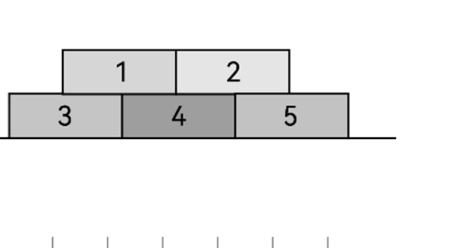
Five bricks form a wall (see figure). Peter can only remove a brick if there is no other brick directly above it. On each turn, he randomly selects one of the removable bricks with equal probability and removes it. What is the probability that the brick numbered 4 is the third to be removed?
Show answer
Answer: D — \(\frac{1}{6}\)
Show hints
Hint 1 of 2
Only the two top bricks start out removable; brick 4 sits beneath both of them, so it is freed only after both 1 and 2 are gone.
Still stuck? Show hint 2 →
Hint 2 of 2
For 4 to be third, the first two removals must be exactly bricks 1 and 2 (in some order), then 4 must be chosen on turn three.
Show solution
Approach: follow the only path that frees brick 4 by turn three
- At the start only the two top bricks 1 and 2 are free (each bottom brick is still pinned by a top brick), so turn 1 removes 1 or 2.
- Suppose 1 goes first; now free are {2, 3}, and brick 4 still needs 2 removed, so turn 2 must pick 2 (chance \(\tfrac{1}{2}\)), after which {3, 4, 5} are free.
- Turn 3 then picks 4 with chance \(\tfrac{1}{3}\); the path probability is \(\tfrac{1}{2}\cdot\tfrac{1}{2}\cdot\tfrac{1}{3}=\tfrac{1}{12}\), and the symmetric order (2 then 1) doubles it to \(\tfrac{1}{6}\), answer D.
Mark:
· log in to save