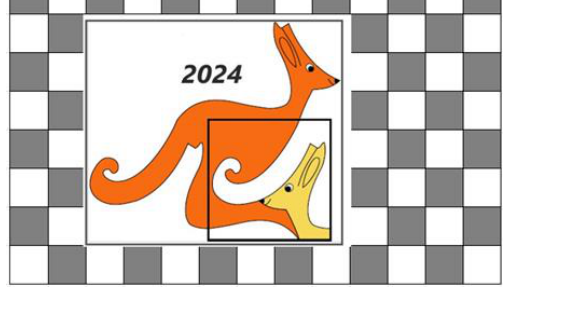
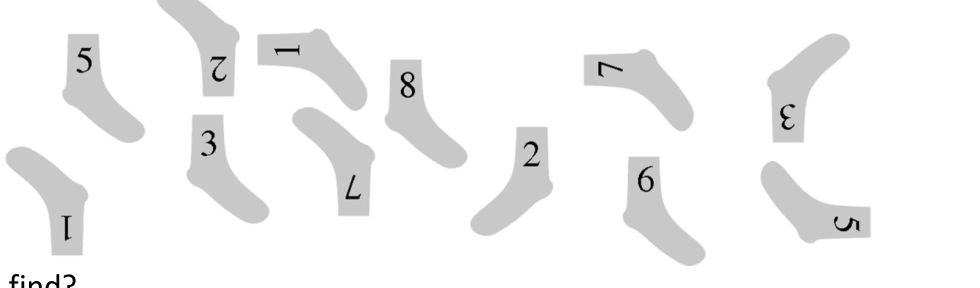
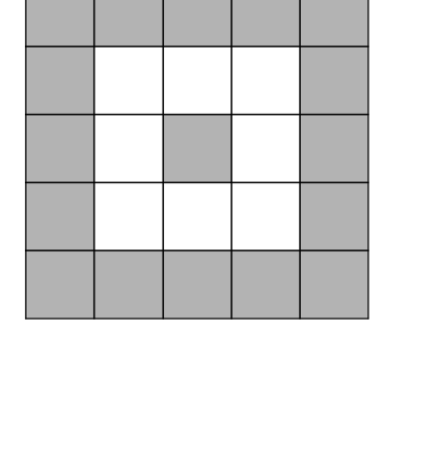
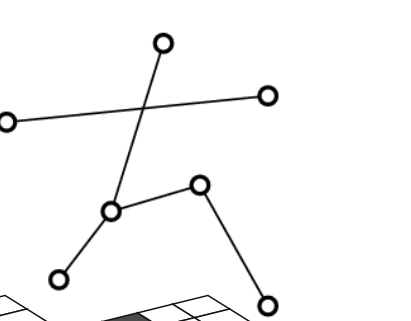
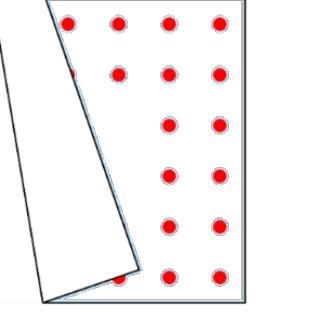
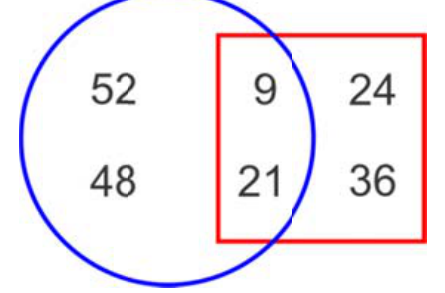
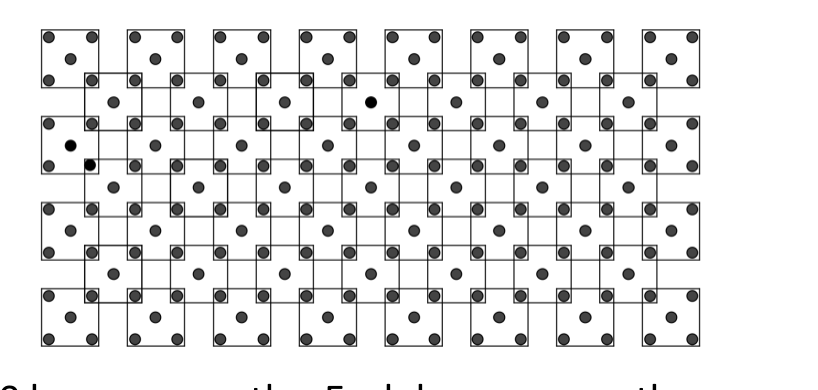
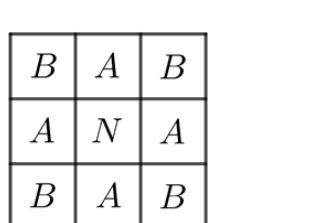
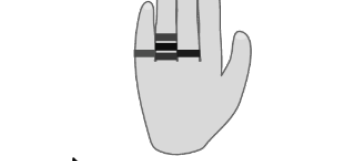
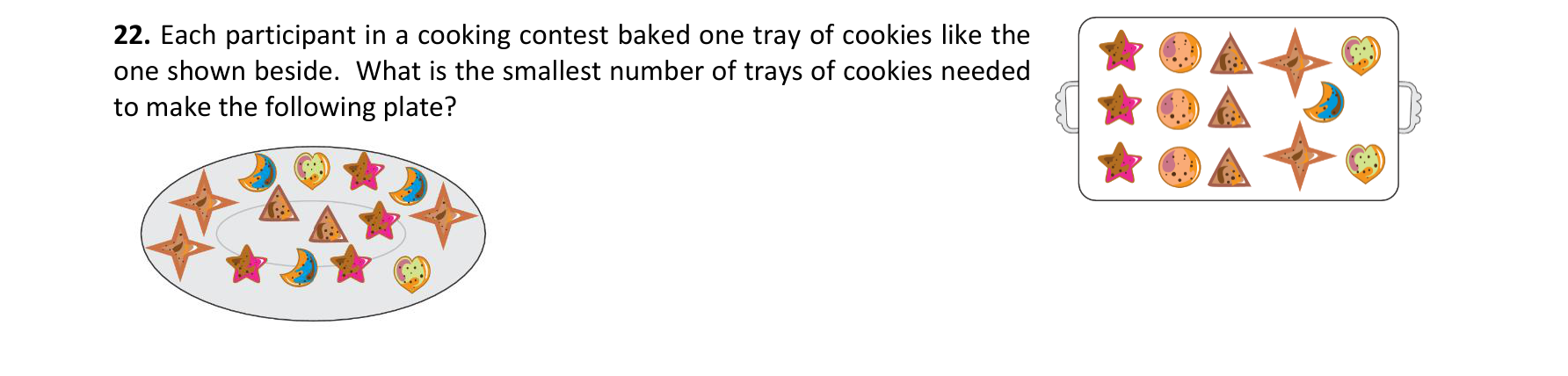
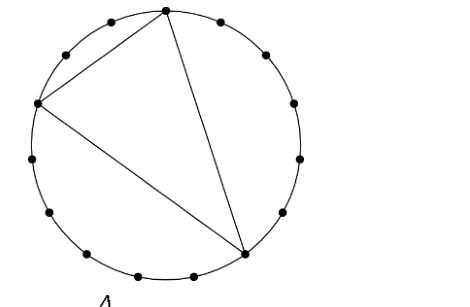
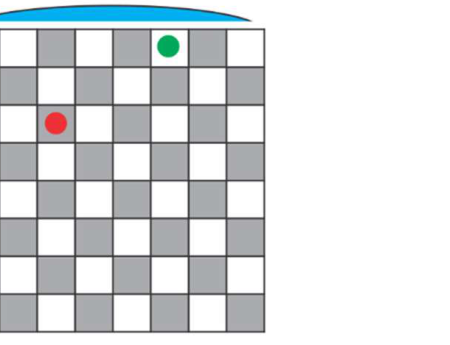
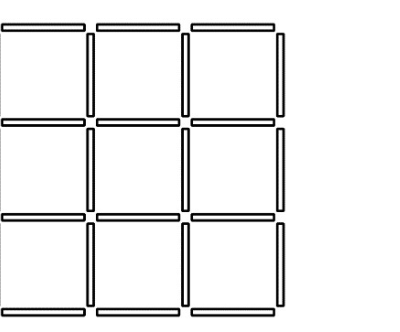
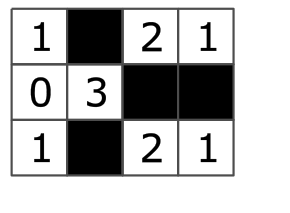
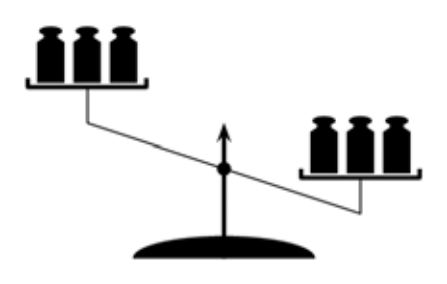
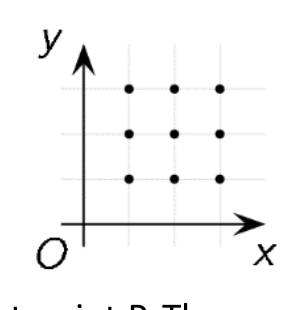
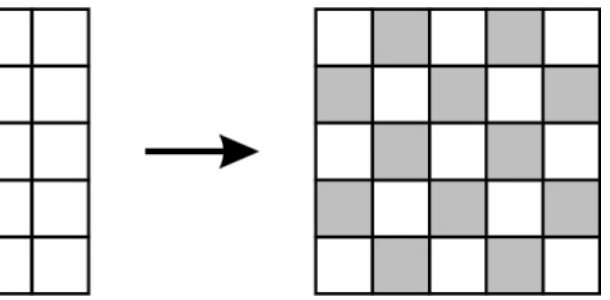
Alex hangs a poster on his kitchen wall. The wall has white and grey tiles of the same size (see picture). How many grey tiles are completely covered by the poster?
Show answer
Answer: B — 21
Show hints
Hint 1 of 3
A tile counts only if the poster hides ALL of it; skip any tile the poster just clips at the edge.
Still stuck? Show hint 2 →
Hint 2 of 3
Mark the block of whole tiles that sit completely under the poster.
Still stuck? Show hint 3 →
Hint 3 of 3
Among only those fully-hidden tiles, count the grey ones (the white ones don't matter).
Show solution
Approach: find the tiles completely under the poster, then tally just the grey ones
First outline the tiles that the poster covers completely, ignoring tiles it only partly overlaps.
These fully-hidden tiles form a grey-and-white checkerboard block.
Now count just the grey tiles inside that block, one by one.
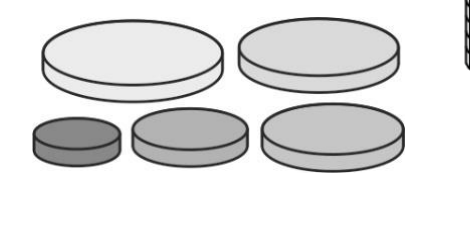
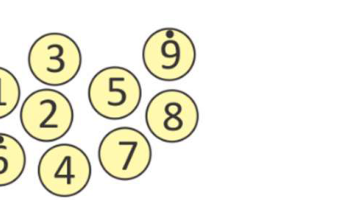
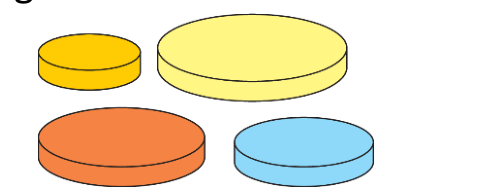
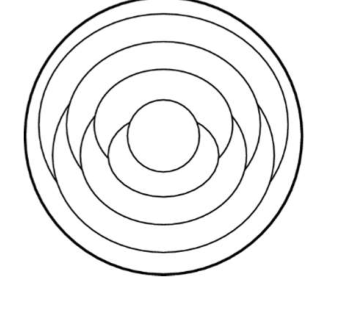
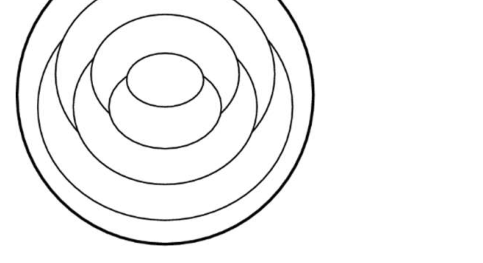
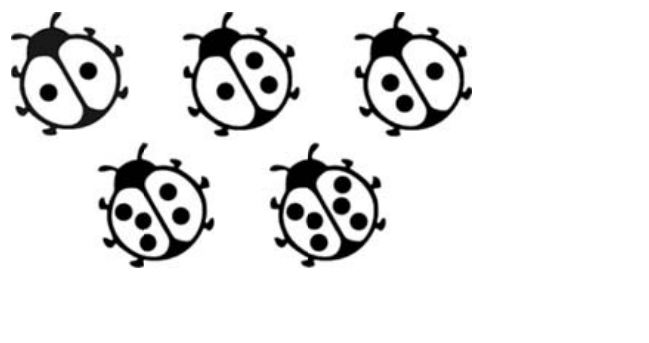
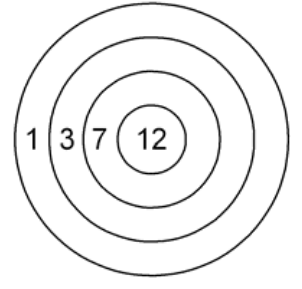
Anna has five discs of different sizes. She wants to use 4 of them to build a tower, always placing a smaller disc on top of a bigger one. In how many ways can Anna build the tower?
Show answer
Answer: B — 5
Show hints
Hint 1 of 2
Once you pick which four discs to use, the order is forced: biggest at the bottom up to smallest.
Still stuck? Show hint 2 →
Hint 2 of 2
So really you are just counting how many ways there are to leave out one disc.
Show solution
Approach: each tower is just a choice of which disc to leave out
A valid tower must go from largest at the bottom to smallest at the top, so a set of four discs can be stacked in only one way.
Building a tower therefore means choosing which 4 of the 5 discs to use, i.e. which single disc to leave out.
There are 5 discs, so there are 5 ways to leave one out.
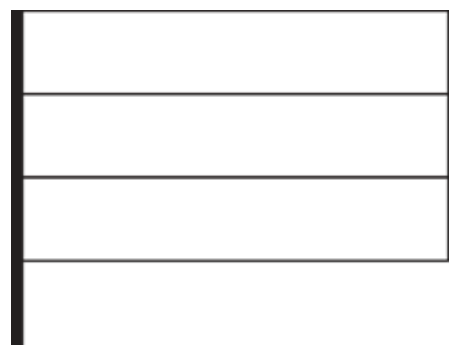
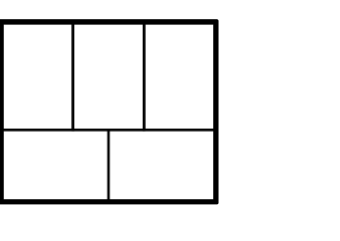
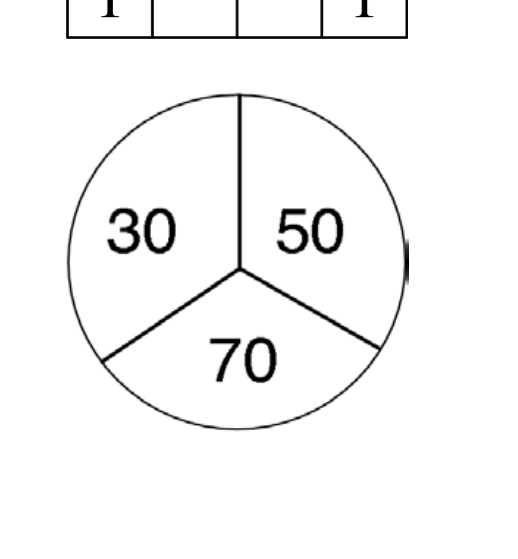
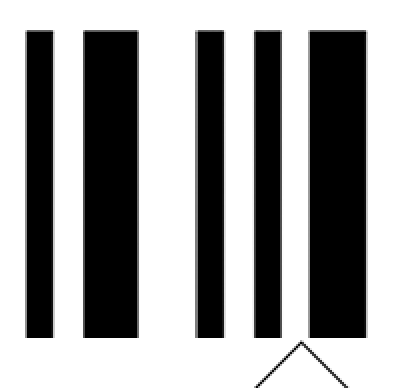
Emma should colour in the three strips of the flag shown. She has four colours available. She can only use one colour for each strip and immediately adjacent strips are not to be of the same colour. How many different ways are there for her to colour in the flag?
Show answer
Answer: D — 36
Show hints
Hint 1 of 2
Colour the strips one at a time and count the choices for each.
Still stuck? Show hint 2 →
Hint 2 of 2
The first strip is free; each later strip just avoids its neighbour's colour.
Show solution
Approach: multiply the independent choices strip by strip
The first strip can be any of 4 colours.
The second strip must differ from the first: 3 choices. The third must differ from the second: 3 choices.
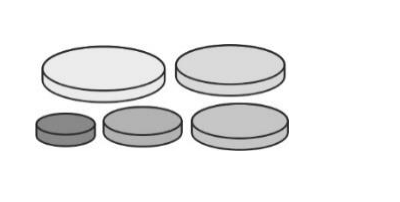
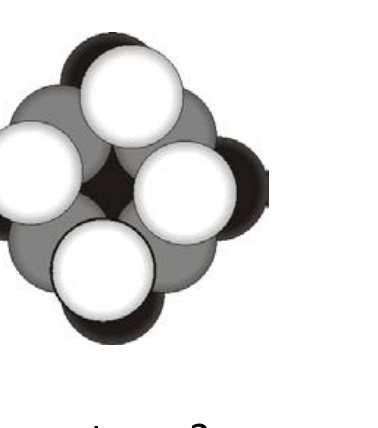
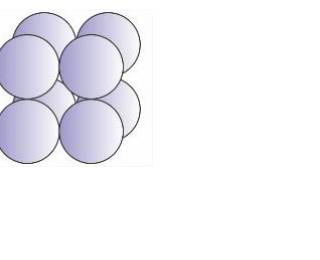
Anna has five circular discs that are all of different sizes. She wants to build a tower using three discs, where a smaller disc always has to lie on top of a bigger disc. How many ways are there for Anna to build the tower?
Show answer
Answer: D — 10
Show hints
Hint 1 of 2
Once three discs are chosen, how many valid stacking orders are there?
Still stuck? Show hint 2 →
Hint 2 of 2
Since sizes are all different, the order is forced, so just count the choices of three discs.
Show solution
Approach: count the ways to choose three discs (order is forced)
For any three chosen discs, the smaller-on-bigger rule fixes exactly one stacking order.
So the number of towers equals the number of ways to choose 3 discs from 5.
Counting & ProbabilityLogic & Word Problemscasework
Three soccer teams compete in a championship. Each team plays exactly once against each of the other teams. In each match the winning team earns 4 points and the losing team loses 1 point; in case of a tie, each team earns 2 points. Once the championship is over, what is the largest possible sum of the points obtained by the three teams?
Show answer
Answer: E — 12
Show hints
Hint 1 of 2
There are only three matches; figure out the point total a single match can produce.
Still stuck? Show hint 2 →
Hint 2 of 2
Compare a decisive match (4 and −1) with a tie (2 and 2) — which gives the bigger combined total?
Show solution
Approach: maximize the total per match
Three teams each playing each other once means 3 matches in total.
A decisive match adds 4 + (−1) = 3 points; a tie adds 2 + 2 = 4 points.
Ties give more, so make all three matches ties: 3 × 4 = 12 points.
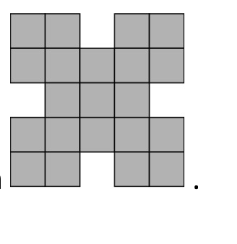
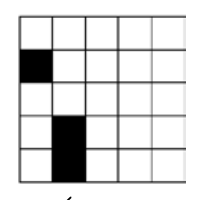
Laura wants to colour in exactly one 2 × 2 square (a block of four little squares) somewhere in the figure shown. How many ways are there for her to do that?
Show answer
Answer: D — 8
Show hints
Hint 1 of 3
Every 2×2 block is pinned down by just one cell: the one in its top-left corner.
Still stuck? Show hint 2 →
Hint 2 of 3
Slide the block around and mark each spot where all four of its little squares stay inside the shape.
Still stuck? Show hint 3 →
Hint 3 of 3
Count those marked spots carefully so you do not double-count or miss one.
Show solution
Approach: count valid top-left corners for a 2×2 square
Each placement of the 2×2 square is decided by which cell is its upper-left corner, provided all four cells lie inside the figure.
Going through the shape cell by cell, there are exactly eight spots where a full 2×2 square fits.
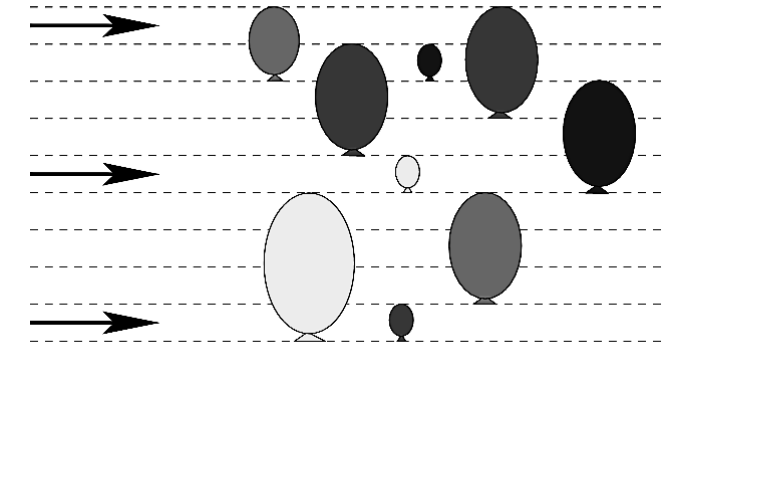
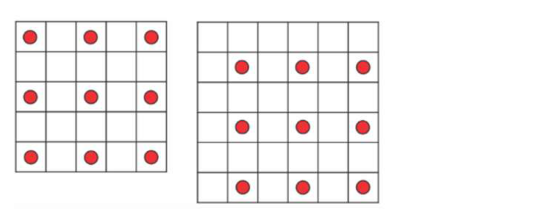
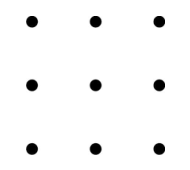
As seen in the diagram, three darts are thrown at nine fixed balloons. If a balloon is hit it bursts and the dart keeps going in the same direction it had before. How many balloons will not be hit by a dart?
Show answer
Answer: B — 3
Show hints
Hint 1 of 2
Follow each dart's straight line of travel and mark every balloon it passes through, since a burst balloon lets the dart keep going.
Still stuck? Show hint 2 →
Hint 2 of 2
Count the balloons that lie on no dart's path - those are the ones never hit.
Show solution
Approach: trace each dart's straight path and count the balloons it misses
Each dart flies in a straight line; whenever it meets a balloon, that balloon bursts and the dart continues the same way, so one dart can hit several balloons in its row.
Trace all three dart lines and shade every balloon that sits on one of those lines.
The balloons left unshaded are the ones no dart reaches.
Leonie has one stamp for each of the digits 0, 1, 2, 3, 4, 5, 6, 7, 8, 9. She uses them to stamp the date of the kangaroo competition (see picture). How many of the stamps does Leonie use?
Show answer
Answer: B — 6
Show hints
Hint 1 of 2
Write out the whole date as it is stamped: 15 03 2018.
Still stuck? Show hint 2 →
Hint 2 of 2
She has only one stamp of each digit, so a digit that shows up twice still uses just one stamp — count the different digits.
Show solution
Approach: write the date and circle the different digits, counting each kind once
The date is stamped as 1 5 0 3 2 0 1 8.
Cross out repeats: the 0 and the 1 each appear twice, but she only owns one stamp of each.
The different digits are 0, 1, 2, 3, 5, 8 — that is 6 stamps, answer B.
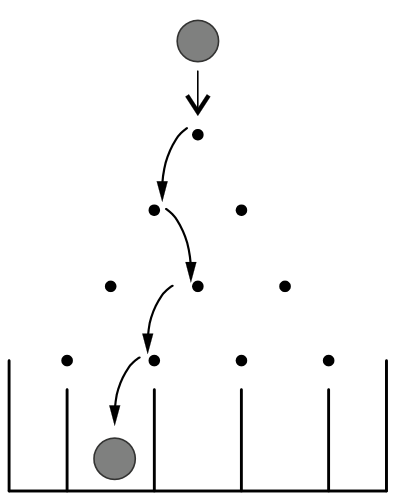
In a game of luck, a ball rolls downwards towards hammered nails and is diverted either to the right or the left by the nail immediately below it. One possible path is shown in the diagram. How many different ways are there for the ball to reach the second compartment from the left?
Show answer
Answer: C — 4
Show hints
Hint 1 of 2
Count how many rows of nails the ball passes before landing.
Still stuck? Show hint 2 →
Hint 2 of 2
The number of paths into each slot follows the same pattern as the rows of Pascal's triangle (1, then 1–1, then 1–2–1, …).
Show solution
Approach: count left/right choices like Pascal's triangle
The ball passes 4 rows of nails, choosing left or right each time, and lands in one of 5 compartments.
The number of ways to reach the compartments from left to right is 1, 4, 6, 4, 1.
The second compartment from the left has 4 different paths.
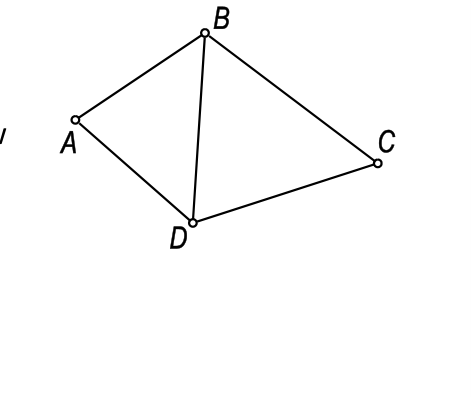
During a cycle race starting at D and finishing at B, every connecting road between the towns A, B, C and D shown in the diagram is ridden along exactly once. How many possible routes are there for the race?
Show answer
Answer: C — 6
Show hints
Hint 1 of 2
A valid race rides every drawn road exactly once, starting at D and ending at B (an Euler trail).
Still stuck? Show hint 2 →
Hint 2 of 2
List the routes by the first road taken out of D, then trace each to the end at B.
Show solution
Approach: count Euler trails from D to B
The five roads are A-B, A-D, B-D, B-C and D-C; the race must use each exactly once, leaving D and arriving at B.
Organise by the first move from D: starting D-A leads to 2 finishing routes, starting D-B leads to 2, and starting D-C leads to 2.
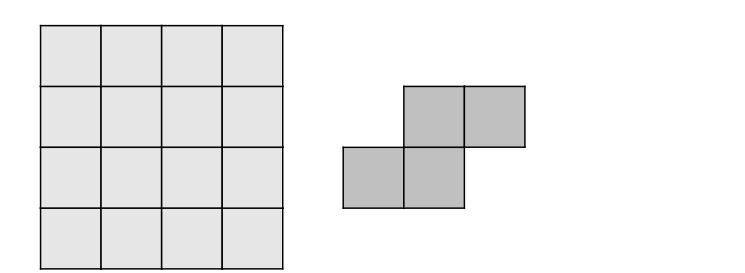
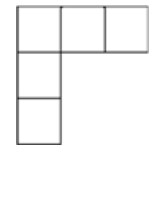
Melanie has a square piece of paper with a 4×4 grid drawn on it. She cuts along the gridlines, cutting out several shapes that each look like the one pictured or its mirror image. How many squares are left over if she cuts out as many shapes as possible?
Show answer
Answer: C — 4
Show hints
Hint 1 of 2
The shape is a 4-square piece; the grid holds 16 squares in total.
Still stuck? Show hint 2 →
Hint 2 of 2
Try to fit as many copies (or mirror images) as you can without overlap, then count the leftovers.
Show solution
Approach: tile and count leftovers
The 4×4 grid has 16 unit squares; each cut-out piece uses 4 of them.
These S/Z-shaped pieces cannot fill the 4×4 square completely.
The best packing fits 3 pieces (12 squares), leaving 4 squares uncovered.
Counting & ProbabilityLogic & Word Problemscasework
A sack contains marbles in five different colours: 2 red, 3 blue, 10 white, 4 green and 3 black. You take marbles out of the bag without looking and without putting any back. What is the smallest number of marbles you must remove to be sure of having two of the same colour?
Show answer
Answer: E — 6
Show hints
Hint 1 of 2
Think about the worst luck possible while still avoiding a matching pair.
Still stuck? Show hint 2 →
Hint 2 of 2
This is a pigeonhole question: one of each colour first, then one more forces a repeat.
Show solution
Approach: pigeonhole / worst case
There are 5 different colours, and every colour has at least two marbles.
The worst case is drawing one marble of each colour: 5 marbles, all different.
The very next marble (the 6th) must repeat a colour.
Barbara wrote “KAENGURUWETTBEWERB” on the blackboard. She used the same colour for equal letters and a different colour for different letters. How many different colours did she use?
Show answer
Answer: D — 10
Show hints
Hint 1 of 2
Same letter means same colour, so count how many different letters appear.
Still stuck? Show hint 2 →
Hint 2 of 2
List the distinct letters in KAENGURUWETTBEWERB and count them.
Show solution
Approach: count distinct letters
Each distinct letter needs its own colour; repeated letters reuse a colour.
The distinct letters are K, A, E, N, G, U, R, W, T, B.
Barbara wrote the word MATHEMATIC on a piece of paper. She used the same colour for letters that are the same, and a different colour for letters that are different. How many different colours did she use?
Show answer
Answer: A — 7
Show hints
Hint 1 of 2
Write out the letters of MATHEMATIC and circle the ones that repeat.
Still stuck? Show hint 2 →
Hint 2 of 2
Count how many different letters appear, not how many letters there are.
Show solution
Approach: count the distinct letters
MATHEMATIC uses the letters M, A, T, H, E, M, A, T, I, C.
The repeats are the second M, the second A and the second T.
The different letters are M, A, T, H, E, I, C — that is 7.
Kangi goes directly from the zoo (Zoo) to school (Schule) and counts the flowers along the way. Which of the following numbers can he not obtain this way?
Show answer
Answer: C — 11
Show hints
Hint 1 of 2
At each fork in the path Kangi can take either the top branch or the bottom branch.
Still stuck? Show hint 2 →
Hint 2 of 2
Write down every total he can make by mixing the branch choices, then see which listed number never appears.
Show solution
Approach: list the reachable totals
Each of the two loops offers two flower counts, and the middle stretch is always counted.
Combine a choice from the first loop with a choice from the second (plus the middle) to get the possible totals.
Listing them shows 9, 10, 12 and 13 are reachable but 11 is not.
At a party there were 4 boys and 4 girls. Boys only danced with girls and girls only danced with boys. At the end of the evening each person was asked how many people they had danced with. The boys gave the answers 3, 1, 2, 2 and three of the girls answered 2. Which answer did the fourth girl give?
Show answer
Answer: C — 2
Show hints
Hint 1 of 2
Each dance pairs one boy with one girl, so the boys' counts and the girls' counts add up to the same total.
Still stuck? Show hint 2 →
Hint 2 of 2
Add the boys' answers, then subtract the three known girls' answers.
Show solution
Approach: count each dance from both sides
Every dance links a boy and a girl, so the sum of the boys' partner-counts equals the sum of the girls'.
Boys reported 3+1+2+2 = 8 dances in total.
Three girls reported 2 each = 6, so the fourth girl danced 8-6 = 2 times.
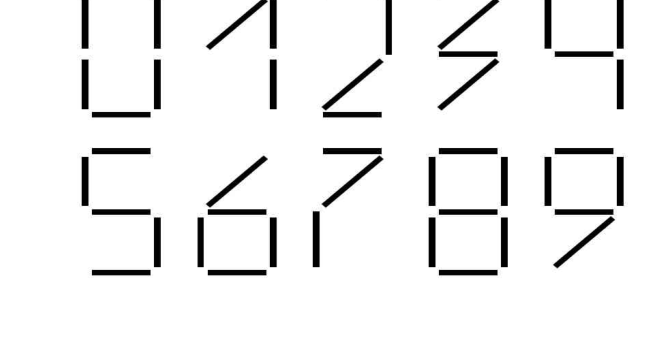
Each digit is built from sticks as shown. The “weight” of a number is the number of sticks used to build it. What is the weight of the heaviest two-digit number?
Show answer
Answer: E — 14
Show hints
Hint 1 of 2
Count the sticks each digit needs, like a calculator display.
Still stuck? Show hint 2 →
Hint 2 of 2
Use the two digits that need the most sticks to make the heaviest number.
Show solution
Approach: seven-segment stick count
By the stick pictures, the digit 8 needs 7 sticks, the most of any digit.
To make the heaviest two-digit number, put 8 in both places: 88.
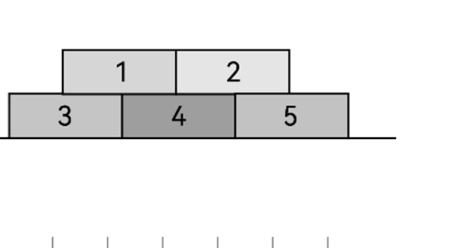
Five bricks form a wall (see figure). Peter can only remove a brick if there is no other brick directly above it. On each turn, he randomly selects one of the removable bricks with equal probability and removes it. What is the probability that the brick numbered 4 is the third to be removed?
Show answer
Answer: D — \(\frac{1}{6}\)
Show hints
Hint 1 of 2
Only the two top bricks start out removable; brick 4 sits beneath both of them, so it is freed only after both 1 and 2 are gone.
Still stuck? Show hint 2 →
Hint 2 of 2
For 4 to be third, the first two removals must be exactly bricks 1 and 2 (in some order), then 4 must be chosen on turn three.
Show solution
Approach: follow the only path that frees brick 4 by turn three
At the start only the two top bricks 1 and 2 are free (each bottom brick is still pinned by a top brick), so turn 1 removes 1 or 2.
Suppose 1 goes first; now free are {2, 3}, and brick 4 still needs 2 removed, so turn 2 must pick 2 (chance \(\tfrac{1}{2}\)), after which {3, 4, 5} are free.
Turn 3 then picks 4 with chance \(\tfrac{1}{3}\); the path probability is \(\tfrac{1}{2}\cdot\tfrac{1}{2}\cdot\tfrac{1}{3}=\tfrac{1}{12}\), and the symmetric order (2 then 1) doubles it to \(\tfrac{1}{6}\), answer D.
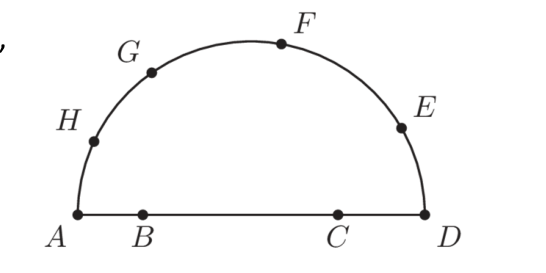
Points B and C lie on the diameter of a semicircle with diameter AD, and points E, F, G and H lie on the arc. How many triangles exist whose vertices are three of these eight points?
Show answer
Answer: D — 52
Show hints
Hint 1 of 2
Count all triples of the 8 points, then subtract the degenerate ones.
Still stuck? Show hint 2 →
Hint 2 of 2
Four points (A, B, C, D) are collinear on the diameter, so triples chosen all from those four are not triangles.
Show solution
Approach: total triples minus collinear triples
Choose any 3 of 8 points: C(8,3) = 56.
The only collinear set is A, B, C, D on the diameter: C(4,3) = 4 bad triples.
The number 2024 is made up of the four digits 2, 0, 2 and 4. How many different four-digit numbers bigger than 2024 can be formed using exactly those digits?
Show answer
Answer: E — 8
Show hints
Hint 1 of 2
Only the leading digit can be 2 or 4 (a leading 0 is not a four-digit number); split into numbers starting with 2 and numbers starting with 4.
Still stuck? Show hint 2 →
Hint 2 of 2
List the rearrangements in each case and keep just those larger than 2024.
Show solution
Approach: split by leading digit and count those above 2024
Using the digits 2, 0, 2, 4, the first digit must be 2 or 4.
Starting with 2, the last three digits arrange the set {0, 2, 4}: 2024, 2042, 2204, 2240, 2402, 2420, of which five exceed 2024.
Starting with 4, every arrangement beats 2024: 4022, 4202, 4220, giving three more.
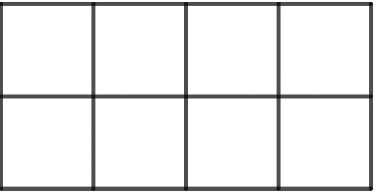
Jelena fills the 2×4 table shown with the letters A, B, C and D. She wants each letter to appear exactly once in each row and exactly once in each of the three 2×2 squares. In how many ways can she do this?
Show answer
Answer: B — 24
Show hints
Hint 1 of 2
Fill the left-hand 2x2 square first, then ask how much freedom is left.
Still stuck? Show hint 2 →
Hint 2 of 2
Because the 2x2 squares overlap by one column, knowing two columns almost forces the next.
Show solution
Approach: fill the first 2x2 block, then propagate the overlaps
The left 2x2 block can be filled with the four letters in \(4!=24\) ways.
Once columns 1 and 2 are set, the middle 2x2 block (columns 2-3) must contain the same four letters, so column 3 is forced to be column 1 with its two entries swapped between the rows; the same logic then forces column 4.
So every choice of the first block extends to exactly one full table, giving \(24\) ways, answer B.
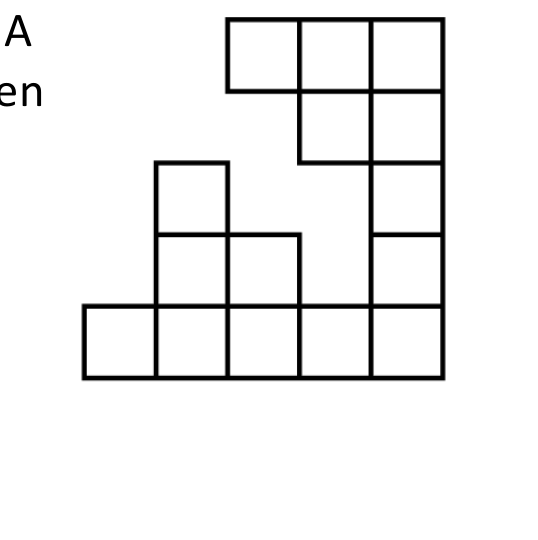
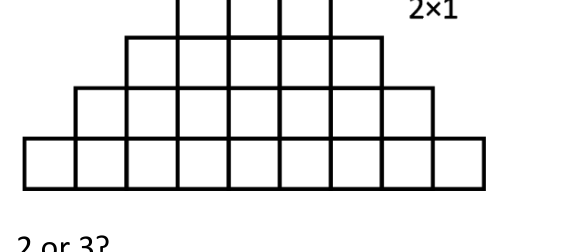
The following shape is composed of identical squares. What is the maximum number of 2×1 dominoes that can be placed on the shape if each covers exactly two squares? The dominoes can be placed horizontally or vertically and are not allowed to cover each other.
Show answer
Answer: C — 10
Show hints
Hint 1 of 3
Colour the squares like a checkerboard, since every domino must cover one square of each colour.
Still stuck? Show hint 2 →
Hint 2 of 3
The number of dominoes can never exceed the count of the rarer colour, so compare the two colour totals.
Still stuck? Show hint 3 →
Hint 3 of 3
Count black and white squares; the smaller total is the ceiling, then check it is actually reachable.
Show solution
Approach: checkerboard bound that turns out to be tight
The pyramid has rows of \(9,7,5,3\) squares, \(24\) in all, so a naive ceiling is \(12\) dominoes.
Colour it like a checkerboard: every \(2\times1\) domino covers exactly one black and one white square.
Counting gives \(14\) of one colour and \(10\) of the other, so no more than \(10\) dominoes can ever be placed.
Ten dominoes can indeed be laid without overlap, so the maximum is 10 (answer C).
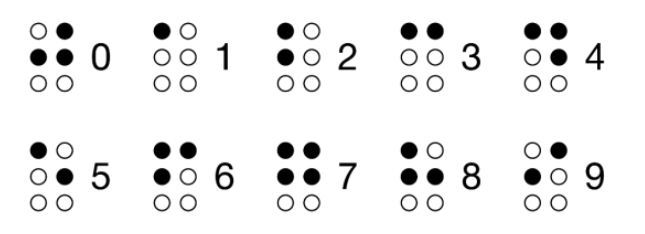
Blind people use Braille, in which numbers and letters are shown as a code with up to 6 tactile dots (black in the picture). The numbers 0 to 9 are shown on the right. How many two-digit numbers have exactly four black dots?
Show answer
Answer: E — 23
Show hints
Hint 1 of 2
First read off how many black dots each digit 0–9 uses from the chart.
Still stuck? Show hint 2 →
Hint 2 of 2
A two-digit number's dots are the tens digit's dots plus the units digit's dots; count the digit pairs whose dot-counts add to 4 (remember the tens digit can't be 0).
Show solution
Approach: tabulate dots per digit, then count pairs summing to four
From the chart, record the number of black dots for each digit 0 through 9.
For a two-digit number, add the dots of the tens digit and the units digit; we want this total to equal 4.
Counting all allowed digit pairs (tens digit 1–9, units digit 0–9) whose dot-counts sum to 4 gives 23 numbers.
So 23 two-digit numbers have exactly four black dots.
The digits 0–9 can be drawn using horizontal and vertical lines, as shown. Greg chooses two digits. Together, his digits have 1 horizontal line and 5 vertical lines. What is the sum of his two digits?
Show answer
Answer: A — 5
Show hints
Hint 1 of 2
Count, for each digit drawn with segments, how many horizontal and how many vertical strokes it uses.
Still stuck? Show hint 2 →
Hint 2 of 2
Find two digits whose horizontal counts add to 1 and vertical counts add to 5.
Show solution
Approach: match segment counts to the required totals
The digit 1 uses 2 vertical and 0 horizontal segments.
The digit 4 uses 3 vertical and 1 horizontal segment.
Together: 2 + 3 = 5 vertical and 0 + 1 = 1 horizontal, exactly as required.
60 children stand in a row. Each child wears a high-visibility vest and a backpack. The vest colours always alternate: yellow, green, yellow, green, … The backpack colours follow the pattern red, brown, purple, red, brown, purple, … How many children have both a yellow vest and a purple backpack?
Show answer
Answer: E — 10
Show hints
Hint 1 of 2
Yellow vests are on odd positions; purple backpacks repeat every third child.
Still stuck? Show hint 2 →
Hint 2 of 2
Find positions that are both odd and a multiple of 3 — that's every 6th child starting at 3.
Show solution
Approach: combine the two repeating patterns
Vests go yellow, green, ..., so yellow is on positions 1, 3, 5, ... (odd).
Backpacks go red, brown, purple, ..., so purple is on positions 3, 6, 9, ...
Both happen at positions 3, 9, 15, ..., i.e. every 6th child starting at 3.
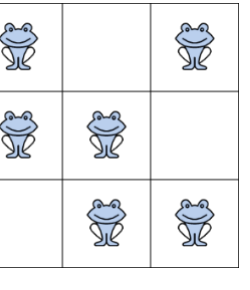
There are exactly 2 frogs in each row and in each column (see picture). At the same moment, two of the six frogs each hop to an empty neighbouring square. Afterwards there are again 2 frogs in each row and in each column. In how many ways can two frogs hop like this?
Show answer
Answer: D — 4
Show hints
Hint 1 of 3
There are only three empty squares, so each hopping frog must land on one of those empty squares.
Still stuck? Show hint 2 →
Hint 2 of 3
When a frog leaves a row (or column) and another frog must keep that row (or column) at two, the two moves have to balance each other.
Still stuck? Show hint 3 →
Hint 3 of 3
Carefully try every pair of frogs that can hop into empty neighbours, and keep only the pairs that still leave two frogs in every row and every column.
Show solution
Approach: try each pair of frogs hopping into empty neighbours and keep the ones that stay balanced
On the 3-by-3 grid the six frogs leave exactly three empty squares; a hopping frog can only move onto an empty neighbour.
If one frog hops out of a row, the row drops to one frog, so a second frog must hop back into that same row to keep it at two — and the same must hold for columns.
Go through the pairs of frogs that can both hop into empty neighbours and check which pairs keep every row and every column at two frogs.
Exactly four such pairs of hops work, so the answer is 4 (D).
23 animals are sitting in the first row of a cinema. Each animal is either a beaver or a kangaroo. Each animal has at least one kangaroo next to it. What is the maximum amount of beavers in the row?
Show answer
Answer: D — 11
Show hints
Hint 1 of 2
Every animal — including each kangaroo — needs a kangaroo as a neighbour.
Still stuck? Show hint 2 →
Hint 2 of 2
So kangaroos can't sit alone; they must come in adjacent pairs, and at most two beavers can sit between groups.
Show solution
Approach: kangaroos must be paired; pack beavers between pairs
A lone kangaroo would have no kangaroo neighbour, so kangaroos occur in adjacent pairs.
Between two such pairs at most two beavers fit (a third would be too far from any kangaroo).
The tightest packing of 23 seats uses 12 kangaroos, leaving a maximum of 11 beavers.
The numbers from 1 to 9 are to be distributed to the nine squares in the diagram according to the following rules: There is to be one number in each square. The sum of three adjacent numbers is always a multiple of 3. The numbers 7 and 9 are already written in. How many ways are there to insert the remaining numbers?
Show answer
Answer: E — 24
Show hints
Hint 1 of 3
Sort 1–9 by remainder mod 3: \(\{3,6,9\}\) give 0, \(\{1,4,7\}\) give 1, \(\{2,5,8\}\) give 2.
Still stuck? Show hint 2 →
Hint 2 of 3
Comparing two overlapping triples shows the remainders must repeat every third square.
Still stuck? Show hint 3 →
Hint 3 of 3
Use the fixed 7 and 9 to decide which remainder class goes in which of the three position-classes.
Show solution
Approach: the mod-3 remainders repeat with period 3, then count
If squares \(i,i+1,i+2\) and \(i+1,i+2,i+3\) both sum to a multiple of 3, subtracting shows square \(i\) and square \(i+3\) have the same remainder, so the remainders repeat in a period-3 pattern across the nine squares.
Thus one remainder class (three numbers) fills positions \(1,4,7\), another fills \(2,5,8\), the third fills \(3,6,9\); the placed 7 (remainder 1) and 9 (remainder 0) lock those two classes onto their position groups, leaving the remainder-2 class for the third group.
Each of the three classes can be arranged inside its three positions in \(3! = 6\) ways, but the 7 and 9 are fixed, so the count is \(2 \cdot 2 \cdot 6 = \mathbf{24}\) ways.
Three boys enter a room one after the other. Hermann is not the first. Felix is not the second. Clemens is not the third. How many different orders are there for the boys to enter the room?
Show answer
Answer: B — 2
Show hints
Hint 1 of 2
List all six orders of the three boys and cross out the forbidden ones.
Still stuck? Show hint 2 →
Hint 2 of 2
Hermann cannot be 1st, Felix cannot be 2nd, Clemens cannot be 3rd.
Show solution
Approach: enumerate the orders and discard those breaking a rule
There are 6 possible orders of three boys.
Keeping only those with Hermann not first, Felix not second, and Clemens not third leaves Felix-Clemens-Hermann and Clemens-Hermann-Felix.
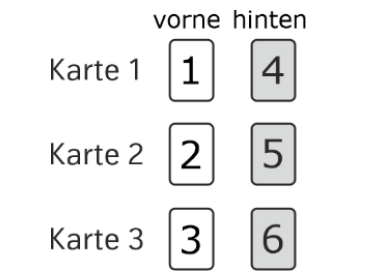
Martin has three cards, each labelled with a number on both sides (see picture: front and back). He places the three cards on the table without paying attention to which side is up, and adds the three numbers he can see. How many different sums can Martin get this way?
Show answer
Answer: E — A different amount.
Show hints
Hint 1 of 2
Each card shows one of its two numbers, so there are a few possible visible triples to add up.
Still stuck? Show hint 2 →
Hint 2 of 2
List every possible sum, then count how many different totals there really are and compare with the choices.
Show solution
Approach: list all visible triples and count the distinct sums
Each card shows either its front or back number: card 1 shows 1 or 4, card 2 shows 2 or 5, card 3 shows 3 or 6.
Notice each card's two numbers differ by 3, so the sum changes by 3 each time a card is flipped; the possible sums are 6, 9, 12 and 15.
That is 4 different sums.
Since 4 is not among the listed choices, the answer is E, a different amount.
Counting & ProbabilityLogic & Word Problemscareful-countingcasework
Snow White organises a chess tournament for the seven dwarfs, lasting several days. Every dwarf has to play every other dwarf exactly once. On Monday Grumpy plays 1 game, Sneezy plays 2, Sleepy 3, Bashful 4, Happy 5 and Doc 6 games. How many games does Dopey, the 7th dwarf, play on Monday?
Show answer
Answer: C — 3
Show hints
Hint 1 of 3
Each dwarf can play at most the other six, and the given counts 1, 2, 3, 4, 5, 6 are all different.
Still stuck? Show hint 2 →
Hint 2 of 3
Start from the extremes: the one who played 6 games played everybody, while the one who played only 1 must have played that same dwarf.
Still stuck? Show hint 3 →
Hint 3 of 3
Keep pairing the highest remaining count with the lowest, peeling off the players whose schedule is now complete.
Show solution
Approach: pair the largest count with the smallest, working inward
Doc played 6 games, so he played everyone — including Grumpy, whose single game must therefore be against Doc only.
Happy played 5: everyone except Grumpy (Grumpy is already finished), so Happy played the other five, including Dopey; Sneezy's 2 games are then Doc and Happy.
Bashful played 4: he must be Doc, Happy, Sleepy and Dopey; Sleepy's 3 are Doc, Happy and Bashful.
So Dopey was played by Doc, Happy and Bashful only — that is 3 games, option C.
Counting & ProbabilityLogic & Word Problemscareful-countingcasework
Elisabeth wants to write the numbers 1 to 9 in the fields of the diagram shown so that the product of the numbers in any two fields next to each other is no greater than 15. Two fields are called “next to each other” if they share a common edge. How many ways are there for Elisabeth to label the fields?
Show answer
Answer: C — 16
Show hints
Hint 1 of 2
The big numbers (7, 8, 9) are very restricted: their neighbours' products must stay ≤ 15.
Still stuck? Show hint 2 →
Hint 2 of 2
Place 9, 8, 7 first into spots with few neighbours or small neighbours, then count the freedom that remains.
Show solution
Approach: place the large numbers under the product constraint, then multiply free choices
For adjacent products ≤ 15, the largest numbers (9, 8, 7) can only sit next to very small numbers (mostly 1 and 2).
This pins those big numbers to specific low-degree fields and forces small neighbours around them.
Counting the independent choices that remain gives 16 labelings.
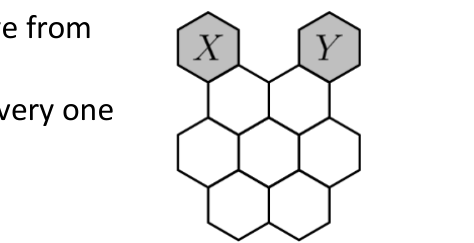
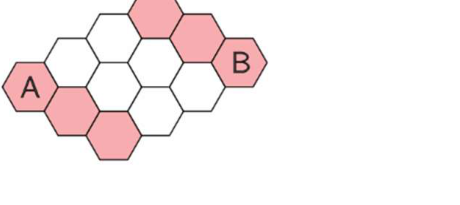
A bee called Maja wants to hike from honeycomb X to honeycomb Y. She can only move from one honeycomb to the neighbouring honeycomb if they share an edge. How many different ways are there for Maja to go from X to Y if she has to step onto every one of the seven honeycombs exactly once?
Show answer
Answer: D — 5
Show hints
Hint 1 of 2
You need a path from X to Y that visits all seven honeycombs exactly once.
Still stuck? Show hint 2 →
Hint 2 of 2
Work outward from X, pruning routes that strand a cell you can never return to.
Show solution
Approach: count the full paths through the seven-cell honeycomb graph
Model the honeycombs as nodes with edges between cells that share a side.
Trace every route from X that uses all seven cells exactly once and ends at Y, discarding ones that get stuck.
In a tournament with 8 participants the players are randomly paired up in four teams for the first round and the winner of each encounter then proceeds to the second round. There are two games in the second round and the two winners then play the final. Anita and Martina are the two best players and will win against all others; in case they have to play against each other, Anita will win. How big is the chance that Martina will get to the final?
Show answer
Answer: E — \(\tfrac{4}{7}\)
Show hints
Hint 1 of 2
Martina reaches the final unless she is drawn against Anita in round 1 or in the semifinal.
Still stuck? Show hint 2 →
Hint 2 of 2
Multiply the chance of dodging Anita each round.
Show solution
Approach: avoid the stronger player each round
Round 1: Martina's opponent is one of 7; chance it is not Anita is 6/7.
Semifinal: among the four winners she meets one of 3; chance it is not Anita is 2/3.
Ahmad walks up 8 steps, going up either 1 or 2 steps at a time. There is a hole on the 6th step, so he cannot use this step. In how many different ways can Ahmad reach the top step?
Show answer
Answer: C — 8
Show hints
Hint 1 of 2
Count, step by step, the number of ways to reach each step using 1- or 2-step moves.
Still stuck? Show hint 2 →
Hint 2 of 2
The forbidden 6th step has 0 ways; carry that 0 forward to the top.
Show solution
Approach: build up ways-to-reach each step (Fibonacci-style)
Ways to reach steps 1..5 are 1, 2, 3, 5, 8 (each is the sum of the two below).
Step 6 is a hole, so it has 0 ways and cannot be used.
The first 1000 positive integers are written in a row in some order and all sums of any three adjacent numbers are calculated. What is the greatest number of odd sums that can be obtained?
Show answer
Answer: A — 997
Show hints
Hint 1 of 2
A sum of three numbers is odd exactly when an odd count of them is odd.
Still stuck? Show hint 2 →
Hint 2 of 2
Think about how arranging the 500 odd and 500 even numbers controls the parity of each window of three.
Show solution
Approach: track parities; a window's sum is odd when it holds an odd count of odd numbers
Only parity matters: write O for an odd number and E for an even one. There are 500 of each, and a window of three has an odd sum exactly when it contains one or three O's.
There are 998 windows of three. The repeating block OOEOOE… gives an odd sum in every window except those straddling a break, and a short check shows you cannot make all 998 odd.
Arranging the 500 O's and 500 E's carefully leaves exactly one window even, so the greatest number of odd sums is 997.
Five cars participated in a race, starting in the order I, II, III, IV, V. Whenever a car overtook another car, a point was awarded. The cars reached the finish line in the order III, V, I, IV, II. What is the smallest number of points in total that could have been awarded?
Show answer
Answer: E — 6
Show hints
Hint 1 of 2
The fewest overtakes equals the number of pairs that swap their relative order from start to finish.
Still stuck? Show hint 2 →
Hint 2 of 2
Compare every pair of cars and count how many ended in the opposite order to how they started.
Show solution
Approach: count order-reversed pairs (inversions)
Each overtake swaps one adjacent pair, so the minimum total equals the number of pairs whose order reversed.
Start I,II,III,IV,V; finish III,V,I,IV,II.
Counting all pairs that flipped relative order gives 6 such pairs.
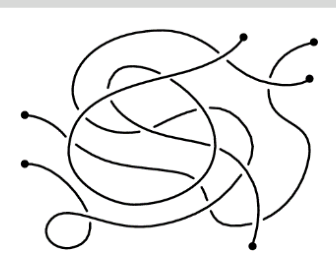
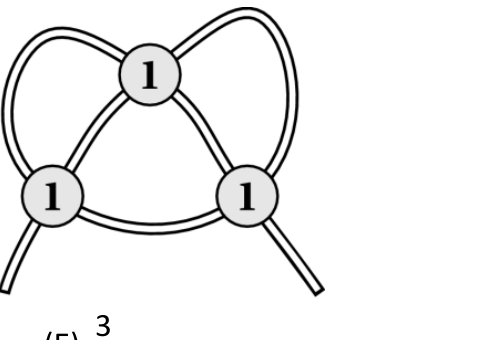
A piece of string is lying on the table. It is partially covered by three coins as seen in the figure. Under each coin the string is equally likely to pass over itself one way or the other (i.e. at each crossing either strand is equally likely to be on top). What is the probability that the string is knotted after its ends are pulled?
Show answer
Answer: B — \(\tfrac{1}{4}\)
Show hints
Hint 1 of 2
Each hidden crossing is independently 'over' or 'under', so list how many equally likely cases there are.
Still stuck? Show hint 2 →
Hint 2 of 2
Decide which of those cases actually produce a knot when the ends are pulled.
Show solution
Approach: count favourable crossing patterns out of all equally likely ones
Three crossings, each equally likely two ways, give 2³ = 8 equally likely outcomes.
Only the patterns that interlock the strand into a true knot count; exactly 2 of the 8 do.
Logic & Word ProblemsCounting & Probabilitysum-constraintcomplementary-counting
A box contains only green, red, blue and yellow counters. There is always at least one green counter amongst any 27 counters chosen from the box; always at least one red counter amongst any 25 counters chosen; always at least one blue amongst any 22 counters chosen and always at least one yellow amongst any 17 counters chosen. What is the largest number of counters that could be in the box?
Show answer
Answer: B — 29
Show hints
Hint 1 of 2
'Any 27 chosen contain a green' means you can never pick 27 with no green — so the non-green counters number at most 26.
Still stuck? Show hint 2 →
Hint 2 of 2
Write the same kind of bound for each colour and add them up.
Logic & Word ProblemsCounting & Probabilitycaseworkcareful-counting
In a town there are 21 knights who always tell the truth and 2000 knaves who always lie. A wizard divided 2020 of these 2021 people into 1010 pairs. Every person in a pair described the other person as either a knight or a knave. As a result, 2000 people were called knights and 20 people were called knaves. How many pairs of two knaves were there?
Show answer
Answer: D — 995
Show hints
Hint 1 of 3
Work out what each type of pair (two knights, two knaves, mixed) makes the partners say.
Still stuck? Show hint 2 →
Hint 2 of 3
Only mixed pairs produce 'knave' answers, two each — that pins down the number of mixed pairs.
Still stuck? Show hint 3 →
Hint 3 of 3
Then use the 21 knights to back out the other pair types.
Show solution
Approach: classify pairs by the labels they generate
In a same-type pair both say 'knight'; in a mixed pair both say 'knave'.
The 20 'knave' calls come 2 per mixed pair, so there are 10 mixed pairs (using 10 knights and 10 knaves).
With one knight left out, the other 10 knights form 5 knight-knight pairs; the remaining 1990 knaves form 995 knave-knave pairs.
Logic & Word ProblemsCounting & Probabilitycasework
In a tournament each of the 6 teams plays one match against every other team. In each round of matches, 3 take place simultaneously. A TV station has already decided which match it will broadcast for each round, as shown in the table. In which round will team D play against team F?
Round
1
2
3
4
5
Broadcast match
A–B
C–D
A–E
E–F
A–C
Show answer
Answer: A — 1
Show hints
Hint 1 of 2
The five rounds form a schedule where each round is three disjoint matches covering all six teams.
Still stuck? Show hint 2 →
Hint 2 of 2
Each team plays once per round, so a team's partners across the rounds are all different; reconstruct from the broadcasts.
Show solution
Approach: reconstruct the round-by-round pairing
A's broadcast matches are B (R1), E (R3) and C (R5), so A must meet D and F in rounds 2 and 4; since R2 already shows C–D, A plays F in R2 and D in R4.
Round 4 shows A–D and E–F, so its third match is B–C; round 2's leftover pair is B–E.
Now D still needs B, E, F and E still needs C, D: E–C must fall in round 1 (E is busy in the others), forcing E–D into round 5.
That leaves round 1 as A–B, C–E and the last pair D–F, so D plays F in round 1 — answer A.
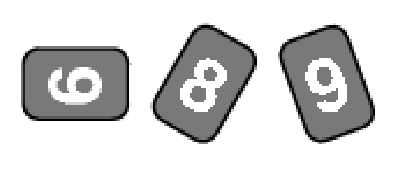
Mary numbered the faces of three cards with the numbers 1 to 6. Using the three cards she can make three-digit numbers, for example 135 or 234, but some numbers cannot be made, such as 126. Which of the following numbers CANNOT be made?
Show answer
Answer: D — 245
Show hints
Hint 1 of 2
Each card shows two numbers (opposite faces), and you read one number from each of the three cards.
Still stuck? Show hint 2 →
Hint 2 of 2
Find the secret pairing of {1..6} into three cards; a number is impossible if two of its digits live on the same card.
Show solution
Approach: recover the card pairings, then test each number
Three cards carry digits 1..6, two per card; a three-digit number takes one digit from each card.
Examples 135 and 234 are possible while 126 is not, which pins down which digits share a card.
Checking the options, 245 needs two digits on the same card, so it cannot be made.
Ana plays with n × n boards by placing a token in each of the cells, with no common points with other cells containing tokens. In the picture we see how to place as many tokens as possible on 5 × 5 and 6 × 6 boards. In this way, how many tokens can Ana possibly put on a 2020 × 2020 board?
Show answer
Answer: D — 1010²
Show hints
Hint 1 of 2
'No common points' means tokens can’t even touch at a corner, so leave a gap between rows and columns.
Still stuck? Show hint 2 →
Hint 2 of 2
Place tokens on every other row and every other column; count how many fit.
Show solution
Approach: pack tokens on alternate rows and columns
Non-touching tokens go on alternate rows and alternate columns.
On an n×n board that fits ⌈n/2⌉ per direction.
For 2020, ⌈2020/2⌉ = 1010 each way, giving 1010² tokens.
Julia puts the nine chips shown into a box. She then takes one chip at a time, without looking, and notes down its digit, obtaining at the end a number with nine different digits. What is the probability that the number written by Julia is divisible by 45?
Show answer
Answer: A — 19
Show hints
Hint 1 of 2
Divisible by 45 means divisible by both 9 and 5.
Still stuck? Show hint 2 →
Hint 2 of 2
The digits 1–9 always sum to 45, so 9 is automatic — only the last digit matters for 5.
Show solution
Approach: reduce to a single last-digit condition
1+2+…+9 = 45, so any arrangement is divisible by 9.
Divisibility by 5 needs the last digit to be 5 (there’s no 0).
Maia the bee can only walk on coloured houses. In how many ways can you colour exactly three white houses, all the same colour, so that Maia can walk from A to B?
Show answer
Answer: B — 16
Show hints
Hint 1 of 2
You need a connected colored path linking A and B using exactly three newly-colored white houses.
Still stuck? Show hint 2 →
Hint 2 of 2
Count the distinct sets of three white houses that connect A to B.
Show solution
Approach: count valid 3-house connecting paths
Maia needs a connected run of colored houses from A to B.
Colour exactly three white houses so that, together with A and B, they form a connected walk.
Carefully listing the choices of three white houses that complete a path gives 16 ways.
Anna, Bella, Claire, Dora and Erika meet at a party. Each pair who know each other shake hands exactly once. Anna shakes hands once, Bella twice, Claire three times and Dora four times. How many people does Erika shake hands with?
Show answer
Answer: B — 2
Show hints
Hint 1 of 2
Start from Dora, who shook hands four times, so she met everyone else.
Still stuck? Show hint 2 →
Hint 2 of 2
Peel off who Anna, Bella and Claire could have shaken to find Erika's count.
Show solution
Approach: reason from the largest handshake count down
Dora shook 4 times, so she shook hands with all of Anna, Bella, Claire and Erika.
Anna shook only once, so Anna's single handshake was with Dora.
Claire shook three times: with Dora plus two others, which must be Bella and Erika; Bella's two are Dora and Claire.
So Erika shook hands with Dora and Claire: 2 people.
There are five balls in a box: four contain chocolate, and one contains a boiled sweet. Johann and Maria take turns drawing a ball from the box without replacing it. Whoever draws the boiled sweet wins. Johann starts. What is the probability that Maria wins?
Show answer
Answer: A — \(\dfrac{2}{5}\)
Show hints
Hint 1 of 2
The single boiled sweet is equally likely to be the 1st, 2nd, 3rd, 4th or 5th ball drawn.
Still stuck? Show hint 2 →
Hint 2 of 2
Maria draws on turns 2 and 4, so count her winning positions out of five.
Show solution
Approach: the sweet is equally likely in each draw position
By symmetry the boiled sweet is equally likely to be the 1st, 2nd, 3rd, 4th or 5th ball drawn, each with probability \(\frac{1}{5}\).
Johann draws on turns 1, 3 and 5; Maria draws on turns 2 and 4.
Maria wins in exactly 2 of the 5 positions, so her probability is \(\frac{2}{5}\).
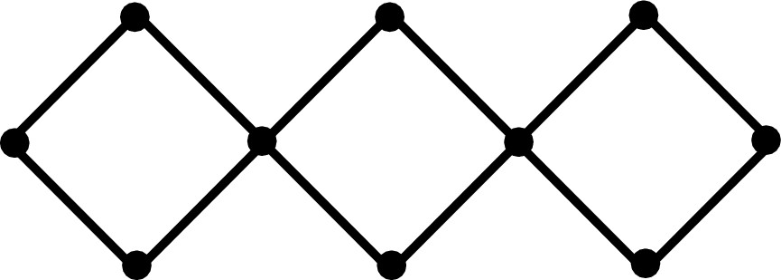
The intersection points of the network of bars shown are labelled with the numbers 1 to 10. The sum \(S\) of the four numbers at the vertices of each square is the same for all three squares. What is the minimum possible value of \(S\)?
Show answer
Answer: C — 20
Show hints
Hint 1 of 2
Two of the ten points are shared between neighbouring squares, so they each count in two of the square sums.
Still stuck? Show hint 2 →
Hint 2 of 2
Adding all three square sums gives \(3S = 55 + (\text{the two shared vertices})\); minimise \(S\) by choosing those two values well.
Show solution
Approach: minimise the common square sum using the shared vertices
The labels 1 to 10 add to 55. Summing the three equal square sums counts the two shared (middle) vertices twice, so \(3S = 55 + (\text{sum of the two shared vertices})\).
We need that total divisible by 3; since \(55 \equiv 1 \pmod 3\), the two shared vertices must sum to \(2 \pmod 3\).
The smallest such sum of two distinct labels is \(1 + 4 = 5\) (or \(2 + 3\)), giving \(3S = 60\), so \(S = 20\), and the remaining labels can be placed to make it work.
Emil takes selfies with his 8 cousins. Each one of the 8 cousins appears in two or three of the pictures. There are exactly 5 cousins in each picture. How many selfies does Emil take?
Show answer
Answer: B — 4
Show hints
Hint 1 of 3
Count the total number of 'cousin appearances' — every face that shows up in every photo.
Still stuck? Show hint 2 →
Hint 2 of 3
Since each cousin appears 2 or 3 times, this total must be between 2×8 and 3×8.
Still stuck? Show hint 3 →
Hint 3 of 3
Each photo shows exactly 5 cousins, so the number of photos times 5 equals that total.
Show solution
Approach: count total appearances, then divide by 5
Each of the 8 cousins shows up 2 or 3 times, so the total number of cousin-appearances is between 2×8 = 16 and 3×8 = 24.
Each photo holds exactly 5 cousins, so the number of photos times 5 must land between 16 and 24 — only 5 × 4 = 20 works.
So there are 4 photos (20 appearances split as four cousins thrice and four cousins twice): Emil takes 4 selfies (B).
On one day there are 40 train trips, each from one of the towns M, N, O, P, Q to exactly one other of those towns. There are 10 trips either from or to M, 10 either from or to N, 10 either from or to O, and 10 either from or to P. How many trips are there either from or to Q?
Show answer
Answer: E — 40
Show hints
Hint 1 of 2
Each trip touches exactly two towns, so summing “trips touching each town” counts every trip twice.
Still stuck? Show hint 2 →
Hint 2 of 2
The five town-counts must add up to 2 × 40 = 80.
Show solution
Approach: each trip is counted at both of its towns
Every trip has two endpoints, so adding the counts for all five towns gives \(2\times 40 = 80\).
From the list 1, 2, 3, 4, 5, 6, 7, Monika chooses 3 different numbers whose sum is 8. From the same list Daniel chooses 3 different numbers whose sum is 7. How many of the numbers were chosen by both Monika and Daniel?
Show answer
Answer: C — 2
Show hints
Hint 1 of 2
List the sets of three different numbers from 1-7 that sum to 7, then those that sum to 8.
Still stuck? Show hint 2 →
Hint 2 of 2
Daniel's sum 7 has only one possible set; compare it with each of Monika's options.
Show solution
Approach: enumerate the possible triples and compare
Three different numbers from 1-7 summing to 7 can only be {1, 2, 4}, so that is Daniel's set.
Summing to 8 gives Monika either {1, 2, 5} or {1, 3, 4}.
Comparing {1, 2, 4} with {1, 2, 5} shares {1, 2}; with {1, 3, 4} shares {1, 4}.
Counting & ProbabilityLogic & Word Problemscareful-counting
A whimsical teacher has a box with 203 red, 117 white and 28 blue buttons. He asks his students to each take one button out of the box without looking. What is the minimum number of students who have to take a button so that definitely at least three of the buttons picked have the same colour?
Show answer
Answer: C — 7
Show hints
Hint 1 of 2
Think about the worst possible luck before three match.
Still stuck? Show hint 2 →
Hint 2 of 2
There are only three colours, so how many can you draw with at most two of each?
Show solution
Approach: pigeonhole: build the worst case, then add one
In the worst case each colour comes up at most twice: 2 + 2 + 2 = 6 buttons with no colour reaching three.
The very next button (the 7th) must repeat some colour for a third time.
So 7 students guarantee three of one colour, choice C.
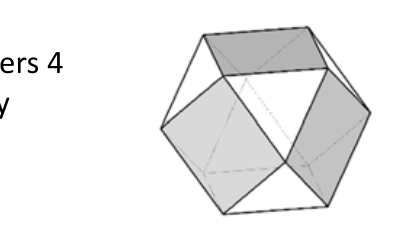
Each face of the polyhedron shown is either a triangle or a square. Each square borders 4 triangles, and each triangle borders 3 squares. The polyhedron has 6 squares. How many triangles does it have?
Show answer
Answer: D — 8
Show hints
Hint 1 of 2
Count the square-touches-triangle contacts in two different ways.
Still stuck? Show hint 2 →
Hint 2 of 2
Each square contributes 4 such contacts; each triangle uses up 3 of them.
Show solution
Approach: double-count the square-triangle adjacencies
There are 6 squares, each bordering 4 triangles, giving 6 x 4 = 24 square-triangle borders.
Each triangle borders 3 squares, so it accounts for 3 of those borders.
The four faces of a regular tetrahedron are labelled with the four digits 2, 0, 1 and 7 (one digit on each face). For a game, four such tetrahedrons are used as fair dice. All four dice are thrown simultaneously. Three of the four faces of each die can then be seen from above. What is the probability that we can form the number 2017 using exactly one of the three visible digits of each die?
Show answer
Answer: B — 6364
Show hints
Hint 1 of 2
On each die the three visible faces are simply all faces except the one hidden underneath.
Still stuck? Show hint 2 →
Hint 2 of 2
It is easier to count the chance you CANNOT form 2017, then subtract from 1.
Show solution
Approach: complementary counting over which digit each die hides
Each die hides exactly one of its four digits; the other three are visible. There are 4^4 = 256 equally likely hidden-digit combinations.
You can match the four needed digits (2,0,1,7) to the four dice unless some required digit is hidden on every die.
That fails only when all four dice hide the same one digit: 4 ways out of 256.
So the probability of success is 1 - 4/256 = 63/64.
Counting & ProbabilityLogic & Word Problemscareful-counting
Tycho plans his running training. Each week he wants to go for a run on the same weekdays. He never wants to go for a run on two consecutive days. But he wants to go for a run three days a week. How many different weekly plans meet those conditions?
Show answer
Answer: B — 7
Show hints
Hint 1 of 2
A weekly plan repeats, so the seven days form a loop — Sunday touches Monday.
Still stuck? Show hint 2 →
Hint 2 of 2
Count choices of 3 days on a circle of 7 with no two adjacent.
Show solution
Approach: count non-adjacent triples around a cycle of 7 days
Because the plan repeats every week, the days form a circle of 7 where no two chosen days may be next to each other.
The number of ways to pick 3 non-adjacent positions on a circle of 7 is 7.
The numbers 1, 2, 3, 4 and 5 are to be written into the five cells of this diagram by the following rules: if one number is below another it must be greater, and if one number is to the right of another it must be greater. How many ways are there to place the numbers?
Show answer
Answer: D — 6
Show hints
Hint 1 of 2
Numbers must increase going right and increase going down, which forces 1 into the top-left and 5 into the bottom-right.
Still stuck? Show hint 2 →
Hint 2 of 2
Count the valid fillings of the remaining cells respecting both rules.
Show solution
Approach: place the forced smallest and largest, then list the few valid fillings
Every cell must be bigger than the one to its left and the one above it, so the very top-left cell is the smallest, 1, and the very bottom-right cell is the largest, 5.
Now fill the remaining cells with 2, 3 and 4, always keeping each one larger than its left and upper neighbours.
Going through the possibilities carefully, exactly 6 different fillings obey both rules.
Eight kangaroos stand in a row, facing the directions shown in the picture. Whenever two kangaroos that are next to each other are facing each other, they swap places by hopping past one another. This continues until no more hops are possible. How many times did a swap take place?
Show answer
Answer: D — 13
Show hints
Hint 1 of 2
A swap happens only where a right-facing kangaroo is directly in front of a left-facing one (they face each other).
Still stuck? Show hint 2 →
Hint 2 of 2
Each such facing pair eventually passes through every opposing kangaroo — count the total crossings.
Show solution
Approach: count the head-on pairs that must pass each other
Two neighbours swap only when a right-facing kangaroo is immediately in front of a left-facing one, so they meet head-on.
Over the whole process, each right-facing kangaroo ends up passing every left-facing kangaroo that started to its right — exactly one swap per such pair.
Reading the picture, the facing pattern gives 13 such right-then-left pairs.
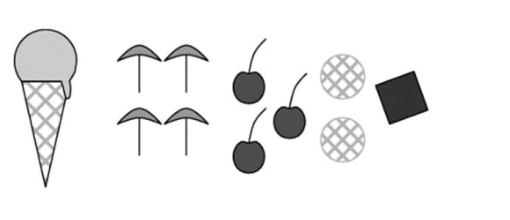
A small zoo has a giraffe, an elephant, a lion and a turtle. Susi wants to visit exactly two of the animals today but does not want to start with the lion. How many different possibilities does she have, to visit the two animals one after the other?
Show answer
Answer: D — 9
Show hints
Hint 1 of 2
Count ordered visits of two different animals, then remove the forbidden starts.
Still stuck? Show hint 2 →
Hint 2 of 2
There are 4 x 3 ordered pairs; throw out the ones beginning with the lion.
Show solution
Approach: count ordered pairs, then subtract those starting with the lion
Choosing two animals in order gives 4 x 3 = 12 possibilities.
Of these, the ones starting with the lion number 1 x 3 = 3.
There are 10 kangaroos in a row, as seen in the picture. Two kangaroos that are standing next to each other and can see each other are allowed to change places by hopping past each other. This is carried out until no more jumps are allowed. How often do two kangaroos swap places?
Show answer
Answer: C — 18
Show hints
Hint 1 of 2
A swap happens for each pair of kangaroos that start facing each other but in the wrong order.
Still stuck? Show hint 2 →
Hint 2 of 2
Count the facing pairs that must pass each other — that is the number of swaps.
Show solution
Approach: count the pairs that must cross
A swap happens exactly once for each pair where a right-facing kangaroo starts somewhere to the left of a left-facing kangaroo, since those two must pass each other.
So count, for every right-facing kangaroo, how many left-facing kangaroos stand to its right, and add these up.
Five sparrows are sitting on a rope (see picture). Some of them are looking to the left, some of them are looking to the right. Every sparrow whistles as many times as the number of sparrows it can see sitting in front of it. For example, the third sparrow whistles exactly twice. How many times do all the sparrows whistle altogether?
Show answer
Answer: D — 10
Show hints
Hint 1 of 2
Each sparrow only sees the birds in the direction its beak is pointing.
Still stuck? Show hint 2 →
Hint 2 of 2
Count how many birds are in front of each sparrow, then add all five counts.
Show solution
Approach: count each sparrow's forward view and add them up
Look at which way each beak points, then count the sparrows in front of it.
From left to right the sparrows look right, left, right, left, right, so they see 4, 1, 2, 3, and 0 birds in front.
Richard writes down all numbers with the following properties: the first digit is 1; each of the following digits is at least as big as the previous one; the sum of the digits is 5. How many such numbers can Richard write down?
Show answer
Answer: B — 5
Show hints
Hint 1 of 3
The first digit is 1, so the digits after it must add up to the remaining 4.
Still stuck? Show hint 2 →
Hint 2 of 3
Those later digits can never go down, so list them from smallest going up.
Still stuck? Show hint 3 →
Hint 3 of 3
Just write out every non-decreasing way to make 4 (using digits at least 1).
Show solution
Approach: list every non-decreasing way the leftover digits add to 4
The number starts with 1, so the digits that follow are non-decreasing and add up to \(5 - 1 = 4\).
Listing the ways to make 4 without ever decreasing: 4, then 1+3, then 2+2, then 1+1+2, then 1+1+1+1.
These give the numbers 14, 113, 122, 1112, 11111 — that is 5 numbers, choice (B).
In each of the five carriages of a train there is at least one passenger. Two passengers are neighbours if they are in the same carriage or in two successive carriages. Each passenger has either exactly 5 or exactly 10 neighbours. How many passengers are on the train?
Show answer
Answer: C — 17
Show hints
Hint 1 of 3
A passenger's neighbour count = (own carriage size) + (adjacent carriage sizes) − 1, and it must be 5 or 10 for everyone.
Still stuck? Show hint 2 →
Hint 2 of 3
So for each carriage the sum of it and its neighbours is fixed at 6 or 11; the two end carriages have only one neighbour-carriage.
Still stuck? Show hint 3 →
Hint 3 of 3
Pin down the middle carriage first, then the two pairs at the ends.
Show solution
Approach: fix the carriage sizes from the neighbour counts
Each passenger's neighbours = (own carriage) + (touching carriages) − 1, so for every carriage the block-sum of it and its neighbours is 6 or 11.
The two end pairs must sum to 6 (an end carriage plus its single neighbour), and the middle three must sum to 11, which forces the middle carriage to hold 5.
So the train is (end-pair sum 6) + 5 + (end-pair sum 6) = 6 + 5 + 6 = 17 passengers, e.g. 3, 3, 5, 3, 3.
3 green apples, 5 yellow apples, 7 green pears and 2 yellow pears are in a sack. Without looking, Sebastian takes either an apple or a pear out of the sack. How many pieces of fruit must he take out of the sack to be sure of having at least one apple and one pear of the same colour?
Show answer
Answer: E — 13
Show hints
Hint 1 of 2
Think of the unluckiest case: how many fruit could he pull out and still NOT have an apple and a pear of the same colour?
Still stuck? Show hint 2 →
Hint 2 of 2
He could keep drawing green pears and yellow apples forever without ever matching a colour across the two fruit types.
Show solution
Approach: find the largest unlucky collection with no same-colour apple+pear, then add one
He wins when he holds an apple and a pear of the same colour: green-with-green or yellow-with-yellow.
The biggest collection that still avoids this takes all 7 green pears and all 5 yellow apples — green pears with no green apple, yellow apples with no yellow pear — that's 12 fruit and still no match.
Any 13th fruit must be a green apple or a yellow pear, which completes a same-colour pair, so he needs to take 13.
Bibi rolls a die which has the numbers 1, 2, 3, 4, 5, 6 on its faces. At the same time Tina rolls a die which has the numbers 2, 2, 2, 5, 5, 5 on its faces. Tina wins if she rolls a number higher than Bibi. What is the probability that Tina wins?
Show answer
Answer: C — 512
Show hints
Hint 1 of 2
Tina's die only ever shows 2 or 5; split into those two cases.
Still stuck? Show hint 2 →
Hint 2 of 2
Count Bibi's faces that each Tina value beats, over 36 equally likely pairs.
Show solution
Approach: case on Tina's roll, count favourable pairs out of 36
There are 6×6 = 36 equally likely (Bibi, Tina) pairs.
Tina rolls 2 (3 faces) and wins only against Bibi's 1: 3×1 = 3 wins.
Tina rolls 5 (3 faces) and wins against Bibi's 1,2,3,4: 3×4 = 12 wins.
Total 15 wins, so the probability is 15/36 = 5/12 (C).
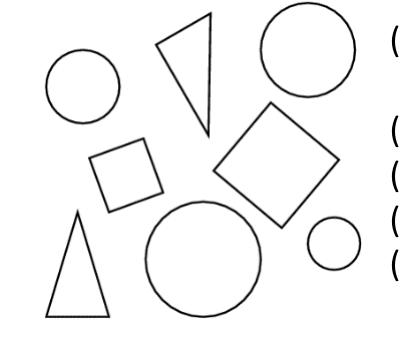
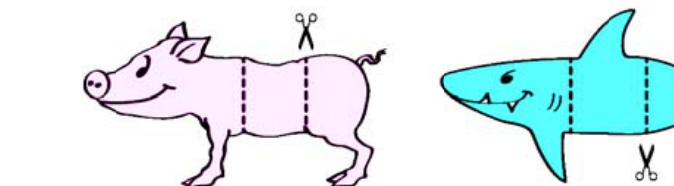
Thomas drew a pig and a shark. He cuts each animal into three pieces. Then he takes one of the two heads, one of the two middle sections and one of the two tails and lays them together to make another animal. How many different animals can he make in this way?
Show answer
Answer: E — 8
Show hints
Hint 1 of 2
A new animal needs a head, a middle and a tail, and there are two choices for each part.
Still stuck? Show hint 2 →
Hint 2 of 2
Multiply the number of choices for the three parts.
Show solution
Approach: multiply the choices for each of the three parts
There are 2 heads to choose from, 2 middle sections, and 2 tails.
Each new animal is one choice for each part, so 2 × 2 × 2 = 8 animals can be built.
Petra has three different dictionaries and two different novels on her bookshelf. In how many different ways can she arrange the books, if all the dictionaries should stay together and likewise the novels as well?
Show answer
Answer: B — 24
Show hints
Hint 1 of 2
Treat the dictionaries as one block and the novels as another, then arrange the two blocks.
Still stuck? Show hint 2 →
Hint 2 of 2
Multiply: arrange the 2 blocks, then arrange within the 3-dictionary block and within the 2-novel block.
Show solution
Approach: block (glue) the groups, then count
The 3 dictionaries form one block, the 2 novels another: 2! ways to order the two blocks.
Inside: 3! ways for the dictionaries, 2! ways for the novels.
A two-digit number with the digits x, y, can be written in the form \(\overline{xy}\). Let a, b, c be different digits. In how many ways can the digits a, b, c be chosen, so that \(\overline{ab} < \overline{bc} < \overline{ca}\)?
Show answer
Answer: A — 84
Show hints
Hint 1 of 2
All three of ab, bc, ca are genuine two-digit numbers, so a, b, c are each from 1 to 9 and distinct.
Still stuck? Show hint 2 →
Hint 2 of 2
Count ordered distinct triples (a, b, c) from 1–9 satisfying ab < bc < ca.
Show solution
Approach: count valid distinct digit triples
Since ab, bc, ca are two-digit numbers, a, b, c are in {1, ..., 9} and all different.
Among the 9·8·7 = 504 ordered distinct triples, count those with 10a+b < 10b+c < 10c+a.
I have noted down six digits of Erich’s seven-digit phone number in the correct order. I don’t know which digit I have missed out and where I have missed it out. What is the maximum number of tries that I have to make to be sure that I have used the correct phone number? (Note: the first digit could also be 0!)
Show answer
Answer: C — 64
Show hints
Hint 1 of 2
You know 6 digits in order with one digit deleted somewhere; rebuild the candidates by inserting one unknown digit.
Still stuck? Show hint 2 →
Hint 2 of 2
Count insertions of a digit (0-9) into the 8 gaps, then remove the duplicates that arise next to matching digits.
Show solution
Approach: count insertions of one digit into the known string
Insert one missing digit into one of the 8 positions (including before the first digit).
Each position allows 10 digits, giving 8 * 10 = 80 raw candidates.
Inserting a digit equal to an adjacent known digit repeats an earlier candidate; removing those duplicates leaves 64.
Several points are marked on a straight line. Then all possible connecting lines between each two points are drawn. One such point lies within exactly 80 of those connecting lines, and another one lies within exactly 90 of those. How many points were marked on the straight line?
Show answer
Answer: B — 22
Show hints
Hint 1 of 2
A marked point with L points to its left and R to its right lies inside exactly L×R of the segments.
Still stuck? Show hint 2 →
Hint 2 of 2
Find one N giving both L×R = 80 and L×R = 90 at two points; N = 22 works (5×16 and 6×15).
Show solution
Approach: count segments through a point as L×R
A point with L points left and R right is interior to L×R segments.
We need L×R = 80 and (elsewhere) = 90 for the same total N.
With N = 22: a point at position 6 gives 5×16 = 80, at position 7 gives 6×15 = 90.
How many numbers, which are only allowed to contain the digits 1, 2 or 3, are bigger than 10 and smaller than 32? The digits can be used more than once in the numbers.
Show answer
Answer: D — 7
Show hints
Hint 1 of 3
Bigger than 10 and smaller than 32 means the number has two digits and starts with 1, 2, or 3.
Still stuck? Show hint 2 →
Hint 2 of 3
Be neat: write all the numbers that start with 1, then all that start with 2, then those that start with 3.
Still stuck? Show hint 3 →
Hint 3 of 3
Remember each digit can only be 1, 2, or 3, and don't forget to stop before 32.
Show solution
Approach: list the two-digit numbers in order, using only the digits 1, 2, 3
We want two-digit numbers made only from 1, 2, 3 that are bigger than 10 and smaller than 32.
Starting with 1: 11, 12, 13. Starting with 2: 21, 22, 23. Starting with 3 (but under 32): just 31.
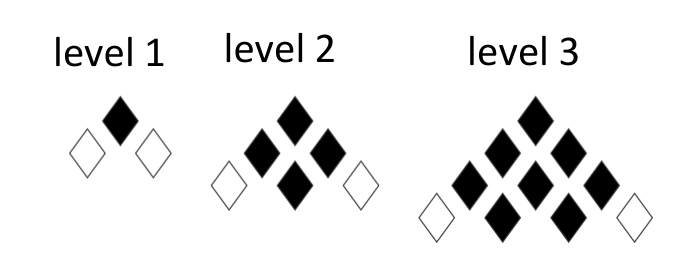
The black diamonds ◆ and white diamonds ◇ follow a fixed pattern. The first 3 levels are shown on the right. Each level (from the 2nd level on) has one more row than the level before. In every level, the two outermost diamonds of the last row are white, and all the other diamonds are black. How many black diamonds are there in level 6?
Show answer
Answer: C — 26
Show hints
Hint 1 of 3
Each level is a little triangle of rows: 1 diamond, then 2, then 3, and so on down.
Still stuck? Show hint 2 →
Hint 2 of 3
Count ALL the diamonds in level 6 first, then take away the white ones.
Still stuck? Show hint 3 →
Hint 3 of 3
In every level only the two ends of the very bottom row are white.
Show solution
Approach: count all the diamonds, then take away the two white ones
Level 6 has 6 + 1 = 7 rows, with 1, 2, 3, 4, 5, 6, 7 diamonds in them.
In the equation \(N \times U \times (M + B + E + R) = 33\) each letter stands for a different digit (0, 1, 2, …, 9). In how many different ways can the letters be replaced by different digits?
Show answer
Answer: D — 48
Show hints
Hint 1 of 2
33 factors very few ways into three positive integers using single digits.
Still stuck? Show hint 2 →
Hint 2 of 2
Fix which factor is the bracket sum, then count digit arrangements.
Show solution
Approach: factor 33, pin the bracket sum, then count digit arrangements
The bracket \(M+B+E+R\) is a sum of four different digits, so it lies between \(0+1+2+3=6\) and 30; the only divisor of 33 in that range is 11, forcing \(N\times U=3\), i.e. \(\{N,U\}=\{1,3\}\).
The four bracket digits must be different and avoid 1 and 3; the smallest four-digit total from the remaining digits is \(0+2+4+5=11\), so \(\{M,B,E,R\}=\{0,2,4,5\}\) is the only possibility.
Arrangements: \(2\) ways to assign \(N,U\) times \(4!=24\) ways to assign the bracket digits give \(2\times24=\) 48 ways.
In the diagram Karl wants to add lines, each joining two of the marked points, so that each of the seven marked points is joined to the same number of other marked points. What is the minimum number of lines he must draw?
Show answer
Answer: D — 9
Show hints
Hint 1 of 2
Count the degree (number of lines) already at each of the seven points.
Still stuck? Show hint 2 →
Hint 2 of 2
Add the fewest lines so every point ends with the same degree.
Show solution
Approach: equalise the seven vertex degrees with the fewest added edges
From the diagram the current degrees are 3, 2, 1, 1, 1, 1, 1 (sum 10, i.e. 5 existing lines).
Raising every vertex to a common degree needs a minimum of 9 extra lines.
There are 9 kangaroos called the Greatkangs. Each is coloured either white or black. If three Greatkangs meet by chance, the probability that none of them is white is exactly two thirds. How many Greatkangs are black?
Show answer
Answer: E — 8
Show hints
Hint 1 of 2
'None of three is white' means all three are chosen from the black ones.
Still stuck? Show hint 2 →
Hint 2 of 2
Set the probability of an all-black trio equal to 2/3 and solve for how many are black.
Show solution
Approach: ratio of all-black trios to all trios
With b black out of 9, P(all three black) = C(b,3)/C(9,3) = C(b,3)/84.
Every group of three vertices of a cube forms a triangle. How many such triangles are there whose vertices do not all lie on the same face of the cube?
Show answer
Answer: C — 32
Show hints
Hint 1 of 2
Count all triangles from the 8 vertices, then remove the 'flat' ones.
Still stuck? Show hint 2 →
Hint 2 of 2
A triangle is bad exactly when all three vertices lie on one face.
Show solution
Approach: total triangles minus the same-face ones
All triangles: C(8,3) = 56.
Each of the 6 faces has C(4,3) = 4 same-face triangles, so 6 × 4 = 24 are bad.
Consider all 7-digit numbers that use each of the digits 1 to 7 exactly once. Write these numbers in increasing order and split the list exactly in the middle into two lists of equal size. What is the last number of the first list?
Show answer
Answer: E — 4376521
Show hints
Hint 1 of 2
There are 7! such numbers in order; the split point is right in the middle.
Still stuck? Show hint 2 →
Hint 2 of 2
Find the 2520th smallest arrangement of the digits 1–7.
Show solution
Approach: locate the middle permutation by digit blocks
There are 7! = 5040 numbers, so the first list ends at the 2520th smallest.
Counting in blocks (each leading digit gives 6! = 720 numbers): 2520 = 3·720 + 360, landing among the numbers starting with 4, then resolving the rest.
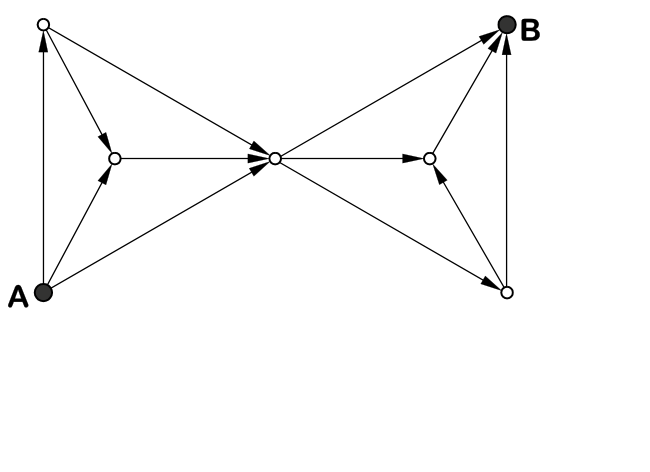
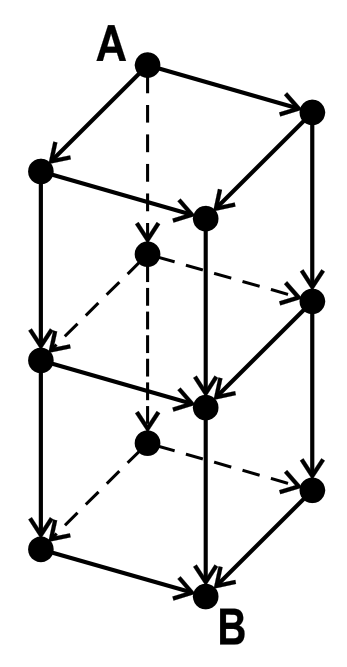
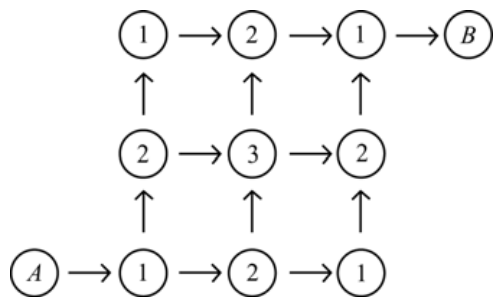
How many different ways are there in the diagram shown to get from point A to point B, if you are only allowed to move in the directions indicated by the arrows?
Show answer
Answer: D — 12
Show hints
Hint 1 of 2
Count paths by labelling each junction with how many ways reach it from A.
Still stuck? Show hint 2 →
Hint 2 of 2
Only the indicated arrow directions are allowed, so every move goes forward toward B.
Show solution
Approach: count directed paths by accumulating at each node
Label each junction with the number of allowed paths reaching it from A, starting with 1 at A.
Add incoming counts along the arrow directions, junction by junction, down to B.
A box holds 900 cards numbered from 100 to 999, every number appearing once. Franz picks some cards and works out the digit sum on each. What is the minimum number of cards he must pick to be sure of having at least three with the same digit sum?
Show answer
Answer: C — 53
Show hints
Hint 1 of 2
First find how many different digit-sums the numbers 100–999 can have.
Still stuck? Show hint 2 →
Hint 2 of 2
Watch the extreme sums — some occur for only one card.
Show solution
Approach: pigeonhole with limited boxes
Digit sums run 1 to 27, but sum 1 (100) and sum 27 (999) each occur only once.
Worst case: 2 cards from each of the 25 sums 2–26 plus the two lone cards = 52 with no triple.
The 53rd card forces a third of some sum, so the minimum is 53 = C.
Counting & ProbabilityLogic & Word Problemscaseworkcareful-counting
A gardener wants to plant a row of 20 trees (lindens and oaks) in a park. There must never be exactly three trees between any two oak trees. What is the greatest number of the 20 trees that could be oaks?
Show answer
Answer: C — 12
Show hints
Hint 1 of 2
‘Exactly three trees between two oaks’ means two oaks four positions apart — that is forbidden.
Still stuck? Show hint 2 →
Hint 2 of 2
Split the 20 spots into groups that are 4 apart and pick as many as possible from each.
Logic & Word ProblemsCounting & Probabilitywork-backwardcasework
Dad made 6 pancakes one after another and numbered them 1 to 6 in the order he made them. Sometimes while he worked his children ran into the kitchen and ate the hottest pancakes. In which of the following orders could the pancakes not have been eaten?
Show answer
Answer: D — 456231
Show hints
Hint 1 of 2
Children always grab the hottest available pancake — the most recently made uneaten one.
Still stuck? Show hint 2 →
Hint 2 of 2
That makes the eating order a stack (last in, first out); test each option for a stack violation.
Show solution
Approach: valid stack pop order
The hottest pancake is the most recently made one not yet eaten, so eating works like popping a stack.
An eating order is possible only if it is a valid stack-pop sequence of 1,2,3,4,5,6.
Order 456231 fails: eating 4, 5, 6 first means 1, 2, 3 are still stacked with 3 on top, so the next pancake eaten must be 3, not 2.
Counting & ProbabilityLogic & Word Problemscareful-countingcasework
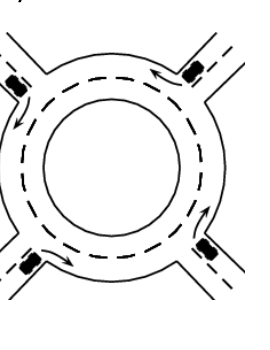
Four cars drive into a roundabout at the same moment, each from a different direction (see diagram). No car drives all the way around the roundabout, and no two cars leave by the same exit. In how many different ways can the cars exit the roundabout?
Show answer
Answer: A — 9
Show hints
Hint 1 of 2
No car exits where it entered (that would be a full loop), and all four exits are different.
Still stuck? Show hint 2 →
Hint 2 of 2
That is exactly a permutation of four things with no item in its own place.
Show solution
Approach: count derangements of 4
Each car must leave by a different exit, and not its own entrance — a permutation with no fixed point.
Five cars enter a roundabout at the same time, one at each of the five entrances. Each car drives less than a full loop and exactly one car leaves at each of the five exits. In how many different ways can the cars leave the roundabout?
Show answer
Answer: B — 44
Show hints
Hint 1 of 2
Each car must leave at a different exit and cannot ride a full lap back to its own entry.
Still stuck? Show hint 2 →
Hint 2 of 2
So no car exits at its own entrance — count arrangements with no fixed point.
Show solution
Approach: count derangements of 5
Label exits by the cars' entry points; a valid assignment sends each car to a different exit, never its own.
Anna, Laura, Lisa and Katharina wanted to take a photo together. Anna and Katharina are best friends and wanted to stand next to each other. Lisa also wanted to stand next to Anna. In how many different ways can the photo be taken, if all their wishes are met?
Show answer
Answer: B — 4
Show hints
Hint 1 of 2
Anna must stand next to both Katharina and Lisa, so Anna is in the middle of those two.
Still stuck? Show hint 2 →
Hint 2 of 2
Treat Katharina-Anna-Lisa as one block and place Laura at either end.
Show solution
Approach: bundle the friends who must be adjacent
Anna is next to Katharina and next to Lisa, so the order around Anna is Katharina-Anna-Lisa (or its reverse): 2 ways.
This block of three can have Laura at the left end or the right end: 2 ways.
48 children are going on a ski trip. Six of them go with exactly one sibling, nine go with exactly two siblings, and four go with exactly three siblings. The remaining children go without any siblings. How many families are going on the trip?
Show answer
Answer: D — 36
Show hints
Hint 1 of 2
'Exactly one sibling' means a family of two; 'two siblings' a family of three, and so on.
Still stuck? Show hint 2 →
Hint 2 of 2
Turn each group of children into a count of families, then add the only-children.
Show solution
Approach: convert children-with-k-siblings into families
6 children with one sibling → 3 families of 2; 9 with two siblings → 3 families of 3; 4 with three siblings → 1 family of 4.
Children with siblings: 6+9+4 = 19, leaving 48−19 = 29 only-children → 29 families.
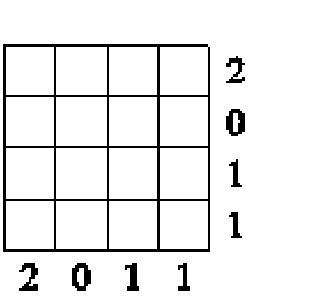
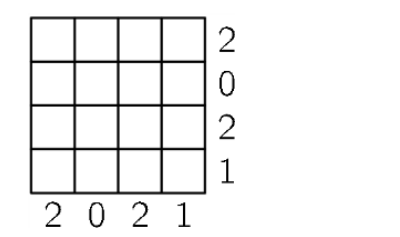
The cells of the 4×4 table shown should each be coloured either black or white. The numbers tell how many cells in each row and column should be black. In how many ways can the colouring be done?
Show answer
Answer: D — 5
Show hints
Hint 1 of 2
A row or column needing 0 black cells is entirely white, shrinking the puzzle.
Still stuck? Show hint 2 →
Hint 2 of 2
Count the black-cell placements left over for the smaller grid by cases on the row needing 2.
Show solution
Approach: remove the zero line, then enumerate the 3x3 core
The row and column needing 0 black cells are all white, leaving a 3×3 core with row sums 2,1,1 and column sums 2,1,1.
Place the two black cells of the '2' row, then fill the two '1' rows to meet the column totals.
The three cases for that pair of columns give 2 + 2 + 1 = 5 valid fillings.
You can place together the cards pictured to make different three‑digit numbers, for instance 989 or 986. How many different three‑digit numbers can you make with these cards?
Show answer
Answer: E — 12
Show hints
Hint 1 of 3
Two of the cards are the kind that show a 6 one way and a 9 when you turn them upside down; the 8 looks the same either way.
Still stuck? Show hint 2 →
Hint 2 of 3
First decide which of the three spots the 8 sits in, then fill the other two spots.
Still stuck? Show hint 3 →
Hint 3 of 3
For each place the 8 can go, the two leftover spots can each be a 6 or a 9.
Show solution
Approach: place the 8, then fill the other two spots with 6 or 9
There are three cards: two flip-cards that each show a 6 or a 9, and one 8-card that looks the same whichever way up it is.
Pick where the 8 goes: it can be the first, middle, or last digit — that is 3 choices.
For each of those, the two remaining spots can each be a 6 or a 9, giving 4 numbers per choice: for example with 8 in front you get 866, 869, 896, 899.
So the count is 3 groups of 4, which is 3 × 4 = 12 different numbers, answer E.
A square is split into 4 smaller squares. Each small square is coloured either white or black. How many ways are there to colour the big square? (Two patterns count as the same if one can be turned into the other by a rotation, as shown in the picture.)
Show answer
Answer: B — 6
Show hints
Hint 1 of 2
Count colourings by how many of the four cells are black: 0,1,2,3,4.
Still stuck? Show hint 2 →
Hint 2 of 2
Two colourings are the same if a rotation matches them, so merge those.
Show solution
Approach: count by number of black cells, up to rotation
By number of black squares: 0 black gives 1 way; 1 black gives 1; 2 black gives 2 (adjacent or diagonal); 3 black gives 1; 4 black gives 1.
Lydia draws a flower with 5 petals. She wants to colour the petals using only the colours white and black. Two flowers count as the same if one can be turned to look like the other. How many different flowers can she make (the flower may also be just one colour)?
Show answer
Answer: C — 8
Show hints
Hint 1 of 2
Turning a flower around does not make a new flower, so group your counting by how many petals are black.
Still stuck? Show hint 2 →
Hint 2 of 2
For 2 black petals, the only thing that matters is whether the two black petals touch or have a gap between them.
Show solution
Approach: sort flowers by how many black petals
Count by the number of black petals, since spinning the flower never makes a new one.
0 black: 1 way. 1 black: 1 way. 2 black: 2 ways (the black petals touch, or have a gap). 3 black: 2 ways. 4 black: 1 way. 5 black: 1 way.
Adding up: \(1 + 1 + 2 + 2 + 1 + 1 = 8\) different flowers — the answer is C.
A barcode as pictured is made up of alternate black and white stripes. The code always starts and ends with a black stripe. Each stripe (black or white) has width 1 or 2, and the total width of the barcode is 12. How many different barcodes of this kind are there if one reads from left to right?
Show answer
Answer: E — 116
Show hints
Hint 1 of 2
An odd number of stripes is needed so it starts and ends black.
Still stuck? Show hint 2 →
Hint 2 of 2
Count compositions of 12 using widths 1 and 2 with an odd number of parts.
Show solution
Approach: count compositions of 12 into 1's and 2's (odd part-count)
Starting and ending black forces an odd number of stripes, k.
With k stripes there are 12-k twos: k=7 gives C(7,5)=21, k=9 gives C(9,3)=84, k=11 gives C(11,1)=11.
100 students take an exam with 4 questions. 90 solve the first question, 85 the second, 80 the third and 70 the fourth. Determine the smallest possible number of students that have solved all four questions.
Show answer
Answer: D — 25
Show hints
Hint 1 of 2
Count the ‘misses’ rather than the solves: how many failures are there in total?
Still stuck? Show hint 2 →
Hint 2 of 2
Spread the failures over as many different students as possible to minimise those who got everything.
Show solution
Approach: count failures and subtract from 100
The numbers who missed each question are 10, 15, 20, 30, totalling 75 failures.
At best each failure falls on a different student, so at most 75 students missed something.
Then at least 100 − 75 = 25 students solved all four.
The rooms in a hotel each have a three-digit number. The first digit gives the floor and the last two digits give the room number on that floor; for example, room 125 is on floor 1, room 25. The hotel has 5 floors (1 to 5) with 35 rooms on each floor, so floor 1 has rooms 101 to 135, and so on. How many times does the digit 2 appear in all the room numbers of the hotel?
Show answer
Answer: E — 105 times
Show hints
Hint 1 of 2
Split a room number into the floor digit and the two room digits, and count the 2s place by place.
Still stuck? Show hint 2 →
Hint 2 of 2
Count 2s in the hundreds, tens and units across floors 1–5 and rooms 01–35.
Show solution
Approach: count by digit place
Rooms run 101–135, 201–235, …, 501–535: 175 rooms in all.
Hundreds place: a 2 appears on the whole 2nd floor, 35 times.
Tens place: rooms x20–x29 give 10 twos per floor × 5 = 50 times.
Units place: rooms ending in 2 give 4 per floor × 5 = 20 times.
How many 10-digit numbers are there which use only the digits 1, 2 and 3 (not necessarily all) and are written in such a way that consecutive digits always have a difference of 1?
Show answer
Answer: C — 64
Show hints
Hint 1 of 2
From a 2 you may go to 1 or 3, but a 1 must be followed by 2 (and a 3 by 2).
Still stuck? Show hint 2 →
Hint 2 of 2
Count step by step how many valid strings of each length end in 1, 2 or 3.
Show solution
Approach: count by tracking the last digit
Track how many valid strings end in 1, 2, 3 as length grows: a 1 or 3 forces a following 2, while a 2 allows a 1 or 3.
Vera has built a tower of cubes. She wants to replace the two cubes with question marks with cubes with numbers. Vera wants the number on each cube to be at least 2 higher than the number on the cube below it. How many ways can she replace the two cubes?
Show answer
Answer: D — 6
Show hints
Hint 1 of 2
The two missing cubes sit above 6 and below 14, each at least 2 more than the one below.
Still stuck? Show hint 2 →
Hint 2 of 2
List the lower missing number first, then count valid choices for the upper one.
Show solution
Approach: count valid number pairs by casework
Reading up, the tower is 1, 4, 6, then two unknowns, then 14, each cube at least 2 more than the one below.
The lower unknown must be at least 8 (it is at least 2 more than 6).
The upper unknown is at least 2 more than it and at most 12 (since 14 is at least 2 more).
In the picture you can see five different wheels of fortune. Each wheel of fortune is divided into equal-sized parts, but the number of parts is different. Anna spins all of the wheels of fortune. If a wheel of fortune stops at the arrow with a dark sector, she wins. Which of the wheels of fortune gives Anna the best chance of winning?
Show answer
Answer: A — 1
Show hints
Hint 1 of 2
On a fair wheel, the chance of winning is just the share of the wheel that is dark: dark sectors out of total sectors.
Still stuck? Show hint 2 →
Hint 2 of 2
Write each wheel’s chance as a fraction and see which fraction is biggest — a bigger dark share on a wheel with fewer pieces wins.
Show solution
Approach: compare the fraction of dark sectors
Each wheel is split into equal parts, so the chance of stopping on dark is simply the fraction of the wheel that is dark.
Wheel 1 has 2 dark sectors out of 8, which is 14 of the wheel; the others all turn out to be smaller dark shares (each less than a quarter, since they spread their dark sectors over more pieces).
14 is the largest dark share, so wheel 1 gives Anna the best chance, and the answer is (A) 1.
Alex threads white and black beads alternately onto a piece of string. Twice, 5 beads are hidden — see picture. How many white beads are hidden in total?
Show answer
Answer: C — 6
Show hints
Hint 1 of 3
The beads always go white, black, white, black — never two of the same colour together.
Still stuck? Show hint 2 →
Hint 2 of 3
Look at the visible bead right before each hidden part to know what colour comes next.
Still stuck? Show hint 3 →
Hint 3 of 3
Fill in each hidden run of 5 by carrying on the colours, then count just the white ones.
Show solution
Approach: carry on the alternating colour pattern through each hidden run
The beads keep switching: white, black, white, black, and so on.
Each hidden group of 5 carries on that pattern, and in each one 3 of the 5 beads come out white.
There are two hidden groups, so 3 and 3 make 6 white beads in total. The answer is C.
A mouse wants to reach a piece of cheese. From each square it can only move to the square to its right or to the square directly below it. How many different paths lead the mouse to a piece of cheese?
Show answer
Answer: C — 8
Show hints
Hint 1 of 2
Instead of drawing every route, write a number in each square: how many ways the mouse can reach that square.
Still stuck? Show hint 2 →
Hint 2 of 2
A square's number is the sum of the numbers in the square just left of it and the square just above it, since those are the only ways in.
Show solution
Approach: fill in path counts square by square
Write 1 in the start square; every other square gets the total of the square to its left and the square above it (the only squares that can flow into it).
Filling the staircase this way, the counts grow 1, then 2 and 3, and so on down toward the cheese.
The cheese squares collect a total of 8 paths, which is (C).
A bee, a mouse, a beetle and a cat want to take a group photo, so they line up next to each other. The cat is not allowed to stand next to the mouse. In how many different ways can the animals line up?
Show answer
Answer: B — 12
Show hints
Hint 1 of 2
Count all line-ups, then remove the bad ones where the cat and mouse are side by side.
Still stuck? Show hint 2 →
Hint 2 of 2
Treat the cat-and-mouse pair as a single block to count the forbidden arrangements.
Show solution
Approach: total minus the cat-next-to-mouse cases
Four animals can line up in 4! = 24 ways.
Glue cat+mouse together: 3 items in 3! = 6 orders, times 2 for the internal order = 12 forbidden line-ups.
Allowed line-ups = \(24 - 12 = 12\), which is (B).
A type of hopscotch is played like this: a player jumps from one square to the next, alternating left foot, both feet, right foot, both feet, and so on, as shown. Maya plays and jumps into exactly 48 squares, starting with her left foot. How many times is her left foot on the floor during the game?
Show answer
Answer: C — 36
Show hints
Hint 1 of 2
The only jumps where the left foot is NOT on the floor are the right-foot-only jumps, so it may be easier to count those.
Still stuck? Show hint 2 →
Hint 2 of 2
Group the jumps into the repeating block left, both, right, both and see how the left foot behaves in each block.
Show solution
Approach: count the jumps where the left foot is down
The pattern repeats every four squares: left, both, right, both.
In each block of four, the left foot is down on the 'left' square and on the two 'both-feet' squares, so 3 of every 4 squares use the left foot.
Over 48 squares that is \(\frac{3}{4}\times 48 = 36\) times, answer C.
Ria has three cards with the numbers 1, 5 and 11. She wants to place the cards next to each other to form a 4-digit number. How many different 4-digit numbers can she form?
Show answer
Answer: B — 4
Show hints
Hint 1 of 2
List the orders of the three cards and write out the number each makes.
Still stuck? Show hint 2 →
Hint 2 of 2
Two different orders can spell the same number, so count distinct numbers, not orders.
Show solution
Approach: list the distinct numbers the three cards can spell
Placing cards 1, 5, 11 in a row always gives a 4-digit number.
Writing out the orders gives 1511, 1115, 5111, and 1151 (some orders repeat).
Kaito has manipulated a die. The probabilities of rolling a 2, 3, 4 or 5 are still 16 each, but the probability of rolling a 6 is now twice the probability of rolling a 1. What is the probability of rolling a 6?
Show answer
Answer: D — 29
Show hints
Hint 1 of 2
The four fair faces use up a fixed total probability, leaving the rest for faces 1 and 6.
Still stuck? Show hint 2 →
Hint 2 of 2
Let P(1) be unknown, write P(6) = 2·P(1), and use that all six probabilities add to 1.
Show solution
Approach: use that all probabilities sum to 1
Faces 2,3,4,5 each have probability 1/6, totalling 4/6 = 2/3.
So P(1) + P(6) = 1 − 2/3 = 1/3.
With P(6) = 2·P(1): 3·P(1) = 1/3, so P(1) = 1/9 and P(6) = 2/9.
Lucas has these five puzzle pieces (shown on the right): a smiling head, a banana-tail, and three middle pieces. They snap together only where a bump fits into a notch. He wants to make a caterpillar with a head, a tail, and 1, 2 or 3 pieces in between. How many different caterpillars can Lucas build?
Show answer
Answer: B — 4
Show hints
Hint 1 of 3
The head only joins on one side and the tail only joins on one side; the pieces fit only where a bump (tab) meets a notch (socket).
Still stuck? Show hint 2 →
Hint 2 of 3
A caterpillar is head, then 1, 2, or 3 middle pieces, then tail — build the chains by matching bumps to notches.
Still stuck? Show hint 3 →
Hint 3 of 3
Go case by case: count the legal chains with exactly 1 middle piece, then 2, then 3, and add them up.
Show solution
Approach: match the connectors (bump-to-notch) and count the legal chains of 1, 2, or 3 middle pieces
A piece can join another only where a bump fits into a notch, and the head and tail each connect on just one side.
Try 1 middle piece between head and tail: only the pieces whose bumps and notches line up both ways work.
Now try 2 middle pieces, then 3 middle pieces, keeping every join a bump-into-notch fit.
Adding up all the chains that connect properly gives 4 (B) different caterpillars.
Anna has four discs of different sizes. She wants to build a tower using 3 discs. A smaller disc always has to lie on top of a bigger disc. How many ways are there for Anna to build this tower?
Show answer
Answer: C — 4
Show hints
Hint 1 of 2
A tower uses 3 of the 4 discs, and the sizes force their order.
Still stuck? Show hint 2 →
Hint 2 of 2
So really you are just choosing which one disc to leave out.
Show solution
Approach: each choice of 3 discs has exactly one legal stacking
Once three discs are chosen, they must go largest-on-bottom, so the order is fixed.
Thus the number of towers equals the number of ways to pick 3 discs from 4.
That is the same as choosing which disc to omit: 4 ways, so the answer is 4.
The digits 0 to 9 can be formed using matchsticks (see diagram). How many different positive whole numbers can be formed this way with exactly 6 matchsticks?
Show answer
Answer: C — 6
Show hints
Hint 1 of 2
First note how many matchsticks each digit 0..9 needs.
Still stuck? Show hint 2 →
Hint 2 of 2
List all numbers (one or more digits) whose matchstick counts add to exactly 6, ignoring leading zeros.
Show solution
Approach: count matchsticks per digit, then list totals equal to 6
A big rectangle is made up of five small rectangles (see picture). Lukas wants to colour the small rectangles red, blue and yellow so that any two rectangles sharing a side have different colours. In how many ways can he do this?
Show answer
Answer: D — 6
Show hints
Hint 1 of 3
Start by colouring one rectangle, then move to a neighbour and count how many of the three colours are still allowed.
Still stuck? Show hint 2 →
Hint 2 of 3
Multiply the number of free choices as you colour the rectangles one by one.
Still stuck? Show hint 3 →
Hint 3 of 3
Be extra careful at a rectangle that touches two already-coloured neighbours, since it may have fewer choices left.
Show solution
Approach: colour the rectangles in order, counting choices for each
Colour the three top rectangles left to right: the first has 3 choices, each next one must differ from its neighbour.
The bottom rectangles must differ from the top rectangles they touch and from each other, which limits the remaining choices.
Carefully multiplying the allowed choices through the whole arrangement gives 6 valid colourings.
Logic & Word ProblemsCounting & Probabilitycareful-countingcasework
Some kangaroos and three beavers are standing in a circle. No beaver stands directly next to another beaver. There are exactly three kangaroos that are standing next to another kangaroo. What is the biggest possible number of kangaroos in the circle?
Show answer
Answer: B — 5
Show hints
Hint 1 of 3
The 3 beavers split the circle into 3 blocks of kangaroos, and none of those blocks can be empty since no two beavers may touch.
Still stuck? Show hint 2 →
Hint 2 of 3
A kangaroo has a kangaroo neighbour exactly when it sits in a block of 2 or more; count how many such kangaroos a block of each size produces.
Still stuck? Show hint 3 →
Hint 3 of 3
You are allowed only 3 kangaroos-with-a-kangaroo-neighbour total, so spend that budget on one block and keep the rest as singles.
Show solution
Approach: beavers cut the circle into blocks; count kangaroos that touch a kangaroo
The 3 beavers (no two adjacent) cut the circle into 3 non-empty blocks of kangaroos.
In a block of size 1 the lone kangaroo touches only beavers, but every kangaroo in a block of size 2 or more touches another kangaroo, so a block of size k≥2 uses up k of the allowed 3.
To keep the count at exactly 3, make one block of size 3 and the other two blocks size 1: arrangement B·KKK·B·K·B·K uses 3 + 1 + 1 = 5 kangaroos, and only the three in the KKK block touch a kangaroo.
Any sixth kangaroo would enlarge another block to size 2+, pushing the touching-count above 3, so the maximum is 5 (B).
All integers from 2 to 2022 which can be written using only the digits 0 and 2 are written in ascending order in a list. Which number is the middle number on that list?
Show answer
Answer: B — 220
Show hints
Hint 1 of 2
List every number from 2 to 2022 using only the digits 0 and 2.
Still stuck? Show hint 2 →
Hint 2 of 2
There are 11 such numbers; the middle one is the 6th.
Show solution
Approach: list and pick the middle
The numbers are 2, 20, 22, 200, 202, 220, 222, 2000, 2002, 2020, 2022 — eleven of them.
Aladdin’s carpet is a square. Along each edge there are two rows of dots (see diagram), and each edge has the same number of dots. How many dots does the carpet have in total?
Show answer
Answer: A — 32
Show hints
Hint 1 of 3
The dots make two square loops — a big loop on the outside and a smaller loop just inside it.
Still stuck? Show hint 2 →
Hint 2 of 3
Count the dots on one side of a loop, but be careful: the corner dots belong to two sides, so don't count them twice.
Still stuck? Show hint 3 →
Hint 3 of 3
Add up the big loop and the small loop.
Show solution
Approach: count the big square loop and the small square loop of dots
The dots make two square loops, one just inside the other, with the same number on every side.
The big loop has 6 dots along each side; counting around it (corners only once) gives 4 × 6 − 4 = 20 dots.
The small loop has 4 dots along each side, giving 4 × 4 − 4 = 12 dots.
Bia has the five coins shown. She goes to the grocery store to buy one fruit, paying with exactly three of the coins and receiving no change. Among the fruit prices below, which one can she NOT pay for?
Show answer
Answer: C — 1.40
Show hints
Hint 1 of 2
The coins are 1.00, 0.50, 0.25, 0.10 and 0.05; she uses exactly three of them with no change.
Still stuck? Show hint 2 →
Hint 2 of 2
Check each price: one of the listed totals simply has no three-coin combination.
Show solution
Approach: test each price against all three-coin sums
The five coins are R$1.00, 0.50, 0.25, 0.10 and 0.05.
The digits of the year 2020 are each repeated twice and the two digits are different. How many times does this happen between the year 1000 and now (2020)?
Show answer
Answer: E — 29
Show hints
Hint 1 of 2
You want years like 2020 made of two different digits, each appearing exactly twice.
Still stuck? Show hint 2 →
Hint 2 of 2
Split by the leading digit: count such years starting with 1, then those starting with 2 up to 2020.
Show solution
Approach: count the two-distinct-digit, each-twice years by leading digit
Such a year uses two different digits, each appearing twice, e.g. 1331 or 2020.
Years from 1000–1999 (leading 1): the other digit pairs with one more 1 plus two of a different digit; enumerating the patterns gives 27 of them.
Years from 2000–2020 add just 2002 and 2020, for 2 more.
Cynthia paints each region of the figure a single colour: red, blue or yellow. Regions that touch each other must be painted different colours. In how many different ways can she colour the figure?
Show answer
Answer: E — 6
Show hints
Hint 1 of 2
The picture is a chain of nested regions; neighbours sharing a border must differ in colour.
Still stuck? Show hint 2 →
Hint 2 of 2
Work along the chain: each new region just needs to avoid the colour of the one it touches, so multiply the choices.
Show solution
Approach: count colourings region by region with the touching rule
The figure splits into regions; touching regions must get different colours from {red, blue, yellow}.
Colour the regions one at a time: the first is free, and each following region only has to differ from the single region it borders.
Multiplying the available choices at each step gives 6 valid colourings.
Two identical dice each have two red faces, two blue faces and two green faces. If both dice are rolled at the same time, what is the probability that the two top faces show different colours?
Show answer
Answer: E — 23
Show hints
Hint 1 of 2
Each die shows red, blue or green with equal chance 1/3.
Still stuck? Show hint 2 →
Hint 2 of 2
It is easier to find the chance the two match, then subtract.
Show solution
Approach: complementary counting on colours
Each die shows each colour with probability 2/6 = 1/3.
Cynthia paints each region of the figure in a single colour: red, blue or yellow. Regions that touch each other must be painted different colours. In how many different ways can Cynthia paint the figure?
Show answer
Answer: E — 6
Show hints
Hint 1 of 3
Find which regions actually share a border, since only touching regions are forced to be different colours.
Still stuck? Show hint 2 →
Hint 2 of 3
Colour one region first, then count how many free colour choices are left for each region next to it.
Still stuck? Show hint 3 →
Hint 3 of 3
Multiply the number of choices region by region as you work inward.
Show solution
Approach: colour the regions one at a time and multiply the free choices
Colour the outermost region first: there are 3 colours to pick from.
Each region just inside it touches the one outside, so it must use a different colour, which usually leaves only a small number of choices.
Multiplying the choices region by region as you move inward gives 6 different ways to paint the whole figure, choice E.
In a class, every student either only swims, or only dances, or does both. Three eighths of the students in the class swim. Exactly five students do both — that is, they swim and dance. At least how many students are in the class?
Show answer
Answer: A — 16
Show hints
Hint 1 of 2
Three eighths of the class swim, so the class size must be a multiple of 8.
Still stuck? Show hint 2 →
Hint 2 of 2
The five who do both must fit inside the swimmers; find the smallest multiple of 8 that allows that.
Show solution
Approach: make the swimmer count work out
Swimmers = 3/8 of the class, so the total must be a multiple of 8.
The 5 students who do both are among the swimmers, so swimmers ≥ 5, meaning 3/8 of the total ≥ 5.
The smallest multiple of 8 giving at least 5 swimmers is 16 (3/8 of 16 = 6 swimmers, which holds the 5).
A park has five entrances. Monika wants to enter the park through one entrance and leave through another entrance. How many ways are there in which she can enter and leave the park?
Show answer
Answer: B — 20
Show hints
Hint 1 of 2
She enters by one entrance and leaves by a different one.
Still stuck? Show hint 2 →
Hint 2 of 2
Count ordered pairs of distinct entrances: 5 choices then 4.
The picture shows a mouse and a piece of cheese. The mouse is only allowed to move to the neighbouring fields in the direction of the arrows. How many paths are there from the mouse to the cheese?
Show answer
Answer: E — 6
Show hints
Hint 1 of 2
The arrows only let the mouse go forward toward the cheese, never back.
Still stuck? Show hint 2 →
Hint 2 of 2
Trace one path with your finger, then carefully find every different way without repeating one.
Show solution
Approach: trace every allowed path one at a time and count them
Put your finger on the mouse and follow the arrows toward the cheese.
Each time you reach a spot with two arrows, you can pick a different way to go.
Carefully trace each different route all the way to the cheese without repeating one.
Counting all the different routes gives 6, so the answer is E.
There are 65 balls in a box, 8 of which are white and the rest black. Up to 5 balls can be taken out of the box in one draw, and no balls may be put back. What is the minimum number of draws needed to be certain that at least one white ball is drawn?
Show answer
Answer: B — 12
Show hints
Hint 1 of 2
Imagine the unluckiest possible sequence of draws that keeps avoiding white balls.
Still stuck? Show hint 2 →
Hint 2 of 2
How many draws of up to 5 can be all black before white is forced?
Show solution
Approach: worst-case (pigeonhole) reasoning on the 57 black balls
There are 57 black balls; in the worst case you keep pulling black.
Eleven draws of 5 remove only 55 balls, so black balls might still remain; a twelfth draw can no longer be all black (at most 2 black left) and must include a white.
You make two-digit numbers using the digits 2, 0, 1 and 8. Each number must be bigger than 10 and smaller than 25, and made of two different digits. How many different numbers do you get?
Show answer
Answer: A — 4
Show hints
Hint 1 of 3
The number is between 10 and 25, so it must start with a 1 or a 2 — try each.
Still stuck? Show hint 2 →
Hint 2 of 3
For a number starting with 1, the other digit comes from 2, 0, 8 (a 1 would repeat).
Still stuck? Show hint 3 →
Hint 3 of 3
Write out every number you can make, then cross off any below 11 or 25 and up, and any with two equal digits.
Show solution
Approach: list every allowed number and count them
The number is bigger than 10 and smaller than 25, so it starts with 1 or 2.
Starting with 1, the other digit (from 2, 0, 8) gives 12, 10, 18 — but 10 is not bigger than 10, so keep 12 and 18.
Starting with 2, staying under 25, gives 20 and 21. All together: 12, 18, 20, 21, which is 4 numbers.
In which picture are there half as many circles as triangles and twice as many squares as triangles? (The five pictures are shown as choices A, B, C, D, E.)
Show answer
Answer: E
Show hints
Hint 1 of 2
For each picture, count the circles, the triangles, and the squares.
Still stuck? Show hint 2 →
Hint 2 of 2
You want the triangles to be in the middle: half as many circles, and double as many squares.
Show solution
Approach: count the shapes in each picture
Count the three kinds of shape in each picture.
We need a picture where the circles are the small group, the triangles are double the circles, and the squares are double the triangles.
For example 1 circle, 2 triangles, 4 squares fits: circles are half the triangles and squares are twice the triangles.
In each of the five boxes (A) to (E) there are red and blue balls. Benedict wants to take exactly one ball, without looking, out of one of these boxes, and hopes to get a blue ball. In which box is the probability of that happening greatest?
Show answer
Answer: B — 6 blue, 4 red
Show hints
Hint 1 of 2
For each box the chance of a blue ball is blues divided by total balls.
Tycho plans his running training. Each week he wants to go for a run on the same weekdays. He never wants to go for a run on two consecutive days, but he wants to go for a run two days a week. How many different weekly plans meet those conditions?
Show answer
Answer: B — 14
Show hints
Hint 1 of 2
The seven weekdays form a cycle; pick 2 run-days with no two next to each other.
Still stuck? Show hint 2 →
Hint 2 of 2
Count all pairs of 7 days, then remove the adjacent ones.
Show solution
Approach: choose 2 non-adjacent days on a 7-cycle
Choosing 2 of 7 days gives C(7,2) = 21 pairs.
Of these, 7 pairs are consecutive days, which are not allowed.
A hen lays white and brown eggs. Lisa takes six of them and puts them in a box as shown. The brown eggs are not allowed to touch each other. What is the largest number of brown eggs Lisa can put in the box?
Show answer
Answer: C — 3
Show hints
Hint 1 of 2
Two round eggs touch only when their cups are right next to each other (side by side or one above the other).
Still stuck? Show hint 2 →
Hint 2 of 2
Try putting brown eggs in cups that skip a space, like a checkerboard pattern.
Show solution
Approach: spread the brown eggs out so none are next to each other
The box has 6 cups in 2 rows of 3. Eggs touch only when their cups are side by side or one directly above the other.
Put brown eggs in the two top corners and the middle cup of the bottom row — none of these three cups touch.
A fourth brown egg would have to sit next to one of them, so the most Lisa can place is 3.
I have some unusual dice. On their faces are the digits 1 to 6 as usual, however the odd numbers are negative (so −1, −3, −5 instead of 1, 3, 5). I throw two such dice at the same time. Which of the following sums can I definitely not achieve with one such throw?
Show answer
Answer: D — 7
Show hints
Hint 1 of 2
List the six face values: −1, 2, −3, 4, −5, 6.
Still stuck? Show hint 2 →
Hint 2 of 2
Try to write each target as a sum of two of those values.
Show solution
Approach: reachable sums
Each die shows one of −5, −3, −1, 2, 4, 6.
Sums 3, 4, 5, 8 are all possible (e.g. −1+4, 2+2, −1+6, 2+6).
Step by step the word VELO is changed into the word LOVE. In every step two adjacent letters are allowed to be swapped around. What is the minimum amount of steps needed?
Show answer
Answer: B — 4
Show hints
Hint 1 of 2
Number the target positions and look at how out of order the start is.
Still stuck? Show hint 2 →
Hint 2 of 2
The fewest adjacent swaps equals the number of inversions.
Show solution
Approach: count inversions
Target LOVE means positions L,O,V,E; the start VELO reads as 3,4,1,2 in that order.
The out-of-order pairs are (3,1),(3,2),(4,1),(4,2) — four of them.
A mouse wants to escape a labyrinth (see picture). On her way out she is only allowed to go through each opening once at most. How many different ways can the mouse choose to get outside?
Show answer
Answer: D — 6
Show hints
Hint 1 of 2
Trace each route from the mouse to the outside, never reusing an opening.
Still stuck? Show hint 2 →
Hint 2 of 2
Count the separate paths one by one and don't repeat any.
Show solution
Approach: trace and count the distinct escape routes
Start at the mouse and follow the openings outward, using each opening at most once.
List every different route that reaches the outside.
Sven writes five different single-digit positive whole numbers on a board. He realises that no sum of two of these numbers is equal to 10. Which of the following numbers has Sven definitely written on the board?
Show answer
Answer: E — 5
Show hints
Hint 1 of 2
Group the digits 1–9 into pairs that add to 10.
Still stuck? Show hint 2 →
Hint 2 of 2
You can use at most one number from each pair; count how many that allows.
Show solution
Approach: pigeonhole on pairs
The pairs summing to 10 are {1,9},{2,8},{3,7},{4,6}; the digit 5 has no partner.
From four pairs you may pick only one each — at most 4 numbers.
To reach five numbers you must also use 5, so 5 is definitely written.
Joseph has got a toy car, a teddy bear, a ball and a ship. He wants to put them in a new order on the shelf. The ship must be next to the car, and the teddy bear should also be next to the car. In how many different orders can he put the toys on the shelf?
Show answer
Answer: B — 4
Show hints
Hint 1 of 2
The car must touch both the ship and the teddy, so the car sits between them.
Still stuck? Show hint 2 →
Hint 2 of 2
Treat ship-car-teddy as one block and place the ball at either end.
Show solution
Approach: form the forced block, then place the remaining toy
The ship and the teddy both must be next to the car, so the car is in the middle of a block: ship–car–teddy.
That block can be ordered 2 ways (ship–car–teddy or teddy–car–ship).
The ball goes at the left end or the right end of the block: 2 choices.
Two of the 5 ladybirds in the picture are always friends with each other if the difference between their number of dots is exactly 1. Today every ladybird has sent an SMS to each of their friends. How many SMS messages were sent?
Show answer
Answer: C — 6
Show hints
Hint 1 of 2
First count the spots on each ladybird, then pair up those that differ by exactly one spot.
Still stuck? Show hint 2 →
Hint 2 of 2
Each friendship means two messages, since each friend texts the other.
Show solution
Approach: find friend pairs, then count messages both ways
The ladybirds carry 2, 3, 3, 5 and 6 spots.
Friends differ by exactly 1 spot: the 2-spot is friends with each 3-spot, and the 5-spot is friends with the 6-spot — 3 friendships in all.
In each friendship both friends send a message, so each pair accounts for 2 messages.
Gray and white pearls are threaded onto a string (see picture). Tony pulls pearls off from the ends of the string. After pulling off the fifth gray pearl he stops. At most, how many white pearls could he have pulled off?
Show answer
Answer: D — 7
Show hints
Hint 1 of 2
He can pull from either end, so choose the ends that hand over white pearls cheaply.
Still stuck? Show hint 2 →
Hint 2 of 2
Count how many white pearls can be removed before the fifth gray pearl is forced off.
Show solution
Approach: pull from whichever end yields the most white pearls
Tony stops the instant the fifth gray pearl comes off, so he removes exactly 5 gray pearls in total, sharing them between the two ends.
He should pull from whichever end currently hands over white pearls before its next gray pearl.
Taking the first three gray pearls from one end and the next two from the other end sweeps up the most white pearls along the way.
Counting the white pearls collected before that fifth gray pearl gives at most 7.
Katja throws darts at the target shown on the right. If she does not hit the target she gets no points. She throws twice and adds her points. What can her total not be?
Show answer
Answer: D — 90
Show hints
Hint 1 of 3
Each single throw can only score one of the numbers on the target (or 0 for a miss).
Still stuck? Show hint 2 →
Hint 2 of 3
Try adding two of those numbers together in every way you can.
Still stuck? Show hint 3 →
Hint 3 of 3
Check each answer choice to find the one total you can never build.
Show solution
Approach: add the two throws in every way and find the missing total
One throw scores 0, 30, 50 or 70, and the total is two throws added.
Gerhard has the same number of white, grey and black counters. He has thrown some of these round pieces together onto a pile. All the pieces he used can be seen in the picture. He has, however, got 5 counters left that will not stay on the pile. How many black counters did he have to begin with?
Show answer
Answer: B — 6
Show hints
Hint 1 of 3
He began with the same number of white, grey and black, so think of them in equal groups.
Still stuck? Show hint 2 →
Hint 2 of 3
Count the counters on the pile, colour by colour, from the picture.
Still stuck? Show hint 3 →
Hint 3 of 3
The 5 left over are the extras that did not fit, so add them back to find each starting group.
Show solution
Approach: count the pile by colour, then add back the leftovers to make equal groups
Count how many white, grey and black counters are actually on the pile in the picture.
He started with the same number of each colour, and 5 counters were left over that did not stay on.
Sharing everything back into three equal colour groups, each group had 6 counters.
Anne plays “sink the ship” with a friend on a 5×5 grid. She has already drawn in a 1×1 ship and a 2×2 ship (see picture). She must also draw a rectangular 3×1 ship. Ships may be neither directly nor diagonally adjacent to one another. How many possible positions are there for the 3×1 ship?
Show answer
Answer: E — 8
Show hints
Hint 1 of 3
Shade every cell that touches an existing ship, even at a corner, as off-limits.
Still stuck? Show hint 2 →
Hint 2 of 3
On the cells that remain, count the straight runs of three (across and down) where the new ship fits.
Still stuck? Show hint 3 →
Hint 3 of 3
Each free column tall enough holds several vertical placements, so check the open columns carefully.
Show solution
Approach: block the buffer cells, then count straight runs of three free cells
Each existing ship needs a one-cell gap on every side (including diagonals), so shade those buffer cells as forbidden.
After shading, the two right-hand columns stay completely open from top to bottom, plus the top two rows have a free stretch of three cells.
Each open length-5 column holds 3 vertical placements (rows 1-3, 2-4, 3-5), giving 3 + 3 = 6 vertical positions.
The two open top rows each hold one horizontal 3-in-a-row, adding 2 more, for 6 + 2 = 8.
Number TheoryCounting & Probabilitycareful-countingplace-value
All four-digit positive numbers that use the same digits as 2013 were written on a blackboard in ascending order. Find the largest possible difference between two numbers that are next to each other on the blackboard.
Show answer
Answer: A — 702
Show hints
Hint 1 of 2
List the four-digit numbers using the digits 2, 0, 1, 3 each once (no leading 0), in order.
Still stuck? Show hint 2 →
Hint 2 of 2
The biggest jump happens where the leading digit changes.
Show solution
Approach: order the arrangements, find the largest jump
Using digits 2,0,1,3 (no leading zero) gives numbers starting with 1, 2, or 3.
The largest number starting with 2 is 2310; the smallest starting with 3 is 3012.
Their difference 3012 − 2310 = 702 is the largest gap between consecutive numbers.
Grandmother baked 20 ginger biscuits for her grandchildren. She decorated them with raisins and nuts. First she decorated 15 with raisins, and then 15 with nuts. No biscuit was left plain. How many biscuits were decorated with both raisins and nuts?
Show answer
Answer: E — 10
Show hints
Hint 1 of 2
Adding the raisin biscuits and the nut biscuits double-counts the ones with both.
Still stuck? Show hint 2 →
Hint 2 of 2
The overlap is (15 + 15) - 20.
Show solution
Approach: overlap of two groups
15 biscuits got raisins and 15 got nuts, a total of 15 + 15 = 30 'decorations'.
But there are only 20 biscuits and none was left plain, so the extra 30 - 20 = 10 decorations come from biscuits counted twice.
Max and Hugo roll a number of dice to decide who jumps first into the cold lake. If no six comes up, Max jumps; if exactly one six comes up, Hugo jumps; if several sixes come up, neither jumps. How many dice must they use so that the two boys are equally likely to have to jump in?
Show answer
Answer: B — 5
Show hints
Hint 1 of 2
Write the chance of 'no six' and the chance of 'exactly one six' with n dice, then set them equal.
Still stuck? Show hint 2 →
Hint 2 of 2
(5/6)n = n·(1/6)(5/6)n−1 collapses nicely.
Show solution
Approach: set the two probabilities equal and simplify
In the diagram one should go from A to B along the arrows. Along the way, add up the numbers that are stepped on. How many different results can be obtained?
Show answer
Answer: B — 2
Show hints
Hint 1 of 2
List the possible routes from A to B that follow the arrows.
Still stuck? Show hint 2 →
Hint 2 of 2
Add the circled numbers on each route and see how many different totals appear.
Show solution
Approach: enumerate the arrow routes
Follow every allowed path from A to B and total the numbers stepped on.
The different routes give only a couple of distinct sums.
In a drawer there are 2 white, 3 red and 4 blue socks. Lisa knows that one third of the socks have holes, but she does not know the colour of the faulty socks. She randomly picks socks from the drawer until she has a usable pair, i.e. a pair without holes and of equal colour. What is the minimum number of socks she has to draw to be certain of getting a usable pair?
Show answer
Answer: D — 7
Show hints
Hint 1 of 2
Picture an adversary who hands you the worst possible socks before you can win.
Still stuck? Show hint 2 →
Hint 2 of 2
The worst run is all faulty socks plus one good sock of every colour—count those, then add one.
Show solution
Approach: worst-case (pigeonhole) counting
Three socks have holes; even if you draw all three, they cannot help.
You could then draw one good sock of each colour (white, red, blue) without a matching pair: 3 more.
After 3 + 3 = 6 socks you might still have no usable pair, so the 7th guarantees one. Answer 7.
There are 12 children at a party, including 3 pairs of twins. How many different ways are there to distribute six blue hats and six red hats to the children, so that each pair of twins wears hats of the same colour?
Show answer
Answer: C — 92
Show hints
Hint 1 of 2
Treat each twin pair as a single unit that takes two hats of one colour; six singletons take one hat each.
Still stuck? Show hint 2 →
Hint 2 of 2
Sum over how many pairs are blue, then choose colours for the singletons to balance to 6 and 6.
Show solution
Approach: casework on the number of blue twin-pairs
If k of the 3 pairs wear blue, they use 2k blue hats, leaving 6−2k blue hats for the six singletons.
Sylvia has several fair 12-sided dice, each with the numbers 1 to 12 written on their faces. If she rolls all the dice simultaneously, the probability of rolling exactly one 12 is equal to the probability of not rolling a 12 at all. How many dice does Sylvia have?
Show answer
Answer: D — 11
Show hints
Hint 1 of 2
Write the probability of exactly one 12 and of no 12 for n dice, then set them equal.
Still stuck? Show hint 2 →
Hint 2 of 2
n·(1/12)(11/12)^(n−1) = (11/12)^n simplifies to a single equation for n.
Show solution
Approach: set the two probabilities equal
P(no 12) = (11/12)ⁿ and P(exactly one 12) = n·(1/12)·(11/12)^(n−1).
Setting them equal and dividing by (11/12)^(n−1): n/12 = 11/12.
Ann rolled an ordinary die 24 times. Every number from 1 to 6 came up at least once, and the number 1 came up more often than any other number. Ann then added all the numbers she rolled. What is the largest total she could have obtained?
Show answer
Answer: D — 90
Show hints
Hint 1 of 2
Every face appears at least once, and 1 must appear strictly more often than each other face.
Still stuck? Show hint 2 →
Hint 2 of 2
Allow 1 to appear enough times that the other faces may each appear up to one less, then load 5's and 6's.
Show solution
Approach: minimise the count of 1 then maximise the high faces
Let 1 appear c times; every other face appears at most c-1 times, and all six faces appear at least once.
To maximise the sum we want many 5's and 6's, so allow c = 7: then faces can appear up to 6 times each, e.g. six 6's, six 5's, three 4's, one 3, one 2, and seven 1's (total 24 rolls).
That total is 7*1 + 1*2 + 1*3 + 3*4 + 6*5 + 6*6 = 90.
Consider n different straight lines in a plane, labelled \(\ell_1, \ldots, \ell_n\). The line \(\ell_1\) intersects 5 of the other lines, the line \(\ell_2\) intersects 9 of the other lines, and the line \(\ell_3\) intersects 11 of the other lines. Which of the following is a possible value of n?
Show answer
Answer: B — 12
Show hints
Hint 1 of 2
A line misses only the lines parallel to it, so 'intersects m others' means it has \(n-1-m\) lines parallel to it.
Still stuck? Show hint 2 →
Hint 2 of 2
Since one line already intersects 11 others, n cannot be smaller than 12, so test n = 12 first.
Show solution
Approach: turn intersection counts into parallel-class sizes and check the smallest n
A line parallel to none of the others would meet all \(n-1\); since \(\ell_3\) meets 11, we need \(n-1\ge 11\), so \(n\ge 12\).
Try \(n=12\): then \(\ell_3\) is in a direction by itself (meets all 11), \(\ell_2\) has \(12-1-9=2\) lines parallel to it, and \(\ell_1\) has \(12-1-5=6\) lines parallel to it, so the directions group as \(7+3+1+1=12\) lines.
That grouping is consistent, so \(n=12\) works, answer B.
The numbers from 1 to 9 should be distributed among the 9 squares in the diagram according to the following rules: there should be one number in each square, and the sum of three adjacent numbers is always a multiple of 3. The numbers 3 and 1 are already placed. How many ways are there to place the remaining numbers?
Show answer
Answer: E — 24
Show hints
Hint 1 of 2
Three numbers in a row summing to a multiple of 3 forces a repeating pattern of residues mod 3.
Still stuck? Show hint 2 →
Hint 2 of 2
Group the nine positions by position mod 3; each group must hold one residue class, and the fixed 3 and 1 pin down two of the groups.
Show solution
Approach: use residues mod 3 across the strip
Three adjacent numbers summing to a multiple of 3 forces position \(i\) and \(i+3\) to have the same residue mod 3, so the nine positions split into three groups of three by index mod 3.
The numbers 1–9 also split by residue into \(\{3,6,9\}\equiv0\), \(\{1,4,7\}\equiv1\), \(\{2,5,8\}\equiv2\); each position-group must get one whole residue-group.
The placed 3 (residue 0) and 1 (residue 1) pin which residue-group goes to their two position-groups, so the third assignment is forced too.
Now arrange within groups: the group with no fixed number can be ordered \(3!=6\) ways, and each of the two groups with a fixed number has its other two numbers free (\(2!=2\) ways each), giving \(6\cdot2\cdot2=\) 24 ways (choice E).
How many different ways are there to read the word BANANA in the following table if we can only cross to a field that shares an edge with the current field and we can use fields several times?
Show answer
Answer: E — 128
Show hints
Hint 1 of 2
Start on a corner B and spell B-A-N-A-N-A, stepping only to edge-adjacent cells (reuse allowed).
Still stuck? Show hint 2 →
Hint 2 of 2
Count routes by multiplying the choices at each letter; symmetry across the four corners helps.
Show solution
Approach: multiply the branching choices, letter by letter
A path spells B-A-N-A-N-A, moving each step to an edge-adjacent cell, and cells may be reused.
Start from a B and count how many neighbours carry the next needed letter at each move; the number of full paths is the product of those branch counts along the route.
Because the grid is symmetric, every starting B contributes the same number of paths, so multiply one B's count by the number of B's.
Carrying out this branch-multiplication over the whole grid totals 128 ways (choice E).
13 athletes took part in a three-part climbing competition. There are no draws in any part. The final rank of each athlete is determined by arranging the products of the ranks in each of the three parts: if an athlete for example comes 4th once, 3rd once and 6th once, he has \(4 \cdot 3 \cdot 6 = 72\) points. The higher the number of points, the worse the final rank. What is the worst possible final rank Hans can get to if he was 1st in two of the parts?
Show answer
Answer: B — 3.
Show hints
Hint 1 of 3
Hans being 1st in two parts makes his score just his rank \(r\) in the third part, so a large \(r\) gives others more room.
Still stuck? Show hint 2 →
Hint 2 of 3
Other athletes never get rank 1 in the two parts Hans won, so their two factors there are at least 2 each.
Still stuck? Show hint 3 →
Hint 3 of 3
Count how many athletes can be arranged to have a product strictly below Hans's score.
Show solution
Approach: let Hans take the worst third-part rank, then squeeze others below him
With two firsts Hans scores \(1 \cdot 1 \cdot r = r\); pick the largest helpful \(r = 10\) to leave room beneath him.
Every other athlete has factors \(\ge 2\) in the two parts Hans won, so the smallest products come from athletes using the ranks 2 and 3 there: e.g. \(2\cdot 2\cdot 2 = 8\) and \(3\cdot 3\cdot 1 = 9\), both below 10, while no third athlete can be pushed under 10.
So at most two athletes beat him, putting Hans at worst in final rank 3.
3 girls and 2 boys were dancing. They danced in pairs so that each girl danced with each boy for exactly 1 minute. At any time, there was only one pair on the dance floor. For how many minutes did they dance?
Show answer
Answer: B — 6
Show hints
Hint 1 of 3
Only one pair dances at a time, so the total minutes equals the number of pairs.
Still stuck? Show hint 2 →
Hint 2 of 3
Each girl needs to dance once with each boy.
Still stuck? Show hint 3 →
Hint 3 of 3
Count all the different girl-and-boy pairs you can make.
Show solution
Approach: count the pairs
There are 3 girls and 2 boys, giving 3 × 2 = 6 different pairs.
Each pair dances for 1 minute, one pair at a time.
Each participant in a cooking contest baked one tray of cookies like the one shown beside. What is the smallest number of trays of cookies needed to make the following plate?
Show answer
Answer: C — 3
Show hints
Hint 1 of 3
Count how many of each kind of cookie the big plate needs.
Still stuck? Show hint 2 →
Hint 2 of 3
Now see how many of each kind you get from just one tray.
Still stuck? Show hint 3 →
Hint 3 of 3
The kind of cookie you need the most of decides how many trays you must bake.
Show solution
Approach: compare each cookie type to what one tray gives
Count each kind of cookie on the plate, and count how many of that kind one tray makes.
For each kind, see how many trays it would take, then pick the biggest of those numbers.
Three trays are enough to cover every kind, so the answer is 3.
On a circle 15 points are equally spaced. We can form triangles by joining any 3 of these. Congruent triangles, by rotation or reflection, are counted as only one triangle. How many different triangles can be drawn?
Show answer
Answer: A — 19
Show hints
Hint 1 of 2
A triangle on the circle is described by the three gaps between its chosen points, which add to 15.
Still stuck? Show hint 2 →
Hint 2 of 2
Counting up to rotation and reflection means counting unordered gap-triples, i.e. partitions of 15 into three parts.
Show solution
Approach: count partitions of 15 into three positive parts
An inscribed triangle is fixed (up to rotation/reflection) by the multiset of arc gaps a, b, c with a+b+c = 15 and each ≥ 1.
So we count partitions of 15 into exactly three positive parts.
There are 19 such partitions, hence 19 distinct triangles.
In the 4×4 table, some cells must be painted black. The numbers next to and below the table show how many cells in that row or column must be black. In how many ways can this table be painted?
Show answer
Answer: D — 5
Show hints
Hint 1 of 2
The row and column labelled 0 are entirely white, shrinking the puzzle to a 3×3 grid.
Still stuck? Show hint 2 →
Hint 2 of 2
Count black-cell placements in that 3×3 grid with row sums 2,2,1 and column sums 2,2,1.
Show solution
Approach: reduce by the zero row/column, then enumerate
Row 2 and column 2 each need 0 black cells, so they are all white.
What remains is a 3×3 grid needing row sums 2,2,1 and column sums 2,2,1.
Enumerating where the single-black row and the two double-black rows go yields exactly five valid fillings.
A certain game is won when one player gets 3 points ahead. Two players A and B are playing the game and at a particular point, A is 1 point ahead. Each player has an equal probability of winning each point. What is the probability that A wins the game?
Show answer
Answer: B — \(\tfrac{2}{3}\)
Show hints
Hint 1 of 2
Track A's lead as a walk that ends at +3 (A wins) or −3 (A loses), starting at +1.
Still stuck? Show hint 2 →
Hint 2 of 2
For a fair walk, the chance of reaching one boundary first is proportional to the distance from the other.
Show solution
Approach: model as a symmetric walk between absorbing boundaries
Let A's lead change by ±1 with equal chance; A wins at +3 and loses at −3, starting from +1.
For a fair random walk, P(reach +3 before −3) = (start − lower)/(upper − lower) = (1−(−3))/(3−(−3)).
Joana has several sheets of paper, each with a drawing of a parrot. She wants to paint only the head, tail and wing of the parrot, using red, blue or green. The head and tail may be the same colour, but the wing must not be the same colour as the head or the tail. How many sheets can she paint so that no two parrots are painted the same way?
Show answer
Answer: D — 12
Show hints
Hint 1 of 2
Pick colours for head, tail and wing in turn, remembering the wing's restriction.
Still stuck? Show hint 2 →
Hint 2 of 2
Split into 'head and tail same colour' versus 'head and tail different'.
Show solution
Approach: count by cases on the head/tail colours
If head and tail share a colour (3 ways), the wing has 2 allowed colours: 3×2 = 6.
If head and tail differ (3×2 = 6 ways), the wing must avoid both, leaving 1 choice: 6.
Counting & ProbabilityLogic & Word Problemscaseworkcareful-counting
Twelve colored cubes are lined up side by side: three blue, two yellow, three red and four green, but not in that order. There is a red cube at one end and a yellow one at the other end. The red cubes are all together, and the green cubes are all together. The tenth cube from the left is blue. In how many ways can the cubes be lined up?
Show answer
Answer: D — 9
Show hints
Hint 1 of 2
The red block of 3 sits at the red end, the green block of 4 stays together, and position 10 is blue.
Still stuck? Show hint 2 →
Hint 2 of 2
Place the two big blocks and the end yellow first, then count where the loose blues and the other yellow can go.
Show solution
Approach: place the blocks, then count the rest
Red (3 together) occupies the red end and yellow occupies the far end; green stays as a block of 4.
With position 10 forced blue, the green block and the remaining blues and yellow have only a few valid placements.
Counting all consistent arrangements gives 9 ways.
The Kangaroo Hotel has 30 floors, numbered 1 to 30, and each floor has 20 rooms, numbered 1 to 20. The code to enter a room is formed by writing the floor number followed by the room number, in that order. But a code can be confusing: for example, the code 111 could mean floor 11 room 1 or floor 1 room 11. Note that the code 101 is not confusing, since it can only mean floor 10 room 1 (floor 1 room 1 has the code 11, not 101). How many codes are confusing, including the one in the example?
Show answer
Answer: E — 18
Show hints
Hint 1 of 3
A code is confusing when the same digits can be cut into a floor and a room in two different correct ways.
Still stuck? Show hint 2 →
Hint 2 of 3
For three digits, you can cut after the first digit or after the second digit, so look for codes where both cuts give a real floor and a real room.
Still stuck? Show hint 3 →
Hint 3 of 3
Think about which three-digit codes start with a small floor but could also start with a teens floor.
Show solution
Approach: find three-digit codes that can be cut two ways, both giving a real floor and room
A three-digit code can be cut after the 1st digit (1-digit floor, 2-digit room) or after the 2nd digit (2-digit floor, 1-digit room); it is confusing when BOTH cuts give a real floor (1 to 30) and room (1 to 20).
For both cuts to work, the middle digit must be 1, so the codes look like floor-1-room, and they are exactly 11c and 21c where c is 1 to 9.
11c reads as floor 1 room 1c or floor 11 room c, and 21c reads as floor 2 room 1c or floor 21 room c, and c can be 1 to 9.
That is 9 codes of the form 11c and 9 codes of the form 21c, so 9 + 9 = 18 confusing codes, choice E.
Counting & ProbabilityLogic & Word Problemscareful-countingcasework
Ten people each order an ice cream: four vanilla, three chocolate, two lemon and one mango. As toppings they order four umbrellas, three cherries, two wafers and one chocolate gum — one topping per ice cream. Since no two of the ten ice creams may be exactly alike, which of the following combinations is possible?
Show answer
Answer: E — Lemon and cherry.
Show hints
Hint 1 of 2
Each flavour gets a different topping, with limited supply (4 umbrellas, 3 cherries, 2 wafers, 1 gum).
Still stuck? Show hint 2 →
Hint 2 of 2
A pairing is impossible if it forces two identical ice creams or runs a topping short.
Show solution
Approach: test each pairing against the flavour and topping counts
Ten ice creams (4 vanilla, 3 chocolate, 2 lemon, 1 mango) each get a distinct topping (4 umbrellas, 3 cherries, 2 wafers, 1 gum), no two identical.
Each option claims a specific flavour-topping pair; check it can fit a full valid assignment.
Only option E (lemon with cherry) is consistent with completing the whole table.
At the Sunday fair, in the morning Ana wanted to buy three kinds of fruit out of 12 options and one kind of vegetable out of the 6 available. In the afternoon some products had sold out, and Bela wanted to buy two kinds of fruit and two kinds of vegetable from those remaining. Since the number of possible choices for Bela was a quarter of the number of possible choices for Ana, how many products had sold out by the afternoon?
Show answer
Answer: C — 3
Show hints
Hint 1 of 2
Write Ana's count C(12,3)·C(6,1) and Bela's count with reduced stocks.
Still stuck? Show hint 2 →
Hint 2 of 2
Set Bela's count to a quarter of Ana's and solve.
Show solution
Approach: set the two combination counts in a 1:4 ratio
Ana has C(12,3)·C(6,1) = 1320 choices.
After f fruits and v vegetables sell out, Bela has C(12−f,2)·C(6−v,2), which must equal 1320/4 = 330.
The only solution is f = 1, v = 2, so the number sold out is 3.
Pedro assembled a cube using 64 little white equal cubes and then painted the cube red. Then he dismantled the cube and reassembled it so that all of its faces were white, and painted the cube red again. How many white faces of little cubes remained white?
Show answer
Answer: E — 192
Show hints
Hint 1 of 2
Count all the little-cube faces, then subtract the ones that get painted.
Still stuck? Show hint 2 →
Hint 2 of 2
After the first paint 96 faces are red; on reassembly another 96 (white ones turned outward) get painted.
Show solution
Approach: track which faces stay unpainted through both paintings
There are 64·6 = 384 little faces; the first painting reds 96 of them.
That leaves 288 white faces.
Reassembling white-out and repainting reds 96 more of those white faces.
Cleuza assembled the 2×2×2 block of equal balls shown beside, using one drop of glue at each contact point between two balls, for a total of 12 drops. She then glued on more balls until she completed a 4×3×2 block. How many extra drops of glue did she use?
Show answer
Answer: C — 34
Show hints
Hint 1 of 2
A glue drop sits at every place two balls touch face-to-face; count contacts in the finished 4×3×2 block.
Still stuck? Show hint 2 →
Hint 2 of 2
Subtract the 12 drops already used on the 2×2×2 block to get the extra drops.
Show solution
Approach: count touching pairs in the block
Touching pairs in an a×b×c stack number (a−1)bc + a(b−1)c + ab(c−1).
For 4×3×2 this is 3·6 + 4·2·2 + 4·3·1 = 18 + 16 + 12 = 46 drops.
She already used 12 on the 2×2×2 block, so the extra is 46 − 12 = 34.
On the 8 × 8 board shown, in how many ways can you place two chips, one green and one red, on differently coloured cells, so that the chips are not in the same row or in the same column of the board?
Show answer
Answer: E — 1536
Show hints
Hint 1 of 2
Green and red must sit on opposite colours; count the two colour-orders separately.
Still stuck? Show hint 2 →
Hint 2 of 2
For a fixed green cell, count the opposite-colour cells that avoid its row and column.
Show solution
Approach: count valid opposite-colour pairs by removing the shared row/column cells
Put green on a white cell (32 ways); a black cell shares its row or column in 4+4 = 8 cases.
So 32 − 8 = 24 black cells work, giving 32·24 = 768 ordered pairs.
By symmetry green-black/red-white gives another 768.
Natascha has some blue, red, yellow and green sticks, each 1 cm long. She wants to make a 3 × 3 grid, as shown, so that the four sides of every 1 × 1 square in the grid are all different colours. What is the smallest number of green sticks she can use?
Show answer
Answer: C — 5
Show hints
Hint 1 of 2
Each of the nine unit squares must use four different colours on its four sides.
Still stuck? Show hint 2 →
Hint 2 of 2
Push to use as few green sticks as possible while still colouring every square legally.
Show solution
Approach: minimise one colour under the per-square constraint
Every 1×1 square needs its four sides in four different colours, so each square uses green on at most one side.
Sticks are shared between neighbouring squares, so one green stick can serve two squares at once.
Arranging the green sticks to cover all nine squares needs a minimum of 5 green sticks.
Teams of three take part in a chess tournament. Each player plays against every player from every other team exactly once. For organisational reasons no more than 250 games may be played. What is the greatest number of three-player teams that can take part?
Show answer
Answer: E — 7
Show hints
Hint 1 of 2
Each game is between two players on different teams; count games as pairs of teams times players.
Still stuck? Show hint 2 →
Hint 2 of 2
Find the largest team count keeping games at most 250.
Show solution
Approach: count cross-team games and bound by 250
With n teams of 3, each pair of teams plays 3 × 3 = 9 games, so total games = 9 × n(n−1)/2.
For n = 7 that is 9 × 21 = 189 (allowed); for n = 8 it is 9 × 28 = 252 (too many).
Diana draws a rectangle made of squares on grid paper and colours some squares black. In every white square she writes the number of black squares next to it (sharing an edge). The diagram shows an example. She now does the same with a rectangle made of 2018 squares. What is the biggest possible sum of all the numbers in the white squares?
Show answer
Answer: D — 3025
Show hints
Hint 1 of 2
The total written down is just the number of shared edges that have a black square on one side and a white square on the other.
Still stuck? Show hint 2 →
Hint 2 of 2
Since \(2018 = 2\times 1009\), the rectangle is either \(1\times 2018\) or \(2\times 1009\); compare which shape allows more black–white edges.
Show solution
Approach: the sum equals the count of black–white shared edges; maximise that
Each number in a white square counts its black neighbours, so adding them all gives exactly the number of edges that separate a black square from a white square.
Because \(2018 = 2\times 1009\), the rectangle is \(1\times 2018\) or \(2\times 1009\); colouring whole columns black/white alternately so that no two same-colour columns touch makes nearly every internal edge a black–white edge.
For the \(2\times 1009\) strip this alternating pattern gives \(3\times 1009 - 2 = 3025\) such edges (the \(1\times 2018\) strip gives only \(2017\)), so the largest total is 3025.
Each number of the set {1, 2, 3, 4, 5, 6} is written into exactly one cell of a 2 × 3 table. In how many ways can this be done so that the sum of the numbers in every column and every row is divisible by 3?
Show answer
Answer: D — 48
Show hints
Hint 1 of 2
Group the numbers by remainder mod 3: {3,6} give 0, {1,4} give 1, {2,5} give 2.
Still stuck? Show hint 2 →
Hint 2 of 2
Decide the remainder pattern of the table first, then count how to place the actual numbers.
Show solution
Approach: work modulo 3 on the remainder pattern, then fill in
By remainder mod 3 the numbers are two 0's (3,6), two 1's (1,4) and two 2's (2,5).
Each row of three and each column of two must sum to a multiple of 3; find the valid remainder patterns.
For each valid pattern, the two numbers in each remainder class can be swapped, and counting all arrangements gives 48.
In a class there are 40% more girls than boys. The probability that a student representative team of two students randomly selected from this class is made up of exactly one girl and one boy is exactly \(\tfrac{1}{2}\). How many children are there in this class?
Show answer
Answer: C — 36
Show hints
Hint 1 of 2
Let the number of boys be b; girls are 1.4b, and 1.4b must be a whole number.
Still stuck? Show hint 2 →
Hint 2 of 2
Write the probability of one girl + one boy and set it to 1/2.
Show solution
Approach: set up the mixed-pair probability and solve
Let boys = b and girls = 1.4b, so the class has 2.4b children.
Set P(one girl and one boy) = (girls·boys)/C(total,2) equal to 1/2 and look for a whole-number class.
A class of 36 (15 boys and 21 girls) gives 15·21 / C(36,2) = 315/630 = 1/2.
The numbers −3, −2, −1, 0, 1, 2 are written on the six faces of a die. The die is rolled twice. The numbers that were rolled are multiplied. How big is the probability that this product is negative?
Show answer
Answer: E — 13
Show hints
Hint 1 of 2
A product is negative only when one factor is positive and the other is negative.
Still stuck? Show hint 2 →
Hint 2 of 2
Count the positive faces and the negative faces; zero never helps.
Show solution
Approach: count favourable ordered rolls over all 36 outcomes
The faces are −3, −2, −1, 0, 1, 2: three negatives and two positives (0 gives product 0).
Negative product needs one of each sign; ordered, that is 3·2 + 2·3 = 12 of the 36 equally likely pairs.
My friend Heinz wants to use a special password that is made up of seven digits. Each digit used in the password appears as many times in the password as is the value of the digit. Additionally, equal digits are always next to each other. Therefore he can for example use 4444333 or 1666666 as passwords. How many possible passwords can he choose from?
Show answer
Answer: E — 13
Show hints
Hint 1 of 2
Each chosen digit takes up as many of the 7 slots as its value, so the values must add to 7.
Still stuck? Show hint 2 →
Hint 2 of 2
Equal digits stay together as one block, so count orderings of the blocks.
Show solution
Approach: partition 7 into distinct digit-values, then order the blocks
Since a digit d fills d slots and equal digits are adjacent, choose distinct digit-values that sum to 7: {7}, {1,6}, {2,5}, {3,4}, {1,2,4}.
Each choice of k blocks can be arranged in k! orders: 1 + 2 + 2 + 2 + 6 = 13.
Anna has five boxes, as well as five black balls and five white balls. She is allowed to decide how she shares out the balls between the boxes, as long as she puts at least one ball into each box. Beate randomly chooses one box and takes one ball without looking. Beate wins if she draws a white ball; otherwise Anna wins. How should Anna distribute the balls to get the highest probability of winning?
Show answer
Answer: D — Anna puts all of the white balls into one box and then puts one black ball into each box.
Show hints
Hint 1 of 2
Anna wins when Beate draws black, so Anna wants to minimise the chance of a white draw.
Still stuck? Show hint 2 →
Hint 2 of 2
Beate picks a box uniformly first; compute the white-draw probability for each option and pick the smallest.
Show solution
Approach: compute Beate's white-draw probability for each distribution
Beate first picks one of the 5 boxes with equal chance \(\frac{1}{5}\), then a ball from it; Anna wants the white-draw probability as small as possible.
Option D buries all 5 white balls in one box that also gets a black ball (6 balls, \(\frac{5}{6}\) white) while the other four boxes hold only black, giving white chance \(\frac{1}{5}\cdot\frac{5}{6} = \frac{1}{6}\).
Every other option leaves more boxes containing white balls, so its white chance exceeds \(\frac{1}{6}\) (e.g. option C gives \(\frac{1}{5}\)).
The smallest white chance, hence Anna's best play, is option D.
Counting & ProbabilityLogic & Word Problemscaseworkcareful-counting
Three weights are randomly placed on each tray of a beam balance. The balance dips to the right hand side as shown on the picture. The masses of the weights are 101, 102, 103, 104, 105 and 106 grams. For how many percent of the possible distributions is the 106-grams-weight on the right (heavier) side?
Show answer
Answer: B — 80 %
Show hints
Hint 1 of 2
List the splits of the six weights into two trays of three with the right side heavier.
Still stuck? Show hint 2 →
Hint 2 of 2
Among those, count how often the heaviest weight (106) is on the right.
Show solution
Approach: enumerate the heavier-right splits and check where 106 sits
Of the C(6,3)=20 ways to fill the right tray, exactly half (10) make the right side heavier.
Counting those, the 106-gram weight is on the right in 8 of the 10 cases.
We consider a 5 × 5 square that is split up into 25 fields. Initially all fields are white. In each move it is allowed to change the colour of three fields that are adjacent in a horizontal or vertical line (i.e. white fields turn black and black ones turn white). What is the smallest number of moves needed to obtain the chessboard colouring shown in the diagram?
Show answer
Answer: A — less than 10
Show hints
Hint 1 of 3
Each move flips exactly three in-line cells, so a cell ends black only if it is flipped an odd number of times.
Still stuck? Show hint 2 →
Hint 2 of 3
Try to cover several needed black cells with each single move instead of one at a time.
Still stuck? Show hint 3 →
Hint 3 of 3
Look for a clever overlap of horizontal and vertical triples that hits the target with very few moves.
Show solution
Approach: find an efficient flip sequence
A move toggles three adjacent cells in a line, so the goal is to flip exactly the target-black cells an odd number of times and the rest an even number.
Because moves overlap, a single well-placed triple can settle several target cells at once.
A careful set of fewer than ten moves produces the whole chessboard pattern, so the answer is less than 10 (A).
Exactly 2016 people are taking part in a conference. They are registered as P1 to P2016 in the system. Each person from P1 to P2015 has shaken exactly the amount of other hands that his/her own system number indicates. How many people did P2016 shake hands with?
Show answer
Answer: D — 1008
Show hints
Hint 1 of 2
P2015 shook everyone, so each person shares a handshake with the busiest people first.
Still stuck? Show hint 2 →
Hint 2 of 2
Pair the busiest with the least busy and peel inward; track who is left for P2016.
Show solution
Approach: pair from the extremes
P2015 shakes everyone (so P1's single handshake is with P2015); P2014 shakes all but P1 (matching P2's two), and so on.
Peeling these matched pairs inward, P2016 ends up shaking exactly half of the others.
In how many ways can the three kangaroos be placed in three different squares of the row of 7 squares so that no kangaroo has an immediate neighbour?
Show answer
Answer: D — 10
Show hints
Hint 1 of 3
The kangaroos look the same, so you are really just choosing which 3 of the 7 squares are filled, with no two filled squares touching.
Still stuck? Show hint 2 →
Hint 2 of 3
Put the 4 empty squares in a row and notice the 5 gaps around them (one before, three between, one after).
Still stuck? Show hint 3 →
Hint 3 of 3
Dropping a kangaroo into a gap automatically keeps them apart, so just count ways to pick 3 of those 5 gaps.
Show solution
Approach: place the empty squares first, then drop kangaroos into the gaps so they can't touch
Since the kangaroos are identical, we just choose 3 of the 7 squares to fill, with no two chosen squares next to each other.
Line up the 4 empty squares: _ ▢ _ ▢ _ ▢ _ ▢ _. The 5 underscores are the safe spots, and any kangaroo placed in a gap is automatically separated from the others.
Choosing 3 of these 5 gaps, leaving 2 empty, the gap-pairs left out are 12,13,14,15,23,24,25,34,35,45 — that's 10 ways.
Any three vertices of a regular 13-sided shape are joined up to form a triangle. How many of these triangles contain the circumcentre of the 13-sided shape?
Show answer
Answer: C — 91
Show hints
Hint 1 of 2
A triangle inscribed in a circle contains the centre exactly when none of its three arcs is a half-circle or more.
Still stuck? Show hint 2 →
Hint 2 of 2
It is easier to count the triangles that miss the centre, then subtract from the total C(13,3).
Show solution
Approach: complementary counting of centre-missing triangles
Total triangles: C(13,3) = 286.
A triangle misses the centre when all three vertices lie within a half-circle; counting these and subtracting leaves the ones containing the centre.
100 trees (oaks and birches) are standing in a row. The number of trees between any two oaks is never equal to 5. What is the maximum number of the 100 trees that can be oaks?
Show answer
Answer: B — 52
Show hints
Hint 1 of 2
Two oaks may not be 6 positions apart (that is 5 trees between them); link positions whose numbers differ by 6.
Still stuck? Show hint 2 →
Hint 2 of 2
Split positions 1–100 by their remainder mod 6 into chains, then pick the most from each chain with no two neighbours.
Show solution
Approach: independent set on residue-mod-6 chains
Positions that differ by 6 cannot both be oaks; grouping 1–100 by remainder mod 6 gives six chains.
Each chain is a row where no two adjacent positions may both be oaks, so pick about half of each: the ceiling of (chain length) / 2.
Summing over the six chains gives a maximum of 52 oaks.
The two diagonals \(\{x_1,x_3\}\) and \(\{x_2,x_4\}\) split \(\{1,2,3,4\}\) into a pair-sum product: \(5\cdot5\), \(4\cdot6\), or \(3\cdot7\) — only \(4\cdot6\) and \(3\cdot7\) are divisible by 3.
Each good split fills the two diagonals in \(2\times2\) orders, and either pair can be the odd-positioned one, giving \(8\) permutations per split.
Two good splits give \(2\times8 = 16\) permutations, choice D.
A cat had 7 kittens. The kittens had the colours white, black, ginger, black-white, ginger-white, ginger-black, and ginger-black-white. In how many ways can you choose 4 cats so that each time two of them have a colour in common?
Show answer
Answer: C — 4
Show hints
Hint 1 of 2
Each kitten is a set of colours; every chosen pair must share a colour.
Still stuck? Show hint 2 →
Hint 2 of 2
Look for groups of four whose colour-sets pairwise overlap.
Show solution
Approach: count pairwise-intersecting families of four
List the colour-sets; any two chosen kittens must share at least one colour.
Three families work by sharing one fixed colour (all whites, all blacks, or all gingers — four kittens each).
A fourth family is the three two-colour kittens plus the all-three kitten, which also pairwise overlap.
That makes 4 valid ways to choose the four kittens.
The five-digit number \(\overline{abcde}\) is called interesting if all of its digits are different and a = b + c + d + e holds true. How many interesting numbers are there?
Show answer
Answer: C — 168
Show hints
Hint 1 of 2
The leading digit a must equal the sum of four distinct digits, so a is at least 6.
Still stuck? Show hint 2 →
Hint 2 of 2
For each value of a from 6 to 9, list the digit-sets, then multiply by the arrangements of the last four digits.
Show solution
Approach: case on the leading digit, then count arrangements
Since a = b+c+d+e with four distinct digits, the smallest possible sum is 0+1+2+3 = 6, so a is 6, 7, 8 or 9.
The sets summing to a (none equal to a) number 1, 1, 2, 3 for a = 6, 7, 8, 9: seven sets in all.
Each set's four digits can be arranged 4! = 24 ways after the fixed leading a.
A box contains red and green balls. If two balls are drawn at random, the probability that they are the same colour is \(\tfrac{1}{2}\). Which of the following could be the total number of balls in the box?
Show answer
Answer: A — 81
Show hints
Hint 1 of 2
Set the chance of two same-colour equal to the chance of two different.
Still stuck? Show hint 2 →
Hint 2 of 2
The condition simplifies to (r − g)² = r + g, so the total must be a perfect square.
Show solution
Approach: reduce the probability condition to a perfect-square total
P(same) = 1/2 means C(r,2)+C(g,2) = rg, which simplifies to (r−g)² = r+g = n.
So the total n must be a perfect square.
Among the choices only 81 = 9² qualifies, so the total could be 81.
An archer tries his skill on the target shown on the right. With each of his three arrows he always hits the target. How many different total scores can he make with three arrows?
Show answer
Answer: C — 19
Show hints
Hint 1 of 2
Each arrow scores 1, 3, 7 or 12, and the three scores add up; repeats are allowed.
Still stuck? Show hint 2 →
Hint 2 of 2
List the possible totals for all triples and count the distinct values.
Show solution
Approach: enumerate distinct sums of three values from {1,3,7,12}
Any three arrows give a total a+b+c with each of a,b,c in {1, 3, 7, 12}.
Listing every combination yields totals 3,5,7,9,11,13,14,15,16,17,18,20,21,22,25,26,27,31,36.
Determine all n (with \(1 \le n \le 8\)) for which one can mark several cells of a 5×5 table so that there are exactly n marked cells in every 3×3 sub-table.
Show answer
Answer: E — All numbers from 1 to 8 are possible.
Show hints
Hint 1 of 3
Sliding a 3×3 window one column right drops its left column and adds a new one, so equal counts force the dropped and added columns (over those three rows) to match.
Still stuck? Show hint 2 →
Hint 2 of 3
That balancing condition makes column-1 match column-4 and column-2 match column-5, suggesting a repeating pattern.
Still stuck? Show hint 3 →
Hint 3 of 3
Instead of asking which n are forbidden, just try to build one valid marking for each n from 1 to 8.
Show solution
Approach: build an explicit marking for every n from 1 to 8
Because overlapping windows force the marking to repeat (column 4 like column 1, column 5 like column 2, and likewise for rows), a marking is fixed by a small repeating block.
Choosing how many cells of that block are marked lets the common window-count be tuned up or down across the whole achievable range.
Carrying this out gives an explicit valid pattern for each target, so n = 1, 2, 3, 4, 5, 6, 7 and 8 are all attainable.
In a pizzeria there is a basic pizza with tomato and cheese. It can be ordered with exactly one or exactly two of the following toppings: anchovies, artichokes, mushrooms or capers. The pizza comes in three sizes. How many different types of pizza are offered in total?
Show answer
Answer: A — 30
Show hints
Hint 1 of 2
Count the topping choices first: either pick one topping, or pick a pair of two toppings.
Still stuck? Show hint 2 →
Hint 2 of 2
Once you know how many topping choices there are, each one comes in 3 sizes.
Show solution
Approach: count topping choices, then multiply by sizes
Picking one topping: 4 ways. Picking a pair from the 4 toppings: the pairs are \(\{1,2\},\{1,3\},\{1,4\},\{2,3\},\{2,4\},\{3,4\}\), so 6 ways.
That is \(4 + 6 = 10\) topping choices.
Each choice comes in 3 sizes, so \(10 \times 3 = 30\) pizzas — the answer is A.
I roll an ordinary die three times. What is the probability that I rolled a ‘2’ at least once, given that the third number is equal to the sum of the first two?
Show answer
Answer: D — \(\frac{8}{15}\)
Show hints
Hint 1 of 2
The condition limits the first two rolls so their sum is still a die face.
Still stuck? Show hint 2 →
Hint 2 of 2
List those equally likely outcomes, then count the ones showing a 2.
Show solution
Approach: conditional probability by listing valid outcomes
The third number equals the first two's sum, so that sum must be at most 6; there are 15 such (first, second) pairs.
Among the three numbers (the two rolls and their sum), count those containing a 2: there are 8.
A barcode as pictured is made up of alternate black and white stripes. The code always starts and ends with a black stripe. Each stripe (black or white) has the width 1 or 2 and the total width of the barcode is 12. How many different barcodes of this kind are there if one reads from left to right?
Show answer
Answer: E — 116
Show hints
Hint 1 of 2
The colours alternate and the ends are black, so the number of stripes is odd.
Still stuck? Show hint 2 →
Hint 2 of 2
Each stripe is width 1 or 2 summing to 12; count by how many stripes there are.
Show solution
Approach: count compositions of 12 into 1s and 2s with an odd number of parts
With k stripes there are 12 − k stripes of width 2, so C(k, 12−k) patterns.
An odd number of stripes is needed (black at both ends): k = 7, 9, 11.
In a vase there is one red, one blue, one yellow and one white flower. Maja the bee visits each flower exactly once. She begins with the red flower and she never flies directly from the yellow to the white flower. In how many different ways can she visit each flower?
Show answer
Answer: D — 4
Show hints
Hint 1 of 2
She always starts at the red flower, so list the orders of the other three.
Still stuck? Show hint 2 →
Hint 2 of 2
Then cross out any order where yellow comes immediately before white.
Show solution
Approach: list the routes and remove the forbidden ones
Starting at red, the other three flowers (blue, yellow, white) can be ordered in 6 ways.
Remove every order in which yellow is immediately followed by white.
Two of the six orders are forbidden, leaving 4 allowed routes.
How many 10-digit numbers are made up solely of the digits 1, 2 and 3 (not necessarily all of them) and have the property that adjacent digits always differ by exactly 1?
Show answer
Answer: C — 64
Show hints
Hint 1 of 2
Adjacent digits differ by 1, so from a 2 you can go to 1 or 3, but from a 1 you must go to 2.
Still stuck? Show hint 2 →
Hint 2 of 2
Build the count digit by digit, tracking how many strings end in each digit.
Show solution
Approach: count step by step with a small transition table
Because neighbours differ by 1, a 2 must sit next to a 1 or a 3, while a 1 or a 3 must sit next to a 2 — so 2s and (1-or-3)s strictly alternate.
That fixes which of the 10 positions hold a 2: either all odd positions or all even positions, giving 2 patterns.
In each pattern the five non-2 slots are independently a 1 or a 3, so \(2^5 = 32\) ways per pattern.
Total = \(2 \times 32 = 64\), so the answer is 64.
55 pupils are taking part in a competition. A jury marks each question with a “+” if it is solved correctly, with a “−” if it is solved incorrectly, and a “0” if it was not attempted. It turns out that no two students had the same number of “+” as well as the same number of “−”. What is the minimum number of questions that had to be asked in the competition?
Show answer
Answer: B — 9
Show hints
Hint 1 of 2
Each pupil is described by the pair (number of +, number of −), and these pairs must all be different.
Still stuck? Show hint 2 →
Hint 2 of 2
Count how many such pairs are possible with Q questions, and make it reach 55.
Show solution
Approach: count the distinct (plus, minus) pairs
With Q questions a pupil’s pluses and minuses satisfy (#+) + (#−) ≤ Q, giving (Q+1)(Q+2)/2 possible pairs.
All 55 pupils need different pairs, so (Q+1)(Q+2)/2 ≥ 55.
The smallest Q is 9, since 10·11/2 = 55. Answer 9.
Robert wants to place stones on a 4 × 4 game board so that the number of stones in each row and in each column is different; that is, there are 8 different amounts. To do this he can place one or several stones in any one field, or even leave single fields empty. What is the minimum number of stones needed?
Show answer
Answer: A — 14
Show hints
Hint 1 of 2
The four row totals and four column totals are eight different whole numbers.
Still stuck? Show hint 2 →
Hint 2 of 2
The smallest eight distinct totals are 0–7; the stones are the sum of either the rows or the columns.
Show solution
Approach: minimise the shared row/column total
The eight totals must be eight distinct non-negative integers; the smallest set is 0,1,2,3,4,5,6,7.
Total stones equals the sum of the four row totals, which must equal the sum of the four column totals.
Split 0–7 into two equal-sum fours, e.g. rows {0,1,6,7} and columns {2,3,4,5}, each summing to 14.
Such a board is realisable, so the minimum number of stones is 14.
A number of oranges, peaches, apples and bananas are placed in a row. What is the minimum number of fruits needed so that each kind of fruit lies next to each other kind at least once somewhere in the row?
Show answer
Answer: C — 8
Show hints
Hint 1 of 2
There are four fruit types, so 6 unordered pairs must each appear side by side somewhere.
Still stuck? Show hint 2 →
Hint 2 of 2
Think of fruits as dots and 'were neighbours' as edges of K₄; you want a near-Eulerian walk.
Show solution
Approach: cover all six pairs with the fewest neighbour-links
With 4 types there are 6 pairs to realise as adjacencies; a row of n fruits has only n−1 adjacencies.
Each type would need to touch the other three, but all four 'dots' have odd degree 3 in the pair-graph K₄.
Repeating one link fixes the parity, giving 7 needed adjacencies, hence 8 fruits.
A row such as orange-peach-apple-orange-banana-peach-apple-banana shows 8 works, so the answer is 8.
A kangaroo is sitting at the origin of a Cartesian coordinate system. With each bounce it can jump one unit in the horizontal or the vertical direction. How many points are there where the kangaroo could be after 10 jumps?
Show answer
Answer: A — 121
Show hints
Hint 1 of 2
After 10 unit jumps, a reachable point has |x| + |y| ≤ 10, and its parity matches 10 (even).
Still stuck? Show hint 2 →
Hint 2 of 2
Count all lattice points inside that diamond with even taxicab distance.
Show solution
Approach: count even-parity points within taxicab distance 10
Each jump changes \(x\) or \(y\) by 1, so after 10 jumps \(|x| + |y|\) is at most 10 and has the same parity as 10, i.e. even.
Every such point is actually reachable, so count the lattice points with \(|x|+|y|\) even and \(\le 10\).
By distance: 1 point at distance 0, then \(4d\) points at each even distance \(d = 2,4,6,8,10\), giving \(1 + 4(2+4+6+8+10) = 1 + 120 = 121\).
Samantha and her three sisters go to the theatre. They have reserved a loge with four seats. Samantha and two of her sisters arrive early and sit down without paying attention to their seat numbers. Marie arrives later and insists on sitting in the seat indicated on her ticket. What is the probability that Samantha has to change her seat, if every sister who has to swap seats then insists on sitting in the seat indicated on her ticket?
Show answer
Answer: B — 12
Show hints
Hint 1 of 2
The first three sit at random; then Marie’s arrival may start a chain of forced swaps.
Still stuck? Show hint 2 →
Hint 2 of 2
Work out, over the random seatings, how often that chain ends up moving Samantha.
Show solution
Approach: trace the swap chain over all random seatings
The three early sisters occupy three of the four seats at random; Marie then claims her own seat, displacing whoever is there into a chain.
Checking every equally-likely seating, Samantha ends up having to move in exactly half of them.