Problem 16 · 2024 Math Kangaroo
Hard
Spatial & Visual Reasoning
cube-viewsspatial-reasoning
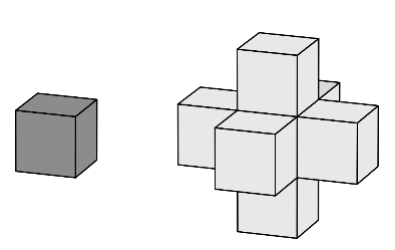
Johann has several light and dark cubes. He used them to form the solid shown on the right by gluing a light cube on each side of a dark cube. Now he wants to glue on dark cubes so that no light areas can be seen from the outside. What is the minimum number of dark cubes that he will need?
Show answer
Answer: A — 18
Show hints
Hint 1 of 3
The solid is a 3D plus sign: a central dark cube with one light cube poking out on each of its 6 faces.
Still stuck? Show hint 2 →
Hint 2 of 3
Each light arm shows 5 light faces (its outer end plus 4 sides); a dark cube tucked into a corner between two arms can hide a side face of both at once.
Still stuck? Show hint 3 →
Hint 3 of 3
Count the end-caps separately from the corner cubes, and watch for the corner cubes being shared between neighbouring arms.
Show solution
Approach: cap each arm, then fill the shared corners between arms
- Each of the 6 light arms shows its outer end face, so it needs 1 dark cube as a cap: that is 6 dark cubes.
- Each arm also shows 4 side faces, for 6 × 4 = 24 light side faces in all.
- A dark cube sitting in a corner between two neighbouring arms covers one side face of each, so it hides 2 side faces; there are 12 such corner positions around the cross.
- The 12 corner cubes hide 12 × 2 = 24 side faces, exactly all of them, so the total is 6 + 12 = 18 dark cubes.
Mark:
· log in to save