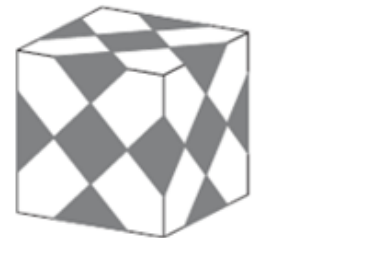
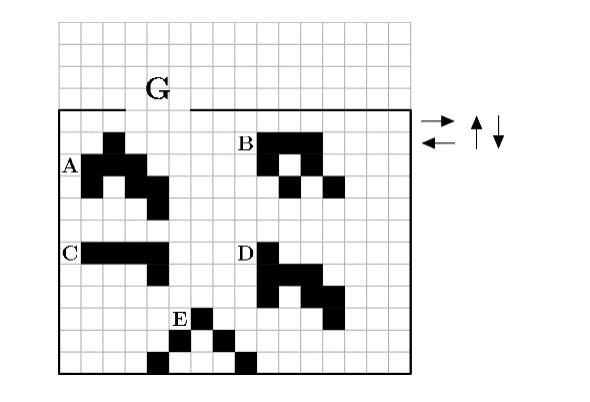
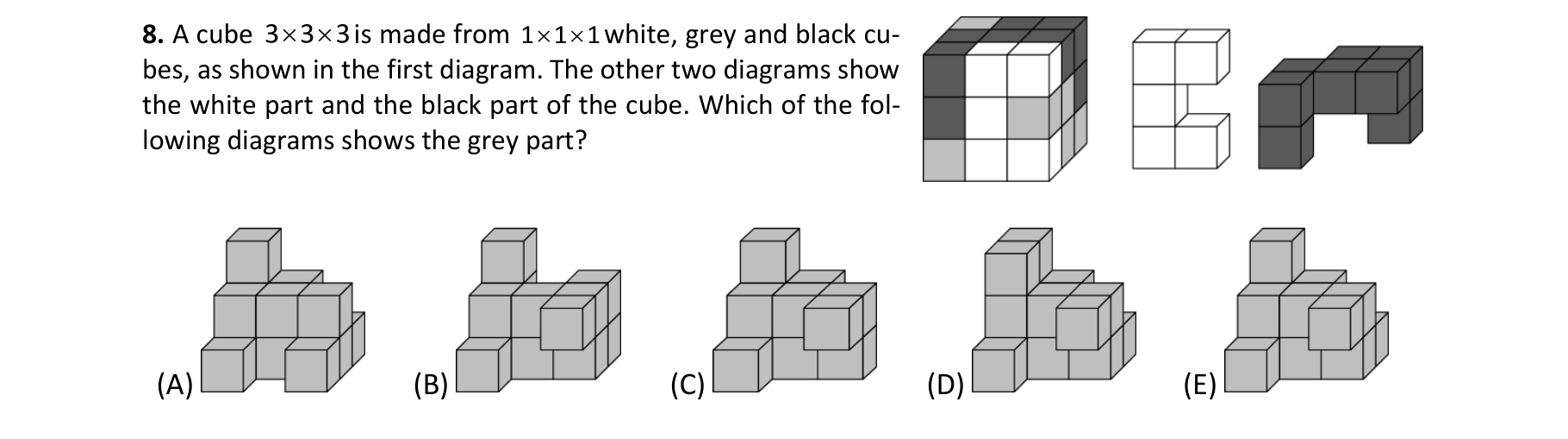
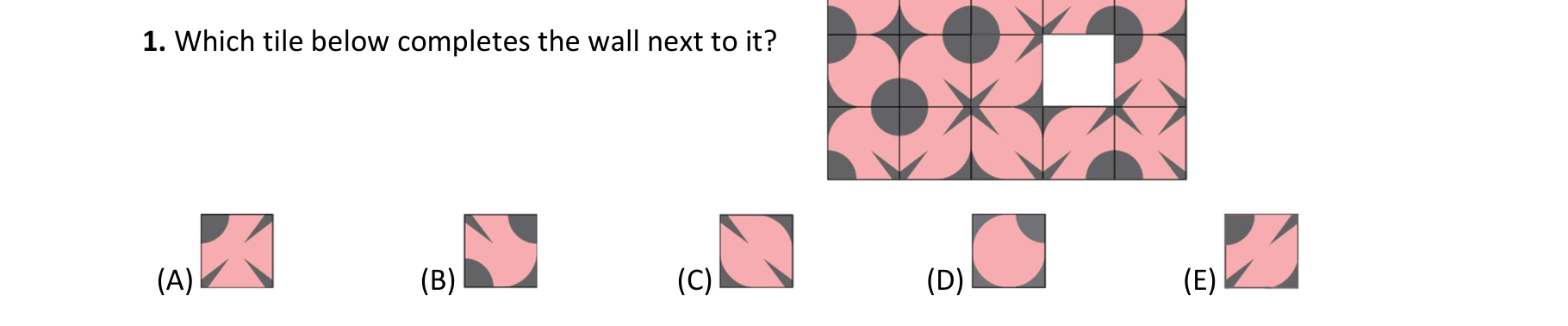
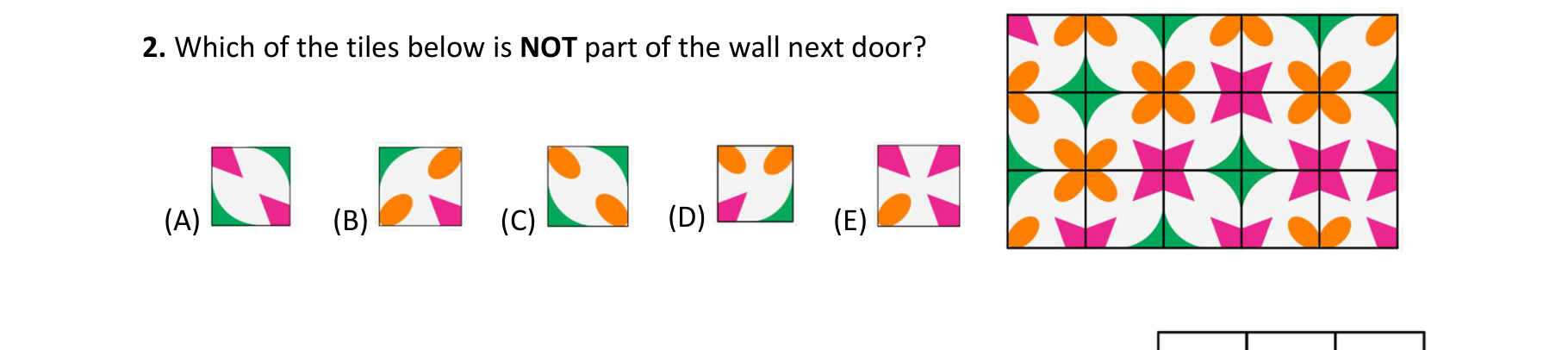
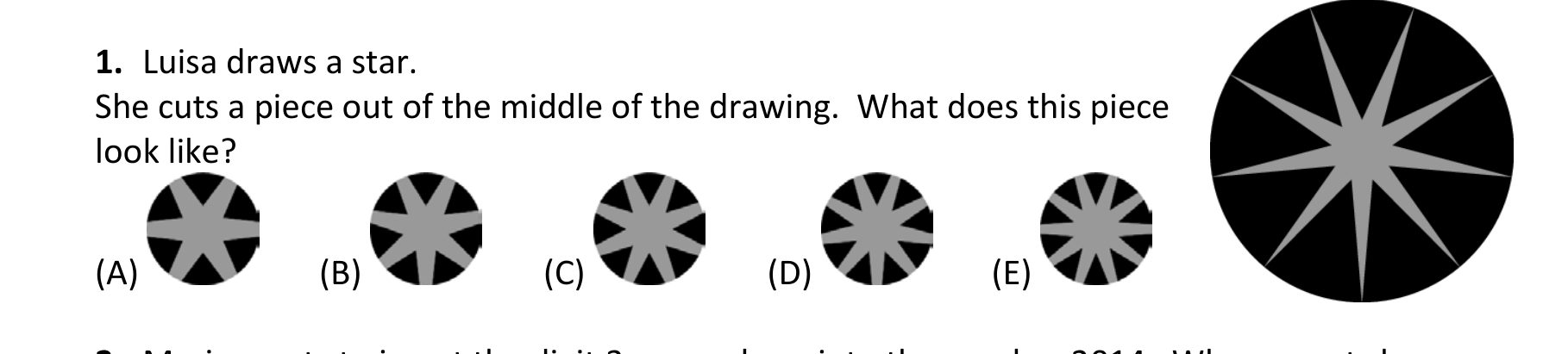
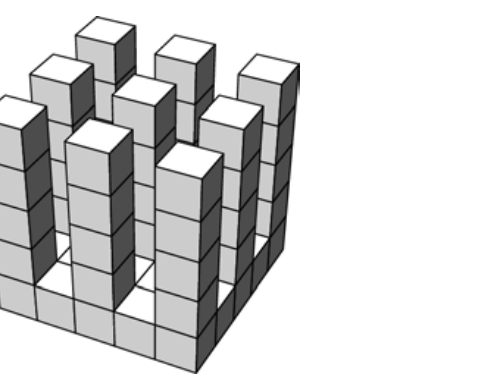
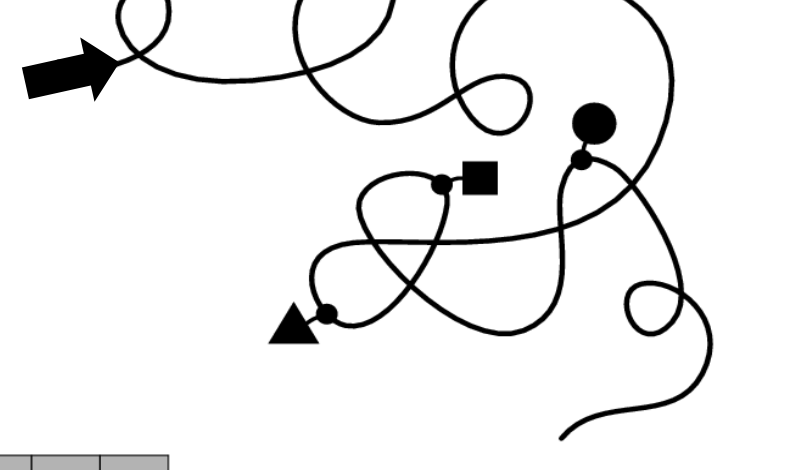
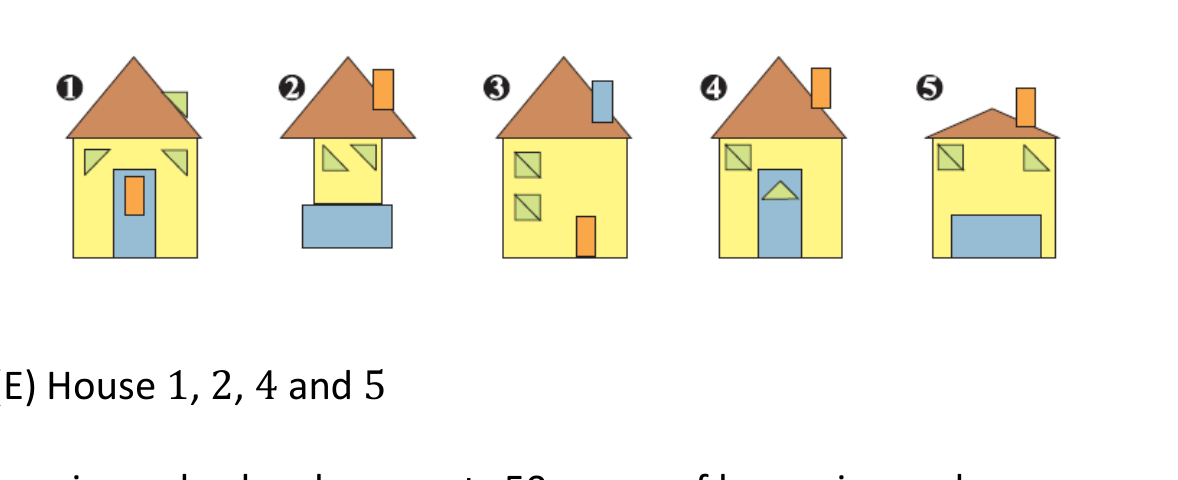
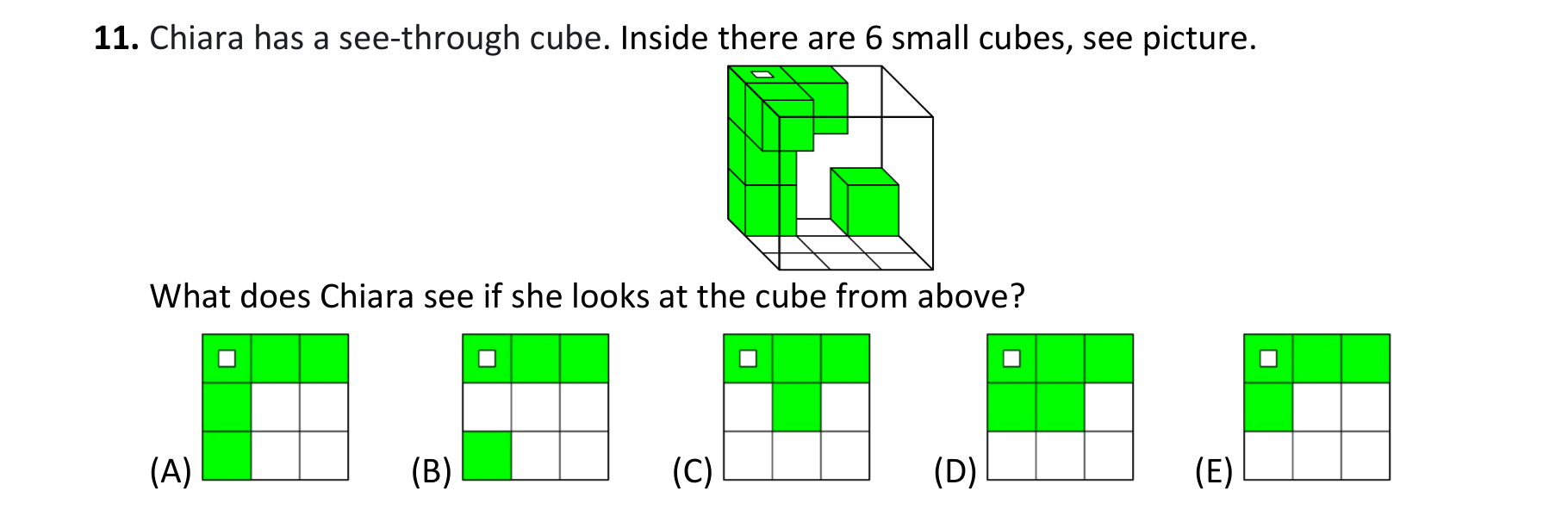
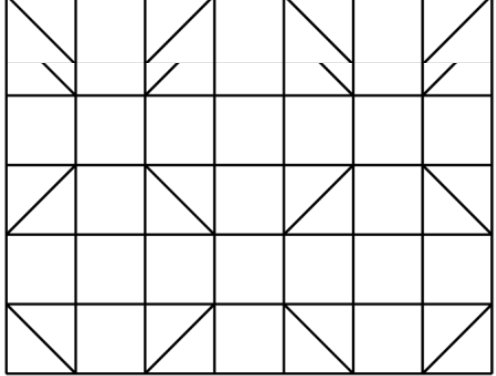
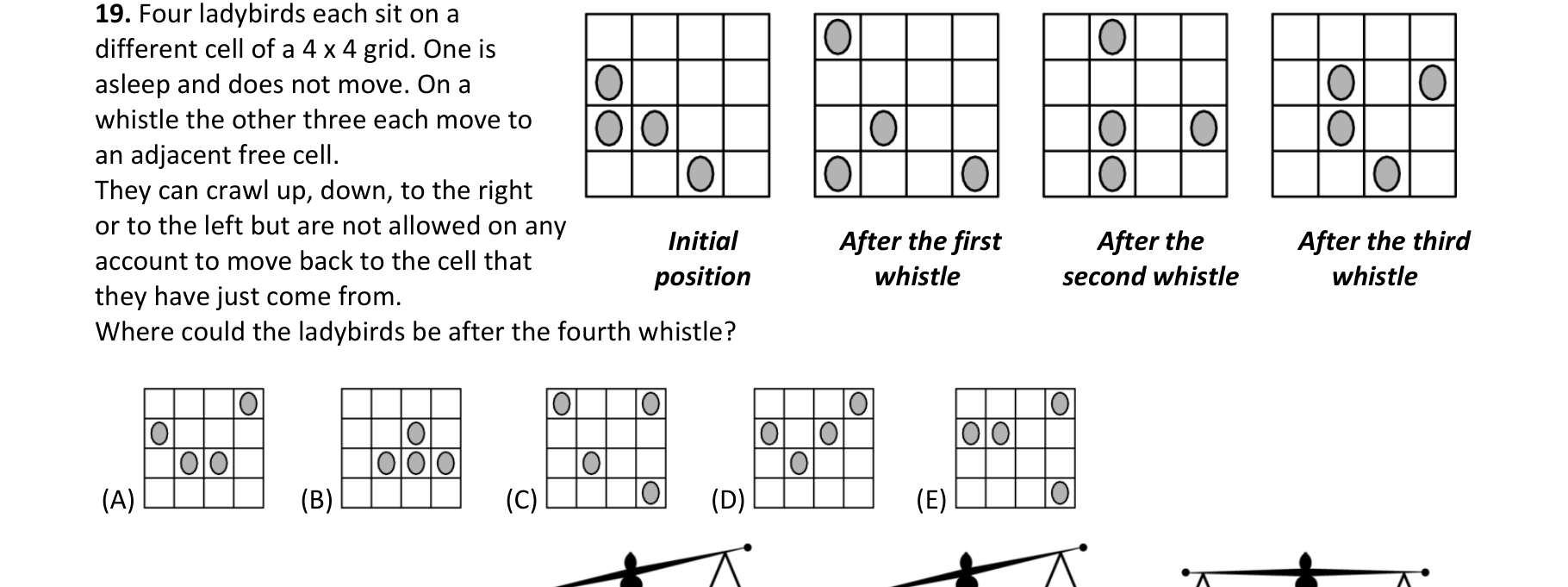
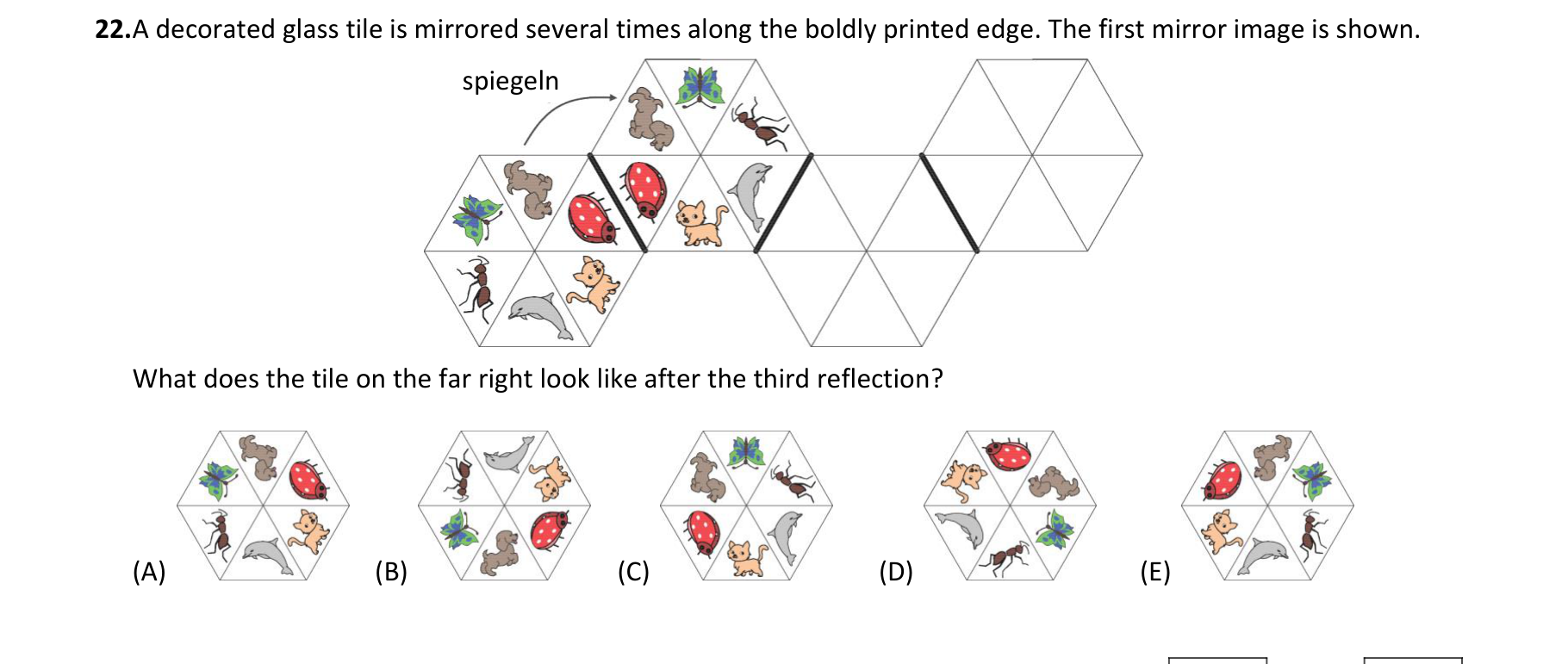
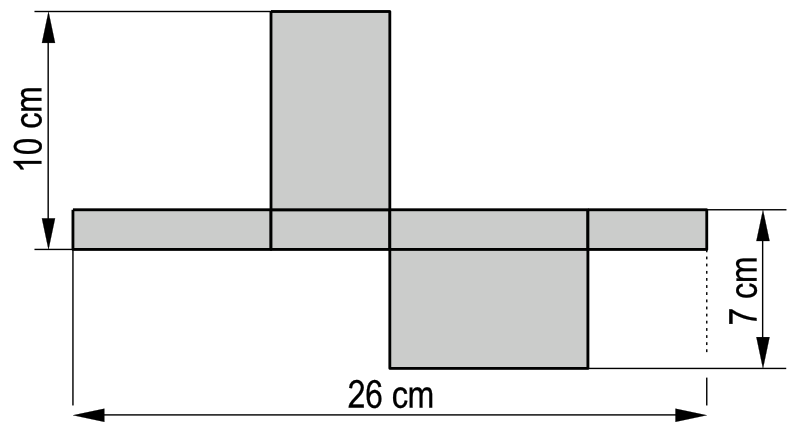
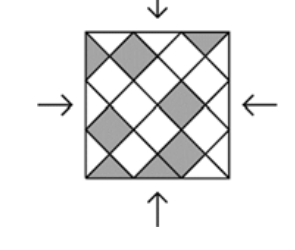
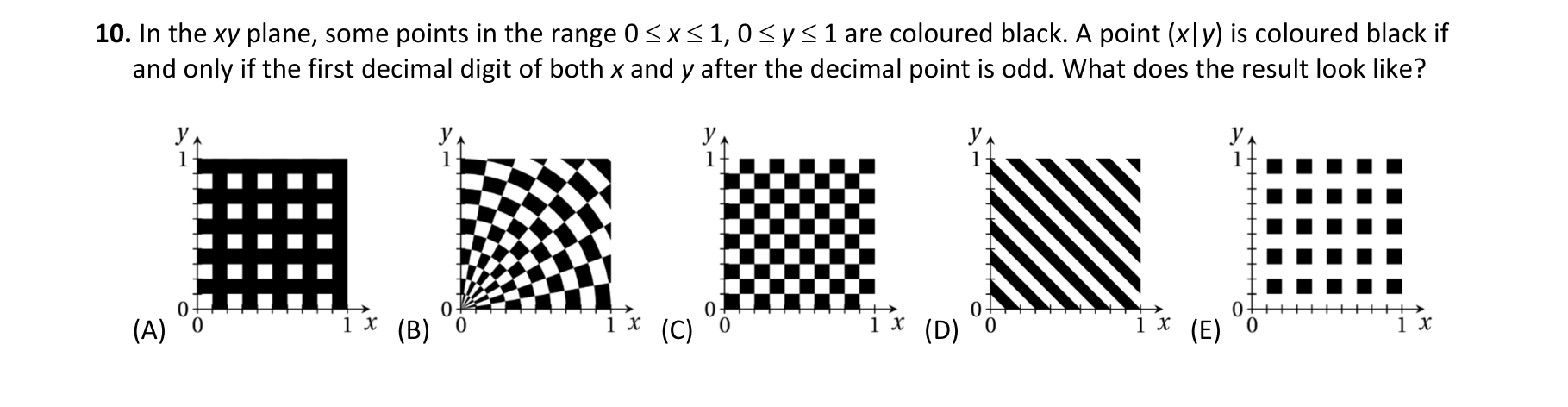
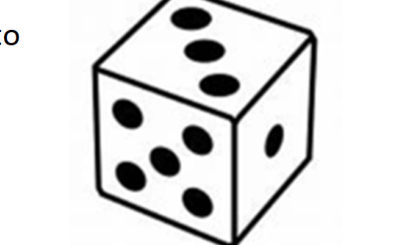
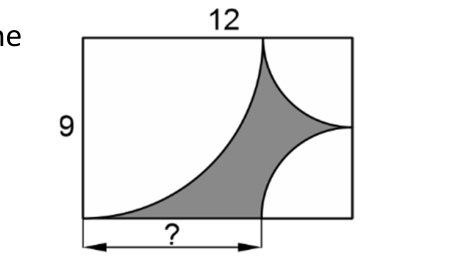
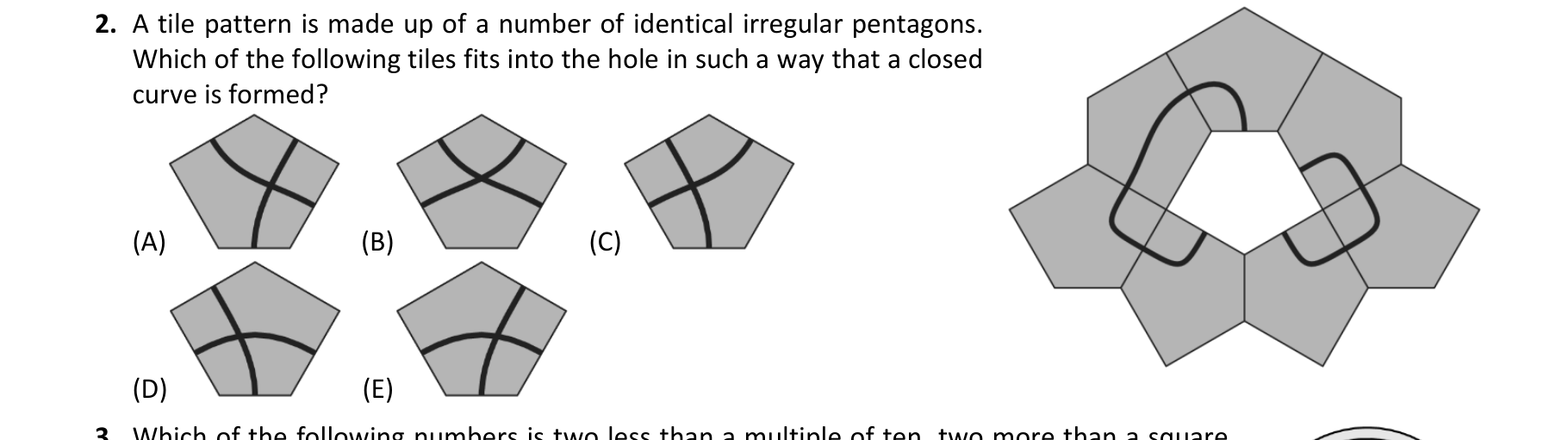
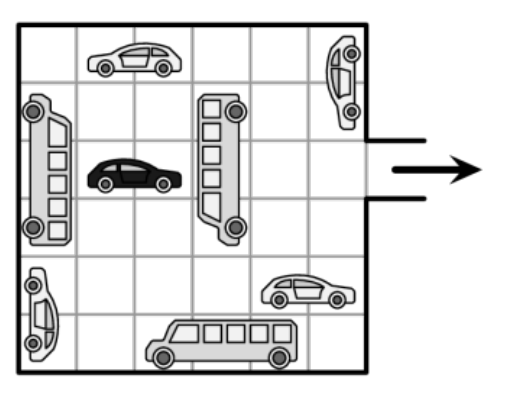
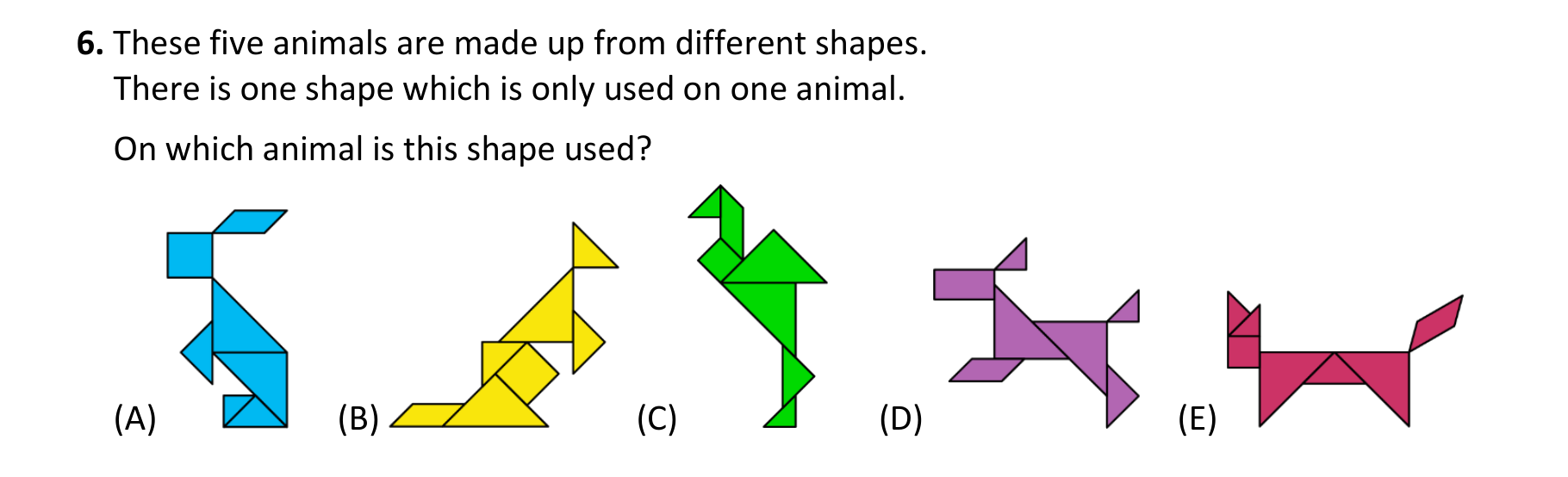
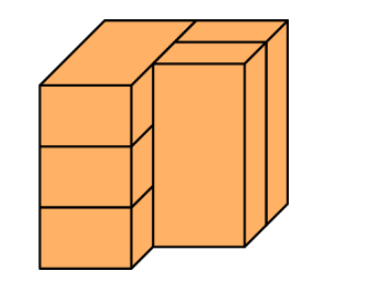
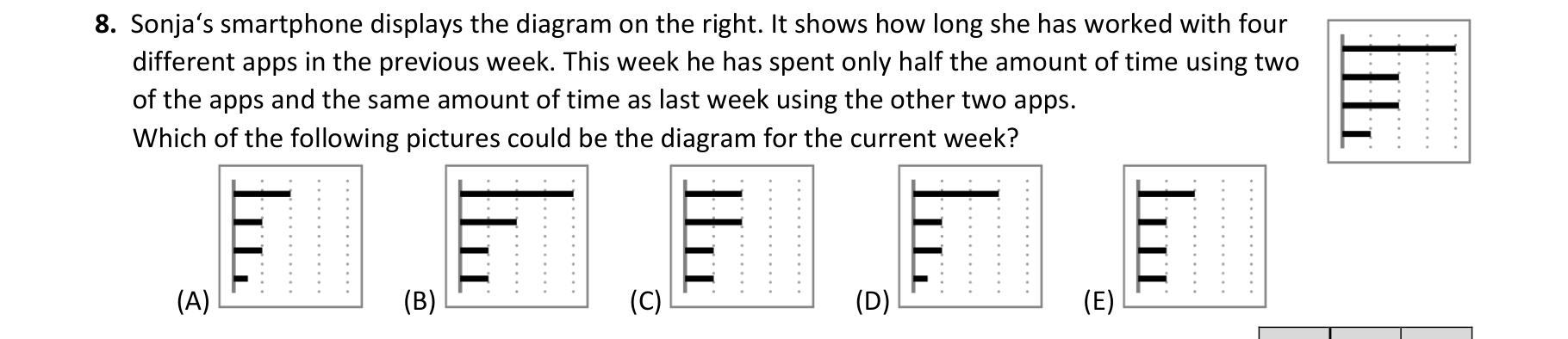
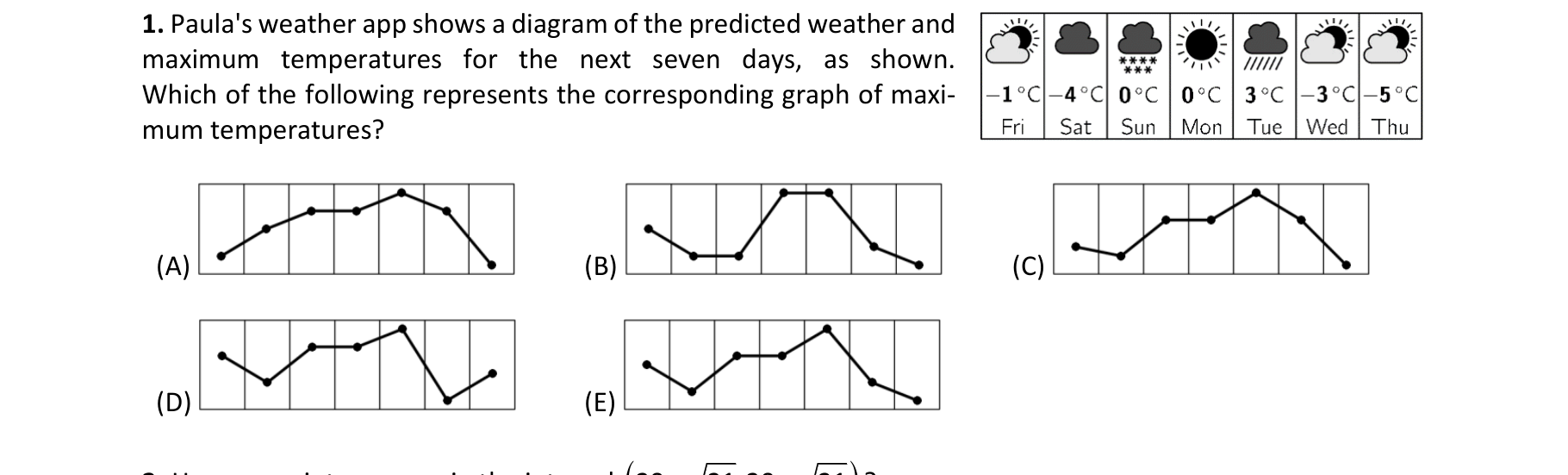
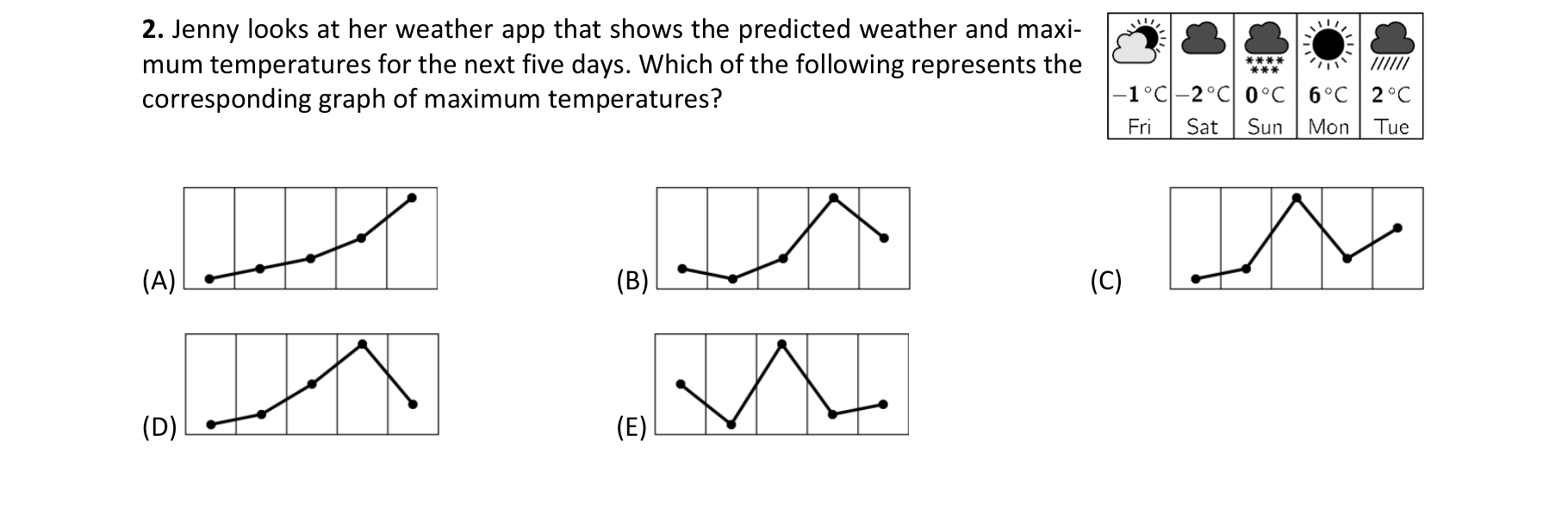
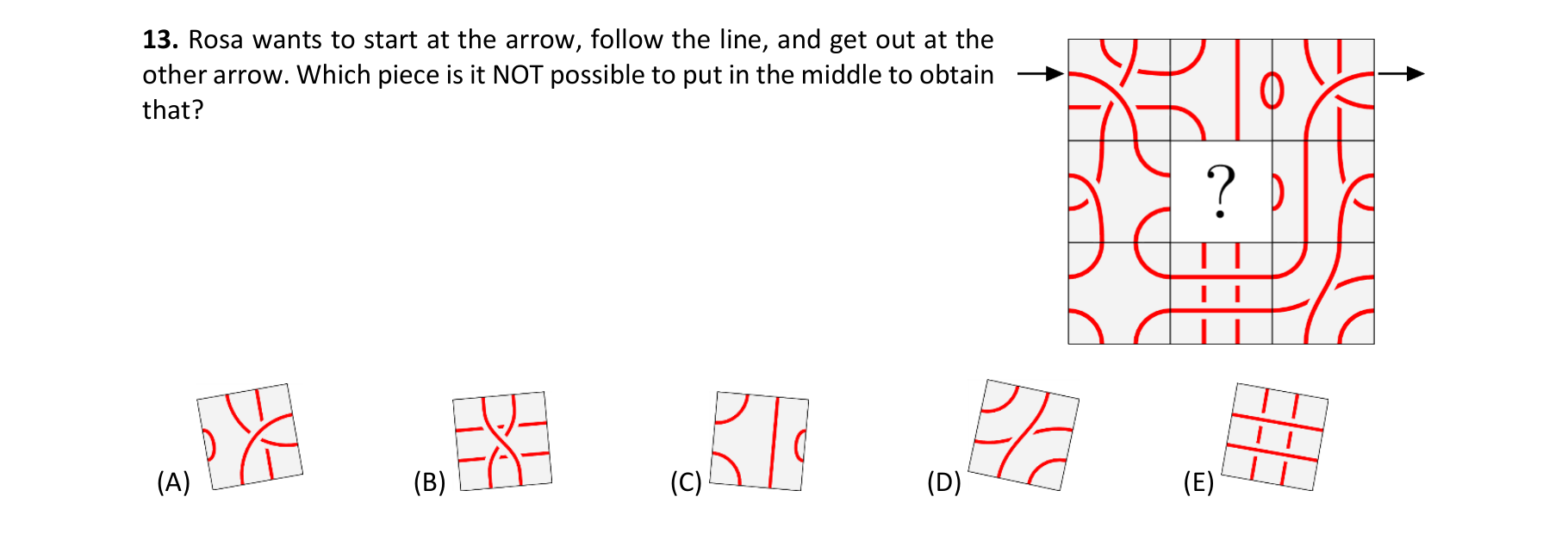
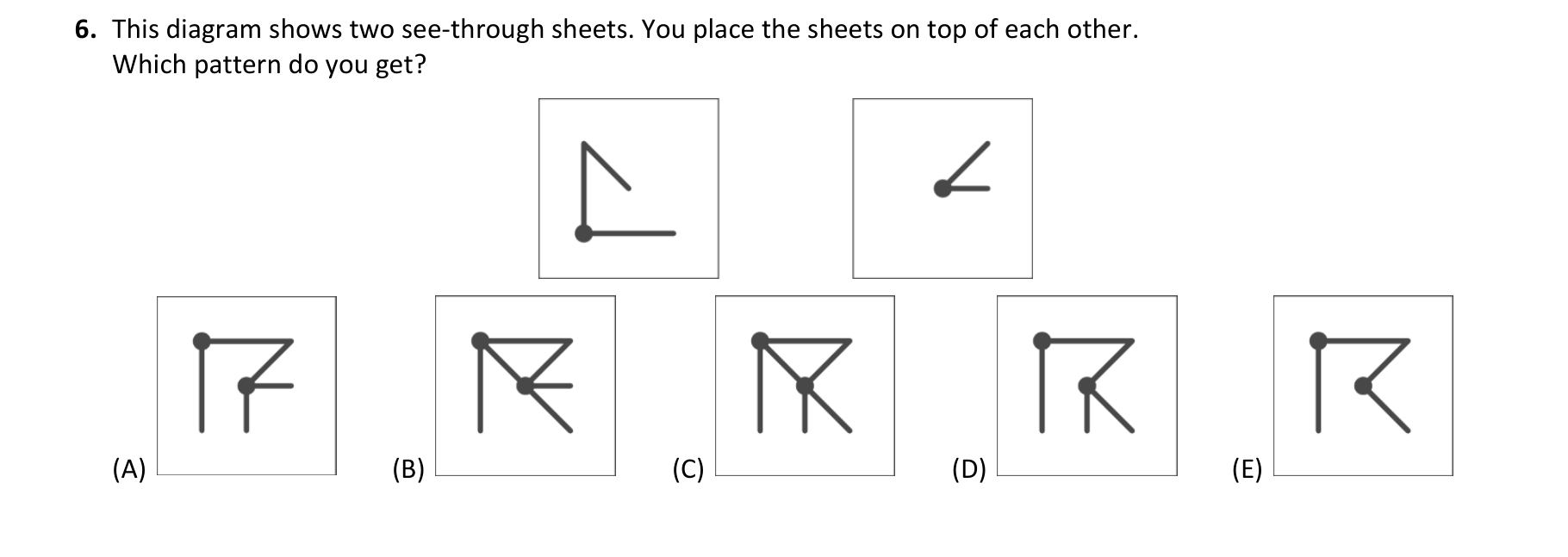
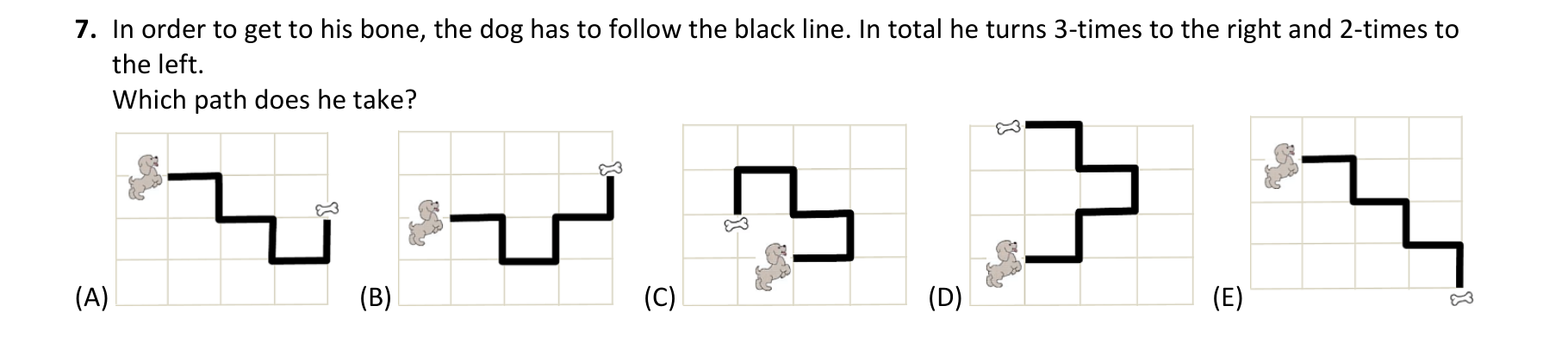
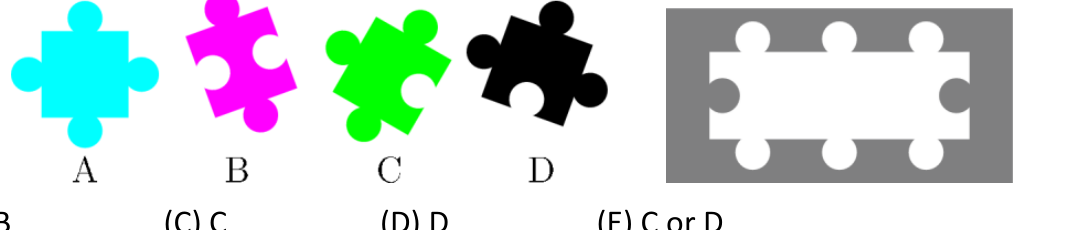
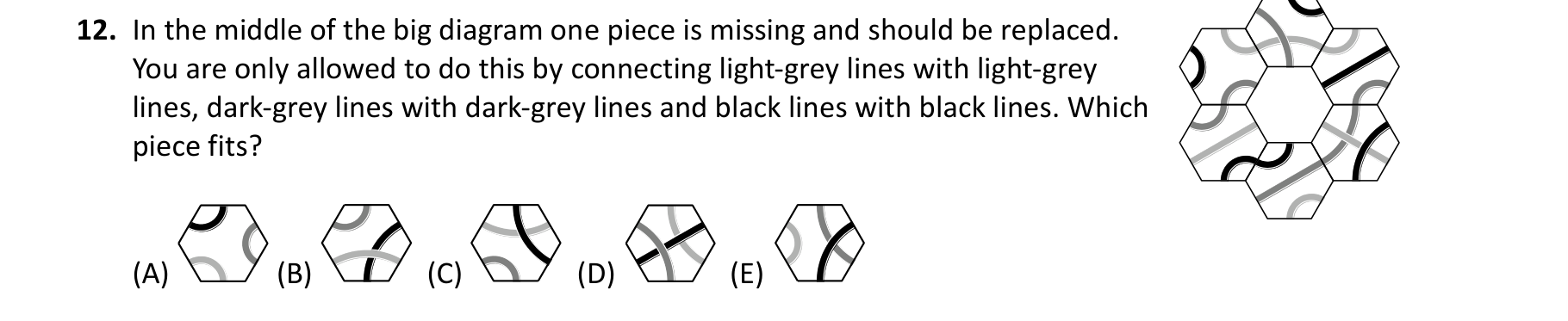
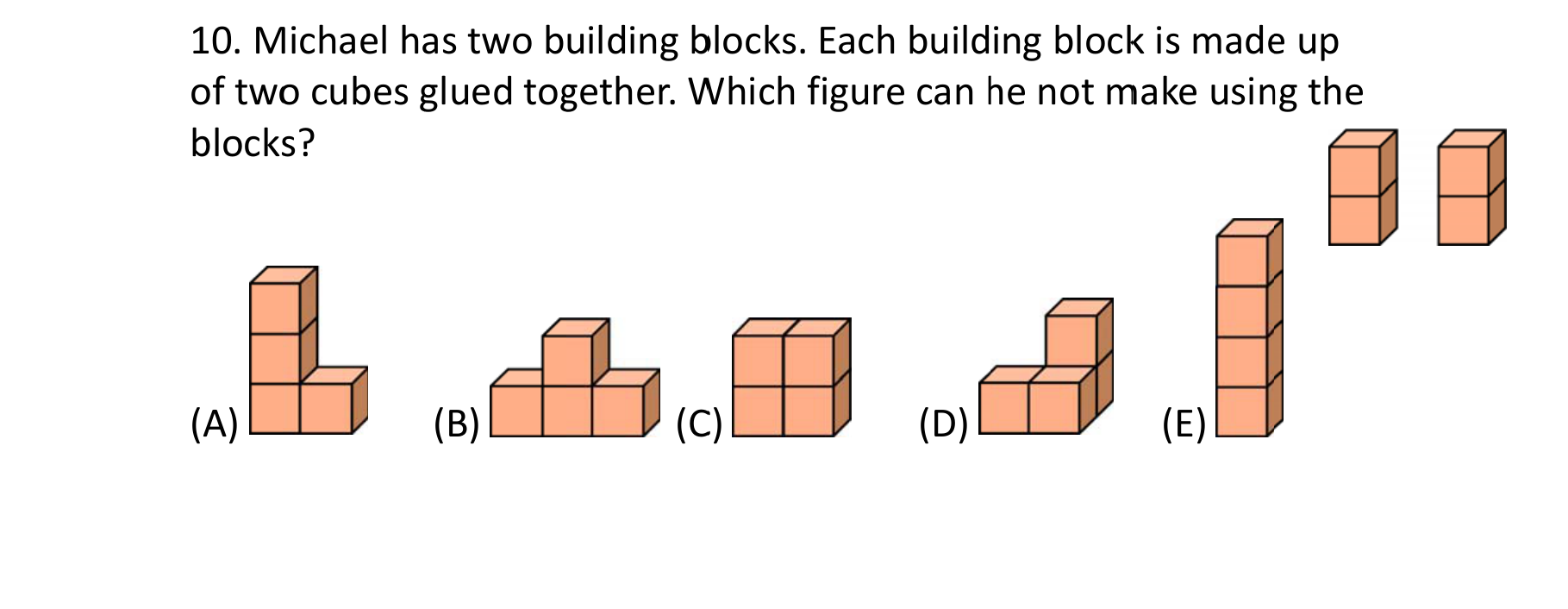
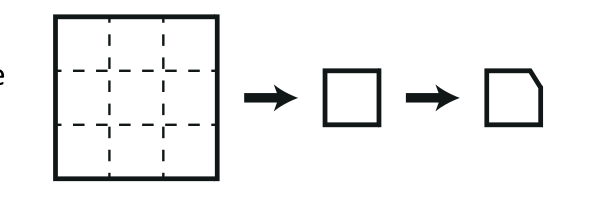
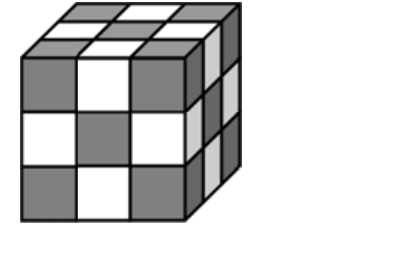
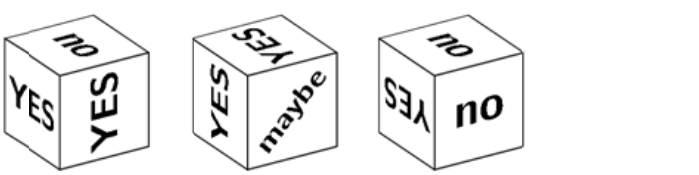
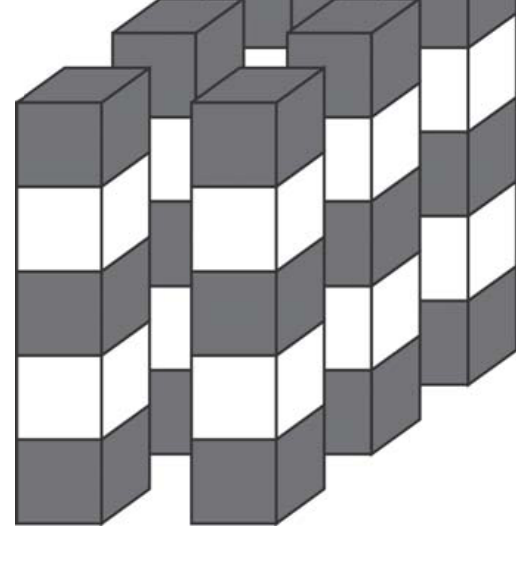
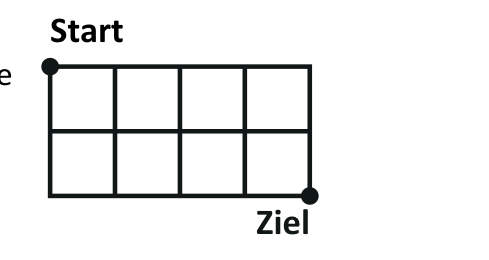
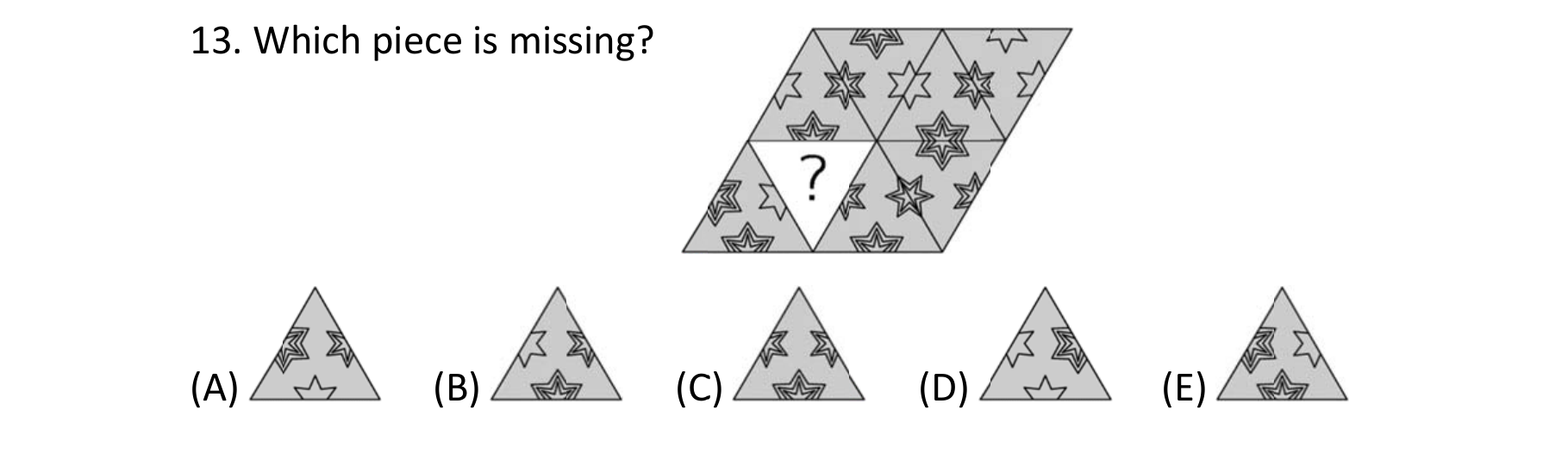
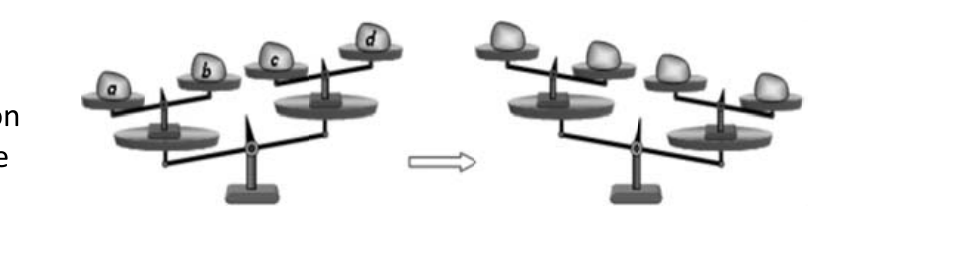
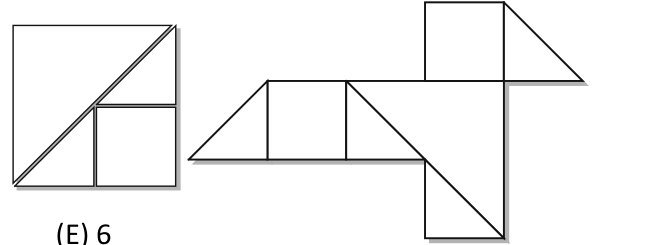
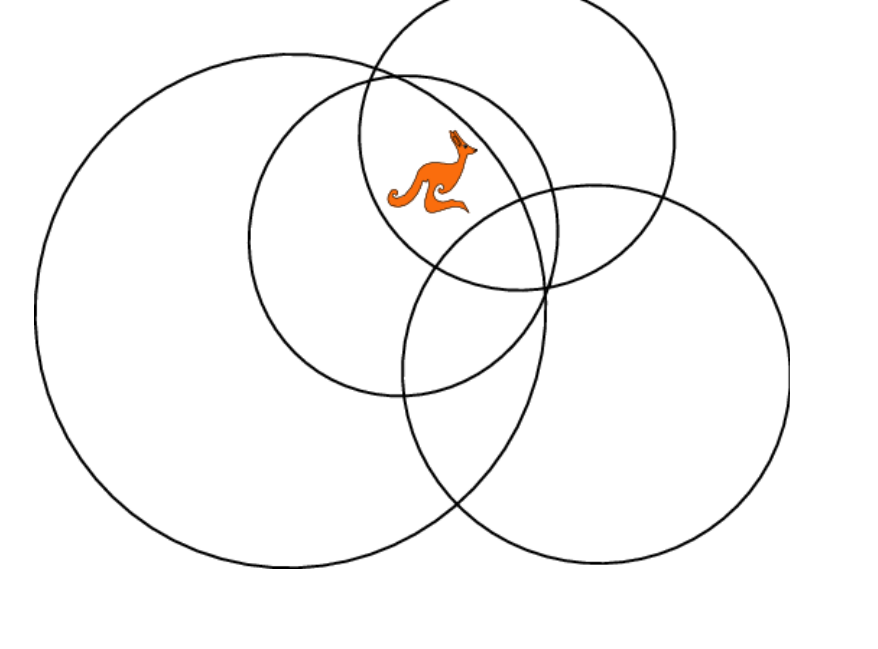
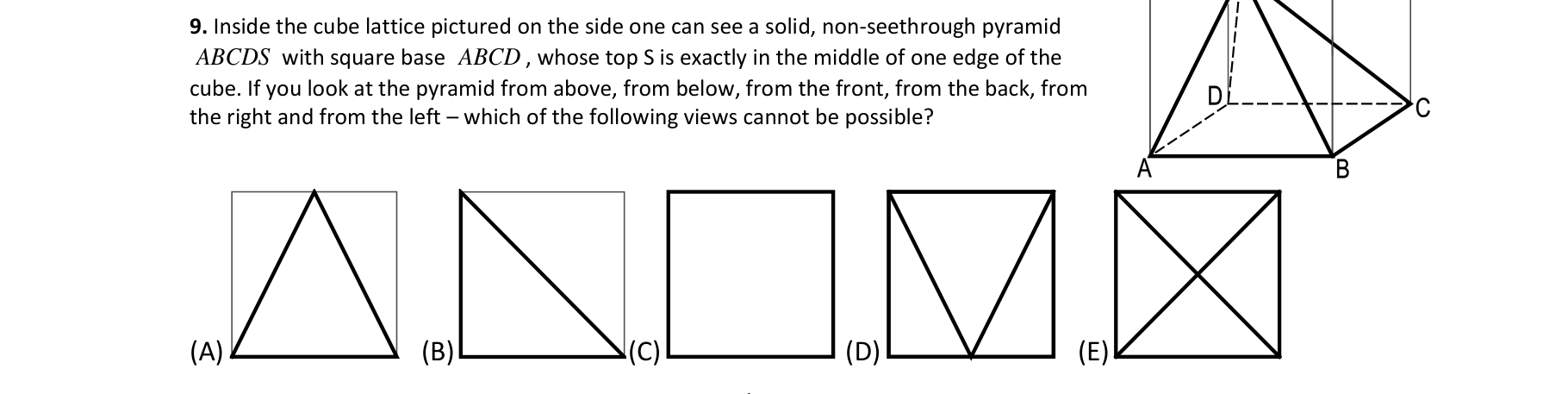
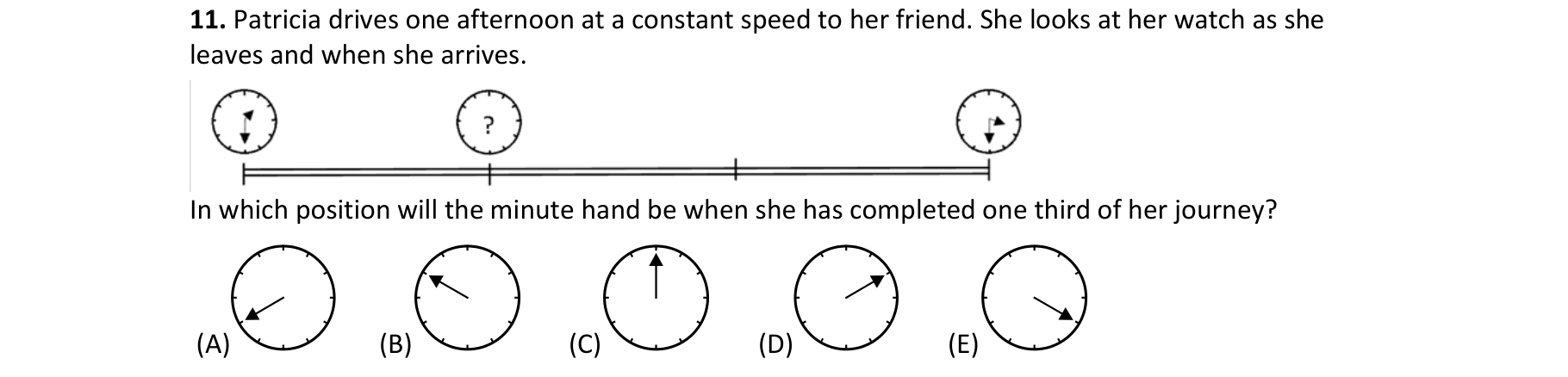
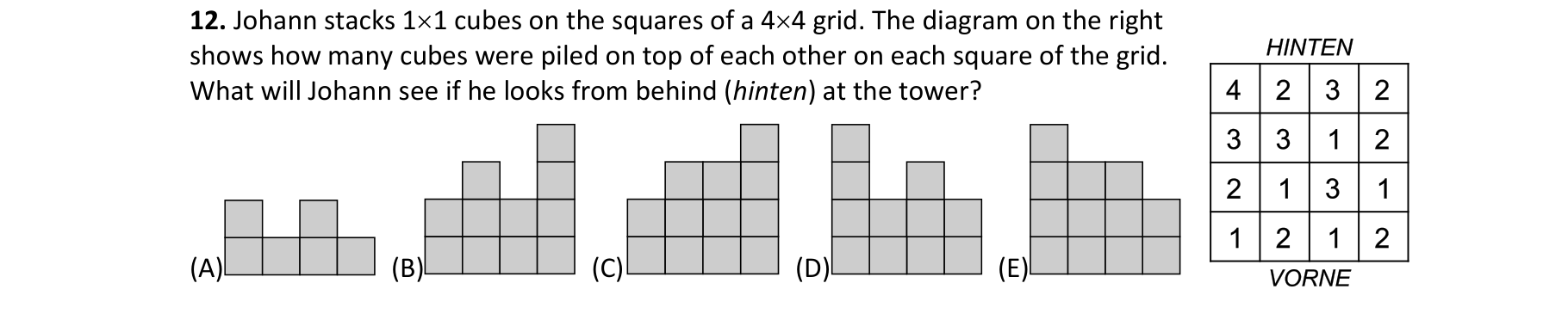
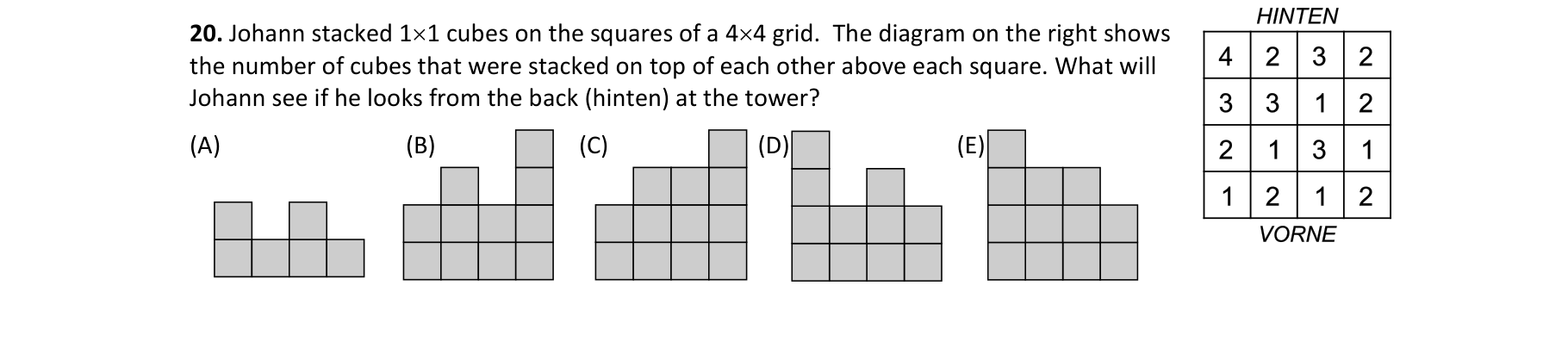
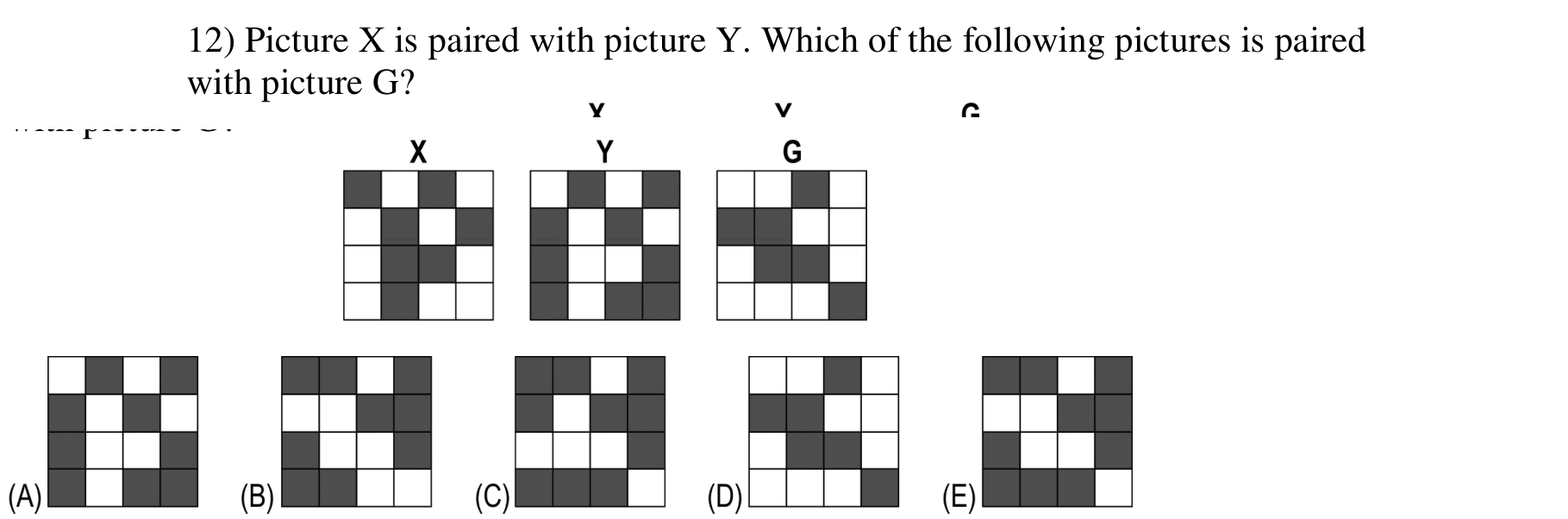
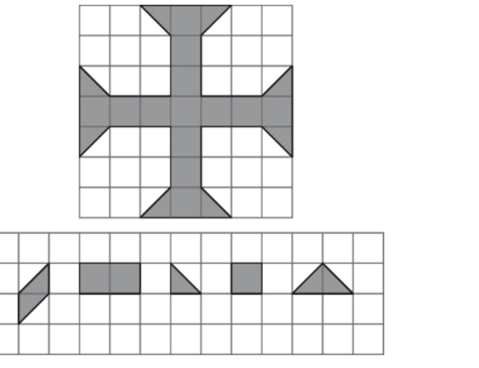
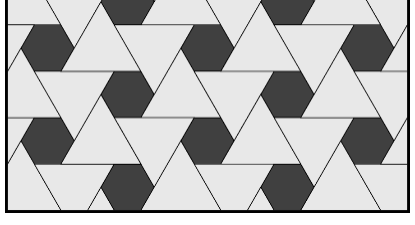
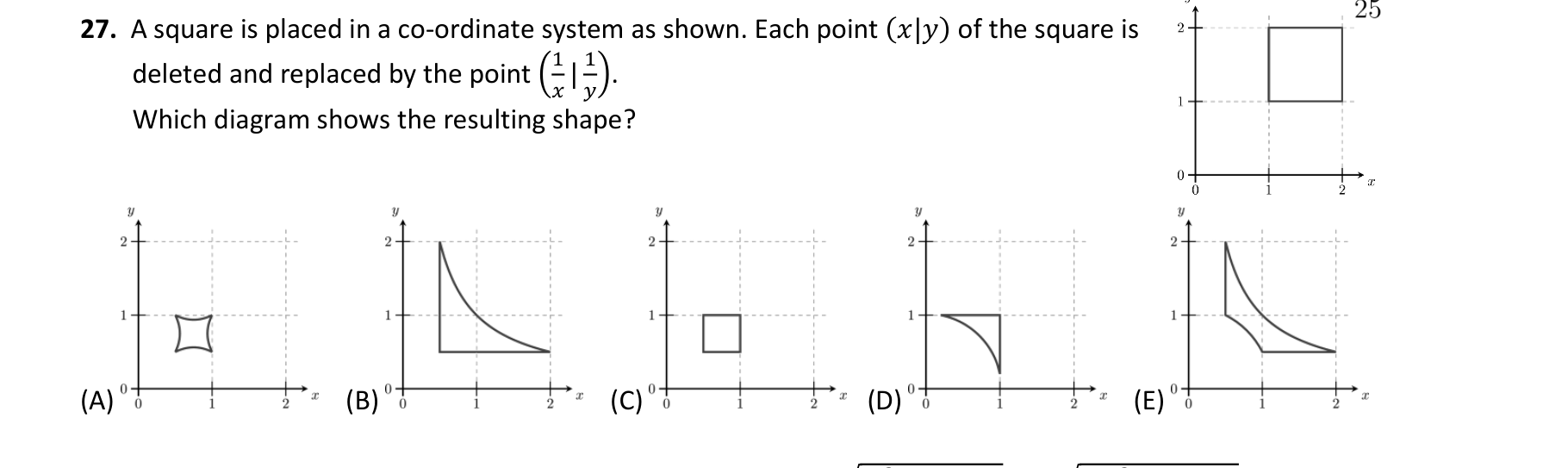
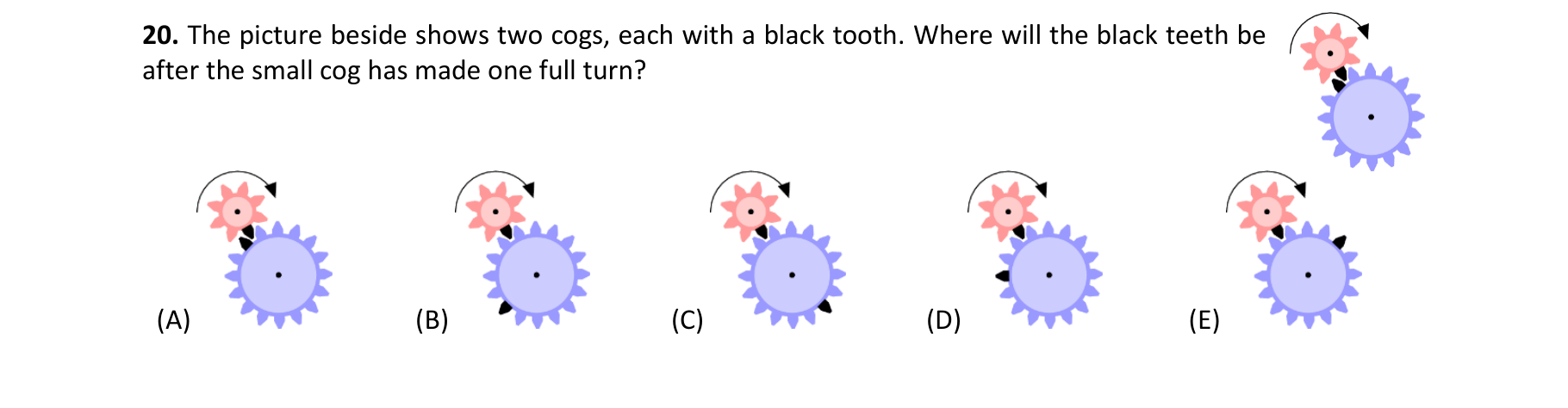
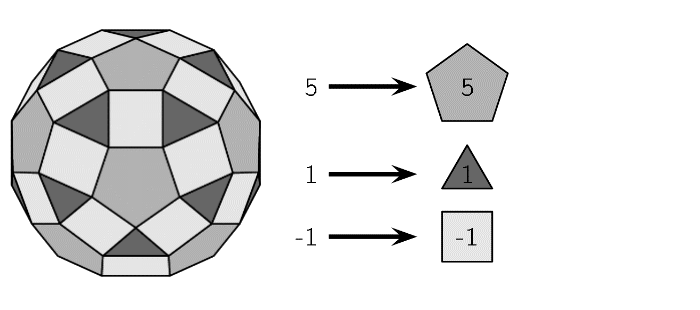
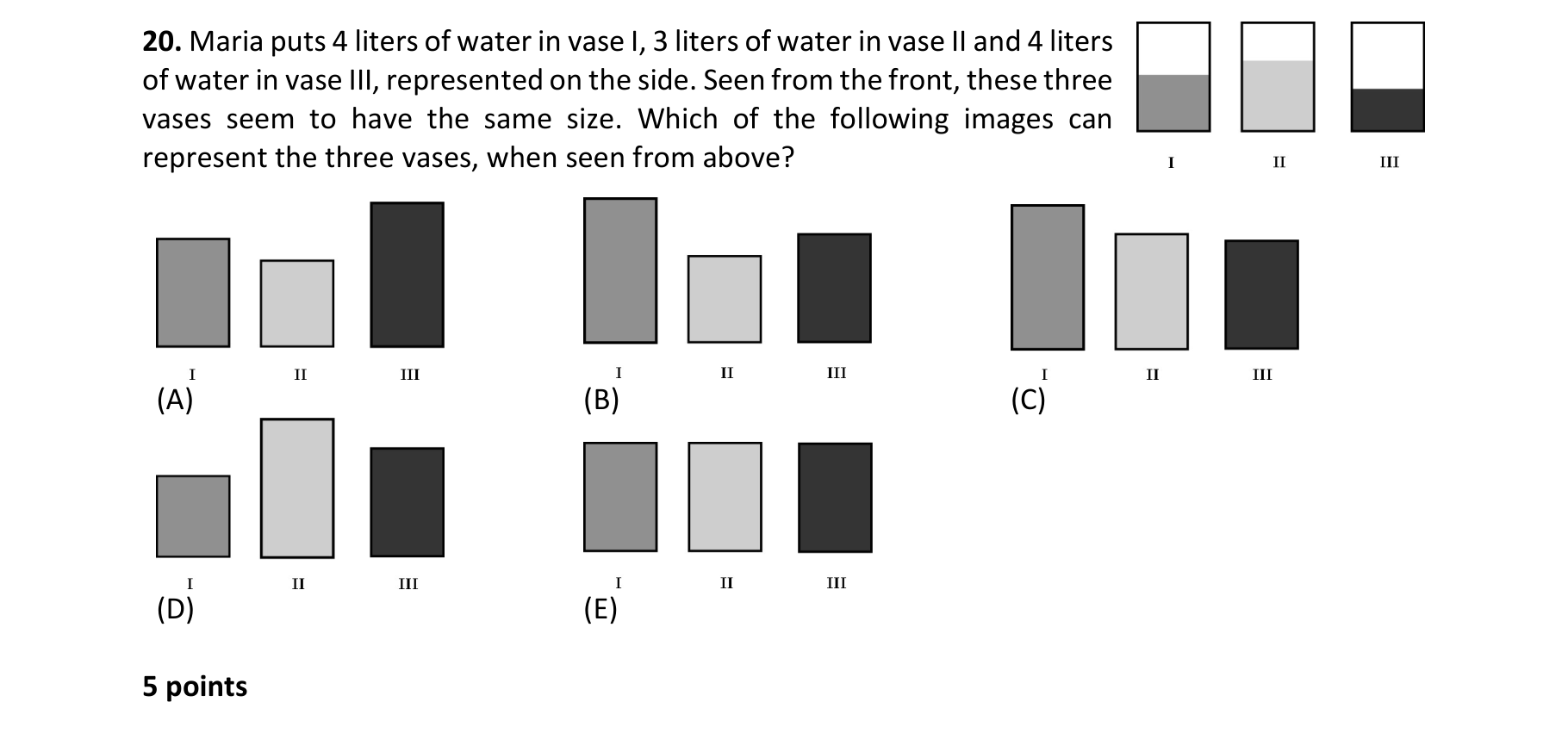
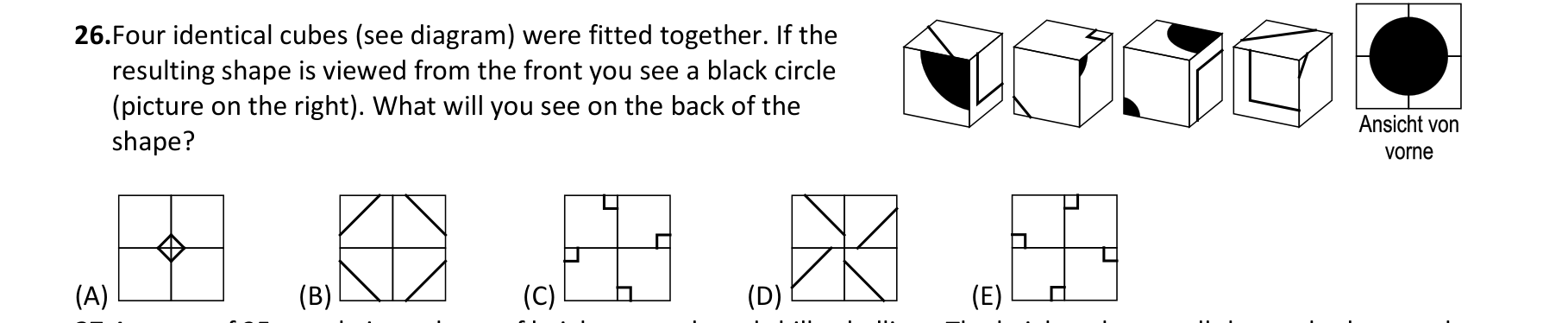
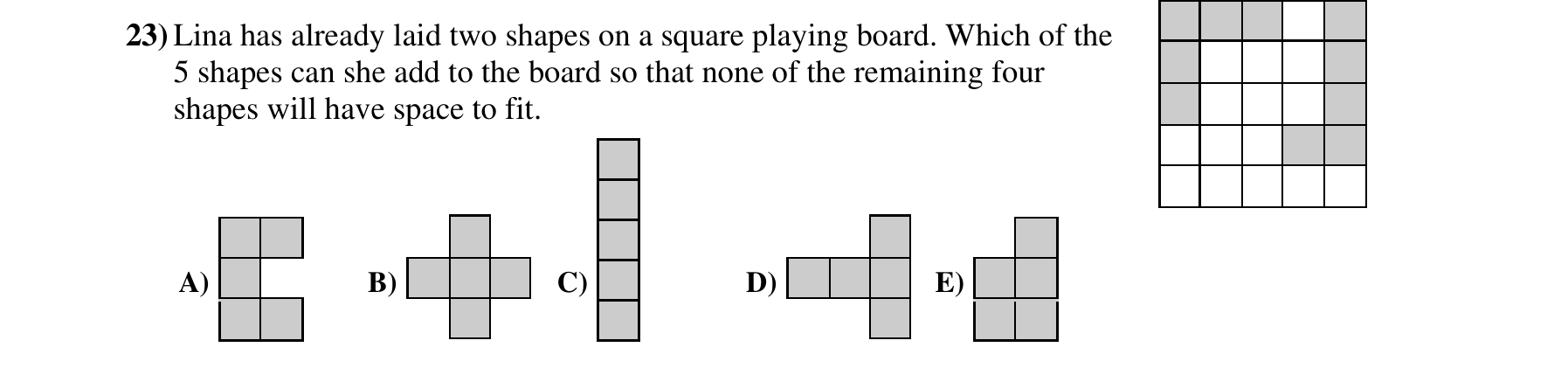
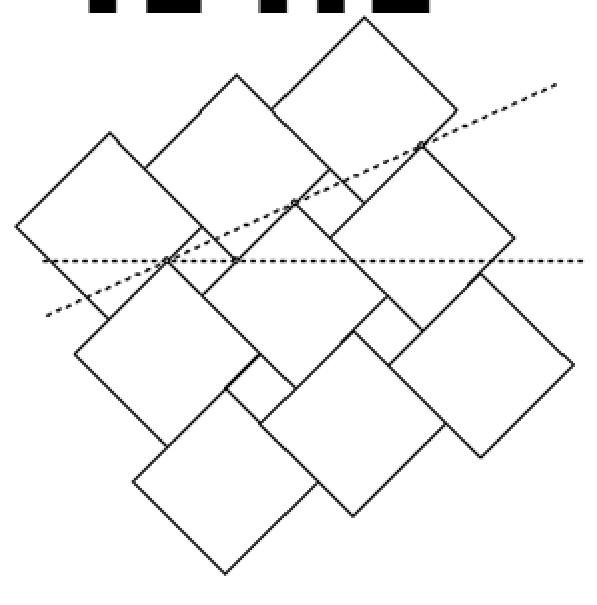
Which of the pieces shown completes the pattern? (The five choices A–E are pictured below the question.)
Show answer
Answer: C
Show hints
Hint 1 of 2
The big design is one repeating pattern; the white window is just a square-shaped hole punched out of it.
Still stuck? Show hint 2 →
Hint 2 of 2
Look at the lines touching all four edges of the hole and ask which piece lets every one of them continue without a break.
Show solution
Approach: match the missing tile to the lines around the hole
The hole sits inside a repeating pattern of overlapping squares and diamonds, so the right piece is the one that keeps every line going straight across the gap.
Trace the lines that arrive at the top, bottom, left and right edges of the white square; the correct piece must connect to all of them at once.
Only choice C lines up on all four sides so the pattern stays seamless with no broken lines, so the answer is (C).
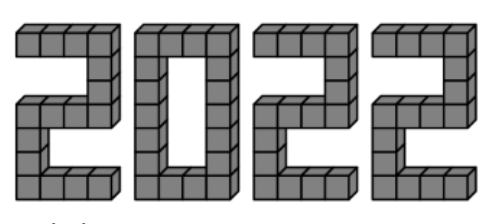
Anna builds a wall out of black and grey bricks that shows 2025. What can Bella read on the back of the wall? (The five choices A–E are pictured below the question.)
Show answer
Answer: E
Show hints
Hint 1 of 2
Looking at the back of a wall is like seeing it in a mirror.
Still stuck? Show hint 2 →
Hint 2 of 2
Reflect the whole ‘2025’ left-to-right; each digit flips and the order of digits reverses.
Show solution
Approach: horizontal mirror reflection
Seeing the back of the wall is exactly like holding the front up to a mirror, so the whole picture flips left–right.
Two things happen at once: the order of the digits reverses (so 2025 reads 5202), and each digit itself is mirrored.
The choice that shows this left–right flip of the bricks is the back view, which is (E).
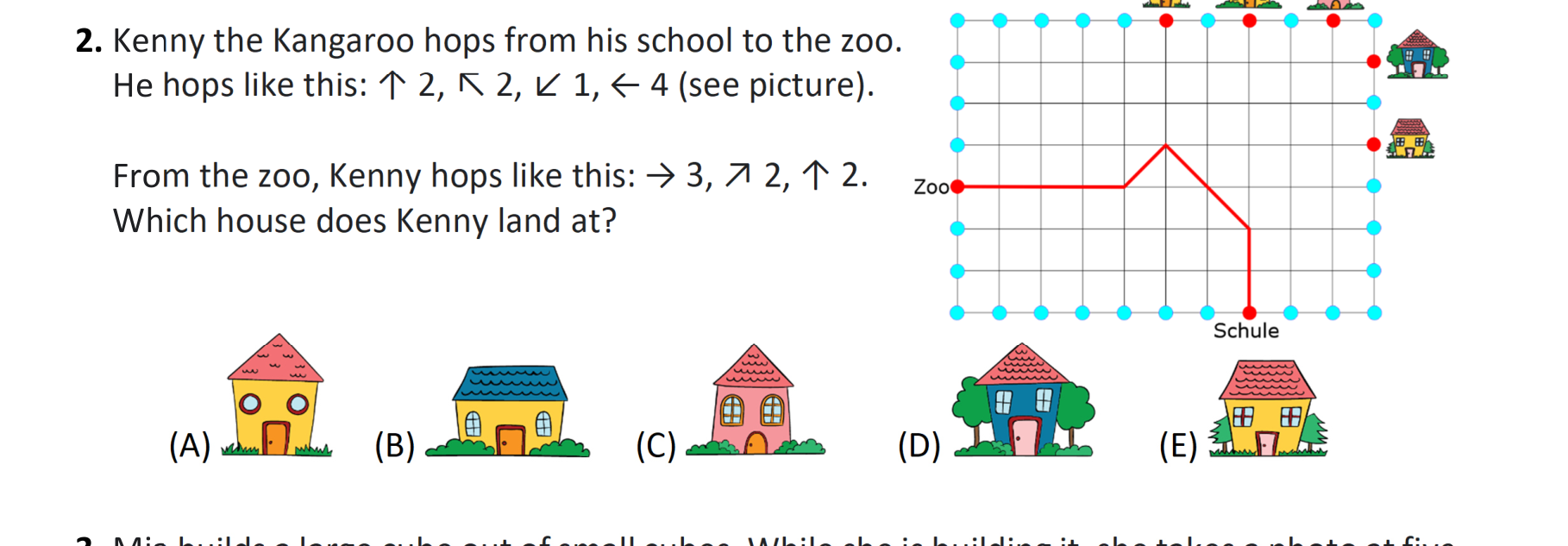
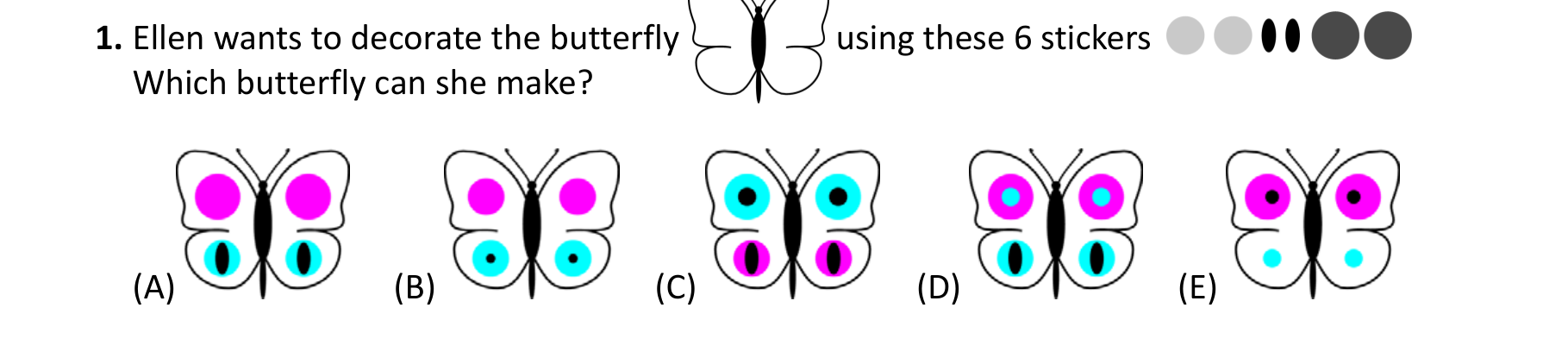
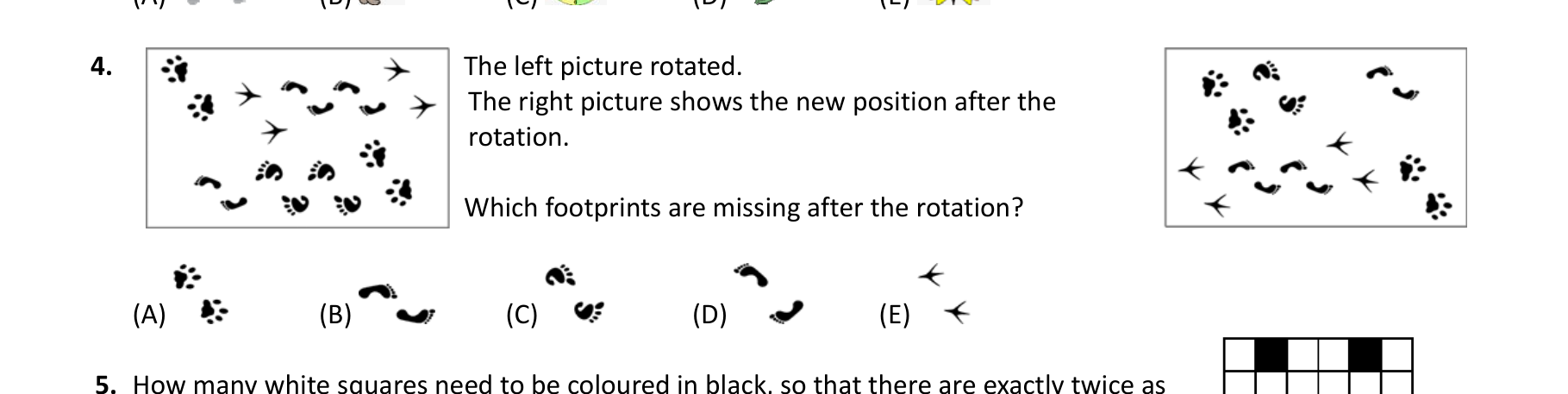
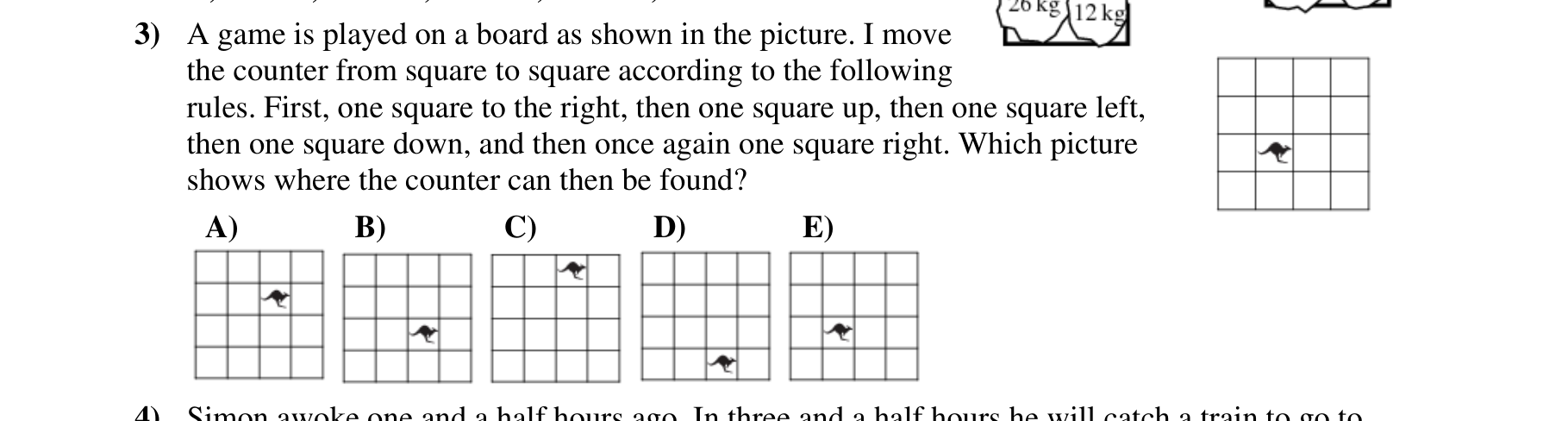
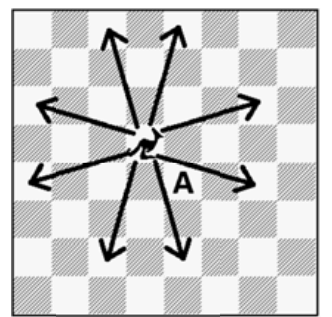
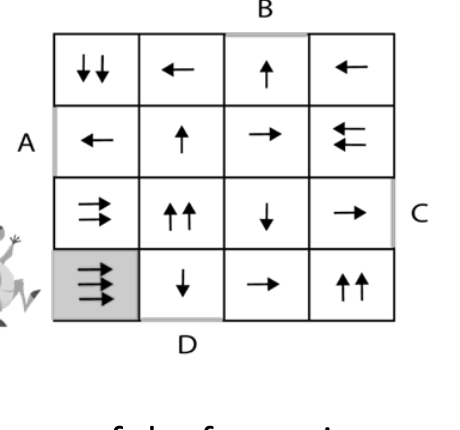
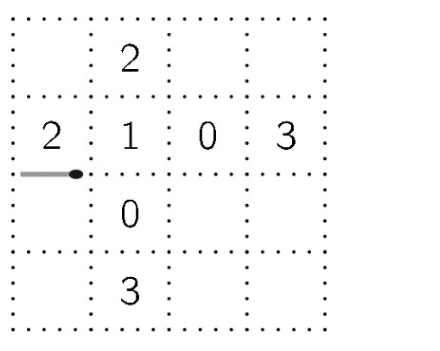
Kenny the Kangaroo hops from his school to the zoo. He hops like this: up 2, up-left 2, down-left 1, left 4 (see picture). From the zoo, Kenny hops like this: right 3, up-right 2, up 2. Which house does Kenny land at?
Show answer
Answer: A
Show hints
Hint 1 of 2
Start at the Zoo dot and follow the new hops one by one on the grid.
Still stuck? Show hint 2 →
Hint 2 of 2
Track the arrows right 3, up-right 2, up 2 step by step until you land on a house.
Show solution
Approach: trace the hops on the grid from the zoo
Begin at the Zoo marker and move right 3 squares.
Then move diagonally up-right 2 squares, then straight up 2 squares.
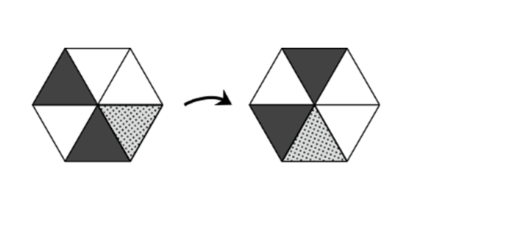
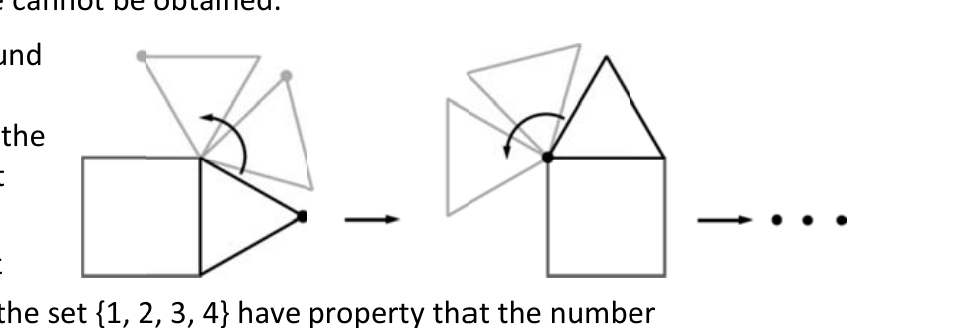
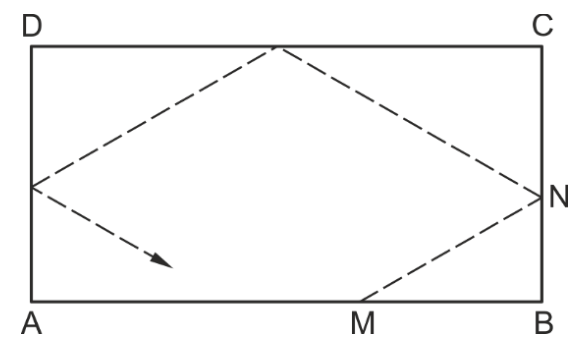
Isabelle plays with a hexagonal sheet of paper. With each move she rotates the hexagon by the same angle in the same direction. The illustration shows the sheet at the start and after the first move. After how many moves does the sheet look the same as it did at the beginning?
Show answer
Answer: A — 6
Show hints
Hint 1 of 2
The single dotted wedge acts as a marker — track where it lands after one move.
Still stuck? Show hint 2 →
Hint 2 of 2
Find the rotation angle of one move, then see how many moves complete a full turn back to the start.
Show solution
Approach: track the marker wedge under repeated equal rotations
The colouring has no rotational symmetry, so the sheet only looks identical after a whole turn brings every wedge home.
Comparing the start and the first move, the unique dotted wedge has shifted by one position — a 60° rotation.
A 60° step needs \(360^\circ \div 60^\circ = 6\) moves to return to the original picture, which is (A).
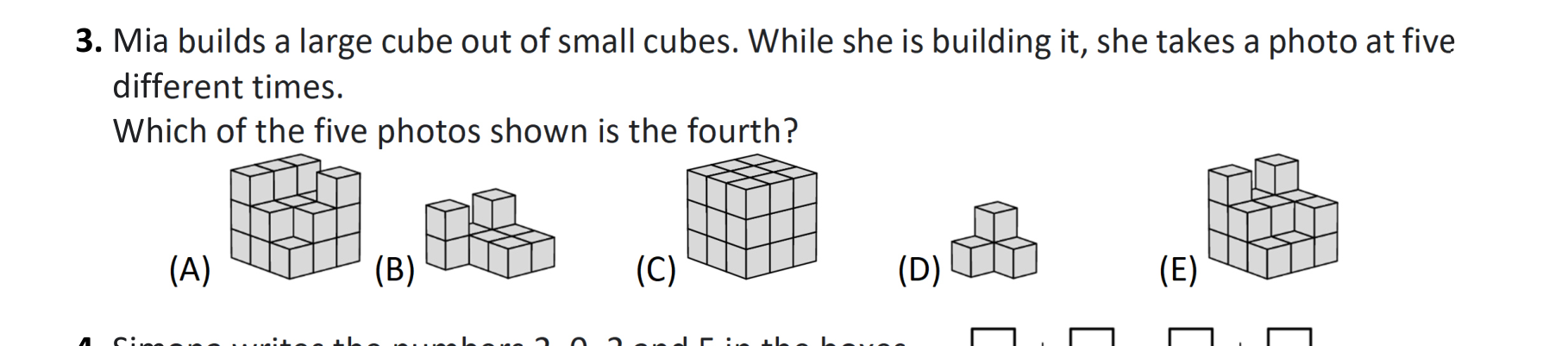
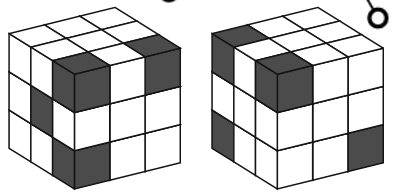
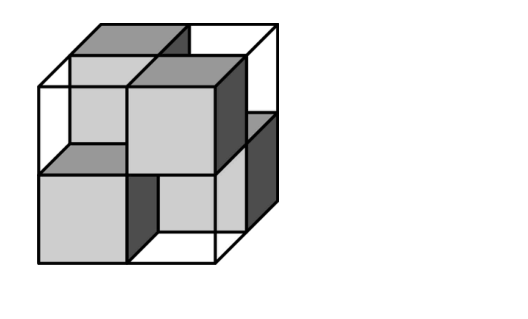
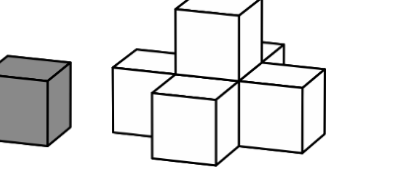
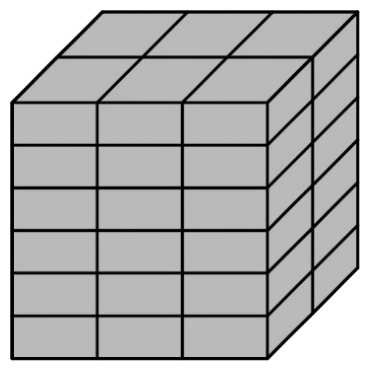
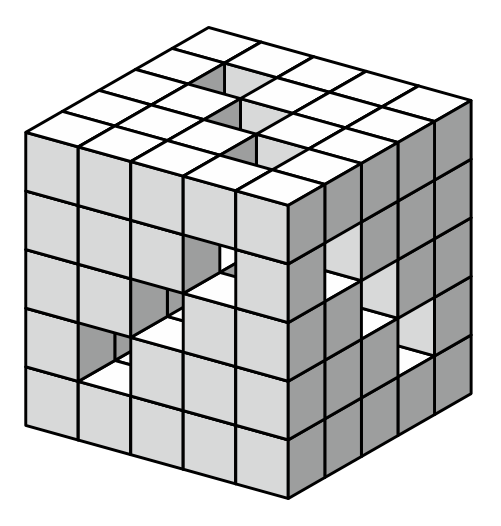
Mia builds a large cube out of small cubes. While she is building it, she takes a photo at five different times. Which of the five photos shown is the fourth?
Show answer
Answer: A
Show hints
Hint 1 of 2
The photos show the cube growing, so put them in order from fewest cubes to a full cube.
Still stuck? Show hint 2 →
Hint 2 of 2
Order the five pictures by how complete the cube is, then count to the fourth one.
Show solution
Approach: order the photos by how built-up the cube is
The cube is assembled over time, so the photos go from least built to fully built.
Arrange the five images by increasing number of small cubes placed.
The fourth picture in that order is the nearly-complete cube shown in option A.
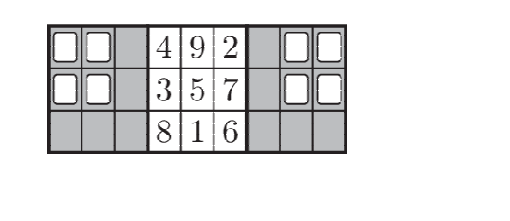
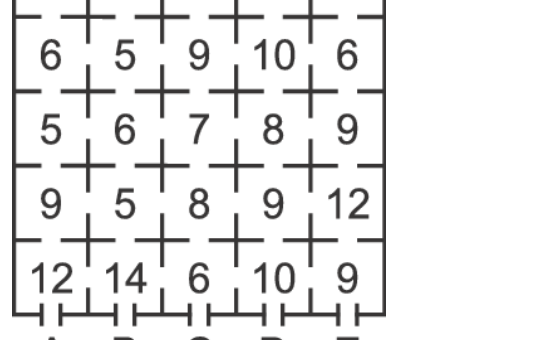
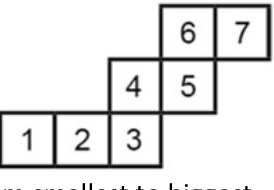
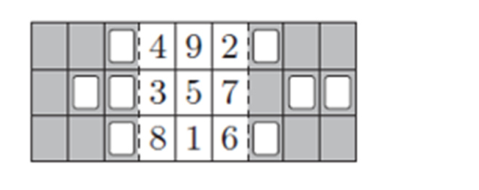
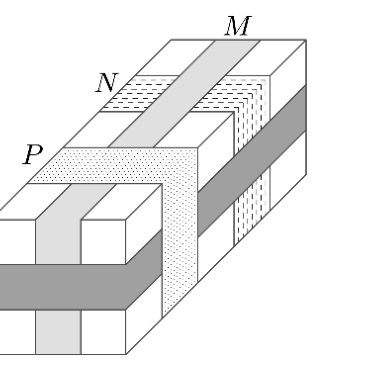
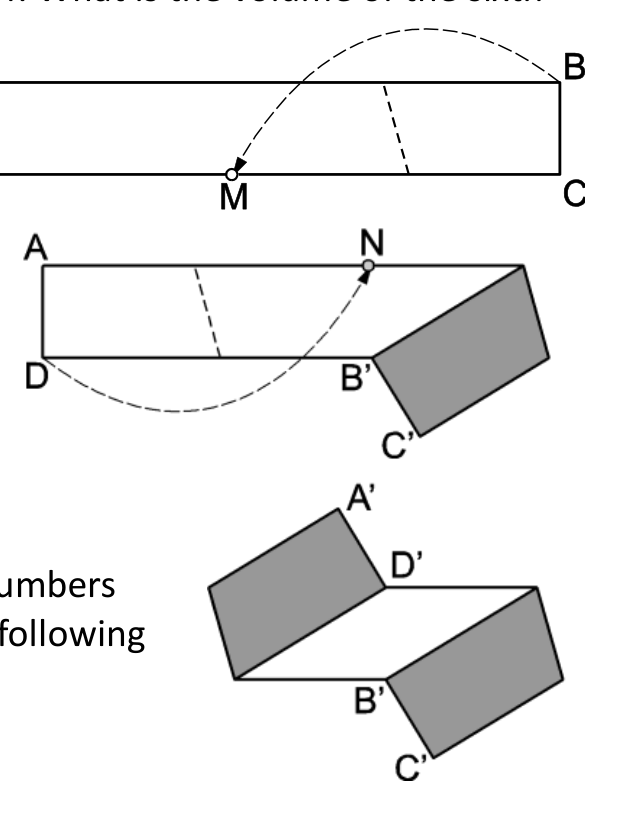
The left and right parts of a three-part brochure each contain four transparent windows. If these two parts are folded onto the middle part, some of the numbers written on the middle part are visible through the windows. What is the sum of the visible numbers when the brochure is folded?
Show answer
Answer: D — 14
Show hints
Hint 1 of 3
Both side panels fold over the middle, stacking on top of each other, so each panel reflects left-right as it closes.
Still stuck? Show hint 2 →
Hint 2 of 3
A middle number shows only if BOTH the left panel and the right panel have a window over that same cell.
Still stuck? Show hint 3 →
Hint 3 of 3
Find the windows each panel lands on after folding, then keep only the cells where the two sets of windows overlap.
Show solution
Approach: intersect the two panels' window positions
Both flaps fold inward and cover the whole 3×3 middle, so a number is visible only where the left flap AND the right flap both have a window (you must see through both layers).
Folding the left flap (it reflects) puts its windows over the middle's two right columns; folding the right flap puts its windows over the middle's two left columns — they overlap only in the centre column.
There the visible numbers are 9 (top) and 5 (middle), so the sum is \(9+5=14\), answer D.
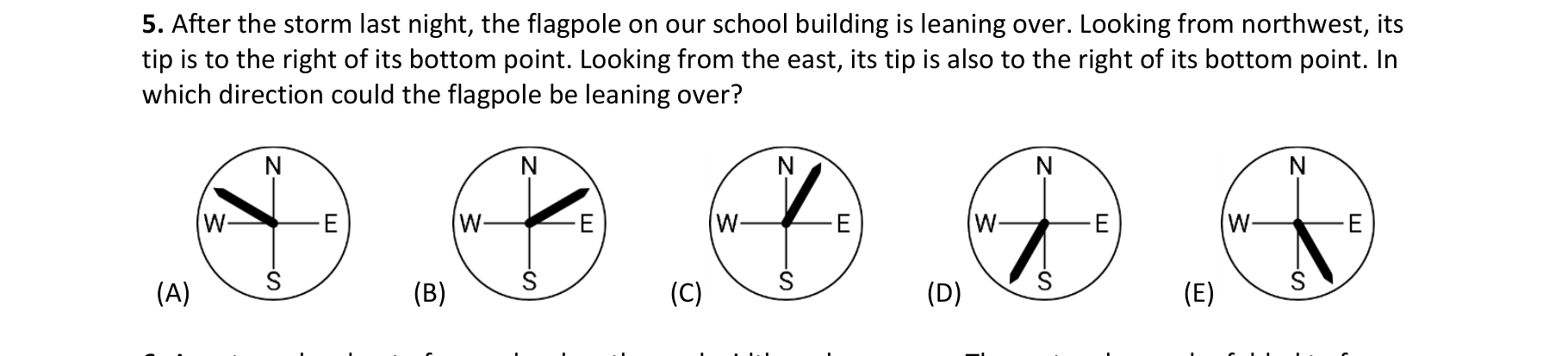
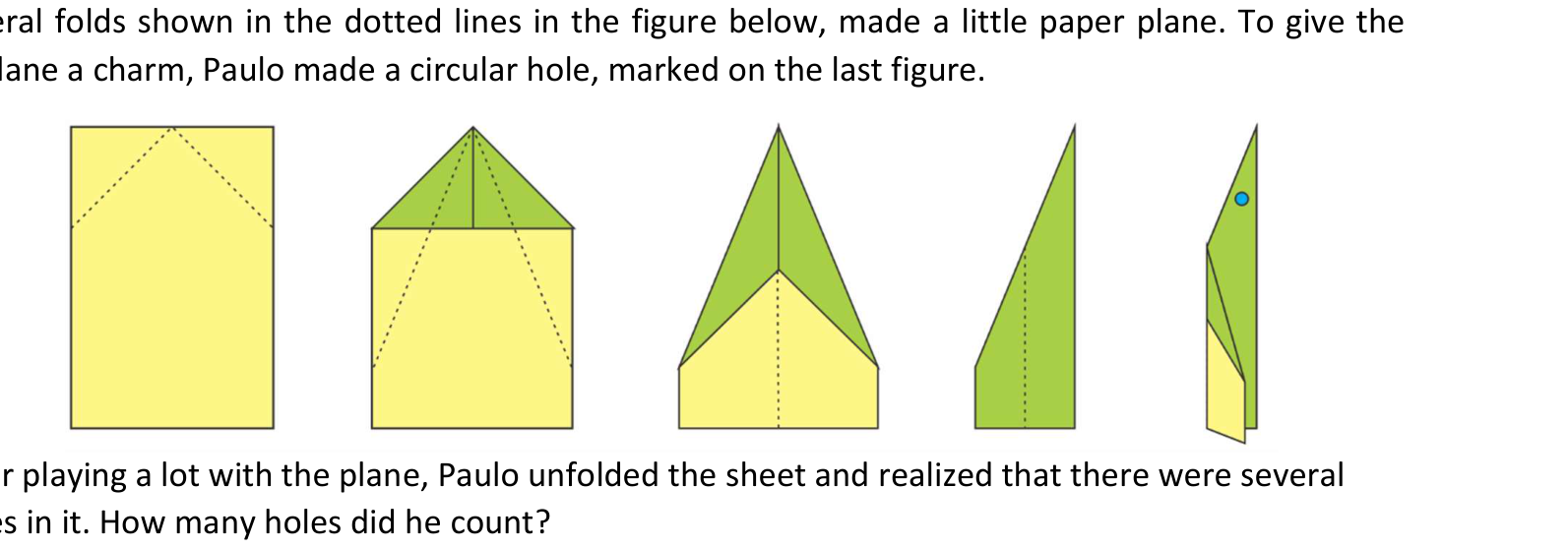
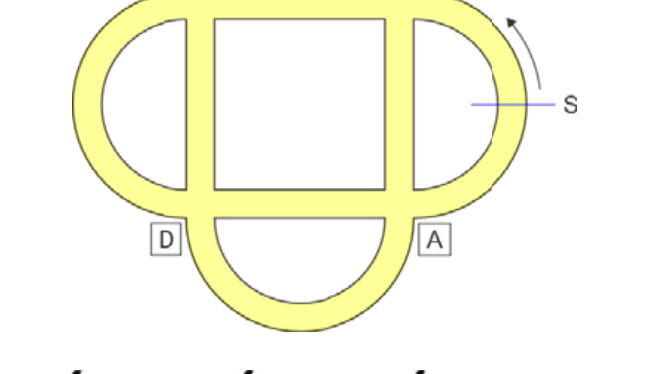
Thea rotates a painted hexagon clockwise one space at a time. The first rotation can be seen in the picture. Which hexagon does Thea see after the eighth rotation? (The five choices A–E are pictured below the question.)
Show answer
Answer: A
Show hints
Hint 1 of 2
The hexagon has 6 sectors, so rotating 6 times brings it back to the start.
Still stuck? Show hint 2 →
Hint 2 of 2
Eight rotations is the same as just 8 − 6 = 2 rotations.
Show solution
Approach: rotation repeats every 6 steps
A hexagon has 6 sectors, so after 6 one-step turns it looks exactly like the start — the pattern repeats every 6 rotations.
So the 8th rotation looks the same as the 8 − 6 = 2nd rotation; we only need to turn the starting hexagon two steps clockwise.
Turning the Start picture two sectors clockwise matches choice (A), so that is what Thea sees after the eighth rotation.
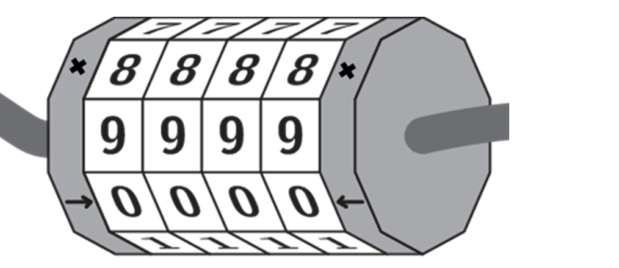
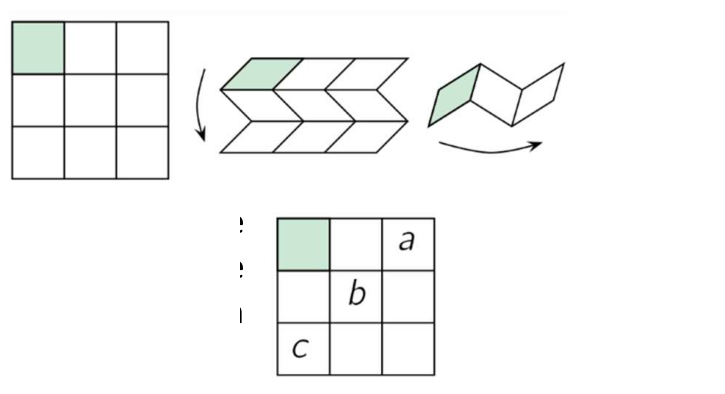
When Paul sets the number 0000 on his bicycle lock, he sees 8888 at the point marked with an x. To open the lock he must turn the rings so that 2815 shows at the x mark. What number is then next to the arrows?
Show answer
Answer: A — 4037
Show hints
Hint 1 of 2
Compare the two visible windows: at the arrows you see 0, two rows up at the x you see 8.
Still stuck? Show hint 2 →
Hint 2 of 2
Each ring is offset by a fixed amount; find the digit at the arrows for each target digit at the x.
Show solution
Approach: use the fixed offset between the x-window and the arrow-window
When the arrows show 0 the x shows 8, so on every ring the arrow digit is 2 more than the x digit (the rows run …,8,9,0,… downward).
Setting 2,8,1,5 at the x makes the arrows read 2+2, 8+2, 1+2, 5+2 (mod 10) = 4, 0, 3, 7.
Each square below is cut into two pieces by a line. Which square was divided into two pieces that are different in shape? (The answer choices are the five pictured squares.)
Show answer
Answer: E
Show hints
Hint 1 of 3
For each square, look at the two pieces and ask: are they the same shape and size?
Still stuck? Show hint 2 →
Hint 2 of 3
Imagine cutting along the line and laying one piece on top of the other — in four squares they match exactly.
Still stuck? Show hint 3 →
Hint 3 of 3
Find the one square where the two pieces would NOT stack on top of each other.
Show solution
Approach: for each square, check whether the two pieces are the same
In each square, picture cutting along the line and laying one piece on top of the other.
In four of the squares the two pieces stack perfectly — they are the same shape and size.
In one square the pieces are clearly different: one is bigger or a different shape, so they cannot stack.
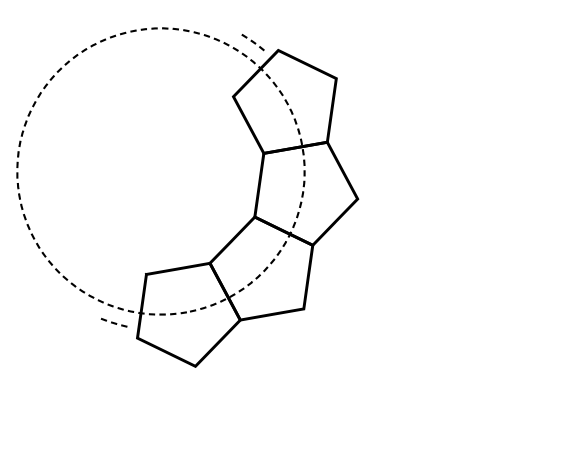
The diagram on the right is made up of five-sided tiles of equal size. Which tile can be inserted in the missing spot so that two closed lines are formed?
Show answer
Answer: C
Show hints
Hint 1 of 2
The grid in the corner already has lines running into the empty slot; the inserted tile must continue them.
Still stuck? Show hint 2 →
Hint 2 of 2
You need the two arcs in the hole to join up into exactly two separate closed loops, so match where each line meets the tile's edges.
Show solution
Approach: match the line endpoints so the curves close into two loops
Look at where the existing curves hit the boundary of the missing pentagon-shaped slot.
The added tile must have its two arcs touch those same edge points so the strokes connect.
Only the tile whose arcs link the open ends into two complete closed lines works.
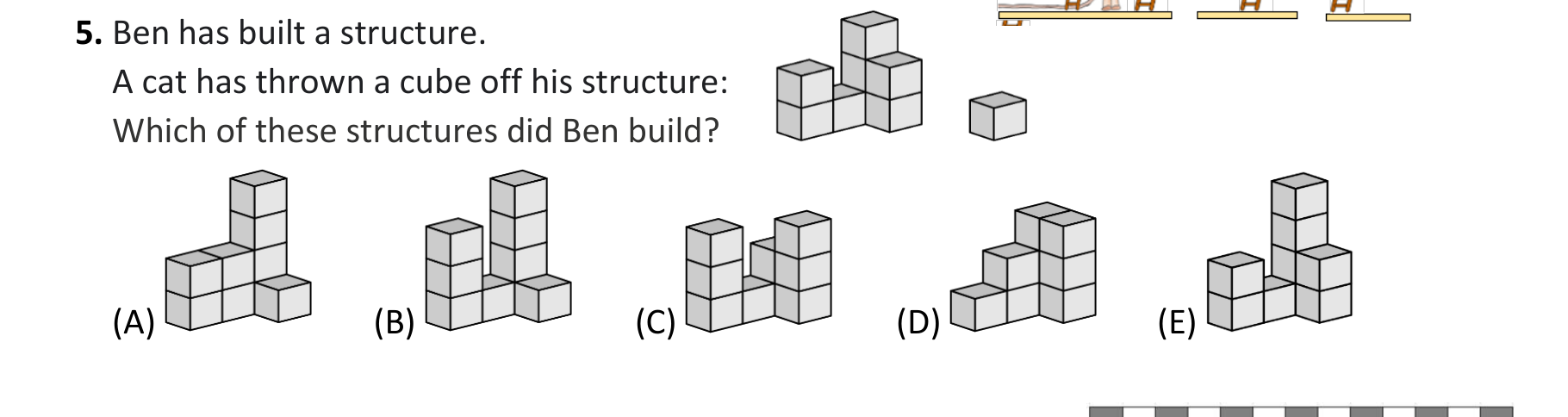
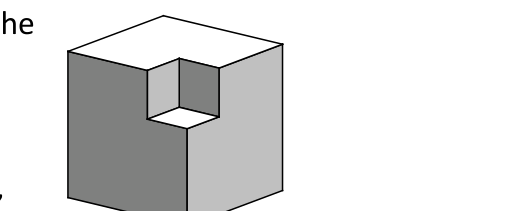
Ben built a structure out of cubes. A cat then knocked one cube off it. The picture on the right shows the knocked-down structure together with the loose cube that fell. Which of the five pictured structures (A)–(E) did Ben originally build?
Show answer
Answer: E
Show hints
Hint 1 of 3
The picture shows the knocked-down structure plus one loose cube that fell off, so Ben's tower had one more cube than the picture.
Still stuck? Show hint 2 →
Hint 2 of 3
Take each answer choice and cover up one cube — you want the one that is then left looking exactly like the pictured structure.
Still stuck? Show hint 3 →
Hint 3 of 3
Match the cubes spot by spot, remembering the loose cube goes back on top of the tall part.
Show solution
Approach: put the fallen cube back and match the cube positions to an option
The cat knocked one cube off, so Ben's real structure is the pictured shape with that one loose cube added back on.
Put the loose cube back where it fits (on the tall stack) and look at the whole shape.
Now compare that finished shape, cube by cube, with each answer choice.
Only one choice has its cubes in exactly the same spots: E.
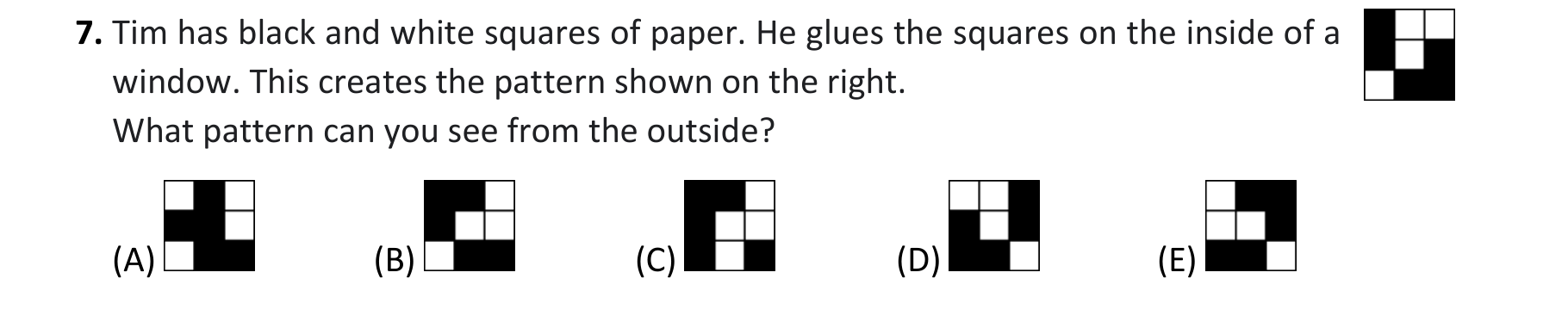
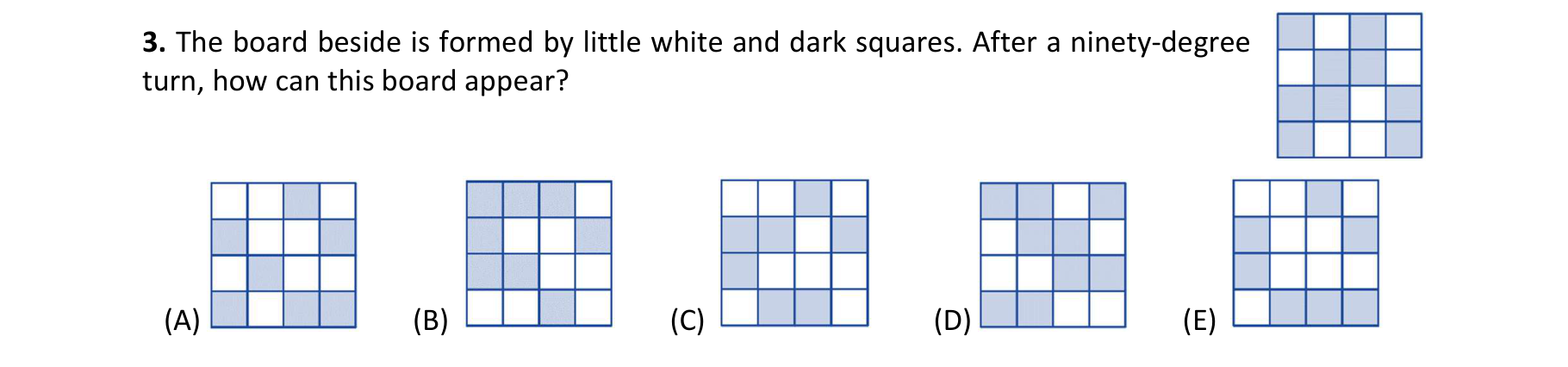
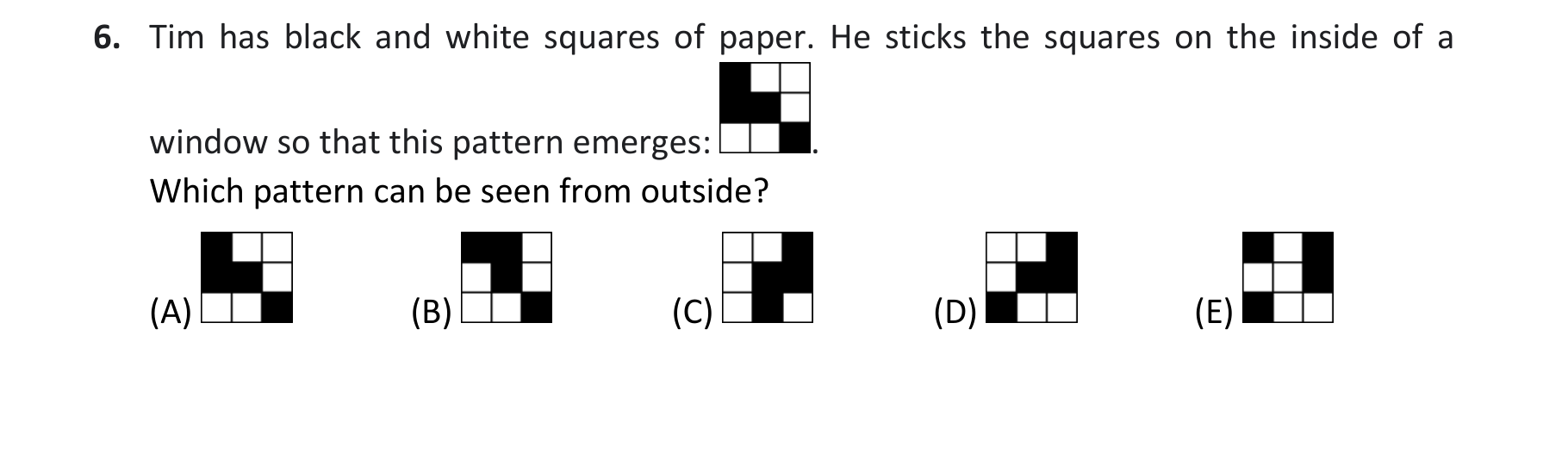
Tim has black and white paper squares. He glues them onto the inside of a window, making the pattern shown on the right. What pattern do you see when you look at the window from the outside? (The answer choices are the five pictured grids.)
Show answer
Answer: D
Show hints
Hint 1 of 3
Think about looking at a sticker stuck on the inside of a window when you walk around to the outside.
Still stuck? Show hint 2 →
Hint 2 of 3
Seen from the other side, the picture is flipped left-to-right (like in a mirror), but the top stays on top.
Still stuck? Show hint 3 →
Hint 3 of 3
Flip the shown pattern so its left column becomes the right column, then find the matching choice.
Show solution
Approach: flip the inside pattern left-to-right to see it from outside
The squares are glued on the inside, so from the outside you see the same picture flipped left-to-right (top still on top).
Flipping swaps each row's leftmost cell with its rightmost cell.
Holger writes the numbers up to 40 into the table in the same way as shown. Which of the pieces A to E can he then cut out from the table?
Show answer
Answer: C
Show hints
Hint 1 of 2
The numbers fill the table eight to a row: 1-8, then 9-16, then 17-24, and so on.
Still stuck? Show hint 2 →
Hint 2 of 2
Pin down where 12 sits, then check that the two cells just below it really hold 20 and 21, and that the cell hanging beneath them matches the piece's shape.
Show solution
Approach: locate the cells by their row-of-eight positions and match the exact shape
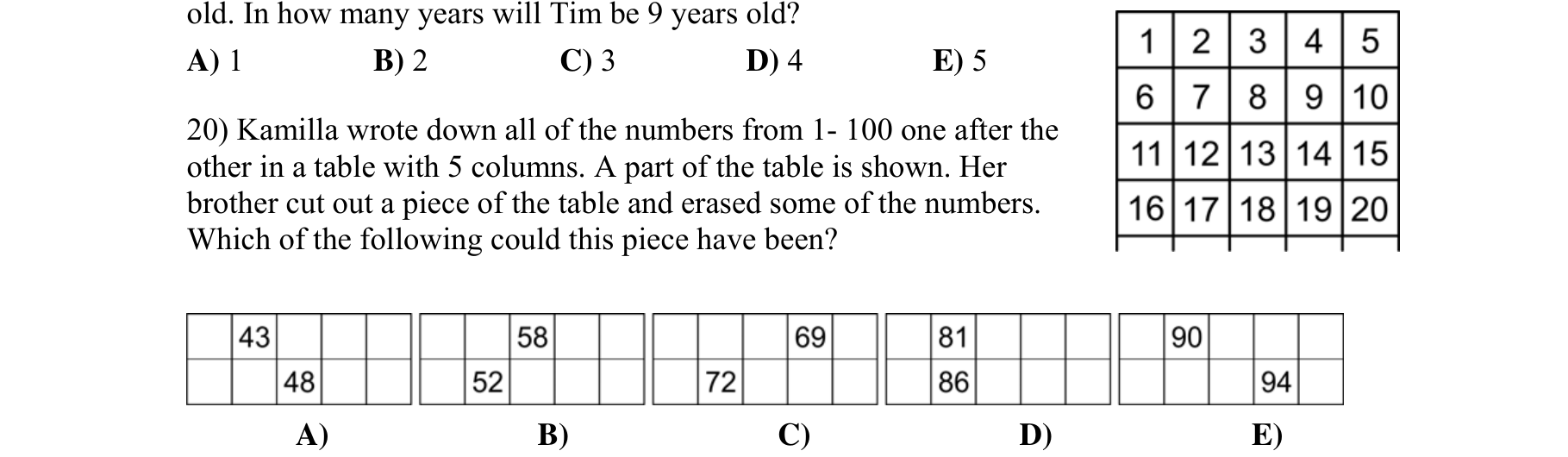
Each row holds eight numbers, so 12 sits in the second row, fourth column.
Directly under 12 are 20 then 21 (third row), and beneath 21 sits 29 (fourth row).
The piece whose three cells read 12 on top, 20 and 21 in the middle, and 29 hanging under the 21 is the only one whose outline matches these real positions.
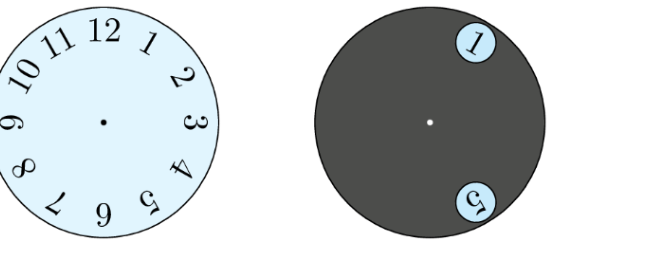
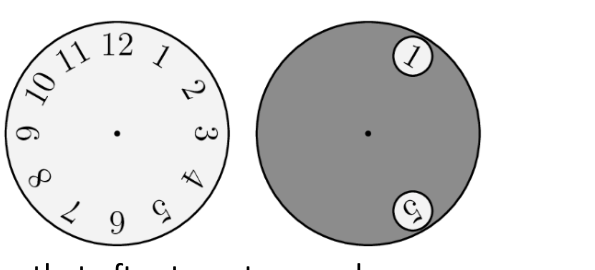
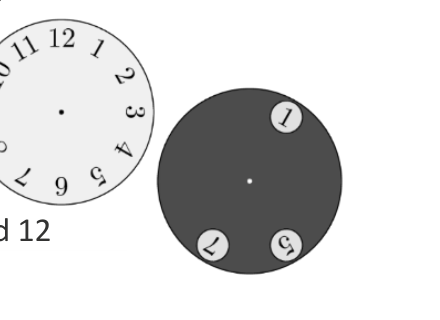
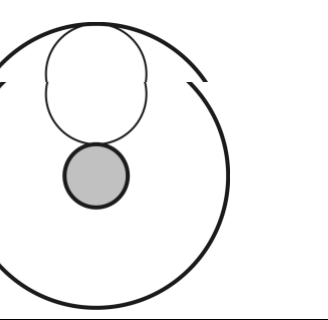
A dark disc with two holes is placed on top of the dial of a watch, as shown. The dark disc is now rotated so that the number 8 can be seen through one of the holes. Which numbers could one see through the other hole now?
Show answer
Answer: A — 4 and 12
Show hints
Hint 1 of 2
The two holes keep a fixed angular gap as the whole disc turns.
Still stuck? Show hint 2 →
Hint 2 of 2
Find which two clock numbers sit the same angular distance apart as the two holes.
Show solution
Approach: use the fixed angular spacing between the two holes
In the picture the two holes sit over the 1 and the 5, so they are a fixed 4 hours apart on the disc.
If 8 shows in the hole that was over the 1, the disc turned 7 hours, so the other hole (was over 5) now shows 5 + 7 = 12.
If 8 shows in the hole that was over the 5, the disc turned 3 hours, so the other hole (was over 1) now shows 1 + 3 = 4.
So the other hole shows 4 or 12, which is option A.
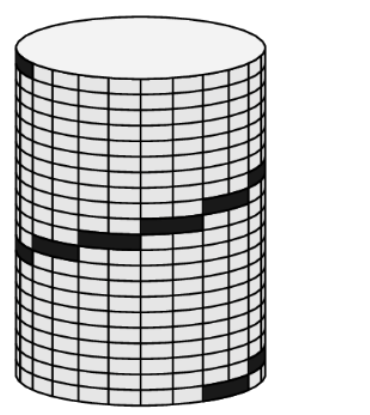
Nine steps of a staircase winding around a cylinder can be seen, starting at the bottom and leading all the way to the top. All the steps are equally high. How many steps cannot be seen?
Show answer
Answer: D — 12
Show hints
Hint 1 of 3
From the front you only see the steps facing you; the rest of the staircase keeps winding around the hidden back of the cylinder.
Still stuck? Show hint 2 →
Hint 2 of 3
The picture shows the front-facing steps spiralling up; figure out how high the whole tower climbs, then take away the nine you can already see.
Still stuck? Show hint 3 →
Hint 3 of 3
Each level of the spiral has steps on both the front and the back, so the hidden back steps roughly mirror the visible front ones, plus a few more for the extra height.
Show solution
Approach: see that the spiral has front and back steps at each level, then count the hidden ones
The nine steps you can see are the ones facing you as the staircase spirals up the front of the cylinder.
As the spiral turns, the same number of steps run around the hidden back at each level, and the tower keeps climbing past where the front steps stop.
Counting the back steps level by level all the way to the top gives twelve steps that are turned away and cannot be seen.
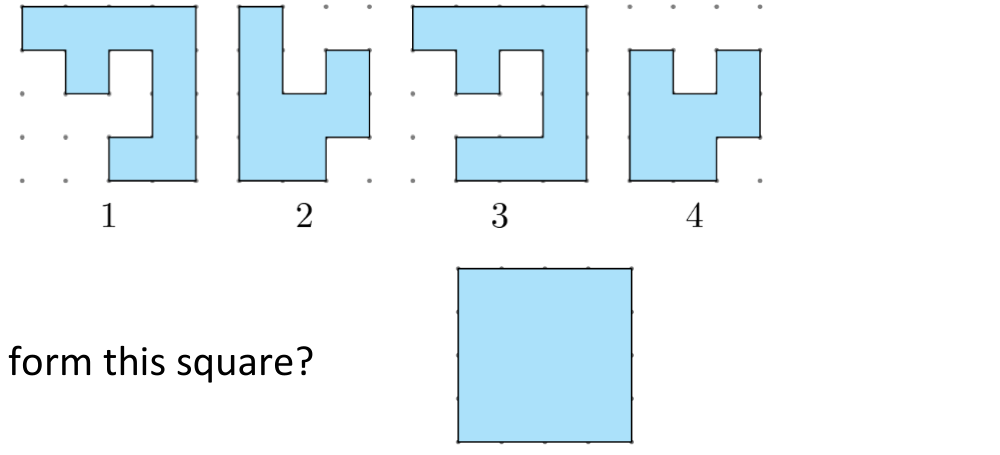
A grid should be cut along the black lines into several identical shapes, with no piece left over. Into which of the following shapes is it not possible to cut this grid in this way?
Show answer
Answer: D
Show hints
Hint 1 of 2
Count the cells of the grid; the number of cells in one tile must divide that total exactly.
Still stuck? Show hint 2 →
Hint 2 of 2
Even when the count divides evenly, also try to actually fit copies of the tile — the one that always leaves an unfillable gap is the answer.
Show solution
Approach: test which shape can tile the whole grid with no leftover
First check the cell count: the number of cells in one tile must divide the total number of cells in the grid.
For the shapes that pass that check, try fitting copies into the grid; most can be arranged to cover it exactly.
The shape in option D can never be placed to cover the grid with no piece left over.
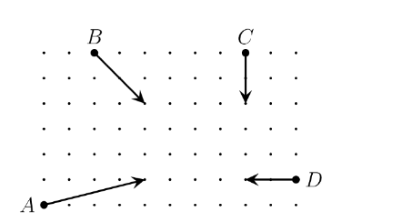
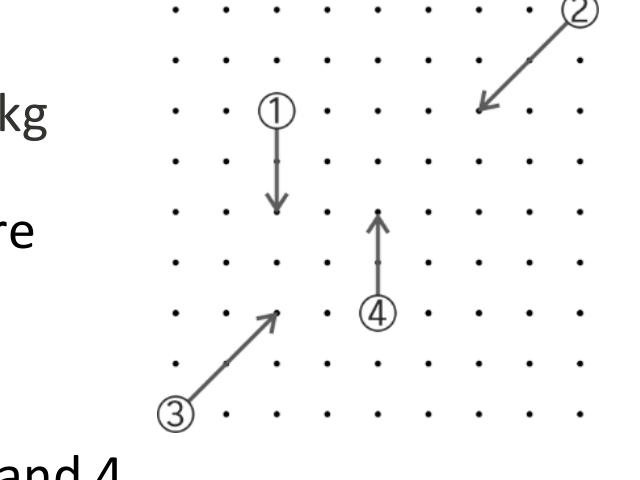
The diagram shows the starting position, the direction and the distance covered within 5 seconds by four bumper cars. Which two cars will first crash into each other?
Show answer
Answer: B — A and C
Show hints
Hint 1 of 2
Mark where each car ends up after its arrow's full length.
Still stuck? Show hint 2 →
Hint 2 of 2
The first crash is between the two cars whose paths meet soonest, not just whose endpoints are near.
Show solution
Approach: track each car's motion on the grid and find the earliest collision
Each arrow gives a car's direction and the distance it covers in the 5 seconds.
Following the paths, cars A and C are heading onto the same point first.
Their tracks intersect before any other pair's, so the first crash is A and C (B).
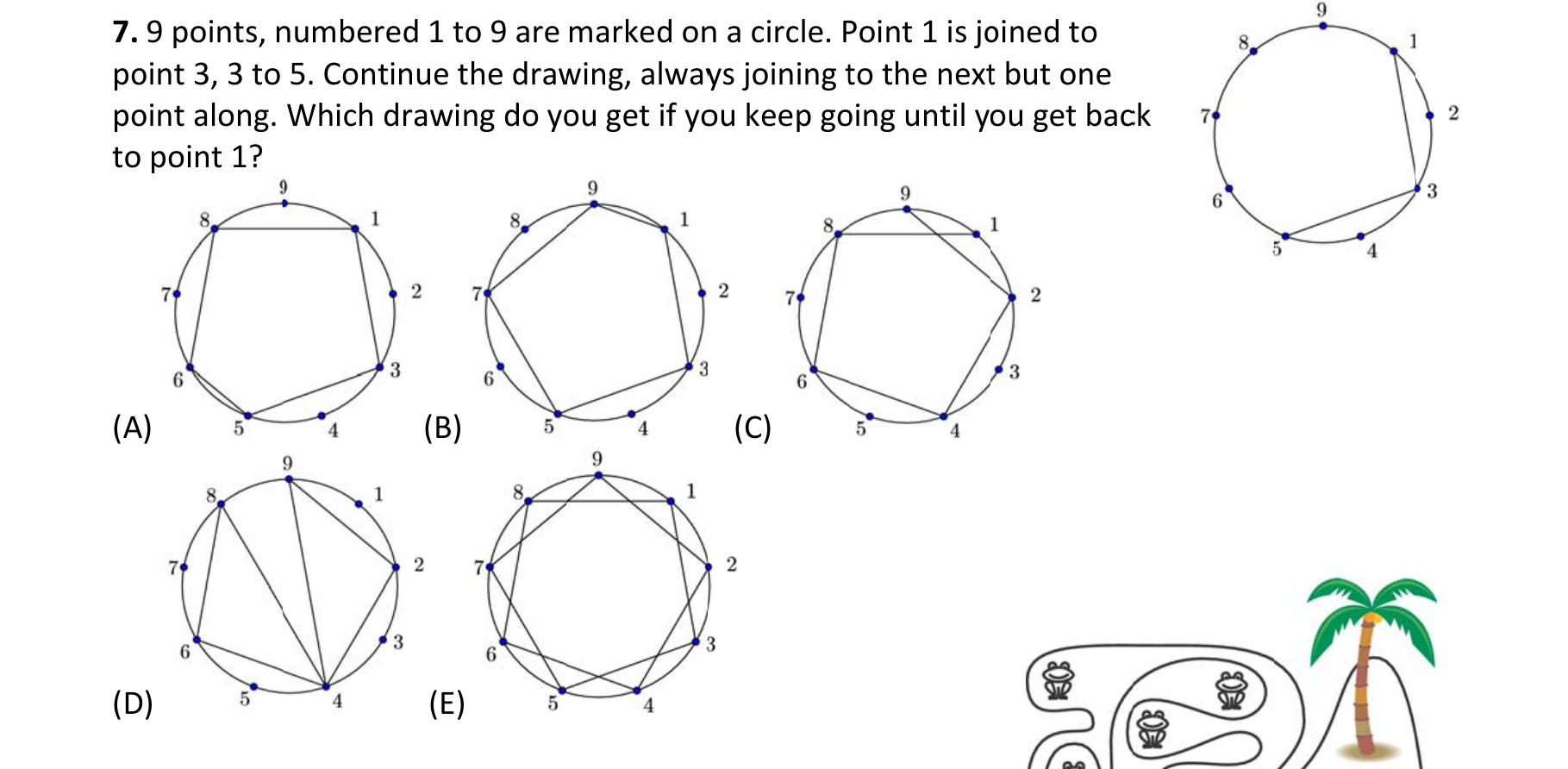
Six points are placed and numbered as shown on the right. Two triangles are drawn: one by connecting the even-numbered points, and one by connecting the odd-numbered points. Which of the following shapes is the result?
Show answer
Answer: E
Show hints
Hint 1 of 2
Mark which of the six points are odd (1,3,5) and which are even (2,4,6), then picture the two triangles they make.
Still stuck? Show hint 2 →
Hint 2 of 2
Each triangle is fixed by its three points; overlay them and compare the combined outline to each option.
Show solution
Approach: connect the odd and even points and match the overlaid figure
The odd points 1,3,5 form one triangle and the even points 2,4,6 form another.
Drawing both on the given point positions, the two triangles cross each other in a particular way.
Comparing that overlap with the choices, only E reproduces it.
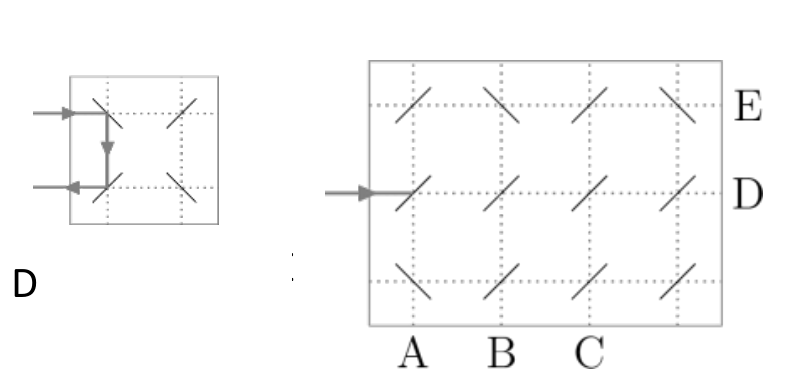
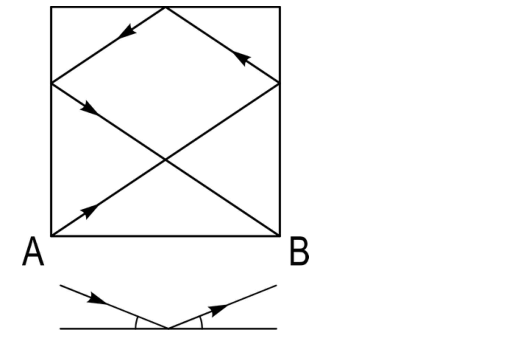
The two-sided mirrors reflect the laser beam as shown in the small picture on the left. At which letter does the laser beam leave the picture on the right?
Show answer
Answer: B — B
Show hints
Hint 1 of 2
Each diagonal mirror turns the beam by a right angle; the small example shows which way.
Still stuck? Show hint 2 →
Hint 2 of 2
Step the beam square by square, bouncing 90 degrees at every mirror, until it reaches an edge.
Show solution
Approach: trace the beam, reflecting 90 degrees at each mirror
Use the small picture to learn how each slanted mirror deflects the beam.
Starting from the entry arrow on the big grid, advance the beam and turn it a quarter-turn at every mirror it hits.
Following the bounces, the beam leaves the grid at letter B.
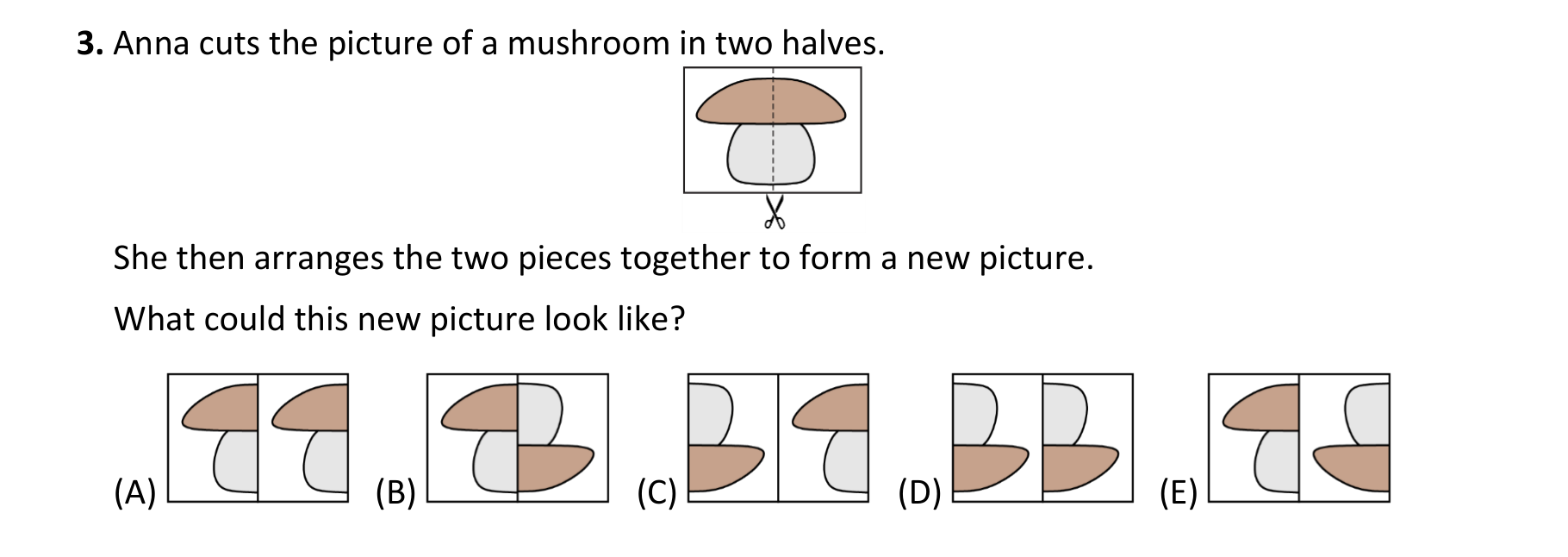
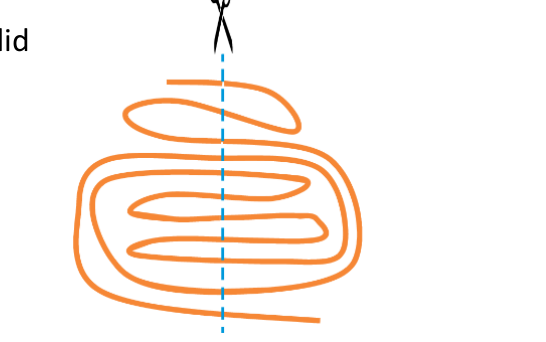
Anna cuts the picture of a mushroom in two halves (straight down the middle). She then arranges the two pieces together to form a new picture. What could this new picture look like?
Show answer
Answer: E
Show hints
Hint 1 of 2
The dashed line cuts the mushroom straight down the middle, so each piece is exactly one half.
Still stuck? Show hint 2 →
Hint 2 of 2
When you slide the two halves back together, they must add up to exactly one whole cap and one whole stem - no extra pieces, none missing.
Show solution
Approach: the two halves must add back up to one whole mushroom's worth
Cutting down the middle gives a left half and a right half, each with half a cap and half a stem.
No matter how Anna turns or slides them, the two pieces together still hold exactly one full cap's worth of brown and one full stem's worth of grey.
Only picture E is made from exactly those two matching halves, so the answer is E.
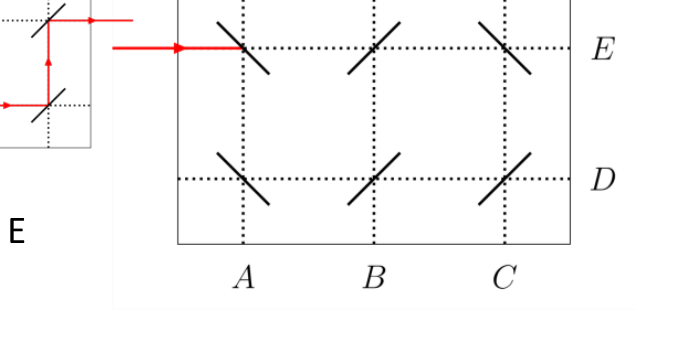
When a laser beam hits a mirror it changes direction (see the small diagram). Each mirror reflects on both of its sides. At which letter does the laser beam come out?
Show answer
Answer: B — B
Show hints
Hint 1 of 3
Put your finger where the beam starts and slide it along, but turn a corner every time you reach a slanted mirror.
Still stuck? Show hint 2 →
Hint 2 of 3
A mirror leaning like '\' turns a beam going across into a beam going down; a mirror leaning like '/' turns it the other way.
Still stuck? Show hint 3 →
Hint 3 of 3
Keep sliding and turning until your finger walks off the edge at one of the letters.
Show solution
Approach: trace the beam one mirror at a time
Start your finger on the beam and slide it straight until it touches the first slanted mirror.
At each mirror, make a quarter turn the way the mirror leans, then keep sliding.
Following every bounce, the finger leaves the grid at the letter B.
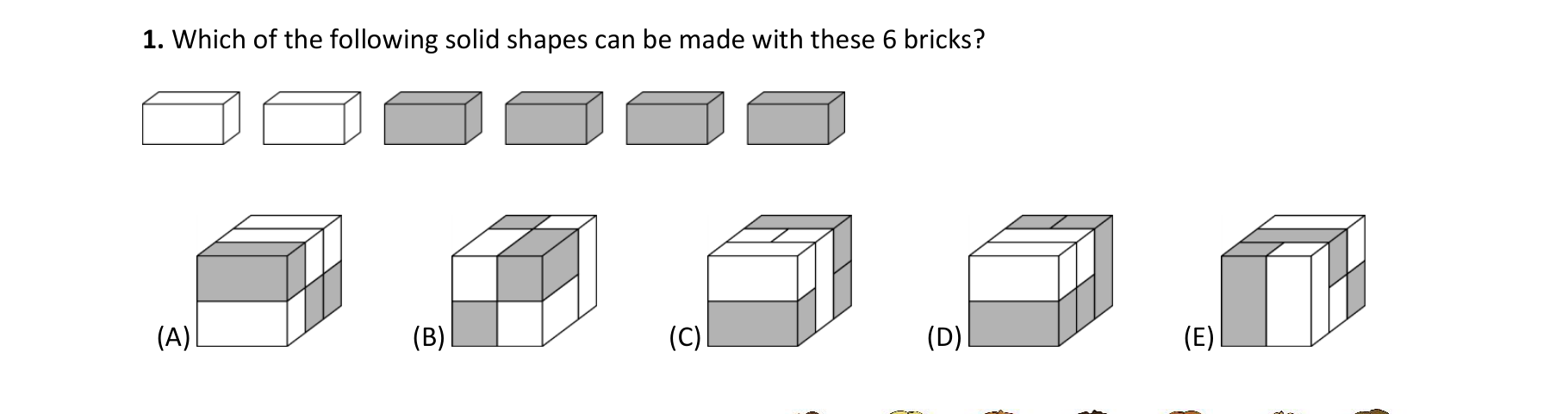
Which of the following solid shapes can be made with these 6 bricks?
Show answer
Answer: D
Show hints
Hint 1 of 2
The 6 bricks are 2 white and 4 grey, and each brick is a 1x1x2 block.
Still stuck? Show hint 2 →
Hint 2 of 2
Build the answer from twelve unit cubes (4 white, 8 grey) and check which picture shows exactly that count of each colour with the brick seams in the right places.
Show solution
Approach: match brick colours and seams to a solid
Two white bricks and four grey bricks supply 4 white unit cubes and 8 grey unit cubes.
The assembled solid must show that 2:1 grey-to-white split, with the visible faces and the seams between bricks lining up.
Only choice D shows a solid whose colouring and brick seams can come from these six bricks.
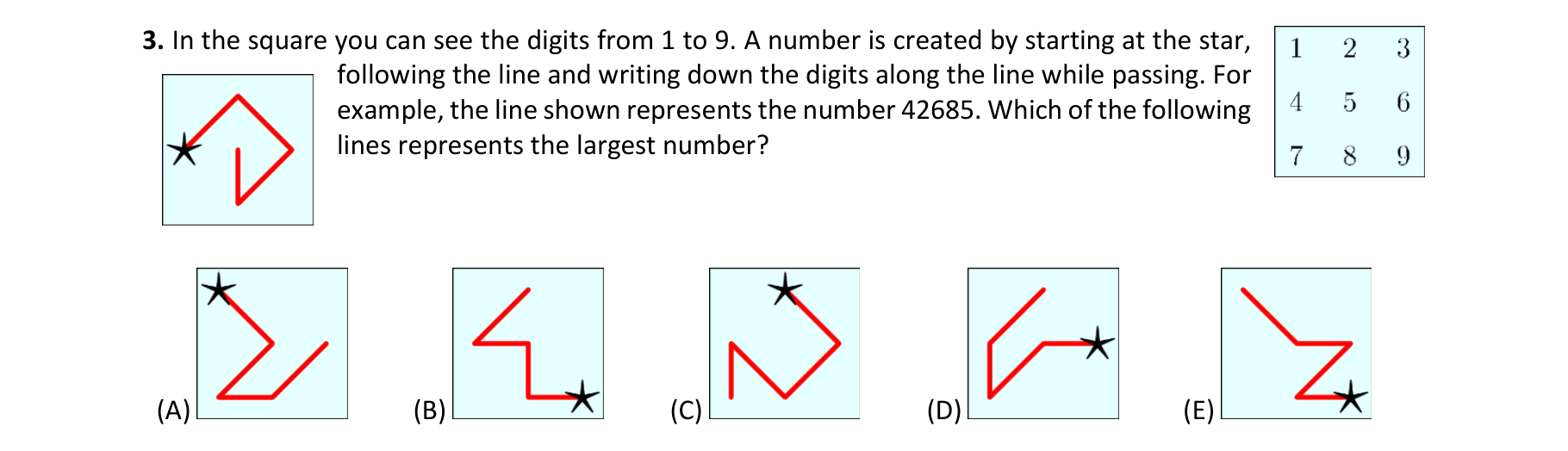
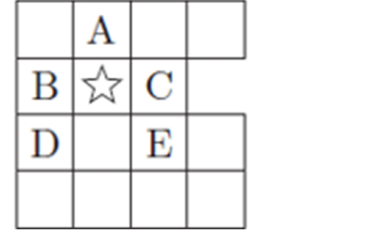
In the square you can see the digits from 1 to 9. A number is created by starting at the star, following the line and writing down the digits along the line while passing. For example, the line shown represents the number 42685. Which of the following lines represents the largest number?
Show answer
Answer: E
Show hints
Hint 1 of 2
Read off the digit string each path makes, then compare them as numbers.
Still stuck? Show hint 2 →
Hint 2 of 2
The biggest number starts with the largest leading digit; break ties by the next digit.
Show solution
Approach: trace each path into a number and compare
Each option traces a path from the star across cells of the 1-9 grid, writing the digit of every cell it passes.
Convert each path to its number and compare digit by digit from the left.
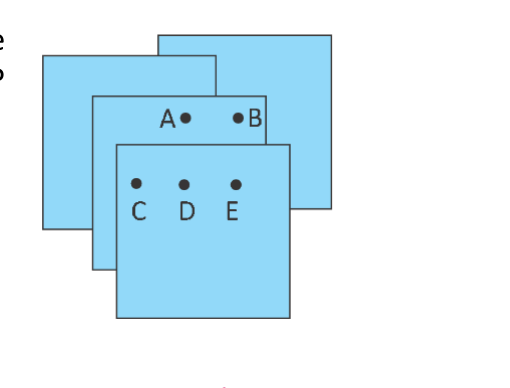
Four identical pieces of paper are placed as shown. Michael wants to punch a hole that goes through all four pieces. At which point should Michael punch the hole?
Show answer
Answer: D — D
Show hints
Hint 1 of 3
The hole has to go through all four pieces of paper at once.
Still stuck? Show hint 2 →
Hint 2 of 3
So the spot must be covered by every single sheet.
Still stuck? Show hint 3 →
Hint 3 of 3
Look for the dot that sits on top of all four sheets together.
Show solution
Approach: find the common overlap point
A hole through all four sheets must sit where all four sheets overlap.
Checking the marked points, only point D lies in the part shared by every sheet.
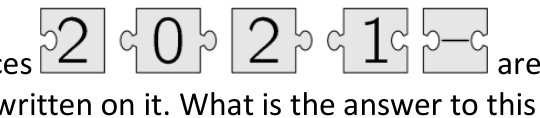
When the 5 pieces shown are fitted together correctly, the result is a rectangle with a calculation written on it. What is the answer to this calculation?
Show answer
Answer: A — −100
Show hints
Hint 1 of 2
Fit the jigsaw pieces into a rectangle so the symbols line up into a single calculation.
Still stuck? Show hint 2 →
Hint 2 of 2
Once assembled it reads a short arithmetic expression — just evaluate it.
Show solution
Approach: assemble the pieces into the expression and compute
The five pieces fit together to spell out a calculation using the digits 2, 0, 2, 1 and a minus sign.
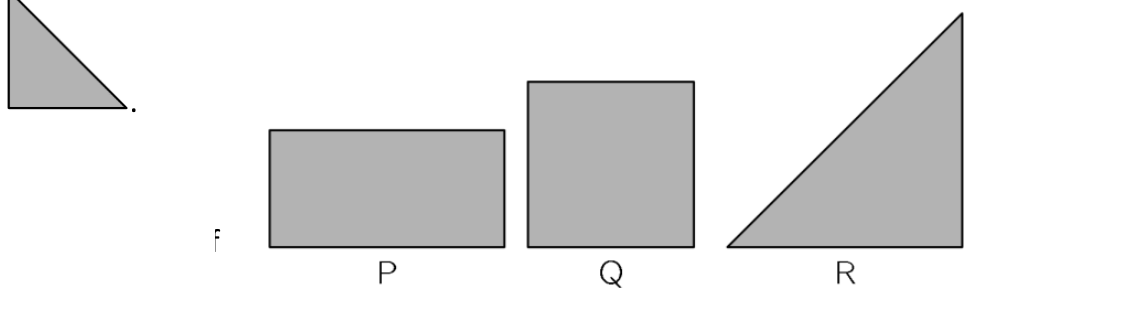
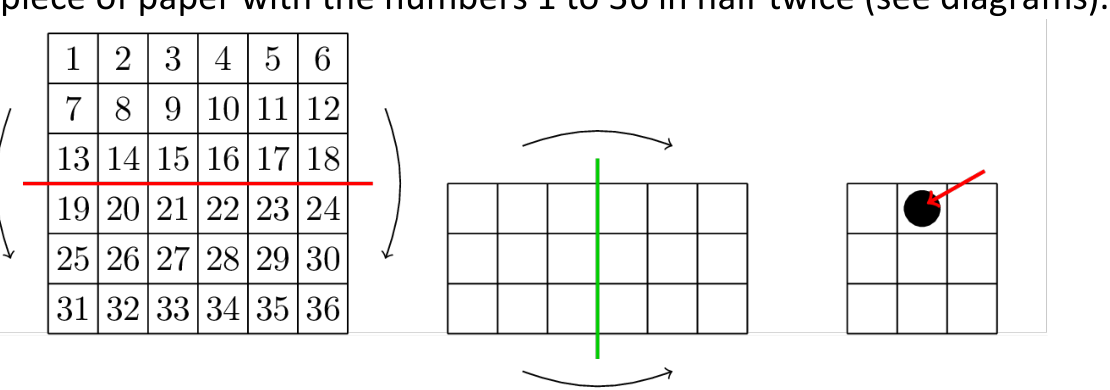
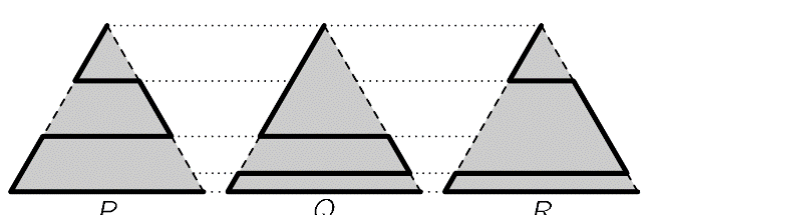
Mary had a piece of paper. She folded it exactly in half. Then she folded it exactly in half again. She got the small shape shown on the left (a right triangle). Which of the shapes P, Q or R could have been the shape of her original piece of paper?
Show answer
Answer: E — any of P, Q or R
Show hints
Hint 1 of 2
Folding once then again maps the original onto a quarter-size shape; run it backwards.
Still stuck? Show hint 2 →
Hint 2 of 2
Unfold the right triangle twice and check which of P, Q, R it could grow back into.
Show solution
Approach: unfold the result twice
Folding a sheet in half twice can turn a rectangle, a square, or a larger right triangle into this small right triangle.
Unfolding the given triangle can recreate any of shapes P, Q or R, so the answer is E (any of P, Q or R).
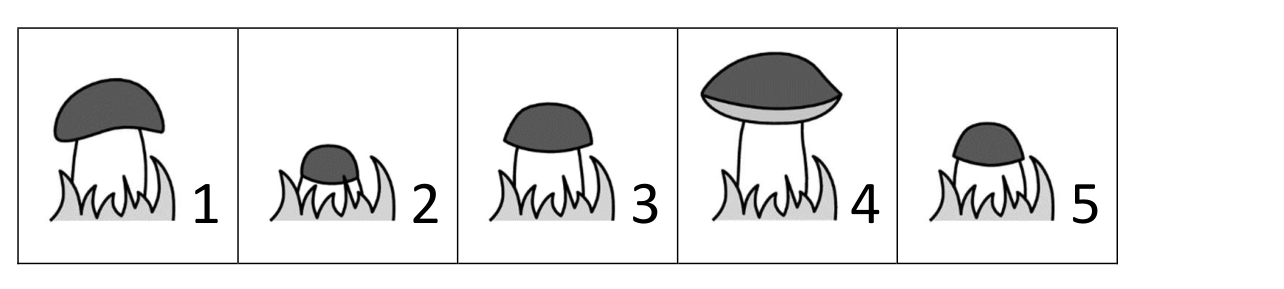
A mushroom grows a little bigger every day. Over five days Maria took a photo of this mushroom, but she put the photos in the wrong order (see picture). Which order of the photos shows the mushroom growing, from left to right?
Show answer
Answer: A — 2-5-3-1-4
Show hints
Hint 1 of 2
A mushroom only gets bigger from one day to the next, so order the photos from smallest cap to largest cap.
Still stuck? Show hint 2 →
Hint 2 of 2
Find the tiniest mushroom and read the labels in growing order.
Show solution
Approach: order the photos from smallest to largest mushroom
The mushroom grows every day, so the correct order goes from the smallest cap to the biggest, fully opened cap.
Reading the photo labels from smallest to largest gives the sequence in choice A: 2-5-3-1-4.
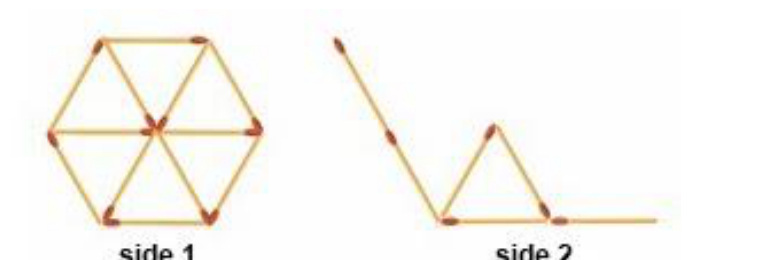
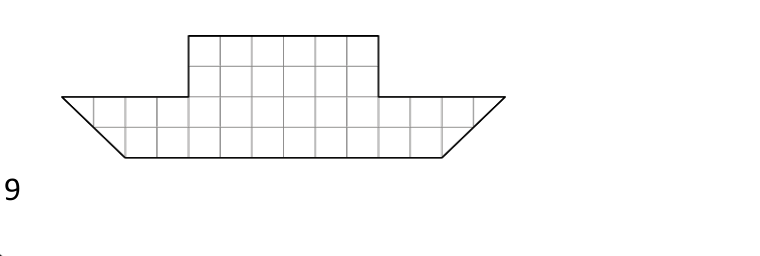
The figure of side 1 is formed by six equal triangles, made with 12 matchsticks. How many matchsticks are needed to complete the figure of side 2, shown partially started?
Show answer
Answer: D — 36
Show hints
Hint 1 of 2
Side 1 (a hexagon of six triangles) uses 12 sticks; side 2 is the next size up of the same pattern.
Still stuck? Show hint 2 →
Hint 2 of 2
Count the matchsticks in the full side-2 figure — the stick count grows faster than the side.
Show solution
Approach: scale the matchstick count to the next size
Side 1 is six small triangles forming a hexagon and needs 12 sticks.
Side 2 is the same hexagonal pattern built one size larger, and a full count of its segments comes to 36 sticks.
So 36 matchsticks are needed to complete the side-2 figure — choice D.
A 3 × 3 × 3 cube is made up of small 1 × 1 × 1 cubes. Then the middle cubes from front to back, from top to bottom and from right to left are removed (see diagram). How many 1 × 1 × 1 cubes remain?
Show answer
Answer: C — 20
Show hints
Hint 1 of 2
Start from all 27 small cubes and figure out exactly which ones get drilled away.
Still stuck? Show hint 2 →
Hint 2 of 2
The three tunnels all pass through the very middle, so the centre cube is removed only once.
Show solution
Approach: count removed cubes, watch the shared centre
A 3×3×3 block has 27 unit cubes.
Each of the three tunnels (front-back, top-bottom, left-right) removes the 3 cubes down its middle line.
All three lines share the single centre cube, so together they remove the centre plus 6 face-centre cubes = 7 cubes.
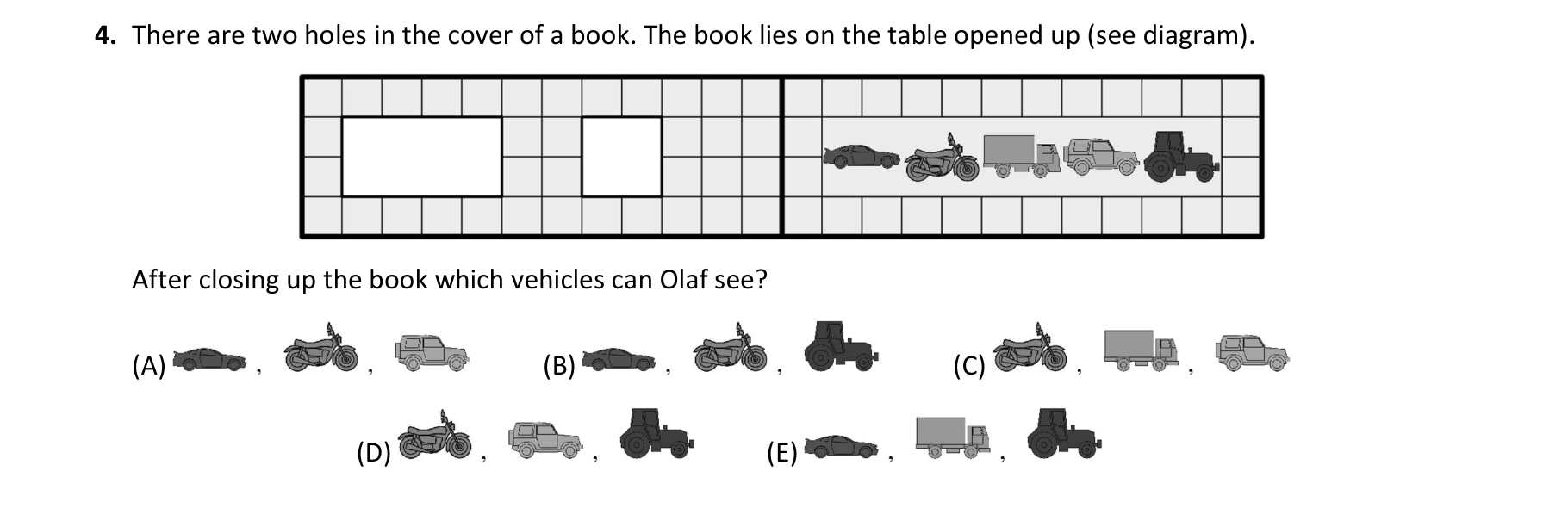
There are two holes in the cover of a book. The book lies on the table opened up (see diagram). After closing up the book, which vehicles can Olaf see through the two holes?
Show answer
Answer: D
Show hints
Hint 1 of 2
When the cover folds over, the holes line up above the page on the right.
Still stuck? Show hint 2 →
Hint 2 of 2
The folded cover flips left-to-right, so the vehicles appear in mirror order through the two windows.
Show solution
Approach: fold the cover and look through the holes
Folding the cover onto the page flips it like a mirror.
The two holes then sit over two groups of vehicles, but in reversed left-right order.
Matching the windows to the line of vehicles gives the set in option D.
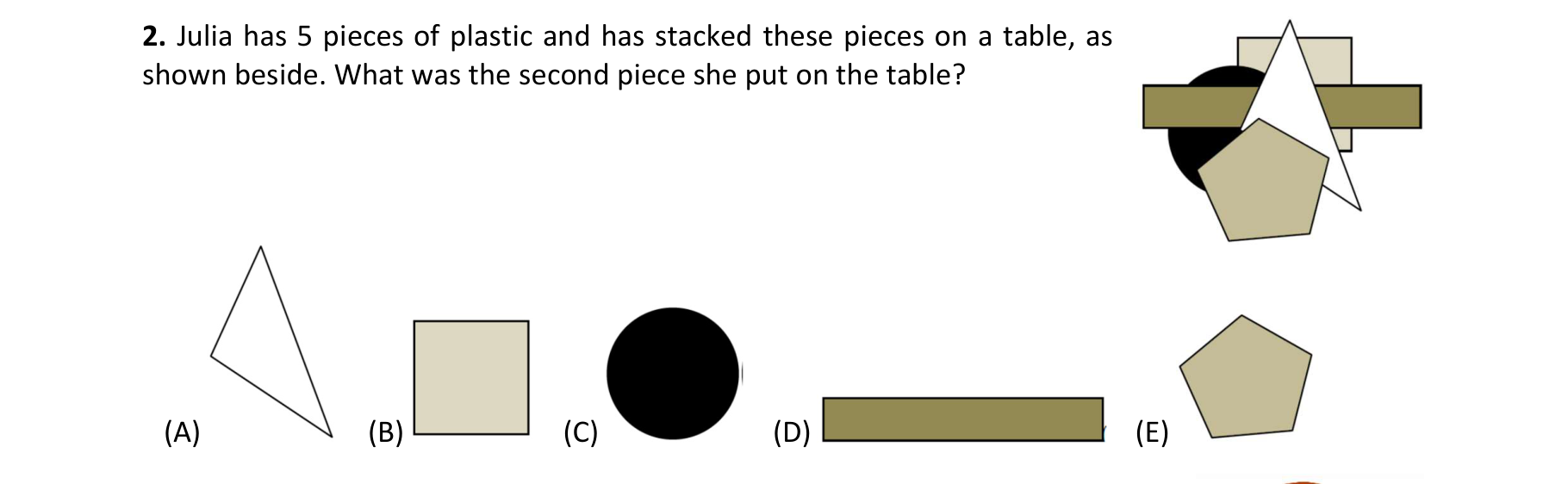
Five equally big square pieces of card are placed on a table on top of each other, making the picture shown. The cards are collected up from top to bottom. In which order are they collected?
Show answer
Answer: E — 5-2-3-1-4
Show hints
Hint 1 of 2
The card on top is the one whose whole shape is fully visible, none of it hidden.
Still stuck? Show hint 2 →
Hint 2 of 2
Pick up the fully-showing card first, then the next one that becomes fully visible, and so on.
Show solution
Approach: peel cards top-down, taking the fully-visible one each time
The card that is completely visible (nothing covering it) is on top, so it comes off first.
Remove it, then find the next card that is now fully uncovered, and take that one.
Repeating this gives the order of collection from top to bottom.
In the diagram, 3 darts are flying towards 9 fixed balloons. If a dart hits a balloon, the balloon bursts and the dart keeps going in the same direction. How many balloons are hit by the darts?
Show answer
Answer: E — 6
Show hints
Hint 1 of 2
A dart does not stop at the first balloon — it keeps flying the same way and can pop more.
Still stuck? Show hint 2 →
Hint 2 of 2
Put your finger on each dart and slide it straight ahead, marking every balloon it touches.
Show solution
Approach: slide a finger along each dart's straight line and mark every balloon it touches
Place a finger on a dart and slide it straight in the way it is pointing; mark each balloon the line passes through.
Do this for all three darts — some darts line up with two balloons in a row, so they pop both.
Counting all the marked balloons gives 6, answer E.
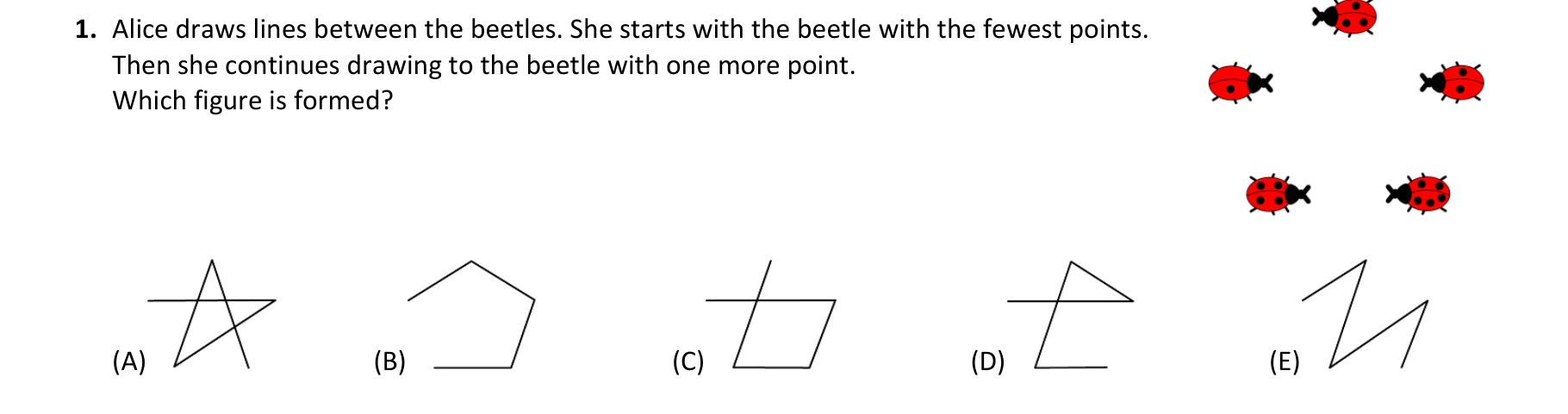
Alice draws lines between the beetles. She starts with the beetle that has the fewest dots. Then she keeps drawing on to the beetle with one more dot. Which figure is formed?
Show answer
Answer: D
Show hints
Hint 1 of 3
First find the beetle with the fewest dots — that is where the pencil starts.
Still stuck? Show hint 2 →
Hint 2 of 3
Go beetle to beetle in dot order: 1 dot, then 2 dots, then 3 dots, and so on.
Still stuck? Show hint 3 →
Hint 3 of 3
The line you draw between them, in that order, makes one of the five shapes.
Show solution
Approach: connect the beetles in dot order and see the shape
Count the dots on each beetle and put them in order: the fewest-dot beetle is first, then one more, then one more.
Draw the line from the 1st beetle to the 2nd, then to the 3rd, and on to the last — always to the beetle with just one more dot.
Following the beetles in that dot order draws the open shape in option D (not a closed star or pentagon).
If the letters of the word MAMA are written one underneath another, the word has a vertical axis of symmetry. For which of these words is that also true?
Show answer
Answer: E — TOTO
Show hints
Hint 1 of 2
Stack the letters of a word in a column and imagine a mirror line running straight down.
Still stuck? Show hint 2 →
Hint 2 of 2
Every single letter must look the same in that vertical mirror — check each letter of each word.
Show solution
Approach: test each letter for a vertical mirror line
A word has a vertical axis of symmetry only if every letter does (A, M, T, O, U, V, W, …).
ADAM has D, BAUM has B, BOOT has B, LOGO has L and G — none of these are vertically symmetric.
In TOTO every letter (T, O, T, O) is symmetric about a vertical line, so the answer is TOTO.
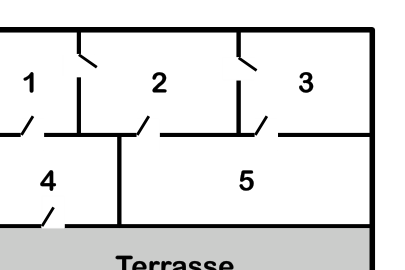
The diagram shows the floor plan of Renate's house. Renate enters from the terrace and walks through every door of the house exactly once. Which room does she end up in?
Show answer
Answer: B — 2
Show hints
Hint 1 of 2
Think of each door as an edge and each room as a dot; walking every door once is an Euler trail.
Still stuck? Show hint 2 →
Hint 2 of 2
An Euler trail ends at the other odd-degree room when it starts at an odd-degree one.
Show solution
Approach: model the floor plan as a graph and trace the Euler trail from the terrace
Treat rooms (and the outside terrace) as vertices and doors as edges.
Passing through every door exactly once is an Euler trail, which must start and finish at the two rooms with an odd number of doors.
Starting from the terrace, the trail is forced and ends in room 2.
The diagram shows an object made up of 12 small cubes glued together. The object is dipped into paint so that its entire outside is coloured. How many of the small cubes will have exactly four faces coloured?
Show answer
Answer: A — 8
Show hints
Hint 1 of 2
A small cube ends up with exactly 4 painted faces only when exactly 2 of its faces are glued to neighbours.
Still stuck? Show hint 2 →
Hint 2 of 2
So count the cubes that touch exactly two other cubes.
Show solution
Approach: a cube shows 4 painted faces exactly when it is glued to neighbours on 2 faces
When dipped, a small cube is painted on every face that is on the outside, so it has 4 painted faces precisely when 2 of its faces are hidden (glued to neighbours).
Each cube glued on exactly two faces is one with two neighbours; cubes with one neighbour show 5 painted faces and cubes with three neighbours show 3.
Going through the 12 cubes of the shape, exactly 8 of them touch two neighbours.
Lucy folds a piece of paper exactly in half and then cuts out a figure (see picture). Then she unfolds the paper again. Which of the five pictures can she see?
Show answer
Answer: D
Show hints
Hint 1 of 2
Whatever is cut on the folded side gets copied onto the other side when the paper opens.
Still stuck? Show hint 2 →
Hint 2 of 2
So the opened picture must look the same on both sides of the fold line, like a butterfly.
Show solution
Approach: open the fold by copying the cut shape to a matching shape on the other side of the crease
When the folded paper is cut and then opened, the cut shape appears twice — once on each side of the fold line.
The two sides are mirror copies that touch along the crease, like a butterfly's wings.
Only picture D has that matching mirror shape, so the answer is D.
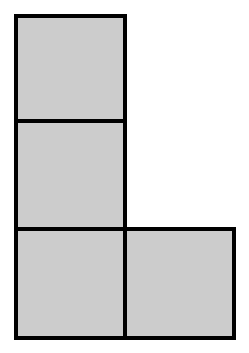
Anna has four identical building blocks that each look like the one shown (a straight strip of three squares). Which of the shapes in the options can she not form with them?
Show answer
Answer: E
Show hints
Hint 1 of 2
Each block covers three squares in a straight line; four of them cover twelve squares.
Still stuck? Show hint 2 →
Hint 2 of 2
A shape can be built only if it can be cut into straight 1×3 pieces — try tiling each one.
Show solution
Approach: tile each shape with straight triominoes
The block is a straight strip of three squares, so four blocks cover 12 squares total.
Each pictured shape has 12 squares, so the test is whether it splits into four straight 1×3 strips.
Four of the shapes can be cut into such strips; the remaining one cannot be tiled this way.
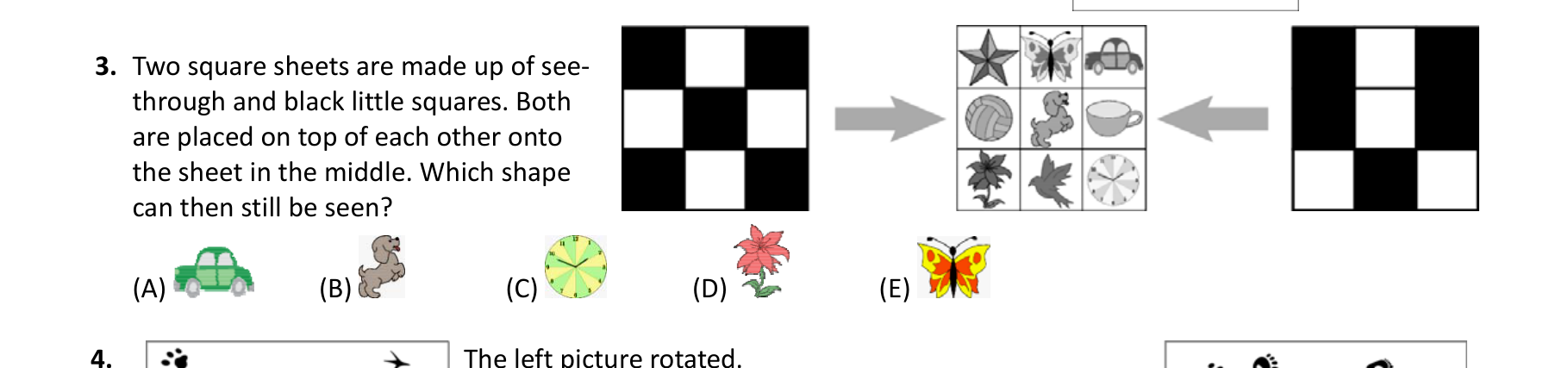
Two square sheets are made up of see-through and black little squares. Both are placed on top of each other onto the sheet in the middle. Which shape can then still be seen?
Show answer
Answer: E
Show hints
Hint 1 of 2
A picture is visible only where BOTH sheets are see-through over that cell.
Still stuck? Show hint 2 →
Hint 2 of 2
Find the one cell that is clear (white) on the left sheet AND clear on the right sheet.
Show solution
Approach: a shape shows only through a cell that is transparent on both sheets
Lay the two patterns on top of each other, cell by cell, over the middle sheet.
A cell stays see-through only when BOTH sheets are clear there; if either sheet has a black square, that cell is blocked.
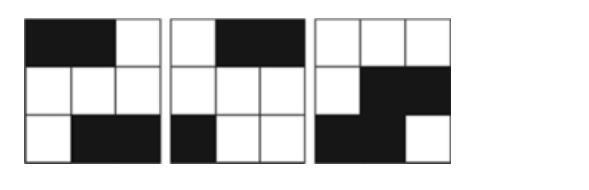
Colour in every cell that is black on either sheet, and the cells still see-through show the picture.
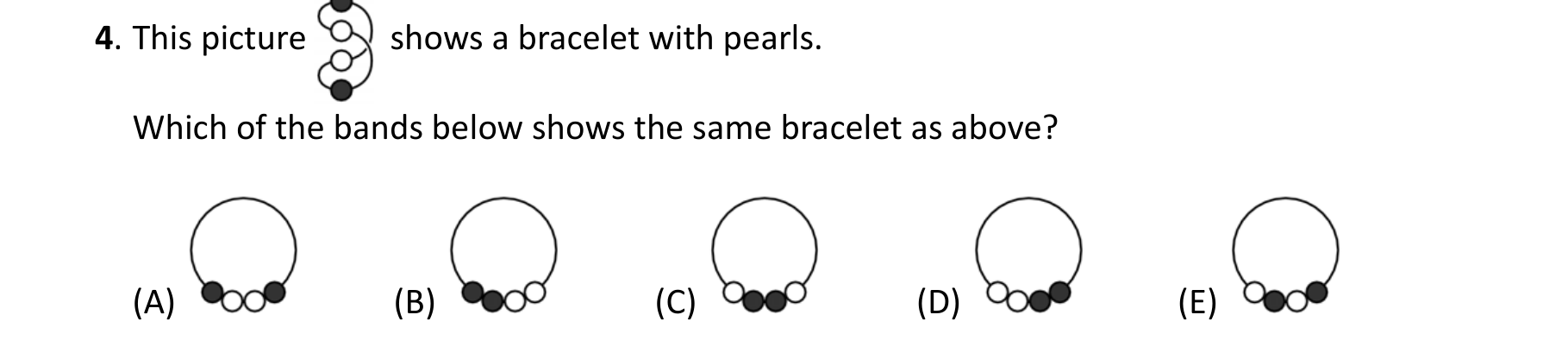
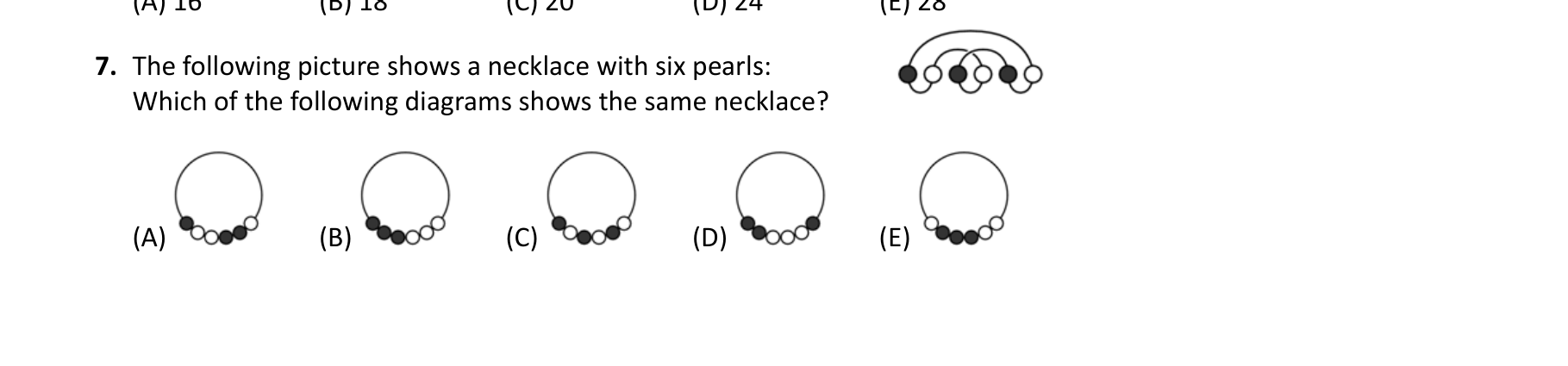
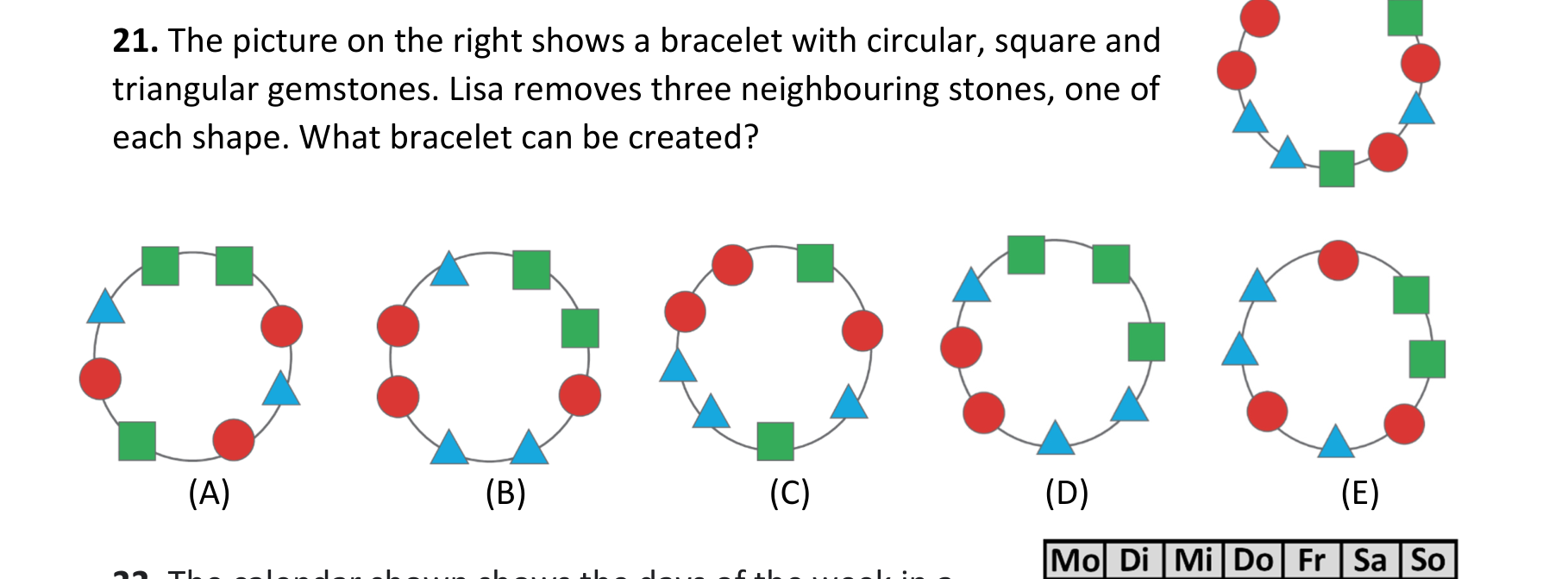
This picture shows a bracelet with pearls. Which of the bands below shows the same bracelet as above? (The five bands are shown as choices A, B, C, D, E.)
Show answer
Answer: E
Show hints
Hint 1 of 2
The bracelet is a ring, so it does not matter which pearl you start counting from.
Still stuck? Show hint 2 →
Hint 2 of 2
Say the colours out loud going around the ring, then find the band that matches when it is wrapped into the same ring.
Show solution
Approach: read the pearls around the ring
The bracelet is a closed ring of pearls. Say their colours out loud going around it.
When you cut a ring open into a straight band, you can start at any pearl, so the band can begin in a different place but the order of colours stays the same.
Check each band: does it have the same colours in the same going-around order?
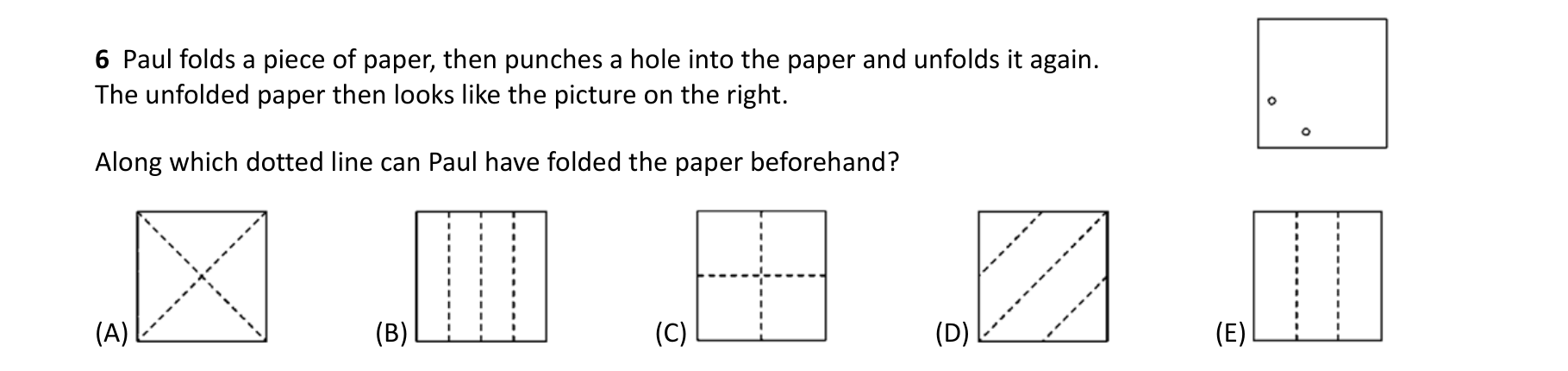
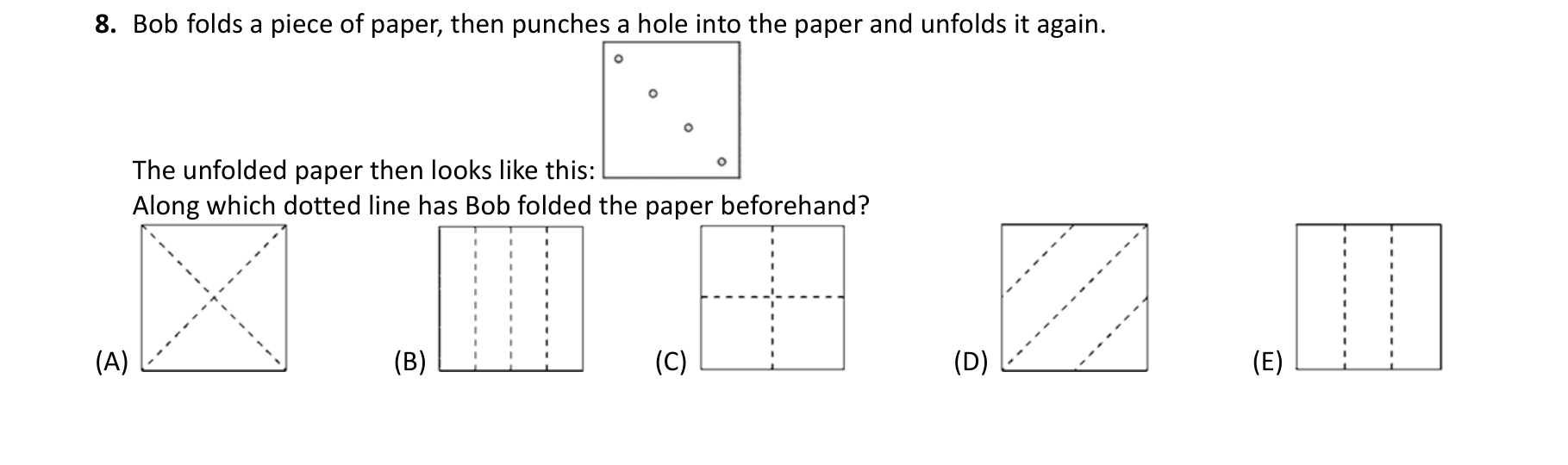
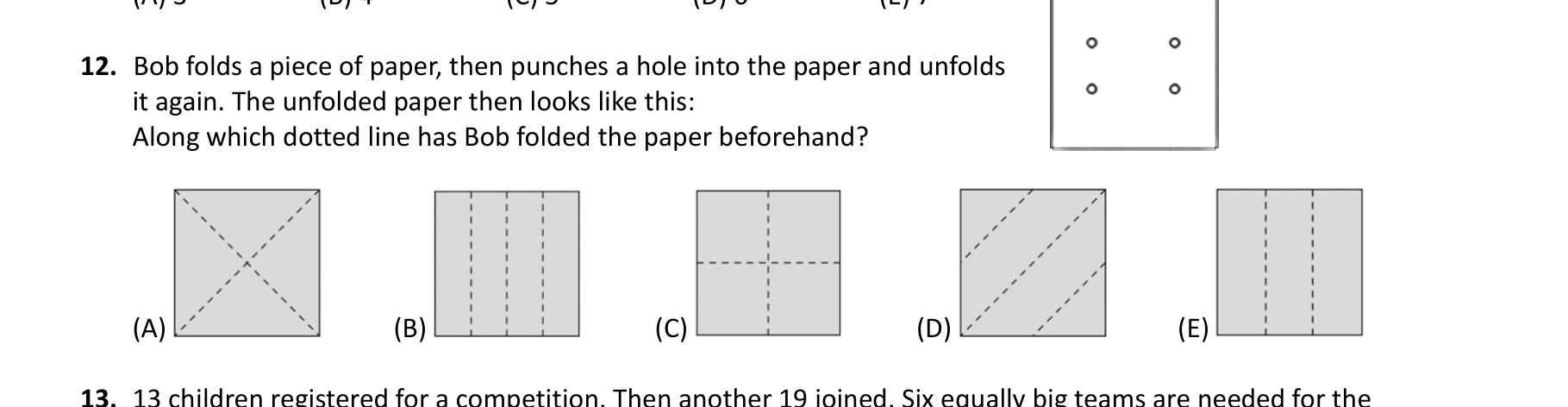
Bob folds a piece of paper, then punches a hole in it and unfolds it again. The unfolded paper then looks like the picture. Along which dotted line did Bob fold the paper?
Show answer
Answer: D
Show hints
Hint 1 of 2
Unfolding mirrors the punched holes across each fold line, so the holes are symmetric about that line.
Still stuck? Show hint 2 →
Hint 2 of 2
Find the line that the four-hole pattern is symmetric across — that was the fold.
Show solution
Approach: match the hole pattern's symmetry to the fold line
A punch through folded paper leaves holes that are mirror images across the fold crease.
Look at the four holes in the unfolded sheet and find the line they are symmetric about.
The holes balance across the diagonal shown in (D).
For each sign, count how many mirror lines fold the picture exactly onto itself.
Still stuck? Show hint 2 →
Hint 2 of 2
A round X-cross folds along four lines, more than a triangle or an arrowed circle.
Show solution
Approach: count the mirror lines of each sign
Check each sign for fold lines: the yield triangle (C) has 3, the dead-end sign (E) has 1, and the roundabout arrows (D) and priority sign (B) have none.
The round no-stopping sign (A) is a circle with an X-cross, and an X folds onto itself along 4 lines (two diagonals plus the horizontal and vertical).
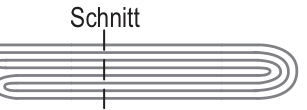
A 10 cm long piece of wire is folded so that every part is equally long (see diagram). The wire is then cut through in the two marked positions. How long are the three pieces created in this way?
Show answer
Answer: A — 2 cm, 3 cm, 5 cm
Show hints
Hint 1 of 3
The wire is folded into equal little segments, so each segment is the same length.
Still stuck? Show hint 2 →
Hint 2 of 3
Imagine unfolding the wire into one straight 10 cm line and mark where the two cuts land.
Still stuck? Show hint 3 →
Hint 3 of 3
Count how many equal segments fall in each of the three pieces.
Show solution
Approach: unfold the wire and read off the cut positions
Folding 10 cm into equal parts makes a row of equal-length segments.
If you straighten the wire back out, the two marked cuts land on segment boundaries.
Counting the segments in each piece gives lengths of 2 cm, 3 cm and 5 cm (which add back to 10 cm), choice (A).
Four girls are sleeping in a room with their heads on the grey pillows. Bea and Pia are sleeping on the left-hand side of the room with their faces towards each other; Mary and Karen are on the right-hand side with their backs towards each other. How many girls sleep with their right ear on the pillow?
Show answer
Answer: C — 2
Show hints
Hint 1 of 3
For each girl, picture which cheek is pressed into the pillow and so which ear is underneath.
Still stuck? Show hint 2 →
Hint 2 of 3
When two girls lie side by side facing opposite ways, they rest on opposite ears.
Still stuck? Show hint 3 →
Hint 3 of 3
So in a face-to-face pair (and in a back-to-back pair) exactly one girl is on her right ear.
Show solution
Approach: pair up the girls and use mirror directions
Bea and Pia lie facing each other: since they point opposite ways, one rests on her left ear and the other on her right ear, so that pair gives 1 right-ear girl.
Mary and Karen lie back to back, again pointing opposite ways, so that pair also gives exactly 1 right-ear girl.
Adding the two pairs, \(1 + 1 = 2\) girls sleep on their right ear, choice (C).
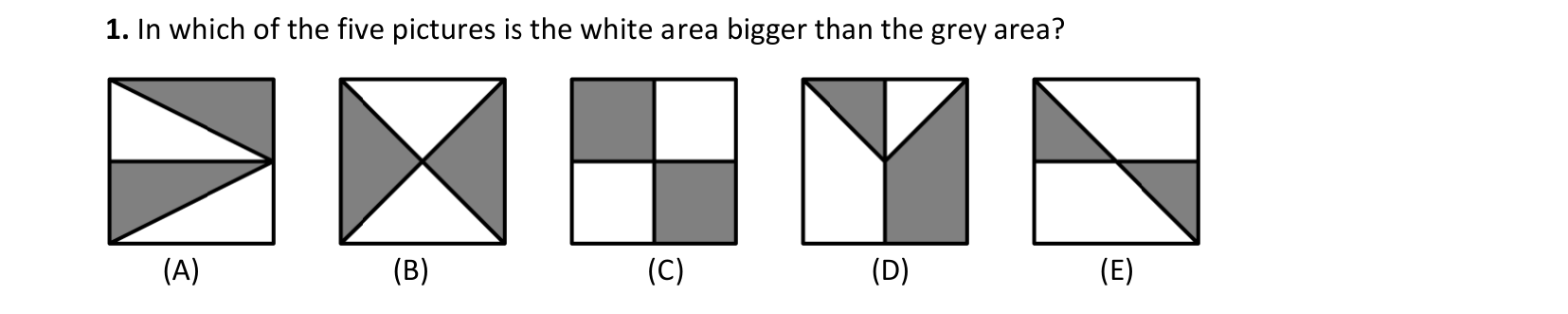
For each shape, ask whether the grey part and the white part are the same size.
Still stuck? Show hint 2 →
Hint 2 of 2
An altitude of a triangle splits it into two pieces of equal area; check which figure is cut into two matching halves.
Show solution
Approach: compare grey area to whole in each picture
In the triangle the line goes straight down from the top vertex, cutting it into two pieces of equal area, and exactly one of them is grey.
The circle is in thirds (grey = one third), the four-square figure has three of four shaded, and the square-with-X and the pentagon-star are not split into two equal grey/white halves.
Only the triangle has exactly one half coloured grey, so the answer is B.
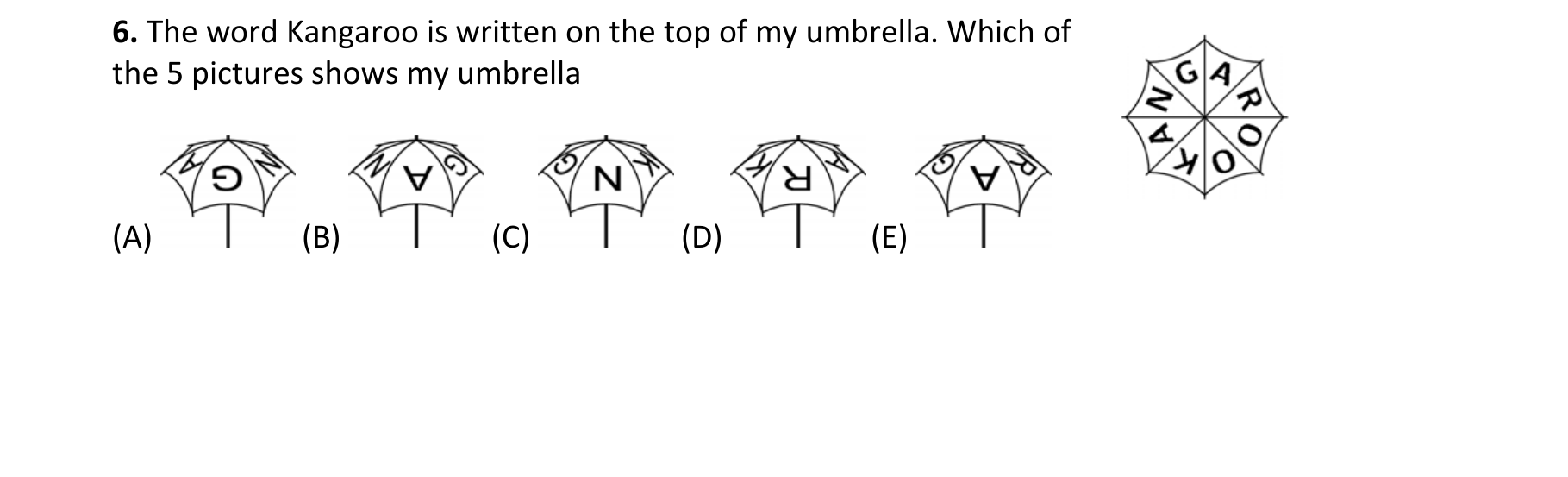
On the real umbrella the eight letters of KANGAROO appear in one fixed cyclic order around the rim.
Still stuck? Show hint 2 →
Hint 2 of 2
Pick the front letter of each pictured umbrella and read the neighbours left and right; the order around the rim must always match KANGAROO (just rotated).
Show solution
Approach: check the cyclic order of letters around each umbrella
Around the rim the letters always follow the same circular sequence K-A-N-G-A-R-O-O (the umbrella can only be turned, not rearranged).
Four of the pictures show that exact cyclic order, just rotated to a different front panel.
Picture C has the letters in an order that cannot be obtained by turning the umbrella, so it is the one that does not show the umbrella.
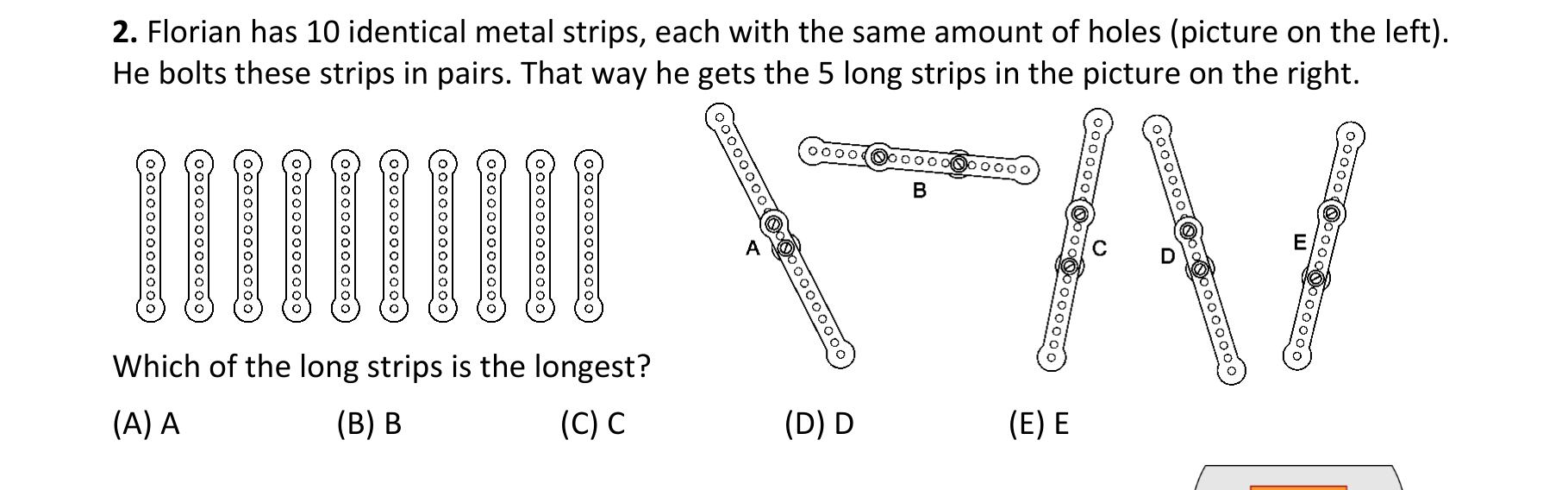
Florian has 10 identical metal strips, each with the same number of holes. He bolts them together in pairs to make the 5 long strips in the picture. Which of the long strips is the longest?
Show answer
Answer: A
Show hints
Hint 1 of 2
Each long strip is two short strips laid end to end, sharing a few holes where they overlap.
Still stuck? Show hint 2 →
Hint 2 of 2
The fewer holes the two short strips share, the further the long strip stretches.
Show solution
Approach: compare how much each pair of strips overlaps
Every long strip is two equal short strips bolted so they share some holes in the overlap.
Picture sharing only 1 hole versus sharing many: the less the strips overlap, the longer they reach.
Strip A is the one whose two pieces overlap the least, so it stretches the furthest.
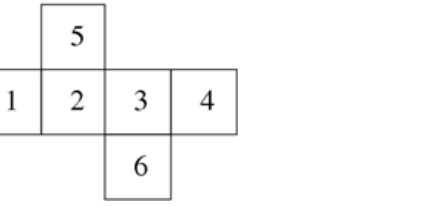
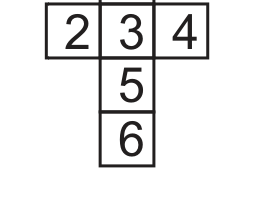
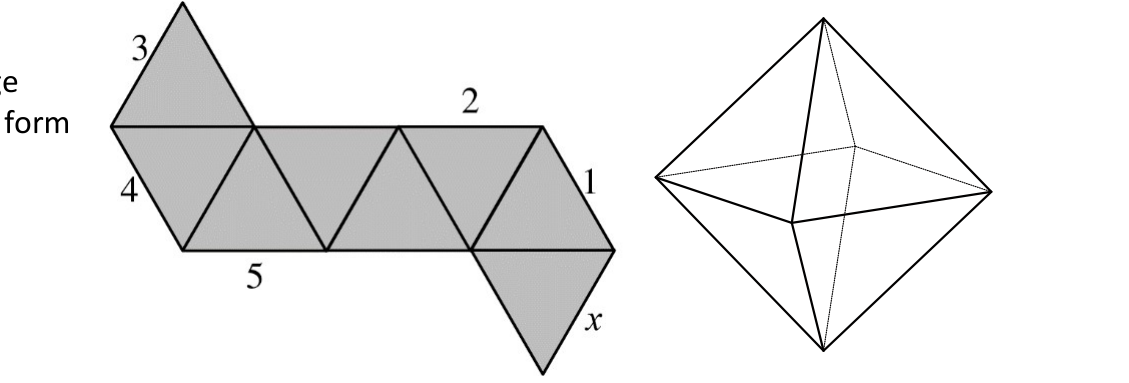
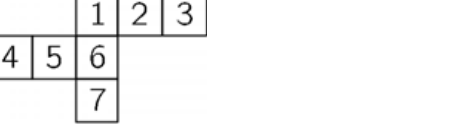
The diagram shows the net of a cube whose faces are numbered. Sascha adds the numbers that are on opposite faces of the cube. Which three results does he get?
Show answer
Answer: A — 4, 6, 11
Show hints
Hint 1 of 2
Fold the net into a cube in your head and see which faces end up opposite each other.
Still stuck? Show hint 2 →
Hint 2 of 2
On a band of four faces in a row, opposite faces skip one; then pair the two faces sticking out.
Show solution
Approach: identify the three pairs of opposite faces
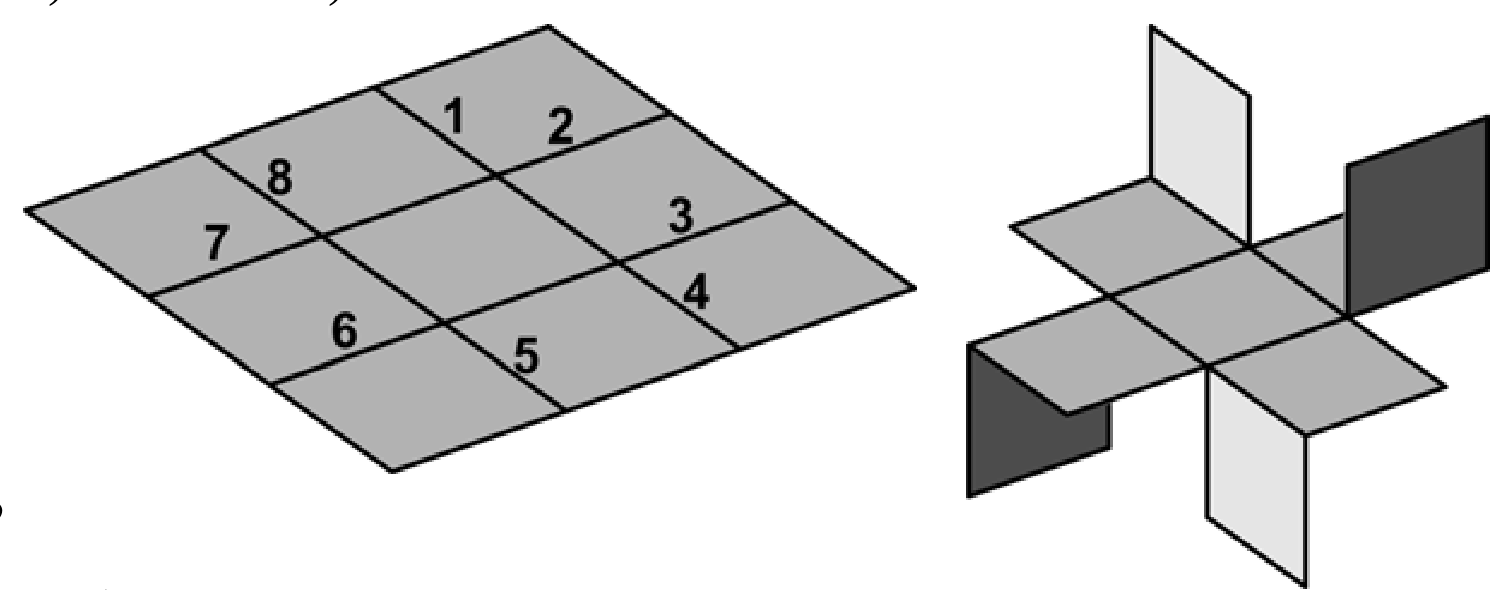
Faces 1, 2, 3, 4 form a band around the cube, so 1 is opposite 3 and 2 is opposite 4.
The remaining faces 5 and 6 are top and bottom, so 5 is opposite 6.
The three opposite-face sums are 1+3 = 4, 2+4 = 6, and 5+6 = 11.
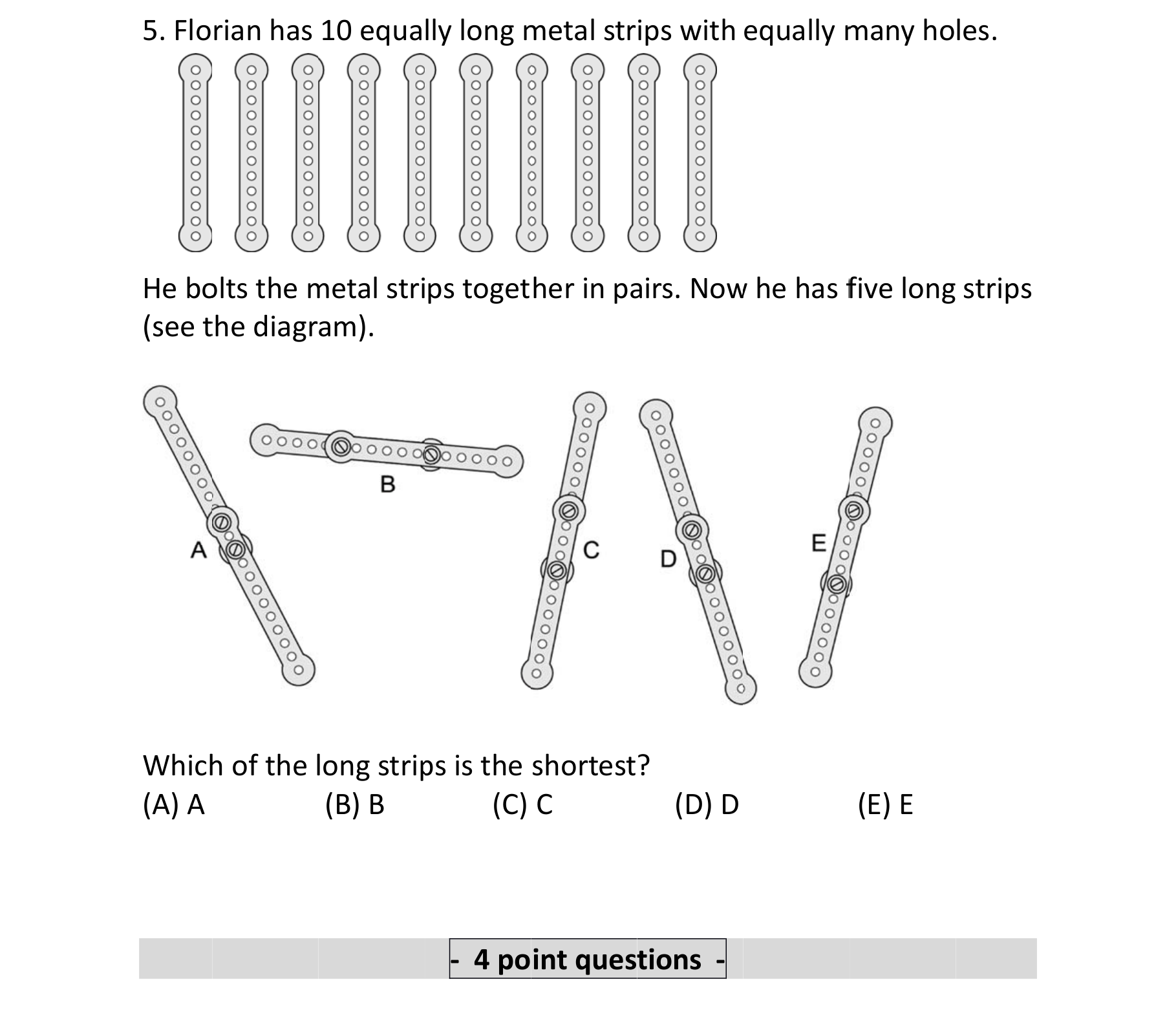
Florian has 10 equally long metal strips with equally many holes. He bolts the metal strips together in pairs. Now he has five long strips (see the diagram). Which of the long strips is the shortest?
Show answer
Answer: B
Show hints
Hint 1 of 2
Each long strip is two of the equal short strips bolted together, but they overlap by some holes.
Still stuck? Show hint 2 →
Hint 2 of 2
The strip that overlaps the most (shares the most holes) ends up the shortest.
Show solution
Approach: more overlap means a shorter combined strip
All the short strips are the same length, so the total length of a pair depends only on how much the two pieces overlap.
The more holes the two pieces share, the shorter the finished strip.
Strip B has the biggest overlap, so it is the shortest: choice B.
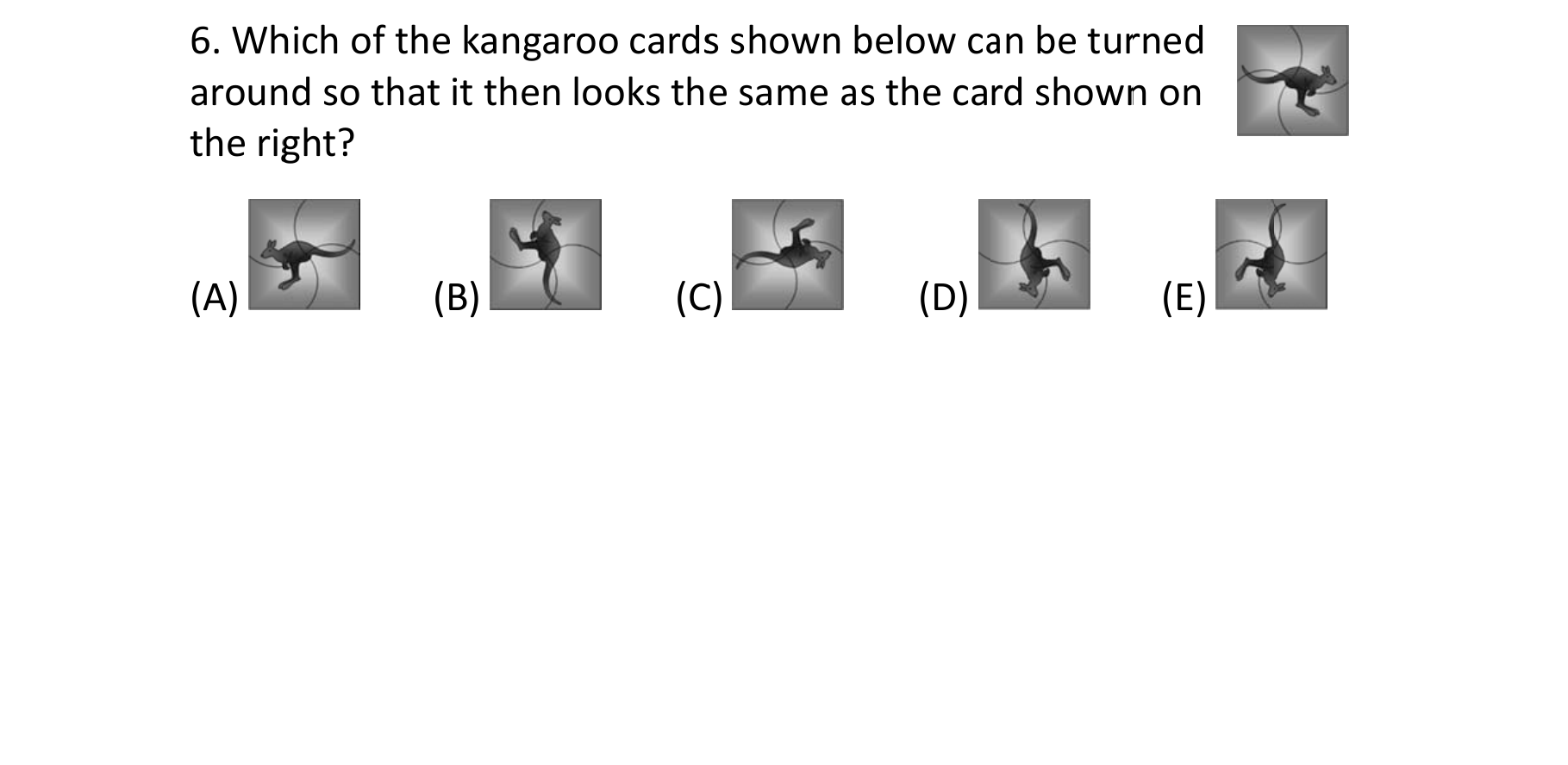
Which of the kangaroo cards shown below can be turned around so that it then looks the same as the card shown on the right? (The five cards and the reference card are shown in the figure.)
Show answer
Answer: E
Show hints
Hint 1 of 2
You may only turn (rotate) a card, not flip it over like a mirror.
Still stuck? Show hint 2 →
Hint 2 of 2
Find the option that becomes exactly the reference kangaroo after some rotation.
Show solution
Approach: test each card for a matching rotation
The card on the right shows the kangaroo in one pose; turning a card keeps it the same shape (no mirror flip).
Rotate each option in your mind and compare it to the reference.
Only card E matches the reference after a turn, so the answer is E.
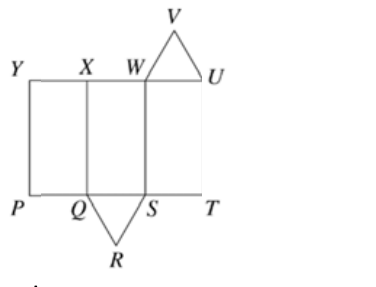
The diagram shows the net of a three-sided prism. Which line of the diagram forms an edge of the prism together with line UV when the net is folded up?
Show answer
Answer: C — XY
Show hints
Hint 1 of 2
Fold the net into the prism and watch where the endpoints of UV land.
Still stuck? Show hint 2 →
Hint 2 of 2
When folded, the edge along UV meets another edge of the net; find which labelled segment touches it.
Show solution
Approach: fold the net and see which edge meets UV
The net of the triangular prism wraps the rectangular faces around the two triangular ends.
When it is folded up, segment UV is brought together with the segment that shares its endpoints after folding.
Arno lays out the word KANGAROO with 8 letter cards, but some cards are turned the wrong way (see picture). The letter K can be set right by turning its card twice, and the letter A by turning its card once. How many turns in all does Arno need so that KANGAROO reads correctly?
Show answer
Answer: C — 6
Show hints
Hint 1 of 2
Go letter by letter and decide whether each card is already the right way up.
Still stuck? Show hint 2 →
Hint 2 of 2
Count the cost: a letter that is upside-down or mirrored needs one or two turns to fix; add those up across the whole word.
Show solution
Approach: check each card and add up the turns it needs
Read the laid-out word against KANGAROO and find every card that is rotated or flipped.
Each wrong card needs either one turn or two turns to come right, exactly as the example shows for K and A.
Adding the turns needed across all the wrong cards gives a total of 6.
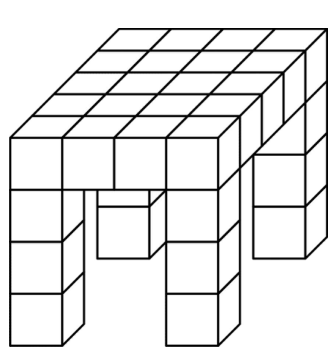
If one removes some 1×1×1 cubes from a 5×5×5 cube, you obtain the solid shown. It consists of several equally high pillars built on a common base. How many little cubes have been removed?
Show answer
Answer: C — 64
Show hints
Hint 1 of 2
Build it in two parts: a solid base layer, then the equal pillars standing on it.
Still stuck? Show hint 2 →
Hint 2 of 2
Count how many of the 125 unit cubes are LEFT, then subtract from 125.
Show solution
Approach: count what remains, then subtract
The full cube has 5×5×5 = 125 unit cubes.
One complete bottom layer stays in place: that is 5×5 = 25 cubes.
On top sit 9 equal pillars (a 3×3 arrangement), each rising the remaining 4 levels: 9×4 = 36 cubes.
So 25 + 36 = 61 cubes remain, and 125 − 61 = 64 were removed.
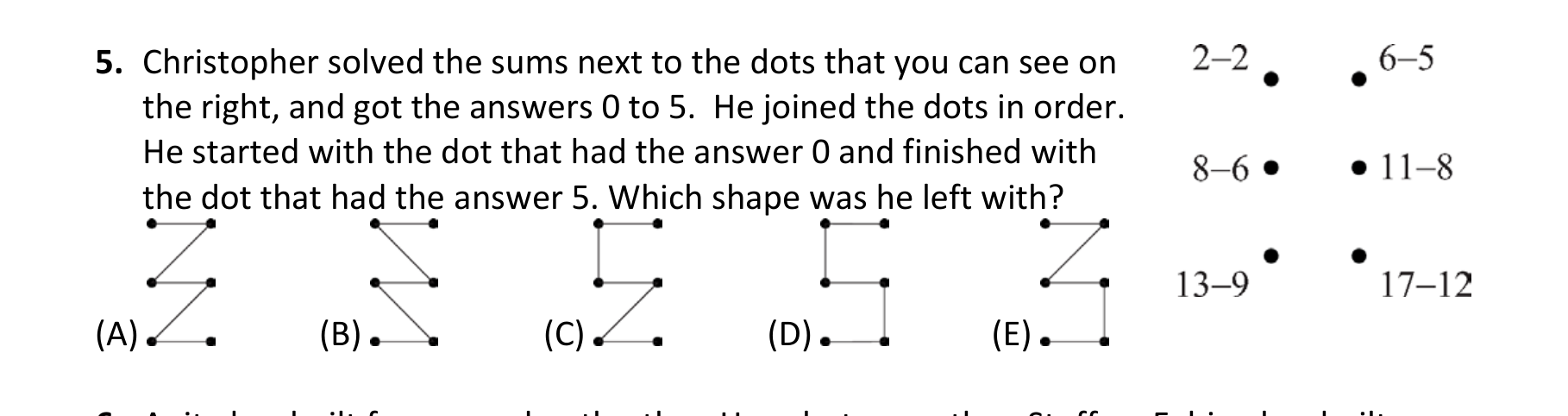
Christopher worked out the sums written next to the dots and got the answers 0, 1, 2, 3, 4 and 5. He joined the dots in order, starting at the dot with answer 0 and finishing at the dot with answer 5. Which shape was he left with? (Choose the matching picture.)
Show answer
Answer: A
Show hints
Hint 1 of 3
First work out the little sum next to each dot and write its answer on the dot.
Still stuck? Show hint 2 →
Hint 2 of 3
Now you have dots labelled 0, 1, 2, 3, 4 and 5.
Still stuck? Show hint 3 →
Hint 3 of 3
Draw a line from 0 to 1 to 2 and on to 5, then see which picture your line looks like.
Show solution
Approach: label each dot with its answer, then join them in order
Work out each sum and write the answer on its dot, so the dots are now numbered 0, 1, 2, 3, 4 and 5.
Start your pencil at the 0 dot and draw to the 1 dot, then the 2, and so on up to the 5.
The line zig-zags from side to side and makes a clear shape.
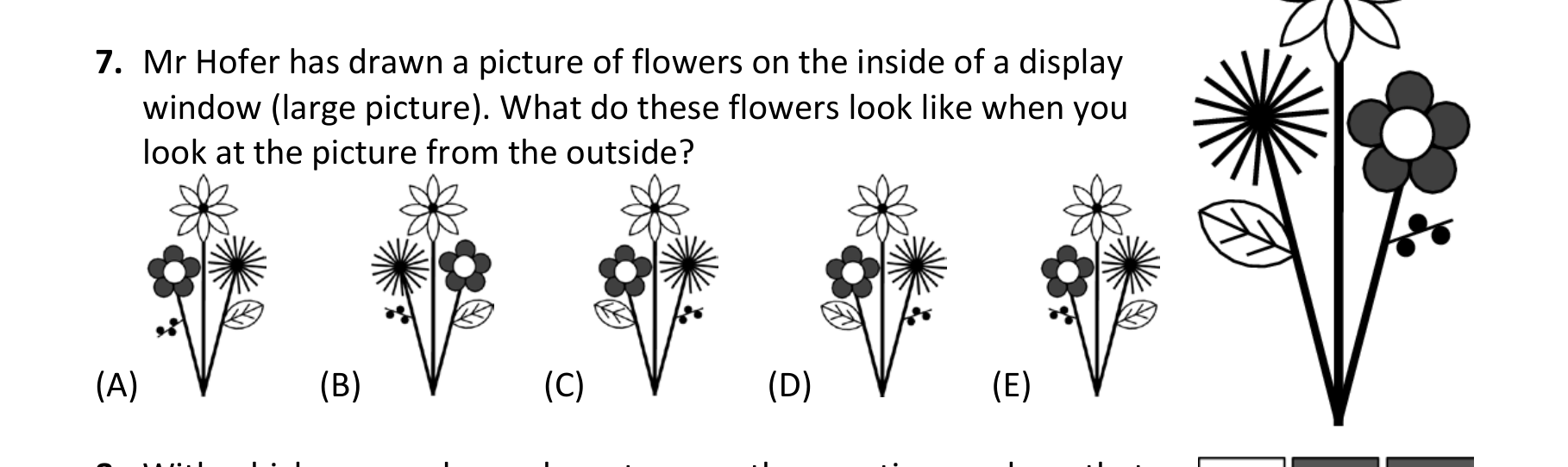
Mr Hofer drew a picture of flowers on the inside of a shop window (the large picture). What do these flowers look like when you walk outside and look at the picture through the glass? (Choose the matching picture.)
Show answer
Answer: E
Show hints
Hint 1 of 3
Looking through the glass from the other side is just like looking in a mirror.
Still stuck? Show hint 2 →
Hint 2 of 3
A mirror swaps left and right, but keeps top and bottom the same.
Still stuck? Show hint 3 →
Hint 3 of 3
Hold the picture up to a mirror in your mind: what is on the left jumps to the right.
Show solution
Approach: flip the picture left-to-right like a mirror
Seeing the drawing from outside the glass is the same as seeing it in a mirror.
A mirror keeps each flower the right way up but swaps the left side with the right side.
So flowers on the left of the drawing should now be on the right.
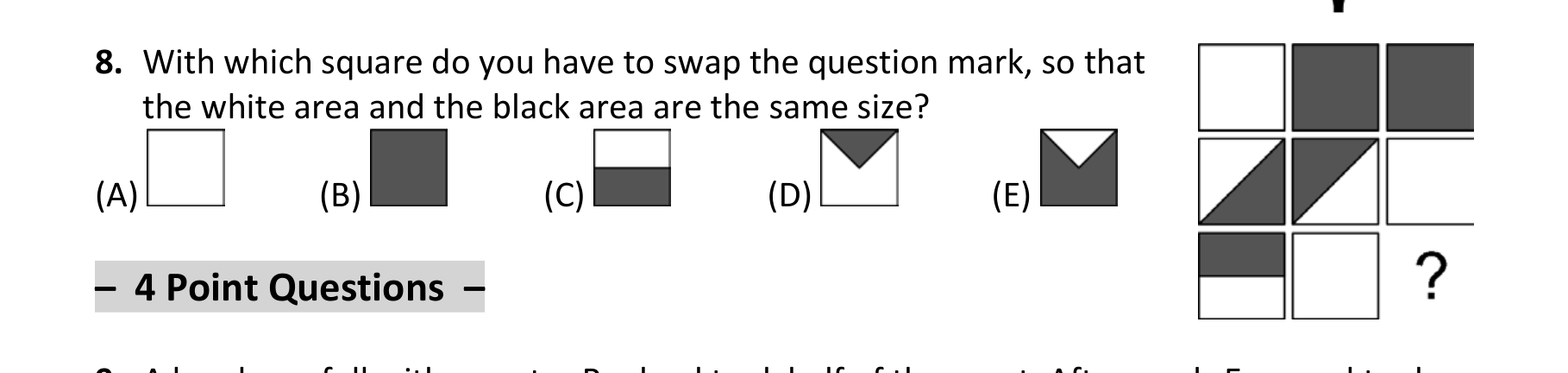
With which square do you have to swap the question-mark square so that the white area and the black area become the same size? (Choose the matching picture.)
Show answer
Answer: B
Show hints
Hint 1 of 3
Count how many small black parts and how many small white parts the picture has right now.
Still stuck? Show hint 2 →
Hint 2 of 3
If there is more black than white, the new square must add some white to even them out (or the other way round).
Still stuck? Show hint 3 →
Hint 3 of 3
Pick the square that swaps in just the right amount to make black and white match.
Show solution
Approach: count the black and white parts and find the square that balances them
Count up all the black little pieces and all the white little pieces as the picture stands.
One colour is ahead, so the question-mark square needs to be replaced by one that gives back exactly that difference in the other colour.
Try each choice and see which one makes the black total equal the white total.
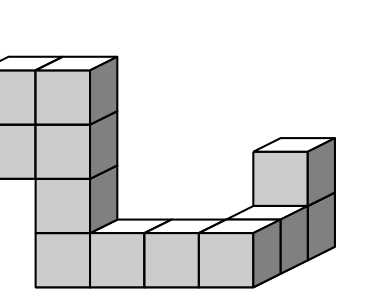
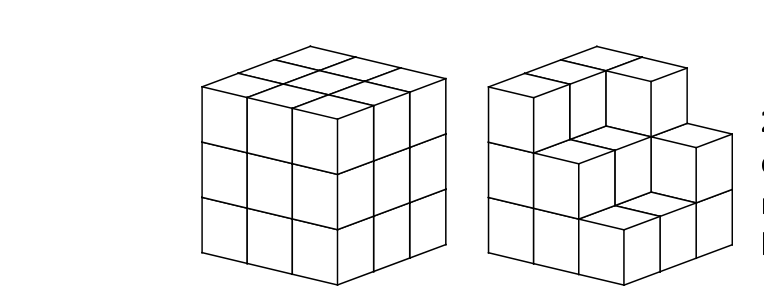
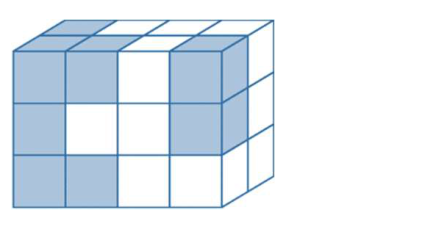
Nathalie wants to build a large cube out of small cubes (the complete cube is shown on the left). How many small cubes are missing from the shape on the right so that it would form the large cube?
Show answer
Answer: C — 7
Show hints
Hint 1 of 3
A full \(3\times3\times3\) cube is built from 27 little cubes.
Still stuck? Show hint 2 →
Hint 2 of 3
Count the little cubes already in the picture on the right, then see how many are still needed.
Still stuck? Show hint 3 →
Hint 3 of 3
Missing cubes = 27 minus the ones you counted.
Show solution
Approach: count present cubes and subtract from a full cube
The finished big cube is 3 cubes wide, 3 tall and 3 deep, so it needs \(3\times3\times3 = 27\) small cubes.
Counting the cubes in the picture on the right gives 20.
So the number still missing is \(27 - 20 = 7\), which is choice C.
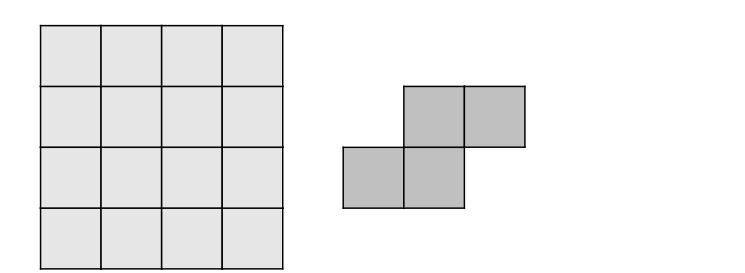
Melanie has a square piece of paper with a 4×4 grid drawn on it. She cuts along the gridlines, cutting out several shapes that each look like the one pictured or its mirror image. How many squares are left over if she cuts out as many shapes as possible?
Show answer
Answer: C — 4
Show hints
Hint 1 of 2
The shape is a 4-square piece; the grid holds 16 squares in total.
Still stuck? Show hint 2 →
Hint 2 of 2
Try to fit as many copies (or mirror images) as you can without overlap, then count the leftovers.
Show solution
Approach: tile and count leftovers
The 4×4 grid has 16 unit squares; each cut-out piece uses 4 of them.
These S/Z-shaped pieces cannot fill the 4×4 square completely.
The best packing fits 3 pieces (12 squares), leaving 4 squares uncovered.
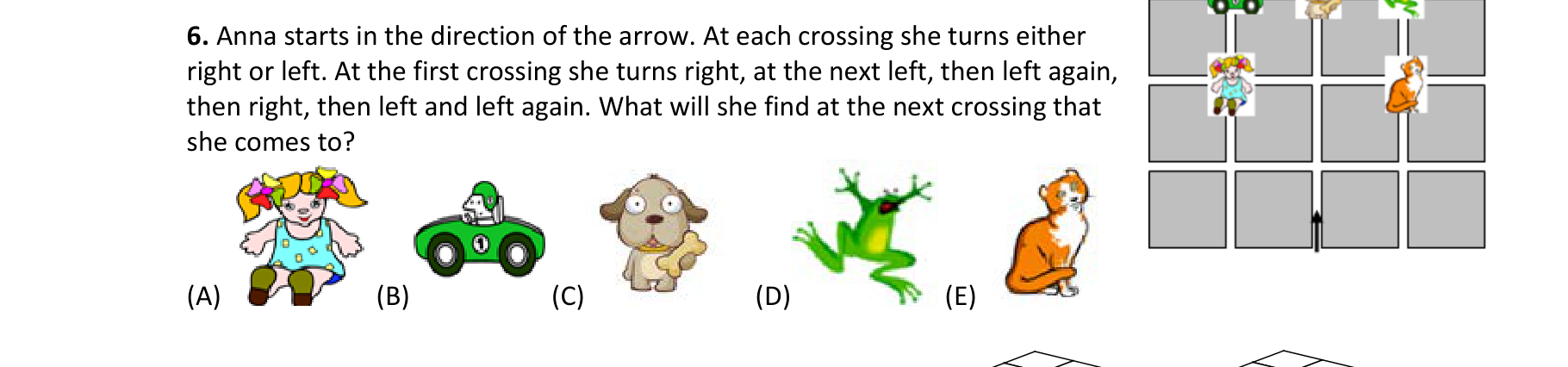
Anna starts walking in the direction of the arrow. At each crossing she turns either right or left. She turns right, then left, then left again, then right, then left, then left again. What will she find at the next crossing she reaches?
Show answer
Answer: A
Show hints
Hint 1 of 3
Put your finger on the start and point it the way the arrow points.
Still stuck? Show hint 2 →
Hint 2 of 3
Make the turns one at a time in order: right, left, left, right, left, left.
Still stuck? Show hint 3 →
Hint 3 of 3
After the last turn, look at the very next crossing to see which pictured item is there.
Show solution
Approach: walk the path one turn at a time and read off the item at the final crossing
Start at the arrow and trace the path, turning right, left, left, right, left, then left.
Keep your finger moving along the streets so you do not skip a crossing.
The item waiting at the next crossing is the one shown in option A.
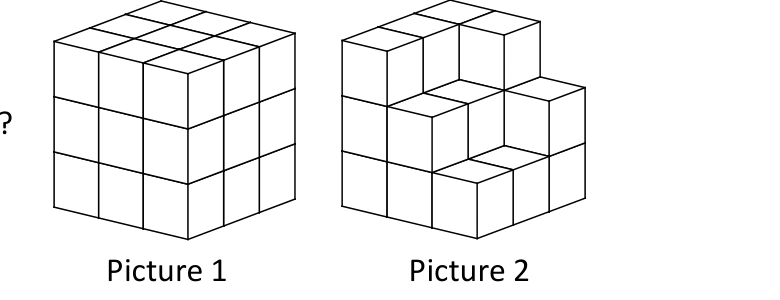
Nathalie wanted to build a large cube out of lots of small cubes, just like in Picture 1. How many cubes are missing from Picture 2 that would be needed to build the large cube?
Show answer
Answer: C — 7
Show hints
Hint 1 of 3
A full big cube like Picture 1 is 3 cubes wide, 3 deep and 3 tall, so it needs 27 small cubes.
Still stuck? Show hint 2 →
Hint 2 of 3
Count how many small cubes are really in Picture 2, layer by layer.
Still stuck? Show hint 3 →
Hint 3 of 3
The missing number is 27 take away the cubes you counted in Picture 2.
Show solution
Approach: subtract the cubes present from a full cube
A complete large cube is 3 × 3 × 3 = 27 small cubes.
Counting the cubes in picture 2 layer by layer gives 20 cubes.
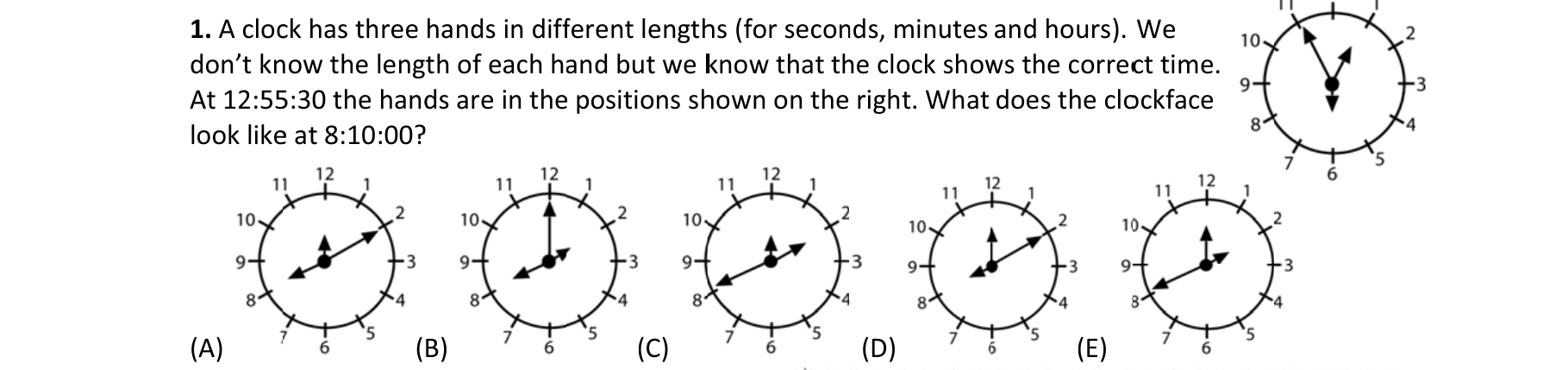
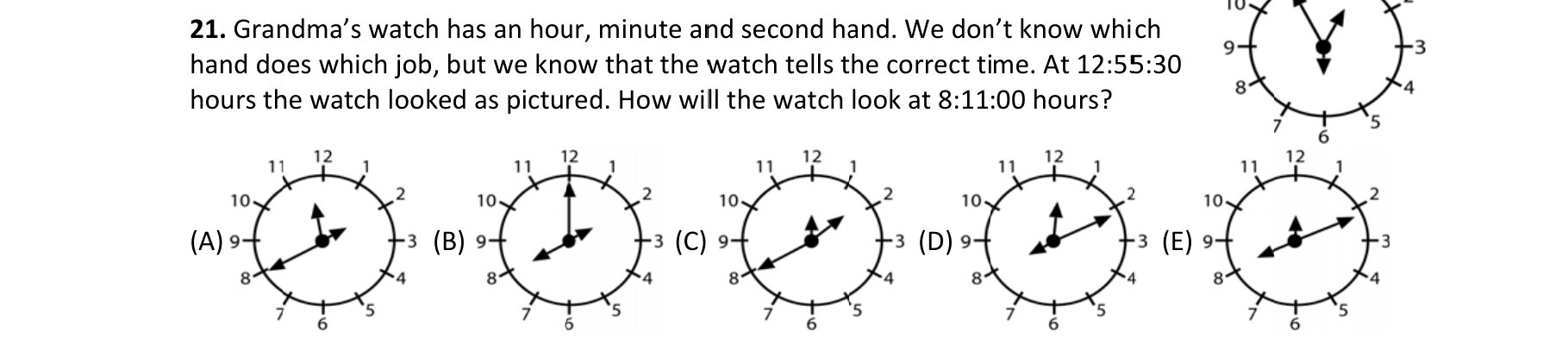
A clock has three hands of different lengths (for seconds, minutes and hours). We don't know the length of each hand, but we know the clock shows the correct time. At 12:55:30 the hands are in the positions shown on the right. What does the clockface look like at 8:10:00?
Show answer
Answer: A
Show hints
Hint 1 of 2
At 8:10:00 the second hand points straight to 12, while the minute hand has barely moved off the top.
Still stuck? Show hint 2 →
Hint 2 of 2
Decide where each of the three hands sits at 8:10:00, then find the picture that shows all three at once.
Show solution
Approach: place each clock hand at 8:10:00 and match the figure
At 8:10:00 the seconds hand is at 0, so it points exactly at 12.
The minute hand sits at 10 minutes, pointing to the 2.
The hour hand is a little past the 8.
Only choice A shows those three directions together.
Eva has a pair of scissors and five letters made from cardboard. She cuts up each letter with a single straight cut so that as many pieces as possible are obtained. For which letter does she obtain the most pieces?
Show answer
Answer: E
Show hints
Hint 1 of 2
One straight cut makes more pieces when it crosses the letter's outline more times.
Still stuck? Show hint 2 →
Hint 2 of 2
Picture a single line drawn across each letter and count how many separate parts it leaves.
Show solution
Approach: count crossings of a single line
A single straight cut splits a shape into one more piece for each time the cut crosses the shape.
A wiggly outline like the letter S can be crossed by one straight line in the most places.
Cutting M with one straight line through all four of its strokes leaves the most pieces of the five letters.
Werner folds a piece of paper once in the middle as shown. With a pair of scissors he makes two straight cuts into the folded paper, then unfolds it again. Which of the following shapes is not possible for the piece of paper to show afterwards?
Show answer
Answer: D
Show hints
Hint 1 of 3
After unfolding, the cut-out pattern must be mirror-symmetric about the fold line.
Still stuck? Show hint 2 →
Hint 2 of 3
Each straight cut on the doubled paper unfolds into a symmetric pair, so two cuts can make only a limited number of corners.
Still stuck? Show hint 3 →
Hint 3 of 3
Count how many separate notches or corners each shape needs and compare it to what just two straight cuts can produce.
Show solution
Approach: count the cuts each shape needs
Folding once makes two layers, so each straight cut goes through both layers and unfolds into a pair of cuts that are mirror images across the fold.
Two straight cuts can therefore create at most two such symmetric features — enough to make the single notch of A, the central hole of B, the trimmed corners of C, and the symmetric notch of E.
Shape D has several separate zig-zag notches, more than two straight cuts can produce, so it is the one that is not possible.
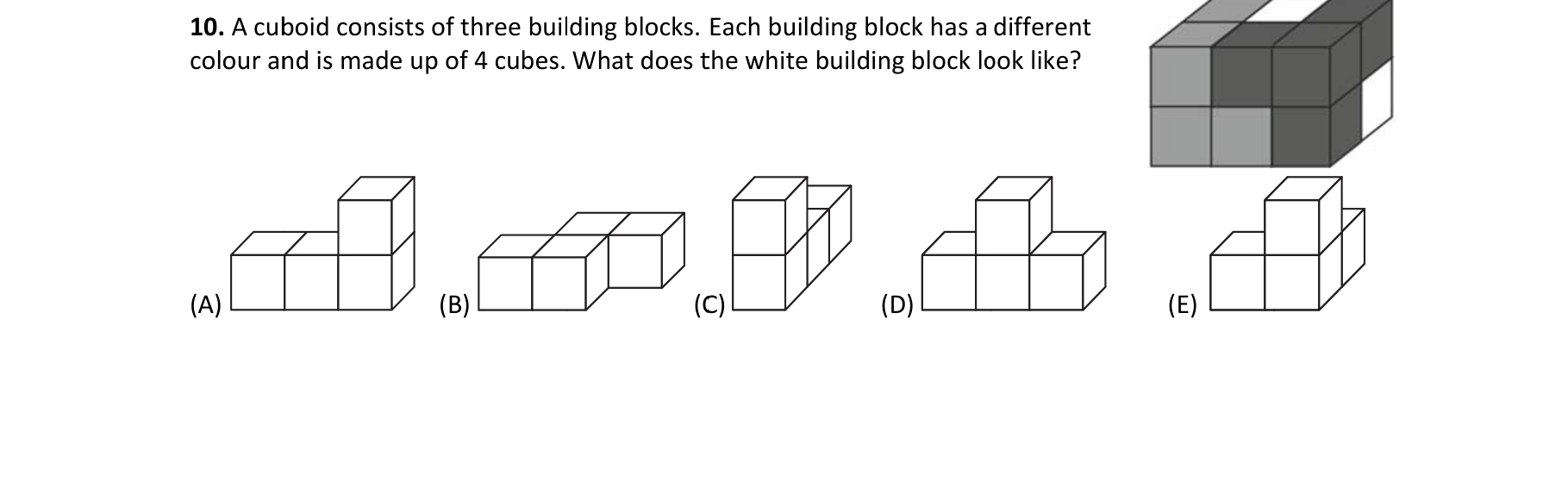
A cuboid is built from three building blocks. Each building block has a different colour and is made up of 4 cubes. What does the white building block look like?
Show answer
Answer: D
Show hints
Hint 1 of 3
The cuboid is 2 × 2 × 3 (12 cubes), split into three blocks of 4 cubes each.
Still stuck? Show hint 2 →
Hint 2 of 3
Find every white cube — two are visible (one on the top, one on the right face); the other two are hidden inside.
Still stuck? Show hint 3 →
Hint 3 of 3
Once you know all four white positions, picture how those four cubes connect into one solid block.
Show solution
Approach: locate the white cubes and read their shape
The full cuboid holds 12 unit cubes shared by three blocks of 4 cubes each, so the grey and dark-grey blocks fill 8 cubes and the white block fills the remaining 4.
Tracking the white cubes through the picture, three of them lie in a row along the bottom and the fourth sits on top of the middle of that row.
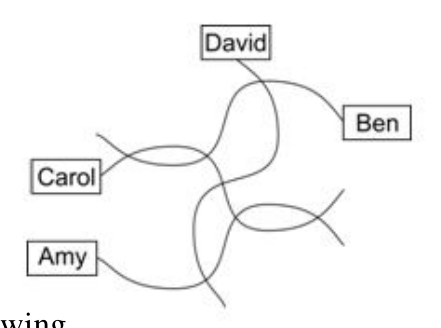
Jan cannot draw very accurately, but he tried to make a roadmap of his village. The relative positions of the houses and the street crossings are all correct, but although three of the roads are actually straight, Qurwik street is not. Who lives on Qurwik street?
Show answer
Answer: C — Carol
Show hints
Hint 1 of 2
Three of the four roads are straight; the one that bends is Qurwik street.
Still stuck? Show hint 2 →
Hint 2 of 2
Find the resident whose connecting road is the curved one, not a straight segment.
Show solution
Approach: identify the single curved road in the map
The crossings and house positions are correct, and only one road is drawn curved instead of straight.
That curved road is Qurwik street, and the house it serves belongs to Carol.
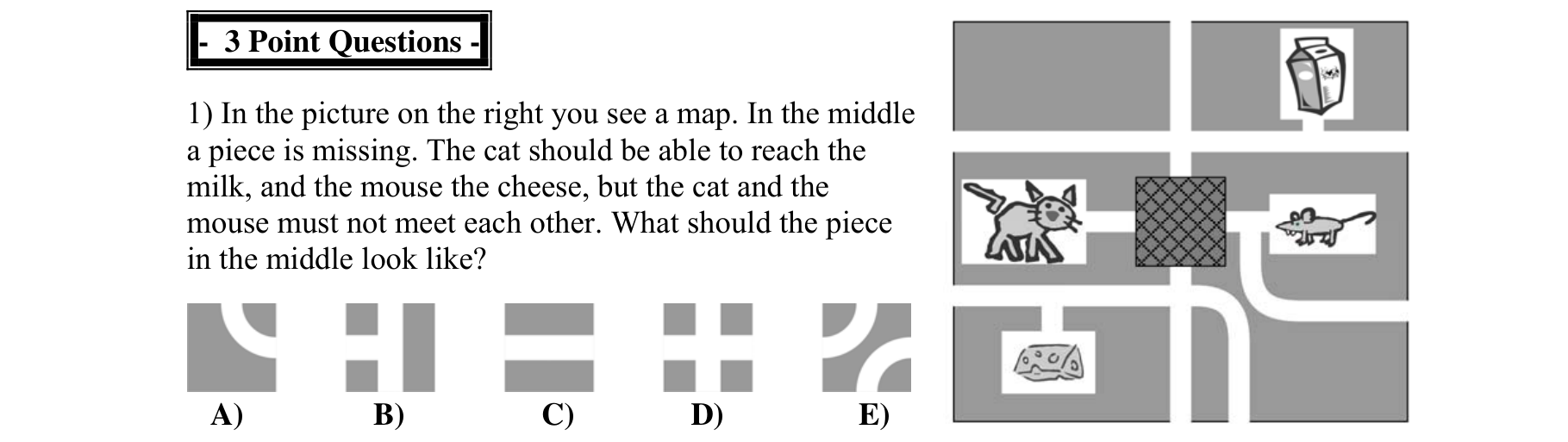
The road piece has to join the cat to the milk and the mouse to the cheese, yet keep those two routes from ever touching.
Still stuck? Show hint 2 →
Hint 2 of 2
Look at which sides of the missing square each road must enter and leave, then find the piece whose roads connect exactly those sides without crossing.
Show solution
Approach: match the road piece to the required connections
The cat must reach the milk, and the mouse the cheese, but the two animals' paths must stay separate.
So the missing piece needs two roads that link the correct opposite sides while never meeting in the middle.
Only the curved piece E carries the two routes past each other without letting them join.
For transport, games are packed in several equally sized cube-shaped boxes. Every eight of these are packed into a bigger cubic box. How many of the small boxes are on the bottom level of the bigger box?
Show answer
Answer: D — 4
Show hints
Hint 1 of 2
A bigger cube made of eight equal cubes is a 2×2×2 stack.
Still stuck? Show hint 2 →
Hint 2 of 2
Just look at one floor of that 2×2×2 arrangement.
Show solution
Approach: picture the 2x2x2 cube
Eight equal cubes packed into a cube form a 2×2×2 block.
Each level (floor) is a 2×2 square of cubes = 4 boxes.
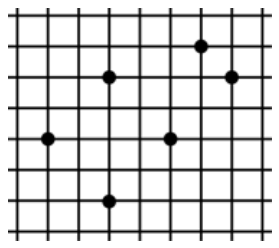
Six points are marked on a square grid as pictured. Which geometric figure cannot be drawn if only the marked points are allowed to be used as corner points of the figure?
Show answer
Answer: E — all figures are possible
Show hints
Hint 1 of 2
Look at where the six dots sit and try to actually build each named shape on them.
Still stuck? Show hint 2 →
Hint 2 of 2
Test the shapes one by one; if you can place all four, the answer is that all are possible.
Show solution
Approach: construct each shape on the marked points
Check each listed figure against the six marked points.
Each of the shapes can be formed using marked points as its corners.
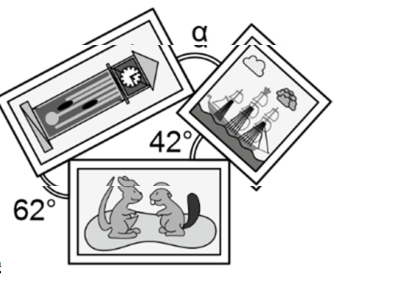
Louise places three rectangular pictures as shown in the figure. What is the size of the angle α?
Show answer
Answer: B — 70°
Show hints
Hint 1 of 2
Each picture is a rectangle, so every corner of it is a right angle (90°) — that is the key fact to lean on.
Still stuck? Show hint 2 →
Hint 2 of 2
Use a right-angle corner together with the marked 62° to find a small leftover angle, then combine it with the 42°.
Show solution
Approach: angle-chase using the rectangles' right angles
Because each picture is a rectangle, the corner sitting at the 62° mark is a right angle, so beyond the 62° there is \(90^\circ-62^\circ=28^\circ\) left over.
That 28° lines up next to the 42° gap, so \(\alpha=42^\circ+28^\circ\).
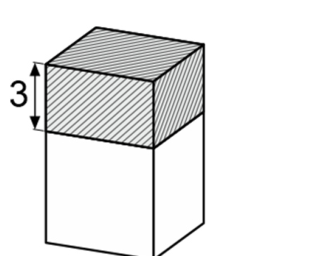
If the height of a cuboid is reduced by 3 cm, its surface area decreases by 60 cm² and the result is a cube. What is the volume of the original cuboid, in cm³?
Show answer
Answer: D — 200
Show hints
Hint 1 of 2
When you trim 3 cm off the height you remove a band around the side — that lost area is the side perimeter times 3.
Still stuck? Show hint 2 →
Hint 2 of 2
After trimming it's a cube, so the base is a square; find its side from the lost surface area.
Show solution
Approach: relate the surface-area loss to the base perimeter
Cutting the height by 3 cm removes a strip of lateral surface = (base perimeter)×3 = 60, so the base perimeter is 20 and each square side is 5.
The result is a cube of side 5, so the original height was 5 + 3 = 8.
Original volume = \(5\times5\times8 = 200\) cm³, which is (D).
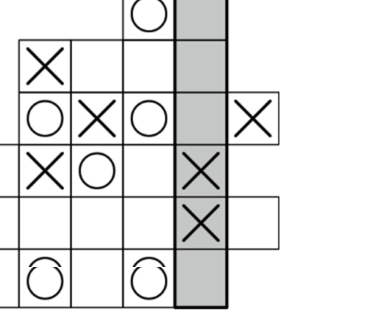
Martin wants to fill the cells in the diagram so that each cell contains either a cross or a circle, with no row, column or diagonal containing four consecutive identical symbols. What will the grey column contain in the completed diagram?
Show answer
Answer: B — 2 circles and 4 crosses
Show hints
Hint 1 of 2
No row, column or diagonal may hold four of the same symbol in a row — that rule forces almost every empty cell once you start from the ones already filled.
Still stuck? Show hint 2 →
Hint 2 of 2
Work cell by cell from the given symbols; whenever three matching symbols line up, the fourth must be the opposite one.
Show solution
Approach: propagate the no-four-in-a-row constraint
Start from the already-filled cells and apply the rule: whenever a line would otherwise get four equal symbols in a row, the next cell is forced to be the other symbol.
Chasing these forced choices through the grid fills the grey column uniquely.
The grey column ends up with 2 circles and 4 crosses, which is (B).
John has black and white unit cubes and wants to use 27 of them to build a 3×3×3 cube. He wants to make sure that the surface is exactly half white and half black. What is the minimum number of black cubes that he needs?
Show answer
Answer: E — another number
Show hints
Hint 1 of 2
Corner cubes show 3 faces, edge cubes 2, face-centre cubes 1 — use the ones showing the most faces first.
Still stuck? Show hint 2 →
Hint 2 of 2
The surface has 54 little faces; half is 27 black faces, so cover 27 of them with as few cubes as possible.
Show solution
Approach: maximise black faces per cube
The 3×3×3 surface has 6×9 = 54 little faces; half of them, 27, must be black.
A corner cube shows 3 faces, an edge cube 2, a face-centre cube 1.
All 8 corners give 24 black faces; one edge (2) plus one face-centre (1) adds the last 3.
That is 8 + 1 + 1 = 10 cubes — not 11/12/13/14, so the answer is another number.
Johann has several light and dark cubes. He used them to form the solid shown on the right by gluing a light cube on each side of a dark cube. Now he wants to glue on dark cubes so that no light areas can be seen from the outside. What is the minimum number of dark cubes that he will need?
Show answer
Answer: A — 18
Show hints
Hint 1 of 3
The solid is a 3D plus sign: a central dark cube with one light cube poking out on each of its 6 faces.
Still stuck? Show hint 2 →
Hint 2 of 3
Each light arm shows 5 light faces (its outer end plus 4 sides); a dark cube tucked into a corner between two arms can hide a side face of both at once.
Still stuck? Show hint 3 →
Hint 3 of 3
Count the end-caps separately from the corner cubes, and watch for the corner cubes being shared between neighbouring arms.
Show solution
Approach: cap each arm, then fill the shared corners between arms
Each of the 6 light arms shows its outer end face, so it needs 1 dark cube as a cap: that is 6 dark cubes.
Each arm also shows 4 side faces, for 6 × 4 = 24 light side faces in all.
A dark cube sitting in a corner between two neighbouring arms covers one side face of each, so it hides 2 side faces; there are 12 such corner positions around the cross.
The 12 corner cubes hide 12 × 2 = 24 side faces, exactly all of them, so the total is 6 + 12 = 18 dark cubes.
A beaver wants to colour the squares and triangles in the pattern so that adjacent cells are never the same colour, even if they only touch each other in one corner. What is the minimum number of colours he needs?
Show answer
Answer: C — 5
Show hints
Hint 1 of 3
Because even a single shared corner counts as touching, look for the point where the most cells crowd together.
Still stuck? Show hint 2 →
Hint 2 of 3
A group of cells that all pairwise touch must all get different colours — that group size is a lower bound.
Still stuck? Show hint 3 →
Hint 3 of 3
Find the largest mutually-touching cluster, then show a colouring with that many colours actually works everywhere.
Show solution
Approach: largest mutually-touching cluster sets the lower bound
Two cells are adjacent if they share an edge or merely a corner, so colours clash even at a point.
Around an interior corner the four triangles of one square plus a neighbouring cell all touch one another pairwise, forcing at least 5 different colours.
A consistent colouring of the whole pattern can be carried out with exactly those 5 colours.
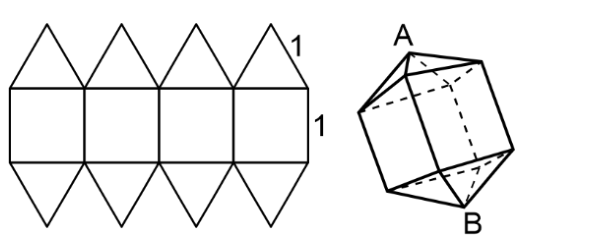
Otis builds the net of a solid from squares and triangles, as shown; every side of the squares and triangles has length 1. He folds the net to form the solid shown. What is the distance from A to B?
Show answer
Answer: A — \(1+\sqrt{2}\)
Show hints
Hint 1 of 2
Folding the band of squares makes a square tube; the triangles cap it into the solid, and every edge has length 1.
Still stuck? Show hint 2 →
Hint 2 of 2
Give the corners simple 3-D coordinates, then A and B are two of those corners; use the distance formula.
Show solution
Approach: fold to coordinates, then apply the distance formula
The four squares fold into the sides of a square prism of side 1, and the triangles fold over to close it, so all vertices sit on a unit grid.
Placing the vertices on coordinates, A and B land so that they differ by 1 in one direction and by a face diagonal \(\sqrt2\) lined up in the same straight line.
Adding those aligned pieces gives the straight-line distance \(AB = 1+\sqrt2\), answer A.
Kanga wants to build a figure out of these three cube parts (shown at the top). He may rotate or flip the parts. Which of the five pictured figures (A)–(E) can he NOT build?
Show answer
Answer: E
Show hints
Hint 1 of 3
First count the cubes in the three given parts added together — every figure Kanga can build must have exactly that many cubes.
Still stuck? Show hint 2 →
Hint 2 of 3
For each choice, try to colour it in three groups, one matching each part, turning or flipping the parts as needed.
Still stuck? Show hint 3 →
Hint 3 of 3
The figure you simply cannot split into the three parts is the one he canNOT make.
Show solution
Approach: try to split each figure into the three given parts (rotations and flips allowed)
Each finished figure must be built from all three parts, so it always has the same total number of cubes.
For each choice, try to break it into three pieces that match the three parts, allowing turning and flipping.
Four of the figures can be split up neatly into the three parts.
One figure cannot be split that way no matter how you turn the parts, so Kanga cannot make it: E.
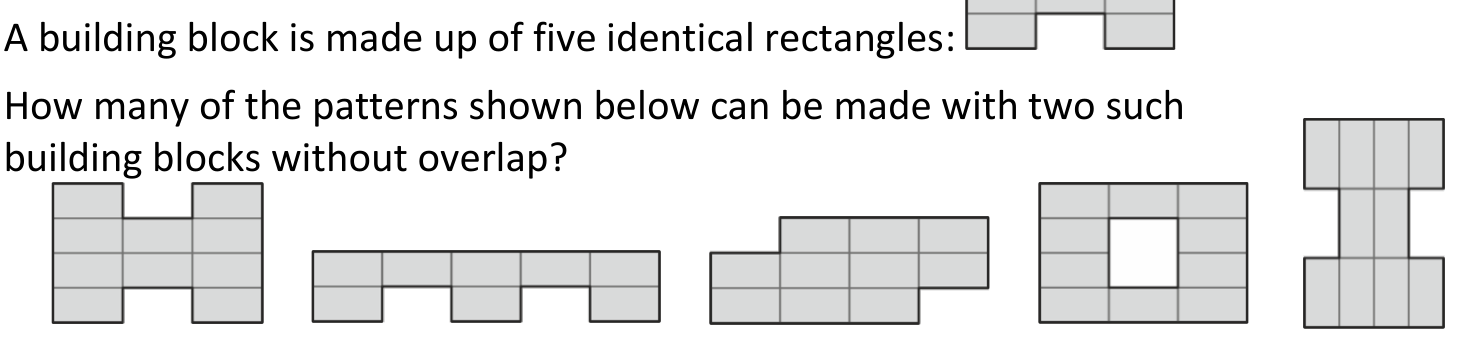
A building block is made up of five identical rectangles (shown). How many of the patterns shown below can be made with two such building blocks without overlap?
Show answer
Answer: D — 4
Show hints
Hint 1 of 2
Two blocks cover 5 + 5 = 10 small rectangles, so only patterns with 10 cells are possible.
Still stuck? Show hint 2 →
Hint 2 of 2
For the right-sized patterns, try to split them into two of the given S-shaped blocks.
Show solution
Approach: check cell count, then attempt a two-block tiling of each pattern
Each building block is 5 cells, so two of them cover 10 cells — only patterns with 10 cells can work.
Testing those patterns, exactly four of the five can be split into two of the S-shaped blocks without overlap.
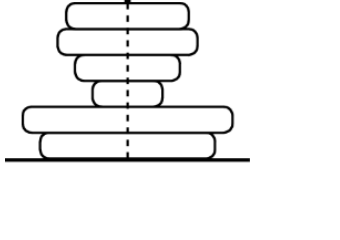
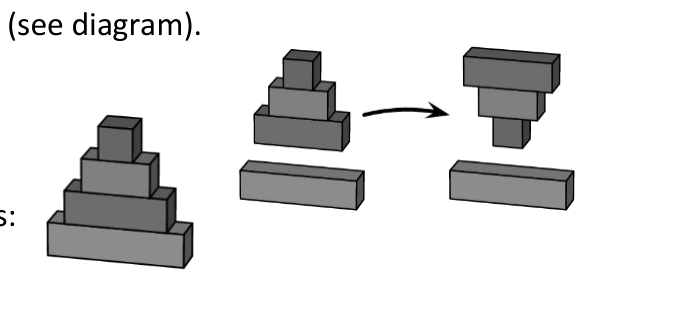
In one move you may take some (or all) of the building blocks from the top of a stack, turn that group upside down, and put it back in the same place (see picture). Goran starts with the stack on the left and wants to end up with all the blocks ordered by size, as shown on the right. What is the smallest number of moves Goran needs?
Show answer
Answer: B — 3
Show hints
Hint 1 of 3
A move can only lift a group off the top and turn that whole group over, so the bottom blocks stay put unless you lift everything above them.
Still stuck? Show hint 2 →
Hint 2 of 3
Look at which blocks are already in the right size order and which clumps are reversed or out of place.
Still stuck? Show hint 3 →
Hint 3 of 3
Try to undo the disorder one reversed clump at a time, counting how few flips can finish the job.
Show solution
Approach: find the smallest set of top-flips that reorders the blocks
A move lifts some blocks off the top, turns that chunk over, and puts it back, so one move can reverse a top group.
Comparing the starting stack with the target size order shows which groups are out of place.
Carrying out the reorder with the fewest such flips takes 3 moves.
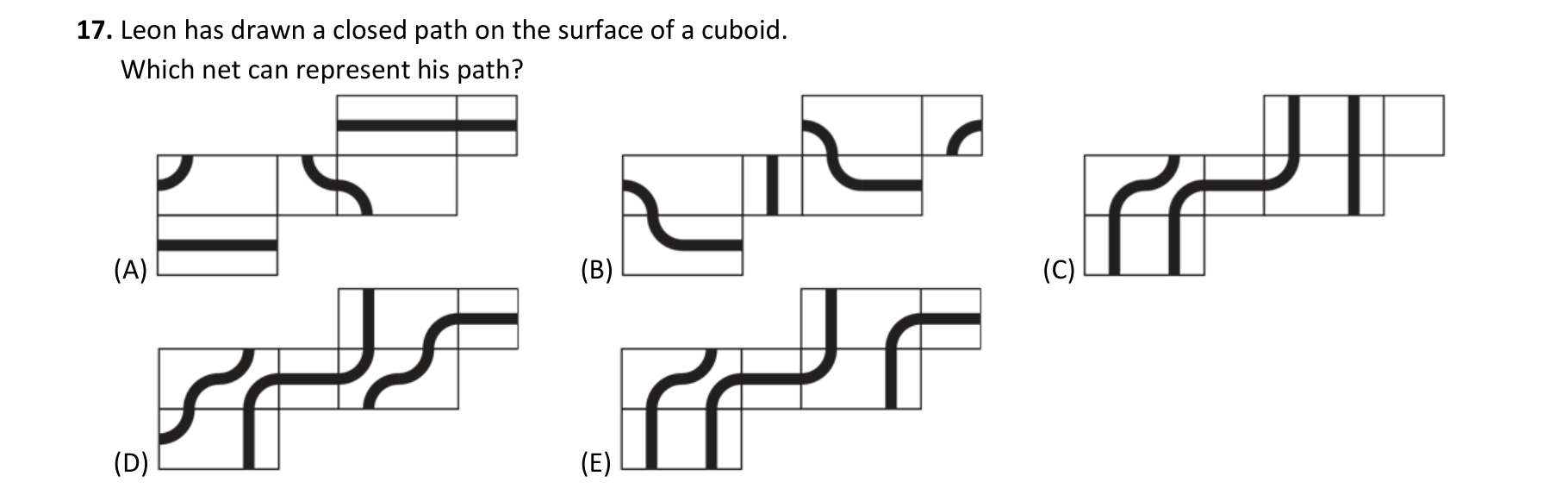
Leon has drawn a closed path on the surface of a cuboid. Which net (shown below) can represent his path?
Show answer
Answer: D
Show hints
Hint 1 of 3
On the real cuboid the path is one continuous loop, so on every fold edge the line must continue across without a gap.
Still stuck? Show hint 2 →
Hint 2 of 3
Walk along the path in each net and check that it leaves a face exactly where it re-enters the neighbouring face when folded.
Still stuck? Show hint 3 →
Hint 3 of 3
Reject any net where a path end stops at an edge with no matching segment on the face it glues to.
Show solution
Approach: match path crossings across every glued edge of the folded net
A closed path on the cuboid is one loop, so where it crosses an edge of the net the two faces that join along that edge must each carry the line at the same point.
In options A, B, C and E at least one path segment runs off an edge with no matching line on the face it folds against, breaking the loop.
Only the segments in option D line up at every shared edge and close into a single continuous loop.
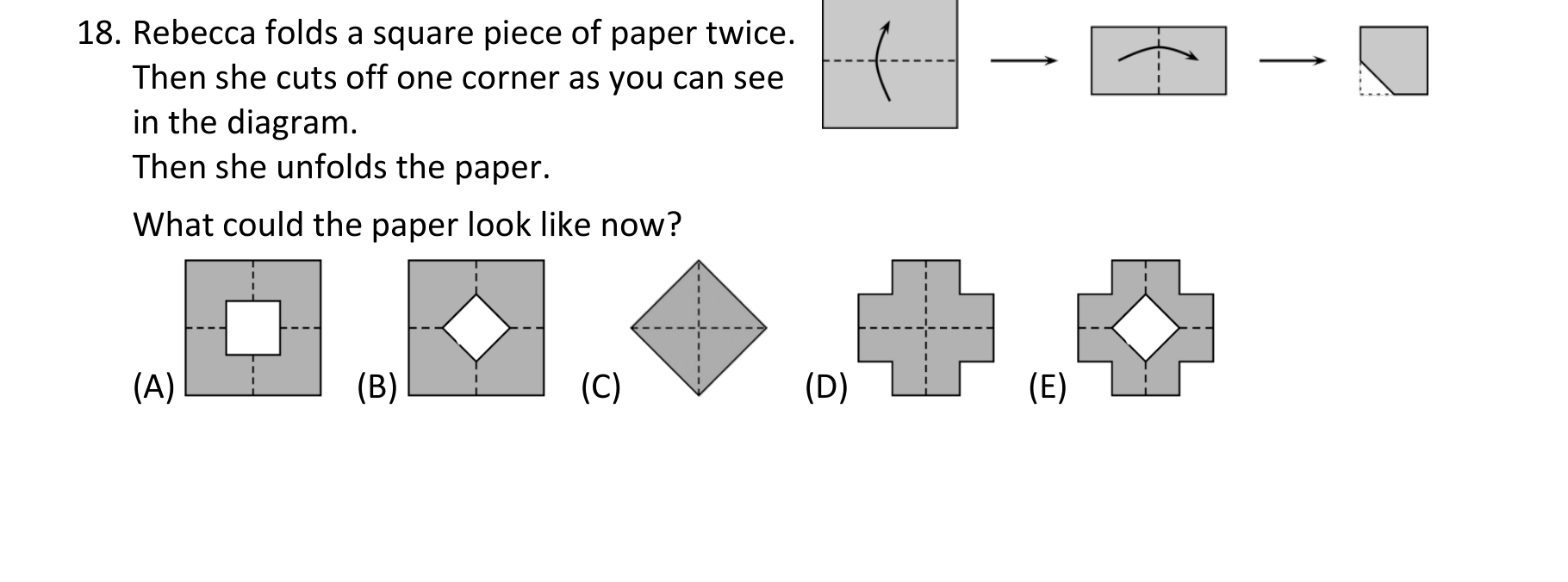
Rebecca folds a square piece of paper twice. Then she cuts off one corner as shown in the diagram. Then she unfolds the paper. What could the paper look like now? (Choose from pictures A–E.)
Show answer
Answer: B
Show hints
Hint 1 of 2
Folding twice stacks four layers; the single cut goes through all of them.
Still stuck? Show hint 2 →
Hint 2 of 2
The cut corner sits at the folded centre, so unfolding makes a hole in the middle.
Show solution
Approach: unfold the cut by reflecting it across both fold lines
Two folds bring all four corners together at the centre of the square.
Cutting that folded corner removes a piece from the very middle of the paper.
Unfolded, the paper is a full square with a small square hole in the centre, which is option B.
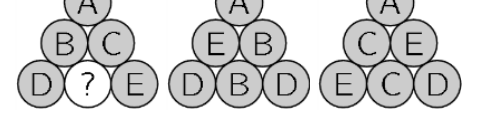
Tina draws shapes into each field of the pyramid. Each field in the second and third rows contains exactly the shapes of the two fields directly below it. Some fields are already filled in. Which shapes does she draw into the empty field of the bottom row?
Show answer
Answer: D
Show hints
Hint 1 of 3
A filled field is just the two fields below it combined, so a field above tells you the total of the pair underneath.
Still stuck? Show hint 2 →
Hint 2 of 3
Find a field whose value you know that sits right above the empty one, then subtract the shapes you can already see.
Still stuck? Show hint 3 →
Hint 3 of 3
Whatever shapes are missing after that subtraction must belong in the empty bottom field.
Show solution
Approach: use the rule that each field is the combination of the two below it
Each field equals the shapes of the two fields beneath it, so a middle field is the sum of its two bottom fields, and the top field is the sum of all three bottom fields (with the middle one counted twice).
Filling in the fields that are already given, subtract the known bottom fields from the totals to isolate the missing bottom field.
The shapes left over for the empty bottom field are one circle and one triangle.
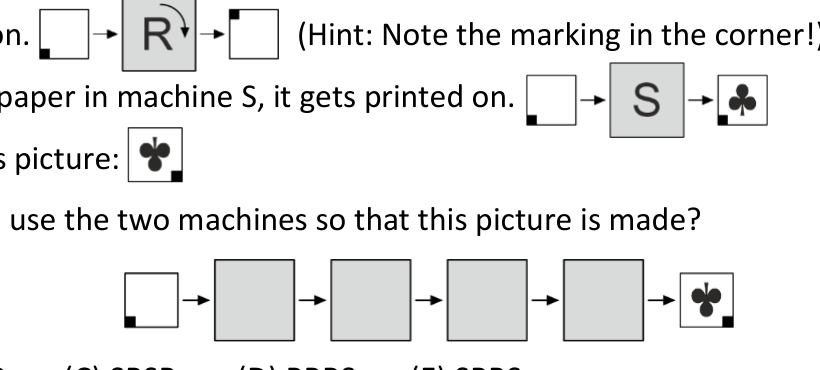
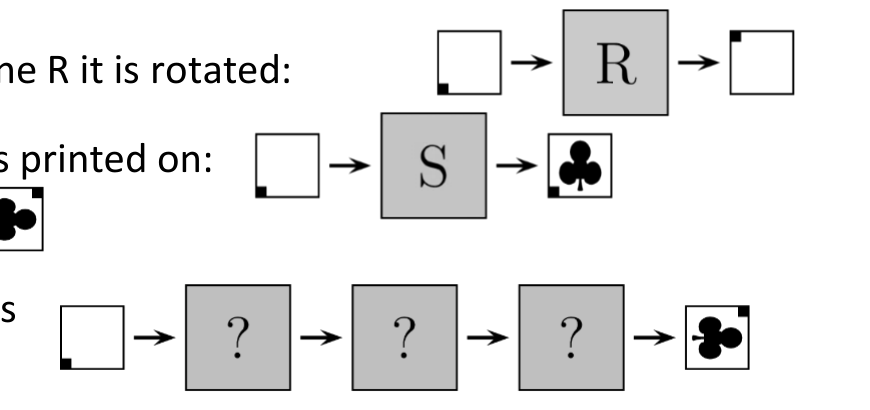
Anna has two machines R and S. Machine R rotates a square piece of paper 90° clockwise (watch the marking in the corner). Machine S prints a club onto the paper. Anna wants to produce the picture shown. In which order does she use the two machines?
Show answer
Answer: B — RSRR
Show hints
Hint 1 of 3
Machine R only spins the paper a quarter-turn, while machine S stamps the club at whatever angle the paper is in right now.
Still stuck? Show hint 2 →
Hint 2 of 3
Keep your eye on the little corner marking and follow where it travels after each R turn.
Still stuck? Show hint 3 →
Hint 3 of 3
Read the orders one letter at a time, checking that the club gets stamped at the right moment so it ends up tilted the way the target shows.
Show solution
Approach: track the corner mark and the club's orientation through the machines
Follow the position of the corner marking as R turns the square 90° clockwise each time and S prints the club at the current orientation.
The target shows both the corner mark and the club in particular positions, so the printing must happen at the right stage and the later turns must carry both into place.
Testing the orders, R then S then R then R lands the marking and the club exactly as the target requires.
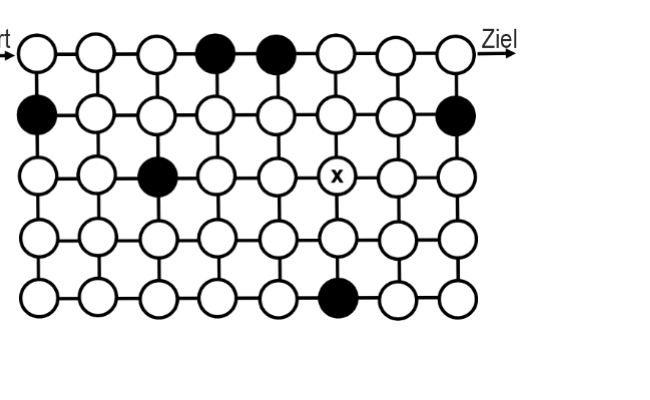
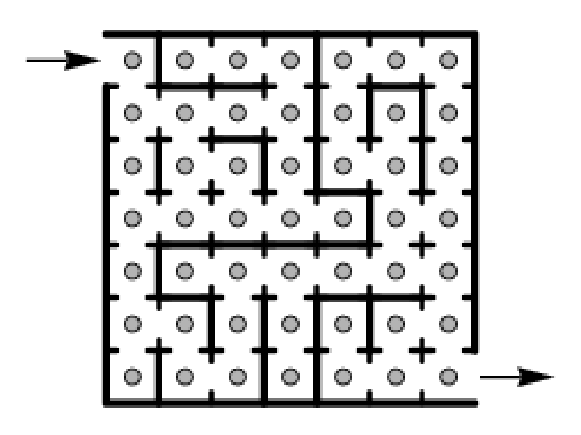
Monika wants to find a path through the maze from “Start” to “Ziel”. She may only move horizontally or vertically. She must enter every white circle exactly once and may not enter any black circle. In which direction must Monika move when she reaches the circle marked with x?
Show answer
Answer: A — ↓
Show hints
Hint 1 of 3
A circle in a corner or with black circles around it usually has only one open neighbour, so its move is forced.
Still stuck? Show hint 2 →
Hint 2 of 3
Start filling in those forced moves first, because each one locks in the next.
Still stuck? Show hint 3 →
Hint 3 of 3
By the time the forced path reaches x, only one direction keeps every remaining white circle reachable exactly once.
Show solution
Approach: use the must-visit-each-white-circle-once rule to force the path at x
Monika moves only horizontally and vertically, must enter every white circle exactly once, and cannot enter a black circle.
Near corners and beside black circles, several moves are forced because there is only one legal way through.
Tracing these forced moves up to the circle marked x leaves exactly one direction that still lets the path reach every remaining white circle: downward.
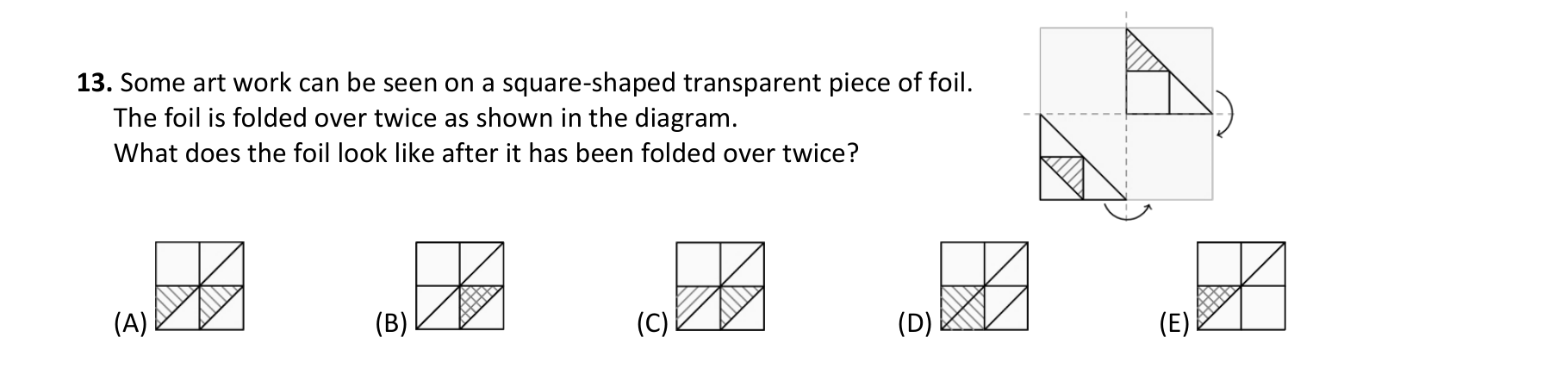
Some artwork is drawn on a square piece of transparent foil. The foil is folded over twice, as shown in the diagram. What does the foil look like after it has been folded over twice?
Show answer
Answer: A
Show hints
Hint 1 of 2
Each fold reflects the visible marks across the fold line onto the layer below.
Still stuck? Show hint 2 →
Hint 2 of 2
Fold once, draw where the marks land, then fold again and combine all layers.
Show solution
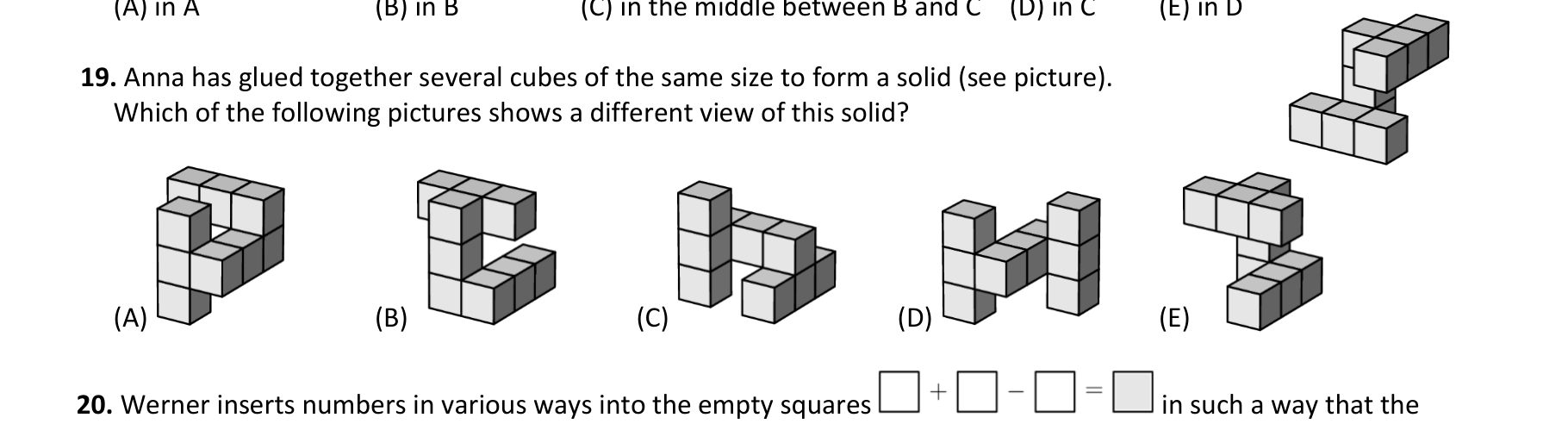
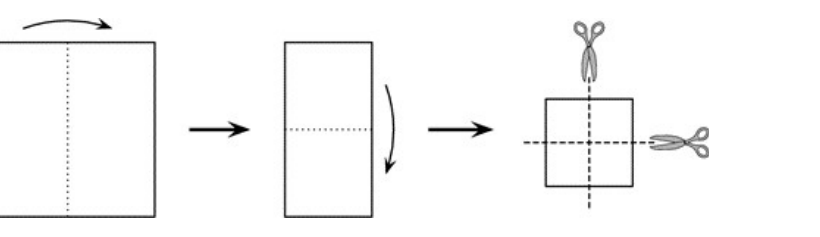
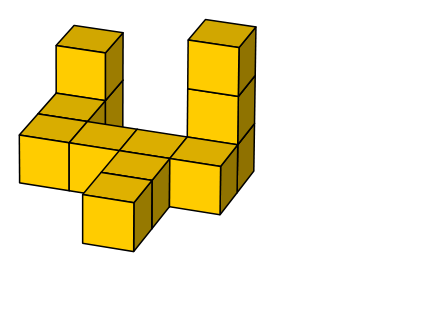
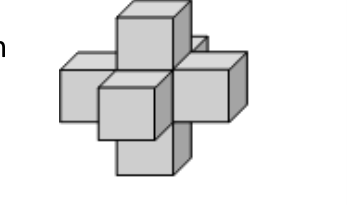
Approach: reflect the marks across each fold line
Folding flips the drawn marks across the fold crease onto the part beneath.
Apply the first fold, record the mirrored marks, then apply the second fold and overlay everything.
Dino walks from the entrance to the exit. He is only allowed to go through each room once. The rooms have numbers (see diagram). Dino adds up all the numbers of the rooms he walks through. What is the biggest result he can get this way?
Show answer
Answer: D — 34
Show hints
Hint 1 of 3
For the biggest total, Dino should try to walk through as many rooms as he can.
Still stuck? Show hint 2 →
Hint 2 of 3
Add up all eight room numbers first - then see whether the doorways really let him visit every single room.
Still stuck? Show hint 3 →
Hint 3 of 3
He cannot quite reach all eight; find the path that misses only the room worth the least points.
Show solution
Approach: add up all the rooms, then leave out the one room you are forced to skip
All eight room numbers add up: 1 + 2 + 3 + 4 + 5 + 6 + 7 + 8 = 36, so the most he could ever score is 36.
Trying paths through the doorways from the entrance (room 1) to the exit (room 8) without repeating a room, Dino cannot fit in every room - the best route leaves out exactly one room, and the smallest he can skip is room 2.
So his biggest total is 36 − 2 = 34, which is answer D.
On an ordinary die the numbers on opposite faces always add up to 7. Four such dice are glued together as shown. All the numbers still visible on the outside of the solid are added up. What is the smallest possible value of that total?
Show answer
Answer: D — 58
Show hints
Hint 1 of 2
Opposite faces of a die sum to 7, so all six faces of one die total 21 and the four dice total 84.
Still stuck? Show hint 2 →
Hint 2 of 2
Visible total = 84 minus the glued (hidden) faces, so MINIMISE the visible sum by putting the biggest allowed numbers on the touching faces.
Show solution
Approach: subtract the hidden glued faces from the four-dice total
The four dice have total pip count 4 x 21 = 84, and the visible sum is 84 minus whatever is hidden at the glued joints.
To make the visible sum smallest, orient the dice so the touching faces carry as many pips as the gluing in the figure allows.
Maximising the hidden pips this way leaves a smallest visible total of 58, so the answer is D.
Anna has glued together several cubes of the same size to form a solid (see picture). Which of the following pictures shows a different view of this same solid?
Show answer
Answer: C
Show hints
Hint 1 of 2
Count the cubes and note the solid's overall shape, then mentally rotate it.
Still stuck? Show hint 2 →
Hint 2 of 2
A valid view must keep the same number of cubes and the same connections, just seen from another side.
Show solution
Approach: rotate the solid and match cube count and connections
The given solid has a fixed number of cubes joined in a particular way.
Each option is checked to see whether it is the same solid seen from a different direction.
Only C is a genuine rotation of the original solid.
A pyramid is built from cubes (see diagram), and every cube has side length 10 cm. An ant crawls along the line drawn across the pyramid (see diagram). How long is the path the ant takes?
Show answer
Answer: E — 90 cm
Show hints
Hint 1 of 3
The drawn line is made of short straight pieces, and each piece is exactly one cube-edge long.
Still stuck? Show hint 2 →
Hint 2 of 3
One cube edge is 10 cm, so you only need to count how many cube-edges the whole line covers.
Still stuck? Show hint 3 →
Hint 3 of 3
Trace the line up the steps and back down, counting one edge at a time.
Show solution
Approach: count the cube-edges the line covers, each 10 cm
The ant's line follows the steps of the pyramid, and every little piece is one cube-edge of 10 cm.
Tracing the line up over the steps and down the other side, it covers 9 cube-edges.
A road leads away from each of the six houses (see diagram), but the hexagon of roads for the middle is missing. Which hexagons can go in the middle so that you can travel from A to B and to E, but not to D?
Show answer
Answer: C — 1 and 5
Show hints
Hint 1 of 3
The roads inside the hexagon decide which houses get joined to which — put your finger on A and see where you can drive.
Still stuck? Show hint 2 →
Hint 2 of 3
You want A, B and E all on one set of connected roads, but D left out with no way to reach it.
Still stuck? Show hint 3 →
Hint 3 of 3
Try each hexagon in the gap and trace the roads from A every time.
Show solution
Approach: drop in each hexagon and trace the roads from A
Fit a hexagon into the gap, then put your finger on house A and follow every road you can drive along.
You need A, B and E to all join up, while D stays cut off (no road reaches it).
Only hexagons 1 and 5 connect A to B and E while leaving D alone.
The big cube is built from three different kinds of building blocks (see diagram). How many of the little white cubes are needed to build the big cube?
Show answer
Answer: B — 11
Show hints
Hint 1 of 3
First figure out how many little cubes fill the whole big cube — it is 3 across, 3 deep and 3 tall.
Still stuck? Show hint 2 →
Hint 2 of 3
Each grey L-piece and each dark bar is made of 3 little cubes, so count how many little cubes all the coloured pieces use up.
Still stuck? Show hint 3 →
Hint 3 of 3
Whatever little cubes are left over after the coloured pieces must be the single white ones.
Show solution
Approach: count all the little cubes, then take away the coloured pieces
The big cube is 3 across, 3 deep and 3 tall, so it holds 3 × 3 × 3 = 27 little cubes.
Each grey L-piece and each dark bar is built from 3 little cubes, and together the coloured pieces fill 16 of the 27 spots.
Every spot that is left over must be a single white cube: 27 − 16 = 11.
The picture shows the five houses of five friends and their school. The school is the largest building in the picture. To go to school, Doris and Ali walk past Leo's house. Eva walks past Chloe's house. Which is Eva's house?
Show answer
Answer: B
Show hints
Hint 1 of 3
Find the school first, then trace the road each child walks to get there.
Still stuck? Show hint 2 →
Hint 2 of 3
The clues about Leo's house help you figure out who lives where.
Still stuck? Show hint 3 →
Hint 3 of 3
Eva's road is the one that goes right past Chloe's house.
Show solution
Approach: trace the roads to school
Find the big school, then look at which houses you walk past on the way from each house.
The clue that Doris and Ali pass Leo's house tells you where Leo lives.
Eva's road is the one passing Chloe's house, and tracing it back, Eva's house is option B.
The picture shows 3 gears with a black gear tooth on each. Which picture shows the correct position of the black teeth after the small gear has turned a full turn clockwise?
Show answer
Answer: A
Show hints
Hint 1 of 2
Meshed gears turn in opposite directions; a full turn of the small gear moves the others by matching tooth counts.
Still stuck? Show hint 2 →
Hint 2 of 2
Track the black tooth on each gear after that rotation to find the consistent picture.
Show solution
Approach: rotate each meshed gear correctly
When the small gear makes one full clockwise turn, the gears it meshes with rotate the other way by the same number of teeth.
Following each black tooth to its new position, the arrangement that results is choice A.
Logic & Word ProblemsSpatial & Visual Reasoningcareful-countingcasework
A triangular pyramid is built with 20 cannon balls, as shown. Each cannon ball is labelled with one of A, B, C, D or E. There are 4 cannon balls with each type of label. The picture shows the labels on the cannon balls on 3 of the faces of the pyramid. What is the label on the hidden cannon ball in the middle of the fourth face?
Show answer
Answer: D — D
Show hints
Hint 1 of 2
Each label A–E is used exactly four times across the 20 balls.
Still stuck? Show hint 2 →
Hint 2 of 2
Tally how many of each label already appear on the three shown faces (counting shared edge balls once); the centre ball must be the label still short of four.
Show solution
Approach: count each label and find the one not yet at full quota
There are 4 balls of each label. Tally the labels visible on the three shown faces, counting shared edge/corner balls once.
One label falls one short of its quota of 4; that missing ball is the hidden centre of the fourth face.
A large cube has side-length 7 cm. On each of its 6 faces, the two diagonals are drawn in red. The large cube is then cut into small cubes with side-length 1 cm. How many small cubes will have at least one red line drawn on it?
Show answer
Answer: B — 62
Show hints
Hint 1 of 2
A red face-diagonal only marks the unit cubes it passes through on that face; count by face then remove double counts.
Still stuck? Show hint 2 →
Hint 2 of 2
Edge and corner cubes can be crossed by diagonals on more than one face — don't count them twice.
Show solution
Approach: count marked cubes per face, then correct overlaps
Each face is a 7×7 grid of little squares; the two diagonals run through 7 + 7 − 1 = 13 of them (the centre square is shared).
Six faces give 6 × 13 = 78, but cubes along the edges and corners get a red line on two faces and were counted twice — there are 16 such double-counts.
So the number of unit cubes with at least one red line is 78 − 16 = 62.
There are rectangular cards divided into 4 equal cells with different shapes drawn in each cell. Cards can be placed side by side only if the same shapes appear in adjacent cells on their common side. 9 cards are used to form a rectangle as shown in the figure. Which of the following cards was definitely NOT used to form this rectangle?
Show answer
Answer: E
Show hints
Hint 1 of 2
Cards join only when the touching cells match, so trace the shape sequence along each row and column of the assembled rectangle.
Still stuck? Show hint 2 →
Hint 2 of 2
Read the forced shapes from the given grid; one listed card has a cell pattern that can never fit.
Show solution
Approach: match each card against the forced grid pattern
The assembled rectangle fixes which shapes sit in each cell because adjacent cards must agree on their shared edge.
Reading those forced shapes, four of the candidate cards can occur somewhere in the layout.
Card E has a cell arrangement that cannot fit anywhere, so it was definitely not used.
Zilda will use six identical cubes and two different rectangular blocks to build the structure shown, which has eight faces. Before gluing the pieces, she paints each one completely and works out that she needs 18 litres of paint (colour does not matter). How many litres of paint would she use if she painted the whole structure only after gluing the pieces together?
Show answer
Answer: C — 11.5
Show hints
Hint 1 of 2
Painting after gluing simply skips the faces that get hidden where two pieces touch.
Still stuck? Show hint 2 →
Hint 2 of 2
Every internal contact hides two equal faces, so pair them up and remove their paint.
Show solution
Approach: subtract the paint on the faces hidden by gluing
Painted separately, all the pieces' faces need 18 litres.
After gluing, wherever two pieces meet, two equal faces are hidden and no longer painted, so that paint is removed.
Totalling the hidden contact faces and subtracting their paint from 18 litres leaves 11.5 litres, option C.
Maria has exactly 9 white cubes, 9 light-grey cubes and 9 dark-grey cubes, all the same size. She glues them all together to form one larger cube. Which of the cubes below is the one she made?
Show answer
Answer: A
Show hints
Hint 1 of 2
A 3x3x3 cube has 27 small cubes; here each colour is used exactly 9 times.
Still stuck? Show hint 2 →
Hint 2 of 2
Count the visible faces of each colour in each option - the right cube must allow exactly 9 of each colour overall.
Show solution
Approach: match the visible colour counts to 9-9-9
The big cube is 3x3x3 = 27 small cubes, painted 9 white, 9 light grey, 9 dark grey.
For each option, see whether the visible and forced hidden cubes can split into three nines.
Only cube A is consistent with using each colour exactly nine times.
Amelia glues six stickers onto the faces of a cube. The figure shows this cube in two different positions. Which sticker is on the face opposite the duck?
Show answer
Answer: E
Show hints
Hint 1 of 2
Use the two shown views to find which stickers sit next to the duck.
Still stuck? Show hint 2 →
Hint 2 of 2
Whatever sticker never appears next to the duck in either view sits on the opposite face.
Show solution
Approach: find the duck's neighbours, the rest is opposite
Each cube view shows the duck together with some neighbouring faces.
Collect every sticker seen adjacent to the duck across the two pictures - those four are its side faces.
The remaining sticker, the fly, is opposite the duck.
The points on opposite sides of an ordinary die add up to 7. This die is placed on the first square as shown and then rolled along, as in the picture, to the fifth square. When the die reaches the last square, what is the product of the numbers of points on its two coloured vertical faces?
Show answer
Answer: D — 18
Show hints
Hint 1 of 3
The two side faces are partners that always add to 7, so once you know one, you know the other.
Still stuck? Show hint 2 →
Hint 2 of 3
Roll a real die (or imagine one) tipping forward square by square and watch the side faces.
Still stuck? Show hint 3 →
Hint 3 of 3
Only the forward tips change the top and front faces; the two side numbers stay as a pair the whole way.
Show solution
Approach: roll the die step by step and read the two colored side faces at the end
Set a real die the same way as the picture and tip it forward, one square at a time, following the arrows to the last square.
Keep checking the two colored side faces, remembering that whatever shows on one side, its hidden partner is 7 minus that number.
On the last square the two colored side faces show 3 and 6, and 3 × 6 = 18, choice D.
A 3 × 2 rectangle can be covered in two ways by two of the L-shaped figures, as shown. In how many ways can the diagram on the right be covered by these L-shaped figures?
Show answer
Answer: B — 2
Show hints
Hint 1 of 2
The two L-pieces must pair up the way they did in the 3 × 2 box.
Still stuck? Show hint 2 →
Hint 2 of 2
Find a corner cell that only one piece can reach, and let that placement force the rest.
Show solution
Approach: let a forced corner pin down the whole covering
Look at a corner cell of the figure: only one orientation of an L-piece can cover it while staying inside.
Once that corner piece is placed, the cells it leaves can be completed by the remaining pieces in just two consistent ways.
Kathi folds a square piece of paper twice and then cuts it along the two lines shown in the picture. The resulting pieces of paper are then unfolded where possible. How many of the pieces are squares?
Show answer
Answer: C — 5
Show hints
Hint 1 of 2
Fold mentally, mark the two cuts, then unfold and see which pieces are squares.
Still stuck? Show hint 2 →
Hint 2 of 2
Each cut, once unfolded, becomes several cuts because of the layers.
Show solution
Approach: unfold the cuts and identify square pieces
Folding the square twice stacks four layers; the two cuts pass through all layers.
Unfolding turns those cuts into a symmetric set of cut lines across the whole sheet.
Tracing the resulting pieces, exactly 5 of them are squares.
An octahedron is inscribed in a cube with side length 1; the vertices of the octahedron are the midpoints of the faces of the cube. How big is the volume of the octahedron?
Show answer
Answer: D — \(\tfrac{1}{6}\)
Show hints
Hint 1 of 2
The octahedron's vertices are the centres of the cube's six faces.
Still stuck? Show hint 2 →
Hint 2 of 2
Split the octahedron into two square pyramids.
Show solution
Approach: octahedron from face centres of a unit cube
The six face centres of a unit cube form a regular octahedron made of two square pyramids.
Each pyramid has base area 1/2 (the square joining four face centres) and height 1/2.
A regular pentagon is cut out of a page of lined paper. Step by step the pentagon is then rotated 21° counter-clockwise about its midpoint. The result after step one is shown in the diagram. Which of the diagrams shows the situation when the pentagon fills the hole entirely again for the first time?
Show answer
Answer: B
Show hints
Hint 1 of 3
The pentagon outline refits its hole only when the total turn is a whole multiple of its rotational-symmetry angle.
Still stuck? Show hint 2 →
Hint 2 of 3
Find the smallest number of 21° steps that is a whole multiple of 72°, then see how far the drawn lines have turned.
Still stuck? Show hint 3 →
Hint 3 of 3
The lines printed on the pentagon turn by the full accumulated angle, reduced modulo 360°.
Show solution
Approach: rotational symmetry: the hole is refilled when the total rotation is a multiple of 72°
A regular pentagon looks the same after a turn of 72°, so its outline fits the hole when the accumulated rotation is a multiple of 72°.
Stepping 21° at a time first lands on a multiple of 72° after 24 steps, since 24·21° = 504° = 7·72°.
The outline is back in place, but the lines printed across it have turned 504° ≡ 144°, so they are no longer horizontal — they appear tilted.
The diagram with the outline refit and the lines at that tilt is option (B).
The rooms in Kanga’s house are numbered. Eva enters through the main entrance. She must walk through the rooms so that each room she enters has a higher number than the previous one. Through which door does Eva leave the house?
Show answer
Answer: D — D
Show hints
Hint 1 of 3
Start at the entrance and only ever step into a room whose number is bigger than the room you are leaving — never into a smaller or equal one.
Still stuck? Show hint 2 →
Hint 2 of 3
From each room, look at the rooms next to it and walk to one with a higher number; this forces your route step by step.
Still stuck? Show hint 3 →
Hint 3 of 3
Keep climbing to higher numbers until you reach the bottom wall, and see which door A–E you come out of.
Show solution
Approach: walk from the entrance always stepping into the next room only if its number is larger, which pins down a single route to the exit
From the main entrance Eva can step into a neighbouring room only when its number is larger than the one she is in, so at every step she has just the higher-numbered neighbour to choose.
Following that climbing-numbers rule, she is funnelled along one route down through the house, since any move to an equal or smaller number is blocked.
That single increasing path brings her to the bottom row and out through door D, answer D.
A decorated glass tile is mirrored several times along the boldly printed edge. The first mirror image is shown. What does the tile on the far right look like after the third reflection?
Show answer
Answer: B
Show hints
Hint 1 of 3
Picture the tile as a stamp pressed over and over: each mirror across the next bold edge flips it left-to-right, like turning the page of a book.
Still stuck? Show hint 2 →
Hint 2 of 3
Think about whether the tile faces the same way or the flipped way after 1 flip, after 2 flips, after 3 flips.
Still stuck? Show hint 3 →
Hint 3 of 3
One flip and three flips leave it mirror-flipped; two flips bring it back to looking like the original.
Show solution
Approach: track that each flip mirrors the tile, so an odd number of flips gives a mirror image of the start
Each reflection across a bold edge flips the tile left-to-right, so after one flip the picture is the mirror image of the original.
A second flip turns it back to the original look, and a third flip makes it the mirror image again — so after three flips the tile is the mirror image of the starting tile.
The picture that is the left-right mirror of the original tile is B, the answer.
The diagram shows the net of a box consisting only of rectangles. How big is the volume of the box?
Show answer
Answer: C — 80 cm³
Show hints
Hint 1 of 2
Fold the net up in your head into a closed box and find its three edge lengths.
Still stuck? Show hint 2 →
Hint 2 of 2
The band of four faces wraps around the box, so its height is one edge and its total length is twice the sum of the other two edges; a tab gives the remaining edge.
Show solution
Approach: read the box edges from the folded net
The horizontal strip of four faces wraps around the box; its height (7 cm) is one edge, and the tab sticking out adds 10 − 7 = 3 cm for another edge.
Folding the net up gives a rectangular box, and multiplying its three edge lengths gives the volume.
By the official key the volume is 80 cm³ (the marked lengths in this image crop did not cleanly reproduce 80, so the key letter C is kept).
Simon has two identical tiles, whose front looks like this. The back is white. Which pattern can he make with those two tiles? (The five patterns are shown as choices A, B, C, D, E.)
Show answer
Answer: A
Show hints
Hint 1 of 2
Each tile can be turned around or even flipped over, since the back is plain white.
Still stuck? Show hint 2 →
Hint 2 of 2
Try to split each pattern into two pieces that both look just like Simon's tile.
Show solution
Approach: tile the figure with two copies of the piece
The two tiles are identical L-shaped pieces (a dark square in one corner); they may be turned or flipped.
Test each option by trying to cut it into two such tiles with the dark squares in the right spots.
Only option A can be built from the two given tiles.
Max builds this construction using some small equally big cubes. If he looks at his construction from above, the plan on the right tells the number of cubes in every tower. How big is the sum of the numbers covered by the two hearts?
Show answer
Answer: C — 5
Show hints
Hint 1 of 2
The plan number in each square is the height of the tower standing there.
Still stuck? Show hint 2 →
Hint 2 of 2
Read the two hidden tower heights off the 3-D picture, then add them.
Show solution
Approach: read the two covered tower heights from the construction and add
Each square of the plan shows how many cubes are stacked there.
The two hearts cover two of these tower heights.
Reading those two towers from the picture and adding gives the total.
A square floor is tiled with triangular and square tiles in grey and white. What is the smallest number of grey tiles that must be swapped with white tiles so that the floor looks the same from each of the four marked viewing directions?
Show answer
Answer: C — one triangle, one square
Show hints
Hint 1 of 2
Looking the same from all four directions means the pattern must be unchanged by a quarter-turn rotation.
Still stuck? Show hint 2 →
Hint 2 of 2
Find the fewest grey tiles to recolour so every quarter-turn maps grey onto grey.
Show solution
Approach: enforce 4-fold rotational symmetry with fewest swaps
For the floor to look identical from all four sides, the grey pattern must repeat under a 90° rotation.
Compare each tile to where it lands under the rotations and fix the mismatches.
The smallest fix recolours one triangular tile and one square tile.
The first kangaroo is repeatedly mirrored (reflected) across the dotted lines. Two reflections have already been carried out. In which position is the kangaroo in the grey triangle?
Show answer
Answer: E
Show hints
Hint 1 of 2
Each step flips the kangaroo across the next dotted edge; reflecting twice restores orientation but moves it.
Still stuck? Show hint 2 →
Hint 2 of 2
Track the kangaroo through the reflections into the grey triangle and read off its pose.
Show solution
Approach: apply successive reflections across the triangle edges
Reflecting across each shared dotted edge flips the kangaroo's orientation in alternating triangles.
Carry the flips along the strip until reaching the grey triangle.
The resulting pose matches option (E).
So the kangaroo in the grey triangle looks like (E).
Gerda walks along the road and writes down the letters she can see on her right-hand side. Which word is formed while Gerda walks from point 1 to point 2?
Show answer
Answer: A — KNAO
Show hints
Hint 1 of 2
Walk from point 1 toward point 2 and only write a letter when it is on Gerda's right.
Still stuck? Show hint 2 →
Hint 2 of 2
Read off the right-hand letters in the order she passes them.
Show solution
Approach: record only the right-side letters along the route
Walk Gerda's path from point 1 to point 2 and look at each sign — write it down only when it is on her right-hand side.
In the order she passes them, the right-side letters are K, N, A, O.
Clara is forming one big triangle made up of identical little triangles. She has already put some triangles together (see diagram). What is the minimum number of little triangles she still has to add?
Show answer
Answer: B — 9
Show hints
Hint 1 of 3
A big triangle with little triangles has a square-number count: side 2 holds 4, side 3 holds 9, side 4 holds 16.
Still stuck? Show hint 2 →
Hint 2 of 3
Find the smallest such big triangle that still fits around the pieces already placed.
Still stuck? Show hint 3 →
Hint 3 of 3
Then subtract the pieces already there from that total.
Show solution
Approach: complete to the smallest big triangle that fits
The widest row already placed forces the big triangle to be 4 little triangles along each side, and a side-4 triangle holds \(4 \times 4 = 16\) little triangles.
Counting what is already placed and taking it away from 16, Clara must add 9 more little triangles, choice (B).
A big cube is made of 64 small cubes. Exactly one of them is grey (see diagram). Two cubes are neighbours if they share a common face. On day one the grey cube colours all of its neighbours grey. On day two all grey cubes again colour all of their neighbours grey. How many of the 64 little cubes are grey at the end of the second day?
Show answer
Answer: E — 17
Show hints
Hint 1 of 3
After day one the grey cube and all cubes sharing a face with it are grey.
Still stuck? Show hint 2 →
Hint 2 of 3
After day two add every cube sharing a face with those, so grey reaches anything within 2 face-steps of the start.
Still stuck? Show hint 3 →
Hint 3 of 3
Count the cubes you can reach in at most 2 face-steps, remembering the block is only 4 by 4 by 4 so some directions run off the edge.
Show solution
Approach: count cubes reachable within two face-steps
A cube ends up grey exactly when it can be reached from the start in at most two face-to-face steps (one step on day one, one on day two).
The grey cube sits on the top face just in from the back, so day one greys its 5 face-neighbours, and day two greys the new cubes one more step out.
Counting every cube within two face-steps (stopping at the outer faces of the 4 by 4 by 4 block) gives 17 grey cubes.
Some of the small squares on each of the square transparencies have been coloured black. If you slide the three transparencies on top of each other, without lifting them from the table, a new pattern can be seen. What is the maximum number of black squares which could be seen in the new pattern?
Show answer
Answer: D — 8
Show hints
Hint 1 of 2
Stacking the see-through sheets makes a square black wherever any sheet is black there.
Still stuck? Show hint 2 →
Hint 2 of 2
Slide them so the black cells overlap as little as possible, then count the covered squares.
Show solution
Approach: overlay the transparencies and count the black cells
Each sheet is transparent, so a cell looks black if it is black on at least one of the stacked sheets.
Lining the three sheets up so their black cells barely overlap covers as many squares as possible.
Together the black cells can cover 8 of the 9 squares, leaving just one clear.
For the game of chess a new piece, the Kangaroo, has been invented. With each jump the kangaroo jumps either 3 squares vertically and 1 horizontally, or 3 horizontally and 1 vertically, as pictured. What is the smallest number of jumps the kangaroo must make to move from its current position to position A?
Show answer
Answer: B — 3
Show hints
Hint 1 of 2
Square A is only a short step away, but every jump is long (3 one way, 1 the other), so you must overshoot and come back.
Still stuck? Show hint 2 →
Hint 2 of 2
Check that one or two jumps can never land exactly on A, then find a route that works.
Show solution
Approach: rule out the short jump counts, then exhibit a 3-jump path
Square A sits just one square diagonally from the start, while each jump moves a total of 4 squares (3 + 1), so a single jump lands far away.
Two jumps can be checked to never end exactly on A's square.
Three well-chosen jumps (overshooting and stepping back) do land on A, so the smallest number of jumps is 3.
On a standard die the sum of the numbers on opposite faces is always 7. Two identical standard dice are shown in the figure. How many dots could there be on the non-visible right-hand face (marked with “?”)?
Show answer
Answer: A — only 5
Show hints
Hint 1 of 2
The two dice are identical, so they have the same handedness: the cyclic order of the 1-2-3 corner is the same on both.
Still stuck? Show hint 2 →
Hint 2 of 2
Read the top and front pips of the right die, then use that fixed handedness to read off the third (right-hand) face.
Show solution
Approach: use the matching handedness of two identical dice
From the left die you can read the way its 1, 2 and 3 faces turn around their shared corner; the right die, being identical, turns the same way.
On the right die the top and front faces are shown, so its handedness fixes the remaining (right-hand) face to a single value.
Florian has seven pieces of wire of lengths 1 cm, 2 cm, 3 cm, 4 cm, 5 cm, 6 cm and 7 cm. He uses some of those pieces to form a wire model of a cube with side length 1. He does not want any overlapping wire parts. What is the smallest number of wire pieces that he can use?
Show answer
Answer: D — 4
Show hints
Hint 1 of 2
A cube frame has 12 edges of length 1; the wires can bend at the corners.
Still stuck? Show hint 2 →
Hint 2 of 2
Think of tracing all 12 edges with as few continuous strokes as possible without overlap - an Euler-path count.
Show solution
Approach: cover all 12 edges with the fewest continuous wires
The cube wireframe has 12 edges meeting at 8 corners where 3 edges meet.
Every corner has odd degree, so a single continuous wire cannot cover all edges without overlap.
The minimum number of continuous strokes covering all 12 edges is 4.
The faces of a die are labelled 1, 2, 3, 4, 5, 6. Faces 1 and 6 share an edge. So do faces 1 and 5, faces 1 and 2, faces 6 and 5, faces 6 and 4, and faces 6 and 2. Which number is on the face opposite face 4?
Show answer
Answer: A — 1
Show hints
Hint 1 of 2
Opposite faces of a die never share an edge.
Still stuck? Show hint 2 →
Hint 2 of 2
List every face that face 4 shares an edge with; the one number missing from that list is opposite to 4.
Show solution
Approach: find face 4's neighbours; the leftover face is opposite
From the listed common edges, face 4 shares an edge only with face 6.
Face 1 shares edges with 6, 5 and 2, but never with 4, so 1 is not next to 4.
Working through the edges, faces 2, 3, 5 and 6 all end up next to 4, leaving 1 as the only non-neighbour.
A 3×3×3 cube is made of 27 small cubes. Some of the small cubes are removed. Looking at the result from the right, from above, and from the front, you see the same shape each time (shown in the picture). How many small cubes were removed?
Show answer
Answer: E — 7
Show hints
Hint 1 of 2
Each of the three views tells you which columns of small cubes are missing in that direction.
Still stuck? Show hint 2 →
Hint 2 of 2
Find an arrangement that produces all three silhouettes at once, then count the empty little-cube spots.
Show solution
Approach: match all three silhouettes and count the missing cubes
The three given views show notches: some small cubes must be cleared so the right, top and front outlines all look as drawn.
Removing cubes only from positions that are missing in every relevant view, the fewest consistent removals reproduce all three pictures.
Counting those cleared positions gives 7 little cubes removed.
In the figure on the right a few of the small squares will be painted grey. While doing this, no 2×2 block made of four small grey squares is allowed to appear. At most how many of the squares in the figure can be painted grey?
Show answer
Answer: D — 21
Show hints
Hint 1 of 3
The rule is broken the moment four grey squares make a full 2×2 block, so every 2×2 block needs at least one white square.
Still stuck? Show hint 2 →
Hint 2 of 3
To colour the MOST squares grey, leave as few white squares as you can while still breaking every 2×2 block.
Still stuck? Show hint 3 →
Hint 3 of 3
Spread your white squares out cleverly so each one spoils several 2×2 blocks at once.
Show solution
Approach: leave the fewest white squares that still break every 2x2 block
Every little 2×2 group of squares must have at least one square left white, or it would be a forbidden block.
To keep the most grey, place the white squares far apart so each white square breaks as many 2×2 blocks as possible.
Doing this for the whole figure leaves just a few white squares, and the rest, 21 of them, can be grey.
The diagram shows two different views of the same cube, which is made from 27 small cubes that are either white or black. At most how many black cubes are there?
Show answer
Answer: D — 9
Show hints
Hint 1 of 2
The two pictures show the same cube, so every visible black square must be consistent.
Still stuck? Show hint 2 →
Hint 2 of 2
Maximise the hidden black cubes while keeping both views possible.
Show solution
Approach: the two views pin some faces; make every other small cube black
The two pictures show the outside of the same 3×3×3 cube, so a small cube touching a face that looks white in either view must itself be white there.
Mark white only the surface cubes the pictures force, and colour every remaining small cube black, including the fully hidden ones.
Ralf has many equally big plastic plates, each a regular pentagon. He glues them together edge to edge to form a complete ring (see picture). Out of how many plates is the ring made?
Show answer
Answer: C — 10
Show hints
Hint 1 of 2
Each pentagon turns the ring by a fixed angle as you go around.
Still stuck? Show hint 2 →
Hint 2 of 2
The ring closes after the turning adds up to a full 360° (going around twice for pentagons).
Show solution
Approach: turning angle around the ring
Gluing regular pentagons edge to edge bends the chain by 36° at each joint.
To come back to the start the bends must total 360°, needing 10 plates.
A round carpet colours every tile it touches, so the grey region must be a single rounded, bulging blob.
Still stuck? Show hint 2 →
Hint 2 of 3
A disk has two axes of symmetry, so the set of tiles it touches must look the same when flipped left-right and top-bottom.
Still stuck? Show hint 3 →
Hint 3 of 3
Check each picture for that mirror symmetry and for any one-tile 'bump' a smooth circle could not reach.
Show solution
Approach: use the symmetry a disk's grey set must have
The tiles a disk touches always form one solid, convex-looking blob that is symmetric about both the horizontal and the vertical line through the disk's centre.
Patterns (A)–(D) each have that double mirror symmetry, so a suitably placed circle can produce them.
Pattern (E) has an off-centre tile that breaks the symmetry — no single circle can touch exactly those tiles, so the impossible one is E.
A 1 × 1 × 1 cube is cut out of each corner of a 3 × 3 × 3 cube. The picture shows the result after the first corner cube has been removed. How many faces does the final shape have?
Show answer
Answer: D — 30
Show hints
Hint 1 of 3
Begin with the 6 big faces the cube starts with.
Still stuck? Show hint 2 →
Hint 2 of 3
Look at the one notch in the picture: it scoops out a little corner and reveals 3 new small square walls.
Still stuck? Show hint 3 →
Hint 3 of 3
There are 8 corners, so add up all the new little faces and the original 6.
Show solution
Approach: count original faces plus faces added per corner
Even after the corners are scooped out, each of the 6 big outer faces is still one face (just with bites taken out of it), so that is 6 faces.
Each corner cut opens up 3 new little square faces inside the notch, and there are 8 corners: \(8 \times 3 = 24\) new faces.
Beatrice has several grey tiles that all look exactly like the one pictured. At least how many of these tiles does she need in order to make a complete square?
Show answer
Answer: B — 4
Show hints
Hint 1 of 3
Try fitting copies of the tile together so they make a big square with no gaps and no overlaps.
Still stuck? Show hint 2 →
Hint 2 of 3
Turn and rotate the copies so their stair-step edges lock into each other.
Still stuck? Show hint 3 →
Hint 3 of 3
Start small: see whether 2 or 3 copies can ever make a square before trying 4.
Show solution
Approach: rotate copies of the tile so they lock into a square, using as few as possible
Slide and rotate copies of the tile so their jagged edges fit together with no gaps.
Two or three copies cannot close up into a full square, but four copies do fit together into one.
So the fewest she needs is 4 tiles, which is answer B.
The diagram shows the 7 positions 1, 2, 3, 4, 5, 6, 7 of the bottom side of a die which is rolled around its edge in this order. Which two of these positions were taken up by the same face of the die?
Show answer
Answer: B — 1 and 6
Show hints
Hint 1 of 3
Track which face is on the bottom as the die tips from square to square.
Still stuck? Show hint 2 →
Hint 2 of 3
Each tip moves the bottom face to a neighbour; carefully follow it through the two turns in the staircase path.
Still stuck? Show hint 3 →
Hint 3 of 3
Label the starting bottom face and update it tip by tip until you see it land face-down again.
Show solution
Approach: track the bottom face along the path
Label the face touching the ground on square 1 and follow it as the die tips along the staircase path 1-2-3-4-5-6-7.
Updating the bottom face at each tip, the bottoms on the seven squares come out as positions 1, 3, 6, 2, 4, 1, 5 in terms of the original faces.
The same face is on the bottom on square 1 and again on square 6, so the answer is 1 and 6, B.
An equilateral triangle is being rolled around a unit square as shown. How long is the path that the point shown covers, if the point and the triangle are both back at the start for the first time?
Show answer
Answer: B — \(\tfrac{28}{3}\pi\)
Show hints
Hint 1 of 2
The triangle has the same side length (1) as the square, so each pivot turns it by the exterior angle \(120^\circ\), except at a square corner where an extra \(90^\circ\) is added.
Still stuck? Show hint 2 →
Hint 2 of 2
The marked point sweeps an arc of radius 1 each flip, unless the point itself is the pivot (then radius 0, no arc); add the arcs over one full return circuit.
Show solution
Approach: sum the arcs swept by the marked vertex over one full circuit
Each tumble pivots the triangle about a vertex; the marked point (another vertex, distance 1 away) sweeps a circular arc of radius 1 — and stays put whenever it is itself the pivot.
On a flat stretch each flip turns the triangle \(120^\circ = \tfrac{2\pi}{3}\); rounding a square corner adds an extra \(90^\circ\) to that turn.
Following the rolling until both the point and the triangle first return to their starting position, the swept arcs (each of radius 1) total an angle of \(\tfrac{28}{3}\pi\).
So the path length is \(\tfrac{28}{3}\pi\), choice B.
A piece of string is folded as shown in the diagram by folding it in the middle, then folding it in the middle again and finally folding it in the middle once more. Then this folded piece of string is cut so that several pieces emerge. Amongst the resulting pieces there are some with length 4 m and some with length 9 m. Which of the following lengths cannot be the total length of the original piece of string? (In the picture, “Schnitt” marks where the cut is made.)
Show answer
Answer: C — 72 m
Show hints
Hint 1 of 3
Folding in half three times stacks the string into eight equal layers before the single cut.
Still stuck? Show hint 2 →
Hint 2 of 3
Call the two parts the cut makes in one folded layer \(a\) and \(b\); then the whole string has length \(8(a+b)\).
Still stuck? Show hint 3 →
Hint 3 of 3
Work out the lengths of the pieces in terms of \(a\) and \(b\), then test each total to see whether both a 4 m and a 9 m piece can appear.
Show solution
Approach: lengths of the unfolded pieces
Three folds make 8 stacked layers, so the folded packet has length \(s=a+b\) where the cut lands distance \(a\) from the folded edge, and the whole string is \(8s=8(a+b)\).
Unfolding, the cut points split the string into pieces of just three lengths: \(a\) (the two ends), \(2a\), and \(2b\); so both a 4 m piece and a 9 m piece must appear among \(a,2a,2b\).
A total of 52, 68 or 88 m can be split this way with a 4 m and a 9 m piece, but for a total of 72 m we get \(s=9\), and then \(a,2a,2b\) can never give both 4 and 9 at once.
Fridolin the hamster runs through the maze shown. On the path there are 16 pumpkin seeds. He is only allowed to cross each junction once. What is the maximum number of pumpkin seeds that he can collect?
Show answer
Answer: B — 13
Show hints
Hint 1 of 2
He cannot revisit a junction, so some seed-bearing edges must be left out.
Still stuck? Show hint 2 →
Hint 2 of 2
Look for the route that misses as few seeds as possible while obeying the one-visit rule.
Show solution
Approach: trace a single path that crosses each junction once and grabs the most seeds
Seeds sit along the maze edges; he may pass each junction only once.
That restriction forces him to skip some edges, so he cannot scoop up all 16.
The best single legal route through the maze collects 13 seeds.
Lines are drawn on a piece of paper and some of the lines are numbered. The paper is cut along some of these lines and then folded as shown in the picture. What is the total of the numbers on the lines that were cut?
Show answer
Answer: D — 20
Show hints
Hint 1 of 2
A line is cut only if the fold could not bring its two sides together; uncut lines are the fold creases.
Still stuck? Show hint 2 →
Hint 2 of 2
Figure out which numbered lines stayed as folds, and add up the rest.
Show solution
Approach: separate fold creases from cut lines, then add the cut numbers
Match the folded result to the flat sheet to see which lines were creases and which were cut.
In the diagram a \(2\times 2\times 2\) cube is made up of four transparent \(1\times 1\times 1\) cubes and four non-transparent black \(1\times 1\times 1\) cubes. They are placed so that the entire big cube is non-transparent; i.e. looking at it from front to back, right to left, or top to bottom, at no point can you see through the cube. What is the minimum number of black \(1\times 1\times 1\) cubes needed to make a \(3\times 3\times 3\) cube non-transparent in the same way?
Show answer
Answer: B — 9
Show hints
Hint 1 of 2
Think of the lines of sight: every straight line through the cube along a face direction must hit a black cube.
Still stuck? Show hint 2 →
Hint 2 of 2
Count how many such lines there are and how many lines one black cube can block at once.
Show solution
Approach: cover every line of sight with as few cubes as possible
For a 3×3×3 cube there are 9 lines in each of the three directions: 27 lines that must each contain a black cube.
One black cube lies on exactly one line per direction, so it blocks 3 lines.
Thus at least 27 ÷ 3 = 9 cubes are needed, and 9 can be arranged to work. Answer 9.
The diagram shows the bird’s-eye view and front elevation of a solid that is defined by flat surfaces (i.e. the view from above and from the front respectively). Which of the outlines I to IV can be the side elevation (i.e. the view from the left) of the same object?
Show answer
Answer: D — IV
Show hints
Hint 1 of 2
From the two given views, read off the solid’s height profile across its width and depth.
Still stuck? Show hint 2 →
Hint 2 of 2
Test each candidate side outline against that profile—only one can come from the same solid.
Show solution
Approach: reconstruct the solid’s outline from the two given views
The top view and the front view together constrain the solid’s heights along each direction.
Checking each candidate side elevation against those constraints, only outline IV is consistent with both given views.
There are three great circles on a sphere that intersect each other at right angles. Starting at point S, a little bug moves along the great circles in the direction indicated. At each crossing it turns alternately to the right or to the left. How many quarter circles does it crawl along until it is back at point S?
Show answer
Answer: A — 6
Show hints
Hint 1 of 2
The three perpendicular great circles meet at six points (the axis tips); each arc between them is a quarter circle.
Still stuck? Show hint 2 →
Hint 2 of 2
Track the turns: with the right/left alternation the path closes after surprisingly few quarter-arcs.
Show solution
Approach: trace the alternating-turn path between the six crossing points
Three mutually perpendicular great circles cross at six points (like the six face-centres of a cube); each arc from one crossing to the next neighbouring crossing is a quarter circle.
From S the bug reaches a crossing after one quarter arc, turns, takes the next quarter arc, and so on, alternating right and left.
Tracing this alternating walk closes the loop after visiting six such crossings, so it covers six quarter circles before returning to S.
A beetle walks along the edges of a cube. Starting from point P it first moves in the direction shown. At the end of each edge it changes the direction in which it turns, turning first right, then left, then right, etc. Along how many edges will it walk before it returns to point P?
Show answer
Answer: C — 6
Show hints
Hint 1 of 2
Follow the beetle edge by edge, alternating a right turn then a left turn at each vertex.
Still stuck? Show hint 2 →
Hint 2 of 2
Track when it first lands back on P - the path closes into a loop.
Show solution
Approach: trace the alternating-turn path
Starting at P along the given edge, the beetle turns right, then left, then right, ... at successive vertices.
Following this rule the path closes into a loop returning to P.
Laura glues together 18 cubes. Then she stretches two rubber bands around them — see picture. How many cubes are not touched by any of the rubber bands?
Show answer
Answer: D — 10
Show hints
Hint 1 of 3
Find the cubes each rubber band touches first, then the leftover cubes are the answer.
Still stuck? Show hint 2 →
Hint 2 of 3
The 18 cubes make a box that is 3 cubes wide, 3 cubes deep and 2 cubes tall.
Still stuck? Show hint 3 →
Hint 3 of 3
Count the cubes a band runs across, then count how many cubes nothing touches at all.
Show solution
Approach: find the touched cubes, then count the ones left over
The 18 cubes are stacked into a box 3 wide, 3 deep and 2 tall.
Follow each rubber band and mark every cube it presses against — the two bands touch 8 cubes in all.
The cubes nothing touches are the 18 minus those 8, which is 10. The answer is D.
A student throws five stones in turn, hitting a window at points A, B, C, D and E. Whenever a stone hits the window, it creates cracks starting from that point. These cracks end either at the edge of the window or at an existing crack. In which order did he throw the stones?
Show answer
Answer: A — DACBE
Show hints
Hint 1 of 3
A crack can only stop on a crack that already exists, so "X's crack ends on Y's crack" means Y was thrown before X.
Still stuck? Show hint 2 →
Hint 2 of 3
Find the stone whose cracks all run to the window edge—that one must be first.
Still stuck? Show hint 3 →
Hint 3 of 3
Then repeatedly pick the next stone whose cracks only touch the edge or already-placed points.
Show solution
Approach: order the throws by which cracks land on earlier cracks
\(D\)'s cracks reach only the window edge, so \(D\) was thrown first.
Next, \(A\)'s crack ends on \(D\)'s, then \(C\)'s ends on \(A\)'s, then \(B\)'s ends on \(C\)'s, and finally \(E\)'s ends on \(B\)'s.
There are numbers on the middle part of a 3-part unfolded card. The left and right parts of the card have holes. Mike folds the right part along the dotted line onto the middle part. He can now see the numbers 2, 3, 5 and 6 through the holes. Then he folds the left part along the dotted line onto the other two parts. What is the sum of the numbers that he can still see through the holes?
Show answer
Answer: A — 8
Show hints
Hint 1 of 2
After folding the right flap, you already see 2, 3, 5 and 6 through its holes.
Still stuck? Show hint 2 →
Hint 2 of 2
Folding the left flap on top covers some of those holes; only the numbers under a left-flap hole stay visible.
Show solution
Approach: trace which holes still line up after both folds
After the right flap is folded over, its holes already let Mike see 2, 3, 5 and 6 on the middle panel.
When the left flap folds on top, its holes only line up over some of those numbers: two of them stay showing through a hole and the other two get covered by solid paper.
The two numbers still visible through a hole are 3 and 5, so the sum is 3 + 5 = 8, giving the answer (A) 8.
In the \(xy\) plane, some points in the range \(0 \le x \le 1\), \(0 \le y \le 1\) are coloured black. A point \((x\,|\,y)\) is coloured black if and only if the first decimal digit of both \(x\) and \(y\) after the decimal point is odd. What does the result look like?
Show answer
Answer: E
Show hints
Hint 1 of 2
List which first-decimal digits are odd for x, and the same for y.
Still stuck? Show hint 2 →
Hint 2 of 2
Odd first digit means x lies in [0.1,0.2)∪[0.3,0.4)∪…∪[0.9,1.0): five separated strips each way.
Show solution
Approach: intersect two sets of strips
x has an odd first decimal in five disjoint strips; same for y.
Black points form a 5×5 array of separated squares with gaps between them.
On a standard die, the sum of the number of points on opposite sides is always 7. We want to tilt the die shown several times along its edges so that all six sides are on top once. Which of the given sequences of top numbers is not possible?
Show answer
Answer: B — 3-2-5-1-6-4
Show hints
Hint 1 of 2
Each tilt moves to a face sharing an edge with the current top; opposite faces (summing to 7) can never be consecutive in the list.
Still stuck? Show hint 2 →
Hint 2 of 2
Check each sequence: two faces that are opposite must not appear next to each other.
Show solution
Approach: adjacent tops cannot be opposite faces
Tilting over an edge sends the top to a face that shares that edge, i.e. an adjacent face — never to the opposite face (its 7-partner).
So in a valid sequence no two consecutive top numbers may sum to 7; scan each option for such a forbidden step.
In sequence B, the step 2 then 5 has \(2+5=7\), an impossible move, so B is the one that cannot occur.
Which of the five shapes cannot be placed on the large square so that it only lies on white squares? (The five shapes A–E and the patterned large square are pictured with the question.)
Show answer
Answer: D
Show hints
Hint 1 of 2
Look at where the white squares actually sit on the big board, then try to slide each shape around so all of its squares land on white.
Still stuck? Show hint 2 →
Hint 2 of 2
Four of the shapes can be tucked onto a run of white squares; hunt for the one shape whose squares are forced to grab a black square no matter where you put it.
Show solution
Approach: try to fit each shape onto only white squares
A shape works only if you can lay it down so every one of its squares sits on a white square of the board.
Slide each shape A–E around the board: four of them can be placed on a stretch of white squares with no black square underneath.
Shape D is the only one that always lands on at least one black square wherever it goes, so it cannot sit only on white squares — the answer is (D).
Elke draws quarter circles on a sheet of paper measuring 12 cm × 9 cm, with the centres at the four corners. She shades the resulting region in the middle of the figure (not drawn to scale). How long is the distance marked with the question mark?
Show answer
Answer: B — 6 cm
Show hints
Hint 1 of 2
Each quarter circle reaches exactly its radius along the side it starts from, so name the radii and mark where each arc meets the bottom edge.
Still stuck? Show hint 2 →
Hint 2 of 2
Where two arcs touch, their radii must fit together along that side — use that to pin the radii, then read the marked length off the 12 cm bottom.
Show solution
Approach: use the corner-circle radii along the sides
Each arc reaches its own radius along the edges from its corner; where two arcs meet on the 9 cm right side, those two radii add up to 9.
Those same radii mark off points along the 12 cm bottom edge, and the question-mark length is what is left between the bottom-left corner and the bottom-right arc.
Working the radii through the 12 cm width leaves the marked distance equal to 6 cm, which is (B).
A tile pattern is made up of a number of identical irregular pentagons. Which of the following tiles fits into the hole in such a way that a closed curve is formed?
Show answer
Answer: C
Show hints
Hint 1 of 3
Find where the curves on the surrounding tiles meet the edges of the empty pentagonal hole — those are loose ends.
Still stuck? Show hint 2 →
Hint 2 of 3
The inserted tile's arcs must connect to every loose end so the curve never just stops.
Still stuck? Show hint 3 →
Hint 3 of 3
Check each option by tracing: only one tile turns all the loose ends into a single unbroken closed loop.
Show solution
Approach: match the curve ends along the hole's edges
On the edges of the empty pentagon, the surrounding tiles leave several curve ends sticking out.
The tile dropped in must join to every one of those ends, or the curve would have a loose end.
Tracing the five options, only one routes its arcs so that all ends connect.
That tile seals everything into one closed curve, so the answer is C.
On a standard die opposite faces always show points adding to 7. The vertex sum at a corner is the sum of the points on the three faces meeting there. (For example, the faces showing 1, 2 and 3 meet at P, so the vertex sum at P is 1 + 2 + 3 = 6.) Which of the following is the biggest vertex sum among the vertices Q, R and S?
Show answer
Answer: D — 11
Show hints
Hint 1 of 2
Opposite faces add to 7, so the three faces meeting at a vertex are never an opposite pair; the bigger faces (5, 6) want to be together.
Still stuck? Show hint 2 →
Hint 2 of 2
A vertex sum is biggest when it uses the three largest faces that can actually meet, so look for the corner near the high-numbered hidden faces.
Show solution
Approach: find the three faces at each vertex and add them
From the picture the three visible faces show 1 (top), 2 (front-left) and 3 (front-right), and they meet at P, giving 1 + 2 + 3 = 6.
The hidden faces are the opposites: 6 (bottom), 5 (opposite the 2) and 4 (opposite the 3); each corner mixes visible and hidden faces.
Corner R (bottom-front) uses the two largest faces 2, 3 plus the hidden bottom 6, giving 2 + 3 + 6 = 11, larger than Q = 1 + 3 + 5 = 9 and S = 1 + 2 + 4 = 7.
Tim wants to draw the figure shown without lifting his pencil off the paper, so he has to go over some parts more than once. The segment lengths are marked on the figure. If he may choose his starting point freely, what is the shortest total length of line he draws?
Show answer
Answer: B — 15 cm
Show hints
Hint 1 of 2
A figure can be drawn in one stroke only if it has zero or two odd-degree vertices.
Still stuck? Show hint 2 →
Hint 2 of 2
Each odd vertex beyond the allowed two forces you to retrace one extra edge; retrace the shortest ones.
Show solution
Approach: Euler path: keep only two odd vertices, retrace the shortest edges
A figure can be drawn in one stroke only if it has at most two vertices where an odd number of segments meet; you may start and end at those two.
This figure has more than two odd vertices, so the extra odd vertices must be paired up by re-drawing (retracing) a path between them, and you pick the shortest segments to repeat.
Adding the length of the whole figure to those shortest retraced pieces gives the minimum stroke length of 15 cm, answer B.
Julia has the strange habit of drawing the xy-plane with the positive directions of the coordinate axes pointing to the left and downwards. What does the graph of the equation \(y=x+1\) look like in Julia's coordinate system?
Show answer
Answer: D
Show hints
Hint 1 of 3
Reversing the direction of both axes is exactly a 180° rotation of the ordinary picture.
Still stuck? Show hint 2 →
Hint 2 of 3
A 180° turn keeps a line's slope, so the drawn line still rises to the right — only the labelled intercepts move.
Still stuck? Show hint 3 →
Hint 3 of 3
Rotate the standard graph of \(y=x+1\) half a turn and see which option's intercepts match.
Show solution
Approach: Julia's plane is the standard plane turned 180°
Making both positive axes point the opposite way is the same as rotating the usual coordinate picture by \(180^\circ\).
Under a \(180^\circ\) rotation the line \(y=x+1\) keeps its positive slope, so in Julia's drawing it still rises to the right.
Its intercepts rotate to match exactly one of the pictures.
Tim has black and white squares of paper. He sticks the squares on the inside of a window so that the shown pattern appears. Which pattern can be seen from outside the window?
Show answer
Answer: D
Show hints
Hint 1 of 3
Think about looking at writing through glass from the other side — it comes out backwards.
Still stuck? Show hint 2 →
Hint 2 of 3
Seen from outside, the whole pattern is flipped like a mirror: left and right swap.
Still stuck? Show hint 3 →
Hint 3 of 3
Flip each row so the left square becomes the right square, then find the matching picture.
Show solution
Approach: flip the pattern left-to-right like a mirror
Looking from outside is like seeing the window through a mirror, so the picture flips left-to-right.
Take each row and swap its left and right squares: the black square on the left jumps to the right, and so on.
Manuel has a round transparent piece of paper with some circles on it (see diagram on the right). He folds it along the dashed line. What does it look like once it has been folded?
Show answer
Answer: C
Show hints
Hint 1 of 2
Folding along the dashed line flips the left half onto the right half like a mirror.
Still stuck? Show hint 2 →
Hint 2 of 2
The folded picture shows the right-hand circles plus the mirror images of the left-hand circles laid on top.
Show solution
Approach: reflect the left half over the fold line and overlay
The fold is a reflection across the dashed line.
Each circle on the folded-over half lands at its mirror position on the other half.
Combine the fixed circles with these reflected circles to see the result.
John has many equally sized light and dark cubes. He puts one dark cube on the table, leaving five faces visible. Next he covers all five visible faces with five light cubes, as shown. Now he wants to add dark cubes so that no light face is visible at all. What is the smallest number of dark cubes he needs?
Show answer
Answer: D — 13
Show hints
Hint 1 of 2
After the five light cubes are added you have a 3-D plus (cross); the dark cube underneath is already hidden, so only the light faces are the problem.
Still stuck? Show hint 2 →
Hint 2 of 2
One dark cube can hide more than one light face at a time when it sits in a notch where two light cubes meet, so look for those shared notches.
Show solution
Approach: wrap the light cross with dark cubes, reusing the notches
The light cubes form a plus shape (one on top, four on the sides) around the dark centre, leaving many light faces showing.
A dark cube placed in a notch between two neighbouring light arms covers a light face on each of them, so each notch is worth two faces.
Filling all the notches and the remaining flat light faces with the fewest cubes, the smallest number of dark cubes needed is 13, answer D.
Kangaroo Joey hops through a maze. The arrows in a square tell him which way to jump and how far: one arrow means jump to the next square, and three arrows mean jump in that direction skipping two squares and landing in the 3rd square. Joey starts in the bottom-left square (the one with three arrows). Through which exit does he leave the maze?
Show answer
Answer: E — through none of the four exits
Show hints
Hint 1 of 2
From each square, move the number of steps shown (one, two, or three) in the arrows' direction.
Still stuck? Show hint 2 →
Hint 2 of 2
Keep following the rule and watch whether Joey ever steps off an edge or just keeps looping.
Show solution
Approach: follow the arrow moves and look for a loop
Start in the bottom-left square and jump in the arrows' direction, the shown number of steps each time.
Tracing the moves, Joey keeps landing back on squares he has visited.
He enters a repeating cycle and never lands outside the grid.
A dark disc with two holes is placed on the dial of a watch as shown in the diagram. The dark disc is now rotated so that the number 10 can be seen through one of the two holes. Which of the numbers could one see through the other hole now?
Show answer
Answer: A — 2 and 6
Show hints
Hint 1 of 2
The two holes stay a fixed angular distance apart no matter how the disc turns.
Still stuck? Show hint 2 →
Hint 2 of 2
Find the gap (in hours) between the two holes from the starting picture, then apply it to the 10.
Show solution
Approach: use the fixed angular spacing between the two holes
In the starting position the two holes reveal numbers a fixed number of hours apart on the dial.
That same gap is preserved after any rotation of the disc.
When one hole shows 10, applying the gap lands the other hole on the numbers 2 and 6.
A dark disc with three holes is placed on top of the dial of a watch (see picture). The disc is then rotated about its centre. Which three numbers can be seen through the holes at the same time?
Show answer
Answer: A — 4, 6 and 12
Show hints
Hint 1 of 2
Rotating the disc keeps the three holes the same distances apart around the circle.
Still stuck? Show hint 2 →
Hint 2 of 2
Compare the gaps between the three holes with the gaps between the numbers in each answer; only a matching gap pattern can appear.
Show solution
Approach: match the angular gaps of the three holes to the gaps between the numbers
The three holes sit at fixed clock-positions, so the gaps between them (measured in hours) stay the same no matter how you turn the disc: the gaps are 2, 4 and 6 hours.
Check the gaps for each answer: 4, 6 and 12 are spaced 2, 4 and 6 hours apart — the same pattern.
None of the other answers has gaps 2, 4, 6, so only this triple can show through the holes at once.
Daniel sticks these two pieces of paper onto a black circle. The two pieces of paper are not allowed to overlap. Which picture does he get? (Choose from pictures A–E.)
Show answer
Answer: E
Show hints
Hint 1 of 2
A half-circle covers half the black disc; a quarter-circle covers a quarter.
Still stuck? Show hint 2 →
Hint 2 of 2
Together they leave one quarter of the black circle still showing.
Show solution
Approach: cover a half and a quarter, leaving one black quarter
The grey half-piece hides one half of the black circle.
The white quarter-piece hides another quarter, and the pieces may not overlap.
That leaves exactly one quarter black, matching picture E.
Some edges of a cube are coloured red so that each face of the cube has at least one red edge. What is the minimum number of red edges that the cube must have?
Show answer
Answer: B — 3
Show hints
Hint 1 of 2
A cube has 6 faces and 12 edges; each edge borders 2 faces, so one red edge can cover 2 faces.
Still stuck? Show hint 2 →
Hint 2 of 2
Try to cover all 6 faces with as few edges as possible — can 3 well-chosen edges touch every face?
Show solution
Approach: cover all six faces using each edge's two adjacent faces
Each edge lies on exactly two faces, so k red edges can touch at most 2k faces.
To cover all 6 faces you need at least 3 edges.
Three suitably placed edges (one near each of three corners) do touch all six faces.
The diagram shows a spiral of consecutive numbers starting with 1. In which order will the numbers 625, 626 and 627 appear in the spiral? (Choose the matching arrangement A–E shown below.)
Show answer
Answer: B
Show hints
Hint 1 of 3
Perfect squares sit at the corners of a square spiral, so note that \(625 = 25^2\).
Still stuck? Show hint 2 →
Hint 2 of 3
Decide which side of the spiral the run 625–627 lies on, and exactly where the spiral turns its next corner.
Still stuck? Show hint 3 →
Hint 3 of 3
Find whether 625 to 626 is a straight step and where the right-angle turn to 627 happens.
Show solution
Approach: use that 625 is a perfect square sitting just before a corner
Since \(625 = 25^2\), it lands on a straight arm of the spiral with a corner just ahead.
Following the winding, 625 and 626 line up along that arm (626 directly past 625), and the spiral then turns a right angle so 627 steps off perpendicular to the 625–626 segment.
That straight pair plus a perpendicular third number is exactly the arrangement in option B.
Martin's smartphone displays the diagram on the right. It shows how long he has worked with four different apps in the previous week. The apps are sorted from top to bottom according to the amount of time they have been used. This week he has spent only half the amount of time using two of the apps and the same amount of time as last week using the other two apps. Which of the following pictures cannot be the diagram for the current week?
Show answer
Answer: E
Show hints
Hint 1 of 3
Each app's new bar is either the same length as last week's or exactly half of it.
Still stuck? Show hint 2 →
Hint 2 of 3
Two bars must stay unchanged and the other two must be halved — look for the picture that can't be built that way.
Still stuck? Show hint 3 →
Hint 3 of 3
The total of all four new bars is fixed; the picture whose bars can't be split into two 'kept' and two 'halved' originals is the answer.
Show solution
Approach: rule out the bar chart that can't come from keeping two bars and halving two
Last week's four bars had fixed (decreasing) lengths; this week exactly two of them keep their length and the other two are cut to half.
So every valid new picture must show two bars equal to two of the originals and two bars equal to half of the other two originals.
Checking each option, four can be matched to such a 'keep two, halve two' pairing, but one cannot — it has a bar that is neither a full original nor half of any original.
Various symbols are drawn on a piece of paper (see picture). The teacher folds the left side along the vertical line to the right. How many symbols of the left side are now congruent on top of a symbol on the right side?
Show answer
Answer: C — 3
Show hints
Hint 1 of 2
Reflect each left-side symbol across the fold line and see where it lands.
Still stuck? Show hint 2 →
Hint 2 of 2
A match needs the SAME shape AND the same orientation after the flip.
Show solution
Approach: reflect the left half onto the right and count exact matches
Folding flips every left symbol horizontally onto the matching spot on the right.
Compare each landed symbol with the symbol already on the right, requiring both shape and orientation to agree.
Exactly 3 of the left symbols land congruently on a right-side symbol.
Karin places tables of size \(2\times 1\) according to the number of participants in a meeting. The diagram shows the table arrangements from above for a small, a medium and a large meeting. How many tables are used in a large meeting?
Show answer
Answer: C — 12
Show hints
Hint 1 of 2
Don't compute a formula — just see how many tables get added from one meeting to the next.
Still stuck? Show hint 2 →
Hint 2 of 2
The small, medium and large arrangements grow by the same number of tables each step.
Show solution
Approach: spot the constant jump in the number of tables
Count the \(2\times 1\) tables in the small and medium arrangements: they go 4, then 8.
Each step up adds the same number of tables (4 more), so the next arrangement has \(8+4\).
The large meeting therefore uses \(12\) tables, which is answer C.
All vehicles in the garage can only drive forwards or backwards. The black car wants to leave the garage (see diagram). What is the minimum number of grey vehicles that need to move at least a little bit so that this is possible?
Show answer
Answer: C — 4
Show hints
Hint 1 of 3
Find the exit first, then the straight lane the black car must drive along to reach it.
Still stuck? Show hint 2 →
Hint 2 of 3
Only the grey vehicles actually sitting in that lane (or blocking a vehicle that does) need to move.
Still stuck? Show hint 3 →
Hint 3 of 3
Count just those blockers - vehicles parked out of the way can stay put.
Show solution
Approach: clear the black car's exit lane, moving only the blockers
The black car must drive straight to the opening on the right.
Identify every grey vehicle sitting in or across that path.
Exactly 4 of them must shift at least a little to free the route.
These five animals are each made up from flat shapes (triangles, a square, and a slanted parallelogram). There is one shape that is only used on one animal. On which animal is this shape used?
Show answer
Answer: D
Show hints
Hint 1 of 2
The animals are built from the same little set of shapes - triangles, a square, and one slanted shape (a parallelogram).
Still stuck? Show hint 2 →
Hint 2 of 2
Look for the one shape that you can find on just a single animal and nowhere else.
Show solution
Approach: spot the shape that appears on only one animal
Most animals are built only from triangles (and a square), which show up again and again.
The slanted parallelogram (a leaning four-sided shape) appears on just one animal.
That animal is the purple one, D, so the answer is D.
Otto fastens his licence plate to the car upside down, but it doesn’t matter because the plate looks exactly the same that way. Which of these plates could be Otto’s?
Show answer
Answer: B — 60 SOS 09
Show hints
Hint 1 of 2
Turning the plate upside down rotates it 180 degrees; which digits still read as valid digits after that?
Still stuck? Show hint 2 →
Hint 2 of 2
Only 0, 1, 8 (and the pair 6/9 swapping) survive a 180 turn; the whole string must read the same.
Show solution
Approach: test each plate for 180-degree symmetry
Rotating 180 degrees, 0 stays 0, 1 stays 1, 8 stays 8, while 6 and 9 swap.
The string must read identically after flipping and reversing order.
Only 60 SOS 09 reads the same upside down, so the answer is B.
Sonja’s smartphone displays the diagram on the right. It shows how long she has worked with four different apps in the previous week. This week she has spent only half the amount of time using two of the apps and the same amount of time as last week using the other two apps. Which of the following pictures could be the diagram for the current week?
Show answer
Answer: C
Show hints
Hint 1 of 2
Two of the four bars must be exactly halved; the other two stay the same.
Still stuck? Show hint 2 →
Hint 2 of 2
Find the choice where two bars match the original lengths and two are cut in half.
Show solution
Approach: match a chart with two halved bars and two unchanged
The new week keeps two bars at their original length and halves the other two.
Check each option against the reference chart for exactly this combination.
Only option C shows two unchanged bars and two halved bars.
Sonja builds the cube shown out of equally sized bricks. The shortest edge of one brick is 4 cm long. What are the dimensions, in cm, of one brick?
Show answer
Answer: C — \(4 \times 8 \times 12\)
Show hints
Hint 1 of 2
The shortest brick side is 4 cm; use the cube picture to count how many bricks line up along each edge.
Still stuck? Show hint 2 →
Hint 2 of 2
Each brick edge must fit a whole number of times along the cube's edge, so all three brick lengths divide the cube's side.
Show solution
Approach: read the brick counts off the cube picture
The cube is built from equal bricks whose shortest side is 4 cm, so the cube's edge is a multiple of 4.
Counting the bricks along the three directions in the figure shows the brick is 4 cm by 8 cm by 12 cm, and 24 (the cube edge) is divisible by each of these.
So one brick measures 4 x 8 x 12 cm, the answer is C.
The kangaroo wants to visit the koala. On its way it is not allowed to jump onto a square with water. Each arrow shows one jump onto a neighbouring square. Which arrow path is the kangaroo allowed to take?
Show answer
Answer: C
Show hints
Hint 1 of 2
Put your finger on the kangaroo and follow one arrow at a time, one square per arrow.
Still stuck? Show hint 2 →
Hint 2 of 2
Any path that lands on a blue water square is not allowed, so cross it out; the good path stays on dry land all the way to the koala.
Show solution
Approach: trace each arrow path and reject any that hits water
Start at the kangaroo in the corner and follow each option's arrows, moving one square per arrow.
As soon as a path would land on a blue water square (or leave the grid), cross that option out.
Only path C stays on dry squares the whole way and reaches the koala, so the answer is C.
Marc builds the number 2022 from 66 cubes of the same size, all glued together (see picture). He then paints the entire outer surface. On how many of the 66 cubes has Marc painted exactly four faces?
Show answer
Answer: E — 60
Show hints
Hint 1 of 2
Every face glued to a neighbouring cube is hidden; all the rest get painted.
Still stuck? Show hint 2 →
Hint 2 of 2
Since the digits are one cube thick, a cube shows 4 painted faces exactly when it touches 2 neighbours — so look for the few cubes that touch only 1.
Show solution
Approach: count cubes that touch exactly two neighbours
The digits are one cube thick, so every cube always shows its front and back; it shows exactly 4 painted faces when it also has exactly 2 of its in-plane neighbours, i.e. it sits in a straight run or at a corner.
The 0 is a closed loop, so every one of its cubes has 2 neighbours and shows 4 faces. Each 2 is an open strip with exactly two free ends, and those end cubes have only 1 neighbour, so they show 5 painted faces.
The only exceptions are the 2 free ends on each of the three 2s, which is 6 cubes in all.
That leaves 66 − 6 = 60 cubes with exactly four painted faces, so the answer is E.
There are 5 trees and 3 paths in a park, shown on the map. One more tree is planted so that every path has an equal number of trees on each side of it. In which section of the park is the new tree planted?
Show answer
Answer: B — B
Show hints
Hint 1 of 2
Each path must split the trees so equal numbers sit on each side; count trees per side of every path now.
Still stuck? Show hint 2 →
Hint 2 of 2
The new tree must fix every path's balance at once; find the single section on the correct side of all three paths.
Show solution
Approach: balance every path at once
Right now each of the three paths has an unequal split of the five trees.
Adding one tree must even out all three paths simultaneously.
The only section that sits on the short side of every unbalanced path is B, so the answer is B.
Johanna takes a paper with the numbers 1 to 36 and folds it in half twice (see diagrams). Then she pokes a hole through all four layers at once (see the diagram on the right). Which four numbers does she pierce?
Show answer
Answer: C — 14, 17, 20, 23
Show hints
Hint 1 of 2
Each fold lays one half exactly onto the other, so the hole goes through matching squares.
Still stuck? Show hint 2 →
Hint 2 of 2
Track which four numbers stack on top of each other at the hole's position.
Show solution
Approach: undo the folds to find the stacked numbers
The horizontal fold pairs each top-half square with the bottom-half square it lands on.
The vertical fold then pairs left columns with right columns.
The hole's spot stacks the squares 14, 17, 20 and 23.
A park is shaped like an equilateral triangle. A cat wants to walk along one of the three indicated paths (thicker lines) from the upper corner to the lower-right corner. The lengths of the paths are P, Q and R, as shown. Which statement about the lengths of the paths is true?
Show answer
Answer: B — \(PShow hints
Hint 1 of 2
Every path starts at the top corner and ends at the lower-right corner, so they all cover the same overall drop and shift.
Still stuck? Show hint 2 →
Hint 2 of 2
Replacing a straight horizontal cut with travel along the slanted edge adds length, so compare how much of each path hugs the slant.
Show solution
Approach: compare the three traced paths segment by segment
All three paths join the same two corners, so they share the same net horizontal and vertical change.
Path P takes the most direct mix of horizontal cuts and short drops, so it is the shortest.
Path Q runs the most along the slanted edge, where covering the same height costs extra length, so it is the longest, with R in between.
First read off the two shown triangles: count their areas, which are isosceles, and which are right-angled.
Still stuck? Show hint 2 →
Hint 2 of 2
The third triangle has to make each of the three counts land on exactly two — same area, isosceles, right-angled — so test every option against all three at once.
Show solution
Approach: make each of the three counts (equal area, isosceles, right-angled) equal exactly two
Read the two given triangles from the grid: note each one's area, whether it is isosceles, and whether it has a right angle.
The third triangle must push each count to exactly two: exactly two of equal area, exactly two isosceles, exactly two right-angled.
Check each option against all three conditions together — most options break at least one of the counts.
Only the triangle in choice (D) satisfies all three at once.
18 cubes are coloured white, grey or black and stacked into the block shown. The figures show the white part and the black part on their own. Which of the following is the grey part?
Show answer
Answer: E
Show hints
Hint 1 of 2
The whole block is white cubes plus black cubes plus grey cubes, with nothing missing.
Still stuck? Show hint 2 →
Hint 2 of 2
The grey part is just the leftover cubes — the exact shape that fills the holes the white and black pieces leave behind.
Show solution
Approach: the grey piece is the leftover after taking out the white and black
Imagine lifting the white cubes and the black cubes out of the big block.
Whatever cubes are still sitting there make up the grey part — it exactly fills the gaps the white and black left.
Matching that leftover shape to the pictures gives option E.
A triangular pyramid is built with 10 identical balls. Each ball has one of the letters A, B, C, D and E on it, and there are 2 balls marked with each letter. The picture shows 3 side views of the pyramid. What is the letter on the ball with the question mark?
Show answer
Answer: A — A
Show hints
Hint 1 of 2
Ten balls, two of each of A–E; the three side views show different faces of the same pyramid.
Still stuck? Show hint 2 →
Hint 2 of 2
Use the visible letters to deduce which letters are already placed, leaving the '?' ball's identity.
Show solution
Approach: reconcile the three views
Each letter appears exactly twice among the ten balls, and the three views show the pyramid from different sides.
Tracking which positions carry which letters across the views fixes every ball except the marked one.
Nora plays with 3 cups on the table. In each move she takes the left-hand cup, flips it over, and puts it to the right of the other cups. The picture shows the first move. What do the cups look like after 10 moves?
Show answer
Answer: B
Show hints
Hint 1 of 2
Draw the up/down pattern after each move and watch for it to come back to the start.
Still stuck? Show hint 2 →
Hint 2 of 2
Once you know how many moves bring the cups back to the beginning, you can skip ahead to move 10.
Show solution
Approach: draw the moves until the pattern repeats, then read off move 10
Start with all 3 cups upright and flip-and-move the left cup each time: up-up-up turns into up-up-down, then up-down-down, then down-down-down.
Keep going: down-down-up, down-up-up, and at move 6 the cups are back to up-up-up — so the pattern repeats every 6 moves.
Move 10 is 4 moves past move 6, so it matches move 4: down-down-up.
When Cosme correctly wears his new shirt, as shown in the left figure, the horizontal stripes form seven closed arches around his body. This morning he buttoned his shirt in the wrong way, as shown on the right. How many open arches were there around Cosme’s body this morning?
Show answer
Answer: B — 1
Show hints
Hint 1 of 2
A closed arch needs its stripe to line up on both sides of the button placket; an open arch is one that no longer meets.
Still stuck? Show hint 2 →
Hint 2 of 2
Misbuttoning slides one half of the shirt up by a single button, so trace which of the seven arches still join.
Show solution
Approach: track how the one-button shift breaks the stripe matches
Buttoning wrong slides the two halves of the shirt past each other by one button.
Each stripe then meets the stripe one position over, so almost every arch still closes — just one level higher.
Following the figure, only the single arch at the very bottom is left with nothing to meet, so it stays open.
Paulo took a rectangular sheet of paper, yellow on one side and green on the other, and made the folds shown by the dotted lines to build a little paper plane. To decorate it, he punched one round hole, marked on the last picture. When he unfolded the sheet again, he found several holes in it. How many holes did he count?
Show answer
Answer: D — 8
Show hints
Hint 1 of 2
One punched hole passes through every layer the paper is folded into at that spot.
Still stuck? Show hint 2 →
Hint 2 of 2
Count how many layers stack up where the hole is punched.
Show solution
Approach: count layers pierced by the single punch
When the folded plane is punched, the hole goes through all the paper layers stacked there.
Unfolding spreads those holes out; the layers give 8 holes in total.
Spatial & Visual ReasoningLogic & Word Problemscube-viewsspatial-reasoning
Andrew bought 27 little cubes of the same size, each with three adjacent faces painted red and the other three painted a different color. He wants to use all of these little cubes to build one bigger cube. What is the largest number of completely red faces he can make on this big cube?
Show answer
Answer: E — 6
Show hints
Hint 1 of 2
Each small cube can show its three red faces all meeting at one corner; think about where each cube sits in the 3×3×3.
Still stuck? Show hint 2 →
Hint 2 of 2
Corner cubes show 3 faces, edge cubes 2 adjacent faces, face cubes 1 — can every position be served by a red corner?
Show solution
Approach: place each cube so red faces point outward
A small cube's three red faces meet at a vertex, so they cover any single face, any two adjacent faces, or any corner of three.
Corner positions need 3 mutually adjacent faces (matches a cube's red corner), edges need 2 adjacent, centers need 1 — all achievable.
So every outer face of the big cube can be made fully red, giving all 6 faces, choice E.
Spatial & Visual ReasoningLogic & Word Problemscube-viewsspatial-reasoningcareful-counting
Irene made a "city" using identical wooden cubes. Beside the problem there is a view from above and a side view of this "city." We do not know which side of the "city" the side view shows. What is the smallest number of cubes Irene could have used to build it?
Show answer
Answer: E — 15
Show hints
Hint 1 of 2
The top view tells you which floor cells have at least one cube; the side view tells you the heights seen in a row.
Still stuck? Show hint 2 →
Hint 2 of 2
Add the smallest heights at each occupied cell that still match both views — the orientation is unknown.
Show solution
Approach: combine the two views for a minimum
The top view marks which ground cells are occupied; the side view limits the column heights.
Choosing the least cube count at each cell that is still consistent with both views (over the unknown orientation) gives a minimum.
Spatial & Visual ReasoningLogic & Word Problemspaper-cuttingfoldingcasework
Amelia has a paper strip with five equal cells, each containing a different drawing, as shown in the figure. She folds the strip so that the cells overlap in five layers. Which of the following sequences of layers, from top to bottom, is not possible to obtain?
Show answer
Answer: A — ★, □, ■, ○, ●
Show hints
Hint 1 of 2
Folding a strip reverses the order of the cells that flip over; track which symbol ends on top.
Still stuck? Show hint 2 →
Hint 2 of 2
Test each listed stack against an actual fold — one ordering can never arise.
Show solution
Approach: simulate the folds
Folding the five-cell strip so all cells overlap forces certain symbols to keep their relative order and others to reverse.
Checking each option against a real folding, four of them can be produced.
The ordering in A cannot be obtained by any folding, so it is the impossible one, choice A.
Bridget folds a square piece of paper in half, then in half again, and then cuts it along the two lines shown in the picture. How many pieces of paper does she get?
Show answer
Answer: C — 9
Show hints
Hint 1 of 3
Folding the square in half twice stacks it into four layers.
Still stuck? Show hint 2 →
Hint 2 of 3
One snip through four layers makes four cuts at once, so imagine the cut lines reflected when you unfold.
Still stuck? Show hint 3 →
Hint 3 of 3
Draw the unfolded square with all the cut lines and count the separate pieces.
Show solution
Approach: track the cuts through the folded layers, then unfold
Folding the square twice stacks it into four layers.
The two cuts slice through all the layers; unfolding turns each cut into a full line across the paper.
Counting the regions those lines make gives 9 separate pieces (C).
Charles cuts one rope into 3 pieces that are all the same length. He ties 1 knot in the first piece, 2 knots in the next, and 3 knots in the last. Then he lays the three pieces down in any order. Which picture does he see?
Show answer
Answer: B
Show hints
Hint 1 of 3
Two things must be true in the right picture — about how many knots AND about the rope lengths.
Still stuck? Show hint 2 →
Hint 2 of 3
Count knots: the three pieces should show 1 knot, 2 knots, and 3 knots — one of each.
Still stuck? Show hint 3 →
Hint 3 of 3
Don't forget the pieces were cut to be the SAME length, so all three ropes must look equally long.
Show solution
Approach: check both the knot counts and that the three ropes are equal length
The three pieces must show one rope with 1 knot, one with 2 knots, and one with 3 knots.
But the pieces were cut to be the same length, so all three ropes must also be equally long.
Only option B has both: ropes of 1, 2 and 3 knots that are all the same length.
Tom wants to completely cover his paper boat using the two shapes shown (a small square and a trapezoid). What is the smallest number of shapes he needs?
Show answer
Answer: B — 6
Show hints
Hint 1 of 2
You want to fill the whole boat with no gaps, so try to use the bigger shape as often as it fits.
Still stuck? Show hint 2 →
Hint 2 of 2
Cover the wide bottom of the boat with the big pieces first, then patch the corners with the small ones.
Show solution
Approach: fill the boat using the big piece wherever it fits, then patch the rest, counting pieces
Start by laying the bigger shape across the parts of the boat where it fits exactly.
Fill the leftover corners and edges with the smaller shape so there are no gaps.
The fewest shapes that cover the whole boat is 6, answer B.
The five vases shown are filled with water at a constant rate. For which of the five vases does the graph shown describe the height of the water \(h\) as a function of the time \(t\)?
Show answer
Answer: D
Show hints
Hint 1 of 2
A constant fill rate means height rises fast where the vase is narrow and slowly where it is wide.
Still stuck? Show hint 2 →
Hint 2 of 2
Read the graph's changing slope and match it to a width profile.
Show solution
Approach: match the slope of h(t) to the cross-section width at each height
The graph rises steeply at first, then flattens — the level climbs quickly low down and slowly higher up.
Quick early rise means a narrow bottom; slowing rise means it widens going up.
The cone standing on its point (narrow below, wide above) gives exactly this.
Tobias glues 10 cubes together to form the object shown. He paints all of it, even the bottom. How many of the cubes then have exactly 4 faces coloured?
Show answer
Answer: C — 8
Show hints
Hint 1 of 3
Every cube has 6 faces; the bottom is painted too, so a face stays unpainted only where it is glued to a neighbour cube.
Still stuck? Show hint 2 →
Hint 2 of 3
A cube shows exactly 4 painted faces when exactly 2 of its faces are glued to neighbours.
Still stuck? Show hint 3 →
Hint 3 of 3
The whole object is one long bent line of cubes, so most cubes touch a neighbour on each end.
Show solution
Approach: the cubes form one long bent chain; count how many touch a neighbour on exactly two sides
All 6 faces of a cube get painted except the ones glued to a neighbour, so a cube shows 4 painted faces exactly when 2 faces are glued.
The 10 cubes are joined into one long bending line (up the left arm, across the bottom, up the right side), so each cube in the middle of the line is glued to a neighbour on two sides, even the corner cubes where the line turns.
Only the two cubes at the very ends of the line are glued on just one side, so they show 5 painted faces; the other 10 − 2 = 8 cubes each show exactly 4 painted faces, answer C.
Peter writes the word KANGAROO on a see-through piece of glass, as seen on the right. What can he see when he first flips over the glass onto its back along the right-hand side edge and then turns it about 180° while it is lying on the table?
Show answer
Answer: E
Show hints
Hint 1 of 2
Flipping the glass over its right edge mirrors the writing left–right.
Still stuck? Show hint 2 →
Hint 2 of 2
Track what happens to both the order of the letters and whether each letter looks reversed.
Show solution
Approach: apply the flip then the half-turn to the see-through word
Flipping the glass over its right-hand edge reverses the writing left–right, like a mirror image.
Turning it 180° flat on the table then rotates that mirrored word a half turn.
Carrying out both moves on KANGAROO gives the image shown in choice E.
Jim and Ben are sitting in a ferris wheel (see picture on the right). The ferris wheel is turning. Now Ben is in the position where Jim was beforehand. Where is Jim now? (The five positions are shown as choices A, B, C, D, E.)
Show answer
Answer: C
Show hints
Hint 1 of 2
The whole wheel turns together, so every seat slides the same number of spots around.
Still stuck? Show hint 2 →
Hint 2 of 2
See how far Ben moved to reach Jim's old seat, then slide Jim that same amount in that same direction.
Show solution
Approach: rotate every seat by the same step
Ben moved into the seat Jim used to occupy, so the wheel rotated by exactly one seat-gap.
Jim's seat rotates by that same gap in the same direction.
Alfred turns his building block 10 times. The first three times can be seen in the picture. What is the final position of the building block? (The five positions are shown as choices A, B, C, D, E.)
Show answer
Answer: D
Show hints
Hint 1 of 2
Look at the first three pictures and notice that every turn is the same little turn.
Still stuck? Show hint 2 →
Hint 2 of 2
The block goes back to looking the same after a few turns, so find that repeat and see where turn 10 lands.
Show solution
Approach: follow the repeating turn up to turn 10
Each turn is the same. After it keeps turning, the block comes back to the very first picture every 4 turns.
Count by fours: turn 4 and turn 8 both look like the start.
Two more turns after turn 8 (turn 9, then turn 10) match the second and third pictures.
A circle with radius 1 rolls along a straight line from point K to point L, as shown, with \(KL = 11\pi\). In which position is the circle when it has arrived in L?
Show answer
Answer: E
Show hints
Hint 1 of 2
How many full turns does the circle make over a length of 11π?
Still stuck? Show hint 2 →
Hint 2 of 2
Its circumference is 2π, so see how much of an extra turn is left over.
Show solution
Approach: count revolutions, then read off the leftover part-turn
A radius-1 circle has circumference 2π, so over 11π it makes 11π ÷ 2π = 5.5 turns.
The half turn left over flips the shaded pattern to the opposite side compared with the start.
Reading off the resulting orientation gives choice E.
A \(4 \times 1 \times 1\) cuboid is made up of 2 white and 2 grey cubes as shown. Which of the following cuboids can be built entirely out of such \(4 \times 1 \times 1\) cuboids?
Show answer
Answer: A
Show hints
Hint 1 of 2
Each building block is a 4x1x1 bar with a fixed white-white-grey-grey colour pattern.
Still stuck? Show hint 2 →
Hint 2 of 2
A target box can be built only if its grey and white cubes split into such fixed bars; check the colour layout, not just the shape.
Show solution
Approach: check which target colouring can be partitioned into the fixed WWGG bars
Every available bar is 4 cubes long with colours white, white, grey, grey in that order.
Try to cover each candidate box with these bars so that every bar's colour pattern matches.
Only box A has a colour layout that can be cut entirely into such WWGG bars.
Bob folds a piece of paper, then punches a hole into the paper and unfolds it again. The unfolded paper then looks like this. Along which dotted line has Bob folded the paper beforehand?
Show answer
Answer: C
Show hints
Hint 1 of 2
Count the holes: four holes from one punch means the paper was in four layers.
Still stuck? Show hint 2 →
Hint 2 of 2
Four layers come from folding twice, along both centre lines.
Show solution
Approach: four holes need four layers, i.e. folds along both centre lines
One punched hole makes one hole per layer of paper.
Four holes mean the paper had four layers when punched.
Four layers come from folding along both the horizontal and the vertical centre line.
That double fold is shown by the cross in choice C.
Maria wants to build a bridge across a river. This river has the special feature that from each point along one shore the shortest possible bridge to the other shore always has the same length. Which of the following diagrams is definitely not a sketch of this river?
Show answer
Answer: B
Show hints
Hint 1 of 3
A constant shortest crossing means the two shores stay a fixed distance apart everywhere.
Still stuck? Show hint 2 →
Hint 2 of 3
Look for a shore shape where a sharp corner would let you reach the far side by a shorter slanted bridge.
Still stuck? Show hint 3 →
Hint 3 of 3
At a sharp inside corner of a zig-zag, the nearest point on the far shore is closer than along a straight crossing, so the width can't stay constant.
Show solution
Approach: constant-width strip
The condition says the two banks are everywhere the same perpendicular distance apart (a constant-width strip).
Smooth parallel curves can keep a fixed gap.
Banks made of straight segments meeting at sharp angles (the zig-zag) cannot: near an inside vertex the opposite bank is reached by a shorter slanted bridge.
A scatter diagram on the xy-plane gives the picture of a kangaroo as shown on the right. Now the x- and the y-coordinate are swapped for every point. What does the resulting picture look like?
Show answer
Answer: A
Show hints
Hint 1 of 2
Swapping x and y for every point is a familiar geometric move.
Still stuck? Show hint 2 →
Hint 2 of 2
It reflects the whole picture across the line y = x (the diagonal).
Show solution
Approach: reflection across y = x
Replacing (x,y) by (y,x) reflects each point over the line y = x.
Reflecting the kangaroo across that diagonal gives the picture in A.
The given net is folded along the dotted lines to form an open box. The box is placed on the table so that the opening is on top. Which side is facing the table?
Show answer
Answer: B — B
Show hints
Hint 1 of 2
Fold the net up in your head into an open box (one face missing for the opening).
Still stuck? Show hint 2 →
Hint 2 of 2
With the opening on top, the face opposite the opening is the one on the table.
Show solution
Approach: fold the net up and find the bottom face
Fold the net up so the four sides stand and one face is missing; that missing face is the opening on top.
The face that lies flat at the bottom, opposite the opening, is the one touching the table, which is B, choice (B).
Five children each have a black square, a grey triangle and a white circle made of paper. The children place the three shapes on top of each other as shown in the pictures. In how many pictures was the triangle placed after the square?
Show answer
Answer: D — 3
Show hints
Hint 1 of 2
If the triangle was placed after the square, the triangle must cover the square.
Still stuck? Show hint 2 →
Hint 2 of 2
Check each picture: is the square hidden by the triangle, or does it show on top?
Show solution
Approach: decide the stacking order from what covers what
The triangle is placed after the square when the triangle sits on top of (hides part of) the square.
Go through the five pictures and mark the ones where the triangle covers the square.
Three of the pictures show the triangle on top of the square.
A 3 cm wide strip of paper is dark on one side and light on the other. The folded strip lies exactly inside a rectangle 27 cm long and 9 cm wide (see diagram). How long is the strip of paper?
Show answer
Answer: D — 57 cm
Show hints
Hint 1 of 3
The strip is 3 cm wide and fills a 27 cm by 9 cm rectangle, which is three strip-widths tall.
Still stuck? Show hint 2 →
Hint 2 of 3
Unroll the zig-zag: each slanted fold spans the full 9 cm height, so it is longer than a flat 3 cm-wide piece would be.
Still stuck? Show hint 3 →
Hint 3 of 3
Add the flat horizontal runs to the longer slanted fold pieces.
Show solution
Approach: unroll the folded strip and add the pieces
The 3 cm wide strip lies inside the 27 by 9 rectangle (three strip-widths tall), folding up and down as a zig-zag.
Unrolling it, the flat horizontal stretches plus the slanted fold pieces (each crossing the full 9 cm height) recombine into one straight strip.
Summing the straight runs and the longer slanted pieces gives a total length of 57 cm.
Seven identical dice (each with 1, 2, 3, 4, 5 and 6 points on its faces) are glued together to form the solid shown. Faces that are glued together always show the same number of points. How many points can be seen on the surface of the solid?
Show answer
Answer: D — 105
Show hints
Hint 1 of 3
Each die has 1 + 2 + ... + 6 = 21 points; seven dice hold 7 × 21.
Still stuck? Show hint 2 →
Hint 2 of 3
Subtract the hidden glued faces, which come in equal-number pairs.
Still stuck? Show hint 3 →
Hint 3 of 3
The six gluings hide pairs that total a fixed amount; remove it.
Show solution
Approach: total points minus the hidden glued faces
Seven dice have 7 × 21 = 147 points in all.
The central die is glued to 6 others; each gluing hides two equal faces, and over the 6 contacts the hidden faces sum to 42.
A shape is traceable in one stroke (without retracing) exactly when it is connected and has at most two vertices where an odd number of edges meet.
The circle with a line passing all the way through, and the two- and three-ring targets, each have only the two free line tips as odd vertices, so all three are traceable.
The shape whose line stops on each side of the circle (two separate stubs) has four odd points and fails, leaving 3 drawable shapes (D).
What do you see if you look at the tower, which is made up of two building blocks, exactly from above? (The tower and the five answer pictures are shown in the figure.)
Show answer
Answer: A
Show hints
Hint 1 of 2
Looking straight down, you only see the outline of the widest part of the tower.
Still stuck? Show hint 2 →
Hint 2 of 2
Both round blocks in the tower look round when you peek at them from straight above.
Show solution
Approach: find the shape of the top-down outline
Pretend you are a bird flying right over the tower and looking straight down.
Both round blocks make a round outline, so from above you see a circle.
A magnified circular patch must match a piece of the squiggly drawing exactly in how the lines cross it.
Still stuck? Show hint 2 →
Hint 2 of 2
Compare the line pattern inside each circle with what actually appears in the picture; one pattern never occurs.
Show solution
Approach: match each magnified circle to a region of the picture
Through the magnifying glass Peter sees a round window onto part of the drawing, so the lines inside the circle must reproduce a real crossing in the picture.
Four of the circles match a place where the curves cross or pass through as shown.
The pattern of lines in circle E does not occur anywhere in the picture, so that is the section he cannot see.
Imagine slitting the glass along one slant line and rolling it flat.
Still stuck? Show hint 2 →
Hint 2 of 2
The top and bottom rims become circular arcs of different radii.
Show solution
Approach: unroll the lateral surface of the frustum
Cutting the side of the truncated cone along a slant line and flattening it gives a piece of a sector centred at the apex of the full cone (the cone you get by extending the glass to a point).
The top and bottom rims flatten into two concentric circular arcs (the wider bottom rim becomes the longer outer arc), joined by two straight slant edges — an annular sector.
That is the shape with two arcs and the apex shown by dashed lines (E).
Michael has two building blocks. Each building block is made up of two cubes glued together. Which figure can he not make using the blocks? (The five answer figures are shown in the figure.)
Show answer
Answer: B
Show hints
Hint 1 of 2
Each block is two cubes glued in a straight line (a 1x2 domino shape).
Still stuck? Show hint 2 →
Hint 2 of 2
A figure can be made only if it splits into two such straight 1x2 pieces.
Show solution
Approach: check if each shape splits into two straight two-cube blocks
Michael has two straight pieces, each made of two cubes in a row.
Try to cut each figure into two such straight two-cube pieces.
Four of the figures can be split this way, but figure B cannot be cut into two straight two-cube blocks, so the answer is B.
A square bit of paper is folded along the dashed lines in some order and direction. One of the corners of the resulting small square is cut off. The piece of paper is then unfolded. How many holes are on the inner area of the piece of paper?
Show answer
Answer: B — 1
Show hints
Hint 1 of 2
The folds stack the 3×3 grid into one small square, so the single cut copies onto a matching point in every cell.
Still stuck? Show hint 2 →
Hint 2 of 2
A copied cut only becomes a hole when it lands strictly inside the unfolded sheet, not on its outer edge.
Show solution
Approach: track the cut through the folded layers
Folding along the dashed thirds stacks all nine cells of the 3×3 grid into the small square, so cutting one corner of the stack puts a matching cut at the same corner of every cell.
When unfolded, those copied cuts that land on the sheet's outer border only notch the edge, while a cut at an interior grid point makes a real hole.
Exactly one of the copies falls on an interior point of the sheet, leaving a single hole, so the answer is 1 (B).
Jack makes a cube from 27 small cubes. The small cubes are either grey or white as shown in the diagram. Two small cubes with the same colour are not allowed to be placed next to each other. How many small, white cubes has Jack used?
Show answer
Answer: C — 13
Show hints
Hint 1 of 2
No two cubes of the same colour may touch, so the colours alternate like the dark-and-light squares on a checkerboard.
Still stuck? Show hint 2 →
Hint 2 of 2
The big cube is built from 27 little cubes; the corners are grey, so count up the grey cubes and the rest are white.
Show solution
Approach: colour the 27 little cubes like a checkerboard
Since same-coloured cubes can't touch, the colours flip back and forth like a checkerboard going up, across and back.
Start the corner as grey: then the grey cubes are the 8 corners and the 6 little cubes sitting in the middle of each face — that is 8 + 6 = 14 grey cubes.
All 27 cubes minus the 14 grey ones leaves the white cubes: 27 − 14 = 13.
Every one of these six building blocks consists of 5 little cubes. The little cubes are either white or grey. Cubes of equal colour don’t touch each other. How many little white cubes are there in total?
Show answer
Answer: C — 12
Show hints
Hint 1 of 2
In each block of 5 cubes the colours alternate, so they go grey-white-grey-white-grey.
Still stuck? Show hint 2 →
Hint 2 of 2
Count the white cubes in one block, then multiply by the number of blocks.
Show solution
Approach: count white per block, then scale to all blocks
Because same-colour cubes never touch, each block of 5 alternates colour, giving 3 of one colour and 2 of the other.
Each block ends up with 2 white cubes.
With 6 blocks that is 6 x 2 = 12 white cubes, choice C.
The side lengths of each of the small squares in the diagram are 1. How long is the shortest path from “Start” to “Ziel”, if you are only allowed to move along the sides and the diagonals of the squares?
Show answer
Answer: C — \(2+2\sqrt{2}\)
Show hints
Hint 1 of 2
You may step along square sides (length 1) or square diagonals (length √2); mix them to go down and across.
Still stuck? Show hint 2 →
Hint 2 of 2
Two diagonal steps drop you down a row and across, then walk straight; compare 2√2 + 2 with the others.
Show solution
Approach: combine diagonals and straight edges
From Start, two diagonal moves (each √2) carry you down one row and two columns across: 2√2.
Then walk straight along the bottom edge the remaining distance: 2 unit sides = 2.
Peter rides his bike along a cycle path in a park. He starts at point S and rides in the direction of the arrow. At the first crossing he turns right, then at the next left, and then again to the right and then again to left. Which crossing does he not reach?
Show answer
Answer: D — D
Show hints
Hint 1 of 2
Put your finger on S, point it the way the arrow points, and ride along.
Still stuck? Show hint 2 →
Hint 2 of 2
At each crossing make the next turn in the list (right, then left, then right, then left) and see which labelled crossing your finger never lands on.
Show solution
Approach: trace the route obeying the turn sequence
Start at S facing the arrow and ride to the first crossing, then turn as told: right, then left, then right, then left.
Tracing this with your finger, Peter rolls through the other crossings but his turns steer him away from one of them.
Four objects a, b, c, d are placed on a double balance as shown. Then two of the objects are exchanged, which results in the change of position of the balance as shown. Which two objects were exchanged?
Show answer
Answer: D — a and d
Show hints
Hint 1 of 2
Track which pan tips in each balance before and after the swap.
Still stuck? Show hint 2 →
Hint 2 of 2
Test swaps of two objects and see which single exchange flips the balances to the shown new state.
Show solution
Approach: test each possible exchange against the new tilt
The two balances pin down the relative weights of a, b, c, d before the swap.
After exchanging two objects, the balance tilts change to the pictured arrangement.
Only swapping a and d reproduces the new positions.
Wanda has lots of pages of square paper, each with an area of 4. She cuts each page into right-angled triangles and squares (see the left-hand diagram). She takes a few of these pieces and forms the shape in the right-hand diagram. What is the area of this shape?
Show answer
Answer: E — 6
Show hints
Hint 1 of 2
Each whole page has area 4, so work out the area of each small piece she cuts.
Still stuck? Show hint 2 →
Hint 2 of 2
Add up the areas of the pieces that make the right-hand shape, regardless of how they are turned.
Show solution
Approach: count the area contributed by each cut piece
Each page is a square of area 4, i.e. side 2; the cuts make a big right triangle of area 2, a unit square of area 1, and a small right triangle of area 1.
The dog shape is built from these pieces, so just add the areas of the pieces used: it is made up of unit squares and triangles of area 1 plus a couple of the area-2 triangles.
Adding the areas of all the assembled pieces totals an area of 6.
When the ant walks from home along the arrows right 3, up 3, right 3, up 1, he gets to the ladybird. Which animal does the ant get to when he walks from home along these arrows: right 2, down 2, right 3, up 3, right 2, up 2?
Show answer
Answer: A
Show hints
Hint 1 of 3
An arrow with a number tells you how many squares to step that way, like a board game move.
Still stuck? Show hint 2 →
Hint 2 of 3
Start your finger on the home square and make each move one square at a time, counting as you go.
Still stuck? Show hint 3 →
Hint 3 of 3
When all the moves are done, look at the square your finger has landed on.
Show solution
Approach: hop square by square through every arrow, then read the animal on the landing square
Put your finger on the home square; each arrow says which way to go and how many squares to hop.
Hop right 2, then down 2, then right 3, then up 3, then right 2, then up 2, counting each square.
Your finger lands on the square in the top-right where the butterfly is sitting.
The solid in the diagram is built from 8 identical cubes. What does the solid look like when you look straight down at it from above? (Choose the matching picture.)
Show answer
Answer: C
Show hints
Hint 1 of 3
Imagine you are a bird flying right over the top, looking straight down.
Still stuck? Show hint 2 →
Hint 2 of 3
From up there you cannot tell how tall a stack is, only which floor squares are covered.
Still stuck? Show hint 3 →
Hint 3 of 3
Shade in every square that has at least one cube under it and match that shape.
Show solution
Approach: draw the shape of the floor squares the cubes cover
Looking from above, tall and short stacks look the same; all that matters is which floor squares are filled.
Mark each square that has a cube sitting on it, ignoring how high the pile goes.
Each piece is a square with some sides pushed in (a dent) or pushed out (a bulge).
Still stuck? Show hint 2 →
Hint 2 of 2
When two pieces sit side by side, a bulge on one must drop into a matching dent on its neighbour; find the piece whose curves have no partner.
Show solution
Approach: match each piece's curved edges so bulges fill dents
To build a square with straight outer sides, every outward bulge on one piece must fit a matching inward dent on a neighbour, so the curved edges have to pair up.
Four of the pieces have curves that pair off neatly and tile a 2-by-2 square.
Piece B's curves cannot be matched by the others, so it is the piece left over.
Erwin has the four paper pieces shown. He has to cover a special shape exactly with these four pieces. In which drawing can he do this, when the one piece is placed as shown? (Choose the matching picture.)
Show answer
Answer: C
Show hints
Hint 1 of 3
The piece that is already placed covers part of the shape, so look at the empty gap that is left.
Still stuck? Show hint 2 →
Hint 2 of 3
Ask whether the other three pieces can fill that gap with no holes and no sticking out.
Still stuck? Show hint 3 →
Hint 3 of 3
Try each drawing and keep the only one that the pieces fit perfectly.
Show solution
Approach: see which outline the leftover three pieces fill exactly
Once the shown piece is set down, the empty space that remains has a fixed shape.
Imagine sliding the other three pieces in like a little jigsaw, covering every square with no gaps and no overlaps.
Only one of the drawings lets all four pieces fit exactly.
The vertices of a die are numbered 1 to 8 so that the sum of the four numbers on the vertices of each face is the same. The numbers 1, 4 and 6 are already indicated in the picture. Which number is in position x?
Show answer
Answer: A — 2
Show hints
Hint 1 of 2
Every face uses 4 of the 8 corner numbers and they must all add to the same total.
Still stuck? Show hint 2 →
Hint 2 of 2
Total of 1…8 is 36; use that to find each face's required sum, then fill in around the given 1, 4, 6.
Show solution
Approach: fix the common face sum, then deduce the corners
The eight corner labels add to 1+…+8 = 36; pairing opposite faces shows each face must sum to 18.
Placing the given 1, 4 and 6 and forcing every face to total 18 determines all remaining corners uniquely.
A cube is coloured on the outside as if it were made up of four white and four black small cubes, with no two cubes of the same colour next to each other (see picture). Which of the following figures could be a net of the coloured cube?
Show answer
Answer: E
Show hints
Hint 1 of 2
Track which faces end up opposite each other when the net folds into the cube.
Still stuck? Show hint 2 →
Hint 2 of 2
Each face is split into a checkerboard; only one net folds so that no two same-coloured small cubes touch.
Show solution
Approach: fold each net mentally and check the colouring rule
The cube is coloured so that small cubes of the same colour never sit next to each other.
Folding each candidate net, only one keeps that colouring consistent along every shared edge.
Anne has several grey tiles shaped like the one in the picture. What is the greatest number of these tiles she can place on the 5 × 4 rectangle without any overlaps?
Show answer
Answer: C — 4
Show hints
Hint 1 of 3
First count how many squares the board has and how many each tile covers.
Still stuck? Show hint 2 →
Hint 2 of 3
Area says at most 5 tiles could fit, but try actually drawing them in.
Still stuck? Show hint 3 →
Hint 3 of 3
The bumpy T-shape always leaves a few squares stranded, so you can't reach 5.
Show solution
Approach: bound by area, then test placement
The board has \(5 \times 4 = 20\) squares and each grey tile covers 4 squares, so at most \(20 \div 4 = 5\) tiles could fit.
But when you slot the T-shaped tiles in, they keep leaving small gaps, so 5 is impossible.
You can fit 4 tiles with no overlap (covering 16 squares), so the most is 4, choice C.
Patricia drives one afternoon at a steady speed to her friend. She looks at her watch when she leaves and again when she arrives (both clocks are shown). Where will the minute hand be when she has completed one third of her journey?
Show answer
Answer: D
Show hints
Hint 1 of 3
The two clocks show the start time and the finish time of the whole drive.
Still stuck? Show hint 2 →
Hint 2 of 3
Find how far the minute hand swings between those two clocks, then take one third of that swing.
Still stuck? Show hint 3 →
Hint 3 of 3
Mark the one-third point and match it to the pictured clock faces.
Show solution
Approach: take one‑third of the way between start and finish
From the leaving clock to the arriving clock, the minute hand sweeps through a fixed amount.
Since the speed is constant, one third of the journey means the hand has swept one third of that amount.
Marking the one-third point of the swing matches the clock in choice D.
Johann stacks \(1\times1\) cubes on the squares of a \(4\times4\) grid. The diagram shows how many cubes are piled on each square. What will Johann see if he looks at the tower from behind?
Show answer
Answer: C
Show hints
Hint 1 of 3
Looking from the back flips left and right compared with the front.
Still stuck? Show hint 2 →
Hint 2 of 3
For each line of squares, only the tallest stack shows up in the side view.
Still stuck? Show hint 3 →
Hint 3 of 3
Read off the tallest stack in each row, then flip the row left-to-right for the back view.
Show solution
Approach: read the height grid from the back view
The grid tells how tall each stack is; from behind you see the same stacks but with left and right swapped.
For each line going across, the tallest stack is the one that shows in the outline.
Reading the tallest stacks and flipping left-to-right gives the shape in choice C.
Lisa built a large cube out of 8 smaller ones. The small cubes have the same letter on each of their faces (A, B, C or D). Two cubes with a common face always have a different letter on them. Which letter is on the cube that cannot be seen in the picture?
Show answer
Answer: B — B
Show hints
Hint 1 of 3
There are 8 little cubes but only 4 letters, and every cube touches three neighbours that must all differ from it.
Still stuck? Show hint 2 →
Hint 2 of 3
Two cubes can share a letter only if they do NOT touch, i.e. they sit at opposite ends of a long diagonal through the centre.
Still stuck? Show hint 3 →
Hint 3 of 3
The hidden cube is the corner diagonally opposite a visible one, so it copies that cube's letter.
Show solution
Approach: opposite corners share a letter
Each small cube touches 3 others (one in each direction), and touching cubes must differ, so a cube and its 3 neighbours use up all 4 letters A, B, C, D.
That means a letter can repeat only on two cubes that never touch, namely the two ends of a diagonal running through the centre of the big cube.
So each of the 4 space-diagonals carries one repeated letter, pairing every cube with the corner diagonally across from it.
The unseen back corner is diagonally opposite a visible corner, and matching their letter gives the hidden one: B.
A rectangular piece of paper is wrapped around a cylinder. Then an angled straight cut is made through the points X and Y of the cylinder, as shown on the left. The lower part of the paper is then unrolled. Which of the following pictures could show the result?
Show answer
Answer: C
Show hints
Hint 1 of 2
A slanted plane cut across a cylinder, then unrolled, gives a smooth wave rather than a straight or circular top.
Still stuck? Show hint 2 →
Hint 2 of 2
The unrolled cut is one period of a sine curve.
Show solution
Approach: unrolling a slanted cylinder cut gives a sine curve
Wrapping height around the cylinder, a straight slanted cut becomes a sinusoid when the sheet is flattened.
The lower piece therefore has a single smooth sine-shaped upper edge.
The picture shows an L-shaped object made up of four squares. We would like to add another equally big square so that the new object has a line of symmetry. How many ways are there to achieve this?
Show answer
Answer: C — 3
Show hints
Hint 1 of 2
A line of symmetry means one half is the mirror image of the other.
Still stuck? Show hint 2 →
Hint 2 of 2
Try adding the extra square in each open position and test for a mirror line.
Show solution
Approach: add a square so the figure gains a line of symmetry
The L of four squares can be completed in different ways by adding one equal square.
Check each spot where a new square can sit and see if the result has a mirror line.
Exactly 3 placements give a figure with a line of symmetry.
Fridolin the hamster runs through the maze in the picture. 16 pumpkin seeds are lying on the path. He is only allowed to cross each junction once. What is the maximum number of pumpkin seeds that he can collect?
Show answer
Answer: B — 13
Show hints
Hint 1 of 2
He may pass each junction only once, so he can't take every seed.
Still stuck? Show hint 2 →
Hint 2 of 2
Find the longest single path through the maze and count seeds along it.
Show solution
Approach: find the best non-repeating path
Fridolin must follow a path that uses each junction at most once.
Because some seeds sit on junctions he cannot revisit, he cannot collect all 16.
The best possible single path lets him pick up 13 of the pumpkin seeds.
In each square of the maze there is a piece of cheese. Ronnie the mouse wants to enter and leave the maze as shown in the picture. He doesn’t want to visit a square more than once, but would like to eat as much cheese as possible. What is the maximum number of pieces of cheese that he can eat?
Show answer
Answer: C — 37
Show hints
Hint 1 of 2
Plan a single path from the entrance to the exit that never revisits a square.
Still stuck? Show hint 2 →
Hint 2 of 2
Try to weave through as many squares as the walls allow before leaving.
Show solution
Approach: trace the longest non-repeating path
Starting at the entrance, follow the corridors so the path never crosses itself.
The walls let the mouse snake through at most 37 of the squares before reaching the exit.
So the greatest number of cheese pieces he can eat is 37.
In the box are seven blocks. You want to rearrange the blocks so that another block can be placed in the box. What is the minimum number of blocks that have to be moved?
Show answer
Answer: B — 3
Show hints
Hint 1 of 2
You only need enough free space for one more block of the same kind.
Still stuck? Show hint 2 →
Hint 2 of 2
Try to clear the smallest set of blocks that opens up a gap big enough.
Show solution
Approach: find the fewest blocks to relocate to free a slot
Look for where an eighth block could fit and what currently blocks it.
Shifting the blocks around that spot, the minimum that must be moved is 3.
In the box there are seven blocks. By sliding the blocks around it is possible to make room so that one more block can be added. What is the least number of blocks that must be moved?
Show answer
Answer: B — 2
Show hints
Hint 1 of 2
Look at where the empty space is — it is split into pieces, not one block-sized hole yet.
Still stuck? Show hint 2 →
Hint 2 of 2
You only need to slide enough blocks to gather that empty space into one spot the new block fits.
Show solution
Approach: gather the empty space into one hole
There is exactly one block of empty space, but it is spread out, so a new block will not fit yet.
By sliding just two of the blocks, the scattered empty space lines up into a single block-shaped gap.
Lines are drawn on a piece of paper and some of the lines are numbered. The paper is cut along some of these lines and then folded into the shape shown. Along which lines were the cuts made?
Show answer
Answer: B — 2, 4, 6, 8
Show hints
Hint 1 of 2
A fold keeps the paper joined, but a cut lets a flap lift up and stand free.
Still stuck? Show hint 2 →
Hint 2 of 2
Match each free-standing flap in the folded picture back to its numbered line on the flat sheet.
Show solution
Approach: unfold the model in your head
On the flat sheet, a fold-line stays attached but a cut-line frees a flap to be raised.
Tracing the flaps that lift up in the folded picture back to the sheet, they sit on the even-numbered lines.
So the cuts were made along lines 2, 4, 6 and 8 (answer B).
In the box are seven blocks. It is possible to slide the blocks around so that another block can be added to the box. What is the minimum number of blocks that must be moved?
Show answer
Answer: B — 3
Show hints
Hint 1 of 2
You need to clear enough room for one more block of the empty shape.
Still stuck? Show hint 2 →
Hint 2 of 2
Find the fewest blocks to relocate so the free space lines up into one block-sized gap.
Show solution
Approach: rearrange to open one block-sized gap
The seven blocks leave scattered free space; an eighth block fits only after the gaps are merged.
Sliding 3 blocks is enough to gather the free area into one block-shaped opening, and fewer cannot.
A large cube is made from 64 small cubes. The 5 visible faces of the large cube are green and the bottom face is red. How many of the small cubes have 3 green faces?
Show answer
Answer: A — 4
Show hints
Hint 1 of 2
A small cube shows 3 green faces only if it is a corner of the big cube with all three faces on green sides.
Still stuck? Show hint 2 →
Hint 2 of 2
The bottom face is red, so bottom corners can't have 3 green faces — only the top corners can.
Show solution
Approach: check which corner cubes touch three green faces
Only corner cubes can show three faces.
The four bottom corners each touch the red bottom, so they have at most 2 green faces.
The four top corners each touch the green top and two green sides — 3 green faces.
A paper strip is folded three times in the middle. It is then opened again and looked at from the side, so that one can see all 7 folds from the side at the same time. Which of the following views is not a possible result?
Show answer
Answer: D
Show hints
Hint 1 of 2
Folding a strip in the middle three times makes 7 creases when reopened.
Still stuck? Show hint 2 →
Hint 2 of 2
Look at the up/down pattern of creases; one of the pictures breaks the rule of what folding can make.
Show solution
Approach: check the crease (mountain/valley) pattern
Folding in the middle three times and reopening leaves seven creases, each either a peak (mountain) or a dip (valley).
Repeated centre-folding forces a fixed symmetric mountain/valley pattern, so most of the pictures match a real fold while one cannot occur.
The view that no sequence of centre folds can produce is D.
A (very small) ball is kicked off from point A on a square billiard table with side length 2 m. After moving along the shown path and touching the sides three times as indicated, the path ends at point B. How long is the path that the ball travels from A to B? (As indicated: angle of incidence = angle of reflection.)
Show answer
Answer: B — \(2\sqrt{13}\)
Show hints
Hint 1 of 2
Unfold each bounce by reflecting the table, turning the zig-zag into one straight segment.
Still stuck? Show hint 2 →
Hint 2 of 2
The straight unfolded distance is the hypotenuse of a right triangle whose legs come from the reflections.
Show solution
Approach: reflect (unfold) the bounces into a straight line
Reflecting the square at each bounce straightens the path into a single line from A to the final image of B.
That line is the hypotenuse of a right triangle with legs 4 and 6 (in units of the 2 m side).
Joanna divides the figure into five equal-sized, same-shaped parts, each of which consists of three squares. Which of the letters is in the part with the star?
Show answer
Answer: E — E
Show hints
Hint 1 of 2
All five pieces are the same shape made of three squares, so figure out that shape first from a corner that can only be filled one way.
Still stuck? Show hint 2 →
Hint 2 of 2
Once you know the piece shape, build outward and watch which three squares end up grouped with the star.
Show solution
Approach: find the repeating 3-square piece, then read off the star’s group
Since every piece is the same three-square shape, start at a corner of the figure where only one shape can fit; that fixes what the repeating piece looks like.
Lay that same piece again and again to tile the whole figure with no gaps or overlaps — there is only one way it all fits together.
The piece that ends up covering the starred square also covers the square labelled E, so the answer is (E).
The picture on the right shows a bracelet with round, square and triangular gemstones. Lisa removes three neighbouring stones, one of each shape. Which bracelet can be created?
Show answer
Answer: B
Show hints
Hint 1 of 2
Removing three neighbours (one circle, one square, one triangle) leaves a gap of three in the ring.
Still stuck? Show hint 2 →
Hint 2 of 2
Find a stretch of three adjacent stones with one of each shape, then see what remains.
Show solution
Approach: remove a valid run of three neighbouring stones
Lisa removes three stones in a row, one of each shape.
Locate a circle, square, and triangle sitting next to each other on the bracelet.
Taking them out leaves the arrangement shown in option B.
Julio wants to make the shape shown in the top picture on the right. He has several of each of the five tiles shown in the bottom picture on the right. The tiles must be placed next to each other without overlapping. What is the smallest number of tiles he must use?
Show answer
Answer: C — 13
Show hints
Hint 1 of 2
To use as few tiles as possible, you want each tile to cover as much of the cross as it can, so reach for the biggest tiles first.
Still stuck? Show hint 2 →
Hint 2 of 2
The straight parts of the cross are easy to cover with the large rectangle and big triangle; the pointy arm-tips are what force you to use the small triangles.
Show solution
Approach: cover the big areas with big tiles, the tips with small ones
Fewer tiles means each tile should cover as much as possible, so fill the wide straight parts of the cross with the largest tiles (the long rectangle and the big triangle).
The four slanted arm-tips are too thin for the big tiles, so each tip has to be finished with the small triangle pieces — these are unavoidable and set the limit on how low the count can go.
Packing the big tiles in the body and the small triangles at the tips, with no overlaps, covers the whole cross in 13 tiles, and no arrangement does it in fewer, so the answer is (C) 13.
Tina wants to combine the three building blocks shown in the picture to form a cube building. Which one of the following cube buildings could she make? (The three blocks and the five choices A–E are pictured with the question.)
Show answer
Answer: D
Show hints
Hint 1 of 2
First just count: how many little cubes are in the three blocks all together? The answer building must use exactly that many cubes.
Still stuck? Show hint 2 →
Hint 2 of 2
Throw out any choice with the wrong cube count, then check the survivors by mentally snapping the three blocks together.
Show solution
Approach: count cubes first, then fit the blocks
Each of the three building blocks is made of small cubes; counting them gives a fixed total number of cubes that the finished building must contain.
Count the cubes in each answer building and cross out the ones with the wrong total — the right building must have exactly as many cubes as the three blocks combined.
Among the buildings with the correct cube count, only (D) can actually be assembled from those three particular blocks fitting together with no gaps, so the answer is (D).
Nele folds a piece of paper in half and then in half again (see picture). She cuts four pieces out of the folded paper. When she unfolds it, she sees the pattern shown. What did the paper look like before she unfolded it?
Show answer
Answer: A
Show hints
Hint 1 of 2
Fold the unfolded pattern back in half twice and see what single quarter-piece you get.
Still stuck? Show hint 2 →
Hint 2 of 2
The folded paper shows just one quarter of the pattern, with cuts on the folded edges.
Show solution
Approach: fold the pattern back to a quarter
Folding in half twice stacks the paper into four layers, so the cuts repeat four times.
Reverse it: take one quarter of the shown pattern.
That single folded quarter is the X-shape in option A.
Tarek wants to colour two more cells of the 4×4-square black so that the pattern of white and black cells has exactly one axis of symmetry. In how many ways can he do that?
Show answer
Answer: E — 6
Show hints
Hint 1 of 3
A 4×4 grid can be symmetric about four possible lines: vertical, horizontal, and the two diagonals.
Still stuck? Show hint 2 →
Hint 2 of 3
For each candidate axis, reflect the two black cells already there and see what the two new cells would have to be.
Still stuck? Show hint 3 →
Hint 3 of 3
Be careful to keep exactly one axis — a placement that accidentally creates a second axis does not count.
Show solution
Approach: make the picture symmetric about each axis in turn and count the valid two-cell completions
Reflecting the two given black cells across the vertical axis forces one extra colouring that is symmetric only about that vertical line.
The horizontal axis similarly forces one valid colouring.
The two diagonal axes are more flexible and give the remaining colourings, for a total of four diagonal-symmetric ways.
Tiler Teri wants to cover a square floor with a regular pattern (see diagram) using six-sided and three-sided tiles. She estimates that she will need about 3000 six-sided tiles for the whole floor. About how many three-sided tiles will she need?
Show answer
Answer: D — 6000
Show hints
Hint 1 of 2
Focus on one hexagon and count how many triangles touch it, then notice each triangle is shared between hexagons.
Still stuck? Show hint 2 →
Hint 2 of 2
Pick out the small repeating block of the pattern and count hexagons versus triangles inside it to get the fixed ratio.
Show solution
Approach: use the fixed triangle-to-hexagon ratio of the repeating pattern
In this regular pattern, six triangles ring each hexagon, but every triangle is shared by three hexagons, so each hexagon effectively owns 6 ÷ 3 = 2 triangles.
That means the tiling always has 2 triangles for every hexagon.
With about 3000 hexagons, the number of triangles is about 2 × 3000 = 6000.
Else has two machines R and S. If she puts a square piece of paper into machine R it is rotated. If she puts the piece of paper into machine S a club symbol is printed on it. She wants to produce the picture shown. In which order does Else use the two machines so that she gets this picture?
Show answer
Answer: B — RSR
Show hints
Hint 1 of 2
Machine R rotates the square; machine S stamps the club symbol in a corner.
Still stuck? Show hint 2 →
Hint 2 of 2
Work backwards from the finished picture to decide the order of the three steps.
Show solution
Approach: track the corner mark through each machine to match the target
Machine S prints the club in a fixed corner and machine R rotates the square.
Following the corner mark through the three machines, the order that lands the club in the correct final corner is R, then S, then R.
A building is made of cubes of the same size. The three pictures show it from above (von oben), from the front (von vorne) and from the right (von rechts). What is the maximum number of cubes that could be used to make this building?
Show answer
Answer: B — 19
Show hints
Hint 1 of 2
The top view fixes which columns can hold cubes; the front and side views cap each column's height.
Still stuck? Show hint 2 →
Hint 2 of 2
For the maximum, make every column as tall as its views allow.
Show solution
Approach: raise each column to the height its views permit
The top view shows which floor positions are occupied.
The front and right views give the largest height allowed for each row and column.
Stacking each column to its maximum allowed height totals 19 cubes.
What is the smallest number of cells of a \(5 \times 5\) grid that must be coloured so that every \(1 \times 4\) rectangle and every \(4 \times 1\) rectangle in the grid contains at least one coloured cell?
Show answer
Answer: B — 6
Show hints
Hint 1 of 2
Every horizontal and every vertical run of 4 cells must contain a coloured cell; first find a lower bound, then build an example reaching it.
Still stuck? Show hint 2 →
Hint 2 of 2
A single cell in the middle three columns covers both horizontal 4-strips of its row, and similarly for columns; balance these two demands.
Show solution
Approach: cover all 1x4 and 4x1 strips with a small lower bound and a matching example
Consider the four disjoint 1x4 strips in the corners (rows 1 and 5, cols 1-4 and 2-5 style); they force several coloured cells, giving a lower bound of 6.
Six cells placed in two short diagonals (for example (1,2),(2,3),(3,4) and (3,2),(4,3),(5,4)) hit every horizontal and every vertical 4-in-a-row.
Since 6 cells suffice and fewer cannot, the minimum is 6, so the answer is B.
A square is placed in a co-ordinate system as shown. Each point \((x\,|\,y)\) of the square is deleted and replaced by the point \(\left(\tfrac{1}{x}\,\middle|\,\tfrac{1}{y}\right)\). Which diagram shows the resulting shape?
Show answer
Answer: C
Show hints
Hint 1 of 3
Track where the four corners of the square land under the map \((x,y)\to(\tfrac1x,\tfrac1y)\).
Still stuck? Show hint 2 →
Hint 2 of 3
A straight edge where \(x\) is constant maps to a straight edge (\(1/x\) constant), but an edge where \(x+y\) or a slanted relation holds bends into a hyperbola.
Still stuck? Show hint 3 →
Hint 3 of 3
Decide whether the transformed sides bow inward or outward to pick the matching picture.
Show solution
Approach: image of the square's corners and edges under the reciprocal map
The corners \((1,1),(2,1),(1,2),(2,2)\) map to \((1,1),(\tfrac12,1),(1,\tfrac12),(\tfrac12,\tfrac12)\), so the image again lives in a small square region near the origin.
Edges with \(x\) or \(y\) constant stay straight, while the edges along which both coordinates vary become arcs of hyperbolas \(y=c/x\) that curve toward the origin.
Matching this curved-side small region to the options gives diagram C.
The solid shown in the diagram has 12 regular pentagonal faces, the other faces being either equilateral triangles or squares. Each pentagonal face is surrounded by 5 square faces and each triangular face is surrounded by 3 square faces. John writes 1 on each triangular face, 5 on each pentagonal face and \(-1\) on each square. What is the total of the numbers written on the solid?
Show answer
Answer: B — 50
Show hints
Hint 1 of 2
Each pentagon is ringed by 5 squares and each triangle by 3 squares — use this to count the faces of each type.
Still stuck? Show hint 2 →
Hint 2 of 2
Multiply each face count by its written number and add.
Show solution
Approach: count each face type, then total the labels
The solid is the rhombicosidodecahedron: 12 pentagons, 20 triangles and 30 squares.
John's total is 12·5 + 20·1 + 30·(−1) = 60 + 20 − 30.
Maria pours 4 litres of water into vase I, 3 litres into vase II and 4 litres into vase III, as shown. Seen from the front, the three vases look the same size. Which of the following pictures can show the three vases seen from above?
Show answer
Answer: A
Show hints
Hint 1 of 2
Same water heights from the front but different amounts means the vases have different base areas.
Still stuck? Show hint 2 →
Hint 2 of 2
Vase II holds less (3 L vs 4 L) at the same height, so II has the smaller top - match the top-view sizes.
Show solution
Approach: use volume = base area x height to rank the tops
From the front the vases look the same size, so the shown heights reflect base area, not real width.
Vases I and III hold 4 L and II holds 3 L; with the heights shown, the top-view areas differ accordingly.
The top view giving I and III equal larger tops and II a smaller top is option A.
John built a structure of equal-sized wooden cubes whose front, right-side and top views are shown, using as many cubes as possible. His sister Ana wants to remove as many cubes as she can without changing any of these three views. At most, how many cubes can she remove?
Show answer
Answer: B — 12
Show hints
Hint 1 of 2
The three views (front, side, above) must all stay the same after removing cubes.
Still stuck? Show hint 2 →
Hint 2 of 2
Keep only the cubes forced by all three silhouettes; count how many of the fullest build can be taken away.
Show solution
Approach: compare the fullest build with the minimum that keeps all views
Build the most cubes giving those three views, then strip out any cube not needed by all three silhouettes.
Each removed cube must leave the front, side and top outlines unchanged.
The largest number she can remove while preserving every view is 12.
Dirce built the sculpture shown by gluing together cubic boxes that are half a metre on each side. She then painted the whole sculpture except the base it rests on, using a special paint sold in cans. Each can covers 4 square metres. How many cans of paint did she have to buy?
Show answer
Answer: B — 4
Show hints
Hint 1 of 2
Each cube edge is 0.5 m, so a small face is 0.25 m^2; count painted faces of the stepped solid, skipping the base.
Still stuck? Show hint 2 →
Hint 2 of 2
Total painted area / 4 m^2 per can, then round up to whole cans.
Show solution
Approach: count exposed faces, convert to area, divide by can coverage
Each cube is 0.5 m on a side, so one face is 0.5x0.5 = 0.25 m^2.
Count every exposed face of the stepped solid except the bottom support; multiplying by 0.25 gives the painted area.
Dividing by 4 m^2 per can and rounding up, she needs 4 cans.
Cleuza assembled the 2×2×2 block of equal balls shown beside, using one drop of glue at each contact point between two balls, for a total of 12 drops. She then glued on more balls until she completed a 4×3×2 block. How many extra drops of glue did she use?
Show answer
Answer: C — 34
Show hints
Hint 1 of 2
A glue drop sits at every place two balls touch face-to-face; count contacts in the finished 4×3×2 block.
Still stuck? Show hint 2 →
Hint 2 of 2
Subtract the 12 drops already used on the 2×2×2 block to get the extra drops.
Show solution
Approach: count touching pairs in the block
Touching pairs in an a×b×c stack number (a−1)bc + a(b−1)c + ab(c−1).
For 4×3×2 this is 3·6 + 4·2·2 + 4·3·1 = 18 + 16 + 12 = 46 drops.
She already used 12 on the 2×2×2 block, so the extra is 46 − 12 = 34.
Vania has a sheet of paper divided into nine equal squares. She folds it as shown — first the horizontal folds, then the vertical folds — until the coloured square is on top of the stack. She wants to write the numbers 1 to 9, one per square, so that after folding they read in order from top to bottom, starting with 1 on top. On the unfolded sheet shown, which numbers should she write in places a, b and c?
Show answer
Answer: C — a = 7, b = 5, c = 3
Show hints
Hint 1 of 2
Track where each unfolded square ends up in the stack after the horizontal then vertical folds.
Still stuck? Show hint 2 →
Hint 2 of 2
Reverse the folds to read which numbers land at positions a, b and c on the flat sheet.
Show solution
Approach: reverse the fold order to map stack layers to grid cells
Folding horizontally then vertically stacks the nine squares; the coloured square is on top (number 1), and lower layers get 2,3,...
Unfolding to the flat sheet, each layer returns to its cell, spreading the numbers in a fixed pattern.
Reading positions a, b, c gives a = 7, b = 5, c = 3 - option C.
Anna places matches along the dotted lines to make a path. She has placed the first match as shown in the diagram. The path is built so that in the end it leads back to the left end of the first match. The numbers in the small squares tell how many sides of that square have a match on them. What is the smallest number of matches she can use?
Show answer
Answer: C — 16
Show hints
Hint 1 of 2
The numbers say exactly how many sides of each small square carry a match.
Still stuck? Show hint 2 →
Hint 2 of 2
Build one closed loop that meets all those counts using as few matches as possible.
Show solution
Approach: build the cheapest closed loop fitting the side-counts
Each labelled square must have exactly the stated number of its four sides covered by matches.
The matches form one closed path returning to the start, which constrains how edges join up.
The smallest such loop satisfying every count uses 16 matches.
Two concentric circles with radii 1 and 9 form an annulus. n non-overlapping circles are drawn inside this annulus, each touching both circles of the annulus. (The diagram shows an example for n = 1.) What is the biggest possible value of n?
Show answer
Answer: C — 3
Show hints
Hint 1 of 2
Each inscribed circle has radius 4, with its centre 5 from the common centre.
Still stuck? Show hint 2 →
Hint 2 of 2
Compare the angle each circle takes up at the centre with the full 360°.
Show solution
Approach: fit equal circles around the ring by their central angles
A circle touching both the radius-1 and radius-9 circles has radius \(\tfrac{9-1}{2}=4\), and its centre lies on the circle of radius \(1+4 = 5\).
Two such neighbouring circles just touch when the half-angle \(\theta\) at the centre satisfies \(\sin\theta = \tfrac{4}{5}\), so each circle takes up about \(106^\circ\).
Three circles use about \(318^\circ < 360^\circ\) (they fit), but four would need about \(424^\circ\) (too much).
On an idealised rectangular billiard table with side lengths 3 m and 2 m, a point-shaped ball is pushed away from point M on the long side AB. It is reflected exactly once on each of the other sides, as shown. At what distance from vertex A will the ball hit side AB again if \(BM = 1.2\) m and \(BN = 0.8\) m?
Show answer
Answer: E — \(1.8\) m
Show hints
Hint 1 of 2
Reflect the path by 'unfolding' the table so the bounces become a straight line.
Still stuck? Show hint 2 →
Hint 2 of 2
The launch direction is fixed by M and the first bounce point N.
Show solution
Approach: unfold the reflections into a straight-line path
Place A=(0,0), B=(3,0); then M=(1.8,0) (BM=1.2) and the first hit N=(3,0.8) on the short side (BN=0.8), giving direction slope 0.8/1.2 = 2/3.
Following equal-angle reflections off the right, top and left sides, the unfolded straight path brings the ball back to the long side AB.
Seven little dice were removed from a 3 × 3 × 3 die, as shown in the diagram. The remaining (completely symmetrical) figure is cut along a plane through the centre and perpendicular to one of the four space diagonals. What does the cross-section look like?
Show answer
Answer: A
Show hints
Hint 1 of 2
Looking straight down a space diagonal of a cube, the outline you see is a regular hexagon.
Still stuck? Show hint 2 →
Hint 2 of 2
Track which little cubes were removed and where their gaps fall on that hexagonal cross-section.
Show solution
Approach: take the cross-section perpendicular to a space diagonal
Viewed along a space diagonal, the cube's cross-section through the centre is a regular hexagon.
Removing the seven little cubes (the centre and the six face-centres) leaves gaps that, on this cross-section, form a six-pointed star.
So the cross-section looks like option A (the star inside the hexagon).
Mike has 125 small, equally big cubes. He glues some of them together in such a way that one big cube with exactly nine tunnels is created (see diagram). The tunnels go all the way straight through the cube. How many of the 125 cubes is he not using?
Show answer
Answer: D — 39
Show hints
Hint 1 of 2
Count how many unit cubes are removed to make the nine straight tunnels.
Still stuck? Show hint 2 →
Hint 2 of 2
Tunnels share cubes where they cross inside the big cube — don't double-count.
Show solution
Approach: count removed cubes via inclusion-exclusion
Each tunnel removes a straight line of 5 cubes; nine tunnels would remove 45, but the tunnels intersect inside the cube.
Subtracting the cubes shared at the crossings leaves 39 cubes actually removed.
A rectangular piece of paper ABCD is 5 cm wide and 50 cm long. The paper is white on one side and grey on the other. Christina folds the strip as shown so that the vertex B coincides with M, the midpoint of the edge CD. Then she folds it so that the vertex D coincides with N, the midpoint of the edge AB. How big is the area of the visible white part in the diagram?
Show answer
Answer: B — 60 cm²
Show hints
Hint 1 of 3
Each fold flips a corner flap, so its grey back shows and it hides the white strip underneath it.
Still stuck? Show hint 2 →
Hint 2 of 3
Find the visible white as the leftover middle strip minus the white that the two folded grey flaps cover.
Still stuck? Show hint 3 →
Hint 3 of 3
Each flap, once folded inward, lands as a triangle whose base is 13 and height 5 over the white middle.
Show solution
Approach: subtract the white hidden by the two folded-in grey flaps
The strip has area \(5 \times 50 = 250\); each fold turns over an end flap of area 62.5, leaving a white middle band of area \(250 - 2 \times 62.5 = 125\).
Folding B onto M (and D onto N) lays each grey flap back onto that middle band, where it covers a triangle of base 13 and height 5, area \(\tfrac12 \times 13 \times 5 = 32.5\).
The two covered triangles sit in opposite halves and do not overlap, so they hide \(2 \times 32.5 = 65\) of white.
Visible white \(= 125 - 65 = 60\,\text{cm}^2\), answer B.
Nina wants to make a cube from the paper net. You can see there are 7 squares instead of 6. Which square(s) can she remove from the net, so that the other 6 squares remain connected and from the newly formed net a cube can be made?
Show answer
Answer: D — only 3 or 7
Show hints
Hint 1 of 2
A cube net needs the remaining 6 squares to stay connected AND to fold up without two squares landing on the same face.
Still stuck? Show hint 2 →
Hint 2 of 2
Test each candidate removal: most leave a shape that overlaps when folded; only certain end squares work.
Show solution
Approach: test which removals leave a connected, foldable 6-square net
Removing a square must keep the other six joined and able to fold into a cube with no doubled-up face.
Taking out an interior square breaks the net or makes two squares fold onto the same face, so those fail.
Removing square 3 works, and removing square 7 works, while no other single removal does — so the answer is only 3 or 7.
Maria writes a number on each face of the cube. Then, for each corner point of the cube, she adds the numbers on the faces which meet at that corner. (For corner B she adds the numbers on faces BCDA, BAEF and BFGC.) In this way she gets a total of 14 for corner C, 16 for corner D, and 24 for corner E. Which total does she get for corner F?
Show answer
Answer: C — 22
Show hints
Hint 1 of 2
Two corners at opposite ends of a space diagonal use all six faces between them, so their corner-sums add up to the same total every time.
Still stuck? Show hint 2 →
Hint 2 of 2
Pair the given corner with the unknown one along a space diagonal, and pair the other two the same way.
Show solution
Approach: use that opposite corners of the cube share the same total of all six faces
A corner's number is the sum of its three meeting faces. Two corners on opposite ends of a space diagonal together touch all six faces exactly once, so each such pair has the same sum S (the total of all six faces).
Corners C and E are opposite, and corners D and F are opposite, so C + E = D + F.
On a pond, 16 lily pads are arranged in a \(4\times 4\) grid as shown in the diagram. A frog sits on a lily pad in one of the corners of the grid (see picture). The frog jumps from one lily pad to another horizontally or vertically, always jumping over at least one lily pad, and never lands on the same lily pad twice. What is the maximum number of lily pads, including the one he starts on, on which he can land?
Show answer
Answer: A — 16
Show hints
Hint 1 of 2
Each jump skips at least one pad, so from a column or row the frog lands two or more cells away.
Still stuck? Show hint 2 →
Hint 2 of 2
Try to build a route that visits every pad without repeating; can all 16 be reached?
Show solution
Approach: construct a route touching every pad
From a corner the frog can hop horizontally or vertically, always clearing at least one pad in between.
Designing the path carefully, it is possible to thread through every row and column so that no pad is repeated.
Such a route reaches all of them, so the maximum number of pads is the full 16.
A \(5\times 5\) square is covered with \(1\times 1\) tiles. The design on each tile is made up of three dark triangles and one light triangle (see diagram). The triangles of neighbouring tiles always have the same colour where they join along an edge. The border of the large square is made of dark and light triangles. What is the smallest number of dark triangles that could be among them?
Show answer
Answer: B — 5
Show hints
Hint 1 of 2
Neighbouring tiles must match colour along each shared edge, which constrains how the dark and light triangles line up.
Still stuck? Show hint 2 →
Hint 2 of 2
Focus on the border triangles and arrange the tiles to use as few dark ones there as the matching rule allows.
Show solution
Approach: minimise dark triangles under the edge-matching rule
Every tile has three dark and one light triangle, and triangles meeting along a shared edge must be the same colour.
This matching rule links the colours of adjacent tiles' edge triangles, limiting how the single light triangle of each tile can be aimed outward.
Arranging the tiles so the most light triangles fall on the border leaves the fewest dark ones there.
The smallest possible number of dark border triangles is 5.
A model train set has only identical curved track pieces. Matthias uses 8 of them to make a closed circle (picture on the left). Martin starts his track with the 2 pieces shown on the right. He also wants a closed track using as few pieces as possible. How many pieces will his track use?
Show answer
Answer: B — 12
Show hints
Hint 1 of 3
Eight identical pieces close a full circle, so each piece bends the track by \(360^\circ \div 8 = 45^\circ\).
Still stuck? Show hint 2 →
Hint 2 of 3
To come back to the start, all the bends together must add up to one full turn, \(360^\circ\).
Still stuck? Show hint 3 →
Hint 3 of 3
Martin's two starting pieces curve opposite ways and cancel, so count how many more pieces are needed to still make a full turn.
Show solution
Approach: use the fixed bend angle to close a loop
Each curved piece turns the track \(45^\circ\), because 8 of them make a full circle (\(8 \times 45^\circ = 360^\circ\)).
To form a closed track the bends must add up to a full turn of \(360^\circ\), but Martin's two opening pieces curve in opposite directions and cancel out.
Working out the smallest loop that still turns a full \(360^\circ\) starting from that S-shape needs 12 pieces in all, which is choice B.
Lina has placed two tiles on a square game board. Which one of the 5 counters shown (A–E) can she add, so that none of the remaining four counters can be placed anymore?
Show answer
Answer: D
Show hints
Hint 1 of 2
A good blocking piece should break up the empty area into spaces too small for the others.
Still stuck? Show hint 2 →
Hint 2 of 2
Place each option and ask: can any other counter still be added?
Show solution
Approach: find the counter that blocks every spot for the remaining four
Two tiles are already placed; adding one more counter should leave no room for any of the other shapes.
Test each candidate counter and check whether the empty cells can still hold any remaining piece.
Only counter D fills the board so that none of the other four counters fit anymore.
A 3×3×3 die is built from 27 identical small dice. A plane perpendicular to one of the space diagonals of the big die passes through its midpoint. How many of the small dice does this plane cut?
Show answer
Answer: C — 19
Show hints
Hint 1 of 2
The plane through the centre, perpendicular to a space diagonal, cuts a hexagonal cross-section.
Still stuck? Show hint 2 →
Hint 2 of 2
A small cube is cut when the plane passes strictly between its nearest and farthest corner sums.
Show solution
Approach: count small cubes the central diagonal plane passes through
Place the plane as x+y+z = 4.5; a unit cube at (i,j,k) is cut when i+j+k < 4.5 < i+j+k+3.
Counting all 27 unit cubes, exactly 19 satisfy this.
The picture on the right shows a tile pattern. The side length of the bigger tiles is a and of the smaller ones b. The dotted lines (horizontal and tilted) include an angle of 30°. How big is the ratio a:b?
Show answer
Answer: B — \((2+\sqrt{3}):1\)
Show hints
Hint 1 of 2
The 30° tilt of the dotted lines is set by how the big and small squares meet.
Still stuck? Show hint 2 →
Hint 2 of 2
Relate the side lengths through that angle (think of a 15°/75° right triangle).
Show solution
Approach: use the 30-degree relation between the tilings
The dotted lines meet at 30°, which fixes how a small square fits against a big one.
Working through that geometry, the ratio of the big side to the small side is 2 + √3.
A kangaroo who is interested in geometry has a collection of 1×1×1 dice. Each die has a certain colour. It wants to make a 3×3×3 cube out of the dice so that any small dice that touch — even just at a single corner — always have different colours. What is the smallest number of colours it needs?
Show answer
Answer: B — 8
Show hints
Hint 1 of 2
Look at any little 2×2×2 block of eight dice inside the big cube.
Still stuck? Show hint 2 →
Hint 2 of 2
All eight of those dice meet at one common corner, so they must all differ.
Show solution
Approach: bound from a shared-corner cluster
Inside the 3×3×3 cube, any 2×2×2 group of 8 small cubes all touch one common corner, so they need 8 different colours — at least 8.
Eight colours also suffice: colour each die by the parity (even/odd) of its three coordinates, giving 2×2×2 = 8 classes in which corner-touching dice always differ.
Sylvia draws shapes made of straight lines that are each 1 cm long. At the end of each line she turns a right angle, either left or right. At every turn she writes down a ♥ or a ♠, and the same symbol always means a turn in the same direction. Today her notes show ♥♠♠♠♥♥. Which of the following shapes could she have drawn today if A is her starting point?
Show answer
Answer: E
Show hints
Hint 1 of 3
Every symbol is a right-angle turn; one symbol always turns the same way and the other symbol always turns the other way.
Still stuck? Show hint 2 →
Hint 2 of 3
Notice the notes have three of the same symbol in a row (♠♠♠) in the middle, so the correct shape must make three same-direction turns in a row there.
Still stuck? Show hint 3 →
Hint 3 of 3
Start at A, walk 1 cm at a time, and turn the way each symbol tells you.
Show solution
Approach: match the ♥/♠ turn pattern by walking from the start point A
Each line is 1 cm and each symbol is a right-angle turn, with one symbol always turning left and the other always turning right.
The middle of the notes has three of the same symbol in a row (♠♠♠), which means three turns the same way in a row — that traces three sides of a little square.
Starting at A and walking the path while turning as ♥♠♠♠♥♥ tells you, the path closes up in the shape of option E.