Problem 20 · 2022 Math Kangaroo
Stretch
Geometry & Measurement
spatial-reasoningsum-constraint
Two identical bricks can be placed side by side in three different ways, as shown. The surface areas of the three resulting cuboids are 72, 96 and 102 cm². What is the surface area, in cm², of one brick?
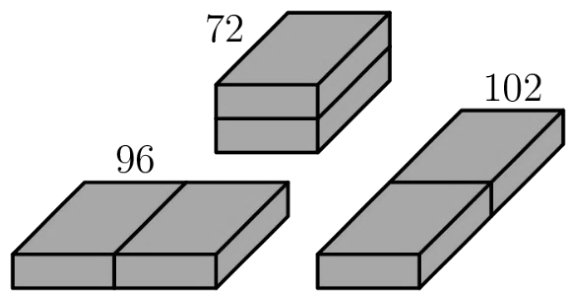
Show answer
Answer: D — 54
Show hints
Hint 1 of 2
Let one brick be \(a \times b \times c\); a brick's own surface area is \(2(ab+bc+ca)\).
Still stuck? Show hint 2 →
Hint 2 of 2
Add the three cuboids' surface areas and watch how each product \(ab, bc, ca\) appears the same number of times.
Show solution
Approach: add the three surface areas to isolate one brick
- Let the brick be \(a \times b \times c\); doubling it along each of the three directions gives the three cuboids, with surface areas \(2(2ab+bc+2ca)\), \(2(2ab+2bc+ca)\) and \(2(ab+2bc+2ca)\).
- Adding all three, every product appears the same way and the total is \(10(ab+bc+ca) = 72+96+102 = 270\), so \(ab+bc+ca = 27\).
- One brick's surface is \(2(ab+bc+ca) = 2 \times 27 = 54\) cm squared, so the answer is D.
Mark:
· log in to save