Problem 14 · 2020 Math Kangaroo
Medium
Algebra & Patterns
sum-constraint
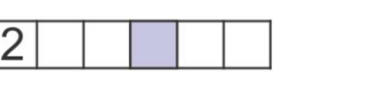
Maria wants to write whole numbers in the squares of the figure, so that the sum of the numbers in three consecutive squares is always 10. She has already written one number. What number should she write in the gray square?
Show answer
Answer: B — 2
Show hints
Hint 1 of 3
Every group of three squares next to each other adds up to the same total, 10.
Still stuck? Show hint 2 →
Hint 2 of 3
Two overlapping groups of three share the middle two squares, so the ends must match.
Still stuck? Show hint 3 →
Hint 3 of 3
This means squares that are three apart always hold the same number.
Show solution
Approach: see that squares three apart must be equal
- Take the first three squares and the next three squares (squares 2, 3, 4). Both groups add to 10.
- Both groups share squares 2 and 3, so square 1 and square 4 must be equal, and in the same way every square equals the one three places away.
- So the pattern of numbers just repeats every three squares.
- The gray square sits three places from the square already holding 2, so it also holds 2.
Mark:
· log in to save