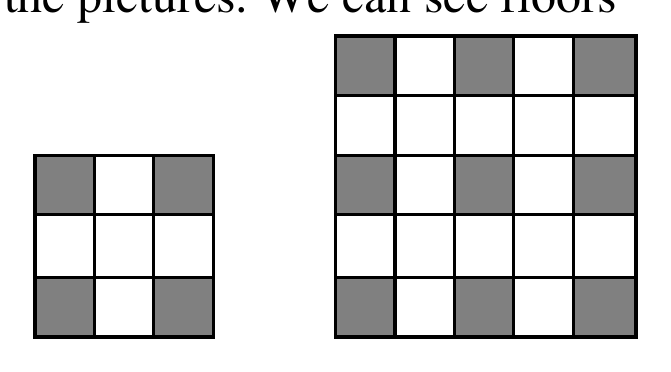
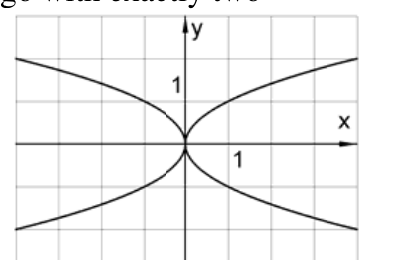
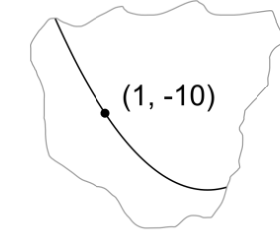
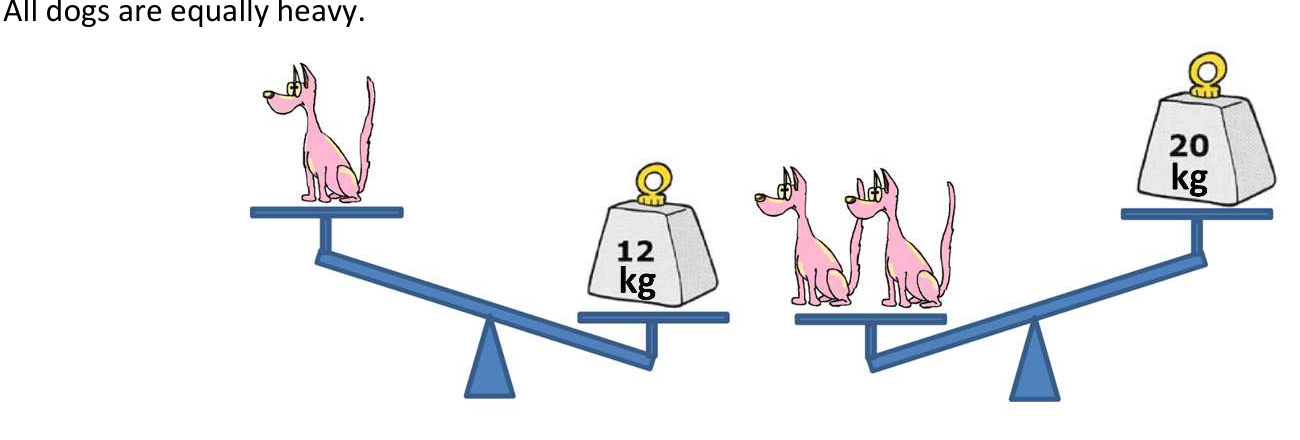
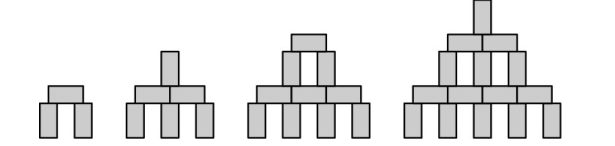
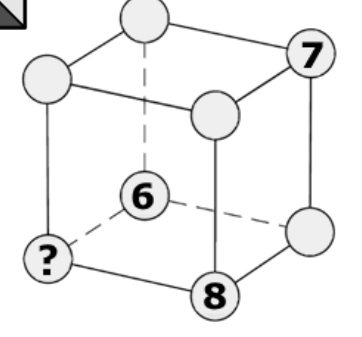
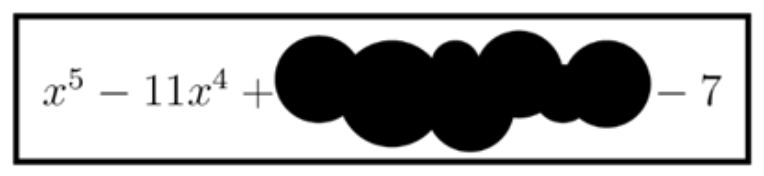
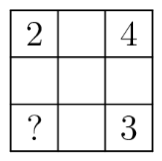
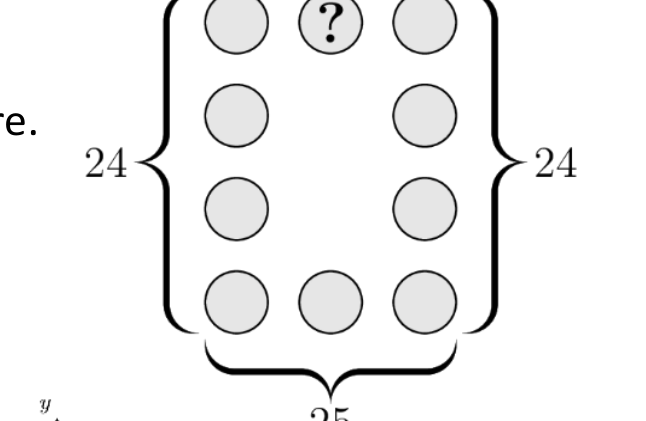
Luka has dogs, rabbits and cats as pets. Eight of these pets are not dogs, five of these pets are not rabbits and seven of these pets are not cats. How many pets does Luka have?
Show answer
Answer: A — 10
Show hints
Hint 1 of 2
Let the counts of dogs, rabbits, cats be d, r, c and turn each 'not' statement into an equation.
Still stuck? Show hint 2 →
Hint 2 of 2
Add the three equations; each total counts every pet twice.
Show solution
Approach: set up and add the three equations
Not dogs: r+c=8; not rabbits: d+c=5; not cats: d+r=7.
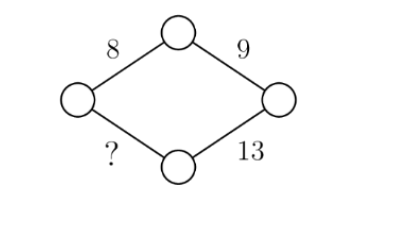
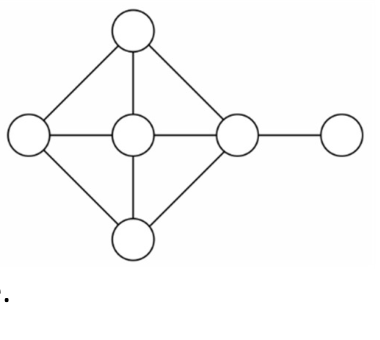
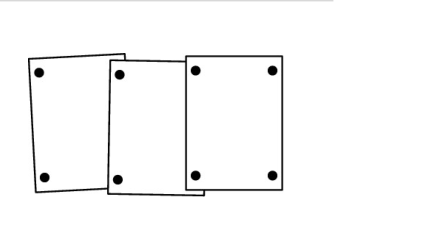
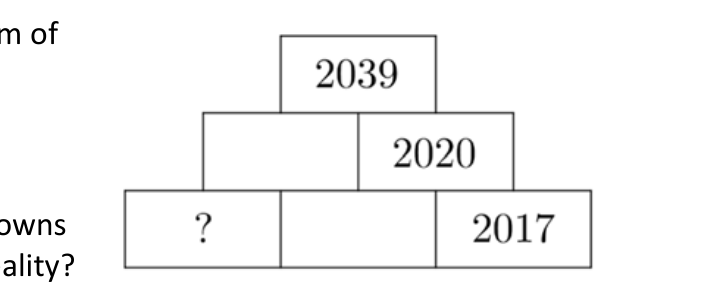
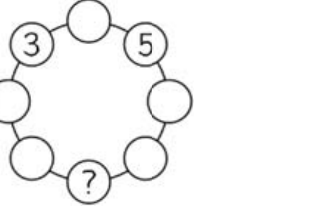
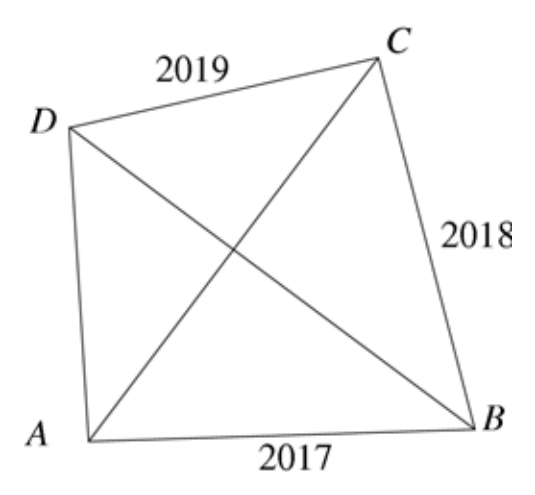
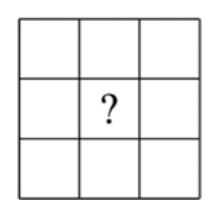
Werner wants to label each side and each corner point of the rhombus shown with exactly one number. He wants the number on each side to be equal to the sum of the numbers at the two corner points of that side. Which number is he going to write in place of the question mark?
Show answer
Answer: B — 12
Show hints
Hint 1 of 2
Each side label equals the sum of the two corner numbers at its ends; write those four relations.
Still stuck? Show hint 2 →
Hint 2 of 2
Add opposite sides: the two pairs of opposite sides have the same total, since both use all four corners.
Show solution
Approach: opposite sides of the rhombus share the same corner-sum total
Each side equals the sum of its two corner numbers, and the four corners are split the same way by the two pairs of opposite sides.
Anna, Beatrice and Clara are 15 years old altogether. Anna and Beatrice together are 11 years old, and Beatrice and Clara together are 12 years old. How old is the oldest of the three?
Show answer
Answer: E — 8
Show hints
Hint 1 of 2
You know all three together, and two of the pairs. Subtract a pair total from the full total.
Still stuck? Show hint 2 →
Hint 2 of 2
The total minus a pair gives the third person's age; do this to find each age.
Show solution
Approach: subtract pair sums from the grand total
All three add to 15. Anna+Beatrice = 11, so Clara = 15-11 = 4.
Beatrice+Clara = 12, so Anna = 15-12 = 3, and Beatrice = 15-3-4 = 8.
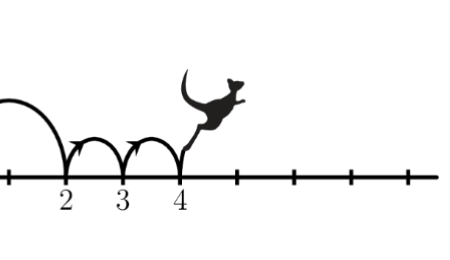
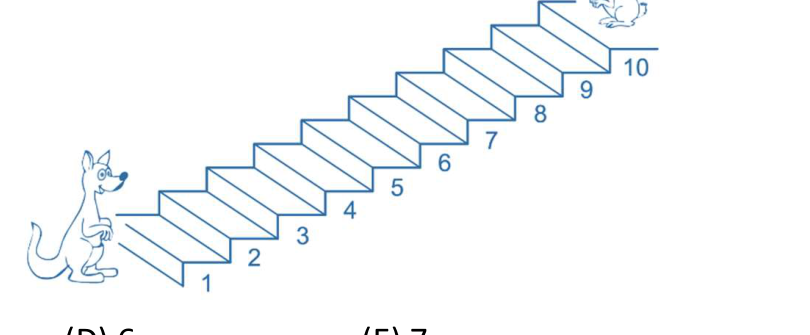
Kengu hops to the right along the number line (see diagram). He makes one big jump and then two little jumps, and repeats this pattern again and again. He starts at 0 and lands on 16. How many jumps does Kengu make in total?
Show answer
Answer: E — 12
Show hints
Hint 1 of 3
Look at the picture: how many numbers does the big jump cover, and how many does each little jump cover?
Still stuck? Show hint 2 →
Hint 2 of 3
One round is big-little-little; work out how far one whole round moves him and how many jumps that is.
Still stuck? Show hint 3 →
Hint 3 of 3
Then skip-count by that round-distance until you land on 16.
Show solution
Approach: measure one round, then skip-count to 16
From the picture, the big jump moves 2 spaces and each little jump moves 1 space.
So one round (big, little, little) moves him 2 + 1 + 1 = 4 spaces using 3 jumps.
Skip-counting by 4 reaches 16 after 4 rounds (4, 8, 12, 16).
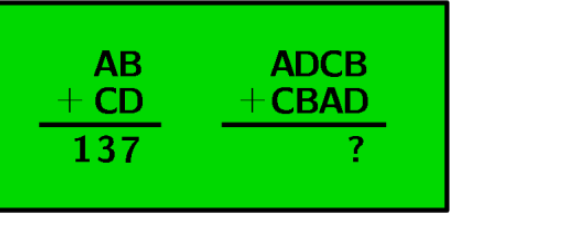
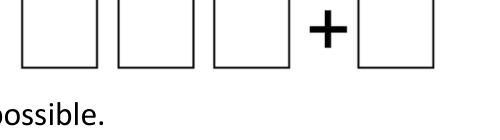
A student correctly added the two two-digit numbers on the left of the board (AB + CD) and got the answer 137. What answer will he get if he adds the two four-digit numbers on the right of the board (ADCB + CBAD)?
Show answer
Answer: B — 13 837
Show hints
Hint 1 of 2
Write the right-hand sum ADCB + CBAD in terms of the totals A+C and B+D.
Still stuck? Show hint 2 →
Hint 2 of 2
The left-hand fact AB + CD = 137 already pins down 10(A+C) + (B+D).
Show solution
Approach: express the big sum using A+C and B+D
From AB + CD = 137 we get 10(A+C) + (B+D) = 137, so A+C = 13 and B+D = 7.
Miguel decided to solve three math problems a day. Eight days later, Daniel started solving five problems a day, until the two of them tied in the total number of problems solved. How many problems had each one solved by that day?
Show answer
Answer: C — 60
Show hints
Hint 1 of 2
When Daniel starts, Miguel already has an 8-day head start of solved problems.
Still stuck? Show hint 2 →
Hint 2 of 2
Set the two running totals equal and solve for the number of days Daniel has been solving.
Show solution
Approach: equate the two running totals
By the time Daniel starts, Miguel has solved 3 × 8 = 24 problems.
After Daniel works d days, Miguel has 24 + 3d and Daniel has 5d.
Setting them equal: 24 + 3d = 5d, so 2d = 24 and d = 12.
Each has then solved 5 × 12 = 60 problems, choice C.
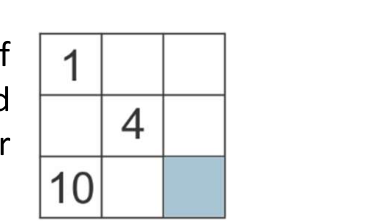
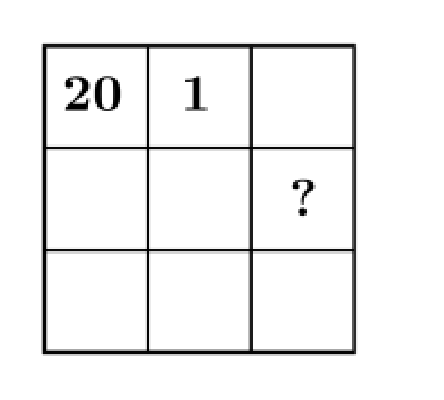
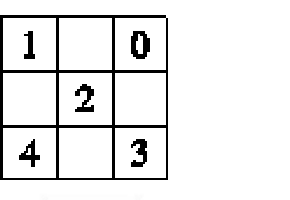
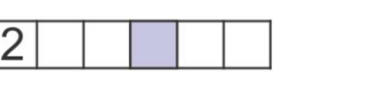
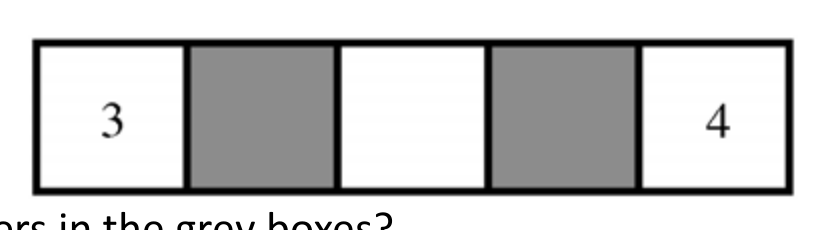
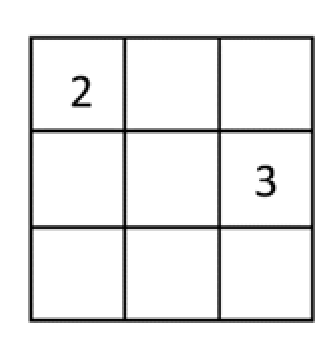
Eli drew a board on the floor with nine squares and wrote a number in each one, starting from 1 and adding 3 each time, until the board was full. Three of the numbers she wrote are shown in the picture. Which number below could be the one in the colored box?
Show answer
Answer: E — 22
Show hints
Hint 1 of 3
Skip-count out loud: start at 1 and keep adding 3 until you have written nine numbers.
Still stuck? Show hint 2 →
Hint 2 of 3
The colored box must hold one of the numbers Eli actually wrote, so check which answer choice shows up in your skip-count.
Still stuck? Show hint 3 →
Hint 3 of 3
Notice that some choices never appear in the count-by-3 list at all.
Show solution
Approach: write out Eli's count-by-3 list and see which choice fits
Eli starts at 1 and keeps adding 3, so the nine numbers she writes are 1, 4, 7, 10, 13, 16, 19, 22, 25.
Look at the choices: 14, 17 and 20 are never on this list, and 10 is already shown in another box, so they cannot sit in the colored box.
The only choice left that Eli really wrote is 22, so the colored box holds 22, which is choice E.
When Julia goes from home to school, she can walk half the way and take the bus for the other half. If she walks the whole way instead, she spends 45 minutes more. How much less time does it take her to go to school if she takes the bus the whole way?
Show answer
Answer: B — 45 minutes
Show hints
Hint 1 of 2
Let the full walk take W minutes and the full bus ride take B minutes; write the mixed trip as half of each.
Still stuck? Show hint 2 →
Hint 2 of 2
Compare 'walk only' with the half-and-half trip to find W − B, then compare 'bus only' with the mix.
Show solution
Approach: set up the half-and-half relation
Mixed trip = W/2 + B/2; walking only = W. Walking is 45 min more: W − (W/2 + B/2) = 45, so (W − B)/2 = 45.
The bus saves over the mixed trip by (W/2 + B/2) − B = (W − B)/2.
That is the same (W − B)/2 = 45 minutes.
So the bus-only trip takes 45 minutes less, choice B.
In an enclosure there is a group of kangaroos. If you add up the ages of all the kangaroos you get 36 years. In two years all the kangaroos together will be 60 years old. How many kangaroos are in the enclosure?
Show answer
Answer: A — 12
Show hints
Hint 1 of 3
In two years every single kangaroo gets exactly 2 years older.
Still stuck? Show hint 2 →
Hint 2 of 3
So the whole total grows by 2 for each kangaroo there is.
Still stuck? Show hint 3 →
Hint 3 of 3
The total grew from 36 to 60; ask how many 2s fit into that growth.
Show solution
Approach: the total gains 2 years per kangaroo
In two years the combined age goes from 36 to 60, so it grows by 60 − 36 = 24 years.
Each kangaroo is responsible for 2 of those extra years, so there must be 24 ÷ 2 = 12 kangaroos.
Start with the number in the first cloud and follow the arrows. The arrows say, in order, −0, then +1, then ×5. Which number is hidden behind the question mark?
Show answer
Answer: E — 15
Show hints
Hint 1 of 2
Start with the number in the first cloud and do what each arrow says, one arrow at a time.
Still stuck? Show hint 2 →
Hint 2 of 2
Taking away 0 keeps the number the same; then add 1, then make 5 copies of it.
Show solution
Approach: follow the operation chain left to right
Begin with 2. The first arrow says −0, so it stays 2.
After mum had hung the t-shirts on the washing line for drying, her son hung a single sock between each two t-shirts. Now there are 29 pieces of clothing on the line. How many of them are t-shirts?
Show answer
Answer: E — 15
Show hints
Hint 1 of 2
A sock goes in every gap between two t-shirts, so socks number one fewer than t-shirts.
Still stuck? Show hint 2 →
Hint 2 of 2
If there are T t-shirts, the line holds T + (T−1) pieces; set that equal to 29.
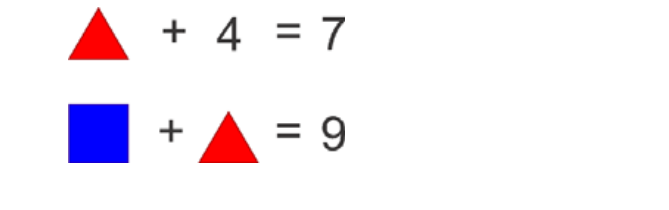
The two shapes below each stand for a number. The red triangle plus 4 equals 7, and the blue square plus the red triangle equals 9. Which number is hidden behind the square?
Show answer
Answer: E — 6
Show hints
Hint 1 of 2
The first picture-sum tells you the triangle's number all by itself.
Still stuck? Show hint 2 →
Hint 2 of 2
Once you know the triangle, use the second picture-sum to find the square.
Show solution
Approach: find the triangle first, then use it to find the square
Triangle and 4 make 7, so the triangle must be 3 (because 3 + 4 = 7).
The square and the triangle make 9, so the square and 3 make 9.
The number that goes with 3 to make 9 is 6 (since 6 + 3 = 9).
There are 33 teenagers in a class. Their favourite subjects are either computing, PE or both. Three of them like both subjects. There are twice as many teenagers who only like computing as teenagers who like PE only. How many of them like computing?
Show answer
Answer: E — 23
Show hints
Hint 1 of 2
Split the class into computing-only, PE-only, and both, and write the total.
Still stuck? Show hint 2 →
Hint 2 of 2
Let PE-only be p; then computing-only is 2p, and 3 + p + 2p = 33.
Show solution
Approach: set up parts of a Venn split
Let PE-only = p, so computing-only = 2p, and both = 3.
3 + p + 2p = 33 gives 3p = 30, so p = 10.
Computing-only = 20; those who like computing = 20 + 3 (the 'both') = 23.
Herr Waxi buys 100 candles. Each day he burns down one candle. From the left overs of seven burned down candles, he can always make a new candle. After how many days does he have to buy new candles?
Show answer
Answer: D — 116
Show hints
Hint 1 of 2
Every candle burned leaves a stub, and 7 stubs become a fresh candle — keep recycling.
Still stuck? Show hint 2 →
Hint 2 of 2
Count how many candles in total he can burn, recycling stubs, then that many days pass before he needs more.
Show solution
Approach: recycle stubs until none remain
100 candles burn to 100 stubs → 14 new candles (2 stubs left).
Those 14 burn → 14 + 2 = 16 stubs → 2 new candles (2 left).
Those 2 burn → 2 + 2 = 4 stubs (not enough for another).
Total burned = 100 + 14 + 2 = 116, so he must buy new candles after 116 days.
In three differently sized baskets there are 48 balls in total. Together the smallest and the biggest basket hold twice as many balls as the middle one. The smallest basket holds half as many balls as the middle one. How many balls are there in the biggest basket?
Show answer
Answer: C — 24
Show hints
Hint 1 of 2
Let the middle basket be your unit and write the others in terms of it.
Still stuck? Show hint 2 →
Hint 2 of 2
Three quantities add to 48 — turn the words into one equation in the middle amount.
Show solution
Approach: express all baskets through the middle one
Let the middle basket hold m balls. The smallest holds m/2.
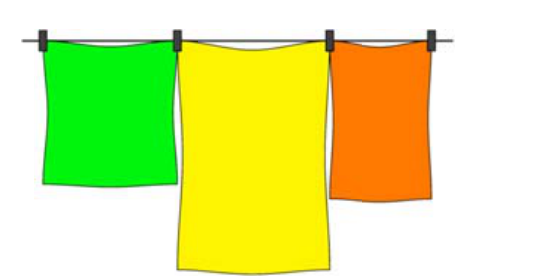
Father hangs towels on the washing line as shown in the picture. For three towels he uses 4 clothes pegs. How many clothes pegs would he use for 5 towels?
Show answer
Answer: C — 6
Show hints
Hint 1 of 2
Draw the towels in a row and mark a peg wherever two towels meet or a row ends.
Still stuck? Show hint 2 →
Hint 2 of 2
Each new towel adds just one extra peg, because neighbours share a peg.
Show solution
Approach: spot the 'one more peg than towels' pattern
Three towels in a row need a peg at each end and one between each pair: 3 towels → 4 pegs.
A dragon has 5 heads. Each time someone chops off one head, 5 new heads grow back. If 6 heads are chopped off one after the other, how many heads does the dragon end up with?
Show answer
Answer: C — 29
Show hints
Hint 1 of 2
Each chop removes one head but adds five, so track the net change.
Still stuck? Show hint 2 →
Hint 2 of 2
What is the net change in the number of heads per chop?
Show solution
Approach: net change per step
Each chop removes 1 head and grows 5, a net gain of 4 heads.
In the school for animals there are 3 cats, 2 ducks, 2 sheep and some dogs. The teacher counted the legs of all the animals and got 44. How many dogs go to the school?
Show answer
Answer: B — 5
Show hints
Hint 1 of 2
Count the legs you already know from the cats, ducks and sheep.
Still stuck? Show hint 2 →
Hint 2 of 2
Subtract those legs from 44, then see how many 4-legged dogs are left.
Show solution
Approach: account for known legs, then divide
Cats: 3 x 4 = 12 legs. Sheep: 2 x 4 = 8 legs. Ducks: 2 x 2 = 4 legs.
Known legs = 12 + 8 + 4 = 24.
Dog legs = 44 - 24 = 20, and each dog has 4 legs, so 20 / 4 = 5 dogs.
My calculator has gone mad. If I want to multiply, it divides, and if I want to add, it subtracts. I type in \((12\times3)+(4\times2)=\). Which result will it give me?
Show answer
Answer: A — 2
Show hints
Hint 1 of 2
Replace every × with ÷ and every + with − before you compute.
Still stuck? Show hint 2 →
Hint 2 of 2
Evaluate (12÷3)−(4÷2).
Show solution
Approach: swap the operations as the broken calculator does
The calculator turns × into ÷ and + into −.
So (12×3)+(4×2) is actually carried out as (12÷3)−(4÷2).
In a box are 50 counters: white ones, blue ones and red ones. There are eleven times as many white ones as blue ones. There are fewer red ones than white ones, but more red ones than blue ones. By how much is the number of red counters less than the number of white ones in the box?
Show answer
Answer: C — 19
Show hints
Hint 1 of 2
Let the number of blue ones be small and write white as eleven times that.
Still stuck? Show hint 2 →
Hint 2 of 2
Use the clues that red is between blue and white to pin everything down.
Show solution
Approach: set up with the blue count
If blue = b then white = 11b, and blue + white + red = 50 gives red = 50 - 12b.
With b = 3: white = 33, red = 14, and indeed blue(3) < red(14) < white(33).
Harry delivers newspapers in Long Street. He must deliver a paper to every house with an odd house number. If the first house is number 15 and the last is number 53, to how many houses does Harry deliver?
Show answer
Answer: B — 20
Show hints
Hint 1 of 2
List only the odd numbers from 15 to 53; they rise in steps of 2.
Still stuck? Show hint 2 →
Hint 2 of 2
Use (last - first)/step + 1, and don't forget the +1.
Show solution
Approach: count terms of an arithmetic list
The odd house numbers are 15, 17, 19, ..., 53, increasing by 2.
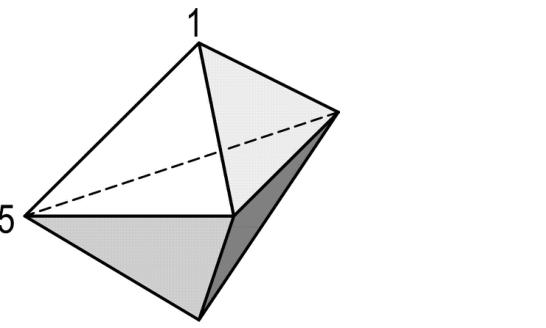
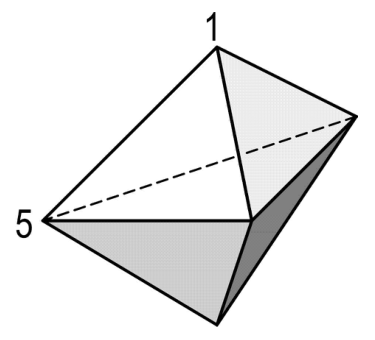
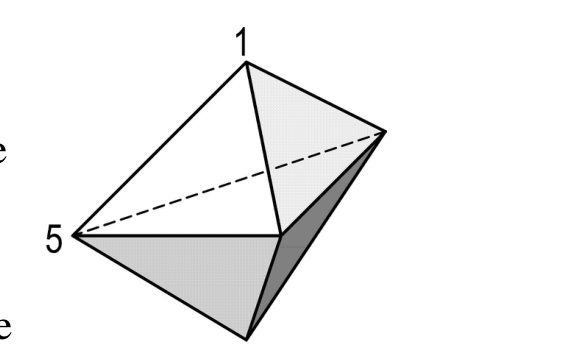
The diagram shows a solid made up of 6 triangles. Each vertex is assigned a number, two of which are indicated. The total of the three numbers on each triangular face is the same. What is the total of all five numbers?
Show answer
Answer: C — 17
Show hints
Hint 1 of 2
Adding the sums of all six faces counts every vertex the same number of times.
Still stuck? Show hint 2 →
Hint 2 of 2
Equal face sums force the three ‘waist’ vertices to be equal and the two tips to be equal.
Show solution
Approach: use equal face sums to collapse the unknowns
Each triangular face joins a tip vertex to two neighbouring waist vertices.
Equal sums make all three waist vertices equal and both tip vertices equal.
The figure marks a tip as 1 and a waist vertex as 5, so the five numbers are 1, 1, 5, 5, 5, totalling 17.
The letters p, q, r, s and t stand for five consecutive positive integers, but not necessarily in that order. It is given that p + q = 69 and s + t = 72. Which number does r stand for?
Show answer
Answer: C — 34
Show hints
Hint 1 of 2
Five consecutive integers add up to 5 times the middle one.
Still stuck? Show hint 2 →
Hint 2 of 2
Add p+q and s+t, then compare with the total of all five to isolate r.
Show solution
Approach: use the total of the five consecutive integers
Adding the two given sums, \((p+q)+(s+t)=69+72=141\), accounts for every letter except \(r\).
The five consecutive integers must be 33, 34, 35, 36, 37 (their two largest add to 72 and two others add to 69), and together they total 175.
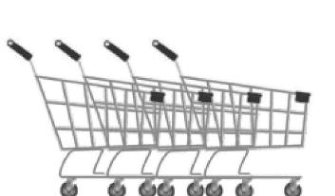
All trolleys in a shop are the same. Four trolleys slid together have a total length of 108 cm (see diagram). Ten trolleys slid together have a total length of 168 cm. How long is one trolley?
Show answer
Answer: C — 78 cm
Show hints
Hint 1 of 2
Each extra trolley adds only the part that sticks out past the one in front, a fixed overlap length.
Still stuck? Show hint 2 →
Hint 2 of 2
Compare 4 trolleys with 10 trolleys to find that fixed added length, then back out one whole trolley.
Show solution
Approach: use the difference to find the added length per trolley
Going from 4 to 10 trolleys adds 6 trolleys and 168 − 108 = 60 cm.
So each extra trolley adds 60 ÷ 6 = 10 cm.
Four trolleys = one full trolley + 3 added bits: 108 = L + 3·10, so L = 108 − 30 = 78 cm.
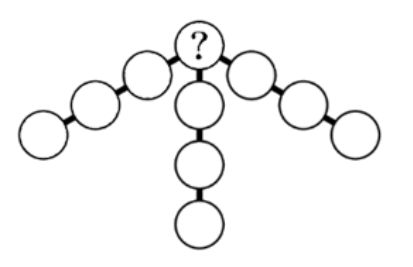
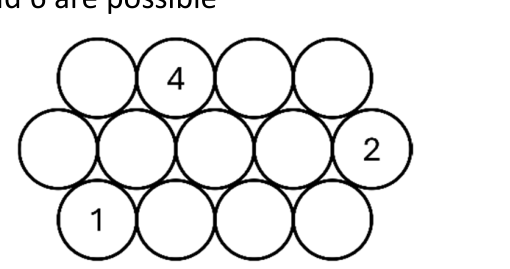
Annie wants to write the numbers 1 to 10 in the ten circles (see picture). Each circle should have a different number. She wants the sum of the four numbers along each line to be exactly 23. Which number does she have to write in the circle with the question mark?
Show answer
Answer: D — 7
Show hints
Hint 1 of 3
Add every number once: 1 + 2 + ... + 10 = 55, then think about what you get if you instead add up all the line-totals.
Still stuck? Show hint 2 →
Hint 2 of 3
Each line is 23, but the circles where lines cross get counted more than once, so the line-totals add up to more than 55 — the extra amount is exactly the crossing circles.
Still stuck? Show hint 3 →
Hint 3 of 3
Work out how much 'extra' the crossings contribute, then see what the question-mark circle must be to make its lines reach 23.
Show solution
Approach: total all numbers, then use the leftover at the crossing circles
The ten numbers 1 through 10 add to 55.
Adding the line-totals counts every plain circle once but each crossing circle more than once, so the line-totals add up to more than 55; that surplus tells you the sum sitting at the shared crossing circles.
Filling in the circles so each line reaches 23 forces the question-mark circle to balance its line.
The required number is 7.
Quick checkWhatever line passes through the question mark must total 23; once the other three circles on that line are placed from 1–10, the question mark is what is left to reach 23, and that value is 7.
Jean-Philippe has \(n^3\) equally sized cubes. He uses them to build one big cube and paints its surface. The number of small cubes with exactly one painted face is then the same as the number of small cubes with no painted face. What is the value of n?
Show answer
Answer: D — 8
Show hints
Hint 1 of 2
For an n x n x n cube, count edge cubes (one painted face) and interior cubes (no painted face).
Still stuck? Show hint 2 →
Hint 2 of 2
Set the one-face count equal to the zero-face count and solve.
Show solution
Approach: equate the one-face and zero-face cube counts
Cubes with exactly one painted face number 6(n-2)^2; cubes with no painted face number (n-2)^3.
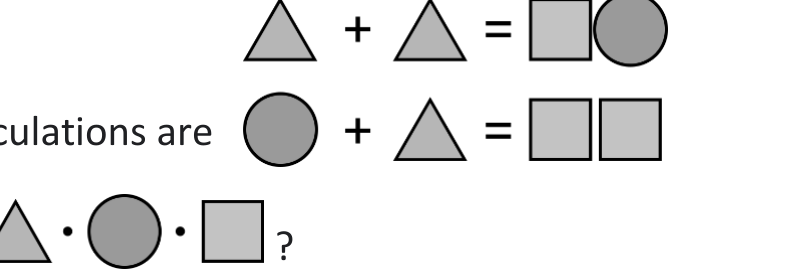
Cards with the same shape hide the same digit, and cards with different shapes hide different digits. Kim lays out the cards so that both calculations shown on the right are correct. What number does Kim get for triangle × circle × square?
Show answer
Answer: D — 28
Show hints
Hint 1 of 3
Each shape stands for one digit, and the two-shape answers on the right are two-digit numbers.
Still stuck? Show hint 2 →
Hint 2 of 3
When you add two single digits, the answer is at most 9 + 9 = 18, so its tens digit can only be 1.
Still stuck? Show hint 3 →
Hint 3 of 3
That tells you what the square is; then try a few values for the triangle until both pictures come out right.
Show solution
Approach: the tens digit of a sum of two single digits must be 1, then check triangle values
Triangle + triangle is a two-digit number, but adding two single digits can give at most 18, so its tens digit is 1: the square is 1.
The second picture says circle + triangle = the two-digit number 'square square' = 11.
Try triangle = 7: then 7 + 7 = 14, so the answer is 1 then 4, meaning circle = 4; and circle + triangle = 4 + 7 = 11. Both pictures work!
So triangle × circle × square = 7 × 4 × 1 = 28 (D).
Vlado took part in 31 cross-country races over the last five years. In the first year he ran the fewest races, and the number then increased every year. In the fifth year he ran three times as many races as in the first year. How many races did he run in the fourth year?
Show answer
Answer: C — 8
Show hints
Hint 1 of 2
Let the first year be a; then the fifth year is 3a, and all five years strictly increase.
Still stuck? Show hint 2 →
Hint 2 of 2
The five increasing numbers add to 31; test small values of a.
Show solution
Approach: bound the first year and pin down the fourth
With first year a and fifth year 3a, the five strictly increasing counts sum to 31.
Testing values forces a = 3 (so fifth year 9), with the middle three summing to 19.
Every valid arrangement puts 8 races in the fourth year.
A rope with length 95 m is cut into three pieces so that each piece is half as long again as the respective previous piece. How long is the longest of the three pieces?
Show answer
Answer: C — 45 m
Show hints
Hint 1 of 2
“Half as long again” means each piece is 1.5 times the previous one.
Still stuck? Show hint 2 →
Hint 2 of 2
Write the three pieces as x, 1.5x, 2.25x and add them to 95.
The graphs of the functions \(y = x^3 + 3x^2 + ax + 2a + 4\) all pass through a common point independent of the choice of a. How big is the sum of the co-ordinates of this common point?
Show answer
Answer: E — another number
Show hints
Hint 1 of 2
Group the terms that contain a together.
Still stuck? Show hint 2 →
Hint 2 of 2
The point must work for every a, so the coefficient of a has to vanish.
Show solution
Approach: make the coefficient of the parameter zero
Write y = (x3+3x2+4) + a(x+2); for this to be independent of a, set x+2 = 0, so x = −2.
Then y = (−8 + 12 + 4) = 8, giving the fixed point (−2, 8).
Sum of coordinates = −2 + 8 = 6, which is not among the first four options, so the answer is another number.
A rugby team scored 24, 17 and 25 points in their 7th, 8th and 9th game of the previous season. The average number of points per game was higher after 9 games than after their first 6 games. Their average after 10 games was more than 22 points. What is the minimum number of points they could have scored in their 10th game?
Show answer
Answer: C — 24
Show hints
Hint 1 of 2
Turn each 'average' statement into a statement about total points using the number of games.
Still stuck? Show hint 2 →
Hint 2 of 2
Combine the inequality after 9 games with the 'more than 22 after 10 games' condition to bound the 10th score from below.
Show solution
Approach: convert averages to total-point inequalities and minimise
Let the first-6-game total be T; games 7–9 add 24+17+25 = 66, so the 9-game total is T + 66.
'Higher average after 9 than after 6' gives \(\frac{T+66}{9} > \frac{T}{6}\); clearing denominators, \(6(T+66) > 9T\), so \(396 > 3T\) and \(T < 132\).
'More than 22 after 10 games' gives \(T + 66 + g > 220\), so \(g > 154 - T\); to make the 10th score \(g\) as small as possible, take \(T\) as large as allowed, \(T = 131\).
Then \(g > 154 - 131 = 23\), so the smallest whole-number score is 24, option C.
a, b and c are real numbers not equal to zero. It is known that the numbers \(-2a^4b^3c^2\) and \(3a^3b^5c^{-4}\) have the same sign. Which of the following statements is definitely correct?
Show answer
Answer: E — \(a<0\)
Show hints
Hint 1 of 2
Track only the signs: even powers are positive, so focus on the odd-power factors and the leading constants.
Still stuck? Show hint 2 →
Hint 2 of 2
Set the two signs equal and solve for the sign of a.
Show solution
Approach: sign analysis
Sign of −2a^4 b^3 c^2 is −sign(b) (the a^4 and c^2 are positive).
Sign of 3a^3 b^5 c^(−4) is sign(a)·sign(b) (c^(−4) is positive).
Equal signs: −sign(b) = sign(a)·sign(b), so sign(a) = −1.
The sum of two positive integers is three times as big as their difference. The product of the two numbers is four times as big as their sum. How big is the sum of the two numbers?
Show answer
Answer: E — 18
Show hints
Hint 1 of 2
Translate both sentences into equations in the two numbers.
Still stuck? Show hint 2 →
Hint 2 of 2
The first equation forces a simple ratio between the numbers.
Show solution
Approach: solve the two equations
a + b = 3(a - b) gives 4b = 2a, so a = 2b.
a*b = 4(a + b): with a = 2b this is 2b^2 = 12b, so b = 6 and a = 12.
Some identical glasses are stacked on top of each other. A stack of eight glasses is 42 cm high, and a stack of two glasses is 18 cm high. How high is a stack of six glasses?
Show answer
Answer: D — 34 cm
Show hints
Hint 1 of 2
Each glass you add on top sticks up by the same fixed amount.
Still stuck? Show hint 2 →
Hint 2 of 2
Compare the two-glass and eight-glass stacks to find how much one extra glass adds.
Show solution
Approach: find how much one extra glass adds, then build up
Going from 2 glasses to 8 glasses adds 6 glasses and raises the height by 42 − 18 = 24 cm.
So each extra glass adds 24 ÷ 6 = 4 cm.
Six glasses is four more than two glasses, so the height is 18 + 4 × 4 = 34 cm.
Werner writes down some numbers whose sum is 22. Ria subtracts each of Werner’s numbers from 7 and writes down the results; her numbers add up to 34. How many numbers did Werner write down?
Show answer
Answer: B — 8
Show hints
Hint 1 of 2
Each of Ria's numbers is 7 minus one of Werner's; what does adding them all give in terms of how many numbers there are?
Still stuck? Show hint 2 →
Hint 2 of 2
If there are n numbers, Ria's total is 7n minus Werner's total; set that equal to 34.
Show solution
Approach: sum the transformed numbers
If Werner wrote n numbers summing to 22, Ria's numbers sum to 7n - 22.
The arithmetic mean of five numbers is 24. The mean of the three smallest numbers is 19 and that of the three biggest is 28. What is the median of the five numbers?
Show answer
Answer: B — 21
Show hints
Hint 1 of 2
Write the three totals: all five, the three smallest, the three largest.
Still stuck? Show hint 2 →
Hint 2 of 2
The median is counted in both the bottom-three and top-three sums.
Show solution
Approach: overlap counts the median twice
Sum of all five = 120; smallest three sum to 57; largest three sum to 84.
57 + 84 counts every number once except the median, which is counted twice: 57 + 84 = 120 + median.
Five girls eat plums. Laura eats 2 more plums than Sophie. Bettina eats 3 fewer plums than Laura. Clara eats one more plum than Bettina, and 3 fewer than Alice. Which two girls eat the same number of plums?
Show answer
Answer: E — Clara and Sophie
Show hints
Hint 1 of 3
Pretend Sophie eats some easy number of plums, like 10, then work out everyone else from the clues.
Still stuck? Show hint 2 →
Hint 2 of 3
Go in order: Laura is 2 more than Sophie, Bettina is 3 less than Laura, Clara is 1 more than Bettina.
Still stuck? Show hint 3 →
Hint 3 of 3
Once you have all five numbers, look for two girls with the same count.
Show solution
Approach: pretend Sophie's number, then fill in the rest
Say Sophie eats 10 plums (any number works the same way).
Laura eats 2 more, so 12; Bettina eats 3 less than Laura, so 9; Clara eats 1 more than Bettina, so 10; Alice eats 3 more than Clara, so 13.
Now compare: Sophie has 10 and Clara has 10 — they match!
So the two girls who eat the same are Clara and Sophie (choice E).
For older kids (with letters)Let Sophie = S. Then Laura = S+2, Bettina = S−1, Clara = S, Alice = S+3, so Clara = Sophie.
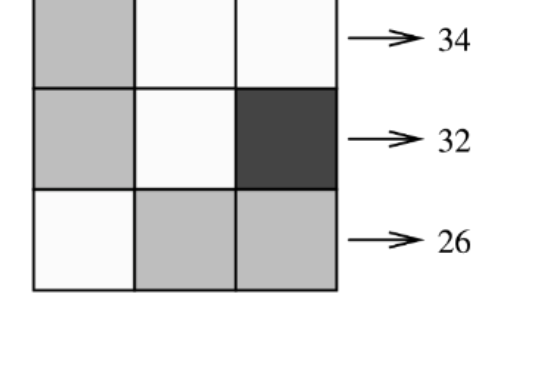
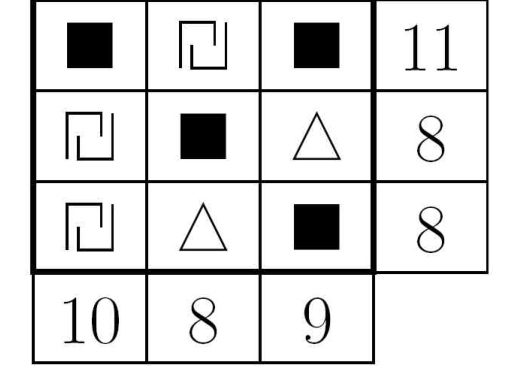
Cards of the same colour always hide the same number. When the three hidden numbers in a row are added, you get the number written to the right of that row (see diagram). Which number is hidden under the black card?
Show answer
Answer: D — 12
Show hints
Hint 1 of 3
Every card of the same colour hides the same number, so think of one secret number per colour.
Still stuck? Show hint 2 →
Hint 2 of 3
Compare two rows that are almost the same to find one colour's number first.
Still stuck? Show hint 3 →
Hint 3 of 3
Once you know grey and white, the black card is just its row total take away the other two.
Show solution
Approach: compare rows to peel off one colour at a time
The top row is grey + white + white = 34, and the bottom row is white + grey + grey = 26.
Both rows use one extra grey instead of one extra white, and they differ by 34 − 26 = 8, so a white card is 8 more than a grey card.
Trying small numbers that fit grey + 2 whites = 34: grey = 6 and white = 14 works (6 + 14 + 14 = 34).
The middle row grey + white + black = 32, so black = 32 − 6 − 14 = 12 — answer D.
For older kids (with letters)Let grey = g, white = w, black = k. From g + 2w = 34 and 2g + w = 26 you get g = 6, w = 14, then k = 32 − g − w = 12.
If \(A = {]0,1[} \cup {]2,3[}\) and \(B = {]1,2[} \cup {]3,4[}\), what is the set of all numbers of the form \(a+b\) with \(a \in A\) and \(b \in B\)? (Here \(]m,n[\) denotes the open interval from m to n.)
Show answer
Answer: D — \(]1,3[ \cup ]3,5[ \cup ]5,7[\)
Show hints
Hint 1 of 2
Add each piece of A to each piece of B; adding two open intervals gives another open interval.
Still stuck? Show hint 2 →
Hint 2 of 2
Take the union of all the resulting intervals.
Show solution
Approach: add the intervals pairwise and union the results
A = (0,1)∪(2,3), B = (1,2)∪(3,4). Adding endpoints: (0,1)+(1,2)=(1,3); (0,1)+(3,4)=(3,5); (2,3)+(1,2)=(3,5); (2,3)+(3,4)=(5,7).
The union is (1,3) ∪ (3,5) ∪ (5,7) — note 3 and 5 are never reached.
An infinite list of numbers has the property that, for each positive integer n, the average of the first n terms is n. How many terms are there less than 2021?
Show answer
Answer: C — 1010
Show hints
Hint 1 of 2
If the average of the first n terms is n, what is their sum?
Still stuck? Show hint 2 →
Hint 2 of 2
Get a single term by subtracting consecutive sums.
Show solution
Approach: turn the average condition into the n-th term
Average of first n is n means the sum of the first n terms is n².
The n-th term is n² − (n−1)² = 2n − 1 (the odd numbers 1, 3, 5, …).
We need 2n − 1 < 2021, i.e. n ≤ 1010, so 1010 terms.
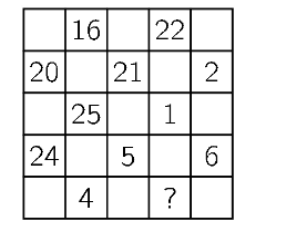
In the \(5 \times 5\) square shown the sum of the numbers in each row and in each column is the same. There is a number in every cell, but some of the numbers are not shown. What is the number in the cell marked with a question mark?
Show answer
Answer: B — 10
Show hints
Hint 1 of 2
The grand total of a 1–25 square fixes the common row/column sum.
Still stuck? Show hint 2 →
Hint 2 of 2
Use row and column equations through the marked cell to pin its value.
Show solution
Approach: use the magic sum, then solve the right cells
The numbers 1–25 total 325, so each row and column sums to 65.
Solving the equations for row 2 and the involved columns forces the entries 7, 15, 13, 17 around column 4.
Column 4 then gives 22 + e + 1 + j + ? = 65 with e=15, j=17, so ? = 10.
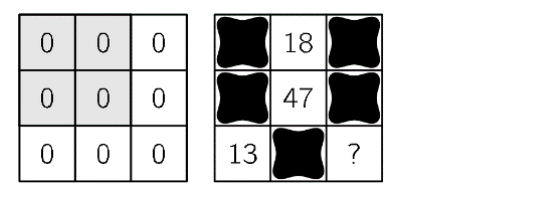
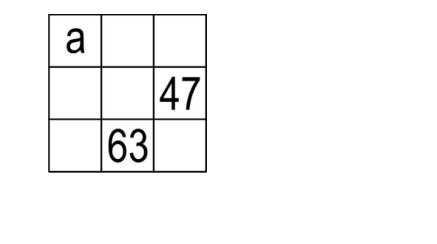
A 3×3 square initially has the number 0 in each of its cells. In one step, all four numbers in one 2×2 sub-square (such as the shaded one) are increased by 1. This operation is repeated several times to obtain the arrangement on the right. Some numbers in this arrangement are hidden. What number is in the square with the question mark?
Show answer
Answer: C — 16
Show hints
Hint 1 of 2
Each cell's value is how many of the chosen 2×2 squares cover it; the centre is covered by all four.
Still stuck? Show hint 2 →
Hint 2 of 2
Centre minus a touching edge gives the opposite-corner pair sum; use the known 13 to split it.
Show solution
Approach: express cells via the four 2x2 operation counts
Let the four 2×2 squares be used a, b, c, d times; the centre cell equals a+b+c+d.
The top-middle cell equals one pair (here 18) and the centre is 47, so the other pair sums to 47-18 = 29.
That other pair is the two bottom corners; one corner is 13, so the marked one is 29-13.
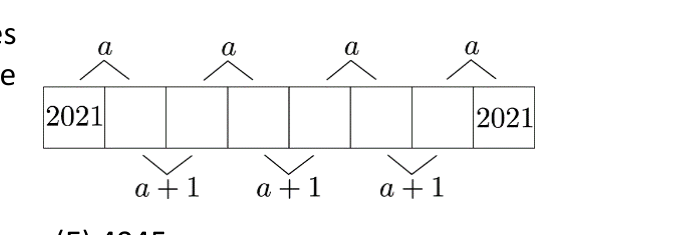
There are eight boxes in the strip shown. The numbers in adjacent boxes have sum a or a + 1, as shown. The numbers in the first box and the eighth box are both 2021. What is the value of a?
Show answer
Answer: E — 4045
Show hints
Hint 1 of 2
Step along the boxes: each next entry is the arch-sum minus the current entry.
Still stuck? Show hint 2 →
Hint 2 of 2
The arch-sums alternate a and a+1; chain from box 1 = 2021 to box 8 = 2021 and solve for a.
Show solution
Approach: walk the chain of sums and set box 8 = 2021
Starting at box 1 = 2021 and using the alternating sums a, a+1, a, a+1, ..., each box is the previous sum minus the previous box.
In a particular fraction the numerator and denominator are both positive. The numerator of this fraction is increased by 40%. By what percentage should its denominator be decreased so that the new fraction is double the original fraction?
Show answer
Answer: C — 30%
Show hints
Hint 1 of 2
Increasing the top by 40% multiplies the fraction by 1.4; you want the new fraction to be twice the old.
Still stuck? Show hint 2 →
Hint 2 of 2
Find the multiplier the denominator needs, then convert it to a percent decrease.
Show solution
Approach: balance the multipliers on top and bottom
Multiplying the numerator by 1.4 while dividing the denominator by (1 − p) should double the fraction: 1.4 / (1 − p) = 2.
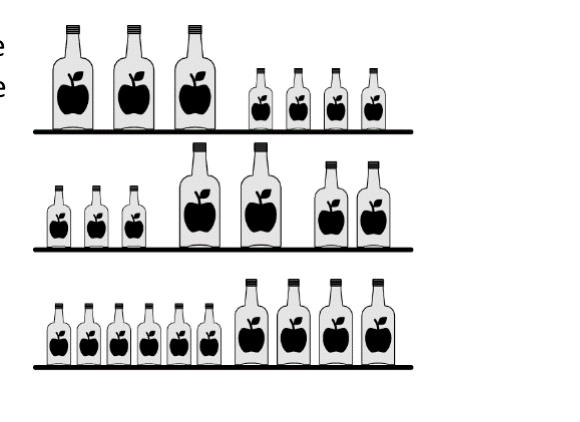
Each shelf holds a total of 64 deciliters of apple juice. The bottles come in three different sizes: large, medium and small (see picture). How many deciliters of apple juice does a medium bottle contain?
Show answer
Answer: D — 10
Show hints
Hint 1 of 2
Let large, medium, small bottles hold L, M, S deciliters; each shelf's bottles total 64.
Still stuck? Show hint 2 →
Hint 2 of 2
Write one equation per shelf and solve the system for M.
Show solution
Approach: set up one equation per shelf and solve
Counting bottles, the three shelves give 3L + 4S = 64, 2L + 2M + 3S = 64, and 4M + 6S = 64.
Solving the system gives S = 4, L = 16 and M = 10.
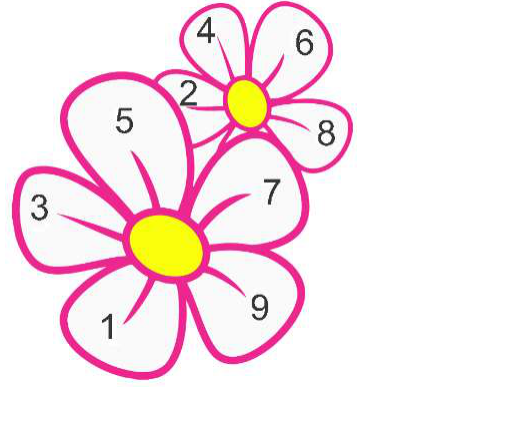
Numbers were written on the petals of two flowers, one number on each petal. One of the petals is hidden. The sum of the numbers on the back flower is twice the sum of the numbers on the front flower. What number is written on the hidden petal?
Show answer
Answer: D — 30
Show hints
Hint 1 of 2
Add up the petals you can see on each flower separately.
Still stuck? Show hint 2 →
Hint 2 of 2
The back flower's total is double the front flower's total; the hidden petal makes up the difference.
Show solution
Approach: use the doubling relationship between the two totals
The front flower shows all its numbers: 1 + 3 + 5 + 7 + 9 = 25.
The back flower must total twice that, so 2 × 25 = 50.
Its visible petals add to 2 + 4 + 6 + 8 = 20, so the hidden petal is 50 − 20 = 30.
Let a, b, c be nonzero real numbers such that \((a - a^{-1})^2 + (b - b^{-1})^2 + (c - c^{-1})^2 = 0\). Which of the following can NOT be the value of \(a + b + c\)?
Show answer
Answer: C — 0
Show hints
Hint 1 of 2
A sum of three squares equals zero only if each square is zero.
Still stuck? Show hint 2 →
Hint 2 of 2
Solve x − 1/x = 0; what can x be?
Show solution
Approach: zero sum of squares forces each term zero
Since each squared term is ≥ 0 and they sum to 0, each must be 0: a = 1/a, and likewise for b and c.
So a, b, c each equal +1 or −1.
Then a+b+c is one of −3, −1, 1, 3 — never 0, so the impossible value is 0.
Toninho wants to write strictly positive, consecutive whole numbers in the nine places of the figure, so that the sum of the three numbers in each diameter is equal to 24. What is the largest possible sum of all nine numbers?
Show answer
Answer: A — 81
Show hints
Hint 1 of 2
The centre number sits on every diameter, so it gets counted in all the pair-sums.
Still stuck? Show hint 2 →
Hint 2 of 2
Write the total of all nine numbers in terms of the centre value, then make the centre as small as possible.
Show solution
Approach: express the total via the shared centre and minimise it
Each of the 4 diameters sums to 24 and shares the centre c, so the eight outer numbers total 4(24−c) = 96−4c.
Total of all nine = (96−4c) + c = 96−3c.
With nine consecutive integers the constraint forces the run 5..13 (centre 5), giving total 96−15 = 81.
Ana, Bia and Cris have, together, 100 reais. They go to the movies and each one pays her own entrance fee. Before paying, Ana had twice as much as each of her friends. After paying the fee, Ana now has three times what the other two friends have together. How much did the movie entrance cost?
Show answer
Answer: E — R$ 20
Show hints
Hint 1 of 3
Split the 100 reais into equal shares first: Ana's pile is as big as both friends' piles put together.
Still stuck? Show hint 2 →
Hint 2 of 3
After they pay, picture Ana's leftover money as three equal piles next to the two friends' leftover piles together.
Still stuck? Show hint 3 →
Hint 3 of 3
Compare how much Ana lost to how much the two friends lost in total.
Show solution
Approach: share the money into equal parts, then compare the leftovers in piles
Before paying, Ana has as much as both friends together, so split 100 into four equal piles of 25: Ana holds two piles (50) and each friend holds one pile (25).
After everyone pays the same ticket, Ana's leftover is three times the two friends' leftover together; so think of Ana's leftover as 3 small piles and the two friends' leftover together as 1 small pile, four small piles in all.
The four friends-and-Ana started with 100 reais and spent 3 tickets, and those leftovers split evenly: trying the choices, a 20-real ticket leaves Ana 30 and each friend 5 (the two friends have 10 together, and 30 is three times 10).
So the ticket cost 20 reais, choice E.
For older kids (algebra)Let each friend start with x, so Ana has 2x and 2x + x + x = 100 gives x = 25. After paying f each, 50 − f = 3((25 − f) + (25 − f)) leads to 5f = 100, so f = 20.
The sequence \(f_n\) is given by \(f_1 = 1\), \(f_2 = 2\) and \(f_n = f_{n-1} \cdot f_{n+1}\) for \(n \ge 2\). How many of the first 2020 terms of this sequence are even numbers?
Show answer
Answer: B — 674
Show hints
Hint 1 of 2
Rearrange the rule to f(n+1) = f(n)/f(n−1) and list a few terms.
Still stuck? Show hint 2 →
Hint 2 of 2
The sequence repeats with a short period — find it.
Show solution
Approach: detect the period and count evens within it
From the rule we get f(n+1) = f(n)/f(n−1), giving 1, 2, 2, 1, 1/2, 1/2, then repeating with period 6.
Each period of 6 has exactly two even terms (the two 2's).
2020 = 336×6 + 4; the 336 periods give 672 evens and the leading 1,2,2,1 add 2 more, totalling 674.
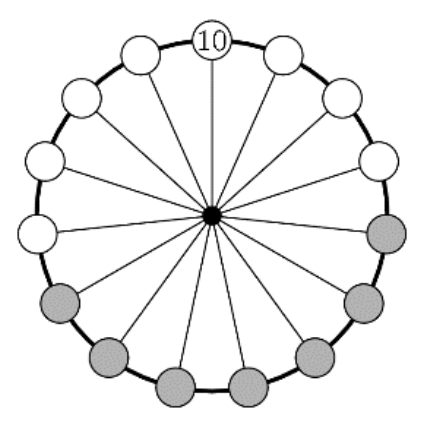
Matias wrote 15 numbers around the wheel shown. Only one of them is visible, the 10 at the top. The sum of the numbers in any seven consecutive positions (such as the gray positions in the figure) is always the same. When seven numbers in consecutive positions are added, which of the following results is possible?
Show answer
Answer: B — 70
Show hints
Hint 1 of 2
Equal 7-sums force entry n to equal entry n−7 around the 15-position wheel.
Still stuck? Show hint 2 →
Hint 2 of 2
Since gcd(7,15)=1, that links all the numbers.
Show solution
Approach: constant window sum forces all entries equal
If every 7 consecutive entries have the same sum, then sliding by one shows entry n = entry n−7 (indices mod 15).
Because gcd(7, 15) = 1, this makes all 15 numbers equal; the visible one is 10, so all are 10.
Beatriz has five sisters whose ages are 2, 3, 5, 8, 10 and 17. Beatriz writes these ages in the circles of the diagram so that the sum of the ages in the four corners of the square equals the sum of the ages in the four circles in the horizontal row. What is this sum?
Show answer
Answer: D — 32
Show hints
Hint 1 of 2
The left and right circles belong to both groups, so when you set the two sums equal those two ages cancel out.
Still stuck? Show hint 2 →
Hint 2 of 2
That leaves top + bottom = centre + far-right; find the split of the six ages that makes this work, then add up the four corners.
Show solution
Approach: cancel the two shared circles, then place the rest
The corners (top, left, right, bottom) and the horizontal row (left, centre, right, far-right) share the left and right circles, so equal sums mean the unshared pairs match: top + bottom = centre + far-right.
Among 2, 3, 5, 8, 10, 17 the pairs 3 + 10 and 5 + 8 both make 13, so put 3 and 10 at top and bottom, and 5 and 8 at centre and far-right.
That leaves 2 and 17 for the shared left and right circles. Each sum is then (left + right) + (the matching 13) = (2 + 17) + 13 = 32.
Michael invents a new operation \(\diamond\) for real numbers, defined by \(x \diamond y = y - x\). Which of the following statements is definitely true if numbers \(a\), \(b\) and \(c\) satisfy \((a \diamond b) \diamond c = a \diamond (b \diamond c)\)?
Show answer
Answer: D — \(a = 0\)
Show hints
Hint 1 of 2
Carefully apply \(x \diamond y = y - x\) to each side of the equation.
Still stuck? Show hint 2 →
Hint 2 of 2
Both sides become a simple expression in \(a\), \(b\), \(c\); the difference shows which variable is forced.
Show solution
Approach: expand both sides of the condition
With \(x \diamond y = y - x\), the left side is \((a \diamond b) \diamond c = c - (b - a) = c - b + a\).
The right side is \(a \diamond (b \diamond c) = (c - b) - a = c - b - a\).
Setting them equal gives \(c - b + a = c - b - a\), so \(2a = 0\), i.e. \(a = 0\).
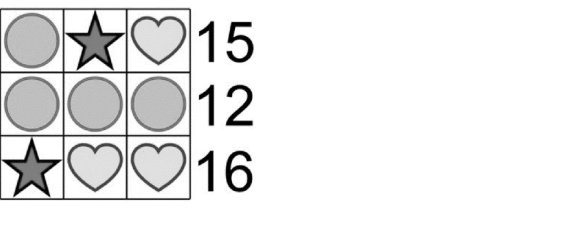
Each shape represents exactly one digit. The sum of the digits in each row is stated on the right hand-side of each row. Which digit does the star stand for?
Show answer
Answer: E — 6
Show hints
Hint 1 of 2
A row of three identical circles tells you one circle's value right away.
Still stuck? Show hint 2 →
Hint 2 of 2
Substitute the circle into the other rows to peel out the star and heart.
Show solution
Approach: solve the shape values one at a time
Row of three circles: 3×circle = 12, so circle = 4.
Top row: circle + star + heart = 15, so star + heart = 11.
Bottom row: star + heart + heart = 16, so subtracting gives heart = 5 and star = 6.
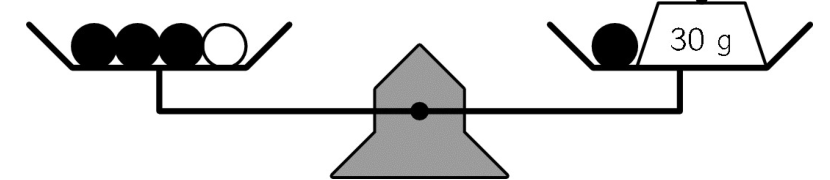
4 equally heavy black pearls, 1 white pearl and a piece of iron weighing 30 g are placed on a beam balance, as shown in the diagram, and the balance is level. How heavy are 6 black pearls and 3 white pearls altogether?
Show answer
Answer: E — 90 g
Show hints
Hint 1 of 3
A level balance means the two sides weigh exactly the same; read off what equals what.
Still stuck? Show hint 2 →
Hint 2 of 3
From the picture, the pearls left over on one side just balance the 30 g of iron.
Still stuck? Show hint 3 →
Hint 3 of 3
Notice that 6 black and 3 white is simply three copies of that balanced group of pearls.
Show solution
Approach: scale the balance equation
Reading the balanced scale, 2 black pearls and 1 white pearl together weigh the same as the 30 g iron, so 2 black + 1 white = 30 g.
We want 6 black + 3 white, which is exactly three copies of that group: 3 × (2 black + 1 white).
So 6 black and 3 white pearls weigh 3 × 30 g = 90 g (E).
Peter wants to buy a book but has no money. His father and his two brothers help. His father gives him half as much as his two brothers give jointly. His older brother gives a third of what the other two give him. The youngest brother gives 10 €. How expensive is the book?
Show answer
Answer: A — 24 €
Show hints
Hint 1 of 2
Write the total as father + older brother + youngest brother and use each clue as a fraction of the total.
Still stuck? Show hint 2 →
Hint 2 of 2
Father is one third of the whole; the older brother is one quarter of the whole.
Show solution
Approach: express each gift as a fraction of the total
Father gives half of what the brothers give, so father is \(\tfrac13\) of the total cost.
The older brother gives a third of what the other two give, so he is \(\tfrac14\) of the total.
The youngest brother's 10 € is the remaining \(1-\tfrac13-\tfrac14 = \tfrac{5}{12}\) of the total.
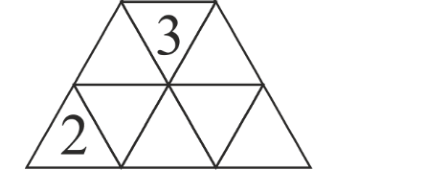
Emily wants to write a number in each empty small triangle. The sum of the numbers in any two triangles that share a side should always be the same. Two of the numbers are already given. What is the sum of all the numbers in the figure?
Show answer
Answer: C — 21
Show hints
Hint 1 of 2
Equal sums on shared sides force neighbouring triangles to repeat values in a pattern.
Still stuck? Show hint 2 →
Hint 2 of 2
Use the two given numbers to fill the pattern, then add every triangle's number.
Show solution
Approach: propagate the equal-sum rule from the given numbers
Two triangles sharing a side must give the same total with each neighbour, which forces a repeating pattern of values across the figure.
Starting from the given 2 and 3, fill every small triangle by that rule.
Adding all the resulting numbers gives a total of 21.
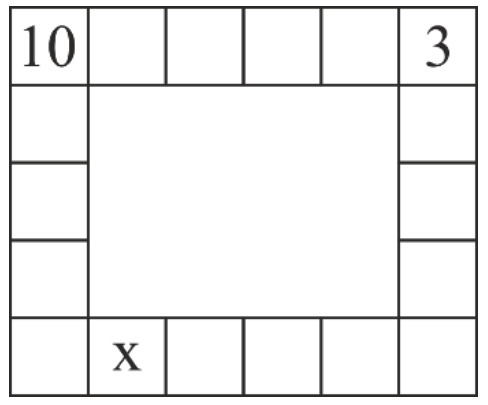
Rita wants to write a number into every square of the diagram shown. Every number should be equal to the sum of the two numbers from the adjacent squares. Squares are adjacent if they share one edge. Two numbers are already given. Which number is she going to write into the square marked with x?
Show answer
Answer: B — 7
Show hints
Hint 1 of 2
Each square equals the sum of its two neighbours, so going around: next = current − previous.
Still stuck? Show hint 2 →
Hint 2 of 2
That rule repeats every 6 squares; find x by stepping around the ring.
Show solution
Approach: use the period-6 'each equals sum of neighbours' rule
If each square is the sum of its two neighbours, then next = this − previous, a pattern that repeats every six squares.
Starting 10, ?, … and forcing the far corner to be 3 fixes the ring as 10, 7, −3, −10, −7, 3, repeating.
Stepping around to the square marked x lands on the value 7.
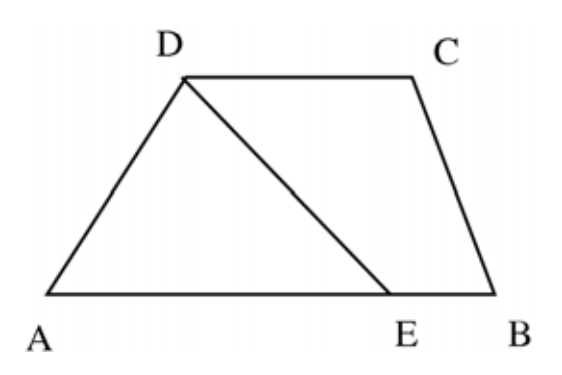
ABCD is a trapezium with parallel sides AB and CD. Let AB = 50 and CD = 20. Point E lies on side AB in such a way that the straight line DE divides the trapezium into two shapes of equal area. How long is the straight line AE?
Show answer
Answer: C — 35
Show hints
Hint 1 of 2
The line DE makes triangle ADE on one side; its area is half base times height.
Still stuck? Show hint 2 →
Hint 2 of 2
Set that triangle equal to half the whole trapezium's area.
Show solution
Approach: express the half-area as a triangle and solve for the base AE
The trapezium has area (50 + 20)/2 × h = 35h, so each half is 17.5h.
Triangle ADE has base AE on AB and the same height h, area = ½ · AE · h.
Setting ½ · AE · h = 17.5h gives AE = 35, choice C.
Algebra & PatternsLogic & Word Problemssubstitution
Four brothers have different heights. Tobias is as many centimeters smaller than Viktor, as he is taller than Peter. Oskar on the other hand is equally many centimeters smaller than Peter. Tobias is 184 cm tall, and on average the four brothers are 178 cm tall. How tall is Oskar?
Show answer
Answer: A — 160 cm
Show hints
Hint 1 of 2
Write everyone's height as Tobias plus or minus a single difference d.
Still stuck? Show hint 2 →
Hint 2 of 2
Use the average to pin down d.
Show solution
Approach: express all four heights in terms of one difference, then use the average
Let d be the common difference. Viktor = 184 + d, Peter = 184 − d, and Oskar = Peter − d = 184 − 2d.
The average is 178, so the sum is 712: (184+d) + 184 + (184−d) + (184−2d) = 736 − 2d = 712.
Thus 2d = 24, d = 12, and Oskar = 184 − 24 = 160 cm, choice A.
Logic & Word ProblemsAlgebra & Patternssum-constraintsubstitution
During our holidays it rained on 7 days. If it rained before noon, then there was no rain in the afternoon. If it rained in the afternoon, there was no rain before noon. There were 5 days without rain before noon and six days without rain in the afternoon. How many days long was our holiday?
Show answer
Answer: C — 9
Show hints
Hint 1 of 2
Each rainy day rains either only the morning or only the afternoon, never both.
Still stuck? Show hint 2 →
Hint 2 of 2
Count days with no morning rain and no afternoon rain in terms of the total.
Show solution
Approach: set up the dry-half counts against the total number of days
Each of the 7 rainy days has rain in exactly one half, so morning-rain + afternoon-rain days = 7.
If the holiday is N days: dry mornings = N − (morning-rain) = 5 and dry afternoons = N − (afternoon-rain) = 6.
Adding: 2N − 7 = 11, so 2N = 18 and N = 9, choice C.
Algebra & PatternsLogic & Word Problemssubstitution
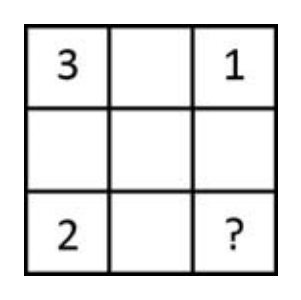
Jenny wants to write numbers into the cells of a 3×3-table so that the sum of the numbers in each of the four 2×2-squares are equally big. As it is shown in the diagram, she has already inserted three numbers. What number does she have to write into the cell in the fourth corner?
Show answer
Answer: D — 0
Show hints
Hint 1 of 2
Two 2×2 squares side by side share a whole column, so comparing them cancels those shared cells.
Still stuck? Show hint 2 →
Hint 2 of 2
Compare the two top squares and the two bottom squares, then subtract.
Show solution
Approach: compare side-by-side 2x2 squares so the shared column cancels
Call the unknown corner x (bottom-right); the known corners are 3 (top-left), 1 (top-right), 2 (bottom-left). Write the middle-left cell as d and the middle-right cell as f.
The two top squares are equal, and they share the middle column, so the leftover columns match: 3 + d = 1 + f.
The two bottom squares are equal the same way: 2 + d = x + f.
Subtract the second from the first: 3 − 2 = 1 − x, so 1 = 1 − x and x = 0, uniquely, choice D.
Number TheoryAlgebra & Patternssum-constraintcasework
Seven positive whole numbers a, b, c, d, e, f, g are written down next to each other in this order. The sum of all seven numbers is 2017. Every two adjacent numbers always differ by 1. Which number can be equal to 286?
Show answer
Answer: A — only a or g
Show hints
Hint 1 of 2
Neighbours differ by 1, so the seven numbers alternate even, odd, even, … — and the odd total 2017 fixes which positions are even.
Still stuck? Show hint 2 →
Hint 2 of 2
286 is below the average of about 288, so ask which position can dip the lowest.
Show solution
Approach: parity rules out three spots, then check which can reach the smallest value
Neighbours differ by 1, so the numbers alternate in parity. For the total 2017 to be odd, the four outer-pattern places a, c, e, g must be even and b, d, f odd.
286 is even, so it can only sit at one of a, c, e, g — that already rules out choices about b, d, f.
The average is 2017 ÷ 7 ≈ 288, and since steps are only ±1, the smallest a number can be is 286, reached only by going straight down from an end. An inner even place (c or e) has values on both sides pulling it up, so it cannot get below 288.
Hence 286 can occur only at an endpoint: only a or g, choice A.
a, b, c, d are positive whole numbers for which \(a + 2 = b - 2 = c \times 2 = d \div 2\) holds true. Which of the four numbers a, b, c and d is biggest?
Show answer
Answer: D — d
Show hints
Hint 1 of 2
Set the common value equal to k and write each of a, b, c, d in terms of k.
Still stuck? Show hint 2 →
Hint 2 of 2
Compare a = k-2, b = k+2, c = k/2, d = 2k.
Show solution
Approach: express all four through the common value
Let a+2 = b-2 = 2c = d/2 = k.
Then a = k-2, b = k+2, c = k/2, d = 2k.
For positive whole numbers 2k exceeds the others, so d is biggest.
Jilly makes up a multiplication magic square using the numbers 1, 2, 4, 5, 10, 20, 25, 50 and 100. The products of the numbers in each row, column and diagonal should be equal. In the diagram it can be seen how she has started. Which number goes into the cell with the question mark?
Show answer
Answer: B — 4
Show hints
Hint 1 of 3
Multiply all nine numbers to find the constant product, then take its cube root for the centre.
Still stuck? Show hint 2 →
Hint 2 of 3
Use the constant product along a row, column and the diagonal to fill the cells.
Still stuck? Show hint 3 →
Hint 3 of 3
The product of all nine values is 10^9, so each line multiplies to 1000.
Show solution
Approach: multiplicative magic square
All nine numbers multiply to 109, so each line's product is the cube root, 1000, and the centre is 10.
Top row 20×1×? = 1000 gives 50; the diagonal 20×10×? = 1000 gives 5 at the bottom-right.
The right column 50×?×5 = 1000 forces the marked cell to be 4.
Tim, Tom and Jim are triplets. Their brother Carl is exactly 3 years younger. All four are having their birthdays today. How old can the four brothers be altogether?
Show answer
Answer: A — 53
Show hints
Hint 1 of 3
The three triplets are all the same age, and Carl is 3 years younger than that age.
Still stuck? Show hint 2 →
Hint 2 of 3
Imagine giving Carl 3 extra birthdays so all four are the same age: then the total would be 4 equal ages.
Still stuck? Show hint 3 →
Hint 3 of 3
So the real total is 3 less than some multiple of 4.
Show solution
Approach: make all four ages equal, then adjust by 3
If Carl were the same age as the triplets, all four ages would be equal, so the total would be 4 times one age, a multiple of 4.
Carl is actually 3 years younger, so the real total is 3 less than a multiple of 4.
Checking the choices, only \(53 + 3 = 56 = 4 \times 14\) is a multiple of 4, so the total is 53, choice (A).
With algebraIf each triplet is \(t\), Carl is \(t-3\) and the total is \(3t+(t-3)=4t-3\); setting \(4t-3=53\) gives \(t=14\).
Luigi owns a few square tables and some chairs for his little restaurant. If he sets out his tables individually with 4 chairs each, he is 6 chairs short. If he always puts two tables together to make a bigger table with 6 chairs, he has 4 chairs left over. How many tables does Luigi have?
Show answer
Answer: B — 10
Show hints
Hint 1 of 3
Pairing tables uses 6 chairs for every 2 tables, which is 3 chairs per table; singling uses 4 chairs per table.
Still stuck? Show hint 2 →
Hint 2 of 3
So switching from paired to single needs 1 more chair for each table.
Still stuck? Show hint 3 →
Hint 3 of 3
Compare how the chair situation swings from '4 left over' to '6 short'.
Show solution
Approach: see how 1 extra chair per table swings the count
Paired up, the tables use 6 chairs per 2 tables, which is 3 chairs per table; set out singly they use 4 chairs per table.
So going from paired to single costs 1 extra chair for each table.
The situation swings from 4 chairs left over to 6 chairs short, a change of \(4 + 6 = 10\) chairs, and that swing is exactly 1 chair per table, so there are 10 tables, choice (B).
With algebraChairs \(=4T-6\) (singly) and \(=3T+4\) (paired); setting them equal, \(4T-6=3T+4\) gives \(T=10\).
In an enclosure there are 2016 kangaroos. Each of them is either red or grey, and there is at least one red and at least one grey kangaroo amongst them. For each kangaroo K we calculate the fraction obtained, if you take the number of kangaroos of the other colour divided by the kangaroos of the own colour (including K itself). Determine the sum of these 2016 fractions.
Show answer
Answer: A — 2016
Show hints
Hint 1 of 2
Group the kangaroos by colour: say r red and g grey, with r + g = 2016.
Still stuck? Show hint 2 →
Hint 2 of 2
Add the fractions colour by colour and watch the counts cancel.
Show solution
Approach: sum by colour
Each red kangaroo contributes g/r and there are r of them, totalling g.
Each grey kangaroo contributes r/g and there are g of them, totalling r.
Twelve girls met up in a pastry shop. On average they each ate 1.5 muffins. None of them ate more than two muffins, and two of them ate nothing. How many girls ate two muffins?
Show answer
Answer: E — 8
Show hints
Hint 1 of 2
Twelve girls averaging 1.5 muffins ate 18 muffins total.
Still stuck? Show hint 2 →
Hint 2 of 2
Two ate 0; of the other 10 let x eat 2 and the rest 1, then use the total 18.
Show solution
Approach: set up the total-muffin equation
Total muffins = 12 × 1.5 = 18.
Two girls ate 0; of the remaining 10 let x eat 2 and (10 − x) eat 1: 2x + (10 − x) = 18.
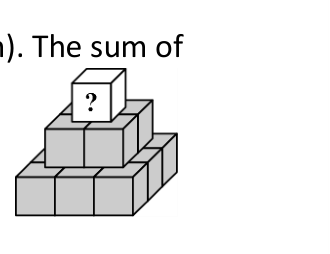
Susi writes a different positive whole number on each of the 14 cubes of the pyramid (see diagram). The sum of the numbers on the nine cubes on the bottom is 50. The number on every other cube equals the sum of the numbers on the four cubes directly underneath it. What is the biggest number that can be written on the topmost cube?
Show answer
Answer: E — 118
Show hints
Hint 1 of 3
Each cube above is the sum of the four directly under it; the top is a weighted sum of the nine bottom numbers.
Still stuck? Show hint 2 →
Hint 2 of 3
The centre bottom cube counts 4 times, edge-centres twice, corners once; the nine distinct numbers total 50.
Still stuck? Show hint 3 →
Hint 3 of 3
Put the largest values where the weight is biggest to maximise the top.
Show solution
Approach: weighted sum of the bottom layer
Adding up the pyramid, the top equals a weighted sum of the nine bottom numbers with weights: centre 4, the four edge-middles 2 each, the four corners 1 each, so top = (sum of all nine) + 3·(centre) + (sum of the four edges) = 50 + 3·centre + (edge sum).
To make this biggest, push value into the centre: give the four corners the smallest distinct values 1, 2, 3, 4 (sum 10), leaving 40 for the centre plus four edges.
Make the four edges the next-smallest distinct values 5, 6, 7, 8 (sum 26), so the centre is 40 − 26 = 14; then top = 50 + 3·14 + 26 = 118.
We know the following about five positive whole numbers a, b, c, d, e. All the numbers are different, b = c : e, d = a + b and a = e − d. Which of the numbers a, b, c, d, e is the largest?
Show answer
Answer: C — c
Show hints
Hint 1 of 2
Express everything in terms of the smaller quantities, then see which is built up the most.
Still stuck? Show hint 2 →
Hint 2 of 2
c is a product, while the others are sums or differences.
Show solution
Approach: rewrite each in terms of a and b
From a = e−d and d = a+b, we get e = 2a+b, so e and d are modest sums.
b = c÷e means c = b·e, a product of two positive whole numbers larger than 1.
A product of such factors beats the sums, so c is the largest (C).
The geometric mean of n numbers is defined as the nth root of the product of all n numbers, that is n√x1 · x2 · … · xn. We have six numbers. The geometric mean of three of them is 3, the geometric mean of the other three is 12. How big is the geometric mean of all six numbers?
Show answer
Answer: B — 6
Show hints
Hint 1 of 2
A geometric mean of 3 numbers tells you their product.
Still stuck? Show hint 2 →
Hint 2 of 2
Multiply the two products, then take the sixth root.
Show solution
Approach: combine the two products under one sixth root
Geometric mean 3 of three numbers means their product is 3³ = 27; geometric mean 12 means the other product is 12³ = 1728.
All six multiply to 27×1728 = 46656 = 6⁶.
The geometric mean of all six is the sixth root, 6 (B).
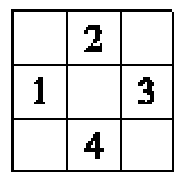
The numbers 1, 2, 3, 4 and 9 are written into the squares on the following figure. The sum of the three numbers in the horizontal row should be the same as the sum of the three numbers in the vertical column. Which number is written in the middle?
Show answer
Answer: E — 9
Show hints
Hint 1 of 2
The middle square sits in both the row and the column, so it gets used in both totals.
Still stuck? Show hint 2 →
Hint 2 of 2
The other four numbers must split into two equal-sized pairs, one pair for the row's ends and one for the column's ends.
Show solution
Approach: the middle is shared, so the other four split into two equal pairs
The number in the middle is part of both the row total and the column total, so the other four numbers fill the two ends of the row and the two ends of the column.
Those four numbers must make two pairs that add up to the same amount; from 1, 2, 3, 4 the pairs 1 + 4 = 5 and 2 + 3 = 5 match perfectly, leaving 9 for the middle.
Then each line totals 9 + 5 = 14, the same both ways, so it works.
The middle number is 9.
A quick check for older kidsAll five numbers add to 19. The row and column together use the middle twice, giving 19 + middle, and that must split into two equal halves — so 19 + middle is even, which forces the middle to be odd, and 9 is the choice that balances.
Sarah bought three books. For the first book she paid half of her money plus 1 Euro more. For the second book she paid again half of her left-over money plus 2 Euros more. For the third book she paid again half of her left-over money plus 3 Euros more. After which she had spent all of her money. How much money did she have to begin with?
Show answer
Answer: C — 34 €
Show hints
Hint 1 of 2
Work backwards from the end, when she has spent everything.
Still stuck? Show hint 2 →
Hint 2 of 2
Just before the last book she had some amount L; she paid half of it plus 3 and was left with nothing, so half of L equals 3.
Show solution
Approach: rewind the spending step by step, starting from when she has nothing left
Work backwards from the end. At the third book she paid half her money plus 3 € and was left with nothing, so that half must have been the 3 €, meaning she had 6 € before book three.
Before book two she paid half plus 2 € and was left with that 6 €; so after taking the extra 2 € back the 6 € is the other half, making 8 € the half, so she had 16 € before book two.
Before book one she paid half plus 1 € and was left with that 16 €; adding the 1 € back, 17 € is one half, so she started with 34 €.
Forward checkStart 34: pay 17+1=18, left 16; pay 8+2=10, left 6; pay 3+3=6, left 0. ✓
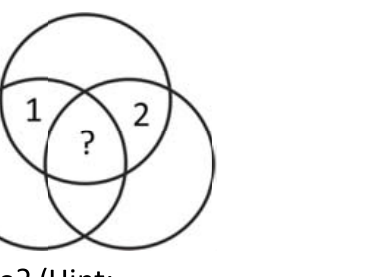
In the diagram we can see seven sections which are bordered by three circles. One number is written into each section. It is known that each number is equal to the sum of all the numbers in the adjacent zones. (Two zones are called adjacent if they have more than one corner point in common.) Which number is written into the inner area?
Show answer
Answer: A — 0
Show hints
Hint 1 of 2
Give each of the seven regions a letter and write 'region = sum of its adjacent regions'.
Still stuck? Show hint 2 →
Hint 2 of 2
With two outer regions fixed at 1 and 2, solving the linear system pins the centre to 0.
Show solution
Approach: solve the linear system of region sums
Label the seven regions; each equals the sum of the regions sharing an arc with it.
Two outer regions are 1 and 2; this fixes all the others by the equations.
Solving, the inner (all-three) region comes out to 0.
Five positive whole numbers, which are not necessarily all different, are written on five cards. Peter calculates the sum of each pair of cards. He obtains only three different results, namely 57, 70 and 83. What is the biggest number that is written on one of the cards?
Show answer
Answer: C — 48
Show hints
Hint 1 of 2
With only three distinct pairwise sums, the five numbers take very few distinct values.
Still stuck? Show hint 2 →
Hint 2 of 2
The smallest sum is the two smallest cards and the largest sum the two largest; use 57, 70, 83 to pin them.
Show solution
Approach: deduce the card values from the three pair-sums
Only three sums (57, 70, 83) appear, so the cards take just a couple of distinct values plus an odd one out.
The biggest sum 83 pairs the two largest cards; combined with 57 and 70 this forces a largest card of 48.
Indeed 35 + 48 = 83, while repeated smaller values give 57 and 70.
Captain Sparrow and his pirates loot some gold coins and share them equally amongst themselves. If there were four pirates fewer, they would each get 10 coins more. If there were 50 coins fewer, they would each get 5 coins fewer. How many coins did they share between themselves?
Show answer
Answer: D — 150
Show hints
Hint 1 of 2
Let there be p pirates sharing N coins; write the share as N/p.
Still stuck? Show hint 2 →
Hint 2 of 2
The '50 fewer coins means 5 fewer each' clue gives p directly, then use the other clue to find N.
Show solution
Approach: set up share equations and solve
Let p pirates share N coins. '50 fewer coins is 5 fewer each' means 50/p = 5, so p = 10.
'Four fewer pirates means 10 more each' gives N/(p−4) = N/p + 10, i.e. N/6 = N/10 + 10.
Then N/6 − N/10 = 10, so 2N/30 = 10, giving N = 150.
Let \(a,b,c\) be different real numbers, none equal to zero, and let \(n\) be a positive whole number. It is known that the numbers \((-2)^{2n+3} imes a^{2n+2} imes b^{2n-1} imes c^{3n+2}\) and \((-3)^{2n+2} imes a^{4n+1} imes b^{2n+5} imes c^{3n-4}\) have the same sign. Which of the following statements is definitely true?
Show answer
Answer: D — \(a<0\)
Show hints
Hint 1 of 2
Even powers are always positive, so only the odd-powered factors carry a sign.
Still stuck? Show hint 2 →
Hint 2 of 2
Compare the parities of the exponents in the two products to see what must be true.
Show solution
Approach: track signs through even/odd exponents
In a product, only factors with odd exponents affect the sign; even powers are positive.
Matching the two products' signs forces the contribution of a to flip consistently, and the only sign that is pinned down in every case is that of a.
Working it through shows a must be negative, so (D): a < 0 is definitely true.
Grandma gives 180 marbles to her ten grandchildren. No two children get the same number of marbles. Anna gets the most. What is the smallest number of marbles Anna could get?
Show answer
Answer: E — 23
Show hints
Hint 1 of 2
To make Anna's share as small as possible, the other nine children should get as much as they can while still all being different and less than Anna's amount.
Still stuck? Show hint 2 →
Hint 2 of 2
If Anna gets A, the most the group can total is A + (A−1) + ... + (A−9); make that at least 180.
Show solution
Approach: make the other nine as large as possible just below Anna, then see how small Anna can be
To let Anna take as little as possible, the other nine children should grab as much as they can while still all being different and below Anna.
So they take the nine amounts right below Anna's: if Anna has 23, the rest are 22, 21, 20, ..., 14.
Those ten amounts 14 + 15 + ... + 23 add up to exactly 180, the whole bag, so Anna = 23 works.
If Anna had only 22, even the biggest allowed amounts (22, 21, ..., 13) total just 175, too few to reach 180.
So the smallest Anna could get is 23.
The same idea with a quick formulaThe largest ten distinct amounts ending at Anna's value A total 10A − (1+2+⋯+9) = 10A − 45, and this must reach 180, so 10A ≥ 225 and A ≥ 23.
A class has written a test. If every boy had obtained 3 more points, the class average would be 1.2 points higher than it is now. What percentage of the children in this class are girls?
Show answer
Answer: D — 60%
Show hints
Hint 1 of 2
Giving every boy 3 more points adds 3 × (number of boys) to the class total.
Still stuck? Show hint 2 →
Hint 2 of 2
That extra total, spread over all children, is the 1.2-point rise — set up the equation for the fraction of boys.
Show solution
Approach: relate the total point increase to the average increase
If there are b boys among c children, adding 3 to each boy adds 3b points total.
The average rises by 3b / c = 1.2, so b / c = 0.4 — 40% are boys.
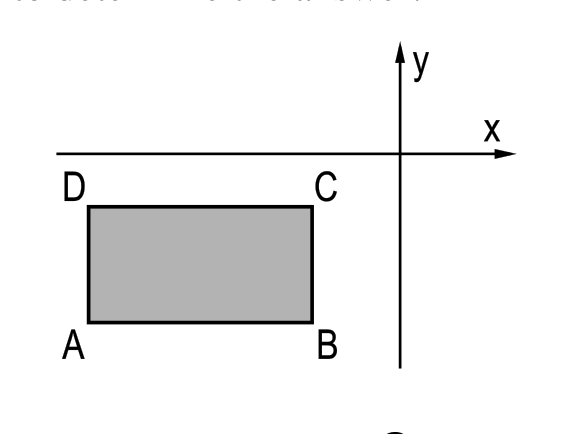
The sides of rectangle ABCD are parallel to the coordinate axes. The rectangle lies below the x-axis and to the right of the y-axis, as shown. For each of the points A, B, C, D the quotient (y-coordinate) : (x-coordinate) is calculated. For which point will you obtain the smallest quotient?
Show answer
Answer: D — D
Show hints
Hint 1 of 2
For every corner the quotient is (negative y) over (negative x), so it is positive; you want the smallest positive value.
Still stuck? Show hint 2 →
Hint 2 of 2
Smallest quotient = smallest |y| paired with largest |x| — find that corner.
Show solution
Approach: compare y/x at each corner
In the diagram the rectangle has both coordinates negative, so each quotient y : x is positive.
The smallest quotient comes from the corner closest to the x-axis (smallest |y|) and farthest from the y-axis (largest |x|).
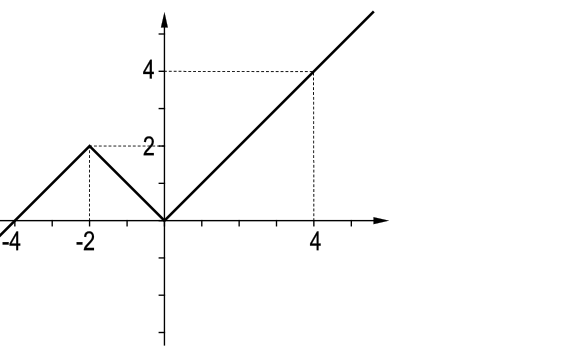
Peter drew the graph of a function \(f : \mathbb{R} \to \mathbb{R}\) consisting of two rays and a line segment, as shown. How many solutions does the equation \(f(f(f(x))) = 0\) have?
Show answer
Answer: A — 4
Show hints
Hint 1 of 2
First find every input that f sends to 0, then work outward one layer at a time.
Still stuck? Show hint 2 →
Hint 2 of 2
Track preimages: solve f = 0, then f = those values, then again.
Show solution
Approach: count preimages layer by layer
f(x)=0 at x = 0 and x = −4.
Pulling back once more, f(x) ∈ {0,−4} adds x = −8; pulling back again adds x = −12.
The solution set is {0,−4,−8,−12}: 4 solutions, A.
Five consecutive positive integers have the following property: the sum of three of the numbers is as big as the sum of the other two. How many sets of 5 such numbers are there?
Show answer
Answer: C — 2
Show hints
Hint 1 of 2
Let the five numbers be n, n+1, n+2, n+3, n+4 and write the three-equal-two condition as an equation.
Still stuck? Show hint 2 →
Hint 2 of 2
The three chosen must total half of all five, which is only possible for small n.
Show solution
Approach: split the five and require equal halves
The five numbers total 5n + 10; splitting into a 3-group equal to a 2-group needs each half to be (5n + 10) / 2.
Testing small starts: {2,3,4,5,6} works (2 + 3 + 5 = 4 + 6 = 10) and {4,5,6,7,8} works (4 + 5 + 6 = 7 + 8 = 15).
For larger n the two largest can no longer balance the three smallest, so there are exactly 2 such sets.
Number TheoryAlgebra & Patternsplace-valuedigit-sum
Robert chose a five-digit positive number. He removed one of its digits, leaving a four-digit number. The sum of this four-digit number and the original five-digit number is 52713. What is the digit sum of the original five-digit number?
Show answer
Answer: C — 23
Show hints
Hint 1 of 2
The five-digit number plus the four-digit number is 52713; estimate the five-digit number's size.
Still stuck? Show hint 2 →
Hint 2 of 2
Removing a digit relates the two numbers through place value — set up and solve.
Show solution
Approach: place-value relation between N and the trimmed number
Let N be the five-digit number and M the four-digit number; N + M = 52713.
Since M is N with one digit removed, N is a little under 52713, around 47921.
Solving gives N = 47921 (and M = 4792), whose digits sum to 4+7+9+2+1 = 23.
Algebra & PatternsLogic & Word Problemssubstitutionwork-backward
In the finishing order of a cross-country race there are twice as many runners behind Alex as there are ahead of Daniel, and 1.5 times as many behind Daniel as ahead of Alex. Alex finished in 21st place. How many runners finished the race?
Show answer
Answer: B — 41
Show hints
Hint 1 of 2
Alex is 21st, so 20 runners finished before him; turn each clue into a count.
Still stuck? Show hint 2 →
Hint 2 of 2
Write the total as one unknown and use the two ratio clues to solve.
Show solution
Approach: set up counts around the two runners
Before Alex there are 20 runners, so behind Daniel = 1.5 × 20 = 30.
Let T be the total; behind Alex = T − 21 and before Daniel = T − 31.
Behind Alex = 2 × (before Daniel): T − 21 = 2(T − 31).
A sequence of numbers begins 1, −1, −1, 1, −1. Each new number is the product of the two numbers before it (for example, the sixth number is the product of the fourth and fifth). What is the sum of the first 2013 numbers?
Show answer
Answer: B — −671
Show hints
Hint 1 of 2
Compute a few more terms; the sequence soon repeats.
Still stuck? Show hint 2 →
Hint 2 of 2
Find the repeating block and its sum, then count how many blocks fit in 2013 terms.
Show solution
Approach: find the period and sum blocks
The terms run 1, −1, −1, 1, −1, −1, 1, −1, −1, … — the block (1, −1, −1) repeats.
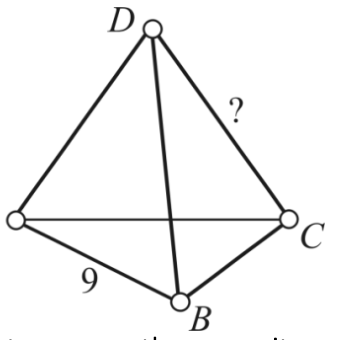
Each of the 4 vertices and 6 edges of a tetrahedron is labelled with one of the numbers 1, 2, 3, 4, 5, 6, 7, 8, 9, 11 (the number 10 is left out), each used exactly once. The number on each edge is the sum of the numbers on the two vertices it connects. The edge AB has the number 9. With which number is the edge CD labelled?
Show answer
Answer: B — 5
Show hints
Hint 1 of 2
Add up all ten labels, and note each vertex value is counted in three edges.
Still stuck? Show hint 2 →
Hint 2 of 2
Find the vertex-sum first; opposite edges (like AB and CD) split that sum.
Show solution
Approach: total counts each vertex three times
The ten labels 1..9 and 11 sum to 56.
Edges sum to 3×(vertex sum) since each vertex sits on 3 edges, so vertex sum + 3×(vertex sum) = 4×(vertex sum) = 56, giving vertex sum 14.
Edges AB and CD together use all four vertices, so (A+B) + (C+D) = 14.
Tom and Mary play a game with a coin. When the coin shows heads, Mary wins and Tom must give her two sweets. When the coin shows tails Tom wins and Mary must give him three sweets. After 30 throws of the coin they each have the same number of sweets as they had at the start of the game. How often has Tom won?
Show answer
Answer: B — 12
Show hints
Hint 1 of 2
Let h be heads and t tails; the totals must end where they started.
Still stuck? Show hint 2 →
Hint 2 of 2
Tom's net change is −2 per head and +3 per tail, and it must be zero.
Show solution
Approach: set net change to zero with a fixed number of throws
In 30 throws let h be heads (Mary wins, Tom loses 2) and t tails (Tom wins 3), with h + t = 30.
For the counts to return to the start, Tom's net is 0: −2h + 3t = 0, i.e. 2h = 3t.
Solving with h + t = 30 gives h = 18, t = 12, so Tom won (the tails) 12 times (B).
Michael thought of a number. He multiplied this number by itself, added 1, multiplied the result by 10, added 3, and multiplied the total by 4. He arrived at 2012. Which number had Michael thought of to start with?
Show answer
Answer: D — 7
Show hints
Hint 1 of 2
Undo each step that led to 2012, working from the last operation back to the first.
Still stuck? Show hint 2 →
Hint 2 of 2
Divide by 4, subtract 3, divide by 10, subtract 1, then take the square root.
Show solution
Approach: reverse the operations
He finished at 2012; undo 'x4' to get 2012 / 4 = 503.
Undo '+3' to get 500, then undo 'x10' to get 50, then undo '+1' to get 49.
49 came from the number times itself, so the number is the square root: 7.
Stefan has 5 dice in different sizes. If he places them in order next to each other from smallest to biggest then the heights of two neighbouring dice each differ by 2 cm. The biggest die is as big as the tower built by the two smallest dice. How high is a tower made up of all 5 dice?
Show answer
Answer: E — 50 cm
Show hints
Hint 1 of 2
Write the five heights as an arithmetic list with common difference 2.
Still stuck? Show hint 2 →
Hint 2 of 2
Use 'biggest = two smallest stacked' to find the starting height.
Show solution
Approach: arithmetic sequence
Let the heights be a, a+2, a+4, a+6, a+8 (increasing by 2).
Biggest equals the two smallest stacked: a+8 = a + (a+2), so a = 6; heights are 6, 8, 10, 12, 14.
Michael wants to write whole numbers into the empty cells of the 3×3 table on the right so that the numbers in every 2×2 square add up to 10. Four numbers are already filled in. Which of the following could be the sum of the remaining five numbers?
Show answer
Answer: E — None of these numbers is possible.
Show hints
Hint 1 of 3
Call the centre cell c and write each 2×2 sum-equals-10 condition in terms of c.
Still stuck? Show hint 2 →
Hint 2 of 3
Add the four border cells and the centre — the total comes out as 20 − 3c.
Still stuck? Show hint 3 →
Hint 3 of 3
Check whether any listed value has the form 20 − 3c for a whole number c.
Show solution
Approach: express the five unknowns through the centre value
With the centre = c, the four 2×2 conditions give the corners as 7−c, 5−c, 5−c, 3−c.
Their sum with c is (7−c)+(5−c)+c+(5−c)+(3−c) = 20 − 3c.
That is always 2 more than a multiple of 3, but 9, 10, 12, 13 are not.
Black and white tiles can be laid on square floors as shown in the pictures. We can see floors with 4 black and 9 black tiles respectively. In each corner there is a black tile, and each black tile touches only white tiles. How many white tiles would there be on a floor that had 25 black tiles?
Show answer
Answer: D — 56
Show hints
Hint 1 of 2
Look at the small floors: 4 black tiles sit on a 3-by-3 floor, and 9 black tiles sit on a 5-by-5 floor.
Still stuck? Show hint 2 →
Hint 2 of 2
Spot the pattern in the floor sizes, then count the white tiles as total minus black.
Show solution
Approach: see how the floor grows with the black count, then subtract
Watch the pattern: 4 black tiles go on a 3-by-3 floor, and 9 black tiles go on a 5-by-5 floor — the side jumps by 2 each time.
Following the pattern, 25 black tiles go on a 9-by-9 floor, which is 9 × 9 = 81 tiles in all.
White tiles = 81 − 25 = 56.
Why the pattern worksWith \(n^2\) black tiles the floor is \((2n-1) \times (2n-1)\); for \(n = 5\) that is \(9 \times 9 = 81\), so white \(= 81 - 25 = 56\).
How many of the functions \(y=x^{2}\), \(y=-x^{2}\), \(y=+\sqrt{x}\), \(y=-\sqrt{x}\), \(y=+\sqrt{-x}\), \(y=-\sqrt{-x}\), \(y=+\sqrt{|x|}\), \(y=-\sqrt{|x|}\) have graphs that appear in the sketch on the right?
Show answer
Answer: D — 6
Show hints
Hint 1 of 2
Sort the eight functions into square-type parabolas and square-root-type curves.
Still stuck? Show hint 2 →
Hint 2 of 2
The sketch shows the sideways square-root branches, not the upward/downward parabolas.
Show solution
Approach: match the sketch to the square-root family of curves
The drawing shows curves that flatten near the axis like square roots, meeting at the origin.
Six of the listed functions (the √-type ones) reproduce exactly those branches; the two parabolas do not.
In the (x, y)-plane the coordinate axes are drawn as usual. The point A(1, −10), which lies on the parabola \(y=ax^{2}+bx+c\), was marked. Then the coordinate axes and most of the parabola were erased, leaving the sketch on the right. Which of the following statements could be false?
Show answer
Answer: E — \(c<0\)
Show hints
Hint 1 of 2
Use the point A(1, −10): substituting x = 1 gives a + b + c = −10.
Still stuck? Show hint 2 →
Hint 2 of 2
That fixes some statements as always true; look for the one that the picture does not force.
Show solution
Approach: substitute the known point and test each statement
A(1,−10) gives a+b+c = −10 < 0, so that statement is always true; the upward shape forces a > 0.
But c is the value at x = 0, which the trimmed picture does not pin down — it may be positive.
Nick wants to write whole numbers into the cells of the 3×3 table shown so that the sum of the numbers in each 2×2 sub-table is always 10. Five numbers have already been written. Determine the sum of the remaining four numbers.
Show answer
Answer: D — 12
Show hints
Hint 1 of 2
Each 2×2 block summing to 10 gives one equation among neighbouring cells.
Still stuck? Show hint 2 →
Hint 2 of 2
Add the right equations so the known centre and corners cancel, leaving the four unknown edge cells.
Show solution
Approach: combine the four 2x2 equations
Label the grid with corners 1, 0, 4, 3 and centre 2; the unknowns are the four edge-midpoints b, d, f, h.
Top blocks give b+d = 7 and b+f = 8; bottom blocks give d+h = 4 and f+h = 5.
The needed sum is b + d + f + h = (b+d) + (f+h) = 7 + 5 = 12.
So the four remaining numbers total 12, choice (D).
Which of the following graphs represents the solution set of \((x-|x|)^2 + (y-|y|)^2 = 4\)?
Show answer
Answer: A
Show hints
Hint 1 of 2
The value of x − |x| depends on whether x is negative.
Still stuck? Show hint 2 →
Hint 2 of 2
Split the plane into the four sign-quadrants and simplify in each.
Show solution
Approach: case-split on the signs of x and y
If a coordinate is non-negative, t−|t| is 0; if it is negative, t−|t| = 2t.
First quadrant gives 0 = 4 (nothing); the second and fourth quadrants give the rays x = −1 (for y ≥ 0, pointing up) and y = −1 (for x ≥ 0, pointing right).
The third quadrant gives 4x² + 4y² = 4, a quarter circle x² + y² = 1 joining (−1, 0) to (0, −1).
The quarter arc together with the upward ray at x = −1 and the rightward ray at y = −1 matches graph A.
In front of a supermarket there are two rows of interconnected trolleys. The first one is 2.9 m long and consists of 10 trolleys. The second one is 4.9 m long and consists of twenty trolleys. How long is one trolley?
Show answer
Answer: C — 1.1 m
Show hints
Hint 1 of 2
Each extra trolley adds the same small length to a row.
Still stuck? Show hint 2 →
Hint 2 of 2
Use the two rows to find that per-extra-trolley length, then back out one trolley.
Show solution
Approach: constant increment per added trolley
10 trolleys: L + 9d = 2.9; 20 trolleys: L + 19d = 4.9.
Subtracting, 10d = 2.0, so each extra trolley adds d = 0.2 m.
In a sequence the first three terms are 1, 2 and 3. From the fourth term onwards each term is found from the three previous terms: the third one back is subtracted from the sum of the two before it. This gives the sequence 1, 2, 3, 0, 5, −2, 7, … What is the 2010th term of this sequence?
Show answer
Answer: A — −2006
Show hints
Hint 1 of 2
Compute a few more terms with the rule (sum of the two before, minus the one three back).
Still stuck? Show hint 2 →
Hint 2 of 2
Watch how odd- and even-numbered terms behave separately.
Leonhard made up a sequence in which, starting with the third term, each term is the sum of the previous two terms. The fourth term is 6 and the sixth term is 15. What is the seventh term of the sequence?
Show answer
Answer: E — 24
Show hints
Hint 1 of 2
Each term is the sum of the two before it; write the 4th and 6th in terms of the first two.
Still stuck? Show hint 2 →
Hint 2 of 2
Two equations in the first two terms pin everything down.
Show solution
Approach: set up the recurrence from the two known terms
Let the first two terms be a and b. Then t₄ = a + 2b = 6 and t₆ = 3a + 5b = 15.
Solving gives b = 3 and a = 0, so the sequence is 0, 3, 3, 6, 9, 15, …
The diagram shows an object with 6 triangular faces. On each corner there is a number (two are shown). The sum of the numbers on the corners of each face is the same. What is the sum of all 5 numbers?
Show answer
Answer: C — 17
Show hints
Hint 1 of 2
Equal face-sums force just two values: the two tips are equal and the three middle corners are equal.
Still stuck? Show hint 2 →
Hint 2 of 2
Use the two shown numbers to tell which value is a tip and which is a middle corner.
Show solution
Approach: exploit equal face sums to find the two values
The solid is a triangular bipyramid: two tips plus three middle corners. Equal face sums force all three middle corners equal and both tips equal.
The shown 1 is a tip and the shown 5 is a middle corner, so the numbers are 1, 1 (tips) and 5, 5, 5 (middle).
The sum of the numbers in each row, column and diagonal in the “magic square” on the right is always constant. Only two numbers are visible. Which number is missing in field a?
Show answer
Answer: D — 55
Show hints
Hint 1 of 2
Use that every line, column and both diagonals share the same total S.
Still stuck? Show hint 2 →
Hint 2 of 2
Combine a few of those equal-sum lines so the unknown cell pops out on its own.
Show solution
Approach: add and subtract equal-sum lines to isolate the corner
Writing each row, column and diagonal as equal to S gives a linear system in the cells.
Combining the equations forces the corner cell a to a single value regardless of the others.
Katrin and Thomas are both celebrating their birthday today. Thomas notices that \(\frac{1}{19}\) of Katrin's age is the same as \(\frac{1}{17}\) of his. Together they are older than 40 years and younger than 100 years. How old is Katrin?
Show answer
Answer: C — 38
Show hints
Hint 1 of 2
If Katrin/19 equals Thomas/17, both ages are multiples of the same number.
Still stuck? Show hint 2 →
Hint 2 of 2
Write K=19k, T=17k and use 40 < K+T < 100.
Show solution
Approach: common-multiple substitution
From K/19 = T/17, set K = 19k and T = 17k.
Total K+T = 36k must satisfy 40 < 36k < 100, so k = 2.
Emma wants to write a number in each circle (see diagram) so that each number equals the sum of the numbers in the two adjacent circles. She has already written two numbers. Which number will she write in the grey circle?
Show answer
Answer: D — −3
Show hints
Hint 1 of 2
Every circle equals the sum of the two circles touching it, and the 1 and 2 are not next to each other.
Still stuck? Show hint 2 →
Hint 2 of 2
Start with the empty circle between the 1 and the 2 — it must equal \(1+2\) — then keep applying the rule around the ring.
Show solution
Approach: propagate the neighbour-sum rule around the ring
The top circle sits between the 1 and the 2, so it equals \(1+2=3\).
Now use 'each circle = sum of its two neighbours' going around: the right circle is \(2-3=-1\), the left circle is \(1-3=-2\), and the grey bottom circle (between them) is \(-1+(-2)=-3\).
Paul shoots a ball at two targets (see diagram) a total of 27 times. When he aims for the upper-left target, he hits 50% of the time, and when he aims for the bottom-right target, he hits 80% of the time. In total, 9 of his shots miss their target. How many times does Paul hit the top-left target?
Show answer
Answer: C — 6
Show hints
Hint 1 of 2
27 shots, 9 missed, so 18 hit; let a shots aim upper-left and b aim lower-right.
Still stuck? Show hint 2 →
Hint 2 of 2
Misses are 50% of a plus 20% of b; set that equal to 9.
Show solution
Approach: set up the miss equation
a + b = 27 shots. Misses: 0.5a + 0.2b = 9.
Substitute b = 27−a: 0.5a + 0.2(27−a) = 9 → 0.3a = 3.6 → a = 12.
Emus, snakes and kangaroos live together on an Australian farm. Emus have two legs and no tail. Kangaroos have four legs and a tail. Snakes have no legs but a tail. Every animal has two eyes. Altogether they have 18 eyes, 7 tails and 24 legs. How many kangaroos live on the farm?
Show answer
Answer: E — 5
Show hints
Hint 1 of 2
Every animal has 2 eyes, so the eye count gives the total number of animals.
Still stuck? Show hint 2 →
Hint 2 of 2
Use tails to split snakes+kangaroos from emus, then legs to isolate the kangaroos.
Show solution
Approach: set up and solve from eyes, tails and legs
18 eyes mean 9 animals; 7 tails are carried by kangaroos and snakes, so 2 emus.
Legs: emus give 2×2 = 4, so kangaroos give 24 − 4 = 20 legs.
Each kangaroo has 4 legs, so there are \(20 \div 4 = 5\) kangaroos, which is (E).
Let a and b be numbers from the set {1, 2, 3, 4, 5, 6}. For each pair (a, b) we draw the line \(y = ax + b\) and look at the triangle it makes with the coordinate axes. For how many pairs (a, b) is that triangle isosceles?
Show answer
Answer: D — 6
Show hints
Hint 1 of 2
The line y = ax + b cuts the axes at (0, b) and (-b/a, 0); these legs make a right triangle.
Still stuck? Show hint 2 →
Hint 2 of 2
A right triangle is isosceles exactly when its two legs are equal.
Show solution
Approach: set the two axis intercept lengths equal
The right triangle has legs of length |b| (on the y-axis) and |b/a| (on the x-axis).
It is isosceles when these are equal: |b| = |b/a|, i.e. |a| = 1.
Among a in {1,...,6} only a = 1 works, and b can be any of the 6 values, giving 6 pairs.
A straight wooden fence is made up of vertical beams stuck in the ground which are each connected to the next beam by 4 horizontal beams. The fence begins and ends with a vertical beam. Out of how many beams could such a fence be made?
Show answer
Answer: B — 96
Show hints
Hint 1 of 2
With v vertical beams there are v−1 gaps, each holding 4 horizontal beams.
Still stuck? Show hint 2 →
Hint 2 of 2
Write the total as a formula in v and see which option it can equal.
Show solution
Approach: set up a formula for the beam count
v vertical beams create v−1 gaps; each gap has 4 horizontals.
Total beams = v + 4(v−1) = 5v − 4.
This must equal one of the options: 5v−4 = 96 gives v = 20, a whole number.
The other options give non-integer v, so the answer is 96.
The two markers with a question mark have the same number. Which number do you have to put instead of the question mark so that the calculation is correct?
Show answer
Answer: C — 3
Show hints
Hint 1 of 3
Both question marks hide the very same number, so whatever you try, use it in both spots.
Still stuck? Show hint 2 →
Hint 2 of 3
You can just try the answers: put 1 in both marks, then 2, then 3, and check the sum each time.
Still stuck? Show hint 3 →
Hint 3 of 3
Keep trying numbers until the calculation comes out right.
Show solution
Approach: try the same number in both marks until the sum works
Remember both marks are the same number, so pick a number and use it in both spots.
Try the choices in turn and add up: too small a number makes the total too low, too big makes it too high.
The number that makes the calculation come out exactly right is 3, so the answer is C.
Tom, John and Lily have each shot 6 arrows at a disc with three sections (see diagram). The number of points for a hit depends on the section that has been hit. Tom has 46 points and John has 34 points. How many points did Lily get?
Show answer
Answer: D — 40
Show hints
Hint 1 of 2
Let the three ring values be the unknowns and read off how many arrows landed in each ring for Tom and John.
Still stuck? Show hint 2 →
Hint 2 of 2
Two equations fix enough about the ring values to total Lily's hits.
Show solution
Approach: set up the ring point-values from Tom and John, then total Lily
Let the outer, middle and inner rings be worth fixed point values; each player threw 6 arrows.
Tom's hits give 46 points and John's give 34 points, which pin down the ring values (each is consistent with 6 arrows).
Applying those values to Lily's six hits totals 40.
In a jazz band, Giuseppe plays the saxophone, Sergio plays the trumpet and Eliana sings. They are all the same age. There are 3 more members of the band, who are 19, 20 and 21 years old. The average age of the jazz band is 21. How old is Eliana?
Show answer
Answer: C — 22
Show hints
Hint 1 of 2
Average 21 over 6 members means the total of all ages is 6×21.
Still stuck? Show hint 2 →
Hint 2 of 2
Subtract the three known ages; the rest splits equally among the three same-age members.
Show solution
Approach: use the total then divide
Six members average 21, so their ages total 6×21 = 126.
The three known members are 19+20+21 = 60, leaving 66 for the other three.
Those three are the same age, so each is 66÷3 = 22.
The little kangaroo has chosen a special number. She gets the same result when she subtracts 110 from her number as she does when she multiplies it by 110. What is her number?
Show answer
Answer: E — 19
Show hints
Hint 1 of 2
Call the number x and write both described results as expressions.
Still stuck? Show hint 2 →
Hint 2 of 2
Set 'x minus 1/10' equal to 'x times 1/10' and solve.
Show solution
Approach: set the two described results equal
Let the number be x. Subtracting gives x − 110; multiplying gives x10.
The parabola in the figure has an equation of the form \(y = ax^{2} + bx + c\) for some distinct real numbers a, b and c. Which of the following equations could be an equation of the line in the figure?
Show answer
Answer: D — \(y = ax + c\)
Show hints
Hint 1 of 2
The parabola opens upward, so what is the sign of a?
Still stuck? Show hint 2 →
Hint 2 of 2
Match the line's slope and y-intercept to combinations of a, b and c.
Show solution
Approach: read the sign of a and the intercept from the picture
The parabola opens upward, so a > 0, giving a positive slope; its y-intercept is c.
The line in the figure has positive slope and the same y-intercept c.
An equation with slope a and intercept c is y = ax + c.
The diagram shows 3 hexagons with numbers at their vertices, but some numbers are invisible. The sum of the 6 numbers around each hexagon is 30. What is the number on the vertex marked with a question mark?
Show answer
Answer: B — 4
Show hints
Hint 1 of 2
Each hexagon's six vertex numbers add to 30; shared vertices link the hexagons.
Still stuck? Show hint 2 →
Hint 2 of 2
Set the unknown shared values from one hexagon's total, then use them in the hexagon with the '?'.
Show solution
Approach: use the constant hexagon sum and shared vertices
Every hexagon totals 30, and two neighbouring hexagons share the two vertices on their common edge.
Comparing the middle hexagon (holding the ?) with a neighbouring hexagon, the shared vertices appear in both totals and cancel, so the difference of their other vertices is forced.
Filling the blanks from the visible numbers that way pins the marked vertex to 4.
Costa is building a new fence in his garden. He uses 25 planks of wood, each of which are 30 cm long. He arranges these planks so that there is the same slight overlap between any two adjacent planks. The total length of Costa's new fence is 6.9 metres. What is the length, in centimetres, of the overlap between any pair of adjacent planks?
Show answer
Answer: B — 2.5
Show hints
Hint 1 of 2
With 25 planks there are 24 overlaps, all equal.
Still stuck? Show hint 2 →
Hint 2 of 2
Compare the total plank length to the actual fence length to find the overlap total.
Show solution
Approach: account for total length lost to overlaps
Laid end to end the 25 planks would span 25·30 = 750 cm.
The fence is only 690 cm, so 750 − 690 = 60 cm is lost to overlapping.
There are 24 equal overlaps, so each is 60 ÷ 24 = 2.5 cm.
Five squares are positioned as shown. The small square indicated has area 1. What is the value of h?
Show answer
Answer: C — 4 m
Show hints
Hint 1 of 2
The marked small square has area 1, so its side is 1; use it as the unit of length.
Still stuck? Show hint 2 →
Hint 2 of 2
Work along the staircase of squares to express h in those units.
Show solution
Approach: measure with the unit square
The marked small square has area 1, so its side is 1; use that as the unit of length along the figure.
Each larger square's side is set by stacking on the one beside it, so the side lengths grow by fixed steps measured in those units.
The arrow h reaches across the top from the small square's structure to the far edge of the big right-hand square, and summing those side-steps gives h = 4 m.
There are 20 questions in a quiz. Each correct answer scores 7 points, each wrong answer scores −4 points, and each question left blank scores 0 points. Eric took the quiz and scored 100 points. How many questions did he leave blank?
Show answer
Answer: B — 1
Show hints
Hint 1 of 2
Let the numbers of correct, wrong and blank answers add to 20, with score 7c − 4w = 100.
Still stuck? Show hint 2 →
Hint 2 of 2
Search for whole-number solutions and read off the blanks.
Show solution
Approach: solve the score equation in whole numbers
With c correct and w wrong: 7c − 4w = 100 and c + w ≤ 20.
c = 16, w = 3 gives 112 − 12 = 100, and that is the only fit.
A rectangular strip of paper of dimensions 4 cm × 13 cm is folded as shown in the diagram. 2 rectangles are formed with areas P and Q where P = 2Q. What is the value of x?
Show answer
Answer: C — 6 cm
Show hints
Hint 1 of 2
The 45° fold makes the overlap a right-isosceles triangle, linking the two rectangle sizes.
Still stuck? Show hint 2 →
Hint 2 of 2
Use P = 2Q together with the strip's fixed width and length to pin down x.
Show solution
Approach: relate the two rectangle areas through the fold
The strip has width 4, so both rectangles are 4 wide: P = 4x and Q = 4y, where x and y are their lengths.
The 45° fold turns the strip square across its width, so the diagonal overlap uses a 4-by-4 square, and the three lengths fit the strip: x + 4 + y = 13.
P = 2Q gives x = 2y; with x + y = 9 this makes y = 3 and x = 6.
Logic & Word ProblemsAlgebra & Patternssubstitution
Three villages are connected by paths as shown. From Downend to Uphill, the detour via Middleton is 1 km longer than the direct path. From Downend to Middleton, the detour via Uphill is 5 km longer than the direct path. From Uphill to Middleton, the detour via Downend is 7 km longer than the direct path. How long is the shortest of the three direct paths between the villages?
Show answer
Answer: C — 3 km
Show hints
Hint 1 of 2
Name the three direct distances and turn each 'detour is k longer' fact into an equation.
Still stuck? Show hint 2 →
Hint 2 of 2
Add all three equations to get the total of the distances quickly.
Show solution
Approach: set up and add the detour equations
Let the direct paths be DU = a, DM = b, UM = c. The detours give b+c = a+1, a+c = b+5, a+b = c+7.
Adding all three: 2(a+b+c) = (a+b+c) + 13, so a+b+c = 13.
Then a = 6, b = 4, c = 3; the shortest direct path is 3 km.
Every night the wizard Tilim makes the weather forecast for the king. When Tilim gets it right he gets 3 gold coins, but when he makes a mistake he pays a fine of 2 gold coins. After making the prediction for 5 days, Tilim found that he neither won nor lost coins. How many times did he get the weather forecast right in those 5 days?
Show answer
Answer: C — 2
Show hints
Hint 1 of 2
The coins he wins must exactly cancel the coins he pays in fines.
Still stuck? Show hint 2 →
Hint 2 of 2
Try a few guesses: how many right days make the coins won equal the coins lost?
Show solution
Approach: make the coins won match the coins lost
He ends with no change, so the coins he won must equal the coins he paid.
Each right day wins 3 coins and each wrong day costs 2 coins, over 5 days.
If he was right 2 days: 2 × 3 = 6 coins won, and the other 3 days cost 3 × 2 = 6 coins.
6 won and 6 paid balance out, so he was right 2 times.
Maria has ten pieces of paper. Some are squares and the others are triangles. She cuts each square along one of its diagonals. She then counts the total number of vertices of the pieces she has now and gets 48. How many squares did she have before making the cuts?
Show answer
Answer: D — 6
Show hints
Hint 1 of 2
A whole square has 4 corners, but a cut square becomes two triangles — count their corners.
Still stuck? Show hint 2 →
Hint 2 of 2
Set up one equation for the 10 pieces and one for the 48 vertices.
Show solution
Approach: count vertices of cut squares vs triangles and solve
Cutting a square along a diagonal gives two triangles, 6 vertices in all.
An uncut triangle has 3 vertices.
With s squares and (10−s) triangles: 6s + 3(10−s) = 48.
In a garden, a bush has branches with seven leaves, or branches with four leaves and a flower. Janaina counted the leaves and flowers and found that the bush has 9 flowers and 120 leaves. How many branches does the bush have?
Show answer
Answer: B — 21
Show hints
Hint 1 of 2
Each flower comes with a four-leaf branch, so the 9 flowers account for 9 such branches.
Still stuck? Show hint 2 →
Hint 2 of 2
Subtract those branches' leaves from 120, then divide the rest among seven-leaf branches.
Show solution
Approach: split the count into flowered and unflowered branches
A branch with a flower has 4 leaves; 9 flowers mean 9 of these branches, giving 9x4 = 36 leaves.
That leaves 120 - 36 = 84 leaves on the seven-leaf branches, i.e. 84 / 7 = 12 branches.
Maria wants to write whole numbers in the squares of the figure, so that the sum of the numbers in three consecutive squares is always 10. She has already written one number. What number should she write in the gray square?
Show answer
Answer: B — 2
Show hints
Hint 1 of 3
Every group of three squares next to each other adds up to the same total, 10.
Still stuck? Show hint 2 →
Hint 2 of 3
Two overlapping groups of three share the middle two squares, so the ends must match.
Still stuck? Show hint 3 →
Hint 3 of 3
This means squares that are three apart always hold the same number.
Show solution
Approach: see that squares three apart must be equal
Take the first three squares and the next three squares (squares 2, 3, 4). Both groups add to 10.
Both groups share squares 2 and 3, so square 1 and square 4 must be equal, and in the same way every square equals the one three places away.
So the pattern of numbers just repeats every three squares.
The gray square sits three places from the square already holding 2, so it also holds 2.
A square is formed by four identical rectangles and a central square, as in the figure. The area of the large square is 81 cm², and the square formed by the diagonals of these rectangles has area 64 cm². What is the area of the central square?
Show answer
Answer: D — 47 cm²
Show hints
Hint 1 of 2
Call the rectangle sides a and b; one big side is a + b = 9, and the diagonal is √(a²+b²) = 8.
Still stuck? Show hint 2 →
Hint 2 of 2
The central square has side a − b, so its area is a² + b² − 2ab.
Show solution
Approach: combine the sum and the diagonal
The outer square has side 9 (area 81), so a + b = 9 and (a+b)² = 81.
The diagonals' square has side 8, so a² + b² = 64.
From 81 = 64 + 2ab we get 2ab = 17, and the central square area is (a−b)² = a²+b² − 2ab = 64 − 17 = 47.
Five friends bake gingerbread and then meet up for a tasting. Each one gives one of his gingerbreads to each of the other four people. Then everyone eats all of the gingerbread they were given. After that the number of gingerbreads has halved. How many gingerbreads did the five friends have to start with?
Show answer
Answer: D — 40
Show hints
Hint 1 of 2
Work out how many gingerbreads are eaten in total.
Still stuck? Show hint 2 →
Hint 2 of 2
The amount eaten equals half the starting number.
Show solution
Approach: total eaten = half the start
Each of the 5 friends hands one gingerbread to each of the other 4, so 5 × 4 = 20 gingerbreads are given away and eaten.
After eating, the count has halved, so the 20 eaten are exactly half of the start.
Therefore they began with 2 × 20 = 40 gingerbreads.
The individual masses (in kg) of three kangaroos are three different integers. Together they weigh 97 kg. What is the maximum weight the lightest of the three can have?
Show answer
Answer: C — 31
Show hints
Hint 1 of 2
To make the lightest as big as possible, keep the three weights as close together as you can.
Still stuck? Show hint 2 →
Hint 2 of 2
Try three near-equal integers summing to 97 and adjust.
Show solution
Approach: push the three values close together
Let the weights be a < b < c with a + b + c = 97.
The lightest is largest when the three are nearly equal: 31, 32, 34 = 97.
Linda fixes 3 photos on a pin board next to each other. She uses 8 pins to do so (see picture). Peter wants to fix 7 photos in the same way. How many pins does he need for that?
Show answer
Answer: B — 16
Show hints
Hint 1 of 2
Look at the picture: the first photo needs 4 pins (its 4 corners), but each new photo touches the one before it.
Still stuck? Show hint 2 →
Hint 2 of 2
Because neighbours share their pins, every photo after the first adds the same small number of pins.
Show solution
Approach: see the repeating add-on for each photo
The top row of pins has one more pin than the number of photos, and so does the bottom row.
For 3 photos that is 4 pins on top and 4 pins on the bottom, which makes 8 pins — this matches the picture.
For 7 photos it is 8 pins on top and 8 pins on the bottom.
The six smallest odd natural numbers are written on the sides of a die. Toni rolls the die three times and adds the numbers. Which sum will Toni not be able to make?
Show answer
Answer: E — 35
Show hints
Hint 1 of 3
The six smallest odd numbers are 1, 3, 5, 7, 9, 11, so those are the faces.
Still stuck? Show hint 2 →
Hint 2 of 3
Adding three odd numbers always gives an odd result, and there is a biggest total you can ever reach.
Still stuck? Show hint 3 →
Hint 3 of 3
Find that biggest possible total and check each answer against it.
Show solution
Approach: bound the achievable totals
The faces are the odd numbers 1, 3, 5, 7, 9, 11, and the biggest total you can roll is 11 + 11 + 11 = 33.
Three odd numbers always add to an odd number, and every odd value from 3 up to 33 can be reached.
35 is larger than the biggest possible total of 33, so it can never be made: 35 (E).
Andreas shares some apples equally among six baskets. Boris shares the same number of apples equally among five baskets. Boris notices that each of his baskets has two more apples than each of Andreas's baskets. How many apples did Andreas share out?
Show answer
Answer: A — 60
Show hints
Hint 1 of 2
Let the total number of apples be one unknown and write each person's per-basket amount.
Still stuck? Show hint 2 →
Hint 2 of 2
Boris's basket has 2 more than Andreas's basket.
Show solution
Approach: set up one equation in the total
Let the total be x apples. Andreas puts x/6 in each basket, Boris puts x/5 in each.
In a witch’s garden there are 30 animals: dogs, cats and mice. The witch changes 6 dogs into 6 cats and then 5 cats into 5 mice. Now there is an equal number of dogs, cats and mice. How many cats were there to start with?
Show answer
Answer: C — 9
Show hints
Hint 1 of 3
At the end the three kinds are equal, and 30 splits into three equal piles.
Still stuck? Show hint 2 →
Hint 2 of 3
Follow only the cats: first they go up, then they go down.
Still stuck? Show hint 3 →
Hint 3 of 3
Work the cat count backwards from its final value to its start.
Show solution
Approach: work backward from 10 cats
At the end the three kinds are equal, so each is 30 ÷ 3 = 10; in particular there are 10 cats at the end.
Cats gained 6 (the dogs that became cats) and then lost 5 (the cats that became mice), a net change of 6 − 5 = +1.
So the cats started 1 fewer than they ended: 10 − 1 = 9 cats (C).
Maxi builds towers made up of little 1 cm × 1 cm × 2 cm building blocks, as shown in the picture. He continues to build his towers in the same way. Finally he uses 28 building blocks for one tower. What is the height of this tower?
Show answer
Answer: C — 11 cm
Show hints
Hint 1 of 3
Write down how many blocks each tower in the picture uses, in order.
Still stuck? Show hint 2 →
Hint 2 of 3
Each new tower adds one more block than the jump before, so the counts grow 3, 6, 10, 15, ...
Still stuck? Show hint 3 →
Hint 3 of 3
Keep extending until you reach 28 blocks, then read that tower's height from how it is built.
Show solution
Approach: extend the block-count pattern
Count the blocks in the picture's towers: 3, then 6, then 10, then 15. Each step adds one more block than the step before (+3, +4, +5, ...).
Keep going: 15 + 6 = 21, then 21 + 7 = 28, so the 28-block tower is the next one in the staircase pattern.
Building that tower in the same way, it rises to a height of 11 cm (C).
Steven wants to write each of the digits 2, 0, 1 and 9 into the boxes of this addition (a three-digit number plus a single-digit number). He wants to obtain the biggest result possible. Which digit does he have to use for the single-digit number?
Show answer
Answer: A — either 0 or 1
Show hints
Hint 1 of 2
The biggest sum comes from putting the largest digit, 9, in the hundreds place of the three-digit number.
Still stuck? Show hint 2 →
Hint 2 of 2
The single digit and the units of the three-digit number both count once, so swapping them does not change the total.
Show solution
Approach: maximise by place value
Put 9 in the hundreds place; the sum becomes 900 + (tens, units, single from 2,1,0).
Put 2 in the tens place to add the most: 920 + (remaining 1 and 0).
The leftover 1 and 0 fill the units and the single-digit number, each adding the same amount.
So the single digit can be either 0 or 1: answer A.
The pictures show how much 2 pieces of fruit cost altogether. The first three show pairs costing 5, 7 and 10 Taler. How much do the three fruits in the last picture cost altogether?
Show answer
Answer: D — 11 Taler
Show hints
Hint 1 of 2
Add the three given pair-prices together; each fruit then appears exactly twice.
Still stuck? Show hint 2 →
Hint 2 of 2
The last picture shows all three fruits, whose total is half of that combined sum.
Show solution
Approach: add the pairs, then halve
The three given totals are 5, 7 and 10 Taler.
Adding them gives 22, which counts each fruit twice.
All three fruits together cost 22 ÷ 2 = 11 Taler (D).
The distance from the top of the cat sitting on the table to the top of the cat sleeping on the floor is 150 cm. The distance from the top of the cat sleeping on the table to the top of the cat sitting on the floor is 110 cm. How high is the table?
Show answer
Answer: C — 130 cm
Show hints
Hint 1 of 2
Add the two given distances and see what each cat contributes.
Still stuck? Show hint 2 →
Hint 2 of 2
Each measurement is one sitting-cat height plus the table minus one sleeping-cat height; adding them cancels the cats.
Show solution
Approach: add the two measurements so the cat heights cancel
Let the table height be t, a sitting cat add s above its base and a sleeping cat add p.
First distance: t + s − p = 150. Second distance: t + p − s = 110.
Adding the two equations: 2t = 260, so t = 130 cm.
The map shows the round trip that Captain Bluebear sails. Three distances are given. He sails from island to island starting at Berg, and altogether he covers 100 km. The distance between Wüste and Wald equals the distance from Berg to Blume going past Vulkan. How big is the distance between Berg and Wald?
Show answer
Answer: D — 33 km
Show hints
Hint 1 of 2
Three legs are given (17, 15, 26) and the whole loop is 100 km.
Still stuck? Show hint 2 →
Hint 2 of 2
Use the clue that Wüste–Wald equals Berg–Blume via Vulkan to fill the missing leg, then subtract.
Show solution
Approach: find the unknown legs from the 100 km loop and the equal-distance clue
The trip Berg–Vulkan–Blume–Wüste–Wald–Berg totals 100 km.
11 points are marked from left to right on a straight line, and their distances are recorded. The sum of the distances from the first point to every other point is 2018. The sum of all distances from the second point to every other point, including the first point, is 2000. What is the distance between the first and the second point?
Show answer
Answer: B — 2
Show hints
Hint 1 of 2
Compare the two distance-sums term by term, lining up the same far points.
Still stuck? Show hint 2 →
Hint 2 of 2
Every far point (from the 3rd on) contributes the gap between point 1 and point 2 to the difference.
Show solution
Approach: subtract the two sums to isolate the first gap
From point 2's sum, the distance to point 1 is the gap d; the distances to points 3..11 are each shorter by d than from point 1.
So the sums differ by 9d (nine points beyond the second): 2018 − 2000 = 9d.
On the number wall shown, the number on each tile is equal to the sum of the numbers on the two tiles directly below it. Which number is on the tile marked with “?”
Show answer
Answer: B — 16
Show hints
Hint 1 of 2
The top tile equals the sum of everything fed up from the bottom; write each tile from the bottom two unknowns.
Still stuck? Show hint 2 →
Hint 2 of 2
Use the known tiles 2020 and 2017 to pin down the bottom values first, then read off the marked tile.
Show solution
Approach: set up the wall from the bottom two unknown tiles and use the known tiles
Call the two leftmost bottom tiles a (the marked one) and b; the bottom row is a, b, 2017.
The middle-right tile is b + 2017 = 2020, so b = 3.
The top tile is a + 2b + 2017 = 2039, so a + 2b = 22, giving a = 22 - 6 = 16.
Which quadrant contains no points of the graph of the linear function \(f(x) = -3.5x + 7\)? (Quadrants are numbered I, II, III, IV anticlockwise, starting from the upper right.)
Show answer
Answer: C — III
Show hints
Hint 1 of 2
A line with negative slope and positive y-intercept rises to the upper left and falls to the lower right.
Still stuck? Show hint 2 →
Hint 2 of 2
Sketch where the line goes: which of the four quadrants does it simply never enter?
Show solution
Approach: trace the line by slope and intercept across the quadrants
f(x) = -3.5x + 7 has y-intercept (0,7) and x-intercept (2,0).
For x < 2 the line is above the x-axis (quadrants II then I); for x > 2 it drops below (quadrant IV).
It never reaches the lower-left region, so it has no points in quadrant III.
A furniture shop sells 3-seater, 2-seater and 1-seater sofas. Each sofa has an equally wide armrest on the left and on the right, and every seat is equally wide (see picture). With its armrests the 3-seater sofa is 220 cm wide and the 2-seater sofa is 160 cm wide. How wide is the 1-seater sofa?
Show answer
Answer: D — 100 cm
Show hints
Hint 1 of 2
Both sofas have two armrests; the only difference between the 3-seater and 2-seater is one seat.
Still stuck? Show hint 2 →
Hint 2 of 2
Find one seat's width from the 220 vs 160 difference, then build the 1-seater.
Show solution
Approach: subtract to isolate a seat, then a pair of armrests
Paul goes on a 5-day hike, starting on Monday and finishing on Friday. Each day he walks 2 km more than the day before, and in total he walks 70 km. How far does he walk on Thursday?
Show answer
Answer: E — 16 km
Show hints
Hint 1 of 2
The five daily distances rise by 2 km each day, so they are evenly spaced around the middle day.
Still stuck? Show hint 2 →
Hint 2 of 2
The middle (Wednesday) distance is the average; find it, then step up to Thursday.
Show solution
Approach: use the average of an arithmetic sequence
Five days increasing by 2 km average to the middle day, Wednesday: 70 ÷ 5 = 14 km.
Each later day is 2 km more, so Thursday = 14 + 2 = 16 km.
Ria wants to write a number into each box. She has already written two numbers. The sum of all five numbers should be 35, the sum of the first three numbers should be 22, and the sum of the last three numbers should be 25. What is the product Ria gets if she multiplies the two numbers in the grey boxes?
Show answer
Answer: A — 63
Show hints
Hint 1 of 2
The full sum minus the first three minus the last three double-counts only the middle box.
Still stuck? Show hint 2 →
Hint 2 of 2
Use the running sums to pin down each grey box.
Show solution
Approach: solve the box values from overlapping sums
first3 + last3 = 22 + 25 = 47 = total (35) + middle, so the middle box = 12.
First three: 3 + grey1 + 12 = 22, so grey1 = 7. Last three: 12 + grey2 + 4 = 25, so grey2 = 9.
Emily wants to insert nine numbers into the 3 × 3 table so that the sum of the numbers in any two adjacent cells (cells with a common side) is always the same. She has already written two numbers into the table. How big is the sum of all nine numbers?
Show answer
Answer: D — 22
Show hints
Hint 1 of 2
Equal adjacent sums force a checkerboard: cells in the same colour class all hold the same value.
Still stuck? Show hint 2 →
Hint 2 of 2
The two given numbers belong to the two different colour classes.
Show solution
Approach: checkerboard pattern from equal adjacent sums
If every pair of side-sharing cells has the same sum, the grid alternates two values like a checkerboard: 5 cells of one value, 4 of the other.
The 2 sits in the 5-cell class and the 3 in the 4-cell class.
The sum of the ages of Tom and Johann is 23. The sum of the ages of Johann and Alex is 24, and the sum of the ages of Alex and Tom is 25. How old is the oldest of them?
Show answer
Answer: D — 13
Show hints
Hint 1 of 3
Add all three given pair-sums together.
Still stuck? Show hint 2 →
Hint 2 of 3
The grand total counts every person twice, so half of it is the sum of all three ages.
Still stuck? Show hint 3 →
Hint 3 of 3
Subtract a known pair from that whole-group total to isolate one person's age.
Show solution
Approach: add the equations to get the total, then back out each age
Adding the three pair-sums: 23+24+25 = 72.
Each person is counted twice, so Tom+Johann+Alex = 36.
Alex = 36 - (Tom+Johann) = 36 - 23 = 13; similarly Tom = 12, Johann = 11.
Ruth takes part in the kangaroo competition where 30 questions have to be answered. She answers every question and each answer is either right or wrong. She has 50% more right than wrong answers. How many of her answers are right?
Show answer
Answer: D — 18
Show hints
Hint 1 of 2
Let the number of wrong answers be one part.
Still stuck? Show hint 2 →
Hint 2 of 2
Right is 1.5 parts; right + wrong is 30.
Show solution
Approach: parts model
If wrong = 2 parts then right = 3 parts (50% more).
Lukas invents his own notation for negative numbers. When counting backwards he writes: … 3, 2, 1, 0, 00, 000, 0000, … What is the result of the calculation 000 + 0000 in his notation?
Show answer
Answer: C — 000000
Show hints
Hint 1 of 2
Match each string of zeros to the negative number it stands for.
There are 30 girls and boys in a class. Two students always share a desk. Every boy shares a desk with a girl. Exactly half the girls share a desk with a boy. How many boys are in the class?
Show answer
Answer: D — 10
Show hints
Hint 1 of 3
A boy-girl desk has one boy and one girl, so counting those desks counts the boys.
Still stuck? Show hint 2 →
Hint 2 of 3
Those same boy-girl desks use up exactly half the girls, so there are as many boys as half-the-girls.
Still stuck? Show hint 3 →
Hint 3 of 3
That means there are twice as many girls as boys.
Show solution
Approach: match boys to half the girls
Every boy sits at a boy-girl desk, so the number of boy-girl desks equals the number of boys.
Those desks contain exactly half the girls, so the number of boys equals half the girls; in other words there are twice as many girls as boys.
Split 30 into 1 part boys and 2 parts girls: 3 equal parts make 30, so each part is 10, and the boys are 1 part, giving 10 boys, choice (D).
With algebraIf \(b\) boys and \(g\) girls, then \(b+g=30\) and \(g=2b\), so \(3b=30\) and \(b=10\).
Tim, Tom and Jim are triplets. Their twin brothers John and James are 3 years younger. All five have their birthday today. Which of the following numbers could be the sum of the ages of the five brothers?
Show answer
Answer: B — 89
Show hints
Hint 1 of 2
Let the triplets be age t; the twins are t − 3 each. Write the total.
Still stuck? Show hint 2 →
Hint 2 of 2
The sum is 5t − 6, so the answer plus 6 must be a multiple of 5.
Show solution
Approach: express the sum and test the form
Three triplets are each age t and two twins are each t − 3.
Total = 3t + 2(t − 3) = 5t − 6, so (sum + 6) must be a multiple of 5.
89 + 6 = 95 = 5 × 19 works (t = 19); the other options fail, so the sum can be 89.
The two kangaroos Jump and Hop start at the same time from the same line in the same direction. Each jumps exactly once per second. Jump always jumps 6 m. Hop jumps 1 m, then 2 m, then 3 m, and so on. After how many jumps does Hop catch up with Jump?
Show answer
Answer: B — 11
Show hints
Hint 1 of 2
After n jumps Jump has gone 6n m; Hop has gone 1 + 2 + ... + n m.
Still stuck? Show hint 2 →
Hint 2 of 2
Set n(n+1)/2 = 6n and solve.
Show solution
Approach: equate the distances after n jumps
After n jumps Jump is at 6n m and Hop is at 1 + 2 + ... + n = n(n+1)/2 m.
Hop catches up when n(n+1)/2 = 6n, i.e. n + 1 = 12, so n = 11.
There are 20 students in total, girls and boys, in a class. Two students always share a desk. One third of the boys share a desk with a girl, and half of the girls share a desk with a boy. How many boys are in the class?
Show answer
Answer: B — 12
Show hints
Hint 1 of 3
Let b boys and g girls with b + g = 20; count the mixed desks two ways.
Still stuck? Show hint 2 →
Hint 2 of 3
One third of the boys equals half the girls: b/3 = g/2.
Still stuck? Show hint 3 →
Hint 3 of 3
Solve b/3 = g/2 together with b + g = 20.
Show solution
Approach: count the mixed desks two ways
Let b boys and g girls, b + g = 20.
Mixed desks from the boys' side = b/3; from the girls' side = g/2; these are equal, so b/3 = g/2.
Then 2b = 3g; with b + g = 20 this gives b = 12, g = 8, so there are 12 boys.
Each plant in John's garden has exactly 5 leaves or exactly 2 leaves and a flower. In total the plants have 6 flowers and 32 leaves. How many plants are growing in the garden?
Show answer
Answer: A — 10
Show hints
Hint 1 of 2
Only the 2-leaf plants carry flowers, so the number of flowers tells you how many of those there are.
Still stuck? Show hint 2 →
Hint 2 of 2
Subtract the leaves on the flowering plants from 32 to see how many leaves are left for the 5-leaf plants.
Show solution
Approach: use the flowers to fix one kind of plant, then account for the leaves
Each flower belongs to a 2-leaf plant, and there are 6 flowers, so there are 6 plants with 2 leaves, giving 6 × 2 = 12 leaves.
That leaves 32 − 12 = 20 leaves for the 5-leaf plants, which is 20 ÷ 5 = 4 plants.
Luis has got 7 apples and 2 bananas. He gives 2 apples to his friend Jacob, who gives him bananas in return. Afterwards Luis has got the same amount of apples as bananas. How many bananas did Luis get from Jacob?
Show answer
Answer: B — 3
Show hints
Hint 1 of 2
First update the apple count after Luis gives 2 away.
Still stuck? Show hint 2 →
Hint 2 of 2
Set the new banana count equal to the apple count and read off how many bananas he received.
Show solution
Approach: track apples and bananas, then make them equal
Luis gives away 2 of his 7 apples, leaving 5 apples.
Afterwards he has as many bananas as apples, so he must have 5 bananas.
He started with 2 bananas, so he received 5 − 2 = 3 bananas from Jacob.
Andrea has 4 equally long strips of paper. When she glues two together with an overlap of 10 cm, she gets a strip 50 cm long. With the other two she wants to make a 56 cm long strip. How long must the overlap be?
Show answer
Answer: A — 4 cm
Show hints
Hint 1 of 2
Two strips glued together lose exactly one overlap from their combined length.
Still stuck? Show hint 2 →
Hint 2 of 2
First find the length of one strip from the 50 cm result, then use it for the 56 cm strip.
Show solution
Approach: find one strip length, then solve for the new overlap
Two strips glued with a 10 cm overlap measure 50 cm, so the two full strips total 50 + 10 = 60 cm, meaning each strip is 30 cm.
The other two strips also total 60 cm; gluing them to make 56 cm loses 60 − 56 = 4 cm to overlap.
Each inhabitant of a distant planet has at least two ears. Three inhabitants called Imi, Dimi and Trimi meet in a trendy crater. Imi says: “I can see 8 ears.” Dimi then replies: “I can see 7 ears.” Finally Trimi says: “Strange, I can only see 5 ears.” None of them can see their own ears. How many ears does Trimi have?
Show answer
Answer: C — 5
Show hints
Hint 1 of 2
Add up what all three claim they can see; every ear gets counted by the two who don't own it.
Still stuck? Show hint 2 →
Hint 2 of 2
Sum of the three counts = 2 × (total ears); subtract the count that excludes Trimi to get Trimi's ears.
Show solution
Approach: add the three counts and halve
Each ear is seen by exactly the two others, so 8 + 7 + 5 = 2 × (total ears).
Total ears = 20 / 2 = 10.
Imi (sees 8) has 10 − 8 = 2; Dimi (sees 7) has 3; Trimi (sees 5) has 10 − 5 = 5.
Ella wants to write a number into each circle in the diagram on the right, in such a way that each number is equal to the sum of its two direct neighbours. Which number does Ella need to write into the circle marked with “?”?
Show answer
Answer: E — This question has no solution.
Show hints
Hint 1 of 2
‘Each number equals the sum of its two neighbours’ rearranges to ‘next = this − previous’, which repeats with period 6.
Still stuck? Show hint 2 →
Hint 2 of 2
Follow that pattern around the 8-circle ring and see whether the two given numbers, 3 and 5, can both fit.
Show solution
Approach: chase the neighbour-sum rule around the ring
Writing each circle as the sum of its neighbours rearranges to ‘next neighbour = this − previous’, a rule that repeats every 6 steps.
On a ring of 8 circles this period-6 repetition forces two of the circles (here the ones holding 3 and 5) to carry equal values.
Since 3 ≠ 5, no consistent filling exists, so the answer is ‘no solution’ (E).
The 10 participants of a test achieve on average 6 points. Exactly 6 of the participants passed the test. The average of the participants that passed the test was 8 points. What is the average of the participants that did not pass the test?
Show answer
Answer: C — 3
Show hints
Hint 1 of 2
Turn each average into a total number of points.
Still stuck? Show hint 2 →
Hint 2 of 2
Total points minus the passers' points gives the failers' points; divide by how many failed.
Show solution
Approach: use totals, not averages, then divide
All 10 participants total 10 * 6 = 60 points.
The 6 who passed total 6 * 8 = 48 points.
The 4 who failed total 60 - 48 = 12 points, so their average is 12 / 4 = 3.
Eva added the lengths of three sides of a rectangle and obtained 44 cm. Ulli also added the lengths of three sides of the same rectangle and obtained 40 cm. What is the perimeter of the rectangle?
Show answer
Answer: B — 56 cm
Show hints
Hint 1 of 2
Each person added three sides, so together their sums use the sides a known number of times.
Still stuck? Show hint 2 →
Hint 2 of 2
Adding the two results counts the length three times and the width three times: 3 times (length + width).
Show solution
Approach: add the two three-side sums
One person summed two lengths and a width, the other two widths and a length.
Adding their results, 44 + 40 = 84, counts three lengths and three widths: 3(L + W) = 84.
A restaurant has 16 tables, each with 3, 4, or 6 chairs. The tables with 3 or 4 chairs seat 36 guests in total. The restaurant seats 72 guests altogether. How many tables have three chairs?
Show answer
Answer: A — 4
Show hints
Hint 1 of 2
First find how many seats the 6-chair tables provide, then how many such tables there are.
Still stuck? Show hint 2 →
Hint 2 of 2
Once you know the number of 3-or-4-chair tables and their 36 seats, set up two simple equations for the 3s and 4s.
Show solution
Approach: peel off the 6-chair tables, then nudge 4-chair tables down to 3
The 3- and 4-chair tables seat 36 guests, so the 6-chair tables seat 72 − 36 = 36, which is 36 ÷ 6 = 6 tables of six.
That leaves 16 − 6 = 10 tables with 3 or 4 chairs, and they seat 36 guests in total.
Pretend all 10 had 4 chairs: that would be 40 seats, which is 4 too many.
Each time you change a 4-chair table into a 3-chair table you lose one seat, so you need 4 of those changes.
There are 4 tables with three chairs.
The same idea with a quick equationIf t tables have 3 chairs, then 3t + 4(10 − t) = 36, so 40 − t = 36 and t = 4.
A chess player plays 40 matches and gains 25 points from them, where a win gives 1 point, a draw 12 point, and a loss 0 points. How many more matches does he win than he loses?
Show answer
Answer: C — 10
Show hints
Hint 1 of 2
Set up wins, draws, losses with the match-count and points equations.
Still stuck? Show hint 2 →
Hint 2 of 2
Subtract the equations cleverly to get wins minus losses directly.
Show solution
Approach: combine the total-games and total-points equations
Let w, d, l be wins, draws, losses: w + d + l = 40 and w + d/2 = 25.
Double the second: 2w + d = 50; subtract the first: w − l = 10.
In a list of five numbers the first number is 2 and the last one is 12. The product of the first three numbers is 30, of the middle three 90 and of the last three 360. What is the middle number in that list?
Show answer
Answer: C — 5
Show hints
Hint 1 of 2
The first three multiply to 30 and the first number is 2, so you know the product of numbers 2 and 3.
Still stuck? Show hint 2 →
Hint 2 of 2
Use the last-three product and the known last number to pin down number 4, then chain back.
Show solution
Approach: peel products from both ends
Label the list \(a,b,c,d,e\) with \(a=2\) and \(e=12\). Since \(abc=30\), we get \(bc = 15\).
From \(bcd=90\): \(d = \frac{90}{bc} = \frac{90}{15} = 6\); and \(cde=360\) gives \(cd = \frac{360}{12} = 30\).
Then \(c = \frac{cd}{d} = \frac{30}{6} = 5\), so the middle number is \(5\), choice C.
In addition to the weight of the basket, a single balloon can lift 80 kg. Two balloons can lift 180 kg in addition to the weight of the basket. How heavy is the basket?
Show answer
Answer: E — 20 kg
Show hints
Hint 1 of 2
Adding a second balloon adds another 80 kg of lift; compare the two situations.
Still stuck? Show hint 2 →
Hint 2 of 2
Find the basket weight by seeing how the totals jump from one balloon to two.
Show solution
Approach: compare one balloon vs two balloons
Let the basket weigh b and one balloon's own lift be L. One balloon: L - b = 80.
Two balloons: 2L - b = 180. Subtracting the first from the second gives L = 100.
Then b = L - 80 = 100 - 80 = 20 kg. Check: 2(100) - 20 = 180.
Alice and Bob send each other secret messages. To put their messages into code they use the following system: First each letter is given a number in order: A = 1, B = 2, C = 3, … Z = 26. Then the letter number is doubled and 9 is added. Bob received a message which began 19 – 37 – 48 – 19 – … Which of the following messages had Alice sent to Bob?
Show answer
Answer: E — Alice has made a mistake
Show hints
Hint 1 of 2
Undo the rule: from a received number, subtract 9 then halve to get the letter number.
Still stuck? Show hint 2 →
Hint 2 of 2
Check whether every received number actually gives a whole letter number.
Show solution
Approach: invert the encoding and test for validity
The rule sends a letter number n to 2n + 9, so to decode you compute (received − 9) / 2.
19 → 5 = E and 37 → 14 = N, but 48 → (48 − 9)/2 = 19.5, which is not a whole number.
Since 48 cannot come from any letter, the message could not have been encoded correctly.
Grandmother gave Vivian and Mike some apples and pears. In total they had 25 pieces of fruit. On the way home Vivian ate 1 apple and 3 pears, and Mike ate 3 apples and 2 pears. At home they noticed that there were exactly the same number of apples and pears left in the basket. How many pears had Grandmother given them?
Show answer
Answer: B — 13
Show hints
Hint 1 of 2
Work out how many apples and pears were eaten in total.
Still stuck? Show hint 2 →
Hint 2 of 2
After eating, the basket has equal apples and pears; build back up to the pears given.
Show solution
Approach: track what was eaten, then use the equal-leftover clue
Eaten: Vivian 1 apple + 3 pears, Mike 3 apples + 2 pears, so 4 apples and 5 pears eaten (9 pieces).
Left in the basket: 25 - 9 = 16 pieces, split equally, so 8 apples and 8 pears.
Total pears = pears left + pears eaten = 8 + 5 = 13.
In the school for animals there are 3 cats, 2 ducks, 2 sheep and some dogs. The teacher counted the legs of all the animals and got 44. How many dogs go to the school?
Show answer
Answer: B — 5
Show hints
Hint 1 of 2
Count the legs of the cats, ducks and sheep first.
Still stuck? Show hint 2 →
Hint 2 of 2
Subtract those legs from 44, then divide what is left by 4 for the dogs.
Show solution
Approach: subtract known legs, then divide
3 cats have 12 legs, 2 ducks have 4 legs, 2 sheep have 8 legs: 12 + 4 + 8 = 24 legs.
The dogs account for 44 - 24 = 20 legs.
Each dog has 4 legs, so there are 20 / 4 = 5 dogs.
When Adam stands on a table and Mike on the floor, Adam is 80 cm taller than Mike. When Mike stands on the table and Adam on the floor, Mike is one metre taller than Adam. How high is the table?
Show answer
Answer: C — 90 cm
Show hints
Hint 1 of 2
Write the two situations as equations using Adam's height, Mike's height, and the table.
Still stuck? Show hint 2 →
Hint 2 of 2
Add the two equations — the heights cancel and leave twice the table height.
Show solution
Approach: set up two equations and add them
With Adam on the table: (Adam + table) − Mike = 80.
With Mike on the table: (Mike + table) − Adam = 100.
Add the two equations: the heights cancel, giving 2 × table = 180, so the table is 90 cm (C).
Barbara wants to complete the grid shown on the right by inserting three numbers into the empty spaces. The sum of the first three numbers should be 100, the sum of the middle three numbers 200 and the sum of the last three numbers 300. Which is the middle number in this grid?
10
130
Show answer
Answer: B — 60
Show hints
Hint 1 of 2
Write the five numbers as 10, then three unknowns, then 130.
Still stuck? Show hint 2 →
Hint 2 of 2
Use the overlapping sums of three to peel off one number at a time.
Show solution
Approach: overlapping sums
Call the row 10, a, b, c, 130 with 10+a+b = 100, a+b+c = 200, b+c+130 = 300.
From 10+a+b=100: a+b = 90. From b+c+130=300: b+c = 170.
Then a+b+c = 200 gives c = 200−90 = 110, and b = 170−110 = 60.
For a ski race consecutive starting numbers are handed out. One number was accidentally given out twice. The sum of all the numbers handed out is 857. Which number was given out twice?
Show answer
Answer: D — 37
Show hints
Hint 1 of 2
First add up 1+2+…+n and see which n lands just below 857.
Still stuck? Show hint 2 →
Hint 2 of 2
The leftover above that triangular number is the repeated starting number.
Show solution
Approach: match a triangular number, then read the extra
If the numbers run \(1\) to \(n\), their sum is \(\frac{n(n+1)}{2}\) and the repeated number adds a little extra.
\(1+\cdots+40 = 820\), and \(857 - 820 = 37\), which is a valid number between 1 and 40 (while \(1+\cdots+41 = 861\) is already too big).
In one class a test did not yield a very successful result because the average mark was exactly 4. The boys have done slightly better with an average mark of 3.6, while the girls have received an average mark of 4.2. Which of the following statements is correct?
Show answer
Answer: C — There are twice as many girls as boys.
Show hints
Hint 1 of 2
Write the total of all marks two ways: as 4×(everyone) and as boys' total plus girls' total.
Still stuck? Show hint 2 →
Hint 2 of 2
Set them equal and the ratio of boys to girls drops out.
Show solution
Approach: balance the weighted average
With \(b\) boys and \(g\) girls, the total of all marks is \(3.6b + 4.2g\) and also \(4(b+g)\).
Benjamin chooses a number, divides it by 7, adds 7 to the result, and then multiplies that result by 7. He obtains the number 777. Which number did he start with?
Show answer
Answer: E — 728
Show hints
Hint 1 of 2
Run the story backwards, starting from the final answer 777.
Still stuck? Show hint 2 →
Hint 2 of 2
Each step undoes the one Benjamin did: undo a multiply with a divide, undo an add with a subtract.
Show solution
Approach: undo each step from the end
The last thing he did was \(\times 7\), so undo it: \(777 \div 7 = 111\).
Before that he added 7, so undo it: \(111 - 7 = 104\).
The first thing he did was \(\div 7\), so undo it: \(104 \times 7 = 728\) — the answer is E.
2009 people are taking part in a public fun run. The number of people Hans beat is three times as big as the number of people who finished before him. In which place did Hans finish the race?
Show answer
Answer: A — 503rd
Show hints
Hint 1 of 2
Let b be the number who finished before Hans; then the number he beat is 3b.
Still stuck? Show hint 2 →
Hint 2 of 2
Everyone except Hans is either ahead of him or behind him — set up one equation.
Show solution
Approach: split the field into ahead, Hans, and behind
Besides Hans there are 2008 runners: those ahead (b) and those he beat (3b).
So b + 3b = 2008, giving 4b = 2008 and b = 502.
Hans is one place behind those 502 runners, so he finishes in place 503.
Harry does his paper round in Long Street. He has to deliver one newspaper to each house with an odd number. The first house with an odd number is 15 and the last house is number 53. How many houses does Harry have to visit?
Show answer
Answer: B — 20
Show hints
Hint 1 of 2
List the odd house numbers: 15, 17, 19, …, 53.
Still stuck? Show hint 2 →
Hint 2 of 2
Count terms in an arithmetic list with: (last − first)/step + 1.
Show solution
Approach: count terms of an arithmetic progression
The houses are 15, 17, 19, …, 53, stepping by 2.
Number of terms = (53 − 15)/2 + 1 = 38/2 + 1 = 19 + 1 = 20.
The diagram on the right shows a solid made up of 6 triangles. Each vertex is assigned a number, two of which are shown. The total of the three numbers on each triangular face is the same. What is the total of all five numbers?
Show answer
Answer: C — 17
Show hints
Hint 1 of 2
The solid is a triangular bipyramid: two apexes and a middle triangle of three vertices.
Still stuck? Show hint 2 →
Hint 2 of 2
Equal face sums force the three middle vertices to be equal and the two apexes to be equal.
Show solution
Approach: use equal triangle sums to pin down the vertex values
Label the two tips t and the three middle vertices m₁,m₂,m₃.
Each face uses one tip and two middle vertices; equal sums force m₁=m₂=m₃=m and both tips equal to t.
The two given numbers 1 and 5 must be t and m; taking t=1, m=5 gives matching face sums.
In a dance group there are 25 boys and 19 girls. Every week 2 more boys and 3 more girls join the group. After how many weeks will there be the same number of boys as girls in the dance group?
Show answer
Answer: A — 6
Show hints
Hint 1 of 2
The girls start behind but gain on the boys each week.
Still stuck? Show hint 2 →
Hint 2 of 2
How many more girls than boys arrive each week, and how big is the gap to close?
Show solution
Approach: close the gap one week at a time
At the start there are 25 boys and 19 girls: 6 more boys.
Each week 3 girls and 2 boys join, so the girls gain 1 on the boys per week.
A dance group has 39 boys and 23 girls. Every week 6 more boys and 8 more girls join the group. After some weeks there will be the same number of boys as girls. How many boys and girls will be in the dance group then?
Show answer
Answer: D — 174
Show hints
Hint 1 of 2
At the start there are more boys than girls — how big is that gap?
Still stuck? Show hint 2 →
Hint 2 of 2
Each week girls gain 8 but boys gain only 6, so watch how much the gap shrinks every week.
Show solution
Approach: close the gap week by week
At the start there are 39 − 23 = 16 more boys than girls.
Each week the girls gain 8 and the boys gain 6, so the gap shrinks by 2 every week.
To close a gap of 16 at 2 per week takes 16 ÷ 2 = 8 weeks; then boys = 39 + 8×6 = 87 and girls = 23 + 8×8 = 87.
Together that is 87 + 87 = 174 — answer D.
Algebra version (older kids)Set 39 + 6w = 23 + 8w, so 16 = 2w and w = 8, giving 174.
Fritz fills out a table with two columns and 51 rows. In the first row, he writes 5 on the left and 3 on the right. In each subsequent row he writes the sum of the two numbers from the row above on the left and the positive difference of these two numbers on the right. Which two numbers does he write in the bottom row?
Show answer
Answer: D — \(5\cdot 2^{25}\) and \(3\cdot 2^{25}\)
Show hints
Hint 1 of 2
Compute a few rows and watch the left and right entries separately.
Still stuck? Show hint 2 →
Hint 2 of 2
Each pair (L, R) becomes (L+R, L−R); the left entry doubles every two rows starting from 5.
Show solution
Approach: track the recurrence two rows at a time
Rows give left entries 5, 8, 10, 16, 20, 32, 40… and right entries 3, 2, 6, 4, 12, 8, 24…
A number is to be written in each circle of the diagram in such a way that the sum of the numbers in three touching circles is always the same. Some of the numbers are already given. What is the sum of all the numbers in the middle row?
Show answer
Answer: C — 13
Show hints
Hint 1 of 3
Every set of three mutually touching circles forms a tiny triangle with the same sum; use both the upward- and downward-pointing triangles.
Still stuck? Show hint 2 →
Hint 2 of 3
Two triangles that share the same pair of circles must have equal third circles, which lets you copy values between rows.
Still stuck? Show hint 3 →
Hint 3 of 3
Propagate from the given 4 (top), 2 (right of middle) and 1 (bottom) until every middle circle is fixed.
Show solution
Approach: use the equal-triple-sum constraints to propagate values
The circles pack in three rows (4, 5, 4); each small triangle of three touching circles has the same sum \(S\), and two triangles sharing a side force their opposite circles to be equal.
Chaining these equalities from the known 4, 2 and 1 fixes \(S=7\) and fills the middle row as \(4,\,2,\,1,\,4,\,2\).
The number 8 and another number x are written on a board. Eight children go to the board, one after the other. Each child writes down the average of all the numbers already on the board. The last child writes the number 26. What is the value of x?
Show answer
Answer: D — 44
Show hints
Hint 1 of 2
Each child writes the average of everything on the board so far, then that value joins the board.
Still stuck? Show hint 2 →
Hint 2 of 2
Adding a number equal to the current average leaves the average unchanged — so every entry equals the average of 8 and x.
Show solution
Approach: the running average never changes
After the first two numbers, the average is (8+x)/2; writing that value keeps the average the same.
Hence every child writes exactly (8+x)/2, including the last who wrote 26.
Mary wants to write the numbers 1 to 8 in the corners of the cube. For each of the six faces, the sum of the four numbers at its corners should be the same. She has already entered the numbers 6, 7 and 8 (see picture). What number does Mary have to write in the corner with the question mark?
Show answer
Answer: C — 3
Show hints
Hint 1 of 3
Add the eight corner numbers 1 + 2 + ... + 8 first, and notice every corner is shared by exactly 3 of the 6 faces.
Still stuck? Show hint 2 →
Hint 2 of 3
Use that to find what each single face must add up to, since all six faces have the same total.
Still stuck? Show hint 3 →
Hint 3 of 3
Then pick the one face that already shows known numbers next to the question mark and make it reach that total.
Show solution
Approach: find the common face-total, then fill in one face
The corner numbers 1 through 8 add up to 36.
Each corner sits on 3 of the 6 faces, so adding all six face-totals counts every corner 3 times: 3 × 36 = 108, which split over 6 equal faces makes each face add to 18.
On the face that holds the question mark together with already-placed numbers, the four corners must reach 18, and filling in the known numbers leaves the question-mark corner as 3.
A kangaroo jumps up a mountain and back down again on the same path. Going up, it covers 1 metre per jump. Going down, it covers 3 metres per jump. In total it jumped 2024 times. How many metres did it cover in total?
Show answer
Answer: D — 3036
Show hints
Hint 1 of 2
The climb up and the climb down cover the same height H, but with different jump sizes.
Still stuck? Show hint 2 →
Hint 2 of 2
Write the number of up-jumps and down-jumps in terms of H and set their sum to 2024.
Show solution
Approach: express jumps via height, solve, then double the height
Up: H metres at 1 m/jump needs H jumps. Down: H metres at 3 m/jump needs H/3 jumps.
Total jumps: H + H/3 = 4H/3 = 2024, so H = 1518 m.
I have a four-digit number \(N=\overline{pqrs}\). If I place a decimal point between the digits q and r, I obtain the number \(\overline{pq}.\overline{rs}\). This is exactly the average of the two numbers \(\overline{pq}\) and \(\overline{rs}\). What is the sum of the digits of N?
Show answer
Answer: B — 18
Show hints
Hint 1 of 2
Turning pq.rs into an average gives an equation linking the two-digit blocks pq and rs.
Still stuck? Show hint 2 →
Hint 2 of 2
From pq + rs/100 = (pq + rs)/2 you get 50·pq = 49·rs, which pins down pq and rs.
Show solution
Approach: translate the average condition into an equation
The number with the decimal is pq + rs/100, and it equals (pq + rs)/2.
A function \(f:\mathbb{R}\to\mathbb{R}\) fulfils the condition \(f(20-x)=f(22+x)\) for all real numbers x. It is known that f has exactly two real zeros. What is the sum of the two zeros?
Show answer
Answer: E — another number
Show hints
Hint 1 of 2
The condition says f takes equal values at points that are mirror images of each other.
Still stuck? Show hint 2 →
Hint 2 of 2
Find the axis of symmetry by averaging 20 − x and 22 + x; the two zeros are symmetric about it.
Show solution
Approach: locate the axis of symmetry
f(20 − x) = f(22 + x) means f is symmetric about the midpoint of 20−x and 22+x.
That midpoint is (20−x + 22+x)/2 = 21, so the graph is symmetric about x = 21.
Two zeros symmetric about 21 add to 2×21 = 42, which is another number.
Starting with the four numbers 2, 0, 2, 3 the kangaroo-machine creates numbers according to the following rule: the next number is always the smallest non-negative integer that is different from the four directly previous numbers. Which number is in position 2023?
Show answer
Answer: C — 2
Show hints
Hint 1 of 2
Generate a few terms: the next number is the smallest non-negative integer not among the last four.
Still stuck? Show hint 2 →
Hint 2 of 2
After a short start the sequence becomes periodic — find the period and reduce 2023.
A part of a polynomial of degree five is illegible due to an ink stain (see diagram). It is known that all zeros of the polynomial are integers. What is the highest power of \(x - 1\) that divides this polynomial?
Show answer
Answer: D — \((x-1)^4\)
Show hints
Hint 1 of 2
Vieta's formulas link the visible coefficients to the sum and product of the roots.
Still stuck? Show hint 2 →
Hint 2 of 2
All roots are integers, the product is 7 and the sum is 11 — that pins them down.
Show solution
Approach: recover the integer roots with Vieta's formulas
For x5 − 11x4 + ... − 7, the integer roots have product 7 and sum 11.
The only integer multiset is 7, 1, 1, 1, 1 (product 7, sum 11).
So (x−1) appears four times, and the highest power dividing it is (x−1)4.
Several points are marked on a straight line. Renate marks another point between each pair of adjacent points. She repeats this process three more times. Now there are 225 points marked on this straight line. How many points were marked to start with?
Show answer
Answer: A — 15
Show hints
Hint 1 of 2
Adding a point between every adjacent pair turns n points into 2n−1.
Still stuck? Show hint 2 →
Hint 2 of 2
Apply that step four times and set the result to 225.
Werner fills the empty squares in the calculation \(? + ? - ? = \square\) (the grey square is the result) so that the equation is correct. He always uses four of the numbers 2, 3, 4, 5, 6, and in each calculation no number may be used more than once. How many of the five numbers can Werner put in the grey square?
Show answer
Answer: E — 5
Show hints
Hint 1 of 2
You need a + b minus c = d using four distinct numbers from {2,3,4,5,6}; ask which values d can be.
Still stuck? Show hint 2 →
Hint 2 of 2
Try to hit each candidate for the grey square with some valid choice of the other three.
Show solution
Approach: construct a valid equation for each possible result
Test each value as the grey (result) square: 3+4-5=2, 4+5-6=3, 3+6-5=4, 6+2-3=5, 5+4-3=6.
Each uses four distinct numbers from the set, so every one of the five works.
Hence all 5 numbers can appear in the grey square.
Jenny writes numbers in a \(3 \times 3\) table so that the four numbers in every \(2 \times 2\) square have the same sum. Three corner cells are already filled in (see diagram). Which number does she write in the fourth corner?
Show answer
Answer: B — 1
Show hints
Hint 1 of 2
The four overlapping 2x2 squares all share the same sum; compare two of them that overlap in a row or column.
Still stuck? Show hint 2 →
Hint 2 of 2
Comparing the four equal block-sums forces a tidy rule on the four corner cells of the grid.
Show solution
Approach: equal block-sums link the four corners
Comparing the four equal 2x2 sums cancels the shared middle cells and forces the two diagonal corner-pairs to have equal sums: one corner plus its opposite equals the other two corners added.
The given corners are 2, 4 and 3; the missing corner pairs with 4 across the diagonal, so (missing) + 4 = 2 + 3 = 5.
Therefore the fourth corner is 5 - 4 = 1, so the answer is B.
The numbers 1 to 10 were written into the ten circles in the pattern shown in the picture. The sum of the four numbers in the left and the right column is 24 each and the sum of the three numbers in the bottom row is 25. Which number is in the circle with the question mark?
Show answer
Answer: E — another number
Show hints
Hint 1 of 2
All ten numbers add to 55; the two columns already use 24 + 24 = 48.
Still stuck? Show hint 2 →
Hint 2 of 2
That leaves 7 for the two circles outside the columns; the bottom-row total of 25 then pins each one.
Show solution
Approach: use total 55 and the column/row sums
1+2+···+10 = 55. The left and right columns (four each) take 24 + 24 = 48.
The remaining two circles sum to 55 − 48 = 7; with the bottom row equal to 25 they are forced to be 6 and 1.
The question-mark circle is the one equal to 1, which is none of 2, 4, 5, 6, so the answer is another number.
Some points are marked on a straight line. Renate marks a new point between every pair of adjacent points, then repeats this three more times. Now there are 225 points on the line. How many points were there at the start?
Show answer
Answer: C — 15
Show hints
Hint 1 of 2
Inserting a point between every adjacent pair takes n points to a new count; find that rule.
Still stuck? Show hint 2 →
Hint 2 of 2
Each pass sends n points to 2n - 1; apply it four times and work backward from 225.
Show solution
Approach: iterate the doubling-minus-one rule
Marking a point between each adjacent pair turns n points into n + (n-1) = 2n - 1.
Doing this four times: n to 2n-1 to 4n-3 to 8n-7 to 16n-15.
Set 16n - 15 = 225, so 16n = 240 and n = 15; the answer is C.
Altogether 2022 kangaroos and some koalas live in seven parks. In each park there live as many kangaroos as there are koalas in all the other parks together. How many koalas live in the seven parks in total?
Show answer
Answer: B — 337
Show hints
Hint 1 of 2
Kangaroos in each park equal the koalas in all the OTHER parks; add this up over the seven parks.
Still stuck? Show hint 2 →
Hint 2 of 2
Let total koalas be K; summing kangaroos over parks gives 7K minus K. Set that equal to 2022.
Show solution
Approach: sum the cross-park condition
Let the total number of koalas be K. In each park the kangaroos equal K minus that park's own koalas.
Summing over all seven parks: total kangaroos = 7K - K = 6K = 2022.
The function f is such that \(f(x+y) = f(x) \cdot f(y)\) and \(f(1) = 2\). What is the value of \(\dfrac{f(2)}{f(1)} + \dfrac{f(3)}{f(2)} + \cdots + \dfrac{f(2021)}{f(2020)}\)?
Show answer
Answer: E — none of the previous
Show hints
Hint 1 of 2
The rule f(x+y)=f(x)f(y) with f(1)=2 forces a familiar formula for f.
Still stuck? Show hint 2 →
Hint 2 of 2
Simplify a typical term f(n+1)/f(n) before adding.
Show solution
Approach: identify the exponential and collapse each term
From f(x+y)=f(x)f(y) and f(1)=2 we get f(n)=2ⁿ.
Each term f(n+1)/f(n) = 2ⁿ⁺¹/2ⁿ = 2, and there are 2020 terms (from f(2)/f(1) to f(2021)/f(2020)).
The sum is 2020 × 2 = 4040, which is not among A–D, so none of the previous.
Let \(M(k)\) be the maximum value of \(\left|\,4x^{2} - 4x + k\,\right|\) for x in the interval \([-1,1]\), where k can be any real number. What is the minimum possible value of \(M(k)\)?
Show answer
Answer: B — \(\tfrac{9}{2}\)
Show hints
Hint 1 of 2
Find the range of g(x) = 4x² − 4x on [−1,1]; then 4x² − 4x + k just shifts that range by k.
Still stuck? Show hint 2 →
Hint 2 of 2
The maximum of the absolute value is the larger of the two endpoint distances; choose k to balance them.
Show solution
Approach: find the range, then minimise the larger absolute endpoint
On [−1,1], g(x)=4x²−4x ranges from −1 (at x=½) to 8 (at x=−1), so 4x²−4x+k lies in [k−1, k+8].
Thus M(k) = max(|k−1|, |k+8|); this is smallest when k−1 = −(k+8), i.e. k = −7/2.
Lady Josephine bought a pack of beans. The beans come mixed with impurities such as pebbles and sand, and the label says these impurities make up 8% of the contents of the package. Lady Josephine removes part of these impurities, reducing them to 4% of the contents of the package. What fraction of the total amount of impurities was removed from the package?
Show answer
Answer: B — 2548
Show hints
Hint 1 of 2
Start with a 100 g pack: 8 g impurities, 92 g good beans; removing impurities does not change the good beans.
Still stuck? Show hint 2 →
Hint 2 of 2
After removal the impurities are 4% of the new, smaller pack — solve for how much impurity was taken out.
Show solution
Approach: keep the good beans fixed
Take a 100 g pack: 8 g impurities and 92 g good beans. Removing x g of impurity leaves a pack of (100 − x) g.
Now (8 − x) is 4% of (100 − x): 8 − x = 0.04(100 − x), giving 4 = 0.96x, so x = 25/6 g.
The fraction of the original impurities removed is (25/6) ÷ 8 = 25/48.
Number TheoryAlgebra & Patternsfactorizationsubstitution
Sonia writes three consecutive whole numbers, one on each side of a triangle. Then, on each vertex of the triangle, she writes the sum of the numbers written on the two sides that meet at that vertex, and she multiplies these three vertex numbers, obtaining the product 504. What is the product of the three numbers written on the sides of the triangle?
Show answer
Answer: B — 60
Show hints
Hint 1 of 2
Call the three consecutive numbers n, n+1, n+2; each vertex product is a sum of two of them.
Still stuck? Show hint 2 →
Hint 2 of 2
The vertex sums are 2n+1, 2n+2, 2n+3; set their product to 504 and find n.
Show solution
Approach: set up the vertex products
With sides n, n+1, n+2, the three vertices hold (2n+1), (2n+2), (2n+3), and their product is 504.
Testing, 7 × 8 × 9 = 504, so 2n+1 = 7, giving n = 3 and sides 3, 4, 5.
The product of the side numbers is 3 × 4 × 5 = 60.
Leo spends all his money buying 50 bottles of juice for 1 Euro each, then sells them on for a higher price. After selling 40 bottles, each for the same price, he has 10 Euros more than he started with. He then sells the remaining bottles for the same price. How much money does Leo have now?
Show answer
Answer: B — 75 Euros
Show hints
Hint 1 of 2
First find the selling price from the 'after 40 sold' clue.
Still stuck? Show hint 2 →
Hint 2 of 2
Then total the income from all 50 bottles he sells.
Show solution
Approach: find the price, then total the sales
Leo spends 50 Euros buying 50 bottles. After selling 40 at price p he holds 40p, which is 10 more than his original 50, so 40p = 60 and p = 1.5 Euros.
Four different straight lines pass through the origin of the coordinate system. They intersect the parabola \(y = x^{2} - 2\) at eight points. What could the product of the \(x\)-coordinates of these eight points be?
Show answer
Answer: A — only 16
Show hints
Hint 1 of 2
A line \(y = mx\) through the origin meets \(y = x^{2} - 2\) where \(x^{2} - mx - 2 = 0\); by Vieta the two \(x\)-roots multiply to \(-2\).
Still stuck? Show hint 2 →
Hint 2 of 2
Each of the four lines contributes a root-product of \(-2\), so just multiply across the four lines.
Show solution
Approach: use Vieta on each line–parabola intersection
A line \(y = mx\) meets \(y = x^{2} - 2\) where \(x^{2} - mx - 2 = 0\), whose two roots multiply to \(-2\) (the constant term).
The four lines give four such pairs, each with root-product \(-2\).
So the product of all eight \(x\)-coordinates is \((-2)^{4} = 16\), no matter which four lines are chosen.
The sequence \(a_1, a_2, a_3, \ldots\) starts with \(a_1 = 49\). To find \(a_{n+1}\) for \(n \ge 1\), you add 1 to the digit sum of \(a_n\) and square the result. For example, \(a_2 = (4 + 9 + 1)^{2} = 196\). Find \(a_{2019}\).
Show answer
Answer: C — 64
Show hints
Hint 1 of 2
Compute terms in order — \(a_1 = 49\), \(a_2 = 196\), \(a_3 = 289\), \(a_4 = 400\), \(a_5 = 25\), … — and watch for a repeating cycle.
Still stuck? Show hint 2 →
Hint 2 of 2
Once the sequence cycles, locate term 2019 by its position within the cycle.
Show solution
Approach: iterate until the sequence settles into a cycle
A train has 18 carriages. There are 700 passengers on the train. In every five successive carriages there are exactly 199 passengers in total. How many passengers are in the two middle carriages of the train altogether?
Show answer
Answer: D — 96
Show hints
Hint 1 of 2
Every five consecutive carriages hold the same total, which forces a repeating pattern.
Still stuck? Show hint 2 →
Hint 2 of 2
Carriage counts repeat with period 5, so carriage i equals carriage i+5.
Show solution
Approach: use the period-5 pattern from equal 5-sums
Since each window of 5 carriages sums to 199, sliding by one shows carriage i and carriage i+5 carry the same number.
So the 18 carriages repeat with period 5; carriages 1-15 give 3 × 199 = 597, leaving carriages 16,17,18 to total 700 − 597 = 103.
Those equal carriages 1,2,3, so carriages 4+5 = 199 − 103 = 96; the two middle carriages 9,10 equal carriages 4,5, giving 96.
The faces of the prism shown are made up of two triangles and three squares. The six vertices are labelled using the numbers 1 to 6. The sum of the four numbers around each square is always the same. The numbers 1 and 5 are given in the diagram. Which number is written at vertex X?
Show answer
Answer: A — 2
Show hints
Hint 1 of 3
Add up all six labels, and use that each vertex sits on exactly two of the three square faces.
Still stuck? Show hint 2 →
Hint 2 of 3
That forces each pair of vertices joined by a vertical edge to add to the same total.
Still stuck? Show hint 3 →
Hint 3 of 3
Find that common edge-sum, then look at the edge through vertex 5.
Show solution
Approach: double counting forces each vertical edge of the prism to have the same vertex-sum
The labels 1–6 total 21. Each vertex lies on exactly two of the three square faces, so the three equal square sums total 2·21 = 42, giving each square sum 14.
Each square face is built from two vertical edges, and comparing the three faces shows the two endpoints of every vertical edge must add to the same value; with total 21 over three edges that value is 21/3 = 7.
So the vertical edges pair the numbers as (1,6), (2,5), (3,4); in the picture X sits directly above 5 on one vertical edge, so X + 5 = 7.
The sum of Kathi's age and her mother's age is 36. The sum of her mother's age and her grandmother's age is 81. How old was Kathi's grandmother when Kathi was born?
Show answer
Answer: C — 45
Show hints
Hint 1 of 2
Subtract the two given sums to compare the grandmother's age with Kathi's directly.
Still stuck? Show hint 2 →
Hint 2 of 2
The gap between grandmother and Kathi is exactly her age when Kathi was born.
Show solution
Approach: subtract the two equations to get the age gap
Four positive numbers are given. Take three of them, find their mean, then add the fourth number. This can be done in four ways, giving the results 17, 21, 23 and 29. Which is the biggest of the four numbers?
Show answer
Answer: C — 21
Show hints
Hint 1 of 2
Each result is “mean of three” plus the one left out; adding the four results relates them to the total.
Still stuck? Show hint 2 →
Hint 2 of 2
The largest result corresponds to leaving out (adding back) the largest number.
Show solution
Approach: add all four results to find the total, then back out each number
Let the total of the four numbers be T. Each result is \(\frac{T-x}{3}+x = \frac{T+2x}{3}\), where x is the added number.
Summing the four results: \(\frac{4T + 2T}{3} = 2T\), and \(17+21+23+29 = 90\), so \(2T = 90\), giving \(T = 45\).
The biggest result 29 comes from the biggest x: \(\frac{45+2x}{3}=29\Rightarrow x = 21\).
The points \(A_0, A_1, A_2, \ldots\) all lie on a straight line. It is given that \(A_0A_1 = 1\) and that \(A_n\) is the midpoint of segment \(A_{n+1}A_{n+2}\) for every non-negative index n. How long is the segment \(A_0A_{11}\)?
Show answer
Answer: E — 683
Show hints
Hint 1 of 2
The midpoint rule rearranges to \(A_{n+2} = 2A_n - A_{n+1}\), so the signed step doubles and flips sign each time.
Still stuck? Show hint 2 →
Hint 2 of 2
Track the signed steps \(d_n = A_{n+1}-A_n\); they follow \(d_{n+1} = -2d_n\).
Show solution
Approach: find the recurrence for the directed steps, then sum
Since \(A_n\) is the midpoint of \(A_{n+1}A_{n+2}\), the signed steps satisfy \(d_{n+1} = -2d_n\) with \(d_0 = 1\), so \(d_n = (-2)^n\).
A function \(f\) fulfils the property \(f(x + y) = f(x) \cdot f(y)\) for all whole numbers \(x\) and \(y\). Furthermore \(f(1) = \tfrac{1}{2}\). Determine the value of the expression \(f(0) + f(1) + f(2) + f(3)\).
Show answer
Answer: D — \(\tfrac{15}{8}\)
Show hints
Hint 1 of 2
Plug in x = y = 0 to pin down f(0).
Still stuck? Show hint 2 →
Hint 2 of 2
Build f(2) and f(3) by repeatedly using f(a+b) = f(a)f(b).
Show solution
Approach: exploit the multiplicative functional equation
Setting x = y = 0 gives f(0) = f(0)², so f(0) = 1.
A number is written at every vertex of the 18-sided shape so that each number equals the sum of the numbers at its two neighbouring vertices. Two of the numbers are given (see picture). Which number is written at vertex A?
Show answer
Answer: D — 38
Show hints
Hint 1 of 2
The rule “each = sum of its two neighbours” makes the sequence of vertex values repeat with period 6.
Still stuck? Show hint 2 →
Hint 2 of 2
Write a few terms: the pattern is \(x,\ y,\ y-x,\ -x,\ -y,\ x-y\) and then it repeats.
Show solution
Approach: use the period-6 pattern forced by the neighbour rule
If a vertex equals the sum of its neighbours, going around gives the repeating block \(x,\,y,\,y-x,\,-x,\,-y,\,x-y\) (period 6).
Over the 18 vertices this block repeats exactly three times.
Placing the two given values (20 and 18) at their vertices and following the period-6 pattern forces vertex A to 38.
A quadratic function of the form \(f(x) = x^2 + px + q\) intersects the x-axis and the y-axis in three different points. The circle through these three points intersects the graph of \(f\) in a fourth point. What are the coordinates of this fourth point of intersection?
Show answer
Answer: C — \((-p \mid q)\)
Show hints
Hint 1 of 2
The four intersection x-values of circle and parabola are the roots of one quartic.
Still stuck? Show hint 2 →
Hint 2 of 2
Use the sum of those roots; three of them you already know.
Show solution
Approach: sum of roots of the circle-parabola quartic
Substituting y = x²+px+q into the circle equation gives a quartic in x whose four roots sum to −2p.
Three known intersection x-values are the two parabola roots (summing to −p) and 0.
So the fourth x-value is −2p −(−p) = −p, and y = f(−p) = q.
In a convex quadrilateral ABCD the diagonals are perpendicular to each other. The length of the edges are AB = 2017, BC = 2018 and CD = 2019 (diagram not to scale). How long is side AD?
Show answer
Answer: D — \(\sqrt{2018^2 + 2}\)
Show hints
Hint 1 of 2
When the diagonals of a quadrilateral are perpendicular, opposite sides obey a neat relation.
Still stuck? Show hint 2 →
Hint 2 of 2
For perpendicular diagonals, \(AB^2 + CD^2 = BC^2 + AD^2\).
Show solution
Approach: apply the perpendicular-diagonals side relation
With perpendicular diagonals, \(AB^2 + CD^2 = BC^2 + AD^2\).
The number sequence 2, 3, 6, 8, 8, … is created by the following rule: the first two digits are 2 and 3. After that, every subsequent digit is the units digit of the product of the two previous digits. Which digit is the 2017th digit of the sequence?
Show answer
Answer: A — 2
Show hints
Hint 1 of 2
Each new term is the units digit of the product of the previous two, so the sequence soon repeats.
Still stuck? Show hint 2 →
Hint 2 of 2
Find the repeating block, then locate position 2017 within it.
Show solution
Approach: detect the cycle, then index into it
The sequence is 2, 3, 6, 8, 8, 4, 2, 8, 6, 8, 8, 4, ... ; from the 6th term it cycles with period 6: (4, 2, 8, 6, 8, 8).
Position 2017 is 2011 steps past the 6th term, and 2011 mod 6 = 1, picking the 2nd entry of the cycle.
Nine whole numbers were written into the cells of a 3 × 3 table. The sum of these nine numbers is 500. We know that the numbers in two adjacent cells (sharing a common side) differ by exactly 1. Which number is in the middle cell?
Show answer
Answer: D — 56
Show hints
Hint 1 of 2
Adjacent cells differ by 1, so the grid splits into two parity classes like a checkerboard around the centre.
Still stuck? Show hint 2 →
Hint 2 of 2
Express all nine entries in terms of the centre value and set the total equal to 500.
Show solution
Approach: write all cells relative to the centre, then use the sum
Colour the grid like a checkerboard; neighbours differ by 1, so the centre and four corners share one parity while the four edge cells share the other.
A valid tight filling is centre \(m\), each edge cell \(m-1\), and each corner \(m\) (every adjacent pair then differs by exactly 1).
The total is \(m + 4(m-1) + 4m = 9m - 4\); setting \(9m - 4 = 500\) gives \(9m = 504\).
The equations \(x^2 + ax + b = 0\) and \(x^2 + bx + a = 0\) both have real solutions. It is known that the sum of the squares of the solutions of the first equation is equal to the sum of the squares of the solutions of the second equation, and that \(a \ne b\). Then \(a + b\) equals
Show answer
Answer: B — -2
Show hints
Hint 1 of 3
By Vieta, the sum of the squares of the roots is \((\text{sum})^2 - 2(\text{product})\).
Still stuck? Show hint 2 →
Hint 2 of 3
Set the two sums-of-squares equal, then factor the resulting symmetric equation.
Still stuck? Show hint 3 →
Hint 3 of 3
The condition \(a \ne b\) lets you cancel one factor.
Show solution
Approach: Vieta plus factoring
For \(x^2+ax+b\) the roots have sum \(-a\) and product \(b\), so their squares sum to \(a^2 - 2b\); for \(x^2+bx+a\) it is \(b^2 - 2a\).
Jan and Eva take on a challenge to solve mathematics questions. They each get an identical list of 100 questions. For each question, the first to solve it gets 4 points while the slower person gets 1 point. Jan solved 60 questions and Eva also solved 60 questions. Together they scored 312 points. How many questions were solved by both Jan and Eva?
Show answer
Answer: D — 56
Show hints
Hint 1 of 2
Let x be the number of questions both solved; a shared question scores 4 + 1 = 5 points.
Still stuck? Show hint 2 →
Hint 2 of 2
Write the total score in terms of x using how many questions were solved by one person versus both.
Show solution
Approach: count points by 'both' versus 'one only'
Let x questions be solved by both. Each such question gives 4 + 1 = 5 points total.
Jan-only and Eva-only questions number (60−x) + (60−x) = 120 − 2x, each worth 4 points.
Total points: 5x + 4(120 − 2x) = 480 − 3x = 312, so 3x = 168 and x = 56.
The mapping \(f:\mathbb{Z} o\mathbb{Z}\) fulfils the conditions \(f(4)=6\) and \(xf(x)=(x-3)f(x+1)\). What is the value of the expression \(f(4) imes f(7) imes f(10) imes\ldots imes f(2011) imes f(2014)\)?
Show answer
Answer: D — \(2013!\)
Show hints
Hint 1 of 2
The relation x·f(x) = (x−3)·f(x+1) lets you step f from one integer to the next.
Still stuck? Show hint 2 →
Hint 2 of 2
When you multiply the wanted terms, look for a massive telescoping cancellation.
Show solution
Approach: use the recurrence and telescope the product
The condition gives f(x+1) = x·f(x)/(x−3), so with f(4)=6 every value of f is determined.
Forming f(4)·f(7)·f(10)·…·f(2014) and simplifying, the fractions telescope.
Starting from three numbers, the ‘addition machine’ makes three new ones by adding each pair together. For example, from {3, 4, 6} it makes {10, 9, 7}, and running it again gives {16, 17, 19}. We feed in the three numbers {20, 1, 3} and run the machine 2013 times. What is the biggest possible difference between two of the three resulting numbers?
Show answer
Answer: D — 19
Show hints
Hint 1 of 3
Don't follow the numbers themselves; watch the gaps between them.
Still stuck? Show hint 2 →
Hint 2 of 3
Work out the gaps in the example before and after one run of the machine and notice they are the same three gaps.
Still stuck? Show hint 3 →
Hint 3 of 3
If the gaps never change, the biggest gap at the end is the biggest gap you start with.
Show solution
Approach: watch the gaps between the numbers, not the numbers
Check the example: \(\{3,4,6\}\) has gaps 1, 2, 3, and after the machine \(\{7,9,10\}\) has gaps 2, 1, 3 — the very same three gaps, just shuffled.
So the three gaps between the numbers never change, no matter how many times you run the machine.
Starting from \(\{20,1,3\}\) the biggest gap is \(20 - 1 = 19\), and it is still 19 after 2013 runs, which is choice D.
“Sum change” is a procedure in which, for a set of three numbers, each number is replaced by the sum of the other two. So for instance {3, 4, 6} becomes {10, 9, 7}, and this again becomes {16, 17, 19}. Let the starting set be {1, 2, 3}. How many such sum changes are necessary until the number 2013 appears in the set?
Show answer
Answer: E — 2013 never comes up.
Show hints
Hint 1 of 2
Run the sum-change a few times and watch what kind of set you always get.
Still stuck? Show hint 2 →
Hint 2 of 2
The three numbers stay clustered around a single fast-growing value — check whether 2013 is ever that value.
Show solution
Approach: iterate and spot the pattern
Starting from {1,2,3}, the sets become {3,4,5}, {7,8,9}, {15,16,17}, {31,32,33}, ... — always three consecutive integers centred near a power of 2.
The centre values run 4, 8, 16, 32, 64, 128, 256, 512, 1024, 2048 — jumping from {1023,1024,1025} straight to {2047,2048,2049}.
Those triples skip right over 2013, so 2013 never appears.
After an especially intense lesson the graph of the function y = x² was still on the board as well as 2012 straight lines parallel to the straight line with the equation y = x, which each intersected the parabola in two points. How big is the sum of all x-coordinates of the intersections of the straight lines with the parabola?
Show answer
Answer: D — 2012
Show hints
Hint 1 of 2
Each line parallel to \(y = x\) has the form \(y = x + c\); intersect it with \(y = x^2\).
Still stuck? Show hint 2 →
Hint 2 of 2
The two \(x\)-values on one line are the roots of \(x^2 - x - c = 0\) — use the sum of roots, which is the same for every line.
Show solution
Approach: sum of roots per line, added over all lines
A line \(y = x + c\) meets \(y = x^2\) where \(x^2 - x - c = 0\), whose two roots sum to \(1\) (independent of \(c\)).
So each of the 2012 lines contributes \(1\) to the running total of \(x\)-coordinates.
The overall sum is \(2012 \cdot 1 = 2012\), choice D.
In the sequence 1, 1, 0, 1, −1, … the first two terms a1 and a2 are each 1. The third term is the difference of the previous two and a3 = a1 − a2 holds true. The fourth one is the sum of the previous two with a4 = a2 + a3, the fifth is the difference a5 = a3 − a4, a6 = a4 + a5, and so on, as well as the alternating difference and the sum. How big is the sum of the first 100 terms of this sequence?
Show answer
Answer: B — 3
Show hints
Hint 1 of 2
Just generate terms, alternately subtracting then adding the previous two, until the pattern repeats.
Still stuck? Show hint 2 →
Hint 2 of 2
Find the period and the sum over one full period, then handle the leftover terms.
Show solution
Approach: find the period, then sum 100 terms
Listing terms gives \(1,1,0,1,-1,0,-1,-1,0,-1,1,0\), after which \(a_{13}=1, a_{14}=1\) repeat the start, so the period is 12.
One full period sums to \(0\), so the first \(96 = 8\times12\) terms contribute \(0\).
The remaining four terms \(a_{97},\dots,a_{100}\) match \(a_1,\dots,a_4 = 1,1,0,1\), summing to \(3\), choice B.
Positive numbers were written in a 3 × 3 grid in such a way that the product of the numbers in each row and each column is exactly 1. The product of the four numbers in each 2 × 2 grid that can be found inside the 3 × 3 grid is 2. Which number is written in the centre of the 3 × 3 grid?
Show answer
Answer: A — 16
Show hints
Hint 1 of 3
Multiply all four 2×2 block products together — that is \(2^4 = 16\).
Still stuck? Show hint 2 →
Hint 2 of 3
Group the resulting factors by row and use that each row and each column multiplies to 1.
Still stuck? Show hint 3 →
Hint 3 of 3
Almost everything cancels, leaving just the centre value.
Show solution
Approach: multiply the four block products and cancel using the unit row/column products
Label the grid a, b, c / d, e, f / g, h, i with every row product and every column product equal to 1, and each of the four 2×2 block products equal to 2.
Multiplying the four block products gives \(2^4 = 16\) and, collecting factors, equals \(a b^2 c \cdot d^2 e^4 f^2 \cdot g h^2 i\).
Group by rows: \(abc = 1\) and \(def = 1\) and \(ghi = 1\), so this reduces to \(b \cdot e^2 \cdot h\); the middle column \(beh = 1\), leaving just \(e\).
Consider the two arithmetic sequences 5, 20, 35, … and 35, 61, 87, …. How many different arithmetic sequences of positive whole numbers have both of these as subsequences?
Show answer
Answer: C — 5
Show hints
Hint 1 of 2
For an arithmetic sequence to contain another as a subsequence, its common difference must divide the other's difference.
Still stuck? Show hint 2 →
Hint 2 of 2
Here the difference must divide both 15 and 26, whose gcd is 1.
Show solution
Approach: the super-sequence's step must divide both 15 and 26
To contain the step-15 sequence its difference d divides 15; to contain the step-26 sequence d divides 26.
Since gcd(15, 26) = 1, d = 1, so the super-sequence runs through consecutive integers.
Starting at any of 1, 2, 3, 4, 5 (it must reach 5) gives 5 such sequences.
(Note: the official key also accepts 'infinite' under a looser reading of the question.)
The sequence of functions \(f_{1}(x),\,f_{2}(x),\,\ldots\) satisfies \(f_{1}(x)=x\) and \(f_{n+1}(x)=\dfrac{1}{1-f_{n}(x)}\). Determine the value of \(f_{2011}(2011)\).
Show answer
Answer: A — 2011
Show hints
Hint 1 of 2
Compute f₂, f₃, f₄ and watch for a repeat.
Still stuck? Show hint 2 →
Hint 2 of 2
The map cycles with period 3, so reduce 2011 modulo 3.
Show solution
Approach: detect the period-3 cycle
f₁(x)=x, f₂=1/(1−x), f₃=(x−1)/x, and f₄=x again — period 3.
Myshko shoots at a target board. He only hits the numbers 5, 8 and 10. In doing so he hits the numbers 8 and 10 equally often and scores a total of 99 points. For 25% of his shots he missed the target board completely. How often did he shoot at the target board?
Show answer
Answer: D — 20
Show hints
Hint 1 of 2
Call the equal counts of the 8s and 10s the same letter and write the score equation.
Still stuck? Show hint 2 →
Hint 2 of 2
Once you know how many shots hit, use 'missed 25%' to scale up to all shots.
Show solution
Approach: set hits of 8 and 10 equal, use the score, then the 25% miss rate
Let him hit 8 and 10 the same number of times, k each, and 5 some number m times.
Score: 5m + 8k + 10k = 5m + 18k = 99; trying k = 3 gives m = 9.
Hits = m + 2k = 15, and since 25% missed, hits are 75% of all shots, so total = 15/0.75 = 20.
An airline does not charge for luggage below a certain weight; for each additional kg there is a charge. Mr. and Mrs. Raiss had 60 kg of luggage and paid 3 €. Mr. Wander also had 60 kg of luggage but had to pay 10.50 €. How many kg of luggage per passenger were carried free?
Show answer
Answer: D — 25
Show hints
Hint 1 of 2
Mr. and Mrs. Raiss are two passengers; Mr. Wander is one — they share the same free allowance and rate.
Still stuck? Show hint 2 →
Hint 2 of 2
Set up the two charge equations and divide them to remove the rate.
Show solution
Approach: two charge equations, eliminate the per-kg rate by dividing
Let f be the free kg per passenger and c the rate. Raiss: c(60 − 2f) = 3; Wander: c(60 − f) = 10.5.
Dividing: (60 − f)/(60 − 2f) = 3.5, so 60 − f = 210 − 7f, giving 6f = 150.
The numbers from 1 to 10 are written on a board. The children now play the following game: one child erases two of the numbers and writes in their place the sum of the two numbers minus 1. Then a second child does the same, and so on, until only one number is left on the board. The last number is …
Show answer
Answer: C — 46
Show hints
Hint 1 of 2
Watch what each move does to the running total of all numbers on the board.
Still stuck? Show hint 2 →
Hint 2 of 2
Every move lowers that total by exactly 1, no matter which numbers are chosen.
Show solution
Approach: track an invariant (total drops by 1 per move)
Replacing two numbers by (their sum − 1) lowers the board's total by 1 and the count by 1.
Starting from the numbers 1–10 (total 55, ten numbers), reaching one number takes 9 moves, dropping the total by 9.
The final number is 55 − 9 = 46, independent of the order.
The numbers from 1 to 10 are written 10 times each on a board. Now the children play the following game: one child deletes two numbers off the board and writes instead the sum of the two numbers minus 1. Then a second child does the same, and so forth until there is only one number left on the board. The last number is
Show answer
Answer: B — 451.
Show hints
Hint 1 of 2
Each move replaces two numbers with one, so track how the count and the total change.
Still stuck? Show hint 2 →
Hint 2 of 2
The total drops by exactly 1 every move, regardless of which numbers are chosen.
Show solution
Approach: track the invariant: total minus number of moves
The starting numbers sum to 10×(1+...+10) = 550, and there are 100 numbers.
Each move removes one number and lowers the total by 1; reaching one number takes 99 moves.
A function maps all positive real numbers to real numbers. For all \(x\in\mathbb{R}^{+}\) the following holds true: \(2f(x)+3f\!\left(\dfrac{2010}{x}\right)=5x\). Determine the value of f(6).
Show answer
Answer: A — 993
Show hints
Hint 1 of 2
Replace x with 2010/x to get a second equation in the same two unknowns.
Still stuck? Show hint 2 →
Hint 2 of 2
Solve the pair for f(x), then plug in x = 6.
Show solution
Approach: substitute x -> 2010/x and solve the system
The given equation is 2f(x) + 3f(2010/x) = 5x.
Swapping x and 2010/x gives 2f(2010/x) + 3f(x) = 5·2010/x.
Meta collects pictures of famous sports people. Each year she collects as many pictures as she did in the previous two years. In 2008 she had 60 photos and this year she has 96. How many photos did she have in 2006?
Show answer
Answer: B — 24
Show hints
Hint 1 of 2
Each year's count equals the previous two years added together.
Still stuck? Show hint 2 →
Hint 2 of 2
You know 2008 and 2009; work backwards to find 2007, then 2006.