Problem 18 · 2019 Math Kangaroo
Hard
Geometry & Measurement
areaarea-decomposition
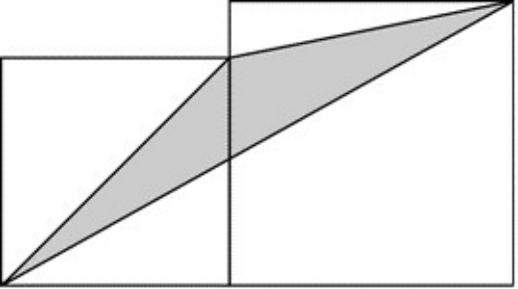
The diagram shows two adjoining squares with side lengths \(a\) and \(b\) (with \(a < b\)). What is the area of the grey triangle?
Show answer
Answer: B — \(\tfrac{1}{2}a^{2}\)
Show hints
Hint 1 of 2
Put the two squares on a common baseline with coordinates, the small square (side \(a\)) on the left and the big one (side \(b\)) on the right.
Still stuck? Show hint 2 →
Hint 2 of 2
Find the grey triangle's area with the shoelace formula and watch the \(b\)-terms cancel.
Show solution
Approach: coordinates and the shoelace formula, watching \(b\) cancel
- Place the small square with corners \((0,0)\) and \((a,a)\); the big square sits to its right with top-right corner \((a+b,\,b)\).
- The grey triangle has vertices \((0,0)\), \((a,a)\) and \((a+b,\,b)\).
- Shoelace area \(= \tfrac{1}{2}\,|\,0(a-b) + a(b-0) + (a+b)(0-a)\,| = \tfrac{1}{2}\,|ab - a^2 - ab| = \tfrac{1}{2}a^2\), independent of \(b\).
- So the grey area is \(\tfrac{1}{2}a^2\) — answer (B).
Mark:
· log in to save