Problem 15 · 2018 Math Kangaroo
Hard
Geometry & Measurement
substitution
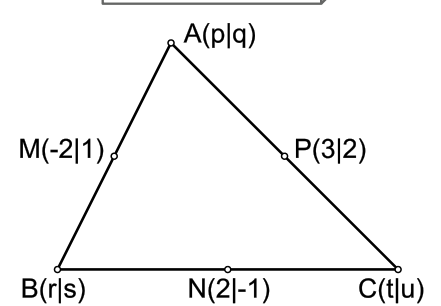
The vertices of a triangle have the coordinates \(A(p \mid q)\), \(B(r \mid s)\) and \(C(t \mid u)\), as shown. The midpoints of the sides of the triangle are the points \(M(-2 \mid 1)\), \(N(2 \mid -1)\) and \(P(3 \mid 2)\). Determine the value of the expression \(p + q + r + s + t + u\).
Show answer
Answer: D — \(5\)
Show hints
Hint 1 of 2
The sum of the triangle's vertices relates simply to the sum of the side midpoints.
Still stuck? Show hint 2 →
Hint 2 of 2
Each midpoint is the average of two vertices.
Show solution
Approach: sum the midpoints to get the sum of the vertices
- Adding the three midpoints: (A+B)/2 + (B+C)/2 + (C+A)/2 = A+B+C.
- So the sum of all vertex coordinates equals the sum of all midpoint coordinates.
- Midpoints sum: x: −2+2+3 = 3; y: 1−1+2 = 2; total 3+2 = 5.
- Thus p+q+r+s+t+u = 5.
Mark:
· log in to save